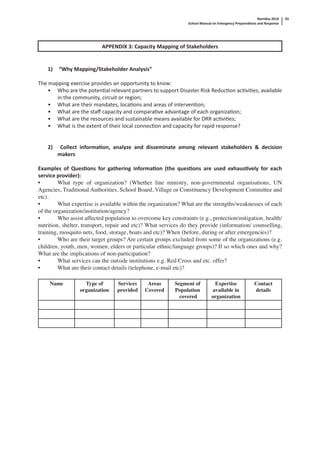
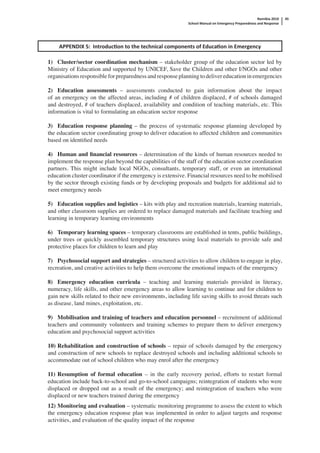
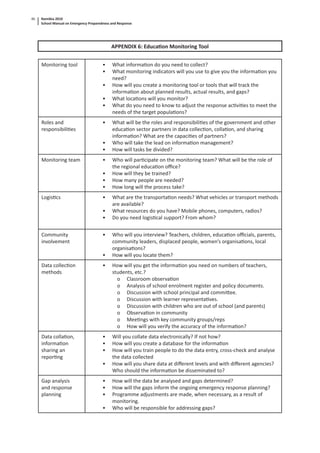
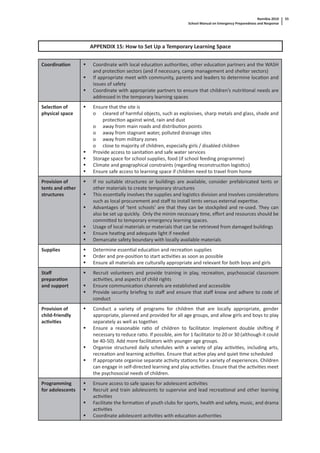
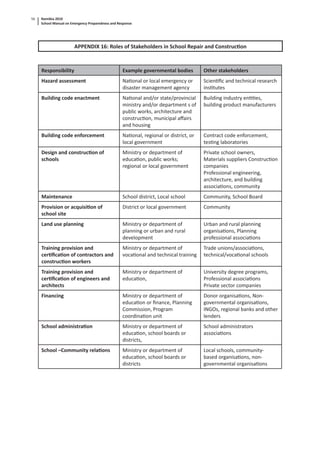
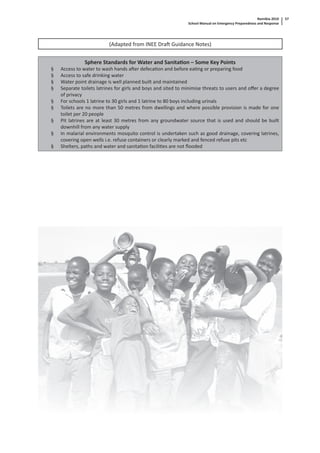
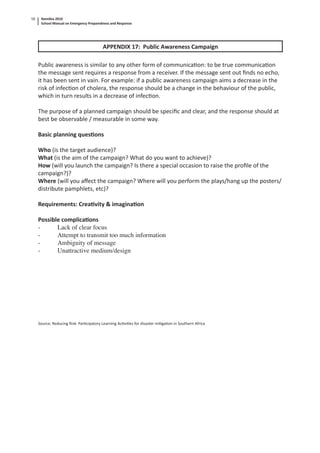
Namibia 2010
School Manual on Emergency Preparedness and Response
3
Content:
Introduc on ...................................................................................................................................5
1) What is a disaster? Key concepts and risk factors ...................................................................7
2) The importance of Educa on in Emergencies........................................................................ 13
3) Protec on during emergencies............................................................................................. 17
4) Disaster risk reduc on - What can children do? .................................................................... 22
5) Disaster management and community involvement............................................................. 26
6) How to ensure quality educa on - Teacher challenges and support ...................................... 29
7) How to ensure quality learning - Study ps .......................................................................... 32
8) References............................................................................................................................ 34
9) Appendix.............................................................................................................................. 36
Namibia 2010
School Manual on Emergency Preparedness and Response
4
Namibia 2010
School Manual on Emergency Preparedness and Response
5
Introduction
This manual is the result of the recent flood disaster in Namibia and efforts made to improve the
preparedness for future disasters in the educa on sector. It is being piloted and tested out in Caprivi.
Comments and feedback will be incorporated in the development of the planned Na onal School
Manual on Emergency Preparedness and Response.
The north and north-east areas of Namibia are prone to annual seasonal flooding. The Cuvelai ecological
area of the northern regions is characterized by thousands of shallow drainage channels locally known
as ‘oshanas’. Flooding of the ‘oshanas’ in the Cuvelai normally occurs a er heavy local rains or good
rainfalls in the highlands of neighbouring Angola. The regions face yearly small scale floods, which
some mes result in damage of varying magnitudes.
The north east regions of Kavango and Caprivi have experienced a yearly increase in the level of
flooding since 2003. Floods are caused by the Zambezi and Kwando river systems which overflow, high
ground water levels and above normal rainfall. Eastern Caprivi comprises the area east of the Kwando
River. The eastern part is surrounded by three perennial rivers to the west (Kwando), south (Linyan ),
south-east (Chobe) and north (Zambezi). The second part is formed by the Caprivi Strip or West Caprivi
to the west of the Kwando River and stretching up to the Kavango River. More than seventy percent
of the Caprivi popula on lives in rural areas in tradi onal dwellings with limited access to sanita on
facili es. According to the Human Poverty Index for 2000, Caprivi was ranked as the poorest region in
the country. The Caprivi region is characterized by extreme flatness and about thirty percent of the
region is inundated every year during seasonal floods.
In 2009, the Namibian government declared a na onal emergency a er the highest flood level in fi y
years causing extensive damage to socio-economic infrastructures in the six northern regions. The
disaster response was characterized by poor coordina on and lack of preparedness. It is an cipated
that, in the future floods could last as long as eight months, from February to September. One of
the recommenda ons made by the na onal government in January 2009 was to prepare for future
emergencies by developing a school manual on emergency preparedness and response.
In January 2010, the Caprivi Regional Educa on Office, UNESCO and UNICEF organized a three-day
workshop to formulate recommenda ons for improvements to local, regional and na onal disaster risk
con ngency plans in the field of educa on. The goal was to develop the disaster preven on, recogni on
and preparedness of the educa on sector in Namibia. Representa ves from fi een of the most
affected schools in Caprivi, the Regional Educa on Forum and the Na onal Ins tute for Educa onal
Development (NIED) shared their best prac ces and developed recommenda ons. Relevant materials
and outcomes from the workshop have been included in this manual and adapted for radio programmes
that will be disseminated through Community Media and Learning Centres in flood-affected regions.
The target audience for this manual is educa on personnel in order to enable a culture of disaster
risk reduc on, and to enhance disaster risk management and knowledge management in Namibia.
The manual is meant to be a prac cal guide for teachers on how to prepare and involve the learners,
parents, school boards, community members and local authori es in a par cipatory way.
Chapter 1 focuses on commonly used disaster management terminology, disaster risk reduc on, the
various phases in an emergency - disaster preparedness, mi ga on, preven on and response, and the
con ngency planning process and outputs; Chapter 2 focuses on reasons why educa on is essen al,
explores some tools that can assist in ensuring quality educa on during disasters and disaster risk
reduc on in educa on; Chapter 3 explains the legal obliga on to ensure a child friendly learning
environment and how to do so; Chapter 4 focuses on children’s right to par cipate and how they can
ac vely contribute to disaster risk reduc on; Chapter 5 emphasises the important role of community
par cipa on in disaster risk reduc on and management; Chapter 6 presents ideas on what teachers
Namibia 2010
School Manual on Emergency Preparedness and Response
6
can do, or get help to do, to improve their own situa ons during emergencies and at the same me
ensuring that quality teaching takes place; Chapter 7 provides ideas and sugges ons on how to ensure
quality learning before, during and a er emergencies; and a number of appendix provides ideas and
tools for disaster risk preparedness ac vi es at the school and in the community.
The Caprivi region was selected to pilot the manual as the area is most prone to floods in Namibia.
Due to the scarcity of educa onal materials on disaster risk reduc on for the Namibian context, the
manual draws on experiences from Southern Africa, from similar disaster responses in Asia along with
best prac ces from the Inter-Agency Network in Educa on in Emergencies. See references at the back
for further reading.
There have been many contributors to this pilot manual. It is based on ground work prepared by
colleagues at the Prime Minister’s Office, the Ministry of Educa on, the various Regional Councils and
UNICEF. Special thanks go to Mr. D.M. Liswaniso and Mr N. Sibeya at the Caprivi Regional Educa on
office, Mr. Ndopu at the Regional Educa on Forum, Mr. P. Simalumba at NIED, and Mr. A. Chunga, Mr.
F.K. Kachingo, Mr. L. S. Mulonda, Mr. F. M. Imenda, Mr. L.M. Muletwa, Mr. R.S. Longwani, Mr. B. Sisamu,
Mr. A. Sinyepe, Mr. F.N. Mbanga, Mr. S.B. Matengu, Mr F.M Kayoaka, Mr. D.M Mufalo, Mr. G. Nkando,
Mr. J. Imasiku and Mrs. D. M. Ntema, principals in Caprivi.
This manual was funded by UNESCO, and collated and wri en by Goeril Tomren, Educa on in
Emergencies Specialist at UNESCO and UNICEF, Windhoek in March 2010.
Namibia 2010
School Manual on Emergency Preparedness and Response
7
1) What is a disaster? Key concepts and risk factors
This chapter focuses on commonly used disaster management terminology, disaster risk reduc on,
the various phases in an emergency - disaster preparedness, mi ga on, preven on and response,
and the con ngency planning process and outputs
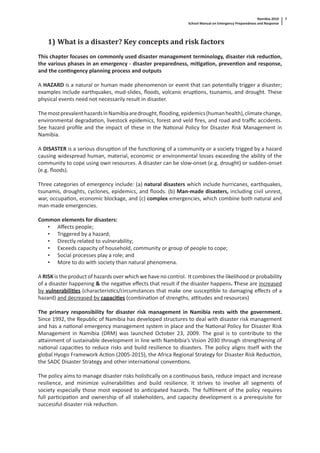
A HAZARD is a natural or human made phenomenon or event that can poten ally trigger a disaster;
examples include earthquakes, mud-slides, floods, volcanic erup ons, tsunamis, and drought. These
physical events need not necessarily result in disaster.
ThemostprevalenthazardsinNamibiaaredrought,flooding,epidemics(humanhealth),climatechange,
environmental degrada on, livestock epidemics, forest and veld fires, and road and traffic accidents.
See hazard profile and the impact of these in the Na onal Policy for Disaster Risk Management in
Namibia.
A DISASTER is a serious disrup on of the func oning of a community or a society trigged by a hazard
causing widespread human, material, economic or environmental losses exceeding the ability of the
community to cope using own resources. A disaster can be slow-onset (e.g. drought) or sudden-onset
(e.g. floods).
Three categories of emergency include: (a) natural disasters which include hurricanes, earthquakes,
tsunamis, droughts, cyclones, epidemics, and floods. (b) Man-made disasters, including civil unrest,

war, occupa on, economic blockage, and (c) complex emergencies, which combine both natural and
man-made emergencies.
Common elements for disasters:
• Affects people;
• Triggered by a hazard;
• Directly related to vulnerability;
• Exceeds capacity of household, community or group of people to cope;
• Social processes play a role; and
• More to do with society than natural phenomena.
A RISK is the product of hazards over which we have no control. It combines the likelihood or probability
of a disaster happening & the nega ve effects that result if the disaster happens. These are increased
by vulnerabili es (characteris cs/circumstances that make one suscep ble to damaging effects of a
hazard) and decreased by capaci es (combina on of strengths, a tudes and resources)
The primary responsibility for disaster risk management in Namibia rests with the government.
Since 1992, the Republic of Namibia has developed structures to deal with disaster risk management
and has a na onal emergency management system in place and the Na onal Policy for Disaster Risk
Management in Namibia (DRM) was launched October 23, 2009. The goal is to contribute to the
a ainment of sustainable development in line with Nambibia’s Vision 2030 through strengthening of
na onal capaci es to reduce risks and build resilience to disasters. The policy aligns itself with the
global Hyogo Framework Ac on (2005-2015), the Africa Regional Strategy for Disaster Risk Reduc on,
the SADC Disaster Strategy and other interna onal conven ons.
The policy aims to manage disaster risks holis cally on a con nuous basis, reduce impact and increase
resilience, and minimize vulnerabili es and build resilience. It strives to involve all segments of
society especially those most exposed to an cipated hazards. The fulfilment of the policy requires
full par cipa on and ownership of all stakeholders, and capacity development is a prerequisite for
successful disaster risk reduc on.
Namibia 2010
School Manual on Emergency Preparedness and Response
8
The Regional Disaster Risk Management Commi ee (RDRMC) is in charge of disaster preparedness and
response at the regional level. It liaises with the Directorate of the Disaster Risk Management (DDRM)
at the Prime Minister’s Office. The Na onal Disaster Risk Management Commi ee (NDRMC) is chaired
by the Secretary to the Cabinet and is composed of Permanent Secretaries, UN agencies, strategic
NGOs and ins tu ons. The NDRMC is responsible to the President and the Prime Minister. It is the
highest level of coordina on forum. It acts as a policy advisor and recommends to the President on the
need to declare a state of na onal emergency and to call for interna onal assistance. The Cons tuency
Disaster Risk Management Commi ee (CDRMC) and Village Disaster Risk Management Commi ee
(VDRMC) are instrumental in cascading disaster support to cons tuencies and villages levels.
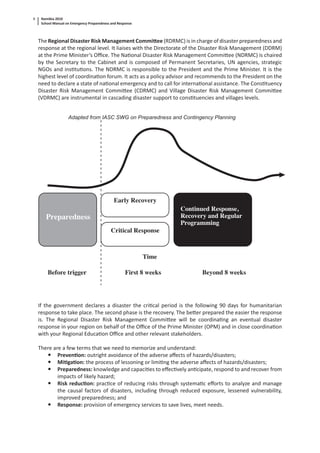
If the government declares a disaster the cri cal period is the following 90 days for humanitarian
response to take place. The second phase is the recovery. The be er prepared the easier the response
is. The Regional Disaster Risk Management Commi ee will be coordina ng an eventual disaster
response in your region on behalf of the Office of the Prime Minister (OPM) and in close coordina on
with your Regional Educa on Office and other relevant stakeholders.
There are a few terms that we need to memorize and understand:
Preven on: outright avoidance of the adverse affects of hazards/disasters;
Mi ga on: the process of lessoning or limi ng the adverse affects of hazards/disasters;
Preparedness: knowledge and capaci es to effec vely an cipate, respond to and recover from
impacts of likely hazard;
Risk reduc on: prac ce of reducing risks through systema c efforts to analyze and manage
the causal factors of disasters, including through reduced exposure, lessened vulnerability,
improved preparedness; and
Response: provision of emergency services to save lives, meet needs.
Adapted from IASC SWG on Preparedness and Contingency Planning
Time
Before trigger First 8 weeks Beyond 8 weeks
Preparedness
Critical Response
Early Recovery
Continued Response,
Recovery and Regular
Programming
Namibia 2010
School Manual on Emergency Preparedness and Response
9
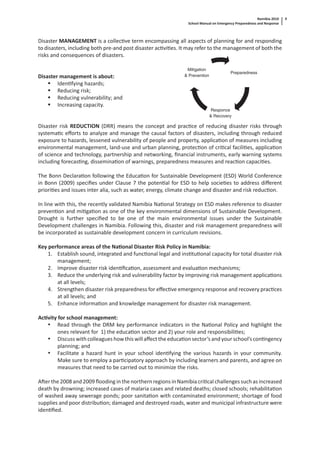
Disaster MANAGEMENT is a collec ve term encompassing all aspects of planning for and responding
to disasters, including both pre-and post disaster ac vi es. It may refer to the management of both the
risks and consequences of disasters.
Disaster management is about:
Iden fying hazards;
Reducing risk;
Reducing vulnerability; and
Increasing capacity.
Disaster risk REDUCTION (DRR) means the concept and prac ce of reducing disaster risks through
systema c efforts to analyze and manage the causal factors of disasters, including through reduced
exposure to hazards, lessened vulnerability of people and property, applica on of measures including
environmental management, land-use and urban planning, protec on of cri cal facili es, applica on
of science and technology, partnership and networking, financial instruments, early warning systems
including forecas ng, dissemina on of warnings, preparedness measures and reac on capaci es.
The Bonn Declara on following the Educa on for Sustainable Development (ESD) World Conference
in Bonn (2009) specifies under Clause 7 the poten al for ESD to help socie es to address different
priori es and issues inter alia, such as water, energy, climate change and disaster and risk reduc on.
In line with this, the recently validated Namibia Na onal Strategy on ESD makes reference to disaster
preven on and mi ga on as one of the key environmental dimensions of Sustainable Development.
Drought is further specified to be one of the main environmental issues under the Sustainable
Development challenges in Namibia. Following this, disaster and risk management preparedness will
be incorporated as sustainable development concern in curriculum revisions.
Key performance areas of the Na onal Disaster Risk Policy in Namibia:
1. Establish sound, integrated and func onal legal and ins tu onal capacity for total disaster risk
management;
2. Improve disaster risk iden fica on, assessment and evalua on mechanisms;
3. Reduce the underlying risk and vulnerability factor by improving risk management applica ons
at all levels;
4. Strengthen disaster risk preparedness for effec ve emergency response and recovery prac ces
at all levels; and
5. Enhance informa on and knowledge management for disaster risk management.
Ac vity for school management:
• Read through the DRM key performance indicators in the Na onal Policy and highlight the
ones relevant for 1) the educa on sector and 2) your role and responsibili es;
• Discuss with colleagues how this will affect the educa on sector’s and your school’s con ngency
planning; and
• Facilitate a hazard hunt in your school iden fying the various hazards in your community.
Make sure to employ a par cipatory approach by including learners and parents, and agree on
measures that need to be carried out to minimize the risks.
A er the 2008 and 2009 flooding in the northern regions in Namibia cri cal challenges such as increased
death by drowning; increased cases of malaria cases and related deaths; closed schools; rehabilita on
of washed away sewerage ponds; poor sanita on with contaminated environment; shortage of food
supplies and poor distribu on; damaged and destroyed roads, water and municipal infrastructure were
iden fied.
Responce
& Recovery
Preparedness
Mitigation
& Prevention
Namibia 2010
School Manual on Emergency Preparedness and Response
10
Con ngency planning involves preparedness planning for most likely disasters, based on vulnerability
and risk analysis. Elements of con ngency planning include:
o Development of likely disaster scenarios based on risk analyses with es mates of
numbers of affected people and types of impact;
o Capacity mapping of stakeholders, e.g. strength and resources among community
development commi ees, NGOs, health personnel, police and etc;
o Iden fica on of roles and responsibili es for components of emergency response;
o Establishment of sector and cross-sector coordina on mechanisms at local, regional
and na onal level;
o Response plans prepared by all sectors including clear objec ves, strategies, policies
and procedures and ar cula ng cri cal ac ons that must be taken; and
o Preparedness ac ons such as developing uniform assessment instruments, supply
stockpiling and long term agreements, disaster management training.
During an emergency, me pressure is one of the most acute problems. Con ngency planning
allows me to deal with an cipated problems before the onset of a crisis. It provides an opportunity
to iden fy constraints and focus on opera onal issues prior to the on-set of a crisis. For example,
it provides opportuni es to map the vulnerabili es of a poten al target popula on, poten al areas
of rights viola ons, assess logis cal infrastructure such as port or warehousing capacity, and assess
coordina on and ins tu onal capacity. By working together in a con ngency planning process, people
develop a common understanding of common challenges, of each other’s capaci es and organiza onal
requirements.
At the Caprivi Lessons Learned workshop January 2010 a principal shared at what happened during
the flooding in 2009:
“The school is situated in rural area outside Ka ma. From early March up to the end of April the school
was surrounded by water. The school forwarded its request for support to the regional council and the
circuit office. The school was informed that boats, tents, food and support material would be provided,
but nothing was done.
Teachers and learners started crossing the deep water to the school and first period was always affected
due to the long distance. Furthermore, the level of water increased all over and it became impossible
to con nue to cross the water by foot. Un l then both teachers and learners had been wading to school
with water up to the waist. The teachers were le without transport and accommoda on while other
schools were provided with the basic needs. The school was forced to close for two weeks because
teachers could not access the site and conduct classes.
A er two weeks private boats were used for transport, and the school reopened. However, some
learners lost their books and school bags on their hazardous way to school. Two teachers and several
learners almost lost their lives due to boats capsizing on their way to school. Learners at the school
received food aid by end of April when the school was about to close for the term. No assessment
was done by either the Regional Disaster Risk Management Commi ee (former REMU) or the regional
office during or a er the flood”.
Recommenda ons from the par cipants a ending the workshop:
• Document and disseminate lessons learned to minimize future risks;
• Ensure mechanism/procedure for community par cipa on during emergency preparedness
planning;
• Clear and transparent logis cal procedures;
o Fair distribu on of relief assistance and support according to needs e.g. sufficient
number of hover and engine boats for each affected school;
o Transparent process with proof of receipt of emergency supplies to schools, inform
receiver in advance of goods to receive, confirma on to sender of receipt with copies
to relevant ministries.
Namibia 2010
School Manual on Emergency Preparedness and Response
11
• Ensure educa on-related needs assessments coordinated through the Regional Disaster Risk
Management Commi ee to the regional office. This is to enable mely budget alloca on
specific to educa on in emergencies at regional level.
The Namibia Na onal Educa on Con ngency Plan was developed by the Ministry of Educa on in
January 2009 and forms part of the Na onal Con ngency Plan (for all sectors). The objec ves are
to ensure safety, security, physical and psycho-social well-being of all learners and teachers before,
during and a er the emergency; Safety of physical infrastructure (schools), access roads, etc; Minimum
disrup on of learning ac vi es due to disaster; Access to schools (educa on); and Learning materials
protected.
The MoE Con ngence Plan includes ac vi es to be done before an emergency such as:
• Risk mapping for schools and qualita ve analysis of physical infrastructure;
• Simula on exercises;
• Pre-posi oning of learning and emergency materials;
• Community and teacher sensi sa on on early warning;
• Establishment of coordina on structures for educa on and with other sectors and
clear communica on channels;
• Dissemina on of the Minimum Standards for Educa on in Emergencies;
• Development of a school manual on emergency preparedness and response; and
• Development of guidelines on camping at schools.
Components of school disaster management include assessment and planning, risk reduc on and
response capacity development. System disaster management includes educa on preparedness and
response plans within government policy, including funding for the implementa on and capacity
building
Sugges ons for your school:
Learn principles and prac ce of disaster risk reduc on and review the Namibia Con ngency
Plan for Educa on with your colleagues;
Become aware of disaster risks in your community and how to reduce them by facilita ng a risk
mapping in your school and create a local con ngency plan ensuring community par cipa on;
Consult with the Regional Educa on Office and the Educa on in Emergencies Commi ee on
how to adapt the na onal plan;
Prepare and implement school disaster plans and disaster risk reduc on efforts;
Create clear roles and responsibili es for all personnel, learners and school board for carrying
out the con ngency plan in case of emergency;
Submit your plan and assessed needs (material, food, transport, health, sanita on, shelter,
training) to the regional educa on office; and
Organize simula ons drills and appropriate response to early warnings available in your school
and community to make sure your plan is func onal and updates it regularly.
FOR THE EDUCATION SECTOR AS A WHOLE AND WIDER GOVERNMENT:
• Iden fy possible types of disasters and geographic risks;
• Carry out mul media awareness raising campaign;
• Iden fy preparedness measures;
• Provide pre-training for vulnerable communi es;
• Government should do risk assessment survey before construc on of any buildings in
emergency-prone areas;
• Incen ve training ;
• Government should prepare emergency shelters and evacua on plans;
• Affected structures should be repaired;
• Early warning systems to be improved and accessible to schools;
Namibia 2010
School Manual on Emergency Preparedness and Response
12
• Commi ees to be established under OPM with all line ministries, UN, NGOs, church leaders
to focus on DRR;
• Development of curriculum for pre-service and in-service training on DRR; and
• Each region should then formulate commi ees under REMU with line ministry par cipa on
to implement na onal DRR plans in the regions.
Note: A crisis is the me to follow the crisis plan, not to make a plan from scratch!
Namibia 2010
School Manual on Emergency Preparedness and Response
13
2) The importance of Education in Emergencies
This chapter focuses on reasons why educa on is so essen al, explores some tools that can assist in
ensuring quality educa on during disasters and disaster risk reduc on in educa on.
Globally disaster risk reduc on and the Hyogo Framework iden fy knowledge and educa on on
disaster risk reduc on as ONE of the FIVE priori es for ac ons in order to achieve disaster resilient
communi es and na ons. Interna onal actors ac vely involved to reduce the risk of disasters have
expressed their commitments and ini a ve to support the planning, guidance and repor ng on
accomplishments of this priority:
1. Ensure that disaster risk reduc on is a na onal and a local priority with a strong ins tu onal
basis for implementa on;
2. Iden fy, assess and monitor disaster risks and enhance early warning;
3. Use knowledge, innova on and educa on to build a culture of safety and resilience at all
levels ;
4. Reduce the underlying risk factors; and
5. Strengthen disaster preparedness for effec ve response at all levels.
Note; Learning takes place in a variety of circumstances in the child’s wider environment – at home,
a er school, in religious ins tu ons and in interac ons with other community members. The school is
one of many social ins tu ons where learning takes place.
Why Educa on in Emergencies?
Educa on is a right. This right is ar culated in various interna onal humanitarian and human
rights instruments, including the Geneva Conven ons, which apply in mes of war, as well as
the Conven on on the Rights of the Child, the Universal Declara on of Human Rights and many
regional rights instruments. The right to educa on is also stated in The Namibian Educa on Act
and Vision 2030.
Educa on in emergencies is a necessity that can be both life-sustaining and life-saving, providing
physical, psychosocial and cogni ve protec on. Educa on in emergencies saves lives by directly
protec ng against exploita on and harm, and by dissemina ng key survival messages, such as
landmine safety or HIV and AIDS preven on.
Educa on is priori sed by communi es. Communi es o en start up some kind of educa on/school
themselves during an emergency. Maintaining this during a crisis can be difficult, however, due to
diminished local capaci es and fewer resources. Emergencies offer opportuni es to improve the
quality of and access to educa on.
Educa on response in emergencies is focused on mee ng the actual needs of the affected
popula on, as well as on formal schooling. The needs depend on the phases and the situa on:
o The acute/flight/displacement phase: Crucial informa on/messages, such as mine, health and
environment risks etc, and emphasis on psychosocial and recrea onal elements
o The chronic or coping phase: organised learning; formal and non-formal, including messages and
topics to prepare for return (if displaced), for the future, risk elements and also peace building and
human rights educa on
o The return, reintegra on and rehabilita on phase: facing the future, rebuilding and upgrading
the whole school system. Without disregarding the devasta on that may have been caused to
the educa on system, this phase should make use of the posi ve opportuni es that may follow
in the a ermath of an emergency. These opportuni es may involve the development of more
equal gender policies and prac ces and the revision of previously divisive curriculum and teaching
prac ces, and requires that sufficient me is given for curriculum development, training of teachers
and the gradual development towards a new defined goal.
Namibia 2010
School Manual on Emergency Preparedness and Response
14
Children and youth have enormous poten al, for learning, for coopera on and for contribu ng to
society. This poten al can be construc ve or destruc ve; children and youth without meaningful
opportuni es and posi ve influences are easily recruited or a racted by alterna ve and o en
nega ve ac vi es. No society can afford to lose the construc ve poten al of its young people; it
must be safe-guarded and cared for even in crisis situa ons. And at last but not least, educa on can
help prevent and mi gate disasters in the future
As men oned above disasters are also an opportunity to Build Back Be er:
Bringing back learners, enroll out of school children, and keep them there;
Ensure equal access for all (disabled, orphaned, girls and boys);
Provide psychosocial support;
Employ teaching and learning methods for children to express themselves;
Ensure quality educa on, including disaster preven on;
Develop disaster-resistant, safe and accessible schools; and
Enhance capacity of educa on planners and managers.
The Inter-Agency Network for Educa on in Emergencies’ (INEE) Minimum Standards for Educa on
in Emergencies, Chronic Crises and Early Reconstruc on is both a handbook and an expression
of commitment that all individuals – children, youth, and adults – have a right to educa on during
emergencies. They echo the core beliefs of the Sphere Project; that all possible steps should be taken
to alleviate human suffering arising out of calamity and conflict, and that people affected by disaster
have a right to life with dignity.
The standards were designed to be an immediate and effec ve tool to promote protec on and
coordina on at the start of an emergency while laying a solid founda on for holis c, quality educa on
and disaster preparedness during reconstruc on. The handbook is designed to give governments and
humanitarian workers the tools that they need to address the Educa on for All and UN Millennium
Development Goals. It is the first step toward ensuring that educa on ini a ves in emergency situa ons
provide a solid and sound basis for post-conflict and disaster reconstruc on.
The standards can be used to assess, monitor and iden fy remaining needs, funding gaps and priori es
during emergencies. The standards can assist teachers in providing essen al survival, school safety and
life skills informa on and establishing a safe and secure environment; to enforce a holis c approach
to emergencies and humanitarian aid, promo ng educa onal responses in the early relief effort that
incorporated a view to longer-term reconstruc on and development of ‘building back be er.’
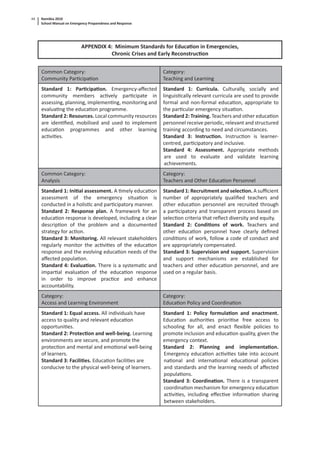
1) MINIMUM STANDARDS Common to All Categories focuses on the essen al areas of community
par cipa on and u liza on of local resources when applying the standards in this handbook, as well
as ensuring that emergency educa on responses are based on an ini al assessment that is followed by
an appropriate response and con nued monitoring and evalua on. Below are some of the standards
par cularly relevant for disasters:
• Emergency-affected community members ac vely par cipate in assessing, planning,
implemen ng, monitoring and evalua ng the educa on programme;
• A mely educa on assessment of the emergency situa on is conducted in a holis c and
par cipatory manner;
• All relevant stakeholders regularly monitor the ac vi es of the educa on response and the
evolving educa on needs of the affected popula on; and
• There is a systema c and impar al evalua on of the educa on response in order to improve
prac ce and enhance accountability.
2) Access and Learning Environment: focuses on partnerships to promote access to learning
opportuni es as well as inter-sectoral linkages with, for example, health, water and sanita on, food
aid and shelter, to enhance security and physical, cogni ve and psychological well-being;
Namibia 2010
School Manual on Emergency Preparedness and Response
15
• Protec on and well-being;
• Learning environments are secure, and promote the protec on and mental and emo onal
well-being of learners; and
• Educa on facili es are conducive to the physical well-being of learners.
3) Teaching and Learning: focuses on cri cal elements that promote effec ve teaching and learning: 1)
curriculum, 2) training, 3) instruc on, and 4) assessment;
• Culturally, socially and linguis cally relevant curricula are used to provide formal and non-
formal educa on, appropriate to the par cular emergency situa on.
4) Teachers and other Educa on Personnel: focuses on the administra on and management of human
resources in the field of educa on, including recruitment and selec on, condi ons of service, and
supervision and support.
5) Educa on Policy and Coordina on: focuses on policy formula on and enactment, planning and
implementa on, and coordina on.
Cross-cu ng issues, such as human and children’s rights, gender, the right of the popula on to
par cipate, HIV and AIDS, disability and vulnerability, have been incorporated into the relevant
standards rather than being dealt with in separate standards. Acceptance of the minimum standards is
a commitment to increased accountability, transparency and quality. See appendix 4 and 5 for further
details.
With ac ve actors (UNESCO, UNICEF, Red Cross and etc), global frameworks are suppor ng na onal
efforts in a coordinated manner to be of greater impact by COMBINING our EFFORTS and reviewing
current ini a ves, gaps and opportuni es related to DRR, developing a work plan based on outputs
and indicators, working in close collabora on with Governments ac vi es and commitment to DRR,
sharing of lessons learnt and network exchanges and among na onal, NGOs, private sectors, schools
associa ons.
The objec ves of disaster risk reduc on (DRR) in Educa on:
To seek poli cal commitment in integra ng DRR into educa on curricula, school construc on
and educa on sector plans;
To promote the integra on of DRR into non-formal educa on and extra-curricular ac vi es
and recognize the importance of tradi onal and indigenous knowledge;
To highlight the role and contribu on of learners, local communi es, in par cular women,
as well as local authori es and implemen ng partners (NGOs, na onal socie es) in the
educa onal process;
To recognize the special needs of vulnerable groups including disabled children; and
To iden fy good prac ces and iden fy na onal “champions” in integra ng disaster risk
reduc on into school curricula and in developing school safety programmes.
Disaster risk reduc on (DRR) ac vi es
Integra ng DRR into the curriculum, training teachers, construc ng disaster-resistant school
infrastructure, and development of DRR resources for children and teachers are prac cal
examples of DRR ac vi es which can be supported by the Ministry of Educa on and partners;
Children are important agents for improving safety and resilience and should be involved in
DRR efforts; and
Ensuring safety at school is paramount in order to save the lives of learners and teachers,
prevent injuries and facilitate a culture of resilience.
Note; Remember to develop school and community con ngency plans IN ADVANCE for school
con nuity. This should be in line with regional con ngency plans and na onal policies. Include as
necessary:alternateschoolloca ons,alternatetransporta on,alternateschedules,alternatecurriculum
Namibia 2010
School Manual on Emergency Preparedness and Response
16
delivery methods, reten on and recruitment of learners, exam prepara on and administra on, and
resources and training for psychosocial support, and back-up educa onal records in safe loca ons.
Namibia 2010
School Manual on Emergency Preparedness and Response
17
3) Protection during emergencies
This chapter explains the legal obliga on to ensure a child friendly learning environment, and how
to do so
Safety is a human concern – this concern must be taken more decisively by school communi es given
that they are in the business of caring for the young and in preserving lives. It is a concern that must be
taken seriously and strive con nually to achieve at all mes especially during emergencies.
• Emergencies have an impact on a child’s personal growth and development, educa on systems
and disrupt the environment in which children learn and grow;
• Emergencies affect educa on opportuni es for children differently, depending on the nature
of the emergency, a tudes toward girls and other marginalised groups, and a community’s
own resources; and
• Emergencies can have a profound psychological effect on children. It is important to understand
that the effects of trauma are normal reac ons to abnormal circumstances and that each
person can be affected by trauma c experiences in a different way.
According to research carried out by the United Na ons children are exposed to many physical and
physiological threats that jeopardize their health and safety during emergencies. While all children may
be exposed to threats to their security and wellbeing in and around school, some are at par cular risk.
The most vulnerable groups include children with special needs, disabili es or health impairments;
those affected by abuse, discrimina on, exploita on, war or natural disaster; orphans and children
affected by HIV and AIDS; minority children; those in remote, rural areas or urban slums; and girls.
Children who face a combina on of these factors are at an even higher risk of discrimina on and
physical and psychological violence, exploita on and abuse.
The Conven on on the Rights of the Child spells out the obliga ons of governments to facilitate
children’s right to learn in a safe and secure environment, whether a conven onal school or a designated
learning space in an emergency. The Interna onal Conference on School Safety held January 2006 in
Gujarat, India reaffirmed both the Hyogo Framework of Ac on Priority for Ac on 3 “Use knowledge,
innova on and educa on to build a culture of safety and resilience at all levels” and the UN Millennium
Development Goal number 2 to “Achieve universal primary educa on by year 2015”. Recognizing that
every child has both the right to educa on and the right to safe and sustainable living, set the goal to
achieve “Zero Mortality of Children in Schools from Preventable Disaster by the year 2015”.
It has been sta s cally proven that children who are not in the care of their parents or other responsible
adults are more prone to traffic accidents, vic ms of fire and less protected against criminal ac ons.
When the village school is closed due to flooding, hostels are full or parents cannot afford the costs
of boarding, people are being crea ve in how to ensure that their children s ll gain access to school.
A tradi onal prac ce in Namibia is called “home service” where learners are placed in temporary
shelters close to the school. During that me learners are entrusted in the care of elder siblings
a ending the same school. The children o en have to commute over large and hazardous distances
to acquire their food from the village of origin. Special precau ons need to be taken by the parents,
school administra on and local community to ensure the protec on and wellbeing of these learners,
especially during emergencies, un l government can provide safe access to school for all children.
What can parents/primary care givers do? Parents should ensure that the children’s basic needs are
covered (food, shelter, clothing, health and security); Ensure safe access and transport to the place of
learning; A end school parent mee ngs; Visite learners in schools and reloca on camps to familiarize
themselves with the situa on; Support school development funds and; A end to parent-learner
educa on on DRR.
Namibia 2010
School Manual on Emergency Preparedness and Response
18
Following the INEE Minimum Standards we need to ensure that learning environments are secure,
and promote the protec on and mental and emo onal well-being of learners, and ensure that
educa on facili es are conducive to the physical well-being of learners. Schools should have a learning
environment where children are free from fear, anxiety, danger, disease, exploita on, harm or injury.
We need to create a healthy, safe and protec ve environment through the provision of school-based
health, nutri on, water and sanita on services, and codes of conduct against violence.
What can teachers do? Teachers cannot be psychologists, but they can play a cri cal role in the
trauma healing process and in the emo onal adjustment of the learners and the preserva on and
promo on of the mental health of the children. This means providing safe and protec ve schools
that are adequately staffed with trained teachers; equipped with adequate resources and graced with
appropriate condi ons for learning; Recognize trauma and refer more serious cases; Explain what
disasters are and why they happen; Facilitate par cipatory learning and safe space for expression,
grieving and play; Teach disaster awareness and preven on educa on; Ensure disaster awareness and
preven on is included in curriculum and; Report incidents to relevant authori es. See appendix 8-12
for more details on how to recognize trauma and suggested ac vi es
Poor condi ons influence children’s well-being and their future livelihood. It creates challenges that
make it difficult for children to enrol in school, a end regularly, complete the final year of the cycle or
achieve the prescribed level of learning.
How to verify that access and learning environment is according to Minimum Standards?
• The learning structure is located in proximity to the popula on it serves and accessible to all
regardless of physical ability;
• Access is safe and secure for all, no dangers on the way to “school”;
• Learning environment is free from dangers that may cause harm to learners;
• Training programmes for teachers, learners and the community are in place to promote safety,
security and protec on;
• Teachers and other educa on personnel are provided with the skills to give psychosocial
support to learners’ emo onal well-being;
• The community is involved in decisions regarding loca on, systems and policies to ensure that
learners are safe and secure,
• Nutri on and short-term hunger needs of learners are addressed to allow for effec ve learning
to take place;
• Basic health and hygiene are promoted in the learning environment;
• Class space and sea ng arrangements are in line with an agreed ra o of space per learner
and teacher, as well as per grade level, in order to promote par cipatory methodologies and
learner centred approaches;
• Adequate sanita on facili es are provided in close proximity of the learning environment; and
• Adequate quan es of safe drinking water and water for personal hygiene are available at the
learning site.
Food and water insecurity, malnutri on, parasi c infesta ons, unhygienic surroundings, chronic
poverty, household chores, harmful tradi onal beliefs and prac ces, domes c overcrowding, gender
discrimina on, HIV and AIDS, domes c violence, childcare deficiencies and the increasing prevalence
and severity of natural disasters related to climate change are factors that can wreak havoc with a
child’s right to a end and complete school. Schools must therefore focus on the whole child, which
means taking into account condi ons in the family or community that might be hindering his or her
educa onal progress.
What can school administrators do? School administrators can; Inform the authori es about the
ac vi es and needs; Organize safety awareness ac vi es for staff, learners and community; Integrate
safety and disaster awareness in the curriculum; Create emergency and con ngency plans; Organize a
school emergency preparedness commi ee; Organize emergency drills; Conduct trainings for the staff;
Namibia 2010
School Manual on Emergency Preparedness and Response
19
Coordinate with emergency agencies; Implement safety policies and building maintenance; Conduct
a site vulnerability and risk assessments; Implement risk reduc on measures; Raise funds to purchase
safety equipment and pe on government for funds for reloca on or retrofi ng; Establish school
safety clubs and task forces in schools and provide training to them; Prepare tools like manuals, games
and ac vity kits for training school teachers and learners in disaster management; Train teachers for
crea ng a culture of safety in schools, and; Ins tu onalize the program through training of trainers.
Educa on managers cannot and should not be engineers, but can be trained and supported to play a
key role in the priori za on, planning and monitoring of school reconstruc on. One factor is to involve
the community and encourage them to take charge of the SCHOOL MAINTENANCE COMMITTEE.
The Educa on Act of 2001 gives each School Board a larger responsibility for the maintenance of
their facili es. To successfully take on this responsibility the schools will need skills and insight in the
planning and organisa on of maintenance as well as in the prac cal measures. In 2003 Ministry of
Basic Educa on, Sports and Culture published “Schools Las ng Longer” a manual for simple repair and
maintenance in Namibian Schools. It describes how to plan, implement and follow up maintenance
and gives step by step instruc ons on how to take care of and maintain schools. The manual should be
made available in all schools.
One of the important ways that schools develop response capacity skills and raise awareness of the
need for assessment, planning and risk reduc on is by conduc ng REGULAR EMERGENCY DRILLS. Drills
offer the opportunity to iden fy training needs, establish new reflexes and teach through ac on and
repe on. For example prac ce on pu ng on life jackets and prac cing water safety for an eventual
evacua on or transport by boat. Three types of drills are all useful: simple drills that focus on specific
skills and behaviour that may at first seem unnatural; table-top exercises especially for management
and school-based leadership that emphasize a range of coordina on tasks; and full-scale scenario drills
that involve all members of the community. Scenario drills provide a chance to prac ce coordina on
of func onal organiza on of response as well as opera onal skills such as light search and rescue, fire
suppression, hazardous materials control and logis cs skills to facilitate life-saving, security, nutri on,
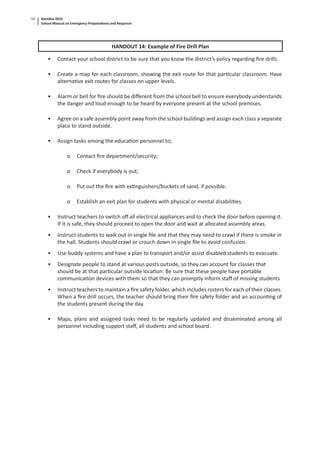
shelter and sanita on, and psycho-social support. See appendix 14 for more informa on on Fire Drill.
Good prac ces from Philippines: “Using par cipatory risk assessments, parents and children in an
urban neighbourhood began to think about flood risks. Parents made life vests for the children, and
ini ated drills at a nearby swimming pool”.
What can teachers do? Teachers can advocate by teaching safety and disaster awareness and organize
safety awareness ac vi es, conduct emergency drills, join the school emergency preparedness
commi ee, teach how to prepare a safety kit, learn first aid and join sa ey trainings, report unsafe
condi ons and faulty safety equipment, volunteer in safety assessment and building inves ga on,
raise funds to purchase safety equipment and pe on government for funds.
Sugges ons based on the Lessons learned from Caprivi:
• Revitalise or create a school maintenance commi ee, fast-track the infrastructure development,
especially in those areas that affect security, such as school fencing and repair of broken windows;
• Make the children aware of dangers e.g. strong currents, snakes, crocodiles, hippos in the streams
or rivers;
• Prepare and implement school safety plans; taking steps to assess the hazards to schools and to
address/strengthen and properly maintain them with a mul -hazard approach; and ensure that
new schools are designed, sited, and constructed with hazards in mind;
• Ensure that there is adequate teaching staff or adult volunteers from the school board, at school
at all mes, for example, one or two teachers to supervise children during breaks and on the
playgrounds;
• Ensure that teachers know who is authorized to pick up the child, ensuring that the learner is only
allowed to leave the school premises with a specified adult;
Namibia 2010
School Manual on Emergency Preparedness and Response
20
• Train guidance counsellors and teachers to be able to provide psychosocial support and referrals
for children at risk.
Health-related policies in schools can help ensure a safe and secure physical environment and a
posi ve psychosocial environment. They should address all types of school violence, such as the abuse
of learners, sexual harassment and bullying and help maintain the educa on system in the face of HIV
and AIDS.
Provision of safe water and sanita on facili es, as first steps in crea ng a healthy school environment
can reinforces hygienic skills and behaviours. Providing separate sanita on facili es and privacy for girls
is an important contribu ng factor in reducing dropout during and before menstrua on.
Skills-based health educa on that focuses on the development of knowledge, a tudes, values and life
skills is needed to make appropriate posi ve decisions, to establish lifelong healthy prac ces, and to
reduce vulnerability to substance abuse and HIV and AIDS.
School-based health and nutri on services that are simple, safe and familiar, can address problems
that are prevalent and recognized as important by the community, including the provision of counselling
to cope with the AIDS epidemic.
During larger disasters affected popula ons might be forced to relocate to a safer space. Many are then
dependent on the authori es or humanitarian agencies to cover their basic needs such as food, health,
shelter, educa on and security. There exist extensive minimum standards and guidelines on camp
management, e.g. Sphere Standards and Camp Management Toolkit. With a good con ngency plan
everything should ideally be planned in advance and catered for, in real life this not always the case.
Furthermore, when you have a large number of people gathered in a limited space the risk of spreading
of diseases, fire incidents, sexual abuse and exploita on increases propor onally with the number of
people. Special measures needs to be taken to deal with for example refuse removal, alloca on of
space to individuals and families, loca on of clinic and school and other basic services, access to safe
drinking water and a variety of security and protec on issues.
Safety measures recommended in RELOCATION CAMPS based on Lessons learned from Caprivi:
o Relocated educa on personnel to liaise with camp management;
o Ensure that access to quality educa on is equal and free from s gma and discrimina on and
that facili es are according to standards;
o School administrators/teachers to implement a confiden al monitoring system for allega ons of
sexual and gender based violence;
o Train teachers, volunteers and community members on the systems that have been put in place
to prevent, monitor and report viola ons of the Code of Conduct and Confiden ality;
o Ensure establishment of a school board for the camp school, health and hygiene commi ee and
a security commi ee to maintain law and order, and dissemina on of informa on on prevalent
risks;
o Organize pickup points where children, especially girls, can be picked up and taken home at the end
of the day, and organize safe transport or walking clubs so that children can walk home in groups
rather than alone; and
o Plan for the safe return and reintegra on to the area of origin.
In Namibia, it is against the law to physically or sexually abuse a child. It is important to immediately
report cases of abuse to the police to enable collec on of informa on and evidence so that the abuser
can be arrested and aligned in court. Every region has a ‘Women and child protec on unit’ within the
police, o en based at the local hospital. There prescribed special procedures and organise immediate
needs for the abused such as medical a en on, preven on of HIV and other sexually transmi ed
diseases and pregnancy, and psycho-social support services. Cases should be reported as soon as
Namibia 2010
School Manual on Emergency Preparedness and Response
21
possible, so the child can be asked important ques ons about the abuse while she or he s ll remembers
clearly, to assist the police in their inves ga on. Just remember that the child’s own safety comes first,
and it would be wise to speak to a trained counsellor or social worker about how to do this in the best
possible way.
At the Caprivi Lessons Learned workshop January 2010 a principal shared at what happened during
the flooding in 2007;
“One teacher and two learners were being evacuated from the school to the reloca on camp during the
flooding in 2007. In the boat was also the driver, two members of the Na onal Defence Force (NDF) and
belongings of several of the teachers at the school. Rain and strong wind made it difficult to navigate
and then the heavily loaded boat suddenly capsized. Some of the adults managed to swim to the shore
and get help from the nearby house. They then paddled in a dug-out boat (tradi onal boat) to the next
village, where a community member helped to inform members of the NDF in Schuckmansburg and
report the incident. The NDF sent two speed boats which were able to rescue the driver, teacher and
NDF personnel, but it was too late for the two learners who drowned. All the items in the boat were lost
and the teachers have not received compensa on for their lost belonging up to this day.”
Recommenda ons from the par cipants at the Caprivi Lessons Learned workshop:
o Awareness raising campaigns in communi es of the importance of emergency planning and
preparedness;
o Provision of clear safety and security standards, procedures and regula ons;
o Organise evacua ons drills and safe transport training for children as many travel to school by
boat or are crossing rivers and flood water by foot during rainy season;
o Ensure adequate provision of hover and engine boats for each affected school for transport
including life jackets or other floa ng elements.
o Schools to provide informa on about needs e.g. tents, boats and etc, to regional Educa on
Office as part of the con ngency planning - in due me;
o Provision of danger allowance and compensa on related to official du es (replacement of lost
items, visas/border pass/emergency travel cer ficate/passport). This needs to be follow-up
with the teacher unions; and
o Trained marine specialists should be in charge during evacua on, other personnel should be
trained, currently not enough trained personnel assigned to important tasks, e.g. boat drivers
and security measures.
A nurturing and suppor ve environment helps children cope with adverse situa ons, and contributes
to build their resilience. Parents, school teachers, government and other duty bearers have to provide
this support to the children.
Namibia 2010
School Manual on Emergency Preparedness and Response
22
Namibia 2010
School Manual on Emergency Preparedness and Response
23
4) Disaster risk reduction - What can children do?
This chapter focuses on children’s right to par cipate and how they can ac vely contribute to disaster
risk reduc on
DRR ac vi es include all sectors and should be embedded throughout the disaster management cycle.
DRR seeks to minimise vulnerabili es and disaster risks throughout a society, to avoid or to limit the
adverse impacts of hazards on communi es and their development. Generally the poorest segments of
society are affected by disasters the most and propor onally children are among the most vulnerable
when disaster strikes. In this regards it is important to promote children’s role as an ac ve ci zen who
are capable to par cipate in making a decision and taking an ac on on issues relevant to their own lives.
“Children and youth are part of society, so regarding whatever is affec ng them and their communi es,
they must par cipate in thinking, expressing their ideas and solving the problems. Children, especially
those in disaster-affected areas, don’t just need help or to be all- me receivers they also want to stand
up and fight.” - A youth worker with Save the Children’s Child-led Disaster Risk Reduc on program in
Thailand.
Ar cle 13 of the United Na ons Conven on on the Rights of the Child gives children the right to have a
say in ma ers affec ng their own lives, to prepare for their responsibili es in adulthood. This ar cle is
applicable to all children in all emergency situa ons, including chronic crisis and early reconstruc on.
Studies made by Save the Children Sweden in Cuba and Thailand show that children and youth can
play an ac ve role in community affairs that are relevant to them, especially if they are appropriately
trained and supported by adults, like teachers and community members. Children are pleased to
par cipate if they are informed about what the whole thing is about and why and how should they be
involved; if they are empowered by the process; if it is fun, a rac ve and not too difficult; if issues are
relevant to them; and if they get sufficient support from adults.
Note that children’s par cipa on requires long-term commitment and close supervision. It is also
important to keep in mind that children possess capaci es according to their stage of development
which form the basis for their ac ve par cipa on in emergency response, preparedness and mi ga on.
The interac on between teacher and learners, with the teacher as authority figure and facilitator of
learning and the learner as ac ve par cipant is a democra c process that involves mutual respect.
Good prac ce from South Africa, Eastern Cape Province: “A school compe on enables students
to demonstrate their knowledge on disaster risk reduc on through art, music and drama. This best
prac ce was selected for replica on in two other provinces. Mul -stakeholder coopera on and local
media interest supports children in reaching the en re community.”
DRR educa on provides children with the knowledge and skills needed to systema cally recognize
hazards and vulnerabili es, to reduce the physical risks in their environment, make use of capaci es and
resources, and protect themselves and others from hazard impacts. It strengthens children’s thinking,
team-building and problem-solving skills, encourages young people to analyze informa on, iden fy
problems, propose solu ons, and mo vates them to take an ac ve role in community protec on and
environmental stewardship. Educa on counteracts fatalism and passivity, and facilitates changes in
a tude and behavior towards a culture of safety. Par cipa on of children builds their self-esteem and
self-confidence which helps them contribute to the safety of their families and communi es. Children
who par cipate in disaster risk reduc on programs are aware of their rights, know how to be safe and
know where to go for help.
What can children do?
Children can iden fy disaster risks in their communi es; Conduct community risk and resource mapping;
Develop an educa onal campaign to raise awareness of communi es to reduce those risks; Act as role
Namibia 2010
School Manual on Emergency Preparedness and Response
24
models for younger children; Organizing hazard hunts and safety awareness ac vi es; Par cipa ng in
emergency drills; Form a student disaster preparedness commi ee; Volunteer in emergency brigades;
Prepare a do-it-yourself kit; Learn first aid; Report unsafe condi ons and faulty safety equipment; Raise
funds to purchase safety equipment and pe on government for funds ; Suggest improvements in school
ac vi es or repor ng; Prevent abuse within the learning environment and; Organise recrea onal ac vi es.
Based on the Lessons Learned by Save the Children Sweden in Thailand a er the Tsunami in 2005
one possible way to enhance children’s’ par cipa on is as follows:
1. Train a few youth trainers from the community;
2. Organize an orienta on for school administrators, school board and teachers to introduce the
ac vi es and consult with them so that everyone understands the concept and process;
3. Sensi ze parents and community members on the importance of children’s par cipa on, and
what they can do to support the children;
4. Select and involve children in the project/ac vity, involve children and youth in the
conceptualiza on, se ng of criteria and selec on of youth trainers, also include out of school
children;
5. Conduct training on DRR concepts and ac vi es for the children so that they have a good
understanding on hazard, disaster, risk, vulnerability and capacity, and acquire basic skills for
conduc ng DRR ac vi es in their schools as a next step;
6. Conduct training in presenta on skills, community survey, iden fying disaster risks in
community and producing risk and resource maps, on how to plan and strategise educa onal
campaign to raise awareness on situa on at risk and risk behaviour in the community;
7. Conduct community trips to carry out risk and resource mapping: a er being trained,
par cipa ng learners would develop a method for a community study and conduct a field
trip to selected communi es. Informa on gathered from the field would be used for risk and
resource community mapping and for preparing an appropriate DRR educa on campaign;
8. Conduct a community educa on campaign on DRR that features puppet shows, dramas,
brochures, posters and other educa on material launched in schools and communi es; and
9. Document the process and lessons learned to be shared and duplicated in other schools and
regions.
Note that boys and girls might have different percep ons and needs. In risk assessment and ac on
planning ac vi es with children and youth, consider having groups for girls and boys separately.
Good prac ce from Thailand: “Local partners innovated with a “Child-Led Disaster Risk Reduc on
in Thailand” supported by Save the Children Sweden, a child-focused NGO. Youth trainers reached
hundreds of children in dozens of schools to be catalysts taking the lead in DRR ac vi es. Children
took community trips, conducted risk and resource mapping, and developed a disaster risk reduc on
educa on campaign”.
“In Thailand children interview and map their communi es; conduct assessments of risk and
vulnerabili es; educate peers and communi es about these risks; they advocate for government
understanding of issues rela ng to children in disasters; lead the community in developing ac on plans
to mi gate risks; and they conduct program assessments to measure the impact of the work”. Save the
Children Sweden.
Good prac ce from Philippines, Sta. Paz Sur: “In the barangays (villages) of San Francisco municipality,
school children learned in 2006 that their high school was located in a landslide risk area. Students
debated whether and how to relocate the school. The headmaster opened the decision to a community-
wide referendum. The students were in favour of reloca on, though parents were concerned about
the extra travel me and local businesses worried about loss of lunch trade. Student organiza ons in
the high school developed an educa on campaign and their proposal won the vote by 101 to 49 (Plan
Interna onal, 2007). They dug ditches around their temporary school site and put up tents with their
parents. Students now bicycle to their new permanent school that incorporates earthquake mi ga on
measures and prepara on for use as an emergency shelter”.
Namibia 2010
School Manual on Emergency Preparedness and Response
25
Forma on of various DRR teams: Children can further form an early warning group, rescue
and evacua on group, first aid group, etc for whom training can be given on their roles and
responsibili es. These groups will help the other learners when disaster occurs when they are
in the schools. If this idea shall be taken to the community, adults need to be involved in these
groups for be er delivery of services for the ul mate aim to reduce the disaster risks within the
school and within the community.
Simula on exercises: Now and then ar ficial emergency of flood and tsunami can be set up
within the school and ask the children how to respond towards it. It will sustain the impact in
the be er way since the children always remember what they do, instead of learning what to
do. The similar exercise can also be prac ced within the community.
Life Skills: DRR should not be considered as a separated project but could be integrated into
life skill learning. These DRR skills make us not to get panic towards a specific situa on, how to
deal it, and what kind of precau ons to be taken. For example how to behave in a boat, train
for evacua on
“In Vietnam situa onal analysis showed that drowning was a high cause of fatality amongst children.
This research consequently provided the framework for their programming. The Child-Led DRR
program went on to ins tute swimming lessons and produce posters to educate the community on the
importance of children learning how to swim”. Save the Children Sweden.
Flooding is o en associated with elephants, buffalo, lion, hyena, crocodile and hippo a acks, drowning,
snake and insect bites, and contaminated water. When aware of the risks children can be role models
for their peers and take the needed precau onary measures. The older children can for example inform
the younger to only cross a stream if it is clear and shallow during day light. By organizing a buddy
system where the older lead a group of children over a stream while holding hands will create a safer
access to and from school if adult supervision is not an op on. Children like to swim and to prohibit
them from playing in the river will never work. Learners should be informed about the dangers of
swimming in deep water. Organizing swim clubs supervised by responsible adults is also an excellent
opportunity to include out of school children. Children take charge in clearing high grass surrounding
the school premises to avoid snake bites and inform on how to iden fy and avoid contaminated water.
The schools health commi ee should train the learners on preven ve measures in case of snake and
insect bites, scorpion and rat bites and encourage them to assist each other in the efficient buddy
system. During emergencies the space around the schools or play ground becomes less spacious due to
excesswater,andli er,brokenbo lesarespreadalloverbythewater.Diseasesrelatedtocontaminated
water e.g. cholera and dysentery are widespread during flooding. By teaching the learners how to avoid
stagnant water and spreading of diseases the messages will be spread among their siblings, friends,
their families and thus affect the whole community.
The children representa ves can also perform theatre, drama or puppet shows with regular intervals
in the schools for other children as well as in the community for mass awareness. Community radio can
also be used as a medium for DRR.
Based on Lessons Learned from Caprivi, radio programmes on DRR will be disseminated through the
Community Radio.
DRR ac vi es for children:
• Learn principles and prac ces of disaster risk reduc on;
• Become aware of disaster risks in your own community and how to reduce them
• Par cipate in preparing and implemen ng school disaster plans and disaster risk reduc on
efforts;
Namibia 2010
School Manual on Emergency Preparedness and Response
26
• Par cipate in drills and appropriate response to early warnings available in your school or
community; and
• Par cipate as bridges to spread disaster risk reduc on knowledge to families and communi es.
DRR ac vi es for teachers to ensure child par cipa on:
• Appoint focal person to coordinate training of learners on risk reduc on;
• Promote compulsory swimming lessons in a safe environment for learners;
• Include messages about not panicking in sensi za on of children and teachers ;
• Provide general health and hygiene educa on;
• Iden fica on of safe crossing areas;
• Make early warning systems accessible to learners and teachers; and
• Promote compulsory training on first aid for teachers and learners.
Good prac ce in including children with disabili es in DRR from Indonesia: “Arbeiter-Samiter-Bund
(ASB),inpartnershipwiththeProvincialDepartmentofEduca on,Yogyakarta,hasconductedearthquake
preparednesstrainingforteachersandstudentsatalloftheprovince’s60specialneedsschools.Teaming
with deaf colleagues at a local NGO they developed mul media earthquake preparedness materials
including an educa onal drama involving deaf children. Audio based materials for blind children were
also developed. The project also provided teachers with communica ve training, including simple sign
language and mime techniques. Trainings are supported by visual prompts including oversized game
cards. New materials will cover mul -hazards for disabled children in and out of schools”.
Good prac ce in including children with disabili es in DRR from Iran: “Pilot outreach to deaf students
in 2006 has showed a high level of interest among students. In an exploratory needs assessment
workshop, deaf child survivors of the Bam earthquake conveyed their own experiences and parallel
discussion sessions involved 180 students, parents and teachers in explora on of core no ons of school
safety for deaf children, appropriate methodologies for conveying earthquake educa on to them, and
iden fica on of their basic needs following a disaster. The results will inform the design of outreach
programmes to deaf students in the future”.
Schools should have disaster risk mapping (hazard zone and safe zone along with vulnerable sec on
(disabled) within school campus). The map can be displayed within the school campus at the prominent
place for informa on dissemina on to other children in the schools. Ac ve members from women
groups, Cons tuency and Village Development Commi ees, local leaders, and so on can be included.
As risk mapping is not a one me ac vity, which has to be updated once in 6 months (at least once in
a year), it can be ini ated and led by children in the community and 30 to 40 percent adults should be
involved. This will ensure sustainable impact of child led DRR.
Good prac ce from Nepal, Bhaktapur, Syangja & Chitwan; “The Nepali Red Crescent Society has
worked in more than 450 communi es prone to earthquakes, floods and landslides. School students
are involved in hazard mapping and vulnerability and capacity assessments in their communi es. Using
peer learning sessions, compe ons and Junior RC Circles, students have raised funds for awareness
and mi ga on work”.
The goal should be to promote schools as centers for community disaster risk reduc on, mobilizing a
culture of safety through mobiliza on and organiza on and promo ng ini a ves among children in
and out of schools that make them leaders in risk reduc on in the community.
Namibia 2010
School Manual on Emergency Preparedness and Response
27
5) Disaster management and community involvement
This chapter emphasises the important role of community par cipa on in disaster risk reduc on
and management.
As men oned in previous chapters disaster risk reduc on (DRR) seeks to minimise vulnerabili es and
disaster risks throughout a society, to avoid or to limit the adverse impacts of hazards on communi es
and their development. DRR ac vi es include all sectors and should be embedded throughout the
disaster management cycle. Generally the poorest segments of society are affected by disasters the
most and propor onally children are among the most vulnerable when disaster strikes. DRR is cost-
effec ve - every $1 spent on DRR saves $4 spent on relief and rehabilita on. A school safety program
has many benefits for linking the school to the family and community in disaster risk reduc on.
According to the Lesson learned from the Pakistani earthquake in 2005 the remaining challenges
required to achieve success and ensure sustainability were corresponding training for contractors
and engineers; formaliza on of roles and responsibili es, including repor ng procedures; con nuous
revision/update of plans; inclusion in standard training programmes and curriculum; and coordinated
planning, evidence-based and community-based standards and procedures.
In the hours following a disaster search and rescue and the provision of immediate assistance to the
injured and homeless are almost en rely carried out by family members, rela ves and neighbors. In
the case of small-scale events, communi es may be le en rely to their own devices, as there may be
no external assistance available at all. Even the most vulnerable communi es possess skills, knowledge,
resources and capaci es. These assets are o en overlooked and underu lized and, in some cases, even
undermined by external actors. It is therefore crucial that at-risk communi es are ac vely involved
in the iden fica on and analysis of the risks they are facing, and par cipate directly in the planning,
design, implementa on, monitoring and evalua on of disaster risk ac vi es.
Minimum Standard number 1 on Community Par cipa on is to ensure that emergency-affected
community members ac vely par cipate in assessing, planning, implemen ng, monitoring and
evalua ng the educa on programme;
• Parents and households have regular, meaningful two-way communica on with the school;
• Parents have an integral role in assis ng school learning;
• Parents are full partners in decision making about educa on outcomes for their children;
• Parents are welcome in the school and their support for children’s learning is sought.
DRR should be made as part and parcel of the schools and community. The communi es might
celebrate events or arrange fes vals, work for common cause where they share the responsibili es
of fund collec on, decora on, cultural programs, etc. Nobody taught them about this and it is being
transferred from one genera on to next. In the same way, DRR commi ees should exist in the schools
and communi es forever, making DRR as their culture, as part and parcel of their life.
A rights-based approach to educa on means that governments are the ul mate duty bearers, with
a responsibility to ensure access to quality basic educa on for all children. However, parents and
communi es are ‘first-line’ duty bearers, responsible for accessing available opportuni es for their
children and for suppor ng quality educa on in their community. Parents and communi es have a
duty to lobby their government for schools that can provide quality educa on for their children. In the
absence of such government provision, parents and communi es s ll have a duty to their children and
need to establish schools that can provide quality educa on.
Good prac ce from Philippines, Banaba: “A regional NGO, the Center for Disaster Preparedness, and
local environmental coali on Buklod Tao (People Bonded Together) pioneered in the development of
Child Oriented Par cipatory Risk Assessment and Planning Tools. Children and parents are engaged in
par cipatory hazards, vulnerability and capacity assessment. A resul ng ac on plan led to mothers
Namibia 2010
School Manual on Emergency Preparedness and Response
28
producing life vests for children, and flood evacua on drills with children using life vests in local
swimming pool were ini ated. Disaster preparedness educa on messages are conveyed through
banners in each of 7 neighbourhoods (Luneta, 2007)”.
Good prac ce from Iran: “A pilot effort in 2 schools was ini ated in 1996by the Public Educa on
Department of Interna onal Ins tute of Earthquake and Engineering (IIEES) By 2008, the 10th Na onal
Earthquake and Safety Drill reached more than 14 million students in over 124,000 schools the country.
The Ministry of Educa on, Ministry of Interior (Na onal Commi ee for Natural Disaster Reduc on),
IIEES, Iranian Red Crescent Society, and Iran Na onal Television and Radio Broadcast cooperate to
support the drill. An Earthquake Safety Alarm is broadcast on na onal and local radio. Voluntary School
Earthquake Safety Councils involve teachers and parents in risk reduc on and preparedness efforts at
school sites”.
Parents and communi es must be closely involved in all aspects of the school and must be prepared to
support it by shouldering the fair and reasonable costs required to promote quality educa on. Parents
should have a vested interest in what schools offer and in the outcomes of the educa on process for
their children and communi es. In turn, schools have an obliga on to be sensi ve to the communi es
they serve, to care for and protect the children entrusted to them, and to be accountable to the local
community in their governance and management. School boards and parent-teacher commi ees
are the governance and management mechanisms through which this linkage and accountability are
manifested:
• Mobilize parent, learners, local community and educa on staff to champion school safety;
• Schools to prepare and implement school safety plans including measures to be taken both
within school premises and in the immediate neighborhood. This must include regular
safety drills; and
• Promote ac ve dialogue and exchange between schools and local leaders including police,
civil defense, fire safety, search and rescue, medical and other emergency service providers.
O en families and households do not feel empowered to take on these roles, nor are schools prepared
to support them. Therefore, it is important to involve families in their children’s educa on and establish
community school links at the earliest stages. Communi es will generally support teachers and iden fy
with schools (local ownership) if children are learning, teachers are commi ed to facilita ng learning
and the school is responsive to the concerns of the local community, and if the communi es are
involved in the planning and decision making process.
What can parents and community members do? Parents and community members can support
the teachers others in safety awareness ac vi es; they can join the school emergency preparedness
commi ee and emergency drills; encourage coordina on among local official, business and schools
to maximize efforts in preparedness and response; volunteer in school safety assessment, and raise
or donate funds for the purchase of safe equipment or repair of facili es and pe on government
for funds for reloca on/retrofi ng; and spread disaster risk reduc on knowledge to families
and communi es and; advocate for all new school buildings to be adherent to building codes that
incorporate disaster resilience (design, loca on, construc on, materials and methods, inspec on,
monitoring and maintenance).
Good prac ce from Jamaica; “150 professionals and PTA representa ves from an ini al 30 target
schools have knowledge and skills to develop comprehensive school emergency preparedness
and response plans and sensi ze community members on how to use a hazard map, community
vulnerability assessment, basic disaster management, shelter management and basic first aid. This
small-scale programme highlights longer-term needs and priori es”.
DRR ac vi es for teachers and parents at school level;
• Promote ac ve dialogue and exchange between schools and local leaders including police, civil
defence, fire safety, search and rescue, medical and other emergency service providers;
Namibia 2010
School Manual on Emergency Preparedness and Response
29
• Ensurethatalsonon-teachingstaffreceivetheopportunityfortrainingindisasterriskreduc on;
• Be accountable for applying prescribed safety norms and regula ons in your own schools.
• Establish commi ee on DRR;
• Ensure ac ve par cipa on of school community, including children and parents, in preparing
and implemen ng school disaster plans and disaster risk reduc on efforts;
• Be prepared to respond to emergencies;
• Encourage and support children to par cipate in spreading disaster risk reduc on knowledge,
ac ng as bridges to families and communi es;
• School construc on needs to take into account risk assessment;
• Advocate for bridges and signs;
• Advocate for construc on of storm water channels;
• Improve drainage systems near schools.
Awareness campaigns needs to be planned during community mee ngs, radio, newspapers, churches
andschools.Advocacymessagescanbesharedonno ceboards,assemblymee ngs,parentgatherings,
informa on centre e.g. market places, clinics and etc. Messages could be;
o Use mosquito/insect repellent and purifica on tablets;
o Avoid li ering and broken bo les both on land and in water;
o Ensure that school site and play ground has no stagnant water;
o Cleaning of utensils a er use to avoid cockroaches and rats;
o Clear bushes around water points;
o Learners should move in groups to avoid harassment (sexual/criminal);
o Report dangerous animals to elders, parents and teachers; and
o Sexually transmi ed diseases and preven on measures.
See appendix 17 for more informa on on for more ideas on how to arrange a Community Awareness
Campaign.
Schools can ac vely engage communi es through ac vi es such as;
• Training community members on what to do, what to carry, when floods strike - accessing safe
areas during disasters;
• Emphasis on buddy system where community members work together;
• Establish commi ee to lead DRR ac vi es at community level in conjunc on with local
authori es including;
• Establish guidelines to advise community members on where to build their houses;
• Training community members on use of local resources and establish guidelines on where to
fish during floods and to pre-posi on food in advance of floods Prepare temporary emergency
shelter and establish evacua on plans so community members know where to go; and
• Establish community-level early warning systems and upgrade infrastructure to be flood
resistant.
The key features of con nuity planning for schools involve:
• Alterna ve school loca ons iden fied in advance.
• Off-site back-up kept of key student records.
• Plans for con nuity of student learning in the event of school closures (e.g. instruc on
via local radio or television, distance instruc on, telephone trees, mailed lessons and
assignments).
• Plan for con nuity of core opera ons: staffing and communica ons.
When the crisis occurs the plan is ready to act upon!
Namibia 2010
School Manual on Emergency Preparedness and Response
30
Namibia 2010
School Manual on Emergency Preparedness and Response
31
6) How to ensure quality education - Teacher challenges and
support
This chapter presents ideas on what teachers can do, or get help to do, to improve their own situa ons
during emergencies and at the same me ensuring that quality teaching will take place
During emergencies teachers have crucial role. They gather early warning messages, disseminate
informa on, host and coordinate local decision making mee ngs, facilitate evacua ons assist in
distribu ng relief goods, and they o en take care of learners outside office hours. This is in addi on to
their teaching responsibili es and ensuring a protec ve learning environment.
As a teacher you are a role model for your learners. During and recovering from a disaster dealing with
your own grief and pain you are also needed by your learners to help them deal with theirs. This is not
an easy role. There is a risk of increasing the trauma of a child to see their caretakers responding in a
disorganized, confused or anxious manner. If you as a teacher feel overwhelmed or irritable, it is best to
simply help the child understand why you also react. Communicate your feelings as normal reac ons,
and the learners will understand and not be afraid. To be able to care for others you need to take care
of yourself as well.
While taking a plane, during the security instruc ons, you are told to put on your own oxygen mask
before you try to help another person. In any emergency, whether in school or in an airplane you will be
be er equipped to help the people in your care and they will learn from you and be comforted by your
example. Please note that the support that teachers can provide to one another should be considered
as a tremendous asset. Remember during stressful periods to remind each other to take a break. See
appendix 20 for Effec ve Self Care for educa on personnel
At the Caprivi Lessons Learned workshop January 2010 a principal shared at what happened during
the flooding in 2007; Teachers stranded between elephants and crocodiles:
“It was in the year 2007, when the flooded schools were re-opening for the second term in May. A
private boat of passengers was heading back to the school. On the way within 5km of their trip, the
boat was about to capsize. The driver decided to leave a few teachers on a small island on the Botswana
side of the Chobe River, close to Chobe Na onal Park, opposite to Masikili on the Namibia side. They
were le there at about 3pm, and remained there for over five hours without help. They hoped for
some me that the boat would return to pick them up, but in vain, and were worried about a acks
by wild animals, with elephants on one and crocodiles on the other side. Since they were not able to
reach any of the regional authori es calling with their mobile phones, they then tried and succeeded
in contac ng the emergency unit in the capital Windhoek (1200km away). Windhoek then called the
regional governor in Ka ma Mulilo (the regional capital). The governor and his team drove to Ngoma
and contacted local police officers there, and managed to locate the loca on where the teachers were
stranded. Fortunately, they were able to reach them by rubber boat at about 10pm. The teachers were
then dropped off in Ngoma to try to make the same journey again the next day. In addi on to the risk
of being a acked by elephants or crocodiles, had they been found by Botswana Defence Forces, they
could have been mistaken for poachers and been shot”.
In the situa on described above there was a lack of safety and security standard being followed, local/
regional emergency services were not available, teachers were not being provided any coordinated
support in reaching their place of work, having to fend for their lives to make the dangerous journey.
Teachers did not receive any support to deal with trauma accumulated during the emergency.
Recommenda on from the Lessons Learnt workshop in Caprivi:
• Formal recogni on of the cri cal role of the schools in emergencies for all sectors, i.e. as hubs
of informa on gathering and dissemina on, distribu on of goods, mee ngs;
Namibia 2010
School Manual on Emergency Preparedness and Response
32
• Empower principals during emergencies to ensure be er coordina on of school-related
ac vi es, incl. reloca on of school;
• Clear roles and responsibili es in an emergency, teachers, learners, community, authori es
• Ensure func oning of informa on and communica on channels relevant to emergencies in
educa on (e.g. between affected schools and the regional educa on office);
• Improved coordina on of educa on-related needs assessments through the Regional Disaster
Risk Management Commi ee;
• Provision of danger allowance and compensa on related to official du es (replacement of
lost items, visas/border pass/emergency travel cer ficate/passport) – to be followed up with
teacher unions;
• Integra on of disaster risk reduc on into school curricula, school construc on/loca on and
the educa on sector plans
• To use different fora, i.e. principals’ forum and other teacher assemblies to share informa on
on disaster preparedness and teacher support;
• More teachers trained on disaster risk reduc on.
Another issue during emergencies is the me management. When the school has to close due to lack
of access, security or be relocated to a safer loca on planned classes has to be postponed or cancelled.
This again might lead to learners missing out on vital informa on in order for them to pass their exams.
The teachers know in which subjects learners are weak or strong. During emergencies you should
focus more on strengthening the weaknesses. For example focus more on individual learner support in
mathema cs and science and give self study or group work in other subjects were learners are stronger.
Many teachers work weekends and a ernoons when recovering a er an emergency to ensure quality
educa on. By planning alterna ve schedules in advance and managing your me carefully it is possible
to ensure both a safe learning environment and quality educa on. This should be part of your disaster
risk preparedness.
Teachers’ mo va on and commitment are as much a part of the reform process as their knowledge
and technical competencies. However, building capacity and strengthening the role of field level
educa on supervisors as resource persons who follow up with teachers in their schools or at the school
cluster level will be crucial in the effort of ensuring disaster risk reduc on in Namibia;
• Enhancing the capaci es of head teachers as mentors and ‘catalysts for change’ at the school
and community levels;
• Helping teachers develop self-confidence in their professional competence and become
increasingly autonomous as capable child-friendly school prac oners.
Good prac ce from Sri Lanka on teacher training for DRR:
Following the 2004 Tsunami under leadership of the Ministry of Educa on and the Na onal Ins tute
of Educa on and with the support of the German Technical Coopera on, an effort began to integrate
disaster risk reduc on into the teacher training curriculum and prepare teachers country wide for its
implementa on. India’s Na onal Ins tute of Disaster Management provided ini al expert support and
contributed to the development of a prac cal, skills-focused curriculum. Through the Na onal Colleges
of Educa on all future teachers are reached during their pre-service training and acquire basic Disaster
Management know-how and relevant skills for implemen ng School Safety programmes.
A rights-based approach to educa on means that governments are the ul mate duty bearers, with
a responsibility to ensure access to quality basic educa on for all children including teacher training
and capacity building. Experience to date suggests that school-based, on-the-job training, support and
close supervision are most appropriate for building teacher competencies and maintaining momentum
around the change process in classrooms and schools. In providing such training, it is essen al for
teachers and head teachers to be treated as professionals with a stake in developing their school and
their own prac ce.
Namibia 2010
School Manual on Emergency Preparedness and Response
33
“In Sierra Leone, Seychelles and Tanzania, disaster risk reduc on educa on and teacher training have
been piloted as a prelude to integra on into the curriculum”.
Long-termandsustainablecapacity-buildingfordisaster-resilienteduca onandsafeschoolsreliesupon
embedding these competencies in higher educa on programmes for teacher-training. Partnerships
with pedagogic ins tutes will be vital to the success of these efforts. Three complementary approaches
are all important for long-term sustainability and mainstreaming of disaster preven on educa on:
1. Partnerships with teacher-training ins tu ons and support for faculty-training and seeding;
2. Development of distance-learning self-study tools to support widest low-cost dissemina on of
educa on; and
3. Development of in-service and con nuing educa on curricula for training of exis ng pool of
teachers.
Highereduca onandvoca onaltrainingprogrammesarealsoimportantareasforcapacitydevelopment
for disaster preven on educa on and safe schools.
Namibia 2010
School Manual on Emergency Preparedness and Response
34
Namibia 2010
School Manual on Emergency Preparedness and Response
35
7) How to ensure quality learning - Study tips
This chapter provides ideas and sugges ons on how to ensure quality learning before, during and
a er emergencies.
INEE Minimum Standard 1 on Curricula under Teaching and Learning Standard is to ensure that
culturally, socially and linguis cally relevant curricula are used to provide formal and non-formal
educa on, appropriate to the par cular emergency situa on.
Good prac ce from India, Central Board for Secondary Educa on: “Primary schools introduce disaster
management through extra-curricular performing and visual arts ac vi es. Formal educa on in disaster
management begins in Standard VIII”.
Iden fying curricular needs in your school:
Involve the local community or IDP community members, teachers in the iden fica on and
development of appropriate curricular materials and guides;
Check on the availability of exis ng curricular materials, textbooks, teachers guides and
supplementary materials;
Assess whether textbooks and curricular materials are appropriate for post-crisis and transi on
situa on; and
Consider using or adap ng curricula as appropriate, in accelerated learning, voca onal
educa on, non-formal educa on, life skills, HIV and AIDs, peace educa on and other
appropriate curricula, including mother tongue educa on.
Good prac ce from New Zealand: “The Ministry of Educa on contracted with an educa onal
consultancy to work with both teachers and Civil Defence Officers in planning, developing and tes ng
a teacher and child-friendly curriculum. “What’s the Plan, Stan?” features Stan the dog and 5 children
who model what to do before, during and a er 6 types of disasters. It can be used to incorporate disaster
risk reduc on and content across all areas of the curriculum for students aged 8-12. Components
include teacher’s handbook with unit plans, ac vi es, simula ons and informa on for school planning,
CD-ROM for teachers and students including stories, interac ve games, hazard map, research material,
ps and resources. There is also a storybook and accompanying audio-CD, poster, and website with
informa on and interac ve ac vi es and templates (www.whatstheplanstan.govt.nz). Workshops
introduced this resource to teachers.”
Good prac ce from Mali: ”The Ministry of Educa on and Directorate of Civil Defence introduced
disaster preven on messages to build resilience to drought, locust invasions and flood by introducing
messages on the covers cover and 1 internal sheet of children’s exercise books (providing a total of 8
sides of informa on). This simple and cost-effec ve way of raising awareness in schools has already
reached more than 25,000 students with the help of the Young Business Owners’ and Managers’
Federa on, even before mainstreaming disaster risk reduc on into the curriculum is implemented”.
The ability of teachers to create appropriate teaching learning aids, o en from low-cost, locally
available materials, bolsters success. The approach also assumes that teachers will involve children in
helping to produce learning materials, and that learners’ schoolwork will be posted on school walls for
instruc onal purposes and to ins l a sense of pride.
Use polystyrene packing material, packing boxes, n cans, bo le tops, pebbles, flowers, leaves and
inexpensive, easily obtained materials to make pocket boards, flash cards, big books, charts and
models illustra ng textbook lessons. By calling on their ingenuity, teachers’ latent talents are revealed
and they develop new confidence and pride in their professional competencies. Moreover, produc on
of innova ve, low-cost teaching aids from locally available resources requires wider, more regular
consulta on among teachers within the school and clusters.
Namibia 2010
School Manual on Emergency Preparedness and Response
36
Good prac ces from India, U ar Pradesh: School communi es in U ar Pradesh have made extensive
use of street theatre, magic shows and puppetry to convey disaster risk reduc on messages.
Collabora on between performing ar sts and disaster risk reduc on experts has led to crea ve and
engaging educa onal scripts.
Examples of disaster risk reduc on integra on in various subjects;
• Language Arts Read literature, news ar cles, concerning disasters, hazards, risks. Read
cri cally, explore myths, and use persuasion. Research; write essay, proposal, and le er to
elected officials regarding disaster risk reduc on.
• Mathema cs Solve problems related to assessment and solu ons to natural hazard induced
risks.
• Geography Explore climate, habitats, geology and human/environmental interac ons
producing disaster risk, vernacular architecture, urbaniza on, livelihood impacts of disaster.
• Sciences Learn mechanisms of geological and hydro-meteorological phenomena. Inves gate
local measures for environmental protec on. Conduct experiments to learn principles of
disaster resistant construc on. Learn home and industrial hazardous materials safety. Explore
and prac ce environmental stewardship.
• History and Humani es; Explore historic impact of natural hazards on civiliza ons, indigenous
knowledge for se lement and livelihood protec on.
• Civics Meet with elected officials and par cipate in community planning, local disaster risk
reduc on and advocacy.
• Health & Life Skills; Basic first aid, family disaster planning, response preparedness, health
hazards and pandemic prophylaxis.
• Voca onal training; Learn non-structural mi ga on measures and tools. Learn principles of
disaster resistant design and construc on.
• Foreign Languages; Read passages about natural hazard threats and community-based risk
reduc on.
• Arts; Select disaster risk reduc on as a theme for visual and performing arts projects and
community exhibits.
Good prac ce from Turkey: “Basic disaster awareness is included in the na onal educa on curriculum
of primary school: from 1st grade to 12th grade. Its goal is to help students to iden fy the many small
steps that can be taken to reduce disaster risks, to assist families in risk reduc on and preparedness,
and to help ourselves and those around us following a disaster. It covers: Hazard and Risk Awareness,
Before a Disaster, During and A er a Disaster, and Next Steps (www.ahep.org) “
Monitoring is a more immediate and con nuous process meant to keep things on track and ensure that
the right inputs are included for successful implementa on of a model.
Namibia 2010
School Manual on Emergency Preparedness and Response
37
8) References
“Behaviour change communica on in emergencies: a toolkit” - Kathmandu : UNICEF Regional Office for
South Asia (ROSA), 2006
“Child and youth par cipa on resource guide – Bangkok”: UNICEF Asia and Pacific Regional Office
(EAPRO) Compiled by Junita Upadhyay, 2006
“Child protec on training manual” - Lilongwe : Min. of Women and Child Development/UNICEF Malawi.
Developed by Alice Akunga 2006
“Community Disaster Risk reduc on Implementa on” Par cipants Workbook 1 www.adpc.net Disaster
reduc on for safer communi es and sustainable development Asian Disaster Preparedness Center
MODULE 6 - SESSION 7 Child Focused Disaster Risk Reduc on , Save the Children, 16th Community
Based Disaster Risk Management Course Bangkok, Thailand 16 – 27 July 2007
“Disaster Preven on for Schools, Guidance for Educa on Sector Decision-Makers”, Consulta on
version, November 2008, Author: Marla Petal, Published by: UNISDR, Geneva
November, 2008 h p://www.preven onweb.net/go.php/edu-materials/
Educa on in Emergencies - A Resource Tool Kit © United Na ons Children’s Fund
Regional Office for South Asia (UNICEF ROSA) 2006
“Educa on in Emergencies- A tool kit for star ng and managing educa on in emergencies” Susan
Nicolai - Save the Children 2003
“Emergency and Preparedness (EPR) Training Manual” - New York : UNICEF Div. of Human Resources.
Organiza onal Learning and Development Sec on, 2004
“Full of promise : how the UN’s monitoring and repor ng mechanism can be er protect children –
London” : ODI Humanitarian Prac ce Network, 2008.(HPN Network paper ; no. 62 Wri en by Save the
Children UK for the ODI, Katy Barne and Anna Jefferys, September 2008
“Introduc on to child protec on in emergencies”: an Inter agency modular training package Chris an
Children’s Fund/ Interna onal Commi ee of the Red Cross/Interna onal Rescue Commi ee/Save the
Children Alliance/Terre des Hommes/UNICEF/UNHCR, 2007
“Minimum Standards for Educa on in Emergencies, Chronic Crises and Early Reconstruc on”; Inter-
Agency Network for Educa on in Emergencies (INEE) 2004
“Na onal Policy for Disaster Risk Management in Namibia”, Directorate for Disaster Risk Management,
Namibia 2009
“Outcome document of the Interna onal Conference on School Safety” Ahmedabad, India 18th - 20th
January, 2007
“Reducing risk - Par cipatory Learning ac vi es for disaster mi ga on in Southern Africa”, Astrid von
Kotze and Ailisa Holloway, IFRC/Oxfam, David Philip Publishers 1996
“Schools las ng longer: The manual for maintaining Namibian schools”, Ministry of Educa on Sports
and Culture, Namibia 2003
“Teacher Training in Earthquake Affected Areas”, UNESCO and Ministry of Educa on, Pakistan 2006
Namibia 2010
School Manual on Emergency Preparedness and Response
38
“Towards a Culture of Preven on: Disaster Risk Reduc on Begins at School. Prac ce and Lessons
Learned “ UNESCO/UN-ISDR, Publication Date: 21-11-2007
“Working with vulnerable communi es to assess and reduce disaster risk”, Humanitarian Exchange
Magazine, Issue 38 June 2007, h p://www.odihpn.org/report.asp?id=2888
Namibia 2010
School Manual on Emergency Preparedness and Response
39
9) Appendix
1. Flooding scenario Caprivi 2009
2. Emergency Preparedness, Response and Recovery
3. Capacity Mapping of Stakeholders
4. Standards for Educa on in Emergencies, Chronic Crisis and Early Reconstruc on
5. Introduc on to the technical components of Educa on in Emergency
6. Educa on Monitoring Tool
7. Tool for Recognizing the Symptoms of Stress in Children in Emergencies
8. Age Specific Ac vi es for Children a er Stressful Events
9. Psychosocial Support Needs and strategies for Children in Emergencies
10. IASC Guidelines on Mental Health and Psychosocial Support in Emergency Se ngs Checklist
11. Some ways to help children to cope with disaster
12. UNICEF Supplies for Temporary Learning Spaces
13. Sample Checklist on Basic Safety Requirements
14. Example of Fire Drill Plan
15. How to Set Up a Temporary Learning Space
16. Roles of Stakeholders in School Repair and Construc on
17. Public Awareness Campaign Public Awareness Campaign
18. The Role the School Commi e can play
19. School Disaster Reduc on & Readiness CHECKLIST
20. Effec ve self-care for teacher support
21. Earth Science/flood lesson plan grade 6-8
Namibia 2010
School Manual on Emergency Preparedness and Response
40
Namibia 2010
School Manual on Emergency Preparedness and Response
41
APPENDIX 1: Flooding scenario Caprivi 2009
The following informa on is based on data collated by the former Regional Emergency Management
Units (REMU).
The Situa on 72 Hours a er the onset of the Emergency; February 23, 2010, in the middle of the rainy
season, the Zambezi River has overflowed its banks, resul ng in massive flooding in the Caprivi Strip
and Kavango regions, affec ng almost all the cons tuencies in the two regions. This flooding is much
worse than the 2009 floods and has affected more people. Nearly 20,000 people in Caprivi have been
displaced and have sought higher ground. In Kavango, nearly 30,000 people have been displaced. The
downstream communi es have been especially hard hit. The overall death toll is expected to be not
more than 100 in both regions. The total number of displaced is expected to be at least 50,000, while
as many as 150 may be missing. Nearly 50% of the displaced popula on is expected to be 18 or under.
In Caprivi five of the six cons tuencies (Linyan , Kabbe, Ka ma Rural, Ka ma Urban, Kongola) have
been affected, with Kabbe hit the worst. Due to the flooding, 10 roads in Caprivi are impassible and
bridges have been destroyed together with culverts under roads. A total of 18 camps have been set up
so far on higher ground. It is an cipated that Ka ma Urban will also need at least 5 more camps.
Shelter; Nearly half of the displaced people are seeking shelter in reloca on camps set up by the
Red Cross and government. The displaced are being housed in tents and makeshi shelters of plas c
shee ng. The Red Cross and government have been distribu ng tents, tarpaulins, hygiene kits, and
other non-food items to the rese lement camps. All essen al services, including educa on, have been
disrupted in both regions, with expected displacement of teachers and children. Phone communica on
has been disrupted, though is s ll working in some places but electricity outages disrupted ba ery
recharging.
Health; The Ministry of Health fears a cholera outbreak and malaria is now a much greater threat than
usual. The dissemina on of informa on and educa on about hygiene and health are essen al to the
affected popula on.
Educa on; The schools have all closed since access to them has become impossible. A few schools have
been damaged by the flood waters. Nearly 40,000 children have had their schooling interrupted either
through displacement or lack of access to schools. About 200 schools have been closed because some
are submerged in water and others are inaccessible because water levels make it too dangerous for
children to cross to areas of higher ground where they are situated.
3 WEEKS AFTER FLOODING in Caprivi families have fled the affected areas and the Red Cross has set
up camps for all 20,000 displaced people. Helicopters have been able to drop food and non-food items.
No educa on assistance has reached these people yet despite the fact that there are 10,000 school
children relocated in the camp with their parents.
The Namibia Red Cross Society has deployed tents and set up reloca on camps for almost all 30,000
displaced people and World Food Program is working hand in hand with the Emergency Management
Unit to provide food. About 14, 000 children are not a ending school (Caprivi. Kavango)
Namibia 2010
School Manual on Emergency Preparedness and Response
42
APPENDIX 2: Emergency Preparedness, Response and Recovery
The PREPAREDNESS phase
• Know the community and surrounding hazards;
• Iden fy and involve stakeholders, bring together leaders and community representa ves;
• Consider exis ng efforts/revise exis ng plans and determine what crisis the plan will address;
• Define roles and responsibili es for teachers, students, caregivers, security, medical staff and
spokesperson including backups;
• Develop and establish methods and clear terms for communica ng with the staff, students, families and
the media;
• Prepare for immediate response (and reverse evacua on/return) including students/staff needing
special assistance;
• Obtain necessary equipments and supplies, and create maps and facili es informa on;
• Develop accountability and students release procedures (students, teachers and visitors present –
inform parents of release procedures);
• Define assembly area in case of immediate danger;
• Prac ce - Create drill and training schedule log and facilitate tabletop discussions;
• Address liability issues (e.g. accident during evacua on; school responsible); and
• Plan for recovery - both psychosocial and prac cal);
THE CRISIS PLAN - emergency response:
• Expect to be surprised (confusion);
• Assess the situa on and choose the appropriate response (quickly & carefully);
• No fy appropriate emergency responders and the school crisis team;
• Evacuate and lock down the school as appropriate;
• Triage injuries and provide emergency first aid to those who need it;
• Keep supplies nearby and organized at all mes;
• Trust leadership designated command structure;
• Communicate accurate and appropriate informa on;
• Ac vate the student release system;
• Allow for flexibility in implemen ng the plan; and
• Documenta on (financial expenditure, incidents etc).
The RECOVERY phase
• Assemble the assigned Crisis Management Team and/or school board;
• Return back to normal teaching & learning as quickly as possible;
• Schools and districts need to keep students, families and the media informed (what support the school
can provide taking into account cultural and language differences;
• Focus on the building, as well as people, during recovery;
• Provide assessment of emo onal needs of staff, students, families and responders;
• Provide stress management during class me;
• Conduct daily debriefs for staff, responders, volunteers and others assis ng in recovery;
• Take as much me as needed for recovery;
• Remember anniversaries for crises or larger incidents affec ng the community;
• Evaluate -prepare for the next crisis - which recovery strategies would you change and why?
• Make regular school safety & security efforts part of mi ga on/preven on prac ces to reduce the risks
during eventual future emergencies.
Namibia 2010
School Manual on Emergency Preparedness and Response
43
APPENDIX 3: Capacity Mapping of Stakeholders
1) “Why Mapping/Stakeholder Analysis”
The mapping exercise provides an opportunity to know:
• Who are the poten al relevant partners to support Disaster Risk Reduc on ac vi es, available
in the community, circuit or region;
• What are their mandates, loca ons and areas of interven on;
• What are the staff capacity and compara ve advantage of each organiza on;
• What are the resources and sustainable means available for DRR ac vi es;
• What is the extent of their local connec on and capacity for rapid response?
2) Collect informa on, analyze and disseminate among relevant stakeholders & decision
makers
Examples of Ques ons for gathering informa on (the ques ons are used exhaus vely for each
service provider):
• What type of organization? (Whether line ministry, non-governmental organisations, UN
Agencies, Traditional Authorities, School Board, Village or Constituency Development Committee and
etc).
• What expertise is available within the organization? What are the strengths/weaknesses of each
of the organization/institution/agency?
• Who assist affected population to overcome key constraints (e.g., protection/mitigation, health/
nutrition, shelter, transport, repair and etc)? What services do they provide (information/ counselling,
training, mosquito nets, food, storage, boats and etc)? When (before, during or after emergencies)?
• Who are their target groups? Are certain groups excluded from some of the organizations (e.g.
children, youth, men, women, elders or particular ethnic/language groups)? If so which ones and why?
What are the implications of non-participation?
• What services can the outside institutions e.g. Red Cross and etc. offer?
• What are their contact details (telephone, e-mail etc)?
Name Type of
organization
Services
provided
Areas
Covered
Segment of
Population
covered
Expertise
available in
organization
Contact
details
Namibia 2010
School Manual on Emergency Preparedness and Response
44
APPENDIX 4: Minimum Standards for Educa on in Emergencies,
Chronic Crises and Early Reconstruc on
Common Category:
Community Par cipa on
Category:
Teaching and Learning
Standard 1: Par cipa on. Emergency-affected
community members ac vely par cipate in
assessing, planning, implemen ng, monitoring and
evalua ng the educa on programme.
Standard 2: Resources. Local community resources
are iden fied, mobilised and used to implement
educa on programmes and other learning
ac vi es.
Standard 1: Curricula. Culturally, socially and
linguis cally relevant curricula are used to provide
formal and non-formal educa on, appropriate to
the par cular emergency situa on.
Standard 2: Training. Teachers and other educa on
personnel receive periodic, relevant and structured
training according to need and circumstances.
Standard 3: Instruc on. Instruc on is learner-
centred, par cipatory and inclusive.
Standard 4: Assessment. Appropriate methods
are used to evaluate and validate learning
achievements.
Common Category:
Analysis
Category:
Teachers and Other Educa on Personnel
Standard 1: Ini al assessment. A mely educa on
assessment of the emergency situa on is
conducted in a holis c and par cipatory manner.
Standard 2: Response plan. A framework for an
educa on response is developed, including a clear
descrip on of the problem and a documented
strategy for ac on.
Standard 3: Monitoring. All relevant stakeholders
regularly monitor the ac vi es of the educa on
response and the evolving educa on needs of the
affected popula on.
Standard 4: Evalua on. There is a systema c and
impar al evalua on of the educa on response
in order to improve prac ce and enhance
accountability.
Standard 1: Recruitment and selec on. A sufficient
number of appropriately qualified teachers and
other educa on personnel are recruited through
a par cipatory and transparent process based on
selec on criteria that reflect diversity and equity.
Standard 2: Condi ons of work. Teachers and
other educa on personnel have clearly defined
condi ons of work, follow a code of conduct and
are appropriately compensated.
Standard 3: Supervision and support. Supervision
and support mechanisms are established for
teachers and other educa on personnel, and are
used on a regular basis.
Category:
Access and Learning Environment
Category:
Educa on Policy and Coordina on
Standard 1: Equal access. All individuals have
access to quality and relevant educa on
opportuni es.
Standard 2: Protec on and well-being. Learning
environments are secure, and promote the
protec on and mental and emo onal well-being
of learners.
Standard 3: Facili es. Educa on facili es are
conducive to the physical well-being of learners.
Standard 1: Policy formula on and enactment.
Educa on authori es priori se free access to
schooling for all, and enact flexible policies to
promote inclusion and educa on quality, given the
emergency context.
Standard 2: Planning and implementa on.
Emergency educa on ac vi es take into account
na onal and interna onal educa onal policies
and standards and the learning needs of affected
popula ons.
Standard 3: Coordina on. There is a transparent
coordina on mechanism for emergency educa on
ac vi es, including effec ve informa on sharing
between stakeholders.
Namibia 2010
School Manual on Emergency Preparedness and Response
45
APPENDIX 5: Introduc on to the technical components of Educa on in Emergency
1) Cluster/sector coordination mechanism – stakeholder group of the education sector led by
Ministry of Education and supported by UNICEF, Save the Children and other I/NGOs and other
organisations responsible for preparedness and response planning to deliver education in emergencies
2) Education assessments – assessments conducted to gain information about the impact
of an emergency on the affected areas, including # of children displaced, # of schools damaged
and destroyed, # of teachers displaced, availability and condition of teaching materials, etc. This
information is vital to formulating an education sector response
3) Education response planning – the process of systematic response planning developed by
the education sector coordinating group to deliver education to affected children and communities
based on identified needs
4) Human and financial resources – determination of the kinds of human resources needed to
implement the response plan beyond the capabilities of the staff of the education sector coordination
partners. This might include local NGOs, consultants, temporary staff, or even an international
education cluster coordinator if the emergency is extensive. Financial resources need to be mobilised
by the sector through existing funds or by developing proposals and budgets for additional aid to
meet emergency needs
5) Education supplies and logistics – kits with play and recreation materials, learning materials,
and other classroom supplies are ordered to replace damaged materials and facilitate teaching and
learning in temporary learning environments
6) Temporary learning spaces – temporary classrooms are established in tents, public buildings,
under trees or quickly assembled temporary structures using local materials to provide safe and
protective places for children to learn and play
7) Psychosocial support and strategies – structured activities to allow children to engage in play,
recreation, and creative activities to help them overcome the emotional impacts of the emergency
8) Emergency education curricula – teaching and learning materials provided in literacy,
numeracy, life skills, and other emergency areas to allow learning to continue and for children to
gain new skills related to their new environments, including life saving skills to avoid threats such
as disease, land mines, exploitation, etc.
9) Mobilisation and training of teachers and education personnel – recruitment of additional
teachers and community volunteers and training schemes to prepare them to deliver emergency
education and psychosocial support activities
10) Rehabilitation and construction of schools – repair of schools damaged by the emergency
and construction of new schools to replace destroyed schools and including additional schools to
accommodate out of school children who may enrol after the emergency
11) Resumption of formal education – in the early recovery period, efforts to restart formal
education include back-to-school and go-to-school campaigns; reintegration of students who were
displaced or dropped out as a result of the emergency; and reintegration of teachers who were
displaced or new teachers trained during the emergency
12) Monitoring and evaluation – systematic monitoring programme to assess the extent to which
the emergency education response plan was implemented in order to adjust targets and response
activities, and evaluation of the quality impact of the response
Namibia 2010
School Manual on Emergency Preparedness and Response
46
APPENDIX 6: Educa on Monitoring Tool
Monitoring tool • What informa on do you need to collect?
• What monitoring indicators will you use to give you the informa on you
need?
• How will you create a monitoring tool or tools that will track the
informa on about planned results, actual results, and gaps?
• What loca ons will you monitor?
• What do you need to know to adjust the response ac vi es to meet the
needs of the target popula ons?
Roles and
responsibili es
• What will be the roles and responsibili es of the government and other
educa on sector partners in data collec on, colla on, and sharing
informa on? What are the capaci es of partners?
• Who will take the lead on informa on management?
• How will tasks be divided?
Monitoring team • Who will par cipate on the monitoring team? What will be the role of
the regional educa on office?
• How will they be trained?
• How many people are needed?
• How long will the process take?
Logis cs • What are the transporta on needs? What vehicles or transport methods
are available?
• What resources do you have? Mobile phones, computers, radios?
• Do you need logis cal support? From whom?
Community
involvement
• Who will you interview? Teachers, children, educa on officials, parents,
community leaders, displaced people, women’s organisa ons, local
organisa ons?
• How will you locate them?
Data collec on
methods
• How will you get the informa on you need on numbers of teachers,
students, etc.?
o Classroom observa on
o Analysis of school enrolment register and policy documents.
o Discussion with school principal and commi ee.
o Discussion with learner representa ves.
o Discussion with children who are out of school (and parents)
o Observa on in community
o Mee ngs with key community groups/reps
o How will you verify the accuracy of the informa on?
Data colla on,
informa on
sharing an
repor ng
• Will you collate data electronically? If not how?
• How will you create a database for the informa on
• How will you train people to do the data entry, cross-check and analyse
the data collected
• How will you share data at different levels and with different agencies?
Who should the informa on be disseminated to?
Gap analysis
and response
planning
• How will the data be analysed and gaps determined?
• How will the gaps inform the ongoing emergency response planning?
• Programme adjustments are made, when necessary, as a result of
monitoring.
• Who will be responsible for addressing gaps?
Namibia 2010
School Manual on Emergency Preparedness and Response
47
APPENDIX 7: Tool for Recognizing the Symptoms of Stress in Children in Emergencies
Age Group Possible Symptoms
Very young children
(0 – 5 years)
• Anxious clinging to caregivers
• Temper tantrums
• Fear of going to sleep
• Nightmares and night terrors
• Excessive fear of real or imagined things, e.g., thunder, monsters
Young children
(6 – 12 years)
• Poor concentra on, restlessness or bad behaviour at school
• Anxious behaviour including hyperac vity, stu ering and ea ng
problems
• Psychosoma c complaints, e.g., headache, stomach pains
• Behavioural change, becoming aggressive or withdrawn and
passive
• Sleeping problems
• Regression – ac ng like a younger child
Adolescents
(13 – 16 years)
• Self-destruc veness and rebelliousness, e.g., drug taking, stealing
• Withdrawal – cau ous of others and fearful of the future
• Anxiety, nervousness
• Psychosoma c complaints, e.g., headaches, stomach pains
Namibia 2010
School Manual on Emergency Preparedness and Response
48
APPENDIX 8: Age Specific Ac vi es for Children a er Stressful Events
Preschoolers
Elementary
(grades K-5)
Middle/Junior High to
High School (grades 6-12)
Draw-a-picture Draw-a-picture Art, music, dance
Tell-a-story Tell-a-story Stories, essays, poetry, video
produc on
Coloring books on disaster and
loss
Books on friendship, families,
animals, upbeat and joyful
stories
Books on friendship, adventure,
poetry
Doll, toy play Create a play or puppet show
about a disaster – But if it has
a sad ending never let the
child leave without further
discussions and always end on a
posi ve note
Create a play, puppet show, or
- If it has a sad ending never let
the child leave without further
discussions and always end on a
posi ve note
Group games Create a game about disaster
recovery, disaster preparedness,
partnerships
Group discussions about disaster
preparedness, or disaster
recovery and partnerships
Talks about disaster safety and
self-protec on
School study or community
service projects
School projects on health or
natural and social sciences
Community service projects
Colouring books on happy family
mes
Ask the children to create a play
or puppet show about posi ve
outcomes a er a disaster – or
simply “happy mes” with
friends and family.
Group discussions about what
they would like to do/be when
they grow up
Namibia 2010
School Manual on Emergency Preparedness and Response
49
APPENDIX 9: Psychosocial Support Needs and Strategies for
Children in Emergencies
3 to 5% of the children may require specialised
interven on due to losses, trauma, or unresolved
grief.
What to do? - Teachers and other adults need to
know how to recognise these most vulnerable (least
resilient) children, and refer them for special help
(i.e., medical doctors, tradi onal healers, mental
health professionals, or other appropriate service
providers.) These children should be included in all of
the structured, normalising ac vi es and educa on
opportuni es organised for the other children as
much as possible.
Interven ons need to
• Reconnect children with family members,
friends and neighbours
• Foster social connec ons and interac ons
• Normalise daily life
• Promote a sense of competence and
restore a person’s control over their life
• Allow for expression of grief within a trusted environment, when the child is ready and follow up is
guaranteed
Children’s Needs Possible Psychosocial Interven ons
A Sense of Belonging • Establish an educa on structure where children feel included
• Promote the restora on of cultural, tradi onal prac ces of
childcare, whenever possible
Rela onships with Peers • Provide a dependable, interac ve rou ne through school or
other organised educa onal ac vity
• Offer group and team ac vi es (i.e., sports, drama, etc.) that
requires coopera on and dependence on one another
Personal A achments • Enlist teachers that can form appropriate caring rela onships
with children
• Provide opportuni es for social integra on and unity by
teaching and showing respect for all cultural values, regardless
of differing backgrounds
Intellectual S mula on • Enhancechilddevelopmentbyprovidingavarietyofeduca onal
experiences
3 to 5% require specialised
intervention
70% of the children are
resilient
20 to 25% of the children
are vulnerable
Namibia 2010
School Manual on Emergency Preparedness and Response
50
APPENDIX 10: IASC Guidelines on Mental Health and Psychosocial Support
in Emergency Se ngs Checklist
Educa on Check List
• Promote safe learning environments
• Make formal and non-formal educa on more suppor ve and relevant
• Strengthen access to quality educa on for all
• Prepare and encourage educators to support learners’ psychosocial well-being
• Strengthen the capacity of the educa on system to support learner experiencing psychosocial and
mental difficul es.
Core Principles
• Human rights and equity
Humanitarian actors should promote the human rights of all affected persons and protect individuals
and groups who are at heightened risk of human rights viola ons. Humanitarian actors should also
promote equity and non-discrimina on.
• Par cipa on
Humanitarian ac on should maximise the par cipa on of local affected popula ons in the humanitarian
response. In most emergency situa ons, significant numbers of people exhibit sufficient resilience to
par cipate in relief and reconstruc on efforts.
• Do no harm
Work on mental health and psychosocial support has the poten al to cause harm because it deals with
highly sensi ve issues. Humanitarian actors may reduce the risk of harm in various ways, such as
• Par cipa ng in coordina on groups to learn from others and to minimise duplica on and gaps in
response
• Designing interven ons on the basis of sufficient informa on
• Commi ng to evalua on, openness to scru ny and external review
• Developing cultural sensi vity and competence in the areas in which they intervene/work
• Developing an understanding of, and consistently reflec ng on, universal human rights, power
rela ons between outsiders and emergency-affected people, and the value of par cipatory
approaches
• Building on available resources and capaci es
All affected groups have assets or resources that support mental health and psychosocial well-being. A
key principle, even in the early stages of an emergency, is building local capaci es, suppor ng self-help
and strengthening the resources already present. Externally driven and implemented programs o en
lead to inappropriate mental health and psychosocial support and frequently have limited sustainability.
Where possible, it is important to build both government and civil society capaci es.
• Integrated support systems
Ac vi es and programming should be integrated as far as possible. The prolifera on of stand-alone
services, such as those dealing only with rape survivors or only with people with a specific diagnosis, can
create a highly fragmented care system.
• Mul layered supports
In emergencies, people are affected in different ways and require different kinds of supports. A key to
organising mental health and psychosocial support is to develop a layered system of complementary
supports that meets the needs of different groups.
www.humanitarianinfo.org/iasc/content/products
Namibia 2010
School Manual on Emergency Preparedness and Response
51
APPENDIX 11: Some ways to help children to cope with disaster
• Talk. Provide children with age-appropriate informa on. Speak about your thoughts and
feelings. Honesty and openness will help the child develop trust.
• Listen. Listening (while being careful not to avoid or over-react) and providing comfort will
have a cri cal, long-las ng posi ve effect on the child.
• Discuss. Encourage children to speak with you, and with one another, about their thoughts
and feelings. This helps reduce their confusion and anxiety related to the trauma. Respond to
ques ons in terms they can comprehend.
• Provide a consistent, predictable pa ern as much as possible. It is helpful to try and keep
regular schedules for ac vi es in school as well as ea ng, playing and going to bed to help
restore a sense of security and normalcy for children. Make sure the child knows the pa ern.
When the day includes new or different ac vi es, tell the child beforehand and explain why
this day’s pa ern is different.
• Provide play experiences to help relieve tension. Younger children in par cular may find it
easier to share their ideas and feelings about the event through non-verbal ac vi es such as
drawing.
• Physical exercise. There should be a regular programme of physical exercise in school for both
girls and boys. Physical exercise helps to maintain a sort of psycho-physical balance. Exercise
tones both the nervous system and the muscular system. The chemical reac ons that take
place in the body a er physical exercise act as “happy drug”: except of course that it is perfectly
natural. Given the grieving and sadness many of our children are suffering, physical exercise
helps to li the spirits and bring the child into balance.
• Protect. Do not hesitate to interrupt or stop ac vi es which are upse ng or trauma zing
for the child. If you observe increased symptoms in a child that occur in a certain situa on
or following exposure to certain movies, ac vi es and so forth, avoid these ac vi es. Try to
restructure or limit ac vi es that cause escala on of symptoms in the trauma zed child.
• Support. Reassure children repeatedly that you care about them and that you understand their
fears and concerns. Give the child choices and some sense of control. Providing hugs, kisses
and other physical comfort is very important (within an appropriate context).
• Observe. Watch children closely for signs of re-enactment (e.g., in play, drawing, behaviours),
avoidance (e.g., being withdrawn, daydreaming, avoiding other children) and physiological
hyper-reac vity (e.g., anxiety, sleep problems, behavioural impulsivity). Try to comfort and be
tolerant of the child’s emo onal and behavioural problems (which will probably wax and wane,
some mes for no apparent reason). You might consider keeping a record of the behaviours and
emo ons in a log or journal and try to iden fy pa erns in the behaviour. By iden fying triggers,
you may be able to help your child develop self-soothing abili es.
• Take care of yourself. By remembering to take care of yourself (remember the airlines’ advice
to put on your own oxygen mask before you try to help another), you will be be er equipped
to help your loved ones and they will learn from and be comforted by your example. This is not
an act of selfishness, especially if it allows you to con nue to love and care for your family in
healthy, posi ve ways.
Namibia 2010
School Manual on Emergency Preparedness and Response
52
APPENDIX 12: UNICEF Supplies for Temporary Learning Spaces
EARLY CHILDHOOD DEVELOPMENT KIT
1 Kit per 30 Children
Item Quan ty per kit
Toy bag 1
Paper, newsprint for pain ng and drawing. A4 size, 500 sheets per ream 5
Wax crayon in plas c bag 15
Scissors safety school type, blunt round ps 10
Permanent markers, blue, black, red and green 4 x each colour, 16 per kit
Pres k 2
Art and cra white glue (packed 12 in a box) 2
Round plas c hoola hoops, various colours 10
Puzzles 12 piece, cardboard, African culture 4
Duplo size blocks, 80 pieces per bag, plas c in different colours 4
Puzzles 25 piece, cardboard, African culture 4
Puzzles 50 piece, cardboard, African culture 4
Ragg doll for African child 5
Rubber bounce balls 22” for 3-6 year olds 3
So plas c balls 22” for 3-6 year olds 15
SCHOOL KIT
Item Quan ty per kit
Durable box/container, easy to carry and securable 1
Boxes of white chalk 30
Boxes of coloured chalk 6
Clock, including ba eries 3
Can of 5 litre for blackboard paint 1
Paint brush 3
Rope-ball of standard size 3
Scissors 3
Sellotape 6
Pencil sharpeners 3
Football 6
Volleyball 6
Volleyball net 1
Air pump for balls 2
Namibia 2010
School Manual on Emergency Preparedness and Response
53
HANDOUT 13: Sample Checklist on Basic Safety Requirements
Safety Feature
Water suitable for food prepara on and drinking is available
Water suitable for personal hygiene and cleaning is available
Adequate ligh ng in all areas of the building and surroundings is provided
A manual fire alarm system is in place
Fire ex nguishers are found in corridors and exit routes
Fire ex nguisher are found at the entrances of high risk rooms such as laboratories
Floors are clean, non-slippery
Floors are without splinters and holes
Corridors are wide and spacious
Corridors are free from obstruc ons especially during an emergency
Roofing materials are completely and securely fastened and leak proof
Rooms doors can always be opened from the inside for emergency exit purposes
Stairways have safe and adequately secured railings
Electrical wires and cables are properly fastened and secured
Doors are securely a ached to jambs
Secured entrance and exit points
Combus ble and hazardous chemicals and gases are safely and appropriately
located
Proper segrega on and storage of hazardous materials/chemicals
Func onal electrical and emergency lights with ba ery back-up in all cri cal areas
Regular emergency drills (e.g. fire, earthquake drills) are conducted
Proper exit markings are provided to assist people that are not familiar where exits/
emergency exits are located
Emergency evacua on maps are posted in cri cal areas
Periodic inspec on, repair and maintenance of facili es and surroundings are done
☺
Namibia 2010
School Manual on Emergency Preparedness and Response
54
HANDOUT 14: Example of Fire Drill Plan
• Contact your school district to be sure that you know the district’s policy regarding fire drills.
• Create a map for each classroom, showing the exit route for that par cular classroom. Have
alterna ve exit routes for classes on upper levels.
• Alarm or bell for fire should be different from the school bell to ensure everybody understands
the danger and loud enough to be heard by everyone present at the school premises.
• Agree on a safe assembly point away from the school buildings and assign each class a separate
place to stand outside.
• Assign tasks among the educa on personnel to;
o Contact fire department/security;
o Check if everybody is out;
o Put out the fire with ex nguishers/buckets of sand, if possible.
o Establish an exit plan for students with physical or mental disabili es.
• Instruct teachers to switch off all electrical appliances and to check the door before opening it.
If it is safe, they should proceed to open the door and wait at allocated assembly areas.
• Instruct students to walk out in single file and that they may need to crawl if there is smoke in
the hall. Students should crawl or crouch down in single file to avoid confusion.
• Use buddy systems and have a plan to transport and/or assist disabled students to evacuate.
• Designate people to stand at various posts outside, so they can account for classes that
should be at that par cular outside loca on. Be sure that these people have portable
communica on devices with them so that they can promptly inform staff of missing students
• Instruct teachers to maintain a fire safety folder, which includes rosters for each of their classes.
When a fire drill occurs, the teacher should bring their fire safety folder and an accoun ng of
the students present during the day.
• Maps, plans and assigned tasks need to be regularly updated and disseminated among all
personnel including support staff, all students and school board.
Namibia 2010
School Manual on Emergency Preparedness and Response
55
APPENDIX 15: How to Set Up a Temporary Learning Space
Coordina on Coordinate with local educa on authori es, other educa on partners and the WASH
and protec on sectors (and if necessary, camp management and shelter sectors)
If appropriate meet with community, parents and leaders to determine loca on and
issues of safety
Coordinate with appropriate partners to ensure that children’s nutri onal needs are
addressed in the temporary learning spaces
Selec on of
physical space
Ensure that the site is
o cleared of harmful objects, such as explosives, sharp metals and glass, shade and
protec on against wind, rain and dust
o away from main roads and distribu on points
o away from stagnant water, polluted drainage sites
o away from military zones
o close to majority of children, especially girls / disabled children
Provide access to sanita on and safe water services
Storage space for school supplies, food (if school feeding programme)
Climate and geographical constraints (regarding reconstruc on logis cs)
Ensure safe access to learning space if children need to travel from home
Provision of
tents and other
structures
If no suitable structures or buildings are available, consider prefabricated tents or
other materials to create temporary structures
This essen ally involves the supplies and logis cs division and involves considera ons
such as local procurement and staff to install tents versus external exper se.
Advantages of ‘tent schools’ are that they can be stockpiled and re-used. They can
also be set up quickly. Only the minim necessary me, effort and resources should be
commi ed to temporary emergency learning spaces.
Usage of local materials or materials that can be retrieved from damaged buildings
Ensure hea ng and adequate light if needed
Demarcate safety boundary with locally available materials
Supplies Determine essen al educa on and recrea on supplies
Order and pre-posi on to start ac vi es as soon as possible
Ensure all materials are culturally appropriate and relevant for both boys and girls
Staff
prepara on
and support
Recruit volunteers and provide training in play, recrea on, psychosocial classroom
ac vi es, and aspects of child rights
Ensure communica on channels are established and accessible
Provide security briefing to staff and ensure that staff know and adhere to code of
conduct
Provision of
child-friendly
ac vi es
Conduct a variety of programs for children that are locally appropriate, gender
appropriate, planned and provided for all age groups, and allow girls and boys to play
separately as well as together.
Ensure a reasonable ra o of children to facilitator. Implement double shi ing if
necessary to reduce ra o. If possible, aim for 1 facilitator to 20 or 30 (although it could
be 40-50). Add more facilitators with younger age groups.
Organise structured daily schedules with a variety of play ac vi es, including arts,
recrea on and learning ac vi es. Ensure that ac ve play and quiet me scheduled
If appropriate organise separate ac vity sta ons for a variety of experiences. Children
can engage in self-directed learning and play ac vi es. Ensure that the ac vi es meet
the psychosocial needs of children.
Programming
for adolescents
Ensure access to safe spaces for adolescent ac vi es
Recruit and train adolescents to supervise and lead recrea onal and other learning
ac vi es
Facilitate the forma on of youth clubs for sports, health and safety, music, and drama
ac vi es
Coordinate adolescent ac vi es with educa on authori es
Namibia 2010
School Manual on Emergency Preparedness and Response
56
APPENDIX 16: Roles of Stakeholders in School Repair and Construc on
Responsibility Example governmental bodies Other stakeholders
Hazard assessment Na onal or local emergency or
disaster management agency
Scien fic and technical research
ins tutes
Building code enactment Na onal and/or state/provincial
ministry and/or department s of
public works, architecture and
construc on, municipal affairs
and housing
Building industry en es,
building product manufacturers
Building code enforcement Na onal, regional or district, or
local government
Contract code enforcement,
tes ng laboratories
Design and construc on of
schools
Ministry or department of
educa on, public works;
regional or local government
Private school owners,
Materials suppliers Construc on
companies
Professional engineering,
architecture, and building
associa ons, community
Maintenance School district, Local school Community, School Board
Provision or acquisi on of
school site
District or local government Community
Land use planning Ministry or department of
planning or urban and rural
development
Urban and rural planning
organisa ons, Planning
professional associa ons
Training provision and
cer fica on of contractors and
construc on workers
Ministry or department of
voca onal and technical training
Trade unions/associa ons,
technical/voca onal schools
Training provision and
cer fica on of engineers and
architects
Ministry or department of
educa on,
University degree programs,
Professional associa ons
Private sector companies
Financing Ministry or department of
educa on or finance, Planning
Commission, Program
coordina on unit
Donor organisa ons, Non-
governmental organisa ons,
INGOs, regional banks and other
lenders
School administra on Ministry or department of
educa on, school boards or
districts,
School administrators
associa ons
School –Community rela ons Ministry or department of
educa on, school boards or
districts
Local schools, community-
based organisa ons, non-
governmental organisa ons
Namibia 2010
School Manual on Emergency Preparedness and Response
57
(Adapted from INEE Dra Guidance Notes)
Sphere Standards for Water and Sanita on – Some Key Points
§ Access to water to wash hands a er defeca on and before ea ng or preparing food
§ Access to safe drinking water
§ Water point drainage is well planned built and maintained
§ Separate toilets latrines for girls and boys and sited to minimise threats to users and offer a degree
of privacy
§ For schools 1 latrine to 30 girls and 1 latrine to 80 boys including urinals
§ Toilets are no more than 50 metres from dwellings and where possible provision is made for one
toilet per 20 people
§ Pit latrines are at least 30 metres from any groundwater source that is used and should be built
downhill from any water supply
§ In malarial environments mosquito control is undertaken such as good drainage, covering latrines,
covering open wells i.e. refuse containers or clearly marked and fenced refuse pits etc
§ Shelters, paths and water and sanita on facili es are not flooded
Namibia 2010
School Manual on Emergency Preparedness and Response
58
APPENDIX 17: Public Awareness Campaign
Public awareness is similar to any other form of communica on: to be true communica on
the message sent requires a response from a receiver. If the message sent out finds no echo,
it has been sent in vain. For example: if a public awareness campaign aims a decrease in the
risk of infec on of cholera, the response should be a change in the behaviour of the public,
which in turn results in a decrease of infec on.
The purpose of a planned campaign should be specific and clear, and the response should at
best be observable / measurable in some way.
Basic planning ques ons
Who (is the target audience)?
What (is the aim of the campaign? What do you want to achieve)?
How (will you launch the campaign? Is there a special occasion to raise the profile of the
campaign?)?
Where (will you affect the campaign? Where will you perform the plays/hang up the posters/
distribute pamphlets, etc)?
Requirements: Crea vity & imagina on
Possible complica ons
- Lack of clear focus
- Attempt to transmit too much information
- Ambiguity of message
- Unattractive medium/design
Source; Reducing Risk- Par cipatory Learning Ac vi es for disaster mi ga on in Southern Africa
Namibia 2010
School Manual on Emergency Preparedness and Response
59
APPENDIX 18: The Role the School Commi e can play
Issues to be solved What School Boards can do to help
Children not a ending school School Boards can raise awareness about importance of educa on
in the community to ensure that children are enrolled in school,
and towards authori es to ensure sufficient provision of quality
educa on facili es in rural areas
Increase in drop-outs School Boards can raise awareness in the community about
importance of educa on and support families to send their
children to school through provision of scholarships especially
targe ng vulnerable groups to ensure that students complete
their degree
Insufficient number of teachers School Boards can iden fy in the community persons who could
act as teaching
assistants for the available teachers and
advocate to the authori es for addi onal and subs tute teachers
Not enough materials/teaching
aids
School Boards can organise the community to make teaching aids
from local materials as well as raise money for buying materials.
Trauma sed children School Boards can train community members to iden fy and
address trauma among children, organise recrea onal ac vi es
and offer support to individuals
Overburdened teachers School Boards can take some responsibility for playground duty,
cleaning of school premises, maintenance, financial management
or fundraising, duty rosters, collec on of administra ve data,
needs assessments etc. School Boards can also organise field
visits and excursions and help to supervise these.
Insufficient recrea on and/or co-
curricular ac vi es
School Boards can organise and supervise a range of co-curricular
ac vi es for both girls and boys
Lack of careers advice and further
study advice for students
School Boards can invite speakers from various professions
and universi es and organize seminars and mee ngs with the
students
Source: Adapted from the Teacher training in Earthquake affected areas manual, Pakistan
Namibia 2010
School Manual on Emergency Preparedness and Response
60
Handout 19: School Disaster Reduc on & Readiness CHECKLIST
ACTION STEPS
1. Convene local school safety commi ee represen ng administra on, faculty, staff, students and parents, and local
community.
2. Study the school safety planning and ac on steps below together.
3. As needed assign sub-groups or individuals to be responsible for inves ga ng and making recommenda ons for
each task.
4. Create plan based on task group recommenda ons.
5. Implement the plan, involving the whole school community, se ng milestones and taking ac on steps to achieve
risk reduc on and response preparedness.
6. Communicate and coordinate as needed with educa on authori es using the resources and support available, and
advising them of resource and support needs.
7. Review and revise the plan as necessary, at least annually.
8. Be sure to keep all staff, parents/guardians, and students advised about the plan.
ASSESSMENT & PLANNING
An ongoing school safety commi ee has been established to lead disaster risk reduc on and disaster
response planning in our school. We hold regular mee ngs (including staff, parents/guardians, students
and local community leaders) to develop and review our mi ga on, preparedness and response plans.
We have learned about local resources and assets (egs. fire ex nguishers, first aid kits, people with
response skills, generator, ladder, search & rescue equipment) available in the community nearby from
private and public sources, and discussed shared use of resources post-disaster.
We have researched historical events and current scien fic studies and considered all of the different
hazards that could affect us. We are aware of the needs of vulnerable groups or individuals such as
young children, students with disabili es, and language minori es, as well as the concerns of staff,
students, parents and community.
We have site and neighbourhood maps and have iden fied alternate staging and evacua on loca ons.
We have assessed and are addressing physical risks posed by buildings, building non-structural elements
and building contents, and hazards in our neighborhood.
Wehaveevacua onplans,includingsafeassemblyareas,evacua onroutes,safehavensandalterna ves,
buddy system. Student transporta on systems have plans to take students to nearest safe school in case
of disaster during student commute. Parents/guardians are informed of loca on of all possible safe
havens for reunifica on. The evacua on plan has been shared with the nearest police, fire and hospital
officials and established communica on and understanding in advance of emergency situa ons.
We have established a communica on system for emergencies, including a warning system wherever
appropriate. All necessary contact informa on is available for emergency response and family
reunifica on.
We have established student release procedures to ensure that children are released only to adults
approved by parents/guardians.
If needed we have planned to provide emergency shelter for our local community.
We have a plan for educa onal con nuity for our students including alternate loca ons to con nue
classes, alternate schedules and methods of instruc on as needed and secure back-up of educa onal
records.
We have plans and regular contact with local news media (radio, newspapers, television) to communicate
planning and emergency messages to families, and to use our school-based ac vi es to promote risk
reduc on community-wide.
We provide significant prac cal local disaster risk awareness and reduc on ac vity at all age levels,
through school-based ac vi es and projects and/or through the formal curriculum.
Namibia 2010
School Manual on Emergency Preparedness and Response
61
We encourage staff and students to prepare for disasters at home and provide support material for
doing so.
We have insurance coverage to pool economic risks.
PHYSICAL PROTECTION
Our building has been located appropriately, designed and built according to current building codes/
safety standards for disaster safety, and inspected by a qualified structural engineer.
The building has been checked by local fire department for fire safety.
Ifourschoolrequiredrepairorretrofit,thishasbeencompletedwithoutminimaldisrup onofeduca on.
We prac ce preventa ve maintenance on our buildings, protec ng them from damp and other damage,
and repairing damage when it occurs.
Earthquake, windstorm: We have fastened tall and heavy furniture, secured computers, televisions and
other electronic equipment, hazardous materials, supplies, propane gas tanks, water tanks, ligh ng
fixtures, roof elements, railings and parapets, hea ng and cooling devices, storage tanks and other items
that could kill, injure, or impair educa onal con nuity. We have put latches on cabinets, and hung
pictures securely on closed hooks to protect ourselves from injury and financial losses.
Flood, storm, tornado: We know about early warning systems in use in our community and have plans
to respond to these in order to move people and assets to safety.
We have smoke detectors, fire alarms, automa c sprinkler systems, fire hoses, fire ex nguishers, and
automa c emergency ligh ng, and maintain these. Our building exit routes are marked.
We have limited, isolated, and secured any hazardous materials to prevent spill or release.
We have off-site back-up of cri cal informa on, including student emergency contacts and release
permissions.
School transporta on is inspected for safety and drivers and students are trained in respec ve safety
skills. Seat belts, helmets and other transporta on safety measures are advocated and promoted.
RESPONSE CAPACITY: SUPPLIES & SKILLS
We have guidelines for and we hold post-disaster drills to prac ce safety skills with all staff and students
at least twice a year. We have a buddy system for those needing help. We follow basic building
evacua on rules: “Don’t talk. Don’t run. Don’t push. Don’t go back”. We hold simula on exercises at
least once a year where opera onal teams prac ce response organiza on as well as procedures and
skills in damage assessment, informa on-sharing, light search and rescue, first aid, fire suppression and
family reunifica on. We discuss and improve on our prac ce.
We have skills and prac ce building evacua on drills twice yearly as well as applicable drills for the
threats faced (eg. first aid skills for life safety, drop, cover, and hold for earthquakes, water safety and
swimming skills for floods, shelter-in-place for violent threats).
We have access to reliable external informa on sources on disasters and to an internal communica on
system. We have prac ced receiving updates on emergency situa ons, warning our community and
informing the relevant authori es.
We have emergency supplies for students and staff to last for at least the first 72 hours (including at least
12 liters of water per person, food, first aid supplies, emergency power, emergency ligh ng, alternate
communica ons, alternate transporta on, shelter and sanita on supplies) (Students can be asked to
bring emergency supplies bag at the beginning of each year, and take it home again at the end of the
school year).
School staff and older students have and learn response skills including: first aid, mass casualty triage,
light search and rescue, fire suppression, wireless communica on, pychological first aid, emergency
power opera on, student release procedures, shelter, nutri on, and sanita on skills.
Namibia 2010
School Manual on Emergency Preparedness and Response
62
School staff know how to turn off our electricity, water and gas.
We have a standard organiza onal system and know the principles for organizing post-disaster self-help.
We have iden fied resources for psychosocial support if needed.
We have plans to use our resources for mutual aid and to support local community response.
Risk RED: Risk Reduc on Educa on for Disasters
www.riskred.org
Namibia 2010
School Manual on Emergency Preparedness and Response
63
APPENDIX20:Effectiveself-care
9
Youwillneverbecomesogoodattakingcareofyourselfthatyouleadastress-freelife.
However,thereismuchyoucandotohelpalleviatestressreacons.
Nosingletechniquewillrelieveallyourstress,butpayingaenontothefollowingthree
areasofself-caremaybuildupyourhardiness(yourabilitytohandlemorestresswith
lessdistress)andyourresilience(yourabilityto“bounceback”aerparcularlystressful
ortraumacevents).
Physical
Regularexercise
Sleep
Healthyeang
Drinkingenoughwater
Humorandlaughter
Limityourconsumponofalcohol
Pilatesoryoga
Relaxaontechniques(suchas
progressivemusclerelaxaon,
diaphragmacbreathing,visualizaon
andmeditaon)
Massage,whirlpool,sauna
Repeveacvies(suchascrossstch-
ing,
walking,quilng,
drawingandcooking)
Spiritual
Knowingyourvalues:Wheredoyou
tendtofindmeaningandpurposein
life?
Parcipanginacommunityofmean-
ingandpurpose
Regularmesofprayer,reading,medi-
taon
Spirituallymeaningfulconversaons
Singingorlisteningtomeaningfulmusic
Contactwithreligiousleadersorinspir-
ingindividuals
Timewithart,natureormusic
Solitude
Emoonalandrelaonal
Nurturingrelaonships
Contactwithhome/friendsthrough
email,phoneandtapes
Talking
Humor
Ongoingsupportgroup
Reflecon:journaling,wring,meditat-
ing,poetry
Creaveacvitysuchasdrawing,sculpt-
ing,cooking,painngandphotography
Movies,books,music
Havingbalancedpriories
Understandingtraumacstressand
haverealiscexpectaons
Counseling
Namibia 2010
School Manual on Emergency Preparedness and Response
64
APPENDIX 21: Earth Science/flood lesson plan grade 6-8
TITLE OF LESSON PLAN: Flood!
LENGTH OF LESSON: Two class periods
GRADE LEVEL: 6-8
SUBJECT AREA: Earth Science
OBJECTIVES: Students will understand the following:
1. Different types of soil have different capaci es for retaining rainwater.
2. If the soil in an area will not hold enough rainwater, flooding problems will ensue.
3. Soil can be tested for its water-retaining capacity.
MATERIALS:
The following materials should be distributed to each group: Three soil samples: sand, agricultural soil
(po ng soil), and clay; Water; Three measuring cups; Funnel and ; Filter paper
PROCEDURE:
1. Present the following scenario to your students. The class is a team of “consul ng engineers” for a
new housing development to be built in the next county. Many of the county’s ci zens are protes ng
the development. They are saying that the soil in that area will not hold the rain and there will be
flooding problems for all dwellings in that area. But others believe this is just an excuse to delay and
block the development.
2. Tell students that their challenge is to aid in the decision-making process by tes ng different samples
of soil to see how much water the soil will absorb.
3. Divide your class into small groups, distribu ng materials to each group.
4. Students should first test each type of soil in its dry state by measuring the same amount of each soil,
in turn, into a funnel lined with filter paper, and then pouring a measured amount of water through it.
They should use the same amount of water for each type of soil. The water that drains through each
type of soil should be collected in another measuring cup and the amount recorded.
5. Have students repeat the test using the same types of soil in their saturated states.
6. Discuss with the class which soil held the most water when dry and which saturated soil held the
most water. Which type of soil would be most likely to cause flooding problems?
7. Have each student write a lab report describing the soil tests, including an explana on of how
communi es and developers would use such tests.
ADAPTATIONS:
Adapta ons for Older Students: Have students find documenta on for soil tes ng that has been done
in their own community and report their findings to the class.
DISCUSSION QUESTIONS:
1. Explain why a river can flood even if there was no recent rain in that sec on of the river valley?
2. Why are sediments found in rivers? Discuss how rivers carry sediments and explain how this impacts
the land during a flood.
3. What characteris cs determine how much water soil can hold?
4.Debatethemeritsofbuildingdamsupstreamtopreventflooding—therebymakingformerfloodplains
available for development.
5. Discuss why hydrologists—scien sts who study the water cycle—track snow accumula on as a part of
long-term flood forecas ng. What other data would help them make more accurate flood predic ons?
6. Debate whether or not people should be allowed to rebuild homes in an area prone to serious
flooding.
Namibia 2010
School Manual on Emergency Preparedness and Response
65
EVALUATION:
You can evaluate your students on their lab reports using the following three-point rubric:
Three points: accurate and complete descrip on of each soil test; clear explana on of how tests would
be used; careful and error-free wri ng
Two points: sa sfactory descrip on of each soil test; explana on of how tests would be used lacking
in clarity; some wri ng errors
One point: sketchy descrip on; unclear explana on or no explana on; numerous wri ng errors
You can ask your students to contribute to the assessment rubric by determining what informa on
should be included in the descrip on of each soil test.
EXTENSION:
Ci es and Floods
Have students use either a map or a large local map to locate and label major rivers on the map.
Students can then label major ci es near the rivers. Divide the class into groups to research a
par cular city and the river associated with it. The research students gather should include historical,
geographical, geological, and meteorological informa on on their river and city. Informa on could
include the following: when the city was founded, what industries make par cular use of the river,
what the eleva on of the city is, where the town cemetery was built, what year and season the last
flood occurred, how high the river has risen, and whether the city has taken precau ons against future
floods.
Measure Flood Velocity
Use a stream table to explore with your students the impact of slope on water velocity. (If you don’t
have a stream table, a long rectangular planter, wallpaper trough, or piece of gu er will also work.)
Arrange your equipment so that students can vary the height of the container and thereby change the
slope. Fill the container with sand, po ng soil, or clay. Using a measured amount of water and a watch
with a second hand, students can determine the velocity of the flow based on the height (slope) and
length of the container. With each change in the slope of the container, have students draw the erosion
pa erns. Students can display their results in a graph and discuss ways that communi es use this type
of data. For example, they might observe the edges of a highway from a safe loca on and then, back in
class, discuss how engineers have designed highways to be protected from high-velocity running water.
How is erosion prevented?
SUGGESTED READINGS:
“Floods” by Michael Allaby. Facts on File, 1998. This work discusses floods, from basic meteorology to
floods caused by tsunamis. It also discusses man’s a empts to prevent and control flooding.
“Tearing at the Earth” by Craig Childs. Audubon, May-June 1998. In the desert, flash foods strike quickly
and powerfully. In the process, they move boulders and carve stone.
VOCABULARY:
• Levee An embankment for preven ng flooding. Context: Eventually, rivers break through their
banks and levees.
• Monsoon In India and adjacent areas, the season of the southwest monsoon (a wind in the
Indian Ocean) characterized by very heavy rainfall. Context: The metable of life is driven by
the arrival and departure of the monsoon. The monsoon’s path is ul mately blocked by the
mighty peaks of the Himalayas.
• River basin The en re tract of country drained by a river and its tributaries. Context: A belt of
violent storms traveled right along the line of the river. All the water they produced was caught
in the same river basin.
• Silt Loose sedimentary material with rock par cles usually 1/20 millimeter or less in diameter.
Context: Before they could begin to es mate the flood damage, hundreds of tons of silt had to
be removed; it had all been washed off the mountain slopes by the torren al rain.
Namibia 2010
School Manual on Emergency Preparedness and Response
66
• Waterlogged Saturated with water. Context: The land was so waterlogged by heavy rain, the
soil could no longer absorb it and the floods began to build.
ACADEMIC STANDARDS:
Grade Level: 6-8, 9-12 Subject Area: science Standard: Understands basic Earth processes.
Benchmarks:
(6-8) Knows how land forms are created through a combina on of construc ve and destruc ve forces
(e.g., construc ve forces such as crustal deforma on, volcanic erup ons, and deposi on of sediment;
destruc ve forces such as weathering and erosion).
(9-12) Knows that elements exist in fixed amounts and move through the solid Earth, oceans,
atmosphere, and living things as part of geochemical cycles (e.g., carbon cycle, nitrogen cycle).
(9-12) Knows that throughout the rock cycle (e.g., forma on, weathering, sedimenta on, reforma on)
the total amount of material stays the same as its form changes.
Grade Level: 6-8
Subject Area: Science Standard: Understands basic features of the Earth.
Benchmarks:
Benchmark 1: Knows factors that can impact the Earth’s climate (e.g., changes in the composi on of
the atmosphere; changes in ocean temperature; geological shi s such as meteor impacts, the advance
or retreat of glaciers, or a series of volcanic erup ons).
Benchmark 2: Knows the processes involved in the water cycle (e.g., evapora on, condensa on,
precipita on, surface runoff, percola on) and their effects on clima c pa erns.
Grade Level: 6-8, 9-12
Subject Area: Geography Standard: Knows the physical processes that shape pa erns on Earth’s
surface.
Benchmarks:
(6-8) Knows the major processes that shape pa erns in the physical environment (e.g., the erosional
agents such as water and ice, earthquake zones and volcanic ac vity, the ocean circula on system).
(6-8) Knows the consequences of a specific physical process opera ng on Earth’s surface (e.g., effects
of an extreme weather phenomenon such as a hurricane’s impact on a coastal ecosystem, effects of
heavy rainfall on hill slopes, effects of the con nued movement of Earth’s tectonic plates).
(9-12) Understands how physical systems are dynamic and interac ve (e.g., the rela onships between
changes in landforms and the effects of climate, such as the erosion of hill slopes by precipita on,
deposi on of sediments by floods, and shaping of land surfaces by wind).
Source: Susan Hurstcalderone, science and resource teacher, Blessed Sacrament School, Washington, D.C. h p://www.discoveryschool.com

10 0384-a4+manuals

  • 1.
    Namibia 2010 School Manualon Emergency Preparedness and Response 3 Content: Introduc on ...................................................................................................................................5 1) What is a disaster? Key concepts and risk factors ...................................................................7 2) The importance of Educa on in Emergencies........................................................................ 13 3) Protec on during emergencies............................................................................................. 17 4) Disaster risk reduc on - What can children do? .................................................................... 22 5) Disaster management and community involvement............................................................. 26 6) How to ensure quality educa on - Teacher challenges and support ...................................... 29 7) How to ensure quality learning - Study ps .......................................................................... 32 8) References............................................................................................................................ 34 9) Appendix.............................................................................................................................. 36
  • 2.
    Namibia 2010 School Manualon Emergency Preparedness and Response 4
  • 3.
    Namibia 2010 School Manualon Emergency Preparedness and Response 5 Introduction This manual is the result of the recent flood disaster in Namibia and efforts made to improve the preparedness for future disasters in the educa on sector. It is being piloted and tested out in Caprivi. Comments and feedback will be incorporated in the development of the planned Na onal School Manual on Emergency Preparedness and Response. The north and north-east areas of Namibia are prone to annual seasonal flooding. The Cuvelai ecological area of the northern regions is characterized by thousands of shallow drainage channels locally known as ‘oshanas’. Flooding of the ‘oshanas’ in the Cuvelai normally occurs a er heavy local rains or good rainfalls in the highlands of neighbouring Angola. The regions face yearly small scale floods, which some mes result in damage of varying magnitudes. The north east regions of Kavango and Caprivi have experienced a yearly increase in the level of flooding since 2003. Floods are caused by the Zambezi and Kwando river systems which overflow, high ground water levels and above normal rainfall. Eastern Caprivi comprises the area east of the Kwando River. The eastern part is surrounded by three perennial rivers to the west (Kwando), south (Linyan ), south-east (Chobe) and north (Zambezi). The second part is formed by the Caprivi Strip or West Caprivi to the west of the Kwando River and stretching up to the Kavango River. More than seventy percent of the Caprivi popula on lives in rural areas in tradi onal dwellings with limited access to sanita on facili es. According to the Human Poverty Index for 2000, Caprivi was ranked as the poorest region in the country. The Caprivi region is characterized by extreme flatness and about thirty percent of the region is inundated every year during seasonal floods. In 2009, the Namibian government declared a na onal emergency a er the highest flood level in fi y years causing extensive damage to socio-economic infrastructures in the six northern regions. The disaster response was characterized by poor coordina on and lack of preparedness. It is an cipated that, in the future floods could last as long as eight months, from February to September. One of the recommenda ons made by the na onal government in January 2009 was to prepare for future emergencies by developing a school manual on emergency preparedness and response. In January 2010, the Caprivi Regional Educa on Office, UNESCO and UNICEF organized a three-day workshop to formulate recommenda ons for improvements to local, regional and na onal disaster risk con ngency plans in the field of educa on. The goal was to develop the disaster preven on, recogni on and preparedness of the educa on sector in Namibia. Representa ves from fi een of the most affected schools in Caprivi, the Regional Educa on Forum and the Na onal Ins tute for Educa onal Development (NIED) shared their best prac ces and developed recommenda ons. Relevant materials and outcomes from the workshop have been included in this manual and adapted for radio programmes that will be disseminated through Community Media and Learning Centres in flood-affected regions. The target audience for this manual is educa on personnel in order to enable a culture of disaster risk reduc on, and to enhance disaster risk management and knowledge management in Namibia. The manual is meant to be a prac cal guide for teachers on how to prepare and involve the learners, parents, school boards, community members and local authori es in a par cipatory way. Chapter 1 focuses on commonly used disaster management terminology, disaster risk reduc on, the various phases in an emergency - disaster preparedness, mi ga on, preven on and response, and the con ngency planning process and outputs; Chapter 2 focuses on reasons why educa on is essen al, explores some tools that can assist in ensuring quality educa on during disasters and disaster risk reduc on in educa on; Chapter 3 explains the legal obliga on to ensure a child friendly learning environment and how to do so; Chapter 4 focuses on children’s right to par cipate and how they can ac vely contribute to disaster risk reduc on; Chapter 5 emphasises the important role of community par cipa on in disaster risk reduc on and management; Chapter 6 presents ideas on what teachers
  • 4.
    Namibia 2010 School Manualon Emergency Preparedness and Response 6 can do, or get help to do, to improve their own situa ons during emergencies and at the same me ensuring that quality teaching takes place; Chapter 7 provides ideas and sugges ons on how to ensure quality learning before, during and a er emergencies; and a number of appendix provides ideas and tools for disaster risk preparedness ac vi es at the school and in the community. The Caprivi region was selected to pilot the manual as the area is most prone to floods in Namibia. Due to the scarcity of educa onal materials on disaster risk reduc on for the Namibian context, the manual draws on experiences from Southern Africa, from similar disaster responses in Asia along with best prac ces from the Inter-Agency Network in Educa on in Emergencies. See references at the back for further reading. There have been many contributors to this pilot manual. It is based on ground work prepared by colleagues at the Prime Minister’s Office, the Ministry of Educa on, the various Regional Councils and UNICEF. Special thanks go to Mr. D.M. Liswaniso and Mr N. Sibeya at the Caprivi Regional Educa on office, Mr. Ndopu at the Regional Educa on Forum, Mr. P. Simalumba at NIED, and Mr. A. Chunga, Mr. F.K. Kachingo, Mr. L. S. Mulonda, Mr. F. M. Imenda, Mr. L.M. Muletwa, Mr. R.S. Longwani, Mr. B. Sisamu, Mr. A. Sinyepe, Mr. F.N. Mbanga, Mr. S.B. Matengu, Mr F.M Kayoaka, Mr. D.M Mufalo, Mr. G. Nkando, Mr. J. Imasiku and Mrs. D. M. Ntema, principals in Caprivi. This manual was funded by UNESCO, and collated and wri en by Goeril Tomren, Educa on in Emergencies Specialist at UNESCO and UNICEF, Windhoek in March 2010.
  • 5.
    Namibia 2010 School Manualon Emergency Preparedness and Response 7 1) What is a disaster? Key concepts and risk factors This chapter focuses on commonly used disaster management terminology, disaster risk reduc on, the various phases in an emergency - disaster preparedness, mi ga on, preven on and response, and the con ngency planning process and outputs A HAZARD is a natural or human made phenomenon or event that can poten ally trigger a disaster; examples include earthquakes, mud-slides, floods, volcanic erup ons, tsunamis, and drought. These physical events need not necessarily result in disaster. ThemostprevalenthazardsinNamibiaaredrought,flooding,epidemics(humanhealth),climatechange, environmental degrada on, livestock epidemics, forest and veld fires, and road and traffic accidents. See hazard profile and the impact of these in the Na onal Policy for Disaster Risk Management in Namibia. A DISASTER is a serious disrup on of the func oning of a community or a society trigged by a hazard causing widespread human, material, economic or environmental losses exceeding the ability of the community to cope using own resources. A disaster can be slow-onset (e.g. drought) or sudden-onset (e.g. floods). Three categories of emergency include: (a) natural disasters which include hurricanes, earthquakes, tsunamis, droughts, cyclones, epidemics, and floods. (b) Man-made disasters, including civil unrest, war, occupa on, economic blockage, and (c) complex emergencies, which combine both natural and man-made emergencies. Common elements for disasters: • Affects people; • Triggered by a hazard; • Directly related to vulnerability; • Exceeds capacity of household, community or group of people to cope; • Social processes play a role; and • More to do with society than natural phenomena. A RISK is the product of hazards over which we have no control. It combines the likelihood or probability of a disaster happening & the nega ve effects that result if the disaster happens. These are increased by vulnerabili es (characteris cs/circumstances that make one suscep ble to damaging effects of a hazard) and decreased by capaci es (combina on of strengths, a tudes and resources) The primary responsibility for disaster risk management in Namibia rests with the government. Since 1992, the Republic of Namibia has developed structures to deal with disaster risk management and has a na onal emergency management system in place and the Na onal Policy for Disaster Risk Management in Namibia (DRM) was launched October 23, 2009. The goal is to contribute to the a ainment of sustainable development in line with Nambibia’s Vision 2030 through strengthening of na onal capaci es to reduce risks and build resilience to disasters. The policy aligns itself with the global Hyogo Framework Ac on (2005-2015), the Africa Regional Strategy for Disaster Risk Reduc on, the SADC Disaster Strategy and other interna onal conven ons. The policy aims to manage disaster risks holis cally on a con nuous basis, reduce impact and increase resilience, and minimize vulnerabili es and build resilience. It strives to involve all segments of society especially those most exposed to an cipated hazards. The fulfilment of the policy requires full par cipa on and ownership of all stakeholders, and capacity development is a prerequisite for successful disaster risk reduc on.
  • 6.
    Namibia 2010 School Manualon Emergency Preparedness and Response 8 The Regional Disaster Risk Management Commi ee (RDRMC) is in charge of disaster preparedness and response at the regional level. It liaises with the Directorate of the Disaster Risk Management (DDRM) at the Prime Minister’s Office. The Na onal Disaster Risk Management Commi ee (NDRMC) is chaired by the Secretary to the Cabinet and is composed of Permanent Secretaries, UN agencies, strategic NGOs and ins tu ons. The NDRMC is responsible to the President and the Prime Minister. It is the highest level of coordina on forum. It acts as a policy advisor and recommends to the President on the need to declare a state of na onal emergency and to call for interna onal assistance. The Cons tuency Disaster Risk Management Commi ee (CDRMC) and Village Disaster Risk Management Commi ee (VDRMC) are instrumental in cascading disaster support to cons tuencies and villages levels. If the government declares a disaster the cri cal period is the following 90 days for humanitarian response to take place. The second phase is the recovery. The be er prepared the easier the response is. The Regional Disaster Risk Management Commi ee will be coordina ng an eventual disaster response in your region on behalf of the Office of the Prime Minister (OPM) and in close coordina on with your Regional Educa on Office and other relevant stakeholders. There are a few terms that we need to memorize and understand: Preven on: outright avoidance of the adverse affects of hazards/disasters; Mi ga on: the process of lessoning or limi ng the adverse affects of hazards/disasters; Preparedness: knowledge and capaci es to effec vely an cipate, respond to and recover from impacts of likely hazard; Risk reduc on: prac ce of reducing risks through systema c efforts to analyze and manage the causal factors of disasters, including through reduced exposure, lessened vulnerability, improved preparedness; and Response: provision of emergency services to save lives, meet needs. Adapted from IASC SWG on Preparedness and Contingency Planning Time Before trigger First 8 weeks Beyond 8 weeks Preparedness Critical Response Early Recovery Continued Response, Recovery and Regular Programming
  • 7.
    Namibia 2010 School Manualon Emergency Preparedness and Response 9 Disaster MANAGEMENT is a collec ve term encompassing all aspects of planning for and responding to disasters, including both pre-and post disaster ac vi es. It may refer to the management of both the risks and consequences of disasters. Disaster management is about: Iden fying hazards; Reducing risk; Reducing vulnerability; and Increasing capacity. Disaster risk REDUCTION (DRR) means the concept and prac ce of reducing disaster risks through systema c efforts to analyze and manage the causal factors of disasters, including through reduced exposure to hazards, lessened vulnerability of people and property, applica on of measures including environmental management, land-use and urban planning, protec on of cri cal facili es, applica on of science and technology, partnership and networking, financial instruments, early warning systems including forecas ng, dissemina on of warnings, preparedness measures and reac on capaci es. The Bonn Declara on following the Educa on for Sustainable Development (ESD) World Conference in Bonn (2009) specifies under Clause 7 the poten al for ESD to help socie es to address different priori es and issues inter alia, such as water, energy, climate change and disaster and risk reduc on. In line with this, the recently validated Namibia Na onal Strategy on ESD makes reference to disaster preven on and mi ga on as one of the key environmental dimensions of Sustainable Development. Drought is further specified to be one of the main environmental issues under the Sustainable Development challenges in Namibia. Following this, disaster and risk management preparedness will be incorporated as sustainable development concern in curriculum revisions. Key performance areas of the Na onal Disaster Risk Policy in Namibia: 1. Establish sound, integrated and func onal legal and ins tu onal capacity for total disaster risk management; 2. Improve disaster risk iden fica on, assessment and evalua on mechanisms; 3. Reduce the underlying risk and vulnerability factor by improving risk management applica ons at all levels; 4. Strengthen disaster risk preparedness for effec ve emergency response and recovery prac ces at all levels; and 5. Enhance informa on and knowledge management for disaster risk management. Ac vity for school management: • Read through the DRM key performance indicators in the Na onal Policy and highlight the ones relevant for 1) the educa on sector and 2) your role and responsibili es; • Discuss with colleagues how this will affect the educa on sector’s and your school’s con ngency planning; and • Facilitate a hazard hunt in your school iden fying the various hazards in your community. Make sure to employ a par cipatory approach by including learners and parents, and agree on measures that need to be carried out to minimize the risks. A er the 2008 and 2009 flooding in the northern regions in Namibia cri cal challenges such as increased death by drowning; increased cases of malaria cases and related deaths; closed schools; rehabilita on of washed away sewerage ponds; poor sanita on with contaminated environment; shortage of food supplies and poor distribu on; damaged and destroyed roads, water and municipal infrastructure were iden fied. Responce & Recovery Preparedness Mitigation & Prevention
  • 8.
    Namibia 2010 School Manualon Emergency Preparedness and Response 10 Con ngency planning involves preparedness planning for most likely disasters, based on vulnerability and risk analysis. Elements of con ngency planning include: o Development of likely disaster scenarios based on risk analyses with es mates of numbers of affected people and types of impact; o Capacity mapping of stakeholders, e.g. strength and resources among community development commi ees, NGOs, health personnel, police and etc; o Iden fica on of roles and responsibili es for components of emergency response; o Establishment of sector and cross-sector coordina on mechanisms at local, regional and na onal level; o Response plans prepared by all sectors including clear objec ves, strategies, policies and procedures and ar cula ng cri cal ac ons that must be taken; and o Preparedness ac ons such as developing uniform assessment instruments, supply stockpiling and long term agreements, disaster management training. During an emergency, me pressure is one of the most acute problems. Con ngency planning allows me to deal with an cipated problems before the onset of a crisis. It provides an opportunity to iden fy constraints and focus on opera onal issues prior to the on-set of a crisis. For example, it provides opportuni es to map the vulnerabili es of a poten al target popula on, poten al areas of rights viola ons, assess logis cal infrastructure such as port or warehousing capacity, and assess coordina on and ins tu onal capacity. By working together in a con ngency planning process, people develop a common understanding of common challenges, of each other’s capaci es and organiza onal requirements. At the Caprivi Lessons Learned workshop January 2010 a principal shared at what happened during the flooding in 2009: “The school is situated in rural area outside Ka ma. From early March up to the end of April the school was surrounded by water. The school forwarded its request for support to the regional council and the circuit office. The school was informed that boats, tents, food and support material would be provided, but nothing was done. Teachers and learners started crossing the deep water to the school and first period was always affected due to the long distance. Furthermore, the level of water increased all over and it became impossible to con nue to cross the water by foot. Un l then both teachers and learners had been wading to school with water up to the waist. The teachers were le without transport and accommoda on while other schools were provided with the basic needs. The school was forced to close for two weeks because teachers could not access the site and conduct classes. A er two weeks private boats were used for transport, and the school reopened. However, some learners lost their books and school bags on their hazardous way to school. Two teachers and several learners almost lost their lives due to boats capsizing on their way to school. Learners at the school received food aid by end of April when the school was about to close for the term. No assessment was done by either the Regional Disaster Risk Management Commi ee (former REMU) or the regional office during or a er the flood”. Recommenda ons from the par cipants a ending the workshop: • Document and disseminate lessons learned to minimize future risks; • Ensure mechanism/procedure for community par cipa on during emergency preparedness planning; • Clear and transparent logis cal procedures; o Fair distribu on of relief assistance and support according to needs e.g. sufficient number of hover and engine boats for each affected school; o Transparent process with proof of receipt of emergency supplies to schools, inform receiver in advance of goods to receive, confirma on to sender of receipt with copies to relevant ministries.
  • 9.
    Namibia 2010 School Manualon Emergency Preparedness and Response 11 • Ensure educa on-related needs assessments coordinated through the Regional Disaster Risk Management Commi ee to the regional office. This is to enable mely budget alloca on specific to educa on in emergencies at regional level. The Namibia Na onal Educa on Con ngency Plan was developed by the Ministry of Educa on in January 2009 and forms part of the Na onal Con ngency Plan (for all sectors). The objec ves are to ensure safety, security, physical and psycho-social well-being of all learners and teachers before, during and a er the emergency; Safety of physical infrastructure (schools), access roads, etc; Minimum disrup on of learning ac vi es due to disaster; Access to schools (educa on); and Learning materials protected. The MoE Con ngence Plan includes ac vi es to be done before an emergency such as: • Risk mapping for schools and qualita ve analysis of physical infrastructure; • Simula on exercises; • Pre-posi oning of learning and emergency materials; • Community and teacher sensi sa on on early warning; • Establishment of coordina on structures for educa on and with other sectors and clear communica on channels; • Dissemina on of the Minimum Standards for Educa on in Emergencies; • Development of a school manual on emergency preparedness and response; and • Development of guidelines on camping at schools. Components of school disaster management include assessment and planning, risk reduc on and response capacity development. System disaster management includes educa on preparedness and response plans within government policy, including funding for the implementa on and capacity building Sugges ons for your school: Learn principles and prac ce of disaster risk reduc on and review the Namibia Con ngency Plan for Educa on with your colleagues; Become aware of disaster risks in your community and how to reduce them by facilita ng a risk mapping in your school and create a local con ngency plan ensuring community par cipa on; Consult with the Regional Educa on Office and the Educa on in Emergencies Commi ee on how to adapt the na onal plan; Prepare and implement school disaster plans and disaster risk reduc on efforts; Create clear roles and responsibili es for all personnel, learners and school board for carrying out the con ngency plan in case of emergency; Submit your plan and assessed needs (material, food, transport, health, sanita on, shelter, training) to the regional educa on office; and Organize simula ons drills and appropriate response to early warnings available in your school and community to make sure your plan is func onal and updates it regularly. FOR THE EDUCATION SECTOR AS A WHOLE AND WIDER GOVERNMENT: • Iden fy possible types of disasters and geographic risks; • Carry out mul media awareness raising campaign; • Iden fy preparedness measures; • Provide pre-training for vulnerable communi es; • Government should do risk assessment survey before construc on of any buildings in emergency-prone areas; • Incen ve training ; • Government should prepare emergency shelters and evacua on plans; • Affected structures should be repaired; • Early warning systems to be improved and accessible to schools;
  • 10.
    Namibia 2010 School Manualon Emergency Preparedness and Response 12 • Commi ees to be established under OPM with all line ministries, UN, NGOs, church leaders to focus on DRR; • Development of curriculum for pre-service and in-service training on DRR; and • Each region should then formulate commi ees under REMU with line ministry par cipa on to implement na onal DRR plans in the regions. Note: A crisis is the me to follow the crisis plan, not to make a plan from scratch!
  • 11.
    Namibia 2010 School Manualon Emergency Preparedness and Response 13 2) The importance of Education in Emergencies This chapter focuses on reasons why educa on is so essen al, explores some tools that can assist in ensuring quality educa on during disasters and disaster risk reduc on in educa on. Globally disaster risk reduc on and the Hyogo Framework iden fy knowledge and educa on on disaster risk reduc on as ONE of the FIVE priori es for ac ons in order to achieve disaster resilient communi es and na ons. Interna onal actors ac vely involved to reduce the risk of disasters have expressed their commitments and ini a ve to support the planning, guidance and repor ng on accomplishments of this priority: 1. Ensure that disaster risk reduc on is a na onal and a local priority with a strong ins tu onal basis for implementa on; 2. Iden fy, assess and monitor disaster risks and enhance early warning; 3. Use knowledge, innova on and educa on to build a culture of safety and resilience at all levels ; 4. Reduce the underlying risk factors; and 5. Strengthen disaster preparedness for effec ve response at all levels. Note; Learning takes place in a variety of circumstances in the child’s wider environment – at home, a er school, in religious ins tu ons and in interac ons with other community members. The school is one of many social ins tu ons where learning takes place. Why Educa on in Emergencies? Educa on is a right. This right is ar culated in various interna onal humanitarian and human rights instruments, including the Geneva Conven ons, which apply in mes of war, as well as the Conven on on the Rights of the Child, the Universal Declara on of Human Rights and many regional rights instruments. The right to educa on is also stated in The Namibian Educa on Act and Vision 2030. Educa on in emergencies is a necessity that can be both life-sustaining and life-saving, providing physical, psychosocial and cogni ve protec on. Educa on in emergencies saves lives by directly protec ng against exploita on and harm, and by dissemina ng key survival messages, such as landmine safety or HIV and AIDS preven on. Educa on is priori sed by communi es. Communi es o en start up some kind of educa on/school themselves during an emergency. Maintaining this during a crisis can be difficult, however, due to diminished local capaci es and fewer resources. Emergencies offer opportuni es to improve the quality of and access to educa on. Educa on response in emergencies is focused on mee ng the actual needs of the affected popula on, as well as on formal schooling. The needs depend on the phases and the situa on: o The acute/flight/displacement phase: Crucial informa on/messages, such as mine, health and environment risks etc, and emphasis on psychosocial and recrea onal elements o The chronic or coping phase: organised learning; formal and non-formal, including messages and topics to prepare for return (if displaced), for the future, risk elements and also peace building and human rights educa on o The return, reintegra on and rehabilita on phase: facing the future, rebuilding and upgrading the whole school system. Without disregarding the devasta on that may have been caused to the educa on system, this phase should make use of the posi ve opportuni es that may follow in the a ermath of an emergency. These opportuni es may involve the development of more equal gender policies and prac ces and the revision of previously divisive curriculum and teaching prac ces, and requires that sufficient me is given for curriculum development, training of teachers and the gradual development towards a new defined goal.
  • 12.
    Namibia 2010 School Manualon Emergency Preparedness and Response 14 Children and youth have enormous poten al, for learning, for coopera on and for contribu ng to society. This poten al can be construc ve or destruc ve; children and youth without meaningful opportuni es and posi ve influences are easily recruited or a racted by alterna ve and o en nega ve ac vi es. No society can afford to lose the construc ve poten al of its young people; it must be safe-guarded and cared for even in crisis situa ons. And at last but not least, educa on can help prevent and mi gate disasters in the future As men oned above disasters are also an opportunity to Build Back Be er: Bringing back learners, enroll out of school children, and keep them there; Ensure equal access for all (disabled, orphaned, girls and boys); Provide psychosocial support; Employ teaching and learning methods for children to express themselves; Ensure quality educa on, including disaster preven on; Develop disaster-resistant, safe and accessible schools; and Enhance capacity of educa on planners and managers. The Inter-Agency Network for Educa on in Emergencies’ (INEE) Minimum Standards for Educa on in Emergencies, Chronic Crises and Early Reconstruc on is both a handbook and an expression of commitment that all individuals – children, youth, and adults – have a right to educa on during emergencies. They echo the core beliefs of the Sphere Project; that all possible steps should be taken to alleviate human suffering arising out of calamity and conflict, and that people affected by disaster have a right to life with dignity. The standards were designed to be an immediate and effec ve tool to promote protec on and coordina on at the start of an emergency while laying a solid founda on for holis c, quality educa on and disaster preparedness during reconstruc on. The handbook is designed to give governments and humanitarian workers the tools that they need to address the Educa on for All and UN Millennium Development Goals. It is the first step toward ensuring that educa on ini a ves in emergency situa ons provide a solid and sound basis for post-conflict and disaster reconstruc on. The standards can be used to assess, monitor and iden fy remaining needs, funding gaps and priori es during emergencies. The standards can assist teachers in providing essen al survival, school safety and life skills informa on and establishing a safe and secure environment; to enforce a holis c approach to emergencies and humanitarian aid, promo ng educa onal responses in the early relief effort that incorporated a view to longer-term reconstruc on and development of ‘building back be er.’ 1) MINIMUM STANDARDS Common to All Categories focuses on the essen al areas of community par cipa on and u liza on of local resources when applying the standards in this handbook, as well as ensuring that emergency educa on responses are based on an ini al assessment that is followed by an appropriate response and con nued monitoring and evalua on. Below are some of the standards par cularly relevant for disasters: • Emergency-affected community members ac vely par cipate in assessing, planning, implemen ng, monitoring and evalua ng the educa on programme; • A mely educa on assessment of the emergency situa on is conducted in a holis c and par cipatory manner; • All relevant stakeholders regularly monitor the ac vi es of the educa on response and the evolving educa on needs of the affected popula on; and • There is a systema c and impar al evalua on of the educa on response in order to improve prac ce and enhance accountability. 2) Access and Learning Environment: focuses on partnerships to promote access to learning opportuni es as well as inter-sectoral linkages with, for example, health, water and sanita on, food aid and shelter, to enhance security and physical, cogni ve and psychological well-being;
  • 13.
    Namibia 2010 School Manualon Emergency Preparedness and Response 15 • Protec on and well-being; • Learning environments are secure, and promote the protec on and mental and emo onal well-being of learners; and • Educa on facili es are conducive to the physical well-being of learners. 3) Teaching and Learning: focuses on cri cal elements that promote effec ve teaching and learning: 1) curriculum, 2) training, 3) instruc on, and 4) assessment; • Culturally, socially and linguis cally relevant curricula are used to provide formal and non- formal educa on, appropriate to the par cular emergency situa on. 4) Teachers and other Educa on Personnel: focuses on the administra on and management of human resources in the field of educa on, including recruitment and selec on, condi ons of service, and supervision and support. 5) Educa on Policy and Coordina on: focuses on policy formula on and enactment, planning and implementa on, and coordina on. Cross-cu ng issues, such as human and children’s rights, gender, the right of the popula on to par cipate, HIV and AIDS, disability and vulnerability, have been incorporated into the relevant standards rather than being dealt with in separate standards. Acceptance of the minimum standards is a commitment to increased accountability, transparency and quality. See appendix 4 and 5 for further details. With ac ve actors (UNESCO, UNICEF, Red Cross and etc), global frameworks are suppor ng na onal efforts in a coordinated manner to be of greater impact by COMBINING our EFFORTS and reviewing current ini a ves, gaps and opportuni es related to DRR, developing a work plan based on outputs and indicators, working in close collabora on with Governments ac vi es and commitment to DRR, sharing of lessons learnt and network exchanges and among na onal, NGOs, private sectors, schools associa ons. The objec ves of disaster risk reduc on (DRR) in Educa on: To seek poli cal commitment in integra ng DRR into educa on curricula, school construc on and educa on sector plans; To promote the integra on of DRR into non-formal educa on and extra-curricular ac vi es and recognize the importance of tradi onal and indigenous knowledge; To highlight the role and contribu on of learners, local communi es, in par cular women, as well as local authori es and implemen ng partners (NGOs, na onal socie es) in the educa onal process; To recognize the special needs of vulnerable groups including disabled children; and To iden fy good prac ces and iden fy na onal “champions” in integra ng disaster risk reduc on into school curricula and in developing school safety programmes. Disaster risk reduc on (DRR) ac vi es Integra ng DRR into the curriculum, training teachers, construc ng disaster-resistant school infrastructure, and development of DRR resources for children and teachers are prac cal examples of DRR ac vi es which can be supported by the Ministry of Educa on and partners; Children are important agents for improving safety and resilience and should be involved in DRR efforts; and Ensuring safety at school is paramount in order to save the lives of learners and teachers, prevent injuries and facilitate a culture of resilience. Note; Remember to develop school and community con ngency plans IN ADVANCE for school con nuity. This should be in line with regional con ngency plans and na onal policies. Include as necessary:alternateschoolloca ons,alternatetransporta on,alternateschedules,alternatecurriculum
  • 14.
    Namibia 2010 School Manualon Emergency Preparedness and Response 16 delivery methods, reten on and recruitment of learners, exam prepara on and administra on, and resources and training for psychosocial support, and back-up educa onal records in safe loca ons.
  • 15.
    Namibia 2010 School Manualon Emergency Preparedness and Response 17 3) Protection during emergencies This chapter explains the legal obliga on to ensure a child friendly learning environment, and how to do so Safety is a human concern – this concern must be taken more decisively by school communi es given that they are in the business of caring for the young and in preserving lives. It is a concern that must be taken seriously and strive con nually to achieve at all mes especially during emergencies. • Emergencies have an impact on a child’s personal growth and development, educa on systems and disrupt the environment in which children learn and grow; • Emergencies affect educa on opportuni es for children differently, depending on the nature of the emergency, a tudes toward girls and other marginalised groups, and a community’s own resources; and • Emergencies can have a profound psychological effect on children. It is important to understand that the effects of trauma are normal reac ons to abnormal circumstances and that each person can be affected by trauma c experiences in a different way. According to research carried out by the United Na ons children are exposed to many physical and physiological threats that jeopardize their health and safety during emergencies. While all children may be exposed to threats to their security and wellbeing in and around school, some are at par cular risk. The most vulnerable groups include children with special needs, disabili es or health impairments; those affected by abuse, discrimina on, exploita on, war or natural disaster; orphans and children affected by HIV and AIDS; minority children; those in remote, rural areas or urban slums; and girls. Children who face a combina on of these factors are at an even higher risk of discrimina on and physical and psychological violence, exploita on and abuse. The Conven on on the Rights of the Child spells out the obliga ons of governments to facilitate children’s right to learn in a safe and secure environment, whether a conven onal school or a designated learning space in an emergency. The Interna onal Conference on School Safety held January 2006 in Gujarat, India reaffirmed both the Hyogo Framework of Ac on Priority for Ac on 3 “Use knowledge, innova on and educa on to build a culture of safety and resilience at all levels” and the UN Millennium Development Goal number 2 to “Achieve universal primary educa on by year 2015”. Recognizing that every child has both the right to educa on and the right to safe and sustainable living, set the goal to achieve “Zero Mortality of Children in Schools from Preventable Disaster by the year 2015”. It has been sta s cally proven that children who are not in the care of their parents or other responsible adults are more prone to traffic accidents, vic ms of fire and less protected against criminal ac ons. When the village school is closed due to flooding, hostels are full or parents cannot afford the costs of boarding, people are being crea ve in how to ensure that their children s ll gain access to school. A tradi onal prac ce in Namibia is called “home service” where learners are placed in temporary shelters close to the school. During that me learners are entrusted in the care of elder siblings a ending the same school. The children o en have to commute over large and hazardous distances to acquire their food from the village of origin. Special precau ons need to be taken by the parents, school administra on and local community to ensure the protec on and wellbeing of these learners, especially during emergencies, un l government can provide safe access to school for all children. What can parents/primary care givers do? Parents should ensure that the children’s basic needs are covered (food, shelter, clothing, health and security); Ensure safe access and transport to the place of learning; A end school parent mee ngs; Visite learners in schools and reloca on camps to familiarize themselves with the situa on; Support school development funds and; A end to parent-learner educa on on DRR.
  • 16.
    Namibia 2010 School Manualon Emergency Preparedness and Response 18 Following the INEE Minimum Standards we need to ensure that learning environments are secure, and promote the protec on and mental and emo onal well-being of learners, and ensure that educa on facili es are conducive to the physical well-being of learners. Schools should have a learning environment where children are free from fear, anxiety, danger, disease, exploita on, harm or injury. We need to create a healthy, safe and protec ve environment through the provision of school-based health, nutri on, water and sanita on services, and codes of conduct against violence. What can teachers do? Teachers cannot be psychologists, but they can play a cri cal role in the trauma healing process and in the emo onal adjustment of the learners and the preserva on and promo on of the mental health of the children. This means providing safe and protec ve schools that are adequately staffed with trained teachers; equipped with adequate resources and graced with appropriate condi ons for learning; Recognize trauma and refer more serious cases; Explain what disasters are and why they happen; Facilitate par cipatory learning and safe space for expression, grieving and play; Teach disaster awareness and preven on educa on; Ensure disaster awareness and preven on is included in curriculum and; Report incidents to relevant authori es. See appendix 8-12 for more details on how to recognize trauma and suggested ac vi es Poor condi ons influence children’s well-being and their future livelihood. It creates challenges that make it difficult for children to enrol in school, a end regularly, complete the final year of the cycle or achieve the prescribed level of learning. How to verify that access and learning environment is according to Minimum Standards? • The learning structure is located in proximity to the popula on it serves and accessible to all regardless of physical ability; • Access is safe and secure for all, no dangers on the way to “school”; • Learning environment is free from dangers that may cause harm to learners; • Training programmes for teachers, learners and the community are in place to promote safety, security and protec on; • Teachers and other educa on personnel are provided with the skills to give psychosocial support to learners’ emo onal well-being; • The community is involved in decisions regarding loca on, systems and policies to ensure that learners are safe and secure, • Nutri on and short-term hunger needs of learners are addressed to allow for effec ve learning to take place; • Basic health and hygiene are promoted in the learning environment; • Class space and sea ng arrangements are in line with an agreed ra o of space per learner and teacher, as well as per grade level, in order to promote par cipatory methodologies and learner centred approaches; • Adequate sanita on facili es are provided in close proximity of the learning environment; and • Adequate quan es of safe drinking water and water for personal hygiene are available at the learning site. Food and water insecurity, malnutri on, parasi c infesta ons, unhygienic surroundings, chronic poverty, household chores, harmful tradi onal beliefs and prac ces, domes c overcrowding, gender discrimina on, HIV and AIDS, domes c violence, childcare deficiencies and the increasing prevalence and severity of natural disasters related to climate change are factors that can wreak havoc with a child’s right to a end and complete school. Schools must therefore focus on the whole child, which means taking into account condi ons in the family or community that might be hindering his or her educa onal progress. What can school administrators do? School administrators can; Inform the authori es about the ac vi es and needs; Organize safety awareness ac vi es for staff, learners and community; Integrate safety and disaster awareness in the curriculum; Create emergency and con ngency plans; Organize a school emergency preparedness commi ee; Organize emergency drills; Conduct trainings for the staff;
  • 17.
    Namibia 2010 School Manualon Emergency Preparedness and Response 19 Coordinate with emergency agencies; Implement safety policies and building maintenance; Conduct a site vulnerability and risk assessments; Implement risk reduc on measures; Raise funds to purchase safety equipment and pe on government for funds for reloca on or retrofi ng; Establish school safety clubs and task forces in schools and provide training to them; Prepare tools like manuals, games and ac vity kits for training school teachers and learners in disaster management; Train teachers for crea ng a culture of safety in schools, and; Ins tu onalize the program through training of trainers. Educa on managers cannot and should not be engineers, but can be trained and supported to play a key role in the priori za on, planning and monitoring of school reconstruc on. One factor is to involve the community and encourage them to take charge of the SCHOOL MAINTENANCE COMMITTEE. The Educa on Act of 2001 gives each School Board a larger responsibility for the maintenance of their facili es. To successfully take on this responsibility the schools will need skills and insight in the planning and organisa on of maintenance as well as in the prac cal measures. In 2003 Ministry of Basic Educa on, Sports and Culture published “Schools Las ng Longer” a manual for simple repair and maintenance in Namibian Schools. It describes how to plan, implement and follow up maintenance and gives step by step instruc ons on how to take care of and maintain schools. The manual should be made available in all schools. One of the important ways that schools develop response capacity skills and raise awareness of the need for assessment, planning and risk reduc on is by conduc ng REGULAR EMERGENCY DRILLS. Drills offer the opportunity to iden fy training needs, establish new reflexes and teach through ac on and repe on. For example prac ce on pu ng on life jackets and prac cing water safety for an eventual evacua on or transport by boat. Three types of drills are all useful: simple drills that focus on specific skills and behaviour that may at first seem unnatural; table-top exercises especially for management and school-based leadership that emphasize a range of coordina on tasks; and full-scale scenario drills that involve all members of the community. Scenario drills provide a chance to prac ce coordina on of func onal organiza on of response as well as opera onal skills such as light search and rescue, fire suppression, hazardous materials control and logis cs skills to facilitate life-saving, security, nutri on, shelter and sanita on, and psycho-social support. See appendix 14 for more informa on on Fire Drill. Good prac ces from Philippines: “Using par cipatory risk assessments, parents and children in an urban neighbourhood began to think about flood risks. Parents made life vests for the children, and ini ated drills at a nearby swimming pool”. What can teachers do? Teachers can advocate by teaching safety and disaster awareness and organize safety awareness ac vi es, conduct emergency drills, join the school emergency preparedness commi ee, teach how to prepare a safety kit, learn first aid and join sa ey trainings, report unsafe condi ons and faulty safety equipment, volunteer in safety assessment and building inves ga on, raise funds to purchase safety equipment and pe on government for funds. Sugges ons based on the Lessons learned from Caprivi: • Revitalise or create a school maintenance commi ee, fast-track the infrastructure development, especially in those areas that affect security, such as school fencing and repair of broken windows; • Make the children aware of dangers e.g. strong currents, snakes, crocodiles, hippos in the streams or rivers; • Prepare and implement school safety plans; taking steps to assess the hazards to schools and to address/strengthen and properly maintain them with a mul -hazard approach; and ensure that new schools are designed, sited, and constructed with hazards in mind; • Ensure that there is adequate teaching staff or adult volunteers from the school board, at school at all mes, for example, one or two teachers to supervise children during breaks and on the playgrounds; • Ensure that teachers know who is authorized to pick up the child, ensuring that the learner is only allowed to leave the school premises with a specified adult;
  • 18.
    Namibia 2010 School Manualon Emergency Preparedness and Response 20 • Train guidance counsellors and teachers to be able to provide psychosocial support and referrals for children at risk. Health-related policies in schools can help ensure a safe and secure physical environment and a posi ve psychosocial environment. They should address all types of school violence, such as the abuse of learners, sexual harassment and bullying and help maintain the educa on system in the face of HIV and AIDS. Provision of safe water and sanita on facili es, as first steps in crea ng a healthy school environment can reinforces hygienic skills and behaviours. Providing separate sanita on facili es and privacy for girls is an important contribu ng factor in reducing dropout during and before menstrua on. Skills-based health educa on that focuses on the development of knowledge, a tudes, values and life skills is needed to make appropriate posi ve decisions, to establish lifelong healthy prac ces, and to reduce vulnerability to substance abuse and HIV and AIDS. School-based health and nutri on services that are simple, safe and familiar, can address problems that are prevalent and recognized as important by the community, including the provision of counselling to cope with the AIDS epidemic. During larger disasters affected popula ons might be forced to relocate to a safer space. Many are then dependent on the authori es or humanitarian agencies to cover their basic needs such as food, health, shelter, educa on and security. There exist extensive minimum standards and guidelines on camp management, e.g. Sphere Standards and Camp Management Toolkit. With a good con ngency plan everything should ideally be planned in advance and catered for, in real life this not always the case. Furthermore, when you have a large number of people gathered in a limited space the risk of spreading of diseases, fire incidents, sexual abuse and exploita on increases propor onally with the number of people. Special measures needs to be taken to deal with for example refuse removal, alloca on of space to individuals and families, loca on of clinic and school and other basic services, access to safe drinking water and a variety of security and protec on issues. Safety measures recommended in RELOCATION CAMPS based on Lessons learned from Caprivi: o Relocated educa on personnel to liaise with camp management; o Ensure that access to quality educa on is equal and free from s gma and discrimina on and that facili es are according to standards; o School administrators/teachers to implement a confiden al monitoring system for allega ons of sexual and gender based violence; o Train teachers, volunteers and community members on the systems that have been put in place to prevent, monitor and report viola ons of the Code of Conduct and Confiden ality; o Ensure establishment of a school board for the camp school, health and hygiene commi ee and a security commi ee to maintain law and order, and dissemina on of informa on on prevalent risks; o Organize pickup points where children, especially girls, can be picked up and taken home at the end of the day, and organize safe transport or walking clubs so that children can walk home in groups rather than alone; and o Plan for the safe return and reintegra on to the area of origin. In Namibia, it is against the law to physically or sexually abuse a child. It is important to immediately report cases of abuse to the police to enable collec on of informa on and evidence so that the abuser can be arrested and aligned in court. Every region has a ‘Women and child protec on unit’ within the police, o en based at the local hospital. There prescribed special procedures and organise immediate needs for the abused such as medical a en on, preven on of HIV and other sexually transmi ed diseases and pregnancy, and psycho-social support services. Cases should be reported as soon as
  • 19.
    Namibia 2010 School Manualon Emergency Preparedness and Response 21 possible, so the child can be asked important ques ons about the abuse while she or he s ll remembers clearly, to assist the police in their inves ga on. Just remember that the child’s own safety comes first, and it would be wise to speak to a trained counsellor or social worker about how to do this in the best possible way. At the Caprivi Lessons Learned workshop January 2010 a principal shared at what happened during the flooding in 2007; “One teacher and two learners were being evacuated from the school to the reloca on camp during the flooding in 2007. In the boat was also the driver, two members of the Na onal Defence Force (NDF) and belongings of several of the teachers at the school. Rain and strong wind made it difficult to navigate and then the heavily loaded boat suddenly capsized. Some of the adults managed to swim to the shore and get help from the nearby house. They then paddled in a dug-out boat (tradi onal boat) to the next village, where a community member helped to inform members of the NDF in Schuckmansburg and report the incident. The NDF sent two speed boats which were able to rescue the driver, teacher and NDF personnel, but it was too late for the two learners who drowned. All the items in the boat were lost and the teachers have not received compensa on for their lost belonging up to this day.” Recommenda ons from the par cipants at the Caprivi Lessons Learned workshop: o Awareness raising campaigns in communi es of the importance of emergency planning and preparedness; o Provision of clear safety and security standards, procedures and regula ons; o Organise evacua ons drills and safe transport training for children as many travel to school by boat or are crossing rivers and flood water by foot during rainy season; o Ensure adequate provision of hover and engine boats for each affected school for transport including life jackets or other floa ng elements. o Schools to provide informa on about needs e.g. tents, boats and etc, to regional Educa on Office as part of the con ngency planning - in due me; o Provision of danger allowance and compensa on related to official du es (replacement of lost items, visas/border pass/emergency travel cer ficate/passport). This needs to be follow-up with the teacher unions; and o Trained marine specialists should be in charge during evacua on, other personnel should be trained, currently not enough trained personnel assigned to important tasks, e.g. boat drivers and security measures. A nurturing and suppor ve environment helps children cope with adverse situa ons, and contributes to build their resilience. Parents, school teachers, government and other duty bearers have to provide this support to the children.
  • 20.
    Namibia 2010 School Manualon Emergency Preparedness and Response 22
  • 21.
    Namibia 2010 School Manualon Emergency Preparedness and Response 23 4) Disaster risk reduction - What can children do? This chapter focuses on children’s right to par cipate and how they can ac vely contribute to disaster risk reduc on DRR ac vi es include all sectors and should be embedded throughout the disaster management cycle. DRR seeks to minimise vulnerabili es and disaster risks throughout a society, to avoid or to limit the adverse impacts of hazards on communi es and their development. Generally the poorest segments of society are affected by disasters the most and propor onally children are among the most vulnerable when disaster strikes. In this regards it is important to promote children’s role as an ac ve ci zen who are capable to par cipate in making a decision and taking an ac on on issues relevant to their own lives. “Children and youth are part of society, so regarding whatever is affec ng them and their communi es, they must par cipate in thinking, expressing their ideas and solving the problems. Children, especially those in disaster-affected areas, don’t just need help or to be all- me receivers they also want to stand up and fight.” - A youth worker with Save the Children’s Child-led Disaster Risk Reduc on program in Thailand. Ar cle 13 of the United Na ons Conven on on the Rights of the Child gives children the right to have a say in ma ers affec ng their own lives, to prepare for their responsibili es in adulthood. This ar cle is applicable to all children in all emergency situa ons, including chronic crisis and early reconstruc on. Studies made by Save the Children Sweden in Cuba and Thailand show that children and youth can play an ac ve role in community affairs that are relevant to them, especially if they are appropriately trained and supported by adults, like teachers and community members. Children are pleased to par cipate if they are informed about what the whole thing is about and why and how should they be involved; if they are empowered by the process; if it is fun, a rac ve and not too difficult; if issues are relevant to them; and if they get sufficient support from adults. Note that children’s par cipa on requires long-term commitment and close supervision. It is also important to keep in mind that children possess capaci es according to their stage of development which form the basis for their ac ve par cipa on in emergency response, preparedness and mi ga on. The interac on between teacher and learners, with the teacher as authority figure and facilitator of learning and the learner as ac ve par cipant is a democra c process that involves mutual respect. Good prac ce from South Africa, Eastern Cape Province: “A school compe on enables students to demonstrate their knowledge on disaster risk reduc on through art, music and drama. This best prac ce was selected for replica on in two other provinces. Mul -stakeholder coopera on and local media interest supports children in reaching the en re community.” DRR educa on provides children with the knowledge and skills needed to systema cally recognize hazards and vulnerabili es, to reduce the physical risks in their environment, make use of capaci es and resources, and protect themselves and others from hazard impacts. It strengthens children’s thinking, team-building and problem-solving skills, encourages young people to analyze informa on, iden fy problems, propose solu ons, and mo vates them to take an ac ve role in community protec on and environmental stewardship. Educa on counteracts fatalism and passivity, and facilitates changes in a tude and behavior towards a culture of safety. Par cipa on of children builds their self-esteem and self-confidence which helps them contribute to the safety of their families and communi es. Children who par cipate in disaster risk reduc on programs are aware of their rights, know how to be safe and know where to go for help. What can children do? Children can iden fy disaster risks in their communi es; Conduct community risk and resource mapping; Develop an educa onal campaign to raise awareness of communi es to reduce those risks; Act as role
  • 22.
    Namibia 2010 School Manualon Emergency Preparedness and Response 24 models for younger children; Organizing hazard hunts and safety awareness ac vi es; Par cipa ng in emergency drills; Form a student disaster preparedness commi ee; Volunteer in emergency brigades; Prepare a do-it-yourself kit; Learn first aid; Report unsafe condi ons and faulty safety equipment; Raise funds to purchase safety equipment and pe on government for funds ; Suggest improvements in school ac vi es or repor ng; Prevent abuse within the learning environment and; Organise recrea onal ac vi es. Based on the Lessons Learned by Save the Children Sweden in Thailand a er the Tsunami in 2005 one possible way to enhance children’s’ par cipa on is as follows: 1. Train a few youth trainers from the community; 2. Organize an orienta on for school administrators, school board and teachers to introduce the ac vi es and consult with them so that everyone understands the concept and process; 3. Sensi ze parents and community members on the importance of children’s par cipa on, and what they can do to support the children; 4. Select and involve children in the project/ac vity, involve children and youth in the conceptualiza on, se ng of criteria and selec on of youth trainers, also include out of school children; 5. Conduct training on DRR concepts and ac vi es for the children so that they have a good understanding on hazard, disaster, risk, vulnerability and capacity, and acquire basic skills for conduc ng DRR ac vi es in their schools as a next step; 6. Conduct training in presenta on skills, community survey, iden fying disaster risks in community and producing risk and resource maps, on how to plan and strategise educa onal campaign to raise awareness on situa on at risk and risk behaviour in the community; 7. Conduct community trips to carry out risk and resource mapping: a er being trained, par cipa ng learners would develop a method for a community study and conduct a field trip to selected communi es. Informa on gathered from the field would be used for risk and resource community mapping and for preparing an appropriate DRR educa on campaign; 8. Conduct a community educa on campaign on DRR that features puppet shows, dramas, brochures, posters and other educa on material launched in schools and communi es; and 9. Document the process and lessons learned to be shared and duplicated in other schools and regions. Note that boys and girls might have different percep ons and needs. In risk assessment and ac on planning ac vi es with children and youth, consider having groups for girls and boys separately. Good prac ce from Thailand: “Local partners innovated with a “Child-Led Disaster Risk Reduc on in Thailand” supported by Save the Children Sweden, a child-focused NGO. Youth trainers reached hundreds of children in dozens of schools to be catalysts taking the lead in DRR ac vi es. Children took community trips, conducted risk and resource mapping, and developed a disaster risk reduc on educa on campaign”. “In Thailand children interview and map their communi es; conduct assessments of risk and vulnerabili es; educate peers and communi es about these risks; they advocate for government understanding of issues rela ng to children in disasters; lead the community in developing ac on plans to mi gate risks; and they conduct program assessments to measure the impact of the work”. Save the Children Sweden. Good prac ce from Philippines, Sta. Paz Sur: “In the barangays (villages) of San Francisco municipality, school children learned in 2006 that their high school was located in a landslide risk area. Students debated whether and how to relocate the school. The headmaster opened the decision to a community- wide referendum. The students were in favour of reloca on, though parents were concerned about the extra travel me and local businesses worried about loss of lunch trade. Student organiza ons in the high school developed an educa on campaign and their proposal won the vote by 101 to 49 (Plan Interna onal, 2007). They dug ditches around their temporary school site and put up tents with their parents. Students now bicycle to their new permanent school that incorporates earthquake mi ga on measures and prepara on for use as an emergency shelter”.
  • 23.
    Namibia 2010 School Manualon Emergency Preparedness and Response 25 Forma on of various DRR teams: Children can further form an early warning group, rescue and evacua on group, first aid group, etc for whom training can be given on their roles and responsibili es. These groups will help the other learners when disaster occurs when they are in the schools. If this idea shall be taken to the community, adults need to be involved in these groups for be er delivery of services for the ul mate aim to reduce the disaster risks within the school and within the community. Simula on exercises: Now and then ar ficial emergency of flood and tsunami can be set up within the school and ask the children how to respond towards it. It will sustain the impact in the be er way since the children always remember what they do, instead of learning what to do. The similar exercise can also be prac ced within the community. Life Skills: DRR should not be considered as a separated project but could be integrated into life skill learning. These DRR skills make us not to get panic towards a specific situa on, how to deal it, and what kind of precau ons to be taken. For example how to behave in a boat, train for evacua on “In Vietnam situa onal analysis showed that drowning was a high cause of fatality amongst children. This research consequently provided the framework for their programming. The Child-Led DRR program went on to ins tute swimming lessons and produce posters to educate the community on the importance of children learning how to swim”. Save the Children Sweden. Flooding is o en associated with elephants, buffalo, lion, hyena, crocodile and hippo a acks, drowning, snake and insect bites, and contaminated water. When aware of the risks children can be role models for their peers and take the needed precau onary measures. The older children can for example inform the younger to only cross a stream if it is clear and shallow during day light. By organizing a buddy system where the older lead a group of children over a stream while holding hands will create a safer access to and from school if adult supervision is not an op on. Children like to swim and to prohibit them from playing in the river will never work. Learners should be informed about the dangers of swimming in deep water. Organizing swim clubs supervised by responsible adults is also an excellent opportunity to include out of school children. Children take charge in clearing high grass surrounding the school premises to avoid snake bites and inform on how to iden fy and avoid contaminated water. The schools health commi ee should train the learners on preven ve measures in case of snake and insect bites, scorpion and rat bites and encourage them to assist each other in the efficient buddy system. During emergencies the space around the schools or play ground becomes less spacious due to excesswater,andli er,brokenbo lesarespreadalloverbythewater.Diseasesrelatedtocontaminated water e.g. cholera and dysentery are widespread during flooding. By teaching the learners how to avoid stagnant water and spreading of diseases the messages will be spread among their siblings, friends, their families and thus affect the whole community. The children representa ves can also perform theatre, drama or puppet shows with regular intervals in the schools for other children as well as in the community for mass awareness. Community radio can also be used as a medium for DRR. Based on Lessons Learned from Caprivi, radio programmes on DRR will be disseminated through the Community Radio. DRR ac vi es for children: • Learn principles and prac ces of disaster risk reduc on; • Become aware of disaster risks in your own community and how to reduce them • Par cipate in preparing and implemen ng school disaster plans and disaster risk reduc on efforts;
  • 24.
    Namibia 2010 School Manualon Emergency Preparedness and Response 26 • Par cipate in drills and appropriate response to early warnings available in your school or community; and • Par cipate as bridges to spread disaster risk reduc on knowledge to families and communi es. DRR ac vi es for teachers to ensure child par cipa on: • Appoint focal person to coordinate training of learners on risk reduc on; • Promote compulsory swimming lessons in a safe environment for learners; • Include messages about not panicking in sensi za on of children and teachers ; • Provide general health and hygiene educa on; • Iden fica on of safe crossing areas; • Make early warning systems accessible to learners and teachers; and • Promote compulsory training on first aid for teachers and learners. Good prac ce in including children with disabili es in DRR from Indonesia: “Arbeiter-Samiter-Bund (ASB),inpartnershipwiththeProvincialDepartmentofEduca on,Yogyakarta,hasconductedearthquake preparednesstrainingforteachersandstudentsatalloftheprovince’s60specialneedsschools.Teaming with deaf colleagues at a local NGO they developed mul media earthquake preparedness materials including an educa onal drama involving deaf children. Audio based materials for blind children were also developed. The project also provided teachers with communica ve training, including simple sign language and mime techniques. Trainings are supported by visual prompts including oversized game cards. New materials will cover mul -hazards for disabled children in and out of schools”. Good prac ce in including children with disabili es in DRR from Iran: “Pilot outreach to deaf students in 2006 has showed a high level of interest among students. In an exploratory needs assessment workshop, deaf child survivors of the Bam earthquake conveyed their own experiences and parallel discussion sessions involved 180 students, parents and teachers in explora on of core no ons of school safety for deaf children, appropriate methodologies for conveying earthquake educa on to them, and iden fica on of their basic needs following a disaster. The results will inform the design of outreach programmes to deaf students in the future”. Schools should have disaster risk mapping (hazard zone and safe zone along with vulnerable sec on (disabled) within school campus). The map can be displayed within the school campus at the prominent place for informa on dissemina on to other children in the schools. Ac ve members from women groups, Cons tuency and Village Development Commi ees, local leaders, and so on can be included. As risk mapping is not a one me ac vity, which has to be updated once in 6 months (at least once in a year), it can be ini ated and led by children in the community and 30 to 40 percent adults should be involved. This will ensure sustainable impact of child led DRR. Good prac ce from Nepal, Bhaktapur, Syangja & Chitwan; “The Nepali Red Crescent Society has worked in more than 450 communi es prone to earthquakes, floods and landslides. School students are involved in hazard mapping and vulnerability and capacity assessments in their communi es. Using peer learning sessions, compe ons and Junior RC Circles, students have raised funds for awareness and mi ga on work”. The goal should be to promote schools as centers for community disaster risk reduc on, mobilizing a culture of safety through mobiliza on and organiza on and promo ng ini a ves among children in and out of schools that make them leaders in risk reduc on in the community.
  • 25.
    Namibia 2010 School Manualon Emergency Preparedness and Response 27 5) Disaster management and community involvement This chapter emphasises the important role of community par cipa on in disaster risk reduc on and management. As men oned in previous chapters disaster risk reduc on (DRR) seeks to minimise vulnerabili es and disaster risks throughout a society, to avoid or to limit the adverse impacts of hazards on communi es and their development. DRR ac vi es include all sectors and should be embedded throughout the disaster management cycle. Generally the poorest segments of society are affected by disasters the most and propor onally children are among the most vulnerable when disaster strikes. DRR is cost- effec ve - every $1 spent on DRR saves $4 spent on relief and rehabilita on. A school safety program has many benefits for linking the school to the family and community in disaster risk reduc on. According to the Lesson learned from the Pakistani earthquake in 2005 the remaining challenges required to achieve success and ensure sustainability were corresponding training for contractors and engineers; formaliza on of roles and responsibili es, including repor ng procedures; con nuous revision/update of plans; inclusion in standard training programmes and curriculum; and coordinated planning, evidence-based and community-based standards and procedures. In the hours following a disaster search and rescue and the provision of immediate assistance to the injured and homeless are almost en rely carried out by family members, rela ves and neighbors. In the case of small-scale events, communi es may be le en rely to their own devices, as there may be no external assistance available at all. Even the most vulnerable communi es possess skills, knowledge, resources and capaci es. These assets are o en overlooked and underu lized and, in some cases, even undermined by external actors. It is therefore crucial that at-risk communi es are ac vely involved in the iden fica on and analysis of the risks they are facing, and par cipate directly in the planning, design, implementa on, monitoring and evalua on of disaster risk ac vi es. Minimum Standard number 1 on Community Par cipa on is to ensure that emergency-affected community members ac vely par cipate in assessing, planning, implemen ng, monitoring and evalua ng the educa on programme; • Parents and households have regular, meaningful two-way communica on with the school; • Parents have an integral role in assis ng school learning; • Parents are full partners in decision making about educa on outcomes for their children; • Parents are welcome in the school and their support for children’s learning is sought. DRR should be made as part and parcel of the schools and community. The communi es might celebrate events or arrange fes vals, work for common cause where they share the responsibili es of fund collec on, decora on, cultural programs, etc. Nobody taught them about this and it is being transferred from one genera on to next. In the same way, DRR commi ees should exist in the schools and communi es forever, making DRR as their culture, as part and parcel of their life. A rights-based approach to educa on means that governments are the ul mate duty bearers, with a responsibility to ensure access to quality basic educa on for all children. However, parents and communi es are ‘first-line’ duty bearers, responsible for accessing available opportuni es for their children and for suppor ng quality educa on in their community. Parents and communi es have a duty to lobby their government for schools that can provide quality educa on for their children. In the absence of such government provision, parents and communi es s ll have a duty to their children and need to establish schools that can provide quality educa on. Good prac ce from Philippines, Banaba: “A regional NGO, the Center for Disaster Preparedness, and local environmental coali on Buklod Tao (People Bonded Together) pioneered in the development of Child Oriented Par cipatory Risk Assessment and Planning Tools. Children and parents are engaged in par cipatory hazards, vulnerability and capacity assessment. A resul ng ac on plan led to mothers
  • 26.
    Namibia 2010 School Manualon Emergency Preparedness and Response 28 producing life vests for children, and flood evacua on drills with children using life vests in local swimming pool were ini ated. Disaster preparedness educa on messages are conveyed through banners in each of 7 neighbourhoods (Luneta, 2007)”. Good prac ce from Iran: “A pilot effort in 2 schools was ini ated in 1996by the Public Educa on Department of Interna onal Ins tute of Earthquake and Engineering (IIEES) By 2008, the 10th Na onal Earthquake and Safety Drill reached more than 14 million students in over 124,000 schools the country. The Ministry of Educa on, Ministry of Interior (Na onal Commi ee for Natural Disaster Reduc on), IIEES, Iranian Red Crescent Society, and Iran Na onal Television and Radio Broadcast cooperate to support the drill. An Earthquake Safety Alarm is broadcast on na onal and local radio. Voluntary School Earthquake Safety Councils involve teachers and parents in risk reduc on and preparedness efforts at school sites”. Parents and communi es must be closely involved in all aspects of the school and must be prepared to support it by shouldering the fair and reasonable costs required to promote quality educa on. Parents should have a vested interest in what schools offer and in the outcomes of the educa on process for their children and communi es. In turn, schools have an obliga on to be sensi ve to the communi es they serve, to care for and protect the children entrusted to them, and to be accountable to the local community in their governance and management. School boards and parent-teacher commi ees are the governance and management mechanisms through which this linkage and accountability are manifested: • Mobilize parent, learners, local community and educa on staff to champion school safety; • Schools to prepare and implement school safety plans including measures to be taken both within school premises and in the immediate neighborhood. This must include regular safety drills; and • Promote ac ve dialogue and exchange between schools and local leaders including police, civil defense, fire safety, search and rescue, medical and other emergency service providers. O en families and households do not feel empowered to take on these roles, nor are schools prepared to support them. Therefore, it is important to involve families in their children’s educa on and establish community school links at the earliest stages. Communi es will generally support teachers and iden fy with schools (local ownership) if children are learning, teachers are commi ed to facilita ng learning and the school is responsive to the concerns of the local community, and if the communi es are involved in the planning and decision making process. What can parents and community members do? Parents and community members can support the teachers others in safety awareness ac vi es; they can join the school emergency preparedness commi ee and emergency drills; encourage coordina on among local official, business and schools to maximize efforts in preparedness and response; volunteer in school safety assessment, and raise or donate funds for the purchase of safe equipment or repair of facili es and pe on government for funds for reloca on/retrofi ng; and spread disaster risk reduc on knowledge to families and communi es and; advocate for all new school buildings to be adherent to building codes that incorporate disaster resilience (design, loca on, construc on, materials and methods, inspec on, monitoring and maintenance). Good prac ce from Jamaica; “150 professionals and PTA representa ves from an ini al 30 target schools have knowledge and skills to develop comprehensive school emergency preparedness and response plans and sensi ze community members on how to use a hazard map, community vulnerability assessment, basic disaster management, shelter management and basic first aid. This small-scale programme highlights longer-term needs and priori es”. DRR ac vi es for teachers and parents at school level; • Promote ac ve dialogue and exchange between schools and local leaders including police, civil defence, fire safety, search and rescue, medical and other emergency service providers;
  • 27.
    Namibia 2010 School Manualon Emergency Preparedness and Response 29 • Ensurethatalsonon-teachingstaffreceivetheopportunityfortrainingindisasterriskreduc on; • Be accountable for applying prescribed safety norms and regula ons in your own schools. • Establish commi ee on DRR; • Ensure ac ve par cipa on of school community, including children and parents, in preparing and implemen ng school disaster plans and disaster risk reduc on efforts; • Be prepared to respond to emergencies; • Encourage and support children to par cipate in spreading disaster risk reduc on knowledge, ac ng as bridges to families and communi es; • School construc on needs to take into account risk assessment; • Advocate for bridges and signs; • Advocate for construc on of storm water channels; • Improve drainage systems near schools. Awareness campaigns needs to be planned during community mee ngs, radio, newspapers, churches andschools.Advocacymessagescanbesharedonno ceboards,assemblymee ngs,parentgatherings, informa on centre e.g. market places, clinics and etc. Messages could be; o Use mosquito/insect repellent and purifica on tablets; o Avoid li ering and broken bo les both on land and in water; o Ensure that school site and play ground has no stagnant water; o Cleaning of utensils a er use to avoid cockroaches and rats; o Clear bushes around water points; o Learners should move in groups to avoid harassment (sexual/criminal); o Report dangerous animals to elders, parents and teachers; and o Sexually transmi ed diseases and preven on measures. See appendix 17 for more informa on on for more ideas on how to arrange a Community Awareness Campaign. Schools can ac vely engage communi es through ac vi es such as; • Training community members on what to do, what to carry, when floods strike - accessing safe areas during disasters; • Emphasis on buddy system where community members work together; • Establish commi ee to lead DRR ac vi es at community level in conjunc on with local authori es including; • Establish guidelines to advise community members on where to build their houses; • Training community members on use of local resources and establish guidelines on where to fish during floods and to pre-posi on food in advance of floods Prepare temporary emergency shelter and establish evacua on plans so community members know where to go; and • Establish community-level early warning systems and upgrade infrastructure to be flood resistant. The key features of con nuity planning for schools involve: • Alterna ve school loca ons iden fied in advance. • Off-site back-up kept of key student records. • Plans for con nuity of student learning in the event of school closures (e.g. instruc on via local radio or television, distance instruc on, telephone trees, mailed lessons and assignments). • Plan for con nuity of core opera ons: staffing and communica ons. When the crisis occurs the plan is ready to act upon!
  • 28.
    Namibia 2010 School Manualon Emergency Preparedness and Response 30
  • 29.
    Namibia 2010 School Manualon Emergency Preparedness and Response 31 6) How to ensure quality education - Teacher challenges and support This chapter presents ideas on what teachers can do, or get help to do, to improve their own situa ons during emergencies and at the same me ensuring that quality teaching will take place During emergencies teachers have crucial role. They gather early warning messages, disseminate informa on, host and coordinate local decision making mee ngs, facilitate evacua ons assist in distribu ng relief goods, and they o en take care of learners outside office hours. This is in addi on to their teaching responsibili es and ensuring a protec ve learning environment. As a teacher you are a role model for your learners. During and recovering from a disaster dealing with your own grief and pain you are also needed by your learners to help them deal with theirs. This is not an easy role. There is a risk of increasing the trauma of a child to see their caretakers responding in a disorganized, confused or anxious manner. If you as a teacher feel overwhelmed or irritable, it is best to simply help the child understand why you also react. Communicate your feelings as normal reac ons, and the learners will understand and not be afraid. To be able to care for others you need to take care of yourself as well. While taking a plane, during the security instruc ons, you are told to put on your own oxygen mask before you try to help another person. In any emergency, whether in school or in an airplane you will be be er equipped to help the people in your care and they will learn from you and be comforted by your example. Please note that the support that teachers can provide to one another should be considered as a tremendous asset. Remember during stressful periods to remind each other to take a break. See appendix 20 for Effec ve Self Care for educa on personnel At the Caprivi Lessons Learned workshop January 2010 a principal shared at what happened during the flooding in 2007; Teachers stranded between elephants and crocodiles: “It was in the year 2007, when the flooded schools were re-opening for the second term in May. A private boat of passengers was heading back to the school. On the way within 5km of their trip, the boat was about to capsize. The driver decided to leave a few teachers on a small island on the Botswana side of the Chobe River, close to Chobe Na onal Park, opposite to Masikili on the Namibia side. They were le there at about 3pm, and remained there for over five hours without help. They hoped for some me that the boat would return to pick them up, but in vain, and were worried about a acks by wild animals, with elephants on one and crocodiles on the other side. Since they were not able to reach any of the regional authori es calling with their mobile phones, they then tried and succeeded in contac ng the emergency unit in the capital Windhoek (1200km away). Windhoek then called the regional governor in Ka ma Mulilo (the regional capital). The governor and his team drove to Ngoma and contacted local police officers there, and managed to locate the loca on where the teachers were stranded. Fortunately, they were able to reach them by rubber boat at about 10pm. The teachers were then dropped off in Ngoma to try to make the same journey again the next day. In addi on to the risk of being a acked by elephants or crocodiles, had they been found by Botswana Defence Forces, they could have been mistaken for poachers and been shot”. In the situa on described above there was a lack of safety and security standard being followed, local/ regional emergency services were not available, teachers were not being provided any coordinated support in reaching their place of work, having to fend for their lives to make the dangerous journey. Teachers did not receive any support to deal with trauma accumulated during the emergency. Recommenda on from the Lessons Learnt workshop in Caprivi: • Formal recogni on of the cri cal role of the schools in emergencies for all sectors, i.e. as hubs of informa on gathering and dissemina on, distribu on of goods, mee ngs;
  • 30.
    Namibia 2010 School Manualon Emergency Preparedness and Response 32 • Empower principals during emergencies to ensure be er coordina on of school-related ac vi es, incl. reloca on of school; • Clear roles and responsibili es in an emergency, teachers, learners, community, authori es • Ensure func oning of informa on and communica on channels relevant to emergencies in educa on (e.g. between affected schools and the regional educa on office); • Improved coordina on of educa on-related needs assessments through the Regional Disaster Risk Management Commi ee; • Provision of danger allowance and compensa on related to official du es (replacement of lost items, visas/border pass/emergency travel cer ficate/passport) – to be followed up with teacher unions; • Integra on of disaster risk reduc on into school curricula, school construc on/loca on and the educa on sector plans • To use different fora, i.e. principals’ forum and other teacher assemblies to share informa on on disaster preparedness and teacher support; • More teachers trained on disaster risk reduc on. Another issue during emergencies is the me management. When the school has to close due to lack of access, security or be relocated to a safer loca on planned classes has to be postponed or cancelled. This again might lead to learners missing out on vital informa on in order for them to pass their exams. The teachers know in which subjects learners are weak or strong. During emergencies you should focus more on strengthening the weaknesses. For example focus more on individual learner support in mathema cs and science and give self study or group work in other subjects were learners are stronger. Many teachers work weekends and a ernoons when recovering a er an emergency to ensure quality educa on. By planning alterna ve schedules in advance and managing your me carefully it is possible to ensure both a safe learning environment and quality educa on. This should be part of your disaster risk preparedness. Teachers’ mo va on and commitment are as much a part of the reform process as their knowledge and technical competencies. However, building capacity and strengthening the role of field level educa on supervisors as resource persons who follow up with teachers in their schools or at the school cluster level will be crucial in the effort of ensuring disaster risk reduc on in Namibia; • Enhancing the capaci es of head teachers as mentors and ‘catalysts for change’ at the school and community levels; • Helping teachers develop self-confidence in their professional competence and become increasingly autonomous as capable child-friendly school prac oners. Good prac ce from Sri Lanka on teacher training for DRR: Following the 2004 Tsunami under leadership of the Ministry of Educa on and the Na onal Ins tute of Educa on and with the support of the German Technical Coopera on, an effort began to integrate disaster risk reduc on into the teacher training curriculum and prepare teachers country wide for its implementa on. India’s Na onal Ins tute of Disaster Management provided ini al expert support and contributed to the development of a prac cal, skills-focused curriculum. Through the Na onal Colleges of Educa on all future teachers are reached during their pre-service training and acquire basic Disaster Management know-how and relevant skills for implemen ng School Safety programmes. A rights-based approach to educa on means that governments are the ul mate duty bearers, with a responsibility to ensure access to quality basic educa on for all children including teacher training and capacity building. Experience to date suggests that school-based, on-the-job training, support and close supervision are most appropriate for building teacher competencies and maintaining momentum around the change process in classrooms and schools. In providing such training, it is essen al for teachers and head teachers to be treated as professionals with a stake in developing their school and their own prac ce.
  • 31.
    Namibia 2010 School Manualon Emergency Preparedness and Response 33 “In Sierra Leone, Seychelles and Tanzania, disaster risk reduc on educa on and teacher training have been piloted as a prelude to integra on into the curriculum”. Long-termandsustainablecapacity-buildingfordisaster-resilienteduca onandsafeschoolsreliesupon embedding these competencies in higher educa on programmes for teacher-training. Partnerships with pedagogic ins tutes will be vital to the success of these efforts. Three complementary approaches are all important for long-term sustainability and mainstreaming of disaster preven on educa on: 1. Partnerships with teacher-training ins tu ons and support for faculty-training and seeding; 2. Development of distance-learning self-study tools to support widest low-cost dissemina on of educa on; and 3. Development of in-service and con nuing educa on curricula for training of exis ng pool of teachers. Highereduca onandvoca onaltrainingprogrammesarealsoimportantareasforcapacitydevelopment for disaster preven on educa on and safe schools.
  • 32.
    Namibia 2010 School Manualon Emergency Preparedness and Response 34
  • 33.
    Namibia 2010 School Manualon Emergency Preparedness and Response 35 7) How to ensure quality learning - Study tips This chapter provides ideas and sugges ons on how to ensure quality learning before, during and a er emergencies. INEE Minimum Standard 1 on Curricula under Teaching and Learning Standard is to ensure that culturally, socially and linguis cally relevant curricula are used to provide formal and non-formal educa on, appropriate to the par cular emergency situa on. Good prac ce from India, Central Board for Secondary Educa on: “Primary schools introduce disaster management through extra-curricular performing and visual arts ac vi es. Formal educa on in disaster management begins in Standard VIII”. Iden fying curricular needs in your school: Involve the local community or IDP community members, teachers in the iden fica on and development of appropriate curricular materials and guides; Check on the availability of exis ng curricular materials, textbooks, teachers guides and supplementary materials; Assess whether textbooks and curricular materials are appropriate for post-crisis and transi on situa on; and Consider using or adap ng curricula as appropriate, in accelerated learning, voca onal educa on, non-formal educa on, life skills, HIV and AIDs, peace educa on and other appropriate curricula, including mother tongue educa on. Good prac ce from New Zealand: “The Ministry of Educa on contracted with an educa onal consultancy to work with both teachers and Civil Defence Officers in planning, developing and tes ng a teacher and child-friendly curriculum. “What’s the Plan, Stan?” features Stan the dog and 5 children who model what to do before, during and a er 6 types of disasters. It can be used to incorporate disaster risk reduc on and content across all areas of the curriculum for students aged 8-12. Components include teacher’s handbook with unit plans, ac vi es, simula ons and informa on for school planning, CD-ROM for teachers and students including stories, interac ve games, hazard map, research material, ps and resources. There is also a storybook and accompanying audio-CD, poster, and website with informa on and interac ve ac vi es and templates (www.whatstheplanstan.govt.nz). Workshops introduced this resource to teachers.” Good prac ce from Mali: ”The Ministry of Educa on and Directorate of Civil Defence introduced disaster preven on messages to build resilience to drought, locust invasions and flood by introducing messages on the covers cover and 1 internal sheet of children’s exercise books (providing a total of 8 sides of informa on). This simple and cost-effec ve way of raising awareness in schools has already reached more than 25,000 students with the help of the Young Business Owners’ and Managers’ Federa on, even before mainstreaming disaster risk reduc on into the curriculum is implemented”. The ability of teachers to create appropriate teaching learning aids, o en from low-cost, locally available materials, bolsters success. The approach also assumes that teachers will involve children in helping to produce learning materials, and that learners’ schoolwork will be posted on school walls for instruc onal purposes and to ins l a sense of pride. Use polystyrene packing material, packing boxes, n cans, bo le tops, pebbles, flowers, leaves and inexpensive, easily obtained materials to make pocket boards, flash cards, big books, charts and models illustra ng textbook lessons. By calling on their ingenuity, teachers’ latent talents are revealed and they develop new confidence and pride in their professional competencies. Moreover, produc on of innova ve, low-cost teaching aids from locally available resources requires wider, more regular consulta on among teachers within the school and clusters.
  • 34.
    Namibia 2010 School Manualon Emergency Preparedness and Response 36 Good prac ces from India, U ar Pradesh: School communi es in U ar Pradesh have made extensive use of street theatre, magic shows and puppetry to convey disaster risk reduc on messages. Collabora on between performing ar sts and disaster risk reduc on experts has led to crea ve and engaging educa onal scripts. Examples of disaster risk reduc on integra on in various subjects; • Language Arts Read literature, news ar cles, concerning disasters, hazards, risks. Read cri cally, explore myths, and use persuasion. Research; write essay, proposal, and le er to elected officials regarding disaster risk reduc on. • Mathema cs Solve problems related to assessment and solu ons to natural hazard induced risks. • Geography Explore climate, habitats, geology and human/environmental interac ons producing disaster risk, vernacular architecture, urbaniza on, livelihood impacts of disaster. • Sciences Learn mechanisms of geological and hydro-meteorological phenomena. Inves gate local measures for environmental protec on. Conduct experiments to learn principles of disaster resistant construc on. Learn home and industrial hazardous materials safety. Explore and prac ce environmental stewardship. • History and Humani es; Explore historic impact of natural hazards on civiliza ons, indigenous knowledge for se lement and livelihood protec on. • Civics Meet with elected officials and par cipate in community planning, local disaster risk reduc on and advocacy. • Health & Life Skills; Basic first aid, family disaster planning, response preparedness, health hazards and pandemic prophylaxis. • Voca onal training; Learn non-structural mi ga on measures and tools. Learn principles of disaster resistant design and construc on. • Foreign Languages; Read passages about natural hazard threats and community-based risk reduc on. • Arts; Select disaster risk reduc on as a theme for visual and performing arts projects and community exhibits. Good prac ce from Turkey: “Basic disaster awareness is included in the na onal educa on curriculum of primary school: from 1st grade to 12th grade. Its goal is to help students to iden fy the many small steps that can be taken to reduce disaster risks, to assist families in risk reduc on and preparedness, and to help ourselves and those around us following a disaster. It covers: Hazard and Risk Awareness, Before a Disaster, During and A er a Disaster, and Next Steps (www.ahep.org) “ Monitoring is a more immediate and con nuous process meant to keep things on track and ensure that the right inputs are included for successful implementa on of a model.
  • 35.
    Namibia 2010 School Manualon Emergency Preparedness and Response 37 8) References “Behaviour change communica on in emergencies: a toolkit” - Kathmandu : UNICEF Regional Office for South Asia (ROSA), 2006 “Child and youth par cipa on resource guide – Bangkok”: UNICEF Asia and Pacific Regional Office (EAPRO) Compiled by Junita Upadhyay, 2006 “Child protec on training manual” - Lilongwe : Min. of Women and Child Development/UNICEF Malawi. Developed by Alice Akunga 2006 “Community Disaster Risk reduc on Implementa on” Par cipants Workbook 1 www.adpc.net Disaster reduc on for safer communi es and sustainable development Asian Disaster Preparedness Center MODULE 6 - SESSION 7 Child Focused Disaster Risk Reduc on , Save the Children, 16th Community Based Disaster Risk Management Course Bangkok, Thailand 16 – 27 July 2007 “Disaster Preven on for Schools, Guidance for Educa on Sector Decision-Makers”, Consulta on version, November 2008, Author: Marla Petal, Published by: UNISDR, Geneva November, 2008 h p://www.preven onweb.net/go.php/edu-materials/ Educa on in Emergencies - A Resource Tool Kit © United Na ons Children’s Fund Regional Office for South Asia (UNICEF ROSA) 2006 “Educa on in Emergencies- A tool kit for star ng and managing educa on in emergencies” Susan Nicolai - Save the Children 2003 “Emergency and Preparedness (EPR) Training Manual” - New York : UNICEF Div. of Human Resources. Organiza onal Learning and Development Sec on, 2004 “Full of promise : how the UN’s monitoring and repor ng mechanism can be er protect children – London” : ODI Humanitarian Prac ce Network, 2008.(HPN Network paper ; no. 62 Wri en by Save the Children UK for the ODI, Katy Barne and Anna Jefferys, September 2008 “Introduc on to child protec on in emergencies”: an Inter agency modular training package Chris an Children’s Fund/ Interna onal Commi ee of the Red Cross/Interna onal Rescue Commi ee/Save the Children Alliance/Terre des Hommes/UNICEF/UNHCR, 2007 “Minimum Standards for Educa on in Emergencies, Chronic Crises and Early Reconstruc on”; Inter- Agency Network for Educa on in Emergencies (INEE) 2004 “Na onal Policy for Disaster Risk Management in Namibia”, Directorate for Disaster Risk Management, Namibia 2009 “Outcome document of the Interna onal Conference on School Safety” Ahmedabad, India 18th - 20th January, 2007 “Reducing risk - Par cipatory Learning ac vi es for disaster mi ga on in Southern Africa”, Astrid von Kotze and Ailisa Holloway, IFRC/Oxfam, David Philip Publishers 1996 “Schools las ng longer: The manual for maintaining Namibian schools”, Ministry of Educa on Sports and Culture, Namibia 2003 “Teacher Training in Earthquake Affected Areas”, UNESCO and Ministry of Educa on, Pakistan 2006
  • 36.
    Namibia 2010 School Manualon Emergency Preparedness and Response 38 “Towards a Culture of Preven on: Disaster Risk Reduc on Begins at School. Prac ce and Lessons Learned “ UNESCO/UN-ISDR, Publication Date: 21-11-2007 “Working with vulnerable communi es to assess and reduce disaster risk”, Humanitarian Exchange Magazine, Issue 38 June 2007, h p://www.odihpn.org/report.asp?id=2888
  • 37.
    Namibia 2010 School Manualon Emergency Preparedness and Response 39 9) Appendix 1. Flooding scenario Caprivi 2009 2. Emergency Preparedness, Response and Recovery 3. Capacity Mapping of Stakeholders 4. Standards for Educa on in Emergencies, Chronic Crisis and Early Reconstruc on 5. Introduc on to the technical components of Educa on in Emergency 6. Educa on Monitoring Tool 7. Tool for Recognizing the Symptoms of Stress in Children in Emergencies 8. Age Specific Ac vi es for Children a er Stressful Events 9. Psychosocial Support Needs and strategies for Children in Emergencies 10. IASC Guidelines on Mental Health and Psychosocial Support in Emergency Se ngs Checklist 11. Some ways to help children to cope with disaster 12. UNICEF Supplies for Temporary Learning Spaces 13. Sample Checklist on Basic Safety Requirements 14. Example of Fire Drill Plan 15. How to Set Up a Temporary Learning Space 16. Roles of Stakeholders in School Repair and Construc on 17. Public Awareness Campaign Public Awareness Campaign 18. The Role the School Commi e can play 19. School Disaster Reduc on & Readiness CHECKLIST 20. Effec ve self-care for teacher support 21. Earth Science/flood lesson plan grade 6-8
  • 38.
    Namibia 2010 School Manualon Emergency Preparedness and Response 40
  • 39.
    Namibia 2010 School Manualon Emergency Preparedness and Response 41 APPENDIX 1: Flooding scenario Caprivi 2009 The following informa on is based on data collated by the former Regional Emergency Management Units (REMU). The Situa on 72 Hours a er the onset of the Emergency; February 23, 2010, in the middle of the rainy season, the Zambezi River has overflowed its banks, resul ng in massive flooding in the Caprivi Strip and Kavango regions, affec ng almost all the cons tuencies in the two regions. This flooding is much worse than the 2009 floods and has affected more people. Nearly 20,000 people in Caprivi have been displaced and have sought higher ground. In Kavango, nearly 30,000 people have been displaced. The downstream communi es have been especially hard hit. The overall death toll is expected to be not more than 100 in both regions. The total number of displaced is expected to be at least 50,000, while as many as 150 may be missing. Nearly 50% of the displaced popula on is expected to be 18 or under. In Caprivi five of the six cons tuencies (Linyan , Kabbe, Ka ma Rural, Ka ma Urban, Kongola) have been affected, with Kabbe hit the worst. Due to the flooding, 10 roads in Caprivi are impassible and bridges have been destroyed together with culverts under roads. A total of 18 camps have been set up so far on higher ground. It is an cipated that Ka ma Urban will also need at least 5 more camps. Shelter; Nearly half of the displaced people are seeking shelter in reloca on camps set up by the Red Cross and government. The displaced are being housed in tents and makeshi shelters of plas c shee ng. The Red Cross and government have been distribu ng tents, tarpaulins, hygiene kits, and other non-food items to the rese lement camps. All essen al services, including educa on, have been disrupted in both regions, with expected displacement of teachers and children. Phone communica on has been disrupted, though is s ll working in some places but electricity outages disrupted ba ery recharging. Health; The Ministry of Health fears a cholera outbreak and malaria is now a much greater threat than usual. The dissemina on of informa on and educa on about hygiene and health are essen al to the affected popula on. Educa on; The schools have all closed since access to them has become impossible. A few schools have been damaged by the flood waters. Nearly 40,000 children have had their schooling interrupted either through displacement or lack of access to schools. About 200 schools have been closed because some are submerged in water and others are inaccessible because water levels make it too dangerous for children to cross to areas of higher ground where they are situated. 3 WEEKS AFTER FLOODING in Caprivi families have fled the affected areas and the Red Cross has set up camps for all 20,000 displaced people. Helicopters have been able to drop food and non-food items. No educa on assistance has reached these people yet despite the fact that there are 10,000 school children relocated in the camp with their parents. The Namibia Red Cross Society has deployed tents and set up reloca on camps for almost all 30,000 displaced people and World Food Program is working hand in hand with the Emergency Management Unit to provide food. About 14, 000 children are not a ending school (Caprivi. Kavango)
  • 40.
    Namibia 2010 School Manualon Emergency Preparedness and Response 42 APPENDIX 2: Emergency Preparedness, Response and Recovery The PREPAREDNESS phase • Know the community and surrounding hazards; • Iden fy and involve stakeholders, bring together leaders and community representa ves; • Consider exis ng efforts/revise exis ng plans and determine what crisis the plan will address; • Define roles and responsibili es for teachers, students, caregivers, security, medical staff and spokesperson including backups; • Develop and establish methods and clear terms for communica ng with the staff, students, families and the media; • Prepare for immediate response (and reverse evacua on/return) including students/staff needing special assistance; • Obtain necessary equipments and supplies, and create maps and facili es informa on; • Develop accountability and students release procedures (students, teachers and visitors present – inform parents of release procedures); • Define assembly area in case of immediate danger; • Prac ce - Create drill and training schedule log and facilitate tabletop discussions; • Address liability issues (e.g. accident during evacua on; school responsible); and • Plan for recovery - both psychosocial and prac cal); THE CRISIS PLAN - emergency response: • Expect to be surprised (confusion); • Assess the situa on and choose the appropriate response (quickly & carefully); • No fy appropriate emergency responders and the school crisis team; • Evacuate and lock down the school as appropriate; • Triage injuries and provide emergency first aid to those who need it; • Keep supplies nearby and organized at all mes; • Trust leadership designated command structure; • Communicate accurate and appropriate informa on; • Ac vate the student release system; • Allow for flexibility in implemen ng the plan; and • Documenta on (financial expenditure, incidents etc). The RECOVERY phase • Assemble the assigned Crisis Management Team and/or school board; • Return back to normal teaching & learning as quickly as possible; • Schools and districts need to keep students, families and the media informed (what support the school can provide taking into account cultural and language differences; • Focus on the building, as well as people, during recovery; • Provide assessment of emo onal needs of staff, students, families and responders; • Provide stress management during class me; • Conduct daily debriefs for staff, responders, volunteers and others assis ng in recovery; • Take as much me as needed for recovery; • Remember anniversaries for crises or larger incidents affec ng the community; • Evaluate -prepare for the next crisis - which recovery strategies would you change and why? • Make regular school safety & security efforts part of mi ga on/preven on prac ces to reduce the risks during eventual future emergencies.
  • 41.
    Namibia 2010 School Manualon Emergency Preparedness and Response 43 APPENDIX 3: Capacity Mapping of Stakeholders 1) “Why Mapping/Stakeholder Analysis” The mapping exercise provides an opportunity to know: • Who are the poten al relevant partners to support Disaster Risk Reduc on ac vi es, available in the community, circuit or region; • What are their mandates, loca ons and areas of interven on; • What are the staff capacity and compara ve advantage of each organiza on; • What are the resources and sustainable means available for DRR ac vi es; • What is the extent of their local connec on and capacity for rapid response? 2) Collect informa on, analyze and disseminate among relevant stakeholders & decision makers Examples of Ques ons for gathering informa on (the ques ons are used exhaus vely for each service provider): • What type of organization? (Whether line ministry, non-governmental organisations, UN Agencies, Traditional Authorities, School Board, Village or Constituency Development Committee and etc). • What expertise is available within the organization? What are the strengths/weaknesses of each of the organization/institution/agency? • Who assist affected population to overcome key constraints (e.g., protection/mitigation, health/ nutrition, shelter, transport, repair and etc)? What services do they provide (information/ counselling, training, mosquito nets, food, storage, boats and etc)? When (before, during or after emergencies)? • Who are their target groups? Are certain groups excluded from some of the organizations (e.g. children, youth, men, women, elders or particular ethnic/language groups)? If so which ones and why? What are the implications of non-participation? • What services can the outside institutions e.g. Red Cross and etc. offer? • What are their contact details (telephone, e-mail etc)? Name Type of organization Services provided Areas Covered Segment of Population covered Expertise available in organization Contact details
  • 42.
    Namibia 2010 School Manualon Emergency Preparedness and Response 44 APPENDIX 4: Minimum Standards for Educa on in Emergencies, Chronic Crises and Early Reconstruc on Common Category: Community Par cipa on Category: Teaching and Learning Standard 1: Par cipa on. Emergency-affected community members ac vely par cipate in assessing, planning, implemen ng, monitoring and evalua ng the educa on programme. Standard 2: Resources. Local community resources are iden fied, mobilised and used to implement educa on programmes and other learning ac vi es. Standard 1: Curricula. Culturally, socially and linguis cally relevant curricula are used to provide formal and non-formal educa on, appropriate to the par cular emergency situa on. Standard 2: Training. Teachers and other educa on personnel receive periodic, relevant and structured training according to need and circumstances. Standard 3: Instruc on. Instruc on is learner- centred, par cipatory and inclusive. Standard 4: Assessment. Appropriate methods are used to evaluate and validate learning achievements. Common Category: Analysis Category: Teachers and Other Educa on Personnel Standard 1: Ini al assessment. A mely educa on assessment of the emergency situa on is conducted in a holis c and par cipatory manner. Standard 2: Response plan. A framework for an educa on response is developed, including a clear descrip on of the problem and a documented strategy for ac on. Standard 3: Monitoring. All relevant stakeholders regularly monitor the ac vi es of the educa on response and the evolving educa on needs of the affected popula on. Standard 4: Evalua on. There is a systema c and impar al evalua on of the educa on response in order to improve prac ce and enhance accountability. Standard 1: Recruitment and selec on. A sufficient number of appropriately qualified teachers and other educa on personnel are recruited through a par cipatory and transparent process based on selec on criteria that reflect diversity and equity. Standard 2: Condi ons of work. Teachers and other educa on personnel have clearly defined condi ons of work, follow a code of conduct and are appropriately compensated. Standard 3: Supervision and support. Supervision and support mechanisms are established for teachers and other educa on personnel, and are used on a regular basis. Category: Access and Learning Environment Category: Educa on Policy and Coordina on Standard 1: Equal access. All individuals have access to quality and relevant educa on opportuni es. Standard 2: Protec on and well-being. Learning environments are secure, and promote the protec on and mental and emo onal well-being of learners. Standard 3: Facili es. Educa on facili es are conducive to the physical well-being of learners. Standard 1: Policy formula on and enactment. Educa on authori es priori se free access to schooling for all, and enact flexible policies to promote inclusion and educa on quality, given the emergency context. Standard 2: Planning and implementa on. Emergency educa on ac vi es take into account na onal and interna onal educa onal policies and standards and the learning needs of affected popula ons. Standard 3: Coordina on. There is a transparent coordina on mechanism for emergency educa on ac vi es, including effec ve informa on sharing between stakeholders.
  • 43.
    Namibia 2010 School Manualon Emergency Preparedness and Response 45 APPENDIX 5: Introduc on to the technical components of Educa on in Emergency 1) Cluster/sector coordination mechanism – stakeholder group of the education sector led by Ministry of Education and supported by UNICEF, Save the Children and other I/NGOs and other organisations responsible for preparedness and response planning to deliver education in emergencies 2) Education assessments – assessments conducted to gain information about the impact of an emergency on the affected areas, including # of children displaced, # of schools damaged and destroyed, # of teachers displaced, availability and condition of teaching materials, etc. This information is vital to formulating an education sector response 3) Education response planning – the process of systematic response planning developed by the education sector coordinating group to deliver education to affected children and communities based on identified needs 4) Human and financial resources – determination of the kinds of human resources needed to implement the response plan beyond the capabilities of the staff of the education sector coordination partners. This might include local NGOs, consultants, temporary staff, or even an international education cluster coordinator if the emergency is extensive. Financial resources need to be mobilised by the sector through existing funds or by developing proposals and budgets for additional aid to meet emergency needs 5) Education supplies and logistics – kits with play and recreation materials, learning materials, and other classroom supplies are ordered to replace damaged materials and facilitate teaching and learning in temporary learning environments 6) Temporary learning spaces – temporary classrooms are established in tents, public buildings, under trees or quickly assembled temporary structures using local materials to provide safe and protective places for children to learn and play 7) Psychosocial support and strategies – structured activities to allow children to engage in play, recreation, and creative activities to help them overcome the emotional impacts of the emergency 8) Emergency education curricula – teaching and learning materials provided in literacy, numeracy, life skills, and other emergency areas to allow learning to continue and for children to gain new skills related to their new environments, including life saving skills to avoid threats such as disease, land mines, exploitation, etc. 9) Mobilisation and training of teachers and education personnel – recruitment of additional teachers and community volunteers and training schemes to prepare them to deliver emergency education and psychosocial support activities 10) Rehabilitation and construction of schools – repair of schools damaged by the emergency and construction of new schools to replace destroyed schools and including additional schools to accommodate out of school children who may enrol after the emergency 11) Resumption of formal education – in the early recovery period, efforts to restart formal education include back-to-school and go-to-school campaigns; reintegration of students who were displaced or dropped out as a result of the emergency; and reintegration of teachers who were displaced or new teachers trained during the emergency 12) Monitoring and evaluation – systematic monitoring programme to assess the extent to which the emergency education response plan was implemented in order to adjust targets and response activities, and evaluation of the quality impact of the response
  • 44.
    Namibia 2010 School Manualon Emergency Preparedness and Response 46 APPENDIX 6: Educa on Monitoring Tool Monitoring tool • What informa on do you need to collect? • What monitoring indicators will you use to give you the informa on you need? • How will you create a monitoring tool or tools that will track the informa on about planned results, actual results, and gaps? • What loca ons will you monitor? • What do you need to know to adjust the response ac vi es to meet the needs of the target popula ons? Roles and responsibili es • What will be the roles and responsibili es of the government and other educa on sector partners in data collec on, colla on, and sharing informa on? What are the capaci es of partners? • Who will take the lead on informa on management? • How will tasks be divided? Monitoring team • Who will par cipate on the monitoring team? What will be the role of the regional educa on office? • How will they be trained? • How many people are needed? • How long will the process take? Logis cs • What are the transporta on needs? What vehicles or transport methods are available? • What resources do you have? Mobile phones, computers, radios? • Do you need logis cal support? From whom? Community involvement • Who will you interview? Teachers, children, educa on officials, parents, community leaders, displaced people, women’s organisa ons, local organisa ons? • How will you locate them? Data collec on methods • How will you get the informa on you need on numbers of teachers, students, etc.? o Classroom observa on o Analysis of school enrolment register and policy documents. o Discussion with school principal and commi ee. o Discussion with learner representa ves. o Discussion with children who are out of school (and parents) o Observa on in community o Mee ngs with key community groups/reps o How will you verify the accuracy of the informa on? Data colla on, informa on sharing an repor ng • Will you collate data electronically? If not how? • How will you create a database for the informa on • How will you train people to do the data entry, cross-check and analyse the data collected • How will you share data at different levels and with different agencies? Who should the informa on be disseminated to? Gap analysis and response planning • How will the data be analysed and gaps determined? • How will the gaps inform the ongoing emergency response planning? • Programme adjustments are made, when necessary, as a result of monitoring. • Who will be responsible for addressing gaps?
  • 45.
    Namibia 2010 School Manualon Emergency Preparedness and Response 47 APPENDIX 7: Tool for Recognizing the Symptoms of Stress in Children in Emergencies Age Group Possible Symptoms Very young children (0 – 5 years) • Anxious clinging to caregivers • Temper tantrums • Fear of going to sleep • Nightmares and night terrors • Excessive fear of real or imagined things, e.g., thunder, monsters Young children (6 – 12 years) • Poor concentra on, restlessness or bad behaviour at school • Anxious behaviour including hyperac vity, stu ering and ea ng problems • Psychosoma c complaints, e.g., headache, stomach pains • Behavioural change, becoming aggressive or withdrawn and passive • Sleeping problems • Regression – ac ng like a younger child Adolescents (13 – 16 years) • Self-destruc veness and rebelliousness, e.g., drug taking, stealing • Withdrawal – cau ous of others and fearful of the future • Anxiety, nervousness • Psychosoma c complaints, e.g., headaches, stomach pains
  • 46.
    Namibia 2010 School Manualon Emergency Preparedness and Response 48 APPENDIX 8: Age Specific Ac vi es for Children a er Stressful Events Preschoolers Elementary (grades K-5) Middle/Junior High to High School (grades 6-12) Draw-a-picture Draw-a-picture Art, music, dance Tell-a-story Tell-a-story Stories, essays, poetry, video produc on Coloring books on disaster and loss Books on friendship, families, animals, upbeat and joyful stories Books on friendship, adventure, poetry Doll, toy play Create a play or puppet show about a disaster – But if it has a sad ending never let the child leave without further discussions and always end on a posi ve note Create a play, puppet show, or - If it has a sad ending never let the child leave without further discussions and always end on a posi ve note Group games Create a game about disaster recovery, disaster preparedness, partnerships Group discussions about disaster preparedness, or disaster recovery and partnerships Talks about disaster safety and self-protec on School study or community service projects School projects on health or natural and social sciences Community service projects Colouring books on happy family mes Ask the children to create a play or puppet show about posi ve outcomes a er a disaster – or simply “happy mes” with friends and family. Group discussions about what they would like to do/be when they grow up
  • 47.
    Namibia 2010 School Manualon Emergency Preparedness and Response 49 APPENDIX 9: Psychosocial Support Needs and Strategies for Children in Emergencies 3 to 5% of the children may require specialised interven on due to losses, trauma, or unresolved grief. What to do? - Teachers and other adults need to know how to recognise these most vulnerable (least resilient) children, and refer them for special help (i.e., medical doctors, tradi onal healers, mental health professionals, or other appropriate service providers.) These children should be included in all of the structured, normalising ac vi es and educa on opportuni es organised for the other children as much as possible. Interven ons need to • Reconnect children with family members, friends and neighbours • Foster social connec ons and interac ons • Normalise daily life • Promote a sense of competence and restore a person’s control over their life • Allow for expression of grief within a trusted environment, when the child is ready and follow up is guaranteed Children’s Needs Possible Psychosocial Interven ons A Sense of Belonging • Establish an educa on structure where children feel included • Promote the restora on of cultural, tradi onal prac ces of childcare, whenever possible Rela onships with Peers • Provide a dependable, interac ve rou ne through school or other organised educa onal ac vity • Offer group and team ac vi es (i.e., sports, drama, etc.) that requires coopera on and dependence on one another Personal A achments • Enlist teachers that can form appropriate caring rela onships with children • Provide opportuni es for social integra on and unity by teaching and showing respect for all cultural values, regardless of differing backgrounds Intellectual S mula on • Enhancechilddevelopmentbyprovidingavarietyofeduca onal experiences 3 to 5% require specialised intervention 70% of the children are resilient 20 to 25% of the children are vulnerable
  • 48.
    Namibia 2010 School Manualon Emergency Preparedness and Response 50 APPENDIX 10: IASC Guidelines on Mental Health and Psychosocial Support in Emergency Se ngs Checklist Educa on Check List • Promote safe learning environments • Make formal and non-formal educa on more suppor ve and relevant • Strengthen access to quality educa on for all • Prepare and encourage educators to support learners’ psychosocial well-being • Strengthen the capacity of the educa on system to support learner experiencing psychosocial and mental difficul es. Core Principles • Human rights and equity Humanitarian actors should promote the human rights of all affected persons and protect individuals and groups who are at heightened risk of human rights viola ons. Humanitarian actors should also promote equity and non-discrimina on. • Par cipa on Humanitarian ac on should maximise the par cipa on of local affected popula ons in the humanitarian response. In most emergency situa ons, significant numbers of people exhibit sufficient resilience to par cipate in relief and reconstruc on efforts. • Do no harm Work on mental health and psychosocial support has the poten al to cause harm because it deals with highly sensi ve issues. Humanitarian actors may reduce the risk of harm in various ways, such as • Par cipa ng in coordina on groups to learn from others and to minimise duplica on and gaps in response • Designing interven ons on the basis of sufficient informa on • Commi ng to evalua on, openness to scru ny and external review • Developing cultural sensi vity and competence in the areas in which they intervene/work • Developing an understanding of, and consistently reflec ng on, universal human rights, power rela ons between outsiders and emergency-affected people, and the value of par cipatory approaches • Building on available resources and capaci es All affected groups have assets or resources that support mental health and psychosocial well-being. A key principle, even in the early stages of an emergency, is building local capaci es, suppor ng self-help and strengthening the resources already present. Externally driven and implemented programs o en lead to inappropriate mental health and psychosocial support and frequently have limited sustainability. Where possible, it is important to build both government and civil society capaci es. • Integrated support systems Ac vi es and programming should be integrated as far as possible. The prolifera on of stand-alone services, such as those dealing only with rape survivors or only with people with a specific diagnosis, can create a highly fragmented care system. • Mul layered supports In emergencies, people are affected in different ways and require different kinds of supports. A key to organising mental health and psychosocial support is to develop a layered system of complementary supports that meets the needs of different groups. www.humanitarianinfo.org/iasc/content/products
  • 49.
    Namibia 2010 School Manualon Emergency Preparedness and Response 51 APPENDIX 11: Some ways to help children to cope with disaster • Talk. Provide children with age-appropriate informa on. Speak about your thoughts and feelings. Honesty and openness will help the child develop trust. • Listen. Listening (while being careful not to avoid or over-react) and providing comfort will have a cri cal, long-las ng posi ve effect on the child. • Discuss. Encourage children to speak with you, and with one another, about their thoughts and feelings. This helps reduce their confusion and anxiety related to the trauma. Respond to ques ons in terms they can comprehend. • Provide a consistent, predictable pa ern as much as possible. It is helpful to try and keep regular schedules for ac vi es in school as well as ea ng, playing and going to bed to help restore a sense of security and normalcy for children. Make sure the child knows the pa ern. When the day includes new or different ac vi es, tell the child beforehand and explain why this day’s pa ern is different. • Provide play experiences to help relieve tension. Younger children in par cular may find it easier to share their ideas and feelings about the event through non-verbal ac vi es such as drawing. • Physical exercise. There should be a regular programme of physical exercise in school for both girls and boys. Physical exercise helps to maintain a sort of psycho-physical balance. Exercise tones both the nervous system and the muscular system. The chemical reac ons that take place in the body a er physical exercise act as “happy drug”: except of course that it is perfectly natural. Given the grieving and sadness many of our children are suffering, physical exercise helps to li the spirits and bring the child into balance. • Protect. Do not hesitate to interrupt or stop ac vi es which are upse ng or trauma zing for the child. If you observe increased symptoms in a child that occur in a certain situa on or following exposure to certain movies, ac vi es and so forth, avoid these ac vi es. Try to restructure or limit ac vi es that cause escala on of symptoms in the trauma zed child. • Support. Reassure children repeatedly that you care about them and that you understand their fears and concerns. Give the child choices and some sense of control. Providing hugs, kisses and other physical comfort is very important (within an appropriate context). • Observe. Watch children closely for signs of re-enactment (e.g., in play, drawing, behaviours), avoidance (e.g., being withdrawn, daydreaming, avoiding other children) and physiological hyper-reac vity (e.g., anxiety, sleep problems, behavioural impulsivity). Try to comfort and be tolerant of the child’s emo onal and behavioural problems (which will probably wax and wane, some mes for no apparent reason). You might consider keeping a record of the behaviours and emo ons in a log or journal and try to iden fy pa erns in the behaviour. By iden fying triggers, you may be able to help your child develop self-soothing abili es. • Take care of yourself. By remembering to take care of yourself (remember the airlines’ advice to put on your own oxygen mask before you try to help another), you will be be er equipped to help your loved ones and they will learn from and be comforted by your example. This is not an act of selfishness, especially if it allows you to con nue to love and care for your family in healthy, posi ve ways.
  • 50.
    Namibia 2010 School Manualon Emergency Preparedness and Response 52 APPENDIX 12: UNICEF Supplies for Temporary Learning Spaces EARLY CHILDHOOD DEVELOPMENT KIT 1 Kit per 30 Children Item Quan ty per kit Toy bag 1 Paper, newsprint for pain ng and drawing. A4 size, 500 sheets per ream 5 Wax crayon in plas c bag 15 Scissors safety school type, blunt round ps 10 Permanent markers, blue, black, red and green 4 x each colour, 16 per kit Pres k 2 Art and cra white glue (packed 12 in a box) 2 Round plas c hoola hoops, various colours 10 Puzzles 12 piece, cardboard, African culture 4 Duplo size blocks, 80 pieces per bag, plas c in different colours 4 Puzzles 25 piece, cardboard, African culture 4 Puzzles 50 piece, cardboard, African culture 4 Ragg doll for African child 5 Rubber bounce balls 22” for 3-6 year olds 3 So plas c balls 22” for 3-6 year olds 15 SCHOOL KIT Item Quan ty per kit Durable box/container, easy to carry and securable 1 Boxes of white chalk 30 Boxes of coloured chalk 6 Clock, including ba eries 3 Can of 5 litre for blackboard paint 1 Paint brush 3 Rope-ball of standard size 3 Scissors 3 Sellotape 6 Pencil sharpeners 3 Football 6 Volleyball 6 Volleyball net 1 Air pump for balls 2
  • 51.
    Namibia 2010 School Manualon Emergency Preparedness and Response 53 HANDOUT 13: Sample Checklist on Basic Safety Requirements Safety Feature Water suitable for food prepara on and drinking is available Water suitable for personal hygiene and cleaning is available Adequate ligh ng in all areas of the building and surroundings is provided A manual fire alarm system is in place Fire ex nguishers are found in corridors and exit routes Fire ex nguisher are found at the entrances of high risk rooms such as laboratories Floors are clean, non-slippery Floors are without splinters and holes Corridors are wide and spacious Corridors are free from obstruc ons especially during an emergency Roofing materials are completely and securely fastened and leak proof Rooms doors can always be opened from the inside for emergency exit purposes Stairways have safe and adequately secured railings Electrical wires and cables are properly fastened and secured Doors are securely a ached to jambs Secured entrance and exit points Combus ble and hazardous chemicals and gases are safely and appropriately located Proper segrega on and storage of hazardous materials/chemicals Func onal electrical and emergency lights with ba ery back-up in all cri cal areas Regular emergency drills (e.g. fire, earthquake drills) are conducted Proper exit markings are provided to assist people that are not familiar where exits/ emergency exits are located Emergency evacua on maps are posted in cri cal areas Periodic inspec on, repair and maintenance of facili es and surroundings are done ☺
  • 52.
    Namibia 2010 School Manualon Emergency Preparedness and Response 54 HANDOUT 14: Example of Fire Drill Plan • Contact your school district to be sure that you know the district’s policy regarding fire drills. • Create a map for each classroom, showing the exit route for that par cular classroom. Have alterna ve exit routes for classes on upper levels. • Alarm or bell for fire should be different from the school bell to ensure everybody understands the danger and loud enough to be heard by everyone present at the school premises. • Agree on a safe assembly point away from the school buildings and assign each class a separate place to stand outside. • Assign tasks among the educa on personnel to; o Contact fire department/security; o Check if everybody is out; o Put out the fire with ex nguishers/buckets of sand, if possible. o Establish an exit plan for students with physical or mental disabili es. • Instruct teachers to switch off all electrical appliances and to check the door before opening it. If it is safe, they should proceed to open the door and wait at allocated assembly areas. • Instruct students to walk out in single file and that they may need to crawl if there is smoke in the hall. Students should crawl or crouch down in single file to avoid confusion. • Use buddy systems and have a plan to transport and/or assist disabled students to evacuate. • Designate people to stand at various posts outside, so they can account for classes that should be at that par cular outside loca on. Be sure that these people have portable communica on devices with them so that they can promptly inform staff of missing students • Instruct teachers to maintain a fire safety folder, which includes rosters for each of their classes. When a fire drill occurs, the teacher should bring their fire safety folder and an accoun ng of the students present during the day. • Maps, plans and assigned tasks need to be regularly updated and disseminated among all personnel including support staff, all students and school board.
  • 53.
    Namibia 2010 School Manualon Emergency Preparedness and Response 55 APPENDIX 15: How to Set Up a Temporary Learning Space Coordina on Coordinate with local educa on authori es, other educa on partners and the WASH and protec on sectors (and if necessary, camp management and shelter sectors) If appropriate meet with community, parents and leaders to determine loca on and issues of safety Coordinate with appropriate partners to ensure that children’s nutri onal needs are addressed in the temporary learning spaces Selec on of physical space Ensure that the site is o cleared of harmful objects, such as explosives, sharp metals and glass, shade and protec on against wind, rain and dust o away from main roads and distribu on points o away from stagnant water, polluted drainage sites o away from military zones o close to majority of children, especially girls / disabled children Provide access to sanita on and safe water services Storage space for school supplies, food (if school feeding programme) Climate and geographical constraints (regarding reconstruc on logis cs) Ensure safe access to learning space if children need to travel from home Provision of tents and other structures If no suitable structures or buildings are available, consider prefabricated tents or other materials to create temporary structures This essen ally involves the supplies and logis cs division and involves considera ons such as local procurement and staff to install tents versus external exper se. Advantages of ‘tent schools’ are that they can be stockpiled and re-used. They can also be set up quickly. Only the minim necessary me, effort and resources should be commi ed to temporary emergency learning spaces. Usage of local materials or materials that can be retrieved from damaged buildings Ensure hea ng and adequate light if needed Demarcate safety boundary with locally available materials Supplies Determine essen al educa on and recrea on supplies Order and pre-posi on to start ac vi es as soon as possible Ensure all materials are culturally appropriate and relevant for both boys and girls Staff prepara on and support Recruit volunteers and provide training in play, recrea on, psychosocial classroom ac vi es, and aspects of child rights Ensure communica on channels are established and accessible Provide security briefing to staff and ensure that staff know and adhere to code of conduct Provision of child-friendly ac vi es Conduct a variety of programs for children that are locally appropriate, gender appropriate, planned and provided for all age groups, and allow girls and boys to play separately as well as together. Ensure a reasonable ra o of children to facilitator. Implement double shi ing if necessary to reduce ra o. If possible, aim for 1 facilitator to 20 or 30 (although it could be 40-50). Add more facilitators with younger age groups. Organise structured daily schedules with a variety of play ac vi es, including arts, recrea on and learning ac vi es. Ensure that ac ve play and quiet me scheduled If appropriate organise separate ac vity sta ons for a variety of experiences. Children can engage in self-directed learning and play ac vi es. Ensure that the ac vi es meet the psychosocial needs of children. Programming for adolescents Ensure access to safe spaces for adolescent ac vi es Recruit and train adolescents to supervise and lead recrea onal and other learning ac vi es Facilitate the forma on of youth clubs for sports, health and safety, music, and drama ac vi es Coordinate adolescent ac vi es with educa on authori es
  • 54.
    Namibia 2010 School Manualon Emergency Preparedness and Response 56 APPENDIX 16: Roles of Stakeholders in School Repair and Construc on Responsibility Example governmental bodies Other stakeholders Hazard assessment Na onal or local emergency or disaster management agency Scien fic and technical research ins tutes Building code enactment Na onal and/or state/provincial ministry and/or department s of public works, architecture and construc on, municipal affairs and housing Building industry en es, building product manufacturers Building code enforcement Na onal, regional or district, or local government Contract code enforcement, tes ng laboratories Design and construc on of schools Ministry or department of educa on, public works; regional or local government Private school owners, Materials suppliers Construc on companies Professional engineering, architecture, and building associa ons, community Maintenance School district, Local school Community, School Board Provision or acquisi on of school site District or local government Community Land use planning Ministry or department of planning or urban and rural development Urban and rural planning organisa ons, Planning professional associa ons Training provision and cer fica on of contractors and construc on workers Ministry or department of voca onal and technical training Trade unions/associa ons, technical/voca onal schools Training provision and cer fica on of engineers and architects Ministry or department of educa on, University degree programs, Professional associa ons Private sector companies Financing Ministry or department of educa on or finance, Planning Commission, Program coordina on unit Donor organisa ons, Non- governmental organisa ons, INGOs, regional banks and other lenders School administra on Ministry or department of educa on, school boards or districts, School administrators associa ons School –Community rela ons Ministry or department of educa on, school boards or districts Local schools, community- based organisa ons, non- governmental organisa ons
  • 55.
    Namibia 2010 School Manualon Emergency Preparedness and Response 57 (Adapted from INEE Dra Guidance Notes) Sphere Standards for Water and Sanita on – Some Key Points § Access to water to wash hands a er defeca on and before ea ng or preparing food § Access to safe drinking water § Water point drainage is well planned built and maintained § Separate toilets latrines for girls and boys and sited to minimise threats to users and offer a degree of privacy § For schools 1 latrine to 30 girls and 1 latrine to 80 boys including urinals § Toilets are no more than 50 metres from dwellings and where possible provision is made for one toilet per 20 people § Pit latrines are at least 30 metres from any groundwater source that is used and should be built downhill from any water supply § In malarial environments mosquito control is undertaken such as good drainage, covering latrines, covering open wells i.e. refuse containers or clearly marked and fenced refuse pits etc § Shelters, paths and water and sanita on facili es are not flooded
  • 56.
    Namibia 2010 School Manualon Emergency Preparedness and Response 58 APPENDIX 17: Public Awareness Campaign Public awareness is similar to any other form of communica on: to be true communica on the message sent requires a response from a receiver. If the message sent out finds no echo, it has been sent in vain. For example: if a public awareness campaign aims a decrease in the risk of infec on of cholera, the response should be a change in the behaviour of the public, which in turn results in a decrease of infec on. The purpose of a planned campaign should be specific and clear, and the response should at best be observable / measurable in some way. Basic planning ques ons Who (is the target audience)? What (is the aim of the campaign? What do you want to achieve)? How (will you launch the campaign? Is there a special occasion to raise the profile of the campaign?)? Where (will you affect the campaign? Where will you perform the plays/hang up the posters/ distribute pamphlets, etc)? Requirements: Crea vity & imagina on Possible complica ons - Lack of clear focus - Attempt to transmit too much information - Ambiguity of message - Unattractive medium/design Source; Reducing Risk- Par cipatory Learning Ac vi es for disaster mi ga on in Southern Africa
  • 57.
    Namibia 2010 School Manualon Emergency Preparedness and Response 59 APPENDIX 18: The Role the School Commi e can play Issues to be solved What School Boards can do to help Children not a ending school School Boards can raise awareness about importance of educa on in the community to ensure that children are enrolled in school, and towards authori es to ensure sufficient provision of quality educa on facili es in rural areas Increase in drop-outs School Boards can raise awareness in the community about importance of educa on and support families to send their children to school through provision of scholarships especially targe ng vulnerable groups to ensure that students complete their degree Insufficient number of teachers School Boards can iden fy in the community persons who could act as teaching assistants for the available teachers and advocate to the authori es for addi onal and subs tute teachers Not enough materials/teaching aids School Boards can organise the community to make teaching aids from local materials as well as raise money for buying materials. Trauma sed children School Boards can train community members to iden fy and address trauma among children, organise recrea onal ac vi es and offer support to individuals Overburdened teachers School Boards can take some responsibility for playground duty, cleaning of school premises, maintenance, financial management or fundraising, duty rosters, collec on of administra ve data, needs assessments etc. School Boards can also organise field visits and excursions and help to supervise these. Insufficient recrea on and/or co- curricular ac vi es School Boards can organise and supervise a range of co-curricular ac vi es for both girls and boys Lack of careers advice and further study advice for students School Boards can invite speakers from various professions and universi es and organize seminars and mee ngs with the students Source: Adapted from the Teacher training in Earthquake affected areas manual, Pakistan
  • 58.
    Namibia 2010 School Manualon Emergency Preparedness and Response 60 Handout 19: School Disaster Reduc on & Readiness CHECKLIST ACTION STEPS 1. Convene local school safety commi ee represen ng administra on, faculty, staff, students and parents, and local community. 2. Study the school safety planning and ac on steps below together. 3. As needed assign sub-groups or individuals to be responsible for inves ga ng and making recommenda ons for each task. 4. Create plan based on task group recommenda ons. 5. Implement the plan, involving the whole school community, se ng milestones and taking ac on steps to achieve risk reduc on and response preparedness. 6. Communicate and coordinate as needed with educa on authori es using the resources and support available, and advising them of resource and support needs. 7. Review and revise the plan as necessary, at least annually. 8. Be sure to keep all staff, parents/guardians, and students advised about the plan. ASSESSMENT & PLANNING An ongoing school safety commi ee has been established to lead disaster risk reduc on and disaster response planning in our school. We hold regular mee ngs (including staff, parents/guardians, students and local community leaders) to develop and review our mi ga on, preparedness and response plans. We have learned about local resources and assets (egs. fire ex nguishers, first aid kits, people with response skills, generator, ladder, search & rescue equipment) available in the community nearby from private and public sources, and discussed shared use of resources post-disaster. We have researched historical events and current scien fic studies and considered all of the different hazards that could affect us. We are aware of the needs of vulnerable groups or individuals such as young children, students with disabili es, and language minori es, as well as the concerns of staff, students, parents and community. We have site and neighbourhood maps and have iden fied alternate staging and evacua on loca ons. We have assessed and are addressing physical risks posed by buildings, building non-structural elements and building contents, and hazards in our neighborhood. Wehaveevacua onplans,includingsafeassemblyareas,evacua onroutes,safehavensandalterna ves, buddy system. Student transporta on systems have plans to take students to nearest safe school in case of disaster during student commute. Parents/guardians are informed of loca on of all possible safe havens for reunifica on. The evacua on plan has been shared with the nearest police, fire and hospital officials and established communica on and understanding in advance of emergency situa ons. We have established a communica on system for emergencies, including a warning system wherever appropriate. All necessary contact informa on is available for emergency response and family reunifica on. We have established student release procedures to ensure that children are released only to adults approved by parents/guardians. If needed we have planned to provide emergency shelter for our local community. We have a plan for educa onal con nuity for our students including alternate loca ons to con nue classes, alternate schedules and methods of instruc on as needed and secure back-up of educa onal records. We have plans and regular contact with local news media (radio, newspapers, television) to communicate planning and emergency messages to families, and to use our school-based ac vi es to promote risk reduc on community-wide. We provide significant prac cal local disaster risk awareness and reduc on ac vity at all age levels, through school-based ac vi es and projects and/or through the formal curriculum.
  • 59.
    Namibia 2010 School Manualon Emergency Preparedness and Response 61 We encourage staff and students to prepare for disasters at home and provide support material for doing so. We have insurance coverage to pool economic risks. PHYSICAL PROTECTION Our building has been located appropriately, designed and built according to current building codes/ safety standards for disaster safety, and inspected by a qualified structural engineer. The building has been checked by local fire department for fire safety. Ifourschoolrequiredrepairorretrofit,thishasbeencompletedwithoutminimaldisrup onofeduca on. We prac ce preventa ve maintenance on our buildings, protec ng them from damp and other damage, and repairing damage when it occurs. Earthquake, windstorm: We have fastened tall and heavy furniture, secured computers, televisions and other electronic equipment, hazardous materials, supplies, propane gas tanks, water tanks, ligh ng fixtures, roof elements, railings and parapets, hea ng and cooling devices, storage tanks and other items that could kill, injure, or impair educa onal con nuity. We have put latches on cabinets, and hung pictures securely on closed hooks to protect ourselves from injury and financial losses. Flood, storm, tornado: We know about early warning systems in use in our community and have plans to respond to these in order to move people and assets to safety. We have smoke detectors, fire alarms, automa c sprinkler systems, fire hoses, fire ex nguishers, and automa c emergency ligh ng, and maintain these. Our building exit routes are marked. We have limited, isolated, and secured any hazardous materials to prevent spill or release. We have off-site back-up of cri cal informa on, including student emergency contacts and release permissions. School transporta on is inspected for safety and drivers and students are trained in respec ve safety skills. Seat belts, helmets and other transporta on safety measures are advocated and promoted. RESPONSE CAPACITY: SUPPLIES & SKILLS We have guidelines for and we hold post-disaster drills to prac ce safety skills with all staff and students at least twice a year. We have a buddy system for those needing help. We follow basic building evacua on rules: “Don’t talk. Don’t run. Don’t push. Don’t go back”. We hold simula on exercises at least once a year where opera onal teams prac ce response organiza on as well as procedures and skills in damage assessment, informa on-sharing, light search and rescue, first aid, fire suppression and family reunifica on. We discuss and improve on our prac ce. We have skills and prac ce building evacua on drills twice yearly as well as applicable drills for the threats faced (eg. first aid skills for life safety, drop, cover, and hold for earthquakes, water safety and swimming skills for floods, shelter-in-place for violent threats). We have access to reliable external informa on sources on disasters and to an internal communica on system. We have prac ced receiving updates on emergency situa ons, warning our community and informing the relevant authori es. We have emergency supplies for students and staff to last for at least the first 72 hours (including at least 12 liters of water per person, food, first aid supplies, emergency power, emergency ligh ng, alternate communica ons, alternate transporta on, shelter and sanita on supplies) (Students can be asked to bring emergency supplies bag at the beginning of each year, and take it home again at the end of the school year). School staff and older students have and learn response skills including: first aid, mass casualty triage, light search and rescue, fire suppression, wireless communica on, pychological first aid, emergency power opera on, student release procedures, shelter, nutri on, and sanita on skills.
  • 60.
    Namibia 2010 School Manualon Emergency Preparedness and Response 62 School staff know how to turn off our electricity, water and gas. We have a standard organiza onal system and know the principles for organizing post-disaster self-help. We have iden fied resources for psychosocial support if needed. We have plans to use our resources for mutual aid and to support local community response. Risk RED: Risk Reduc on Educa on for Disasters www.riskred.org
  • 61.
    Namibia 2010 School Manualon Emergency Preparedness and Response 63 APPENDIX20:Effectiveself-care 9 Youwillneverbecomesogoodattakingcareofyourselfthatyouleadastress-freelife. However,thereismuchyoucandotohelpalleviatestressreacons. Nosingletechniquewillrelieveallyourstress,butpayingaenontothefollowingthree areasofself-caremaybuildupyourhardiness(yourabilitytohandlemorestresswith lessdistress)andyourresilience(yourabilityto“bounceback”aerparcularlystressful ortraumacevents). Physical Regularexercise Sleep Healthyeang Drinkingenoughwater Humorandlaughter Limityourconsumponofalcohol Pilatesoryoga Relaxaontechniques(suchas progressivemusclerelaxaon, diaphragmacbreathing,visualizaon andmeditaon) Massage,whirlpool,sauna Repeveacvies(suchascrossstch- ing, walking,quilng, drawingandcooking) Spiritual Knowingyourvalues:Wheredoyou tendtofindmeaningandpurposein life? Parcipanginacommunityofmean- ingandpurpose Regularmesofprayer,reading,medi- taon Spirituallymeaningfulconversaons Singingorlisteningtomeaningfulmusic Contactwithreligiousleadersorinspir- ingindividuals Timewithart,natureormusic Solitude Emoonalandrelaonal Nurturingrelaonships Contactwithhome/friendsthrough email,phoneandtapes Talking Humor Ongoingsupportgroup Reflecon:journaling,wring,meditat- ing,poetry Creaveacvitysuchasdrawing,sculpt- ing,cooking,painngandphotography Movies,books,music Havingbalancedpriories Understandingtraumacstressand haverealiscexpectaons Counseling
  • 62.
    Namibia 2010 School Manualon Emergency Preparedness and Response 64 APPENDIX 21: Earth Science/flood lesson plan grade 6-8 TITLE OF LESSON PLAN: Flood! LENGTH OF LESSON: Two class periods GRADE LEVEL: 6-8 SUBJECT AREA: Earth Science OBJECTIVES: Students will understand the following: 1. Different types of soil have different capaci es for retaining rainwater. 2. If the soil in an area will not hold enough rainwater, flooding problems will ensue. 3. Soil can be tested for its water-retaining capacity. MATERIALS: The following materials should be distributed to each group: Three soil samples: sand, agricultural soil (po ng soil), and clay; Water; Three measuring cups; Funnel and ; Filter paper PROCEDURE: 1. Present the following scenario to your students. The class is a team of “consul ng engineers” for a new housing development to be built in the next county. Many of the county’s ci zens are protes ng the development. They are saying that the soil in that area will not hold the rain and there will be flooding problems for all dwellings in that area. But others believe this is just an excuse to delay and block the development. 2. Tell students that their challenge is to aid in the decision-making process by tes ng different samples of soil to see how much water the soil will absorb. 3. Divide your class into small groups, distribu ng materials to each group. 4. Students should first test each type of soil in its dry state by measuring the same amount of each soil, in turn, into a funnel lined with filter paper, and then pouring a measured amount of water through it. They should use the same amount of water for each type of soil. The water that drains through each type of soil should be collected in another measuring cup and the amount recorded. 5. Have students repeat the test using the same types of soil in their saturated states. 6. Discuss with the class which soil held the most water when dry and which saturated soil held the most water. Which type of soil would be most likely to cause flooding problems? 7. Have each student write a lab report describing the soil tests, including an explana on of how communi es and developers would use such tests. ADAPTATIONS: Adapta ons for Older Students: Have students find documenta on for soil tes ng that has been done in their own community and report their findings to the class. DISCUSSION QUESTIONS: 1. Explain why a river can flood even if there was no recent rain in that sec on of the river valley? 2. Why are sediments found in rivers? Discuss how rivers carry sediments and explain how this impacts the land during a flood. 3. What characteris cs determine how much water soil can hold? 4.Debatethemeritsofbuildingdamsupstreamtopreventflooding—therebymakingformerfloodplains available for development. 5. Discuss why hydrologists—scien sts who study the water cycle—track snow accumula on as a part of long-term flood forecas ng. What other data would help them make more accurate flood predic ons? 6. Debate whether or not people should be allowed to rebuild homes in an area prone to serious flooding.
  • 63.
    Namibia 2010 School Manualon Emergency Preparedness and Response 65 EVALUATION: You can evaluate your students on their lab reports using the following three-point rubric: Three points: accurate and complete descrip on of each soil test; clear explana on of how tests would be used; careful and error-free wri ng Two points: sa sfactory descrip on of each soil test; explana on of how tests would be used lacking in clarity; some wri ng errors One point: sketchy descrip on; unclear explana on or no explana on; numerous wri ng errors You can ask your students to contribute to the assessment rubric by determining what informa on should be included in the descrip on of each soil test. EXTENSION: Ci es and Floods Have students use either a map or a large local map to locate and label major rivers on the map. Students can then label major ci es near the rivers. Divide the class into groups to research a par cular city and the river associated with it. The research students gather should include historical, geographical, geological, and meteorological informa on on their river and city. Informa on could include the following: when the city was founded, what industries make par cular use of the river, what the eleva on of the city is, where the town cemetery was built, what year and season the last flood occurred, how high the river has risen, and whether the city has taken precau ons against future floods. Measure Flood Velocity Use a stream table to explore with your students the impact of slope on water velocity. (If you don’t have a stream table, a long rectangular planter, wallpaper trough, or piece of gu er will also work.) Arrange your equipment so that students can vary the height of the container and thereby change the slope. Fill the container with sand, po ng soil, or clay. Using a measured amount of water and a watch with a second hand, students can determine the velocity of the flow based on the height (slope) and length of the container. With each change in the slope of the container, have students draw the erosion pa erns. Students can display their results in a graph and discuss ways that communi es use this type of data. For example, they might observe the edges of a highway from a safe loca on and then, back in class, discuss how engineers have designed highways to be protected from high-velocity running water. How is erosion prevented? SUGGESTED READINGS: “Floods” by Michael Allaby. Facts on File, 1998. This work discusses floods, from basic meteorology to floods caused by tsunamis. It also discusses man’s a empts to prevent and control flooding. “Tearing at the Earth” by Craig Childs. Audubon, May-June 1998. In the desert, flash foods strike quickly and powerfully. In the process, they move boulders and carve stone. VOCABULARY: • Levee An embankment for preven ng flooding. Context: Eventually, rivers break through their banks and levees. • Monsoon In India and adjacent areas, the season of the southwest monsoon (a wind in the Indian Ocean) characterized by very heavy rainfall. Context: The metable of life is driven by the arrival and departure of the monsoon. The monsoon’s path is ul mately blocked by the mighty peaks of the Himalayas. • River basin The en re tract of country drained by a river and its tributaries. Context: A belt of violent storms traveled right along the line of the river. All the water they produced was caught in the same river basin. • Silt Loose sedimentary material with rock par cles usually 1/20 millimeter or less in diameter. Context: Before they could begin to es mate the flood damage, hundreds of tons of silt had to be removed; it had all been washed off the mountain slopes by the torren al rain.
  • 64.
    Namibia 2010 School Manualon Emergency Preparedness and Response 66 • Waterlogged Saturated with water. Context: The land was so waterlogged by heavy rain, the soil could no longer absorb it and the floods began to build. ACADEMIC STANDARDS: Grade Level: 6-8, 9-12 Subject Area: science Standard: Understands basic Earth processes. Benchmarks: (6-8) Knows how land forms are created through a combina on of construc ve and destruc ve forces (e.g., construc ve forces such as crustal deforma on, volcanic erup ons, and deposi on of sediment; destruc ve forces such as weathering and erosion). (9-12) Knows that elements exist in fixed amounts and move through the solid Earth, oceans, atmosphere, and living things as part of geochemical cycles (e.g., carbon cycle, nitrogen cycle). (9-12) Knows that throughout the rock cycle (e.g., forma on, weathering, sedimenta on, reforma on) the total amount of material stays the same as its form changes. Grade Level: 6-8 Subject Area: Science Standard: Understands basic features of the Earth. Benchmarks: Benchmark 1: Knows factors that can impact the Earth’s climate (e.g., changes in the composi on of the atmosphere; changes in ocean temperature; geological shi s such as meteor impacts, the advance or retreat of glaciers, or a series of volcanic erup ons). Benchmark 2: Knows the processes involved in the water cycle (e.g., evapora on, condensa on, precipita on, surface runoff, percola on) and their effects on clima c pa erns. Grade Level: 6-8, 9-12 Subject Area: Geography Standard: Knows the physical processes that shape pa erns on Earth’s surface. Benchmarks: (6-8) Knows the major processes that shape pa erns in the physical environment (e.g., the erosional agents such as water and ice, earthquake zones and volcanic ac vity, the ocean circula on system). (6-8) Knows the consequences of a specific physical process opera ng on Earth’s surface (e.g., effects of an extreme weather phenomenon such as a hurricane’s impact on a coastal ecosystem, effects of heavy rainfall on hill slopes, effects of the con nued movement of Earth’s tectonic plates). (9-12) Understands how physical systems are dynamic and interac ve (e.g., the rela onships between changes in landforms and the effects of climate, such as the erosion of hill slopes by precipita on, deposi on of sediments by floods, and shaping of land surfaces by wind). Source: Susan Hurstcalderone, science and resource teacher, Blessed Sacrament School, Washington, D.C. h p://www.discoveryschool.com