Grounding Sustainability Education
in Place and Community

Gregory Smith
Lewis & Clark College
Portland, Oregon
gasmith@lclark.edu
What do I mean by sustainability?
• Don’t eat your seed corn or turn your forests
into deserts.
• Don’t pump your wastes into your drinking
water.
• Don’t let some people have so much that
others—both now and in the future--are
unable to live secure and meaningful lives.
[Sustainability] implies many things including a
rapid transition to energy efficiency and renewable
energy sources as well as management of soils and
forests for long-term health; elimination of waste;
and changes in economic accounting necessary to
preserve “natural capital” so that each generation
leaves “as much and as good” for succeeding
generations. (Orr, 2012)
Need to nurture citizens who:
• Understand the nature of humanity’s current
circumstances
• Feel connected enough to their place and
community to want to get involved
• Have the capacity to analyze and then solve
problems
• Possess the confidence to take action
Place- and community-based education is a
holistic approach to education, conservation,
and community development that uses the
local community as an integrating context for
learning at all ages. It fosters vibrant
partnerships between schools and
communities both to boost student
achievement and to improve community
health and vitality--environmental, social, and
economic.
Place- and community-based education provides
a vehicle for nurturing such citizens by
• Connecting learning to where students live
• Giving them the opportunity to become
problem-solvers capable of looking at issues
systemically
• Supporting them as they gain the skills needed
to take action
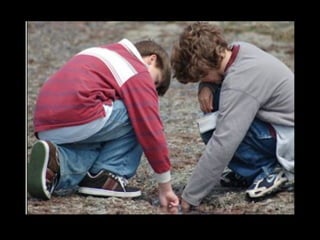
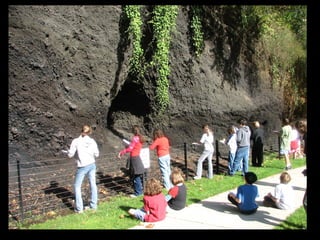
Connecting:
SES, Portland, OR
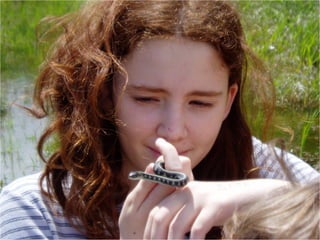
Ecophobia – a fear of the natural world that
can lead to a withdrawal from nature
Biophilia – love of life or living systems
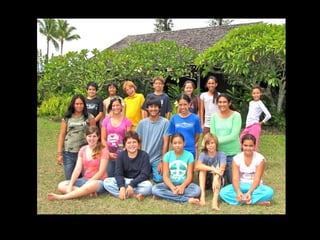
Problem-solving:
Promoting Resolutions with Integrity
for a Sustainable Molokai (PRISM),
Aka’ula and Kualapu’u Schools, HI
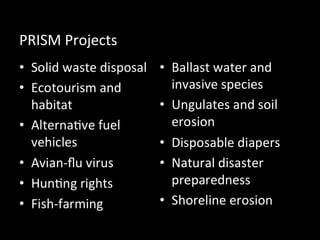
PRISM Projects
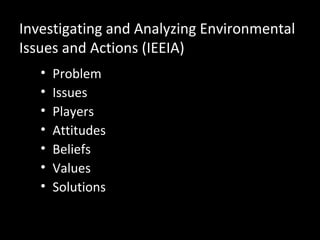
Investigating and Analyzing Environmental
Issues and Actions (IEEIA)
•
•
•
•
•
•
•

Problem
Issues
Players
Attitudes
Beliefs
Values
Solutions
“Everyone can express his or her viewpoints and
consider others’ viewpoints surrounding issues of
local significance. This participation is evidently
infectious. When adults become more
knowledgeable of the issues through students’
presentations, they become more than spectators.
They become participants themselves. This in turn
has enormous impact on the motivation of the
students to thoroughly investigate the issues they
choose. Publication of the students’ findings place
demands on their communicative skills and fuels their
drive to refine and polish their products and
presentations.”
- Trudi Volk & Marie Cheak
In 2007 Hawaii governor Linda Lingle
praised the Aka’ula School for creating a
“community of critical thinkers who are
able to investigate and take informed
action on social, cultural, and
environmental issues.”
“I see these kids and the ones that have
graduated and gone on and they’ve
learned how to learn. They’re not
afraid. They’re not afraid to ask
questions.”
a parent quoted by Cheak, Volk,
and Hungerford
Taking action:
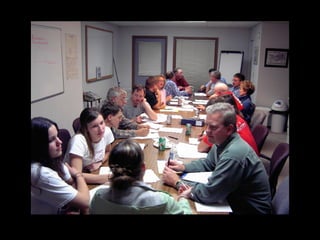
Howard High School
Howard, SD
Taking action:
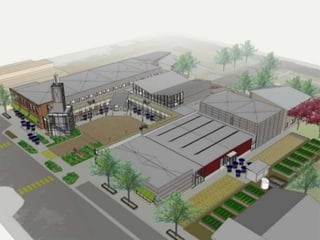
Al Kennedy High School
Cottage Grove, OR
Sustainability themes
•
•
•
•
•

Agriculture
Forestry
Energy
Architecture
Community
• Evaluate, discuss, question, analyze, and
apply
• Understand that knowledge and intellect
should accompany goodness and
commitment to community
• Develop the intellectual and physical
capacity that ensures a love of learning
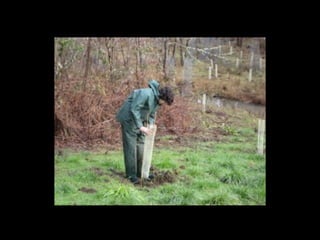
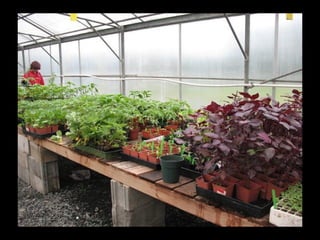
Taking action:
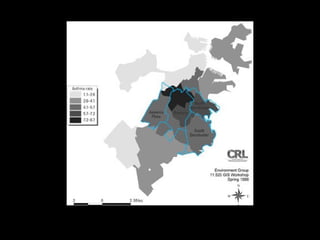
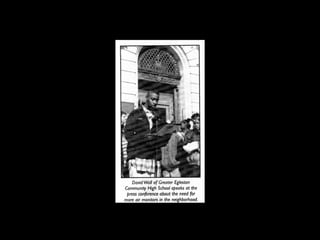
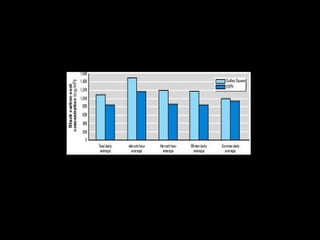
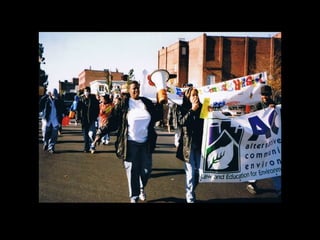
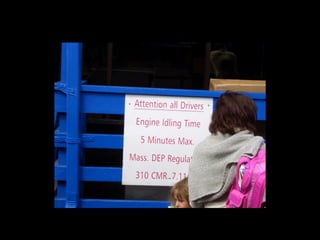
Greater Egleston Community High
School, Boston, MA
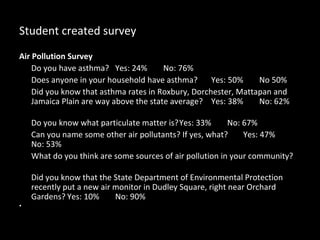
Student created survey
Air Pollution Survey
Do you have asthma? Yes: 24%
No: 76%
Does anyone in your household have asthma?
Yes: 50%
No 50%
Did you know that asthma rates in Roxbury, Dorchester, Mattapan and
Jamaica Plain are way above the state average? Yes: 38%
No: 62%
Do you know what particulate matter is?Yes: 33%
No: 67%
Can you name some other air pollutants? If yes, what?
Yes: 47%
No: 53%
What do you think are some sources of air pollution in your community?
Did you know that the State Department of Environmental Protection
recently put a new air monitor in Dudley Square, right near Orchard
Gardens? Yes: 10%
No: 90%
•
“I am proud of my accomplishments in
environmental justice this trimester. Most
importantly, I have been able to gain confidence to
speak in front of large groups of people. Before
presenting to the City Council I was very nervous.
But after watching them and my classmates
somewhat debate I realized they are regular people
just like my family, my teachers, and my friends,
and I should not be nervous when it comes to
speaking my mind.”
- student from GECHS
Research studies from the Place-based
Education Evaluation Collaborative
show that this approach:
• Encourages students to become
environmental stewards and active citizens
• Helps students learn
• Energizes teachers
• Transforms school culture
• Connects schools to communities
“Educators like these are priceless because at this
very special time on the clock of the universe they
are going beyond protest. Instead of expecting or
demanding solutions from dysfunctional
governments addicted to war, mountaintop mining,
incarceration and other punitive measures, they are
engaging our children and young people day-in-andday-out in evolutionary activities that transform
themselves and our institutions. This “direct action”
education, MLK said shortly before his assassination,
is what young people ‘in our dying cities’ need.”
- Grace Lee Boggs

Place and community based education - Prof Greg Smith

  • 1.
    Grounding Sustainability Education inPlace and Community Gregory Smith Lewis & Clark College Portland, Oregon gasmith@lclark.edu
  • 2.
    What do Imean by sustainability? • Don’t eat your seed corn or turn your forests into deserts. • Don’t pump your wastes into your drinking water. • Don’t let some people have so much that others—both now and in the future--are unable to live secure and meaningful lives.
  • 3.
    [Sustainability] implies manythings including a rapid transition to energy efficiency and renewable energy sources as well as management of soils and forests for long-term health; elimination of waste; and changes in economic accounting necessary to preserve “natural capital” so that each generation leaves “as much and as good” for succeeding generations. (Orr, 2012)
  • 4.
    Need to nurturecitizens who: • Understand the nature of humanity’s current circumstances • Feel connected enough to their place and community to want to get involved • Have the capacity to analyze and then solve problems • Possess the confidence to take action
  • 5.
    Place- and community-basededucation is a holistic approach to education, conservation, and community development that uses the local community as an integrating context for learning at all ages. It fosters vibrant partnerships between schools and communities both to boost student achievement and to improve community health and vitality--environmental, social, and economic.
  • 6.
    Place- and community-basededucation provides a vehicle for nurturing such citizens by • Connecting learning to where students live • Giving them the opportunity to become problem-solvers capable of looking at issues systemically • Supporting them as they gain the skills needed to take action
  • 7.
  • 14.
    Ecophobia – afear of the natural world that can lead to a withdrawal from nature Biophilia – love of life or living systems
  • 16.
    Problem-solving: Promoting Resolutions withIntegrity for a Sustainable Molokai (PRISM), Aka’ula and Kualapu’u Schools, HI
  • 18.
  • 19.
    Investigating and AnalyzingEnvironmental Issues and Actions (IEEIA) • • • • • • • Problem Issues Players Attitudes Beliefs Values Solutions
  • 21.
    “Everyone can expresshis or her viewpoints and consider others’ viewpoints surrounding issues of local significance. This participation is evidently infectious. When adults become more knowledgeable of the issues through students’ presentations, they become more than spectators. They become participants themselves. This in turn has enormous impact on the motivation of the students to thoroughly investigate the issues they choose. Publication of the students’ findings place demands on their communicative skills and fuels their drive to refine and polish their products and presentations.” - Trudi Volk & Marie Cheak
  • 22.
    In 2007 Hawaiigovernor Linda Lingle praised the Aka’ula School for creating a “community of critical thinkers who are able to investigate and take informed action on social, cultural, and environmental issues.”
  • 23.
    “I see thesekids and the ones that have graduated and gone on and they’ve learned how to learn. They’re not afraid. They’re not afraid to ask questions.” a parent quoted by Cheak, Volk, and Hungerford
  • 24.
    Taking action: Howard HighSchool Howard, SD
  • 29.
    Taking action: Al KennedyHigh School Cottage Grove, OR
  • 30.
  • 31.
    • Evaluate, discuss,question, analyze, and apply • Understand that knowledge and intellect should accompany goodness and commitment to community • Develop the intellectual and physical capacity that ensures a love of learning
  • 37.
    Taking action: Greater EglestonCommunity High School, Boston, MA
  • 41.
    Student created survey AirPollution Survey Do you have asthma? Yes: 24% No: 76% Does anyone in your household have asthma? Yes: 50% No 50% Did you know that asthma rates in Roxbury, Dorchester, Mattapan and Jamaica Plain are way above the state average? Yes: 38% No: 62% Do you know what particulate matter is?Yes: 33% No: 67% Can you name some other air pollutants? If yes, what? Yes: 47% No: 53% What do you think are some sources of air pollution in your community? Did you know that the State Department of Environmental Protection recently put a new air monitor in Dudley Square, right near Orchard Gardens? Yes: 10% No: 90% •
  • 45.
    “I am proudof my accomplishments in environmental justice this trimester. Most importantly, I have been able to gain confidence to speak in front of large groups of people. Before presenting to the City Council I was very nervous. But after watching them and my classmates somewhat debate I realized they are regular people just like my family, my teachers, and my friends, and I should not be nervous when it comes to speaking my mind.” - student from GECHS
  • 46.
    Research studies fromthe Place-based Education Evaluation Collaborative show that this approach: • Encourages students to become environmental stewards and active citizens • Helps students learn • Energizes teachers • Transforms school culture • Connects schools to communities
  • 47.
    “Educators like theseare priceless because at this very special time on the clock of the universe they are going beyond protest. Instead of expecting or demanding solutions from dysfunctional governments addicted to war, mountaintop mining, incarceration and other punitive measures, they are engaging our children and young people day-in-andday-out in evolutionary activities that transform themselves and our institutions. This “direct action” education, MLK said shortly before his assassination, is what young people ‘in our dying cities’ need.” - Grace Lee Boggs

Editor's Notes

  • #2 Thank Lena Taylor, Meg Collins, and conference organizers for inviting me to speak. Position at Cairns Institute. Looking at Education for Sustainability in Australia during four months. Got into this work because of my desire to strengthen young people’s sense of relationship to their communities and places with the aim of engendering the knowledge and sense of responsibility required to be effective citizens and stewards.
  • #3 Gave a talk a few years ago without defining sustainability. Learned then that I always need to do this. Taught course on envisioning a sustainable society for 17 years—complex topic—but it seems as though the essence can be boiled down to these points.
  • #4 David Orr, one of the most respected figures in the field of sustainability in the US—has written that - In same article, Orr talks about how sustainability implies the capacity for self-renewal and resilience, perspectives that will become increasingly important as our societies experience the consequences of climate change, resource exhaustion, overpopulation, and economic uncertainty. Something he said at L&C at ecological education institute in 1996 has stayed with me. Heart attack.
  • #5 To grapple with the challenges currently facing humankind, we need citizens: For the past decade and a half a group of colleagues and I have been suggesting that incorporating more local knowledge and issues and learning experiences into the curriculum provides a way for accomplishing this end. In the remainder of my talk, I’ll provide some definitions, a rationale, and examples of what this kind of educational experience looks like.
  • #6 Comprehensive educational approach that addresses the environment, the economy, and equity—the health of human community Only ways this can be done is to partner with other community organizations—break the barrier down between classroom and community
  • #7 Place- and community-based education can do this by doing the following things.
  • #8 Portland Oregon. 20 years in existence. Began as middle school. One day a week devoted to field studies or community service. Currculum organized around rivers, forests, and mountains. Investigate local—extend to global.
  • #9 Play outside. Walk in neighborhood
  • #10 Get to know with their own senses their own place—Mt. Tabor—urban volcano
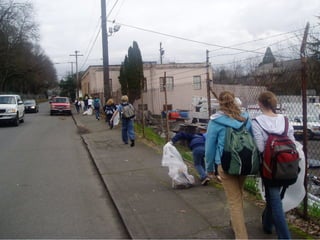
  • #11 Help care for community—litter clean up in neighborhood around school
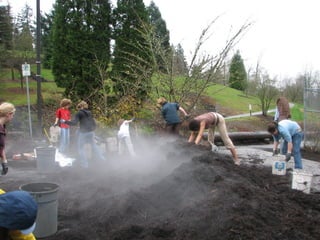
  • #12 Helping maintain garden at Vietnam Memorial in Washington Park
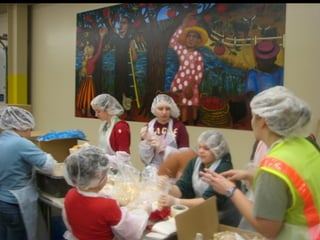
  • #13 Volunteering in Oregon Food Bank
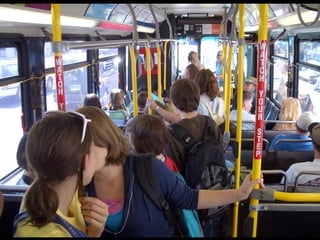
  • #14 Use public transportation to get to restoration and community service sites, as well as sites where they conduct field studies about water quality, local flora and fauna. In addition to taking students out into the community, SES also draws the community into the school. Twice in the past five years, students have organized two-day teach-ins to which they invite community members to share what they know about climate change. These events have been very powerful in helping students gain a deeper understanding of this critical issue. At the same time, their experience of learning about their own place and contributing their own energies to making it better counter what David Sobel has called ecophobia.
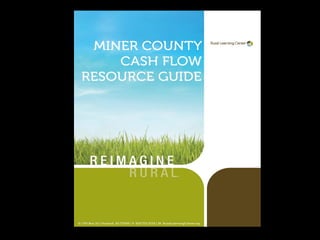
  • #26 Students determined how much money people were spending on discretionary purchase and how much went out of town. 1/3 went to Mitchell or Sioux Falls Urged them to spend 10% more in Howard to support local businesses, increase the multiplier effect, and contribute to the local sales tax. Local revenues increased by 41%. Sales tax revenue increased from $246K to $433K. 1996-2011. Between 1996 and 2011 the sales tax revenue for the city of Howard increased from $246,000 to $433,000. This has been a significant boon to the city. Students wanted to know how much of the community’s disposable income was spent locally and how much went to regional shopping areas in Sioux Falls or Mitchell. They learned that fully one-third of this money was spent out of town. They began an effort to increase local spending by 10 percent. The next year, students surpassed this goal by nearly three times over; a 27 percent increase in local spending yielded 15 million new dollars in revenue, an amount that stabilized over the next few years.  
  • #27 Development of 10-year strategic plan. $4 mil grant from NW Areas foundation, $2 mil from SD Community Foundation. Miner County Community Revitalization.
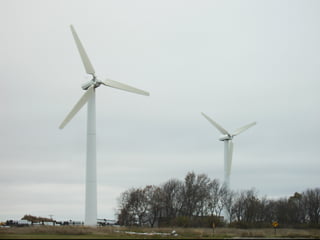
  • #28 Efforts led to Howard becoming a hub of windpower activity in the upper Midwest. This success led to the creation of what is now called the Rural Learning Center.
  • #29 Current projects: continue to support initiatives around housing, healthcare, job creation, education, childcare; Go Teach South Dakota—innovative teaching training program to prepare people to work in rural and Native American school districts.
  • #33 Wetlands mitigation projects.
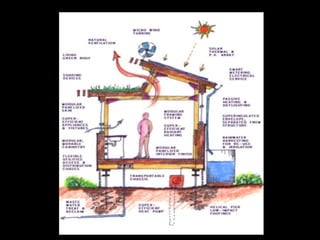
  • #35 Prefabricated house
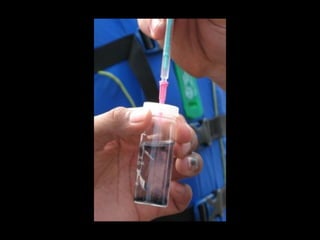
  • #36 Students also gather water quality data from four sites along the Coast Fork Willamette River. In the field, students perform tests aimed at assessing the amount of dissolved oxygen, turbidity, water temperature, and coliform and E. coli bacteria levels. When they return to the classroom, they conduct tests to determine how much phosphorous, nitrates, and ammonium can be detected in the water. These tests require students to use a variety of advanced techniques including analysis using a digital colorimeter