Sole Scuderi
UoL Environmental SustainabilityPlacementStudent
1
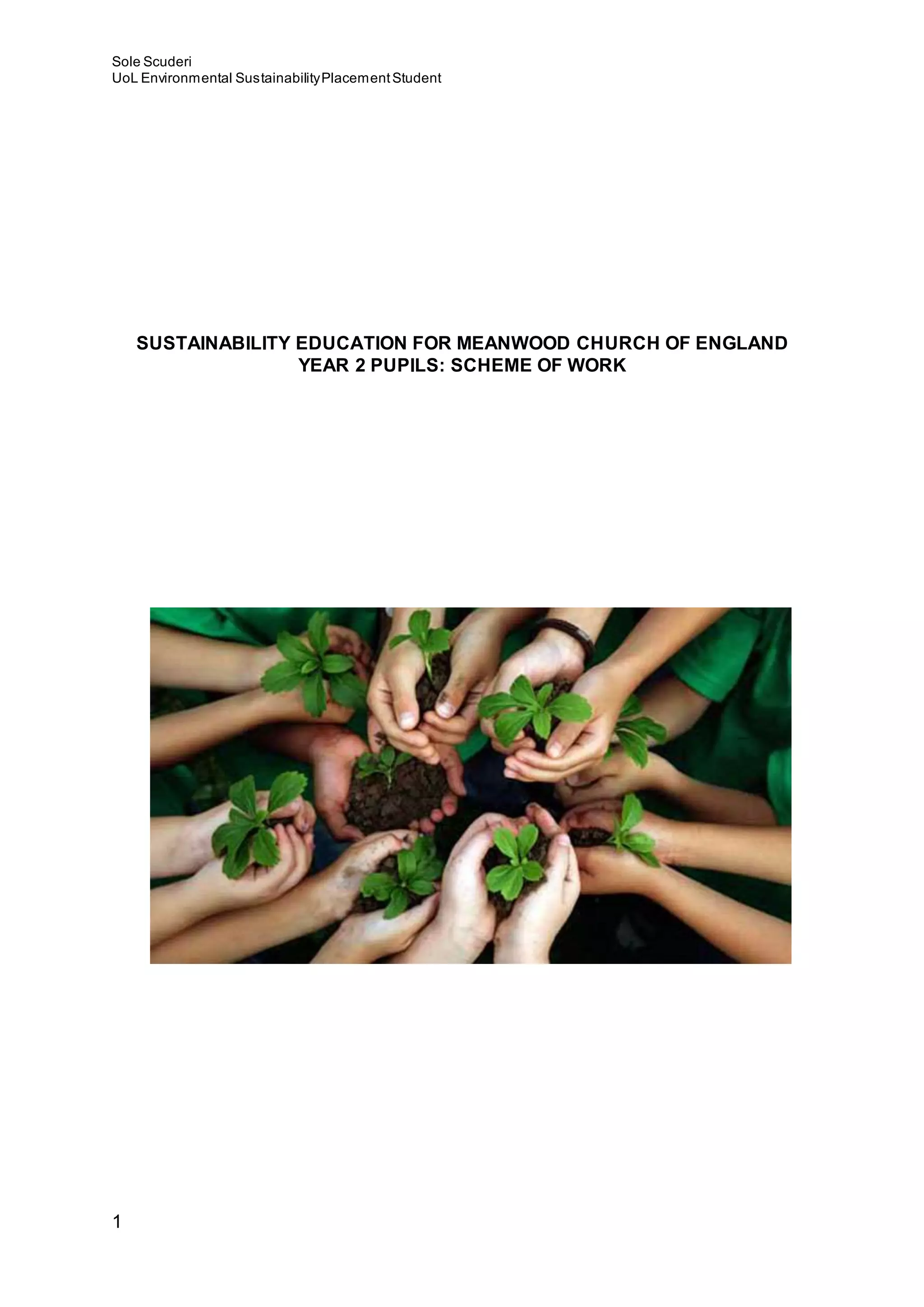
SUSTAINABILITY EDUCATION FOR MEANWOOD CHURCH OF ENGLAND
YEAR 2 PUPILS: SCHEME OF WORK
Sole Scuderi
UoL Environmental SustainabilityPlacementStudent
2
BACKGROUND
The concept of sustainability has enjoyed great popularity, both in the academic and lay repertoire,
since the late 1980s. Its mainstream definition stems from the 1987 Bruntland Commission report1,
which frames it in terms of development that does not compromise the needs of the current and future
generations. Such definition has then been operationalized by Kates et al (2001) in the “three pillars”
concept2, which emphasizes the need to consider the environmental, social and economic
sustainability of choices made at all levels.
As an environmental sustainability student, I do not embrace such a policy-oriented, neoliberal and
anti- radical social change definition of my discipline, which only focuses on a positivist approach to
environmental conservation. I prefer to focus on the idea of resourcefulness (McKinnon and Driscoll-
Derickson, 2012), which empowers local communities to self-determine how to utilize the resources
available to them in order to act truly sustainably3. Fostering community links, participatory
democracy, self-sufficiency and small-scale provision systems is, in my opinion, the most viable path
to a low-impact life that does not perpetrate the systemic inequality and injustice embedded in the
capitalist and liberal democracy system.
How is the above relevant to my placement at Meanwood Church of England Primary School? My
approach to environmental education is not going to be dominated by the positivist, statistical
approach that conditions students to see “the environment” as a series of numbers and thresholds to
not cross (see the ever-so-popular energy audits or CO2 calculations projects). It is instead going to
focus on making the children reflect on the impacts their daily life has on the natural and social
environment, and on how to act on them by deciding TOGETHER (rather than by sticking to pre-
determined guidelines) what the best course of action is.
In order to do so, I will stimulate reflection on six core areas: energy and transport, food, water, waste,
community and self-sufficiency. After the children will have expressed their thoughts on the above
issues, I will deliver a brief informative session (through the medium of videos when possible) on each
topic. Subsequently, using both elements from the brainstorming and from the contents delivered by
me, the students and I will determine a plan of action on the matter by using consensus decision
making, a participatory technique that aims at finding solutions without overpowering minority groups
(which regularly happens with voting). Each session will then end with a game/creative activity related
to the week’s theme.
In conclusion, my 7-week course will attempt to make children think about their (and their families’
and peers’) behaviour patterns and to help them reach solutions to intervene on them by themselves,
rather than by uncritically following pre-determined guidelines.
LEARNING OBJECTIVES
1) Introducingnon-hierarchical forms of communication and decision makingto the children (consensus
and associated exercises;based on the work by the Seeds for Change Collective,
www.seedsforchange.org.uk)
2) Conveying basic educational contents on the followingkey sustainability areas:
- Energy and transport(renewables vs. non renewables; pollution)
1
WCED (1987) Our Common Future, available from http://www.un-documents.net/wced-ocf.htm
2
Kates et al (2001) Sustainability Science, Science, vol. 292, pp. 641-2
3
McKinnon, D.; Driscoll-Derickson, K. (2012) From resilience to resourcefulness: A critique of resilience policy and
activism, Progress in Human Geography, vol. 73, issue 2, pp. 253-70
Sole Scuderi
UoL Environmental SustainabilityPlacementStudent
3
- Food (land use for food; global food trade; food growing)
- Water (sources and circulation)
- Waste (disposal methods)
- Community (sustainablecommunities and cohousing;citizens assemblies)
- Self-sufficiency (alternativeprovision system:cooperatives,food growing, small scalerenewable
energy)
LEARNING OUTCOMES
1) The children should beableto use consensus-decision makingtechniques (hand signals,spectrum
lines,thinkinghats,rankings,roleplay) to express their idea and reach a shared decision
2) They should be aware of the key areas in which the impacts of the natural/social environment
interactions impacts aremanifested and of some of the solutions to intervene on them
3) They should be ableto drawon existingknowledge and freshly acquired one to reach a decision on
how to modify their behaviour
ENQUIRY QUESTIONS
- Why is itimportant to learn about the environment? What will I be learningand how?
- What do I use energy for? How could I change the way I use energy?
- What do I eat? Where does food come from? Could I grow my own food?
- What do I use water for? Where does it come from? How could I change the way I use water?
- Where do the things I throw away go? Could I reuse things rather than throw them away?
- Who is partof my community? What is my role in my community? How could I contribute to my
community?
- What aremy real needs (shelter, clothes,water, food, community relations)? How can I fulfil them
without relyingon them being given to me?
CURRICULUM REFERENCES
KS1 National curriculum
- Science
1) Electricity. Pupils should be taught about everyday appliances that use electricity (lesson 2)
- Geography
1) recognising how places have become the way they are and how they are changing (for example,
the quality of the environment in a street) (overarching)
2) recognising how places are linked to other places in the world (for example, food from other
countries) (lesson 3)
3) recognising how the environment may be improved and sustained (for example, by restricting the
number of cars) (overarching + lesson 2)
- Art and Design
1) representing observations, ideas and feelings, and design and make images and artefacts (each
lesson will contain a closing activity that includes drawing or modelling)
- Personal, Social and Health Education
1) taking part in discussions with one other person and the whole class
2) taking part in a simple debate about topical issues
3) to recognise choices they can make, and recognise the difference between right and wrong
(overarching, especially through learning consensus techniques)
4) belonging to various groups and communities, such as family and school (lesson 6)
5) what improves and harms their local, natural and built environments and about some of the ways
people look after them to listen to other people, and play and work cooperatively (overarching,
especially through learning consensus techniques)
Sole Scuderi
UoL Environmental SustainabilityPlacementStudent
4
- Citizenship
1) taking part in discussions (for example, talking about issues such as 'where our food and raw
materials for industry come from') (lesson 3)
2) considering social and moral dilemmas that they come across in everyday life (for example
questions of fairness, simple political issues, simple environmental issues) (overarching)
MCoEPS curriculum
- Meanwood Urban Farm Visit(Autumn 1): relevant to lessons 3 (food sources) and 6 (community
projects)
- Visitto Garden Centre (Spring1): relevant to lessons 3 (food growing) and 7 (ibid.;in terms of self-
sufficiency)
- PSHE “Taking careof on another” unit (Autumn 2): relevant to lesson 6 (community relations)
- Geography “Improving the park environment” unit (Summer 1): overarching
- The fact that children make their own rules: overarching(underlyingtheme of reachingdecisions
together through consensus)+lesson 7 (self-sufficiency,especially self-determination)
SOURCES
- National KS1 Curriculum,availablefrom
www.education.gov.uk/schools/teachingandlearning/curriculum/primary/
- Consensus decision makingtechniques: www.seedsforchange.org and Seeds for Change Collective
(2013),A consensus handbook,Leeds: Footprint
- Games: NEED (USA scheme aimed at “putting energy into education”) website
LESSON PLAN 1
TITLE: LEARNING ABOUT THE ENVIRONMENT AND FINDING SOLUTIONS TOGETHER
OBJECTIVES
This session sets the scene for the course. Its two main aims are:
- makingthe children reflecton why we will befocussingon environmental issues
- teaching them the core learningtool we will use,consensus decision-making
After an introductory icebreaker activity, the children will elaborate their existing knowledge on
environmental issues and on why it is important to pay attention to them. I will then introduce the
contents of the course and I will explain how, rather than simply learning new facts, the course will be
about reflecting on what happens around us and deciding together on what to do to change it. The
rest of the session will be used to demonstrate and practice some consensus decision making
Sole Scuderi
UoL Environmental SustainabilityPlacementStudent
5
techniques. If time remains/ should children lose interest, a drawing activity focussed on children
drawing themselves as happy in their environment (park, class, river, home) will be carried out.
LEARNING OUTCOMES
Skills
Learning how to discuss in group and reach an agreement using hand signals, spectrum lines and
ranking
Knowledge
Revisiting and sharing previous knowledge on environmental issues
MATERIALS
Flipchart, Colourful markers, Stickers, Paper, Board
STARTER (15 mins)
1) Names game (5 mins.)
We sit in a circle, and everybody thinks of a word that begins with the same letter as their name and
of their favourite colour and then introduces themselves, i.e. “I’m Silly Sole and I like purple”
2) Brainstorming(10 mins.)
I will move to the middle of the circle with a flipchart, and divide it in three sides, one saying “The
environment”, the other “Environmental problems” and the last “Why do we care”. I will ask
children to share their definition of “environment” and some of the related problems they are
aware of and why do they think it’s important to care, and write it down for everyone to read.
INSTRUCTIONAL PART (15 MINS)
I will briefly comment on the content of the flipchart and explain that the ones the children have
mentioned are very important things, and so are the ones we will be concentrating on week after
week. I will briefly mention each topic and write it on another flipchart, with a definition next to it drawn
from the brainstorming.
I will then explain that the way to solve the problems the children and I have mentioned is to find
solutions together, by listening to each other and reasoning together, and that we will try to do so
every week by using consensus decision making.
I will then dedicate 5 minutes to explaining and trialling with the whole class each of the three most
widely used consensus techniques: hand signal, spectrum lines and ranking.
To demonstrate them, I will ask the children to choose topics to discuss and reach a decision on that
concern their daily school life, e.g. what food the school canteen should serve, what colour they’d like
their classroom wall to be painted, what sports they’re like to play in PE lesson, etc.
INDEPENDENT WORK (10 MINS)
I will split the class in 3 groups; ideally, each group would spend 2-3 mins practicing each consensus
technique. I will let the children decide which one they want to begin with/the topic to discuss. I will go
around the groups and help with any doubts/ lack of ideas.
SUMMARY
I will remind the children why we have learnt to use consensus and I will briefly mention the following
week’s topic (Energy and Transport) and what it would make us reflect and decide together about.
EVALUATION
I will attempt to gauge the enthusiasm of the class about the course and its structures by using hand
signals, which will also help to verify the understanding of one of the consensus techniques. I will ask
for suggestions on activities the children would like to do/topics they would like to cover.
5 mins
Sole Scuderi
UoL Environmental SustainabilityPlacementStudent
6
LESSON PLAN 2
TITLE: LEARNING TO USE ENERGY
OBJECTIVES
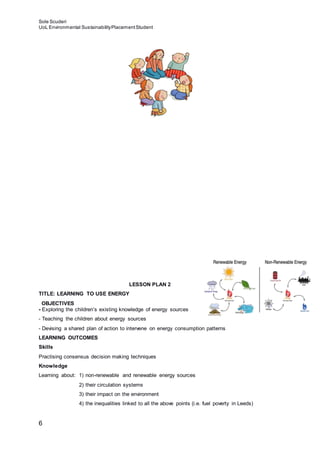
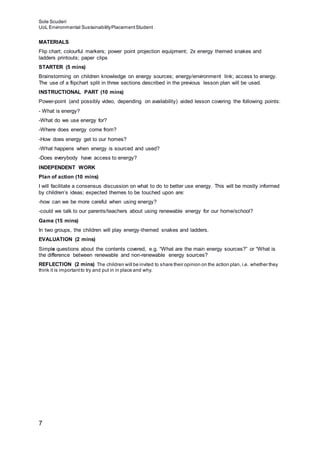
- Exploring the children’s existing knowledge of energy sources
- Teaching the children about energy sources
- Devising a shared plan of action to intervene on energy consumption patterns
LEARNING OUTCOMES
Skills
Practising consensus decision making techniques
Knowledge
Learning about: 1) non-renewable and renewable energy sources
2) their circulation systems
3) their impact on the environment
4) the inequalities linked to all the above points (i.e. fuel poverty in Leeds)
Sole Scuderi
UoL Environmental SustainabilityPlacementStudent
7
MATERIALS
Flip chart; colourful markers; power point projection equipment; 2x energy themed snakes and
ladders printouts; paper clips
STARTER (5 mins)
Brainstorming on children knowledge on energy sources; energy/environment link; access to energy.
The use of a flipchart split in three sections described in the previous lesson plan will be used.
INSTRUCTIONAL PART (10 mins)
Power-point (and possibly video, depending on availability) aided lesson covering the following points:
- What is energy?
-What do we use energy for?
-Where does energy come from?
-How does energy get to our homes?
-What happens when energy is sourced and used?
-Does everybody have access to energy?
INDEPENDENT WORK
Plan of action (10 mins)
I will facilitate a consensus discussion on what to do to better use energy. This will be mostly informed
by children’s ideas; expected themes to be touched upon are:
-how can we be more careful when using energy?
-could we talk to our parents/teachers about using renewable energy for our home/school?
Game (15 mins)
In two groups, the children will play energy-themed snakes and ladders.
EVALUATION (2 mins)
Simple questions about the contents covered, e.g. “What are the main energy sources?” or “What is
the difference between renewable and non-renewable energy sources?
REFLECTION (2 mins) The children will be invited to share their opinion on the action plan, i.e. whether they
think it is importantto try and put in in place and why.
Sole Scuderi
UoL Environmental SustainabilityPlacementStudent
8
LESSON PLAN 3
TITLE: FROM THE WORLD TO OUR PLATE
OBJECTIVES
-Exploring children’s existing knowledge on food sources
-Teaching the children about food sources
-Devising a shared plan of action to intervene on food consumption patterns
LEARNING OUTCOMES
Skills
Practising consensus decision making techniques
Planning through observing (outdoors)
Knowledge
Learning about: 1) the food industry
2) global food trade
3) land use for food
3) their impact on the environment
4) the inequalities linked to all the above points (i.e. food deserts in Leeds)
MATERIALS
Flip chart; colourful markers; paper; power point projection equipment; stickers; colourful paper rolls
Sole Scuderi
UoL Environmental SustainabilityPlacementStudent
9
STARTER (5 mins)
Brainstorming on children knowledge on food sources; food/environment link; access to food. The use
of a flipchart split in three sections described in the first lesson plan will be used.
INSTRUCTIONAL PART (10 mins)
Power-point (and possibly video, depending on availability) aided lesson covering the following points:
-Where does food come from?
-How does food get to our plates?
-What happens when food is cultivated and traded?
-Does everybody have access to food?
INDEPENDENT WORK
Plan of action (15 mins)
I will facilitate a consensus discussion on what to do to better consume food. This will be mostly
informed by children’s ideas; expected themes to be touched upon are:
-how can we be more careful when buying food?
-could we talk to our parents/teachers about growing food on an allotment in Leeds?
I will ask the children which technique(s) they prefer to use between the already known ones (hand
signals, spectrum lines, ranking) and a new one I could briefly introduce to them (a variation of the
thinking hats with paper rolls)
Creative activity (10 mins)
The children will be accompanied outdoors to the food growing area of the allotment. They will plan a
communal meal from the ingredients cultivated.
REFLECTION (5 mins)
The children will be invited to share their opinion on the action plan, i.e. whether they think it is
important to try and put in in place and why.
Sole Scuderi
UoL Environmental SustainabilityPlacementStudent
10
LESSON PLAN 4
TITLE: WATER RUNS FARTHER THAN OUR TAP!
OBJECTIVES
-Exploring children’s existing knowledge on water sources
-Teaching the children about water sources and circulation
-Devising a shared plan of action to intervene on water consumption patterns
LEARNING OUTCOMES
Skills
Practising consensus decision making techniques
Acting
Knowledge
Learning about: 1) water harvesting
2) water circulation
3) their impact on the environment
4) the inequalities linked to all the above points (i.e. water shortages in the UK)
MATERIALS
Flip chart; colourful markers; paper; power point projection equipment
STARTER (5 mins)
Brainstorming on children knowledge on water sources and circulation; water/environment link;
access to water. The use of a flipchart split in three sections described in the first lesson plan will be
used.
INSTRUCTIONAL PART (10 mins)
Power-point (and possibly video, depending on availability) aided lesson covering the following points:
Sole Scuderi
UoL Environmental SustainabilityPlacementStudent
11
-What do we use water for?
-Where does water come from?
-How does water get to our taps?
-What happens when water is harvested and circulated?
-Does everybody have access to water?
EVALUATION (2 mins)
Simple questions about the contents covered, e.g. “How is water sourced?” or “Is water a finite
resource? Why/why not?”
INDEPENDENT WORK
Plan of action (10 mins)
I will facilitate a consensus discussion on what to do to better use water. This will be mostly informed
by children’s ideas; expected themes to be touched upon are:
-how can we be more careful when using water?
-could we talk to our parents/teachers about using recycled water sources for our home/school?
Game (15 mins)
Children will be acting a mini-play written by me, “The story of water”. Slides related to what is
happening on the screen will provide a backdrop.
Sole Scuderi
UoL Environmental SustainabilityPlacementStudent
12
LESSON PLAN 5
TITLE: DON’T WASTE IT, LOVE IT!
OBJECTIVES
-Exploring children’s existing knowledge on waste disposal
-Teaching the children about waste disposal systems
-Devising a shared plan of action to intervene on waste production patterns
LEARNING OUTCOMES
Skills
Practising consensus decision making techniques
Decoration making
Knowledge
Learning about: 1) landfilling
2) recycling in Leeds, UK and other EU countries
3) the impacts of the above on the environment
4) the inequalities linked to all the above points (i.e. Naples case study)
MATERIALS
Flip chart; colourful markers; paper; power point projection equipment; scrap paper/cardboard;
scissors; glue; string
STARTER (5 mins)
Brainstorming on children knowledge on waste disposal methods; waste/environment link. The use of
a flipchart split in three sections described in the first lesson plan will be used.
INSTRUCTIONAL PART (10 mins)
Power-point (and possibly video, depending on availability) aided lesson covering the following points:
-How much waste do we produce?
-Where does our garbage go?
-What happens when waste is landfilled?
Sole Scuderi
UoL Environmental SustainabilityPlacementStudent
13
-What happens when waste is recycled?
-Is it the same everywhere?
EVALUATION (2 mins)
Simple questions about the contents covered, e.g. “What does landfilling mean?” or “What can you
recycle in Leeds?”
INDEPENDENT WORK
Plan of action (10 mins)
I will facilitate a consensus discussion on what to do to produce less waste. This will be mostly
informed by children’s ideas; expected themes to be touched upon are:
-how can we be more careful when disposing of what we don’t want/ need, starting from redefining
that?
-could we talk to our parents/teachers about bringing our old things to charity shops?
REFLECTION (2 mins)
The children will be invited to share their opinion on the action plan,i.e. whether they think it is importantto try
and put in in place and why.
Creative activity (15 mins)
The children will be encouraged to create bunting for their bedrooms from scrap paper/cardboard.
Sole Scuderi
UoL Environmental SustainabilityPlacementStudent
14
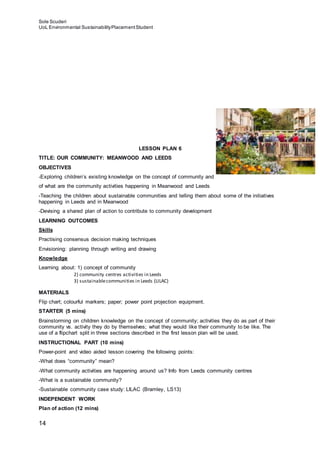
LESSON PLAN 6
TITLE: OUR COMMUNITY: MEANWOOD AND LEEDS
OBJECTIVES
-Exploring children’s existing knowledge on the concept of community and
of what are the community activities happening in Meanwood and Leeds
-Teaching the children about sustainable communities and telling them about some of the initiatives
happening in Leeds and in Meanwood
-Devising a shared plan of action to contribute to community development
LEARNING OUTCOMES
Skills
Practising consensus decision making techniques
Envisioning: planning through writing and drawing
Knowledge
Learning about: 1) concept of community
2) community centres activities in Leeds
3) sustainablecommunities in Leeds (LILAC)
MATERIALS
Flip chart; colourful markers; paper; power point projection equipment.
STARTER (5 mins)
Brainstorming on children knowledge on the concept of community; activities they do as part of their
community vs. activity they do by themselves; what they would like their community to be like. The
use of a flipchart split in three sections described in the first lesson plan will be used.
INSTRUCTIONAL PART (10 mins)
Power-point and video aided lesson covering the following points:
-What does “community” mean?
-What community activities are happening around us? Info from Leeds community centres
-What is a sustainable community?
-Sustainable community case study: LILAC (Bramley, LS13)
INDEPENDENT WORK
Plan of action (12 mins)
Sole Scuderi
UoL Environmental SustainabilityPlacementStudent
15
I will facilitate a consensus discussion on how to be involved in our community. This will be mostly
informed by children’s ideas; expected themes to be touched upon are:
-how can we be more involved in our community?
-could we ask our family to help us organize a community meal/sports day?
REFLECTION (2 mins)
The children will be invited to share their opinion on the action plan, i.e. whether they think it is
important to try and put in in place and why.
Creative activity (17 mins)
The children will be encouraged to envision the sustainable community they would like to live in along
the lines of LILAC, and write about it/draw it.
LESSON PLAN 7
TITLE: THE CHANGES HAPPENING AROUND US
OBJECTIVES
-Reflecting back on the issues discussed in the previous sessions, questioning our
needs (shelter, clothes, water, food, community relations) and how can we fulfil them without relying
on them being given to us
-Telling the children about alternative provision system: cooperatives, food growing, small scale
renewable energy, mostly drawing on my own experience of them in Leeds. Framing these
alternatives in the context of self-sufficiency
-Gauge the effect that the course has had on the children’s understanding of their impact on the
environment and how to intervene on it
LEARNING OUTCOMES
Knowledge
Learning about alternative provision systems: housing and workers cooperatives, allotments and
community gardens, community owned energy projects, swap shops, Local Exchange Trade Systems
(LETS)
MATERIALS
Flip chart; colourful markers; power point projection equipment
STARTER (5 mins)
Brainstorming on what children consider needs; how they are currently fulfilled; how could they
otherwise be fulfilled. The use of a flipchart split in three sections described in the first lesson plan will
be used.
INSTRUCTIONAL PART (15 mins)
Power-point and video aided lesson covering the following points:
-Not everybody rents or owns their house: housing cooperatives (Leeds case studies)
-Not everybody has a boss: workers cooperatives (Leeds case studies: Green Action)
-Not everybody goes to the supermarket: community gardens and allotments (Hollin Street allotments
case study)
-Not everybody buys their energy: micro-generation (Glasgow case study)
-Money is not always necessary: Local Exchange Trade Systems (Streetbank case study)
-Why do people put their time and energy into doing these things? The concept of collective
ownership
Sole Scuderi
UoL Environmental SustainabilityPlacementStudent
16
REFLECTION
-Ask children their opinion on the projects I presented to them: whether they think they are good idea,
whether they would take part in them (2 mins)
-Brainstorming on what children feel like they have learnt on the environment; the impact we have on
it; what we can do to change things; one thing they are definitely going to do to change things. The
use of a flipchart split in four sections described in the first lesson plan will be used. A slide that uses
their previous ideas on the issues we covered made by summarizing the content of the brainstorming
flipcharts from the previous lessons will be projected to allow them to appreciate their learning curve,
alongside a summary of their action plans to help them remember them (12 mins)
GOODBYES AND CHATTING! (5 mins)

scheme of work

  • 1.
    Sole Scuderi UoL EnvironmentalSustainabilityPlacementStudent 1 SUSTAINABILITY EDUCATION FOR MEANWOOD CHURCH OF ENGLAND YEAR 2 PUPILS: SCHEME OF WORK
  • 2.
    Sole Scuderi UoL EnvironmentalSustainabilityPlacementStudent 2 BACKGROUND The concept of sustainability has enjoyed great popularity, both in the academic and lay repertoire, since the late 1980s. Its mainstream definition stems from the 1987 Bruntland Commission report1, which frames it in terms of development that does not compromise the needs of the current and future generations. Such definition has then been operationalized by Kates et al (2001) in the “three pillars” concept2, which emphasizes the need to consider the environmental, social and economic sustainability of choices made at all levels. As an environmental sustainability student, I do not embrace such a policy-oriented, neoliberal and anti- radical social change definition of my discipline, which only focuses on a positivist approach to environmental conservation. I prefer to focus on the idea of resourcefulness (McKinnon and Driscoll- Derickson, 2012), which empowers local communities to self-determine how to utilize the resources available to them in order to act truly sustainably3. Fostering community links, participatory democracy, self-sufficiency and small-scale provision systems is, in my opinion, the most viable path to a low-impact life that does not perpetrate the systemic inequality and injustice embedded in the capitalist and liberal democracy system. How is the above relevant to my placement at Meanwood Church of England Primary School? My approach to environmental education is not going to be dominated by the positivist, statistical approach that conditions students to see “the environment” as a series of numbers and thresholds to not cross (see the ever-so-popular energy audits or CO2 calculations projects). It is instead going to focus on making the children reflect on the impacts their daily life has on the natural and social environment, and on how to act on them by deciding TOGETHER (rather than by sticking to pre- determined guidelines) what the best course of action is. In order to do so, I will stimulate reflection on six core areas: energy and transport, food, water, waste, community and self-sufficiency. After the children will have expressed their thoughts on the above issues, I will deliver a brief informative session (through the medium of videos when possible) on each topic. Subsequently, using both elements from the brainstorming and from the contents delivered by me, the students and I will determine a plan of action on the matter by using consensus decision making, a participatory technique that aims at finding solutions without overpowering minority groups (which regularly happens with voting). Each session will then end with a game/creative activity related to the week’s theme. In conclusion, my 7-week course will attempt to make children think about their (and their families’ and peers’) behaviour patterns and to help them reach solutions to intervene on them by themselves, rather than by uncritically following pre-determined guidelines. LEARNING OBJECTIVES 1) Introducingnon-hierarchical forms of communication and decision makingto the children (consensus and associated exercises;based on the work by the Seeds for Change Collective, www.seedsforchange.org.uk) 2) Conveying basic educational contents on the followingkey sustainability areas: - Energy and transport(renewables vs. non renewables; pollution) 1 WCED (1987) Our Common Future, available from http://www.un-documents.net/wced-ocf.htm 2 Kates et al (2001) Sustainability Science, Science, vol. 292, pp. 641-2 3 McKinnon, D.; Driscoll-Derickson, K. (2012) From resilience to resourcefulness: A critique of resilience policy and activism, Progress in Human Geography, vol. 73, issue 2, pp. 253-70
  • 3.
    Sole Scuderi UoL EnvironmentalSustainabilityPlacementStudent 3 - Food (land use for food; global food trade; food growing) - Water (sources and circulation) - Waste (disposal methods) - Community (sustainablecommunities and cohousing;citizens assemblies) - Self-sufficiency (alternativeprovision system:cooperatives,food growing, small scalerenewable energy) LEARNING OUTCOMES 1) The children should beableto use consensus-decision makingtechniques (hand signals,spectrum lines,thinkinghats,rankings,roleplay) to express their idea and reach a shared decision 2) They should be aware of the key areas in which the impacts of the natural/social environment interactions impacts aremanifested and of some of the solutions to intervene on them 3) They should be ableto drawon existingknowledge and freshly acquired one to reach a decision on how to modify their behaviour ENQUIRY QUESTIONS - Why is itimportant to learn about the environment? What will I be learningand how? - What do I use energy for? How could I change the way I use energy? - What do I eat? Where does food come from? Could I grow my own food? - What do I use water for? Where does it come from? How could I change the way I use water? - Where do the things I throw away go? Could I reuse things rather than throw them away? - Who is partof my community? What is my role in my community? How could I contribute to my community? - What aremy real needs (shelter, clothes,water, food, community relations)? How can I fulfil them without relyingon them being given to me? CURRICULUM REFERENCES KS1 National curriculum - Science 1) Electricity. Pupils should be taught about everyday appliances that use electricity (lesson 2) - Geography 1) recognising how places have become the way they are and how they are changing (for example, the quality of the environment in a street) (overarching) 2) recognising how places are linked to other places in the world (for example, food from other countries) (lesson 3) 3) recognising how the environment may be improved and sustained (for example, by restricting the number of cars) (overarching + lesson 2) - Art and Design 1) representing observations, ideas and feelings, and design and make images and artefacts (each lesson will contain a closing activity that includes drawing or modelling) - Personal, Social and Health Education 1) taking part in discussions with one other person and the whole class 2) taking part in a simple debate about topical issues 3) to recognise choices they can make, and recognise the difference between right and wrong (overarching, especially through learning consensus techniques) 4) belonging to various groups and communities, such as family and school (lesson 6) 5) what improves and harms their local, natural and built environments and about some of the ways people look after them to listen to other people, and play and work cooperatively (overarching, especially through learning consensus techniques)
  • 4.
    Sole Scuderi UoL EnvironmentalSustainabilityPlacementStudent 4 - Citizenship 1) taking part in discussions (for example, talking about issues such as 'where our food and raw materials for industry come from') (lesson 3) 2) considering social and moral dilemmas that they come across in everyday life (for example questions of fairness, simple political issues, simple environmental issues) (overarching) MCoEPS curriculum - Meanwood Urban Farm Visit(Autumn 1): relevant to lessons 3 (food sources) and 6 (community projects) - Visitto Garden Centre (Spring1): relevant to lessons 3 (food growing) and 7 (ibid.;in terms of self- sufficiency) - PSHE “Taking careof on another” unit (Autumn 2): relevant to lesson 6 (community relations) - Geography “Improving the park environment” unit (Summer 1): overarching - The fact that children make their own rules: overarching(underlyingtheme of reachingdecisions together through consensus)+lesson 7 (self-sufficiency,especially self-determination) SOURCES - National KS1 Curriculum,availablefrom www.education.gov.uk/schools/teachingandlearning/curriculum/primary/ - Consensus decision makingtechniques: www.seedsforchange.org and Seeds for Change Collective (2013),A consensus handbook,Leeds: Footprint - Games: NEED (USA scheme aimed at “putting energy into education”) website LESSON PLAN 1 TITLE: LEARNING ABOUT THE ENVIRONMENT AND FINDING SOLUTIONS TOGETHER OBJECTIVES This session sets the scene for the course. Its two main aims are: - makingthe children reflecton why we will befocussingon environmental issues - teaching them the core learningtool we will use,consensus decision-making After an introductory icebreaker activity, the children will elaborate their existing knowledge on environmental issues and on why it is important to pay attention to them. I will then introduce the contents of the course and I will explain how, rather than simply learning new facts, the course will be about reflecting on what happens around us and deciding together on what to do to change it. The rest of the session will be used to demonstrate and practice some consensus decision making
  • 5.
    Sole Scuderi UoL EnvironmentalSustainabilityPlacementStudent 5 techniques. If time remains/ should children lose interest, a drawing activity focussed on children drawing themselves as happy in their environment (park, class, river, home) will be carried out. LEARNING OUTCOMES Skills Learning how to discuss in group and reach an agreement using hand signals, spectrum lines and ranking Knowledge Revisiting and sharing previous knowledge on environmental issues MATERIALS Flipchart, Colourful markers, Stickers, Paper, Board STARTER (15 mins) 1) Names game (5 mins.) We sit in a circle, and everybody thinks of a word that begins with the same letter as their name and of their favourite colour and then introduces themselves, i.e. “I’m Silly Sole and I like purple” 2) Brainstorming(10 mins.) I will move to the middle of the circle with a flipchart, and divide it in three sides, one saying “The environment”, the other “Environmental problems” and the last “Why do we care”. I will ask children to share their definition of “environment” and some of the related problems they are aware of and why do they think it’s important to care, and write it down for everyone to read. INSTRUCTIONAL PART (15 MINS) I will briefly comment on the content of the flipchart and explain that the ones the children have mentioned are very important things, and so are the ones we will be concentrating on week after week. I will briefly mention each topic and write it on another flipchart, with a definition next to it drawn from the brainstorming. I will then explain that the way to solve the problems the children and I have mentioned is to find solutions together, by listening to each other and reasoning together, and that we will try to do so every week by using consensus decision making. I will then dedicate 5 minutes to explaining and trialling with the whole class each of the three most widely used consensus techniques: hand signal, spectrum lines and ranking. To demonstrate them, I will ask the children to choose topics to discuss and reach a decision on that concern their daily school life, e.g. what food the school canteen should serve, what colour they’d like their classroom wall to be painted, what sports they’re like to play in PE lesson, etc. INDEPENDENT WORK (10 MINS) I will split the class in 3 groups; ideally, each group would spend 2-3 mins practicing each consensus technique. I will let the children decide which one they want to begin with/the topic to discuss. I will go around the groups and help with any doubts/ lack of ideas. SUMMARY I will remind the children why we have learnt to use consensus and I will briefly mention the following week’s topic (Energy and Transport) and what it would make us reflect and decide together about. EVALUATION I will attempt to gauge the enthusiasm of the class about the course and its structures by using hand signals, which will also help to verify the understanding of one of the consensus techniques. I will ask for suggestions on activities the children would like to do/topics they would like to cover. 5 mins
  • 6.
    Sole Scuderi UoL EnvironmentalSustainabilityPlacementStudent 6 LESSON PLAN 2 TITLE: LEARNING TO USE ENERGY OBJECTIVES - Exploring the children’s existing knowledge of energy sources - Teaching the children about energy sources - Devising a shared plan of action to intervene on energy consumption patterns LEARNING OUTCOMES Skills Practising consensus decision making techniques Knowledge Learning about: 1) non-renewable and renewable energy sources 2) their circulation systems 3) their impact on the environment 4) the inequalities linked to all the above points (i.e. fuel poverty in Leeds)
  • 7.
    Sole Scuderi UoL EnvironmentalSustainabilityPlacementStudent 7 MATERIALS Flip chart; colourful markers; power point projection equipment; 2x energy themed snakes and ladders printouts; paper clips STARTER (5 mins) Brainstorming on children knowledge on energy sources; energy/environment link; access to energy. The use of a flipchart split in three sections described in the previous lesson plan will be used. INSTRUCTIONAL PART (10 mins) Power-point (and possibly video, depending on availability) aided lesson covering the following points: - What is energy? -What do we use energy for? -Where does energy come from? -How does energy get to our homes? -What happens when energy is sourced and used? -Does everybody have access to energy? INDEPENDENT WORK Plan of action (10 mins) I will facilitate a consensus discussion on what to do to better use energy. This will be mostly informed by children’s ideas; expected themes to be touched upon are: -how can we be more careful when using energy? -could we talk to our parents/teachers about using renewable energy for our home/school? Game (15 mins) In two groups, the children will play energy-themed snakes and ladders. EVALUATION (2 mins) Simple questions about the contents covered, e.g. “What are the main energy sources?” or “What is the difference between renewable and non-renewable energy sources? REFLECTION (2 mins) The children will be invited to share their opinion on the action plan, i.e. whether they think it is importantto try and put in in place and why.
  • 8.
    Sole Scuderi UoL EnvironmentalSustainabilityPlacementStudent 8 LESSON PLAN 3 TITLE: FROM THE WORLD TO OUR PLATE OBJECTIVES -Exploring children’s existing knowledge on food sources -Teaching the children about food sources -Devising a shared plan of action to intervene on food consumption patterns LEARNING OUTCOMES Skills Practising consensus decision making techniques Planning through observing (outdoors) Knowledge Learning about: 1) the food industry 2) global food trade 3) land use for food 3) their impact on the environment 4) the inequalities linked to all the above points (i.e. food deserts in Leeds) MATERIALS Flip chart; colourful markers; paper; power point projection equipment; stickers; colourful paper rolls
  • 9.
    Sole Scuderi UoL EnvironmentalSustainabilityPlacementStudent 9 STARTER (5 mins) Brainstorming on children knowledge on food sources; food/environment link; access to food. The use of a flipchart split in three sections described in the first lesson plan will be used. INSTRUCTIONAL PART (10 mins) Power-point (and possibly video, depending on availability) aided lesson covering the following points: -Where does food come from? -How does food get to our plates? -What happens when food is cultivated and traded? -Does everybody have access to food? INDEPENDENT WORK Plan of action (15 mins) I will facilitate a consensus discussion on what to do to better consume food. This will be mostly informed by children’s ideas; expected themes to be touched upon are: -how can we be more careful when buying food? -could we talk to our parents/teachers about growing food on an allotment in Leeds? I will ask the children which technique(s) they prefer to use between the already known ones (hand signals, spectrum lines, ranking) and a new one I could briefly introduce to them (a variation of the thinking hats with paper rolls) Creative activity (10 mins) The children will be accompanied outdoors to the food growing area of the allotment. They will plan a communal meal from the ingredients cultivated. REFLECTION (5 mins) The children will be invited to share their opinion on the action plan, i.e. whether they think it is important to try and put in in place and why.
  • 10.
    Sole Scuderi UoL EnvironmentalSustainabilityPlacementStudent 10 LESSON PLAN 4 TITLE: WATER RUNS FARTHER THAN OUR TAP! OBJECTIVES -Exploring children’s existing knowledge on water sources -Teaching the children about water sources and circulation -Devising a shared plan of action to intervene on water consumption patterns LEARNING OUTCOMES Skills Practising consensus decision making techniques Acting Knowledge Learning about: 1) water harvesting 2) water circulation 3) their impact on the environment 4) the inequalities linked to all the above points (i.e. water shortages in the UK) MATERIALS Flip chart; colourful markers; paper; power point projection equipment STARTER (5 mins) Brainstorming on children knowledge on water sources and circulation; water/environment link; access to water. The use of a flipchart split in three sections described in the first lesson plan will be used. INSTRUCTIONAL PART (10 mins) Power-point (and possibly video, depending on availability) aided lesson covering the following points:
  • 11.
    Sole Scuderi UoL EnvironmentalSustainabilityPlacementStudent 11 -What do we use water for? -Where does water come from? -How does water get to our taps? -What happens when water is harvested and circulated? -Does everybody have access to water? EVALUATION (2 mins) Simple questions about the contents covered, e.g. “How is water sourced?” or “Is water a finite resource? Why/why not?” INDEPENDENT WORK Plan of action (10 mins) I will facilitate a consensus discussion on what to do to better use water. This will be mostly informed by children’s ideas; expected themes to be touched upon are: -how can we be more careful when using water? -could we talk to our parents/teachers about using recycled water sources for our home/school? Game (15 mins) Children will be acting a mini-play written by me, “The story of water”. Slides related to what is happening on the screen will provide a backdrop.
  • 12.
    Sole Scuderi UoL EnvironmentalSustainabilityPlacementStudent 12 LESSON PLAN 5 TITLE: DON’T WASTE IT, LOVE IT! OBJECTIVES -Exploring children’s existing knowledge on waste disposal -Teaching the children about waste disposal systems -Devising a shared plan of action to intervene on waste production patterns LEARNING OUTCOMES Skills Practising consensus decision making techniques Decoration making Knowledge Learning about: 1) landfilling 2) recycling in Leeds, UK and other EU countries 3) the impacts of the above on the environment 4) the inequalities linked to all the above points (i.e. Naples case study) MATERIALS Flip chart; colourful markers; paper; power point projection equipment; scrap paper/cardboard; scissors; glue; string STARTER (5 mins) Brainstorming on children knowledge on waste disposal methods; waste/environment link. The use of a flipchart split in three sections described in the first lesson plan will be used. INSTRUCTIONAL PART (10 mins) Power-point (and possibly video, depending on availability) aided lesson covering the following points: -How much waste do we produce? -Where does our garbage go? -What happens when waste is landfilled?
  • 13.
    Sole Scuderi UoL EnvironmentalSustainabilityPlacementStudent 13 -What happens when waste is recycled? -Is it the same everywhere? EVALUATION (2 mins) Simple questions about the contents covered, e.g. “What does landfilling mean?” or “What can you recycle in Leeds?” INDEPENDENT WORK Plan of action (10 mins) I will facilitate a consensus discussion on what to do to produce less waste. This will be mostly informed by children’s ideas; expected themes to be touched upon are: -how can we be more careful when disposing of what we don’t want/ need, starting from redefining that? -could we talk to our parents/teachers about bringing our old things to charity shops? REFLECTION (2 mins) The children will be invited to share their opinion on the action plan,i.e. whether they think it is importantto try and put in in place and why. Creative activity (15 mins) The children will be encouraged to create bunting for their bedrooms from scrap paper/cardboard.
  • 14.
    Sole Scuderi UoL EnvironmentalSustainabilityPlacementStudent 14 LESSON PLAN 6 TITLE: OUR COMMUNITY: MEANWOOD AND LEEDS OBJECTIVES -Exploring children’s existing knowledge on the concept of community and of what are the community activities happening in Meanwood and Leeds -Teaching the children about sustainable communities and telling them about some of the initiatives happening in Leeds and in Meanwood -Devising a shared plan of action to contribute to community development LEARNING OUTCOMES Skills Practising consensus decision making techniques Envisioning: planning through writing and drawing Knowledge Learning about: 1) concept of community 2) community centres activities in Leeds 3) sustainablecommunities in Leeds (LILAC) MATERIALS Flip chart; colourful markers; paper; power point projection equipment. STARTER (5 mins) Brainstorming on children knowledge on the concept of community; activities they do as part of their community vs. activity they do by themselves; what they would like their community to be like. The use of a flipchart split in three sections described in the first lesson plan will be used. INSTRUCTIONAL PART (10 mins) Power-point and video aided lesson covering the following points: -What does “community” mean? -What community activities are happening around us? Info from Leeds community centres -What is a sustainable community? -Sustainable community case study: LILAC (Bramley, LS13) INDEPENDENT WORK Plan of action (12 mins)
  • 15.
    Sole Scuderi UoL EnvironmentalSustainabilityPlacementStudent 15 I will facilitate a consensus discussion on how to be involved in our community. This will be mostly informed by children’s ideas; expected themes to be touched upon are: -how can we be more involved in our community? -could we ask our family to help us organize a community meal/sports day? REFLECTION (2 mins) The children will be invited to share their opinion on the action plan, i.e. whether they think it is important to try and put in in place and why. Creative activity (17 mins) The children will be encouraged to envision the sustainable community they would like to live in along the lines of LILAC, and write about it/draw it. LESSON PLAN 7 TITLE: THE CHANGES HAPPENING AROUND US OBJECTIVES -Reflecting back on the issues discussed in the previous sessions, questioning our needs (shelter, clothes, water, food, community relations) and how can we fulfil them without relying on them being given to us -Telling the children about alternative provision system: cooperatives, food growing, small scale renewable energy, mostly drawing on my own experience of them in Leeds. Framing these alternatives in the context of self-sufficiency -Gauge the effect that the course has had on the children’s understanding of their impact on the environment and how to intervene on it LEARNING OUTCOMES Knowledge Learning about alternative provision systems: housing and workers cooperatives, allotments and community gardens, community owned energy projects, swap shops, Local Exchange Trade Systems (LETS) MATERIALS Flip chart; colourful markers; power point projection equipment STARTER (5 mins) Brainstorming on what children consider needs; how they are currently fulfilled; how could they otherwise be fulfilled. The use of a flipchart split in three sections described in the first lesson plan will be used. INSTRUCTIONAL PART (15 mins) Power-point and video aided lesson covering the following points: -Not everybody rents or owns their house: housing cooperatives (Leeds case studies) -Not everybody has a boss: workers cooperatives (Leeds case studies: Green Action) -Not everybody goes to the supermarket: community gardens and allotments (Hollin Street allotments case study) -Not everybody buys their energy: micro-generation (Glasgow case study) -Money is not always necessary: Local Exchange Trade Systems (Streetbank case study) -Why do people put their time and energy into doing these things? The concept of collective ownership
  • 16.
    Sole Scuderi UoL EnvironmentalSustainabilityPlacementStudent 16 REFLECTION -Ask children their opinion on the projects I presented to them: whether they think they are good idea, whether they would take part in them (2 mins) -Brainstorming on what children feel like they have learnt on the environment; the impact we have on it; what we can do to change things; one thing they are definitely going to do to change things. The use of a flipchart split in four sections described in the first lesson plan will be used. A slide that uses their previous ideas on the issues we covered made by summarizing the content of the brainstorming flipcharts from the previous lessons will be projected to allow them to appreciate their learning curve, alongside a summary of their action plans to help them remember them (12 mins) GOODBYES AND CHATTING! (5 mins)