The Role of Science in the Design
and Impact of Sustainability Projects
and Curricula within a selected
Primary and Secondary School: A
Melbourne Case Study.
The University of Melbourne
Master of Education
Melbourne Graduate School of Education
Manju Mohandoss – priyacreations@bigpond.com.au
What does the future mean to me?
2007- Year 9
Answer - To us the future means being able to live
without wearing masks to help us breathe and being
able to have good healthy food instead of genetically
modified plants which are not natural in their
nutrients and what they give to animals and people of
the world, but they are good to help with disease
control and drought proofing the plants.
We will hope our lives will not become a grim and
unliveable standard of life where nothing is natural
and where the air and water is poisoned.
‘Xplore’ program
Leading School Fund initiative award (2005)
An integrated and comprehensive Year
9 program connects students with
both their local and global
communities to address the needs of
adolescent learners under a broad
theme known as ‘The Big Question’ to
link their personal learning and
opinions about sustainability issues.
Significance of the Study
In this study, commenced during
2009, I investigated ways in which
teachers were reflecting on their
goals, successes, challenges and
obstacles faced to deliver the
objectives for the first four years
under the “Decade of Education for
Sustainable Development”.
‘Our Common Future’ (1987)
This report provided the concept of educational
sustainability for rethinking and development of
a global agenda to protect the environment
while achieving sustainable development. The
57th Session of the General Assembly at the
December 2002 World Summit on Sustainable
Development in Johannesburg resolved to
proclaim the 10 year period as the United
Nations Decade of Education for Sustainable
Development (UNDESD) to address teacher
education in its role as task manager for the 10
year period beginning on January 1, 2005.
Symposium for the United Nations
Decade of Educational Sustainability
National Symposium was organised and hosted
in Melbourne by RMIT University on 7th of July
2005. The Australian Government nominated the
Department of Environment and Heritage (DEH)
as the leading agency.
Representatives of over 70 national
organizations including industry groups, non-
government organizations, trade unions,
professional associations, local and
state/territory government, Technical and
Further Education (TAFE) and higher education
providers attended the Symposium.
Conceptual Framework
For sustainable educational development
within the global context, school communities
need innovation, willingness and coordination
to re-think inclusively to create a sustainable,
safe future for our planet. This small scale
case study exploration employed open-ended
and qualitative methodology to allow teachers
to express their own interpretations rather
than impose them for response. The crisis of
sustainability can only be solved by taking a
holistic, empowering and integrated approach
to education.
Research Questions
The following questions provided the framework
for the case study:
a) What do teachers know about sustainability?
b) What do teachers believe about its places in the
curriculum and the classroom?
c) What are teacher’s attitudes about sustainability in
an education context?
d) What do teachers currently do to teach and
promote sustainability?
e) Are there specific resources teachers choose or
‘outside’ projects they incorporate into their teaching
of sustainability?
Key definition
‘Environmental Education’ / ‘Education for
Sustainability’
The research questions were structured to
evaluate participating teachers’ views on their
general and educational knowledge about
sustainability. The “Assessments of community
education for sustainability – Framework (2007)”
was used to provide clarity on the terminology
“Education for Sustainability” (Appendix 2).
Environmental and sustainability education
terminology (p.37) has discussed how the terms
‘education for sustainability’ and ‘sustainability
education’ are commonly used within policy
framing in Victoria.
Data Collection
Teachers and school based curriculum designers
invited from the local primary and the adjacent
secondary school.
A total of 30 teachers with a mixed range of teaching
experiences (novice to experienced) from both
schools voluntarily gave permission to be included
within the interview sample. All 30 participants from
a cross-section of curriculum areas were included so
that the findings could be representative of the
selected school contexts:
Duration of each questionnaire and interview was
approximately 30 minutes.
Participants were interviewed on site where they were
employed at a negotiated time.
Interviews were digitally recorded with participants
consent.
Findings and preliminary
discussion
To rigorously explore the teacher practice in
education for sustainability, the semi-
structured research questions formed
extensive and discursive responses from the
participating teachers. Coding and concept
building were used to review strategies by
linking qualitative data analysis with each
research question. The assessment involved
auditing the semi-structured interviews to
evaluate the current state of school
sustainability education.
Question a): What do you know
about sustainability?
Teacher understanding and knowledge about
sustainability included:
 Managing and maintaining resources for future
generations to have a productive and healthy
lifestyle – (18/30)
 Use of renewable resources and recycling -(13/30)
 Social responsibility to promote/improve
sustainable practices – (7/30)
 Conservation – protecting natural environment -
(6/30)
 Not using fossil fuels/ minimal local-global impact
on the planet – (7/30)
 Other definitions of sustainability – (2/30)
Question b): What do you believe about
its places in the curriculum and the
classroom?
The general comment mainly constituted two parts:
Part A - Place of sustainability in the curriculum with
implementation across the disciplines in the
curriculum:
 Coordinated approach - Sustainability integrated in
certain disciplines only. (20/30)
 Cross-curriculum approach - Sustainability integrated
in all subject areas. (8/30)
Part B - Place of sustainability in the classroom with
implementation across different subject areas as
selected by teachers: Secondary school teachers were in
favour of implementation of sustainability across certain
subject areas as a major place in the curriculum and the
classroom. Science was selected by 18 teachers and
Geography was selected by 15 teachers.
Question c): What are the teacher’s
attitudes about sustainability in an
education context?
Teacher’s attitudes about sustainability in an education
context included:
 Raising awareness of the current and future issues and
challenges – (13/30)
 Inquiry-based setting with coordinated approach –
(6/30)
 Support and teacher training for creating units – (5/30)
 Integrated approach – (5/30)
 Schools and teachers needing to model behaviour and
attitudes – (2/30 – Primary teachers)
 Crowded curriculum – (1/30)
Question d): What do teachers currently
do to teach and promote sustainability?
 Local Primary School - Classroom Projects:
Sustainability issues were currently
incorporated in curriculum planning with
classroom projects at the local primary
school.
 Local Secondary School - Subject areas:
Teachers at the secondary school mentioned that
sustainability was mainly promoted through the
‘Xplore’ program for Year 9 students (10 teachers)
and through Geography (8 teachers) or Science
classes (8 teachers). Some teachers mentioned that
subjects like Commerce (3 teachers), English (2
teachers), Health (1 teacher) and History (1
teacher) also currently promoted sustainability.
Question (e): Are there specific
resources you choose or ‘outside’
projects you incorporate into your
teaching of sustainability?
Comments made by participants
showed that 21 out of 30 teachers
incorporated specific resources and
outside projects to teach sustainability.
These included both primary and
secondary school teachers and in
particular from Mathematics, Science,
English and History subject areas.
Summary Discussion and
Conclusions
For participating teachers from both schools,
attitudes about sustainability in an educational
context involved the importance of a coordinated
and integrated approach and modelling good
behaviour. Need for financial support and teacher
training was mentioned for creating the curriculum
approach to prepare teachers and students for
these complex environmental and social challenges
faced. Many participating teachers were finding it
difficult to teach and promote sustainability.
However, the crowded curriculum was not seen as
an important constraint.
Acknowledgements
I wish to express my sincere thanks and gratitude to my
supervisor Dr. Peter Ferguson for his continuing
encouragement, advice and guidance.
My special thanks go to the 30 local primary school and
adjacent secondary school teachers who participated in
this research project.
Special thanks to Roie Thomas for her assistance and
encouragement.
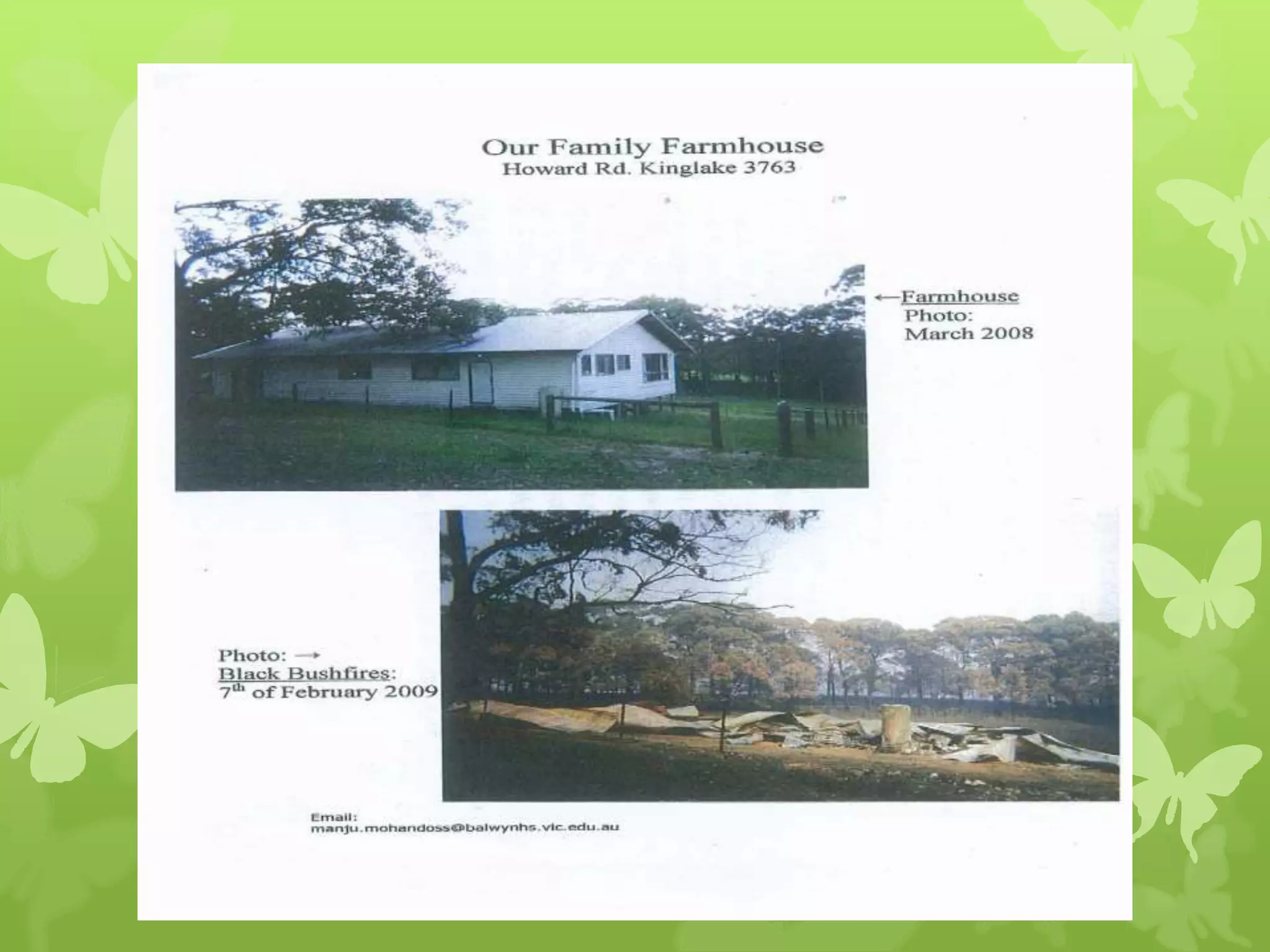
Finally, my deepest appreciation is expressed to my
daughter Priya Mohandoss who supported and
encouraged me when we lost our family farmhouse at
Kinglake during the ‘Black Saturday Bushfires’ on 7th of
February 2009.
Mahatma Gandhi

The Role of Science in the Design and

  • 1.
    The Role ofScience in the Design and Impact of Sustainability Projects and Curricula within a selected Primary and Secondary School: A Melbourne Case Study. The University of Melbourne Master of Education Melbourne Graduate School of Education Manju Mohandoss – priyacreations@bigpond.com.au
  • 2.
    What does thefuture mean to me? 2007- Year 9 Answer - To us the future means being able to live without wearing masks to help us breathe and being able to have good healthy food instead of genetically modified plants which are not natural in their nutrients and what they give to animals and people of the world, but they are good to help with disease control and drought proofing the plants. We will hope our lives will not become a grim and unliveable standard of life where nothing is natural and where the air and water is poisoned.
  • 3.
    ‘Xplore’ program Leading SchoolFund initiative award (2005) An integrated and comprehensive Year 9 program connects students with both their local and global communities to address the needs of adolescent learners under a broad theme known as ‘The Big Question’ to link their personal learning and opinions about sustainability issues.
  • 4.
    Significance of theStudy In this study, commenced during 2009, I investigated ways in which teachers were reflecting on their goals, successes, challenges and obstacles faced to deliver the objectives for the first four years under the “Decade of Education for Sustainable Development”.
  • 5.
    ‘Our Common Future’(1987) This report provided the concept of educational sustainability for rethinking and development of a global agenda to protect the environment while achieving sustainable development. The 57th Session of the General Assembly at the December 2002 World Summit on Sustainable Development in Johannesburg resolved to proclaim the 10 year period as the United Nations Decade of Education for Sustainable Development (UNDESD) to address teacher education in its role as task manager for the 10 year period beginning on January 1, 2005.
  • 6.
    Symposium for theUnited Nations Decade of Educational Sustainability National Symposium was organised and hosted in Melbourne by RMIT University on 7th of July 2005. The Australian Government nominated the Department of Environment and Heritage (DEH) as the leading agency. Representatives of over 70 national organizations including industry groups, non- government organizations, trade unions, professional associations, local and state/territory government, Technical and Further Education (TAFE) and higher education providers attended the Symposium.
  • 7.
    Conceptual Framework For sustainableeducational development within the global context, school communities need innovation, willingness and coordination to re-think inclusively to create a sustainable, safe future for our planet. This small scale case study exploration employed open-ended and qualitative methodology to allow teachers to express their own interpretations rather than impose them for response. The crisis of sustainability can only be solved by taking a holistic, empowering and integrated approach to education.
  • 8.
    Research Questions The followingquestions provided the framework for the case study: a) What do teachers know about sustainability? b) What do teachers believe about its places in the curriculum and the classroom? c) What are teacher’s attitudes about sustainability in an education context? d) What do teachers currently do to teach and promote sustainability? e) Are there specific resources teachers choose or ‘outside’ projects they incorporate into their teaching of sustainability?
  • 9.
    Key definition ‘Environmental Education’/ ‘Education for Sustainability’ The research questions were structured to evaluate participating teachers’ views on their general and educational knowledge about sustainability. The “Assessments of community education for sustainability – Framework (2007)” was used to provide clarity on the terminology “Education for Sustainability” (Appendix 2). Environmental and sustainability education terminology (p.37) has discussed how the terms ‘education for sustainability’ and ‘sustainability education’ are commonly used within policy framing in Victoria.
  • 10.
    Data Collection Teachers andschool based curriculum designers invited from the local primary and the adjacent secondary school. A total of 30 teachers with a mixed range of teaching experiences (novice to experienced) from both schools voluntarily gave permission to be included within the interview sample. All 30 participants from a cross-section of curriculum areas were included so that the findings could be representative of the selected school contexts: Duration of each questionnaire and interview was approximately 30 minutes. Participants were interviewed on site where they were employed at a negotiated time. Interviews were digitally recorded with participants consent.
  • 11.
    Findings and preliminary discussion Torigorously explore the teacher practice in education for sustainability, the semi- structured research questions formed extensive and discursive responses from the participating teachers. Coding and concept building were used to review strategies by linking qualitative data analysis with each research question. The assessment involved auditing the semi-structured interviews to evaluate the current state of school sustainability education.
  • 12.
    Question a): Whatdo you know about sustainability? Teacher understanding and knowledge about sustainability included:  Managing and maintaining resources for future generations to have a productive and healthy lifestyle – (18/30)  Use of renewable resources and recycling -(13/30)  Social responsibility to promote/improve sustainable practices – (7/30)  Conservation – protecting natural environment - (6/30)  Not using fossil fuels/ minimal local-global impact on the planet – (7/30)  Other definitions of sustainability – (2/30)
  • 13.
    Question b): Whatdo you believe about its places in the curriculum and the classroom? The general comment mainly constituted two parts: Part A - Place of sustainability in the curriculum with implementation across the disciplines in the curriculum:  Coordinated approach - Sustainability integrated in certain disciplines only. (20/30)  Cross-curriculum approach - Sustainability integrated in all subject areas. (8/30) Part B - Place of sustainability in the classroom with implementation across different subject areas as selected by teachers: Secondary school teachers were in favour of implementation of sustainability across certain subject areas as a major place in the curriculum and the classroom. Science was selected by 18 teachers and Geography was selected by 15 teachers.
  • 14.
    Question c): Whatare the teacher’s attitudes about sustainability in an education context? Teacher’s attitudes about sustainability in an education context included:  Raising awareness of the current and future issues and challenges – (13/30)  Inquiry-based setting with coordinated approach – (6/30)  Support and teacher training for creating units – (5/30)  Integrated approach – (5/30)  Schools and teachers needing to model behaviour and attitudes – (2/30 – Primary teachers)  Crowded curriculum – (1/30)
  • 15.
    Question d): Whatdo teachers currently do to teach and promote sustainability?  Local Primary School - Classroom Projects: Sustainability issues were currently incorporated in curriculum planning with classroom projects at the local primary school.  Local Secondary School - Subject areas: Teachers at the secondary school mentioned that sustainability was mainly promoted through the ‘Xplore’ program for Year 9 students (10 teachers) and through Geography (8 teachers) or Science classes (8 teachers). Some teachers mentioned that subjects like Commerce (3 teachers), English (2 teachers), Health (1 teacher) and History (1 teacher) also currently promoted sustainability.
  • 16.
    Question (e): Arethere specific resources you choose or ‘outside’ projects you incorporate into your teaching of sustainability? Comments made by participants showed that 21 out of 30 teachers incorporated specific resources and outside projects to teach sustainability. These included both primary and secondary school teachers and in particular from Mathematics, Science, English and History subject areas.
  • 17.
    Summary Discussion and Conclusions Forparticipating teachers from both schools, attitudes about sustainability in an educational context involved the importance of a coordinated and integrated approach and modelling good behaviour. Need for financial support and teacher training was mentioned for creating the curriculum approach to prepare teachers and students for these complex environmental and social challenges faced. Many participating teachers were finding it difficult to teach and promote sustainability. However, the crowded curriculum was not seen as an important constraint.
  • 18.
    Acknowledgements I wish toexpress my sincere thanks and gratitude to my supervisor Dr. Peter Ferguson for his continuing encouragement, advice and guidance. My special thanks go to the 30 local primary school and adjacent secondary school teachers who participated in this research project. Special thanks to Roie Thomas for her assistance and encouragement. Finally, my deepest appreciation is expressed to my daughter Priya Mohandoss who supported and encouraged me when we lost our family farmhouse at Kinglake during the ‘Black Saturday Bushfires’ on 7th of February 2009.
  • 20.