Alicia Keefe - Alicia.Keefe@noaa.gov
Education and Outreach Coordinator
West Coast Region
June 27, 2016
Climate Change in Your Classroom
YOUR BACKGROUND
What’s in the news?
June 26, 2016
• Climate Change Puts Squeeze on Cuddly
Koalas
• Brexit could slow progress on fighting
climate change
• Climate change could be even worse for
Boston than previously thought
• Climate Change Poses Urgent Threat to Poor
• Food Crop Breeding Programmes are Being
Outpaced by Climate Change
What’s in the news?
June 26, 2016
• New Coalition Of 7,100 Cities Launched To
Tackle More Effectively Climate Change
• Native American tribes learn to fight
climate change
• Oslo votes to slash emissions 95% by 2030
• Portland School Board Bans Materials
Questioning Human-Caused Climate
Change
POWERLESSNESS, TERROR, AND HOPE
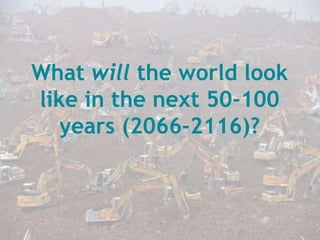
What will the world look
like in the next 50-100
years (2066-2116)?
Ecophobia
A fear of ecological problems and the natural world.
Learned Helplessness
Personal
See themselves as the problem; internalize
the problem.
Pervasive
See the problem affecting all aspects of life.
Permanent
See the problem as unchangeable
What do you want the world
to look like in the next 50-100
years?
“As educators, despair is
not our business.”
- Edmund O’Sullivan, Transformative Learning Center
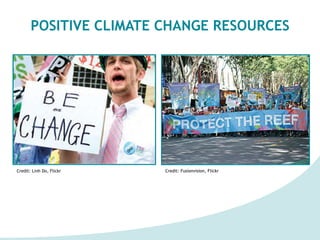
POSITIVE CLIMATE CHANGE RESOURCES
Credit: Linh Do, Flickr Credit: Fusionvision, Flickr
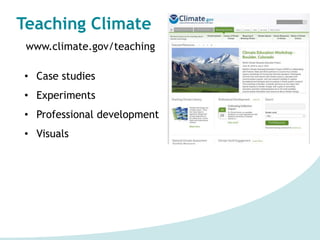
Teaching Climate
www.climate.gov/teaching
• Case studies
• Experiments
• Professional development
• Visuals
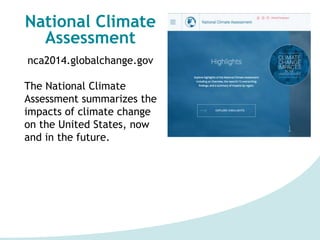
National Climate
Assessment
nca2014.globalchange.gov
The National Climate
Assessment summarizes the
impacts of climate change
on the United States, now
and in the future.
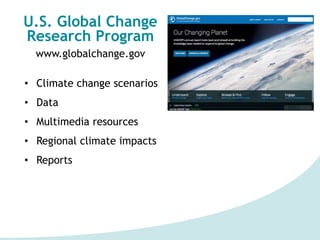
U.S. Global Change
Research Program
www.globalchange.gov
• Climate change scenarios
• Data
• Multimedia resources
• Regional climate impacts
• Reports
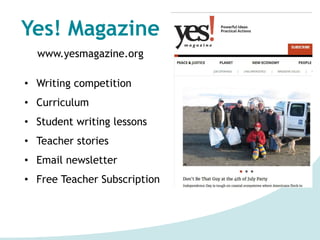
Yes! Magazine
www.yesmagazine.org
• Writing competition
• Curriculum
• Student writing lessons
• Teacher stories
• Email newsletter
• Free Teacher Subscription
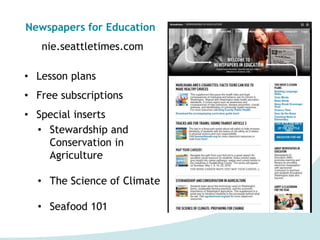
Newspapers for Education
nie.seattletimes.com
• Lesson plans
• Free subscriptions
• Special inserts
• Stewardship and
Conservation in
Agriculture
• The Science of Climate
• Seafood 101
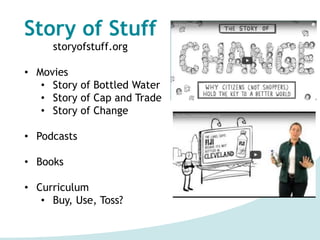
Story of Stuff
storyofstuff.org
• Movies
• Story of Bottled Water
• Story of Cap and Trade
• Story of Change
• Podcasts
• Books
• Curriculum
• Buy, Use, Toss?
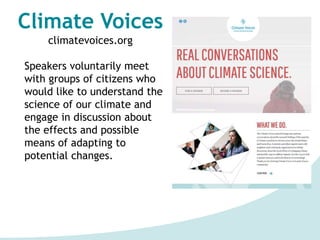
Climate Voices
climatevoices.org
Speakers voluntarily meet
with groups of citizens who
would like to understand the
science of our climate and
engage in discussion about
the effects and possible
means of adapting to
potential changes.
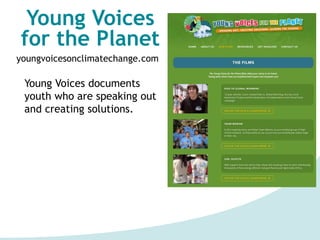
Young Voices
for the Planet
youngvoicesonclimatechange.com
Young Voices documents
youth who are speaking out
and creating solutions.
○Books
○Curriculum
○Movies
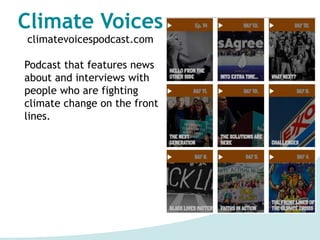
Climate Voices
climatevoicespodcast.com
Podcast that features news
about and interviews with
people who are fighting
climate change on the front
lines.
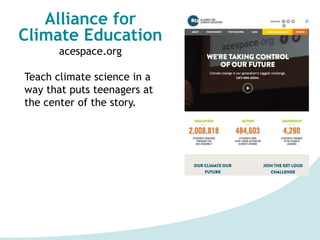
Alliance for
Climate Education
acespace.org
Teach climate science in a
way that puts teenagers at
the center of the story.
○Action projects
○Assemblies
○Lesson plans
○Music
○Videos
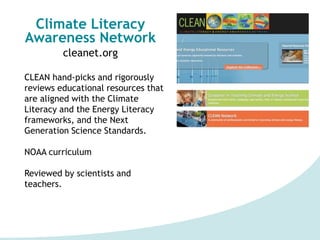
Climate Literacy
Awareness Network
cleanet.org
CLEAN hand-picks and rigorously
reviews educational resources that
are aligned with the Climate
Literacy and the Energy Literacy
frameworks, and the Next
Generation Science Standards.
NOAA curriculum
Reviewed by scientists and
teachers.
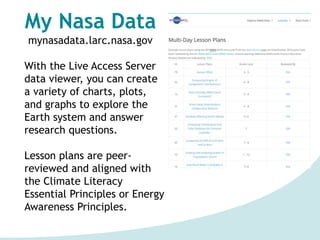
My Nasa Data
mynasadata.larc.nasa.gov
With the Live Access Server
data viewer, you can create
a variety of charts, plots,
and graphs to explore the
Earth system and answer
research questions.
Lesson plans are peer-
reviewed and aligned with
the Climate Literacy
Essential Principles or Energy
Awareness Principles.
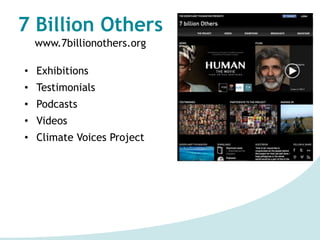
7 Billion Others
www.7billionothers.org
• Exhibitions
• Testimonials
• Podcasts
• Videos
• Climate Voices Project
○600 interviews
○17 countries
○7 continents
Facing the Future
www.facingthefuture.org
Lesson plans
• NOAA and NASA data
• Tested in classrooms around
the US
• Interdisciplinary
Professional development
FOUNDATIONAL KNOWLEDGE
Defining
Sustainability
Sustainability
The principle of meeting current
needs without limiting the ability
of future generations to meet
their needs.
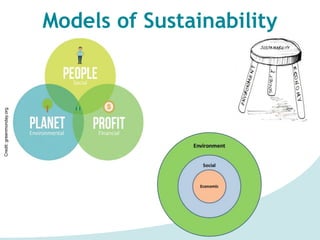
Models of Sustainability
Credit:greenmonday.org
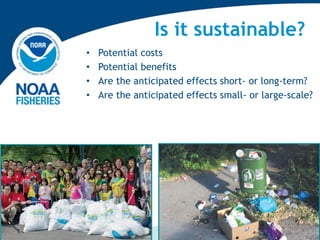
Is it sustainable?
• Potential costs
• Potential benefits
• Are the anticipated effects short- or long-term?
• Are the anticipated effects small- or large-scale?
CLIMATE CHANGE CURRICULUM
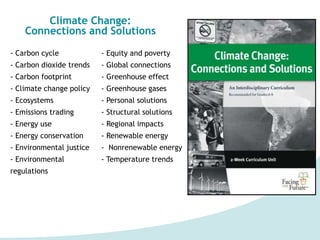
Climate Change:
Connections and Solutions
- Equity and poverty
- Global connections
- Greenhouse effect
- Greenhouse gases
- Personal solutions
- Structural solutions
- Regional impacts
- Renewable energy
- Nonrenewable energy
- Temperature trends
- Carbon cycle
- Carbon dioxide trends
- Carbon footprint
- Climate change policy
- Ecosystems
- Emissions trading
- Energy use
- Energy conservation
- Environmental justice
- Environmental
regulations
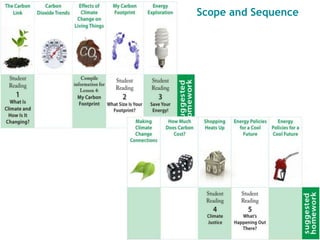
Scope and Sequence
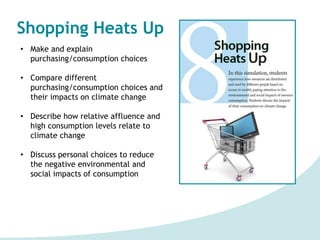
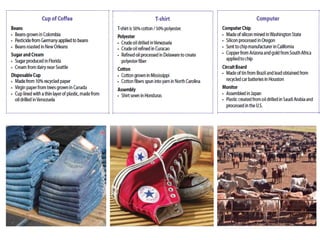
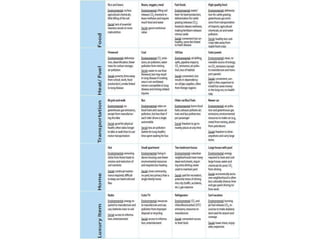
Shopping Heats Up
• Make and explain
purchasing/consumption choices
• Compare different
purchasing/consumption choices and
their impacts on climate change
• Describe how relative affluence and
high consumption levels relate to
climate change
• Discuss personal choices to reduce
the negative environmental and
social impacts of consumption
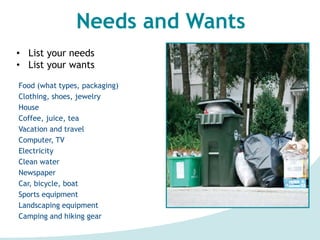
Needs and Wants
• List your needs
• List your wants
Food (what types, packaging)
Clothing, shoes, jewelry
House
Coffee, juice, tea
Vacation and travel
Computer, TV
Electricity
Clean water
Newspaper
Car, bicycle, boat
Sports equipment
Landscaping equipment
Camping and hiking gear
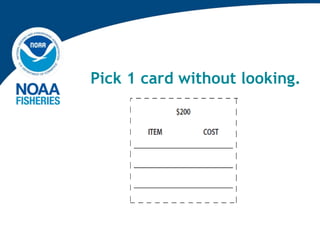
Pick 1 card without looking.
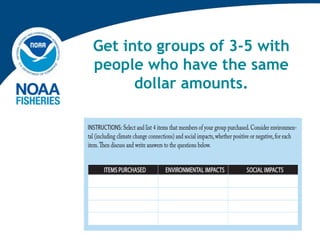
Get into groups of 3-5 with
people who have the same
dollar amounts.
Critical Thinking Questions
• What choices are available to people
with relatively little access to
wealth/income compared to people
with relatively high access?
• What are some environmental and
social impacts of each of those choices
and decisions? How do these impacts
contribute to climate change?
• What personal choices can we make to
help reduce our impact on climate
change?
Extension
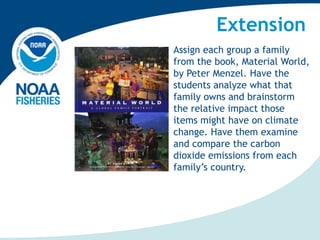
Assign each group a family
from the book, Material World,
by Peter Menzel. Have the
students analyze what that
family owns and brainstorm
the relative impact those
items might have on climate
change. Have them examine
and compare the carbon
dioxide emissions from each
family’s country.
Extension
Have students research cost-effective ways of
reducing greenhouse gas emissions (e.g., compact
fluorescent light bulbs, sealing cracks around
windows and doors, unplugging appliances when
not in use).
Some high-tech solutions are too costly for many
people to use; finding cost-effective measures is
essential to involve more people in climate change
solutions. Give students a “budget” of $50 and
challenge them to find the most effective ways to
reduce CO2 emissions within that budget
CULMINATING PROJECTS
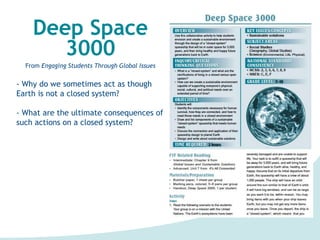
Deep Space
3000
From Engaging Students Through Global Issues
- Why do we sometimes act as though
Earth is not a closed system?
- What are the ultimate consequences of
such actions on a closed system?
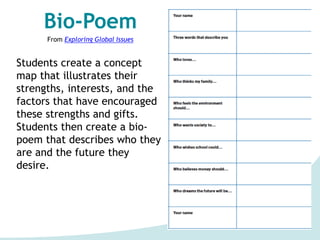
Bio-Poem
From Exploring Global Issues
Students create a concept
map that illustrates their
strengths, interests, and the
factors that have encouraged
these strengths and gifts.
Students then create a bio-
poem that describes who they
are and the future they
desire.
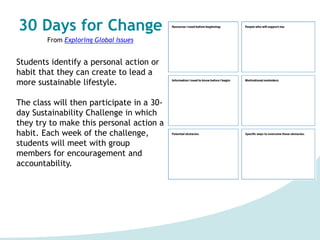
30 Days for Change
From Exploring Global Issues
Students identify a personal action or
habit that they can create to lead a
more sustainable lifestyle.
The class will then participate in a 30-
day Sustainability Challenge in which
they try to make this personal action a
habit. Each week of the challenge,
students will meet with group
members for encouragement and
accountability.
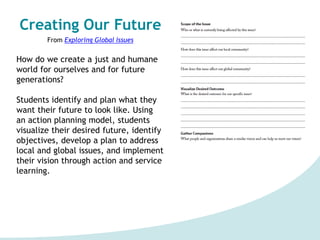
Creating Our Future
From Exploring Global Issues
How do we create a just and humane
world for ourselves and for future
generations?
Students identify and plan what they
want their future to look like. Using
an action planning model, students
visualize their desired future, identify
objectives, develop a plan to address
local and global issues, and implement
their vision through action and service
learning.
CLIMATE EDUCATION LEGISLATION
Senate Bill 3074
Senate Bill 3074, introduced in the U. S. Senate
on June 16, 2016, would, if enacted, authorize
NOAA to establish a climate change education
program.
Included is a grant program aimed at improving
climate change education at the K-12 level.
"Everyone concerned about equipping students
with the knowledge and know how required for
them to flourish in a warming world should urge
their congressional representative to support
these bills."
- Ann Reid, Executive Director, National Center for Science Education

Alicia Keefe- Climate Change

  • 1.
    Alicia Keefe -Alicia.Keefe@noaa.gov Education and Outreach Coordinator West Coast Region June 27, 2016 Climate Change in Your Classroom
  • 2.
  • 3.
    What’s in thenews? June 26, 2016 • Climate Change Puts Squeeze on Cuddly Koalas • Brexit could slow progress on fighting climate change • Climate change could be even worse for Boston than previously thought • Climate Change Poses Urgent Threat to Poor • Food Crop Breeding Programmes are Being Outpaced by Climate Change
  • 4.
    What’s in thenews? June 26, 2016 • New Coalition Of 7,100 Cities Launched To Tackle More Effectively Climate Change • Native American tribes learn to fight climate change • Oslo votes to slash emissions 95% by 2030 • Portland School Board Bans Materials Questioning Human-Caused Climate Change
  • 5.
  • 6.
    What will theworld look like in the next 50-100 years (2066-2116)?
  • 7.
    Ecophobia A fear ofecological problems and the natural world.
  • 8.
    Learned Helplessness Personal See themselvesas the problem; internalize the problem. Pervasive See the problem affecting all aspects of life. Permanent See the problem as unchangeable
  • 9.
    What do youwant the world to look like in the next 50-100 years?
  • 10.
    “As educators, despairis not our business.” - Edmund O’Sullivan, Transformative Learning Center
  • 11.
    POSITIVE CLIMATE CHANGERESOURCES Credit: Linh Do, Flickr Credit: Fusionvision, Flickr
  • 12.
    Teaching Climate www.climate.gov/teaching • Casestudies • Experiments • Professional development • Visuals
  • 13.
    National Climate Assessment nca2014.globalchange.gov The NationalClimate Assessment summarizes the impacts of climate change on the United States, now and in the future.
  • 14.
    U.S. Global Change ResearchProgram www.globalchange.gov • Climate change scenarios • Data • Multimedia resources • Regional climate impacts • Reports
  • 15.
    Yes! Magazine www.yesmagazine.org • Writingcompetition • Curriculum • Student writing lessons • Teacher stories • Email newsletter • Free Teacher Subscription
  • 16.
    Newspapers for Education nie.seattletimes.com •Lesson plans • Free subscriptions • Special inserts • Stewardship and Conservation in Agriculture • The Science of Climate • Seafood 101
  • 17.
    Story of Stuff storyofstuff.org •Movies • Story of Bottled Water • Story of Cap and Trade • Story of Change • Podcasts • Books • Curriculum • Buy, Use, Toss?
  • 18.
    Climate Voices climatevoices.org Speakers voluntarilymeet with groups of citizens who would like to understand the science of our climate and engage in discussion about the effects and possible means of adapting to potential changes.
  • 19.
    Young Voices for thePlanet youngvoicesonclimatechange.com Young Voices documents youth who are speaking out and creating solutions. ○Books ○Curriculum ○Movies
  • 20.
    Climate Voices climatevoicespodcast.com Podcast thatfeatures news about and interviews with people who are fighting climate change on the front lines.
  • 21.
    Alliance for Climate Education acespace.org Teachclimate science in a way that puts teenagers at the center of the story. ○Action projects ○Assemblies ○Lesson plans ○Music ○Videos
  • 22.
    Climate Literacy Awareness Network cleanet.org CLEANhand-picks and rigorously reviews educational resources that are aligned with the Climate Literacy and the Energy Literacy frameworks, and the Next Generation Science Standards. NOAA curriculum Reviewed by scientists and teachers.
  • 23.
    My Nasa Data mynasadata.larc.nasa.gov Withthe Live Access Server data viewer, you can create a variety of charts, plots, and graphs to explore the Earth system and answer research questions. Lesson plans are peer- reviewed and aligned with the Climate Literacy Essential Principles or Energy Awareness Principles.
  • 24.
    7 Billion Others www.7billionothers.org •Exhibitions • Testimonials • Podcasts • Videos • Climate Voices Project ○600 interviews ○17 countries ○7 continents
  • 25.
    Facing the Future www.facingthefuture.org Lessonplans • NOAA and NASA data • Tested in classrooms around the US • Interdisciplinary Professional development
  • 26.
  • 27.
  • 28.
    Sustainability The principle ofmeeting current needs without limiting the ability of future generations to meet their needs.
  • 29.
  • 30.
    Is it sustainable? •Potential costs • Potential benefits • Are the anticipated effects short- or long-term? • Are the anticipated effects small- or large-scale?
  • 31.
  • 32.
    Climate Change: Connections andSolutions - Equity and poverty - Global connections - Greenhouse effect - Greenhouse gases - Personal solutions - Structural solutions - Regional impacts - Renewable energy - Nonrenewable energy - Temperature trends - Carbon cycle - Carbon dioxide trends - Carbon footprint - Climate change policy - Ecosystems - Emissions trading - Energy use - Energy conservation - Environmental justice - Environmental regulations
  • 33.
  • 34.
    Shopping Heats Up •Make and explain purchasing/consumption choices • Compare different purchasing/consumption choices and their impacts on climate change • Describe how relative affluence and high consumption levels relate to climate change • Discuss personal choices to reduce the negative environmental and social impacts of consumption
  • 35.
    Needs and Wants •List your needs • List your wants Food (what types, packaging) Clothing, shoes, jewelry House Coffee, juice, tea Vacation and travel Computer, TV Electricity Clean water Newspaper Car, bicycle, boat Sports equipment Landscaping equipment Camping and hiking gear
  • 37.
    Pick 1 cardwithout looking.
  • 39.
    Get into groupsof 3-5 with people who have the same dollar amounts.
  • 40.
    Critical Thinking Questions •What choices are available to people with relatively little access to wealth/income compared to people with relatively high access? • What are some environmental and social impacts of each of those choices and decisions? How do these impacts contribute to climate change? • What personal choices can we make to help reduce our impact on climate change?
  • 41.
    Extension Assign each groupa family from the book, Material World, by Peter Menzel. Have the students analyze what that family owns and brainstorm the relative impact those items might have on climate change. Have them examine and compare the carbon dioxide emissions from each family’s country.
  • 42.
    Extension Have students researchcost-effective ways of reducing greenhouse gas emissions (e.g., compact fluorescent light bulbs, sealing cracks around windows and doors, unplugging appliances when not in use). Some high-tech solutions are too costly for many people to use; finding cost-effective measures is essential to involve more people in climate change solutions. Give students a “budget” of $50 and challenge them to find the most effective ways to reduce CO2 emissions within that budget
  • 43.
  • 44.
    Deep Space 3000 From EngagingStudents Through Global Issues - Why do we sometimes act as though Earth is not a closed system? - What are the ultimate consequences of such actions on a closed system?
  • 45.
    Bio-Poem From Exploring GlobalIssues Students create a concept map that illustrates their strengths, interests, and the factors that have encouraged these strengths and gifts. Students then create a bio- poem that describes who they are and the future they desire.
  • 46.
    30 Days forChange From Exploring Global Issues Students identify a personal action or habit that they can create to lead a more sustainable lifestyle. The class will then participate in a 30- day Sustainability Challenge in which they try to make this personal action a habit. Each week of the challenge, students will meet with group members for encouragement and accountability.
  • 47.
    Creating Our Future FromExploring Global Issues How do we create a just and humane world for ourselves and for future generations? Students identify and plan what they want their future to look like. Using an action planning model, students visualize their desired future, identify objectives, develop a plan to address local and global issues, and implement their vision through action and service learning.
  • 48.
  • 49.
    Senate Bill 3074 SenateBill 3074, introduced in the U. S. Senate on June 16, 2016, would, if enacted, authorize NOAA to establish a climate change education program. Included is a grant program aimed at improving climate change education at the K-12 level. "Everyone concerned about equipping students with the knowledge and know how required for them to flourish in a warming world should urge their congressional representative to support these bills." - Ann Reid, Executive Director, National Center for Science Education

Editor's Notes

  • #28 Work with your neighbor to come up with a definition of sustainability. How does your definition relate to climate change?
  • #44 Some of the presenters this week will be talking about service learning projects and volunteering ideas for your students. I wanted to highlight some culminating projects that you can easily implement during your regularly-scheduled classes.