






5 Steps to U.S. Study
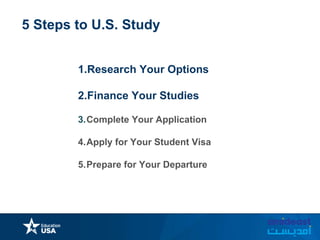
1.Research Your Options
2.Finance Your Studies
3.Complete Your Application
4.Apply for Your Student Visa
5.Prepare for Your Departure
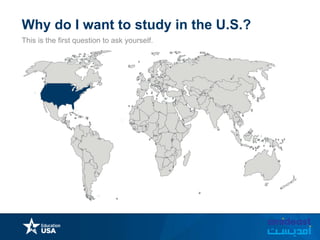
Why do I want to study in the U.S.?
This is the first question to ask yourself.
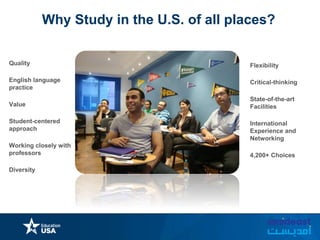
Why Study in the U.S. of all places?
Quality
English language
practice
Value
Student-centered
approach
Working closely with
professors
Diversity
Flexibility
Critical-thinking
State-of-the-art
Facilities
International
Experience and
Networking
4,200+ Choices
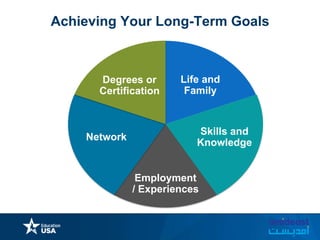
Life and
Family
Skills and
Knowledge
Employment
/ Experiences
Network
Degrees or
Certification
Achieving Your Long-Term Goals
What to Study
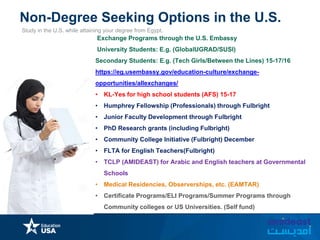
Non-Degree Seeking Options in the U.S.
Study in the U.S. while attaining your degree from Egypt.
Exchange Programs through the U.S. Embassy
University Students: E.g. (GlobalUGRAD/SUSI)
Secondary Students: E.g. (Tech Girls/Between the Lines) 15-17/16
https://eg.usembassy.gov/education-culture/exchange-
opportunities/allexchanges/
• KL-Yes for high school students (AFS) 15-17
• Humphrey Fellowship (Professionals) through Fulbright
• Junior Faculty Development through Fulbright
• PhD Research grants (including Fulbright)
• Community College Initiative (Fulbright) December
• FLTA for English Teachers(Fulbright)
• TCLP (AMIDEAST) for Arabic and English teachers at Governmental
Schools
• Medical Residencies, Observerships, etc. (EAMTAR)
• Certificate Programs/ELI Programs/Summer Programs through
Community colleges or US Universities. (Self fund)
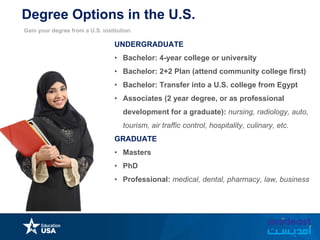
Degree Options in the U.S.
UNDERGRADUATE
• Bachelor: 4-year college or university
• Bachelor: 2+2 Plan (attend community college first)
• Bachelor: Transfer into a U.S. college from Egypt
• Associates (2 year degree, or as professional
development for a graduate): nursing, radiology, auto,
tourism, air traffic control, hospitality, culinary, etc.
GRADUATE
• Masters
• PhD
• Professional: medical, dental, pharmacy, law, business
Gain your degree from a U.S. institution.
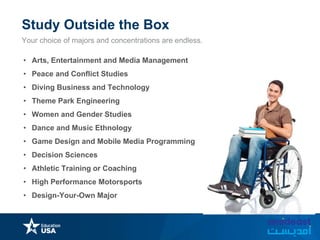
Study Outside the Box
Your choice of majors and concentrations are endless.
• Arts, Entertainment and Media Management
• Peace and Conflict Studies
• Diving Business and Technology
• Theme Park Engineering
• Women and Gender Studies
• Dance and Music Ethnology
• Game Design and Mobile Media Programming
• Decision Sciences
• Athletic Training or Coaching
• High Performance Motorsports
• Design-Your-Own Major
Where to Study
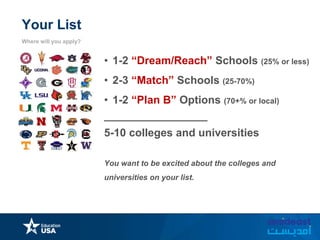
Your List
Where will you apply?
• 1-2 “Dream/Reach” Schools (25% or less)
• 2-3 “Match” Schools (25-70%)
• 1-2 “Plan B” Options (70+% or local)
_________________
5-10 colleges and universities
You want to be excited about the colleges and
universities on your list.
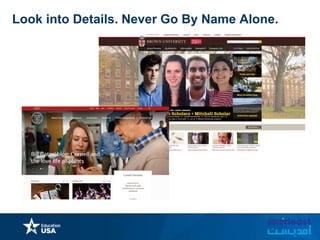
Look into Details. Never Go By Name Alone.
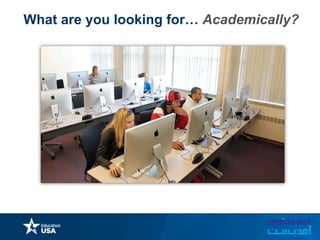
What are you looking for… Academically?
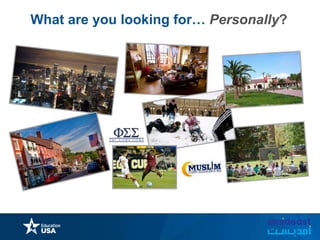
What are you looking for… Personally?
What are you looking for… Financially?
Things to Consider Other Than Rankings
Consider more when considering a U.S. institution.
• Your personality and social/study habits
• Number of International Students
• Undergraduate / Graduate Student Ratios
• Is there research being done on your specialization?
• Do the faculty share your interests and passions?
• Graduation Rate
• Employment Rate
• How many large, lecture-style classes?
• Are you eligible for financial assistance?
• WHERE DO YOU FIT?
Undergraduate Financial Assistance
Find out what the college offers and which programs you are eligible for.
• Merit Scholarships: Academic GPA and SAT/ACT scores
• Talent Scholarships: Specific majors
• Diversity Scholarships
• Transfer Scholarships
• Tuition wavers and other guaranteed discounts
• Need-based financial aid for international students (full need met)
• Athletic Scholarships (administered through the NCAA)
• Leadership and other special awards
• On-Campus Work Study (limited hours and wage <$2,500 per year)
• Off-Campus Internship (CPT/OPT Practical Training, sometimes paid)
• Tuition Guarantee (price will not rise each year)
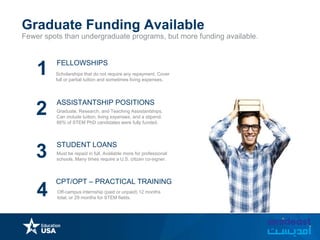
Graduate Funding Available
Fewer spots than undergraduate programs, but more funding available.
FELLOWSHIPS
Graduate, Research, and Teaching Assistantships.
Can include tuition, living expenses, and a stipend.
86% of STEM PhD candidates were fully funded.
ASSISTANTSHIP POSITIONS
Must be repaid in full. Available more for professional
schools. Many times require a U.S. citizen co-signer.
STUDENT LOANS
1
2
3
Off-campus internship (paid or unpaid) 12 months
total, or 29 months for STEM fields.
4
Scholarships that do not require any repayment. Cover
full or partial tuition and sometimes living expenses.
CPT/OPT – PRACTICAL TRAINING
Graduate: Things to Consider
• More like applying for a job.
• Is the professor/department doing exactly
what you have experience with?
• How many positions do they have available?
• Two Models: Few, fully-funded students VS
Many, partially-funded students
• Are they looking for work/life experience?
• Fewer spots than undergraduate programs,
but more funding available
• Professional Schools offer little/no funding;
Could you consider an academic degree
instead of a professional track?
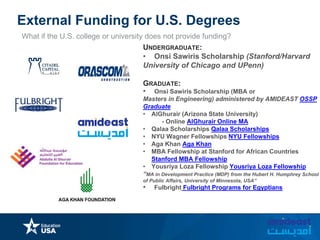
What if the U.S. college or university does not provide funding?
UNDERGRADUATE:
• Onsi Sawiris Scholarship (Stanford/Harvard
University of Chicago and UPenn)
GRADUATE:
• Onsi Sawiris Scholarship (MBA or
Masters in Engineering) administered by AMIDEAST OSSP
Graduate
• AlGhurair (Arizona State University)
- Online AlGhurair Online MA
• Qalaa Scholarships Qalaa Scholarships
• NYU Wagner Fellowships NYU Fellowships
• Aga Khan Aga Khan
• MBA Fellowship at Stanford for African Countries
Stanford MBA Fellowship
• Yousriya Loza Fellowship Yousriya Loza Fellowship
“MA in Development Practice (MDP) from the Hubert H. Humphrey School
of Public Affairs, University of Minnesota, USA”
• Fulbright Fulbright Programs for Egyptians
External Funding for U.S. Degrees
What Are They
Looking For?
Are Your Scores and GPA Similar to
Their Average Students?
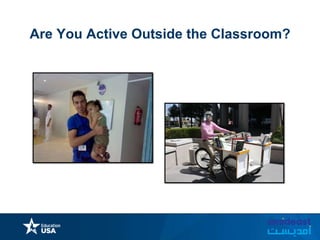
Are You Active Outside the Classroom?
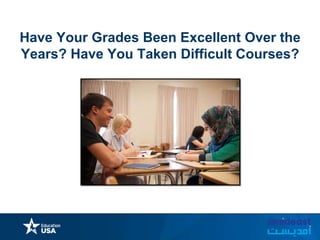
Have Your Grades Been Excellent Over the
Years? Have You Taken Difficult Courses?
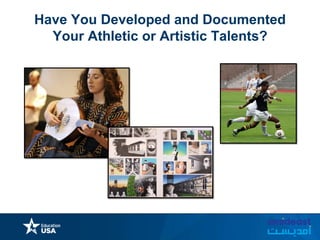
Have You Developed and Documented
Your Athletic or Artistic Talents?
Do You Have Strong English Proficiency?
(Incl. essay writing)
Can You Tell Your Story in a
Unique and Powerful Way?
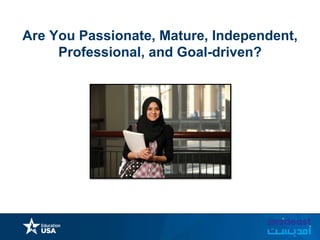
Are You Passionate, Mature, Independent,
Professional, and Goal-driven?
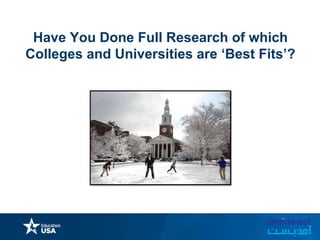
Have You Done Full Research of which
Colleges and Universities are ‘Best Fits’?
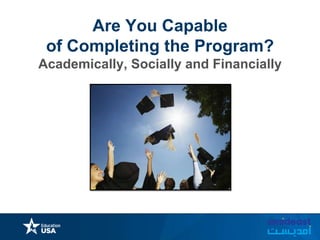
Are You Capable
of Completing the Program?
Academically, Socially and Financially
How to Apply
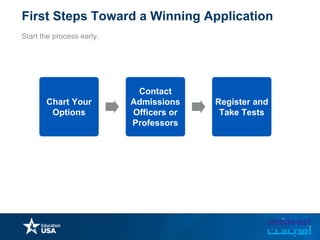
Start the process early.
First Steps Toward a Winning Application
Chart Your
Options
Contact
Admissions
Officers or
Professors
Register and
Take Tests
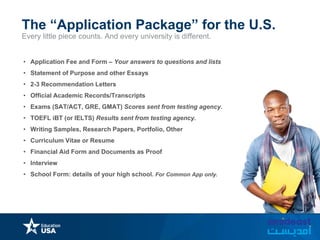
Every little piece counts. And every university is different.
The “Application Package” for the U.S.
• Application Fee and Form – Your answers to questions and lists
• Statement of Purpose and other Essays
• 2-3 Recommendation Letters
• Official Academic Records/Transcripts
• Exams (SAT/ACT, GRE, GMAT) Scores sent from testing agency.
• TOEFL iBT (or IELTS) Results sent from testing agency.
• Writing Samples, Research Papers, Portfolio, Other
• Curriculum Vitae or Resume
• Financial Aid Form and Documents as Proof
• Interview
• School Form: details of your high school. For Common App only.
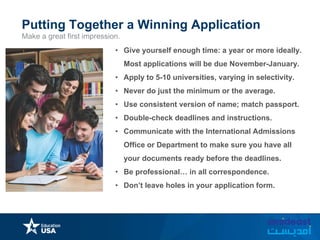
Make a great first impression.
Putting Together a Winning Application
• Give yourself enough time: a year or more ideally.
Most applications will be due November-January.
• Apply to 5-10 universities, varying in selectivity.
• Never do just the minimum or the average.
• Use consistent version of name; match passport.
• Double-check deadlines and instructions.
• Communicate with the International Admissions
Office or Department to make sure you have all
your documents ready before the deadlines.
• Be professional… in all correspondence.
• Don’t leave holes in your application form.
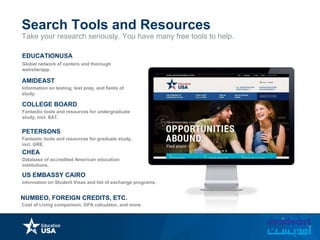
Take your research seriously. You have many free tools to help.
Search Tools and Resources
Global network of centers and thorough
website/app.
EDUCATIONUSA
AMIDEAST
Information on testing, test prep, and fields of
study.
COLLEGE BOARD
Fantastic tools and resources for undergraduate
study, incl. SAT.
PETERSONS
Fantastic tools and resources for graduate study,
incl. GRE.
CHEA
Database of accredited American education
institutions.
US EMBASSY CAIRO
Information on Student Visas and list of exchange programs.
NUMBEO, FOREIGN CREDITS, ETC.
Cost of Living comparison, GPA calculator, and more.
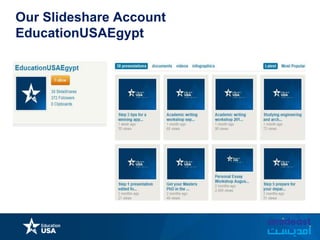
Our Slideshare Account
EducationUSAEgypt
Check our website!
EducationUSA.state.gov
Our Facebook Community
EducationUSA Egypt
Q&A

Step 1 generic 2021

  • 2.
    5 Steps toU.S. Study 1.Research Your Options 2.Finance Your Studies 3.Complete Your Application 4.Apply for Your Student Visa 5.Prepare for Your Departure
  • 3.
    Why do Iwant to study in the U.S.? This is the first question to ask yourself.
  • 4.
    Why Study inthe U.S. of all places? Quality English language practice Value Student-centered approach Working closely with professors Diversity Flexibility Critical-thinking State-of-the-art Facilities International Experience and Networking 4,200+ Choices
  • 5.
    Life and Family Skills and Knowledge Employment /Experiences Network Degrees or Certification Achieving Your Long-Term Goals
  • 6.
  • 7.
    Non-Degree Seeking Optionsin the U.S. Study in the U.S. while attaining your degree from Egypt. Exchange Programs through the U.S. Embassy University Students: E.g. (GlobalUGRAD/SUSI) Secondary Students: E.g. (Tech Girls/Between the Lines) 15-17/16 https://eg.usembassy.gov/education-culture/exchange- opportunities/allexchanges/ • KL-Yes for high school students (AFS) 15-17 • Humphrey Fellowship (Professionals) through Fulbright • Junior Faculty Development through Fulbright • PhD Research grants (including Fulbright) • Community College Initiative (Fulbright) December • FLTA for English Teachers(Fulbright) • TCLP (AMIDEAST) for Arabic and English teachers at Governmental Schools • Medical Residencies, Observerships, etc. (EAMTAR) • Certificate Programs/ELI Programs/Summer Programs through Community colleges or US Universities. (Self fund)
  • 8.
    Degree Options inthe U.S. UNDERGRADUATE • Bachelor: 4-year college or university • Bachelor: 2+2 Plan (attend community college first) • Bachelor: Transfer into a U.S. college from Egypt • Associates (2 year degree, or as professional development for a graduate): nursing, radiology, auto, tourism, air traffic control, hospitality, culinary, etc. GRADUATE • Masters • PhD • Professional: medical, dental, pharmacy, law, business Gain your degree from a U.S. institution.
  • 9.
    Study Outside theBox Your choice of majors and concentrations are endless. • Arts, Entertainment and Media Management • Peace and Conflict Studies • Diving Business and Technology • Theme Park Engineering • Women and Gender Studies • Dance and Music Ethnology • Game Design and Mobile Media Programming • Decision Sciences • Athletic Training or Coaching • High Performance Motorsports • Design-Your-Own Major
  • 10.
  • 11.
    Your List Where willyou apply? • 1-2 “Dream/Reach” Schools (25% or less) • 2-3 “Match” Schools (25-70%) • 1-2 “Plan B” Options (70+% or local) _________________ 5-10 colleges and universities You want to be excited about the colleges and universities on your list.
  • 12.
    Look into Details.Never Go By Name Alone.
  • 13.
    What are youlooking for… Academically?
  • 14.
    What are youlooking for… Personally?
  • 15.
    What are youlooking for… Financially?
  • 16.
    Things to ConsiderOther Than Rankings Consider more when considering a U.S. institution. • Your personality and social/study habits • Number of International Students • Undergraduate / Graduate Student Ratios • Is there research being done on your specialization? • Do the faculty share your interests and passions? • Graduation Rate • Employment Rate • How many large, lecture-style classes? • Are you eligible for financial assistance? • WHERE DO YOU FIT?
  • 17.
    Undergraduate Financial Assistance Findout what the college offers and which programs you are eligible for. • Merit Scholarships: Academic GPA and SAT/ACT scores • Talent Scholarships: Specific majors • Diversity Scholarships • Transfer Scholarships • Tuition wavers and other guaranteed discounts • Need-based financial aid for international students (full need met) • Athletic Scholarships (administered through the NCAA) • Leadership and other special awards • On-Campus Work Study (limited hours and wage <$2,500 per year) • Off-Campus Internship (CPT/OPT Practical Training, sometimes paid) • Tuition Guarantee (price will not rise each year)
  • 18.
    Graduate Funding Available Fewerspots than undergraduate programs, but more funding available. FELLOWSHIPS Graduate, Research, and Teaching Assistantships. Can include tuition, living expenses, and a stipend. 86% of STEM PhD candidates were fully funded. ASSISTANTSHIP POSITIONS Must be repaid in full. Available more for professional schools. Many times require a U.S. citizen co-signer. STUDENT LOANS 1 2 3 Off-campus internship (paid or unpaid) 12 months total, or 29 months for STEM fields. 4 Scholarships that do not require any repayment. Cover full or partial tuition and sometimes living expenses. CPT/OPT – PRACTICAL TRAINING
  • 19.
    Graduate: Things toConsider • More like applying for a job. • Is the professor/department doing exactly what you have experience with? • How many positions do they have available? • Two Models: Few, fully-funded students VS Many, partially-funded students • Are they looking for work/life experience? • Fewer spots than undergraduate programs, but more funding available • Professional Schools offer little/no funding; Could you consider an academic degree instead of a professional track?
  • 20.
    What if theU.S. college or university does not provide funding? UNDERGRADUATE: • Onsi Sawiris Scholarship (Stanford/Harvard University of Chicago and UPenn) GRADUATE: • Onsi Sawiris Scholarship (MBA or Masters in Engineering) administered by AMIDEAST OSSP Graduate • AlGhurair (Arizona State University) - Online AlGhurair Online MA • Qalaa Scholarships Qalaa Scholarships • NYU Wagner Fellowships NYU Fellowships • Aga Khan Aga Khan • MBA Fellowship at Stanford for African Countries Stanford MBA Fellowship • Yousriya Loza Fellowship Yousriya Loza Fellowship “MA in Development Practice (MDP) from the Hubert H. Humphrey School of Public Affairs, University of Minnesota, USA” • Fulbright Fulbright Programs for Egyptians External Funding for U.S. Degrees
  • 21.
  • 22.
    Are Your Scoresand GPA Similar to Their Average Students?
  • 23.
    Are You ActiveOutside the Classroom?
  • 24.
    Have Your GradesBeen Excellent Over the Years? Have You Taken Difficult Courses?
  • 25.
    Have You Developedand Documented Your Athletic or Artistic Talents?
  • 26.
    Do You HaveStrong English Proficiency? (Incl. essay writing)
  • 27.
    Can You TellYour Story in a Unique and Powerful Way?
  • 28.
    Are You Passionate,Mature, Independent, Professional, and Goal-driven?
  • 29.
    Have You DoneFull Research of which Colleges and Universities are ‘Best Fits’?
  • 30.
    Are You Capable ofCompleting the Program? Academically, Socially and Financially
  • 31.
  • 32.
    Start the processearly. First Steps Toward a Winning Application Chart Your Options Contact Admissions Officers or Professors Register and Take Tests
  • 33.
    Every little piececounts. And every university is different. The “Application Package” for the U.S. • Application Fee and Form – Your answers to questions and lists • Statement of Purpose and other Essays • 2-3 Recommendation Letters • Official Academic Records/Transcripts • Exams (SAT/ACT, GRE, GMAT) Scores sent from testing agency. • TOEFL iBT (or IELTS) Results sent from testing agency. • Writing Samples, Research Papers, Portfolio, Other • Curriculum Vitae or Resume • Financial Aid Form and Documents as Proof • Interview • School Form: details of your high school. For Common App only.
  • 34.
    Make a greatfirst impression. Putting Together a Winning Application • Give yourself enough time: a year or more ideally. Most applications will be due November-January. • Apply to 5-10 universities, varying in selectivity. • Never do just the minimum or the average. • Use consistent version of name; match passport. • Double-check deadlines and instructions. • Communicate with the International Admissions Office or Department to make sure you have all your documents ready before the deadlines. • Be professional… in all correspondence. • Don’t leave holes in your application form.
  • 35.
    Take your researchseriously. You have many free tools to help. Search Tools and Resources Global network of centers and thorough website/app. EDUCATIONUSA AMIDEAST Information on testing, test prep, and fields of study. COLLEGE BOARD Fantastic tools and resources for undergraduate study, incl. SAT. PETERSONS Fantastic tools and resources for graduate study, incl. GRE. CHEA Database of accredited American education institutions. US EMBASSY CAIRO Information on Student Visas and list of exchange programs. NUMBEO, FOREIGN CREDITS, ETC. Cost of Living comparison, GPA calculator, and more.
  • 36.
  • 37.
  • 38.
  • 41.