PAYMENT OF CHEQUES
Paying Banker
Duties And Responsibilities
Sec.31
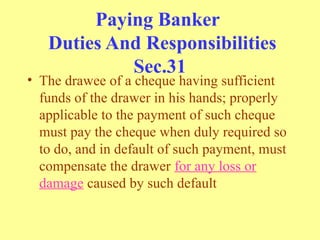
• The drawee of a cheque having sufficient
funds of the drawer in his hands; properly
applicable to the payment of such cheque
must pay the cheque when duly required so
to do, and in default of such payment, must
compensate the drawer for any loss or
damage caused by such default
Payment Of Cheques
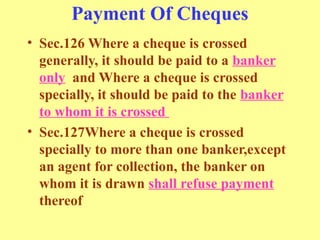
• Sec.126 Where a cheque is crossed
generally, it should be paid to a banker
only and Where a cheque is crossed
specially, it should be paid to the banker
to whom it is crossed
• Sec.127Where a cheque is crossed
specially to more than one banker,except
an agent for collection, the banker on
whom it is drawn shall refuse payment
thereof
Payment Of Cheques
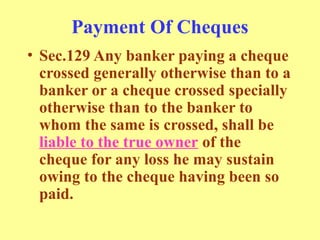
• Sec.129 Any banker paying a cheque
crossed generally otherwise than to a
banker or a cheque crossed specially
otherwise than to the banker to
whom the same is crossed, shall be
liable to the true owner of the
cheque for any loss he may sustain
owing to the cheque having been so
paid.
Precautions To Be Taken While
Making Payment Of Cheques
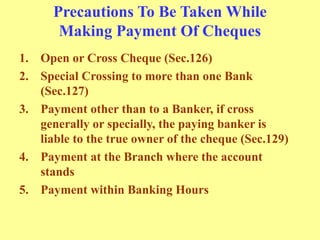
1. Open or Cross Cheque (Sec.126)
2. Special Crossing to more than one Bank
(Sec.127)
3. Payment other than to a Banker, if cross
generally or specially, the paying banker is
liable to the true owner of the cheque (Sec.129)
4. Payment at the Branch where the account
stands
5. Payment within Banking Hours
Precautions (contd..)
6. Mutilated cheques. If accidentally torn, in the
hands of drawer he should confirm the same.
If it torn in the hands of payee/endorsee to be
confirmed by drawer/collecting banker
7. Correctness of Form
8. Post-dated SHOULD NOT BE PAID:
a. Stop Payment before due date
b. May result wrongful dishonour of subsequent
cheques
c. Drawer may become insolvent, insane
d. Encashment, holding till due date, and
discounting of post dated cheque is a fraud in
banking practice
Precautions (contd..)
9. Stale Cheque: Outstanding more than 6
months. Drawer has to revalidate.
10. Amount in words and figures: Sec.18
says amount in words is to be paid.
11.Material Alteration-
Cheques which do not appear to have
been so altered Protection under Sec.89
available to the paying banker, if
payment is made in due course
Precautions (contd..)
12. Computation of Balance
13. Endorsement and Identification of holders of
bearer cheques:
14. Once a Bearer always a Bearer: (sec.85)
15. Endorsement in blank
16. Endorsement of order cheque – Identification
of payee/endorsee is required
17. Forged Signature: There should not be any
grounds of contributory negligence on the
part of customer also
“Payment in Due Course”
(Sec.10)
• Paying banker get protection under sections
31, 85, 85A, 87, 126 to 130, only if payment is
made in due course.
• “Payment in due course means payment in
accordance with the apparent tenor of the
instrument in good faith and without negligence
to any person in possession thereof under
circumstances which do not afford a reasonable
ground for believing that he is not entitled to
receive payment of the amount therein
mentioned” (Sec.10)
Payment to Holder or
Holder-in-due Course
• If payment is stopped by drawer, inspite of
possessing a cheque, the holder is not
entitled for payment.
• Payment of such cheque does not give
protection to the Banker under Section 10.
Collecting Banker
Duties And Responsibilities
• Sec.131: A Banker who has in good faith
and without negligence received payment
for a customer of a cheque crossed
generally or specially to himself shall not, in
case the title to the cheque proves defective,
incur any liability to the true owner of the
cheque by reason only of having received
such payment
Collecting Banker Duties And
Responsibilities (contd)
• Opening of the account by its customer
properly introduced
• Satisfactory conduct of the operations in the
account
• The endorsement leading to collection of
the instrument – anything suspicious
CONVERSION
• Conversion is the unlawful taking, using,
disposing or destroying of goods, which is
inconsistent with the owner’s right of
possession. Even an agent may be held
liable for conversion.
Payment of Cheques
(Some Legal Decisions)
• Issue of cheque: Drawer’s liability
commences with the issue of cheque with
constructive or actual delivery of the
instrument
• Cheque lost in transit: In case the cheque
is lost in transit, the loss would devolve on
the drawer, as the post office being regarded
as the agent of the drawer
Payment of Cheques
(Some Legal Decisions)
• Stolen Cheque: If a cheque is lost in transit and
should a thief encash it, the paying banker
paying a cheque according to its tenor in the
ordinary course of his business would not be
held liable for negligence
• Position of True Owner: The true owner of a
stolen cheque, which has reached the hands of a
holder in due course, will not be able to obtain
payment thereon and will also lose his remedy
against prior parties
BOUNCING OF CHEQUES
(Sec.138)
• Introduced in 1988
• Further amended in 2002 effective from
17.12.02
BOUNCING OF CHEQUES
(Sec.138)
• Punishment with imprisonment upto 2years or
fine upto twice the amount of the cheque or
both: (Sec. 138) (w.e.f. 6.2.2003)
• Conditions:
• Cheque is drawn on account with the bank
• Cheque is issued for discharge of whole or part
of liability or of any debt
• Cheque is returned for insufficiency of funds
• Cheque is presented within the validity
BOUNCING OF CHEQUES
(Sec.138)
• Payee/holder-in-due course makes a
demand on drawer within 30 days from the
date of receipt of intimation from Banker
• Drawer fails to pay the amount within 15
days of receipt of notice
• This section does not provide for making
payment to the payee or the holder in due
course
Check Your Progress
• A banker on whom a cheque is drawn by the
customer is – a) Collecting Banker, b) Paying
Banker, c) Advising Banker`
• A banker who collects a cheque for and on
behalf of his customer is a) Collecting Banker,
b) Paying Banker, c) Advising Banker
• Section 131 of NI act extends protection to the
a) Collecting Banker, b) Paying Banker, c)
Advising Banker
Check Your Progress
• Section 85 of NI act extends protection to the a)
Collecting Banker, b) Paying Banker, c)
Advising Banker
• When a banker makes payment of a cheque
after banking hour he will be held a) liable; b)
reasonable; c) acceptable
• One of the conditions to honour the cheque by
the paying banker is that amount in words and
figures should a) differ; b) tally; c) be clear
Check Your Progress
• Where a customer by a letter has advised the
bank directing the banker not to honour/pay a
particular cheque such a letter is called a) letter
of authority; b) letter of credit; c) stop payment
letter;
• Where a customer has issued a cheque date of
which is yet to come, such a cheque is called a)
Stale cheque; b) post dated cheque; c) crossed
cheque
Check Your Progress
• When a bank pays a cheque according to the
apparent tenor, in good faith and without negligence
and without having reason to doubt the bonafide of
the presenter such a payment is a) wrong payment;
b) late payment; c) payment in due course
• To get the protection under sec.131 a collecting bank
has to collect a ________cheque for credit to his
customer a) Stolen; b) Stale; c) Crossed
• Where the signature of the drawer of a cheque is not
genuine, such cheque is called a) Post dated cheque;
b) Forged cheque; c) Clearing cheque
Check Your Progress
• Payment of cheque must be made by the
banker within banking hours. True/False
• Payment of a postdated cheque by a banker
is in order. True/False
• A bearer cheque is always payable to
bearer. True/False
• Payment of a cheque at a branch other than
the branch where the account of the
customer is kept is in order. True/False
Check Your Progress
• Stopped payment cheques should be paid by the
banker. True/False
• A forged cheque is a valid cheque. True/False
• The true owner of a cheque will be entitled for
payment notwithstanding, the cheque has been lost
and it has reached the hands of hold in due course.
True/False
• Where a person has lost an article and if the article
comes in possession of a bonafide purchaser the
bonafide purchaser will not be entitled to the
article. True/False
T h a n k Y o u

Negotiable instruments act for Banking profession2

  • 1.
  • 2.
    Paying Banker Duties AndResponsibilities Sec.31 • The drawee of a cheque having sufficient funds of the drawer in his hands; properly applicable to the payment of such cheque must pay the cheque when duly required so to do, and in default of such payment, must compensate the drawer for any loss or damage caused by such default
  • 3.
    Payment Of Cheques •Sec.126 Where a cheque is crossed generally, it should be paid to a banker only and Where a cheque is crossed specially, it should be paid to the banker to whom it is crossed • Sec.127Where a cheque is crossed specially to more than one banker,except an agent for collection, the banker on whom it is drawn shall refuse payment thereof
  • 4.
    Payment Of Cheques •Sec.129 Any banker paying a cheque crossed generally otherwise than to a banker or a cheque crossed specially otherwise than to the banker to whom the same is crossed, shall be liable to the true owner of the cheque for any loss he may sustain owing to the cheque having been so paid.
  • 5.
    Precautions To BeTaken While Making Payment Of Cheques 1. Open or Cross Cheque (Sec.126) 2. Special Crossing to more than one Bank (Sec.127) 3. Payment other than to a Banker, if cross generally or specially, the paying banker is liable to the true owner of the cheque (Sec.129) 4. Payment at the Branch where the account stands 5. Payment within Banking Hours
  • 6.
    Precautions (contd..) 6. Mutilatedcheques. If accidentally torn, in the hands of drawer he should confirm the same. If it torn in the hands of payee/endorsee to be confirmed by drawer/collecting banker 7. Correctness of Form 8. Post-dated SHOULD NOT BE PAID: a. Stop Payment before due date b. May result wrongful dishonour of subsequent cheques c. Drawer may become insolvent, insane d. Encashment, holding till due date, and discounting of post dated cheque is a fraud in banking practice
  • 7.
    Precautions (contd..) 9. StaleCheque: Outstanding more than 6 months. Drawer has to revalidate. 10. Amount in words and figures: Sec.18 says amount in words is to be paid. 11.Material Alteration- Cheques which do not appear to have been so altered Protection under Sec.89 available to the paying banker, if payment is made in due course
  • 8.
    Precautions (contd..) 12. Computationof Balance 13. Endorsement and Identification of holders of bearer cheques: 14. Once a Bearer always a Bearer: (sec.85) 15. Endorsement in blank 16. Endorsement of order cheque – Identification of payee/endorsee is required 17. Forged Signature: There should not be any grounds of contributory negligence on the part of customer also
  • 9.
    “Payment in DueCourse” (Sec.10) • Paying banker get protection under sections 31, 85, 85A, 87, 126 to 130, only if payment is made in due course. • “Payment in due course means payment in accordance with the apparent tenor of the instrument in good faith and without negligence to any person in possession thereof under circumstances which do not afford a reasonable ground for believing that he is not entitled to receive payment of the amount therein mentioned” (Sec.10)
  • 10.
    Payment to Holderor Holder-in-due Course • If payment is stopped by drawer, inspite of possessing a cheque, the holder is not entitled for payment. • Payment of such cheque does not give protection to the Banker under Section 10.
  • 11.
    Collecting Banker Duties AndResponsibilities • Sec.131: A Banker who has in good faith and without negligence received payment for a customer of a cheque crossed generally or specially to himself shall not, in case the title to the cheque proves defective, incur any liability to the true owner of the cheque by reason only of having received such payment
  • 12.
    Collecting Banker DutiesAnd Responsibilities (contd) • Opening of the account by its customer properly introduced • Satisfactory conduct of the operations in the account • The endorsement leading to collection of the instrument – anything suspicious
  • 13.
    CONVERSION • Conversion isthe unlawful taking, using, disposing or destroying of goods, which is inconsistent with the owner’s right of possession. Even an agent may be held liable for conversion.
  • 14.
    Payment of Cheques (SomeLegal Decisions) • Issue of cheque: Drawer’s liability commences with the issue of cheque with constructive or actual delivery of the instrument • Cheque lost in transit: In case the cheque is lost in transit, the loss would devolve on the drawer, as the post office being regarded as the agent of the drawer
  • 15.
    Payment of Cheques (SomeLegal Decisions) • Stolen Cheque: If a cheque is lost in transit and should a thief encash it, the paying banker paying a cheque according to its tenor in the ordinary course of his business would not be held liable for negligence • Position of True Owner: The true owner of a stolen cheque, which has reached the hands of a holder in due course, will not be able to obtain payment thereon and will also lose his remedy against prior parties
  • 16.
    BOUNCING OF CHEQUES (Sec.138) •Introduced in 1988 • Further amended in 2002 effective from 17.12.02
  • 17.
    BOUNCING OF CHEQUES (Sec.138) •Punishment with imprisonment upto 2years or fine upto twice the amount of the cheque or both: (Sec. 138) (w.e.f. 6.2.2003) • Conditions: • Cheque is drawn on account with the bank • Cheque is issued for discharge of whole or part of liability or of any debt • Cheque is returned for insufficiency of funds • Cheque is presented within the validity
  • 18.
    BOUNCING OF CHEQUES (Sec.138) •Payee/holder-in-due course makes a demand on drawer within 30 days from the date of receipt of intimation from Banker • Drawer fails to pay the amount within 15 days of receipt of notice • This section does not provide for making payment to the payee or the holder in due course
  • 19.
    Check Your Progress •A banker on whom a cheque is drawn by the customer is – a) Collecting Banker, b) Paying Banker, c) Advising Banker` • A banker who collects a cheque for and on behalf of his customer is a) Collecting Banker, b) Paying Banker, c) Advising Banker • Section 131 of NI act extends protection to the a) Collecting Banker, b) Paying Banker, c) Advising Banker
  • 20.
    Check Your Progress •Section 85 of NI act extends protection to the a) Collecting Banker, b) Paying Banker, c) Advising Banker • When a banker makes payment of a cheque after banking hour he will be held a) liable; b) reasonable; c) acceptable • One of the conditions to honour the cheque by the paying banker is that amount in words and figures should a) differ; b) tally; c) be clear
  • 21.
    Check Your Progress •Where a customer by a letter has advised the bank directing the banker not to honour/pay a particular cheque such a letter is called a) letter of authority; b) letter of credit; c) stop payment letter; • Where a customer has issued a cheque date of which is yet to come, such a cheque is called a) Stale cheque; b) post dated cheque; c) crossed cheque
  • 22.
    Check Your Progress •When a bank pays a cheque according to the apparent tenor, in good faith and without negligence and without having reason to doubt the bonafide of the presenter such a payment is a) wrong payment; b) late payment; c) payment in due course • To get the protection under sec.131 a collecting bank has to collect a ________cheque for credit to his customer a) Stolen; b) Stale; c) Crossed • Where the signature of the drawer of a cheque is not genuine, such cheque is called a) Post dated cheque; b) Forged cheque; c) Clearing cheque
  • 23.
    Check Your Progress •Payment of cheque must be made by the banker within banking hours. True/False • Payment of a postdated cheque by a banker is in order. True/False • A bearer cheque is always payable to bearer. True/False • Payment of a cheque at a branch other than the branch where the account of the customer is kept is in order. True/False
  • 24.
    Check Your Progress •Stopped payment cheques should be paid by the banker. True/False • A forged cheque is a valid cheque. True/False • The true owner of a cheque will be entitled for payment notwithstanding, the cheque has been lost and it has reached the hands of hold in due course. True/False • Where a person has lost an article and if the article comes in possession of a bonafide purchaser the bonafide purchaser will not be entitled to the article. True/False
  • 25.
    T h an k Y o u