Banking Law and Practices
Unit - II
Cheque – Crossing and Endorsement
Points to remember regarding cheques
• A cheque can only be issued against a current or savings bank account
• A cheque without date shall be considered invalid
• Only the payee, in whose name the cheque has been issued, can
encash it
• A cheque is only valid 3 months from the date it has been issued
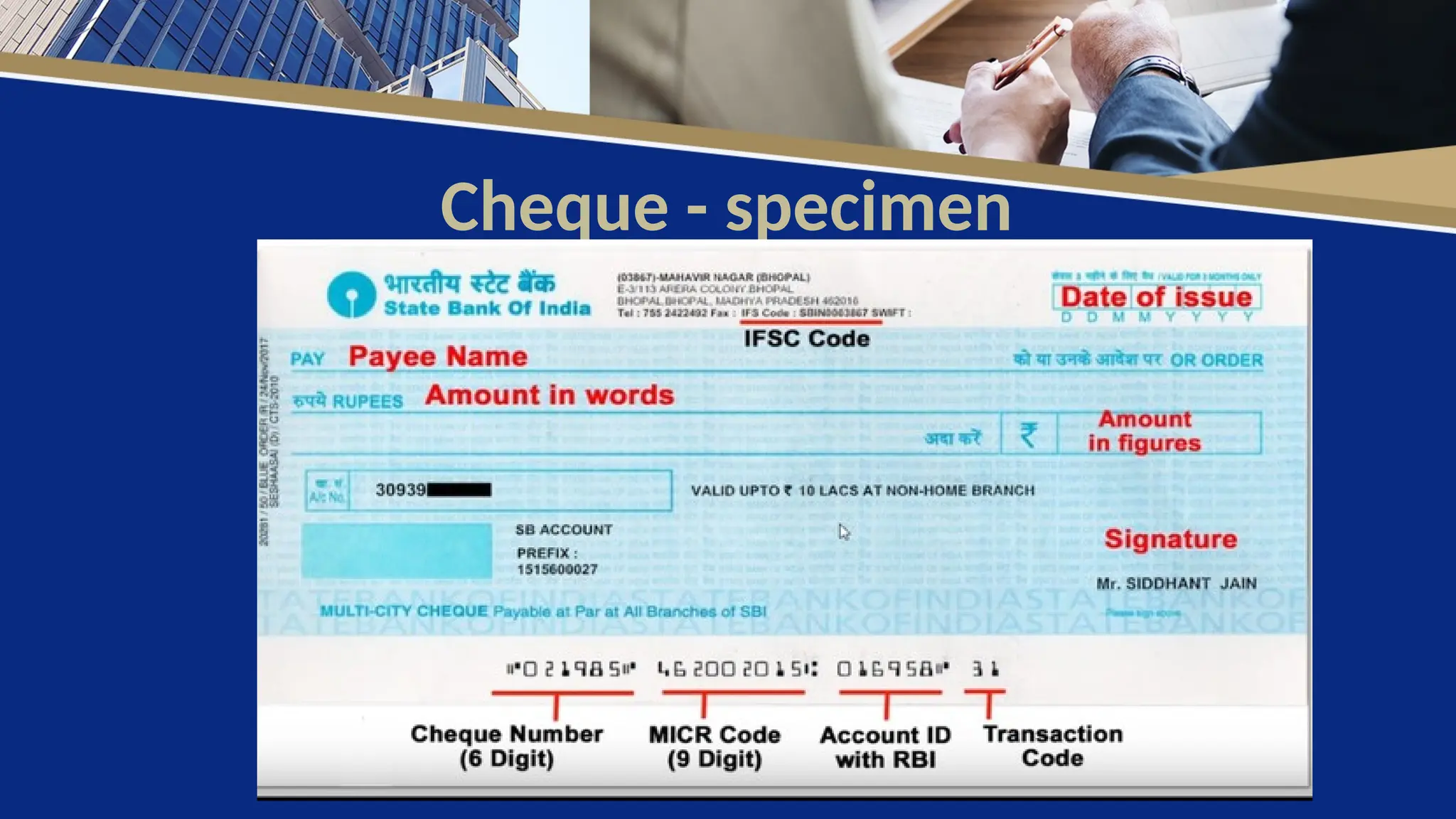
• A 9-digit MICR (Magnetic Ink Character Recognition) code is mentioned
at the bottom of the cheque. This makes the clearance of cheques
easier for the banks.
Cheque - specimen
Parties involved with a Cheque
• Drawer or Maker – Drawer of the cheque is the customer or account
holder who issues the cheque.
• Drawee – Drawee is basically the bank on which the cheque is drawn.
Remember that a cheque is always drawn on a particular banker.
• Payee – This is the person who is named in the cheque and gets the
payment for the amount mentioned in the cheque. In particular cases
(when the drawer writes a self-cheque), the drawer and the payee
can be the same individual.
• Endorser: When a party i.e. payee transfers his right
to take the payment to another party, he/she is
called endorser.
• Endorsee: The party in whose favour, the right is
transferred, is called endorsee.
Features of Cheque
Written Document
• A cheque is a Written document.
• It can be written in any form or language but the word should be visible.
• Cheque can be written in pen, pencil, typed or printed.
• To be in written is a must requirement for a document to be termed as
Cheque.
• Oral orders to pay the amount cannot be considered as cheque.
Features of Cheque
Three Parties
• There are three parties involved in cheque. They are Drawer, Drawee and Payee.
• Drawer is the person who makes and issues the cheque.
• Drawee is the bank of drawer on whom the cheque is drawn or who is ordered to pay
the specified amount.
• Payee is the person who is the beneficiary of cheque or to whom the amount is to be
paid by Drawee on Drawer order.
Features of Cheque
Unconditional Order
• Cheque contains an unconditional order from a customer to his bank to pay the
amount.
• Payment shall not be dependent on any contingency or any condition should not be
attached with it.
• It is required to be paid unconditionally by the drawer to the payee.
• Cheque containing conditions for payment is invalid and cannot be termed as Cheque.
Features of Cheque
Payee To Be Certain
• The cheque must clearly denote the name of the beneficiary, to
whom it must be paid.
• Name of Payee must be clearly written and should be on a cheque.
• Payee can be a real person or an artificial person like a company.
Features of Cheque
Must Be Signed
• Cheque must be signed by his maker.
• Original drawer should sign the cheque and should clearly mention
the date on it.
• A cheque stands invalid unless it is signed by its original drawer or if
signed by any other person other than his drawer.
Features of Cheque
Drawn On Banker
• A cheque is drawn by the drawer on a specified bank.
• Customer holding account in a bank that may be a saving
or current account draws a cheque on its bank.
• Cheque drawn on any other person is termed as invalid.
Features of Cheque
Must Mention Exact Amount
• The amount to be paid by Drawee must be clearly mentioned in
Cheque.
• It contains an order to pay a monetary amount only.
• The amount of money should be clearly written in figures and
words.
Features of Cheque
Do Not Require Acceptance Or Stamp
• Cheque does not require any acceptance on part of drawee like a bill
of exchange.
• It contains an unconditional order to pay.
• However, banks have a provision to mark cheque as “Good” for the
purpose of clearance but it has nothing to do with acceptance.
Type of cheque
• Bearer Cheque
• Order Cheque
• Crossed Cheque
• Account Payee Cheque
• Stale Cheque
• Post Dated Cheque
• Ante Dated Cheque
• Self Cheque
• Traveller’s Cheque
• Mutilated Cheque
• Blank Cheque
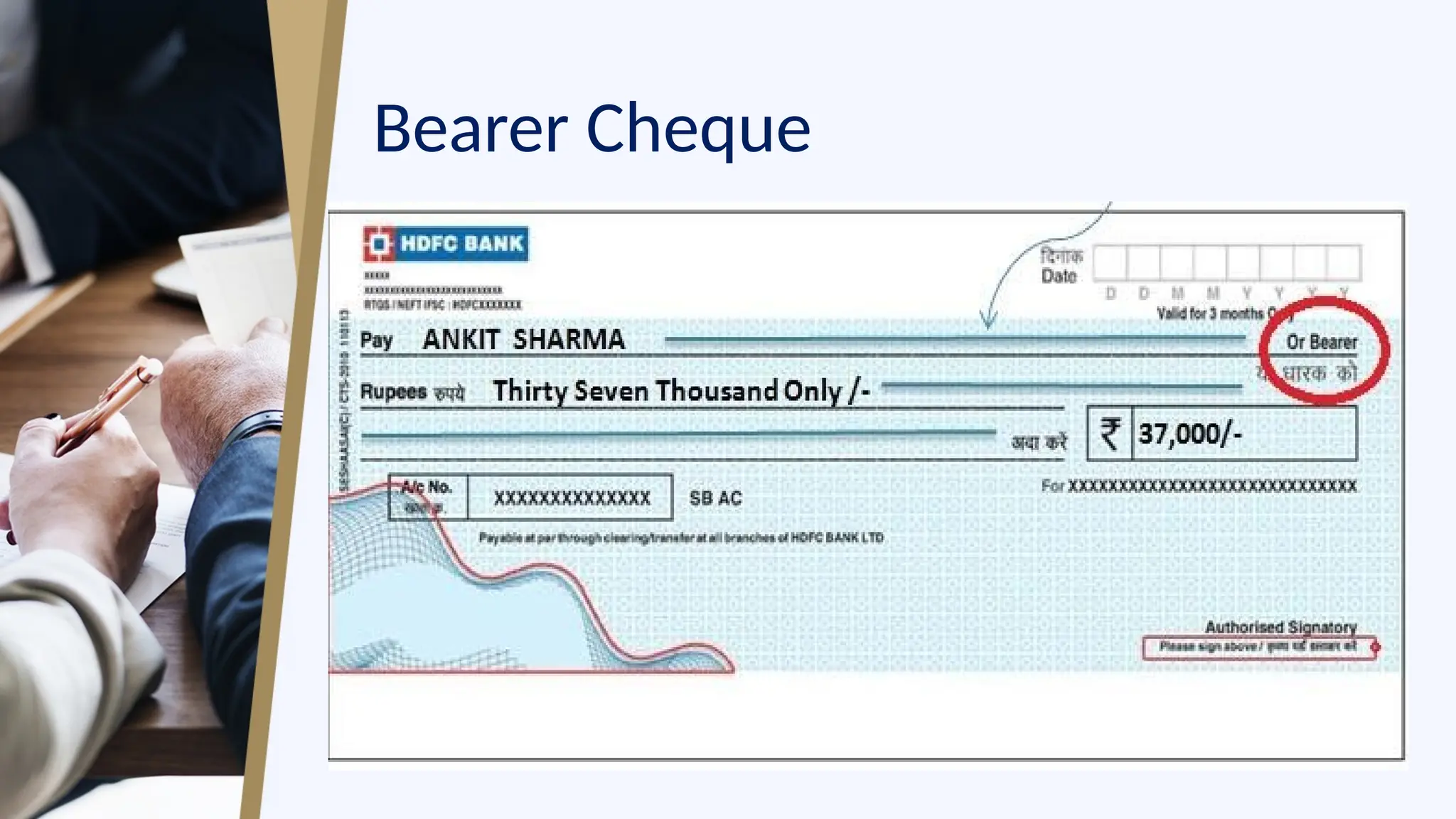
Bearer Cheque
• The bearer cheque is a type of cheque in which
the bearer is authorised to get the cheque
encashed. This means the person who carries
the cheque to the bank has the authority to ask
the bank for encashment.
• This type of cheque can be used for cash
withdrawal. This kind of cheque is endorsable.
No kind of identification is required for the
bearer of the cheque.
Bearer Cheque
Order Cheque
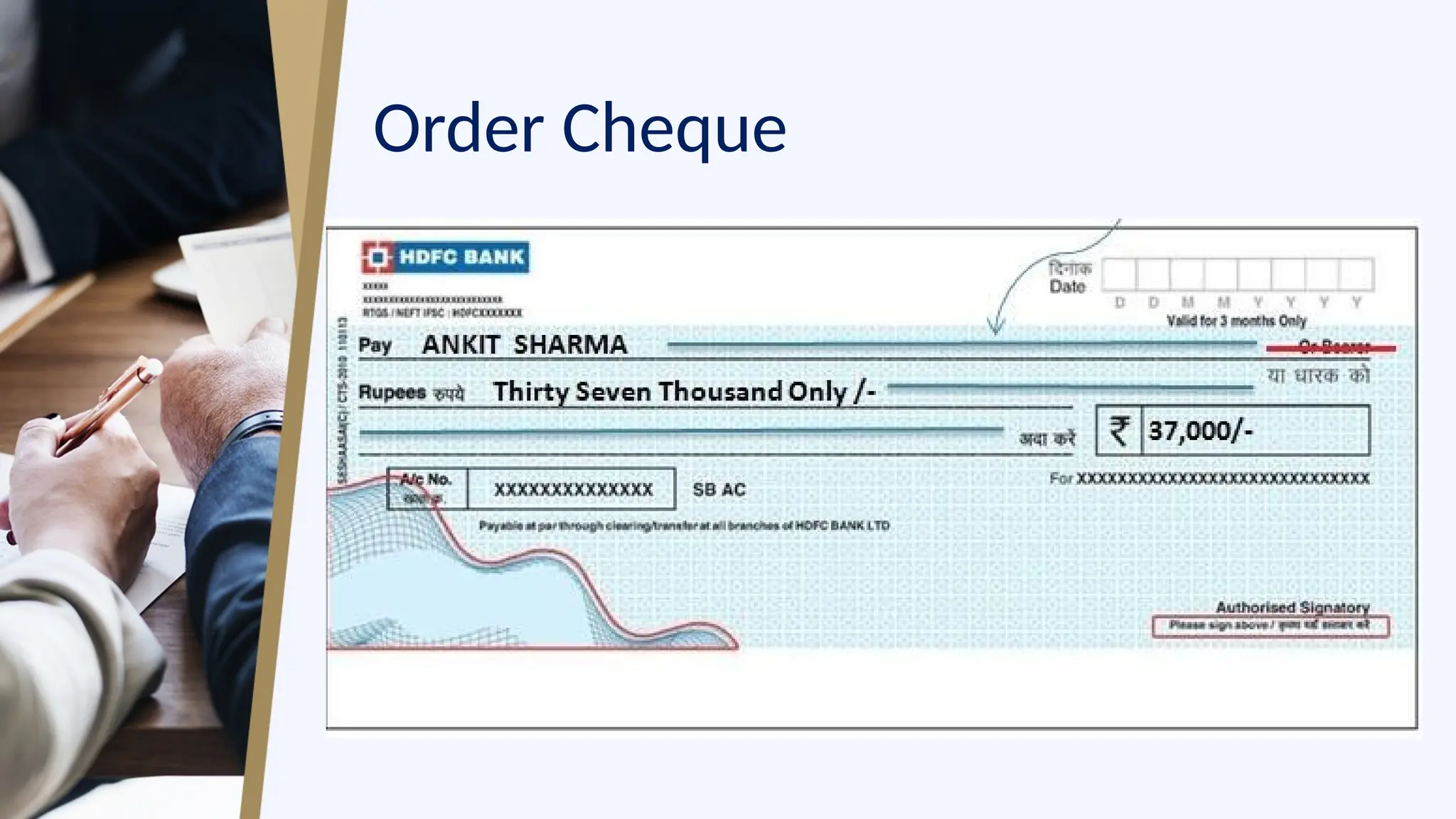
• This type of cheque cannot be endorsed, i.e.,
only the payee, whose name has been
mentioned in the cheque is liable to get cash
for that amount. The drawer needs to strike the
“OR BEARER” mark as mentioned on the
cheque so that the cheque can only be
encashed to the payee.
Order Cheque
Crossed Cheque
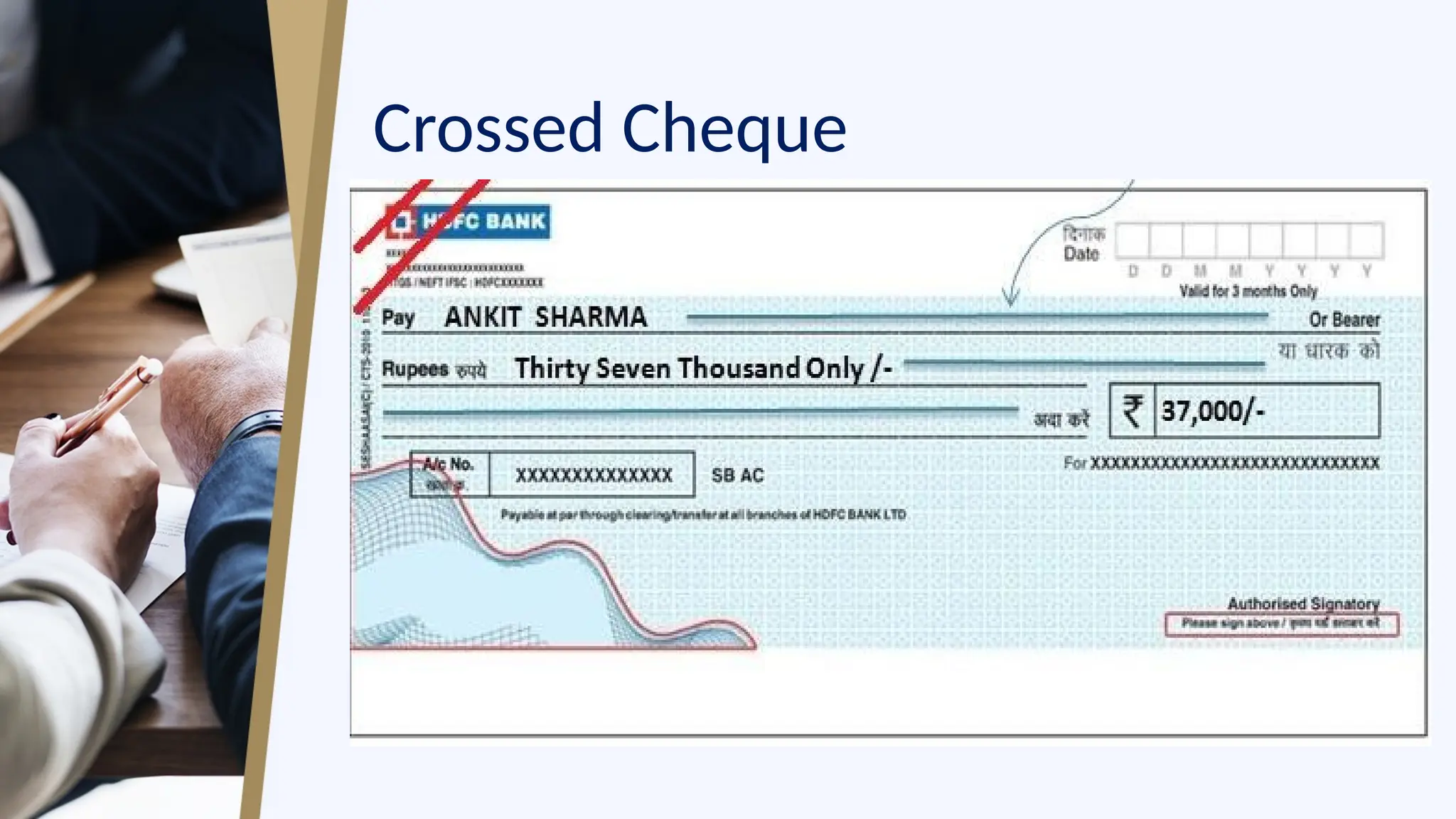
• In this type of cheque, no cash withdrawal can
be done. The amount can only be transferred
from the drawer’s account to the payee’s
account. Any third party can visit the bank to
submit the cheque.
• In case of a crossed cheque, the drawer must
draw two lines at the left top corner of the
cheque.
Crossed Cheque
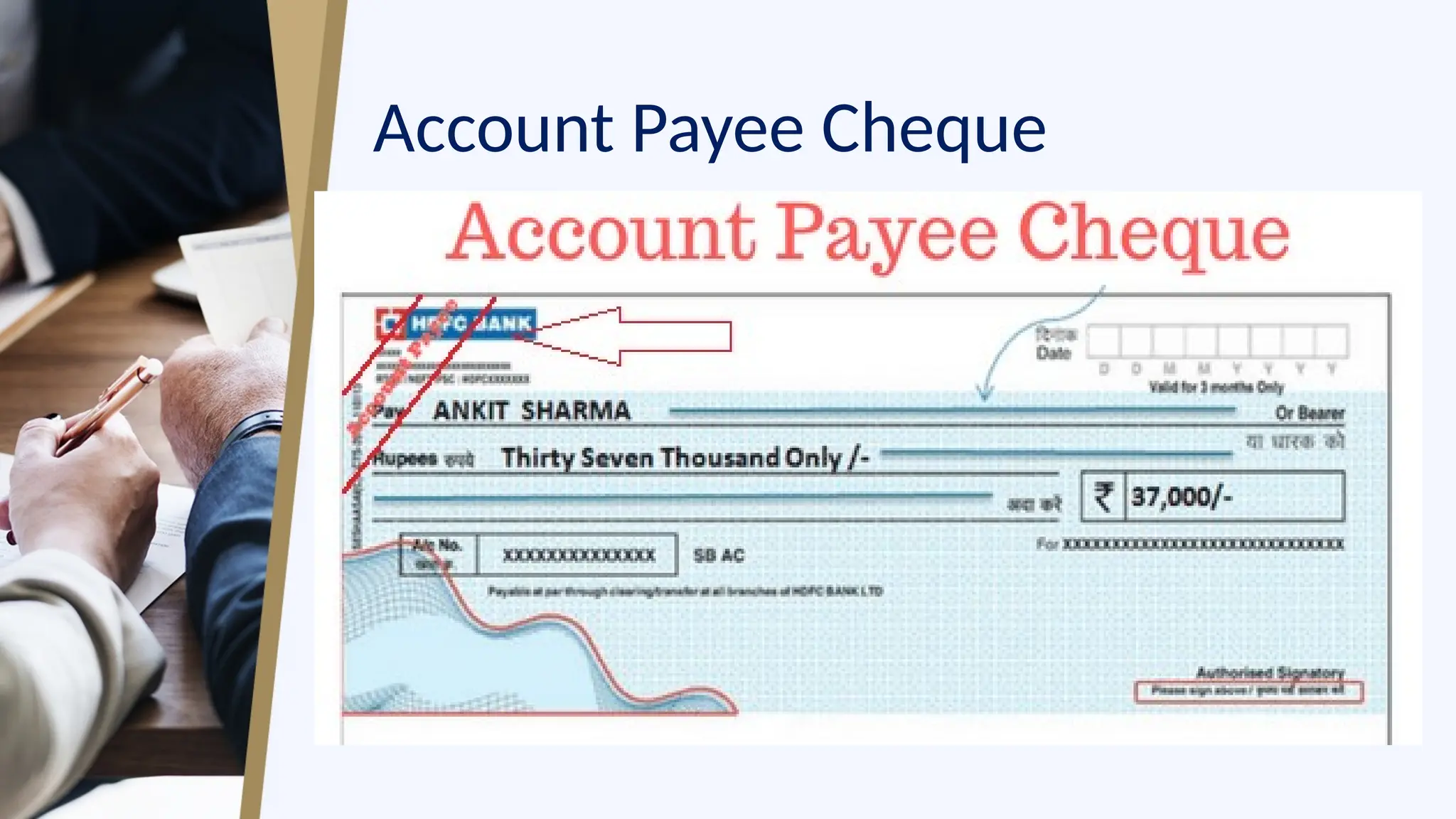
Account Payee Cheque
• This is the same as the account payee cheque
but no third party involvement is required. The
amount shall be transferred directly to the
payee’s account number.
• To ensure that it is an account payee cheque,
two lines are made on the left top corner of the
cheque, labelling it for “A/C PAYEE”.
Account Payee Cheque
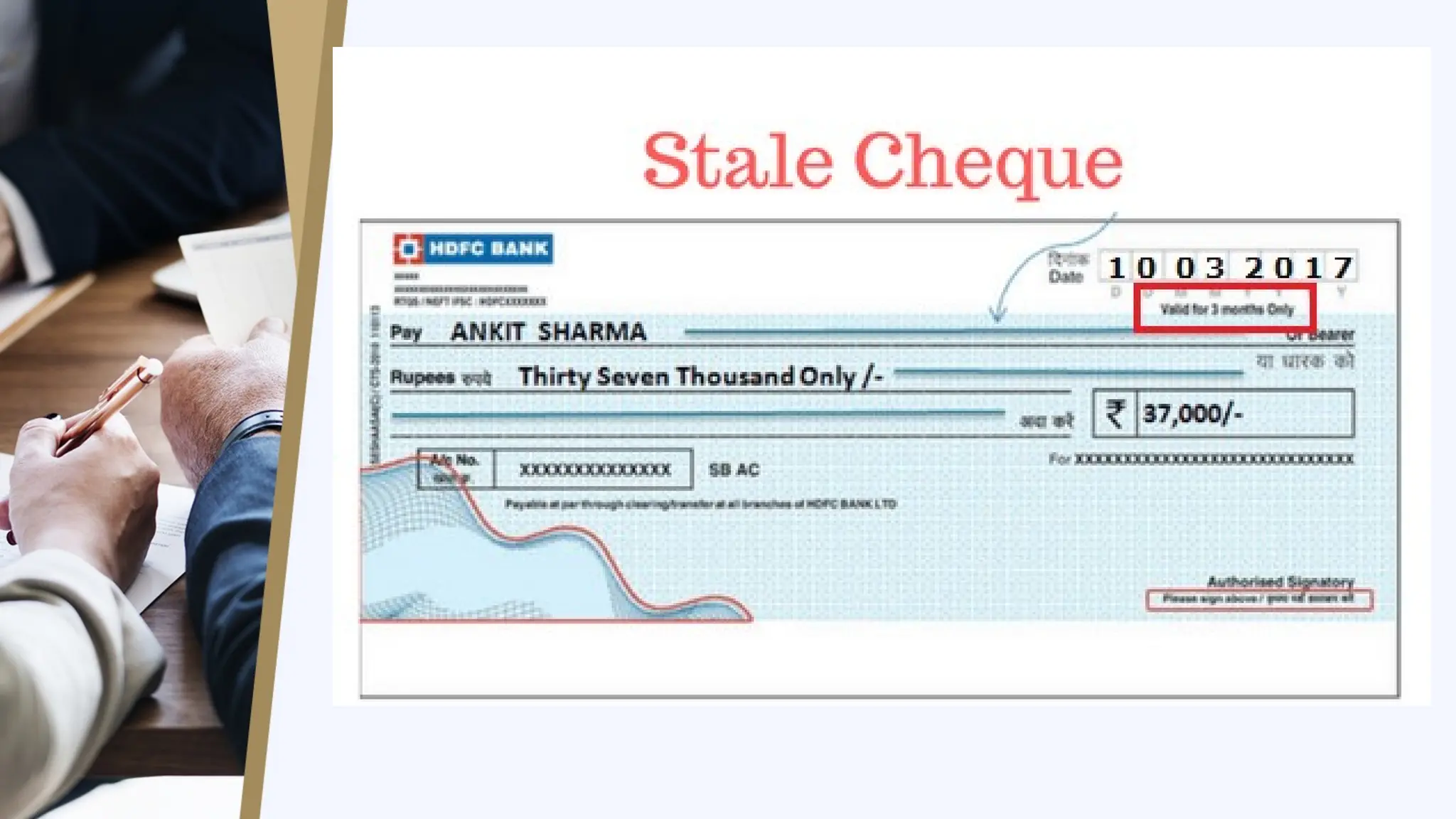
Stale Cheque
• In India, any cheque is valid only until 3 months
from the date of issue. So if a payee moves to
the bank to get withdrawal for a cheque which
was signed 3 months ago, the cheque shall be
declared a stale cheque.
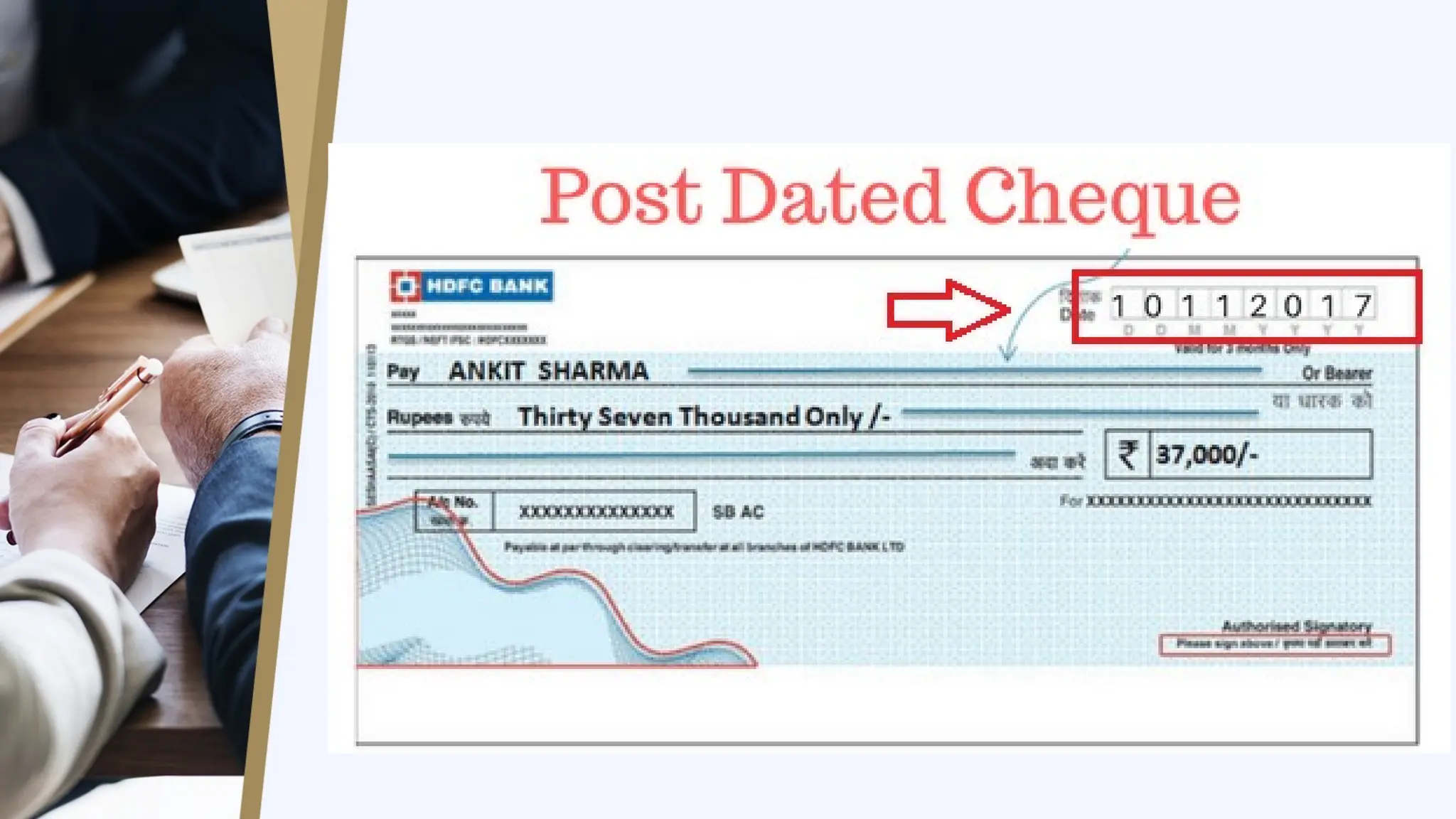
Post Dated Cheque
• If a drawer wants the payee to apply for
withdrawal or transfer of money after the
present date, then he/she can fill a post dated
cheque.
• For example: If the date on which the drawer is
filling the cheque is May 10, 2021, but he wants
the payment to be done later, he/she can fill
the cheque dates as May 30, 2021. It shall be
called a post-dated cheque.
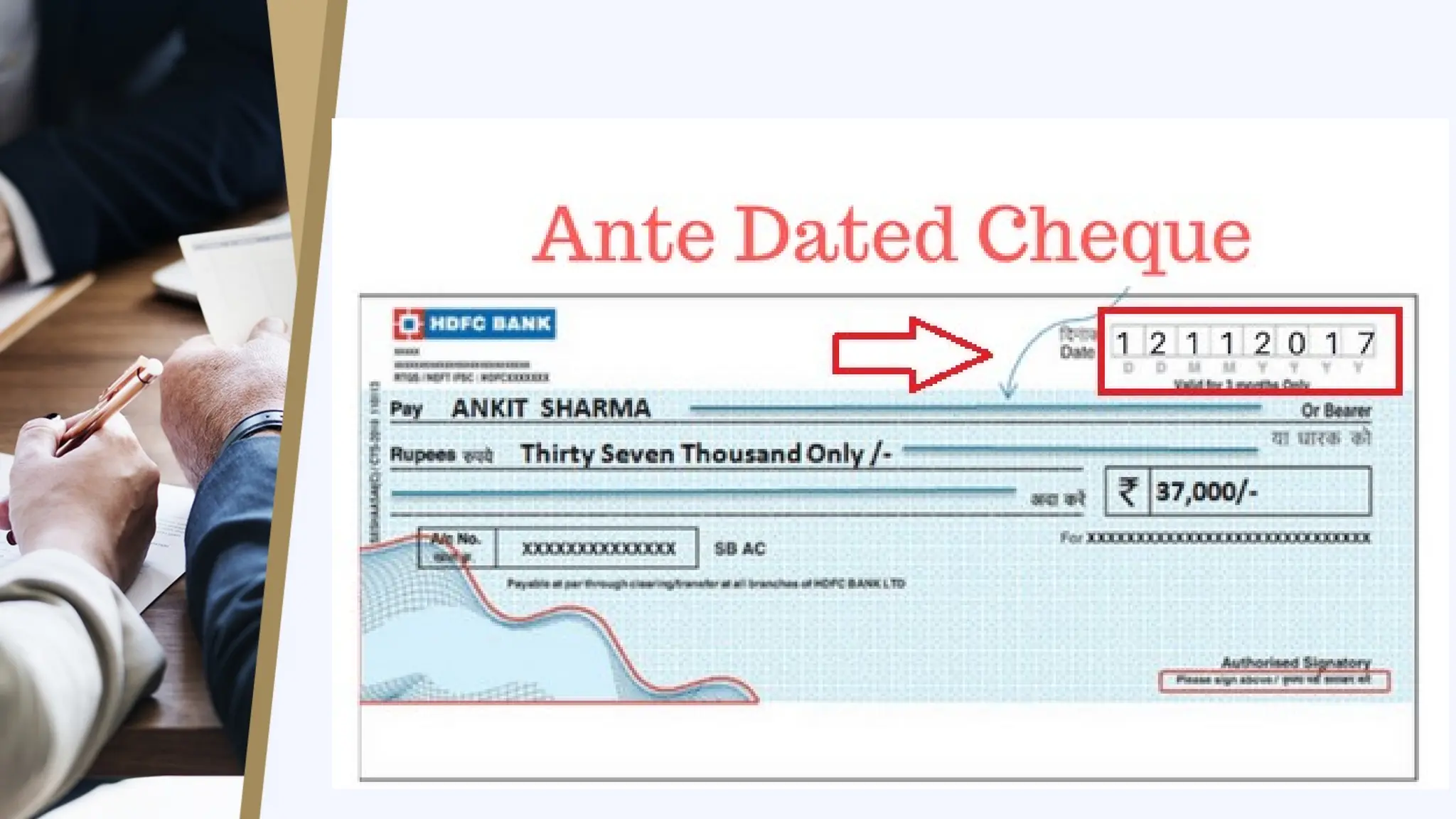
Ante Dated Cheque
• If the drawer mentions a date prior to the
current date on the cheque, it is called ante
dated cheque.
• For example: If the current date is January 30,
2021, and the drawer dates the cheque as
January 1, 2021. It shall be considered as an
ante-dated cheque.
Self Cheque
• If the drawer wishes cash for himself he can
issue a cheque where in place of the Payee’s
name he can write “SELF” and get encashment
from the branch where he owns an account.
• For example: If a person wants Rs.1,00,000/- in
cash, he can issue a self cheque and visit his
bank branch where he owns an account and
get encashment in place of a cheque.
Traveller’s Cheque
• As the name suggests, the Traveler’s
cheque can be used when a person is
travelling abroad where the Indian
currency is not used.
• If a person is travelling abroad, he can
carry the traveller’s cheque and get
encashment for the same in abroad
countries.
Mutilated Cheque
• If a cheque reaches the bank in a torn
condition, it is called a mutilated cheque. If the
cheque is torn into two or more pieces and the
relevant information is torn, the bank shall
reject the cheque and declare it invalid, until
the drawer confirms its validation.
• If the cheque is torn from the corners and all
the important data on the cheque is intact,
then the bank may process the cheque further.
Blank Cheque
• When a cheque only has a drawer’s
signature and all the other fields are left
empty, then such a type of a cheque is
called a blank cheque.
• The above-mentioned types of cheques are
the most commonly known and used in the
Indian banking industry. Let us now know
the parties associated with a cheque.
Features of Cross a Cheque
• Minimizing the risk: The crossing of the cheque gives the paying banker
instructions to pay the amount only through the banker and not directly
to the payee or holder presenting the amount at the counter. It is an
effective way to minimize the risk of loss or falsification.
• Paying instructions: Crossing is a way for the paying banker to generally
pay the money to a bank or to a particular bank, as applicable.
• Negotiability: Merely a cheque crossing does not affect its negotiability.
Features of Cross a Cheque
• Payment through the bank: Only a banker can secure the payment
of a crossed cheque, which makes it easy for the holder to present
it with a quarter of the respectability and credit that is known. By
using a crossed cheque, the specified amount cannot be cashed
but can only be credited to the bank account of the payee.
• The receiver of the amount: As only a banker secures the payment
of a crossed cheque, the money received can easily be traced for
whose use.
Types of Cheque Crossing
There are two main types of check crossing.
• General crossing
• Special crossing
– Restrictive crossing
– Not - negotiable crossing
– Account payee crossing
General Crossing
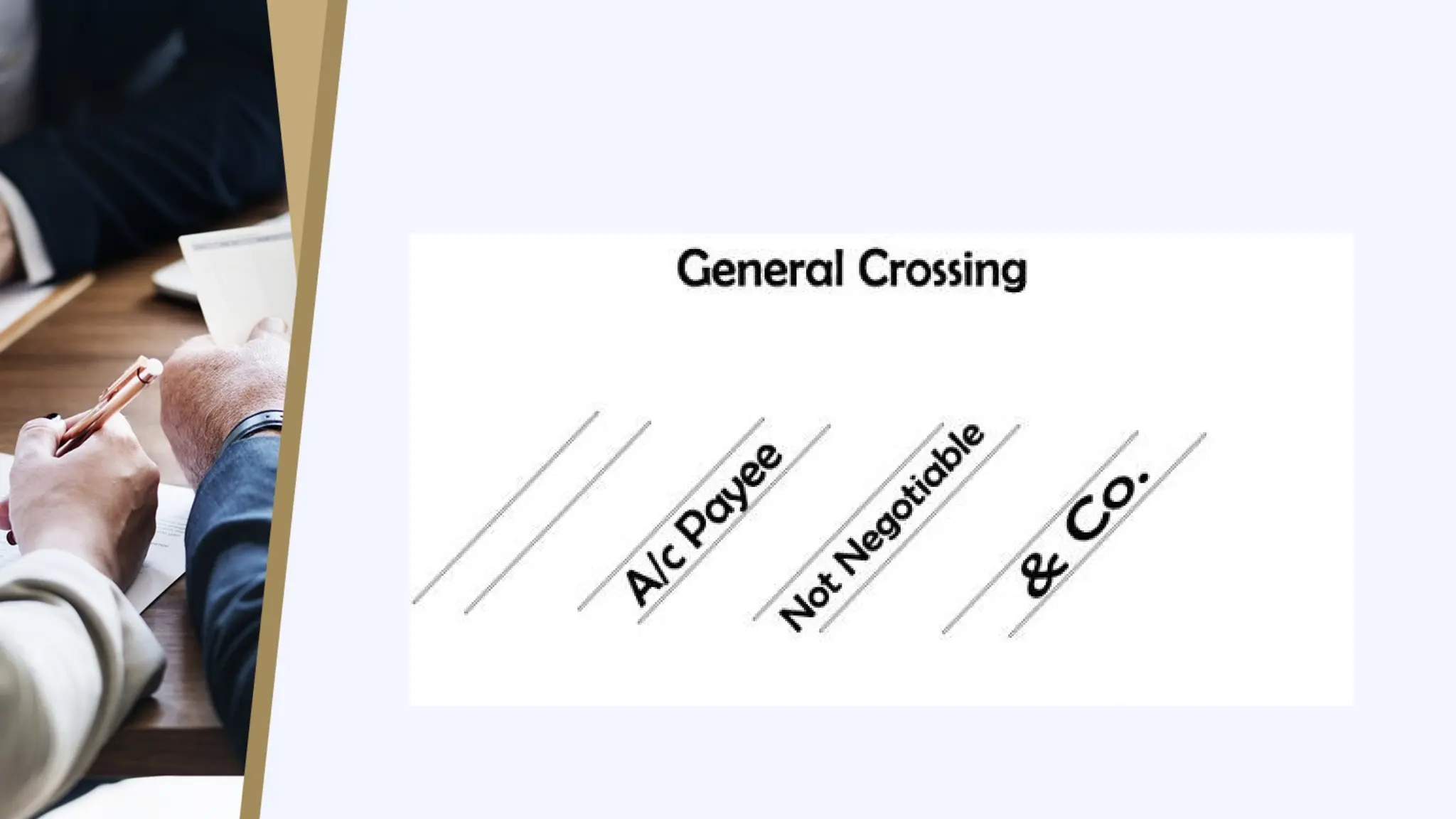
Generally, cheques are crossed when –
• There are two transverse parallel lines, marked
across its face or,
• The cheque bears an abbreviation ‘& Co.’ between
the two parallel lines or,
• The Cheque bears the words “Not Negotiable”
between the two parallel lines or,
• The cheque bears the words A/C, Payee” between
the two parallel lines.
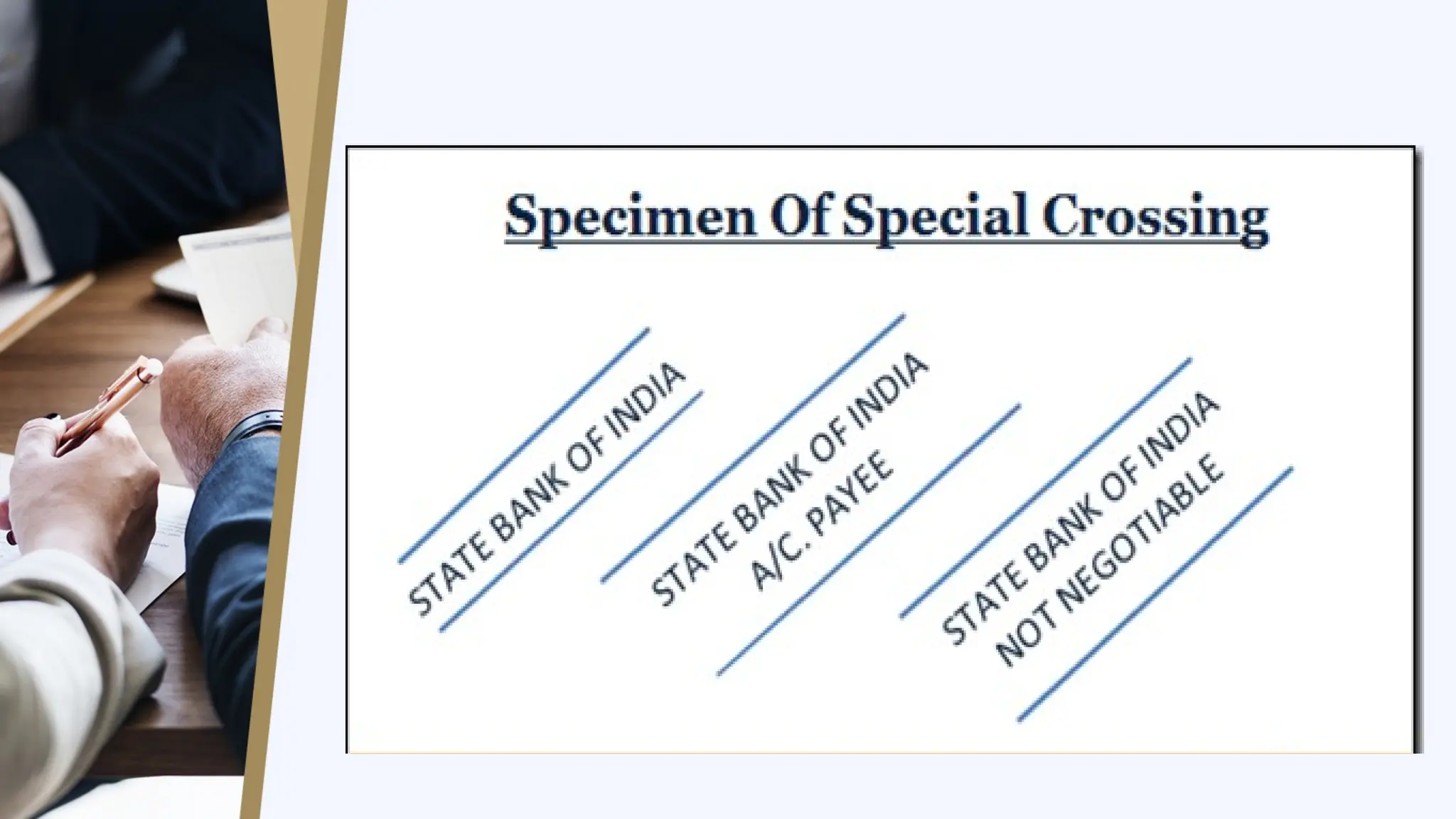
Special Crossing
• For a cheque to be deemed to have been crossed, the banker’s name had to
be added across the face of the cheque.
• In case of a special crossing, a cheque must not be crossed by drawing two
parallel lines.
• Section 124 of The Negotiable Instruments Act, 1881 defines Special
Crossing:
• Also known as Restricted Crossing.
• Two transverse lines must not necessarily be drawn.
• The banker’s name is added across the face of the cheque.
• The banker’s name may or may not carry the abbreviated word’ & Co.’
• Payment can only be made through the bank of the crossing. The banker
mentioned at the crossing can appoint another banker to collect such
cheques as his agent. Therefore, it is safer than ‘generally’ crossed cheques.
• Specially Crossed Cheques are not convertible into General Crossing.
Restrictive Cheque Crossing
• The act provides only two types of crossing
mentioned as general and special crossing.
• Banking usage had developed yet another
type of crossing called as “Restrictive
Crossing”.
• This type of crossing includes the word like
“A/C Payee” “A/C John only” between
equivalent outline.
Not - negotiable crossing
• In this type of crossing, the cheque must
contain the words ‘not negotiable’.
• The cheque must be crossed generally or
specially.
• The effect of this crossing is that the cheque
nevertheless remains negotiable
(transferrable) and the title of the transferred
shall not be better than title of transferor.
Account payee crossing
• This is also called restrictive crossing.
• The cheque must contain the words
‘account payee’ or ‘account payee only’.
• The cheque must be crossed generally or
specially.
• The effect of this type of crossing is that
the cheque does not remain negotiable
anymore.
Reasons to Dishonour of Cheque
• Drawer’s Countermined: When the drawers instruct the bank to stop
payment of a cheque, he must refuse (means say no, to stop the payment,
reject) its payment. This is a most common reason to dishonour of cheque.
• Drawer’s Death: Bank must stop the payment of a cheque of a notice of the
drawer’s death is received. Another, valid reason to dishonour of cheque
and bank may refuse to make payment.
• Insolvency of Customer: On receiving the notice of insolvency or
bankruptcy, the bank must refuse to pay cheque. Also, one more reason to
dishonour of cheque.
• Garnishes Order: If the order of the court is received attaching the account
of the customer, the bank should stop honoring his cheques
General Reasons to Dishonour of Cheque
• Insufficient balance in
depositor’s account.
• When the date is not entered.
• When the drawer has closed
his account.
• Amount in words and figures
differs.
• Signatures of the drawer’s
differ.
• When a cheque is mutilated or
spoiled.
• Post-dated or stale cheque.
• When alterations are not
signed by drawer.
• Payee’s endorsement
required.
• Refer to drawer.
• When the cheque is anti-
dated.
• No advice is received.
• Bank directs to present
again.
ENDORSEMENT
• Endorsement and delivery is a mode of negotiating a
negotiable instrument like cheque. A negotiable
instrument like cheque payable to order (i.e., payable to
specified person or his order) can be negotiated only by
endorsement and delivery.
• Endorsement means signing at the back of the
instrument for the purpose of negotiation.
• The act of the signing a cheque, for the purpose of
transferring to the someone else, is called the
endorsement of Cheque.
Rules Regarding Endorsement
• All Endorsements should be made in ink only (pencil endorsements are not objected
in law, but as they may be altered, such practice should be discouraged)
• An endorsement should not be in block letters. The endorsement should be made
by signature and not by writing name in Block Letters.
• A type written endorsement is also valid.
• A rubber stamp endorsement is as valid as written endorsement
• An endorsement in the form of facsimile, (signature made on a stamp) of payee’s
signature is also legally valid. But endorsement types from point 3 to 5 are normally
discouraged in practice, as there are chances of fraud, to take place.
• When endorsement is in a language which a banker is not expected to know the
paying banker can refuse payment for its confirmation. But he should give valid
reason for it.
Parties to be involved
• Endorser: The person who endorses the instrument
(i.e., the person who signs his name on the back of
the instrument for the purpose of transferring its
property to another) is called the “endorser”.
• Endorsee: The person to whom the instrument is
endorsed is called the “endorsee”
Kinds / various types of Endorsements
• Blank or General
• Special or Full Endorsement
• Restrictive Endorsement
• Partial Endorsement
• Conditional or Qualified Endorsement
• Endorsement in Blank / General: An endorsement is said to
be blank or general when the endorser puts his signature only
on the instrument and does not write the name of anyone to
whom or to whose order the payment is to be made.
• Special or Full Endorsement: If the endorser signs his name
and adds a direction to pay the amount mentioned in the
instrument to, or to the order of a specified person, the
endorsement is said to be special or in full.
• Conditional endorsement: It is an endorsement under which
the endorser lays down same condition to be fulfilled by the
payee before making the payment.
• Restrictive Endorsement: Restrictive endorsement by written
words restricts the right of further negotiation. The banker
should pay the amount to a particular endorsee only.
• Partial Endorsement: An endorsement partial is one which
purports to transfer to the endorsee, a part only of the amount
payable on the instrument.
E-cheques
• E-cheques (Electronic Cheques) are a form of electronic
tokens designed to make payments through the internet
and performs the same functions as a conventional paper
cheque.
• As the cheque is in an electronic form, it can be
processed in fewer steps and has more security checks
than a standard paper cheque, like authentication, public
key cryptography, digital signature, encryption, etc.
• With the amendments in Negotiable Instruments Act,
1881, an e-cheque has become legalized since 2002.

BANKING THEORY LAW AND PRACTICES - Cheque.pptx

  • 1.
    Banking Law andPractices Unit - II Cheque – Crossing and Endorsement
  • 2.
    Points to rememberregarding cheques • A cheque can only be issued against a current or savings bank account • A cheque without date shall be considered invalid • Only the payee, in whose name the cheque has been issued, can encash it • A cheque is only valid 3 months from the date it has been issued • A 9-digit MICR (Magnetic Ink Character Recognition) code is mentioned at the bottom of the cheque. This makes the clearance of cheques easier for the banks.
  • 3.
  • 4.
    Parties involved witha Cheque • Drawer or Maker – Drawer of the cheque is the customer or account holder who issues the cheque. • Drawee – Drawee is basically the bank on which the cheque is drawn. Remember that a cheque is always drawn on a particular banker. • Payee – This is the person who is named in the cheque and gets the payment for the amount mentioned in the cheque. In particular cases (when the drawer writes a self-cheque), the drawer and the payee can be the same individual.
  • 5.
    • Endorser: Whena party i.e. payee transfers his right to take the payment to another party, he/she is called endorser. • Endorsee: The party in whose favour, the right is transferred, is called endorsee.
  • 6.
    Features of Cheque WrittenDocument • A cheque is a Written document. • It can be written in any form or language but the word should be visible. • Cheque can be written in pen, pencil, typed or printed. • To be in written is a must requirement for a document to be termed as Cheque. • Oral orders to pay the amount cannot be considered as cheque.
  • 7.
    Features of Cheque ThreeParties • There are three parties involved in cheque. They are Drawer, Drawee and Payee. • Drawer is the person who makes and issues the cheque. • Drawee is the bank of drawer on whom the cheque is drawn or who is ordered to pay the specified amount. • Payee is the person who is the beneficiary of cheque or to whom the amount is to be paid by Drawee on Drawer order.
  • 8.
    Features of Cheque UnconditionalOrder • Cheque contains an unconditional order from a customer to his bank to pay the amount. • Payment shall not be dependent on any contingency or any condition should not be attached with it. • It is required to be paid unconditionally by the drawer to the payee. • Cheque containing conditions for payment is invalid and cannot be termed as Cheque.
  • 9.
    Features of Cheque PayeeTo Be Certain • The cheque must clearly denote the name of the beneficiary, to whom it must be paid. • Name of Payee must be clearly written and should be on a cheque. • Payee can be a real person or an artificial person like a company.
  • 10.
    Features of Cheque MustBe Signed • Cheque must be signed by his maker. • Original drawer should sign the cheque and should clearly mention the date on it. • A cheque stands invalid unless it is signed by its original drawer or if signed by any other person other than his drawer.
  • 11.
    Features of Cheque DrawnOn Banker • A cheque is drawn by the drawer on a specified bank. • Customer holding account in a bank that may be a saving or current account draws a cheque on its bank. • Cheque drawn on any other person is termed as invalid.
  • 12.
    Features of Cheque MustMention Exact Amount • The amount to be paid by Drawee must be clearly mentioned in Cheque. • It contains an order to pay a monetary amount only. • The amount of money should be clearly written in figures and words.
  • 13.
    Features of Cheque DoNot Require Acceptance Or Stamp • Cheque does not require any acceptance on part of drawee like a bill of exchange. • It contains an unconditional order to pay. • However, banks have a provision to mark cheque as “Good” for the purpose of clearance but it has nothing to do with acceptance.
  • 14.
    Type of cheque •Bearer Cheque • Order Cheque • Crossed Cheque • Account Payee Cheque • Stale Cheque • Post Dated Cheque • Ante Dated Cheque • Self Cheque • Traveller’s Cheque • Mutilated Cheque • Blank Cheque
  • 15.
    Bearer Cheque • Thebearer cheque is a type of cheque in which the bearer is authorised to get the cheque encashed. This means the person who carries the cheque to the bank has the authority to ask the bank for encashment. • This type of cheque can be used for cash withdrawal. This kind of cheque is endorsable. No kind of identification is required for the bearer of the cheque.
  • 16.
  • 17.
    Order Cheque • Thistype of cheque cannot be endorsed, i.e., only the payee, whose name has been mentioned in the cheque is liable to get cash for that amount. The drawer needs to strike the “OR BEARER” mark as mentioned on the cheque so that the cheque can only be encashed to the payee.
  • 18.
  • 19.
    Crossed Cheque • Inthis type of cheque, no cash withdrawal can be done. The amount can only be transferred from the drawer’s account to the payee’s account. Any third party can visit the bank to submit the cheque. • In case of a crossed cheque, the drawer must draw two lines at the left top corner of the cheque.
  • 20.
  • 21.
    Account Payee Cheque •This is the same as the account payee cheque but no third party involvement is required. The amount shall be transferred directly to the payee’s account number. • To ensure that it is an account payee cheque, two lines are made on the left top corner of the cheque, labelling it for “A/C PAYEE”.
  • 22.
  • 23.
    Stale Cheque • InIndia, any cheque is valid only until 3 months from the date of issue. So if a payee moves to the bank to get withdrawal for a cheque which was signed 3 months ago, the cheque shall be declared a stale cheque.
  • 25.
    Post Dated Cheque •If a drawer wants the payee to apply for withdrawal or transfer of money after the present date, then he/she can fill a post dated cheque. • For example: If the date on which the drawer is filling the cheque is May 10, 2021, but he wants the payment to be done later, he/she can fill the cheque dates as May 30, 2021. It shall be called a post-dated cheque.
  • 27.
    Ante Dated Cheque •If the drawer mentions a date prior to the current date on the cheque, it is called ante dated cheque. • For example: If the current date is January 30, 2021, and the drawer dates the cheque as January 1, 2021. It shall be considered as an ante-dated cheque.
  • 29.
    Self Cheque • Ifthe drawer wishes cash for himself he can issue a cheque where in place of the Payee’s name he can write “SELF” and get encashment from the branch where he owns an account. • For example: If a person wants Rs.1,00,000/- in cash, he can issue a self cheque and visit his bank branch where he owns an account and get encashment in place of a cheque.
  • 30.
    Traveller’s Cheque • Asthe name suggests, the Traveler’s cheque can be used when a person is travelling abroad where the Indian currency is not used. • If a person is travelling abroad, he can carry the traveller’s cheque and get encashment for the same in abroad countries.
  • 31.
    Mutilated Cheque • Ifa cheque reaches the bank in a torn condition, it is called a mutilated cheque. If the cheque is torn into two or more pieces and the relevant information is torn, the bank shall reject the cheque and declare it invalid, until the drawer confirms its validation. • If the cheque is torn from the corners and all the important data on the cheque is intact, then the bank may process the cheque further.
  • 32.
    Blank Cheque • Whena cheque only has a drawer’s signature and all the other fields are left empty, then such a type of a cheque is called a blank cheque. • The above-mentioned types of cheques are the most commonly known and used in the Indian banking industry. Let us now know the parties associated with a cheque.
  • 33.
    Features of Crossa Cheque • Minimizing the risk: The crossing of the cheque gives the paying banker instructions to pay the amount only through the banker and not directly to the payee or holder presenting the amount at the counter. It is an effective way to minimize the risk of loss or falsification. • Paying instructions: Crossing is a way for the paying banker to generally pay the money to a bank or to a particular bank, as applicable. • Negotiability: Merely a cheque crossing does not affect its negotiability.
  • 34.
    Features of Crossa Cheque • Payment through the bank: Only a banker can secure the payment of a crossed cheque, which makes it easy for the holder to present it with a quarter of the respectability and credit that is known. By using a crossed cheque, the specified amount cannot be cashed but can only be credited to the bank account of the payee. • The receiver of the amount: As only a banker secures the payment of a crossed cheque, the money received can easily be traced for whose use.
  • 35.
    Types of ChequeCrossing There are two main types of check crossing. • General crossing • Special crossing – Restrictive crossing – Not - negotiable crossing – Account payee crossing
  • 36.
    General Crossing Generally, chequesare crossed when – • There are two transverse parallel lines, marked across its face or, • The cheque bears an abbreviation ‘& Co.’ between the two parallel lines or, • The Cheque bears the words “Not Negotiable” between the two parallel lines or, • The cheque bears the words A/C, Payee” between the two parallel lines.
  • 38.
    Special Crossing • Fora cheque to be deemed to have been crossed, the banker’s name had to be added across the face of the cheque. • In case of a special crossing, a cheque must not be crossed by drawing two parallel lines. • Section 124 of The Negotiable Instruments Act, 1881 defines Special Crossing: • Also known as Restricted Crossing. • Two transverse lines must not necessarily be drawn. • The banker’s name is added across the face of the cheque. • The banker’s name may or may not carry the abbreviated word’ & Co.’ • Payment can only be made through the bank of the crossing. The banker mentioned at the crossing can appoint another banker to collect such cheques as his agent. Therefore, it is safer than ‘generally’ crossed cheques. • Specially Crossed Cheques are not convertible into General Crossing.
  • 40.
    Restrictive Cheque Crossing •The act provides only two types of crossing mentioned as general and special crossing. • Banking usage had developed yet another type of crossing called as “Restrictive Crossing”. • This type of crossing includes the word like “A/C Payee” “A/C John only” between equivalent outline.
  • 41.
    Not - negotiablecrossing • In this type of crossing, the cheque must contain the words ‘not negotiable’. • The cheque must be crossed generally or specially. • The effect of this crossing is that the cheque nevertheless remains negotiable (transferrable) and the title of the transferred shall not be better than title of transferor.
  • 42.
    Account payee crossing •This is also called restrictive crossing. • The cheque must contain the words ‘account payee’ or ‘account payee only’. • The cheque must be crossed generally or specially. • The effect of this type of crossing is that the cheque does not remain negotiable anymore.
  • 43.
    Reasons to Dishonourof Cheque • Drawer’s Countermined: When the drawers instruct the bank to stop payment of a cheque, he must refuse (means say no, to stop the payment, reject) its payment. This is a most common reason to dishonour of cheque. • Drawer’s Death: Bank must stop the payment of a cheque of a notice of the drawer’s death is received. Another, valid reason to dishonour of cheque and bank may refuse to make payment. • Insolvency of Customer: On receiving the notice of insolvency or bankruptcy, the bank must refuse to pay cheque. Also, one more reason to dishonour of cheque. • Garnishes Order: If the order of the court is received attaching the account of the customer, the bank should stop honoring his cheques
  • 44.
    General Reasons toDishonour of Cheque • Insufficient balance in depositor’s account. • When the date is not entered. • When the drawer has closed his account. • Amount in words and figures differs. • Signatures of the drawer’s differ. • When a cheque is mutilated or spoiled. • Post-dated or stale cheque. • When alterations are not signed by drawer. • Payee’s endorsement required. • Refer to drawer. • When the cheque is anti- dated. • No advice is received. • Bank directs to present again.
  • 45.
    ENDORSEMENT • Endorsement anddelivery is a mode of negotiating a negotiable instrument like cheque. A negotiable instrument like cheque payable to order (i.e., payable to specified person or his order) can be negotiated only by endorsement and delivery. • Endorsement means signing at the back of the instrument for the purpose of negotiation. • The act of the signing a cheque, for the purpose of transferring to the someone else, is called the endorsement of Cheque.
  • 46.
    Rules Regarding Endorsement •All Endorsements should be made in ink only (pencil endorsements are not objected in law, but as they may be altered, such practice should be discouraged) • An endorsement should not be in block letters. The endorsement should be made by signature and not by writing name in Block Letters. • A type written endorsement is also valid. • A rubber stamp endorsement is as valid as written endorsement • An endorsement in the form of facsimile, (signature made on a stamp) of payee’s signature is also legally valid. But endorsement types from point 3 to 5 are normally discouraged in practice, as there are chances of fraud, to take place. • When endorsement is in a language which a banker is not expected to know the paying banker can refuse payment for its confirmation. But he should give valid reason for it.
  • 47.
    Parties to beinvolved • Endorser: The person who endorses the instrument (i.e., the person who signs his name on the back of the instrument for the purpose of transferring its property to another) is called the “endorser”. • Endorsee: The person to whom the instrument is endorsed is called the “endorsee”
  • 48.
    Kinds / varioustypes of Endorsements • Blank or General • Special or Full Endorsement • Restrictive Endorsement • Partial Endorsement • Conditional or Qualified Endorsement
  • 49.
    • Endorsement inBlank / General: An endorsement is said to be blank or general when the endorser puts his signature only on the instrument and does not write the name of anyone to whom or to whose order the payment is to be made. • Special or Full Endorsement: If the endorser signs his name and adds a direction to pay the amount mentioned in the instrument to, or to the order of a specified person, the endorsement is said to be special or in full.
  • 50.
    • Conditional endorsement:It is an endorsement under which the endorser lays down same condition to be fulfilled by the payee before making the payment. • Restrictive Endorsement: Restrictive endorsement by written words restricts the right of further negotiation. The banker should pay the amount to a particular endorsee only. • Partial Endorsement: An endorsement partial is one which purports to transfer to the endorsee, a part only of the amount payable on the instrument.
  • 51.
    E-cheques • E-cheques (ElectronicCheques) are a form of electronic tokens designed to make payments through the internet and performs the same functions as a conventional paper cheque. • As the cheque is in an electronic form, it can be processed in fewer steps and has more security checks than a standard paper cheque, like authentication, public key cryptography, digital signature, encryption, etc. • With the amendments in Negotiable Instruments Act, 1881, an e-cheque has become legalized since 2002.