UNIT-2
DIFFERENT MEANS
OF REMITTANCE
F.Y. B.Com (Sem-II)
Elements of Banking and Insurance
Introduction
Apart from accepting deposits and lending money, banks also carry out the
act of transfer of money - both domestic and foreign. This activity is known
as "remittance business" . The money transfer between two branches of
the same country is known as internal transfer. In case of international
transfer the banks remit the funds through letter of credit. Banks remit
funds from one place to another through the network of their branches. The
main instruments for transfer of funds are Demand Drafts, Mail Transfer,
Travellers’ cheques, Banker's Cheques, Money Orders, plastic cards etc.
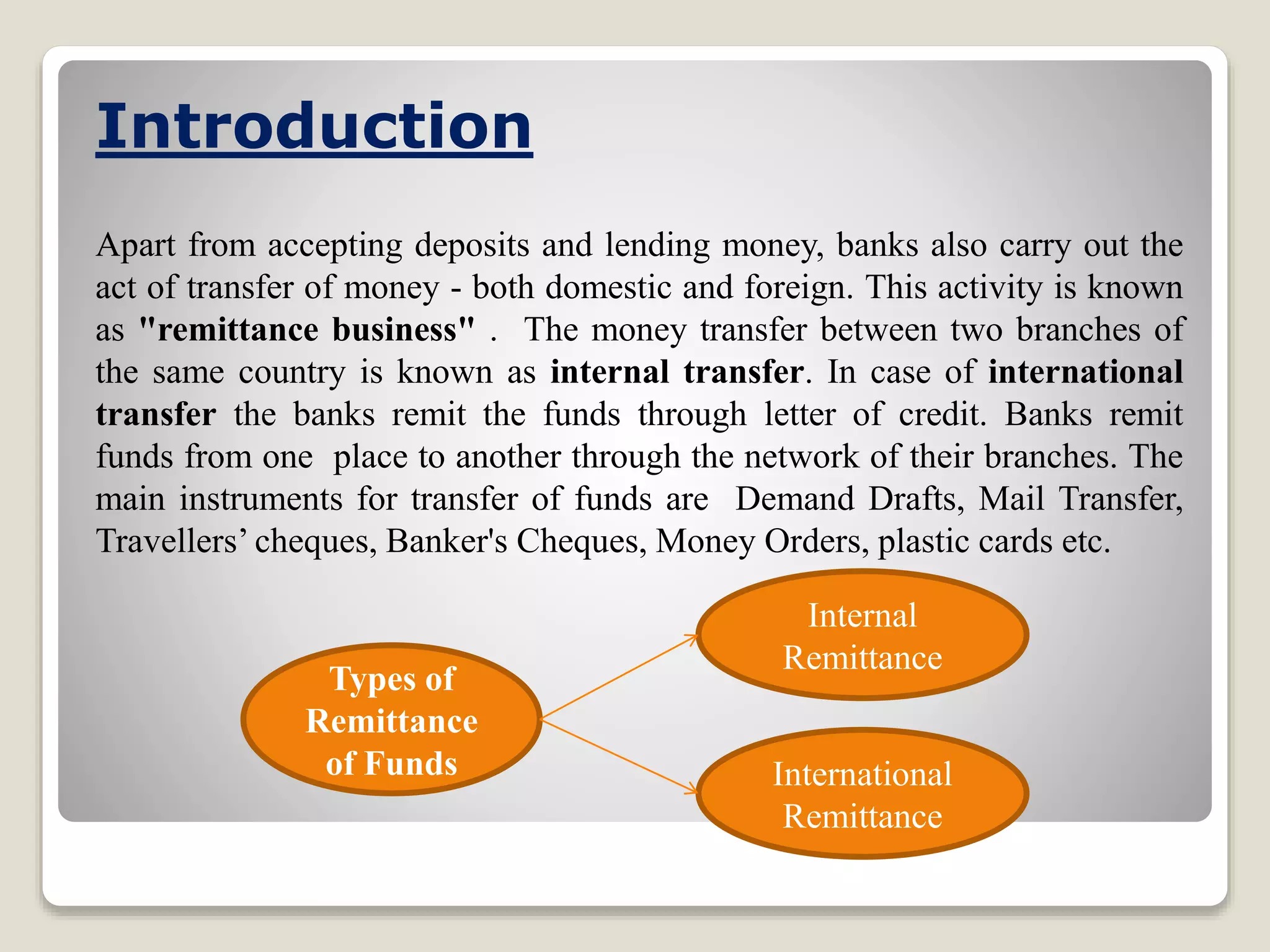
Types of
Remittance
of Funds
Internal
Remittance
International
Remittance
Different Instruments for Remittance
of Funds
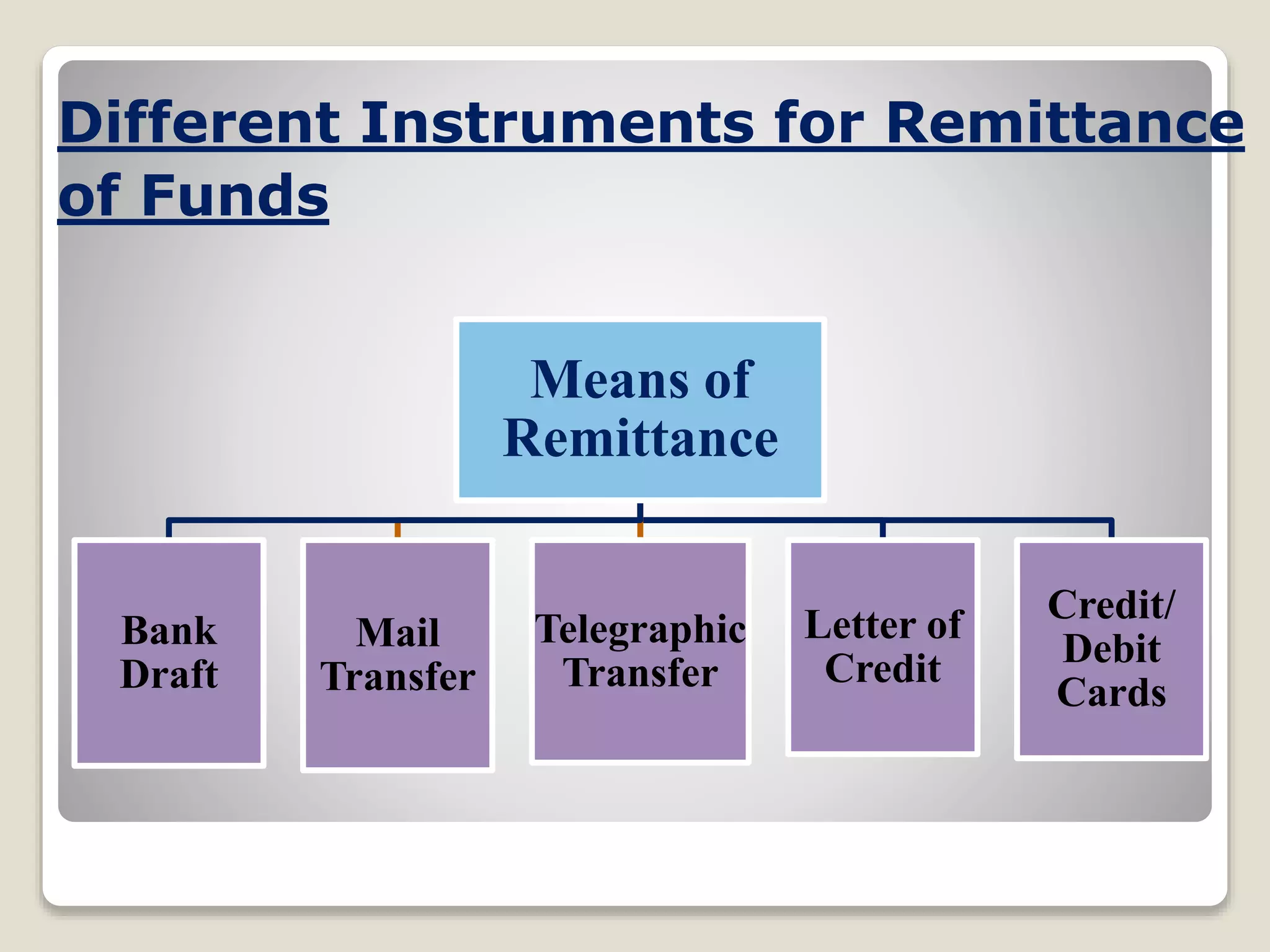
Means of
Remittance
Bank
Draft
Mail
Transfer
Telegraphic
Transfer
Letter of
Credit
Credit/
Debit
Cards
Bank Draft or Demand Draft
 “A bank draft is an order from one branch of a bank to another
branch of the same bank to pay a specified sum of money to the
person named therein or to his order”.
 A person who wants to send money can buy a draft by paying the required
amount to a bank and send to another who can encash it in his place.
Banks issue drafts for a nominal commission. The purchaser of the draft
need not to be a customer or account holder of the bank.
 According to the section 13 of the Negotiable Instrument Act, a bank draft
is not a negotiable instrument. But a draft has all the attributes of a bill of
exchange, such as an instrument in writing, containing an unconditional
order, signed by banker.
 Section 85-A provides protection to bank against forged or unauthorized
endorsement on drafts or Section 131 gives protection to collecting banker
in respect of crossed drafts.
 A bank draft is a commitment on the part of the issuing bank to pay a
certain amount of money to a third party.
 Sometimes the purchaser of the bank draft may return it to the issuing bank
with a request to cancel it and refund the amount to him. The banker may
consider his request subjected that the draft has not been delivered to
payee. The moment the draft is sent to the payee the purchaser loses this
right.
 Validity of the bank or demand draft is three months from the date of issue.
 In case the draft is lost and it is reported to the issuing bank, it should
immediately advice the loss to the drawee branch which will make note of
the loss in the record to guard itself against the fraudulent use of the lost
draft.
Loss of draft:
The draft lost by the purchaser is entitled to get a duplicate one
from the issuing bank. The banker, before issuing a duplicate
draft should take the following steps:
1. The banker should be satisfied with the genuineness of the
request by the purchaser for the issue of a duplicate.
2. A confirmation regards non-payment of the draft should be
obtained from the drawee bank.
3. An indemnity bond must be obtained from the purchaser. If
the draft has reached the hands of the payee, he should also
sign the indemnity bond.
4. When a duplicate draft is issued, the drawee bank must be
informed about it.
Mail Transfer
The facility of transferring money by mail is available to
customers having some sort of an account with the bank. The
remitter deposits the amount to be transferred with a small
commission with the remitting branch. After receiving the
money, the bank sends instruction by mail to its drawee branch
to credit the account of the payee with the specified amount and
informs the payee about it. Remittance of money by mail
transfer is comparatively cheaper, safer and more convenient.
This is, however, a dying product and many banks like State
Bank of India have since withdrawn this.
Telegraphic Transfer
Remittance of funds can be made more speedy than mail
transfers by using telegraphic transfer. A nominal charge is often
charged by the sending bank and in some cases by the receiving
bank. This is similar to the Mail Transfer except that the
message is sent by way of a telegram and the money is
deposited the next day.
Telephonic Transfer
When any bank sends to its branch the advice or instruction of
such transfer or remittance of money on telephone, it is called
telephonic transfer. This system transfers money faster than
telegraphic transfer. Such type of dealing can be made with the
branches of the same bank.
Letter of Credit
 A letter of credit is a document from a bank guaranteeing that a
seller will receive payment in full as long as certain delivery
conditions have been met. In the event that the buyer is unable to
make payment on the purchase, the bank will cover the outstanding
amount.
 They are often used in international transactions to ensure that
payment will be received where the buyer and seller may not know
each other and are operating in different countries.
 The bank that writes the letter of credit will act on behalf of the
buyer and make sure that all delivery conditions have been met
before making the payment to the seller.
 Letters of credit are typically used by importing and exporting
companies particularly for large purchases.
 “A letter of credit is defined as a letter issued by the
importer’s bank in favor of the export authorizing him to
draw bill up to an amount specified in it and assuring him
of payment against the delivery of the prescribed
documents in his own country”.
 The importer who requests bank to open a letter of credit in
favor of the overseas supplier is called the opener or
accountee and his bank is known as opening bank.
 The letter of credit is sent to the foreign branch of the banker
to its correspondent bank, which is called the negotiating
bank.
 After satisfying itself about the authenticity of the credit, the
bank forwards it to the exporter who is called the beneficiary.
 The exporter ships the goods, prepares the document and
draws a bill on his importer.
 The negotiating bank receives the bill and pays the amount if
it is in accordance with the letter of credit.
 The opening bank receives the bill and documents and
presents them for acceptance if are D/A bills and for payment
D/P bills.
 Documents are delivered on payment or acceptance, as the
case may be to the importer who takes delivery of the goods.
Parties of a letter of credit:
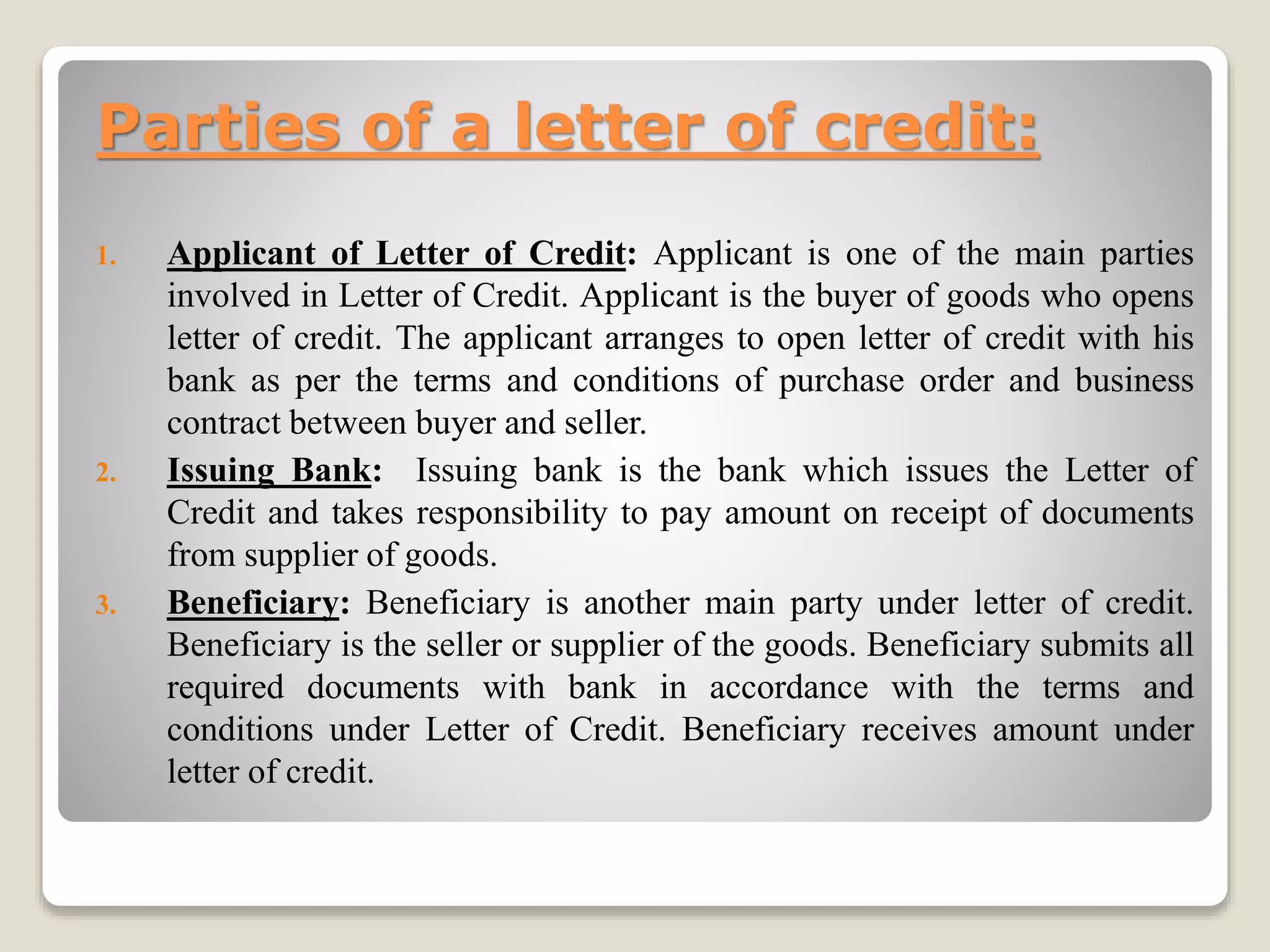
1. Applicant of Letter of Credit: Applicant is one of the main parties
involved in Letter of Credit. Applicant is the buyer of goods who opens
letter of credit. The applicant arranges to open letter of credit with his
bank as per the terms and conditions of purchase order and business
contract between buyer and seller.
2. Issuing Bank: Issuing bank is the bank which issues the Letter of
Credit and takes responsibility to pay amount on receipt of documents
from supplier of goods.
3. Beneficiary: Beneficiary is another main party under letter of credit.
Beneficiary is the seller or supplier of the goods. Beneficiary submits all
required documents with bank in accordance with the terms and
conditions under Letter of Credit. Beneficiary receives amount under
letter of credit.
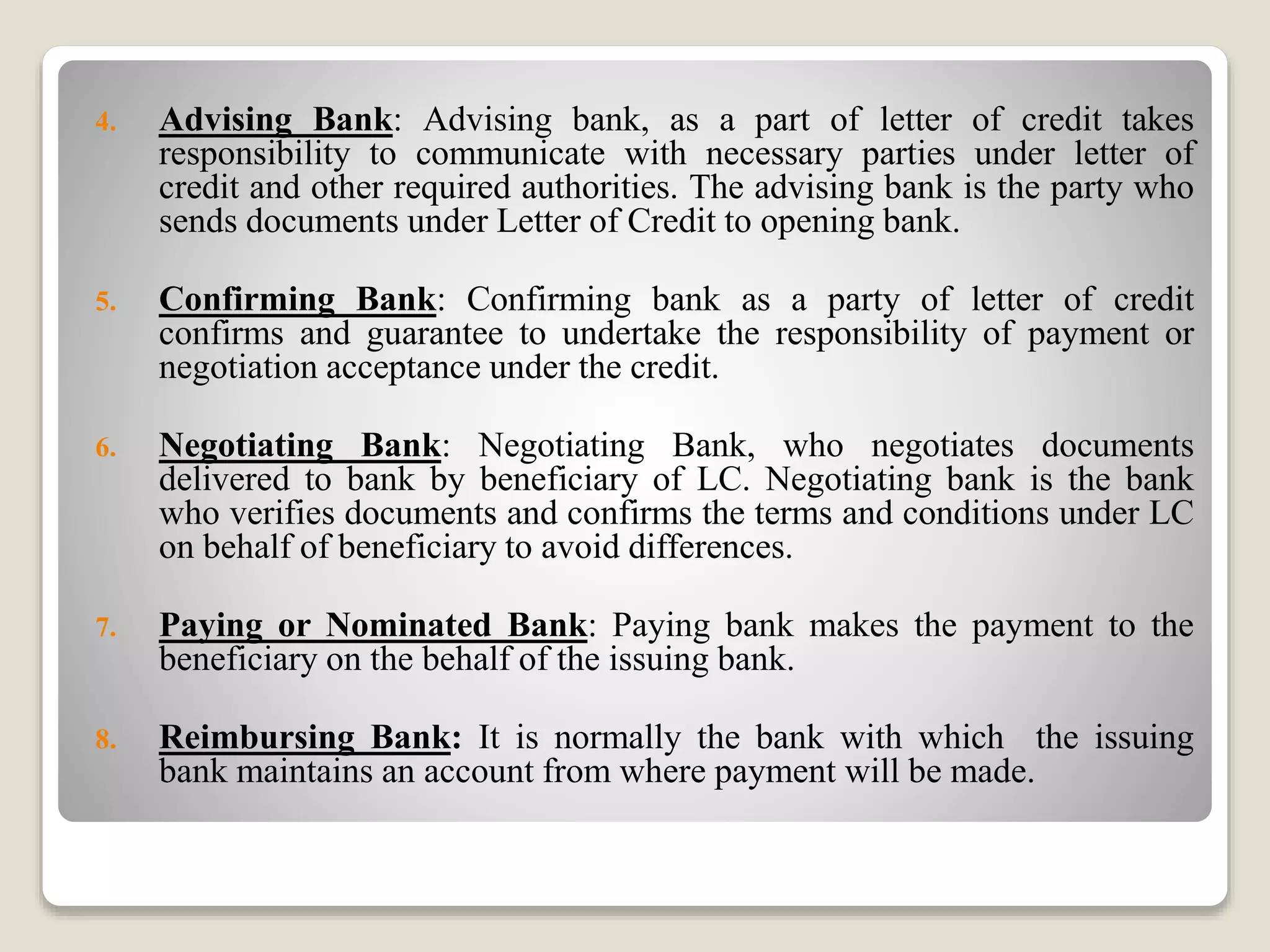
4. Advising Bank: Advising bank, as a part of letter of credit takes
responsibility to communicate with necessary parties under letter of
credit and other required authorities. The advising bank is the party who
sends documents under Letter of Credit to opening bank.
5. Confirming Bank: Confirming bank as a party of letter of credit
confirms and guarantee to undertake the responsibility of payment or
negotiation acceptance under the credit.
6. Negotiating Bank: Negotiating Bank, who negotiates documents
delivered to bank by beneficiary of LC. Negotiating bank is the bank
who verifies documents and confirms the terms and conditions under LC
on behalf of beneficiary to avoid differences.
7. Paying or Nominated Bank: Paying bank makes the payment to the
beneficiary on the behalf of the issuing bank.
8. Reimbursing Bank: It is normally the bank with which the issuing
bank maintains an account from where payment will be made.
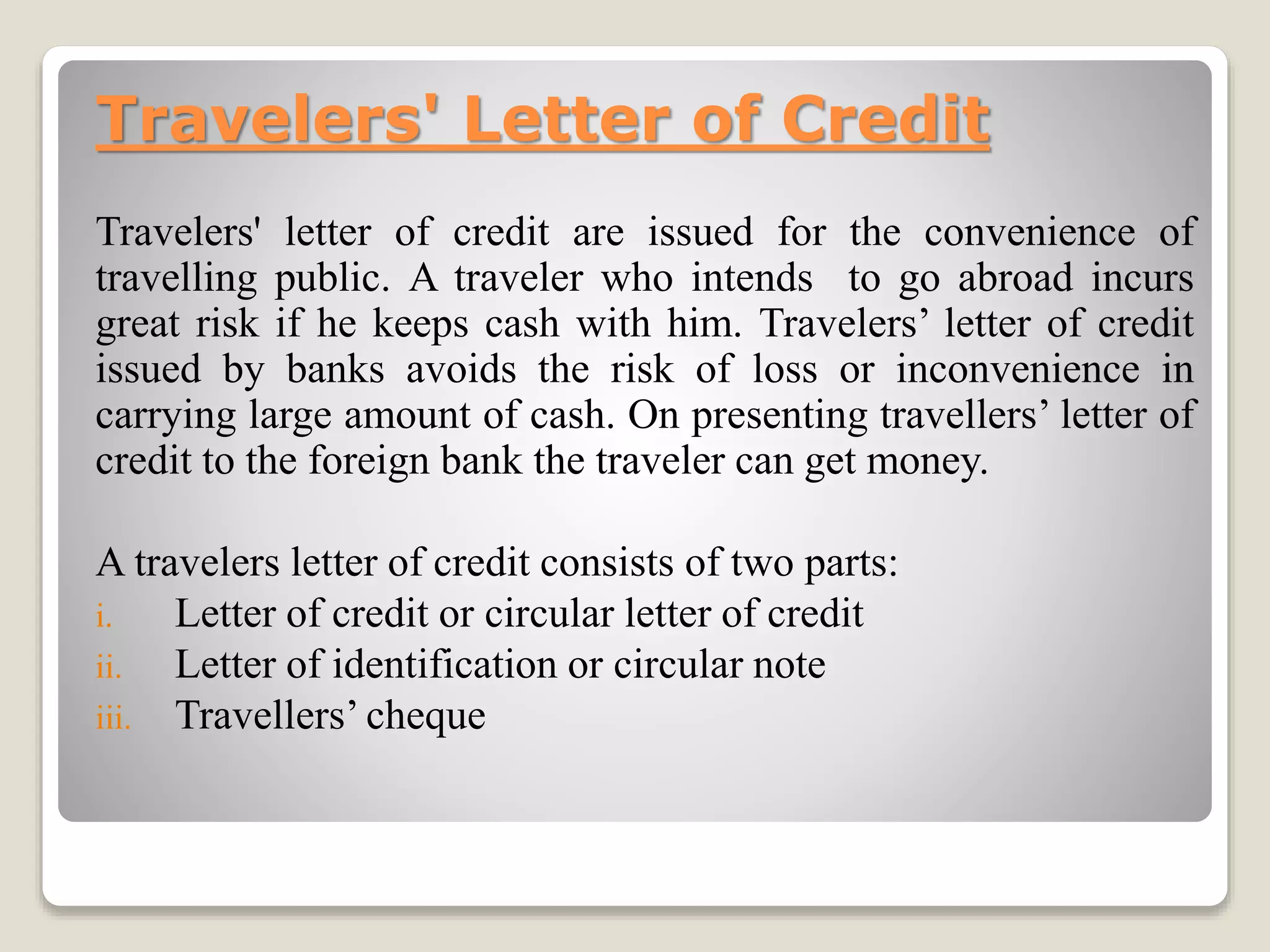
Travelers' Letter of Credit
Travelers' letter of credit are issued for the convenience of
travelling public. A traveler who intends to go abroad incurs
great risk if he keeps cash with him. Travelers’ letter of credit
issued by banks avoids the risk of loss or inconvenience in
carrying large amount of cash. On presenting travellers’ letter of
credit to the foreign bank the traveler can get money.
A travelers letter of credit consists of two parts:
i. Letter of credit or circular letter of credit
ii. Letter of identification or circular note
iii. Travellers’ cheque
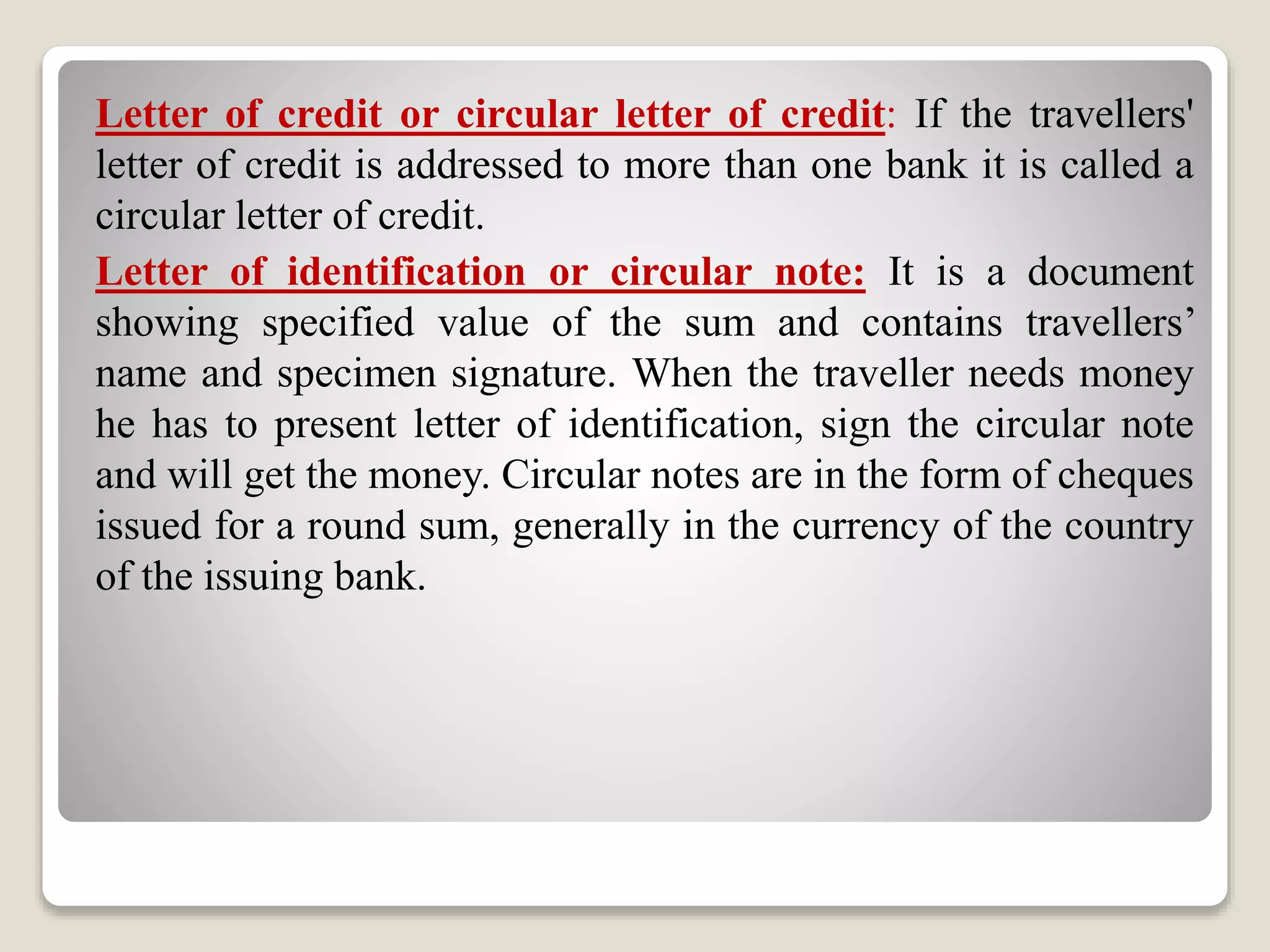
Letter of credit or circular letter of credit: If the travellers'
letter of credit is addressed to more than one bank it is called a
circular letter of credit.
Letter of identification or circular note: It is a document
showing specified value of the sum and contains travellers’
name and specimen signature. When the traveller needs money
he has to present letter of identification, sign the circular note
and will get the money. Circular notes are in the form of cheques
issued for a round sum, generally in the currency of the country
of the issuing bank.
Letter for Commercial Credit
This type of letter of credit is used to finance trading activities. The
customer wishing to open such a credit approaches a banker with a
request for a letter addressed to another person in a different city or
country from whom he expects shipment of goods on credit. The total
amount of such credit is settled with the banker after the latter
receives the requisite security to his satisfaction.
The banker by giving the said letter of credit, authorizes the other
party, who is to make the shipment, to draw a bill of exchange on him
up to the amount mentioned in the said letter, which the banker on
giving the letter agrees to accept, provided it is drawn strictly in
accordance with the terms and conditions covered by the letter of
credit.
Types of Letter of Credit
 Documentary and clean letter of credit.
 Revocable and irrevocable letter of credit.
 Fixed and revolving letter of credit.
 Confirmed and unconfirmed letter of credit.
 With or without recourse letter of credit.
 Back to back letter of credit.
 Red clause letter of credit.
 Green clause letter of credit.
Documentary and clean letter of credit
 A documentary letter of credit is one which the issuing bank
undertakes to honour the bills drawn under it only when it
receives with certain documents (ex- insurance policy,
invoice, certificate of origin, etc.). The documents are kept by
the issuing bank as security for advance made by it.
 A clean letter of credit is one where no documents are
involved. Such a letter of credit is issued for customers of
high financial standing.
Revocable and Irrevocable letter of credit
 A revocable letter of credit can be changed at any time by either the
buyer or the issuing bank with no notification to the beneficiary. Since
revocable letters of credit do not provide any protection to the beneficiary,
they are not used frequently.
 Conversely, an irrevocable letter of credit only allows change or
cancellation of the letter of credit by the issuing bank after application by
the buyer and approval by the beneficiary. Letters of credit issued by banks
in India are irrevocable letters of credit.
Fixed and revolving letter of credit
 A fixed letter of credit is opened for a specific amount for a specific
period. The exporter may draw one or more bills up to the amount
specified. The credit would exhaust as soon as the total amount has been
drawn. If the period is fixed, it expires after the lapse of the prescribed
time.
 In case of revolving letter of credit, the amount of credit remains constant
during the period of validity. When a bill is drawn, the amount gets
reduced and when the bill is duly honored, the credit amount is
automatically renewed.
Confirmed and Unconfirmed letter of credit
A confirmed letter of credit is one where a negotiating bank agrees
to pay the letter of credit at the request of the issuing bank. An LC is
said to be confirmed when a negotiating bank adds its confirmation
(or guarantee) to honor a complying presentation at the request or
authorization of the issuing bank.
An unconfirmed letter of credit is guaranteed only by the issuing
bank and does not carry the confirmation of negotiating bank.
With or Without recourse letter of credit
In case of a letter of credit with recourse, the beneficiary of
the letter of credit holds himself liable to the holder of the bill,
in the event of dishonour.
Where the beneficiary does not hold himself liable to the holder
for dishonour, such a letter of credit is known as without
recourse letter of credit.
Transferrable and Non-transferrable letter of credit
Letter of credit may also be a transferrable letter of credit.
These are commonly used when the beneficiary is simply an
intermediary for the real supplier of the goods and services or is
one of a group of suppliers. It allows the named beneficiary to
present its own documentation but transfer all or part of the
payment to the actual suppliers. The beneficiary has the right to
transfer the credit on whole or in part to one or more third
parties.
As you might guess, an non-transferrable letter of credit does
not allow transfer of payments to third parties.
Red clause letter of credit
A red clause letter of credit allows the beneficiary to receive partial payment
before shipping the products or performing the services from negotiating
bank. Originally, these terms were written in red ink, hence is known as red
clause letter of credit. In practical use, issuing banks will rarely offer these
terms unless the beneficiary is very creditworthy or an advising bank agrees
to refund the money if the shipment is not made.
Green Clause letter of credit
In addition to the red clause credit facilities, the exporter gets finance for
warehouse and insurance charges at the port where the goods are stores
pending availability of ship. This clause is written in green ink and hence the
name.
Back-to-back letter of credit
A back-to-back letter of credit is used in a trade involving an
intermediary, such as a trading house. It is actually made up of
two letters of credit, one issued by the buyer's bank to the
intermediary and the other issued by the intermediary's bank to
the seller.
Documentation Requirements
The documents that the issuing bank will accept are specified in
the letter of credit, but may often include:
 Bills of exchange
 Invoices
 Government documents such as licenses, certificates of origin,
inspection certificates, embassy legalizations.
 Shipping and transport documents such as bills of lading and
airway bills
 Insurance policies or certificates, except cover notes.
Risks in Letter of Credit Transactions
 The payment may be obtained through the use of fraud documents.
 Legal risk prevents completion of the transaction.
 The completion of the transaction may be prevented by an external
force, such as war or natural disaster.
 Failure of the issuing or collecting bank or insolvency of the buyer.
 In addition, non-delivery, shipping less than was ordered, inferior
quality merchandise, early or late shipment, or goods being
damaged in transit.
Advantages of L/C to Importer
 Reasonable cost of funding.
 Financing of up to 100 percentof contract value.
 Easier to do business with unknown sellers.
 No payment is made until documentary evidence is received showing shipment
details.
 Documents are examined in compliance with International Chamber of
Commerce rules and the terms of the L/C.
 Preservation of acting discounts of suppliers.
 he bank will pay the seller for the goods, on condition that the latter presents to
the bank the determined documents in line with the terms of the letter of credit;
The buyer can control the time period for shipping of the goods; By a letter of
credit, the buyer demonstrates his solvency; In the case of issuing a letter of
credit providing for delayed payment, the seller grants a credit to the buyer.
Providing a letter of credit allows the buyer to avoid or reduce pre-payment.
Advantages of L/C to Exporter
 Certainty of payment and avoidance of risk.
 Financial standing of the buyer is replaced by the issuing bank.
 In case of confirmed LC, additional assurance from the Confirming bank.
 The seller has the obligation of buyer's bank's to pay for the shipped goods.
 Reducing the production risk, if the buyer cancels or changes his order.
 The opportunity to get financing in the period between the shipment of the
goods and receipt of payment (especially, in case of deferred payment).
 The seller is able to calculate the payment date for the goods.
 The buyer will not be able to refuse to pay due to a complaint about the goods.
Unit 2 (different means of remittance) (As per syllabus 2017-18)

Unit 2 (different means of remittance) (As per syllabus 2017-18)

  • 1.
    UNIT-2 DIFFERENT MEANS OF REMITTANCE F.Y.B.Com (Sem-II) Elements of Banking and Insurance
  • 2.
    Introduction Apart from acceptingdeposits and lending money, banks also carry out the act of transfer of money - both domestic and foreign. This activity is known as "remittance business" . The money transfer between two branches of the same country is known as internal transfer. In case of international transfer the banks remit the funds through letter of credit. Banks remit funds from one place to another through the network of their branches. The main instruments for transfer of funds are Demand Drafts, Mail Transfer, Travellers’ cheques, Banker's Cheques, Money Orders, plastic cards etc. Types of Remittance of Funds Internal Remittance International Remittance
  • 3.
    Different Instruments forRemittance of Funds Means of Remittance Bank Draft Mail Transfer Telegraphic Transfer Letter of Credit Credit/ Debit Cards
  • 4.
    Bank Draft orDemand Draft  “A bank draft is an order from one branch of a bank to another branch of the same bank to pay a specified sum of money to the person named therein or to his order”.  A person who wants to send money can buy a draft by paying the required amount to a bank and send to another who can encash it in his place. Banks issue drafts for a nominal commission. The purchaser of the draft need not to be a customer or account holder of the bank.  According to the section 13 of the Negotiable Instrument Act, a bank draft is not a negotiable instrument. But a draft has all the attributes of a bill of exchange, such as an instrument in writing, containing an unconditional order, signed by banker.  Section 85-A provides protection to bank against forged or unauthorized endorsement on drafts or Section 131 gives protection to collecting banker in respect of crossed drafts.
  • 5.
     A bankdraft is a commitment on the part of the issuing bank to pay a certain amount of money to a third party.  Sometimes the purchaser of the bank draft may return it to the issuing bank with a request to cancel it and refund the amount to him. The banker may consider his request subjected that the draft has not been delivered to payee. The moment the draft is sent to the payee the purchaser loses this right.  Validity of the bank or demand draft is three months from the date of issue.  In case the draft is lost and it is reported to the issuing bank, it should immediately advice the loss to the drawee branch which will make note of the loss in the record to guard itself against the fraudulent use of the lost draft.
  • 6.
    Loss of draft: Thedraft lost by the purchaser is entitled to get a duplicate one from the issuing bank. The banker, before issuing a duplicate draft should take the following steps: 1. The banker should be satisfied with the genuineness of the request by the purchaser for the issue of a duplicate. 2. A confirmation regards non-payment of the draft should be obtained from the drawee bank. 3. An indemnity bond must be obtained from the purchaser. If the draft has reached the hands of the payee, he should also sign the indemnity bond. 4. When a duplicate draft is issued, the drawee bank must be informed about it.
  • 7.
    Mail Transfer The facilityof transferring money by mail is available to customers having some sort of an account with the bank. The remitter deposits the amount to be transferred with a small commission with the remitting branch. After receiving the money, the bank sends instruction by mail to its drawee branch to credit the account of the payee with the specified amount and informs the payee about it. Remittance of money by mail transfer is comparatively cheaper, safer and more convenient. This is, however, a dying product and many banks like State Bank of India have since withdrawn this.
  • 8.
    Telegraphic Transfer Remittance offunds can be made more speedy than mail transfers by using telegraphic transfer. A nominal charge is often charged by the sending bank and in some cases by the receiving bank. This is similar to the Mail Transfer except that the message is sent by way of a telegram and the money is deposited the next day.
  • 9.
    Telephonic Transfer When anybank sends to its branch the advice or instruction of such transfer or remittance of money on telephone, it is called telephonic transfer. This system transfers money faster than telegraphic transfer. Such type of dealing can be made with the branches of the same bank.
  • 10.
    Letter of Credit A letter of credit is a document from a bank guaranteeing that a seller will receive payment in full as long as certain delivery conditions have been met. In the event that the buyer is unable to make payment on the purchase, the bank will cover the outstanding amount.  They are often used in international transactions to ensure that payment will be received where the buyer and seller may not know each other and are operating in different countries.  The bank that writes the letter of credit will act on behalf of the buyer and make sure that all delivery conditions have been met before making the payment to the seller.  Letters of credit are typically used by importing and exporting companies particularly for large purchases.
  • 11.
     “A letterof credit is defined as a letter issued by the importer’s bank in favor of the export authorizing him to draw bill up to an amount specified in it and assuring him of payment against the delivery of the prescribed documents in his own country”.  The importer who requests bank to open a letter of credit in favor of the overseas supplier is called the opener or accountee and his bank is known as opening bank.  The letter of credit is sent to the foreign branch of the banker to its correspondent bank, which is called the negotiating bank.  After satisfying itself about the authenticity of the credit, the bank forwards it to the exporter who is called the beneficiary.
  • 12.
     The exporterships the goods, prepares the document and draws a bill on his importer.  The negotiating bank receives the bill and pays the amount if it is in accordance with the letter of credit.  The opening bank receives the bill and documents and presents them for acceptance if are D/A bills and for payment D/P bills.  Documents are delivered on payment or acceptance, as the case may be to the importer who takes delivery of the goods.
  • 13.
    Parties of aletter of credit: 1. Applicant of Letter of Credit: Applicant is one of the main parties involved in Letter of Credit. Applicant is the buyer of goods who opens letter of credit. The applicant arranges to open letter of credit with his bank as per the terms and conditions of purchase order and business contract between buyer and seller. 2. Issuing Bank: Issuing bank is the bank which issues the Letter of Credit and takes responsibility to pay amount on receipt of documents from supplier of goods. 3. Beneficiary: Beneficiary is another main party under letter of credit. Beneficiary is the seller or supplier of the goods. Beneficiary submits all required documents with bank in accordance with the terms and conditions under Letter of Credit. Beneficiary receives amount under letter of credit.
  • 14.
    4. Advising Bank:Advising bank, as a part of letter of credit takes responsibility to communicate with necessary parties under letter of credit and other required authorities. The advising bank is the party who sends documents under Letter of Credit to opening bank. 5. Confirming Bank: Confirming bank as a party of letter of credit confirms and guarantee to undertake the responsibility of payment or negotiation acceptance under the credit. 6. Negotiating Bank: Negotiating Bank, who negotiates documents delivered to bank by beneficiary of LC. Negotiating bank is the bank who verifies documents and confirms the terms and conditions under LC on behalf of beneficiary to avoid differences. 7. Paying or Nominated Bank: Paying bank makes the payment to the beneficiary on the behalf of the issuing bank. 8. Reimbursing Bank: It is normally the bank with which the issuing bank maintains an account from where payment will be made.
  • 15.
    Travelers' Letter ofCredit Travelers' letter of credit are issued for the convenience of travelling public. A traveler who intends to go abroad incurs great risk if he keeps cash with him. Travelers’ letter of credit issued by banks avoids the risk of loss or inconvenience in carrying large amount of cash. On presenting travellers’ letter of credit to the foreign bank the traveler can get money. A travelers letter of credit consists of two parts: i. Letter of credit or circular letter of credit ii. Letter of identification or circular note iii. Travellers’ cheque
  • 16.
    Letter of creditor circular letter of credit: If the travellers' letter of credit is addressed to more than one bank it is called a circular letter of credit. Letter of identification or circular note: It is a document showing specified value of the sum and contains travellers’ name and specimen signature. When the traveller needs money he has to present letter of identification, sign the circular note and will get the money. Circular notes are in the form of cheques issued for a round sum, generally in the currency of the country of the issuing bank.
  • 17.
    Letter for CommercialCredit This type of letter of credit is used to finance trading activities. The customer wishing to open such a credit approaches a banker with a request for a letter addressed to another person in a different city or country from whom he expects shipment of goods on credit. The total amount of such credit is settled with the banker after the latter receives the requisite security to his satisfaction. The banker by giving the said letter of credit, authorizes the other party, who is to make the shipment, to draw a bill of exchange on him up to the amount mentioned in the said letter, which the banker on giving the letter agrees to accept, provided it is drawn strictly in accordance with the terms and conditions covered by the letter of credit.
  • 18.
    Types of Letterof Credit  Documentary and clean letter of credit.  Revocable and irrevocable letter of credit.  Fixed and revolving letter of credit.  Confirmed and unconfirmed letter of credit.  With or without recourse letter of credit.  Back to back letter of credit.  Red clause letter of credit.  Green clause letter of credit.
  • 19.
    Documentary and cleanletter of credit  A documentary letter of credit is one which the issuing bank undertakes to honour the bills drawn under it only when it receives with certain documents (ex- insurance policy, invoice, certificate of origin, etc.). The documents are kept by the issuing bank as security for advance made by it.  A clean letter of credit is one where no documents are involved. Such a letter of credit is issued for customers of high financial standing.
  • 20.
    Revocable and Irrevocableletter of credit  A revocable letter of credit can be changed at any time by either the buyer or the issuing bank with no notification to the beneficiary. Since revocable letters of credit do not provide any protection to the beneficiary, they are not used frequently.  Conversely, an irrevocable letter of credit only allows change or cancellation of the letter of credit by the issuing bank after application by the buyer and approval by the beneficiary. Letters of credit issued by banks in India are irrevocable letters of credit.
  • 21.
    Fixed and revolvingletter of credit  A fixed letter of credit is opened for a specific amount for a specific period. The exporter may draw one or more bills up to the amount specified. The credit would exhaust as soon as the total amount has been drawn. If the period is fixed, it expires after the lapse of the prescribed time.  In case of revolving letter of credit, the amount of credit remains constant during the period of validity. When a bill is drawn, the amount gets reduced and when the bill is duly honored, the credit amount is automatically renewed.
  • 22.
    Confirmed and Unconfirmedletter of credit A confirmed letter of credit is one where a negotiating bank agrees to pay the letter of credit at the request of the issuing bank. An LC is said to be confirmed when a negotiating bank adds its confirmation (or guarantee) to honor a complying presentation at the request or authorization of the issuing bank. An unconfirmed letter of credit is guaranteed only by the issuing bank and does not carry the confirmation of negotiating bank.
  • 23.
    With or Withoutrecourse letter of credit In case of a letter of credit with recourse, the beneficiary of the letter of credit holds himself liable to the holder of the bill, in the event of dishonour. Where the beneficiary does not hold himself liable to the holder for dishonour, such a letter of credit is known as without recourse letter of credit.
  • 24.
    Transferrable and Non-transferrableletter of credit Letter of credit may also be a transferrable letter of credit. These are commonly used when the beneficiary is simply an intermediary for the real supplier of the goods and services or is one of a group of suppliers. It allows the named beneficiary to present its own documentation but transfer all or part of the payment to the actual suppliers. The beneficiary has the right to transfer the credit on whole or in part to one or more third parties. As you might guess, an non-transferrable letter of credit does not allow transfer of payments to third parties.
  • 25.
    Red clause letterof credit A red clause letter of credit allows the beneficiary to receive partial payment before shipping the products or performing the services from negotiating bank. Originally, these terms were written in red ink, hence is known as red clause letter of credit. In practical use, issuing banks will rarely offer these terms unless the beneficiary is very creditworthy or an advising bank agrees to refund the money if the shipment is not made. Green Clause letter of credit In addition to the red clause credit facilities, the exporter gets finance for warehouse and insurance charges at the port where the goods are stores pending availability of ship. This clause is written in green ink and hence the name.
  • 26.
    Back-to-back letter ofcredit A back-to-back letter of credit is used in a trade involving an intermediary, such as a trading house. It is actually made up of two letters of credit, one issued by the buyer's bank to the intermediary and the other issued by the intermediary's bank to the seller.
  • 27.
    Documentation Requirements The documentsthat the issuing bank will accept are specified in the letter of credit, but may often include:  Bills of exchange  Invoices  Government documents such as licenses, certificates of origin, inspection certificates, embassy legalizations.  Shipping and transport documents such as bills of lading and airway bills  Insurance policies or certificates, except cover notes.
  • 28.
    Risks in Letterof Credit Transactions  The payment may be obtained through the use of fraud documents.  Legal risk prevents completion of the transaction.  The completion of the transaction may be prevented by an external force, such as war or natural disaster.  Failure of the issuing or collecting bank or insolvency of the buyer.  In addition, non-delivery, shipping less than was ordered, inferior quality merchandise, early or late shipment, or goods being damaged in transit.
  • 29.
    Advantages of L/Cto Importer  Reasonable cost of funding.  Financing of up to 100 percentof contract value.  Easier to do business with unknown sellers.  No payment is made until documentary evidence is received showing shipment details.  Documents are examined in compliance with International Chamber of Commerce rules and the terms of the L/C.  Preservation of acting discounts of suppliers.  he bank will pay the seller for the goods, on condition that the latter presents to the bank the determined documents in line with the terms of the letter of credit; The buyer can control the time period for shipping of the goods; By a letter of credit, the buyer demonstrates his solvency; In the case of issuing a letter of credit providing for delayed payment, the seller grants a credit to the buyer. Providing a letter of credit allows the buyer to avoid or reduce pre-payment.
  • 30.
    Advantages of L/Cto Exporter  Certainty of payment and avoidance of risk.  Financial standing of the buyer is replaced by the issuing bank.  In case of confirmed LC, additional assurance from the Confirming bank.  The seller has the obligation of buyer's bank's to pay for the shipped goods.  Reducing the production risk, if the buyer cancels or changes his order.  The opportunity to get financing in the period between the shipment of the goods and receipt of payment (especially, in case of deferred payment).  The seller is able to calculate the payment date for the goods.  The buyer will not be able to refuse to pay due to a complaint about the goods.