Presented by:
Avinash Shaw
Mohit Chandra
Prabhat Gupta
Sumeet Agarwal
Sumona Ghosh
Agenda
• Overview
• Why Pizza Hut is Successful ?
• Challenges faced in India
• Competitor Analysis
• Conclusion
Overview
• Pizza Hut was founded in June 1958 by two University students, brothers Dan and
Frank Carney at Wichita, Kansas
• Internationally acclaimed fast food chains like KFC, McDonalds and Subway ,
Subsidiary of Yum Brands Inc.
• Pizza Hut incorporated the red roof into the logo to solidify the red roof as their
brand image .The design became symbolic of family dinners, post-game parties,
and late nights at the office all around the world
• Pizza Hut made its grand launch in India with a dine-in restaurant in Bangalore in
June 1996 and was the first international restaurant chain to enter this category and
can be credited with pioneering the pizza market in India.
Cont.
• By 1986, Pizza Hut’s leadership of the overall pizza market is being challenged by
Domino’s, a delivery-only chain.
• The delivery segment accounts for only 20% of the $12.7 billion pizza market, but
it is growing rapidly.
• A change in consumer preferences has led to the increased purchases in the delivery
segment.
• After years of resisting entry into the delivery segment for fear of cannibalizing its
existing eat-in restaurants, Pizza Hut has decided it is necessary to move into the
delivery segment.
.
Analysis between the two competitors
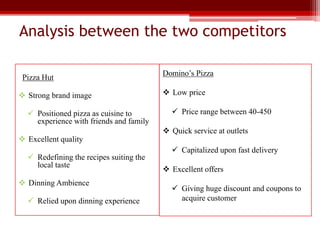
Pizza Hut
 Strong brand image
 Positioned pizza as cuisine to
experience with friends and family
 Excellent quality
 Redefining the recipes suiting the
local taste
 Dinning Ambience
 Relied upon dinning experience
Domino’s Pizza
 Low price
 Price range between 40-450
 Quick service at outlets
 Capitalized upon fast delivery
 Excellent offers
 Giving huge discount and coupons to
acquire customer
Why Pizza Hut is Successful ?
• Pizza Hut uses different strategies to reach their customers
 Spent 60 million pounds to refresh their brand image and menu.
 Add cocktail bars inside of restaurants in order to appeal to a younger clientele.
• Pizza Hut focuses on innovation
• Customized menu to incorporate local flavors
 Think Global Act Local
• Competitive long-term strategy
 Customer inflow shifted from Dine in to Delivery
• Pizza Hut managed their risk before investment
 The forecast is based on the amount of customers and the average amount of money
customers will spend on each meal.
 Also analyses for cost and profit, such as net margin, variable cost and fix cost.
Challenges faced in India
• High overhead costs due to large number of restaurants
• Constant need and assured supply for adequate manpower to run the outlets
(common problem to all operators in the sector)
• Challenges of solid supply chain system
• Ever-increasing real estate cost
• The quick service restaurants (QSR) are getting hit hard by the increase in
service tax that was announced
Conclusion
• Pizza Hut captures a 27 % market share of the eating-out market in India and with
over 70,000 footfalls per day across the country, it claims to provide diners with the
ideal place to build memories and relationships over delicious food
• Location: the most critical success factor for any hospitality business is “Location”.
Pizza hut does not aim to be a premium brand with selective distribution, instead it
aims to be make itself available anywhere and everywhere.Thus, pizza hut must
increase its Coverage
• Besides offering an extensive range of vegetarian pizzas, it was the first pizza chain
to open a 100% vegetarian restaurant in India in Surat and later in Ahmedabad and
Chowpatty, where it offers a Jain menu sans all root-based ingredients.
Thank You

Pizza hut : Case Study

  • 1.
    Presented by: Avinash Shaw MohitChandra Prabhat Gupta Sumeet Agarwal Sumona Ghosh
  • 2.
    Agenda • Overview • WhyPizza Hut is Successful ? • Challenges faced in India • Competitor Analysis • Conclusion
  • 3.
    Overview • Pizza Hutwas founded in June 1958 by two University students, brothers Dan and Frank Carney at Wichita, Kansas • Internationally acclaimed fast food chains like KFC, McDonalds and Subway , Subsidiary of Yum Brands Inc. • Pizza Hut incorporated the red roof into the logo to solidify the red roof as their brand image .The design became symbolic of family dinners, post-game parties, and late nights at the office all around the world • Pizza Hut made its grand launch in India with a dine-in restaurant in Bangalore in June 1996 and was the first international restaurant chain to enter this category and can be credited with pioneering the pizza market in India.
  • 4.
    Cont. • By 1986,Pizza Hut’s leadership of the overall pizza market is being challenged by Domino’s, a delivery-only chain. • The delivery segment accounts for only 20% of the $12.7 billion pizza market, but it is growing rapidly. • A change in consumer preferences has led to the increased purchases in the delivery segment. • After years of resisting entry into the delivery segment for fear of cannibalizing its existing eat-in restaurants, Pizza Hut has decided it is necessary to move into the delivery segment. .
  • 5.
    Analysis between thetwo competitors Pizza Hut  Strong brand image  Positioned pizza as cuisine to experience with friends and family  Excellent quality  Redefining the recipes suiting the local taste  Dinning Ambience  Relied upon dinning experience Domino’s Pizza  Low price  Price range between 40-450  Quick service at outlets  Capitalized upon fast delivery  Excellent offers  Giving huge discount and coupons to acquire customer
  • 6.
    Why Pizza Hutis Successful ? • Pizza Hut uses different strategies to reach their customers  Spent 60 million pounds to refresh their brand image and menu.  Add cocktail bars inside of restaurants in order to appeal to a younger clientele. • Pizza Hut focuses on innovation • Customized menu to incorporate local flavors  Think Global Act Local • Competitive long-term strategy  Customer inflow shifted from Dine in to Delivery • Pizza Hut managed their risk before investment  The forecast is based on the amount of customers and the average amount of money customers will spend on each meal.  Also analyses for cost and profit, such as net margin, variable cost and fix cost.
  • 7.
    Challenges faced inIndia • High overhead costs due to large number of restaurants • Constant need and assured supply for adequate manpower to run the outlets (common problem to all operators in the sector) • Challenges of solid supply chain system • Ever-increasing real estate cost • The quick service restaurants (QSR) are getting hit hard by the increase in service tax that was announced
  • 8.
    Conclusion • Pizza Hutcaptures a 27 % market share of the eating-out market in India and with over 70,000 footfalls per day across the country, it claims to provide diners with the ideal place to build memories and relationships over delicious food • Location: the most critical success factor for any hospitality business is “Location”. Pizza hut does not aim to be a premium brand with selective distribution, instead it aims to be make itself available anywhere and everywhere.Thus, pizza hut must increase its Coverage • Besides offering an extensive range of vegetarian pizzas, it was the first pizza chain to open a 100% vegetarian restaurant in India in Surat and later in Ahmedabad and Chowpatty, where it offers a Jain menu sans all root-based ingredients.
  • 9.