Securing your Low-code  No-code Applications
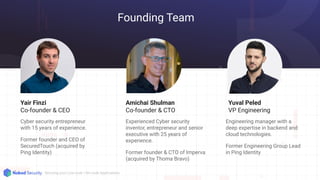
Founding Team
Experienced Cyber security
inventor, entrepreneur and senior
executive with 25 years of
experience.
Former founder & CTO of Imperva
(acquired by Thoma Bravo)
Amichai Shulman
Co-founder & CTO
Cyber security entrepreneur
with 15 years of experience.
Former founder and CEO of
SecuredTouch (acquired by
Ping Identity)
Yair Finzi
Co-founder & CEO
Securing your Low-code  No-code Applications
Yuval Peled
VP Engineering
Engineering manager with a
deep expertise in backend and
cloud technologies.
Former Engineering Group Lead
in Ping Identity
3 examples (out of 100M) for no-code built apps
Western Union Digital EU
Banking App
B2B application for
employee benefits
PepsiCo Vending
Machines web app, and
truck parking app
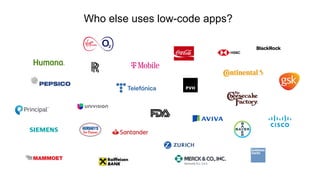
Who else uses low-code apps?
The Low-code  No-code trend
Low-code  no-code (LCNC) is a software development
approach that requires little (“low-code”) to zero (“no-code”)
coding to build business applications
According to Gartner, 65% of applications will be based on
low-code by 2024
Most large organizations have adopted multiple low-code tools
Many enterprise platforms (e.g. Office365, SalesForce.com,
ServiceNow) offer LCNC out-of-the-box
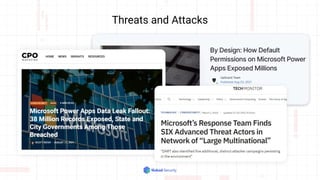
Threats and Attacks
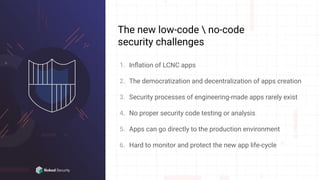
The new low-code  no-code
security challenges
Inflation of LCNC apps
The democratization and decentralization of apps creation
Security processes of engineering-made apps rarely exist
No proper security code testing or analysis
Apps can go directly to the production environment
Hard to monitor and protect the new app life-cycle
1.
2.
4.
3.
5.
6.
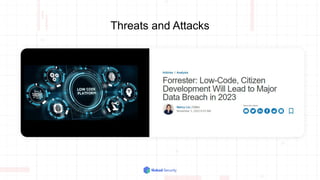
Threats and Attacks
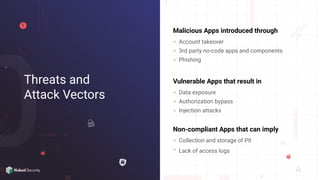
Threats and
Attack Vectors
Malicious Apps introduced through
Account takeover
3rd party no-code apps and components
Phishing
Vulnerable Apps that result in
Data exposure
Authorization bypass
Injection attacks
Non-compliant Apps that can imply
Collection and storage of PII
Lack of access logs
Mission
Empower organizations with tools and intelligence
for preventing cyber attacks and data breaches
through low-code  no-code applications
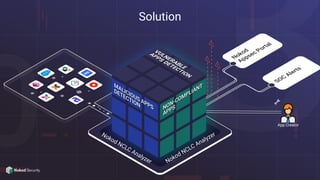
Solution
Nokod NCLC Analyzer Nokod NCLC Analyzer
App Creator
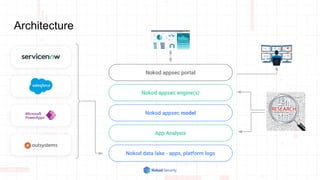
Architecture
Nokod appsec portal
Nokod appsec engine(s)
Nokod appsec model
App Analysis
Nokod data lake - apps, platform logs
TAM - top-down approach #1
Based on the Appsec market size
Analysis of AlliedMarketResearch [1] reports $5.97B in 2020, projecting
growth of 18.7% CAGR till being $33.9B by 2030
Analysis of ResearchAndMarkets [2] reports $7.35B in 2022, projecting growth
of 18.5% CAGR till being $33B by 2030
Averaging the two studies ($9.35B at 2023), and assuming 65% (Gartner) of apps
will be LCNC with similar proportion of the appsec effort = $6.07B at 2023
1.
2.
TAM - top-down approach #2
Based on the low-code  no-code platforms market size
A new analysis (December 2022) by Gartner [1] projects $26.9B in
2023, with CAGR of 19.6%
Analysis of Acumen [2] reports $16B in 2021 and projects growth of
28.8% CAGR till being $159B by 2030
Averaging the two studies ($26.72B at 2023), assuming 15% for security =
$4B at 2023
1.
2.
TAM - bottom-up approach
350,000 large companies (250+ employees) worldwide [1] (conservatively
using the 2021 figure)
Assuming 20% of those will use low-code  no-code
Average annual deal size: [Redacted- financial confidential]
TAM at 2023 = [Redacted- financial confidential]
1.
3.
4.
2.
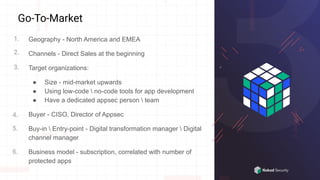
Go-To-Market
Geography - North America and EMEA
Channels - Direct Sales at the beginning
Target organizations:
● Size - mid-market upwards
● Using low-code  no-code tools for app development
● Have a dedicated appsec person  team
Buyer - CISO, Director of Appsec
Buy-in  Entry-point - Digital transformation manager  Digital
channel manager
Business model - subscription, correlated with number of
protected apps
1.
3.
2.
4.
5.
6.
Competition - still a blue ocean!
[Competitors analysis redacted-
strategic confidential]
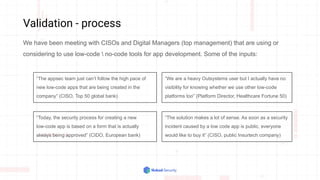
Validation - process
We have been meeting with CISOs and Digital Managers (top management) that are using or
considering to use low-code  no-code tools for app development. Some of the inputs:
“The appsec team just can’t follow the high pace of
new low-code apps that are being created in the
company” (CISO, Top 50 global bank)
“We are a heavy Outsystems user but I actually have no
visibility for knowing whether we use other low-code
platforms too” (Platform Director, Healthcare Fortune 50)
“The solution makes a lot of sense. As soon as a security
incident caused by a low code app is public, everyone
would like to buy it” (CISO, public Insurtech company)
“Today, the security process for creating a new
low-code app is based on a form that is actually
always being approved” (CIDO, European bank)
Validation - takeaways
1.
3.
4.
2.
5.
[Redacted- confidential operational plan]
Timeline 2023-2025
Month #1 Month #13 Month #24
Company Size 4 FTEs 15 FTEs 25 FTEs
Customers [Redacted- financial confidential]
Revenues (ARR)
Product MVP, 1-2 covered
platforms, design
partner-ready
[Redacted- product confidential]
A
Seed $8M
Thank you
For more information:
info@nokodsecurity.com

Pitch Deck Teardown: Nokod Security's $8M Seed deck

  • 1.
    Securing your Low-code No-code Applications
  • 2.
    Founding Team Experienced Cybersecurity inventor, entrepreneur and senior executive with 25 years of experience. Former founder & CTO of Imperva (acquired by Thoma Bravo) Amichai Shulman Co-founder & CTO Cyber security entrepreneur with 15 years of experience. Former founder and CEO of SecuredTouch (acquired by Ping Identity) Yair Finzi Co-founder & CEO Securing your Low-code No-code Applications Yuval Peled VP Engineering Engineering manager with a deep expertise in backend and cloud technologies. Former Engineering Group Lead in Ping Identity
  • 3.
    3 examples (outof 100M) for no-code built apps Western Union Digital EU Banking App B2B application for employee benefits PepsiCo Vending Machines web app, and truck parking app
  • 4.
    Who else useslow-code apps?
  • 5.
    The Low-code No-code trend Low-code no-code (LCNC) is a software development approach that requires little (“low-code”) to zero (“no-code”) coding to build business applications According to Gartner, 65% of applications will be based on low-code by 2024 Most large organizations have adopted multiple low-code tools Many enterprise platforms (e.g. Office365, SalesForce.com, ServiceNow) offer LCNC out-of-the-box
  • 6.
  • 7.
    The new low-code no-code security challenges Inflation of LCNC apps The democratization and decentralization of apps creation Security processes of engineering-made apps rarely exist No proper security code testing or analysis Apps can go directly to the production environment Hard to monitor and protect the new app life-cycle 1. 2. 4. 3. 5. 6.
  • 8.
  • 9.
    Threats and Attack Vectors MaliciousApps introduced through Account takeover 3rd party no-code apps and components Phishing Vulnerable Apps that result in Data exposure Authorization bypass Injection attacks Non-compliant Apps that can imply Collection and storage of PII Lack of access logs
  • 10.
    Mission Empower organizations withtools and intelligence for preventing cyber attacks and data breaches through low-code no-code applications
  • 11.
    Solution Nokod NCLC AnalyzerNokod NCLC Analyzer App Creator
  • 12.
    Architecture Nokod appsec portal Nokodappsec engine(s) Nokod appsec model App Analysis Nokod data lake - apps, platform logs
  • 13.
    TAM - top-downapproach #1 Based on the Appsec market size Analysis of AlliedMarketResearch [1] reports $5.97B in 2020, projecting growth of 18.7% CAGR till being $33.9B by 2030 Analysis of ResearchAndMarkets [2] reports $7.35B in 2022, projecting growth of 18.5% CAGR till being $33B by 2030 Averaging the two studies ($9.35B at 2023), and assuming 65% (Gartner) of apps will be LCNC with similar proportion of the appsec effort = $6.07B at 2023 1. 2.
  • 14.
    TAM - top-downapproach #2 Based on the low-code no-code platforms market size A new analysis (December 2022) by Gartner [1] projects $26.9B in 2023, with CAGR of 19.6% Analysis of Acumen [2] reports $16B in 2021 and projects growth of 28.8% CAGR till being $159B by 2030 Averaging the two studies ($26.72B at 2023), assuming 15% for security = $4B at 2023 1. 2.
  • 15.
    TAM - bottom-upapproach 350,000 large companies (250+ employees) worldwide [1] (conservatively using the 2021 figure) Assuming 20% of those will use low-code no-code Average annual deal size: [Redacted- financial confidential] TAM at 2023 = [Redacted- financial confidential] 1. 3. 4. 2.
  • 16.
    Go-To-Market Geography - NorthAmerica and EMEA Channels - Direct Sales at the beginning Target organizations: ● Size - mid-market upwards ● Using low-code no-code tools for app development ● Have a dedicated appsec person team Buyer - CISO, Director of Appsec Buy-in Entry-point - Digital transformation manager Digital channel manager Business model - subscription, correlated with number of protected apps 1. 3. 2. 4. 5. 6.
  • 17.
    Competition - stilla blue ocean! [Competitors analysis redacted- strategic confidential]
  • 18.
    Validation - process Wehave been meeting with CISOs and Digital Managers (top management) that are using or considering to use low-code no-code tools for app development. Some of the inputs: “The appsec team just can’t follow the high pace of new low-code apps that are being created in the company” (CISO, Top 50 global bank) “We are a heavy Outsystems user but I actually have no visibility for knowing whether we use other low-code platforms too” (Platform Director, Healthcare Fortune 50) “The solution makes a lot of sense. As soon as a security incident caused by a low code app is public, everyone would like to buy it” (CISO, public Insurtech company) “Today, the security process for creating a new low-code app is based on a form that is actually always being approved” (CIDO, European bank)
  • 19.
    Validation - takeaways 1. 3. 4. 2. 5. [Redacted-confidential operational plan]
  • 20.
    Timeline 2023-2025 Month #1Month #13 Month #24 Company Size 4 FTEs 15 FTEs 25 FTEs Customers [Redacted- financial confidential] Revenues (ARR) Product MVP, 1-2 covered platforms, design partner-ready [Redacted- product confidential] A Seed $8M
  • 21.
    Thank you For moreinformation: info@nokodsecurity.com