The case for low-
code
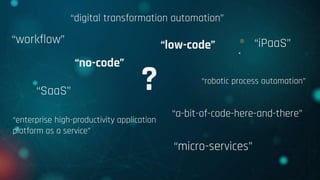
?
“low-code”
“no-code”
“a-bit-of-code-here-and-there”
“SaaS”
“iPaaS”
“micro-services”
“digital transformation automation”
“enterprise high-productivity application
platform as a service”
“robotic process automation”
“workflow”
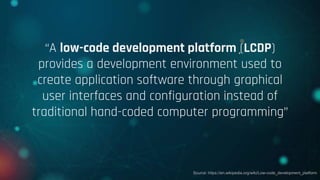
“A low-code development platform (LCDP)
provides a development environment used to
create application software through graphical
user interfaces and configuration instead of
traditional hand-coded computer programming”
Source: https://en.wikipedia.org/wiki/Low-code_development_platform
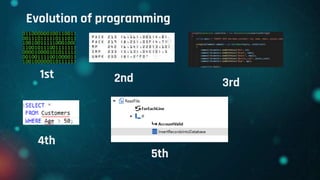
Evolution of programming
1st 2nd 3rd
4th
5th
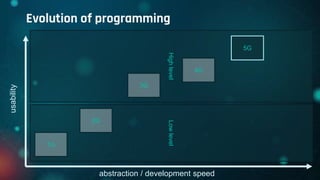
Evolution of programming
High
level
Low
level
usability
1G
abstraction / development speed
2G
3G
4G
5G
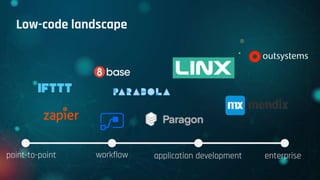
Low-code landscape
workflow
point-to-point application development enterprise
The business case for low-code
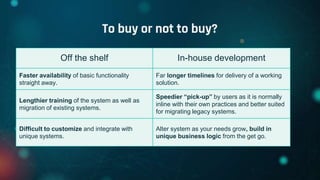
To buy or not to buy?
Off the shelf In-house development
Faster availability of basic functionality
straight away.
Far longer timelines for delivery of a working
solution.
Lengthier training of the system as well as
migration of existing systems.
Speedier “pick-up” by users as it is normally
inline with their own practices and better suited
for migrating legacy systems.
Difficult to customize and integrate with
unique systems.
Alter system as your needs grow, build in
unique business logic from the get go.
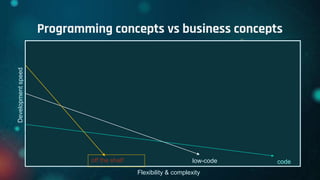
Programming concepts vs business concepts
Flexibility & complexity
Development
speed
code
low-code
off the shelf
Service-oriented architecture (SOA)
“SOA, or service-oriented architecture, defines a
way to make software components reusable via
service interfaces. These interfaces utilize
common communication standards in such a
way that they can be rapidly incorporated into
new applications without having to perform
deep integration each time.”
Source: https://www.ibm.com/cloud/learn/soa
A service has four properties according to one of many definitions of
SOA:
1) It logically represents a business activity with a specified outcome.
2) It is self-contained.
3) It is a black box for its consumers, meaning the consumer does not
have to be aware of the service's inner workings.
4) It may consist of other underlying services.
Source: http://publications.opengroup.org/standards/soa
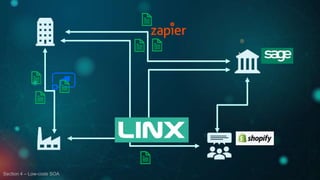
Section 4 – Low-code SOA
Business use cases of low-code SOA
• Innovation
• Resource capacity
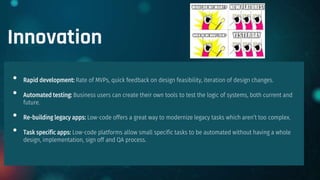
Innovation
• Rapid development: Rate of MVPs, quick feedback on design feasibility, iteration of design changes.
• Automated testing: Business users can create their own tools to test the logic of systems, both current and
future.
• Re-building legacy apps: Low-code offers a great way to modernize legacy tasks which aren’t too complex.
• Task specific apps: Low-code platforms allow small specific tasks to be automated without having a whole
design, implementation, sign off and QA process.
“Prolific developers don’t always write a
lot of code, instead they solve a lot of
problems. The two things are not the
same. – J. Chambers
Resource capacity
• Senior developers: Senior devs are in short supply, and most of their time is spent ensuring lower skilled
developers are implementing the correct functionality – these peoples time should be spent on core
complex logic.
• Maintaining legacy systems: Much of developers time is spent on maintaining outdated legacy systems
which everything has been built on – by focusing their time on these system, innovation suffers.
• Non-IT developers: Subject matter experts or design consultants can implement their designs almost
immediately without going through all the channels to get it custom developed.
• Less testing: As the systems being plugged into each other are developed specifically for one area of
functionality, you can assume that these systems have been tested to the correct level. When you use of
these systems you know it will work and don’t spend time fixing logic bugs.
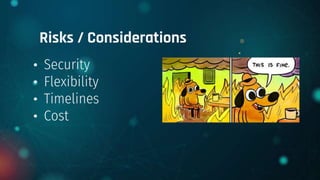
• Security
• Flexibility
• Timelines
• Cost
Risks / Considerations
The future of low-code
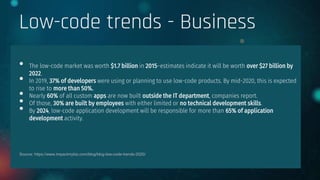
Low-code trends - Business
• The low-code market was worth $1.7 billion in 2015–estimates indicate it will be worth over $27 billion by
2022.
• In 2019, 37% of developers were using or planning to use low-code products. By mid-2020, this is expected
to rise to more than 50%.
• Nearly 60% of all custom apps are now built outside the IT department, companies report.
• Of those, 30% are built by employees with either limited or no technical development skills.
• By 2024, low-code application development will be responsible for more than 65% of application
development activity.
Source: https://www.impactmybiz.com/blog/blog-low-code-trends-2020/
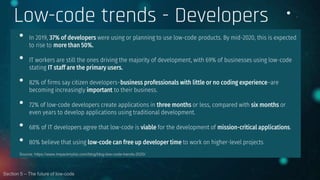
Low-code trends - Developers • .
• In 2019, 37% of developers were using or planning to use low-code products. By mid-2020, this is expected
to rise to more than 50%.
• IT workers are still the ones driving the majority of development, with 69% of businesses using low-code
stating IT staff are the primary users.
• 82% of firms say citizen developers–business professionals with little or no coding experience–are
becoming increasingly important to their business.
• 72% of low-code developers create applications in three months or less, compared with six months or
even years to develop applications using traditional development.
• 68% of IT developers agree that low-code is viable for the development of mission-critical applications.
• 80% believe that using low-code can free up developer time to work on higher-level projects
Source: https://www.impactmybiz.com/blog/blog-low-code-trends-2020/
Section 5 – The future of low-code
Citizen developers
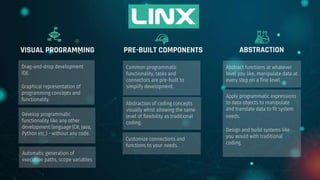
PRE-BUILT COMPONENTS
Customize connections and
functions to your needs.
Common programmatic
functionality, tasks and
connectors are pre-built to
simplify development.
VISUAL PROGRAMMING
Automatic generation of
execution paths, scope variables
ABSTRACTION
Abstract functions at whatever
level you like, manipulate data at
every step on a fine level.
Apply programmatic expressions
to data objects to manipulate
and translate data to fit system
needs.
Design and build systems like
you would with traditional
coding.
Drag-and-drop development
IDE.
Graphical representation of
programming concepts and
functionality.
Develop programmatic
functionality like any other
development language (C#, Java,
Python etc.) - without any code.
Abstraction of coding concepts
visually whist allowing the same
level of flexibility as traditional
coding.
.
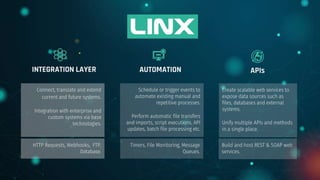
Connect, translate and extend
current and future systems.
Integration with enterprise and
custom systems via base
technologies.
Schedule or trigger events to
automate existing manual and
repetitive processes.
Perform automatic file transfers
and imports, script executions, API
updates, batch file processing etc.
INTEGRATION LAYER AUTOMATION APIs
HTTP Requests, Webhooks, FTP,
Database.
Timers, File Monitoring, Message
Queues.
Create scalable web services to
expose data sources such as
files, databases and external
systems.
Unify multiple APIs and methods
in a single place.
Build and host REST & SOAP web
services.
Conclusion
“go forth and (low)code”

The Case for Low-code Development

  • 1.
    The case forlow- code
  • 2.
  • 3.
    “A low-code developmentplatform (LCDP) provides a development environment used to create application software through graphical user interfaces and configuration instead of traditional hand-coded computer programming” Source: https://en.wikipedia.org/wiki/Low-code_development_platform
  • 4.
  • 5.
  • 8.
  • 9.
    The business casefor low-code
  • 10.
    To buy ornot to buy? Off the shelf In-house development Faster availability of basic functionality straight away. Far longer timelines for delivery of a working solution. Lengthier training of the system as well as migration of existing systems. Speedier “pick-up” by users as it is normally inline with their own practices and better suited for migrating legacy systems. Difficult to customize and integrate with unique systems. Alter system as your needs grow, build in unique business logic from the get go.
  • 11.
    Programming concepts vsbusiness concepts Flexibility & complexity Development speed code low-code off the shelf
  • 12.
  • 13.
    “SOA, or service-orientedarchitecture, defines a way to make software components reusable via service interfaces. These interfaces utilize common communication standards in such a way that they can be rapidly incorporated into new applications without having to perform deep integration each time.” Source: https://www.ibm.com/cloud/learn/soa
  • 14.
    A service hasfour properties according to one of many definitions of SOA: 1) It logically represents a business activity with a specified outcome. 2) It is self-contained. 3) It is a black box for its consumers, meaning the consumer does not have to be aware of the service's inner workings. 4) It may consist of other underlying services. Source: http://publications.opengroup.org/standards/soa
  • 15.
    Section 4 –Low-code SOA
  • 16.
    Business use casesof low-code SOA • Innovation • Resource capacity
  • 17.
    Innovation • Rapid development:Rate of MVPs, quick feedback on design feasibility, iteration of design changes. • Automated testing: Business users can create their own tools to test the logic of systems, both current and future. • Re-building legacy apps: Low-code offers a great way to modernize legacy tasks which aren’t too complex. • Task specific apps: Low-code platforms allow small specific tasks to be automated without having a whole design, implementation, sign off and QA process.
  • 18.
    “Prolific developers don’talways write a lot of code, instead they solve a lot of problems. The two things are not the same. – J. Chambers
  • 19.
    Resource capacity • Seniordevelopers: Senior devs are in short supply, and most of their time is spent ensuring lower skilled developers are implementing the correct functionality – these peoples time should be spent on core complex logic. • Maintaining legacy systems: Much of developers time is spent on maintaining outdated legacy systems which everything has been built on – by focusing their time on these system, innovation suffers. • Non-IT developers: Subject matter experts or design consultants can implement their designs almost immediately without going through all the channels to get it custom developed. • Less testing: As the systems being plugged into each other are developed specifically for one area of functionality, you can assume that these systems have been tested to the correct level. When you use of these systems you know it will work and don’t spend time fixing logic bugs.
  • 20.
    • Security • Flexibility •Timelines • Cost Risks / Considerations
  • 21.
    The future oflow-code
  • 22.
    Low-code trends -Business • The low-code market was worth $1.7 billion in 2015–estimates indicate it will be worth over $27 billion by 2022. • In 2019, 37% of developers were using or planning to use low-code products. By mid-2020, this is expected to rise to more than 50%. • Nearly 60% of all custom apps are now built outside the IT department, companies report. • Of those, 30% are built by employees with either limited or no technical development skills. • By 2024, low-code application development will be responsible for more than 65% of application development activity. Source: https://www.impactmybiz.com/blog/blog-low-code-trends-2020/
  • 23.
    Low-code trends -Developers • . • In 2019, 37% of developers were using or planning to use low-code products. By mid-2020, this is expected to rise to more than 50%. • IT workers are still the ones driving the majority of development, with 69% of businesses using low-code stating IT staff are the primary users. • 82% of firms say citizen developers–business professionals with little or no coding experience–are becoming increasingly important to their business. • 72% of low-code developers create applications in three months or less, compared with six months or even years to develop applications using traditional development. • 68% of IT developers agree that low-code is viable for the development of mission-critical applications. • 80% believe that using low-code can free up developer time to work on higher-level projects Source: https://www.impactmybiz.com/blog/blog-low-code-trends-2020/ Section 5 – The future of low-code
  • 24.
  • 25.
    PRE-BUILT COMPONENTS Customize connectionsand functions to your needs. Common programmatic functionality, tasks and connectors are pre-built to simplify development. VISUAL PROGRAMMING Automatic generation of execution paths, scope variables ABSTRACTION Abstract functions at whatever level you like, manipulate data at every step on a fine level. Apply programmatic expressions to data objects to manipulate and translate data to fit system needs. Design and build systems like you would with traditional coding. Drag-and-drop development IDE. Graphical representation of programming concepts and functionality. Develop programmatic functionality like any other development language (C#, Java, Python etc.) - without any code. Abstraction of coding concepts visually whist allowing the same level of flexibility as traditional coding. .
  • 26.
    Connect, translate andextend current and future systems. Integration with enterprise and custom systems via base technologies. Schedule or trigger events to automate existing manual and repetitive processes. Perform automatic file transfers and imports, script executions, API updates, batch file processing etc. INTEGRATION LAYER AUTOMATION APIs HTTP Requests, Webhooks, FTP, Database. Timers, File Monitoring, Message Queues. Create scalable web services to expose data sources such as files, databases and external systems. Unify multiple APIs and methods in a single place. Build and host REST & SOAP web services.
  • 27.