Treatment of Pineoblastoma and
Germ Cell Tumors
By
Dr Parneet Singh
Max Hospital,Saket
Introduction
• Pineal & Germ cell Tumors <1%of all intracranial tumors in adults and 3-8%
in children
• Germinomas are the most common 33-50%of pineal tumors
• Peak incidence of GCT in 2nd decade
• Gliomas & pineal parenchymal tumors-25% each
• 10-15% CNS dissemination at diagnosis
• Male:Female 3:1
• Patients present with raised intracranial pressure symptoms and parinaud’s
syndrome
• GCTs arise from a pluripotent embryonic cell that escapes normal
developmental signals and progresses to CNS GCTs
WHO Tumor Classification(2007)
• GCT
1. Germinoma
2. Embryonal carcinoma
3. Yolk sac tumor
4. Choriocarcinoma
5. Teratoma
6. Mixed germ cell tumor
• Pineal parenchymal Tumors
1. Pineocytoma
2. Pineal parenchymal tumor of intermediate differentiation
3. Pineoblastoma
• Glial
1. Astrocytoma
2. Paillary tumor of pineal region
3. Ganglioglioma
• Others
1. Mets
2. Dermoid/Epidermoid
Investigative Work-Up
• Detailed history
• Physical Examination
• CE MRI
• Biopsy open biopsy, stereotactic biopsy or endoscopic biopsy
• Serum & CSF levels of AFP and βHCG shunting
• CSF cytology
• Endocrine evaluation
• Visual field testing(suprasellar tumors)
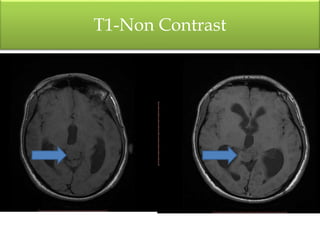
T1-Non Contrast
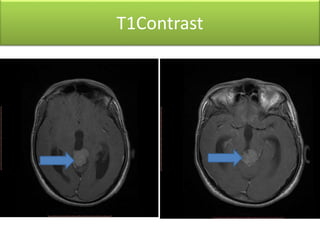
T1Contrast
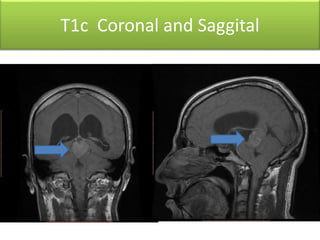
T1c Coronal and Saggital
T2
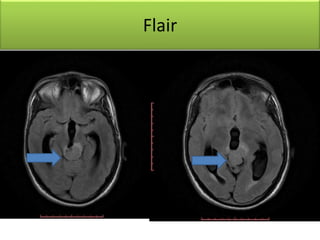
Flair
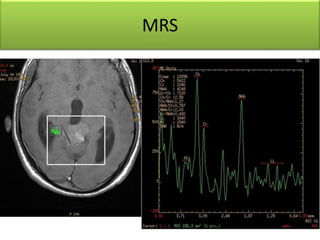
MRS
• Soft tissue mass lesion measureing2.9 X 2.7 X 2.7 cm
• Hypointense T1,hyperintense T2 / FLAIR signal &
homogenous post-contrast enhancement
• Lesion is compressing the superior portion of the cerebral
aqueduct with moderate supratentorial hydrocephalus
• MRS of the lesion shows
• Elevation of the choline and lipid lactate peaks.
IHC Markers
Tumor Type βHCG AFP PLAP
Choriocarcinoma + _ _
Embroynal Carcinoma _ _ _
Germinoma + _ +
Immature Teratoma +/- +/- +/-
Mature teratoma _ _ -
Mixed germ cell tumor +/- +/- +/-
Pure germinoma _ _ +
Yolk Sac tumor _ + _
Serum & CSF markers
Tumor Type βHCG AFP
Choriocarcinoma +++ -
Embryonal Ca + +
Germinoma +/- -
Teratoma - +
Yolk Sac tumor - +++
Chang’s Modified Staging
Pineocytoma
• WHO grade I
• Slow growing tumor
• Occur typically in adults
• Surgical resection by occipital transtentorial/ infratentorial supracerebellar
approach
• If complete/subtotal resection done then progression free survival 90-100%
• Infratentorial supracerebellar approach-
Surgical corridor in midline b/w tentorium above and sup. Surface of
cerebellum below
• Occipital transtentorial approach
Under the occipital lobe and through an incision in the tentorium to reach the
pineal region
• Obstructive hydrocephalus if present then endoscopic IIIrd
ventriculostomy with transventricular biopsy Cipri et al 2005
• VP shunting also done
• CSF sampling for cytological analysis & tumor markers
• If radial resection done then post op MRI scan should be done within
48 hours of surgery for residual disease.
• Post-op RT is recommended in case of residual disease
• Target volume is local
• Macroscopic residual ds +1-2 cm margin for CTV
• Dose of 50-55 Gy over 6 weeks. (schild et al Cancer 1996)
• University of Pennsylvania; 1987 (1975-1985)-- "Pineocytomas of
childhood. A reappraisal of natural history and response to therapy."
(D'Andrea AD, Cancer. 1987 Apr 1;59(7):1353-7.)
•
– Retrospective. 6 children
– Surgery + CSI+boost (n=3) or local RT (n=2) or chemo-RT (n=1).
– Outcome: 4/6 recurrences, median 2 years after diagnosis. 3
leptomeningeal dissemination
– Conclusion: Aggressive tumors in pediatric population; RT alone
inadequate
• Stereotactic Radiosurgery as
 Primary
 Adjuvant
 Salvage therapy
• Retrospective study from Pittsburg in 2005 evaluated 15
patients with mean dose of 15Gy and tumor volume of 5cm3
with mean follow up of 52 months
• Local control was 100%
• 3 patients died due to leptomengial or extracranial spread
• Barrow Neurological Institute; 2004 (Arizona) (Deshmukh VR,
Neurosurgery. 2004
• 3 GTR, 6 subtotal or bx. Adjuvant RT in 5/9 patients (n=2
IMRT 54/30, n=3 GKS)
– Outcome: 4/9 local recurrences (3 clinical, 1 radiographic).
Mean time to recurrence 3.5 years
– Radiosurgery: all stable or decreased at 3 years
– Treatment recommendations: If symptomatic, attempt
resection. For subtotally resected, adjuvant GKS. For small
asymptomatic tumors, stereotactic biopsy and primary GKS.
Need close follow-up
Pineal Parenchymal Tumor of intermediate
differentiation
• WHO grade II/III
• Moderate nuclear atypia &low to moderate mitotic activity
• 10% of pineal parenchymal tumors
• Unpredictable growth rate & behaviour
• 2 extremes
• In some series only surgery is recommended
• In others tumors have seeding potential so post-op CSI is
recommended(Schild Cancer 1993)
Pineoblastoma
• WHO grade IV
• Embryonal PNET with highly aggressive behavior
• Occurs in young children (estimated 40-50% in age <1 year)
• Children <3 years appear to have particularly aggressive disease,
with frequent advanced presentation
• Sheets of densely packed cells with high mitotic rate and necrosis
• Large and multilobulated
• Frequently invade adjacent structures & disseminate through CSF
• Leptomeningeal spread 20-50%
• Present with enlarged head circumference & raised ICT
• Surgical resection often incomplete due to location
• Typical approach is surgery, f/b chemotherapy & RT
• Older children can have a reasonable survival
• Efforts to eliminate RT in young children have resulted in poor
outcomes (POG, CCG, and German trials)
• Long-term CSI toxicity is severe, so efforts are under way for dose
intensification with stem cell transplant
• Post op children older than 3 year treated with RT and
chemotherapy
• Chemo is used for delaying RT- risk of neurocognitive
functions
Sx resection---->post-op CSI 36Gy (@1.8-Gy/#) followed by
boost tumor bed to 54 Gy with concurrent chemo-------> 8
cycles of adjuvant chemo.(cisplatin +Vincristine+CCNU)
(Freeman et al Med Pediatr oncol 2002)
RADIOTHERAPY
Objective:
• To treat microscopic cancer cells
• Residual tumor with the goal of reducing its size or stopping its
progression
• Prevent or treat spread through CSF
• Covering entire subarachnoid space
Target volume for CSI
• CSI includes irradiation of both CNS & entire subarachnoid
space (neuraxis)
• Whole brain with its meninges
• Spinal cord down to the caudal end of the thecal sac(usually S2
but should be verified by sagittal MRI)
 Primary tumor site
• Initial GTV – primary tumor site
• Initial CTV – whole brain + entire spinal cord with 1-2 cm
margin(including skull base & cribriform plate)
• Boost GTV – tumor bed+ residual
• Boost CTV – boost GTV + 1-1.5cm margin
• German HIT-SKK87, HIT 91, and HIT-SKK92 (1987-1992, 1992-
1997)
– Subset of 11 patients with PB. If <3 years, surgery + chemo with
RT deferred until >3 years or progression (n=5). If >3 years,
surgery + chemo + CSI (35.2/22 + 20/10 boost) +/- maintenance
chemo (n=6)
– Hinkes BG, J Neurooncol. 2007
• Older children (>3): 5/6 alive with median OS/PFS 7.9 years
after chemo and RT. All had M0 disease
• Younger children (<3): 0/5 alive with median OS 0.9 years and
PFS 0.6 years. All had M1 disease and/or postop residual
disease. Response to chemo lower, only 1/5 received RT
• Role of RT: All older children received it, & benefited (PR->CR or
stayed in CR).
• One younger child received who, after progressing on chemo, and
showed PR to it
• Conclusion: Combined chemo and RT feasible and effective if >3
years.
• More intensified regimens necessary for <3 years
• Subsequent HIT trial for young children with supratentorial PNET
investigates short dose-intense induction, followed by high-dose
chemo and CSI
• Baby POG I (1986-90)
– Prospective. 198 children < 3 yrs (132 < 2 yrs, 66 age 2-3 yrs),
treated with maximal surgery, postop chemo (CTX/VCR followed
by cis/etopo) for 2 yrs (if age < 2 at dx) or 1 yr (age 2-3) or until
disease progression, followed by RT.
– RT -CSI 35.2 Gy + boost to primary to 54 Gy.If no residual disease
after chemo, reduced RT to CSI 24 Gy and primary site 50 Gy.
Infants <2 years 90% of dose
– Duffner PK et al Med Pediatr Oncol. 1995
• Subset of PB infants (age <3 years, but 8/11 <1 year). 11
patients. Partial surgical resection
• Outcome: All children failed chemo, 9/11 in primary site, 8/11
had leptomeningeal progression at time of failure. All children
died, survival 4-13 months
• Conclusion: Chemo alone not effective
• CCG 921 (1986-1992)
– Older children (>1.5 years) treated with surgery + CSI + chemo;
infants (<1.5 years) treated with surgery + chemo (8-in-1) only
– Pineal only; 1995 (Jakacki et al J Clin Oncol. 1995
• Pineoblastoma subset of 25 patients, 17 age >1.5, 8 infants
– Infants: all infants developed progressive disease, median
PFS 4 months
– Older children: 3-year PFS 61% .After RT, 70% had residual
pineal region mass, which persisted as long as 5 years
before resolving
• Conclusion: Chemo alone (8-in-1) ineffective for infants. CSI +
chemo effective for older children
(methylprednisolone, VCR, CCNU or carmustine, procarbazine,
hydroxyurea, cisplatin, cytarabine and cyclophosphamide
• UCSF; 1995 (1975-1992) Chang SM, Neurosurgery. 1995
– Retrospective. 11 patients. Median age 36 years (17-59). All with
symptomatic hydrocephalus. Gross total resection 1/11. CSI
10/11 (CSI 24-45 Gy with tumor boost to 54-59.4 Gy). 7/11 chemo
– Outcome: M+ (5/10) alive median PFS 10 months, median OS 2.5
years; M0 (5/10) all alive at 2.2 years follow-up
– Conclusion: M0 patients can do well after surgery + CSI, benefit
of chemo unclear
SRS
• Marseille; 2006 - Reyns N Acta Neurochir (Wien). 2006
– Retrospective. 13 patients (8 pineocytomas, 5 pineoblastomas).
SRS alone in 6 cases, after surgery 3 cases, with chemo 3 cases, s/p
EBRT 1 case. Mean dose 15 Gy (11-20 Gy). Mean F/U 2.8 years
– Outcome: pineocytoma 8/8 alive, pineoblastoma 2/5 alive
– Toxicity: none major
– Conclusion: SRS effective and safe for pineocytoma, should have
a role in multimodality treatment for pineoblastoma
• Hasegawa T, Neurosurgery. 2002(Pittsburg)
– Retrospective. 16 patients treated with SRS as primary or
adjuvant. Pineocytoma (n=10), mixed tumor (n=2), pineoblastoma
(n=4). Mean dose 15 Gy. Mean F/U 4.3 years
– Outcome: 2-year OS 75%, 5-year OS 67%; LC rate 100%; 5/16 died,
4 secondary to leptomeningeal or extracranial spread
– Conclusion: SRS valuable modality for pineocytomas; can be used
as boost for malignant pineal tumors
• Kobayashi T, J Neurooncol. 2001(Japan)
– Retrospective. 5 patients with pineal & nearby tumors.
Pineocytoma (n=3), pineoblastoma (n=2). Pineal RT mean dose
15.7 Gy
– Outcome: pineocytoma 2/3 CR, 1/3 PR, no progression at 22
months; pineoblastoma 1/2 PR, 1/2 PG
– Conclusion: GKS is expected to be effective approach
Brachytherapy-Iodine 125
• Budapest; 2006 "Review of radiosurgery of pineal parenchymal
tumors. Long survival following 125-iodine brachytherapy of
pineoblastomas in 2 cases." (Julow J, Minim Invasive
Neurosurg. 2006
– Case report. 2 patients. Follow-up 5.1 and 4.8 years
– Outcome: shrinkage 73% and 77%, both negative on PET
– Conclusion: Two successful treatments reported
Simulation-cranial field
 Opposing lateral fields are applied to the whole brain and
upper spine
 Isocentre positioned at midline.
 AP width & superior border include the entire skull with 2 cm
clearance
 Inferior border placed around C2-3
 Lower border is matched with the superior border collimator
rotation of 7-11 o to match the divergence of the direct posterior
spinal field
Spinal field
• Upper border- at low neck
• Lateral border – 1cm lateral to the
lateral edge of each I/L pedicles or
to include the transverse processes in
their entirety to cover the spinal cord
and meninges along the nerve roots
upto the spinal ganglia
• Lower border at termination of
thecal sac or S2 whichever is lower
• If whole spinal axis cannot be included in single field
 Treatment at extended SSD
Advantage
• Single spinal field and overcoming the issue of junction between two spinal
fields
 Disadvantage
• Higher percentage depth dose
• Greater penumbra
 Treatment with split fields in which 2 spinal fields are used to treat spinal
axis
Radiotherapy Planning
 Phase I- CSI
Two lateral cranial fields
1 or 2 spinal fields
 Phase II: Boost
Two lateral cranial fields
TECHNIQUES OF MATCHING CS FIELDS
 Collimator/Couch rotation
 Half beam block
 Asymmetric jaws
 Planned gaps
 Moving Junction technique
Collimator rotation
• Divergence of upper spinal field into cranial field overcome by
collimator rotation so that its inferior border is parallel to divergence
of superior aspect of spinal fields
• Collimator angle = tan-1 { ½L1/SSD}
• L1 is spinal field length
 SSD = source to surface distance of posterior spine field
COUCH ROTATION
Rotation of the couchDivergence of cranial field
Divergence of cranial field into upper spinal field overcome by
couch rotation
Couch angle = tan-1 { ½ L2/SAD}
 L2 is cranial field length
Half beam block
Aligning Spinal field
 Field gap technique
 Double junction technique
 Feathering
Gap calculation-formula
Disadvantage-
Dose above the
junction will be lower
– Cold spot.
Below the junction
higher than the
junction dose- Hot
spot
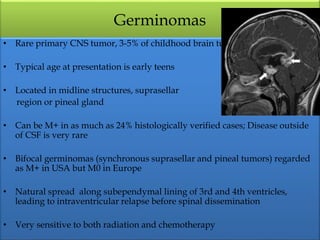
Germinomas
• Rare primary CNS tumor, 3-5% of childhood brain tumors
• Typical age at presentation is early teens
• Located in midline structures, suprasellar
region or pineal gland
• Can be M+ in as much as 24% histologically verified cases; Disease outside
of CSF is very rare
• Bifocal germinomas (synchronous suprasellar and pineal tumors) regarded
as M+ in USA but M0 in Europe
• Natural spread along subependymal lining of 3rd and 4th ventricles,
leading to intraventricular relapse before spinal dissemination
• Very sensitive to both radiation and chemotherapy
• T/t of M0 disease Historically CSI was the gold standard, but with local
control >99% and 10-year survival rates >90%, limiting side-effects is
essential
• Then WBRT & now to tumor + ventricles only.
• Isolated spinal relapse appears comparable between CSI and whole-brain
RT or whole-ventricular RT with neoadjuvant chemo
• M+ disease to be treated with CSI
• Now
– Whole ventricular volume: 3rd, 4th, lateral, prepontine cistern
– Involved field volume: pre-chemotherapy volume + clinical margin 1-1.5
cm
– Dose to primary disease is typically 40-45 Gy, and to subclinical disease
20-24 Gy(SFOP Neuro Oncol 2010)
•
• Rogers SJ, Lancet Oncol. 2005
– Reviewed 20 studies since 1988. 788 patients. 66% cases histologically
confirmed, 12/20 series 100% confirmation. Median F/U 6.4 years
– CSI: local control 99.7%; relapses 3.8% but half of them outside CS axis;
isolated spinal relapse 1%
– WBRT or Whole-ventricular RT+boost: both comparable. local control
97%; relapses 8%; isolated spinal relapse 3%
– Focal: local control 93%; relapses 23%; isolated spinal relapses 11%
– Conclusion: Whole-ventricular RT + boost should replace craniospinal
RT in completely staged localized intracranial germinomas
• MAKEI 83/86/89, 1983-93 (German)
– Prospective, non-randomized. Goal: dose reduction. 60 pts.
Germinomas. Three trials: 83(pilot) and two successive trials. Biopsy
only (no resection)
– In MAKEI 83/86 (11 pts), RT to 36 Gy to craniospinal axis + 14 Gy boost
to tumor (total 50 Gy, at 1.8-2 Gy/fx).
– In MAKEI 89 (49 pts), 30 Gy (CSI) + 15 Gy (total 34 Gy at 1.5 Gy/fx).
– Mean f/u 59 mos. CR in all pts. 5-yr RFS 91%, OS 93%
• Conclusion: Dose reduction is feasible.
• Huh S. 1996
– Retrospective. 32 patients, confirmed intracranial germinomas (14
suprasellar, 12 basal/thalamus, 4 pineal, 2 multiple). CSI in 29 patients.
RT tumor bed 54 Gy, whole-brain 36 Gy, spinal axis 24 Gy
– Outcome: 5-year OS 97%, 10-year OS 97%; 1 death with persistent tumor
2 months after RT; no intracranial or spinal recurrence
– Toxicity: 1 severe intellectual deterioration, 3 vertebral growth
impairment
– Conclusion: Excellent result with RT alone
• Proton Therapy
• Harvard Macdonald SM, Int J Radiat Oncol Biol Phys. 2010
– Retrospective. 22 patients, CNS germ cell tumors, treated with 3D
PT
– Patients also replanned with IMRT and IMPT. Median F/U 2.3
years
– Outcome: Local control 100%, no CNS recurrences, PFS 95%, OS
100%
– Treatment planning: Comparable CTV coverage with IMRT, 3D-
CPT, and IMPT. Substantial normal tissue sparing with either PT
over IMRT. IMPT may yield additional brain and temporal lobe
sparing
– Conclusion: Preliminary disease control favorable; superior dose-
distribution compared to IMRT
RT doses for geminomas
• In less favourable or leptomeningel spread
• 21 Gy to CSI f/b boost to primary tumor to 40-45 Gy
• If chemo 2 -6 cycles of PIE
• If CR 24Gy/15# @1.6 Gy to WVRT in 3 weeks
• If PR 16Gy in 10# in 2 weeks boost total 40Gy/25 #
• (Alapetite et al neuro onco 2010)
Chemotherapy
• 4 cycles of Chemotherapy at 21 day interval for NGMGCT
• Chemotherapy is based on a combination of Cisplatin, Etoposide and
Ifosfamide (PEI)
• Chemotherapy as in SIOP CNS GCT 96
• Each course of PEI consists of:
• Cisplatin 20 mg/m²/day days 1, 2, 3, 4, 5
• Etoposide 100 mg/m²/day days 1, 2, 3
• Ifosfamide 1500 mg/m²/day days 1, 2, 3, 4, 5
RT Dose for Non Germinomas
• British Oncology Society 2011
• Non-metastatic disease (negative CSF-cytology, negative spinal MRI)
• 24Gy /15# @1.6 to WVRT
• Primary tumor bed additional boost to 54Gy
• Metastatic disease (positive CSF-cytology and / or positive spinal
MRI)
No Of # Dose/# Total dose
(Gy)
Duration
(weeks)
Brain 20 1.5 30 4
Spinal cord 20 1.5 30 4
Boost CNS +15 1.6 24 +3
Boost SC +10 1.6 16 +2
Total 35 54 To CNS
46 To S.
mets
30 to CSI
7
Stem Cell Rescue
• 12 patients treated with induction chemo f/b CSI and pineal
region boost(36Gy CSI,59.4Gy boost)
• F/b high dose chemo and stem cell transplant
• 9/12 pts remained disease free iclu 1 who didn’t receive rt
• Overall survival at 4 years was 71%
• Still investigational
Case 1
• 10 year old
• Vp shunting done
• MRI-lesion inpineal regon
• Tumor decompression done
• HPR-Germinoma
• 4 cycles of CT carbo+Eto
• 24 Gy/15# at 1.6 Gy/# panventricular
• f/b preop dis + margin
• 1cm CTV
• 3mm PTV
• Tumor bed boost 10.5 Gy/6 # @1.75Gy/#
2nd Case
• 20 year old male
• MRI sol in pineal region
• AFP-2.34,BHCG<1.2
• GTR at Paras Hospital
• HPR-Pineoblastoma Gd IV
• CSI with concurrent CDDP
• F/b Adjuvant chemo
• CSI 36Gy/20#@ 1.8Gy/#
• Post fossa boost to 54Gy
Japanese Pediatric Brain Tumor Study Group
Classification
Prognostic Group
• Good
• Germinoma, pure
• Mature teratoma
• Germinoma with syncytiotrophoblastic giant cells
• Intermediate
• Immature teratoma
• Mixed tumors mainly composed of germinoma or teratoma
• Poor
• Teratoma with malignant transformation
• Choriocarcinoma
• Embryonal carcinoma
• Mixed tumors composed of choriocarcinoma, yolk sac tumor, or embryonal
carcinoma
• Yolk sac tumor
Side effects of RT
• Acute Side Effect
(1-6 months after
Treatment)
• Skin Burns
• Hair Loss
• Fatigue
• Occasional Worsening of
Neurological Symptoms
• Headaches
• Nausea / Vomiting
• Hearing Loss
• Dry Eyes
• Late Side Effects
(6-24 months after
Treatment)
• Ataxia,
• Urinary Incontinence
• Hearing Loss
• Dry Eyes
• Endocrine Disorders
• 10-20% risk of cognitive
change, which include
memory loss and apathy
Follow -UP
• Schedule Frequency
• Years 0–2 Annually every 3–6 months
• Year 3–5 Every 6–12 months
• Year 6 and beyond Annually
• Examination
• Complete history and physical examination
• Formal visual field testing
• Imaging study MRI 1st at 3 momths then every 6 months in the first 2
years, then annually
• Laboratory tests
• Endocrine tests are recommended every 6 months
• Tests include GH, TSH/T3/T4, gonadal function and adrenal
function tests, and hypersecreted hormone
Pineoblastoma

Pineoblastoma

  • 1.
    Treatment of Pineoblastomaand Germ Cell Tumors By Dr Parneet Singh Max Hospital,Saket
  • 3.
    Introduction • Pineal &Germ cell Tumors <1%of all intracranial tumors in adults and 3-8% in children • Germinomas are the most common 33-50%of pineal tumors • Peak incidence of GCT in 2nd decade • Gliomas & pineal parenchymal tumors-25% each • 10-15% CNS dissemination at diagnosis • Male:Female 3:1 • Patients present with raised intracranial pressure symptoms and parinaud’s syndrome • GCTs arise from a pluripotent embryonic cell that escapes normal developmental signals and progresses to CNS GCTs
  • 4.
    WHO Tumor Classification(2007) •GCT 1. Germinoma 2. Embryonal carcinoma 3. Yolk sac tumor 4. Choriocarcinoma 5. Teratoma 6. Mixed germ cell tumor • Pineal parenchymal Tumors 1. Pineocytoma 2. Pineal parenchymal tumor of intermediate differentiation 3. Pineoblastoma
  • 5.
    • Glial 1. Astrocytoma 2.Paillary tumor of pineal region 3. Ganglioglioma • Others 1. Mets 2. Dermoid/Epidermoid
  • 6.
    Investigative Work-Up • Detailedhistory • Physical Examination • CE MRI • Biopsy open biopsy, stereotactic biopsy or endoscopic biopsy • Serum & CSF levels of AFP and βHCG shunting • CSF cytology • Endocrine evaluation • Visual field testing(suprasellar tumors)
  • 7.
  • 8.
  • 9.
  • 10.
  • 11.
  • 12.
  • 13.
    • Soft tissuemass lesion measureing2.9 X 2.7 X 2.7 cm • Hypointense T1,hyperintense T2 / FLAIR signal & homogenous post-contrast enhancement • Lesion is compressing the superior portion of the cerebral aqueduct with moderate supratentorial hydrocephalus • MRS of the lesion shows • Elevation of the choline and lipid lactate peaks.
  • 14.
    IHC Markers Tumor TypeβHCG AFP PLAP Choriocarcinoma + _ _ Embroynal Carcinoma _ _ _ Germinoma + _ + Immature Teratoma +/- +/- +/- Mature teratoma _ _ - Mixed germ cell tumor +/- +/- +/- Pure germinoma _ _ + Yolk Sac tumor _ + _
  • 15.
    Serum & CSFmarkers Tumor Type βHCG AFP Choriocarcinoma +++ - Embryonal Ca + + Germinoma +/- - Teratoma - + Yolk Sac tumor - +++
  • 16.
  • 17.
    Pineocytoma • WHO gradeI • Slow growing tumor • Occur typically in adults • Surgical resection by occipital transtentorial/ infratentorial supracerebellar approach • If complete/subtotal resection done then progression free survival 90-100% • Infratentorial supracerebellar approach- Surgical corridor in midline b/w tentorium above and sup. Surface of cerebellum below • Occipital transtentorial approach Under the occipital lobe and through an incision in the tentorium to reach the pineal region
  • 18.
    • Obstructive hydrocephalusif present then endoscopic IIIrd ventriculostomy with transventricular biopsy Cipri et al 2005 • VP shunting also done • CSF sampling for cytological analysis & tumor markers • If radial resection done then post op MRI scan should be done within 48 hours of surgery for residual disease. • Post-op RT is recommended in case of residual disease • Target volume is local • Macroscopic residual ds +1-2 cm margin for CTV • Dose of 50-55 Gy over 6 weeks. (schild et al Cancer 1996)
  • 19.
    • University ofPennsylvania; 1987 (1975-1985)-- "Pineocytomas of childhood. A reappraisal of natural history and response to therapy." (D'Andrea AD, Cancer. 1987 Apr 1;59(7):1353-7.) • – Retrospective. 6 children – Surgery + CSI+boost (n=3) or local RT (n=2) or chemo-RT (n=1). – Outcome: 4/6 recurrences, median 2 years after diagnosis. 3 leptomeningeal dissemination – Conclusion: Aggressive tumors in pediatric population; RT alone inadequate
  • 20.
    • Stereotactic Radiosurgeryas  Primary  Adjuvant  Salvage therapy • Retrospective study from Pittsburg in 2005 evaluated 15 patients with mean dose of 15Gy and tumor volume of 5cm3 with mean follow up of 52 months • Local control was 100% • 3 patients died due to leptomengial or extracranial spread
  • 21.
    • Barrow NeurologicalInstitute; 2004 (Arizona) (Deshmukh VR, Neurosurgery. 2004 • 3 GTR, 6 subtotal or bx. Adjuvant RT in 5/9 patients (n=2 IMRT 54/30, n=3 GKS) – Outcome: 4/9 local recurrences (3 clinical, 1 radiographic). Mean time to recurrence 3.5 years – Radiosurgery: all stable or decreased at 3 years – Treatment recommendations: If symptomatic, attempt resection. For subtotally resected, adjuvant GKS. For small asymptomatic tumors, stereotactic biopsy and primary GKS. Need close follow-up
  • 22.
    Pineal Parenchymal Tumorof intermediate differentiation • WHO grade II/III • Moderate nuclear atypia &low to moderate mitotic activity • 10% of pineal parenchymal tumors • Unpredictable growth rate & behaviour • 2 extremes • In some series only surgery is recommended • In others tumors have seeding potential so post-op CSI is recommended(Schild Cancer 1993)
  • 23.
    Pineoblastoma • WHO gradeIV • Embryonal PNET with highly aggressive behavior • Occurs in young children (estimated 40-50% in age <1 year) • Children <3 years appear to have particularly aggressive disease, with frequent advanced presentation • Sheets of densely packed cells with high mitotic rate and necrosis • Large and multilobulated
  • 24.
    • Frequently invadeadjacent structures & disseminate through CSF • Leptomeningeal spread 20-50% • Present with enlarged head circumference & raised ICT • Surgical resection often incomplete due to location • Typical approach is surgery, f/b chemotherapy & RT • Older children can have a reasonable survival • Efforts to eliminate RT in young children have resulted in poor outcomes (POG, CCG, and German trials) • Long-term CSI toxicity is severe, so efforts are under way for dose intensification with stem cell transplant
  • 25.
    • Post opchildren older than 3 year treated with RT and chemotherapy • Chemo is used for delaying RT- risk of neurocognitive functions Sx resection---->post-op CSI 36Gy (@1.8-Gy/#) followed by boost tumor bed to 54 Gy with concurrent chemo-------> 8 cycles of adjuvant chemo.(cisplatin +Vincristine+CCNU) (Freeman et al Med Pediatr oncol 2002)
  • 28.
    RADIOTHERAPY Objective: • To treatmicroscopic cancer cells • Residual tumor with the goal of reducing its size or stopping its progression • Prevent or treat spread through CSF • Covering entire subarachnoid space
  • 29.
    Target volume forCSI • CSI includes irradiation of both CNS & entire subarachnoid space (neuraxis) • Whole brain with its meninges • Spinal cord down to the caudal end of the thecal sac(usually S2 but should be verified by sagittal MRI)  Primary tumor site • Initial GTV – primary tumor site • Initial CTV – whole brain + entire spinal cord with 1-2 cm margin(including skull base & cribriform plate) • Boost GTV – tumor bed+ residual • Boost CTV – boost GTV + 1-1.5cm margin
  • 30.
    • German HIT-SKK87,HIT 91, and HIT-SKK92 (1987-1992, 1992- 1997) – Subset of 11 patients with PB. If <3 years, surgery + chemo with RT deferred until >3 years or progression (n=5). If >3 years, surgery + chemo + CSI (35.2/22 + 20/10 boost) +/- maintenance chemo (n=6) – Hinkes BG, J Neurooncol. 2007 • Older children (>3): 5/6 alive with median OS/PFS 7.9 years after chemo and RT. All had M0 disease • Younger children (<3): 0/5 alive with median OS 0.9 years and PFS 0.6 years. All had M1 disease and/or postop residual disease. Response to chemo lower, only 1/5 received RT
  • 31.
    • Role ofRT: All older children received it, & benefited (PR->CR or stayed in CR). • One younger child received who, after progressing on chemo, and showed PR to it • Conclusion: Combined chemo and RT feasible and effective if >3 years. • More intensified regimens necessary for <3 years • Subsequent HIT trial for young children with supratentorial PNET investigates short dose-intense induction, followed by high-dose chemo and CSI
  • 32.
    • Baby POGI (1986-90) – Prospective. 198 children < 3 yrs (132 < 2 yrs, 66 age 2-3 yrs), treated with maximal surgery, postop chemo (CTX/VCR followed by cis/etopo) for 2 yrs (if age < 2 at dx) or 1 yr (age 2-3) or until disease progression, followed by RT. – RT -CSI 35.2 Gy + boost to primary to 54 Gy.If no residual disease after chemo, reduced RT to CSI 24 Gy and primary site 50 Gy. Infants <2 years 90% of dose – Duffner PK et al Med Pediatr Oncol. 1995 • Subset of PB infants (age <3 years, but 8/11 <1 year). 11 patients. Partial surgical resection • Outcome: All children failed chemo, 9/11 in primary site, 8/11 had leptomeningeal progression at time of failure. All children died, survival 4-13 months • Conclusion: Chemo alone not effective
  • 33.
    • CCG 921(1986-1992) – Older children (>1.5 years) treated with surgery + CSI + chemo; infants (<1.5 years) treated with surgery + chemo (8-in-1) only – Pineal only; 1995 (Jakacki et al J Clin Oncol. 1995 • Pineoblastoma subset of 25 patients, 17 age >1.5, 8 infants – Infants: all infants developed progressive disease, median PFS 4 months – Older children: 3-year PFS 61% .After RT, 70% had residual pineal region mass, which persisted as long as 5 years before resolving • Conclusion: Chemo alone (8-in-1) ineffective for infants. CSI + chemo effective for older children (methylprednisolone, VCR, CCNU or carmustine, procarbazine, hydroxyurea, cisplatin, cytarabine and cyclophosphamide
  • 34.
    • UCSF; 1995(1975-1992) Chang SM, Neurosurgery. 1995 – Retrospective. 11 patients. Median age 36 years (17-59). All with symptomatic hydrocephalus. Gross total resection 1/11. CSI 10/11 (CSI 24-45 Gy with tumor boost to 54-59.4 Gy). 7/11 chemo – Outcome: M+ (5/10) alive median PFS 10 months, median OS 2.5 years; M0 (5/10) all alive at 2.2 years follow-up – Conclusion: M0 patients can do well after surgery + CSI, benefit of chemo unclear
  • 35.
    SRS • Marseille; 2006- Reyns N Acta Neurochir (Wien). 2006 – Retrospective. 13 patients (8 pineocytomas, 5 pineoblastomas). SRS alone in 6 cases, after surgery 3 cases, with chemo 3 cases, s/p EBRT 1 case. Mean dose 15 Gy (11-20 Gy). Mean F/U 2.8 years – Outcome: pineocytoma 8/8 alive, pineoblastoma 2/5 alive – Toxicity: none major – Conclusion: SRS effective and safe for pineocytoma, should have a role in multimodality treatment for pineoblastoma
  • 36.
    • Hasegawa T,Neurosurgery. 2002(Pittsburg) – Retrospective. 16 patients treated with SRS as primary or adjuvant. Pineocytoma (n=10), mixed tumor (n=2), pineoblastoma (n=4). Mean dose 15 Gy. Mean F/U 4.3 years – Outcome: 2-year OS 75%, 5-year OS 67%; LC rate 100%; 5/16 died, 4 secondary to leptomeningeal or extracranial spread – Conclusion: SRS valuable modality for pineocytomas; can be used as boost for malignant pineal tumors • Kobayashi T, J Neurooncol. 2001(Japan) – Retrospective. 5 patients with pineal & nearby tumors. Pineocytoma (n=3), pineoblastoma (n=2). Pineal RT mean dose 15.7 Gy – Outcome: pineocytoma 2/3 CR, 1/3 PR, no progression at 22 months; pineoblastoma 1/2 PR, 1/2 PG – Conclusion: GKS is expected to be effective approach
  • 37.
    Brachytherapy-Iodine 125 • Budapest;2006 "Review of radiosurgery of pineal parenchymal tumors. Long survival following 125-iodine brachytherapy of pineoblastomas in 2 cases." (Julow J, Minim Invasive Neurosurg. 2006 – Case report. 2 patients. Follow-up 5.1 and 4.8 years – Outcome: shrinkage 73% and 77%, both negative on PET – Conclusion: Two successful treatments reported
  • 38.
    Simulation-cranial field  Opposinglateral fields are applied to the whole brain and upper spine  Isocentre positioned at midline.  AP width & superior border include the entire skull with 2 cm clearance  Inferior border placed around C2-3  Lower border is matched with the superior border collimator rotation of 7-11 o to match the divergence of the direct posterior spinal field
  • 40.
    Spinal field • Upperborder- at low neck • Lateral border – 1cm lateral to the lateral edge of each I/L pedicles or to include the transverse processes in their entirety to cover the spinal cord and meninges along the nerve roots upto the spinal ganglia • Lower border at termination of thecal sac or S2 whichever is lower
  • 41.
    • If wholespinal axis cannot be included in single field  Treatment at extended SSD Advantage • Single spinal field and overcoming the issue of junction between two spinal fields  Disadvantage • Higher percentage depth dose • Greater penumbra  Treatment with split fields in which 2 spinal fields are used to treat spinal axis
  • 42.
    Radiotherapy Planning  PhaseI- CSI Two lateral cranial fields 1 or 2 spinal fields  Phase II: Boost Two lateral cranial fields
  • 43.
    TECHNIQUES OF MATCHINGCS FIELDS  Collimator/Couch rotation  Half beam block  Asymmetric jaws  Planned gaps  Moving Junction technique
  • 44.
    Collimator rotation • Divergenceof upper spinal field into cranial field overcome by collimator rotation so that its inferior border is parallel to divergence of superior aspect of spinal fields • Collimator angle = tan-1 { ½L1/SSD} • L1 is spinal field length  SSD = source to surface distance of posterior spine field
  • 45.
    COUCH ROTATION Rotation ofthe couchDivergence of cranial field Divergence of cranial field into upper spinal field overcome by couch rotation Couch angle = tan-1 { ½ L2/SAD}  L2 is cranial field length
  • 46.
  • 47.
    Aligning Spinal field Field gap technique  Double junction technique  Feathering
  • 48.
    Gap calculation-formula Disadvantage- Dose abovethe junction will be lower – Cold spot. Below the junction higher than the junction dose- Hot spot
  • 49.
    Germinomas • Rare primaryCNS tumor, 3-5% of childhood brain tumors • Typical age at presentation is early teens • Located in midline structures, suprasellar region or pineal gland • Can be M+ in as much as 24% histologically verified cases; Disease outside of CSF is very rare • Bifocal germinomas (synchronous suprasellar and pineal tumors) regarded as M+ in USA but M0 in Europe • Natural spread along subependymal lining of 3rd and 4th ventricles, leading to intraventricular relapse before spinal dissemination • Very sensitive to both radiation and chemotherapy
  • 50.
    • T/t ofM0 disease Historically CSI was the gold standard, but with local control >99% and 10-year survival rates >90%, limiting side-effects is essential • Then WBRT & now to tumor + ventricles only. • Isolated spinal relapse appears comparable between CSI and whole-brain RT or whole-ventricular RT with neoadjuvant chemo • M+ disease to be treated with CSI • Now – Whole ventricular volume: 3rd, 4th, lateral, prepontine cistern – Involved field volume: pre-chemotherapy volume + clinical margin 1-1.5 cm – Dose to primary disease is typically 40-45 Gy, and to subclinical disease 20-24 Gy(SFOP Neuro Oncol 2010) •
  • 51.
    • Rogers SJ,Lancet Oncol. 2005 – Reviewed 20 studies since 1988. 788 patients. 66% cases histologically confirmed, 12/20 series 100% confirmation. Median F/U 6.4 years – CSI: local control 99.7%; relapses 3.8% but half of them outside CS axis; isolated spinal relapse 1% – WBRT or Whole-ventricular RT+boost: both comparable. local control 97%; relapses 8%; isolated spinal relapse 3% – Focal: local control 93%; relapses 23%; isolated spinal relapses 11% – Conclusion: Whole-ventricular RT + boost should replace craniospinal RT in completely staged localized intracranial germinomas
  • 52.
    • MAKEI 83/86/89,1983-93 (German) – Prospective, non-randomized. Goal: dose reduction. 60 pts. Germinomas. Three trials: 83(pilot) and two successive trials. Biopsy only (no resection) – In MAKEI 83/86 (11 pts), RT to 36 Gy to craniospinal axis + 14 Gy boost to tumor (total 50 Gy, at 1.8-2 Gy/fx). – In MAKEI 89 (49 pts), 30 Gy (CSI) + 15 Gy (total 34 Gy at 1.5 Gy/fx). – Mean f/u 59 mos. CR in all pts. 5-yr RFS 91%, OS 93% • Conclusion: Dose reduction is feasible. • Huh S. 1996 – Retrospective. 32 patients, confirmed intracranial germinomas (14 suprasellar, 12 basal/thalamus, 4 pineal, 2 multiple). CSI in 29 patients. RT tumor bed 54 Gy, whole-brain 36 Gy, spinal axis 24 Gy – Outcome: 5-year OS 97%, 10-year OS 97%; 1 death with persistent tumor 2 months after RT; no intracranial or spinal recurrence – Toxicity: 1 severe intellectual deterioration, 3 vertebral growth impairment – Conclusion: Excellent result with RT alone
  • 53.
    • Proton Therapy •Harvard Macdonald SM, Int J Radiat Oncol Biol Phys. 2010 – Retrospective. 22 patients, CNS germ cell tumors, treated with 3D PT – Patients also replanned with IMRT and IMPT. Median F/U 2.3 years – Outcome: Local control 100%, no CNS recurrences, PFS 95%, OS 100% – Treatment planning: Comparable CTV coverage with IMRT, 3D- CPT, and IMPT. Substantial normal tissue sparing with either PT over IMRT. IMPT may yield additional brain and temporal lobe sparing – Conclusion: Preliminary disease control favorable; superior dose- distribution compared to IMRT
  • 54.
    RT doses forgeminomas • In less favourable or leptomeningel spread • 21 Gy to CSI f/b boost to primary tumor to 40-45 Gy • If chemo 2 -6 cycles of PIE • If CR 24Gy/15# @1.6 Gy to WVRT in 3 weeks • If PR 16Gy in 10# in 2 weeks boost total 40Gy/25 # • (Alapetite et al neuro onco 2010)
  • 55.
    Chemotherapy • 4 cyclesof Chemotherapy at 21 day interval for NGMGCT • Chemotherapy is based on a combination of Cisplatin, Etoposide and Ifosfamide (PEI) • Chemotherapy as in SIOP CNS GCT 96 • Each course of PEI consists of: • Cisplatin 20 mg/m²/day days 1, 2, 3, 4, 5 • Etoposide 100 mg/m²/day days 1, 2, 3 • Ifosfamide 1500 mg/m²/day days 1, 2, 3, 4, 5
  • 56.
    RT Dose forNon Germinomas • British Oncology Society 2011 • Non-metastatic disease (negative CSF-cytology, negative spinal MRI) • 24Gy /15# @1.6 to WVRT • Primary tumor bed additional boost to 54Gy • Metastatic disease (positive CSF-cytology and / or positive spinal MRI) No Of # Dose/# Total dose (Gy) Duration (weeks) Brain 20 1.5 30 4 Spinal cord 20 1.5 30 4 Boost CNS +15 1.6 24 +3 Boost SC +10 1.6 16 +2 Total 35 54 To CNS 46 To S. mets 30 to CSI 7
  • 57.
    Stem Cell Rescue •12 patients treated with induction chemo f/b CSI and pineal region boost(36Gy CSI,59.4Gy boost) • F/b high dose chemo and stem cell transplant • 9/12 pts remained disease free iclu 1 who didn’t receive rt • Overall survival at 4 years was 71% • Still investigational
  • 58.
    Case 1 • 10year old • Vp shunting done • MRI-lesion inpineal regon • Tumor decompression done • HPR-Germinoma • 4 cycles of CT carbo+Eto • 24 Gy/15# at 1.6 Gy/# panventricular • f/b preop dis + margin • 1cm CTV • 3mm PTV • Tumor bed boost 10.5 Gy/6 # @1.75Gy/#
  • 60.
    2nd Case • 20year old male • MRI sol in pineal region • AFP-2.34,BHCG<1.2 • GTR at Paras Hospital • HPR-Pineoblastoma Gd IV • CSI with concurrent CDDP • F/b Adjuvant chemo • CSI 36Gy/20#@ 1.8Gy/# • Post fossa boost to 54Gy
  • 61.
    Japanese Pediatric BrainTumor Study Group Classification Prognostic Group • Good • Germinoma, pure • Mature teratoma • Germinoma with syncytiotrophoblastic giant cells • Intermediate • Immature teratoma • Mixed tumors mainly composed of germinoma or teratoma • Poor • Teratoma with malignant transformation • Choriocarcinoma • Embryonal carcinoma • Mixed tumors composed of choriocarcinoma, yolk sac tumor, or embryonal carcinoma • Yolk sac tumor
  • 62.
    Side effects ofRT • Acute Side Effect (1-6 months after Treatment) • Skin Burns • Hair Loss • Fatigue • Occasional Worsening of Neurological Symptoms • Headaches • Nausea / Vomiting • Hearing Loss • Dry Eyes • Late Side Effects (6-24 months after Treatment) • Ataxia, • Urinary Incontinence • Hearing Loss • Dry Eyes • Endocrine Disorders • 10-20% risk of cognitive change, which include memory loss and apathy
  • 63.
    Follow -UP • ScheduleFrequency • Years 0–2 Annually every 3–6 months • Year 3–5 Every 6–12 months • Year 6 and beyond Annually • Examination • Complete history and physical examination • Formal visual field testing • Imaging study MRI 1st at 3 momths then every 6 months in the first 2 years, then annually • Laboratory tests • Endocrine tests are recommended every 6 months • Tests include GH, TSH/T3/T4, gonadal function and adrenal function tests, and hypersecreted hormone