Radiosurgery in Paediatric tumors
Introduction
• Brain tumors-20% of childhood malignancies
• Radiation therapy -important treatment modality -multi-disciplinary
management
Goals of radiosurgery –
1. high doses of radiation
2. discrete target -steep dose falloff from the target
3. minimizing radiation to surrounding tissue.
• Radiosurgery-
1. Gammaknife based
2. Cyberknife based
3. LINAC based
Unique Aspects of Radiosurgery in Children
<24 months old: lack of skull thickness- complicates -
fixation of a stereotactic localization frame to the skull
child’s thin skull is that it is deformable
anesthetic concerns
difference in normal tissue tolerance between children
and adults
Gammaknife based
radiosurgery
• Benign CNS diseases –
1. Arteriovenous malformation (AVM)
2. Vestibular schwannoma
3. Craniopharyngioma
4. Meningiomas
• Malignant primary CNS diseases –
a) Brain metastasis
b) Ependymoma
c) Low-grade gliomas
d) High-grade gliomas
e) Medulloblastoma
f) Primitive neuroectodermal tumors (PNET)
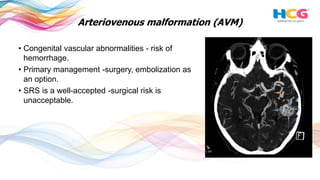
Arteriovenous malformation (AVM)
• Congenital vascular abnormalities - risk of
hemorrhage.
• Primary management -surgery, embolization as
an option.
• SRS is a well-accepted -surgical risk is
unacceptable.
University of California, San Francisco (UCSF) evaluated dose effects on obliteration rates of 80
pediatric patients treated with SRS for AVM –
• 3-year overall obliteration rate - 56% for dose prescription of 18-20 Gy,16% - dose < 18Gy.
• 5 years following SRS, cumulative incidence of hemorrhage - 25%
• To maximixe AVM obliteration and minimize post-treatment hemorrhage, the authors recommended a
prescription marginal dose of ≥ 18 Gy.
KEYPOINTS-AVM
• Surgical resection -standard management for AVM.
• SRS- high rates of obliteration
low rates of post-treatment hemorrhage & neurologic complications
• Radiosurgery should be reserved for nonsurgical cases or lesions in critical
brain regions.
Vestibular schwannoma
• Benign, slow growing tumors
• In association with neurofibromatosis
type 2.
• Treatment options- microsurgical
resection /stereotactic radiosurgery
• Hearing preservation is important.
• Equivalence in local control ,superior
functional outcomes and quality of life
after treatment with SRS
A total of 55 full-text articles were included in the analysis. All studies were retrospective,
except for 2 prospective quality of life studies
The single fraction RS series (linac or Gamma Knife) with tumour marginal doses between 12 and 14 Gy
revealed 5-year tumour control rates of 90-99%, hearing preservation rates of 41-79%, facial nerve
preservation rates of 95-100% and trigeminal preservation rates of 79-99%.
Craniopharyngioma
• Benign tumors that arise in rathke’s pouch.
• Management -surgical resection with adjuvant fractionated radiation therapy used for residual disease.
107 patients with craniopharyngioma treated with SRS to a dose of 11.5 Gy included 38 children.
Progression-free survival (PFS) at 5 and 10 years was 60.8% and 53.8%, respectively,
Ependymoma
• Ependymomas -small proportion pediatric brain tumors
• The standard management - maximally safe resection followed by
postoperative fractionated radiation therapy.
• Local failures -2/3 of recurrences -typically occur within the treatment field .
• SRS -residual tumor and recurrent disease.
Medulloblastoma
• Radiosurgery - effective and safe treatment option
• SRS- Boost after conventional fractionation
• Boston SRS series –
21 children with medulloblastoma & PNET,
six children being treated upfront with SRS (median dose 12.5 Gy) .
Median PFS -11 months & 3 year local control was 57 %.
o University of Heidelberg –
20 patients with 29 lesions -6 patients < 14 years
All recurrent disease
SRS with a median dose of 15 Gy.
There were no local failures or symptomatic radiation necrosis
•
Stereotactic radiosurgery or hypofractionated stereotactic radiotherapy is an effective treatment method of
the local recurrence after CSI and can be performed safely in heavily pre-treated patients
Gliomas
• Low Grade-
1. slow growing ,managed surgical resection alone, especially in the pediatric
population.
2. Radiosurgery - incomplete resection or recurrent disease.
• High-grade -
1. WHO grade III and IV tumors.
2. very aggressive with poor clinical outcomes.
3. Standard therapy includes resection and adjuvant radiation & chemotherapy.
4. SRS - recurrence.
Gammaknife Radiosurgery
Cyberknife radiosurgery
KEYPOINTS
• Radiation-induced toxicities - cognitive decline -particular concern.
• Steep dose gradient and high conformality makes radiosurgery a better option
• Valuable treatment option for children with recurrent disease.
• Challenges in establishing guidelines for pediatric -limited sample size of
treated patients compared with the adult population
• Multidisciplinary research approach i-neurosurgeons, radiation oncologists,
pediatric oncologists, anesthesiologists is paramount in optimizing the
management of children treated with radiosurgery

Paediatric radiosurgery.pptx

  • 1.
  • 2.
    Introduction • Brain tumors-20%of childhood malignancies • Radiation therapy -important treatment modality -multi-disciplinary management Goals of radiosurgery – 1. high doses of radiation 2. discrete target -steep dose falloff from the target 3. minimizing radiation to surrounding tissue.
  • 3.
    • Radiosurgery- 1. Gammaknifebased 2. Cyberknife based 3. LINAC based
  • 4.
    Unique Aspects ofRadiosurgery in Children <24 months old: lack of skull thickness- complicates - fixation of a stereotactic localization frame to the skull child’s thin skull is that it is deformable anesthetic concerns difference in normal tissue tolerance between children and adults Gammaknife based radiosurgery
  • 6.
    • Benign CNSdiseases – 1. Arteriovenous malformation (AVM) 2. Vestibular schwannoma 3. Craniopharyngioma 4. Meningiomas • Malignant primary CNS diseases – a) Brain metastasis b) Ependymoma c) Low-grade gliomas d) High-grade gliomas e) Medulloblastoma f) Primitive neuroectodermal tumors (PNET)
  • 7.
    Arteriovenous malformation (AVM) •Congenital vascular abnormalities - risk of hemorrhage. • Primary management -surgery, embolization as an option. • SRS is a well-accepted -surgical risk is unacceptable.
  • 8.
    University of California,San Francisco (UCSF) evaluated dose effects on obliteration rates of 80 pediatric patients treated with SRS for AVM – • 3-year overall obliteration rate - 56% for dose prescription of 18-20 Gy,16% - dose < 18Gy. • 5 years following SRS, cumulative incidence of hemorrhage - 25% • To maximixe AVM obliteration and minimize post-treatment hemorrhage, the authors recommended a prescription marginal dose of ≥ 18 Gy.
  • 10.
    KEYPOINTS-AVM • Surgical resection-standard management for AVM. • SRS- high rates of obliteration low rates of post-treatment hemorrhage & neurologic complications • Radiosurgery should be reserved for nonsurgical cases or lesions in critical brain regions.
  • 11.
    Vestibular schwannoma • Benign,slow growing tumors • In association with neurofibromatosis type 2. • Treatment options- microsurgical resection /stereotactic radiosurgery • Hearing preservation is important. • Equivalence in local control ,superior functional outcomes and quality of life after treatment with SRS
  • 12.
    A total of55 full-text articles were included in the analysis. All studies were retrospective, except for 2 prospective quality of life studies The single fraction RS series (linac or Gamma Knife) with tumour marginal doses between 12 and 14 Gy revealed 5-year tumour control rates of 90-99%, hearing preservation rates of 41-79%, facial nerve preservation rates of 95-100% and trigeminal preservation rates of 79-99%.
  • 13.
    Craniopharyngioma • Benign tumorsthat arise in rathke’s pouch. • Management -surgical resection with adjuvant fractionated radiation therapy used for residual disease.
  • 14.
    107 patients withcraniopharyngioma treated with SRS to a dose of 11.5 Gy included 38 children. Progression-free survival (PFS) at 5 and 10 years was 60.8% and 53.8%, respectively,
  • 15.
    Ependymoma • Ependymomas -smallproportion pediatric brain tumors • The standard management - maximally safe resection followed by postoperative fractionated radiation therapy. • Local failures -2/3 of recurrences -typically occur within the treatment field . • SRS -residual tumor and recurrent disease.
  • 17.
    Medulloblastoma • Radiosurgery -effective and safe treatment option • SRS- Boost after conventional fractionation • Boston SRS series – 21 children with medulloblastoma & PNET, six children being treated upfront with SRS (median dose 12.5 Gy) . Median PFS -11 months & 3 year local control was 57 %. o University of Heidelberg – 20 patients with 29 lesions -6 patients < 14 years All recurrent disease SRS with a median dose of 15 Gy. There were no local failures or symptomatic radiation necrosis •
  • 18.
    Stereotactic radiosurgery orhypofractionated stereotactic radiotherapy is an effective treatment method of the local recurrence after CSI and can be performed safely in heavily pre-treated patients
  • 19.
    Gliomas • Low Grade- 1.slow growing ,managed surgical resection alone, especially in the pediatric population. 2. Radiosurgery - incomplete resection or recurrent disease. • High-grade - 1. WHO grade III and IV tumors. 2. very aggressive with poor clinical outcomes. 3. Standard therapy includes resection and adjuvant radiation & chemotherapy. 4. SRS - recurrence.
  • 21.
  • 22.
  • 23.
    KEYPOINTS • Radiation-induced toxicities- cognitive decline -particular concern. • Steep dose gradient and high conformality makes radiosurgery a better option • Valuable treatment option for children with recurrent disease. • Challenges in establishing guidelines for pediatric -limited sample size of treated patients compared with the adult population • Multidisciplinary research approach i-neurosurgeons, radiation oncologists, pediatric oncologists, anesthesiologists is paramount in optimizing the management of children treated with radiosurgery