NCCN Guidelines for Patients®
Version 3.2020 , 09/11/20 © 2020 National Comprehensive Cancer Network®
(NCCN®
), All rights reserved. NCCN Guidelines®
and this illustration may not be reproduced in any form without the express written permission of NCCN.
NCCN Clinical Practice Guidelines in Oncology (NCCN Guidelines®
)
Central Nervous System
Cancers
Version 3.2020 — September 11, 2020
Continue
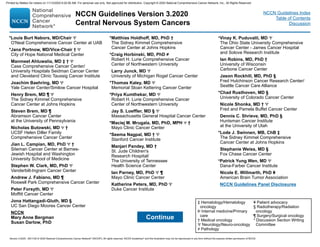
*Louis Burt Nabors, MD/Chair Y
O'Neal Comprehensive Cancer Center at UAB
*Jana Portnow, MD/Vice-Chair † Y
City of Hope National Medical Center
Manmeet Ahluwalia, MD ‡ † Y
Case Comprehensive Cancer Center/
University Hospitals Seidman Cancer Center
and Cleveland Clinic Taussig Cancer Institute
Joachim Baehring, MD Y
Yale Cancer Center/Smilow Cancer Hospital
Henry Brem, MD ¶ Y
The Sidney Kimmel Comprehensive
Cancer Center at Johns Hopkins
Steven Brem, MD ¶
Abramson Cancer Center
at the University of Pennsylvania
Nicholas Butowski, MD Y †
UCSF Helen Diller Family
Comprehensive Cancer Center
Jian L. Campian, MD, PhD Y †
Siteman Cancer Center at Barnes-
Jewish Hospital and Washington
University School of Medicine
Stephen W. Clark, MD, PhD Y
Vanderbilt-Ingram Cancer Center
Andrew J. Fabiano, MD ¶
Roswell Park Comprehensive Cancer Center
Peter Forsyth, MD Y
Moffitt Cancer Center
Jona Hattangadi-Gluth, MD §
UC San Diego Moores Cancer Center
NCCN
Mary Anne Bergman
Susan Darlow, PhD
*Matthias Holdhoff, MD, PhD †
The Sidney Kimmel Comprehensive
Cancer Center at Johns Hopkins
*Craig Horbinski, MD, PhD ≠
Robert H. Lurie Comprehensive Cancer
Center of Northwestern University
Larry Junck, MD Y
University of Michigan Rogel Cancer Center
*Thomas Kaley, MD Y
Memorial Sloan Kettering Cancer Center
*Priya Kumthekar, MD Y
Robert H. Lurie Comprehensive Cancer
Center of Northwestern University
Jay S. Loeffler, MD § Y
Massachusetts General Hospital Cancer Center
*Maciej M. Mrugala, MD, PhD, MPH Y †
Mayo Clinic Cancer Center
*Seema Nagpal, MD † Y
Stanford Cancer Institute
Manjari Pandey, MD †
St. Jude Children's
Research Hospital/
The University of Tennessee
Health Science Center
Ian Parney, MD, PhD Y ¶
Mayo Clinic Cancer Center
Katherine Peters, MD, PhD Y
Duke Cancer Institute
*Vinay K. Puduvalli, MD Y
The Ohio State University Comprehensive
Cancer Center - James Cancer Hospital
and Solove Research Institute
Ian Robins, MD, PhD †
University of Wisconsin
Carbone Cancer Center
Jason Rockhill, MD, PhD §
Fred Hutchinson Cancer Research Center/
Seattle Cancer Care Alliance
*Chad Rusthoven, MD §
University of Colorado Cancer Center
Nicole Shonka, MD † Y
Fred and Pamela Buffet Cancer Center
Dennis C. Shrieve, MD, PhD §
Huntsman Cancer Institute
at the University of Utah
*Lode J. Swinnen, MB, ChB ‡
The Sidney Kimmel Comprehensive
Cancer Center at Johns Hopkins
Stephanie Weiss, MD §
Fox Chase Cancer Center
*Patrick Yung Wen, MD Y
Dana-Farber Cancer Institute
Nicole E. Willmarth, PhD ¥
American Brain Tumor Association
Continue
NCCN Guidelines Panel Disclosures
‡ Hematology/Hematology
oncology
Þ Internal medicine/Primary
care
† Medical oncology
Y Neurology/Neuro-oncology
≠ Pathology
¥ Patient advocacy
§ Radiotherapy/Radiation
oncology
¶ Surgery/Surgical oncology
* Discussion Section Writing
Committee
NCCN Guidelines Version 3.2020
Central Nervous System Cancers
Version 3.2020 , 09/11/20 © 2020 National Comprehensive Cancer Network®
(NCCN®
), All rights reserved. NCCN Guidelines®
and this illustration may not be reproduced in any form without the express written permission of NCCN.
NCCN Guidelines Index
Table of Contents
Discussion
Printed by Matteo De notaris on 11/13/2020 6:02:56 AM. For personal use only. Not approved for distribution. Copyright © 2020 National Comprehensive Cancer Network, Inc., All Rights Reserved.
NCCN Central Nervous System Cancers Panel Members
Summary of the Guidelines Updates
Adult Low-Grade (WHO Grade I or II) Glioma/Pilocytic and Infiltrative Supratentorial
Astrocytoma/Oligodendroglioma (ASTR-1)
Anaplastic Gliomas/Glioblastoma (GLIO-1)
Adult Intracranial and Spinal Ependymoma (Excluding Subependymoma) (EPEN-1)
Adult Medulloblastoma (AMED-1)
Primary CNS Lymphoma (PCNS-1)
Primary Spinal Cord Tumors (PSCT-1)
Meningiomas (MENI-1)
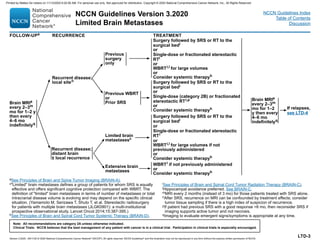
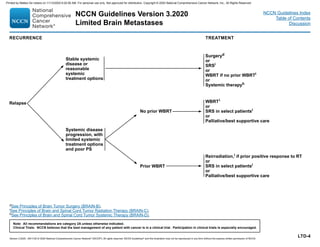
Limited Brain Metastases (LTD-1)
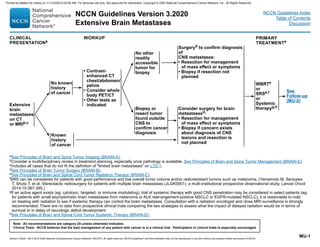
Extensive Brain Metastases (MU-1)
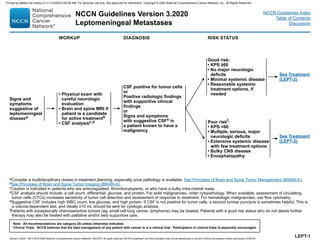
Leptomeningeal Metastases (LEPT-1)
Metastatic Spine Tumors (SPINE-1)
Principles of:
• Brain and Spine Tumor Imaging (BRAIN-A)
• Brain Tumor Surgery (BRAIN-B)
• Radiation Therapy for Brain and Spinal Cord (BRAIN-C)
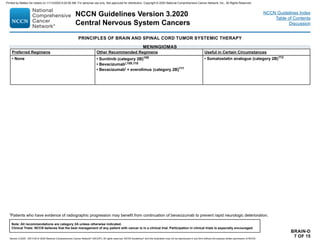
• Brain and Spinal Cord Tumor Systemic Therapy (BRAIN-D)
• Brain and Spine Tumor Management (BRAIN-E)
• Brain Tumor Pathology (BRAIN-F)
Clinical Trials: NCCN believes that
the best management for any patient
with cancer is in a clinical trial.
Participation in clinical trials is
especially encouraged.
To find clinical trials online at NCCN
Member Institutions, click here:
nccn.org/clinical_trials/member_
institutions.aspx.
NCCN Categories of Evidence and
Consensus: All recommendations
are category 2A unless otherwise
indicated.
See NCCN Categories of Evidence
and Consensus.
NCCN Categories of Preference:
All recommendations are considered
appropriate.
See NCCN Categories of Preference.
The NCCN Guidelines®
are a statement of evidence and consensus of the authors regarding their views of currently accepted approaches to
treatment. Any clinician seeking to apply or consult the NCCN Guidelines is expected to use independent medical judgment in the context of individual
clinical circumstances to determine any patient’s care or treatment. The National Comprehensive Cancer Network®
(NCCN®
) makes no representations
or warranties of any kind regarding their content, use or application and disclaims any responsibility for their application or use in any way. The NCCN
Guidelines are copyrighted by National Comprehensive Cancer Network®
. All rights reserved. The NCCN Guidelines and the illustrations herein may
not be reproduced in any form without the express written permission of NCCN. ©2020.
NCCN Guidelines Version 3.2020
Central Nervous System Cancers
Version 3.2020 , 09/11/20 © 2020 National Comprehensive Cancer Network®
(NCCN®
), All rights reserved. NCCN Guidelines®
and this illustration may not be reproduced in any form without the express written permission of NCCN.
NCCN Guidelines Index
Table of Contents
Discussion
Printed by Matteo De notaris on 11/13/2020 6:02:56 AM. For personal use only. Not approved for distribution. Copyright © 2020 National Comprehensive Cancer Network, Inc., All Rights Reserved.
UPDATES
Continued
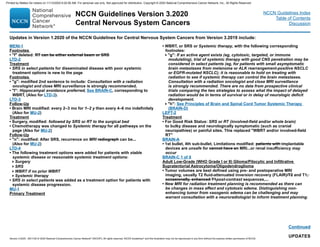
Updates in Version 2.2020 of the NCCN Guidelines for Central Nervous System Cancers from Version 1.2020 include:
BRAIN-D (8 of 15)
• Tucatinib + trastuzumab + capecitabine was added as a category 2A recommendation for HER2-positive breast cancer patients previously
treated with 1 or more anti-HER2-based regimens.
The following reference was included: Murthy RK, Loi S, Okines A, et al. Tucatinib, trastuzumab, and capecitabine for HER2-positive
metastatic breast cancer. N Engl J Med. 2020;382:597-609.
Updates in Version 3.2020 of the NCCN Guidelines for Central Nervous System Cancers from Version 2.2020 include:
MS-1
• The Discussion section was updated to reflect the changes in the algorithm.
Updates in Version 1.2020 of the NCCN Guidelines for Central Nervous System Cancers from Version 3.2019 include:
ASTR-1
Adjuvant Treatment
• Consider BRAF and MEK inhibitors if BRAF V600E activating mutation, is new to the page for pilocytic astrocytoma, PXA, ganglioglioma.
Follow-Up
• Modified, Brain MRI every 3–6 mo for 3–5 y then at least annually every 6-12 mo or as clinically indicated.
Footnotes
• c: Modified to include, and BRAF V600E mutation.
ASTR-2
• Algorithm has been streamlined.
RT + adjuvant temozolomide for patients with high-risk disease is now a category 2A option.
ASTR-3
Treatment
• Modified for prior fractionated EBRT, Consider reirradiation with highly focused RT...especially if progression-free survival is greater than 2 y after prior
RT or
GLIO-1
Footnotes
• e: Biopsy first prior to administration of steroids if MRI compatible with CNS lymphoma.
GLIO-2
Adjuvant Treatment
• Fractionated external beam RT replaced with Standard RT throughout the page. (Also for EPEN-2, EPEN-3, EPEN-4)
Follow-Up
• Brain MRI 2–8 wks (6 weeks). (Also for GLIO-3 and GLIO-4)
• corresponding to Standard brain RT + concurrent and adjuvant lomustine and temozoliomide (category 2B)
NCCN Guidelines Version 3.2020
Central Nervous System Cancers
Version 3.2020 , 09/11/20 © 2020 National Comprehensive Cancer Network®
(NCCN®
), All rights reserved. NCCN Guidelines®
and this illustration may not be reproduced in any form without the express written permission of NCCN.
NCCN Guidelines Index
Table of Contents
Discussion
Printed by Matteo De notaris on 11/13/2020 6:02:56 AM. For personal use only. Not approved for distribution. Copyright © 2020 National Comprehensive Cancer Network, Inc., All Rights Reserved.
UPDATES
Updates in Version 1.2020 of the NCCN Guidelines for Central Nervous System Cancers from Version 3.2019 include:
Continued
GLIO-3
Adjuvant Treatment
• Standard brain RT + concurrent and adjuvant lomustine and temozoliomide (category 2B) for patients with good performance status and methylated
tumors is new to the page.
Footnotes
• r: Combination of agents modalities may lead to increased toxicity or radiographic changes. (Also for GLIO-4).
• t:Moderate to significant myelosuppression was observed, but the toxicity profile for this regimen is not yet fully defined, is new to the page
corresponding to Standard brain RT + concurrent and adjuvant lomustine and temozoliomide (category 2B)
GLIO-4
Footnotes
• w:See NCCN Guidelines for Older Adult Oncology, corresponding to Age 70 y Glioblastoma.
EPEN-2
Pathology
Ependymoma (Grades 1 and II). (Also for EPEN-3).
Footnotes
• h:Lumbar puncture is indicated when there is clinical concern for meningeal dissemination. Lumbar puncture should be done after MRI of spine is
performed to avoid a false-positive imaging result. Lumbar puncture for CSF should be delayed at least 2 weeks after surgery to avoid possible false-
positive cytology. Lumbar puncture may be contraindicated (eg, posterior fossa mass). (Also for EPEN-3, EPEN-4).
• k:Consider proton therapy if available to reduce toxicity, is a new to the page and corresponds to Craniospinal RT. (Also for EPEN-3, EPEN-4, AMED-2)
EPEN-3
Postoperative Staging
• Grade I, top pathway: Gross total En bloc resection
EPEN-4
• Resectable, evidence of metastasis, Gross total or removed
AMED-3
Follow-Up
Brain MRI: every 3 mo for 2 y; then every 6–12 mo for 5–10 y;
then every 1–2 y or as clinically indicated. For patients with previous spine disease, concurrent spine imaging as clinically indicated
PCNS-1
Footnotes
f: Modified: Brain biopsy is recommended as the primary procedure to obtain diagnosis. CSF analysis should include flow cytometry, CSF cytology, cell
count, and possibly gene rearrangements.
PCNS-2
Evaluation
• Lactate dehydrogenase (LDH) test, is new to the page.
Induction Therapy
• Modified: High-dose methotrexate-based regimen or other systemic therapy regimen if patient is unsuitable for or intolerant to high-dose methotrexate
Changed vitreous to vitreoretinal for eye exam.
PCNS-2A
Footnotes
• m: Dose adjusted for GFR if dosing at 8 g/m2
.
PSCT-4
Treatment for Recurrence
• Chemotherapy relative to cell type if further surgery or RT not possible
NCCN Guidelines Version 3.2020
Central Nervous System Cancers
Version 3.2020 , 09/11/20 © 2020 National Comprehensive Cancer Network®
(NCCN®
), All rights reserved. NCCN Guidelines®
and this illustration may not be reproduced in any form without the express written permission of NCCN.
NCCN Guidelines Index
Table of Contents
Discussion
Printed by Matteo De notaris on 11/13/2020 6:02:56 AM. For personal use only. Not approved for distribution. Copyright © 2020 National Comprehensive Cancer Network, Inc., All Rights Reserved.
Updates in Version 1.2020 of the NCCN Guidelines for Central Nervous System Cancers from Version 3.2019 include:
UPDATES
Continued
MENI-1
Footnotes
• f deleted: RT can be either external beam or SRS
LTD-2
Treatment
• SRS in select patients for disseminated disease with poor systemic
treatment options is new to the page
Footnotes
• g: modified 2nd sentence to include: Consultation with a radiation
oncologist and close MRI surveillance is strongly recommended.
• l: Hippocampal avoidance preferred, See BRAIN-C, corresponding to
WBRT, (Also for LTD-3).
LTD-3
Follow-Up
• Brain MRI modified: every 2–3 mo for 1–2 y then every 4–6 mo indefinitely
(Also for MU-2)
Treatment
• Surgery, modified: followed by SRS or RT to the surgical bed
• Chemotherapy was changed to Systemic therapy for all pathways on the
page (Also for MU-2)
Follow-Up
• n: modified: After SRS, recurrence on MRI radiograph can be...
(Also for MU-2)
LTD-4
• The following treatment options were added for patients with stable
systemic disease or reasonable systemic treatment options:
Surgery
SRS
WBRT if no prior WBRT
Systemic therapy
• SRS in select patients was added as a treatment option for patients with
systemic disease progression.
MU-1
Primary Treatment
• WBRT, or SRS or Systemic therapy, with the following corresponding
footnotes:
g: If an active agent exists (eg, cytotoxic, targeted, or immune
modulating), trial of systemic therapy with good CNS penetration may be
considered in select patients (eg, for patients with small asymptomatic
brain metastases from melanoma or ALK rearrangement-positive NSCLC
or EGFR-mutated NSCLC); it is reasonable to hold on treating with
radiation to see if systemic therapy can control the brain metastases.
Consultation with a radiation oncologist and close MRI surveillance
is strongly recommended. There are no data from prospective clinical
trials comparing the two strategies to assess what the impact of delayed
radiation would be in terms of survival or in delay of neurologic deficit
development.
h: See Principles of Brain and Spinal Cord Tumor Systemic Therapy
(BRAIN-D)
LEPT-2
Treatment
• For Good Risk Status: SRS or RT (involved-field and/or whole brain)
to bulky disease and neurologically symptomatic (such as cranial
neuropathies) or painful sites. This replaced WBRT and/or involved-field
RT
BRAIN-A
• 1st bullet, 4th sub-bullet, Limitations modified: patients with implantable
devices are unsafe for cannot have an MRI...or renal insufficiency may
occur
BRAIN-C 1 of 8
Adult Low-Grade (WHO Grade I or II) Glioma/Pilocytic and Infiltrative
Supratentorial Astrocytoma/Oligodendroglioma
• Tumor volumes are best defined using pre- and postoperative MRI
imaging, usually T2 fluid-attenuated inversion recovery (FLAIR)/T2 and T1,
occasionally, enhanced T1post-contrast sequences,...
• New MRI for radiation treatment planning is recommended as there can
be changes in mass effect and cytotoxic edema. Distinguishing non-
enhancing tumor from vasogenic edema can be challenging and may
warrant consultation with a neuroradiologist to inform treatment planning.
NCCN Guidelines Version 3.2020
Central Nervous System Cancers
Version 3.2020 , 09/11/20 © 2020 National Comprehensive Cancer Network®
(NCCN®
), All rights reserved. NCCN Guidelines®
and this illustration may not be reproduced in any form without the express written permission of NCCN.
NCCN Guidelines Index
Table of Contents
Discussion
Printed by Matteo De notaris on 11/13/2020 6:02:56 AM. For personal use only. Not approved for distribution. Copyright © 2020 National Comprehensive Cancer Network, Inc., All Rights Reserved.
UPDATES
Continued
BRAIN-C 1 of 8 (continued)
Anaplastic Gliomas/Glioblastoma High-Grade (Grades III/IV)
• Tumor volumes are best defined using pre- and postoperative MRI
imaging using enhanced post-contrast T1 with/without and FLAIR/T2
sequences to define GTV. To account for sub-diagnostic tumor infiltration,
the GTV is expanded 1–2 cm (CTV) for grade III up to 2-2.5 cm (CTV) for
grade...
• Consider proton therapy for patients with good long-term prognosis
(grade III IDH-mutant tumors [Buckner 2016] and grade III 1p19q co-
deleted tumors [Shih 2015]) to better spare un-involved brain and
preserve cognitive function, is new to the page.
RT Dosing Information
• 4th bullet, second sentence modified: Typical fractionation schedules are
34 Gy/10 fx, 40.05 Gy/15 fx, or 50 Gy/20 fx.
BRAIN-C 4 of 8
• WHO Grade 1 Meningiomas
2nd, sub,sub-bullet modifed (25–30 Gy in 5 fractions)
BRAIN-C 6 of 8
• 1st sub-bullet under RT dosing modified: ..spinal cord and/or nerve root
• 4th sub-bullet modified: When lower BED regimens are utilized upfront
(ie, BED ≤60 Gy2
, which includes up to 20 Gy in 5 fractions but does not
include 30 Gy in 10 fractions), retreatment with similar BED regimens,
such as 20 Gy in 5 fractions or 8 Gy in 1 fraction, can safely be considered
as early as 4 weeks to 6 weeks from initial treatment for pain relief.
• 5th sub-bullet modified: In other cases of retreatment, doses ranging from
15 Gy in 1 fraction with SBRT to 40 Gy in 20 fractions with a conformal
approach have been utilized for tumor control, with careful consideration
of tolerance of the spinal cord and/or nerve roots. In these instances,
it is generally recommended that 6 months or more of time between
treatments is required.
BRAIN-D (1 of 15)
Adjuvant Treatment
Useful in Certain Circumstances; modified as follows:
• Pilocytic astrocytoma, PXA, ganglioglioma if BRAF V600E activiting
mutation
BRAF/MEK inhibitors:
◊◊ dabrafenib/trametinib
◊◊ vemurafenib/cobimetinib
BRAIN-D (2 of 15)
Anaplastic Gliomas
• Carboplatin category 2B removed under Other Recommended Regimens
for Recurrence Therapy (Also for BRAIN-D 3 of 15)
Footnotes
j: modified: Bevacizumab + chemotherapy can be considered if
bevacizumab monotherapy fails and it is desirable to continue the steroid
sparing effects of bevacizumab (Also for BRAIN-D 3 of 15).
BRAIN-D (3 of 15)
Adjuvant Treatment for Glioblastoma
Preferred Regimens; modified as follows:
• RT with concurrent and adjuvant TMZ ± TTF
Useful in Certain Circumstances; the following is new to the page:
• RT with concurrent and adjuvant lomustine and TMZ (for patients with
MGMT promoter methylated tumors, KPS ≥60, and age ≤70 years)
(category 2B), with the following corresponding footnote: Moderate to
significant myelosuppression was observed, but the toxicity profile for
this regimen is not yet fully defined.
Recurrence Therapy for Glioblastoma
Preferred Regimens:
Regorafenib is new to the page
BRAIN-D (5 of 15)
Induction Therapy for Primary CNS Lymphoma
Useful in Certain Circumstances
• Patient is unsuitable for or intolerant to high-dose methotrexate
See Other Recommended Regimens for Relapsed or Refractory
Disease
Relapsed or Refractory Disease
Other Recommended Regimens; modified as follows:
• Retreat with high-dose methotrexate
with or without rituximab and ibrutinib
• Topotecan
• Dexamethasone, high-dose cytarabine, cisplatin
BRAIN-D (7 of 15)
Other Recommended Regimens for Meningioma; modified as follows:
• Interferon alfa (category 2B)
• Somatostatin analogue, if octreotide scan positive
Useful in Certain Circumstances; modified as follows:
• Somatostatin analogue (category 2B) if octreotide scan positive
Updates in Version 1.2020 of the NCCN Guidelines for Central Nervous System Cancers from Version 3.2019 include:
NCCN Guidelines Version 3.2020
Central Nervous System Cancers
Version 3.2020 , 09/11/20 © 2020 National Comprehensive Cancer Network®
(NCCN®
), All rights reserved. NCCN Guidelines®
and this illustration may not be reproduced in any form without the express written permission of NCCN.
NCCN Guidelines Index
Table of Contents
Discussion
Printed by Matteo De notaris on 11/13/2020 6:02:56 AM. For personal use only. Not approved for distribution. Copyright © 2020 National Comprehensive Cancer Network, Inc., All Rights Reserved.
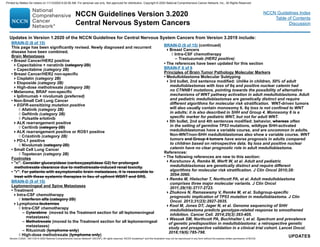
Updates in Version 1.2020 of the NCCN Guidelines for Central Nervous System Cancers from Version 3.2019 include:
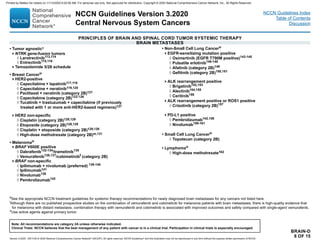
BRAIN-D (8 of 15)
This page has been significantly revised. Newly diagnosed and recurrent
disease have been combined.
Brain Metastases
• Breast Cancer/HER2 positive
Capecitabine + neratinib (category 2B)
Capecitabine (category 2B)
• Breast Cancer/HER2 non-specific
Cisplatin (category 2B)
Etoposide (category 2B)
High-dose methotrexate (category 2B)
• Melanoma, BRAF non-specific
lpilimumab + nivolumab (preferred)
• Non-Small Cell Lung Cancer
EGFR-sensitizing mutation positive
◊◊ Afatinib (category 2B)
◊◊ Gefitinib (category 2B)
◊◊ Pulsatile erlotinib
ALK rearrangement positive
◊◊ Ceritinib (category 2B)
ALK rearrangement positive or ROS1 positive
◊◊ Crizotinib (category 2B)
PD-L1 positive
◊◊ Nivolumab (category 2B)
• Small Cell Lung Cancer
◊◊ Topotecan (category 2B)
Footnotes
• n: Consider glucarpidase (carboxypeptidase G2) for prolonged
methotrexate clearance due to methotrexate-induced renal toxicity.
• r: For patients with asymptomatic brain metastases, it is reasonable to
treat with these systemic therapies in lieu of upfront WBRT and SRS.
BRAIN-D (9 of 15)
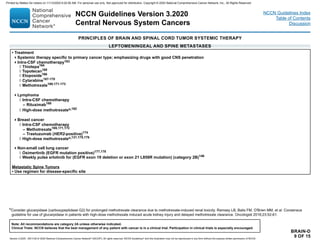
Leptomeningeal and Spine Metastases
• Treatment
Intra-CSF chemotherapy
◊◊ Interferon alfa (category 2B)
Lymphoma-leukemias
◊◊ Intra-CSF chemotherapy
–– Cytarabine (moved to the Treatment section for all leptomeningeal
metastases)
–– Methotrexate (moved to the Treatment section for all leptomeningeal
metastases)
–– Rituximab (lymphoma only)
◊◊ High-dose methotrexate (lymphoma only)
BRAIN-D (9 of 15) (continued)
Breast Cancers
◊◊ Intra-CSF chemotherapy
–– Trastuzumab (HER2 positive)
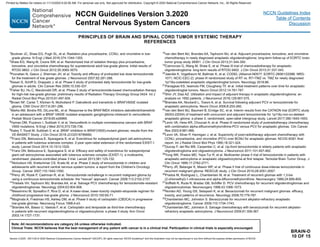
• The references have been updated for this section
BRAIN-F 6 of 8
Principles of Brain Tumor Pathology Molecular Markers
• Medulloblastoma Molecular Subtyping
3rd bullet, 2nd sentence modified: Unlike in children, 50% of adult
medulloblastomas with loss of 6q and positive nuclear catenin had
no CTNNB1 mutations, pointing towards the possibility of alternative
mechanisms of WNT pathway activation in adult medulloblastoma. Adult
and pediatric medulloblastomas are genetically distinct and require
different algorithms for molecular risk stratification. WNT-driven tumors
will also usually contain monosomy 6. 6q loss is not confined to WNT
in adults; it is also described in SHH and Group 4. Monosomy 6 is a
specific marker for pediatric WNT, but not for adult WNT.
5th bullet, 2nd and 4th sentences modified: behavior, whereas often
in the setting of germline TP53 mutations, wildtype SHH-activated
medulloblastomas have a variable course, and are uncommon in adults.
Non-WNT/non-SHH medulloblastomas also show a variable course. WNT
tumors and Group 4 tumors have worse prognosis in adults compared
to children based on retrospective data. 6q loss and positive nuclear
catenin have no clear prognostic role in adult medulloblastoma.
References:
• The following references are new to this section:
Korshunov A, Remke M, Werft W, et al. Adult and pediatric
medulloblastomas are genetically distinct and require different
algorithms for molecular risk stratification. J Clin Oncol 2010;28:
3054-3060.
Remke M, Hielscher T, Northcott PA, et al. Adult medulloblastoma
comprises three major molecular variants. J Clin Oncol
2011;29(19):2717-2723.
Zhukova N, Ramaswamy V, Remke M, et al. Subgroup-specific
prognostic implication of TP53 mutation in medulloblastoma. J Clin
Oncol. 2013;31(23):2927-2935.
Kool M, Jones DT, Jager N, et al. Genome sequencing of SHH
medulloblastoma predicts genotype-related response to smoothened
inhibition. Cancer Cell. 2014;25(3):393-405.
Waszak SM, Northcott PA, Buchhalter I, et al. Spectrum and prevalence
of genetic predisposition in medulloblastoma: a retrospective genetic
study and prospective validation in a clinical trial cohort. Lancet Oncol.
2018;19(6):785-798.
UPDATES
NCCN Guidelines Version 3.2020
Central Nervous System Cancers
Version 3.2020 , 09/11/20 © 2020 National Comprehensive Cancer Network®
(NCCN®
), All rights reserved. NCCN Guidelines®
and this illustration may not be reproduced in any form without the express written permission of NCCN.
NCCN Guidelines Index
Table of Contents
Discussion
Printed by Matteo De notaris on 11/13/2020 6:02:56 AM. For personal use only. Not approved for distribution. Copyright © 2020 National Comprehensive Cancer Network, Inc., All Rights Reserved.
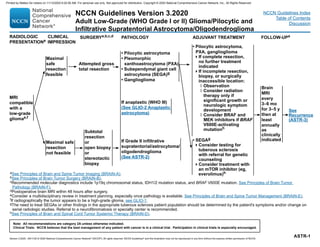
RADIOLOGIC
PRESENTATIONa
CLINICAL
IMPRESSION
SURGERYa,b,c,d
MRI
compatible
with a
low-grade
gliomae,f
Maximal
safe
resection
feasible
Maximal safe
resection
not feasible
Attempted gross
total resection
Subtotal
resection
or
open biopsy
or
stereotactic
biopsy
ADJUVANT TREATMENT FOLLOW-UPaPATHOLOGY
• Pilocytic astrocytoma
• Pleomorphic
xanthoastrocytoma (PXA)
• Subependymal giant cell
astrocytoma (SEGA)g
• Ganglioglioma
• Pilocytic astrocytoma,
PXA, ganglioglioma
If complete resection,
no further treatment
indicated
If incomplete resection,
biopsy, or surgically
inaccessible location:
◊◊ Observation
◊◊ Consider radiation
therapy only if
significant growth or
neurologic symptom
development
◊◊ Consider BRAF and
MEK inhibitors if BRAF
V600E-activating
mutationh
• SEGAg
Consider testing for
tuberous sclerosis
with referral for genetic
counseling
Consider treatment with
an mTOR inhibitor (eg,
everolimus)h
If Grade II infiltrative
supratentorial/astrocytoma/
oligodendroglioma
(See ASTR-2)
aSee Principles of Brain and Spine Tumor Imaging (BRAIN-A).
bSee Principles of Brain Tumor Surgery (BRAIN-B).
cRecommended molecular diagnostics include 1p19q chromosomal status, IDH1/2 mutation status, and BRAF V600E mutation. See Principles of Brain Tumor
Pathology (BRAIN-F).
dPostoperative brain MRI within 48 hours after surgery.
eConsider a multidisciplinary review in treatment planning, especially once pathology is available. See Principles of Brain and Spine Tumor Management (BRAIN-E).
fIf radiographically the tumor appears to be a high-grade glioma, see GLIO-1.
gThe need to treat SEGAs or other findings in the appropriate tuberous sclerosis patient population should be determined by the patient's symptoms and/or change on
serial radiologic studies. Referral to a neurofibromatosis or specialty center is recommended.
hSee Principles of Brain and Spinal Cord Tumor Systemic Therapy (BRAIN-D).
See
Recurrence
(ASTR-3)
Brain
MRI
every
3–6 mo
for 3–5 y
then at
least
annually
as
clinically
indicated
If anaplastic (WHO III)
(See GLIO-2 Anaplastic
astrocytoma)
ASTR-1
Note: All recommendations are category 2A unless otherwise indicated.
Clinical Trials: NCCN believes that the best management of any patient with cancer is in a clinical trial. Participation in clinical trials is especially encouraged.
Version 3.2020 , 09/11/20 © 2020 National Comprehensive Cancer Network®
(NCCN®
), All rights reserved. NCCN Guidelines®
and this illustration may not be reproduced in any form without the express written permission of NCCN.
NCCN Guidelines Version 3.2020
Adult Low-Grade (WHO Grade I or II) Glioma/Pilocytic and
Infiltrative Supratentorial Astrocytoma/Oligodendroglioma
NCCN Guidelines Index
Table of Contents
Discussion
Printed by Matteo De notaris on 11/13/2020 6:02:56 AM. For personal use only. Not approved for distribution. Copyright © 2020 National Comprehensive Cancer Network, Inc., All Rights Reserved.
ASTR-2
PRESENTATIONc,e,f
ADJUVANT TREATMENT FOLLOW-UP
Grade II infiltrative
supratentorial
astrocytoma/
oligodendroglioma
Consider clinical trial (preferred
for eligible patients)
or
Observek,l
Low riski
High riskj
Brain MRI
every
3–6 mo for
5 y then at
least every
6–12 mo or
as clinically
indicated
See
Recurrence
(ASTR-3)
Consider clinical trial (preferred for eligible
patients)
or
RTm + adjuvant PCV chemotherapyn (category 1)
or
RTm + adjuvant temozolomiden
or
RTm + concurrent and adjuvant temozolomiden
or
Observeo in highly select patients
cRecommended molecular diagnostics include 1p19q chromosomal status, IDH1/2
mutation status, and BRAF V600E mutation. See Principles of Brain Tumor
Pathology (BRAIN-F).
eConsider a multidisciplinary review in treatment planning, especially once
pathology is available. See Principles of Brain and Spine Tumor Management
(BRAIN-E).
fIf radiographically the tumor appears to be a high-grade glioma, see GLIO-1.
iLow-risk features: ≤40 y and gross total resection (GTR).
jHigh-risk features: 40 y or subtotal resection (STR) or open or stereotactic biopsy.
Other high-risk factors that are sometimes taken into consideration are tumor size,
neurologic deficits, and presence of sequencing verified IDH wild type.
kRegular follow-up is essential for patients receiving observation alone after resection.
lIn the event that other risk factors are considered and treatment is warranted, treat
as high risk. There may also be rare circumstances in which treating a patient
with fractionated external beam RT alone (category 2B) or chemotherapy alone
(category 2B) may be considered. See Principles of Brain and Spinal Cord Tumor
Radiation (BRAIN-C) or Principles of Brain and Spinal Cord Tumor Systemic
Therapy (BRAIN-D).
mFor low-grade gliomas, See Principles of Brain and Spinal Cord Tumor Radiation
Therapy (BRAIN-C).
nSee Principles of Brain and Spinal Cord Tumor Systemic Therapy (BRAIN-D).
oThe results of RTOG 9802 showed that there was a significant improvement in
median overall survival in high-risk low-grade glioma patients treated with RT
followed by PCV x 6 cycles compared with RT alone after a tissue diagnosis
was made. However, this important study did not address whether all of these
patients should be treated right away. Observation after diagnosis may be a
reasonable option for a high-risk low-grade glioma patient who is neurologically
asymptomatic or stable. Close monitoring with brain MRIs is important.
Note: All recommendations are category 2A unless otherwise indicated.
Clinical Trials: NCCN believes that the best management of any patient with cancer is in a clinical trial. Participation in clinical trials is especially encouraged.
Version 3.2020 , 09/11/20 © 2020 National Comprehensive Cancer Network®
(NCCN®
), All rights reserved. NCCN Guidelines®
and this illustration may not be reproduced in any form without the express written permission of NCCN.
NCCN Guidelines Version 3.2020
Adult Low-Grade (WHO Grade I or II) Glioma/Pilocytic and
Infiltrative Supratentorial Astrocytoma/Oligodendroglioma
NCCN Guidelines Index
Table of Contents
Discussion
Printed by Matteo De notaris on 11/13/2020 6:02:56 AM. For personal use only. Not approved for distribution. Copyright © 2020 National Comprehensive Cancer Network, Inc., All Rights Reserved.
ASTR-3
aSee Principles of Brain and Spine Tumor Imaging (BRAIN-A).
dPostoperative brain MRI within 48 hours after surgery.
eConsider a multidisciplinary review in treatment planning, especially once
pathology is available. See Principles of Brain and Spine Tumor Management
(BRAIN-E).
fIf radiographically the tumor appears to be a high-grade glioma, see GLIO-1.
mFor low-grade gliomas, See Principles of Brain and Spinal Cord Tumor Radiation
Therapy (BRAIN-C).
nSee Principles of Brain and Spinal Cord Tumor Systemic Therapy (BRAIN-D).
pIf GTR is achieved in a patient with low-risk disease, consider further observation.
qRecurrence on neuroimaging can be confounded by treatment effects. To confirm
tumor recurrence and assess for possible transformation of tumor to higher
grade, strongly consider tumor tissue sampling (biopsy at minimum) if there is
a high index of suspicion of recurrence. Sixty percent or more of astrocytomas
and 40%–50% of oligodendrogliomas will eventually undergo transformation to a
higher grade. For treatment of patients with transformation to high-grade disease,
see GLIO-1.
rBrain MRI every 2–3 months while on treatment, then every 6 months indefinitely,
to assess disease recurrence/progression during treatment with chemotherapy.
(See BRAIN-A).
sRT alone is not encouraged, but may be appropriate for select cases (eg, poor
performance status).
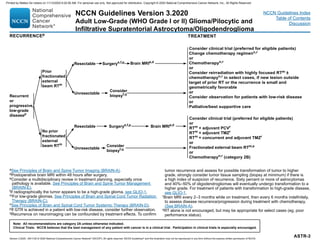
RECURRENCEp
Recurrent
or
progressive,
low-grade
diseasep
Prior
fractionated
external
beam RTm
No prior
fractionated
external
beam RTm
Resectable
Unresectable
Resectable
Unresectable
Surgerye,f,p
Consider clinical trial (preferred for eligible patients)
Change chemotherapy regimenn,r
or
Chemotherapyn,r
or
Consider reirradiation with highly focused RTm ±
chemotherapyn,r in select cases, if new lesion outside
target of prior RT or the recurrence is small and
geometrically favorable
or
Consider observation for patients with low-risk disease
or
Palliative/best supportive care
Consider clinical trial (preferred for eligible patients)
or
RTm + adjuvant PCVr
RTm + adjuvant TMZr
RTm + concurrent and adjuvant TMZr
or
Fractionated external beam RTm,s
or
Chemotherapyn,r (category 2B)
Brain MRIa,d
Brain MRIa,d
Consider
biopsyf,q
Consider
biopsyf,q
Surgerye,f,p
TREATMENT
Note: All recommendations are category 2A unless otherwise indicated.
Clinical Trials: NCCN believes that the best management of any patient with cancer is in a clinical trial. Participation in clinical trials is especially encouraged.
Version 3.2020 , 09/11/20 © 2020 National Comprehensive Cancer Network®
(NCCN®
), All rights reserved. NCCN Guidelines®
and this illustration may not be reproduced in any form without the express written permission of NCCN.
NCCN Guidelines Version 3.2020
Adult Low-Grade (WHO Grade I or II) Glioma/Pilocytic and
Infiltrative Supratentorial Astrocytoma/Oligodendroglioma
NCCN Guidelines Index
Table of Contents
Discussion
Printed by Matteo De notaris on 11/13/2020 6:02:56 AM. For personal use only. Not approved for distribution. Copyright © 2020 National Comprehensive Cancer Network, Inc., All Rights Reserved.
GLIO-1
RADIOLOGIC
PRESENTATIONb
CLINICAL
IMPRESSION
SURGERYc PATHOLOGYd
MRI suggestive
of high-grade
gliomae,f
Multidisciplinary
input for
treatment
planning if
feasible
Maximal safe
resection feasible
with goal for
image-verified
complete
resection
Maximal safe
resection not feasible
Stereotactic biopsy
or
Open biopsy
or
Subtotal resection
(MRI after resection)i
Brain MRIb,i
• Anaplastic
oligodendroglioma
• Anaplastic
oligoastrocytomaj
• Anaplastic
astrocytoma
• Anaplastic gliomas
Glioblastomak
See
Adjuvant
Treatment
(GLIO-2)
See
Adjuvant
Treatment
(GLIO-3)
Maximal safe
resectiong,h
aThis pathway includes the classification of mixed anaplastic oligoastrocytoma (AOA),
anaplastic astrocytoma (AA), anaplastic oligodendroglioma (AO), and other rare
anaplastic gliomas.
bSee Principles of Brain and Spine Tumor Imaging (BRAIN-A).
cSee Principles of Brain Tumor Surgery (BRAIN-B).
dSee Principles of Brain Tumor Pathology (BRAIN-F).
eBiopsy prior to administration of steroids if MRI compatible with CNS lymphoma.
fConsider a multidisciplinary review in treatment planning, especially once pathology
is available. See Principles of Brain and Spine Tumor Management (BRAIN-E).
gIf frozen section diagnosis supports high-grade glioma.
hConsider carmustine (BCNU) wafer implant during maximal safe resection (category
2B). Treatment with carmustine wafer may impact enrollment in adjuvant clinical
trials.
iPostoperative brain MRI within 48 hours after surgery.
jThe 2016 WHO Classification of Tumors of the CNS has deleted
oligoastrocytoma as a category, although “anaplastic oligoastrocytoma, NOS”
may continue to be used for 1) patients with mixed histology and no available
molecular data (ie, no tissue available for analysis) for determining whether
to classify as oligodendroglioma versus astrocytoma; or 2) rare instances in
which the tumor has regions with histologic features of oligoastrocytoma with
1p19q-codeletion, and distinct regions with histologic features of astrocytoma
without 1p19q-codeletion.
kThis pathway also includes gliosarcoma.
Note: All recommendations are category 2A unless otherwise indicated.
Clinical Trials: NCCN believes that the best management of any patient with cancer is in a clinical trial. Participation in clinical trials is especially encouraged.
Version 3.2020 , 09/11/20 © 2020 National Comprehensive Cancer Network®
(NCCN®
), All rights reserved. NCCN Guidelines®
and this illustration may not be reproduced in any form without the express written permission of NCCN.
NCCN Guidelines Version 3.2020
Anaplastic Gliomas
a
/Glioblastoma
NCCN Guidelines Index
Table of Contents
Discussion
Printed by Matteo De notaris on 11/13/2020 6:02:56 AM. For personal use only. Not approved for distribution. Copyright © 2020 National Comprehensive Cancer Network, Inc., All Rights Reserved.
GLIO-2
PATHOLOGYd ADJUVANT TREATMENT FOLLOW-UPb
See
Recurrence
(GLIO-5)
Anaplastic
oligodendroglioma
(1p19q codeleted)
Consider clinical trial (preferred for eligible patients)
or
Standard RTl and neoadjuvant or adjuvantm PCV (category 1)n
or
Standard RTl with concurrent and adjuvant temozolomiden
or
Standard RTl and adjuvant temozolomiden
Brain MRI 2–8 wks
after RT,p then every
2–4 mo for 3 y, then
every 3–6 months
indefinitely
Anaplastic astrocytoma,
Anaplastic
oligoastrocytoma, NOSj
Consider clinical trial (preferred for eligible patients)
or
Standard RT followed by adjuvant temozolomiden
or
Standard RTl with concurrent and adjuvant temozolomiden
or
Standard RTl + neoadjuvant or adjuvantm PCV
Anaplastic gliomasa
Poor performance
status (KPS 60)
RTl(hypofractionated [preferred] or standard)
or
Temozolomide (category 2B)n,o
or
Palliative/best supportive care
ANAPLASTIC GLIOMAS (SEE GLIO-3/GLIO-4 FOR GLIOBLASTOMA)
aThis pathway includes the classification of mixed AOA, AA, AO, and other rare
anaplastic gliomas.
bSee Principles of Brain and Spine Tumor Imaging (BRAIN-A).
dSee Principles of Brain Tumor Pathology (BRAIN-F).
jThe 2016 WHO Classification of Tumors of the CNS has deleted oligoastrocytoma as
a category, although “anaplastic oligoastrocytoma, NOS” may continue to be used
for 1) patients with mixed histology and no available molecular data (ie, no tissue
available for analysis) for determining whether to classify as oligodendroglioma versus
astrocytoma; or 2) rare instances in which the tumor has regions with histologic
features of oligoastrocytoma with 1p19q-codeletion, and distinct regions with
histologic features of astrocytoma without 1p19q-codeletion.
lSee Principles of Brain and Spinal Cord Tumor Radiation Therapy (BRAIN-C).
mThe panel recommends that PCV be administered after RT (as per EORTC 26951)
since the intensive PCV regimen given prior to RT (RTOG 9402) was not tolerated as
well.
nSee Principles of Brain and Spinal Cord Tumor Systemic Therapy (BRAIN-D).
oConsider temozolomide if tumor is MGMT promoter methylated.
pWithin the first 3 months after completion of RT and concomitant temozolomide,
diagnosis of recurrence can be indistinguishable from pseudoprogression on
neuroimaging.
Note: All recommendations are category 2A unless otherwise indicated.
Clinical Trials: NCCN believes that the best management of any patient with cancer is in a clinical trial. Participation in clinical trials is especially encouraged.
Version 3.2020 , 09/11/20 © 2020 National Comprehensive Cancer Network®
(NCCN®
), All rights reserved. NCCN Guidelines®
and this illustration may not be reproduced in any form without the express written permission of NCCN.
NCCN Guidelines Version 3.2020
Anaplastic Gliomas
a
/Glioblastoma
NCCN Guidelines Index
Table of Contents
Discussion
Printed by Matteo De notaris on 11/13/2020 6:02:56 AM. For personal use only. Not approved for distribution. Copyright © 2020 National Comprehensive Cancer Network, Inc., All Rights Reserved.
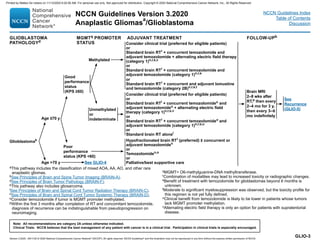
GLIO-3
ADJUVANT TREATMENT FOLLOW-UPb
Glioblastomak
Good
performance
status
(KPS ≥60)
Poor
performance
status (KPS 60)
Consider clinical trial (preferred for eligible patients)
or
Standard brain RTl
+ concurrent temozolomide and
adjuvant temozolomide + alternating electric field therapy
(category 1)n,r,s,v
or
Standard brain RTl
+ concurrent temozolomide and
adjuvant temozolomide (category 1)n,r,s
or
Standard brain RTl
+ concurrent and adjuvant lomustine
and temozolomide (category 2B)n,r,s,t
Brain MRI
2–8 wks after
RT,p
then every
2–4 mo for 3 y,
then every 3–6
mo indefinitely
See
Recurrence
(GLIO-5)
GLIOBLASTOMA
PATHOLOGYd
Age ≤70 y
Age 70 y
Hypofractionated brain RTl
(preferred) ± concurrent or
adjuvant temozolomiden
or
Temozolomiden,o
or
Palliative/best supportive care
aThis pathway includes the classification of mixed AOA, AA, AO, and other rare
anaplastic gliomas.
bSee Principles of Brain and Spine Tumor Imaging (BRAIN-A).
dSee Principles of Brain Tumor Pathology (BRAIN-F).
kThis pathway also includes gliosarcoma.
lSee Principles of Brain and Spinal Cord Tumor Radiation Therapy (BRAIN-C).
nSee Principles of Brain and Spinal Cord Tumor Systemic Therapy (BRAIN-D).
oConsider temozolomide if tumor is MGMT promoter methylated.
pWithin the first 3 months after completion of RT and concomitant temozolomide,
diagnosis of recurrence can be indistinguishable from pseudoprogression on
neuroimaging.
qMGMT= O6-methylguanine-DNA methyltransferase.
rCombination of modalities may lead to increased toxicity or radiographic changes.
sBenefit of treatment with temozolomide for glioblastomas beyond 6 months is
unknown.
tModerate to significant myelosuppression was observed, but the toxicity profile for
this regimen is not yet fully defined.
uClinical benefit from temozolomide is likely to be lower in patients whose tumors
lack MGMT promoter methylation.
vAlternating electric field therapy is only an option for patients with supratentorial
disease.
Methylated
Unmethylated
or
indeterminate
Consider clinical trial (preferred for eligible patients)
or
Standard brain RTl
+ concurrent temozolomideu
and
adjuvant temozolomideu
+ alternating electric field
therapy (category 1)n,r,s,v
or
Standard brain RTl
+ concurrent temozolomideu
and
adjuvant temozolomide (category 1)n,r,s,u
or
Standard brain RT alonel
See GLIO-4
MGMTq PROMOTER
STATUS
Note: All recommendations are category 2A unless otherwise indicated.
Clinical Trials: NCCN believes that the best management of any patient with cancer is in a clinical trial. Participation in clinical trials is especially encouraged.
Version 3.2020 , 09/11/20 © 2020 National Comprehensive Cancer Network®
(NCCN®
), All rights reserved. NCCN Guidelines®
and this illustration may not be reproduced in any form without the express written permission of NCCN.
NCCN Guidelines Version 3.2020
Anaplastic Gliomas
a
/Glioblastoma
NCCN Guidelines Index
Table of Contents
Discussion
Printed by Matteo De notaris on 11/13/2020 6:02:56 AM. For personal use only. Not approved for distribution. Copyright © 2020 National Comprehensive Cancer Network, Inc., All Rights Reserved.
GLIO-4
ADJUVANT TREATMENT FOLLOW-UPb
Brain MRI
2–8 wks after
RT,p
then
every 2–4 mo
for 3 y, then
every 3–6 mo
indefinitely
See
Recurrence
(GLIO-5)
GLIOBLASTOMA
PATHOLOGYd
Age 70 y
Glioblastomak,w
Hypofractionated brain RT alonel
or
Temozolomiden,o
or
Palliative/best supportive care
Good
performance
status
(KPS ≥60)
Poor performance
status (KPS 60)
Methylated
Unmethylated
or
indeterminate
Consider clinical trial (preferred for eligible patients)
or
Hypofractionated brain RTl
+ concurrent and adjuvant temozolomide (category 1)n,r,s
or
Standard RTl
+ concurrent temozolomide and adjuvant temozolomide +
alternating electric field therapy (category 1)n,r,s,v
or
Standard RTl
+ concurrent temozolomide and adjuvant temozolomiden,r,s
or
Temozolomiden
or
Hypofractionated brain RT alonel
Consider clinical trial (preferred for eligible patients)
or
Standard RTl
+ concurrent temozolomideu
and adjuvant temozolomideu
+ alternating electric field therapy (category 1)n,r,s,v
or
Standard RTl
+ concurrent temozolomideu
and adjuvant temozolomiden,r,s,u
or
Hypofractionated brain RTl
+ concurrent and adjuvant temozolomiden,r,s
or
Hypofractionated brain RT alonel
MGMTq
PROMOTER
STATUS
aThis pathway includes the classification of mixed AOA, AA, AO, and other rare
anaplastic gliomas.
bSee Principles of Brain and Spine Tumor Imaging (BRAIN-A).
dSee Principles of Brain Tumor Pathology (BRAIN-F).
kThis pathway also includes gliosarcoma.
lSee Principles of Brain and Spinal Cord Tumor Radiation Therapy (BRAIN-C).
nSee Principles of Brain and Spinal Cord Tumor Systemic Therapy (BRAIN-D).
oConsider temozolomide if tumor is MGMT promoter methylated.
pWithin the first 3 months after completion of RT and concomitant temozolomide, diagnosis of
recurrence can be indistinguishable from pseudoprogression on neuroimaging.
qMGMT= O6-methylguanine-DNA methyltransferase.
rCombination of modalities may lead to increased toxicity or radiographic changes.
sBenefit of treatment with temozolomide for glioblastomas beyond 6 months is unknown.
uClinical benefit from temozolomide is likely to be lower in patients whose tumors lack MGMT promoter
methylation.
vAlternating electric field therapy is only an option for patients with supratentorial disease.
wSee NCCN Guidelines for Older Adult Oncology.
Note: All recommendations are category 2A unless otherwise indicated.
Clinical Trials: NCCN believes that the best management of any patient with cancer is in a clinical trial. Participation in clinical trials is especially encouraged.
Version 3.2020 , 09/11/20 © 2020 National Comprehensive Cancer Network®
(NCCN®
), All rights reserved. NCCN Guidelines®
and this illustration may not be reproduced in any form without the express written permission of NCCN.
NCCN Guidelines Version 3.2020
Anaplastic Gliomas
a
/Glioblastoma
NCCN Guidelines Index
Table of Contents
Discussion
Printed by Matteo De notaris on 11/13/2020 6:02:56 AM. For personal use only. Not approved for distribution. Copyright © 2020 National Comprehensive Cancer Network, Inc., All Rights Reserved.
GLIO-5
RECURRENCE TREATMENTy
Recurrent
diseasep,z
for:
• Anaplastic
oligodendroglioma
• Anaplastic
oligoastrocytoma,
NOSj
• Anaplastic
astrocytoma
• Anaplastic gliomas
• Glioblastoma
Diffuse
or
multiple
Local
Resectable
Unresectable
or resection not
recommended/
elected
Consider clinical trials (preferred for
eligible patients)
or
Systemic chemotherapyn,aa
or
Surgery for symptomatic, large lesion
or
Consider alternating electric field therapy
for glioblastoma (category 2B)
or
Palliative/best supportive care if poor
performance status
Consider clinical trials (preferred for
eligible patients)
or
Systemic chemotherapyn,aa
or
Consider reirradiation (category 2B)l,bb
or
Consider alternating electric field therapy
for glioblastoma (category 2B)
or
Palliative/best supportive care if poor
performance status
Palliative/best
supportive care
See NCCN
Guidelines For
Palliative CareBrain MRIb,i
Consider
clinical trial
or
Resectionx
aThis pathway includes the classification of mixed AOA, AA, AO, and other rare anaplastic
gliomas.
bSee Principles of Brain and Spine Tumor Imaging (BRAIN-A).
iPostoperative brain MRI within 48 hours after surgery.
jThe 2016 WHO Classification of Tumors of the CNS has deleted oligoastrocytoma as
a category, although “anaplastic oligoastrocytoma, NOS” may continue to be used
for 1) patients with mixed histology and no available molecular data (ie, no tissue
available for analysis) for determining whether to classify as oligodendroglioma versus
astrocytoma; or 2) rare instances in which the tumor has regions with histologic features
of oligoastrocytoma with 1p19q-codeletion, and distinct regions with histologic features of
astrocytoma without 1p19q-codeletion.
lSee Principles of Brain and Spinal Cord Tumor Radiation Therapy (BRAIN-C).
nSee Principles of Brain and Spinal Cord Tumor Systemic Therapy (BRAIN-D).
pWithin the first 3 months after completion of RT and concomitant temozolomide, diagnosis
of recurrence can be indistinguishable from pseudoprogression on neuroimaging.
xConsider carmustine (BCNU) wafer implant during resection. Treatment with carmustine
wafer may impact enrollment in clinical trials.
yThe efficacy of standard-of-care treatment for recurrent glioblastoma is suboptimal, so for
eligible patients consideration of clinical trials is highly encouraged. Prior treatment may
impact enrollment in clinical trials.
zConsider biopsy, MR spectroscopy, MR perfusion, brain PET/CT, or brain PET/MRI, or re-
image to follow changes that may be due to progression versus radionecrosis.
aaAnaplastic oligodendrogliomas have been reported to be especially sensitive to
chemotherapy. Chemotherapy using temozolomide or nitrosourea-based regimens may be
appropriate.
bbEspecially if long interval since prior RT and/or if there was a good response to prior RT.
Note: All recommendations are category 2A unless otherwise indicated.
Clinical Trials: NCCN believes that the best management of any patient with cancer is in a clinical trial. Participation in clinical trials is especially encouraged.
Version 3.2020 , 09/11/20 © 2020 National Comprehensive Cancer Network®
(NCCN®
), All rights reserved. NCCN Guidelines®
and this illustration may not be reproduced in any form without the express written permission of NCCN.
NCCN Guidelines Version 3.2020
Anaplastic Gliomas
a
/Glioblastoma
NCCN Guidelines Index
Table of Contents
Discussion
Printed by Matteo De notaris on 11/13/2020 6:02:56 AM. For personal use only. Not approved for distribution. Copyright © 2020 National Comprehensive Cancer Network, Inc., All Rights Reserved.
EPEN-1
aSee Principles of Brain and Spine Tumor Imaging (BRAIN-A).
bConsider a multidisciplinary review in treatment planning, especially once pathology is available. See Principles of Brain and Spine Tumor Management (BRAIN-E).
cIf image-confirmed GTR not achieved, consider multidisciplinary review and reresection.
dSee Principles of Brain Tumor Surgery (BRAIN-B).
eTesting for RELA fusion may be recommended for ependymomas. See Principles of Brain Tumor Pathology (BRAIN-F).
RADIOLOGIC
PRESENTATIONa
CLINICAL
IMPRESSION
SURGERYd PATHOLOGYe
Contrast-enhanced
MRI/CT compatible
with primary brain
tumor or spinal
cord tumorb
Gross total
resection
feasiblec
Gross total
resection
not feasible
Gross total
resection
Stereotactic biopsy
or
Open biopsy
or
Subtotal resection
Intracranial
ependymoma
(supratentorial, posterior
fossa)
Spinal ependymoma
See Adjuvant
Treatment
(EPEN-2)
See Adjuvant
Treatment
(EPEN-3)
Note: All recommendations are category 2A unless otherwise indicated.
Clinical Trials: NCCN believes that the best management of any patient with cancer is in a clinical trial. Participation in clinical trials is especially encouraged.
Version 3.2020 , 09/11/20 © 2020 National Comprehensive Cancer Network®
(NCCN®
), All rights reserved. NCCN Guidelines®
and this illustration may not be reproduced in any form without the express written permission of NCCN.
NCCN Guidelines Version 3.2020
Adult Intracranial and Spinal Ependymoma
(Excluding Subependymoma)
NCCN Guidelines Index
Table of Contents
Discussion
Printed by Matteo De notaris on 11/13/2020 6:02:56 AM. For personal use only. Not approved for distribution. Copyright © 2020 National Comprehensive Cancer Network, Inc., All Rights Reserved.
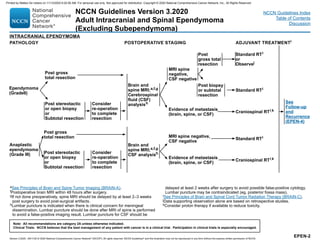
EPEN-2
INTRACRANIAL EPENDYMOMA
POSTOPERATIVE STAGINGPATHOLOGY ADJUVANT TREATMENTi
Ependymoma
(GradeII)
Anaplastic
ependymoma
(Grade III)
Brain and
spine MRI;a,f,g
CSF analysish
See
Follow-up
and
Recurrence
(EPEN-4)
MRI spine negative,
CSF negative
Evidence of metastasis
(brain, spine, or CSF)
Standard RTi
Craniospinal RTi,k
Brain and
spine MRI;a,f,g
Cerebrospinal
fluid (CSF)
analysishConsider
re-operation
to complete
resection
MRI spine
negative,
CSF negative
Evidence of metastasis
(brain, spine, or CSF)
Standard RTi
or
Observej
Standard RTi
Craniospinal RTi,k
Post gross
total resection
Post stereotactic
or open biopsy
or
Subtotal resection
Post
gross total
resection
Post biopsy
or subtotal
resection
Post gross
total resection
Post stereotactic
or open biopsy
or
Subtotal resection
aSee Principles of Brain and Spine Tumor Imaging (BRAIN-A).
fPostoperative brain MRI within 48 hours after surgery.
gIf not done preoperatively, spine MRI should be delayed by at least 2–3 weeks
post surgery to avoid post-surgical artifacts.
hLumbar puncture is indicated when there is clinical concern for meningeal
dissemination. Lumbar puncture should be done after MRI of spine is performed
to avoid a false-positive imaging result. Lumbar puncture for CSF should be
delayed at least 2 weeks after surgery to avoid possible false-positive cytology.
Lumbar puncture may be contraindicated (eg, posterior fossa mass).
iSee Principles of Brain and Spinal Cord Tumor Radiation Therapy (BRAIN-C).
jData supporting observation alone are based on retrospective studies.
kConsider proton therapy if available to reduce toxicity.
Consider
re-operation
to complete
resection
Note: All recommendations are category 2A unless otherwise indicated.
Clinical Trials: NCCN believes that the best management of any patient with cancer is in a clinical trial. Participation in clinical trials is especially encouraged.
Version 3.2020 , 09/11/20 © 2020 National Comprehensive Cancer Network®
(NCCN®
), All rights reserved. NCCN Guidelines®
and this illustration may not be reproduced in any form without the express written permission of NCCN.
NCCN Guidelines Version 3.2020
Adult Intracranial and Spinal Ependymoma
(Excluding Subependymoma)
NCCN Guidelines Index
Table of Contents
Discussion
Printed by Matteo De notaris on 11/13/2020 6:02:56 AM. For personal use only. Not approved for distribution. Copyright © 2020 National Comprehensive Cancer Network, Inc., All Rights Reserved.
SPINAL EPENDYMOMA
PATHOLOGY
Ependymoma,
status post
resection
(Grade II)
Anaplastic
ependymoma
(Grade III),
status post
resection
Myxopapillary
ependymoma
(Grade I)
POSTOPERATIVE STAGING
Brain MRI and
spine MRI;a,l
CSF analysish
Brain and
spine MRI;a,l
CSF analysish
Subtotal resection,
MRI brain negative, CSF negative
Gross total resection, MRI brain and
spine negative, CSF negative
Gross total or subtotal resection and
evidence of metastasis (brain, spine,
or CSF)
Observe
Standard RTi
or
Observe in select
situations
Craniospinal RTi,k
Gross total or subtotal resection,
MRI negative, CSF negative
Gross total or subtotal resection and
evidence of metastasis (brain, spine,
or CSF)
Standard RTi
Craniospinal RTi,k
Brain and
spine MRI;a,l
CSF analysish
En bloc resection,
without capsule violation;
CSF cytology negative
Observe
Gross total resection,
but capsule violation occurred;
CSF cytology negative
or
Subtotal resection;
CSF cytology negative
Standard RTi
Gross total or subtotal resection and
evidence of metastasis in brain or
spine, or CSF cytology positive
Craniospinal RTi,k
aSee Principles of Brain and Spine Tumor Imaging (BRAIN-A).
hLumbar puncture is indicated when there is clinical concern for meningeal
dissemination. Lumbar puncture should be done after MRI of spine is performed
to avoid a false-positive imaging result. Lumbar puncture for CSF should be
delayed at least 2 weeks after surgery to avoid possible false-positive cytology.
Lumbar puncture may be contraindicated (eg, posterior fossa mass).
iSee Principles of Brain and Spinal Cord Tumor Radiation Therapy (BRAIN-C).
kConsider proton therapy if available to reduce toxicity.
lIf not done preoperatively, spine MRI should be performed 48 h post surgery.
EPEN-3
ADJUVANT TREATMENTi
See
Follow-up
and
Recurrence
(EPEN-4)
Note: All recommendations are category 2A unless otherwise indicated.
Clinical Trials: NCCN believes that the best management of any patient with cancer is in a clinical trial. Participation in clinical trials is especially encouraged.
Version 3.2020 , 09/11/20 © 2020 National Comprehensive Cancer Network®
(NCCN®
), All rights reserved. NCCN Guidelines®
and this illustration may not be reproduced in any form without the express written permission of NCCN.
NCCN Guidelines Version 3.2020
Adult Intracranial and Spinal Ependymoma
(Excluding Subependymoma)
NCCN Guidelines Index
Table of Contents
Discussion
Printed by Matteo De notaris on 11/13/2020 6:02:56 AM. For personal use only. Not approved for distribution. Copyright © 2020 National Comprehensive Cancer Network, Inc., All Rights Reserved.
FOLLOW-UPa RECURRENCE STAGING WORKUPa
TREATMENT FOR
PROGRESSION OR
RECURRENCE
• Imaging in the event
of emergent signs
or symptoms (brain
and/or spine MRI)
• Imaging of tumor
site (brain or spine
MRI) every 3–4 mo
for 1 y, then every
4–6 mo for year 2,
then every 6–12 mo
for 5–10 y, then as
clinically indicated
Spine or
brain
recurrence
EPEN-4
MRI imaging
of spine,
brain, and
CSF analysish
Resectable
Unresectable
Gross total or subtotal
resection; CSF cytology
negative
Standard RTi,m
Subtotal resection and
evidence of metastasis
(brain, spine, or CSF)
Craniospinal RTi,k
Gross total or subtotal
resection; CSF cytology
negative
Subtotal resection and
evidence of metastasis
(brain, spine, or CSF)
Clinical trial or consider
re-irradiationi or
chemotherapyn,o
Clinical trial
or chemotherapyn,o
or Palliative/best
supportive care
Localized recurrence
Evidence of metastasis
(brain, spine, or CSF)
Localized recurrence
Evidence of metastasis
(brain, spine, or CSF)
No prior
RT
Prior RT
No prior
RT
Prior RT
Standard RTi,m
Craniospinal RTi,k
Clinical trial or consider
re-irradiationi or
chemotherapyn,o
Clinical trial
or chemotherapym,n,o
or Palliative/best
supportive care
aSee Principles of Brain and Spine Tumor Imaging (BRAIN-A).
hLumbar puncture is indicated when there is clinical concern for
meningeal dissemination. Lumbar puncture should be done after
MRI of spine is performed to avoid a false-positive imaging result.
Lumbar puncture for CSF should be delayed at least 2 weeks after
surgery to avoid possible false-positive cytology. Lumbar puncture
may be contraindicated (eg, posterior fossa mass).
iSee Principles of Brain and Spinal Cord Tumor Radiation Therapy
(BRAIN-C).
kConsider proton therapy if available to reduce toxicity.
mConsider stereotactic radiosurgery (SRS) if geometrically favorable.
nChemotherapy should be reserved for patients who are refractory to surgery or radiation.
oSee Principles of Brain and Spinal Cord Tumor Systemic Therapy (BRAIN-D).
Note: All recommendations are category 2A unless otherwise indicated.
Clinical Trials: NCCN believes that the best management of any patient with cancer is in a clinical trial. Participation in clinical trials is especially encouraged.
Version 3.2020 , 09/11/20 © 2020 National Comprehensive Cancer Network®
(NCCN®
), All rights reserved. NCCN Guidelines®
and this illustration may not be reproduced in any form without the express written permission of NCCN.
NCCN Guidelines Version 3.2020
Adult Intracranial and Spinal Ependymoma
(Excluding Subependymoma)
NCCN Guidelines Index
Table of Contents
Discussion
Printed by Matteo De notaris on 11/13/2020 6:02:56 AM. For personal use only. Not approved for distribution. Copyright © 2020 National Comprehensive Cancer Network, Inc., All Rights Reserved.
AMED-1
aSee Principles of Brain and Spine Tumor Imaging (BRAIN-A).
bConsider a multidisciplinary review in treatment planning, before surgery and once pathology is available. See Principles of Brain and Spine Tumor Management
(BRAIN-E).
cPlacement of ventriculoperitoneal (VP) shunt for management of hydrocephalus is acceptable if needed.
dSee Principles of Brain Tumor Surgery (BRAIN-B).
eStrongly recommend referring patient to a brain tumor center to be evaluated for possible further, more complete surgical resection.
RADIOLOGIC PRESENTATIONa CLINICAL IMPRESSION SURGERYd
Contrast-enhanced MRI
compatible with primary
brain tumorb
Gross total
resection possiblec
Gross total resection
not possiblec
Gross total
resection
Stereotactic biopsye
or
Open biopsy
or
Partial resection
See Postoperative
Staging (AMED-2)
Note: All recommendations are category 2A unless otherwise indicated.
Clinical Trials: NCCN believes that the best management of any patient with cancer is in a clinical trial. Participation in clinical trials is especially encouraged.
Version 3.2020 , 09/11/20 © 2020 National Comprehensive Cancer Network®
(NCCN®
), All rights reserved. NCCN Guidelines®
and this illustration may not be reproduced in any form without the express written permission of NCCN.
NCCN Guidelines Version 3.2020
Adult Medulloblastoma
NCCN Guidelines Index
Table of Contents
Discussion
Printed by Matteo De notaris on 11/13/2020 6:02:56 AM. For personal use only. Not approved for distribution. Copyright © 2020 National Comprehensive Cancer Network, Inc., All Rights Reserved.
AMED-2
aSee Principles of Brain and Spine Tumor Imaging (BRAIN-A).
fPostoperative brain MRI within 48 hours after surgery.
gSpine MRI should be delayed by at least 2–3 weeks post surgery to avoid post-surgical
artifacts.
hLumbar puncture should be done after spine MRI. Lumbar puncture for CSF should be
delayed at least 2 weeks after surgery to avoid possible false-positive cytology.
iBone scan; CT with contrast of chest, abdomen, and pelvis or whole body PET/CT; and
bone marrow biopsy only if clinically indicated.
jMolecular profiling to identify clinically relevant subtypes is recommended to encourage
opportunities for clinical trial involvement. See Principles of Pathology (BRAIN-F).
kSee the modified Chang system for staging medulloblastoma. (Chang CH, Housepain
EM, Herbert C. Radiology 1969;93:1351-1359 and Cohen ME, Duffner PK (Eds). Brain
tumors in children, 2nd ed, McGraw-Hill, New York, 1994, p.187.)
lIf only biopsy is possible, consider an attempt at resection at a center that specializes in
the treatment of brain tumors.
mSee Principles of Brain and Spinal Cord Tumor Radiation Therapy (BRAIN-C).
POSTOPERATIVE STAGING ADJUVANT TREATMENTl
See Follow-up
(AMED-3)
Brainf and
spine MRIa,g
and CSF
analysis,h,i
and molecular
analysisj
Standard risk for recurrence:k
• No evidence of metastasis
(brain, spine, CSF, extraneural)
• Small-volume residual disease
(contrast volume 1.5 cm2
)
• Classic or desmoplastic histology
High risk for recurrence:k
Unresectable tumor or residual tumor 1.5 cm2
or
Disseminated disease within or outside of the neuroaxis
or
Large cell/anaplastic medulloblastoma
Standard-dose craniospinal
radiationm,n
or
Reduced-dose craniospinal RTm,n
with chemotherapyo followed by
post-radiation chemotherapyo,p
Craniospinal radiationm,n with
chemotherapy followed by
post-radiation chemotherapyq,r
nConsider proton therapy if available to reduce toxicity.
oOmission of vincristine during radiotherapy phase of therapy or dose
modification may be required for adults because they do not tolerate this
regimen as well. Data supporting vincristine’s use have been found in
pediatric trials only. Patients should be closely monitored for neurologic
toxicity with periodic exams. (Packer RJ, Gajjar A, Vezina G, et al. Phase III
study of craniospinal radiation therapy followed by adjuvant chemotherapy for
newly diagnosed average-risk medulloblastoma. J Clin Oncol 2006;24:4202-
4208.)
pSee Principles of Brain and Spinal Cord Tumor Systemic Therapy (BRAIN-D).
qRecommend a platinum-based chemotherapy regimen such as either of the
treatment arms used in the Children’s Oncology Group study referenced in
footnote k.
rConsider collecting stem cells before craniospinal radiation.
Note: All recommendations are category 2A unless otherwise indicated.
Clinical Trials: NCCN believes that the best management of any patient with cancer is in a clinical trial. Participation in clinical trials is especially encouraged.
Version 3.2020 , 09/11/20 © 2020 National Comprehensive Cancer Network®
(NCCN®
), All rights reserved. NCCN Guidelines®
and this illustration may not be reproduced in any form without the express written permission of NCCN.
NCCN Guidelines Version 3.2020
Adult Medulloblastoma
NCCN Guidelines Index
Table of Contents
Discussion
Printed by Matteo De notaris on 11/13/2020 6:02:56 AM. For personal use only. Not approved for distribution. Copyright © 2020 National Comprehensive Cancer Network, Inc., All Rights Reserved.
AMED-3
aSee Principles of Brain and Spine Tumor Imaging (BRAIN-A).
fPostoperative brain MRI within 48 hours after surgery.
gSpine MRI should be delayed by at least 2–3 weeks post surgery to avoid post-
surgical artifacts.
pSee Principles of Brain and Spinal Cord Tumor Systemic Therapy (BRAIN-D).
FOLLOW-UPa CLINICAL STAGING SURGERY TREATMENT FOR
RECURRENCE
Chemotherapyp
and/or
Additional
radiation,u such
as stereotactic
radiosurgery (SRS),
after resection
or
High-dose
chemotherapyp with
autologous
stem cell reinfusionv
Brain MRI:
every 3 mo for 2 y;
then every 6–12 mo
for 5–10 y; then every
1–2 y or as clinically
indicated
For patients with
previous spine disease,
concurrent spine
imaging as clinically
indicated
Recurrent
disease
• Brain and spine MRIa,s
• CSF analysis
Localized
brain
recurrence
Disseminated diseaset
Maximum
safe
resection
Brainf and
spine MRIa,g
Chemotherapyp
or
Palliative/best supportive
care, including focal
radiation, if indicatedu
sAs clinically indicated, consider bone scan; contrast-enhanced CT scans of chest,
abdomen, and pelvis; and/or bone marrow biopsy.
tConsider resection for palliation of symptoms where indicated.
uSee Principles of Brain and Spinal Cord Tumor Radiation Therapy (BRAIN-C).
vOnly if the patient is without evidence of disease after surgery or conventional
dose re-induction chemotherapy.
Note: All recommendations are category 2A unless otherwise indicated.
Clinical Trials: NCCN believes that the best management of any patient with cancer is in a clinical trial. Participation in clinical trials is especially encouraged.
Version 3.2020 , 09/11/20 © 2020 National Comprehensive Cancer Network®
(NCCN®
), All rights reserved. NCCN Guidelines®
and this illustration may not be reproduced in any form without the express written permission of NCCN.
NCCN Guidelines Version 3.2020
Adult Medulloblastoma
NCCN Guidelines Index
Table of Contents
Discussion
Printed by Matteo De notaris on 11/13/2020 6:02:56 AM. For personal use only. Not approved for distribution. Copyright © 2020 National Comprehensive Cancer Network, Inc., All Rights Reserved.
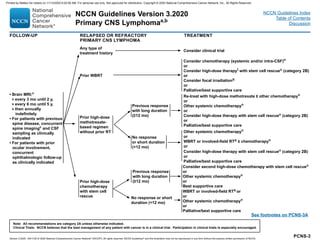
PCNS-1
DIAGNOSIS BY
TISSUE EVALUATION
Brain MRIc
suggestive of
primary CNS
lymphomad
aIf patient is HIV positive, antiretroviral (ARV) therapy should be part of his/her
treatment. ARVs can be administered safely with chemotherapy but consultation
with an HIV specialist or pharmacist is important to optimize compatibility. See
NCCN Guidelines for Cancer in People Living with HIV.
bFor additional guidance on management of transplant recipients with PCNSL, see
NCCN Guidelines for B-Cell Lymphomas, Diffuse Large B-Cell Lymphoma.
cSee Principles of Brain and Spine Tumor Imaging (BRAIN-A).
dIncludes primary CNS lymphoma of the brain, spine, CSF, and leptomeninges.
For lymphoma with primary tumor outside the CNS or involving only the eye, See
NCCN Guidelines for B-Cell Lymphomas, Diffuse Large B-Cell Lymphoma.
eIf stereotactic biopsy is not available refer to a specialized center.
f Brain biopsy is recommended as the primary procedure to obtain diagnosis. CSF
analysis should include flow cytometry, CSF cytology, cell count, and possibly
gene rearrangements.
• Biopsy of brain lesion with least
invasive approache
• Consider CSF sampling (15–20 mL
spinal fluid to increase diagnostic
yield), if safe, and if it will not delay the
diagnostic process or treatmentf
• Hold initiation of steroids, if possible,
prior to diagnostic procedure
Positive diagnosis of
primary CNS lymphoma
See (PCNS-2)
Biopsy not diagnostic of
primary CNS lymphoma
Other CNS tumor
See (PCNS-2)
See NCCN Guidelines for
Central Nervous System
Cancers Table of Contents
Note: All recommendations are category 2A unless otherwise indicated.
Clinical Trials: NCCN believes that the best management of any patient with cancer is in a clinical trial. Participation in clinical trials is especially encouraged.
Version 3.2020 , 09/11/20 © 2020 National Comprehensive Cancer Network®
(NCCN®
), All rights reserved. NCCN Guidelines®
and this illustration may not be reproduced in any form without the express written permission of NCCN.
NCCN Guidelines Version 3.2020
Primary CNS Lymphomaa,b
NCCN Guidelines Index
Table of Contents
Discussion
Printed by Matteo De notaris on 11/13/2020 6:02:56 AM. For personal use only. Not approved for distribution. Copyright © 2020 National Comprehensive Cancer Network, Inc., All Rights Reserved.
PCNS-2
EXTENT OF
DISEASE
INDUCTION THERAPYl
Positive
diagnosis of
primary CNS
lymphomag,s
Biopsy not
diagnostic of primary
CNS lymphoma
• Full ophthalmologic exam
including slit lamp eye
exam
• Lumbar puncture if safei,j
• Spine MRI,c
if symptomatic
or positive CSF
• Lactate dehydrogenase
(LDH) test
• HIV statusa
• CBC, comprehensive
metabolic panel
• Contrast-enhanced chest/
abdominal/pelvic CT or
whole body PET/CT scan
• Bone marrow biopsy
(category 2B)
• Consider testicular
ultrasound for men 60 yk
(category 2B)
• Initiate steroids as
clinically indicated
Prior steroids
No prior steroids
Discontinue steroids, and rebiopsy or repeat CSF evaluation when disease progresses
Workup for other CNS diagnosis or rebiopsy or repeat CSF evaluation
OR
High-dose methotrexate-based
regimenm,n,o
or other systemic therapy
regimen if patient is unsuitable for or
intolerant to high-dose methotrexate
• If eye exam shows vitreoretinal
involvement and disease is not
responding to systemic chemotherapy,
consider orbital RTq
or refer to an
ophthalmologist experienced in intra-
ocular chemotherapy (category 2B)
OR
Whole brain RT (WBRT)q
if patient is not a
candidate for systemic chemotherapy
• If eye exam shows vitreoretinal
involvement, RT to globe
• If CSF positive or spinal MRI positive,
consider intra-CSF chemotherapyn
+ focal spinal RT
EVALUATIONh
If complete response or complete
response unconfirmed (CRu)h
consider:
• High-dose chemotherapy with stem
cell rescuen
or
• High-dose cytarabine ± etoposiden
or
• Low-dose WBRTq,r
or
• Continue monthly high-dose
methotrexate-based regimen for up
to 1 y
If residual disease present:
• WBRTq
or
• Consider high-dose cytarabine ±
etoposiden
or
• Best supportive care
CONSOLIDATION THERAPYp
See
Follow-up
(PCNS-3)
Consider clinical trial
Note: All recommendations are category 2A unless otherwise indicated.
Clinical Trials: NCCN believes that the best management of any patient with cancer is in a clinical trial. Participation in clinical trials is especially encouraged.
Version 3.2020 , 09/11/20 © 2020 National Comprehensive Cancer Network®
(NCCN®
), All rights reserved. NCCN Guidelines®
and this illustration may not be reproduced in any form without the express written permission of NCCN.
NCCN Guidelines Version 3.2020
Primary CNS Lymphomaa,b
NCCN Guidelines Index
Table of Contents
Discussion
Printed by Matteo De notaris on 11/13/2020 6:02:56 AM. For personal use only. Not approved for distribution. Copyright © 2020 National Comprehensive Cancer Network, Inc., All Rights Reserved.
aIf patient is HIV positive, ARV therapy should be part of his/her treatment. ARVs can be administered safely with chemotherapy but consultation with an HIV specialist or pharmacist is
important to optimize compatibility. See NCCN Guidelines for Cancer in People Living with HIV.
bFor additional guidance on management of transplant recipients with PCNSL, see NCCN Guidelines for B-Cell Lymphomas, Diffuse Large B-Cell Lymphoma.
cSee Principles of Brain and Spine Tumor Imaging (BRAIN-A).
gMay institute primary therapy and workup simultaneously.
hFor full details regarding evaluation of extent of disease and response criteria for primary CNS lymphoma, refer to Abrey LE, Batchelor TT, Ferreri AJ, et al. Report of an international
workshop to standardize baseline evaluation and response criteria for primary CNS lymphoma. J Clin Oncol 2005;23:5034-5043.
iCSF analysis should include flow cytometry, and CSF cytology, and may consider gene rearrangements.
jCaution is indicated in patients who are anticoagulated, thrombocytopenic, or who have a bulky intra-cranial mass.
kRecommend regular testicular exams. If PET/CT scan is negative, then there is no need for testicular ultrasound.
lA low KPS should not be a reason to withhold chemotherapy. KPS may improve dramatically after treatment.
mDose adjusted for glomerular filtration rate (GFR) if dosing at 8 g/m2
.
nSee Principles of Brain and Spinal Cord Tumor Systemic Therapy (BRAIN-D).
oIf CSF positive or spinal MRI positive, consider alternative systemic chemotherapy regimens and/or intra-CSF chemotherapy (category 2B), especially for patients who cannot tolerate
systemic methotrexate ≥3 g/m2
.
pDue to a lack of strong evidence, it is not clear which consolidation regimen provides the most benefit.
qSee Principles of Brain and Spinal Cord Tumor Radiation Therapy (BRAIN-C).
rWBRT may increase neurotoxicity, especially in patients 60 y.
sIncludes primary CNS lymphoma of the brain, spine, CSF, and leptomeninges.
FOOTNOTES
PCNS-2A
Note: All recommendations are category 2A unless otherwise indicated.
Clinical Trials: NCCN believes that the best management of any patient with cancer is in a clinical trial. Participation in clinical trials is especially encouraged.
Version 3.2020 , 09/11/20 © 2020 National Comprehensive Cancer Network®
(NCCN®
), All rights reserved. NCCN Guidelines®
and this illustration may not be reproduced in any form without the express written permission of NCCN.
NCCN Guidelines Version 3.2020
Primary CNS Lymphomaa,b
NCCN Guidelines Index
Table of Contents
Discussion
Printed by Matteo De notaris on 11/13/2020 6:02:56 AM. For personal use only. Not approved for distribution. Copyright © 2020 National Comprehensive Cancer Network, Inc., All Rights Reserved.
PCNS-3
RELAPSED OR REFRACTORY
PRIMARY CNS LYMPHOMA
TREATMENT
Prior high-dose
methotrexate-
based regimen
without prior RT
Consider chemotherapy (systemic and/or intra-CSF)n
or
Consider high-dose therapyt
with stem cell rescueu
(category 2B)
or
Consider focal irradiationq
or
Palliative/best supportive care
Previous response
with long duration
(≥12 mo)
No response
or short duration
(12 mo)
Re-treat with high-dose methotrexate ± other chemotherapyn
or
Other systemic chemotherapyn
or
Consider high-dose therapy with stem cell rescueu
(category 2B)
or
Palliative/best supportive care
Other systemic chemotherapyn
or
WBRT or involved-field RTq
± chemotherapyn
or
Consider high-dose therapy with stem cell rescueu
(category 2B)
or
Palliative/best supportive care
Prior high-dose
chemotherapy
with stem cell
rescue
Previous response
with long duration
(≥12 mo)
No response or short
duration (12 mo)
Consider second high-dose chemotherapy with stem cell rescueu
or
Other systemic chemotherapyn
or
Best supportive care
WBRT or involved-field RTq
or
or
Other systemic chemotherapyn
or
Palliative/best supportive care
FOLLOW-UP
• Brain MRI:c
every 3 mo until 2 y,
every 6 mo until 5 y,
then annually
indefinitely
• For patients with previous
spine disease, concurrent
spine imagingc
and CSF
sampling as clinically
indicated
• For patients with prior
ocular involvement,
concurrent
ophthalmologic follow-up
as clinically indicated
Any type of
treatment history
Consider clinical trial
Prior WBRT
See footnotes on PCNS-3A
Note: All recommendations are category 2A unless otherwise indicated.
Clinical Trials: NCCN believes that the best management of any patient with cancer is in a clinical trial. Participation in clinical trials is especially encouraged.
Version 3.2020 , 09/11/20 © 2020 National Comprehensive Cancer Network®
(NCCN®
), All rights reserved. NCCN Guidelines®
and this illustration may not be reproduced in any form without the express written permission of NCCN.
NCCN Guidelines Version 3.2020
Primary CNS Lymphomaa,b
NCCN Guidelines Index
Table of Contents
Discussion
Printed by Matteo De notaris on 11/13/2020 6:02:56 AM. For personal use only. Not approved for distribution. Copyright © 2020 National Comprehensive Cancer Network, Inc., All Rights Reserved.
aIf patient is HIV positive, ARV therapy should be part of his/her treatment. ARVs can be administered safely with chemotherapy but consultation with an HIV specialist
or pharmacist is important to optimize compatibility. See NCCN Guidelines for Cancer in People Living with HIV.
bFor additional guidance on management of transplant recipients with PCNSL, see NCCN Guidelines for B-Cell Lymphomas, Diffuse Large B-Cell Lymphoma.
cSee Principles of Brain and Spine Tumor Imaging (BRAIN-A).
nSee Principles of Brain and Spinal Cord Tumor Systemic Therapy (BRAIN-D).
qSee Principles of Brain and Spinal Cord Tumor Radiation Therapy (BRAIN-C).
tThe risk of neurotoxicity should be considered before administrating high-dose therapy to a patient with prior WBRT.
uIf the recurrent disease goes into complete remission with reinduction chemotherapy.
FOOTNOTES
PCNS-3A
Note: All recommendations are category 2A unless otherwise indicated.
Clinical Trials: NCCN believes that the best management of any patient with cancer is in a clinical trial. Participation in clinical trials is especially encouraged.
Version 3.2020 , 09/11/20 © 2020 National Comprehensive Cancer Network®
(NCCN®
), All rights reserved. NCCN Guidelines®
and this illustration may not be reproduced in any form without the express written permission of NCCN.
NCCN Guidelines Version 3.2020
Primary CNS Lymphomaa,b
NCCN Guidelines Index
Table of Contents
Discussion
Printed by Matteo De notaris on 11/13/2020 6:02:56 AM. For personal use only. Not approved for distribution. Copyright © 2020 National Comprehensive Cancer Network, Inc., All Rights Reserved.
PSCT-1
aSee Principles of Brain and Spine Tumor Imaging (BRAIN-A).
bConsider a multidisciplinary review in treatment planning, before surgery and once pathology is available. See Principles of Brain and Spine Tumor Management
(BRAIN-E).
cSee Principles of Brain Tumor Surgery (BRAIN-B).
RADIOLOGIC PRESENTATIONa CLINICAL
PRESENTATION
SURGERYc
Intradural mass
by spine MRIb or
CT myelogram
(if MRI is
contraindicated)
Intradural
intramedullary
Intradural
extramedullary
MRI well-defined/
circumscribed
MRI poorly
defined/infiltrative
See PSCT-3
Asymptomatic
Symptomatic
Asymptomatic
Symptomatic
Observation
or
Maximum
safe
resection
Maximum
safe
resection
Post-
operative
spine
MRIa
Observation
or
Biopsy
Biopsy
See Follow-up
(PSCT-4)
See Pathology
(PSCT-2)
See Follow-up
(PSCT-4)
See Pathology
(PSCT-2)
Note: All recommendations are category 2A unless otherwise indicated.
Clinical Trials: NCCN believes that the best management of any patient with cancer is in a clinical trial. Participation in clinical trials is especially encouraged.
Version 3.2020 , 09/11/20 © 2020 National Comprehensive Cancer Network®
(NCCN®
), All rights reserved. NCCN Guidelines®
and this illustration may not be reproduced in any form without the express written permission of NCCN.
NCCN Guidelines Version 3.2020
Primary Spinal Cord Tumors
NCCN Guidelines Index
Table of Contents
Discussion
Printed by Matteo De notaris on 11/13/2020 6:02:56 AM. For personal use only. Not approved for distribution. Copyright © 2020 National Comprehensive Cancer Network, Inc., All Rights Reserved.
PSCT-2
dVHL Family Alliance: The VHL Handbook: What You Need to Know About VHL: A Reference Handbook for People with von Hippel-Lindau Disease, Their Families, and
Support Personnel. Boston, MA, 2014 VHL Family Alliance.
eSee Principles of Brain and Spinal Cord Tumor Radiation Therapy (BRAIN-C).
RADIOLOGIC
PRESENTATION
PATHOLOGY CLINICAL
PRESENTATION
ADJUVANT
TREATMENT
FOLLOW-UP
Ependymoma
See Adult Intracranial and Spinal
Ependymoma (EPEN-1) and (EPEN-3)
Other subtypes:
• Pilocytic
astrocytoma
• Hemangioblastoma
Consider
screening for
von Hippel-
Lindau
syndromed
Intradural
Intramedullary
tumor
MRI well-defined/
circumscribed
Image-verified
complete resection
Partial resection
or biopsy
Observation
Asymptomatic
Symptomatic
Observation
RTe
Follow-up
See (PSCT-4)
Intradural
Intramedullary
tumor
MRI poorly
defined/infiltrative
Low-grade glioma
• Anaplastic
glioma
• Glioblastoma
See Adult Low-Grade
(WHO Grade II) Infiltrative
Supratentorial Astrocytoma/
Oligodendroglioma (ASTR-1)
See Anaplastic
Gliomas/Glioblastoma
(GLIO-1)
Note: All recommendations are category 2A unless otherwise indicated.
Clinical Trials: NCCN believes that the best management of any patient with cancer is in a clinical trial. Participation in clinical trials is especially encouraged.
Version 3.2020 , 09/11/20 © 2020 National Comprehensive Cancer Network®
(NCCN®
), All rights reserved. NCCN Guidelines®
and this illustration may not be reproduced in any form without the express written permission of NCCN.
NCCN Guidelines Version 3.2020
Primary Spinal Cord Tumors
NCCN Guidelines Index
Table of Contents
Discussion
Printed by Matteo De notaris on 11/13/2020 6:02:56 AM. For personal use only. Not approved for distribution. Copyright © 2020 National Comprehensive Cancer Network, Inc., All Rights Reserved.
PSCT-3
aSee Principles of Brain and Spine Tumor Imaging (BRAIN-A).
cSee Principles of Brain Tumor Surgery (BRAIN-B).
fSpine MRI should be delayed by at least 2–3 weeks post surgery to avoid post-surgical artifacts.
RADIOLOGIC
PRESENTATION
CLINICAL
PRESENTATION
SURGERYc PATHOLOGY FOLLOW-UP
Intradural
extramedullary
Solitary
or
Multiple
Consider:
• Neurofibromatosis
(Type I and Type II)
• Schwannomatosis
• Leptomeningeal
metastases
(See LEPT-1)
Asymptomatic
Symptomatic
Maximum
safe
resection
• Meningioma
(See MENI-1)
Other subtypes:
• Peripheral nerve
sheath tumor
• Myxopapillary
ependymoma
Follow-up
(See PSCT-4)
Post-
operative
spine
MRIa,f
Note: All recommendations are category 2A unless otherwise indicated.
Clinical Trials: NCCN believes that the best management of any patient with cancer is in a clinical trial. Participation in clinical trials is especially encouraged.
Version 3.2020 , 09/11/20 © 2020 National Comprehensive Cancer Network®
(NCCN®
), All rights reserved. NCCN Guidelines®
and this illustration may not be reproduced in any form without the express written permission of NCCN.
NCCN Guidelines Version 3.2020
Primary Spinal Cord Tumors
NCCN Guidelines Index
Table of Contents
Discussion
Printed by Matteo De notaris on 11/13/2020 6:02:56 AM. For personal use only. Not approved for distribution. Copyright © 2020 National Comprehensive Cancer Network, Inc., All Rights Reserved.
PSCT-4
aSee Principles of Brain and Spine Tumor Imaging (BRAIN-A).
eSee Principles of Brain and Spinal Cord Tumor Radiation Therapy (BRAIN-C).
gSee Principles of Brain and Spinal Cord Tumor Systemic Therapy (BRAIN-D) for options according to disease histology.
Patients managed by:
Observation
or
Maximum safe
resection for
intradural
intramedullary tumor
or intradural
extramedullary tumor
FOLLOW-UPa
Spine MRI 2–6 wk after treatment,
then every 2–4 mo until 2–3 y,
then every 3–6 mo until 5 y, then
every 6–12 mo indefinitely
Spine MRI every 3–6 mo until
5 y, then at least annually
indefinitely
Low-grade
tumors (I–II)
High-grade
tumors (III–IV)
RECURRENCE
New/worsening
symptoms
or radiographic
progression
TREATMENT FOR RECURRENCE
Re-resection
or
RTe or re-irradiation (include
stereotactic radiotherapy [SRT]), if
surgery not possible
or
Chemotherapyg relative to cell type if
further surgery or RT not possible
Note: All recommendations are category 2A unless otherwise indicated.
Clinical Trials: NCCN believes that the best management of any patient with cancer is in a clinical trial. Participation in clinical trials is especially encouraged.
Version 3.2020 , 09/11/20 © 2020 National Comprehensive Cancer Network®
(NCCN®
), All rights reserved. NCCN Guidelines®
and this illustration may not be reproduced in any form without the express written permission of NCCN.
NCCN Guidelines Version 3.2020
Primary Spinal Cord Tumors
NCCN Guidelines Index
Table of Contents
Discussion
Printed by Matteo De notaris on 11/13/2020 6:02:56 AM. For personal use only. Not approved for distribution. Copyright © 2020 National Comprehensive Cancer Network, Inc., All Rights Reserved.
MENI-1
aMultidisciplinary input for treatment planning if feasible.
bTreatment selection should be based on assessment of a variety of inter-related
factors, including patient features (eg, age, performance score, comorbidities,
treatment preferences), tumor features (eg, size, grade, growth rate, location
[proximity to critical structures], potential for causing neurologic consequences
if untreated, presence and severity of symptoms), and treatment-related factors
(eg, potential for neurologic consequences from surgery/RT, likelihood of
complete resection and/or complete irradiation with SRS, treatability of tumor if it
progresses, available surgical or radiation oncology expertise and resources). The
decision to administer RT after surgery also depends on the extent of resection
achieved. Multidisciplinary input for treatment planning is recommended.
cFor asymptomatic meningiomas, observation is preferred for small tumors,
with a suggested cutoff of ≤3 cm. Active treatment with surgery and/or RT is
recommended in cases with one or more tumor- and/or treatment-related risk
factors, such as proximity to the optic nerve.
dPostoperative brain MRI within 48 hours after surgery.
eSee Principles of Brain and Spine Tumor Imaging (BRAIN-A).
fSee Principles of Brain Tumor Radiation Therapy (BRAIN-C).
gWHO Grade I = Benign meningioma, WHO Grade II = Atypical meningioma, WHO
Grade III = Malignant (anaplastic) meningioma.
PRESENTATIONa TREATMENTb
Radiographic
diagnosis by brain
MRI:
• Dural-based mass
• Homogeneously
contrast-enhancing
• Dural tail
• CSF cleft
Meningioma by
radiographic criteria
or
Possible meningioma:
• Consider resection
• Consider octreotide
scan if diagnostic
doubt exists
Consider RTf
depending on factors in footnote b
In general, postoperative management depends
on grade,g
extent of resection, and symptoms, as
follows:
• Grade I: observation or consider RT (for
symptomatic patients)
• Grade II with complete resection: consider RT
• Grade II with incomplete resection: RT
• Grade III: RT
Follow-up
(See MENI-2)
Observe (preferred for
small asymptomatic
tumors; not generally
recommended for
symptomatic tumors)c
or
Surgeryd,e
(if accessible)f
or
RTf
TREATMENTb ADJUVANT TREATMENT
Note: All recommendations are category 2A unless otherwise indicated.
Clinical Trials: NCCN believes that the best management of any patient with cancer is in a clinical trial. Participation in clinical trials is especially encouraged.
Version 3.2020 , 09/11/20 © 2020 National Comprehensive Cancer Network®
(NCCN®
), All rights reserved. NCCN Guidelines®
and this illustration may not be reproduced in any form without the express written permission of NCCN.
NCCN Guidelines Version 3.2020
Meningiomas
NCCN Guidelines Index
Table of Contents
Discussion
Printed by Matteo De notaris on 11/13/2020 6:02:56 AM. For personal use only. Not approved for distribution. Copyright © 2020 National Comprehensive Cancer Network, Inc., All Rights Reserved.
MENI-2
dPostoperative brain MRI within 48 hours after surgery.
eSee Principles of Brain and Spine Tumor Imaging (BRAIN-A).
fSee Principles of Brain and Spinal Cord Tumor Radiation Therapy (BRAIN-C).
hConsider less frequent follow-up after 5–10 y.
iMore frequent imaging may be required for WHO Grade 3 meningiomas, and for meningiomas of any grade that are treated for recurrence or with chemotherapy.
jSee Principles of Brain and Spinal Cord Tumor Systemic Therapy (BRAIN-D).
FOLLOW-UPh RECURRENCE/PROGRESSION TREATMENT
WHO Grade I and IIe,i
or unresected meningiomas:
Brain MRId,e at 3, 6, and 12
mo,
then every 6–12 mo for 5 y,
then every 1–3 y as clinically
indicated
Recurrent
or
progressive
disease
Surgery if accessible
Not surgically accessible
RT possible
Not surgically accessible
RT not possible
Treatment not clinically indicated
Consider clinical
trial
or
RTf (if no prior RT)
or
Consider
re-irradiationf
RTf
Chemotherapyj
Observation
Brain MRId,e
Note: All recommendations are category 2A unless otherwise indicated.
Clinical Trials: NCCN believes that the best management of any patient with cancer is in a clinical trial. Participation in clinical trials is especially encouraged.
Version 3.2020 , 09/11/20 © 2020 National Comprehensive Cancer Network®
(NCCN®
), All rights reserved. NCCN Guidelines®
and this illustration may not be reproduced in any form without the express written permission of NCCN.
NCCN Guidelines Version 3.2020
Meningiomas
NCCN Guidelines Index
Table of Contents
Discussion
Printed by Matteo De notaris on 11/13/2020 6:02:56 AM. For personal use only. Not approved for distribution. Copyright © 2020 National Comprehensive Cancer Network, Inc., All Rights Reserved.
LTD-1
CLINICAL
PRESENTATIONa
WORKUP
Limited
brain
metastases
on MRIb,c
No known
history
of cancer
Known
history
of cancer
• Contrast-
enhanced CT
chest/abdomen/
pelvis
• Consider whole
body PET/CT
• Other tests as
indicated
No other
readily
accessible
tumor for
biopsy
Biopsy
or resect
tumor found
outside CNS
to confirm
cancer
diagnosis
See Clinical
Presentation and
Treatment (LTD-2)
Surgeryd to confirm diagnosis of
CNS metastases:
• Resection for management of
mass effect or symptoms
• Consider resection for
treatment of patients with newly
diagnosed or stable systemic
disease or reasonable systemic
treatment optionse
• Biopsy if resection not planned
Consider surgery for brain
metastasesd,f:
• Resection for management of
mass effect or symptoms
• Resection for treatment of
patients with newly diagnosed
or stable systemic disease or
reasonable systemic treatment
optionse
• Biopsy if concern exists about
diagnosis of CNS lesions and
resection is not planned
aSee Principles of Brain and Spine Tumor Imaging (BRAIN-A).
bConsider a multidisciplinary review in treatment planning, especially once
pathology is available. See Principles of Brain and Spine Tumor Management
(BRAIN-E).
cLimited brain metastases defines a group of patients for whom SRS is equally
effective and offers significant cognitive protection compared with WBRT. The
definition of limited brain metastases in terms of number of metastases or total
intracranial disease volume is evolving and may depend on the specific clinical
situation. (Yamamoto M, Serizawa T, Shuto T, et al. Stereotactic radiosurgery
for patients with multiple brain metastases (JLGK0901): a multi-institutional
prospective observational study. Lancet Oncol 2014;15:387-395.)
dSee Principles of Brain Tumor Surgery (BRAIN-B).
eFor secondary CNS lymphoma, treatment may include systemic treatment,
whole-brain or focal RT, or combination.
fThe decision to resect a tumor may depend on the need to establish histologic
diagnosis, the size of the lesion, its location, and institutional expertise. For
example, smaller (2 cm), deep, asymptomatic lesions may be considered for
treatment with SRS versus larger (2 cm), symptomatic lesions that may be more
appropriate for surgery. (Ewend MG, Morris DE, Carey LA, Ladha AM, Brem S.
Guidelines for the initial management of metastatic brain tumors: role of surgery,
radiosurgery, and radiation therapy. J Natl Compr Cancer Netw 2008;6:505-513.)
Note: All recommendations are category 2A unless otherwise indicated.
Clinical Trials: NCCN believes that the best management of any patient with cancer is in a clinical trial. Participation in clinical trials is especially encouraged.
Version 3.2020 , 09/11/20 © 2020 National Comprehensive Cancer Network®
(NCCN®
), All rights reserved. NCCN Guidelines®
and this illustration may not be reproduced in any form without the express written permission of NCCN.
NCCN Guidelines Version 3.2020
Limited Brain Metastases
NCCN Guidelines Index
Table of Contents
Discussion
Printed by Matteo De notaris on 11/13/2020 6:02:56 AM. For personal use only. Not approved for distribution. Copyright © 2020 National Comprehensive Cancer Network, Inc., All Rights Reserved.
LTD-2
eFor secondary CNS lymphoma, treatment may include systemic treatment, whole-brain or focal RT, or combination.
gIf an active agent exists (eg, cytotoxic, targeted, or immune modulating), trial of systemic therapy with good CNS penetration may be considered in select patients (eg,
for patients with small asymptomatic brain metastases from melanoma or ALK rearrangement-positive NSCLC or EGFR-mutated NSCLC); it is reasonable to hold
on treating with radiation to see if systemic therapy can control the brain metastases. Consultation with a radiation oncologist and close MRI surveillance is strongly
recommended. There are no data from prospective clinical trials comparing the two strategies to assess what the impact of delayed radiation would be in terms of
survival or in delay of neurologic deficit development.
hSee Principles of Brain and Spinal Cord Tumor Systemic Therapy (BRAIN-D).
iSee Principles of Brain and Spinal Cord Tumor Radiation Therapy (BRAIN-C).
jSRS is preferred when safe, especially for low tumor volume, to both the resection cavity and any other non-­resected brain metastases. WBRT is generally not
recommended but may be appropriate in some rare clinical circumstances.
kFor brain metastases not managed with resection, SRS + WBRT is generally not recomended but may be appropriate in some rare clinical circumstances. Brown 2016
showed that for tumors 3 cm, SRS + WBRT improved local control compared with SRS alone, but did not significantly improve survival, and was associated with
greater cognitive decline and poorer quality of life. (Brown PD, Jaeckle K, Ballman KV, et al. Effect of radiosurgery alone vs radiosurgery with whole brain radiation
therapy on cognitive function in patients with 1 to 3 brain metastases: a randomized clinical trial. JAMA 2016;316:401-409.)
lHippocampal avoidance preferred. See BRAIN-C.
CLINICAL PRESENTATION TREATMENTg,h
Disseminated
systemic disease
with poor systemic
treatment optionse
Newly diagnosed or
stable systemic
disease or
Reasonable systemic
treatment options
existe,h
WBRTg,i
or
SRS in select patientsi
or
Consider palliative/best supportive care
SRS (preferred)g,i,j
or
WBRTi,k,l
See Follow-up
and
Recurrence
(LTD-3)
Note: All recommendations are category 2A unless otherwise indicated.
Clinical Trials: NCCN believes that the best management of any patient with cancer is in a clinical trial. Participation in clinical trials is especially encouraged.
Version 3.2020 , 09/11/20 © 2020 National Comprehensive Cancer Network®
(NCCN®
), All rights reserved. NCCN Guidelines®
and this illustration may not be reproduced in any form without the express written permission of NCCN.
NCCN Guidelines Version 3.2020
Limited Brain Metastases
NCCN Guidelines Index
Table of Contents
Discussion
Printed by Matteo De notaris on 11/13/2020 6:02:56 AM. For personal use only. Not approved for distribution. Copyright © 2020 National Comprehensive Cancer Network, Inc., All Rights Reserved.
LTD-3
FOLLOW-UPa RECURRENCE TREATMENT
Brain MRIa
every 2–3m
mo for 1–2 y
then every
4–6 mo
indefinitelyq
Recurrent disease;
local siten
Recurrent disease;
distant brain
± local recurrence
Previous
surgery
only
Previous WBRT
or
Prior SRS
Limited brain
metastasesc
Extensive brain
metastases
Surgery followed by SRS or RT to the
surgical bedi
or
Single-dose or fractionated stereotactic
RTi
or
WBRTi,l for large volumes
or
Consider systemic therapyh
Surgery followed by SRS or RT to the
surgical bedi
or
Single-dose (category 2B) or fractionated
stereotactic RTi,p
or
Consider systemic therapyh
Surgery followed by SRS or RT to the
surgical bedi
or
Single-dose or fractionated stereotactic
RTi
or
WBRTi,l for large volumes if not
previously administered
or
Consider systemic therapyh
WBRTi if not previously administered
or
Consider systemic therapyh
If relapses,
see LTD-4
Brain MRIa
every 2–3m
mo for 1–2
y then every
4–6 mo
indefinitelyq
aSee Principles of Brain and Spine Tumor Imaging (BRAIN-A).
cLimited brain metastases defines a group of patients for whom SRS is equally
effective and offers significant cognitive protection compared with WBRT. The
definition of limited brain metastases in terms of number of metastases or total
intracranial disease volume is evolving and may depend on the specific clinical
situation. (Yamamoto M, Serizawa T, Shuto T, et al. Stereotactic radiosurgery
for patients with multiple brain metastases (JLGK0901): a multi-institutional
prospective observational study. Lancet Oncol 2014;15:387-395.)
hSee Principles of Brain and Spinal Cord Tumor Systemic Therapy (BRAIN-D).
iSee Principles of Brain and Spinal Cord Tumor Radiation Therapy (BRAIN-C).
lHippocampal avoidance preferred. See BRAIN-C.
mMRI every 2 months (instead of 3 mo) for those patients treated with SRS alone.
nAfter SRS, recurrence on MRI can be confounded by treatment effects; consider
tumor tissue sampling if there is a high index of suspicion of recurrence.
pIf patient had previous SRS with a good response 6 mo, then reconsider SRS if
imaging supports active tumor and not necrosis.
qImaging to evaluate emergent signs/symptoms is appropriate at any time.
Note: All recommendations are category 2A unless otherwise indicated.
Clinical Trials: NCCN believes that the best management of any patient with cancer is in a clinical trial. Participation in clinical trials is especially encouraged.
Version 3.2020 , 09/11/20 © 2020 National Comprehensive Cancer Network®
(NCCN®
), All rights reserved. NCCN Guidelines®
and this illustration may not be reproduced in any form without the express written permission of NCCN.
NCCN Guidelines Version 3.2020
Limited Brain Metastases
NCCN Guidelines Index
Table of Contents
Discussion
Printed by Matteo De notaris on 11/13/2020 6:02:56 AM. For personal use only. Not approved for distribution. Copyright © 2020 National Comprehensive Cancer Network, Inc., All Rights Reserved.
LTD-4
dSee Principles of Brain Tumor Surgery (BRAIN-B).
iSee Principles of Brain and Spinal Cord Tumor Radiation Therapy (BRAIN-C).
hSee Principles of Brain and Spinal Cord Tumor Systemic Therapy (BRAIN-D).
RECURRENCE TREATMENT
Systemic disease
progression, with
limited systemic
treatment options
and poor PS
No prior WBRT
Prior WBRT
WBRTi
or
SRS in select patientsi
or
Palliative/best supportive care
Reirradiation,i if prior positive response to RT
or
SRS in select patientsi
or
Palliative/best supportive care
Stable systemic
disease or
reasonable
systemic
treatment options
Surgeryd
or
SRSi
or
WBRT if no prior WBRTi
or
Systemic therapyh
Relapse
Note: All recommendations are category 2A unless otherwise indicated.
Clinical Trials: NCCN believes that the best management of any patient with cancer is in a clinical trial. Participation in clinical trials is especially encouraged.
Version 3.2020 , 09/11/20 © 2020 National Comprehensive Cancer Network®
(NCCN®
), All rights reserved. NCCN Guidelines®
and this illustration may not be reproduced in any form without the express written permission of NCCN.
NCCN Guidelines Version 3.2020
Limited Brain Metastases
NCCN Guidelines Index
Table of Contents
Discussion
Printed by Matteo De notaris on 11/13/2020 6:02:56 AM. For personal use only. Not approved for distribution. Copyright © 2020 National Comprehensive Cancer Network, Inc., All Rights Reserved.
MU-1
aSee Principles of Brain and Spine Tumor Imaging (BRAIN-A).
bConsider a multidisciplinary review in treatment planning, especially once pathology is available. See Principles of Brain and Spine Tumor Management (BRAIN-E).
cIncludes all cases that do not fit the definition of limited brain metastases on LTD-1.
dSee Principles of Brain Tumor Surgery (BRAIN-B).
eSee Principles of Brain and Spinal Cord Tumor Radiation Therapy (BRAIN-C).
fSRS can be considered for patients with good performance and low overall tumor volume and/or radioresistant tumors such as melanoma. (Yamamoto M, Serizawa
T, Shuto T, et al. Stereotactic radiosurgery for patients with multiple brain metastases (JLGK0901): a multi-institutional prospective observational study. Lancet Oncol
2014;15:387-395.)
gIf an active agent exists (eg, cytotoxic, targeted, or immune modulating), trial of systemic therapy with good CNS penetration may be considered in select patients (eg,
for patients with small asymptomatic brain metastases from melanoma or ALK rearrangement-positive NSCLC or EGFR-mutated NSCLC); it is reasonable to hold
on treating with radiation to see if systemic therapy can control the brain metastases. Consultation with a radiation oncologist and close MRI surveillance is strongly
recommended. There are no data from prospective clinical trials comparing the two strategies to assess what the impact of delayed radiation would be in terms of
survival or in delay of neurologic deficit development.
hSee Principles of Brain and Spinal Cord Tumor Systemic Therapy (BRAIN-D).
CLINICAL
PRESENTATIONa
WORKUP PRIMARY
TREATMENTe
Extensive
brain
metastases
on CT
or MRIb,c
No known
history
of cancer
Known
history
of cancer
• Contrast-
enhanced CT
chest/abdomen/
pelvis
• Consider whole
body PET/CT
• Other tests as
indicated
No other
readily
accessible
tumor for
biopsy
WBRTe
or
SRSe,f
or
Systemic
therapyg,h
See
Follow-up
(MU-2)
Biopsy or
resect tumor
found outside
CNS to
confirm cancer
diagnosis
Surgeryd to confirm diagnosis
of
CNS metastases:
• Resection for management
of mass effect or symptoms
• Biopsy if resection not
planned
Consider surgery for brain
metastasesd:
• Resection for management
of mass effect or symptoms
• Biopsy if concern exists
about diagnosis of CNS
lesions and resection is
not planned
Note: All recommendations are category 2A unless otherwise indicated.
Clinical Trials: NCCN believes that the best management of any patient with cancer is in a clinical trial. Participation in clinical trials is especially encouraged.
Version 3.2020 , 09/11/20 © 2020 National Comprehensive Cancer Network®
(NCCN®
), All rights reserved. NCCN Guidelines®
and this illustration may not be reproduced in any form without the express written permission of NCCN.
NCCN Guidelines Version 3.2020
Extensive Brain Metastases
NCCN Guidelines Index
Table of Contents
Discussion
Printed by Matteo De notaris on 11/13/2020 6:02:56 AM. For personal use only. Not approved for distribution. Copyright © 2020 National Comprehensive Cancer Network, Inc., All Rights Reserved.
MU-2
aSee Principles of Brain and Spine Tumor Imaging (BRAIN-A).
eSee Principles of Brain and Spinal Cord Tumor Radiation Therapy (BRAIN-C).
hSee Principles of Brain and Spinal Cord Tumor Systemic Therapy (BRAIN-D).
iImaging to evaluate emergent signs/symptoms is appropriate at any time.
jAfter SRS, recurrence on MRI can be confounded by treatment effects; consider tumor tissue sampling if there is a high index of suspicion of recurrence.
FOLLOW-UPa RECURRENCE TREATMENT
Brain MRI
every 2–3 mo
for 1–2 y,
then every 4–6 mo
indefinitelyi
Recurrent
diseasej
Systemic disease
progression,
with limited systemic
treatment options
Stable systemic
disease or
reasonable systemic
treatment options
Palliative/best supportive care
Surgery
or
SRSe
or
WBRT (if no prior WBRT)e
or
Systemic therapyh
Brain MRIa
every 2–3 mo
for 1–2 y,
then every
4–6 mo
indefinitelyi
Note: All recommendations are category 2A unless otherwise indicated.
Clinical Trials: NCCN believes that the best management of any patient with cancer is in a clinical trial. Participation in clinical trials is especially encouraged.
Version 3.2020 , 09/11/20 © 2020 National Comprehensive Cancer Network®
(NCCN®
), All rights reserved. NCCN Guidelines®
and this illustration may not be reproduced in any form without the express written permission of NCCN.
NCCN Guidelines Version 3.2020
Extensive Brain Metastases
NCCN Guidelines Index
Table of Contents
Discussion
Printed by Matteo De notaris on 11/13/2020 6:02:56 AM. For personal use only. Not approved for distribution. Copyright © 2020 National Comprehensive Cancer Network, Inc., All Rights Reserved.
LEPT-1
aConsider a multidisciplinary review in treatment planning, especially once pathology is available. See Principles of Brain and Spine Tumor Management (BRAIN-E).
bSee Principles of Brain and Spine Tumor Imaging (BRAIN-A).
cCaution is indicated in patients who are anticoagulated, thrombocytopenic, or who have a bulky intra-cranial mass.
dCSF analysis should include: a cell count, differential, glucose, and protein. For solid malignancies, order cytopathology. When available, assessment of circulating
tumor cells (CTCs) increases sensitivity of tumor cell detection and assessment of response to treatment. For hematologic malignancies, use flow cytometry.
eSuggestive CSF includes high WBC count, low glucose, and high protein. If CSF is not positive for tumor cells, a second lumbar puncture is sometimes helpful. This is
a volume-dependent test, and ideally ≥10 mL should be sent for cytologic analysis.
fPatients with exceptionally chemosensitive tumors (eg, small cell lung cancer, lymphoma) may be treated. Patients with a good risk status who do not desire further
therapy may also be treated with palliative and/or best supportive care.
WORKUP DIAGNOSIS RISK STATUS
Signs and
symptoms
suggestive of
leptomeningeal
diseasea
• Physical exam with
careful neurologic
evaluation
• Brain and spine MRI if
patient is a candidate
for active treatmentb
• CSF analysisc,d
CSF positive for tumor cells
or
Positive radiologic findings
with supportive clinical
findings
or
Signs and symptoms
with suggestive CSFe in
a patient known to have a
malignancy
Poor riskf:
• KPS 60
• Multiple, serious, major
neurologic deficits
• Extensive systemic disease
with few treatment options
• Bulky CNS disease
• Encephalopathy
Good risk:
• KPS ≥60
• No major neurologic
deficits
• Minimal systemic disease
• Reasonable systemic
treatment options, if
needed
See Treatment
(LEPT-2)
See Treatment
(LEPT-2)
Note: All recommendations are category 2A unless otherwise indicated.
Clinical Trials: NCCN believes that the best management of any patient with cancer is in a clinical trial. Participation in clinical trials is especially encouraged.
Version 3.2020 , 09/11/20 © 2020 National Comprehensive Cancer Network®
(NCCN®
), All rights reserved. NCCN Guidelines®
and this illustration may not be reproduced in any form without the express written permission of NCCN.
NCCN Guidelines Version 3.2020
Leptomeningeal Metastases
NCCN Guidelines Index
Table of Contents
Discussion
Printed by Matteo De notaris on 11/13/2020 6:02:56 AM. For personal use only. Not approved for distribution. Copyright © 2020 National Comprehensive Cancer Network, Inc., All Rights Reserved.
LEPT-2
fPatients with exceptionally chemosensitive tumors (eg, small cell lung cancer, lymphoma) may be treated. Patients with a good risk status who do not desire further
therapy may also be treated with palliative and/or best supportive care.
gSee Principles of Brain and Spinal Cord Tumor Systemic Therapy (BRAIN-D).
hStrongly consider Ommaya reservoir/intraventricular catheter.
iSee Principles of Brain and Spinal Cord Tumor Radiation Therapy (BRAIN-C).
jDue to substantial toxicity, craniospinal RT should only be considered in highly select patients (eg, leukemia, lymphoma).
RISK STATUS TREATMENT
Poor risk:f
• KPS 60
• Multiple, serious, major
neurologic deficits
• Extensive systemic disease
with few treatment options
• Bulky CNS disease
• Encephalopathy
Good risk:
• KPS ≥60
• No major neurologic deficits
• Minimal systemic disease
• Reasonable systemic
treatment options, if needed
Palliative/best supportive care
and
Consider involved-field RTi to neurologically symptomatic or painful sites
for palliation (including spine and intracranial disease)
• SRS or RT (involved-field and/or whole brain) to bulky disease and
neurologically symptomatic (such as cranial neuropathies) or painful
sites.i,j
See Assessment
of response
(LEPT-3)
• Intra-CSF chemotherapyg,h
If symptoms or imaging suggest CSF flow blockage, perform a CSF
flow scan prior to starting intra-CSF chemotherapy.
If flow abnormalities confirmed:
◊◊ Fractionated external beam RTi to metastatic or painful sites of
obstruction and repeat CSF flow scan to see if flow abnormalities
have resolved.
or
◊◊ High-dose methotrexate if breast cancer or lymphoma
• Systemic chemotherapyg
Note: All recommendations are category 2A unless otherwise indicated.
Clinical Trials: NCCN believes that the best management of any patient with cancer is in a clinical trial. Participation in clinical trials is especially encouraged.
Version 3.2020 , 09/11/20 © 2020 National Comprehensive Cancer Network®
(NCCN®
), All rights reserved. NCCN Guidelines®
and this illustration may not be reproduced in any form without the express written permission of NCCN.
NCCN Guidelines Version 3.2020
Leptomeningeal Metastases
NCCN Guidelines Index
Table of Contents
Discussion
Printed by Matteo De notaris on 11/13/2020 6:02:56 AM. For personal use only. Not approved for distribution. Copyright © 2020 National Comprehensive Cancer Network, Inc., All Rights Reserved.
LEPT-3
gSee Principles of Brain and Spinal Cord Tumor Systemic Therapy (BRAIN-D).
iSee Principles of Brain and Spinal Cord Tumor Radiation Therapy (BRAIN-C).
kIf CSF cytology was initially negative, then assess response with MRI of spine/brain.
lIf cytologic analysis is negative from CSF obtained from an Ommaya reservoir, then assess CSF obtained via a lumbar puncture to confirm CSF cytology is negative.
CSF cytology
negativek,l
CSF cytology
positive
Continue on current regimen
and re-evaluate CSF cytology
every 4–8 weeks
Maintenance
chemotherapyg and
Monitor CSF cytology
every 4–8 weeks
Patient clinically stable
or improving and
there is no evidence of
radiologic progression
of leptomeningeal
disease
Evidence of clinical or
radiologic progression
of leptomeningeal
disease
Continue
chemotherapyg for 4 wks
or
Consider switching
chemotherapy and treat for
4 wks before re-testing CSF
Consider switching
chemotherapy
RTi to symptom sites
or
Systemic chemotherapyg
or
Palliative/best supportive care
Negative cytology or
persistent positive cytology,
but patient is clinically stable
Cytology continually
positive and evidence of
clinical or radiologic
progression of
leptomeningeal disease
TREATMENT
Note: All recommendations are category 2A unless otherwise indicated.
Clinical Trials: NCCN believes that the best management of any patient with cancer is in a clinical trial. Participation in clinical trials is especially encouraged.
Version 3.2020 , 09/11/20 © 2020 National Comprehensive Cancer Network®
(NCCN®
), All rights reserved. NCCN Guidelines®
and this illustration may not be reproduced in any form without the express written permission of NCCN.
NCCN Guidelines Version 3.2020
Leptomeningeal Metastases
NCCN Guidelines Index
Table of Contents
Discussion
Printed by Matteo De notaris on 11/13/2020 6:02:56 AM. For personal use only. Not approved for distribution. Copyright © 2020 National Comprehensive Cancer Network, Inc., All Rights Reserved.
SPINE-1
aBiopsy if remote history of cancer.
bIf the patient is unable to have an MRI, then a CT myelogram is recommended, which may also be useful for SRT planning.
c15%–20% of patients have additional lesions. Highly recommend complete spine imaging.
dSee Principles of Brain and Spine Tumor Imaging (BRAIN-A).
eSee Principles of Brain and Spinal Cord Tumor Radiation Therapy (BRAIN-C).
fSee Principles of Brain and Spinal Cord Tumor Systemic Therapy (BRAIN-D).
gIncludes cauda equina syndrome.
PRESENTATION WORKUP TREATMENT
Patient diagnosed with
cancer
or patient with newly
discovered abnormality
suspicious for spine
metastasis
Asymptomatic
(Incidental finding)
Symptomatic:
• Severe, new, or
progressive pain
or neurologic
symptoms or
myelopathy
• Systemic imaging (ie, contrast-
enhanced chest/abdominal/
pelvic CT or whole body PET/
CT, bone scan as indicated for
metastatic workup)
• Biopsya if it alters management
• Observation
Spine MRId in 6–8 weeks, then every
2–3 months until the nature of the
lesion is established
• Surgery/focal RTe or chemotherapyf
are options for patients with
asymptomatic epidural disease
Spinal MRIb,c,d
(urgent in the event of
neurologic symptoms)
See
SPINE-2
No tumor
Spinal cord compressiong
No spinal cord compressiond
Note: All recommendations are category 2A unless otherwise indicated.
Clinical Trials: NCCN believes that the best management of any patient with cancer is in a clinical trial. Participation in clinical trials is especially encouraged.
Version 3.2020 , 09/11/20 © 2020 National Comprehensive Cancer Network®
(NCCN®
), All rights reserved. NCCN Guidelines®
and this illustration may not be reproduced in any form without the express written permission of NCCN.
NCCN Guidelines Version 3.2020
Metastatic Spine Tumors
NCCN Guidelines Index
Table of Contents
Discussion
Printed by Matteo De notaris on 11/13/2020 6:02:56 AM. For personal use only. Not approved for distribution. Copyright © 2020 National Comprehensive Cancer Network, Inc., All Rights Reserved.
SPINE-2
fSee Principles of Brain and Spinal Cord Tumor Systemic Therapy
(BRAIN-D).
gIncludes cauda equina syndrome.
hThe recommended minimum dose of steroids is 4 mg of
dexamethasone every 6 hours, although dose of steroids may vary
(10–100 mg). A randomized trial supported the use of high-dose
steroids (Sorensen PS, et al. Eur J Cancer 1994;30A:22-27).
iSpinal instability is grossly defined as the presence of significant
kyphosis or subluxation (deformity), or of significantly retropulsed
bone fragment.
jConsider alternative diagnosis of leptomeningeal disease (See
LEPT-1).
kTumor resection with or without spinal stabilization. Surgery should
be focused on anatomic pathology.
PRESENTATION TREATMENT ADJUVANT TREATMENT
No tumor Evaluate for other causes of pain and/or neurologic symptomsj
Spinal cord
compressiong Steroidsh
Surgeryk,l,m ± stabilization followed by RTn
(category 1)
or
Primary RTn
or
In the absence of clinical myelopathy, primary chemotherapyf
if chemosensitive tumor (eg, lymphoma, germ cell tumor,
myeloma)
No spinal cord
compressiong
Fracture or
spinal
instabilityi
No fracture
or spinal
instability
Surgical stabilization
or
Vertebral augmentationo
Followed by RTn
RTn (preferred)
or
Chemotherapyf (if chemosensitive tumor)
or
Surgerym (selective cases) followed by RT
Consider surgerymor
SRSn if:
• Deterioration during RT
• Intractable pain
• Tumor progression
lRegarding surgery, note the following:
•	Category 1 evidence supports the role of surgery in patients with a solitary epidural spinal
cord compression by a tumor not known to be radiosensitive and who are willing to undergo
surgery. (Patchell RA, et al. Lancet 2005;366(9486):643-648)
•	For surgery, patients with hematologic tumors (ie, lymphoma, myeloma, leukemia) should be
excluded, life expectancy should be ≥3 mo, and the patient should not be paraplegic for 24 h.
•	Surgery is especially indicated if the patient has any of the following: spinal instability, no
history of cancer, rapid neurologic deterioration during RT, previous RT to site, and single-site
spinal cord compression.
mPostoperative spine MRI should be delayed by at least 2–3 weeks to avoid post-surgical
artifacts. See Principles of Brain Tumor Surgery (BRAIN-B).
nRecommend SRS if oligometastases and radioresistant. See Principles of Brain and Spinal
Cord Tumor Radiation Therapy (BRAIN-C).
oVertebral augmentation: vertebroplasty, kyphoplasty.
See
Follow-up
(SPINE-3)
Note: All recommendations are category 2A unless otherwise indicated.
Clinical Trials: NCCN believes that the best management of any patient with cancer is in a clinical trial. Participation in clinical trials is especially encouraged.
Version 3.2020 , 09/11/20 © 2020 National Comprehensive Cancer Network®
(NCCN®
), All rights reserved. NCCN Guidelines®
and this illustration may not be reproduced in any form without the express written permission of NCCN.
NCCN Guidelines Version 3.2020
Metastatic Spine Tumors
NCCN Guidelines Index
Table of Contents
Discussion
Printed by Matteo De notaris on 11/13/2020 6:02:56 AM. For personal use only. Not approved for distribution. Copyright © 2020 National Comprehensive Cancer Network, Inc., All Rights Reserved.
SPINE-3
dSee Principles of Brain and Spine Tumor Imaging (BRAIN-A).
mPostoperative spine MRI should be delayed by at least 2–3 weeks to avoid post-surgical artifacts. See Principles of Brain Tumor Surgery (BRAIN-B).
nRecommend SRS if oligometastases and radioresistant. See Principles of Brain and Spinal Cord Tumor Radiation Therapy (BRAIN-C).
pGary AK, et al. Prospective evaluation of spinal reirradiation by using stereotactic body radiation therapy: The University of Texas MD Anderson Cancer Center
experience. Cancer 2011;117:3509-3516.
FOLLOW-UP PRESENTATION
(Symptom- or MRI-based)
TREATMENT FOR RECURRENCE
OR PROGRESSIVE DISEASE
Spine MRI/CTd
1–3 mo after treatment,
then every 3–4 mo
for 1 y, then as
clinically indicated
indefinitely
Progressive
disease
or
Recurrent
disease
If previously treated with:
RT
or
Surgery and RT
If previously treated with:
Chemotherapy
Consider surgerym or SRSn,p
Consider re-irradiation if recurrent
Consider surgerym with or
without RTn
Note: All recommendations are category 2A unless otherwise indicated.
Clinical Trials: NCCN believes that the best management of any patient with cancer is in a clinical trial. Participation in clinical trials is especially encouraged.
Version 3.2020 , 09/11/20 © 2020 National Comprehensive Cancer Network®
(NCCN®
), All rights reserved. NCCN Guidelines®
and this illustration may not be reproduced in any form without the express written permission of NCCN.
NCCN Guidelines Version 3.2020
Metastatic Spine Tumors
NCCN Guidelines Index
Table of Contents
Discussion
Printed by Matteo De notaris on 11/13/2020 6:02:56 AM. For personal use only. Not approved for distribution. Copyright © 2020 National Comprehensive Cancer Network, Inc., All Rights Reserved.
BRAIN-A
PRINCIPLES OF BRAIN AND SPINE TUMOR IMAGING1
1The imaging modalities listed may not be available at every institution.
2Wen PY, Macdonald DR, Reardon DA, et al. Updated response assessment for high-grade gliomas: Response assessment in neuro-oncology working group. J Clin
Oncol 2010;28:1963-1972.
• MRI2
of the brain and spine (with and without contrast):
Gold standard
Provides a “static” picture of tumors
Benefits: Provides a reasonably good delineation of tumors; higher grade tumors and brain leptomeningeal metastasis usually enhance; lower grade
tumors usually do not enhance
Limitations: Sensitive to movement, metallic objects cause artifact, implantable devices are unsafe for MRI, claustrophobia may be an issue, or renal
insufficiency may occur
Postoperative brain MRI should be performed within 48 hours for gliomas and other brain tumors to determine extent of resection.
Postoperative spine MRI should be delayed by at least 2–3 weeks to avoid post-surgical artifacts.
Follow-up brain MRI should be performed at the frequency and intervals stated in the treatment algorithms. More frequent imaging may be done as
clinically indicated by the treating physician, such as in the event of a clinical change such as development of seizures or neurologic deterioration.
• CT of the brain and spine (with and without contrast):
Should be used in patients who cannot have an MRI
Benefits: Claustrophobia or implantable devices are not an issue, can be done faster than an MRI
Limitations: Lacks resolution of MRI, especially in posterior fossa, or renal insufficiency
• MR spectroscopy: Assess metabolites within tumors and normal tissue
May be useful in differentiating tumor from radiation necrosis; may be helpful in grading tumors or assessing response
Area most abnormal would be the best place to target for a biopsy
Limitations: Tumors near vessels, air spaces, or bone. Extra time in MRI and others as noted under MRI
• MR perfusion: Measures cerebral blood volume in tumors
May be useful in differentiating grade of tumor or tumor versus radiation necrosis. Area of highest perfusion would be the best place to biopsy.
Limitations: Tumors near vessels, air spaces, bone, small-volume lesions, or tumors in the spinal cord. Extra time in MRI and others as noted under MRI.
• Brain PET scanning: Assess metabolism within tumor and normal tissue by using radiolabeled tracers
May be useful in differentiating tumor from radiation necrosis but has some limitations; may also correlate with tumor grade or provide the optimal area
for biopsy
Limitations: Accuracy of interpretations, availability of equipment and isotopes
This is a list of imaging modalities available and used in neuro-oncology primarily to make treatment decisions. The most common use for MR
spectroscopy, MR perfusion, and PET scanning is to differentiate radiation necrosis from active tumor, as this might obviate the need for surgery or the
discontinuation of an effective therapy. Imaging is always recommended to investigate emergent signs or symptoms.
NCCN Guidelines Version 3.2020
Central Nervous System Cancers
Version 3.2020 , 09/11/20 © 2020 National Comprehensive Cancer Network®
(NCCN®
), All rights reserved. NCCN Guidelines®
and this illustration may not be reproduced in any form without the express written permission of NCCN.
Note: All recommendations are category 2A unless otherwise indicated.
Clinical Trials: NCCN believes that the best management of any patient with cancer is in a clinical trial. Participation in clinical trials is especially encouraged.
NCCN Guidelines Index
Table of Contents
Discussion
Printed by Matteo De notaris on 11/13/2020 6:02:56 AM. For personal use only. Not approved for distribution. Copyright © 2020 National Comprehensive Cancer Network, Inc., All Rights Reserved.
BRAIN-B
PRINCIPLES OF BRAIN TUMOR SURGERY
Guiding Principles
• Gross total resection (GTR) when appropriate
• Minimal surgical morbidity
• Accurate diagnosis
Factors
• Age
• Performance status (PS)
• Feasibility of decreasing the mass effect with surgery
• Resectability, including number of lesions, location of lesions, time since last surgery (recurrent patients)
• New versus recurrent tumor
• Suspected pathology – benign vs. malignant, possibility of other non-cancer diagnoses, projected natural history
• For patients with IDH1 mutations, there is evidence to suggest that a supramarginal resection is most appropriate, which would include
not only enhancing areas but also T2/flair areas when appropriate in terms of a safe surgical approach, with the use of any and all surgical
adjuncts possible.a
Optionsa
• GTR where feasible
• Stereotactic biopsy
• Open biopsy/debulking followed by planned observation or adjuvant therapy
• Chemotherapy implants, when indicated (See footnote h on GLIO-1)
• Carmustine polymer wafer may be placed in the tumor resection cavity of patients.b,c
Tissue
• Sufficient tissue to pathologist for neuropathology evaluation and molecular correlates
• Frozen section analysis when possible to help with intraoperative decision-making
• Review by experienced neuropathologist
• Postoperative brain MRI should be performed within 48 hours for gliomas and other brain tumors to determine the extent of resection.
Postoperative spine MRI should be delayed by at least 2–3 weeks to avoid post-surgical artifacts.
• The extent of resection should be judged on the postoperative study and used as a baseline to assess further therapeutic efficacy or tumor
progression.
aA number of surgical adjuncts can be considered to facilitate safe brain tumor
surgery, including use of an intraoperative microscope, frameless stereotactic
image guidance, preoperative functional MRI and/or DTI fiber tracking, awake
craniotomy, motor and/or speech mapping, intraoperative MRI, and intraoperative
fluorescence-guided surgery with 5-ALA.
bEwend MG, Brem S, Gilbert M, et al. Treatment of single brain metastasis with
resection, intracavity carmustine polymer wafers, and radiation therapy is safe
and provides excellent local control. Clin Cancer Res 2007;13:3637-3641.
cBrandes AA, Tosoni A, Amista P, et al. How effective is BCNU in recurrent
glioblastoma in the modern era? A phase II trial. Neurology 2004;63:1281-1284.
NCCN Guidelines Version 3.2020
Central Nervous System Cancers
Version 3.2020 , 09/11/20 © 2020 National Comprehensive Cancer Network®
(NCCN®
), All rights reserved. NCCN Guidelines®
and this illustration may not be reproduced in any form without the express written permission of NCCN.
Note: All recommendations are category 2A unless otherwise indicated.
Clinical Trials: NCCN believes that the best management of any patient with cancer is in a clinical trial. Participation in clinical trials is especially encouraged.
NCCN Guidelines Index
Table of Contents
Discussion
Printed by Matteo De notaris on 11/13/2020 6:02:56 AM. For personal use only. Not approved for distribution. Copyright © 2020 National Comprehensive Cancer Network, Inc., All Rights Reserved.
PRINCIPLES OF RADIATION THERAPY FOR BRAIN AND SPINAL CORD
Adult Low-Grade (WHO Grade I or II) Glioma/Pilocytic and Infiltrative Supratentorial Astrocytoma/Oligodendroglioma
• Tumor volumes are best defined using pre- and postoperative MRI imaging, usually T2 fluid-attenuated inversion recovery (FLAIR) and T1 post-contrast
sequences, to define gross tumor volume (GTV). Clinical target volume (CTV) (GTV plus 1–2 cm margin) should receive 45–54 Gy in 1.8–2.0 Gy fractions.1-3
Consider RT dose escalation to 59.4–60 Gy for IDH wild-type low-grade gliomas, as these patients have a more aggressive course of disease.
• New MRI for radiation treatment planning is recommended as there can be changes in mass effect and cytotoxic edema. Distinguishing non-enhancing
tumor from vasogenic edema can be challenging and may warrant consultation with a neuroradiologist to inform treatment planning.
Anaplastic Gliomas/Glioblastoma High-Grade (Grades III/IV)
Simulation and Treatment Planning
• Tumor volumes are best defined using pre- and postoperative MRI imaging using post-contrast T1 and FLAIR/T2 sequences to define GTV. To account for
sub-diagnostic tumor infiltration, the GTV is expanded 1–2 cm (CTV) for grade III and IV tumors. Although trials in glioblastoma have historically used CTV
expansion in the range of 2 cm, smaller CTV expansions are supported in the literature and can be appropriate. A planning target volume (PTV) of margin
of 3–5 mm is typically added to the CTV to account for daily setup errors and image registration. Daily image guidance is required if smaller PTV margins
are used (3 mm or less). When edema as assessed by T2/FLAIR is included in the initial phase of treatment, fields are usually reduced for the last phase
of the treatment (boost). The boost target volume will typically encompass only the gross residual tumor and the resection cavity. A range of acceptable
clinical target volume margins exists. Both strategies appear to produce similar outcomes.4
• Consider proton therapy for patients with good long-term prognosis (grade III IDH-mutant tumors5
and grade III 1p19q co-deleted tumors6
) to better spare
un-involved brain and preserve cognitive function.
RT Dosing Information
• The recommended dose is 60 Gy in 2.0 Gy fractions or 59.4 Gy in 1.8 Gy fractions.
• A slightly lower dose, such as 54–55.8 Gy in 1.8 Gy or 57 Gy in 1.9 Gy fractions, can be applied when the tumor volume is very large (gliomatosis), there is
brainstem/spinal cord involvement, or for grade III astrocytoma.
• If a boost volume is used, the initial phase of the RT plan will receive 46 Gy in 2 Gy fractions or 45–50.4 Gy in 1.8 Gy fractions. The boost plan will typically
then receive 14 Gy in 2 Gy fractions or 9–14.4 Gy in 1.8 Gy fractions.4
• In poorly performing patients or elderly patients, a hypofractionated accelerated course should be considered with the goal of completing the treatment
in 2–4 weeks. Typical fractionation schedules are 34 Gy/10 fx or 40.05 Gy/15 fx.7,8
Alternatively, a shorter fractionation schedule of 25 Gy/5 fx may be
considered for elderly and/or frail patients with smaller tumors for whom a longer course of treatment would not be tolerable.9
BRAIN-C
1 OF 8
NCCN Guidelines Version 3.2020
Central Nervous System Cancers
Version 3.2020 , 09/11/20 © 2020 National Comprehensive Cancer Network®
(NCCN®
), All rights reserved. NCCN Guidelines®
and this illustration may not be reproduced in any form without the express written permission of NCCN.
Note: All recommendations are category 2A unless otherwise indicated.
Clinical Trials: NCCN believes that the best management of any patient with cancer is in a clinical trial. Participation in clinical trials is especially encouraged.
NCCN Guidelines Index
Table of Contents
Discussion
Printed by Matteo De notaris on 11/13/2020 6:02:56 AM. For personal use only. Not approved for distribution. Copyright © 2020 National Comprehensive Cancer Network, Inc., All Rights Reserved.
PRINCIPLES OF RADIATION THERAPY FOR BRAIN AND SPINAL CORD
Adult Intracranial and Spinal Ependymoma
• Limited Fields:
Intracranial tumor volumes are best defined using pre- and postoperative MRI imaging, usually enhanced T1 and/or FLAIR/T2. GTV is
defined as anatomic areas that are touched by preoperative tumor volume plus postoperative signal abnormality as seen on MRI.
RT Dosing Information:
◊◊ CTV (GTV plus 1–2 cm margin) should receive 54–59.4 Gy in 1.8–2.0 Gy fractions. PTV of margin of 3–5 mm is typically added to the CTV
to account for daily setup errors and image registration.
• Craniospinal:
To reduce toxicity from craniospinal irradiation (CSI) in adults, consider the use of intensity-modulated radiotherapy or protons if available.
RT Dosing Information:
◊◊ Whole brain and spine (to bottom of thecal sac) receive 36 Gy in 1.8 Gy fractions, followed by limited field to spine lesions to 45 Gy.
(Gross metastatic lesions below the conus could receive higher doses of 54–60 Gy.)10,11
◊◊ Primary intracranial site should receive total dose of 54–59.4 Gy in 1.8–2.0 Gy fractions.
◊◊ Consider boosting any gross intracranial metastatic sites to a higher dose while respecting normal tissue tolerances.
• Spine Ependymoma:
For spine ependymomas, see section on primary spinal cord tumors (BRAIN-C 3 of 8).12,13
CTV margins of 1–2 cm in the superior and inferior directions are recommended.
PTV of margin of 3–5 mm is typically added to the CTV to account for daily setup errors and image registration.
Adult Medulloblastoma
• Standard Risk for Recurrence:
Conventional dose: 30–36 Gy CSI14,† and boosting the primary brain site to 54–55.8 Gy with or without adjuvant chemotherapy.
Reduced dose: May consider reduced dose radiation with adjuvant chemotherapy: 23.4 Gy CSI14,15,†† and boosting the primary brain site to
54–55.8 Gy.1
	
• High Risk for Recurrence:
36 Gy CSI15,† with boosting primary brain site to 54–55.8 Gy with adjuvant chemotherapy.
PRINCIPLES OF RADIATION THERAPY FOR BRAIN AND SPINAL CORD
BRAIN-C
2 OF 8
†To reduce toxicity from craniospinal irradiation in adults, consider the use of intensity-modulated radiotherapy or protons if available.
††Regimen supported by data from pediatric trials only.
NCCN Guidelines Version 3.2020
Central Nervous System Cancers
Version 3.2020 , 09/11/20 © 2020 National Comprehensive Cancer Network®
(NCCN®
), All rights reserved. NCCN Guidelines®
and this illustration may not be reproduced in any form without the express written permission of NCCN.
Note: All recommendations are category 2A unless otherwise indicated.
Clinical Trials: NCCN believes that the best management of any patient with cancer is in a clinical trial. Participation in clinical trials is especially encouraged.
NCCN Guidelines Index
Table of Contents
Discussion
Printed by Matteo De notaris on 11/13/2020 6:02:56 AM. For personal use only. Not approved for distribution. Copyright © 2020 National Comprehensive Cancer Network, Inc., All Rights Reserved.
PRINCIPLES OF RADIATION THERAPY FOR BRAIN AND SPINAL CORD
BRAIN-C
3 OF 8
Primary CNS Lymphoma
• WBRT may be withheld in the primary setting in patients treated with chemotherapy.
RT Dosing:
◊◊ When used, low-dose WBRT should be limited to 23.4 Gy in 1.8 Gy fractions following a complete response (CR) to chemotherapy.16
◊◊ For less than CR, consider WBRT to 30–36 Gy followed by a limited field to gross disease to 45 Gy or focal radiation to residual disease
only.17-20
For patients who are not candidates for chemotherapy:
◊◊ WBRT doses of 24–36 Gy followed by a boost to gross disease for a total dose of 45 Gy.
Primary Spinal Cord Tumors
RT Dosing:
◊◊ Doses of 45–54 Gy are recommended using fractions of 1.8 Gy.
◊◊ In tumors below the conus medullaris higher doses up to 60 Gy may be delivered.
◊◊ CTV margins of 1–2 cm in the superior and inferior directions are recommended.
◊◊ PTV margins of 3–5 mm are typically added to the CTV to account for daily setup errors and image registration.
NCCN Guidelines Version 3.2020
Central Nervous System Cancers
Version 3.2020 , 09/11/20 © 2020 National Comprehensive Cancer Network®
(NCCN®
), All rights reserved. NCCN Guidelines®
and this illustration may not be reproduced in any form without the express written permission of NCCN.
Note: All recommendations are category 2A unless otherwise indicated.
Clinical Trials: NCCN believes that the best management of any patient with cancer is in a clinical trial. Participation in clinical trials is especially encouraged.
NCCN Guidelines Index
Table of Contents
Discussion
Printed by Matteo De notaris on 11/13/2020 6:02:56 AM. For personal use only. Not approved for distribution. Copyright © 2020 National Comprehensive Cancer Network, Inc., All Rights Reserved.
PRINCIPLES OF RADIATION THERAPY FOR BRAIN AND SPINAL CORD
BRAIN-C
4 OF 8
Meningiomas
• General Treatment Information
If appropriate, may be treated using SRS or fractionated SRS.
Highly conformal fractionated RT techniques (eg, 3D-CRT, IMRT, VMAT, proton therapy) are recommended to spare critical structures and
uninvolved tissue.
Stereotactic or image-guided therapy is recommended when using tight margins or when close to critical structures.
• WHO Grade I Meningiomas:
RT Dosing:
◊◊ 45–54 Gy.
◊◊ WHO grade I meningiomas may also be treated with SRS doses of 12–16 Gy in a single fraction when appropriate, or consider
hypofractionated SRT (25–30 Gy in 5 fractions) if near critical structures. Optimal dosing has not been determined.
• WHO Grade II Meningiomas:
General Treatment Information
◊◊ Treatment should be directed to gross tumor (if present), surgical bed, and a margin (1–2 cm) to account for microscopic disease.
◊◊ Limit margin expansion into the brain parenchyma if there is no evidence of brain invasion.
RT Dosing:
◊◊ 54–60 Gy in 1.8–2.0 Gy fractions.
• WHO Grade III Meningiomas:
General Treatment Information
◊◊ Treat as malignant tumors with treatment directed to gross tumor (if present), surgical bed, and a margin (2–3 cm).
RT Dosing:
◊◊ 59.4–60 Gy in 1.8–2.0 Gy fractions.
NCCN Guidelines Version 3.2020
Central Nervous System Cancers
Version 3.2020 , 09/11/20 © 2020 National Comprehensive Cancer Network®
(NCCN®
), All rights reserved. NCCN Guidelines®
and this illustration may not be reproduced in any form without the express written permission of NCCN.
Note: All recommendations are category 2A unless otherwise indicated.
Clinical Trials: NCCN believes that the best management of any patient with cancer is in a clinical trial. Participation in clinical trials is especially encouraged.
NCCN Guidelines Index
Table of Contents
Discussion
Printed by Matteo De notaris on 11/13/2020 6:02:56 AM. For personal use only. Not approved for distribution. Copyright © 2020 National Comprehensive Cancer Network, Inc., All Rights Reserved.
PRINCIPLES OF RADIATION THERAPY FOR BRAIN AND SPINAL CORD
BRAIN-C
5 OF 8
Brain Metastases
• WBRT: Doses vary between 20 and 40 Gy delivered in 5–20 fractions.
The standard regimens include 30 Gy in 10 fractions or 37.5 Gy in 15 fractions.
Nevertheless, 20 Gy in 5 fractions is a good option for patients with poor predicted prognosis.21
For patients with a better prognosis, consider memantine during and after WBRT for a total of 6 months.22
For patients with a better prognosis (4 months or greater), consider hippocampal-sparing WBRT. 23-24
SRS: Maximum marginal doses from 15–24 Gy based on tumor volume is recommended.25-28
◊◊ Consider fractionated SRS for brain tumor 3 cm.
–– Most common fractionated SRT doses include: 27 Gy in 3 fx and 30 Gy in 5 fx.
◊◊ Postoperative SRS or SRT: Local recurrence rates after brain metastasis resections remain high (in the range of 50% at 1–2 years)
even in the setting of a radiographic GTR. Postoperative SRS or SRT to the surgical cavity is supported by randomized data to improve
local control over observation and to offer similar overall survival and superior cognitive preservation to postoperative WBRT.29,30
A consensus statement regarding radiation target delineation has been published.31 Fractionated SRT may be preferred for larger
cavities.32 Common dose-fractionation schedules include 16–20 Gy in 1 fraction, 27 Gy in 3 fractions, and 30 Gy in 5 fractions.
◊◊ SRS is generally preferred over WBRT for limited brain metastases.
Leptomeningeal Metastases
Volume and dose depend on primary source and sites requiring palliation.
NCCN Guidelines Version 3.2020
Central Nervous System Cancers
Version 3.2020 , 09/11/20 © 2020 National Comprehensive Cancer Network®
(NCCN®
), All rights reserved. NCCN Guidelines®
and this illustration may not be reproduced in any form without the express written permission of NCCN.
Note: All recommendations are category 2A unless otherwise indicated.
Clinical Trials: NCCN believes that the best management of any patient with cancer is in a clinical trial. Participation in clinical trials is especially encouraged.
NCCN Guidelines Index
Table of Contents
Discussion
Printed by Matteo De notaris on 11/13/2020 6:02:56 AM. For personal use only. Not approved for distribution. Copyright © 2020 National Comprehensive Cancer Network, Inc., All Rights Reserved.
PRINCIPLES OF RADIATION THERAPY FOR BRAIN AND SPINAL CORD
BRAIN-C
6 OF 8
Metastatic Spine Tumors
• General Treatment Information
Doses to vertebral body metastases will depend on patient’s PS, spine stability, location in relationship to spinal cord, primary histology,
presence of epidural disease, and overall treatment intent (pain relief, long-term local control, or cure).
Stereotactic radiation approaches (SRS/stereotactic body radiotherapy [SBRT]) for spinal cases may be preferred for patients with
oligometastatic disease where tumor ablation is a goal of treatment and in tumors considered radioresistant (eg, renal cell, melanoma,
sarcoma, hepatocellular, and some colorectal and NSCLC cases).
Stereotactic radiation approaches may also be preferred in the setting of tumor recurrence after prior radiation as a strategy to limit
radiation dose to the spinal cord or other critical structures. Careful adherence to consensus guidelines for radiosurgery planning and
delivery is recommended.33-35
• RT Dosing:
Generally, conventional external beam radiation doses of 8 Gy/1 fx, 20 Gy/5 fx, or 30 Gy/10 fx can be used. It is critical to consider tolerance
at the spinal cord and/or nerve root. In selected cases, or recurrences after previous radiation, SBRT is appropriate.
Common recommended doses for spine SRS/SBRT may include:
◊◊ 16–24 Gy x 1 fx;
◊◊ 24 Gy in 2 fx;
◊◊ 24–27 Gy in 3 fx;
◊◊ 30–35 Gy in 5 fx
In patients with uncomplicated spine metastases that are treated primarily for pain relief, 8 Gy in 1 fraction has been shown to provide
equivalent pain control to longer fractionation schedules. Single fraction treatment is more convenient for patients and an important
consideration for patients with poor prognoses. This treatment may be associated with higher rates of retreatment, and a consideration for
patients with a prognosis that exceeds 6 months or greater.
When lower BED regimens are utilized upfront (ie, BED ≤60 Gy, which includes up to 20 Gy in 5 fractions but does not include 30 Gy in
10 fractions), retreatment with similar BED regimens, such as 20 Gy in 5 fractions or 8 Gy in 1 fraction, can safely be considered as early
as 6 weeks from initial treatment for pain relief.
In other cases of retreatment, doses ranging from 15 Gy in 1 fraction with SBRT to 40 Gy in 20 fractions with a conformal approach have
been utilized for tumor control, with careful consideration of tolerance of the spinal cord and/or nerve roots. In these instances, it is
generally recommended that 6 months or more of time between treatments is required.
NCCN Guidelines Version 3.2020
Central Nervous System Cancers
Version 3.2020 , 09/11/20 © 2020 National Comprehensive Cancer Network®
(NCCN®
), All rights reserved. NCCN Guidelines®
and this illustration may not be reproduced in any form without the express written permission of NCCN.
Note: All recommendations are category 2A unless otherwise indicated.
Clinical Trials: NCCN believes that the best management of any patient with cancer is in a clinical trial. Participation in clinical trials is especially encouraged.
NCCN Guidelines Index
Table of Contents
Discussion
Printed by Matteo De notaris on 11/13/2020 6:02:56 AM. For personal use only. Not approved for distribution. Copyright © 2020 National Comprehensive Cancer Network, Inc., All Rights Reserved.
BRAIN-C
7 OF 8
PRINCIPLES OF BRAIN AND SPINAL CORD TUMOR RADIATION THERAPY
REFERENCES
1Karim AB, Maat B, Hatlevoll R, et al. A randomized trial on dose-response in radiation therapy
of low-grade cerebral glioma: European Organization for Research and Treatment of Cancer
(EORTC) Study 22844. Int J Radiat Oncol Biol Phys 1996;36:549-556.
2Shaw E, Arusell R, Scheithauer B, et al. Prospective randomized trial of low- versus high-
dose radiation therapy in adults with supratentorial low-grade glioma: initial report of a North
Central Cancer Treatment Group/Radiation Therapy Oncology Group/Eastern Cooperative
Oncology Group study. J Clin Oncol 2002;20:2267-2276.
3van den Bent MJ, Afra D, de Witte O, et al. Long-term efficacy of early versus delayed
radiotherapy for low-grade astrocytoma and oligodendroglioma in adults: the EORTC 22845
randomised trial. Lancet 2005;366(9490):985-990.
4
Cabrera AR, Kirkpatrick JP, Fiveash JB, et al. Radiation therapy for glioblastoma: Executive
summary of an American Society for Radiation Oncology Evidence-Based Clinical Practice
Guideline. Pract Radiat Oncol 2016;6:217-225.
5Buckner JC, Shaw EG, Pugh SL, et al. Radiation plus procarbazine, CCNU, and vincristine in
low-grade glioma. N Engl J Med 2016;374:1344-1355.
6Shih HA, Sherman JC, Nachtigall LB, et al. Proton therapy for low-grade gliomas: results from
a prospective trial. Cancer 2015;121:1712-1719.
7Malmström A, Grønberg BH, Marosi C, et al. Temozolomide versus standard 6-week
radiotherapy versus hypofractionated radiotherapy in patients older than 60 years with
glioblastoma: the Nordic randomised, phase 3 trial. Lancet Oncol 2012;13:916-920.
8 Roa W, Brasher PM, Bauman G, et al. Abbreviated course of radiation therapy in older
patients with glioblastoma multiforme: a prospective randomized clinical trial. J Clin Oncol
2004;22:1583-1588.
9Roa W, Kepka L, Kumar N, et al. International Atomic Energy Agency randomized phase III
study of radiation therapy in elderly and/or frail patients with newly diagnosed glioblastoma
multiforme. J Clin Oncol 2015;33:4145-4150.
10Emami B, Lyman J, Brown A, et al. Tolerance of normal tissue to therapeutic irradiation. Int J
Radiat Oncol Biol Phys 1991;21:109-122.
11Pieters RS, Niemierko A, Fullerton BC, Munzenrider JE. Cauda equina tolerance to high-
dose fractionated irradiation. Int J Radiat Oncol Biol Phys 2006;64:251-257.
12Abdel-Wahab M, et al. Spinal cord gliomas: A multi-institutional retrospective analysis. Int J
Radiat Oncol Biol Phys, 2006; 64:1060-1071.
13Lee SH, Chung CK, Kim CH, et al. Long-term outcomes of surgical resection with or without
adjuvant radiation therapy for treatment of spinal ependymoma: a retrospective multicenter
study by the Korea Spinal Oncology Research Group. Neuro Oncol 2013;15:921-929.
14Brown AP, Barney CL, Grosshans DR. Proton beam craniospinal irradiation reduces acute
toxicity for adults with medulloblastoma. Int J Radiat Oncol Biol Phys 2013;86:277-284.
15Packer RJ, Gajjar A, Vezina G, et al. Phase III study of craniospinal radiation therapy
followed by adjuvant chemotherapy for newly diagnosed average-risk medulloblastoma. J
Clin Oncol 2006;24:4202-4208.
16Morris PG, Correa DD, Yahalom J, et al. Rituximab, methotrexate, procarbazine,
and vincristine followed by consolidation reduced-dose whole-brain radiotherapy and
cytarabine in newly diagnosed primary CNS lymphoma: final results and long-term outcome.
J Clin Oncol 2013;31:3971-3979.
17Ghesquières H, Ferlay C, Sebban C, et al. Long-term follow-up of an age-adapted C5R
protocol followed by radiotherapy in 99 newly diagnosed primary CNS lymphomas: a
prospective multicentric phase II study of the Groupe d'Etude des Lymphomes de l'Adulte
(GELA). Ann Oncol 2010;4:842-850.
18Shah GD, Yahalom J, Correa DD, et al. Combined immunochemotherapy with reduced
whole-brain radiotherapy for newly diagnosedprimary CNS lymphoma. J Clin Oncol
2007;30:4730-4735.
19Thiel E, Korfel A, Martus P, et al. High-dose methotrexate with or without whole brain
radiotherapy for primary CNS lymphoma (G-PCNSL-SG-1): a phase 3, randomised, non-
inferiority trial. Lancet Oncol 2010;11:1036-1047.
20Kasenda B, Loeffler J, IIIerhaus G, et al. The role of whole brain radiation in primary CNS
lymphoma. Blood 2016;1:32-36.
21Andrews DW, Scott CB, Sperduto PW, et al. Whole brain radiation therapy with or without
stereotactic radiosurgery boost for patients with one to three brain metastases: phase III
results of the RTOG 9508 randomized trial. Lancet 2004;363:1665-1672.
22Brown PD, Pugh S, Laack NN, Wefel JS, et al. Memantine for the prevention of cognitive
dysfunction in patients receiving whole-brain radiotherapy: a randomized, double-blind,
placebo-controlled trial. Neuro Oncol 2013;15:1429-37.
23Gondi V, Pugh S, Brown PD, et al. NCOG-01. Preservation of neurocognitive function (NCF)
with hippocampal avoidance during whole-brain radiotherapy (WBRT) for brain metastases:
preliminary results of phase III trail NRG Oncology CC001. Neuro Oncol 2018;20:vi:172-
vi:172.
24Gondi V, Pugh SL, Tome WA, et al. Preservation of memory with conformal avoidance of
the hippocampal neural stem-cell compartment during whole-brain radiotherapy for brain
metastases (RTOG 0933): a phase II multi-institutional trial. J Clin Oncol 2014;32:3810-3816.
NCCN Guidelines Version 3.2020
Central Nervous System Cancers
Version 3.2020 , 09/11/20 © 2020 National Comprehensive Cancer Network®
(NCCN®
), All rights reserved. NCCN Guidelines®
and this illustration may not be reproduced in any form without the express written permission of NCCN.
Note: All recommendations are category 2A unless otherwise indicated.
Clinical Trials: NCCN believes that the best management of any patient with cancer is in a clinical trial. Participation in clinical trials is especially encouraged.
NCCN Guidelines Index
Table of Contents
Discussion
Printed by Matteo De notaris on 11/13/2020 6:02:56 AM. For personal use only. Not approved for distribution. Copyright © 2020 National Comprehensive Cancer Network, Inc., All Rights Reserved.
PRINCIPLES OF BRAIN AND SPINAL CORD TUMOR RADIATION THERAPY
REFERENCES
BRAIN-C
8 OF 8
25Aoyama H, Shirato H, Tago M, et al. Stereotactic radiosurgery plus whole-brain radiation therapy vs stereotactic radiosurgery alone for treatment of brain metastases: A randomized controlled
trial. JAMA 2006;295:2483-2491.
26Chang WS, Kim HY, Chang JW, et al. Analysis of radiosurgical results in patients with brain metastases according to the number of brain lesions: is stereotactic radiosurgery effective for
multiple brain metastases? J Neurosurg 2010;113 Suppl:73-78.
27Shaw E, Scott C, Souhami L, et al. Single dose radiosurgical treatment of recurrent previously irradiated primary brain tumors and brain metastases: final report of RTOG protocol 90-05. Int J
Radiat Oncol Biol Phys 2000;47:291-298.
28Yamamoto M, Serizawa T, Shuto T, et al. Stereotactic radiosurgery for patients with multiple brain metastases (JLGK0901): a multi-institutional prospective observational study. Lancet Oncol
2014;15:387-395.
29Brown PD, Ballman KV, Cerhan JH, et al. Postoperative stereotactic radiosurgery compared with whole brain radiotherapy for resected metastatic brain disease (NCCTG N107C/CEC.3): a
multicentre, randomised, controlled, phase 3 trial. Lancet Oncol 2017;18:1049-1060.
30 Mahajan A, Ahmed S, McAleer MF, et al. Post-operative stereotactic radiosurgery versus observation for completely resected brain metastases: a single-centre, randomised, controlled, phase
3 trial. Lancet Oncol 2017;18:1040-1048.
31Soliman H, Ruschin M, Angelov L, et al. Consensus Contouring Guidelines for postoperative completely resected cavity stereotactic radiosurgery for brain metastases. Int J Radiat Oncol Biol
Phys 2018;100:436-442.
32Soltys SG, Seiger K, Modlin LA, et al. A phase I/II dose-escalation trial of 3-fraction stereotactic radiosurgery (SRS) for large resection cavities of brain metastases. Int J Radiat Oncol Biol
Phys 2015;93:S38.
33Cox BW, Spratt DE, Lovelock M, et al. International Spine Radiosurgery Consortium consensus guidelines for target volume definition in spinal stereotactic radiosurgery. Int J Radiat Oncol
Biol Phys 2012;83:e597-e605.
34Redmond KJ, Lo SS, Soltys SG, et al. Consensus guidelines for postoperative stereotactic body radiation therapy for spinal metastases: results of an international survey. J Neurosurg Spine
2017;26:299-306.
35Redmond KJ, Robertson S, Lo SS, et al. Consensus contouring guidelines for postoperative stereotactic body radiation therapy for metastatic solid tumor malignancies to the spine. Int J
Radiat Oncol Biol Phys 2017;97:64-74.
PRINCIPLES OF BRAIN AND SPINAL CORD TUMOR RADIATION THERAPY
REFERENCES
NCCN Guidelines Version 3.2020
Central Nervous System Cancers
Version 3.2020 , 09/11/20 © 2020 National Comprehensive Cancer Network®
(NCCN®
), All rights reserved. NCCN Guidelines®
and this illustration may not be reproduced in any form without the express written permission of NCCN.
Note: All recommendations are category 2A unless otherwise indicated.
Clinical Trials: NCCN believes that the best management of any patient with cancer is in a clinical trial. Participation in clinical trials is especially encouraged.
NCCN Guidelines Index
Table of Contents
Discussion
Printed by Matteo De notaris on 11/13/2020 6:02:56 AM. For personal use only. Not approved for distribution. Copyright © 2020 National Comprehensive Cancer Network, Inc., All Rights Reserved.
aThere are multiple reasonable options, but there is no uniform standard of care at this time for recurrent disease.
bIn rare circumstances, treating a patient with chemotherapy without RT may be considered.
cFor patients not previously treated.
d
Platinum-based regimens include cisplatin or carboplatin.
PRINCIPLES OF BRAIN AND SPINAL CORD TUMOR SYSTEMIC THERAPY
ADULT LOW-GRADE GLIOMA/PILOCYTIC AND INFILTRATIVE SUPRATENTORIAL ASTROCYTOMA/OLIGODENDROGLIOMA
BRAIN-D
1 OF 15
Preferred Regimens Other Recommended Regimens Useful in Certain Circumstances
Adjuvant Treatment • RT + adjuvant PCV
(category 1)1,2
• RT + concurrent and adjuvant
temozolomide3-5
• RT + adjuvant temozolomide3-5
• Temozolomideb,3,4
• PCVb
• Pilocytic astrocytoma, PXA,
ganglioglioma if BRAF V600E
activation mutation
BRAF/MEK inhibitors:
◊◊ Dabrafenib/trametinib6,7
◊◊ Vemurafenib/cobimetinib8,9
• Subependymal giant cell astrocytoma
mTOR inhibitor (eg, everolimus)10,11
Recurrent or Progressive Diseasea • None • RT + adjuvant PCV
• RT + adjuvant temozolomide
• RT+ concurrent and adjuvant
temozolomide
• Temozolomidec,4,12,13
• Lomustine or carmustine
• PCV14
• Platinum-based regimensd,15-17
• None
NCCN Guidelines Version 3.2020
Central Nervous System Cancers
Version 3.2020 , 09/11/20 © 2020 National Comprehensive Cancer Network®
(NCCN®
), All rights reserved. NCCN Guidelines®
and this illustration may not be reproduced in any form without the express written permission of NCCN.
Note: All recommendations are category 2A unless otherwise indicated.
Clinical Trials: NCCN believes that the best management of any patient with cancer is in a clinical trial. Participation in clinical trials is especially encouraged.
NCCN Guidelines Index
Table of Contents
Discussion
Printed by Matteo De notaris on 11/13/2020 6:02:56 AM. For personal use only. Not approved for distribution. Copyright © 2020 National Comprehensive Cancer Network, Inc., All Rights Reserved.
PRINCIPLES OF BRAIN AND SPINAL CORD TUMOR SYSTEMIC THERAPY
Preferred Regimens Other Recommended Regimens Useful in Certain Circumstances
Adjuvant Treatment
Anaplastic oligodendroglioma (1p19q
co-deleted) (KPS ≥60)
• RT with adjuvant PCV
(category 1)e,18
• RT with neoadjuvant PCV
(category 1)e,19
• RT with concurrent and adjuvant
TMZ20
• RT with adjuvant TMZ21,22
• None
Adjuvant Treatment
Anaplastic astrocytoma/anaplastic
oligoastrocytoma, NOSf (KPS ≥60)
• RT with concurrent and
adjuvant TMZ23,24
• RT followed by adjuvant TMZ
(12 cycles)24
• RT with adjuvant PCVe,25,26
• RT with neoadjuvant PCVe
• None
Adjuvant Treatment
Anaplastic gliomas (KPS 60)
• None • TMZg (category 2B)27 • None
Recurrence Therapyh • TMZ12,13,28,29
• Lomustine or carmustine30
• PCV31
• Bevacizumabi, 32-34
• Chemotherapyj + bevacizumab
Carmustine or lomustine +
bevacizumab35
TMZ + bevacizumab36
• If failure or intolerance to the
preferred or other recommended
regimens
Etoposide37,38
(category 2B)
Platinum-based regimensd,39-41
(category 3)
ANAPLASTIC GLIOMAS
d
Platinum-based regimens include cisplatin or carboplatin.
eThe panel recommends that PCV be administered after RT (as per EORTC 26951) since the intensive PCV regimen given prior to RT (RTOG 9402) was not tolerated
as well.
f
The WHO 2016 classification of CNS tumors has deleted oligoastrocytoma as a diagnostic category; however, oligoastrocytoma NOS and anaplastic oligoastrocytoma
NOS may continue to be used for tumors that cannot be classified as either astrocytoma or oligodendroglioma due to the absence of appropriate molecular testing.
g
Consider TMZ if tumor is MGMT promoter methylated.
h
Strongly suggest consideration of clinical trials prior to treating recurrent disease with standard chemotherapy, as additional therapies may eliminate the majority of
clinical trial options.
i
Patients who have evidence of radiographic progression may benefit from continuation of bevacizumab to prevent rapid neurologic deterioration.
j
Bevacizumab + chemotherapy can be considered if bevacizumab monotherapy fails and it is desirable to continue the steroid-sparing effects of bevacizumab.
BRAIN-D
2 OF 15
NCCN Guidelines Version 3.2020
Central Nervous System Cancers
Version 3.2020 , 09/11/20 © 2020 National Comprehensive Cancer Network®
(NCCN®
), All rights reserved. NCCN Guidelines®
and this illustration may not be reproduced in any form without the express written permission of NCCN.
Note: All recommendations are category 2A unless otherwise indicated.
Clinical Trials: NCCN believes that the best management of any patient with cancer is in a clinical trial. Participation in clinical trials is especially encouraged.
NCCN Guidelines Index
Table of Contents
Discussion
Printed by Matteo De notaris on 11/13/2020 6:02:56 AM. For personal use only. Not approved for distribution. Copyright © 2020 National Comprehensive Cancer Network, Inc., All Rights Reserved.
PRINCIPLES OF BRAIN AND SPINAL CORD TUMOR SYSTEMIC THERAPY
Preferred Regimens Other Recommended Regimens Useful in Certain Circumstances
Adjuvant Treatment • RT with concurrent and adjuvant TMZ42,43
± TTF44
• RT with concurrent and adjuvant TMZ (for
patients age 70 or younger and KPS 60)45
• TMZ (for patients with MGMT promoter-
methylated tumors and KPS 60 or age 70
years and KPS ≥60)42,46
• RT with concurrent and adjuvant lomustine
and TMZ (for patients with MGMT promoter-
methylated tumors, KPS ≥60, and age ≤70
years) (category 2B)k,47
Recurrence
Therapyh,m
• Bevacizumabi,l, 48-51
• Temozolomide13,29,52,53
• Lomustine or carmustine54-57
• PCV58,59
• Regorafenib60
• Chemotherapyj + bevacizumab
Carmustine or lomustine +
bevacizumab61,62
TMZ + bevacizumab63,64
• If failure or intolerance to the preferred or other
recommended regimens
Etoposide (category 2B)37
Platinum-based regimensd
(category 3)65,66
GLIOBLASTOMA
d
Platinum-based regimens include cisplatin or carboplatin.
h
Strongly suggest consideration of clinical trials prior to treating recurrent disease with standard chemotherapy, as additional therapies may eliminate the majority of
clinical trial options.
i
Patients who have evidence of radiographic progression may benefit from continuation of bevacizumab to prevent rapid neurologic deterioration.
j
Bevacizumab + chemotherapy can be considered if bevacizumab monotherapy fails and it is desirable to continue the steroid-sparing effects of bevacizumab.
k
Moderate to significant myelosuppression was observed, but the toxicity profile for this regimen is not yet fully defined.
l
An FDA-approved biosimilar is an appropriate substitute for bevacizumab.
m
There are no identified targeted agents with demonstrated efficacy in glioblastoma. However, the panel encourages molecular testing of tumor because if a driver
mutation is detected, it may be reasonable to treat with a targeted therapy on a compassionate use basis and/or the patient may have more treatment options in the
context of a clinical trial. Molecular testing also has a valuable role in improving diagnostic accuracy and prognostic stratification that may inform treatment selection.
BRAIN-D
3 OF 15
NCCN Guidelines Version 3.2020
Central Nervous System Cancers
Version 3.2020 , 09/11/20 © 2020 National Comprehensive Cancer Network®
(NCCN®
), All rights reserved. NCCN Guidelines®
and this illustration may not be reproduced in any form without the express written permission of NCCN.
Note: All recommendations are category 2A unless otherwise indicated.
Clinical Trials: NCCN believes that the best management of any patient with cancer is in a clinical trial. Participation in clinical trials is especially encouraged.
NCCN Guidelines Index
Table of Contents
Discussion
Printed by Matteo De notaris on 11/13/2020 6:02:56 AM. For personal use only. Not approved for distribution. Copyright © 2020 National Comprehensive Cancer Network, Inc., All Rights Reserved.
PRINCIPLES OF BRAIN AND SPINAL CORD TUMOR SYSTEMIC THERAPY
Preferred Regimens Other Recommended Regimens Useful in Certain Circumstances
Recurrence Therapy • None • Platinum-based regimens:d
Single
agent or combination67,68
• Etoposide69,70
• Lomustine or carmustine67
• Bevacizumabi,71
• TMZ72
• Lapatinib + TMZ (category 2B)73
• None
ADULT INTRACRANIAL AND SPINAL EPENDYMOMA (EXCLUDING SUBEPENDYMOMA)
BRAIN-D
4 OF 15
Regimens following
weekly vincristinen
during craniospinal
radiation therapy
• Cisplatin, cyclophosphamide, and
vincristinen,74
• Cisplatin, lomustine, and vincristinen,74
• None • None
Recurrence Therapy • None • No prior chemotherapy
High-dose cyclophosphamide ±
etoposide
Carboplatin, etoposide, and
cyclophosphamide
Cisplatin, etoposide, and
cyclophosphamide
• Prior chemotherapy
High-dose cyclophosphamide ±
etoposide
Oral etoposide75,76
TMZ12,77
• Consider high-dose chemotherapy with
autologous stem cell reinfusion78
in patients
who achieve a CR with conventional doses
of chemotherapy or have no residual disease
after re-resection
• Vismodegib (for mutations in the
sonic hedgehog pathway and if prior
chemotherapy)79
ADULT MEDULLOBLASTOMA
d
Platinum-based regimens include cisplatin or carboplatin.
i
Patients who have evidence of radiographic progression may benefit from continuation of bevacizumab to prevent rapid neurologic deterioration.
nOmission of vincristine during radiotherapy phase of therapy or dose modification may be required for adults because they do not tolerate this regimen as well. Data
supporting vincristine’s use have been found in pediatric trials only. Patients should be monitored closely for neurologic toxicity with periodic exams.
NCCN Guidelines Version 3.2020
Central Nervous System Cancers
Version 3.2020 , 09/11/20 © 2020 National Comprehensive Cancer Network®
(NCCN®
), All rights reserved. NCCN Guidelines®
and this illustration may not be reproduced in any form without the express written permission of NCCN.
Note: All recommendations are category 2A unless otherwise indicated.
Clinical Trials: NCCN believes that the best management of any patient with cancer is in a clinical trial. Participation in clinical trials is especially encouraged.
NCCN Guidelines Index
Table of Contents
Discussion
Printed by Matteo De notaris on 11/13/2020 6:02:56 AM. For personal use only. Not approved for distribution. Copyright © 2020 National Comprehensive Cancer Network, Inc., All Rights Reserved.
PRIMARY CNS LYMPHOMA
BRAIN-D
5 OF 15
Preferred Regimens Other Recommended Regimens Useful in Certain Circumstances
Induction
Therapy:
• Systemic therapy
High-dose methotrexate 8 g/m2
combined
with the following:o,80
◊◊ Rituximabp,81-84
◊◊ Rituximab and TMZp,85
High-dose methotrexate 3.5 g/m2
combined
with the following, and consider WBRT:o,q
◊◊ Vincristine, procarbazine, and rituximab
(R-MPV)86-89
◊◊ TMZ + rituximab followed by post-RT
TMZ90
NONE • Intra-CSF therapy
If CSF positive or spinal MRI positive
◊◊ Methotrexate
◊◊ Cytarabine
◊◊ Rituximab91
• Patient is unsuitable for or intolerant to
high-dose methotrexate
See Other Recommended Regimens
for Relapsed or Refractory Disease
Consolidation
Therapy:
• High-dose chemotherapy with stem cell rescue
Carmustine + thiotepa92,93
Thiotepa, busulfan, and cyclophosphamide
(TBC)94
• High-dose cytarabine + etoposide (EA)95
• High-dose cytarabine86-88
NONE NONE
Relapsed or
Refractory
Disease:
NONE • Retreat with high-dose methotrexateo,80
With or without rituximabp
With rituximabp
and ibrutinibr,96
• Ibrutinibr,96,97
• TMZ98
• Rituximab ± TMZ99-101
• Lenalidomide with or without rituximab102
• High-dose cytarabine103
• Pemetrexed104
• Pomalidomide105
Consider high-dose chemotherapy
with autologous stem cell reinfusion in
eligible patients92,106,107
PRINCIPLES OF BRAIN AND SPINAL CORD TUMOR SYSTEMIC THERAPY
NCCN Guidelines Version 3.2020
Central Nervous System Cancers
Version 3.2020 , 09/11/20 © 2020 National Comprehensive Cancer Network®
(NCCN®
), All rights reserved. NCCN Guidelines®
and this illustration may not be reproduced in any form without the express written permission of NCCN.
Note: All recommendations are category 2A unless otherwise indicated.
Clinical Trials: NCCN believes that the best management of any patient with cancer is in a clinical trial. Participation in clinical trials is especially encouraged.
NCCN Guidelines Index
Table of Contents
Discussion
Printed by Matteo De notaris on 11/13/2020 6:02:56 AM. For personal use only. Not approved for distribution. Copyright © 2020 National Comprehensive Cancer Network, Inc., All Rights Reserved.
PRINCIPLES OF BRAIN AND SPINAL CORD TUMOR SYSTEMIC THERAPY
PRIMARY CNS LYMPHOMA
BRAIN-D
6 OF 15
FOOTNOTES
o
Consider glucarpidase (carboxypeptidase G2) for prolonged methotrexate clearance due to methotrexate-induced renal toxicity. Ramsey LB, Balis FM, O'Brien MM, et
al. Consensus guideline for use of glucarpidase in patients with high-dose methotrexate induced acute kidney injury and delayed methotrexate clearance. Oncologist
2018;23:52-61.
p
Hepatitis B testing is indicated because of the risk of reactivation with immunotherapy + chemotherapy. Tests include hepatitis B surface antigen and core antibody for a
patient with no risk factors. For patients with risk factors or previous history of hepatitis B, add e-antigen. If positive, check viral load and consult with gastroenterologist.
The NCCN Guidelines for B-Cell Lymphomas (NHODG-B, 2 of 4) also have information about HBV testing for patients considering rituximab.
qOther combinations with methotrexate may be used.
rIbrutinib is associated with risk of aspergillus infection.
NCCN Guidelines Version 3.2020
Central Nervous System Cancers
Version 3.2020 , 09/11/20 © 2020 National Comprehensive Cancer Network®
(NCCN®
), All rights reserved. NCCN Guidelines®
and this illustration may not be reproduced in any form without the express written permission of NCCN.
Note: All recommendations are category 2A unless otherwise indicated.
Clinical Trials: NCCN believes that the best management of any patient with cancer is in a clinical trial. Participation in clinical trials is especially encouraged.
NCCN Guidelines Index
Table of Contents
Discussion
Printed by Matteo De notaris on 11/13/2020 6:02:56 AM. For personal use only. Not approved for distribution. Copyright © 2020 National Comprehensive Cancer Network, Inc., All Rights Reserved.
PRINCIPLES OF BRAIN AND SPINAL CORD TUMOR SYSTEMIC THERAPY
Preferred Regimens Other Recommended Regimens Useful in Certain Circumstances
• None • Sunitinib (category 2B)108
• Bevacizumabi,109,110
• Bevacizumabi + everolimus (category 2B)111
• Somatostatin analogue (category 2B)112
BRAIN-D
7 OF 15
i
Patients who have evidence of radiographic progression may benefit from continuation of bevacizumab to prevent rapid neurologic deterioration.
MENINGIOMAS
NCCN Guidelines Version 3.2020
Central Nervous System Cancers
Version 3.2020 , 09/11/20 © 2020 National Comprehensive Cancer Network®
(NCCN®
), All rights reserved. NCCN Guidelines®
and this illustration may not be reproduced in any form without the express written permission of NCCN.
Note: All recommendations are category 2A unless otherwise indicated.
Clinical Trials: NCCN believes that the best management of any patient with cancer is in a clinical trial. Participation in clinical trials is especially encouraged.
NCCN Guidelines Index
Table of Contents
Discussion
Printed by Matteo De notaris on 11/13/2020 6:02:56 AM. For personal use only. Not approved for distribution. Copyright © 2020 National Comprehensive Cancer Network, Inc., All Rights Reserved.
PRINCIPLES OF BRAIN AND SPINAL CORD TUMOR SYSTEMIC THERAPY
BRAIN METASTASES
• Tumor agnostics
NTRK gene-fusion tumors
◊◊ Larotrectinib113,114
◊◊ Entrectinib115,116
Temozolomide 5/28 schedule
• Breast Canceru
HER2-positive
◊◊ Capecitabine + lapatinib117,118
◊◊ Capecitabine + neratinib119,120
◊◊ Paclitaxel + neratinib (category 2B)121
◊◊ Capecitabine (category 2B)122-126
◊◊ Tucatinib + trastuzumab + capecitabine (if previously
treated with 1 or more anti-HER2-based regimens)127
HER2 non-specific
◊◊ Cisplatin (category 2B)128,129
◊◊ Etoposide (category 2B)128,129
◊◊ Cisplatin + etoposide (category 2B)129,130
◊◊ High-dose methotrexate (category 2B)m,131
• Melanomau
BRAF V600E positive
◊◊ Dabrafenib132-134
/trametinib135
◊◊ Vemurafenib136,137
/cobimetinibt (category 2B)
BRAF non-specific
◊◊ Ipilimumab + nivolumab (preferred) 138-140
◊◊ Ipilimumab141
◊◊ Nivolumab139
◊◊ Pembrolizumab142
• Non-Small Cell Lung Canceru
EGFR-sensitizing mutation positive
◊◊ Osimertinib (EGFR T790M positive)143-145
◊◊ Pulsatile erlotinib146-148
◊◊ Afatinib (category 2B)149
◊◊ Gefitinib (category 2B)150,151
ALK rearrangement positive
◊◊ Brigatinib152,153
◊◊ Alectinib154,155
◊◊ Ceritinib156
ALK rearrangement positive or ROS1 positive
◊◊ Crizotinib (category 2B)157
PD-L1 positive
◊◊ Pembrolizumab142,158
◊◊ Nivolumab159-161
• Small Cell Lung Canceru
◊◊ Topotecan (category 2B)
• Lymphomau
◊◊ High-dose methotrexate162
BRAIN-D
8 OF 15
s
See the appropriate NCCN treatment guidelines for systemic therapy recommendations for newly diagnosed brain metastases for any cancers not listed here.
tAlthough there are no published prospective studies on the combination of vemurafenib and cobimetinib for melanoma patients with brain metastases, there is high-quality evidence that
for melanoma with distant metastasis, combination therapy with vemurafenib and cobimetinib is associated with improved outcomes and safety compared with single-agent vemurafenib.
u
Use active agents against primary tumor.
NCCN Guidelines Version 3.2020
Central Nervous System Cancers
Version 3.2020 , 09/11/20 © 2020 National Comprehensive Cancer Network®
(NCCN®
), All rights reserved. NCCN Guidelines®
and this illustration may not be reproduced in any form without the express written permission of NCCN.
Note: All recommendations are category 2A unless otherwise indicated.
Clinical Trials: NCCN believes that the best management of any patient with cancer is in a clinical trial. Participation in clinical trials is especially encouraged.
NCCN Guidelines Index
Table of Contents
Discussion
Printed by Matteo De notaris on 11/13/2020 6:02:56 AM. For personal use only. Not approved for distribution. Copyright © 2020 National Comprehensive Cancer Network, Inc., All Rights Reserved.
PRINCIPLES OF BRAIN AND SPINAL CORD TUMOR SYSTEMIC THERAPY
• Treatment
Systemic therapy specific to primary cancer type; emphasizing drugs with good CNS penetration
Intra-CSF chemotherapy163
◊◊ Thiotepa164
◊◊ Topotecan165
◊◊ Etoposide166
◊◊ Cytarabine167-170
◊◊ Methotrexate169,171-173
Lymphoma
◊◊ Intra-CSF chemotherapy
–– Rituximab168
◊◊ High-dose methotrexateo,162
Breast cancer
◊◊ Intra-CSF chemotherapy
–– Methotrexate169,171,172
–– Trastuzumab (HER2-positive)174
◊◊ High-dose methotrexateo,131,175,176
Non-small cell lung cancer
◊◊ Osimertinib (EGFR mutation positive)177,178
◊◊ Weekly pulse erlotinib for (EGFR exon 19 deletion or exon 21 L858R mutation) (category 2B)146
Metastatic Spine Tumors
• Use regimen for disease-specific site
LEPTOMENINGEAL AND SPINE METASTASES
BRAIN-D
9 OF 15
o
Consider glucarpidase (carboxypeptidase G2) for prolonged methotrexate clearance due to methotrexate-induced renal toxicity. Ramsey LB, Balis FM, O'Brien MM, et al. Consensus
guideline for use of glucarpidase in patients with high-dose methotrexate induced acute kidney injury and delayed methotrexate clearance. Oncologist 2018;23:52-61.
NCCN Guidelines Version 3.2020
Central Nervous System Cancers
Version 3.2020 , 09/11/20 © 2020 National Comprehensive Cancer Network®
(NCCN®
), All rights reserved. NCCN Guidelines®
and this illustration may not be reproduced in any form without the express written permission of NCCN.
Note: All recommendations are category 2A unless otherwise indicated.
Clinical Trials: NCCN believes that the best management of any patient with cancer is in a clinical trial. Participation in clinical trials is especially encouraged.
NCCN Guidelines Index
Table of Contents
Discussion
Printed by Matteo De notaris on 11/13/2020 6:02:56 AM. For personal use only. Not approved for distribution. Copyright © 2020 National Comprehensive Cancer Network, Inc., All Rights Reserved.
PRINCIPLES OF BRAIN AND SPINAL CORD TUMOR SYSTEMIC THERAPY
REFERENCES
BRAIN-D
10 OF 15
1
Buckner JC, Shaw EG, Pugh SL, et al. Radiation plus procarbazine, CCNU, and vincristine in low-
grade glioma. N Engl J Med 2016;374:1344-1355.
2
Shaw EG, Wang M, Coons SW, et al. Randomized trial of radiation therapy plus procarbazine,
lomustine, and vincristine chemotherapy for supratentorial adult low-grade glioma: initial results of
RTOG 9802. J Clin Oncol 2012;30:3065-3070.
3
Pouratian N, Gasco J, Sherman JH, et al. Toxicity and efficacy of protracted low dose temozolomide
for the treatment of low grade gliomas. J Neurooncol 2007;82:281-288.
4
Kesari S, Schiff D, Drappatz J, et al. Phase II study of protracted daily temozolomide for low-grade
gliomas in adults. Clin Cancer Res 2009;15:330-337.
5
Fisher BJ, Hu C, Macdonald DR, et al. Phase 2 study of temozolomide-based chemoradiation therapy
for high-risk low-grade gliomas: preliminary results of Radiation Therapy Oncology Group 0424. Int J
Radiat Oncol Biol Phys 2015;91:497-504.
6
Brown NF, Carter T, Kitchen N, Mulholland P. Dabrafenib and trametinib in BRAFV600E mutated
glioma. CNS Oncol 2017;6:291-296.
7
Marks AM, Bindra RS, DiLuna ML, et al. Response to the BRAF/MEK inhibitors dabrafenib/trametinib
in an adolescent with a BRAF V600E mutated anaplastic ganglioglioma intolerant to vemurafenib.
Pediatr Blood Cancer 2018;65:e26969.
8
Hyman DM, Puzanov I, Subbiah V, et al. Vemurafenib in multiple nonmelanoma cancers with BRAF
V600 mutations. N Engl J Med 2015;373:726-736.
9
Kaley T, Touat M, Subbiah V, et al. BRAF inhibition in BRAF(V600)-mutant gliomas: results from the
VE-BASKET Study. J Clin Oncol 2018:JCO2018789990.
10
Franz DN, Belousova E, Sparagana S, et al. Everolimus for subependymal giant cell astrocytoma
in patients with tuberous sclerosis complex: 2-year open-label extension of the randomised EXIST-1
study. Lancet Oncol 2014;15:1513-1520.
11
Franz DN, Belousova E, Sparagana S, et al. Efficacy and safety of everolimus for subependymal
giant cell astrocytomas associated with tuberous sclerosis complex (EXIST-1): a multicentre,
randomised, placebo-controlled phase 3 trial. Lancet 2013;381:125-132.
12
Nicholson HS, Kretschmar CS, Krailo M, et al. Phase 2 study of temozolomide in children and
adolescents with recurrent central nervous system tumors: a report from the Children's Oncology
Group. Cancer 2007;110:1542-1550.
13
Perry JR, Rizek P, Cashman R, et al. Temozolomide rechallenge in recurrent malignant glioma by
using a continuous temozolomide schedule: the rescue approach. Cancer 2008;113:2152-2157.
14
Triebels VH, Taphoorn MJ, Brandes AA, et al. Salvage PCV chemotherapy for temozolomide-resistant
oligodendrogliomas. Neurology 2004;63:904-906.
15
Massimino M, Spreafico F, Riva D, et al. A lower-dose, lower-toxicity cisplatin-etoposide regimen for
childhood progressive low-grade glioma. J Neurooncol 2010;100:65-71.
16
Moghrabi A, Friedman HS, Ashley DM, et al. Phase II study of carboplatin (CBDCA) in progressive
low-grade gliomas. Neurosurg Focus 1998;4:e3.
17
Brandes AA, Basso U, Vastola F, et al. Carboplatin and teniposide as third-line chemotherapy
in patients with recurrent oligodendroglioma or oligoastrocytoma: a phase II study. Ann Oncol
2003;14:1727-1731.
18
van den Bent MJ, Brandes AA, Taphoorn MJ, et al. Adjuvant procarbazine, lomustine, and vincristine
chemotherapy in newly diagnosed anaplastic oligodendroglioma: long-term follow-up of EORTC brain
tumor group study 26951. J Clin Oncol 2013;31:344-350.
19
Cairncross G, Wang M, Shaw E, et al. Phase III trial of chemoradiotherapy for anaplastic
oligodendroglioma: long-term results of RTOG 9402. J Clin Oncol 2013;31:337-343.
20
Jaeckle K, Vogelbaum M, Ballman K, et al. CODEL (Alliance-N0577; EORTC-26081/22086; NRG-
1071; NCIC-CEC-2): phase III randomized study of RT vs. RT+TMZ vs. TMZ for newly diagnosed
1p/19q-codeleted anaplastic oligodendroglial tumors. Neurology 2016;86.
21
Panageas KS, Iwamoto FM, Cloughesy TF, et al. Initial treatment patterns over time for anaplastic
oligodendroglial tumors. Neuro Oncol 2012;14:761-767.
22
Shin JY, Diaz AZ. Utilization and impact of adjuvant therapy in anaplastic oligodendroglioma: an
analysis on 1692 patients. J Neurooncol 2016;129:567-575.
23
Brandes AA, Nicolardi L, Tosoni A, et al. Survival following adjuvant PCV or temozolomide for
anaplastic astrocytoma. Neuro Oncol 2006;8:253-260.
24
van den Bent MJ, Baumert B, Erridge SC, et al. Interim results from the CATNON trial (EORTC study
26053-22054) of treatment with concurrent and adjuvant temozolomide for 1p/19q non-co-deleted
anaplastic glioma: a phase 3, randomised, open-label intergroup study. Lancet 2017;390:1645-1653.
25
Levin VA, Hess KR, Choucair A, et al. Phase III randomized study of postradiotherapy chemotherapy
with combination alpha-difluoromethylornithine-PCV versus PCV for anaplastic gliomas. Clin Cancer
Res 2003;9:981-990.
26
Levin VA, Silver P, Hannigan J, et al. Superiority of post-radiotherapy adjuvant chemotherapy with
CCNU, procarbazine, and vincristine (PCV) over BCNU for anaplastic gliomas: NCOG 6G61 final
report. Int J Radiat Oncol Biol Phys 1990;18:321-324.
27
Ducray F, del Rio MS, Carpentier C, et al. Up-front temozolomide in elderly patients with anaplastic
oligodendroglioma and oligoastrocytoma. J Neurooncol 2011;101:457-462.
28
Yung WK, Prados MD, Yaya-Tur R, et al. Multicenter phase II trial of temozolomide in patients with
anaplastic astrocytoma or anaplastic oligoastrocytoma at first relapse. Temodal Brain Tumor Group. J
Clin Oncol 1999;17:2762-2771.
29
Perry JR, Belanger K, Mason WP, et al. Phase II trial of continuous dose-intense temozolomide in
recurrent malignant glioma: RESCUE study. J Clin Oncol 2010;28:2051-2057.
30
Prados M, Rodriguez L, Chamberlain M, et al. Treatment of recurrent gliomas with 1,3-bis
(2-chloroethyl)-1-nitrosourea and alpha-difluoromethylornithine. Neurosurgery 1989;24:806-809.
31
Soffietti R, Ruda R, Bradac GB, Schiffer D. PCV chemotherapy for recurrent oligodendrogliomas and
oligoastrocytomas. Neurosurgery 1998;43:1066-1073.
32
Norden AD, Young GS, Setayesh K, et al. Bevacizumab for recurrent malignant gliomas: efficacy,
toxicity, and patterns of recurrence. Neurology 2008;70:779-787.
33
Chamberlain MC, Johnston S. Bevacizumab for recurrent alkylator-refractory anaplastic
oligodendroglioma. Cancer 2009;115:1734-1743.
34
Chamberlain MC, Johnston S. Salvage chemotherapy with bevacizumab for recurrent alkylator-
refractory anaplastic astrocytoma. J Neurooncol 2009;91:359-367.
NCCN Guidelines Version 3.2020
Central Nervous System Cancers
Version 3.2020 , 09/11/20 © 2020 National Comprehensive Cancer Network®
(NCCN®
), All rights reserved. NCCN Guidelines®
and this illustration may not be reproduced in any form without the express written permission of NCCN.
Note: All recommendations are category 2A unless otherwise indicated.
Clinical Trials: NCCN believes that the best management of any patient with cancer is in a clinical trial. Participation in clinical trials is especially encouraged.
NCCN Guidelines Index
Table of Contents
Discussion
Printed by Matteo De notaris on 11/13/2020 6:02:56 AM. For personal use only. Not approved for distribution. Copyright © 2020 National Comprehensive Cancer Network, Inc., All Rights Reserved.
BRAIN-D
11 OF 15
35
Vaccaro V, Fabi A, Vidiri A, et al. Activity and safety of bevacizumab plus fotemustine for recurrent
malignant gliomas. Biomed Res Int 2014;2014:351252.
36
Liu Y, Feng F, Ji P, et al. Improvement of health related quality of life in patients with recurrent glioma
treated with bevacizumab plus daily temozolomide as the salvage therapy. Clin Neurol Neurosurg
2018;169:64-70.
37
Fulton D, Urtasun R, Forsyth P. Phase II study of prolonged oral therapy with etoposide (VP16) for
patients with recurrent malignant glioma. J Neurooncol 1996;27:149-155.
38
Leonard A, Wolff JE. Etoposide improves survival in high-grade glioma: a meta-analysis. Anticancer
Res 2013;33:3307-3315.
39
Murray LJ, Bridgewater CH, Levy D. Carboplatin chemotherapy in patients with recurrent high-grade
glioma. Clin Oncol (R Coll Radiol) 2011;23:55-61.
40
Roci E, Cakani B, Brace G, et al. Platinum-based chemotherapy in recurrent high-grade glioma
patients: retrospective study. Med Arch 2014;68:140-143.
41
Soffietti R, Nobile M, Ruda R, et al. Second-line treatment with carboplatin for recurrent or
progressive oligodendroglial tumors after PCV (procarbazine, lomustine, and vincristine)
chemotherapy: a phase II study. Cancer 2004;100:807-813.
42
Stupp R, Mason WP, van den Bent MJ, et al. Radiotherapy plus concomitant and adjuvant
temozolomide for glioblastoma. N Engl J Med 2005;352:987-996.
43
Stupp R, Hegi ME, Mason WP, et al. Effects of radiotherapy with concomitant and adjuvant
temozolomide versus radiotherapy alone on survival in glioblastoma in a randomised phase III study:
5-year analysis of the EORTC-NCIC trial. Lancet Oncol 2009;10:459-466.
44
Stupp R, Taillibert S, Kanner A, et al. Effect of tumor-treating fields plus maintenance temozolomide
vs maintenance temozolomide alone on survival in patients with glioblastoma: a randomized clinical
trial. JAMA 2017;318:2306-2316.
45
Muni R, Minniti G, Lanzetta G, et al. Short-term radiotherapy followed by adjuvant chemotherapy in
poor-prognosis patients with glioblastoma. Tumori 2010;96:60-64.
46
Malmstrom A, Gronberg BH, Marosi C, et al. Temozolomide versus standard 6-week radiotherapy
versus hypofractionated radiotherapy in patients older than 60 years with glioblastoma: the Nordic
randomised, phase 3 trial. Lancet Oncol 2012;13:916-926.
47
Herrlinger U, Tzaridis T, Mack F, et al. Lomustine-temozolomide combination therapy versus standard
temozolomide therapy in patients with newly diagnosed glioblastoma with methylated MGMT
promoter (CeTeG/NOA-09): a randomised, open-label, phase 3 trial. Lancet 2019;393:678-688.
48
Cloughesy T, Prados MD, Mikkelsen T. A phase 2 randomized non-comparative clinical trial of the
effect of bevacizumab alone or in combination with irinotecan on 6-month progression free survival in
recurrent refractory glioblastoma [abstract]. J Clin Oncol 2008;26(Suppl 15):2010b.
49
Friedman HS, Prados MD, Wen PY, et al. Bevacizumab alone and in combination with irinotecan in
recurrent glioblastoma. J Clin Oncol 2009;27:4733-4740.
50
Kreisl TN, Kim L, Moore K, et al. Phase II trial of single-agent bevacizumab followed by bevacizumab
plus irinotecan at tumor progression in recurrent glioblastoma. J Clin Oncol 2009;27:740-745.
51
Vredenburgh JJ, Desjardins A, Herndon JE, 2nd, et al. Phase II trial of bevacizumab and irinotecan in
recurrent malignant glioma. Clin Cancer Res 2007;13:1253-1259.
52
Yung WK, Albright RE, Olson J, et al. A phase II study of temozolomide vs. procarbazine in patients
with glioblastoma multiforme at first relapse. Br J Cancer 2000;83:588-593.
53
Weller M, Tabatabai G, Kastner B, et al. MGMT promoter methylation is a strong prognostic
biomarker for benefit from dose-intensified temozolomide rechallenge in progressive glioblastoma: the
DIRECTOR trial. Clin Cancer Res 2015;21:2057-2064.
54
Wick W, Puduvalli VK, Chamberlain MC, et al. Phase III study of enzastaurin compared with
lomustine in the treatment of recurrent intracranial glioblastoma. J Clin Oncol 2010;28:1168-1174.
55
Brandes AA, Tosoni A, Amista P, et al. How effective is BCNU in recurrent glioblastoma in the modern
era? A phase II trial. Neurology 2004;63:1281-1284.
56
Reithmeier T, Graf E, Piroth T, et al. BCNU for recurrent glioblastoma multiforme: efficacy, toxicity and
prognostic factors. BMC Cancer 2010;10:30.
57
Taal W, Oosterkamp HM, Walenkamp AM, et al. Single-agent bevacizumab or lomustine versus a
combination of bevacizumab plus lomustine in patients with recurrent glioblastoma (BELOB trial): a
randomised controlled phase 2 trial. Lancet Oncol 2014;15:943-953.
58
Carvalho BF, Fernandes AC, Almeida DS, et al. Second-line chemotherapy in recurrent glioblastoma:
a 2-cohort study. Oncol Res Treat 2015;38:348-354.
59
Schmidt F, Fischer J, Herrlinger U, et al. PCV chemotherapy for recurrent glioblastoma. Neurology
2006;66:587-589.
60
Lombardi G, DeSalvo GL, Brandes AA, et al. Regorafenib compared with lomustine in patients with
relapsed glioblastoma (REGOMA): a multicentre, open-label, randomised, controlled, phase 2 trial.
Lancet Oncol 2019;20(1):110-119.
61
Wick W, Gorlia T, Bendszus M, et al. Lomustine and bevacizumab in progressive glioblastoma. N
Engl J Med 2017;377:1954-1963.
62
Soffietti R, Trevisan E, Bertero L, et al. Bevacizumab and fotemustine for recurrent glioblastoma: a
phase II study of AINO (Italian Association of Neuro-Oncology). J Neurooncol 2014;116:533-541.
63
Badruddoja MA, Pazzi M, Sanan A, et al. Phase II study of bi-weekly temozolomide plus bevacizumab
for adult patients with recurrent glioblastoma. Cancer Chemother Pharmacol 2017;80:715-721.
64
Desjardins A, Reardon DA, Coan A, et al. Bevacizumab and daily temozolomide for recurrent
glioblastoma. Cancer 2012;118:1302-1312.
65
Field KM, Simes J, Nowak AK, et al. Randomized phase 2 study of carboplatin and bevacizumab in
recurrent glioblastoma. Neuro Oncol 2015;17:1504-1513.
66
Kaloshi G, Diamandi P, Cakani B, et al. The added value of bevacizumab concomitantly administered
with carboplatin versus carboplatin alone in patients with recurrent glioblastomas. Tumori
2015;101:41-45.
67
Gornet MK, Buckner JC, Marks RS, et al. Chemotherapy for advanced CNS ependymoma. J
Neurooncol 1999;45:61-67.
68
Brandes AA, Cavallo G, Reni M, et al. A multicenter retrospective study of chemotherapy for recurrent
intracranial ependymal tumors in adults by the Gruppo Italiano Cooperativo di Neuro-Oncologia.
Cancer 2005;104:143-148.
69
Chamberlain MC. Recurrent intracranial ependymoma in children: salvage therapy with oral
etoposide. Pediatr Neurol 2001;24:117-121.
PRINCIPLES OF BRAIN AND SPINAL CORD TUMOR SYSTEMIC THERAPY
REFERENCES
NCCN Guidelines Version 3.2020
Central Nervous System Cancers
Version 3.2020 , 09/11/20 © 2020 National Comprehensive Cancer Network®
(NCCN®
), All rights reserved. NCCN Guidelines®
and this illustration may not be reproduced in any form without the express written permission of NCCN.
Note: All recommendations are category 2A unless otherwise indicated.
Clinical Trials: NCCN believes that the best management of any patient with cancer is in a clinical trial. Participation in clinical trials is especially encouraged.
NCCN Guidelines Index
Table of Contents
Discussion
Printed by Matteo De notaris on 11/13/2020 6:02:56 AM. For personal use only. Not approved for distribution. Copyright © 2020 National Comprehensive Cancer Network, Inc., All Rights Reserved.
PRINCIPLES OF BRAIN AND SPINAL CORD TUMOR SYSTEMIC THERAPY
REFERENCES
BRAIN-D
12 OF 15
70
Sandri A, Massimino M, Mastrodicasa L, et al. Treatment with oral etoposide for childhood recurrent
ependymomas. J Pediatr Hematol Oncol 2005;27:486-490.
71
Green RM, Cloughesy TF, Stupp R, et al. Bevacizumab for recurrent ependymoma. Neurology
2009;73:1677-1680.
72
Ruda R, Bosa C, Magistrello M, et al. Temozolomide as salvage treatment for recurrent intracranial
ependymomas of the adult: a retrospective study. Neuro Oncol 2016;18:261-268.
73
Gilbert M, Yuan Y, Wani K, et al. AT-23 a phase II study of lapatinib and dose-dense temozolomide
(TMZ) for adults with recurrent ependymoma: a CERN clinical trial. Neuro-Oncology 2014;16:v13-v13.
74
Packer RJ, Gajjar A, Vezina G, et al. Phase III study of craniospinal radiation therapy followed
by adjuvant chemotherapy for newly diagnosed average-risk medulloblastoma. J Clin Oncol
2006;24:4202-4208.
75
Ashley DM, Meier L, Kerby T, et al. Response of recurrent medulloblastoma to low-dose oral
etoposide. J Clin Oncol 1996;14:1922-1927.
76
Chamberlain MC, Kormanik PA. Chronic oral VP-16 for recurrent medulloblastoma. Pediatr Neurol
1997;17:230-234.
77
Wang CH, Hsu TR, Wong TT, Chang KP. Efficacy of temozolomide for recurrent embryonal brain
tumors in children. Childs Nerv Syst 2009;25:535-541.
78
Dunkel IJ, Gardner SL, Garvin JH, Jr., et al. High-dose carboplatin, thiotepa, and etoposide with
autologous stem cell rescue for patients with previously irradiated recurrent medulloblastoma. Neuro
Oncol 2010;12:297-303.
79
Robinson GW, Orr BA, Wu G, et al. Vismodegib exerts targeted efficacy against recurrent sonic
hedgehog-subgroup medulloblastoma: results from phase II Pediatric Brain Tumor Consortium
Studies PBTC-025B and PBTC-032. J Clin Oncol 2015;33:2646-2654.
80
Batchelor T, Carson K, O'Neill A, et al. Treatment of primary CNS lymphoma with methotrexate and
deferred radiotherapy: a report of NABTT 96-07. J Clin Oncol 2003;21:1044-1049.
81
Chamberlain MC, Johnston SK. High-dose methotrexate and rituximab with deferred radiotherapy for
newly diagnosed primary B-cell CNS lymphoma. Neuro Oncol 2010;12:736-744.
82
Gregory G, Arumugaswamy A, Leung T, et al. Rituximab is associated with improved survival for
aggressive B cell CNS lymphoma. Neuro Oncol 2013;15:1068-1073.
83
Holdhoff M, Ambady P, Abdelaziz A, et al. High-dose methotrexate with or without rituximab in newly
diagnosed primary CNS lymphoma. Neurology 2014;83:235-239.
84
Ly KI, Crew LL, Graham CA, Mrugala MM. Primary central nervous system lymphoma treated with
high-dose methotrexate and rituximab: A single-institution experience. Oncol Lett 2016;11:3471-3476.
85
Wieduwilt MJ, Valles F, Issa S, et al. Immunochemotherapy with intensive consolidation for primary
CNS lymphoma: a pilot study and prognostic assessment by diffusion-weighted MRI. Clin Cancer Res
2012;18:1146-1155.
86
DeAngelis LM, Seiferheld W, Schold SC, et al. Combination chemotherapy and radiotherapy for
primary central nervous system lymphoma: Radiation Therapy Oncology Group Study 93-10. J Clin
Oncol 2002;20:4643-4648.
87
Shah GD, Yahalom J, Correa DD, et al. Combined immunochemotherapy with reduced whole-brain
radiotherapy for newly diagnosed primary CNS lymphoma. J Clin Oncol 2007;25:4730-4735.
88
Gavrilovic IT, Hormigo A, Yahalom J, et al. Long-term follow-up of high-dose methotrexate-based
therapy with and without whole brain irradiation for newly diagnosed primary CNS lymphoma. J Clin
Oncol 2006;24:4570-4574.
89
Omuro A, Correa DD, DeAngelis LM, et al. R-MPV followed by high-dose chemotherapy with
TBC and autologous stem-cell transplant for newly diagnosed primary CNS lymphoma. Blood
2015;125:1403-1410.
90
Glass J, Won M, Schultz CJ, et al. Phase I and II study of induction chemotherapy with methotrexate,
rituximab, and temozolomide, followed by whole-brain radiotherapy and postirradiation temozolomide
for primary CNS lymphoma: NRG Oncology RTOG 0227. J Clin Oncol 2016;34:1620-1625.
91
Schulz H, Pels H, Schmidt-Wolf I, et al. Intraventricular treatment of relapsed central nervous system
lymphoma with the anti-CD20 antibody rituximab. Haematologica 2004;89:753-754.
92
Illerhaus G, Muller F, Feuerhake F, et al. High-dose chemotherapy and autologous stem-cell
transplantation without consolidating radiotherapy as first-line treatment for primary lymphoma of the
central nervous system. Haematologica 2008;93:147-148.
93
Kasenda B, Schorb E, Fritsch K, et al. Prognosis after high-dose chemotherapy followed by
autologous stem-cell transplantation as first-line treatment in primary CNS lymphoma--a long-term
follow-up study. Ann Oncol 2012;23:2670-2675.
94
DeFilipp Z, Li S, El-Jawahri A, et al. High-dose chemotherapy with thiotepa, busulfan, and
cyclophosphamide and autologous stem cell transplantation for patients with primary central nervous
system lymphoma in first complete remission. Cancer 2017;123:3073-3079.
95
Rubenstein JL, Hsi ED, Johnson JL, et al. Intensive chemotherapy and immunotherapy in patients
with newly diagnosed primary CNS lymphoma: CALGB 50202 (Alliance 50202). J Clin Oncol
2013;31:3061-3068.
96
Soussain C, Choquet S, Blonski M, et al. Ibrutinib monotherapy for relapse or refractory primary CNS
lymphoma and primary vitreoretinal lymphoma: final analysis of the phase II 'proof-of-concept' iLOC
study by the Lymphoma study association (LYSA) and the French oculo-cerebral lymphoma (LOC)
network. Eur J Cancer 2019;117:121-130.
97
Grommes C, Pastore A, Palaskas N, et al. Ibrutinib unmasks critical role of bruton tyrosine kinase in
primary CNS lymphoma. Cancer Discov 2017;7:1018-1029.
98
Makino K, Nakamura H, Hide T, Kuratsu J. Salvage treatment with temozolomide in refractory
or relapsed primary central nervous system lymphoma and assessment of the MGMT status. J
Neurooncol 2012;106:155-160.
99
Enting RH, Demopoulos A, DeAngelis LM, Abrey LE. Salvage therapy for primary CNS lymphoma
with a combination of rituximab and temozolomide. Neurology 2004;63:901-903.
100
Batchelor TT, Grossman SA, Mikkelsen T, et al. Rituximab monotherapy for patients with recurrent
primary CNS lymphoma. Neurology 2011;76:929-930.
101
Nayak L, Abrey LE, Drappatz J, et al. Multicenter phase II study of rituximab and temozolomide in
recurrent primary central nervous system lymphoma. Leuk Lymphoma 2013;54:58-61.
102
Rubenstein JL, Geng H, Fraser EJ, et al. Phase 1 investigation of lenalidomide/rituximab plus
outcomes of lenalidomide maintenance in relapsed CNS lymphoma. Blood Adv 2018;2:1595-1607.
NCCN Guidelines Version 3.2020
Central Nervous System Cancers
Version 3.2020 , 09/11/20 © 2020 National Comprehensive Cancer Network®
(NCCN®
), All rights reserved. NCCN Guidelines®
and this illustration may not be reproduced in any form without the express written permission of NCCN.
Note: All recommendations are category 2A unless otherwise indicated.
Clinical Trials: NCCN believes that the best management of any patient with cancer is in a clinical trial. Participation in clinical trials is especially encouraged.
NCCN Guidelines Index
Table of Contents
Discussion
Printed by Matteo De notaris on 11/13/2020 6:02:56 AM. For personal use only. Not approved for distribution. Copyright © 2020 National Comprehensive Cancer Network, Inc., All Rights Reserved.
BRAIN-D
13 OF 15
PRINCIPLES OF BRAIN AND SPINAL CORD TUMOR SYSTEMIC THERAPY
REFERENCES
103
DeAngelis LM, Kreis W, Chan K, et al. Pharmacokinetics of ara-C and ara-U in plasma and CSF after
high-dose administration of cytosine arabinoside. Cancer Chemother Pharmacol 1992;29:173-177.
104
Raizer JJ, Rademaker A, Evens AM, et al. Pemetrexed in the treatment of relapsed/refractory
primary central nervous system lymphoma. Cancer 2012;118:3743-3748.
105
Tun HW, Johnston PB, DeAngelis LM, et al. Phase 1 study of pomalidomide and dexamethasone for
relapsed/refractory primary CNS or vitreoretinal lymphoma. Blood 2018;132:2240-2248.
106
Soussain C, Hoang-Xuan K, Taillandier L, et al. Intensive chemotherapy followed by hematopoietic
stem-cell rescue for refractory and recurrent primary CNS and intraocular lymphoma: Societe
Francaise de Greffe de Moelle Osseuse-Therapie Cellulaire. J Clin Oncol 2008;26:2512-2518.
107
Kasenda B, Ihorst G, Schroers R, et al. High-dose chemotherapy with autologous haematopoietic
stem cell support for relapsed or refractory primary CNS lymphoma: a prospective multicentre trial by
the German Cooperative PCNSL study group. Leukemia 2017;31:2623-2629.
108
Kaley TJ, Wen P, Schiff D, et al. Phase II trial of sunitinib for recurrent and progressive atypical and
anaplastic meningioma. Neuro Oncol 2015;17:116-121.
109
Lou E, Sumrall AL, Turner S, et al. Bevacizumab therapy for adults with recurrent/progressive
meningioma: a retrospective series. J Neurooncol 2012;109:63-70.
110
Nayak L, Iwamoto FM, Rudnick JD, et al. Atypical and anaplastic meningiomas treated with
bevacizumab. J Neurooncol 2012;109:187-193.
111
Shih KC, Chowdhary S, Rosenblatt P, et al. A phase II trial of bevacizumab and everolimus
as treatment for patients with refractory, progressive intracranial meningioma. J Neurooncol
2016;129:281-288.
112
Chamberlain MC, Glantz MJ, Fadul CE. Recurrent meningioma: salvage therapy with long-acting
somatostatin analogue. Neurology 2007;69:969-973.
113
Drilon A, Laetsch TW, Kummar W, et al. Efficacy of larotrectinib in TRK fusion-positive cancers in
adults and children. N Engl J Med 2018;378:731-739.
114
Drilon AE, DuBois SG, Farago AF, et al. Activity of larotrectinib in TRK fusion cancer patients with
brain metastases or primary central nervous system tumors. J Clin Oncol 2019;37(no. 15_suppl):
Abstract 2006.
115
Demetri GD, Paz-Ares LG, Farago AF, et al. Efficacy and safety of entrectrinib in patients witn NTRK
fusion-positive (NTRK-fp) tumours: pooled analysis of STARTRK-2, STARTRK-1, and ALKA-372-001.
ESMO Congress 2018.
116
Siena S, Doebele RC, Shaw AT, et al. Efficacy of entrectinib in patients with solid tumors and central
nervous system metastases: integrated analysis from three clinical trials. J Clin Oncol 2019;37:3017.
117
Bachelot T, Romieu G, Campone M, et al. Lapatinib plus capecitabine in patients with previously
untreated brain metastases from HER2-positive metastatic breast cancer (LANDSCAPE): a single-
group phase 2 study. Lancet Oncol 2013;14:64-71.
118
Petrelli F, Ghidini M, Lonati V, et al. The efficacy of lapatinib and capecitabine in HER-2 positive
breast cancer with brain metastases: A systematic review and pooled analysis. Eur J Cancer
2017;84:141-148.
119
Freedman RA, Gelman RS, Anders CK, et al. TBCRC 022: a phase II trial of neratinib and
capecitabine for patients with human epidermal growth factor receptor 2-positive breast cancer and
brain metastases. J Clin Oncol 2019;37:1081-1089
120
Saura C, Oliveira M, Feng YH, et al. Neratinib + capecitabine versus lapatinib + capecitabine in
patients with HER2+ metastatic breast cancer previously treated with ≥ 2 HER2-directed regimens:
findings from the multinational, randomized, phase III NALA trial. J Clin Oncol 2019;37(no. 15_
suppl):Abstract 1002.
121
Awada A, Colomer R, Inoue K, et al. Neratinib plus paclitaxel vs trastuzumab plus paclitaxel in
previously untreated metastatic ERBB2-positive breast cancer: the NEfERT-T randomized clinical trial.
JAMA Oncol 2016;2:1557-1564.
122
Rivera E, Meyers C, Groves M, et al. Phase I study of capecitabine in combination with
temozolomide in the treatment of patients with brain metastases from breast carcinoma. Cancer
2006;107:1348-1354.
123
Fabi A, Vidiri A, Ferretti G, et al. Dramatic regression of multiple brain metastases from breast cancer
with capecitabine: another arrow at the bow? Cancer Invest 2006;24:466-468.
124
Siegelmann-Danieli N, Stein M, Bar-Ziv J. Complete response of brain metastases originating in
breast cancer to capecitabine therapy. Isr Med Assoc J 2003;5:833-834.
125
Wang ML, Yung WK, Royce ME, et al. Capecitabine for 5-fluorouracil-resistant brain metastases from
breast cancer. Am J Clin Oncol 2001;24:421-424.
126
Hikino H, Yamada T, Johbara K, et al. Potential role of chemo-radiation with oral capecitabine in a
breast cancer patient with central nervous system relapse. Breast 2006;15:97-99.
127
Murthy RK, Loi S, Okines A, et al. Tucatinib, trastuzumab, and capecitabine for HER2-positive
metastatic breast cancer. N Engl J Med 2020;382:597-609.
128Cocconi G, Lottici R, Bisagni G, et al. Combination therapy with platinum and etoposide of brain
metastases from breast carcinoma. Cancer Invest 1990;8:327-334.
129
Franciosi V, Cocconi G, Michiara M, et al. Front-line chemotherapy with cisplatin and etoposide for
patients with brain metastases from breast carcinoma, nonsmall cell lung carcinoma, or malignant
melanoma: a prospective study. Cancer 1999;85:1599-1605.
130
Vinolas N, Graus F, Mellado B, et al. Phase II trial of cisplatinum and etoposide in brain metastases
of solid tumors. J Neurooncol 1997;35:145-148.
131
Lassman AB, Abrey LE, Shah GD, et al. Systemic high-dose intravenous methotrexate for central
nervous system metastases. J Neurooncol 2006;78:255-260.
132
Long GV, Trefzer U, Davies MA, et al. Dabrafenib in patients with Val600Glu or Val600Lys BRAF-
mutant melanoma metastatic to the brain (BREAK-MB): a multicentre, open-label, phase 2 trial.
Lancet Oncol 2012;13:1087-1095.
133
Falchook GS, Long GV, Kurzrock R, et al. Dabrafenib in patients with melanoma, untreated brain
metastases, and other solid tumours: a phase 1 dose-escalation trial. Lancet 2012;379:1893-1901.
134
Azer MW, Menzies AM, Haydu LE, et al. Patterns of response and progression in patients
with BRAF-mutant melanoma metastatic to the brain who were treated with dabrafenib. Cancer
2014;120:530-536.
135
Davies MA, Saiag P, Robert C, et al. Dabrafenib plus trametinib in patients with BRAFV600-mutant
melanoma brain metastases (COMBI-MB): a multicentre, multicohort, open-label, phase 2 trial. Lancet
Oncol 2017;18:863-873.
NCCN Guidelines Version 3.2020
Central Nervous System Cancers
Version 3.2020 , 09/11/20 © 2020 National Comprehensive Cancer Network®
(NCCN®
), All rights reserved. NCCN Guidelines®
and this illustration may not be reproduced in any form without the express written permission of NCCN.
Note: All recommendations are category 2A unless otherwise indicated.
Clinical Trials: NCCN believes that the best management of any patient with cancer is in a clinical trial. Participation in clinical trials is especially encouraged.
NCCN Guidelines Index
Table of Contents
Discussion
Printed by Matteo De notaris on 11/13/2020 6:02:56 AM. For personal use only. Not approved for distribution. Copyright © 2020 National Comprehensive Cancer Network, Inc., All Rights Reserved.
PRINCIPLES OF BRAIN AND SPINAL CORD TUMOR SYSTEMIC THERAPY
REFERENCES
BRAIN-D
14 OF 15
136
McArthur GA, Maio M, Arance A, et al. Vemurafenib in metastatic melanoma patients with brain
metastases: an open-label, single-arm, phase 2, multicentre study. Ann Oncol 2017;28:634-641.
137
Dummer R, Goldinger SM, Turtschi CP, et al. Vemurafenib in patients with BRAF(V600) mutation-
positive melanoma with symptomatic brain metastases: final results of an open-label pilot study. Eur J
Cancer 2014;50:611-621.
138
Tawbi HA, Forsyth PA, Algazi AP, et al. Combined nivolumab and ipilimumab in melanoma metastatic
to the brain. N Engl J Med 2018;379:722-730.
139
Long GV, Atkinson V, Lo S, et al. Combination nivolumab and ipilimumab or nivolumab alone in
melanoma brain metastases: a multicentre randomised phase 2 study. Lancet Oncol 2018;19:672-
681.
140
Long GV, Atkinson V, Lo S, et al. long-term outcomes from the randomized phase II study of
nivolumab or nivolumab + ipilumumab in patients with melanoma brain metastases: Anti-PD-1 Brain
Collaboration (the ABC trial). ESMO 2019 Congress.
141
Margolin K, Ernstoff MS, Hamid O, et al. Ipilimumab in patients with melanoma and brain
metastases: an open-label, phase 2 trial. Lancet Oncol 2012;13:459-465.
142
Goldberg SB, Gettinger SN, Mahajan A, et al. Pembrolizumab for patients with melanoma or non-
small-cell lung cancer and untreated brain metastases: early analysis of a non-randomised, open-
label, phase 2 trial. Lancet Oncol 2016;17:976-983.
143
Soria JC, Ohe Y, Vansteenkiste J, et al. Osimertinib in untreated EGFR-mutated advanced non-
small-cell lung cancer. N Engl J Med 2018;378:113-125.
144
Goss G, Tsai CM, Shepherd FA, et al. CNS response to osimertinib in patients with T790M-positive
advanced NSCLC: pooled data from two phase II trials. Ann Oncol 2018;29:687-693.
145
Mok TS, Wu YL, Ahn MJ, et al. Osimertinib or platinum-pemetrexed in EGFR T790M-positive lung
cancer. N Engl J Med 2017;376:629-640.
146
Grommes C, Oxnard GR, Kris MG, et al. Pulsatile high-dose weekly erlotinib for CNS metastases
from EGFR mutant non-small cell lung cancer. Neuro Oncol 2011;13:1364-1369.
147
Katayama T, Shimizu J, Suda K, et al. Efficacy of erlotinib for brain and leptomeningeal metastases
in patients with lung adenocarcinoma who showed initial good response to gefitinib. J Thorac Oncol
2009;4:1415-1419.
148
Arbour KC, Kris MG, Riely GJ, et al. Twice weekly pulse and daily continuous-dose erlotinib as
initial treatment for patients with epidermal growth factor receptor-mutant lung cancers and brain
metastases. Cancer 2018;124(1):105-109.
149
Hoffknecht P, Tufman A, Wehler T, et al. Efficacy of the irreversible ErbB family blocker afatinib in
epidermal growth factor receptor (EGFR) tyrosine kinase inhibitor (TKI)-pretreated non-small-cell lung
cancer patients with brain metastases or leptomeningeal disease. J Thorac Oncol 2015;10:156-163.
150
Ceresoli GL, Cappuzzo F, Gregorc V, et al. Gefitinib in patients with brain metastases from non-
small-cell lung cancer: a prospective trial. Ann Oncol 2004;15:1042-1047.
151
Wu C, Li YL, Wang ZM, et al. Gefitinib as palliative therapy for lung adenocarcinoma metastatic to
the brain. Lung Cancer 2007;57:359-364.
152
Camidge DR, Kim HR, Ahn MJ, et al. Brigatinib versus crizotinib in ALK-positive non-small-cell lung
cancer. N Engl J Med 2018;379:2027-2039.
153
Kim DW, Tiseo M, Ahn MJ, et al. Brigatinib in patients with crizotinib-refractory anaplastic lymphoma
kinase-positive non-small-cell lung cancer: a randomized, multicenter phase II trial. J Clin Oncol
2017;35:2490-2498.
154
Peters S, Camidge DR, Shaw AT, et al. Alectinib versus crizotinib in untreated ALK-positive non-
small-cell lung cancers. N Engl J Med 2017;377:829-838.
155
Gandhi L, Ou SI, Shaw AT, et al. Efficacy of alectinib in central nervous system metastases in
crizotinib-resistant ALK-positive non-small-cell lung cancer: comparison of RECIST 1.1 and RANO-
HGG criteria. Eur J Cancer 2017;82:27-33.
156
Kim DW, Mehra R, Tan DSW, et al. Activity and safety of ceritinib in patients with ALK-rearranged
non-small-cell lung cancer (ASCEND-1): updated results from the multicentre, open-label, phase 1
trial. Lancet Oncol 2016;17:452-463.
157
Costa DB, Shaw AT, Ou SH, et al. Clinical experience with crizotinib in patients with advanced ALK-
rearranged non-small-cell lung cancer and brain metastases. J Clin Oncol 2015;33:1881-1888.
158
Kluger HM, Chiang V, Mahajan A, et al. Long-term survival of patients with melanoma with active
brain metastases treated with pembrolizumab on a phase II trial. J Clin Oncol 2019;37:52-60.
159
Gauvain C, Vauleon E, Chouaid C, et al. Intracerebral efficacy and tolerance of nivolumab in non-
small-cell lung cancer patients with brain metastases. Lung Cancer 2018;116:62-66.
160
Goldman JW, Crino L, Vokes EE, et al. P2.36: Nivolumab (nivo) in patients (pts) with advanced (adv)
NSCLC and central nervous system (CNS) metastases (mets). J Thorac Oncol 2016;11:S238-S239.
161
Rizvi NA, Mazieres J, Planchard D, et al. Activity and safety of nivolumab, an anti-PD-1 immune
checkpoint inhibitor, for patients with advanced, refractory squamous non-small-cell lung cancer
(CheckMate 063): a phase 2, single-arm trial. Lancet Oncol 2015;16:257-265.
162
Bokstein F, Lossos A, Lossos IS, Siegal T. Central nervous system relapse of systemic non-
Hodgkin's lymphoma: results of treatment based on high-dose methotrexate combination
chemotherapy. Leuk Lymphoma 2002;43:587-593.
163
Chamberlain MC. Leptomeningeal metastasis. Curr Opin Neurol 2009;22:665-674.
164
Gutin PH, Weiss HD, Wiernik PH, Walker MD. Intrathecal N, N', N-triethylenethiophosphoramide
[thio-TEPA (NSC 6396)] in the treatment of malignant meningeal disease: phase I-II study. Cancer
1976;38:1471-1475.
165
Groves MD, Glantz MJ, Chamberlain MC, et al. A multicenter phase II trial of intrathecal topotecan in
patients with meningeal malignancies. Neuro Oncol 2008;10:208-215.
166
Chamberlain MC, Tsao-Wei DD, Groshen S. Phase II trial of intracerebrospinal fluid etoposide in the
treatment of neoplastic meningitis. Cancer 2006;106:2021-2027.
167
Jaeckle KA, Phuphanich S, Bent MJ, et al. Intrathecal treatment of neoplastic meningitis due to
breast cancer with a slow-release formulation of cytarabine. Br J Cancer 2001;84:157-163.
168
Chamberlain MC, Johnston SK, Van Horn A, Glantz MJ. Recurrent lymphomatous meningitis treated
with intra-CSF rituximab and liposomal ara-C. J Neurooncol 2009;91:271-277.
169
Glantz MJ, Jaeckle KA, Chamberlain MC, et al. A randomized controlled trial comparing intrathecal
sustained-release cytarabine (DepoCyt) to intrathecal methotrexate in patients with neoplastic
meningitis from solid tumors. Clin Cancer Res 1999;5:3394-3402.
NCCN Guidelines Version 3.2020
Central Nervous System Cancers
Version 3.2020 , 09/11/20 © 2020 National Comprehensive Cancer Network®
(NCCN®
), All rights reserved. NCCN Guidelines®
and this illustration may not be reproduced in any form without the express written permission of NCCN.
Note: All recommendations are category 2A unless otherwise indicated.
Clinical Trials: NCCN believes that the best management of any patient with cancer is in a clinical trial. Participation in clinical trials is especially encouraged.
NCCN Guidelines Index
Table of Contents
Discussion
Printed by Matteo De notaris on 11/13/2020 6:02:56 AM. For personal use only. Not approved for distribution. Copyright © 2020 National Comprehensive Cancer Network, Inc., All Rights Reserved.
170
Glantz MJ, LaFollette S, Jaeckle KA, et al. Randomized trial of a slow-release versus a standard
formulation of cytarabine for the intrathecal treatment of lymphomatous meningitis. J Clin Oncol
1999;17:3110-3116.
171
Grossman SA, Finkelstein DM, Ruckdeschel JC, et al. Randomized prospective comparison of
intraventricular methotrexate and thiotepa in patients with previously untreated neoplastic meningitis.
Eastern Cooperative Oncology Group. J Clin Oncol 1993;11:561-569.
172
Hitchins RN, Bell DR, Woods RL, Levi JA. A prospective randomized trial of single-agent versus
combination chemotherapy in meningeal carcinomatosis. J Clin Oncol 1987;5:1655-1662.
173
Ziegler JL, Bluming AZ. Intrathecal chemotherapy in Burkitt's lymphoma. Br Med J 1971;3:508-512.
174
Zagouri F, Sergentanis TN, Bartsch R, et al. Intrathecal administration of trastuzumab for the
treatment of meningeal carcinomatosis in HER2-positive metastatic breast cancer: a systematic
review and pooled analysis. Breast Cancer Res Treat 2013;139:13-22.
175
Glantz MJ, Cole BF, Recht L, et al. High-dose intravenous methotrexate for patients with
nonleukemic leptomeningeal cancer: is intrathecal chemotherapy necessary? J Clin Oncol
1998;16(4):1561-1567.
176
Mrugala MM, Kim B, Sharma A, et al. Phase II study of systemic high-dose methotrexate and
intrathecal liposomal cytarabine for treatment of leptomeningeal carcinomatosis from breast cancer.
Clin Breast Cancer 2019;19(5):311-316.
177
Yang JCH, Cho BC, Kim DW, et al. Osimertinib for patients (pts) with leptomeningeal metastases
(LM) from EGFR-mutant non-small cell lung cancer (NSCLC): updated results from the BLOOM study.
J Clin Oncol 2017;35(no. 15_suppl): Abstract 2020.
178
Nanjo S, Hata A, Okuda C, et al. Standard-dose osimertinib for refractory leptomeningeal
metastases in T790M-positive EGFR-mutant non-small cell lung cancer.
Br J Cancer 2017;118(1):32-37.
BRAIN-D
15 OF 15
PRINCIPLES OF BRAIN AND SPINAL CORD TUMOR SYSTEMIC THERAPY
REFERENCES
NCCN Guidelines Version 3.2020
Central Nervous System Cancers
Version 3.2020 , 09/11/20 © 2020 National Comprehensive Cancer Network®
(NCCN®
), All rights reserved. NCCN Guidelines®
and this illustration may not be reproduced in any form without the express written permission of NCCN.
Note: All recommendations are category 2A unless otherwise indicated.
Clinical Trials: NCCN believes that the best management of any patient with cancer is in a clinical trial. Participation in clinical trials is especially encouraged.
NCCN Guidelines Index
Table of Contents
Discussion
Printed by Matteo De notaris on 11/13/2020 6:02:56 AM. For personal use only. Not approved for distribution. Copyright © 2020 National Comprehensive Cancer Network, Inc., All Rights Reserved.
BRAIN-E
1 OF 3
Continued
1Depending on local referral patterns and available expertise, this physician may be a neurosurgeon, neurologist, medical oncologist, or radiation oncologist.
PRINCIPLES OF BRAIN AND SPINE TUMOR MANAGEMENT
General
Patients diagnosed with a tumor involving the brain, spinal cord, and related support structures should be referred to practitioners who are experienced
in the diagnosis and management of these lesions.1
The patient may (and should) be presented with options for care, which may include procedures
or treatments best done by other specialists. The care options should then be discussed with the patient and their chosen supports in a manner that is
understandable and culturally and educationally sensitive. It is strongly encouraged to discuss goals of care with the patient.
Multidisciplinary Care
• During the course of their treatment, most patients will be seen by multiple subspecialists. Close and regular communication among all providers across
disciplines is essential. Brain tumor board or multidisciplinary clinic care models are strongly recommended. These models facilitate interactions among
multiple subspecialists, ideally including allied health services (ie, physical, occupational and speech therapies, nursing, psychology, social work) for
optimizing treatment plan recommendations.
• As treatment proceeds, it is important that the patient and family understand the role of each team member. One practitioner should be identified early on
as the main point of contact for follow-up care questions. This individual can facilitate referral to the appropriate specialist.
• Offering patients the option of participation in a clinical trial is strongly encouraged. Practitioners should discuss any local, regional, and national options
for which the patient may be eligible and the advantages and disadvantages of participation. Centers treating neuro-oncology patients are encouraged to
participate in large collaborative trials in order to have local options to offer patients.
• Patients should be educated on the importance of informed consent and side effects when receiving chemotherapy.
• Throughout treatment the patient’s quality of life should remain the highest priority and guide clinical decision-making. While responses on imaging are
benchmarks of successful therapy, other indicators of success such as overall well-being, function in day-to-day activities, social and family interactions,
nutrition, pain control, long-term consequences of treatment, and psychological issues must be considered.
• Patients should be informed of the possibility of pseudoprogression, its approximate incidence, and potential investigations that may be needed in the
event that pseudoprogression is suspected. Close follow-up imaging, MR perfusion, MR spectroscopy, PET/CT imaging, and repeat surgery may be
necessary if clinically indicated. Educate patients on the uncertainty of imaging as a whole, and the potential need for corollary testing to interpret scans.
• For patients with spine tumors, it is important to assemble a multidisciplinary team to integrate diagnosis, treatment, symptom management, and
rehabilitation. Patients with spine tumors have complex physical, psychological, and social care needs.
• Optimal managment requires a multidisciplinary team including the following expertise: neuro-oncology/medical and radiation oncology; surgery (ie,
neurosurgery, orthopedic surgery, surgical oncology); radiology; interventional pain specialties; physical and rehabilitation medicine; physiatrists;
experts in bowel and bladder care, back care, and ambulation support; physical therapy; occupational therapy; psychological and/or social services; and
nutritional support.
• Practitioners should become familiar with palliative and hospice care resources that are available in their community in order to help educate patients
and families that involvement of these services does not indicate a state of hopelessness, no further treatment, or abandonment. Palliative and pain
management care should be integrated into management of neuro-oncology patients early in the course of their treatment.
See NCCN Guidelines for Palliative Care and Ferrell BR, Temel JS, Temin S, et al. Integration of Palliative Care Into Standard Oncology Care: American
Society of Clinical Oncology Clinical Practice Guideline Update. J Clin Oncol 2017;35:96-112.
NCCN Guidelines Version 3.2020
Central Nervous System Cancers
Version 3.2020 , 09/11/20 © 2020 National Comprehensive Cancer Network®
(NCCN®
), All rights reserved. NCCN Guidelines®
and this illustration may not be reproduced in any form without the express written permission of NCCN.
Note: All recommendations are category 2A unless otherwise indicated.
Clinical Trials: NCCN believes that the best management of any patient with cancer is in a clinical trial. Participation in clinical trials is especially encouraged.
NCCN Guidelines Index
Table of Contents
Discussion
Printed by Matteo De notaris on 11/13/2020 6:02:56 AM. For personal use only. Not approved for distribution. Copyright © 2020 National Comprehensive Cancer Network, Inc., All Rights Reserved.
BRAIN-E
2 OF 3
Continued
2An exception to this rule is in the case of suspected CNS lymphoma. Steroids should be avoided
where possible (see PCNS-1) prior to biopsy to allow best chance of diagnosis.
3Refractory hyperglycemia, skin changes, visual changes, fluid retention, and myopathy. If any of
these changes occur, it is imperative to evaluate potential palliative treatments for them and also
to evaluate the current dose of steroids to see if it can be reduced in an attempt to mitigate these
side effects. Clinical monitoring for adrenal insufficiency is recommended when weaning steroids
for patients who have been on long-term steroid therapy.
4Nayak L, Iwamoto FM, Rudnick JD, et al. Atypical and anaplastic meningiomas treated with
bevacizumab. J Neurooncol 2012;109(1):187-193.
5Lou E, Sumrall AL, Turner S, et al. Bevacizumab therapy for adults with recurrent/progressive
meningioma: a retrospective series. J Neurooncol 2012;109(1):63-70.
6Kaley T, Nolan C, Carver A, Omuro A. Bevacizumab for acute neurologic deterioration in patients
with glioblastoma. CNS Oncol 2013;2:413-418.
Medical Management
1. Mass Effect, Brain Edema, Radiation Necrosis
• Steroid therapy should be carefully monitored. If a patient is asymptomatic, steroids may be unnecessary. Careful questioning for subtle symptoms
should be undertaken if edema is extensive on imaging. In general, the lowest dose of steroids should be used for the shortest time possible.2
Downward titration of the dose should be attempted whenever possible. Patients with extensive mass effect should receive steroids for at least 24
hours before radiation therapy. Patients with a high risk of GI side effects (ie, perioperative patients, prior history of ulcers/GI bleed, receiving NSAIDs or
anticoagulation) should receive H2
blockers or proton pump inhibitors. Care should be taken to watch for development of steroid side effects.3
Consider
prophylactic treatment of pneumocystis jiroveci pneumonia for patients undergoing long-term steroid therapy. Consider short-course bevacizumab for
management of symptoms driven by RT necrosis,4,5 poorly controlled vasogenic edema, or mass effect in patients with brain metastases and primary
brain tumors, particularly those with deep-seated unresectable tumors, as it may allow overall quality-of-life improvements by reducing steroid dose and
improving functional status.6
2. Seizures
• Seizures are frequent in patients with primary or metastatic brain tumors. Despite this, studies have shown that the use of older, “traditional” anti-
seizure medications, including phenytoin, phenobarbital, and valproic acid as prophylaxis against seizures in patients who have never had a seizure
or who are undergoing neurosurgical procedures, is ineffective and is not recommended. Newer agents (ie, levetiracetam, topiramate, lamotrigine,
pregabalin) have not yet been systematically studied.
• Seizure prophylaxis is not recommended as routine in asymptomatic patients but is reasonable to consider perioperatively.
• Many anti-seizure medications have significant effects on the cytochrome P450 system, and may have effects on the metabolism of numerous
chemotherapeutic agents such as irinotecan, gefitinib, erlotinib, and temsirolimus among others. Where possible, such enzyme-inducing anti-seizure
medications (EIAEDs) should be avoided (ie, phenytoin, phenobarbital, carbamazepine), and non-EIAEDs should be used instead (ie, levetiracetam,
topiramate, valproic acid, lacosamide). Patients should be closely monitored for any adverse effects of the anti-seizure medications or chemotherapeutic
agents.
3. Endocrine Disorders
• Endocrinopathies are common with brain tumor patients. This may be affected by concomitant steroid use as well as by radiotherapy, surgery, and
certain medical therapies. Patients who present with a declining sense of well-being or quality of life should be evaluated not only for abnormalities
related to their hypothalamic pituitary and adrenal axis, but also with regard to thyroid and gonad function. For patients who received prior RT, long-term
monitoring of the hypothalamic pituitary and adrenal axis may be considered (eg, ACTH stimulation test, thyroid monitoring).
4. Fatigue (Also see the NCCN Guidelines for Cancer-Related Fatigue)
• Fatigue is commonly experienced by brain tumor patients. This symptom can be severe, persistent, emotionally overwhelming, and not related to the
degree or duration of physical activity. Screening should be initiated to identify any underlying medical sources of this symptom, after which patients
can be taught energy conservation and organizational skills to help manage this effect. Supervised, moderate exercise may be of assistance for those in
otherwise good general medical condition. More data are needed on the use of CNS stimulants and these agents are not routinely recommended.
PRINCIPLES OF BRAIN AND SPINE TUMOR MANAGEMENT
NCCN Guidelines Version 3.2020
Central Nervous System Cancers
Version 3.2020 , 09/11/20 © 2020 National Comprehensive Cancer Network®
(NCCN®
), All rights reserved. NCCN Guidelines®
and this illustration may not be reproduced in any form without the express written permission of NCCN.
Note: All recommendations are category 2A unless otherwise indicated.
Clinical Trials: NCCN believes that the best management of any patient with cancer is in a clinical trial. Participation in clinical trials is especially encouraged.
NCCN Guidelines Index
Table of Contents
Discussion
Printed by Matteo De notaris on 11/13/2020 6:02:56 AM. For personal use only. Not approved for distribution. Copyright © 2020 National Comprehensive Cancer Network, Inc., All Rights Reserved.
BRAIN-E
3 OF 3
Medical Management—continued
5. Psychiatric Disorders (Also see the NCCN Guidelines for Distress Management including NCCN Distress Thermometer [DIS-A])
• Depression and/or anxiety is common in neuro-oncology patients. These symptoms are greater than simple sadness or anxiety associated
with the diagnosis of a tumor. The vegetative symptoms associated with depression or severe anxiety may become very disabling for
the patient and distressing for the family. These symptoms will respond to psychotropic medications as they do in non-tumor patients.
If less severe, strong support from behavioral health allies and other qualified counselors is also extremely beneficial. Physicians, and
other members of their health care teams, should be sensitive to these symptoms and inquire about them in follow-up visits in order to
determine if the patient may be a candidate for psychological or psychiatric treatment. Communication between members of the patient's
health care team regarding the patient's response to treatment is important. See Andersen BL, DeRubeis RJ, Berman BS, et al. Screening,
assessment, and care of anxiety and depressive symptoms in adults with cancer: an American Society of Clinical Oncology guideline
adaptation. J Clin Oncol 2014;32:1605-1619.
• Anti-seizure medications, anxiolytics, some chemotherapy agents, antiemetics, and other agents used directly in cancer therapy may
affect mental status, alertness, and mood. Alterations in thought processes should trigger an investigation for any treatable causes,
including endocrine disorders, infection, side effects of medication, or tumor progression.
6. Venous Thromboembolism (VTE)
• See the NCCN Guidelines for Cancer-Associated Venous Thromboembolic Disease.
Allied Services
• Physical therapy, occupational therapy, and speech therapy may be helpful for many patients with CNS tumors, either benign or malignant.
Surgical intervention is not a prerequisite for referral, and these therapies should not be withheld from patients because of the uncertain
course of certain malignant tumors. Many patients with aggressive, malignant primary brain tumors or CNS metastases can benefit from
inpatient rehabilitation.
• Practitioners are encouraged to serve as a resource and to refer patients to social services, support groups, and cancer patient advocacy
organizations. Institutional or community resources that can assist patients and families in dealing with financial, insurance, and legal
issues are important.
• Practitioners should be familiar with their state laws concerning seizures and driving so that they can advise patients and families
appropriately.
PRINCIPLES OF BRAIN AND SPINE TUMOR MANAGEMENT
NCCN Guidelines Version 3.2020
Central Nervous System Cancers
Version 3.2020 , 09/11/20 © 2020 National Comprehensive Cancer Network®
(NCCN®
), All rights reserved. NCCN Guidelines®
and this illustration may not be reproduced in any form without the express written permission of NCCN.
Note: All recommendations are category 2A unless otherwise indicated.
Clinical Trials: NCCN believes that the best management of any patient with cancer is in a clinical trial. Participation in clinical trials is especially encouraged.
NCCN Guidelines Index
Table of Contents
Discussion
Printed by Matteo De notaris on 11/13/2020 6:02:56 AM. For personal use only. Not approved for distribution. Copyright © 2020 National Comprehensive Cancer Network, Inc., All Rights Reserved.
BRAIN-F
1 OF 8
PRINCIPLES OF BRAIN TUMOR PATHOLOGY
• Incorporation of relevant diagnostic markers, including histopathologic and molecular information, as per the WHO 2016 Classification of Tumors
of the Central Nervous System should be considered standard practice for tumor classification.
• Molecular/genetic characterization complements standard histologic analysis, providing additional diagnostic and prognostic information that can
greatly improve diagnostic accuracy, influence treatment selection, and possibly improve management decision-making.
Standard Histopathologic Examination and Classification
• Histologic subgrouping of CNS neoplasms provides valuable prognostic information, as is described in the WHO Classification of Tumors of the
Central Nervous System.1
• Inter-observer discrepancies in histologic diagnosis and grading are a recognized issue, due to the inherently subjective nature of certain aspects
of histopathologic interpretation (eg, astrocytic vs. oligodendroglial morphology). Also, surgical sampling does not always capture all the relevant
diagnostic features in morphologically heterogeneous tumors.
• Even so, the traditional histologic classification of CNS neoplasms into primary neuroectodermal neoplasms (eg, glial, neuronal, embryonal), other
primary CNS neoplasms (eg, lymphoma, germ cell, meningeal), metastatic neoplasms, and non-neoplastic conditions mimicking tumors remains
fundamental to any pathologic assessment.
Molecular Characterization
• With the use of genetic and molecular testing, histologically similar CNS neoplasms can be differentiated more accurately in terms of prognosis
and, in some instances, response to different therapies.2-6
• Molecular characterization of primary CNS tumors has substantially impacted clinical trial eligibility and risk stratification in the past 10 years,
thereby evolving the standard of care towards an integrated tumor diagnosis in neuro-oncology.
• Molecular/genetic characterization does not replace standard histologic assessment, but serves as a complementary approach to provide
additional diagnostic and prognostic information that often enhances treatment selection.
• There are no identified targeted agents with demonstrated efficacy in glioblastoma. However, the panel encourages molecular testing of
tumor because if a driver mutation is detected, it may be reasonable to treat with a targeted therapy on a compassionate use basis and/
or the patient may have more treatment options in the context of a clinical trial. Molecular testing also has a valuable role in improving
diagnostic accuracy and prognostic stratification that may inform treatment selection.
Continued
References
NCCN Guidelines Version 3.2020
Central Nervous System Cancers
Version 3.2020 , 09/11/20 © 2020 National Comprehensive Cancer Network®
(NCCN®
), All rights reserved. NCCN Guidelines®
and this illustration may not be reproduced in any form without the express written permission of NCCN.
Note: All recommendations are category 2A unless otherwise indicated.
Clinical Trials: NCCN believes that the best management of any patient with cancer is in a clinical trial. Participation in clinical trials is especially encouraged.
NCCN Guidelines Index
Table of Contents
Discussion
Printed by Matteo De notaris on 11/13/2020 6:02:56 AM. For personal use only. Not approved for distribution. Copyright © 2020 National Comprehensive Cancer Network, Inc., All Rights Reserved.
BRAIN-F
2 OF 8
PRINCIPLES OF BRAIN TUMOR PATHOLOGY MOLECULAR MARKERS
Isocitrate Dehydrogenase 1 and 2 (IDH1 and IDH2) Mutation
• Recommendation: IDH mutation testing is required for the workup of glioma.
• Description: IDH1 and IDH2 are metabolic enzymes. Specific mutations in genes encoding these enzymes lead to the aberrant production of
D-2-hydroxyglutarate, an oncometabolite that causes epigenetic modifications in affected cells.7
• Detection: The most common IDH1 mutation (R132H) is reliably screened by mutation-specific immunohistochemistry, which is
recommended for all glioma patients. If the R132H immunostain result is negative, in the appropriate clinical context, sequencing of IDH1
and IDH2 is highly recommended to detect less common IDH1 and IDH2 mutations. Prior to age 55 years, sequencing of IDH1 and IDH2 is
required if the R132H immunostain result is negative. Standard sequencing methods include Sanger sequencing, pyrosequencing, and next-
generation sequencing, and should be performed on formalin-fixed, paraffin-embedded tissue.7
• Diagnostic value:
IDH mutations define WHO grade II and III astrocytomas and oligodendrogliomas, and the secondary grade IV glioblastomas into which
astrocytomas often evolve. Their presence distinguishes lower-grade gliomas from primary glioblastomas, which are IDH-wild type.8,9
Detection of these mutations in a specimen that is otherwise equivocal for tumor may also be regarded as evidence that a diffusely
infiltrative glioma is present.7
True grade I non-infiltrative gliomas, such as pilocytic astrocytomas and gangliogliomas, do not contain IDH mutations. In such cases,
detection of an IDH mutation indicates that the tumor is at least a grade II diffusely infiltrative glioma.7
• Prognostic value:
IDH mutations are commonly associated with MGMT promoter methylation.4
IDH1 or 2 mutations are associated with a relatively favorable prognosis and are important in stratification for clinical trials.10
In grade II or III infiltrative gliomas, wild-type IDH1 or 2 is associated with increased risk of aggressive disease.4
IDH1 or 2 mutations are associated with a survival benefit for patients treated with radiation or alkylating chemotherapy.11,12
References
The following molecular markers are often used by neuropathologists to facilitate characterization of gliomas and/or by
neuro-oncologists to guide treatment decisions:
Continued
NCCN Guidelines Version 3.2020
Central Nervous System Cancers
Version 3.2020 , 09/11/20 © 2020 National Comprehensive Cancer Network®
(NCCN®
), All rights reserved. NCCN Guidelines®
and this illustration may not be reproduced in any form without the express written permission of NCCN.
Note: All recommendations are category 2A unless otherwise indicated.
Clinical Trials: NCCN believes that the best management of any patient with cancer is in a clinical trial. Participation in clinical trials is especially encouraged.
NCCN Guidelines Index
Table of Contents
Discussion
Printed by Matteo De notaris on 11/13/2020 6:02:56 AM. For personal use only. Not approved for distribution. Copyright © 2020 National Comprehensive Cancer Network, Inc., All Rights Reserved.
Codeletion of 1p and 19q
• Recommendation: 1p19q testing is an essential part of molecular diagnostics for oligodendroglioma.
• Description: This codeletion represents an unbalanced translocation (1;19)(q10;p10), leading to whole-arm deletion of 1p and 19q.13
• Detection: The codeletion of 1p and 19q is detectable by fluorescence in situ hybridization (FISH) or polymerase chain reaction (PCR).
Additional methods, including array-based genomic copy number testing and next-generation sequencing, may also be employed.
• Diagnostic value: It is strongly associated with oligodendroglial histology and helps confirm the oligodendroglial character of tumors with
equivocal or mixed histologic features.14
IDH-mutated gliomas that do NOT show loss of ATRX (for example, by IHC) should be strongly considered for 1p19q testing, even if not
clearly oligodendroglial by histology. Conversely, IDH1 wild-type gliomas do not contain true whole-arm 1p/19q codeletion.15 Therefore,
1p/19q testing is unnecessary if a glioma is not IDH-mutant, and a glioma should not be regarded as 1p/19q-codeleted without an
accompanying IDH mutation, regardless of test results.
A tumor should only be diagnosed as an oligodendroglioma if it contains both an IDH mutation and 1p/19q codeletion. Furthermore, the
term “oligoastrocytoma” should no longer be used, as such morphologically ambiguous tumors can reliably be resolved into astrocytomas
and oligodendrogliomas with molecular testing.16
• Prognostic value: The codeletion confers a favorable prognosis and is predictive of response to alkylating chemotherapy and combination
therapy with radiation and alkylating chemotherapy.17,18
MGMT Promoter Methylation
• Recommendation: MGMT promoter methylation is an essential part of molecular diagnostics for all high-grade gliomas (grade III and IV).
• Description: MGMT (O6-methylguanine-DNA methyltransferase) is a DNA repair enzyme that reverses the DNA damage caused by alkylating
agents, resulting in tumor resistance to temozolomide and nitrosourea-based chemotherapy. Methylation of the MGMT promoter silences
MGMT, making the tumor more sensitive to treatment with alkylating agents.19
• Detection: Methylation of the MGMT promoter is detectable by methylation-specific PCR,20 pyrosequencing,21 or array-based technologies.22
• Prognostic value:
MGMT promoter methylation is strongly associated with IDH mutations and genome-wide epigenetic changes (G-CIMP phenotype).4
MGMT promoter methylation confers a survival advantage in glioblastoma and is used for risk stratification in clinical trials.23
MGMT promoter methylation is particularly useful in treatment decisions for elderly patients with high-grade gliomas (grades III–IV).24,25
Patients with glioblastoma that are not MGMT promoter methylated derive less benefit from treatment with temozolomide compared to
those whose tumors are methylated.23
BRAIN-F
3 OF 8
The following molecular markers are often used by neuropathologists to facilitate characterization of gliomas and/or by
neuro-oncologists to guide treatment decisions:
References
Continued
PRINCIPLES OF BRAIN TUMOR PATHOLOGY MOLECULAR MARKERS
NCCN Guidelines Version 3.2020
Central Nervous System Cancers
Version 3.2020 , 09/11/20 © 2020 National Comprehensive Cancer Network®
(NCCN®
), All rights reserved. NCCN Guidelines®
and this illustration may not be reproduced in any form without the express written permission of NCCN.
Note: All recommendations are category 2A unless otherwise indicated.
Clinical Trials: NCCN believes that the best management of any patient with cancer is in a clinical trial. Participation in clinical trials is especially encouraged.
NCCN Guidelines Index
Table of Contents
Discussion
Printed by Matteo De notaris on 11/13/2020 6:02:56 AM. For personal use only. Not approved for distribution. Copyright © 2020 National Comprehensive Cancer Network, Inc., All Rights Reserved.
ATRX Mutation
• Recommendation: ATRX mutation testing is strongly recommended but not required for glioma.
• Description: ATRX encodes a chromatin regulator protein. Loss of function mutations enable alternative lengthening of telomeres (ALT).26
• Detection: ATRX mutations can be detected by IHC for wild-type ATRX (loss of wild-type expression) and/or sequencing.27
• Diagnostic value: ATRX mutations in glioma are strongly associated with IDH mutations, and are nearly always mutually exclusive with
1p/19q codeletion.27 ATRX deficiency, coupled with IDH mutation, is typical of astrocytoma. A lack of ATRX immunostaining in glioblastoma
should trigger IDH1/2 sequencing if IDH1 R132H immunostaining is negative, due to the frequent co-occurrence of ATRX and IDH
mutations.5,27
TERT Mutation
• Recommendation: TERT mutation testing is recommended but not required for gliomas.
• Description: TERT encodes the catalytic active site of telomerase, the enzyme responsible for maintaining telomere length in dividing cells.
TERT mutations found in gliomas are located in its noncoding promoter region, and cause increased expression of the TERT protein.28
• Detection: TERT mutations can be detected by sequencing of the promoter region.29
• Diagnostic value: TERT mutations are almost invariably present in 1p/19q codeleted oligodendroglioma, and are found in most
glioblastomas. TERT mutation, in combination with IDH mutation and 1p/19q codeletion, is characteristic of oligodendroglioma. Absence of
TERT mutation, coupled with IDH mutation, designates astrocytoma.
• Prognostic value: In the absence of an IDH mutation, TERT mutations in diffusely infiltrative gliomas are associated with reduced overall
survival compared to gliomas lacking TERT mutations.4,30,31
Combined TERT and IDH mutations in the absence of 1p/19q codeletion is an uncommon event, but such tumors have a prognosis as
favorable as gliomas with all three molecular alterations.4,30
BRAIN-F
4 OF 8
The following molecular markers are often used by neuropathologists to facilitate characterization of gliomas and/or by
neuro-oncologists to guide treatment decisions:
PRINCIPLES OF BRAIN TUMOR PATHOLOGY MOLECULAR MARKERS
References
Continued
NCCN Guidelines Version 3.2020
Central Nervous System Cancers
Version 3.2020 , 09/11/20 © 2020 National Comprehensive Cancer Network®
(NCCN®
), All rights reserved. NCCN Guidelines®
and this illustration may not be reproduced in any form without the express written permission of NCCN.
Note: All recommendations are category 2A unless otherwise indicated.
Clinical Trials: NCCN believes that the best management of any patient with cancer is in a clinical trial. Participation in clinical trials is especially encouraged.
NCCN Guidelines Index
Table of Contents
Discussion
Printed by Matteo De notaris on 11/13/2020 6:02:56 AM. For personal use only. Not approved for distribution. Copyright © 2020 National Comprehensive Cancer Network, Inc., All Rights Reserved.
H3F3A Mutation
• Recommendation: H3F3A and HIST1H3B mutation testing is recommended in the appropriate clinical context.
• Description: The most common histone mutation in brain tumors, H3K27M, is caused by a lysine-to-methionine substitution in the H3F3A
gene and inhibits the trimethylation of H3.3 histone. G34 mutations are more common in cortical gliomas in children.32-34
• Detection: Although a K27M histone antibody is available,35 it is not 100% specific and interpretation can be difficult for non-experts.
Therefore, screening by H3F3A and HIST1H3B sequencing is a viable alternative and the preferred approach, especially since it will also
detect mutations in G34.
• Diagnostic value: Histone mutations most commonly occur in pediatric midline gliomas (eg, diffuse intrinsic pontine gliomas [DIPG]),
although midline gliomas in adults can also contain histone mutations.36 Their presence can be considered solid evidence of an infiltrative
glioma, which is often helpful in small biopsies of midline lesions that may not be fully diagnostic with light microscopy or do not fully
resemble infiltrative gliomas.32,33,36
• Prognostic value: K27M gliomas typically do not have MGMT promoter methylation, and the mutation is an adverse prognostic marker in
children and adults. The G34 mutation does not appear to have any prognostic significance once the diagnosis of a glioblastoma has been
established.33,36,37
BRAF Mutation
• Recommendation: BRAF fusion and/or mutation testing is recommended in the appropriate clinical context.
• Description: Activating mutations in BRAF, most commonly the V600E variant seen in other cancers (eg, melanoma), are present in 60%–
80% of supratentorial grade II–III pleomorphic xanthoastrocytomas (PXA), 30% of dysembryoplastic neuroepithelial tumors, 20% of grade I
gangliogliomas, and 5% of grade I pilocytic astrocytomas (PA). Diffusely infiltrative gliomas can also harbor a BRAF mutation, especially in
children. BRAF V600E has even been found in nonneoplastic cortical dysplasia. In contrast, activating BRAF fusions occur predominately in
PA of the posterior fossa, although some supratentorial PA also have this fusion.38-40
• Detection: BRAF V600E is best detected by sequencing, and BRAF fusions can be detected with RNA-Seq or other PCR-based breakpoint
methods that capture the main 16–9, 15–9, and 16–11 breakpoints between BRAF and its main fusion partner, KIAA1549. FISH is too
unreliable to detect BRAF fusions.38
• Diagnostic value: The presence of a BRAF fusion is reliable evidence that the tumor is a pilocytic astrocytoma, provided the histology is
compatible. BRAF V600E is more complicated, as it can occur in a variety of tumors over all four WHO grades and requires integration with
histology.38
• Prognostic value: Tumors with BRAF fusions tend to be indolent, with occasional recurrence but only rare progression to lethality. BRAF
V600E tumors show a much greater range of outcomes and need to be considered in context with other mutations and clinicopathologic
findings (eg, CDKN2A/B deletion). BRAF V600E tumors may respond to BRAF inhibitors such as vemurafenib, but comprehensive clinical
trials are still ongoing.41-43
BRAIN-F
5 OF 8
The following molecular markers are often used by neuropathologists to facilitate characterization of gliomas and/or by
neuro-oncologists to guide treatment decisions:
PRINCIPLES OF BRAIN TUMOR PATHOLOGY MOLECULAR MARKERS
References
Continued
NCCN Guidelines Version 3.2020
Central Nervous System Cancers
Version 3.2020 , 09/11/20 © 2020 National Comprehensive Cancer Network®
(NCCN®
), All rights reserved. NCCN Guidelines®
and this illustration may not be reproduced in any form without the express written permission of NCCN.
Note: All recommendations are category 2A unless otherwise indicated.
Clinical Trials: NCCN believes that the best management of any patient with cancer is in a clinical trial. Participation in clinical trials is especially encouraged.
NCCN Guidelines Index
Table of Contents
Discussion
Printed by Matteo De notaris on 11/13/2020 6:02:56 AM. For personal use only. Not approved for distribution. Copyright © 2020 National Comprehensive Cancer Network, Inc., All Rights Reserved.
BRAIN-F
6 OF 8
RELA Fusion
• Recommendation: RELA fusion testing is recommended in the appropriate clinical context.
• Description: Ependymomas arising in the supratentorium often contain activating fusions of RELA. Increased RELA activity leads to
increased NF-kappa-B signaling and more aggressive behavior. This event is more common in children than in adults, and occurs only in the
supratentorium, not the posterior fossa or spine.44,45
• Detection: The most common RELA fusion partner is C11orf95. This can be detected with RNA-Seq or a break-apart FISH probe set.46
• Diagnostic value: Detection of RELA fusion is not required for the diagnosis of ependymoma, as this entity is still diagnosed by light
microscopy.
• Prognostic value: RELA fusion-positive ependymomas are now a distinct entity in the WHO classification of CNS tumors, as this subset of
ependymomas tends to be far more aggressive than other supratentorial ependymomas.1,44,45,47
Medulloblastoma Molecular Subtyping
• Recommendation: Medulloblastoma testing should be referred to academic tertiary centers with expertise in this area.
• Description: Medulloblastomas are WHO grade IV tumors that predominantly arise from the cerebellum in pediatric patients, but can also
occur in adults. The WHO committee on CNS tumors now recommends subclassification of these tumors into four distinct groups: i) WNT-
activated; ii) Sonic hedgehog (SHH)-activated and TP53-mutant; iii) SHH-activated and TP53-wild type; and iv) non-WNT/non-SHH.1,48
• Detection: Virtually all WNT-driven medulloblastomas will contain mutations in either CTNNB1 or, less commonly, APC (the latter mutation
may be germline if the patient has Turcot syndrome). Unlike in children, 50% of adult medulloblastomas with loss of 6q and positive
nuclear catenin had no CTNNB1 mutations, pointing towards the possibility of alternative mechanisms of WNT pathway activation in
adult medulloblastoma.49 Adult and pediatric medulloblastomas are genetically distinct and require different algorithms for molecular risk
stratification. WNT-driven tumors will also usually contain monosomy 6. 6q loss is not confined to WNT in adults; it is also described in SHH
and Group 4. Monosomy 6 is a specific marker for pediatric WNT, but not for adult WNT.50 Nuclear immunoreactivity for beta-catenin is a very
useful way to identify WNT medulloblastomas, in conjunction with CTNNB1 sequencing and chromosome 6 FISH. Differentiating between
WNT-activated, SHH-activated, and non-WNT/non-SHH tumors is best classified by expression arrays, DNA methylation arrays, or an
immunohistochemistry panel composed of beta-catenin, GAB1, and YAP1. Because there are a variety of hotspots in TP53, gene sequencing
is recommended in SHH-activated medulloblastomas.51-54
• Diagnostic value: None of the molecular markers associated with each medulloblastoma subtype is specific to medulloblastomas; the
diagnosis of medulloblastoma is still made on the basis of light microscopy.
• Prognostic value: The most important aspect of medulloblastoma molecular diagnostics is that the WNT-activated subset has a markedly
better prognosis relative to the other three subtypes, regardless of age at diagnosis. Among SHH-activated medulloblastomas, detection
of TP53 mutations is associated with more aggressive behavior, often in the setting of germline TP53 mutations, wildtype SHH-activated
medulloblastomas have a variable course, and are uncommon in adults.55-57 Non-WNT/non-SHH medulloblastomas also show a variable
course.1,48,55 WNT tumors have worse prognosis in adults compared to children based on retrospective data.50 6q loss and positive nuclear
catenin have no clear prognostic role in adult medulloblastomas.
The following molecular markers are often used by neuropathologists to facilitate characterization of gliomas and/or by
neuro-oncologists to guide treatment decisions:
PRINCIPLES OF BRAIN TUMOR PATHOLOGY MOLECULAR MARKERS
References
NCCN Guidelines Version 3.2020
Central Nervous System Cancers
Version 3.2020 , 09/11/20 © 2020 National Comprehensive Cancer Network®
(NCCN®
), All rights reserved. NCCN Guidelines®
and this illustration may not be reproduced in any form without the express written permission of NCCN.
Note: All recommendations are category 2A unless otherwise indicated.
Clinical Trials: NCCN believes that the best management of any patient with cancer is in a clinical trial. Participation in clinical trials is especially encouraged.
NCCN Guidelines Index
Table of Contents
Discussion
Printed by Matteo De notaris on 11/13/2020 6:02:56 AM. For personal use only. Not approved for distribution. Copyright © 2020 National Comprehensive Cancer Network, Inc., All Rights Reserved.
BRAIN-F
7 OF 8
PRINCIPLES OF BRAIN TUMOR PATHOLOGY
REFERENCES
1Louis DN, Perry A, Reifenberger G, et al. The 2016 World Health Organization
Classification of Tumors of the Central Nervous System: a summary. Acta Neuropathol
2016;131:803-820.
2Weller M, Pfister SM, Wick W, et al. Molecular neuro-oncology in clinical practice: a new
horizon. Lancet Oncol 2013;14:e370-379.
3Hegi ME, Stupp R. Withholding temozolomide in glioblastoma patients with unmethylated
MGMT promoter--still a dilemma? Neuro Oncol 2015;17:1425-1427.
4Eckel-Passow JE, Lachance DH, Molinaro AM, et al. Glioma Groups Based on 1p/19q,
IDH, and TERT Promoter Mutations in Tumors. N Engl J Med 2015;372:2499-2508.
5Cancer Genome Atlas Research N, Brat DJ, Verhaak RG, et al. Comprehensive,
Integrative Genomic Analysis of Diffuse Lower-Grade Gliomas. N Engl J Med
2015;372:2481-2498.
6Dubbink HJ, Atmodimedjo PN, Kros JM, et al. Molecular classification of anaplastic
oligodendroglioma using next-generation sequencing: a report of the prospective
randomized EORTC Brain Tumor Group 26951 phase III trial. Neuro Oncol 2016;18:388-
400.
7Horbinski C. What do we know about IDH1/2 mutations so far, and how do we use it? Acta
Neuropathol 2013;125:621-636.
8Hartmann C, Meyer J, Balss J, et al. Type and frequency of IDH1 and IDH2 mutations are
related to astrocytic and oligodendroglial differentiation and age: a study of 1,010 diffuse
gliomas. Acta Neuropathol 2009;118:469-474.
9Yan H, Parsons DW, Jin G, et al. IDH1 and IDH2 mutations in gliomas. N Engl J Med
2009;360:765-773.
10Sanson M, Marie Y, Paris S, et al. Isocitrate dehydrogenase 1 codon 132 mutation is an
important prognostic biomarker in gliomas. J Clin Oncol 2009;27:4150-4154.
11Hartmann C, Hentschel B, Wick W, et al. Patients with IDH1 wild type anaplastic
astrocytomas exhibit worse prognosis than IDH1-mutated glioblastomas, and IDH1
mutation status accounts for the unfavorable prognostic effect of higher age: implications
for classification of gliomas. Acta Neuropathol 2010;120:707-718.
12Houillier C, Wang X, Kaloshi G, et al. IDH1 or IDH2 mutations predict longer survival and
response to temozolomide in low-grade gliomas. Neurology 2010;75:1560-1566.
13Jenkins RB, Blair H, Ballman KV, et al. A t(1;19)(q10;p10) mediates the combined
deletions of 1p and 19q and predicts a better prognosis of patients with oligodendroglioma.
Cancer Res 2006;66:9852-9861.
14Burger PC, Minn AY, Smith JS, et al. Losses of chromosomal arms 1p and 19q in the
diagnosis of oligodendroglioma. A study of paraffin-embedded sections. Mod Pathol
2001;14:842-853.
15Labussiere M, Idbaih A, Wang XW, et al. All the 1p19q codeleted gliomas are mutated on
IDH1 or IDH2. Neurology 2010;74:1886-1890.
16Sahm F, Reuss D, Koelsche C, et al. Farewell to oligoastrocytoma: in situ molecular
genetics favor classification as either oligodendroglioma or astrocytoma. Acta Neuropathol
2014;128:551-559.
17van den Bent MJ, Brandes AA, Taphoorn MJ, et al. Adjuvant procarbazine, lomustine,
and vincristine chemotherapy in newly diagnosed anaplastic oligodendroglioma: long-term
follow-up of EORTC brain tumor group study 26951. J Clin Oncol 2013;31:344-350.
18Cairncross G, Wang M, Shaw E, et al. Phase III Trial of Chemoradiotherapy for Anaplastic
Oligodendroglioma: Long-Term Results of RTOG 9402. J Clin Oncol 2013;31:337-343.
19Esteller M, Garcia-Foncillas J, Andion E, et al. Inactivation of the DNA-repair gene MGMT
and the clinical response of gliomas to alkylating agents. N Engl J Med 2000;343:1350-
1354.
20Vlassenbroeck I, Califice S, Diserens AC, et al. Validation of real-time methylation-specific
PCR to determine O6-methylguanine-DNA methyltransferase gene promoter methylation
in glioma. J Mol Diagn 2008;10:332-337.
21Xie H, Tubbs R, Yang B. Detection of MGMT promoter methylation in glioblastoma using
pyrosequencing. Int J Clin Exp Pathol 2015;8:636-642.
22Bady P, Sciuscio D, Diserens AC, et al. MGMT methylation analysis of glioblastoma on
the Infinium methylation BeadChip identifies two distinct CpG regions associated with
gene silencing and outcome, yielding a prediction model for comparisons across datasets,
tumor grades, and CIMP-status. Acta Neuropathol 2012;124:547-560.
23Hegi ME, Diserens AC, Gorlia T, et al. MGMT gene silencing and benefit from
temozolomide in glioblastoma. N Engl J Med 2005;352:997-1003.
24Malmstrom A, Gronberg BH, Marosi C, et al. Temozolomide versus standard 6-week
radiotherapy versus hypofractionated radiotherapy in patients older than 60 years with
glioblastoma: the Nordic randomised, phase 3 trial. Lancet Oncol 2012;13:916-926.
25Wick W, Platten M, Meisner C, et al. Temozolomide chemotherapy alone versus
radiotherapy alone for malignant astrocytoma in the elderly: the NOA-08 randomised,
phase 3 trial. Lancet Oncol 2012;13:707-715.
26Koschmann C, Calinescu AA, Nunez FJ, et al. ATRX loss promotes tumor growth
and impairs nonhomologous end joining DNA repair in glioma. Sci Transl Med
2016;8:328ra28.
27Reuss DE, Sahm F, Schrimpf D, et al. ATRX and IDH1-R132H immunohistochemistry
with subsequent copy number analysis and IDH sequencing as a basis for an
integrated diagnostic approach for adult astrocytoma, oligodendroglioma and
glioblastoma. Acta Neuropathol 2015;129:133-146.
28Arita H, Narita Y, Fukushima S, et al. Upregulating mutations in the TERT promoter
commonly occur in adult malignant gliomas and are strongly associated with total
1p19q loss. Acta Neuropathol 2013;126:267-276.
29Nikiforova MN, Wald AI, Melan MA, et al. Targeted next-generation sequencing panel
(GlioSeq) provides comprehensive genetic profiling of central nervous system tumors.
Neuro Oncol 2016;18:379-387.
Continued
NCCN Guidelines Version 3.2020
Central Nervous System Cancers
Version 3.2020 , 09/11/20 © 2020 National Comprehensive Cancer Network®
(NCCN®
), All rights reserved. NCCN Guidelines®
and this illustration may not be reproduced in any form without the express written permission of NCCN.
Note: All recommendations are category 2A unless otherwise indicated.
Clinical Trials: NCCN believes that the best management of any patient with cancer is in a clinical trial. Participation in clinical trials is especially encouraged.
NCCN Guidelines Index
Table of Contents
Discussion
Printed by Matteo De notaris on 11/13/2020 6:02:56 AM. For personal use only. Not approved for distribution. Copyright © 2020 National Comprehensive Cancer Network, Inc., All Rights Reserved.
30Killela PJ, Reitman ZJ, Jiao Y, et al. TERT promoter mutations occur frequently in
gliomas and a subset of tumors derived from cells with low rates of self-renewal. Proc
Natl Acad Sci U S A 2013;110:6021-6026.
31Arita H, Yamasaki K, Matsushita Y, et al. A combination of TERT promoter mutation
and MGMT methylation status predicts clinically relevant subgroups of newly diagnosed
glioblastomas. Acta Neuropathol Commun 2016;4:79.
32Schwartzentruber J, Korshunov A, Liu XY, et al. Driver mutations in histone H3.3 and
chromatin remodelling genes in paediatric glioblastoma. Nature 2012;482:226-231.
33Sturm D, Witt H, Hovestadt V, et al. Hotspot mutations in H3F3A and IDH1 define
distinct epigenetic and biological subgroups of glioblastoma. Cancer Cell 2012;22:425-
437.
34Wu G, Broniscer A, McEachron TA, et al. Somatic histone H3 alterations in pediatric
diffuse intrinsic pontine gliomas and non-brainstem glioblastomas. Nat Genet
2012;44:251-253.
35Bechet D, Gielen GG, Korshunov A, et al. Specific detection of methionine 27 mutation
in histone 3 variants (H3K27M) in fixed tissue from high-grade astrocytomas. Acta
Neuropathol 2014;128:733-741.
36Meyronet D, Esteban-Mader M, Bonnet C, et al. Characteristics of H3 K27M-mutant
gliomas in adults. Neuro Oncol 2017;19:1127-1134.
37Khuong-Quang DA, Buczkowicz P, Rakopoulos P, et al. K27M mutation in histone H3.3
defines clinically and biologically distinct subgroups of pediatric diffuse intrinsic pontine
gliomas. Acta Neuropathol 2012;124:439-447.
38Horbinski C. To BRAF or not to BRAF: is that even a question anymore? J Neuropathol
Exp Neurol 2013;72:2-7.
39Qaddoumi I, Orisme W, Wen J, et al. Genetic alterations in uncommon low-grade
neuroepithelial tumors: BRAF, FGFR1, and MYB mutations occur at high frequency and
align with morphology. Acta Neuropathol 2016;131:833-845.
40Chappe C, Padovani L, Scavarda D, et al. Dysembryoplastic neuroepithelial tumors
share with pleomorphic xanthoastrocytomas and gangliogliomas BRAF(V600E)
mutation and expression. Brain Pathol 2013;23:574-583.
41Hawkins C, Walker E, Mohamed N, et al. BRAF-KIAA1549 fusion predicts better
clinical outcome in pediatric low-grade astrocytoma. Clin Cancer Res 2011;17:4790-
4798.
42Horbinski C, Nikiforova MN, Hagenkord JM, et al. Interplay among BRAF, p16, p53,
and MIB1 in pediatric low-grade gliomas. Neuro Oncol 2012;14:777-789.
43Horbinski C, Hamilton RL, Nikiforov Y, Pollack IF. Association of molecular alterations,
including BRAF, with biology and outcome in pilocytic astrocytomas. Acta Neuropathol
2010;119:641-649.
44Parker M, Mohankumar KM, Punchihewa C, et al. C11orf95-RELA fusions drive
oncogenic NF-kappaB signalling in ependymoma. Nature 2014;506:451-455.
45Pajtler KW, Witt H, Sill M, et al. Molecular Classification of Ependymal Tumors across
All CNS Compartments, Histopathological Grades, and Age Groups. Cancer Cell
2015;27:728-743.
46Olsen TK, Panagopoulos I, Gorunova L, et al. Novel fusion genes and chimeric
transcripts in ependymal tumors. Genes Chromosomes Cancer 2016;55:944-953.
47Hubner JM, Kool M, Pfister SM, et al. Epidemiology, molecular classification and WHO
grading of ependymoma. J Neurosurg Sci 2018;62(1):46-50.
48Kool M, Korshunov A, Remke M, et al. Molecular subgroups of medulloblastoma: an
international meta-analysis of transcriptome, genetic aberrations, and clinical data of
WNT, SHH, Group 3, and Group 4 medulloblastomas. Acta Neuropathol 2012;123:473-
484.
49Korshunov A, Remke M, Werft W, et al. Adult and pediatric medulloblastomas are
genetically distinct and require different algorithms for molecular risk stratification. J Clin
Oncol 2010;28:3054-3060.
50Remke M, Hielscher T, Northcott PA, et al. Adult medulloblastoma comprises three major
molecular variants. J Clin Oncol 2011;29(19):2717-2723.
51Northcott PA, Buchhalter I, Morrissy AS, et al. The whole-genome landscape of
medulloblastoma subtypes. Nature 2017;547:311-317.
52Ellison DW, Kocak M, Dalton J, et al. Definition of disease-risk stratification groups
in childhood medulloblastoma using combined clinical, pathologic, and molecular
variables. J Clin Oncol 2011;29:1400-1407.
53Schwalbe EC, Williamson D, Lindsey JC, et al. DNA methylation profiling of
medulloblastoma allows robust subclassification and improved outcome prediction
using formalin-fixed biopsies. Acta Neuropathol 2013;125:359-371.
54Taylor MD, Northcott PA, Korshunov A, et al. Molecular subgroups of medulloblastoma:
the current consensus. Acta Neuropathol 2012;123:465-472.
55Zhukova N, Ramaswamy V, Remke M, et al. Subgroup-specific prognostic implications
of TP53 mutation in medulloblastoma. J Clin Oncol 2013;31:2927-2935.
56Kool M, Jones DT, Jager N, et al. Genome sequencing of SHH medulloblastoma
predicts genotype-related response to smoothened inhibition. Cancer Cell 2014;25:393-
405.
57Waszak SM, Northcott PA, Buchhalter l, et al. Specturm and prevalence of genetic
predisposition in medulloblastoma: a retrospective genetic study and prospective
validation in a clinical trial cohort. Lancet Oncol 2018;19:785-798.
BRAIN-F
8 OF 8
PRINCIPLES OF BRAIN TUMOR PATHOLOGY
REFERENCES
NCCN Guidelines Version 3.2020
Central Nervous System Cancers
Version 3.2020 , 09/11/20 © 2020 National Comprehensive Cancer Network®
(NCCN®
), All rights reserved. NCCN Guidelines®
and this illustration may not be reproduced in any form without the express written permission of NCCN.
Note: All recommendations are category 2A unless otherwise indicated.
Clinical Trials: NCCN believes that the best management of any patient with cancer is in a clinical trial. Participation in clinical trials is especially encouraged.
NCCN Guidelines Index
Table of Contents
Discussion
Printed by Matteo De notaris on 11/13/2020 6:02:56 AM. For personal use only. Not approved for distribution. Copyright © 2020 National Comprehensive Cancer Network, Inc., All Rights Reserved.
NCCN Categories of Evidence and Consensus
Category 1 Based upon high-level evidence, there is uniform NCCN consensus that the intervention is appropriate.
Category 2A Based upon lower-level evidence, there is uniform NCCN consensus that the intervention is appropriate.
Category 2B Based upon lower-level evidence, there is NCCN consensus that the intervention is appropriate.
Category 3 Based upon any level of evidence, there is major NCCN disagreement that the intervention is appropriate.
All recommendations are category 2A unless otherwise indicated.
NCCN Categories of Preference
Preferred intervention
Interventions that are based on superior efficacy, safety, and evidence; and, when appropriate,
affordability.
Other recommended
intervention
Other interventions that may be somewhat less efficacious, more toxic, or based on less mature data;
or significantly less affordable for similar outcomes.
Useful in certain
circumstances
Other interventions that may be used for selected patient populations (defined with recommendation).
All recommendations are considered appropriate.
CAT-1
NCCN Guidelines Version 3.2020
Central Nervous System Cancers
Version 3.2020 , 09/11/20 © 2020 National Comprehensive Cancer Network®
(NCCN®
), All rights reserved. NCCN Guidelines®
and this illustration may not be reproduced in any form without the express written permission of NCCN.
NCCN Guidelines Index
Table of Contents
Discussion
Printed by Matteo De notaris on 11/13/2020 6:02:56 AM. For personal use only. Not approved for distribution. Copyright © 2020 National Comprehensive Cancer Network, Inc., All Rights Reserved.
Version 3.2020 © 2020 National Comprehensive Cancer Network©
(NCCN©
), All rights reserved. NCCN Guidelines®
and this illustration may not be reproduced in any form without the express written permission of NCCN.
NCCN Guidelines Version 3.2020
Central Nervous System Cancers
MS-1
Discussion
Table of Contents
Overview........................................................................................MS-2
Literature Search Criteria and Guidelines Update Methodology.MS-2
Tumor Types..................................................................................MS-2
Principles of Management ............................................................MS-2
Treatment Principles .....................................................................MS-3
Gliomas..........................................................................................MS-3
Molecular Profiling for Gliomas.....................................................MS-4
Low-Grade Gliomas .....................................................................MS-6
Anaplastic Gliomas and Glioblastomas.......................................MS-11
Intracranial and Spinal Ependymomas.......................................MS-19
Treatment Overview...................................................................MS-20
NCCN Recommendations ..........................................................MS-21
Adult Medulloblastoma ...............................................................MS-22
Treatment Overview...................................................................MS-23
NCCN Recommendations ..........................................................MS-23
Primary CNS Lymphomas...........................................................MS-24
Treatment Overview...................................................................MS-25
NCCN Recommendations ..........................................................MS-27
Primary Spinal Cord Tumors...................................................... MS-30
Treatment Overview.................................................................. MS-30
NCCN Recommendations ......................................................... MS-31
Meningiomas .............................................................................. MS-31
Imaging..................................................................................... MS-32
Treatment Overview.................................................................. MS-32
NCCN Recommendations ......................................................... MS-34
Brain Metastases ........................................................................ MS-34
Treatment Overview.................................................................. MS-35
NCCN Recommendations ......................................................... MS-42
Leptomeningeal Metastases ...................................................... MS-43
Treatment Overview.................................................................. MS-43
NCCN Recommendations ......................................................... MS-44
Metastatic Spinal Tumors........................................................... MS-46
Treatment Overview.................................................................. MS-46
NCCN Recommendations ......................................................... MS-49
References.................................................................................. MS-51
This discussion corresponds to the NCCN Guidelines for Central Nervous System Cancers. Last updated on September 11, 2020.
Printed by Matteo De notaris on 11/13/2020 6:02:56 AM. For personal use only. Not approved for distribution. Copyright © 2020 National Comprehensive Cancer Network, Inc., All Rights Reserved.
Version 3.2020 © 2020 National Comprehensive Cancer Network©
(NCCN©
), All rights reserved. NCCN Guidelines®
and this illustration may not be reproduced in any form without the express written permission of NCCN.
NCCN Guidelines Version 3.2020
Central Nervous System Cancers
MS-2
Overview
In the year 2020, an estimated 23,890 people in the United States will be
diagnosed with a malignant primary central nervous system (CNS) tumor,
and these tumors will be responsible for approximately 18,020 deaths.1
The incidence of primary brain tumors has been increasing over recent
decades,2
especially in older adults.3,4
However, this growth in incidence
rates may be explained by increased use of CT and MRI and changes in
WHO classification of CNS tumors.2,5,6
Literature Search Criteria and Guidelines Update
Methodology
Prior to the update of this version of the NCCN Guidelines for Central
Nervous System Cancers, an electronic search of the PubMed database
was performed to obtain key literature in the field of neuro-oncology, using
the following search terms: {[(brain OR spine OR spinal OR supratentorial
OR cranial OR intracranial OR leptomeningeal) AND (cancer OR
carcinoma OR tumor OR metastases OR lesion)] OR glioma OR
astrocytoma OR oligodendroglioma OR glioblastoma OR ependymoma
OR medulloblastoma OR (primary central nervous system lymphoma) OR
meningioma}. The PubMed database was chosen because it remains the
most widely used resource for medical literature and indexes peer-
reviewed biomedical literature.7
The search results were narrowed by selecting studies in humans
published in English. Results were confined to the following article types:
Clinical Trial, Phase II; Clinical Trial, Phase III; Clinical Trial, Phase IV;
Practice Guideline; Guidelines; Randomized Controlled Trial; Meta-
Analysis; Systematic Reviews; and Validation Studies.
The data from key PubMed articles and articles from additional sources
deemed as relevant to these Guidelines and discussed by the panel have
been included in this version of the Discussion section (eg, e-publications
ahead of print, meeting abstracts). Recommendations for which high-level
evidence is lacking are based on the panel’s review of lower-level
evidence and expert opinion.
The complete details of the Development and Update of the NCCN
Guidelines are available on the NCCN website (www.NCCN.org).
Tumor Types
The NCCN Guidelines for CNS Cancers focus on management of the
following adult CNS cancers: pilocytic and infiltrative supratentorial
astrocytomas, oligodendrogliomas, anaplastic gliomas and glioblastoma,
ependymomas, medulloblastoma, brain metastases, leptomeningeal
metastases, non–AIDS-related primary CNS lymphomas (PCNSLs),
metastatic spinal tumors, meningiomas, and primary spinal cord tumors.
These guidelines are updated annually to include new information or
treatment philosophies as they become available. However, because this
field continually evolves, practitioners should use all of the available
information to determine the best clinical options for their patients.
Principles of Management
Primary brain tumors are a heterogeneous group of neoplasms with varied
outcomes and management strategies. Primary malignant brain tumors
range from pilocytic astrocytomas, which are very uncommon,
noninvasive, and surgically curable, to glioblastoma, the most common
malignant brain tumor in adults, which is highly invasive and virtually
incurable. Likewise, patients with metastatic brain disease may have
rapidly progressive systemic disease or no systemic cancer at all. These
patients may have one or dozens of brain metastases, and they may have
a malignancy that is highly responsive or, alternatively, highly resistant to
radiation therapy (RT) or chemotherapy. Because of this marked
heterogeneity, the prognostic features and treatment options for primary
and metastatic brain tumors must be carefully reviewed on an individual
Printed by Matteo De notaris on 11/13/2020 6:02:56 AM. For personal use only. Not approved for distribution. Copyright © 2020 National Comprehensive Cancer Network, Inc., All Rights Reserved.
Version 3.2020 © 2020 National Comprehensive Cancer Network©
(NCCN©
), All rights reserved. NCCN Guidelines®
and this illustration may not be reproduced in any form without the express written permission of NCCN.
NCCN Guidelines Version 3.2020
Central Nervous System Cancers
MS-3
basis and sensitively communicated to each patient. In addition, these
CNS tumors are associated with a range of symptoms such as seizures,
fatigue, psychiatric disorders, impaired mobility, neuro-cognitive
dysfunction, difficulty speaking, and short-term memory problems, as well
as complications such as intracerebral edema, endocrinopathies, and
venous thromboembolism that can seriously impact patients’ quality of life.
The involvement of an interdisciplinary team, including neurosurgeons, RT
therapists, oncologists, neurologists, and neuroradiologists, is a key factor
in the appropriate management of these patients. For any subtype of
malignant brain tumors, the NCCN Panel strongly recommends brain
tumor board or multidisciplinary review of each patient’s case once the
pathology is available. Further discussion of multidisciplinary care and
allied services, as well as guidelines on medical management of various
disease complications, can be found in the section, Principles of Brain and
Spine Tumor Management in the algorithm.
Treatment Principles
Several important principles guide surgical management and treatment
with RT and systemic therapy for adults with brain tumors. Regardless of
tumor histology, neurosurgeons generally provide the best outcome for
their patients if they remove as much tumor as safely possible (ideally
achieving a gross total resection [GTR]) and thereby provide sufficient
representative tumor tissue to ensure an accurate diagnosis. Decisions
regarding aggressiveness of surgery for primary brain tumors are complex
and depend on the: 1) age and performance status (PS) of the patient; 2)
proximity to “eloquent” areas of the brain; 3) feasibility of decreasing the
mass effect with aggressive surgery; 4) resectability of the tumor
(including the number and location of lesions); and 5) time since last
surgery in patients with recurrent disease.8
Further discussion can be
found in the Principles of Brain Tumor Surgery in the algorithm. It is
recommended to consult neurosurgeons with extensive experience in the
management of intracranial and spine neoplasms.
The surgical options include stereotactic biopsy, open biopsy, subtotal
resection (STR), or GTR. The pathologic diagnosis is critical and may be
difficult to accurately determine without sufficient tumor tissue. Review of
the tumor tissue by an experienced neuropathologist is highly
recommended. The Principles of Brain Tumor Pathology describe guiding
principles for diagnosis of CNS tumor pathology, given the 2016 addition
of molecular parameters to the WHO classification of CNS tumors.9
Radiation oncologists use several different treatment modalities in patients
with primary brain tumors, including fractionated stereotactic RT and
stereotactic radiosurgery (SRS). Standard fractionated external beam RT
(EBRT) is the most common approach. Hypofractionated radiation is an
appropriate option for select patients (ie, older adults and patients with a
poor PS). RT for patients with primary brain tumors is administered within
a limited field (covering tumor or surgical cavity and a small margin of
adjacent brain tissue), while whole-brain RT (WBRT) and SRS are used
primarily for treatment of brain metastases. The dose of RT administered
varies depending on the pathology as seen in Principles of Radiation
Therapy for Brain and Spinal Cord.
The information contained in the algorithms and principles of management
sections are designed to help clinicians navigate through the complex
management of patients with CNS tumors. Standard systemic therapy
options for each tumor subtype are listed in the Principles of Brain and
Spinal Cord Tumor Systemic Therapy; however, enrollment in a clinical
trial is the preferred treatment for eligible patients.
Gliomas
The NCCN Guidelines for CNS Cancers include recommendations for
management of the following gliomas:9
Printed by Matteo De notaris on 11/13/2020 6:02:56 AM. For personal use only. Not approved for distribution. Copyright © 2020 National Comprehensive Cancer Network, Inc., All Rights Reserved.
Version 3.2020 © 2020 National Comprehensive Cancer Network©
(NCCN©
), All rights reserved. NCCN Guidelines®
and this illustration may not be reproduced in any form without the express written permission of NCCN.
NCCN Guidelines Version 3.2020
Central Nervous System Cancers
MS-4
• Grade I: pilocytic astrocytoma, pleomorphic xanthoastrocytoma,
ganglioglioma, and subependymal giant cell astrocytoma
• Grade II: diffuse astrocytomas and oligodendrogliomas
• Grade III: anaplastic astrocytoma and oligodendroglioma
• Grade IV: glioblastoma
Molecular Profiling for Gliomas
Integrated histopathologic and molecular characterization of gliomas
should be standard practice. Molecular/genetic characterization
complements standard histologic analysis, providing additional diagnostic
and prognostic information that improves diagnostic accuracy and aids in
treatment selection.
Updated Classification of Gliomas Based on Histology and Molecular
Features
In 2016, the WHO classification for grade II–III gliomas was revised as
follows: 1) oligodendrogliomas are now defined as tumors that have 1p19q
codeletion and IDH mutation (unless molecular data are not available and
cannot be obtained, in which case designation can be based on histology
with appropriate caveats); 2) anaplastic gliomas were further subdivided
according to IDH mutation status; 3) oligoastrocytoma is no longer a valid
designation unless molecular data (1p19q codeletion and IDH mutation
status) are not available and cannot be obtained.9
Such tumors should be
described as “oligoastrocytoma, not otherwise specified (NOS)” to indicate
that the characterization of the tumor is incomplete. Very rare cases of
concurrent, spatially distinct oligodendroglioma (1p19q codeleted) and
astrocytoma (1p19q intact) components in the same tumor may also be
labeled oligoastrocytoma.9
It is important to note that correlations between
the molecularly defined 2016 WHO categories and the histology-based
2007 WHO categories are limited and vary across studies.10-13
Thus, the
change from 2007 WHO to 2016 WHO reclassified a significant proportion
of gliomas.
Multiple independent studies on gliomas have conducted genome-wide
analyses evaluating an array of molecular features (eg, DNA copy
number, DNA methylation, protein expression) in large populations of
patients with grade II–IV tumors.12,14,15
Unsupervised clustering analyses,
an unbiased method for identifying molecularly similar tumors, have been
used to identify subgroups of gliomas with distinct molecular profiles.12,14,15
Remarkably, further analysis has shown that these molecular subgroups
could be distinguished based on only a handful of molecular features,
including mutation of IDH1/2 and 1p19q codeletion, biomarkers
independently verified by many studies as hallmarks for distinguishing
molecular subgroups in grade II–III gliomas.10-13,15-21
Using these markers
alone, the majority of grade II–III tumors can be divided into three
molecular subtypes: 1) mutation of either IDH1 or IDH2 (IDH-mut) with
1p19q codeletion (1p19q codel); 2) IDH-mut with no 1p19q codeletion or
with isolated deletion of 1p or 19q; and 3) no mutation of IDH1 or IDH2
(IDH wild type; IDH-wt).12
Multiple studies have shown that the 1p19q
codeletion is strongly associated with IDH mutations, such that true whole-
arm 1p19q codeletion in IDH-wt tumors is extremely rare.10,11,18,22,23
In a
tumor that is equivocal, the presence of an IDH mutation indicates at least
a grade II diffusely infiltrative glioma.24
Grade I non-infiltrative gliomas do
not have IDH mutations.24
Other mutations commonly detected in gliomas can have diagnostic and
prognostic value, such as those involving the histone chaperone protein,
ATRX, which is most often found in grade II–III gliomas and secondary
glioblastomas.25,26
ATRX mutation is robustly associated with IDH
mutations, and this combination is strongly suggestive of astrocytoma.27
In
contrast, ATRX mutation is nearly always mutually exclusive with 1p19q
codeletion. Therefore, a glioma that has loss of normal ATRX
Printed by Matteo De notaris on 11/13/2020 6:02:56 AM. For personal use only. Not approved for distribution. Copyright © 2020 National Comprehensive Cancer Network, Inc., All Rights Reserved.
Version 3.2020 © 2020 National Comprehensive Cancer Network©
(NCCN©
), All rights reserved. NCCN Guidelines®
and this illustration may not be reproduced in any form without the express written permission of NCCN.
NCCN Guidelines Version 3.2020
Central Nervous System Cancers
MS-5
immunostaining is unlikely to be an oligodendroglioma. Mutations in the
promoter region of the telomerase reverse transcriptase (TERT) gene
occur frequently in glioblastomas and oligodendrogliomas.28,29
TERT
promoter mutations in gliomas are associated with 1p19q codeletion and
IDH mutations in oligodendrogliomas.30
Interestingly, they are also highly
characteristic of IDH-wt and ATRX wild-type glioblastomas, especially
those that contain amplification of epidermal growth factor receptor
(EGFR).28,29
H3K27M mutations in the histone-encoding H3F3A gene are
mostly found in diffuse midline gliomas in both children and adults.31
Patients with these H3K27M mutated gliomas tend to have a very poor
prognosis regardless of histologic appearance, so they are classified as
WHO grade IV.30,31
Analyses of large databases have also suggested a number of other
molecular markers as being potential characteristic/prognostic features of
specific subgroups.11,13,15,18,22,27
Molecular features suggested as markers
for subtyping grade II–III gliomas include mutations in NOTCH1, CIC, and
FUBP1; mutation in TP53 and/or overexpression of aberrant TP53; PTEN
loss or promoter methylation; amplification of EGFR; and chromosome 7
gain, chromosome 10 loss.10,12,13,19,30
Due to variability in results across
studies, many of these molecular markers are not yet widely used to
subclassify gliomas, although the 2020 version of the WHO classification
of CNS tumors will include CDKN2A/B homozygous deletion as evidence
of grade 4 status in IDH mutant astrocytomas, as indicated by a recent
consensus statement.32
Prognostic Relevance of Molecular Subgroups in Glioma
Numerous large studies of patients with brain tumors have determined
that, among grade II–III gliomas, 1p19q codeletion correlates with greatly
improved progression-free survival (PFS) and overall survival
(OS).11,15,16,33-35
Likewise, the presence of an IDH mutation is a strong
favorable prognostic marker for OS in grade II–III gliomas.12
Analyses
within single treatment arms showed that the IDH status is prognostic for
outcome across a variety of postoperative adjuvant options. For example,
in the NOA-04 phase III randomized trial in newly diagnosed anaplastic
gliomas, IDH mutation was associated with improved PFS, longer time to
treatment failure (TTF), and extended OS in each of the three treatment
arms: standard RT (n = 160); combination therapy with procarbazine,
lomustine, and vincristine (PCV; RT upon progression; n = 78); and
temozolomide (TMZ; RT upon progression; n = 80).34
Multiple independent studies have shown that subdividing gliomas by
molecular subtype, especially IDH1/2 and 1p19q status, yields greater
prognostic separation than subdivision based on histology (as defined by
WHO 2007). These include very large studies covering multiple grades
and histology-based subtypes of gliomas,12,15,33
as well as smaller studies
limited to 1 to 2 grades or histologic subtypes.11,36-38
Multiple studies have
also shown that, among patients with grade II–III gliomas, the IDH-mut
plus 1p19q-codeletion group has the best prognosis, followed by IDH-mut
without 1p19q codeletion; the IDH-wt group has the worst prognosis.11-13,33-
35
Analyses within single treatment arms have confirmed this trend in
prognosis across a variety of postoperative adjuvant treatment
options.11,34,35,38
TERT mutations in patients with high-grade IDH-wt glioma
are associated with shorter OS, compared to IDH-wt tumors without a
TERT mutation.13,29,39
However, a multivariate analysis of data from 291
patients with IDH-mut+1p19q-codeleted oligodendrogliomas showed that
absence of a TERT mutation was associated with worse OS, compared to
patients with TERT-mut oligodendrogliomas (HR, 2.72; 95% CI, 1.05–
7.04; P = .04).40
MGMT (O-6-methylguanine-DNA methyltransferase) is a DNA repair
enzyme that can cause resistance to DNA-alkylating drugs.41
MGMT
promoter methylation is associated with better survival outcomes in
patients with high-grade glioma and is a predictive factor for response to
Printed by Matteo De notaris on 11/13/2020 6:02:56 AM. For personal use only. Not approved for distribution. Copyright © 2020 National Comprehensive Cancer Network, Inc., All Rights Reserved.
Version 3.2020 © 2020 National Comprehensive Cancer Network©
(NCCN©
), All rights reserved. NCCN Guidelines®
and this illustration may not be reproduced in any form without the express written permission of NCCN.
NCCN Guidelines Version 3.2020
Central Nervous System Cancers
MS-6
treatment with alkylating chemotherapy such as TMZ or lomustine,30,42-44
even in older adult patients.45,46
Tumors with H3K27M mutations are far
less likely to be MGMT promoter methylated31
and are associated with
worse prognosis.47,48
Patients whose glioblastomas contain H3F3A G34
mutations, however, may have relatively higher rates of MGMT promoter
methylation, and do not have a worse prognosis than other IDH-wt
glioblastomas.48,49
Most pilocytic astrocytomas in pediatric patients contain BRAF fusions or,
less commonly, BRAF V600E mutations, especially those arising in the
posterior fossa; such tumors are rarely high grade.50
BRAF fusion is
associated with better prognosis in pediatric low-grade astrocytoma.50-52
The likelihood of a BRAF fusion in a pilocytic astrocytoma decreases with
age.50
The BRAF V600E mutation is present in most pleomorphic
xanthoastrocytomas, though it has also been found in some other pediatric
low-grade gliomas, such as gangliogliomas and dysembryoplastic
neuroepithelial tumors,30,50,53
as well as a small proportion of glioblastomas
(especially epithelioid glioblastoma).54
Retrospective studies have shown
that BRAF V600E may be associated with increased risk of progression in
pediatric low-grade gliomas,55
but one study found that this association
was not quite statistically significant (N = 198; P = .07).52
Some studies
have shown that tumors with a BRAF V600E mutation may respond to
BRAF inhibitors such as vemurafenib,56-58
but ongoing trials will further
clarify targeted treatment options in the presence of a BRAF fusion or
V600E mutation (eg, NCT03224767, NCT03430947). BRAF fusion and/or
mutation testing are clinically indicated in patients with low-grade glioma.
NCCN Molecular Testing Recommendations for Glioma
Recommendations for molecular testing of glioma tumors are provided in
the Principles of Brain Tumor Pathology section in the algorithm. Based on
studies showing that IDH status is associated with better prognosis in
patients with grade II–III glioma,22,33,34,59
the panel recommends IDH
mutation testing in patients with glioma. Immunohistochemistry can detect
the most common IDH mutation, which is IDH1 R132H. However,
sequencing must be done to detect the less common IDH1 mutations (eg,
IDH1 R132C) and IDH2. This sequencing should be done in the proper
clinical context (eg, younger patients with non-enhancing gliomas).
Patients with oligodendroglioma should also undergo 1p19q testing.
However, since 1p19q codeletion is strongly associated with IDH
mutation,22,23,60
1p19q testing is not necessary in tumors that are definitely
IDH-wt, and tumors without an IDH mutation should not be regarded as
1p19q codeleted, even when results suggest otherwise. Mutation testing
for ATRX and TERT are also recommended, given the diagnostic value of
these mutations.25,27-29
Screening for H3K27M mutations (H3F3A and
HIST1H3B sequencing preferred) and BRAF fusion and/or mutation
testing may be carried out as clinically indicated.
Grade III–IV gliomas should undergo testing for MGMT promoter
methylation status, since MGMT promoter methylated tumors typically
respond better to alkylating chemotherapy, compared to unmethylated
tumors.42,45,46,61
To date, there are no targeted agents that have shown
improvement in OS in the treatment of glioblastoma. Nevertheless,
molecular testing of glioblastomas is still encouraged by the panel, as
patients with a detected driver mutation may be treated with a targeted
therapy on a compassionate use basis, and these tests improve diagnostic
accuracy and prognostic stratification. Detection of genetic or epigenetic
alterations could also expand clinical trial options for a brain tumor patient.
Low-Grade Gliomas
Low-grade gliomas (ie, pilocytic and diffusely infiltrative astrocytomas,
oligodendrogliomas) are a diverse group of relatively uncommon
malignancies classified as grade I and II under the WHO grading system.9
Low-grade gliomas comprise approximately 5% to 10% of all CNS
tumors.62
Seizure is a common symptom (81%) of low-grade gliomas, and
Printed by Matteo De notaris on 11/13/2020 6:02:56 AM. For personal use only. Not approved for distribution. Copyright © 2020 National Comprehensive Cancer Network, Inc., All Rights Reserved.
Version 3.2020 © 2020 National Comprehensive Cancer Network©
(NCCN©
), All rights reserved. NCCN Guidelines®
and this illustration may not be reproduced in any form without the express written permission of NCCN.
NCCN Guidelines Version 3.2020
Central Nervous System Cancers
MS-7
is more frequently associated with oligodendrogliomas.63,64
The median
duration from onset of symptoms to diagnosis ranges from 6 to 17 months.
Grade I Gliomas
Diffuse astrocytomas are poorly circumscribed and invasive, and most
gradually evolve into higher-grade astrocytomas. Although these were
traditionally considered benign, they can behave aggressively and will
undergo anaplastic transformation within 5 years in approximately half of
patients.65,66
The most common non-infiltrative astrocytomas are pilocytic
astrocytomas. Other grade I gliomas in which treatment recommendations
are included in the NCCN Guidelines for CNS Cancers are pleomorphic
xanthoastrocytoma, subependymal giant cell astrocytoma (SEGA), and
ganglioglioma, though these grade I gliomas are uncommon. Pleomorphic
xanthoastrocytomas are associated with favorable prognosis,67,68
though
mitotic index is associated with survival outcomes.68,69
Gangliogliomas are
commonly located in the temporal lobe, and the most significant predictors
of survival are low tumor grade and younger age.70
SEGAs are typically located at the caudothalamic groove adjacent to the
foramen of Monro. Though they are generally slow-growing and
histologically benign, they can also be associated with manifestations such
as hydrocephalus, intracranial pressure, and seizures.71
SEGAs can be
distinguished from subependymal nodules by their characteristic serial
growth.72
These tumors occur in 5% to 20% of individuals with tuberous
sclerosis complex (TSC).73-75
Treatment
Grade I gliomas are usually curable by surgery alone. Indication for
treatment of SEGAs is based on development of new symptoms or
radiologic evidence of tumor growth.72
Though surgery is sometimes a
recommended option for SEGAs, many are in an area not amenable to
resection, and recurrence may occur following resection.76,77
Surgery may
pose risks because of the frequent location of SEGAs near the foramen of
Monro, but in specialized centers, morbidity is acceptable, and surgical
mortality is extremely low.78
There is some evidence that BRAF inhibitors, as well as a BRAF/MEK
inhibitor combination, may be used for treatment of low-grade gliomas that
are BRAF mutated. The phase II VE-BASKET study showed that
vemurafenib was efficacious in BRAF-mutated low-grade gliomas,
particularly PXA, with an overall response rate (ORR) of 42.9% (n = 7),
median PFS of 5.7 months, and median OS not reached.58
Another phase
II trial including 10 patients with low-grade glioma showed that
dabrafenib/trametinib was associated with an ORR of 56% (5 patients with
a partial response and 4 patients with stable disease).79
Case reports have
demonstrated clinical activity for the combination BRAF/MEK inhibitor
dabrafenib/trametinib in patients with BRAF V600E mutant glioma.80,81
Reducing or stabilizing the volume of SEGAs through systemic therapy
has been investigated. A phase III trial showed that 78 patients with SEGA
and TSC who received everolimus, an mTOR inhibitor, had at least a 50%
reduction in tumor volume, compared to 39 patients who received a
placebo (35% vs. 0%; P  .001), and 6-month PFS was 100% versus
86%, respectively (P  .001).82
Analyses from a long-term follow-up
showed that median duration of response was not reached, with response
duration ranging from 2.1 months to 31.1 months.83
Tumor volume
reduction rates of 30% and 50% were maintained in patients in the
everolimus arm for more than 3 years. This regimen was generally well-
tolerated, with the most frequently reported grade 3 or 4 adverse events
being stomatitis (8%) and pneumonia (8%). Everolimus has also been
investigated in a phase II trial including 58 patients with recurrent grade II
gliomas, with a 6-month PFS rate of 84%.84
Medical therapy of SEGA,
while effective, is a long-term commitment, unless it is being used short-
term to facilitate surgical resection. Once mTOR inhibitor therapy is
stopped, lesions typically recur, usually within several months, and
Printed by Matteo De notaris on 11/13/2020 6:02:56 AM. For personal use only. Not approved for distribution. Copyright © 2020 National Comprehensive Cancer Network, Inc., All Rights Reserved.
Version 3.2020 © 2020 National Comprehensive Cancer Network©
(NCCN©
), All rights reserved. NCCN Guidelines®
and this illustration may not be reproduced in any form without the express written permission of NCCN.
NCCN Guidelines Version 3.2020
Central Nervous System Cancers
MS-8
eventually reach pretreatment volume. The lesions will continue to grow
unless therapy is reintroduced. Most patients tolerate long-term therapy
with mTOR inhibitors quite well.85
NCCN Recommendations
When possible, maximal safe resection is recommended for grade I
gliomas, and the actual extent of resection should be documented with a
T2-weighted or FLAIR MRI scan within 48 hours after surgery. Patients
may be observed following surgery. If incomplete resection or biopsy, or if
surgery was not feasible, then RT may be considered if there is
significant tumor growth or if neurologic symptoms are present or
develop. A BRAF/MEK inhibitor combination may be used for patients with
BRAF V600E mutant low-grade glioma. Treatment with an mTOR inhibitor
(eg, everolimus) should be considered for patients with SEGA,82,83
though
institutional expertise and patient preference should guide treatment
decision-making for these rare tumors.72
Grade II Infiltrative Supratentorial Astrocytoma/Oligodendroglioma
Radiographically, low-grade oligodendrogliomas appear well demarcated,
occasionally contain calcifications, and do not often enhance with contrast.
In histology, the typical “fried egg” appearance of these tumors is evident
as a fixation artifact in paraffin but not in frozen sections. Grade II
oligodendrogliomas have a much better 5-year survival rate (82.7%) than
diffuse astrocytomas (51.6%).86
Factors prognostic for PFS or OS in patients with grade II gliomas include
age, tumor diameter, tumor crossing midline, neurologic status or PS prior
to surgery, and the presence of certain molecular markers (see section
above on Molecular Profiling for Gliomas).11,16,87-92
For example, IDH1/2
mutation is associated with a favorable prognosis in patients with grade II
and III gliomas,12,13,34
supporting the emerging idea that molecular analysis
should play a larger role in treatment decision-making, relative to
histopathology.64
Treatment Overview
Surgery
Surgery remains an important diagnostic and therapeutic modality. The
primary surgical goals are maximal safe resection to delay progression
and improve survival, relief of symptoms, and provision of adequate tissue
for a pathologic diagnosis and grading. Needle biopsies are often
performed when lesions are in deep or critical regions of the brain. Biopsy
results can be misleading, because gliomas often have varying degrees of
cellularity, mitoses, or necrosis from one region to another; thus, small
samples can provide erroneous histologic grade or diagnosis.93,94
Surgical resection plays an important role in the management of low-grade
gliomas. A systematic review showed that GTR was significantly
associated with decreased mortality and lower risk of disease progression
up to 10 years after treatment, compared to STR.95
Because these tumors
are relatively uncommon, published series generally include patients
treated for decades, which introduces additional variables. For example,
the completeness of surgical excision was based on the surgeon’s report
in older studies. This approach is relatively unreliable when compared with
assessment by modern postoperative imaging studies. Furthermore, many
patients also received RT, and thus the net effect of the surgical procedure
on outcome is difficult to evaluate. Two meta-analyses including studies of
primary low-grade gliomas show that extent of resection is a significant
prognostic factor for PFS and/or OS.96,97
Maximal safe resection may also
delay or prevent malignant progression97-99
and recurrence.100
Patients
who undergo an STR, open biopsy, or stereotactic biopsy are, therefore,
considered to be at higher risk for progression. GTR is also associated
with improved seizure control compared to STR.97
Biological considerations also favor an attempt at a complete excision of a
low-grade glioma. First, the tumor may contain higher-grade foci, which
may not be reflected in a small specimen. Second, complete excision may
Printed by Matteo De notaris on 11/13/2020 6:02:56 AM. For personal use only. Not approved for distribution. Copyright © 2020 National Comprehensive Cancer Network, Inc., All Rights Reserved.
Version 3.2020 © 2020 National Comprehensive Cancer Network©
(NCCN©
), All rights reserved. NCCN Guidelines®
and this illustration may not be reproduced in any form without the express written permission of NCCN.
NCCN Guidelines Version 3.2020
Central Nervous System Cancers
MS-9
decrease the risk of future dedifferentiation to a more malignant tumor.101
Third, removal of a large tumor burden may enhance the benefit of RT. As
a result of these considerations, the general recommendation for treating a
low-grade glioma is to first attempt as complete an excision of tumor as
possible (based on postsurgical MRI verification) without compromising
function. However, for tumors that involve eloquent areas, a total removal
may not be feasible, and an aggressive approach could result in
neurologic deficits. Residual tumor volume may also be a prognostic
factor, with a randomized single institution study showing that the OS
benefit of maximal safe resection was limited to patients with a residual
tumor volume 15 cm3
.102
Adjuvant Therapy
A large meta-analysis, including data from phase 3 trials (EORTC 22844
and 22845,103,104
and NCCTG 86-72-5190
), confirmed that surgery followed
by RT significantly improves PFS but not OS in patients with low-grade
gliomas.105
Early versus late postoperative RT did not significantly affect
OS, however, suggesting that observation is a reasonable option for some
patients with newly diagnosed gliomas.104
Final results of a phase 3 randomized clinical trial, RTOG 9802, which
assessed the efficacy of adjuvant RT versus RT followed by 6 cycles of
PCV in patients with newly diagnosed supratentorial WHO grade II
gliomas and at least one of two risk factors for disease progression (STR
or age ≥40 years)106
showed significant improvements in both PFS and
OS with the addition of PCV. 107
The median survival time increased from
7.8 years to 13.3 years (P = .02), and the 10-year survival rate increased
from 41% to 62%. It is important to note, however, that roughly three-
quarters of the study participants had a Karnofsky Performance Status
(KPS) score of 90 to 100, and the median age was around 40 years.106
Exploratory analyses based on histologic subgroups showed a statistically
significant improvement in OS for all subgroups except for patients with
astrocytoma.107
Given that the study participants treated with PCV after RT
experienced a significantly higher incidence of grade 3 or 4 adverse
events (specifically neutropenia, gastrointestinal disorder, and
fatigue),106,107
PCV may be difficult to tolerate in patients who are older or
with poor PS. A retrospective subgroup analysis suggests that the survival
benefit with the addition of PCV was seen only in IDH-mut tumors; the
IDH-wt subgroup did not appear to benefit from the chemotherapy.108
Combined treatment with RT plus TMZ is supported by a phase 2
multicenter trial (RTOG 0424) in patients with supratentorial WHO grade II
tumors and additional risk factors (ie, age ≥40 years, astrocytoma, bi-
hemispherical, tumor diameter ≥6 cm, neurologic function status 1).109
However, since the historical controls included patients treated in an
earlier time period using different RT protocols, prospective controlled
trials are needed to determine whether treatment with TMZ concurrently
and following RT is as efficacious as PCV following radiation. There are
currently no phase III data to support the use of RT and TMZ over RT and
PCV for the treatment of patients with newly diagnosed, high-risk, low-
grade glioma. The phase 3 randomized EORTC 22033-26033 trial showed
that PFS is not significantly different for adjuvant RT versus dose-dense
TMZ in patients with resected or biopsied supratentorial grade II glioma
and more than one risk factor (N = 477).17
However, analyses of OS have
not yet been reported for this trial.
Radiation Therapy
When RT is given to patients with low-grade gliomas, it is administered
with restricted margins. A T2-weighted (occasionally enhanced T1) and/or
FLAIR MRI scan is the best means for evaluating tumor extent, because
these tumors enhance weakly or not at all. The clinical target volume
(CTV) is defined by the FLAIR or T2-weighted tumor with a 1- to 2-cm
margin. Every attempt should be made to decrease the RT dose outside
the target volume. This can be achieved with 3-dimensional (3D) planning
Printed by Matteo De notaris on 11/13/2020 6:02:56 AM. For personal use only. Not approved for distribution. Copyright © 2020 National Comprehensive Cancer Network, Inc., All Rights Reserved.
Version 3.2020 © 2020 National Comprehensive Cancer Network©
(NCCN©
), All rights reserved. NCCN Guidelines®
and this illustration may not be reproduced in any form without the express written permission of NCCN.
NCCN Guidelines Version 3.2020
Central Nervous System Cancers
MS-10
or intensity-modulated RT (IMRT), with improved target coverage and
normal brain/critical structure sparing often shown with IMRT.110,111
The
recommended dosing for postoperative RT is based on results from two
phase 3 randomized trials showing that higher dose RT had no significant
effect on OS or time to progression,90,103
and on several retrospective
analyses showing similar results.89,91,112
Because higher doses offer no
clear advantages, the CNS Panel recommends lower-dose RT (45–54 Gy)
for treatment of low-grade gliomas (grades I/II), including high-risk cases.
However, IDH-wt low-grade gliomas have similar survival only slightly
better than IDH-wt glioblastomas.12
Therefore, an RT dose of 59.4 to 60
Gy may be considered for this subset of patients with low-grade glioma.
Preliminary data suggest that proton therapy could reduce the radiation
dose to developing brain tissue and potentially diminish toxicities without
compromising disease control.113
Recurrent or Progressive Disease
Though the survival impact is unclear, surgery for recurrent disease in
patients with low-grade glioma may reduce symptoms, provide tissue for
evaluation, and potentially allow for molecular characterization of the
tumor.114-117
Maximal safe resection could play an important role for
optimizing survival outcomes; a threshold value is unknown, but 90%
extent of resection is suggested.117
For patients without previous RT,
results of the RTOG 9802 trial106,107
support use of chemotherapy with RT.
Data from phase II trials inform recommendations for chemotherapy
treatment of patients with recurrent or progressive low-grade glioma.118-123
Patients should be enrolled in clinical trials evaluating systemic therapy
options.
NCCN Recommendations
Primary and Adjuvant Treatment
For treatment recommendations for newly diagnosed grade II gliomas, the
panel used the RTOG 9802106,107
criteria for determining if a patient is
considered to be at low or high risk for tumor progression: patients are
categorized as being at low risk if they are 40 years or younger and
underwent a GTR; high-risk patients are older than 40 years of age and/or
underwent an STR. However, the panel acknowledges that other
prognostic factors have been used to guide adjuvant treatment choice in
other studies of patients with low-grade glioma,124
such as tumor size,
presence of neurologic deficits, loss of CDKN2A homozygous deletion,
and the IDH mutation status of the tumor.17,87
If these other risk factors are
considered, and treatment of a patient is warranted, then the panel
recommends that the patient be treated as high-risk.
Patients with low-risk and low-grade glioma may be observed following
surgery. Close follow-up is essential as over half of these patients will
develop tumor progression within 5 years.92
Following surgery, RT
followed by PCV is a category 1 recommendation for patients with grade
II glioma who are considered to be at high risk for tumor progression,
based on the practice-changing results from the RTOG 9802 study,106,107
as discussed above. There is currently a lack of prospective randomized
phase 3 data for the use of radiation and TMZ in patients with low-grade
glioma, but interim data from the phase III CATNON trial illustrate that
there is a benefit from adjuvant TMZ in patients with newly diagnosed
1p19q non-codeleted anaplastic gliomas.125
Therefore, RT followed by
adjuvant TMZ is a category 2A option. Data from EORTC and NCIC
studies, which included patients with glioblastoma, support RT with
concurrent and adjuvant TMZ as an evidence-based regimen.126,127
Therefore, this is also a category 2A option. Because PCV is generally a
more difficult chemotherapy regimen to tolerate than TMZ, it may be
reasonable to treat an elderly patient or a patient with multiple
comorbidities with RT and TMZ instead of RT and PCV, but there are
currently no data to show that doing so would result in similar
improvement in OS.
Printed by Matteo De notaris on 11/13/2020 6:02:56 AM. For personal use only. Not approved for distribution. Copyright © 2020 National Comprehensive Cancer Network, Inc., All Rights Reserved.
Version 3.2020 © 2020 National Comprehensive Cancer Network©
(NCCN©
), All rights reserved. NCCN Guidelines®
and this illustration may not be reproduced in any form without the express written permission of NCCN.
NCCN Guidelines Version 3.2020
Central Nervous System Cancers
MS-11
Since the design of RTOG 9802106,107
did not address whether all patients
should be treated with RT followed by PCV immediately after a tissue
diagnosis (an observation arm was not included for patients with high-risk
glioma [defined as older than 40 years of age and/or underwent an STR]92
in the study), observation after tissue diagnosis may be a reasonable
option for some patients with high-risk grade II glioma who are
neurologically asymptomatic or who have stable disease. However, close
monitoring of such patients with brain MRI is important. Results from
EORTC 22845, which showed that treatment with RT at diagnosis versus
at progression did not significantly impact OS, provide rationale for
observation in select cases with low-grade gliomas as an initial approach,
deferring RT.104
Long-term toxicity from radiation needs to be a
consideration, especially for young patients with 1p19q codeletion, for
whom there is slightly higher risk of radiation necrosis.128
Recurrence
At the time of recurrence, surgery is recommended if resectable disease is
present. Because recurrence on neuroimaging may be confounded by
treatment effects, biopsy of unresectable disease should be considered to
confirm recurrence. There is a propensity for low-grade gliomas to
transform to higher-grade gliomas over time. Therefore, documenting the
histopathologic transformation of a low-grade glioma to a high-grade
glioma may also enable patients to have clinical trial opportunities, since
most clinical trials in the recurrent setting are for patients with high-grade
gliomas. Moreover, sampling of tumor tissue to confirm recurrence is
encouraged to obtain tissue for next-generation sequencing, the results of
which may inform treatment selection and/or clinical trial eligibility.
Surgery for recurrent disease may be followed by the following treatment
options for patients previously treated with fractionated EBRT: 1)
chemotherapy; 2) consideration of reirradiation with or without
chemotherapy; and 3) palliative/best supportive care. Reirradiation is a
good choice if the new lesion is outside the target of previous RT or if the
recurrence is small and geometrically favorable. For patients with low-risk
features for whom GTR was achieved, observation with no further
treatment may be considered.
Based on the strength of the RTOG 9802 results,106,107
RT with
chemotherapy is a treatment option for patients with recurrent or
progressive low-grade gliomas who have not had prior RT. Options
include RT + adjuvant PCV, RT + adjuvant TMZ, and RT + concurrent and
adjuvant TMZ. RT alone is generally not the preferred treatment option
except in select cases, such as a patient with a poor PS, or who does not
want to undergo chemotherapy treatment. Chemotherapy alone (eg, TMZ,
PCV, carmustine/lomustine) is also a treatment option for these patients,
though this is a category 2B option based on less panel consensus.
Anaplastic Gliomas and Glioblastomas
High-grade gliomas (defined as WHO grade III and IV gliomas) are the
most common type of brain cancer, accounting for more than half of all
malignant primary tumors of the CNS.86
Whereas the prognosis for
glioblastoma (grade IV glioma) is grim (5-year survival rates between 1%–
19%, depending on age), outcomes for anaplastic gliomas (grade III
gliomas) are typically better, depending on the molecular features of the
tumor.62
Challenges regarding treatment of glioblastoma include the
inability of most systemic therapy agents to penetrate the blood-brain
barrier (BBB) and heterogeneity among genetic drivers.129
High-grade astrocytomas diffusely infiltrate surrounding tissues and
frequently cross the midline to involve the contralateral brain. Patients with
these neoplasms often present with symptoms of increased intracranial
pressure, seizures, or focal neurologic findings related to the size and
location of the tumor and associated vasogenic edema. High-grade
astrocytomas usually do not have associated hemorrhage or calcification
Printed by Matteo De notaris on 11/13/2020 6:02:56 AM. For personal use only. Not approved for distribution. Copyright © 2020 National Comprehensive Cancer Network, Inc., All Rights Reserved.
Version 3.2020 © 2020 National Comprehensive Cancer Network©
(NCCN©
), All rights reserved. NCCN Guidelines®
and this illustration may not be reproduced in any form without the express written permission of NCCN.
NCCN Guidelines Version 3.2020
Central Nervous System Cancers
MS-12
but can produce considerable edema and mass effect, and they enhance
after the administration of intravenous contrast. Tumor cells have been
found in peritumoral edema, which corresponds to the T2-weighted MRI
abnormalities. Thus, this volume is frequently used to define RT treatment
volumes.
It can be challenging to assess the results of therapy by MRI, because the
extent and distribution of contrast enhancement, edema, and mass effect
are a function of BBB integrity. Thus, factors that increase permeability of
the BBB (such as surgery, RT, tapering of corticosteroids, and
immunotherapies) can mimic tumor progression radiographically by
increasing the presence of contrast enhancement and associated
vasogenic edema. Furthermore, anti-VEGF therapy (ie, bevacizumab)
suppresses vascular permeability and provides a radiographic appearance
of a response, despite residual disease (pseudoresponse).130
Anaplastic oligodendrogliomas are relatively rare.86
While these tumors
can be confused with glioblastoma histopathologically, if molecular
analysis detects that the tumor is 1p19q codeleted and IDH1-mut or IDH2-
mut, then the tumor is considered to be an anaplastic oligodendroglioma.9
This distinct subtype has a much better prognosis compared to other high-
grade gliomas (anaplastic astrocytomas and glioblastomas).
Treatment Overview
Surgery
The goals of surgery are to obtain a diagnosis, alleviate symptoms related
to increased intracranial pressure or compression by tumor, increase
survival, and decrease the need for corticosteroids. A meta-analysis
including six studies with 1618 patients with glioblastoma showed that
GTR is associated with superior OS and PFS, compared to incomplete
resection and biopsy.131
Unfortunately, the infiltrative nature of high-grade
astrocytomas frequently renders GTR difficult. There are data suggesting
that resection of all fluid-attenuated inversion recovery (FLAIR) signal
abnormalities in high-grade IDH-mut gliomas is associated with improved
survival.132
However, a newer and larger study did not find greater benefit
of resection in IDH-mut tumors compared to IDH-wt high-grade gliomas.133
Unfortunately, nearly all high-grade gliomas recur. Re-resection at the time
of recurrence may improve the outcome for select patients.134
According to
an analysis by Park et al,135
tumor involvement in specific critical brain
areas, poor KPS score, and large tumor volume (50 cm3
) were
associated with unfavorable re-resection outcomes.
Radiation Therapy
Conformal RT (CRT) techniques, which include 3D-CRT and IMRT are
recommended for performing focal brain irradiation. IMRT often will
provide superior dosimetric target coverage and better sparing of critical
structures than 3D-CRT.111
Several randomized controlled trials conducted
in the 1970s showed that radiation improved both local control and
survival in patients with newly diagnosed high-grade gliomas.136,137
Sufficient radiation doses are required to maximize this survival benefit.
However, radiation dose escalation alone above 60 Gy has not been
shown to be beneficial.138
The recommended radiation dose for high-grade
astrocytomas is 60 Gy in 2.0 Gy fractions or 59.4 Gy in 1.8 Gy fractions
with an initial RT plan to 46 Gy in 2 Gy fractions or 45 to 50.4 Gy in 1.8
fractions, respectively, followed by a boost plan of 14 Gy in 2 Gy fractions
or 9 to 14.4 Gy in 1.8 Gy fractions, respectively.138
Anaplastic oligodendrogliomas are conventionally treated with the same
dose of radiation as high-grade astrocytomas; however, given the better
prognosis in patients with anaplastic oligodendroglioma, radiation
treatments are generally administered in a lower dose per fraction (1.8
Gy/fraction vs. 2.0 Gy/fraction) to theoretically decrease the risk of late
side effects. Accordingly, as per trials such as RTOG 9813,59
these
gliomas are treated to 50.4 Gy in 1.8 Gy fractions for 28 fractions followed
Printed by Matteo De notaris on 11/13/2020 6:02:56 AM. For personal use only. Not approved for distribution. Copyright © 2020 National Comprehensive Cancer Network, Inc., All Rights Reserved.
Version 3.2020 © 2020 National Comprehensive Cancer Network©
(NCCN©
), All rights reserved. NCCN Guidelines®
and this illustration may not be reproduced in any form without the express written permission of NCCN.
NCCN Guidelines Version 3.2020
Central Nervous System Cancers
MS-13
by a five-fraction boost of 1.8 Gy/fraction to a total of 59.4 Gy. RT targets
for high-grade gliomas are generated from a gross tumor volume (GTV),
CTV, and planning target volume (PTV). The GTV encompasses any
gross tumor remaining after maximal safe resection as well as the surgical
cavity as determined by postoperative imaging. Strategies for GTV
definition vary with respect to the inclusion of edema in an initial target
volume. When edema is included in an initial phase of treatment, fields are
usually reduced for the last phase of treatment. The CTV is an expansion
of the GTV by adding an approximately 2-cm margin for grade III and IV
gliomas (although smaller CTV expansions are supported in the literature
and can be appropriate) to account for a non-enhancing tumor. The CTV
is then expanded to a PTV to account for daily setup errors and image
registration. The boost target volume will typically encompass only the
gross residual tumor and the resection cavity.
Special attention has been given to determining the optimal therapy in
older adults with glioblastoma, given their especially poor prognosis, often
limited functional status, and increased risk of developing side effects.
Overall, the approach in these patients has been to reduce treatment time
while maintaining treatment efficacy. Roa et al randomized patients 60
years or older with a poor PS (KPS  70) to 60 Gy in 30 fractions given
over 6 weeks versus 40 Gy in 15 fractions given over 3 weeks and found
no difference in survival between these two regimens.139
However, fewer
patients who received 40 Gy over a shorter time period required a post-
treatment increase in corticosteroid dose, compared to the patients who
received 60 Gy over the longer time period (23% vs. 49%, respectively; P
= .02). A subsequent study also supports using a regimen of 34 Gy in 10
fractions over 2 weeks in older adult patients.45
Moreover, another study
performed by Roa et al showed that an even shorter course of focal brain
radiation consisting of 25 Gy in 5 fractions over 1 week is a reasonable
alternative to 40 Gy in 15 fractions over 3 weeks in patients with newly
diagnosed glioblastoma who have a poor prognosis (ie, patients who are
older adults and/or frail).140
However, this was a small study that had some
limitations, notably overly broad eligibility criteria and poorly defined non-
inferiority margin.141,142
A randomized trial of hypofractionated RT (40 Gy given over 3 weeks) with
concurrent and adjuvant TMZ versus hypofractionated RT alone in
patients 65 years and older showed an improvement in median OS and
PFS with the addition of concurrent and adjuvant TMZ (5-year OS of 9.8%
vs. 1.9%, respectively; median OS of 14.6 months vs. 12.1 months,
respectively; HR for mortality, 0.63; 95% CI, 0.53–0.75; P  .001; 5-year
PFS of 4.1% vs. 1.3%, respectively; HR, 0.56; 95% CI, 0.47–0.66; P 
.001).143
The largest benefit was noted in patients with MGMT promoter
methylation (see discussion of Systemic Therapy for Glioblastoma, below).
Of note, a comparison of standard focal brain radiation (60 Gy given over
6 weeks) with concurrent and adjuvant TMZ versus hypofractionated
radiation (40 Gy given over 3 weeks) with concurrent and adjuvant TMZ in
elderly patients has not been performed in patients 65 years and older.
Therefore, standard radiation (60 Gy given over 6 weeks) with concurrent
and adjuvant TMZ (with or without alternating electric field therapy; see
discussion of this treatment option below) is also a reasonable treatment
option for an older adult patient who has a good PS and wishes to be
treated aggressively. Ultimately, quality of life remains an important
consideration in the optimal management of this patient population.
Systemic Therapy
Anaplastic Oligodendroglioma
The addition of PCV to RT for the treatment of newly diagnosed anaplastic
oligodendrogliomas is supported by results from two phase III trials, one
which tested RT followed by PCV for 6 cycles (EORTC 26951144,145
) and
the other which assessed 4 cycles of dose-intensive PCV administered
prior to RT (RTOG 940235,146,147
). Both studies compared the combination
therapy to RT alone and found significant increases in median OS when
Printed by Matteo De notaris on 11/13/2020 6:02:56 AM. For personal use only. Not approved for distribution. Copyright © 2020 National Comprehensive Cancer Network, Inc., All Rights Reserved.
Version 3.2020 © 2020 National Comprehensive Cancer Network©
(NCCN©
), All rights reserved. NCCN Guidelines®
and this illustration may not be reproduced in any form without the express written permission of NCCN.
NCCN Guidelines Version 3.2020
Central Nervous System Cancers
MS-14
PCV was added to RT for the upfront management of 1p19q codeleted
tumors.
The EORTC 26951 trial showed that, among the entire group of 368
histopathologically diagnosed study patients with anaplastic
oligodendroglioma or anaplastic oligoastrocytoma, RT followed by 6 cycles
of PCV significantly improved median PFS and OS (42.3 vs. 30.6 months;
HR, 0.75; 95% CI, 0.60–0.95; P = .018) compared with RT alone.145
Moreover, in an exploratory subgroup analysis of the 80 patients whose
tumors were 1p19q codeleted, the benefit was even more pronounced
(OS not reached in the RT + PCV group vs. 112 months in the RT group;
HR, 0.56; 95% CI, 0.31–1.03).22,144,145
RTOG 9402 randomized 291 patients with histopathologically diagnosed
anaplastic oligodendroglioma or anaplastic oligoastrocytoma to treatment
with an intensive PCV regimen followed by RT or RT alone.147
In contrast
to the EORTC 26951 study, no difference in median OS was observed
between the two arms (4.6 years vs. 4.7 years; HR, 0.79; 95% CI, 0.60–
1.04; P = .10). However, an unplanned subgroup analysis of the 126
patients whose tumors were1p19q codeleted found a doubling in median
OS (14.7 vs. 7.3 years; HR, 0.59; 95% CI, 0.37–0.95; P = .03) when PCV
was added to RT as upfront treatment.
As would be predicted, in both studies toxicity was higher in the treatment
arms that included PCV. In EORTC 26951, 70% of patients in the RT
followed by PCV arm did not complete the planned six cycles of
treatment.144,145
In RTOG 9402, there was also a high rate of study
treatment discontinuation and acute toxicities (mainly hematologic),
including two early deaths attributed to PCV-induced neutropenia.146,147
Given the similar efficacy results of the two studies, and the two deaths
that occurred from the intensive PCV regimen in RTOG 9402, PCV
administered after RT is optimal, as per EORTC 26951.
The phase III CODEL study was designed to assess the efficacy of TMZ
for the treatment of newly diagnosed anaplastic oligodendrogliomas. The
initial treatment arms were RT alone, RT + TMZ, and TMZ alone. Initial
results showed that patients who received TMZ alone had significantly
shorter PFS than patients treated with RT (either RT alone or with TMZ)
(2.9 years vs. not reached, respectively; HR, 3.12; 95% CI, 1.26–7.69; P =
.009).148
When the results of RTOG 9402 and EORTC 26951 were
reported showing significant improvement in median OS with RT + PCV
upfront, the CODEL study was redesigned to compare RT + PCV to RT +
TMZ in patients with anaplastic oligodendroglioma as well as low-grade
oligodendroglioma. This study is ongoing.
Anaplastic Astrocytoma
The RTOG 9813 trial showed that RT with concurrent TMZ resulted in
similar outcomes as RT with concurrent nitrosourea (either CCNU
[lomustine] or BCNU [carmustine]) therapy in patients with newly
diagnosed anaplastic astrocytomas, with perhaps slightly better PFS with
TMZ (HR, 0.70; 95% CI, 0.50–0.98; P = .039).59
However, the toxicity of
nitrosourea was significantly worse than for TMZ, and resulted in higher
rates of discontinuation due to toxicity (79% vs. 40%, respectively; P 
.001). The ongoing CATNON phase 3 randomized trial is testing RT alone,
as well as RT with adjuvant TMZ, concurrent TMZ, or both, in patients with
newly diagnosed anaplastic astrocytoma. An initial interim analysis
showed that adjuvant TMZ significantly improved PFS (HR, 0.62; 95% CI,
0.50–0.76) and OS (HR, 0.67; 95% CI, 0.51–0.88).125
Median OS for the
group of patients treated with post-RT TMZ had not been reached, but
median OS at 5 years was 55.9% (95% CI, 47.2–63.8) with and 44.1%
(36.3–51.6) without adjuvant TMZ. A second interim analysis showed that
patients with IDH-mut anaplastic astrocytomas benefit from treatment with
adjuvant TMZ (HR, 0.41; 95% CI, 0.27–0.64), but not those with tumors
that are IDH-wt (HR, 1.05; 95% CI, 0.73–1.52).149
There was also no
definite benefit to concurrent TMZ in patients with IDH-mut anaplastic
Printed by Matteo De notaris on 11/13/2020 6:02:56 AM. For personal use only. Not approved for distribution. Copyright © 2020 National Comprehensive Cancer Network, Inc., All Rights Reserved.
Version 3.2020 © 2020 National Comprehensive Cancer Network©
(NCCN©
), All rights reserved. NCCN Guidelines®
and this illustration may not be reproduced in any form without the express written permission of NCCN.
NCCN Guidelines Version 3.2020
Central Nervous System Cancers
MS-15
astrocytomas (HR, 0.71; 95% CI, 0.35–1.42; P = .32). However, the
findings from the second interim analysis are currently available in abstract
form only. Further follow-up and molecular analyses are ongoing.
Glioblastoma
Adjuvant involved-field RT with concurrent and adjuvant TMZ is the
standard recommended treatment for patients with newly diagnosed
glioblastoma and good PS based on the results of the phase III,
randomized EORTC-NCIC study of 573 patients with newly diagnosed
glioblastoma who were aged ≤70 years and had a WHO PS ≤2.143
Patients
received either 1) daily TMZ administered concomitantly with
postoperative RT followed by 6 cycles of adjuvant TMZ; or 2) RT alone.
The chemoradiation arm resulted in a statistically better median survival
(14.6 vs. 12.1 months) and 2-year survival (26.5% vs. 10.4%) when
compared with RT alone. Final analysis confirmed the survival advantage
at 5 years (10% vs. 2%).143
However, the study design does not shed light
on which component is responsible for the improvement: TMZ
administered with RT, TMZ following RT, or possibly both.
The TMZ dose used in the EORTC-NCIC trial is 75 mg/m2
daily concurrent
with RT, then 150 to 200 mg/m2
post-irradiation on a 5-day schedule every
28 days. Alternate schedules, such as a 75 to 100 mg/m2
for 21 out of 28
days regimen or 50 mg/m2
daily, have been explored in a phase II trial for
newly diagnosed glioblastoma.150
However, a comparison of the dose-
intense 21/28 and standard 5/28 schedules in the RTOG 0525 phase III
study showed no difference in PFS, OS, or by MGMT methylation status
with the post-radiation dose-intense TMZ, compared to the standard post-
radiation TMZ dose.151
A pooled analysis of individual patient data from
four randomized trials127,151-153
of patients with newly diagnosed
glioblastoma determined that treating with post-radiation TMZ beyond six
cycles does not improve OS, even for patients whose tumors are MGMT
promoter methylated.154
A recent prospective, randomized phase II study
showed no improvement in 6-month PFS, PFS, or OS with continuing
treatment with TMZ beyond 6 cycles, and doing so was associated with
greater toxicity.155
MGMT Promoter Methylated Glioblastoma
The presence of MGMT promoter methylation in glioblastoma is both a
prognostic marker and a predictive one for response to treatment with
alkylating agents. In the small (N = 31), single-arm phase II UKT-03
trial,156,157
postoperative RT and TMZ combined with lomustine in patients
with newly diagnosed glioblastoma resulted in a median OS of 34.3
months,156
which compared favorably to the historical control data of 23.4
months in patients with MGMT promoter methylated tumors who were
treated with RT and TMZ in the EORTC-NCIC trial.143
Based on this
improvement in survival with combination alkylating agents in patients with
MGMT promoter methylated glioblastoma, the phase III CeTeG/NOA-09
trial randomized patients with newly diagnosed MGMT promoter
methylated glioblastoma (aged 18–70 and KPS ≥70) to treatment with RT
and lomustine + TMZ or RT and TMZ alone.158
Analysis of the modified
intent-to-treat population (N = 129) showed that OS was significantly
improved in the TMZ + lomustine arm versus the TMZ arm (median OS of
48.1 months vs. 31.4 months, respectively; P = .049). Of note, PFS was
not significantly improved, which the investigators hypothesized could
have been due to a higher incidence of pseudoprogression in the TMZ +
lomustine arm. Grade 3 and 4 adverse events were only slightly higher in
the TMZ + lomustine arm (59% vs. 51%, respectively), but the study was
too small to adequately define the toxicity profile of RT with TMZ +
lomustine. Analysis of health-related quality of life showed no significant
differences between the study arms.159
Older Adults
Building on the findings that hypofractionated RT alone has similar efficacy
and is better tolerated compared to standard RT alone in older adults with
Printed by Matteo De notaris on 11/13/2020 6:02:56 AM. For personal use only. Not approved for distribution. Copyright © 2020 National Comprehensive Cancer Network, Inc., All Rights Reserved.
Version 3.2020 © 2020 National Comprehensive Cancer Network©
(NCCN©
), All rights reserved. NCCN Guidelines®
and this illustration may not be reproduced in any form without the express written permission of NCCN.
NCCN Guidelines Version 3.2020
Central Nervous System Cancers
MS-16
newly diagnosed glioblastoma, a phase III randomized trial with 562 newly
diagnosed patients 65 years of age or older compared hypofractionated
RT with concurrent and adjuvant TMZ to hypofractionated radiation alone.
Patients in the combination therapy arm had better PFS (5.3 months vs.
3.9 months; HR, 0.50; 95% CI, 0.41–0.60; P  .001) and median OS (9.3
months vs. 7.6 months; HR, 0.67; 95% CI, 0.56–0.80; P  .001) compared
to patients treated with hypofractionated RT alone.126
The greatest
improvement in median OS was seen in patients with MGMT promoter
methylated tumors (13.5 months RT + TMZ vs. 7.7 months RT alone; HR,
0.53; 95% CI, 0.38–0.73; P  .001). The benefit of adding TMZ to RT was
smaller in patients with MGMT promoter unmethylated tumors and did not
quite reach statistical significance (10.0 months vs. 7.9 months,
respectively; HR, 0.75; 95% CI, 0.56–1.01; P = .055; P = .08 for
interaction).
Two phase III studies in elderly newly diagnosed glioblastoma patients
assessed treatment with TMZ alone versus radiation.45,46
The Nordic trial
randomized 291 patients aged 60 years and older with good PS across
three treatment groups: TMZ, hypofractionated RT, or standard RT.45
Patients older than 70 years had better survival with TMZ or
hypofractionated RT compared to standard RT, and patients whose
tumors were MGMT promoter methylated benefitted more from treatment
with TMZ compared to patients with MGMT promoter unmethylated tumors
(median OS 9.7 vs. 6.8 months; HR, 0.56; 95% CI, 0.34–0.93; P = .02).
The NOA-08 study assessed the efficacy of TMZ alone compared to
standard RT in 373 patients aged 65 years and older.46
TMZ was found to
be non-inferior to standard RT; median OS was similar in both groups (8.6
months in the TMZ arm vs. 9.6 months in the standard RT arm; HR, 1.09;
95% CI, 0.84–1.42; P [non-inferiority] = .033). For patients whose tumors
were MGMT promoter methylated, event-free survival was longer with
TMZ treatment compared to standard RT (8.4 months vs. 4.6 months).
Neither the Nordic trial nor the NOA-08 trial included a combination RT
and TMZ control arm, which is the treatment regimen typically offered to
patients who are fit enough to tolerate it, regardless of age. Although
radiation in combination with TMZ is recommended over single-modality
therapy for newly diagnosed patients with glioblastoma who are older than
70 years of age and have good PS, the results of these two phase III
studies support the recommendation that TMZ alone as initial therapy may
be a reasonable option for those elderly patients who have MGMT
promoter methylated tumors and would initially prefer to delay treatment
with radiation.45,46
Alternating Electric Field Therapy
In 2015, the FDA approved alternating electric field therapy for the
treatment of patients with newly diagnosed glioblastoma based on the
results of the open-label phase III EF-14 clinical trial. This portable medical
device generates low-intensity alternating electric fields to stop mitosis/cell
division. In the EF-14 trial, 695 patients with newly diagnosed glioblastoma
and good PS (KPS ≥70) were randomized to TMZ alone on a 5/28-day
schedule or the same TMZ and alternating electric field therapy, following
completion of standard focal brain radiation and daily TMZ.160
The results
of the study showed an improvement in median PFS (6.7 vs. 4.0 months,
respectively; HR, 0.63; 95% CI, 0.52–0.76; P  .001) and OS (20.9 vs.
16.0 months, respectively; HR, 0.63; 95% CI, 0.53–0.76; P  .001) in
patients who received TMZ plus alternating electric field therapy.161
The
number of adverse events was not statistically different between the two
treatment groups except for a greater frequency of mild to moderate local
skin irritation/itchiness in the patients treated with the alternating electric
fields.162
There was no increased frequency of seizures.163,164
Based on
the results of this study, concurrent treatment with adjuvant TMZ and
alternating electric fields is a category 1 recommendation for newly
diagnosed glioblastoma patients 70 years of age or younger who have a
good PS. This is also considered a reasonable treatment option for
patients older than 70 years of age with good PS and newly diagnosed
Printed by Matteo De notaris on 11/13/2020 6:02:56 AM. For personal use only. Not approved for distribution. Copyright © 2020 National Comprehensive Cancer Network, Inc., All Rights Reserved.
Version 3.2020 © 2020 National Comprehensive Cancer Network©
(NCCN©
), All rights reserved. NCCN Guidelines®
and this illustration may not be reproduced in any form without the express written permission of NCCN.
NCCN Guidelines Version 3.2020
Central Nervous System Cancers
MS-17
glioblastoma who are treated with standard focal brain radiation and
concurrent daily TMZ.
Therapy for Recurrence
Patients with malignant gliomas eventually develop tumor recurrence or
progression. Surgical resection of locally recurrent disease is reasonable
followed by treatment with chemotherapy. Unfortunately, there is no
established second-line therapy for recurrent gliomas. If there has been a
long time interval between stopping TMZ and development of tumor
progression, it is reasonable to restart a patient on TMZ,165
particularly if
the patient’s tumor is MGMT methylated. Similarly, a nitrosourea, such as
carmustine or lomustine,166-169
would be a reasonable second-line therapy,
especially in a patient whose tumor is MGMT methylated. Although no
studies of bevacizumab in patients with recurrent glioblastoma have
demonstrated an improvement in survival, bevacizumab is FDA approved
for the treatment of recurrent glioblastoma based on improvement in
PFS.170-172
Of note, improvement in PFS may be due to bevacizumab’s
ability to decrease BBB permeability (resulting in less contrast
enhancement and vasogenic edema) rather than a true anti-tumor
effect.173,174
Treatment with regorafenib for recurrent glioblastoma is
supported by the results of a randomized phase II trial in which OS was
greater for patients randomized to receive regorafenib, compared to those
who received lomustine (median OS of 7.4 months vs. 5.6 months,
respectively; HR, 0.50; 95% CI, 0.33–0.75; P  .001).175
Of note, the
median OS in the lomustine arm in this trial was lower than reported in
other randomized phase II and III trials. A phase III study of regorafenib is
being planned.
Other routes of chemotherapy delivery have been evaluated. Local
administration of carmustine using a biodegradable polymer (wafer)
placed intraoperatively in the surgical cavity has demonstrated a
statistically significant improvement in survival for patients with recurrent
high-grade gliomas (31 vs. 23 weeks; adjusted HR, 0.67; P = .006).176
Patients who receive carmustine wafers are at greater risk for seizures
and postoperative infections. When wafers are used, it is important to
achieve a watertight dural closure and have sufficient use of steroids and
antiepileptics in the perioperative period to prevent adverse events.177
Clinicians and patients should be aware that treatment with the carmustine
wafer may prevent participation in a clinical trial involving a locally
delivered investigational agent.
Alternating electric field therapy is also FDA approved for treating
recurrent glioblastoma based on the safety results of this medical device
from the EF-11 clinical trial.178
This phase III study randomized 237
patients with recurrent glioblastoma to alternating electric field therapy or
the treating oncologist’s choice of chemotherapy. The study did not meet
its primary endpoint of demonstrating an improvement in survival in the
cohort of patients treated with alternating electric field therapy. Although
median OS was similar in both of the treatment arms (6.6 vs. 6 months),
the study had not been powered for a non-inferiority determination. Due to
lack of clear efficacy data for alternating electric field therapy in EF-11, the
panel is divided about recommending it for the treatment of recurrent
glioblastoma. Similarly, re-irradiation may be reasonable to consider for
some recurrent glioblastoma patients, but the panel is also divided about
this option. A systematic review including 50 non-comparative studies of
2095 patients with recurrent glioblastoma who were treated with re-
irradiation showed pooled 6- and 12-month OS rates of 73% and 36%,
respectively, and 6- and 12-month PFS rates of 43% and 17%,
respectively.179
Over half of the studies (29 out of 50) were rated as poor
quality, indicating a need for better quality studies in this area. Further,
there is no recommended dose or type of radiation used in the recurrent
setting due to inconsistent trial design among these studies.
Printed by Matteo De notaris on 11/13/2020 6:02:56 AM. For personal use only. Not approved for distribution. Copyright © 2020 National Comprehensive Cancer Network, Inc., All Rights Reserved.
Version 3.2020 © 2020 National Comprehensive Cancer Network©
(NCCN©
), All rights reserved. NCCN Guidelines®
and this illustration may not be reproduced in any form without the express written permission of NCCN.
NCCN Guidelines Version 3.2020
Central Nervous System Cancers
MS-18
NCCN Recommendations
Primary Treatment
When a patient presents with a clinical and radiologic picture suggestive of
a high-grade glioma, neurosurgical input is needed regarding the feasibility
of maximal safe resection. For first-line treatment of high-grade glioma, the
NCCN Guidelines recommend maximal safe resection whenever possible.
Use of intraoperative MRI and intraoperative fluorescence-guided surgery
with 5-aminolevulinic acid (5-ALA) may potentially allow for more complete
resection.180,181
One exception is when CNS lymphoma is suspected; a
biopsy should be performed before steroids are administered, and
management should follow the corresponding pathway if the diagnosis is
confirmed. When maximal resection is performed, the extent of tumor
debulking should be documented with a postoperative MRI scan with and
without contrast performed within 48 hours after surgery. Multidisciplinary
consultation is encouraged once the pathology is available.
Adjuvant Therapy
RT is generally recommended after maximal safe resection for the
treatment of high-grade gliomas to improve local control and survival. For
postoperative treatment of anaplastic gliomas in patients with good PS
(KPS ≥60), combination therapy with focal brain radiation combined with
PCV or TMZ are among the recommended options. For patients with
anaplastic oligodendroglioma, RT plus PCV, given before or after RT, is
preferred, based on the results of the RTOG 940235,147
and EORTC 26951
studies.144,145
The panel advises administering PCV after RT as per
EORTC 26951 instead of the dose-intensive PCV used prior to RT in the
RTOG 9402 study147
due to better patient tolerance. RT, with or without
concurrent TMZ, followed by adjuvant TMZ is also a reasonable option,182
particularly if it is predicted that the patient might have significant difficulty
tolerating PCV due to age or coexisting medical conditions. The panel
awaits the results of CODEL to see if treatment with TMZ will be as
efficacious as PCV in this patient population.
In the case of patients with anaplastic astrocytoma and anaplastic
oligoastrocytoma (NOS) and good PS, RT, with or without concurrent TMZ
and followed by adjuvant TMZ, is preferred based on the first interim
analysis results of the CATNON trial showing improvement in survival with
RT followed by 12 cycles of TMZ compared to RT alone.125
However, for
newly diagnosed anaplastic oligoastrocytoma patients, RT with PCV
administered before or afterwards is also an acceptable treatment
option.183,184
For patients with anaplastic gliomas and a poor PS (KPS 60), treatment
options recommended in the NCCN Guidelines are limited to single-
modality therapies due to concerns about the ability of these patients to
tolerate the toxicity associated with combination regimens. Patients with a
poor PS can be managed by RT (hypofractionation is preferred over
standard fractionation), TMZ alone (considered for patients whose tumors
are MGMT promoter methylated but is a category 2B option), or
palliative/best supportive care.
For patients diagnosed with glioblastoma, the adjuvant options mainly
depend on the patient’s age, PS (as defined by KPS), and MGMT
promoter methylation status.42,45,143,185
Category 1 recommendations for
patients aged 70 years and younger with a good PS, regardless of the
tumor’s MGMT methylation status, include standard brain RT plus
concurrent and adjuvant TMZ with or without alternating electric field
therapy. Because patients with newly diagnosed MGMT promoter
unmethylated glioblastoma are likely to receive less benefit from TMZ, RT
alone is included as a reasonable option, particularly if the patient is
eligible to participate in a clinical trial, which omits the use of upfront TMZ.
Printed by Matteo De notaris on 11/13/2020 6:02:56 AM. For personal use only. Not approved for distribution. Copyright © 2020 National Comprehensive Cancer Network, Inc., All Rights Reserved.
Version 3.2020 © 2020 National Comprehensive Cancer Network©
(NCCN©
), All rights reserved. NCCN Guidelines®
and this illustration may not be reproduced in any form without the express written permission of NCCN.
NCCN Guidelines Version 3.2020
Central Nervous System Cancers
MS-19
Category 1 treatment recommendations for patients older than 70 years of
age with newly diagnosed glioblastoma, a good PS, and MGMT promoter
methylated tumors include hypofractionated brain RT plus concurrent and
adjuvant TMZ126
or standard brain RT plus concurrent and adjuvant TMZ
and alternating electric field therapy. For those patients older than 70
years with newly diagnosed glioblastoma, a good PS, and with MGMT
unmethylated or indeterminant tumors, hypofractionated brain radiation
with concurrent and adjuvant TMZ126
is preferred, but standard brain RT
plus concurrent and adjuvant TMZ and alternating electric field therapy is
also a reasonable option (category 1)160,161
for those elderly patients who
want to be treated as aggressively as possible. The complete list of
recommendations that the panel did not consider category 1 can be found
in the treatment algorithms for patients with glioblastoma who are older
than 70 years.
Treatment recommendations for patients with newly diagnosed
glioblastoma and KPS below 60 (regardless of age) include
hypofractionated brain RT possibly with concurrent and adjuvant TMZ for
patients aged 70 years or younger, TMZ alone (for patients with MGMT
promoter methylated tumors), or palliative/best supportive care.
Follow-up and Recurrence
Patients should be followed closely with serial brain MRI scans (at 2–8
weeks post-irradiation, then every 2–4 months for 3 years, then every 3–6
months indefinitely) after the completion of treatment for newly diagnosed
disease. Scans may appear worse during the first 3 months or longer after
completion of RT even though there may be no actual tumor
progression.129
This finding of “pseudoprogression” occurs more often in
patients whose tumors are MGMT promoter methylated.186,187
Early MRI
scans allow for appropriate titration of corticosteroid doses based on the
extent of mass effect and brain edema. Later scans are used to identify
tumor recurrence. Early detection of recurrence is warranted, because
local and systemic treatment options are available for patients with
recurrent disease. Biopsy, MR spectroscopy, MR perfusion, or brain
PET/CT can be considered to try to determine if the changes seen on
brain MRI are due to pseudoprogression or RT-induced necrosis versus
actual disease progression.188,189
RT-induced necrosis tends to be
detected between 6 and 24 months following RT treatment.187
Management of recurrent tumors depends on the extent of disease and
patient condition. The efficacy of current treatment options for recurrent
disease remains poor; therefore, enrollment in a clinical trial, whenever
possible, is preferred for the management of recurrent disease. Preferred
chemotherapy options for recurrent disease include re-treatment with TMZ
(if there has been a long interval between completion of adjuvant TMZ and
development of recurrent disease),119,165,190-192
carmustine/lomustine,166-
169,193
bevacizumab,170,194-199
regorafenib,175
and PCV.120,200,201
A patient
with a poor PS should receive palliative/best supportive care.
Intracranial and Spinal Ependymomas
Ependymomas constitute up to 1.9% of adult CNS tumors and 5.7% of
pediatric CNS tumors.86
In adults, ependymomas occur more often in the
spinal canal than in the intracranial compartment (supratentorial and
posterior fossa). These tumors can cause hydrocephalus and increased
intracranial pressure, mimic brainstem lesions, cause multiple cranial
nerve palsies, produce localizing cerebellar deficits, and cause neck
stiffness and head tilt if they infiltrate the upper portion of the cervical
cord.202,203
RELA activating fusions occur in about 19% of patients with
ependymomas.204
They occur only in supratentorial ependymomas and
not in those in the posterior fossa or spinal canal; they are also more likely
to occur in children than in adults.204
Ependymomas with RELA activating
fusions are more likely to be advanced and aggressive than RELA fusion-
Printed by Matteo De notaris on 11/13/2020 6:02:56 AM. For personal use only. Not approved for distribution. Copyright © 2020 National Comprehensive Cancer Network, Inc., All Rights Reserved.
Version 3.2020 © 2020 National Comprehensive Cancer Network©
(NCCN©
), All rights reserved. NCCN Guidelines®
and this illustration may not be reproduced in any form without the express written permission of NCCN.
NCCN Guidelines Version 3.2020
Central Nervous System Cancers
MS-20
negative ependymomas, with a greater likelihood of being grade II or III,
and with shorter PFS and OS.204,205
In the revised 2016 WHO classification
system, RELA fusion-positive ependymoma is now designated as a
subtype,9
raising the potential for RELA fusion testing of ependymomas
based on the clinical context.
This section focuses on adult spinal and intracranial ependymal tumors
including grade I (subependymomas or myxopapillary ependymomas),
grade II differentiated (classic ependymomas), and grade III (anaplastic
ependymomas) tumors.
Treatment Overview
Surgery
There is a paucity of robust studies addressing the role of surgery in this
uncommon disease, but multiple case series have reported that patients
with totally resected tumors tend to have the best survival for both low-
and high-grade ependymomas.206-210
Grade I subependymomas are non-
infiltrative and can often be cured by resection alone. For myxopapillary
ependymomas, complete resection of the mass without capsular violation
(marginal en bloc resection) can be curative.211
In a retrospective analysis
by Rodriguez et al,212
patients who underwent surgery had a better
outcome than those who did not (HR, 1.99; P  .001). Supratentorial
ependymomas generally have a poorer prognosis than their infratentorial
counterparts, because a greater proportion of supratentorial lesions are of
high grade.
Radiation Therapy
The survival benefits of RT following surgery have been established for
anaplastic ependymomas and suboptimally resected tumors, although
much of the data are derived from pediatric patients. Rodriguez et al212
reviewed over 2400 cases of ependymomas in the SEER database and
reported that patients with partially resected tumors who do not receive RT
have a poorer prognosis than those who are treated with RT (HR, 1.75; P
= .024). The short-term and 10-year survival rate after RT reached over
70% and 50%, respectively.213-215
The value of RT is more controversial for
differentiated ependymomas,207,216
with data demonstrating improved
survival mainly for subtotally resected tumors.208,212
Emerging data show
poor survival rates in patients with supratentorial non-anaplastic
ependymoma who do not receive RT following GTR.217
Further, much of
the data supporting observation following surgical resection are based on
retrospective studies.218-220
Given the availability of highly CRT modalities
and the relatively lower level of concerns for late effects of RT in adults
(vs. children), RT is recommended as the standard adjuvant treatment
approach in these patients until high-quality evidence supporting
observation alone becomes available.
In the past, the standard practice was to irradiate the entire craniospinal
axis or administer WBRT. However, studies have demonstrated that: 1)
local recurrence is the primary pattern of failure; 2) spinal seeding is
uncommon in the absence of local failure; 3) the patterns of failure are
similar in patients with high-grade tumors who are treated with local fields
or craniospinal axis irradiation; and 4) spinal metastases may not be
prevented by prophylactic treatment.221-223
Prophylactic craniospinal RT or
WBRT does not lead to improvement in survival compared to conformal
regional RT with higher doses in modern studies of non-disseminated
disease.209,216,224
Typical craniospinal irradiation scheme includes 36 Gy in 1.8 Gy fractions
to the whole brain and spine, followed by limited-field irradiation to spine
lesions to 45 Gy. For intracranial ependymomas, the primary brain site
should receive a total of 54 to 59.4 Gy in 1.8 to 2.0 Gy fractions. PTV of
margin of 3 to 5 mm is typically added to the CTV. Tolerance of the cauda
equina is in the range of 54 to 60 Gy.225,226
Therefore, a boost to gross
Printed by Matteo De notaris on 11/13/2020 6:02:56 AM. For personal use only. Not approved for distribution. Copyright © 2020 National Comprehensive Cancer Network, Inc., All Rights Reserved.
Version 3.2020 © 2020 National Comprehensive Cancer Network©
(NCCN©
), All rights reserved. NCCN Guidelines®
and this illustration may not be reproduced in any form without the express written permission of NCCN.
NCCN Guidelines Version 3.2020
Central Nervous System Cancers
MS-21
intracranial metastatic sites (respecting normal tissue tolerances) may be
considered.
For spinal ependymomas, patients could receive local RT to 45 to 54 Gy in
1.8 Gy fractions, with higher doses up to 60 Gy being reasonable for
spinal tumors below the conus medullaris. These dosing
recommendations are consistent with those for primary spinal cord tumors.
However, it is important to note that retrospective analyses have shown
that adjuvant RT does not consistently improve disease outcomes in
patients with these tumors.227,228
Proton beam craniospinal irradiation may be considered when clinically
appropriate and when toxicity is a concern. SRS has been used as a boost
after EBRT or to treat recurrence with some success, although data on
long-term results are still lacking.229-231
Systemic Therapy
Studies regarding the role of chemotherapy have largely been in the
setting of pediatric ependymomas; the role of chemotherapy in the
treatment of ependymomas in adult patients remains poorly defined. No
study has demonstrated a survival advantage with the addition of
chemotherapy to RT in newly diagnosed tumors. However, chemotherapy
is sometimes considered as an alternative to palliative/best supportive
care or RT in the recurrence setting. Possible options include platinum-
based regimens (cisplatin or carboplatin),232,233
etoposide,234,235
nitrosourea-based regimens (lomustine or carmustine),233
bevacizumab,236
and temozolomide.237
The combination of lapatinib, a tyrosine kinase
inhibitor (TKI), and dose-dense TMZ has been evaluated in a phase II trial
in patients with recurrent grade I–III ependymoma, with preliminary results
reported only in abstract form.238
NCCN Recommendations
Primary and Adjuvant Treatment
In general, when feasible, management of rare tumors such as
ependymomas should begin with a timely and early consultation with
centers of neuro-oncologic expertise. Whenever possible, maximal safe
resection should be attempted with contrast-enhanced brain image
verification within 48 hours after surgery. Spine MRI, if not done prior to
surgery, should be delayed by at least 2 to 3 weeks after surgery to avoid
post-surgical artifacts. If maximal resection is not feasible at diagnosis,
STR or biopsy (stereotactic or open) should be performed. Due to the
established relationship between the extent of resection and outcome,
multidisciplinary review and re-resection (if possible) should be considered
if MRI shows that initial resection is incomplete. For spinal myxopapillary
ependymomas, en bloc resection without capsule violation is
recommended whenever feasible.
The adjuvant treatment algorithm depends on the extent of surgical
resection, histology, and staging by craniospinal MRI and cerebrospinal
fluid (CSF) cytology. For spinal ependymomas, brain MRI should be
obtained to determine if these are drop metastases from a primary brain
lesion. CSF dissemination develops in up to 15% of intracranial
ependymomas. Lumbar puncture for CSF cytology, which is indicated
when there is clinical concern for meningeal dissemination, should be
done following spine MRI and, if not done prior to surgery, should be
delayed at least 2 weeks after surgery to avoid a false-positive result.
Lumbar puncture may be contraindicated in some cases (for example, if
there is increased intracranial pressure and risk of herniation).
RT is the appropriate postoperative management for patients with
negative findings for tumor dissemination on MRI scans and CSF analysis.
Patients with grade I spinal ependymomas that have been totally resected
may not require adjuvant RT, as the recurrence rate tends to be low. For
Printed by Matteo De notaris on 11/13/2020 6:02:56 AM. For personal use only. Not approved for distribution. Copyright © 2020 National Comprehensive Cancer Network, Inc., All Rights Reserved.
Version 3.2020 © 2020 National Comprehensive Cancer Network©
(NCCN©
), All rights reserved. NCCN Guidelines®
and this illustration may not be reproduced in any form without the express written permission of NCCN.
NCCN Guidelines Version 3.2020
Central Nervous System Cancers
MS-22
patients who have undergone maximum safe resection for low-grade
intracranial ependymoma with no signs of dissemination on MRI and CSF
analysis, adjuvant RT may be considered. RT is also an adjuvant
treatment option for patients with myxopapillary ependymoma who had an
STR or if capsule violation occurred, even if CSF cytology is negative.
Craniospinal RT is recommended when MRI spine or CSF results reveal
metastatic disease, regardless of histology and extent of resection.
Follow-up and Recurrence
Follow-up of ependymoma depends on tumor grade and the location and
extent of the disease. For localized disease, contrast-enhanced brain and
spine MRI (if initially positive) should be done 2 to 3 weeks postoperatively
and then every 3 to 4 months for one year. The interval can then be
extended to every 4 to 6 months in the years 2 through 4, every 6 to 12
months for years 5 through 10, then as clinically indicated depending on
the physician’s concern regarding the extent of disease, histology, and
other relevant factors. If tumor recurrence in the brain or spine is noted on
one of these scans, restaging by brain and spine MRI as well as CSF
analysis is necessary. More frequent MRI scans may also be indicated
indefinitely for close follow-up in this setting. Resection is recommended if
possible.
Upon disease progression or recurrence, treatment options depend on
extent of disease, imaging and CSF findings, and prior treatment. For
patients not previously irradiated, treatment with RT or consideration of
SRS in appropriate cases for localized recurrence (negative MRI scan and
CSF results), or craniospinal RT, when there is evidence of neuraxis
metastasis, is recommended. For patients who have received prior RT
treatment, clinical trials, chemotherapy, or palliative/best supportive care
(in the setting of poor functional status) are the treatment options for those
with evidence of recurrence with or without metastasis based on imaging
and CSF findings. Patients who have received prior RT, are in good
functional status, and do not show evidence of neuraxis metastatic
disease should be considered for enrollment in a clinical trial. Re-
irradiation and chemotherapy may also be considered for these patients,
as clinically appropriate.
Adult Medulloblastoma
Though medulloblastoma is the most common brain tumor in children, it
also can occur in adults,239
though it makes up only 1% of CNS tumors in
adults.240
These tumors are often located in the cerebellar hemisphere241
and can be broken into distinct molecular subtypes: WNT-activated, SHH-
activated, and non-WNT/non-SHH (ie, Group 3 and Group 4).9,239,242
Subtype analysis continues to evolve.243
Adult medulloblastoma tends to
be different genomically from pediatric medulloblastoma, including
differing prognostic markers.244
6q loss is a prognostic marker in pediatric
medulloblastoma, but not in adult medulloblastoma.245
Tumors activated
by SHH signaling are common in adult medulloblastoma.239,245,246
Metastatic disease is less common in adult medulloblastoma than in
children. It tends to occur in patients with non-WNT, non-SHH disease.247
Tumors activated by WNT signaling are associated with good OS
outcomes (P  .001), based on a sample of patients with medulloblastoma
that included children, infants, and adults, though trends were not
statistically significant in analysis including only adults (n = 65).239
Somatic
CTNNB1 mutations are very common in WNT-activated tumors; germline
APC mutations occur in these tumors as well but are less common.248
In
patients with tumors activated by SHH signaling, prognosis is poor for
those with tumors that are TP53-mut, compared to those with SHH-
activated tumors that are not TP53-mut, even when controlling for
histology, sex, presence of distantly metastatic disease, and age.249
Therefore, the WHO further classifies SHH-mut medulloblastoma as
TP53-mut and TP53-wt.9,250
Printed by Matteo De notaris on 11/13/2020 6:02:56 AM. For personal use only. Not approved for distribution. Copyright © 2020 National Comprehensive Cancer Network, Inc., All Rights Reserved.
Version 3.2020 © 2020 National Comprehensive Cancer Network©
(NCCN©
), All rights reserved. NCCN Guidelines®
and this illustration may not be reproduced in any form without the express written permission of NCCN.
NCCN Guidelines Version 3.2020
Central Nervous System Cancers
MS-23
Treatment Overview
Surgery
Evidence in adult patients is meager for this rare disease and there are no
randomized trial data, but there is general consensus that surgical
resection should be the routine initial treatment to establish diagnosis,
relieve symptoms, and maximize local control. Complete resection can be
achieved in half of the patients251-253
and is associated with improved
survival.251,254
When viewed by molecular subtype, near-total resection
(1.5 cm residual) and GTR produced equivalent OS for SHH, WNT, and
Group 3 patients.255
In addition, surgical placement of a
ventriculoperitoneal shunt can be used to treat hydrocephalus.
Radiation Therapy
Adjuvant RT following surgery is the current standard of care, although
most studies are based on the pediatric population. The conventional dose
is 30 to 36 Gy of craniospinal irradiation and a boost to a total of 54 to 55.8
Gy to the primary brain site.251,254
Data from pediatric trials support use of
a lower craniospinal dose of 23.4 Gy, combined with chemotherapy, while
maintaining 54 to 55.8 Gy to the posterior fossa.256-258
A randomized
pediatric trial for standard-risk patients treated with radiation alone found
an increased relapse risk with dose reduction.259
A multicenter study
including 70 adults with nonmetastatic medulloblastoma showed that
reduced-dose craniospinal irradiation (23.4 or 35.2 Gy with a boost of 55.2
Gy to the fossa posterior) with maintenance chemotherapy is feasible.260
It
is reasonable to consider proton beam for craniospinal irradiation where
available, as it is associated with less toxicity.261
SRS demonstrated safety
and efficacy in a small series of 12 adult patients with residual or recurrent
disease.262
Concomitant chemotherapy (vincristine) is typically omitted in
adults given potential for severe toxicity.
Systemic Therapy
The use of post-irradiation chemotherapy to allow RT dose reduction is
becoming increasingly common especially for children,256,257
but optimal
use of adjuvant chemotherapy is still unclear for adult patients.253,263-266
Neoadjuvant therapy has not shown a benefit in pediatric or adult
patients.267-269
It is used in infants to defer radiation. A phase III study that
enrolled more than 400 patients between 3 and 21 years of age with
average-risk disease to receive post-irradiation cisplatin-based
chemotherapy regimens recorded an encouraging 86% 5-year survival.258
In the setting of recurrence, several regimens are in use in the recurrence
setting, most of which include etoposide.270-272
Temozolomide has also
been used in this setting.119,273
High-dose chemotherapy in combination
with autologous stem cell transplantation is a feasible strategy for patients
who have had good response with conventional-dose chemotherapy,
although long-term control is rarely achieved.272,274
SHH-pathway inhibitors
that have been evaluated in phase II trials including adults with recurrent
medulloblastoma include vismodegib275
and sonidegib.276
Patients in these
trials with SHH-activated disease were more likely to respond than
patients with non-SHH disease.275,276
NCCN Recommendations
Primary Treatment
MRI scan is the gold standard in the assessment of medulloblastoma. The
typical tumor shows enhancement and heterogeneity. Diffusion-weighted
abnormalities are also characteristic of medulloblastoma. Fourth
ventricular floor infiltration is a common finding related to worse
prognosis.263,265,266
Multidisciplinary consultation before treatment initiation
is advised. Maximal safe resection is recommended wherever possible.
Contrast-enhanced brain MRI should be performed within 48 hours
following surgery, but spinal MRI should be delayed by 2 to 3 weeks.
Because of the propensity of medulloblastoma to CSF seeding, CSF
Printed by Matteo De notaris on 11/13/2020 6:02:56 AM. For personal use only. Not approved for distribution. Copyright © 2020 National Comprehensive Cancer Network, Inc., All Rights Reserved.
Version 3.2020 © 2020 National Comprehensive Cancer Network©
(NCCN©
), All rights reserved. NCCN Guidelines®
and this illustration may not be reproduced in any form without the express written permission of NCCN.
NCCN Guidelines Version 3.2020
Central Nervous System Cancers
MS-24
sampling after spine imaging via lumbar puncture is also necessary for
staging. Molecular profiling is recommended, as identification of clinically
relevant medulloblastoma subtypes (eg, SHH-activated) may encourage
opportunities for clinical trial enrollment. Medulloblastoma should be
staged according to the modified Chang system using information from
both imaging and surgery.277,278
Adjuvant Therapy
Patients should be stratified according to recurrence risk for planning of
adjuvant therapy (reviewed by Brandes et al279
). The NCCN Panel agrees
that patients with large cell or anaplastic medulloblastoma, disease
dissemination, unresectable tumors, or residual tumors greater than 1.5
cm2
postsurgery are at heightened risk. These patients should undergo
irradiation of the neuraxis and chemotherapy. Collection of stem cells
before RT may be considered on the condition that RT is not delayed for
potential future autologous stem cell reinfusion at disease progression. For
patients at average risk, craniospinal RT with or without chemotherapy or
reduced-dose craniospinal RT with chemotherapy followed by post-
irradiation chemotherapy are viable options.
Recurrence and Progression
There are no robust data supporting an optimal follow-up schedule for
medulloblastoma. Panel recommendations include brain MRI every 3
months for the first 2 years, every 6 to 12 months for 5 to 10 years, then
every 1 to 2 years or as clinically indicated. If recurrent disease is detected
on these scans, CSF sampling is also required, and concurrent spine
imaging should be performed. Bone scans, contrast-enhanced CT scans
of the chest, abdomen, and pelvis, and bone marrow biopsies may be
considered as indicated.
Maximal safe resection should be attempted for recurrent
medulloblastoma if symptomatic and there is no evidence of
dissemination. Additional options include systemic therapy alone, RT
alone (including SRS), and chemoradiation. High-dose chemotherapy with
autologous stem cell rescue may be considered for patients showing no
evidence of disease after conventional reinduction chemotherapy. Patients
with metastases should be managed by systemic therapy or best
supportive care, which can include palliative RT. In very select cases,
intrathecal chemotherapy might be utilized.
Primary CNS Lymphomas
PCNSL accounts for approximately 3% of all neoplasms and 4% to 6% of
all extranodal lymphomas.280
It is an aggressive form of non-Hodgkin
lymphoma that develops within the brain, spinal cord, eye, or
leptomeninges without evidence of systemic involvement. The overall
incidence of PCNSL in immunocompetent patients is 0.47 per 100,000
person-years, with higher incidence in males than in females and an
increasing incidence with age.280
The greatest increase in incidence has
been reported in older adults with 1.8 per 100,000 patient-years reported
in patients aged 65 years or older and 1.9 in patients aged 75 years or
older, indicating that, in immunocompetent patients, PCNSL is a disease
of older adults.280,281
Non-immunosuppressed patients have a better
prognosis than AIDS-related cases,282
and survival of this group has
improved over the years with treatment advances.283,284
For more
guidance on treatment of patients with PCNSL who are living with HIV,
see the NCCN Guidelines for Cancer in People Living with HIV (available
at www.NCCN.org).
Pathologically, PCNSL is an angiocentric neoplasm composed of a dense
monoclonal proliferation of lymphocytes, usually diffuse large B cells.285
More than 90% of these primary CNS diffuse large B-cell lymphoma cases
are of the activated B-cell–like (ABC) subtype.286
The tumor is infiltrative
and typically extends beyond the primary lesion, as shown by CT or MRI
scans, into regions of the brain with an intact BBB.286
The brain
parenchyma is involved in more than 90% of all PCNSL patients, and the
Printed by Matteo De notaris on 11/13/2020 6:02:56 AM. For personal use only. Not approved for distribution. Copyright © 2020 National Comprehensive Cancer Network, Inc., All Rights Reserved.
Version 3.2020 © 2020 National Comprehensive Cancer Network©
(NCCN©
), All rights reserved. NCCN Guidelines®
and this illustration may not be reproduced in any form without the express written permission of NCCN.
NCCN Guidelines Version 3.2020
Central Nervous System Cancers
MS-25
condition can be multifocal in more than 50% of cases. Leptomeningeal
involvement may occur, either localized to adjacent parenchymal sites or
in diffuse form (that is, positive cytology) in up to 30% of patients. Ocular
involvement may develop independently in 10% to 20% of patients.
Patients with PCNSL can present with various symptoms because of the
multifocal nature of the disease. In a retrospective review of 248
immunocompetent patients, 43% had mental status changes, 33%
showed signs of elevated intracranial pressure, 14% had seizures, and 4%
suffered visual symptoms at diagnosis.287
PCNSL occurs in about 7% to 15% of patients with post-transplant
lymphoproliferative disorders (PTLD)288-291
and is associated with poor
prognosis.290,292,293
PTLDs are a heterogeneous group of lymphoid
neoplasms associated with immunosuppression following solid organ
transplantation (SOT) or allogeneic hematopoietic stem cell
transplantation (HSCT).294-296
For guidance on managing transplant
recipients, see the Post-Transplant Lymphoproliferative Disorders sub-
algorithm in the NCCN Guidelines for Diffuse Large B-Cell Lymphoma
(available at www.NCCN.org).
Treatment Overview
Steroid Administration
Steroids can rapidly alleviate signs and symptoms of PCNSL and improve
PS. However, as these drugs are cytolytic, they can significantly decrease
enhancement and size of tumors on CT and MRI scans as well as affect
the histologic appearance. In the absence of significant mass effect, it is
recommended that steroids be withheld or used judiciously until diagnostic
tissue can be obtained if PCNSL is suspected.
Stereotactic Biopsy
In contrast to the principles previously outlined for invasive astrocytomas
and other gliomas, the surgical goals for PCNSL are different, with the
main goal being establishment of diagnosis under minimal risk of
morbidity. Currently, most authors recommend biopsy rather than
resection.297
This approach stems from the fact that data do not
demonstrate a survival advantage for patients who have had a complete
resection or extensive STR when compared with those who have had only
a stereotactic biopsy. In addition, STR is associated with risk for
postoperative neurologic deficits.287
Systemic Therapy
Methotrexate is the most effective agent against PCNSL. It is commonly
used in combination with other drugs such as procarbazine, vincristine,
cytarabine, rituximab, and temozolomide.298-311
High doses of intravenous
methotrexate are necessary (3.5 g/m2
or higher) to overcome the BBB and
achieve therapeutic levels in the CSF. Intrathecal methotrexate can be
useful where CSF cytology yields positive findings and when patients
cannot tolerate systemic methotrexate at 3.5 g/m2
or higher. Other
intrathecal chemotherapy options in this setting include cytarabine312
and
rituximab.313
Phase II trials in the United States and Europe have shown
that high-dose chemotherapy with autologous stem cell transplantation
following high-dose methotrexate-based chemotherapy is feasible and
well-tolerated, with little evidence of neurotoxicity.307,314-321
Renal dysfunction induced by high-dose methotrexate therapy is a
potentially lethal medical emergency due to heightened toxicities resulting
from a delay in methotrexate excretion. Early intervention with
glucarpidase, a recombinant bacterial enzyme that provides an alternative
route for methotrexate clearance, has shown efficacy in rapidly reducing
plasma concentrations of methotrexate and preventing severe
toxicity.322,323
It has become clear that consolidative therapy can result in significant and
sometimes lethal neurotoxic effects from consolidation RT, especially in
patients older than 60 years of age.301,324,325
Complete response to
Printed by Matteo De notaris on 11/13/2020 6:02:56 AM. For personal use only. Not approved for distribution. Copyright © 2020 National Comprehensive Cancer Network, Inc., All Rights Reserved.
Version 3.2020 © 2020 National Comprehensive Cancer Network©
(NCCN©
), All rights reserved. NCCN Guidelines®
and this illustration may not be reproduced in any form without the express written permission of NCCN.
NCCN Guidelines Version 3.2020
Central Nervous System Cancers
MS-26
chemotherapy ranges from 42% to 61%, with OS ranging between 14 and
55 months. A number of phase II trials have adopted the approach of
chemotherapy without planned RT.298,301,326-330
However, a high fraction of
patients who have forgone initial RT—typically older or with significant
comorbidities—may fail to achieve complete response to chemotherapy.
Studies investigating the efficacy of methotrexate-based regimens as
induction therapy for patients with PCNSL have utilized WBRT, including
reduced WBRT following cytarabine as consolidation treatment.300-302
There are currently no conclusive prospective data published comparing
consolidation with high-dose chemotherapy regimens or high-dose
chemotherapy with autologous stem cell transplantation versus
maintenance therapy or observation, and there are different approaches at
different institutions. Consolidation with high-dose chemotherapy and
autologous stem cell transplant is frequently considered for fitter patients.
Eligibility criteria used in the respective trials that studied these regimens
need to be carefully considered when considering this approach, and
referral to centers with subspecialty expertise in PCNSL should be
considered.
Cytarabine combined with etoposide as high-dose consolidation therapy
following induction treatment with methotrexate, temozolomide, and
rituximab was evaluated in the multicenter Alliance 50202 trial.331
This
protocol was feasible and generally well-tolerated, with one treatment-
related death.
High-dose chemotherapy with autologous stem cell transplantation in the
relapsed/refractory setting has been tested with some success in two
phase 2 European trials,332,333
although evidence of its advantage over
conventional treatment is lacking. The German Cooperative PCNSL Study
Group evaluated the safety and efficacy of rituximab, high-dose
cytarabine, and thiotepa followed by autologous stem cell transplantation
in 39 patients with relapsed or refractory PCNSL with previous high-dose
methotrexate-based treatment.333
A complete response was achieved in
56% of the patients. Out of the remaining patients, only one had
progressive disease (18% of the patients had a partial response or stable
disease). However, median OS was not reached, with a 2-year OS rate of
56.4%. Median PFS was 12.4 months, with a 2-year PFS rate of 46%. A
phase 2 trial from France evaluated the efficacy of high-dose cytarabine
and etoposide followed by autologous stem cell transplantation in 43
patients with relapsed or refractory PCNSL with previous high-dose
methotrexate-based treatment.332
Out of the 27 patients who completed
autologous stem-cell rescue, median OS was 58.6 months (2-year OS
was 69%) and median PFS was 41.1 months (2-year PFS was 58%).
High-dose chemotherapy and autologous stem cell transplantation as part
of initial treatment has now been explored in several trials. High complete
response rates and 2-year PFS have been demonstrated.307,334
Whether
high-dose chemotherapy and autologous stem cell rescue provides any
additional benefit over consolidative conventional-dose chemotherapy or
not is being investigated in two trials currently in progress. Consolidative
conventional dose chemotherapy (NCTNA51101, MATRIX)335
or
consolidative WBRT (ANOCEF-GOELAMS, IELSG32)336
have resulted in
equivalent 2-year PFS in randomized phase II trials. Toxicities differ and
might be a basis for individual patient selection. Of note, longitudinal
neurocognitive assessment in the IELSG32 study showed persistent
neurocognitive impairment in the consolidative WBRT group, but not in the
high-dose chemotherapy group. The extent to which the patient selection
inherent in high-dose chemotherapy trials underlies these favorable
outcomes remains to be determined.
Unfortunately, even for patients who initially achieved complete response,
half will eventually relapse. Re-treatment with high-dose methotrexate may
produce a second response in patients who achieved complete response
with prior exposure.337
Rituximab as well as ibrutinib may be used in
Printed by Matteo De notaris on 11/13/2020 6:02:56 AM. For personal use only. Not approved for distribution. Copyright © 2020 National Comprehensive Cancer Network, Inc., All Rights Reserved.
Version 3.2020 © 2020 National Comprehensive Cancer Network©
(NCCN©
), All rights reserved. NCCN Guidelines®
and this illustration may not be reproduced in any form without the express written permission of NCCN.
NCCN Guidelines Version 3.2020
Central Nervous System Cancers
MS-27
combination with high-dose methotrexate retreatment.338
Several other
regimens, including ibrutinib,339,340
rituximab,341
TMZ with or without
rituximab,342-345
lenalidomide with or without rituximab,346
high-dose
cytarabine,347
pomalidomide,348
and pemetrexed349
have also shown
activity in the relapsed/refractory disease setting, but none has been
established as a standard of care.
Radiation Therapy
Historically, WBRT was the treatment standard to cover the multifocal
nature of the disease. The majority of studies demonstrated the limitation
of high-dose RT and led to the recommended dose of 24 to 36 Gy in 1.8 to
2.0 Gy fractions to the whole brain, without a boost.300,302,350-353
Although
RT alone is useful for initial tumor control, frequent and rapid relapse of
the disease led to a short OS of 12 to 17 months.282,352
This dismal
outcome has prompted the addition of pre-irradiation methotrexate-based
combination chemotherapy in later studies. This approach yields
impressive response rates of up to 94% and improved OS ranging from 33
to 60 months.300-302,310,324,325,350,354,355
However, excessive grade 3 and 4
hematologic toxicity (up to 78%) as well as RT-induced delayed
neurotoxicity (up to 32%) sometimes leading to deaths are primary
concerns, although most of these studies utilized a high RT dose of
greater than or equal to 40 Gy. Of note, younger patients (aged 60 years)
consistently fare better, and there is a higher incidence of late neurotoxic
effects in older patients, but significant neurotoxicity can also occur in
younger adults.
Thiel and colleagues356
conducted a randomized, phase III, non-inferiority
trial of high-dose methotrexate plus ifosfamide with or without WBRT in
318 patients with PCNSL. There was no difference in OS (HR, 1.06; 95%
CI, 0.80–1.40; P = .71), but the primary hypothesis (0.9 non-inferiority
margin) was not proven. Patients who received WBRT had a higher rate of
neurotoxicity than those who did not (49% vs. 26%). The panel currently
recommends that patients receiving WBRT because they are not
candidates for chemotherapy should receive a dose of 24 to 36 Gy with a
boost to gross disease, for a total dose of 45 Gy.
Although WBRT alone is seldom sufficient as primary treatment and is
primarily reserved for patients who cannot tolerate multimodal treatment, it
may be a reasonable treatment option for patients not suitable for other
systemic therapies or clinical trials. Results from a phase II trial showed
that reduced-dose WBRT (23.4 Gy in 1.8 Gy/fraction) following a complete
response to induction chemotherapy was associated with disease
response and long-term control, as well as low neurotoxicity.357
When
administered after chemotherapy failure, WBRT has shown response
rates reaching nearly 75%.358
Median PFS was 9.7 months overall, 57.6
months in patients who had achieved a CR with WBRT, and 9.7 months in
patients with a PR. For patients who had a less than complete response to
chemotherapy, a dosing schedule consistent with that used for induction
treatment may be used, followed by a limited field to gross disease, or
focal RT to residual disease.
NCCN Recommendations
Initial Evaluation
Neuroradiologic evaluation is important in the diagnosis of PCNSL and to
evaluate the effectiveness of subsequent therapy. With MRI, the tumor is
often isointense or hypointense on T1- and T2-weighted images and
enhances frequently.359
In addition, restricted diffusion can be seen in the
area of the enhancing abnormality on diffusion-weighted imaging
sequences. On a CT scan, PCNSL is usually isodense or hyperdense
compared to the brain and enhances in most cases. Hallmark features
include a periventricular distribution, ring enhancement, multiple lesions,
and a smaller amount of edema than might otherwise be expected from a
similar-sized metastatic tumor or glioma. If contrast-enhanced brain MRI
(or contrast-enhanced CT if MRI is contraindicated) suggests PCNSL,
Printed by Matteo De notaris on 11/13/2020 6:02:56 AM. For personal use only. Not approved for distribution. Copyright © 2020 National Comprehensive Cancer Network, Inc., All Rights Reserved.
Version 3.2020 © 2020 National Comprehensive Cancer Network©
(NCCN©
), All rights reserved. NCCN Guidelines®
and this illustration may not be reproduced in any form without the express written permission of NCCN.
NCCN Guidelines Version 3.2020
Central Nervous System Cancers
MS-28
clinicians are advised to hold the use of steroids if possible before
diagnosis is established, since the imaging and histologic features of
PCNSL can be profoundly affected by these drugs.
Patients with an enhancing brain lesion consistent with PCNSL should
receive a biopsy (if lesion is amenable to biopsy), as this is the most direct
and rapid route to achieve a pathologic diagnosis. Because the role of
maximal surgical resection is limited to alleviating symptoms of raised
intracranial pressure or preventing herniation,287
stereotactic biopsy is
generally preferred to minimize invasiveness.297
Even with molecular
marker testing, however, a biopsy can occasionally be falsely negative,
particularly if the patient had been treated previously with steroids. Thus, if
a biopsy is nondiagnostic, the panel recommends that the steroids be
tapered and that the patient be followed closely, both clinically and
radiographically. If and when the lesion recurs, there should be a prompt
repeat CSF evaluation or rebiopsy before the initiation of steroids. If, on
the other hand, no definitive diagnosis of lymphoma is made from biopsy
and the patient has not received steroid therapy, workup for other
diagnoses (for example, inflammatory processes) or repeat CSF
evaluation/rebiopsy is recommended.
Evaluation for Extent of Disease
Once the diagnosis of PCNSL is established, the patient should undergo a
thorough staging workup detailed by The International PCNSL
Collaborative Group.297
This workup involves a complete CNS evaluation
including imaging of the entire neuraxis (MRI of the spine with contrast). If
possible, this should be done before CSF analysis is attempted to avoid
post-lumbar puncture artifacts that can be mistaken for leptomeningeal
disease on imaging.
A lumbar puncture with evaluation of CSF (15–20 mL of spinal fluid)
should be considered, if it can be done safely and without concern for
herniation from increased intracranial pressure, and if it will not delay
diagnosis and treatment. A delay in treatment may compromise patient
outcomes.331
Caution should be taken in patients who are anticoagulated,
thrombocytopenic, or who have a bulky intracranial mass. CSF analysis
should include flow cytometric analysis, CSF cytology, and cell count. The
yield for a positive diagnostic test can be increased by the use of
molecular markers of monoclonality, such as an immunoglobulin gene
rearrangement.
Since disease is sometimes detected in the retina and optic nerve, a full
ophthalmologic exam should be done, which should include a slit-lamp
eye examination. In some cases, the diagnosis of lymphoma is made by
vitrectomy; in this case, flow cytometric analysis is recommended. In
addition, blood work (CBC and chemistry panel) and a contrast-enhanced
body CT or PET/CT360
are required to rule out systemic involvement.
Elevated lactate dehydrogenase (LDH) serum level is associated with
worse survival in patients with PCNSL,361,362
and LDH should be evaluated
as part of the workup for this disease. Bone marrow biopsy is a category
2B option that may be considered. In men older than 60 years of age,
testicular ultrasound may be considered (category 2B). In these patients,
regular testicular examination is encouraged. If both testicular examination
and CT or PET/CT imaging are negative, then testicular ultrasound may
not be necessary.
An HIV blood test should also be performed, because both prognosis and
treatment of patients with HIV-related PCNSL may be different than that of
patients who are otherwise immunocompetent. HIV-positive patients
should receive highly active retroviral therapy in addition to their cancer
therapy.
Newly Diagnosed Disease
Induction treatment should be initiated as soon as possible following
confirmation of diagnosis. The International PCNSL Collaborative Group
has published treatment response criteria for complete response,
Printed by Matteo De notaris on 11/13/2020 6:02:56 AM. For personal use only. Not approved for distribution. Copyright © 2020 National Comprehensive Cancer Network, Inc., All Rights Reserved.
Version 3.2020 © 2020 National Comprehensive Cancer Network©
(NCCN©
), All rights reserved. NCCN Guidelines®
and this illustration may not be reproduced in any form without the express written permission of NCCN.
NCCN Guidelines Version 3.2020
Central Nervous System Cancers
MS-29
unconfirmed complete response, partial response, progressive disease,
and relapsed disease.297
Given the dramatic effect of steroids on symptom
relief, they are commonly administered concurrently with workup. A high-
dose methotrexate-containing regimen is the recommended induction
treatment. In the case of methotrexate-induced renal dysfunction, consider
glucarpidase to aid clearance. Non–methotrexate-based regimens may be
used if the patient cannot tolerate methotrexate, usually those with
impaired renal function.
If a patient is found to have malignant uveitis, orbital RT may be
considered because of poor penetration of systemic chemotherapy into
the uveal fluid. However, there are reports of clearance of ocular
lymphoma in patients who were treated with systemic high-dose
methotrexate.298
Therefore, for a patient with PCNSL who has
asymptomatic ocular involvement, a reasonable strategy is to delay RT to
the globe in order to see if high-dose methotrexate is effective. Referral to
a neuro-ophthalmologist or ophthalmologic oncologist for intraocular
injection of chemotherapy (category 2B) is also an option.
WBRT may be used in patients who are not candidates for chemotherapy.
For a patient treated with WBRT, consideration of intra-CSF
chemotherapy plus focal spinal RT are treatment options if the lumbar
puncture or spinal MRI are positive. Intrathecal chemotherapy options
include methotrexate, cytarabine, and rituximab.
Treatment following induction high-dose methotrexate-based therapy
depends on disease response.297
Given the rarity of this disease, there are
few high-quality studies to inform treatment decision-making. For patients
who have a complete or unconfirmed complete response, consolidation
therapy options that may be considered include high-dose chemotherapy
(carmustine/thiotepa or thiotepa/busulfan/cyclophosphamide [TBC]) with
stem cell rescue307,314-320
or low-dose WBRT. However, WBRT in this
setting may increase neurotoxicity,356,363
especially in patients older than
60 years.301,324,325
High-dose cytarabine with or without etoposide is also a
consolidation treatment option for patients who had a complete response
to induction high-dose methotrexate-based therapy (this regimen may also
be considered in patients who do not have a complete response).300-302,331
If there is not a complete or unconfirmed complete disease response
following induction therapy, it is recommended to pursue another systemic
therapy or WBRT in order to rapidly induce a response, diminish
neurologic morbidity, and optimize quality of life. Best supportive care is
another option for patients with residual disease following methotrexate-
based treatment who are not candidates for other reasonable rescue
therapies.
Relapsed or Refractory Disease
Patients should be followed using brain MRI. Imaging of the spine and
CSF sampling may be done as clinically indicated for patients with spine
disease. If there is ocular involvement, ophthalmologic exams may also be
carried out.
For patients who are treated with prior WBRT and ultimately relapse, they
may consider further chemotherapy (systemic and/or intrathecal), focal
reirradiation, or palliative/best supportive care.
For patients who were initially treated with high-dose methotrexate-based
chemotherapy but did not receive WBRT, the decision about whether to
use other systemic therapy or proceed to RT at the time of relapse
depends on the duration of response to initial chemotherapy. If a patient
had experienced a relatively long-term response of one year or more, then
treating either with the same (in most cases, high-dose methotrexate-
based therapy) or another regimen is reasonable. However, for patients
who either have no response or relapsed within a very short time after
systemic therapy, recommendations include WBRT, switching to a
different chemotherapy regimen, or involved-field RT with or without
Printed by Matteo De notaris on 11/13/2020 6:02:56 AM. For personal use only. Not approved for distribution. Copyright © 2020 National Comprehensive Cancer Network, Inc., All Rights Reserved.
Version 3.2020 © 2020 National Comprehensive Cancer Network©
(NCCN©
), All rights reserved. NCCN Guidelines®
and this illustration may not be reproduced in any form without the express written permission of NCCN.
NCCN Guidelines Version 3.2020
Central Nervous System Cancers
MS-30
chemotherapy.358
In either case, palliative/best supportive care remains an
option.
High-dose chemotherapy with stem cell rescue may also be considered as
treatment for relapsed/refractory disease in patients who did not previously
receive this treatment (ie, patients who were treated with high-dose
methotrexate-based therapy or with WBRT) (category 2B). Regardless of
primary treatment received, stem cell rescue should only be used for
relapsed/refractory disease if there is a complete or partial response to re-
induction high-dose chemotherapy.
For patients previously treated with high-dose chemotherapy with stem
cell rescue, retreatment may be considered if there was a previous
disease response and if time to relapse was at least one year. For patients
who did not have a response to high-dose chemotherapy with stem cell
rescue, and the time to relapse was less than one year, treatment options
include RT to the whole brain or to the involved field. Regardless of time to
relapse, using a different systemic therapy regimen (without stem cell
rescue) and best supportive care are also options.
As there is no uniform standard of care for the treatment of refractory or
relapsed PCNSL, participation in clinical trials is encouraged.
Primary Spinal Cord Tumors
Spinal tumors are classified according to their anatomic location as
extradural, intradural-extramedullary, and intradural-intramedullary.
Extradural tumors are primarily due to metastatic disease and are
discussed in the section Metastatic Spinal Tumors. This section focuses
on intradural primary spinal tumors.
Primary spinal cord tumors are a histologically diverse set of diseases that
represent 2% to 4% of all primary CNS tumors. The overall incidence is
0.74 per 100,000 person-years with a 10-year survival rate of 64%.364
Extramedullary lesions, most commonly benign meningiomas, account for
70% to 80% of spinal cord tumors.365
Astrocytomas (more prevalent in
children) and ependymomas (more prevalent in adults) are the most
common intramedullary tumors. Clinicians are advised to refer to the
corresponding sections in these guidelines for further details regarding
these subtypes, as intracranial and spinal lesions are biologically similar.
Individuals with type I neurofibromatosis, type II neurofibromatosis, and
von Hippel-Lindau syndrome are predisposed to form, respectively, spinal
astrocytomas, spinal peripheral nerve sheath tumors, spinal
ependymomas, and intramedullary hemangioblastomas.
Since 70% of primary spinal cord tumors are low-grade and slow-
growing,364
it is common for patients to suffer from pain for months to
years before diagnosis. Pain that worsens at night is a classic symptom for
intramedullary lesions. Progressive motor weakness occurs in half of the
patients, and patients may experience sensory loss with late autonomic
dysfunction (incontinence).
Treatment Overview
Observation
Many asymptomatic primary tumors of the spinal cord, especially grade I
meningiomas and peripheral nerve sheath tumors, follow an indolent
course and can be followed by observation without immediate intervention.
Surgery
Surgery is the preferred primary treatment when the tumor is symptomatic
and amenable to surgical resection. For lesions that are radiographically
well defined, such as ependymoma, WHO grade I astrocytoma,
hemangioblastoma, schwannoma, and WHO grade I meningioma,
potentially curative, maximal, safe resection is the goal. En bloc total
resection yielded excellent local control rates of more than 90%.366-369
Printed by Matteo De notaris on 11/13/2020 6:02:56 AM. For personal use only. Not approved for distribution. Copyright © 2020 National Comprehensive Cancer Network, Inc., All Rights Reserved.
Version 3.2020 © 2020 National Comprehensive Cancer Network©
(NCCN©
), All rights reserved. NCCN Guidelines®
and this illustration may not be reproduced in any form without the express written permission of NCCN.
NCCN Guidelines Version 3.2020
Central Nervous System Cancers
MS-31
GTR is seldom feasible with grade II or higher astrocytomas because they
are infiltrative and poorly circumscribed. In a study of 202 patients with
intramedullary tumors, over 80% of grade I astrocytomas were completely
resected, while total resection was achieved in only 12% of grade II
tumors.370
Nevertheless, Benes et al371
conducted a review of 38 studies
on spinal astrocytomas and concluded that maximal safe resection should
be attempted whenever possible based on reports of survival benefit.
Radiation Therapy
RT is not recommended as the primary therapy without surgery and
unknown histology because of the potential for limited response and low
RT tolerance of the spinal cord. It is also not advisable following GTR of
certain histologies, as select spinal cord tumors that can be excised
completely have a low local recurrence rate.
A large retrospective analysis including more than 1700 patients with
primary spinal gliomas found an association between RT and worse
cause-specific survival and OS, although there may be a bias that patients
who received RT had more adverse factors.372
The role of adjuvant RT
following incomplete excision or biopsy remains controversial.371,373,374
One
exception is primary spinal myxopapillary ependymoma, for which
postoperative RT has been demonstrated to reduce the rate of tumor
progression.375,376
On the other hand, EBRT is considered a viable option
at disease progression or recurrence. SRS has also shown safety and
efficacy in several patient series.377-379
Systemic Therapy
Unfortunately, evidence on efficacious chemotherapeutic agents for
primary spinal cord tumors is too scant for specific recommendations. The
panel agrees that chemotherapy should be an option where surgery and
RT fail, but there is no consensus on the best regimen. Chemotherapy is
best given in the setting of a clinical trial.
NCCN Recommendations
MRI imaging is the gold standard for diagnosis of spinal cord lesions.
However, CT myelogram may be used for diagnosis in patients for whom
MRI is contraindicated. Asymptomatic patients may be observed
(especially for suspected low-grade) or resected, while all symptomatic
patients should undergo some form of surgery. The surgical plan and
outcome are influenced by whether a clear surgical plane is available.380
Whenever possible, maximal safe resection should be attempted, with a
spine MRI 2 to 3 weeks following surgery to assess the extent of the
resection. Postoperative adjuvant RT is appropriate if symptoms persist
after incomplete resection or biopsy, or for patients with myxopapillary
ependymoma that has been incompletely resected. Patients should be
managed according to the pathology results (see Low-Grade Pilocytic and
Infiltrative Astrocytomas  Oligodendrogliomas, Anaplastic Gliomas and
Glioblastomas, and Intracranial and Spinal Ependymomas). Those
diagnosed with hemangioblastoma should consider screening for von
Hippel-Lindau syndrome including neuraxis imaging.381
All patients should be followed by sequential MRI scans, with a greater
frequency in patients with high-grade tumors. At progression or
recurrence, re-resection is the first choice. If this is not feasible,
conventional EBRT or SRS is the next option. Chemotherapy is reserved
for cases where both surgery and RT are contraindicated. Specific
chemotherapy regimens are dependent on primary tumor type.
Meningiomas
Meningiomas are extra-axial CNS tumors arising from the arachnoid cap
cells in the meninges. They are most often discovered in middle-to-late
adult life, and have a female predominance. The annual incidence for
males and females reported by the Central Brain Tumor Registry of the
United States (CBTRUS) are 1.8 and 3.4 per 100,000 people,
respectively.382
In a review of 319 cases using the WHO grading scale,
Printed by Matteo De notaris on 11/13/2020 6:02:56 AM. For personal use only. Not approved for distribution. Copyright © 2020 National Comprehensive Cancer Network, Inc., All Rights Reserved.
Version 3.2020 © 2020 National Comprehensive Cancer Network©
(NCCN©
), All rights reserved. NCCN Guidelines®
and this illustration may not be reproduced in any form without the express written permission of NCCN.
NCCN Guidelines Version 3.2020
Central Nervous System Cancers
MS-32
92% of meningiomas are grade I (benign), 6% are grade II (atypical), and
2% are grade III (malignant).383
Small tumors are often asymptomatic,
incidental findings.384
Seizure is a common presenting symptom occurring
in 27% of patients.385
Imaging
Brain imaging with contrast-enhanced CT or MRI is the most common
method of diagnosing, monitoring, and evaluating response to treatment
(review by Campbell et al386
). The CT scan best reveals the chronic effects
of slowly growing mass lesions on bone remodeling. Calcification in the
tumor (seen in 25%) and hyperostosis of the surrounding skull are
features of an intracranial meningioma that can be easily identified on a
non-contrast CT scan. Nonetheless, MRI reveals a number of imaging
characteristics highly suggestive of meningioma, and in stereotactic RT
articles, MR has been used to operationally define pathology. These MR
findings include a tumor that is dural-based and isointense with gray
matter, demonstrates prominent and homogeneous enhancement (95%),
has frequent CSF/vascular cleft(s), and often has an enhancing dural tail
(60%). However, approximately 10% to 15% of meningiomas have an
atypical MRI appearance mimicking metastases or malignant gliomas. In
particular, secretory meningiomas may have a significant amount of
peritumoral edema. Cerebral angiography is occasionally performed, often
for surgical planning, as meningiomas are vascular tumors prone to
intraoperative bleeding. In some instances preoperative embolization is
helpful for operative hemostasis management. Angiographic findings
consistent with a meningioma include a dual vascular supply with dural
arteries supplying the central tumor and pial arteries supplying the tumor
periphery. A “sunburst effect” may be seen due to enlarged and multiple
dural arteries, and a prolonged vascular stain or so-called “blushing” can
be seen, which results from intratumoral venous stasis and expanded
intratumoral blood volume.
Meningiomas are also known to have high somatostatin receptor density,
which allows for the use of octreotide brain scintigraphy to help delineate
extent of disease and to pathologically define an extra-axial lesion.387-389
Octreotide imaging with radiolabeled indium or, more recently, gallium
may be particularly useful in distinguishing residual tumor from
postoperative scarring in subtotally resected/recurrent tumors.
Treatment Overview
Observation
Studies that examined the growth rate of incidental meningiomas in
otherwise asymptomatic patients suggested that many asymptomatic
meningiomas may be followed safely with serial brain imaging until either
the tumor enlarges significantly or becomes symptomatic.390,391
These
studies confirm the tenet that many meningiomas grow very slowly and
that a decision not to operate is justified in selected asymptomatic
patients. As the growth rate is unpredictable in any individual, repeat brain
imaging is mandatory to monitor an incidental asymptomatic meningioma.
Surgery
The treatment of meningiomas is dependent upon both patient-related
factors (ie, age, PS, medical comorbidities) and treatment-related factors
(ie, reasons for symptoms, resectability, goals of surgery). Most patients
diagnosed with surgically accessible symptomatic meningioma undergo
surgical resection to relieve neurologic symptoms. Complete surgical
resection may be curative and is therefore the treatment of choice, if
feasible. Both the tumor grade and the extent of resection impact the rate
of recurrence. In a cohort of 581 patients, 10-year PFS was 75% following
GTR but dropped to 39% for patients receiving STR.392
Short-term
recurrences reported for grade I, II, and III meningiomas were 1% to 16%,
20% to 41%, and 56% to 63%, respectively.393-395
The Simpson
classification scheme that evaluates meningioma surgery based on extent
of resection of the tumor and its dural attachment (grades I–V in
Printed by Matteo De notaris on 11/13/2020 6:02:56 AM. For personal use only. Not approved for distribution. Copyright © 2020 National Comprehensive Cancer Network, Inc., All Rights Reserved.
Version 3.2020 © 2020 National Comprehensive Cancer Network©
(NCCN©
), All rights reserved. NCCN Guidelines®
and this illustration may not be reproduced in any form without the express written permission of NCCN.
NCCN Guidelines Version 3.2020
Central Nervous System Cancers
MS-33
decreasing degree of completeness) correlates with local recurrence
rates.396
First proposed in 1957, it is still being widely used by surgeons
today.
Radiation Therapy
Safe GTR is sometimes not feasible due to tumor location. In this case,
STR followed by adjuvant EBRT has been shown to result in long-term
survival comparable to GTR (86% vs. 88%, respectively), compared to
only 51% with incomplete resection alone.397
Of 92 patients with grade I
tumors, Soyuer and colleagues found that RT following STR reduced
progression compared to incomplete resection alone, but has no effect on
OS.398
Conformal fractionated RT (eg, 3D-CRT, IMRT, VMAT, proton
therapy) may be used in patients with grade I meningiomas to spare
critical structures and uninvolved tissue.399
Because high-grade meningiomas have a significant probability of
recurrence even following GTR,400
postoperative high-dose EBRT (54
Gy) has become the accepted standard of care for these tumors to
improve local control.401
Initial results of the phase II RTOG 0539 trial
showed that patients with high-risk meningioma treated with IMRT (60 Gy
in 30 fractions) had a 3-year PFS rate of 58.8%.402
High risk was defined
as new or recurrent grade III, recurrent grade II, or new grade II with STR.
Since new and recurrent tumors were grouped together, this study does
not provide clarification on the appropriate role of RT following GTR in
patients with newly diagnosed WHO grade II disease, and the role of post-
GTR RT in these cases remains controversial.
Technical advances have enabled stereotactic administration of RT by
linear accelerator (LINAC), Leksell Gamma Knife, or CyberKnife
radiosurgery. The use of stereotactic RT (either single fraction or
fractionated) in the management of meningiomas continues to evolve.
Advocates have suggested this therapy in lieu of EBRT for small (35
mm), recurrent, or partially resected tumors. In addition, it has been used
as primary therapy in surgically inaccessible tumors (ie, base-of-skull
meningiomas) or in patients deemed poor surgical candidates because of
advanced age or medical comorbidities. Nonrandomized and retrospective
studies show that stereotactic RT is associated with excellent tumor
control and good survival outcomes, particularly in grade I tumors,
indicating that this treatment is effective as primary and second-line
treatment for meningiomas smaller than 3.5 cm.403-407
However, optimal
dosing has not been determined.
Systemic Therapy
For meningiomas that recur despite surgery and/or RT, or are not
amenable to treatment with surgery or RT, systemic therapies are often
considered. Due to the rarity of these patients requiring systemic therapy,
large randomized trials are lacking. Historical estimates of 6-month PFS
rates in these patients range from 0% to 29%.408
Smaller studies support
the use of targeted therapy including somatostatin analogues in select
cases.409,410
Recently, studies investigating anti-angiogenic therapies in
meningioma have demonstrated improved results.
A prospective, multicenter, nonrandomized, phase II trial evaluating the
safety and efficacy of sunitinib in 36 heavily pretreated patients with
refractory meningioma showed a 6-month PFS rate of 42%, with a median
PFS rate of 5.2 months and a median OS rate of 24.6 months.411
However, toxicities were considerable, with 60% of patients experiencing
grade 3 or higher toxicity.
Retrospective data support the use of bevacizumab for patients with
recurrent meningioma, especially for patients with symptoms driven by RT
necrosis, with a 6-month PFS rate of 43.8% for recurrent surgery and
radiation-refractory grade II and III meningioma with bevacizumab
monotherapy.412,413
In a phase II trial evaluating the efficacy and safety of
bevacizumab combined with everolimus for recurrent meningioma (N =
17), stable disease was reported in 88% of patients, with no complete or
Printed by Matteo De notaris on 11/13/2020 6:02:56 AM. For personal use only. Not approved for distribution. Copyright © 2020 National Comprehensive Cancer Network, Inc., All Rights Reserved.
Version 3.2020 © 2020 National Comprehensive Cancer Network©
(NCCN©
), All rights reserved. NCCN Guidelines®
and this illustration may not be reproduced in any form without the express written permission of NCCN.
NCCN Guidelines Version 3.2020
Central Nervous System Cancers
MS-34
partial responses reported.414
The median PFS and OS rates were 22.0
months and 23.8 months, respectively, with 18-month PFS and OS rates
of 57% and 69%, respectively. Treatment was discontinued in 22% of
patients due to toxicity.
NCCN Recommendations
Initial Treatment
Meningiomas are typically diagnosed by brain MRI. Surgery or octreotide
scan may be considered for confirmation. For treatment planning,
multidisciplinary panel consultation is encouraged. Patients are stratified
by the presence or absence of symptoms and the tumor size. Most
asymptomatic patients with small tumors (≤3 cm) are best managed by
observation; otherwise, patients should undergo surgical resection
whenever possible. Non-surgical candidates should undergo RT.
Regardless of tumor size and symptom status, all patients with surgically
resected grade III meningioma (even after GTR) should receive adjuvant
RT to enhance local control. For patients with grade II meningioma,
postoperative RT is recommended for incomplete resection; in the case of
complete resection in these patients, postoperative RT may be
considered, although this treatment strategy remains controversial.
Patients with grade I meningioma may be observed following surgery,
though postoperative RT may be considered in patients with symptomatic
disease. SRS may be used in lieu of conventional RT as adjuvant or
primary therapy in asymptomatic cases.
Follow-up and Recurrence
In the absence of data, panelists have varying opinions on the best
surveillance scheme and clinicians should follow patients based on
individual clinical conditions. Generally, malignant or recurrent
meningiomas are followed more closely than grade I and II tumors. A
typical schedule for low-grade tumors is MRI every 3 months in year 1,
then every 6 to 12 months for another 5 years. After 5 years, imaging may
be done every 1 to 3 years as clinically indicated.
Upon detection of recurrence, the lesion should be resected whenever
possible, followed by RT. Non-surgical candidates should receive RT.
Chemotherapy is reserved for patients with an unresectable recurrence
refractory to RT. Observation is an option if there is no clinical indication
for treatment at recurrence.
Brain Metastases
Metastases to the brain are the most common intracranial tumors in adults
and may occur up to 10 times more frequently than primary brain tumors.
Population-based data reported that about 8% to 10% of patients with
cancer are affected by symptomatic metastatic tumors in the brain.415,416
Based on autopsy studies, brain metastases have been shown to be
present in 25% of patients with cancer.417
As a result of advances in diagnosis and treatment, many patients improve
with proper management and do not die of progression of these metastatic
lesions. Primary lung cancers are the most common source,418
although
melanoma has a high predilection to spread to the brain.419
Diagnosis of
CNS involvement is increasing in patients with breast cancer as therapy
for metastatic disease is improving.420
Nearly 80% of brain metastases occur in the cerebral hemispheres, an
additional 15% occur in the cerebellum, and 5% occur in the brainstem.421
These lesions typically follow a pattern of hematogenous spread to the
gray-white junction where the relatively narrow caliber of the blood vessels
tends to trap tumor emboli. The majority of cases have multiple brain
metastases evident on MRI scans. The presenting signs and symptoms of
metastatic brain lesions are similar to those of other mass lesions in the
brain, such as headache, seizures, and neurologic impairment.
Printed by Matteo De notaris on 11/13/2020 6:02:56 AM. For personal use only. Not approved for distribution. Copyright © 2020 National Comprehensive Cancer Network, Inc., All Rights Reserved.
Version 3.2020 © 2020 National Comprehensive Cancer Network©
(NCCN©
), All rights reserved. NCCN Guidelines®
and this illustration may not be reproduced in any form without the express written permission of NCCN.
NCCN Guidelines Version 3.2020
Central Nervous System Cancers
MS-35
Treatment Overview
Surgery
Despite advances in surgical technique, surgery alone for brain
metastases is not sufficient for achieving local control.422,423
The objectives
of surgery for brain metastasis include retrieval of tissue for diagnosis,
reduction of mass effect, and improvement of edema.424
To promote local
control following resection of a brain metastasis, adjuvant RT represents
an acceptable treatment strategy, discussed further below. Randomized
trials reported in the 1990s demonstrated an OS benefit with surgical
resection for patients with single brain metastases. In a study of 48
patients, Patchell et al425
demonstrated that surgery followed by WBRT
compared with WBRT alone improved OS (40 vs. 15 weeks in WBRT arm;
P  .01) and functional dependence (38 vs. 8 weeks; P  .005), as well as
decreased recurrence (20% vs. 52%; P  .02). Similarly, combined
surgery and WBRT led to longer survival and functional independence
compared to WBRT alone in another randomized study by Vecht and
colleagues (n = 63).426
A third study of 84 patients found no difference in
survival between the two strategies; however, patients with extensive
systemic disease and lower performance level were included, which likely
resulted in poorer outcomes in the surgical arm.427
Stereotactic Radiosurgery
SRS offers an excellent minimally invasive ablative treatment option for
brain metastases. Patients undergoing SRS avoid the risk of surgery-
related morbidity, and SRS is generally preferred over surgery for patients
with small, asymptomatic lesions that do not require surgery and for
patients with lesions that are not surgically accessible.424
Late side effects
of SRS such as symptomatic edema and RT necrosis are relatively
uncommon, but may be observed at higher rates when treating larger
lesions.428
The role of stereotactic SRS alone for limited brain metastases has been
established by multiple phase III randomized trials comparing SRS alone
to SRS plus WBRT.429-432
Collectively, these studies demonstrate
comparable OS and superior cognitive preservation and quality of life with
SRS alone compared to SRS plus WBRT. The role of SRS for patients
with multiple metastases has also continued to expand. A prospective trial
of 1194 patients found no differences in OS or neurologic mortality with
SRS for 2 to 4 versus 5 to 10 brain metastases.433
A number of analyses
have suggested that total volume of brain metastases and the rate of
developing new brain metastases may be more important prognostic
factors for OS than the number of discrete brain metastases.434-437
Taken
together, patients with multiple lesions but a low total volume of disease,
as well as those with relatively indolent rates of developing new CNS
lesions, can represent suitable candidates for SRS. Additionally, patients
with a favorable histology of the primary tumor (such as breast cancer) or
controlled primary tumors can often benefit from SRS regardless of the
number of brain metastases present.438,439
While brain metastases arising
from small cell lung cancer have historically been treated with WBRT, an
international retrospective study suggested that SRS may be suitable in
some cases.440
Some brain metastases of radio-resistant primary tumors
such as melanoma and renal cell carcinoma have also been shown to
achieve good local control with SRS.441
Other predictors of longer survival
with SRS include younger age, good PS, and primary tumor
control.434,438,439,442
However, there are a number of contemporary series
supporting SRS in patients with a poor prognosis, with poor KPS, or who
are older.443-446
Maximal marginal doses for SRS use should be based on tumor volume
and range from 15 to 24 Gy when treating lesions with a single fraction of
SRS.429,433,447
Multi-fraction SRS may be considered for larger tumors, with
the most common doses being 27 Gy in 3 fractions and 30 Gy in 5
fractions.448-450
Contouring guidelines have been published elsewhere.451
Printed by Matteo De notaris on 11/13/2020 6:02:56 AM. For personal use only. Not approved for distribution. Copyright © 2020 National Comprehensive Cancer Network, Inc., All Rights Reserved.
Version 3.2020 © 2020 National Comprehensive Cancer Network©
(NCCN©
), All rights reserved. NCCN Guidelines®
and this illustration may not be reproduced in any form without the express written permission of NCCN.
NCCN Guidelines Version 3.2020
Central Nervous System Cancers
MS-36
In the recurrence setting, several patient series have demonstrated local
control rates greater than 70% with SRS for patients with good PS and
stable disease who have received prior WBRT.452-455
Postoperative SRS also represents an important strategy to improve local
control after resection of brain metastases. After resection alone, the rates
of local recurrence are relatively high, and have been reported in the
range of 50% at 1 to 2 years in prospective trials. Postoperative SRS to
the surgical cavity is supported by a randomized phase III trial including
132 patients with resected brain metastases (1–3 lesions). This trial
demonstrated that postoperative SRS was associated with a higher 12-
month local recurrence-free rate compared to no postoperative treatment
(72% vs. 43%, respectively; HR, 0.46; 95% CI, 0.24–0.88; P = .015).422
A
separate randomized phase III trial comparing postoperative SRS with
postoperative WBRT demonstrated similar OS and better cognitive
preservation with a strategy of postoperative SRS, despite superior CNS
control outcomes with WBRT.456
Whole-Brain Radiation Therapy
Historically, WBRT was the mainstay of treatment for metastatic lesions in
the brain. Although the role of WBRT has diminished over the last several
decades, WBRT continues to play a role in the modern era, primarily in
clinical scenarios where SRS and surgery are not feasible or indicated (eg,
diffuse brain metastases). The standard dosing for WBRT is 30 Gy in 10
fractions or 37.5 Gy in 15 fractions. For patients with poor prognosis, 20
Gy in 5 fractions may also be used.
The impact of WBRT in addition to SRS has been evaluated in multiple
randomized controlled studies.429-432,457
A 2018 Cochrane meta-analysis of
randomized controlled trials found that the addition of WBRT to SRS alone
was associated with better brain control, no differences in OS, and worse
neurocognitive outcomes or quality of life in several trials.458
The
randomized phase III EORTC 22952 trial failed to show an OS benefit
from WBRT following resection or SRS, compared to observation,432
even
in subgroup analyses including only patients with controlled extracranial
disease and a favorable prognostic score.459
Overall, for patients treated
with SRS for brain metastases, the routine addition of WBRT is not
recommended due to increased cognitive and quality-of-life toxicity and
the lack of an OS benefit.
The randomized phase III non-inferiority QUARTZ trial compared WBRT to
optimal supportive care in patients with non-small cell lung cancer
(NSCLC) who were not candidates for SRS, due to various factors
including age, PS, and extent of disease. No differences in OS or quality
of life were observed with WBRT versus optimal supportive care, which
suggests that this population may derive minimal benefit from WBRT.460
Moreover, as noted above, a number of studies support SRS for older
patients and those with poor prognosis who have historically received
WBRT.443-446,461
The optimal treatment strategy of brain metastases for
patients with a poor prognosis is highly individualized and may call for best
supportive care, WBRT, SRS, or trials of CNS-active systemic agents
depending on the clinical scenarios.
In light of the well-characterized deleterious cognitive effects of
WBRT,430,431,456
a number of trials have evaluated strategies to promote
cognitive preservation in patients with brain metastases including
investigation of neuroprotective agents, anatomical avoidance strategies,
and deferral of WBRT in favor of alternate strategies such as SRS or trials
of CNS-active systemic agents. In patients undergoing WBRT for brain
metastases, the RTOG 0614 (N = 554) compared concurrent and adjuvant
memantine, an N-methyl-D-aspartate receptor antagonist, to placebo.
Memantine was well-tolerated in patients receiving WBRT for brain
metastases, and the rates of toxicity were similar to patients receiving
placebo.462
There was possibly less decline in episodic memory (HVLT-R
Delayed Recall) in the memantine arm compared to placebo at 24 weeks
Printed by Matteo De notaris on 11/13/2020 6:02:56 AM. For personal use only. Not approved for distribution. Copyright © 2020 National Comprehensive Cancer Network, Inc., All Rights Reserved.
Version 3.2020 © 2020 National Comprehensive Cancer Network©
(NCCN©
), All rights reserved. NCCN Guidelines®
and this illustration may not be reproduced in any form without the express written permission of NCCN.
NCCN Guidelines Version 3.2020
Central Nervous System Cancers
MS-37
(P = .059). The memantine arm had significantly longer time to cognitive
decline (HR, 0.78; 95% CI, 0.62–0.99; P = .01), and the probability of
cognitive function failure at 24 weeks was 54% in the memantine arm and
65% in the placebo arm. However, for most cognitive endpoints, no
significant differences were observed between memantine and placebo,
despite numerical trends that generally favored the memantine arm. For
patients with a good prognosis, memantine may be considered during
WBRT, as well as after treatment for as long as 6 months.
To evaluate an anatomic-avoidance strategy to promote cognitive
preservation, the nonrandomized phase II RTOG-0933 trial showed that
reduced radiation dose to the hippocampal neural stem-cell compartment
was associated with a smaller decline in recall (P  .001), compared to a
historical control.463
Based on these results, the phase III NRG-CC001 trial
evaluated WBRT with memantine with or without hippocampal
avoidance.464
There were no significant differences in survival outcomes.
However, risk of cognitive failure was significantly lower in the
hippocampal avoidance arm than in the control arm (HR, 0.76; 95% CI,
0.60–0.98; P = .03). For patients without tumor in or around the
hippocampus, hippocampal-sparing WBRT may be preferred in select
patients (eg, those with good prognosis).
In the postoperative setting, phase 3 trials have evaluated the role of
WBRT after surgical resection of brain metastases. Patchell conducted a
study that randomized 95 patients with single intracranial metastases to
surgery with or without adjuvant WBRT.465
Postoperative RT was
associated with a dramatic reduction in tumor recurrence (18% vs. 70%; P
 .001) and likelihood of neurologic deaths (14% vs. 44%; P = .003). OS, a
secondary endpoint, showed no difference between the arms. The
aforementioned EORTC 22952 trial randomized patients treated with local
therapy (surgery or SRS) to observation versus WBRT.432
Patients
randomized to WBRT were found to have superior brain disease control
and less death form neurological causes, but inferior quality of life and no
differences in OS.432,466
The NCCTG N107C/CEC-3 randomized phase III
trial included 194 patients with resected brain metastases randomized to
either postoperative SRS or WBRT.456
Although there was no significant
difference between the treatment arms for OS, cognitive deterioration at 6
months was less frequent in the SRS arm than in the WBRT arm (52% vs.
85%, respectively; P  .001), and cognitive deterioration-free survival was
also greater for postoperative SRS compared to WBRT (median 3.7
months vs. median 3.0 months; HR, 0.47; 95% CI, 0.35–0.63; P  .001). In
another phase III trial, 215 patients with 1 to 3 brain metastases from
melanoma were randomized to either WBRT or observation following local
treatment with surgery or SRS.467
Though local failure rate was
significantly lower in the WBRT arm (20.0% vs. 33.6%, respectively; P =
.03), there were no significant differences between the study arms for
intracranial failure, OS, and deterioration in performance status. Further,
grade 1 to 2 toxicity during the first 2 to 4 months was more frequently
reported in the WBRT arm.
Systemic Therapy
Many tumors that metastasize to the brain are not chemosensitive or have
already been heavily pretreated with organ-specific effective agents. Poor
penetration through the BBB is an additional concern.419
However, there
are increasing numbers of systemic treatment options with demonstrated
activity in the brain, and it is now reasonable to treat some of these
patients (ie, those with asymptomatic brain metastases) with systemic
therapy upfront instead of upfront SRS or WBRT.
Specific recommended regimens for brain metastases are based on
effective treatment of the primary tumor (see below). However, there is
also an increasing number of “basket” studies that evaluate the efficacy of
targeted therapy options for a specific mutation or biomarker, regardless of
tumor type. For example, the TRK inhibitors larotrectinib and entrectinib
Printed by Matteo De notaris on 11/13/2020 6:02:56 AM. For personal use only. Not approved for distribution. Copyright © 2020 National Comprehensive Cancer Network, Inc., All Rights Reserved.
Version 3.2020 © 2020 National Comprehensive Cancer Network©
(NCCN©
), All rights reserved. NCCN Guidelines®
and this illustration may not be reproduced in any form without the express written permission of NCCN.
NCCN Guidelines Version 3.2020
Central Nervous System Cancers
MS-38
were found to be active in patients with brain metastases from NTRK gene
fusion-positive solid tumors.468,469
As CNS-active systemic agents are changing paradigms for the
management of brain metastases, it is important to acknowledge that
there is a paucity of prospective data to characterize optimal strategies
regarding radiation and systemic therapy combinations or sequencing.
When considering a trial of upfront systemic therapy alone for brain
metastases, a multidisciplinary discussion between medical and radiation
oncology is recommended. Ongoing CNS surveillance with brain MRIs is
essential to allow early interventions in cases of progression or inadequate
response.
Melanoma
Rapid advancements in melanoma have produced effective systemic
options for metastatic disease.470,471
These include multiple
immunotherapy options. Two phase II trials support the use of a
combination of the immunotherapy agents ipilimumab and nivolumab for
patients with asymptomatic untreated brain metastases from
melanoma.472,473
In one of these trials, which was conducted in Australia,
intracranial responses were observed in 46% of patients who received this
combination, with a complete response observed in 17% (n = 79), and
median duration of response was not reached at the time of publication
(median 14 months of follow-up).472
In the second trial, CheckMate 204,
the intracranial response was 57%, with a complete response of 26% (N =
94), with median duration of intracranial response also not having been
reached at time of publication (median 14 months of follow-up).473
In both
of these trials, grade 3 or 4 treatment-related adverse events occurred in
just over half of the patients evaluated.472,473
Results from the Australian
trial also suggest there may be a role for nivolumab monotherapy for
patients with asymptomatic untreated brain metastases (n = 27), with an
intracranial response rate of 20%.472
For patients with asymptomatic
untreated lesions, the response rate for patients who received
ipilimumab/nivolumab was better than for nivolumab monotherapy. This
trial also evaluated nivolumab monotherapy for a small number of patients
for whom local therapy failed (n = 16), but the intracranial response rate
was low (6%). A nonrandomized phase II study supports ipilimumab
monotherapy for patients with small asymptomatic brain metastases from
melanoma (n = 51), with a CNS disease control rate of 24% (no complete
responses).474
Most of the patients in this study had received previous
systemic or local treatment. Nivolumab monotherapy is a reasonable
treatment option for a carefully monitored patient whose goal is to avoid
radiation.
The anti-PD-1 antibody pembrolizumab is also supported for treatment of
both untreated and progressive brain metastases from melanoma, based
on early results of a phase II trial showing a CNS ORR of 22% (n = 18).475
Long-term follow-up from this trial showed a CNS response in 26% of the
sample (N = 23), with four complete responses.476
In patients who had a
CNS response, these responses were ongoing at 24 months in all of the
patients. Median PFS and OS were 2 months and 17 months,
respectively. Grade 3–4 treatment-related adverse events were minimal.
Despite data showing that brain metastases can respond to immune
checkpoint inhibitors, the data do not yet provide any robust comparison of
these agents from treatment of brain metastases from melanoma.
There is also evidence that brain metastases from melanoma can respond
to BRAF/MEK inhibitor combination therapy. The nonrandomized phase II
COMBI-MB trial demonstrated clinical benefit and acceptable toxicity for
the combination of the BRAF inhibitor dabrafenib with the MEK inhibitor
trametinib in 125 patients with brain metastases from BRAF V600-mut
melanoma.477
Among the patients with asymptomatic brain metastases, an
intracranial response was observed in 58% of those with untreated
metastases and in 56% of those with previously treated metastases. In
Printed by Matteo De notaris on 11/13/2020 6:02:56 AM. For personal use only. Not approved for distribution. Copyright © 2020 National Comprehensive Cancer Network, Inc., All Rights Reserved.
Version 3.2020 © 2020 National Comprehensive Cancer Network©
(NCCN©
), All rights reserved. NCCN Guidelines®
and this illustration may not be reproduced in any form without the express written permission of NCCN.
NCCN Guidelines Version 3.2020
Central Nervous System Cancers
MS-39
patients with symptomatic brain metastases, an intracranial response was
observed in 59%. Use of the BRAF inhibitor vemurafenib for patients with
both newly diagnosed and previously treated brain metastases from BRAF
V600-mut melanoma is supported by nonrandomized studies.478,479
Although there are no published prospective studies on the combination of
vemurafenib and cobimetinib for patients with brain metastases from
melanoma, there is high-quality evidence that, for distantly metastatic
melanoma, combination therapy with vemurafenib and cobimetinib is
associated with improved outcomes, compared with vemurafenib
monotherapy.480,481
A case series showed that the BRAF/MEK inhibitor
combination encorafenib/binimetinib showed good CNS penetration.482
Prospective randomized trials are needed to determine which BRAF-
directed therapy options provide the best results in patients with brain
metastases from melanoma.
Lung Cancer
Systemic treatment options for patients with brain metastases from
NSCLC include immunotherapy agents and targeted therapies for cancer
that is anaplastic lymphoma kinase (ALK) rearrangement-positive and
EGFR mutation-positive.
PD-1/PD-L1 Inhibitors
A phase II trial showed a 33% response rate for pembrolizumab in 18
patients with brain metastases from PD-L1-positive NSCLC.475
Pooled
analyses from a phase II trial483
and two phase III trials484,485
showed that
nivolumab for patients with previously treated brain metastases from
NSCLC is well-tolerated, though results from these analyses are currently
only reported in abstract form.486
Nivolumab for patients with brain
metastases from NSCLC is also supported by results from a retrospective
multi-institutional study.487
ALK Inhibitors
At time of diagnosis, brain metastases are present in 24% of patients with
ALK rearrangement-positive NSCLC.488
Crizotinib inhibits ALK
rearrangements, ROS1 rearrangements, and some MET TKIs. Crizotinib
does demonstrate some CNS activity,489
but the response and control
rates appear to be clearly lower than newer generation ALK inhibitors.
In a randomized phase III trial, the ALK inhibitor alectinib was compared to
crizotinib in 303 patients with advanced ALK rearrangement-positive
NSCLC and no previous systemic therapy treatment.490
Brain metastases
were reported in 40.3% of the sample. Among these patients, a CNS
response was observed in 81% of patients in the alectinib arm (8 complete
responses) and 50% of patients in the crizotinib arm (1 complete
response). The median duration of intracranial response in these 122
patients was 17.3 months in the alectinib arm and 5.5 months in the
crizotinib arm. Pooled analyses from two phase II studies491,492
including
patients with ALK rearrangement-positive NSCLC that progressed on
crizotinib showed that alectinib was associated with a good objective
response rate and excellent disease control in patients with brain
metastases.493
Patients who did not receive previous brain RT seemed to
have a better response to alectinib than patients with previous RT, but the
sample size for these analyses was small.
In a similar randomized phase III trial, brigatinib, another ALK inhibitor,
was compared to crizotinib in 275 patients with locally advanced or
metastatic ALK rearrangement-positive NSCLC and no previous systemic
therapy treatment.494
Among patients with brain metastases (n = 90), an
intracranial response was more likely in the brigatinib arm than in the
crizotinib arm (67% vs. 17%, respectively; OR, 13.00; 95% CI, 4.38–
38.61). Complete intracranial responses were observed in 16 patients who
received brigatinib and 2 patients who received crizotinib. Twelve-month
survival without intracranial disease progression was greater in the
brigatinib arm than in the crizotinib arm (67% vs. 21%, respectively; HR,
Printed by Matteo De notaris on 11/13/2020 6:02:56 AM. For personal use only. Not approved for distribution. Copyright © 2020 National Comprehensive Cancer Network, Inc., All Rights Reserved.
Version 3.2020 © 2020 National Comprehensive Cancer Network©
(NCCN©
), All rights reserved. NCCN Guidelines®
and this illustration may not be reproduced in any form without the express written permission of NCCN.
NCCN Guidelines Version 3.2020
Central Nervous System Cancers
MS-40
0.27; 95% CI, 0.13–0.54). Brigatinib treatment in patients with brain
metastases from ALK rearrangement-positive NSCLC and disease
progression on crizotinib is supported by the phase II ALTA trial, which
showed an intracranial response rate of 67%.495
Median intracranial PFS
was 12.8 months in these patients. A dosing schedule of 180 mg once
daily with a 7-day lead-in at 90 mg was used to reduce the chance of
early-onset moderate to severe pulmonary adverse events.
The ALK inhibitor ceritinib was evaluated in a phase I trial including 246
patients with ALK rearrangement-positive NSCLC.496
About half the
sample had brain metastases (n = 124). Retrospective analyses were
used to evaluate intracranial response in these patients. Disease control
rate was 78.9% in patients not previously treated with an ALK inhibitor and
65.3% in patients with previous ALK inhibitor treatment. However, most of
these patients had received RT to the brain. Therefore, it is difficult to draw
conclusions regarding the contribution of RT versus ceritinib to disease
control rates in these patients.
In general, the panel prefers second- and third-generation ALK inhibitors
for patients with brain metastases from ALK rearrangement-positive
NSCLC, based on better activity profiles. A phase II trial in which the third-
generation ALK/ROS1 TKI lorlatinib was evaluated in patients with ALK-
positive NSCLC previously treated with an ALK TKI showed that this agent
may be active against CNS metastases.497
Epidermal Growth Factor Receptor Tyrosine Kinase Inhibitors
Some treatment options for patients with advanced NSCLC that harbor
EGFR-TKI–sensitizing mutations have been evaluated and are now
available.
Older-generation EGFR-TKIs have demonstrated some CNS activity.
Gefitinib for treatment of patients with CNS metastases from NSCLC is
supported by phase II studies.498,499
Pulsatile erlotinib is supported by a
phase I study including patients with untreated CNS metastases from
EGFR-sensitizing mutation-positive NSCLC.500
Afatinib treatment was
evaluated in patients with CNS metastasis from NSCLC and with disease
progression following platinum-based chemotherapy and either erlotinib or
gefitinib (n = 100).501
Cerebral response was observed in 35% of these
patients, and disease control was observed in 66%.
In a randomized phase III FLAURA trial, the EGFR-TKI osimertinib was
compared to a different EGFR-TKI (gefitinib or erlotinib) in 556 patients
with previously untreated EGFR-sensitizing mutation-positive NSCLC.502
CNS metastases were reported in 20.9% of the sample. Median PFS was
greater for these patients in the osimertinib arm than in the standard
EGFR-TKI arm (15.2 months vs. 9.6 months, respectively; HR, 0.47; 95%
CI, 0.30–0.74; P  .001). Preplanned exploratory analyses including 41
patients with at least one measureable CNS lesion showed a CNS ORR of
91% in the osimertinib arm, compared to 68% in the EGFR-TKI arm, but
this difference did not reach statistical significance (OR, 4.6; 95% CI, 0.9–
34.9; P = .066).503
Twenty-three percent of patients in the osimertinib arm
had a complete CNS response, compared to none of the patients in the
EGFR-TKI arm. CNS disease control rate did not significantly differ
between the study arms in patients with at least one measureable CNS
lesion.
Osimertinib has also been evaluated in the randomized phase III AURA3
trial, in which it was compared to pemetrexed with platinum-based therapy
in 419 patients with T790M mutation-positive advanced NSCLC that
progressed after first-line EGFR-TKI therapy.504
CNS metastases were
reported in 34.4% of the sample. Median PFS was greater for these
patients in the osimertinib arm than in the pemetrexed/platinum arm (8.5
months vs. 4.2 months, respectively; HR, 0.32; 95% CI, 0.21–0.49).
Preplanned analyses including 46 patients with at least one measureable
CNS lesion showed a significantly greater CNS ORR for the osimertinib
Printed by Matteo De notaris on 11/13/2020 6:02:56 AM. For personal use only. Not approved for distribution. Copyright © 2020 National Comprehensive Cancer Network, Inc., All Rights Reserved.
Version 3.2020 © 2020 National Comprehensive Cancer Network©
(NCCN©
), All rights reserved. NCCN Guidelines®
and this illustration may not be reproduced in any form without the express written permission of NCCN.
NCCN Guidelines Version 3.2020
Central Nervous System Cancers
MS-41
arm than in the pemetrexed/platinum arm (70% vs. 31%, respectively; OR,
5.13; 95% CI, 1.44–20.64; P = .015).505
CNS disease control rate was
93% in the osimertinib arm, compared to 63% in the pemetrexed/platinum
arm. Median CNS duration of response was also longer in the patients
who received osimertinib. Pooled analyses from two phase II studies506,507
including patients with T790M-positive advanced NSCLC that progressed
following treatment with EGFR-TKI therapy showed a CNS ORR of 54%
and disease control rate of 92%.508
Median CNS duration of response and
median PFS were not reached.
Other Systemic Therapy Options
A phase I/II study of topotecan plus WBRT has shown a 72% response
rate in 75 patients with brain metastases.509
Unfortunately, a follow-up
phase III trial including only patients with brain metastases from lung
cancer was closed early due to slow accrual.510
Breast Cancer
Capecitabine combined with a number of agents has been evaluated in
patients with brain metastases from HER2-positive breast cancer.
Capecitabine combined with the TKI lapatinib for patients with brain
metastases from HER2-positive breast cancer is supported by a
systematic review and pooled analysis showing an ORR of 29.2%, a
disease control rate of 65.1%, and a 2-year OS rate of 33.4%.511
A phase
II study supports use of capecitabine combined with the TKI neratinib in
patients with CNS metastases from HER2-positive breast cancer.512
CNS
metastases in most of the patients were previously treated with surgery or
RT. Results from this study helped inform development of the phase III
NALA trial, in which patients with HER2-positive metastatic breast cancer
who received at least 2 lines of HER2-directed therapy were randomized
to receive capecitabine and neratinib or capecitabine and lapatinib (N =
621).513
Patients in the capecitabine/neratinib arm had superior PFS
compared to those in the capecitabine/lapatinib arm (HR, 0.76; 95% CI,
0.63–0.93; P = .006), though there was no OS advantage. Further,
patients who received capecitabine/neratinib were less likely to have
required intervention for symptomatic CNS metastases than patients in the
capecitabine/lapatinib arm (22.8% vs. 29.2%, respectively; P = .043). In
the HER2CLIMB phase III trial, patients with HER2-positive metastatic
breast cancer who were previously treated with HER2-directed therapy (N
= 612) were randomized to receive trastuzumab and capecitabine
combined with either the TKI tucatinib or a placebo.514
Among the patients
with brain metastases at baseline (47.5% of the sample), both PFS (HR,
0.46; 95% CI, 0.31–0.67) and OS (HR, 0.58; 95% CI, 0.40–0.85) were
superior in the tucatinib arm. The estimated 1-year PFS was 24.9% for
these patients who received tucatinib, compared to 0% in patients who
received the placebo, with duration of PFS being 7.6 months and 5.4
months, respectively. Based on these study results, the FDA approved
tucatinib in combination with trastuzumab and capecitabine in 2020 for
patients with advanced unresectable or metastatic HER2-positive breast
cancer (including patients with brain metastases) who were previously
treated with HER2-directed therapy. Capecitabine monotherapy treatment
in patients with brain metastases from breast cancer is supported by a
phase I trial515
and case reports.516-519
In a randomized phase II trial evaluating paclitaxel combined with
neratinib, compared to trastuzumab combined with paclitaxel, in patients
with untreated metastatic HER2-positive breast cancer, incidence of
symptomatic or progressive CNS events were significantly lower in the
neratinib arm (8.3% vs. 17.3%, respectively; HR, 0.48; 95% CI, 0.29–0.79;
P = .002).520
Though patients with asymptomatic CNS metastases at
baseline were eligible to participate in this trial, they comprised only 3.8%
of the study sample, limiting the conclusions that can be drawn about the
efficacy of this regimen for these patients.
Printed by Matteo De notaris on 11/13/2020 6:02:56 AM. For personal use only. Not approved for distribution. Copyright © 2020 National Comprehensive Cancer Network, Inc., All Rights Reserved.
Version 3.2020 © 2020 National Comprehensive Cancer Network©
(NCCN©
), All rights reserved. NCCN Guidelines®
and this illustration may not be reproduced in any form without the express written permission of NCCN.
NCCN Guidelines Version 3.2020
Central Nervous System Cancers
MS-42
A study of high-dose methotrexate in patients mostly with breast cancer
achieved disease control in 56% of patients.521
The use of cisplatin and
etoposide monotherapies and combination therapy in patients with brain
metastases from breast cancer is supported by nonrandomized studies
published in the 1990s.522-524
NCCN Recommendations
Workup
Patients who present with a single mass or multiple lesions on MRI or CT
imaging suggestive of metastatic cancer to the brain, and who do not have
a known primary, require a careful systemic workup with chest x-ray or CT
with contrast, abdominal or pelvic CT with contrast, or other tests as
indicated. Whole-body PET/CT may be considered. If no other readily
accessible tumor is available for biopsy, a stereotactic or open biopsy
resection is indicated to establish a diagnosis.
Treatment for Limited Metastatic Lesions
The panel defines “limited” brain metastases as patients for whom SRS
represents an effective alternative to WBRT, but with more cognitive
protection.433
Because brain metastases are often managed by physicians
from multiple disciplines, the NCCN Panel encourages multidisciplinary
consultation prior to treatment for optimal planning.
Surgical resection may be considered in select cases (eg, for
management of mass effect or other symptoms; for tumors 3 cm that are
surgically accessible; if there is no other readily accessible tumor to be
biopsied). For patients with newly diagnosed or stable systemic disease,
treatment options include SRS (preferred) and WBRT. When patients are
managed with SRS, NCCN does not recommend the routine addition of
WBRT, as this approach has been consistently associated with cognitive
deterioration and no difference in survival.430
The management of patients
with disseminated systemic disease or poor prognosis should be
individualized and may include strategies of best supportive care, WBRT,
SRS, or a trial of CNS-active systemic agents; multidisciplinary evaluation
is encouraged.
In patients with systemic cancers with options for CNS-active systemic
therapies, (eg, ALK or EGFR mutations in NSCLC; BRAF mutations in
metastatic melanoma), upfront systemic therapy alone may be considered
in carefully selected, asymptomatic patients. When considering a trial of
upfront systemic therapy alone for brain metastases, NCCN recommends
a multidisciplinary discussion between medical and radiation oncologists
and ongoing CNS surveillance with brain MRIs to allow for early
interventions in cases of progression or inadequate response.
Patients should be followed with brain MRI every 2 to 3 months for 1 to 2
years and then every 4 to 6 months indefinitely. Closer follow-up every 2
months may be particularly helpful for patients treated with SRS or
systemic therapy alone.431
Evaluation of potential disease recurrence can
be confounded by treatment effects of SRS. Tumor sampling may be
indicated to discern recurrence versus treatment effect in some cases.
Upon detection of recurrent disease, prior therapy clearly influences the
choice of further therapies. Patients with recurrent CNS disease should be
assessed for local versus systemic disease, because therapy will differ.
For local recurrences, patients who were previously treated with surgery
only can receive the following options: 1) surgery with consideration of
SRS or RT to the surgical bed; 2) single-dose or fractionated SRS; 3)
WBRT; or 4) systemic therapy. However, patients who previously received
WBRT generally should not undergo WBRT at recurrence due to concern
regarding neurotoxicity. If the patient had previous SRS with a durable
response for 6 months, reconsider SRS if imaging or biopsy supports
active tumor and not necrosis. Repeat SRS to a prior location is a
category 2B recommendation.
Printed by Matteo De notaris on 11/13/2020 6:02:56 AM. For personal use only. Not approved for distribution. Copyright © 2020 National Comprehensive Cancer Network, Inc., All Rights Reserved.
Version 3.2020 © 2020 National Comprehensive Cancer Network©
(NCCN©
), All rights reserved. NCCN Guidelines®
and this illustration may not be reproduced in any form without the express written permission of NCCN.
NCCN Guidelines Version 3.2020
Central Nervous System Cancers
MS-43
If isolated CNS disease progression occurs in the setting of limited
systemic treatment options and poor PS, management of brain
metastases should be individualized and may include best supportive
care, WBRT, SRS, and CNS-active systemic agents. WBRT re-irradiation
is generally discouraged due to toxicity to cognition and quality of life and
should be administered only in highly selected circumstances.
Treatment for Extensive Metastatic Lesions
Patients diagnosed with extensive metastatic lesions should generally be
treated with WBRT or SRS as primary therapy. For WBRT dosing, the
standard regimens are 30 Gy in 10 fractions or 37.5 Gy in 15 fractions. For
patients with poor neurologic performance, a more rapid course of RT can
be considered (20 Gy, delivered in 5 fractions). SRS may be considered in
select patients, particularly those with good PS and low overall tumor
volume. Some patients may be eligible for upfront systemic therapy
treatment. Palliative neurosurgery may also be considered if a lesion is
causing a life-threatening mass effect, hemorrhage, or hydrocephalus.
After WBRT or SRS, patients should have a repeat contrast-enhanced
MRI scan every 2 to 3 months for 1 to 2 years, then every 4 to 6 months
indefinitely. Treatment for recurrences are individualized and may include
best supportive care, surgery, WBRT, SRS, or a trial of CNS-active
systemic therapy; multidisciplinary review is recommended. Repeat WBRT
is generally discouraged due to toxicity to cognition and quality of life and
should only be administered in highly selected circumstances.
Leptomeningeal Metastases
Leptomeningeal metastasis or neoplastic meningitis refers to the multifocal
seeding of the leptomeninges by malignant cells. It is known as
leptomeningeal carcinomatosis or carcinomatous meningitis when these
cells originate from a solid tumor. When it is related to a systemic
lymphoma, it is called lymphomatous meningitis, and when associated
with leukemia, it is termed leukemic meningitis. Leptomeningeal
metastasis occurs in approximately 5% of patients with cancer.525
This
disorder is being diagnosed with increasing frequency as patients with
cancer live longer with improved systemic therapeutics and as
neuroimaging studies improve. Most cases arise from breast cancers, lung
cancers, and melanoma, which has the highest rate of leptomeningeal
spread.526,527
Tumor cells gain access to the leptomeninges by hematogenous
dissemination, lymphatic spread, or direct extension. Once these cells
reach the CSF, they are disseminated throughout the neuraxis by the
constant flow of CSF. Infiltration of the leptomeninges by any malignancy
is a serious complication that results in substantial morbidity and mortality.
Cranial nerve palsies, headaches, focal deficits from cortical disturbances,
mental changes, and motor weakness are among the most common
presenting symptoms.525
The median survival of patients diagnosed with
this disorder is typically 3 months with death resulting from progressive
neurologic dysfunction, but survival may be extended by early detection
and intervention.526,527
Treatment Overview
The goals of treatment in patients with leptomeningeal metastases are to
improve or stabilize the patient’s neurologic symptoms and to prolong
survival.528
Unfortunately, there is a lack of standard treatments due to
meager evidence in literature. Because treatment is largely palliative,
aggressive chemotherapy should only be given to patients most likely to
benefit (see Patient Stratification).
Radiation Therapy
RT is mainly given for symptom alleviation, CSF flow correction, or for
debulking to facilitate chemotherapy.527,529,530
SRS may be an option for
Printed by Matteo De notaris on 11/13/2020 6:02:56 AM. For personal use only. Not approved for distribution. Copyright © 2020 National Comprehensive Cancer Network, Inc., All Rights Reserved.
Version 3.2020 © 2020 National Comprehensive Cancer Network©
(NCCN©
), All rights reserved. NCCN Guidelines®
and this illustration may not be reproduced in any form without the express written permission of NCCN.
NCCN Guidelines Version 3.2020
Central Nervous System Cancers
MS-44
patients with focal leptomeningeal disease, particularly in the setting of
focal disease causing CSF flow disruption.531
Surgery
The role of neurosurgery for leptomeningeal metastases is mainly limited
to intraventricular catheter and subcutaneous reservoir placement for drug
administration.532
This is preferred over lumbar punctures because of
improved drug delivery, safety, superior pharmacokinetics, lower inter-
patient variability, and patient comfort.533
Systemic Therapy
Some systemically administered agents are able to reach the
leptomeninges, while others do not traverse the blood CSF barrier.
Intrathecal (intra-CSF) chemotherapy can be used to address particularly
non-bulky leptomeningeal disease, although it is important to note that it is
an effective treatment for brain parenchymal disease. Some drugs have
good CNS penetration, particularly organ-specific targeted therapies or
systemically administered chemotherapies given in high doses.528
Intrathecal therapy can involve either administration via a lumbar puncture
or intraventricular injections via an Ommaya reservoir. However, both
intra-CSF therapy and high-dose systemic therapy are associated with
significant toxicity or complications and are therefore generally restricted
to patients with good PS.
Agents used for intra-CSF therapy are often histology-specific and,
because they are directly injected into the CSF, have good drug
bioavailability. The panel included intrathecal options deemed appropriate
based on moderate benefit: methotrexate534-536
; cytarabine535,537,538
;
thiotepa536,539
; rituximab for lymphoma540
; topotecan541
; etoposide542
; and
trastuzumab for HER2-positive breast cancer.543
Interferon alfa was
removed as an intra-CSF chemotherapy option in 2020 due to
discontinuation.
Breast cancers521,544
and lymphomas537,545
are also particularly responsive
to high-dose methotrexate. In addition, osimertinib and weekly pulse
erlotinib have been used for metastatic NSCLC with EGFR sensitizing
mutations [exon 19 deletion or exon 21 L858R mutation only for erlotinib
(category 2B)].546-549
NCCN Recommendations
Patient Evaluation
Patients present with signs and symptoms ranging from injury to nerves
that traverse the subarachnoid space, direct tumor invasion of the brain or
spinal cord, alteration of the local blood supply, obstruction of normal CSF
flow pathways leading to increased intracranial pressure, or interference
with normal brain function. Patients should have a physical examination
with a careful neurologic evaluation. MRI of the brain and spine should
also be performed for accurate staging, particularly if the patient is a
candidate for active treatment. A definitive diagnosis is most commonly
made by CSF analysis via lumbar puncture if it is safe for the patient. The
CSF protein is typically increased, and there may be a pleocytosis or
decreased glucose levels and ultimately positive CSF cytology for tumor
cells. Assessment of circulating tumor cells increases the sensitivity of
tumor cell detection in CSF.550-552
This assessment is now CLIA-approved
in some states and should be done when it is available. CSF cytology
testing has approximately 50% sensitivity with the first lumbar puncture,
and up to 90% sensitivity after repeated CSF analyses in affected
patients.530
Clinicians should be aware that lumbar punctures may be
contraindicated in patients with anticoagulation, thrombocytopenia, or
bulky intracranial disease. In these cases, suspicious CSF biochemical
results combined with suggestive clinical and/or radiologic features should
be taken into consideration. Although a positive CSF cytology in patients
with solid tumors is virtually always diagnostic, reactive lymphocytes from
infections (for example, herpes zoster infection) can often be mistaken for
malignant lymphocytes.
Printed by Matteo De notaris on 11/13/2020 6:02:56 AM. For personal use only. Not approved for distribution. Copyright © 2020 National Comprehensive Cancer Network, Inc., All Rights Reserved.
Version 3.2020 © 2020 National Comprehensive Cancer Network©
(NCCN©
), All rights reserved. NCCN Guidelines®
and this illustration may not be reproduced in any form without the express written permission of NCCN.
NCCN Guidelines Version 3.2020
Central Nervous System Cancers
MS-45
Patient Stratification
Once the diagnosis has been established, the patient’s overall status
should be carefully assessed to determine how aggressively the
carcinomatous or lymphomatous meningitis should be treated.
Unfortunately, this disease is most common in patients with advanced,
treatment-refractory systemic malignancies for whom treatment options
are limited. In general, fixed neurologic deficits (such as cranial nerve
palsies or paraplegia) do not resolve with therapy, although
encephalopathies may improve dramatically. As a result, patients should
be stratified into “poor-risk” and “good-risk” groups. The poor-risk group
includes patients with KPS below 60; multiple, serious, major neurologic
deficits; extensive systemic disease with few treatment options; bulky CNS
disease; and neoplastic meningitis related to encephalopathy. The good-
risk group includes patients with KPS greater than or equal to 60, no major
neurologic deficits, minimal systemic disease, and reasonable systemic
treatment options. Many patients fall in between these two groups, and
clinical judgment will dictate how aggressive their treatment should be.
Treatment
Patients in the poor-risk group are usually offered palliative/supportive
care measures, though patients considered good-risk may also receive
palliative/best supportive care if they do not desire further treatment.
Fractionated EBRT to neurologically symptomatic sites (eg, to the whole
brain for increased intracranial pressure or to the lumbosacral spine for a
developing cauda equina syndrome) can be considered to temporarily
improve function.
Chemotherapy (systemic or intrathecal) is recommended for patients
considered good-risk. These patients may also receive SRS, WBRT, or
involved-field RT to neurologically symptomatic or painful sites and to
areas of bulky disease identified on neuroimaging studies. Craniospinal
RT may also be considered, but only in highly select patients given the
substantial toxicity and resultant bone marrow suppression that can limit
future cancer-directed therapies.
CSF flow abnormalities are common in patients with neoplastic meningitis,
and these often lead to increased intracranial pressure. Administering
chemotherapy into the ventricle of a patient with a ventricular outlet
obstruction increases the patient’s risk for leukoencephalopathy. In
addition, the agent administered may not reach the lumbar subarachnoid
space where the original CSF cytology was positive if there are flow
obstructions. Therefore, a CSF flow scan should be carried out if there are
concerns about a CSF flow blockage (eg, a patient with hydrocephalus)
prior to administration of intrathecal systemic therapy. If significant flow
abnormalities are seen, fractionated EBRT can be administered to the
sites of obstruction before repeating a CSF flow scan. High-dose
systemically administered methotrexate remains an option for patients with
breast cancer or lymphoma, as normal CSF flow is not required to reach
cytotoxic concentrations.
The patient should be reassessed clinically and with a repeat CSF
cytology. Cytology should be sampled from the lumbar spine, if possible,
or via an intraventricular port. Neuraxis imaging with MRI is recommended
if CSF cytology was initially negative and can also be considered for sites
that were previously positive on a radiograph.
If negative cytology is achieved after induction, continue the induction
chemotherapy for another month before switching to maintenance
intrathecal chemotherapy. The CSF cytology status should be followed
every 4 to 8 weeks. If the patient is clinically stable or improving after
induction and there is no clinical or radiologic evidence of progressive
leptomeningeal disease, the patient should receive another 4 weeks of
“induction” intrathecal chemotherapy or should consider switching
intrathecal drugs for 4 weeks. This regimen should be followed by
maintenance therapy and monthly cytology if the cytology has converted
Printed by Matteo De notaris on 11/13/2020 6:02:56 AM. For personal use only. Not approved for distribution. Copyright © 2020 National Comprehensive Cancer Network, Inc., All Rights Reserved.
Version 3.2020 © 2020 National Comprehensive Cancer Network©
(NCCN©
), All rights reserved. NCCN Guidelines®
and this illustration may not be reproduced in any form without the express written permission of NCCN.
NCCN Guidelines Version 3.2020
Central Nervous System Cancers
MS-46
to negative or is improving (still positive) while the patient is clinically
stable.
Progressive Disease
If the patient’s clinical status is deteriorating from progressive
leptomeningeal disease or if the cytology is persistently positive, the
clinician has several options: 1) RT to symptomatic sites; 2) systemic
chemotherapy; or 3) palliative or best supportive care.
Metastatic Spinal Tumors
Bone metastases are a growing problem among patients with cancer due
to increasing life expectancy, with the spine being the most frequently
affected site. Spinal metastases primarily arise from breast, lung, prostate,
and renal cancers.553,554
Extradural lesions account for about 95% of spinal
tumors, mostly in the thoracic region.
Some patients are found to have vertebral involvement as an
asymptomatic, incidental finding. However, for most affected patients, pain
is the primary presenting symptom preceding neurologic dysfunction.
Three types of pain have been classically defined. Local pain due to tumor
growth is often described as a constant, deep aching that improves with
steroid medications. Mechanical back pain varies with movement and
position and is attributed to structural spinal instability. While seldom
responsive to steroids, mechanical pain can be alleviated by surgical
stabilization. Radicular pain is a sharp or stabbing sensation that occurs
when nerve roots are compressed by the tumor. Patients may experience
any one or a combination of these types of pain.
Spinal cord compression is the most debilitating complication of spine
metastases. It affects 5% to 10% of all patients with cancer, with more
than 20,000 cases diagnosed each year in the United States.555
The
majority of patients initially complain of progressive radicular pain.556
This
is followed by neurologic symptoms such as motor weakness and sensory
loss, and may even include autonomic bladder dysfunction. If left
untreated, neurologic deficits rapidly progress to paralysis. Unfortunately,
a study of 319 patients with cord compression revealed significant delay in
the report of initial pain (3 months) as well as diagnosis (2 months) that
can lead to irreversible spinal cord damage.557
Therefore, it is paramount
that the clinician watches for early suspicious signs and establishes
prompt diagnosis by spine MRI. Once diagnosed, spinal cord compression
is considered a medical emergency; intervention should be implemented
immediately to prevent further neurologic decline.
Treatment Overview
Dissemination to the spinal column is largely incurable. Therefore, the
goals of treatment are palliation and improvement of quality of life through
preservation of neurologic function, pain relief, and stabilization of
mechanical structure. One exception is slow-growing cancers (mainly
renal cell carcinoma) with solitary spinal metastasis, for which surgery may
achieve possible cure.558
Patients with spine metastases require care from
a multidisciplinary team, including neurosurgeons; orthopedic surgeons;
radiologists and interventional radiologists; and specialists in pain
management; care of the bowel, bladder, and back; and ambulatory
support.
The type and aggressiveness of the primary tumor often dictates the
choice of treatment, as different cancers have varying sensitivities to
systemic therapy and RT. In addition, patient characteristics including PS
and comorbidities will determine whether they can tolerate surgery and, if
so, which surgical technique should be used.
Surgery
There is general consensus that a patient should have a life expectancy of
at least 3 months to be a surgical candidate. Paraplegia for over 24 hours
is a strong relative contraindication due to low chances of improvement
Printed by Matteo De notaris on 11/13/2020 6:02:56 AM. For personal use only. Not approved for distribution. Copyright © 2020 National Comprehensive Cancer Network, Inc., All Rights Reserved.
Version 3.2020 © 2020 National Comprehensive Cancer Network©
(NCCN©
), All rights reserved. NCCN Guidelines®
and this illustration may not be reproduced in any form without the express written permission of NCCN.
NCCN Guidelines Version 3.2020
Central Nervous System Cancers
MS-47
when prolonged neurologic deficits exist before surgery.559
Patients with
hematologic malignancies should also be excluded, as they are best
managed by RT or chemotherapy. Because estimation of life expectancy
can be difficult, several groups have developed prognostic scoring
systems to help predict surgical outcomes.560-563
Modern surgical techniques enable surgeons to achieve 360°
decompression of the spinal cord, and stabilization can be performed
concomitantly, if required. The development of a plethora of spinal
implants composed of high-quality materials such as titanium greatly
improves reconstruction outcome. The surgical approach—anterior,
posterior, or combined/circumferential—is primarily determined by disease
anatomy.564,565
Sundaresan and colleagues558
reported favorable results using a variety of
surgical approaches on 80 patients with solitary spine metastases. Both
pain and mobility were improved in the majority of patients. OS reached 30
months, with 18% of patients surviving 5 years or more. The best outcome
was observed in patients with kidney and breast cancers.
Surgery followed by adjuvant EBRT has emerged as a highly effective
approach in relieving spinal cord compression and restoring function,
especially for solid tumors. A meta-analysis including 24 surgery cohort
studies and four RT studies found that patients are twice as likely to regain
ambulatory function after surgery than RT alone.566
However, data also
revealed significant surgery-related mortality (6.3%) and morbidity (23%).
In another review of literature from 1964 to 2005, anterior decompression
with stabilization plus RT was associated with superior outcome over RT
alone or laminectomy, achieving 75% mean improvement in neurologic
function. However, high surgical mortality rate (mean 10%) was also
reported.567
To date, only one relevant randomized trial has been reported.568
Approximately 100 patients with metastatic spinal compression were
randomized to surgery plus postoperative RT or RT alone. Compared to
the RT group, significantly more patients in the surgery group regained
walking ability (84% vs. 57%; P = .001) and for a longer period of time
(median 122 days vs. 13 days; P = .003). The impressive results were
obtained with strict eligibility criteria. The study excluded patients with
radiosensitive tumors, neurologic deficits for 24 hours, multiple spinal
tumors, lesions only compressing spinal roots, and prior RT to the
vertebrae. Although studies demonstrated high efficacy of surgery, the
formidable complications related to surgery cannot be overlooked. Using
the Nationwide Inpatient Sample all-payer database, Patil et al569
reviewed
data of more than 26,000 patients who had undergone surgery for spinal
metastases. The in-hospital mortality and complication rates were 5.6%
and 22%, respectively. The most common complications were pulmonary
(6.7%) and hemorrhages or hematomas (5.9%). Clearly, careful individual
patient selection based on life expectancy and overall health is warranted.
Radiation Therapy
Traditionally, EBRT has been the main form of treatment for spinal
metastases. In the modern surgery era, RT alone is often not sufficient in
achieving decompression or stabilization (see above), but it is routinely
used as adjuvant therapy following surgery as it is difficult to obtain wide
negative margins. Given the potential impact of RT on wound healing,
most studies posed an interval of 1 to 3 weeks between resection and
subsequent RT.570
An excellent response to RT alone for spinal compression was reported by
Marazano and colleagues.571
Three hundred patients were randomized to
a short-course (8 Gy x 2 days) or split-course (5 Gy x 3 days; 3 Gy x 5
days) schedule. After RT, 35% of nonambulatory patients regained
walking ability, and pain relief was recorded in 57% of patients with a
Printed by Matteo De notaris on 11/13/2020 6:02:56 AM. For personal use only. Not approved for distribution. Copyright © 2020 National Comprehensive Cancer Network, Inc., All Rights Reserved.
Version 3.2020 © 2020 National Comprehensive Cancer Network©
(NCCN©
), All rights reserved. NCCN Guidelines®
and this illustration may not be reproduced in any form without the express written permission of NCCN.
NCCN Guidelines Version 3.2020
Central Nervous System Cancers
MS-48
median survival of 4 months. Efficacy of RT was highly dependent on the
histology: 70% of patients with nonambulatory breast cancer recovered
mobility compared to only 20% of hepatocellular carcinoma patients. In
general, solid tumors are considered either moderately radiosensitive (eg,
breast and prostate cancers) or radioresistant (eg, melanoma;
osteosarcomas; cancers of the thyroid, colon, and kidney).572
On the other
hand, hematologic malignancies such as lymphomas and multiple
myelomas are highly responsive to RT. Hence, RT alone is routinely
utilized as therapy for these cancers, even in the presence of cord
compression.
Where there is no compression, fracture, or instability, EBRT is effective in
achieving local control as primary treatment. A mean 77% local control
rate from seven retrospective studies including 885 patients was found in
a systematic review by Gerszten and colleagues.572
RT is also a mainstay
of palliative treatment for patients with poor PS, significant comorbidities,
and/or limited life expectancy (3–4 months). Klimo’s meta-analysis,
including 543 patients treated by RT, revealed pain control rates of 54% to
83%.566
Unlike surgery, RT has no immediate significant treatment-related
complications and very few local recurrences. However, it increases
surgical complications as it impairs wound healing.
Stereotactic radiation approaches (SRS or stereotactic body RT [SBRT])
allow precise high-dose targeting in one or two fractions while minimizing
exposure of the surrounding cord.573
This is especially important in pre-
irradiated patients. A review including 59 publications with 5655 patients
who received SRS for spinal metastases showed 1-year local control rates
of 80% to 90% for newly diagnosed disease, 80% following surgery, and
65% for previously irradiated disease.574
Single-institution reports suggest
that SRS is safe and offers more durable response than conventional
therapy,572,575,576
and results of the phase II RTOG 0631 trial demonstrated
the feasibility of SRS for these patients.577
The phase III component of this
trial is ongoing and is comparing single-dose stereotactic RT of 16 Gy to
single-dose EBRT of 8 Gy in patients with one to three spinal metastases
(NCT00922974). Consensus guidelines should be followed for stereotactic
radiation planning and delivery.573,578,579
Reasonable dosing schedules for
the postoperative setting have been published by Redmond et al.579
Vertebral Augmentation
Percutaneous vertebroplasty and kyphoplasty involve injection of cement
(polymethyl methacrylate) into the vertebral body. Vertebroplasty is a
direct injection, while kyphoplasty involves inserting a balloon that
provides a cavity for the injection. These vertebral augmentation
procedures immediately reinforce and stabilize the column, thereby
relieving pain and preventing further fractures.580
They are suitable in poor
surgical candidates with painful fractures, but are relatively contraindicated
in the case of spinal cord compression because they do not achieve
decompression. Symptomatic complications occur in up to 8% of patients
(mostly with vertebroplasty), including embolization of the cement and
local metastasis along the needle tract.
Systemic Therapy
Corticosteroids remain a routine initial prescription for patients presenting
with cord compression, with a number of theoretical benefits including anti-
inflammation, reduction in edema, short-term neurologic function
improvement, and enhanced blood flow. However, the preference between
high-dose (96 mg daily) and low-dose (10–16 mg daily) is still unclear.581-
583
Chemotherapy has a limited role in metastatic spinal tumors except for
chemosensitive tumors such as lymphoma, myeloma, and germ cell
tumors. Agents efficacious for the primary tumor are used.
Printed by Matteo De notaris on 11/13/2020 6:02:56 AM. For personal use only. Not approved for distribution. Copyright © 2020 National Comprehensive Cancer Network, Inc., All Rights Reserved.
Version 3.2020 © 2020 National Comprehensive Cancer Network©
(NCCN©
), All rights reserved. NCCN Guidelines®
and this illustration may not be reproduced in any form without the express written permission of NCCN.
NCCN Guidelines Version 3.2020
Central Nervous System Cancers
MS-49
NCCN Recommendations
Workup
Initial workup depends on the presence or absence of symptoms. Patients
with an incidental, asymptomatic, metastatic lesion confirmed by systemic
imaging can be observed with MRI. However, biopsy and further treatment
of an incidental lesion are indicated if treatment of the patient is altered as
a result of treatment of the incidental lesion. In the absence of symptoms,
it is not mandatory to obtain a spinal MRI for every incidental metastatic
lesion seen on surveillance bone scans. The alternate category involves
severe or new back pain. Increasing intensity, duration, and changes in
the character of pain should trigger an evaluation with an MRI study, even
in patients with pre-existing degenerative spine conditions. Immediate
spinal MRI is warranted in the occurrence of neurologic symptoms
including weakness, paresthesias, and bladder or bowel incontinence.
Contrast can be used to highlight and further evaluate any focal
abnormality. The MRI can be used to image the entire spine or a focal
area of interest. If the patient is unable to have an MRI, then a CT
myelogram is recommended.
A normal neurologic examination implies that there is no spinal
radiculopathy or myelopathy correlating with the patient’s symptoms. In
this case, other causes should be considered (eg, leptomeningeal
disease). An abnormal neurologic examination includes motor
abnormalities, sphincter abnormalities, and/or sensory deficits attributable
to a dysfunction of nerve root(s) and/or the spinal cord. Therefore,
detection of radiculopathy, myelopathy, or cauda equina syndrome is
indicative of an abnormal examination. However, reflex asymmetry and/or
presence of pathologic reflexes, as well as sensory deficits of a
stocking/glove distribution are excluded.
Treatment
Once metastatic vertebral involvement is diagnosed, treatment is based
on whether the patient is suffering from spinal cord compression, fracture,
or spinal instability. In the presence of multiple metastatic spinal tumors,
the one causing the patient’s main symptoms is addressed first. Additional
tumors can be treated at a later point according to the algorithm.
Radiographic spinal cord compression implies deformation of the spinal
cord because of epidural tumor, retropulsed bone fragment, or both. It
should be noted that epidural tumor may occupy part of the spinal canal
with or without partial obliteration of CSF around the spinal cord. Those
cases are excluded because there is no cord deformation. For tumors
occurring below L1, any canal compression of 50% or more should be
considered of equal importance as spinal cord compression. Patients with
radiographic cord compression should start on dexamethasone (10–100
mg) to alleviate symptoms. Decompressive surgery (concomitant
stabilization if indicated) and adjuvant RT is the preferred treatment
(category 1) where there is spinal instability and no surgical
contraindication. Primary EBRT alone is appropriate for patients with
radiosensitive cancers (hematologic malignancies) and without evidence
of spinal instability. Many fractionation schemes are available (8 Gy in 1
fraction, 20 Gy in 5 fractions, or 30 Gy in 10 fractions); the most common
is a total of 30 Gy in 3-Gy daily fractions for 10 days.584,585
Tolerance at the
spinal cord and/or nerve route must be considered in determining dose.
Primary chemotherapy is also an option for chemo-responsive tumors in
the absence of clinical myelopathy. In general, a treatment interval of at
least 6 months is recommended.
Metastases to the spine without cord compression include the presence of
tumor in the vertebral body, pedicle(s), lamina, transverse, or spinous
process. It can also include epidural disease without cord deformation.
Patients in this category should be assessed for fractures and spinal
Printed by Matteo De notaris on 11/13/2020 6:02:56 AM. For personal use only. Not approved for distribution. Copyright © 2020 National Comprehensive Cancer Network, Inc., All Rights Reserved.
Version 3.2020 © 2020 National Comprehensive Cancer Network©
(NCCN©
), All rights reserved. NCCN Guidelines®
and this illustration may not be reproduced in any form without the express written permission of NCCN.
NCCN Guidelines Version 3.2020
Central Nervous System Cancers
MS-50
instability. Because the criteria for spinal destabilization secondary to
tumor remain unclear, consultation by a surgeon is recommended. Spinal
instability is grossly defined as the presence of significant kyphosis or
subluxation (deformity) or of significantly retropulsed bone fragment. Not
every pathologic fracture implies unstable structure. The degree of
kyphosis or subluxation compatible with instability depends on the location
of the tumor in the spine. The cross-sectional area of the vertebral body
unaffected by the tumor and the patient’s bone mineral density are
additional factors affecting stability. In addition, vertebral body involvement
is more important than dorsal element involvement with regard to stability.
Circumferential disease as well as junctional and contiguous tumor
location should be taken into account when assessing spinal stability. If
fracture or instability is detected, the patient should undergo surgical
stabilization or minimally invasive vertebral augmentation to relieve pain.
These procedures should be followed by adjuvant RT to obtain local
control.
If no fracture or instability is found, EBRT is the treatment of choice.
Stereotactic RT may be appropriate in select cases of limited disease.
Other alternatives are chemotherapy for responsive tumors, or surgery
plus adjuvant RT in select cases. Patients experiencing intractable pain or
rapid neurologic decline during RT should consider surgery, or stereotactic
RT is an option if oligometastases are present or if the disease is
radioresistant. Neurologic deterioration is apparent when the patient’s
neurologic examination is becoming worse on a daily basis and the
patient’s ambulatory status is threatened. Intractable pain means that pain
is not controlled with oral analgesics or that the patient cannot tolerate the
medication due to side effects.
Progression and Recurrence
Follow-up involves MRI or CT imaging within 1 to 3 months post-
treatment, then every 3 to 4 months for 1 year, then as clinically indicated.
Upon detection of progression or recurrence on imaging scans,
management strategy is based on previous treatment. Patients who
underwent prior RT or surgery plus adjuvant RT may consider surgery or
re-irradiation to the recurred area. Stereotactic RT may be appropriate for
select patients. Clinicians should plan 6 months or more between
treatments in consideration of tolerance of the spine and its nerve roots.
Retreatment dose should be limited to no more than 10 Gy to the surface
of the spinal cord. In patients who were previously treated with
chemotherapy, surgery may be indicated depending upon the degree of
spinal stability/cord compression. RT may also be considered.
Printed by Matteo De notaris on 11/13/2020 6:02:56 AM. For personal use only. Not approved for distribution. Copyright © 2020 National Comprehensive Cancer Network, Inc., All Rights Reserved.
Version 3.2020 © 2020 National Comprehensive Cancer Network©
(NCCN©
), All rights reserved. NCCN Guidelines®
and this illustration may not be reproduced in any form without the express written permission of NCCN.
NCCN Guidelines Version 3.2020
Central Nervous System Cancers
MS-51
References
1. Siegel RL, Miller KD, Jemal A. Cancer statistics, 2020. CA Cancer J
Clin 2020;70:7-30. Available at:
https://www.ncbi.nlm.nih.gov/pubmed/31912902.
2. Jukich PJ, McCarthy BJ, Surawicz TS, et al. Trends in incidence of
primary brain tumors in the United States, 1985-1994. Neuro Oncol
2001;3:141-151. Available at:
https://www.ncbi.nlm.nih.gov/pubmed/11465394.
3. Deorah S, Lynch CF, Sibenaller ZA, Ryken TC. Trends in brain cancer
incidence and survival in the United States: Surveillance, Epidemiology,
and End Results Program, 1973 to 2001. Neurosurg Focus 2006;20:E1.
Available at: https://www.ncbi.nlm.nih.gov/pubmed/16709014.
4. Pouchieu C, Gruber A, Berteaud E, et al. Increasing incidence of central
nervous system (CNS) tumors (2000-2012): findings from a population
based registry in Gironde (France). BMC Cancer 2018;18:653. Available
at: https://www.ncbi.nlm.nih.gov/pubmed/29898691.
5. Caldarella A, Crocetti E, Paci E. Is the incidence of brain tumors really
increasing? A population-based analysis from a cancer registry. J
Neurooncol 2011;104:589-594. Available at:
https://www.ncbi.nlm.nih.gov/pubmed/21327863.
6. Arora RS, Alston RD, Eden TO, et al. Are reported increases in
incidence of primary CNS tumours real? An analysis of longitudinal trends
in England, 1979-2003. Eur J Cancer 2010;46:1607-1616. Available at:
https://www.ncbi.nlm.nih.gov/pubmed/20194015.
7. U.S. National Library of Medicine-Key MEDLINE® Indicators. Available
at: http://www.nlm.nih.gov/bsd/bsd_key.html. Accessed July 24, 2014.
8. Sawaya R, Hammoud M, Schoppa D, et al. Neurosurgical outcomes in
a modern series of 400 craniotomies for treatment of parenchymal tumors.
Neurosurgery 1998;42:1044-1055; discussion 1055-1046. Available at:
http://www.ncbi.nlm.nih.gov/pubmed/9588549.
9. Louis DN, Perry A, Reifenberger G, et al. The 2016 World Health
Organization Classification of Tumors of the Central Nervous System: a
summary. Acta Neuropathol 2016;131:803-820. Available at:
http://www.ncbi.nlm.nih.gov/pubmed/27157931.
10. Yan H, Parsons DW, Jin G, et al. IDH1 and IDH2 mutations in gliomas.
N Engl J Med 2009;360:765-773. Available at:
http://www.ncbi.nlm.nih.gov/pubmed/19228619.
11. Houillier C, Wang X, Kaloshi G, et al. IDH1 or IDH2 mutations predict
longer survival and response to temozolomide in low-grade gliomas.
Neurology 2010;75:1560-1566. Available at:
https://www.ncbi.nlm.nih.gov/pubmed/20975057.
12. Cancer Genome Atlas Research Network, Brat DJ, Verhaak RG, et al.
Comprehensive, integrative genomic analysis of diffuse lower-grade
gliomas. N Engl J Med 2015;372:2481-2498. Available at:
http://www.ncbi.nlm.nih.gov/pubmed/26061751.
13. Eckel-Passow JE, Lachance DH, Molinaro AM, et al. Glioma groups
based on 1p/19q, IDH, and TERT promoter mutations in tumors. N Engl J
Med 2015;372:2499-2508. Available at:
http://www.ncbi.nlm.nih.gov/pubmed/26061753.
14. Wiestler B, Capper D, Sill M, et al. Integrated DNA methylation and
copy-number profiling identify three clinically and biologically relevant
groups of anaplastic glioma. Acta Neuropathol 2014;128:561-571.
Available at: https://www.ncbi.nlm.nih.gov/pubmed/25008768.
15. Weller M, Weber RG, Willscher E, et al. Molecular classification of
diffuse cerebral WHO grade II/III gliomas using genome- and
transcriptome-wide profiling improves stratification of prognostically
distinct patient groups. Acta Neuropathol 2015;129:679-693. Available at:
https://www.ncbi.nlm.nih.gov/pubmed/25783747.
16. Nitta M, Muragaki Y, Maruyama T, et al. Proposed therapeutic strategy
for adult low-grade glioma based on aggressive tumor resection.
Neurosurg Focus 2015;38:E7. Available at:
https://www.ncbi.nlm.nih.gov/pubmed/25599276.
Printed by Matteo De notaris on 11/13/2020 6:02:56 AM. For personal use only. Not approved for distribution. Copyright © 2020 National Comprehensive Cancer Network, Inc., All Rights Reserved.
Version 3.2020 © 2020 National Comprehensive Cancer Network©
(NCCN©
), All rights reserved. NCCN Guidelines®
and this illustration may not be reproduced in any form without the express written permission of NCCN.
NCCN Guidelines Version 3.2020
Central Nervous System Cancers
MS-52
17. Baumert BG, Hegi ME, van den Bent MJ, et al. Temozolomide
chemotherapy versus radiotherapy in high-risk low-grade glioma (EORTC
22033-26033): a randomised, open-label, phase 3 intergroup study.
Lancet Oncol 2016;17:1521-1532. Available at:
https://www.ncbi.nlm.nih.gov/pubmed/27686946.
18. Sanson M, Marie Y, Paris S, et al. Isocitrate dehydrogenase 1 codon
132 mutation is an important prognostic biomarker in gliomas. J Clin Oncol
2009;27:4150-4154. Available at:
https://www.ncbi.nlm.nih.gov/pubmed/19636000.
19. Sahm F, Reuss D, Koelsche C, et al. Farewell to oligoastrocytoma: in
situ molecular genetics favor classification as either oligodendroglioma or
astrocytoma. Acta Neuropathol 2014;128:551-559. Available at:
https://www.ncbi.nlm.nih.gov/pubmed/25143301.
20. Pai T, Epari S, Desai S, et al. Histological spectrum of oligodendroglial
tumors: Only a subset shows 1p/19q codeletion. Neurol India
2017;65:113-120. Available at:
https://www.ncbi.nlm.nih.gov/pubmed/28084254.
21. Neumann JE, Dorostkar MM, Korshunov A, et al. Distinct
histomorphology in molecular subgroups of glioblastomas in young
patients. J Neuropathol Exp Neurol 2016;75:408-414. Available at:
https://www.ncbi.nlm.nih.gov/pubmed/26975364.
22. Dubbink HJ, Atmodimedjo PN, Kros JM, et al. Molecular classification
of anaplastic oligodendroglioma using next-generation sequencing: a
report of the prospective randomized EORTC Brain Tumor Group 26951
phase III trial. Neuro Oncol 2016;18:388-400. Available at:
http://www.ncbi.nlm.nih.gov/pubmed/26354927.
23. Labussiere M, Idbaih A, Wang XW, et al. All the 1p19q codeleted
gliomas are mutated on IDH1 or IDH2. Neurology 2010;74:1886-1890.
Available at: https://www.ncbi.nlm.nih.gov/pubmed/20427748.
24. Horbinski C. What do we know about IDH1/2 mutations so far, and
how do we use it? Acta Neuropathol 2013;125:621-636. Available at:
https://www.ncbi.nlm.nih.gov/pubmed/23512379.
25. Jiao Y, Killela PJ, Reitman ZJ, et al. Frequent ATRX, CIC, FUBP1 and
IDH1 mutations refine the classification of malignant gliomas. Oncotarget
2012;3:709-722. Available at:
https://www.ncbi.nlm.nih.gov/pubmed/22869205.
26. Leeper HE, Caron AA, Decker PA, et al. IDH mutation, 1p19q
codeletion and ATRX loss in WHO grade II gliomas. Oncotarget
2015;6:30295-30305. Available at:
https://www.ncbi.nlm.nih.gov/pubmed/26210286.
27. Reuss DE, Sahm F, Schrimpf D, et al. ATRX and IDH1-R132H
immunohistochemistry with subsequent copy number analysis and IDH
sequencing as a basis for an integrated diagnostic approach for adult
astrocytoma, oligodendroglioma and glioblastoma. Acta Neuropathol
2015;129:133-146. Available at:
https://www.ncbi.nlm.nih.gov/pubmed/25427834.
28. Arita H, Narita Y, Fukushima S, et al. Upregulating mutations in the
TERT promoter commonly occur in adult malignant gliomas and are
strongly associated with total 1p19q loss. Acta Neuropathol 2013;126:267-
276. Available at: https://www.ncbi.nlm.nih.gov/pubmed/23764841.
29. Killela PJ, Reitman ZJ, Jiao Y, et al. TERT promoter mutations occur
frequently in gliomas and a subset of tumors derived from cells with low
rates of self-renewal. Proc Natl Acad Sci U S A 2013;110:6021-6026.
Available at: https://www.ncbi.nlm.nih.gov/pubmed/23530248.
30. Kristensen BW, Priesterbach-Ackley LP, Petersen JK, Wesseling P.
Molecular pathology of tumors of the central nervous system. Ann Oncol
2019;30:1265-1278. Available at:
https://www.ncbi.nlm.nih.gov/pubmed/31124566.
31. Meyronet D, Esteban-Mader M, Bonnet C, et al. Characteristics of H3
K27M-mutant gliomas in adults. Neuro Oncol 2017;19:1127-1134.
Available at: https://www.ncbi.nlm.nih.gov/pubmed/28201752.
32. Brat DJ, Aldape K, Colman H, et al. cIMPACT-NOW update 5:
recommended grading criteria and terminologies for IDH-mutant
Printed by Matteo De notaris on 11/13/2020 6:02:56 AM. For personal use only. Not approved for distribution. Copyright © 2020 National Comprehensive Cancer Network, Inc., All Rights Reserved.
Version 3.2020 © 2020 National Comprehensive Cancer Network©
(NCCN©
), All rights reserved. NCCN Guidelines®
and this illustration may not be reproduced in any form without the express written permission of NCCN.
NCCN Guidelines Version 3.2020
Central Nervous System Cancers
MS-53
astrocytomas. Acta Neuropathol 2020;139:603-608. Available at:
https://www.ncbi.nlm.nih.gov/pubmed/31996992.
33. Jiang H, Cui Y, Wang J, Lin S. Impact of epidemiological
characteristics of supratentorial gliomas in adults brought about by the
2016 world health organization classification of tumors of the central
nervous system. Oncotarget 2017;8:20354-20361. Available at:
https://www.ncbi.nlm.nih.gov/pubmed/27888628.
34. Wick W, Roth P, Hartmann C, et al. Long-term analysis of the NOA-04
randomized phase III trial of sequential radiochemotherapy of anaplastic
glioma with PCV or temozolomide. Neuro Oncol 2016;18:1529-1537.
Available at: https://www.ncbi.nlm.nih.gov/pubmed/27370396.
35. Cairncross JG, Wang M, Jenkins RB, et al. Benefit from procarbazine,
lomustine, and vincristine in oligodendroglial tumors is associated with
mutation of IDH. J Clin Oncol 2014;32:783-790. Available at:
http://www.ncbi.nlm.nih.gov/pubmed/24516018.
36. Everhard S, Kaloshi G, Criniere E, et al. MGMT methylation: a marker
of response to temozolomide in low-grade gliomas. Ann Neurol
2006;60:740-743. Available at:
http://www.ncbi.nlm.nih.gov/pubmed/17192931.
37. Gorovets D, Kannan K, Shen R, et al. IDH mutation and neuroglial
developmental features define clinically distinct subclasses of lower grade
diffuse astrocytic glioma. Clin Cancer Res 2012;18:2490-2501. Available
at: https://www.ncbi.nlm.nih.gov/pubmed/22415316.
38. Wahl M, Phillips JJ, Molinaro AM, et al. Chemotherapy for adult low-
grade gliomas: clinical outcomes by molecular subtype in a phase II study
of adjuvant temozolomide. Neuro Oncol 2017;19:242-251. Available at:
https://www.ncbi.nlm.nih.gov/pubmed/27571885.
39. Arita H, Yamasaki K, Matsushita Y, et al. A combination of TERT
promoter mutation and MGMT methylation status predicts clinically
relevant subgroups of newly diagnosed glioblastomas. Acta Neuropathol
Commun 2016;4:79. Available at:
https://www.ncbi.nlm.nih.gov/pubmed/27503138.
40. Pekmezci M, Rice T, Molinaro AM, et al. Adult infiltrating gliomas with
WHO 2016 integrated diagnosis: additional prognostic roles of ATRX and
TERT. Acta Neuropathol 2017;133:1001-1016. Available at:
https://www.ncbi.nlm.nih.gov/pubmed/28255664.
41. Mollemann M, Wolter M, Felsberg J, et al. Frequent promoter
hypermethylation and low expression of the MGMT gene in
oligodendroglial tumors. Int J Cancer 2005;113:379-385. Available at:
http://www.ncbi.nlm.nih.gov/pubmed/15455350.
42. Hegi ME, Diserens AC, Gorlia T, et al. MGMT gene silencing and
benefit from temozolomide in glioblastoma. N Engl J Med 2005;352:997-
1003. Available at: http://www.ncbi.nlm.nih.gov/pubmed/15758010.
43. Hegi ME, Diserens AC, Godard S, et al. Clinical trial substantiates the
predictive value of O-6-methylguanine-DNA methyltransferase promoter
methylation in glioblastoma patients treated with temozolomide. Clin
Cancer Res 2004;10:1871-1874. Available at:
https://www.ncbi.nlm.nih.gov/pubmed/15041700.
44. Bell EH, Zhang P, Fisher BJ, et al. Association of MGMT promoter
methylation status with survival outcomes in patients with high-risk glioma
treated with radiotherapy and temozolomide: an analysis from the NRG
Oncology/RTOG 0424 trial. JAMA Oncol 2018;4:1405-1409. Available at:
https://www.ncbi.nlm.nih.gov/pubmed/29955793.
45. Malmstrom A, Gronberg BH, Marosi C, et al. Temozolomide versus
standard 6-week radiotherapy versus hypofractionated radiotherapy in
patients older than 60 years with glioblastoma: the Nordic randomised,
phase 3 trial. Lancet Oncol 2012;13:916-926. Available at:
http://www.ncbi.nlm.nih.gov/pubmed/22877848.
46. Wick W, Platten M, Meisner C, et al. Temozolomide chemotherapy
alone versus radiotherapy alone for malignant astrocytoma in the elderly:
the NOA-08 randomised, phase 3 trial. Lancet Oncol 2012;13:707-715.
Available at: http://www.ncbi.nlm.nih.gov/pubmed/22578793.
47. Khuong-Quang DA, Buczkowicz P, Rakopoulos P, et al. K27M
mutation in histone H3.3 defines clinically and biologically distinct
Printed by Matteo De notaris on 11/13/2020 6:02:56 AM. For personal use only. Not approved for distribution. Copyright © 2020 National Comprehensive Cancer Network, Inc., All Rights Reserved.
Version 3.2020 © 2020 National Comprehensive Cancer Network©
(NCCN©
), All rights reserved. NCCN Guidelines®
and this illustration may not be reproduced in any form without the express written permission of NCCN.
NCCN Guidelines Version 3.2020
Central Nervous System Cancers
MS-54
subgroups of pediatric diffuse intrinsic pontine gliomas. Acta Neuropathol
2012;124:439-447. Available at:
https://www.ncbi.nlm.nih.gov/pubmed/22661320.
48. Sturm D, Witt H, Hovestadt V, et al. Hotspot mutations in H3F3A and
IDH1 define distinct epigenetic and biological subgroups of glioblastoma.
Cancer Cell 2012;22:425-437. Available at:
https://www.ncbi.nlm.nih.gov/pubmed/23079654.
49. Korshunov A, Capper D, Reuss D, et al. Histologically distinct
neuroepithelial tumors with histone 3 G34 mutation are molecularly similar
and comprise a single nosologic entity. Acta Neuropathol 2016;131:137-
146. Available at: https://www.ncbi.nlm.nih.gov/pubmed/26482474.
50. Horbinski C. To BRAF or not to BRAF: is that even a question
anymore? J Neuropathol Exp Neurol 2013;72:2-7. Available at:
https://www.ncbi.nlm.nih.gov/pubmed/23242278.
51. Hawkins C, Walker E, Mohamed N, et al. BRAF-KIAA1549 fusion
predicts better clinical outcome in pediatric low-grade astrocytoma. Clin
Cancer Res 2011;17:4790-4798. Available at:
https://www.ncbi.nlm.nih.gov/pubmed/21610142.
52. Horbinski C, Nikiforova MN, Hagenkord JM, et al. Interplay among
BRAF, p16, p53, and MIB1 in pediatric low-grade gliomas. Neuro Oncol
2012;14:777-789. Available at:
https://www.ncbi.nlm.nih.gov/pubmed/22492957.
53. Penman CL, Faulkner C, Lowis SP, Kurian KM. Current understanding
of BRAF alterations in diagnosis, prognosis, and therapeutic targeting in
pediatric low-grade gliomas. Front Oncol 2015;5:54. Available at:
http://na1.replicon.com/NCCN/main.aspx.
54. Kleinschmidt-DeMasters BK, Aisner DL, Birks DK, Foreman NK.
Epithelioid GBMs show a high percentage of BRAF V600E mutation. Am J
Surg Pathol 2013;37:685-698. Available at:
https://www.ncbi.nlm.nih.gov/pubmed/23552385.
55. Mistry M, Zhukova N, Merico D, et al. BRAF mutation and CDKN2A
deletion define a clinically distinct subgroup of childhood secondary high-
grade glioma. J Clin Oncol 2015;33:1015-1022. Available at:
https://www.ncbi.nlm.nih.gov/pubmed/25667294.
56. Chapman PB, Hauschild A, Robert C, et al. Improved survival with
vemurafenib in melanoma with BRAF V600E mutation. N Engl J Med
2011;364:2507-2516. Available at:
http://www.ncbi.nlm.nih.gov/pubmed/21639808.
57. McArthur GA, Chapman PB, Robert C, et al. Safety and efficacy of
vemurafenib in BRAF(V600E) and BRAF(V600K) mutation-positive
melanoma (BRIM-3): extended follow-up of a phase 3, randomised, open-
label study. Lancet Oncol 2014;15:323-332. Available at:
http://www.ncbi.nlm.nih.gov/pubmed/24508103.
58. Kaley T, Touat M, Subbiah V, et al. BRAF inhibition in BRAF(V600)-
mutant gliomas: results from the VE-BASKET Study. J Clin Oncol
2018;36:3477-3484. Available at:
https://www.ncbi.nlm.nih.gov/pubmed/30351999.
59. Chang S, Zhang P, Cairncross JG, et al. Phase III randomized study of
radiation and temozolomide versus radiation and nitrosourea therapy for
anaplastic astrocytoma: results of NRG Oncology RTOG 9813. Neuro
Oncol 2017;19:252-258. Available at:
https://www.ncbi.nlm.nih.gov/pubmed/27994066.
60. Olar A, Wani KM, Alfaro-Munoz KD, et al. IDH mutation status and role
of WHO grade and mitotic index in overall survival in grade II-III diffuse
gliomas. Acta Neuropathol 2015;129:585-596. Available at:
https://www.ncbi.nlm.nih.gov/pubmed/25701198.
61. Hegi ME, Genbrugge E, Gorlia T, et al. MGMT promoter methylation
cutoff with safety margin for selecting glioblastoma patients into trials
omitting temozolomide: a pooled analysis of four clinical trials. Clin Cancer
Res 2019;25:1809-1816. Available at:
https://www.ncbi.nlm.nih.gov/pubmed/30514777.
Printed by Matteo De notaris on 11/13/2020 6:02:56 AM. For personal use only. Not approved for distribution. Copyright © 2020 National Comprehensive Cancer Network, Inc., All Rights Reserved.
Version 3.2020 © 2020 National Comprehensive Cancer Network©
(NCCN©
), All rights reserved. NCCN Guidelines®
and this illustration may not be reproduced in any form without the express written permission of NCCN.
NCCN Guidelines Version 3.2020
Central Nervous System Cancers
MS-55
62. Ostrom QT, Gittleman H, Xu J, et al. CBTRUS Statistical Report:
Primary Brain and Other Central Nervous System Tumors Diagnosed in
the United States in 2009-2013. Neuro Oncol 2016;18:v1-v75. Available
at: https://www.ncbi.nlm.nih.gov/pubmed/28475809.
63. Chang EF, Potts MB, Keles GE, et al. Seizure characteristics and
control following resection in 332 patients with low-grade gliomas. J
Neurosurg 2008;108:227-235. Available at:
http://www.ncbi.nlm.nih.gov/pubmed/18240916.
64. Schiff D, Van den Bent M, Vogelbaum MA, et al. Recent developments
and future directions in adult lower-grade gliomas: Society for Neuro-
Oncology (SNO) and European Association of Neuro-Oncology (EANO)
consensus. Neuro Oncol 2019;21:837-853. Available at:
https://www.ncbi.nlm.nih.gov/pubmed/30753579.
65. Piepmeier J, Christopher S, Spencer D, et al. Variations in the natural
history and survival of patients with supratentorial low-grade astrocytomas.
Neurosurgery 1996;38:872-878; discussion 878-879. Available at:
http://www.ncbi.nlm.nih.gov/pubmed/8727811.
66. Afra D, Osztie E, Sipos L, Vitanovics D. Preoperative history and
postoperative survival of supratentorial low-grade astrocytomas. Br J
Neurosurg 1999;13:299-305. Available at:
http://www.ncbi.nlm.nih.gov/pubmed/10562842.
67. Gallo P, Cecchi PC, Locatelli F, et al. Pleomorphic xanthoastrocytoma:
long-term results of surgical treatment and analysis of prognostic factors.
Br J Neurosurg 2013;27:759-764. Available at:
https://www.ncbi.nlm.nih.gov/pubmed/23514331.
68. Giannini C, Scheithauer BW, Burger PC, et al. Pleomorphic
xanthoastrocytoma: what do we really know about it? Cancer
1999;85:2033-2045. Available at:
https://www.ncbi.nlm.nih.gov/pubmed/10223246.
69. Ida CM, Rodriguez FJ, Burger PC, et al. Pleomorphic
xanthoastrocytoma: natural history and long-term follow-up. Brain Pathol
2015;25:575-586. Available at:
https://www.ncbi.nlm.nih.gov/pubmed/25318587.
70. Varshneya K, Sarmiento JM, Nuno M, et al. A national perspective of
adult gangliogliomas. J Clin Neurosci 2016;30:65-70. Available at:
https://www.ncbi.nlm.nih.gov/pubmed/27083133.
71. Tahiri Elousrouti L, Lamchahab M, Bougtoub N, et al. Subependymal
giant cell astrocytoma (SEGA): a case report and review of the literature. J
Med Case Rep 2016;10:35. Available at:
https://www.ncbi.nlm.nih.gov/pubmed/26861567.
72. Roth J, Roach ES, Bartels U, et al. Subependymal giant cell
astrocytoma: diagnosis, screening, and treatment. Recommendations from
the International Tuberous Sclerosis Complex Consensus Conference
2012. Pediatr Neurol 2013;49:439-444. Available at:
https://www.ncbi.nlm.nih.gov/pubmed/24138953.
73. Adriaensen ME, Schaefer-Prokop CM, Stijnen T, et al. Prevalence of
subependymal giant cell tumors in patients with tuberous sclerosis and a
review of the literature. Eur J Neurol 2009;16:691-696. Available at:
https://www.ncbi.nlm.nih.gov/pubmed/19236458.
74. Goh S, Butler W, Thiele EA. Subependymal giant cell tumors in
tuberous sclerosis complex. Neurology 2004;63:1457-1461. Available at:
https://www.ncbi.nlm.nih.gov/pubmed/15505165.
75. Skalicky AM, Rentz AM, Liu Z, et al. The burden of subependymal
giant cell astrocytomas associated with tuberous sclerosis complex:
results of a patient and caregiver survey. J Child Neurol 2015;30:563-569.
Available at: https://www.ncbi.nlm.nih.gov/pubmed/24667738.
76. Franz DN, Bissler JJ, McCormack FX. Tuberous sclerosis complex:
neurological, renal and pulmonary manifestations. Neuropediatrics
2010;41:199-208. Available at:
https://www.ncbi.nlm.nih.gov/pubmed/21210335.
77. Sun P, Kohrman M, Liu J, et al. Outcomes of resecting subependymal
giant cell astrocytoma (SEGA) among patients with SEGA-related
Printed by Matteo De notaris on 11/13/2020 6:02:56 AM. For personal use only. Not approved for distribution. Copyright © 2020 National Comprehensive Cancer Network, Inc., All Rights Reserved.
Version 3.2020 © 2020 National Comprehensive Cancer Network©
(NCCN©
), All rights reserved. NCCN Guidelines®
and this illustration may not be reproduced in any form without the express written permission of NCCN.
NCCN Guidelines Version 3.2020
Central Nervous System Cancers
MS-56
tuberous sclerosis complex: a national claims database analysis. Curr
Med Res Opin 2012;28:657-663. Available at:
https://www.ncbi.nlm.nih.gov/pubmed/22375958.
78. Berhouma M, Dubourg J, Messerer M. Neurology: Letter to the editor.
Re: Sun P, Kohrman M, Liu J et al. Outcomes of resecting subependymal
giant cell astrocytoma (SEGA) among patients with SEGA-related
tuberous sclerosis complex: a national claims database analysis. Curr
Med Res Opin 2012;28:657-63. Curr Med Res Opin 2012;28:1571-1572;
author reply 1572-1573. Available at:
https://www.ncbi.nlm.nih.gov/pubmed/22876836.
79. Wen P, Stein A, van den Bent M, et al. ACTR-30. Updated efficacy
and safety of dabrafenib plus trametinib in patients with
recurrent/refractory BRAF V600E–mutated high-grade glioma (HGG) and
low-grade glioma (LGG). Neuro-Oncology 2019;21:vi19-vi20. Available at:
https://doi.org/10.1093/neuonc/noz175.073.
80. Brown NF, Carter T, Kitchen N, Mulholland P. Dabrafenib and
trametinib in BRAFV600E mutated glioma. CNS Oncol 2017;6:291-296.
Available at: https://www.ncbi.nlm.nih.gov/pubmed/28984141.
81. Marks AM, Bindra RS, DiLuna ML, et al. Response to the BRAF/MEK
inhibitors dabrafenib/trametinib in an adolescent with a BRAF V600E
mutated anaplastic ganglioglioma intolerant to vemurafenib. Pediatr Blood
Cancer 2018;65:e26969. Available at:
https://www.ncbi.nlm.nih.gov/pubmed/29380516.
82. Franz DN, Belousova E, Sparagana S, et al. Efficacy and safety of
everolimus for subependymal giant cell astrocytomas associated with
tuberous sclerosis complex (EXIST-1): a multicentre, randomised,
placebo-controlled phase 3 trial. Lancet 2013;381:125-132. Available at:
https://www.ncbi.nlm.nih.gov/pubmed/23158522.
83. Franz DN, Belousova E, Sparagana S, et al. Everolimus for
subependymal giant cell astrocytoma in patients with tuberous sclerosis
complex: 2-year open-label extension of the randomised EXIST-1 study.
Lancet Oncol 2014;15:1513-1520. Available at:
https://www.ncbi.nlm.nih.gov/pubmed/25456370.
84. Wahl M, Chang SM, Phillips JJ, et al. Probing the phosphatidylinositol
3-kinase/mammalian target of rapamycin pathway in gliomas: A phase 2
study of everolimus for recurrent adult low-grade gliomas. Cancer
2017;123:4631-4639. Available at:
https://www.ncbi.nlm.nih.gov/pubmed/28759109.
85. Ebrahimi-Fakhari D, Franz DN. Pharmacological treatment strategies
for subependymal giant cell astrocytoma (SEGA). Expert Opin
Pharmacother 2020;21:1329-1336. Available at:
https://www.ncbi.nlm.nih.gov/pubmed/32338549.
86. Ostrom QT, Cioffi G, Gittleman H, et al. CBTRUS Statistical Report:
Primary Brain and Other Central Nervous System Tumors Diagnosed in
the United States in 2012-2016. Neuro Oncol 2019;21:v1-v100. Available
at: https://www.ncbi.nlm.nih.gov/pubmed/31675094.
87. Pignatti F, van den Bent M, Curran D, et al. Prognostic factors for
survival in adult patients with cerebral low-grade glioma. J Clin Oncol
2002;20:2076-2084. Available at:
http://www.ncbi.nlm.nih.gov/pubmed/11956268.
88. Daniels TB, Brown PD, Felten SJ, et al. Validation of EORTC
prognostic factors for adults with low-grade glioma: a report using
intergroup 86-72-51. Int J Radiat Oncol Biol Phys 2011;81:218-224.
Available at: http://www.ncbi.nlm.nih.gov/pubmed/21549518.
89. Lo SS, Cho KH, Hall WA, et al. Does the extent of surgery have an
impact on the survival of patients who receive postoperative radiation
therapy for supratentorial low-grade gliomas? Int J Cancer 2001;96
Suppl:71-78. Available at: http://www.ncbi.nlm.nih.gov/pubmed/11992388.
90. Shaw E, Arusell R, Scheithauer B, et al. Prospective randomized trial
of low- versus high-dose radiation therapy in adults with supratentorial
low-grade glioma: initial report of a North Central Cancer Treatment
Group/Radiation Therapy Oncology Group/Eastern Cooperative Oncology
Group study. J Clin Oncol 2002;20:2267-2276. Available at:
http://www.ncbi.nlm.nih.gov/pubmed/11980997.
Printed by Matteo De notaris on 11/13/2020 6:02:56 AM. For personal use only. Not approved for distribution. Copyright © 2020 National Comprehensive Cancer Network, Inc., All Rights Reserved.
Version 3.2020 © 2020 National Comprehensive Cancer Network©
(NCCN©
), All rights reserved. NCCN Guidelines®
and this illustration may not be reproduced in any form without the express written permission of NCCN.
NCCN Guidelines Version 3.2020
Central Nervous System Cancers
MS-57
91. Lo SS, Hall WA, Cho KH, et al. Radiation dose response for
supratentorial low-grade glioma--institutional experience and literature
review. J Neurol Sci 2003;214:43-48. Available at:
http://www.ncbi.nlm.nih.gov/pubmed/12972387.
92. Shaw EG, Berkey B, Coons SW, et al. Recurrence following
neurosurgeon-determined gross-total resection of adult supratentorial low-
grade glioma: results of a prospective clinical trial. J Neurosurg
2008;109:835-841. Available at:
http://www.ncbi.nlm.nih.gov/pubmed/18976072.
93. Jackson RJ, Fuller GN, Abi-Said D, et al. Limitations of stereotactic
biopsy in the initial management of gliomas. Neuro Oncol 2001;3:193-200.
Available at: https://www.ncbi.nlm.nih.gov/pubmed/11465400.
94. Villena Martin M, Pena Pardo FJ, Jimenez Aragon F, et al. Metabolic
targeting can improve the efficiency of brain tumor biopsies. Semin Oncol
2020;47:148-154. Available at:
https://www.ncbi.nlm.nih.gov/pubmed/32513423.
95. Brown TJ, Bota DA, van Den Bent MJ, et al. Management of low-grade
glioma: a systematic review and meta-analysis. Neurooncol Pract
2019;6:249-258. Available at:
https://www.ncbi.nlm.nih.gov/pubmed/31386075.
96. Yang K, Nath S, Koziarz A, et al. Biopsy versus subtotal versus gross
total resection in patients with low-grade glioma: a systematic review and
meta-analysis. World Neurosurg 2018;120:e762-e775. Available at:
https://www.ncbi.nlm.nih.gov/pubmed/30172972.
97. Tang S, Liao J, Long Y. Comparative assessment of the efficacy of
gross total versus subtotal total resection in patients with glioma: a meta-
analysis. Int J Surg 2019;63:90-97. Available at:
https://www.ncbi.nlm.nih.gov/pubmed/30742934.
98. McGirt MJ, Chaichana KL, Attenello FJ, et al. Extent of surgical
resection is independently associated with survival in patients with
hemispheric infiltrating low-grade gliomas. Neurosurgery 2008;63:700-
707; author reply 707-708. Available at:
http://www.ncbi.nlm.nih.gov/pubmed/18981880.
99. Jakola AS, Myrmel KS, Kloster R, et al. Comparison of a strategy
favoring early surgical resection vs a strategy favoring watchful waiting in
low-grade gliomas. JAMA 2012;308:1881-1888. Available at:
https://www.ncbi.nlm.nih.gov/pubmed/23099483.
100. Berger MS, Deliganis AV, Dobbins J, Keles GE. The effect of extent
of resection on recurrence in patients with low grade cerebral hemisphere
gliomas. Cancer 1994;74:1784-1791. Available at:
http://www.ncbi.nlm.nih.gov/pubmed/8082081.
101. Kilic T, Ozduman K, Elmaci I, et al. Effect of surgery on tumor
progression and malignant degeneration in hemispheric diffuse low-grade
astrocytomas. J Clin Neurosci 2002;9:549-552. Available at:
http://www.ncbi.nlm.nih.gov/pubmed/12383413.
102. Roelz R, Strohmaier D, Jabbarli R, et al. Residual tumor volume as
best outcome predictor in low grade glioma - a nine-years near-
randomized survey of surgery vs. biopsy. Sci Rep 2016;6:32286. Available
at: https://www.ncbi.nlm.nih.gov/pubmed/27574036.
103. Karim AB, Maat B, Hatlevoll R, et al. A randomized trial on dose-
response in radiation therapy of low-grade cerebral glioma: European
Organization for Research and Treatment of Cancer (EORTC) Study
22844. Int J Radiat Oncol Biol Phys 1996;36:549-556. Available at:
http://www.ncbi.nlm.nih.gov/pubmed/8948338.
104. van den Bent MJ, Afra D, de Witte O, et al. Long-term efficacy of
early versus delayed radiotherapy for low-grade astrocytoma and
oligodendroglioma in adults: the EORTC 22845 randomised trial. Lancet
2005;366:985-990. Available at:
http://www.ncbi.nlm.nih.gov/pubmed/16168780.
105. Gorlia T, Wu W, Wang M, et al. New validated prognostic models and
prognostic calculators in patients with low-grade gliomas diagnosed by
central pathology review: a pooled analysis of EORTC/RTOG/NCCTG
Printed by Matteo De notaris on 11/13/2020 6:02:56 AM. For personal use only. Not approved for distribution. Copyright © 2020 National Comprehensive Cancer Network, Inc., All Rights Reserved.
Version 3.2020 © 2020 National Comprehensive Cancer Network©
(NCCN©
), All rights reserved. NCCN Guidelines®
and this illustration may not be reproduced in any form without the express written permission of NCCN.
NCCN Guidelines Version 3.2020
Central Nervous System Cancers
MS-58
phase III clinical trials. Neuro Oncol 2013;15:1568-1579. Available at:
http://www.ncbi.nlm.nih.gov/pubmed/24049111.
106. Shaw EG, Wang M, Coons SW, et al. Randomized trial of radiation
therapy plus procarbazine, lomustine, and vincristine chemotherapy for
supratentorial adult low-grade glioma: initial results of RTOG 9802. J Clin
Oncol 2012;30:3065-3070. Available at:
http://www.ncbi.nlm.nih.gov/pubmed/22851558.
107. Buckner JC, Shaw EG, Pugh SL, et al. Radiation plus procarbazine,
CCNU, and vincristine in low-grade glioma. N Engl J Med 2016;374:1344-
1355. Available at: https://www.ncbi.nlm.nih.gov/pubmed/27050206.
108. Bell EH, Zhang P, Shaw EG, et al. Comprehensive genomic analysis
in NRG Oncology/RTOG 9802: a phase III trial of radiation versus
radiation plus procarbazine, lomustine (CCNU), and vincristine in high-risk
low-grade glioma. J Clin Oncol 2020:JCO1902983. Available at:
https://www.ncbi.nlm.nih.gov/pubmed/32706640.
109. Fisher BJ, Hu C, Macdonald DR, et al. Phase 2 study of
temozolomide-based chemoradiation therapy for high-risk low-grade
gliomas: preliminary results of Radiation Therapy Oncology Group 0424.
Int J Radiat Oncol Biol Phys 2015;91:497-504. Available at:
http://www.ncbi.nlm.nih.gov/pubmed/25680596.
110. Navarria P, Pessina F, Cozzi L, et al. Can advanced new radiation
therapy technologies improve outcome of high grade glioma (HGG)
patients? analysis of 3D-conformal radiotherapy (3DCRT) versus
volumetric-modulated arc therapy (VMAT) in patients treated with surgery,
concomitant and adjuvant chemo-radiotherapy. BMC Cancer 2016;16:362.
Available at: https://www.ncbi.nlm.nih.gov/pubmed/27287048.
111. Ding M, Newman F, Chen C, et al. Dosimetric comparison between
3DCRT and IMRT using different multileaf collimators in the treatment of
brain tumors. Med Dosim 2009;34:1-8. Available at:
https://www.ncbi.nlm.nih.gov/pubmed/19181248.
112. Shaw EG, Daumas-Duport C, Scheithauer BW, et al. Radiation
therapy in the management of low-grade supratentorial astrocytomas. J
Neurosurg 1989;70:853-861. Available at:
http://www.ncbi.nlm.nih.gov/pubmed/2715812.
113. Indelicato DJ, Rotondo RL, Uezono H, et al. Outcomes following
proton therapy for pediatric low-grade glioma. Int J Radiat Oncol Biol Phys
2019;104:149-156. Available at:
https://www.ncbi.nlm.nih.gov/pubmed/30684665.
114. Nahed BV, Redjal N, Brat DJ, et al. Management of patients with
recurrence of diffuse low grade glioma: A systematic review and evidence-
based clinical practice guideline. J Neurooncol 2015;125:609-630.
Available at: https://www.ncbi.nlm.nih.gov/pubmed/26530264.
115. Ramakrishna R, Hebb A, Barber J, et al. Outcomes in reoperated
low-grade gliomas. Neurosurgery 2015;77:175-184; discussion 184.
Available at: https://www.ncbi.nlm.nih.gov/pubmed/25850601.
116. Smith JS, Chang EF, Lamborn KR, et al. Role of extent of resection
in the long-term outcome of low-grade hemispheric gliomas. J Clin Oncol
2008;26:1338-1345. Available at:
https://www.ncbi.nlm.nih.gov/pubmed/18323558.
117. Uppstrom TJ, Singh R, Hadjigeorgiou GF, et al. Repeat surgery for
recurrent low-grade gliomas should be standard of care. Clin Neurol
Neurosurg 2016;151:18-23. Available at:
https://www.ncbi.nlm.nih.gov/pubmed/27736650.
118. Kesari S, Schiff D, Drappatz J, et al. Phase II study of protracted daily
temozolomide for low-grade gliomas in adults. Clin Cancer Res
2009;15:330-337. Available at:
http://www.ncbi.nlm.nih.gov/pubmed/19118062.
119. Nicholson HS, Kretschmar CS, Krailo M, et al. Phase 2 study of
temozolomide in children and adolescents with recurrent central nervous
system tumors: a report from the Children's Oncology Group. Cancer
2007;110:1542-1550. Available at:
http://www.ncbi.nlm.nih.gov/pubmed/17705175.
Printed by Matteo De notaris on 11/13/2020 6:02:56 AM. For personal use only. Not approved for distribution. Copyright © 2020 National Comprehensive Cancer Network, Inc., All Rights Reserved.
Version 3.2020 © 2020 National Comprehensive Cancer Network©
(NCCN©
), All rights reserved. NCCN Guidelines®
and this illustration may not be reproduced in any form without the express written permission of NCCN.
NCCN Guidelines Version 3.2020
Central Nervous System Cancers
MS-59
120. Soffietti R, Ruda R, Bradac GB, Schiffer D. PCV chemotherapy for
recurrent oligodendrogliomas and oligoastrocytomas. Neurosurgery
1998;43:1066-1073. Available at:
http://www.ncbi.nlm.nih.gov/pubmed/9802850.
121. Moghrabi A, Friedman HS, Ashley DM, et al. Phase II study of
carboplatin (CBDCA) in progressive low-grade gliomas. Neurosurg Focus
1998;4:e3. Available at: http://www.ncbi.nlm.nih.gov/pubmed/17168503.
122. Brandes AA, Basso U, Vastola F, et al. Carboplatin and teniposide as
third-line chemotherapy in patients with recurrent oligodendroglioma or
oligoastrocytoma: a phase II study. Ann Oncol 2003;14:1727-1731.
Available at: http://www.ncbi.nlm.nih.gov/pubmed/14630676.
123. Triebels VH, Taphoorn MJ, Brandes AA, et al. Salvage PCV
chemotherapy for temozolomide-resistant oligodendrogliomas. Neurology
2004;63:904-906. Available at:
http://www.ncbi.nlm.nih.gov/pubmed/15365146.
124. van den Bent MJ, Smits M, Kros JM, Chang SM. Diffuse infiltrating
oligodendroglioma and astrocytoma. J Clin Oncol 2017;35:2394-2401.
Available at: https://www.ncbi.nlm.nih.gov/pubmed/28640702.
125. van den Bent MJ, Baumert B, Erridge SC, et al. Interim results from
the CATNON trial (EORTC study 26053-22054) of treatment with
concurrent and adjuvant temozolomide for 1p/19q non-co-deleted
anaplastic glioma: a phase 3, randomised, open-label intergroup study.
Lancet 2017;390:1645-1653. Available at:
https://www.ncbi.nlm.nih.gov/pubmed/28801186.
126. Perry JR, Laperriere N, O'Callaghan CJ, et al. Short-course radiation
plus temozolomide in elderly patients with glioblastoma. N Engl J Med
2017;376:1027-1037. Available at:
https://www.ncbi.nlm.nih.gov/pubmed/28296618.
127. Stupp R, Mason WP, van den Bent MJ, et al. Radiotherapy plus
concomitant and adjuvant temozolomide for glioblastoma. N Engl J Med
2005;352:987-996. Available at:
http://www.ncbi.nlm.nih.gov/pubmed/15758009.
128. Acharya S, Robinson CG, Michalski JM, et al. Association of 1p/19q
codeletion and radiation necrosis in adult cranial gliomas after proton or
photon therapy. Int J Radiat Oncol Biol Phys 2018;101:334-343. Available
at: https://www.ncbi.nlm.nih.gov/pubmed/29534896.
129. Wen PY, Weller M, Lee EQ, et al. Glioblastoma in adults: a Society
for Neuro-Oncology (SNO) and European Society of Neuro-Oncology
(EANO) consensus review on current management and future directions.
Neuro Oncol 2020;22:1073-1113. Available at:
https://www.ncbi.nlm.nih.gov/pubmed/32328653.
130. Arevalo OD, Soto C, Rabiei P, et al. Assessment of glioblastoma
response in the era of bevacizumab: longstanding and emergent
challenges in the imaging evaluation of pseudoresponse. Front Neurol
2019;10:460. Available at:
https://www.ncbi.nlm.nih.gov/pubmed/31133966.
131. Li XZ, Li YB, Cao Y, et al. Prognostic implications of resection extent
for patients with glioblastoma multiforme: a meta-analysis. J Neurosurg
Sci 2017;61:631-639. Available at:
https://www.ncbi.nlm.nih.gov/pubmed/26824196.
132. Beiko J, Suki D, Hess KR, et al. IDH1 mutant malignant astrocytomas
are more amenable to surgical resection and have a survival benefit
associated with maximal surgical resection. Neuro Oncol 2014;16:81-91.
Available at: https://www.ncbi.nlm.nih.gov/pubmed/24305719.
133. Molinaro AM, Hervey-Jumper S, Morshed RA, et al. Association of
maximal extent of resection of contrast-enhanced and non-contrast-
enhanced tumor with survival within molecular subgroups of patients with
newly diagnosed glioblastoma. JAMA Oncol 2020;6:495-503. Available at:
https://www.ncbi.nlm.nih.gov/pubmed/32027343.
134. Barker FG, 2nd, Chang SM, Gutin PH, et al. Survival and functional
status after resection of recurrent glioblastoma multiforme. Neurosurgery
1998;42:709-720; discussion 720-703. Available at:
http://www.ncbi.nlm.nih.gov/pubmed/9574634.
Printed by Matteo De notaris on 11/13/2020 6:02:56 AM. For personal use only. Not approved for distribution. Copyright © 2020 National Comprehensive Cancer Network, Inc., All Rights Reserved.
Version 3.2020 © 2020 National Comprehensive Cancer Network©
(NCCN©
), All rights reserved. NCCN Guidelines®
and this illustration may not be reproduced in any form without the express written permission of NCCN.
NCCN Guidelines Version 3.2020
Central Nervous System Cancers
MS-60
135. Park JK, Hodges T, Arko L, et al. Scale to predict survival after
surgery for recurrent glioblastoma multiforme. J Clin Oncol 2010;28:3838-
3843. Available at: http://www.ncbi.nlm.nih.gov/pubmed/20644085.
136. Kristiansen K, Hagen S, Kollevold T, et al. Combined modality
therapy of operated astrocytomas grade III and IV. Confirmation of the
value of postoperative irradiation and lack of potentiation of bleomycin on
survival time: a prospective multicenter trial of the Scandinavian
Glioblastoma Study Group. Cancer 1981;47:649-652. Available at:
http://www.ncbi.nlm.nih.gov/pubmed/6164465.
137. Walker MD, Alexander E, Jr., Hunt WE, et al. Evaluation of BCNU
and/or radiotherapy in the treatment of anaplastic gliomas. A cooperative
clinical trial. J Neurosurg 1978;49:333-343. Available at:
http://www.ncbi.nlm.nih.gov/pubmed/355604.
138. Cabrera AR, Kirkpatrick JP, Fiveash JB, et al. Radiation therapy for
glioblastoma: Executive summary of an American Society for Radiation
Oncology Evidence-Based Clinical Practice Guideline. Pract Radiat Oncol
2016;6:217-225. Available at:
https://www.ncbi.nlm.nih.gov/pubmed/27211230.
139. Roa W, Brasher PM, Bauman G, et al. Abbreviated course of
radiation therapy in older patients with glioblastoma multiforme: a
prospective randomized clinical trial. J Clin Oncol 2004;22:1583-1588.
Available at: http://www.ncbi.nlm.nih.gov/pubmed/15051755.
140. Roa W, Kepka L, Kumar N, et al. International Atomic Energy Agency
randomized phase III study of radiation therapy in elderly and/or frail
patients with newly diagnosed glioblastoma multiforme. J Clin Oncol
2015;33:4145-4150. Available at:
https://www.ncbi.nlm.nih.gov/pubmed/26392096.
141. Finazzi T. One week of radiotherapy for glioblastoma: a noninferiority
trial? J Clin Oncol 2016;34:2192. Available at:
https://www.ncbi.nlm.nih.gov/pubmed/27069081.
142. Kim H, Leiby BE, Shi W. Too little, too soon: short-course
radiotherapy in elderly patients with glioblastoma. J Clin Oncol
2016;34:2191-2192. Available at:
https://www.ncbi.nlm.nih.gov/pubmed/27069070.
143. Stupp R, Hegi ME, Mason WP, et al. Effects of radiotherapy with
concomitant and adjuvant temozolomide versus radiotherapy alone on
survival in glioblastoma in a randomised phase III study: 5-year analysis of
the EORTC-NCIC trial. Lancet Oncol 2009;10:459-466. Available at:
http://www.ncbi.nlm.nih.gov/pubmed/19269895.
144. van den Bent MJ, Carpentier AF, Brandes AA, et al. Adjuvant
procarbazine, lomustine, and vincristine improves progression-free
survival but not overall survival in newly diagnosed anaplastic
oligodendrogliomas and oligoastrocytomas: a randomized European
Organisation for Research and Treatment of Cancer phase III trial. J Clin
Oncol 2006;24:2715-2722. Available at:
http://www.ncbi.nlm.nih.gov/pubmed/16782911.
145. van den Bent MJ, Brandes AA, Taphoorn MJ, et al. Adjuvant
procarbazine, lomustine, and vincristine chemotherapy in newly diagnosed
anaplastic oligodendroglioma: long-term follow-up of EORTC brain tumor
group study 26951. J Clin Oncol 2013;31:344-350. Available at:
http://www.ncbi.nlm.nih.gov/pubmed/23071237.
146. Cairncross G, Berkey B, Shaw E, et al. Phase III trial of
chemotherapy plus radiotherapy compared with radiotherapy alone for
pure and mixed anaplastic oligodendroglioma: Intergroup Radiation
Therapy Oncology Group Trial 9402. J Clin Oncol 2006;24:2707-2714.
Available at: http://www.ncbi.nlm.nih.gov/pubmed/16782910.
147. Cairncross G, Wang M, Shaw E, et al. Phase III trial of
chemoradiotherapy for anaplastic oligodendroglioma: long-term results of
RTOG 9402. J Clin Oncol 2013;31:337-343. Available at:
http://www.ncbi.nlm.nih.gov/pubmed/23071247.
148. Jaeckle KA, Ballman KV, van den Bent M, et al. CODEL: phase III
study of RT, RT + temozolomide (TMZ), or TMZ for newly-diagnosed
1p/19q codeleted oligodendroglioma. Analysis from the initial study
design. Neuro Oncol 2020. Available at:
https://www.ncbi.nlm.nih.gov/pubmed/32678879.
Printed by Matteo De notaris on 11/13/2020 6:02:56 AM. For personal use only. Not approved for distribution. Copyright © 2020 National Comprehensive Cancer Network, Inc., All Rights Reserved.
Version 3.2020 © 2020 National Comprehensive Cancer Network©
(NCCN©
), All rights reserved. NCCN Guidelines®
and this illustration may not be reproduced in any form without the express written permission of NCCN.
NCCN Guidelines Version 3.2020
Central Nervous System Cancers
MS-61
149. van den Bent MJ, Erridge SC, Vogelbaum MA, et al. Second interim
and first molecular analysis of the EORTC randomized phase III intergroup
CATNON trial on concurrent and adjuvant temozolomide in anaplastic
glioma without 1p/19q codeletion. ASCO 2019. Available at:
https://meetinglibrary.asco.org/record/173361/abstract.
150. Clarke JL, Iwamoto FM, Sul J, et al. Randomized phase II trial of
chemoradiotherapy followed by either dose-dense or metronomic
temozolomide for newly diagnosed glioblastoma. J Clin Oncol
2009;27:3861-3867. Available at:
http://www.ncbi.nlm.nih.gov/pubmed/19506159.
151. Gilbert MR, Wang M, Aldape KD, et al. Dose-dense temozolomide for
newly diagnosed glioblastoma: a randomized phase III clinical trial. J Clin
Oncol 2013;31:4085-4091. Available at:
http://www.ncbi.nlm.nih.gov/pubmed/24101040.
152. Stupp R, Hegi ME, Gorlia T, et al. Cilengitide combined with standard
treatment for patients with newly diagnosed glioblastoma with methylated
MGMT promoter (CENTRIC EORTC 26071-22072 study): a multicentre,
randomised, open-label, phase 3 trial. Lancet Oncol 2014;15:1100-1108.
Available at: http://www.ncbi.nlm.nih.gov/pubmed/25163906.
153. Nabors LB, Fink KL, Mikkelsen T, et al. Two cilengitide regimens in
combination with standard treatment for patients with newly diagnosed
glioblastoma and unmethylated MGMT gene promoter: results of the
open-label, controlled, randomized phase II CORE study. Neuro Oncol
2015;17:708-717. Available at:
http://www.ncbi.nlm.nih.gov/pubmed/25762461.
154. Blumenthal DT, Gorlia T, Gilbert MR, et al. Is more better? The
impact of extended adjuvant temozolomide in newly diagnosed
glioblastoma: a secondary analysis of EORTC and NRG Oncology/RTOG.
Neuro Oncol 2017;19:1119-1126. Available at:
https://www.ncbi.nlm.nih.gov/pubmed/28371907.
155. Balana C, Vaz MA, Sepulveda JM, et al. A phase II randomized,
multicenter, open-label trial of continuing adjuvant temozolomide beyond
six cycles in patients with glioblastoma (GEINO 14-01). Neuro Oncol 2020.
Available at: https://www.ncbi.nlm.nih.gov/pubmed/32328662.
156. Glas M, Happold C, Rieger J, et al. Long-term survival of patients
with glioblastoma treated with radiotherapy and lomustine plus
temozolomide. J Clin Oncol 2009;27:1257-1261. Available at:
https://www.ncbi.nlm.nih.gov/pubmed/19188676.
157. Herrlinger U, Rieger J, Koch D, et al. Phase II trial of lomustine plus
temozolomide chemotherapy in addition to radiotherapy in newly
diagnosed glioblastoma: UKT-03. J Clin Oncol 2006;24:4412-4417.
Available at: https://www.ncbi.nlm.nih.gov/pubmed/16983109.
158. Herrlinger U, Tzaridis T, Mack F, et al. Lomustine-temozolomide
combination therapy versus standard temozolomide therapy in patients
with newly diagnosed glioblastoma with methylated MGMT promoter
(CeTeG/NOA-09): a randomised, open-label, phase 3 trial. Lancet
2019;393:678-688. Available at:
https://www.ncbi.nlm.nih.gov/pubmed/30782343.
159. Weller J, Tzaridis T, Mack F, et al. Health-related quality of life and
neurocognitive functioning with lomustine-temozolomide versus
temozolomide in patients with newly diagnosed, MGMT-methylated
glioblastoma (CeTeG/NOA-09): a randomised, multicentre, open-label,
phase 3 trial. Lancet Oncol 2019;20:1444-1453. Available at:
https://www.ncbi.nlm.nih.gov/pubmed/31488360.
160. Stupp R, Taillibert S, Kanner AA, et al. Maintenance therapy with
tumor-treating fields plus temozolomide vs temozolomide alone for
glioblastoma: a randomized clinical trial. JAMA 2015;314:2535-2543.
Available at: http://www.ncbi.nlm.nih.gov/pubmed/26670971.
161. Stupp R, Taillibert S, Kanner A, et al. Effect of tumor-treating fields
plus maintenance temozolomide vs maintenance temozolomide alone on
survival in patients with glioblastoma: a randomized clinical trial. JAMA
2017;318:2306-2316. Available at:
https://www.ncbi.nlm.nih.gov/pubmed/29260225.
Printed by Matteo De notaris on 11/13/2020 6:02:56 AM. For personal use only. Not approved for distribution. Copyright © 2020 National Comprehensive Cancer Network, Inc., All Rights Reserved.
Version 3.2020 © 2020 National Comprehensive Cancer Network©
(NCCN©
), All rights reserved. NCCN Guidelines®
and this illustration may not be reproduced in any form without the express written permission of NCCN.
NCCN Guidelines Version 3.2020
Central Nervous System Cancers
MS-62
162. Taphoorn MJB, Dirven L, Kanner AA, et al. Influence of treatment
with tumor-treating fields on health-related quality of life of patients with
newly diagnosed glioblastoma: a secondary analysis of a randomized
clinical trial. JAMA Oncol 2018;4:495-504. Available at:
https://www.ncbi.nlm.nih.gov/pubmed/29392280.
163. Chamberlain MC. Treatment for patients with newly diagnosed
glioblastoma. JAMA 2016;315:2348. Available at:
https://www.ncbi.nlm.nih.gov/pubmed/27272590.
164. Sampson JH. Alternating electric fields for the treatment of
glioblastoma. JAMA 2015;314:2511-2513. Available at:
https://www.ncbi.nlm.nih.gov/pubmed/26670969.
165. Perry JR, Rizek P, Cashman R, et al. Temozolomide rechallenge in
recurrent malignant glioma by using a continuous temozolomide schedule:
the rescue approach. Cancer 2008;113:2152-2157. Available at:
http://www.ncbi.nlm.nih.gov/pubmed/18756530.
166. Brandes AA, Tosoni A, Amista P, et al. How effective is BCNU in
recurrent glioblastoma in the modern era? A phase II trial. Neurology
2004;63:1281-1284. Available at:
https://www.ncbi.nlm.nih.gov/pubmed/15477552.
167. Reithmeier T, Graf E, Piroth T, et al. BCNU for recurrent glioblastoma
multiforme: efficacy, toxicity and prognostic factors. BMC Cancer
2010;10:30. Available at: https://www.ncbi.nlm.nih.gov/pubmed/20122270.
168. Wick W, Puduvalli VK, Chamberlain MC, et al. Phase III study of
enzastaurin compared with lomustine in the treatment of recurrent
intracranial glioblastoma. J Clin Oncol 2010;28:1168-1174. Available at:
http://www.ncbi.nlm.nih.gov/pubmed/20124186.
169. Taal W, Oosterkamp HM, Walenkamp AM, et al. Single-agent
bevacizumab or lomustine versus a combination of bevacizumab plus
lomustine in patients with recurrent glioblastoma (BELOB trial): a
randomised controlled phase 2 trial. Lancet Oncol 2014;15:943-953.
Available at: https://www.ncbi.nlm.nih.gov/pubmed/25035291.
170. Friedman HS, Prados MD, Wen PY, et al. Bevacizumab alone and in
combination with irinotecan in recurrent glioblastoma. J Clin Oncol
2009;27:4733-4740. Available at:
http://www.ncbi.nlm.nih.gov/pubmed/19720927.
171. Wick W, Gorlia T, Bendszus M, et al. Lomustine and bevacizumab in
progressive glioblastoma. N Engl J Med 2017;377:1954-1963. Available
at: https://www.ncbi.nlm.nih.gov/pubmed/29141164.
172. Ameratunga M, Pavlakis N, Wheeler H, et al. Anti-angiogenic therapy
for high-grade glioma. Cochrane Database Syst Rev 2018;11:CD008218.
Available at: https://www.ncbi.nlm.nih.gov/pubmed/30480778.
173. Wick W, Weller M, van den Bent M, Stupp R. Bevacizumab and
recurrent malignant gliomas: a European perspective. J Clin Oncol
2010;28:e188-189; author reply e190-182. Available at:
https://www.ncbi.nlm.nih.gov/pubmed/20159801.
174. Kaley T, Nolan C, Carver A, Omuro A. Bevacizumab for acute
neurologic deterioration in patients with glioblastoma. CNS Oncol
2013;2:413-418. Available at:
https://www.ncbi.nlm.nih.gov/pubmed/25054664.
175. Lombardi G, De Salvo GL, Brandes AA, et al. Regorafenib compared
with lomustine in patients with relapsed glioblastoma (REGOMA): a
multicentre, open-label, randomised, controlled, phase 2 trial. Lancet
Oncol 2019;20:110-119. Available at:
https://www.ncbi.nlm.nih.gov/pubmed/30522967.
176. Brem H, Piantadosi S, Burger PC, et al. Placebo-controlled trial of
safety and efficacy of intraoperative controlled delivery by biodegradable
polymers of chemotherapy for recurrent gliomas. The Polymer-brain
Tumor Treatment Group. Lancet 1995;345:1008-1012. Available at:
http://www.ncbi.nlm.nih.gov/pubmed/7723496.
177. McGirt MJ, Brem H. Carmustine wafers (Gliadel) plus concomitant
temozolomide therapy after resection of malignant astrocytoma: growing
evidence for safety and efficacy. Ann Surg Oncol 2010;17:1729-1731.
Available at: https://www.ncbi.nlm.nih.gov/pubmed/20422453.
Printed by Matteo De notaris on 11/13/2020 6:02:56 AM. For personal use only. Not approved for distribution. Copyright © 2020 National Comprehensive Cancer Network, Inc., All Rights Reserved.
Version 3.2020 © 2020 National Comprehensive Cancer Network©
(NCCN©
), All rights reserved. NCCN Guidelines®
and this illustration may not be reproduced in any form without the express written permission of NCCN.
NCCN Guidelines Version 3.2020
Central Nervous System Cancers
MS-63
178. Stupp R, Wong ET, Kanner AA, et al. NovoTTF-100A versus
physician's choice chemotherapy in recurrent glioblastoma: a randomised
phase III trial of a novel treatment modality. Eur J Cancer 2012;48:2192-
2202. Available at: http://www.ncbi.nlm.nih.gov/pubmed/22608262.
179. Kazmi F, Soon YY, Leong YH, et al. Re-irradiation for recurrent
glioblastoma (GBM): a systematic review and meta-analysis. J Neurooncol
2019;142:79-90. Available at:
https://www.ncbi.nlm.nih.gov/pubmed/30523605.
180. Mohammadi AM, Sullivan TB, Barnett GH, et al. Use of high-field
intraoperative magnetic resonance imaging to enhance the extent of
resection of enhancing and nonenhancing gliomas. Neurosurgery
2014;74:339-348; discussion 349; quiz 349-350. Available at:
https://www.ncbi.nlm.nih.gov/pubmed/24368543.
181. Coburger J, Wirtz CR. Fluorescence guided surgery by 5-ALA and
intraoperative MRI in high grade glioma: a systematic review. J
Neurooncol 2019;141:533-546. Available at:
https://www.ncbi.nlm.nih.gov/pubmed/30488293.
182. Panageas KS, Iwamoto FM, Cloughesy TF, et al. Initial treatment
patterns over time for anaplastic oligodendroglial tumors. Neuro Oncol
2012;14:761-767. Available at:
https://www.ncbi.nlm.nih.gov/pubmed/22661585.
183. Brandes AA, Nicolardi L, Tosoni A, et al. Survival following adjuvant
PCV or temozolomide for anaplastic astrocytoma. Neuro Oncol
2006;8:253-260. Available at:
https://www.ncbi.nlm.nih.gov/pubmed/16723632.
184. Levin VA, Silver P, Hannigan J, et al. Superiority of post-radiotherapy
adjuvant chemotherapy with CCNU, procarbazine, and vincristine (PCV)
over BCNU for anaplastic gliomas: NCOG 6G61 final report. Int J Radiat
Oncol Biol Phys 1990;18:321-324. Available at:
http://www.ncbi.nlm.nih.gov/pubmed/2154418.
185. Minniti G, Scaringi C, Lanzetta G, et al. Standard (60 gy) or short-
course (40 gy) irradiation plus concomitant and adjuvant temozolomide for
elderly patients with glioblastoma: a propensity-matched analysis. Int J
Radiat Oncol Biol Phys 2015;91:109-115. Available at:
http://www.ncbi.nlm.nih.gov/pubmed/25442339.
186. Brandes AA, Franceschi E, Tosoni A, et al. MGMT promoter
methylation status can predict the incidence and outcome of
pseudoprogression after concomitant radiochemotherapy in newly
diagnosed glioblastoma patients. J Clin Oncol 2008;26:2192-2197.
Available at: https://www.ncbi.nlm.nih.gov/pubmed/18445844.
187. Ellingson BM, Chung C, Pope WB, et al. Pseudoprogression,
radionecrosis, inflammation or true tumor progression? challenges
associated with glioblastoma response assessment in an evolving
therapeutic landscape. J Neurooncol 2017;134:495-504. Available at:
https://www.ncbi.nlm.nih.gov/pubmed/28382534.
188. Tsien C, Galban CJ, Chenevert TL, et al. Parametric response map
as an imaging biomarker to distinguish progression from
pseudoprogression in high-grade glioma. J Clin Oncol 2010;28:2293-2299.
Available at: http://www.ncbi.nlm.nih.gov/pubmed/20368564.
189. Fink J, Born D, Chamberlain MC. Pseudoprogression: relevance with
respect to treatment of high-grade gliomas. Curr Treat Options Oncol
2011;12:240-252. Available at:
http://www.ncbi.nlm.nih.gov/pubmed/21594589.
190. Perry JR, Belanger K, Mason WP, et al. Phase II trial of continuous
dose-intense temozolomide in recurrent malignant glioma: RESCUE
study. J Clin Oncol 2010;28:2051-2057. Available at:
http://www.ncbi.nlm.nih.gov/pubmed/20308655.
191. Weller M, Tabatabai G, Kastner B, et al. MGMT promoter methylation
is a strong prognostic biomarker for benefit from dose-intensified
temozolomide rechallenge in progressive glioblastoma: the DIRECTOR
trial. Clin Cancer Res 2015;21:2057-2064. Available at:
https://www.ncbi.nlm.nih.gov/pubmed/25655102.
192. Yung WK, Albright RE, Olson J, et al. A phase II study of
temozolomide vs. procarbazine in patients with glioblastoma multiforme at
Printed by Matteo De notaris on 11/13/2020 6:02:56 AM. For personal use only. Not approved for distribution. Copyright © 2020 National Comprehensive Cancer Network, Inc., All Rights Reserved.
Version 3.2020 © 2020 National Comprehensive Cancer Network©
(NCCN©
), All rights reserved. NCCN Guidelines®
and this illustration may not be reproduced in any form without the express written permission of NCCN.
NCCN Guidelines Version 3.2020
Central Nervous System Cancers
MS-64
first relapse. Br J Cancer 2000;83:588-593. Available at:
http://www.ncbi.nlm.nih.gov/pubmed/10944597.
193. Prados M, Rodriguez L, Chamberlain M, et al. Treatment of recurrent
gliomas with 1,3-bis(2-chloroethyl)-1-nitrosourea and alpha-
difluoromethylornithine. Neurosurgery 1989;24:806-809. Available at:
https://www.ncbi.nlm.nih.gov/pubmed/2546093.
194. Chamberlain MC, Johnston S. Bevacizumab for recurrent alkylator-
refractory anaplastic oligodendroglioma. Cancer 2009;115:1734-1743.
Available at: http://www.ncbi.nlm.nih.gov/pubmed/19197992.
195. Chamberlain MC, Johnston S. Salvage chemotherapy with
bevacizumab for recurrent alkylator-refractory anaplastic astrocytoma. J
Neurooncol 2009;91:359-367. Available at:
http://www.ncbi.nlm.nih.gov/pubmed/18953491.
196. Norden AD, Young GS, Setayesh K, et al. Bevacizumab for recurrent
malignant gliomas: efficacy, toxicity, and patterns of recurrence. Neurology
2008;70:779-787. Available at:
http://www.ncbi.nlm.nih.gov/pubmed/18316689.
197. Cloughesy T, Prados MD, Mikkelsen T. A phase 2 randomized non-
comparative clinical trial of the effect of bevacizumab alone or in
combination with irinotecan on 6-month progression free survival in
recurrent refractory glioblastoma [abstract]. J Clin Oncol 2008;26(Suppl
15):2010b. Available at:
http://meeting.ascopubs.org/cgi/content/abstract/26/15_suppl/2010b.
198. Kreisl TN, Kim L, Moore K, et al. Phase II trial of single-agent
bevacizumab followed by bevacizumab plus irinotecan at tumor
progression in recurrent glioblastoma. J Clin Oncol 2009;27:740-745.
Available at: http://www.ncbi.nlm.nih.gov/pubmed/19114704.
199. Vredenburgh JJ, Desjardins A, Herndon JE, 2nd, et al. Phase II trial
of bevacizumab and irinotecan in recurrent malignant glioma. Clin Cancer
Res 2007;13:1253-1259. Available at:
http://www.ncbi.nlm.nih.gov/pubmed/17317837.
200. Carvalho BF, Fernandes AC, Almeida DS, et al. Second-line
chemotherapy in recurrent glioblastoma: a 2-cohort study. Oncol Res
Treat 2015;38:348-354. Available at:
https://www.ncbi.nlm.nih.gov/pubmed/26278578.
201. Schmidt F, Fischer J, Herrlinger U, et al. PCV chemotherapy for
recurrent glioblastoma. Neurology 2006;66:587-589. Available at:
https://www.ncbi.nlm.nih.gov/pubmed/16505319.
202. DeVita VT, Lawrence TS, Rosenberg SA. DeVita, Hellman, and
Rosenberg's Cancer: Principles and Practice of Oncology (ed 8).
Philadelphia: Lippincott Williams  Wilkins; 2008.
203. Packer RJ, Hoffman HJ, Friedman HS. Tumors of the fourth ventricle.
In: Levin VA, ed. Cancer in the Nervous System. New York: Churchill
Livingstone; 1996:153-156.
204. Pajtler KW, Witt H, Sill M, et al. Molecular classification of ependymal
tumors across all CNS compartments, histopathological grades, and age
groups. Cancer Cell 2015;27:728-743. Available at:
https://www.ncbi.nlm.nih.gov/pubmed/25965575.
205. Hubner JM, Kool M, Pfister SM, Pajtler KW. Epidemiology, molecular
classification and WHO grading of ependymoma. J Neurosurg Sci
2018;62:46-50. Available at:
https://www.ncbi.nlm.nih.gov/pubmed/28895660.
206. Kawabata Y, Takahashi JA, Arakawa Y, Hashimoto N. Long-term
outcome in patients harboring intracranial ependymoma. J Neurosurg
2005;103:31-37. Available at:
http://www.ncbi.nlm.nih.gov/pubmed/16121970.
207. Metellus P, Figarella-Branger D, Guyotat J, et al. Supratentorial
ependymomas: prognostic factors and outcome analysis in a retrospective
series of 46 adult patients. Cancer 2008;113:175-185. Available at:
http://www.ncbi.nlm.nih.gov/pubmed/18470910.
208. Metellus P, Barrie M, Figarella-Branger D, et al. Multicentric French
study on adult intracranial ependymomas: prognostic factors analysis and
Printed by Matteo De notaris on 11/13/2020 6:02:56 AM. For personal use only. Not approved for distribution. Copyright © 2020 National Comprehensive Cancer Network, Inc., All Rights Reserved.
Version 3.2020 © 2020 National Comprehensive Cancer Network©
(NCCN©
), All rights reserved. NCCN Guidelines®
and this illustration may not be reproduced in any form without the express written permission of NCCN.
NCCN Guidelines Version 3.2020
Central Nervous System Cancers
MS-65
therapeutic considerations from a cohort of 152 patients. Brain
2007;130:1338-1349. Available at:
http://www.ncbi.nlm.nih.gov/pubmed/17449478.
209. Paulino AC, Wen BC, Buatti JM, et al. Intracranial ependymomas: an
analysis of prognostic factors and patterns of failure. Am J Clin Oncol
2002;25:117-122. Available at:
http://www.ncbi.nlm.nih.gov/pubmed/11943886.
210. Schwartz TH, Kim S, Glick RS, et al. Supratentorial ependymomas in
adult patients. Neurosurgery 1999;44:721-731. Available at:
http://www.ncbi.nlm.nih.gov/pubmed/10201296.
211. Abdulaziz M, Mallory GW, Bydon M, et al. Outcomes following
myxopapillary ependymoma resection: the importance of capsule integrity.
Neurosurg Focus 2015;39:E8. Available at:
https://www.ncbi.nlm.nih.gov/pubmed/26235025.
212. Rodriguez D, Cheung MC, Housri N, et al. Outcomes of malignant
CNS ependymomas: an examination of 2408 cases through the
Surveillance, Epidemiology, and End Results (SEER) database (1973-
2005). J Surg Res 2009;156:340-351. Available at:
http://www.ncbi.nlm.nih.gov/pubmed/19577759.
213. Mansur DB, Perry A, Rajaram V, et al. Postoperative radiation
therapy for grade II and III intracranial ependymoma. Int J Radiat Oncol
Biol Phys 2005;61:387-391. Available at:
http://www.ncbi.nlm.nih.gov/pubmed/15667957.
214. Merchant TE, Fouladi M. Ependymoma: new therapeutic approaches
including radiation and chemotherapy. J Neurooncol 2005;75:287-299.
Available at: http://www.ncbi.nlm.nih.gov/pubmed/16195801.
215. Taylor RE. Review of radiotherapy dose and volume for intracranial
ependymoma. Pediatr Blood Cancer 2004;42:457-460. Available at:
http://www.ncbi.nlm.nih.gov/pubmed/15049020.
216. Reni M, Brandes AA, Vavassori V, et al. A multicenter study of the
prognosis and treatment of adult brain ependymal tumors. Cancer
2004;100:1221-1229. Available at:
http://www.ncbi.nlm.nih.gov/pubmed/15022290.
217. Snider CA, Yang K, Mack SC, et al. Impact of radiation therapy and
extent of resection for ependymoma in young children: A population-based
study. Pediatr Blood Cancer 2018;65. Available at:
https://www.ncbi.nlm.nih.gov/pubmed/29115718.
218. Ghia AJ, Mahajan A, Allen PK, et al. Supratentorial gross-totally
resected non-anaplastic ependymoma: population based patterns of care
and outcomes analysis. J Neurooncol 2013;115:513-520. Available at:
https://www.ncbi.nlm.nih.gov/pubmed/24085643.
219. Metellus P, Guyotat J, Chinot O, et al. Adult intracranial WHO grade
II ependymomas: long-term outcome and prognostic factor analysis in a
series of 114 patients. Neuro Oncol 2010;12:976-984. Available at:
https://www.ncbi.nlm.nih.gov/pubmed/20484442.
220. Nuno M, Yu JJ, Varshneya K, et al. Treatment and survival of
supratentorial and posterior fossa ependymomas in adults. J Clin Neurosci
2016;28:24-30. Available at:
https://www.ncbi.nlm.nih.gov/pubmed/26810473.
221. Goldwein JW, Corn BW, Finlay JL, et al. Is craniospinal irradiation
required to cure children with malignant (anaplastic) intracranial
ependymomas? Cancer 1991;67:2766-2771. Available at:
http://www.ncbi.nlm.nih.gov/pubmed/2025840.
222. Vanuytsel L, Brada M. The role of prophylactic spinal irradiation in
localized intracranial ependymoma. Int J Radiat Oncol Biol Phys
1991;21:825-830. Available at:
http://www.ncbi.nlm.nih.gov/pubmed/1831193.
223. Vanuytsel LJ, Bessell EM, Ashley SE, et al. Intracranial
ependymoma: long-term results of a policy of surgery and radiotherapy. Int
J Radiat Oncol Biol Phys 1992;23:313-319. Available at:
http://www.ncbi.nlm.nih.gov/pubmed/1587752.
Printed by Matteo De notaris on 11/13/2020 6:02:56 AM. For personal use only. Not approved for distribution. Copyright © 2020 National Comprehensive Cancer Network, Inc., All Rights Reserved.
Version 3.2020 © 2020 National Comprehensive Cancer Network©
(NCCN©
), All rights reserved. NCCN Guidelines®
and this illustration may not be reproduced in any form without the express written permission of NCCN.
NCCN Guidelines Version 3.2020
Central Nervous System Cancers
MS-66
224. Merchant TE, Li C, Xiong X, et al. Conformal radiotherapy after
surgery for paediatric ependymoma: a prospective study. Lancet Oncol
2009;10:258-266. Available at:
http://www.ncbi.nlm.nih.gov/pubmed/19274783.
225. Pieters RS, Niemierko A, Fullerton BC, Munzenrider JE. Cauda
equina tolerance to high-dose fractionated irradiation. Int J Radiat Oncol
Biol Phys 2006;64:251-257. Available at:
https://www.ncbi.nlm.nih.gov/pubmed/15993548.
226. Emami B, Lyman J, Brown A, et al. Tolerance of normal tissue to
therapeutic irradiation. Int J Radiat Oncol Biol Phys 1991;21:109-122.
Available at: https://www.ncbi.nlm.nih.gov/pubmed/2032882.
227. Lee SH, Chung CK, Kim CH, et al. Long-term outcomes of surgical
resection with or without adjuvant radiation therapy for treatment of spinal
ependymoma: a retrospective multicenter study by the Korea Spinal
Oncology Research Group. Neuro Oncol 2013;15:921-929. Available at:
https://www.ncbi.nlm.nih.gov/pubmed/23576600.
228. Abdel-Wahab M, Etuk B, Palermo J, et al. Spinal cord gliomas: A
multi-institutional retrospective analysis. Int J Radiat Oncol Biol Phys
2006;64:1060-1071. Available at:
https://www.ncbi.nlm.nih.gov/pubmed/16373081.
229. Kano H, Niranjan A, Kondziolka D, et al. Outcome predictors for
intracranial ependymoma radiosurgery. Neurosurgery 2009;64:279-287;
discussion 287-278. Available at:
http://www.ncbi.nlm.nih.gov/pubmed/19190457.
230. Lo SS, Abdulrahman R, Desrosiers PM, et al. The role of Gamma
Knife Radiosurgery in the management of unresectable gross disease or
gross residual disease after surgery in ependymoma. J Neurooncol
2006;79:51-56. Available at:
http://www.ncbi.nlm.nih.gov/pubmed/16557349.
231. Mansur DB, Drzymala RE, Rich KM, et al. The efficacy of stereotactic
radiosurgery in the management of intracranial ependymoma. J
Neurooncol 2004;66:187-190. Available at:
http://www.ncbi.nlm.nih.gov/pubmed/15015785.
232. Brandes AA, Cavallo G, Reni M, et al. A multicenter retrospective
study of chemotherapy for recurrent intracranial ependymal tumors in
adults by the Gruppo Italiano Cooperativo di Neuro-Oncologia. Cancer
2005;104:143-148. Available at:
http://www.ncbi.nlm.nih.gov/pubmed/15912507.
233. Gornet MK, Buckner JC, Marks RS, et al. Chemotherapy for
advanced CNS ependymoma. J Neurooncol 1999;45:61-67. Available at:
http://www.ncbi.nlm.nih.gov/pubmed/10728911.
234. Chamberlain MC. Recurrent intracranial ependymoma in children:
salvage therapy with oral etoposide. Pediatr Neurol 2001;24:117-121.
Available at: http://www.ncbi.nlm.nih.gov/pubmed/11275460.
235. Sandri A, Massimino M, Mastrodicasa L, et al. Treatment with oral
etoposide for childhood recurrent ependymomas. J Pediatr Hematol Oncol
2005;27:486-490. Available at:
https://www.ncbi.nlm.nih.gov/pubmed/16189442.
236. Green RM, Cloughesy TF, Stupp R, et al. Bevacizumab for recurrent
ependymoma. Neurology 2009;73:1677-1680. Available at:
http://www.ncbi.nlm.nih.gov/pubmed/19917990.
237. Ruda R, Bosa C, Magistrello M, et al. Temozolomide as salvage
treatment for recurrent intracranial ependymomas of the adult: a
retrospective study. Neuro Oncol 2016;18:261-268. Available at:
http://www.ncbi.nlm.nih.gov/pubmed/26323606.
238. Gilbert M, Yuan Y, Wani K, et al. AT-23 a phase II study of lapatinib
and dose-dense temozolomide (TMZ) for adults with recurrent
ependymoma: a CERN clinical trial. Neuro Oncol 2014;16:v13-v13.
Available at: https://www.ncbi.nlm.nih.gov/pmc/articles/PMC4217801/.
239. Kool M, Korshunov A, Remke M, et al. Molecular subgroups of
medulloblastoma: an international meta-analysis of transcriptome, genetic
aberrations, and clinical data of WNT, SHH, Group 3, and Group 4
Printed by Matteo De notaris on 11/13/2020 6:02:56 AM. For personal use only. Not approved for distribution. Copyright © 2020 National Comprehensive Cancer Network, Inc., All Rights Reserved.
Version 3.2020 © 2020 National Comprehensive Cancer Network©
(NCCN©
), All rights reserved. NCCN Guidelines®
and this illustration may not be reproduced in any form without the express written permission of NCCN.
NCCN Guidelines Version 3.2020
Central Nervous System Cancers
MS-67
medulloblastomas. Acta Neuropathol 2012;123:473-484. Available at:
https://www.ncbi.nlm.nih.gov/pubmed/22358457.
240. Sant M, Minicozzi P, Lagorio S, et al. Survival of European patients
with central nervous system tumors. Int J Cancer 2012;131:173-185.
Available at: https://www.ncbi.nlm.nih.gov/pubmed/21805473.
241. Brandes AA, Franceschi E. Shedding light on adult medulloblastoma:
current management and opportunities for advances. Am Soc Clin Oncol
Educ Book 2014:e82-87. Available at:
https://www.ncbi.nlm.nih.gov/pubmed/24857151.
242. Northcott PA, Buchhalter I, Morrissy AS, et al. The whole-genome
landscape of medulloblastoma subtypes. Nature 2017;547:311-317.
Available at: https://www.ncbi.nlm.nih.gov/pubmed/28726821.
243. Sharma T, Schwalbe EC, Williamson D, et al. Second-generation
molecular subgrouping of medulloblastoma: an international meta-analysis
of Group 3 and Group 4 subtypes. Acta Neuropathol 2019;138:309-326.
Available at: https://www.ncbi.nlm.nih.gov/pubmed/31076851.
244. Korshunov A, Remke M, Werft W, et al. Adult and pediatric
medulloblastomas are genetically distinct and require different algorithms
for molecular risk stratification. J Clin Oncol 2010;28:3054-3060. Available
at: https://www.ncbi.nlm.nih.gov/pubmed/20479417.
245. Remke M, Hielscher T, Northcott PA, et al. Adult medulloblastoma
comprises three major molecular variants. J Clin Oncol 2011;29:2717-
2723. Available at: https://www.ncbi.nlm.nih.gov/pubmed/21632505.
246. Taylor MD, Northcott PA, Korshunov A, et al. Molecular subgroups of
medulloblastoma: the current consensus. Acta Neuropathol 2012;123:465-
472. Available at: https://www.ncbi.nlm.nih.gov/pubmed/22134537.
247. Prados MD, Warnick RE, Wara WM, et al. Medulloblastoma in adults.
Int J Radiat Oncol Biol Phys 1995;32:1145-1152. Available at:
https://www.ncbi.nlm.nih.gov/pubmed/7607936.
248. Waszak SM, Northcott PA, Buchhalter I, et al. Spectrum and
prevalence of genetic predisposition in medulloblastoma: a retrospective
genetic study and prospective validation in a clinical trial cohort. Lancet
Oncol 2018;19:785-798. Available at:
https://www.ncbi.nlm.nih.gov/pubmed/29753700.
249. Zhukova N, Ramaswamy V, Remke M, et al. Subgroup-specific
prognostic implications of TP53 mutation in medulloblastoma. J Clin Oncol
2013;31:2927-2935. Available at:
https://www.ncbi.nlm.nih.gov/pubmed/23835706.
250. Brandes AA, Bartolotti M, Marucci G, et al. New perspectives in the
treatment of adult medulloblastoma in the era of molecular oncology. Crit
Rev Oncol Hematol 2015;94:348-359. Available at:
https://www.ncbi.nlm.nih.gov/pubmed/25600839.
251. Chan AW, Tarbell NJ, Black PM, et al. Adult medulloblastoma:
prognostic factors and patterns of relapse. Neurosurgery 2000;47:623-
631; discussion 631-622. Available at:
http://www.ncbi.nlm.nih.gov/pubmed/10981749.
252. Frost PJ, Laperriere NJ, Wong CS, et al. Medulloblastoma in adults.
Int J Radiat Oncol Biol Phys 1995;32:951-957. Available at:
http://www.ncbi.nlm.nih.gov/pubmed/7607969.
253. Kunschner LJ, Kuttesch J, Hess K, Yung WK. Survival and
recurrence factors in adult medulloblastoma: the M.D. Anderson Cancer
Center experience from 1978 to 1998. Neuro Oncol 2001;3:167-173.
Available at: http://www.ncbi.nlm.nih.gov/pubmed/11465397.
254. Chargari C, Feuvret L, Levy A, et al. Reappraisal of clinical outcome
in adult medulloblastomas with emphasis on patterns of relapse. Br J
Neurosurg 2010;24:460-467. Available at:
http://www.ncbi.nlm.nih.gov/pubmed/20726753.
255. Thompson EM, Hielscher T, Bouffet E, et al. Prognostic value of
medulloblastoma extent of resection after accounting for molecular
subgroup: a retrospective integrated clinical and molecular analysis.
Printed by Matteo De notaris on 11/13/2020 6:02:56 AM. For personal use only. Not approved for distribution. Copyright © 2020 National Comprehensive Cancer Network, Inc., All Rights Reserved.
Version 3.2020 © 2020 National Comprehensive Cancer Network©
(NCCN©
), All rights reserved. NCCN Guidelines®
and this illustration may not be reproduced in any form without the express written permission of NCCN.
NCCN Guidelines Version 3.2020
Central Nervous System Cancers
MS-68
Lancet Oncol 2016;17:484-495. Available at:
https://www.ncbi.nlm.nih.gov/pubmed/26976201.
256. Douglas JG, Barker JL, Ellenbogen RG, Geyer JR. Concurrent
chemotherapy and reduced-dose cranial spinal irradiation followed by
conformal posterior fossa tumor bed boost for average-risk
medulloblastoma: efficacy and patterns of failure. Int J Radiat Oncol Biol
Phys 2004;58:1161-1164. Available at:
http://www.ncbi.nlm.nih.gov/pubmed/15001259.
257. Merchant TE, Kun LE, Krasin MJ, et al. Multi-institution prospective
trial of reduced-dose craniospinal irradiation (23.4 Gy) followed by
conformal posterior fossa (36 Gy) and primary site irradiation (55.8 Gy)
and dose-intensive chemotherapy for average-risk medulloblastoma. Int J
Radiat Oncol Biol Phys 2008;70:782-787. Available at:
http://www.ncbi.nlm.nih.gov/pubmed/17892918.
258. Packer RJ, Gajjar A, Vezina G, et al. Phase III study of craniospinal
radiation therapy followed by adjuvant chemotherapy for newly diagnosed
average-risk medulloblastoma. J Clin Oncol 2006;24:4202-4208. Available
at: https://www.ncbi.nlm.nih.gov/pubmed/16943538.
259. Deutsch M, Thomas PR, Krischer J, et al. Results of a prospective
randomized trial comparing standard dose neuraxis irradiation (3,600
cGy/20) with reduced neuraxis irradiation (2,340 cGy/13) in patients with
low-stage medulloblastoma. A Combined Children's Cancer Group-
Pediatric Oncology Group Study. Pediatr Neurosurg 1996;24:167-176;
discussion 176-167. Available at:
http://www.ncbi.nlm.nih.gov/pubmed/8873158.
260. Friedrich C, von Bueren AO, von Hoff K, et al. Treatment of adult
nonmetastatic medulloblastoma patients according to the paediatric HIT
2000 protocol: a prospective observational multicentre study. Eur J Cancer
2013;49:893-903. Available at:
http://www.ncbi.nlm.nih.gov/pubmed/23182688.
261. Brown AP, Barney CL, Grosshans DR, et al. Proton beam
craniospinal irradiation reduces acute toxicity for adults with
medulloblastoma. Int J Radiat Oncol Biol Phys 2013;86:277-284. Available
at: http://www.ncbi.nlm.nih.gov/pubmed/23433794.
262. Germanwala AV, Mai JC, Tomycz ND, et al. Boost Gamma Knife
surgery during multimodality management of adult medulloblastoma. J
Neurosurg 2008;108:204-209. Available at:
http://www.ncbi.nlm.nih.gov/pubmed/18240913.
263. Carrie C, Lasset C, Alapetite C, et al. Multivariate analysis of
prognostic factors in adult patients with medulloblastoma. Retrospective
study of 156 patients. Cancer 1994;74:2352-2360. Available at:
http://www.ncbi.nlm.nih.gov/pubmed/7922986.
264. Riffaud L, Saikali S, Leray E, et al. Survival and prognostic factors in
a series of adults with medulloblastomas. J Neurosurg 2009;111:478-487.
Available at: http://www.ncbi.nlm.nih.gov/pubmed/19231932.
265. Padovani L, Sunyach MP, Perol D, et al. Common strategy for adult
and pediatric medulloblastoma: a multicenter series of 253 adults. Int J
Radiat Oncol Biol Phys 2007;68:433-440. Available at:
http://www.ncbi.nlm.nih.gov/pubmed/17498567.
266. Herrlinger U, Steinbrecher A, Rieger J, et al. Adult medulloblastoma:
prognostic factors and response to therapy at diagnosis and at relapse. J
Neurol 2005;252:291-299. Available at:
http://www.ncbi.nlm.nih.gov/pubmed/16189725.
267. Moots PL, O'Neill A, Londer H, et al. Preradiation Chemotherapy for
Adult High-risk Medulloblastoma: A Trial of the ECOG-ACRIN Cancer
Research Group (E4397). Am J Clin Oncol 2018;41:588-594. Available at:
https://www.ncbi.nlm.nih.gov/pubmed/27635620.
268. Tarbell NJ, Friedman H, Polkinghorn WR, et al. High-risk
medulloblastoma: a pediatric oncology group randomized trial of
chemotherapy before or after radiation therapy (POG 9031). J Clin Oncol
2013;31:2936-2941. Available at:
https://www.ncbi.nlm.nih.gov/pubmed/23857975.
Printed by Matteo De notaris on 11/13/2020 6:02:56 AM. For personal use only. Not approved for distribution. Copyright © 2020 National Comprehensive Cancer Network, Inc., All Rights Reserved.
Version 3.2020 © 2020 National Comprehensive Cancer Network©
(NCCN©
), All rights reserved. NCCN Guidelines®
and this illustration may not be reproduced in any form without the express written permission of NCCN.
NCCN Guidelines Version 3.2020
Central Nervous System Cancers
MS-69
269. Zeltzer PM, Boyett JM, Finlay JL, et al. Metastasis stage, adjuvant
treatment, and residual tumor are prognostic factors for medulloblastoma
in children: conclusions from the Children's Cancer Group 921 randomized
phase III study. J Clin Oncol 1999;17:832-845. Available at:
https://www.ncbi.nlm.nih.gov/pubmed/10071274.
270. Ashley DM, Meier L, Kerby T, et al. Response of recurrent
medulloblastoma to low-dose oral etoposide. J Clin Oncol 1996;14:1922-
1927. Available at: http://www.ncbi.nlm.nih.gov/pubmed/8656261.
271. Chamberlain MC, Kormanik PA. Chronic oral VP-16 for recurrent
medulloblastoma. Pediatr Neurol 1997;17:230-234. Available at:
https://www.ncbi.nlm.nih.gov/pubmed/9390699.
272. Dunkel IJ, Gardner SL, Garvin JH, Jr., et al. High-dose carboplatin,
thiotepa, and etoposide with autologous stem cell rescue for patients with
previously irradiated recurrent medulloblastoma. Neuro Oncol
2010;12:297-303. Available at:
http://www.ncbi.nlm.nih.gov/pubmed/20167818.
273. Wang CH, Hsu TR, Wong TT, Chang KP. Efficacy of temozolomide
for recurrent embryonal brain tumors in children. Childs Nerv Syst
2009;25:535-541. Available at:
https://www.ncbi.nlm.nih.gov/pubmed/19107490.
274. Gill P, Litzow M, Buckner J, et al. High-dose chemotherapy with
autologous stem cell transplantation in adults with recurrent embryonal
tumors of the central nervous system. Cancer 2008;112:1805-1811.
Available at: http://www.ncbi.nlm.nih.gov/pubmed/18300237.
275. Robinson GW, Orr BA, Wu G, et al. Vismodegib exerts targeted
efficacy against recurrent sonic hedgehog-subgroup medulloblastoma:
results from phase II Pediatric Brain Tumor Consortium Studies PBTC-
025B and PBTC-032. J Clin Oncol 2015;33:2646-2654. Available at:
https://www.ncbi.nlm.nih.gov/pubmed/26169613.
276. Kieran MW, Chisholm J, Casanova M, et al. Phase I study of oral
sonidegib (LDE225) in pediatric brain and solid tumors and a phase II
study in children and adults with relapsed medulloblastoma. Neuro Oncol
2017;19:1542-1552. Available at:
https://www.ncbi.nlm.nih.gov/pubmed/28605510.
277. Cohen ME, Duffner P, eds. Brain tumors in children (ed 2). New York:
McGraw-Hill; 1994.
278. Chang CH, Housepian EM, Herbert C, Jr. An operative staging
system and a megavoltage radiotherapeutic technic for cerebellar
medulloblastomas. Radiology 1969;93:1351-1359. Available at:
http://www.ncbi.nlm.nih.gov/pubmed/4983156.
279. Brandes AA, Franceschi E, Tosoni A, et al. Adult neuroectodermal
tumors of posterior fossa (medulloblastoma) and of supratentorial sites
(stPNET). Crit Rev Oncol Hematol 2009;71:165-179. Available at:
http://www.ncbi.nlm.nih.gov/pubmed/19303318.
280. Villano JL, Koshy M, Shaikh H, et al. Age, gender, and racial
differences in incidence and survival in primary CNS lymphoma. Br J
Cancer 2011;105:1414-1418. Available at:
https://www.ncbi.nlm.nih.gov/pubmed/21915121.
281. O'Neill BP, Decker PA, Tieu C, Cerhan JR. The changing incidence
of primary central nervous system lymphoma is driven primarily by the
changing incidence in young and middle-aged men and differs from time
trends in systemic diffuse large B-cell non-Hodgkin's lymphoma. Am J
Hematol 2013;88:997-1000. Available at:
https://www.ncbi.nlm.nih.gov/pubmed/23873804.
282. Fine HA, Mayer RJ. Primary central nervous system lymphoma. Ann
Intern Med 1993;119:1093-1104. Available at:
http://www.ncbi.nlm.nih.gov/pubmed/8239229.
283. Norden AD, Drappatz J, Wen PY, Claus EB. Survival among patients
with primary central nervous system lymphoma, 1973-2004. J Neurooncol
2010. Available at: http://www.ncbi.nlm.nih.gov/pubmed/20556477.
284. Uldrick TS, Pipkin S, Scheer S, Hessol NA. Factors associated with
survival among patients with AIDS-related primary central nervous system
Printed by Matteo De notaris on 11/13/2020 6:02:56 AM. For personal use only. Not approved for distribution. Copyright © 2020 National Comprehensive Cancer Network, Inc., All Rights Reserved.
Version 3.2020 © 2020 National Comprehensive Cancer Network©
(NCCN©
), All rights reserved. NCCN Guidelines®
and this illustration may not be reproduced in any form without the express written permission of NCCN.
NCCN Guidelines Version 3.2020
Central Nervous System Cancers
MS-70
lymphoma. AIDS 2014;28:397-405. Available at:
https://www.ncbi.nlm.nih.gov/pubmed/24076659.
285. Gerstner ER, Batchelor TT. Primary central nervous system
lymphoma. Arch Neurol 2010;67:291-297. Available at:
http://www.ncbi.nlm.nih.gov/pubmed/20212226.
286. Batchelor TT. Primary central nervous system lymphoma: A curable
disease. Hematol Oncol 2019;37 Suppl 1:15-18. Available at:
https://www.ncbi.nlm.nih.gov/pubmed/31187523.
287. Bataille B, Delwail V, Menet E, et al. Primary intracerebral malignant
lymphoma: report of 248 cases. J Neurosurg 2000;92:261-266. Available
at: http://www.ncbi.nlm.nih.gov/pubmed/10659013.
288. Buell JF, Gross TG, Hanaway MJ, et al. Posttransplant
lymphoproliferative disorder: significance of central nervous system
involvement. Transplant Proc 2005;37:954-955. Available at:
https://www.ncbi.nlm.nih.gov/pubmed/15848587.
289. Cavaliere R, Petroni G, Lopes MB, et al. Primary central nervous
system post-transplantation lymphoproliferative disorder: an International
Primary Central Nervous System Lymphoma Collaborative Group Report.
Cancer 2010;116:863-870. Available at:
https://www.ncbi.nlm.nih.gov/pubmed/20052713.
290. Evens AM, David KA, Helenowski I, et al. Multicenter analysis of 80
solid organ transplantation recipients with post-transplantation
lymphoproliferative disease: outcomes and prognostic factors in the
modern era. J Clin Oncol 2010;28:1038-1046. Available at:
https://www.ncbi.nlm.nih.gov/pubmed/20085936.
291. Penn I, Porat G. Central nervous system lymphomas in organ
allograft recipients. Transplantation 1995;59:240-244. Available at:
https://www.ncbi.nlm.nih.gov/pubmed/7839447.
292. Leblond V, Dhedin N, Mamzer Bruneel MF, et al. Identification of
prognostic factors in 61 patients with posttransplantation
lymphoproliferative disorders. J Clin Oncol 2001;19:772-778. Available at:
https://www.ncbi.nlm.nih.gov/pubmed/11157030.
293. Nalesnik MA. Clinicopathologic characteristics of post-transplant
lymphoproliferative disorders. Recent Results Cancer Res 2002;159:9-18.
Available at: https://www.ncbi.nlm.nih.gov/pubmed/11785849.
294. Curtis RE, Travis LB, Rowlings PA, et al. Risk of lymphoproliferative
disorders after bone marrow transplantation: a multi-institutional study.
Blood 1999;94:2208-2216. Available at:
https://www.ncbi.nlm.nih.gov/pubmed/10498590.
295. Jacobson CA, LaCasce AS. Lymphoma: risk and response after solid
organ transplant. Oncology (Williston Park) 2010;24:936-944. Available at:
https://www.ncbi.nlm.nih.gov/pubmed/21138175.
296. Wagner HJ, Rooney CM, Heslop HE. Diagnosis and treatment of
posttransplantation lymphoproliferative disease after hematopoietic stem
cell transplantation. Biol Blood Marrow Transplant 2002;8:1-8. Available
at: https://www.ncbi.nlm.nih.gov/pubmed/11846351.
297. Abrey LE, Batchelor TT, Ferreri AJM, et al. Report of an international
workshop to standardize baseline evaluation and response criteria for
primary CNS lymphoma. J Clin Oncol 2005;23:5034-5043. Available at:
http://www.ncbi.nlm.nih.gov/pubmed/15955902.
298. Batchelor T, Carson K, O'Neill A, et al. Treatment of primary CNS
lymphoma with methotrexate and deferred radiotherapy: a report of
NABTT 96-07. J Clin Oncol 2003;21:1044-1049. Available at:
http://www.ncbi.nlm.nih.gov/pubmed/12637469.
299. Chamberlain MC, Johnston SK. High-dose methotrexate and
rituximab with deferred radiotherapy for newly diagnosed primary B-cell
CNS lymphoma. Neuro Oncol 2010;12:736-744. Available at:
http://www.ncbi.nlm.nih.gov/pubmed/20511181.
300. DeAngelis LM, Seiferheld W, Schold SC, et al. Combination
chemotherapy and radiotherapy for primary central nervous system
lymphoma: Radiation Therapy Oncology Group Study 93-10. J Clin Oncol
Printed by Matteo De notaris on 11/13/2020 6:02:56 AM. For personal use only. Not approved for distribution. Copyright © 2020 National Comprehensive Cancer Network, Inc., All Rights Reserved.
Version 3.2020 © 2020 National Comprehensive Cancer Network©
(NCCN©
), All rights reserved. NCCN Guidelines®
and this illustration may not be reproduced in any form without the express written permission of NCCN.
NCCN Guidelines Version 3.2020
Central Nervous System Cancers
MS-71
2002;20:4643-4648. Available at:
http://www.ncbi.nlm.nih.gov/pubmed/12488408.
301. Gavrilovic IT, Hormigo A, Yahalom J, et al. Long-term follow-up of
high-dose methotrexate-based therapy with and without whole brain
irradiation for newly diagnosed primary CNS lymphoma. J Clin Oncol
2006;24:4570-4574. Available at:
http://www.ncbi.nlm.nih.gov/pubmed/17008697.
302. Shah GD, Yahalom J, Correa DD, et al. Combined
immunochemotherapy with reduced whole-brain radiotherapy for newly
diagnosed primary CNS lymphoma. J Clin Oncol 2007;25:4730-4735.
Available at: http://www.ncbi.nlm.nih.gov/pubmed/17947720.
303. Wieduwilt MJ, Valles F, Issa S, et al. Immunochemotherapy with
intensive consolidation for primary CNS lymphoma: a pilot study and
prognostic assessment by diffusion-weighted MRI. Clin Cancer Res
2012;18:1146-1155. Available at:
https://www.ncbi.nlm.nih.gov/pubmed/22228634.
304. Gregory G, Arumugaswamy A, Leung T, et al. Rituximab is
associated with improved survival for aggressive B cell CNS lymphoma.
Neuro Oncol 2013;15:1068-1073. Available at:
http://www.ncbi.nlm.nih.gov/pubmed/23502429.
305. Holdhoff M, Ambady P, Abdelaziz A, et al. High-dose methotrexate
with or without rituximab in newly diagnosed primary CNS lymphoma.
Neurology 2014;83:235-239. Available at:
http://www.ncbi.nlm.nih.gov/pubmed/24928128.
306. Ly KI, Crew LL, Graham CA, Mrugala MM. Primary central nervous
system lymphoma treated with high-dose methotrexate and rituximab: A
single-institution experience. Oncol Lett 2016;11:3471-3476. Available at:
https://www.ncbi.nlm.nih.gov/pubmed/27123138.
307. Omuro A, Correa DD, DeAngelis LM, et al. R-MPV followed by high-
dose chemotherapy with TBC and autologous stem-cell transplant for
newly diagnosed primary CNS lymphoma. Blood 2015;125:1403-1410.
Available at: https://www.ncbi.nlm.nih.gov/pubmed/25568347.
308. Glass J, Won M, Schultz CJ, et al. Phase I and II study of induction
chemotherapy with methotrexate, rituximab, and temozolomide, followed
by whole-brain radiotherapy and postirradiation temozolomide for primary
CNS lymphoma: NRG Oncology RTOG 0227. J Clin Oncol 2016;34:1620-
1625. Available at: https://www.ncbi.nlm.nih.gov/pubmed/27022122.
309. Song Y, Wen Y, Xue W, et al. Effect of rituximab on primary central
nervous system lymphoma: a meta-analysis. Int J Hematol 2017;106:612-
621. Available at: https://www.ncbi.nlm.nih.gov/pubmed/28900847.
310. Ferreri AJ, Reni M, Foppoli M, et al. High-dose cytarabine plus high-
dose methotrexate versus high-dose methotrexate alone in patients with
primary CNS lymphoma: a randomised phase 2 trial. Lancet
2009;374:1512-1520. Available at:
http://www.ncbi.nlm.nih.gov/pubmed/19767089.
311. Bromberg JEC, Issa S, Bakunina K, et al. Rituximab in patients with
primary CNS lymphoma (HOVON 105/ALLG NHL 24): a randomised,
open-label, phase 3 intergroup study. Lancet Oncol 2019;20:216-228.
Available at: https://www.ncbi.nlm.nih.gov/pubmed/30630772.
312. Ferreri AJ, Reni M, Pasini F, et al. A multicenter study of treatment of
primary CNS lymphoma. Neurology 2002;58:1513-1520. Available at:
https://www.ncbi.nlm.nih.gov/pubmed/12034789.
313. Schulz H, Pels H, Schmidt-Wolf I, et al. Intraventricular treatment of
relapsed central nervous system lymphoma with the anti-CD20 antibody
rituximab. Haematologica 2004;89:753-754. Available at:
http://www.ncbi.nlm.nih.gov/pubmed/15194546.
314. Abrey LE, Moskowitz CH, Mason WP, et al. Intensive methotrexate
and cytarabine followed by high-dose chemotherapy with autologous
stem-cell rescue in patients with newly diagnosed primary CNS
lymphoma: an intent-to-treat analysis. J Clin Oncol 2003;21:4151-4156.
Available at: http://www.ncbi.nlm.nih.gov/pubmed/14615443.
315. Montemurro M, Kiefer T, Schuler F, et al. Primary central nervous
system lymphoma treated with high-dose methotrexate, high-dose
busulfan/thiotepa, autologous stem-cell transplantation and response-
Printed by Matteo De notaris on 11/13/2020 6:02:56 AM. For personal use only. Not approved for distribution. Copyright © 2020 National Comprehensive Cancer Network, Inc., All Rights Reserved.
Version 3.2020 © 2020 National Comprehensive Cancer Network©
(NCCN©
), All rights reserved. NCCN Guidelines®
and this illustration may not be reproduced in any form without the express written permission of NCCN.
NCCN Guidelines Version 3.2020
Central Nervous System Cancers
MS-72
adapted whole-brain radiotherapy: results of the multicenter Ostdeutsche
Studiengruppe Hamato-Onkologie OSHO-53 phase II study. Ann Oncol
2007;18:665-671. Available at:
http://www.ncbi.nlm.nih.gov/pubmed/17185743.
316. Colombat P, Lemevel A, Bertrand P, et al. High-dose chemotherapy
with autologous stem cell transplantation as first-line therapy for primary
CNS lymphoma in patients younger than 60 years: a multicenter phase II
study of the GOELAMS group. Bone Marrow Transplant 2006;38:417-420.
Available at: http://www.ncbi.nlm.nih.gov/pubmed/16951691.
317. Illerhaus G, Muller F, Feuerhake F, et al. High-dose chemotherapy
and autologous stem-cell transplantation without consolidating
radiotherapy as first-line treatment for primary lymphoma of the central
nervous system. Haematologica 2008;93:147-148. Available at:
http://www.ncbi.nlm.nih.gov/pubmed/18166803.
318. Cote GM, Hochberg EP, Muzikansky A, et al. Autologous stem cell
transplantation with thiotepa, busulfan, and cyclophosphamide (TBC)
conditioning in patients with CNS involvement by non-Hodgkin lymphoma.
Biol Blood Marrow Transplant 2012;18:76-83. Available at:
http://www.ncbi.nlm.nih.gov/pubmed/21749848.
319. Kasenda B, Schorb E, Fritsch K, et al. Prognosis after high-dose
chemotherapy followed by autologous stem-cell transplantation as first-line
treatment in primary CNS lymphoma--a long-term follow-up study. Ann
Oncol 2012;23:2670-2675. Available at:
http://www.ncbi.nlm.nih.gov/pubmed/22473593.
320. DeFilipp Z, Li S, El-Jawahri A, et al. High-dose chemotherapy with
thiotepa, busulfan, and cyclophosphamide and autologous stem cell
transplantation for patients with primary central nervous system lymphoma
in first complete remission. Cancer 2017;123:3073-3079. Available at:
https://www.ncbi.nlm.nih.gov/pubmed/28369839.
321. Ferreri AJM, Cwynarski K, Pulczynski E, et al. Whole-brain
radiotherapy or autologous stem-cell transplantation as consolidation
strategies after high-dose methotrexate-based chemoimmunotherapy in
patients with primary CNS lymphoma: results of the second randomisation
of the International Extranodal Lymphoma Study Group-32 phase 2 trial.
Lancet Haematol 2017;4:e510-e523. Available at:
https://www.ncbi.nlm.nih.gov/pubmed/29054815.
322. Widemann BC, Balis FM, Kim A, et al. Glucarpidase, leucovorin, and
thymidine for high-dose methotrexate-induced renal dysfunction: clinical
and pharmacologic factors affecting outcome. J Clin Oncol 2010;28:3979-
3986. Available at: http://www.ncbi.nlm.nih.gov/pubmed/20679598.
323. Widemann BC, Balis FM, Kempf-Bielack B, et al. High-dose
methotrexate-induced nephrotoxicity in patients with osteosarcoma.
Cancer 2004;100:2222-2232. Available at:
http://www.ncbi.nlm.nih.gov/pubmed/15139068.
324. Abrey LE, Yahalom J, DeAngelis LM. Treatment for primary CNS
lymphoma: the next step. J Clin Oncol 2000;18:3144-3150. Available at:
http://www.ncbi.nlm.nih.gov/pubmed/10963643.
325. Bessell EM, Lopez-Guillermo A, Villa S, et al. Importance of
radiotherapy in the outcome of patients with primary CNS lymphoma: an
analysis of the CHOD/BVAM regimen followed by two different
radiotherapy treatments. J Clin Oncol 2002;20:231-236. Available at:
http://www.ncbi.nlm.nih.gov/pubmed/11773174.
326. Gerstner ER, Carson KA, Grossman SA, Batchelor TT. Long-term
outcome in PCNSL patients treated with high-dose methotrexate and
deferred radiation. Neurology 2008;70:401-402. Available at:
http://www.ncbi.nlm.nih.gov/pubmed/18227422.
327. Hoang-Xuan K, Taillandier L, Chinot O, et al. Chemotherapy alone as
initial treatment for primary CNS lymphoma in patients older than 60
years: a multicenter phase II study (26952) of the European Organization
for Research and Treatment of Cancer Brain Tumor Group. J Clin Oncol
2003;21:2726-2731. Available at:
http://www.ncbi.nlm.nih.gov/pubmed/12860951.
328. Pels H, Schmidt-Wolf IG, Glasmacher A, et al. Primary central
nervous system lymphoma: results of a pilot and phase II study of
systemic and intraventricular chemotherapy with deferred radiotherapy. J
Printed by Matteo De notaris on 11/13/2020 6:02:56 AM. For personal use only. Not approved for distribution. Copyright © 2020 National Comprehensive Cancer Network, Inc., All Rights Reserved.
Version 3.2020 © 2020 National Comprehensive Cancer Network©
(NCCN©
), All rights reserved. NCCN Guidelines®
and this illustration may not be reproduced in any form without the express written permission of NCCN.
NCCN Guidelines Version 3.2020
Central Nervous System Cancers
MS-73
Clin Oncol 2003;21:4489-4495. Available at:
http://www.ncbi.nlm.nih.gov/pubmed/14597744.
329. Illerhaus G, Marks R, Muller F, et al. High-dose methotrexate
combined with procarbazine and CCNU for primary CNS lymphoma in the
elderly: results of a prospective pilot and phase II study. Ann Oncol
2009;20:319-325. Available at:
http://www.ncbi.nlm.nih.gov/pubmed/18953065.
330. Juergens A, Pels H, Rogowski S, et al. Long-term survival with
favorable cognitive outcome after chemotherapy in primary central
nervous system lymphoma. Ann Neurol 2010;67:182-189. Available at:
http://www.ncbi.nlm.nih.gov/pubmed/20225195.
331. Rubenstein JL, Hsi ED, Johnson JL, et al. Intensive chemotherapy
and immunotherapy in patients with newly diagnosed primary CNS
lymphoma: CALGB 50202 (Alliance 50202). J Clin Oncol 2013;31:3061-
3068. Available at: https://www.ncbi.nlm.nih.gov/pubmed/23569323.
332. Soussain C, Hoang-Xuan K, Taillandier L, et al. Intensive
chemotherapy followed by hematopoietic stem-cell rescue for refractory
and recurrent primary CNS and intraocular lymphoma: Societe Francaise
de Greffe de Moelle Osseuse-Therapie Cellulaire. J Clin Oncol
2008;26:2512-2518. Available at:
http://www.ncbi.nlm.nih.gov/pubmed/18413641.
333. Kasenda B, Ihorst G, Schroers R, et al. High-dose chemotherapy with
autologous haematopoietic stem cell support for relapsed or refractory
primary CNS lymphoma: a prospective multicentre trial by the German
Cooperative PCNSL study group. Leukemia 2017;31:2623-2629. Available
at: https://www.ncbi.nlm.nih.gov/pubmed/28559537.
334. Illerhaus G, Kasenda B, Ihorst G, et al. High-dose chemotherapy with
autologous haemopoietic stem cell transplantation for newly diagnosed
primary CNS lymphoma: a prospective, single-arm, phase 2 trial. Lancet
Haematol 2016;3:e388-397. Available at:
https://www.ncbi.nlm.nih.gov/pubmed/27476790.
335. Schorb E, Finke J, Ferreri AJ, et al. High-dose chemotherapy and
autologous stem cell transplant compared with conventional
chemotherapy for consolidation in newly diagnosed primary CNS
lymphoma--a randomized phase III trial (MATRix). BMC Cancer
2016;16:282. Available at:
https://www.ncbi.nlm.nih.gov/pubmed/27098429.
336. Houillier C, Taillandier L, Dureau S, et al. Radiotherapy or autologous
stem-cell transplantation for primary CNS lymphoma in patients 60 years
of age and younger: results of the Intergroup ANOCEF-GOELAMS
randomized phase II PRECIS study. J Clin Oncol 2019;37:823-833.
Available at: https://www.ncbi.nlm.nih.gov/pubmed/30785830.
337. Plotkin SR, Betensky RA, Hochberg FH, et al. Treatment of relapsed
central nervous system lymphoma with high-dose methotrexate. Clin
Cancer Res 2004;10:5643-5646. Available at:
http://www.ncbi.nlm.nih.gov/pubmed/15355887.
338. Grommes C, Tang SS, Wolfe J, et al. Phase 1b trial of an ibrutinib-
based combination therapy in recurrent/refractory CNS lymphoma. Blood
2019;133:436-445. Available at:
https://www.ncbi.nlm.nih.gov/pubmed/30567753.
339. Grommes C, Pastore A, Palaskas N, et al. Ibrutinib unmasks critical
role of bruton tyrosine kinase in primary CNS lymphoma. Cancer Discov
2017;7:1018-1029. Available at:
https://www.ncbi.nlm.nih.gov/pubmed/28619981.
340. Soussain C, Choquet S, Blonski M, et al. Ibrutinib monotherapy for
relapse or refractory primary CNS lymphoma and primary vitreoretinal
lymphoma: final analysis of the phase II 'proof-of-concept' iLOC study by
the Lymphoma study association (LYSA) and the French oculo-cerebral
lymphoma (LOC) network. Eur J Cancer 2019;117:121-130. Available at:
https://www.ncbi.nlm.nih.gov/pubmed/31279304.
341. Batchelor TT, Grossman SA, Mikkelsen T, et al. Rituximab
monotherapy for patients with recurrent primary CNS lymphoma.
Neurology 2011;76:929-930. Available at:
https://www.ncbi.nlm.nih.gov/pubmed/21383331.
Printed by Matteo De notaris on 11/13/2020 6:02:56 AM. For personal use only. Not approved for distribution. Copyright © 2020 National Comprehensive Cancer Network, Inc., All Rights Reserved.
Version 3.2020 © 2020 National Comprehensive Cancer Network©
(NCCN©
), All rights reserved. NCCN Guidelines®
and this illustration may not be reproduced in any form without the express written permission of NCCN.
NCCN Guidelines Version 3.2020
Central Nervous System Cancers
MS-74
342. Nayak L, Abrey LE, Drappatz J, et al. Multicenter phase II study of
rituximab and temozolomide in recurrent primary central nervous system
lymphoma. Leuk Lymphoma 2013;54:58-61. Available at:
https://www.ncbi.nlm.nih.gov/pubmed/22656234.
343. Reni M, Zaja F, Mason W, et al. Temozolomide as salvage treatment
in primary brain lymphomas. Br J Cancer 2007;96:864-867. Available at:
http://www.ncbi.nlm.nih.gov/pubmed/17325700.
344. Makino K, Nakamura H, Hide T, Kuratsu J. Salvage treatment with
temozolomide in refractory or relapsed primary central nervous system
lymphoma and assessment of the MGMT status. J Neurooncol
2012;106:155-160. Available at:
https://www.ncbi.nlm.nih.gov/pubmed/21720808.
345. Enting RH, Demopoulos A, DeAngelis LM, Abrey LE. Salvage
therapy for primary CNS lymphoma with a combination of rituximab and
temozolomide. Neurology 2004;63:901-903. Available at:
http://www.ncbi.nlm.nih.gov/pubmed/15365145.
346. Rubenstein JL, Geng H, Fraser EJ, et al. Phase 1 investigation of
lenalidomide/rituximab plus outcomes of lenalidomide maintenance in
relapsed CNS lymphoma. Blood Adv 2018;2:1595-1607. Available at:
https://www.ncbi.nlm.nih.gov/pubmed/29986852.
347. DeAngelis LM, Kreis W, Chan K, et al. Pharmacokinetics of ara-C
and ara-U in plasma and CSF after high-dose administration of cytosine
arabinoside. Cancer Chemother Pharmacol 1992;29:173-177. Available
at: http://www.ncbi.nlm.nih.gov/pubmed/1733548.
348. Tun HW, Johnston PB, DeAngelis LM, et al. Phase 1 study of
pomalidomide and dexamethasone for relapsed/refractory primary CNS or
vitreoretinal lymphoma. Blood 2018;132:2240-2248. Available at:
https://www.ncbi.nlm.nih.gov/pubmed/30262659.
349. Raizer JJ, Rademaker A, Evens AM, et al. Pemetrexed in the
treatment of relapsed/refractory primary central nervous system
lymphoma. Cancer 2012;118:3743-3748. Available at:
http://www.ncbi.nlm.nih.gov/pubmed/22179954.
350. DeAngelis LM, Yahalom J, Thaler HT, Kher U. Combined modality
therapy for primary CNS lymphoma. J Clin Oncol 1992;10:635-643.
Available at: http://www.ncbi.nlm.nih.gov/pubmed/1548527.
351. Fisher B, Seiferheld W, Schultz C, et al. Secondary analysis of
Radiation Therapy Oncology Group study (RTOG) 9310: an intergroup
phase II combined modality treatment of primary central nervous system
lymphoma. J Neurooncol 2005;74:201-205. Available at:
http://www.ncbi.nlm.nih.gov/pubmed/16193393.
352. Nelson DF, Martz KL, Bonner H, et al. Non-Hodgkin's lymphoma of
the brain: can high dose, large volume radiation therapy improve survival?
Report on a prospective trial by the Radiation Therapy Oncology Group
(RTOG): RTOG 8315. Int J Radiat Oncol Biol Phys 1992;23:9-17.
Available at: http://www.ncbi.nlm.nih.gov/pubmed/1572835.
353. Schultz C, Scott C, Sherman W, et al. Preirradiation chemotherapy
with cyclophosphamide, doxorubicin, vincristine, and dexamethasone for
primary CNS lymphomas: initial report of radiation therapy oncology group
protocol 88-06. J Clin Oncol 1996;14:556-564. Available at:
http://www.ncbi.nlm.nih.gov/pubmed/8636771.
354. Poortmans PM, Kluin-Nelemans HC, Haaxma-Reiche H, et al. High-
dose methotrexate-based chemotherapy followed by consolidating
radiotherapy in non-AIDS-related primary central nervous system
lymphoma: European Organization for Research and Treatment of Cancer
Lymphoma Group Phase II Trial 20962. J Clin Oncol 2003;21:4483-4488.
Available at: http://www.ncbi.nlm.nih.gov/pubmed/14597741.
355. Ghesquieres H, Ferlay C, Sebban C, et al. Long-term follow-up of an
age-adapted C5R protocol followed by radiotherapy in 99 newly diagnosed
primary CNS lymphomas: a prospective multicentric phase II study of the
Groupe d'Etude des Lymphomes de l'Adulte (GELA). Ann Oncol
2010;21:842-850. Available at:
http://www.ncbi.nlm.nih.gov/pubmed/19914958.
356. Thiel E, Korfel A, Martus P, et al. High-dose methotrexate with or
without whole brain radiotherapy for primary CNS lymphoma (G-PCNSL-
SG-1): a phase 3, randomised, non-inferiority trial. Lancet Oncol
Printed by Matteo De notaris on 11/13/2020 6:02:56 AM. For personal use only. Not approved for distribution. Copyright © 2020 National Comprehensive Cancer Network, Inc., All Rights Reserved.
Version 3.2020 © 2020 National Comprehensive Cancer Network©
(NCCN©
), All rights reserved. NCCN Guidelines®
and this illustration may not be reproduced in any form without the express written permission of NCCN.
NCCN Guidelines Version 3.2020
Central Nervous System Cancers
MS-75
2010;11:1036-1047. Available at:
http://www.ncbi.nlm.nih.gov/pubmed/20970380.
357. Morris PG, Correa DD, Yahalom J, et al. Rituximab, methotrexate,
procarbazine, and vincristine followed by consolidation reduced-dose
whole-brain radiotherapy and cytarabine in newly diagnosed primary CNS
lymphoma: final results and long-term outcome. J Clin Oncol
2013;31:3971-3979. Available at:
http://www.ncbi.nlm.nih.gov/pubmed/24101038.
358. Nguyen PL, Chakravarti A, Finkelstein DM, et al. Results of whole-
brain radiation as salvage of methotrexate failure for immunocompetent
patients with primary CNS lymphoma. J Clin Oncol 2005;23:1507-1513.
Available at: http://www.ncbi.nlm.nih.gov/pubmed/15735126.
359. Coulon A, Lafitte F, Hoang-Xuan K, et al. Radiographic findings in 37
cases of primary CNS lymphoma in immunocompetent patients. Eur
Radiol 2002;12:329-340. Available at:
http://www.ncbi.nlm.nih.gov/pubmed/11870430.
360. Mohile NA, Deangelis LM, Abrey LE. The utility of body FDG PET in
staging primary central nervous system lymphoma. Neuro Oncol
2008;10:223-228. Available at:
http://www.ncbi.nlm.nih.gov/pubmed/18287338.
361. Ferreri AJ, Blay JY, Reni M, et al. Prognostic scoring system for
primary CNS lymphomas: the International Extranodal Lymphoma Study
Group experience. J Clin Oncol 2003;21:266-272. Available at:
https://www.ncbi.nlm.nih.gov/pubmed/12525518.
362. Jahr G, Broi MD, Holte H, Jr., et al. Evaluation of Memorial Sloan-
Kettering Cancer Center and International Extranodal Lymphoma Study
Group prognostic scoring systems to predict overall survival in intracranial
primary CNS lymphoma. Brain Behav 2018;8:e00928. Available at:
https://www.ncbi.nlm.nih.gov/pubmed/29541540.
363. Doolittle ND, Korfel A, Lubow MA, et al. Long-term cognitive function,
neuroimaging, and quality of life in primary CNS lymphoma. Neurology
2013;81:84-92. Available at:
https://www.ncbi.nlm.nih.gov/pubmed/23685932.
364. Schellinger KA, Propp JM, Villano JL, McCarthy BJ. Descriptive
epidemiology of primary spinal cord tumors. J Neurooncol 2008;87:173-
179. Available at: http://www.ncbi.nlm.nih.gov/pubmed/18084720.
365. Grimm S, Chamberlain MC. Adult primary spinal cord tumors. Expert
Rev Neurother 2009;9:1487-1495. Available at:
http://www.ncbi.nlm.nih.gov/pubmed/19831838.
366. Gezen F, Kahraman S, Canakci Z, Beduk A. Review of 36 cases of
spinal cord meningioma. Spine (Phila Pa 1976) 2000;25:727-731.
Available at: http://www.ncbi.nlm.nih.gov/pubmed/10752106.
367. Solero CL, Fornari M, Giombini S, et al. Spinal meningiomas: review
of 174 operated cases. Neurosurgery 1989;25:153-160. Available at:
http://www.ncbi.nlm.nih.gov/pubmed/2671779.
368. Volpp PB, Han K, Kagan AR, Tome M. Outcomes in treatment for
intradural spinal cord ependymomas. Int J Radiat Oncol Biol Phys
2007;69:1199-1204. Available at:
http://www.ncbi.nlm.nih.gov/pubmed/17689025.
369. Yang S, Yang X, Hong G. Surgical treatment of one hundred
seventy-four intramedullary spinal cord tumors. Spine (Phila Pa 1976)
2009;34:2705-2710. Available at:
http://www.ncbi.nlm.nih.gov/pubmed/19910775.
370. Raco A, Esposito V, Lenzi J, et al. Long-term follow-up of
intramedullary spinal cord tumors: a series of 202 cases. Neurosurgery
2005;56:972-981; discussion 972-981. Available at:
http://www.ncbi.nlm.nih.gov/pubmed/15854245.
371. Benes V, 3rd, Barsa P, Benes V, Jr., Suchomel P. Prognostic factors
in intramedullary astrocytomas: a literature review. Eur Spine J
2009;18:1397-1422. Available at:
http://www.ncbi.nlm.nih.gov/pubmed/19562388.
Printed by Matteo De notaris on 11/13/2020 6:02:56 AM. For personal use only. Not approved for distribution. Copyright © 2020 National Comprehensive Cancer Network, Inc., All Rights Reserved.
Version 3.2020 © 2020 National Comprehensive Cancer Network©
(NCCN©
), All rights reserved. NCCN Guidelines®
and this illustration may not be reproduced in any form without the express written permission of NCCN.
NCCN Guidelines Version 3.2020
Central Nervous System Cancers
MS-76
372. Milano MT, Johnson MD, Sul J, et al. Primary spinal cord glioma: a
Surveillance, Epidemiology, and End Results database study. J
Neurooncol 2010;98:83-92. Available at:
http://www.ncbi.nlm.nih.gov/pubmed/19898743.
373. Sgouros S, Malluci CL, Jackowski A. Spinal ependymomas--the
value of postoperative radiotherapy for residual disease control. Br J
Neurosurg 1996;10:559-566. Available at:
http://www.ncbi.nlm.nih.gov/pubmed/9115651.
374. Lee TT, Gromelski EB, Green BA. Surgical treatment of spinal
ependymoma and post-operative radiotherapy. Acta Neurochir (Wien)
1998;140:309-313. Available at:
http://www.ncbi.nlm.nih.gov/pubmed/9689321.
375. Akyurek S, Chang EL, Yu TK, et al. Spinal myxopapillary
ependymoma outcomes in patients treated with surgery and radiotherapy
at M.D. Anderson Cancer Center. J Neurooncol 2006;80:177-183.
Available at: http://www.ncbi.nlm.nih.gov/pubmed/16648988.
376. Pica A, Miller R, Villa S, et al. The results of surgery, with or without
radiotherapy, for primary spinal myxopapillary ependymoma: a
retrospective study from the rare cancer network. Int J Radiat Oncol Biol
Phys 2009;74:1114-1120. Available at:
http://www.ncbi.nlm.nih.gov/pubmed/19250760.
377. Ryu SI, Kim DH, Chang SD. Stereotactic radiosurgery for
hemangiomas and ependymomas of the spinal cord. Neurosurg Focus
2003;15:E10. Available at: http://www.ncbi.nlm.nih.gov/pubmed/15323467.
378. Gerszten PC, Burton SA, Ozhasoglu C, et al. Radiosurgery for
benign intradural spinal tumors. Neurosurgery 2008;62:887-895;
discussion 895-886. Available at:
http://www.ncbi.nlm.nih.gov/pubmed/18496194.
379. Dodd RL, Ryu MR, Kamnerdsupaphon P, et al. CyberKnife
radiosurgery for benign intradural extramedullary spinal tumors.
Neurosurgery 2006;58:674-685; discussion 674-685. Available at:
http://www.ncbi.nlm.nih.gov/pubmed/16575331.
380. Garces-Ambrossi GL, McGirt MJ, Mehta VA, et al. Factors associated
with progression-free survival and long-term neurological outcome after
resection of intramedullary spinal cord tumors: analysis of 101 consecutive
cases. J Neurosurg Spine 2009;11:591-599. Available at:
http://www.ncbi.nlm.nih.gov/pubmed/19929363.
381. Alliance TV. The VHL Handbook: What You Need to Know About
VHL (ed 5th ed.). Boston, MA: VHL Alliance; 2015.
382. Surawicz TS, McCarthy BJ, Kupelian V, et al. Descriptive
epidemiology of primary brain and CNS tumors: results from the Central
Brain Tumor Registry of the United States, 1990-1994. Neuro Oncol
1999;1:14-25. Available at:
http://www.ncbi.nlm.nih.gov/pubmed/11554386.
383. Mahmood A, Caccamo DV, Tomecek FJ, Malik GM. Atypical and
malignant meningiomas: a clinicopathological review. Neurosurgery
1993;33:955-963. Available at:
http://www.ncbi.nlm.nih.gov/pubmed/8134008.
384. Vernooij MW, Ikram MA, Tanghe HL, et al. Incidental findings on
brain MRI in the general population. N Engl J Med 2007;357:1821-1828.
Available at: http://www.ncbi.nlm.nih.gov/pubmed/17978290.
385. Lieu AS, Howng SL. Intracranial meningiomas and epilepsy:
incidence, prognosis and influencing factors. Epilepsy Res 2000;38:45-52.
Available at: http://www.ncbi.nlm.nih.gov/pubmed/10604605.
386. Campbell BA, Jhamb A, Maguire JA, et al. Meningiomas in 2009:
controversies and future challenges. Am J Clin Oncol 2009;32:73-85.
Available at: http://www.ncbi.nlm.nih.gov/pubmed/19194129.
387. Nathoo N, Ugokwe K, Chang AS, et al. The role of 111indium-
octreotide brain scintigraphy in the diagnosis of cranial, dural-based
meningiomas. J Neurooncol 2007;81:167-174. Available at:
http://www.ncbi.nlm.nih.gov/pubmed/16850106.
388. Nyuyki F, Plotkin M, Graf R, et al. Potential impact of (68)Ga-
DOTATOC PET/CT on stereotactic radiotherapy planning of meningiomas.
Printed by Matteo De notaris on 11/13/2020 6:02:56 AM. For personal use only. Not approved for distribution. Copyright © 2020 National Comprehensive Cancer Network, Inc., All Rights Reserved.
Version 3.2020 © 2020 National Comprehensive Cancer Network©
(NCCN©
), All rights reserved. NCCN Guidelines®
and this illustration may not be reproduced in any form without the express written permission of NCCN.
NCCN Guidelines Version 3.2020
Central Nervous System Cancers
MS-77
Eur J Nucl Med Mol Imaging 2010;37:310-318. Available at:
http://www.ncbi.nlm.nih.gov/pubmed/19763565.
389. Gehler B, Paulsen F, Oksuz MO, et al. [68Ga]-DOTATOC-PET/CT
for meningioma IMRT treatment planning. Radiat Oncol 2009;4:56.
Available at: http://www.ncbi.nlm.nih.gov/pubmed/19922642.
390. Nakamura M, Roser F, Michel J, et al. The natural history of
incidental meningiomas. Neurosurgery 2003;53:62-70; discussion 70-61.
Available at: http://www.ncbi.nlm.nih.gov/pubmed/12823874.
391. Olivero WC, Lister JR, Elwood PW. The natural history and growth
rate of asymptomatic meningiomas: a review of 60 patients. J Neurosurg
1995;83:222-224. Available at:
http://www.ncbi.nlm.nih.gov/pubmed/7616265.
392. Stafford SL, Perry A, Suman VJ, et al. Primarily resected
meningiomas: outcome and prognostic factors in 581 Mayo Clinic patients,
1978 through 1988. Mayo Clin Proc 1998;73:936-942. Available at:
http://www.ncbi.nlm.nih.gov/pubmed/9787740.
393. Mahmood A, Qureshi NH, Malik GM. Intracranial meningiomas:
analysis of recurrence after surgical treatment. Acta Neurochir (Wien)
1994;126:53-58. Available at:
http://www.ncbi.nlm.nih.gov/pubmed/8042555.
394. Mathiesen T, Lindquist C, Kihlstrom L, Karlsson B. Recurrence of
cranial base meningiomas. Neurosurgery 1996;39:2-7; discussion 8-9.
Available at: http://www.ncbi.nlm.nih.gov/pubmed/8805134.
395. Perry A, Stafford SL, Scheithauer BW, et al. Meningioma grading: an
analysis of histologic parameters. Am J Surg Pathol 1997;21:1455-1465.
Available at: http://www.ncbi.nlm.nih.gov/pubmed/9414189.
396. Simpson D. The recurrence of intracranial meningiomas after surgical
treatment. J Neurol Neurosurg Psychiatry 1957;20:22-39. Available at:
http://www.ncbi.nlm.nih.gov/pubmed/13406590.
397. Condra KS, Buatti JM, Mendenhall WM, et al. Benign meningiomas:
primary treatment selection affects survival. Int J Radiat Oncol Biol Phys
1997;39:427-436. Available at:
http://www.ncbi.nlm.nih.gov/pubmed/9308947.
398. Soyuer S, Chang EL, Selek U, et al. Radiotherapy after surgery for
benign cerebral meningioma. Radiother Oncol 2004;71:85-90. Available
at: http://www.ncbi.nlm.nih.gov/pubmed/15066300.
399. Pirzkall A, Debus J, Haering P, et al. Intensity modulated
radiotherapy (IMRT) for recurrent, residual, or untreated skull-base
meningiomas: preliminary clinical experience. Int J Radiat Oncol Biol Phys
2003;55:362-372. Available at:
https://www.ncbi.nlm.nih.gov/pubmed/12527049.
400. Aghi MK, Carter BS, Cosgrove GR, et al. Long-term recurrence rates
of atypical meningiomas after gross total resection with or without
postoperative adjuvant radiation. Neurosurgery 2009;64:56-60; discussion
60. Available at: http://www.ncbi.nlm.nih.gov/pubmed/19145156.
401. Hug EB, Devries A, Thornton AF, et al. Management of atypical and
malignant meningiomas: role of high-dose, 3D-conformal radiation
therapy. J Neurooncol 2000;48:151-160. Available at:
http://www.ncbi.nlm.nih.gov/pubmed/11083080.
402. Rogers CL, Won M, Vogelbaum MA, et al. High-risk meningioma:
initial outcomes from NRG Oncology/RTOG 0539. Int J Radiat Oncol Biol
Phys 2020;106:790-799. Available at:
https://www.ncbi.nlm.nih.gov/pubmed/31786276.
403. Selch MT, Ahn E, Laskari A, et al. Stereotactic radiotherapy for
treatment of cavernous sinus meningiomas. Int J Radiat Oncol Biol Phys
2004;59:101-111. Available at:
https://www.ncbi.nlm.nih.gov/pubmed/15093905.
404. Pollock BE, Stafford SL, Utter A, et al. Stereotactic radiosurgery
provides equivalent tumor control to Simpson Grade 1 resection for
patients with small- to medium-size meningiomas. Int J Radiat Oncol Biol
Printed by Matteo De notaris on 11/13/2020 6:02:56 AM. For personal use only. Not approved for distribution. Copyright © 2020 National Comprehensive Cancer Network, Inc., All Rights Reserved.
Version 3.2020 © 2020 National Comprehensive Cancer Network©
(NCCN©
), All rights reserved. NCCN Guidelines®
and this illustration may not be reproduced in any form without the express written permission of NCCN.
NCCN Guidelines Version 3.2020
Central Nervous System Cancers
MS-78
Phys 2003;55:1000-1005. Available at:
http://www.ncbi.nlm.nih.gov/pubmed/12605979.
405. Kondziolka D, Mathieu D, Lunsford LD, et al. Radiosurgery as
definitive management of intracranial meningiomas. Neurosurgery
2008;62:53-58; discussion 58-60. Available at:
http://www.ncbi.nlm.nih.gov/pubmed/18300891.
406. Compter I, Zaugg K, Houben RM, et al. High symptom improvement
and local tumor control using stereotactic radiotherapy when given early
after diagnosis of meningioma. A multicentre study. Strahlenther Onkol
2012;188:887-893. Available at:
http://www.ncbi.nlm.nih.gov/pubmed/22961046.
407. Debus J, Wuendrich M, Pirzkall A, et al. High efficacy of fractionated
stereotactic radiotherapy of large base-of-skull meningiomas: long-term
results. J Clin Oncol 2001;19:3547-3553. Available at:
http://www.ncbi.nlm.nih.gov/pubmed/11481362.
408. Kaley T, Barani I, Chamberlain M, et al. Historical benchmarks for
medical therapy trials in surgery- and radiation-refractory meningioma: a
RANO review. Neuro Oncol 2014;16:829-840. Available at:
https://www.ncbi.nlm.nih.gov/pubmed/24500419.
409. Chamberlain MC, Glantz MJ, Fadul CE. Recurrent meningioma:
salvage therapy with long-acting somatostatin analogue. Neurology
2007;69:969-973. Available at:
http://www.ncbi.nlm.nih.gov/pubmed/17785665.
410. Johnson DR, Kimmel DW, Burch PA, et al. Phase II study of
subcutaneous octreotide in adults with recurrent or progressive
meningioma and meningeal hemangiopericytoma. Neuro Oncol
2011;13:530-535. Available at:
http://www.ncbi.nlm.nih.gov/pubmed/21558077.
411. Kaley TJ, Wen P, Schiff D, et al. Phase II trial of sunitinib for
recurrent and progressive atypical and anaplastic meningioma. Neuro
Oncol 2015;17:116-121. Available at:
http://www.ncbi.nlm.nih.gov/pubmed/25100872.
412. Lou E, Sumrall AL, Turner S, et al. Bevacizumab therapy for adults
with recurrent/progressive meningioma: a retrospective series. J
Neurooncol 2012;109:63-70. Available at:
https://www.ncbi.nlm.nih.gov/pubmed/22535433.
413. Nayak L, Iwamoto FM, Rudnick JD, et al. Atypical and anaplastic
meningiomas treated with bevacizumab. J Neurooncol 2012;109:187-193.
Available at: https://www.ncbi.nlm.nih.gov/pubmed/22544653.
414. Shih KC, Chowdhary S, Rosenblatt P, et al. A phase II trial of
bevacizumab and everolimus as treatment for patients with refractory,
progressive intracranial meningioma. J Neurooncol 2016;129:281-288.
Available at: https://www.ncbi.nlm.nih.gov/pubmed/27311730.
415. Barnholtz-Sloan JS, Sloan AE, Davis FG, et al. Incidence proportions
of brain metastases in patients diagnosed (1973 to 2001) in the
Metropolitan Detroit Cancer Surveillance System. J Clin Oncol
2004;22:2865-2872. Available at:
http://www.ncbi.nlm.nih.gov/pubmed/15254054.
416. Schouten LJ, Rutten J, Huveneers HA, Twijnstra A. Incidence of
brain metastases in a cohort of patients with carcinoma of the breast,
colon, kidney, and lung and melanoma. Cancer 2002;94:2698-2705.
Available at: http://www.ncbi.nlm.nih.gov/pubmed/12173339.
417. Fox BD, Cheung VJ, Patel AJ, et al. Epidemiology of metastatic brain
tumors. Neurosurg Clin N Am 2011;22:1-6, v. Available at:
https://www.ncbi.nlm.nih.gov/pubmed/21109143.
418. Gould J. Breaking down the epidemiology of brain cancer. Nature
2018;561:S40-S41. Available at:
https://www.ncbi.nlm.nih.gov/pubmed/30258156.
419. Maher EA, Mietz J, Arteaga CL, et al. Brain metastasis: opportunities
in basic and translational research. Cancer Res 2009;69:6015-6020.
Available at: https://www.ncbi.nlm.nih.gov/pubmed/19638593.
Printed by Matteo De notaris on 11/13/2020 6:02:56 AM. For personal use only. Not approved for distribution. Copyright © 2020 National Comprehensive Cancer Network, Inc., All Rights Reserved.
Version 3.2020 © 2020 National Comprehensive Cancer Network©
(NCCN©
), All rights reserved. NCCN Guidelines®
and this illustration may not be reproduced in any form without the express written permission of NCCN.
NCCN Guidelines Version 3.2020
Central Nervous System Cancers
MS-79
420. Lin NU, Bellon JR, Winer EP. CNS metastases in breast cancer. J
Clin Oncol 2004;22:3608-3617. Available at:
http://www.ncbi.nlm.nih.gov/pubmed/15337811.
421. Eichler AF, Loeffler JS. Multidisciplinary management of brain
metastases. Oncologist 2007;12:884-898. Available at:
http://www.ncbi.nlm.nih.gov/pubmed/17673619.
422. Mahajan A, Ahmed S, McAleer MF, et al. Post-operative stereotactic
radiosurgery versus observation for completely resected brain metastases:
a single-centre, randomised, controlled, phase 3 trial. Lancet Oncol
2017;18:1040-1048. Available at:
https://www.ncbi.nlm.nih.gov/pubmed/28687375.
423. Churilla TM, Chowdhury IH, Handorf E, et al. Comparison of local
control of brain metastases with stereotactic radiosurgery vs surgical
resection: a secondary analysis of a randomized clinical trial. JAMA Oncol
2019;5:243-247. Available at:
https://www.ncbi.nlm.nih.gov/pubmed/30419088.
424. Ewend MG, Morris DE, Carey LA, et al. Guidelines for the initial
management of metastatic brain tumors: role of surgery, radiosurgery, and
radiation therapy. J Natl Compr Canc Netw 2008;6:505-513; quiz 514.
Available at: https://www.ncbi.nlm.nih.gov/pubmed/18492462.
425. Patchell RA, Tibbs PA, Walsh JW, et al. A randomized trial of surgery
in the treatment of single metastases to the brain. N Engl J Med
1990;322:494-500. Available at:
http://www.ncbi.nlm.nih.gov/pubmed/2405271.
426. Vecht CJ, Haaxma-Reiche H, Noordijk EM, et al. Treatment of single
brain metastasis: radiotherapy alone or combined with neurosurgery? Ann
Neurol 1993;33:583-590. Available at:
http://www.ncbi.nlm.nih.gov/pubmed/8498838.
427. Mintz AH, Kestle J, Rathbone MP, et al. A randomized trial to assess
the efficacy of surgery in addition to radiotherapy in patients with a single
cerebral metastasis. Cancer 1996;78:1470-1476. Available at:
http://www.ncbi.nlm.nih.gov/pubmed/8839553.
428. Suh JH. Stereotactic radiosurgery for the management of brain
metastases. N Engl J Med 2010;362:1119-1127. Available at:
http://www.ncbi.nlm.nih.gov/pubmed/20335588.
429. Aoyama H, Shirato H, Tago M, et al. Stereotactic radiosurgery plus
whole-brain radiation therapy vs stereotactic radiosurgery alone for
treatment of brain metastases: a randomized controlled trial. JAMA
2006;295:2483-2491. Available at:
http://www.ncbi.nlm.nih.gov/pubmed/16757720.
430. Brown PD, Jaeckle K, Ballman KV, et al. Effect of radiosurgery alone
vs radiosurgery with whole brain radiation therapy on cognitive function in
patients with 1 to 3 brain metastases: a randomized clinical trial. JAMA
2016;316:401-409. Available at:
https://www.ncbi.nlm.nih.gov/pubmed/27458945.
431. Chang EL, Wefel JS, Hess KR, et al. Neurocognition in patients with
brain metastases treated with radiosurgery or radiosurgery plus whole-
brain irradiation: a randomised controlled trial. Lancet Oncol
2009;10:1037-1044. Available at:
http://www.ncbi.nlm.nih.gov/pubmed/19801201.
432. Kocher M, Soffietti R, Abacioglu U, et al. Adjuvant whole-brain
radiotherapy versus observation after radiosurgery or surgical resection of
one to three cerebral metastases: results of the EORTC 22952-26001
study. J Clin Oncol 2011;29:134-141. Available at:
http://www.ncbi.nlm.nih.gov/pubmed/21041710.
433. Yamamoto M, Serizawa T, Shuto T, et al. Stereotactic radiosurgery
for patients with multiple brain metastases (JLGK0901): a multi-
institutional prospective observational study. Lancet Oncol 2014;15:387-
395. Available at: http://www.ncbi.nlm.nih.gov/pubmed/24621620.
434. Bhatnagar AK, Flickinger JC, Kondziolka D, Lunsford LD.
Stereotactic radiosurgery for four or more intracranial metastases. Int J
Radiat Oncol Biol Phys 2006;64:898-903. Available at:
http://www.ncbi.nlm.nih.gov/pubmed/16338097.
Printed by Matteo De notaris on 11/13/2020 6:02:56 AM. For personal use only. Not approved for distribution. Copyright © 2020 National Comprehensive Cancer Network, Inc., All Rights Reserved.
Version 3.2020 © 2020 National Comprehensive Cancer Network©
(NCCN©
), All rights reserved. NCCN Guidelines®
and this illustration may not be reproduced in any form without the express written permission of NCCN.
NCCN Guidelines Version 3.2020
Central Nervous System Cancers
MS-80
435. Banfill KE, Bownes PJ, St Clair SE, et al. Stereotactic radiosurgery
for the treatment of brain metastases: impact of cerebral disease burden
on survival. Br J Neurosurg 2012;26:674-678. Available at:
http://www.ncbi.nlm.nih.gov/pubmed/22747250.
436. Chang WS, Kim HY, Chang JW, et al. Analysis of radiosurgical
results in patients with brain metastases according to the number of brain
lesions: is stereotactic radiosurgery effective for multiple brain
metastases? J Neurosurg 2010;113 Suppl:73-78. Available at:
http://www.ncbi.nlm.nih.gov/pubmed/21121789.
437. Farris M, McTyre ER, Cramer CK, et al. Brain metastasis velocity: a
novel prognostic metric predictive of overall survival and freedom from
whole-brain radiation therapy after distant brain failure following upfront
radiosurgery alone. Int J Radiat Oncol Biol Phys 2017;98:131-141.
Available at: https://www.ncbi.nlm.nih.gov/pubmed/28586952.
438. Karlsson B, Hanssens P, Wolff R, et al. Thirty years' experience with
Gamma Knife surgery for metastases to the brain. J Neurosurg
2009;111:449-457. Available at:
http://www.ncbi.nlm.nih.gov/pubmed/19199505.
439. Kased N, Binder DK, McDermott MW, et al. Gamma Knife
radiosurgery for brain metastases from primary breast cancer. Int J Radiat
Oncol Biol Phys 2009;75:1132-1140. Available at:
http://www.ncbi.nlm.nih.gov/pubmed/19345514.
440. Rusthoven CG, Yamamoto M, Bernhardt D, et al. Evaluation of first-
line radiosurgery vs whole-brain radiotherapy for small cell lung cancer
brain metastases: the FIRE-SCLC Cohort Study. JAMA Oncol
2020;6:1028-1037. Available at:
https://www.ncbi.nlm.nih.gov/pubmed/32496550.
441. Hanson PW, Elaimy AL, Lamoreaux WT, et al. A concise review of
the efficacy of stereotactic radiosurgery in the management of melanoma
and renal cell carcinoma brain metastases. World J Surg Oncol
2012;10:176. Available at: http://www.ncbi.nlm.nih.gov/pubmed/22931379.
442. Hunter GK, Suh JH, Reuther AM, et al. Treatment of five or more
brain metastases with stereotactic radiosurgery. Int J Radiat Oncol Biol
Phys 2012;83:1394-1398. Available at:
http://www.ncbi.nlm.nih.gov/pubmed/22209150.
443. Minniti G, Esposito V, Clarke E, et al. Stereotactic radiosurgery in
elderly patients with brain metastases. J Neurooncol 2013;111:319-325.
Available at: https://www.ncbi.nlm.nih.gov/pubmed/23187817.
444. Higuchi Y, Yamamoto M, Serizawa T, et al. Stereotactic radiosurgery
in elderly patients with brain metastases: comparison with non-elderly
patients using database of a multi-institutional prospective observational
study (JLGK0901-Elderly). J Neurooncol 2019;144:393-402. Available at:
https://www.ncbi.nlm.nih.gov/pubmed/31338786.
445. Raman S, Mou B, Hsu F, et al. Whole brain radiotherapy versus
stereotactic radiosurgery in poor-prognosis patients with one to 10 brain
metastases: a randomised feasibility study. Clin Oncol (R Coll Radiol)
2020;32:442-451. Available at:
https://www.ncbi.nlm.nih.gov/pubmed/32085923.
446. Chen L, Shen C, Redmond KJ, et al. Use of stereotactic radiosurgery
in elderly and very elderly patients with brain metastases to limit toxicity
associated with whole brain radiation therapy. Int J Radiat Oncol Biol Phys
2017;98:939-947. Available at:
https://www.ncbi.nlm.nih.gov/pubmed/28602418.
447. Shaw E, Scott C, Souhami L, et al. Single dose radiosurgical
treatment of recurrent previously irradiated primary brain tumors and brain
metastases: final report of RTOG protocol 90-05. Int J Radiat Oncol Biol
Phys 2000;47:291-298. Available at:
http://www.ncbi.nlm.nih.gov/pubmed/10802351.
448. Minniti G, Scaringi C, Paolini S, et al. Single-fraction versus
multifraction (3 x 9 Gy) stereotactic radiosurgery for large (2 cm) brain
metastases: a comparative analysis of local control and risk of radiation-
induced brain necrosis. Int J Radiat Oncol Biol Phys 2016;95:1142-1148.
Available at: https://www.ncbi.nlm.nih.gov/pubmed/27209508.
Printed by Matteo De notaris on 11/13/2020 6:02:56 AM. For personal use only. Not approved for distribution. Copyright © 2020 National Comprehensive Cancer Network, Inc., All Rights Reserved.
Version 3.2020 © 2020 National Comprehensive Cancer Network©
(NCCN©
), All rights reserved. NCCN Guidelines®
and this illustration may not be reproduced in any form without the express written permission of NCCN.
NCCN Guidelines Version 3.2020
Central Nervous System Cancers
MS-81
449. Al-Omair A, Soliman H, Xu W, et al. Hypofractionated stereotactic
radiotherapy in five daily fractions for post-operative surgical cavities in
brain metastases patients with and without prior whole brain radiation.
Technol Cancer Res Treat 2013;12:493-499. Available at:
https://www.ncbi.nlm.nih.gov/pubmed/23617283.
450. Soltys SG, Seiger K, Modlin LA, et al. A phase I/II dose-escalation
trial of 3-fraction stereotactic radiosurgery (SRS) for large resection
cavities of brain metastases. Int J Radiat Oncol Biol Phys 2015;93:S38.
Available at: https://doi.org/10.1016/j.ijrobp.2015.07.093.
451. Soliman H, Ruschin M, Angelov L, et al. Consensus contouring
guidelines for postoperative completely resected cavity stereotactic
radiosurgery for brain metastases. Int J Radiat Oncol Biol Phys
2018;100:436-442. Available at:
https://www.ncbi.nlm.nih.gov/pubmed/29157748.
452. Akyurek S, Chang EL, Mahajan A, et al. Stereotactic radiosurgical
treatment of cerebral metastases arising from breast cancer. Am J Clin
Oncol 2007;30:310-314. Available at:
http://www.ncbi.nlm.nih.gov/pubmed/17551311.
453. Noel G, Proudhom MA, Valery CA, et al. Radiosurgery for re-
irradiation of brain metastasis: results in 54 patients. Radiother Oncol
2001;60:61-67. Available at:
http://www.ncbi.nlm.nih.gov/pubmed/11410305.
454. Sheehan J, Kondziolka D, Flickinger J, Lunsford LD. Radiosurgery for
patients with recurrent small cell lung carcinoma metastatic to the brain:
outcomes and prognostic factors. J Neurosurg 2005;102 Suppl:247-254.
Available at: http://www.ncbi.nlm.nih.gov/pubmed/15662819.
455. Caballero JA, Sneed PK, Lamborn KR, et al. Prognostic factors for
survival in patients treated with stereotactic radiosurgery for recurrent
brain metastases after prior whole brain radiotherapy. Int J Radiat Oncol
Biol Phys 2012;83:303-309. Available at:
http://www.ncbi.nlm.nih.gov/pubmed/22079723.
456. Brown PD, Ballman KV, Cerhan JH, et al. Postoperative stereotactic
radiosurgery compared with whole brain radiotherapy for resected
metastatic brain disease (NCCTG N107C/CEC.3): a multicentre,
randomised, controlled, phase 3 trial. Lancet Oncol 2017;18:1049-1060.
Available at: https://www.ncbi.nlm.nih.gov/pubmed/28687377.
457. Andrews DW, Scott CB, Sperduto PW, et al. Whole brain radiation
therapy with or without stereotactic radiosurgery boost for patients with
one to three brain metastases: phase III results of the RTOG 9508
randomised trial. Lancet 2004;363:1665-1672. Available at:
http://www.ncbi.nlm.nih.gov/pubmed/15158627.
458. Tsao MN, Xu W, Wong RK, et al. Whole brain radiotherapy for the
treatment of newly diagnosed multiple brain metastases. Cochrane
Database Syst Rev 2018;1:CD003869. Available at:
https://www.ncbi.nlm.nih.gov/pubmed/29365347.
459. Churilla TM, Handorf E, Collette S, et al. Whole brain radiotherapy
after stereotactic radiosurgery or surgical resection among patients with
one to three brain metastases and favorable prognoses: a secondary
analysis of EORTC 22952-26001. Ann Oncol 2017;28:2588-2594.
Available at: https://www.ncbi.nlm.nih.gov/pubmed/28961826.
460. Mulvenna P, Nankivell M, Barton R, et al. Dexamethasone and
supportive care with or without whole brain radiotherapy in treating
patients with non-small cell lung cancer with brain metastases unsuitable
for resection or stereotactic radiotherapy (QUARTZ): results from a phase
3, non-inferiority, randomised trial. Lancet 2016;388:2004-2014. Available
at: https://www.ncbi.nlm.nih.gov/pubmed/27604504.
461. Yomo S, Hayashi M. Is upfront stereotactic radiosurgery a rational
treatment option for very elderly patients with brain metastases? A
retrospective analysis of 106 consecutive patients age 80 years and older.
BMC Cancer 2016;16:948. Available at:
https://www.ncbi.nlm.nih.gov/pubmed/27978813.
462. Brown PD, Pugh S, Laack NN, et al. Memantine for the prevention of
cognitive dysfunction in patients receiving whole-brain radiotherapy: a
randomized, double-blind, placebo-controlled trial. Neuro Oncol
Printed by Matteo De notaris on 11/13/2020 6:02:56 AM. For personal use only. Not approved for distribution. Copyright © 2020 National Comprehensive Cancer Network, Inc., All Rights Reserved.
Version 3.2020 © 2020 National Comprehensive Cancer Network©
(NCCN©
), All rights reserved. NCCN Guidelines®
and this illustration may not be reproduced in any form without the express written permission of NCCN.
NCCN Guidelines Version 3.2020
Central Nervous System Cancers
MS-82
2013;15:1429-1437. Available at:
https://www.ncbi.nlm.nih.gov/pubmed/23956241.
463. Gondi V, Pugh SL, Tome WA, et al. Preservation of memory with
conformal avoidance of the hippocampal neural stem-cell compartment
during whole-brain radiotherapy for brain metastases (RTOG 0933): a
phase II multi-institutional trial. J Clin Oncol 2014;32:3810-3816. Available
at: https://www.ncbi.nlm.nih.gov/pubmed/25349290.
464. Brown PD, Gondi V, Pugh S, et al. Hippocampal avoidance during
whole-brain radiotherapy plus memantine for patients with brain
metastases: phase III trial NRG Oncology CC001. J Clin Oncol
2020;38:1019-1029. Available at:
https://www.ncbi.nlm.nih.gov/pubmed/32058845.
465. Patchell RA, Tibbs PA, Regine WF, et al. Postoperative radiotherapy
in the treatment of single metastases to the brain: a randomized trial.
JAMA 1998;280:1485-1489. Available at:
http://www.ncbi.nlm.nih.gov/pubmed/9809728.
466. Soffietti R, Kocher M, Abacioglu UM, et al. A European Organisation
for Research and Treatment of Cancer phase III trial of adjuvant whole-
brain radiotherapy versus observation in patients with one to three brain
metastases from solid tumors after surgical resection or radiosurgery:
quality-of-life results. J Clin Oncol 2013;31:65-72. Available at:
https://www.ncbi.nlm.nih.gov/pubmed/23213105.
467. Hong AM, Fogarty GB, Dolven-Jacobsen K, et al. Adjuvant whole-
brain radiation therapy compared with observation after local treatment of
melanoma brain metastases: a multicenter, randomized phase III trial. J
Clin Oncol 2019;37:3132-3141. Available at:
https://www.ncbi.nlm.nih.gov/pubmed/31553661.
468. Doebele RC, Drilon A, Paz-Ares L, et al. Entrectinib in patients with
advanced or metastatic NTRK fusion-positive solid tumours: integrated
analysis of three phase 1-2 trials. Lancet Oncol 2020;21:271-282.
Available at: https://www.ncbi.nlm.nih.gov/pubmed/31838007.
469. Hong DS, DuBois SG, Kummar S, et al. Larotrectinib in patients with
TRK fusion-positive solid tumours: a pooled analysis of three phase 1/2
clinical trials. Lancet Oncol 2020;21:531-540. Available at:
https://www.ncbi.nlm.nih.gov/pubmed/32105622.
470. Glitza Oliva IC, Schvartsman G, Tawbi H. Advances in the systemic
treatment of melanoma brain metastases. Ann Oncol 2018;29:1509-1520.
Available at: https://www.ncbi.nlm.nih.gov/pubmed/29790899.
471. Turajlic S, Larkin J. Immunotherapy for melanoma metastatic to the
brain. N Engl J Med 2018;379:789-790. Available at:
https://www.ncbi.nlm.nih.gov/pubmed/30134137.
472. Long GV, Atkinson V, Lo S, et al. Combination nivolumab and
ipilimumab or nivolumab alone in melanoma brain metastases: a
multicentre randomised phase 2 study. Lancet Oncol 2018;19:672-681.
Available at: https://www.ncbi.nlm.nih.gov/pubmed/29602646.
473. Tawbi HA, Forsyth PA, Algazi A, et al. Combined nivolumab and
ipilimumab in melanoma metastatic to the brain. N Engl J Med
2018;379:722-730. Available at:
https://www.ncbi.nlm.nih.gov/pubmed/30134131.
474. Margolin K, Ernstoff MS, Hamid O, et al. Ipilimumab in patients with
melanoma and brain metastases: an open-label, phase 2 trial. Lancet
Oncol 2012;13:459-465. Available at:
http://www.ncbi.nlm.nih.gov/pubmed/22456429.
475. Goldberg SB, Gettinger SN, Mahajan A, et al. Pembrolizumab for
patients with melanoma or non-small-cell lung cancer and untreated brain
metastases: early analysis of a non-randomised, open-label, phase 2 trial.
Lancet Oncol 2016;17:976-983. Available at:
https://www.ncbi.nlm.nih.gov/pubmed/27267608.
476. Kluger HM, Chiang V, Mahajan A, et al. Long-term survival of
patients with melanoma with active brain metastases treated with
pembrolizumab on a phase II trial. J Clin Oncol 2019;37:52-60. Available
at: https://www.ncbi.nlm.nih.gov/pubmed/30407895.
Printed by Matteo De notaris on 11/13/2020 6:02:56 AM. For personal use only. Not approved for distribution. Copyright © 2020 National Comprehensive Cancer Network, Inc., All Rights Reserved.
Version 3.2020 © 2020 National Comprehensive Cancer Network©
(NCCN©
), All rights reserved. NCCN Guidelines®
and this illustration may not be reproduced in any form without the express written permission of NCCN.
NCCN Guidelines Version 3.2020
Central Nervous System Cancers
MS-83
477. Davies MA, Saiag P, Robert C, et al. Dabrafenib plus trametinib in
patients with BRAFV600-mutant melanoma brain metastases (COMBI-
MB): a multicentre, multicohort, open-label, phase 2 trial. Lancet Oncol
2017;18:863-873. Available at:
https://www.ncbi.nlm.nih.gov/pubmed/28592387.
478. McArthur GA, Maio M, Arance A, et al. Vemurafenib in metastatic
melanoma patients with brain metastases: an open-label, single-arm,
phase 2, multicentre study. Ann Oncol 2017;28:634-641. Available at:
https://www.ncbi.nlm.nih.gov/pubmed/27993793.
479. Dummer R, Goldinger SM, Turtschi CP, et al. Vemurafenib in patients
with BRAF(V600) mutation-positive melanoma with symptomatic brain
metastases: final results of an open-label pilot study. Eur J Cancer
2014;50:611-621. Available at:
http://www.ncbi.nlm.nih.gov/pubmed/24295639.
480. Ascierto PA, McArthur GA, Dreno B, et al. Cobimetinib combined with
vemurafenib in advanced BRAF(V600)-mutant melanoma (coBRIM):
updated efficacy results from a randomised, double-blind, phase 3 trial.
Lancet Oncol 2016;17:1248-1260. Available at:
https://www.ncbi.nlm.nih.gov/pubmed/27480103.
481. Larkin J, Ascierto PA, Dreno B, et al. Combined vemurafenib and
cobimetinib in BRAF-mutated melanoma. N Engl J Med 2014;371:1867-
1876. Available at: http://www.ncbi.nlm.nih.gov/pubmed/25265494.
482. Holbrook K, Lutzky J, Davies MA, et al. Intracranial antitumor activity
with encorafenib plus binimetinib in patients with melanoma brain
metastases: a case series. Cancer 2020;126:523-530. Available at:
https://www.ncbi.nlm.nih.gov/pubmed/31658370.
483. Rizvi NA, Mazieres J, Planchard D, et al. Activity and safety of
nivolumab, an anti-PD-1 immune checkpoint inhibitor, for patients with
advanced, refractory squamous non-small-cell lung cancer (CheckMate
063): a phase 2, single-arm trial. Lancet Oncol 2015;16:257-265. Available
at: https://www.ncbi.nlm.nih.gov/pubmed/25704439.
484. Brahmer J, Reckamp KL, Baas P, et al. Nivolumab versus docetaxel
in advanced squamous-cell non-small-cell lung cancer. N Engl J Med
2015;373:123-135. Available at:
http://www.ncbi.nlm.nih.gov/pubmed/26028407.
485. Borghaei H, Paz-Ares L, Horn L, et al. Nivolumab versus docetaxel in
advanced nonsquamous non-small-cell lung cancer. N Engl J Med
2015;373:1627-1639. Available at:
http://www.ncbi.nlm.nih.gov/pubmed/26412456.
486. Goldman JW, Crino L, Vokes EE, et al. P2.36: Nivolumab (nivo) in
patients (pts) with advanced (adv) NSCLC and central nervous system
(CNS) metastases (mets). J Thorac Oncol 2016;11:S238-S239. Available
at: https://www.jto.org/article/S1556-0864(16)30816-4/fulltext.
487. Gauvain C, Vauleon E, Chouaid C, et al. Intracerebral efficacy and
tolerance of nivolumab in non-small-cell lung cancer patients with brain
metastases. Lung Cancer 2018;116:62-66. Available at:
https://www.ncbi.nlm.nih.gov/pubmed/29413052.
488. Rangachari D, Yamaguchi N, VanderLaan PA, et al. Brain
metastases in patients with EGFR-mutated or ALK-rearranged non-small-
cell lung cancers. Lung Cancer 2015;88:108-111. Available at:
https://www.ncbi.nlm.nih.gov/pubmed/25682925.
489. Costa DB, Shaw AT, Ou SH, et al. Clinical experience with crizotinib
in patients with advanced ALK-rearranged non-small-cell lung cancer and
brain metastases. J Clin Oncol 2015;33:1881-1888. Available at:
https://www.ncbi.nlm.nih.gov/pubmed/25624436.
490. Peters S, Camidge DR, Shaw AT, et al. Alectinib versus crizotinib in
untreated ALK-positive non-small-cell lung cancers. N Engl J Med
2017;377:829-838. Available at:
https://www.ncbi.nlm.nih.gov/pubmed/28586279.
491. Ou SI, Ahn JS, De Petris L, et al. Alectinib in crizotinib-refractory
ALK-rearranged non-small-cell lung cancer: a phase II global study. J Clin
Oncol 2016;34:661-668. Available at:
http://www.ncbi.nlm.nih.gov/pubmed/26598747.
Printed by Matteo De notaris on 11/13/2020 6:02:56 AM. For personal use only. Not approved for distribution. Copyright © 2020 National Comprehensive Cancer Network, Inc., All Rights Reserved.
Version 3.2020 © 2020 National Comprehensive Cancer Network©
(NCCN©
), All rights reserved. NCCN Guidelines®
and this illustration may not be reproduced in any form without the express written permission of NCCN.
NCCN Guidelines Version 3.2020
Central Nervous System Cancers
MS-84
492. Shaw AT, Gandhi L, Gadgeel S, et al. Alectinib in ALK-positive,
crizotinib-resistant, non-small-cell lung cancer: a single-group, multicentre,
phase 2 trial. Lancet Oncol 2016;17:234-242. Available at:
http://www.ncbi.nlm.nih.gov/pubmed/26708155.
493. Gandhi L, Ou SI, Shaw AT, et al. Efficacy of alectinib in central
nervous system metastases in crizotinib-resistant ALK-positive non-small-
cell lung cancer: comparison of RECIST 1.1 and RANO-HGG criteria. Eur
J Cancer 2017;82:27-33. Available at:
https://www.ncbi.nlm.nih.gov/pubmed/28646771.
494. Camidge DR, Kim HR, Ahn MJ, et al. Brigatinib versus crizotinib in
ALK-positive non-small-cell lung cancer. N Engl J Med 2018;379:2027-
2039. Available at: https://www.ncbi.nlm.nih.gov/pubmed/30280657.
495. Kim DW, Tiseo M, Ahn MJ, et al. Brigatinib in patients with crizotinib-
refractory anaplastic lymphoma kinase-positive non-small-cell lung cancer:
a randomized, multicenter phase II trial. J Clin Oncol 2017;35:2490-2498.
Available at: https://www.ncbi.nlm.nih.gov/pubmed/28475456.
496. Kim DW, Mehra R, Tan DSW, et al. Activity and safety of ceritinib in
patients with ALK-rearranged non-small-cell lung cancer (ASCEND-1):
updated results from the multicentre, open-label, phase 1 trial. Lancet
Oncol 2016;17:452-463. Available at:
https://www.ncbi.nlm.nih.gov/pubmed/26973324.
497. Bauer TM, Shaw AT, Johnson ML, et al. Brain penetration of
lorlatinib: cumulative incidences of CNS and non-CNS progression with
lorlatinib in patients with previously treated ALK-positive non-small-cell
lung cancer. Target Oncol 2020;15:55-65. Available at:
https://www.ncbi.nlm.nih.gov/pubmed/32060867.
498. Ceresoli GL, Cappuzzo F, Gregorc V, et al. Gefitinib in patients with
brain metastases from non-small-cell lung cancer: a prospective trial. Ann
Oncol 2004;15:1042-1047. Available at:
https://www.ncbi.nlm.nih.gov/pubmed/15205197.
499. Wu C, Li YL, Wang ZM, et al. Gefitinib as palliative therapy for lung
adenocarcinoma metastatic to the brain. Lung Cancer 2007;57:359-364.
Available at: https://www.ncbi.nlm.nih.gov/pubmed/17434236.
500. Arbour KC, Kris MG, Riely GJ, et al. Twice weekly pulse and daily
continuous-dose erlotinib as initial treatment for patients with epidermal
growth factor receptor-mutant lung cancers and brain metastases. Cancer
2018;124:105-109. Available at:
https://www.ncbi.nlm.nih.gov/pubmed/28940498.
501. Hoffknecht P, Tufman A, Wehler T, et al. Efficacy of the irreversible
ErbB family blocker afatinib in epidermal growth factor receptor (EGFR)
tyrosine kinase inhibitor (TKI)-pretreated non-small-cell lung cancer
patients with brain metastases or leptomeningeal disease. J Thorac Oncol
2015;10:156-163. Available at:
https://www.ncbi.nlm.nih.gov/pubmed/25247337.
502. Soria JC, Ohe Y, Vansteenkiste J, et al. Osimertinib in untreated
EGFR-mutated advanced non-small-cell lung cancer. N Engl J Med
2018;378:113-125. Available at:
https://www.ncbi.nlm.nih.gov/pubmed/29151359.
503. Reungwetwattana T, Nakagawa K, Cho BC, et al. CNS response to
osimertinib versus standard epidermal growth factor receptor tyrosine
kinase inhibitors in patients with untreated EGFR-mutated advanced non-
small-cell lung cancer. J Clin Oncol 2018:JCO2018783118. Available at:
https://www.ncbi.nlm.nih.gov/pubmed/30153097.
504. Mok TS, Wu YL, Ahn MJ, et al. Osimertinib or platinum-pemetrexed
in EGFR T790M-positive lung cancer. N Engl J Med 2017;376:629-640.
Available at: https://www.ncbi.nlm.nih.gov/pubmed/27959700.
505. Wu YL, Ahn MJ, Garassino MC, et al. CNS efficacy of osimertinib in
patients with T790M-positive advanced non-small-cell lung cancer: data
from a randomized phase III trial (AURA3). J Clin Oncol 2018;36:2702-
2709. Available at: https://www.ncbi.nlm.nih.gov/pubmed/30059262.
506. Yang JC, Ahn MJ, Kim DW, et al. Osimertinib in pretreated T790M-
positive advanced non-small-cell lung cancer: AURA study phase II
Printed by Matteo De notaris on 11/13/2020 6:02:56 AM. For personal use only. Not approved for distribution. Copyright © 2020 National Comprehensive Cancer Network, Inc., All Rights Reserved.
Version 3.2020 © 2020 National Comprehensive Cancer Network©
(NCCN©
), All rights reserved. NCCN Guidelines®
and this illustration may not be reproduced in any form without the express written permission of NCCN.
NCCN Guidelines Version 3.2020
Central Nervous System Cancers
MS-85
extension component. J Clin Oncol 2017;35:1288-1296. Available at:
https://www.ncbi.nlm.nih.gov/pubmed/28221867.
507. Goss G, Tsai CM, Shepherd FA, et al. Osimertinib for pretreated
EGFR Thr790Met-positive advanced non-small-cell lung cancer (AURA2):
a multicentre, open-label, single-arm, phase 2 study. Lancet Oncol
2016;17:1643-1652. Available at:
https://www.ncbi.nlm.nih.gov/pubmed/27751847.
508. Goss G, Tsai CM, Shepherd FA, et al. CNS response to osimertinib
in patients with T790M-positive advanced NSCLC: pooled data from two
phase II trials. Ann Oncol 2018;29:687-693. Available at:
https://www.ncbi.nlm.nih.gov/pubmed/29293889.
509. Hedde JP, Neuhaus T, Schuller H, et al. A phase I/II trial of topotecan
and radiation therapy for brain metastases in patients with solid tumors. Int
J Radiat Oncol Biol Phys 2007;68:839-844. Available at:
http://www.ncbi.nlm.nih.gov/pubmed/17379446.
510. Neuhaus T, Ko Y, Muller RP, et al. A phase III trial of topotecan and
whole brain radiation therapy for patients with CNS-metastases due to
lung cancer. Br J Cancer 2009;100:291-297. Available at:
http://www.ncbi.nlm.nih.gov/pubmed/19127261.
511. Petrelli F, Ghidini M, Lonati V, et al. The efficacy of lapatinib and
capecitabine in HER-2 positive breast cancer with brain metastases: A
systematic review and pooled analysis. Eur J Cancer 2017;84:141-148.
Available at: https://www.ncbi.nlm.nih.gov/pubmed/28810186.
512. Freedman RA, Gelman RS, Anders CK, et al. TBCRC 022: a phase II
trial of neratinib and capecitabine for patients with human epidermal
growth factor receptor 2-positive breast cancer and brain metastases. J
Clin Oncol 2019;37:1081-1089. Available at:
https://www.ncbi.nlm.nih.gov/pubmed/30860945.
513. Saura C, Oliveira M, Feng YH, et al. Neratinib plus capecitabine
versus lapatinib plus capecitabine in HER2-positive metastatic breast
cancer previously treated with /= 2 HER2-directed regimens: phase III
NALA trial. J Clin Oncol 2020:JCO2000147. Available at:
https://www.ncbi.nlm.nih.gov/pubmed/32678716.
514. Murthy RK, Loi S, Okines A, et al. Tucatinib, trastuzumab, and
capecitabine for HER2-positive metastatic breast cancer. N Engl J Med
2020;382:597-609. Available at:
https://www.ncbi.nlm.nih.gov/pubmed/31825569.
515. Rivera E, Meyers C, Groves M, et al. Phase I study of capecitabine in
combination with temozolomide in the treatment of patients with brain
metastases from breast carcinoma. Cancer 2006;107:1348-1354.
Available at: http://www.ncbi.nlm.nih.gov/pubmed/16909414.
516. Fabi A, Vidiri A, Ferretti G, et al. Dramatic regression of multiple brain
metastases from breast cancer with capecitabine: another arrow at the
bow? Cancer Invest 2006;24:466-468. Available at:
http://www.ncbi.nlm.nih.gov/pubmed/16777702.
517. Hikino H, Yamada T, Johbara K, et al. Potential role of chemo-
radiation with oral capecitabine in a breast cancer patient with central
nervous system relapse. Breast 2006;15:97-99. Available at:
http://www.ncbi.nlm.nih.gov/pubmed/16005228.
518. Siegelmann-Danieli N, Stein M, Bar-Ziv J. Complete response of
brain metastases originating in breast cancer to capecitabine therapy. Isr
Med Assoc J 2003;5:833-834. Available at:
https://www.ncbi.nlm.nih.gov/pubmed/14650117.
519. Wang ML, Yung WK, Royce ME, et al. Capecitabine for 5-
fluorouracil-resistant brain metastases from breast cancer. Am J Clin
Oncol 2001;24:421-424. Available at:
http://www.ncbi.nlm.nih.gov/pubmed/11474279.
520. Awada A, Colomer R, Inoue K, et al. Neratinib plus paclitaxel vs
trastuzumab plus paclitaxel in previously untreated metastatic ERBB2-
positive breast cancer: the NEfERT-T randomized clinical trial. JAMA
Oncol 2016;2:1557-1564. Available at:
https://www.ncbi.nlm.nih.gov/pubmed/27078022.
Printed by Matteo De notaris on 11/13/2020 6:02:56 AM. For personal use only. Not approved for distribution. Copyright © 2020 National Comprehensive Cancer Network, Inc., All Rights Reserved.
Version 3.2020 © 2020 National Comprehensive Cancer Network©
(NCCN©
), All rights reserved. NCCN Guidelines®
and this illustration may not be reproduced in any form without the express written permission of NCCN.
NCCN Guidelines Version 3.2020
Central Nervous System Cancers
MS-86
521. Lassman AB, Abrey LE, Shah GD, et al. Systemic high-dose
intravenous methotrexate for central nervous system metastases. J
Neurooncol 2006;78:255-260. Available at:
http://www.ncbi.nlm.nih.gov/pubmed/16344918.
522. Vinolas N, Graus F, Mellado B, et al. Phase II trial of cisplatinum and
etoposide in brain metastases of solid tumors. J Neurooncol 1997;35:145-
148. Available at: https://www.ncbi.nlm.nih.gov/pubmed/9266451.
523. Franciosi V, Cocconi G, Michiara M, et al. Front-line chemotherapy
with cisplatin and etoposide for patients with brain metastases from breast
carcinoma, nonsmall cell lung carcinoma, or malignant melanoma: a
prospective study. Cancer 1999;85:1599-1605. Available at:
http://www.ncbi.nlm.nih.gov/pubmed/10193952.
524. Cocconi G, Lottici R, Bisagni G, et al. Combination therapy with
platinum and etoposide of brain metastases from breast carcinoma.
Cancer Invest 1990;8:327-334. Available at:
http://www.ncbi.nlm.nih.gov/pubmed/2207757.
525. Pavlidis N. The diagnostic and therapeutic management of
leptomeningeal carcinomatosis. Ann Oncol 2004;15 Suppl 4:iv285-291.
Available at: http://www.ncbi.nlm.nih.gov/pubmed/15477323.
526. Waki F, Ando M, Takashima A, et al. Prognostic factors and clinical
outcomes in patients with leptomeningeal metastasis from solid tumors. J
Neurooncol 2009;93:205-212. Available at:
http://www.ncbi.nlm.nih.gov/pubmed/19043775.
527. Clarke JL, Perez HR, Jacks LM, et al. Leptomeningeal metastases in
the MRI era. Neurology 2010;74:1449-1454. Available at:
http://www.ncbi.nlm.nih.gov/pubmed/20439847.
528. Chamberlain MC. Leptomeningeal metastasis. Curr Opin Neurol
2009;22:665-674. Available at:
https://www.ncbi.nlm.nih.gov/pubmed/19738466.
529. Liaw CC, Ng KT, Huang JS, et al. Meningeal carcinomatosis from
solid tumors: clinical analysis of 42 cases. J Formos Med Assoc
1992;91:299-303. Available at:
http://www.ncbi.nlm.nih.gov/pubmed/1354692.
530. Wasserstrom WR, Glass JP, Posner JB. Diagnosis and treatment of
leptomeningeal metastases from solid tumors: experience with 90
patients. Cancer 1982;49:759-772. Available at:
http://www.ncbi.nlm.nih.gov/pubmed/6895713.
531. Wolf A, Donahue B, Silverman JS, et al. Stereotactic radiosurgery for
focal leptomeningeal disease in patients with brain metastases. J
Neurooncol 2017;134:139-143. Available at:
https://www.ncbi.nlm.nih.gov/pubmed/28536993.
532. Sandberg DI, Bilsky MH, Souweidane MM, et al. Ommaya reservoirs
for the treatment of leptomeningeal metastases. Neurosurgery
2000;47:49-54; discussion 54-45. Available at:
http://www.ncbi.nlm.nih.gov/pubmed/10917346.
533. Fleischhack G, Jaehde U, Bode U. Pharmacokinetics following
intraventricular administration of chemotherapy in patients with neoplastic
meningitis. Clin Pharmacokinet 2005;44:1-31. Available at:
http://www.ncbi.nlm.nih.gov/pubmed/15634030.
534. Boogerd W, van den Bent MJ, Koehler PJ, et al. The relevance of
intraventricular chemotherapy for leptomeningeal metastasis in breast
cancer: a randomised study. Eur J Cancer 2004;40:2726-2733. Available
at: http://www.ncbi.nlm.nih.gov/pubmed/15571954.
535. Glantz MJ, Jaeckle KA, Chamberlain MC, et al. A randomized
controlled trial comparing intrathecal sustained-release cytarabine
(DepoCyt) to intrathecal methotrexate in patients with neoplastic
meningitis from solid tumors. Clin Cancer Res 1999;5:3394-3402.
Available at: http://www.ncbi.nlm.nih.gov/pubmed/10589750.
536. Grossman SA, Finkelstein DM, Ruckdeschel JC, et al. Randomized
prospective comparison of intraventricular methotrexate and thiotepa in
patients with previously untreated neoplastic meningitis. Eastern
Cooperative Oncology Group. J Clin Oncol 1993;11:561-569. Available at:
http://www.ncbi.nlm.nih.gov/pubmed/8445432.
Printed by Matteo De notaris on 11/13/2020 6:02:56 AM. For personal use only. Not approved for distribution. Copyright © 2020 National Comprehensive Cancer Network, Inc., All Rights Reserved.
Version 3.2020 © 2020 National Comprehensive Cancer Network©
(NCCN©
), All rights reserved. NCCN Guidelines®
and this illustration may not be reproduced in any form without the express written permission of NCCN.
NCCN Guidelines Version 3.2020
Central Nervous System Cancers
MS-87
537. Glantz MJ, LaFollette S, Jaeckle KA, et al. Randomized trial of a
slow-release versus a standard formulation of cytarabine for the
intrathecal treatment of lymphomatous meningitis. J Clin Oncol
1999;17:3110-3116. Available at:
http://www.ncbi.nlm.nih.gov/pubmed/10506606.
538. Jaeckle KA, Phuphanich S, Bent MJ, et al. Intrathecal treatment of
neoplastic meningitis due to breast cancer with a slow-release formulation
of cytarabine. Br J Cancer 2001;84:157-163. Available at:
http://www.ncbi.nlm.nih.gov/pubmed/11161370.
539. Gutin PH, Weiss HD, Wiernik PH, Walker MD. Intrathecal N, N', N-
triethylenethiophosphoramide [thio-TEPA (NSC 6396)] in the treatment of
malignant meningeal disease: phase I-II study. Cancer 1976;38:1471-
1475. Available at: https://www.ncbi.nlm.nih.gov/pubmed/825215.
540. Chamberlain MC, Johnston SK, Van Horn A, Glantz MJ. Recurrent
lymphomatous meningitis treated with intra-CSF rituximab and liposomal
ara-C. J Neurooncol 2009;91:271-277. Available at:
http://www.ncbi.nlm.nih.gov/pubmed/18820836.
541. Groves MD, Glantz MJ, Chamberlain MC, et al. A multicenter phase
II trial of intrathecal topotecan in patients with meningeal malignancies.
Neuro Oncol 2008;10:208-215. Available at:
http://www.ncbi.nlm.nih.gov/pubmed/18316473.
542. Chamberlain MC, Tsao-Wei DD, Groshen S. Phase II trial of
intracerebrospinal fluid etoposide in the treatment of neoplastic meningitis.
Cancer 2006;106:2021-2027. Available at:
http://www.ncbi.nlm.nih.gov/pubmed/16583432.
543. Zagouri F, Sergentanis TN, Bartsch R, et al. Intrathecal
administration of trastuzumab for the treatment of meningeal
carcinomatosis in HER2-positive metastatic breast cancer: a systematic
review and pooled analysis. Breast Cancer Res Treat 2013;139:13-22.
Available at: http://www.ncbi.nlm.nih.gov/pubmed/23588955.
544. Mrugala MM, Kim B, Sharma A, et al. Phase II study of systemic
high-dose methotrexate and intrathecal liposomal cytarabine for treatment
of leptomeningeal carcinomatosis from breast cancer. Clin Breast Cancer
2019;19:311-316. Available at:
https://www.ncbi.nlm.nih.gov/pubmed/31175053.
545. Bokstein F, Lossos A, Lossos IS, Siegal T. Central nervous system
relapse of systemic non-Hodgkin's lymphoma: results of treatment based
on high-dose methotrexate combination chemotherapy. Leuk Lymphoma
2002;43:587-593. Available at:
http://www.ncbi.nlm.nih.gov/pubmed/12002763.
546. Grommes C, Oxnard GR, Kris MG, et al. Pulsatile high-dose weekly
erlotinib for CNS metastases from EGFR mutant non-small cell lung
cancer. Neuro Oncol 2011;13:1364-1369. Available at:
http://www.ncbi.nlm.nih.gov/pubmed/21865399.
547. Yang JCH, Kim SW, Kim DW, et al. Osimertinib in patients with
epidermal growth factor receptor mutation-positive non-small-cell lung
cancer and leptomeningeal metastases: the BLOOM study. J Clin Oncol
2020;38:538-547. Available at:
https://www.ncbi.nlm.nih.gov/pubmed/31809241.
548. Nanjo S, Hata A, Okuda C, et al. Standard-dose osimertinib for
refractory leptomeningeal metastases in T790M-positive EGFR-mutant
non-small cell lung cancer. Br J Cancer 2018;118:32-37. Available at:
https://www.ncbi.nlm.nih.gov/pubmed/29190637.
549. Ahn MJ, Chiu CH, Cheng Y, et al. Osimertinib for patients with
leptomeningeal metastases associated with EGFR T790M-positive
advanced NSCLC: the AURA leptomeningeal metastases analysis. J
Thorac Oncol 2020;15:637-648. Available at:
https://www.ncbi.nlm.nih.gov/pubmed/31887431.
550. Lee JS, Melisko ME, Magbanua MJ, et al. Detection of cerebrospinal
fluid tumor cells and its clinical relevance in leptomeningeal metastasis of
breast cancer. Breast Cancer Res Treat 2015;154:339-349. Available at:
https://www.ncbi.nlm.nih.gov/pubmed/26520840.
551. Lin X, Fleisher M, Rosenblum M, et al. Cerebrospinal fluid circulating
tumor cells: a novel tool to diagnose leptomeningeal metastases from
Printed by Matteo De notaris on 11/13/2020 6:02:56 AM. For personal use only. Not approved for distribution. Copyright © 2020 National Comprehensive Cancer Network, Inc., All Rights Reserved.
Version 3.2020 © 2020 National Comprehensive Cancer Network©
(NCCN©
), All rights reserved. NCCN Guidelines®
and this illustration may not be reproduced in any form without the express written permission of NCCN.
NCCN Guidelines Version 3.2020
Central Nervous System Cancers
MS-88
epithelial tumors. Neuro Oncol 2017;19:1248-1254. Available at:
https://www.ncbi.nlm.nih.gov/pubmed/28821205.
552. Nayak L, Fleisher M, Gonzalez-Espinoza R, et al. Rare cell capture
technology for the diagnosis of leptomeningeal metastasis in solid tumors.
Neurology 2013;80:1598-1605; discussion 1603. Available at:
https://www.ncbi.nlm.nih.gov/pubmed/23553479.
553. Ibrahim A, Crockard A, Antonietti P, et al. Does spinal surgery
improve the quality of life for those with extradural (spinal) osseous
metastases? An international multicenter prospective observational study
of 223 patients. Invited submission from the Joint Section Meeting on
Disorders of the Spine and Peripheral Nerves, March 2007. J Neurosurg
Spine 2008;8:271-278. Available at:
http://www.ncbi.nlm.nih.gov/pubmed/18312079.
554. Byrne TN. Spinal cord compression from epidural metastases. N Engl
J Med 1992;327:614-619. Available at:
http://www.ncbi.nlm.nih.gov/pubmed/1296600.
555. Schmidt MH, Klimo P, Jr., Vrionis FD. Metastatic spinal cord
compression. J Natl Compr Canc Netw 2005;3:711-719. Available at:
http://www.ncbi.nlm.nih.gov/pubmed/16194459.
556. Helweg-Larsen S, Sorensen PS. Symptoms and signs in metastatic
spinal cord compression: a study of progression from first symptom until
diagnosis in 153 patients. Eur J Cancer 1994;30A:396-398. Available at:
http://www.ncbi.nlm.nih.gov/pubmed/8204366.
557. Levack P, Graham J, Collie D, et al. Don't wait for a sensory level--
listen to the symptoms: a prospective audit of the delays in diagnosis of
malignant cord compression. Clin Oncol (R Coll Radiol) 2002;14:472-480.
Available at: http://www.ncbi.nlm.nih.gov/pubmed/12512970.
558. Sundaresan N, Rothman A, Manhart K, Kelliher K. Surgery for
solitary metastases of the spine: rationale and results of treatment. Spine
(Phila Pa 1976) 2002;27:1802-1806. Available at:
http://www.ncbi.nlm.nih.gov/pubmed/12195075.
559. North RB, LaRocca VR, Schwartz J, et al. Surgical management of
spinal metastases: analysis of prognostic factors during a 10-year
experience. J Neurosurg Spine 2005;2:564-573. Available at:
http://www.ncbi.nlm.nih.gov/pubmed/15945430.
560. Tomita K, Kawahara N, Kobayashi T, et al. Surgical strategy for
spinal metastases. Spine (Phila Pa 1976) 2001;26:298-306. Available at:
http://www.ncbi.nlm.nih.gov/pubmed/11224867.
561. Tokuhashi Y, Matsuzaki H, Oda H, et al. A revised scoring system for
preoperative evaluation of metastatic spine tumor prognosis. Spine (Phila
Pa 1976) 2005;30:2186-2191. Available at:
http://www.ncbi.nlm.nih.gov/pubmed/16205345.
562. van der Linden YM, Dijkstra SP, Vonk EJ, et al. Prediction of survival
in patients with metastases in the spinal column: results based on a
randomized trial of radiotherapy. Cancer 2005;103:320-328. Available at:
http://www.ncbi.nlm.nih.gov/pubmed/15593360.
563. Bartels RH, Feuth T, van der Maazen R, et al. Development of a
model with which to predict the life expectancy of patients with spinal
epidural metastasis. Cancer 2007;110:2042-2049. Available at:
http://www.ncbi.nlm.nih.gov/pubmed/17853394.
564. Choi D, Crockard A, Bunger C, et al. Review of metastatic spine
tumour classification and indications for surgery: the consensus statement
of the Global Spine Tumour Study Group. Eur Spine J 2010;19:215-222.
Available at: http://www.ncbi.nlm.nih.gov/pubmed/20039084.
565. Eleraky M, Papanastassiou I, Vrionis FD. Management of metastatic
spine disease. Curr Opin Support Palliat Care 2010;4:182-188. Available
at: http://www.ncbi.nlm.nih.gov/pubmed/20671554.
566. Klimo P, Jr., Thompson CJ, Kestle JR, Schmidt MH. A meta-analysis
of surgery versus conventional radiotherapy for the treatment of metastatic
spinal epidural disease. Neuro Oncol 2005;7:64-76. Available at:
http://www.ncbi.nlm.nih.gov/pubmed/15701283.
Printed by Matteo De notaris on 11/13/2020 6:02:56 AM. For personal use only. Not approved for distribution. Copyright © 2020 National Comprehensive Cancer Network, Inc., All Rights Reserved.
Version 3.2020 © 2020 National Comprehensive Cancer Network©
(NCCN©
), All rights reserved. NCCN Guidelines®
and this illustration may not be reproduced in any form without the express written permission of NCCN.
NCCN Guidelines Version 3.2020
Central Nervous System Cancers
MS-89
567. Witham TF, Khavkin YA, Gallia GL, et al. Surgery insight: current
management of epidural spinal cord compression from metastatic spine
disease. Nat Clin Pract Neurol 2006;2:87-94; quiz 116. Available at:
http://www.ncbi.nlm.nih.gov/pubmed/16932530.
568. Patchell RA, Tibbs PA, Regine WF, et al. Direct decompressive
surgical resection in the treatment of spinal cord compression caused by
metastatic cancer: a randomised trial. Lancet 2005;366:643-648. Available
at: http://www.ncbi.nlm.nih.gov/pubmed/16112300.
569. Patil CG, Lad SP, Santarelli J, Boakye M. National inpatient
complications and outcomes after surgery for spinal metastasis from 1993-
2002. Cancer 2007;110:625-630. Available at:
http://www.ncbi.nlm.nih.gov/pubmed/17577227.
570. Itshayek E, Yamada J, Bilsky M, et al. Timing of surgery and
radiotherapy in the management of metastatic spine disease: a systematic
review. Int J Oncol 2010;36:533-544. Available at:
http://www.ncbi.nlm.nih.gov/pubmed/20126972.
571. Maranzano E, Bellavita R, Rossi R, et al. Short-course versus split-
course radiotherapy in metastatic spinal cord compression: results of a
phase III, randomized, multicenter trial. J Clin Oncol 2005;23:3358-3365.
Available at: http://www.ncbi.nlm.nih.gov/pubmed/15738534.
572. Gerszten PC, Mendel E, Yamada Y. Radiotherapy and radiosurgery
for metastatic spine disease: what are the options, indications, and
outcomes? Spine (Phila Pa 1976) 2009;34:S78-92. Available at:
http://www.ncbi.nlm.nih.gov/pubmed/19829280.
573. Redmond KJ, Robertson S, Lo SS, et al. Consensus contouring
guidelines for postoperative stereotactic body radiation therapy for
metastatic solid tumor malignancies to the spine. Int J Radiat Oncol Biol
Phys 2017;97:64-74. Available at:
https://www.ncbi.nlm.nih.gov/pubmed/27843035.
574. Glicksman RM, Tjong MC, Neves-Junior WFP, et al. Stereotactic
ablative radiotherapy for the management of spinal metastases: a review.
JAMA Oncol 2020;6:567-577. Available at:
https://www.ncbi.nlm.nih.gov/pubmed/31895403.
575. Sprave T, Verma V, Forster R, et al. Local response and pathologic
fractures following stereotactic body radiotherapy versus three-
dimensional conformal radiotherapy for spinal metastases - a randomized
controlled trial. BMC Cancer 2018;18:859. Available at:
https://www.ncbi.nlm.nih.gov/pubmed/30170568.
576. Redmond KJ, Sciubba D, Khan M, et al. A phase 2 study of post-
operative stereotactic body radiation therapy (SBRT) for solid tumor spine
metastases. Int J Radiat Oncol Biol Phys 2020;106:261-268. Available at:
https://www.ncbi.nlm.nih.gov/pubmed/31628959.
577. Ryu S, Pugh SL, Gerszten PC, et al. RTOG 0631 phase 2/3 study of
image guided stereotactic radiosurgery for localized (1-3) spine
metastases: phase 2 results. Pract Radiat Oncol 2014;4:76-81. Available
at: https://www.ncbi.nlm.nih.gov/pubmed/24890347.
578. Cox BW, Spratt DE, Lovelock M, et al. International Spine
Radiosurgery Consortium consensus guidelines for target volume
definition in spinal stereotactic radiosurgery. Int J Radiat Oncol Biol Phys
2012;83:e597-605. Available at:
https://www.ncbi.nlm.nih.gov/pubmed/22608954.
579. Redmond KJ, Lo SS, Soltys SG, et al. Consensus guidelines for
postoperative stereotactic body radiation therapy for spinal metastases:
results of an international survey. J Neurosurg Spine 2017;26:299-306.
Available at: https://www.ncbi.nlm.nih.gov/pubmed/27834628.
580. Mendel E, Bourekas E, Gerszten P, Golan JD. Percutaneous
techniques in the treatment of spine tumors: what are the diagnostic and
therapeutic indications and outcomes? Spine (Phila Pa 1976)
2009;34:S93-100. Available at:
http://www.ncbi.nlm.nih.gov/pubmed/19829281.
581. Sorensen S, Helweg-Larsen S, Mouridsen H, Hansen HH. Effect of
high-dose dexamethasone in carcinomatous metastatic spinal cord
compression treated with radiotherapy: a randomised trial. Eur J Cancer
Printed by Matteo De notaris on 11/13/2020 6:02:56 AM. For personal use only. Not approved for distribution. Copyright © 2020 National Comprehensive Cancer Network, Inc., All Rights Reserved.
Version 3.2020 © 2020 National Comprehensive Cancer Network©
(NCCN©
), All rights reserved. NCCN Guidelines®
and this illustration may not be reproduced in any form without the express written permission of NCCN.
NCCN Guidelines Version 3.2020
Central Nervous System Cancers
MS-90
1994;30A:22-27. Available at:
http://www.ncbi.nlm.nih.gov/pubmed/8142159.
582. Vecht CJ, Haaxma-Reiche H, van Putten WL, et al. Initial bolus of
conventional versus high-dose dexamethasone in metastatic spinal cord
compression. Neurology 1989;39:1255-1257. Available at:
http://www.ncbi.nlm.nih.gov/pubmed/2771077.
583. Heimdal K, Hirschberg H, Slettebo H, et al. High incidence of serious
side effects of high-dose dexamethasone treatment in patients with
epidural spinal cord compression. J Neurooncol 1992;12:141-144.
Available at: http://www.ncbi.nlm.nih.gov/pubmed/1560260.
584. Kwok Y, Regine WF, Patchell RA. Radiation therapy alone for spinal
cord compression: time to improve upon a relatively ineffective status quo.
J Clin Oncol 2005;23:3308-3310. Available at:
http://www.ncbi.nlm.nih.gov/pubmed/15738546.
585. Rades D, Stalpers LJA, Veninga T, et al. Evaluation of five radiation
schedules and prognostic factors for metastatic spinal cord compression. J
Clin Oncol 2005;23:3366-3375. Available at:
http://www.ncbi.nlm.nih.gov/pubmed/15908648.
Printed by Matteo De notaris on 11/13/2020 6:02:56 AM. For personal use only. Not approved for distribution. Copyright © 2020 National Comprehensive Cancer Network, Inc., All Rights Reserved.

Cns

  • 1.
    NCCN Guidelines forPatients® Version 3.2020 , 09/11/20 © 2020 National Comprehensive Cancer Network® (NCCN® ), All rights reserved. NCCN Guidelines® and this illustration may not be reproduced in any form without the express written permission of NCCN. NCCN Clinical Practice Guidelines in Oncology (NCCN Guidelines® ) Central Nervous System Cancers Version 3.2020 — September 11, 2020 Continue
  • 2.
    *Louis Burt Nabors,MD/Chair Y O'Neal Comprehensive Cancer Center at UAB *Jana Portnow, MD/Vice-Chair † Y City of Hope National Medical Center Manmeet Ahluwalia, MD ‡ † Y Case Comprehensive Cancer Center/ University Hospitals Seidman Cancer Center and Cleveland Clinic Taussig Cancer Institute Joachim Baehring, MD Y Yale Cancer Center/Smilow Cancer Hospital Henry Brem, MD ¶ Y The Sidney Kimmel Comprehensive Cancer Center at Johns Hopkins Steven Brem, MD ¶ Abramson Cancer Center at the University of Pennsylvania Nicholas Butowski, MD Y † UCSF Helen Diller Family Comprehensive Cancer Center Jian L. Campian, MD, PhD Y † Siteman Cancer Center at Barnes- Jewish Hospital and Washington University School of Medicine Stephen W. Clark, MD, PhD Y Vanderbilt-Ingram Cancer Center Andrew J. Fabiano, MD ¶ Roswell Park Comprehensive Cancer Center Peter Forsyth, MD Y Moffitt Cancer Center Jona Hattangadi-Gluth, MD § UC San Diego Moores Cancer Center NCCN Mary Anne Bergman Susan Darlow, PhD *Matthias Holdhoff, MD, PhD † The Sidney Kimmel Comprehensive Cancer Center at Johns Hopkins *Craig Horbinski, MD, PhD ≠ Robert H. Lurie Comprehensive Cancer Center of Northwestern University Larry Junck, MD Y University of Michigan Rogel Cancer Center *Thomas Kaley, MD Y Memorial Sloan Kettering Cancer Center *Priya Kumthekar, MD Y Robert H. Lurie Comprehensive Cancer Center of Northwestern University Jay S. Loeffler, MD § Y Massachusetts General Hospital Cancer Center *Maciej M. Mrugala, MD, PhD, MPH Y † Mayo Clinic Cancer Center *Seema Nagpal, MD † Y Stanford Cancer Institute Manjari Pandey, MD † St. Jude Children's Research Hospital/ The University of Tennessee Health Science Center Ian Parney, MD, PhD Y ¶ Mayo Clinic Cancer Center Katherine Peters, MD, PhD Y Duke Cancer Institute *Vinay K. Puduvalli, MD Y The Ohio State University Comprehensive Cancer Center - James Cancer Hospital and Solove Research Institute Ian Robins, MD, PhD † University of Wisconsin Carbone Cancer Center Jason Rockhill, MD, PhD § Fred Hutchinson Cancer Research Center/ Seattle Cancer Care Alliance *Chad Rusthoven, MD § University of Colorado Cancer Center Nicole Shonka, MD † Y Fred and Pamela Buffet Cancer Center Dennis C. Shrieve, MD, PhD § Huntsman Cancer Institute at the University of Utah *Lode J. Swinnen, MB, ChB ‡ The Sidney Kimmel Comprehensive Cancer Center at Johns Hopkins Stephanie Weiss, MD § Fox Chase Cancer Center *Patrick Yung Wen, MD Y Dana-Farber Cancer Institute Nicole E. Willmarth, PhD ¥ American Brain Tumor Association Continue NCCN Guidelines Panel Disclosures ‡ Hematology/Hematology oncology Þ Internal medicine/Primary care † Medical oncology Y Neurology/Neuro-oncology ≠ Pathology ¥ Patient advocacy § Radiotherapy/Radiation oncology ¶ Surgery/Surgical oncology * Discussion Section Writing Committee NCCN Guidelines Version 3.2020 Central Nervous System Cancers Version 3.2020 , 09/11/20 © 2020 National Comprehensive Cancer Network® (NCCN® ), All rights reserved. NCCN Guidelines® and this illustration may not be reproduced in any form without the express written permission of NCCN. NCCN Guidelines Index Table of Contents Discussion Printed by Matteo De notaris on 11/13/2020 6:02:56 AM. For personal use only. Not approved for distribution. Copyright © 2020 National Comprehensive Cancer Network, Inc., All Rights Reserved.
  • 3.
    NCCN Central NervousSystem Cancers Panel Members Summary of the Guidelines Updates Adult Low-Grade (WHO Grade I or II) Glioma/Pilocytic and Infiltrative Supratentorial Astrocytoma/Oligodendroglioma (ASTR-1) Anaplastic Gliomas/Glioblastoma (GLIO-1) Adult Intracranial and Spinal Ependymoma (Excluding Subependymoma) (EPEN-1) Adult Medulloblastoma (AMED-1) Primary CNS Lymphoma (PCNS-1) Primary Spinal Cord Tumors (PSCT-1) Meningiomas (MENI-1) Limited Brain Metastases (LTD-1) Extensive Brain Metastases (MU-1) Leptomeningeal Metastases (LEPT-1) Metastatic Spine Tumors (SPINE-1) Principles of: • Brain and Spine Tumor Imaging (BRAIN-A) • Brain Tumor Surgery (BRAIN-B) • Radiation Therapy for Brain and Spinal Cord (BRAIN-C) • Brain and Spinal Cord Tumor Systemic Therapy (BRAIN-D) • Brain and Spine Tumor Management (BRAIN-E) • Brain Tumor Pathology (BRAIN-F) Clinical Trials: NCCN believes that the best management for any patient with cancer is in a clinical trial. Participation in clinical trials is especially encouraged. To find clinical trials online at NCCN Member Institutions, click here: nccn.org/clinical_trials/member_ institutions.aspx. NCCN Categories of Evidence and Consensus: All recommendations are category 2A unless otherwise indicated. See NCCN Categories of Evidence and Consensus. NCCN Categories of Preference: All recommendations are considered appropriate. See NCCN Categories of Preference. The NCCN Guidelines® are a statement of evidence and consensus of the authors regarding their views of currently accepted approaches to treatment. Any clinician seeking to apply or consult the NCCN Guidelines is expected to use independent medical judgment in the context of individual clinical circumstances to determine any patient’s care or treatment. The National Comprehensive Cancer Network® (NCCN® ) makes no representations or warranties of any kind regarding their content, use or application and disclaims any responsibility for their application or use in any way. The NCCN Guidelines are copyrighted by National Comprehensive Cancer Network® . All rights reserved. The NCCN Guidelines and the illustrations herein may not be reproduced in any form without the express written permission of NCCN. ©2020. NCCN Guidelines Version 3.2020 Central Nervous System Cancers Version 3.2020 , 09/11/20 © 2020 National Comprehensive Cancer Network® (NCCN® ), All rights reserved. NCCN Guidelines® and this illustration may not be reproduced in any form without the express written permission of NCCN. NCCN Guidelines Index Table of Contents Discussion Printed by Matteo De notaris on 11/13/2020 6:02:56 AM. For personal use only. Not approved for distribution. Copyright © 2020 National Comprehensive Cancer Network, Inc., All Rights Reserved.
  • 4.
    UPDATES Continued Updates in Version2.2020 of the NCCN Guidelines for Central Nervous System Cancers from Version 1.2020 include: BRAIN-D (8 of 15) • Tucatinib + trastuzumab + capecitabine was added as a category 2A recommendation for HER2-positive breast cancer patients previously treated with 1 or more anti-HER2-based regimens. The following reference was included: Murthy RK, Loi S, Okines A, et al. Tucatinib, trastuzumab, and capecitabine for HER2-positive metastatic breast cancer. N Engl J Med. 2020;382:597-609. Updates in Version 3.2020 of the NCCN Guidelines for Central Nervous System Cancers from Version 2.2020 include: MS-1 • The Discussion section was updated to reflect the changes in the algorithm. Updates in Version 1.2020 of the NCCN Guidelines for Central Nervous System Cancers from Version 3.2019 include: ASTR-1 Adjuvant Treatment • Consider BRAF and MEK inhibitors if BRAF V600E activating mutation, is new to the page for pilocytic astrocytoma, PXA, ganglioglioma. Follow-Up • Modified, Brain MRI every 3–6 mo for 3–5 y then at least annually every 6-12 mo or as clinically indicated. Footnotes • c: Modified to include, and BRAF V600E mutation. ASTR-2 • Algorithm has been streamlined. RT + adjuvant temozolomide for patients with high-risk disease is now a category 2A option. ASTR-3 Treatment • Modified for prior fractionated EBRT, Consider reirradiation with highly focused RT...especially if progression-free survival is greater than 2 y after prior RT or GLIO-1 Footnotes • e: Biopsy first prior to administration of steroids if MRI compatible with CNS lymphoma. GLIO-2 Adjuvant Treatment • Fractionated external beam RT replaced with Standard RT throughout the page. (Also for EPEN-2, EPEN-3, EPEN-4) Follow-Up • Brain MRI 2–8 wks (6 weeks). (Also for GLIO-3 and GLIO-4) • corresponding to Standard brain RT + concurrent and adjuvant lomustine and temozoliomide (category 2B) NCCN Guidelines Version 3.2020 Central Nervous System Cancers Version 3.2020 , 09/11/20 © 2020 National Comprehensive Cancer Network® (NCCN® ), All rights reserved. NCCN Guidelines® and this illustration may not be reproduced in any form without the express written permission of NCCN. NCCN Guidelines Index Table of Contents Discussion Printed by Matteo De notaris on 11/13/2020 6:02:56 AM. For personal use only. Not approved for distribution. Copyright © 2020 National Comprehensive Cancer Network, Inc., All Rights Reserved.
  • 5.
    UPDATES Updates in Version1.2020 of the NCCN Guidelines for Central Nervous System Cancers from Version 3.2019 include: Continued GLIO-3 Adjuvant Treatment • Standard brain RT + concurrent and adjuvant lomustine and temozoliomide (category 2B) for patients with good performance status and methylated tumors is new to the page. Footnotes • r: Combination of agents modalities may lead to increased toxicity or radiographic changes. (Also for GLIO-4). • t:Moderate to significant myelosuppression was observed, but the toxicity profile for this regimen is not yet fully defined, is new to the page corresponding to Standard brain RT + concurrent and adjuvant lomustine and temozoliomide (category 2B) GLIO-4 Footnotes • w:See NCCN Guidelines for Older Adult Oncology, corresponding to Age 70 y Glioblastoma. EPEN-2 Pathology Ependymoma (Grades 1 and II). (Also for EPEN-3). Footnotes • h:Lumbar puncture is indicated when there is clinical concern for meningeal dissemination. Lumbar puncture should be done after MRI of spine is performed to avoid a false-positive imaging result. Lumbar puncture for CSF should be delayed at least 2 weeks after surgery to avoid possible false- positive cytology. Lumbar puncture may be contraindicated (eg, posterior fossa mass). (Also for EPEN-3, EPEN-4). • k:Consider proton therapy if available to reduce toxicity, is a new to the page and corresponds to Craniospinal RT. (Also for EPEN-3, EPEN-4, AMED-2) EPEN-3 Postoperative Staging • Grade I, top pathway: Gross total En bloc resection EPEN-4 • Resectable, evidence of metastasis, Gross total or removed AMED-3 Follow-Up Brain MRI: every 3 mo for 2 y; then every 6–12 mo for 5–10 y; then every 1–2 y or as clinically indicated. For patients with previous spine disease, concurrent spine imaging as clinically indicated PCNS-1 Footnotes f: Modified: Brain biopsy is recommended as the primary procedure to obtain diagnosis. CSF analysis should include flow cytometry, CSF cytology, cell count, and possibly gene rearrangements. PCNS-2 Evaluation • Lactate dehydrogenase (LDH) test, is new to the page. Induction Therapy • Modified: High-dose methotrexate-based regimen or other systemic therapy regimen if patient is unsuitable for or intolerant to high-dose methotrexate Changed vitreous to vitreoretinal for eye exam. PCNS-2A Footnotes • m: Dose adjusted for GFR if dosing at 8 g/m2 . PSCT-4 Treatment for Recurrence • Chemotherapy relative to cell type if further surgery or RT not possible NCCN Guidelines Version 3.2020 Central Nervous System Cancers Version 3.2020 , 09/11/20 © 2020 National Comprehensive Cancer Network® (NCCN® ), All rights reserved. NCCN Guidelines® and this illustration may not be reproduced in any form without the express written permission of NCCN. NCCN Guidelines Index Table of Contents Discussion Printed by Matteo De notaris on 11/13/2020 6:02:56 AM. For personal use only. Not approved for distribution. Copyright © 2020 National Comprehensive Cancer Network, Inc., All Rights Reserved.
  • 6.
    Updates in Version1.2020 of the NCCN Guidelines for Central Nervous System Cancers from Version 3.2019 include: UPDATES Continued MENI-1 Footnotes • f deleted: RT can be either external beam or SRS LTD-2 Treatment • SRS in select patients for disseminated disease with poor systemic treatment options is new to the page Footnotes • g: modified 2nd sentence to include: Consultation with a radiation oncologist and close MRI surveillance is strongly recommended. • l: Hippocampal avoidance preferred, See BRAIN-C, corresponding to WBRT, (Also for LTD-3). LTD-3 Follow-Up • Brain MRI modified: every 2–3 mo for 1–2 y then every 4–6 mo indefinitely (Also for MU-2) Treatment • Surgery, modified: followed by SRS or RT to the surgical bed • Chemotherapy was changed to Systemic therapy for all pathways on the page (Also for MU-2) Follow-Up • n: modified: After SRS, recurrence on MRI radiograph can be... (Also for MU-2) LTD-4 • The following treatment options were added for patients with stable systemic disease or reasonable systemic treatment options: Surgery SRS WBRT if no prior WBRT Systemic therapy • SRS in select patients was added as a treatment option for patients with systemic disease progression. MU-1 Primary Treatment • WBRT, or SRS or Systemic therapy, with the following corresponding footnotes: g: If an active agent exists (eg, cytotoxic, targeted, or immune modulating), trial of systemic therapy with good CNS penetration may be considered in select patients (eg, for patients with small asymptomatic brain metastases from melanoma or ALK rearrangement-positive NSCLC or EGFR-mutated NSCLC); it is reasonable to hold on treating with radiation to see if systemic therapy can control the brain metastases. Consultation with a radiation oncologist and close MRI surveillance is strongly recommended. There are no data from prospective clinical trials comparing the two strategies to assess what the impact of delayed radiation would be in terms of survival or in delay of neurologic deficit development. h: See Principles of Brain and Spinal Cord Tumor Systemic Therapy (BRAIN-D) LEPT-2 Treatment • For Good Risk Status: SRS or RT (involved-field and/or whole brain) to bulky disease and neurologically symptomatic (such as cranial neuropathies) or painful sites. This replaced WBRT and/or involved-field RT BRAIN-A • 1st bullet, 4th sub-bullet, Limitations modified: patients with implantable devices are unsafe for cannot have an MRI...or renal insufficiency may occur BRAIN-C 1 of 8 Adult Low-Grade (WHO Grade I or II) Glioma/Pilocytic and Infiltrative Supratentorial Astrocytoma/Oligodendroglioma • Tumor volumes are best defined using pre- and postoperative MRI imaging, usually T2 fluid-attenuated inversion recovery (FLAIR)/T2 and T1, occasionally, enhanced T1post-contrast sequences,... • New MRI for radiation treatment planning is recommended as there can be changes in mass effect and cytotoxic edema. Distinguishing non- enhancing tumor from vasogenic edema can be challenging and may warrant consultation with a neuroradiologist to inform treatment planning. NCCN Guidelines Version 3.2020 Central Nervous System Cancers Version 3.2020 , 09/11/20 © 2020 National Comprehensive Cancer Network® (NCCN® ), All rights reserved. NCCN Guidelines® and this illustration may not be reproduced in any form without the express written permission of NCCN. NCCN Guidelines Index Table of Contents Discussion Printed by Matteo De notaris on 11/13/2020 6:02:56 AM. For personal use only. Not approved for distribution. Copyright © 2020 National Comprehensive Cancer Network, Inc., All Rights Reserved.
  • 7.
    UPDATES Continued BRAIN-C 1 of8 (continued) Anaplastic Gliomas/Glioblastoma High-Grade (Grades III/IV) • Tumor volumes are best defined using pre- and postoperative MRI imaging using enhanced post-contrast T1 with/without and FLAIR/T2 sequences to define GTV. To account for sub-diagnostic tumor infiltration, the GTV is expanded 1–2 cm (CTV) for grade III up to 2-2.5 cm (CTV) for grade... • Consider proton therapy for patients with good long-term prognosis (grade III IDH-mutant tumors [Buckner 2016] and grade III 1p19q co- deleted tumors [Shih 2015]) to better spare un-involved brain and preserve cognitive function, is new to the page. RT Dosing Information • 4th bullet, second sentence modified: Typical fractionation schedules are 34 Gy/10 fx, 40.05 Gy/15 fx, or 50 Gy/20 fx. BRAIN-C 4 of 8 • WHO Grade 1 Meningiomas 2nd, sub,sub-bullet modifed (25–30 Gy in 5 fractions) BRAIN-C 6 of 8 • 1st sub-bullet under RT dosing modified: ..spinal cord and/or nerve root • 4th sub-bullet modified: When lower BED regimens are utilized upfront (ie, BED ≤60 Gy2 , which includes up to 20 Gy in 5 fractions but does not include 30 Gy in 10 fractions), retreatment with similar BED regimens, such as 20 Gy in 5 fractions or 8 Gy in 1 fraction, can safely be considered as early as 4 weeks to 6 weeks from initial treatment for pain relief. • 5th sub-bullet modified: In other cases of retreatment, doses ranging from 15 Gy in 1 fraction with SBRT to 40 Gy in 20 fractions with a conformal approach have been utilized for tumor control, with careful consideration of tolerance of the spinal cord and/or nerve roots. In these instances, it is generally recommended that 6 months or more of time between treatments is required. BRAIN-D (1 of 15) Adjuvant Treatment Useful in Certain Circumstances; modified as follows: • Pilocytic astrocytoma, PXA, ganglioglioma if BRAF V600E activiting mutation BRAF/MEK inhibitors: ◊◊ dabrafenib/trametinib ◊◊ vemurafenib/cobimetinib BRAIN-D (2 of 15) Anaplastic Gliomas • Carboplatin category 2B removed under Other Recommended Regimens for Recurrence Therapy (Also for BRAIN-D 3 of 15) Footnotes j: modified: Bevacizumab + chemotherapy can be considered if bevacizumab monotherapy fails and it is desirable to continue the steroid sparing effects of bevacizumab (Also for BRAIN-D 3 of 15). BRAIN-D (3 of 15) Adjuvant Treatment for Glioblastoma Preferred Regimens; modified as follows: • RT with concurrent and adjuvant TMZ ± TTF Useful in Certain Circumstances; the following is new to the page: • RT with concurrent and adjuvant lomustine and TMZ (for patients with MGMT promoter methylated tumors, KPS ≥60, and age ≤70 years) (category 2B), with the following corresponding footnote: Moderate to significant myelosuppression was observed, but the toxicity profile for this regimen is not yet fully defined. Recurrence Therapy for Glioblastoma Preferred Regimens: Regorafenib is new to the page BRAIN-D (5 of 15) Induction Therapy for Primary CNS Lymphoma Useful in Certain Circumstances • Patient is unsuitable for or intolerant to high-dose methotrexate See Other Recommended Regimens for Relapsed or Refractory Disease Relapsed or Refractory Disease Other Recommended Regimens; modified as follows: • Retreat with high-dose methotrexate with or without rituximab and ibrutinib • Topotecan • Dexamethasone, high-dose cytarabine, cisplatin BRAIN-D (7 of 15) Other Recommended Regimens for Meningioma; modified as follows: • Interferon alfa (category 2B) • Somatostatin analogue, if octreotide scan positive Useful in Certain Circumstances; modified as follows: • Somatostatin analogue (category 2B) if octreotide scan positive Updates in Version 1.2020 of the NCCN Guidelines for Central Nervous System Cancers from Version 3.2019 include: NCCN Guidelines Version 3.2020 Central Nervous System Cancers Version 3.2020 , 09/11/20 © 2020 National Comprehensive Cancer Network® (NCCN® ), All rights reserved. NCCN Guidelines® and this illustration may not be reproduced in any form without the express written permission of NCCN. NCCN Guidelines Index Table of Contents Discussion Printed by Matteo De notaris on 11/13/2020 6:02:56 AM. For personal use only. Not approved for distribution. Copyright © 2020 National Comprehensive Cancer Network, Inc., All Rights Reserved.
  • 8.
    Updates in Version1.2020 of the NCCN Guidelines for Central Nervous System Cancers from Version 3.2019 include: BRAIN-D (8 of 15) This page has been significantly revised. Newly diagnosed and recurrent disease have been combined. Brain Metastases • Breast Cancer/HER2 positive Capecitabine + neratinib (category 2B) Capecitabine (category 2B) • Breast Cancer/HER2 non-specific Cisplatin (category 2B) Etoposide (category 2B) High-dose methotrexate (category 2B) • Melanoma, BRAF non-specific lpilimumab + nivolumab (preferred) • Non-Small Cell Lung Cancer EGFR-sensitizing mutation positive ◊◊ Afatinib (category 2B) ◊◊ Gefitinib (category 2B) ◊◊ Pulsatile erlotinib ALK rearrangement positive ◊◊ Ceritinib (category 2B) ALK rearrangement positive or ROS1 positive ◊◊ Crizotinib (category 2B) PD-L1 positive ◊◊ Nivolumab (category 2B) • Small Cell Lung Cancer ◊◊ Topotecan (category 2B) Footnotes • n: Consider glucarpidase (carboxypeptidase G2) for prolonged methotrexate clearance due to methotrexate-induced renal toxicity. • r: For patients with asymptomatic brain metastases, it is reasonable to treat with these systemic therapies in lieu of upfront WBRT and SRS. BRAIN-D (9 of 15) Leptomeningeal and Spine Metastases • Treatment Intra-CSF chemotherapy ◊◊ Interferon alfa (category 2B) Lymphoma-leukemias ◊◊ Intra-CSF chemotherapy –– Cytarabine (moved to the Treatment section for all leptomeningeal metastases) –– Methotrexate (moved to the Treatment section for all leptomeningeal metastases) –– Rituximab (lymphoma only) ◊◊ High-dose methotrexate (lymphoma only) BRAIN-D (9 of 15) (continued) Breast Cancers ◊◊ Intra-CSF chemotherapy –– Trastuzumab (HER2 positive) • The references have been updated for this section BRAIN-F 6 of 8 Principles of Brain Tumor Pathology Molecular Markers • Medulloblastoma Molecular Subtyping 3rd bullet, 2nd sentence modified: Unlike in children, 50% of adult medulloblastomas with loss of 6q and positive nuclear catenin had no CTNNB1 mutations, pointing towards the possibility of alternative mechanisms of WNT pathway activation in adult medulloblastoma. Adult and pediatric medulloblastomas are genetically distinct and require different algorithms for molecular risk stratification. WNT-driven tumors will also usually contain monosomy 6. 6q loss is not confined to WNT in adults; it is also described in SHH and Group 4. Monosomy 6 is a specific marker for pediatric WNT, but not for adult WNT. 5th bullet, 2nd and 4th sentences modified: behavior, whereas often in the setting of germline TP53 mutations, wildtype SHH-activated medulloblastomas have a variable course, and are uncommon in adults. Non-WNT/non-SHH medulloblastomas also show a variable course. WNT tumors and Group 4 tumors have worse prognosis in adults compared to children based on retrospective data. 6q loss and positive nuclear catenin have no clear prognostic role in adult medulloblastoma. References: • The following references are new to this section: Korshunov A, Remke M, Werft W, et al. Adult and pediatric medulloblastomas are genetically distinct and require different algorithms for molecular risk stratification. J Clin Oncol 2010;28: 3054-3060. Remke M, Hielscher T, Northcott PA, et al. Adult medulloblastoma comprises three major molecular variants. J Clin Oncol 2011;29(19):2717-2723. Zhukova N, Ramaswamy V, Remke M, et al. Subgroup-specific prognostic implication of TP53 mutation in medulloblastoma. J Clin Oncol. 2013;31(23):2927-2935. Kool M, Jones DT, Jager N, et al. Genome sequencing of SHH medulloblastoma predicts genotype-related response to smoothened inhibition. Cancer Cell. 2014;25(3):393-405. Waszak SM, Northcott PA, Buchhalter I, et al. Spectrum and prevalence of genetic predisposition in medulloblastoma: a retrospective genetic study and prospective validation in a clinical trial cohort. Lancet Oncol. 2018;19(6):785-798. UPDATES NCCN Guidelines Version 3.2020 Central Nervous System Cancers Version 3.2020 , 09/11/20 © 2020 National Comprehensive Cancer Network® (NCCN® ), All rights reserved. NCCN Guidelines® and this illustration may not be reproduced in any form without the express written permission of NCCN. NCCN Guidelines Index Table of Contents Discussion Printed by Matteo De notaris on 11/13/2020 6:02:56 AM. For personal use only. Not approved for distribution. Copyright © 2020 National Comprehensive Cancer Network, Inc., All Rights Reserved.
  • 9.
    RADIOLOGIC PRESENTATIONa CLINICAL IMPRESSION SURGERYa,b,c,d MRI compatible with a low-grade gliomae,f Maximal safe resection feasible Maximal safe resection notfeasible Attempted gross total resection Subtotal resection or open biopsy or stereotactic biopsy ADJUVANT TREATMENT FOLLOW-UPaPATHOLOGY • Pilocytic astrocytoma • Pleomorphic xanthoastrocytoma (PXA) • Subependymal giant cell astrocytoma (SEGA)g • Ganglioglioma • Pilocytic astrocytoma, PXA, ganglioglioma If complete resection, no further treatment indicated If incomplete resection, biopsy, or surgically inaccessible location: ◊◊ Observation ◊◊ Consider radiation therapy only if significant growth or neurologic symptom development ◊◊ Consider BRAF and MEK inhibitors if BRAF V600E-activating mutationh • SEGAg Consider testing for tuberous sclerosis with referral for genetic counseling Consider treatment with an mTOR inhibitor (eg, everolimus)h If Grade II infiltrative supratentorial/astrocytoma/ oligodendroglioma (See ASTR-2) aSee Principles of Brain and Spine Tumor Imaging (BRAIN-A). bSee Principles of Brain Tumor Surgery (BRAIN-B). cRecommended molecular diagnostics include 1p19q chromosomal status, IDH1/2 mutation status, and BRAF V600E mutation. See Principles of Brain Tumor Pathology (BRAIN-F). dPostoperative brain MRI within 48 hours after surgery. eConsider a multidisciplinary review in treatment planning, especially once pathology is available. See Principles of Brain and Spine Tumor Management (BRAIN-E). fIf radiographically the tumor appears to be a high-grade glioma, see GLIO-1. gThe need to treat SEGAs or other findings in the appropriate tuberous sclerosis patient population should be determined by the patient's symptoms and/or change on serial radiologic studies. Referral to a neurofibromatosis or specialty center is recommended. hSee Principles of Brain and Spinal Cord Tumor Systemic Therapy (BRAIN-D). See Recurrence (ASTR-3) Brain MRI every 3–6 mo for 3–5 y then at least annually as clinically indicated If anaplastic (WHO III) (See GLIO-2 Anaplastic astrocytoma) ASTR-1 Note: All recommendations are category 2A unless otherwise indicated. Clinical Trials: NCCN believes that the best management of any patient with cancer is in a clinical trial. Participation in clinical trials is especially encouraged. Version 3.2020 , 09/11/20 © 2020 National Comprehensive Cancer Network® (NCCN® ), All rights reserved. NCCN Guidelines® and this illustration may not be reproduced in any form without the express written permission of NCCN. NCCN Guidelines Version 3.2020 Adult Low-Grade (WHO Grade I or II) Glioma/Pilocytic and Infiltrative Supratentorial Astrocytoma/Oligodendroglioma NCCN Guidelines Index Table of Contents Discussion Printed by Matteo De notaris on 11/13/2020 6:02:56 AM. For personal use only. Not approved for distribution. Copyright © 2020 National Comprehensive Cancer Network, Inc., All Rights Reserved.
  • 10.
    ASTR-2 PRESENTATIONc,e,f ADJUVANT TREATMENT FOLLOW-UP GradeII infiltrative supratentorial astrocytoma/ oligodendroglioma Consider clinical trial (preferred for eligible patients) or Observek,l Low riski High riskj Brain MRI every 3–6 mo for 5 y then at least every 6–12 mo or as clinically indicated See Recurrence (ASTR-3) Consider clinical trial (preferred for eligible patients) or RTm + adjuvant PCV chemotherapyn (category 1) or RTm + adjuvant temozolomiden or RTm + concurrent and adjuvant temozolomiden or Observeo in highly select patients cRecommended molecular diagnostics include 1p19q chromosomal status, IDH1/2 mutation status, and BRAF V600E mutation. See Principles of Brain Tumor Pathology (BRAIN-F). eConsider a multidisciplinary review in treatment planning, especially once pathology is available. See Principles of Brain and Spine Tumor Management (BRAIN-E). fIf radiographically the tumor appears to be a high-grade glioma, see GLIO-1. iLow-risk features: ≤40 y and gross total resection (GTR). jHigh-risk features: 40 y or subtotal resection (STR) or open or stereotactic biopsy. Other high-risk factors that are sometimes taken into consideration are tumor size, neurologic deficits, and presence of sequencing verified IDH wild type. kRegular follow-up is essential for patients receiving observation alone after resection. lIn the event that other risk factors are considered and treatment is warranted, treat as high risk. There may also be rare circumstances in which treating a patient with fractionated external beam RT alone (category 2B) or chemotherapy alone (category 2B) may be considered. See Principles of Brain and Spinal Cord Tumor Radiation (BRAIN-C) or Principles of Brain and Spinal Cord Tumor Systemic Therapy (BRAIN-D). mFor low-grade gliomas, See Principles of Brain and Spinal Cord Tumor Radiation Therapy (BRAIN-C). nSee Principles of Brain and Spinal Cord Tumor Systemic Therapy (BRAIN-D). oThe results of RTOG 9802 showed that there was a significant improvement in median overall survival in high-risk low-grade glioma patients treated with RT followed by PCV x 6 cycles compared with RT alone after a tissue diagnosis was made. However, this important study did not address whether all of these patients should be treated right away. Observation after diagnosis may be a reasonable option for a high-risk low-grade glioma patient who is neurologically asymptomatic or stable. Close monitoring with brain MRIs is important. Note: All recommendations are category 2A unless otherwise indicated. Clinical Trials: NCCN believes that the best management of any patient with cancer is in a clinical trial. Participation in clinical trials is especially encouraged. Version 3.2020 , 09/11/20 © 2020 National Comprehensive Cancer Network® (NCCN® ), All rights reserved. NCCN Guidelines® and this illustration may not be reproduced in any form without the express written permission of NCCN. NCCN Guidelines Version 3.2020 Adult Low-Grade (WHO Grade I or II) Glioma/Pilocytic and Infiltrative Supratentorial Astrocytoma/Oligodendroglioma NCCN Guidelines Index Table of Contents Discussion Printed by Matteo De notaris on 11/13/2020 6:02:56 AM. For personal use only. Not approved for distribution. Copyright © 2020 National Comprehensive Cancer Network, Inc., All Rights Reserved.
  • 11.
    ASTR-3 aSee Principles ofBrain and Spine Tumor Imaging (BRAIN-A). dPostoperative brain MRI within 48 hours after surgery. eConsider a multidisciplinary review in treatment planning, especially once pathology is available. See Principles of Brain and Spine Tumor Management (BRAIN-E). fIf radiographically the tumor appears to be a high-grade glioma, see GLIO-1. mFor low-grade gliomas, See Principles of Brain and Spinal Cord Tumor Radiation Therapy (BRAIN-C). nSee Principles of Brain and Spinal Cord Tumor Systemic Therapy (BRAIN-D). pIf GTR is achieved in a patient with low-risk disease, consider further observation. qRecurrence on neuroimaging can be confounded by treatment effects. To confirm tumor recurrence and assess for possible transformation of tumor to higher grade, strongly consider tumor tissue sampling (biopsy at minimum) if there is a high index of suspicion of recurrence. Sixty percent or more of astrocytomas and 40%–50% of oligodendrogliomas will eventually undergo transformation to a higher grade. For treatment of patients with transformation to high-grade disease, see GLIO-1. rBrain MRI every 2–3 months while on treatment, then every 6 months indefinitely, to assess disease recurrence/progression during treatment with chemotherapy. (See BRAIN-A). sRT alone is not encouraged, but may be appropriate for select cases (eg, poor performance status). RECURRENCEp Recurrent or progressive, low-grade diseasep Prior fractionated external beam RTm No prior fractionated external beam RTm Resectable Unresectable Resectable Unresectable Surgerye,f,p Consider clinical trial (preferred for eligible patients) Change chemotherapy regimenn,r or Chemotherapyn,r or Consider reirradiation with highly focused RTm ± chemotherapyn,r in select cases, if new lesion outside target of prior RT or the recurrence is small and geometrically favorable or Consider observation for patients with low-risk disease or Palliative/best supportive care Consider clinical trial (preferred for eligible patients) or RTm + adjuvant PCVr RTm + adjuvant TMZr RTm + concurrent and adjuvant TMZr or Fractionated external beam RTm,s or Chemotherapyn,r (category 2B) Brain MRIa,d Brain MRIa,d Consider biopsyf,q Consider biopsyf,q Surgerye,f,p TREATMENT Note: All recommendations are category 2A unless otherwise indicated. Clinical Trials: NCCN believes that the best management of any patient with cancer is in a clinical trial. Participation in clinical trials is especially encouraged. Version 3.2020 , 09/11/20 © 2020 National Comprehensive Cancer Network® (NCCN® ), All rights reserved. NCCN Guidelines® and this illustration may not be reproduced in any form without the express written permission of NCCN. NCCN Guidelines Version 3.2020 Adult Low-Grade (WHO Grade I or II) Glioma/Pilocytic and Infiltrative Supratentorial Astrocytoma/Oligodendroglioma NCCN Guidelines Index Table of Contents Discussion Printed by Matteo De notaris on 11/13/2020 6:02:56 AM. For personal use only. Not approved for distribution. Copyright © 2020 National Comprehensive Cancer Network, Inc., All Rights Reserved.
  • 12.
    GLIO-1 RADIOLOGIC PRESENTATIONb CLINICAL IMPRESSION SURGERYc PATHOLOGYd MRI suggestive ofhigh-grade gliomae,f Multidisciplinary input for treatment planning if feasible Maximal safe resection feasible with goal for image-verified complete resection Maximal safe resection not feasible Stereotactic biopsy or Open biopsy or Subtotal resection (MRI after resection)i Brain MRIb,i • Anaplastic oligodendroglioma • Anaplastic oligoastrocytomaj • Anaplastic astrocytoma • Anaplastic gliomas Glioblastomak See Adjuvant Treatment (GLIO-2) See Adjuvant Treatment (GLIO-3) Maximal safe resectiong,h aThis pathway includes the classification of mixed anaplastic oligoastrocytoma (AOA), anaplastic astrocytoma (AA), anaplastic oligodendroglioma (AO), and other rare anaplastic gliomas. bSee Principles of Brain and Spine Tumor Imaging (BRAIN-A). cSee Principles of Brain Tumor Surgery (BRAIN-B). dSee Principles of Brain Tumor Pathology (BRAIN-F). eBiopsy prior to administration of steroids if MRI compatible with CNS lymphoma. fConsider a multidisciplinary review in treatment planning, especially once pathology is available. See Principles of Brain and Spine Tumor Management (BRAIN-E). gIf frozen section diagnosis supports high-grade glioma. hConsider carmustine (BCNU) wafer implant during maximal safe resection (category 2B). Treatment with carmustine wafer may impact enrollment in adjuvant clinical trials. iPostoperative brain MRI within 48 hours after surgery. jThe 2016 WHO Classification of Tumors of the CNS has deleted oligoastrocytoma as a category, although “anaplastic oligoastrocytoma, NOS” may continue to be used for 1) patients with mixed histology and no available molecular data (ie, no tissue available for analysis) for determining whether to classify as oligodendroglioma versus astrocytoma; or 2) rare instances in which the tumor has regions with histologic features of oligoastrocytoma with 1p19q-codeletion, and distinct regions with histologic features of astrocytoma without 1p19q-codeletion. kThis pathway also includes gliosarcoma. Note: All recommendations are category 2A unless otherwise indicated. Clinical Trials: NCCN believes that the best management of any patient with cancer is in a clinical trial. Participation in clinical trials is especially encouraged. Version 3.2020 , 09/11/20 © 2020 National Comprehensive Cancer Network® (NCCN® ), All rights reserved. NCCN Guidelines® and this illustration may not be reproduced in any form without the express written permission of NCCN. NCCN Guidelines Version 3.2020 Anaplastic Gliomas a /Glioblastoma NCCN Guidelines Index Table of Contents Discussion Printed by Matteo De notaris on 11/13/2020 6:02:56 AM. For personal use only. Not approved for distribution. Copyright © 2020 National Comprehensive Cancer Network, Inc., All Rights Reserved.
  • 13.
    GLIO-2 PATHOLOGYd ADJUVANT TREATMENTFOLLOW-UPb See Recurrence (GLIO-5) Anaplastic oligodendroglioma (1p19q codeleted) Consider clinical trial (preferred for eligible patients) or Standard RTl and neoadjuvant or adjuvantm PCV (category 1)n or Standard RTl with concurrent and adjuvant temozolomiden or Standard RTl and adjuvant temozolomiden Brain MRI 2–8 wks after RT,p then every 2–4 mo for 3 y, then every 3–6 months indefinitely Anaplastic astrocytoma, Anaplastic oligoastrocytoma, NOSj Consider clinical trial (preferred for eligible patients) or Standard RT followed by adjuvant temozolomiden or Standard RTl with concurrent and adjuvant temozolomiden or Standard RTl + neoadjuvant or adjuvantm PCV Anaplastic gliomasa Poor performance status (KPS 60) RTl(hypofractionated [preferred] or standard) or Temozolomide (category 2B)n,o or Palliative/best supportive care ANAPLASTIC GLIOMAS (SEE GLIO-3/GLIO-4 FOR GLIOBLASTOMA) aThis pathway includes the classification of mixed AOA, AA, AO, and other rare anaplastic gliomas. bSee Principles of Brain and Spine Tumor Imaging (BRAIN-A). dSee Principles of Brain Tumor Pathology (BRAIN-F). jThe 2016 WHO Classification of Tumors of the CNS has deleted oligoastrocytoma as a category, although “anaplastic oligoastrocytoma, NOS” may continue to be used for 1) patients with mixed histology and no available molecular data (ie, no tissue available for analysis) for determining whether to classify as oligodendroglioma versus astrocytoma; or 2) rare instances in which the tumor has regions with histologic features of oligoastrocytoma with 1p19q-codeletion, and distinct regions with histologic features of astrocytoma without 1p19q-codeletion. lSee Principles of Brain and Spinal Cord Tumor Radiation Therapy (BRAIN-C). mThe panel recommends that PCV be administered after RT (as per EORTC 26951) since the intensive PCV regimen given prior to RT (RTOG 9402) was not tolerated as well. nSee Principles of Brain and Spinal Cord Tumor Systemic Therapy (BRAIN-D). oConsider temozolomide if tumor is MGMT promoter methylated. pWithin the first 3 months after completion of RT and concomitant temozolomide, diagnosis of recurrence can be indistinguishable from pseudoprogression on neuroimaging. Note: All recommendations are category 2A unless otherwise indicated. Clinical Trials: NCCN believes that the best management of any patient with cancer is in a clinical trial. Participation in clinical trials is especially encouraged. Version 3.2020 , 09/11/20 © 2020 National Comprehensive Cancer Network® (NCCN® ), All rights reserved. NCCN Guidelines® and this illustration may not be reproduced in any form without the express written permission of NCCN. NCCN Guidelines Version 3.2020 Anaplastic Gliomas a /Glioblastoma NCCN Guidelines Index Table of Contents Discussion Printed by Matteo De notaris on 11/13/2020 6:02:56 AM. For personal use only. Not approved for distribution. Copyright © 2020 National Comprehensive Cancer Network, Inc., All Rights Reserved.
  • 14.
    GLIO-3 ADJUVANT TREATMENT FOLLOW-UPb Glioblastomak Good performance status (KPS≥60) Poor performance status (KPS 60) Consider clinical trial (preferred for eligible patients) or Standard brain RTl + concurrent temozolomide and adjuvant temozolomide + alternating electric field therapy (category 1)n,r,s,v or Standard brain RTl + concurrent temozolomide and adjuvant temozolomide (category 1)n,r,s or Standard brain RTl + concurrent and adjuvant lomustine and temozolomide (category 2B)n,r,s,t Brain MRI 2–8 wks after RT,p then every 2–4 mo for 3 y, then every 3–6 mo indefinitely See Recurrence (GLIO-5) GLIOBLASTOMA PATHOLOGYd Age ≤70 y Age 70 y Hypofractionated brain RTl (preferred) ± concurrent or adjuvant temozolomiden or Temozolomiden,o or Palliative/best supportive care aThis pathway includes the classification of mixed AOA, AA, AO, and other rare anaplastic gliomas. bSee Principles of Brain and Spine Tumor Imaging (BRAIN-A). dSee Principles of Brain Tumor Pathology (BRAIN-F). kThis pathway also includes gliosarcoma. lSee Principles of Brain and Spinal Cord Tumor Radiation Therapy (BRAIN-C). nSee Principles of Brain and Spinal Cord Tumor Systemic Therapy (BRAIN-D). oConsider temozolomide if tumor is MGMT promoter methylated. pWithin the first 3 months after completion of RT and concomitant temozolomide, diagnosis of recurrence can be indistinguishable from pseudoprogression on neuroimaging. qMGMT= O6-methylguanine-DNA methyltransferase. rCombination of modalities may lead to increased toxicity or radiographic changes. sBenefit of treatment with temozolomide for glioblastomas beyond 6 months is unknown. tModerate to significant myelosuppression was observed, but the toxicity profile for this regimen is not yet fully defined. uClinical benefit from temozolomide is likely to be lower in patients whose tumors lack MGMT promoter methylation. vAlternating electric field therapy is only an option for patients with supratentorial disease. Methylated Unmethylated or indeterminate Consider clinical trial (preferred for eligible patients) or Standard brain RTl + concurrent temozolomideu and adjuvant temozolomideu + alternating electric field therapy (category 1)n,r,s,v or Standard brain RTl + concurrent temozolomideu and adjuvant temozolomide (category 1)n,r,s,u or Standard brain RT alonel See GLIO-4 MGMTq PROMOTER STATUS Note: All recommendations are category 2A unless otherwise indicated. Clinical Trials: NCCN believes that the best management of any patient with cancer is in a clinical trial. Participation in clinical trials is especially encouraged. Version 3.2020 , 09/11/20 © 2020 National Comprehensive Cancer Network® (NCCN® ), All rights reserved. NCCN Guidelines® and this illustration may not be reproduced in any form without the express written permission of NCCN. NCCN Guidelines Version 3.2020 Anaplastic Gliomas a /Glioblastoma NCCN Guidelines Index Table of Contents Discussion Printed by Matteo De notaris on 11/13/2020 6:02:56 AM. For personal use only. Not approved for distribution. Copyright © 2020 National Comprehensive Cancer Network, Inc., All Rights Reserved.
  • 15.
    GLIO-4 ADJUVANT TREATMENT FOLLOW-UPb BrainMRI 2–8 wks after RT,p then every 2–4 mo for 3 y, then every 3–6 mo indefinitely See Recurrence (GLIO-5) GLIOBLASTOMA PATHOLOGYd Age 70 y Glioblastomak,w Hypofractionated brain RT alonel or Temozolomiden,o or Palliative/best supportive care Good performance status (KPS ≥60) Poor performance status (KPS 60) Methylated Unmethylated or indeterminate Consider clinical trial (preferred for eligible patients) or Hypofractionated brain RTl + concurrent and adjuvant temozolomide (category 1)n,r,s or Standard RTl + concurrent temozolomide and adjuvant temozolomide + alternating electric field therapy (category 1)n,r,s,v or Standard RTl + concurrent temozolomide and adjuvant temozolomiden,r,s or Temozolomiden or Hypofractionated brain RT alonel Consider clinical trial (preferred for eligible patients) or Standard RTl + concurrent temozolomideu and adjuvant temozolomideu + alternating electric field therapy (category 1)n,r,s,v or Standard RTl + concurrent temozolomideu and adjuvant temozolomiden,r,s,u or Hypofractionated brain RTl + concurrent and adjuvant temozolomiden,r,s or Hypofractionated brain RT alonel MGMTq PROMOTER STATUS aThis pathway includes the classification of mixed AOA, AA, AO, and other rare anaplastic gliomas. bSee Principles of Brain and Spine Tumor Imaging (BRAIN-A). dSee Principles of Brain Tumor Pathology (BRAIN-F). kThis pathway also includes gliosarcoma. lSee Principles of Brain and Spinal Cord Tumor Radiation Therapy (BRAIN-C). nSee Principles of Brain and Spinal Cord Tumor Systemic Therapy (BRAIN-D). oConsider temozolomide if tumor is MGMT promoter methylated. pWithin the first 3 months after completion of RT and concomitant temozolomide, diagnosis of recurrence can be indistinguishable from pseudoprogression on neuroimaging. qMGMT= O6-methylguanine-DNA methyltransferase. rCombination of modalities may lead to increased toxicity or radiographic changes. sBenefit of treatment with temozolomide for glioblastomas beyond 6 months is unknown. uClinical benefit from temozolomide is likely to be lower in patients whose tumors lack MGMT promoter methylation. vAlternating electric field therapy is only an option for patients with supratentorial disease. wSee NCCN Guidelines for Older Adult Oncology. Note: All recommendations are category 2A unless otherwise indicated. Clinical Trials: NCCN believes that the best management of any patient with cancer is in a clinical trial. Participation in clinical trials is especially encouraged. Version 3.2020 , 09/11/20 © 2020 National Comprehensive Cancer Network® (NCCN® ), All rights reserved. NCCN Guidelines® and this illustration may not be reproduced in any form without the express written permission of NCCN. NCCN Guidelines Version 3.2020 Anaplastic Gliomas a /Glioblastoma NCCN Guidelines Index Table of Contents Discussion Printed by Matteo De notaris on 11/13/2020 6:02:56 AM. For personal use only. Not approved for distribution. Copyright © 2020 National Comprehensive Cancer Network, Inc., All Rights Reserved.
  • 16.
    GLIO-5 RECURRENCE TREATMENTy Recurrent diseasep,z for: • Anaplastic oligodendroglioma •Anaplastic oligoastrocytoma, NOSj • Anaplastic astrocytoma • Anaplastic gliomas • Glioblastoma Diffuse or multiple Local Resectable Unresectable or resection not recommended/ elected Consider clinical trials (preferred for eligible patients) or Systemic chemotherapyn,aa or Surgery for symptomatic, large lesion or Consider alternating electric field therapy for glioblastoma (category 2B) or Palliative/best supportive care if poor performance status Consider clinical trials (preferred for eligible patients) or Systemic chemotherapyn,aa or Consider reirradiation (category 2B)l,bb or Consider alternating electric field therapy for glioblastoma (category 2B) or Palliative/best supportive care if poor performance status Palliative/best supportive care See NCCN Guidelines For Palliative CareBrain MRIb,i Consider clinical trial or Resectionx aThis pathway includes the classification of mixed AOA, AA, AO, and other rare anaplastic gliomas. bSee Principles of Brain and Spine Tumor Imaging (BRAIN-A). iPostoperative brain MRI within 48 hours after surgery. jThe 2016 WHO Classification of Tumors of the CNS has deleted oligoastrocytoma as a category, although “anaplastic oligoastrocytoma, NOS” may continue to be used for 1) patients with mixed histology and no available molecular data (ie, no tissue available for analysis) for determining whether to classify as oligodendroglioma versus astrocytoma; or 2) rare instances in which the tumor has regions with histologic features of oligoastrocytoma with 1p19q-codeletion, and distinct regions with histologic features of astrocytoma without 1p19q-codeletion. lSee Principles of Brain and Spinal Cord Tumor Radiation Therapy (BRAIN-C). nSee Principles of Brain and Spinal Cord Tumor Systemic Therapy (BRAIN-D). pWithin the first 3 months after completion of RT and concomitant temozolomide, diagnosis of recurrence can be indistinguishable from pseudoprogression on neuroimaging. xConsider carmustine (BCNU) wafer implant during resection. Treatment with carmustine wafer may impact enrollment in clinical trials. yThe efficacy of standard-of-care treatment for recurrent glioblastoma is suboptimal, so for eligible patients consideration of clinical trials is highly encouraged. Prior treatment may impact enrollment in clinical trials. zConsider biopsy, MR spectroscopy, MR perfusion, brain PET/CT, or brain PET/MRI, or re- image to follow changes that may be due to progression versus radionecrosis. aaAnaplastic oligodendrogliomas have been reported to be especially sensitive to chemotherapy. Chemotherapy using temozolomide or nitrosourea-based regimens may be appropriate. bbEspecially if long interval since prior RT and/or if there was a good response to prior RT. Note: All recommendations are category 2A unless otherwise indicated. Clinical Trials: NCCN believes that the best management of any patient with cancer is in a clinical trial. Participation in clinical trials is especially encouraged. Version 3.2020 , 09/11/20 © 2020 National Comprehensive Cancer Network® (NCCN® ), All rights reserved. NCCN Guidelines® and this illustration may not be reproduced in any form without the express written permission of NCCN. NCCN Guidelines Version 3.2020 Anaplastic Gliomas a /Glioblastoma NCCN Guidelines Index Table of Contents Discussion Printed by Matteo De notaris on 11/13/2020 6:02:56 AM. For personal use only. Not approved for distribution. Copyright © 2020 National Comprehensive Cancer Network, Inc., All Rights Reserved.
  • 17.
    EPEN-1 aSee Principles ofBrain and Spine Tumor Imaging (BRAIN-A). bConsider a multidisciplinary review in treatment planning, especially once pathology is available. See Principles of Brain and Spine Tumor Management (BRAIN-E). cIf image-confirmed GTR not achieved, consider multidisciplinary review and reresection. dSee Principles of Brain Tumor Surgery (BRAIN-B). eTesting for RELA fusion may be recommended for ependymomas. See Principles of Brain Tumor Pathology (BRAIN-F). RADIOLOGIC PRESENTATIONa CLINICAL IMPRESSION SURGERYd PATHOLOGYe Contrast-enhanced MRI/CT compatible with primary brain tumor or spinal cord tumorb Gross total resection feasiblec Gross total resection not feasible Gross total resection Stereotactic biopsy or Open biopsy or Subtotal resection Intracranial ependymoma (supratentorial, posterior fossa) Spinal ependymoma See Adjuvant Treatment (EPEN-2) See Adjuvant Treatment (EPEN-3) Note: All recommendations are category 2A unless otherwise indicated. Clinical Trials: NCCN believes that the best management of any patient with cancer is in a clinical trial. Participation in clinical trials is especially encouraged. Version 3.2020 , 09/11/20 © 2020 National Comprehensive Cancer Network® (NCCN® ), All rights reserved. NCCN Guidelines® and this illustration may not be reproduced in any form without the express written permission of NCCN. NCCN Guidelines Version 3.2020 Adult Intracranial and Spinal Ependymoma (Excluding Subependymoma) NCCN Guidelines Index Table of Contents Discussion Printed by Matteo De notaris on 11/13/2020 6:02:56 AM. For personal use only. Not approved for distribution. Copyright © 2020 National Comprehensive Cancer Network, Inc., All Rights Reserved.
  • 18.
    EPEN-2 INTRACRANIAL EPENDYMOMA POSTOPERATIVE STAGINGPATHOLOGYADJUVANT TREATMENTi Ependymoma (GradeII) Anaplastic ependymoma (Grade III) Brain and spine MRI;a,f,g CSF analysish See Follow-up and Recurrence (EPEN-4) MRI spine negative, CSF negative Evidence of metastasis (brain, spine, or CSF) Standard RTi Craniospinal RTi,k Brain and spine MRI;a,f,g Cerebrospinal fluid (CSF) analysishConsider re-operation to complete resection MRI spine negative, CSF negative Evidence of metastasis (brain, spine, or CSF) Standard RTi or Observej Standard RTi Craniospinal RTi,k Post gross total resection Post stereotactic or open biopsy or Subtotal resection Post gross total resection Post biopsy or subtotal resection Post gross total resection Post stereotactic or open biopsy or Subtotal resection aSee Principles of Brain and Spine Tumor Imaging (BRAIN-A). fPostoperative brain MRI within 48 hours after surgery. gIf not done preoperatively, spine MRI should be delayed by at least 2–3 weeks post surgery to avoid post-surgical artifacts. hLumbar puncture is indicated when there is clinical concern for meningeal dissemination. Lumbar puncture should be done after MRI of spine is performed to avoid a false-positive imaging result. Lumbar puncture for CSF should be delayed at least 2 weeks after surgery to avoid possible false-positive cytology. Lumbar puncture may be contraindicated (eg, posterior fossa mass). iSee Principles of Brain and Spinal Cord Tumor Radiation Therapy (BRAIN-C). jData supporting observation alone are based on retrospective studies. kConsider proton therapy if available to reduce toxicity. Consider re-operation to complete resection Note: All recommendations are category 2A unless otherwise indicated. Clinical Trials: NCCN believes that the best management of any patient with cancer is in a clinical trial. Participation in clinical trials is especially encouraged. Version 3.2020 , 09/11/20 © 2020 National Comprehensive Cancer Network® (NCCN® ), All rights reserved. NCCN Guidelines® and this illustration may not be reproduced in any form without the express written permission of NCCN. NCCN Guidelines Version 3.2020 Adult Intracranial and Spinal Ependymoma (Excluding Subependymoma) NCCN Guidelines Index Table of Contents Discussion Printed by Matteo De notaris on 11/13/2020 6:02:56 AM. For personal use only. Not approved for distribution. Copyright © 2020 National Comprehensive Cancer Network, Inc., All Rights Reserved.
  • 19.
    SPINAL EPENDYMOMA PATHOLOGY Ependymoma, status post resection (GradeII) Anaplastic ependymoma (Grade III), status post resection Myxopapillary ependymoma (Grade I) POSTOPERATIVE STAGING Brain MRI and spine MRI;a,l CSF analysish Brain and spine MRI;a,l CSF analysish Subtotal resection, MRI brain negative, CSF negative Gross total resection, MRI brain and spine negative, CSF negative Gross total or subtotal resection and evidence of metastasis (brain, spine, or CSF) Observe Standard RTi or Observe in select situations Craniospinal RTi,k Gross total or subtotal resection, MRI negative, CSF negative Gross total or subtotal resection and evidence of metastasis (brain, spine, or CSF) Standard RTi Craniospinal RTi,k Brain and spine MRI;a,l CSF analysish En bloc resection, without capsule violation; CSF cytology negative Observe Gross total resection, but capsule violation occurred; CSF cytology negative or Subtotal resection; CSF cytology negative Standard RTi Gross total or subtotal resection and evidence of metastasis in brain or spine, or CSF cytology positive Craniospinal RTi,k aSee Principles of Brain and Spine Tumor Imaging (BRAIN-A). hLumbar puncture is indicated when there is clinical concern for meningeal dissemination. Lumbar puncture should be done after MRI of spine is performed to avoid a false-positive imaging result. Lumbar puncture for CSF should be delayed at least 2 weeks after surgery to avoid possible false-positive cytology. Lumbar puncture may be contraindicated (eg, posterior fossa mass). iSee Principles of Brain and Spinal Cord Tumor Radiation Therapy (BRAIN-C). kConsider proton therapy if available to reduce toxicity. lIf not done preoperatively, spine MRI should be performed 48 h post surgery. EPEN-3 ADJUVANT TREATMENTi See Follow-up and Recurrence (EPEN-4) Note: All recommendations are category 2A unless otherwise indicated. Clinical Trials: NCCN believes that the best management of any patient with cancer is in a clinical trial. Participation in clinical trials is especially encouraged. Version 3.2020 , 09/11/20 © 2020 National Comprehensive Cancer Network® (NCCN® ), All rights reserved. NCCN Guidelines® and this illustration may not be reproduced in any form without the express written permission of NCCN. NCCN Guidelines Version 3.2020 Adult Intracranial and Spinal Ependymoma (Excluding Subependymoma) NCCN Guidelines Index Table of Contents Discussion Printed by Matteo De notaris on 11/13/2020 6:02:56 AM. For personal use only. Not approved for distribution. Copyright © 2020 National Comprehensive Cancer Network, Inc., All Rights Reserved.
  • 20.
    FOLLOW-UPa RECURRENCE STAGINGWORKUPa TREATMENT FOR PROGRESSION OR RECURRENCE • Imaging in the event of emergent signs or symptoms (brain and/or spine MRI) • Imaging of tumor site (brain or spine MRI) every 3–4 mo for 1 y, then every 4–6 mo for year 2, then every 6–12 mo for 5–10 y, then as clinically indicated Spine or brain recurrence EPEN-4 MRI imaging of spine, brain, and CSF analysish Resectable Unresectable Gross total or subtotal resection; CSF cytology negative Standard RTi,m Subtotal resection and evidence of metastasis (brain, spine, or CSF) Craniospinal RTi,k Gross total or subtotal resection; CSF cytology negative Subtotal resection and evidence of metastasis (brain, spine, or CSF) Clinical trial or consider re-irradiationi or chemotherapyn,o Clinical trial or chemotherapyn,o or Palliative/best supportive care Localized recurrence Evidence of metastasis (brain, spine, or CSF) Localized recurrence Evidence of metastasis (brain, spine, or CSF) No prior RT Prior RT No prior RT Prior RT Standard RTi,m Craniospinal RTi,k Clinical trial or consider re-irradiationi or chemotherapyn,o Clinical trial or chemotherapym,n,o or Palliative/best supportive care aSee Principles of Brain and Spine Tumor Imaging (BRAIN-A). hLumbar puncture is indicated when there is clinical concern for meningeal dissemination. Lumbar puncture should be done after MRI of spine is performed to avoid a false-positive imaging result. Lumbar puncture for CSF should be delayed at least 2 weeks after surgery to avoid possible false-positive cytology. Lumbar puncture may be contraindicated (eg, posterior fossa mass). iSee Principles of Brain and Spinal Cord Tumor Radiation Therapy (BRAIN-C). kConsider proton therapy if available to reduce toxicity. mConsider stereotactic radiosurgery (SRS) if geometrically favorable. nChemotherapy should be reserved for patients who are refractory to surgery or radiation. oSee Principles of Brain and Spinal Cord Tumor Systemic Therapy (BRAIN-D). Note: All recommendations are category 2A unless otherwise indicated. Clinical Trials: NCCN believes that the best management of any patient with cancer is in a clinical trial. Participation in clinical trials is especially encouraged. Version 3.2020 , 09/11/20 © 2020 National Comprehensive Cancer Network® (NCCN® ), All rights reserved. NCCN Guidelines® and this illustration may not be reproduced in any form without the express written permission of NCCN. NCCN Guidelines Version 3.2020 Adult Intracranial and Spinal Ependymoma (Excluding Subependymoma) NCCN Guidelines Index Table of Contents Discussion Printed by Matteo De notaris on 11/13/2020 6:02:56 AM. For personal use only. Not approved for distribution. Copyright © 2020 National Comprehensive Cancer Network, Inc., All Rights Reserved.
  • 21.
    AMED-1 aSee Principles ofBrain and Spine Tumor Imaging (BRAIN-A). bConsider a multidisciplinary review in treatment planning, before surgery and once pathology is available. See Principles of Brain and Spine Tumor Management (BRAIN-E). cPlacement of ventriculoperitoneal (VP) shunt for management of hydrocephalus is acceptable if needed. dSee Principles of Brain Tumor Surgery (BRAIN-B). eStrongly recommend referring patient to a brain tumor center to be evaluated for possible further, more complete surgical resection. RADIOLOGIC PRESENTATIONa CLINICAL IMPRESSION SURGERYd Contrast-enhanced MRI compatible with primary brain tumorb Gross total resection possiblec Gross total resection not possiblec Gross total resection Stereotactic biopsye or Open biopsy or Partial resection See Postoperative Staging (AMED-2) Note: All recommendations are category 2A unless otherwise indicated. Clinical Trials: NCCN believes that the best management of any patient with cancer is in a clinical trial. Participation in clinical trials is especially encouraged. Version 3.2020 , 09/11/20 © 2020 National Comprehensive Cancer Network® (NCCN® ), All rights reserved. NCCN Guidelines® and this illustration may not be reproduced in any form without the express written permission of NCCN. NCCN Guidelines Version 3.2020 Adult Medulloblastoma NCCN Guidelines Index Table of Contents Discussion Printed by Matteo De notaris on 11/13/2020 6:02:56 AM. For personal use only. Not approved for distribution. Copyright © 2020 National Comprehensive Cancer Network, Inc., All Rights Reserved.
  • 22.
    AMED-2 aSee Principles ofBrain and Spine Tumor Imaging (BRAIN-A). fPostoperative brain MRI within 48 hours after surgery. gSpine MRI should be delayed by at least 2–3 weeks post surgery to avoid post-surgical artifacts. hLumbar puncture should be done after spine MRI. Lumbar puncture for CSF should be delayed at least 2 weeks after surgery to avoid possible false-positive cytology. iBone scan; CT with contrast of chest, abdomen, and pelvis or whole body PET/CT; and bone marrow biopsy only if clinically indicated. jMolecular profiling to identify clinically relevant subtypes is recommended to encourage opportunities for clinical trial involvement. See Principles of Pathology (BRAIN-F). kSee the modified Chang system for staging medulloblastoma. (Chang CH, Housepain EM, Herbert C. Radiology 1969;93:1351-1359 and Cohen ME, Duffner PK (Eds). Brain tumors in children, 2nd ed, McGraw-Hill, New York, 1994, p.187.) lIf only biopsy is possible, consider an attempt at resection at a center that specializes in the treatment of brain tumors. mSee Principles of Brain and Spinal Cord Tumor Radiation Therapy (BRAIN-C). POSTOPERATIVE STAGING ADJUVANT TREATMENTl See Follow-up (AMED-3) Brainf and spine MRIa,g and CSF analysis,h,i and molecular analysisj Standard risk for recurrence:k • No evidence of metastasis (brain, spine, CSF, extraneural) • Small-volume residual disease (contrast volume 1.5 cm2 ) • Classic or desmoplastic histology High risk for recurrence:k Unresectable tumor or residual tumor 1.5 cm2 or Disseminated disease within or outside of the neuroaxis or Large cell/anaplastic medulloblastoma Standard-dose craniospinal radiationm,n or Reduced-dose craniospinal RTm,n with chemotherapyo followed by post-radiation chemotherapyo,p Craniospinal radiationm,n with chemotherapy followed by post-radiation chemotherapyq,r nConsider proton therapy if available to reduce toxicity. oOmission of vincristine during radiotherapy phase of therapy or dose modification may be required for adults because they do not tolerate this regimen as well. Data supporting vincristine’s use have been found in pediatric trials only. Patients should be closely monitored for neurologic toxicity with periodic exams. (Packer RJ, Gajjar A, Vezina G, et al. Phase III study of craniospinal radiation therapy followed by adjuvant chemotherapy for newly diagnosed average-risk medulloblastoma. J Clin Oncol 2006;24:4202- 4208.) pSee Principles of Brain and Spinal Cord Tumor Systemic Therapy (BRAIN-D). qRecommend a platinum-based chemotherapy regimen such as either of the treatment arms used in the Children’s Oncology Group study referenced in footnote k. rConsider collecting stem cells before craniospinal radiation. Note: All recommendations are category 2A unless otherwise indicated. Clinical Trials: NCCN believes that the best management of any patient with cancer is in a clinical trial. Participation in clinical trials is especially encouraged. Version 3.2020 , 09/11/20 © 2020 National Comprehensive Cancer Network® (NCCN® ), All rights reserved. NCCN Guidelines® and this illustration may not be reproduced in any form without the express written permission of NCCN. NCCN Guidelines Version 3.2020 Adult Medulloblastoma NCCN Guidelines Index Table of Contents Discussion Printed by Matteo De notaris on 11/13/2020 6:02:56 AM. For personal use only. Not approved for distribution. Copyright © 2020 National Comprehensive Cancer Network, Inc., All Rights Reserved.
  • 23.
    AMED-3 aSee Principles ofBrain and Spine Tumor Imaging (BRAIN-A). fPostoperative brain MRI within 48 hours after surgery. gSpine MRI should be delayed by at least 2–3 weeks post surgery to avoid post- surgical artifacts. pSee Principles of Brain and Spinal Cord Tumor Systemic Therapy (BRAIN-D). FOLLOW-UPa CLINICAL STAGING SURGERY TREATMENT FOR RECURRENCE Chemotherapyp and/or Additional radiation,u such as stereotactic radiosurgery (SRS), after resection or High-dose chemotherapyp with autologous stem cell reinfusionv Brain MRI: every 3 mo for 2 y; then every 6–12 mo for 5–10 y; then every 1–2 y or as clinically indicated For patients with previous spine disease, concurrent spine imaging as clinically indicated Recurrent disease • Brain and spine MRIa,s • CSF analysis Localized brain recurrence Disseminated diseaset Maximum safe resection Brainf and spine MRIa,g Chemotherapyp or Palliative/best supportive care, including focal radiation, if indicatedu sAs clinically indicated, consider bone scan; contrast-enhanced CT scans of chest, abdomen, and pelvis; and/or bone marrow biopsy. tConsider resection for palliation of symptoms where indicated. uSee Principles of Brain and Spinal Cord Tumor Radiation Therapy (BRAIN-C). vOnly if the patient is without evidence of disease after surgery or conventional dose re-induction chemotherapy. Note: All recommendations are category 2A unless otherwise indicated. Clinical Trials: NCCN believes that the best management of any patient with cancer is in a clinical trial. Participation in clinical trials is especially encouraged. Version 3.2020 , 09/11/20 © 2020 National Comprehensive Cancer Network® (NCCN® ), All rights reserved. NCCN Guidelines® and this illustration may not be reproduced in any form without the express written permission of NCCN. NCCN Guidelines Version 3.2020 Adult Medulloblastoma NCCN Guidelines Index Table of Contents Discussion Printed by Matteo De notaris on 11/13/2020 6:02:56 AM. For personal use only. Not approved for distribution. Copyright © 2020 National Comprehensive Cancer Network, Inc., All Rights Reserved.
  • 24.
    PCNS-1 DIAGNOSIS BY TISSUE EVALUATION BrainMRIc suggestive of primary CNS lymphomad aIf patient is HIV positive, antiretroviral (ARV) therapy should be part of his/her treatment. ARVs can be administered safely with chemotherapy but consultation with an HIV specialist or pharmacist is important to optimize compatibility. See NCCN Guidelines for Cancer in People Living with HIV. bFor additional guidance on management of transplant recipients with PCNSL, see NCCN Guidelines for B-Cell Lymphomas, Diffuse Large B-Cell Lymphoma. cSee Principles of Brain and Spine Tumor Imaging (BRAIN-A). dIncludes primary CNS lymphoma of the brain, spine, CSF, and leptomeninges. For lymphoma with primary tumor outside the CNS or involving only the eye, See NCCN Guidelines for B-Cell Lymphomas, Diffuse Large B-Cell Lymphoma. eIf stereotactic biopsy is not available refer to a specialized center. f Brain biopsy is recommended as the primary procedure to obtain diagnosis. CSF analysis should include flow cytometry, CSF cytology, cell count, and possibly gene rearrangements. • Biopsy of brain lesion with least invasive approache • Consider CSF sampling (15–20 mL spinal fluid to increase diagnostic yield), if safe, and if it will not delay the diagnostic process or treatmentf • Hold initiation of steroids, if possible, prior to diagnostic procedure Positive diagnosis of primary CNS lymphoma See (PCNS-2) Biopsy not diagnostic of primary CNS lymphoma Other CNS tumor See (PCNS-2) See NCCN Guidelines for Central Nervous System Cancers Table of Contents Note: All recommendations are category 2A unless otherwise indicated. Clinical Trials: NCCN believes that the best management of any patient with cancer is in a clinical trial. Participation in clinical trials is especially encouraged. Version 3.2020 , 09/11/20 © 2020 National Comprehensive Cancer Network® (NCCN® ), All rights reserved. NCCN Guidelines® and this illustration may not be reproduced in any form without the express written permission of NCCN. NCCN Guidelines Version 3.2020 Primary CNS Lymphomaa,b NCCN Guidelines Index Table of Contents Discussion Printed by Matteo De notaris on 11/13/2020 6:02:56 AM. For personal use only. Not approved for distribution. Copyright © 2020 National Comprehensive Cancer Network, Inc., All Rights Reserved.
  • 25.
    PCNS-2 EXTENT OF DISEASE INDUCTION THERAPYl Positive diagnosisof primary CNS lymphomag,s Biopsy not diagnostic of primary CNS lymphoma • Full ophthalmologic exam including slit lamp eye exam • Lumbar puncture if safei,j • Spine MRI,c if symptomatic or positive CSF • Lactate dehydrogenase (LDH) test • HIV statusa • CBC, comprehensive metabolic panel • Contrast-enhanced chest/ abdominal/pelvic CT or whole body PET/CT scan • Bone marrow biopsy (category 2B) • Consider testicular ultrasound for men 60 yk (category 2B) • Initiate steroids as clinically indicated Prior steroids No prior steroids Discontinue steroids, and rebiopsy or repeat CSF evaluation when disease progresses Workup for other CNS diagnosis or rebiopsy or repeat CSF evaluation OR High-dose methotrexate-based regimenm,n,o or other systemic therapy regimen if patient is unsuitable for or intolerant to high-dose methotrexate • If eye exam shows vitreoretinal involvement and disease is not responding to systemic chemotherapy, consider orbital RTq or refer to an ophthalmologist experienced in intra- ocular chemotherapy (category 2B) OR Whole brain RT (WBRT)q if patient is not a candidate for systemic chemotherapy • If eye exam shows vitreoretinal involvement, RT to globe • If CSF positive or spinal MRI positive, consider intra-CSF chemotherapyn + focal spinal RT EVALUATIONh If complete response or complete response unconfirmed (CRu)h consider: • High-dose chemotherapy with stem cell rescuen or • High-dose cytarabine ± etoposiden or • Low-dose WBRTq,r or • Continue monthly high-dose methotrexate-based regimen for up to 1 y If residual disease present: • WBRTq or • Consider high-dose cytarabine ± etoposiden or • Best supportive care CONSOLIDATION THERAPYp See Follow-up (PCNS-3) Consider clinical trial Note: All recommendations are category 2A unless otherwise indicated. Clinical Trials: NCCN believes that the best management of any patient with cancer is in a clinical trial. Participation in clinical trials is especially encouraged. Version 3.2020 , 09/11/20 © 2020 National Comprehensive Cancer Network® (NCCN® ), All rights reserved. NCCN Guidelines® and this illustration may not be reproduced in any form without the express written permission of NCCN. NCCN Guidelines Version 3.2020 Primary CNS Lymphomaa,b NCCN Guidelines Index Table of Contents Discussion Printed by Matteo De notaris on 11/13/2020 6:02:56 AM. For personal use only. Not approved for distribution. Copyright © 2020 National Comprehensive Cancer Network, Inc., All Rights Reserved.
  • 26.
    aIf patient isHIV positive, ARV therapy should be part of his/her treatment. ARVs can be administered safely with chemotherapy but consultation with an HIV specialist or pharmacist is important to optimize compatibility. See NCCN Guidelines for Cancer in People Living with HIV. bFor additional guidance on management of transplant recipients with PCNSL, see NCCN Guidelines for B-Cell Lymphomas, Diffuse Large B-Cell Lymphoma. cSee Principles of Brain and Spine Tumor Imaging (BRAIN-A). gMay institute primary therapy and workup simultaneously. hFor full details regarding evaluation of extent of disease and response criteria for primary CNS lymphoma, refer to Abrey LE, Batchelor TT, Ferreri AJ, et al. Report of an international workshop to standardize baseline evaluation and response criteria for primary CNS lymphoma. J Clin Oncol 2005;23:5034-5043. iCSF analysis should include flow cytometry, and CSF cytology, and may consider gene rearrangements. jCaution is indicated in patients who are anticoagulated, thrombocytopenic, or who have a bulky intra-cranial mass. kRecommend regular testicular exams. If PET/CT scan is negative, then there is no need for testicular ultrasound. lA low KPS should not be a reason to withhold chemotherapy. KPS may improve dramatically after treatment. mDose adjusted for glomerular filtration rate (GFR) if dosing at 8 g/m2 . nSee Principles of Brain and Spinal Cord Tumor Systemic Therapy (BRAIN-D). oIf CSF positive or spinal MRI positive, consider alternative systemic chemotherapy regimens and/or intra-CSF chemotherapy (category 2B), especially for patients who cannot tolerate systemic methotrexate ≥3 g/m2 . pDue to a lack of strong evidence, it is not clear which consolidation regimen provides the most benefit. qSee Principles of Brain and Spinal Cord Tumor Radiation Therapy (BRAIN-C). rWBRT may increase neurotoxicity, especially in patients 60 y. sIncludes primary CNS lymphoma of the brain, spine, CSF, and leptomeninges. FOOTNOTES PCNS-2A Note: All recommendations are category 2A unless otherwise indicated. Clinical Trials: NCCN believes that the best management of any patient with cancer is in a clinical trial. Participation in clinical trials is especially encouraged. Version 3.2020 , 09/11/20 © 2020 National Comprehensive Cancer Network® (NCCN® ), All rights reserved. NCCN Guidelines® and this illustration may not be reproduced in any form without the express written permission of NCCN. NCCN Guidelines Version 3.2020 Primary CNS Lymphomaa,b NCCN Guidelines Index Table of Contents Discussion Printed by Matteo De notaris on 11/13/2020 6:02:56 AM. For personal use only. Not approved for distribution. Copyright © 2020 National Comprehensive Cancer Network, Inc., All Rights Reserved.
  • 27.
    PCNS-3 RELAPSED OR REFRACTORY PRIMARYCNS LYMPHOMA TREATMENT Prior high-dose methotrexate- based regimen without prior RT Consider chemotherapy (systemic and/or intra-CSF)n or Consider high-dose therapyt with stem cell rescueu (category 2B) or Consider focal irradiationq or Palliative/best supportive care Previous response with long duration (≥12 mo) No response or short duration (12 mo) Re-treat with high-dose methotrexate ± other chemotherapyn or Other systemic chemotherapyn or Consider high-dose therapy with stem cell rescueu (category 2B) or Palliative/best supportive care Other systemic chemotherapyn or WBRT or involved-field RTq ± chemotherapyn or Consider high-dose therapy with stem cell rescueu (category 2B) or Palliative/best supportive care Prior high-dose chemotherapy with stem cell rescue Previous response with long duration (≥12 mo) No response or short duration (12 mo) Consider second high-dose chemotherapy with stem cell rescueu or Other systemic chemotherapyn or Best supportive care WBRT or involved-field RTq or or Other systemic chemotherapyn or Palliative/best supportive care FOLLOW-UP • Brain MRI:c every 3 mo until 2 y, every 6 mo until 5 y, then annually indefinitely • For patients with previous spine disease, concurrent spine imagingc and CSF sampling as clinically indicated • For patients with prior ocular involvement, concurrent ophthalmologic follow-up as clinically indicated Any type of treatment history Consider clinical trial Prior WBRT See footnotes on PCNS-3A Note: All recommendations are category 2A unless otherwise indicated. Clinical Trials: NCCN believes that the best management of any patient with cancer is in a clinical trial. Participation in clinical trials is especially encouraged. Version 3.2020 , 09/11/20 © 2020 National Comprehensive Cancer Network® (NCCN® ), All rights reserved. NCCN Guidelines® and this illustration may not be reproduced in any form without the express written permission of NCCN. NCCN Guidelines Version 3.2020 Primary CNS Lymphomaa,b NCCN Guidelines Index Table of Contents Discussion Printed by Matteo De notaris on 11/13/2020 6:02:56 AM. For personal use only. Not approved for distribution. Copyright © 2020 National Comprehensive Cancer Network, Inc., All Rights Reserved.
  • 28.
    aIf patient isHIV positive, ARV therapy should be part of his/her treatment. ARVs can be administered safely with chemotherapy but consultation with an HIV specialist or pharmacist is important to optimize compatibility. See NCCN Guidelines for Cancer in People Living with HIV. bFor additional guidance on management of transplant recipients with PCNSL, see NCCN Guidelines for B-Cell Lymphomas, Diffuse Large B-Cell Lymphoma. cSee Principles of Brain and Spine Tumor Imaging (BRAIN-A). nSee Principles of Brain and Spinal Cord Tumor Systemic Therapy (BRAIN-D). qSee Principles of Brain and Spinal Cord Tumor Radiation Therapy (BRAIN-C). tThe risk of neurotoxicity should be considered before administrating high-dose therapy to a patient with prior WBRT. uIf the recurrent disease goes into complete remission with reinduction chemotherapy. FOOTNOTES PCNS-3A Note: All recommendations are category 2A unless otherwise indicated. Clinical Trials: NCCN believes that the best management of any patient with cancer is in a clinical trial. Participation in clinical trials is especially encouraged. Version 3.2020 , 09/11/20 © 2020 National Comprehensive Cancer Network® (NCCN® ), All rights reserved. NCCN Guidelines® and this illustration may not be reproduced in any form without the express written permission of NCCN. NCCN Guidelines Version 3.2020 Primary CNS Lymphomaa,b NCCN Guidelines Index Table of Contents Discussion Printed by Matteo De notaris on 11/13/2020 6:02:56 AM. For personal use only. Not approved for distribution. Copyright © 2020 National Comprehensive Cancer Network, Inc., All Rights Reserved.
  • 29.
    PSCT-1 aSee Principles ofBrain and Spine Tumor Imaging (BRAIN-A). bConsider a multidisciplinary review in treatment planning, before surgery and once pathology is available. See Principles of Brain and Spine Tumor Management (BRAIN-E). cSee Principles of Brain Tumor Surgery (BRAIN-B). RADIOLOGIC PRESENTATIONa CLINICAL PRESENTATION SURGERYc Intradural mass by spine MRIb or CT myelogram (if MRI is contraindicated) Intradural intramedullary Intradural extramedullary MRI well-defined/ circumscribed MRI poorly defined/infiltrative See PSCT-3 Asymptomatic Symptomatic Asymptomatic Symptomatic Observation or Maximum safe resection Maximum safe resection Post- operative spine MRIa Observation or Biopsy Biopsy See Follow-up (PSCT-4) See Pathology (PSCT-2) See Follow-up (PSCT-4) See Pathology (PSCT-2) Note: All recommendations are category 2A unless otherwise indicated. Clinical Trials: NCCN believes that the best management of any patient with cancer is in a clinical trial. Participation in clinical trials is especially encouraged. Version 3.2020 , 09/11/20 © 2020 National Comprehensive Cancer Network® (NCCN® ), All rights reserved. NCCN Guidelines® and this illustration may not be reproduced in any form without the express written permission of NCCN. NCCN Guidelines Version 3.2020 Primary Spinal Cord Tumors NCCN Guidelines Index Table of Contents Discussion Printed by Matteo De notaris on 11/13/2020 6:02:56 AM. For personal use only. Not approved for distribution. Copyright © 2020 National Comprehensive Cancer Network, Inc., All Rights Reserved.
  • 30.
    PSCT-2 dVHL Family Alliance:The VHL Handbook: What You Need to Know About VHL: A Reference Handbook for People with von Hippel-Lindau Disease, Their Families, and Support Personnel. Boston, MA, 2014 VHL Family Alliance. eSee Principles of Brain and Spinal Cord Tumor Radiation Therapy (BRAIN-C). RADIOLOGIC PRESENTATION PATHOLOGY CLINICAL PRESENTATION ADJUVANT TREATMENT FOLLOW-UP Ependymoma See Adult Intracranial and Spinal Ependymoma (EPEN-1) and (EPEN-3) Other subtypes: • Pilocytic astrocytoma • Hemangioblastoma Consider screening for von Hippel- Lindau syndromed Intradural Intramedullary tumor MRI well-defined/ circumscribed Image-verified complete resection Partial resection or biopsy Observation Asymptomatic Symptomatic Observation RTe Follow-up See (PSCT-4) Intradural Intramedullary tumor MRI poorly defined/infiltrative Low-grade glioma • Anaplastic glioma • Glioblastoma See Adult Low-Grade (WHO Grade II) Infiltrative Supratentorial Astrocytoma/ Oligodendroglioma (ASTR-1) See Anaplastic Gliomas/Glioblastoma (GLIO-1) Note: All recommendations are category 2A unless otherwise indicated. Clinical Trials: NCCN believes that the best management of any patient with cancer is in a clinical trial. Participation in clinical trials is especially encouraged. Version 3.2020 , 09/11/20 © 2020 National Comprehensive Cancer Network® (NCCN® ), All rights reserved. NCCN Guidelines® and this illustration may not be reproduced in any form without the express written permission of NCCN. NCCN Guidelines Version 3.2020 Primary Spinal Cord Tumors NCCN Guidelines Index Table of Contents Discussion Printed by Matteo De notaris on 11/13/2020 6:02:56 AM. For personal use only. Not approved for distribution. Copyright © 2020 National Comprehensive Cancer Network, Inc., All Rights Reserved.
  • 31.
    PSCT-3 aSee Principles ofBrain and Spine Tumor Imaging (BRAIN-A). cSee Principles of Brain Tumor Surgery (BRAIN-B). fSpine MRI should be delayed by at least 2–3 weeks post surgery to avoid post-surgical artifacts. RADIOLOGIC PRESENTATION CLINICAL PRESENTATION SURGERYc PATHOLOGY FOLLOW-UP Intradural extramedullary Solitary or Multiple Consider: • Neurofibromatosis (Type I and Type II) • Schwannomatosis • Leptomeningeal metastases (See LEPT-1) Asymptomatic Symptomatic Maximum safe resection • Meningioma (See MENI-1) Other subtypes: • Peripheral nerve sheath tumor • Myxopapillary ependymoma Follow-up (See PSCT-4) Post- operative spine MRIa,f Note: All recommendations are category 2A unless otherwise indicated. Clinical Trials: NCCN believes that the best management of any patient with cancer is in a clinical trial. Participation in clinical trials is especially encouraged. Version 3.2020 , 09/11/20 © 2020 National Comprehensive Cancer Network® (NCCN® ), All rights reserved. NCCN Guidelines® and this illustration may not be reproduced in any form without the express written permission of NCCN. NCCN Guidelines Version 3.2020 Primary Spinal Cord Tumors NCCN Guidelines Index Table of Contents Discussion Printed by Matteo De notaris on 11/13/2020 6:02:56 AM. For personal use only. Not approved for distribution. Copyright © 2020 National Comprehensive Cancer Network, Inc., All Rights Reserved.
  • 32.
    PSCT-4 aSee Principles ofBrain and Spine Tumor Imaging (BRAIN-A). eSee Principles of Brain and Spinal Cord Tumor Radiation Therapy (BRAIN-C). gSee Principles of Brain and Spinal Cord Tumor Systemic Therapy (BRAIN-D) for options according to disease histology. Patients managed by: Observation or Maximum safe resection for intradural intramedullary tumor or intradural extramedullary tumor FOLLOW-UPa Spine MRI 2–6 wk after treatment, then every 2–4 mo until 2–3 y, then every 3–6 mo until 5 y, then every 6–12 mo indefinitely Spine MRI every 3–6 mo until 5 y, then at least annually indefinitely Low-grade tumors (I–II) High-grade tumors (III–IV) RECURRENCE New/worsening symptoms or radiographic progression TREATMENT FOR RECURRENCE Re-resection or RTe or re-irradiation (include stereotactic radiotherapy [SRT]), if surgery not possible or Chemotherapyg relative to cell type if further surgery or RT not possible Note: All recommendations are category 2A unless otherwise indicated. Clinical Trials: NCCN believes that the best management of any patient with cancer is in a clinical trial. Participation in clinical trials is especially encouraged. Version 3.2020 , 09/11/20 © 2020 National Comprehensive Cancer Network® (NCCN® ), All rights reserved. NCCN Guidelines® and this illustration may not be reproduced in any form without the express written permission of NCCN. NCCN Guidelines Version 3.2020 Primary Spinal Cord Tumors NCCN Guidelines Index Table of Contents Discussion Printed by Matteo De notaris on 11/13/2020 6:02:56 AM. For personal use only. Not approved for distribution. Copyright © 2020 National Comprehensive Cancer Network, Inc., All Rights Reserved.
  • 33.
    MENI-1 aMultidisciplinary input fortreatment planning if feasible. bTreatment selection should be based on assessment of a variety of inter-related factors, including patient features (eg, age, performance score, comorbidities, treatment preferences), tumor features (eg, size, grade, growth rate, location [proximity to critical structures], potential for causing neurologic consequences if untreated, presence and severity of symptoms), and treatment-related factors (eg, potential for neurologic consequences from surgery/RT, likelihood of complete resection and/or complete irradiation with SRS, treatability of tumor if it progresses, available surgical or radiation oncology expertise and resources). The decision to administer RT after surgery also depends on the extent of resection achieved. Multidisciplinary input for treatment planning is recommended. cFor asymptomatic meningiomas, observation is preferred for small tumors, with a suggested cutoff of ≤3 cm. Active treatment with surgery and/or RT is recommended in cases with one or more tumor- and/or treatment-related risk factors, such as proximity to the optic nerve. dPostoperative brain MRI within 48 hours after surgery. eSee Principles of Brain and Spine Tumor Imaging (BRAIN-A). fSee Principles of Brain Tumor Radiation Therapy (BRAIN-C). gWHO Grade I = Benign meningioma, WHO Grade II = Atypical meningioma, WHO Grade III = Malignant (anaplastic) meningioma. PRESENTATIONa TREATMENTb Radiographic diagnosis by brain MRI: • Dural-based mass • Homogeneously contrast-enhancing • Dural tail • CSF cleft Meningioma by radiographic criteria or Possible meningioma: • Consider resection • Consider octreotide scan if diagnostic doubt exists Consider RTf depending on factors in footnote b In general, postoperative management depends on grade,g extent of resection, and symptoms, as follows: • Grade I: observation or consider RT (for symptomatic patients) • Grade II with complete resection: consider RT • Grade II with incomplete resection: RT • Grade III: RT Follow-up (See MENI-2) Observe (preferred for small asymptomatic tumors; not generally recommended for symptomatic tumors)c or Surgeryd,e (if accessible)f or RTf TREATMENTb ADJUVANT TREATMENT Note: All recommendations are category 2A unless otherwise indicated. Clinical Trials: NCCN believes that the best management of any patient with cancer is in a clinical trial. Participation in clinical trials is especially encouraged. Version 3.2020 , 09/11/20 © 2020 National Comprehensive Cancer Network® (NCCN® ), All rights reserved. NCCN Guidelines® and this illustration may not be reproduced in any form without the express written permission of NCCN. NCCN Guidelines Version 3.2020 Meningiomas NCCN Guidelines Index Table of Contents Discussion Printed by Matteo De notaris on 11/13/2020 6:02:56 AM. For personal use only. Not approved for distribution. Copyright © 2020 National Comprehensive Cancer Network, Inc., All Rights Reserved.
  • 34.
    MENI-2 dPostoperative brain MRIwithin 48 hours after surgery. eSee Principles of Brain and Spine Tumor Imaging (BRAIN-A). fSee Principles of Brain and Spinal Cord Tumor Radiation Therapy (BRAIN-C). hConsider less frequent follow-up after 5–10 y. iMore frequent imaging may be required for WHO Grade 3 meningiomas, and for meningiomas of any grade that are treated for recurrence or with chemotherapy. jSee Principles of Brain and Spinal Cord Tumor Systemic Therapy (BRAIN-D). FOLLOW-UPh RECURRENCE/PROGRESSION TREATMENT WHO Grade I and IIe,i or unresected meningiomas: Brain MRId,e at 3, 6, and 12 mo, then every 6–12 mo for 5 y, then every 1–3 y as clinically indicated Recurrent or progressive disease Surgery if accessible Not surgically accessible RT possible Not surgically accessible RT not possible Treatment not clinically indicated Consider clinical trial or RTf (if no prior RT) or Consider re-irradiationf RTf Chemotherapyj Observation Brain MRId,e Note: All recommendations are category 2A unless otherwise indicated. Clinical Trials: NCCN believes that the best management of any patient with cancer is in a clinical trial. Participation in clinical trials is especially encouraged. Version 3.2020 , 09/11/20 © 2020 National Comprehensive Cancer Network® (NCCN® ), All rights reserved. NCCN Guidelines® and this illustration may not be reproduced in any form without the express written permission of NCCN. NCCN Guidelines Version 3.2020 Meningiomas NCCN Guidelines Index Table of Contents Discussion Printed by Matteo De notaris on 11/13/2020 6:02:56 AM. For personal use only. Not approved for distribution. Copyright © 2020 National Comprehensive Cancer Network, Inc., All Rights Reserved.
  • 35.
    LTD-1 CLINICAL PRESENTATIONa WORKUP Limited brain metastases on MRIb,c No known history ofcancer Known history of cancer • Contrast- enhanced CT chest/abdomen/ pelvis • Consider whole body PET/CT • Other tests as indicated No other readily accessible tumor for biopsy Biopsy or resect tumor found outside CNS to confirm cancer diagnosis See Clinical Presentation and Treatment (LTD-2) Surgeryd to confirm diagnosis of CNS metastases: • Resection for management of mass effect or symptoms • Consider resection for treatment of patients with newly diagnosed or stable systemic disease or reasonable systemic treatment optionse • Biopsy if resection not planned Consider surgery for brain metastasesd,f: • Resection for management of mass effect or symptoms • Resection for treatment of patients with newly diagnosed or stable systemic disease or reasonable systemic treatment optionse • Biopsy if concern exists about diagnosis of CNS lesions and resection is not planned aSee Principles of Brain and Spine Tumor Imaging (BRAIN-A). bConsider a multidisciplinary review in treatment planning, especially once pathology is available. See Principles of Brain and Spine Tumor Management (BRAIN-E). cLimited brain metastases defines a group of patients for whom SRS is equally effective and offers significant cognitive protection compared with WBRT. The definition of limited brain metastases in terms of number of metastases or total intracranial disease volume is evolving and may depend on the specific clinical situation. (Yamamoto M, Serizawa T, Shuto T, et al. Stereotactic radiosurgery for patients with multiple brain metastases (JLGK0901): a multi-institutional prospective observational study. Lancet Oncol 2014;15:387-395.) dSee Principles of Brain Tumor Surgery (BRAIN-B). eFor secondary CNS lymphoma, treatment may include systemic treatment, whole-brain or focal RT, or combination. fThe decision to resect a tumor may depend on the need to establish histologic diagnosis, the size of the lesion, its location, and institutional expertise. For example, smaller (2 cm), deep, asymptomatic lesions may be considered for treatment with SRS versus larger (2 cm), symptomatic lesions that may be more appropriate for surgery. (Ewend MG, Morris DE, Carey LA, Ladha AM, Brem S. Guidelines for the initial management of metastatic brain tumors: role of surgery, radiosurgery, and radiation therapy. J Natl Compr Cancer Netw 2008;6:505-513.) Note: All recommendations are category 2A unless otherwise indicated. Clinical Trials: NCCN believes that the best management of any patient with cancer is in a clinical trial. Participation in clinical trials is especially encouraged. Version 3.2020 , 09/11/20 © 2020 National Comprehensive Cancer Network® (NCCN® ), All rights reserved. NCCN Guidelines® and this illustration may not be reproduced in any form without the express written permission of NCCN. NCCN Guidelines Version 3.2020 Limited Brain Metastases NCCN Guidelines Index Table of Contents Discussion Printed by Matteo De notaris on 11/13/2020 6:02:56 AM. For personal use only. Not approved for distribution. Copyright © 2020 National Comprehensive Cancer Network, Inc., All Rights Reserved.
  • 36.
    LTD-2 eFor secondary CNSlymphoma, treatment may include systemic treatment, whole-brain or focal RT, or combination. gIf an active agent exists (eg, cytotoxic, targeted, or immune modulating), trial of systemic therapy with good CNS penetration may be considered in select patients (eg, for patients with small asymptomatic brain metastases from melanoma or ALK rearrangement-positive NSCLC or EGFR-mutated NSCLC); it is reasonable to hold on treating with radiation to see if systemic therapy can control the brain metastases. Consultation with a radiation oncologist and close MRI surveillance is strongly recommended. There are no data from prospective clinical trials comparing the two strategies to assess what the impact of delayed radiation would be in terms of survival or in delay of neurologic deficit development. hSee Principles of Brain and Spinal Cord Tumor Systemic Therapy (BRAIN-D). iSee Principles of Brain and Spinal Cord Tumor Radiation Therapy (BRAIN-C). jSRS is preferred when safe, especially for low tumor volume, to both the resection cavity and any other non-­resected brain metastases. WBRT is generally not recommended but may be appropriate in some rare clinical circumstances. kFor brain metastases not managed with resection, SRS + WBRT is generally not recomended but may be appropriate in some rare clinical circumstances. Brown 2016 showed that for tumors 3 cm, SRS + WBRT improved local control compared with SRS alone, but did not significantly improve survival, and was associated with greater cognitive decline and poorer quality of life. (Brown PD, Jaeckle K, Ballman KV, et al. Effect of radiosurgery alone vs radiosurgery with whole brain radiation therapy on cognitive function in patients with 1 to 3 brain metastases: a randomized clinical trial. JAMA 2016;316:401-409.) lHippocampal avoidance preferred. See BRAIN-C. CLINICAL PRESENTATION TREATMENTg,h Disseminated systemic disease with poor systemic treatment optionse Newly diagnosed or stable systemic disease or Reasonable systemic treatment options existe,h WBRTg,i or SRS in select patientsi or Consider palliative/best supportive care SRS (preferred)g,i,j or WBRTi,k,l See Follow-up and Recurrence (LTD-3) Note: All recommendations are category 2A unless otherwise indicated. Clinical Trials: NCCN believes that the best management of any patient with cancer is in a clinical trial. Participation in clinical trials is especially encouraged. Version 3.2020 , 09/11/20 © 2020 National Comprehensive Cancer Network® (NCCN® ), All rights reserved. NCCN Guidelines® and this illustration may not be reproduced in any form without the express written permission of NCCN. NCCN Guidelines Version 3.2020 Limited Brain Metastases NCCN Guidelines Index Table of Contents Discussion Printed by Matteo De notaris on 11/13/2020 6:02:56 AM. For personal use only. Not approved for distribution. Copyright © 2020 National Comprehensive Cancer Network, Inc., All Rights Reserved.
  • 37.
    LTD-3 FOLLOW-UPa RECURRENCE TREATMENT BrainMRIa every 2–3m mo for 1–2 y then every 4–6 mo indefinitelyq Recurrent disease; local siten Recurrent disease; distant brain ± local recurrence Previous surgery only Previous WBRT or Prior SRS Limited brain metastasesc Extensive brain metastases Surgery followed by SRS or RT to the surgical bedi or Single-dose or fractionated stereotactic RTi or WBRTi,l for large volumes or Consider systemic therapyh Surgery followed by SRS or RT to the surgical bedi or Single-dose (category 2B) or fractionated stereotactic RTi,p or Consider systemic therapyh Surgery followed by SRS or RT to the surgical bedi or Single-dose or fractionated stereotactic RTi or WBRTi,l for large volumes if not previously administered or Consider systemic therapyh WBRTi if not previously administered or Consider systemic therapyh If relapses, see LTD-4 Brain MRIa every 2–3m mo for 1–2 y then every 4–6 mo indefinitelyq aSee Principles of Brain and Spine Tumor Imaging (BRAIN-A). cLimited brain metastases defines a group of patients for whom SRS is equally effective and offers significant cognitive protection compared with WBRT. The definition of limited brain metastases in terms of number of metastases or total intracranial disease volume is evolving and may depend on the specific clinical situation. (Yamamoto M, Serizawa T, Shuto T, et al. Stereotactic radiosurgery for patients with multiple brain metastases (JLGK0901): a multi-institutional prospective observational study. Lancet Oncol 2014;15:387-395.) hSee Principles of Brain and Spinal Cord Tumor Systemic Therapy (BRAIN-D). iSee Principles of Brain and Spinal Cord Tumor Radiation Therapy (BRAIN-C). lHippocampal avoidance preferred. See BRAIN-C. mMRI every 2 months (instead of 3 mo) for those patients treated with SRS alone. nAfter SRS, recurrence on MRI can be confounded by treatment effects; consider tumor tissue sampling if there is a high index of suspicion of recurrence. pIf patient had previous SRS with a good response 6 mo, then reconsider SRS if imaging supports active tumor and not necrosis. qImaging to evaluate emergent signs/symptoms is appropriate at any time. Note: All recommendations are category 2A unless otherwise indicated. Clinical Trials: NCCN believes that the best management of any patient with cancer is in a clinical trial. Participation in clinical trials is especially encouraged. Version 3.2020 , 09/11/20 © 2020 National Comprehensive Cancer Network® (NCCN® ), All rights reserved. NCCN Guidelines® and this illustration may not be reproduced in any form without the express written permission of NCCN. NCCN Guidelines Version 3.2020 Limited Brain Metastases NCCN Guidelines Index Table of Contents Discussion Printed by Matteo De notaris on 11/13/2020 6:02:56 AM. For personal use only. Not approved for distribution. Copyright © 2020 National Comprehensive Cancer Network, Inc., All Rights Reserved.
  • 38.
    LTD-4 dSee Principles ofBrain Tumor Surgery (BRAIN-B). iSee Principles of Brain and Spinal Cord Tumor Radiation Therapy (BRAIN-C). hSee Principles of Brain and Spinal Cord Tumor Systemic Therapy (BRAIN-D). RECURRENCE TREATMENT Systemic disease progression, with limited systemic treatment options and poor PS No prior WBRT Prior WBRT WBRTi or SRS in select patientsi or Palliative/best supportive care Reirradiation,i if prior positive response to RT or SRS in select patientsi or Palliative/best supportive care Stable systemic disease or reasonable systemic treatment options Surgeryd or SRSi or WBRT if no prior WBRTi or Systemic therapyh Relapse Note: All recommendations are category 2A unless otherwise indicated. Clinical Trials: NCCN believes that the best management of any patient with cancer is in a clinical trial. Participation in clinical trials is especially encouraged. Version 3.2020 , 09/11/20 © 2020 National Comprehensive Cancer Network® (NCCN® ), All rights reserved. NCCN Guidelines® and this illustration may not be reproduced in any form without the express written permission of NCCN. NCCN Guidelines Version 3.2020 Limited Brain Metastases NCCN Guidelines Index Table of Contents Discussion Printed by Matteo De notaris on 11/13/2020 6:02:56 AM. For personal use only. Not approved for distribution. Copyright © 2020 National Comprehensive Cancer Network, Inc., All Rights Reserved.
  • 39.
    MU-1 aSee Principles ofBrain and Spine Tumor Imaging (BRAIN-A). bConsider a multidisciplinary review in treatment planning, especially once pathology is available. See Principles of Brain and Spine Tumor Management (BRAIN-E). cIncludes all cases that do not fit the definition of limited brain metastases on LTD-1. dSee Principles of Brain Tumor Surgery (BRAIN-B). eSee Principles of Brain and Spinal Cord Tumor Radiation Therapy (BRAIN-C). fSRS can be considered for patients with good performance and low overall tumor volume and/or radioresistant tumors such as melanoma. (Yamamoto M, Serizawa T, Shuto T, et al. Stereotactic radiosurgery for patients with multiple brain metastases (JLGK0901): a multi-institutional prospective observational study. Lancet Oncol 2014;15:387-395.) gIf an active agent exists (eg, cytotoxic, targeted, or immune modulating), trial of systemic therapy with good CNS penetration may be considered in select patients (eg, for patients with small asymptomatic brain metastases from melanoma or ALK rearrangement-positive NSCLC or EGFR-mutated NSCLC); it is reasonable to hold on treating with radiation to see if systemic therapy can control the brain metastases. Consultation with a radiation oncologist and close MRI surveillance is strongly recommended. There are no data from prospective clinical trials comparing the two strategies to assess what the impact of delayed radiation would be in terms of survival or in delay of neurologic deficit development. hSee Principles of Brain and Spinal Cord Tumor Systemic Therapy (BRAIN-D). CLINICAL PRESENTATIONa WORKUP PRIMARY TREATMENTe Extensive brain metastases on CT or MRIb,c No known history of cancer Known history of cancer • Contrast- enhanced CT chest/abdomen/ pelvis • Consider whole body PET/CT • Other tests as indicated No other readily accessible tumor for biopsy WBRTe or SRSe,f or Systemic therapyg,h See Follow-up (MU-2) Biopsy or resect tumor found outside CNS to confirm cancer diagnosis Surgeryd to confirm diagnosis of CNS metastases: • Resection for management of mass effect or symptoms • Biopsy if resection not planned Consider surgery for brain metastasesd: • Resection for management of mass effect or symptoms • Biopsy if concern exists about diagnosis of CNS lesions and resection is not planned Note: All recommendations are category 2A unless otherwise indicated. Clinical Trials: NCCN believes that the best management of any patient with cancer is in a clinical trial. Participation in clinical trials is especially encouraged. Version 3.2020 , 09/11/20 © 2020 National Comprehensive Cancer Network® (NCCN® ), All rights reserved. NCCN Guidelines® and this illustration may not be reproduced in any form without the express written permission of NCCN. NCCN Guidelines Version 3.2020 Extensive Brain Metastases NCCN Guidelines Index Table of Contents Discussion Printed by Matteo De notaris on 11/13/2020 6:02:56 AM. For personal use only. Not approved for distribution. Copyright © 2020 National Comprehensive Cancer Network, Inc., All Rights Reserved.
  • 40.
    MU-2 aSee Principles ofBrain and Spine Tumor Imaging (BRAIN-A). eSee Principles of Brain and Spinal Cord Tumor Radiation Therapy (BRAIN-C). hSee Principles of Brain and Spinal Cord Tumor Systemic Therapy (BRAIN-D). iImaging to evaluate emergent signs/symptoms is appropriate at any time. jAfter SRS, recurrence on MRI can be confounded by treatment effects; consider tumor tissue sampling if there is a high index of suspicion of recurrence. FOLLOW-UPa RECURRENCE TREATMENT Brain MRI every 2–3 mo for 1–2 y, then every 4–6 mo indefinitelyi Recurrent diseasej Systemic disease progression, with limited systemic treatment options Stable systemic disease or reasonable systemic treatment options Palliative/best supportive care Surgery or SRSe or WBRT (if no prior WBRT)e or Systemic therapyh Brain MRIa every 2–3 mo for 1–2 y, then every 4–6 mo indefinitelyi Note: All recommendations are category 2A unless otherwise indicated. Clinical Trials: NCCN believes that the best management of any patient with cancer is in a clinical trial. Participation in clinical trials is especially encouraged. Version 3.2020 , 09/11/20 © 2020 National Comprehensive Cancer Network® (NCCN® ), All rights reserved. NCCN Guidelines® and this illustration may not be reproduced in any form without the express written permission of NCCN. NCCN Guidelines Version 3.2020 Extensive Brain Metastases NCCN Guidelines Index Table of Contents Discussion Printed by Matteo De notaris on 11/13/2020 6:02:56 AM. For personal use only. Not approved for distribution. Copyright © 2020 National Comprehensive Cancer Network, Inc., All Rights Reserved.
  • 41.
    LEPT-1 aConsider a multidisciplinaryreview in treatment planning, especially once pathology is available. See Principles of Brain and Spine Tumor Management (BRAIN-E). bSee Principles of Brain and Spine Tumor Imaging (BRAIN-A). cCaution is indicated in patients who are anticoagulated, thrombocytopenic, or who have a bulky intra-cranial mass. dCSF analysis should include: a cell count, differential, glucose, and protein. For solid malignancies, order cytopathology. When available, assessment of circulating tumor cells (CTCs) increases sensitivity of tumor cell detection and assessment of response to treatment. For hematologic malignancies, use flow cytometry. eSuggestive CSF includes high WBC count, low glucose, and high protein. If CSF is not positive for tumor cells, a second lumbar puncture is sometimes helpful. This is a volume-dependent test, and ideally ≥10 mL should be sent for cytologic analysis. fPatients with exceptionally chemosensitive tumors (eg, small cell lung cancer, lymphoma) may be treated. Patients with a good risk status who do not desire further therapy may also be treated with palliative and/or best supportive care. WORKUP DIAGNOSIS RISK STATUS Signs and symptoms suggestive of leptomeningeal diseasea • Physical exam with careful neurologic evaluation • Brain and spine MRI if patient is a candidate for active treatmentb • CSF analysisc,d CSF positive for tumor cells or Positive radiologic findings with supportive clinical findings or Signs and symptoms with suggestive CSFe in a patient known to have a malignancy Poor riskf: • KPS 60 • Multiple, serious, major neurologic deficits • Extensive systemic disease with few treatment options • Bulky CNS disease • Encephalopathy Good risk: • KPS ≥60 • No major neurologic deficits • Minimal systemic disease • Reasonable systemic treatment options, if needed See Treatment (LEPT-2) See Treatment (LEPT-2) Note: All recommendations are category 2A unless otherwise indicated. Clinical Trials: NCCN believes that the best management of any patient with cancer is in a clinical trial. Participation in clinical trials is especially encouraged. Version 3.2020 , 09/11/20 © 2020 National Comprehensive Cancer Network® (NCCN® ), All rights reserved. NCCN Guidelines® and this illustration may not be reproduced in any form without the express written permission of NCCN. NCCN Guidelines Version 3.2020 Leptomeningeal Metastases NCCN Guidelines Index Table of Contents Discussion Printed by Matteo De notaris on 11/13/2020 6:02:56 AM. For personal use only. Not approved for distribution. Copyright © 2020 National Comprehensive Cancer Network, Inc., All Rights Reserved.
  • 42.
    LEPT-2 fPatients with exceptionallychemosensitive tumors (eg, small cell lung cancer, lymphoma) may be treated. Patients with a good risk status who do not desire further therapy may also be treated with palliative and/or best supportive care. gSee Principles of Brain and Spinal Cord Tumor Systemic Therapy (BRAIN-D). hStrongly consider Ommaya reservoir/intraventricular catheter. iSee Principles of Brain and Spinal Cord Tumor Radiation Therapy (BRAIN-C). jDue to substantial toxicity, craniospinal RT should only be considered in highly select patients (eg, leukemia, lymphoma). RISK STATUS TREATMENT Poor risk:f • KPS 60 • Multiple, serious, major neurologic deficits • Extensive systemic disease with few treatment options • Bulky CNS disease • Encephalopathy Good risk: • KPS ≥60 • No major neurologic deficits • Minimal systemic disease • Reasonable systemic treatment options, if needed Palliative/best supportive care and Consider involved-field RTi to neurologically symptomatic or painful sites for palliation (including spine and intracranial disease) • SRS or RT (involved-field and/or whole brain) to bulky disease and neurologically symptomatic (such as cranial neuropathies) or painful sites.i,j See Assessment of response (LEPT-3) • Intra-CSF chemotherapyg,h If symptoms or imaging suggest CSF flow blockage, perform a CSF flow scan prior to starting intra-CSF chemotherapy. If flow abnormalities confirmed: ◊◊ Fractionated external beam RTi to metastatic or painful sites of obstruction and repeat CSF flow scan to see if flow abnormalities have resolved. or ◊◊ High-dose methotrexate if breast cancer or lymphoma • Systemic chemotherapyg Note: All recommendations are category 2A unless otherwise indicated. Clinical Trials: NCCN believes that the best management of any patient with cancer is in a clinical trial. Participation in clinical trials is especially encouraged. Version 3.2020 , 09/11/20 © 2020 National Comprehensive Cancer Network® (NCCN® ), All rights reserved. NCCN Guidelines® and this illustration may not be reproduced in any form without the express written permission of NCCN. NCCN Guidelines Version 3.2020 Leptomeningeal Metastases NCCN Guidelines Index Table of Contents Discussion Printed by Matteo De notaris on 11/13/2020 6:02:56 AM. For personal use only. Not approved for distribution. Copyright © 2020 National Comprehensive Cancer Network, Inc., All Rights Reserved.
  • 43.
    LEPT-3 gSee Principles ofBrain and Spinal Cord Tumor Systemic Therapy (BRAIN-D). iSee Principles of Brain and Spinal Cord Tumor Radiation Therapy (BRAIN-C). kIf CSF cytology was initially negative, then assess response with MRI of spine/brain. lIf cytologic analysis is negative from CSF obtained from an Ommaya reservoir, then assess CSF obtained via a lumbar puncture to confirm CSF cytology is negative. CSF cytology negativek,l CSF cytology positive Continue on current regimen and re-evaluate CSF cytology every 4–8 weeks Maintenance chemotherapyg and Monitor CSF cytology every 4–8 weeks Patient clinically stable or improving and there is no evidence of radiologic progression of leptomeningeal disease Evidence of clinical or radiologic progression of leptomeningeal disease Continue chemotherapyg for 4 wks or Consider switching chemotherapy and treat for 4 wks before re-testing CSF Consider switching chemotherapy RTi to symptom sites or Systemic chemotherapyg or Palliative/best supportive care Negative cytology or persistent positive cytology, but patient is clinically stable Cytology continually positive and evidence of clinical or radiologic progression of leptomeningeal disease TREATMENT Note: All recommendations are category 2A unless otherwise indicated. Clinical Trials: NCCN believes that the best management of any patient with cancer is in a clinical trial. Participation in clinical trials is especially encouraged. Version 3.2020 , 09/11/20 © 2020 National Comprehensive Cancer Network® (NCCN® ), All rights reserved. NCCN Guidelines® and this illustration may not be reproduced in any form without the express written permission of NCCN. NCCN Guidelines Version 3.2020 Leptomeningeal Metastases NCCN Guidelines Index Table of Contents Discussion Printed by Matteo De notaris on 11/13/2020 6:02:56 AM. For personal use only. Not approved for distribution. Copyright © 2020 National Comprehensive Cancer Network, Inc., All Rights Reserved.
  • 44.
    SPINE-1 aBiopsy if remotehistory of cancer. bIf the patient is unable to have an MRI, then a CT myelogram is recommended, which may also be useful for SRT planning. c15%–20% of patients have additional lesions. Highly recommend complete spine imaging. dSee Principles of Brain and Spine Tumor Imaging (BRAIN-A). eSee Principles of Brain and Spinal Cord Tumor Radiation Therapy (BRAIN-C). fSee Principles of Brain and Spinal Cord Tumor Systemic Therapy (BRAIN-D). gIncludes cauda equina syndrome. PRESENTATION WORKUP TREATMENT Patient diagnosed with cancer or patient with newly discovered abnormality suspicious for spine metastasis Asymptomatic (Incidental finding) Symptomatic: • Severe, new, or progressive pain or neurologic symptoms or myelopathy • Systemic imaging (ie, contrast- enhanced chest/abdominal/ pelvic CT or whole body PET/ CT, bone scan as indicated for metastatic workup) • Biopsya if it alters management • Observation Spine MRId in 6–8 weeks, then every 2–3 months until the nature of the lesion is established • Surgery/focal RTe or chemotherapyf are options for patients with asymptomatic epidural disease Spinal MRIb,c,d (urgent in the event of neurologic symptoms) See SPINE-2 No tumor Spinal cord compressiong No spinal cord compressiond Note: All recommendations are category 2A unless otherwise indicated. Clinical Trials: NCCN believes that the best management of any patient with cancer is in a clinical trial. Participation in clinical trials is especially encouraged. Version 3.2020 , 09/11/20 © 2020 National Comprehensive Cancer Network® (NCCN® ), All rights reserved. NCCN Guidelines® and this illustration may not be reproduced in any form without the express written permission of NCCN. NCCN Guidelines Version 3.2020 Metastatic Spine Tumors NCCN Guidelines Index Table of Contents Discussion Printed by Matteo De notaris on 11/13/2020 6:02:56 AM. For personal use only. Not approved for distribution. Copyright © 2020 National Comprehensive Cancer Network, Inc., All Rights Reserved.
  • 45.
    SPINE-2 fSee Principles ofBrain and Spinal Cord Tumor Systemic Therapy (BRAIN-D). gIncludes cauda equina syndrome. hThe recommended minimum dose of steroids is 4 mg of dexamethasone every 6 hours, although dose of steroids may vary (10–100 mg). A randomized trial supported the use of high-dose steroids (Sorensen PS, et al. Eur J Cancer 1994;30A:22-27). iSpinal instability is grossly defined as the presence of significant kyphosis or subluxation (deformity), or of significantly retropulsed bone fragment. jConsider alternative diagnosis of leptomeningeal disease (See LEPT-1). kTumor resection with or without spinal stabilization. Surgery should be focused on anatomic pathology. PRESENTATION TREATMENT ADJUVANT TREATMENT No tumor Evaluate for other causes of pain and/or neurologic symptomsj Spinal cord compressiong Steroidsh Surgeryk,l,m ± stabilization followed by RTn (category 1) or Primary RTn or In the absence of clinical myelopathy, primary chemotherapyf if chemosensitive tumor (eg, lymphoma, germ cell tumor, myeloma) No spinal cord compressiong Fracture or spinal instabilityi No fracture or spinal instability Surgical stabilization or Vertebral augmentationo Followed by RTn RTn (preferred) or Chemotherapyf (if chemosensitive tumor) or Surgerym (selective cases) followed by RT Consider surgerymor SRSn if: • Deterioration during RT • Intractable pain • Tumor progression lRegarding surgery, note the following: • Category 1 evidence supports the role of surgery in patients with a solitary epidural spinal cord compression by a tumor not known to be radiosensitive and who are willing to undergo surgery. (Patchell RA, et al. Lancet 2005;366(9486):643-648) • For surgery, patients with hematologic tumors (ie, lymphoma, myeloma, leukemia) should be excluded, life expectancy should be ≥3 mo, and the patient should not be paraplegic for 24 h. • Surgery is especially indicated if the patient has any of the following: spinal instability, no history of cancer, rapid neurologic deterioration during RT, previous RT to site, and single-site spinal cord compression. mPostoperative spine MRI should be delayed by at least 2–3 weeks to avoid post-surgical artifacts. See Principles of Brain Tumor Surgery (BRAIN-B). nRecommend SRS if oligometastases and radioresistant. See Principles of Brain and Spinal Cord Tumor Radiation Therapy (BRAIN-C). oVertebral augmentation: vertebroplasty, kyphoplasty. See Follow-up (SPINE-3) Note: All recommendations are category 2A unless otherwise indicated. Clinical Trials: NCCN believes that the best management of any patient with cancer is in a clinical trial. Participation in clinical trials is especially encouraged. Version 3.2020 , 09/11/20 © 2020 National Comprehensive Cancer Network® (NCCN® ), All rights reserved. NCCN Guidelines® and this illustration may not be reproduced in any form without the express written permission of NCCN. NCCN Guidelines Version 3.2020 Metastatic Spine Tumors NCCN Guidelines Index Table of Contents Discussion Printed by Matteo De notaris on 11/13/2020 6:02:56 AM. For personal use only. Not approved for distribution. Copyright © 2020 National Comprehensive Cancer Network, Inc., All Rights Reserved.
  • 46.
    SPINE-3 dSee Principles ofBrain and Spine Tumor Imaging (BRAIN-A). mPostoperative spine MRI should be delayed by at least 2–3 weeks to avoid post-surgical artifacts. See Principles of Brain Tumor Surgery (BRAIN-B). nRecommend SRS if oligometastases and radioresistant. See Principles of Brain and Spinal Cord Tumor Radiation Therapy (BRAIN-C). pGary AK, et al. Prospective evaluation of spinal reirradiation by using stereotactic body radiation therapy: The University of Texas MD Anderson Cancer Center experience. Cancer 2011;117:3509-3516. FOLLOW-UP PRESENTATION (Symptom- or MRI-based) TREATMENT FOR RECURRENCE OR PROGRESSIVE DISEASE Spine MRI/CTd 1–3 mo after treatment, then every 3–4 mo for 1 y, then as clinically indicated indefinitely Progressive disease or Recurrent disease If previously treated with: RT or Surgery and RT If previously treated with: Chemotherapy Consider surgerym or SRSn,p Consider re-irradiation if recurrent Consider surgerym with or without RTn Note: All recommendations are category 2A unless otherwise indicated. Clinical Trials: NCCN believes that the best management of any patient with cancer is in a clinical trial. Participation in clinical trials is especially encouraged. Version 3.2020 , 09/11/20 © 2020 National Comprehensive Cancer Network® (NCCN® ), All rights reserved. NCCN Guidelines® and this illustration may not be reproduced in any form without the express written permission of NCCN. NCCN Guidelines Version 3.2020 Metastatic Spine Tumors NCCN Guidelines Index Table of Contents Discussion Printed by Matteo De notaris on 11/13/2020 6:02:56 AM. For personal use only. Not approved for distribution. Copyright © 2020 National Comprehensive Cancer Network, Inc., All Rights Reserved.
  • 47.
    BRAIN-A PRINCIPLES OF BRAINAND SPINE TUMOR IMAGING1 1The imaging modalities listed may not be available at every institution. 2Wen PY, Macdonald DR, Reardon DA, et al. Updated response assessment for high-grade gliomas: Response assessment in neuro-oncology working group. J Clin Oncol 2010;28:1963-1972. • MRI2 of the brain and spine (with and without contrast): Gold standard Provides a “static” picture of tumors Benefits: Provides a reasonably good delineation of tumors; higher grade tumors and brain leptomeningeal metastasis usually enhance; lower grade tumors usually do not enhance Limitations: Sensitive to movement, metallic objects cause artifact, implantable devices are unsafe for MRI, claustrophobia may be an issue, or renal insufficiency may occur Postoperative brain MRI should be performed within 48 hours for gliomas and other brain tumors to determine extent of resection. Postoperative spine MRI should be delayed by at least 2–3 weeks to avoid post-surgical artifacts. Follow-up brain MRI should be performed at the frequency and intervals stated in the treatment algorithms. More frequent imaging may be done as clinically indicated by the treating physician, such as in the event of a clinical change such as development of seizures or neurologic deterioration. • CT of the brain and spine (with and without contrast): Should be used in patients who cannot have an MRI Benefits: Claustrophobia or implantable devices are not an issue, can be done faster than an MRI Limitations: Lacks resolution of MRI, especially in posterior fossa, or renal insufficiency • MR spectroscopy: Assess metabolites within tumors and normal tissue May be useful in differentiating tumor from radiation necrosis; may be helpful in grading tumors or assessing response Area most abnormal would be the best place to target for a biopsy Limitations: Tumors near vessels, air spaces, or bone. Extra time in MRI and others as noted under MRI • MR perfusion: Measures cerebral blood volume in tumors May be useful in differentiating grade of tumor or tumor versus radiation necrosis. Area of highest perfusion would be the best place to biopsy. Limitations: Tumors near vessels, air spaces, bone, small-volume lesions, or tumors in the spinal cord. Extra time in MRI and others as noted under MRI. • Brain PET scanning: Assess metabolism within tumor and normal tissue by using radiolabeled tracers May be useful in differentiating tumor from radiation necrosis but has some limitations; may also correlate with tumor grade or provide the optimal area for biopsy Limitations: Accuracy of interpretations, availability of equipment and isotopes This is a list of imaging modalities available and used in neuro-oncology primarily to make treatment decisions. The most common use for MR spectroscopy, MR perfusion, and PET scanning is to differentiate radiation necrosis from active tumor, as this might obviate the need for surgery or the discontinuation of an effective therapy. Imaging is always recommended to investigate emergent signs or symptoms. NCCN Guidelines Version 3.2020 Central Nervous System Cancers Version 3.2020 , 09/11/20 © 2020 National Comprehensive Cancer Network® (NCCN® ), All rights reserved. NCCN Guidelines® and this illustration may not be reproduced in any form without the express written permission of NCCN. Note: All recommendations are category 2A unless otherwise indicated. Clinical Trials: NCCN believes that the best management of any patient with cancer is in a clinical trial. Participation in clinical trials is especially encouraged. NCCN Guidelines Index Table of Contents Discussion Printed by Matteo De notaris on 11/13/2020 6:02:56 AM. For personal use only. Not approved for distribution. Copyright © 2020 National Comprehensive Cancer Network, Inc., All Rights Reserved.
  • 48.
    BRAIN-B PRINCIPLES OF BRAINTUMOR SURGERY Guiding Principles • Gross total resection (GTR) when appropriate • Minimal surgical morbidity • Accurate diagnosis Factors • Age • Performance status (PS) • Feasibility of decreasing the mass effect with surgery • Resectability, including number of lesions, location of lesions, time since last surgery (recurrent patients) • New versus recurrent tumor • Suspected pathology – benign vs. malignant, possibility of other non-cancer diagnoses, projected natural history • For patients with IDH1 mutations, there is evidence to suggest that a supramarginal resection is most appropriate, which would include not only enhancing areas but also T2/flair areas when appropriate in terms of a safe surgical approach, with the use of any and all surgical adjuncts possible.a Optionsa • GTR where feasible • Stereotactic biopsy • Open biopsy/debulking followed by planned observation or adjuvant therapy • Chemotherapy implants, when indicated (See footnote h on GLIO-1) • Carmustine polymer wafer may be placed in the tumor resection cavity of patients.b,c Tissue • Sufficient tissue to pathologist for neuropathology evaluation and molecular correlates • Frozen section analysis when possible to help with intraoperative decision-making • Review by experienced neuropathologist • Postoperative brain MRI should be performed within 48 hours for gliomas and other brain tumors to determine the extent of resection. Postoperative spine MRI should be delayed by at least 2–3 weeks to avoid post-surgical artifacts. • The extent of resection should be judged on the postoperative study and used as a baseline to assess further therapeutic efficacy or tumor progression. aA number of surgical adjuncts can be considered to facilitate safe brain tumor surgery, including use of an intraoperative microscope, frameless stereotactic image guidance, preoperative functional MRI and/or DTI fiber tracking, awake craniotomy, motor and/or speech mapping, intraoperative MRI, and intraoperative fluorescence-guided surgery with 5-ALA. bEwend MG, Brem S, Gilbert M, et al. Treatment of single brain metastasis with resection, intracavity carmustine polymer wafers, and radiation therapy is safe and provides excellent local control. Clin Cancer Res 2007;13:3637-3641. cBrandes AA, Tosoni A, Amista P, et al. How effective is BCNU in recurrent glioblastoma in the modern era? A phase II trial. Neurology 2004;63:1281-1284. NCCN Guidelines Version 3.2020 Central Nervous System Cancers Version 3.2020 , 09/11/20 © 2020 National Comprehensive Cancer Network® (NCCN® ), All rights reserved. NCCN Guidelines® and this illustration may not be reproduced in any form without the express written permission of NCCN. Note: All recommendations are category 2A unless otherwise indicated. Clinical Trials: NCCN believes that the best management of any patient with cancer is in a clinical trial. Participation in clinical trials is especially encouraged. NCCN Guidelines Index Table of Contents Discussion Printed by Matteo De notaris on 11/13/2020 6:02:56 AM. For personal use only. Not approved for distribution. Copyright © 2020 National Comprehensive Cancer Network, Inc., All Rights Reserved.
  • 49.
    PRINCIPLES OF RADIATIONTHERAPY FOR BRAIN AND SPINAL CORD Adult Low-Grade (WHO Grade I or II) Glioma/Pilocytic and Infiltrative Supratentorial Astrocytoma/Oligodendroglioma • Tumor volumes are best defined using pre- and postoperative MRI imaging, usually T2 fluid-attenuated inversion recovery (FLAIR) and T1 post-contrast sequences, to define gross tumor volume (GTV). Clinical target volume (CTV) (GTV plus 1–2 cm margin) should receive 45–54 Gy in 1.8–2.0 Gy fractions.1-3 Consider RT dose escalation to 59.4–60 Gy for IDH wild-type low-grade gliomas, as these patients have a more aggressive course of disease. • New MRI for radiation treatment planning is recommended as there can be changes in mass effect and cytotoxic edema. Distinguishing non-enhancing tumor from vasogenic edema can be challenging and may warrant consultation with a neuroradiologist to inform treatment planning. Anaplastic Gliomas/Glioblastoma High-Grade (Grades III/IV) Simulation and Treatment Planning • Tumor volumes are best defined using pre- and postoperative MRI imaging using post-contrast T1 and FLAIR/T2 sequences to define GTV. To account for sub-diagnostic tumor infiltration, the GTV is expanded 1–2 cm (CTV) for grade III and IV tumors. Although trials in glioblastoma have historically used CTV expansion in the range of 2 cm, smaller CTV expansions are supported in the literature and can be appropriate. A planning target volume (PTV) of margin of 3–5 mm is typically added to the CTV to account for daily setup errors and image registration. Daily image guidance is required if smaller PTV margins are used (3 mm or less). When edema as assessed by T2/FLAIR is included in the initial phase of treatment, fields are usually reduced for the last phase of the treatment (boost). The boost target volume will typically encompass only the gross residual tumor and the resection cavity. A range of acceptable clinical target volume margins exists. Both strategies appear to produce similar outcomes.4 • Consider proton therapy for patients with good long-term prognosis (grade III IDH-mutant tumors5 and grade III 1p19q co-deleted tumors6 ) to better spare un-involved brain and preserve cognitive function. RT Dosing Information • The recommended dose is 60 Gy in 2.0 Gy fractions or 59.4 Gy in 1.8 Gy fractions. • A slightly lower dose, such as 54–55.8 Gy in 1.8 Gy or 57 Gy in 1.9 Gy fractions, can be applied when the tumor volume is very large (gliomatosis), there is brainstem/spinal cord involvement, or for grade III astrocytoma. • If a boost volume is used, the initial phase of the RT plan will receive 46 Gy in 2 Gy fractions or 45–50.4 Gy in 1.8 Gy fractions. The boost plan will typically then receive 14 Gy in 2 Gy fractions or 9–14.4 Gy in 1.8 Gy fractions.4 • In poorly performing patients or elderly patients, a hypofractionated accelerated course should be considered with the goal of completing the treatment in 2–4 weeks. Typical fractionation schedules are 34 Gy/10 fx or 40.05 Gy/15 fx.7,8 Alternatively, a shorter fractionation schedule of 25 Gy/5 fx may be considered for elderly and/or frail patients with smaller tumors for whom a longer course of treatment would not be tolerable.9 BRAIN-C 1 OF 8 NCCN Guidelines Version 3.2020 Central Nervous System Cancers Version 3.2020 , 09/11/20 © 2020 National Comprehensive Cancer Network® (NCCN® ), All rights reserved. NCCN Guidelines® and this illustration may not be reproduced in any form without the express written permission of NCCN. Note: All recommendations are category 2A unless otherwise indicated. Clinical Trials: NCCN believes that the best management of any patient with cancer is in a clinical trial. Participation in clinical trials is especially encouraged. NCCN Guidelines Index Table of Contents Discussion Printed by Matteo De notaris on 11/13/2020 6:02:56 AM. For personal use only. Not approved for distribution. Copyright © 2020 National Comprehensive Cancer Network, Inc., All Rights Reserved.
  • 50.
    PRINCIPLES OF RADIATIONTHERAPY FOR BRAIN AND SPINAL CORD Adult Intracranial and Spinal Ependymoma • Limited Fields: Intracranial tumor volumes are best defined using pre- and postoperative MRI imaging, usually enhanced T1 and/or FLAIR/T2. GTV is defined as anatomic areas that are touched by preoperative tumor volume plus postoperative signal abnormality as seen on MRI. RT Dosing Information: ◊◊ CTV (GTV plus 1–2 cm margin) should receive 54–59.4 Gy in 1.8–2.0 Gy fractions. PTV of margin of 3–5 mm is typically added to the CTV to account for daily setup errors and image registration. • Craniospinal: To reduce toxicity from craniospinal irradiation (CSI) in adults, consider the use of intensity-modulated radiotherapy or protons if available. RT Dosing Information: ◊◊ Whole brain and spine (to bottom of thecal sac) receive 36 Gy in 1.8 Gy fractions, followed by limited field to spine lesions to 45 Gy. (Gross metastatic lesions below the conus could receive higher doses of 54–60 Gy.)10,11 ◊◊ Primary intracranial site should receive total dose of 54–59.4 Gy in 1.8–2.0 Gy fractions. ◊◊ Consider boosting any gross intracranial metastatic sites to a higher dose while respecting normal tissue tolerances. • Spine Ependymoma: For spine ependymomas, see section on primary spinal cord tumors (BRAIN-C 3 of 8).12,13 CTV margins of 1–2 cm in the superior and inferior directions are recommended. PTV of margin of 3–5 mm is typically added to the CTV to account for daily setup errors and image registration. Adult Medulloblastoma • Standard Risk for Recurrence: Conventional dose: 30–36 Gy CSI14,† and boosting the primary brain site to 54–55.8 Gy with or without adjuvant chemotherapy. Reduced dose: May consider reduced dose radiation with adjuvant chemotherapy: 23.4 Gy CSI14,15,†† and boosting the primary brain site to 54–55.8 Gy.1 • High Risk for Recurrence: 36 Gy CSI15,† with boosting primary brain site to 54–55.8 Gy with adjuvant chemotherapy. PRINCIPLES OF RADIATION THERAPY FOR BRAIN AND SPINAL CORD BRAIN-C 2 OF 8 †To reduce toxicity from craniospinal irradiation in adults, consider the use of intensity-modulated radiotherapy or protons if available. ††Regimen supported by data from pediatric trials only. NCCN Guidelines Version 3.2020 Central Nervous System Cancers Version 3.2020 , 09/11/20 © 2020 National Comprehensive Cancer Network® (NCCN® ), All rights reserved. NCCN Guidelines® and this illustration may not be reproduced in any form without the express written permission of NCCN. Note: All recommendations are category 2A unless otherwise indicated. Clinical Trials: NCCN believes that the best management of any patient with cancer is in a clinical trial. Participation in clinical trials is especially encouraged. NCCN Guidelines Index Table of Contents Discussion Printed by Matteo De notaris on 11/13/2020 6:02:56 AM. For personal use only. Not approved for distribution. Copyright © 2020 National Comprehensive Cancer Network, Inc., All Rights Reserved.
  • 51.
    PRINCIPLES OF RADIATIONTHERAPY FOR BRAIN AND SPINAL CORD BRAIN-C 3 OF 8 Primary CNS Lymphoma • WBRT may be withheld in the primary setting in patients treated with chemotherapy. RT Dosing: ◊◊ When used, low-dose WBRT should be limited to 23.4 Gy in 1.8 Gy fractions following a complete response (CR) to chemotherapy.16 ◊◊ For less than CR, consider WBRT to 30–36 Gy followed by a limited field to gross disease to 45 Gy or focal radiation to residual disease only.17-20 For patients who are not candidates for chemotherapy: ◊◊ WBRT doses of 24–36 Gy followed by a boost to gross disease for a total dose of 45 Gy. Primary Spinal Cord Tumors RT Dosing: ◊◊ Doses of 45–54 Gy are recommended using fractions of 1.8 Gy. ◊◊ In tumors below the conus medullaris higher doses up to 60 Gy may be delivered. ◊◊ CTV margins of 1–2 cm in the superior and inferior directions are recommended. ◊◊ PTV margins of 3–5 mm are typically added to the CTV to account for daily setup errors and image registration. NCCN Guidelines Version 3.2020 Central Nervous System Cancers Version 3.2020 , 09/11/20 © 2020 National Comprehensive Cancer Network® (NCCN® ), All rights reserved. NCCN Guidelines® and this illustration may not be reproduced in any form without the express written permission of NCCN. Note: All recommendations are category 2A unless otherwise indicated. Clinical Trials: NCCN believes that the best management of any patient with cancer is in a clinical trial. Participation in clinical trials is especially encouraged. NCCN Guidelines Index Table of Contents Discussion Printed by Matteo De notaris on 11/13/2020 6:02:56 AM. For personal use only. Not approved for distribution. Copyright © 2020 National Comprehensive Cancer Network, Inc., All Rights Reserved.
  • 52.
    PRINCIPLES OF RADIATIONTHERAPY FOR BRAIN AND SPINAL CORD BRAIN-C 4 OF 8 Meningiomas • General Treatment Information If appropriate, may be treated using SRS or fractionated SRS. Highly conformal fractionated RT techniques (eg, 3D-CRT, IMRT, VMAT, proton therapy) are recommended to spare critical structures and uninvolved tissue. Stereotactic or image-guided therapy is recommended when using tight margins or when close to critical structures. • WHO Grade I Meningiomas: RT Dosing: ◊◊ 45–54 Gy. ◊◊ WHO grade I meningiomas may also be treated with SRS doses of 12–16 Gy in a single fraction when appropriate, or consider hypofractionated SRT (25–30 Gy in 5 fractions) if near critical structures. Optimal dosing has not been determined. • WHO Grade II Meningiomas: General Treatment Information ◊◊ Treatment should be directed to gross tumor (if present), surgical bed, and a margin (1–2 cm) to account for microscopic disease. ◊◊ Limit margin expansion into the brain parenchyma if there is no evidence of brain invasion. RT Dosing: ◊◊ 54–60 Gy in 1.8–2.0 Gy fractions. • WHO Grade III Meningiomas: General Treatment Information ◊◊ Treat as malignant tumors with treatment directed to gross tumor (if present), surgical bed, and a margin (2–3 cm). RT Dosing: ◊◊ 59.4–60 Gy in 1.8–2.0 Gy fractions. NCCN Guidelines Version 3.2020 Central Nervous System Cancers Version 3.2020 , 09/11/20 © 2020 National Comprehensive Cancer Network® (NCCN® ), All rights reserved. NCCN Guidelines® and this illustration may not be reproduced in any form without the express written permission of NCCN. Note: All recommendations are category 2A unless otherwise indicated. Clinical Trials: NCCN believes that the best management of any patient with cancer is in a clinical trial. Participation in clinical trials is especially encouraged. NCCN Guidelines Index Table of Contents Discussion Printed by Matteo De notaris on 11/13/2020 6:02:56 AM. For personal use only. Not approved for distribution. Copyright © 2020 National Comprehensive Cancer Network, Inc., All Rights Reserved.
  • 53.
    PRINCIPLES OF RADIATIONTHERAPY FOR BRAIN AND SPINAL CORD BRAIN-C 5 OF 8 Brain Metastases • WBRT: Doses vary between 20 and 40 Gy delivered in 5–20 fractions. The standard regimens include 30 Gy in 10 fractions or 37.5 Gy in 15 fractions. Nevertheless, 20 Gy in 5 fractions is a good option for patients with poor predicted prognosis.21 For patients with a better prognosis, consider memantine during and after WBRT for a total of 6 months.22 For patients with a better prognosis (4 months or greater), consider hippocampal-sparing WBRT. 23-24 SRS: Maximum marginal doses from 15–24 Gy based on tumor volume is recommended.25-28 ◊◊ Consider fractionated SRS for brain tumor 3 cm. –– Most common fractionated SRT doses include: 27 Gy in 3 fx and 30 Gy in 5 fx. ◊◊ Postoperative SRS or SRT: Local recurrence rates after brain metastasis resections remain high (in the range of 50% at 1–2 years) even in the setting of a radiographic GTR. Postoperative SRS or SRT to the surgical cavity is supported by randomized data to improve local control over observation and to offer similar overall survival and superior cognitive preservation to postoperative WBRT.29,30 A consensus statement regarding radiation target delineation has been published.31 Fractionated SRT may be preferred for larger cavities.32 Common dose-fractionation schedules include 16–20 Gy in 1 fraction, 27 Gy in 3 fractions, and 30 Gy in 5 fractions. ◊◊ SRS is generally preferred over WBRT for limited brain metastases. Leptomeningeal Metastases Volume and dose depend on primary source and sites requiring palliation. NCCN Guidelines Version 3.2020 Central Nervous System Cancers Version 3.2020 , 09/11/20 © 2020 National Comprehensive Cancer Network® (NCCN® ), All rights reserved. NCCN Guidelines® and this illustration may not be reproduced in any form without the express written permission of NCCN. Note: All recommendations are category 2A unless otherwise indicated. Clinical Trials: NCCN believes that the best management of any patient with cancer is in a clinical trial. Participation in clinical trials is especially encouraged. NCCN Guidelines Index Table of Contents Discussion Printed by Matteo De notaris on 11/13/2020 6:02:56 AM. For personal use only. Not approved for distribution. Copyright © 2020 National Comprehensive Cancer Network, Inc., All Rights Reserved.
  • 54.
    PRINCIPLES OF RADIATIONTHERAPY FOR BRAIN AND SPINAL CORD BRAIN-C 6 OF 8 Metastatic Spine Tumors • General Treatment Information Doses to vertebral body metastases will depend on patient’s PS, spine stability, location in relationship to spinal cord, primary histology, presence of epidural disease, and overall treatment intent (pain relief, long-term local control, or cure). Stereotactic radiation approaches (SRS/stereotactic body radiotherapy [SBRT]) for spinal cases may be preferred for patients with oligometastatic disease where tumor ablation is a goal of treatment and in tumors considered radioresistant (eg, renal cell, melanoma, sarcoma, hepatocellular, and some colorectal and NSCLC cases). Stereotactic radiation approaches may also be preferred in the setting of tumor recurrence after prior radiation as a strategy to limit radiation dose to the spinal cord or other critical structures. Careful adherence to consensus guidelines for radiosurgery planning and delivery is recommended.33-35 • RT Dosing: Generally, conventional external beam radiation doses of 8 Gy/1 fx, 20 Gy/5 fx, or 30 Gy/10 fx can be used. It is critical to consider tolerance at the spinal cord and/or nerve root. In selected cases, or recurrences after previous radiation, SBRT is appropriate. Common recommended doses for spine SRS/SBRT may include: ◊◊ 16–24 Gy x 1 fx; ◊◊ 24 Gy in 2 fx; ◊◊ 24–27 Gy in 3 fx; ◊◊ 30–35 Gy in 5 fx In patients with uncomplicated spine metastases that are treated primarily for pain relief, 8 Gy in 1 fraction has been shown to provide equivalent pain control to longer fractionation schedules. Single fraction treatment is more convenient for patients and an important consideration for patients with poor prognoses. This treatment may be associated with higher rates of retreatment, and a consideration for patients with a prognosis that exceeds 6 months or greater. When lower BED regimens are utilized upfront (ie, BED ≤60 Gy, which includes up to 20 Gy in 5 fractions but does not include 30 Gy in 10 fractions), retreatment with similar BED regimens, such as 20 Gy in 5 fractions or 8 Gy in 1 fraction, can safely be considered as early as 6 weeks from initial treatment for pain relief. In other cases of retreatment, doses ranging from 15 Gy in 1 fraction with SBRT to 40 Gy in 20 fractions with a conformal approach have been utilized for tumor control, with careful consideration of tolerance of the spinal cord and/or nerve roots. In these instances, it is generally recommended that 6 months or more of time between treatments is required. NCCN Guidelines Version 3.2020 Central Nervous System Cancers Version 3.2020 , 09/11/20 © 2020 National Comprehensive Cancer Network® (NCCN® ), All rights reserved. NCCN Guidelines® and this illustration may not be reproduced in any form without the express written permission of NCCN. Note: All recommendations are category 2A unless otherwise indicated. Clinical Trials: NCCN believes that the best management of any patient with cancer is in a clinical trial. Participation in clinical trials is especially encouraged. NCCN Guidelines Index Table of Contents Discussion Printed by Matteo De notaris on 11/13/2020 6:02:56 AM. For personal use only. Not approved for distribution. Copyright © 2020 National Comprehensive Cancer Network, Inc., All Rights Reserved.
  • 55.
    BRAIN-C 7 OF 8 PRINCIPLESOF BRAIN AND SPINAL CORD TUMOR RADIATION THERAPY REFERENCES 1Karim AB, Maat B, Hatlevoll R, et al. A randomized trial on dose-response in radiation therapy of low-grade cerebral glioma: European Organization for Research and Treatment of Cancer (EORTC) Study 22844. Int J Radiat Oncol Biol Phys 1996;36:549-556. 2Shaw E, Arusell R, Scheithauer B, et al. Prospective randomized trial of low- versus high- dose radiation therapy in adults with supratentorial low-grade glioma: initial report of a North Central Cancer Treatment Group/Radiation Therapy Oncology Group/Eastern Cooperative Oncology Group study. J Clin Oncol 2002;20:2267-2276. 3van den Bent MJ, Afra D, de Witte O, et al. Long-term efficacy of early versus delayed radiotherapy for low-grade astrocytoma and oligodendroglioma in adults: the EORTC 22845 randomised trial. Lancet 2005;366(9490):985-990. 4 Cabrera AR, Kirkpatrick JP, Fiveash JB, et al. Radiation therapy for glioblastoma: Executive summary of an American Society for Radiation Oncology Evidence-Based Clinical Practice Guideline. Pract Radiat Oncol 2016;6:217-225. 5Buckner JC, Shaw EG, Pugh SL, et al. Radiation plus procarbazine, CCNU, and vincristine in low-grade glioma. N Engl J Med 2016;374:1344-1355. 6Shih HA, Sherman JC, Nachtigall LB, et al. Proton therapy for low-grade gliomas: results from a prospective trial. Cancer 2015;121:1712-1719. 7Malmström A, Grønberg BH, Marosi C, et al. Temozolomide versus standard 6-week radiotherapy versus hypofractionated radiotherapy in patients older than 60 years with glioblastoma: the Nordic randomised, phase 3 trial. Lancet Oncol 2012;13:916-920. 8 Roa W, Brasher PM, Bauman G, et al. Abbreviated course of radiation therapy in older patients with glioblastoma multiforme: a prospective randomized clinical trial. J Clin Oncol 2004;22:1583-1588. 9Roa W, Kepka L, Kumar N, et al. International Atomic Energy Agency randomized phase III study of radiation therapy in elderly and/or frail patients with newly diagnosed glioblastoma multiforme. J Clin Oncol 2015;33:4145-4150. 10Emami B, Lyman J, Brown A, et al. Tolerance of normal tissue to therapeutic irradiation. Int J Radiat Oncol Biol Phys 1991;21:109-122. 11Pieters RS, Niemierko A, Fullerton BC, Munzenrider JE. Cauda equina tolerance to high- dose fractionated irradiation. Int J Radiat Oncol Biol Phys 2006;64:251-257. 12Abdel-Wahab M, et al. Spinal cord gliomas: A multi-institutional retrospective analysis. Int J Radiat Oncol Biol Phys, 2006; 64:1060-1071. 13Lee SH, Chung CK, Kim CH, et al. Long-term outcomes of surgical resection with or without adjuvant radiation therapy for treatment of spinal ependymoma: a retrospective multicenter study by the Korea Spinal Oncology Research Group. Neuro Oncol 2013;15:921-929. 14Brown AP, Barney CL, Grosshans DR. Proton beam craniospinal irradiation reduces acute toxicity for adults with medulloblastoma. Int J Radiat Oncol Biol Phys 2013;86:277-284. 15Packer RJ, Gajjar A, Vezina G, et al. Phase III study of craniospinal radiation therapy followed by adjuvant chemotherapy for newly diagnosed average-risk medulloblastoma. J Clin Oncol 2006;24:4202-4208. 16Morris PG, Correa DD, Yahalom J, et al. Rituximab, methotrexate, procarbazine, and vincristine followed by consolidation reduced-dose whole-brain radiotherapy and cytarabine in newly diagnosed primary CNS lymphoma: final results and long-term outcome. J Clin Oncol 2013;31:3971-3979. 17Ghesquières H, Ferlay C, Sebban C, et al. Long-term follow-up of an age-adapted C5R protocol followed by radiotherapy in 99 newly diagnosed primary CNS lymphomas: a prospective multicentric phase II study of the Groupe d'Etude des Lymphomes de l'Adulte (GELA). Ann Oncol 2010;4:842-850. 18Shah GD, Yahalom J, Correa DD, et al. Combined immunochemotherapy with reduced whole-brain radiotherapy for newly diagnosedprimary CNS lymphoma. J Clin Oncol 2007;30:4730-4735. 19Thiel E, Korfel A, Martus P, et al. High-dose methotrexate with or without whole brain radiotherapy for primary CNS lymphoma (G-PCNSL-SG-1): a phase 3, randomised, non- inferiority trial. Lancet Oncol 2010;11:1036-1047. 20Kasenda B, Loeffler J, IIIerhaus G, et al. The role of whole brain radiation in primary CNS lymphoma. Blood 2016;1:32-36. 21Andrews DW, Scott CB, Sperduto PW, et al. Whole brain radiation therapy with or without stereotactic radiosurgery boost for patients with one to three brain metastases: phase III results of the RTOG 9508 randomized trial. Lancet 2004;363:1665-1672. 22Brown PD, Pugh S, Laack NN, Wefel JS, et al. Memantine for the prevention of cognitive dysfunction in patients receiving whole-brain radiotherapy: a randomized, double-blind, placebo-controlled trial. Neuro Oncol 2013;15:1429-37. 23Gondi V, Pugh S, Brown PD, et al. NCOG-01. Preservation of neurocognitive function (NCF) with hippocampal avoidance during whole-brain radiotherapy (WBRT) for brain metastases: preliminary results of phase III trail NRG Oncology CC001. Neuro Oncol 2018;20:vi:172- vi:172. 24Gondi V, Pugh SL, Tome WA, et al. Preservation of memory with conformal avoidance of the hippocampal neural stem-cell compartment during whole-brain radiotherapy for brain metastases (RTOG 0933): a phase II multi-institutional trial. J Clin Oncol 2014;32:3810-3816. NCCN Guidelines Version 3.2020 Central Nervous System Cancers Version 3.2020 , 09/11/20 © 2020 National Comprehensive Cancer Network® (NCCN® ), All rights reserved. NCCN Guidelines® and this illustration may not be reproduced in any form without the express written permission of NCCN. Note: All recommendations are category 2A unless otherwise indicated. Clinical Trials: NCCN believes that the best management of any patient with cancer is in a clinical trial. Participation in clinical trials is especially encouraged. NCCN Guidelines Index Table of Contents Discussion Printed by Matteo De notaris on 11/13/2020 6:02:56 AM. For personal use only. Not approved for distribution. Copyright © 2020 National Comprehensive Cancer Network, Inc., All Rights Reserved.
  • 56.
    PRINCIPLES OF BRAINAND SPINAL CORD TUMOR RADIATION THERAPY REFERENCES BRAIN-C 8 OF 8 25Aoyama H, Shirato H, Tago M, et al. Stereotactic radiosurgery plus whole-brain radiation therapy vs stereotactic radiosurgery alone for treatment of brain metastases: A randomized controlled trial. JAMA 2006;295:2483-2491. 26Chang WS, Kim HY, Chang JW, et al. Analysis of radiosurgical results in patients with brain metastases according to the number of brain lesions: is stereotactic radiosurgery effective for multiple brain metastases? J Neurosurg 2010;113 Suppl:73-78. 27Shaw E, Scott C, Souhami L, et al. Single dose radiosurgical treatment of recurrent previously irradiated primary brain tumors and brain metastases: final report of RTOG protocol 90-05. Int J Radiat Oncol Biol Phys 2000;47:291-298. 28Yamamoto M, Serizawa T, Shuto T, et al. Stereotactic radiosurgery for patients with multiple brain metastases (JLGK0901): a multi-institutional prospective observational study. Lancet Oncol 2014;15:387-395. 29Brown PD, Ballman KV, Cerhan JH, et al. Postoperative stereotactic radiosurgery compared with whole brain radiotherapy for resected metastatic brain disease (NCCTG N107C/CEC.3): a multicentre, randomised, controlled, phase 3 trial. Lancet Oncol 2017;18:1049-1060. 30 Mahajan A, Ahmed S, McAleer MF, et al. Post-operative stereotactic radiosurgery versus observation for completely resected brain metastases: a single-centre, randomised, controlled, phase 3 trial. Lancet Oncol 2017;18:1040-1048. 31Soliman H, Ruschin M, Angelov L, et al. Consensus Contouring Guidelines for postoperative completely resected cavity stereotactic radiosurgery for brain metastases. Int J Radiat Oncol Biol Phys 2018;100:436-442. 32Soltys SG, Seiger K, Modlin LA, et al. A phase I/II dose-escalation trial of 3-fraction stereotactic radiosurgery (SRS) for large resection cavities of brain metastases. Int J Radiat Oncol Biol Phys 2015;93:S38. 33Cox BW, Spratt DE, Lovelock M, et al. International Spine Radiosurgery Consortium consensus guidelines for target volume definition in spinal stereotactic radiosurgery. Int J Radiat Oncol Biol Phys 2012;83:e597-e605. 34Redmond KJ, Lo SS, Soltys SG, et al. Consensus guidelines for postoperative stereotactic body radiation therapy for spinal metastases: results of an international survey. J Neurosurg Spine 2017;26:299-306. 35Redmond KJ, Robertson S, Lo SS, et al. Consensus contouring guidelines for postoperative stereotactic body radiation therapy for metastatic solid tumor malignancies to the spine. Int J Radiat Oncol Biol Phys 2017;97:64-74. PRINCIPLES OF BRAIN AND SPINAL CORD TUMOR RADIATION THERAPY REFERENCES NCCN Guidelines Version 3.2020 Central Nervous System Cancers Version 3.2020 , 09/11/20 © 2020 National Comprehensive Cancer Network® (NCCN® ), All rights reserved. NCCN Guidelines® and this illustration may not be reproduced in any form without the express written permission of NCCN. Note: All recommendations are category 2A unless otherwise indicated. Clinical Trials: NCCN believes that the best management of any patient with cancer is in a clinical trial. Participation in clinical trials is especially encouraged. NCCN Guidelines Index Table of Contents Discussion Printed by Matteo De notaris on 11/13/2020 6:02:56 AM. For personal use only. Not approved for distribution. Copyright © 2020 National Comprehensive Cancer Network, Inc., All Rights Reserved.
  • 57.
    aThere are multiplereasonable options, but there is no uniform standard of care at this time for recurrent disease. bIn rare circumstances, treating a patient with chemotherapy without RT may be considered. cFor patients not previously treated. d Platinum-based regimens include cisplatin or carboplatin. PRINCIPLES OF BRAIN AND SPINAL CORD TUMOR SYSTEMIC THERAPY ADULT LOW-GRADE GLIOMA/PILOCYTIC AND INFILTRATIVE SUPRATENTORIAL ASTROCYTOMA/OLIGODENDROGLIOMA BRAIN-D 1 OF 15 Preferred Regimens Other Recommended Regimens Useful in Certain Circumstances Adjuvant Treatment • RT + adjuvant PCV (category 1)1,2 • RT + concurrent and adjuvant temozolomide3-5 • RT + adjuvant temozolomide3-5 • Temozolomideb,3,4 • PCVb • Pilocytic astrocytoma, PXA, ganglioglioma if BRAF V600E activation mutation BRAF/MEK inhibitors: ◊◊ Dabrafenib/trametinib6,7 ◊◊ Vemurafenib/cobimetinib8,9 • Subependymal giant cell astrocytoma mTOR inhibitor (eg, everolimus)10,11 Recurrent or Progressive Diseasea • None • RT + adjuvant PCV • RT + adjuvant temozolomide • RT+ concurrent and adjuvant temozolomide • Temozolomidec,4,12,13 • Lomustine or carmustine • PCV14 • Platinum-based regimensd,15-17 • None NCCN Guidelines Version 3.2020 Central Nervous System Cancers Version 3.2020 , 09/11/20 © 2020 National Comprehensive Cancer Network® (NCCN® ), All rights reserved. NCCN Guidelines® and this illustration may not be reproduced in any form without the express written permission of NCCN. Note: All recommendations are category 2A unless otherwise indicated. Clinical Trials: NCCN believes that the best management of any patient with cancer is in a clinical trial. Participation in clinical trials is especially encouraged. NCCN Guidelines Index Table of Contents Discussion Printed by Matteo De notaris on 11/13/2020 6:02:56 AM. For personal use only. Not approved for distribution. Copyright © 2020 National Comprehensive Cancer Network, Inc., All Rights Reserved.
  • 58.
    PRINCIPLES OF BRAINAND SPINAL CORD TUMOR SYSTEMIC THERAPY Preferred Regimens Other Recommended Regimens Useful in Certain Circumstances Adjuvant Treatment Anaplastic oligodendroglioma (1p19q co-deleted) (KPS ≥60) • RT with adjuvant PCV (category 1)e,18 • RT with neoadjuvant PCV (category 1)e,19 • RT with concurrent and adjuvant TMZ20 • RT with adjuvant TMZ21,22 • None Adjuvant Treatment Anaplastic astrocytoma/anaplastic oligoastrocytoma, NOSf (KPS ≥60) • RT with concurrent and adjuvant TMZ23,24 • RT followed by adjuvant TMZ (12 cycles)24 • RT with adjuvant PCVe,25,26 • RT with neoadjuvant PCVe • None Adjuvant Treatment Anaplastic gliomas (KPS 60) • None • TMZg (category 2B)27 • None Recurrence Therapyh • TMZ12,13,28,29 • Lomustine or carmustine30 • PCV31 • Bevacizumabi, 32-34 • Chemotherapyj + bevacizumab Carmustine or lomustine + bevacizumab35 TMZ + bevacizumab36 • If failure or intolerance to the preferred or other recommended regimens Etoposide37,38 (category 2B) Platinum-based regimensd,39-41 (category 3) ANAPLASTIC GLIOMAS d Platinum-based regimens include cisplatin or carboplatin. eThe panel recommends that PCV be administered after RT (as per EORTC 26951) since the intensive PCV regimen given prior to RT (RTOG 9402) was not tolerated as well. f The WHO 2016 classification of CNS tumors has deleted oligoastrocytoma as a diagnostic category; however, oligoastrocytoma NOS and anaplastic oligoastrocytoma NOS may continue to be used for tumors that cannot be classified as either astrocytoma or oligodendroglioma due to the absence of appropriate molecular testing. g Consider TMZ if tumor is MGMT promoter methylated. h Strongly suggest consideration of clinical trials prior to treating recurrent disease with standard chemotherapy, as additional therapies may eliminate the majority of clinical trial options. i Patients who have evidence of radiographic progression may benefit from continuation of bevacizumab to prevent rapid neurologic deterioration. j Bevacizumab + chemotherapy can be considered if bevacizumab monotherapy fails and it is desirable to continue the steroid-sparing effects of bevacizumab. BRAIN-D 2 OF 15 NCCN Guidelines Version 3.2020 Central Nervous System Cancers Version 3.2020 , 09/11/20 © 2020 National Comprehensive Cancer Network® (NCCN® ), All rights reserved. NCCN Guidelines® and this illustration may not be reproduced in any form without the express written permission of NCCN. Note: All recommendations are category 2A unless otherwise indicated. Clinical Trials: NCCN believes that the best management of any patient with cancer is in a clinical trial. Participation in clinical trials is especially encouraged. NCCN Guidelines Index Table of Contents Discussion Printed by Matteo De notaris on 11/13/2020 6:02:56 AM. For personal use only. Not approved for distribution. Copyright © 2020 National Comprehensive Cancer Network, Inc., All Rights Reserved.
  • 59.
    PRINCIPLES OF BRAINAND SPINAL CORD TUMOR SYSTEMIC THERAPY Preferred Regimens Other Recommended Regimens Useful in Certain Circumstances Adjuvant Treatment • RT with concurrent and adjuvant TMZ42,43 ± TTF44 • RT with concurrent and adjuvant TMZ (for patients age 70 or younger and KPS 60)45 • TMZ (for patients with MGMT promoter- methylated tumors and KPS 60 or age 70 years and KPS ≥60)42,46 • RT with concurrent and adjuvant lomustine and TMZ (for patients with MGMT promoter- methylated tumors, KPS ≥60, and age ≤70 years) (category 2B)k,47 Recurrence Therapyh,m • Bevacizumabi,l, 48-51 • Temozolomide13,29,52,53 • Lomustine or carmustine54-57 • PCV58,59 • Regorafenib60 • Chemotherapyj + bevacizumab Carmustine or lomustine + bevacizumab61,62 TMZ + bevacizumab63,64 • If failure or intolerance to the preferred or other recommended regimens Etoposide (category 2B)37 Platinum-based regimensd (category 3)65,66 GLIOBLASTOMA d Platinum-based regimens include cisplatin or carboplatin. h Strongly suggest consideration of clinical trials prior to treating recurrent disease with standard chemotherapy, as additional therapies may eliminate the majority of clinical trial options. i Patients who have evidence of radiographic progression may benefit from continuation of bevacizumab to prevent rapid neurologic deterioration. j Bevacizumab + chemotherapy can be considered if bevacizumab monotherapy fails and it is desirable to continue the steroid-sparing effects of bevacizumab. k Moderate to significant myelosuppression was observed, but the toxicity profile for this regimen is not yet fully defined. l An FDA-approved biosimilar is an appropriate substitute for bevacizumab. m There are no identified targeted agents with demonstrated efficacy in glioblastoma. However, the panel encourages molecular testing of tumor because if a driver mutation is detected, it may be reasonable to treat with a targeted therapy on a compassionate use basis and/or the patient may have more treatment options in the context of a clinical trial. Molecular testing also has a valuable role in improving diagnostic accuracy and prognostic stratification that may inform treatment selection. BRAIN-D 3 OF 15 NCCN Guidelines Version 3.2020 Central Nervous System Cancers Version 3.2020 , 09/11/20 © 2020 National Comprehensive Cancer Network® (NCCN® ), All rights reserved. NCCN Guidelines® and this illustration may not be reproduced in any form without the express written permission of NCCN. Note: All recommendations are category 2A unless otherwise indicated. Clinical Trials: NCCN believes that the best management of any patient with cancer is in a clinical trial. Participation in clinical trials is especially encouraged. NCCN Guidelines Index Table of Contents Discussion Printed by Matteo De notaris on 11/13/2020 6:02:56 AM. For personal use only. Not approved for distribution. Copyright © 2020 National Comprehensive Cancer Network, Inc., All Rights Reserved.
  • 60.
    PRINCIPLES OF BRAINAND SPINAL CORD TUMOR SYSTEMIC THERAPY Preferred Regimens Other Recommended Regimens Useful in Certain Circumstances Recurrence Therapy • None • Platinum-based regimens:d Single agent or combination67,68 • Etoposide69,70 • Lomustine or carmustine67 • Bevacizumabi,71 • TMZ72 • Lapatinib + TMZ (category 2B)73 • None ADULT INTRACRANIAL AND SPINAL EPENDYMOMA (EXCLUDING SUBEPENDYMOMA) BRAIN-D 4 OF 15 Regimens following weekly vincristinen during craniospinal radiation therapy • Cisplatin, cyclophosphamide, and vincristinen,74 • Cisplatin, lomustine, and vincristinen,74 • None • None Recurrence Therapy • None • No prior chemotherapy High-dose cyclophosphamide ± etoposide Carboplatin, etoposide, and cyclophosphamide Cisplatin, etoposide, and cyclophosphamide • Prior chemotherapy High-dose cyclophosphamide ± etoposide Oral etoposide75,76 TMZ12,77 • Consider high-dose chemotherapy with autologous stem cell reinfusion78 in patients who achieve a CR with conventional doses of chemotherapy or have no residual disease after re-resection • Vismodegib (for mutations in the sonic hedgehog pathway and if prior chemotherapy)79 ADULT MEDULLOBLASTOMA d Platinum-based regimens include cisplatin or carboplatin. i Patients who have evidence of radiographic progression may benefit from continuation of bevacizumab to prevent rapid neurologic deterioration. nOmission of vincristine during radiotherapy phase of therapy or dose modification may be required for adults because they do not tolerate this regimen as well. Data supporting vincristine’s use have been found in pediatric trials only. Patients should be monitored closely for neurologic toxicity with periodic exams. NCCN Guidelines Version 3.2020 Central Nervous System Cancers Version 3.2020 , 09/11/20 © 2020 National Comprehensive Cancer Network® (NCCN® ), All rights reserved. NCCN Guidelines® and this illustration may not be reproduced in any form without the express written permission of NCCN. Note: All recommendations are category 2A unless otherwise indicated. Clinical Trials: NCCN believes that the best management of any patient with cancer is in a clinical trial. Participation in clinical trials is especially encouraged. NCCN Guidelines Index Table of Contents Discussion Printed by Matteo De notaris on 11/13/2020 6:02:56 AM. For personal use only. Not approved for distribution. Copyright © 2020 National Comprehensive Cancer Network, Inc., All Rights Reserved.
  • 61.
    PRIMARY CNS LYMPHOMA BRAIN-D 5OF 15 Preferred Regimens Other Recommended Regimens Useful in Certain Circumstances Induction Therapy: • Systemic therapy High-dose methotrexate 8 g/m2 combined with the following:o,80 ◊◊ Rituximabp,81-84 ◊◊ Rituximab and TMZp,85 High-dose methotrexate 3.5 g/m2 combined with the following, and consider WBRT:o,q ◊◊ Vincristine, procarbazine, and rituximab (R-MPV)86-89 ◊◊ TMZ + rituximab followed by post-RT TMZ90 NONE • Intra-CSF therapy If CSF positive or spinal MRI positive ◊◊ Methotrexate ◊◊ Cytarabine ◊◊ Rituximab91 • Patient is unsuitable for or intolerant to high-dose methotrexate See Other Recommended Regimens for Relapsed or Refractory Disease Consolidation Therapy: • High-dose chemotherapy with stem cell rescue Carmustine + thiotepa92,93 Thiotepa, busulfan, and cyclophosphamide (TBC)94 • High-dose cytarabine + etoposide (EA)95 • High-dose cytarabine86-88 NONE NONE Relapsed or Refractory Disease: NONE • Retreat with high-dose methotrexateo,80 With or without rituximabp With rituximabp and ibrutinibr,96 • Ibrutinibr,96,97 • TMZ98 • Rituximab ± TMZ99-101 • Lenalidomide with or without rituximab102 • High-dose cytarabine103 • Pemetrexed104 • Pomalidomide105 Consider high-dose chemotherapy with autologous stem cell reinfusion in eligible patients92,106,107 PRINCIPLES OF BRAIN AND SPINAL CORD TUMOR SYSTEMIC THERAPY NCCN Guidelines Version 3.2020 Central Nervous System Cancers Version 3.2020 , 09/11/20 © 2020 National Comprehensive Cancer Network® (NCCN® ), All rights reserved. NCCN Guidelines® and this illustration may not be reproduced in any form without the express written permission of NCCN. Note: All recommendations are category 2A unless otherwise indicated. Clinical Trials: NCCN believes that the best management of any patient with cancer is in a clinical trial. Participation in clinical trials is especially encouraged. NCCN Guidelines Index Table of Contents Discussion Printed by Matteo De notaris on 11/13/2020 6:02:56 AM. For personal use only. Not approved for distribution. Copyright © 2020 National Comprehensive Cancer Network, Inc., All Rights Reserved.
  • 62.
    PRINCIPLES OF BRAINAND SPINAL CORD TUMOR SYSTEMIC THERAPY PRIMARY CNS LYMPHOMA BRAIN-D 6 OF 15 FOOTNOTES o Consider glucarpidase (carboxypeptidase G2) for prolonged methotrexate clearance due to methotrexate-induced renal toxicity. Ramsey LB, Balis FM, O'Brien MM, et al. Consensus guideline for use of glucarpidase in patients with high-dose methotrexate induced acute kidney injury and delayed methotrexate clearance. Oncologist 2018;23:52-61. p Hepatitis B testing is indicated because of the risk of reactivation with immunotherapy + chemotherapy. Tests include hepatitis B surface antigen and core antibody for a patient with no risk factors. For patients with risk factors or previous history of hepatitis B, add e-antigen. If positive, check viral load and consult with gastroenterologist. The NCCN Guidelines for B-Cell Lymphomas (NHODG-B, 2 of 4) also have information about HBV testing for patients considering rituximab. qOther combinations with methotrexate may be used. rIbrutinib is associated with risk of aspergillus infection. NCCN Guidelines Version 3.2020 Central Nervous System Cancers Version 3.2020 , 09/11/20 © 2020 National Comprehensive Cancer Network® (NCCN® ), All rights reserved. NCCN Guidelines® and this illustration may not be reproduced in any form without the express written permission of NCCN. Note: All recommendations are category 2A unless otherwise indicated. Clinical Trials: NCCN believes that the best management of any patient with cancer is in a clinical trial. Participation in clinical trials is especially encouraged. NCCN Guidelines Index Table of Contents Discussion Printed by Matteo De notaris on 11/13/2020 6:02:56 AM. For personal use only. Not approved for distribution. Copyright © 2020 National Comprehensive Cancer Network, Inc., All Rights Reserved.
  • 63.
    PRINCIPLES OF BRAINAND SPINAL CORD TUMOR SYSTEMIC THERAPY Preferred Regimens Other Recommended Regimens Useful in Certain Circumstances • None • Sunitinib (category 2B)108 • Bevacizumabi,109,110 • Bevacizumabi + everolimus (category 2B)111 • Somatostatin analogue (category 2B)112 BRAIN-D 7 OF 15 i Patients who have evidence of radiographic progression may benefit from continuation of bevacizumab to prevent rapid neurologic deterioration. MENINGIOMAS NCCN Guidelines Version 3.2020 Central Nervous System Cancers Version 3.2020 , 09/11/20 © 2020 National Comprehensive Cancer Network® (NCCN® ), All rights reserved. NCCN Guidelines® and this illustration may not be reproduced in any form without the express written permission of NCCN. Note: All recommendations are category 2A unless otherwise indicated. Clinical Trials: NCCN believes that the best management of any patient with cancer is in a clinical trial. Participation in clinical trials is especially encouraged. NCCN Guidelines Index Table of Contents Discussion Printed by Matteo De notaris on 11/13/2020 6:02:56 AM. For personal use only. Not approved for distribution. Copyright © 2020 National Comprehensive Cancer Network, Inc., All Rights Reserved.
  • 64.
    PRINCIPLES OF BRAINAND SPINAL CORD TUMOR SYSTEMIC THERAPY BRAIN METASTASES • Tumor agnostics NTRK gene-fusion tumors ◊◊ Larotrectinib113,114 ◊◊ Entrectinib115,116 Temozolomide 5/28 schedule • Breast Canceru HER2-positive ◊◊ Capecitabine + lapatinib117,118 ◊◊ Capecitabine + neratinib119,120 ◊◊ Paclitaxel + neratinib (category 2B)121 ◊◊ Capecitabine (category 2B)122-126 ◊◊ Tucatinib + trastuzumab + capecitabine (if previously treated with 1 or more anti-HER2-based regimens)127 HER2 non-specific ◊◊ Cisplatin (category 2B)128,129 ◊◊ Etoposide (category 2B)128,129 ◊◊ Cisplatin + etoposide (category 2B)129,130 ◊◊ High-dose methotrexate (category 2B)m,131 • Melanomau BRAF V600E positive ◊◊ Dabrafenib132-134 /trametinib135 ◊◊ Vemurafenib136,137 /cobimetinibt (category 2B) BRAF non-specific ◊◊ Ipilimumab + nivolumab (preferred) 138-140 ◊◊ Ipilimumab141 ◊◊ Nivolumab139 ◊◊ Pembrolizumab142 • Non-Small Cell Lung Canceru EGFR-sensitizing mutation positive ◊◊ Osimertinib (EGFR T790M positive)143-145 ◊◊ Pulsatile erlotinib146-148 ◊◊ Afatinib (category 2B)149 ◊◊ Gefitinib (category 2B)150,151 ALK rearrangement positive ◊◊ Brigatinib152,153 ◊◊ Alectinib154,155 ◊◊ Ceritinib156 ALK rearrangement positive or ROS1 positive ◊◊ Crizotinib (category 2B)157 PD-L1 positive ◊◊ Pembrolizumab142,158 ◊◊ Nivolumab159-161 • Small Cell Lung Canceru ◊◊ Topotecan (category 2B) • Lymphomau ◊◊ High-dose methotrexate162 BRAIN-D 8 OF 15 s See the appropriate NCCN treatment guidelines for systemic therapy recommendations for newly diagnosed brain metastases for any cancers not listed here. tAlthough there are no published prospective studies on the combination of vemurafenib and cobimetinib for melanoma patients with brain metastases, there is high-quality evidence that for melanoma with distant metastasis, combination therapy with vemurafenib and cobimetinib is associated with improved outcomes and safety compared with single-agent vemurafenib. u Use active agents against primary tumor. NCCN Guidelines Version 3.2020 Central Nervous System Cancers Version 3.2020 , 09/11/20 © 2020 National Comprehensive Cancer Network® (NCCN® ), All rights reserved. NCCN Guidelines® and this illustration may not be reproduced in any form without the express written permission of NCCN. Note: All recommendations are category 2A unless otherwise indicated. Clinical Trials: NCCN believes that the best management of any patient with cancer is in a clinical trial. Participation in clinical trials is especially encouraged. NCCN Guidelines Index Table of Contents Discussion Printed by Matteo De notaris on 11/13/2020 6:02:56 AM. For personal use only. Not approved for distribution. Copyright © 2020 National Comprehensive Cancer Network, Inc., All Rights Reserved.
  • 65.
    PRINCIPLES OF BRAINAND SPINAL CORD TUMOR SYSTEMIC THERAPY • Treatment Systemic therapy specific to primary cancer type; emphasizing drugs with good CNS penetration Intra-CSF chemotherapy163 ◊◊ Thiotepa164 ◊◊ Topotecan165 ◊◊ Etoposide166 ◊◊ Cytarabine167-170 ◊◊ Methotrexate169,171-173 Lymphoma ◊◊ Intra-CSF chemotherapy –– Rituximab168 ◊◊ High-dose methotrexateo,162 Breast cancer ◊◊ Intra-CSF chemotherapy –– Methotrexate169,171,172 –– Trastuzumab (HER2-positive)174 ◊◊ High-dose methotrexateo,131,175,176 Non-small cell lung cancer ◊◊ Osimertinib (EGFR mutation positive)177,178 ◊◊ Weekly pulse erlotinib for (EGFR exon 19 deletion or exon 21 L858R mutation) (category 2B)146 Metastatic Spine Tumors • Use regimen for disease-specific site LEPTOMENINGEAL AND SPINE METASTASES BRAIN-D 9 OF 15 o Consider glucarpidase (carboxypeptidase G2) for prolonged methotrexate clearance due to methotrexate-induced renal toxicity. Ramsey LB, Balis FM, O'Brien MM, et al. Consensus guideline for use of glucarpidase in patients with high-dose methotrexate induced acute kidney injury and delayed methotrexate clearance. Oncologist 2018;23:52-61. NCCN Guidelines Version 3.2020 Central Nervous System Cancers Version 3.2020 , 09/11/20 © 2020 National Comprehensive Cancer Network® (NCCN® ), All rights reserved. NCCN Guidelines® and this illustration may not be reproduced in any form without the express written permission of NCCN. Note: All recommendations are category 2A unless otherwise indicated. Clinical Trials: NCCN believes that the best management of any patient with cancer is in a clinical trial. Participation in clinical trials is especially encouraged. NCCN Guidelines Index Table of Contents Discussion Printed by Matteo De notaris on 11/13/2020 6:02:56 AM. For personal use only. Not approved for distribution. Copyright © 2020 National Comprehensive Cancer Network, Inc., All Rights Reserved.
  • 66.
    PRINCIPLES OF BRAINAND SPINAL CORD TUMOR SYSTEMIC THERAPY REFERENCES BRAIN-D 10 OF 15 1 Buckner JC, Shaw EG, Pugh SL, et al. Radiation plus procarbazine, CCNU, and vincristine in low- grade glioma. N Engl J Med 2016;374:1344-1355. 2 Shaw EG, Wang M, Coons SW, et al. Randomized trial of radiation therapy plus procarbazine, lomustine, and vincristine chemotherapy for supratentorial adult low-grade glioma: initial results of RTOG 9802. J Clin Oncol 2012;30:3065-3070. 3 Pouratian N, Gasco J, Sherman JH, et al. Toxicity and efficacy of protracted low dose temozolomide for the treatment of low grade gliomas. J Neurooncol 2007;82:281-288. 4 Kesari S, Schiff D, Drappatz J, et al. Phase II study of protracted daily temozolomide for low-grade gliomas in adults. Clin Cancer Res 2009;15:330-337. 5 Fisher BJ, Hu C, Macdonald DR, et al. Phase 2 study of temozolomide-based chemoradiation therapy for high-risk low-grade gliomas: preliminary results of Radiation Therapy Oncology Group 0424. Int J Radiat Oncol Biol Phys 2015;91:497-504. 6 Brown NF, Carter T, Kitchen N, Mulholland P. Dabrafenib and trametinib in BRAFV600E mutated glioma. CNS Oncol 2017;6:291-296. 7 Marks AM, Bindra RS, DiLuna ML, et al. Response to the BRAF/MEK inhibitors dabrafenib/trametinib in an adolescent with a BRAF V600E mutated anaplastic ganglioglioma intolerant to vemurafenib. Pediatr Blood Cancer 2018;65:e26969. 8 Hyman DM, Puzanov I, Subbiah V, et al. Vemurafenib in multiple nonmelanoma cancers with BRAF V600 mutations. N Engl J Med 2015;373:726-736. 9 Kaley T, Touat M, Subbiah V, et al. BRAF inhibition in BRAF(V600)-mutant gliomas: results from the VE-BASKET Study. J Clin Oncol 2018:JCO2018789990. 10 Franz DN, Belousova E, Sparagana S, et al. Everolimus for subependymal giant cell astrocytoma in patients with tuberous sclerosis complex: 2-year open-label extension of the randomised EXIST-1 study. Lancet Oncol 2014;15:1513-1520. 11 Franz DN, Belousova E, Sparagana S, et al. Efficacy and safety of everolimus for subependymal giant cell astrocytomas associated with tuberous sclerosis complex (EXIST-1): a multicentre, randomised, placebo-controlled phase 3 trial. Lancet 2013;381:125-132. 12 Nicholson HS, Kretschmar CS, Krailo M, et al. Phase 2 study of temozolomide in children and adolescents with recurrent central nervous system tumors: a report from the Children's Oncology Group. Cancer 2007;110:1542-1550. 13 Perry JR, Rizek P, Cashman R, et al. Temozolomide rechallenge in recurrent malignant glioma by using a continuous temozolomide schedule: the rescue approach. Cancer 2008;113:2152-2157. 14 Triebels VH, Taphoorn MJ, Brandes AA, et al. Salvage PCV chemotherapy for temozolomide-resistant oligodendrogliomas. Neurology 2004;63:904-906. 15 Massimino M, Spreafico F, Riva D, et al. A lower-dose, lower-toxicity cisplatin-etoposide regimen for childhood progressive low-grade glioma. J Neurooncol 2010;100:65-71. 16 Moghrabi A, Friedman HS, Ashley DM, et al. Phase II study of carboplatin (CBDCA) in progressive low-grade gliomas. Neurosurg Focus 1998;4:e3. 17 Brandes AA, Basso U, Vastola F, et al. Carboplatin and teniposide as third-line chemotherapy in patients with recurrent oligodendroglioma or oligoastrocytoma: a phase II study. Ann Oncol 2003;14:1727-1731. 18 van den Bent MJ, Brandes AA, Taphoorn MJ, et al. Adjuvant procarbazine, lomustine, and vincristine chemotherapy in newly diagnosed anaplastic oligodendroglioma: long-term follow-up of EORTC brain tumor group study 26951. J Clin Oncol 2013;31:344-350. 19 Cairncross G, Wang M, Shaw E, et al. Phase III trial of chemoradiotherapy for anaplastic oligodendroglioma: long-term results of RTOG 9402. J Clin Oncol 2013;31:337-343. 20 Jaeckle K, Vogelbaum M, Ballman K, et al. CODEL (Alliance-N0577; EORTC-26081/22086; NRG- 1071; NCIC-CEC-2): phase III randomized study of RT vs. RT+TMZ vs. TMZ for newly diagnosed 1p/19q-codeleted anaplastic oligodendroglial tumors. Neurology 2016;86. 21 Panageas KS, Iwamoto FM, Cloughesy TF, et al. Initial treatment patterns over time for anaplastic oligodendroglial tumors. Neuro Oncol 2012;14:761-767. 22 Shin JY, Diaz AZ. Utilization and impact of adjuvant therapy in anaplastic oligodendroglioma: an analysis on 1692 patients. J Neurooncol 2016;129:567-575. 23 Brandes AA, Nicolardi L, Tosoni A, et al. Survival following adjuvant PCV or temozolomide for anaplastic astrocytoma. Neuro Oncol 2006;8:253-260. 24 van den Bent MJ, Baumert B, Erridge SC, et al. Interim results from the CATNON trial (EORTC study 26053-22054) of treatment with concurrent and adjuvant temozolomide for 1p/19q non-co-deleted anaplastic glioma: a phase 3, randomised, open-label intergroup study. Lancet 2017;390:1645-1653. 25 Levin VA, Hess KR, Choucair A, et al. Phase III randomized study of postradiotherapy chemotherapy with combination alpha-difluoromethylornithine-PCV versus PCV for anaplastic gliomas. Clin Cancer Res 2003;9:981-990. 26 Levin VA, Silver P, Hannigan J, et al. Superiority of post-radiotherapy adjuvant chemotherapy with CCNU, procarbazine, and vincristine (PCV) over BCNU for anaplastic gliomas: NCOG 6G61 final report. Int J Radiat Oncol Biol Phys 1990;18:321-324. 27 Ducray F, del Rio MS, Carpentier C, et al. Up-front temozolomide in elderly patients with anaplastic oligodendroglioma and oligoastrocytoma. J Neurooncol 2011;101:457-462. 28 Yung WK, Prados MD, Yaya-Tur R, et al. Multicenter phase II trial of temozolomide in patients with anaplastic astrocytoma or anaplastic oligoastrocytoma at first relapse. Temodal Brain Tumor Group. J Clin Oncol 1999;17:2762-2771. 29 Perry JR, Belanger K, Mason WP, et al. Phase II trial of continuous dose-intense temozolomide in recurrent malignant glioma: RESCUE study. J Clin Oncol 2010;28:2051-2057. 30 Prados M, Rodriguez L, Chamberlain M, et al. Treatment of recurrent gliomas with 1,3-bis (2-chloroethyl)-1-nitrosourea and alpha-difluoromethylornithine. Neurosurgery 1989;24:806-809. 31 Soffietti R, Ruda R, Bradac GB, Schiffer D. PCV chemotherapy for recurrent oligodendrogliomas and oligoastrocytomas. Neurosurgery 1998;43:1066-1073. 32 Norden AD, Young GS, Setayesh K, et al. Bevacizumab for recurrent malignant gliomas: efficacy, toxicity, and patterns of recurrence. Neurology 2008;70:779-787. 33 Chamberlain MC, Johnston S. Bevacizumab for recurrent alkylator-refractory anaplastic oligodendroglioma. Cancer 2009;115:1734-1743. 34 Chamberlain MC, Johnston S. Salvage chemotherapy with bevacizumab for recurrent alkylator- refractory anaplastic astrocytoma. J Neurooncol 2009;91:359-367. NCCN Guidelines Version 3.2020 Central Nervous System Cancers Version 3.2020 , 09/11/20 © 2020 National Comprehensive Cancer Network® (NCCN® ), All rights reserved. NCCN Guidelines® and this illustration may not be reproduced in any form without the express written permission of NCCN. Note: All recommendations are category 2A unless otherwise indicated. Clinical Trials: NCCN believes that the best management of any patient with cancer is in a clinical trial. Participation in clinical trials is especially encouraged. NCCN Guidelines Index Table of Contents Discussion Printed by Matteo De notaris on 11/13/2020 6:02:56 AM. For personal use only. Not approved for distribution. Copyright © 2020 National Comprehensive Cancer Network, Inc., All Rights Reserved.
  • 67.
    BRAIN-D 11 OF 15 35 VaccaroV, Fabi A, Vidiri A, et al. Activity and safety of bevacizumab plus fotemustine for recurrent malignant gliomas. Biomed Res Int 2014;2014:351252. 36 Liu Y, Feng F, Ji P, et al. Improvement of health related quality of life in patients with recurrent glioma treated with bevacizumab plus daily temozolomide as the salvage therapy. Clin Neurol Neurosurg 2018;169:64-70. 37 Fulton D, Urtasun R, Forsyth P. Phase II study of prolonged oral therapy with etoposide (VP16) for patients with recurrent malignant glioma. J Neurooncol 1996;27:149-155. 38 Leonard A, Wolff JE. Etoposide improves survival in high-grade glioma: a meta-analysis. Anticancer Res 2013;33:3307-3315. 39 Murray LJ, Bridgewater CH, Levy D. Carboplatin chemotherapy in patients with recurrent high-grade glioma. Clin Oncol (R Coll Radiol) 2011;23:55-61. 40 Roci E, Cakani B, Brace G, et al. Platinum-based chemotherapy in recurrent high-grade glioma patients: retrospective study. Med Arch 2014;68:140-143. 41 Soffietti R, Nobile M, Ruda R, et al. Second-line treatment with carboplatin for recurrent or progressive oligodendroglial tumors after PCV (procarbazine, lomustine, and vincristine) chemotherapy: a phase II study. Cancer 2004;100:807-813. 42 Stupp R, Mason WP, van den Bent MJ, et al. Radiotherapy plus concomitant and adjuvant temozolomide for glioblastoma. N Engl J Med 2005;352:987-996. 43 Stupp R, Hegi ME, Mason WP, et al. Effects of radiotherapy with concomitant and adjuvant temozolomide versus radiotherapy alone on survival in glioblastoma in a randomised phase III study: 5-year analysis of the EORTC-NCIC trial. Lancet Oncol 2009;10:459-466. 44 Stupp R, Taillibert S, Kanner A, et al. Effect of tumor-treating fields plus maintenance temozolomide vs maintenance temozolomide alone on survival in patients with glioblastoma: a randomized clinical trial. JAMA 2017;318:2306-2316. 45 Muni R, Minniti G, Lanzetta G, et al. Short-term radiotherapy followed by adjuvant chemotherapy in poor-prognosis patients with glioblastoma. Tumori 2010;96:60-64. 46 Malmstrom A, Gronberg BH, Marosi C, et al. Temozolomide versus standard 6-week radiotherapy versus hypofractionated radiotherapy in patients older than 60 years with glioblastoma: the Nordic randomised, phase 3 trial. Lancet Oncol 2012;13:916-926. 47 Herrlinger U, Tzaridis T, Mack F, et al. Lomustine-temozolomide combination therapy versus standard temozolomide therapy in patients with newly diagnosed glioblastoma with methylated MGMT promoter (CeTeG/NOA-09): a randomised, open-label, phase 3 trial. Lancet 2019;393:678-688. 48 Cloughesy T, Prados MD, Mikkelsen T. A phase 2 randomized non-comparative clinical trial of the effect of bevacizumab alone or in combination with irinotecan on 6-month progression free survival in recurrent refractory glioblastoma [abstract]. J Clin Oncol 2008;26(Suppl 15):2010b. 49 Friedman HS, Prados MD, Wen PY, et al. Bevacizumab alone and in combination with irinotecan in recurrent glioblastoma. J Clin Oncol 2009;27:4733-4740. 50 Kreisl TN, Kim L, Moore K, et al. Phase II trial of single-agent bevacizumab followed by bevacizumab plus irinotecan at tumor progression in recurrent glioblastoma. J Clin Oncol 2009;27:740-745. 51 Vredenburgh JJ, Desjardins A, Herndon JE, 2nd, et al. Phase II trial of bevacizumab and irinotecan in recurrent malignant glioma. Clin Cancer Res 2007;13:1253-1259. 52 Yung WK, Albright RE, Olson J, et al. A phase II study of temozolomide vs. procarbazine in patients with glioblastoma multiforme at first relapse. Br J Cancer 2000;83:588-593. 53 Weller M, Tabatabai G, Kastner B, et al. MGMT promoter methylation is a strong prognostic biomarker for benefit from dose-intensified temozolomide rechallenge in progressive glioblastoma: the DIRECTOR trial. Clin Cancer Res 2015;21:2057-2064. 54 Wick W, Puduvalli VK, Chamberlain MC, et al. Phase III study of enzastaurin compared with lomustine in the treatment of recurrent intracranial glioblastoma. J Clin Oncol 2010;28:1168-1174. 55 Brandes AA, Tosoni A, Amista P, et al. How effective is BCNU in recurrent glioblastoma in the modern era? A phase II trial. Neurology 2004;63:1281-1284. 56 Reithmeier T, Graf E, Piroth T, et al. BCNU for recurrent glioblastoma multiforme: efficacy, toxicity and prognostic factors. BMC Cancer 2010;10:30. 57 Taal W, Oosterkamp HM, Walenkamp AM, et al. Single-agent bevacizumab or lomustine versus a combination of bevacizumab plus lomustine in patients with recurrent glioblastoma (BELOB trial): a randomised controlled phase 2 trial. Lancet Oncol 2014;15:943-953. 58 Carvalho BF, Fernandes AC, Almeida DS, et al. Second-line chemotherapy in recurrent glioblastoma: a 2-cohort study. Oncol Res Treat 2015;38:348-354. 59 Schmidt F, Fischer J, Herrlinger U, et al. PCV chemotherapy for recurrent glioblastoma. Neurology 2006;66:587-589. 60 Lombardi G, DeSalvo GL, Brandes AA, et al. Regorafenib compared with lomustine in patients with relapsed glioblastoma (REGOMA): a multicentre, open-label, randomised, controlled, phase 2 trial. Lancet Oncol 2019;20(1):110-119. 61 Wick W, Gorlia T, Bendszus M, et al. Lomustine and bevacizumab in progressive glioblastoma. N Engl J Med 2017;377:1954-1963. 62 Soffietti R, Trevisan E, Bertero L, et al. Bevacizumab and fotemustine for recurrent glioblastoma: a phase II study of AINO (Italian Association of Neuro-Oncology). J Neurooncol 2014;116:533-541. 63 Badruddoja MA, Pazzi M, Sanan A, et al. Phase II study of bi-weekly temozolomide plus bevacizumab for adult patients with recurrent glioblastoma. Cancer Chemother Pharmacol 2017;80:715-721. 64 Desjardins A, Reardon DA, Coan A, et al. Bevacizumab and daily temozolomide for recurrent glioblastoma. Cancer 2012;118:1302-1312. 65 Field KM, Simes J, Nowak AK, et al. Randomized phase 2 study of carboplatin and bevacizumab in recurrent glioblastoma. Neuro Oncol 2015;17:1504-1513. 66 Kaloshi G, Diamandi P, Cakani B, et al. The added value of bevacizumab concomitantly administered with carboplatin versus carboplatin alone in patients with recurrent glioblastomas. Tumori 2015;101:41-45. 67 Gornet MK, Buckner JC, Marks RS, et al. Chemotherapy for advanced CNS ependymoma. J Neurooncol 1999;45:61-67. 68 Brandes AA, Cavallo G, Reni M, et al. A multicenter retrospective study of chemotherapy for recurrent intracranial ependymal tumors in adults by the Gruppo Italiano Cooperativo di Neuro-Oncologia. Cancer 2005;104:143-148. 69 Chamberlain MC. Recurrent intracranial ependymoma in children: salvage therapy with oral etoposide. Pediatr Neurol 2001;24:117-121. PRINCIPLES OF BRAIN AND SPINAL CORD TUMOR SYSTEMIC THERAPY REFERENCES NCCN Guidelines Version 3.2020 Central Nervous System Cancers Version 3.2020 , 09/11/20 © 2020 National Comprehensive Cancer Network® (NCCN® ), All rights reserved. NCCN Guidelines® and this illustration may not be reproduced in any form without the express written permission of NCCN. Note: All recommendations are category 2A unless otherwise indicated. Clinical Trials: NCCN believes that the best management of any patient with cancer is in a clinical trial. Participation in clinical trials is especially encouraged. NCCN Guidelines Index Table of Contents Discussion Printed by Matteo De notaris on 11/13/2020 6:02:56 AM. For personal use only. Not approved for distribution. Copyright © 2020 National Comprehensive Cancer Network, Inc., All Rights Reserved.
  • 68.
    PRINCIPLES OF BRAINAND SPINAL CORD TUMOR SYSTEMIC THERAPY REFERENCES BRAIN-D 12 OF 15 70 Sandri A, Massimino M, Mastrodicasa L, et al. Treatment with oral etoposide for childhood recurrent ependymomas. J Pediatr Hematol Oncol 2005;27:486-490. 71 Green RM, Cloughesy TF, Stupp R, et al. Bevacizumab for recurrent ependymoma. Neurology 2009;73:1677-1680. 72 Ruda R, Bosa C, Magistrello M, et al. Temozolomide as salvage treatment for recurrent intracranial ependymomas of the adult: a retrospective study. Neuro Oncol 2016;18:261-268. 73 Gilbert M, Yuan Y, Wani K, et al. AT-23 a phase II study of lapatinib and dose-dense temozolomide (TMZ) for adults with recurrent ependymoma: a CERN clinical trial. Neuro-Oncology 2014;16:v13-v13. 74 Packer RJ, Gajjar A, Vezina G, et al. Phase III study of craniospinal radiation therapy followed by adjuvant chemotherapy for newly diagnosed average-risk medulloblastoma. J Clin Oncol 2006;24:4202-4208. 75 Ashley DM, Meier L, Kerby T, et al. Response of recurrent medulloblastoma to low-dose oral etoposide. J Clin Oncol 1996;14:1922-1927. 76 Chamberlain MC, Kormanik PA. Chronic oral VP-16 for recurrent medulloblastoma. Pediatr Neurol 1997;17:230-234. 77 Wang CH, Hsu TR, Wong TT, Chang KP. Efficacy of temozolomide for recurrent embryonal brain tumors in children. Childs Nerv Syst 2009;25:535-541. 78 Dunkel IJ, Gardner SL, Garvin JH, Jr., et al. High-dose carboplatin, thiotepa, and etoposide with autologous stem cell rescue for patients with previously irradiated recurrent medulloblastoma. Neuro Oncol 2010;12:297-303. 79 Robinson GW, Orr BA, Wu G, et al. Vismodegib exerts targeted efficacy against recurrent sonic hedgehog-subgroup medulloblastoma: results from phase II Pediatric Brain Tumor Consortium Studies PBTC-025B and PBTC-032. J Clin Oncol 2015;33:2646-2654. 80 Batchelor T, Carson K, O'Neill A, et al. Treatment of primary CNS lymphoma with methotrexate and deferred radiotherapy: a report of NABTT 96-07. J Clin Oncol 2003;21:1044-1049. 81 Chamberlain MC, Johnston SK. High-dose methotrexate and rituximab with deferred radiotherapy for newly diagnosed primary B-cell CNS lymphoma. Neuro Oncol 2010;12:736-744. 82 Gregory G, Arumugaswamy A, Leung T, et al. Rituximab is associated with improved survival for aggressive B cell CNS lymphoma. Neuro Oncol 2013;15:1068-1073. 83 Holdhoff M, Ambady P, Abdelaziz A, et al. High-dose methotrexate with or without rituximab in newly diagnosed primary CNS lymphoma. Neurology 2014;83:235-239. 84 Ly KI, Crew LL, Graham CA, Mrugala MM. Primary central nervous system lymphoma treated with high-dose methotrexate and rituximab: A single-institution experience. Oncol Lett 2016;11:3471-3476. 85 Wieduwilt MJ, Valles F, Issa S, et al. Immunochemotherapy with intensive consolidation for primary CNS lymphoma: a pilot study and prognostic assessment by diffusion-weighted MRI. Clin Cancer Res 2012;18:1146-1155. 86 DeAngelis LM, Seiferheld W, Schold SC, et al. Combination chemotherapy and radiotherapy for primary central nervous system lymphoma: Radiation Therapy Oncology Group Study 93-10. J Clin Oncol 2002;20:4643-4648. 87 Shah GD, Yahalom J, Correa DD, et al. Combined immunochemotherapy with reduced whole-brain radiotherapy for newly diagnosed primary CNS lymphoma. J Clin Oncol 2007;25:4730-4735. 88 Gavrilovic IT, Hormigo A, Yahalom J, et al. Long-term follow-up of high-dose methotrexate-based therapy with and without whole brain irradiation for newly diagnosed primary CNS lymphoma. J Clin Oncol 2006;24:4570-4574. 89 Omuro A, Correa DD, DeAngelis LM, et al. R-MPV followed by high-dose chemotherapy with TBC and autologous stem-cell transplant for newly diagnosed primary CNS lymphoma. Blood 2015;125:1403-1410. 90 Glass J, Won M, Schultz CJ, et al. Phase I and II study of induction chemotherapy with methotrexate, rituximab, and temozolomide, followed by whole-brain radiotherapy and postirradiation temozolomide for primary CNS lymphoma: NRG Oncology RTOG 0227. J Clin Oncol 2016;34:1620-1625. 91 Schulz H, Pels H, Schmidt-Wolf I, et al. Intraventricular treatment of relapsed central nervous system lymphoma with the anti-CD20 antibody rituximab. Haematologica 2004;89:753-754. 92 Illerhaus G, Muller F, Feuerhake F, et al. High-dose chemotherapy and autologous stem-cell transplantation without consolidating radiotherapy as first-line treatment for primary lymphoma of the central nervous system. Haematologica 2008;93:147-148. 93 Kasenda B, Schorb E, Fritsch K, et al. Prognosis after high-dose chemotherapy followed by autologous stem-cell transplantation as first-line treatment in primary CNS lymphoma--a long-term follow-up study. Ann Oncol 2012;23:2670-2675. 94 DeFilipp Z, Li S, El-Jawahri A, et al. High-dose chemotherapy with thiotepa, busulfan, and cyclophosphamide and autologous stem cell transplantation for patients with primary central nervous system lymphoma in first complete remission. Cancer 2017;123:3073-3079. 95 Rubenstein JL, Hsi ED, Johnson JL, et al. Intensive chemotherapy and immunotherapy in patients with newly diagnosed primary CNS lymphoma: CALGB 50202 (Alliance 50202). J Clin Oncol 2013;31:3061-3068. 96 Soussain C, Choquet S, Blonski M, et al. Ibrutinib monotherapy for relapse or refractory primary CNS lymphoma and primary vitreoretinal lymphoma: final analysis of the phase II 'proof-of-concept' iLOC study by the Lymphoma study association (LYSA) and the French oculo-cerebral lymphoma (LOC) network. Eur J Cancer 2019;117:121-130. 97 Grommes C, Pastore A, Palaskas N, et al. Ibrutinib unmasks critical role of bruton tyrosine kinase in primary CNS lymphoma. Cancer Discov 2017;7:1018-1029. 98 Makino K, Nakamura H, Hide T, Kuratsu J. Salvage treatment with temozolomide in refractory or relapsed primary central nervous system lymphoma and assessment of the MGMT status. J Neurooncol 2012;106:155-160. 99 Enting RH, Demopoulos A, DeAngelis LM, Abrey LE. Salvage therapy for primary CNS lymphoma with a combination of rituximab and temozolomide. Neurology 2004;63:901-903. 100 Batchelor TT, Grossman SA, Mikkelsen T, et al. Rituximab monotherapy for patients with recurrent primary CNS lymphoma. Neurology 2011;76:929-930. 101 Nayak L, Abrey LE, Drappatz J, et al. Multicenter phase II study of rituximab and temozolomide in recurrent primary central nervous system lymphoma. Leuk Lymphoma 2013;54:58-61. 102 Rubenstein JL, Geng H, Fraser EJ, et al. Phase 1 investigation of lenalidomide/rituximab plus outcomes of lenalidomide maintenance in relapsed CNS lymphoma. Blood Adv 2018;2:1595-1607. NCCN Guidelines Version 3.2020 Central Nervous System Cancers Version 3.2020 , 09/11/20 © 2020 National Comprehensive Cancer Network® (NCCN® ), All rights reserved. NCCN Guidelines® and this illustration may not be reproduced in any form without the express written permission of NCCN. Note: All recommendations are category 2A unless otherwise indicated. Clinical Trials: NCCN believes that the best management of any patient with cancer is in a clinical trial. Participation in clinical trials is especially encouraged. NCCN Guidelines Index Table of Contents Discussion Printed by Matteo De notaris on 11/13/2020 6:02:56 AM. For personal use only. Not approved for distribution. Copyright © 2020 National Comprehensive Cancer Network, Inc., All Rights Reserved.
  • 69.
    BRAIN-D 13 OF 15 PRINCIPLESOF BRAIN AND SPINAL CORD TUMOR SYSTEMIC THERAPY REFERENCES 103 DeAngelis LM, Kreis W, Chan K, et al. Pharmacokinetics of ara-C and ara-U in plasma and CSF after high-dose administration of cytosine arabinoside. Cancer Chemother Pharmacol 1992;29:173-177. 104 Raizer JJ, Rademaker A, Evens AM, et al. Pemetrexed in the treatment of relapsed/refractory primary central nervous system lymphoma. Cancer 2012;118:3743-3748. 105 Tun HW, Johnston PB, DeAngelis LM, et al. Phase 1 study of pomalidomide and dexamethasone for relapsed/refractory primary CNS or vitreoretinal lymphoma. Blood 2018;132:2240-2248. 106 Soussain C, Hoang-Xuan K, Taillandier L, et al. Intensive chemotherapy followed by hematopoietic stem-cell rescue for refractory and recurrent primary CNS and intraocular lymphoma: Societe Francaise de Greffe de Moelle Osseuse-Therapie Cellulaire. J Clin Oncol 2008;26:2512-2518. 107 Kasenda B, Ihorst G, Schroers R, et al. High-dose chemotherapy with autologous haematopoietic stem cell support for relapsed or refractory primary CNS lymphoma: a prospective multicentre trial by the German Cooperative PCNSL study group. Leukemia 2017;31:2623-2629. 108 Kaley TJ, Wen P, Schiff D, et al. Phase II trial of sunitinib for recurrent and progressive atypical and anaplastic meningioma. Neuro Oncol 2015;17:116-121. 109 Lou E, Sumrall AL, Turner S, et al. Bevacizumab therapy for adults with recurrent/progressive meningioma: a retrospective series. J Neurooncol 2012;109:63-70. 110 Nayak L, Iwamoto FM, Rudnick JD, et al. Atypical and anaplastic meningiomas treated with bevacizumab. J Neurooncol 2012;109:187-193. 111 Shih KC, Chowdhary S, Rosenblatt P, et al. A phase II trial of bevacizumab and everolimus as treatment for patients with refractory, progressive intracranial meningioma. J Neurooncol 2016;129:281-288. 112 Chamberlain MC, Glantz MJ, Fadul CE. Recurrent meningioma: salvage therapy with long-acting somatostatin analogue. Neurology 2007;69:969-973. 113 Drilon A, Laetsch TW, Kummar W, et al. Efficacy of larotrectinib in TRK fusion-positive cancers in adults and children. N Engl J Med 2018;378:731-739. 114 Drilon AE, DuBois SG, Farago AF, et al. Activity of larotrectinib in TRK fusion cancer patients with brain metastases or primary central nervous system tumors. J Clin Oncol 2019;37(no. 15_suppl): Abstract 2006. 115 Demetri GD, Paz-Ares LG, Farago AF, et al. Efficacy and safety of entrectrinib in patients witn NTRK fusion-positive (NTRK-fp) tumours: pooled analysis of STARTRK-2, STARTRK-1, and ALKA-372-001. ESMO Congress 2018. 116 Siena S, Doebele RC, Shaw AT, et al. Efficacy of entrectinib in patients with solid tumors and central nervous system metastases: integrated analysis from three clinical trials. J Clin Oncol 2019;37:3017. 117 Bachelot T, Romieu G, Campone M, et al. Lapatinib plus capecitabine in patients with previously untreated brain metastases from HER2-positive metastatic breast cancer (LANDSCAPE): a single- group phase 2 study. Lancet Oncol 2013;14:64-71. 118 Petrelli F, Ghidini M, Lonati V, et al. The efficacy of lapatinib and capecitabine in HER-2 positive breast cancer with brain metastases: A systematic review and pooled analysis. Eur J Cancer 2017;84:141-148. 119 Freedman RA, Gelman RS, Anders CK, et al. TBCRC 022: a phase II trial of neratinib and capecitabine for patients with human epidermal growth factor receptor 2-positive breast cancer and brain metastases. J Clin Oncol 2019;37:1081-1089 120 Saura C, Oliveira M, Feng YH, et al. Neratinib + capecitabine versus lapatinib + capecitabine in patients with HER2+ metastatic breast cancer previously treated with ≥ 2 HER2-directed regimens: findings from the multinational, randomized, phase III NALA trial. J Clin Oncol 2019;37(no. 15_ suppl):Abstract 1002. 121 Awada A, Colomer R, Inoue K, et al. Neratinib plus paclitaxel vs trastuzumab plus paclitaxel in previously untreated metastatic ERBB2-positive breast cancer: the NEfERT-T randomized clinical trial. JAMA Oncol 2016;2:1557-1564. 122 Rivera E, Meyers C, Groves M, et al. Phase I study of capecitabine in combination with temozolomide in the treatment of patients with brain metastases from breast carcinoma. Cancer 2006;107:1348-1354. 123 Fabi A, Vidiri A, Ferretti G, et al. Dramatic regression of multiple brain metastases from breast cancer with capecitabine: another arrow at the bow? Cancer Invest 2006;24:466-468. 124 Siegelmann-Danieli N, Stein M, Bar-Ziv J. Complete response of brain metastases originating in breast cancer to capecitabine therapy. Isr Med Assoc J 2003;5:833-834. 125 Wang ML, Yung WK, Royce ME, et al. Capecitabine for 5-fluorouracil-resistant brain metastases from breast cancer. Am J Clin Oncol 2001;24:421-424. 126 Hikino H, Yamada T, Johbara K, et al. Potential role of chemo-radiation with oral capecitabine in a breast cancer patient with central nervous system relapse. Breast 2006;15:97-99. 127 Murthy RK, Loi S, Okines A, et al. Tucatinib, trastuzumab, and capecitabine for HER2-positive metastatic breast cancer. N Engl J Med 2020;382:597-609. 128Cocconi G, Lottici R, Bisagni G, et al. Combination therapy with platinum and etoposide of brain metastases from breast carcinoma. Cancer Invest 1990;8:327-334. 129 Franciosi V, Cocconi G, Michiara M, et al. Front-line chemotherapy with cisplatin and etoposide for patients with brain metastases from breast carcinoma, nonsmall cell lung carcinoma, or malignant melanoma: a prospective study. Cancer 1999;85:1599-1605. 130 Vinolas N, Graus F, Mellado B, et al. Phase II trial of cisplatinum and etoposide in brain metastases of solid tumors. J Neurooncol 1997;35:145-148. 131 Lassman AB, Abrey LE, Shah GD, et al. Systemic high-dose intravenous methotrexate for central nervous system metastases. J Neurooncol 2006;78:255-260. 132 Long GV, Trefzer U, Davies MA, et al. Dabrafenib in patients with Val600Glu or Val600Lys BRAF- mutant melanoma metastatic to the brain (BREAK-MB): a multicentre, open-label, phase 2 trial. Lancet Oncol 2012;13:1087-1095. 133 Falchook GS, Long GV, Kurzrock R, et al. Dabrafenib in patients with melanoma, untreated brain metastases, and other solid tumours: a phase 1 dose-escalation trial. Lancet 2012;379:1893-1901. 134 Azer MW, Menzies AM, Haydu LE, et al. Patterns of response and progression in patients with BRAF-mutant melanoma metastatic to the brain who were treated with dabrafenib. Cancer 2014;120:530-536. 135 Davies MA, Saiag P, Robert C, et al. Dabrafenib plus trametinib in patients with BRAFV600-mutant melanoma brain metastases (COMBI-MB): a multicentre, multicohort, open-label, phase 2 trial. Lancet Oncol 2017;18:863-873. NCCN Guidelines Version 3.2020 Central Nervous System Cancers Version 3.2020 , 09/11/20 © 2020 National Comprehensive Cancer Network® (NCCN® ), All rights reserved. NCCN Guidelines® and this illustration may not be reproduced in any form without the express written permission of NCCN. Note: All recommendations are category 2A unless otherwise indicated. Clinical Trials: NCCN believes that the best management of any patient with cancer is in a clinical trial. Participation in clinical trials is especially encouraged. NCCN Guidelines Index Table of Contents Discussion Printed by Matteo De notaris on 11/13/2020 6:02:56 AM. For personal use only. Not approved for distribution. Copyright © 2020 National Comprehensive Cancer Network, Inc., All Rights Reserved.
  • 70.
    PRINCIPLES OF BRAINAND SPINAL CORD TUMOR SYSTEMIC THERAPY REFERENCES BRAIN-D 14 OF 15 136 McArthur GA, Maio M, Arance A, et al. Vemurafenib in metastatic melanoma patients with brain metastases: an open-label, single-arm, phase 2, multicentre study. Ann Oncol 2017;28:634-641. 137 Dummer R, Goldinger SM, Turtschi CP, et al. Vemurafenib in patients with BRAF(V600) mutation- positive melanoma with symptomatic brain metastases: final results of an open-label pilot study. Eur J Cancer 2014;50:611-621. 138 Tawbi HA, Forsyth PA, Algazi AP, et al. Combined nivolumab and ipilimumab in melanoma metastatic to the brain. N Engl J Med 2018;379:722-730. 139 Long GV, Atkinson V, Lo S, et al. Combination nivolumab and ipilimumab or nivolumab alone in melanoma brain metastases: a multicentre randomised phase 2 study. Lancet Oncol 2018;19:672- 681. 140 Long GV, Atkinson V, Lo S, et al. long-term outcomes from the randomized phase II study of nivolumab or nivolumab + ipilumumab in patients with melanoma brain metastases: Anti-PD-1 Brain Collaboration (the ABC trial). ESMO 2019 Congress. 141 Margolin K, Ernstoff MS, Hamid O, et al. Ipilimumab in patients with melanoma and brain metastases: an open-label, phase 2 trial. Lancet Oncol 2012;13:459-465. 142 Goldberg SB, Gettinger SN, Mahajan A, et al. Pembrolizumab for patients with melanoma or non- small-cell lung cancer and untreated brain metastases: early analysis of a non-randomised, open- label, phase 2 trial. Lancet Oncol 2016;17:976-983. 143 Soria JC, Ohe Y, Vansteenkiste J, et al. Osimertinib in untreated EGFR-mutated advanced non- small-cell lung cancer. N Engl J Med 2018;378:113-125. 144 Goss G, Tsai CM, Shepherd FA, et al. CNS response to osimertinib in patients with T790M-positive advanced NSCLC: pooled data from two phase II trials. Ann Oncol 2018;29:687-693. 145 Mok TS, Wu YL, Ahn MJ, et al. Osimertinib or platinum-pemetrexed in EGFR T790M-positive lung cancer. N Engl J Med 2017;376:629-640. 146 Grommes C, Oxnard GR, Kris MG, et al. Pulsatile high-dose weekly erlotinib for CNS metastases from EGFR mutant non-small cell lung cancer. Neuro Oncol 2011;13:1364-1369. 147 Katayama T, Shimizu J, Suda K, et al. Efficacy of erlotinib for brain and leptomeningeal metastases in patients with lung adenocarcinoma who showed initial good response to gefitinib. J Thorac Oncol 2009;4:1415-1419. 148 Arbour KC, Kris MG, Riely GJ, et al. Twice weekly pulse and daily continuous-dose erlotinib as initial treatment for patients with epidermal growth factor receptor-mutant lung cancers and brain metastases. Cancer 2018;124(1):105-109. 149 Hoffknecht P, Tufman A, Wehler T, et al. Efficacy of the irreversible ErbB family blocker afatinib in epidermal growth factor receptor (EGFR) tyrosine kinase inhibitor (TKI)-pretreated non-small-cell lung cancer patients with brain metastases or leptomeningeal disease. J Thorac Oncol 2015;10:156-163. 150 Ceresoli GL, Cappuzzo F, Gregorc V, et al. Gefitinib in patients with brain metastases from non- small-cell lung cancer: a prospective trial. Ann Oncol 2004;15:1042-1047. 151 Wu C, Li YL, Wang ZM, et al. Gefitinib as palliative therapy for lung adenocarcinoma metastatic to the brain. Lung Cancer 2007;57:359-364. 152 Camidge DR, Kim HR, Ahn MJ, et al. Brigatinib versus crizotinib in ALK-positive non-small-cell lung cancer. N Engl J Med 2018;379:2027-2039. 153 Kim DW, Tiseo M, Ahn MJ, et al. Brigatinib in patients with crizotinib-refractory anaplastic lymphoma kinase-positive non-small-cell lung cancer: a randomized, multicenter phase II trial. J Clin Oncol 2017;35:2490-2498. 154 Peters S, Camidge DR, Shaw AT, et al. Alectinib versus crizotinib in untreated ALK-positive non- small-cell lung cancers. N Engl J Med 2017;377:829-838. 155 Gandhi L, Ou SI, Shaw AT, et al. Efficacy of alectinib in central nervous system metastases in crizotinib-resistant ALK-positive non-small-cell lung cancer: comparison of RECIST 1.1 and RANO- HGG criteria. Eur J Cancer 2017;82:27-33. 156 Kim DW, Mehra R, Tan DSW, et al. Activity and safety of ceritinib in patients with ALK-rearranged non-small-cell lung cancer (ASCEND-1): updated results from the multicentre, open-label, phase 1 trial. Lancet Oncol 2016;17:452-463. 157 Costa DB, Shaw AT, Ou SH, et al. Clinical experience with crizotinib in patients with advanced ALK- rearranged non-small-cell lung cancer and brain metastases. J Clin Oncol 2015;33:1881-1888. 158 Kluger HM, Chiang V, Mahajan A, et al. Long-term survival of patients with melanoma with active brain metastases treated with pembrolizumab on a phase II trial. J Clin Oncol 2019;37:52-60. 159 Gauvain C, Vauleon E, Chouaid C, et al. Intracerebral efficacy and tolerance of nivolumab in non- small-cell lung cancer patients with brain metastases. Lung Cancer 2018;116:62-66. 160 Goldman JW, Crino L, Vokes EE, et al. P2.36: Nivolumab (nivo) in patients (pts) with advanced (adv) NSCLC and central nervous system (CNS) metastases (mets). J Thorac Oncol 2016;11:S238-S239. 161 Rizvi NA, Mazieres J, Planchard D, et al. Activity and safety of nivolumab, an anti-PD-1 immune checkpoint inhibitor, for patients with advanced, refractory squamous non-small-cell lung cancer (CheckMate 063): a phase 2, single-arm trial. Lancet Oncol 2015;16:257-265. 162 Bokstein F, Lossos A, Lossos IS, Siegal T. Central nervous system relapse of systemic non- Hodgkin's lymphoma: results of treatment based on high-dose methotrexate combination chemotherapy. Leuk Lymphoma 2002;43:587-593. 163 Chamberlain MC. Leptomeningeal metastasis. Curr Opin Neurol 2009;22:665-674. 164 Gutin PH, Weiss HD, Wiernik PH, Walker MD. Intrathecal N, N', N-triethylenethiophosphoramide [thio-TEPA (NSC 6396)] in the treatment of malignant meningeal disease: phase I-II study. Cancer 1976;38:1471-1475. 165 Groves MD, Glantz MJ, Chamberlain MC, et al. A multicenter phase II trial of intrathecal topotecan in patients with meningeal malignancies. Neuro Oncol 2008;10:208-215. 166 Chamberlain MC, Tsao-Wei DD, Groshen S. Phase II trial of intracerebrospinal fluid etoposide in the treatment of neoplastic meningitis. Cancer 2006;106:2021-2027. 167 Jaeckle KA, Phuphanich S, Bent MJ, et al. Intrathecal treatment of neoplastic meningitis due to breast cancer with a slow-release formulation of cytarabine. Br J Cancer 2001;84:157-163. 168 Chamberlain MC, Johnston SK, Van Horn A, Glantz MJ. Recurrent lymphomatous meningitis treated with intra-CSF rituximab and liposomal ara-C. J Neurooncol 2009;91:271-277. 169 Glantz MJ, Jaeckle KA, Chamberlain MC, et al. A randomized controlled trial comparing intrathecal sustained-release cytarabine (DepoCyt) to intrathecal methotrexate in patients with neoplastic meningitis from solid tumors. Clin Cancer Res 1999;5:3394-3402. NCCN Guidelines Version 3.2020 Central Nervous System Cancers Version 3.2020 , 09/11/20 © 2020 National Comprehensive Cancer Network® (NCCN® ), All rights reserved. NCCN Guidelines® and this illustration may not be reproduced in any form without the express written permission of NCCN. Note: All recommendations are category 2A unless otherwise indicated. Clinical Trials: NCCN believes that the best management of any patient with cancer is in a clinical trial. Participation in clinical trials is especially encouraged. NCCN Guidelines Index Table of Contents Discussion Printed by Matteo De notaris on 11/13/2020 6:02:56 AM. For personal use only. Not approved for distribution. Copyright © 2020 National Comprehensive Cancer Network, Inc., All Rights Reserved.
  • 71.
    170 Glantz MJ, LaFolletteS, Jaeckle KA, et al. Randomized trial of a slow-release versus a standard formulation of cytarabine for the intrathecal treatment of lymphomatous meningitis. J Clin Oncol 1999;17:3110-3116. 171 Grossman SA, Finkelstein DM, Ruckdeschel JC, et al. Randomized prospective comparison of intraventricular methotrexate and thiotepa in patients with previously untreated neoplastic meningitis. Eastern Cooperative Oncology Group. J Clin Oncol 1993;11:561-569. 172 Hitchins RN, Bell DR, Woods RL, Levi JA. A prospective randomized trial of single-agent versus combination chemotherapy in meningeal carcinomatosis. J Clin Oncol 1987;5:1655-1662. 173 Ziegler JL, Bluming AZ. Intrathecal chemotherapy in Burkitt's lymphoma. Br Med J 1971;3:508-512. 174 Zagouri F, Sergentanis TN, Bartsch R, et al. Intrathecal administration of trastuzumab for the treatment of meningeal carcinomatosis in HER2-positive metastatic breast cancer: a systematic review and pooled analysis. Breast Cancer Res Treat 2013;139:13-22. 175 Glantz MJ, Cole BF, Recht L, et al. High-dose intravenous methotrexate for patients with nonleukemic leptomeningeal cancer: is intrathecal chemotherapy necessary? J Clin Oncol 1998;16(4):1561-1567. 176 Mrugala MM, Kim B, Sharma A, et al. Phase II study of systemic high-dose methotrexate and intrathecal liposomal cytarabine for treatment of leptomeningeal carcinomatosis from breast cancer. Clin Breast Cancer 2019;19(5):311-316. 177 Yang JCH, Cho BC, Kim DW, et al. Osimertinib for patients (pts) with leptomeningeal metastases (LM) from EGFR-mutant non-small cell lung cancer (NSCLC): updated results from the BLOOM study. J Clin Oncol 2017;35(no. 15_suppl): Abstract 2020. 178 Nanjo S, Hata A, Okuda C, et al. Standard-dose osimertinib for refractory leptomeningeal metastases in T790M-positive EGFR-mutant non-small cell lung cancer. Br J Cancer 2017;118(1):32-37. BRAIN-D 15 OF 15 PRINCIPLES OF BRAIN AND SPINAL CORD TUMOR SYSTEMIC THERAPY REFERENCES NCCN Guidelines Version 3.2020 Central Nervous System Cancers Version 3.2020 , 09/11/20 © 2020 National Comprehensive Cancer Network® (NCCN® ), All rights reserved. NCCN Guidelines® and this illustration may not be reproduced in any form without the express written permission of NCCN. Note: All recommendations are category 2A unless otherwise indicated. Clinical Trials: NCCN believes that the best management of any patient with cancer is in a clinical trial. Participation in clinical trials is especially encouraged. NCCN Guidelines Index Table of Contents Discussion Printed by Matteo De notaris on 11/13/2020 6:02:56 AM. For personal use only. Not approved for distribution. Copyright © 2020 National Comprehensive Cancer Network, Inc., All Rights Reserved.
  • 72.
    BRAIN-E 1 OF 3 Continued 1Dependingon local referral patterns and available expertise, this physician may be a neurosurgeon, neurologist, medical oncologist, or radiation oncologist. PRINCIPLES OF BRAIN AND SPINE TUMOR MANAGEMENT General Patients diagnosed with a tumor involving the brain, spinal cord, and related support structures should be referred to practitioners who are experienced in the diagnosis and management of these lesions.1 The patient may (and should) be presented with options for care, which may include procedures or treatments best done by other specialists. The care options should then be discussed with the patient and their chosen supports in a manner that is understandable and culturally and educationally sensitive. It is strongly encouraged to discuss goals of care with the patient. Multidisciplinary Care • During the course of their treatment, most patients will be seen by multiple subspecialists. Close and regular communication among all providers across disciplines is essential. Brain tumor board or multidisciplinary clinic care models are strongly recommended. These models facilitate interactions among multiple subspecialists, ideally including allied health services (ie, physical, occupational and speech therapies, nursing, psychology, social work) for optimizing treatment plan recommendations. • As treatment proceeds, it is important that the patient and family understand the role of each team member. One practitioner should be identified early on as the main point of contact for follow-up care questions. This individual can facilitate referral to the appropriate specialist. • Offering patients the option of participation in a clinical trial is strongly encouraged. Practitioners should discuss any local, regional, and national options for which the patient may be eligible and the advantages and disadvantages of participation. Centers treating neuro-oncology patients are encouraged to participate in large collaborative trials in order to have local options to offer patients. • Patients should be educated on the importance of informed consent and side effects when receiving chemotherapy. • Throughout treatment the patient’s quality of life should remain the highest priority and guide clinical decision-making. While responses on imaging are benchmarks of successful therapy, other indicators of success such as overall well-being, function in day-to-day activities, social and family interactions, nutrition, pain control, long-term consequences of treatment, and psychological issues must be considered. • Patients should be informed of the possibility of pseudoprogression, its approximate incidence, and potential investigations that may be needed in the event that pseudoprogression is suspected. Close follow-up imaging, MR perfusion, MR spectroscopy, PET/CT imaging, and repeat surgery may be necessary if clinically indicated. Educate patients on the uncertainty of imaging as a whole, and the potential need for corollary testing to interpret scans. • For patients with spine tumors, it is important to assemble a multidisciplinary team to integrate diagnosis, treatment, symptom management, and rehabilitation. Patients with spine tumors have complex physical, psychological, and social care needs. • Optimal managment requires a multidisciplinary team including the following expertise: neuro-oncology/medical and radiation oncology; surgery (ie, neurosurgery, orthopedic surgery, surgical oncology); radiology; interventional pain specialties; physical and rehabilitation medicine; physiatrists; experts in bowel and bladder care, back care, and ambulation support; physical therapy; occupational therapy; psychological and/or social services; and nutritional support. • Practitioners should become familiar with palliative and hospice care resources that are available in their community in order to help educate patients and families that involvement of these services does not indicate a state of hopelessness, no further treatment, or abandonment. Palliative and pain management care should be integrated into management of neuro-oncology patients early in the course of their treatment. See NCCN Guidelines for Palliative Care and Ferrell BR, Temel JS, Temin S, et al. Integration of Palliative Care Into Standard Oncology Care: American Society of Clinical Oncology Clinical Practice Guideline Update. J Clin Oncol 2017;35:96-112. NCCN Guidelines Version 3.2020 Central Nervous System Cancers Version 3.2020 , 09/11/20 © 2020 National Comprehensive Cancer Network® (NCCN® ), All rights reserved. NCCN Guidelines® and this illustration may not be reproduced in any form without the express written permission of NCCN. Note: All recommendations are category 2A unless otherwise indicated. Clinical Trials: NCCN believes that the best management of any patient with cancer is in a clinical trial. Participation in clinical trials is especially encouraged. NCCN Guidelines Index Table of Contents Discussion Printed by Matteo De notaris on 11/13/2020 6:02:56 AM. For personal use only. Not approved for distribution. Copyright © 2020 National Comprehensive Cancer Network, Inc., All Rights Reserved.
  • 73.
    BRAIN-E 2 OF 3 Continued 2Anexception to this rule is in the case of suspected CNS lymphoma. Steroids should be avoided where possible (see PCNS-1) prior to biopsy to allow best chance of diagnosis. 3Refractory hyperglycemia, skin changes, visual changes, fluid retention, and myopathy. If any of these changes occur, it is imperative to evaluate potential palliative treatments for them and also to evaluate the current dose of steroids to see if it can be reduced in an attempt to mitigate these side effects. Clinical monitoring for adrenal insufficiency is recommended when weaning steroids for patients who have been on long-term steroid therapy. 4Nayak L, Iwamoto FM, Rudnick JD, et al. Atypical and anaplastic meningiomas treated with bevacizumab. J Neurooncol 2012;109(1):187-193. 5Lou E, Sumrall AL, Turner S, et al. Bevacizumab therapy for adults with recurrent/progressive meningioma: a retrospective series. J Neurooncol 2012;109(1):63-70. 6Kaley T, Nolan C, Carver A, Omuro A. Bevacizumab for acute neurologic deterioration in patients with glioblastoma. CNS Oncol 2013;2:413-418. Medical Management 1. Mass Effect, Brain Edema, Radiation Necrosis • Steroid therapy should be carefully monitored. If a patient is asymptomatic, steroids may be unnecessary. Careful questioning for subtle symptoms should be undertaken if edema is extensive on imaging. In general, the lowest dose of steroids should be used for the shortest time possible.2 Downward titration of the dose should be attempted whenever possible. Patients with extensive mass effect should receive steroids for at least 24 hours before radiation therapy. Patients with a high risk of GI side effects (ie, perioperative patients, prior history of ulcers/GI bleed, receiving NSAIDs or anticoagulation) should receive H2 blockers or proton pump inhibitors. Care should be taken to watch for development of steroid side effects.3 Consider prophylactic treatment of pneumocystis jiroveci pneumonia for patients undergoing long-term steroid therapy. Consider short-course bevacizumab for management of symptoms driven by RT necrosis,4,5 poorly controlled vasogenic edema, or mass effect in patients with brain metastases and primary brain tumors, particularly those with deep-seated unresectable tumors, as it may allow overall quality-of-life improvements by reducing steroid dose and improving functional status.6 2. Seizures • Seizures are frequent in patients with primary or metastatic brain tumors. Despite this, studies have shown that the use of older, “traditional” anti- seizure medications, including phenytoin, phenobarbital, and valproic acid as prophylaxis against seizures in patients who have never had a seizure or who are undergoing neurosurgical procedures, is ineffective and is not recommended. Newer agents (ie, levetiracetam, topiramate, lamotrigine, pregabalin) have not yet been systematically studied. • Seizure prophylaxis is not recommended as routine in asymptomatic patients but is reasonable to consider perioperatively. • Many anti-seizure medications have significant effects on the cytochrome P450 system, and may have effects on the metabolism of numerous chemotherapeutic agents such as irinotecan, gefitinib, erlotinib, and temsirolimus among others. Where possible, such enzyme-inducing anti-seizure medications (EIAEDs) should be avoided (ie, phenytoin, phenobarbital, carbamazepine), and non-EIAEDs should be used instead (ie, levetiracetam, topiramate, valproic acid, lacosamide). Patients should be closely monitored for any adverse effects of the anti-seizure medications or chemotherapeutic agents. 3. Endocrine Disorders • Endocrinopathies are common with brain tumor patients. This may be affected by concomitant steroid use as well as by radiotherapy, surgery, and certain medical therapies. Patients who present with a declining sense of well-being or quality of life should be evaluated not only for abnormalities related to their hypothalamic pituitary and adrenal axis, but also with regard to thyroid and gonad function. For patients who received prior RT, long-term monitoring of the hypothalamic pituitary and adrenal axis may be considered (eg, ACTH stimulation test, thyroid monitoring). 4. Fatigue (Also see the NCCN Guidelines for Cancer-Related Fatigue) • Fatigue is commonly experienced by brain tumor patients. This symptom can be severe, persistent, emotionally overwhelming, and not related to the degree or duration of physical activity. Screening should be initiated to identify any underlying medical sources of this symptom, after which patients can be taught energy conservation and organizational skills to help manage this effect. Supervised, moderate exercise may be of assistance for those in otherwise good general medical condition. More data are needed on the use of CNS stimulants and these agents are not routinely recommended. PRINCIPLES OF BRAIN AND SPINE TUMOR MANAGEMENT NCCN Guidelines Version 3.2020 Central Nervous System Cancers Version 3.2020 , 09/11/20 © 2020 National Comprehensive Cancer Network® (NCCN® ), All rights reserved. NCCN Guidelines® and this illustration may not be reproduced in any form without the express written permission of NCCN. Note: All recommendations are category 2A unless otherwise indicated. Clinical Trials: NCCN believes that the best management of any patient with cancer is in a clinical trial. Participation in clinical trials is especially encouraged. NCCN Guidelines Index Table of Contents Discussion Printed by Matteo De notaris on 11/13/2020 6:02:56 AM. For personal use only. Not approved for distribution. Copyright © 2020 National Comprehensive Cancer Network, Inc., All Rights Reserved.
  • 74.
    BRAIN-E 3 OF 3 MedicalManagement—continued 5. Psychiatric Disorders (Also see the NCCN Guidelines for Distress Management including NCCN Distress Thermometer [DIS-A]) • Depression and/or anxiety is common in neuro-oncology patients. These symptoms are greater than simple sadness or anxiety associated with the diagnosis of a tumor. The vegetative symptoms associated with depression or severe anxiety may become very disabling for the patient and distressing for the family. These symptoms will respond to psychotropic medications as they do in non-tumor patients. If less severe, strong support from behavioral health allies and other qualified counselors is also extremely beneficial. Physicians, and other members of their health care teams, should be sensitive to these symptoms and inquire about them in follow-up visits in order to determine if the patient may be a candidate for psychological or psychiatric treatment. Communication between members of the patient's health care team regarding the patient's response to treatment is important. See Andersen BL, DeRubeis RJ, Berman BS, et al. Screening, assessment, and care of anxiety and depressive symptoms in adults with cancer: an American Society of Clinical Oncology guideline adaptation. J Clin Oncol 2014;32:1605-1619. • Anti-seizure medications, anxiolytics, some chemotherapy agents, antiemetics, and other agents used directly in cancer therapy may affect mental status, alertness, and mood. Alterations in thought processes should trigger an investigation for any treatable causes, including endocrine disorders, infection, side effects of medication, or tumor progression. 6. Venous Thromboembolism (VTE) • See the NCCN Guidelines for Cancer-Associated Venous Thromboembolic Disease. Allied Services • Physical therapy, occupational therapy, and speech therapy may be helpful for many patients with CNS tumors, either benign or malignant. Surgical intervention is not a prerequisite for referral, and these therapies should not be withheld from patients because of the uncertain course of certain malignant tumors. Many patients with aggressive, malignant primary brain tumors or CNS metastases can benefit from inpatient rehabilitation. • Practitioners are encouraged to serve as a resource and to refer patients to social services, support groups, and cancer patient advocacy organizations. Institutional or community resources that can assist patients and families in dealing with financial, insurance, and legal issues are important. • Practitioners should be familiar with their state laws concerning seizures and driving so that they can advise patients and families appropriately. PRINCIPLES OF BRAIN AND SPINE TUMOR MANAGEMENT NCCN Guidelines Version 3.2020 Central Nervous System Cancers Version 3.2020 , 09/11/20 © 2020 National Comprehensive Cancer Network® (NCCN® ), All rights reserved. NCCN Guidelines® and this illustration may not be reproduced in any form without the express written permission of NCCN. Note: All recommendations are category 2A unless otherwise indicated. Clinical Trials: NCCN believes that the best management of any patient with cancer is in a clinical trial. Participation in clinical trials is especially encouraged. NCCN Guidelines Index Table of Contents Discussion Printed by Matteo De notaris on 11/13/2020 6:02:56 AM. For personal use only. Not approved for distribution. Copyright © 2020 National Comprehensive Cancer Network, Inc., All Rights Reserved.
  • 75.
    BRAIN-F 1 OF 8 PRINCIPLESOF BRAIN TUMOR PATHOLOGY • Incorporation of relevant diagnostic markers, including histopathologic and molecular information, as per the WHO 2016 Classification of Tumors of the Central Nervous System should be considered standard practice for tumor classification. • Molecular/genetic characterization complements standard histologic analysis, providing additional diagnostic and prognostic information that can greatly improve diagnostic accuracy, influence treatment selection, and possibly improve management decision-making. Standard Histopathologic Examination and Classification • Histologic subgrouping of CNS neoplasms provides valuable prognostic information, as is described in the WHO Classification of Tumors of the Central Nervous System.1 • Inter-observer discrepancies in histologic diagnosis and grading are a recognized issue, due to the inherently subjective nature of certain aspects of histopathologic interpretation (eg, astrocytic vs. oligodendroglial morphology). Also, surgical sampling does not always capture all the relevant diagnostic features in morphologically heterogeneous tumors. • Even so, the traditional histologic classification of CNS neoplasms into primary neuroectodermal neoplasms (eg, glial, neuronal, embryonal), other primary CNS neoplasms (eg, lymphoma, germ cell, meningeal), metastatic neoplasms, and non-neoplastic conditions mimicking tumors remains fundamental to any pathologic assessment. Molecular Characterization • With the use of genetic and molecular testing, histologically similar CNS neoplasms can be differentiated more accurately in terms of prognosis and, in some instances, response to different therapies.2-6 • Molecular characterization of primary CNS tumors has substantially impacted clinical trial eligibility and risk stratification in the past 10 years, thereby evolving the standard of care towards an integrated tumor diagnosis in neuro-oncology. • Molecular/genetic characterization does not replace standard histologic assessment, but serves as a complementary approach to provide additional diagnostic and prognostic information that often enhances treatment selection. • There are no identified targeted agents with demonstrated efficacy in glioblastoma. However, the panel encourages molecular testing of tumor because if a driver mutation is detected, it may be reasonable to treat with a targeted therapy on a compassionate use basis and/ or the patient may have more treatment options in the context of a clinical trial. Molecular testing also has a valuable role in improving diagnostic accuracy and prognostic stratification that may inform treatment selection. Continued References NCCN Guidelines Version 3.2020 Central Nervous System Cancers Version 3.2020 , 09/11/20 © 2020 National Comprehensive Cancer Network® (NCCN® ), All rights reserved. NCCN Guidelines® and this illustration may not be reproduced in any form without the express written permission of NCCN. Note: All recommendations are category 2A unless otherwise indicated. Clinical Trials: NCCN believes that the best management of any patient with cancer is in a clinical trial. Participation in clinical trials is especially encouraged. NCCN Guidelines Index Table of Contents Discussion Printed by Matteo De notaris on 11/13/2020 6:02:56 AM. For personal use only. Not approved for distribution. Copyright © 2020 National Comprehensive Cancer Network, Inc., All Rights Reserved.
  • 76.
    BRAIN-F 2 OF 8 PRINCIPLESOF BRAIN TUMOR PATHOLOGY MOLECULAR MARKERS Isocitrate Dehydrogenase 1 and 2 (IDH1 and IDH2) Mutation • Recommendation: IDH mutation testing is required for the workup of glioma. • Description: IDH1 and IDH2 are metabolic enzymes. Specific mutations in genes encoding these enzymes lead to the aberrant production of D-2-hydroxyglutarate, an oncometabolite that causes epigenetic modifications in affected cells.7 • Detection: The most common IDH1 mutation (R132H) is reliably screened by mutation-specific immunohistochemistry, which is recommended for all glioma patients. If the R132H immunostain result is negative, in the appropriate clinical context, sequencing of IDH1 and IDH2 is highly recommended to detect less common IDH1 and IDH2 mutations. Prior to age 55 years, sequencing of IDH1 and IDH2 is required if the R132H immunostain result is negative. Standard sequencing methods include Sanger sequencing, pyrosequencing, and next- generation sequencing, and should be performed on formalin-fixed, paraffin-embedded tissue.7 • Diagnostic value: IDH mutations define WHO grade II and III astrocytomas and oligodendrogliomas, and the secondary grade IV glioblastomas into which astrocytomas often evolve. Their presence distinguishes lower-grade gliomas from primary glioblastomas, which are IDH-wild type.8,9 Detection of these mutations in a specimen that is otherwise equivocal for tumor may also be regarded as evidence that a diffusely infiltrative glioma is present.7 True grade I non-infiltrative gliomas, such as pilocytic astrocytomas and gangliogliomas, do not contain IDH mutations. In such cases, detection of an IDH mutation indicates that the tumor is at least a grade II diffusely infiltrative glioma.7 • Prognostic value: IDH mutations are commonly associated with MGMT promoter methylation.4 IDH1 or 2 mutations are associated with a relatively favorable prognosis and are important in stratification for clinical trials.10 In grade II or III infiltrative gliomas, wild-type IDH1 or 2 is associated with increased risk of aggressive disease.4 IDH1 or 2 mutations are associated with a survival benefit for patients treated with radiation or alkylating chemotherapy.11,12 References The following molecular markers are often used by neuropathologists to facilitate characterization of gliomas and/or by neuro-oncologists to guide treatment decisions: Continued NCCN Guidelines Version 3.2020 Central Nervous System Cancers Version 3.2020 , 09/11/20 © 2020 National Comprehensive Cancer Network® (NCCN® ), All rights reserved. NCCN Guidelines® and this illustration may not be reproduced in any form without the express written permission of NCCN. Note: All recommendations are category 2A unless otherwise indicated. Clinical Trials: NCCN believes that the best management of any patient with cancer is in a clinical trial. Participation in clinical trials is especially encouraged. NCCN Guidelines Index Table of Contents Discussion Printed by Matteo De notaris on 11/13/2020 6:02:56 AM. For personal use only. Not approved for distribution. Copyright © 2020 National Comprehensive Cancer Network, Inc., All Rights Reserved.
  • 77.
    Codeletion of 1pand 19q • Recommendation: 1p19q testing is an essential part of molecular diagnostics for oligodendroglioma. • Description: This codeletion represents an unbalanced translocation (1;19)(q10;p10), leading to whole-arm deletion of 1p and 19q.13 • Detection: The codeletion of 1p and 19q is detectable by fluorescence in situ hybridization (FISH) or polymerase chain reaction (PCR). Additional methods, including array-based genomic copy number testing and next-generation sequencing, may also be employed. • Diagnostic value: It is strongly associated with oligodendroglial histology and helps confirm the oligodendroglial character of tumors with equivocal or mixed histologic features.14 IDH-mutated gliomas that do NOT show loss of ATRX (for example, by IHC) should be strongly considered for 1p19q testing, even if not clearly oligodendroglial by histology. Conversely, IDH1 wild-type gliomas do not contain true whole-arm 1p/19q codeletion.15 Therefore, 1p/19q testing is unnecessary if a glioma is not IDH-mutant, and a glioma should not be regarded as 1p/19q-codeleted without an accompanying IDH mutation, regardless of test results. A tumor should only be diagnosed as an oligodendroglioma if it contains both an IDH mutation and 1p/19q codeletion. Furthermore, the term “oligoastrocytoma” should no longer be used, as such morphologically ambiguous tumors can reliably be resolved into astrocytomas and oligodendrogliomas with molecular testing.16 • Prognostic value: The codeletion confers a favorable prognosis and is predictive of response to alkylating chemotherapy and combination therapy with radiation and alkylating chemotherapy.17,18 MGMT Promoter Methylation • Recommendation: MGMT promoter methylation is an essential part of molecular diagnostics for all high-grade gliomas (grade III and IV). • Description: MGMT (O6-methylguanine-DNA methyltransferase) is a DNA repair enzyme that reverses the DNA damage caused by alkylating agents, resulting in tumor resistance to temozolomide and nitrosourea-based chemotherapy. Methylation of the MGMT promoter silences MGMT, making the tumor more sensitive to treatment with alkylating agents.19 • Detection: Methylation of the MGMT promoter is detectable by methylation-specific PCR,20 pyrosequencing,21 or array-based technologies.22 • Prognostic value: MGMT promoter methylation is strongly associated with IDH mutations and genome-wide epigenetic changes (G-CIMP phenotype).4 MGMT promoter methylation confers a survival advantage in glioblastoma and is used for risk stratification in clinical trials.23 MGMT promoter methylation is particularly useful in treatment decisions for elderly patients with high-grade gliomas (grades III–IV).24,25 Patients with glioblastoma that are not MGMT promoter methylated derive less benefit from treatment with temozolomide compared to those whose tumors are methylated.23 BRAIN-F 3 OF 8 The following molecular markers are often used by neuropathologists to facilitate characterization of gliomas and/or by neuro-oncologists to guide treatment decisions: References Continued PRINCIPLES OF BRAIN TUMOR PATHOLOGY MOLECULAR MARKERS NCCN Guidelines Version 3.2020 Central Nervous System Cancers Version 3.2020 , 09/11/20 © 2020 National Comprehensive Cancer Network® (NCCN® ), All rights reserved. NCCN Guidelines® and this illustration may not be reproduced in any form without the express written permission of NCCN. Note: All recommendations are category 2A unless otherwise indicated. Clinical Trials: NCCN believes that the best management of any patient with cancer is in a clinical trial. Participation in clinical trials is especially encouraged. NCCN Guidelines Index Table of Contents Discussion Printed by Matteo De notaris on 11/13/2020 6:02:56 AM. For personal use only. Not approved for distribution. Copyright © 2020 National Comprehensive Cancer Network, Inc., All Rights Reserved.
  • 78.
    ATRX Mutation • Recommendation:ATRX mutation testing is strongly recommended but not required for glioma. • Description: ATRX encodes a chromatin regulator protein. Loss of function mutations enable alternative lengthening of telomeres (ALT).26 • Detection: ATRX mutations can be detected by IHC for wild-type ATRX (loss of wild-type expression) and/or sequencing.27 • Diagnostic value: ATRX mutations in glioma are strongly associated with IDH mutations, and are nearly always mutually exclusive with 1p/19q codeletion.27 ATRX deficiency, coupled with IDH mutation, is typical of astrocytoma. A lack of ATRX immunostaining in glioblastoma should trigger IDH1/2 sequencing if IDH1 R132H immunostaining is negative, due to the frequent co-occurrence of ATRX and IDH mutations.5,27 TERT Mutation • Recommendation: TERT mutation testing is recommended but not required for gliomas. • Description: TERT encodes the catalytic active site of telomerase, the enzyme responsible for maintaining telomere length in dividing cells. TERT mutations found in gliomas are located in its noncoding promoter region, and cause increased expression of the TERT protein.28 • Detection: TERT mutations can be detected by sequencing of the promoter region.29 • Diagnostic value: TERT mutations are almost invariably present in 1p/19q codeleted oligodendroglioma, and are found in most glioblastomas. TERT mutation, in combination with IDH mutation and 1p/19q codeletion, is characteristic of oligodendroglioma. Absence of TERT mutation, coupled with IDH mutation, designates astrocytoma. • Prognostic value: In the absence of an IDH mutation, TERT mutations in diffusely infiltrative gliomas are associated with reduced overall survival compared to gliomas lacking TERT mutations.4,30,31 Combined TERT and IDH mutations in the absence of 1p/19q codeletion is an uncommon event, but such tumors have a prognosis as favorable as gliomas with all three molecular alterations.4,30 BRAIN-F 4 OF 8 The following molecular markers are often used by neuropathologists to facilitate characterization of gliomas and/or by neuro-oncologists to guide treatment decisions: PRINCIPLES OF BRAIN TUMOR PATHOLOGY MOLECULAR MARKERS References Continued NCCN Guidelines Version 3.2020 Central Nervous System Cancers Version 3.2020 , 09/11/20 © 2020 National Comprehensive Cancer Network® (NCCN® ), All rights reserved. NCCN Guidelines® and this illustration may not be reproduced in any form without the express written permission of NCCN. Note: All recommendations are category 2A unless otherwise indicated. Clinical Trials: NCCN believes that the best management of any patient with cancer is in a clinical trial. Participation in clinical trials is especially encouraged. NCCN Guidelines Index Table of Contents Discussion Printed by Matteo De notaris on 11/13/2020 6:02:56 AM. For personal use only. Not approved for distribution. Copyright © 2020 National Comprehensive Cancer Network, Inc., All Rights Reserved.
  • 79.
    H3F3A Mutation • Recommendation:H3F3A and HIST1H3B mutation testing is recommended in the appropriate clinical context. • Description: The most common histone mutation in brain tumors, H3K27M, is caused by a lysine-to-methionine substitution in the H3F3A gene and inhibits the trimethylation of H3.3 histone. G34 mutations are more common in cortical gliomas in children.32-34 • Detection: Although a K27M histone antibody is available,35 it is not 100% specific and interpretation can be difficult for non-experts. Therefore, screening by H3F3A and HIST1H3B sequencing is a viable alternative and the preferred approach, especially since it will also detect mutations in G34. • Diagnostic value: Histone mutations most commonly occur in pediatric midline gliomas (eg, diffuse intrinsic pontine gliomas [DIPG]), although midline gliomas in adults can also contain histone mutations.36 Their presence can be considered solid evidence of an infiltrative glioma, which is often helpful in small biopsies of midline lesions that may not be fully diagnostic with light microscopy or do not fully resemble infiltrative gliomas.32,33,36 • Prognostic value: K27M gliomas typically do not have MGMT promoter methylation, and the mutation is an adverse prognostic marker in children and adults. The G34 mutation does not appear to have any prognostic significance once the diagnosis of a glioblastoma has been established.33,36,37 BRAF Mutation • Recommendation: BRAF fusion and/or mutation testing is recommended in the appropriate clinical context. • Description: Activating mutations in BRAF, most commonly the V600E variant seen in other cancers (eg, melanoma), are present in 60%– 80% of supratentorial grade II–III pleomorphic xanthoastrocytomas (PXA), 30% of dysembryoplastic neuroepithelial tumors, 20% of grade I gangliogliomas, and 5% of grade I pilocytic astrocytomas (PA). Diffusely infiltrative gliomas can also harbor a BRAF mutation, especially in children. BRAF V600E has even been found in nonneoplastic cortical dysplasia. In contrast, activating BRAF fusions occur predominately in PA of the posterior fossa, although some supratentorial PA also have this fusion.38-40 • Detection: BRAF V600E is best detected by sequencing, and BRAF fusions can be detected with RNA-Seq or other PCR-based breakpoint methods that capture the main 16–9, 15–9, and 16–11 breakpoints between BRAF and its main fusion partner, KIAA1549. FISH is too unreliable to detect BRAF fusions.38 • Diagnostic value: The presence of a BRAF fusion is reliable evidence that the tumor is a pilocytic astrocytoma, provided the histology is compatible. BRAF V600E is more complicated, as it can occur in a variety of tumors over all four WHO grades and requires integration with histology.38 • Prognostic value: Tumors with BRAF fusions tend to be indolent, with occasional recurrence but only rare progression to lethality. BRAF V600E tumors show a much greater range of outcomes and need to be considered in context with other mutations and clinicopathologic findings (eg, CDKN2A/B deletion). BRAF V600E tumors may respond to BRAF inhibitors such as vemurafenib, but comprehensive clinical trials are still ongoing.41-43 BRAIN-F 5 OF 8 The following molecular markers are often used by neuropathologists to facilitate characterization of gliomas and/or by neuro-oncologists to guide treatment decisions: PRINCIPLES OF BRAIN TUMOR PATHOLOGY MOLECULAR MARKERS References Continued NCCN Guidelines Version 3.2020 Central Nervous System Cancers Version 3.2020 , 09/11/20 © 2020 National Comprehensive Cancer Network® (NCCN® ), All rights reserved. NCCN Guidelines® and this illustration may not be reproduced in any form without the express written permission of NCCN. Note: All recommendations are category 2A unless otherwise indicated. Clinical Trials: NCCN believes that the best management of any patient with cancer is in a clinical trial. Participation in clinical trials is especially encouraged. NCCN Guidelines Index Table of Contents Discussion Printed by Matteo De notaris on 11/13/2020 6:02:56 AM. For personal use only. Not approved for distribution. Copyright © 2020 National Comprehensive Cancer Network, Inc., All Rights Reserved.
  • 80.
    BRAIN-F 6 OF 8 RELAFusion • Recommendation: RELA fusion testing is recommended in the appropriate clinical context. • Description: Ependymomas arising in the supratentorium often contain activating fusions of RELA. Increased RELA activity leads to increased NF-kappa-B signaling and more aggressive behavior. This event is more common in children than in adults, and occurs only in the supratentorium, not the posterior fossa or spine.44,45 • Detection: The most common RELA fusion partner is C11orf95. This can be detected with RNA-Seq or a break-apart FISH probe set.46 • Diagnostic value: Detection of RELA fusion is not required for the diagnosis of ependymoma, as this entity is still diagnosed by light microscopy. • Prognostic value: RELA fusion-positive ependymomas are now a distinct entity in the WHO classification of CNS tumors, as this subset of ependymomas tends to be far more aggressive than other supratentorial ependymomas.1,44,45,47 Medulloblastoma Molecular Subtyping • Recommendation: Medulloblastoma testing should be referred to academic tertiary centers with expertise in this area. • Description: Medulloblastomas are WHO grade IV tumors that predominantly arise from the cerebellum in pediatric patients, but can also occur in adults. The WHO committee on CNS tumors now recommends subclassification of these tumors into four distinct groups: i) WNT- activated; ii) Sonic hedgehog (SHH)-activated and TP53-mutant; iii) SHH-activated and TP53-wild type; and iv) non-WNT/non-SHH.1,48 • Detection: Virtually all WNT-driven medulloblastomas will contain mutations in either CTNNB1 or, less commonly, APC (the latter mutation may be germline if the patient has Turcot syndrome). Unlike in children, 50% of adult medulloblastomas with loss of 6q and positive nuclear catenin had no CTNNB1 mutations, pointing towards the possibility of alternative mechanisms of WNT pathway activation in adult medulloblastoma.49 Adult and pediatric medulloblastomas are genetically distinct and require different algorithms for molecular risk stratification. WNT-driven tumors will also usually contain monosomy 6. 6q loss is not confined to WNT in adults; it is also described in SHH and Group 4. Monosomy 6 is a specific marker for pediatric WNT, but not for adult WNT.50 Nuclear immunoreactivity for beta-catenin is a very useful way to identify WNT medulloblastomas, in conjunction with CTNNB1 sequencing and chromosome 6 FISH. Differentiating between WNT-activated, SHH-activated, and non-WNT/non-SHH tumors is best classified by expression arrays, DNA methylation arrays, or an immunohistochemistry panel composed of beta-catenin, GAB1, and YAP1. Because there are a variety of hotspots in TP53, gene sequencing is recommended in SHH-activated medulloblastomas.51-54 • Diagnostic value: None of the molecular markers associated with each medulloblastoma subtype is specific to medulloblastomas; the diagnosis of medulloblastoma is still made on the basis of light microscopy. • Prognostic value: The most important aspect of medulloblastoma molecular diagnostics is that the WNT-activated subset has a markedly better prognosis relative to the other three subtypes, regardless of age at diagnosis. Among SHH-activated medulloblastomas, detection of TP53 mutations is associated with more aggressive behavior, often in the setting of germline TP53 mutations, wildtype SHH-activated medulloblastomas have a variable course, and are uncommon in adults.55-57 Non-WNT/non-SHH medulloblastomas also show a variable course.1,48,55 WNT tumors have worse prognosis in adults compared to children based on retrospective data.50 6q loss and positive nuclear catenin have no clear prognostic role in adult medulloblastomas. The following molecular markers are often used by neuropathologists to facilitate characterization of gliomas and/or by neuro-oncologists to guide treatment decisions: PRINCIPLES OF BRAIN TUMOR PATHOLOGY MOLECULAR MARKERS References NCCN Guidelines Version 3.2020 Central Nervous System Cancers Version 3.2020 , 09/11/20 © 2020 National Comprehensive Cancer Network® (NCCN® ), All rights reserved. NCCN Guidelines® and this illustration may not be reproduced in any form without the express written permission of NCCN. Note: All recommendations are category 2A unless otherwise indicated. Clinical Trials: NCCN believes that the best management of any patient with cancer is in a clinical trial. Participation in clinical trials is especially encouraged. NCCN Guidelines Index Table of Contents Discussion Printed by Matteo De notaris on 11/13/2020 6:02:56 AM. For personal use only. Not approved for distribution. Copyright © 2020 National Comprehensive Cancer Network, Inc., All Rights Reserved.
  • 81.
    BRAIN-F 7 OF 8 PRINCIPLESOF BRAIN TUMOR PATHOLOGY REFERENCES 1Louis DN, Perry A, Reifenberger G, et al. The 2016 World Health Organization Classification of Tumors of the Central Nervous System: a summary. Acta Neuropathol 2016;131:803-820. 2Weller M, Pfister SM, Wick W, et al. Molecular neuro-oncology in clinical practice: a new horizon. Lancet Oncol 2013;14:e370-379. 3Hegi ME, Stupp R. Withholding temozolomide in glioblastoma patients with unmethylated MGMT promoter--still a dilemma? Neuro Oncol 2015;17:1425-1427. 4Eckel-Passow JE, Lachance DH, Molinaro AM, et al. Glioma Groups Based on 1p/19q, IDH, and TERT Promoter Mutations in Tumors. N Engl J Med 2015;372:2499-2508. 5Cancer Genome Atlas Research N, Brat DJ, Verhaak RG, et al. Comprehensive, Integrative Genomic Analysis of Diffuse Lower-Grade Gliomas. N Engl J Med 2015;372:2481-2498. 6Dubbink HJ, Atmodimedjo PN, Kros JM, et al. Molecular classification of anaplastic oligodendroglioma using next-generation sequencing: a report of the prospective randomized EORTC Brain Tumor Group 26951 phase III trial. Neuro Oncol 2016;18:388- 400. 7Horbinski C. What do we know about IDH1/2 mutations so far, and how do we use it? Acta Neuropathol 2013;125:621-636. 8Hartmann C, Meyer J, Balss J, et al. Type and frequency of IDH1 and IDH2 mutations are related to astrocytic and oligodendroglial differentiation and age: a study of 1,010 diffuse gliomas. Acta Neuropathol 2009;118:469-474. 9Yan H, Parsons DW, Jin G, et al. IDH1 and IDH2 mutations in gliomas. N Engl J Med 2009;360:765-773. 10Sanson M, Marie Y, Paris S, et al. Isocitrate dehydrogenase 1 codon 132 mutation is an important prognostic biomarker in gliomas. J Clin Oncol 2009;27:4150-4154. 11Hartmann C, Hentschel B, Wick W, et al. Patients with IDH1 wild type anaplastic astrocytomas exhibit worse prognosis than IDH1-mutated glioblastomas, and IDH1 mutation status accounts for the unfavorable prognostic effect of higher age: implications for classification of gliomas. Acta Neuropathol 2010;120:707-718. 12Houillier C, Wang X, Kaloshi G, et al. IDH1 or IDH2 mutations predict longer survival and response to temozolomide in low-grade gliomas. Neurology 2010;75:1560-1566. 13Jenkins RB, Blair H, Ballman KV, et al. A t(1;19)(q10;p10) mediates the combined deletions of 1p and 19q and predicts a better prognosis of patients with oligodendroglioma. Cancer Res 2006;66:9852-9861. 14Burger PC, Minn AY, Smith JS, et al. Losses of chromosomal arms 1p and 19q in the diagnosis of oligodendroglioma. A study of paraffin-embedded sections. Mod Pathol 2001;14:842-853. 15Labussiere M, Idbaih A, Wang XW, et al. All the 1p19q codeleted gliomas are mutated on IDH1 or IDH2. Neurology 2010;74:1886-1890. 16Sahm F, Reuss D, Koelsche C, et al. Farewell to oligoastrocytoma: in situ molecular genetics favor classification as either oligodendroglioma or astrocytoma. Acta Neuropathol 2014;128:551-559. 17van den Bent MJ, Brandes AA, Taphoorn MJ, et al. Adjuvant procarbazine, lomustine, and vincristine chemotherapy in newly diagnosed anaplastic oligodendroglioma: long-term follow-up of EORTC brain tumor group study 26951. J Clin Oncol 2013;31:344-350. 18Cairncross G, Wang M, Shaw E, et al. Phase III Trial of Chemoradiotherapy for Anaplastic Oligodendroglioma: Long-Term Results of RTOG 9402. J Clin Oncol 2013;31:337-343. 19Esteller M, Garcia-Foncillas J, Andion E, et al. Inactivation of the DNA-repair gene MGMT and the clinical response of gliomas to alkylating agents. N Engl J Med 2000;343:1350- 1354. 20Vlassenbroeck I, Califice S, Diserens AC, et al. Validation of real-time methylation-specific PCR to determine O6-methylguanine-DNA methyltransferase gene promoter methylation in glioma. J Mol Diagn 2008;10:332-337. 21Xie H, Tubbs R, Yang B. Detection of MGMT promoter methylation in glioblastoma using pyrosequencing. Int J Clin Exp Pathol 2015;8:636-642. 22Bady P, Sciuscio D, Diserens AC, et al. MGMT methylation analysis of glioblastoma on the Infinium methylation BeadChip identifies two distinct CpG regions associated with gene silencing and outcome, yielding a prediction model for comparisons across datasets, tumor grades, and CIMP-status. Acta Neuropathol 2012;124:547-560. 23Hegi ME, Diserens AC, Gorlia T, et al. MGMT gene silencing and benefit from temozolomide in glioblastoma. N Engl J Med 2005;352:997-1003. 24Malmstrom A, Gronberg BH, Marosi C, et al. Temozolomide versus standard 6-week radiotherapy versus hypofractionated radiotherapy in patients older than 60 years with glioblastoma: the Nordic randomised, phase 3 trial. Lancet Oncol 2012;13:916-926. 25Wick W, Platten M, Meisner C, et al. Temozolomide chemotherapy alone versus radiotherapy alone for malignant astrocytoma in the elderly: the NOA-08 randomised, phase 3 trial. Lancet Oncol 2012;13:707-715. 26Koschmann C, Calinescu AA, Nunez FJ, et al. ATRX loss promotes tumor growth and impairs nonhomologous end joining DNA repair in glioma. Sci Transl Med 2016;8:328ra28. 27Reuss DE, Sahm F, Schrimpf D, et al. ATRX and IDH1-R132H immunohistochemistry with subsequent copy number analysis and IDH sequencing as a basis for an integrated diagnostic approach for adult astrocytoma, oligodendroglioma and glioblastoma. Acta Neuropathol 2015;129:133-146. 28Arita H, Narita Y, Fukushima S, et al. Upregulating mutations in the TERT promoter commonly occur in adult malignant gliomas and are strongly associated with total 1p19q loss. Acta Neuropathol 2013;126:267-276. 29Nikiforova MN, Wald AI, Melan MA, et al. Targeted next-generation sequencing panel (GlioSeq) provides comprehensive genetic profiling of central nervous system tumors. Neuro Oncol 2016;18:379-387. Continued NCCN Guidelines Version 3.2020 Central Nervous System Cancers Version 3.2020 , 09/11/20 © 2020 National Comprehensive Cancer Network® (NCCN® ), All rights reserved. NCCN Guidelines® and this illustration may not be reproduced in any form without the express written permission of NCCN. Note: All recommendations are category 2A unless otherwise indicated. Clinical Trials: NCCN believes that the best management of any patient with cancer is in a clinical trial. Participation in clinical trials is especially encouraged. NCCN Guidelines Index Table of Contents Discussion Printed by Matteo De notaris on 11/13/2020 6:02:56 AM. For personal use only. Not approved for distribution. Copyright © 2020 National Comprehensive Cancer Network, Inc., All Rights Reserved.
  • 82.
    30Killela PJ, ReitmanZJ, Jiao Y, et al. TERT promoter mutations occur frequently in gliomas and a subset of tumors derived from cells with low rates of self-renewal. Proc Natl Acad Sci U S A 2013;110:6021-6026. 31Arita H, Yamasaki K, Matsushita Y, et al. A combination of TERT promoter mutation and MGMT methylation status predicts clinically relevant subgroups of newly diagnosed glioblastomas. Acta Neuropathol Commun 2016;4:79. 32Schwartzentruber J, Korshunov A, Liu XY, et al. Driver mutations in histone H3.3 and chromatin remodelling genes in paediatric glioblastoma. Nature 2012;482:226-231. 33Sturm D, Witt H, Hovestadt V, et al. Hotspot mutations in H3F3A and IDH1 define distinct epigenetic and biological subgroups of glioblastoma. Cancer Cell 2012;22:425- 437. 34Wu G, Broniscer A, McEachron TA, et al. Somatic histone H3 alterations in pediatric diffuse intrinsic pontine gliomas and non-brainstem glioblastomas. Nat Genet 2012;44:251-253. 35Bechet D, Gielen GG, Korshunov A, et al. Specific detection of methionine 27 mutation in histone 3 variants (H3K27M) in fixed tissue from high-grade astrocytomas. Acta Neuropathol 2014;128:733-741. 36Meyronet D, Esteban-Mader M, Bonnet C, et al. Characteristics of H3 K27M-mutant gliomas in adults. Neuro Oncol 2017;19:1127-1134. 37Khuong-Quang DA, Buczkowicz P, Rakopoulos P, et al. K27M mutation in histone H3.3 defines clinically and biologically distinct subgroups of pediatric diffuse intrinsic pontine gliomas. Acta Neuropathol 2012;124:439-447. 38Horbinski C. To BRAF or not to BRAF: is that even a question anymore? J Neuropathol Exp Neurol 2013;72:2-7. 39Qaddoumi I, Orisme W, Wen J, et al. Genetic alterations in uncommon low-grade neuroepithelial tumors: BRAF, FGFR1, and MYB mutations occur at high frequency and align with morphology. Acta Neuropathol 2016;131:833-845. 40Chappe C, Padovani L, Scavarda D, et al. Dysembryoplastic neuroepithelial tumors share with pleomorphic xanthoastrocytomas and gangliogliomas BRAF(V600E) mutation and expression. Brain Pathol 2013;23:574-583. 41Hawkins C, Walker E, Mohamed N, et al. BRAF-KIAA1549 fusion predicts better clinical outcome in pediatric low-grade astrocytoma. Clin Cancer Res 2011;17:4790- 4798. 42Horbinski C, Nikiforova MN, Hagenkord JM, et al. Interplay among BRAF, p16, p53, and MIB1 in pediatric low-grade gliomas. Neuro Oncol 2012;14:777-789. 43Horbinski C, Hamilton RL, Nikiforov Y, Pollack IF. Association of molecular alterations, including BRAF, with biology and outcome in pilocytic astrocytomas. Acta Neuropathol 2010;119:641-649. 44Parker M, Mohankumar KM, Punchihewa C, et al. C11orf95-RELA fusions drive oncogenic NF-kappaB signalling in ependymoma. Nature 2014;506:451-455. 45Pajtler KW, Witt H, Sill M, et al. Molecular Classification of Ependymal Tumors across All CNS Compartments, Histopathological Grades, and Age Groups. Cancer Cell 2015;27:728-743. 46Olsen TK, Panagopoulos I, Gorunova L, et al. Novel fusion genes and chimeric transcripts in ependymal tumors. Genes Chromosomes Cancer 2016;55:944-953. 47Hubner JM, Kool M, Pfister SM, et al. Epidemiology, molecular classification and WHO grading of ependymoma. J Neurosurg Sci 2018;62(1):46-50. 48Kool M, Korshunov A, Remke M, et al. Molecular subgroups of medulloblastoma: an international meta-analysis of transcriptome, genetic aberrations, and clinical data of WNT, SHH, Group 3, and Group 4 medulloblastomas. Acta Neuropathol 2012;123:473- 484. 49Korshunov A, Remke M, Werft W, et al. Adult and pediatric medulloblastomas are genetically distinct and require different algorithms for molecular risk stratification. J Clin Oncol 2010;28:3054-3060. 50Remke M, Hielscher T, Northcott PA, et al. Adult medulloblastoma comprises three major molecular variants. J Clin Oncol 2011;29(19):2717-2723. 51Northcott PA, Buchhalter I, Morrissy AS, et al. The whole-genome landscape of medulloblastoma subtypes. Nature 2017;547:311-317. 52Ellison DW, Kocak M, Dalton J, et al. Definition of disease-risk stratification groups in childhood medulloblastoma using combined clinical, pathologic, and molecular variables. J Clin Oncol 2011;29:1400-1407. 53Schwalbe EC, Williamson D, Lindsey JC, et al. DNA methylation profiling of medulloblastoma allows robust subclassification and improved outcome prediction using formalin-fixed biopsies. Acta Neuropathol 2013;125:359-371. 54Taylor MD, Northcott PA, Korshunov A, et al. Molecular subgroups of medulloblastoma: the current consensus. Acta Neuropathol 2012;123:465-472. 55Zhukova N, Ramaswamy V, Remke M, et al. Subgroup-specific prognostic implications of TP53 mutation in medulloblastoma. J Clin Oncol 2013;31:2927-2935. 56Kool M, Jones DT, Jager N, et al. Genome sequencing of SHH medulloblastoma predicts genotype-related response to smoothened inhibition. Cancer Cell 2014;25:393- 405. 57Waszak SM, Northcott PA, Buchhalter l, et al. Specturm and prevalence of genetic predisposition in medulloblastoma: a retrospective genetic study and prospective validation in a clinical trial cohort. Lancet Oncol 2018;19:785-798. BRAIN-F 8 OF 8 PRINCIPLES OF BRAIN TUMOR PATHOLOGY REFERENCES NCCN Guidelines Version 3.2020 Central Nervous System Cancers Version 3.2020 , 09/11/20 © 2020 National Comprehensive Cancer Network® (NCCN® ), All rights reserved. NCCN Guidelines® and this illustration may not be reproduced in any form without the express written permission of NCCN. Note: All recommendations are category 2A unless otherwise indicated. Clinical Trials: NCCN believes that the best management of any patient with cancer is in a clinical trial. Participation in clinical trials is especially encouraged. NCCN Guidelines Index Table of Contents Discussion Printed by Matteo De notaris on 11/13/2020 6:02:56 AM. For personal use only. Not approved for distribution. Copyright © 2020 National Comprehensive Cancer Network, Inc., All Rights Reserved.
  • 83.
    NCCN Categories ofEvidence and Consensus Category 1 Based upon high-level evidence, there is uniform NCCN consensus that the intervention is appropriate. Category 2A Based upon lower-level evidence, there is uniform NCCN consensus that the intervention is appropriate. Category 2B Based upon lower-level evidence, there is NCCN consensus that the intervention is appropriate. Category 3 Based upon any level of evidence, there is major NCCN disagreement that the intervention is appropriate. All recommendations are category 2A unless otherwise indicated. NCCN Categories of Preference Preferred intervention Interventions that are based on superior efficacy, safety, and evidence; and, when appropriate, affordability. Other recommended intervention Other interventions that may be somewhat less efficacious, more toxic, or based on less mature data; or significantly less affordable for similar outcomes. Useful in certain circumstances Other interventions that may be used for selected patient populations (defined with recommendation). All recommendations are considered appropriate. CAT-1 NCCN Guidelines Version 3.2020 Central Nervous System Cancers Version 3.2020 , 09/11/20 © 2020 National Comprehensive Cancer Network® (NCCN® ), All rights reserved. NCCN Guidelines® and this illustration may not be reproduced in any form without the express written permission of NCCN. NCCN Guidelines Index Table of Contents Discussion Printed by Matteo De notaris on 11/13/2020 6:02:56 AM. For personal use only. Not approved for distribution. Copyright © 2020 National Comprehensive Cancer Network, Inc., All Rights Reserved.
  • 84.
    Version 3.2020 ©2020 National Comprehensive Cancer Network© (NCCN© ), All rights reserved. NCCN Guidelines® and this illustration may not be reproduced in any form without the express written permission of NCCN. NCCN Guidelines Version 3.2020 Central Nervous System Cancers MS-1 Discussion Table of Contents Overview........................................................................................MS-2 Literature Search Criteria and Guidelines Update Methodology.MS-2 Tumor Types..................................................................................MS-2 Principles of Management ............................................................MS-2 Treatment Principles .....................................................................MS-3 Gliomas..........................................................................................MS-3 Molecular Profiling for Gliomas.....................................................MS-4 Low-Grade Gliomas .....................................................................MS-6 Anaplastic Gliomas and Glioblastomas.......................................MS-11 Intracranial and Spinal Ependymomas.......................................MS-19 Treatment Overview...................................................................MS-20 NCCN Recommendations ..........................................................MS-21 Adult Medulloblastoma ...............................................................MS-22 Treatment Overview...................................................................MS-23 NCCN Recommendations ..........................................................MS-23 Primary CNS Lymphomas...........................................................MS-24 Treatment Overview...................................................................MS-25 NCCN Recommendations ..........................................................MS-27 Primary Spinal Cord Tumors...................................................... MS-30 Treatment Overview.................................................................. MS-30 NCCN Recommendations ......................................................... MS-31 Meningiomas .............................................................................. MS-31 Imaging..................................................................................... MS-32 Treatment Overview.................................................................. MS-32 NCCN Recommendations ......................................................... MS-34 Brain Metastases ........................................................................ MS-34 Treatment Overview.................................................................. MS-35 NCCN Recommendations ......................................................... MS-42 Leptomeningeal Metastases ...................................................... MS-43 Treatment Overview.................................................................. MS-43 NCCN Recommendations ......................................................... MS-44 Metastatic Spinal Tumors........................................................... MS-46 Treatment Overview.................................................................. MS-46 NCCN Recommendations ......................................................... MS-49 References.................................................................................. MS-51 This discussion corresponds to the NCCN Guidelines for Central Nervous System Cancers. Last updated on September 11, 2020. Printed by Matteo De notaris on 11/13/2020 6:02:56 AM. For personal use only. Not approved for distribution. Copyright © 2020 National Comprehensive Cancer Network, Inc., All Rights Reserved.
  • 85.
    Version 3.2020 ©2020 National Comprehensive Cancer Network© (NCCN© ), All rights reserved. NCCN Guidelines® and this illustration may not be reproduced in any form without the express written permission of NCCN. NCCN Guidelines Version 3.2020 Central Nervous System Cancers MS-2 Overview In the year 2020, an estimated 23,890 people in the United States will be diagnosed with a malignant primary central nervous system (CNS) tumor, and these tumors will be responsible for approximately 18,020 deaths.1 The incidence of primary brain tumors has been increasing over recent decades,2 especially in older adults.3,4 However, this growth in incidence rates may be explained by increased use of CT and MRI and changes in WHO classification of CNS tumors.2,5,6 Literature Search Criteria and Guidelines Update Methodology Prior to the update of this version of the NCCN Guidelines for Central Nervous System Cancers, an electronic search of the PubMed database was performed to obtain key literature in the field of neuro-oncology, using the following search terms: {[(brain OR spine OR spinal OR supratentorial OR cranial OR intracranial OR leptomeningeal) AND (cancer OR carcinoma OR tumor OR metastases OR lesion)] OR glioma OR astrocytoma OR oligodendroglioma OR glioblastoma OR ependymoma OR medulloblastoma OR (primary central nervous system lymphoma) OR meningioma}. The PubMed database was chosen because it remains the most widely used resource for medical literature and indexes peer- reviewed biomedical literature.7 The search results were narrowed by selecting studies in humans published in English. Results were confined to the following article types: Clinical Trial, Phase II; Clinical Trial, Phase III; Clinical Trial, Phase IV; Practice Guideline; Guidelines; Randomized Controlled Trial; Meta- Analysis; Systematic Reviews; and Validation Studies. The data from key PubMed articles and articles from additional sources deemed as relevant to these Guidelines and discussed by the panel have been included in this version of the Discussion section (eg, e-publications ahead of print, meeting abstracts). Recommendations for which high-level evidence is lacking are based on the panel’s review of lower-level evidence and expert opinion. The complete details of the Development and Update of the NCCN Guidelines are available on the NCCN website (www.NCCN.org). Tumor Types The NCCN Guidelines for CNS Cancers focus on management of the following adult CNS cancers: pilocytic and infiltrative supratentorial astrocytomas, oligodendrogliomas, anaplastic gliomas and glioblastoma, ependymomas, medulloblastoma, brain metastases, leptomeningeal metastases, non–AIDS-related primary CNS lymphomas (PCNSLs), metastatic spinal tumors, meningiomas, and primary spinal cord tumors. These guidelines are updated annually to include new information or treatment philosophies as they become available. However, because this field continually evolves, practitioners should use all of the available information to determine the best clinical options for their patients. Principles of Management Primary brain tumors are a heterogeneous group of neoplasms with varied outcomes and management strategies. Primary malignant brain tumors range from pilocytic astrocytomas, which are very uncommon, noninvasive, and surgically curable, to glioblastoma, the most common malignant brain tumor in adults, which is highly invasive and virtually incurable. Likewise, patients with metastatic brain disease may have rapidly progressive systemic disease or no systemic cancer at all. These patients may have one or dozens of brain metastases, and they may have a malignancy that is highly responsive or, alternatively, highly resistant to radiation therapy (RT) or chemotherapy. Because of this marked heterogeneity, the prognostic features and treatment options for primary and metastatic brain tumors must be carefully reviewed on an individual Printed by Matteo De notaris on 11/13/2020 6:02:56 AM. For personal use only. Not approved for distribution. Copyright © 2020 National Comprehensive Cancer Network, Inc., All Rights Reserved.
  • 86.
    Version 3.2020 ©2020 National Comprehensive Cancer Network© (NCCN© ), All rights reserved. NCCN Guidelines® and this illustration may not be reproduced in any form without the express written permission of NCCN. NCCN Guidelines Version 3.2020 Central Nervous System Cancers MS-3 basis and sensitively communicated to each patient. In addition, these CNS tumors are associated with a range of symptoms such as seizures, fatigue, psychiatric disorders, impaired mobility, neuro-cognitive dysfunction, difficulty speaking, and short-term memory problems, as well as complications such as intracerebral edema, endocrinopathies, and venous thromboembolism that can seriously impact patients’ quality of life. The involvement of an interdisciplinary team, including neurosurgeons, RT therapists, oncologists, neurologists, and neuroradiologists, is a key factor in the appropriate management of these patients. For any subtype of malignant brain tumors, the NCCN Panel strongly recommends brain tumor board or multidisciplinary review of each patient’s case once the pathology is available. Further discussion of multidisciplinary care and allied services, as well as guidelines on medical management of various disease complications, can be found in the section, Principles of Brain and Spine Tumor Management in the algorithm. Treatment Principles Several important principles guide surgical management and treatment with RT and systemic therapy for adults with brain tumors. Regardless of tumor histology, neurosurgeons generally provide the best outcome for their patients if they remove as much tumor as safely possible (ideally achieving a gross total resection [GTR]) and thereby provide sufficient representative tumor tissue to ensure an accurate diagnosis. Decisions regarding aggressiveness of surgery for primary brain tumors are complex and depend on the: 1) age and performance status (PS) of the patient; 2) proximity to “eloquent” areas of the brain; 3) feasibility of decreasing the mass effect with aggressive surgery; 4) resectability of the tumor (including the number and location of lesions); and 5) time since last surgery in patients with recurrent disease.8 Further discussion can be found in the Principles of Brain Tumor Surgery in the algorithm. It is recommended to consult neurosurgeons with extensive experience in the management of intracranial and spine neoplasms. The surgical options include stereotactic biopsy, open biopsy, subtotal resection (STR), or GTR. The pathologic diagnosis is critical and may be difficult to accurately determine without sufficient tumor tissue. Review of the tumor tissue by an experienced neuropathologist is highly recommended. The Principles of Brain Tumor Pathology describe guiding principles for diagnosis of CNS tumor pathology, given the 2016 addition of molecular parameters to the WHO classification of CNS tumors.9 Radiation oncologists use several different treatment modalities in patients with primary brain tumors, including fractionated stereotactic RT and stereotactic radiosurgery (SRS). Standard fractionated external beam RT (EBRT) is the most common approach. Hypofractionated radiation is an appropriate option for select patients (ie, older adults and patients with a poor PS). RT for patients with primary brain tumors is administered within a limited field (covering tumor or surgical cavity and a small margin of adjacent brain tissue), while whole-brain RT (WBRT) and SRS are used primarily for treatment of brain metastases. The dose of RT administered varies depending on the pathology as seen in Principles of Radiation Therapy for Brain and Spinal Cord. The information contained in the algorithms and principles of management sections are designed to help clinicians navigate through the complex management of patients with CNS tumors. Standard systemic therapy options for each tumor subtype are listed in the Principles of Brain and Spinal Cord Tumor Systemic Therapy; however, enrollment in a clinical trial is the preferred treatment for eligible patients. Gliomas The NCCN Guidelines for CNS Cancers include recommendations for management of the following gliomas:9 Printed by Matteo De notaris on 11/13/2020 6:02:56 AM. For personal use only. Not approved for distribution. Copyright © 2020 National Comprehensive Cancer Network, Inc., All Rights Reserved.
  • 87.
    Version 3.2020 ©2020 National Comprehensive Cancer Network© (NCCN© ), All rights reserved. NCCN Guidelines® and this illustration may not be reproduced in any form without the express written permission of NCCN. NCCN Guidelines Version 3.2020 Central Nervous System Cancers MS-4 • Grade I: pilocytic astrocytoma, pleomorphic xanthoastrocytoma, ganglioglioma, and subependymal giant cell astrocytoma • Grade II: diffuse astrocytomas and oligodendrogliomas • Grade III: anaplastic astrocytoma and oligodendroglioma • Grade IV: glioblastoma Molecular Profiling for Gliomas Integrated histopathologic and molecular characterization of gliomas should be standard practice. Molecular/genetic characterization complements standard histologic analysis, providing additional diagnostic and prognostic information that improves diagnostic accuracy and aids in treatment selection. Updated Classification of Gliomas Based on Histology and Molecular Features In 2016, the WHO classification for grade II–III gliomas was revised as follows: 1) oligodendrogliomas are now defined as tumors that have 1p19q codeletion and IDH mutation (unless molecular data are not available and cannot be obtained, in which case designation can be based on histology with appropriate caveats); 2) anaplastic gliomas were further subdivided according to IDH mutation status; 3) oligoastrocytoma is no longer a valid designation unless molecular data (1p19q codeletion and IDH mutation status) are not available and cannot be obtained.9 Such tumors should be described as “oligoastrocytoma, not otherwise specified (NOS)” to indicate that the characterization of the tumor is incomplete. Very rare cases of concurrent, spatially distinct oligodendroglioma (1p19q codeleted) and astrocytoma (1p19q intact) components in the same tumor may also be labeled oligoastrocytoma.9 It is important to note that correlations between the molecularly defined 2016 WHO categories and the histology-based 2007 WHO categories are limited and vary across studies.10-13 Thus, the change from 2007 WHO to 2016 WHO reclassified a significant proportion of gliomas. Multiple independent studies on gliomas have conducted genome-wide analyses evaluating an array of molecular features (eg, DNA copy number, DNA methylation, protein expression) in large populations of patients with grade II–IV tumors.12,14,15 Unsupervised clustering analyses, an unbiased method for identifying molecularly similar tumors, have been used to identify subgroups of gliomas with distinct molecular profiles.12,14,15 Remarkably, further analysis has shown that these molecular subgroups could be distinguished based on only a handful of molecular features, including mutation of IDH1/2 and 1p19q codeletion, biomarkers independently verified by many studies as hallmarks for distinguishing molecular subgroups in grade II–III gliomas.10-13,15-21 Using these markers alone, the majority of grade II–III tumors can be divided into three molecular subtypes: 1) mutation of either IDH1 or IDH2 (IDH-mut) with 1p19q codeletion (1p19q codel); 2) IDH-mut with no 1p19q codeletion or with isolated deletion of 1p or 19q; and 3) no mutation of IDH1 or IDH2 (IDH wild type; IDH-wt).12 Multiple studies have shown that the 1p19q codeletion is strongly associated with IDH mutations, such that true whole- arm 1p19q codeletion in IDH-wt tumors is extremely rare.10,11,18,22,23 In a tumor that is equivocal, the presence of an IDH mutation indicates at least a grade II diffusely infiltrative glioma.24 Grade I non-infiltrative gliomas do not have IDH mutations.24 Other mutations commonly detected in gliomas can have diagnostic and prognostic value, such as those involving the histone chaperone protein, ATRX, which is most often found in grade II–III gliomas and secondary glioblastomas.25,26 ATRX mutation is robustly associated with IDH mutations, and this combination is strongly suggestive of astrocytoma.27 In contrast, ATRX mutation is nearly always mutually exclusive with 1p19q codeletion. Therefore, a glioma that has loss of normal ATRX Printed by Matteo De notaris on 11/13/2020 6:02:56 AM. For personal use only. Not approved for distribution. Copyright © 2020 National Comprehensive Cancer Network, Inc., All Rights Reserved.
  • 88.
    Version 3.2020 ©2020 National Comprehensive Cancer Network© (NCCN© ), All rights reserved. NCCN Guidelines® and this illustration may not be reproduced in any form without the express written permission of NCCN. NCCN Guidelines Version 3.2020 Central Nervous System Cancers MS-5 immunostaining is unlikely to be an oligodendroglioma. Mutations in the promoter region of the telomerase reverse transcriptase (TERT) gene occur frequently in glioblastomas and oligodendrogliomas.28,29 TERT promoter mutations in gliomas are associated with 1p19q codeletion and IDH mutations in oligodendrogliomas.30 Interestingly, they are also highly characteristic of IDH-wt and ATRX wild-type glioblastomas, especially those that contain amplification of epidermal growth factor receptor (EGFR).28,29 H3K27M mutations in the histone-encoding H3F3A gene are mostly found in diffuse midline gliomas in both children and adults.31 Patients with these H3K27M mutated gliomas tend to have a very poor prognosis regardless of histologic appearance, so they are classified as WHO grade IV.30,31 Analyses of large databases have also suggested a number of other molecular markers as being potential characteristic/prognostic features of specific subgroups.11,13,15,18,22,27 Molecular features suggested as markers for subtyping grade II–III gliomas include mutations in NOTCH1, CIC, and FUBP1; mutation in TP53 and/or overexpression of aberrant TP53; PTEN loss or promoter methylation; amplification of EGFR; and chromosome 7 gain, chromosome 10 loss.10,12,13,19,30 Due to variability in results across studies, many of these molecular markers are not yet widely used to subclassify gliomas, although the 2020 version of the WHO classification of CNS tumors will include CDKN2A/B homozygous deletion as evidence of grade 4 status in IDH mutant astrocytomas, as indicated by a recent consensus statement.32 Prognostic Relevance of Molecular Subgroups in Glioma Numerous large studies of patients with brain tumors have determined that, among grade II–III gliomas, 1p19q codeletion correlates with greatly improved progression-free survival (PFS) and overall survival (OS).11,15,16,33-35 Likewise, the presence of an IDH mutation is a strong favorable prognostic marker for OS in grade II–III gliomas.12 Analyses within single treatment arms showed that the IDH status is prognostic for outcome across a variety of postoperative adjuvant options. For example, in the NOA-04 phase III randomized trial in newly diagnosed anaplastic gliomas, IDH mutation was associated with improved PFS, longer time to treatment failure (TTF), and extended OS in each of the three treatment arms: standard RT (n = 160); combination therapy with procarbazine, lomustine, and vincristine (PCV; RT upon progression; n = 78); and temozolomide (TMZ; RT upon progression; n = 80).34 Multiple independent studies have shown that subdividing gliomas by molecular subtype, especially IDH1/2 and 1p19q status, yields greater prognostic separation than subdivision based on histology (as defined by WHO 2007). These include very large studies covering multiple grades and histology-based subtypes of gliomas,12,15,33 as well as smaller studies limited to 1 to 2 grades or histologic subtypes.11,36-38 Multiple studies have also shown that, among patients with grade II–III gliomas, the IDH-mut plus 1p19q-codeletion group has the best prognosis, followed by IDH-mut without 1p19q codeletion; the IDH-wt group has the worst prognosis.11-13,33- 35 Analyses within single treatment arms have confirmed this trend in prognosis across a variety of postoperative adjuvant treatment options.11,34,35,38 TERT mutations in patients with high-grade IDH-wt glioma are associated with shorter OS, compared to IDH-wt tumors without a TERT mutation.13,29,39 However, a multivariate analysis of data from 291 patients with IDH-mut+1p19q-codeleted oligodendrogliomas showed that absence of a TERT mutation was associated with worse OS, compared to patients with TERT-mut oligodendrogliomas (HR, 2.72; 95% CI, 1.05– 7.04; P = .04).40 MGMT (O-6-methylguanine-DNA methyltransferase) is a DNA repair enzyme that can cause resistance to DNA-alkylating drugs.41 MGMT promoter methylation is associated with better survival outcomes in patients with high-grade glioma and is a predictive factor for response to Printed by Matteo De notaris on 11/13/2020 6:02:56 AM. For personal use only. Not approved for distribution. Copyright © 2020 National Comprehensive Cancer Network, Inc., All Rights Reserved.
  • 89.
    Version 3.2020 ©2020 National Comprehensive Cancer Network© (NCCN© ), All rights reserved. NCCN Guidelines® and this illustration may not be reproduced in any form without the express written permission of NCCN. NCCN Guidelines Version 3.2020 Central Nervous System Cancers MS-6 treatment with alkylating chemotherapy such as TMZ or lomustine,30,42-44 even in older adult patients.45,46 Tumors with H3K27M mutations are far less likely to be MGMT promoter methylated31 and are associated with worse prognosis.47,48 Patients whose glioblastomas contain H3F3A G34 mutations, however, may have relatively higher rates of MGMT promoter methylation, and do not have a worse prognosis than other IDH-wt glioblastomas.48,49 Most pilocytic astrocytomas in pediatric patients contain BRAF fusions or, less commonly, BRAF V600E mutations, especially those arising in the posterior fossa; such tumors are rarely high grade.50 BRAF fusion is associated with better prognosis in pediatric low-grade astrocytoma.50-52 The likelihood of a BRAF fusion in a pilocytic astrocytoma decreases with age.50 The BRAF V600E mutation is present in most pleomorphic xanthoastrocytomas, though it has also been found in some other pediatric low-grade gliomas, such as gangliogliomas and dysembryoplastic neuroepithelial tumors,30,50,53 as well as a small proportion of glioblastomas (especially epithelioid glioblastoma).54 Retrospective studies have shown that BRAF V600E may be associated with increased risk of progression in pediatric low-grade gliomas,55 but one study found that this association was not quite statistically significant (N = 198; P = .07).52 Some studies have shown that tumors with a BRAF V600E mutation may respond to BRAF inhibitors such as vemurafenib,56-58 but ongoing trials will further clarify targeted treatment options in the presence of a BRAF fusion or V600E mutation (eg, NCT03224767, NCT03430947). BRAF fusion and/or mutation testing are clinically indicated in patients with low-grade glioma. NCCN Molecular Testing Recommendations for Glioma Recommendations for molecular testing of glioma tumors are provided in the Principles of Brain Tumor Pathology section in the algorithm. Based on studies showing that IDH status is associated with better prognosis in patients with grade II–III glioma,22,33,34,59 the panel recommends IDH mutation testing in patients with glioma. Immunohistochemistry can detect the most common IDH mutation, which is IDH1 R132H. However, sequencing must be done to detect the less common IDH1 mutations (eg, IDH1 R132C) and IDH2. This sequencing should be done in the proper clinical context (eg, younger patients with non-enhancing gliomas). Patients with oligodendroglioma should also undergo 1p19q testing. However, since 1p19q codeletion is strongly associated with IDH mutation,22,23,60 1p19q testing is not necessary in tumors that are definitely IDH-wt, and tumors without an IDH mutation should not be regarded as 1p19q codeleted, even when results suggest otherwise. Mutation testing for ATRX and TERT are also recommended, given the diagnostic value of these mutations.25,27-29 Screening for H3K27M mutations (H3F3A and HIST1H3B sequencing preferred) and BRAF fusion and/or mutation testing may be carried out as clinically indicated. Grade III–IV gliomas should undergo testing for MGMT promoter methylation status, since MGMT promoter methylated tumors typically respond better to alkylating chemotherapy, compared to unmethylated tumors.42,45,46,61 To date, there are no targeted agents that have shown improvement in OS in the treatment of glioblastoma. Nevertheless, molecular testing of glioblastomas is still encouraged by the panel, as patients with a detected driver mutation may be treated with a targeted therapy on a compassionate use basis, and these tests improve diagnostic accuracy and prognostic stratification. Detection of genetic or epigenetic alterations could also expand clinical trial options for a brain tumor patient. Low-Grade Gliomas Low-grade gliomas (ie, pilocytic and diffusely infiltrative astrocytomas, oligodendrogliomas) are a diverse group of relatively uncommon malignancies classified as grade I and II under the WHO grading system.9 Low-grade gliomas comprise approximately 5% to 10% of all CNS tumors.62 Seizure is a common symptom (81%) of low-grade gliomas, and Printed by Matteo De notaris on 11/13/2020 6:02:56 AM. For personal use only. Not approved for distribution. Copyright © 2020 National Comprehensive Cancer Network, Inc., All Rights Reserved.
  • 90.
    Version 3.2020 ©2020 National Comprehensive Cancer Network© (NCCN© ), All rights reserved. NCCN Guidelines® and this illustration may not be reproduced in any form without the express written permission of NCCN. NCCN Guidelines Version 3.2020 Central Nervous System Cancers MS-7 is more frequently associated with oligodendrogliomas.63,64 The median duration from onset of symptoms to diagnosis ranges from 6 to 17 months. Grade I Gliomas Diffuse astrocytomas are poorly circumscribed and invasive, and most gradually evolve into higher-grade astrocytomas. Although these were traditionally considered benign, they can behave aggressively and will undergo anaplastic transformation within 5 years in approximately half of patients.65,66 The most common non-infiltrative astrocytomas are pilocytic astrocytomas. Other grade I gliomas in which treatment recommendations are included in the NCCN Guidelines for CNS Cancers are pleomorphic xanthoastrocytoma, subependymal giant cell astrocytoma (SEGA), and ganglioglioma, though these grade I gliomas are uncommon. Pleomorphic xanthoastrocytomas are associated with favorable prognosis,67,68 though mitotic index is associated with survival outcomes.68,69 Gangliogliomas are commonly located in the temporal lobe, and the most significant predictors of survival are low tumor grade and younger age.70 SEGAs are typically located at the caudothalamic groove adjacent to the foramen of Monro. Though they are generally slow-growing and histologically benign, they can also be associated with manifestations such as hydrocephalus, intracranial pressure, and seizures.71 SEGAs can be distinguished from subependymal nodules by their characteristic serial growth.72 These tumors occur in 5% to 20% of individuals with tuberous sclerosis complex (TSC).73-75 Treatment Grade I gliomas are usually curable by surgery alone. Indication for treatment of SEGAs is based on development of new symptoms or radiologic evidence of tumor growth.72 Though surgery is sometimes a recommended option for SEGAs, many are in an area not amenable to resection, and recurrence may occur following resection.76,77 Surgery may pose risks because of the frequent location of SEGAs near the foramen of Monro, but in specialized centers, morbidity is acceptable, and surgical mortality is extremely low.78 There is some evidence that BRAF inhibitors, as well as a BRAF/MEK inhibitor combination, may be used for treatment of low-grade gliomas that are BRAF mutated. The phase II VE-BASKET study showed that vemurafenib was efficacious in BRAF-mutated low-grade gliomas, particularly PXA, with an overall response rate (ORR) of 42.9% (n = 7), median PFS of 5.7 months, and median OS not reached.58 Another phase II trial including 10 patients with low-grade glioma showed that dabrafenib/trametinib was associated with an ORR of 56% (5 patients with a partial response and 4 patients with stable disease).79 Case reports have demonstrated clinical activity for the combination BRAF/MEK inhibitor dabrafenib/trametinib in patients with BRAF V600E mutant glioma.80,81 Reducing or stabilizing the volume of SEGAs through systemic therapy has been investigated. A phase III trial showed that 78 patients with SEGA and TSC who received everolimus, an mTOR inhibitor, had at least a 50% reduction in tumor volume, compared to 39 patients who received a placebo (35% vs. 0%; P .001), and 6-month PFS was 100% versus 86%, respectively (P .001).82 Analyses from a long-term follow-up showed that median duration of response was not reached, with response duration ranging from 2.1 months to 31.1 months.83 Tumor volume reduction rates of 30% and 50% were maintained in patients in the everolimus arm for more than 3 years. This regimen was generally well- tolerated, with the most frequently reported grade 3 or 4 adverse events being stomatitis (8%) and pneumonia (8%). Everolimus has also been investigated in a phase II trial including 58 patients with recurrent grade II gliomas, with a 6-month PFS rate of 84%.84 Medical therapy of SEGA, while effective, is a long-term commitment, unless it is being used short- term to facilitate surgical resection. Once mTOR inhibitor therapy is stopped, lesions typically recur, usually within several months, and Printed by Matteo De notaris on 11/13/2020 6:02:56 AM. For personal use only. Not approved for distribution. Copyright © 2020 National Comprehensive Cancer Network, Inc., All Rights Reserved.
  • 91.
    Version 3.2020 ©2020 National Comprehensive Cancer Network© (NCCN© ), All rights reserved. NCCN Guidelines® and this illustration may not be reproduced in any form without the express written permission of NCCN. NCCN Guidelines Version 3.2020 Central Nervous System Cancers MS-8 eventually reach pretreatment volume. The lesions will continue to grow unless therapy is reintroduced. Most patients tolerate long-term therapy with mTOR inhibitors quite well.85 NCCN Recommendations When possible, maximal safe resection is recommended for grade I gliomas, and the actual extent of resection should be documented with a T2-weighted or FLAIR MRI scan within 48 hours after surgery. Patients may be observed following surgery. If incomplete resection or biopsy, or if surgery was not feasible, then RT may be considered if there is significant tumor growth or if neurologic symptoms are present or develop. A BRAF/MEK inhibitor combination may be used for patients with BRAF V600E mutant low-grade glioma. Treatment with an mTOR inhibitor (eg, everolimus) should be considered for patients with SEGA,82,83 though institutional expertise and patient preference should guide treatment decision-making for these rare tumors.72 Grade II Infiltrative Supratentorial Astrocytoma/Oligodendroglioma Radiographically, low-grade oligodendrogliomas appear well demarcated, occasionally contain calcifications, and do not often enhance with contrast. In histology, the typical “fried egg” appearance of these tumors is evident as a fixation artifact in paraffin but not in frozen sections. Grade II oligodendrogliomas have a much better 5-year survival rate (82.7%) than diffuse astrocytomas (51.6%).86 Factors prognostic for PFS or OS in patients with grade II gliomas include age, tumor diameter, tumor crossing midline, neurologic status or PS prior to surgery, and the presence of certain molecular markers (see section above on Molecular Profiling for Gliomas).11,16,87-92 For example, IDH1/2 mutation is associated with a favorable prognosis in patients with grade II and III gliomas,12,13,34 supporting the emerging idea that molecular analysis should play a larger role in treatment decision-making, relative to histopathology.64 Treatment Overview Surgery Surgery remains an important diagnostic and therapeutic modality. The primary surgical goals are maximal safe resection to delay progression and improve survival, relief of symptoms, and provision of adequate tissue for a pathologic diagnosis and grading. Needle biopsies are often performed when lesions are in deep or critical regions of the brain. Biopsy results can be misleading, because gliomas often have varying degrees of cellularity, mitoses, or necrosis from one region to another; thus, small samples can provide erroneous histologic grade or diagnosis.93,94 Surgical resection plays an important role in the management of low-grade gliomas. A systematic review showed that GTR was significantly associated with decreased mortality and lower risk of disease progression up to 10 years after treatment, compared to STR.95 Because these tumors are relatively uncommon, published series generally include patients treated for decades, which introduces additional variables. For example, the completeness of surgical excision was based on the surgeon’s report in older studies. This approach is relatively unreliable when compared with assessment by modern postoperative imaging studies. Furthermore, many patients also received RT, and thus the net effect of the surgical procedure on outcome is difficult to evaluate. Two meta-analyses including studies of primary low-grade gliomas show that extent of resection is a significant prognostic factor for PFS and/or OS.96,97 Maximal safe resection may also delay or prevent malignant progression97-99 and recurrence.100 Patients who undergo an STR, open biopsy, or stereotactic biopsy are, therefore, considered to be at higher risk for progression. GTR is also associated with improved seizure control compared to STR.97 Biological considerations also favor an attempt at a complete excision of a low-grade glioma. First, the tumor may contain higher-grade foci, which may not be reflected in a small specimen. Second, complete excision may Printed by Matteo De notaris on 11/13/2020 6:02:56 AM. For personal use only. Not approved for distribution. Copyright © 2020 National Comprehensive Cancer Network, Inc., All Rights Reserved.
  • 92.
    Version 3.2020 ©2020 National Comprehensive Cancer Network© (NCCN© ), All rights reserved. NCCN Guidelines® and this illustration may not be reproduced in any form without the express written permission of NCCN. NCCN Guidelines Version 3.2020 Central Nervous System Cancers MS-9 decrease the risk of future dedifferentiation to a more malignant tumor.101 Third, removal of a large tumor burden may enhance the benefit of RT. As a result of these considerations, the general recommendation for treating a low-grade glioma is to first attempt as complete an excision of tumor as possible (based on postsurgical MRI verification) without compromising function. However, for tumors that involve eloquent areas, a total removal may not be feasible, and an aggressive approach could result in neurologic deficits. Residual tumor volume may also be a prognostic factor, with a randomized single institution study showing that the OS benefit of maximal safe resection was limited to patients with a residual tumor volume 15 cm3 .102 Adjuvant Therapy A large meta-analysis, including data from phase 3 trials (EORTC 22844 and 22845,103,104 and NCCTG 86-72-5190 ), confirmed that surgery followed by RT significantly improves PFS but not OS in patients with low-grade gliomas.105 Early versus late postoperative RT did not significantly affect OS, however, suggesting that observation is a reasonable option for some patients with newly diagnosed gliomas.104 Final results of a phase 3 randomized clinical trial, RTOG 9802, which assessed the efficacy of adjuvant RT versus RT followed by 6 cycles of PCV in patients with newly diagnosed supratentorial WHO grade II gliomas and at least one of two risk factors for disease progression (STR or age ≥40 years)106 showed significant improvements in both PFS and OS with the addition of PCV. 107 The median survival time increased from 7.8 years to 13.3 years (P = .02), and the 10-year survival rate increased from 41% to 62%. It is important to note, however, that roughly three- quarters of the study participants had a Karnofsky Performance Status (KPS) score of 90 to 100, and the median age was around 40 years.106 Exploratory analyses based on histologic subgroups showed a statistically significant improvement in OS for all subgroups except for patients with astrocytoma.107 Given that the study participants treated with PCV after RT experienced a significantly higher incidence of grade 3 or 4 adverse events (specifically neutropenia, gastrointestinal disorder, and fatigue),106,107 PCV may be difficult to tolerate in patients who are older or with poor PS. A retrospective subgroup analysis suggests that the survival benefit with the addition of PCV was seen only in IDH-mut tumors; the IDH-wt subgroup did not appear to benefit from the chemotherapy.108 Combined treatment with RT plus TMZ is supported by a phase 2 multicenter trial (RTOG 0424) in patients with supratentorial WHO grade II tumors and additional risk factors (ie, age ≥40 years, astrocytoma, bi- hemispherical, tumor diameter ≥6 cm, neurologic function status 1).109 However, since the historical controls included patients treated in an earlier time period using different RT protocols, prospective controlled trials are needed to determine whether treatment with TMZ concurrently and following RT is as efficacious as PCV following radiation. There are currently no phase III data to support the use of RT and TMZ over RT and PCV for the treatment of patients with newly diagnosed, high-risk, low- grade glioma. The phase 3 randomized EORTC 22033-26033 trial showed that PFS is not significantly different for adjuvant RT versus dose-dense TMZ in patients with resected or biopsied supratentorial grade II glioma and more than one risk factor (N = 477).17 However, analyses of OS have not yet been reported for this trial. Radiation Therapy When RT is given to patients with low-grade gliomas, it is administered with restricted margins. A T2-weighted (occasionally enhanced T1) and/or FLAIR MRI scan is the best means for evaluating tumor extent, because these tumors enhance weakly or not at all. The clinical target volume (CTV) is defined by the FLAIR or T2-weighted tumor with a 1- to 2-cm margin. Every attempt should be made to decrease the RT dose outside the target volume. This can be achieved with 3-dimensional (3D) planning Printed by Matteo De notaris on 11/13/2020 6:02:56 AM. For personal use only. Not approved for distribution. Copyright © 2020 National Comprehensive Cancer Network, Inc., All Rights Reserved.
  • 93.
    Version 3.2020 ©2020 National Comprehensive Cancer Network© (NCCN© ), All rights reserved. NCCN Guidelines® and this illustration may not be reproduced in any form without the express written permission of NCCN. NCCN Guidelines Version 3.2020 Central Nervous System Cancers MS-10 or intensity-modulated RT (IMRT), with improved target coverage and normal brain/critical structure sparing often shown with IMRT.110,111 The recommended dosing for postoperative RT is based on results from two phase 3 randomized trials showing that higher dose RT had no significant effect on OS or time to progression,90,103 and on several retrospective analyses showing similar results.89,91,112 Because higher doses offer no clear advantages, the CNS Panel recommends lower-dose RT (45–54 Gy) for treatment of low-grade gliomas (grades I/II), including high-risk cases. However, IDH-wt low-grade gliomas have similar survival only slightly better than IDH-wt glioblastomas.12 Therefore, an RT dose of 59.4 to 60 Gy may be considered for this subset of patients with low-grade glioma. Preliminary data suggest that proton therapy could reduce the radiation dose to developing brain tissue and potentially diminish toxicities without compromising disease control.113 Recurrent or Progressive Disease Though the survival impact is unclear, surgery for recurrent disease in patients with low-grade glioma may reduce symptoms, provide tissue for evaluation, and potentially allow for molecular characterization of the tumor.114-117 Maximal safe resection could play an important role for optimizing survival outcomes; a threshold value is unknown, but 90% extent of resection is suggested.117 For patients without previous RT, results of the RTOG 9802 trial106,107 support use of chemotherapy with RT. Data from phase II trials inform recommendations for chemotherapy treatment of patients with recurrent or progressive low-grade glioma.118-123 Patients should be enrolled in clinical trials evaluating systemic therapy options. NCCN Recommendations Primary and Adjuvant Treatment For treatment recommendations for newly diagnosed grade II gliomas, the panel used the RTOG 9802106,107 criteria for determining if a patient is considered to be at low or high risk for tumor progression: patients are categorized as being at low risk if they are 40 years or younger and underwent a GTR; high-risk patients are older than 40 years of age and/or underwent an STR. However, the panel acknowledges that other prognostic factors have been used to guide adjuvant treatment choice in other studies of patients with low-grade glioma,124 such as tumor size, presence of neurologic deficits, loss of CDKN2A homozygous deletion, and the IDH mutation status of the tumor.17,87 If these other risk factors are considered, and treatment of a patient is warranted, then the panel recommends that the patient be treated as high-risk. Patients with low-risk and low-grade glioma may be observed following surgery. Close follow-up is essential as over half of these patients will develop tumor progression within 5 years.92 Following surgery, RT followed by PCV is a category 1 recommendation for patients with grade II glioma who are considered to be at high risk for tumor progression, based on the practice-changing results from the RTOG 9802 study,106,107 as discussed above. There is currently a lack of prospective randomized phase 3 data for the use of radiation and TMZ in patients with low-grade glioma, but interim data from the phase III CATNON trial illustrate that there is a benefit from adjuvant TMZ in patients with newly diagnosed 1p19q non-codeleted anaplastic gliomas.125 Therefore, RT followed by adjuvant TMZ is a category 2A option. Data from EORTC and NCIC studies, which included patients with glioblastoma, support RT with concurrent and adjuvant TMZ as an evidence-based regimen.126,127 Therefore, this is also a category 2A option. Because PCV is generally a more difficult chemotherapy regimen to tolerate than TMZ, it may be reasonable to treat an elderly patient or a patient with multiple comorbidities with RT and TMZ instead of RT and PCV, but there are currently no data to show that doing so would result in similar improvement in OS. Printed by Matteo De notaris on 11/13/2020 6:02:56 AM. For personal use only. Not approved for distribution. Copyright © 2020 National Comprehensive Cancer Network, Inc., All Rights Reserved.
  • 94.
    Version 3.2020 ©2020 National Comprehensive Cancer Network© (NCCN© ), All rights reserved. NCCN Guidelines® and this illustration may not be reproduced in any form without the express written permission of NCCN. NCCN Guidelines Version 3.2020 Central Nervous System Cancers MS-11 Since the design of RTOG 9802106,107 did not address whether all patients should be treated with RT followed by PCV immediately after a tissue diagnosis (an observation arm was not included for patients with high-risk glioma [defined as older than 40 years of age and/or underwent an STR]92 in the study), observation after tissue diagnosis may be a reasonable option for some patients with high-risk grade II glioma who are neurologically asymptomatic or who have stable disease. However, close monitoring of such patients with brain MRI is important. Results from EORTC 22845, which showed that treatment with RT at diagnosis versus at progression did not significantly impact OS, provide rationale for observation in select cases with low-grade gliomas as an initial approach, deferring RT.104 Long-term toxicity from radiation needs to be a consideration, especially for young patients with 1p19q codeletion, for whom there is slightly higher risk of radiation necrosis.128 Recurrence At the time of recurrence, surgery is recommended if resectable disease is present. Because recurrence on neuroimaging may be confounded by treatment effects, biopsy of unresectable disease should be considered to confirm recurrence. There is a propensity for low-grade gliomas to transform to higher-grade gliomas over time. Therefore, documenting the histopathologic transformation of a low-grade glioma to a high-grade glioma may also enable patients to have clinical trial opportunities, since most clinical trials in the recurrent setting are for patients with high-grade gliomas. Moreover, sampling of tumor tissue to confirm recurrence is encouraged to obtain tissue for next-generation sequencing, the results of which may inform treatment selection and/or clinical trial eligibility. Surgery for recurrent disease may be followed by the following treatment options for patients previously treated with fractionated EBRT: 1) chemotherapy; 2) consideration of reirradiation with or without chemotherapy; and 3) palliative/best supportive care. Reirradiation is a good choice if the new lesion is outside the target of previous RT or if the recurrence is small and geometrically favorable. For patients with low-risk features for whom GTR was achieved, observation with no further treatment may be considered. Based on the strength of the RTOG 9802 results,106,107 RT with chemotherapy is a treatment option for patients with recurrent or progressive low-grade gliomas who have not had prior RT. Options include RT + adjuvant PCV, RT + adjuvant TMZ, and RT + concurrent and adjuvant TMZ. RT alone is generally not the preferred treatment option except in select cases, such as a patient with a poor PS, or who does not want to undergo chemotherapy treatment. Chemotherapy alone (eg, TMZ, PCV, carmustine/lomustine) is also a treatment option for these patients, though this is a category 2B option based on less panel consensus. Anaplastic Gliomas and Glioblastomas High-grade gliomas (defined as WHO grade III and IV gliomas) are the most common type of brain cancer, accounting for more than half of all malignant primary tumors of the CNS.86 Whereas the prognosis for glioblastoma (grade IV glioma) is grim (5-year survival rates between 1%– 19%, depending on age), outcomes for anaplastic gliomas (grade III gliomas) are typically better, depending on the molecular features of the tumor.62 Challenges regarding treatment of glioblastoma include the inability of most systemic therapy agents to penetrate the blood-brain barrier (BBB) and heterogeneity among genetic drivers.129 High-grade astrocytomas diffusely infiltrate surrounding tissues and frequently cross the midline to involve the contralateral brain. Patients with these neoplasms often present with symptoms of increased intracranial pressure, seizures, or focal neurologic findings related to the size and location of the tumor and associated vasogenic edema. High-grade astrocytomas usually do not have associated hemorrhage or calcification Printed by Matteo De notaris on 11/13/2020 6:02:56 AM. For personal use only. Not approved for distribution. Copyright © 2020 National Comprehensive Cancer Network, Inc., All Rights Reserved.
  • 95.
    Version 3.2020 ©2020 National Comprehensive Cancer Network© (NCCN© ), All rights reserved. NCCN Guidelines® and this illustration may not be reproduced in any form without the express written permission of NCCN. NCCN Guidelines Version 3.2020 Central Nervous System Cancers MS-12 but can produce considerable edema and mass effect, and they enhance after the administration of intravenous contrast. Tumor cells have been found in peritumoral edema, which corresponds to the T2-weighted MRI abnormalities. Thus, this volume is frequently used to define RT treatment volumes. It can be challenging to assess the results of therapy by MRI, because the extent and distribution of contrast enhancement, edema, and mass effect are a function of BBB integrity. Thus, factors that increase permeability of the BBB (such as surgery, RT, tapering of corticosteroids, and immunotherapies) can mimic tumor progression radiographically by increasing the presence of contrast enhancement and associated vasogenic edema. Furthermore, anti-VEGF therapy (ie, bevacizumab) suppresses vascular permeability and provides a radiographic appearance of a response, despite residual disease (pseudoresponse).130 Anaplastic oligodendrogliomas are relatively rare.86 While these tumors can be confused with glioblastoma histopathologically, if molecular analysis detects that the tumor is 1p19q codeleted and IDH1-mut or IDH2- mut, then the tumor is considered to be an anaplastic oligodendroglioma.9 This distinct subtype has a much better prognosis compared to other high- grade gliomas (anaplastic astrocytomas and glioblastomas). Treatment Overview Surgery The goals of surgery are to obtain a diagnosis, alleviate symptoms related to increased intracranial pressure or compression by tumor, increase survival, and decrease the need for corticosteroids. A meta-analysis including six studies with 1618 patients with glioblastoma showed that GTR is associated with superior OS and PFS, compared to incomplete resection and biopsy.131 Unfortunately, the infiltrative nature of high-grade astrocytomas frequently renders GTR difficult. There are data suggesting that resection of all fluid-attenuated inversion recovery (FLAIR) signal abnormalities in high-grade IDH-mut gliomas is associated with improved survival.132 However, a newer and larger study did not find greater benefit of resection in IDH-mut tumors compared to IDH-wt high-grade gliomas.133 Unfortunately, nearly all high-grade gliomas recur. Re-resection at the time of recurrence may improve the outcome for select patients.134 According to an analysis by Park et al,135 tumor involvement in specific critical brain areas, poor KPS score, and large tumor volume (50 cm3 ) were associated with unfavorable re-resection outcomes. Radiation Therapy Conformal RT (CRT) techniques, which include 3D-CRT and IMRT are recommended for performing focal brain irradiation. IMRT often will provide superior dosimetric target coverage and better sparing of critical structures than 3D-CRT.111 Several randomized controlled trials conducted in the 1970s showed that radiation improved both local control and survival in patients with newly diagnosed high-grade gliomas.136,137 Sufficient radiation doses are required to maximize this survival benefit. However, radiation dose escalation alone above 60 Gy has not been shown to be beneficial.138 The recommended radiation dose for high-grade astrocytomas is 60 Gy in 2.0 Gy fractions or 59.4 Gy in 1.8 Gy fractions with an initial RT plan to 46 Gy in 2 Gy fractions or 45 to 50.4 Gy in 1.8 fractions, respectively, followed by a boost plan of 14 Gy in 2 Gy fractions or 9 to 14.4 Gy in 1.8 Gy fractions, respectively.138 Anaplastic oligodendrogliomas are conventionally treated with the same dose of radiation as high-grade astrocytomas; however, given the better prognosis in patients with anaplastic oligodendroglioma, radiation treatments are generally administered in a lower dose per fraction (1.8 Gy/fraction vs. 2.0 Gy/fraction) to theoretically decrease the risk of late side effects. Accordingly, as per trials such as RTOG 9813,59 these gliomas are treated to 50.4 Gy in 1.8 Gy fractions for 28 fractions followed Printed by Matteo De notaris on 11/13/2020 6:02:56 AM. For personal use only. Not approved for distribution. Copyright © 2020 National Comprehensive Cancer Network, Inc., All Rights Reserved.
  • 96.
    Version 3.2020 ©2020 National Comprehensive Cancer Network© (NCCN© ), All rights reserved. NCCN Guidelines® and this illustration may not be reproduced in any form without the express written permission of NCCN. NCCN Guidelines Version 3.2020 Central Nervous System Cancers MS-13 by a five-fraction boost of 1.8 Gy/fraction to a total of 59.4 Gy. RT targets for high-grade gliomas are generated from a gross tumor volume (GTV), CTV, and planning target volume (PTV). The GTV encompasses any gross tumor remaining after maximal safe resection as well as the surgical cavity as determined by postoperative imaging. Strategies for GTV definition vary with respect to the inclusion of edema in an initial target volume. When edema is included in an initial phase of treatment, fields are usually reduced for the last phase of treatment. The CTV is an expansion of the GTV by adding an approximately 2-cm margin for grade III and IV gliomas (although smaller CTV expansions are supported in the literature and can be appropriate) to account for a non-enhancing tumor. The CTV is then expanded to a PTV to account for daily setup errors and image registration. The boost target volume will typically encompass only the gross residual tumor and the resection cavity. Special attention has been given to determining the optimal therapy in older adults with glioblastoma, given their especially poor prognosis, often limited functional status, and increased risk of developing side effects. Overall, the approach in these patients has been to reduce treatment time while maintaining treatment efficacy. Roa et al randomized patients 60 years or older with a poor PS (KPS 70) to 60 Gy in 30 fractions given over 6 weeks versus 40 Gy in 15 fractions given over 3 weeks and found no difference in survival between these two regimens.139 However, fewer patients who received 40 Gy over a shorter time period required a post- treatment increase in corticosteroid dose, compared to the patients who received 60 Gy over the longer time period (23% vs. 49%, respectively; P = .02). A subsequent study also supports using a regimen of 34 Gy in 10 fractions over 2 weeks in older adult patients.45 Moreover, another study performed by Roa et al showed that an even shorter course of focal brain radiation consisting of 25 Gy in 5 fractions over 1 week is a reasonable alternative to 40 Gy in 15 fractions over 3 weeks in patients with newly diagnosed glioblastoma who have a poor prognosis (ie, patients who are older adults and/or frail).140 However, this was a small study that had some limitations, notably overly broad eligibility criteria and poorly defined non- inferiority margin.141,142 A randomized trial of hypofractionated RT (40 Gy given over 3 weeks) with concurrent and adjuvant TMZ versus hypofractionated RT alone in patients 65 years and older showed an improvement in median OS and PFS with the addition of concurrent and adjuvant TMZ (5-year OS of 9.8% vs. 1.9%, respectively; median OS of 14.6 months vs. 12.1 months, respectively; HR for mortality, 0.63; 95% CI, 0.53–0.75; P .001; 5-year PFS of 4.1% vs. 1.3%, respectively; HR, 0.56; 95% CI, 0.47–0.66; P .001).143 The largest benefit was noted in patients with MGMT promoter methylation (see discussion of Systemic Therapy for Glioblastoma, below). Of note, a comparison of standard focal brain radiation (60 Gy given over 6 weeks) with concurrent and adjuvant TMZ versus hypofractionated radiation (40 Gy given over 3 weeks) with concurrent and adjuvant TMZ in elderly patients has not been performed in patients 65 years and older. Therefore, standard radiation (60 Gy given over 6 weeks) with concurrent and adjuvant TMZ (with or without alternating electric field therapy; see discussion of this treatment option below) is also a reasonable treatment option for an older adult patient who has a good PS and wishes to be treated aggressively. Ultimately, quality of life remains an important consideration in the optimal management of this patient population. Systemic Therapy Anaplastic Oligodendroglioma The addition of PCV to RT for the treatment of newly diagnosed anaplastic oligodendrogliomas is supported by results from two phase III trials, one which tested RT followed by PCV for 6 cycles (EORTC 26951144,145 ) and the other which assessed 4 cycles of dose-intensive PCV administered prior to RT (RTOG 940235,146,147 ). Both studies compared the combination therapy to RT alone and found significant increases in median OS when Printed by Matteo De notaris on 11/13/2020 6:02:56 AM. For personal use only. Not approved for distribution. Copyright © 2020 National Comprehensive Cancer Network, Inc., All Rights Reserved.
  • 97.
    Version 3.2020 ©2020 National Comprehensive Cancer Network© (NCCN© ), All rights reserved. NCCN Guidelines® and this illustration may not be reproduced in any form without the express written permission of NCCN. NCCN Guidelines Version 3.2020 Central Nervous System Cancers MS-14 PCV was added to RT for the upfront management of 1p19q codeleted tumors. The EORTC 26951 trial showed that, among the entire group of 368 histopathologically diagnosed study patients with anaplastic oligodendroglioma or anaplastic oligoastrocytoma, RT followed by 6 cycles of PCV significantly improved median PFS and OS (42.3 vs. 30.6 months; HR, 0.75; 95% CI, 0.60–0.95; P = .018) compared with RT alone.145 Moreover, in an exploratory subgroup analysis of the 80 patients whose tumors were 1p19q codeleted, the benefit was even more pronounced (OS not reached in the RT + PCV group vs. 112 months in the RT group; HR, 0.56; 95% CI, 0.31–1.03).22,144,145 RTOG 9402 randomized 291 patients with histopathologically diagnosed anaplastic oligodendroglioma or anaplastic oligoastrocytoma to treatment with an intensive PCV regimen followed by RT or RT alone.147 In contrast to the EORTC 26951 study, no difference in median OS was observed between the two arms (4.6 years vs. 4.7 years; HR, 0.79; 95% CI, 0.60– 1.04; P = .10). However, an unplanned subgroup analysis of the 126 patients whose tumors were1p19q codeleted found a doubling in median OS (14.7 vs. 7.3 years; HR, 0.59; 95% CI, 0.37–0.95; P = .03) when PCV was added to RT as upfront treatment. As would be predicted, in both studies toxicity was higher in the treatment arms that included PCV. In EORTC 26951, 70% of patients in the RT followed by PCV arm did not complete the planned six cycles of treatment.144,145 In RTOG 9402, there was also a high rate of study treatment discontinuation and acute toxicities (mainly hematologic), including two early deaths attributed to PCV-induced neutropenia.146,147 Given the similar efficacy results of the two studies, and the two deaths that occurred from the intensive PCV regimen in RTOG 9402, PCV administered after RT is optimal, as per EORTC 26951. The phase III CODEL study was designed to assess the efficacy of TMZ for the treatment of newly diagnosed anaplastic oligodendrogliomas. The initial treatment arms were RT alone, RT + TMZ, and TMZ alone. Initial results showed that patients who received TMZ alone had significantly shorter PFS than patients treated with RT (either RT alone or with TMZ) (2.9 years vs. not reached, respectively; HR, 3.12; 95% CI, 1.26–7.69; P = .009).148 When the results of RTOG 9402 and EORTC 26951 were reported showing significant improvement in median OS with RT + PCV upfront, the CODEL study was redesigned to compare RT + PCV to RT + TMZ in patients with anaplastic oligodendroglioma as well as low-grade oligodendroglioma. This study is ongoing. Anaplastic Astrocytoma The RTOG 9813 trial showed that RT with concurrent TMZ resulted in similar outcomes as RT with concurrent nitrosourea (either CCNU [lomustine] or BCNU [carmustine]) therapy in patients with newly diagnosed anaplastic astrocytomas, with perhaps slightly better PFS with TMZ (HR, 0.70; 95% CI, 0.50–0.98; P = .039).59 However, the toxicity of nitrosourea was significantly worse than for TMZ, and resulted in higher rates of discontinuation due to toxicity (79% vs. 40%, respectively; P .001). The ongoing CATNON phase 3 randomized trial is testing RT alone, as well as RT with adjuvant TMZ, concurrent TMZ, or both, in patients with newly diagnosed anaplastic astrocytoma. An initial interim analysis showed that adjuvant TMZ significantly improved PFS (HR, 0.62; 95% CI, 0.50–0.76) and OS (HR, 0.67; 95% CI, 0.51–0.88).125 Median OS for the group of patients treated with post-RT TMZ had not been reached, but median OS at 5 years was 55.9% (95% CI, 47.2–63.8) with and 44.1% (36.3–51.6) without adjuvant TMZ. A second interim analysis showed that patients with IDH-mut anaplastic astrocytomas benefit from treatment with adjuvant TMZ (HR, 0.41; 95% CI, 0.27–0.64), but not those with tumors that are IDH-wt (HR, 1.05; 95% CI, 0.73–1.52).149 There was also no definite benefit to concurrent TMZ in patients with IDH-mut anaplastic Printed by Matteo De notaris on 11/13/2020 6:02:56 AM. For personal use only. Not approved for distribution. Copyright © 2020 National Comprehensive Cancer Network, Inc., All Rights Reserved.
  • 98.
    Version 3.2020 ©2020 National Comprehensive Cancer Network© (NCCN© ), All rights reserved. NCCN Guidelines® and this illustration may not be reproduced in any form without the express written permission of NCCN. NCCN Guidelines Version 3.2020 Central Nervous System Cancers MS-15 astrocytomas (HR, 0.71; 95% CI, 0.35–1.42; P = .32). However, the findings from the second interim analysis are currently available in abstract form only. Further follow-up and molecular analyses are ongoing. Glioblastoma Adjuvant involved-field RT with concurrent and adjuvant TMZ is the standard recommended treatment for patients with newly diagnosed glioblastoma and good PS based on the results of the phase III, randomized EORTC-NCIC study of 573 patients with newly diagnosed glioblastoma who were aged ≤70 years and had a WHO PS ≤2.143 Patients received either 1) daily TMZ administered concomitantly with postoperative RT followed by 6 cycles of adjuvant TMZ; or 2) RT alone. The chemoradiation arm resulted in a statistically better median survival (14.6 vs. 12.1 months) and 2-year survival (26.5% vs. 10.4%) when compared with RT alone. Final analysis confirmed the survival advantage at 5 years (10% vs. 2%).143 However, the study design does not shed light on which component is responsible for the improvement: TMZ administered with RT, TMZ following RT, or possibly both. The TMZ dose used in the EORTC-NCIC trial is 75 mg/m2 daily concurrent with RT, then 150 to 200 mg/m2 post-irradiation on a 5-day schedule every 28 days. Alternate schedules, such as a 75 to 100 mg/m2 for 21 out of 28 days regimen or 50 mg/m2 daily, have been explored in a phase II trial for newly diagnosed glioblastoma.150 However, a comparison of the dose- intense 21/28 and standard 5/28 schedules in the RTOG 0525 phase III study showed no difference in PFS, OS, or by MGMT methylation status with the post-radiation dose-intense TMZ, compared to the standard post- radiation TMZ dose.151 A pooled analysis of individual patient data from four randomized trials127,151-153 of patients with newly diagnosed glioblastoma determined that treating with post-radiation TMZ beyond six cycles does not improve OS, even for patients whose tumors are MGMT promoter methylated.154 A recent prospective, randomized phase II study showed no improvement in 6-month PFS, PFS, or OS with continuing treatment with TMZ beyond 6 cycles, and doing so was associated with greater toxicity.155 MGMT Promoter Methylated Glioblastoma The presence of MGMT promoter methylation in glioblastoma is both a prognostic marker and a predictive one for response to treatment with alkylating agents. In the small (N = 31), single-arm phase II UKT-03 trial,156,157 postoperative RT and TMZ combined with lomustine in patients with newly diagnosed glioblastoma resulted in a median OS of 34.3 months,156 which compared favorably to the historical control data of 23.4 months in patients with MGMT promoter methylated tumors who were treated with RT and TMZ in the EORTC-NCIC trial.143 Based on this improvement in survival with combination alkylating agents in patients with MGMT promoter methylated glioblastoma, the phase III CeTeG/NOA-09 trial randomized patients with newly diagnosed MGMT promoter methylated glioblastoma (aged 18–70 and KPS ≥70) to treatment with RT and lomustine + TMZ or RT and TMZ alone.158 Analysis of the modified intent-to-treat population (N = 129) showed that OS was significantly improved in the TMZ + lomustine arm versus the TMZ arm (median OS of 48.1 months vs. 31.4 months, respectively; P = .049). Of note, PFS was not significantly improved, which the investigators hypothesized could have been due to a higher incidence of pseudoprogression in the TMZ + lomustine arm. Grade 3 and 4 adverse events were only slightly higher in the TMZ + lomustine arm (59% vs. 51%, respectively), but the study was too small to adequately define the toxicity profile of RT with TMZ + lomustine. Analysis of health-related quality of life showed no significant differences between the study arms.159 Older Adults Building on the findings that hypofractionated RT alone has similar efficacy and is better tolerated compared to standard RT alone in older adults with Printed by Matteo De notaris on 11/13/2020 6:02:56 AM. For personal use only. Not approved for distribution. Copyright © 2020 National Comprehensive Cancer Network, Inc., All Rights Reserved.
  • 99.
    Version 3.2020 ©2020 National Comprehensive Cancer Network© (NCCN© ), All rights reserved. NCCN Guidelines® and this illustration may not be reproduced in any form without the express written permission of NCCN. NCCN Guidelines Version 3.2020 Central Nervous System Cancers MS-16 newly diagnosed glioblastoma, a phase III randomized trial with 562 newly diagnosed patients 65 years of age or older compared hypofractionated RT with concurrent and adjuvant TMZ to hypofractionated radiation alone. Patients in the combination therapy arm had better PFS (5.3 months vs. 3.9 months; HR, 0.50; 95% CI, 0.41–0.60; P .001) and median OS (9.3 months vs. 7.6 months; HR, 0.67; 95% CI, 0.56–0.80; P .001) compared to patients treated with hypofractionated RT alone.126 The greatest improvement in median OS was seen in patients with MGMT promoter methylated tumors (13.5 months RT + TMZ vs. 7.7 months RT alone; HR, 0.53; 95% CI, 0.38–0.73; P .001). The benefit of adding TMZ to RT was smaller in patients with MGMT promoter unmethylated tumors and did not quite reach statistical significance (10.0 months vs. 7.9 months, respectively; HR, 0.75; 95% CI, 0.56–1.01; P = .055; P = .08 for interaction). Two phase III studies in elderly newly diagnosed glioblastoma patients assessed treatment with TMZ alone versus radiation.45,46 The Nordic trial randomized 291 patients aged 60 years and older with good PS across three treatment groups: TMZ, hypofractionated RT, or standard RT.45 Patients older than 70 years had better survival with TMZ or hypofractionated RT compared to standard RT, and patients whose tumors were MGMT promoter methylated benefitted more from treatment with TMZ compared to patients with MGMT promoter unmethylated tumors (median OS 9.7 vs. 6.8 months; HR, 0.56; 95% CI, 0.34–0.93; P = .02). The NOA-08 study assessed the efficacy of TMZ alone compared to standard RT in 373 patients aged 65 years and older.46 TMZ was found to be non-inferior to standard RT; median OS was similar in both groups (8.6 months in the TMZ arm vs. 9.6 months in the standard RT arm; HR, 1.09; 95% CI, 0.84–1.42; P [non-inferiority] = .033). For patients whose tumors were MGMT promoter methylated, event-free survival was longer with TMZ treatment compared to standard RT (8.4 months vs. 4.6 months). Neither the Nordic trial nor the NOA-08 trial included a combination RT and TMZ control arm, which is the treatment regimen typically offered to patients who are fit enough to tolerate it, regardless of age. Although radiation in combination with TMZ is recommended over single-modality therapy for newly diagnosed patients with glioblastoma who are older than 70 years of age and have good PS, the results of these two phase III studies support the recommendation that TMZ alone as initial therapy may be a reasonable option for those elderly patients who have MGMT promoter methylated tumors and would initially prefer to delay treatment with radiation.45,46 Alternating Electric Field Therapy In 2015, the FDA approved alternating electric field therapy for the treatment of patients with newly diagnosed glioblastoma based on the results of the open-label phase III EF-14 clinical trial. This portable medical device generates low-intensity alternating electric fields to stop mitosis/cell division. In the EF-14 trial, 695 patients with newly diagnosed glioblastoma and good PS (KPS ≥70) were randomized to TMZ alone on a 5/28-day schedule or the same TMZ and alternating electric field therapy, following completion of standard focal brain radiation and daily TMZ.160 The results of the study showed an improvement in median PFS (6.7 vs. 4.0 months, respectively; HR, 0.63; 95% CI, 0.52–0.76; P .001) and OS (20.9 vs. 16.0 months, respectively; HR, 0.63; 95% CI, 0.53–0.76; P .001) in patients who received TMZ plus alternating electric field therapy.161 The number of adverse events was not statistically different between the two treatment groups except for a greater frequency of mild to moderate local skin irritation/itchiness in the patients treated with the alternating electric fields.162 There was no increased frequency of seizures.163,164 Based on the results of this study, concurrent treatment with adjuvant TMZ and alternating electric fields is a category 1 recommendation for newly diagnosed glioblastoma patients 70 years of age or younger who have a good PS. This is also considered a reasonable treatment option for patients older than 70 years of age with good PS and newly diagnosed Printed by Matteo De notaris on 11/13/2020 6:02:56 AM. For personal use only. Not approved for distribution. Copyright © 2020 National Comprehensive Cancer Network, Inc., All Rights Reserved.
  • 100.
    Version 3.2020 ©2020 National Comprehensive Cancer Network© (NCCN© ), All rights reserved. NCCN Guidelines® and this illustration may not be reproduced in any form without the express written permission of NCCN. NCCN Guidelines Version 3.2020 Central Nervous System Cancers MS-17 glioblastoma who are treated with standard focal brain radiation and concurrent daily TMZ. Therapy for Recurrence Patients with malignant gliomas eventually develop tumor recurrence or progression. Surgical resection of locally recurrent disease is reasonable followed by treatment with chemotherapy. Unfortunately, there is no established second-line therapy for recurrent gliomas. If there has been a long time interval between stopping TMZ and development of tumor progression, it is reasonable to restart a patient on TMZ,165 particularly if the patient’s tumor is MGMT methylated. Similarly, a nitrosourea, such as carmustine or lomustine,166-169 would be a reasonable second-line therapy, especially in a patient whose tumor is MGMT methylated. Although no studies of bevacizumab in patients with recurrent glioblastoma have demonstrated an improvement in survival, bevacizumab is FDA approved for the treatment of recurrent glioblastoma based on improvement in PFS.170-172 Of note, improvement in PFS may be due to bevacizumab’s ability to decrease BBB permeability (resulting in less contrast enhancement and vasogenic edema) rather than a true anti-tumor effect.173,174 Treatment with regorafenib for recurrent glioblastoma is supported by the results of a randomized phase II trial in which OS was greater for patients randomized to receive regorafenib, compared to those who received lomustine (median OS of 7.4 months vs. 5.6 months, respectively; HR, 0.50; 95% CI, 0.33–0.75; P .001).175 Of note, the median OS in the lomustine arm in this trial was lower than reported in other randomized phase II and III trials. A phase III study of regorafenib is being planned. Other routes of chemotherapy delivery have been evaluated. Local administration of carmustine using a biodegradable polymer (wafer) placed intraoperatively in the surgical cavity has demonstrated a statistically significant improvement in survival for patients with recurrent high-grade gliomas (31 vs. 23 weeks; adjusted HR, 0.67; P = .006).176 Patients who receive carmustine wafers are at greater risk for seizures and postoperative infections. When wafers are used, it is important to achieve a watertight dural closure and have sufficient use of steroids and antiepileptics in the perioperative period to prevent adverse events.177 Clinicians and patients should be aware that treatment with the carmustine wafer may prevent participation in a clinical trial involving a locally delivered investigational agent. Alternating electric field therapy is also FDA approved for treating recurrent glioblastoma based on the safety results of this medical device from the EF-11 clinical trial.178 This phase III study randomized 237 patients with recurrent glioblastoma to alternating electric field therapy or the treating oncologist’s choice of chemotherapy. The study did not meet its primary endpoint of demonstrating an improvement in survival in the cohort of patients treated with alternating electric field therapy. Although median OS was similar in both of the treatment arms (6.6 vs. 6 months), the study had not been powered for a non-inferiority determination. Due to lack of clear efficacy data for alternating electric field therapy in EF-11, the panel is divided about recommending it for the treatment of recurrent glioblastoma. Similarly, re-irradiation may be reasonable to consider for some recurrent glioblastoma patients, but the panel is also divided about this option. A systematic review including 50 non-comparative studies of 2095 patients with recurrent glioblastoma who were treated with re- irradiation showed pooled 6- and 12-month OS rates of 73% and 36%, respectively, and 6- and 12-month PFS rates of 43% and 17%, respectively.179 Over half of the studies (29 out of 50) were rated as poor quality, indicating a need for better quality studies in this area. Further, there is no recommended dose or type of radiation used in the recurrent setting due to inconsistent trial design among these studies. Printed by Matteo De notaris on 11/13/2020 6:02:56 AM. For personal use only. Not approved for distribution. Copyright © 2020 National Comprehensive Cancer Network, Inc., All Rights Reserved.
  • 101.
    Version 3.2020 ©2020 National Comprehensive Cancer Network© (NCCN© ), All rights reserved. NCCN Guidelines® and this illustration may not be reproduced in any form without the express written permission of NCCN. NCCN Guidelines Version 3.2020 Central Nervous System Cancers MS-18 NCCN Recommendations Primary Treatment When a patient presents with a clinical and radiologic picture suggestive of a high-grade glioma, neurosurgical input is needed regarding the feasibility of maximal safe resection. For first-line treatment of high-grade glioma, the NCCN Guidelines recommend maximal safe resection whenever possible. Use of intraoperative MRI and intraoperative fluorescence-guided surgery with 5-aminolevulinic acid (5-ALA) may potentially allow for more complete resection.180,181 One exception is when CNS lymphoma is suspected; a biopsy should be performed before steroids are administered, and management should follow the corresponding pathway if the diagnosis is confirmed. When maximal resection is performed, the extent of tumor debulking should be documented with a postoperative MRI scan with and without contrast performed within 48 hours after surgery. Multidisciplinary consultation is encouraged once the pathology is available. Adjuvant Therapy RT is generally recommended after maximal safe resection for the treatment of high-grade gliomas to improve local control and survival. For postoperative treatment of anaplastic gliomas in patients with good PS (KPS ≥60), combination therapy with focal brain radiation combined with PCV or TMZ are among the recommended options. For patients with anaplastic oligodendroglioma, RT plus PCV, given before or after RT, is preferred, based on the results of the RTOG 940235,147 and EORTC 26951 studies.144,145 The panel advises administering PCV after RT as per EORTC 26951 instead of the dose-intensive PCV used prior to RT in the RTOG 9402 study147 due to better patient tolerance. RT, with or without concurrent TMZ, followed by adjuvant TMZ is also a reasonable option,182 particularly if it is predicted that the patient might have significant difficulty tolerating PCV due to age or coexisting medical conditions. The panel awaits the results of CODEL to see if treatment with TMZ will be as efficacious as PCV in this patient population. In the case of patients with anaplastic astrocytoma and anaplastic oligoastrocytoma (NOS) and good PS, RT, with or without concurrent TMZ and followed by adjuvant TMZ, is preferred based on the first interim analysis results of the CATNON trial showing improvement in survival with RT followed by 12 cycles of TMZ compared to RT alone.125 However, for newly diagnosed anaplastic oligoastrocytoma patients, RT with PCV administered before or afterwards is also an acceptable treatment option.183,184 For patients with anaplastic gliomas and a poor PS (KPS 60), treatment options recommended in the NCCN Guidelines are limited to single- modality therapies due to concerns about the ability of these patients to tolerate the toxicity associated with combination regimens. Patients with a poor PS can be managed by RT (hypofractionation is preferred over standard fractionation), TMZ alone (considered for patients whose tumors are MGMT promoter methylated but is a category 2B option), or palliative/best supportive care. For patients diagnosed with glioblastoma, the adjuvant options mainly depend on the patient’s age, PS (as defined by KPS), and MGMT promoter methylation status.42,45,143,185 Category 1 recommendations for patients aged 70 years and younger with a good PS, regardless of the tumor’s MGMT methylation status, include standard brain RT plus concurrent and adjuvant TMZ with or without alternating electric field therapy. Because patients with newly diagnosed MGMT promoter unmethylated glioblastoma are likely to receive less benefit from TMZ, RT alone is included as a reasonable option, particularly if the patient is eligible to participate in a clinical trial, which omits the use of upfront TMZ. Printed by Matteo De notaris on 11/13/2020 6:02:56 AM. For personal use only. Not approved for distribution. Copyright © 2020 National Comprehensive Cancer Network, Inc., All Rights Reserved.
  • 102.
    Version 3.2020 ©2020 National Comprehensive Cancer Network© (NCCN© ), All rights reserved. NCCN Guidelines® and this illustration may not be reproduced in any form without the express written permission of NCCN. NCCN Guidelines Version 3.2020 Central Nervous System Cancers MS-19 Category 1 treatment recommendations for patients older than 70 years of age with newly diagnosed glioblastoma, a good PS, and MGMT promoter methylated tumors include hypofractionated brain RT plus concurrent and adjuvant TMZ126 or standard brain RT plus concurrent and adjuvant TMZ and alternating electric field therapy. For those patients older than 70 years with newly diagnosed glioblastoma, a good PS, and with MGMT unmethylated or indeterminant tumors, hypofractionated brain radiation with concurrent and adjuvant TMZ126 is preferred, but standard brain RT plus concurrent and adjuvant TMZ and alternating electric field therapy is also a reasonable option (category 1)160,161 for those elderly patients who want to be treated as aggressively as possible. The complete list of recommendations that the panel did not consider category 1 can be found in the treatment algorithms for patients with glioblastoma who are older than 70 years. Treatment recommendations for patients with newly diagnosed glioblastoma and KPS below 60 (regardless of age) include hypofractionated brain RT possibly with concurrent and adjuvant TMZ for patients aged 70 years or younger, TMZ alone (for patients with MGMT promoter methylated tumors), or palliative/best supportive care. Follow-up and Recurrence Patients should be followed closely with serial brain MRI scans (at 2–8 weeks post-irradiation, then every 2–4 months for 3 years, then every 3–6 months indefinitely) after the completion of treatment for newly diagnosed disease. Scans may appear worse during the first 3 months or longer after completion of RT even though there may be no actual tumor progression.129 This finding of “pseudoprogression” occurs more often in patients whose tumors are MGMT promoter methylated.186,187 Early MRI scans allow for appropriate titration of corticosteroid doses based on the extent of mass effect and brain edema. Later scans are used to identify tumor recurrence. Early detection of recurrence is warranted, because local and systemic treatment options are available for patients with recurrent disease. Biopsy, MR spectroscopy, MR perfusion, or brain PET/CT can be considered to try to determine if the changes seen on brain MRI are due to pseudoprogression or RT-induced necrosis versus actual disease progression.188,189 RT-induced necrosis tends to be detected between 6 and 24 months following RT treatment.187 Management of recurrent tumors depends on the extent of disease and patient condition. The efficacy of current treatment options for recurrent disease remains poor; therefore, enrollment in a clinical trial, whenever possible, is preferred for the management of recurrent disease. Preferred chemotherapy options for recurrent disease include re-treatment with TMZ (if there has been a long interval between completion of adjuvant TMZ and development of recurrent disease),119,165,190-192 carmustine/lomustine,166- 169,193 bevacizumab,170,194-199 regorafenib,175 and PCV.120,200,201 A patient with a poor PS should receive palliative/best supportive care. Intracranial and Spinal Ependymomas Ependymomas constitute up to 1.9% of adult CNS tumors and 5.7% of pediatric CNS tumors.86 In adults, ependymomas occur more often in the spinal canal than in the intracranial compartment (supratentorial and posterior fossa). These tumors can cause hydrocephalus and increased intracranial pressure, mimic brainstem lesions, cause multiple cranial nerve palsies, produce localizing cerebellar deficits, and cause neck stiffness and head tilt if they infiltrate the upper portion of the cervical cord.202,203 RELA activating fusions occur in about 19% of patients with ependymomas.204 They occur only in supratentorial ependymomas and not in those in the posterior fossa or spinal canal; they are also more likely to occur in children than in adults.204 Ependymomas with RELA activating fusions are more likely to be advanced and aggressive than RELA fusion- Printed by Matteo De notaris on 11/13/2020 6:02:56 AM. For personal use only. Not approved for distribution. Copyright © 2020 National Comprehensive Cancer Network, Inc., All Rights Reserved.
  • 103.
    Version 3.2020 ©2020 National Comprehensive Cancer Network© (NCCN© ), All rights reserved. NCCN Guidelines® and this illustration may not be reproduced in any form without the express written permission of NCCN. NCCN Guidelines Version 3.2020 Central Nervous System Cancers MS-20 negative ependymomas, with a greater likelihood of being grade II or III, and with shorter PFS and OS.204,205 In the revised 2016 WHO classification system, RELA fusion-positive ependymoma is now designated as a subtype,9 raising the potential for RELA fusion testing of ependymomas based on the clinical context. This section focuses on adult spinal and intracranial ependymal tumors including grade I (subependymomas or myxopapillary ependymomas), grade II differentiated (classic ependymomas), and grade III (anaplastic ependymomas) tumors. Treatment Overview Surgery There is a paucity of robust studies addressing the role of surgery in this uncommon disease, but multiple case series have reported that patients with totally resected tumors tend to have the best survival for both low- and high-grade ependymomas.206-210 Grade I subependymomas are non- infiltrative and can often be cured by resection alone. For myxopapillary ependymomas, complete resection of the mass without capsular violation (marginal en bloc resection) can be curative.211 In a retrospective analysis by Rodriguez et al,212 patients who underwent surgery had a better outcome than those who did not (HR, 1.99; P .001). Supratentorial ependymomas generally have a poorer prognosis than their infratentorial counterparts, because a greater proportion of supratentorial lesions are of high grade. Radiation Therapy The survival benefits of RT following surgery have been established for anaplastic ependymomas and suboptimally resected tumors, although much of the data are derived from pediatric patients. Rodriguez et al212 reviewed over 2400 cases of ependymomas in the SEER database and reported that patients with partially resected tumors who do not receive RT have a poorer prognosis than those who are treated with RT (HR, 1.75; P = .024). The short-term and 10-year survival rate after RT reached over 70% and 50%, respectively.213-215 The value of RT is more controversial for differentiated ependymomas,207,216 with data demonstrating improved survival mainly for subtotally resected tumors.208,212 Emerging data show poor survival rates in patients with supratentorial non-anaplastic ependymoma who do not receive RT following GTR.217 Further, much of the data supporting observation following surgical resection are based on retrospective studies.218-220 Given the availability of highly CRT modalities and the relatively lower level of concerns for late effects of RT in adults (vs. children), RT is recommended as the standard adjuvant treatment approach in these patients until high-quality evidence supporting observation alone becomes available. In the past, the standard practice was to irradiate the entire craniospinal axis or administer WBRT. However, studies have demonstrated that: 1) local recurrence is the primary pattern of failure; 2) spinal seeding is uncommon in the absence of local failure; 3) the patterns of failure are similar in patients with high-grade tumors who are treated with local fields or craniospinal axis irradiation; and 4) spinal metastases may not be prevented by prophylactic treatment.221-223 Prophylactic craniospinal RT or WBRT does not lead to improvement in survival compared to conformal regional RT with higher doses in modern studies of non-disseminated disease.209,216,224 Typical craniospinal irradiation scheme includes 36 Gy in 1.8 Gy fractions to the whole brain and spine, followed by limited-field irradiation to spine lesions to 45 Gy. For intracranial ependymomas, the primary brain site should receive a total of 54 to 59.4 Gy in 1.8 to 2.0 Gy fractions. PTV of margin of 3 to 5 mm is typically added to the CTV. Tolerance of the cauda equina is in the range of 54 to 60 Gy.225,226 Therefore, a boost to gross Printed by Matteo De notaris on 11/13/2020 6:02:56 AM. For personal use only. Not approved for distribution. Copyright © 2020 National Comprehensive Cancer Network, Inc., All Rights Reserved.
  • 104.
    Version 3.2020 ©2020 National Comprehensive Cancer Network© (NCCN© ), All rights reserved. NCCN Guidelines® and this illustration may not be reproduced in any form without the express written permission of NCCN. NCCN Guidelines Version 3.2020 Central Nervous System Cancers MS-21 intracranial metastatic sites (respecting normal tissue tolerances) may be considered. For spinal ependymomas, patients could receive local RT to 45 to 54 Gy in 1.8 Gy fractions, with higher doses up to 60 Gy being reasonable for spinal tumors below the conus medullaris. These dosing recommendations are consistent with those for primary spinal cord tumors. However, it is important to note that retrospective analyses have shown that adjuvant RT does not consistently improve disease outcomes in patients with these tumors.227,228 Proton beam craniospinal irradiation may be considered when clinically appropriate and when toxicity is a concern. SRS has been used as a boost after EBRT or to treat recurrence with some success, although data on long-term results are still lacking.229-231 Systemic Therapy Studies regarding the role of chemotherapy have largely been in the setting of pediatric ependymomas; the role of chemotherapy in the treatment of ependymomas in adult patients remains poorly defined. No study has demonstrated a survival advantage with the addition of chemotherapy to RT in newly diagnosed tumors. However, chemotherapy is sometimes considered as an alternative to palliative/best supportive care or RT in the recurrence setting. Possible options include platinum- based regimens (cisplatin or carboplatin),232,233 etoposide,234,235 nitrosourea-based regimens (lomustine or carmustine),233 bevacizumab,236 and temozolomide.237 The combination of lapatinib, a tyrosine kinase inhibitor (TKI), and dose-dense TMZ has been evaluated in a phase II trial in patients with recurrent grade I–III ependymoma, with preliminary results reported only in abstract form.238 NCCN Recommendations Primary and Adjuvant Treatment In general, when feasible, management of rare tumors such as ependymomas should begin with a timely and early consultation with centers of neuro-oncologic expertise. Whenever possible, maximal safe resection should be attempted with contrast-enhanced brain image verification within 48 hours after surgery. Spine MRI, if not done prior to surgery, should be delayed by at least 2 to 3 weeks after surgery to avoid post-surgical artifacts. If maximal resection is not feasible at diagnosis, STR or biopsy (stereotactic or open) should be performed. Due to the established relationship between the extent of resection and outcome, multidisciplinary review and re-resection (if possible) should be considered if MRI shows that initial resection is incomplete. For spinal myxopapillary ependymomas, en bloc resection without capsule violation is recommended whenever feasible. The adjuvant treatment algorithm depends on the extent of surgical resection, histology, and staging by craniospinal MRI and cerebrospinal fluid (CSF) cytology. For spinal ependymomas, brain MRI should be obtained to determine if these are drop metastases from a primary brain lesion. CSF dissemination develops in up to 15% of intracranial ependymomas. Lumbar puncture for CSF cytology, which is indicated when there is clinical concern for meningeal dissemination, should be done following spine MRI and, if not done prior to surgery, should be delayed at least 2 weeks after surgery to avoid a false-positive result. Lumbar puncture may be contraindicated in some cases (for example, if there is increased intracranial pressure and risk of herniation). RT is the appropriate postoperative management for patients with negative findings for tumor dissemination on MRI scans and CSF analysis. Patients with grade I spinal ependymomas that have been totally resected may not require adjuvant RT, as the recurrence rate tends to be low. For Printed by Matteo De notaris on 11/13/2020 6:02:56 AM. For personal use only. Not approved for distribution. Copyright © 2020 National Comprehensive Cancer Network, Inc., All Rights Reserved.
  • 105.
    Version 3.2020 ©2020 National Comprehensive Cancer Network© (NCCN© ), All rights reserved. NCCN Guidelines® and this illustration may not be reproduced in any form without the express written permission of NCCN. NCCN Guidelines Version 3.2020 Central Nervous System Cancers MS-22 patients who have undergone maximum safe resection for low-grade intracranial ependymoma with no signs of dissemination on MRI and CSF analysis, adjuvant RT may be considered. RT is also an adjuvant treatment option for patients with myxopapillary ependymoma who had an STR or if capsule violation occurred, even if CSF cytology is negative. Craniospinal RT is recommended when MRI spine or CSF results reveal metastatic disease, regardless of histology and extent of resection. Follow-up and Recurrence Follow-up of ependymoma depends on tumor grade and the location and extent of the disease. For localized disease, contrast-enhanced brain and spine MRI (if initially positive) should be done 2 to 3 weeks postoperatively and then every 3 to 4 months for one year. The interval can then be extended to every 4 to 6 months in the years 2 through 4, every 6 to 12 months for years 5 through 10, then as clinically indicated depending on the physician’s concern regarding the extent of disease, histology, and other relevant factors. If tumor recurrence in the brain or spine is noted on one of these scans, restaging by brain and spine MRI as well as CSF analysis is necessary. More frequent MRI scans may also be indicated indefinitely for close follow-up in this setting. Resection is recommended if possible. Upon disease progression or recurrence, treatment options depend on extent of disease, imaging and CSF findings, and prior treatment. For patients not previously irradiated, treatment with RT or consideration of SRS in appropriate cases for localized recurrence (negative MRI scan and CSF results), or craniospinal RT, when there is evidence of neuraxis metastasis, is recommended. For patients who have received prior RT treatment, clinical trials, chemotherapy, or palliative/best supportive care (in the setting of poor functional status) are the treatment options for those with evidence of recurrence with or without metastasis based on imaging and CSF findings. Patients who have received prior RT, are in good functional status, and do not show evidence of neuraxis metastatic disease should be considered for enrollment in a clinical trial. Re- irradiation and chemotherapy may also be considered for these patients, as clinically appropriate. Adult Medulloblastoma Though medulloblastoma is the most common brain tumor in children, it also can occur in adults,239 though it makes up only 1% of CNS tumors in adults.240 These tumors are often located in the cerebellar hemisphere241 and can be broken into distinct molecular subtypes: WNT-activated, SHH- activated, and non-WNT/non-SHH (ie, Group 3 and Group 4).9,239,242 Subtype analysis continues to evolve.243 Adult medulloblastoma tends to be different genomically from pediatric medulloblastoma, including differing prognostic markers.244 6q loss is a prognostic marker in pediatric medulloblastoma, but not in adult medulloblastoma.245 Tumors activated by SHH signaling are common in adult medulloblastoma.239,245,246 Metastatic disease is less common in adult medulloblastoma than in children. It tends to occur in patients with non-WNT, non-SHH disease.247 Tumors activated by WNT signaling are associated with good OS outcomes (P .001), based on a sample of patients with medulloblastoma that included children, infants, and adults, though trends were not statistically significant in analysis including only adults (n = 65).239 Somatic CTNNB1 mutations are very common in WNT-activated tumors; germline APC mutations occur in these tumors as well but are less common.248 In patients with tumors activated by SHH signaling, prognosis is poor for those with tumors that are TP53-mut, compared to those with SHH- activated tumors that are not TP53-mut, even when controlling for histology, sex, presence of distantly metastatic disease, and age.249 Therefore, the WHO further classifies SHH-mut medulloblastoma as TP53-mut and TP53-wt.9,250 Printed by Matteo De notaris on 11/13/2020 6:02:56 AM. For personal use only. Not approved for distribution. Copyright © 2020 National Comprehensive Cancer Network, Inc., All Rights Reserved.
  • 106.
    Version 3.2020 ©2020 National Comprehensive Cancer Network© (NCCN© ), All rights reserved. NCCN Guidelines® and this illustration may not be reproduced in any form without the express written permission of NCCN. NCCN Guidelines Version 3.2020 Central Nervous System Cancers MS-23 Treatment Overview Surgery Evidence in adult patients is meager for this rare disease and there are no randomized trial data, but there is general consensus that surgical resection should be the routine initial treatment to establish diagnosis, relieve symptoms, and maximize local control. Complete resection can be achieved in half of the patients251-253 and is associated with improved survival.251,254 When viewed by molecular subtype, near-total resection (1.5 cm residual) and GTR produced equivalent OS for SHH, WNT, and Group 3 patients.255 In addition, surgical placement of a ventriculoperitoneal shunt can be used to treat hydrocephalus. Radiation Therapy Adjuvant RT following surgery is the current standard of care, although most studies are based on the pediatric population. The conventional dose is 30 to 36 Gy of craniospinal irradiation and a boost to a total of 54 to 55.8 Gy to the primary brain site.251,254 Data from pediatric trials support use of a lower craniospinal dose of 23.4 Gy, combined with chemotherapy, while maintaining 54 to 55.8 Gy to the posterior fossa.256-258 A randomized pediatric trial for standard-risk patients treated with radiation alone found an increased relapse risk with dose reduction.259 A multicenter study including 70 adults with nonmetastatic medulloblastoma showed that reduced-dose craniospinal irradiation (23.4 or 35.2 Gy with a boost of 55.2 Gy to the fossa posterior) with maintenance chemotherapy is feasible.260 It is reasonable to consider proton beam for craniospinal irradiation where available, as it is associated with less toxicity.261 SRS demonstrated safety and efficacy in a small series of 12 adult patients with residual or recurrent disease.262 Concomitant chemotherapy (vincristine) is typically omitted in adults given potential for severe toxicity. Systemic Therapy The use of post-irradiation chemotherapy to allow RT dose reduction is becoming increasingly common especially for children,256,257 but optimal use of adjuvant chemotherapy is still unclear for adult patients.253,263-266 Neoadjuvant therapy has not shown a benefit in pediatric or adult patients.267-269 It is used in infants to defer radiation. A phase III study that enrolled more than 400 patients between 3 and 21 years of age with average-risk disease to receive post-irradiation cisplatin-based chemotherapy regimens recorded an encouraging 86% 5-year survival.258 In the setting of recurrence, several regimens are in use in the recurrence setting, most of which include etoposide.270-272 Temozolomide has also been used in this setting.119,273 High-dose chemotherapy in combination with autologous stem cell transplantation is a feasible strategy for patients who have had good response with conventional-dose chemotherapy, although long-term control is rarely achieved.272,274 SHH-pathway inhibitors that have been evaluated in phase II trials including adults with recurrent medulloblastoma include vismodegib275 and sonidegib.276 Patients in these trials with SHH-activated disease were more likely to respond than patients with non-SHH disease.275,276 NCCN Recommendations Primary Treatment MRI scan is the gold standard in the assessment of medulloblastoma. The typical tumor shows enhancement and heterogeneity. Diffusion-weighted abnormalities are also characteristic of medulloblastoma. Fourth ventricular floor infiltration is a common finding related to worse prognosis.263,265,266 Multidisciplinary consultation before treatment initiation is advised. Maximal safe resection is recommended wherever possible. Contrast-enhanced brain MRI should be performed within 48 hours following surgery, but spinal MRI should be delayed by 2 to 3 weeks. Because of the propensity of medulloblastoma to CSF seeding, CSF Printed by Matteo De notaris on 11/13/2020 6:02:56 AM. For personal use only. Not approved for distribution. Copyright © 2020 National Comprehensive Cancer Network, Inc., All Rights Reserved.
  • 107.
    Version 3.2020 ©2020 National Comprehensive Cancer Network© (NCCN© ), All rights reserved. NCCN Guidelines® and this illustration may not be reproduced in any form without the express written permission of NCCN. NCCN Guidelines Version 3.2020 Central Nervous System Cancers MS-24 sampling after spine imaging via lumbar puncture is also necessary for staging. Molecular profiling is recommended, as identification of clinically relevant medulloblastoma subtypes (eg, SHH-activated) may encourage opportunities for clinical trial enrollment. Medulloblastoma should be staged according to the modified Chang system using information from both imaging and surgery.277,278 Adjuvant Therapy Patients should be stratified according to recurrence risk for planning of adjuvant therapy (reviewed by Brandes et al279 ). The NCCN Panel agrees that patients with large cell or anaplastic medulloblastoma, disease dissemination, unresectable tumors, or residual tumors greater than 1.5 cm2 postsurgery are at heightened risk. These patients should undergo irradiation of the neuraxis and chemotherapy. Collection of stem cells before RT may be considered on the condition that RT is not delayed for potential future autologous stem cell reinfusion at disease progression. For patients at average risk, craniospinal RT with or without chemotherapy or reduced-dose craniospinal RT with chemotherapy followed by post- irradiation chemotherapy are viable options. Recurrence and Progression There are no robust data supporting an optimal follow-up schedule for medulloblastoma. Panel recommendations include brain MRI every 3 months for the first 2 years, every 6 to 12 months for 5 to 10 years, then every 1 to 2 years or as clinically indicated. If recurrent disease is detected on these scans, CSF sampling is also required, and concurrent spine imaging should be performed. Bone scans, contrast-enhanced CT scans of the chest, abdomen, and pelvis, and bone marrow biopsies may be considered as indicated. Maximal safe resection should be attempted for recurrent medulloblastoma if symptomatic and there is no evidence of dissemination. Additional options include systemic therapy alone, RT alone (including SRS), and chemoradiation. High-dose chemotherapy with autologous stem cell rescue may be considered for patients showing no evidence of disease after conventional reinduction chemotherapy. Patients with metastases should be managed by systemic therapy or best supportive care, which can include palliative RT. In very select cases, intrathecal chemotherapy might be utilized. Primary CNS Lymphomas PCNSL accounts for approximately 3% of all neoplasms and 4% to 6% of all extranodal lymphomas.280 It is an aggressive form of non-Hodgkin lymphoma that develops within the brain, spinal cord, eye, or leptomeninges without evidence of systemic involvement. The overall incidence of PCNSL in immunocompetent patients is 0.47 per 100,000 person-years, with higher incidence in males than in females and an increasing incidence with age.280 The greatest increase in incidence has been reported in older adults with 1.8 per 100,000 patient-years reported in patients aged 65 years or older and 1.9 in patients aged 75 years or older, indicating that, in immunocompetent patients, PCNSL is a disease of older adults.280,281 Non-immunosuppressed patients have a better prognosis than AIDS-related cases,282 and survival of this group has improved over the years with treatment advances.283,284 For more guidance on treatment of patients with PCNSL who are living with HIV, see the NCCN Guidelines for Cancer in People Living with HIV (available at www.NCCN.org). Pathologically, PCNSL is an angiocentric neoplasm composed of a dense monoclonal proliferation of lymphocytes, usually diffuse large B cells.285 More than 90% of these primary CNS diffuse large B-cell lymphoma cases are of the activated B-cell–like (ABC) subtype.286 The tumor is infiltrative and typically extends beyond the primary lesion, as shown by CT or MRI scans, into regions of the brain with an intact BBB.286 The brain parenchyma is involved in more than 90% of all PCNSL patients, and the Printed by Matteo De notaris on 11/13/2020 6:02:56 AM. For personal use only. Not approved for distribution. Copyright © 2020 National Comprehensive Cancer Network, Inc., All Rights Reserved.
  • 108.
    Version 3.2020 ©2020 National Comprehensive Cancer Network© (NCCN© ), All rights reserved. NCCN Guidelines® and this illustration may not be reproduced in any form without the express written permission of NCCN. NCCN Guidelines Version 3.2020 Central Nervous System Cancers MS-25 condition can be multifocal in more than 50% of cases. Leptomeningeal involvement may occur, either localized to adjacent parenchymal sites or in diffuse form (that is, positive cytology) in up to 30% of patients. Ocular involvement may develop independently in 10% to 20% of patients. Patients with PCNSL can present with various symptoms because of the multifocal nature of the disease. In a retrospective review of 248 immunocompetent patients, 43% had mental status changes, 33% showed signs of elevated intracranial pressure, 14% had seizures, and 4% suffered visual symptoms at diagnosis.287 PCNSL occurs in about 7% to 15% of patients with post-transplant lymphoproliferative disorders (PTLD)288-291 and is associated with poor prognosis.290,292,293 PTLDs are a heterogeneous group of lymphoid neoplasms associated with immunosuppression following solid organ transplantation (SOT) or allogeneic hematopoietic stem cell transplantation (HSCT).294-296 For guidance on managing transplant recipients, see the Post-Transplant Lymphoproliferative Disorders sub- algorithm in the NCCN Guidelines for Diffuse Large B-Cell Lymphoma (available at www.NCCN.org). Treatment Overview Steroid Administration Steroids can rapidly alleviate signs and symptoms of PCNSL and improve PS. However, as these drugs are cytolytic, they can significantly decrease enhancement and size of tumors on CT and MRI scans as well as affect the histologic appearance. In the absence of significant mass effect, it is recommended that steroids be withheld or used judiciously until diagnostic tissue can be obtained if PCNSL is suspected. Stereotactic Biopsy In contrast to the principles previously outlined for invasive astrocytomas and other gliomas, the surgical goals for PCNSL are different, with the main goal being establishment of diagnosis under minimal risk of morbidity. Currently, most authors recommend biopsy rather than resection.297 This approach stems from the fact that data do not demonstrate a survival advantage for patients who have had a complete resection or extensive STR when compared with those who have had only a stereotactic biopsy. In addition, STR is associated with risk for postoperative neurologic deficits.287 Systemic Therapy Methotrexate is the most effective agent against PCNSL. It is commonly used in combination with other drugs such as procarbazine, vincristine, cytarabine, rituximab, and temozolomide.298-311 High doses of intravenous methotrexate are necessary (3.5 g/m2 or higher) to overcome the BBB and achieve therapeutic levels in the CSF. Intrathecal methotrexate can be useful where CSF cytology yields positive findings and when patients cannot tolerate systemic methotrexate at 3.5 g/m2 or higher. Other intrathecal chemotherapy options in this setting include cytarabine312 and rituximab.313 Phase II trials in the United States and Europe have shown that high-dose chemotherapy with autologous stem cell transplantation following high-dose methotrexate-based chemotherapy is feasible and well-tolerated, with little evidence of neurotoxicity.307,314-321 Renal dysfunction induced by high-dose methotrexate therapy is a potentially lethal medical emergency due to heightened toxicities resulting from a delay in methotrexate excretion. Early intervention with glucarpidase, a recombinant bacterial enzyme that provides an alternative route for methotrexate clearance, has shown efficacy in rapidly reducing plasma concentrations of methotrexate and preventing severe toxicity.322,323 It has become clear that consolidative therapy can result in significant and sometimes lethal neurotoxic effects from consolidation RT, especially in patients older than 60 years of age.301,324,325 Complete response to Printed by Matteo De notaris on 11/13/2020 6:02:56 AM. For personal use only. Not approved for distribution. Copyright © 2020 National Comprehensive Cancer Network, Inc., All Rights Reserved.
  • 109.
    Version 3.2020 ©2020 National Comprehensive Cancer Network© (NCCN© ), All rights reserved. NCCN Guidelines® and this illustration may not be reproduced in any form without the express written permission of NCCN. NCCN Guidelines Version 3.2020 Central Nervous System Cancers MS-26 chemotherapy ranges from 42% to 61%, with OS ranging between 14 and 55 months. A number of phase II trials have adopted the approach of chemotherapy without planned RT.298,301,326-330 However, a high fraction of patients who have forgone initial RT—typically older or with significant comorbidities—may fail to achieve complete response to chemotherapy. Studies investigating the efficacy of methotrexate-based regimens as induction therapy for patients with PCNSL have utilized WBRT, including reduced WBRT following cytarabine as consolidation treatment.300-302 There are currently no conclusive prospective data published comparing consolidation with high-dose chemotherapy regimens or high-dose chemotherapy with autologous stem cell transplantation versus maintenance therapy or observation, and there are different approaches at different institutions. Consolidation with high-dose chemotherapy and autologous stem cell transplant is frequently considered for fitter patients. Eligibility criteria used in the respective trials that studied these regimens need to be carefully considered when considering this approach, and referral to centers with subspecialty expertise in PCNSL should be considered. Cytarabine combined with etoposide as high-dose consolidation therapy following induction treatment with methotrexate, temozolomide, and rituximab was evaluated in the multicenter Alliance 50202 trial.331 This protocol was feasible and generally well-tolerated, with one treatment- related death. High-dose chemotherapy with autologous stem cell transplantation in the relapsed/refractory setting has been tested with some success in two phase 2 European trials,332,333 although evidence of its advantage over conventional treatment is lacking. The German Cooperative PCNSL Study Group evaluated the safety and efficacy of rituximab, high-dose cytarabine, and thiotepa followed by autologous stem cell transplantation in 39 patients with relapsed or refractory PCNSL with previous high-dose methotrexate-based treatment.333 A complete response was achieved in 56% of the patients. Out of the remaining patients, only one had progressive disease (18% of the patients had a partial response or stable disease). However, median OS was not reached, with a 2-year OS rate of 56.4%. Median PFS was 12.4 months, with a 2-year PFS rate of 46%. A phase 2 trial from France evaluated the efficacy of high-dose cytarabine and etoposide followed by autologous stem cell transplantation in 43 patients with relapsed or refractory PCNSL with previous high-dose methotrexate-based treatment.332 Out of the 27 patients who completed autologous stem-cell rescue, median OS was 58.6 months (2-year OS was 69%) and median PFS was 41.1 months (2-year PFS was 58%). High-dose chemotherapy and autologous stem cell transplantation as part of initial treatment has now been explored in several trials. High complete response rates and 2-year PFS have been demonstrated.307,334 Whether high-dose chemotherapy and autologous stem cell rescue provides any additional benefit over consolidative conventional-dose chemotherapy or not is being investigated in two trials currently in progress. Consolidative conventional dose chemotherapy (NCTNA51101, MATRIX)335 or consolidative WBRT (ANOCEF-GOELAMS, IELSG32)336 have resulted in equivalent 2-year PFS in randomized phase II trials. Toxicities differ and might be a basis for individual patient selection. Of note, longitudinal neurocognitive assessment in the IELSG32 study showed persistent neurocognitive impairment in the consolidative WBRT group, but not in the high-dose chemotherapy group. The extent to which the patient selection inherent in high-dose chemotherapy trials underlies these favorable outcomes remains to be determined. Unfortunately, even for patients who initially achieved complete response, half will eventually relapse. Re-treatment with high-dose methotrexate may produce a second response in patients who achieved complete response with prior exposure.337 Rituximab as well as ibrutinib may be used in Printed by Matteo De notaris on 11/13/2020 6:02:56 AM. For personal use only. Not approved for distribution. Copyright © 2020 National Comprehensive Cancer Network, Inc., All Rights Reserved.
  • 110.
    Version 3.2020 ©2020 National Comprehensive Cancer Network© (NCCN© ), All rights reserved. NCCN Guidelines® and this illustration may not be reproduced in any form without the express written permission of NCCN. NCCN Guidelines Version 3.2020 Central Nervous System Cancers MS-27 combination with high-dose methotrexate retreatment.338 Several other regimens, including ibrutinib,339,340 rituximab,341 TMZ with or without rituximab,342-345 lenalidomide with or without rituximab,346 high-dose cytarabine,347 pomalidomide,348 and pemetrexed349 have also shown activity in the relapsed/refractory disease setting, but none has been established as a standard of care. Radiation Therapy Historically, WBRT was the treatment standard to cover the multifocal nature of the disease. The majority of studies demonstrated the limitation of high-dose RT and led to the recommended dose of 24 to 36 Gy in 1.8 to 2.0 Gy fractions to the whole brain, without a boost.300,302,350-353 Although RT alone is useful for initial tumor control, frequent and rapid relapse of the disease led to a short OS of 12 to 17 months.282,352 This dismal outcome has prompted the addition of pre-irradiation methotrexate-based combination chemotherapy in later studies. This approach yields impressive response rates of up to 94% and improved OS ranging from 33 to 60 months.300-302,310,324,325,350,354,355 However, excessive grade 3 and 4 hematologic toxicity (up to 78%) as well as RT-induced delayed neurotoxicity (up to 32%) sometimes leading to deaths are primary concerns, although most of these studies utilized a high RT dose of greater than or equal to 40 Gy. Of note, younger patients (aged 60 years) consistently fare better, and there is a higher incidence of late neurotoxic effects in older patients, but significant neurotoxicity can also occur in younger adults. Thiel and colleagues356 conducted a randomized, phase III, non-inferiority trial of high-dose methotrexate plus ifosfamide with or without WBRT in 318 patients with PCNSL. There was no difference in OS (HR, 1.06; 95% CI, 0.80–1.40; P = .71), but the primary hypothesis (0.9 non-inferiority margin) was not proven. Patients who received WBRT had a higher rate of neurotoxicity than those who did not (49% vs. 26%). The panel currently recommends that patients receiving WBRT because they are not candidates for chemotherapy should receive a dose of 24 to 36 Gy with a boost to gross disease, for a total dose of 45 Gy. Although WBRT alone is seldom sufficient as primary treatment and is primarily reserved for patients who cannot tolerate multimodal treatment, it may be a reasonable treatment option for patients not suitable for other systemic therapies or clinical trials. Results from a phase II trial showed that reduced-dose WBRT (23.4 Gy in 1.8 Gy/fraction) following a complete response to induction chemotherapy was associated with disease response and long-term control, as well as low neurotoxicity.357 When administered after chemotherapy failure, WBRT has shown response rates reaching nearly 75%.358 Median PFS was 9.7 months overall, 57.6 months in patients who had achieved a CR with WBRT, and 9.7 months in patients with a PR. For patients who had a less than complete response to chemotherapy, a dosing schedule consistent with that used for induction treatment may be used, followed by a limited field to gross disease, or focal RT to residual disease. NCCN Recommendations Initial Evaluation Neuroradiologic evaluation is important in the diagnosis of PCNSL and to evaluate the effectiveness of subsequent therapy. With MRI, the tumor is often isointense or hypointense on T1- and T2-weighted images and enhances frequently.359 In addition, restricted diffusion can be seen in the area of the enhancing abnormality on diffusion-weighted imaging sequences. On a CT scan, PCNSL is usually isodense or hyperdense compared to the brain and enhances in most cases. Hallmark features include a periventricular distribution, ring enhancement, multiple lesions, and a smaller amount of edema than might otherwise be expected from a similar-sized metastatic tumor or glioma. If contrast-enhanced brain MRI (or contrast-enhanced CT if MRI is contraindicated) suggests PCNSL, Printed by Matteo De notaris on 11/13/2020 6:02:56 AM. For personal use only. Not approved for distribution. Copyright © 2020 National Comprehensive Cancer Network, Inc., All Rights Reserved.
  • 111.
    Version 3.2020 ©2020 National Comprehensive Cancer Network© (NCCN© ), All rights reserved. NCCN Guidelines® and this illustration may not be reproduced in any form without the express written permission of NCCN. NCCN Guidelines Version 3.2020 Central Nervous System Cancers MS-28 clinicians are advised to hold the use of steroids if possible before diagnosis is established, since the imaging and histologic features of PCNSL can be profoundly affected by these drugs. Patients with an enhancing brain lesion consistent with PCNSL should receive a biopsy (if lesion is amenable to biopsy), as this is the most direct and rapid route to achieve a pathologic diagnosis. Because the role of maximal surgical resection is limited to alleviating symptoms of raised intracranial pressure or preventing herniation,287 stereotactic biopsy is generally preferred to minimize invasiveness.297 Even with molecular marker testing, however, a biopsy can occasionally be falsely negative, particularly if the patient had been treated previously with steroids. Thus, if a biopsy is nondiagnostic, the panel recommends that the steroids be tapered and that the patient be followed closely, both clinically and radiographically. If and when the lesion recurs, there should be a prompt repeat CSF evaluation or rebiopsy before the initiation of steroids. If, on the other hand, no definitive diagnosis of lymphoma is made from biopsy and the patient has not received steroid therapy, workup for other diagnoses (for example, inflammatory processes) or repeat CSF evaluation/rebiopsy is recommended. Evaluation for Extent of Disease Once the diagnosis of PCNSL is established, the patient should undergo a thorough staging workup detailed by The International PCNSL Collaborative Group.297 This workup involves a complete CNS evaluation including imaging of the entire neuraxis (MRI of the spine with contrast). If possible, this should be done before CSF analysis is attempted to avoid post-lumbar puncture artifacts that can be mistaken for leptomeningeal disease on imaging. A lumbar puncture with evaluation of CSF (15–20 mL of spinal fluid) should be considered, if it can be done safely and without concern for herniation from increased intracranial pressure, and if it will not delay diagnosis and treatment. A delay in treatment may compromise patient outcomes.331 Caution should be taken in patients who are anticoagulated, thrombocytopenic, or who have a bulky intracranial mass. CSF analysis should include flow cytometric analysis, CSF cytology, and cell count. The yield for a positive diagnostic test can be increased by the use of molecular markers of monoclonality, such as an immunoglobulin gene rearrangement. Since disease is sometimes detected in the retina and optic nerve, a full ophthalmologic exam should be done, which should include a slit-lamp eye examination. In some cases, the diagnosis of lymphoma is made by vitrectomy; in this case, flow cytometric analysis is recommended. In addition, blood work (CBC and chemistry panel) and a contrast-enhanced body CT or PET/CT360 are required to rule out systemic involvement. Elevated lactate dehydrogenase (LDH) serum level is associated with worse survival in patients with PCNSL,361,362 and LDH should be evaluated as part of the workup for this disease. Bone marrow biopsy is a category 2B option that may be considered. In men older than 60 years of age, testicular ultrasound may be considered (category 2B). In these patients, regular testicular examination is encouraged. If both testicular examination and CT or PET/CT imaging are negative, then testicular ultrasound may not be necessary. An HIV blood test should also be performed, because both prognosis and treatment of patients with HIV-related PCNSL may be different than that of patients who are otherwise immunocompetent. HIV-positive patients should receive highly active retroviral therapy in addition to their cancer therapy. Newly Diagnosed Disease Induction treatment should be initiated as soon as possible following confirmation of diagnosis. The International PCNSL Collaborative Group has published treatment response criteria for complete response, Printed by Matteo De notaris on 11/13/2020 6:02:56 AM. For personal use only. Not approved for distribution. Copyright © 2020 National Comprehensive Cancer Network, Inc., All Rights Reserved.
  • 112.
    Version 3.2020 ©2020 National Comprehensive Cancer Network© (NCCN© ), All rights reserved. NCCN Guidelines® and this illustration may not be reproduced in any form without the express written permission of NCCN. NCCN Guidelines Version 3.2020 Central Nervous System Cancers MS-29 unconfirmed complete response, partial response, progressive disease, and relapsed disease.297 Given the dramatic effect of steroids on symptom relief, they are commonly administered concurrently with workup. A high- dose methotrexate-containing regimen is the recommended induction treatment. In the case of methotrexate-induced renal dysfunction, consider glucarpidase to aid clearance. Non–methotrexate-based regimens may be used if the patient cannot tolerate methotrexate, usually those with impaired renal function. If a patient is found to have malignant uveitis, orbital RT may be considered because of poor penetration of systemic chemotherapy into the uveal fluid. However, there are reports of clearance of ocular lymphoma in patients who were treated with systemic high-dose methotrexate.298 Therefore, for a patient with PCNSL who has asymptomatic ocular involvement, a reasonable strategy is to delay RT to the globe in order to see if high-dose methotrexate is effective. Referral to a neuro-ophthalmologist or ophthalmologic oncologist for intraocular injection of chemotherapy (category 2B) is also an option. WBRT may be used in patients who are not candidates for chemotherapy. For a patient treated with WBRT, consideration of intra-CSF chemotherapy plus focal spinal RT are treatment options if the lumbar puncture or spinal MRI are positive. Intrathecal chemotherapy options include methotrexate, cytarabine, and rituximab. Treatment following induction high-dose methotrexate-based therapy depends on disease response.297 Given the rarity of this disease, there are few high-quality studies to inform treatment decision-making. For patients who have a complete or unconfirmed complete response, consolidation therapy options that may be considered include high-dose chemotherapy (carmustine/thiotepa or thiotepa/busulfan/cyclophosphamide [TBC]) with stem cell rescue307,314-320 or low-dose WBRT. However, WBRT in this setting may increase neurotoxicity,356,363 especially in patients older than 60 years.301,324,325 High-dose cytarabine with or without etoposide is also a consolidation treatment option for patients who had a complete response to induction high-dose methotrexate-based therapy (this regimen may also be considered in patients who do not have a complete response).300-302,331 If there is not a complete or unconfirmed complete disease response following induction therapy, it is recommended to pursue another systemic therapy or WBRT in order to rapidly induce a response, diminish neurologic morbidity, and optimize quality of life. Best supportive care is another option for patients with residual disease following methotrexate- based treatment who are not candidates for other reasonable rescue therapies. Relapsed or Refractory Disease Patients should be followed using brain MRI. Imaging of the spine and CSF sampling may be done as clinically indicated for patients with spine disease. If there is ocular involvement, ophthalmologic exams may also be carried out. For patients who are treated with prior WBRT and ultimately relapse, they may consider further chemotherapy (systemic and/or intrathecal), focal reirradiation, or palliative/best supportive care. For patients who were initially treated with high-dose methotrexate-based chemotherapy but did not receive WBRT, the decision about whether to use other systemic therapy or proceed to RT at the time of relapse depends on the duration of response to initial chemotherapy. If a patient had experienced a relatively long-term response of one year or more, then treating either with the same (in most cases, high-dose methotrexate- based therapy) or another regimen is reasonable. However, for patients who either have no response or relapsed within a very short time after systemic therapy, recommendations include WBRT, switching to a different chemotherapy regimen, or involved-field RT with or without Printed by Matteo De notaris on 11/13/2020 6:02:56 AM. For personal use only. Not approved for distribution. Copyright © 2020 National Comprehensive Cancer Network, Inc., All Rights Reserved.
  • 113.
    Version 3.2020 ©2020 National Comprehensive Cancer Network© (NCCN© ), All rights reserved. NCCN Guidelines® and this illustration may not be reproduced in any form without the express written permission of NCCN. NCCN Guidelines Version 3.2020 Central Nervous System Cancers MS-30 chemotherapy.358 In either case, palliative/best supportive care remains an option. High-dose chemotherapy with stem cell rescue may also be considered as treatment for relapsed/refractory disease in patients who did not previously receive this treatment (ie, patients who were treated with high-dose methotrexate-based therapy or with WBRT) (category 2B). Regardless of primary treatment received, stem cell rescue should only be used for relapsed/refractory disease if there is a complete or partial response to re- induction high-dose chemotherapy. For patients previously treated with high-dose chemotherapy with stem cell rescue, retreatment may be considered if there was a previous disease response and if time to relapse was at least one year. For patients who did not have a response to high-dose chemotherapy with stem cell rescue, and the time to relapse was less than one year, treatment options include RT to the whole brain or to the involved field. Regardless of time to relapse, using a different systemic therapy regimen (without stem cell rescue) and best supportive care are also options. As there is no uniform standard of care for the treatment of refractory or relapsed PCNSL, participation in clinical trials is encouraged. Primary Spinal Cord Tumors Spinal tumors are classified according to their anatomic location as extradural, intradural-extramedullary, and intradural-intramedullary. Extradural tumors are primarily due to metastatic disease and are discussed in the section Metastatic Spinal Tumors. This section focuses on intradural primary spinal tumors. Primary spinal cord tumors are a histologically diverse set of diseases that represent 2% to 4% of all primary CNS tumors. The overall incidence is 0.74 per 100,000 person-years with a 10-year survival rate of 64%.364 Extramedullary lesions, most commonly benign meningiomas, account for 70% to 80% of spinal cord tumors.365 Astrocytomas (more prevalent in children) and ependymomas (more prevalent in adults) are the most common intramedullary tumors. Clinicians are advised to refer to the corresponding sections in these guidelines for further details regarding these subtypes, as intracranial and spinal lesions are biologically similar. Individuals with type I neurofibromatosis, type II neurofibromatosis, and von Hippel-Lindau syndrome are predisposed to form, respectively, spinal astrocytomas, spinal peripheral nerve sheath tumors, spinal ependymomas, and intramedullary hemangioblastomas. Since 70% of primary spinal cord tumors are low-grade and slow- growing,364 it is common for patients to suffer from pain for months to years before diagnosis. Pain that worsens at night is a classic symptom for intramedullary lesions. Progressive motor weakness occurs in half of the patients, and patients may experience sensory loss with late autonomic dysfunction (incontinence). Treatment Overview Observation Many asymptomatic primary tumors of the spinal cord, especially grade I meningiomas and peripheral nerve sheath tumors, follow an indolent course and can be followed by observation without immediate intervention. Surgery Surgery is the preferred primary treatment when the tumor is symptomatic and amenable to surgical resection. For lesions that are radiographically well defined, such as ependymoma, WHO grade I astrocytoma, hemangioblastoma, schwannoma, and WHO grade I meningioma, potentially curative, maximal, safe resection is the goal. En bloc total resection yielded excellent local control rates of more than 90%.366-369 Printed by Matteo De notaris on 11/13/2020 6:02:56 AM. For personal use only. Not approved for distribution. Copyright © 2020 National Comprehensive Cancer Network, Inc., All Rights Reserved.
  • 114.
    Version 3.2020 ©2020 National Comprehensive Cancer Network© (NCCN© ), All rights reserved. NCCN Guidelines® and this illustration may not be reproduced in any form without the express written permission of NCCN. NCCN Guidelines Version 3.2020 Central Nervous System Cancers MS-31 GTR is seldom feasible with grade II or higher astrocytomas because they are infiltrative and poorly circumscribed. In a study of 202 patients with intramedullary tumors, over 80% of grade I astrocytomas were completely resected, while total resection was achieved in only 12% of grade II tumors.370 Nevertheless, Benes et al371 conducted a review of 38 studies on spinal astrocytomas and concluded that maximal safe resection should be attempted whenever possible based on reports of survival benefit. Radiation Therapy RT is not recommended as the primary therapy without surgery and unknown histology because of the potential for limited response and low RT tolerance of the spinal cord. It is also not advisable following GTR of certain histologies, as select spinal cord tumors that can be excised completely have a low local recurrence rate. A large retrospective analysis including more than 1700 patients with primary spinal gliomas found an association between RT and worse cause-specific survival and OS, although there may be a bias that patients who received RT had more adverse factors.372 The role of adjuvant RT following incomplete excision or biopsy remains controversial.371,373,374 One exception is primary spinal myxopapillary ependymoma, for which postoperative RT has been demonstrated to reduce the rate of tumor progression.375,376 On the other hand, EBRT is considered a viable option at disease progression or recurrence. SRS has also shown safety and efficacy in several patient series.377-379 Systemic Therapy Unfortunately, evidence on efficacious chemotherapeutic agents for primary spinal cord tumors is too scant for specific recommendations. The panel agrees that chemotherapy should be an option where surgery and RT fail, but there is no consensus on the best regimen. Chemotherapy is best given in the setting of a clinical trial. NCCN Recommendations MRI imaging is the gold standard for diagnosis of spinal cord lesions. However, CT myelogram may be used for diagnosis in patients for whom MRI is contraindicated. Asymptomatic patients may be observed (especially for suspected low-grade) or resected, while all symptomatic patients should undergo some form of surgery. The surgical plan and outcome are influenced by whether a clear surgical plane is available.380 Whenever possible, maximal safe resection should be attempted, with a spine MRI 2 to 3 weeks following surgery to assess the extent of the resection. Postoperative adjuvant RT is appropriate if symptoms persist after incomplete resection or biopsy, or for patients with myxopapillary ependymoma that has been incompletely resected. Patients should be managed according to the pathology results (see Low-Grade Pilocytic and Infiltrative Astrocytomas Oligodendrogliomas, Anaplastic Gliomas and Glioblastomas, and Intracranial and Spinal Ependymomas). Those diagnosed with hemangioblastoma should consider screening for von Hippel-Lindau syndrome including neuraxis imaging.381 All patients should be followed by sequential MRI scans, with a greater frequency in patients with high-grade tumors. At progression or recurrence, re-resection is the first choice. If this is not feasible, conventional EBRT or SRS is the next option. Chemotherapy is reserved for cases where both surgery and RT are contraindicated. Specific chemotherapy regimens are dependent on primary tumor type. Meningiomas Meningiomas are extra-axial CNS tumors arising from the arachnoid cap cells in the meninges. They are most often discovered in middle-to-late adult life, and have a female predominance. The annual incidence for males and females reported by the Central Brain Tumor Registry of the United States (CBTRUS) are 1.8 and 3.4 per 100,000 people, respectively.382 In a review of 319 cases using the WHO grading scale, Printed by Matteo De notaris on 11/13/2020 6:02:56 AM. For personal use only. Not approved for distribution. Copyright © 2020 National Comprehensive Cancer Network, Inc., All Rights Reserved.
  • 115.
    Version 3.2020 ©2020 National Comprehensive Cancer Network© (NCCN© ), All rights reserved. NCCN Guidelines® and this illustration may not be reproduced in any form without the express written permission of NCCN. NCCN Guidelines Version 3.2020 Central Nervous System Cancers MS-32 92% of meningiomas are grade I (benign), 6% are grade II (atypical), and 2% are grade III (malignant).383 Small tumors are often asymptomatic, incidental findings.384 Seizure is a common presenting symptom occurring in 27% of patients.385 Imaging Brain imaging with contrast-enhanced CT or MRI is the most common method of diagnosing, monitoring, and evaluating response to treatment (review by Campbell et al386 ). The CT scan best reveals the chronic effects of slowly growing mass lesions on bone remodeling. Calcification in the tumor (seen in 25%) and hyperostosis of the surrounding skull are features of an intracranial meningioma that can be easily identified on a non-contrast CT scan. Nonetheless, MRI reveals a number of imaging characteristics highly suggestive of meningioma, and in stereotactic RT articles, MR has been used to operationally define pathology. These MR findings include a tumor that is dural-based and isointense with gray matter, demonstrates prominent and homogeneous enhancement (95%), has frequent CSF/vascular cleft(s), and often has an enhancing dural tail (60%). However, approximately 10% to 15% of meningiomas have an atypical MRI appearance mimicking metastases or malignant gliomas. In particular, secretory meningiomas may have a significant amount of peritumoral edema. Cerebral angiography is occasionally performed, often for surgical planning, as meningiomas are vascular tumors prone to intraoperative bleeding. In some instances preoperative embolization is helpful for operative hemostasis management. Angiographic findings consistent with a meningioma include a dual vascular supply with dural arteries supplying the central tumor and pial arteries supplying the tumor periphery. A “sunburst effect” may be seen due to enlarged and multiple dural arteries, and a prolonged vascular stain or so-called “blushing” can be seen, which results from intratumoral venous stasis and expanded intratumoral blood volume. Meningiomas are also known to have high somatostatin receptor density, which allows for the use of octreotide brain scintigraphy to help delineate extent of disease and to pathologically define an extra-axial lesion.387-389 Octreotide imaging with radiolabeled indium or, more recently, gallium may be particularly useful in distinguishing residual tumor from postoperative scarring in subtotally resected/recurrent tumors. Treatment Overview Observation Studies that examined the growth rate of incidental meningiomas in otherwise asymptomatic patients suggested that many asymptomatic meningiomas may be followed safely with serial brain imaging until either the tumor enlarges significantly or becomes symptomatic.390,391 These studies confirm the tenet that many meningiomas grow very slowly and that a decision not to operate is justified in selected asymptomatic patients. As the growth rate is unpredictable in any individual, repeat brain imaging is mandatory to monitor an incidental asymptomatic meningioma. Surgery The treatment of meningiomas is dependent upon both patient-related factors (ie, age, PS, medical comorbidities) and treatment-related factors (ie, reasons for symptoms, resectability, goals of surgery). Most patients diagnosed with surgically accessible symptomatic meningioma undergo surgical resection to relieve neurologic symptoms. Complete surgical resection may be curative and is therefore the treatment of choice, if feasible. Both the tumor grade and the extent of resection impact the rate of recurrence. In a cohort of 581 patients, 10-year PFS was 75% following GTR but dropped to 39% for patients receiving STR.392 Short-term recurrences reported for grade I, II, and III meningiomas were 1% to 16%, 20% to 41%, and 56% to 63%, respectively.393-395 The Simpson classification scheme that evaluates meningioma surgery based on extent of resection of the tumor and its dural attachment (grades I–V in Printed by Matteo De notaris on 11/13/2020 6:02:56 AM. For personal use only. Not approved for distribution. Copyright © 2020 National Comprehensive Cancer Network, Inc., All Rights Reserved.
  • 116.
    Version 3.2020 ©2020 National Comprehensive Cancer Network© (NCCN© ), All rights reserved. NCCN Guidelines® and this illustration may not be reproduced in any form without the express written permission of NCCN. NCCN Guidelines Version 3.2020 Central Nervous System Cancers MS-33 decreasing degree of completeness) correlates with local recurrence rates.396 First proposed in 1957, it is still being widely used by surgeons today. Radiation Therapy Safe GTR is sometimes not feasible due to tumor location. In this case, STR followed by adjuvant EBRT has been shown to result in long-term survival comparable to GTR (86% vs. 88%, respectively), compared to only 51% with incomplete resection alone.397 Of 92 patients with grade I tumors, Soyuer and colleagues found that RT following STR reduced progression compared to incomplete resection alone, but has no effect on OS.398 Conformal fractionated RT (eg, 3D-CRT, IMRT, VMAT, proton therapy) may be used in patients with grade I meningiomas to spare critical structures and uninvolved tissue.399 Because high-grade meningiomas have a significant probability of recurrence even following GTR,400 postoperative high-dose EBRT (54 Gy) has become the accepted standard of care for these tumors to improve local control.401 Initial results of the phase II RTOG 0539 trial showed that patients with high-risk meningioma treated with IMRT (60 Gy in 30 fractions) had a 3-year PFS rate of 58.8%.402 High risk was defined as new or recurrent grade III, recurrent grade II, or new grade II with STR. Since new and recurrent tumors were grouped together, this study does not provide clarification on the appropriate role of RT following GTR in patients with newly diagnosed WHO grade II disease, and the role of post- GTR RT in these cases remains controversial. Technical advances have enabled stereotactic administration of RT by linear accelerator (LINAC), Leksell Gamma Knife, or CyberKnife radiosurgery. The use of stereotactic RT (either single fraction or fractionated) in the management of meningiomas continues to evolve. Advocates have suggested this therapy in lieu of EBRT for small (35 mm), recurrent, or partially resected tumors. In addition, it has been used as primary therapy in surgically inaccessible tumors (ie, base-of-skull meningiomas) or in patients deemed poor surgical candidates because of advanced age or medical comorbidities. Nonrandomized and retrospective studies show that stereotactic RT is associated with excellent tumor control and good survival outcomes, particularly in grade I tumors, indicating that this treatment is effective as primary and second-line treatment for meningiomas smaller than 3.5 cm.403-407 However, optimal dosing has not been determined. Systemic Therapy For meningiomas that recur despite surgery and/or RT, or are not amenable to treatment with surgery or RT, systemic therapies are often considered. Due to the rarity of these patients requiring systemic therapy, large randomized trials are lacking. Historical estimates of 6-month PFS rates in these patients range from 0% to 29%.408 Smaller studies support the use of targeted therapy including somatostatin analogues in select cases.409,410 Recently, studies investigating anti-angiogenic therapies in meningioma have demonstrated improved results. A prospective, multicenter, nonrandomized, phase II trial evaluating the safety and efficacy of sunitinib in 36 heavily pretreated patients with refractory meningioma showed a 6-month PFS rate of 42%, with a median PFS rate of 5.2 months and a median OS rate of 24.6 months.411 However, toxicities were considerable, with 60% of patients experiencing grade 3 or higher toxicity. Retrospective data support the use of bevacizumab for patients with recurrent meningioma, especially for patients with symptoms driven by RT necrosis, with a 6-month PFS rate of 43.8% for recurrent surgery and radiation-refractory grade II and III meningioma with bevacizumab monotherapy.412,413 In a phase II trial evaluating the efficacy and safety of bevacizumab combined with everolimus for recurrent meningioma (N = 17), stable disease was reported in 88% of patients, with no complete or Printed by Matteo De notaris on 11/13/2020 6:02:56 AM. For personal use only. Not approved for distribution. Copyright © 2020 National Comprehensive Cancer Network, Inc., All Rights Reserved.
  • 117.
    Version 3.2020 ©2020 National Comprehensive Cancer Network© (NCCN© ), All rights reserved. NCCN Guidelines® and this illustration may not be reproduced in any form without the express written permission of NCCN. NCCN Guidelines Version 3.2020 Central Nervous System Cancers MS-34 partial responses reported.414 The median PFS and OS rates were 22.0 months and 23.8 months, respectively, with 18-month PFS and OS rates of 57% and 69%, respectively. Treatment was discontinued in 22% of patients due to toxicity. NCCN Recommendations Initial Treatment Meningiomas are typically diagnosed by brain MRI. Surgery or octreotide scan may be considered for confirmation. For treatment planning, multidisciplinary panel consultation is encouraged. Patients are stratified by the presence or absence of symptoms and the tumor size. Most asymptomatic patients with small tumors (≤3 cm) are best managed by observation; otherwise, patients should undergo surgical resection whenever possible. Non-surgical candidates should undergo RT. Regardless of tumor size and symptom status, all patients with surgically resected grade III meningioma (even after GTR) should receive adjuvant RT to enhance local control. For patients with grade II meningioma, postoperative RT is recommended for incomplete resection; in the case of complete resection in these patients, postoperative RT may be considered, although this treatment strategy remains controversial. Patients with grade I meningioma may be observed following surgery, though postoperative RT may be considered in patients with symptomatic disease. SRS may be used in lieu of conventional RT as adjuvant or primary therapy in asymptomatic cases. Follow-up and Recurrence In the absence of data, panelists have varying opinions on the best surveillance scheme and clinicians should follow patients based on individual clinical conditions. Generally, malignant or recurrent meningiomas are followed more closely than grade I and II tumors. A typical schedule for low-grade tumors is MRI every 3 months in year 1, then every 6 to 12 months for another 5 years. After 5 years, imaging may be done every 1 to 3 years as clinically indicated. Upon detection of recurrence, the lesion should be resected whenever possible, followed by RT. Non-surgical candidates should receive RT. Chemotherapy is reserved for patients with an unresectable recurrence refractory to RT. Observation is an option if there is no clinical indication for treatment at recurrence. Brain Metastases Metastases to the brain are the most common intracranial tumors in adults and may occur up to 10 times more frequently than primary brain tumors. Population-based data reported that about 8% to 10% of patients with cancer are affected by symptomatic metastatic tumors in the brain.415,416 Based on autopsy studies, brain metastases have been shown to be present in 25% of patients with cancer.417 As a result of advances in diagnosis and treatment, many patients improve with proper management and do not die of progression of these metastatic lesions. Primary lung cancers are the most common source,418 although melanoma has a high predilection to spread to the brain.419 Diagnosis of CNS involvement is increasing in patients with breast cancer as therapy for metastatic disease is improving.420 Nearly 80% of brain metastases occur in the cerebral hemispheres, an additional 15% occur in the cerebellum, and 5% occur in the brainstem.421 These lesions typically follow a pattern of hematogenous spread to the gray-white junction where the relatively narrow caliber of the blood vessels tends to trap tumor emboli. The majority of cases have multiple brain metastases evident on MRI scans. The presenting signs and symptoms of metastatic brain lesions are similar to those of other mass lesions in the brain, such as headache, seizures, and neurologic impairment. Printed by Matteo De notaris on 11/13/2020 6:02:56 AM. For personal use only. Not approved for distribution. Copyright © 2020 National Comprehensive Cancer Network, Inc., All Rights Reserved.
  • 118.
    Version 3.2020 ©2020 National Comprehensive Cancer Network© (NCCN© ), All rights reserved. NCCN Guidelines® and this illustration may not be reproduced in any form without the express written permission of NCCN. NCCN Guidelines Version 3.2020 Central Nervous System Cancers MS-35 Treatment Overview Surgery Despite advances in surgical technique, surgery alone for brain metastases is not sufficient for achieving local control.422,423 The objectives of surgery for brain metastasis include retrieval of tissue for diagnosis, reduction of mass effect, and improvement of edema.424 To promote local control following resection of a brain metastasis, adjuvant RT represents an acceptable treatment strategy, discussed further below. Randomized trials reported in the 1990s demonstrated an OS benefit with surgical resection for patients with single brain metastases. In a study of 48 patients, Patchell et al425 demonstrated that surgery followed by WBRT compared with WBRT alone improved OS (40 vs. 15 weeks in WBRT arm; P .01) and functional dependence (38 vs. 8 weeks; P .005), as well as decreased recurrence (20% vs. 52%; P .02). Similarly, combined surgery and WBRT led to longer survival and functional independence compared to WBRT alone in another randomized study by Vecht and colleagues (n = 63).426 A third study of 84 patients found no difference in survival between the two strategies; however, patients with extensive systemic disease and lower performance level were included, which likely resulted in poorer outcomes in the surgical arm.427 Stereotactic Radiosurgery SRS offers an excellent minimally invasive ablative treatment option for brain metastases. Patients undergoing SRS avoid the risk of surgery- related morbidity, and SRS is generally preferred over surgery for patients with small, asymptomatic lesions that do not require surgery and for patients with lesions that are not surgically accessible.424 Late side effects of SRS such as symptomatic edema and RT necrosis are relatively uncommon, but may be observed at higher rates when treating larger lesions.428 The role of stereotactic SRS alone for limited brain metastases has been established by multiple phase III randomized trials comparing SRS alone to SRS plus WBRT.429-432 Collectively, these studies demonstrate comparable OS and superior cognitive preservation and quality of life with SRS alone compared to SRS plus WBRT. The role of SRS for patients with multiple metastases has also continued to expand. A prospective trial of 1194 patients found no differences in OS or neurologic mortality with SRS for 2 to 4 versus 5 to 10 brain metastases.433 A number of analyses have suggested that total volume of brain metastases and the rate of developing new brain metastases may be more important prognostic factors for OS than the number of discrete brain metastases.434-437 Taken together, patients with multiple lesions but a low total volume of disease, as well as those with relatively indolent rates of developing new CNS lesions, can represent suitable candidates for SRS. Additionally, patients with a favorable histology of the primary tumor (such as breast cancer) or controlled primary tumors can often benefit from SRS regardless of the number of brain metastases present.438,439 While brain metastases arising from small cell lung cancer have historically been treated with WBRT, an international retrospective study suggested that SRS may be suitable in some cases.440 Some brain metastases of radio-resistant primary tumors such as melanoma and renal cell carcinoma have also been shown to achieve good local control with SRS.441 Other predictors of longer survival with SRS include younger age, good PS, and primary tumor control.434,438,439,442 However, there are a number of contemporary series supporting SRS in patients with a poor prognosis, with poor KPS, or who are older.443-446 Maximal marginal doses for SRS use should be based on tumor volume and range from 15 to 24 Gy when treating lesions with a single fraction of SRS.429,433,447 Multi-fraction SRS may be considered for larger tumors, with the most common doses being 27 Gy in 3 fractions and 30 Gy in 5 fractions.448-450 Contouring guidelines have been published elsewhere.451 Printed by Matteo De notaris on 11/13/2020 6:02:56 AM. For personal use only. Not approved for distribution. Copyright © 2020 National Comprehensive Cancer Network, Inc., All Rights Reserved.
  • 119.
    Version 3.2020 ©2020 National Comprehensive Cancer Network© (NCCN© ), All rights reserved. NCCN Guidelines® and this illustration may not be reproduced in any form without the express written permission of NCCN. NCCN Guidelines Version 3.2020 Central Nervous System Cancers MS-36 In the recurrence setting, several patient series have demonstrated local control rates greater than 70% with SRS for patients with good PS and stable disease who have received prior WBRT.452-455 Postoperative SRS also represents an important strategy to improve local control after resection of brain metastases. After resection alone, the rates of local recurrence are relatively high, and have been reported in the range of 50% at 1 to 2 years in prospective trials. Postoperative SRS to the surgical cavity is supported by a randomized phase III trial including 132 patients with resected brain metastases (1–3 lesions). This trial demonstrated that postoperative SRS was associated with a higher 12- month local recurrence-free rate compared to no postoperative treatment (72% vs. 43%, respectively; HR, 0.46; 95% CI, 0.24–0.88; P = .015).422 A separate randomized phase III trial comparing postoperative SRS with postoperative WBRT demonstrated similar OS and better cognitive preservation with a strategy of postoperative SRS, despite superior CNS control outcomes with WBRT.456 Whole-Brain Radiation Therapy Historically, WBRT was the mainstay of treatment for metastatic lesions in the brain. Although the role of WBRT has diminished over the last several decades, WBRT continues to play a role in the modern era, primarily in clinical scenarios where SRS and surgery are not feasible or indicated (eg, diffuse brain metastases). The standard dosing for WBRT is 30 Gy in 10 fractions or 37.5 Gy in 15 fractions. For patients with poor prognosis, 20 Gy in 5 fractions may also be used. The impact of WBRT in addition to SRS has been evaluated in multiple randomized controlled studies.429-432,457 A 2018 Cochrane meta-analysis of randomized controlled trials found that the addition of WBRT to SRS alone was associated with better brain control, no differences in OS, and worse neurocognitive outcomes or quality of life in several trials.458 The randomized phase III EORTC 22952 trial failed to show an OS benefit from WBRT following resection or SRS, compared to observation,432 even in subgroup analyses including only patients with controlled extracranial disease and a favorable prognostic score.459 Overall, for patients treated with SRS for brain metastases, the routine addition of WBRT is not recommended due to increased cognitive and quality-of-life toxicity and the lack of an OS benefit. The randomized phase III non-inferiority QUARTZ trial compared WBRT to optimal supportive care in patients with non-small cell lung cancer (NSCLC) who were not candidates for SRS, due to various factors including age, PS, and extent of disease. No differences in OS or quality of life were observed with WBRT versus optimal supportive care, which suggests that this population may derive minimal benefit from WBRT.460 Moreover, as noted above, a number of studies support SRS for older patients and those with poor prognosis who have historically received WBRT.443-446,461 The optimal treatment strategy of brain metastases for patients with a poor prognosis is highly individualized and may call for best supportive care, WBRT, SRS, or trials of CNS-active systemic agents depending on the clinical scenarios. In light of the well-characterized deleterious cognitive effects of WBRT,430,431,456 a number of trials have evaluated strategies to promote cognitive preservation in patients with brain metastases including investigation of neuroprotective agents, anatomical avoidance strategies, and deferral of WBRT in favor of alternate strategies such as SRS or trials of CNS-active systemic agents. In patients undergoing WBRT for brain metastases, the RTOG 0614 (N = 554) compared concurrent and adjuvant memantine, an N-methyl-D-aspartate receptor antagonist, to placebo. Memantine was well-tolerated in patients receiving WBRT for brain metastases, and the rates of toxicity were similar to patients receiving placebo.462 There was possibly less decline in episodic memory (HVLT-R Delayed Recall) in the memantine arm compared to placebo at 24 weeks Printed by Matteo De notaris on 11/13/2020 6:02:56 AM. For personal use only. Not approved for distribution. Copyright © 2020 National Comprehensive Cancer Network, Inc., All Rights Reserved.
  • 120.
    Version 3.2020 ©2020 National Comprehensive Cancer Network© (NCCN© ), All rights reserved. NCCN Guidelines® and this illustration may not be reproduced in any form without the express written permission of NCCN. NCCN Guidelines Version 3.2020 Central Nervous System Cancers MS-37 (P = .059). The memantine arm had significantly longer time to cognitive decline (HR, 0.78; 95% CI, 0.62–0.99; P = .01), and the probability of cognitive function failure at 24 weeks was 54% in the memantine arm and 65% in the placebo arm. However, for most cognitive endpoints, no significant differences were observed between memantine and placebo, despite numerical trends that generally favored the memantine arm. For patients with a good prognosis, memantine may be considered during WBRT, as well as after treatment for as long as 6 months. To evaluate an anatomic-avoidance strategy to promote cognitive preservation, the nonrandomized phase II RTOG-0933 trial showed that reduced radiation dose to the hippocampal neural stem-cell compartment was associated with a smaller decline in recall (P .001), compared to a historical control.463 Based on these results, the phase III NRG-CC001 trial evaluated WBRT with memantine with or without hippocampal avoidance.464 There were no significant differences in survival outcomes. However, risk of cognitive failure was significantly lower in the hippocampal avoidance arm than in the control arm (HR, 0.76; 95% CI, 0.60–0.98; P = .03). For patients without tumor in or around the hippocampus, hippocampal-sparing WBRT may be preferred in select patients (eg, those with good prognosis). In the postoperative setting, phase 3 trials have evaluated the role of WBRT after surgical resection of brain metastases. Patchell conducted a study that randomized 95 patients with single intracranial metastases to surgery with or without adjuvant WBRT.465 Postoperative RT was associated with a dramatic reduction in tumor recurrence (18% vs. 70%; P .001) and likelihood of neurologic deaths (14% vs. 44%; P = .003). OS, a secondary endpoint, showed no difference between the arms. The aforementioned EORTC 22952 trial randomized patients treated with local therapy (surgery or SRS) to observation versus WBRT.432 Patients randomized to WBRT were found to have superior brain disease control and less death form neurological causes, but inferior quality of life and no differences in OS.432,466 The NCCTG N107C/CEC-3 randomized phase III trial included 194 patients with resected brain metastases randomized to either postoperative SRS or WBRT.456 Although there was no significant difference between the treatment arms for OS, cognitive deterioration at 6 months was less frequent in the SRS arm than in the WBRT arm (52% vs. 85%, respectively; P .001), and cognitive deterioration-free survival was also greater for postoperative SRS compared to WBRT (median 3.7 months vs. median 3.0 months; HR, 0.47; 95% CI, 0.35–0.63; P .001). In another phase III trial, 215 patients with 1 to 3 brain metastases from melanoma were randomized to either WBRT or observation following local treatment with surgery or SRS.467 Though local failure rate was significantly lower in the WBRT arm (20.0% vs. 33.6%, respectively; P = .03), there were no significant differences between the study arms for intracranial failure, OS, and deterioration in performance status. Further, grade 1 to 2 toxicity during the first 2 to 4 months was more frequently reported in the WBRT arm. Systemic Therapy Many tumors that metastasize to the brain are not chemosensitive or have already been heavily pretreated with organ-specific effective agents. Poor penetration through the BBB is an additional concern.419 However, there are increasing numbers of systemic treatment options with demonstrated activity in the brain, and it is now reasonable to treat some of these patients (ie, those with asymptomatic brain metastases) with systemic therapy upfront instead of upfront SRS or WBRT. Specific recommended regimens for brain metastases are based on effective treatment of the primary tumor (see below). However, there is also an increasing number of “basket” studies that evaluate the efficacy of targeted therapy options for a specific mutation or biomarker, regardless of tumor type. For example, the TRK inhibitors larotrectinib and entrectinib Printed by Matteo De notaris on 11/13/2020 6:02:56 AM. For personal use only. Not approved for distribution. Copyright © 2020 National Comprehensive Cancer Network, Inc., All Rights Reserved.
  • 121.
    Version 3.2020 ©2020 National Comprehensive Cancer Network© (NCCN© ), All rights reserved. NCCN Guidelines® and this illustration may not be reproduced in any form without the express written permission of NCCN. NCCN Guidelines Version 3.2020 Central Nervous System Cancers MS-38 were found to be active in patients with brain metastases from NTRK gene fusion-positive solid tumors.468,469 As CNS-active systemic agents are changing paradigms for the management of brain metastases, it is important to acknowledge that there is a paucity of prospective data to characterize optimal strategies regarding radiation and systemic therapy combinations or sequencing. When considering a trial of upfront systemic therapy alone for brain metastases, a multidisciplinary discussion between medical and radiation oncology is recommended. Ongoing CNS surveillance with brain MRIs is essential to allow early interventions in cases of progression or inadequate response. Melanoma Rapid advancements in melanoma have produced effective systemic options for metastatic disease.470,471 These include multiple immunotherapy options. Two phase II trials support the use of a combination of the immunotherapy agents ipilimumab and nivolumab for patients with asymptomatic untreated brain metastases from melanoma.472,473 In one of these trials, which was conducted in Australia, intracranial responses were observed in 46% of patients who received this combination, with a complete response observed in 17% (n = 79), and median duration of response was not reached at the time of publication (median 14 months of follow-up).472 In the second trial, CheckMate 204, the intracranial response was 57%, with a complete response of 26% (N = 94), with median duration of intracranial response also not having been reached at time of publication (median 14 months of follow-up).473 In both of these trials, grade 3 or 4 treatment-related adverse events occurred in just over half of the patients evaluated.472,473 Results from the Australian trial also suggest there may be a role for nivolumab monotherapy for patients with asymptomatic untreated brain metastases (n = 27), with an intracranial response rate of 20%.472 For patients with asymptomatic untreated lesions, the response rate for patients who received ipilimumab/nivolumab was better than for nivolumab monotherapy. This trial also evaluated nivolumab monotherapy for a small number of patients for whom local therapy failed (n = 16), but the intracranial response rate was low (6%). A nonrandomized phase II study supports ipilimumab monotherapy for patients with small asymptomatic brain metastases from melanoma (n = 51), with a CNS disease control rate of 24% (no complete responses).474 Most of the patients in this study had received previous systemic or local treatment. Nivolumab monotherapy is a reasonable treatment option for a carefully monitored patient whose goal is to avoid radiation. The anti-PD-1 antibody pembrolizumab is also supported for treatment of both untreated and progressive brain metastases from melanoma, based on early results of a phase II trial showing a CNS ORR of 22% (n = 18).475 Long-term follow-up from this trial showed a CNS response in 26% of the sample (N = 23), with four complete responses.476 In patients who had a CNS response, these responses were ongoing at 24 months in all of the patients. Median PFS and OS were 2 months and 17 months, respectively. Grade 3–4 treatment-related adverse events were minimal. Despite data showing that brain metastases can respond to immune checkpoint inhibitors, the data do not yet provide any robust comparison of these agents from treatment of brain metastases from melanoma. There is also evidence that brain metastases from melanoma can respond to BRAF/MEK inhibitor combination therapy. The nonrandomized phase II COMBI-MB trial demonstrated clinical benefit and acceptable toxicity for the combination of the BRAF inhibitor dabrafenib with the MEK inhibitor trametinib in 125 patients with brain metastases from BRAF V600-mut melanoma.477 Among the patients with asymptomatic brain metastases, an intracranial response was observed in 58% of those with untreated metastases and in 56% of those with previously treated metastases. In Printed by Matteo De notaris on 11/13/2020 6:02:56 AM. For personal use only. Not approved for distribution. Copyright © 2020 National Comprehensive Cancer Network, Inc., All Rights Reserved.
  • 122.
    Version 3.2020 ©2020 National Comprehensive Cancer Network© (NCCN© ), All rights reserved. NCCN Guidelines® and this illustration may not be reproduced in any form without the express written permission of NCCN. NCCN Guidelines Version 3.2020 Central Nervous System Cancers MS-39 patients with symptomatic brain metastases, an intracranial response was observed in 59%. Use of the BRAF inhibitor vemurafenib for patients with both newly diagnosed and previously treated brain metastases from BRAF V600-mut melanoma is supported by nonrandomized studies.478,479 Although there are no published prospective studies on the combination of vemurafenib and cobimetinib for patients with brain metastases from melanoma, there is high-quality evidence that, for distantly metastatic melanoma, combination therapy with vemurafenib and cobimetinib is associated with improved outcomes, compared with vemurafenib monotherapy.480,481 A case series showed that the BRAF/MEK inhibitor combination encorafenib/binimetinib showed good CNS penetration.482 Prospective randomized trials are needed to determine which BRAF- directed therapy options provide the best results in patients with brain metastases from melanoma. Lung Cancer Systemic treatment options for patients with brain metastases from NSCLC include immunotherapy agents and targeted therapies for cancer that is anaplastic lymphoma kinase (ALK) rearrangement-positive and EGFR mutation-positive. PD-1/PD-L1 Inhibitors A phase II trial showed a 33% response rate for pembrolizumab in 18 patients with brain metastases from PD-L1-positive NSCLC.475 Pooled analyses from a phase II trial483 and two phase III trials484,485 showed that nivolumab for patients with previously treated brain metastases from NSCLC is well-tolerated, though results from these analyses are currently only reported in abstract form.486 Nivolumab for patients with brain metastases from NSCLC is also supported by results from a retrospective multi-institutional study.487 ALK Inhibitors At time of diagnosis, brain metastases are present in 24% of patients with ALK rearrangement-positive NSCLC.488 Crizotinib inhibits ALK rearrangements, ROS1 rearrangements, and some MET TKIs. Crizotinib does demonstrate some CNS activity,489 but the response and control rates appear to be clearly lower than newer generation ALK inhibitors. In a randomized phase III trial, the ALK inhibitor alectinib was compared to crizotinib in 303 patients with advanced ALK rearrangement-positive NSCLC and no previous systemic therapy treatment.490 Brain metastases were reported in 40.3% of the sample. Among these patients, a CNS response was observed in 81% of patients in the alectinib arm (8 complete responses) and 50% of patients in the crizotinib arm (1 complete response). The median duration of intracranial response in these 122 patients was 17.3 months in the alectinib arm and 5.5 months in the crizotinib arm. Pooled analyses from two phase II studies491,492 including patients with ALK rearrangement-positive NSCLC that progressed on crizotinib showed that alectinib was associated with a good objective response rate and excellent disease control in patients with brain metastases.493 Patients who did not receive previous brain RT seemed to have a better response to alectinib than patients with previous RT, but the sample size for these analyses was small. In a similar randomized phase III trial, brigatinib, another ALK inhibitor, was compared to crizotinib in 275 patients with locally advanced or metastatic ALK rearrangement-positive NSCLC and no previous systemic therapy treatment.494 Among patients with brain metastases (n = 90), an intracranial response was more likely in the brigatinib arm than in the crizotinib arm (67% vs. 17%, respectively; OR, 13.00; 95% CI, 4.38– 38.61). Complete intracranial responses were observed in 16 patients who received brigatinib and 2 patients who received crizotinib. Twelve-month survival without intracranial disease progression was greater in the brigatinib arm than in the crizotinib arm (67% vs. 21%, respectively; HR, Printed by Matteo De notaris on 11/13/2020 6:02:56 AM. For personal use only. Not approved for distribution. Copyright © 2020 National Comprehensive Cancer Network, Inc., All Rights Reserved.
  • 123.
    Version 3.2020 ©2020 National Comprehensive Cancer Network© (NCCN© ), All rights reserved. NCCN Guidelines® and this illustration may not be reproduced in any form without the express written permission of NCCN. NCCN Guidelines Version 3.2020 Central Nervous System Cancers MS-40 0.27; 95% CI, 0.13–0.54). Brigatinib treatment in patients with brain metastases from ALK rearrangement-positive NSCLC and disease progression on crizotinib is supported by the phase II ALTA trial, which showed an intracranial response rate of 67%.495 Median intracranial PFS was 12.8 months in these patients. A dosing schedule of 180 mg once daily with a 7-day lead-in at 90 mg was used to reduce the chance of early-onset moderate to severe pulmonary adverse events. The ALK inhibitor ceritinib was evaluated in a phase I trial including 246 patients with ALK rearrangement-positive NSCLC.496 About half the sample had brain metastases (n = 124). Retrospective analyses were used to evaluate intracranial response in these patients. Disease control rate was 78.9% in patients not previously treated with an ALK inhibitor and 65.3% in patients with previous ALK inhibitor treatment. However, most of these patients had received RT to the brain. Therefore, it is difficult to draw conclusions regarding the contribution of RT versus ceritinib to disease control rates in these patients. In general, the panel prefers second- and third-generation ALK inhibitors for patients with brain metastases from ALK rearrangement-positive NSCLC, based on better activity profiles. A phase II trial in which the third- generation ALK/ROS1 TKI lorlatinib was evaluated in patients with ALK- positive NSCLC previously treated with an ALK TKI showed that this agent may be active against CNS metastases.497 Epidermal Growth Factor Receptor Tyrosine Kinase Inhibitors Some treatment options for patients with advanced NSCLC that harbor EGFR-TKI–sensitizing mutations have been evaluated and are now available. Older-generation EGFR-TKIs have demonstrated some CNS activity. Gefitinib for treatment of patients with CNS metastases from NSCLC is supported by phase II studies.498,499 Pulsatile erlotinib is supported by a phase I study including patients with untreated CNS metastases from EGFR-sensitizing mutation-positive NSCLC.500 Afatinib treatment was evaluated in patients with CNS metastasis from NSCLC and with disease progression following platinum-based chemotherapy and either erlotinib or gefitinib (n = 100).501 Cerebral response was observed in 35% of these patients, and disease control was observed in 66%. In a randomized phase III FLAURA trial, the EGFR-TKI osimertinib was compared to a different EGFR-TKI (gefitinib or erlotinib) in 556 patients with previously untreated EGFR-sensitizing mutation-positive NSCLC.502 CNS metastases were reported in 20.9% of the sample. Median PFS was greater for these patients in the osimertinib arm than in the standard EGFR-TKI arm (15.2 months vs. 9.6 months, respectively; HR, 0.47; 95% CI, 0.30–0.74; P .001). Preplanned exploratory analyses including 41 patients with at least one measureable CNS lesion showed a CNS ORR of 91% in the osimertinib arm, compared to 68% in the EGFR-TKI arm, but this difference did not reach statistical significance (OR, 4.6; 95% CI, 0.9– 34.9; P = .066).503 Twenty-three percent of patients in the osimertinib arm had a complete CNS response, compared to none of the patients in the EGFR-TKI arm. CNS disease control rate did not significantly differ between the study arms in patients with at least one measureable CNS lesion. Osimertinib has also been evaluated in the randomized phase III AURA3 trial, in which it was compared to pemetrexed with platinum-based therapy in 419 patients with T790M mutation-positive advanced NSCLC that progressed after first-line EGFR-TKI therapy.504 CNS metastases were reported in 34.4% of the sample. Median PFS was greater for these patients in the osimertinib arm than in the pemetrexed/platinum arm (8.5 months vs. 4.2 months, respectively; HR, 0.32; 95% CI, 0.21–0.49). Preplanned analyses including 46 patients with at least one measureable CNS lesion showed a significantly greater CNS ORR for the osimertinib Printed by Matteo De notaris on 11/13/2020 6:02:56 AM. For personal use only. Not approved for distribution. Copyright © 2020 National Comprehensive Cancer Network, Inc., All Rights Reserved.
  • 124.
    Version 3.2020 ©2020 National Comprehensive Cancer Network© (NCCN© ), All rights reserved. NCCN Guidelines® and this illustration may not be reproduced in any form without the express written permission of NCCN. NCCN Guidelines Version 3.2020 Central Nervous System Cancers MS-41 arm than in the pemetrexed/platinum arm (70% vs. 31%, respectively; OR, 5.13; 95% CI, 1.44–20.64; P = .015).505 CNS disease control rate was 93% in the osimertinib arm, compared to 63% in the pemetrexed/platinum arm. Median CNS duration of response was also longer in the patients who received osimertinib. Pooled analyses from two phase II studies506,507 including patients with T790M-positive advanced NSCLC that progressed following treatment with EGFR-TKI therapy showed a CNS ORR of 54% and disease control rate of 92%.508 Median CNS duration of response and median PFS were not reached. Other Systemic Therapy Options A phase I/II study of topotecan plus WBRT has shown a 72% response rate in 75 patients with brain metastases.509 Unfortunately, a follow-up phase III trial including only patients with brain metastases from lung cancer was closed early due to slow accrual.510 Breast Cancer Capecitabine combined with a number of agents has been evaluated in patients with brain metastases from HER2-positive breast cancer. Capecitabine combined with the TKI lapatinib for patients with brain metastases from HER2-positive breast cancer is supported by a systematic review and pooled analysis showing an ORR of 29.2%, a disease control rate of 65.1%, and a 2-year OS rate of 33.4%.511 A phase II study supports use of capecitabine combined with the TKI neratinib in patients with CNS metastases from HER2-positive breast cancer.512 CNS metastases in most of the patients were previously treated with surgery or RT. Results from this study helped inform development of the phase III NALA trial, in which patients with HER2-positive metastatic breast cancer who received at least 2 lines of HER2-directed therapy were randomized to receive capecitabine and neratinib or capecitabine and lapatinib (N = 621).513 Patients in the capecitabine/neratinib arm had superior PFS compared to those in the capecitabine/lapatinib arm (HR, 0.76; 95% CI, 0.63–0.93; P = .006), though there was no OS advantage. Further, patients who received capecitabine/neratinib were less likely to have required intervention for symptomatic CNS metastases than patients in the capecitabine/lapatinib arm (22.8% vs. 29.2%, respectively; P = .043). In the HER2CLIMB phase III trial, patients with HER2-positive metastatic breast cancer who were previously treated with HER2-directed therapy (N = 612) were randomized to receive trastuzumab and capecitabine combined with either the TKI tucatinib or a placebo.514 Among the patients with brain metastases at baseline (47.5% of the sample), both PFS (HR, 0.46; 95% CI, 0.31–0.67) and OS (HR, 0.58; 95% CI, 0.40–0.85) were superior in the tucatinib arm. The estimated 1-year PFS was 24.9% for these patients who received tucatinib, compared to 0% in patients who received the placebo, with duration of PFS being 7.6 months and 5.4 months, respectively. Based on these study results, the FDA approved tucatinib in combination with trastuzumab and capecitabine in 2020 for patients with advanced unresectable or metastatic HER2-positive breast cancer (including patients with brain metastases) who were previously treated with HER2-directed therapy. Capecitabine monotherapy treatment in patients with brain metastases from breast cancer is supported by a phase I trial515 and case reports.516-519 In a randomized phase II trial evaluating paclitaxel combined with neratinib, compared to trastuzumab combined with paclitaxel, in patients with untreated metastatic HER2-positive breast cancer, incidence of symptomatic or progressive CNS events were significantly lower in the neratinib arm (8.3% vs. 17.3%, respectively; HR, 0.48; 95% CI, 0.29–0.79; P = .002).520 Though patients with asymptomatic CNS metastases at baseline were eligible to participate in this trial, they comprised only 3.8% of the study sample, limiting the conclusions that can be drawn about the efficacy of this regimen for these patients. Printed by Matteo De notaris on 11/13/2020 6:02:56 AM. For personal use only. Not approved for distribution. Copyright © 2020 National Comprehensive Cancer Network, Inc., All Rights Reserved.
  • 125.
    Version 3.2020 ©2020 National Comprehensive Cancer Network© (NCCN© ), All rights reserved. NCCN Guidelines® and this illustration may not be reproduced in any form without the express written permission of NCCN. NCCN Guidelines Version 3.2020 Central Nervous System Cancers MS-42 A study of high-dose methotrexate in patients mostly with breast cancer achieved disease control in 56% of patients.521 The use of cisplatin and etoposide monotherapies and combination therapy in patients with brain metastases from breast cancer is supported by nonrandomized studies published in the 1990s.522-524 NCCN Recommendations Workup Patients who present with a single mass or multiple lesions on MRI or CT imaging suggestive of metastatic cancer to the brain, and who do not have a known primary, require a careful systemic workup with chest x-ray or CT with contrast, abdominal or pelvic CT with contrast, or other tests as indicated. Whole-body PET/CT may be considered. If no other readily accessible tumor is available for biopsy, a stereotactic or open biopsy resection is indicated to establish a diagnosis. Treatment for Limited Metastatic Lesions The panel defines “limited” brain metastases as patients for whom SRS represents an effective alternative to WBRT, but with more cognitive protection.433 Because brain metastases are often managed by physicians from multiple disciplines, the NCCN Panel encourages multidisciplinary consultation prior to treatment for optimal planning. Surgical resection may be considered in select cases (eg, for management of mass effect or other symptoms; for tumors 3 cm that are surgically accessible; if there is no other readily accessible tumor to be biopsied). For patients with newly diagnosed or stable systemic disease, treatment options include SRS (preferred) and WBRT. When patients are managed with SRS, NCCN does not recommend the routine addition of WBRT, as this approach has been consistently associated with cognitive deterioration and no difference in survival.430 The management of patients with disseminated systemic disease or poor prognosis should be individualized and may include strategies of best supportive care, WBRT, SRS, or a trial of CNS-active systemic agents; multidisciplinary evaluation is encouraged. In patients with systemic cancers with options for CNS-active systemic therapies, (eg, ALK or EGFR mutations in NSCLC; BRAF mutations in metastatic melanoma), upfront systemic therapy alone may be considered in carefully selected, asymptomatic patients. When considering a trial of upfront systemic therapy alone for brain metastases, NCCN recommends a multidisciplinary discussion between medical and radiation oncologists and ongoing CNS surveillance with brain MRIs to allow for early interventions in cases of progression or inadequate response. Patients should be followed with brain MRI every 2 to 3 months for 1 to 2 years and then every 4 to 6 months indefinitely. Closer follow-up every 2 months may be particularly helpful for patients treated with SRS or systemic therapy alone.431 Evaluation of potential disease recurrence can be confounded by treatment effects of SRS. Tumor sampling may be indicated to discern recurrence versus treatment effect in some cases. Upon detection of recurrent disease, prior therapy clearly influences the choice of further therapies. Patients with recurrent CNS disease should be assessed for local versus systemic disease, because therapy will differ. For local recurrences, patients who were previously treated with surgery only can receive the following options: 1) surgery with consideration of SRS or RT to the surgical bed; 2) single-dose or fractionated SRS; 3) WBRT; or 4) systemic therapy. However, patients who previously received WBRT generally should not undergo WBRT at recurrence due to concern regarding neurotoxicity. If the patient had previous SRS with a durable response for 6 months, reconsider SRS if imaging or biopsy supports active tumor and not necrosis. Repeat SRS to a prior location is a category 2B recommendation. Printed by Matteo De notaris on 11/13/2020 6:02:56 AM. For personal use only. Not approved for distribution. Copyright © 2020 National Comprehensive Cancer Network, Inc., All Rights Reserved.
  • 126.
    Version 3.2020 ©2020 National Comprehensive Cancer Network© (NCCN© ), All rights reserved. NCCN Guidelines® and this illustration may not be reproduced in any form without the express written permission of NCCN. NCCN Guidelines Version 3.2020 Central Nervous System Cancers MS-43 If isolated CNS disease progression occurs in the setting of limited systemic treatment options and poor PS, management of brain metastases should be individualized and may include best supportive care, WBRT, SRS, and CNS-active systemic agents. WBRT re-irradiation is generally discouraged due to toxicity to cognition and quality of life and should be administered only in highly selected circumstances. Treatment for Extensive Metastatic Lesions Patients diagnosed with extensive metastatic lesions should generally be treated with WBRT or SRS as primary therapy. For WBRT dosing, the standard regimens are 30 Gy in 10 fractions or 37.5 Gy in 15 fractions. For patients with poor neurologic performance, a more rapid course of RT can be considered (20 Gy, delivered in 5 fractions). SRS may be considered in select patients, particularly those with good PS and low overall tumor volume. Some patients may be eligible for upfront systemic therapy treatment. Palliative neurosurgery may also be considered if a lesion is causing a life-threatening mass effect, hemorrhage, or hydrocephalus. After WBRT or SRS, patients should have a repeat contrast-enhanced MRI scan every 2 to 3 months for 1 to 2 years, then every 4 to 6 months indefinitely. Treatment for recurrences are individualized and may include best supportive care, surgery, WBRT, SRS, or a trial of CNS-active systemic therapy; multidisciplinary review is recommended. Repeat WBRT is generally discouraged due to toxicity to cognition and quality of life and should only be administered in highly selected circumstances. Leptomeningeal Metastases Leptomeningeal metastasis or neoplastic meningitis refers to the multifocal seeding of the leptomeninges by malignant cells. It is known as leptomeningeal carcinomatosis or carcinomatous meningitis when these cells originate from a solid tumor. When it is related to a systemic lymphoma, it is called lymphomatous meningitis, and when associated with leukemia, it is termed leukemic meningitis. Leptomeningeal metastasis occurs in approximately 5% of patients with cancer.525 This disorder is being diagnosed with increasing frequency as patients with cancer live longer with improved systemic therapeutics and as neuroimaging studies improve. Most cases arise from breast cancers, lung cancers, and melanoma, which has the highest rate of leptomeningeal spread.526,527 Tumor cells gain access to the leptomeninges by hematogenous dissemination, lymphatic spread, or direct extension. Once these cells reach the CSF, they are disseminated throughout the neuraxis by the constant flow of CSF. Infiltration of the leptomeninges by any malignancy is a serious complication that results in substantial morbidity and mortality. Cranial nerve palsies, headaches, focal deficits from cortical disturbances, mental changes, and motor weakness are among the most common presenting symptoms.525 The median survival of patients diagnosed with this disorder is typically 3 months with death resulting from progressive neurologic dysfunction, but survival may be extended by early detection and intervention.526,527 Treatment Overview The goals of treatment in patients with leptomeningeal metastases are to improve or stabilize the patient’s neurologic symptoms and to prolong survival.528 Unfortunately, there is a lack of standard treatments due to meager evidence in literature. Because treatment is largely palliative, aggressive chemotherapy should only be given to patients most likely to benefit (see Patient Stratification). Radiation Therapy RT is mainly given for symptom alleviation, CSF flow correction, or for debulking to facilitate chemotherapy.527,529,530 SRS may be an option for Printed by Matteo De notaris on 11/13/2020 6:02:56 AM. For personal use only. Not approved for distribution. Copyright © 2020 National Comprehensive Cancer Network, Inc., All Rights Reserved.
  • 127.
    Version 3.2020 ©2020 National Comprehensive Cancer Network© (NCCN© ), All rights reserved. NCCN Guidelines® and this illustration may not be reproduced in any form without the express written permission of NCCN. NCCN Guidelines Version 3.2020 Central Nervous System Cancers MS-44 patients with focal leptomeningeal disease, particularly in the setting of focal disease causing CSF flow disruption.531 Surgery The role of neurosurgery for leptomeningeal metastases is mainly limited to intraventricular catheter and subcutaneous reservoir placement for drug administration.532 This is preferred over lumbar punctures because of improved drug delivery, safety, superior pharmacokinetics, lower inter- patient variability, and patient comfort.533 Systemic Therapy Some systemically administered agents are able to reach the leptomeninges, while others do not traverse the blood CSF barrier. Intrathecal (intra-CSF) chemotherapy can be used to address particularly non-bulky leptomeningeal disease, although it is important to note that it is an effective treatment for brain parenchymal disease. Some drugs have good CNS penetration, particularly organ-specific targeted therapies or systemically administered chemotherapies given in high doses.528 Intrathecal therapy can involve either administration via a lumbar puncture or intraventricular injections via an Ommaya reservoir. However, both intra-CSF therapy and high-dose systemic therapy are associated with significant toxicity or complications and are therefore generally restricted to patients with good PS. Agents used for intra-CSF therapy are often histology-specific and, because they are directly injected into the CSF, have good drug bioavailability. The panel included intrathecal options deemed appropriate based on moderate benefit: methotrexate534-536 ; cytarabine535,537,538 ; thiotepa536,539 ; rituximab for lymphoma540 ; topotecan541 ; etoposide542 ; and trastuzumab for HER2-positive breast cancer.543 Interferon alfa was removed as an intra-CSF chemotherapy option in 2020 due to discontinuation. Breast cancers521,544 and lymphomas537,545 are also particularly responsive to high-dose methotrexate. In addition, osimertinib and weekly pulse erlotinib have been used for metastatic NSCLC with EGFR sensitizing mutations [exon 19 deletion or exon 21 L858R mutation only for erlotinib (category 2B)].546-549 NCCN Recommendations Patient Evaluation Patients present with signs and symptoms ranging from injury to nerves that traverse the subarachnoid space, direct tumor invasion of the brain or spinal cord, alteration of the local blood supply, obstruction of normal CSF flow pathways leading to increased intracranial pressure, or interference with normal brain function. Patients should have a physical examination with a careful neurologic evaluation. MRI of the brain and spine should also be performed for accurate staging, particularly if the patient is a candidate for active treatment. A definitive diagnosis is most commonly made by CSF analysis via lumbar puncture if it is safe for the patient. The CSF protein is typically increased, and there may be a pleocytosis or decreased glucose levels and ultimately positive CSF cytology for tumor cells. Assessment of circulating tumor cells increases the sensitivity of tumor cell detection in CSF.550-552 This assessment is now CLIA-approved in some states and should be done when it is available. CSF cytology testing has approximately 50% sensitivity with the first lumbar puncture, and up to 90% sensitivity after repeated CSF analyses in affected patients.530 Clinicians should be aware that lumbar punctures may be contraindicated in patients with anticoagulation, thrombocytopenia, or bulky intracranial disease. In these cases, suspicious CSF biochemical results combined with suggestive clinical and/or radiologic features should be taken into consideration. Although a positive CSF cytology in patients with solid tumors is virtually always diagnostic, reactive lymphocytes from infections (for example, herpes zoster infection) can often be mistaken for malignant lymphocytes. Printed by Matteo De notaris on 11/13/2020 6:02:56 AM. For personal use only. Not approved for distribution. Copyright © 2020 National Comprehensive Cancer Network, Inc., All Rights Reserved.
  • 128.
    Version 3.2020 ©2020 National Comprehensive Cancer Network© (NCCN© ), All rights reserved. NCCN Guidelines® and this illustration may not be reproduced in any form without the express written permission of NCCN. NCCN Guidelines Version 3.2020 Central Nervous System Cancers MS-45 Patient Stratification Once the diagnosis has been established, the patient’s overall status should be carefully assessed to determine how aggressively the carcinomatous or lymphomatous meningitis should be treated. Unfortunately, this disease is most common in patients with advanced, treatment-refractory systemic malignancies for whom treatment options are limited. In general, fixed neurologic deficits (such as cranial nerve palsies or paraplegia) do not resolve with therapy, although encephalopathies may improve dramatically. As a result, patients should be stratified into “poor-risk” and “good-risk” groups. The poor-risk group includes patients with KPS below 60; multiple, serious, major neurologic deficits; extensive systemic disease with few treatment options; bulky CNS disease; and neoplastic meningitis related to encephalopathy. The good- risk group includes patients with KPS greater than or equal to 60, no major neurologic deficits, minimal systemic disease, and reasonable systemic treatment options. Many patients fall in between these two groups, and clinical judgment will dictate how aggressive their treatment should be. Treatment Patients in the poor-risk group are usually offered palliative/supportive care measures, though patients considered good-risk may also receive palliative/best supportive care if they do not desire further treatment. Fractionated EBRT to neurologically symptomatic sites (eg, to the whole brain for increased intracranial pressure or to the lumbosacral spine for a developing cauda equina syndrome) can be considered to temporarily improve function. Chemotherapy (systemic or intrathecal) is recommended for patients considered good-risk. These patients may also receive SRS, WBRT, or involved-field RT to neurologically symptomatic or painful sites and to areas of bulky disease identified on neuroimaging studies. Craniospinal RT may also be considered, but only in highly select patients given the substantial toxicity and resultant bone marrow suppression that can limit future cancer-directed therapies. CSF flow abnormalities are common in patients with neoplastic meningitis, and these often lead to increased intracranial pressure. Administering chemotherapy into the ventricle of a patient with a ventricular outlet obstruction increases the patient’s risk for leukoencephalopathy. In addition, the agent administered may not reach the lumbar subarachnoid space where the original CSF cytology was positive if there are flow obstructions. Therefore, a CSF flow scan should be carried out if there are concerns about a CSF flow blockage (eg, a patient with hydrocephalus) prior to administration of intrathecal systemic therapy. If significant flow abnormalities are seen, fractionated EBRT can be administered to the sites of obstruction before repeating a CSF flow scan. High-dose systemically administered methotrexate remains an option for patients with breast cancer or lymphoma, as normal CSF flow is not required to reach cytotoxic concentrations. The patient should be reassessed clinically and with a repeat CSF cytology. Cytology should be sampled from the lumbar spine, if possible, or via an intraventricular port. Neuraxis imaging with MRI is recommended if CSF cytology was initially negative and can also be considered for sites that were previously positive on a radiograph. If negative cytology is achieved after induction, continue the induction chemotherapy for another month before switching to maintenance intrathecal chemotherapy. The CSF cytology status should be followed every 4 to 8 weeks. If the patient is clinically stable or improving after induction and there is no clinical or radiologic evidence of progressive leptomeningeal disease, the patient should receive another 4 weeks of “induction” intrathecal chemotherapy or should consider switching intrathecal drugs for 4 weeks. This regimen should be followed by maintenance therapy and monthly cytology if the cytology has converted Printed by Matteo De notaris on 11/13/2020 6:02:56 AM. For personal use only. Not approved for distribution. Copyright © 2020 National Comprehensive Cancer Network, Inc., All Rights Reserved.
  • 129.
    Version 3.2020 ©2020 National Comprehensive Cancer Network© (NCCN© ), All rights reserved. NCCN Guidelines® and this illustration may not be reproduced in any form without the express written permission of NCCN. NCCN Guidelines Version 3.2020 Central Nervous System Cancers MS-46 to negative or is improving (still positive) while the patient is clinically stable. Progressive Disease If the patient’s clinical status is deteriorating from progressive leptomeningeal disease or if the cytology is persistently positive, the clinician has several options: 1) RT to symptomatic sites; 2) systemic chemotherapy; or 3) palliative or best supportive care. Metastatic Spinal Tumors Bone metastases are a growing problem among patients with cancer due to increasing life expectancy, with the spine being the most frequently affected site. Spinal metastases primarily arise from breast, lung, prostate, and renal cancers.553,554 Extradural lesions account for about 95% of spinal tumors, mostly in the thoracic region. Some patients are found to have vertebral involvement as an asymptomatic, incidental finding. However, for most affected patients, pain is the primary presenting symptom preceding neurologic dysfunction. Three types of pain have been classically defined. Local pain due to tumor growth is often described as a constant, deep aching that improves with steroid medications. Mechanical back pain varies with movement and position and is attributed to structural spinal instability. While seldom responsive to steroids, mechanical pain can be alleviated by surgical stabilization. Radicular pain is a sharp or stabbing sensation that occurs when nerve roots are compressed by the tumor. Patients may experience any one or a combination of these types of pain. Spinal cord compression is the most debilitating complication of spine metastases. It affects 5% to 10% of all patients with cancer, with more than 20,000 cases diagnosed each year in the United States.555 The majority of patients initially complain of progressive radicular pain.556 This is followed by neurologic symptoms such as motor weakness and sensory loss, and may even include autonomic bladder dysfunction. If left untreated, neurologic deficits rapidly progress to paralysis. Unfortunately, a study of 319 patients with cord compression revealed significant delay in the report of initial pain (3 months) as well as diagnosis (2 months) that can lead to irreversible spinal cord damage.557 Therefore, it is paramount that the clinician watches for early suspicious signs and establishes prompt diagnosis by spine MRI. Once diagnosed, spinal cord compression is considered a medical emergency; intervention should be implemented immediately to prevent further neurologic decline. Treatment Overview Dissemination to the spinal column is largely incurable. Therefore, the goals of treatment are palliation and improvement of quality of life through preservation of neurologic function, pain relief, and stabilization of mechanical structure. One exception is slow-growing cancers (mainly renal cell carcinoma) with solitary spinal metastasis, for which surgery may achieve possible cure.558 Patients with spine metastases require care from a multidisciplinary team, including neurosurgeons; orthopedic surgeons; radiologists and interventional radiologists; and specialists in pain management; care of the bowel, bladder, and back; and ambulatory support. The type and aggressiveness of the primary tumor often dictates the choice of treatment, as different cancers have varying sensitivities to systemic therapy and RT. In addition, patient characteristics including PS and comorbidities will determine whether they can tolerate surgery and, if so, which surgical technique should be used. Surgery There is general consensus that a patient should have a life expectancy of at least 3 months to be a surgical candidate. Paraplegia for over 24 hours is a strong relative contraindication due to low chances of improvement Printed by Matteo De notaris on 11/13/2020 6:02:56 AM. For personal use only. Not approved for distribution. Copyright © 2020 National Comprehensive Cancer Network, Inc., All Rights Reserved.
  • 130.
    Version 3.2020 ©2020 National Comprehensive Cancer Network© (NCCN© ), All rights reserved. NCCN Guidelines® and this illustration may not be reproduced in any form without the express written permission of NCCN. NCCN Guidelines Version 3.2020 Central Nervous System Cancers MS-47 when prolonged neurologic deficits exist before surgery.559 Patients with hematologic malignancies should also be excluded, as they are best managed by RT or chemotherapy. Because estimation of life expectancy can be difficult, several groups have developed prognostic scoring systems to help predict surgical outcomes.560-563 Modern surgical techniques enable surgeons to achieve 360° decompression of the spinal cord, and stabilization can be performed concomitantly, if required. The development of a plethora of spinal implants composed of high-quality materials such as titanium greatly improves reconstruction outcome. The surgical approach—anterior, posterior, or combined/circumferential—is primarily determined by disease anatomy.564,565 Sundaresan and colleagues558 reported favorable results using a variety of surgical approaches on 80 patients with solitary spine metastases. Both pain and mobility were improved in the majority of patients. OS reached 30 months, with 18% of patients surviving 5 years or more. The best outcome was observed in patients with kidney and breast cancers. Surgery followed by adjuvant EBRT has emerged as a highly effective approach in relieving spinal cord compression and restoring function, especially for solid tumors. A meta-analysis including 24 surgery cohort studies and four RT studies found that patients are twice as likely to regain ambulatory function after surgery than RT alone.566 However, data also revealed significant surgery-related mortality (6.3%) and morbidity (23%). In another review of literature from 1964 to 2005, anterior decompression with stabilization plus RT was associated with superior outcome over RT alone or laminectomy, achieving 75% mean improvement in neurologic function. However, high surgical mortality rate (mean 10%) was also reported.567 To date, only one relevant randomized trial has been reported.568 Approximately 100 patients with metastatic spinal compression were randomized to surgery plus postoperative RT or RT alone. Compared to the RT group, significantly more patients in the surgery group regained walking ability (84% vs. 57%; P = .001) and for a longer period of time (median 122 days vs. 13 days; P = .003). The impressive results were obtained with strict eligibility criteria. The study excluded patients with radiosensitive tumors, neurologic deficits for 24 hours, multiple spinal tumors, lesions only compressing spinal roots, and prior RT to the vertebrae. Although studies demonstrated high efficacy of surgery, the formidable complications related to surgery cannot be overlooked. Using the Nationwide Inpatient Sample all-payer database, Patil et al569 reviewed data of more than 26,000 patients who had undergone surgery for spinal metastases. The in-hospital mortality and complication rates were 5.6% and 22%, respectively. The most common complications were pulmonary (6.7%) and hemorrhages or hematomas (5.9%). Clearly, careful individual patient selection based on life expectancy and overall health is warranted. Radiation Therapy Traditionally, EBRT has been the main form of treatment for spinal metastases. In the modern surgery era, RT alone is often not sufficient in achieving decompression or stabilization (see above), but it is routinely used as adjuvant therapy following surgery as it is difficult to obtain wide negative margins. Given the potential impact of RT on wound healing, most studies posed an interval of 1 to 3 weeks between resection and subsequent RT.570 An excellent response to RT alone for spinal compression was reported by Marazano and colleagues.571 Three hundred patients were randomized to a short-course (8 Gy x 2 days) or split-course (5 Gy x 3 days; 3 Gy x 5 days) schedule. After RT, 35% of nonambulatory patients regained walking ability, and pain relief was recorded in 57% of patients with a Printed by Matteo De notaris on 11/13/2020 6:02:56 AM. For personal use only. Not approved for distribution. Copyright © 2020 National Comprehensive Cancer Network, Inc., All Rights Reserved.
  • 131.
    Version 3.2020 ©2020 National Comprehensive Cancer Network© (NCCN© ), All rights reserved. NCCN Guidelines® and this illustration may not be reproduced in any form without the express written permission of NCCN. NCCN Guidelines Version 3.2020 Central Nervous System Cancers MS-48 median survival of 4 months. Efficacy of RT was highly dependent on the histology: 70% of patients with nonambulatory breast cancer recovered mobility compared to only 20% of hepatocellular carcinoma patients. In general, solid tumors are considered either moderately radiosensitive (eg, breast and prostate cancers) or radioresistant (eg, melanoma; osteosarcomas; cancers of the thyroid, colon, and kidney).572 On the other hand, hematologic malignancies such as lymphomas and multiple myelomas are highly responsive to RT. Hence, RT alone is routinely utilized as therapy for these cancers, even in the presence of cord compression. Where there is no compression, fracture, or instability, EBRT is effective in achieving local control as primary treatment. A mean 77% local control rate from seven retrospective studies including 885 patients was found in a systematic review by Gerszten and colleagues.572 RT is also a mainstay of palliative treatment for patients with poor PS, significant comorbidities, and/or limited life expectancy (3–4 months). Klimo’s meta-analysis, including 543 patients treated by RT, revealed pain control rates of 54% to 83%.566 Unlike surgery, RT has no immediate significant treatment-related complications and very few local recurrences. However, it increases surgical complications as it impairs wound healing. Stereotactic radiation approaches (SRS or stereotactic body RT [SBRT]) allow precise high-dose targeting in one or two fractions while minimizing exposure of the surrounding cord.573 This is especially important in pre- irradiated patients. A review including 59 publications with 5655 patients who received SRS for spinal metastases showed 1-year local control rates of 80% to 90% for newly diagnosed disease, 80% following surgery, and 65% for previously irradiated disease.574 Single-institution reports suggest that SRS is safe and offers more durable response than conventional therapy,572,575,576 and results of the phase II RTOG 0631 trial demonstrated the feasibility of SRS for these patients.577 The phase III component of this trial is ongoing and is comparing single-dose stereotactic RT of 16 Gy to single-dose EBRT of 8 Gy in patients with one to three spinal metastases (NCT00922974). Consensus guidelines should be followed for stereotactic radiation planning and delivery.573,578,579 Reasonable dosing schedules for the postoperative setting have been published by Redmond et al.579 Vertebral Augmentation Percutaneous vertebroplasty and kyphoplasty involve injection of cement (polymethyl methacrylate) into the vertebral body. Vertebroplasty is a direct injection, while kyphoplasty involves inserting a balloon that provides a cavity for the injection. These vertebral augmentation procedures immediately reinforce and stabilize the column, thereby relieving pain and preventing further fractures.580 They are suitable in poor surgical candidates with painful fractures, but are relatively contraindicated in the case of spinal cord compression because they do not achieve decompression. Symptomatic complications occur in up to 8% of patients (mostly with vertebroplasty), including embolization of the cement and local metastasis along the needle tract. Systemic Therapy Corticosteroids remain a routine initial prescription for patients presenting with cord compression, with a number of theoretical benefits including anti- inflammation, reduction in edema, short-term neurologic function improvement, and enhanced blood flow. However, the preference between high-dose (96 mg daily) and low-dose (10–16 mg daily) is still unclear.581- 583 Chemotherapy has a limited role in metastatic spinal tumors except for chemosensitive tumors such as lymphoma, myeloma, and germ cell tumors. Agents efficacious for the primary tumor are used. Printed by Matteo De notaris on 11/13/2020 6:02:56 AM. For personal use only. Not approved for distribution. Copyright © 2020 National Comprehensive Cancer Network, Inc., All Rights Reserved.
  • 132.
    Version 3.2020 ©2020 National Comprehensive Cancer Network© (NCCN© ), All rights reserved. NCCN Guidelines® and this illustration may not be reproduced in any form without the express written permission of NCCN. NCCN Guidelines Version 3.2020 Central Nervous System Cancers MS-49 NCCN Recommendations Workup Initial workup depends on the presence or absence of symptoms. Patients with an incidental, asymptomatic, metastatic lesion confirmed by systemic imaging can be observed with MRI. However, biopsy and further treatment of an incidental lesion are indicated if treatment of the patient is altered as a result of treatment of the incidental lesion. In the absence of symptoms, it is not mandatory to obtain a spinal MRI for every incidental metastatic lesion seen on surveillance bone scans. The alternate category involves severe or new back pain. Increasing intensity, duration, and changes in the character of pain should trigger an evaluation with an MRI study, even in patients with pre-existing degenerative spine conditions. Immediate spinal MRI is warranted in the occurrence of neurologic symptoms including weakness, paresthesias, and bladder or bowel incontinence. Contrast can be used to highlight and further evaluate any focal abnormality. The MRI can be used to image the entire spine or a focal area of interest. If the patient is unable to have an MRI, then a CT myelogram is recommended. A normal neurologic examination implies that there is no spinal radiculopathy or myelopathy correlating with the patient’s symptoms. In this case, other causes should be considered (eg, leptomeningeal disease). An abnormal neurologic examination includes motor abnormalities, sphincter abnormalities, and/or sensory deficits attributable to a dysfunction of nerve root(s) and/or the spinal cord. Therefore, detection of radiculopathy, myelopathy, or cauda equina syndrome is indicative of an abnormal examination. However, reflex asymmetry and/or presence of pathologic reflexes, as well as sensory deficits of a stocking/glove distribution are excluded. Treatment Once metastatic vertebral involvement is diagnosed, treatment is based on whether the patient is suffering from spinal cord compression, fracture, or spinal instability. In the presence of multiple metastatic spinal tumors, the one causing the patient’s main symptoms is addressed first. Additional tumors can be treated at a later point according to the algorithm. Radiographic spinal cord compression implies deformation of the spinal cord because of epidural tumor, retropulsed bone fragment, or both. It should be noted that epidural tumor may occupy part of the spinal canal with or without partial obliteration of CSF around the spinal cord. Those cases are excluded because there is no cord deformation. For tumors occurring below L1, any canal compression of 50% or more should be considered of equal importance as spinal cord compression. Patients with radiographic cord compression should start on dexamethasone (10–100 mg) to alleviate symptoms. Decompressive surgery (concomitant stabilization if indicated) and adjuvant RT is the preferred treatment (category 1) where there is spinal instability and no surgical contraindication. Primary EBRT alone is appropriate for patients with radiosensitive cancers (hematologic malignancies) and without evidence of spinal instability. Many fractionation schemes are available (8 Gy in 1 fraction, 20 Gy in 5 fractions, or 30 Gy in 10 fractions); the most common is a total of 30 Gy in 3-Gy daily fractions for 10 days.584,585 Tolerance at the spinal cord and/or nerve route must be considered in determining dose. Primary chemotherapy is also an option for chemo-responsive tumors in the absence of clinical myelopathy. In general, a treatment interval of at least 6 months is recommended. Metastases to the spine without cord compression include the presence of tumor in the vertebral body, pedicle(s), lamina, transverse, or spinous process. It can also include epidural disease without cord deformation. Patients in this category should be assessed for fractures and spinal Printed by Matteo De notaris on 11/13/2020 6:02:56 AM. For personal use only. Not approved for distribution. Copyright © 2020 National Comprehensive Cancer Network, Inc., All Rights Reserved.
  • 133.
    Version 3.2020 ©2020 National Comprehensive Cancer Network© (NCCN© ), All rights reserved. NCCN Guidelines® and this illustration may not be reproduced in any form without the express written permission of NCCN. NCCN Guidelines Version 3.2020 Central Nervous System Cancers MS-50 instability. Because the criteria for spinal destabilization secondary to tumor remain unclear, consultation by a surgeon is recommended. Spinal instability is grossly defined as the presence of significant kyphosis or subluxation (deformity) or of significantly retropulsed bone fragment. Not every pathologic fracture implies unstable structure. The degree of kyphosis or subluxation compatible with instability depends on the location of the tumor in the spine. The cross-sectional area of the vertebral body unaffected by the tumor and the patient’s bone mineral density are additional factors affecting stability. In addition, vertebral body involvement is more important than dorsal element involvement with regard to stability. Circumferential disease as well as junctional and contiguous tumor location should be taken into account when assessing spinal stability. If fracture or instability is detected, the patient should undergo surgical stabilization or minimally invasive vertebral augmentation to relieve pain. These procedures should be followed by adjuvant RT to obtain local control. If no fracture or instability is found, EBRT is the treatment of choice. Stereotactic RT may be appropriate in select cases of limited disease. Other alternatives are chemotherapy for responsive tumors, or surgery plus adjuvant RT in select cases. Patients experiencing intractable pain or rapid neurologic decline during RT should consider surgery, or stereotactic RT is an option if oligometastases are present or if the disease is radioresistant. Neurologic deterioration is apparent when the patient’s neurologic examination is becoming worse on a daily basis and the patient’s ambulatory status is threatened. Intractable pain means that pain is not controlled with oral analgesics or that the patient cannot tolerate the medication due to side effects. Progression and Recurrence Follow-up involves MRI or CT imaging within 1 to 3 months post- treatment, then every 3 to 4 months for 1 year, then as clinically indicated. Upon detection of progression or recurrence on imaging scans, management strategy is based on previous treatment. Patients who underwent prior RT or surgery plus adjuvant RT may consider surgery or re-irradiation to the recurred area. Stereotactic RT may be appropriate for select patients. Clinicians should plan 6 months or more between treatments in consideration of tolerance of the spine and its nerve roots. Retreatment dose should be limited to no more than 10 Gy to the surface of the spinal cord. In patients who were previously treated with chemotherapy, surgery may be indicated depending upon the degree of spinal stability/cord compression. RT may also be considered. Printed by Matteo De notaris on 11/13/2020 6:02:56 AM. For personal use only. Not approved for distribution. Copyright © 2020 National Comprehensive Cancer Network, Inc., All Rights Reserved.
  • 134.
    Version 3.2020 ©2020 National Comprehensive Cancer Network© (NCCN© ), All rights reserved. NCCN Guidelines® and this illustration may not be reproduced in any form without the express written permission of NCCN. NCCN Guidelines Version 3.2020 Central Nervous System Cancers MS-51 References 1. Siegel RL, Miller KD, Jemal A. Cancer statistics, 2020. CA Cancer J Clin 2020;70:7-30. Available at: https://www.ncbi.nlm.nih.gov/pubmed/31912902. 2. Jukich PJ, McCarthy BJ, Surawicz TS, et al. Trends in incidence of primary brain tumors in the United States, 1985-1994. Neuro Oncol 2001;3:141-151. Available at: https://www.ncbi.nlm.nih.gov/pubmed/11465394. 3. Deorah S, Lynch CF, Sibenaller ZA, Ryken TC. Trends in brain cancer incidence and survival in the United States: Surveillance, Epidemiology, and End Results Program, 1973 to 2001. Neurosurg Focus 2006;20:E1. Available at: https://www.ncbi.nlm.nih.gov/pubmed/16709014. 4. Pouchieu C, Gruber A, Berteaud E, et al. Increasing incidence of central nervous system (CNS) tumors (2000-2012): findings from a population based registry in Gironde (France). BMC Cancer 2018;18:653. Available at: https://www.ncbi.nlm.nih.gov/pubmed/29898691. 5. Caldarella A, Crocetti E, Paci E. Is the incidence of brain tumors really increasing? A population-based analysis from a cancer registry. J Neurooncol 2011;104:589-594. Available at: https://www.ncbi.nlm.nih.gov/pubmed/21327863. 6. Arora RS, Alston RD, Eden TO, et al. Are reported increases in incidence of primary CNS tumours real? An analysis of longitudinal trends in England, 1979-2003. Eur J Cancer 2010;46:1607-1616. Available at: https://www.ncbi.nlm.nih.gov/pubmed/20194015. 7. U.S. National Library of Medicine-Key MEDLINE® Indicators. Available at: http://www.nlm.nih.gov/bsd/bsd_key.html. Accessed July 24, 2014. 8. Sawaya R, Hammoud M, Schoppa D, et al. Neurosurgical outcomes in a modern series of 400 craniotomies for treatment of parenchymal tumors. Neurosurgery 1998;42:1044-1055; discussion 1055-1046. Available at: http://www.ncbi.nlm.nih.gov/pubmed/9588549. 9. Louis DN, Perry A, Reifenberger G, et al. The 2016 World Health Organization Classification of Tumors of the Central Nervous System: a summary. Acta Neuropathol 2016;131:803-820. Available at: http://www.ncbi.nlm.nih.gov/pubmed/27157931. 10. Yan H, Parsons DW, Jin G, et al. IDH1 and IDH2 mutations in gliomas. N Engl J Med 2009;360:765-773. Available at: http://www.ncbi.nlm.nih.gov/pubmed/19228619. 11. Houillier C, Wang X, Kaloshi G, et al. IDH1 or IDH2 mutations predict longer survival and response to temozolomide in low-grade gliomas. Neurology 2010;75:1560-1566. Available at: https://www.ncbi.nlm.nih.gov/pubmed/20975057. 12. Cancer Genome Atlas Research Network, Brat DJ, Verhaak RG, et al. Comprehensive, integrative genomic analysis of diffuse lower-grade gliomas. N Engl J Med 2015;372:2481-2498. Available at: http://www.ncbi.nlm.nih.gov/pubmed/26061751. 13. Eckel-Passow JE, Lachance DH, Molinaro AM, et al. Glioma groups based on 1p/19q, IDH, and TERT promoter mutations in tumors. N Engl J Med 2015;372:2499-2508. Available at: http://www.ncbi.nlm.nih.gov/pubmed/26061753. 14. Wiestler B, Capper D, Sill M, et al. Integrated DNA methylation and copy-number profiling identify three clinically and biologically relevant groups of anaplastic glioma. Acta Neuropathol 2014;128:561-571. Available at: https://www.ncbi.nlm.nih.gov/pubmed/25008768. 15. Weller M, Weber RG, Willscher E, et al. Molecular classification of diffuse cerebral WHO grade II/III gliomas using genome- and transcriptome-wide profiling improves stratification of prognostically distinct patient groups. Acta Neuropathol 2015;129:679-693. Available at: https://www.ncbi.nlm.nih.gov/pubmed/25783747. 16. Nitta M, Muragaki Y, Maruyama T, et al. Proposed therapeutic strategy for adult low-grade glioma based on aggressive tumor resection. Neurosurg Focus 2015;38:E7. Available at: https://www.ncbi.nlm.nih.gov/pubmed/25599276. Printed by Matteo De notaris on 11/13/2020 6:02:56 AM. For personal use only. Not approved for distribution. Copyright © 2020 National Comprehensive Cancer Network, Inc., All Rights Reserved.
  • 135.
    Version 3.2020 ©2020 National Comprehensive Cancer Network© (NCCN© ), All rights reserved. NCCN Guidelines® and this illustration may not be reproduced in any form without the express written permission of NCCN. NCCN Guidelines Version 3.2020 Central Nervous System Cancers MS-52 17. Baumert BG, Hegi ME, van den Bent MJ, et al. Temozolomide chemotherapy versus radiotherapy in high-risk low-grade glioma (EORTC 22033-26033): a randomised, open-label, phase 3 intergroup study. Lancet Oncol 2016;17:1521-1532. Available at: https://www.ncbi.nlm.nih.gov/pubmed/27686946. 18. Sanson M, Marie Y, Paris S, et al. Isocitrate dehydrogenase 1 codon 132 mutation is an important prognostic biomarker in gliomas. J Clin Oncol 2009;27:4150-4154. Available at: https://www.ncbi.nlm.nih.gov/pubmed/19636000. 19. Sahm F, Reuss D, Koelsche C, et al. Farewell to oligoastrocytoma: in situ molecular genetics favor classification as either oligodendroglioma or astrocytoma. Acta Neuropathol 2014;128:551-559. Available at: https://www.ncbi.nlm.nih.gov/pubmed/25143301. 20. Pai T, Epari S, Desai S, et al. Histological spectrum of oligodendroglial tumors: Only a subset shows 1p/19q codeletion. Neurol India 2017;65:113-120. Available at: https://www.ncbi.nlm.nih.gov/pubmed/28084254. 21. Neumann JE, Dorostkar MM, Korshunov A, et al. Distinct histomorphology in molecular subgroups of glioblastomas in young patients. J Neuropathol Exp Neurol 2016;75:408-414. Available at: https://www.ncbi.nlm.nih.gov/pubmed/26975364. 22. Dubbink HJ, Atmodimedjo PN, Kros JM, et al. Molecular classification of anaplastic oligodendroglioma using next-generation sequencing: a report of the prospective randomized EORTC Brain Tumor Group 26951 phase III trial. Neuro Oncol 2016;18:388-400. Available at: http://www.ncbi.nlm.nih.gov/pubmed/26354927. 23. Labussiere M, Idbaih A, Wang XW, et al. All the 1p19q codeleted gliomas are mutated on IDH1 or IDH2. Neurology 2010;74:1886-1890. Available at: https://www.ncbi.nlm.nih.gov/pubmed/20427748. 24. Horbinski C. What do we know about IDH1/2 mutations so far, and how do we use it? Acta Neuropathol 2013;125:621-636. Available at: https://www.ncbi.nlm.nih.gov/pubmed/23512379. 25. Jiao Y, Killela PJ, Reitman ZJ, et al. Frequent ATRX, CIC, FUBP1 and IDH1 mutations refine the classification of malignant gliomas. Oncotarget 2012;3:709-722. Available at: https://www.ncbi.nlm.nih.gov/pubmed/22869205. 26. Leeper HE, Caron AA, Decker PA, et al. IDH mutation, 1p19q codeletion and ATRX loss in WHO grade II gliomas. Oncotarget 2015;6:30295-30305. Available at: https://www.ncbi.nlm.nih.gov/pubmed/26210286. 27. Reuss DE, Sahm F, Schrimpf D, et al. ATRX and IDH1-R132H immunohistochemistry with subsequent copy number analysis and IDH sequencing as a basis for an integrated diagnostic approach for adult astrocytoma, oligodendroglioma and glioblastoma. Acta Neuropathol 2015;129:133-146. Available at: https://www.ncbi.nlm.nih.gov/pubmed/25427834. 28. Arita H, Narita Y, Fukushima S, et al. Upregulating mutations in the TERT promoter commonly occur in adult malignant gliomas and are strongly associated with total 1p19q loss. Acta Neuropathol 2013;126:267- 276. Available at: https://www.ncbi.nlm.nih.gov/pubmed/23764841. 29. Killela PJ, Reitman ZJ, Jiao Y, et al. TERT promoter mutations occur frequently in gliomas and a subset of tumors derived from cells with low rates of self-renewal. Proc Natl Acad Sci U S A 2013;110:6021-6026. Available at: https://www.ncbi.nlm.nih.gov/pubmed/23530248. 30. Kristensen BW, Priesterbach-Ackley LP, Petersen JK, Wesseling P. Molecular pathology of tumors of the central nervous system. Ann Oncol 2019;30:1265-1278. Available at: https://www.ncbi.nlm.nih.gov/pubmed/31124566. 31. Meyronet D, Esteban-Mader M, Bonnet C, et al. Characteristics of H3 K27M-mutant gliomas in adults. Neuro Oncol 2017;19:1127-1134. Available at: https://www.ncbi.nlm.nih.gov/pubmed/28201752. 32. Brat DJ, Aldape K, Colman H, et al. cIMPACT-NOW update 5: recommended grading criteria and terminologies for IDH-mutant Printed by Matteo De notaris on 11/13/2020 6:02:56 AM. For personal use only. Not approved for distribution. Copyright © 2020 National Comprehensive Cancer Network, Inc., All Rights Reserved.
  • 136.
    Version 3.2020 ©2020 National Comprehensive Cancer Network© (NCCN© ), All rights reserved. NCCN Guidelines® and this illustration may not be reproduced in any form without the express written permission of NCCN. NCCN Guidelines Version 3.2020 Central Nervous System Cancers MS-53 astrocytomas. Acta Neuropathol 2020;139:603-608. Available at: https://www.ncbi.nlm.nih.gov/pubmed/31996992. 33. Jiang H, Cui Y, Wang J, Lin S. Impact of epidemiological characteristics of supratentorial gliomas in adults brought about by the 2016 world health organization classification of tumors of the central nervous system. Oncotarget 2017;8:20354-20361. Available at: https://www.ncbi.nlm.nih.gov/pubmed/27888628. 34. Wick W, Roth P, Hartmann C, et al. Long-term analysis of the NOA-04 randomized phase III trial of sequential radiochemotherapy of anaplastic glioma with PCV or temozolomide. Neuro Oncol 2016;18:1529-1537. Available at: https://www.ncbi.nlm.nih.gov/pubmed/27370396. 35. Cairncross JG, Wang M, Jenkins RB, et al. Benefit from procarbazine, lomustine, and vincristine in oligodendroglial tumors is associated with mutation of IDH. J Clin Oncol 2014;32:783-790. Available at: http://www.ncbi.nlm.nih.gov/pubmed/24516018. 36. Everhard S, Kaloshi G, Criniere E, et al. MGMT methylation: a marker of response to temozolomide in low-grade gliomas. Ann Neurol 2006;60:740-743. Available at: http://www.ncbi.nlm.nih.gov/pubmed/17192931. 37. Gorovets D, Kannan K, Shen R, et al. IDH mutation and neuroglial developmental features define clinically distinct subclasses of lower grade diffuse astrocytic glioma. Clin Cancer Res 2012;18:2490-2501. Available at: https://www.ncbi.nlm.nih.gov/pubmed/22415316. 38. Wahl M, Phillips JJ, Molinaro AM, et al. Chemotherapy for adult low- grade gliomas: clinical outcomes by molecular subtype in a phase II study of adjuvant temozolomide. Neuro Oncol 2017;19:242-251. Available at: https://www.ncbi.nlm.nih.gov/pubmed/27571885. 39. Arita H, Yamasaki K, Matsushita Y, et al. A combination of TERT promoter mutation and MGMT methylation status predicts clinically relevant subgroups of newly diagnosed glioblastomas. Acta Neuropathol Commun 2016;4:79. Available at: https://www.ncbi.nlm.nih.gov/pubmed/27503138. 40. Pekmezci M, Rice T, Molinaro AM, et al. Adult infiltrating gliomas with WHO 2016 integrated diagnosis: additional prognostic roles of ATRX and TERT. Acta Neuropathol 2017;133:1001-1016. Available at: https://www.ncbi.nlm.nih.gov/pubmed/28255664. 41. Mollemann M, Wolter M, Felsberg J, et al. Frequent promoter hypermethylation and low expression of the MGMT gene in oligodendroglial tumors. Int J Cancer 2005;113:379-385. Available at: http://www.ncbi.nlm.nih.gov/pubmed/15455350. 42. Hegi ME, Diserens AC, Gorlia T, et al. MGMT gene silencing and benefit from temozolomide in glioblastoma. N Engl J Med 2005;352:997- 1003. Available at: http://www.ncbi.nlm.nih.gov/pubmed/15758010. 43. Hegi ME, Diserens AC, Godard S, et al. Clinical trial substantiates the predictive value of O-6-methylguanine-DNA methyltransferase promoter methylation in glioblastoma patients treated with temozolomide. Clin Cancer Res 2004;10:1871-1874. Available at: https://www.ncbi.nlm.nih.gov/pubmed/15041700. 44. Bell EH, Zhang P, Fisher BJ, et al. Association of MGMT promoter methylation status with survival outcomes in patients with high-risk glioma treated with radiotherapy and temozolomide: an analysis from the NRG Oncology/RTOG 0424 trial. JAMA Oncol 2018;4:1405-1409. Available at: https://www.ncbi.nlm.nih.gov/pubmed/29955793. 45. Malmstrom A, Gronberg BH, Marosi C, et al. Temozolomide versus standard 6-week radiotherapy versus hypofractionated radiotherapy in patients older than 60 years with glioblastoma: the Nordic randomised, phase 3 trial. Lancet Oncol 2012;13:916-926. Available at: http://www.ncbi.nlm.nih.gov/pubmed/22877848. 46. Wick W, Platten M, Meisner C, et al. Temozolomide chemotherapy alone versus radiotherapy alone for malignant astrocytoma in the elderly: the NOA-08 randomised, phase 3 trial. Lancet Oncol 2012;13:707-715. Available at: http://www.ncbi.nlm.nih.gov/pubmed/22578793. 47. Khuong-Quang DA, Buczkowicz P, Rakopoulos P, et al. K27M mutation in histone H3.3 defines clinically and biologically distinct Printed by Matteo De notaris on 11/13/2020 6:02:56 AM. For personal use only. Not approved for distribution. Copyright © 2020 National Comprehensive Cancer Network, Inc., All Rights Reserved.
  • 137.
    Version 3.2020 ©2020 National Comprehensive Cancer Network© (NCCN© ), All rights reserved. NCCN Guidelines® and this illustration may not be reproduced in any form without the express written permission of NCCN. NCCN Guidelines Version 3.2020 Central Nervous System Cancers MS-54 subgroups of pediatric diffuse intrinsic pontine gliomas. Acta Neuropathol 2012;124:439-447. Available at: https://www.ncbi.nlm.nih.gov/pubmed/22661320. 48. Sturm D, Witt H, Hovestadt V, et al. Hotspot mutations in H3F3A and IDH1 define distinct epigenetic and biological subgroups of glioblastoma. Cancer Cell 2012;22:425-437. Available at: https://www.ncbi.nlm.nih.gov/pubmed/23079654. 49. Korshunov A, Capper D, Reuss D, et al. Histologically distinct neuroepithelial tumors with histone 3 G34 mutation are molecularly similar and comprise a single nosologic entity. Acta Neuropathol 2016;131:137- 146. Available at: https://www.ncbi.nlm.nih.gov/pubmed/26482474. 50. Horbinski C. To BRAF or not to BRAF: is that even a question anymore? J Neuropathol Exp Neurol 2013;72:2-7. Available at: https://www.ncbi.nlm.nih.gov/pubmed/23242278. 51. Hawkins C, Walker E, Mohamed N, et al. BRAF-KIAA1549 fusion predicts better clinical outcome in pediatric low-grade astrocytoma. Clin Cancer Res 2011;17:4790-4798. Available at: https://www.ncbi.nlm.nih.gov/pubmed/21610142. 52. Horbinski C, Nikiforova MN, Hagenkord JM, et al. Interplay among BRAF, p16, p53, and MIB1 in pediatric low-grade gliomas. Neuro Oncol 2012;14:777-789. Available at: https://www.ncbi.nlm.nih.gov/pubmed/22492957. 53. Penman CL, Faulkner C, Lowis SP, Kurian KM. Current understanding of BRAF alterations in diagnosis, prognosis, and therapeutic targeting in pediatric low-grade gliomas. Front Oncol 2015;5:54. Available at: http://na1.replicon.com/NCCN/main.aspx. 54. Kleinschmidt-DeMasters BK, Aisner DL, Birks DK, Foreman NK. Epithelioid GBMs show a high percentage of BRAF V600E mutation. Am J Surg Pathol 2013;37:685-698. Available at: https://www.ncbi.nlm.nih.gov/pubmed/23552385. 55. Mistry M, Zhukova N, Merico D, et al. BRAF mutation and CDKN2A deletion define a clinically distinct subgroup of childhood secondary high- grade glioma. J Clin Oncol 2015;33:1015-1022. Available at: https://www.ncbi.nlm.nih.gov/pubmed/25667294. 56. Chapman PB, Hauschild A, Robert C, et al. Improved survival with vemurafenib in melanoma with BRAF V600E mutation. N Engl J Med 2011;364:2507-2516. Available at: http://www.ncbi.nlm.nih.gov/pubmed/21639808. 57. McArthur GA, Chapman PB, Robert C, et al. Safety and efficacy of vemurafenib in BRAF(V600E) and BRAF(V600K) mutation-positive melanoma (BRIM-3): extended follow-up of a phase 3, randomised, open- label study. Lancet Oncol 2014;15:323-332. Available at: http://www.ncbi.nlm.nih.gov/pubmed/24508103. 58. Kaley T, Touat M, Subbiah V, et al. BRAF inhibition in BRAF(V600)- mutant gliomas: results from the VE-BASKET Study. J Clin Oncol 2018;36:3477-3484. Available at: https://www.ncbi.nlm.nih.gov/pubmed/30351999. 59. Chang S, Zhang P, Cairncross JG, et al. Phase III randomized study of radiation and temozolomide versus radiation and nitrosourea therapy for anaplastic astrocytoma: results of NRG Oncology RTOG 9813. Neuro Oncol 2017;19:252-258. Available at: https://www.ncbi.nlm.nih.gov/pubmed/27994066. 60. Olar A, Wani KM, Alfaro-Munoz KD, et al. IDH mutation status and role of WHO grade and mitotic index in overall survival in grade II-III diffuse gliomas. Acta Neuropathol 2015;129:585-596. Available at: https://www.ncbi.nlm.nih.gov/pubmed/25701198. 61. Hegi ME, Genbrugge E, Gorlia T, et al. MGMT promoter methylation cutoff with safety margin for selecting glioblastoma patients into trials omitting temozolomide: a pooled analysis of four clinical trials. Clin Cancer Res 2019;25:1809-1816. Available at: https://www.ncbi.nlm.nih.gov/pubmed/30514777. Printed by Matteo De notaris on 11/13/2020 6:02:56 AM. For personal use only. Not approved for distribution. Copyright © 2020 National Comprehensive Cancer Network, Inc., All Rights Reserved.
  • 138.
    Version 3.2020 ©2020 National Comprehensive Cancer Network© (NCCN© ), All rights reserved. NCCN Guidelines® and this illustration may not be reproduced in any form without the express written permission of NCCN. NCCN Guidelines Version 3.2020 Central Nervous System Cancers MS-55 62. Ostrom QT, Gittleman H, Xu J, et al. CBTRUS Statistical Report: Primary Brain and Other Central Nervous System Tumors Diagnosed in the United States in 2009-2013. Neuro Oncol 2016;18:v1-v75. Available at: https://www.ncbi.nlm.nih.gov/pubmed/28475809. 63. Chang EF, Potts MB, Keles GE, et al. Seizure characteristics and control following resection in 332 patients with low-grade gliomas. J Neurosurg 2008;108:227-235. Available at: http://www.ncbi.nlm.nih.gov/pubmed/18240916. 64. Schiff D, Van den Bent M, Vogelbaum MA, et al. Recent developments and future directions in adult lower-grade gliomas: Society for Neuro- Oncology (SNO) and European Association of Neuro-Oncology (EANO) consensus. Neuro Oncol 2019;21:837-853. Available at: https://www.ncbi.nlm.nih.gov/pubmed/30753579. 65. Piepmeier J, Christopher S, Spencer D, et al. Variations in the natural history and survival of patients with supratentorial low-grade astrocytomas. Neurosurgery 1996;38:872-878; discussion 878-879. Available at: http://www.ncbi.nlm.nih.gov/pubmed/8727811. 66. Afra D, Osztie E, Sipos L, Vitanovics D. Preoperative history and postoperative survival of supratentorial low-grade astrocytomas. Br J Neurosurg 1999;13:299-305. Available at: http://www.ncbi.nlm.nih.gov/pubmed/10562842. 67. Gallo P, Cecchi PC, Locatelli F, et al. Pleomorphic xanthoastrocytoma: long-term results of surgical treatment and analysis of prognostic factors. Br J Neurosurg 2013;27:759-764. Available at: https://www.ncbi.nlm.nih.gov/pubmed/23514331. 68. Giannini C, Scheithauer BW, Burger PC, et al. Pleomorphic xanthoastrocytoma: what do we really know about it? Cancer 1999;85:2033-2045. Available at: https://www.ncbi.nlm.nih.gov/pubmed/10223246. 69. Ida CM, Rodriguez FJ, Burger PC, et al. Pleomorphic xanthoastrocytoma: natural history and long-term follow-up. Brain Pathol 2015;25:575-586. Available at: https://www.ncbi.nlm.nih.gov/pubmed/25318587. 70. Varshneya K, Sarmiento JM, Nuno M, et al. A national perspective of adult gangliogliomas. J Clin Neurosci 2016;30:65-70. Available at: https://www.ncbi.nlm.nih.gov/pubmed/27083133. 71. Tahiri Elousrouti L, Lamchahab M, Bougtoub N, et al. Subependymal giant cell astrocytoma (SEGA): a case report and review of the literature. J Med Case Rep 2016;10:35. Available at: https://www.ncbi.nlm.nih.gov/pubmed/26861567. 72. Roth J, Roach ES, Bartels U, et al. Subependymal giant cell astrocytoma: diagnosis, screening, and treatment. Recommendations from the International Tuberous Sclerosis Complex Consensus Conference 2012. Pediatr Neurol 2013;49:439-444. Available at: https://www.ncbi.nlm.nih.gov/pubmed/24138953. 73. Adriaensen ME, Schaefer-Prokop CM, Stijnen T, et al. Prevalence of subependymal giant cell tumors in patients with tuberous sclerosis and a review of the literature. Eur J Neurol 2009;16:691-696. Available at: https://www.ncbi.nlm.nih.gov/pubmed/19236458. 74. Goh S, Butler W, Thiele EA. Subependymal giant cell tumors in tuberous sclerosis complex. Neurology 2004;63:1457-1461. Available at: https://www.ncbi.nlm.nih.gov/pubmed/15505165. 75. Skalicky AM, Rentz AM, Liu Z, et al. The burden of subependymal giant cell astrocytomas associated with tuberous sclerosis complex: results of a patient and caregiver survey. J Child Neurol 2015;30:563-569. Available at: https://www.ncbi.nlm.nih.gov/pubmed/24667738. 76. Franz DN, Bissler JJ, McCormack FX. Tuberous sclerosis complex: neurological, renal and pulmonary manifestations. Neuropediatrics 2010;41:199-208. Available at: https://www.ncbi.nlm.nih.gov/pubmed/21210335. 77. Sun P, Kohrman M, Liu J, et al. Outcomes of resecting subependymal giant cell astrocytoma (SEGA) among patients with SEGA-related Printed by Matteo De notaris on 11/13/2020 6:02:56 AM. For personal use only. Not approved for distribution. Copyright © 2020 National Comprehensive Cancer Network, Inc., All Rights Reserved.
  • 139.
    Version 3.2020 ©2020 National Comprehensive Cancer Network© (NCCN© ), All rights reserved. NCCN Guidelines® and this illustration may not be reproduced in any form without the express written permission of NCCN. NCCN Guidelines Version 3.2020 Central Nervous System Cancers MS-56 tuberous sclerosis complex: a national claims database analysis. Curr Med Res Opin 2012;28:657-663. Available at: https://www.ncbi.nlm.nih.gov/pubmed/22375958. 78. Berhouma M, Dubourg J, Messerer M. Neurology: Letter to the editor. Re: Sun P, Kohrman M, Liu J et al. Outcomes of resecting subependymal giant cell astrocytoma (SEGA) among patients with SEGA-related tuberous sclerosis complex: a national claims database analysis. Curr Med Res Opin 2012;28:657-63. Curr Med Res Opin 2012;28:1571-1572; author reply 1572-1573. Available at: https://www.ncbi.nlm.nih.gov/pubmed/22876836. 79. Wen P, Stein A, van den Bent M, et al. ACTR-30. Updated efficacy and safety of dabrafenib plus trametinib in patients with recurrent/refractory BRAF V600E–mutated high-grade glioma (HGG) and low-grade glioma (LGG). Neuro-Oncology 2019;21:vi19-vi20. Available at: https://doi.org/10.1093/neuonc/noz175.073. 80. Brown NF, Carter T, Kitchen N, Mulholland P. Dabrafenib and trametinib in BRAFV600E mutated glioma. CNS Oncol 2017;6:291-296. Available at: https://www.ncbi.nlm.nih.gov/pubmed/28984141. 81. Marks AM, Bindra RS, DiLuna ML, et al. Response to the BRAF/MEK inhibitors dabrafenib/trametinib in an adolescent with a BRAF V600E mutated anaplastic ganglioglioma intolerant to vemurafenib. Pediatr Blood Cancer 2018;65:e26969. Available at: https://www.ncbi.nlm.nih.gov/pubmed/29380516. 82. Franz DN, Belousova E, Sparagana S, et al. Efficacy and safety of everolimus for subependymal giant cell astrocytomas associated with tuberous sclerosis complex (EXIST-1): a multicentre, randomised, placebo-controlled phase 3 trial. Lancet 2013;381:125-132. Available at: https://www.ncbi.nlm.nih.gov/pubmed/23158522. 83. Franz DN, Belousova E, Sparagana S, et al. Everolimus for subependymal giant cell astrocytoma in patients with tuberous sclerosis complex: 2-year open-label extension of the randomised EXIST-1 study. Lancet Oncol 2014;15:1513-1520. Available at: https://www.ncbi.nlm.nih.gov/pubmed/25456370. 84. Wahl M, Chang SM, Phillips JJ, et al. Probing the phosphatidylinositol 3-kinase/mammalian target of rapamycin pathway in gliomas: A phase 2 study of everolimus for recurrent adult low-grade gliomas. Cancer 2017;123:4631-4639. Available at: https://www.ncbi.nlm.nih.gov/pubmed/28759109. 85. Ebrahimi-Fakhari D, Franz DN. Pharmacological treatment strategies for subependymal giant cell astrocytoma (SEGA). Expert Opin Pharmacother 2020;21:1329-1336. Available at: https://www.ncbi.nlm.nih.gov/pubmed/32338549. 86. Ostrom QT, Cioffi G, Gittleman H, et al. CBTRUS Statistical Report: Primary Brain and Other Central Nervous System Tumors Diagnosed in the United States in 2012-2016. Neuro Oncol 2019;21:v1-v100. Available at: https://www.ncbi.nlm.nih.gov/pubmed/31675094. 87. Pignatti F, van den Bent M, Curran D, et al. Prognostic factors for survival in adult patients with cerebral low-grade glioma. J Clin Oncol 2002;20:2076-2084. Available at: http://www.ncbi.nlm.nih.gov/pubmed/11956268. 88. Daniels TB, Brown PD, Felten SJ, et al. Validation of EORTC prognostic factors for adults with low-grade glioma: a report using intergroup 86-72-51. Int J Radiat Oncol Biol Phys 2011;81:218-224. Available at: http://www.ncbi.nlm.nih.gov/pubmed/21549518. 89. Lo SS, Cho KH, Hall WA, et al. Does the extent of surgery have an impact on the survival of patients who receive postoperative radiation therapy for supratentorial low-grade gliomas? Int J Cancer 2001;96 Suppl:71-78. Available at: http://www.ncbi.nlm.nih.gov/pubmed/11992388. 90. Shaw E, Arusell R, Scheithauer B, et al. Prospective randomized trial of low- versus high-dose radiation therapy in adults with supratentorial low-grade glioma: initial report of a North Central Cancer Treatment Group/Radiation Therapy Oncology Group/Eastern Cooperative Oncology Group study. J Clin Oncol 2002;20:2267-2276. Available at: http://www.ncbi.nlm.nih.gov/pubmed/11980997. Printed by Matteo De notaris on 11/13/2020 6:02:56 AM. For personal use only. Not approved for distribution. Copyright © 2020 National Comprehensive Cancer Network, Inc., All Rights Reserved.
  • 140.
    Version 3.2020 ©2020 National Comprehensive Cancer Network© (NCCN© ), All rights reserved. NCCN Guidelines® and this illustration may not be reproduced in any form without the express written permission of NCCN. NCCN Guidelines Version 3.2020 Central Nervous System Cancers MS-57 91. Lo SS, Hall WA, Cho KH, et al. Radiation dose response for supratentorial low-grade glioma--institutional experience and literature review. J Neurol Sci 2003;214:43-48. Available at: http://www.ncbi.nlm.nih.gov/pubmed/12972387. 92. Shaw EG, Berkey B, Coons SW, et al. Recurrence following neurosurgeon-determined gross-total resection of adult supratentorial low- grade glioma: results of a prospective clinical trial. J Neurosurg 2008;109:835-841. Available at: http://www.ncbi.nlm.nih.gov/pubmed/18976072. 93. Jackson RJ, Fuller GN, Abi-Said D, et al. Limitations of stereotactic biopsy in the initial management of gliomas. Neuro Oncol 2001;3:193-200. Available at: https://www.ncbi.nlm.nih.gov/pubmed/11465400. 94. Villena Martin M, Pena Pardo FJ, Jimenez Aragon F, et al. Metabolic targeting can improve the efficiency of brain tumor biopsies. Semin Oncol 2020;47:148-154. Available at: https://www.ncbi.nlm.nih.gov/pubmed/32513423. 95. Brown TJ, Bota DA, van Den Bent MJ, et al. Management of low-grade glioma: a systematic review and meta-analysis. Neurooncol Pract 2019;6:249-258. Available at: https://www.ncbi.nlm.nih.gov/pubmed/31386075. 96. Yang K, Nath S, Koziarz A, et al. Biopsy versus subtotal versus gross total resection in patients with low-grade glioma: a systematic review and meta-analysis. World Neurosurg 2018;120:e762-e775. Available at: https://www.ncbi.nlm.nih.gov/pubmed/30172972. 97. Tang S, Liao J, Long Y. Comparative assessment of the efficacy of gross total versus subtotal total resection in patients with glioma: a meta- analysis. Int J Surg 2019;63:90-97. Available at: https://www.ncbi.nlm.nih.gov/pubmed/30742934. 98. McGirt MJ, Chaichana KL, Attenello FJ, et al. Extent of surgical resection is independently associated with survival in patients with hemispheric infiltrating low-grade gliomas. Neurosurgery 2008;63:700- 707; author reply 707-708. Available at: http://www.ncbi.nlm.nih.gov/pubmed/18981880. 99. Jakola AS, Myrmel KS, Kloster R, et al. Comparison of a strategy favoring early surgical resection vs a strategy favoring watchful waiting in low-grade gliomas. JAMA 2012;308:1881-1888. Available at: https://www.ncbi.nlm.nih.gov/pubmed/23099483. 100. Berger MS, Deliganis AV, Dobbins J, Keles GE. The effect of extent of resection on recurrence in patients with low grade cerebral hemisphere gliomas. Cancer 1994;74:1784-1791. Available at: http://www.ncbi.nlm.nih.gov/pubmed/8082081. 101. Kilic T, Ozduman K, Elmaci I, et al. Effect of surgery on tumor progression and malignant degeneration in hemispheric diffuse low-grade astrocytomas. J Clin Neurosci 2002;9:549-552. Available at: http://www.ncbi.nlm.nih.gov/pubmed/12383413. 102. Roelz R, Strohmaier D, Jabbarli R, et al. Residual tumor volume as best outcome predictor in low grade glioma - a nine-years near- randomized survey of surgery vs. biopsy. Sci Rep 2016;6:32286. Available at: https://www.ncbi.nlm.nih.gov/pubmed/27574036. 103. Karim AB, Maat B, Hatlevoll R, et al. A randomized trial on dose- response in radiation therapy of low-grade cerebral glioma: European Organization for Research and Treatment of Cancer (EORTC) Study 22844. Int J Radiat Oncol Biol Phys 1996;36:549-556. Available at: http://www.ncbi.nlm.nih.gov/pubmed/8948338. 104. van den Bent MJ, Afra D, de Witte O, et al. Long-term efficacy of early versus delayed radiotherapy for low-grade astrocytoma and oligodendroglioma in adults: the EORTC 22845 randomised trial. Lancet 2005;366:985-990. Available at: http://www.ncbi.nlm.nih.gov/pubmed/16168780. 105. Gorlia T, Wu W, Wang M, et al. New validated prognostic models and prognostic calculators in patients with low-grade gliomas diagnosed by central pathology review: a pooled analysis of EORTC/RTOG/NCCTG Printed by Matteo De notaris on 11/13/2020 6:02:56 AM. For personal use only. Not approved for distribution. Copyright © 2020 National Comprehensive Cancer Network, Inc., All Rights Reserved.
  • 141.
    Version 3.2020 ©2020 National Comprehensive Cancer Network© (NCCN© ), All rights reserved. NCCN Guidelines® and this illustration may not be reproduced in any form without the express written permission of NCCN. NCCN Guidelines Version 3.2020 Central Nervous System Cancers MS-58 phase III clinical trials. Neuro Oncol 2013;15:1568-1579. Available at: http://www.ncbi.nlm.nih.gov/pubmed/24049111. 106. Shaw EG, Wang M, Coons SW, et al. Randomized trial of radiation therapy plus procarbazine, lomustine, and vincristine chemotherapy for supratentorial adult low-grade glioma: initial results of RTOG 9802. J Clin Oncol 2012;30:3065-3070. Available at: http://www.ncbi.nlm.nih.gov/pubmed/22851558. 107. Buckner JC, Shaw EG, Pugh SL, et al. Radiation plus procarbazine, CCNU, and vincristine in low-grade glioma. N Engl J Med 2016;374:1344- 1355. Available at: https://www.ncbi.nlm.nih.gov/pubmed/27050206. 108. Bell EH, Zhang P, Shaw EG, et al. Comprehensive genomic analysis in NRG Oncology/RTOG 9802: a phase III trial of radiation versus radiation plus procarbazine, lomustine (CCNU), and vincristine in high-risk low-grade glioma. J Clin Oncol 2020:JCO1902983. Available at: https://www.ncbi.nlm.nih.gov/pubmed/32706640. 109. Fisher BJ, Hu C, Macdonald DR, et al. Phase 2 study of temozolomide-based chemoradiation therapy for high-risk low-grade gliomas: preliminary results of Radiation Therapy Oncology Group 0424. Int J Radiat Oncol Biol Phys 2015;91:497-504. Available at: http://www.ncbi.nlm.nih.gov/pubmed/25680596. 110. Navarria P, Pessina F, Cozzi L, et al. Can advanced new radiation therapy technologies improve outcome of high grade glioma (HGG) patients? analysis of 3D-conformal radiotherapy (3DCRT) versus volumetric-modulated arc therapy (VMAT) in patients treated with surgery, concomitant and adjuvant chemo-radiotherapy. BMC Cancer 2016;16:362. Available at: https://www.ncbi.nlm.nih.gov/pubmed/27287048. 111. Ding M, Newman F, Chen C, et al. Dosimetric comparison between 3DCRT and IMRT using different multileaf collimators in the treatment of brain tumors. Med Dosim 2009;34:1-8. Available at: https://www.ncbi.nlm.nih.gov/pubmed/19181248. 112. Shaw EG, Daumas-Duport C, Scheithauer BW, et al. Radiation therapy in the management of low-grade supratentorial astrocytomas. J Neurosurg 1989;70:853-861. Available at: http://www.ncbi.nlm.nih.gov/pubmed/2715812. 113. Indelicato DJ, Rotondo RL, Uezono H, et al. Outcomes following proton therapy for pediatric low-grade glioma. Int J Radiat Oncol Biol Phys 2019;104:149-156. Available at: https://www.ncbi.nlm.nih.gov/pubmed/30684665. 114. Nahed BV, Redjal N, Brat DJ, et al. Management of patients with recurrence of diffuse low grade glioma: A systematic review and evidence- based clinical practice guideline. J Neurooncol 2015;125:609-630. Available at: https://www.ncbi.nlm.nih.gov/pubmed/26530264. 115. Ramakrishna R, Hebb A, Barber J, et al. Outcomes in reoperated low-grade gliomas. Neurosurgery 2015;77:175-184; discussion 184. Available at: https://www.ncbi.nlm.nih.gov/pubmed/25850601. 116. Smith JS, Chang EF, Lamborn KR, et al. Role of extent of resection in the long-term outcome of low-grade hemispheric gliomas. J Clin Oncol 2008;26:1338-1345. Available at: https://www.ncbi.nlm.nih.gov/pubmed/18323558. 117. Uppstrom TJ, Singh R, Hadjigeorgiou GF, et al. Repeat surgery for recurrent low-grade gliomas should be standard of care. Clin Neurol Neurosurg 2016;151:18-23. Available at: https://www.ncbi.nlm.nih.gov/pubmed/27736650. 118. Kesari S, Schiff D, Drappatz J, et al. Phase II study of protracted daily temozolomide for low-grade gliomas in adults. Clin Cancer Res 2009;15:330-337. Available at: http://www.ncbi.nlm.nih.gov/pubmed/19118062. 119. Nicholson HS, Kretschmar CS, Krailo M, et al. Phase 2 study of temozolomide in children and adolescents with recurrent central nervous system tumors: a report from the Children's Oncology Group. Cancer 2007;110:1542-1550. Available at: http://www.ncbi.nlm.nih.gov/pubmed/17705175. Printed by Matteo De notaris on 11/13/2020 6:02:56 AM. For personal use only. Not approved for distribution. Copyright © 2020 National Comprehensive Cancer Network, Inc., All Rights Reserved.
  • 142.
    Version 3.2020 ©2020 National Comprehensive Cancer Network© (NCCN© ), All rights reserved. NCCN Guidelines® and this illustration may not be reproduced in any form without the express written permission of NCCN. NCCN Guidelines Version 3.2020 Central Nervous System Cancers MS-59 120. Soffietti R, Ruda R, Bradac GB, Schiffer D. PCV chemotherapy for recurrent oligodendrogliomas and oligoastrocytomas. Neurosurgery 1998;43:1066-1073. Available at: http://www.ncbi.nlm.nih.gov/pubmed/9802850. 121. Moghrabi A, Friedman HS, Ashley DM, et al. Phase II study of carboplatin (CBDCA) in progressive low-grade gliomas. Neurosurg Focus 1998;4:e3. Available at: http://www.ncbi.nlm.nih.gov/pubmed/17168503. 122. Brandes AA, Basso U, Vastola F, et al. Carboplatin and teniposide as third-line chemotherapy in patients with recurrent oligodendroglioma or oligoastrocytoma: a phase II study. Ann Oncol 2003;14:1727-1731. Available at: http://www.ncbi.nlm.nih.gov/pubmed/14630676. 123. Triebels VH, Taphoorn MJ, Brandes AA, et al. Salvage PCV chemotherapy for temozolomide-resistant oligodendrogliomas. Neurology 2004;63:904-906. Available at: http://www.ncbi.nlm.nih.gov/pubmed/15365146. 124. van den Bent MJ, Smits M, Kros JM, Chang SM. Diffuse infiltrating oligodendroglioma and astrocytoma. J Clin Oncol 2017;35:2394-2401. Available at: https://www.ncbi.nlm.nih.gov/pubmed/28640702. 125. van den Bent MJ, Baumert B, Erridge SC, et al. Interim results from the CATNON trial (EORTC study 26053-22054) of treatment with concurrent and adjuvant temozolomide for 1p/19q non-co-deleted anaplastic glioma: a phase 3, randomised, open-label intergroup study. Lancet 2017;390:1645-1653. Available at: https://www.ncbi.nlm.nih.gov/pubmed/28801186. 126. Perry JR, Laperriere N, O'Callaghan CJ, et al. Short-course radiation plus temozolomide in elderly patients with glioblastoma. N Engl J Med 2017;376:1027-1037. Available at: https://www.ncbi.nlm.nih.gov/pubmed/28296618. 127. Stupp R, Mason WP, van den Bent MJ, et al. Radiotherapy plus concomitant and adjuvant temozolomide for glioblastoma. N Engl J Med 2005;352:987-996. Available at: http://www.ncbi.nlm.nih.gov/pubmed/15758009. 128. Acharya S, Robinson CG, Michalski JM, et al. Association of 1p/19q codeletion and radiation necrosis in adult cranial gliomas after proton or photon therapy. Int J Radiat Oncol Biol Phys 2018;101:334-343. Available at: https://www.ncbi.nlm.nih.gov/pubmed/29534896. 129. Wen PY, Weller M, Lee EQ, et al. Glioblastoma in adults: a Society for Neuro-Oncology (SNO) and European Society of Neuro-Oncology (EANO) consensus review on current management and future directions. Neuro Oncol 2020;22:1073-1113. Available at: https://www.ncbi.nlm.nih.gov/pubmed/32328653. 130. Arevalo OD, Soto C, Rabiei P, et al. Assessment of glioblastoma response in the era of bevacizumab: longstanding and emergent challenges in the imaging evaluation of pseudoresponse. Front Neurol 2019;10:460. Available at: https://www.ncbi.nlm.nih.gov/pubmed/31133966. 131. Li XZ, Li YB, Cao Y, et al. Prognostic implications of resection extent for patients with glioblastoma multiforme: a meta-analysis. J Neurosurg Sci 2017;61:631-639. Available at: https://www.ncbi.nlm.nih.gov/pubmed/26824196. 132. Beiko J, Suki D, Hess KR, et al. IDH1 mutant malignant astrocytomas are more amenable to surgical resection and have a survival benefit associated with maximal surgical resection. Neuro Oncol 2014;16:81-91. Available at: https://www.ncbi.nlm.nih.gov/pubmed/24305719. 133. Molinaro AM, Hervey-Jumper S, Morshed RA, et al. Association of maximal extent of resection of contrast-enhanced and non-contrast- enhanced tumor with survival within molecular subgroups of patients with newly diagnosed glioblastoma. JAMA Oncol 2020;6:495-503. Available at: https://www.ncbi.nlm.nih.gov/pubmed/32027343. 134. Barker FG, 2nd, Chang SM, Gutin PH, et al. Survival and functional status after resection of recurrent glioblastoma multiforme. Neurosurgery 1998;42:709-720; discussion 720-703. Available at: http://www.ncbi.nlm.nih.gov/pubmed/9574634. Printed by Matteo De notaris on 11/13/2020 6:02:56 AM. For personal use only. Not approved for distribution. Copyright © 2020 National Comprehensive Cancer Network, Inc., All Rights Reserved.
  • 143.
    Version 3.2020 ©2020 National Comprehensive Cancer Network© (NCCN© ), All rights reserved. NCCN Guidelines® and this illustration may not be reproduced in any form without the express written permission of NCCN. NCCN Guidelines Version 3.2020 Central Nervous System Cancers MS-60 135. Park JK, Hodges T, Arko L, et al. Scale to predict survival after surgery for recurrent glioblastoma multiforme. J Clin Oncol 2010;28:3838- 3843. Available at: http://www.ncbi.nlm.nih.gov/pubmed/20644085. 136. Kristiansen K, Hagen S, Kollevold T, et al. Combined modality therapy of operated astrocytomas grade III and IV. Confirmation of the value of postoperative irradiation and lack of potentiation of bleomycin on survival time: a prospective multicenter trial of the Scandinavian Glioblastoma Study Group. Cancer 1981;47:649-652. Available at: http://www.ncbi.nlm.nih.gov/pubmed/6164465. 137. Walker MD, Alexander E, Jr., Hunt WE, et al. Evaluation of BCNU and/or radiotherapy in the treatment of anaplastic gliomas. A cooperative clinical trial. J Neurosurg 1978;49:333-343. Available at: http://www.ncbi.nlm.nih.gov/pubmed/355604. 138. Cabrera AR, Kirkpatrick JP, Fiveash JB, et al. Radiation therapy for glioblastoma: Executive summary of an American Society for Radiation Oncology Evidence-Based Clinical Practice Guideline. Pract Radiat Oncol 2016;6:217-225. Available at: https://www.ncbi.nlm.nih.gov/pubmed/27211230. 139. Roa W, Brasher PM, Bauman G, et al. Abbreviated course of radiation therapy in older patients with glioblastoma multiforme: a prospective randomized clinical trial. J Clin Oncol 2004;22:1583-1588. Available at: http://www.ncbi.nlm.nih.gov/pubmed/15051755. 140. Roa W, Kepka L, Kumar N, et al. International Atomic Energy Agency randomized phase III study of radiation therapy in elderly and/or frail patients with newly diagnosed glioblastoma multiforme. J Clin Oncol 2015;33:4145-4150. Available at: https://www.ncbi.nlm.nih.gov/pubmed/26392096. 141. Finazzi T. One week of radiotherapy for glioblastoma: a noninferiority trial? J Clin Oncol 2016;34:2192. Available at: https://www.ncbi.nlm.nih.gov/pubmed/27069081. 142. Kim H, Leiby BE, Shi W. Too little, too soon: short-course radiotherapy in elderly patients with glioblastoma. J Clin Oncol 2016;34:2191-2192. Available at: https://www.ncbi.nlm.nih.gov/pubmed/27069070. 143. Stupp R, Hegi ME, Mason WP, et al. Effects of radiotherapy with concomitant and adjuvant temozolomide versus radiotherapy alone on survival in glioblastoma in a randomised phase III study: 5-year analysis of the EORTC-NCIC trial. Lancet Oncol 2009;10:459-466. Available at: http://www.ncbi.nlm.nih.gov/pubmed/19269895. 144. van den Bent MJ, Carpentier AF, Brandes AA, et al. Adjuvant procarbazine, lomustine, and vincristine improves progression-free survival but not overall survival in newly diagnosed anaplastic oligodendrogliomas and oligoastrocytomas: a randomized European Organisation for Research and Treatment of Cancer phase III trial. J Clin Oncol 2006;24:2715-2722. Available at: http://www.ncbi.nlm.nih.gov/pubmed/16782911. 145. van den Bent MJ, Brandes AA, Taphoorn MJ, et al. Adjuvant procarbazine, lomustine, and vincristine chemotherapy in newly diagnosed anaplastic oligodendroglioma: long-term follow-up of EORTC brain tumor group study 26951. J Clin Oncol 2013;31:344-350. Available at: http://www.ncbi.nlm.nih.gov/pubmed/23071237. 146. Cairncross G, Berkey B, Shaw E, et al. Phase III trial of chemotherapy plus radiotherapy compared with radiotherapy alone for pure and mixed anaplastic oligodendroglioma: Intergroup Radiation Therapy Oncology Group Trial 9402. J Clin Oncol 2006;24:2707-2714. Available at: http://www.ncbi.nlm.nih.gov/pubmed/16782910. 147. Cairncross G, Wang M, Shaw E, et al. Phase III trial of chemoradiotherapy for anaplastic oligodendroglioma: long-term results of RTOG 9402. J Clin Oncol 2013;31:337-343. Available at: http://www.ncbi.nlm.nih.gov/pubmed/23071247. 148. Jaeckle KA, Ballman KV, van den Bent M, et al. CODEL: phase III study of RT, RT + temozolomide (TMZ), or TMZ for newly-diagnosed 1p/19q codeleted oligodendroglioma. Analysis from the initial study design. Neuro Oncol 2020. Available at: https://www.ncbi.nlm.nih.gov/pubmed/32678879. Printed by Matteo De notaris on 11/13/2020 6:02:56 AM. For personal use only. Not approved for distribution. Copyright © 2020 National Comprehensive Cancer Network, Inc., All Rights Reserved.
  • 144.
    Version 3.2020 ©2020 National Comprehensive Cancer Network© (NCCN© ), All rights reserved. NCCN Guidelines® and this illustration may not be reproduced in any form without the express written permission of NCCN. NCCN Guidelines Version 3.2020 Central Nervous System Cancers MS-61 149. van den Bent MJ, Erridge SC, Vogelbaum MA, et al. Second interim and first molecular analysis of the EORTC randomized phase III intergroup CATNON trial on concurrent and adjuvant temozolomide in anaplastic glioma without 1p/19q codeletion. ASCO 2019. Available at: https://meetinglibrary.asco.org/record/173361/abstract. 150. Clarke JL, Iwamoto FM, Sul J, et al. Randomized phase II trial of chemoradiotherapy followed by either dose-dense or metronomic temozolomide for newly diagnosed glioblastoma. J Clin Oncol 2009;27:3861-3867. Available at: http://www.ncbi.nlm.nih.gov/pubmed/19506159. 151. Gilbert MR, Wang M, Aldape KD, et al. Dose-dense temozolomide for newly diagnosed glioblastoma: a randomized phase III clinical trial. J Clin Oncol 2013;31:4085-4091. Available at: http://www.ncbi.nlm.nih.gov/pubmed/24101040. 152. Stupp R, Hegi ME, Gorlia T, et al. Cilengitide combined with standard treatment for patients with newly diagnosed glioblastoma with methylated MGMT promoter (CENTRIC EORTC 26071-22072 study): a multicentre, randomised, open-label, phase 3 trial. Lancet Oncol 2014;15:1100-1108. Available at: http://www.ncbi.nlm.nih.gov/pubmed/25163906. 153. Nabors LB, Fink KL, Mikkelsen T, et al. Two cilengitide regimens in combination with standard treatment for patients with newly diagnosed glioblastoma and unmethylated MGMT gene promoter: results of the open-label, controlled, randomized phase II CORE study. Neuro Oncol 2015;17:708-717. Available at: http://www.ncbi.nlm.nih.gov/pubmed/25762461. 154. Blumenthal DT, Gorlia T, Gilbert MR, et al. Is more better? The impact of extended adjuvant temozolomide in newly diagnosed glioblastoma: a secondary analysis of EORTC and NRG Oncology/RTOG. Neuro Oncol 2017;19:1119-1126. Available at: https://www.ncbi.nlm.nih.gov/pubmed/28371907. 155. Balana C, Vaz MA, Sepulveda JM, et al. A phase II randomized, multicenter, open-label trial of continuing adjuvant temozolomide beyond six cycles in patients with glioblastoma (GEINO 14-01). Neuro Oncol 2020. Available at: https://www.ncbi.nlm.nih.gov/pubmed/32328662. 156. Glas M, Happold C, Rieger J, et al. Long-term survival of patients with glioblastoma treated with radiotherapy and lomustine plus temozolomide. J Clin Oncol 2009;27:1257-1261. Available at: https://www.ncbi.nlm.nih.gov/pubmed/19188676. 157. Herrlinger U, Rieger J, Koch D, et al. Phase II trial of lomustine plus temozolomide chemotherapy in addition to radiotherapy in newly diagnosed glioblastoma: UKT-03. J Clin Oncol 2006;24:4412-4417. Available at: https://www.ncbi.nlm.nih.gov/pubmed/16983109. 158. Herrlinger U, Tzaridis T, Mack F, et al. Lomustine-temozolomide combination therapy versus standard temozolomide therapy in patients with newly diagnosed glioblastoma with methylated MGMT promoter (CeTeG/NOA-09): a randomised, open-label, phase 3 trial. Lancet 2019;393:678-688. Available at: https://www.ncbi.nlm.nih.gov/pubmed/30782343. 159. Weller J, Tzaridis T, Mack F, et al. Health-related quality of life and neurocognitive functioning with lomustine-temozolomide versus temozolomide in patients with newly diagnosed, MGMT-methylated glioblastoma (CeTeG/NOA-09): a randomised, multicentre, open-label, phase 3 trial. Lancet Oncol 2019;20:1444-1453. Available at: https://www.ncbi.nlm.nih.gov/pubmed/31488360. 160. Stupp R, Taillibert S, Kanner AA, et al. Maintenance therapy with tumor-treating fields plus temozolomide vs temozolomide alone for glioblastoma: a randomized clinical trial. JAMA 2015;314:2535-2543. Available at: http://www.ncbi.nlm.nih.gov/pubmed/26670971. 161. Stupp R, Taillibert S, Kanner A, et al. Effect of tumor-treating fields plus maintenance temozolomide vs maintenance temozolomide alone on survival in patients with glioblastoma: a randomized clinical trial. JAMA 2017;318:2306-2316. Available at: https://www.ncbi.nlm.nih.gov/pubmed/29260225. Printed by Matteo De notaris on 11/13/2020 6:02:56 AM. For personal use only. Not approved for distribution. Copyright © 2020 National Comprehensive Cancer Network, Inc., All Rights Reserved.
  • 145.
    Version 3.2020 ©2020 National Comprehensive Cancer Network© (NCCN© ), All rights reserved. NCCN Guidelines® and this illustration may not be reproduced in any form without the express written permission of NCCN. NCCN Guidelines Version 3.2020 Central Nervous System Cancers MS-62 162. Taphoorn MJB, Dirven L, Kanner AA, et al. Influence of treatment with tumor-treating fields on health-related quality of life of patients with newly diagnosed glioblastoma: a secondary analysis of a randomized clinical trial. JAMA Oncol 2018;4:495-504. Available at: https://www.ncbi.nlm.nih.gov/pubmed/29392280. 163. Chamberlain MC. Treatment for patients with newly diagnosed glioblastoma. JAMA 2016;315:2348. Available at: https://www.ncbi.nlm.nih.gov/pubmed/27272590. 164. Sampson JH. Alternating electric fields for the treatment of glioblastoma. JAMA 2015;314:2511-2513. Available at: https://www.ncbi.nlm.nih.gov/pubmed/26670969. 165. Perry JR, Rizek P, Cashman R, et al. Temozolomide rechallenge in recurrent malignant glioma by using a continuous temozolomide schedule: the rescue approach. Cancer 2008;113:2152-2157. Available at: http://www.ncbi.nlm.nih.gov/pubmed/18756530. 166. Brandes AA, Tosoni A, Amista P, et al. How effective is BCNU in recurrent glioblastoma in the modern era? A phase II trial. Neurology 2004;63:1281-1284. Available at: https://www.ncbi.nlm.nih.gov/pubmed/15477552. 167. Reithmeier T, Graf E, Piroth T, et al. BCNU for recurrent glioblastoma multiforme: efficacy, toxicity and prognostic factors. BMC Cancer 2010;10:30. Available at: https://www.ncbi.nlm.nih.gov/pubmed/20122270. 168. Wick W, Puduvalli VK, Chamberlain MC, et al. Phase III study of enzastaurin compared with lomustine in the treatment of recurrent intracranial glioblastoma. J Clin Oncol 2010;28:1168-1174. Available at: http://www.ncbi.nlm.nih.gov/pubmed/20124186. 169. Taal W, Oosterkamp HM, Walenkamp AM, et al. Single-agent bevacizumab or lomustine versus a combination of bevacizumab plus lomustine in patients with recurrent glioblastoma (BELOB trial): a randomised controlled phase 2 trial. Lancet Oncol 2014;15:943-953. Available at: https://www.ncbi.nlm.nih.gov/pubmed/25035291. 170. Friedman HS, Prados MD, Wen PY, et al. Bevacizumab alone and in combination with irinotecan in recurrent glioblastoma. J Clin Oncol 2009;27:4733-4740. Available at: http://www.ncbi.nlm.nih.gov/pubmed/19720927. 171. Wick W, Gorlia T, Bendszus M, et al. Lomustine and bevacizumab in progressive glioblastoma. N Engl J Med 2017;377:1954-1963. Available at: https://www.ncbi.nlm.nih.gov/pubmed/29141164. 172. Ameratunga M, Pavlakis N, Wheeler H, et al. Anti-angiogenic therapy for high-grade glioma. Cochrane Database Syst Rev 2018;11:CD008218. Available at: https://www.ncbi.nlm.nih.gov/pubmed/30480778. 173. Wick W, Weller M, van den Bent M, Stupp R. Bevacizumab and recurrent malignant gliomas: a European perspective. J Clin Oncol 2010;28:e188-189; author reply e190-182. Available at: https://www.ncbi.nlm.nih.gov/pubmed/20159801. 174. Kaley T, Nolan C, Carver A, Omuro A. Bevacizumab for acute neurologic deterioration in patients with glioblastoma. CNS Oncol 2013;2:413-418. Available at: https://www.ncbi.nlm.nih.gov/pubmed/25054664. 175. Lombardi G, De Salvo GL, Brandes AA, et al. Regorafenib compared with lomustine in patients with relapsed glioblastoma (REGOMA): a multicentre, open-label, randomised, controlled, phase 2 trial. Lancet Oncol 2019;20:110-119. Available at: https://www.ncbi.nlm.nih.gov/pubmed/30522967. 176. Brem H, Piantadosi S, Burger PC, et al. Placebo-controlled trial of safety and efficacy of intraoperative controlled delivery by biodegradable polymers of chemotherapy for recurrent gliomas. The Polymer-brain Tumor Treatment Group. Lancet 1995;345:1008-1012. Available at: http://www.ncbi.nlm.nih.gov/pubmed/7723496. 177. McGirt MJ, Brem H. Carmustine wafers (Gliadel) plus concomitant temozolomide therapy after resection of malignant astrocytoma: growing evidence for safety and efficacy. Ann Surg Oncol 2010;17:1729-1731. Available at: https://www.ncbi.nlm.nih.gov/pubmed/20422453. Printed by Matteo De notaris on 11/13/2020 6:02:56 AM. For personal use only. Not approved for distribution. Copyright © 2020 National Comprehensive Cancer Network, Inc., All Rights Reserved.
  • 146.
    Version 3.2020 ©2020 National Comprehensive Cancer Network© (NCCN© ), All rights reserved. NCCN Guidelines® and this illustration may not be reproduced in any form without the express written permission of NCCN. NCCN Guidelines Version 3.2020 Central Nervous System Cancers MS-63 178. Stupp R, Wong ET, Kanner AA, et al. NovoTTF-100A versus physician's choice chemotherapy in recurrent glioblastoma: a randomised phase III trial of a novel treatment modality. Eur J Cancer 2012;48:2192- 2202. Available at: http://www.ncbi.nlm.nih.gov/pubmed/22608262. 179. Kazmi F, Soon YY, Leong YH, et al. Re-irradiation for recurrent glioblastoma (GBM): a systematic review and meta-analysis. J Neurooncol 2019;142:79-90. Available at: https://www.ncbi.nlm.nih.gov/pubmed/30523605. 180. Mohammadi AM, Sullivan TB, Barnett GH, et al. Use of high-field intraoperative magnetic resonance imaging to enhance the extent of resection of enhancing and nonenhancing gliomas. Neurosurgery 2014;74:339-348; discussion 349; quiz 349-350. Available at: https://www.ncbi.nlm.nih.gov/pubmed/24368543. 181. Coburger J, Wirtz CR. Fluorescence guided surgery by 5-ALA and intraoperative MRI in high grade glioma: a systematic review. J Neurooncol 2019;141:533-546. Available at: https://www.ncbi.nlm.nih.gov/pubmed/30488293. 182. Panageas KS, Iwamoto FM, Cloughesy TF, et al. Initial treatment patterns over time for anaplastic oligodendroglial tumors. Neuro Oncol 2012;14:761-767. Available at: https://www.ncbi.nlm.nih.gov/pubmed/22661585. 183. Brandes AA, Nicolardi L, Tosoni A, et al. Survival following adjuvant PCV or temozolomide for anaplastic astrocytoma. Neuro Oncol 2006;8:253-260. Available at: https://www.ncbi.nlm.nih.gov/pubmed/16723632. 184. Levin VA, Silver P, Hannigan J, et al. Superiority of post-radiotherapy adjuvant chemotherapy with CCNU, procarbazine, and vincristine (PCV) over BCNU for anaplastic gliomas: NCOG 6G61 final report. Int J Radiat Oncol Biol Phys 1990;18:321-324. Available at: http://www.ncbi.nlm.nih.gov/pubmed/2154418. 185. Minniti G, Scaringi C, Lanzetta G, et al. Standard (60 gy) or short- course (40 gy) irradiation plus concomitant and adjuvant temozolomide for elderly patients with glioblastoma: a propensity-matched analysis. Int J Radiat Oncol Biol Phys 2015;91:109-115. Available at: http://www.ncbi.nlm.nih.gov/pubmed/25442339. 186. Brandes AA, Franceschi E, Tosoni A, et al. MGMT promoter methylation status can predict the incidence and outcome of pseudoprogression after concomitant radiochemotherapy in newly diagnosed glioblastoma patients. J Clin Oncol 2008;26:2192-2197. Available at: https://www.ncbi.nlm.nih.gov/pubmed/18445844. 187. Ellingson BM, Chung C, Pope WB, et al. Pseudoprogression, radionecrosis, inflammation or true tumor progression? challenges associated with glioblastoma response assessment in an evolving therapeutic landscape. J Neurooncol 2017;134:495-504. Available at: https://www.ncbi.nlm.nih.gov/pubmed/28382534. 188. Tsien C, Galban CJ, Chenevert TL, et al. Parametric response map as an imaging biomarker to distinguish progression from pseudoprogression in high-grade glioma. J Clin Oncol 2010;28:2293-2299. Available at: http://www.ncbi.nlm.nih.gov/pubmed/20368564. 189. Fink J, Born D, Chamberlain MC. Pseudoprogression: relevance with respect to treatment of high-grade gliomas. Curr Treat Options Oncol 2011;12:240-252. Available at: http://www.ncbi.nlm.nih.gov/pubmed/21594589. 190. Perry JR, Belanger K, Mason WP, et al. Phase II trial of continuous dose-intense temozolomide in recurrent malignant glioma: RESCUE study. J Clin Oncol 2010;28:2051-2057. Available at: http://www.ncbi.nlm.nih.gov/pubmed/20308655. 191. Weller M, Tabatabai G, Kastner B, et al. MGMT promoter methylation is a strong prognostic biomarker for benefit from dose-intensified temozolomide rechallenge in progressive glioblastoma: the DIRECTOR trial. Clin Cancer Res 2015;21:2057-2064. Available at: https://www.ncbi.nlm.nih.gov/pubmed/25655102. 192. Yung WK, Albright RE, Olson J, et al. A phase II study of temozolomide vs. procarbazine in patients with glioblastoma multiforme at Printed by Matteo De notaris on 11/13/2020 6:02:56 AM. For personal use only. Not approved for distribution. Copyright © 2020 National Comprehensive Cancer Network, Inc., All Rights Reserved.
  • 147.
    Version 3.2020 ©2020 National Comprehensive Cancer Network© (NCCN© ), All rights reserved. NCCN Guidelines® and this illustration may not be reproduced in any form without the express written permission of NCCN. NCCN Guidelines Version 3.2020 Central Nervous System Cancers MS-64 first relapse. Br J Cancer 2000;83:588-593. Available at: http://www.ncbi.nlm.nih.gov/pubmed/10944597. 193. Prados M, Rodriguez L, Chamberlain M, et al. Treatment of recurrent gliomas with 1,3-bis(2-chloroethyl)-1-nitrosourea and alpha- difluoromethylornithine. Neurosurgery 1989;24:806-809. Available at: https://www.ncbi.nlm.nih.gov/pubmed/2546093. 194. Chamberlain MC, Johnston S. Bevacizumab for recurrent alkylator- refractory anaplastic oligodendroglioma. Cancer 2009;115:1734-1743. Available at: http://www.ncbi.nlm.nih.gov/pubmed/19197992. 195. Chamberlain MC, Johnston S. Salvage chemotherapy with bevacizumab for recurrent alkylator-refractory anaplastic astrocytoma. J Neurooncol 2009;91:359-367. Available at: http://www.ncbi.nlm.nih.gov/pubmed/18953491. 196. Norden AD, Young GS, Setayesh K, et al. Bevacizumab for recurrent malignant gliomas: efficacy, toxicity, and patterns of recurrence. Neurology 2008;70:779-787. Available at: http://www.ncbi.nlm.nih.gov/pubmed/18316689. 197. Cloughesy T, Prados MD, Mikkelsen T. A phase 2 randomized non- comparative clinical trial of the effect of bevacizumab alone or in combination with irinotecan on 6-month progression free survival in recurrent refractory glioblastoma [abstract]. J Clin Oncol 2008;26(Suppl 15):2010b. Available at: http://meeting.ascopubs.org/cgi/content/abstract/26/15_suppl/2010b. 198. Kreisl TN, Kim L, Moore K, et al. Phase II trial of single-agent bevacizumab followed by bevacizumab plus irinotecan at tumor progression in recurrent glioblastoma. J Clin Oncol 2009;27:740-745. Available at: http://www.ncbi.nlm.nih.gov/pubmed/19114704. 199. Vredenburgh JJ, Desjardins A, Herndon JE, 2nd, et al. Phase II trial of bevacizumab and irinotecan in recurrent malignant glioma. Clin Cancer Res 2007;13:1253-1259. Available at: http://www.ncbi.nlm.nih.gov/pubmed/17317837. 200. Carvalho BF, Fernandes AC, Almeida DS, et al. Second-line chemotherapy in recurrent glioblastoma: a 2-cohort study. Oncol Res Treat 2015;38:348-354. Available at: https://www.ncbi.nlm.nih.gov/pubmed/26278578. 201. Schmidt F, Fischer J, Herrlinger U, et al. PCV chemotherapy for recurrent glioblastoma. Neurology 2006;66:587-589. Available at: https://www.ncbi.nlm.nih.gov/pubmed/16505319. 202. DeVita VT, Lawrence TS, Rosenberg SA. DeVita, Hellman, and Rosenberg's Cancer: Principles and Practice of Oncology (ed 8). Philadelphia: Lippincott Williams Wilkins; 2008. 203. Packer RJ, Hoffman HJ, Friedman HS. Tumors of the fourth ventricle. In: Levin VA, ed. Cancer in the Nervous System. New York: Churchill Livingstone; 1996:153-156. 204. Pajtler KW, Witt H, Sill M, et al. Molecular classification of ependymal tumors across all CNS compartments, histopathological grades, and age groups. Cancer Cell 2015;27:728-743. Available at: https://www.ncbi.nlm.nih.gov/pubmed/25965575. 205. Hubner JM, Kool M, Pfister SM, Pajtler KW. Epidemiology, molecular classification and WHO grading of ependymoma. J Neurosurg Sci 2018;62:46-50. Available at: https://www.ncbi.nlm.nih.gov/pubmed/28895660. 206. Kawabata Y, Takahashi JA, Arakawa Y, Hashimoto N. Long-term outcome in patients harboring intracranial ependymoma. J Neurosurg 2005;103:31-37. Available at: http://www.ncbi.nlm.nih.gov/pubmed/16121970. 207. Metellus P, Figarella-Branger D, Guyotat J, et al. Supratentorial ependymomas: prognostic factors and outcome analysis in a retrospective series of 46 adult patients. Cancer 2008;113:175-185. Available at: http://www.ncbi.nlm.nih.gov/pubmed/18470910. 208. Metellus P, Barrie M, Figarella-Branger D, et al. Multicentric French study on adult intracranial ependymomas: prognostic factors analysis and Printed by Matteo De notaris on 11/13/2020 6:02:56 AM. For personal use only. Not approved for distribution. Copyright © 2020 National Comprehensive Cancer Network, Inc., All Rights Reserved.
  • 148.
    Version 3.2020 ©2020 National Comprehensive Cancer Network© (NCCN© ), All rights reserved. NCCN Guidelines® and this illustration may not be reproduced in any form without the express written permission of NCCN. NCCN Guidelines Version 3.2020 Central Nervous System Cancers MS-65 therapeutic considerations from a cohort of 152 patients. Brain 2007;130:1338-1349. Available at: http://www.ncbi.nlm.nih.gov/pubmed/17449478. 209. Paulino AC, Wen BC, Buatti JM, et al. Intracranial ependymomas: an analysis of prognostic factors and patterns of failure. Am J Clin Oncol 2002;25:117-122. Available at: http://www.ncbi.nlm.nih.gov/pubmed/11943886. 210. Schwartz TH, Kim S, Glick RS, et al. Supratentorial ependymomas in adult patients. Neurosurgery 1999;44:721-731. Available at: http://www.ncbi.nlm.nih.gov/pubmed/10201296. 211. Abdulaziz M, Mallory GW, Bydon M, et al. Outcomes following myxopapillary ependymoma resection: the importance of capsule integrity. Neurosurg Focus 2015;39:E8. Available at: https://www.ncbi.nlm.nih.gov/pubmed/26235025. 212. Rodriguez D, Cheung MC, Housri N, et al. Outcomes of malignant CNS ependymomas: an examination of 2408 cases through the Surveillance, Epidemiology, and End Results (SEER) database (1973- 2005). J Surg Res 2009;156:340-351. Available at: http://www.ncbi.nlm.nih.gov/pubmed/19577759. 213. Mansur DB, Perry A, Rajaram V, et al. Postoperative radiation therapy for grade II and III intracranial ependymoma. Int J Radiat Oncol Biol Phys 2005;61:387-391. Available at: http://www.ncbi.nlm.nih.gov/pubmed/15667957. 214. Merchant TE, Fouladi M. Ependymoma: new therapeutic approaches including radiation and chemotherapy. J Neurooncol 2005;75:287-299. Available at: http://www.ncbi.nlm.nih.gov/pubmed/16195801. 215. Taylor RE. Review of radiotherapy dose and volume for intracranial ependymoma. Pediatr Blood Cancer 2004;42:457-460. Available at: http://www.ncbi.nlm.nih.gov/pubmed/15049020. 216. Reni M, Brandes AA, Vavassori V, et al. A multicenter study of the prognosis and treatment of adult brain ependymal tumors. Cancer 2004;100:1221-1229. Available at: http://www.ncbi.nlm.nih.gov/pubmed/15022290. 217. Snider CA, Yang K, Mack SC, et al. Impact of radiation therapy and extent of resection for ependymoma in young children: A population-based study. Pediatr Blood Cancer 2018;65. Available at: https://www.ncbi.nlm.nih.gov/pubmed/29115718. 218. Ghia AJ, Mahajan A, Allen PK, et al. Supratentorial gross-totally resected non-anaplastic ependymoma: population based patterns of care and outcomes analysis. J Neurooncol 2013;115:513-520. Available at: https://www.ncbi.nlm.nih.gov/pubmed/24085643. 219. Metellus P, Guyotat J, Chinot O, et al. Adult intracranial WHO grade II ependymomas: long-term outcome and prognostic factor analysis in a series of 114 patients. Neuro Oncol 2010;12:976-984. Available at: https://www.ncbi.nlm.nih.gov/pubmed/20484442. 220. Nuno M, Yu JJ, Varshneya K, et al. Treatment and survival of supratentorial and posterior fossa ependymomas in adults. J Clin Neurosci 2016;28:24-30. Available at: https://www.ncbi.nlm.nih.gov/pubmed/26810473. 221. Goldwein JW, Corn BW, Finlay JL, et al. Is craniospinal irradiation required to cure children with malignant (anaplastic) intracranial ependymomas? Cancer 1991;67:2766-2771. Available at: http://www.ncbi.nlm.nih.gov/pubmed/2025840. 222. Vanuytsel L, Brada M. The role of prophylactic spinal irradiation in localized intracranial ependymoma. Int J Radiat Oncol Biol Phys 1991;21:825-830. Available at: http://www.ncbi.nlm.nih.gov/pubmed/1831193. 223. Vanuytsel LJ, Bessell EM, Ashley SE, et al. Intracranial ependymoma: long-term results of a policy of surgery and radiotherapy. Int J Radiat Oncol Biol Phys 1992;23:313-319. Available at: http://www.ncbi.nlm.nih.gov/pubmed/1587752. Printed by Matteo De notaris on 11/13/2020 6:02:56 AM. For personal use only. Not approved for distribution. Copyright © 2020 National Comprehensive Cancer Network, Inc., All Rights Reserved.
  • 149.
    Version 3.2020 ©2020 National Comprehensive Cancer Network© (NCCN© ), All rights reserved. NCCN Guidelines® and this illustration may not be reproduced in any form without the express written permission of NCCN. NCCN Guidelines Version 3.2020 Central Nervous System Cancers MS-66 224. Merchant TE, Li C, Xiong X, et al. Conformal radiotherapy after surgery for paediatric ependymoma: a prospective study. Lancet Oncol 2009;10:258-266. Available at: http://www.ncbi.nlm.nih.gov/pubmed/19274783. 225. Pieters RS, Niemierko A, Fullerton BC, Munzenrider JE. Cauda equina tolerance to high-dose fractionated irradiation. Int J Radiat Oncol Biol Phys 2006;64:251-257. Available at: https://www.ncbi.nlm.nih.gov/pubmed/15993548. 226. Emami B, Lyman J, Brown A, et al. Tolerance of normal tissue to therapeutic irradiation. Int J Radiat Oncol Biol Phys 1991;21:109-122. Available at: https://www.ncbi.nlm.nih.gov/pubmed/2032882. 227. Lee SH, Chung CK, Kim CH, et al. Long-term outcomes of surgical resection with or without adjuvant radiation therapy for treatment of spinal ependymoma: a retrospective multicenter study by the Korea Spinal Oncology Research Group. Neuro Oncol 2013;15:921-929. Available at: https://www.ncbi.nlm.nih.gov/pubmed/23576600. 228. Abdel-Wahab M, Etuk B, Palermo J, et al. Spinal cord gliomas: A multi-institutional retrospective analysis. Int J Radiat Oncol Biol Phys 2006;64:1060-1071. Available at: https://www.ncbi.nlm.nih.gov/pubmed/16373081. 229. Kano H, Niranjan A, Kondziolka D, et al. Outcome predictors for intracranial ependymoma radiosurgery. Neurosurgery 2009;64:279-287; discussion 287-278. Available at: http://www.ncbi.nlm.nih.gov/pubmed/19190457. 230. Lo SS, Abdulrahman R, Desrosiers PM, et al. The role of Gamma Knife Radiosurgery in the management of unresectable gross disease or gross residual disease after surgery in ependymoma. J Neurooncol 2006;79:51-56. Available at: http://www.ncbi.nlm.nih.gov/pubmed/16557349. 231. Mansur DB, Drzymala RE, Rich KM, et al. The efficacy of stereotactic radiosurgery in the management of intracranial ependymoma. J Neurooncol 2004;66:187-190. Available at: http://www.ncbi.nlm.nih.gov/pubmed/15015785. 232. Brandes AA, Cavallo G, Reni M, et al. A multicenter retrospective study of chemotherapy for recurrent intracranial ependymal tumors in adults by the Gruppo Italiano Cooperativo di Neuro-Oncologia. Cancer 2005;104:143-148. Available at: http://www.ncbi.nlm.nih.gov/pubmed/15912507. 233. Gornet MK, Buckner JC, Marks RS, et al. Chemotherapy for advanced CNS ependymoma. J Neurooncol 1999;45:61-67. Available at: http://www.ncbi.nlm.nih.gov/pubmed/10728911. 234. Chamberlain MC. Recurrent intracranial ependymoma in children: salvage therapy with oral etoposide. Pediatr Neurol 2001;24:117-121. Available at: http://www.ncbi.nlm.nih.gov/pubmed/11275460. 235. Sandri A, Massimino M, Mastrodicasa L, et al. Treatment with oral etoposide for childhood recurrent ependymomas. J Pediatr Hematol Oncol 2005;27:486-490. Available at: https://www.ncbi.nlm.nih.gov/pubmed/16189442. 236. Green RM, Cloughesy TF, Stupp R, et al. Bevacizumab for recurrent ependymoma. Neurology 2009;73:1677-1680. Available at: http://www.ncbi.nlm.nih.gov/pubmed/19917990. 237. Ruda R, Bosa C, Magistrello M, et al. Temozolomide as salvage treatment for recurrent intracranial ependymomas of the adult: a retrospective study. Neuro Oncol 2016;18:261-268. Available at: http://www.ncbi.nlm.nih.gov/pubmed/26323606. 238. Gilbert M, Yuan Y, Wani K, et al. AT-23 a phase II study of lapatinib and dose-dense temozolomide (TMZ) for adults with recurrent ependymoma: a CERN clinical trial. Neuro Oncol 2014;16:v13-v13. Available at: https://www.ncbi.nlm.nih.gov/pmc/articles/PMC4217801/. 239. Kool M, Korshunov A, Remke M, et al. Molecular subgroups of medulloblastoma: an international meta-analysis of transcriptome, genetic aberrations, and clinical data of WNT, SHH, Group 3, and Group 4 Printed by Matteo De notaris on 11/13/2020 6:02:56 AM. For personal use only. Not approved for distribution. Copyright © 2020 National Comprehensive Cancer Network, Inc., All Rights Reserved.
  • 150.
    Version 3.2020 ©2020 National Comprehensive Cancer Network© (NCCN© ), All rights reserved. NCCN Guidelines® and this illustration may not be reproduced in any form without the express written permission of NCCN. NCCN Guidelines Version 3.2020 Central Nervous System Cancers MS-67 medulloblastomas. Acta Neuropathol 2012;123:473-484. Available at: https://www.ncbi.nlm.nih.gov/pubmed/22358457. 240. Sant M, Minicozzi P, Lagorio S, et al. Survival of European patients with central nervous system tumors. Int J Cancer 2012;131:173-185. Available at: https://www.ncbi.nlm.nih.gov/pubmed/21805473. 241. Brandes AA, Franceschi E. Shedding light on adult medulloblastoma: current management and opportunities for advances. Am Soc Clin Oncol Educ Book 2014:e82-87. Available at: https://www.ncbi.nlm.nih.gov/pubmed/24857151. 242. Northcott PA, Buchhalter I, Morrissy AS, et al. The whole-genome landscape of medulloblastoma subtypes. Nature 2017;547:311-317. Available at: https://www.ncbi.nlm.nih.gov/pubmed/28726821. 243. Sharma T, Schwalbe EC, Williamson D, et al. Second-generation molecular subgrouping of medulloblastoma: an international meta-analysis of Group 3 and Group 4 subtypes. Acta Neuropathol 2019;138:309-326. Available at: https://www.ncbi.nlm.nih.gov/pubmed/31076851. 244. Korshunov A, Remke M, Werft W, et al. Adult and pediatric medulloblastomas are genetically distinct and require different algorithms for molecular risk stratification. J Clin Oncol 2010;28:3054-3060. Available at: https://www.ncbi.nlm.nih.gov/pubmed/20479417. 245. Remke M, Hielscher T, Northcott PA, et al. Adult medulloblastoma comprises three major molecular variants. J Clin Oncol 2011;29:2717- 2723. Available at: https://www.ncbi.nlm.nih.gov/pubmed/21632505. 246. Taylor MD, Northcott PA, Korshunov A, et al. Molecular subgroups of medulloblastoma: the current consensus. Acta Neuropathol 2012;123:465- 472. Available at: https://www.ncbi.nlm.nih.gov/pubmed/22134537. 247. Prados MD, Warnick RE, Wara WM, et al. Medulloblastoma in adults. Int J Radiat Oncol Biol Phys 1995;32:1145-1152. Available at: https://www.ncbi.nlm.nih.gov/pubmed/7607936. 248. Waszak SM, Northcott PA, Buchhalter I, et al. Spectrum and prevalence of genetic predisposition in medulloblastoma: a retrospective genetic study and prospective validation in a clinical trial cohort. Lancet Oncol 2018;19:785-798. Available at: https://www.ncbi.nlm.nih.gov/pubmed/29753700. 249. Zhukova N, Ramaswamy V, Remke M, et al. Subgroup-specific prognostic implications of TP53 mutation in medulloblastoma. J Clin Oncol 2013;31:2927-2935. Available at: https://www.ncbi.nlm.nih.gov/pubmed/23835706. 250. Brandes AA, Bartolotti M, Marucci G, et al. New perspectives in the treatment of adult medulloblastoma in the era of molecular oncology. Crit Rev Oncol Hematol 2015;94:348-359. Available at: https://www.ncbi.nlm.nih.gov/pubmed/25600839. 251. Chan AW, Tarbell NJ, Black PM, et al. Adult medulloblastoma: prognostic factors and patterns of relapse. Neurosurgery 2000;47:623- 631; discussion 631-622. Available at: http://www.ncbi.nlm.nih.gov/pubmed/10981749. 252. Frost PJ, Laperriere NJ, Wong CS, et al. Medulloblastoma in adults. Int J Radiat Oncol Biol Phys 1995;32:951-957. Available at: http://www.ncbi.nlm.nih.gov/pubmed/7607969. 253. Kunschner LJ, Kuttesch J, Hess K, Yung WK. Survival and recurrence factors in adult medulloblastoma: the M.D. Anderson Cancer Center experience from 1978 to 1998. Neuro Oncol 2001;3:167-173. Available at: http://www.ncbi.nlm.nih.gov/pubmed/11465397. 254. Chargari C, Feuvret L, Levy A, et al. Reappraisal of clinical outcome in adult medulloblastomas with emphasis on patterns of relapse. Br J Neurosurg 2010;24:460-467. Available at: http://www.ncbi.nlm.nih.gov/pubmed/20726753. 255. Thompson EM, Hielscher T, Bouffet E, et al. Prognostic value of medulloblastoma extent of resection after accounting for molecular subgroup: a retrospective integrated clinical and molecular analysis. Printed by Matteo De notaris on 11/13/2020 6:02:56 AM. For personal use only. Not approved for distribution. Copyright © 2020 National Comprehensive Cancer Network, Inc., All Rights Reserved.
  • 151.
    Version 3.2020 ©2020 National Comprehensive Cancer Network© (NCCN© ), All rights reserved. NCCN Guidelines® and this illustration may not be reproduced in any form without the express written permission of NCCN. NCCN Guidelines Version 3.2020 Central Nervous System Cancers MS-68 Lancet Oncol 2016;17:484-495. Available at: https://www.ncbi.nlm.nih.gov/pubmed/26976201. 256. Douglas JG, Barker JL, Ellenbogen RG, Geyer JR. Concurrent chemotherapy and reduced-dose cranial spinal irradiation followed by conformal posterior fossa tumor bed boost for average-risk medulloblastoma: efficacy and patterns of failure. Int J Radiat Oncol Biol Phys 2004;58:1161-1164. Available at: http://www.ncbi.nlm.nih.gov/pubmed/15001259. 257. Merchant TE, Kun LE, Krasin MJ, et al. Multi-institution prospective trial of reduced-dose craniospinal irradiation (23.4 Gy) followed by conformal posterior fossa (36 Gy) and primary site irradiation (55.8 Gy) and dose-intensive chemotherapy for average-risk medulloblastoma. Int J Radiat Oncol Biol Phys 2008;70:782-787. Available at: http://www.ncbi.nlm.nih.gov/pubmed/17892918. 258. Packer RJ, Gajjar A, Vezina G, et al. Phase III study of craniospinal radiation therapy followed by adjuvant chemotherapy for newly diagnosed average-risk medulloblastoma. J Clin Oncol 2006;24:4202-4208. Available at: https://www.ncbi.nlm.nih.gov/pubmed/16943538. 259. Deutsch M, Thomas PR, Krischer J, et al. Results of a prospective randomized trial comparing standard dose neuraxis irradiation (3,600 cGy/20) with reduced neuraxis irradiation (2,340 cGy/13) in patients with low-stage medulloblastoma. A Combined Children's Cancer Group- Pediatric Oncology Group Study. Pediatr Neurosurg 1996;24:167-176; discussion 176-167. Available at: http://www.ncbi.nlm.nih.gov/pubmed/8873158. 260. Friedrich C, von Bueren AO, von Hoff K, et al. Treatment of adult nonmetastatic medulloblastoma patients according to the paediatric HIT 2000 protocol: a prospective observational multicentre study. Eur J Cancer 2013;49:893-903. Available at: http://www.ncbi.nlm.nih.gov/pubmed/23182688. 261. Brown AP, Barney CL, Grosshans DR, et al. Proton beam craniospinal irradiation reduces acute toxicity for adults with medulloblastoma. Int J Radiat Oncol Biol Phys 2013;86:277-284. Available at: http://www.ncbi.nlm.nih.gov/pubmed/23433794. 262. Germanwala AV, Mai JC, Tomycz ND, et al. Boost Gamma Knife surgery during multimodality management of adult medulloblastoma. J Neurosurg 2008;108:204-209. Available at: http://www.ncbi.nlm.nih.gov/pubmed/18240913. 263. Carrie C, Lasset C, Alapetite C, et al. Multivariate analysis of prognostic factors in adult patients with medulloblastoma. Retrospective study of 156 patients. Cancer 1994;74:2352-2360. Available at: http://www.ncbi.nlm.nih.gov/pubmed/7922986. 264. Riffaud L, Saikali S, Leray E, et al. Survival and prognostic factors in a series of adults with medulloblastomas. J Neurosurg 2009;111:478-487. Available at: http://www.ncbi.nlm.nih.gov/pubmed/19231932. 265. Padovani L, Sunyach MP, Perol D, et al. Common strategy for adult and pediatric medulloblastoma: a multicenter series of 253 adults. Int J Radiat Oncol Biol Phys 2007;68:433-440. Available at: http://www.ncbi.nlm.nih.gov/pubmed/17498567. 266. Herrlinger U, Steinbrecher A, Rieger J, et al. Adult medulloblastoma: prognostic factors and response to therapy at diagnosis and at relapse. J Neurol 2005;252:291-299. Available at: http://www.ncbi.nlm.nih.gov/pubmed/16189725. 267. Moots PL, O'Neill A, Londer H, et al. Preradiation Chemotherapy for Adult High-risk Medulloblastoma: A Trial of the ECOG-ACRIN Cancer Research Group (E4397). Am J Clin Oncol 2018;41:588-594. Available at: https://www.ncbi.nlm.nih.gov/pubmed/27635620. 268. Tarbell NJ, Friedman H, Polkinghorn WR, et al. High-risk medulloblastoma: a pediatric oncology group randomized trial of chemotherapy before or after radiation therapy (POG 9031). J Clin Oncol 2013;31:2936-2941. Available at: https://www.ncbi.nlm.nih.gov/pubmed/23857975. Printed by Matteo De notaris on 11/13/2020 6:02:56 AM. For personal use only. Not approved for distribution. Copyright © 2020 National Comprehensive Cancer Network, Inc., All Rights Reserved.
  • 152.
    Version 3.2020 ©2020 National Comprehensive Cancer Network© (NCCN© ), All rights reserved. NCCN Guidelines® and this illustration may not be reproduced in any form without the express written permission of NCCN. NCCN Guidelines Version 3.2020 Central Nervous System Cancers MS-69 269. Zeltzer PM, Boyett JM, Finlay JL, et al. Metastasis stage, adjuvant treatment, and residual tumor are prognostic factors for medulloblastoma in children: conclusions from the Children's Cancer Group 921 randomized phase III study. J Clin Oncol 1999;17:832-845. Available at: https://www.ncbi.nlm.nih.gov/pubmed/10071274. 270. Ashley DM, Meier L, Kerby T, et al. Response of recurrent medulloblastoma to low-dose oral etoposide. J Clin Oncol 1996;14:1922- 1927. Available at: http://www.ncbi.nlm.nih.gov/pubmed/8656261. 271. Chamberlain MC, Kormanik PA. Chronic oral VP-16 for recurrent medulloblastoma. Pediatr Neurol 1997;17:230-234. Available at: https://www.ncbi.nlm.nih.gov/pubmed/9390699. 272. Dunkel IJ, Gardner SL, Garvin JH, Jr., et al. High-dose carboplatin, thiotepa, and etoposide with autologous stem cell rescue for patients with previously irradiated recurrent medulloblastoma. Neuro Oncol 2010;12:297-303. Available at: http://www.ncbi.nlm.nih.gov/pubmed/20167818. 273. Wang CH, Hsu TR, Wong TT, Chang KP. Efficacy of temozolomide for recurrent embryonal brain tumors in children. Childs Nerv Syst 2009;25:535-541. Available at: https://www.ncbi.nlm.nih.gov/pubmed/19107490. 274. Gill P, Litzow M, Buckner J, et al. High-dose chemotherapy with autologous stem cell transplantation in adults with recurrent embryonal tumors of the central nervous system. Cancer 2008;112:1805-1811. Available at: http://www.ncbi.nlm.nih.gov/pubmed/18300237. 275. Robinson GW, Orr BA, Wu G, et al. Vismodegib exerts targeted efficacy against recurrent sonic hedgehog-subgroup medulloblastoma: results from phase II Pediatric Brain Tumor Consortium Studies PBTC- 025B and PBTC-032. J Clin Oncol 2015;33:2646-2654. Available at: https://www.ncbi.nlm.nih.gov/pubmed/26169613. 276. Kieran MW, Chisholm J, Casanova M, et al. Phase I study of oral sonidegib (LDE225) in pediatric brain and solid tumors and a phase II study in children and adults with relapsed medulloblastoma. Neuro Oncol 2017;19:1542-1552. Available at: https://www.ncbi.nlm.nih.gov/pubmed/28605510. 277. Cohen ME, Duffner P, eds. Brain tumors in children (ed 2). New York: McGraw-Hill; 1994. 278. Chang CH, Housepian EM, Herbert C, Jr. An operative staging system and a megavoltage radiotherapeutic technic for cerebellar medulloblastomas. Radiology 1969;93:1351-1359. Available at: http://www.ncbi.nlm.nih.gov/pubmed/4983156. 279. Brandes AA, Franceschi E, Tosoni A, et al. Adult neuroectodermal tumors of posterior fossa (medulloblastoma) and of supratentorial sites (stPNET). Crit Rev Oncol Hematol 2009;71:165-179. Available at: http://www.ncbi.nlm.nih.gov/pubmed/19303318. 280. Villano JL, Koshy M, Shaikh H, et al. Age, gender, and racial differences in incidence and survival in primary CNS lymphoma. Br J Cancer 2011;105:1414-1418. Available at: https://www.ncbi.nlm.nih.gov/pubmed/21915121. 281. O'Neill BP, Decker PA, Tieu C, Cerhan JR. The changing incidence of primary central nervous system lymphoma is driven primarily by the changing incidence in young and middle-aged men and differs from time trends in systemic diffuse large B-cell non-Hodgkin's lymphoma. Am J Hematol 2013;88:997-1000. Available at: https://www.ncbi.nlm.nih.gov/pubmed/23873804. 282. Fine HA, Mayer RJ. Primary central nervous system lymphoma. Ann Intern Med 1993;119:1093-1104. Available at: http://www.ncbi.nlm.nih.gov/pubmed/8239229. 283. Norden AD, Drappatz J, Wen PY, Claus EB. Survival among patients with primary central nervous system lymphoma, 1973-2004. J Neurooncol 2010. Available at: http://www.ncbi.nlm.nih.gov/pubmed/20556477. 284. Uldrick TS, Pipkin S, Scheer S, Hessol NA. Factors associated with survival among patients with AIDS-related primary central nervous system Printed by Matteo De notaris on 11/13/2020 6:02:56 AM. For personal use only. Not approved for distribution. Copyright © 2020 National Comprehensive Cancer Network, Inc., All Rights Reserved.
  • 153.
    Version 3.2020 ©2020 National Comprehensive Cancer Network© (NCCN© ), All rights reserved. NCCN Guidelines® and this illustration may not be reproduced in any form without the express written permission of NCCN. NCCN Guidelines Version 3.2020 Central Nervous System Cancers MS-70 lymphoma. AIDS 2014;28:397-405. Available at: https://www.ncbi.nlm.nih.gov/pubmed/24076659. 285. Gerstner ER, Batchelor TT. Primary central nervous system lymphoma. Arch Neurol 2010;67:291-297. Available at: http://www.ncbi.nlm.nih.gov/pubmed/20212226. 286. Batchelor TT. Primary central nervous system lymphoma: A curable disease. Hematol Oncol 2019;37 Suppl 1:15-18. Available at: https://www.ncbi.nlm.nih.gov/pubmed/31187523. 287. Bataille B, Delwail V, Menet E, et al. Primary intracerebral malignant lymphoma: report of 248 cases. J Neurosurg 2000;92:261-266. Available at: http://www.ncbi.nlm.nih.gov/pubmed/10659013. 288. Buell JF, Gross TG, Hanaway MJ, et al. Posttransplant lymphoproliferative disorder: significance of central nervous system involvement. Transplant Proc 2005;37:954-955. Available at: https://www.ncbi.nlm.nih.gov/pubmed/15848587. 289. Cavaliere R, Petroni G, Lopes MB, et al. Primary central nervous system post-transplantation lymphoproliferative disorder: an International Primary Central Nervous System Lymphoma Collaborative Group Report. Cancer 2010;116:863-870. Available at: https://www.ncbi.nlm.nih.gov/pubmed/20052713. 290. Evens AM, David KA, Helenowski I, et al. Multicenter analysis of 80 solid organ transplantation recipients with post-transplantation lymphoproliferative disease: outcomes and prognostic factors in the modern era. J Clin Oncol 2010;28:1038-1046. Available at: https://www.ncbi.nlm.nih.gov/pubmed/20085936. 291. Penn I, Porat G. Central nervous system lymphomas in organ allograft recipients. Transplantation 1995;59:240-244. Available at: https://www.ncbi.nlm.nih.gov/pubmed/7839447. 292. Leblond V, Dhedin N, Mamzer Bruneel MF, et al. Identification of prognostic factors in 61 patients with posttransplantation lymphoproliferative disorders. J Clin Oncol 2001;19:772-778. Available at: https://www.ncbi.nlm.nih.gov/pubmed/11157030. 293. Nalesnik MA. Clinicopathologic characteristics of post-transplant lymphoproliferative disorders. Recent Results Cancer Res 2002;159:9-18. Available at: https://www.ncbi.nlm.nih.gov/pubmed/11785849. 294. Curtis RE, Travis LB, Rowlings PA, et al. Risk of lymphoproliferative disorders after bone marrow transplantation: a multi-institutional study. Blood 1999;94:2208-2216. Available at: https://www.ncbi.nlm.nih.gov/pubmed/10498590. 295. Jacobson CA, LaCasce AS. Lymphoma: risk and response after solid organ transplant. Oncology (Williston Park) 2010;24:936-944. Available at: https://www.ncbi.nlm.nih.gov/pubmed/21138175. 296. Wagner HJ, Rooney CM, Heslop HE. Diagnosis and treatment of posttransplantation lymphoproliferative disease after hematopoietic stem cell transplantation. Biol Blood Marrow Transplant 2002;8:1-8. Available at: https://www.ncbi.nlm.nih.gov/pubmed/11846351. 297. Abrey LE, Batchelor TT, Ferreri AJM, et al. Report of an international workshop to standardize baseline evaluation and response criteria for primary CNS lymphoma. J Clin Oncol 2005;23:5034-5043. Available at: http://www.ncbi.nlm.nih.gov/pubmed/15955902. 298. Batchelor T, Carson K, O'Neill A, et al. Treatment of primary CNS lymphoma with methotrexate and deferred radiotherapy: a report of NABTT 96-07. J Clin Oncol 2003;21:1044-1049. Available at: http://www.ncbi.nlm.nih.gov/pubmed/12637469. 299. Chamberlain MC, Johnston SK. High-dose methotrexate and rituximab with deferred radiotherapy for newly diagnosed primary B-cell CNS lymphoma. Neuro Oncol 2010;12:736-744. Available at: http://www.ncbi.nlm.nih.gov/pubmed/20511181. 300. DeAngelis LM, Seiferheld W, Schold SC, et al. Combination chemotherapy and radiotherapy for primary central nervous system lymphoma: Radiation Therapy Oncology Group Study 93-10. J Clin Oncol Printed by Matteo De notaris on 11/13/2020 6:02:56 AM. For personal use only. Not approved for distribution. Copyright © 2020 National Comprehensive Cancer Network, Inc., All Rights Reserved.
  • 154.
    Version 3.2020 ©2020 National Comprehensive Cancer Network© (NCCN© ), All rights reserved. NCCN Guidelines® and this illustration may not be reproduced in any form without the express written permission of NCCN. NCCN Guidelines Version 3.2020 Central Nervous System Cancers MS-71 2002;20:4643-4648. Available at: http://www.ncbi.nlm.nih.gov/pubmed/12488408. 301. Gavrilovic IT, Hormigo A, Yahalom J, et al. Long-term follow-up of high-dose methotrexate-based therapy with and without whole brain irradiation for newly diagnosed primary CNS lymphoma. J Clin Oncol 2006;24:4570-4574. Available at: http://www.ncbi.nlm.nih.gov/pubmed/17008697. 302. Shah GD, Yahalom J, Correa DD, et al. Combined immunochemotherapy with reduced whole-brain radiotherapy for newly diagnosed primary CNS lymphoma. J Clin Oncol 2007;25:4730-4735. Available at: http://www.ncbi.nlm.nih.gov/pubmed/17947720. 303. Wieduwilt MJ, Valles F, Issa S, et al. Immunochemotherapy with intensive consolidation for primary CNS lymphoma: a pilot study and prognostic assessment by diffusion-weighted MRI. Clin Cancer Res 2012;18:1146-1155. Available at: https://www.ncbi.nlm.nih.gov/pubmed/22228634. 304. Gregory G, Arumugaswamy A, Leung T, et al. Rituximab is associated with improved survival for aggressive B cell CNS lymphoma. Neuro Oncol 2013;15:1068-1073. Available at: http://www.ncbi.nlm.nih.gov/pubmed/23502429. 305. Holdhoff M, Ambady P, Abdelaziz A, et al. High-dose methotrexate with or without rituximab in newly diagnosed primary CNS lymphoma. Neurology 2014;83:235-239. Available at: http://www.ncbi.nlm.nih.gov/pubmed/24928128. 306. Ly KI, Crew LL, Graham CA, Mrugala MM. Primary central nervous system lymphoma treated with high-dose methotrexate and rituximab: A single-institution experience. Oncol Lett 2016;11:3471-3476. Available at: https://www.ncbi.nlm.nih.gov/pubmed/27123138. 307. Omuro A, Correa DD, DeAngelis LM, et al. R-MPV followed by high- dose chemotherapy with TBC and autologous stem-cell transplant for newly diagnosed primary CNS lymphoma. Blood 2015;125:1403-1410. Available at: https://www.ncbi.nlm.nih.gov/pubmed/25568347. 308. Glass J, Won M, Schultz CJ, et al. Phase I and II study of induction chemotherapy with methotrexate, rituximab, and temozolomide, followed by whole-brain radiotherapy and postirradiation temozolomide for primary CNS lymphoma: NRG Oncology RTOG 0227. J Clin Oncol 2016;34:1620- 1625. Available at: https://www.ncbi.nlm.nih.gov/pubmed/27022122. 309. Song Y, Wen Y, Xue W, et al. Effect of rituximab on primary central nervous system lymphoma: a meta-analysis. Int J Hematol 2017;106:612- 621. Available at: https://www.ncbi.nlm.nih.gov/pubmed/28900847. 310. Ferreri AJ, Reni M, Foppoli M, et al. High-dose cytarabine plus high- dose methotrexate versus high-dose methotrexate alone in patients with primary CNS lymphoma: a randomised phase 2 trial. Lancet 2009;374:1512-1520. Available at: http://www.ncbi.nlm.nih.gov/pubmed/19767089. 311. Bromberg JEC, Issa S, Bakunina K, et al. Rituximab in patients with primary CNS lymphoma (HOVON 105/ALLG NHL 24): a randomised, open-label, phase 3 intergroup study. Lancet Oncol 2019;20:216-228. Available at: https://www.ncbi.nlm.nih.gov/pubmed/30630772. 312. Ferreri AJ, Reni M, Pasini F, et al. A multicenter study of treatment of primary CNS lymphoma. Neurology 2002;58:1513-1520. Available at: https://www.ncbi.nlm.nih.gov/pubmed/12034789. 313. Schulz H, Pels H, Schmidt-Wolf I, et al. Intraventricular treatment of relapsed central nervous system lymphoma with the anti-CD20 antibody rituximab. Haematologica 2004;89:753-754. Available at: http://www.ncbi.nlm.nih.gov/pubmed/15194546. 314. Abrey LE, Moskowitz CH, Mason WP, et al. Intensive methotrexate and cytarabine followed by high-dose chemotherapy with autologous stem-cell rescue in patients with newly diagnosed primary CNS lymphoma: an intent-to-treat analysis. J Clin Oncol 2003;21:4151-4156. Available at: http://www.ncbi.nlm.nih.gov/pubmed/14615443. 315. Montemurro M, Kiefer T, Schuler F, et al. Primary central nervous system lymphoma treated with high-dose methotrexate, high-dose busulfan/thiotepa, autologous stem-cell transplantation and response- Printed by Matteo De notaris on 11/13/2020 6:02:56 AM. For personal use only. Not approved for distribution. Copyright © 2020 National Comprehensive Cancer Network, Inc., All Rights Reserved.
  • 155.
    Version 3.2020 ©2020 National Comprehensive Cancer Network© (NCCN© ), All rights reserved. NCCN Guidelines® and this illustration may not be reproduced in any form without the express written permission of NCCN. NCCN Guidelines Version 3.2020 Central Nervous System Cancers MS-72 adapted whole-brain radiotherapy: results of the multicenter Ostdeutsche Studiengruppe Hamato-Onkologie OSHO-53 phase II study. Ann Oncol 2007;18:665-671. Available at: http://www.ncbi.nlm.nih.gov/pubmed/17185743. 316. Colombat P, Lemevel A, Bertrand P, et al. High-dose chemotherapy with autologous stem cell transplantation as first-line therapy for primary CNS lymphoma in patients younger than 60 years: a multicenter phase II study of the GOELAMS group. Bone Marrow Transplant 2006;38:417-420. Available at: http://www.ncbi.nlm.nih.gov/pubmed/16951691. 317. Illerhaus G, Muller F, Feuerhake F, et al. High-dose chemotherapy and autologous stem-cell transplantation without consolidating radiotherapy as first-line treatment for primary lymphoma of the central nervous system. Haematologica 2008;93:147-148. Available at: http://www.ncbi.nlm.nih.gov/pubmed/18166803. 318. Cote GM, Hochberg EP, Muzikansky A, et al. Autologous stem cell transplantation with thiotepa, busulfan, and cyclophosphamide (TBC) conditioning in patients with CNS involvement by non-Hodgkin lymphoma. Biol Blood Marrow Transplant 2012;18:76-83. Available at: http://www.ncbi.nlm.nih.gov/pubmed/21749848. 319. Kasenda B, Schorb E, Fritsch K, et al. Prognosis after high-dose chemotherapy followed by autologous stem-cell transplantation as first-line treatment in primary CNS lymphoma--a long-term follow-up study. Ann Oncol 2012;23:2670-2675. Available at: http://www.ncbi.nlm.nih.gov/pubmed/22473593. 320. DeFilipp Z, Li S, El-Jawahri A, et al. High-dose chemotherapy with thiotepa, busulfan, and cyclophosphamide and autologous stem cell transplantation for patients with primary central nervous system lymphoma in first complete remission. Cancer 2017;123:3073-3079. Available at: https://www.ncbi.nlm.nih.gov/pubmed/28369839. 321. Ferreri AJM, Cwynarski K, Pulczynski E, et al. Whole-brain radiotherapy or autologous stem-cell transplantation as consolidation strategies after high-dose methotrexate-based chemoimmunotherapy in patients with primary CNS lymphoma: results of the second randomisation of the International Extranodal Lymphoma Study Group-32 phase 2 trial. Lancet Haematol 2017;4:e510-e523. Available at: https://www.ncbi.nlm.nih.gov/pubmed/29054815. 322. Widemann BC, Balis FM, Kim A, et al. Glucarpidase, leucovorin, and thymidine for high-dose methotrexate-induced renal dysfunction: clinical and pharmacologic factors affecting outcome. J Clin Oncol 2010;28:3979- 3986. Available at: http://www.ncbi.nlm.nih.gov/pubmed/20679598. 323. Widemann BC, Balis FM, Kempf-Bielack B, et al. High-dose methotrexate-induced nephrotoxicity in patients with osteosarcoma. Cancer 2004;100:2222-2232. Available at: http://www.ncbi.nlm.nih.gov/pubmed/15139068. 324. Abrey LE, Yahalom J, DeAngelis LM. Treatment for primary CNS lymphoma: the next step. J Clin Oncol 2000;18:3144-3150. Available at: http://www.ncbi.nlm.nih.gov/pubmed/10963643. 325. Bessell EM, Lopez-Guillermo A, Villa S, et al. Importance of radiotherapy in the outcome of patients with primary CNS lymphoma: an analysis of the CHOD/BVAM regimen followed by two different radiotherapy treatments. J Clin Oncol 2002;20:231-236. Available at: http://www.ncbi.nlm.nih.gov/pubmed/11773174. 326. Gerstner ER, Carson KA, Grossman SA, Batchelor TT. Long-term outcome in PCNSL patients treated with high-dose methotrexate and deferred radiation. Neurology 2008;70:401-402. Available at: http://www.ncbi.nlm.nih.gov/pubmed/18227422. 327. Hoang-Xuan K, Taillandier L, Chinot O, et al. Chemotherapy alone as initial treatment for primary CNS lymphoma in patients older than 60 years: a multicenter phase II study (26952) of the European Organization for Research and Treatment of Cancer Brain Tumor Group. J Clin Oncol 2003;21:2726-2731. Available at: http://www.ncbi.nlm.nih.gov/pubmed/12860951. 328. Pels H, Schmidt-Wolf IG, Glasmacher A, et al. Primary central nervous system lymphoma: results of a pilot and phase II study of systemic and intraventricular chemotherapy with deferred radiotherapy. J Printed by Matteo De notaris on 11/13/2020 6:02:56 AM. For personal use only. Not approved for distribution. Copyright © 2020 National Comprehensive Cancer Network, Inc., All Rights Reserved.
  • 156.
    Version 3.2020 ©2020 National Comprehensive Cancer Network© (NCCN© ), All rights reserved. NCCN Guidelines® and this illustration may not be reproduced in any form without the express written permission of NCCN. NCCN Guidelines Version 3.2020 Central Nervous System Cancers MS-73 Clin Oncol 2003;21:4489-4495. Available at: http://www.ncbi.nlm.nih.gov/pubmed/14597744. 329. Illerhaus G, Marks R, Muller F, et al. High-dose methotrexate combined with procarbazine and CCNU for primary CNS lymphoma in the elderly: results of a prospective pilot and phase II study. Ann Oncol 2009;20:319-325. Available at: http://www.ncbi.nlm.nih.gov/pubmed/18953065. 330. Juergens A, Pels H, Rogowski S, et al. Long-term survival with favorable cognitive outcome after chemotherapy in primary central nervous system lymphoma. Ann Neurol 2010;67:182-189. Available at: http://www.ncbi.nlm.nih.gov/pubmed/20225195. 331. Rubenstein JL, Hsi ED, Johnson JL, et al. Intensive chemotherapy and immunotherapy in patients with newly diagnosed primary CNS lymphoma: CALGB 50202 (Alliance 50202). J Clin Oncol 2013;31:3061- 3068. Available at: https://www.ncbi.nlm.nih.gov/pubmed/23569323. 332. Soussain C, Hoang-Xuan K, Taillandier L, et al. Intensive chemotherapy followed by hematopoietic stem-cell rescue for refractory and recurrent primary CNS and intraocular lymphoma: Societe Francaise de Greffe de Moelle Osseuse-Therapie Cellulaire. J Clin Oncol 2008;26:2512-2518. Available at: http://www.ncbi.nlm.nih.gov/pubmed/18413641. 333. Kasenda B, Ihorst G, Schroers R, et al. High-dose chemotherapy with autologous haematopoietic stem cell support for relapsed or refractory primary CNS lymphoma: a prospective multicentre trial by the German Cooperative PCNSL study group. Leukemia 2017;31:2623-2629. Available at: https://www.ncbi.nlm.nih.gov/pubmed/28559537. 334. Illerhaus G, Kasenda B, Ihorst G, et al. High-dose chemotherapy with autologous haemopoietic stem cell transplantation for newly diagnosed primary CNS lymphoma: a prospective, single-arm, phase 2 trial. Lancet Haematol 2016;3:e388-397. Available at: https://www.ncbi.nlm.nih.gov/pubmed/27476790. 335. Schorb E, Finke J, Ferreri AJ, et al. High-dose chemotherapy and autologous stem cell transplant compared with conventional chemotherapy for consolidation in newly diagnosed primary CNS lymphoma--a randomized phase III trial (MATRix). BMC Cancer 2016;16:282. Available at: https://www.ncbi.nlm.nih.gov/pubmed/27098429. 336. Houillier C, Taillandier L, Dureau S, et al. Radiotherapy or autologous stem-cell transplantation for primary CNS lymphoma in patients 60 years of age and younger: results of the Intergroup ANOCEF-GOELAMS randomized phase II PRECIS study. J Clin Oncol 2019;37:823-833. Available at: https://www.ncbi.nlm.nih.gov/pubmed/30785830. 337. Plotkin SR, Betensky RA, Hochberg FH, et al. Treatment of relapsed central nervous system lymphoma with high-dose methotrexate. Clin Cancer Res 2004;10:5643-5646. Available at: http://www.ncbi.nlm.nih.gov/pubmed/15355887. 338. Grommes C, Tang SS, Wolfe J, et al. Phase 1b trial of an ibrutinib- based combination therapy in recurrent/refractory CNS lymphoma. Blood 2019;133:436-445. Available at: https://www.ncbi.nlm.nih.gov/pubmed/30567753. 339. Grommes C, Pastore A, Palaskas N, et al. Ibrutinib unmasks critical role of bruton tyrosine kinase in primary CNS lymphoma. Cancer Discov 2017;7:1018-1029. Available at: https://www.ncbi.nlm.nih.gov/pubmed/28619981. 340. Soussain C, Choquet S, Blonski M, et al. Ibrutinib monotherapy for relapse or refractory primary CNS lymphoma and primary vitreoretinal lymphoma: final analysis of the phase II 'proof-of-concept' iLOC study by the Lymphoma study association (LYSA) and the French oculo-cerebral lymphoma (LOC) network. Eur J Cancer 2019;117:121-130. Available at: https://www.ncbi.nlm.nih.gov/pubmed/31279304. 341. Batchelor TT, Grossman SA, Mikkelsen T, et al. Rituximab monotherapy for patients with recurrent primary CNS lymphoma. Neurology 2011;76:929-930. Available at: https://www.ncbi.nlm.nih.gov/pubmed/21383331. Printed by Matteo De notaris on 11/13/2020 6:02:56 AM. For personal use only. Not approved for distribution. Copyright © 2020 National Comprehensive Cancer Network, Inc., All Rights Reserved.
  • 157.
    Version 3.2020 ©2020 National Comprehensive Cancer Network© (NCCN© ), All rights reserved. NCCN Guidelines® and this illustration may not be reproduced in any form without the express written permission of NCCN. NCCN Guidelines Version 3.2020 Central Nervous System Cancers MS-74 342. Nayak L, Abrey LE, Drappatz J, et al. Multicenter phase II study of rituximab and temozolomide in recurrent primary central nervous system lymphoma. Leuk Lymphoma 2013;54:58-61. Available at: https://www.ncbi.nlm.nih.gov/pubmed/22656234. 343. Reni M, Zaja F, Mason W, et al. Temozolomide as salvage treatment in primary brain lymphomas. Br J Cancer 2007;96:864-867. Available at: http://www.ncbi.nlm.nih.gov/pubmed/17325700. 344. Makino K, Nakamura H, Hide T, Kuratsu J. Salvage treatment with temozolomide in refractory or relapsed primary central nervous system lymphoma and assessment of the MGMT status. J Neurooncol 2012;106:155-160. Available at: https://www.ncbi.nlm.nih.gov/pubmed/21720808. 345. Enting RH, Demopoulos A, DeAngelis LM, Abrey LE. Salvage therapy for primary CNS lymphoma with a combination of rituximab and temozolomide. Neurology 2004;63:901-903. Available at: http://www.ncbi.nlm.nih.gov/pubmed/15365145. 346. Rubenstein JL, Geng H, Fraser EJ, et al. Phase 1 investigation of lenalidomide/rituximab plus outcomes of lenalidomide maintenance in relapsed CNS lymphoma. Blood Adv 2018;2:1595-1607. Available at: https://www.ncbi.nlm.nih.gov/pubmed/29986852. 347. DeAngelis LM, Kreis W, Chan K, et al. Pharmacokinetics of ara-C and ara-U in plasma and CSF after high-dose administration of cytosine arabinoside. Cancer Chemother Pharmacol 1992;29:173-177. Available at: http://www.ncbi.nlm.nih.gov/pubmed/1733548. 348. Tun HW, Johnston PB, DeAngelis LM, et al. Phase 1 study of pomalidomide and dexamethasone for relapsed/refractory primary CNS or vitreoretinal lymphoma. Blood 2018;132:2240-2248. Available at: https://www.ncbi.nlm.nih.gov/pubmed/30262659. 349. Raizer JJ, Rademaker A, Evens AM, et al. Pemetrexed in the treatment of relapsed/refractory primary central nervous system lymphoma. Cancer 2012;118:3743-3748. Available at: http://www.ncbi.nlm.nih.gov/pubmed/22179954. 350. DeAngelis LM, Yahalom J, Thaler HT, Kher U. Combined modality therapy for primary CNS lymphoma. J Clin Oncol 1992;10:635-643. Available at: http://www.ncbi.nlm.nih.gov/pubmed/1548527. 351. Fisher B, Seiferheld W, Schultz C, et al. Secondary analysis of Radiation Therapy Oncology Group study (RTOG) 9310: an intergroup phase II combined modality treatment of primary central nervous system lymphoma. J Neurooncol 2005;74:201-205. Available at: http://www.ncbi.nlm.nih.gov/pubmed/16193393. 352. Nelson DF, Martz KL, Bonner H, et al. Non-Hodgkin's lymphoma of the brain: can high dose, large volume radiation therapy improve survival? Report on a prospective trial by the Radiation Therapy Oncology Group (RTOG): RTOG 8315. Int J Radiat Oncol Biol Phys 1992;23:9-17. Available at: http://www.ncbi.nlm.nih.gov/pubmed/1572835. 353. Schultz C, Scott C, Sherman W, et al. Preirradiation chemotherapy with cyclophosphamide, doxorubicin, vincristine, and dexamethasone for primary CNS lymphomas: initial report of radiation therapy oncology group protocol 88-06. J Clin Oncol 1996;14:556-564. Available at: http://www.ncbi.nlm.nih.gov/pubmed/8636771. 354. Poortmans PM, Kluin-Nelemans HC, Haaxma-Reiche H, et al. High- dose methotrexate-based chemotherapy followed by consolidating radiotherapy in non-AIDS-related primary central nervous system lymphoma: European Organization for Research and Treatment of Cancer Lymphoma Group Phase II Trial 20962. J Clin Oncol 2003;21:4483-4488. Available at: http://www.ncbi.nlm.nih.gov/pubmed/14597741. 355. Ghesquieres H, Ferlay C, Sebban C, et al. Long-term follow-up of an age-adapted C5R protocol followed by radiotherapy in 99 newly diagnosed primary CNS lymphomas: a prospective multicentric phase II study of the Groupe d'Etude des Lymphomes de l'Adulte (GELA). Ann Oncol 2010;21:842-850. Available at: http://www.ncbi.nlm.nih.gov/pubmed/19914958. 356. Thiel E, Korfel A, Martus P, et al. High-dose methotrexate with or without whole brain radiotherapy for primary CNS lymphoma (G-PCNSL- SG-1): a phase 3, randomised, non-inferiority trial. Lancet Oncol Printed by Matteo De notaris on 11/13/2020 6:02:56 AM. For personal use only. Not approved for distribution. Copyright © 2020 National Comprehensive Cancer Network, Inc., All Rights Reserved.
  • 158.
    Version 3.2020 ©2020 National Comprehensive Cancer Network© (NCCN© ), All rights reserved. NCCN Guidelines® and this illustration may not be reproduced in any form without the express written permission of NCCN. NCCN Guidelines Version 3.2020 Central Nervous System Cancers MS-75 2010;11:1036-1047. Available at: http://www.ncbi.nlm.nih.gov/pubmed/20970380. 357. Morris PG, Correa DD, Yahalom J, et al. Rituximab, methotrexate, procarbazine, and vincristine followed by consolidation reduced-dose whole-brain radiotherapy and cytarabine in newly diagnosed primary CNS lymphoma: final results and long-term outcome. J Clin Oncol 2013;31:3971-3979. Available at: http://www.ncbi.nlm.nih.gov/pubmed/24101038. 358. Nguyen PL, Chakravarti A, Finkelstein DM, et al. Results of whole- brain radiation as salvage of methotrexate failure for immunocompetent patients with primary CNS lymphoma. J Clin Oncol 2005;23:1507-1513. Available at: http://www.ncbi.nlm.nih.gov/pubmed/15735126. 359. Coulon A, Lafitte F, Hoang-Xuan K, et al. Radiographic findings in 37 cases of primary CNS lymphoma in immunocompetent patients. Eur Radiol 2002;12:329-340. Available at: http://www.ncbi.nlm.nih.gov/pubmed/11870430. 360. Mohile NA, Deangelis LM, Abrey LE. The utility of body FDG PET in staging primary central nervous system lymphoma. Neuro Oncol 2008;10:223-228. Available at: http://www.ncbi.nlm.nih.gov/pubmed/18287338. 361. Ferreri AJ, Blay JY, Reni M, et al. Prognostic scoring system for primary CNS lymphomas: the International Extranodal Lymphoma Study Group experience. J Clin Oncol 2003;21:266-272. Available at: https://www.ncbi.nlm.nih.gov/pubmed/12525518. 362. Jahr G, Broi MD, Holte H, Jr., et al. Evaluation of Memorial Sloan- Kettering Cancer Center and International Extranodal Lymphoma Study Group prognostic scoring systems to predict overall survival in intracranial primary CNS lymphoma. Brain Behav 2018;8:e00928. Available at: https://www.ncbi.nlm.nih.gov/pubmed/29541540. 363. Doolittle ND, Korfel A, Lubow MA, et al. Long-term cognitive function, neuroimaging, and quality of life in primary CNS lymphoma. Neurology 2013;81:84-92. Available at: https://www.ncbi.nlm.nih.gov/pubmed/23685932. 364. Schellinger KA, Propp JM, Villano JL, McCarthy BJ. Descriptive epidemiology of primary spinal cord tumors. J Neurooncol 2008;87:173- 179. Available at: http://www.ncbi.nlm.nih.gov/pubmed/18084720. 365. Grimm S, Chamberlain MC. Adult primary spinal cord tumors. Expert Rev Neurother 2009;9:1487-1495. Available at: http://www.ncbi.nlm.nih.gov/pubmed/19831838. 366. Gezen F, Kahraman S, Canakci Z, Beduk A. Review of 36 cases of spinal cord meningioma. Spine (Phila Pa 1976) 2000;25:727-731. Available at: http://www.ncbi.nlm.nih.gov/pubmed/10752106. 367. Solero CL, Fornari M, Giombini S, et al. Spinal meningiomas: review of 174 operated cases. Neurosurgery 1989;25:153-160. Available at: http://www.ncbi.nlm.nih.gov/pubmed/2671779. 368. Volpp PB, Han K, Kagan AR, Tome M. Outcomes in treatment for intradural spinal cord ependymomas. Int J Radiat Oncol Biol Phys 2007;69:1199-1204. Available at: http://www.ncbi.nlm.nih.gov/pubmed/17689025. 369. Yang S, Yang X, Hong G. Surgical treatment of one hundred seventy-four intramedullary spinal cord tumors. Spine (Phila Pa 1976) 2009;34:2705-2710. Available at: http://www.ncbi.nlm.nih.gov/pubmed/19910775. 370. Raco A, Esposito V, Lenzi J, et al. Long-term follow-up of intramedullary spinal cord tumors: a series of 202 cases. Neurosurgery 2005;56:972-981; discussion 972-981. Available at: http://www.ncbi.nlm.nih.gov/pubmed/15854245. 371. Benes V, 3rd, Barsa P, Benes V, Jr., Suchomel P. Prognostic factors in intramedullary astrocytomas: a literature review. Eur Spine J 2009;18:1397-1422. Available at: http://www.ncbi.nlm.nih.gov/pubmed/19562388. Printed by Matteo De notaris on 11/13/2020 6:02:56 AM. For personal use only. Not approved for distribution. Copyright © 2020 National Comprehensive Cancer Network, Inc., All Rights Reserved.
  • 159.
    Version 3.2020 ©2020 National Comprehensive Cancer Network© (NCCN© ), All rights reserved. NCCN Guidelines® and this illustration may not be reproduced in any form without the express written permission of NCCN. NCCN Guidelines Version 3.2020 Central Nervous System Cancers MS-76 372. Milano MT, Johnson MD, Sul J, et al. Primary spinal cord glioma: a Surveillance, Epidemiology, and End Results database study. J Neurooncol 2010;98:83-92. Available at: http://www.ncbi.nlm.nih.gov/pubmed/19898743. 373. Sgouros S, Malluci CL, Jackowski A. Spinal ependymomas--the value of postoperative radiotherapy for residual disease control. Br J Neurosurg 1996;10:559-566. Available at: http://www.ncbi.nlm.nih.gov/pubmed/9115651. 374. Lee TT, Gromelski EB, Green BA. Surgical treatment of spinal ependymoma and post-operative radiotherapy. Acta Neurochir (Wien) 1998;140:309-313. Available at: http://www.ncbi.nlm.nih.gov/pubmed/9689321. 375. Akyurek S, Chang EL, Yu TK, et al. Spinal myxopapillary ependymoma outcomes in patients treated with surgery and radiotherapy at M.D. Anderson Cancer Center. J Neurooncol 2006;80:177-183. Available at: http://www.ncbi.nlm.nih.gov/pubmed/16648988. 376. Pica A, Miller R, Villa S, et al. The results of surgery, with or without radiotherapy, for primary spinal myxopapillary ependymoma: a retrospective study from the rare cancer network. Int J Radiat Oncol Biol Phys 2009;74:1114-1120. Available at: http://www.ncbi.nlm.nih.gov/pubmed/19250760. 377. Ryu SI, Kim DH, Chang SD. Stereotactic radiosurgery for hemangiomas and ependymomas of the spinal cord. Neurosurg Focus 2003;15:E10. Available at: http://www.ncbi.nlm.nih.gov/pubmed/15323467. 378. Gerszten PC, Burton SA, Ozhasoglu C, et al. Radiosurgery for benign intradural spinal tumors. Neurosurgery 2008;62:887-895; discussion 895-886. Available at: http://www.ncbi.nlm.nih.gov/pubmed/18496194. 379. Dodd RL, Ryu MR, Kamnerdsupaphon P, et al. CyberKnife radiosurgery for benign intradural extramedullary spinal tumors. Neurosurgery 2006;58:674-685; discussion 674-685. Available at: http://www.ncbi.nlm.nih.gov/pubmed/16575331. 380. Garces-Ambrossi GL, McGirt MJ, Mehta VA, et al. Factors associated with progression-free survival and long-term neurological outcome after resection of intramedullary spinal cord tumors: analysis of 101 consecutive cases. J Neurosurg Spine 2009;11:591-599. Available at: http://www.ncbi.nlm.nih.gov/pubmed/19929363. 381. Alliance TV. The VHL Handbook: What You Need to Know About VHL (ed 5th ed.). Boston, MA: VHL Alliance; 2015. 382. Surawicz TS, McCarthy BJ, Kupelian V, et al. Descriptive epidemiology of primary brain and CNS tumors: results from the Central Brain Tumor Registry of the United States, 1990-1994. Neuro Oncol 1999;1:14-25. Available at: http://www.ncbi.nlm.nih.gov/pubmed/11554386. 383. Mahmood A, Caccamo DV, Tomecek FJ, Malik GM. Atypical and malignant meningiomas: a clinicopathological review. Neurosurgery 1993;33:955-963. Available at: http://www.ncbi.nlm.nih.gov/pubmed/8134008. 384. Vernooij MW, Ikram MA, Tanghe HL, et al. Incidental findings on brain MRI in the general population. N Engl J Med 2007;357:1821-1828. Available at: http://www.ncbi.nlm.nih.gov/pubmed/17978290. 385. Lieu AS, Howng SL. Intracranial meningiomas and epilepsy: incidence, prognosis and influencing factors. Epilepsy Res 2000;38:45-52. Available at: http://www.ncbi.nlm.nih.gov/pubmed/10604605. 386. Campbell BA, Jhamb A, Maguire JA, et al. Meningiomas in 2009: controversies and future challenges. Am J Clin Oncol 2009;32:73-85. Available at: http://www.ncbi.nlm.nih.gov/pubmed/19194129. 387. Nathoo N, Ugokwe K, Chang AS, et al. The role of 111indium- octreotide brain scintigraphy in the diagnosis of cranial, dural-based meningiomas. J Neurooncol 2007;81:167-174. Available at: http://www.ncbi.nlm.nih.gov/pubmed/16850106. 388. Nyuyki F, Plotkin M, Graf R, et al. Potential impact of (68)Ga- DOTATOC PET/CT on stereotactic radiotherapy planning of meningiomas. Printed by Matteo De notaris on 11/13/2020 6:02:56 AM. For personal use only. Not approved for distribution. Copyright © 2020 National Comprehensive Cancer Network, Inc., All Rights Reserved.
  • 160.
    Version 3.2020 ©2020 National Comprehensive Cancer Network© (NCCN© ), All rights reserved. NCCN Guidelines® and this illustration may not be reproduced in any form without the express written permission of NCCN. NCCN Guidelines Version 3.2020 Central Nervous System Cancers MS-77 Eur J Nucl Med Mol Imaging 2010;37:310-318. Available at: http://www.ncbi.nlm.nih.gov/pubmed/19763565. 389. Gehler B, Paulsen F, Oksuz MO, et al. [68Ga]-DOTATOC-PET/CT for meningioma IMRT treatment planning. Radiat Oncol 2009;4:56. Available at: http://www.ncbi.nlm.nih.gov/pubmed/19922642. 390. Nakamura M, Roser F, Michel J, et al. The natural history of incidental meningiomas. Neurosurgery 2003;53:62-70; discussion 70-61. Available at: http://www.ncbi.nlm.nih.gov/pubmed/12823874. 391. Olivero WC, Lister JR, Elwood PW. The natural history and growth rate of asymptomatic meningiomas: a review of 60 patients. J Neurosurg 1995;83:222-224. Available at: http://www.ncbi.nlm.nih.gov/pubmed/7616265. 392. Stafford SL, Perry A, Suman VJ, et al. Primarily resected meningiomas: outcome and prognostic factors in 581 Mayo Clinic patients, 1978 through 1988. Mayo Clin Proc 1998;73:936-942. Available at: http://www.ncbi.nlm.nih.gov/pubmed/9787740. 393. Mahmood A, Qureshi NH, Malik GM. Intracranial meningiomas: analysis of recurrence after surgical treatment. Acta Neurochir (Wien) 1994;126:53-58. Available at: http://www.ncbi.nlm.nih.gov/pubmed/8042555. 394. Mathiesen T, Lindquist C, Kihlstrom L, Karlsson B. Recurrence of cranial base meningiomas. Neurosurgery 1996;39:2-7; discussion 8-9. Available at: http://www.ncbi.nlm.nih.gov/pubmed/8805134. 395. Perry A, Stafford SL, Scheithauer BW, et al. Meningioma grading: an analysis of histologic parameters. Am J Surg Pathol 1997;21:1455-1465. Available at: http://www.ncbi.nlm.nih.gov/pubmed/9414189. 396. Simpson D. The recurrence of intracranial meningiomas after surgical treatment. J Neurol Neurosurg Psychiatry 1957;20:22-39. Available at: http://www.ncbi.nlm.nih.gov/pubmed/13406590. 397. Condra KS, Buatti JM, Mendenhall WM, et al. Benign meningiomas: primary treatment selection affects survival. Int J Radiat Oncol Biol Phys 1997;39:427-436. Available at: http://www.ncbi.nlm.nih.gov/pubmed/9308947. 398. Soyuer S, Chang EL, Selek U, et al. Radiotherapy after surgery for benign cerebral meningioma. Radiother Oncol 2004;71:85-90. Available at: http://www.ncbi.nlm.nih.gov/pubmed/15066300. 399. Pirzkall A, Debus J, Haering P, et al. Intensity modulated radiotherapy (IMRT) for recurrent, residual, or untreated skull-base meningiomas: preliminary clinical experience. Int J Radiat Oncol Biol Phys 2003;55:362-372. Available at: https://www.ncbi.nlm.nih.gov/pubmed/12527049. 400. Aghi MK, Carter BS, Cosgrove GR, et al. Long-term recurrence rates of atypical meningiomas after gross total resection with or without postoperative adjuvant radiation. Neurosurgery 2009;64:56-60; discussion 60. Available at: http://www.ncbi.nlm.nih.gov/pubmed/19145156. 401. Hug EB, Devries A, Thornton AF, et al. Management of atypical and malignant meningiomas: role of high-dose, 3D-conformal radiation therapy. J Neurooncol 2000;48:151-160. Available at: http://www.ncbi.nlm.nih.gov/pubmed/11083080. 402. Rogers CL, Won M, Vogelbaum MA, et al. High-risk meningioma: initial outcomes from NRG Oncology/RTOG 0539. Int J Radiat Oncol Biol Phys 2020;106:790-799. Available at: https://www.ncbi.nlm.nih.gov/pubmed/31786276. 403. Selch MT, Ahn E, Laskari A, et al. Stereotactic radiotherapy for treatment of cavernous sinus meningiomas. Int J Radiat Oncol Biol Phys 2004;59:101-111. Available at: https://www.ncbi.nlm.nih.gov/pubmed/15093905. 404. Pollock BE, Stafford SL, Utter A, et al. Stereotactic radiosurgery provides equivalent tumor control to Simpson Grade 1 resection for patients with small- to medium-size meningiomas. Int J Radiat Oncol Biol Printed by Matteo De notaris on 11/13/2020 6:02:56 AM. For personal use only. Not approved for distribution. Copyright © 2020 National Comprehensive Cancer Network, Inc., All Rights Reserved.
  • 161.
    Version 3.2020 ©2020 National Comprehensive Cancer Network© (NCCN© ), All rights reserved. NCCN Guidelines® and this illustration may not be reproduced in any form without the express written permission of NCCN. NCCN Guidelines Version 3.2020 Central Nervous System Cancers MS-78 Phys 2003;55:1000-1005. Available at: http://www.ncbi.nlm.nih.gov/pubmed/12605979. 405. Kondziolka D, Mathieu D, Lunsford LD, et al. Radiosurgery as definitive management of intracranial meningiomas. Neurosurgery 2008;62:53-58; discussion 58-60. Available at: http://www.ncbi.nlm.nih.gov/pubmed/18300891. 406. Compter I, Zaugg K, Houben RM, et al. High symptom improvement and local tumor control using stereotactic radiotherapy when given early after diagnosis of meningioma. A multicentre study. Strahlenther Onkol 2012;188:887-893. Available at: http://www.ncbi.nlm.nih.gov/pubmed/22961046. 407. Debus J, Wuendrich M, Pirzkall A, et al. High efficacy of fractionated stereotactic radiotherapy of large base-of-skull meningiomas: long-term results. J Clin Oncol 2001;19:3547-3553. Available at: http://www.ncbi.nlm.nih.gov/pubmed/11481362. 408. Kaley T, Barani I, Chamberlain M, et al. Historical benchmarks for medical therapy trials in surgery- and radiation-refractory meningioma: a RANO review. Neuro Oncol 2014;16:829-840. Available at: https://www.ncbi.nlm.nih.gov/pubmed/24500419. 409. Chamberlain MC, Glantz MJ, Fadul CE. Recurrent meningioma: salvage therapy with long-acting somatostatin analogue. Neurology 2007;69:969-973. Available at: http://www.ncbi.nlm.nih.gov/pubmed/17785665. 410. Johnson DR, Kimmel DW, Burch PA, et al. Phase II study of subcutaneous octreotide in adults with recurrent or progressive meningioma and meningeal hemangiopericytoma. Neuro Oncol 2011;13:530-535. Available at: http://www.ncbi.nlm.nih.gov/pubmed/21558077. 411. Kaley TJ, Wen P, Schiff D, et al. Phase II trial of sunitinib for recurrent and progressive atypical and anaplastic meningioma. Neuro Oncol 2015;17:116-121. Available at: http://www.ncbi.nlm.nih.gov/pubmed/25100872. 412. Lou E, Sumrall AL, Turner S, et al. Bevacizumab therapy for adults with recurrent/progressive meningioma: a retrospective series. J Neurooncol 2012;109:63-70. Available at: https://www.ncbi.nlm.nih.gov/pubmed/22535433. 413. Nayak L, Iwamoto FM, Rudnick JD, et al. Atypical and anaplastic meningiomas treated with bevacizumab. J Neurooncol 2012;109:187-193. Available at: https://www.ncbi.nlm.nih.gov/pubmed/22544653. 414. Shih KC, Chowdhary S, Rosenblatt P, et al. A phase II trial of bevacizumab and everolimus as treatment for patients with refractory, progressive intracranial meningioma. J Neurooncol 2016;129:281-288. Available at: https://www.ncbi.nlm.nih.gov/pubmed/27311730. 415. Barnholtz-Sloan JS, Sloan AE, Davis FG, et al. Incidence proportions of brain metastases in patients diagnosed (1973 to 2001) in the Metropolitan Detroit Cancer Surveillance System. J Clin Oncol 2004;22:2865-2872. Available at: http://www.ncbi.nlm.nih.gov/pubmed/15254054. 416. Schouten LJ, Rutten J, Huveneers HA, Twijnstra A. Incidence of brain metastases in a cohort of patients with carcinoma of the breast, colon, kidney, and lung and melanoma. Cancer 2002;94:2698-2705. Available at: http://www.ncbi.nlm.nih.gov/pubmed/12173339. 417. Fox BD, Cheung VJ, Patel AJ, et al. Epidemiology of metastatic brain tumors. Neurosurg Clin N Am 2011;22:1-6, v. Available at: https://www.ncbi.nlm.nih.gov/pubmed/21109143. 418. Gould J. Breaking down the epidemiology of brain cancer. Nature 2018;561:S40-S41. Available at: https://www.ncbi.nlm.nih.gov/pubmed/30258156. 419. Maher EA, Mietz J, Arteaga CL, et al. Brain metastasis: opportunities in basic and translational research. Cancer Res 2009;69:6015-6020. Available at: https://www.ncbi.nlm.nih.gov/pubmed/19638593. Printed by Matteo De notaris on 11/13/2020 6:02:56 AM. For personal use only. Not approved for distribution. Copyright © 2020 National Comprehensive Cancer Network, Inc., All Rights Reserved.
  • 162.
    Version 3.2020 ©2020 National Comprehensive Cancer Network© (NCCN© ), All rights reserved. NCCN Guidelines® and this illustration may not be reproduced in any form without the express written permission of NCCN. NCCN Guidelines Version 3.2020 Central Nervous System Cancers MS-79 420. Lin NU, Bellon JR, Winer EP. CNS metastases in breast cancer. J Clin Oncol 2004;22:3608-3617. Available at: http://www.ncbi.nlm.nih.gov/pubmed/15337811. 421. Eichler AF, Loeffler JS. Multidisciplinary management of brain metastases. Oncologist 2007;12:884-898. Available at: http://www.ncbi.nlm.nih.gov/pubmed/17673619. 422. Mahajan A, Ahmed S, McAleer MF, et al. Post-operative stereotactic radiosurgery versus observation for completely resected brain metastases: a single-centre, randomised, controlled, phase 3 trial. Lancet Oncol 2017;18:1040-1048. Available at: https://www.ncbi.nlm.nih.gov/pubmed/28687375. 423. Churilla TM, Chowdhury IH, Handorf E, et al. Comparison of local control of brain metastases with stereotactic radiosurgery vs surgical resection: a secondary analysis of a randomized clinical trial. JAMA Oncol 2019;5:243-247. Available at: https://www.ncbi.nlm.nih.gov/pubmed/30419088. 424. Ewend MG, Morris DE, Carey LA, et al. Guidelines for the initial management of metastatic brain tumors: role of surgery, radiosurgery, and radiation therapy. J Natl Compr Canc Netw 2008;6:505-513; quiz 514. Available at: https://www.ncbi.nlm.nih.gov/pubmed/18492462. 425. Patchell RA, Tibbs PA, Walsh JW, et al. A randomized trial of surgery in the treatment of single metastases to the brain. N Engl J Med 1990;322:494-500. Available at: http://www.ncbi.nlm.nih.gov/pubmed/2405271. 426. Vecht CJ, Haaxma-Reiche H, Noordijk EM, et al. Treatment of single brain metastasis: radiotherapy alone or combined with neurosurgery? Ann Neurol 1993;33:583-590. Available at: http://www.ncbi.nlm.nih.gov/pubmed/8498838. 427. Mintz AH, Kestle J, Rathbone MP, et al. A randomized trial to assess the efficacy of surgery in addition to radiotherapy in patients with a single cerebral metastasis. Cancer 1996;78:1470-1476. Available at: http://www.ncbi.nlm.nih.gov/pubmed/8839553. 428. Suh JH. Stereotactic radiosurgery for the management of brain metastases. N Engl J Med 2010;362:1119-1127. Available at: http://www.ncbi.nlm.nih.gov/pubmed/20335588. 429. Aoyama H, Shirato H, Tago M, et al. Stereotactic radiosurgery plus whole-brain radiation therapy vs stereotactic radiosurgery alone for treatment of brain metastases: a randomized controlled trial. JAMA 2006;295:2483-2491. Available at: http://www.ncbi.nlm.nih.gov/pubmed/16757720. 430. Brown PD, Jaeckle K, Ballman KV, et al. Effect of radiosurgery alone vs radiosurgery with whole brain radiation therapy on cognitive function in patients with 1 to 3 brain metastases: a randomized clinical trial. JAMA 2016;316:401-409. Available at: https://www.ncbi.nlm.nih.gov/pubmed/27458945. 431. Chang EL, Wefel JS, Hess KR, et al. Neurocognition in patients with brain metastases treated with radiosurgery or radiosurgery plus whole- brain irradiation: a randomised controlled trial. Lancet Oncol 2009;10:1037-1044. Available at: http://www.ncbi.nlm.nih.gov/pubmed/19801201. 432. Kocher M, Soffietti R, Abacioglu U, et al. Adjuvant whole-brain radiotherapy versus observation after radiosurgery or surgical resection of one to three cerebral metastases: results of the EORTC 22952-26001 study. J Clin Oncol 2011;29:134-141. Available at: http://www.ncbi.nlm.nih.gov/pubmed/21041710. 433. Yamamoto M, Serizawa T, Shuto T, et al. Stereotactic radiosurgery for patients with multiple brain metastases (JLGK0901): a multi- institutional prospective observational study. Lancet Oncol 2014;15:387- 395. Available at: http://www.ncbi.nlm.nih.gov/pubmed/24621620. 434. Bhatnagar AK, Flickinger JC, Kondziolka D, Lunsford LD. Stereotactic radiosurgery for four or more intracranial metastases. Int J Radiat Oncol Biol Phys 2006;64:898-903. Available at: http://www.ncbi.nlm.nih.gov/pubmed/16338097. Printed by Matteo De notaris on 11/13/2020 6:02:56 AM. For personal use only. Not approved for distribution. Copyright © 2020 National Comprehensive Cancer Network, Inc., All Rights Reserved.
  • 163.
    Version 3.2020 ©2020 National Comprehensive Cancer Network© (NCCN© ), All rights reserved. NCCN Guidelines® and this illustration may not be reproduced in any form without the express written permission of NCCN. NCCN Guidelines Version 3.2020 Central Nervous System Cancers MS-80 435. Banfill KE, Bownes PJ, St Clair SE, et al. Stereotactic radiosurgery for the treatment of brain metastases: impact of cerebral disease burden on survival. Br J Neurosurg 2012;26:674-678. Available at: http://www.ncbi.nlm.nih.gov/pubmed/22747250. 436. Chang WS, Kim HY, Chang JW, et al. Analysis of radiosurgical results in patients with brain metastases according to the number of brain lesions: is stereotactic radiosurgery effective for multiple brain metastases? J Neurosurg 2010;113 Suppl:73-78. Available at: http://www.ncbi.nlm.nih.gov/pubmed/21121789. 437. Farris M, McTyre ER, Cramer CK, et al. Brain metastasis velocity: a novel prognostic metric predictive of overall survival and freedom from whole-brain radiation therapy after distant brain failure following upfront radiosurgery alone. Int J Radiat Oncol Biol Phys 2017;98:131-141. Available at: https://www.ncbi.nlm.nih.gov/pubmed/28586952. 438. Karlsson B, Hanssens P, Wolff R, et al. Thirty years' experience with Gamma Knife surgery for metastases to the brain. J Neurosurg 2009;111:449-457. Available at: http://www.ncbi.nlm.nih.gov/pubmed/19199505. 439. Kased N, Binder DK, McDermott MW, et al. Gamma Knife radiosurgery for brain metastases from primary breast cancer. Int J Radiat Oncol Biol Phys 2009;75:1132-1140. Available at: http://www.ncbi.nlm.nih.gov/pubmed/19345514. 440. Rusthoven CG, Yamamoto M, Bernhardt D, et al. Evaluation of first- line radiosurgery vs whole-brain radiotherapy for small cell lung cancer brain metastases: the FIRE-SCLC Cohort Study. JAMA Oncol 2020;6:1028-1037. Available at: https://www.ncbi.nlm.nih.gov/pubmed/32496550. 441. Hanson PW, Elaimy AL, Lamoreaux WT, et al. A concise review of the efficacy of stereotactic radiosurgery in the management of melanoma and renal cell carcinoma brain metastases. World J Surg Oncol 2012;10:176. Available at: http://www.ncbi.nlm.nih.gov/pubmed/22931379. 442. Hunter GK, Suh JH, Reuther AM, et al. Treatment of five or more brain metastases with stereotactic radiosurgery. Int J Radiat Oncol Biol Phys 2012;83:1394-1398. Available at: http://www.ncbi.nlm.nih.gov/pubmed/22209150. 443. Minniti G, Esposito V, Clarke E, et al. Stereotactic radiosurgery in elderly patients with brain metastases. J Neurooncol 2013;111:319-325. Available at: https://www.ncbi.nlm.nih.gov/pubmed/23187817. 444. Higuchi Y, Yamamoto M, Serizawa T, et al. Stereotactic radiosurgery in elderly patients with brain metastases: comparison with non-elderly patients using database of a multi-institutional prospective observational study (JLGK0901-Elderly). J Neurooncol 2019;144:393-402. Available at: https://www.ncbi.nlm.nih.gov/pubmed/31338786. 445. Raman S, Mou B, Hsu F, et al. Whole brain radiotherapy versus stereotactic radiosurgery in poor-prognosis patients with one to 10 brain metastases: a randomised feasibility study. Clin Oncol (R Coll Radiol) 2020;32:442-451. Available at: https://www.ncbi.nlm.nih.gov/pubmed/32085923. 446. Chen L, Shen C, Redmond KJ, et al. Use of stereotactic radiosurgery in elderly and very elderly patients with brain metastases to limit toxicity associated with whole brain radiation therapy. Int J Radiat Oncol Biol Phys 2017;98:939-947. Available at: https://www.ncbi.nlm.nih.gov/pubmed/28602418. 447. Shaw E, Scott C, Souhami L, et al. Single dose radiosurgical treatment of recurrent previously irradiated primary brain tumors and brain metastases: final report of RTOG protocol 90-05. Int J Radiat Oncol Biol Phys 2000;47:291-298. Available at: http://www.ncbi.nlm.nih.gov/pubmed/10802351. 448. Minniti G, Scaringi C, Paolini S, et al. Single-fraction versus multifraction (3 x 9 Gy) stereotactic radiosurgery for large (2 cm) brain metastases: a comparative analysis of local control and risk of radiation- induced brain necrosis. Int J Radiat Oncol Biol Phys 2016;95:1142-1148. Available at: https://www.ncbi.nlm.nih.gov/pubmed/27209508. Printed by Matteo De notaris on 11/13/2020 6:02:56 AM. For personal use only. Not approved for distribution. Copyright © 2020 National Comprehensive Cancer Network, Inc., All Rights Reserved.
  • 164.
    Version 3.2020 ©2020 National Comprehensive Cancer Network© (NCCN© ), All rights reserved. NCCN Guidelines® and this illustration may not be reproduced in any form without the express written permission of NCCN. NCCN Guidelines Version 3.2020 Central Nervous System Cancers MS-81 449. Al-Omair A, Soliman H, Xu W, et al. Hypofractionated stereotactic radiotherapy in five daily fractions for post-operative surgical cavities in brain metastases patients with and without prior whole brain radiation. Technol Cancer Res Treat 2013;12:493-499. Available at: https://www.ncbi.nlm.nih.gov/pubmed/23617283. 450. Soltys SG, Seiger K, Modlin LA, et al. A phase I/II dose-escalation trial of 3-fraction stereotactic radiosurgery (SRS) for large resection cavities of brain metastases. Int J Radiat Oncol Biol Phys 2015;93:S38. Available at: https://doi.org/10.1016/j.ijrobp.2015.07.093. 451. Soliman H, Ruschin M, Angelov L, et al. Consensus contouring guidelines for postoperative completely resected cavity stereotactic radiosurgery for brain metastases. Int J Radiat Oncol Biol Phys 2018;100:436-442. Available at: https://www.ncbi.nlm.nih.gov/pubmed/29157748. 452. Akyurek S, Chang EL, Mahajan A, et al. Stereotactic radiosurgical treatment of cerebral metastases arising from breast cancer. Am J Clin Oncol 2007;30:310-314. Available at: http://www.ncbi.nlm.nih.gov/pubmed/17551311. 453. Noel G, Proudhom MA, Valery CA, et al. Radiosurgery for re- irradiation of brain metastasis: results in 54 patients. Radiother Oncol 2001;60:61-67. Available at: http://www.ncbi.nlm.nih.gov/pubmed/11410305. 454. Sheehan J, Kondziolka D, Flickinger J, Lunsford LD. Radiosurgery for patients with recurrent small cell lung carcinoma metastatic to the brain: outcomes and prognostic factors. J Neurosurg 2005;102 Suppl:247-254. Available at: http://www.ncbi.nlm.nih.gov/pubmed/15662819. 455. Caballero JA, Sneed PK, Lamborn KR, et al. Prognostic factors for survival in patients treated with stereotactic radiosurgery for recurrent brain metastases after prior whole brain radiotherapy. Int J Radiat Oncol Biol Phys 2012;83:303-309. Available at: http://www.ncbi.nlm.nih.gov/pubmed/22079723. 456. Brown PD, Ballman KV, Cerhan JH, et al. Postoperative stereotactic radiosurgery compared with whole brain radiotherapy for resected metastatic brain disease (NCCTG N107C/CEC.3): a multicentre, randomised, controlled, phase 3 trial. Lancet Oncol 2017;18:1049-1060. Available at: https://www.ncbi.nlm.nih.gov/pubmed/28687377. 457. Andrews DW, Scott CB, Sperduto PW, et al. Whole brain radiation therapy with or without stereotactic radiosurgery boost for patients with one to three brain metastases: phase III results of the RTOG 9508 randomised trial. Lancet 2004;363:1665-1672. Available at: http://www.ncbi.nlm.nih.gov/pubmed/15158627. 458. Tsao MN, Xu W, Wong RK, et al. Whole brain radiotherapy for the treatment of newly diagnosed multiple brain metastases. Cochrane Database Syst Rev 2018;1:CD003869. Available at: https://www.ncbi.nlm.nih.gov/pubmed/29365347. 459. Churilla TM, Handorf E, Collette S, et al. Whole brain radiotherapy after stereotactic radiosurgery or surgical resection among patients with one to three brain metastases and favorable prognoses: a secondary analysis of EORTC 22952-26001. Ann Oncol 2017;28:2588-2594. Available at: https://www.ncbi.nlm.nih.gov/pubmed/28961826. 460. Mulvenna P, Nankivell M, Barton R, et al. Dexamethasone and supportive care with or without whole brain radiotherapy in treating patients with non-small cell lung cancer with brain metastases unsuitable for resection or stereotactic radiotherapy (QUARTZ): results from a phase 3, non-inferiority, randomised trial. Lancet 2016;388:2004-2014. Available at: https://www.ncbi.nlm.nih.gov/pubmed/27604504. 461. Yomo S, Hayashi M. Is upfront stereotactic radiosurgery a rational treatment option for very elderly patients with brain metastases? A retrospective analysis of 106 consecutive patients age 80 years and older. BMC Cancer 2016;16:948. Available at: https://www.ncbi.nlm.nih.gov/pubmed/27978813. 462. Brown PD, Pugh S, Laack NN, et al. Memantine for the prevention of cognitive dysfunction in patients receiving whole-brain radiotherapy: a randomized, double-blind, placebo-controlled trial. Neuro Oncol Printed by Matteo De notaris on 11/13/2020 6:02:56 AM. For personal use only. Not approved for distribution. Copyright © 2020 National Comprehensive Cancer Network, Inc., All Rights Reserved.
  • 165.
    Version 3.2020 ©2020 National Comprehensive Cancer Network© (NCCN© ), All rights reserved. NCCN Guidelines® and this illustration may not be reproduced in any form without the express written permission of NCCN. NCCN Guidelines Version 3.2020 Central Nervous System Cancers MS-82 2013;15:1429-1437. Available at: https://www.ncbi.nlm.nih.gov/pubmed/23956241. 463. Gondi V, Pugh SL, Tome WA, et al. Preservation of memory with conformal avoidance of the hippocampal neural stem-cell compartment during whole-brain radiotherapy for brain metastases (RTOG 0933): a phase II multi-institutional trial. J Clin Oncol 2014;32:3810-3816. Available at: https://www.ncbi.nlm.nih.gov/pubmed/25349290. 464. Brown PD, Gondi V, Pugh S, et al. Hippocampal avoidance during whole-brain radiotherapy plus memantine for patients with brain metastases: phase III trial NRG Oncology CC001. J Clin Oncol 2020;38:1019-1029. Available at: https://www.ncbi.nlm.nih.gov/pubmed/32058845. 465. Patchell RA, Tibbs PA, Regine WF, et al. Postoperative radiotherapy in the treatment of single metastases to the brain: a randomized trial. JAMA 1998;280:1485-1489. Available at: http://www.ncbi.nlm.nih.gov/pubmed/9809728. 466. Soffietti R, Kocher M, Abacioglu UM, et al. A European Organisation for Research and Treatment of Cancer phase III trial of adjuvant whole- brain radiotherapy versus observation in patients with one to three brain metastases from solid tumors after surgical resection or radiosurgery: quality-of-life results. J Clin Oncol 2013;31:65-72. Available at: https://www.ncbi.nlm.nih.gov/pubmed/23213105. 467. Hong AM, Fogarty GB, Dolven-Jacobsen K, et al. Adjuvant whole- brain radiation therapy compared with observation after local treatment of melanoma brain metastases: a multicenter, randomized phase III trial. J Clin Oncol 2019;37:3132-3141. Available at: https://www.ncbi.nlm.nih.gov/pubmed/31553661. 468. Doebele RC, Drilon A, Paz-Ares L, et al. Entrectinib in patients with advanced or metastatic NTRK fusion-positive solid tumours: integrated analysis of three phase 1-2 trials. Lancet Oncol 2020;21:271-282. Available at: https://www.ncbi.nlm.nih.gov/pubmed/31838007. 469. Hong DS, DuBois SG, Kummar S, et al. Larotrectinib in patients with TRK fusion-positive solid tumours: a pooled analysis of three phase 1/2 clinical trials. Lancet Oncol 2020;21:531-540. Available at: https://www.ncbi.nlm.nih.gov/pubmed/32105622. 470. Glitza Oliva IC, Schvartsman G, Tawbi H. Advances in the systemic treatment of melanoma brain metastases. Ann Oncol 2018;29:1509-1520. Available at: https://www.ncbi.nlm.nih.gov/pubmed/29790899. 471. Turajlic S, Larkin J. Immunotherapy for melanoma metastatic to the brain. N Engl J Med 2018;379:789-790. Available at: https://www.ncbi.nlm.nih.gov/pubmed/30134137. 472. Long GV, Atkinson V, Lo S, et al. Combination nivolumab and ipilimumab or nivolumab alone in melanoma brain metastases: a multicentre randomised phase 2 study. Lancet Oncol 2018;19:672-681. Available at: https://www.ncbi.nlm.nih.gov/pubmed/29602646. 473. Tawbi HA, Forsyth PA, Algazi A, et al. Combined nivolumab and ipilimumab in melanoma metastatic to the brain. N Engl J Med 2018;379:722-730. Available at: https://www.ncbi.nlm.nih.gov/pubmed/30134131. 474. Margolin K, Ernstoff MS, Hamid O, et al. Ipilimumab in patients with melanoma and brain metastases: an open-label, phase 2 trial. Lancet Oncol 2012;13:459-465. Available at: http://www.ncbi.nlm.nih.gov/pubmed/22456429. 475. Goldberg SB, Gettinger SN, Mahajan A, et al. Pembrolizumab for patients with melanoma or non-small-cell lung cancer and untreated brain metastases: early analysis of a non-randomised, open-label, phase 2 trial. Lancet Oncol 2016;17:976-983. Available at: https://www.ncbi.nlm.nih.gov/pubmed/27267608. 476. Kluger HM, Chiang V, Mahajan A, et al. Long-term survival of patients with melanoma with active brain metastases treated with pembrolizumab on a phase II trial. J Clin Oncol 2019;37:52-60. Available at: https://www.ncbi.nlm.nih.gov/pubmed/30407895. Printed by Matteo De notaris on 11/13/2020 6:02:56 AM. For personal use only. Not approved for distribution. Copyright © 2020 National Comprehensive Cancer Network, Inc., All Rights Reserved.
  • 166.
    Version 3.2020 ©2020 National Comprehensive Cancer Network© (NCCN© ), All rights reserved. NCCN Guidelines® and this illustration may not be reproduced in any form without the express written permission of NCCN. NCCN Guidelines Version 3.2020 Central Nervous System Cancers MS-83 477. Davies MA, Saiag P, Robert C, et al. Dabrafenib plus trametinib in patients with BRAFV600-mutant melanoma brain metastases (COMBI- MB): a multicentre, multicohort, open-label, phase 2 trial. Lancet Oncol 2017;18:863-873. Available at: https://www.ncbi.nlm.nih.gov/pubmed/28592387. 478. McArthur GA, Maio M, Arance A, et al. Vemurafenib in metastatic melanoma patients with brain metastases: an open-label, single-arm, phase 2, multicentre study. Ann Oncol 2017;28:634-641. Available at: https://www.ncbi.nlm.nih.gov/pubmed/27993793. 479. Dummer R, Goldinger SM, Turtschi CP, et al. Vemurafenib in patients with BRAF(V600) mutation-positive melanoma with symptomatic brain metastases: final results of an open-label pilot study. Eur J Cancer 2014;50:611-621. Available at: http://www.ncbi.nlm.nih.gov/pubmed/24295639. 480. Ascierto PA, McArthur GA, Dreno B, et al. Cobimetinib combined with vemurafenib in advanced BRAF(V600)-mutant melanoma (coBRIM): updated efficacy results from a randomised, double-blind, phase 3 trial. Lancet Oncol 2016;17:1248-1260. Available at: https://www.ncbi.nlm.nih.gov/pubmed/27480103. 481. Larkin J, Ascierto PA, Dreno B, et al. Combined vemurafenib and cobimetinib in BRAF-mutated melanoma. N Engl J Med 2014;371:1867- 1876. Available at: http://www.ncbi.nlm.nih.gov/pubmed/25265494. 482. Holbrook K, Lutzky J, Davies MA, et al. Intracranial antitumor activity with encorafenib plus binimetinib in patients with melanoma brain metastases: a case series. Cancer 2020;126:523-530. Available at: https://www.ncbi.nlm.nih.gov/pubmed/31658370. 483. Rizvi NA, Mazieres J, Planchard D, et al. Activity and safety of nivolumab, an anti-PD-1 immune checkpoint inhibitor, for patients with advanced, refractory squamous non-small-cell lung cancer (CheckMate 063): a phase 2, single-arm trial. Lancet Oncol 2015;16:257-265. Available at: https://www.ncbi.nlm.nih.gov/pubmed/25704439. 484. Brahmer J, Reckamp KL, Baas P, et al. Nivolumab versus docetaxel in advanced squamous-cell non-small-cell lung cancer. N Engl J Med 2015;373:123-135. Available at: http://www.ncbi.nlm.nih.gov/pubmed/26028407. 485. Borghaei H, Paz-Ares L, Horn L, et al. Nivolumab versus docetaxel in advanced nonsquamous non-small-cell lung cancer. N Engl J Med 2015;373:1627-1639. Available at: http://www.ncbi.nlm.nih.gov/pubmed/26412456. 486. Goldman JW, Crino L, Vokes EE, et al. P2.36: Nivolumab (nivo) in patients (pts) with advanced (adv) NSCLC and central nervous system (CNS) metastases (mets). J Thorac Oncol 2016;11:S238-S239. Available at: https://www.jto.org/article/S1556-0864(16)30816-4/fulltext. 487. Gauvain C, Vauleon E, Chouaid C, et al. Intracerebral efficacy and tolerance of nivolumab in non-small-cell lung cancer patients with brain metastases. Lung Cancer 2018;116:62-66. Available at: https://www.ncbi.nlm.nih.gov/pubmed/29413052. 488. Rangachari D, Yamaguchi N, VanderLaan PA, et al. Brain metastases in patients with EGFR-mutated or ALK-rearranged non-small- cell lung cancers. Lung Cancer 2015;88:108-111. Available at: https://www.ncbi.nlm.nih.gov/pubmed/25682925. 489. Costa DB, Shaw AT, Ou SH, et al. Clinical experience with crizotinib in patients with advanced ALK-rearranged non-small-cell lung cancer and brain metastases. J Clin Oncol 2015;33:1881-1888. Available at: https://www.ncbi.nlm.nih.gov/pubmed/25624436. 490. Peters S, Camidge DR, Shaw AT, et al. Alectinib versus crizotinib in untreated ALK-positive non-small-cell lung cancers. N Engl J Med 2017;377:829-838. Available at: https://www.ncbi.nlm.nih.gov/pubmed/28586279. 491. Ou SI, Ahn JS, De Petris L, et al. Alectinib in crizotinib-refractory ALK-rearranged non-small-cell lung cancer: a phase II global study. J Clin Oncol 2016;34:661-668. Available at: http://www.ncbi.nlm.nih.gov/pubmed/26598747. Printed by Matteo De notaris on 11/13/2020 6:02:56 AM. For personal use only. Not approved for distribution. Copyright © 2020 National Comprehensive Cancer Network, Inc., All Rights Reserved.
  • 167.
    Version 3.2020 ©2020 National Comprehensive Cancer Network© (NCCN© ), All rights reserved. NCCN Guidelines® and this illustration may not be reproduced in any form without the express written permission of NCCN. NCCN Guidelines Version 3.2020 Central Nervous System Cancers MS-84 492. Shaw AT, Gandhi L, Gadgeel S, et al. Alectinib in ALK-positive, crizotinib-resistant, non-small-cell lung cancer: a single-group, multicentre, phase 2 trial. Lancet Oncol 2016;17:234-242. Available at: http://www.ncbi.nlm.nih.gov/pubmed/26708155. 493. Gandhi L, Ou SI, Shaw AT, et al. Efficacy of alectinib in central nervous system metastases in crizotinib-resistant ALK-positive non-small- cell lung cancer: comparison of RECIST 1.1 and RANO-HGG criteria. Eur J Cancer 2017;82:27-33. Available at: https://www.ncbi.nlm.nih.gov/pubmed/28646771. 494. Camidge DR, Kim HR, Ahn MJ, et al. Brigatinib versus crizotinib in ALK-positive non-small-cell lung cancer. N Engl J Med 2018;379:2027- 2039. Available at: https://www.ncbi.nlm.nih.gov/pubmed/30280657. 495. Kim DW, Tiseo M, Ahn MJ, et al. Brigatinib in patients with crizotinib- refractory anaplastic lymphoma kinase-positive non-small-cell lung cancer: a randomized, multicenter phase II trial. J Clin Oncol 2017;35:2490-2498. Available at: https://www.ncbi.nlm.nih.gov/pubmed/28475456. 496. Kim DW, Mehra R, Tan DSW, et al. Activity and safety of ceritinib in patients with ALK-rearranged non-small-cell lung cancer (ASCEND-1): updated results from the multicentre, open-label, phase 1 trial. Lancet Oncol 2016;17:452-463. Available at: https://www.ncbi.nlm.nih.gov/pubmed/26973324. 497. Bauer TM, Shaw AT, Johnson ML, et al. Brain penetration of lorlatinib: cumulative incidences of CNS and non-CNS progression with lorlatinib in patients with previously treated ALK-positive non-small-cell lung cancer. Target Oncol 2020;15:55-65. Available at: https://www.ncbi.nlm.nih.gov/pubmed/32060867. 498. Ceresoli GL, Cappuzzo F, Gregorc V, et al. Gefitinib in patients with brain metastases from non-small-cell lung cancer: a prospective trial. Ann Oncol 2004;15:1042-1047. Available at: https://www.ncbi.nlm.nih.gov/pubmed/15205197. 499. Wu C, Li YL, Wang ZM, et al. Gefitinib as palliative therapy for lung adenocarcinoma metastatic to the brain. Lung Cancer 2007;57:359-364. Available at: https://www.ncbi.nlm.nih.gov/pubmed/17434236. 500. Arbour KC, Kris MG, Riely GJ, et al. Twice weekly pulse and daily continuous-dose erlotinib as initial treatment for patients with epidermal growth factor receptor-mutant lung cancers and brain metastases. Cancer 2018;124:105-109. Available at: https://www.ncbi.nlm.nih.gov/pubmed/28940498. 501. Hoffknecht P, Tufman A, Wehler T, et al. Efficacy of the irreversible ErbB family blocker afatinib in epidermal growth factor receptor (EGFR) tyrosine kinase inhibitor (TKI)-pretreated non-small-cell lung cancer patients with brain metastases or leptomeningeal disease. J Thorac Oncol 2015;10:156-163. Available at: https://www.ncbi.nlm.nih.gov/pubmed/25247337. 502. Soria JC, Ohe Y, Vansteenkiste J, et al. Osimertinib in untreated EGFR-mutated advanced non-small-cell lung cancer. N Engl J Med 2018;378:113-125. Available at: https://www.ncbi.nlm.nih.gov/pubmed/29151359. 503. Reungwetwattana T, Nakagawa K, Cho BC, et al. CNS response to osimertinib versus standard epidermal growth factor receptor tyrosine kinase inhibitors in patients with untreated EGFR-mutated advanced non- small-cell lung cancer. J Clin Oncol 2018:JCO2018783118. Available at: https://www.ncbi.nlm.nih.gov/pubmed/30153097. 504. Mok TS, Wu YL, Ahn MJ, et al. Osimertinib or platinum-pemetrexed in EGFR T790M-positive lung cancer. N Engl J Med 2017;376:629-640. Available at: https://www.ncbi.nlm.nih.gov/pubmed/27959700. 505. Wu YL, Ahn MJ, Garassino MC, et al. CNS efficacy of osimertinib in patients with T790M-positive advanced non-small-cell lung cancer: data from a randomized phase III trial (AURA3). J Clin Oncol 2018;36:2702- 2709. Available at: https://www.ncbi.nlm.nih.gov/pubmed/30059262. 506. Yang JC, Ahn MJ, Kim DW, et al. Osimertinib in pretreated T790M- positive advanced non-small-cell lung cancer: AURA study phase II Printed by Matteo De notaris on 11/13/2020 6:02:56 AM. For personal use only. Not approved for distribution. Copyright © 2020 National Comprehensive Cancer Network, Inc., All Rights Reserved.
  • 168.
    Version 3.2020 ©2020 National Comprehensive Cancer Network© (NCCN© ), All rights reserved. NCCN Guidelines® and this illustration may not be reproduced in any form without the express written permission of NCCN. NCCN Guidelines Version 3.2020 Central Nervous System Cancers MS-85 extension component. J Clin Oncol 2017;35:1288-1296. Available at: https://www.ncbi.nlm.nih.gov/pubmed/28221867. 507. Goss G, Tsai CM, Shepherd FA, et al. Osimertinib for pretreated EGFR Thr790Met-positive advanced non-small-cell lung cancer (AURA2): a multicentre, open-label, single-arm, phase 2 study. Lancet Oncol 2016;17:1643-1652. Available at: https://www.ncbi.nlm.nih.gov/pubmed/27751847. 508. Goss G, Tsai CM, Shepherd FA, et al. CNS response to osimertinib in patients with T790M-positive advanced NSCLC: pooled data from two phase II trials. Ann Oncol 2018;29:687-693. Available at: https://www.ncbi.nlm.nih.gov/pubmed/29293889. 509. Hedde JP, Neuhaus T, Schuller H, et al. A phase I/II trial of topotecan and radiation therapy for brain metastases in patients with solid tumors. Int J Radiat Oncol Biol Phys 2007;68:839-844. Available at: http://www.ncbi.nlm.nih.gov/pubmed/17379446. 510. Neuhaus T, Ko Y, Muller RP, et al. A phase III trial of topotecan and whole brain radiation therapy for patients with CNS-metastases due to lung cancer. Br J Cancer 2009;100:291-297. Available at: http://www.ncbi.nlm.nih.gov/pubmed/19127261. 511. Petrelli F, Ghidini M, Lonati V, et al. The efficacy of lapatinib and capecitabine in HER-2 positive breast cancer with brain metastases: A systematic review and pooled analysis. Eur J Cancer 2017;84:141-148. Available at: https://www.ncbi.nlm.nih.gov/pubmed/28810186. 512. Freedman RA, Gelman RS, Anders CK, et al. TBCRC 022: a phase II trial of neratinib and capecitabine for patients with human epidermal growth factor receptor 2-positive breast cancer and brain metastases. J Clin Oncol 2019;37:1081-1089. Available at: https://www.ncbi.nlm.nih.gov/pubmed/30860945. 513. Saura C, Oliveira M, Feng YH, et al. Neratinib plus capecitabine versus lapatinib plus capecitabine in HER2-positive metastatic breast cancer previously treated with /= 2 HER2-directed regimens: phase III NALA trial. J Clin Oncol 2020:JCO2000147. Available at: https://www.ncbi.nlm.nih.gov/pubmed/32678716. 514. Murthy RK, Loi S, Okines A, et al. Tucatinib, trastuzumab, and capecitabine for HER2-positive metastatic breast cancer. N Engl J Med 2020;382:597-609. Available at: https://www.ncbi.nlm.nih.gov/pubmed/31825569. 515. Rivera E, Meyers C, Groves M, et al. Phase I study of capecitabine in combination with temozolomide in the treatment of patients with brain metastases from breast carcinoma. Cancer 2006;107:1348-1354. Available at: http://www.ncbi.nlm.nih.gov/pubmed/16909414. 516. Fabi A, Vidiri A, Ferretti G, et al. Dramatic regression of multiple brain metastases from breast cancer with capecitabine: another arrow at the bow? Cancer Invest 2006;24:466-468. Available at: http://www.ncbi.nlm.nih.gov/pubmed/16777702. 517. Hikino H, Yamada T, Johbara K, et al. Potential role of chemo- radiation with oral capecitabine in a breast cancer patient with central nervous system relapse. Breast 2006;15:97-99. Available at: http://www.ncbi.nlm.nih.gov/pubmed/16005228. 518. Siegelmann-Danieli N, Stein M, Bar-Ziv J. Complete response of brain metastases originating in breast cancer to capecitabine therapy. Isr Med Assoc J 2003;5:833-834. Available at: https://www.ncbi.nlm.nih.gov/pubmed/14650117. 519. Wang ML, Yung WK, Royce ME, et al. Capecitabine for 5- fluorouracil-resistant brain metastases from breast cancer. Am J Clin Oncol 2001;24:421-424. Available at: http://www.ncbi.nlm.nih.gov/pubmed/11474279. 520. Awada A, Colomer R, Inoue K, et al. Neratinib plus paclitaxel vs trastuzumab plus paclitaxel in previously untreated metastatic ERBB2- positive breast cancer: the NEfERT-T randomized clinical trial. JAMA Oncol 2016;2:1557-1564. Available at: https://www.ncbi.nlm.nih.gov/pubmed/27078022. Printed by Matteo De notaris on 11/13/2020 6:02:56 AM. For personal use only. Not approved for distribution. Copyright © 2020 National Comprehensive Cancer Network, Inc., All Rights Reserved.
  • 169.
    Version 3.2020 ©2020 National Comprehensive Cancer Network© (NCCN© ), All rights reserved. NCCN Guidelines® and this illustration may not be reproduced in any form without the express written permission of NCCN. NCCN Guidelines Version 3.2020 Central Nervous System Cancers MS-86 521. Lassman AB, Abrey LE, Shah GD, et al. Systemic high-dose intravenous methotrexate for central nervous system metastases. J Neurooncol 2006;78:255-260. Available at: http://www.ncbi.nlm.nih.gov/pubmed/16344918. 522. Vinolas N, Graus F, Mellado B, et al. Phase II trial of cisplatinum and etoposide in brain metastases of solid tumors. J Neurooncol 1997;35:145- 148. Available at: https://www.ncbi.nlm.nih.gov/pubmed/9266451. 523. Franciosi V, Cocconi G, Michiara M, et al. Front-line chemotherapy with cisplatin and etoposide for patients with brain metastases from breast carcinoma, nonsmall cell lung carcinoma, or malignant melanoma: a prospective study. Cancer 1999;85:1599-1605. Available at: http://www.ncbi.nlm.nih.gov/pubmed/10193952. 524. Cocconi G, Lottici R, Bisagni G, et al. Combination therapy with platinum and etoposide of brain metastases from breast carcinoma. Cancer Invest 1990;8:327-334. Available at: http://www.ncbi.nlm.nih.gov/pubmed/2207757. 525. Pavlidis N. The diagnostic and therapeutic management of leptomeningeal carcinomatosis. Ann Oncol 2004;15 Suppl 4:iv285-291. Available at: http://www.ncbi.nlm.nih.gov/pubmed/15477323. 526. Waki F, Ando M, Takashima A, et al. Prognostic factors and clinical outcomes in patients with leptomeningeal metastasis from solid tumors. J Neurooncol 2009;93:205-212. Available at: http://www.ncbi.nlm.nih.gov/pubmed/19043775. 527. Clarke JL, Perez HR, Jacks LM, et al. Leptomeningeal metastases in the MRI era. Neurology 2010;74:1449-1454. Available at: http://www.ncbi.nlm.nih.gov/pubmed/20439847. 528. Chamberlain MC. Leptomeningeal metastasis. Curr Opin Neurol 2009;22:665-674. Available at: https://www.ncbi.nlm.nih.gov/pubmed/19738466. 529. Liaw CC, Ng KT, Huang JS, et al. Meningeal carcinomatosis from solid tumors: clinical analysis of 42 cases. J Formos Med Assoc 1992;91:299-303. Available at: http://www.ncbi.nlm.nih.gov/pubmed/1354692. 530. Wasserstrom WR, Glass JP, Posner JB. Diagnosis and treatment of leptomeningeal metastases from solid tumors: experience with 90 patients. Cancer 1982;49:759-772. Available at: http://www.ncbi.nlm.nih.gov/pubmed/6895713. 531. Wolf A, Donahue B, Silverman JS, et al. Stereotactic radiosurgery for focal leptomeningeal disease in patients with brain metastases. J Neurooncol 2017;134:139-143. Available at: https://www.ncbi.nlm.nih.gov/pubmed/28536993. 532. Sandberg DI, Bilsky MH, Souweidane MM, et al. Ommaya reservoirs for the treatment of leptomeningeal metastases. Neurosurgery 2000;47:49-54; discussion 54-45. Available at: http://www.ncbi.nlm.nih.gov/pubmed/10917346. 533. Fleischhack G, Jaehde U, Bode U. Pharmacokinetics following intraventricular administration of chemotherapy in patients with neoplastic meningitis. Clin Pharmacokinet 2005;44:1-31. Available at: http://www.ncbi.nlm.nih.gov/pubmed/15634030. 534. Boogerd W, van den Bent MJ, Koehler PJ, et al. The relevance of intraventricular chemotherapy for leptomeningeal metastasis in breast cancer: a randomised study. Eur J Cancer 2004;40:2726-2733. Available at: http://www.ncbi.nlm.nih.gov/pubmed/15571954. 535. Glantz MJ, Jaeckle KA, Chamberlain MC, et al. A randomized controlled trial comparing intrathecal sustained-release cytarabine (DepoCyt) to intrathecal methotrexate in patients with neoplastic meningitis from solid tumors. Clin Cancer Res 1999;5:3394-3402. Available at: http://www.ncbi.nlm.nih.gov/pubmed/10589750. 536. Grossman SA, Finkelstein DM, Ruckdeschel JC, et al. Randomized prospective comparison of intraventricular methotrexate and thiotepa in patients with previously untreated neoplastic meningitis. Eastern Cooperative Oncology Group. J Clin Oncol 1993;11:561-569. Available at: http://www.ncbi.nlm.nih.gov/pubmed/8445432. Printed by Matteo De notaris on 11/13/2020 6:02:56 AM. For personal use only. Not approved for distribution. Copyright © 2020 National Comprehensive Cancer Network, Inc., All Rights Reserved.
  • 170.
    Version 3.2020 ©2020 National Comprehensive Cancer Network© (NCCN© ), All rights reserved. NCCN Guidelines® and this illustration may not be reproduced in any form without the express written permission of NCCN. NCCN Guidelines Version 3.2020 Central Nervous System Cancers MS-87 537. Glantz MJ, LaFollette S, Jaeckle KA, et al. Randomized trial of a slow-release versus a standard formulation of cytarabine for the intrathecal treatment of lymphomatous meningitis. J Clin Oncol 1999;17:3110-3116. Available at: http://www.ncbi.nlm.nih.gov/pubmed/10506606. 538. Jaeckle KA, Phuphanich S, Bent MJ, et al. Intrathecal treatment of neoplastic meningitis due to breast cancer with a slow-release formulation of cytarabine. Br J Cancer 2001;84:157-163. Available at: http://www.ncbi.nlm.nih.gov/pubmed/11161370. 539. Gutin PH, Weiss HD, Wiernik PH, Walker MD. Intrathecal N, N', N- triethylenethiophosphoramide [thio-TEPA (NSC 6396)] in the treatment of malignant meningeal disease: phase I-II study. Cancer 1976;38:1471- 1475. Available at: https://www.ncbi.nlm.nih.gov/pubmed/825215. 540. Chamberlain MC, Johnston SK, Van Horn A, Glantz MJ. Recurrent lymphomatous meningitis treated with intra-CSF rituximab and liposomal ara-C. J Neurooncol 2009;91:271-277. Available at: http://www.ncbi.nlm.nih.gov/pubmed/18820836. 541. Groves MD, Glantz MJ, Chamberlain MC, et al. A multicenter phase II trial of intrathecal topotecan in patients with meningeal malignancies. Neuro Oncol 2008;10:208-215. Available at: http://www.ncbi.nlm.nih.gov/pubmed/18316473. 542. Chamberlain MC, Tsao-Wei DD, Groshen S. Phase II trial of intracerebrospinal fluid etoposide in the treatment of neoplastic meningitis. Cancer 2006;106:2021-2027. Available at: http://www.ncbi.nlm.nih.gov/pubmed/16583432. 543. Zagouri F, Sergentanis TN, Bartsch R, et al. Intrathecal administration of trastuzumab for the treatment of meningeal carcinomatosis in HER2-positive metastatic breast cancer: a systematic review and pooled analysis. Breast Cancer Res Treat 2013;139:13-22. Available at: http://www.ncbi.nlm.nih.gov/pubmed/23588955. 544. Mrugala MM, Kim B, Sharma A, et al. Phase II study of systemic high-dose methotrexate and intrathecal liposomal cytarabine for treatment of leptomeningeal carcinomatosis from breast cancer. Clin Breast Cancer 2019;19:311-316. Available at: https://www.ncbi.nlm.nih.gov/pubmed/31175053. 545. Bokstein F, Lossos A, Lossos IS, Siegal T. Central nervous system relapse of systemic non-Hodgkin's lymphoma: results of treatment based on high-dose methotrexate combination chemotherapy. Leuk Lymphoma 2002;43:587-593. Available at: http://www.ncbi.nlm.nih.gov/pubmed/12002763. 546. Grommes C, Oxnard GR, Kris MG, et al. Pulsatile high-dose weekly erlotinib for CNS metastases from EGFR mutant non-small cell lung cancer. Neuro Oncol 2011;13:1364-1369. Available at: http://www.ncbi.nlm.nih.gov/pubmed/21865399. 547. Yang JCH, Kim SW, Kim DW, et al. Osimertinib in patients with epidermal growth factor receptor mutation-positive non-small-cell lung cancer and leptomeningeal metastases: the BLOOM study. J Clin Oncol 2020;38:538-547. Available at: https://www.ncbi.nlm.nih.gov/pubmed/31809241. 548. Nanjo S, Hata A, Okuda C, et al. Standard-dose osimertinib for refractory leptomeningeal metastases in T790M-positive EGFR-mutant non-small cell lung cancer. Br J Cancer 2018;118:32-37. Available at: https://www.ncbi.nlm.nih.gov/pubmed/29190637. 549. Ahn MJ, Chiu CH, Cheng Y, et al. Osimertinib for patients with leptomeningeal metastases associated with EGFR T790M-positive advanced NSCLC: the AURA leptomeningeal metastases analysis. J Thorac Oncol 2020;15:637-648. Available at: https://www.ncbi.nlm.nih.gov/pubmed/31887431. 550. Lee JS, Melisko ME, Magbanua MJ, et al. Detection of cerebrospinal fluid tumor cells and its clinical relevance in leptomeningeal metastasis of breast cancer. Breast Cancer Res Treat 2015;154:339-349. Available at: https://www.ncbi.nlm.nih.gov/pubmed/26520840. 551. Lin X, Fleisher M, Rosenblum M, et al. Cerebrospinal fluid circulating tumor cells: a novel tool to diagnose leptomeningeal metastases from Printed by Matteo De notaris on 11/13/2020 6:02:56 AM. For personal use only. Not approved for distribution. Copyright © 2020 National Comprehensive Cancer Network, Inc., All Rights Reserved.
  • 171.
    Version 3.2020 ©2020 National Comprehensive Cancer Network© (NCCN© ), All rights reserved. NCCN Guidelines® and this illustration may not be reproduced in any form without the express written permission of NCCN. NCCN Guidelines Version 3.2020 Central Nervous System Cancers MS-88 epithelial tumors. Neuro Oncol 2017;19:1248-1254. Available at: https://www.ncbi.nlm.nih.gov/pubmed/28821205. 552. Nayak L, Fleisher M, Gonzalez-Espinoza R, et al. Rare cell capture technology for the diagnosis of leptomeningeal metastasis in solid tumors. Neurology 2013;80:1598-1605; discussion 1603. Available at: https://www.ncbi.nlm.nih.gov/pubmed/23553479. 553. Ibrahim A, Crockard A, Antonietti P, et al. Does spinal surgery improve the quality of life for those with extradural (spinal) osseous metastases? An international multicenter prospective observational study of 223 patients. Invited submission from the Joint Section Meeting on Disorders of the Spine and Peripheral Nerves, March 2007. J Neurosurg Spine 2008;8:271-278. Available at: http://www.ncbi.nlm.nih.gov/pubmed/18312079. 554. Byrne TN. Spinal cord compression from epidural metastases. N Engl J Med 1992;327:614-619. Available at: http://www.ncbi.nlm.nih.gov/pubmed/1296600. 555. Schmidt MH, Klimo P, Jr., Vrionis FD. Metastatic spinal cord compression. J Natl Compr Canc Netw 2005;3:711-719. Available at: http://www.ncbi.nlm.nih.gov/pubmed/16194459. 556. Helweg-Larsen S, Sorensen PS. Symptoms and signs in metastatic spinal cord compression: a study of progression from first symptom until diagnosis in 153 patients. Eur J Cancer 1994;30A:396-398. Available at: http://www.ncbi.nlm.nih.gov/pubmed/8204366. 557. Levack P, Graham J, Collie D, et al. Don't wait for a sensory level-- listen to the symptoms: a prospective audit of the delays in diagnosis of malignant cord compression. Clin Oncol (R Coll Radiol) 2002;14:472-480. Available at: http://www.ncbi.nlm.nih.gov/pubmed/12512970. 558. Sundaresan N, Rothman A, Manhart K, Kelliher K. Surgery for solitary metastases of the spine: rationale and results of treatment. Spine (Phila Pa 1976) 2002;27:1802-1806. Available at: http://www.ncbi.nlm.nih.gov/pubmed/12195075. 559. North RB, LaRocca VR, Schwartz J, et al. Surgical management of spinal metastases: analysis of prognostic factors during a 10-year experience. J Neurosurg Spine 2005;2:564-573. Available at: http://www.ncbi.nlm.nih.gov/pubmed/15945430. 560. Tomita K, Kawahara N, Kobayashi T, et al. Surgical strategy for spinal metastases. Spine (Phila Pa 1976) 2001;26:298-306. Available at: http://www.ncbi.nlm.nih.gov/pubmed/11224867. 561. Tokuhashi Y, Matsuzaki H, Oda H, et al. A revised scoring system for preoperative evaluation of metastatic spine tumor prognosis. Spine (Phila Pa 1976) 2005;30:2186-2191. Available at: http://www.ncbi.nlm.nih.gov/pubmed/16205345. 562. van der Linden YM, Dijkstra SP, Vonk EJ, et al. Prediction of survival in patients with metastases in the spinal column: results based on a randomized trial of radiotherapy. Cancer 2005;103:320-328. Available at: http://www.ncbi.nlm.nih.gov/pubmed/15593360. 563. Bartels RH, Feuth T, van der Maazen R, et al. Development of a model with which to predict the life expectancy of patients with spinal epidural metastasis. Cancer 2007;110:2042-2049. Available at: http://www.ncbi.nlm.nih.gov/pubmed/17853394. 564. Choi D, Crockard A, Bunger C, et al. Review of metastatic spine tumour classification and indications for surgery: the consensus statement of the Global Spine Tumour Study Group. Eur Spine J 2010;19:215-222. Available at: http://www.ncbi.nlm.nih.gov/pubmed/20039084. 565. Eleraky M, Papanastassiou I, Vrionis FD. Management of metastatic spine disease. Curr Opin Support Palliat Care 2010;4:182-188. Available at: http://www.ncbi.nlm.nih.gov/pubmed/20671554. 566. Klimo P, Jr., Thompson CJ, Kestle JR, Schmidt MH. A meta-analysis of surgery versus conventional radiotherapy for the treatment of metastatic spinal epidural disease. Neuro Oncol 2005;7:64-76. Available at: http://www.ncbi.nlm.nih.gov/pubmed/15701283. Printed by Matteo De notaris on 11/13/2020 6:02:56 AM. For personal use only. Not approved for distribution. Copyright © 2020 National Comprehensive Cancer Network, Inc., All Rights Reserved.
  • 172.
    Version 3.2020 ©2020 National Comprehensive Cancer Network© (NCCN© ), All rights reserved. NCCN Guidelines® and this illustration may not be reproduced in any form without the express written permission of NCCN. NCCN Guidelines Version 3.2020 Central Nervous System Cancers MS-89 567. Witham TF, Khavkin YA, Gallia GL, et al. Surgery insight: current management of epidural spinal cord compression from metastatic spine disease. Nat Clin Pract Neurol 2006;2:87-94; quiz 116. Available at: http://www.ncbi.nlm.nih.gov/pubmed/16932530. 568. Patchell RA, Tibbs PA, Regine WF, et al. Direct decompressive surgical resection in the treatment of spinal cord compression caused by metastatic cancer: a randomised trial. Lancet 2005;366:643-648. Available at: http://www.ncbi.nlm.nih.gov/pubmed/16112300. 569. Patil CG, Lad SP, Santarelli J, Boakye M. National inpatient complications and outcomes after surgery for spinal metastasis from 1993- 2002. Cancer 2007;110:625-630. Available at: http://www.ncbi.nlm.nih.gov/pubmed/17577227. 570. Itshayek E, Yamada J, Bilsky M, et al. Timing of surgery and radiotherapy in the management of metastatic spine disease: a systematic review. Int J Oncol 2010;36:533-544. Available at: http://www.ncbi.nlm.nih.gov/pubmed/20126972. 571. Maranzano E, Bellavita R, Rossi R, et al. Short-course versus split- course radiotherapy in metastatic spinal cord compression: results of a phase III, randomized, multicenter trial. J Clin Oncol 2005;23:3358-3365. Available at: http://www.ncbi.nlm.nih.gov/pubmed/15738534. 572. Gerszten PC, Mendel E, Yamada Y. Radiotherapy and radiosurgery for metastatic spine disease: what are the options, indications, and outcomes? Spine (Phila Pa 1976) 2009;34:S78-92. Available at: http://www.ncbi.nlm.nih.gov/pubmed/19829280. 573. Redmond KJ, Robertson S, Lo SS, et al. Consensus contouring guidelines for postoperative stereotactic body radiation therapy for metastatic solid tumor malignancies to the spine. Int J Radiat Oncol Biol Phys 2017;97:64-74. Available at: https://www.ncbi.nlm.nih.gov/pubmed/27843035. 574. Glicksman RM, Tjong MC, Neves-Junior WFP, et al. Stereotactic ablative radiotherapy for the management of spinal metastases: a review. JAMA Oncol 2020;6:567-577. Available at: https://www.ncbi.nlm.nih.gov/pubmed/31895403. 575. Sprave T, Verma V, Forster R, et al. Local response and pathologic fractures following stereotactic body radiotherapy versus three- dimensional conformal radiotherapy for spinal metastases - a randomized controlled trial. BMC Cancer 2018;18:859. Available at: https://www.ncbi.nlm.nih.gov/pubmed/30170568. 576. Redmond KJ, Sciubba D, Khan M, et al. A phase 2 study of post- operative stereotactic body radiation therapy (SBRT) for solid tumor spine metastases. Int J Radiat Oncol Biol Phys 2020;106:261-268. Available at: https://www.ncbi.nlm.nih.gov/pubmed/31628959. 577. Ryu S, Pugh SL, Gerszten PC, et al. RTOG 0631 phase 2/3 study of image guided stereotactic radiosurgery for localized (1-3) spine metastases: phase 2 results. Pract Radiat Oncol 2014;4:76-81. Available at: https://www.ncbi.nlm.nih.gov/pubmed/24890347. 578. Cox BW, Spratt DE, Lovelock M, et al. International Spine Radiosurgery Consortium consensus guidelines for target volume definition in spinal stereotactic radiosurgery. Int J Radiat Oncol Biol Phys 2012;83:e597-605. Available at: https://www.ncbi.nlm.nih.gov/pubmed/22608954. 579. Redmond KJ, Lo SS, Soltys SG, et al. Consensus guidelines for postoperative stereotactic body radiation therapy for spinal metastases: results of an international survey. J Neurosurg Spine 2017;26:299-306. Available at: https://www.ncbi.nlm.nih.gov/pubmed/27834628. 580. Mendel E, Bourekas E, Gerszten P, Golan JD. Percutaneous techniques in the treatment of spine tumors: what are the diagnostic and therapeutic indications and outcomes? Spine (Phila Pa 1976) 2009;34:S93-100. Available at: http://www.ncbi.nlm.nih.gov/pubmed/19829281. 581. Sorensen S, Helweg-Larsen S, Mouridsen H, Hansen HH. Effect of high-dose dexamethasone in carcinomatous metastatic spinal cord compression treated with radiotherapy: a randomised trial. Eur J Cancer Printed by Matteo De notaris on 11/13/2020 6:02:56 AM. For personal use only. Not approved for distribution. Copyright © 2020 National Comprehensive Cancer Network, Inc., All Rights Reserved.
  • 173.
    Version 3.2020 ©2020 National Comprehensive Cancer Network© (NCCN© ), All rights reserved. NCCN Guidelines® and this illustration may not be reproduced in any form without the express written permission of NCCN. NCCN Guidelines Version 3.2020 Central Nervous System Cancers MS-90 1994;30A:22-27. Available at: http://www.ncbi.nlm.nih.gov/pubmed/8142159. 582. Vecht CJ, Haaxma-Reiche H, van Putten WL, et al. Initial bolus of conventional versus high-dose dexamethasone in metastatic spinal cord compression. Neurology 1989;39:1255-1257. Available at: http://www.ncbi.nlm.nih.gov/pubmed/2771077. 583. Heimdal K, Hirschberg H, Slettebo H, et al. High incidence of serious side effects of high-dose dexamethasone treatment in patients with epidural spinal cord compression. J Neurooncol 1992;12:141-144. Available at: http://www.ncbi.nlm.nih.gov/pubmed/1560260. 584. Kwok Y, Regine WF, Patchell RA. Radiation therapy alone for spinal cord compression: time to improve upon a relatively ineffective status quo. J Clin Oncol 2005;23:3308-3310. Available at: http://www.ncbi.nlm.nih.gov/pubmed/15738546. 585. Rades D, Stalpers LJA, Veninga T, et al. Evaluation of five radiation schedules and prognostic factors for metastatic spinal cord compression. J Clin Oncol 2005;23:3366-3375. Available at: http://www.ncbi.nlm.nih.gov/pubmed/15908648. Printed by Matteo De notaris on 11/13/2020 6:02:56 AM. For personal use only. Not approved for distribution. Copyright © 2020 National Comprehensive Cancer Network, Inc., All Rights Reserved.