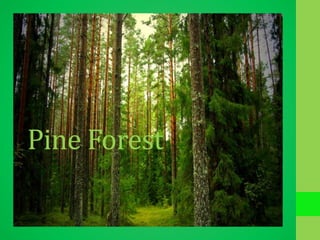
Pine Forest
• Pine forests are light coniferous forest
in which pine is the predominant tree.
• The pine forest is a monoculture,
meaning only one species -- Eastern
white pine (Pinus strobus) -- was
planted here.
Characteristics
• A monoculture causes a decline in the
number of species, particularly animal
species, existing in an area by
decreasing the variety of different
resources available.
• They occur on sandy loams, sands,
limestone, dolomites, and peat bogs.
• The climate in Pine Forest is warm
and temperate.
• In Pine Forest, the average annual
temperature is 19.6 °C. In a year, the
average rainfall is 1434 mm.
Climate and amount of rainfall
Luzon Tropical Pine
Forest
• The Luzon tropical pine forests are a
tropical coniferous forest ecoregion
of the Philippines in the western
Pacific Ocean.
Location and description
• Found at elevations over 1000m in the Cordillera
Central mountains in the north of the island.
• The Cordillera Central includes Luzon's highest
peak Mount Pulag along with other high peaks
such as Mount Puguis, Mount Polis and Mount
Data.
• Also found in the Zambales Mountains of west-
central Luzon, particularly in Mount Tapulao and
Mount Redondo near Subic, Zambales.
Flora
• In this ecoregion Benguet pine(Pinus
insularis) trees are thinly spread over
the grasslands that cover the slopes.
Regular fires in the dry season maintain
the balance of pines and grassland and
prevent other deciduous trees and
shrubs from taking hold.
Fauna
• There are a number of mammals endemic to the
Cordillera Central, mainly species of mice and rats
including large squirrel-like cloud rats.
• Three larger mammals in this forest are the:
Philippine Long-tailed Macaque (Macaca
fascicularis)
Philippine Warty Pig (Sus philippensis)
Malayan Civet (Viverra tangalunga)
• The most common bird in this forest is the:
Pine-nut eating Common Crossbill
Threats
• Pine trees have been cut down for
timber, firewood and turpentine
production for centuries and today
this is intensified as forest is cleared
for agriculture and copper and gold
mining projects as the population of
the Philippines grows and remains
impoverished in these rural areas.
Preservation
• In the dry season it is a straight
forward process to set fires for forest
clearance. Protected areas include
Mount Pulag, home to a number of
endemic plants and birds.
Is my
report
pine?
Pine forest

Pine forest

  • 1.
  • 2.
    • Pine forestsare light coniferous forest in which pine is the predominant tree. • The pine forest is a monoculture, meaning only one species -- Eastern white pine (Pinus strobus) -- was planted here. Characteristics
  • 3.
    • A monoculturecauses a decline in the number of species, particularly animal species, existing in an area by decreasing the variety of different resources available. • They occur on sandy loams, sands, limestone, dolomites, and peat bogs.
  • 4.
    • The climatein Pine Forest is warm and temperate. • In Pine Forest, the average annual temperature is 19.6 °C. In a year, the average rainfall is 1434 mm. Climate and amount of rainfall
  • 6.
  • 7.
    • The Luzontropical pine forests are a tropical coniferous forest ecoregion of the Philippines in the western Pacific Ocean.
  • 8.
    Location and description •Found at elevations over 1000m in the Cordillera Central mountains in the north of the island. • The Cordillera Central includes Luzon's highest peak Mount Pulag along with other high peaks such as Mount Puguis, Mount Polis and Mount Data. • Also found in the Zambales Mountains of west- central Luzon, particularly in Mount Tapulao and Mount Redondo near Subic, Zambales.
  • 9.
    Flora • In thisecoregion Benguet pine(Pinus insularis) trees are thinly spread over the grasslands that cover the slopes. Regular fires in the dry season maintain the balance of pines and grassland and prevent other deciduous trees and shrubs from taking hold.
  • 10.
    Fauna • There area number of mammals endemic to the Cordillera Central, mainly species of mice and rats including large squirrel-like cloud rats. • Three larger mammals in this forest are the: Philippine Long-tailed Macaque (Macaca fascicularis) Philippine Warty Pig (Sus philippensis) Malayan Civet (Viverra tangalunga) • The most common bird in this forest is the: Pine-nut eating Common Crossbill
  • 11.
    Threats • Pine treeshave been cut down for timber, firewood and turpentine production for centuries and today this is intensified as forest is cleared for agriculture and copper and gold mining projects as the population of the Philippines grows and remains impoverished in these rural areas.
  • 12.
    Preservation • In thedry season it is a straight forward process to set fires for forest clearance. Protected areas include Mount Pulag, home to a number of endemic plants and birds.
  • 13.

Editor's Notes

  • #4 Notice that there is very little undergrowth, hardly any trees & shrubs other than pines.
  • #9 These pine forests are found at elevations over 1000m in the Cordillera Central mountains in the north of the island, where they are mixed in with areas of Luzon montane rain forests especially at the northern end of the range.