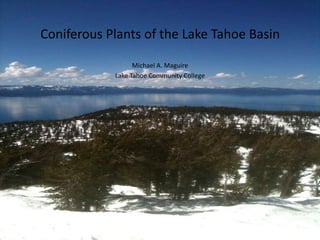
Coniferous Plants of the Lake Tahoe Basin

                  Michael A. Maguire
            Lake Tahoe Community College
Abstract
The focus of this lab/field assignment was to gain insight into the coniferous
plant life of the Lake Tahoe basin. Each of these plants is an essential
component to the biological productivity of this delicate ecosystem. This
presentation seeks to identify and analyze these elements and construct an
intricate understanding of how this ecosystem benefits from their presence.
Native Coniferous Plants of the Lake Tahoe Basin

• The Pine Family
   - Evergreen, needled trees with unisexual reproductive structures (cones)
     occurring on the same tree (monoecious).
   - Male Pollen cones are non-woody and deciduous.
   - Female seed cones (pine cones) are woody with bracts and persistent
     scales.
• The Cypress Family
   - Evergreen trees
   - Opposite, four ranked or whorled, scale like leaves
   - Fleshy seed cones, become hard at maturity


           (Rost, T.L., Barbour, M.G., Stocking, C.R., & Murphy T.M., 2006)
The Importance of Coniferous Plants in the Lake
                Tahoe basin
• Conifers in the Lake Tahoe basin are of immense ecological importance.
  They represent the dominant class of plant life that inhabits the Lake
  Tahoe Basin.
• Without their presence, the ecosystem would suffer to sustain its survival.
• Erosion would decrease drastically, the biological productivity of the
  terrestrial landscape would be greatly inhibited, and the clarity of the lake
  would be greatly impacted.
• Animals, birds, and beneficial micro-organisms would as well lose an
  essential resource that they need to survive.
The Evolution of Coniferous Plants
• The earliest conifers in the fossil record date to the late Carboniferous
  period, about 300 million years ago. (Pinophyta, 2012)
• An important adaptation of these gymnosperms was allowing plants to
  live without being so dependent on water. (Pinophyta, 2012)
• Another adaptation is the development of pollen, which allows the
  embryo to be transported and developed elsewhere. (Pinophyta, 2012)
The Pine Family
             A. White Fir (Abiesconcolor) [Piss Fir]
                  1. Kingdom (Plantae), Division (Coniferophyta), Class (Pinopsida), Order
      (Pinales),                  Family (Pinacaea), Genus (Abies), Species (AbiesConcolor).
                  2. 0 to 120 feet tall
                  3. Late season
                  4. Semi-moist to dry, cool habitats
                        a. Mostly found below 7,500 feet in elevation
b. Smooth White-gray bark in young trees
c. Deeply furrowed dark-gray bark on mature trees
d. Single, unbundled needles
i. Longer needles than red fir
ii. Flattened
                              iii. Twisted 180° at the base
e. Seed cones grow in single season (about 4 inches in length)
f. Tend to die from the top down


                                          (Graf, 1999)
The Pine Family
            B. Red fir (Abiesmagnifica) [Silver Tip]
                  1. Kingdom (Plantae), Division (Coniferophyta), Class (Pinopsida), Order
     (Pinales),                   Family (Pinacaea), Genus (Abies Mill), Species (Abiesmagnificana)
                  2. 60 to 180 feet tall
                  3. Late season
                  4. semi-moist, cool habitats
                        a. Abundant on cool exposures in deep soils
b. Found between 7,000-9,000 feet in elevation
c. Mature red fir distinguished from white fir by
i. Deeply furrowed, purplish red bark
                              ii. Tightly needled
                              iii. Jigsaw-puzzled branch orientation that project out horizontally
                                   from the trunk
d. Young red fir distinguished by
i. Smaller, untwisted, rounded needles
e. Cones may be over 8 inches long (twice the size of white fir cones)


                                                (Graf, 1999)
The Pine Family

           C. Jeffrey Pine (Pinusjeffreyi)
                  1. Kingdom (Plantae), Division (Coniferophyta), Class (Pinopsida), Order
    (Pinales),                  Family (Pinacaea), Genus (Pinus), Species (Pinusjeffreyi)
                  2. 2 to 160 feet tall
                  3. Late season
                  4. Dry, open to semi-open habitats
                         a. Common on drier soils from lake level to 8,000 feet in elevation
b. At lower elevations, on exposed rocky slopes and in the drier regions of
    the basin, it is the most abundant conifer.
                  5. Recognizable by its three long grayish-blue needles
                  6. Reddish-brown, deep furrowed bark, gives off a vanilla-like smell
                  7. Large, oblong seed cones with recurved scales
                  8. Ranges from southern tip of Oregon to Baja California


                                            (Graf, 1999)
The Pine Family
            D. Lodgepole Pine (Pinuscontorta)
                  1. Kingdom (Plantae), Division (Coniferophyta), Class (Pinopsida), Order
     (Pinales),                 Family (Pinacaea), Genus (Pinus), Species (PinusContorta)
                  2. 1 to 120 feet tall
                  3. Mid to late season
                  4. Diverse habitats
                        a. Able to survive and prosper over a wide range of elevations
b. Most abundant in most areas along lake and meadow edges, aided bya
     root system that, unlike that of other conifers, is able to tolerate
     waterlogged, anaerobic environments.
c. Commonly found on thin, rocky soils that overlay granitic bedrock in
     higher elevation watersheds.
d. Flourish in soggy to dry soils by controlling rates of water uptake and loss
     from transpiration.
                  5. Two needled bundles, corn flake-like bark, and small spherical, pointed
                     cones
                  6. The common name, lodgepole, comes from Native Americans’ use of the
                      young trees as poles for their teepees.


                                            (Graf, 1999)
The Cypress Family
             A. Incense-cedar (Calocedrusdecurrenes)
                   1. Kingdom (Plantae), Division (Coniferophyta), Class (Pinopsida), Order (Pinales),
                      Family (Cupressaceae), Genus (CalocedrusKurz), Species (Calocedrusdecurrens)
                   2. Habitat
                          a. Large range of soils
b. Elevations below 7,000 feet in the Sierra Nevada’s
c. Found in California, Oregon, Washington, and sometimes in Nevada
                   3. 60 to 150 feet tall
                   4. Needles
                          a. Small, ovate, oblonged, and opposite
b. orientated in whorls of four
                   5. cones
                          a. Two types of cones, pollen cones and seed cones
i. Yellowish pollen cones
                                ii. Woody seed cones
                   6. Bark
                          a. Young trees
i. Purplish red color
b. Mature trees
i. Cinnamon-red color


                                          (Graf, 1999)
Core Samples
•   Taxonomic classification, growth patterns, bark characteristics, needle/leaflet
    arrangement, and natural habitats were utilized in the identification of these trees.
•   Tree Core samples where obtained with the use of an increment borer and a measurement of
    the circumference of each tree was also documented.
•   An increment borer is a tool used to take a core sample of a tree’s annual rings.
Core Samples Data
1. White fir (Abiesconcolor)
                     a. Sample 1
i. 2 feet 3 ¼ inch circumference
                           ii. 53years ± 3 years
              2. white Fir (Abiesconcolor)
a. Sample 2
i. 4 feet 5 inch circumference
                           ii. 100 years ± 3 years
              3. Jeffrey Pine (Pinusjeffreyi)
                     a. Sample 1
i. 4 feet 4 ½ inch circumference
                           ii. 70 years ± 5 years
              4. Jeffrey Pine (Pinusjeffreyi)
                     a. Sample 2
i. 5 feet 6 inch circumference
                           ii. 112 years ± 5 years
              5. Lodgepole Pine (Pinuscontorta ssp. Murrayana)
                     a. Sample 1
i. 5 feet ½ inch circumference
                           ii. 100 years ± 3 years
              6. Lodgepole Pine (Pinuscontorta ssp. Murrayana)
                     a. sample 2
i. 5 feet 3 ¾ inch circumference
                           ii. 100 years ± 10 years
White Fir
Red Fir
Jeffery Pine
Lodge Pole Pine
Incense Cedar
Granite
•   Granite is an igneous rock that that is composed of minerals that crystallized from
    cooling molten rock matter.
•   This process is known as intrusive igneous activity
•   Granite is a major component to the structure of the Sierra Nevada Mountains, which
    solidified under ground and was later “exposed at the surface following uplift and
    erosion.” (Monroe &Wicander, 2012, p. 86)


• The following image is a
  picture taken of granite
  boulders resting along the
  waters edge just past Sand
  Harbor on the north east
  shoreline, looking towards
  Crystal Bay.
Volcanic Rock

• A volcanic rocks is, “an extrusive igneous rock that forms when lava flows
  cool or when pyroclastic materials become consolidated , which then
  become extruded onto the surface.” (Monroe &Wicander, 2012, p. 87)
• Volcanic rocks grade into hypabyssal and metamorphic rocks and compose
  an important element of some sediments and sedimentary rocks.
  (Volcanic Rock, 2012)
Reference List

Graf , M. (1999). Plants of the Tahoe Basin (First ed.) CA: Phyllis M.
   Faber, CNPS Press.
Monroe, J.S., &Wicander, R. (2012). The changing Earth: Exploring Geology
   and Evolution (6th ed.). Belmont, CA: Brooks/Cole, Cengage Learning.
Rost, T.L., Barbour, M.G., Stocking, C.R., & Murphy T.M. (2006). Plant Biology.
   (Second ed.). CA: Thomson Brooks/Cole.
Pinophyta. (2012). In Wikipedia. Retrieved July 29, 2012, from
http://en.wikipedia.org/wiki/Conifer#Evolution
Plant Evolution Timeline. (2012). Evolution of Plants. Retrieved July
   29, 2012, from
   http://botanistbackyard.blogspot.com/2012/03/evolution-of-plants.html
Volcanic Rock. (2012). In Wikipedia. Retrieved July 29, 2012, from
   http://en.wikipedia.org/wiki/Volcanic_rock

Gel 103 lab work # 2

  • 1.
    Coniferous Plants ofthe Lake Tahoe Basin Michael A. Maguire Lake Tahoe Community College
  • 2.
    Abstract The focus ofthis lab/field assignment was to gain insight into the coniferous plant life of the Lake Tahoe basin. Each of these plants is an essential component to the biological productivity of this delicate ecosystem. This presentation seeks to identify and analyze these elements and construct an intricate understanding of how this ecosystem benefits from their presence.
  • 3.
    Native Coniferous Plantsof the Lake Tahoe Basin • The Pine Family - Evergreen, needled trees with unisexual reproductive structures (cones) occurring on the same tree (monoecious). - Male Pollen cones are non-woody and deciduous. - Female seed cones (pine cones) are woody with bracts and persistent scales. • The Cypress Family - Evergreen trees - Opposite, four ranked or whorled, scale like leaves - Fleshy seed cones, become hard at maturity (Rost, T.L., Barbour, M.G., Stocking, C.R., & Murphy T.M., 2006)
  • 4.
    The Importance ofConiferous Plants in the Lake Tahoe basin • Conifers in the Lake Tahoe basin are of immense ecological importance. They represent the dominant class of plant life that inhabits the Lake Tahoe Basin. • Without their presence, the ecosystem would suffer to sustain its survival. • Erosion would decrease drastically, the biological productivity of the terrestrial landscape would be greatly inhibited, and the clarity of the lake would be greatly impacted. • Animals, birds, and beneficial micro-organisms would as well lose an essential resource that they need to survive.
  • 5.
    The Evolution ofConiferous Plants • The earliest conifers in the fossil record date to the late Carboniferous period, about 300 million years ago. (Pinophyta, 2012) • An important adaptation of these gymnosperms was allowing plants to live without being so dependent on water. (Pinophyta, 2012) • Another adaptation is the development of pollen, which allows the embryo to be transported and developed elsewhere. (Pinophyta, 2012)
  • 6.
    The Pine Family A. White Fir (Abiesconcolor) [Piss Fir] 1. Kingdom (Plantae), Division (Coniferophyta), Class (Pinopsida), Order (Pinales), Family (Pinacaea), Genus (Abies), Species (AbiesConcolor). 2. 0 to 120 feet tall 3. Late season 4. Semi-moist to dry, cool habitats a. Mostly found below 7,500 feet in elevation b. Smooth White-gray bark in young trees c. Deeply furrowed dark-gray bark on mature trees d. Single, unbundled needles i. Longer needles than red fir ii. Flattened iii. Twisted 180° at the base e. Seed cones grow in single season (about 4 inches in length) f. Tend to die from the top down (Graf, 1999)
  • 7.
    The Pine Family B. Red fir (Abiesmagnifica) [Silver Tip] 1. Kingdom (Plantae), Division (Coniferophyta), Class (Pinopsida), Order (Pinales), Family (Pinacaea), Genus (Abies Mill), Species (Abiesmagnificana) 2. 60 to 180 feet tall 3. Late season 4. semi-moist, cool habitats a. Abundant on cool exposures in deep soils b. Found between 7,000-9,000 feet in elevation c. Mature red fir distinguished from white fir by i. Deeply furrowed, purplish red bark ii. Tightly needled iii. Jigsaw-puzzled branch orientation that project out horizontally from the trunk d. Young red fir distinguished by i. Smaller, untwisted, rounded needles e. Cones may be over 8 inches long (twice the size of white fir cones) (Graf, 1999)
  • 8.
    The Pine Family C. Jeffrey Pine (Pinusjeffreyi) 1. Kingdom (Plantae), Division (Coniferophyta), Class (Pinopsida), Order (Pinales), Family (Pinacaea), Genus (Pinus), Species (Pinusjeffreyi) 2. 2 to 160 feet tall 3. Late season 4. Dry, open to semi-open habitats a. Common on drier soils from lake level to 8,000 feet in elevation b. At lower elevations, on exposed rocky slopes and in the drier regions of the basin, it is the most abundant conifer. 5. Recognizable by its three long grayish-blue needles 6. Reddish-brown, deep furrowed bark, gives off a vanilla-like smell 7. Large, oblong seed cones with recurved scales 8. Ranges from southern tip of Oregon to Baja California (Graf, 1999)
  • 9.
    The Pine Family D. Lodgepole Pine (Pinuscontorta) 1. Kingdom (Plantae), Division (Coniferophyta), Class (Pinopsida), Order (Pinales), Family (Pinacaea), Genus (Pinus), Species (PinusContorta) 2. 1 to 120 feet tall 3. Mid to late season 4. Diverse habitats a. Able to survive and prosper over a wide range of elevations b. Most abundant in most areas along lake and meadow edges, aided bya root system that, unlike that of other conifers, is able to tolerate waterlogged, anaerobic environments. c. Commonly found on thin, rocky soils that overlay granitic bedrock in higher elevation watersheds. d. Flourish in soggy to dry soils by controlling rates of water uptake and loss from transpiration. 5. Two needled bundles, corn flake-like bark, and small spherical, pointed cones 6. The common name, lodgepole, comes from Native Americans’ use of the young trees as poles for their teepees. (Graf, 1999)
  • 10.
    The Cypress Family A. Incense-cedar (Calocedrusdecurrenes) 1. Kingdom (Plantae), Division (Coniferophyta), Class (Pinopsida), Order (Pinales), Family (Cupressaceae), Genus (CalocedrusKurz), Species (Calocedrusdecurrens) 2. Habitat a. Large range of soils b. Elevations below 7,000 feet in the Sierra Nevada’s c. Found in California, Oregon, Washington, and sometimes in Nevada 3. 60 to 150 feet tall 4. Needles a. Small, ovate, oblonged, and opposite b. orientated in whorls of four 5. cones a. Two types of cones, pollen cones and seed cones i. Yellowish pollen cones ii. Woody seed cones 6. Bark a. Young trees i. Purplish red color b. Mature trees i. Cinnamon-red color (Graf, 1999)
  • 11.
    Core Samples • Taxonomic classification, growth patterns, bark characteristics, needle/leaflet arrangement, and natural habitats were utilized in the identification of these trees. • Tree Core samples where obtained with the use of an increment borer and a measurement of the circumference of each tree was also documented. • An increment borer is a tool used to take a core sample of a tree’s annual rings.
  • 12.
    Core Samples Data 1.White fir (Abiesconcolor) a. Sample 1 i. 2 feet 3 ¼ inch circumference ii. 53years ± 3 years 2. white Fir (Abiesconcolor) a. Sample 2 i. 4 feet 5 inch circumference ii. 100 years ± 3 years 3. Jeffrey Pine (Pinusjeffreyi) a. Sample 1 i. 4 feet 4 ½ inch circumference ii. 70 years ± 5 years 4. Jeffrey Pine (Pinusjeffreyi) a. Sample 2 i. 5 feet 6 inch circumference ii. 112 years ± 5 years 5. Lodgepole Pine (Pinuscontorta ssp. Murrayana) a. Sample 1 i. 5 feet ½ inch circumference ii. 100 years ± 3 years 6. Lodgepole Pine (Pinuscontorta ssp. Murrayana) a. sample 2 i. 5 feet 3 ¾ inch circumference ii. 100 years ± 10 years
  • 13.
  • 14.
  • 15.
  • 16.
  • 17.
  • 18.
    Granite • Granite is an igneous rock that that is composed of minerals that crystallized from cooling molten rock matter. • This process is known as intrusive igneous activity • Granite is a major component to the structure of the Sierra Nevada Mountains, which solidified under ground and was later “exposed at the surface following uplift and erosion.” (Monroe &Wicander, 2012, p. 86) • The following image is a picture taken of granite boulders resting along the waters edge just past Sand Harbor on the north east shoreline, looking towards Crystal Bay.
  • 19.
    Volcanic Rock • Avolcanic rocks is, “an extrusive igneous rock that forms when lava flows cool or when pyroclastic materials become consolidated , which then become extruded onto the surface.” (Monroe &Wicander, 2012, p. 87) • Volcanic rocks grade into hypabyssal and metamorphic rocks and compose an important element of some sediments and sedimentary rocks. (Volcanic Rock, 2012)
  • 20.
    Reference List Graf ,M. (1999). Plants of the Tahoe Basin (First ed.) CA: Phyllis M. Faber, CNPS Press. Monroe, J.S., &Wicander, R. (2012). The changing Earth: Exploring Geology and Evolution (6th ed.). Belmont, CA: Brooks/Cole, Cengage Learning. Rost, T.L., Barbour, M.G., Stocking, C.R., & Murphy T.M. (2006). Plant Biology. (Second ed.). CA: Thomson Brooks/Cole. Pinophyta. (2012). In Wikipedia. Retrieved July 29, 2012, from http://en.wikipedia.org/wiki/Conifer#Evolution Plant Evolution Timeline. (2012). Evolution of Plants. Retrieved July 29, 2012, from http://botanistbackyard.blogspot.com/2012/03/evolution-of-plants.html Volcanic Rock. (2012). In Wikipedia. Retrieved July 29, 2012, from http://en.wikipedia.org/wiki/Volcanic_rock