Comparison of the Dry Forest of
  Guanica and the Caribbean
 National Forest “El Yunque”
     Group #1: Carla J. Figueroa   Gustavo Martinez
               Crystal K. Colon    John E. Munoz
               Zuleika Velazquez   Luis F. Centeno
Introduction

 On the days of June 19 and 21, we had two separate
  field trips to two completely different areas of
  Puerto Rico. We traveled to el Bosque Seco de
  Guánica on June 19, then to el Bosque Nacional del
  Caribe, el Yunque, on June 21. After having
  travelled to both forests, we were able to compare
  these completely different, yet similar areas.
Dry Forest of Guanica
Climate and Location

 Located in the southwestern area of Puerto Rico, this
  forest expands all the way from Guánica to Ponce,
  covering roughly over 11,000 acres of land.
 The climate is hot and dry, due to a lack of precipitation
  because of the restrictions placed by the Cordillera
  Central de P.R., which does not allow the passage of
  rain-carrying winds.
 The forest receives approximately 30-40 in. of rain per
  year.
 Because of the harsh climate and extreme temperature,
  the organisms have adapted to thrive and survive in this
  forest.
Birds

 They have recorded 136 species of birds, 12 of them are
  endemic (3 of which are endangered and 8 in the list of
  endangered species).
 Compared with rain forests: 31 versus 20 species of birds
  per 1,000 individuals.
 More number of birds per linear mile (0.6 miles) in
  Guánica in a rainforest.
 The ecological role of frogs and lizards of the Anvil, in
  Guánica is carried out mainly by insectivorous birds.
 Furthermore, the forest contains a wide range of insects
  that provide food for many birds.
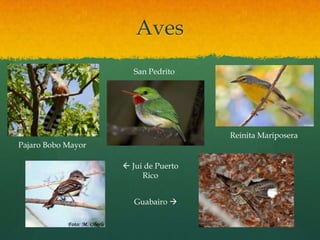
Aves
                       San Pedrito


                                      Reinita Mariposera
Pajaro Bobo Mayor

                     Jui de Puerto
                         Rico


                       Guabairo 
Bird Adaptations

 High percentage of nocturnal animals.
 Many species with scales that prevent desiccation
 Obtain water from the dam to ingest and vegetation.
 Hibernation.
 Animals that are buried or used natural cavities.
 Low breathing.
 Bodies with light colors.
 They nest on the ground or in bushes.
Fauna

 There have been a very valuable herpetofauna
  which includes 21 species of reptiles and 6 species of
  amphibians.

 Among the reptiles there are 8 species of lizards
  endemic to Puerto Rico and the Virgin Islands.

 Among the amphibians there has been some
  notoriety crested toad.

 During dry weather remains a refugee, just leave
  the aestivation period as a result of precipitation.
Flora

 The flora of the Guanica Dry Forest is no longer than 49
  ft. Because in that form they conserve water and don’t
  spend it in biomass.

 Most of the vegetation is semideciduous are lost their
  leaves in summer.

 In the Guanica Dry Forest, the flora modified their
  activities for the principal goal of all, conserve water.
  Some of the adaptations are: vertical orientation of the
  leave to avoid direct sunlight, stems that carry out the
  photosynthesis and plants with spines.
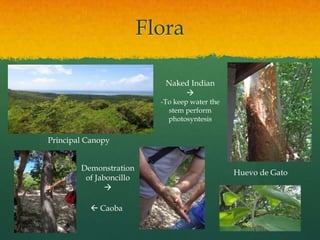
Flora

                            Naked Indian
                                
                           -To keep water the
                             stem perform
                             photosyntesis


Principal Canopy


        Demonstration
                                                Huevo de Gato
         of Jaboncillo
               

           Caoba
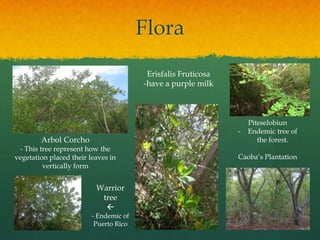
Flora
                                         Erisfalis Fruticosa
                                        -have a purple milk


                                                                   Piteselobiun
                                                               -   Endemic tree of
        Arbol Corcho                                                  the forest.
 - This tree represent how the
vegetation placed their leaves in                              Caoba’s Plantation
         vertically form


                          Warrior
                           tree
                            
                         - Endemic of
                          Puerto Rico
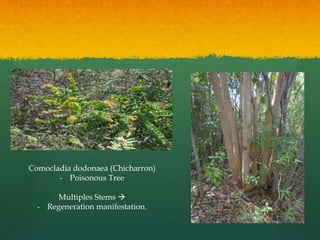
Comocladia dodonaea (Chicharron)
       - Poisonous Tree

      Multiples Stems 
  - Regeneration manifestation.
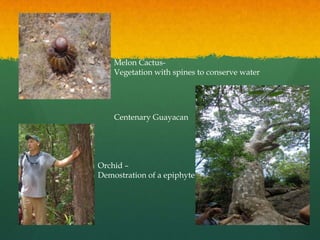
Melon Cactus-
    Vegetation with spines to conserve water


    Centenary Guayacan


Orchid –
Demostration of a epiphyte
The Caribbean National
        Forest
     “El Yunque”
Clima y Localizacion

 Localizado a 49 Kms de San Juan en las Sierras de
  Luquillo, tiene una temperatura de 78 grados Fahrenheit
  en las partes bajas y alrededor de 65 grados Fahrenheit
  en areas sobre los 3,200 pies.
 Recibe alrededor de 250 pulgadas de precipitación al año
  significando que caen aguaceros ligeros pero intensos
  diariamente esto causa que el suelo del bosque sufra
  grandes perdidas por la erosión.
 Por la cantidad de precipitación que cae la isla de Puerto
  Rico depende de el para poder adquirir la cantidad de
  agua suficiente para los habitantes.
Fauna

 The fauna that lives in the forest is limited to small
  animals.
 Approximately 100 vertebrates including amphibians
  and birds live in the different forests of “El Yunque”. The
  mammalian are represented by 11 different species of
  bats.
 The most common invertebrates are snails and the
  Puerto Rican Boa.
 Puerto Rico’s most important native animal is the
  “Coqui”. It is an in danger specie and approximately
  twelve (12) different types of them live in the forest.
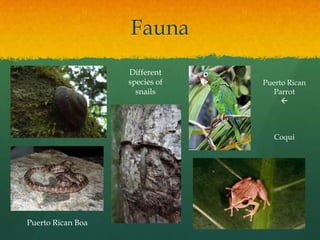
Fauna
                   Different
                   species of   Puerto Rican
                     snails        Parrot
                                     


                                   Coqui


Puerto Rican Boa
Flora

 Poses more vegetation diversity by area unit than
  any other forest in America. 225 especies de árboles,
  nativos del bosque.

 It has twenty-three (23) endemic species, fourty-
  seven (47) introduced species, eighty-eight (88) tree
  species that are considered rare or strange, fifty (50)
  different species of native orchids and one-hundred
  & fifty (150) fern species.
Types of Forests

 Pluvial Forest

 Palo Colorado Forest

 Palma de Sierra Forest

 Elfin Forest
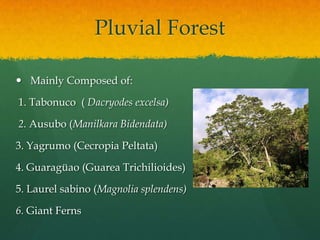
Pluvial Forest

 Mainly Composed of:

1. Tabonuco ( Dacryodes excelsa)

2. Ausubo (Manilkara Bidendata)

3. Yagrumo (Cecropia Peltata)

4. Guaragüao (Guarea Trichilioides)

5. Laurel sabino (Magnolia splendens)

6. Giant Ferns
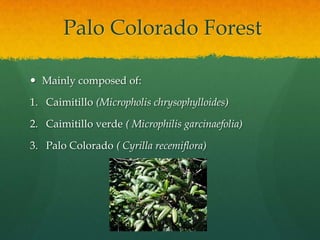
Palo Colorado Forest

 Mainly composed of:

1. Caimitillo (Micropholis chrysophylloides)

2. Caimitillo verde ( Microphilis garcinaefolia)

3. Palo Colorado ( Cyrilla recemiflora)
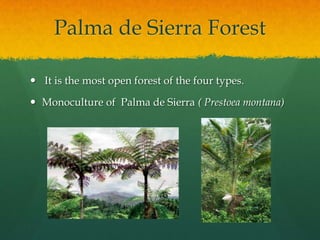
Palma de Sierra Forest

 It is the most open forest of the four types.

 Monoculture of Palma de Sierra ( Prestoea montana)
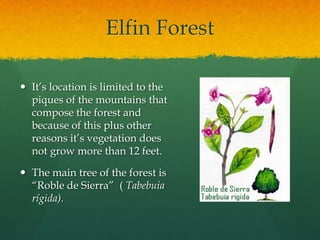
Elfin Forest

 It’s location is limited to the
  piques of the mountains that
  compose the forest and
  because of this plus other
  reasons it’s vegetation does
  not grow more than 12 feet.

 The main tree of the forest is
  “Roble de Sierra” ( Tabebuia
  rígida).
Conclusion

Comparacion de bosques grupo #1

  • 1.
    Comparison of theDry Forest of Guanica and the Caribbean National Forest “El Yunque” Group #1: Carla J. Figueroa Gustavo Martinez Crystal K. Colon John E. Munoz Zuleika Velazquez Luis F. Centeno
  • 2.
    Introduction  On thedays of June 19 and 21, we had two separate field trips to two completely different areas of Puerto Rico. We traveled to el Bosque Seco de Guánica on June 19, then to el Bosque Nacional del Caribe, el Yunque, on June 21. After having travelled to both forests, we were able to compare these completely different, yet similar areas.
  • 3.
  • 4.
    Climate and Location Located in the southwestern area of Puerto Rico, this forest expands all the way from Guánica to Ponce, covering roughly over 11,000 acres of land.  The climate is hot and dry, due to a lack of precipitation because of the restrictions placed by the Cordillera Central de P.R., which does not allow the passage of rain-carrying winds.  The forest receives approximately 30-40 in. of rain per year.  Because of the harsh climate and extreme temperature, the organisms have adapted to thrive and survive in this forest.
  • 5.
    Birds  They haverecorded 136 species of birds, 12 of them are endemic (3 of which are endangered and 8 in the list of endangered species).  Compared with rain forests: 31 versus 20 species of birds per 1,000 individuals.  More number of birds per linear mile (0.6 miles) in Guánica in a rainforest.  The ecological role of frogs and lizards of the Anvil, in Guánica is carried out mainly by insectivorous birds.  Furthermore, the forest contains a wide range of insects that provide food for many birds.
  • 6.
    Aves San Pedrito Reinita Mariposera Pajaro Bobo Mayor  Jui de Puerto Rico Guabairo 
  • 7.
    Bird Adaptations  Highpercentage of nocturnal animals.  Many species with scales that prevent desiccation  Obtain water from the dam to ingest and vegetation.  Hibernation.  Animals that are buried or used natural cavities.  Low breathing.  Bodies with light colors.  They nest on the ground or in bushes.
  • 8.
    Fauna  There havebeen a very valuable herpetofauna which includes 21 species of reptiles and 6 species of amphibians.  Among the reptiles there are 8 species of lizards endemic to Puerto Rico and the Virgin Islands.  Among the amphibians there has been some notoriety crested toad.  During dry weather remains a refugee, just leave the aestivation period as a result of precipitation.
  • 9.
    Flora  The floraof the Guanica Dry Forest is no longer than 49 ft. Because in that form they conserve water and don’t spend it in biomass.  Most of the vegetation is semideciduous are lost their leaves in summer.  In the Guanica Dry Forest, the flora modified their activities for the principal goal of all, conserve water. Some of the adaptations are: vertical orientation of the leave to avoid direct sunlight, stems that carry out the photosynthesis and plants with spines.
  • 10.
    Flora Naked Indian  -To keep water the stem perform photosyntesis Principal Canopy Demonstration Huevo de Gato of Jaboncillo   Caoba
  • 11.
    Flora Erisfalis Fruticosa -have a purple milk Piteselobiun - Endemic tree of Arbol Corcho the forest. - This tree represent how the vegetation placed their leaves in Caoba’s Plantation vertically form Warrior tree  - Endemic of Puerto Rico
  • 12.
    Comocladia dodonaea (Chicharron) - Poisonous Tree Multiples Stems  - Regeneration manifestation.
  • 13.
    Melon Cactus- Vegetation with spines to conserve water Centenary Guayacan Orchid – Demostration of a epiphyte
  • 14.
    The Caribbean National Forest “El Yunque”
  • 15.
    Clima y Localizacion Localizado a 49 Kms de San Juan en las Sierras de Luquillo, tiene una temperatura de 78 grados Fahrenheit en las partes bajas y alrededor de 65 grados Fahrenheit en areas sobre los 3,200 pies.  Recibe alrededor de 250 pulgadas de precipitación al año significando que caen aguaceros ligeros pero intensos diariamente esto causa que el suelo del bosque sufra grandes perdidas por la erosión.  Por la cantidad de precipitación que cae la isla de Puerto Rico depende de el para poder adquirir la cantidad de agua suficiente para los habitantes.
  • 16.
    Fauna  The faunathat lives in the forest is limited to small animals.  Approximately 100 vertebrates including amphibians and birds live in the different forests of “El Yunque”. The mammalian are represented by 11 different species of bats.  The most common invertebrates are snails and the Puerto Rican Boa.  Puerto Rico’s most important native animal is the “Coqui”. It is an in danger specie and approximately twelve (12) different types of them live in the forest.
  • 17.
    Fauna Different species of Puerto Rican snails Parrot  Coqui Puerto Rican Boa
  • 18.
    Flora  Poses morevegetation diversity by area unit than any other forest in America. 225 especies de árboles, nativos del bosque.  It has twenty-three (23) endemic species, fourty- seven (47) introduced species, eighty-eight (88) tree species that are considered rare or strange, fifty (50) different species of native orchids and one-hundred & fifty (150) fern species.
  • 19.
    Types of Forests Pluvial Forest  Palo Colorado Forest  Palma de Sierra Forest  Elfin Forest
  • 20.
    Pluvial Forest  MainlyComposed of: 1. Tabonuco ( Dacryodes excelsa) 2. Ausubo (Manilkara Bidendata) 3. Yagrumo (Cecropia Peltata) 4. Guaragüao (Guarea Trichilioides) 5. Laurel sabino (Magnolia splendens) 6. Giant Ferns
  • 21.
    Palo Colorado Forest Mainly composed of: 1. Caimitillo (Micropholis chrysophylloides) 2. Caimitillo verde ( Microphilis garcinaefolia) 3. Palo Colorado ( Cyrilla recemiflora)
  • 22.
    Palma de SierraForest  It is the most open forest of the four types.  Monoculture of Palma de Sierra ( Prestoea montana)
  • 23.
    Elfin Forest  It’slocation is limited to the piques of the mountains that compose the forest and because of this plus other reasons it’s vegetation does not grow more than 12 feet.  The main tree of the forest is “Roble de Sierra” ( Tabebuia rígida).
  • 24.