FLORA AND
FAUNA
FLOR
A
Flora, meaning "Goddess of the Flower,"
represents the entire plant kingdom in a specific
region.
Flora classification depends on habitat,
affecting distribution.
The native Philippines
orchid Fowlie
Paphiopedilum grows
on limestone cliffs at
600-950 m altitude and
is rarely exposed to
sunshine.
Nepenthes peltata is a
tropical pitcher plant in the
Philippines, found on Mount
Hamiguitan's upper slopes. It
has a peltate tendril
attachment and indumentum,
producing ovoid pitchers with
a basal crest and large
nectar glands.
Paphiopedilum ciliolare is
endemic to four Philippines
islands, growing on
limestone bushes, volcanic
ridges, and
subtropical/tropical moist
montane forests at 300-
1830 meters.
Medinilla magnifica
Lindl. 1850 is a native
Philippine evergreen
shrub, growing up to 8
feet in part shade or
ground clearings.
Strongylodon macrobotrys,
also known as jade vine, is a
30-50' long perennial woody
vine native to tropical rain
forests in the Philippines.
Despite deforestation, it
survives in cultivation and
nurseries worldwide.
Amyema incarnatiflora, a
Lorantacae species,
inhabits mountainous
Cabadbaran and jungles of
Cagayan province,
producing pink flowers with
half-open parasol shape.
Dillenia monantha, a
unique Philippine species,
produces a single yellow
flower with a spider-like
bottom color.
Xanthostemon fructicosus, a
Myrtaceae species, is
distinguished by its
spectacular foliage and red
bunches of actinomorphous
flowers, attracting 3,000
species in Australia,
Mediterranean, and America.
Plumeria acuminata, also
known as 'perungalli' in Tamil,
is a plant used in traditional
medicine for various diseases,
including purgatives, diarrhoea
remedies, itch cures,
inflammation treatment, and
rheumatism. Its bark is also
effective in treating hard
tumors, diarrhea, and
gonorrhoea.
Paphiopedilum adductum is
endemic to Mindanao Island
of the Philippines, found at
high elevation between 1250
and 1350 meters above sea
level, near Impasugong in
Bukidnon province. It grows
as an epiphyte in leafy
humus, in the subtropical or
tropical moist lowland forests.
It prefers mid-shaded habitats
in tropical climates and
flowers in early winter.
Rafflessia manillana the
world's largest and
endemic species, is
named after Sir Stamford
Raffles and Manila. Its
foul-smelling flower and
carrion flies pollinate it.
FAU
NA
Fauna or “fauns”, originating from Roman mythology,
refers to indigenous animal life and forest spirits,
possibly referring to fertility goddesses.
World’s Largest Clam
The largest clam in the world
contains the world's largest pearl,
"The Pearl of Lao Tzu," valued at
$42 million and believed to be
600 years old..
Endangered Dwarf Buffalo
Dwarf buffalo, known as
Tamaraws, roamed Mindoro's
province in the 1900s. Today,
the Tamaraws, once a symbol
of the island, are in danger of
extinction, potentially losing
their status as the "Land of
the Tamaraws."
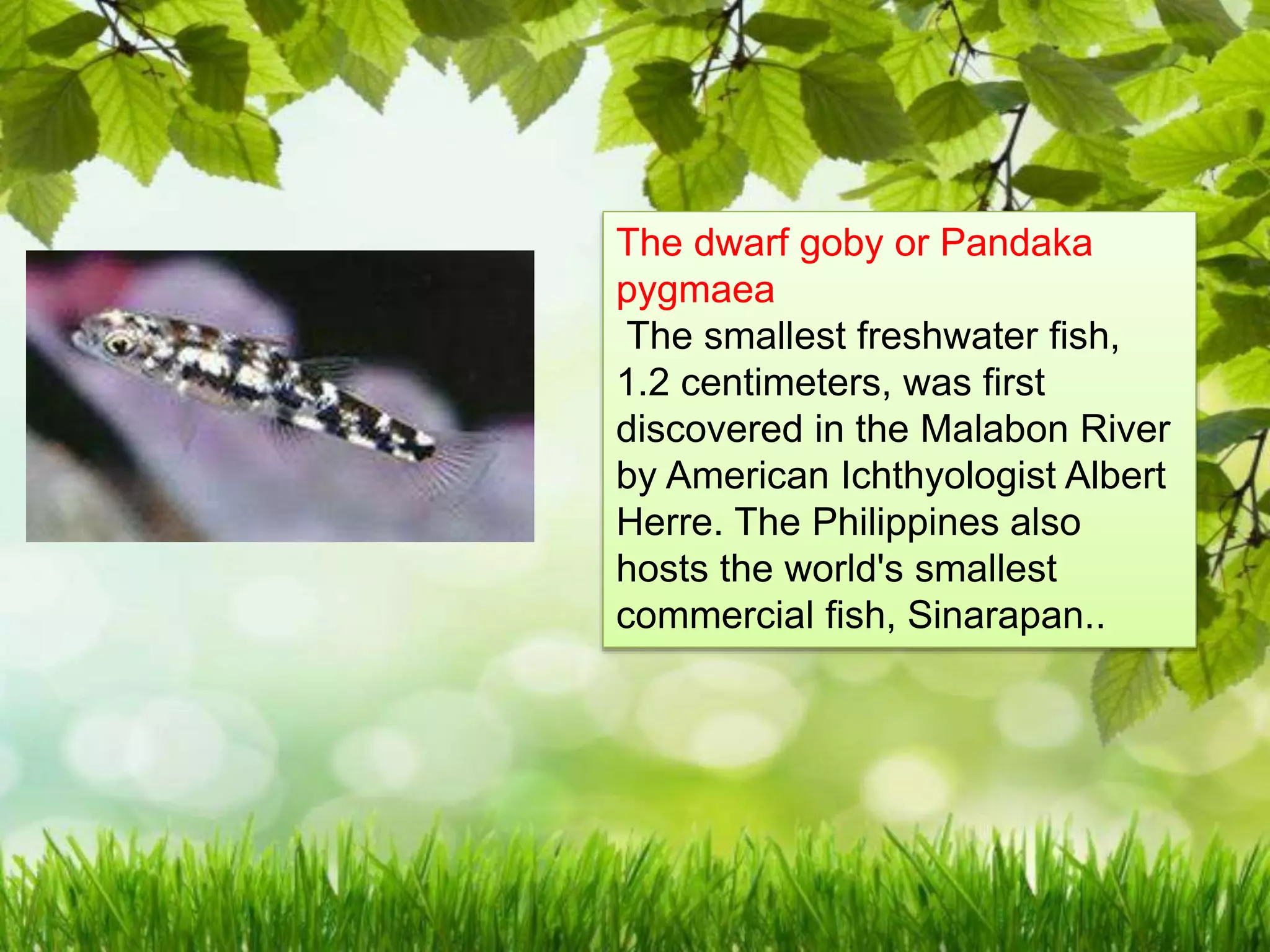
The dwarf goby or Pandaka
pygmaea
The smallest freshwater fish,
1.2 centimeters, was first
discovered in the Malabon River
by American Ichthyologist Albert
Herre. The Philippines also
hosts the world's smallest
commercial fish, Sinarapan..
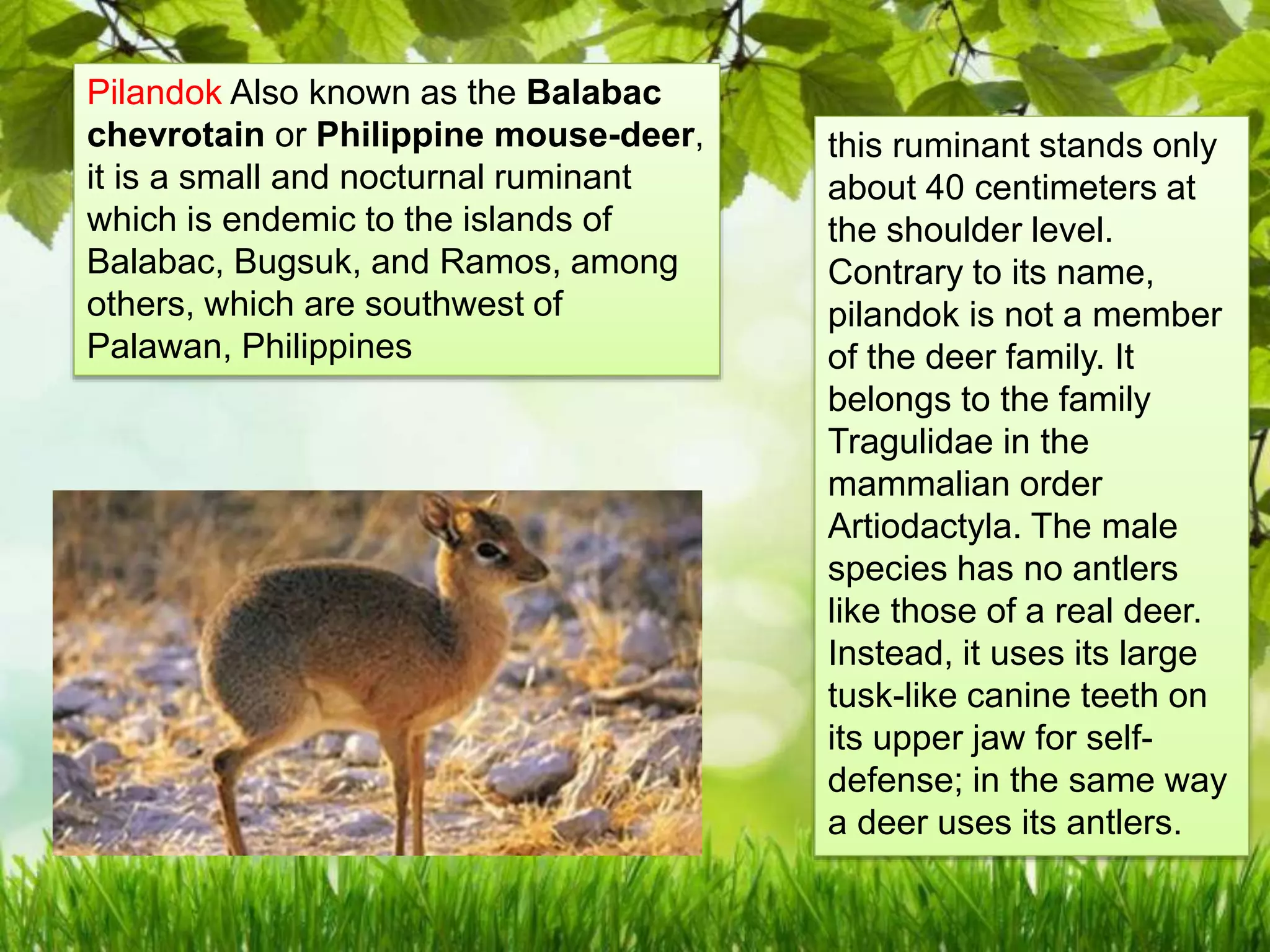
Pilandok Also known as the Balabac
chevrotain or Philippine mouse-deer,
it is a small and nocturnal ruminant
which is endemic to the islands of
Balabac, Bugsuk, and Ramos, among
others, which are southwest of
Palawan, Philippines
this ruminant stands only
about 40 centimeters at
the shoulder level.
Contrary to its name,
pilandok is not a member
of the deer family. It
belongs to the family
Tragulidae in the
mammalian order
Artiodactyla. The male
species has no antlers
like those of a real deer.
Instead, it uses its large
tusk-like canine teeth on
its upper jaw for self-
defense; in the same way
a deer uses its antlers.
Philippine Eagle
The Philippine eagle, also
known as the monkey-
eating eagle, is one of the
world's largest eagles,
inhabiting rainforests in
Isabela, Samar, Leyte, and
Mindanao.
The Magellan Birdwing
Troides magellanus is a rare
birdwing in the Philippines,
with a blue-green sheen and
limited-view iridescence in its
dorsal hind wings..
Hog Deer
Calamian Islands, off
Palawan, house unique
hog deer species,
known as Calamian
deer, to differentiate
them from other
species.
Giant golden-crowned flying fox
Subic Bay and Bataan's virgin forest
hosts the world's largest bats, the
giant flying fox and golden crown
flying fox, in the largest roosting site
globally.
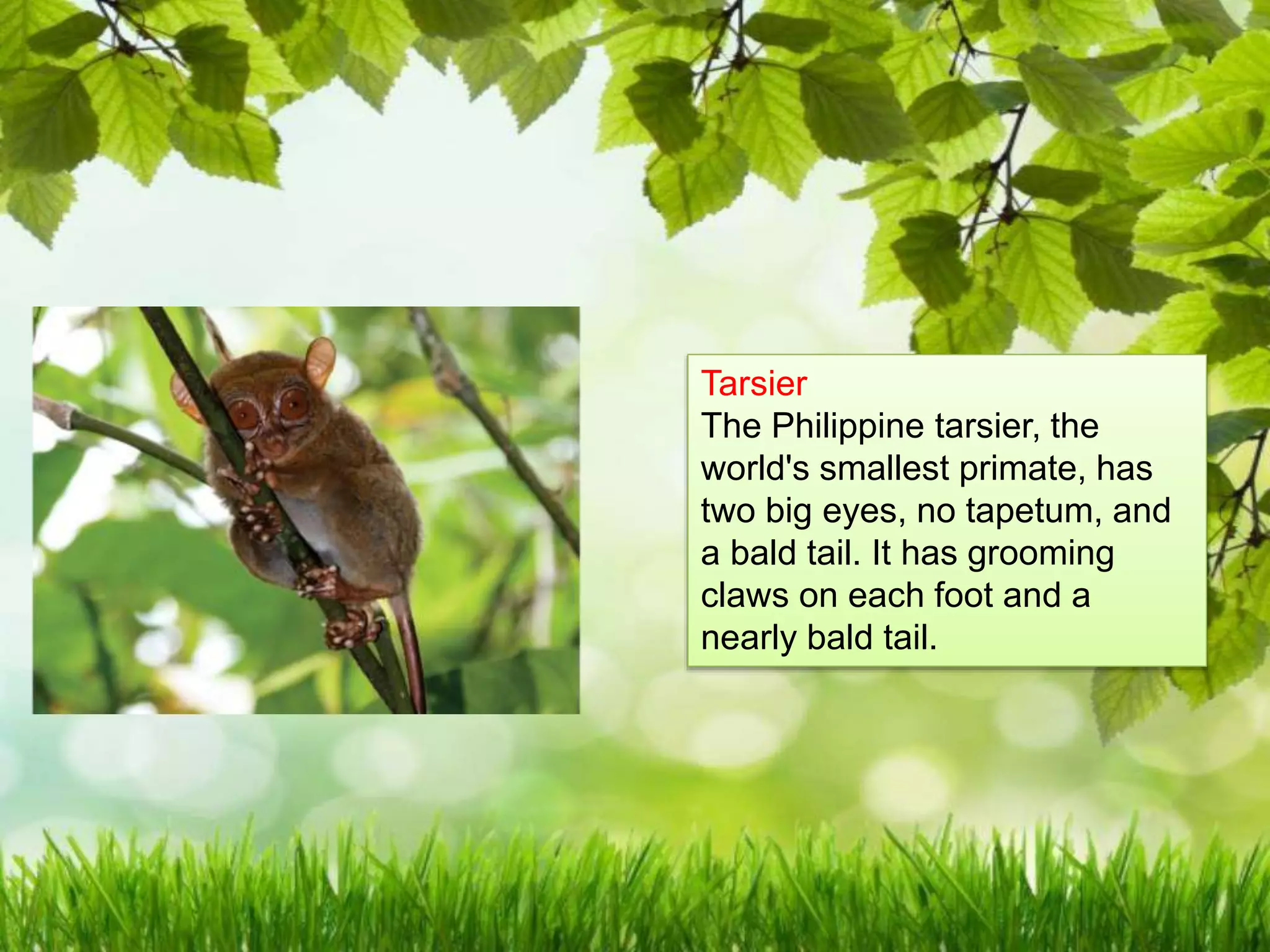
Tarsier
The Philippine tarsier, the
world's smallest primate, has
two big eyes, no tapetum, and
a bald tail. It has grooming
claws on each foot and a
nearly bald tail.
The Philippine saltwater crocodile,
known as Crocodylus porosus, is the
world's largest reptile and weighs
between two and three tons. A 27-
foot specimen was killed near Lake
Taal in 1823, requiring 40 men to
bring it ashore.
FLORA AND FAUNA ppt.pptx

FLORA AND FAUNA ppt.pptx

  • 1.
  • 2.
    FLOR A Flora, meaning "Goddessof the Flower," represents the entire plant kingdom in a specific region. Flora classification depends on habitat, affecting distribution.
  • 3.
    The native Philippines orchidFowlie Paphiopedilum grows on limestone cliffs at 600-950 m altitude and is rarely exposed to sunshine.
  • 4.
    Nepenthes peltata isa tropical pitcher plant in the Philippines, found on Mount Hamiguitan's upper slopes. It has a peltate tendril attachment and indumentum, producing ovoid pitchers with a basal crest and large nectar glands.
  • 5.
    Paphiopedilum ciliolare is endemicto four Philippines islands, growing on limestone bushes, volcanic ridges, and subtropical/tropical moist montane forests at 300- 1830 meters.
  • 6.
    Medinilla magnifica Lindl. 1850is a native Philippine evergreen shrub, growing up to 8 feet in part shade or ground clearings.
  • 7.
    Strongylodon macrobotrys, also knownas jade vine, is a 30-50' long perennial woody vine native to tropical rain forests in the Philippines. Despite deforestation, it survives in cultivation and nurseries worldwide.
  • 8.
    Amyema incarnatiflora, a Lorantacaespecies, inhabits mountainous Cabadbaran and jungles of Cagayan province, producing pink flowers with half-open parasol shape.
  • 9.
    Dillenia monantha, a uniquePhilippine species, produces a single yellow flower with a spider-like bottom color.
  • 10.
    Xanthostemon fructicosus, a Myrtaceaespecies, is distinguished by its spectacular foliage and red bunches of actinomorphous flowers, attracting 3,000 species in Australia, Mediterranean, and America.
  • 11.
    Plumeria acuminata, also knownas 'perungalli' in Tamil, is a plant used in traditional medicine for various diseases, including purgatives, diarrhoea remedies, itch cures, inflammation treatment, and rheumatism. Its bark is also effective in treating hard tumors, diarrhea, and gonorrhoea.
  • 12.
    Paphiopedilum adductum is endemicto Mindanao Island of the Philippines, found at high elevation between 1250 and 1350 meters above sea level, near Impasugong in Bukidnon province. It grows as an epiphyte in leafy humus, in the subtropical or tropical moist lowland forests. It prefers mid-shaded habitats in tropical climates and flowers in early winter.
  • 13.
    Rafflessia manillana the world'slargest and endemic species, is named after Sir Stamford Raffles and Manila. Its foul-smelling flower and carrion flies pollinate it.
  • 14.
    FAU NA Fauna or “fauns”,originating from Roman mythology, refers to indigenous animal life and forest spirits, possibly referring to fertility goddesses.
  • 15.
    World’s Largest Clam Thelargest clam in the world contains the world's largest pearl, "The Pearl of Lao Tzu," valued at $42 million and believed to be 600 years old..
  • 16.
    Endangered Dwarf Buffalo Dwarfbuffalo, known as Tamaraws, roamed Mindoro's province in the 1900s. Today, the Tamaraws, once a symbol of the island, are in danger of extinction, potentially losing their status as the "Land of the Tamaraws."
  • 17.
    The dwarf gobyor Pandaka pygmaea The smallest freshwater fish, 1.2 centimeters, was first discovered in the Malabon River by American Ichthyologist Albert Herre. The Philippines also hosts the world's smallest commercial fish, Sinarapan..
  • 18.
    Pilandok Also knownas the Balabac chevrotain or Philippine mouse-deer, it is a small and nocturnal ruminant which is endemic to the islands of Balabac, Bugsuk, and Ramos, among others, which are southwest of Palawan, Philippines this ruminant stands only about 40 centimeters at the shoulder level. Contrary to its name, pilandok is not a member of the deer family. It belongs to the family Tragulidae in the mammalian order Artiodactyla. The male species has no antlers like those of a real deer. Instead, it uses its large tusk-like canine teeth on its upper jaw for self- defense; in the same way a deer uses its antlers.
  • 19.
    Philippine Eagle The Philippineeagle, also known as the monkey- eating eagle, is one of the world's largest eagles, inhabiting rainforests in Isabela, Samar, Leyte, and Mindanao.
  • 20.
    The Magellan Birdwing Troidesmagellanus is a rare birdwing in the Philippines, with a blue-green sheen and limited-view iridescence in its dorsal hind wings..
  • 21.
    Hog Deer Calamian Islands,off Palawan, house unique hog deer species, known as Calamian deer, to differentiate them from other species.
  • 22.
    Giant golden-crowned flyingfox Subic Bay and Bataan's virgin forest hosts the world's largest bats, the giant flying fox and golden crown flying fox, in the largest roosting site globally.
  • 23.
    Tarsier The Philippine tarsier,the world's smallest primate, has two big eyes, no tapetum, and a bald tail. It has grooming claws on each foot and a nearly bald tail.
  • 24.
    The Philippine saltwatercrocodile, known as Crocodylus porosus, is the world's largest reptile and weighs between two and three tons. A 27- foot specimen was killed near Lake Taal in 1823, requiring 40 men to bring it ashore.