Industrial Pharmacy
Unit VI
Pilot Plant Scale Up Techniques
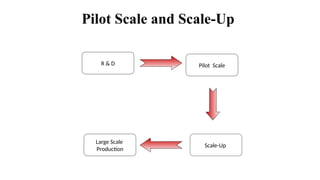
Pilot Scale
Scale-Up
R & D
Large Scale
Production
Pilot Scale and Scale-Up
Introduction
• Plant: It is a place were the 5 M’s like money, material, man, method and machine
are brought together for the manufacturing of the products.
• Pilot Plant: It is the part of the pharmaceutical industry where a lab scale formula is
transformed into a viable product by development of liable and practical procedure
of manufacture.
• Scale-up: The art for designing of prototype using the data obtained from the pilot
plant model.
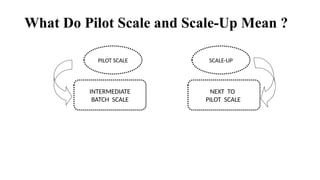
What Do Pilot Scale and Scale-Up Mean ?
INTERMEDIATE
BATCH SCALE
PILOT SCALE SCALE-UP
NEXT TO
PILOT SCALE
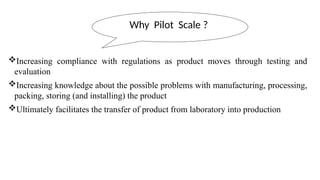
Increasing compliance with regulations as product moves through testing and
evaluation
Increasing knowledge about the possible problems with manufacturing, processing,
packing, storing (and installing) the product
Ultimately facilitates the transfer of product from laboratory into production
Why Pilot Scale ?
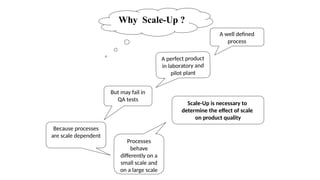
Why Scale-Up ?
A well defined
process
A perfect product
in laboratory and
pilot plant
But may fail in
QA tests
Because processes
are scale dependent
Processes
behave
differently on a
small scale and
on a large scale
Scale-Up is necessary to
determine the effect of scale
on product quality
Why conduct pilot plant studies?
• A pilot plant allows investigation of a product and process on an intermediate scale
before large amounts of money are committed to full-scale production.
• It is usually not possible to predict the effects of a many- fold increase in scale.
• It is not possible to design a large scale processing plant from laboratory data alone
with any degree of success.
Objectives
• To try the process on a model of proposed plant before committing large sum of money on a
production unit.
• Examination of the formula to determine it’s ability to withstand Batch-scale and process
modification.
• Evaluation and Validation for process and equipment.
• To identify the critical features of the process.
• Guidelines for production and process controls.
• To provide master manufacturing formula with instructions for manufacturing procedure.
• To avoid the scale-up problems.
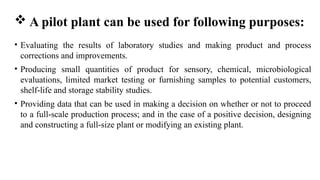
 A pilot plant can be used for following purposes:
• Evaluating the results of laboratory studies and making product and process
corrections and improvements.
• Producing small quantities of product for sensory, chemical, microbiological
evaluations, limited market testing or furnishing samples to potential customers,
shelf-life and storage stability studies.
• Providing data that can be used in making a decision on whether or not to proceed
to a full-scale production process; and in the case of a positive decision, designing
and constructing a full-size plant or modifying an existing plant.
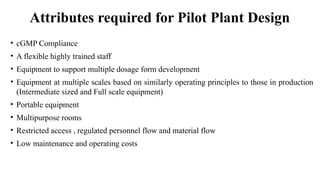
Attributes required for Pilot Plant Design
• cGMP Compliance
• A flexible highly trained staff
• Equipment to support multiple dosage form development
• Equipment at multiple scales based on similarly operating principles to those in production
(Intermediate sized and Full scale equipment)
• Portable equipment
• Multipurpose rooms
• Restricted access , regulated personnel flow and material flow
• Low maintenance and operating costs
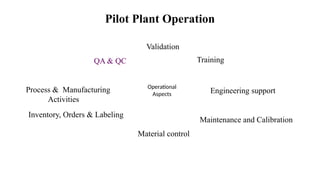
Operational
Aspects
Validation
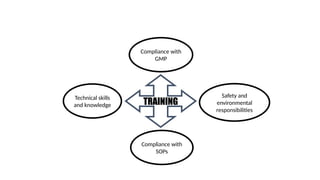
Training
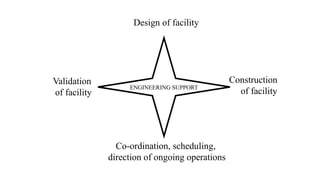
Engineering support
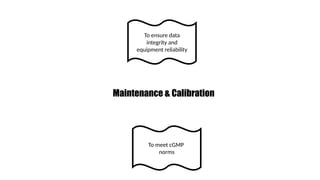
Maintenance and Calibration
Inventory, Orders & Labeling
Material control
Process & Manufacturing
Activities
QA & QC
Pilot Plant Operation
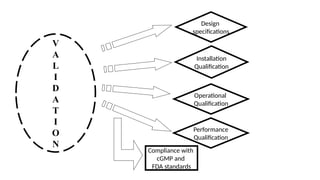
V
A
L
I
D
A
T
I
O
N
Design
specifications
Installation
Qualification
Operational
Qualification
Performance
Qualification
Compliance with
cGMP and
FDA standards
Compliance with
GMP
Safety and
environmental
responsibilities
Compliance with
SOPs
Technical skills
and knowledge TRAINING
ENGINEERING SUPPORT
Design of facility
Construction
of facility
Co-ordination, scheduling,
direction of ongoing operations
Validation
of facility
To ensure data
integrity and
equipment reliability
To meet cGMP
norms
Maintenance & Calibration
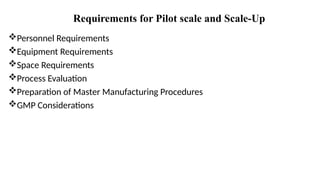
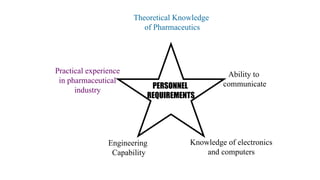
Personnel Requirements
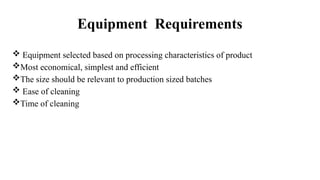
Equipment Requirements
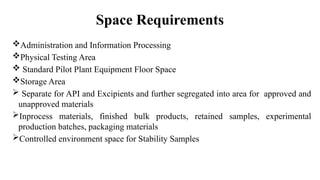
Space Requirements
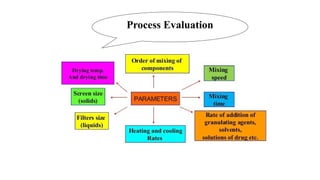
Process Evaluation
Preparation of Master Manufacturing Procedures
GMP Considerations
Requirements for Pilot scale and Scale-Up
PERSONNEL
REQUIREMENTS
Theoretical Knowledge
of Pharmaceutics
Ability to
communicate
Practical experience
in pharmaceutical
industry
Engineering
Capability
Knowledge of electronics
and computers
Equipment Requirements
 Equipment selected based on processing characteristics of product
Most economical, simplest and efficient
The size should be relevant to production sized batches
 Ease of cleaning
Time of cleaning
Administration and Information Processing
Physical Testing Area
 Standard Pilot Plant Equipment Floor Space
Storage Area
 Separate for API and Excipients and further segregated into area for approved and
unapproved materials
Inprocess materials, finished bulk products, retained samples, experimental
production batches, packaging materials
Controlled environment space for Stability Samples
Space Requirements
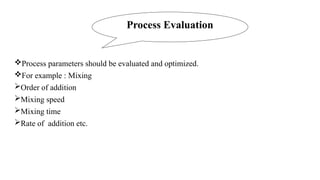
Process Evaluation
Process parameters should be evaluated and optimized.
For example : Mixing
Order of addition
Mixing speed
Mixing time
Rate of addition etc.
Process Evaluation
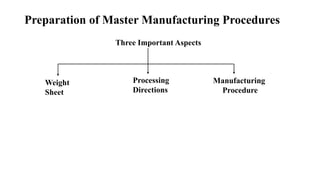
Preparation of Master Manufacturing Procedures
Three Important Aspects
Weight
Sheet
Processing
Directions
Manufacturing
Procedure
• The weight sheet should clearly identify the chemicals required In a batch. To
prevent confusion the names and identifying number for the ingredients should be
used on batch records.
• The process directions should be precise and explicit.
• A manufacturing procedure should be written by the actual operator.
• Various specifications like addition rates, mixing time, mixing speed, heating, and
cooling rates, temperature, storing of the finished product samples should be
mentioned in the batch record directions.
Preparation of Master Manufacturing Procedures
GMP Requirements
• Equipment qualification
• Process validation
• Regularly schedule preventative maintenance
• Regularly process review & revalidation
• Relevant written standard operating procedures
• The use of competent technically qualified personnel
• Adequate provision for training of personnel
• A well-defined technology transfer system
• Validated cleaning procedures.
• An orderly arrangement of equipment so as to ease material flow & prevent cross-
contamination
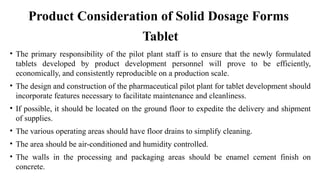
• The primary responsibility of the pilot plant staff is to ensure that the newly formulated
tablets developed by product development personnel will prove to be efficiently,
economically, and consistently reproducible on a production scale.
• The design and construction of the pharmaceutical pilot plant for tablet development should
incorporate features necessary to facilitate maintenance and cleanliness.
• If possible, it should be located on the ground floor to expedite the delivery and shipment
of supplies.
• The various operating areas should have floor drains to simplify cleaning.
• The area should be air-conditioned and humidity controlled.
• The walls in the processing and packaging areas should be enamel cement finish on
concrete.
Tablet
Product Consideration of Solid Dosage Forms
1. Material Handling System
• In the laboratory, materials are simply scooped or poured by hand, but in
intermediate- or large-scale operations, handling of this materials often become
necessary.
• If a system is used to transfer materials for more than one product steps must be
taken to prevent cross contamination.
• Any material handling system must deliver the accurate amount of the ingredient to
the destination.
• The type of system selected also depends on the characteristics of the materials.
More sophisticated methods of handling materials such as vacuum loading systems,
metering pumps, screw feed system.
2. Dry Blending
• Powders to be used for encapsulation or to be granulated must be well blended to
ensure good drug distribution.
• Inadequate blending at this stage could result in discrete portion of the batch being
either high or low in potency.
• Steps should also be taken to ensure that all the ingredients are free of lumps and
agglomerates.
• For these reasons, screening and/or milling of the ingredients usually makes the
process more reliable and reproducible.
 The equipment used for blending are:
• V- blender
• Double cone blender
• Ribbon blender
• Orbiting screw blenders vertical and horizontal high intensity mixers.
 SCALE UP CONSIDERATIONS
• Time of blending .
• Blender loading.
• Size of blender.
2. Dry Blending
3. Granulation
 The most common reasons given to justify granulating are:
• To impart good flow properties to the material,
• To increase the apparent density of the powders,
• To change the particle size distribution,
• Uniform dispersion of active ingredient.
 Types : a. Wet Granulation b. Dry Granulation c. Direct Compression
 Method: A small amount potent active ingredient can be dispersed most effectively in a
carrier granulation, when the drug is dissolved in granulating solution and added during the
granulating process.
 Traditionally wet granulation has been carried out by using Sigma blade mixer & Heavy-
duty planetary mixer.
Wet granulation can also be prepared by using tumble blenders equipped with high-speed
chopper blades.
 More recently, the use of multifunctional “processors” that are capable of performing
all functions required to prepare a finished granulation, such as dry blending, wet
granulation, drying, sizing and lubrication in a continuous process in a single
equipment.
 Fluidized Bed Granulations :
• Process Inlet Air Temperature
• Atomization Air Pressure
• Air Volume
• Liquid Spray Rate
• Nozzle Position and Number of Spray Heads
• Product and Exhaust Air Temperature
• Filter Porosity
• Cleaning Frequency
• Bowl Capacity
3. Granulation
• Used in tablet formulations to make powders more compressible and to produce tablets that
are more resistant to breakage during handling.
• In some instances the binding agent imparts viscosity to the granulating solution so that
transfer of fluid becomes difficult.
• This problem can be overcome by adding some or all binding agents in the dry powder prior
to granulation.
• Some granulation, when prepared in production sized equipment, take on a dough-like
consistency and may have to be subdivided to a more granular and porous mass to facilitate
drying.
• This can be accomplished by passing the wet mass through an oscillating type granulator
with a suitably large screen or a hammer mill with either a suitably large screen or no screen
at all.
4. Binder
• The most common conventional method of drying a granulation continues to be the
circulating hot air oven, which is heated by either steam or electricity.
• The important factor to consider as part of scale-up of an oven drying operation are
airflow, air temperature, and the depth of the granulation on the trays.
• If the granulation bed is too deep or too dense, the drying process will be inefficient,
and if soluble dyes are involved, migration of the dye to the surface of the granules.
• Drying times at specified temperatures and airflow rates must be established for each
product, and for each particular oven load.
• Fluidized bed dryers are an attractive alternative to the circulating hot air ovens.
• The important factor considered as part of scale up fluidized bed dryer are optimum
loads, rate of airflow, inlet air temperature and humidity.
5. Drying
 Tray Dryer- Parameters to be considered for scale up are :
• Air flow
• Air temperature
• Depth of the granulation on the tray
• Monitoring of the drying process by the use of moisture and temperature probes
• Drying times at specified temperatures and air flow rates for each product
 Fluidized Bed Dryer : Parameters to be considered for scale up are :
• Optimum Load
• Air Flow Rate
• Inlet Air Temperature
• Humidity of the Incoming Air
5. Drying
• Compression factors that may be affected by the particle size distribution are flowability,
compressibility, uniformity of tablet weight, content uniformity, tablet hardness, and tablet
color uniformity.
• First step in this process is to determine the particle size distribution of granulation using a
series of “stacked” sieves of decreasing mesh openings.
• Particle size reduction of the dried granulation of production size batches can be carried out
by passing all the material through an oscillating granulator, a hammer mill, a mechanical
sieving device, or in some cases, a screening device.
• As part of the scale-up of a milling or sieving operation, the lubricants and glidants, which
in the laboratory are usually added directly to the final blend, are usually added to the dried
granulation during the sizing operation.
• This is done because some of these additives, especially magnesium stearate, tend to
agglomerate when added in large quantities to the granulation in a blender.
6. Reduction of Particle Size
• Consequent attention should be paid to scale up of the right design is used and blender loads,
mixing speeds, mixing timing are properly established.
• In any blending operation segregation and mixing occurs simultaneously, both processes are a
function a particle size, shape, hardness, density and dynamics of the mixing action.
• Low dose active ingredients – directly compressed.
• Equipments : Planetory type mixer, Twin shell mixture, Cone type
• Over loading in blender retards the free flow of granules, reduce the efficiency and cause
content un-uniformity
• If the load is too small powder blend slides rather than roll in blender and there is improper
mixing.
7. Blending
 In scale up of blending, following parameters should be considered:
1. Blender loads
2. Blender size
3. Mixing speeds
4. Mixing times
5. Bulk density of the raw material (must be considered in selecting blender and in
determining optimum blender load)
6. Characteristics of the material
7. Blending
 Slugging (Dry Granulation)
• A dry powder blend that can not be directly compressed because of poor flow
properties may in some instances be processed using a slugging operation.
• Instruments : Tablet press which operates at pressure of 15 tons, compared with a
normal tablet press, which operates at pressure of 4 tons or less
• If an excessive amount of fine powder is generated during the milling operation the
material must be screened & fines recycled through the slugging operation.
8. Specialized Granulation Procedure
 Dry Compaction
• Granulation by dry compaction can also be achieved by passing powders between
two rollers that compact the material. Materials of very low density require roller
compaction to achieve a bulk density sufficient to allow encapsulation or
compression.
• One of the best examples of this process is the densification of aluminum
hydroxide. Pilot plant personnel should determine whether the final drug blend or
the active ingredient could be more efficiently processed in this manner than by
conventional processing in order to produce a granulation with the required
tabletting or encapsulation properties.
8. Specialized Granulation Procedure
 Compression
• The ultimate test of a tablet formulation and granulation process is whether the
granulation can be compressed on a high-speed tablet press. During compression,
the tablet press performs the following functions:
a. Filling of empty die cavity with granulation
b. Precompression of granulation (optional)
c. Compression of granules
d. Ejection of the tablet from the die cavity and take-off of compressed tablet
• Compression characteristics can be evaluated by press speed equal to normal
production speed. Then detect the problems such as, sticking to punch surface,
tablet hardness, capping, weight variation.
8. Specialized Granulation Procedure
 Following parameters are to be considered while choosing speed of press.
 Granulation feed rate
Delivery system should not change the particle size distribution.
System should not cause segregation of coarse and fine particles, nor it should induce
static charges.
8. Specialized Granulation Procedure
• The die feed system must be able to fill the die cavities adequately in the short period of
time that the die is passing under the feed frame.
• The smaller the tablet , the more difficult it is to get a uniform fill a high press speeds.
• For high-speed machines, induced die feed systems is necessary. These are available with
a variety of feed paddles and with variable speed capabilities. So that optimum feed for
every granulation can be obtained.
• After the die cavities are filled ,the excess is removed by the feed frame to the center of
the die table.
• Compression of the granulation usually occurs as a single event as the heads of the
punches pass over the lower and under the upper pressure rollers.
8. Specialized Granulation Procedure
• Compression cause the punches to the penetrate the die to a preset depth,
compacting the granulation to the thickness of the gap set between the punches.
• The rapidity and dwell time in between this press event occurs is determined by the
speed at which the press is rotating and by the size of compression rollers.
• Larger the compressions roller, the more gradually compression force is applied and
released.
• Slowing down the press speed or using larger compression rollers can often reduce
capping in a formulation.
• The final event is ejection of compressed tablets from die cavity.
8. Specialized Granulation Procedure
• During compression, the granulation is compacted to form tablet, bonds within
compressible material must be formed which results in sticking.
• High level of lubricant or over blending can result in a soft tablet, decrease in
wettability of the powder and an extension of the dissolution time.
• Binding to die walls can also be overcome by designing the die to be 0.001 to 0.005
inch wider at the upper portion than at the center in order to relieve pressure during
ejection.
8. Specialized Granulation Procedure
• Sugar coating is carried out in conventional coating pans, has undergone many
changes because of new developments in coating technology and changes in safety
and environmental regulations.
• The conventional sugar coating pan has given way to perforated pans or fluidized-
bed coating columns.
• The development of new polymeric materials has resulted in a change from aqueous
sugar coating and more recently, to aqueous film coating.
• The tablets must be sufficiently hard to withstand the tumbling to which they are
subjected in either the coating pan or the coating column.
Tablet Coating
• Some tablet core materials are naturally hydrophobic, and in these cases, film coating
with an aqueous system may require special formulation of the tablet core and/or the
coating solution.
• A film coating solution may have been found to work well with a particular tablet in
small lab coating pan but may be totally unacceptable on a production scale.
• This is because of increased pressure & abrasion to which tablets are subjected when
batch size is large & different in temperature and humidity to which tablets are
exposed while coating and drying process.
Tablet Coating
• To produce capsules on high-speed equipment, the powder blend must have uniform particle
size distribution, bulk density, formation of compact of the right size and of sufficient
cohesiveness to be filled into capsule shells.
• Equipment : 1. Zanasi or Mertalli - Dosator (hollow tube) 2. Hoflinger - Karg - Tamping pins
• Weight variation problem can be encountered with these two methods.
• Overly lubricated granules - delaying disintegration
• Humidity affect moisture content of granulation and on the empty gelatin capsules.
• Empty gelatin capsules have a recommended storage condition of 15-25 ºC temperature &
humidity 35-65 % RH.
• At high humidity - capsule swells make separation of the capsule parts difficult to interfere
with the transport of the capsule through the process.
• At low humidity - capsule brittle increased static charge interfere with encapsulation
operation.
Capsule