Social Policy Research Centre 2016
Evaluation of Crisis Respite Services: Final Report i
Research Team
Social Policy Research Centre: Professor Ilan Katz,
Rosemary Kayess, Andrew Griffiths, Shona Bates
Époque Consulting: Fredrick Zmudzki
For further information
Professor Ilan Katz
Ilan.katz@unsw.edu.au 02 9385 7810
Acknowledgements
The evaluation would not have been possible without the many people who provided
information about their lives or professional experiences, including Ms Elizabeth Todd, Ms
Melanie Ball, Mr Marc Currie, Mr Dan Donaghey, Mr Simon Fuller, Mr David Moffatt, Mr Paul
Roberts, Mr Mark Leggett, Mr Graeme Sanders, and Mr John Strachan. Ms Katrina Kong, Mr
Damian Robinson, Ms Kim Holmes (Neami National), Ms Mary-Jane Honner (Neami
National), and Ms Mog Van Golstein Brouwers (Neami National)
Social Policy Research Centre
Level 2, John Goodsell Building
UNSW Arts and Social Sciences
UNSW Australia
UNSW Sydney 2052 Australia
T +61 (2) 9385 7800
F +61 (2) 9385 7838
E sprc@unsw.edu.au
W www.sprc.unsw.edu.au
The Social Policy Research Centre is based in the Faculty of Arts & Social Sciences at UNSW
Australia. This report is an output of the Evaluation of Crisis Respite Services in South
Australia, funded by SA Health.
© UNSW Australia 2016
ISBN: 978-1-925218-50-3
Suggested citation:
Zmudzki, F. Griffiths, A., Bates, S., Katz, I., Kayess, R. (2016). Evaluation of Crisis Respite Services: Final Report
(SPRC Report 06/16). Sydney: Social Policy Research Centre, UNSW Australia.
Social Policy Research Centre 2016
Evaluation of Crisis Respite Services: Final Report ii
1 Introduction ...................................................................................................... 6
1.1 Mental health services in South Australia .................................................. 6
1.2 Mental health subacute Crisis Respite Services – Residential and Home
Based Services....................................................................................... 7
1.3 SA Health Crisis Respite Services implementation plan .......................... 10
1.4 Program outcomes and evaluation objectives.......................................... 11
2 Previous research on crisis respite care......................................................... 13
2.1 Introduction.............................................................................................. 13
2.2 Mental health crisis respite services ........................................................ 13
2.3 Conclusion............................................................................................... 17
3 Methodology .................................................................................................. 18
3.1 Overall approach ..................................................................................... 18
3.2 Ethics process ......................................................................................... 19
3.3 Review of program documentation .......................................................... 19
3.4 Quantitative data analysis........................................................................ 20
3.5 Qualitative research................................................................................. 28
3.6 Analysis and triangulation of findings....................................................... 30
4 Crisis respite service consumer profiles and service delivery ......................... 31
4.1 Demographics ......................................................................................... 31
4.2 Program establishment............................................................................ 36
4.3 Program duration and service delivery..................................................... 38
4.4 Reason for accessing CRS...................................................................... 39
4.5 Reported mental health diagnoses .......................................................... 40
5 Consumer outcomes...................................................................................... 41
5.1 Inpatient admissions and lengths of stay ................................................. 41
5.2 Emergency department presentations ..................................................... 45
5.3 Community mental health services .......................................................... 48
5.4 Mental health outcomes........................................................................... 48
5.5 Relapse duration analysis........................................................................ 51
6 Consumers and carers................................................................................... 52
6.1 Overview of support provided by crisis respite services ........................... 52
6.2 High quality support................................................................................. 53
6.3 Support-oriented recovery ....................................................................... 56
6.4 Effectiveness in different areas of life....................................................... 57
6.5 Building on the strengths of the program ................................................. 62
6.6 Suggested changes to the program ......................................................... 65
6.7 Other comments...................................................................................... 66
7 Governance, service model, and relationships............................................... 67
7.1 Overall aims of CRS ................................................................................ 67
7.2 Meeting the needs of consumers............................................................. 67
7.3 Providing residential and home-based respite services ........................... 69
7.4 Referrals between SA Health and Neami................................................. 69
7.5 Greatest areas of impact.......................................................................... 70
7.6 Issues affecting the program.................................................................... 71
Social Policy Research Centre 2016
Evaluation of Crisis Respite Services: Final Report iii
7.7 Effectiveness of partnership between government and non-government
agencies ............................................................................................... 73
7.8 Effectiveness of program governance...................................................... 74
7.9 Other comments...................................................................................... 75
8 Economic evaluation...................................................................................... 77
8.1 Program funding ...................................................................................... 77
8.2 Program benefits ..................................................................................... 78
8.3 Health service cost offsets....................................................................... 79
8.4 Cost-effectiveness ................................................................................... 81
8.5 Discussion ............................................................................................... 88
9 Conclusion ..................................................................................................... 89
10 References..................................................................................................... 90
Appendix A Evaluation framework data sources .............................................. 93
Appendix B K10 score grouping....................................................................... 95
Appendix C CARS CRS data items .................................................................. 96
Appendix D Neami consumer exit survey and data .......................................... 97
Social Policy Research Centre 2016
Evaluation of Crisis Respite Services: Final Report iv
Table 1: Summary of data sources ........................................................................ 19
Table 2: Qualitative sample by method and location .............................................. 29
Table 3: CRS consumers by Aboriginal and Torres Strait Islander status .............. 35
Table 4: CRS consumers by ethnicity .................................................................... 35
Table 5: Consumer reason for accessing CRS services ........................................ 39
Table 6: Reported mental health diagnoses by CRS type ...................................... 40
Table 7: Average inpatient length of stay – 6 months before to 3 months after CRS
.............................................................................................................................. 43
Table 8: Current inpatients referred to CRS program............................................. 44
Table 9: Inpatient admissions avoided by service type........................................... 44
Table 10: Average number of ED presentations by month ..................................... 46
Table 11: Reported ED avoided on entry to CRS program..................................... 47
Table 12: Mean K10 scores on entry and exit of CRS program.............................. 49
Table 13: CRS Program funding 2013–14 to 2015–16........................................... 78
Figure 1: CRS evaluation – data sources............................................................... 21
Figure 2: Program consumer age and gender........................................................ 32
Figure 3: Program consumer age and gender by service type ............................... 33
Figure 4: Comparison group age and gender (Country)......................................... 34
Figure 5: CRS Program development by support service type............................... 38
Figure 6: Duration of residential and home based crisis respite support ................ 39
Figure 7: Inpatient admissions and admitted days before and after CRS ............... 42
Figure 8: Emergency department presentations before and after CRS .................. 46
Figure 9: Community health service contacts before and after CRS ...................... 48
Figure 10: K10 level of severity on entry and exit of CRS program ........................ 50
Figure 11: Cumulative CRS funding and service use offsets – base case.............. 86
CARS Consumer Activity Report System
CBIS Community Based Information System
CRS Crisis Respite Services
CALD Culturally and Linguistically Diverse
CCCME Central Country Information System
COAG Council of Australian Governments
ED Emergency Department
HoNOS Health of the Nation Outcomes Scales
K10 Kessler Psychological Distress Scale
LOS Length of stay
LSP-16 Life Skills Profile
NGO Non-Government Organisation
NOCC National Outcomes and Case-mix Collection
Social Policy Research Centre 2016
Evaluation of Crisis Respite Services: Final Report 1
 The Crisis Respite Services (CRS) were successfully implemented in Adelaide
despite a number of challenges to implementation.
 The CRS was successful in reaching its target group although there were some
difficulties accessing Aboriginal and Torres Strait Islander and CALD consumers
and young people.
 The governance structure worked well and in particular the working relationship
between SA Health and Neami was a successful partnership.
 Consumers and their families indicated a wide range of benefits arising from the
CRS including practical help with housing and other problems as well as
providing a ‘space’ for consumers to get back on track after a crisis or hospital
admission.
 The residential and home based service models were also praised highly by
consumers.
 The CRS has resulted in statistically significant reductions in:
o Psychological distress
o Hospital admissions
o Time in hospital
o Emergency Department visits
 A large proportion of the costs were offset by the reductions in hospitalisation
and Emergency Department presentations.
 Overall the success of the CRS program is remarkable. It is consistent with
previous evaluations of respite services which tend to show positive outcomes.
However this evaluation is more robust than most previous evaluations cited in
the literature.
 The short term nature of the funding has compromised the CRS program’s ability
to contribute to long term sustained improvements in service provision and
consequently the wellbeing of mental health consumers in South Australia.
Social Policy Research Centre 2016
Evaluation of Crisis Respite Services: Final Report 2
 Following slight initial delays resulting from relocation of interim premises,
consumer numbers increased consistently from July 2014 to November 2014.
 From November 2014 there was sustained, consistent demand for the program
for the remaining 12 months of the evaluation period with an average of 75
residential consumers accessed residential CRS per month, and an average of
23 consumers received home based support.
 Program development has been achieved through a strong partnership between
South Australia Health and the non-government organisation (NGO) sector,
which utilized NGO experience and capacity.
 The total number of cumulative CRS consumer contacts, including cases where
consumers accessed both residential and home based services, or multiple
support services, increased from low initial numbers, to a total of 1,270 as at 31
October 2015.
 Overall residential services are substantially higher than home based support
with 75.0% of total episodes (n=902) to 25% for home based CRS (n=300).
 Through utilising established NGO service provider capacity and experience, the
program was initiated and developed without the need for significant additional
up-front investment by SA Health.
 The program has supported a total of 872 consumers from program
commencement in July 2014 to 31 October 2015.
o Overall a substantially higher proportion of CRS consumers are female
(63.5%, n=554) than male (36.5%, n=318).
o The higher level of female consumers is consistent across all program age
bands reflecting the broader South Australian proportion of females with a
mental health condition.
o A higher proportion of females are also accessing services at younger ages
compared to males, particularly home based services.
 The duration of CRS services provided reflects the short-term program focus
with the substantial majority of consumers having completed their support
periods within seven days, including 86.5% (n=688) of residential consumers
and 59.9% (n=161) of home based consumers.
 Just over a third of residential consumers remained in the program for a full 7
days (34.6%, n=275). Collectively more than half of all consumers received a
shorter duration of support than 7 days, including 51.9% (n=413) of residential
consumers.
Social Policy Research Centre 2016
Evaluation of Crisis Respite Services: Final Report 3
 The program is achieving all reported outcomes within the approved operating
funding of $17.9 million, of which the allocated budget for the study period as at
31 October 2015 was $12.1 million.
 The program is reaching target populations including Aboriginal and Torres Strait
Islander communities and culturally and linguistically diverse (CALD):
o 5.0% of consumers (n=44) identify as Aboriginal and Torres Strait Islander
compared with 1.9% of the South Australian population.
o 12.3% of metropolitan consumers report ethnicity other than Australian,
which is similar to the estimated 12.7% of South Australians who were born
in predominantly non-English speaking countries.
Program targets specified in the Commonwealth Implementation Plan for South
Australia are being achieved within the total forward funding to 2015-16. These
include:
 Individual satisfaction around resolution of the situation leading to crisis respite
service
 Demonstrated improvements in individual satisfaction around areas such as
quality of life, hope for the future, and belief in their potential to recover and
regain meaningful life roles
 Improvement in mental health
 Increased stability of community tenure
 Increased family satisfaction
 Decreased psychosocial related hospitalisations
 Decreased number of emergency department presentations
 Exit plan in place and followed through contact within 7 days of exit.
There has been a significant reduction in the number of psychiatric hospital
admissions and hospital bed days for consumers who have exited the program. This
includes:
 Inpatient admissions stabilised in the month following CRS before falling
significantly in the following 4 weeks to average pre-crisis levels.
 An average reduction in the number of psychiatric hospital admissions of 1.1
days per consumer in the first two months after exiting the program (from 2.8 to
1.7 days).
 The reduced admissions were sustained in months 2 and 3 following CRS.
 Additionally a significant number of both residential and home based consumers
are reported to have avoided inpatient admission completely as a result of the
CRS program, 40.3% (512 of 1,270 episodes).
Social Policy Research Centre 2016
Evaluation of Crisis Respite Services: Final Report 4
There has also been a significant reduction in the number of presentations to EDs,
including:
 An average reduction in the three months after exiting the program of 0.52 ED
presentations per consumer (n=404).
 Similar to inpatient admissions, a significant number of consumers (n=542,
42.7%) are reported to have avoided presentation to EDs.
Overall there was a highly statistically significant improvement in psychological
distress of CRS consumers as measured through comparison of K10 scores pre and
post involvement with CRS.
 The reduction in mean K10 scores was higher for residential consumers with a
change of –9.9 (n=428)
 Home based support resulted in reduced average scores of –6.0 (n=101)
 Collectively for the 529 cases where there were both pre and post CRS scores,
the overall reduction was –9.2.
 In addition to reduced K10 scores overall, approximately three quarters of
consumers were experiencing severe levels of psychological distress on entry to
the CRS program (74.9%, n=396).
o This was the case across both support types with 74.8% (n=320) of
residential and 75.3% (n=76) of home based consumers exhibiting severe
levels of psychological distress on entry to CRS.
o The proportions for both service types reduced significantly on exit to 32.7%
(n=14) for residential and 49.5% (n=50) for home based respectively.
In terms of program objectives and budget, consumer outcomes are being achieved
in line with SA Health delivery targets and within the allocated budget.
 In addition to the broad range of consumer outcomes being achieved by the
program, reduced and avoided hospital service usage is producing significant
cost offsets.
 As at October 2015, these are estimated at $8.0 million, representing 65.8% of
total program funding, including:
o Reduced inpatient and ED activity cumulatively estimated at $4.5 million as
at October 2015, representing approximately one third of total program
funding
o Reported inpatient and ED attendances avoided, potentially contributing a
further $3.5 million of cost offsets.
 The remaining residual funding may be viewed as the cost of achieving the
significant reduction in K10 scores by 9.2 points per episode
o The reduction in mean K10 scores represents a significant outcome
component contributing to the program cost effectiveness.
Social Policy Research Centre 2016
Evaluation of Crisis Respite Services: Final Report 5
 Overall consumers and families had a high level of satisfaction with CRS.
 Situational respite was key to the support, getting time away from the crisis and
to oneself. CRS provided a “breather”, and time to “get back on their feet”. The
nature of the support also allows independence and freedom, especially in
contrast to hospitals.
 Mental health counselling was also key to positive outcomes, especially in terms
of giving consumers the tools to “help themselves” (self-directed care).
 Many commented on the difference between CRS and other
services/psychologists/hospitals in that it was less clinical, less medication-
based, and more about arming consumers with ‘tools’ and strategies to help
themselves.
 The most useful practical support was related to housing and basic practical
matters such as dealing with bureaucracies, forms, helping re-establish routines
and planning, etc.
 Friendly, approachable, non-judgemental staff were also a key to the program’s
success.
 Most felt that CRS had met the needs of consumers well. This was put down to
the ability to provide respite from situational crises, and assisting consumers to
self-direct their own care. However situational respite might not work well for all
consumers, and had not attracted many CALD/Aboriginal and Torres Strait
Islander clients (but met state averages, as seen in quant). Home-based gives
another option for some of these consumers.
 Stakeholders felt that residential and home-based support both offered
advantages depending on the needs of the consumer, but some cautioned that
only residential care could truly address the situational risk that was usually at
the core of the crises.
 The partnership had generally worked well, including with regard to referrals
between the partner organisations, primarily due to openness and equality
between the partners, as well as effective mechanisms through which issues
could be resolved such as regular meetings at several levels.
 The biggest issue was around the initial set-up delays of the program, especially
with regard to finding suitable accommodation and acquiring council approval for
the residential sites. It was felt that more set-up time, planning and funding
could’ve helped in this regard.
 Overall the evaluation found that Crisis Respite Care provided substantial
benefits to the wellbeing of sub-acute mental health consumers at low cost. CRS
should be an integral part of a recovery oriented system of provision in mental
health.
Social Policy Research Centre 2016
Evaluation of Crisis Respite Services: Final Report 6
This is the final report of the evaluation of the Crisis Respite Services (CRS). The
program is funded and managed by SA Health and delivered in partnership with
Neami National.
The evaluation team from the Social Policy Research Centre (SPRC) at UNSW
Australia (the University of New South Wales) conducted the evaluation in
collaboration with Époque Consulting. The overall aim of this research is to build a
strong evidence base for the provision of best practice and improved policy in the
delivery of recovery-oriented sub-acute crisis respite services in South Australia.
South Australia’s mental health system is undergoing significant reform in relation to
structure, services and approaches (SA Health, 2012). A key aspect of the South
Australian mental health reform is a move to a recovery-oriented approach and the
development of more rehabilitation services to support individuals’ unique and
personal journeys to social inclusion and wellness (SA Health, 2008, 2010, 2012).
Recovery and rehabilitation do not entail a cure for an individual’s mental illness, but
rather helping individuals to achieve an improved level of wellbeing and a renewed
sense of identity, purpose and meaning in life in the presence or absence of
symptoms of illness (SA Health, 2010, 2012). There is no time frame set for an
individual’s recovery, as everyone’s recovery journey is unique (SA Health, 2010,
2012).
Overall, psychosocial rehabilitation entails a shift from an illness model towards a
social functioning model that aims to improve individuals’ competencies and to
introduce environmental changes to improve the quality of life of individuals with
mental illness. The delivery of psychosocial rehabilitation requires a partnership
approach across government and non-government sectors, including specialist
providers, Government providers, non-government organisations, consumer run
providers, brokerage agencies, and General Practice.
Research evidence supports the use of psychosocial rehabilitation and shows
positive consumer outcomes that potentially reduce health system service use,
including through reduced and avoided hospital admissions and lengths of stay.
(Barbato, 2006; Barton, 1999; Crosse, 2003; Zmudzki 2015).
The reform of mental health services in South Australia has been guided by a
number of national and state directives.
At a national level, key policy documents include the National Action Plan on
Mental Health 2006–2011 (which emphasises coordination and collaboration
between government, private and nongovernment providers), the COAG National
Social Policy Research Centre 2016
Evaluation of Crisis Respite Services: Final Report 7
Mental Health Policy 2008 (which provides a strategic vision for a mental health
system that enables recovery, prevents and detects mental illness early, and
ensures that all Australians with a mental illness can access effective and
appropriate treatment and can participate fully in society); the Fourth National
Mental Health Plan 2009–2014 (which offers a framework to develop systems of
care that are able to intervene early and provide integrated services across health
and social domains); the National Standards for Mental Health Services 2010
(which incorporate a recovery standard and cover bed-based and community mental
health services, those in the clinical and non-government sectors, the private sector,
and primary care and general practice).
At the South Australia level, five key policy documents are the Stepping Up: A Social
Inclusion Action Plan for Mental Health Reform 2007–2012, the Psychosocial
rehabilitation support services standards (SA Health, 2008), the South Australia’s
Mental Health and Wellbeing Policy 2010–2015 (SA Health, 2010), the Mental
Health Act 2009, and Statewide Aboriginal Mental Health Consultation: Summary
Report.
Stepping Up: A Social Inclusion Action Plan for Mental Health Reform 2007–
2012 set the vision for mental health services in South Australia to provide a service
that is people-centred and recovery-oriented. It recommended the implementation of
a stepped system of care, which entails that the mental health service system is
arranged as a tiered care system consisting of support across the community,
supported accommodation, community rehabilitation, intermediate care, acute care
and secure care (SA Health, 2012). The Psychosocial Rehabilitation Support
Service Standards (SA Health, 2008) offered a framework for the provision of
quality services under a recovery model within the South Australian context. The
South Australia’s Mental Health and Wellbeing Policy 2010–2015 (SA Health,
2010) built on the Stepping Up reform and set key goals in relation to the well-being,
service provision and social inclusion of individuals with mental illness. The Mental
Health Act 2009 provided a legislative framework that explicitly articulated the rights
of people with mental illness and facilitated their recovery and participation in
community life (SA Health, 2012). Finally, the Statewide Aboriginal Mental Health
Consultation: Summary Report July 2010 proposed thirteen recommendations
aimed to improve mental health and wellbeing for Aboriginal South Australians and
seven core elements relevant to all services.
Part of the National Partnership Agreement, Mental Health Subacute Crisis Respite
– Residential and Home Based Services, in South Australia involved setting up a
total of 24 residential based subacute crisis respite beds and 10 home based bed
equivalent places within metropolitan Adelaide (SA Health, 2014c). Sub-acute Crisis
Respite Services complement the stepped model of care and provide an additional
Social Policy Research Centre 2016
Evaluation of Crisis Respite Services: Final Report 8
service delivery option for people with mental illness (SA Health, 2014b). The Sub-
acute Crisis Respite Services are informed by a recovery based philosophy and aim
to provide a period of respite care for consumers experiencing deterioration in their
mental health. Consumers receive clinical and psychosocial support to assist in
addressing the issues leading to the presentation in crisis and in restoring usual or
improved functioning and living skills that support them to reside in the community
(SA Health, 2014a, 2014b).
Overall, Crisis Respite Services are expected to reduce the number of emergency
department presentations and/or hospital admissions and reduce the burden of care
experienced by carers. The objectives are (SA Health, 2014a, p. 4):
• To provide home or bed-based respite for individuals presenting in crisis with
issues largely social in nature, and requiring predominantly social and
psychological interventions.
• To provide appropriate and timely out of hospital care for people
experiencing a mental health crisis.
• To improve mental health outcomes, stop deterioration in mental health,
and/or restore the individual to usual or improved functioning.
• To provide an alternative to hospitalisation or emergency department
presentation in a more appropriate environment.
• To provide a therapeutic environment.
• To provide interventions up to 7 days (extension can be negotiated on the
basis of acceptable rationale).
• To minimise mental health hospital admissions resulting from crisis.
• To decrease wait and stay times in emergency departments.
• To provide a timely response to referrals from mental health triage,
emergency departments, community mental health services taking into
account consumer, carer and mental health system context.
• To provide an alternative to hospitalisation or emergency department
presentation in a more appropriate environment.
• To improve mental health outcomes.
• To stop deterioration in mental health.
The Crisis Respite Service is a partnership program between Mental Health
Services and the non-government sector (SA Health, 2014b). It is operated 24
hours/7 days per week by offering both bed based crisis respite and home based
crisis respite for up to 7 days (SA Health, 2014b). Each of the three metropolitan
Local Health Network (LHN) – i.e. Southern Adelaide LHN, Central Adelaide LHN
and Northern Adelaide LHN –have a Crisis Respite Service consisting of 8
residential beds and a home based (outreach) service with about 3.33 home based
bed equivalent places per metropolitan LHN (SA Health, 2014b).
Social Policy Research Centre 2016
Evaluation of Crisis Respite Services: Final Report 9
Crisis Respite Services use the following criteria to identify people who are eligible
for the program:
• Individuals aged between 18 and 65. People who are younger or older are
accepted if developmentally appropriate and suitable for the environment
and service.
• Individuals who are experiencing disruption to usual mental health and
require a short term crisis respite response which may be due to one or a
combination of the following or other reasons:
o Existence of a high prevalence disorder where acute admission is not
indicated, and assessed level of risk can be managed in the
environment.
o Carer whose stress levels have precipitated mental health issues.
o Family and/or relationship issues (usual supports under stress).
o Accommodation stress.
o Substance misuse which is impacting on mental health and ability to
function but where clinical response is not required.
o Financial issues which impact on usual living situation (e.g. unpaid
electricity bill, rent money etc.).
o Loss and grief issues.
o Physical health issues which impact on usual mental health and/or
have prompted a crisis presentation and which can be managed
within the crisis respite environment.
• Referrals must have an element of hospital avoidance, i.e. an emergency
department presentation or an acute admission.
• Engagement in the Crisis Respite Service is voluntary.
• Catchment for each crisis respite facility will be based on source of referral
as well as residence. The three facilities will work closely together to offer a
place if the service is deemed appropriate. Equal consideration will be given
to individuals from country locations, particularly those who have presented
to a metro emergency department, or where a respite stay is the most
appropriate and least restrictive option for care.
• Homelessness is not an exclusion for this service.
• Scheduled or planned respite is not in scope for this service.
Program governance. The Crisis Respite Services program governance is
managed by a Crisis Respite Project Control Group, which is convened by the
Mental Health and Substance Abuse Division (the Program Management Unit
responsible for the establishment and oversight of Crisis Respite Services) (SA
Health, 2014b). The Crisis Respite Project Control group are convened by the
Executive Lead of the Mental Health and Substance Abuse Division and have
representation from senior staff within the Local Health Networks, Country Health
Social Policy Research Centre 2016
Evaluation of Crisis Respite Services: Final Report 10
SA Local Health Networks, any Non-Government Organisation contracted to provide
the service and a consumer and carer representative (SA Health, 2014b).
The Mental Health and Substance Abuse Division, which convenes the Control
Group, is an administrative division of the Department for Health and Ageing with
responsibility for the implementation of the Crisis Respite Services “which involves
the provision of funding to the Local Health Networks (for the clinical component)
and to the non-government sector (for the residential management and non-clinical
component)” (SA Health, 2014b, p. 6).
Clinical governance. Each of the three metropolitan Local Health Networks (LHN)
has clinical governance for a Crisis Respite Service. The Clinical Director, within
each LHN, has overall clinical responsibility for the treatment and care provided to
consumers of Crisis Respite Services. Each LHN establishes a Crisis Respite
Services Partnership Committee, which meet on a regular and agreed basis. The
Partnership Committee includes representation from the LHN and from the Non-
Government Organisation(s) contracted by the Department for Health and Ageing to
provide Crisis Respite Services within the LHN (SA Health, 2014b). The
representatives, from each of the LHN’s, will report to the Project Control Group (SA
Health, 2014b).
The SA Health CRS Implementation Plan specifies the development and
implementation of mental health residential and home based subacute crisis respite
services, under the National Partnership Agreement on Improving Public Hospital
Services. Under the Implementation Plan consumers experiencing deterioration in
their mental health will receive a period of respite care incorporating clinical and
psychosocial support to assist in addressing the issues leading to a crisis episode
and to support the consumer to remain resident in the community.
The CRS program was initially established as Metropolitan Adelaide service
partnership between South Australia Health and the NGO sector, with potential
subsequent state wide expansion into regional country areas. The Implementation
Plan was approved by Cabinet on 21 October 2013, with final budget and program
delivery approval on 16 December 2013.
The establishment phase of the program reflected some delays completing the
procurement process and employing initial staff while final workforce levels were
confirmed across both the residential and home based support services. It was also
initially planned for SA Health to acquire properties for the CRS residential support
component, but approval for capital expenditure did not proceed and the final plan
incorporated leasing of premises through the NGO service provider. The short
implementation process for CRS also did not factor in lengthy council approval
periods for each of the residential facilities.
Social Policy Research Centre 2016
Evaluation of Crisis Respite Services: Final Report 11
The Implementation Plan provides details of CRS program funding and expected
improvements. The expected improvements are presented above in Section 1.2,
with associated total program funding of:
 Total operating funding for the two year and one month period from June 2014 to
June 2016 of $17.943 million.
 The service provider component of the program for the 25 month period
represents $11.267 million (GST exclusive), 62.8 percent of the program budget.
 The CRS services are indicated as time limited until June 2016 and the
Implementation Plan notes they will cease when the Commonwealth funding is
exhausted.
The evaluation scope and objectives are presented in the program evaluation plan
prepared in October 2015.1
In summary the evaluation involves a process evaluation and an outcomes
component, including a cost-effectiveness analysis. The process evaluation focuses
on the effectiveness of the Crisis Respite Services, including governance structure,
stakeholder relationships, collaboration, inter-agency service delivery approach, as
well as consumer and carer experiences of receiving residential and home based
support services.
The outcomes evaluation focuses on the impact of Crisis Respite Services on
participants in the areas of quality of life, health and mental health, and community
participation and examines the extent to which the Crisis Respite Services are
assisting in reducing hospitalisation and presentations at emergency departments
and other acute care settings.
The cost-effectiveness analysis examines the program outcomes in terms of total
program funding and compares Crisis Respite Services daily program cost per ‘bed
day equivalent’ to estimated cost offsets of emergency department and hospital bed
day costs.
The evaluation examines key program outcomes including:
 Individual satisfaction around resolution of the situation leading to crisis respite
service
 Demonstrated improvements in individual satisfaction around areas such as
quality of life, hope for the future, and belief in their potential to recover and
regain meaningful life roles
 Improvement in mental health
1
Bates, S., Griffiths, A., Katz, I., Kayess, R., & Zmudzki, F. (2015). Evaluation of Crisis Respite
Services: Evaluation Plan. Sydney: Social Policy Research Centre, UNSW Australia.
Social Policy Research Centre 2016
Evaluation of Crisis Respite Services: Final Report 12
 Increased stability of community tenure
 Increased family satisfaction
 Decreased psychosocial related hospitalisations
 Decreased number of emergency department presentations
 Exit plan in place and followed through contact within 7 days of exit.
The methodology of each component of the evaluation is described in detail in
Section 3.
Social Policy Research Centre 2016
Evaluation of Crisis Respite Services: Final Report 13
This review focuses on:
 Identifying models and best practice approaches from existing international and
Australian mental health respite programs
 Exploring similar outcome evaluations of mental health crisis respite services
 Evaluating the existing knowledge on respite services in Australia and South
Australia
The search strategy comprised key words (mental health, crisis respite service,
respite care, psychosocial rehabilitation, recovery-orientated rehabilitation) and
secondary words to narrow the search focus (international, Australia, South
Australia, Evaluation, Sub-acute).
The key words were employed in a search of the following academic databases:
 ProQuest Databases
 ProQuest Central
 PsycARTICLES
 PsycINFO
 Routledge, Taylor & Francis Group
 SAGE Journals
 Scopus
 Springer Science & Business Media B.V.
 Web of Science
In addition, the following sites were searched for related grey literature:
 Google Scholar
 SA Health
 NSW Department of Health
Crisis respite programs have received generally positive reviews in the past, helping
to promote their development and implementation within the mental health sector.
Within the framework of Australia’s mental health system, access to mental health
care has significantly increased, with care now delivered predominantly in
Social Policy Research Centre 2016
Evaluation of Crisis Respite Services: Final Report 14
community settings rather than relying on inpatient services as in the past (SA
Health 2008). SA Health has developed a recovery-oriented approach to
rehabilitation services to encourage social inclusion and general wellbeing (SA
Health, 2008; SA Health, 2012). De Vecchi Kenny & Kidd (2015) demonstrate the
positive impact such services can provide to individuals facing sub-acute mental
health crises and extensive stress or trauma.
CRS has also been based on a recovery model involving voluntary admission and
self-regulation of medication. This model has been shown to successfully facilitate
psychosocial rehabilitation (Hopkins & Niemiec, 2007; Lyons et al., 2009; Grant &
Westhues, 2012). Support for a stepped approach of care as an alternative to
inpatient admission can facilitate psychosocial rehabilitation into the community
while supporting the alleviation of pressures on hospital services and clinical
resources (NSW Mental Health Commission, 2014, p. 57). Less intrusive
approaches to mental health crisis and respite services are becoming increasingly
valuable as the need grows to reduce pressures on clinicians and emergency
departments (EDs). Associated measures that have proven to be successful are
greater individualised care, an emphasis on preventative measures and facilitating
alternatives to hospitalisation that may be perceived as less threatening, socially
excluding and stigmatising (Rosen & O’Connell, 2013; Grant & Westhues, 2012). SA
Health emphasises this approach (2012) to support consumers to facilitate their own
recovery and provide a sense of personal empowerment, while focusing as much as
possible on the wellbeing of the consumer in the context of their social and cultural
environments (Hancock & Jarvis, 2005; SA Health, 2008; Lyons et al., 2009).
In conducting a process evaluation of a mental health crisis respite service in
Ontario, Canada, Grant & Westhues (2012) identify crisis respite as a valuable
alternative to hospitalisation that assisted people to return to the community or make
transitions in their lives. This finding aligns with a number of other relevant studies
(Lyons et al. 2009; Hopkins & Niemiec 2007; Grant & Westhues, 2012; Rosen &
O’Connell, 2013). These studies have emphasised the importance of pre-emptive
services in providing consumers with immediate and local access in times of crisis
(Lyons et al., 2009, p. 426). The employment of a triage system with optimised
decision-making and referrals by experienced mental health clinicians can assist
staff accessibility and availability and provide a practical and effective entry point to
busy clinical services (Hopkins & Niemiec, 2007, p. 312). In Australia, joint delivery
of mental health services by the public sector and NGOs, in conjunction with a
stepped system of care model, may enhance consumer outcomes (SA Health, 2012;
Lee et al., 2014).
Social Policy Research Centre 2016
Evaluation of Crisis Respite Services: Final Report 15
Successful crisis respite program outcomes
Overall, mental health respite services have been positively received internationally,
with demand expanding for this model of intermediary health service. High
consumer satisfaction rates and a significant decline in the severity of a wide range
of psychiatric symptoms among crisis respite consumers have been attributed to the
crisis respite model providing an alternative to hospitalisation (Adams & El-Mallakh
2009, p. 398; Farrelly et al., 2014, p. 1609; Rosen & O’Connell, 2013). Rosen &
O’Connell (2013, p. 436) identified an improvement in distress systems, confidence
and self-esteem from the time participants spent in the respite program. Thomas &
Rickwood (2013) contributed high satisfaction rates among crisis respite consumers
to the function of respite as an intermediary link to other services. In addition, many
respite service consumers were reassured by a continuity of personnel and service
providers (Hopkins & Niemiec, 2007, p. 313).
Hopkins & Niemiec (2007) found that users of a home based mental health service
in Newcastle in the UK identified accessibility, availability, consistency, quality and
communication as the main features that facilitated the success of the program.
They emphasise that this success was dependent on having rapid access to
services, as well as being able to form successful therapeutic relationships that
nurtured respect between consumers and service providers (Hopkins & Niemiec,
2007, p. 313). The effectiveness of psychosocial rehabilitative methods in improving
the quality of life of those with mental illness is strongly related to the strength of
working relationships between consumers and clinicians, as well as between
government and non-government sectors (Hopkins & Niemiec, 2007; De Vecchi et
al. 2015).
Rosen & O’Connell (2013) evaluated a crisis respite program where consumers
were offered short-term psychiatric rehabilitation either in-home or in residential
care. In this case, the consumers had been diagnosed with severe and persistent
mental illness. The program has had success in reducing hospital admissions
(Rosen & O’Connell 2013, p. 434). Furthermore, Adams & El-Mallakh (2009) identify
community-based crisis units suitable for voluntary and acutely ill psychiatric
patients as being a cost-effective alternative to inpatient hospitalisation.
Limitations of crisis respite programs
Despite the successes of mental health crisis respite services, such programs may
also face limitations during and following project implementation. One issue
commonly described as warranting greater development related to ambiguous or
inconsistent processes for respite service referrals and admissions (Lyons et al.,
2009; Hannigan, 2013). These included disputes regarding eligibility and access,
which led to negative relationships between service providers and clinicians
(Hannigan, 2013, p. 217). Patient self-admission was not available in all programs
Social Policy Research Centre 2016
Evaluation of Crisis Respite Services: Final Report 16
but was preferred by service users to deal with the ‘gatekeeping function’ (Lyons et
al., 2009, p. 429). This is explored further below.
The importance of an individualised focus is also emphasised throughout the
literature. Crises are individually defined and what constitutes crisis for one
individual may not be so for another (Mechanic, 1996; Lyons et al., 2009; Grant &
Westhues, 2012). Thus the definition of ‘crisis’, and therefore the criteria for
admission, are difficult to standardise. Furthermore, the “revolving door
phenomenon”, as identified in Grant & Westhues (2012), indicates that short-term
psychiatric hospitalisation or temporary stabilisation may be inadequate for some
consumers and could lead readmission. Short term interventions may lead some
consumers to relapse in the long term because they become more dependent on
the mental health system for treating recurrent, less severe crises.
Methods of transitioning individuals out of CRS are also significant in the final stages
of the interventions. Short lengths of stay in sub-acute care programs or inadequate
stepping down provisions can render treatment insufficient to positively alter the
illness trajectories of consumers (Allison, Bastiampillai & Goldney, 2014). The NSW
Mental Health Commission (2014) highlights the way in which hospital rehabilitation
units may be at risk of becoming long-stay units when no appropriate step-down
community support was provided. Hopkins & Niemiec (2007) also emphasise the
importance of a slow, fully informed and negotiated ending, leading to a smooth
transition back to the consumer’s doctors or alternative mental health services. This
aspect of the final stages of respite services has been considered in SA Health’s
“Stepping Up 2007 – 2012” reform which is centred around providing end-to-end
rehabilitation or transitional assistance to ensure individuals are provided with
relevant support (SA Health, 2012).
A lack of extensive outcomes evaluations of crisis respite programs makes it difficult
to assess the longer term effects of these programs, including whether readmissions
occur following treatment and the frequency of these readmissions. Further,
evaluations will assist in determining the effectiveness of such programs in the long-
term, particularly with regard to reducing pressures on clinicians and mental health
services in general, and to examine their cost effectiveness (Adams & El-Mallakh
2009).
Service accessibility
Disadvantaged groups in Australia, particularly those from rural areas, young and
older people, Aboriginal and Torres Strait Islanders, CALD individuals, veterans and
children at risk may experience inconsistent access to evidence-based crisis respite
programs because of distance, poorer health or social isolation (De Vecchi et al.,
2015; Hopkins & Niemiec, 2007)). Yamada & Brekke (2008) outline the importance
of recognising sociocultural factors in mental health reform such as language,
Social Policy Research Centre 2016
Evaluation of Crisis Respite Services: Final Report 17
religion, CALD background, and familial and social support in order to provide
culturally responsive and targeted psychosocial rehabilitation services.
In an attempt to address issues relating to self-admission and referrals, some
researchers have suggested that measures such as phone helplines may help to
reduce waiting times, while home-based pre-emptive services may enhance service
continuity and foster more effective rehabilitation (Lyons et al., 2009). In order to
smooth the transition from crisis respite back into society, treatment should be
incorporated into the consumer’s day-to-day routine (SA Health, 2012; Rosen &
O’Connell, 2008).
Limitations of the study
Most crisis respite program evaluations have been conducted through the use of
satisfaction surveys and self-evaluative procedures, potentially leading to issues
relating to the subjectivity of participant responses. Conversely, limited survey
response options may limit the free flow of ideas or genuine feedback (Hopkins &
Niemiec, 2007, p. 310). Hancock and Jarvis (2015) have suggested that in-depth
surveys or focus group interviews could add significant value to future crisis respite
evaluations. Furthermore, previous evaluations have tended to lack analysis of
consumer readmissions to gauge the long-term effects of crisis respite.
Further research is also needed to determine the consumer groups that benefit most
from alternatives to hospitalisation and flexible treatment options (Hopkins &
Niemiec 2007; Yamada & Brekke 2008; Thomas & Rickwood, 2013; Farrelly et al.,
2014).
There is a growing evidence base indicating the effectiveness of crisis respite
services as an effective medium for psychosocial recovery and rehabilitation.
Overall, the recovery model framework in which CRS has been developed - as a
less intrusive form of response that provides a non-medical approach to crisis
intervention – has been positively evaluated (Grant & Westhues, 2012, p. 37). The
most effective interventions, and those that are most likely to reduce clinical
admissions, focus on providing strategies to consumers that can be used in their
day-to-day lives (Rosen & O’Connell, 2013; Farrelly et al., 2014). The success of
future mental health crisis respite programs will depend on policymakers taking an
evidence-based, best-practice approach that meets the needs of both consumers
and clinicians.
Social Policy Research Centre 2016
Evaluation of Crisis Respite Services: Final Report 18
The evaluation has been commissioned by SA Health Department, Mental Health
and Substance Abuse Branch. The evaluation involved a process and outcomes
evaluation, including a cost-effectiveness analysis.
The process evaluation examined the effectiveness of the Crisis Respite Services,
including governance structure, stakeholder relationships, collaboration, inter-
agency service delivery approach, and consumer/ carer experiences of receiving
services and support in their home/ facility.
The outcomes evaluation assessed the impact of Crisis Respite Services on
participants in the areas of quality of life, health and mental health, and community
participation; and examined Crisis Respite Services in context of assisting in
reducing presentations at EDs and other acute care settings.
The cost-effectiveness analysis assessed total program funding in terms of
mental health, health service outcomes and Crisis Respite Services daily program
cost per ‘bed day equivalent’ compared to estimated cost offsets for EDs and
hospital bed days.
The evaluation consisted of the following components:
 Review of program documentation including program policy documents.
 Ethics application for qualitative and quantitative components through SA Health
and the service provider.
 Quantitative evaluation using de-identified program and administrative data,
including analysing the cost-effectiveness of the program.
 Qualitative research including interviews with consumers, carers, staff
(department staff, service providers, the Crisis Respite Services evaluation
subcommittee, the Crisis Respite Project Control Group and others identified),
and other stakeholders.
 Analysis through the triangulation of findings.
Each component of the evaluation is described in detail in this Section. Appendix A
summarises how the components of the evaluation fulfil the research objectives and
research questions.
The evaluation was informed by a review of program documentation and data from a
variety of sources. The evaluation analysed existing data generated by the program
or other administrative data sources (including information available through CARS
and CBIS).
Social Policy Research Centre 2016
Evaluation of Crisis Respite Services: Final Report 19
Qualitative data (e.g. interviews and group discussions) were conducted with
consumers, their informal carers, service providers and managers from SA Health
and NEAMI.
An overview of data sources and number of participants/records that informed the
evaluation is presented in Table 1 below.
Table 1: Summary of data sources
Per location Total (n)
Program data (CBIS and CARS) A
Consumers – profile, outputs and outcomes all 872
Financial and administrative data B all 872
Interviews (face-to-face)
Consumers (past program participants) 3–5 12
Family and carers 0–1 2
Focus groups/ interviews
Service providers (gov and NGOs) 1–2 4
Phone interviews (Department staff/ program
Directors, other)
- 6
A
Consumers receiving or exited Crisis Respite Services as at 31 October 2015.
B
Financial data are aggregate figures used as the basis of average cost estimates.
Ethics approval was provided by:
 SA Health Human Research Ethics Committee for the use of de-identified
administration and program data for the evaluation (ref HREC-15-SAH-11).
 SA Health Human Research Ethics Committee for the overall conduct of the
evaluation in accordance with this Evaluation Plan (ref HREC-15-SAH-28) –
including all fieldwork on the condition that specific site assessment All research
will be conducted under ethics approval.
 Local Health Networks
 Neami national.
UNSW Human Research Ethics Committee (HREC) recognises the above ethics
committees and no separate approval was required.
To better understand the program its objectives, partnership arrangements and
governance structure the research team reviewed a small number of key program
policy documents, specifications and related documents that informed the research
design and approach, as well as a brief literature review.
Social Policy Research Centre 2016
Evaluation of Crisis Respite Services: Final Report 20
The quantitative analysis is based on data collected through the operational systems
used by SA Health for the CRS program, as well as Neami as the partner agency.
The analysis includes a total of 872 consumers: all consumers from program
commencement in July 2014 to 31 October 2015.
In line with the CRS program delivery targets and expected improvements, this
evaluation examines outcomes for consumers for the available post program period,
focusing on 3 month follow-up timeframes. The outcomes relate to both residential
and home based CRS services, and related consumer level hospital service use for
both inpatient admissions and emergency department presentations. The evaluation
also examines available data of the Kessler Psychological Distress Scale (K10) to
assess the impact of CRS support on mental health.
The quantitative analysis used de-identified program and administrative data relating
to costs, service use, consumer outcomes, and other relevant program data. The
program costs include operating NGO grant funding and program related SA Health
salaries and wages. The service usage and consumer outcome data include pre and
post program as the basis of the before and after time series framework.
The quantitative outcomes analysis has been integrated with program financial and
cost data to assess the cost effectiveness of the program. The cost-effectiveness
analysis measures CRS against health service cost offsets, primarily for hospital
inpatient admissions and ED presentations.
The program data does not include consumer level cost records and, as such,
average cost per consumer is derived from monthly reported facility based “bed
days” or home based bed day equivalent amounts. As program funding is provided
to the NGO service provider through aggregate transfers, the total program costs
are aligned and compared to service use and corresponding cost offsets in order to
indicate cost-effectiveness in broad terms.
The quantitative analysis is based on multiple data sources covering NGO program
service delivery, program funding to the NGO service provider, and Commonwealth
reporting. As CRS is based in metropolitan Adelaide, the researchers utilised CBIS
system data to analyse consumer outcomes. Each data source was separately
reviewed and structured to align activity and outcomes in monthly timeframes, and
also in a time series framework relative to when consumers entered and exited the
program.
All data sources were available for dates from program commencement in July 2014
to October 2015. As presented in Figure 1, pre-program data were also available for
Social Policy Research Centre 2016
Evaluation of Crisis Respite Services: Final Report 21
the prior two years for all consumers’ service usage and outcomes. The use of pre-
program data allowed the researchers to compare data about service use in the 6
consecutive months before entry, and 3 month periods following program support,
while allowing for varying consumer program entry timing. The time series
framework is described further in Section 3.3.1 below, with details on each data
source provided in the following sections.
Additionally, post program data were assessed for duration analysis and a paired
consumer cohort was established for before and after CRS comparison groups for
consumers that had completed 3 full months after exiting the program.
Separate data were also collated from a group of SA Health Rural and Regional
individuals to investigate the possibility of undertaking a comparison with a similar
cohort of mental health consumers who had used CRS.
Figure 1: CRS evaluation – data sources
Community Based Information System (CBIS)
The Community Based Information System (CBIS) is the core system used by SA
Health in metropolitan areas to capture in-patient data, as well as a range of service
delivery information, demographic and outcome measures. CBIS resides within the
National Outcome and Casemix Collection (NOCC) reporting procedures.
Social Policy Research Centre 2016
Evaluation of Crisis Respite Services: Final Report 22
The CBIS consumer dataset provided a comprehensive sample of all CRS
consumers as at October 2015 (6,158 records). CBIS was the source of the
following data:
 Demographics, age, gender, and cultural status (e.g. Aboriginal or Torres Strait
Islander, culturally and linguistically diverse)
 CRS service type for residential or home based support
 Episode type; inpatient, emergency department or community mental health
service
 Primary diagnosis
 CRS program start and end dates
 Primary Reason for Crisis Respite
 Admission Questions:
o Was the consumer likely to have attended an ED
o Is the consumer a current inpatient
o Could admission to CRS avoid inpatient admission
Through preliminary data preparation, supplementary variables were also derived,
including:
 duration in the CRS program, separately for residential and home based
 episode duration
o length of stay for each inpatient admission
o allocation of assumed 1 day for each ED presentation
 post program and censor duration
 time series grouping by relative before and after month
 age band grouping
ED records include the date of presentation and often an exit or discharge date. The
exit was commonly not recorded or, in many cases, included multiple days or dates.
SA Health advised that ED stays longer than one day do occur in some cases while
assessment and inpatient admission are being arranged. Given that the
presentation date is accurately recorded but that exit dates were not always clear, it
has been assumed that each ED presentation was equal to one day. This is a
somewhat conservative approach and will slightly understate the total number of ED
days.
SA Health staff thoroughly reviewed and cleaned CRS data to ensure data accuracy
to an estimated 90 to 95% compliance rate.
Social Policy Research Centre 2016
Evaluation of Crisis Respite Services: Final Report 23
Consumer Activity Report System (CARS)
The Consumer Activity Report System (CARS) has been used by SA Health since
program commencement in July 2014 to manage all CRS contractual arrangements
with the NGO service provider. The CARS system records the number of consumer
days for residential services, and the number of consumer hours for home based
services, to determine a monthly total per consumer. This in turn provides the basis
for an estimated bed day equivalent figure that is used for ongoing program
management and Commonwealth reporting. All hours recorded in CARS represent
“intensive” hours for the purpose of estimated bed day equivalents, with no
distinction between “standard” hours, as in some home based programs.
The CARS data items used in the quantitative analysis are provided in Appendix C.
Neami Carelink program data
Carelink is the core program data system by Neami for CRS consumers. Where
possible, K10 scores were recorded into the Carelink dataset at entry and exit for all
residential or home based CRS consumers. This provided a total paired before and
after K10 sample from 529 CRS consumers, including 428 residential and 101 home
based episodes.
One group of K10 scores did not appear to match scores in entry and exit forms.
This group was excluded from the final paired analysis as the overall sample size
was sufficient despite their exclusion.
Target country area non-consumer comparison group
The researchers suggested the possibility of developing a country-based
comparison group after investigations revealed that a metropolitan-based
comparison group would not be feasible for various reasons. Following discussion
with Transfer of Care Co-ordinators and clinicians in the Emergency Triage and
Liaison Service (ETLS), crisis cases presenting within the Rural & Remote Mental
Health Service were confidentially identified for a potential alternative comparison
group from May 2015 until the October 2015. Identification details were recorded
internally by SA Health and verified in the country patient data system (CCCME) in
cases where valid individual identification codes could be matched. The target crisis
comparison group assessment and identification was undertaken over a two month
period from July to August 2015.
The final group of country non-CRS consumers included 64 in-scope individuals
who had presented as crisis cases. From this cohort six consumers did not have
country Mental Health service contact during the relevant evaluation period. These
six individuals were excluded, providing a final country comparison group of 58
individuals. This comparison group was matched to the equivalent time series
framework as CRS program participants to investigate service usage before and
after the time of crisis assessment.
Social Policy Research Centre 2016
Evaluation of Crisis Respite Services: Final Report 24
The comparison group dataset includes equivalent demographics including age,
gender, Aboriginal and Torres Strait Islander status, country of birth and main
language spoken at home, as well as crisis assessment date, the reason for crisis
assessment, primary diagnoses and episode classification as inpatient, ambulatory
or referral. The service usage data includes hospital admissions and lengths of stay
(LOS) for both discharged episodes as well as active episodes as at 31 October
2015 for the inpatient data available for the country based Integrated Mental Health
Inpatient Unit (IMHIUs).
The development of paired records before and after the crisis episode produced a
subgroup of seven individuals that had identified inpatient admissions. Mental health
ED presentations are captured in separate sub systems and were not compiled in
the CCCME dataset. The additional effort to link ED records would similarly not have
supported a sufficient subgroup given the total target sample.
Commonwealth reporting
The CRS program is included in Commonwealth reporting procedures under South
Australia’s Implementation Plan under the National Partnership Agreement on
Improving Public Hospital Services. CRS Program funding is allocated as part of this
agreement, including the development of the facility based and home based mental
health sub-acute early intervention care.2
Commonwealth reporting documents provided program funding figures including the
NGO operating grant and SA Health CRS operating budgets for program related
salaries, wages and administration.
Time series framework
The CRS program is a short term 7-day intervention typically without further
scheduled follow up with consumers once they have left the program, although it is
understood that certain consumers may receive extended support or a longer stay.
In the context of this short timeframe, the preliminary phase of the quantitative
analysis developed a time series framework as the basis of comparative analysis of
consumer outcomes before and after entry and exit from the CRS program. This
included aligning service delivery timing with individual consumer outcomes as the
basis for paired before and after analyses and combined service delivery funding
with monthly consumer growth during the establishment and program development
period for the cost effectiveness components. Program outcomes assessed
changes in inpatient admissions and lengths of stay, ED presentations, and hospital
services avoided as a result of program intervention. Similarly, before and after
2
Commonwealth reporting includes Project E3 for facility based support services and Project E4 for
home based CRS.
Social Policy Research Centre 2016
Evaluation of Crisis Respite Services: Final Report 25
comparisons were undertaken for community mental health services, and mental
health assessment before and after CRS support in terms of psychological distress
as measured through the K10 instrument. Collectively, the time series framework
supported a substantial sample of matched before and after scores for individual
consumers referred to the CRS program.
The quantitative analysis is based on data collected through the operational systems
used by SA Health for the CRS program and includes all consumers from program
commencement in July 2014 to 31 October 2015, a total of 872 consumers. In line
with the service delivery targets and expected improvements, and the short term
(generally 7 day) focus of the CRS program, the analysis examines outcomes for
consumers for the currently available post program period, focusing on the 3 months
post-exit.
The time series dataset has been used to compare ED presentations and days in
hospital for CRS consumers before and after their involvement in CRS. The data
has been collated into a post program duration cluster for consumers who have
completed a full 3 months since exiting CRS. This provided a sufficient sample size
for paired statistical analysis on the same individual consumers before and after
entry and exit. The paired “balanced” before and after cluster controls for consumer
covariance in baseline characteristics as they focus on timeframes directly before
and after CRS support, with the only explicit change being their participation in the
program.
The cost-effectiveness analysis examines CRS against the primary mental health
outcomes as measured through the before and after K10 scores and through health
service cost offsets, primarily for hospital inpatient admissions and ED
presentations.
Statistical analysis of before and after service usage changes was undertaken using
Stata®
statistical software (Special Edition Version 13.1 2014, College Station,
Texas).
Consumer duration analysis
The post program period was also assessed to determine the relative duration and
timing of any other service use or other consumer outcomes. This was undertaken
to verify sufficient post program duration to capture as much comparative before and
after timeframe as possible. This type of time series analysis is often limited by the
number of individuals passing through the program (which could limit the degree to
which sub-group analysis can be undertaken), or through ‘right censoring’ – some
consumers may have left the CRS program only recently (or might still be in the
program) and therefore insufficient time will have passed to fully assess the impact
of the program on hospital admission patterns. In order to account for these factors,
as described in the previous section, a paired before and after consumer cluster was
developed based on consumers who had completed 3 full months of post program
Social Policy Research Centre 2016
Evaluation of Crisis Respite Services: Final Report 26
duration. This provided a sufficient sample size to support the statistical analyses
and managed the censoring issue without the need for additional duration analysis
techniques.
Propensity score matching
Propensity score matching (PSM) is an approach that may be used in observational
studies to estimate the treatment effect of an intervention when potential program
participants have not been randomly allocated to treatment and non-treatment
groups. The approach aims to control for variation in consumer baseline
characteristics to conditionally predict where individuals outside of the program may
have been accepted for support services, and to compare outcomes on this basis.
In addition to the core before and after analysis, data sources were initially
considered for the possibility of undertaking propensity score matching as the basis
for a non-consumer comparison group. Following initial discussion with the CRS
project team it was established that a target study comparison group could
potentially be identified in country regions where the CRS program is not yet
available, as detailed above. This approach for the target country comparison group
was expected to provide a more suitably matched basis for those in comparable
crisis situations given that it is well recognised that mental health episodes are
complex and specific to a wide range of individual factors and diagnoses, including
potentially important non-observable characteristics.
The evaluation team initially considered sampling non-CRS consumers to assess
whether a comparative cohort could be identified of sufficient quality to adequately
estimate propensity scores as the basis for comparison group matching. Under this
approach consumers are potentially matched on a number of pre-program variables,
in particular:
 Age, gender, Aboriginal status
 Primary and where feasible secondary diagnoses
 History of mental health use, particularly hospital admission
The target country region CRS non-consumer comparison group was collated as a
more suitable matching basis for comparison and replaced the PSM component.
This was additionally considered a preferred approach given the short term (up to 7
day) CRS intervention, or intermittent home based support, and the advantage of
basing the before and after analysis on an exact date of a presenting crisis episode.
Social Policy Research Centre 2016
Evaluation of Crisis Respite Services: Final Report 27
Bed day equivalents
Bed day equivalents are calculated based on conversion factors tabled for Health
and Ageing Senate Estimates.3
In summary, the formula provided for intensive
home based subacute care, as used for CRS, is:
Home based subacute care (intensive)
An occasion of interdisciplinary care provided to a non-admitted patient as a direct
substitute for an inpatient admission and with the same level of clinical intensity as
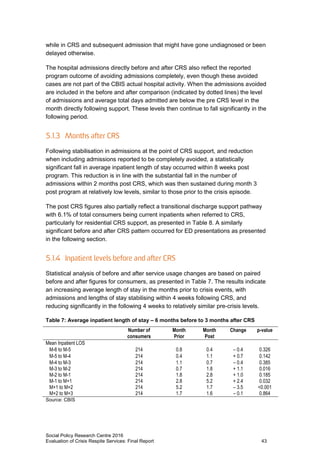
care on an inpatient unit. This care is typically provided as a component of a broader
program and typically includes care:
 by more than one discipline
 of at least three hours duration and
 that is provided in the person's usual place of accommodation or similar.
Conversion factor for intensive home-based subacute care:
 1.5 occasions of service = one hospital bed day
 465 occasions of service = one hospital bed year
 A hospital bed year, a hospital bed that is available for the full year (365 days)
with an occupancy rate of 85%, is to be used for the purpose of calculating bed
year equivalents.
Cost effectiveness
The initial analysis phase reviewed data from the CBIS and CARS systems to
establish CRS consumer profiles across funding, service delivery and demographic
dimensions. The preliminary data provided average benchmark costs in the context
of residential days and service support hours per month, as recorded in CARS, to
establish the cumulative program cost trajectory. Service delivery costs were then
aligned with consumer outcomes and health system service usage from CBIS
through the times series framework.
The program economic component has been developed, based on the quantitative
analysis, by incorporating and aligning cost data for both bed based and home
based sub-acute services in order to estimate the cost effectiveness of providing
CRS, and whether this is a viable service delivery model.
The program service delivery cost basis was derived from combining residential
based days and home based service hours, and the estimated bed day equivalent,
3
Senate Community Affairs Committee, Answers to estimates questions on notice, Health and Ageing
portfolio, Budget Estimates 2013-14, 5/6 & 7 June 2013, Question: E13-204, Definitions and counting
methodology for the National Partnership Agreement on Improving Public Hospital Services, Centre for
Health Service Development Australian Health Services Research Institute, The University of
Wollongong, 30 June 2011, pages 12-13.
Social Policy Research Centre 2016
Evaluation of Crisis Respite Services: Final Report 28
with aggregate program funding and cost data. The resulting average cost estimates
have also been aligned with monthly program utilisation patterns and the timing of
cost offsets, including reduced hospital lengths of stay and reduced ED
presentations post program. The cost offsets also include avoided health service
usage, both inpatient and ED, resulting from the provision of CRS.
Cost effectiveness is analysed through the short CRS timeframe, which may limit
the sensitivity of service usage changes over subsequent months. The countering
aspect will be to identify where possible the circumstances that led to the crisis and
the implications for the consumer if CRS support had not been available.
The program data does not include consumer level cost records and is based on
average cost per consumer based on bed days and support hours. As program
funding is provided to the NGO service provider through periodic grant transfers, the
total program costs are aligned and compared to service use and corresponding
cost offsets in order to indicate cost-effectiveness in broad terms.
Cost effectiveness and model scenarios
As part of the cost effectiveness analysis, model scenarios were developed to
investigate potential costs and outcomes. This is particularly useful for gauging the
proportion of reported hospital and ED presentations avoided. There may be further
scenarios that could model extended timeframes, for example reduced health
service usage and relapse in subsequent months and quarters. In the case that post
program consumer outcomes are sustained over longer timeframes, perhaps 6 or 9
months, this may potentially contribute significantly to the profile of ongoing health
service cost offsets and correspondingly to the program cost effectiveness.
However, these potential ongoing benefits interrelate with confounding factors and,
consistent with the conservative approach taken in this evaluation, are not explicitly
included in the program cost effectiveness estimates. A core cost effectiveness base
case has been developed focused on relatively short term outcomes combined with
established program demand to develop a projected rolling estimate based on
program utilisation. This estimate has provided the basis for projections of outcomes
beyond the evaluation timeframe.
The qualitative research consisted of interviews with key stakeholders and program
managers, and with consumer and carers in the three LHNs. Stakeholder and
manager interviews were generally conducted over the phone while consumer and
carer interviews were generally conducted face-to-face.
Table 2 below shows different stakeholder groups and the total number of interviews
by location/ group.
Social Policy Research Centre 2016
Evaluation of Crisis Respite Services: Final Report 29
Table 2: Qualitative sample by method and location
Stakeholder
group
Consumer
interviews
Carer
interviews
Stakeholder
interviews a
Total
Southern Adelaide LHN 3 1 2
Central Adelaide LHN 4 0 1
Northern Adelaide LHN 5 1 1
Non-geographically based
(e.g. Department staff/ program
Directors, other)
6
Total 12 2 10 27
a
CRS managers and service providers (NGO, SA mental health service); department staff and program directors.
Fieldwork was carried out in the three LHNs where Crisis Respite Services are
delivered.
We collected interview data from consumers who were currently in the program or
who had recently exited. In total 12 consumers were interviewed across the three
LHNs.
The interviews focused on consumers’ previous and current state of wellbeing and
personal circumstances, the types of support and services they had received, and
outcomes they had experienced as a result of being involved with CRS.
Carers were interviewed to better understand the experience of receiving CRS and
to provide insights into outcomes consumers may have experienced. Two family
members were interviewed across the three LHNs. This was fewer interviews than
had been planned as it became clear that it was unusual for staff to have contact
with family members due to the unplanned nature of most admissions, and the fact
that many consumers don’t have contact with family or are homeless.
The research team interviewed staff and stakeholders of the CRS program,
including departmental and Neami staff members. These stakeholders were
involved in the oversight, management, and delivery of CRS. Ten stakeholders were
interviewed. The research team asked stakeholders about processes and
governance arrangements that impact on the effectiveness of the initiative (its
strengths and weaknesses), and how issues could be addressed for future service
improvement.
Social Policy Research Centre 2016
Evaluation of Crisis Respite Services: Final Report 30
The analysis involved triangulation of data including program policy and
documentation, quantitative program, administration and financial data, and
qualitative data collected. The final report will draw together the preliminary findings
of the quantitative and qualitative components of the research, and any feedback
received from the Crisis Respite Services Evaluation sub-committee.
The final report has been written in a language suitable for wider distribution to
stakeholders, such as participating consumers and service providers.
Social Policy Research Centre 2016
Evaluation of Crisis Respite Services: Final Report 31
This section provides demographic details for all CRS consumers, including both
residential and home based support. It also presents program usage from the
establishment phase and ongoing service delivery trend, as well as average service
duration of CRS support, primary mental health diagnoses and reported reasons for
accessing the program.
The CRS program is available for individuals aged between 18 and 65, as well as
older or younger people if they are assessed as appropriate for the service. As
described in the introduction section, eligible consumers may be experiencing
various types of mental health crisis including episodic, high prevalence disorders
where acute admission is not indicated, carer related stress, family or relationship
issues, and accommodation stress or substance misuse.
In addition to support services for the broader community, the program targets
particular populations; young people and Aboriginals and Torres Strait Islanders. It
should be noted that while comparisons are made between CRS consumers and the
general South Australian population, this analysis does not include a comparison
between CRS consumers and South Australian mental health consumers, which
may have provided a more accurate comparison.
Stakeholder interviews indicated that although CRS has been successful in reaching
Aboriginal and Torres Strait Islander people and young people, there is room for
improvement in engaging with these groups.
 The relationship between CRS and Aboriginal Community Controlled Health
Organisations is not clear to key staff and this has been a barrier to the
promotion of the program within the Aboriginal community.
 Young people have more complicated referral pathways and transitions to CRS
(and other programs) than other consumers and this is also true for older (50
years and over) consumers.
Overall a substantially higher proportion of CRS consumers are female (63.5%,
n=554) than male (36.5%, n=318). The higher level of female consumers is
consistent across all program age bands as presented in Figure 2. This reflects the
Social Policy Research Centre 2016
Evaluation of Crisis Respite Services: Final Report 32
broader South Australian proportion of the population reported as having a mental
health condition, which is statistically significantly higher for females than males. 4
Crisis respite service consumers (n=872) are relatively normally distributed across
age bands, with a higher proportion of females accessing services at younger ages.
Approximately twice the number of females accessed the program in the 19 to 24
age band (n=81), compared to males (n=40). The highest level of female access
was in the 25 to 34 year age band.
By comparison lower numbers of males accessed services in the 19 to 24 and 25 to
34 age bands, with peak male frequency in the 35 to 44 age group. Adjusting for the
higher number of females overall the distribution across age groups is relatively
similar and normally distributed (dotted lines and right hand scale).
Figure 2: Program consumer age and gender
Source: CBIS, n=872
The number of consumers represents the total number of individuals including those
that received residential or home based CRS, or both, or repeat support episodes of
either support type. In order to examine the age and gender distribution by CRS
service type the following figures are presented as episodes of support and include
cases where consumers accessed both residential and home based services, and
multiple support services for repeat consumers (n=1,202).
4
Government of South Australia, Health Performance Council, Mental health conditions in South
Australia -- by age and sex, 2014.
Social Policy Research Centre 2016
Evaluation of Crisis Respite Services: Final Report 33
Overall residential services are substantially higher than home based support with
three quarters (75%) of total episodes being residential (n=902) compared to 25%
for home based CRS (n=300). Within the age and gender distribution the
proportions of consumers accessing residential or home based support reflect the
higher numbers of residential CRS across all age bands, as shown in Figure 3 (dark
base portion of each group). This view of the age and service type mix shows the
higher proportion of females accessing home based support, particularly in the
younger and middle age bands (light blue section of each band) compared to males
(notably smaller light red portions).
Figure 3: Program consumer age and gender by service type
Source: CBIS, n=1,202 as based on episodes including multiple episodes for repeat consumers
Target country comparison group
The target country comparison group provided a substantially smaller sample (n=55)
compared to the CRS consumer sample (n=872) and is not sufficient to support
statistically significant analyses. The age and gender distribution of the target
comparison group is relatively consistent with the program sample, with a higher
proportion of identified crisis cases presenting in country regions being female
(52.7%, n=29) compared to males (47.3%, n=26), as presented in Figure 4.
The comparison group is relatively normally distributed across age bands, although
as for CRS consumers, a slightly higher proportion of females accessed the service
at younger ages with approximately twice the number of females to males in the 25
to 34 age band (n=14).
Social Policy Research Centre 2016
Evaluation of Crisis Respite Services: Final Report 34
Figure 4: Comparison group age and gender (Country)
Source: CCCME n=55
In South Australia, 1.9% of the population identified as being of Aboriginal and/or
Torres Strait Islander origin in the 2011 Census.5
As such, CRS is successfully
targeting people who identify as Aboriginal or Torres Strait Islander, with 44
consumers of the total program of 872 indicating Aboriginal status (5.0%). However,
this figure must be read in the context of higher than average rates of mental health
conditions within the Aboriginal and Torres Strait Islander population in South
Australia (as in other jurisdictions).
Aboriginal and Torres Strait Islander South Australians report a high to very high
rate of psychological distress at almost three times the rate of the wider South
Australian population, the highest of any Australian jurisdiction. Aboriginal and
Torres Strait Islander people represent 7.5% of mental health related ED
presentations, compared to 5.2% of total ED presentations.
Aboriginal and Torres Strait Islander people in SA metropolitan areas also use
mental health services at a higher rate than in country regions. The proportion of
Aboriginal and Torres Strait Islander people using mental health services within
5
Australian Bureau of Statistics, 2075.0 - Census of Population and Housing - Counts of Aboriginal and
Torres Strait Islander Australians, 2011
Social Policy Research Centre 2016
Evaluation of Crisis Respite Services: Final Report 35
metropolitan areas is an estimated 15.5%, significantly higher than country regions
at 4.5%, where the CRS program is currently not available.6
Table 3: CRS consumers by Aboriginal and Torres Strait Islander status
Consumers
n
Consumer
%
Aboriginal and/or Torres Strait Islander 44 5.0
Not Aboriginal or Torres Strait Islander 700 80.3
Status not stated 128 14.7
Total 872 100.0
Across metropolitan Adelaide, 107 consumers identified ethnicity as being other
than Australian, representing 12.3% of total CRS consumer contacts. There is
potential variation with established definitions of culturally and linguistically diverse
(CALD) populations although this proportion is similar to an estimated 12.7% of
South Australians who were born in predominantly non-English speaking countries.
South Australia is below the national average of 15.7%.7
Table 4: CRS consumers by ethnicity
Ethnicity Consumers
n
%
Australian 707 81.1
Not Recorded 58 6.7
Aboriginal 23 2.6
English 23 2.6
Greek 10 1.1
New Zealand 6 0.7
Scottish 4 0.5
Chinese 4 0.5
American 4 0.5
Maori 3 0.3
British 3 0.3
Sth African 2 0.2
Sudanese 2 0.2
Indian 2 0.2
German 2 0.2
Iranian 2 0.2
Other 17 1.9
Total 872 100.0
Source: CBIS, n=872
6
State of Our Health: Aboriginal Population Compendium Data Volume, Health Performance Council,
Government of South Australia, October 2014
7
State of Our Health: Health Status and Health Determinants of South Australians Working Draft for
Discussion (May 2013), figures based on Australian Bureau of Statistics, 2011 Census of Population
and Housing, Basic Community Profile, B09 Country of Birth of Persons by sex. Latest Issue Released
at 11.30am (AEST) 21/06/2012.
Social Policy Research Centre 2016
Evaluation of Crisis Respite Services: Final Report 36
Note: CBIS data categories include ethnicity as presented in table as well as country of birth which may result in
minor variation to comparative CALD definitions.
Comparison group data from CCCME record place of birth and language spoken at
home. As indicative figures based on the smaller country crisis cases (n=55) all but
one was reported as English speaking (54/45) with the remaining case not having
language identified. This would tend to reflect generally lower proportions of CALD
individuals in rural regions.
For several months after program commencement in July 2014, the number of
consumers entering the program was low due to set up delays and relocations from
interim premises. Stakeholders commented on the effect of these delays and
relocations in Section 7.6.
Despite the slightly delayed initial phase, consumer numbers increased consistently
from July 2014 to November 2014 from which point there was sustained, consistent
demand for the program for the remaining 12 months of the evaluation period. From
November 2014 to October 2015, an average of 75 consumers accessed residential
CRS per month, and an average of 23 consumers received home based support.
As presented in
Social Policy Research Centre 2016
Evaluation of Crisis Respite Services: Final Report 37
Figure 5, the total number of cumulative CRS consumers increased from low initial
numbers, to a total of 1,270 as at 31 October 2015. Residential CRS represents a
higher proportion of total program consumers (light blue dotted line) than home
based consumers (dark blue dotted line).
Social Policy Research Centre 2016
Evaluation of Crisis Respite Services: Final Report 38
Figure 5: CRS Program development by support service type
Source: CBIS: Facility based services n=903, Home based services n=300
The monthly bars indicate the number of CRS episodes with the higher proportion of
residential contacts (light blue portion) remaining relatively stable following the initial
program establishment phase.
The CRS initiative is a short-term intervention, typically intended to be seven days,
although in some cases consumers can receive an extended service, or receive
periods of both residential and home based support. The duration of CRS services
provided reflect the short-term program focus with the substantial majority of
consumers having completed their support periods within seven days, including
86.5% (n=688) of residential consumers and 59.9% (n=161) of home based
consumers, as shown in Figure 6.
The largest proportion of residential consumers remained in the program for a full 7
days (34.6%, n=275). Collectively more than half of all consumers received a
shorter duration of support than 7 days, including 51.9% (n=413) of residential
consumers.
Social Policy Research Centre 2016
Evaluation of Crisis Respite Services: Final Report 39
Figure 6: Duration of residential and home based crisis respite support
Source: CBIS, residential n=795 exited consumers, Home based n=269
Of those receiving support beyond the target seven days, the largest proportion
received an additional 1 or 2 days (9.6%, n=76), and a further declining number of
consumers received an additional 3 or 4 days (2.6%, n=21). Eight consumers
received support beyond 11 days (1.0%) for a given episode during the 16 month
evaluation period from July 2014 to October 2015.
Reported reasons for accessing residential or home based CRS support focused on
social (34.7%) and accommodation (22.4%) factors as presented in Table 5. Recent
psychological trauma and victimisation collectively related to a further significant
portion of consumers.
Table 5: Consumer reason for accessing CRS services
Home Based Residential Total
Reason for CRS
Consumers
n
Consumers
%
Consumers
n
Consumers
%
Consumers
n
Consumers
%
Social 69 38.8 189 33.4 258 34.7
Accommodation 16 9.0 151 26.7 167 22.4
Recent Psychological Trauma 33 18.5 99 17.5 132 17.7
Victimisation/Vulnerability 25 14.0 70 12.4 95 12.8
Not Recorded 16 9.0 39 6.9 55 7.4
Financial 11 6.2 10 1.8 21 2.8
Recent Physical Trauma 8 4.5 8 1.4 16 2.2
Total 178 100.0 566 100.0 744 100.0
Source: CBIS (n=862)
Social Policy Research Centre 2016
Evaluation of Crisis Respite Services: Final Report 40
Sections 6.2 and 6.4 contain comments from interview participants with regard to
the areas of life in which they felt CRS was most effective, including living
independently and maintaining accommodation.
The most commonly reported mental health diagnosis for CRS consumers was
grouped under the designation ‘mental disorder not otherwise specified’ (31.3%,
n=398), Table 6. This reflects the short term CRS consumer base as generally not
presenting with chronic or more specific diagnoses. Customers with chronic
conditions are generally supported through higher level programs in the stepped
care model.
Table 6: Reported mental health diagnoses by CRS type
Residential Home Based Total
Diagnosis
Consumers
n
Consumers
%
Consumers
n
Consumers
%
Consumers
n
Consumers
%
Mental disorder not otherwise specified 282 29.5 116 36.8 398 31.3
Suicidal Ideation 117 12.3 28 8.9 145 11.4
(blank) 70 7.3 23 7.3 93 7.3
Emotion unstable person disrd borderline 62 6.5 16 5.1 78 6.1
Adjustment disorders 54 5.7 19 6.0 73 5.7
Mod depres ep not in postnatal period 29 3.0 10 3.2 39 3.1
Bipolar affective disorder unspecified 20 2.1 12 3.8 32 2.5
Paranoid schizophrenia 25 2.6 5 1.6 30 2.4
Schizophrenia unspecified 23 2.4 4 1.3 27 2.1
Unspecified nonorganic psychosis 20 2.1 5 1.6 25 2.0
Acute stress reaction 22 2.3 3 1.0 25 2.0
Anxiety disorder unspecified 20 2.1 4 1.3 24 1.9
Schizoaffective disorder unspecified 16 1.7 6 1.9 22 1.7
Mixed anxiety and depressive disorder 18 1.9 4 1.3 22 1.7
Depres ep not in the postnatal period 5 0.5 12 3.8 17 1.3
Post traumatic stress disorder 11 1.2 1 0.3 12 0.9
Personality disorder unspecified 10 1.0 1 0.3 11 0.9
Other diagnoses 151 15.8 46 14.6 197 15.5
Total 955 100.0 315 100.0 1270 100.0
Source: CBIS (n=1,270)
The second most common reported mental health diagnosis was suicidal ideation,
12.3% of residential consumers (n=117) and 8.9% of home based support (n=23),
11.4% of all CRS consumers (n=145).
Social Policy Research Centre 2016
Evaluation of Crisis Respite Services: Final Report 41
This section presents the primary consumer outcomes using both program and
interview data from consumers, carers, and staff. In line with the CRS program
objectives, consumer outcomes have been assessed in terms of:
 Reduced inpatient admission and lengths of stay,
 Reduced ED presentations,
 Avoided inpatient admissions,
 Avoided ED presentations,
 Improved patient mental health outcomes (based on K10), and
 Corresponding use of community mental health services.
The outcome analyses are based on available metropolitan Adelaide CBIS data and
Neami program data for mental health outcomes through K10 scores. Each section
of the quantitative analysis is based on de-identified program and administrative
data using the paired before and after time series framework and is extended using
interview data.
The analysis of inpatient admissions before and after CRS support is based on an
established core consumer cluster including data relating to service use 6 months
prior and 3 months post CRS involvment. As all consumers in this subgroup have
exited CRS for a full 3 months this eliminates the potential issue of right censoring
and provided a sufficient matched sample size for statistical analysis (n=214).
Overall the study group experienced an increase in hospital admissions in the
months immediately prior to CRS support, a levelling off at the point of CRS,
followed by a significant decline to pre-program levels as presented in Figure 7. The
figures indicate total number of admitted days per month (left axis), and the total
number of inpatient admissions per month (right axis).The corresponding statistical
significance of monthly before and after changes are presented further below in
Table 7.
The average number of admitted days prior to CRS for the paired group of 214
consumers was in the order of 200 days per month (around 1 day per consumer per
month) and remained around this level for the months leading up to the crisis
episode. The two months prior to CRS reflect a significant increase in the number or
inpatient admissions and the corresponding average length of stay to around 400
days per month two months prior (around 2 days per consumer per month) to CRS
Social Policy Research Centre 2016
Evaluation of Crisis Respite Services: Final Report 42
and 600 in the month directly prior to program support (around 3 days per consumer
per month).
A further significant pre CRS factor relates to the number of admissions avoided as
a result of program support. As presented in Section 4.1.2, a relatively high
proportion of consumers were assessed by clinicians as having avoided admission
completely and are therefore not included in the pre-program admission data. In the
case that a portion of these proceeded to hospital the level of admissions for this
cohort would plausibly be substantially higher. The estimated number of avoided
inpatient admissions are shown as the additional pre-program gap, indicated with
parentheses. Both of these avoided and reduced components provide context for
the before and after CRS outcomes and are examined separately in the estimated
program cost effectiveness.
Figure 7: Inpatient admissions and admitted days before and after CRS
Source: CBIS (n=214)
The relatively short timeframe of CRS, generally up to 7 days, provides responsive
support services with flexibility to target crisis episodes quickly. The before and after
framework is based on months relative to CRS start date and months after exit date
however many days the consumer received CRS services.
The actual number of hospital admissions, excluding admissions avoided, stabilised
at the point of CRS (solid lines in Figure 7). The slight increase in the average
number of admissions in the first month following CRS is not statistically different
from the level prior to support. These figures at the point of CRS also reflect a
number of admissions that proceeded within days of commencing support, with the
highest proportion of admissions within 4 weeks of CRS diagnosed for suicidal
ideation, 10 of 58 (17.2%). This may partially reflect closer professional monitoring
Social Policy Research Centre 2016
Evaluation of Crisis Respite Services: Final Report 43
while in CRS and subsequent admission that might have gone undiagnosed or been
delayed otherwise.
The hospital admissions directly before and after CRS also reflect the reported
program outcome of avoiding admissions completely, even though these avoided
cases are not part of the CBIS actual hospital activity. When the admissions avoided
are included in the before and after comparison (indicated by dotted lines) the level
of admissions and average total days admitted are below the pre CRS level in the
month directly following support. These levels then continue to fall significantly in the
following period.
Following stabilisation in admissions at the point of CRS support, and reduction
when including admissions reported to be completely avoided, a statistically
significant fall in average inpatient length of stay occurred within 8 weeks post
program. This reduction is in line with the substantial fall in the number of
admissions within 2 months post CRS, which was then sustained during month 3
post program at relatively low levels, similar to those prior to the crisis episode.
The post CRS figures also partially reflect a transitional discharge support pathway
with 6.1% of total consumers being current inpatients when referred to CRS,
particularly for residential CRS support, as presented in Table 8. A similarly
significant before and after CRS pattern occurred for ED presentations as presented
in the following section.
Statistical analysis of before and after service usage changes are based on paired
before and after figures for consumers, as presented in Table 7. The results indicate
an increasing average length of stay in the months prior to crisis events, with
admissions and lengths of stay stabilising within 4 weeks following CRS, and
reducing significantly in the following 4 weeks to relatively similar pre-crisis levels.
Table 7: Average inpatient length of stay – 6 months before to 3 months after CRS
Number of
consumers
Month
Prior
Month
Post
Change p-value
Mean Inpatient LOS
M-6 to M-5 214 0.8 0.4 – 0.4 0.326
M-5 to M-4 214 0.4 1.1 + 0.7 0.142
M-4 to M-3
M-3 to M-2
M-2 to M-1
M-1 to M+1
M+1 to M+2
M+2 to M+3
214
214
214
214
214
214
1.1
0.7
1.8
2.8
5.2
1.7
0.7
1.8
2.8
5.2
1.7
1.6
– 0.4
+ 1.1
+ 1.0
+ 2.4
– 3.5
– 0.1
0.385
0.016
0.185
0.032
<0.001
0.864
Source: CBIS
Social Policy Research Centre 2016
Evaluation of Crisis Respite Services: Final Report 44
Note: Consumer cluster based on 3 month post CRS n=214, paired t-test on matched before and after
consumers.
As presented in
Table 8 a total of 78 consumers (6.1%) were reported as current inpatients when
they entered CRS support. The proportion of residential CRS consumers is
substantially higher, which reflects a temporary discharge pathway which may
contribute to slightly reduced lengths of stay due to consumers feeling able to
transition through a residential facility or safely return home with home based
support.
Table 8: Current inpatients referred to CRS program
Home Based Residential Total
Current inpatient
Consumers
n
Consumers
%
Consumers
n
Consumers
%
Consumers
n
Consumers
%
No 172 54.6 494 51.73 666 52.44
Yes 6 1.9 72 7.54 78 6.14
Not reported 137 43.5 389 40.73 526 41.42
Total 315 100.0 955 100.00 1270 100.00
Source: CBIS (n=1,270)
In addition to reduced inpatient admissions post program and potential reduced LOS
resulting from early discharge, a significant proportion of consumers targeted as ‘at
risk’ of inpatient admission are reported to have avoided hospital completely as a
result of the program. The program responsiveness and capacity enables rapid
intervention of developing episodes and is diverting consumers from hospital events
altogether. Avoided admissions is an additional component to reduced admissions
and LOS and is not reflected in CBIS figures in the month prior to program entry.
Table 9: Inpatient admissions avoided by service type
Home Based Residential Total
Avoided inpatient
Consumers
n
Consumers
%
Consumers
n
Consumers
%
Consumers
n
Consumers
%
No 61 19.4 170 17.80 231 18.19
Yes 116 36.8 396 41.47 512 40.31
Not reported 138 43.8 389 40.73 527 41.50
Total 315 100.0 955 100.00 1270 100.00
Source: CBIS
As presented in Table 9 a relatively high proportion of both residential and home
based consumers are reported to have avoided inpatient admission as a result of
the CRS program, 40.3% of total CRS episodes. This indicates that a significant
Social Policy Research Centre 2016
Evaluation of Crisis Respite Services: Final Report 45
number of consumers avoided inpatient admission completely through entry to the
program rather than hospital. The comparative before and after change does not
capture these avoided admissions as it is based on pre and post CRS average
lengths of stay. For this reason the reported avoided admissions are estimated and
presented as a separate potential component in the cost effectiveness analysis.
This question records a subjective judgement by the clinician and is accordingly
presented as a suggestive figure. Despite this, the fact that a significant proportion
of consumers are considered to have avoided hospital health services suggests the
program is contributing to a significant number of avoided hospital admissions.
Consumers interviewed in the qualitative phase of the fieldwork commented
positively on the fact that their admittance to CRS had meant they had avoided a
hospital stay (see Section 6.4.6), or had acquired strategies that would make a
hospital stay less likely in the future. Clinical service staff also facilitate patients who
present to EDs to be assessed and discharged to CRS where appropriate.
Similar to the before and after CRS reduction in hospital admissions, ED
presentations showed a significant increase pre CRS at the point of the crisis
episode and declined significantly following CRS support.
Presentation to EDs for the paired cohort increased significantly in the month prior to
CRS support, and decreased significantly in the month following CRS, Figure 8. The
corresponding statistical significance of monthly before and after changes are
presented further below in Table 10.
Social Policy Research Centre 2016
Evaluation of Crisis Respite Services: Final Report 46
Figure 8: Emergency department presentations before and after CRS
Source: CBIS (n=404)
Similar to the hospital admission pattern, the number of ED presentations was
relatively stable in the months prior to the crisis episode at around 50 per month, an
average of 12% of the cohort attending an ED. The average number of ED
presentations increased significantly in the month prior to CRS, partially as a result
of multiple ED attendances including 33 individuals with more than 1 presentation,
and 3 consumers attending 3 times in the month. These repeat cases in the month
before CRS account for 69 presentations of the total 283, 11.7% of the total.
Table 10: Average number of ED presentations by month
Number of matched
consumers
Quarter
Prior
Quarter
Post
Change p-value
Mean ED presentations
M-3 to M-2 404 0.15 0.12 –0.3 0.345
M-2 to M-1 404 0.12 0.70 +0.58 0.001
M-1 to M+1 404 0.70 0.18 –0.52 0.001
M+1 to M+2
M+2 to M+3
404
404
0.18
0.11
0.11
0.13
–0.07
+0.02
0.015
0.503
Source: CBIS
Consumer cluster based on 3 months post CRS n=404, paired t-test on matched before and after consumers
Assumed ED presentation = 1 day.
Similar to hospital admissions presented in the previous section, ED presentations
before and after CRS also reflect the reported effectiveness in avoiding ED
completely, underlining that these avoided cases are not part of the CBIS actual ED
activity. When ED presentations avoided are included in the before and after
comparison (indicated by dotted blue line) the level of ED attendances are more
significantly reduced below the pre CRS level.
The statistically significant reduction in ED attendances in the month following CRS
includes 24 consumers who were admitted to hospital within 4 weeks of program
support, potentially overstating the total post program ED reduction by
Social Policy Research Centre 2016
Evaluation of Crisis Respite Services: Final Report 47
approximately 11% assuming the ED absence resulted from being an inpatient.
Excluding this component there is a highly significant reduction in ED presentations
in the months post CRS.
Average ED presentations are relatively low compared with inpatient days, showing
a reduction of 0.52 presentations per month in the before and after comparison and
accordingly this is a relatively minor component of hospital cost offsets as discussed
in the cost effectiveness presented in Section 7.
It is recognised that presentations to EDs are often complex and diagnoses in this
emergency setting may focus on physical symptoms and thus mask underlying
mental health conditions, or not be classified within established definitions for
reporting mental health related ED presentations. This may lead to under-reporting
of the actual number of mental health related ED presentations.8
Clinical service staff are well placed to responsively facilitate assessment and
referral to CRS services, with a stated program intention to prevent patients
presenting to EDs. Similar to inpatient admissions, a significant number of CRS
consumers were reported as having avoided ED as a result of CRS support, a total
of 542 cases (42.7%), Table 11.
Table 11: Reported ED avoided on entry to CRS program
Home Based Residential Total
Likely ED
Consumers
n
Consumers
%
Consumers
n
Consumers
%
Consumers
n
Consumers
%
No 68 21.6 134 14.03 202 15.91
Yes 110 34.9 432 45.24 542 42.68
Not reported 137 43.5 389 40.73 526 41.42
Total 315 100.0 955 100.00 1270 100.00
Source: CBIS
Similar to avoiding inpatient admission, avoiding ED presentation is based on an
assessment by the clinician, which includes consideration of discussion with the
consumer, past history of the consumer’s utilisation of ED, and the clinician’s
judgement that CRS may help avoid an ED presentation. This question is a
subjective judgement by the clinician and is therefore presented as a suggestive
figure. Despite this, the fact that a majority of consumers are considered to have
avoided ED services suggests the program is contributing to a significant number of
avoided presentations.
8
Australian hospital statistics 2011–12. Health services series no. 50. Cat. No. HSE 134. Canberra:
AIHW.
Social Policy Research Centre 2016
Evaluation of Crisis Respite Services: Final Report 48
Consistent with the before and after CRS reductions in hospital admissions and ED
presentations, community health service contacts also reflect an increase leading up
to the crisis episode and CRS entry, followed by a reduction following CRS support,
Figure 9. All figures are based on the matched before and after consumer group as
used in the inpatient and ED analyses with the number of community health service
contacts shown on the left hand scale and the reported contact duration on the right
hand scale.
The community contact figures are based on CBIS episode type and do not include
specific details of the types of community program contact. Similarly the community
contact duration is derived from episode start and end dates and does not reflect the
relative intensity of the support period. For this reason the community health service
contacts are presented as indicative before and after CRS figures, which are
consistent with the hospital admission and ED service use patterns.
Similarly, in line with the conservative approach of the evaluation the community
health service figures have not been explicitly incorporated into the preliminary cost-
effectiveness analysis. The extent to which these community mental health services
are reduced provides an additional source of potential cost offsets to the program
and would further contribute to the program cost-effectiveness estimates as further
discussed in Section 7.
Figure 9: Community health service contacts before and after CRS
Source: CBIS, (n=342)
Mental health outcomes were assessed based on the Kessler Psychological
Distress Scale (K10) which assesses the level of anxiety and depressive symptoms
Social Policy Research Centre 2016
Evaluation of Crisis Respite Services: Final Report 49
a person may have experienced in the most recent four-week period. K10 scores
provided a statistically significant sample of matched CRS consumers with K10
scores recorded on entry and directly after CRS support.
The K10 was generally administered on the day of CRS program entry and then on
the day or within days of exit. This importantly focused the comparative change on
the similarly short timeframe of CRS residential or home based support.
The K10 is scored using a five-level response scale based on the frequency of
symptoms reported for each question. In most ABS and other Australian surveys, 1
is the minimum score for each item (none of the time) and 5 is the maximum score
(all of the time). The sum of these scores yields a minimum possible score of 10 (all
answers were ‘none of the time’) and a maximum possible score of 50 (all answers
were ‘all of the time’) 9
Overall CRS consumers reported a highly statistically significant improvement in
total K10 scores post program, i.e. lower average score, as presented in Table 12.
The reduction in mean score was higher for residential consumers with a change of
–9.9 (n=428), although home based support also resulted in reduced average
scores of –6.0 (n=101). Collectively for the matched cohort of 529 the overall
reduction was –9.2.
Table 12: Mean K10 scores on entry and exit of CRS program
Number of
matched
consumers
CRS
Entry
CRS
Exit Change 95% CI p-value
Mean K10
Residential
Home based
Total
428
101
529
35.4
35.8
35.4
25.4
29.8
26.2
–9.9
–6.0
–9.2
9.0 / 10.9
4.3 / 7.8
8.4 / 10.1
< 0.001
< 0.001
< 0.001
Source: Neami program data. CI = Confidence interval
The highly statistically changes in before and after CRS K10 scores indicates that
the CRS intervention frequently improves psychological distress associated with
crisis episodes, and in particular from episodes involving higher levels of distress.
In addition to the overall reduction in K10 scores, it is important to note the
proportion of consumers that presented on CRS entry with severe levels of
psychological distress compared to the proportion on exit, Figure 10. In order to
examine the composition of levels of K10 scores, the matched before and after CRS
scores were additionally grouped under categories of severe, moderate or mild
distress in line with established ranges used by the Australian Bureau of Statistics
9
4817.0.55.001 - Information Paper: Use of the Kessler Psychological Distress Scale in ABS Health
Surveys, Australia, 2007-08
Social Policy Research Centre 2016
Evaluation of Crisis Respite Services: Final Report 50
(presented in Appendix A). Consumers receiving repeat CRS support episodes
complete separate K10 questionaries for each support episode.
The K10 categories indicate a high proportion, approximately three quarters, of
consumers were experiencing severe levels of psychological distress on entry to the
CRS program (74.9%, n=396). This was the case across both support types with
74.8% (n=320) of residential and 75.3% (n=76) of home based consumers exhibiting
severe levels of psychological distress on entry to CRS. The proportion reduced
significantly on exit to 32.7% (n=14) for residential and 49.5% (n=50) for home
based respectively.
South Australia’s target for psychological wellbeing involves psychological distress
being maintained at equal or lower levels to the Australian average for psychological
distress.10
The trend between 2001 and 2011–12 indicates an improvement in South
Australia from 14.1% to 11.4% of the population experiencing high levels of
psychological distress. This compares nationally over the same period with an
improvement from 12.6% to 10.8%. Although statistical limitations with the national
data set prevent conclusive comparisons between South Australian and Australian
rates of psychological distress, programs which support reduced levels, including
the CRS program, are contributing to achieving and then sustaining this strategic
target.
Figure 10: K10 level of severity on entry and exit of CRS program
Source: Neami Carelink program data. N=529
10
South Australia’s Strategic Plan, http://saplan.org.au/targets/86-psychological-wellbeing, Target 86.
Social Policy Research Centre 2016
Evaluation of Crisis Respite Services: Final Report 51
Relapse duration analysis examines the timing of relapse of CRS consumers post
program, for example either as an inpatient admission or presenting to an ED11
.
Given the relatively short 7 day CRS support timeframe, potential program
outcomes beyond 3 months post support are considered outside the timeframe of
the crisis episode for which the CRS referral was made and are not examined in the
analysis. Based on the assessed 3 months following CRS both hospital
readmissions and repeat ED presentations remain at relatively stable pre CRS
levels.
11
Due to consumer program entry and exit dates, the available consumer follow-up period varies and is
limited with a characteristic resulting issue of right censoring, where insufficient post CRS duration is
available to sufficiently assess program outcomes.
The duration analysis framework has been used to define a post CRS program cohort in which all
consumers have completed a full 3 months since exiting the program. This manages the potential right
censoring issue and provides a sufficient consumer cluster of paired before and after data for 6 months
prior and 3 months following CRS. The analyses focus on the before and after CRS framework and
further comparative duration analysis was not possible given the small sample size obtained from the
target country comparison group.
Social Policy Research Centre 2016
Evaluation of Crisis Respite Services: Final Report 52
The researchers conducted a total of 14 interviews with consumers of the CRS
program and their carers. Interview participants had experienced home-based or
residential CRS care. Some of these consumers were current CRS consumers,
while others had recently exited the program. Interview participants were asked to
explain the broad circumstances of how they became involved with CRS and other
details of their stay such as how long they had used the service, the nature of the
supports they had been receiving, and how effective they thought the service had
been.
Most of the interview participants had come to CRS straight from hospital. For
several of these participants, this was not their first stay with CRS, and some of
these consumers described how CRS had become part of their “routine” when
experiencing or recovering from mental health issues. The majority of participants
reported staying with the service for the full 7–day period, with some consumers
extending this period within the residential accommodation (usually only for 2 or 3
days), or by adding a period of home-based respite at the end of the residential stay
(usually another 7 days).
Some interview participants explained the reasons that they had been referred to
CRS. Some had experienced some form of breakdown, while others mentioned drug
and alcohol-related reasons. Others commented that they had come to CRS to
achieve some stability, routine or normality in their life. A few participants mentioned
that they came to CRS to ease the process of changing or beginning a new
medication.
CRS staff members provided a range of services to the interview participants. Most
commented that they were given their own space, time alone if they wanted it,
including sleeping when they wanted to, and help to make and eat healthy food.
I was given space to rest and get myself ready to be open and active.
It gave me the opportunity to be away from the children and get some space
so I could go home comfortably to look after the children, without a 2 or 4 or
8 week hospital stay.
It was good to be taken away from an environment where I was anxious and
out of control, to one where none of those things mattered.
Beyond these basic forms of respite, interview participants said that they had also
received mental health support and counselling, medical support from GPs,
domestic violence support, as well as assistance from CRS staff with practical
Social Policy Research Centre 2016
Evaluation of Crisis Respite Services: Final Report 53
matters such as housing and furniture acquisition, dealing with Centrelink and
identification issuers, banking, and connections to community organisations.
Interview participants described their overall experience with CRS:
It gave me the opportunity to get back on my feet and options, and an idea of
how to help myself when I was feeling low.
I had an interview when I came in to assess me, then I was free to chat with
staff members that were available. There were also some support staff that
would ask how I was going. And then within a couple of days I was
interviewed again to see how I was traveling and the type of support that was
required. First couple of days I stayed in my room, but after that there was no
pressure or anything, there was a natural progression to manoeuvre through
the place in terms of social interaction.
I was homeless when I arrived so I needed help finding somewhere to live.
I’d come out of a complete breakdown in every part of my life so it was a
good place to decompress; and the staff were nice and you could talk to
them and relate to them. Mine was a breakdown everywhere and it was good
to just get away from it.
My life had become chaotic and I was living every day hoping it was my last
day. So they helped me feel that I was worth something and I did have
reasons to live. I had isolated myself at home. They took me out here after
dinner for walks to get into the habit of getting out and walking around. Eating
as well – I wasn’t eating. I was suicidal at the time. They helped me with my
medications and to have rest and a respite and proper nutrition.
Overall, interview participants were very positive about the support they had
received.
It’s been excellent. There are counsellors here 24/7, that’s the best thing.
Whenever you need it.
You can’t really ask for anything more.
Fantastic.
It’s been awesome. It’s the right type, right intensity. Is exactly what I
needed.
This round it has helped majorly. They helped to give me another perspective
from the outside.
[CRS staff] can help guide me into a situation when I leave that is more
planned and structured than my usual approach.
Interview participants discussed how well the support they had received at CRS had
met their needs in terms of factors such as the intensity, frequency and length of the
Social Policy Research Centre 2016
Evaluation of Crisis Respite Services: Final Report 54
support. Several interview participants commented on the CRS staff themselves,
noting in particular that they were friendly, helpful, approachable, and non-
judgemental.
You could go to them with anything and everything. If you wanted to cry you
could cry and they’d just sit and listen and help as much as they could.
They provide a lot of good services and they interact with people, they’re
polite, they make you feel welcome, and at the same time give you the help
that you need.
It just feels like a family here. Because when you don’t have any self-worth
they tell you that you have.
It’s like having about 8 mums.
The environment and setting made the staff a lot more approachable, they
weren’t locked away in a little room, you could always talk to them, ask about
when dinner would be made, etcetera. Being able to ask about that stuff was
great and they weren’t locked away in meetings.
Just chatting and being asked how I am –it feels genuine, and they’re here to
really help people. Which is ideal.
The fact that there’s no judgement: people will stop their work to talk to you.
That doesn’t happen in hospitals, their work comes first. At CRS the
consumer comes first.
Interview participants also mentioned that CRS staff had provided good support to
them with regard to practical matters. Most importantly, CRS staff addressed
consumers’ needs relating to housing, and to helping to provide structure to their
lives.
Like with my dyslexia and reading and writing, they said they could help me
fill out forms and stuff on my behalf, which was good. They were looking into
things like mentors for me. They told him there are jobs out there for people
like me, which picked me up, made me feel happy. I could see them actually
doing something to help me.
Getting back in a daily routine was the biggest help for me. One of the [CRS]
workers suggested a daily planner for me so they created that and it was
really helpful, and now it’s on my fridge at home.
They came every day for a week when I was at home [in home-based care].
And they helped me with shopping and took me to the beach, different things
that I needed. I liked having the company.
CRS find a lot of the people you need to see, and contact people for you.
They’re very helpful. And they actually helped me with my super and
everything, and even helped me get a payout because I can’t work anymore.
Can’t thank them enough for that.
Social Policy Research Centre 2016
Evaluation of Crisis Respite Services: Final Report 55
There’s a list of boarding houses they offered me here and I was able to
access them and will transition to there after here. I’ve never been offered
that before.
I don’t know a lot of services like Housing SA so I’ll be sorting all that out with
them. They’ll accompany me and advocate on my behalf. Housing will be the
big one for me, the independence side of things.
Interview participants spoke about the way that CRS staff “helped them to help
themselves” to succeed independently, for example by helping to devise plans and
structures for their lives or strategies for coping with their mental health condition,
and stepping in to assist when necessary while also being trusted to tackle their own
issues.
At CRS they let me see my own doctors who understand my condition. In
hospital they use their own internal doctors and change all my medication, so
I come out and have to start all that again. In CRS they don’t do that so I
don’t have to go through that whole process – and they trust me enough to
give myself my own meds, so I really appreciates that trust.
You could ask for someone to fix your own life, but when it comes down to it
you need clean, safe housing, someone to not baby you but to support you
with things you do need – someone can’t just “fix” everything.
The space is important, also positive encouragement, being active in my own
exit plan – they want to involve you and not just give you a number and leave
you to it.
A carer also reiterated this point.
I probably changed the way that I emotionally support her. From taking
charge of the situation, to more encouraging her to take charge of the
situation. That was borne out of the philosophies that they espouse here at
CRS; for example the clients prepare their own food, clean the place, look
after themselves. They’re under supervision and have a safe shelter but it’s
really about taking charge of your life and what it’s going to be like when
you’re not in care.
Some interview participants also reflected on how the support they had received
through CRS had differed from support they had received in the past through other
services or practitioners.
[A psychologist] was just one hour a week and that was it. They’d give you
things to try but then leave it to you. Here they’re always there for you.
[Area] Mental Health is not as good as CRS – they distance themselves from
the client. CRS they take a lot of care in what they do. [Area] Mental Health,
you’re just a number and this is just a process you have to go through. It’s
the little personal touches. They just go through the motions. Or you ring
them up and they don’t get back to you. At CRS it’s a different model.
I have rapid cycling bipolar, which can be hard for hospitals to understand
that I need a long stay. So CRS means I can say to them that I might be up
Social Policy Research Centre 2016
Evaluation of Crisis Respite Services: Final Report 56
and down but it’s due to the rapid cycling bipolar, but in hospitals they don’t
like to be told things like that.
I had clinical treatment for depression about 7 years ago, but that [treatment]
was primarily clinical, antidepressants…[CRS] was a lot more subtle in that it
takes you away from areas where I felt anxious and put into an area where I
didn’t feel any pressure at all. That in itself was a great thing
Interview participants described the CRS staff as very proactive and helpful in
assisting them to connect with a range of external services, including other mental
health and medical services, accommodation services, government services such
as Centrelink, and community groups. This assistance usually consisted of calling
these services on the consumer’s behalf or taking the consumer to the service in
person.
Finally, a few interview participants said that they didn’t think that 7 days was a long
enough period of support for them. Having said this, it appeared to be reasonably
common practice to extend stays or to offer an additional period of home-based
support to consumers where possible.
A carer of a person with a mental health condition made the point that CRS provided
respite not just for the consumer, but for family as well.
It provided the required support at the time, not just for her but for other
people around her. She needed somewhere where she could be supervised
safely. For people around her they needed the respite from having to provide
care for her.
The researchers asked the interview participants whether they felt that the support
they had received at CRS was oriented to recovery. Interview participants conceived
of the notion of “recovery” in various ways. For some of these CRS consumers,
mental health recovery was thought of as something that was secondary to, or the
result of, achieving stability in one’s life, and not necessarily the only or main goal of
their treatment. Although it would be fair to say that some level of mental health
recovery is required before practical matters can be effectively attended to.
Just getting back on my feet. Getting back into a routine and planning things
like meals makes things easier.
My goal is to stay well, physically and mentally. Having the daily routine and
getting centred, and to reinforce some strategies I’d learnt in the past from a
counsellor, being able to pull out the right tool. Whether that be acceptance
therapy or mindfulness.
Life recovery. Getting up on your feet. Whether you’ve lost your children or
whatever you’re going through because of a mental illness, whatever your life
is like because of that, they’re just trying to help – your depression, your
anxiety, your drug abuse, etc. people who have a mental issue need support.
Social Policy Research Centre 2016
Evaluation of Crisis Respite Services: Final Report 57
Other interview participants saw the purpose of CRS as providing immediate respite
so they could recover from a crisis point in their lives, and then go on to reassess,
restart and move away from the “brink” of that crisis.
I don’t want to feel the way I’m feeling. I want to stop that. It’s a little bit
better. I would describe it as “stabilisation”, because I know I could go back
to it.
To have a reason for living. A purpose. To get my life back into something
meaningful every day.
My endpoint was to feel that I was capable of being able to move forward
and take control of the things I needed to take control of. And understanding
why those things needed to be put in place was critical too.
There were a few specific points that had got completely out of control –
drinking, home life, business life was stressing home to the point of not
sleeping,.. so basically decompressing.
For some interview participants, their focus was on taking an important first step that
they felt was a prerequisite to achieving a “recovery”.
The goal is …I have to go to court, so to get [to CRS] and then to that stage
and past if I have to, if need be. So that’s given me food for thought, so now
I’m thinking long term instead of just short term.
The goal of CRS is to keep me from needing hospital care. To give me the
time out I need without having to have a hospital stay. Sometimes people
end up in hospital who don’t need to be there, they just need a time out. A lot
of people have long term mental illness and they just need respite not a
hospital.
I just wanted to get stronger and come back home and live on my own. My
mum died and I had been in a sort of caring role for her and living with her.
In order to discern the areas in which CRS has had the most effect, interview
participants were asked to comment on specific parts of their lives and the degree to
which CRS has helped in those areas.
Interview participants generally felt that CRS had had a positive effect on their
mental health and their ability to get back to “normal”; although some acknowledged
that it may be too soon to say whether these effects would last beyond the short-
term.
I felt absolutely fantastic when I got home. I felt like a different person.
Social Policy Research Centre 2016
Evaluation of Crisis Respite Services: Final Report 58
I feel a lot stronger. It’s down to slowly fixing some of the things that were a
roadblock – when every path you go to take there’s a block because you’ve
lost your bankcard, or whatever, small minor things, but they all add up and
it’s like your life is over.
It’s short-term, [but] mental health is a long term issue. Short-term it couldn’t
have been better. [CRS staff will] see me outside of here as well. Short-term
I’ve had people to talk to that understand to help me get through. Without this
I would’ve been in a mental hospital for sure. So I’ve been diverted from that
path.
Participants felt that the particularly useful aspects of CRS in terms of improving
their mental health were the opportunity it provided for a break and respite, and the
fact that it provided treatment that focused on equipping consumers with strategies
to address their mental health issues rather than simply focusing on medication, as
many had experienced in hospitals or other mental health treatment facilities.
These people here at CRS help you find strategies to cope with things
instead of relying on the drugs they give you to make you feel relaxed and
normal and happy and make you feel like a zombie. This mob here give you
coping skills so you don’t have to rely on drugs. You keep your mind
occupied working out strategies by painting, doing puzzles, meditation.
Just to get back into the daily routine and reinforce the techniques that you
can use on a daily basis. It’s not something they show you once off, you can
apply it to your life every day. It’s a life skill.
[It has improved my mental health] drastically. Going through mental health
wards they want to give you drugs – I haven’t had any drugs here. No
medication. And I feel so much better already. It is in the true sense a
respite.
I haven’t had to go to hospital for nearly a year. It’s just been that break that
I’ve needed. I don’t need to go to hospital every time I become unwell. As I
get older I’m better at regrouping, and CRS provides that opportunity.
The majority of interview participants said that the support they had received from
CRS increased their capacity to live independently. For some participants, this was
because CRS had helped them to organise practical matters such as daily planning
and engagement with services.
To be able to have a normal daily life without feeling depressed all the time…
If I can stick with my daily planner everything flows from there. For example, I
have a job interview on Friday that I wouldn’t have been in a position to
tackle if I hadn’t been able to plan my approach.
Just coping with different things. They helped me out with bills and stuff like
that. Setting up direct debits for me. Stuff like that. And coping with everyday
life.
Social Policy Research Centre 2016
Evaluation of Crisis Respite Services: Final Report 59
I think I’ve always had that capacity – I’ve been looking after myself since I
was 15-16 - but what it has done is reiterated the want for me to be by myself
without being distracted by other influences or situations.
Two interview participants said that CRS had helped to stabilise their substance
misuse, which in turn increased their ability to live independently.
Since being here it’s reminded me of how I can live and how I used to live.
The drinking is now probably a tenth of what it was. I can see a future without
being in a rehab or anything.
Another two participants commented that CRS provided a bridge between living in a
hospital and living independently by providing the skills and strategies to do so.
One consumer said that she still wasn’t sure if she was ready to live independently
because of the severity of her mental health condition, and another said that she
would have appreciated some more follow up from CRS staff after she had left to
assist her in living independently.
So you feel like you’re back out in the world on your own. Something like a
courtesy call a couple of days after you leave to check in would be good.
Another consumer had moved into boarding house accommodation after his stint at
CRS and had set a goal of living completely independently within two years.
Again, interview participants had a range of definitions of what constituted
“community life”. For some participants, CRS had helped them to simply leave the
house to undertake activities in the community such as going for a walk, or going to
the shops or local library.
I went for a walk to the shops yesterday, which I haven’t done for so long – I
wasn’t strong enough mentally and physically.
Some participants saw CRS residential care as a community in itself, with social
interactions between staff and consumers. For some, this form of community
participation may have been greater than they usually experienced.
For other participants, CRS staff had actively helped them connect with external,
formalised community activities, such as community gardens, netball, a crochet
club, swimming, arts and crafts, men’s sheds, and community centres and hubs.
They helped me find out about groups and phone numbers which I didn’t
know about before, things like community gardens.
Social Policy Research Centre 2016
Evaluation of Crisis Respite Services: Final Report 60
Some participants hadn’t required assistance to engage with formalised community
activities but did note that they had reengaged with friends and social activities after
their mental health had improved following their treatment at CRS.
Finally, a few participants felt that CRS had helped to prepare them to re-enter
community life, but that they weren’t quite ready to do so yet; although some had
started to make plans to do so.
Interview participants strongly argued that the support they had received from CRS
had improved their quality of life, and many of these participants attributed this
improvement directly to the staff themselves and particular aspects of the nature of
the treatment at CRS such as the focus on helping consumers to help themselves.
Participants spoke of their crises having abated, allowing them to return to
“normality” and routine, and often remarked on the turnaround they had experienced
in their lives.
In my head that big dark shadow – they call it depression – it’s just not as
dark. And I’m more open. When I feel like everything’s crap I tend to close off
and don’t want to talk and don’t want to answer questions. Now it’s not as
stressful – there is an answer for questions again.
They picked me up from the bottom and put me right up there – like this is
not the end of the track. Stuff goes on but you have got to cope with it and
find different ways and you’re the only one that can do that, they can just
advise you how. It’s saying yes it’s up to you to do it. They plant it into you to
make you feel like there is some good in you. They make you feel like…they
don’t say “we can take the pain away from you”, because they say you’re the
only one that can do it, so they make you realise that yes you can do it. They
don’t just give you your happy tablets and then go away.
It’s given me hope. And self-worth. They don’t judge you. They know
everything, they know the whole deal and they don’t judge you on it, they just
support you.
From where I was last week to this, my quality of life is a complete
turnaround. I was having suicidal thoughts and depression and not wanting
to be part of anything. To have the positive atmosphere [at CRS] has let me
know it isn’t all over and these positive people can help me help myself.
Ultimately it is probably the single most impactive thing I’ve had in regards to
getting back on track from a personal perspective. This feels like more of an
emotional support, coming from a different angle. It’s impacted so much I’ve
started doing a Cert IV mental health course.
I’m eating properly and cooking and being healthy, so that physical aspect as
well as mental, and the daily routine – all steps you in the right direction.
They’re all good guidelines to move forward.
Social Policy Research Centre 2016
Evaluation of Crisis Respite Services: Final Report 61
80% increase easily. At least I wake up, have my shower, get dressed.
Before I wore the same trackies every day.
A carer said that CRS had had a significant effect on the ability of the person that he
cares for to self-direct their own care.
I’ve noticed that she’s now standing up for herself more, she’s become quite
stubborn when she believes in something or doesn’t agree with somebody.
So her whole character has changed to become quite stubborn. In life in
general. She’s listening all the time, she’s understanding everything. She’s
letting people know that if she doesn’t agree or wants more information… it’s
a significant change to her. She always used to be very passive. She’s now
an active participant. She’s still on medication and probably will be for a long
time but it’s a minimal amount considering how much she was on at the start.
She’s been able to articulate very clearly with the doctors about what she
believes is working and isn’t working, so that’s been part of her taking charge
too. And they’ve listened to it.
The majority of participants were already in stable housing so for them the question
was not relevant.
For those participants who were not in stable housing, two said they were still
looking for accommodation (with the help of CRS staff), so it was too soon to say
whether they would achieve stable housing. One participant had been living in his
car before entering CRS and had gone on to find accommodation, although he
described this accommodation as “not the most stable”. Another participant had
been experiencing domestic violence at home so had applied, with the help of staff
members, for temporary emergency accommodation and had been accepted into
what she described as a boarding house.
Some interview participants had a mental health condition that led to frequent crises
(and therefore frequent visits to hospital or use of emergency services), while other
participants had experienced what they thought of as a “one-off” crisis or
breakdown. The former group spoke about CRS providing them with strategies and
skills that would, they hoped, reduce the frequency and severity of their crises, or
provide a diversion from hospitalisation or emergency care.
If this wasn’t here I would’ve been in a ward being forcefully made to take
medication I don’t wanna take.
It’s given me time to think because I’m not in the situation anymore. So
you’re standing outside the square looking in.
One member of this group was worried about what might happen when he left CRS
and was “on his own”:
Social Policy Research Centre 2016
Evaluation of Crisis Respite Services: Final Report 62
It has [reduced the frequency and severity of the crises] to a certain extent
because during the 7 days [in CRS care] it stops – but then there’s no more
contact, it’s pretty daunting. They fit a fair bit in in 7 days, but then you’re on
your own. It would be good if they could do follow ups and stuff like that.
Those participants who had experienced what they saw as a one-off crisis generally
felt that the support they had received in CRS would prevent or significantly
decrease the likelihood of future crises.
This diversity of experience should be taken into account when interpreting the
quantitative findings on reductions of ED visits and hospital stays. If consumers had
not had hospital admissions or ED visits in the months prior to their spell in CRS
then they could not be classified as having reduced their hospital attendance.
However the interviews with customers and families confirm that CRS has helped
them avoid further in patient care and has in addition supported a number of less
quantifiable outcomes for participants.
Interview participants spoke very positively about the increase in their ability to
reach their goals, often attributing their greater self-efficacy, confidence and self-
worth to encouragement from CRS staff members, and access to information
through CRS.
They just lift you up. You can do anything you want, as long as you wanna do
it. Nothing’s too hard.
In terms of giving you confidence, you realise you’re not a worthless idiot and
do have something to contribute to the world.
You think that you can do it now where before I didn’t want to do it and didn’t
think I could.
A couple of interview participants also noted that whereas hospitals or other
services may focus on assisting consumers through the use of medication, CRS
takes a more holistic approach by encouraging consumers to achieve self-efficacy
by equipping them with skills and strategies to help reduce their need for additional
or unnecessary medication.
The researchers asked the interview participants what they liked and disliked about
CRS. As many were unable to name anything they actively disliked, these
participants were asked instead to name those aspects of the programs that could
be improved. The aspects which consumers most liked about CRS fell into several
broad groupings:
• the independence and freedom offered by CRS;
Social Policy Research Centre 2016
Evaluation of Crisis Respite Services: Final Report 63
• privacy;
• the surroundings and environment;
• staff; and
• the non-clinical nature of the service.
Many interview participants commented on the freedom and independence that
were afforded to them in CRS residential care.
You’re very independent here and can do your own thing. You can look like a
dag and not worry what people say. People sense the comfort. They don’t
keep you confined – you can go to the shops.
They’re not on your back, they’re not following you around and checking your
bags – you’re pretty independent.
You felt you still had your freedom, you weren’t incarcerated.
In association with freedom and independence, interview participants also
commented on the privacy they were offered during their residential stay. It was
important for consumers to have their own rooms and to be able to feel that they
could stay in their room and not be bothered, but also that they had the option of
being social with other residents and staff if and when they desired.
I like the privacy, the fact that if we don’t want to come out of our room we
don’t have to. I like that there is a communal area for people who do want to
be social.
I had privacy if I wanted it but if I needed it, someone to talk to.
They respected your privacy and your time. The sharing of meals was really
important too. It gave you the opportunity to socialise with staff and other
clients.
Interview participants also praised the setting and environment of the residential
accommodation, particularly in the northern and southern facilities.
The houses are beautiful. I like everything. I like being here – it’s nice, it’s
white, it’s clean, it’s open, it’s airy, it’s light.
A carer noted the difference between the atmosphere at the Central Highgate facility
and the Southern facility.
He’s been through it twice - once was when they were at Highgate, but since
they’ve moved into the new place they’ve completely changed. It’s much
better now. It’s better set out, not all clumped together, in 4 or 5 different
houses. Parents can go in and visit now.
CRS staff members were also praised for their accessibility, approachability, and the
quality of the support that they offered.
The staff were very nice. They were very helpful and very friendly.
Social Policy Research Centre 2016
Evaluation of Crisis Respite Services: Final Report 64
Whoever is hiring these staff are absolutely brilliant because each staff
member is not like a robot, they’ve got their own quality of helping you in
different ways. So this person helps you with your confidence, this person
helps you finding out with medication, and they complement each other
beautifully. They were like family.
It was always great that anytime you asked for something they’d drop what
they’re doing even if they’re in the middle of something. So eager to put you
number one. You never felt like you were bothering them.
When it comes to down to a particular issue of mental health, there are
people who you feel that you can’t go to for an intangible reason, but here
you felt like everybody wanted to assist.
Many of these positives were described in contrast with conditions in hospitals or
other clinical settings.
It’s much better than a hospital. In a hospital you don’t sleep or have much
freedom. Here [at CRS] you can shower, put on your own clothes, walk
outside, do normal everyday things you used to do.
I liked the idea of privacy – in hospital there isn’t much privacy, they might
lock you out of you room, restrict your medication. So you couldn’t have
afternoon naps, for example.
It’s excellent that [CRS] exists. It’s better than being medicated and put in a
ward. Sometimes people just need a few days to relax in a social
environment.
I helped cook the dinners, did some craft, watched a movie with one of the
workers, and was able to talk with the worker in that setting, which was better
than in a clinical setting.
One participant felt that the service should last for longer than 7 days or that there
should be some kind of follow-up after the 7 days “instead of just cutting you off -
then something else comes in that undoes what they’re doing”.
One participant said that he hadn’t received adequate support from an external
social worker who had failed to follow up on some issues with which he had
promised to assist.
Another participant made the point that it was hard to know which staff member was
which, and what their given roles were.
Nobody wears badges, which is fine, but there’s no signs or pictures of staff.
People come and go and you don’t know who’s who and what their position
is… when you’re in crisis you need to know who’s who so you feel safe and
secure. Maybe could put up a board with “today we have person x, y” and
their pictures, and what their qualifications and positions are, and who’s in
charge.
Social Policy Research Centre 2016
Evaluation of Crisis Respite Services: Final Report 65
One of the participants felt that the she would have benefitted from having more
things to do and a more structured timetable of activities.
There’s nothing to do. You need more structure to your days – I know it’s
respite but you need someone organising things.
One participant said she would have liked to have had access to a private computer;
she only had access to a computer in the staff office where staff members could
watch over her as she used it.
Two interview participants noted that the bathrooms had run out of items such as
soap, toilet paper and clean towels, and one said that his room was too small.
Interview participants were asked what they would change about the CRS program.
Four participants said that the program should be longer than 7 days, with one
suggesting that 2 weeks would be ideal. A carer agreed that a two week stay would
have provided the person he cares for a better chance to find accommodation after
he left CRS.
One participant suggested that CRS employ an onsite doctor so that consumers
didn’t have to see an external doctor.
If you’re coming off drugs it would be a lot easier if they could medicate, or
have an onsite doctor or nurse someone like that. Would save you having to
go externally. Even people who need tablets… you’re coming off the streets
and you wont necessarily have your scripts.
A few participants suggested providing more activities in the residential
accommodation such as exercise equipment, or a games room.
If you don’t like TV, there’s not much else on offer.
Two participants thought that there was a lack of space in the residential
accommodation, one saying the bedrooms are too small, and another saying that
the individual units can be quite tight when they are full.
There were three people in the unit I was staying in. It was a bit tight. It can
impinge on privacy. They asked if it was ok and I didn’t really wanna say no
because someone else may have missed out on help.
Some other, minor suggestions were that the cupboards and drawers should be
labelled so things are easier to find, and that an intercom system would be useful for
consumers to communicate with staff.
Social Policy Research Centre 2016
Evaluation of Crisis Respite Services: Final Report 66
Finally, interview participants were given the opportunity to provide any additional
general thoughts they had about the program. Almost all of the participants wanted
to praise the service, with comments that it was “fabulous”, “a great idea”,
“fantastic”, and “a good service”.
Can’t really ask for much more in any area. I felt like I was at the bottom of
the bottomless pit the other day, and to have CRS like this, I can’t see how
people could have a problem with it if they’re being honest and real.
It’s a great opportunity for people to be able to feel like they’ve got an instant
support network that’s non-judgemental.
I don’t think that people pay enough credence to CRS. It’s being underused.
There are people who are in hospital who really only need a little bit of
respite.
Several participants mentioned that they wished they’d heard of CRS earlier.
I think it’s been fantastic and I wish I’d known about it earlier so I could’ve
been through this earlier, because I’ve been to hospital numerous times and
it’s the first time I’ve heard of it.
I would like to say that I’ve worked in pharmacies, nursing homes, I’ve been
a carer with disabled and aged people…I didn’t realise that there was a place
like this available and how great this sort of place is to have.
Again, some participants noted the contrast between CRS and other services such
as hospitals.
It’s like a home away from home, where you don’t want to be classed as a
nutcase, not like a hospital… I was absolutely gobsmacked.
[Northern Mental Health] do more harm than good. They just give you
tablets.
One consumer made a negative comment about one of the staff members.
There was one [staff member] here that was a bit of a bully. I hated it when
she was on, I felt like she didn’t like me, and I stumbled and stuttered with
her. I saw her treat other people the same. I saw her roll her eyes at
someone here, so I thought ‘oh it’s not just me’. Every day I wake up and
hope she’s not on.
Social Policy Research Centre 2016
Evaluation of Crisis Respite Services: Final Report 67
The researchers spoke to 10 staff and stakeholders of the CRS program. These
stakeholders came from SA Health and Neami, and included members of the Crisis
Respite Project Control Group, LHN staff members, and CRS managers. The
stakeholders held a range of positions, from purely advisory and governance roles,
to regional management, to day-to-day program management and service delivery.
Most of these stakeholders had been involved with CRS either before it officially
commenced, with some having held positions on the joint governance committee
that oversaw the program’s implementation, while others took up their positions
soon after the program began.
Stakeholders saw the primary aims of CRS as diverting consumers from hospitals,
emergency departments or other forms of acute or clinical care, and providing
“recovery-based” environmental respite and psychosocial support.
If we can support people to develop skills to avoid hospital and connect them
with services which are going to provide them with a level of care that
reduces the impact of their mental health issues, then we’ve done their job.
In a way, it’s a chance for them to get a break from their day to day life and
some support around specific goals that generally relate quite directly to
whatever the crisis was related to.
The role of CRS is to provide consumers with a space to take time out and
recoup when there are stressors which are having an impact on their ability
to function, on their mental health; to support that individual to work through
the stressors that lead to their presentation so they leave the service with a
sense of hope and a plan that they feel confident in executing.
The aim is for people to be comfortable to manage a psychosocial situation
rather than going into acute care where we know people don’t do so well.
[The aim of CRS is] to stop the queues at hospital.
The majority of stakeholders said that CRS had met the needs of consumers well.
If you look at the criteria behind it, it’s doing what it should.
Better than expected. It’s phenomenal and the feedback has been great.
Several stakeholders cited entry and exit data (such as the K10 scale) that they said
showed that CRS was meeting consumers’ needs.
Social Policy Research Centre 2016
Evaluation of Crisis Respite Services: Final Report 68
[The data] overwhelmingly show that people are coming in with high levels of
stress and leaving with low levels or normal functioning. We also do an exit
survey with consumers and overwhelmingly we’re being told that they’re very
satisfied or satisfied with the service.
From their exit questionnaire, you’ll always get complaints, but most of the
people are very grateful.
Looking at psychological distress reports before and after, it’s doing a critical
job.
Stakeholders gave a range of reasons for why they felt why the program met
consumers’ needs, including that CRS was effective at addressing the short term
needs of consumers while also helping them to work on a long term support plan,
that consumers’ crises are often “situationally driven” and as such are better
addressed in CRS than in a hospital or acute care, and that consumers feel listened
to and validated. Another key element is that the support is driven by the consumers
themselves in a self-directed model. One stakeholder also pointed out that CRS
meets the needs of carers by offering them respite.
Several stakeholders said that CRS was more suited to certain types of consumers
than others. This was due in some cases to the nature of shared, residential
accommodation: for example residential accommodation might not be appropriate
for people who display inappropriate behaviours, schizophrenia or paranoid
behaviours. Some stakeholders noted that young people had formed a significant
part of the CRS population and that CRS had proven to be effective for young
people. One stakeholder was surprised at how many homeless consumers had
entered the program, and one stakeholder said that CRS was particularly suitable
for women fleeing DV.
Having a week to find somewhere and make a decision about their life is very
important.
Various stakeholders commented on the fact that CRS had not attracted many
CALD or Aboriginal and Torres Strait Islander consumers. However, one
stakeholder said that the program had met its targets for Aboriginal and Torres Strait
Islander consumers. Section 4.1 contains actual program demographic data.
Another stakeholder offered theories for why Aboriginal and Torres Strait Islander
and CALD consumers were underrepresented. `
We don’t see a lot of Indigenous or CALD, possibly because they have a
large support group and services available.
Some stakeholders suggested that CRS could cater more appropriately for
Indigenous consumers by working with Indigenous advisors, linking with Indigenous
services, or employing Indigenous staff.
Social Policy Research Centre 2016
Evaluation of Crisis Respite Services: Final Report 69
Stakeholders explained that CRS was originally designed only to provide residential-
based support but later expanded to also offer home-based support. This change
was carried out in the interest of offering both options to consumers based on their
need or personal preference. Most stakeholders saw advantages to offering both
residential- and home-based support depending on the nature and needs of the
consumer. Home-based care was associated with stability and flexibility (especially
if the consumer has family at home), and could also be offered as an additional
period of support after the consumer exited residential care. However some
stakeholders felt that home-based support could be detrimental in some cases due
to “environmental risk”.
In residential settings, clients could focus more on themselves without
needing to manage environment around them. In home support, if the
environment causes stress it may not be as effective or bring about as much
of an improvement.
There is a real benefit in getting people out of their current environment and
into residential.
Residential really works for a group of people who absolutely need to get out
of their usual environment to take a breath and work on what they need to,
and also to act as an alternative to hospital.
Stakeholders were asked to comment on the effectiveness of the CRS referral
process. Most thought that the process had been working well, despite some minor
issues, predominantly at the inception of the program. Most of these issues were
seen as the inevitable outcome of having a two-step referral process involving both
SA Health and Neami.
Clearly a single-system approach would streamline processes.
The current model requires access through triage making accessibility more
difficult, having to go through several referral points.
However, none of the stakeholders saw the need to have both parties involved as
being detrimental to the referral process.
The referral system is pretty exhaustive with multiple contacts to assess and
refer a consumer.
There is clinical accountability either way. A doctor is always held
responsible either way.
There is no ‘them and us’ feeling.
Social Policy Research Centre 2016
Evaluation of Crisis Respite Services: Final Report 70
Two stakeholders pointed out the effectiveness of Neami’s “’yes’ approach” whereby
there were as few steps as possible from the consumer’s presentation in distress, to
referral and then acceptance in CRS.
Neami have worked hard to engage a “yes” approach with quick responses
to clinical teams and an openness to working through issues.
Other minor issues highlighted by stakeholders are detailed below.
Referrals have been working well but could be streamlined a little. The
hospitals sometimes need reminders or education about who they should be
referring. Sometimes clients get stuck in the system without being “flagged”
as a referral, but not too often.
We’ve hardly received any referrals from the country, despite them being
resourced with a couple of CRS positions.
It’s taken 18 months to get CRS embedded in people’s thinking and in the
system.
The majority of stakeholders felt that CRS has had the greatest impact in
consumers’ lives in the areas of housing and accommodation, and personal
relationships. CRS consumers often require support to achieve or maintain stable
housing. CRS has played a significant role in assisting consumers to, for example,
engage with Housing SA or providers of short term accommodation such as
Catherine House. CRS’ consumers may not have the necessary support from family
or the community to maintain accommodation, or may have undergone a situational
or relationship crisis which led to them require alternative accommodation.
Relationship crises, including family conflicts (often related to the individual’s mental
health conditions), domestic violence, relationship breakdowns, and dysfunctional
households, are another form of crisis for which stakeholders said that CRS was
particularly well suited. CRS has been able to provide counselling and mediation
services for consumers experiencing these issues.
Several stakeholders mentioned that CRS has the greatest impact where people
have undergone a temporary, often situational crisis, for which they need short term
respite.
CRS provides general practical support like when people find themselves
frozen in life, someone can insert themselves and sit there with you and help
them through. People often need to share that level of pressure just for a
week. Some people need to just come here and do nothing and have respite
from themselves.
Where something has happened that’s had a big impact or been one step too
far and they need help recovering quickly.
Social Policy Research Centre 2016
Evaluation of Crisis Respite Services: Final Report 71
Some stakeholders argued that CRS is equally suited to individuals experiencing
short term crises, and those who experience longer term conditions that may flare
up in the form of occasional crises. For the latter, CRS can provide a more
appropriate form of support than a hospital stay.
The program is adequate enough to deal with both spectrums of more and
less severe mental illness. That may mean shorter stays in CRS for those
with borderline personality disorder is better than entering acute services, for
example.
People who have ongoing issues might feel more confident talking with
doctors at CRS because they don’t get scared they might have to go to
hospital. CRS also helps with continuity of treatment for people like that –
they don’t have to worry about getting medication regimes all over again in
hospital, so that all has a massive impact on people’s overall wellbeing. So it
works well for a diverse group of people.
Stakeholders named a range of issues that had affected the CRS program. One of
the biggest concerns expressed by stakeholders was the difficulty that staff had
finding suitable rental accommodation for the residential service. Some stakeholders
pointed out that CRS was initially developed without any existing properties or
council approval to set up new properties as residential accommodation.
Additionally, the short, five-week project implementation period did not provide
adequate time to obtain the council approval (which in practice took 6-12
months).For some stakeholders, the lack of suitable rental accommodation was one
of the main reasons that the implementation of CRS had been slower than
expected.
We had to start in a temporary location and waited 9 months for council
approval, and then one site didn’t get approval.
Local council bylaws can be problematic in attempting to use rental
accommodation for the purposes we had in mind.
Purpose built houses would’ve been nice, rather than just houses that were
available. Forward planning on that aspect would’ve helped. You could
improve the level of service if you have purpose built houses. It can be very
cosy, for example, when we have a full load and full staff. Private meeting
rooms would’ve been good too.
It was a miracle things got off the ground. For system design to be
implemented, it takes time – 8-12 months – which CRS didn’t have. If you
rush to implement something it’ll do more harm than good.
There was a very short implementation period – 5 or 6 weeks to establish
beds, empty beds; everything to get a service up and running – due to
property issues and the time it takes to embed a new service type into a
system. That has a big impact in a service with such a short timeframe
anyway.
Social Policy Research Centre 2016
Evaluation of Crisis Respite Services: Final Report 72
The effect of these delays on the number of consumers using the program is
addressed in Section 4.2.
Two stakeholders also questioned whether Highgate House was the most
appropriate facility in which to accommodate CRS consumers in the Central LHN.
However stakeholders generally felt that the program had been able to overcome
these implementations delays.
Now that they’re up and running they’re really getting into the swing of things.
It took a while to sort it all but it’s all good now.
Some stakeholders mentioned the negative effect that funding uncertainty had had
on the delivery of the program.
There’s been no assurance of any further funding. So we haven’t had that
confidence that it’s something that will be around for the long term – why
would you refer consumers to it, and why would it become an embedded part
of the system [without that assurance]?
The sustainability question…it’s indirectly setting us up for failure because
we were set up with additional staff but cannot maintain them. In future, they
should look at assisting existing project staff with funding rather than adding
totally new staff then pulling that funding out.
Several stakeholders commented on the challenges they had encountered in
simultaneously supporting consumers with a range of conditions or behaviours, as
well as those experiencing both long and short term conditions.
CRS doesn’t deal as much with those with longer term needs, which is one
limitation of having a 2-year program. It’s difficult to determine who the
program is most effective for. Higher management is required for riskier
situations or those consumers who are more volatile, for example with
personality disorders.
If you have 2 or 3 consumers with a similar type of personality construct in at
one time, and say an antisocial male, it can be chaos. We can veto a person
if we think a mix of clients won’t work but we don’t have the right of veto on a
clinical basis.
One stakeholder commented on the difficulty of dealing with consumers with
substance misuse issues, particularly the drug ice, because of the specific
behaviours that they may display. They noted that their staff weren’t necessarily
adequately trained to deal with these behaviours.
Two stakeholders mentioned the trouble that CRS had had in determining the
optimum number of beds to offer at each facility. Fewer consumers can make it
easier to get the right “balance” of individuals at any one time. One stakeholder said
that it might’ve been better to have had offered fewer beds per location (6, for
Social Policy Research Centre 2016
Evaluation of Crisis Respite Services: Final Report 73
example) to have ensured a higher occupancy rate and therefore potentially
maximise the program’s financial sustainability.
If there’s less beds, the program could’ve gone longer.
Section 8.4.1 addresses this question with regard to the cost-effectiveness of the
CRS bed utilisation rate.
One person mentioned the difficulties in providing staff on a 24-hour basis,
especially because of the cost involved in that level of staffing.
The vast majority of stakeholders felt that the partnership between SA Health and
Neami was highly effective, with several even expressing pleasant surprise that it
had in fact been so effective.
There was responsiveness to adversity and sharing debriefing issues. We
didn’t expect such grassroots level of cooperation and service delivery
support, which highlights SA Health’s progression with working with NGOs.
It has been one of those windows that can showcase a service that won’t
work without the partnership working. And perhaps seeing how the NGO
sector works and having an appreciation for people’s skill base has been part
of that.
The stakeholders saw regular, open and honest communication as the key to the
effectiveness of the collaboration. Communication occurred in the form of twice daily
“huddles” between Neami and clinical staff, as well as regular phone calls, while
partnership meetings and Steering Committee meetings were useful “higher level”
forums to discuss any issues between the partners. Various stakeholders provided
an explanation of how issues were addressed through the different forms and levels
of communication.
Most of the issues get sorted out and managed at a local level. Differing
interpretations of issues are usually then raised and clarified at the
partnership meetings and if not resolved then, raised at the Steering
Committee. The first response is to try to resolve them at a local level, but we
will often raise them at partnership level anyway just for communication and
to provide information on how the issue was handled.
The integrated approach with clinical and psychosocial support teams has
worked really well. The steering committee and partnership meetings have
done their job – identifying areas for improvement, mitigating risk and
informing people.
We’ve got better at things like, when there’s an incident, sharing knowledge
and debriefing etcetera, and have embedded structures at a practice level
Social Policy Research Centre 2016
Evaluation of Crisis Respite Services: Final Report 74
that make things work like huddles and handovers which work well for the
consumers’ goals.
Some consumers also commented on the fact that they felt that honesty, openness
and professional respect had contributed to the equality of the partnership.
It’s very much a collaborative approach with no turf wars. We [SA Health]
take on board what Neami has to offer and vice versa.
SA Health can see what we [Neami] do, with our social workers,
psychologists, and so on, which prompts immediate respect, meaning we
don’t have to prove anything to the mental health teams and clinicians.
It’s taken commitment from both parties to have a commitment to meet, talk
things through, and be honest and open with each other.
The managers put quite a lot of work into managing the partnership and
providing and accepting feedback without it coming down to “us and them”.
Staff can be upfront and honest without personalising it.
Some stakeholders noted that issues such as the initial difficulty in finding
appropriate accommodation and differing interpretations of acceptance criteria for
consumers had threatened to adversely affect the partnership, but that these issues
were eventually resolved through the communication mechanisms detailed above.
Stakeholders generally agreed that CRS’ governance was functioning effectively,
with a typical comment describing it as “robust and strong”. Many stakeholders were
again of the view that strong communication and openness was the key to this
effectiveness.
Things tend to get worked out at that level so conflicts don’t tend to go on. If
there is a differing view, things generally get worked out.
Representatives on the steering group are thoughtful about discussion and
what to say.
Several stakeholders pointed out minor governance issues. One stakeholder argued
that the “dual” governance structure created extra steps in the process and was
“trickier than having a single organisation” at the helm. Another stakeholder said that
some governance measures were developed “on the fly”, but that the governance
had been effective despite this.
Some things weren’t in place as quickly as they could’ve been; but some
people didn’t anticipate how quickly things would happen, and CRS is by its
nature always hectic and busy. We have developed methods as we figured
things out, for example we didn’t have the Senior Program Leader role
initially so it was great when that started, and we changed shift start times
based on the opening hours of other agencies. So we’ve been flexible.
Social Policy Research Centre 2016
Evaluation of Crisis Respite Services: Final Report 75
The researchers asked stakeholders if they had any additional comments to make
about CRS. Comments were generally positive, focusing on the strengths and
successes of the program.
The feedback is that people have become unwell when they’ve gone to
hospital, whereas they come to CRS and avoid hospital and come across
people who also want to avoid hospital so they have a commonality and a lot
of friendships are born out of the service, and so it adds to their support in
their community.
To step back and looking at the volume of people coming through the
program it’s actually quite incredible.
I think it does meet a need and for the people that it’s helped. And if it’s
stopped people ending up in an ED then it’s doing its job. It has worked for a
lot of people. Once the community learns more about it and gets on board
they will support it.
It’s really important for it to continue, it’s part of the continuum of support, and
if we lose it we’ll lose something important.
We’ve had quite a few onto their 5th and 6th stay. Once someone knows this
place exists, they’ll jump up and down to get it and direct their own care. This
is a good thing.
Two stakeholders specifically mentioned the effectiveness of the partnership model.
I reckon SA Health have developed a really innovative service approach from
a consumer outcome perspective, and in terms of offering consumers an
alternative to a hospital. SA Health have been leaders in developing the
[partnership] model.
I think it’s a really innovative model and working in partnerships has been a
really good experience.
Some stakeholders mentioned challenges that the program had faced, including the
aforementioned issues that arose during the setup phase.
Lots of lessons we’ve learnt in setting it up but they could also be taken out
and used elsewhere in other programs.
There was a challenge with the lack of time given to prove efficacy of the
program. Start-up would’ve been easier with purpose-built facilities but
limitations around funding meant we had to have everything up at the one
time. Ideally, we would’ve started small with one facility and built up making it
easier for everyone. But that was more a concern with funding than
management.
Social Policy Research Centre 2016
Evaluation of Crisis Respite Services: Final Report 76
The feedback is that it’s been doing what it’s intended to do, so it would be
good to have some certainty around it – is hard to run an effective service
with funding security.
Overall the stakeholders were highly complimentary about the model and the
governance structures, but were disparaging about the timescales of the funding for
the program which they perceived did not allow enough time for planning and has
compromised the efficacy of the program because there was insufficient time to
adapt and improve the program in the light of experience.
Social Policy Research Centre 2016
Evaluation of Crisis Respite Services: Final Report 77
The positive program outcomes presented in the previous sections of this report
have been achieved within the allocated program budget. In this context, the
economic evaluation examines these outcomes in the perspective of total funding
and, where relevant, includes cost offsets to wider health services generated by the
program. The economic evaluation is based on the quantitative analysis and aligns
cost data with service delivery content to estimate the cost-effectiveness of
providing residential and home based CRS services from the perspective of SA
Health.
The overall CRS funding figures are available at an aggregate level, in line with
approved program budgets and Commonwealth reporting. The figures have been
combined with program service delivery from the CARS system, including actual
days for residential CRS and estimated bed day equivalents for home based support
services. These figures have been used to derive average cost per bed day
reference rates as a basis to align aggregate program funding with reported monthly
service delivery.
These average cost estimates have then been aligned with program service
patterns in the context of timing the cost of offsets. The cost offsets include reduced
lengths of hospital stays, reduced ED presentations post program, and avoided
health service usage, both inpatient and ED. These are examined in context of the
responsive provision of support when entering the CRS program.
Total CRS operating funding of $17.9 million was approved by Cabinet on 21
October 2013. The funding approval included grants and subsidies to non-
government organisations and following an open market tender process Neami was
contracted for the period 1 June 2014 to 30 June 2016 to source, rent and manage
the community based housing for the residential CRS with the contract value of
$11.3 million over the two year and one month period. Neami is an established
National non-government service provider of specialist psychosocial services to
people with mental illness and have been operating in South Australia since 2004.
Separate funding was approved for SA Health staff resources to establish the
program, manage the NGO contract and service level agreement and analyse data
provided by Neami. The SA Health salaries and wages support clinical roles across
the Local Health Networks as well as central program management, administration
and reporting. Initial program development funding was allocated in early 2014 while
potential facilities where assessed and initial staff were employed in preparation for
service delivery which commenced in July 2014.
Social Policy Research Centre 2016
Evaluation of Crisis Respite Services: Final Report 78
The ‘hybrid’ nature of the program is reflected in the funding proportions with NGO
staff primarily delivering core services and SA Health staff providing management
and program coordination. Program funding for the evaluation period as at 31
October 2015 is presented in Table 13. Adjustments have been made to align
funding with service hours in CARS to the end of October 2015, as a direct linear
proportion.
Table 13: CRS Program funding 2013–14 to 2015–16
Financial Year Grants to
NGO service
providers
Supplies
and
services
Total NGO
funding
SA Health
operating
salaries/
wages
SA Health
operating
supplies/
services
Total
SA Health
Total
Program
Funding
2013/14 432,000 0 432,000 164,000 11,000 175,000 607,000
2014/15 5,337,000 211,000 5,548,000 2,894,000 170,000 3,064,000 8,612,000
2015/16 1,832,667 33,333 1,866,000 984,000 58,000 1,042,000 2,908,000
Program totals 7,601,667 244,333 7,846,000 4,042,000 239,000 4,281,000 12,127,000
Total bed days 7,567 7,567 7,567 7,567 7,567 7,567 7,567
Average cost
per bed day
1,005 32 1,037 534 32 566 1,603
Source: South Australia Health finance system, CARS
Note: 2015/16 figures as at 31 October 2015
The program totals for NGO and SA Health components have been aligned with
aggregate total bed days for the evaluation timeframe, including both actual bed
days for residential CRS and estimated bed day equivalents for home based
services. This high level estimate is subject to minor variation resulting from timing
of service delivery and related bed day equivalent calculation. The estimated
average cost per bed day is presented as an aggregate based on total program
funding and total CRS program service delivery as the basis to align aggregate
funding with service delivery activity.
The approved CRS services include delivery of a total of 31 bed equivalents across
the metropolitan Adelaide area. The program funding package includes residential
services of 24 beds across three metropolitan Local Health Networks, 8 in each
LHN, as well as 7 bed day equivalents covering home based services.
Overall, as at 31 October 2015, the program was being delivered within budget and
within estimated budget for the 2015–16 financial year, based on established
service delivery levels. The program funding approval currently extends until June
2016.
CRS provides responsive short term support for consumers presenting with a crisis
situation, and helps avoid further decline and assistance to continue residing in the
Social Policy Research Centre 2016
Evaluation of Crisis Respite Services: Final Report 79
community. The program provides benefits to the consumer and also assists carers
and family members.
The program is delivered in line with the detailed service agreement incorporating
key program outcomes including:
 Individual satisfaction around resolution of the situation leading to crisis respite
service
 Demonstrated improvements in individual satisfaction around areas such as
quality of life, hope for the future, and belief in their potential to recover and
regain meaningful life roles
 Improvement in mental health
 Increased stability of community tenure
 Increased family satisfaction
 Decreased psychosocial related hospitalisations
 Decreased number of emergency department presentations
 Exit plan in place and followed through contact within 7 days of exit.
Additionally the Council of Australian Governments (COAG) 10 Year Roadmap
outlines the direction governments will take for models of care and support for
people with mental illness, aimed at creating more cost-effective and sustainable
interventions.
A significant characteristic of the CRS program is the relatively low establishment
cost. The program leveraged established systems and NGO network capacity. This
enabled SA Health to utilise their reach and capacity during the program
development and implementation phases without additional significant up-front
investment funding.
Program costs have been prepared using calculated average costs with aggregate
service actual bed days and estimated bed day equivalents for home based CRS as
recorded in the CARS system, providing the basis for timing of service delivery and
the cumulative cost trajectory. The service delivery costs have then been aligned
with consumer outcome and health system service usage from CBIS, as presented
in the methodology section, and in terms of time series outcomes and each
consumer’s duration in the program.
For both inpatient and ED service use, there are multiple aspects resulting from the
CRS program, which affect cost offsets at separate points relative to when
consumers entered and exited the program.
Social Policy Research Centre 2016
Evaluation of Crisis Respite Services: Final Report 80
First, there is the reduced service use in the months following CRS support
compared to the monthly usage and trend prior. As presented in Section 5.1,
inpatient admissions and lengths of stay declined following CRS as consumers
proceeded beyond the crisis episode. Hospital admissions in the matched cohort of
CRS consumers stabilised at the point of CRS and reduced significantly in following
months to relatively low pre-crisis average levels.
Second, and separately, consumers at risk of inpatient or ED presentation were able
to be supported in a responsive short timeframe. Significant numbers of consumers
are reported as having avoided hospital admission or ED service altogether. This is
reflected through the CBIS consumer datasets and has been used to separately
estimate the number of avoided incidents for inclusion in the cost-effectiveness
model. This is correspondingly not reflected in the pre-program average lengths of
stay or the change between the pre and post program timeframes.
The third aspect results from consumers being discharged earlier than expected
with the community home based support of CRS. This is reflected in 7.5% of
residential CRS consumers recorded as current inpatients on entry to the program,
as well as 1.9% of those receiving home based support. Again, this may result in the
pre-program inpatient length of stay being reduced by the amount of the early
discharge.
Through CRS providing a timely response to referrals the program supports a range
of diffused benefits, not only through actual inpatient admissions and ED
presentations avoided or reduced, but also indirectly through reducing wait and stay
times in emergency departments.
Inpatient costs
The average cost of psychiatric inpatient care is subject to various estimates from
approximately $800 per day to $1,200 per occupied bed day.12
In line with the
conservative approach taken, the lower estimate of $800 per day has been used in
cost-effectiveness estimates.
Emergency Department costs
The average cost of an ED presentation used in cost estimates is $400, again with
estimates above this level reported.13
12
SA Health Evaluation of the Intermediate Care Services, Final Report 2013. Mental health acute
costs provided by System Performance SA Health and are based on RAH, FMC, Noarlunga and the
Repatriation Hospital. Cost data for 2011/12 for Glenside, Lyell McEwin and TQEH was not available.
13
Department of Health and Ageing (2013) National Mental Health Report 2013: tracking progress of
mental health reform in Australia 1993–2011.
Social Policy Research Centre 2016
Evaluation of Crisis Respite Services: Final Report 81
In line with consumer outcomes presented in Section 5, the broad perspective of
program effectiveness is positive across target objectives. This is particularly the
case for consumers in terms of responsiveness of CRS support and the highly
significant reductions in levels of psychological distress reported on program exit.
In this context, the program cost-effectiveness implicitly includes this full range of
consumer outcomes, positioned against the total program funding. The perspective
from the Commonwealth and the South Australian Government as program and
health system funders focuses on specific service use measures that can be
quantified in terms of cost savings or ‘offsets’ to related services, predominantly
hospital services including admissions and ED presentations. The cost-effectiveness
perspective for the CRS takes this focus on measurable health service cost offsets.
It is, however, emphasised that there are substantial program outcomes in terms of
improvement in consumers’ wellbeing and life pathways that are not measured but
that should be considered in relation to program effectiveness and overall cost-
effectiveness.
The CRS cost-effectiveness reflects core program development and timeframe
characteristics. To begin with, the CRS did not require substantial establishment
investment to develop the program as the program was able to utilise established
capacity and experience within the NGO network.
The further core characteristic of the cost-effectiveness is the relatively short term
perspective due to the programs’ recent establishment and corresponding duration
of post program outcome data. The time series framework is based on 6
consecutive months before entering, generally 7 days support while in the program,
and 3 consecutive months post program.
The primary consumer outcomes for inpatient admission and ED presentations
focus on the month directly prior to entry, when the crisis episode occurred, and the
3 months following program support, which represents a 9–month timeframe
including time in the program. These before and after periods provided sufficient
consumer sample sizes, and the changes in hospital service usage before and after
are statistically significant.
On this basis, the cost-effectiveness model uses program costs directly aligned with
CRS bed days and bed day equivalents delivered and overlays the 3 month
outcomes with the timing of consumer exits each month. The cost-effectiveness
estimates are in this respect a rolling cycle of program funding during the CRS
support period, i.e., 3 months of outcomes for each consumer, and then a turnover
of new consumers flowing through the program cycle.
In the initial phases of the economic evaluation, scenarios were examined to model
outcomes in relation to an extended timeframe based on the extrapolation of
Social Policy Research Centre 2016
Evaluation of Crisis Respite Services: Final Report 82
available intermediate outcomes. Although it appears likely that program benefits
continue beyond the 3 months for which outcome data are currently available, the
figures for the cost-effectiveness base case use only available, statistically
significant figures. In this context, the base case cost-effectiveness estimates are a
conservative estimate of the program cost-effectiveness and subject to verification
when more post program data becomes available.
The funding arrangement also provides a service control of total hours within the
program budget, and there is no evident risk of cost overruns. This is reflected in
program operation to date, which is within current and projected year end budget
targets.
Additional positive consumer outcomes also result from program support. Although
these positive outcomes are evident, they are difficult to quantify, especially within
the primary evaluation timeframe. The following examples provide preliminary
evidence of broader health service offsets that potentially contribute further to the
program cost-effectiveness. Collectively, they represent additional benefits and
further cost offsets which add further to the program cost-effectiveness perspective.
Additional program benefits potentially result from stabilising crisis episodes and the
related range of improvements in health and reengaging in their community
activities, education, or employment. In addition the reductions in psychological
distress as reflected in changes in the K10 scores (Table 6) are likely to contribute
to positive economic impacts which are not quantified here.
The estimation of program cost effectiveness is characteristically undertaken using
specific health related quality of life instruments validated for health economic
evaluation, for example in Australia using the AQoL-8D multi attribute questionnaire.
These validated surveys have been developed to be sufficiently general in order to
support comparability of programs or medications being evaluated, with an implicit
trade off in specific sensitivity to health dimensions, and in the case of CRS, mental
health aspects.
A wide range of disease and condition specific instruments are routinely used in
program evaluation and research, aimed at measuring sensitivity of target
outcomes, such as the K10 integrated into the CRS reporting protocols. Ongoing
research is examining the relationship and correlation between these groups of
established international instruments, including the K10 and the AQoL-8D used
widely for economic cost effectiveness analysis in Australia. This research includes
specific work indicating the correlation between levels of severity in K10 and the
AQoL-8D with the implication of developing mapping to assess cost effectiveness of
programs where validated measures are collected directly, as for the CRS
Social Policy Research Centre 2016
Evaluation of Crisis Respite Services: Final Report 83
program.14
While there are limitations in direct comparison of these instruments, the
work indicates significant broad correlation between K10 scores and validated
measures of increased cost effectiveness. In this context the highly significant
before and after CRS K10 scores represent a significant positive contribution to the
program cost effectiveness.
Hospital discharge support
There is an implicit overlap with general post discharge support services for which
CRS is substituting support. Although it is not a core objective of CRS, 78
consumers (6.1%) were referred to the program as inpatients. This represents a
further potential positive cost offset resulting from the program.
Program funding
Program funding is aligned on this basis of cumulative beds and bed day
equivalents provided, based on average cost, as shown in Figure 11. The cost-
effectiveness figures presented combine cumulative program funding with identified
service use offsets, in particular for reduced number of inpatient days and ED
presentations post program. The perspective also includes inpatient admissions and
ED presentations avoided as a result of the responsive commencement of program
support.
Outcomes and cost offsets
The CRS cost effectiveness figures are based on the evaluation timeframe data to
October 2015 and then on corresponding projections to the financial year end in
June 2016. The program funding trajectory is represented by the solid line, shown
for the separate proportions of residential and home based CRS as dotted lines.
Against this total program funding, cost offsets are presented as stacked bars
reflecting the proportion of estimated hospital admission or ED reduced or avoided.
The significant program outcomes reflected in the K10 scores and more widely
through the interview series are additional benefits produced through CRS support.
The program data and consumer interviews also highlighted the risks of many
mental health episodes, with a number of consumers indicating that they had
considered suicide. In this context the program has a significant range of outcomes
that are not captured, having been prevented, and in this context are implicit in
program effectiveness and resulting cost-effectiveness.
Given the potential magnitude of these aspects, the modelled cost-effectiveness is
considered to be a sub component of quantifiable health service usage.
14
Mihalopoulos,C, Chen,G, Iezzi,A, Khan,MA and Richardson,J 2014, Assessing outcomes for cost-
utility analysis in depression : comparison of five multi-attribute utility instruments with two depression-
specific outcome measures, British Journal of Psychiatry, vol. 205, no. 5, pp. 390-397.
Social Policy Research Centre 2016
Evaluation of Crisis Respite Services: Final Report 84
The program establishment and development reflects preliminary delays and
relocation of services from interim premises. As presented in Section 4.2 once
established, service delivery was sustained at relatively stable levels each month.
In line with Commonwealth reporting, utilisation rates were relatively low during the
initial program development phase and increased within the first months to 30% to
40% of available bed and bed day equivalents for home based support. The
program utilisation increased during the majority of the evaluation period with
characteristic monthly variation, in line with the inherently unpredictable nature of
crisis episodes, to around 60% for available residential beds and 50% for home
based CRS. By comparison, hospital bed occupancy rates are generally reported
against a target 85% capacity, to allow for admission and discharge cycles and
demand fluctuations. By the nature of crisis respite, demand is characteristically
variable and will reflect in monthly occupancy variation.
In this context, and given the increasing service delivery over time, there is
underutilised program capacity in both residential and home based CRS that
provides further upside service delivery potential. In the case that program utilisation
increases further, this would positively reflect in the program cost effectiveness as
further service delivery could be provided within the fixed cost components.
In line with Section 5.1.5 above, the cost-effectiveness includes core estimates
based on the actual inpatient and ED activity both through reduced admissions and
lengths of stay, as well as hospital service use avoided due to program support prior
to the program. The cost effectiveness base case uses a matched CRS consumer
cohort for which a statistically significant consumer sample was available.
The actual number of hospital admissions, excluding admissions avoided, reflect an
increase in hospital admissions in the months immediately prior to CRS support, a
levelling off at the point of CRS, followed by a significant decline following support to
relatively low pre-program levels.
Additionally, the reduced lengths of stay component, resulting from consumers’ early
discharge, may contribute to estimated inpatient cost offsets. This element has not
been explicitly included in the cost-effectiveness estimates due to the uncertainty of
estimating early discharge against an expected or benchmark LOS. However, in the
case of early discharge as a result of CRS, this would further contribute to total
inpatient cost offsets.
Social Policy Research Centre 2016
Evaluation of Crisis Respite Services: Final Report 85
As presented in Section 5.1.6 a relatively high proportion of both residential and
home based consumers are reported to have avoided inpatient admission as a
result of the CRS program, 40.3% of total CRS episodes. This reflects the program
targeting of individuals at risk of hospital admission and indicates that a significant
number of consumers avoided inpatient admission completely on entry to the
program.
The average length of stay avoided is based on the paired before and after
consumer cohort, compared to potentially more complex and chronic cases. The
CRS paired sample indicates that average lengths of stay are below national
average figures, and the analysis reflects the reduced average LOS.
The cost-effectiveness of the program is characterised by a focus on program days
or hours delivered during the typical duration of up to 7 days in comparison to
consumer outcomes for the relatively short post program perspective of 3 months.
This is supported by the absence of significant establishment costs that typically
may be compared to longer term outcomes to cumulatively deliver sufficient offsets
to recover the investment.
The focused 3-month post program perspective reflects the short term responsive
and early intervention approach of the CRS and aligns with the basis for quantifying
outcomes, based on paired before and after figures for individual consumers.
The estimations as presented in Figure 11 are based on the statistically significant
outcome results described in Section 5. The outcome data for the evaluation was
available until October 2015, and projections are presented forward until the end of
the 2015–16 financial year, covering the 25 months of the CRS project from
commencement in June 2014 until June 2016.
As described previously, the model is driven by rolling consumer throughput, with
outcomes captured in a relatively short timeframe post program. On this basis, the
program is achieving the service delivery outcomes and benefits presented in
Section 5, as well as generating a partial level of health service cost offsets.
The cumulative program funding is shown as for total CRS funding (solid line) as
well as separately for the proportion of residential CRS (dotted line) and home
based services (dashed line). The reduced inpatient days (dark blue bar segment) is
based on the paired outcome analysis and average before and after change. The
relative proportion of offset reflects the generally moderate duration of hospital
admissions for CRS consumers, given that higher level and chronic mental health
diagnoses are characteristically supported through separate programs within the
stepped care framework.
Social Policy Research Centre 2016
Evaluation of Crisis Respite Services: Final Report 86
Figure 11: Cumulative CRS funding and service use offsets – base case
Source: CBIS, CARS, CRS financial reporting
As presented in Section 5.1.6, approximately 40% of CRS consumers indicated that
the program helped them avoid ED attendance. This is consistent with figures
showing that the first point of system contact for mental health related episodes is
often an ED. The potential scale of cost offset from avoided ED is represented as
shaded grey for reference and reflects the short duration contact with ED in
comparison to admission.
The outcomes to program consumers, as outlined in previous sections, include
highly significant improvements in the level of psychological distress as measured
through the before and after CRS K10 scores. As discussed in Section 8.4 ongoing
research has demonstrated a significant correlation between K10 levels of severity
and validated instruments with the implication that a statistically significant
improvement in K10 indicates a positive contribution to program cost effectiveness.
In context of the CRS cost effectiveness, reduced inpatient and ED activity is
estimated to generate cost offsets in the order of one third of the program cost.
Although there is relatively higher uncertainty with reported inpatient and ED
attendances avoided, this component contributes to further cost offsets, potentially
accounting for an additional one third of program cost in the case the reported levels
of avoidances are being achieved. In broad terms the residual one third of program
funding may be viewed as the cost of reducing mean K10 scores by 9.2 points per
consumer, as represented in Figure 11 by the gap between total funding and total
estimated cost offsets.
Social Policy Research Centre 2016
Evaluation of Crisis Respite Services: Final Report 87
In aggregate terms the significant reduction in CRS K10 scores, based on residual
funding after estimated cost offsets, represent a raw average cost in the order of
$375 per K10 point reduction. Estimated cost offsets are presented as conservative
and plausible estimated figures, however in the case these levels of offsets are not
realised, the residual funding may be higher, and the estimated cost per K10 point
reduced may be closer to $500. The purpose of these estimates is not to suggest an
accurate measure of the average cost of improving the K10 score, but to indicate
that even under conservative assumptions, and scenario analyses to test variation in
offsets, the significant post CRS K10 improvements are contributing materially to the
program cost effectiveness.
Program objectives that result in changes to service use are separately identified
and presented as stacked bars to reflect cumulative estimated program cost offsets
per month. In the case that outcome benefits are sustained over additional duration,
the cumulative benefit will add further to program effectiveness and cost-
effectiveness. Given the short term intervention of CRS support it is not possible to
verify whether benefits may extend over longer term timeframes, perhaps through
reduced patterns of longer term readmission or ED presentation. Accordingly any
potential longer ongoing benefits are not included in the cost effectiveness figures.
Additionally, as presented in Section 8.4.1, underutilized capacity remained at the
end of the evaluation period in October 2015. If CRS program utilisation levels
continued to increase, this would positively contribute further to estimated program
cost effectiveness. This is because additional numbers of consumers could be
supported within the fixed cost components. This is particularly the case for the
residential facilities. CRS occupancy figures did indeed increase in the months
following the formal evaluation period. Home based services increased to around
70% occupancy and facility based utilisation was reported at similar levels in some
Local Health Networks, although on average residential occupancy remained closer
to 60%.15
This suggests that program demand continued to develop, further utilising
remaining excess capacity and plausibly contributing further to program cost
effectiveness.
Projected funding and cost offset figures for 2015–16 have been indexed using the
2014 consumer price index weighted for capital cities of 1.7% per annum, which is
also the same rate reported specifically for Adelaide.16
In line with other aspects of
the cost-effectiveness estimates, this figure is conservative as health service costs
are consistently reported to be increasing faster than the broad index. In the case
that higher health service prices occur, this would add to the estimated figures as
services of higher value are being offset.
15
Home based figure based on 2015–16 year to date as at January 2016.
16
Australian Bureau of Statistics, 6401.0 - Consumer Price Index, Australia, Dec 2014 December
Quarter 2013 to December Quarter 2014 weighted capital city 1.7% health component was 4.4%.
Social Policy Research Centre 2016
Evaluation of Crisis Respite Services: Final Report 88
Overall, as outlined in the report introduction, the CRS program reflects evidence
based practice in psychosocial rehabilitation which has broadly transitioned from
illness focused models towards social functioning based models. This shift
emphasises the value of early intervention and the rapid provision of appropriate
services aiming to support improvement in an individuals’ competencies and to
introduce environmental changes to improve the quality of life of individuals with
mental illness.
The Crisis Respite Services program is being delivered in the context of national
and state policy and mental health strategy directives under the National Action
Plans on Mental Health and COAG National Mental Health Policy. The SA Health
Strategic Plan outlines the ongoing development of services, including mental health
residential and home based sub-acute crisis respite services as an ongoing reform
to improve early access to more integrated specialist and support services.
Specifically, South Australia’s Strategic Plan includes a target of achieving an equal
or lower level of psychological stress to the Australian average and sustaining that
level.17
In this overarching policy context, the CRS program is consistent with the
direction of ongoing recovery-oriented reform in mental health.
Growth in the partnership between SA Health and the NGO sector has continued
over several years and is central to delivery of CRS support available to consumers.
This growth is the result of consistent partnership as the basis to continue
developing further program models, skills and workforce capacity. This has enabled
the program to be set up relatively quickly despite the challenges of finding
appropriate accommodation and to run smoothly throughout its duration. The level
of trust which characterised relationships between agencies, at the service delivery
and the strategic management levels, has been a key factor in the success of the
program.
SA Health have developed and implemented sub-acute Crisis Respite Services to
complement the established stepped model of care and provide an additional
service delivery option for people with mental illness. The CRS aims to identify
mental health diagnoses early and ensure access to integrated services across
health and social domains to provide a period of respite care for consumers
experiencing crisis episodes or deterioration in their mental health, and assist in
addressing the issues leading to the presentation in crisis and in restoring usual or
improved functioning and living skills that support them to reside in the community.
17
South Australia’s Strategic Plan, http://saplan.org.au/targets/86-psychological-wellbeing, Target 86.
Social Policy Research Centre 2016
Evaluation of Crisis Respite Services: Final Report 89
This evaluation adds to the evidence base for the effectiveness of respite care; in
particular in the context of a crisis or hospital admission and as part of a stepped
system, of mental health care. It is important to put this finding into context. The
review of the literature provided in Section 2 indicates the generally positive findings
from previous research on respite care, but points out that most of the previous
evaluations have relied on satisfaction surveys and other methods which do not
provide robust data on outcomes. This is partly because of the challenge of
measuring outcomes for a short term intervention such as CRS, especially in the
absence of a control group.
This evaluation is based on a dataset which includes the large number of customers
who have used the CRS and following up their engagement with the mental health
service system for three months after they received CRS. In addition the evaluation
is able to provide insights into the mechanisms by which CRS has been successful,
as well as the challenges.
It is unusual for a multi method evaluation such as this to provide such consistently
positive findings across different methodologies. This shows that the service context
in which CRS was implemented is unusual if not unique, especially with regard to
the partnership between SA Health and the NGO sector. The history of collaborative
working across a number of previous programs has enabled the CRS to be set up
and run efficiently and to deal with the challenges involved in establishing and
running a new and quite complex program.
The CRS was also innovative in providing both residential and home based respite
care. This was partly due to necessity; there were significant challenges in acquiring
suitable accommodation for the program in each health district. However the
flexibility which was provided by being able to offer consumers a choice between
residential and home based care turned out to be a strength of the program.
Overall the evaluation has found that Crisis Respite Care can provide substantial
benefits to the wellbeing of sub-acute mental health consumers at relatively low
cost. CRS should be an integral part of a recovery oriented system of provision in
mental health.
Social Policy Research Centre 2016
Evaluation of Crisis Respite Services: Final Report 90
Adams, C. L., & El-Mallakh, R. S. (2008). Patient Outcome after Treatment in a Community-
Based Crisis Stabilization Unit. The Journal of Behavioral Health Services &
Research, 36, 396-399. National Council for Community Behavioral Healthcare.
Allison, S., Bastiampillai, T., & Goldney, R. (2014). Acute versus sub-acute care beds:
Should Australia invest in community beds at the expense of hospital
beds?. Australian and New Zealand Journal of Psychiatry, 48(10), 952-954.
Barbato, A. (2006). Psychosocial rehabilitation and severe mental disorders: A public health
approach. World Psychiatry, 5(3), 162-163.
Barbato, A. (2006). Psychosocial rehabilitation and severe mental disorders: A public health
approach. World Psychiatry, 5(3), 162-163.
Barton, R. (1999). Psychosocial Rehabilitation Services in Community Support Systems: A
Review of Outcomes and Policy Recommendations. Psychiatric Services, 50(4),
525-534.
Barton, R. (1999). Psychosocial Rehabilitation Services in Community Support Systems: A
Review of Outcomes and Policy Recommendations. Psychiatric Services, 50(4),
525-534.
Crosse, C. (2003). A meaningful day: Integrating psychosocial rehabilitation into community
treatment of schizophrenia. Med J Aust, 178 Suppl, S76-78.
Crosse, C. (2003). A meaningful day: Integrating psychosocial rehabilitation into community
treatment of schizophrenia. Med J Aust, 178 Suppl, S76-78.
De Vecchi, N., Amanda K. & Kidd, S. (2015). ‘Stakeholder views on a recovery-oriented
psychiatric rehabilitation art therapy program in a rural Australian mental health
service: A qualitative description’. International Journal of Mental Health Systems,
9(1), 1-11.
Evans, D. (2013). ‘The provision of health and social care services for older people by respite
providers’. Contemporary Nurse, 45(2), 255-263.
Farrelly, S., Brown, G., Rose, D., Elizabeth Doherty, R., Henderson, C., Birchwood, M., . . .
Thornicroft, G. (2014). ‘What service users with psychotic disorders want in a mental
health crisis or relapse: thematic analysis of joint crisis plans’. Social Psychiatry And
Psychiatric Epidemiology, 49, 1609–1617.
Government of South Australia. (2013). ‘Department for Health and Ageing Annual Report
2012-13’, Adelaide, South Australia: SA Department for Health and Ageing, 2013.
Grant, J. G., & Westhues, A. (2012). ‘Mental Health Crisis/Respite Service: A Process
Evaluation’. Social Work in Mental Health, 10(1), 34-52.
Hancock, P. J., & Jarvis, J. A. (2005). ‘Evaluation of the Australian Commonwealth Respite
Care Program: A case study from Western Australia and the Australian Red Cross’.
Evaluation and Program Planning, 28(3), 301-311.
Hannigan, B. (2013). ‘Connections and consequences in complex systems: Insights from a
case study of the emergence and local impact of crisis resolution and home
treatment services’. Social science & medicine, 93, 212-219.
Social Policy Research Centre 2016
Evaluation of Crisis Respite Services: Final Report 91
Health Outcomes International (HOI), (2013), ‘SA Health Evaluation of the Intermediate Care
Services Final Report’, Glynde, South Australia: Health Outcomes International,
2013.
Hopkins, C., & Niemiec, S. (2007). ‘Mental health crisis at home: service user perspectives
on what helps and what hinders’. Journal of Psychiatric and Mental Health Nursing,
14(3), 310-318.
Lee, S. J., Collister, L., Stafrace, S., Crowther, E., Kroschel, J., & Kulkarni, J. (2014).
‘Promoting recovery via an integrated model of care to deliver a bed-based, mental
health prevention and recovery centre’. Australasian Psychiatry, 22(5), 481-488.
Lyons, C., Hopley, P., & Horrocks, J. (2009). ‘Mental health crisis and respite services:
service user and carer aspirations’. Journal of Psychiatric and Mental Health
Nursing, 16(5), 424-433.
Mechanic, D. (1996). ‘Emerging Issues in International Mental Health Services Research’.
Psychiatric Services, 47(4), 371-375.
NSW Mental Health Commission. (2014). ‘NSW Mental Health Commission (2014)’. Living
Well: A Strategic Plan for Mental Health in NSW. NSW.
Rosen, J., & O’Connell, M. (2013). ‘The Impact of a Mental Health Crisis Respite upon
Clients’ Symptom Distress’. Community Mental Health Journal, 49(4), 433-437.
SA Health (2008). Psychosocial rehabilitation support services standards. Adelaide:
Government of South Australia.
SA Health (2008). Psychosocial rehabilitation support services standards. Adelaide:
Government of South Australia.
SA Health (2010). South Australia's mental health and wellbeing policy 2010-2015. Adelaide:
Government of South Australia.
SA Health (2010). South Australia's mental health and wellbeing policy 2010-2015. Adelaide:
Government of South Australia.
SA Health (2012). The framework for recovery-oriented rehabilitation in mental health care.
Adelaide: Government of South Australia.
SA Health (2012). The framework for recovery-oriented rehabilitation in mental health care.
Adelaide: Government of South Australia.
SA Health (2014a). Crisis respite - Facility and home based. Summary service model.
Adelaide: Government of South Australia.
SA Health (2014a). Crisis respite - Facility and home based. Summary service model.
Adelaide: Government of South Australia.
SA Health (2014b). Mental health subacute crisis respite services. Operational guidelines:
Service delivery Adelaide: Government of South Australia.
SA Health (2014b). Mental health subacute crisis respite services. Operational guidelines:
Service delivery Adelaide: Government of South Australia.
SA Health (2014c). Mental health subacute crisis respite services. Residential management.
Operational guidelines and service provision. Adelaide: Government of South
Australia.
Social Policy Research Centre 2016
Evaluation of Crisis Respite Services: Final Report 92
SA Health (2014c). Mental health subacute crisis respite services. Residential management.
Operational guidelines and service provision. Adelaide: Government of South
Australia.
Thomas, K. A., & Rickwood, D. (2013). ‘Clinical and Cost-Effectiveness of Acute and
Subacute Residential Mental Health Services: A Systematic Review’. Psychiatric
Services, 64(11), 1140-1149.
Zmudzki, F., valentine, k., Katz, I., Loebel, A., & Bates, S. (2015). Evaluation of Intensive
Home Based Support Services for SA Health (SPRC Report 03/2015). Sydney:
Social Policy Research Centre, UNSW Australia.
Social Policy Research Centre 2016
Evaluation of Crisis Respite Services: Final Report 93
Evaluation
objectives
Evaluation questions Data source
Programpolicyand
documents
Govdata(e.g.CBIS)
Non-govdata(e.g.
CARS)
Consumerinterviews
Carerinterviews
Stakeholderfocus
groups&interviews
Outcomes To determine the extent and impact of the Crisis
Respite Services initiative/services on consumers
and their informal carers, and the wider service
system.
   
For
consumers
Improved mental health    
Enhanced capacity to live independently     
Participate in community life   
Enhanced quality of life    
Achieved or maintained housing stability    
Reduced frequency and severity of crisis (recovery
oriented – avert crisis, prevent relapse
   
Increased self-efficacy to manage mental illness (e.g.
use of flexible supports)
    
For carers Carers and informal supporters of consumers feel
better supported and informed to care for their
family/friend
 
For service
system/
community/
consumers
Reduced reliance on acute sector and community MH
specialists (e.g. number of admissions and days in
hospital)
  
Reduced need for emergency services (e.g.
presentations at EDs)
  
For service
providers
Feel supported and well equipped to meet the needs
of people with severe mental-ill health
 
Process To determine the effectiveness of the Crisis
Respite Services initiative overall: governance
arrangements, service model and implementation,
inter-agency partnerships, integrated care and
case management, consumer journey from
engagement to exit, and aspects of the service that
can be improved.
    
Social Policy Research Centre 2016
Evaluation of Crisis Respite Services: Final Report 94
Evaluation
objectives
Evaluation questions Data source
Programpolicyand
documents
Govdata(e.g.CBIS)
Non-govdata(e.g.
CARS)
Consumerinterviews
Carerinterviews
Stakeholderfocus
groups&interviews
Services are tailored at a level of intensity and duration
appropriate to the consumer’s needs
    
recovery oriented services and support meeting the
needs of the target group (people with serious mental
illness, complex needs), in particular Indigenous and
young people
    
Implementation is consistent (integrated care /
consumer journey from engagement to exit)
 
effective inter-agency partnership approach (gov &
non-gov; local and regional etc.)
  
Program is reaching its target groups (in particular
Indigenous and young people)
    
Program governance structures are effective   
The program is enhancing partnerships with the
community to build capacity (social recreational
services, education and training, CALD and
Indigenous services etc.)
 
The program is enhancing partnerships between
government and non-government community mental
health services, consumers and carers
  
Cost-
effectivene
ss
This will involve an analysis of outcome measures,
activities and where data is available financial
comparisons of bed equivalent costs with hospital
bed days and emergency department
presentations.
  
compare Crisis Respite Services daily program cost
per ‘bed day equivalent’ to cost of Emergency
Department and hospital bed day costs
  
Social Policy Research Centre 2016
Evaluation of Crisis Respite Services: Final Report 95
Before and after CRS K10 scores have been grouped under the following categories
as one of the established ranges used by the Australian Bureau of Statistics. 18
K10 Total
Score Levels
Level of psychological distress
10-19 The score indicates that the client or patient may currently not be
experiencing significant feelings of distress.
20-24 The client or patient may be experiencing mild levels of distress
consistent with a diagnosis of a mild depression and/or anxiety
disorder.
25-29 The client or patient may be experiencing moderate levels of distress
consistent with a diagnosis of a moderate depression and/or anxiety
disorder.
30-50 The client or patient may be experiencing severe levels of distress
consistent with a diagnosis of a severe depression and/or anxiety
disorder.
18
4817.0.55.001 - Information Paper: Use of the Kessler Psychological Distress Scale in ABS Health
Surveys, Australia, 2007-08
Social Policy Research Centre 2016
Evaluation of Crisis Respite Services: Final Report 96
The CARS data items used in the quantitative analysis includes the following:
For Residential CRS services:
 Report date
 Month and year
 Consumer identification number
 Consumer date of birth
 Consumer age
 Consumer Aboriginal and Torres Strait Islander status
 Consumer CALD status
 Program referral date
 First contact date
 Exit date
 Number of residential days
 Record referral source
For home based CRS services:
 Report date
 Month and year
 Consumer identification number
 Consumer date of birth
 Consumer age
 Consumer Aboriginal and Torres Strait Islander status
 Consumer CALD status
 Program referral date
 First contact date
 Exit date
 Number of intensive hours
 Number of intensive contacts
 Record referral source
Social Policy Research Centre 2016
Evaluation of Crisis Respite Services: Final Report 97
1. How would you rate the level of support provided by the team during your stay?
[very good, good, average, poor, very poor]
2. How would you rate your experience of engaging with other consumers during
your stay? [very good, good, average, poor, very poor]
3. How did you find the daily routine/structure during your stay? [very good, good,
average, poor, very poor]
4. How safe did you feel here? [very safe, safe, undecided, unsafe, very unsafe]
5. How would you rate your level of confidence in now using your Crisis Support
Plan to help you in the future? [very confident, confident, unsure, somewhat
confident, not at all confident]
6. What was valuable about your stay? [free text]
7. What might improve your experience of staying here? [free text]
8. Overall how satisfied were you with your stay? [very satisfied, satisfied, neither
satisfied nor dissatisfied, dissatisfied, very dissatisfied]
9. Would you like to make any other comments about your stay? [free text]
Social Policy Research Centre 2016
Evaluation of Crisis Respite Services: Final Report 98
Residential exit questions Home Based exit questions
Consumers %
Good or
very
good %
Consumers %
Good or
very
good
Question 1 Question 1
Very Good 432 64.0 Very Good 122 65.6
Good 178 26.4 90.4 Good 54 29.0 94.6
Average 49 7.3 Average 6 3.2
Poor 9 1.3 Poor 3 1.6
Very Poor 7 1.0 Very Poor 1 0.5
Total 675 100.0 Total 186 100.0
Question 2 Question 2
Good 278 41.4 Very Good 61 54.5
Very Good 273 40.6 82.0 Good 42 37.5 92.0
Average 94 14.0 Average 9 8.0
Poor 16 2.4 Total 112 100.0
Very Poor 11 1.6
Total 672 100.0
Question 3 Question 3
Good 45 38.1 Very Good 11 55.0
Very Good 41 34.7 72.9 Good 9 45.0 100.0
Average 24 20.3 Total 20 100.0
Poor 5 4.2
Very Poor 3 2.5
Total 118 100.0
Question 4 Question 4
Good 231 40.6 Very Good 67 45.0
Very Good 218 38.3 78.9 Good 63 42.3 87.2
Average 91 16.0 Average 16 10.7
Poor 22 3.9 Poor 3 2.0
Very Poor 7 1.2 Total 149 100.0
Total 569 100.0
Social Policy Research Centre 2016
Evaluation of Crisis Respite Services: Final Report 99
Residential exit questions Home Based exit questions
Consumers %
Good or
very
good %
Consumers %
Good or
very
good %
Question 5 Question 5
Very Safe 404 61.3 Very Safe 72 48.0
Safe 193 29.3 90.6 Safe 59 39.3 87.3
Undecided 49 7.4 Undecided 14 9.3
Unsafe 8 1.2 Unsafe 3 2.0
Very Unsafe 5 0.8 Very Unsafe 2 1.3
Total 659 100.0 Total 150 100.0
Question 6 Question 6
Confident 242 37.1 Confident 78 41.7
Very Confident 236 36.1 73.2 Very Confident 52 27.8 69.5
Unsure 123 18.8 Unsure 31 16.6
Somewhat
Confident
23 3.5 Somewhat
Confident
13 7.0
Not at all Confident 20 3.1 Not at all
Confident
9 4.8
Not Applicable 9 1.4 Not Applicable 4 2.1
Total 411 62.9 Total 187 100.0
Question 9 Question 9
Very Satisfied 373 60.7 Very Satisfied 94 57.3
Satisfied 182 29.6 90.2 Satisfied 57 34.8 92.1
Neither Satisfied
Nor Dissatisfied
45 7.3 Neither Satisfied
Nor Dissatisfied
12 7.3
Dissatisfied 8 1.3 Very Dissatisfied 1 0.6
Very Dissatisfied 7 1.1 Total 164 100.0

Crisis_Respite_Services_Evaluation__Final_Report

  • 2.
    Social Policy ResearchCentre 2016 Evaluation of Crisis Respite Services: Final Report i Research Team Social Policy Research Centre: Professor Ilan Katz, Rosemary Kayess, Andrew Griffiths, Shona Bates Époque Consulting: Fredrick Zmudzki For further information Professor Ilan Katz Ilan.katz@unsw.edu.au 02 9385 7810 Acknowledgements The evaluation would not have been possible without the many people who provided information about their lives or professional experiences, including Ms Elizabeth Todd, Ms Melanie Ball, Mr Marc Currie, Mr Dan Donaghey, Mr Simon Fuller, Mr David Moffatt, Mr Paul Roberts, Mr Mark Leggett, Mr Graeme Sanders, and Mr John Strachan. Ms Katrina Kong, Mr Damian Robinson, Ms Kim Holmes (Neami National), Ms Mary-Jane Honner (Neami National), and Ms Mog Van Golstein Brouwers (Neami National) Social Policy Research Centre Level 2, John Goodsell Building UNSW Arts and Social Sciences UNSW Australia UNSW Sydney 2052 Australia T +61 (2) 9385 7800 F +61 (2) 9385 7838 E sprc@unsw.edu.au W www.sprc.unsw.edu.au The Social Policy Research Centre is based in the Faculty of Arts & Social Sciences at UNSW Australia. This report is an output of the Evaluation of Crisis Respite Services in South Australia, funded by SA Health. © UNSW Australia 2016 ISBN: 978-1-925218-50-3 Suggested citation: Zmudzki, F. Griffiths, A., Bates, S., Katz, I., Kayess, R. (2016). Evaluation of Crisis Respite Services: Final Report (SPRC Report 06/16). Sydney: Social Policy Research Centre, UNSW Australia.
  • 3.
    Social Policy ResearchCentre 2016 Evaluation of Crisis Respite Services: Final Report ii 1 Introduction ...................................................................................................... 6 1.1 Mental health services in South Australia .................................................. 6 1.2 Mental health subacute Crisis Respite Services – Residential and Home Based Services....................................................................................... 7 1.3 SA Health Crisis Respite Services implementation plan .......................... 10 1.4 Program outcomes and evaluation objectives.......................................... 11 2 Previous research on crisis respite care......................................................... 13 2.1 Introduction.............................................................................................. 13 2.2 Mental health crisis respite services ........................................................ 13 2.3 Conclusion............................................................................................... 17 3 Methodology .................................................................................................. 18 3.1 Overall approach ..................................................................................... 18 3.2 Ethics process ......................................................................................... 19 3.3 Review of program documentation .......................................................... 19 3.4 Quantitative data analysis........................................................................ 20 3.5 Qualitative research................................................................................. 28 3.6 Analysis and triangulation of findings....................................................... 30 4 Crisis respite service consumer profiles and service delivery ......................... 31 4.1 Demographics ......................................................................................... 31 4.2 Program establishment............................................................................ 36 4.3 Program duration and service delivery..................................................... 38 4.4 Reason for accessing CRS...................................................................... 39 4.5 Reported mental health diagnoses .......................................................... 40 5 Consumer outcomes...................................................................................... 41 5.1 Inpatient admissions and lengths of stay ................................................. 41 5.2 Emergency department presentations ..................................................... 45 5.3 Community mental health services .......................................................... 48 5.4 Mental health outcomes........................................................................... 48 5.5 Relapse duration analysis........................................................................ 51 6 Consumers and carers................................................................................... 52 6.1 Overview of support provided by crisis respite services ........................... 52 6.2 High quality support................................................................................. 53 6.3 Support-oriented recovery ....................................................................... 56 6.4 Effectiveness in different areas of life....................................................... 57 6.5 Building on the strengths of the program ................................................. 62 6.6 Suggested changes to the program ......................................................... 65 6.7 Other comments...................................................................................... 66 7 Governance, service model, and relationships............................................... 67 7.1 Overall aims of CRS ................................................................................ 67 7.2 Meeting the needs of consumers............................................................. 67 7.3 Providing residential and home-based respite services ........................... 69 7.4 Referrals between SA Health and Neami................................................. 69 7.5 Greatest areas of impact.......................................................................... 70 7.6 Issues affecting the program.................................................................... 71
  • 4.
    Social Policy ResearchCentre 2016 Evaluation of Crisis Respite Services: Final Report iii 7.7 Effectiveness of partnership between government and non-government agencies ............................................................................................... 73 7.8 Effectiveness of program governance...................................................... 74 7.9 Other comments...................................................................................... 75 8 Economic evaluation...................................................................................... 77 8.1 Program funding ...................................................................................... 77 8.2 Program benefits ..................................................................................... 78 8.3 Health service cost offsets....................................................................... 79 8.4 Cost-effectiveness ................................................................................... 81 8.5 Discussion ............................................................................................... 88 9 Conclusion ..................................................................................................... 89 10 References..................................................................................................... 90 Appendix A Evaluation framework data sources .............................................. 93 Appendix B K10 score grouping....................................................................... 95 Appendix C CARS CRS data items .................................................................. 96 Appendix D Neami consumer exit survey and data .......................................... 97
  • 5.
    Social Policy ResearchCentre 2016 Evaluation of Crisis Respite Services: Final Report iv Table 1: Summary of data sources ........................................................................ 19 Table 2: Qualitative sample by method and location .............................................. 29 Table 3: CRS consumers by Aboriginal and Torres Strait Islander status .............. 35 Table 4: CRS consumers by ethnicity .................................................................... 35 Table 5: Consumer reason for accessing CRS services ........................................ 39 Table 6: Reported mental health diagnoses by CRS type ...................................... 40 Table 7: Average inpatient length of stay – 6 months before to 3 months after CRS .............................................................................................................................. 43 Table 8: Current inpatients referred to CRS program............................................. 44 Table 9: Inpatient admissions avoided by service type........................................... 44 Table 10: Average number of ED presentations by month ..................................... 46 Table 11: Reported ED avoided on entry to CRS program..................................... 47 Table 12: Mean K10 scores on entry and exit of CRS program.............................. 49 Table 13: CRS Program funding 2013–14 to 2015–16........................................... 78 Figure 1: CRS evaluation – data sources............................................................... 21 Figure 2: Program consumer age and gender........................................................ 32 Figure 3: Program consumer age and gender by service type ............................... 33 Figure 4: Comparison group age and gender (Country)......................................... 34 Figure 5: CRS Program development by support service type............................... 38 Figure 6: Duration of residential and home based crisis respite support ................ 39 Figure 7: Inpatient admissions and admitted days before and after CRS ............... 42 Figure 8: Emergency department presentations before and after CRS .................. 46 Figure 9: Community health service contacts before and after CRS ...................... 48 Figure 10: K10 level of severity on entry and exit of CRS program ........................ 50 Figure 11: Cumulative CRS funding and service use offsets – base case.............. 86 CARS Consumer Activity Report System CBIS Community Based Information System CRS Crisis Respite Services CALD Culturally and Linguistically Diverse CCCME Central Country Information System COAG Council of Australian Governments ED Emergency Department HoNOS Health of the Nation Outcomes Scales K10 Kessler Psychological Distress Scale LOS Length of stay LSP-16 Life Skills Profile NGO Non-Government Organisation NOCC National Outcomes and Case-mix Collection
  • 6.
    Social Policy ResearchCentre 2016 Evaluation of Crisis Respite Services: Final Report 1  The Crisis Respite Services (CRS) were successfully implemented in Adelaide despite a number of challenges to implementation.  The CRS was successful in reaching its target group although there were some difficulties accessing Aboriginal and Torres Strait Islander and CALD consumers and young people.  The governance structure worked well and in particular the working relationship between SA Health and Neami was a successful partnership.  Consumers and their families indicated a wide range of benefits arising from the CRS including practical help with housing and other problems as well as providing a ‘space’ for consumers to get back on track after a crisis or hospital admission.  The residential and home based service models were also praised highly by consumers.  The CRS has resulted in statistically significant reductions in: o Psychological distress o Hospital admissions o Time in hospital o Emergency Department visits  A large proportion of the costs were offset by the reductions in hospitalisation and Emergency Department presentations.  Overall the success of the CRS program is remarkable. It is consistent with previous evaluations of respite services which tend to show positive outcomes. However this evaluation is more robust than most previous evaluations cited in the literature.  The short term nature of the funding has compromised the CRS program’s ability to contribute to long term sustained improvements in service provision and consequently the wellbeing of mental health consumers in South Australia.
  • 7.
    Social Policy ResearchCentre 2016 Evaluation of Crisis Respite Services: Final Report 2  Following slight initial delays resulting from relocation of interim premises, consumer numbers increased consistently from July 2014 to November 2014.  From November 2014 there was sustained, consistent demand for the program for the remaining 12 months of the evaluation period with an average of 75 residential consumers accessed residential CRS per month, and an average of 23 consumers received home based support.  Program development has been achieved through a strong partnership between South Australia Health and the non-government organisation (NGO) sector, which utilized NGO experience and capacity.  The total number of cumulative CRS consumer contacts, including cases where consumers accessed both residential and home based services, or multiple support services, increased from low initial numbers, to a total of 1,270 as at 31 October 2015.  Overall residential services are substantially higher than home based support with 75.0% of total episodes (n=902) to 25% for home based CRS (n=300).  Through utilising established NGO service provider capacity and experience, the program was initiated and developed without the need for significant additional up-front investment by SA Health.  The program has supported a total of 872 consumers from program commencement in July 2014 to 31 October 2015. o Overall a substantially higher proportion of CRS consumers are female (63.5%, n=554) than male (36.5%, n=318). o The higher level of female consumers is consistent across all program age bands reflecting the broader South Australian proportion of females with a mental health condition. o A higher proportion of females are also accessing services at younger ages compared to males, particularly home based services.  The duration of CRS services provided reflects the short-term program focus with the substantial majority of consumers having completed their support periods within seven days, including 86.5% (n=688) of residential consumers and 59.9% (n=161) of home based consumers.  Just over a third of residential consumers remained in the program for a full 7 days (34.6%, n=275). Collectively more than half of all consumers received a shorter duration of support than 7 days, including 51.9% (n=413) of residential consumers.
  • 8.
    Social Policy ResearchCentre 2016 Evaluation of Crisis Respite Services: Final Report 3  The program is achieving all reported outcomes within the approved operating funding of $17.9 million, of which the allocated budget for the study period as at 31 October 2015 was $12.1 million.  The program is reaching target populations including Aboriginal and Torres Strait Islander communities and culturally and linguistically diverse (CALD): o 5.0% of consumers (n=44) identify as Aboriginal and Torres Strait Islander compared with 1.9% of the South Australian population. o 12.3% of metropolitan consumers report ethnicity other than Australian, which is similar to the estimated 12.7% of South Australians who were born in predominantly non-English speaking countries. Program targets specified in the Commonwealth Implementation Plan for South Australia are being achieved within the total forward funding to 2015-16. These include:  Individual satisfaction around resolution of the situation leading to crisis respite service  Demonstrated improvements in individual satisfaction around areas such as quality of life, hope for the future, and belief in their potential to recover and regain meaningful life roles  Improvement in mental health  Increased stability of community tenure  Increased family satisfaction  Decreased psychosocial related hospitalisations  Decreased number of emergency department presentations  Exit plan in place and followed through contact within 7 days of exit. There has been a significant reduction in the number of psychiatric hospital admissions and hospital bed days for consumers who have exited the program. This includes:  Inpatient admissions stabilised in the month following CRS before falling significantly in the following 4 weeks to average pre-crisis levels.  An average reduction in the number of psychiatric hospital admissions of 1.1 days per consumer in the first two months after exiting the program (from 2.8 to 1.7 days).  The reduced admissions were sustained in months 2 and 3 following CRS.  Additionally a significant number of both residential and home based consumers are reported to have avoided inpatient admission completely as a result of the CRS program, 40.3% (512 of 1,270 episodes).
  • 9.
    Social Policy ResearchCentre 2016 Evaluation of Crisis Respite Services: Final Report 4 There has also been a significant reduction in the number of presentations to EDs, including:  An average reduction in the three months after exiting the program of 0.52 ED presentations per consumer (n=404).  Similar to inpatient admissions, a significant number of consumers (n=542, 42.7%) are reported to have avoided presentation to EDs. Overall there was a highly statistically significant improvement in psychological distress of CRS consumers as measured through comparison of K10 scores pre and post involvement with CRS.  The reduction in mean K10 scores was higher for residential consumers with a change of –9.9 (n=428)  Home based support resulted in reduced average scores of –6.0 (n=101)  Collectively for the 529 cases where there were both pre and post CRS scores, the overall reduction was –9.2.  In addition to reduced K10 scores overall, approximately three quarters of consumers were experiencing severe levels of psychological distress on entry to the CRS program (74.9%, n=396). o This was the case across both support types with 74.8% (n=320) of residential and 75.3% (n=76) of home based consumers exhibiting severe levels of psychological distress on entry to CRS. o The proportions for both service types reduced significantly on exit to 32.7% (n=14) for residential and 49.5% (n=50) for home based respectively. In terms of program objectives and budget, consumer outcomes are being achieved in line with SA Health delivery targets and within the allocated budget.  In addition to the broad range of consumer outcomes being achieved by the program, reduced and avoided hospital service usage is producing significant cost offsets.  As at October 2015, these are estimated at $8.0 million, representing 65.8% of total program funding, including: o Reduced inpatient and ED activity cumulatively estimated at $4.5 million as at October 2015, representing approximately one third of total program funding o Reported inpatient and ED attendances avoided, potentially contributing a further $3.5 million of cost offsets.  The remaining residual funding may be viewed as the cost of achieving the significant reduction in K10 scores by 9.2 points per episode o The reduction in mean K10 scores represents a significant outcome component contributing to the program cost effectiveness.
  • 10.
    Social Policy ResearchCentre 2016 Evaluation of Crisis Respite Services: Final Report 5  Overall consumers and families had a high level of satisfaction with CRS.  Situational respite was key to the support, getting time away from the crisis and to oneself. CRS provided a “breather”, and time to “get back on their feet”. The nature of the support also allows independence and freedom, especially in contrast to hospitals.  Mental health counselling was also key to positive outcomes, especially in terms of giving consumers the tools to “help themselves” (self-directed care).  Many commented on the difference between CRS and other services/psychologists/hospitals in that it was less clinical, less medication- based, and more about arming consumers with ‘tools’ and strategies to help themselves.  The most useful practical support was related to housing and basic practical matters such as dealing with bureaucracies, forms, helping re-establish routines and planning, etc.  Friendly, approachable, non-judgemental staff were also a key to the program’s success.  Most felt that CRS had met the needs of consumers well. This was put down to the ability to provide respite from situational crises, and assisting consumers to self-direct their own care. However situational respite might not work well for all consumers, and had not attracted many CALD/Aboriginal and Torres Strait Islander clients (but met state averages, as seen in quant). Home-based gives another option for some of these consumers.  Stakeholders felt that residential and home-based support both offered advantages depending on the needs of the consumer, but some cautioned that only residential care could truly address the situational risk that was usually at the core of the crises.  The partnership had generally worked well, including with regard to referrals between the partner organisations, primarily due to openness and equality between the partners, as well as effective mechanisms through which issues could be resolved such as regular meetings at several levels.  The biggest issue was around the initial set-up delays of the program, especially with regard to finding suitable accommodation and acquiring council approval for the residential sites. It was felt that more set-up time, planning and funding could’ve helped in this regard.  Overall the evaluation found that Crisis Respite Care provided substantial benefits to the wellbeing of sub-acute mental health consumers at low cost. CRS should be an integral part of a recovery oriented system of provision in mental health.
  • 11.
    Social Policy ResearchCentre 2016 Evaluation of Crisis Respite Services: Final Report 6 This is the final report of the evaluation of the Crisis Respite Services (CRS). The program is funded and managed by SA Health and delivered in partnership with Neami National. The evaluation team from the Social Policy Research Centre (SPRC) at UNSW Australia (the University of New South Wales) conducted the evaluation in collaboration with Époque Consulting. The overall aim of this research is to build a strong evidence base for the provision of best practice and improved policy in the delivery of recovery-oriented sub-acute crisis respite services in South Australia. South Australia’s mental health system is undergoing significant reform in relation to structure, services and approaches (SA Health, 2012). A key aspect of the South Australian mental health reform is a move to a recovery-oriented approach and the development of more rehabilitation services to support individuals’ unique and personal journeys to social inclusion and wellness (SA Health, 2008, 2010, 2012). Recovery and rehabilitation do not entail a cure for an individual’s mental illness, but rather helping individuals to achieve an improved level of wellbeing and a renewed sense of identity, purpose and meaning in life in the presence or absence of symptoms of illness (SA Health, 2010, 2012). There is no time frame set for an individual’s recovery, as everyone’s recovery journey is unique (SA Health, 2010, 2012). Overall, psychosocial rehabilitation entails a shift from an illness model towards a social functioning model that aims to improve individuals’ competencies and to introduce environmental changes to improve the quality of life of individuals with mental illness. The delivery of psychosocial rehabilitation requires a partnership approach across government and non-government sectors, including specialist providers, Government providers, non-government organisations, consumer run providers, brokerage agencies, and General Practice. Research evidence supports the use of psychosocial rehabilitation and shows positive consumer outcomes that potentially reduce health system service use, including through reduced and avoided hospital admissions and lengths of stay. (Barbato, 2006; Barton, 1999; Crosse, 2003; Zmudzki 2015). The reform of mental health services in South Australia has been guided by a number of national and state directives. At a national level, key policy documents include the National Action Plan on Mental Health 2006–2011 (which emphasises coordination and collaboration between government, private and nongovernment providers), the COAG National
  • 12.
    Social Policy ResearchCentre 2016 Evaluation of Crisis Respite Services: Final Report 7 Mental Health Policy 2008 (which provides a strategic vision for a mental health system that enables recovery, prevents and detects mental illness early, and ensures that all Australians with a mental illness can access effective and appropriate treatment and can participate fully in society); the Fourth National Mental Health Plan 2009–2014 (which offers a framework to develop systems of care that are able to intervene early and provide integrated services across health and social domains); the National Standards for Mental Health Services 2010 (which incorporate a recovery standard and cover bed-based and community mental health services, those in the clinical and non-government sectors, the private sector, and primary care and general practice). At the South Australia level, five key policy documents are the Stepping Up: A Social Inclusion Action Plan for Mental Health Reform 2007–2012, the Psychosocial rehabilitation support services standards (SA Health, 2008), the South Australia’s Mental Health and Wellbeing Policy 2010–2015 (SA Health, 2010), the Mental Health Act 2009, and Statewide Aboriginal Mental Health Consultation: Summary Report. Stepping Up: A Social Inclusion Action Plan for Mental Health Reform 2007– 2012 set the vision for mental health services in South Australia to provide a service that is people-centred and recovery-oriented. It recommended the implementation of a stepped system of care, which entails that the mental health service system is arranged as a tiered care system consisting of support across the community, supported accommodation, community rehabilitation, intermediate care, acute care and secure care (SA Health, 2012). The Psychosocial Rehabilitation Support Service Standards (SA Health, 2008) offered a framework for the provision of quality services under a recovery model within the South Australian context. The South Australia’s Mental Health and Wellbeing Policy 2010–2015 (SA Health, 2010) built on the Stepping Up reform and set key goals in relation to the well-being, service provision and social inclusion of individuals with mental illness. The Mental Health Act 2009 provided a legislative framework that explicitly articulated the rights of people with mental illness and facilitated their recovery and participation in community life (SA Health, 2012). Finally, the Statewide Aboriginal Mental Health Consultation: Summary Report July 2010 proposed thirteen recommendations aimed to improve mental health and wellbeing for Aboriginal South Australians and seven core elements relevant to all services. Part of the National Partnership Agreement, Mental Health Subacute Crisis Respite – Residential and Home Based Services, in South Australia involved setting up a total of 24 residential based subacute crisis respite beds and 10 home based bed equivalent places within metropolitan Adelaide (SA Health, 2014c). Sub-acute Crisis Respite Services complement the stepped model of care and provide an additional
  • 13.
    Social Policy ResearchCentre 2016 Evaluation of Crisis Respite Services: Final Report 8 service delivery option for people with mental illness (SA Health, 2014b). The Sub- acute Crisis Respite Services are informed by a recovery based philosophy and aim to provide a period of respite care for consumers experiencing deterioration in their mental health. Consumers receive clinical and psychosocial support to assist in addressing the issues leading to the presentation in crisis and in restoring usual or improved functioning and living skills that support them to reside in the community (SA Health, 2014a, 2014b). Overall, Crisis Respite Services are expected to reduce the number of emergency department presentations and/or hospital admissions and reduce the burden of care experienced by carers. The objectives are (SA Health, 2014a, p. 4): • To provide home or bed-based respite for individuals presenting in crisis with issues largely social in nature, and requiring predominantly social and psychological interventions. • To provide appropriate and timely out of hospital care for people experiencing a mental health crisis. • To improve mental health outcomes, stop deterioration in mental health, and/or restore the individual to usual or improved functioning. • To provide an alternative to hospitalisation or emergency department presentation in a more appropriate environment. • To provide a therapeutic environment. • To provide interventions up to 7 days (extension can be negotiated on the basis of acceptable rationale). • To minimise mental health hospital admissions resulting from crisis. • To decrease wait and stay times in emergency departments. • To provide a timely response to referrals from mental health triage, emergency departments, community mental health services taking into account consumer, carer and mental health system context. • To provide an alternative to hospitalisation or emergency department presentation in a more appropriate environment. • To improve mental health outcomes. • To stop deterioration in mental health. The Crisis Respite Service is a partnership program between Mental Health Services and the non-government sector (SA Health, 2014b). It is operated 24 hours/7 days per week by offering both bed based crisis respite and home based crisis respite for up to 7 days (SA Health, 2014b). Each of the three metropolitan Local Health Network (LHN) – i.e. Southern Adelaide LHN, Central Adelaide LHN and Northern Adelaide LHN –have a Crisis Respite Service consisting of 8 residential beds and a home based (outreach) service with about 3.33 home based bed equivalent places per metropolitan LHN (SA Health, 2014b).
  • 14.
    Social Policy ResearchCentre 2016 Evaluation of Crisis Respite Services: Final Report 9 Crisis Respite Services use the following criteria to identify people who are eligible for the program: • Individuals aged between 18 and 65. People who are younger or older are accepted if developmentally appropriate and suitable for the environment and service. • Individuals who are experiencing disruption to usual mental health and require a short term crisis respite response which may be due to one or a combination of the following or other reasons: o Existence of a high prevalence disorder where acute admission is not indicated, and assessed level of risk can be managed in the environment. o Carer whose stress levels have precipitated mental health issues. o Family and/or relationship issues (usual supports under stress). o Accommodation stress. o Substance misuse which is impacting on mental health and ability to function but where clinical response is not required. o Financial issues which impact on usual living situation (e.g. unpaid electricity bill, rent money etc.). o Loss and grief issues. o Physical health issues which impact on usual mental health and/or have prompted a crisis presentation and which can be managed within the crisis respite environment. • Referrals must have an element of hospital avoidance, i.e. an emergency department presentation or an acute admission. • Engagement in the Crisis Respite Service is voluntary. • Catchment for each crisis respite facility will be based on source of referral as well as residence. The three facilities will work closely together to offer a place if the service is deemed appropriate. Equal consideration will be given to individuals from country locations, particularly those who have presented to a metro emergency department, or where a respite stay is the most appropriate and least restrictive option for care. • Homelessness is not an exclusion for this service. • Scheduled or planned respite is not in scope for this service. Program governance. The Crisis Respite Services program governance is managed by a Crisis Respite Project Control Group, which is convened by the Mental Health and Substance Abuse Division (the Program Management Unit responsible for the establishment and oversight of Crisis Respite Services) (SA Health, 2014b). The Crisis Respite Project Control group are convened by the Executive Lead of the Mental Health and Substance Abuse Division and have representation from senior staff within the Local Health Networks, Country Health
  • 15.
    Social Policy ResearchCentre 2016 Evaluation of Crisis Respite Services: Final Report 10 SA Local Health Networks, any Non-Government Organisation contracted to provide the service and a consumer and carer representative (SA Health, 2014b). The Mental Health and Substance Abuse Division, which convenes the Control Group, is an administrative division of the Department for Health and Ageing with responsibility for the implementation of the Crisis Respite Services “which involves the provision of funding to the Local Health Networks (for the clinical component) and to the non-government sector (for the residential management and non-clinical component)” (SA Health, 2014b, p. 6). Clinical governance. Each of the three metropolitan Local Health Networks (LHN) has clinical governance for a Crisis Respite Service. The Clinical Director, within each LHN, has overall clinical responsibility for the treatment and care provided to consumers of Crisis Respite Services. Each LHN establishes a Crisis Respite Services Partnership Committee, which meet on a regular and agreed basis. The Partnership Committee includes representation from the LHN and from the Non- Government Organisation(s) contracted by the Department for Health and Ageing to provide Crisis Respite Services within the LHN (SA Health, 2014b). The representatives, from each of the LHN’s, will report to the Project Control Group (SA Health, 2014b). The SA Health CRS Implementation Plan specifies the development and implementation of mental health residential and home based subacute crisis respite services, under the National Partnership Agreement on Improving Public Hospital Services. Under the Implementation Plan consumers experiencing deterioration in their mental health will receive a period of respite care incorporating clinical and psychosocial support to assist in addressing the issues leading to a crisis episode and to support the consumer to remain resident in the community. The CRS program was initially established as Metropolitan Adelaide service partnership between South Australia Health and the NGO sector, with potential subsequent state wide expansion into regional country areas. The Implementation Plan was approved by Cabinet on 21 October 2013, with final budget and program delivery approval on 16 December 2013. The establishment phase of the program reflected some delays completing the procurement process and employing initial staff while final workforce levels were confirmed across both the residential and home based support services. It was also initially planned for SA Health to acquire properties for the CRS residential support component, but approval for capital expenditure did not proceed and the final plan incorporated leasing of premises through the NGO service provider. The short implementation process for CRS also did not factor in lengthy council approval periods for each of the residential facilities.
  • 16.
    Social Policy ResearchCentre 2016 Evaluation of Crisis Respite Services: Final Report 11 The Implementation Plan provides details of CRS program funding and expected improvements. The expected improvements are presented above in Section 1.2, with associated total program funding of:  Total operating funding for the two year and one month period from June 2014 to June 2016 of $17.943 million.  The service provider component of the program for the 25 month period represents $11.267 million (GST exclusive), 62.8 percent of the program budget.  The CRS services are indicated as time limited until June 2016 and the Implementation Plan notes they will cease when the Commonwealth funding is exhausted. The evaluation scope and objectives are presented in the program evaluation plan prepared in October 2015.1 In summary the evaluation involves a process evaluation and an outcomes component, including a cost-effectiveness analysis. The process evaluation focuses on the effectiveness of the Crisis Respite Services, including governance structure, stakeholder relationships, collaboration, inter-agency service delivery approach, as well as consumer and carer experiences of receiving residential and home based support services. The outcomes evaluation focuses on the impact of Crisis Respite Services on participants in the areas of quality of life, health and mental health, and community participation and examines the extent to which the Crisis Respite Services are assisting in reducing hospitalisation and presentations at emergency departments and other acute care settings. The cost-effectiveness analysis examines the program outcomes in terms of total program funding and compares Crisis Respite Services daily program cost per ‘bed day equivalent’ to estimated cost offsets of emergency department and hospital bed day costs. The evaluation examines key program outcomes including:  Individual satisfaction around resolution of the situation leading to crisis respite service  Demonstrated improvements in individual satisfaction around areas such as quality of life, hope for the future, and belief in their potential to recover and regain meaningful life roles  Improvement in mental health 1 Bates, S., Griffiths, A., Katz, I., Kayess, R., & Zmudzki, F. (2015). Evaluation of Crisis Respite Services: Evaluation Plan. Sydney: Social Policy Research Centre, UNSW Australia.
  • 17.
    Social Policy ResearchCentre 2016 Evaluation of Crisis Respite Services: Final Report 12  Increased stability of community tenure  Increased family satisfaction  Decreased psychosocial related hospitalisations  Decreased number of emergency department presentations  Exit plan in place and followed through contact within 7 days of exit. The methodology of each component of the evaluation is described in detail in Section 3.
  • 18.
    Social Policy ResearchCentre 2016 Evaluation of Crisis Respite Services: Final Report 13 This review focuses on:  Identifying models and best practice approaches from existing international and Australian mental health respite programs  Exploring similar outcome evaluations of mental health crisis respite services  Evaluating the existing knowledge on respite services in Australia and South Australia The search strategy comprised key words (mental health, crisis respite service, respite care, psychosocial rehabilitation, recovery-orientated rehabilitation) and secondary words to narrow the search focus (international, Australia, South Australia, Evaluation, Sub-acute). The key words were employed in a search of the following academic databases:  ProQuest Databases  ProQuest Central  PsycARTICLES  PsycINFO  Routledge, Taylor & Francis Group  SAGE Journals  Scopus  Springer Science & Business Media B.V.  Web of Science In addition, the following sites were searched for related grey literature:  Google Scholar  SA Health  NSW Department of Health Crisis respite programs have received generally positive reviews in the past, helping to promote their development and implementation within the mental health sector. Within the framework of Australia’s mental health system, access to mental health care has significantly increased, with care now delivered predominantly in
  • 19.
    Social Policy ResearchCentre 2016 Evaluation of Crisis Respite Services: Final Report 14 community settings rather than relying on inpatient services as in the past (SA Health 2008). SA Health has developed a recovery-oriented approach to rehabilitation services to encourage social inclusion and general wellbeing (SA Health, 2008; SA Health, 2012). De Vecchi Kenny & Kidd (2015) demonstrate the positive impact such services can provide to individuals facing sub-acute mental health crises and extensive stress or trauma. CRS has also been based on a recovery model involving voluntary admission and self-regulation of medication. This model has been shown to successfully facilitate psychosocial rehabilitation (Hopkins & Niemiec, 2007; Lyons et al., 2009; Grant & Westhues, 2012). Support for a stepped approach of care as an alternative to inpatient admission can facilitate psychosocial rehabilitation into the community while supporting the alleviation of pressures on hospital services and clinical resources (NSW Mental Health Commission, 2014, p. 57). Less intrusive approaches to mental health crisis and respite services are becoming increasingly valuable as the need grows to reduce pressures on clinicians and emergency departments (EDs). Associated measures that have proven to be successful are greater individualised care, an emphasis on preventative measures and facilitating alternatives to hospitalisation that may be perceived as less threatening, socially excluding and stigmatising (Rosen & O’Connell, 2013; Grant & Westhues, 2012). SA Health emphasises this approach (2012) to support consumers to facilitate their own recovery and provide a sense of personal empowerment, while focusing as much as possible on the wellbeing of the consumer in the context of their social and cultural environments (Hancock & Jarvis, 2005; SA Health, 2008; Lyons et al., 2009). In conducting a process evaluation of a mental health crisis respite service in Ontario, Canada, Grant & Westhues (2012) identify crisis respite as a valuable alternative to hospitalisation that assisted people to return to the community or make transitions in their lives. This finding aligns with a number of other relevant studies (Lyons et al. 2009; Hopkins & Niemiec 2007; Grant & Westhues, 2012; Rosen & O’Connell, 2013). These studies have emphasised the importance of pre-emptive services in providing consumers with immediate and local access in times of crisis (Lyons et al., 2009, p. 426). The employment of a triage system with optimised decision-making and referrals by experienced mental health clinicians can assist staff accessibility and availability and provide a practical and effective entry point to busy clinical services (Hopkins & Niemiec, 2007, p. 312). In Australia, joint delivery of mental health services by the public sector and NGOs, in conjunction with a stepped system of care model, may enhance consumer outcomes (SA Health, 2012; Lee et al., 2014).
  • 20.
    Social Policy ResearchCentre 2016 Evaluation of Crisis Respite Services: Final Report 15 Successful crisis respite program outcomes Overall, mental health respite services have been positively received internationally, with demand expanding for this model of intermediary health service. High consumer satisfaction rates and a significant decline in the severity of a wide range of psychiatric symptoms among crisis respite consumers have been attributed to the crisis respite model providing an alternative to hospitalisation (Adams & El-Mallakh 2009, p. 398; Farrelly et al., 2014, p. 1609; Rosen & O’Connell, 2013). Rosen & O’Connell (2013, p. 436) identified an improvement in distress systems, confidence and self-esteem from the time participants spent in the respite program. Thomas & Rickwood (2013) contributed high satisfaction rates among crisis respite consumers to the function of respite as an intermediary link to other services. In addition, many respite service consumers were reassured by a continuity of personnel and service providers (Hopkins & Niemiec, 2007, p. 313). Hopkins & Niemiec (2007) found that users of a home based mental health service in Newcastle in the UK identified accessibility, availability, consistency, quality and communication as the main features that facilitated the success of the program. They emphasise that this success was dependent on having rapid access to services, as well as being able to form successful therapeutic relationships that nurtured respect between consumers and service providers (Hopkins & Niemiec, 2007, p. 313). The effectiveness of psychosocial rehabilitative methods in improving the quality of life of those with mental illness is strongly related to the strength of working relationships between consumers and clinicians, as well as between government and non-government sectors (Hopkins & Niemiec, 2007; De Vecchi et al. 2015). Rosen & O’Connell (2013) evaluated a crisis respite program where consumers were offered short-term psychiatric rehabilitation either in-home or in residential care. In this case, the consumers had been diagnosed with severe and persistent mental illness. The program has had success in reducing hospital admissions (Rosen & O’Connell 2013, p. 434). Furthermore, Adams & El-Mallakh (2009) identify community-based crisis units suitable for voluntary and acutely ill psychiatric patients as being a cost-effective alternative to inpatient hospitalisation. Limitations of crisis respite programs Despite the successes of mental health crisis respite services, such programs may also face limitations during and following project implementation. One issue commonly described as warranting greater development related to ambiguous or inconsistent processes for respite service referrals and admissions (Lyons et al., 2009; Hannigan, 2013). These included disputes regarding eligibility and access, which led to negative relationships between service providers and clinicians (Hannigan, 2013, p. 217). Patient self-admission was not available in all programs
  • 21.
    Social Policy ResearchCentre 2016 Evaluation of Crisis Respite Services: Final Report 16 but was preferred by service users to deal with the ‘gatekeeping function’ (Lyons et al., 2009, p. 429). This is explored further below. The importance of an individualised focus is also emphasised throughout the literature. Crises are individually defined and what constitutes crisis for one individual may not be so for another (Mechanic, 1996; Lyons et al., 2009; Grant & Westhues, 2012). Thus the definition of ‘crisis’, and therefore the criteria for admission, are difficult to standardise. Furthermore, the “revolving door phenomenon”, as identified in Grant & Westhues (2012), indicates that short-term psychiatric hospitalisation or temporary stabilisation may be inadequate for some consumers and could lead readmission. Short term interventions may lead some consumers to relapse in the long term because they become more dependent on the mental health system for treating recurrent, less severe crises. Methods of transitioning individuals out of CRS are also significant in the final stages of the interventions. Short lengths of stay in sub-acute care programs or inadequate stepping down provisions can render treatment insufficient to positively alter the illness trajectories of consumers (Allison, Bastiampillai & Goldney, 2014). The NSW Mental Health Commission (2014) highlights the way in which hospital rehabilitation units may be at risk of becoming long-stay units when no appropriate step-down community support was provided. Hopkins & Niemiec (2007) also emphasise the importance of a slow, fully informed and negotiated ending, leading to a smooth transition back to the consumer’s doctors or alternative mental health services. This aspect of the final stages of respite services has been considered in SA Health’s “Stepping Up 2007 – 2012” reform which is centred around providing end-to-end rehabilitation or transitional assistance to ensure individuals are provided with relevant support (SA Health, 2012). A lack of extensive outcomes evaluations of crisis respite programs makes it difficult to assess the longer term effects of these programs, including whether readmissions occur following treatment and the frequency of these readmissions. Further, evaluations will assist in determining the effectiveness of such programs in the long- term, particularly with regard to reducing pressures on clinicians and mental health services in general, and to examine their cost effectiveness (Adams & El-Mallakh 2009). Service accessibility Disadvantaged groups in Australia, particularly those from rural areas, young and older people, Aboriginal and Torres Strait Islanders, CALD individuals, veterans and children at risk may experience inconsistent access to evidence-based crisis respite programs because of distance, poorer health or social isolation (De Vecchi et al., 2015; Hopkins & Niemiec, 2007)). Yamada & Brekke (2008) outline the importance of recognising sociocultural factors in mental health reform such as language,
  • 22.
    Social Policy ResearchCentre 2016 Evaluation of Crisis Respite Services: Final Report 17 religion, CALD background, and familial and social support in order to provide culturally responsive and targeted psychosocial rehabilitation services. In an attempt to address issues relating to self-admission and referrals, some researchers have suggested that measures such as phone helplines may help to reduce waiting times, while home-based pre-emptive services may enhance service continuity and foster more effective rehabilitation (Lyons et al., 2009). In order to smooth the transition from crisis respite back into society, treatment should be incorporated into the consumer’s day-to-day routine (SA Health, 2012; Rosen & O’Connell, 2008). Limitations of the study Most crisis respite program evaluations have been conducted through the use of satisfaction surveys and self-evaluative procedures, potentially leading to issues relating to the subjectivity of participant responses. Conversely, limited survey response options may limit the free flow of ideas or genuine feedback (Hopkins & Niemiec, 2007, p. 310). Hancock and Jarvis (2015) have suggested that in-depth surveys or focus group interviews could add significant value to future crisis respite evaluations. Furthermore, previous evaluations have tended to lack analysis of consumer readmissions to gauge the long-term effects of crisis respite. Further research is also needed to determine the consumer groups that benefit most from alternatives to hospitalisation and flexible treatment options (Hopkins & Niemiec 2007; Yamada & Brekke 2008; Thomas & Rickwood, 2013; Farrelly et al., 2014). There is a growing evidence base indicating the effectiveness of crisis respite services as an effective medium for psychosocial recovery and rehabilitation. Overall, the recovery model framework in which CRS has been developed - as a less intrusive form of response that provides a non-medical approach to crisis intervention – has been positively evaluated (Grant & Westhues, 2012, p. 37). The most effective interventions, and those that are most likely to reduce clinical admissions, focus on providing strategies to consumers that can be used in their day-to-day lives (Rosen & O’Connell, 2013; Farrelly et al., 2014). The success of future mental health crisis respite programs will depend on policymakers taking an evidence-based, best-practice approach that meets the needs of both consumers and clinicians.
  • 23.
    Social Policy ResearchCentre 2016 Evaluation of Crisis Respite Services: Final Report 18 The evaluation has been commissioned by SA Health Department, Mental Health and Substance Abuse Branch. The evaluation involved a process and outcomes evaluation, including a cost-effectiveness analysis. The process evaluation examined the effectiveness of the Crisis Respite Services, including governance structure, stakeholder relationships, collaboration, inter- agency service delivery approach, and consumer/ carer experiences of receiving services and support in their home/ facility. The outcomes evaluation assessed the impact of Crisis Respite Services on participants in the areas of quality of life, health and mental health, and community participation; and examined Crisis Respite Services in context of assisting in reducing presentations at EDs and other acute care settings. The cost-effectiveness analysis assessed total program funding in terms of mental health, health service outcomes and Crisis Respite Services daily program cost per ‘bed day equivalent’ compared to estimated cost offsets for EDs and hospital bed days. The evaluation consisted of the following components:  Review of program documentation including program policy documents.  Ethics application for qualitative and quantitative components through SA Health and the service provider.  Quantitative evaluation using de-identified program and administrative data, including analysing the cost-effectiveness of the program.  Qualitative research including interviews with consumers, carers, staff (department staff, service providers, the Crisis Respite Services evaluation subcommittee, the Crisis Respite Project Control Group and others identified), and other stakeholders.  Analysis through the triangulation of findings. Each component of the evaluation is described in detail in this Section. Appendix A summarises how the components of the evaluation fulfil the research objectives and research questions. The evaluation was informed by a review of program documentation and data from a variety of sources. The evaluation analysed existing data generated by the program or other administrative data sources (including information available through CARS and CBIS).
  • 24.
    Social Policy ResearchCentre 2016 Evaluation of Crisis Respite Services: Final Report 19 Qualitative data (e.g. interviews and group discussions) were conducted with consumers, their informal carers, service providers and managers from SA Health and NEAMI. An overview of data sources and number of participants/records that informed the evaluation is presented in Table 1 below. Table 1: Summary of data sources Per location Total (n) Program data (CBIS and CARS) A Consumers – profile, outputs and outcomes all 872 Financial and administrative data B all 872 Interviews (face-to-face) Consumers (past program participants) 3–5 12 Family and carers 0–1 2 Focus groups/ interviews Service providers (gov and NGOs) 1–2 4 Phone interviews (Department staff/ program Directors, other) - 6 A Consumers receiving or exited Crisis Respite Services as at 31 October 2015. B Financial data are aggregate figures used as the basis of average cost estimates. Ethics approval was provided by:  SA Health Human Research Ethics Committee for the use of de-identified administration and program data for the evaluation (ref HREC-15-SAH-11).  SA Health Human Research Ethics Committee for the overall conduct of the evaluation in accordance with this Evaluation Plan (ref HREC-15-SAH-28) – including all fieldwork on the condition that specific site assessment All research will be conducted under ethics approval.  Local Health Networks  Neami national. UNSW Human Research Ethics Committee (HREC) recognises the above ethics committees and no separate approval was required. To better understand the program its objectives, partnership arrangements and governance structure the research team reviewed a small number of key program policy documents, specifications and related documents that informed the research design and approach, as well as a brief literature review.
  • 25.
    Social Policy ResearchCentre 2016 Evaluation of Crisis Respite Services: Final Report 20 The quantitative analysis is based on data collected through the operational systems used by SA Health for the CRS program, as well as Neami as the partner agency. The analysis includes a total of 872 consumers: all consumers from program commencement in July 2014 to 31 October 2015. In line with the CRS program delivery targets and expected improvements, this evaluation examines outcomes for consumers for the available post program period, focusing on 3 month follow-up timeframes. The outcomes relate to both residential and home based CRS services, and related consumer level hospital service use for both inpatient admissions and emergency department presentations. The evaluation also examines available data of the Kessler Psychological Distress Scale (K10) to assess the impact of CRS support on mental health. The quantitative analysis used de-identified program and administrative data relating to costs, service use, consumer outcomes, and other relevant program data. The program costs include operating NGO grant funding and program related SA Health salaries and wages. The service usage and consumer outcome data include pre and post program as the basis of the before and after time series framework. The quantitative outcomes analysis has been integrated with program financial and cost data to assess the cost effectiveness of the program. The cost-effectiveness analysis measures CRS against health service cost offsets, primarily for hospital inpatient admissions and ED presentations. The program data does not include consumer level cost records and, as such, average cost per consumer is derived from monthly reported facility based “bed days” or home based bed day equivalent amounts. As program funding is provided to the NGO service provider through aggregate transfers, the total program costs are aligned and compared to service use and corresponding cost offsets in order to indicate cost-effectiveness in broad terms. The quantitative analysis is based on multiple data sources covering NGO program service delivery, program funding to the NGO service provider, and Commonwealth reporting. As CRS is based in metropolitan Adelaide, the researchers utilised CBIS system data to analyse consumer outcomes. Each data source was separately reviewed and structured to align activity and outcomes in monthly timeframes, and also in a time series framework relative to when consumers entered and exited the program. All data sources were available for dates from program commencement in July 2014 to October 2015. As presented in Figure 1, pre-program data were also available for
  • 26.
    Social Policy ResearchCentre 2016 Evaluation of Crisis Respite Services: Final Report 21 the prior two years for all consumers’ service usage and outcomes. The use of pre- program data allowed the researchers to compare data about service use in the 6 consecutive months before entry, and 3 month periods following program support, while allowing for varying consumer program entry timing. The time series framework is described further in Section 3.3.1 below, with details on each data source provided in the following sections. Additionally, post program data were assessed for duration analysis and a paired consumer cohort was established for before and after CRS comparison groups for consumers that had completed 3 full months after exiting the program. Separate data were also collated from a group of SA Health Rural and Regional individuals to investigate the possibility of undertaking a comparison with a similar cohort of mental health consumers who had used CRS. Figure 1: CRS evaluation – data sources Community Based Information System (CBIS) The Community Based Information System (CBIS) is the core system used by SA Health in metropolitan areas to capture in-patient data, as well as a range of service delivery information, demographic and outcome measures. CBIS resides within the National Outcome and Casemix Collection (NOCC) reporting procedures.
  • 27.
    Social Policy ResearchCentre 2016 Evaluation of Crisis Respite Services: Final Report 22 The CBIS consumer dataset provided a comprehensive sample of all CRS consumers as at October 2015 (6,158 records). CBIS was the source of the following data:  Demographics, age, gender, and cultural status (e.g. Aboriginal or Torres Strait Islander, culturally and linguistically diverse)  CRS service type for residential or home based support  Episode type; inpatient, emergency department or community mental health service  Primary diagnosis  CRS program start and end dates  Primary Reason for Crisis Respite  Admission Questions: o Was the consumer likely to have attended an ED o Is the consumer a current inpatient o Could admission to CRS avoid inpatient admission Through preliminary data preparation, supplementary variables were also derived, including:  duration in the CRS program, separately for residential and home based  episode duration o length of stay for each inpatient admission o allocation of assumed 1 day for each ED presentation  post program and censor duration  time series grouping by relative before and after month  age band grouping ED records include the date of presentation and often an exit or discharge date. The exit was commonly not recorded or, in many cases, included multiple days or dates. SA Health advised that ED stays longer than one day do occur in some cases while assessment and inpatient admission are being arranged. Given that the presentation date is accurately recorded but that exit dates were not always clear, it has been assumed that each ED presentation was equal to one day. This is a somewhat conservative approach and will slightly understate the total number of ED days. SA Health staff thoroughly reviewed and cleaned CRS data to ensure data accuracy to an estimated 90 to 95% compliance rate.
  • 28.
    Social Policy ResearchCentre 2016 Evaluation of Crisis Respite Services: Final Report 23 Consumer Activity Report System (CARS) The Consumer Activity Report System (CARS) has been used by SA Health since program commencement in July 2014 to manage all CRS contractual arrangements with the NGO service provider. The CARS system records the number of consumer days for residential services, and the number of consumer hours for home based services, to determine a monthly total per consumer. This in turn provides the basis for an estimated bed day equivalent figure that is used for ongoing program management and Commonwealth reporting. All hours recorded in CARS represent “intensive” hours for the purpose of estimated bed day equivalents, with no distinction between “standard” hours, as in some home based programs. The CARS data items used in the quantitative analysis are provided in Appendix C. Neami Carelink program data Carelink is the core program data system by Neami for CRS consumers. Where possible, K10 scores were recorded into the Carelink dataset at entry and exit for all residential or home based CRS consumers. This provided a total paired before and after K10 sample from 529 CRS consumers, including 428 residential and 101 home based episodes. One group of K10 scores did not appear to match scores in entry and exit forms. This group was excluded from the final paired analysis as the overall sample size was sufficient despite their exclusion. Target country area non-consumer comparison group The researchers suggested the possibility of developing a country-based comparison group after investigations revealed that a metropolitan-based comparison group would not be feasible for various reasons. Following discussion with Transfer of Care Co-ordinators and clinicians in the Emergency Triage and Liaison Service (ETLS), crisis cases presenting within the Rural & Remote Mental Health Service were confidentially identified for a potential alternative comparison group from May 2015 until the October 2015. Identification details were recorded internally by SA Health and verified in the country patient data system (CCCME) in cases where valid individual identification codes could be matched. The target crisis comparison group assessment and identification was undertaken over a two month period from July to August 2015. The final group of country non-CRS consumers included 64 in-scope individuals who had presented as crisis cases. From this cohort six consumers did not have country Mental Health service contact during the relevant evaluation period. These six individuals were excluded, providing a final country comparison group of 58 individuals. This comparison group was matched to the equivalent time series framework as CRS program participants to investigate service usage before and after the time of crisis assessment.
  • 29.
    Social Policy ResearchCentre 2016 Evaluation of Crisis Respite Services: Final Report 24 The comparison group dataset includes equivalent demographics including age, gender, Aboriginal and Torres Strait Islander status, country of birth and main language spoken at home, as well as crisis assessment date, the reason for crisis assessment, primary diagnoses and episode classification as inpatient, ambulatory or referral. The service usage data includes hospital admissions and lengths of stay (LOS) for both discharged episodes as well as active episodes as at 31 October 2015 for the inpatient data available for the country based Integrated Mental Health Inpatient Unit (IMHIUs). The development of paired records before and after the crisis episode produced a subgroup of seven individuals that had identified inpatient admissions. Mental health ED presentations are captured in separate sub systems and were not compiled in the CCCME dataset. The additional effort to link ED records would similarly not have supported a sufficient subgroup given the total target sample. Commonwealth reporting The CRS program is included in Commonwealth reporting procedures under South Australia’s Implementation Plan under the National Partnership Agreement on Improving Public Hospital Services. CRS Program funding is allocated as part of this agreement, including the development of the facility based and home based mental health sub-acute early intervention care.2 Commonwealth reporting documents provided program funding figures including the NGO operating grant and SA Health CRS operating budgets for program related salaries, wages and administration. Time series framework The CRS program is a short term 7-day intervention typically without further scheduled follow up with consumers once they have left the program, although it is understood that certain consumers may receive extended support or a longer stay. In the context of this short timeframe, the preliminary phase of the quantitative analysis developed a time series framework as the basis of comparative analysis of consumer outcomes before and after entry and exit from the CRS program. This included aligning service delivery timing with individual consumer outcomes as the basis for paired before and after analyses and combined service delivery funding with monthly consumer growth during the establishment and program development period for the cost effectiveness components. Program outcomes assessed changes in inpatient admissions and lengths of stay, ED presentations, and hospital services avoided as a result of program intervention. Similarly, before and after 2 Commonwealth reporting includes Project E3 for facility based support services and Project E4 for home based CRS.
  • 30.
    Social Policy ResearchCentre 2016 Evaluation of Crisis Respite Services: Final Report 25 comparisons were undertaken for community mental health services, and mental health assessment before and after CRS support in terms of psychological distress as measured through the K10 instrument. Collectively, the time series framework supported a substantial sample of matched before and after scores for individual consumers referred to the CRS program. The quantitative analysis is based on data collected through the operational systems used by SA Health for the CRS program and includes all consumers from program commencement in July 2014 to 31 October 2015, a total of 872 consumers. In line with the service delivery targets and expected improvements, and the short term (generally 7 day) focus of the CRS program, the analysis examines outcomes for consumers for the currently available post program period, focusing on the 3 months post-exit. The time series dataset has been used to compare ED presentations and days in hospital for CRS consumers before and after their involvement in CRS. The data has been collated into a post program duration cluster for consumers who have completed a full 3 months since exiting CRS. This provided a sufficient sample size for paired statistical analysis on the same individual consumers before and after entry and exit. The paired “balanced” before and after cluster controls for consumer covariance in baseline characteristics as they focus on timeframes directly before and after CRS support, with the only explicit change being their participation in the program. The cost-effectiveness analysis examines CRS against the primary mental health outcomes as measured through the before and after K10 scores and through health service cost offsets, primarily for hospital inpatient admissions and ED presentations. Statistical analysis of before and after service usage changes was undertaken using Stata® statistical software (Special Edition Version 13.1 2014, College Station, Texas). Consumer duration analysis The post program period was also assessed to determine the relative duration and timing of any other service use or other consumer outcomes. This was undertaken to verify sufficient post program duration to capture as much comparative before and after timeframe as possible. This type of time series analysis is often limited by the number of individuals passing through the program (which could limit the degree to which sub-group analysis can be undertaken), or through ‘right censoring’ – some consumers may have left the CRS program only recently (or might still be in the program) and therefore insufficient time will have passed to fully assess the impact of the program on hospital admission patterns. In order to account for these factors, as described in the previous section, a paired before and after consumer cluster was developed based on consumers who had completed 3 full months of post program
  • 31.
    Social Policy ResearchCentre 2016 Evaluation of Crisis Respite Services: Final Report 26 duration. This provided a sufficient sample size to support the statistical analyses and managed the censoring issue without the need for additional duration analysis techniques. Propensity score matching Propensity score matching (PSM) is an approach that may be used in observational studies to estimate the treatment effect of an intervention when potential program participants have not been randomly allocated to treatment and non-treatment groups. The approach aims to control for variation in consumer baseline characteristics to conditionally predict where individuals outside of the program may have been accepted for support services, and to compare outcomes on this basis. In addition to the core before and after analysis, data sources were initially considered for the possibility of undertaking propensity score matching as the basis for a non-consumer comparison group. Following initial discussion with the CRS project team it was established that a target study comparison group could potentially be identified in country regions where the CRS program is not yet available, as detailed above. This approach for the target country comparison group was expected to provide a more suitably matched basis for those in comparable crisis situations given that it is well recognised that mental health episodes are complex and specific to a wide range of individual factors and diagnoses, including potentially important non-observable characteristics. The evaluation team initially considered sampling non-CRS consumers to assess whether a comparative cohort could be identified of sufficient quality to adequately estimate propensity scores as the basis for comparison group matching. Under this approach consumers are potentially matched on a number of pre-program variables, in particular:  Age, gender, Aboriginal status  Primary and where feasible secondary diagnoses  History of mental health use, particularly hospital admission The target country region CRS non-consumer comparison group was collated as a more suitable matching basis for comparison and replaced the PSM component. This was additionally considered a preferred approach given the short term (up to 7 day) CRS intervention, or intermittent home based support, and the advantage of basing the before and after analysis on an exact date of a presenting crisis episode.
  • 32.
    Social Policy ResearchCentre 2016 Evaluation of Crisis Respite Services: Final Report 27 Bed day equivalents Bed day equivalents are calculated based on conversion factors tabled for Health and Ageing Senate Estimates.3 In summary, the formula provided for intensive home based subacute care, as used for CRS, is: Home based subacute care (intensive) An occasion of interdisciplinary care provided to a non-admitted patient as a direct substitute for an inpatient admission and with the same level of clinical intensity as care on an inpatient unit. This care is typically provided as a component of a broader program and typically includes care:  by more than one discipline  of at least three hours duration and  that is provided in the person's usual place of accommodation or similar. Conversion factor for intensive home-based subacute care:  1.5 occasions of service = one hospital bed day  465 occasions of service = one hospital bed year  A hospital bed year, a hospital bed that is available for the full year (365 days) with an occupancy rate of 85%, is to be used for the purpose of calculating bed year equivalents. Cost effectiveness The initial analysis phase reviewed data from the CBIS and CARS systems to establish CRS consumer profiles across funding, service delivery and demographic dimensions. The preliminary data provided average benchmark costs in the context of residential days and service support hours per month, as recorded in CARS, to establish the cumulative program cost trajectory. Service delivery costs were then aligned with consumer outcomes and health system service usage from CBIS through the times series framework. The program economic component has been developed, based on the quantitative analysis, by incorporating and aligning cost data for both bed based and home based sub-acute services in order to estimate the cost effectiveness of providing CRS, and whether this is a viable service delivery model. The program service delivery cost basis was derived from combining residential based days and home based service hours, and the estimated bed day equivalent, 3 Senate Community Affairs Committee, Answers to estimates questions on notice, Health and Ageing portfolio, Budget Estimates 2013-14, 5/6 & 7 June 2013, Question: E13-204, Definitions and counting methodology for the National Partnership Agreement on Improving Public Hospital Services, Centre for Health Service Development Australian Health Services Research Institute, The University of Wollongong, 30 June 2011, pages 12-13.
  • 33.
    Social Policy ResearchCentre 2016 Evaluation of Crisis Respite Services: Final Report 28 with aggregate program funding and cost data. The resulting average cost estimates have also been aligned with monthly program utilisation patterns and the timing of cost offsets, including reduced hospital lengths of stay and reduced ED presentations post program. The cost offsets also include avoided health service usage, both inpatient and ED, resulting from the provision of CRS. Cost effectiveness is analysed through the short CRS timeframe, which may limit the sensitivity of service usage changes over subsequent months. The countering aspect will be to identify where possible the circumstances that led to the crisis and the implications for the consumer if CRS support had not been available. The program data does not include consumer level cost records and is based on average cost per consumer based on bed days and support hours. As program funding is provided to the NGO service provider through periodic grant transfers, the total program costs are aligned and compared to service use and corresponding cost offsets in order to indicate cost-effectiveness in broad terms. Cost effectiveness and model scenarios As part of the cost effectiveness analysis, model scenarios were developed to investigate potential costs and outcomes. This is particularly useful for gauging the proportion of reported hospital and ED presentations avoided. There may be further scenarios that could model extended timeframes, for example reduced health service usage and relapse in subsequent months and quarters. In the case that post program consumer outcomes are sustained over longer timeframes, perhaps 6 or 9 months, this may potentially contribute significantly to the profile of ongoing health service cost offsets and correspondingly to the program cost effectiveness. However, these potential ongoing benefits interrelate with confounding factors and, consistent with the conservative approach taken in this evaluation, are not explicitly included in the program cost effectiveness estimates. A core cost effectiveness base case has been developed focused on relatively short term outcomes combined with established program demand to develop a projected rolling estimate based on program utilisation. This estimate has provided the basis for projections of outcomes beyond the evaluation timeframe. The qualitative research consisted of interviews with key stakeholders and program managers, and with consumer and carers in the three LHNs. Stakeholder and manager interviews were generally conducted over the phone while consumer and carer interviews were generally conducted face-to-face. Table 2 below shows different stakeholder groups and the total number of interviews by location/ group.
  • 34.
    Social Policy ResearchCentre 2016 Evaluation of Crisis Respite Services: Final Report 29 Table 2: Qualitative sample by method and location Stakeholder group Consumer interviews Carer interviews Stakeholder interviews a Total Southern Adelaide LHN 3 1 2 Central Adelaide LHN 4 0 1 Northern Adelaide LHN 5 1 1 Non-geographically based (e.g. Department staff/ program Directors, other) 6 Total 12 2 10 27 a CRS managers and service providers (NGO, SA mental health service); department staff and program directors. Fieldwork was carried out in the three LHNs where Crisis Respite Services are delivered. We collected interview data from consumers who were currently in the program or who had recently exited. In total 12 consumers were interviewed across the three LHNs. The interviews focused on consumers’ previous and current state of wellbeing and personal circumstances, the types of support and services they had received, and outcomes they had experienced as a result of being involved with CRS. Carers were interviewed to better understand the experience of receiving CRS and to provide insights into outcomes consumers may have experienced. Two family members were interviewed across the three LHNs. This was fewer interviews than had been planned as it became clear that it was unusual for staff to have contact with family members due to the unplanned nature of most admissions, and the fact that many consumers don’t have contact with family or are homeless. The research team interviewed staff and stakeholders of the CRS program, including departmental and Neami staff members. These stakeholders were involved in the oversight, management, and delivery of CRS. Ten stakeholders were interviewed. The research team asked stakeholders about processes and governance arrangements that impact on the effectiveness of the initiative (its strengths and weaknesses), and how issues could be addressed for future service improvement.
  • 35.
    Social Policy ResearchCentre 2016 Evaluation of Crisis Respite Services: Final Report 30 The analysis involved triangulation of data including program policy and documentation, quantitative program, administration and financial data, and qualitative data collected. The final report will draw together the preliminary findings of the quantitative and qualitative components of the research, and any feedback received from the Crisis Respite Services Evaluation sub-committee. The final report has been written in a language suitable for wider distribution to stakeholders, such as participating consumers and service providers.
  • 36.
    Social Policy ResearchCentre 2016 Evaluation of Crisis Respite Services: Final Report 31 This section provides demographic details for all CRS consumers, including both residential and home based support. It also presents program usage from the establishment phase and ongoing service delivery trend, as well as average service duration of CRS support, primary mental health diagnoses and reported reasons for accessing the program. The CRS program is available for individuals aged between 18 and 65, as well as older or younger people if they are assessed as appropriate for the service. As described in the introduction section, eligible consumers may be experiencing various types of mental health crisis including episodic, high prevalence disorders where acute admission is not indicated, carer related stress, family or relationship issues, and accommodation stress or substance misuse. In addition to support services for the broader community, the program targets particular populations; young people and Aboriginals and Torres Strait Islanders. It should be noted that while comparisons are made between CRS consumers and the general South Australian population, this analysis does not include a comparison between CRS consumers and South Australian mental health consumers, which may have provided a more accurate comparison. Stakeholder interviews indicated that although CRS has been successful in reaching Aboriginal and Torres Strait Islander people and young people, there is room for improvement in engaging with these groups.  The relationship between CRS and Aboriginal Community Controlled Health Organisations is not clear to key staff and this has been a barrier to the promotion of the program within the Aboriginal community.  Young people have more complicated referral pathways and transitions to CRS (and other programs) than other consumers and this is also true for older (50 years and over) consumers. Overall a substantially higher proportion of CRS consumers are female (63.5%, n=554) than male (36.5%, n=318). The higher level of female consumers is consistent across all program age bands as presented in Figure 2. This reflects the
  • 37.
    Social Policy ResearchCentre 2016 Evaluation of Crisis Respite Services: Final Report 32 broader South Australian proportion of the population reported as having a mental health condition, which is statistically significantly higher for females than males. 4 Crisis respite service consumers (n=872) are relatively normally distributed across age bands, with a higher proportion of females accessing services at younger ages. Approximately twice the number of females accessed the program in the 19 to 24 age band (n=81), compared to males (n=40). The highest level of female access was in the 25 to 34 year age band. By comparison lower numbers of males accessed services in the 19 to 24 and 25 to 34 age bands, with peak male frequency in the 35 to 44 age group. Adjusting for the higher number of females overall the distribution across age groups is relatively similar and normally distributed (dotted lines and right hand scale). Figure 2: Program consumer age and gender Source: CBIS, n=872 The number of consumers represents the total number of individuals including those that received residential or home based CRS, or both, or repeat support episodes of either support type. In order to examine the age and gender distribution by CRS service type the following figures are presented as episodes of support and include cases where consumers accessed both residential and home based services, and multiple support services for repeat consumers (n=1,202). 4 Government of South Australia, Health Performance Council, Mental health conditions in South Australia -- by age and sex, 2014.
  • 38.
    Social Policy ResearchCentre 2016 Evaluation of Crisis Respite Services: Final Report 33 Overall residential services are substantially higher than home based support with three quarters (75%) of total episodes being residential (n=902) compared to 25% for home based CRS (n=300). Within the age and gender distribution the proportions of consumers accessing residential or home based support reflect the higher numbers of residential CRS across all age bands, as shown in Figure 3 (dark base portion of each group). This view of the age and service type mix shows the higher proportion of females accessing home based support, particularly in the younger and middle age bands (light blue section of each band) compared to males (notably smaller light red portions). Figure 3: Program consumer age and gender by service type Source: CBIS, n=1,202 as based on episodes including multiple episodes for repeat consumers Target country comparison group The target country comparison group provided a substantially smaller sample (n=55) compared to the CRS consumer sample (n=872) and is not sufficient to support statistically significant analyses. The age and gender distribution of the target comparison group is relatively consistent with the program sample, with a higher proportion of identified crisis cases presenting in country regions being female (52.7%, n=29) compared to males (47.3%, n=26), as presented in Figure 4. The comparison group is relatively normally distributed across age bands, although as for CRS consumers, a slightly higher proportion of females accessed the service at younger ages with approximately twice the number of females to males in the 25 to 34 age band (n=14).
  • 39.
    Social Policy ResearchCentre 2016 Evaluation of Crisis Respite Services: Final Report 34 Figure 4: Comparison group age and gender (Country) Source: CCCME n=55 In South Australia, 1.9% of the population identified as being of Aboriginal and/or Torres Strait Islander origin in the 2011 Census.5 As such, CRS is successfully targeting people who identify as Aboriginal or Torres Strait Islander, with 44 consumers of the total program of 872 indicating Aboriginal status (5.0%). However, this figure must be read in the context of higher than average rates of mental health conditions within the Aboriginal and Torres Strait Islander population in South Australia (as in other jurisdictions). Aboriginal and Torres Strait Islander South Australians report a high to very high rate of psychological distress at almost three times the rate of the wider South Australian population, the highest of any Australian jurisdiction. Aboriginal and Torres Strait Islander people represent 7.5% of mental health related ED presentations, compared to 5.2% of total ED presentations. Aboriginal and Torres Strait Islander people in SA metropolitan areas also use mental health services at a higher rate than in country regions. The proportion of Aboriginal and Torres Strait Islander people using mental health services within 5 Australian Bureau of Statistics, 2075.0 - Census of Population and Housing - Counts of Aboriginal and Torres Strait Islander Australians, 2011
  • 40.
    Social Policy ResearchCentre 2016 Evaluation of Crisis Respite Services: Final Report 35 metropolitan areas is an estimated 15.5%, significantly higher than country regions at 4.5%, where the CRS program is currently not available.6 Table 3: CRS consumers by Aboriginal and Torres Strait Islander status Consumers n Consumer % Aboriginal and/or Torres Strait Islander 44 5.0 Not Aboriginal or Torres Strait Islander 700 80.3 Status not stated 128 14.7 Total 872 100.0 Across metropolitan Adelaide, 107 consumers identified ethnicity as being other than Australian, representing 12.3% of total CRS consumer contacts. There is potential variation with established definitions of culturally and linguistically diverse (CALD) populations although this proportion is similar to an estimated 12.7% of South Australians who were born in predominantly non-English speaking countries. South Australia is below the national average of 15.7%.7 Table 4: CRS consumers by ethnicity Ethnicity Consumers n % Australian 707 81.1 Not Recorded 58 6.7 Aboriginal 23 2.6 English 23 2.6 Greek 10 1.1 New Zealand 6 0.7 Scottish 4 0.5 Chinese 4 0.5 American 4 0.5 Maori 3 0.3 British 3 0.3 Sth African 2 0.2 Sudanese 2 0.2 Indian 2 0.2 German 2 0.2 Iranian 2 0.2 Other 17 1.9 Total 872 100.0 Source: CBIS, n=872 6 State of Our Health: Aboriginal Population Compendium Data Volume, Health Performance Council, Government of South Australia, October 2014 7 State of Our Health: Health Status and Health Determinants of South Australians Working Draft for Discussion (May 2013), figures based on Australian Bureau of Statistics, 2011 Census of Population and Housing, Basic Community Profile, B09 Country of Birth of Persons by sex. Latest Issue Released at 11.30am (AEST) 21/06/2012.
  • 41.
    Social Policy ResearchCentre 2016 Evaluation of Crisis Respite Services: Final Report 36 Note: CBIS data categories include ethnicity as presented in table as well as country of birth which may result in minor variation to comparative CALD definitions. Comparison group data from CCCME record place of birth and language spoken at home. As indicative figures based on the smaller country crisis cases (n=55) all but one was reported as English speaking (54/45) with the remaining case not having language identified. This would tend to reflect generally lower proportions of CALD individuals in rural regions. For several months after program commencement in July 2014, the number of consumers entering the program was low due to set up delays and relocations from interim premises. Stakeholders commented on the effect of these delays and relocations in Section 7.6. Despite the slightly delayed initial phase, consumer numbers increased consistently from July 2014 to November 2014 from which point there was sustained, consistent demand for the program for the remaining 12 months of the evaluation period. From November 2014 to October 2015, an average of 75 consumers accessed residential CRS per month, and an average of 23 consumers received home based support. As presented in
  • 42.
    Social Policy ResearchCentre 2016 Evaluation of Crisis Respite Services: Final Report 37 Figure 5, the total number of cumulative CRS consumers increased from low initial numbers, to a total of 1,270 as at 31 October 2015. Residential CRS represents a higher proportion of total program consumers (light blue dotted line) than home based consumers (dark blue dotted line).
  • 43.
    Social Policy ResearchCentre 2016 Evaluation of Crisis Respite Services: Final Report 38 Figure 5: CRS Program development by support service type Source: CBIS: Facility based services n=903, Home based services n=300 The monthly bars indicate the number of CRS episodes with the higher proportion of residential contacts (light blue portion) remaining relatively stable following the initial program establishment phase. The CRS initiative is a short-term intervention, typically intended to be seven days, although in some cases consumers can receive an extended service, or receive periods of both residential and home based support. The duration of CRS services provided reflect the short-term program focus with the substantial majority of consumers having completed their support periods within seven days, including 86.5% (n=688) of residential consumers and 59.9% (n=161) of home based consumers, as shown in Figure 6. The largest proportion of residential consumers remained in the program for a full 7 days (34.6%, n=275). Collectively more than half of all consumers received a shorter duration of support than 7 days, including 51.9% (n=413) of residential consumers.
  • 44.
    Social Policy ResearchCentre 2016 Evaluation of Crisis Respite Services: Final Report 39 Figure 6: Duration of residential and home based crisis respite support Source: CBIS, residential n=795 exited consumers, Home based n=269 Of those receiving support beyond the target seven days, the largest proportion received an additional 1 or 2 days (9.6%, n=76), and a further declining number of consumers received an additional 3 or 4 days (2.6%, n=21). Eight consumers received support beyond 11 days (1.0%) for a given episode during the 16 month evaluation period from July 2014 to October 2015. Reported reasons for accessing residential or home based CRS support focused on social (34.7%) and accommodation (22.4%) factors as presented in Table 5. Recent psychological trauma and victimisation collectively related to a further significant portion of consumers. Table 5: Consumer reason for accessing CRS services Home Based Residential Total Reason for CRS Consumers n Consumers % Consumers n Consumers % Consumers n Consumers % Social 69 38.8 189 33.4 258 34.7 Accommodation 16 9.0 151 26.7 167 22.4 Recent Psychological Trauma 33 18.5 99 17.5 132 17.7 Victimisation/Vulnerability 25 14.0 70 12.4 95 12.8 Not Recorded 16 9.0 39 6.9 55 7.4 Financial 11 6.2 10 1.8 21 2.8 Recent Physical Trauma 8 4.5 8 1.4 16 2.2 Total 178 100.0 566 100.0 744 100.0 Source: CBIS (n=862)
  • 45.
    Social Policy ResearchCentre 2016 Evaluation of Crisis Respite Services: Final Report 40 Sections 6.2 and 6.4 contain comments from interview participants with regard to the areas of life in which they felt CRS was most effective, including living independently and maintaining accommodation. The most commonly reported mental health diagnosis for CRS consumers was grouped under the designation ‘mental disorder not otherwise specified’ (31.3%, n=398), Table 6. This reflects the short term CRS consumer base as generally not presenting with chronic or more specific diagnoses. Customers with chronic conditions are generally supported through higher level programs in the stepped care model. Table 6: Reported mental health diagnoses by CRS type Residential Home Based Total Diagnosis Consumers n Consumers % Consumers n Consumers % Consumers n Consumers % Mental disorder not otherwise specified 282 29.5 116 36.8 398 31.3 Suicidal Ideation 117 12.3 28 8.9 145 11.4 (blank) 70 7.3 23 7.3 93 7.3 Emotion unstable person disrd borderline 62 6.5 16 5.1 78 6.1 Adjustment disorders 54 5.7 19 6.0 73 5.7 Mod depres ep not in postnatal period 29 3.0 10 3.2 39 3.1 Bipolar affective disorder unspecified 20 2.1 12 3.8 32 2.5 Paranoid schizophrenia 25 2.6 5 1.6 30 2.4 Schizophrenia unspecified 23 2.4 4 1.3 27 2.1 Unspecified nonorganic psychosis 20 2.1 5 1.6 25 2.0 Acute stress reaction 22 2.3 3 1.0 25 2.0 Anxiety disorder unspecified 20 2.1 4 1.3 24 1.9 Schizoaffective disorder unspecified 16 1.7 6 1.9 22 1.7 Mixed anxiety and depressive disorder 18 1.9 4 1.3 22 1.7 Depres ep not in the postnatal period 5 0.5 12 3.8 17 1.3 Post traumatic stress disorder 11 1.2 1 0.3 12 0.9 Personality disorder unspecified 10 1.0 1 0.3 11 0.9 Other diagnoses 151 15.8 46 14.6 197 15.5 Total 955 100.0 315 100.0 1270 100.0 Source: CBIS (n=1,270) The second most common reported mental health diagnosis was suicidal ideation, 12.3% of residential consumers (n=117) and 8.9% of home based support (n=23), 11.4% of all CRS consumers (n=145).
  • 46.
    Social Policy ResearchCentre 2016 Evaluation of Crisis Respite Services: Final Report 41 This section presents the primary consumer outcomes using both program and interview data from consumers, carers, and staff. In line with the CRS program objectives, consumer outcomes have been assessed in terms of:  Reduced inpatient admission and lengths of stay,  Reduced ED presentations,  Avoided inpatient admissions,  Avoided ED presentations,  Improved patient mental health outcomes (based on K10), and  Corresponding use of community mental health services. The outcome analyses are based on available metropolitan Adelaide CBIS data and Neami program data for mental health outcomes through K10 scores. Each section of the quantitative analysis is based on de-identified program and administrative data using the paired before and after time series framework and is extended using interview data. The analysis of inpatient admissions before and after CRS support is based on an established core consumer cluster including data relating to service use 6 months prior and 3 months post CRS involvment. As all consumers in this subgroup have exited CRS for a full 3 months this eliminates the potential issue of right censoring and provided a sufficient matched sample size for statistical analysis (n=214). Overall the study group experienced an increase in hospital admissions in the months immediately prior to CRS support, a levelling off at the point of CRS, followed by a significant decline to pre-program levels as presented in Figure 7. The figures indicate total number of admitted days per month (left axis), and the total number of inpatient admissions per month (right axis).The corresponding statistical significance of monthly before and after changes are presented further below in Table 7. The average number of admitted days prior to CRS for the paired group of 214 consumers was in the order of 200 days per month (around 1 day per consumer per month) and remained around this level for the months leading up to the crisis episode. The two months prior to CRS reflect a significant increase in the number or inpatient admissions and the corresponding average length of stay to around 400 days per month two months prior (around 2 days per consumer per month) to CRS
  • 47.
    Social Policy ResearchCentre 2016 Evaluation of Crisis Respite Services: Final Report 42 and 600 in the month directly prior to program support (around 3 days per consumer per month). A further significant pre CRS factor relates to the number of admissions avoided as a result of program support. As presented in Section 4.1.2, a relatively high proportion of consumers were assessed by clinicians as having avoided admission completely and are therefore not included in the pre-program admission data. In the case that a portion of these proceeded to hospital the level of admissions for this cohort would plausibly be substantially higher. The estimated number of avoided inpatient admissions are shown as the additional pre-program gap, indicated with parentheses. Both of these avoided and reduced components provide context for the before and after CRS outcomes and are examined separately in the estimated program cost effectiveness. Figure 7: Inpatient admissions and admitted days before and after CRS Source: CBIS (n=214) The relatively short timeframe of CRS, generally up to 7 days, provides responsive support services with flexibility to target crisis episodes quickly. The before and after framework is based on months relative to CRS start date and months after exit date however many days the consumer received CRS services. The actual number of hospital admissions, excluding admissions avoided, stabilised at the point of CRS (solid lines in Figure 7). The slight increase in the average number of admissions in the first month following CRS is not statistically different from the level prior to support. These figures at the point of CRS also reflect a number of admissions that proceeded within days of commencing support, with the highest proportion of admissions within 4 weeks of CRS diagnosed for suicidal ideation, 10 of 58 (17.2%). This may partially reflect closer professional monitoring
  • 48.
    Social Policy ResearchCentre 2016 Evaluation of Crisis Respite Services: Final Report 43 while in CRS and subsequent admission that might have gone undiagnosed or been delayed otherwise. The hospital admissions directly before and after CRS also reflect the reported program outcome of avoiding admissions completely, even though these avoided cases are not part of the CBIS actual hospital activity. When the admissions avoided are included in the before and after comparison (indicated by dotted lines) the level of admissions and average total days admitted are below the pre CRS level in the month directly following support. These levels then continue to fall significantly in the following period. Following stabilisation in admissions at the point of CRS support, and reduction when including admissions reported to be completely avoided, a statistically significant fall in average inpatient length of stay occurred within 8 weeks post program. This reduction is in line with the substantial fall in the number of admissions within 2 months post CRS, which was then sustained during month 3 post program at relatively low levels, similar to those prior to the crisis episode. The post CRS figures also partially reflect a transitional discharge support pathway with 6.1% of total consumers being current inpatients when referred to CRS, particularly for residential CRS support, as presented in Table 8. A similarly significant before and after CRS pattern occurred for ED presentations as presented in the following section. Statistical analysis of before and after service usage changes are based on paired before and after figures for consumers, as presented in Table 7. The results indicate an increasing average length of stay in the months prior to crisis events, with admissions and lengths of stay stabilising within 4 weeks following CRS, and reducing significantly in the following 4 weeks to relatively similar pre-crisis levels. Table 7: Average inpatient length of stay – 6 months before to 3 months after CRS Number of consumers Month Prior Month Post Change p-value Mean Inpatient LOS M-6 to M-5 214 0.8 0.4 – 0.4 0.326 M-5 to M-4 214 0.4 1.1 + 0.7 0.142 M-4 to M-3 M-3 to M-2 M-2 to M-1 M-1 to M+1 M+1 to M+2 M+2 to M+3 214 214 214 214 214 214 1.1 0.7 1.8 2.8 5.2 1.7 0.7 1.8 2.8 5.2 1.7 1.6 – 0.4 + 1.1 + 1.0 + 2.4 – 3.5 – 0.1 0.385 0.016 0.185 0.032 <0.001 0.864 Source: CBIS
  • 49.
    Social Policy ResearchCentre 2016 Evaluation of Crisis Respite Services: Final Report 44 Note: Consumer cluster based on 3 month post CRS n=214, paired t-test on matched before and after consumers. As presented in Table 8 a total of 78 consumers (6.1%) were reported as current inpatients when they entered CRS support. The proportion of residential CRS consumers is substantially higher, which reflects a temporary discharge pathway which may contribute to slightly reduced lengths of stay due to consumers feeling able to transition through a residential facility or safely return home with home based support. Table 8: Current inpatients referred to CRS program Home Based Residential Total Current inpatient Consumers n Consumers % Consumers n Consumers % Consumers n Consumers % No 172 54.6 494 51.73 666 52.44 Yes 6 1.9 72 7.54 78 6.14 Not reported 137 43.5 389 40.73 526 41.42 Total 315 100.0 955 100.00 1270 100.00 Source: CBIS (n=1,270) In addition to reduced inpatient admissions post program and potential reduced LOS resulting from early discharge, a significant proportion of consumers targeted as ‘at risk’ of inpatient admission are reported to have avoided hospital completely as a result of the program. The program responsiveness and capacity enables rapid intervention of developing episodes and is diverting consumers from hospital events altogether. Avoided admissions is an additional component to reduced admissions and LOS and is not reflected in CBIS figures in the month prior to program entry. Table 9: Inpatient admissions avoided by service type Home Based Residential Total Avoided inpatient Consumers n Consumers % Consumers n Consumers % Consumers n Consumers % No 61 19.4 170 17.80 231 18.19 Yes 116 36.8 396 41.47 512 40.31 Not reported 138 43.8 389 40.73 527 41.50 Total 315 100.0 955 100.00 1270 100.00 Source: CBIS As presented in Table 9 a relatively high proportion of both residential and home based consumers are reported to have avoided inpatient admission as a result of the CRS program, 40.3% of total CRS episodes. This indicates that a significant
  • 50.
    Social Policy ResearchCentre 2016 Evaluation of Crisis Respite Services: Final Report 45 number of consumers avoided inpatient admission completely through entry to the program rather than hospital. The comparative before and after change does not capture these avoided admissions as it is based on pre and post CRS average lengths of stay. For this reason the reported avoided admissions are estimated and presented as a separate potential component in the cost effectiveness analysis. This question records a subjective judgement by the clinician and is accordingly presented as a suggestive figure. Despite this, the fact that a significant proportion of consumers are considered to have avoided hospital health services suggests the program is contributing to a significant number of avoided hospital admissions. Consumers interviewed in the qualitative phase of the fieldwork commented positively on the fact that their admittance to CRS had meant they had avoided a hospital stay (see Section 6.4.6), or had acquired strategies that would make a hospital stay less likely in the future. Clinical service staff also facilitate patients who present to EDs to be assessed and discharged to CRS where appropriate. Similar to the before and after CRS reduction in hospital admissions, ED presentations showed a significant increase pre CRS at the point of the crisis episode and declined significantly following CRS support. Presentation to EDs for the paired cohort increased significantly in the month prior to CRS support, and decreased significantly in the month following CRS, Figure 8. The corresponding statistical significance of monthly before and after changes are presented further below in Table 10.
  • 51.
    Social Policy ResearchCentre 2016 Evaluation of Crisis Respite Services: Final Report 46 Figure 8: Emergency department presentations before and after CRS Source: CBIS (n=404) Similar to the hospital admission pattern, the number of ED presentations was relatively stable in the months prior to the crisis episode at around 50 per month, an average of 12% of the cohort attending an ED. The average number of ED presentations increased significantly in the month prior to CRS, partially as a result of multiple ED attendances including 33 individuals with more than 1 presentation, and 3 consumers attending 3 times in the month. These repeat cases in the month before CRS account for 69 presentations of the total 283, 11.7% of the total. Table 10: Average number of ED presentations by month Number of matched consumers Quarter Prior Quarter Post Change p-value Mean ED presentations M-3 to M-2 404 0.15 0.12 –0.3 0.345 M-2 to M-1 404 0.12 0.70 +0.58 0.001 M-1 to M+1 404 0.70 0.18 –0.52 0.001 M+1 to M+2 M+2 to M+3 404 404 0.18 0.11 0.11 0.13 –0.07 +0.02 0.015 0.503 Source: CBIS Consumer cluster based on 3 months post CRS n=404, paired t-test on matched before and after consumers Assumed ED presentation = 1 day. Similar to hospital admissions presented in the previous section, ED presentations before and after CRS also reflect the reported effectiveness in avoiding ED completely, underlining that these avoided cases are not part of the CBIS actual ED activity. When ED presentations avoided are included in the before and after comparison (indicated by dotted blue line) the level of ED attendances are more significantly reduced below the pre CRS level. The statistically significant reduction in ED attendances in the month following CRS includes 24 consumers who were admitted to hospital within 4 weeks of program support, potentially overstating the total post program ED reduction by
  • 52.
    Social Policy ResearchCentre 2016 Evaluation of Crisis Respite Services: Final Report 47 approximately 11% assuming the ED absence resulted from being an inpatient. Excluding this component there is a highly significant reduction in ED presentations in the months post CRS. Average ED presentations are relatively low compared with inpatient days, showing a reduction of 0.52 presentations per month in the before and after comparison and accordingly this is a relatively minor component of hospital cost offsets as discussed in the cost effectiveness presented in Section 7. It is recognised that presentations to EDs are often complex and diagnoses in this emergency setting may focus on physical symptoms and thus mask underlying mental health conditions, or not be classified within established definitions for reporting mental health related ED presentations. This may lead to under-reporting of the actual number of mental health related ED presentations.8 Clinical service staff are well placed to responsively facilitate assessment and referral to CRS services, with a stated program intention to prevent patients presenting to EDs. Similar to inpatient admissions, a significant number of CRS consumers were reported as having avoided ED as a result of CRS support, a total of 542 cases (42.7%), Table 11. Table 11: Reported ED avoided on entry to CRS program Home Based Residential Total Likely ED Consumers n Consumers % Consumers n Consumers % Consumers n Consumers % No 68 21.6 134 14.03 202 15.91 Yes 110 34.9 432 45.24 542 42.68 Not reported 137 43.5 389 40.73 526 41.42 Total 315 100.0 955 100.00 1270 100.00 Source: CBIS Similar to avoiding inpatient admission, avoiding ED presentation is based on an assessment by the clinician, which includes consideration of discussion with the consumer, past history of the consumer’s utilisation of ED, and the clinician’s judgement that CRS may help avoid an ED presentation. This question is a subjective judgement by the clinician and is therefore presented as a suggestive figure. Despite this, the fact that a majority of consumers are considered to have avoided ED services suggests the program is contributing to a significant number of avoided presentations. 8 Australian hospital statistics 2011–12. Health services series no. 50. Cat. No. HSE 134. Canberra: AIHW.
  • 53.
    Social Policy ResearchCentre 2016 Evaluation of Crisis Respite Services: Final Report 48 Consistent with the before and after CRS reductions in hospital admissions and ED presentations, community health service contacts also reflect an increase leading up to the crisis episode and CRS entry, followed by a reduction following CRS support, Figure 9. All figures are based on the matched before and after consumer group as used in the inpatient and ED analyses with the number of community health service contacts shown on the left hand scale and the reported contact duration on the right hand scale. The community contact figures are based on CBIS episode type and do not include specific details of the types of community program contact. Similarly the community contact duration is derived from episode start and end dates and does not reflect the relative intensity of the support period. For this reason the community health service contacts are presented as indicative before and after CRS figures, which are consistent with the hospital admission and ED service use patterns. Similarly, in line with the conservative approach of the evaluation the community health service figures have not been explicitly incorporated into the preliminary cost- effectiveness analysis. The extent to which these community mental health services are reduced provides an additional source of potential cost offsets to the program and would further contribute to the program cost-effectiveness estimates as further discussed in Section 7. Figure 9: Community health service contacts before and after CRS Source: CBIS, (n=342) Mental health outcomes were assessed based on the Kessler Psychological Distress Scale (K10) which assesses the level of anxiety and depressive symptoms
  • 54.
    Social Policy ResearchCentre 2016 Evaluation of Crisis Respite Services: Final Report 49 a person may have experienced in the most recent four-week period. K10 scores provided a statistically significant sample of matched CRS consumers with K10 scores recorded on entry and directly after CRS support. The K10 was generally administered on the day of CRS program entry and then on the day or within days of exit. This importantly focused the comparative change on the similarly short timeframe of CRS residential or home based support. The K10 is scored using a five-level response scale based on the frequency of symptoms reported for each question. In most ABS and other Australian surveys, 1 is the minimum score for each item (none of the time) and 5 is the maximum score (all of the time). The sum of these scores yields a minimum possible score of 10 (all answers were ‘none of the time’) and a maximum possible score of 50 (all answers were ‘all of the time’) 9 Overall CRS consumers reported a highly statistically significant improvement in total K10 scores post program, i.e. lower average score, as presented in Table 12. The reduction in mean score was higher for residential consumers with a change of –9.9 (n=428), although home based support also resulted in reduced average scores of –6.0 (n=101). Collectively for the matched cohort of 529 the overall reduction was –9.2. Table 12: Mean K10 scores on entry and exit of CRS program Number of matched consumers CRS Entry CRS Exit Change 95% CI p-value Mean K10 Residential Home based Total 428 101 529 35.4 35.8 35.4 25.4 29.8 26.2 –9.9 –6.0 –9.2 9.0 / 10.9 4.3 / 7.8 8.4 / 10.1 < 0.001 < 0.001 < 0.001 Source: Neami program data. CI = Confidence interval The highly statistically changes in before and after CRS K10 scores indicates that the CRS intervention frequently improves psychological distress associated with crisis episodes, and in particular from episodes involving higher levels of distress. In addition to the overall reduction in K10 scores, it is important to note the proportion of consumers that presented on CRS entry with severe levels of psychological distress compared to the proportion on exit, Figure 10. In order to examine the composition of levels of K10 scores, the matched before and after CRS scores were additionally grouped under categories of severe, moderate or mild distress in line with established ranges used by the Australian Bureau of Statistics 9 4817.0.55.001 - Information Paper: Use of the Kessler Psychological Distress Scale in ABS Health Surveys, Australia, 2007-08
  • 55.
    Social Policy ResearchCentre 2016 Evaluation of Crisis Respite Services: Final Report 50 (presented in Appendix A). Consumers receiving repeat CRS support episodes complete separate K10 questionaries for each support episode. The K10 categories indicate a high proportion, approximately three quarters, of consumers were experiencing severe levels of psychological distress on entry to the CRS program (74.9%, n=396). This was the case across both support types with 74.8% (n=320) of residential and 75.3% (n=76) of home based consumers exhibiting severe levels of psychological distress on entry to CRS. The proportion reduced significantly on exit to 32.7% (n=14) for residential and 49.5% (n=50) for home based respectively. South Australia’s target for psychological wellbeing involves psychological distress being maintained at equal or lower levels to the Australian average for psychological distress.10 The trend between 2001 and 2011–12 indicates an improvement in South Australia from 14.1% to 11.4% of the population experiencing high levels of psychological distress. This compares nationally over the same period with an improvement from 12.6% to 10.8%. Although statistical limitations with the national data set prevent conclusive comparisons between South Australian and Australian rates of psychological distress, programs which support reduced levels, including the CRS program, are contributing to achieving and then sustaining this strategic target. Figure 10: K10 level of severity on entry and exit of CRS program Source: Neami Carelink program data. N=529 10 South Australia’s Strategic Plan, http://saplan.org.au/targets/86-psychological-wellbeing, Target 86.
  • 56.
    Social Policy ResearchCentre 2016 Evaluation of Crisis Respite Services: Final Report 51 Relapse duration analysis examines the timing of relapse of CRS consumers post program, for example either as an inpatient admission or presenting to an ED11 . Given the relatively short 7 day CRS support timeframe, potential program outcomes beyond 3 months post support are considered outside the timeframe of the crisis episode for which the CRS referral was made and are not examined in the analysis. Based on the assessed 3 months following CRS both hospital readmissions and repeat ED presentations remain at relatively stable pre CRS levels. 11 Due to consumer program entry and exit dates, the available consumer follow-up period varies and is limited with a characteristic resulting issue of right censoring, where insufficient post CRS duration is available to sufficiently assess program outcomes. The duration analysis framework has been used to define a post CRS program cohort in which all consumers have completed a full 3 months since exiting the program. This manages the potential right censoring issue and provides a sufficient consumer cluster of paired before and after data for 6 months prior and 3 months following CRS. The analyses focus on the before and after CRS framework and further comparative duration analysis was not possible given the small sample size obtained from the target country comparison group.
  • 57.
    Social Policy ResearchCentre 2016 Evaluation of Crisis Respite Services: Final Report 52 The researchers conducted a total of 14 interviews with consumers of the CRS program and their carers. Interview participants had experienced home-based or residential CRS care. Some of these consumers were current CRS consumers, while others had recently exited the program. Interview participants were asked to explain the broad circumstances of how they became involved with CRS and other details of their stay such as how long they had used the service, the nature of the supports they had been receiving, and how effective they thought the service had been. Most of the interview participants had come to CRS straight from hospital. For several of these participants, this was not their first stay with CRS, and some of these consumers described how CRS had become part of their “routine” when experiencing or recovering from mental health issues. The majority of participants reported staying with the service for the full 7–day period, with some consumers extending this period within the residential accommodation (usually only for 2 or 3 days), or by adding a period of home-based respite at the end of the residential stay (usually another 7 days). Some interview participants explained the reasons that they had been referred to CRS. Some had experienced some form of breakdown, while others mentioned drug and alcohol-related reasons. Others commented that they had come to CRS to achieve some stability, routine or normality in their life. A few participants mentioned that they came to CRS to ease the process of changing or beginning a new medication. CRS staff members provided a range of services to the interview participants. Most commented that they were given their own space, time alone if they wanted it, including sleeping when they wanted to, and help to make and eat healthy food. I was given space to rest and get myself ready to be open and active. It gave me the opportunity to be away from the children and get some space so I could go home comfortably to look after the children, without a 2 or 4 or 8 week hospital stay. It was good to be taken away from an environment where I was anxious and out of control, to one where none of those things mattered. Beyond these basic forms of respite, interview participants said that they had also received mental health support and counselling, medical support from GPs, domestic violence support, as well as assistance from CRS staff with practical
  • 58.
    Social Policy ResearchCentre 2016 Evaluation of Crisis Respite Services: Final Report 53 matters such as housing and furniture acquisition, dealing with Centrelink and identification issuers, banking, and connections to community organisations. Interview participants described their overall experience with CRS: It gave me the opportunity to get back on my feet and options, and an idea of how to help myself when I was feeling low. I had an interview when I came in to assess me, then I was free to chat with staff members that were available. There were also some support staff that would ask how I was going. And then within a couple of days I was interviewed again to see how I was traveling and the type of support that was required. First couple of days I stayed in my room, but after that there was no pressure or anything, there was a natural progression to manoeuvre through the place in terms of social interaction. I was homeless when I arrived so I needed help finding somewhere to live. I’d come out of a complete breakdown in every part of my life so it was a good place to decompress; and the staff were nice and you could talk to them and relate to them. Mine was a breakdown everywhere and it was good to just get away from it. My life had become chaotic and I was living every day hoping it was my last day. So they helped me feel that I was worth something and I did have reasons to live. I had isolated myself at home. They took me out here after dinner for walks to get into the habit of getting out and walking around. Eating as well – I wasn’t eating. I was suicidal at the time. They helped me with my medications and to have rest and a respite and proper nutrition. Overall, interview participants were very positive about the support they had received. It’s been excellent. There are counsellors here 24/7, that’s the best thing. Whenever you need it. You can’t really ask for anything more. Fantastic. It’s been awesome. It’s the right type, right intensity. Is exactly what I needed. This round it has helped majorly. They helped to give me another perspective from the outside. [CRS staff] can help guide me into a situation when I leave that is more planned and structured than my usual approach. Interview participants discussed how well the support they had received at CRS had met their needs in terms of factors such as the intensity, frequency and length of the
  • 59.
    Social Policy ResearchCentre 2016 Evaluation of Crisis Respite Services: Final Report 54 support. Several interview participants commented on the CRS staff themselves, noting in particular that they were friendly, helpful, approachable, and non- judgemental. You could go to them with anything and everything. If you wanted to cry you could cry and they’d just sit and listen and help as much as they could. They provide a lot of good services and they interact with people, they’re polite, they make you feel welcome, and at the same time give you the help that you need. It just feels like a family here. Because when you don’t have any self-worth they tell you that you have. It’s like having about 8 mums. The environment and setting made the staff a lot more approachable, they weren’t locked away in a little room, you could always talk to them, ask about when dinner would be made, etcetera. Being able to ask about that stuff was great and they weren’t locked away in meetings. Just chatting and being asked how I am –it feels genuine, and they’re here to really help people. Which is ideal. The fact that there’s no judgement: people will stop their work to talk to you. That doesn’t happen in hospitals, their work comes first. At CRS the consumer comes first. Interview participants also mentioned that CRS staff had provided good support to them with regard to practical matters. Most importantly, CRS staff addressed consumers’ needs relating to housing, and to helping to provide structure to their lives. Like with my dyslexia and reading and writing, they said they could help me fill out forms and stuff on my behalf, which was good. They were looking into things like mentors for me. They told him there are jobs out there for people like me, which picked me up, made me feel happy. I could see them actually doing something to help me. Getting back in a daily routine was the biggest help for me. One of the [CRS] workers suggested a daily planner for me so they created that and it was really helpful, and now it’s on my fridge at home. They came every day for a week when I was at home [in home-based care]. And they helped me with shopping and took me to the beach, different things that I needed. I liked having the company. CRS find a lot of the people you need to see, and contact people for you. They’re very helpful. And they actually helped me with my super and everything, and even helped me get a payout because I can’t work anymore. Can’t thank them enough for that.
  • 60.
    Social Policy ResearchCentre 2016 Evaluation of Crisis Respite Services: Final Report 55 There’s a list of boarding houses they offered me here and I was able to access them and will transition to there after here. I’ve never been offered that before. I don’t know a lot of services like Housing SA so I’ll be sorting all that out with them. They’ll accompany me and advocate on my behalf. Housing will be the big one for me, the independence side of things. Interview participants spoke about the way that CRS staff “helped them to help themselves” to succeed independently, for example by helping to devise plans and structures for their lives or strategies for coping with their mental health condition, and stepping in to assist when necessary while also being trusted to tackle their own issues. At CRS they let me see my own doctors who understand my condition. In hospital they use their own internal doctors and change all my medication, so I come out and have to start all that again. In CRS they don’t do that so I don’t have to go through that whole process – and they trust me enough to give myself my own meds, so I really appreciates that trust. You could ask for someone to fix your own life, but when it comes down to it you need clean, safe housing, someone to not baby you but to support you with things you do need – someone can’t just “fix” everything. The space is important, also positive encouragement, being active in my own exit plan – they want to involve you and not just give you a number and leave you to it. A carer also reiterated this point. I probably changed the way that I emotionally support her. From taking charge of the situation, to more encouraging her to take charge of the situation. That was borne out of the philosophies that they espouse here at CRS; for example the clients prepare their own food, clean the place, look after themselves. They’re under supervision and have a safe shelter but it’s really about taking charge of your life and what it’s going to be like when you’re not in care. Some interview participants also reflected on how the support they had received through CRS had differed from support they had received in the past through other services or practitioners. [A psychologist] was just one hour a week and that was it. They’d give you things to try but then leave it to you. Here they’re always there for you. [Area] Mental Health is not as good as CRS – they distance themselves from the client. CRS they take a lot of care in what they do. [Area] Mental Health, you’re just a number and this is just a process you have to go through. It’s the little personal touches. They just go through the motions. Or you ring them up and they don’t get back to you. At CRS it’s a different model. I have rapid cycling bipolar, which can be hard for hospitals to understand that I need a long stay. So CRS means I can say to them that I might be up
  • 61.
    Social Policy ResearchCentre 2016 Evaluation of Crisis Respite Services: Final Report 56 and down but it’s due to the rapid cycling bipolar, but in hospitals they don’t like to be told things like that. I had clinical treatment for depression about 7 years ago, but that [treatment] was primarily clinical, antidepressants…[CRS] was a lot more subtle in that it takes you away from areas where I felt anxious and put into an area where I didn’t feel any pressure at all. That in itself was a great thing Interview participants described the CRS staff as very proactive and helpful in assisting them to connect with a range of external services, including other mental health and medical services, accommodation services, government services such as Centrelink, and community groups. This assistance usually consisted of calling these services on the consumer’s behalf or taking the consumer to the service in person. Finally, a few interview participants said that they didn’t think that 7 days was a long enough period of support for them. Having said this, it appeared to be reasonably common practice to extend stays or to offer an additional period of home-based support to consumers where possible. A carer of a person with a mental health condition made the point that CRS provided respite not just for the consumer, but for family as well. It provided the required support at the time, not just for her but for other people around her. She needed somewhere where she could be supervised safely. For people around her they needed the respite from having to provide care for her. The researchers asked the interview participants whether they felt that the support they had received at CRS was oriented to recovery. Interview participants conceived of the notion of “recovery” in various ways. For some of these CRS consumers, mental health recovery was thought of as something that was secondary to, or the result of, achieving stability in one’s life, and not necessarily the only or main goal of their treatment. Although it would be fair to say that some level of mental health recovery is required before practical matters can be effectively attended to. Just getting back on my feet. Getting back into a routine and planning things like meals makes things easier. My goal is to stay well, physically and mentally. Having the daily routine and getting centred, and to reinforce some strategies I’d learnt in the past from a counsellor, being able to pull out the right tool. Whether that be acceptance therapy or mindfulness. Life recovery. Getting up on your feet. Whether you’ve lost your children or whatever you’re going through because of a mental illness, whatever your life is like because of that, they’re just trying to help – your depression, your anxiety, your drug abuse, etc. people who have a mental issue need support.
  • 62.
    Social Policy ResearchCentre 2016 Evaluation of Crisis Respite Services: Final Report 57 Other interview participants saw the purpose of CRS as providing immediate respite so they could recover from a crisis point in their lives, and then go on to reassess, restart and move away from the “brink” of that crisis. I don’t want to feel the way I’m feeling. I want to stop that. It’s a little bit better. I would describe it as “stabilisation”, because I know I could go back to it. To have a reason for living. A purpose. To get my life back into something meaningful every day. My endpoint was to feel that I was capable of being able to move forward and take control of the things I needed to take control of. And understanding why those things needed to be put in place was critical too. There were a few specific points that had got completely out of control – drinking, home life, business life was stressing home to the point of not sleeping,.. so basically decompressing. For some interview participants, their focus was on taking an important first step that they felt was a prerequisite to achieving a “recovery”. The goal is …I have to go to court, so to get [to CRS] and then to that stage and past if I have to, if need be. So that’s given me food for thought, so now I’m thinking long term instead of just short term. The goal of CRS is to keep me from needing hospital care. To give me the time out I need without having to have a hospital stay. Sometimes people end up in hospital who don’t need to be there, they just need a time out. A lot of people have long term mental illness and they just need respite not a hospital. I just wanted to get stronger and come back home and live on my own. My mum died and I had been in a sort of caring role for her and living with her. In order to discern the areas in which CRS has had the most effect, interview participants were asked to comment on specific parts of their lives and the degree to which CRS has helped in those areas. Interview participants generally felt that CRS had had a positive effect on their mental health and their ability to get back to “normal”; although some acknowledged that it may be too soon to say whether these effects would last beyond the short- term. I felt absolutely fantastic when I got home. I felt like a different person.
  • 63.
    Social Policy ResearchCentre 2016 Evaluation of Crisis Respite Services: Final Report 58 I feel a lot stronger. It’s down to slowly fixing some of the things that were a roadblock – when every path you go to take there’s a block because you’ve lost your bankcard, or whatever, small minor things, but they all add up and it’s like your life is over. It’s short-term, [but] mental health is a long term issue. Short-term it couldn’t have been better. [CRS staff will] see me outside of here as well. Short-term I’ve had people to talk to that understand to help me get through. Without this I would’ve been in a mental hospital for sure. So I’ve been diverted from that path. Participants felt that the particularly useful aspects of CRS in terms of improving their mental health were the opportunity it provided for a break and respite, and the fact that it provided treatment that focused on equipping consumers with strategies to address their mental health issues rather than simply focusing on medication, as many had experienced in hospitals or other mental health treatment facilities. These people here at CRS help you find strategies to cope with things instead of relying on the drugs they give you to make you feel relaxed and normal and happy and make you feel like a zombie. This mob here give you coping skills so you don’t have to rely on drugs. You keep your mind occupied working out strategies by painting, doing puzzles, meditation. Just to get back into the daily routine and reinforce the techniques that you can use on a daily basis. It’s not something they show you once off, you can apply it to your life every day. It’s a life skill. [It has improved my mental health] drastically. Going through mental health wards they want to give you drugs – I haven’t had any drugs here. No medication. And I feel so much better already. It is in the true sense a respite. I haven’t had to go to hospital for nearly a year. It’s just been that break that I’ve needed. I don’t need to go to hospital every time I become unwell. As I get older I’m better at regrouping, and CRS provides that opportunity. The majority of interview participants said that the support they had received from CRS increased their capacity to live independently. For some participants, this was because CRS had helped them to organise practical matters such as daily planning and engagement with services. To be able to have a normal daily life without feeling depressed all the time… If I can stick with my daily planner everything flows from there. For example, I have a job interview on Friday that I wouldn’t have been in a position to tackle if I hadn’t been able to plan my approach. Just coping with different things. They helped me out with bills and stuff like that. Setting up direct debits for me. Stuff like that. And coping with everyday life.
  • 64.
    Social Policy ResearchCentre 2016 Evaluation of Crisis Respite Services: Final Report 59 I think I’ve always had that capacity – I’ve been looking after myself since I was 15-16 - but what it has done is reiterated the want for me to be by myself without being distracted by other influences or situations. Two interview participants said that CRS had helped to stabilise their substance misuse, which in turn increased their ability to live independently. Since being here it’s reminded me of how I can live and how I used to live. The drinking is now probably a tenth of what it was. I can see a future without being in a rehab or anything. Another two participants commented that CRS provided a bridge between living in a hospital and living independently by providing the skills and strategies to do so. One consumer said that she still wasn’t sure if she was ready to live independently because of the severity of her mental health condition, and another said that she would have appreciated some more follow up from CRS staff after she had left to assist her in living independently. So you feel like you’re back out in the world on your own. Something like a courtesy call a couple of days after you leave to check in would be good. Another consumer had moved into boarding house accommodation after his stint at CRS and had set a goal of living completely independently within two years. Again, interview participants had a range of definitions of what constituted “community life”. For some participants, CRS had helped them to simply leave the house to undertake activities in the community such as going for a walk, or going to the shops or local library. I went for a walk to the shops yesterday, which I haven’t done for so long – I wasn’t strong enough mentally and physically. Some participants saw CRS residential care as a community in itself, with social interactions between staff and consumers. For some, this form of community participation may have been greater than they usually experienced. For other participants, CRS staff had actively helped them connect with external, formalised community activities, such as community gardens, netball, a crochet club, swimming, arts and crafts, men’s sheds, and community centres and hubs. They helped me find out about groups and phone numbers which I didn’t know about before, things like community gardens.
  • 65.
    Social Policy ResearchCentre 2016 Evaluation of Crisis Respite Services: Final Report 60 Some participants hadn’t required assistance to engage with formalised community activities but did note that they had reengaged with friends and social activities after their mental health had improved following their treatment at CRS. Finally, a few participants felt that CRS had helped to prepare them to re-enter community life, but that they weren’t quite ready to do so yet; although some had started to make plans to do so. Interview participants strongly argued that the support they had received from CRS had improved their quality of life, and many of these participants attributed this improvement directly to the staff themselves and particular aspects of the nature of the treatment at CRS such as the focus on helping consumers to help themselves. Participants spoke of their crises having abated, allowing them to return to “normality” and routine, and often remarked on the turnaround they had experienced in their lives. In my head that big dark shadow – they call it depression – it’s just not as dark. And I’m more open. When I feel like everything’s crap I tend to close off and don’t want to talk and don’t want to answer questions. Now it’s not as stressful – there is an answer for questions again. They picked me up from the bottom and put me right up there – like this is not the end of the track. Stuff goes on but you have got to cope with it and find different ways and you’re the only one that can do that, they can just advise you how. It’s saying yes it’s up to you to do it. They plant it into you to make you feel like there is some good in you. They make you feel like…they don’t say “we can take the pain away from you”, because they say you’re the only one that can do it, so they make you realise that yes you can do it. They don’t just give you your happy tablets and then go away. It’s given me hope. And self-worth. They don’t judge you. They know everything, they know the whole deal and they don’t judge you on it, they just support you. From where I was last week to this, my quality of life is a complete turnaround. I was having suicidal thoughts and depression and not wanting to be part of anything. To have the positive atmosphere [at CRS] has let me know it isn’t all over and these positive people can help me help myself. Ultimately it is probably the single most impactive thing I’ve had in regards to getting back on track from a personal perspective. This feels like more of an emotional support, coming from a different angle. It’s impacted so much I’ve started doing a Cert IV mental health course. I’m eating properly and cooking and being healthy, so that physical aspect as well as mental, and the daily routine – all steps you in the right direction. They’re all good guidelines to move forward.
  • 66.
    Social Policy ResearchCentre 2016 Evaluation of Crisis Respite Services: Final Report 61 80% increase easily. At least I wake up, have my shower, get dressed. Before I wore the same trackies every day. A carer said that CRS had had a significant effect on the ability of the person that he cares for to self-direct their own care. I’ve noticed that she’s now standing up for herself more, she’s become quite stubborn when she believes in something or doesn’t agree with somebody. So her whole character has changed to become quite stubborn. In life in general. She’s listening all the time, she’s understanding everything. She’s letting people know that if she doesn’t agree or wants more information… it’s a significant change to her. She always used to be very passive. She’s now an active participant. She’s still on medication and probably will be for a long time but it’s a minimal amount considering how much she was on at the start. She’s been able to articulate very clearly with the doctors about what she believes is working and isn’t working, so that’s been part of her taking charge too. And they’ve listened to it. The majority of participants were already in stable housing so for them the question was not relevant. For those participants who were not in stable housing, two said they were still looking for accommodation (with the help of CRS staff), so it was too soon to say whether they would achieve stable housing. One participant had been living in his car before entering CRS and had gone on to find accommodation, although he described this accommodation as “not the most stable”. Another participant had been experiencing domestic violence at home so had applied, with the help of staff members, for temporary emergency accommodation and had been accepted into what she described as a boarding house. Some interview participants had a mental health condition that led to frequent crises (and therefore frequent visits to hospital or use of emergency services), while other participants had experienced what they thought of as a “one-off” crisis or breakdown. The former group spoke about CRS providing them with strategies and skills that would, they hoped, reduce the frequency and severity of their crises, or provide a diversion from hospitalisation or emergency care. If this wasn’t here I would’ve been in a ward being forcefully made to take medication I don’t wanna take. It’s given me time to think because I’m not in the situation anymore. So you’re standing outside the square looking in. One member of this group was worried about what might happen when he left CRS and was “on his own”:
  • 67.
    Social Policy ResearchCentre 2016 Evaluation of Crisis Respite Services: Final Report 62 It has [reduced the frequency and severity of the crises] to a certain extent because during the 7 days [in CRS care] it stops – but then there’s no more contact, it’s pretty daunting. They fit a fair bit in in 7 days, but then you’re on your own. It would be good if they could do follow ups and stuff like that. Those participants who had experienced what they saw as a one-off crisis generally felt that the support they had received in CRS would prevent or significantly decrease the likelihood of future crises. This diversity of experience should be taken into account when interpreting the quantitative findings on reductions of ED visits and hospital stays. If consumers had not had hospital admissions or ED visits in the months prior to their spell in CRS then they could not be classified as having reduced their hospital attendance. However the interviews with customers and families confirm that CRS has helped them avoid further in patient care and has in addition supported a number of less quantifiable outcomes for participants. Interview participants spoke very positively about the increase in their ability to reach their goals, often attributing their greater self-efficacy, confidence and self- worth to encouragement from CRS staff members, and access to information through CRS. They just lift you up. You can do anything you want, as long as you wanna do it. Nothing’s too hard. In terms of giving you confidence, you realise you’re not a worthless idiot and do have something to contribute to the world. You think that you can do it now where before I didn’t want to do it and didn’t think I could. A couple of interview participants also noted that whereas hospitals or other services may focus on assisting consumers through the use of medication, CRS takes a more holistic approach by encouraging consumers to achieve self-efficacy by equipping them with skills and strategies to help reduce their need for additional or unnecessary medication. The researchers asked the interview participants what they liked and disliked about CRS. As many were unable to name anything they actively disliked, these participants were asked instead to name those aspects of the programs that could be improved. The aspects which consumers most liked about CRS fell into several broad groupings: • the independence and freedom offered by CRS;
  • 68.
    Social Policy ResearchCentre 2016 Evaluation of Crisis Respite Services: Final Report 63 • privacy; • the surroundings and environment; • staff; and • the non-clinical nature of the service. Many interview participants commented on the freedom and independence that were afforded to them in CRS residential care. You’re very independent here and can do your own thing. You can look like a dag and not worry what people say. People sense the comfort. They don’t keep you confined – you can go to the shops. They’re not on your back, they’re not following you around and checking your bags – you’re pretty independent. You felt you still had your freedom, you weren’t incarcerated. In association with freedom and independence, interview participants also commented on the privacy they were offered during their residential stay. It was important for consumers to have their own rooms and to be able to feel that they could stay in their room and not be bothered, but also that they had the option of being social with other residents and staff if and when they desired. I like the privacy, the fact that if we don’t want to come out of our room we don’t have to. I like that there is a communal area for people who do want to be social. I had privacy if I wanted it but if I needed it, someone to talk to. They respected your privacy and your time. The sharing of meals was really important too. It gave you the opportunity to socialise with staff and other clients. Interview participants also praised the setting and environment of the residential accommodation, particularly in the northern and southern facilities. The houses are beautiful. I like everything. I like being here – it’s nice, it’s white, it’s clean, it’s open, it’s airy, it’s light. A carer noted the difference between the atmosphere at the Central Highgate facility and the Southern facility. He’s been through it twice - once was when they were at Highgate, but since they’ve moved into the new place they’ve completely changed. It’s much better now. It’s better set out, not all clumped together, in 4 or 5 different houses. Parents can go in and visit now. CRS staff members were also praised for their accessibility, approachability, and the quality of the support that they offered. The staff were very nice. They were very helpful and very friendly.
  • 69.
    Social Policy ResearchCentre 2016 Evaluation of Crisis Respite Services: Final Report 64 Whoever is hiring these staff are absolutely brilliant because each staff member is not like a robot, they’ve got their own quality of helping you in different ways. So this person helps you with your confidence, this person helps you finding out with medication, and they complement each other beautifully. They were like family. It was always great that anytime you asked for something they’d drop what they’re doing even if they’re in the middle of something. So eager to put you number one. You never felt like you were bothering them. When it comes to down to a particular issue of mental health, there are people who you feel that you can’t go to for an intangible reason, but here you felt like everybody wanted to assist. Many of these positives were described in contrast with conditions in hospitals or other clinical settings. It’s much better than a hospital. In a hospital you don’t sleep or have much freedom. Here [at CRS] you can shower, put on your own clothes, walk outside, do normal everyday things you used to do. I liked the idea of privacy – in hospital there isn’t much privacy, they might lock you out of you room, restrict your medication. So you couldn’t have afternoon naps, for example. It’s excellent that [CRS] exists. It’s better than being medicated and put in a ward. Sometimes people just need a few days to relax in a social environment. I helped cook the dinners, did some craft, watched a movie with one of the workers, and was able to talk with the worker in that setting, which was better than in a clinical setting. One participant felt that the service should last for longer than 7 days or that there should be some kind of follow-up after the 7 days “instead of just cutting you off - then something else comes in that undoes what they’re doing”. One participant said that he hadn’t received adequate support from an external social worker who had failed to follow up on some issues with which he had promised to assist. Another participant made the point that it was hard to know which staff member was which, and what their given roles were. Nobody wears badges, which is fine, but there’s no signs or pictures of staff. People come and go and you don’t know who’s who and what their position is… when you’re in crisis you need to know who’s who so you feel safe and secure. Maybe could put up a board with “today we have person x, y” and their pictures, and what their qualifications and positions are, and who’s in charge.
  • 70.
    Social Policy ResearchCentre 2016 Evaluation of Crisis Respite Services: Final Report 65 One of the participants felt that the she would have benefitted from having more things to do and a more structured timetable of activities. There’s nothing to do. You need more structure to your days – I know it’s respite but you need someone organising things. One participant said she would have liked to have had access to a private computer; she only had access to a computer in the staff office where staff members could watch over her as she used it. Two interview participants noted that the bathrooms had run out of items such as soap, toilet paper and clean towels, and one said that his room was too small. Interview participants were asked what they would change about the CRS program. Four participants said that the program should be longer than 7 days, with one suggesting that 2 weeks would be ideal. A carer agreed that a two week stay would have provided the person he cares for a better chance to find accommodation after he left CRS. One participant suggested that CRS employ an onsite doctor so that consumers didn’t have to see an external doctor. If you’re coming off drugs it would be a lot easier if they could medicate, or have an onsite doctor or nurse someone like that. Would save you having to go externally. Even people who need tablets… you’re coming off the streets and you wont necessarily have your scripts. A few participants suggested providing more activities in the residential accommodation such as exercise equipment, or a games room. If you don’t like TV, there’s not much else on offer. Two participants thought that there was a lack of space in the residential accommodation, one saying the bedrooms are too small, and another saying that the individual units can be quite tight when they are full. There were three people in the unit I was staying in. It was a bit tight. It can impinge on privacy. They asked if it was ok and I didn’t really wanna say no because someone else may have missed out on help. Some other, minor suggestions were that the cupboards and drawers should be labelled so things are easier to find, and that an intercom system would be useful for consumers to communicate with staff.
  • 71.
    Social Policy ResearchCentre 2016 Evaluation of Crisis Respite Services: Final Report 66 Finally, interview participants were given the opportunity to provide any additional general thoughts they had about the program. Almost all of the participants wanted to praise the service, with comments that it was “fabulous”, “a great idea”, “fantastic”, and “a good service”. Can’t really ask for much more in any area. I felt like I was at the bottom of the bottomless pit the other day, and to have CRS like this, I can’t see how people could have a problem with it if they’re being honest and real. It’s a great opportunity for people to be able to feel like they’ve got an instant support network that’s non-judgemental. I don’t think that people pay enough credence to CRS. It’s being underused. There are people who are in hospital who really only need a little bit of respite. Several participants mentioned that they wished they’d heard of CRS earlier. I think it’s been fantastic and I wish I’d known about it earlier so I could’ve been through this earlier, because I’ve been to hospital numerous times and it’s the first time I’ve heard of it. I would like to say that I’ve worked in pharmacies, nursing homes, I’ve been a carer with disabled and aged people…I didn’t realise that there was a place like this available and how great this sort of place is to have. Again, some participants noted the contrast between CRS and other services such as hospitals. It’s like a home away from home, where you don’t want to be classed as a nutcase, not like a hospital… I was absolutely gobsmacked. [Northern Mental Health] do more harm than good. They just give you tablets. One consumer made a negative comment about one of the staff members. There was one [staff member] here that was a bit of a bully. I hated it when she was on, I felt like she didn’t like me, and I stumbled and stuttered with her. I saw her treat other people the same. I saw her roll her eyes at someone here, so I thought ‘oh it’s not just me’. Every day I wake up and hope she’s not on.
  • 72.
    Social Policy ResearchCentre 2016 Evaluation of Crisis Respite Services: Final Report 67 The researchers spoke to 10 staff and stakeholders of the CRS program. These stakeholders came from SA Health and Neami, and included members of the Crisis Respite Project Control Group, LHN staff members, and CRS managers. The stakeholders held a range of positions, from purely advisory and governance roles, to regional management, to day-to-day program management and service delivery. Most of these stakeholders had been involved with CRS either before it officially commenced, with some having held positions on the joint governance committee that oversaw the program’s implementation, while others took up their positions soon after the program began. Stakeholders saw the primary aims of CRS as diverting consumers from hospitals, emergency departments or other forms of acute or clinical care, and providing “recovery-based” environmental respite and psychosocial support. If we can support people to develop skills to avoid hospital and connect them with services which are going to provide them with a level of care that reduces the impact of their mental health issues, then we’ve done their job. In a way, it’s a chance for them to get a break from their day to day life and some support around specific goals that generally relate quite directly to whatever the crisis was related to. The role of CRS is to provide consumers with a space to take time out and recoup when there are stressors which are having an impact on their ability to function, on their mental health; to support that individual to work through the stressors that lead to their presentation so they leave the service with a sense of hope and a plan that they feel confident in executing. The aim is for people to be comfortable to manage a psychosocial situation rather than going into acute care where we know people don’t do so well. [The aim of CRS is] to stop the queues at hospital. The majority of stakeholders said that CRS had met the needs of consumers well. If you look at the criteria behind it, it’s doing what it should. Better than expected. It’s phenomenal and the feedback has been great. Several stakeholders cited entry and exit data (such as the K10 scale) that they said showed that CRS was meeting consumers’ needs.
  • 73.
    Social Policy ResearchCentre 2016 Evaluation of Crisis Respite Services: Final Report 68 [The data] overwhelmingly show that people are coming in with high levels of stress and leaving with low levels or normal functioning. We also do an exit survey with consumers and overwhelmingly we’re being told that they’re very satisfied or satisfied with the service. From their exit questionnaire, you’ll always get complaints, but most of the people are very grateful. Looking at psychological distress reports before and after, it’s doing a critical job. Stakeholders gave a range of reasons for why they felt why the program met consumers’ needs, including that CRS was effective at addressing the short term needs of consumers while also helping them to work on a long term support plan, that consumers’ crises are often “situationally driven” and as such are better addressed in CRS than in a hospital or acute care, and that consumers feel listened to and validated. Another key element is that the support is driven by the consumers themselves in a self-directed model. One stakeholder also pointed out that CRS meets the needs of carers by offering them respite. Several stakeholders said that CRS was more suited to certain types of consumers than others. This was due in some cases to the nature of shared, residential accommodation: for example residential accommodation might not be appropriate for people who display inappropriate behaviours, schizophrenia or paranoid behaviours. Some stakeholders noted that young people had formed a significant part of the CRS population and that CRS had proven to be effective for young people. One stakeholder was surprised at how many homeless consumers had entered the program, and one stakeholder said that CRS was particularly suitable for women fleeing DV. Having a week to find somewhere and make a decision about their life is very important. Various stakeholders commented on the fact that CRS had not attracted many CALD or Aboriginal and Torres Strait Islander consumers. However, one stakeholder said that the program had met its targets for Aboriginal and Torres Strait Islander consumers. Section 4.1 contains actual program demographic data. Another stakeholder offered theories for why Aboriginal and Torres Strait Islander and CALD consumers were underrepresented. ` We don’t see a lot of Indigenous or CALD, possibly because they have a large support group and services available. Some stakeholders suggested that CRS could cater more appropriately for Indigenous consumers by working with Indigenous advisors, linking with Indigenous services, or employing Indigenous staff.
  • 74.
    Social Policy ResearchCentre 2016 Evaluation of Crisis Respite Services: Final Report 69 Stakeholders explained that CRS was originally designed only to provide residential- based support but later expanded to also offer home-based support. This change was carried out in the interest of offering both options to consumers based on their need or personal preference. Most stakeholders saw advantages to offering both residential- and home-based support depending on the nature and needs of the consumer. Home-based care was associated with stability and flexibility (especially if the consumer has family at home), and could also be offered as an additional period of support after the consumer exited residential care. However some stakeholders felt that home-based support could be detrimental in some cases due to “environmental risk”. In residential settings, clients could focus more on themselves without needing to manage environment around them. In home support, if the environment causes stress it may not be as effective or bring about as much of an improvement. There is a real benefit in getting people out of their current environment and into residential. Residential really works for a group of people who absolutely need to get out of their usual environment to take a breath and work on what they need to, and also to act as an alternative to hospital. Stakeholders were asked to comment on the effectiveness of the CRS referral process. Most thought that the process had been working well, despite some minor issues, predominantly at the inception of the program. Most of these issues were seen as the inevitable outcome of having a two-step referral process involving both SA Health and Neami. Clearly a single-system approach would streamline processes. The current model requires access through triage making accessibility more difficult, having to go through several referral points. However, none of the stakeholders saw the need to have both parties involved as being detrimental to the referral process. The referral system is pretty exhaustive with multiple contacts to assess and refer a consumer. There is clinical accountability either way. A doctor is always held responsible either way. There is no ‘them and us’ feeling.
  • 75.
    Social Policy ResearchCentre 2016 Evaluation of Crisis Respite Services: Final Report 70 Two stakeholders pointed out the effectiveness of Neami’s “’yes’ approach” whereby there were as few steps as possible from the consumer’s presentation in distress, to referral and then acceptance in CRS. Neami have worked hard to engage a “yes” approach with quick responses to clinical teams and an openness to working through issues. Other minor issues highlighted by stakeholders are detailed below. Referrals have been working well but could be streamlined a little. The hospitals sometimes need reminders or education about who they should be referring. Sometimes clients get stuck in the system without being “flagged” as a referral, but not too often. We’ve hardly received any referrals from the country, despite them being resourced with a couple of CRS positions. It’s taken 18 months to get CRS embedded in people’s thinking and in the system. The majority of stakeholders felt that CRS has had the greatest impact in consumers’ lives in the areas of housing and accommodation, and personal relationships. CRS consumers often require support to achieve or maintain stable housing. CRS has played a significant role in assisting consumers to, for example, engage with Housing SA or providers of short term accommodation such as Catherine House. CRS’ consumers may not have the necessary support from family or the community to maintain accommodation, or may have undergone a situational or relationship crisis which led to them require alternative accommodation. Relationship crises, including family conflicts (often related to the individual’s mental health conditions), domestic violence, relationship breakdowns, and dysfunctional households, are another form of crisis for which stakeholders said that CRS was particularly well suited. CRS has been able to provide counselling and mediation services for consumers experiencing these issues. Several stakeholders mentioned that CRS has the greatest impact where people have undergone a temporary, often situational crisis, for which they need short term respite. CRS provides general practical support like when people find themselves frozen in life, someone can insert themselves and sit there with you and help them through. People often need to share that level of pressure just for a week. Some people need to just come here and do nothing and have respite from themselves. Where something has happened that’s had a big impact or been one step too far and they need help recovering quickly.
  • 76.
    Social Policy ResearchCentre 2016 Evaluation of Crisis Respite Services: Final Report 71 Some stakeholders argued that CRS is equally suited to individuals experiencing short term crises, and those who experience longer term conditions that may flare up in the form of occasional crises. For the latter, CRS can provide a more appropriate form of support than a hospital stay. The program is adequate enough to deal with both spectrums of more and less severe mental illness. That may mean shorter stays in CRS for those with borderline personality disorder is better than entering acute services, for example. People who have ongoing issues might feel more confident talking with doctors at CRS because they don’t get scared they might have to go to hospital. CRS also helps with continuity of treatment for people like that – they don’t have to worry about getting medication regimes all over again in hospital, so that all has a massive impact on people’s overall wellbeing. So it works well for a diverse group of people. Stakeholders named a range of issues that had affected the CRS program. One of the biggest concerns expressed by stakeholders was the difficulty that staff had finding suitable rental accommodation for the residential service. Some stakeholders pointed out that CRS was initially developed without any existing properties or council approval to set up new properties as residential accommodation. Additionally, the short, five-week project implementation period did not provide adequate time to obtain the council approval (which in practice took 6-12 months).For some stakeholders, the lack of suitable rental accommodation was one of the main reasons that the implementation of CRS had been slower than expected. We had to start in a temporary location and waited 9 months for council approval, and then one site didn’t get approval. Local council bylaws can be problematic in attempting to use rental accommodation for the purposes we had in mind. Purpose built houses would’ve been nice, rather than just houses that were available. Forward planning on that aspect would’ve helped. You could improve the level of service if you have purpose built houses. It can be very cosy, for example, when we have a full load and full staff. Private meeting rooms would’ve been good too. It was a miracle things got off the ground. For system design to be implemented, it takes time – 8-12 months – which CRS didn’t have. If you rush to implement something it’ll do more harm than good. There was a very short implementation period – 5 or 6 weeks to establish beds, empty beds; everything to get a service up and running – due to property issues and the time it takes to embed a new service type into a system. That has a big impact in a service with such a short timeframe anyway.
  • 77.
    Social Policy ResearchCentre 2016 Evaluation of Crisis Respite Services: Final Report 72 The effect of these delays on the number of consumers using the program is addressed in Section 4.2. Two stakeholders also questioned whether Highgate House was the most appropriate facility in which to accommodate CRS consumers in the Central LHN. However stakeholders generally felt that the program had been able to overcome these implementations delays. Now that they’re up and running they’re really getting into the swing of things. It took a while to sort it all but it’s all good now. Some stakeholders mentioned the negative effect that funding uncertainty had had on the delivery of the program. There’s been no assurance of any further funding. So we haven’t had that confidence that it’s something that will be around for the long term – why would you refer consumers to it, and why would it become an embedded part of the system [without that assurance]? The sustainability question…it’s indirectly setting us up for failure because we were set up with additional staff but cannot maintain them. In future, they should look at assisting existing project staff with funding rather than adding totally new staff then pulling that funding out. Several stakeholders commented on the challenges they had encountered in simultaneously supporting consumers with a range of conditions or behaviours, as well as those experiencing both long and short term conditions. CRS doesn’t deal as much with those with longer term needs, which is one limitation of having a 2-year program. It’s difficult to determine who the program is most effective for. Higher management is required for riskier situations or those consumers who are more volatile, for example with personality disorders. If you have 2 or 3 consumers with a similar type of personality construct in at one time, and say an antisocial male, it can be chaos. We can veto a person if we think a mix of clients won’t work but we don’t have the right of veto on a clinical basis. One stakeholder commented on the difficulty of dealing with consumers with substance misuse issues, particularly the drug ice, because of the specific behaviours that they may display. They noted that their staff weren’t necessarily adequately trained to deal with these behaviours. Two stakeholders mentioned the trouble that CRS had had in determining the optimum number of beds to offer at each facility. Fewer consumers can make it easier to get the right “balance” of individuals at any one time. One stakeholder said that it might’ve been better to have had offered fewer beds per location (6, for
  • 78.
    Social Policy ResearchCentre 2016 Evaluation of Crisis Respite Services: Final Report 73 example) to have ensured a higher occupancy rate and therefore potentially maximise the program’s financial sustainability. If there’s less beds, the program could’ve gone longer. Section 8.4.1 addresses this question with regard to the cost-effectiveness of the CRS bed utilisation rate. One person mentioned the difficulties in providing staff on a 24-hour basis, especially because of the cost involved in that level of staffing. The vast majority of stakeholders felt that the partnership between SA Health and Neami was highly effective, with several even expressing pleasant surprise that it had in fact been so effective. There was responsiveness to adversity and sharing debriefing issues. We didn’t expect such grassroots level of cooperation and service delivery support, which highlights SA Health’s progression with working with NGOs. It has been one of those windows that can showcase a service that won’t work without the partnership working. And perhaps seeing how the NGO sector works and having an appreciation for people’s skill base has been part of that. The stakeholders saw regular, open and honest communication as the key to the effectiveness of the collaboration. Communication occurred in the form of twice daily “huddles” between Neami and clinical staff, as well as regular phone calls, while partnership meetings and Steering Committee meetings were useful “higher level” forums to discuss any issues between the partners. Various stakeholders provided an explanation of how issues were addressed through the different forms and levels of communication. Most of the issues get sorted out and managed at a local level. Differing interpretations of issues are usually then raised and clarified at the partnership meetings and if not resolved then, raised at the Steering Committee. The first response is to try to resolve them at a local level, but we will often raise them at partnership level anyway just for communication and to provide information on how the issue was handled. The integrated approach with clinical and psychosocial support teams has worked really well. The steering committee and partnership meetings have done their job – identifying areas for improvement, mitigating risk and informing people. We’ve got better at things like, when there’s an incident, sharing knowledge and debriefing etcetera, and have embedded structures at a practice level
  • 79.
    Social Policy ResearchCentre 2016 Evaluation of Crisis Respite Services: Final Report 74 that make things work like huddles and handovers which work well for the consumers’ goals. Some consumers also commented on the fact that they felt that honesty, openness and professional respect had contributed to the equality of the partnership. It’s very much a collaborative approach with no turf wars. We [SA Health] take on board what Neami has to offer and vice versa. SA Health can see what we [Neami] do, with our social workers, psychologists, and so on, which prompts immediate respect, meaning we don’t have to prove anything to the mental health teams and clinicians. It’s taken commitment from both parties to have a commitment to meet, talk things through, and be honest and open with each other. The managers put quite a lot of work into managing the partnership and providing and accepting feedback without it coming down to “us and them”. Staff can be upfront and honest without personalising it. Some stakeholders noted that issues such as the initial difficulty in finding appropriate accommodation and differing interpretations of acceptance criteria for consumers had threatened to adversely affect the partnership, but that these issues were eventually resolved through the communication mechanisms detailed above. Stakeholders generally agreed that CRS’ governance was functioning effectively, with a typical comment describing it as “robust and strong”. Many stakeholders were again of the view that strong communication and openness was the key to this effectiveness. Things tend to get worked out at that level so conflicts don’t tend to go on. If there is a differing view, things generally get worked out. Representatives on the steering group are thoughtful about discussion and what to say. Several stakeholders pointed out minor governance issues. One stakeholder argued that the “dual” governance structure created extra steps in the process and was “trickier than having a single organisation” at the helm. Another stakeholder said that some governance measures were developed “on the fly”, but that the governance had been effective despite this. Some things weren’t in place as quickly as they could’ve been; but some people didn’t anticipate how quickly things would happen, and CRS is by its nature always hectic and busy. We have developed methods as we figured things out, for example we didn’t have the Senior Program Leader role initially so it was great when that started, and we changed shift start times based on the opening hours of other agencies. So we’ve been flexible.
  • 80.
    Social Policy ResearchCentre 2016 Evaluation of Crisis Respite Services: Final Report 75 The researchers asked stakeholders if they had any additional comments to make about CRS. Comments were generally positive, focusing on the strengths and successes of the program. The feedback is that people have become unwell when they’ve gone to hospital, whereas they come to CRS and avoid hospital and come across people who also want to avoid hospital so they have a commonality and a lot of friendships are born out of the service, and so it adds to their support in their community. To step back and looking at the volume of people coming through the program it’s actually quite incredible. I think it does meet a need and for the people that it’s helped. And if it’s stopped people ending up in an ED then it’s doing its job. It has worked for a lot of people. Once the community learns more about it and gets on board they will support it. It’s really important for it to continue, it’s part of the continuum of support, and if we lose it we’ll lose something important. We’ve had quite a few onto their 5th and 6th stay. Once someone knows this place exists, they’ll jump up and down to get it and direct their own care. This is a good thing. Two stakeholders specifically mentioned the effectiveness of the partnership model. I reckon SA Health have developed a really innovative service approach from a consumer outcome perspective, and in terms of offering consumers an alternative to a hospital. SA Health have been leaders in developing the [partnership] model. I think it’s a really innovative model and working in partnerships has been a really good experience. Some stakeholders mentioned challenges that the program had faced, including the aforementioned issues that arose during the setup phase. Lots of lessons we’ve learnt in setting it up but they could also be taken out and used elsewhere in other programs. There was a challenge with the lack of time given to prove efficacy of the program. Start-up would’ve been easier with purpose-built facilities but limitations around funding meant we had to have everything up at the one time. Ideally, we would’ve started small with one facility and built up making it easier for everyone. But that was more a concern with funding than management.
  • 81.
    Social Policy ResearchCentre 2016 Evaluation of Crisis Respite Services: Final Report 76 The feedback is that it’s been doing what it’s intended to do, so it would be good to have some certainty around it – is hard to run an effective service with funding security. Overall the stakeholders were highly complimentary about the model and the governance structures, but were disparaging about the timescales of the funding for the program which they perceived did not allow enough time for planning and has compromised the efficacy of the program because there was insufficient time to adapt and improve the program in the light of experience.
  • 82.
    Social Policy ResearchCentre 2016 Evaluation of Crisis Respite Services: Final Report 77 The positive program outcomes presented in the previous sections of this report have been achieved within the allocated program budget. In this context, the economic evaluation examines these outcomes in the perspective of total funding and, where relevant, includes cost offsets to wider health services generated by the program. The economic evaluation is based on the quantitative analysis and aligns cost data with service delivery content to estimate the cost-effectiveness of providing residential and home based CRS services from the perspective of SA Health. The overall CRS funding figures are available at an aggregate level, in line with approved program budgets and Commonwealth reporting. The figures have been combined with program service delivery from the CARS system, including actual days for residential CRS and estimated bed day equivalents for home based support services. These figures have been used to derive average cost per bed day reference rates as a basis to align aggregate program funding with reported monthly service delivery. These average cost estimates have then been aligned with program service patterns in the context of timing the cost of offsets. The cost offsets include reduced lengths of hospital stays, reduced ED presentations post program, and avoided health service usage, both inpatient and ED. These are examined in context of the responsive provision of support when entering the CRS program. Total CRS operating funding of $17.9 million was approved by Cabinet on 21 October 2013. The funding approval included grants and subsidies to non- government organisations and following an open market tender process Neami was contracted for the period 1 June 2014 to 30 June 2016 to source, rent and manage the community based housing for the residential CRS with the contract value of $11.3 million over the two year and one month period. Neami is an established National non-government service provider of specialist psychosocial services to people with mental illness and have been operating in South Australia since 2004. Separate funding was approved for SA Health staff resources to establish the program, manage the NGO contract and service level agreement and analyse data provided by Neami. The SA Health salaries and wages support clinical roles across the Local Health Networks as well as central program management, administration and reporting. Initial program development funding was allocated in early 2014 while potential facilities where assessed and initial staff were employed in preparation for service delivery which commenced in July 2014.
  • 83.
    Social Policy ResearchCentre 2016 Evaluation of Crisis Respite Services: Final Report 78 The ‘hybrid’ nature of the program is reflected in the funding proportions with NGO staff primarily delivering core services and SA Health staff providing management and program coordination. Program funding for the evaluation period as at 31 October 2015 is presented in Table 13. Adjustments have been made to align funding with service hours in CARS to the end of October 2015, as a direct linear proportion. Table 13: CRS Program funding 2013–14 to 2015–16 Financial Year Grants to NGO service providers Supplies and services Total NGO funding SA Health operating salaries/ wages SA Health operating supplies/ services Total SA Health Total Program Funding 2013/14 432,000 0 432,000 164,000 11,000 175,000 607,000 2014/15 5,337,000 211,000 5,548,000 2,894,000 170,000 3,064,000 8,612,000 2015/16 1,832,667 33,333 1,866,000 984,000 58,000 1,042,000 2,908,000 Program totals 7,601,667 244,333 7,846,000 4,042,000 239,000 4,281,000 12,127,000 Total bed days 7,567 7,567 7,567 7,567 7,567 7,567 7,567 Average cost per bed day 1,005 32 1,037 534 32 566 1,603 Source: South Australia Health finance system, CARS Note: 2015/16 figures as at 31 October 2015 The program totals for NGO and SA Health components have been aligned with aggregate total bed days for the evaluation timeframe, including both actual bed days for residential CRS and estimated bed day equivalents for home based services. This high level estimate is subject to minor variation resulting from timing of service delivery and related bed day equivalent calculation. The estimated average cost per bed day is presented as an aggregate based on total program funding and total CRS program service delivery as the basis to align aggregate funding with service delivery activity. The approved CRS services include delivery of a total of 31 bed equivalents across the metropolitan Adelaide area. The program funding package includes residential services of 24 beds across three metropolitan Local Health Networks, 8 in each LHN, as well as 7 bed day equivalents covering home based services. Overall, as at 31 October 2015, the program was being delivered within budget and within estimated budget for the 2015–16 financial year, based on established service delivery levels. The program funding approval currently extends until June 2016. CRS provides responsive short term support for consumers presenting with a crisis situation, and helps avoid further decline and assistance to continue residing in the
  • 84.
    Social Policy ResearchCentre 2016 Evaluation of Crisis Respite Services: Final Report 79 community. The program provides benefits to the consumer and also assists carers and family members. The program is delivered in line with the detailed service agreement incorporating key program outcomes including:  Individual satisfaction around resolution of the situation leading to crisis respite service  Demonstrated improvements in individual satisfaction around areas such as quality of life, hope for the future, and belief in their potential to recover and regain meaningful life roles  Improvement in mental health  Increased stability of community tenure  Increased family satisfaction  Decreased psychosocial related hospitalisations  Decreased number of emergency department presentations  Exit plan in place and followed through contact within 7 days of exit. Additionally the Council of Australian Governments (COAG) 10 Year Roadmap outlines the direction governments will take for models of care and support for people with mental illness, aimed at creating more cost-effective and sustainable interventions. A significant characteristic of the CRS program is the relatively low establishment cost. The program leveraged established systems and NGO network capacity. This enabled SA Health to utilise their reach and capacity during the program development and implementation phases without additional significant up-front investment funding. Program costs have been prepared using calculated average costs with aggregate service actual bed days and estimated bed day equivalents for home based CRS as recorded in the CARS system, providing the basis for timing of service delivery and the cumulative cost trajectory. The service delivery costs have then been aligned with consumer outcome and health system service usage from CBIS, as presented in the methodology section, and in terms of time series outcomes and each consumer’s duration in the program. For both inpatient and ED service use, there are multiple aspects resulting from the CRS program, which affect cost offsets at separate points relative to when consumers entered and exited the program.
  • 85.
    Social Policy ResearchCentre 2016 Evaluation of Crisis Respite Services: Final Report 80 First, there is the reduced service use in the months following CRS support compared to the monthly usage and trend prior. As presented in Section 5.1, inpatient admissions and lengths of stay declined following CRS as consumers proceeded beyond the crisis episode. Hospital admissions in the matched cohort of CRS consumers stabilised at the point of CRS and reduced significantly in following months to relatively low pre-crisis average levels. Second, and separately, consumers at risk of inpatient or ED presentation were able to be supported in a responsive short timeframe. Significant numbers of consumers are reported as having avoided hospital admission or ED service altogether. This is reflected through the CBIS consumer datasets and has been used to separately estimate the number of avoided incidents for inclusion in the cost-effectiveness model. This is correspondingly not reflected in the pre-program average lengths of stay or the change between the pre and post program timeframes. The third aspect results from consumers being discharged earlier than expected with the community home based support of CRS. This is reflected in 7.5% of residential CRS consumers recorded as current inpatients on entry to the program, as well as 1.9% of those receiving home based support. Again, this may result in the pre-program inpatient length of stay being reduced by the amount of the early discharge. Through CRS providing a timely response to referrals the program supports a range of diffused benefits, not only through actual inpatient admissions and ED presentations avoided or reduced, but also indirectly through reducing wait and stay times in emergency departments. Inpatient costs The average cost of psychiatric inpatient care is subject to various estimates from approximately $800 per day to $1,200 per occupied bed day.12 In line with the conservative approach taken, the lower estimate of $800 per day has been used in cost-effectiveness estimates. Emergency Department costs The average cost of an ED presentation used in cost estimates is $400, again with estimates above this level reported.13 12 SA Health Evaluation of the Intermediate Care Services, Final Report 2013. Mental health acute costs provided by System Performance SA Health and are based on RAH, FMC, Noarlunga and the Repatriation Hospital. Cost data for 2011/12 for Glenside, Lyell McEwin and TQEH was not available. 13 Department of Health and Ageing (2013) National Mental Health Report 2013: tracking progress of mental health reform in Australia 1993–2011.
  • 86.
    Social Policy ResearchCentre 2016 Evaluation of Crisis Respite Services: Final Report 81 In line with consumer outcomes presented in Section 5, the broad perspective of program effectiveness is positive across target objectives. This is particularly the case for consumers in terms of responsiveness of CRS support and the highly significant reductions in levels of psychological distress reported on program exit. In this context, the program cost-effectiveness implicitly includes this full range of consumer outcomes, positioned against the total program funding. The perspective from the Commonwealth and the South Australian Government as program and health system funders focuses on specific service use measures that can be quantified in terms of cost savings or ‘offsets’ to related services, predominantly hospital services including admissions and ED presentations. The cost-effectiveness perspective for the CRS takes this focus on measurable health service cost offsets. It is, however, emphasised that there are substantial program outcomes in terms of improvement in consumers’ wellbeing and life pathways that are not measured but that should be considered in relation to program effectiveness and overall cost- effectiveness. The CRS cost-effectiveness reflects core program development and timeframe characteristics. To begin with, the CRS did not require substantial establishment investment to develop the program as the program was able to utilise established capacity and experience within the NGO network. The further core characteristic of the cost-effectiveness is the relatively short term perspective due to the programs’ recent establishment and corresponding duration of post program outcome data. The time series framework is based on 6 consecutive months before entering, generally 7 days support while in the program, and 3 consecutive months post program. The primary consumer outcomes for inpatient admission and ED presentations focus on the month directly prior to entry, when the crisis episode occurred, and the 3 months following program support, which represents a 9–month timeframe including time in the program. These before and after periods provided sufficient consumer sample sizes, and the changes in hospital service usage before and after are statistically significant. On this basis, the cost-effectiveness model uses program costs directly aligned with CRS bed days and bed day equivalents delivered and overlays the 3 month outcomes with the timing of consumer exits each month. The cost-effectiveness estimates are in this respect a rolling cycle of program funding during the CRS support period, i.e., 3 months of outcomes for each consumer, and then a turnover of new consumers flowing through the program cycle. In the initial phases of the economic evaluation, scenarios were examined to model outcomes in relation to an extended timeframe based on the extrapolation of
  • 87.
    Social Policy ResearchCentre 2016 Evaluation of Crisis Respite Services: Final Report 82 available intermediate outcomes. Although it appears likely that program benefits continue beyond the 3 months for which outcome data are currently available, the figures for the cost-effectiveness base case use only available, statistically significant figures. In this context, the base case cost-effectiveness estimates are a conservative estimate of the program cost-effectiveness and subject to verification when more post program data becomes available. The funding arrangement also provides a service control of total hours within the program budget, and there is no evident risk of cost overruns. This is reflected in program operation to date, which is within current and projected year end budget targets. Additional positive consumer outcomes also result from program support. Although these positive outcomes are evident, they are difficult to quantify, especially within the primary evaluation timeframe. The following examples provide preliminary evidence of broader health service offsets that potentially contribute further to the program cost-effectiveness. Collectively, they represent additional benefits and further cost offsets which add further to the program cost-effectiveness perspective. Additional program benefits potentially result from stabilising crisis episodes and the related range of improvements in health and reengaging in their community activities, education, or employment. In addition the reductions in psychological distress as reflected in changes in the K10 scores (Table 6) are likely to contribute to positive economic impacts which are not quantified here. The estimation of program cost effectiveness is characteristically undertaken using specific health related quality of life instruments validated for health economic evaluation, for example in Australia using the AQoL-8D multi attribute questionnaire. These validated surveys have been developed to be sufficiently general in order to support comparability of programs or medications being evaluated, with an implicit trade off in specific sensitivity to health dimensions, and in the case of CRS, mental health aspects. A wide range of disease and condition specific instruments are routinely used in program evaluation and research, aimed at measuring sensitivity of target outcomes, such as the K10 integrated into the CRS reporting protocols. Ongoing research is examining the relationship and correlation between these groups of established international instruments, including the K10 and the AQoL-8D used widely for economic cost effectiveness analysis in Australia. This research includes specific work indicating the correlation between levels of severity in K10 and the AQoL-8D with the implication of developing mapping to assess cost effectiveness of programs where validated measures are collected directly, as for the CRS
  • 88.
    Social Policy ResearchCentre 2016 Evaluation of Crisis Respite Services: Final Report 83 program.14 While there are limitations in direct comparison of these instruments, the work indicates significant broad correlation between K10 scores and validated measures of increased cost effectiveness. In this context the highly significant before and after CRS K10 scores represent a significant positive contribution to the program cost effectiveness. Hospital discharge support There is an implicit overlap with general post discharge support services for which CRS is substituting support. Although it is not a core objective of CRS, 78 consumers (6.1%) were referred to the program as inpatients. This represents a further potential positive cost offset resulting from the program. Program funding Program funding is aligned on this basis of cumulative beds and bed day equivalents provided, based on average cost, as shown in Figure 11. The cost- effectiveness figures presented combine cumulative program funding with identified service use offsets, in particular for reduced number of inpatient days and ED presentations post program. The perspective also includes inpatient admissions and ED presentations avoided as a result of the responsive commencement of program support. Outcomes and cost offsets The CRS cost effectiveness figures are based on the evaluation timeframe data to October 2015 and then on corresponding projections to the financial year end in June 2016. The program funding trajectory is represented by the solid line, shown for the separate proportions of residential and home based CRS as dotted lines. Against this total program funding, cost offsets are presented as stacked bars reflecting the proportion of estimated hospital admission or ED reduced or avoided. The significant program outcomes reflected in the K10 scores and more widely through the interview series are additional benefits produced through CRS support. The program data and consumer interviews also highlighted the risks of many mental health episodes, with a number of consumers indicating that they had considered suicide. In this context the program has a significant range of outcomes that are not captured, having been prevented, and in this context are implicit in program effectiveness and resulting cost-effectiveness. Given the potential magnitude of these aspects, the modelled cost-effectiveness is considered to be a sub component of quantifiable health service usage. 14 Mihalopoulos,C, Chen,G, Iezzi,A, Khan,MA and Richardson,J 2014, Assessing outcomes for cost- utility analysis in depression : comparison of five multi-attribute utility instruments with two depression- specific outcome measures, British Journal of Psychiatry, vol. 205, no. 5, pp. 390-397.
  • 89.
    Social Policy ResearchCentre 2016 Evaluation of Crisis Respite Services: Final Report 84 The program establishment and development reflects preliminary delays and relocation of services from interim premises. As presented in Section 4.2 once established, service delivery was sustained at relatively stable levels each month. In line with Commonwealth reporting, utilisation rates were relatively low during the initial program development phase and increased within the first months to 30% to 40% of available bed and bed day equivalents for home based support. The program utilisation increased during the majority of the evaluation period with characteristic monthly variation, in line with the inherently unpredictable nature of crisis episodes, to around 60% for available residential beds and 50% for home based CRS. By comparison, hospital bed occupancy rates are generally reported against a target 85% capacity, to allow for admission and discharge cycles and demand fluctuations. By the nature of crisis respite, demand is characteristically variable and will reflect in monthly occupancy variation. In this context, and given the increasing service delivery over time, there is underutilised program capacity in both residential and home based CRS that provides further upside service delivery potential. In the case that program utilisation increases further, this would positively reflect in the program cost effectiveness as further service delivery could be provided within the fixed cost components. In line with Section 5.1.5 above, the cost-effectiveness includes core estimates based on the actual inpatient and ED activity both through reduced admissions and lengths of stay, as well as hospital service use avoided due to program support prior to the program. The cost effectiveness base case uses a matched CRS consumer cohort for which a statistically significant consumer sample was available. The actual number of hospital admissions, excluding admissions avoided, reflect an increase in hospital admissions in the months immediately prior to CRS support, a levelling off at the point of CRS, followed by a significant decline following support to relatively low pre-program levels. Additionally, the reduced lengths of stay component, resulting from consumers’ early discharge, may contribute to estimated inpatient cost offsets. This element has not been explicitly included in the cost-effectiveness estimates due to the uncertainty of estimating early discharge against an expected or benchmark LOS. However, in the case of early discharge as a result of CRS, this would further contribute to total inpatient cost offsets.
  • 90.
    Social Policy ResearchCentre 2016 Evaluation of Crisis Respite Services: Final Report 85 As presented in Section 5.1.6 a relatively high proportion of both residential and home based consumers are reported to have avoided inpatient admission as a result of the CRS program, 40.3% of total CRS episodes. This reflects the program targeting of individuals at risk of hospital admission and indicates that a significant number of consumers avoided inpatient admission completely on entry to the program. The average length of stay avoided is based on the paired before and after consumer cohort, compared to potentially more complex and chronic cases. The CRS paired sample indicates that average lengths of stay are below national average figures, and the analysis reflects the reduced average LOS. The cost-effectiveness of the program is characterised by a focus on program days or hours delivered during the typical duration of up to 7 days in comparison to consumer outcomes for the relatively short post program perspective of 3 months. This is supported by the absence of significant establishment costs that typically may be compared to longer term outcomes to cumulatively deliver sufficient offsets to recover the investment. The focused 3-month post program perspective reflects the short term responsive and early intervention approach of the CRS and aligns with the basis for quantifying outcomes, based on paired before and after figures for individual consumers. The estimations as presented in Figure 11 are based on the statistically significant outcome results described in Section 5. The outcome data for the evaluation was available until October 2015, and projections are presented forward until the end of the 2015–16 financial year, covering the 25 months of the CRS project from commencement in June 2014 until June 2016. As described previously, the model is driven by rolling consumer throughput, with outcomes captured in a relatively short timeframe post program. On this basis, the program is achieving the service delivery outcomes and benefits presented in Section 5, as well as generating a partial level of health service cost offsets. The cumulative program funding is shown as for total CRS funding (solid line) as well as separately for the proportion of residential CRS (dotted line) and home based services (dashed line). The reduced inpatient days (dark blue bar segment) is based on the paired outcome analysis and average before and after change. The relative proportion of offset reflects the generally moderate duration of hospital admissions for CRS consumers, given that higher level and chronic mental health diagnoses are characteristically supported through separate programs within the stepped care framework.
  • 91.
    Social Policy ResearchCentre 2016 Evaluation of Crisis Respite Services: Final Report 86 Figure 11: Cumulative CRS funding and service use offsets – base case Source: CBIS, CARS, CRS financial reporting As presented in Section 5.1.6, approximately 40% of CRS consumers indicated that the program helped them avoid ED attendance. This is consistent with figures showing that the first point of system contact for mental health related episodes is often an ED. The potential scale of cost offset from avoided ED is represented as shaded grey for reference and reflects the short duration contact with ED in comparison to admission. The outcomes to program consumers, as outlined in previous sections, include highly significant improvements in the level of psychological distress as measured through the before and after CRS K10 scores. As discussed in Section 8.4 ongoing research has demonstrated a significant correlation between K10 levels of severity and validated instruments with the implication that a statistically significant improvement in K10 indicates a positive contribution to program cost effectiveness. In context of the CRS cost effectiveness, reduced inpatient and ED activity is estimated to generate cost offsets in the order of one third of the program cost. Although there is relatively higher uncertainty with reported inpatient and ED attendances avoided, this component contributes to further cost offsets, potentially accounting for an additional one third of program cost in the case the reported levels of avoidances are being achieved. In broad terms the residual one third of program funding may be viewed as the cost of reducing mean K10 scores by 9.2 points per consumer, as represented in Figure 11 by the gap between total funding and total estimated cost offsets.
  • 92.
    Social Policy ResearchCentre 2016 Evaluation of Crisis Respite Services: Final Report 87 In aggregate terms the significant reduction in CRS K10 scores, based on residual funding after estimated cost offsets, represent a raw average cost in the order of $375 per K10 point reduction. Estimated cost offsets are presented as conservative and plausible estimated figures, however in the case these levels of offsets are not realised, the residual funding may be higher, and the estimated cost per K10 point reduced may be closer to $500. The purpose of these estimates is not to suggest an accurate measure of the average cost of improving the K10 score, but to indicate that even under conservative assumptions, and scenario analyses to test variation in offsets, the significant post CRS K10 improvements are contributing materially to the program cost effectiveness. Program objectives that result in changes to service use are separately identified and presented as stacked bars to reflect cumulative estimated program cost offsets per month. In the case that outcome benefits are sustained over additional duration, the cumulative benefit will add further to program effectiveness and cost- effectiveness. Given the short term intervention of CRS support it is not possible to verify whether benefits may extend over longer term timeframes, perhaps through reduced patterns of longer term readmission or ED presentation. Accordingly any potential longer ongoing benefits are not included in the cost effectiveness figures. Additionally, as presented in Section 8.4.1, underutilized capacity remained at the end of the evaluation period in October 2015. If CRS program utilisation levels continued to increase, this would positively contribute further to estimated program cost effectiveness. This is because additional numbers of consumers could be supported within the fixed cost components. This is particularly the case for the residential facilities. CRS occupancy figures did indeed increase in the months following the formal evaluation period. Home based services increased to around 70% occupancy and facility based utilisation was reported at similar levels in some Local Health Networks, although on average residential occupancy remained closer to 60%.15 This suggests that program demand continued to develop, further utilising remaining excess capacity and plausibly contributing further to program cost effectiveness. Projected funding and cost offset figures for 2015–16 have been indexed using the 2014 consumer price index weighted for capital cities of 1.7% per annum, which is also the same rate reported specifically for Adelaide.16 In line with other aspects of the cost-effectiveness estimates, this figure is conservative as health service costs are consistently reported to be increasing faster than the broad index. In the case that higher health service prices occur, this would add to the estimated figures as services of higher value are being offset. 15 Home based figure based on 2015–16 year to date as at January 2016. 16 Australian Bureau of Statistics, 6401.0 - Consumer Price Index, Australia, Dec 2014 December Quarter 2013 to December Quarter 2014 weighted capital city 1.7% health component was 4.4%.
  • 93.
    Social Policy ResearchCentre 2016 Evaluation of Crisis Respite Services: Final Report 88 Overall, as outlined in the report introduction, the CRS program reflects evidence based practice in psychosocial rehabilitation which has broadly transitioned from illness focused models towards social functioning based models. This shift emphasises the value of early intervention and the rapid provision of appropriate services aiming to support improvement in an individuals’ competencies and to introduce environmental changes to improve the quality of life of individuals with mental illness. The Crisis Respite Services program is being delivered in the context of national and state policy and mental health strategy directives under the National Action Plans on Mental Health and COAG National Mental Health Policy. The SA Health Strategic Plan outlines the ongoing development of services, including mental health residential and home based sub-acute crisis respite services as an ongoing reform to improve early access to more integrated specialist and support services. Specifically, South Australia’s Strategic Plan includes a target of achieving an equal or lower level of psychological stress to the Australian average and sustaining that level.17 In this overarching policy context, the CRS program is consistent with the direction of ongoing recovery-oriented reform in mental health. Growth in the partnership between SA Health and the NGO sector has continued over several years and is central to delivery of CRS support available to consumers. This growth is the result of consistent partnership as the basis to continue developing further program models, skills and workforce capacity. This has enabled the program to be set up relatively quickly despite the challenges of finding appropriate accommodation and to run smoothly throughout its duration. The level of trust which characterised relationships between agencies, at the service delivery and the strategic management levels, has been a key factor in the success of the program. SA Health have developed and implemented sub-acute Crisis Respite Services to complement the established stepped model of care and provide an additional service delivery option for people with mental illness. The CRS aims to identify mental health diagnoses early and ensure access to integrated services across health and social domains to provide a period of respite care for consumers experiencing crisis episodes or deterioration in their mental health, and assist in addressing the issues leading to the presentation in crisis and in restoring usual or improved functioning and living skills that support them to reside in the community. 17 South Australia’s Strategic Plan, http://saplan.org.au/targets/86-psychological-wellbeing, Target 86.
  • 94.
    Social Policy ResearchCentre 2016 Evaluation of Crisis Respite Services: Final Report 89 This evaluation adds to the evidence base for the effectiveness of respite care; in particular in the context of a crisis or hospital admission and as part of a stepped system, of mental health care. It is important to put this finding into context. The review of the literature provided in Section 2 indicates the generally positive findings from previous research on respite care, but points out that most of the previous evaluations have relied on satisfaction surveys and other methods which do not provide robust data on outcomes. This is partly because of the challenge of measuring outcomes for a short term intervention such as CRS, especially in the absence of a control group. This evaluation is based on a dataset which includes the large number of customers who have used the CRS and following up their engagement with the mental health service system for three months after they received CRS. In addition the evaluation is able to provide insights into the mechanisms by which CRS has been successful, as well as the challenges. It is unusual for a multi method evaluation such as this to provide such consistently positive findings across different methodologies. This shows that the service context in which CRS was implemented is unusual if not unique, especially with regard to the partnership between SA Health and the NGO sector. The history of collaborative working across a number of previous programs has enabled the CRS to be set up and run efficiently and to deal with the challenges involved in establishing and running a new and quite complex program. The CRS was also innovative in providing both residential and home based respite care. This was partly due to necessity; there were significant challenges in acquiring suitable accommodation for the program in each health district. However the flexibility which was provided by being able to offer consumers a choice between residential and home based care turned out to be a strength of the program. Overall the evaluation has found that Crisis Respite Care can provide substantial benefits to the wellbeing of sub-acute mental health consumers at relatively low cost. CRS should be an integral part of a recovery oriented system of provision in mental health.
  • 95.
    Social Policy ResearchCentre 2016 Evaluation of Crisis Respite Services: Final Report 90 Adams, C. L., & El-Mallakh, R. S. (2008). Patient Outcome after Treatment in a Community- Based Crisis Stabilization Unit. The Journal of Behavioral Health Services & Research, 36, 396-399. National Council for Community Behavioral Healthcare. Allison, S., Bastiampillai, T., & Goldney, R. (2014). Acute versus sub-acute care beds: Should Australia invest in community beds at the expense of hospital beds?. Australian and New Zealand Journal of Psychiatry, 48(10), 952-954. Barbato, A. (2006). Psychosocial rehabilitation and severe mental disorders: A public health approach. World Psychiatry, 5(3), 162-163. Barbato, A. (2006). Psychosocial rehabilitation and severe mental disorders: A public health approach. World Psychiatry, 5(3), 162-163. Barton, R. (1999). Psychosocial Rehabilitation Services in Community Support Systems: A Review of Outcomes and Policy Recommendations. Psychiatric Services, 50(4), 525-534. Barton, R. (1999). Psychosocial Rehabilitation Services in Community Support Systems: A Review of Outcomes and Policy Recommendations. Psychiatric Services, 50(4), 525-534. Crosse, C. (2003). A meaningful day: Integrating psychosocial rehabilitation into community treatment of schizophrenia. Med J Aust, 178 Suppl, S76-78. Crosse, C. (2003). A meaningful day: Integrating psychosocial rehabilitation into community treatment of schizophrenia. Med J Aust, 178 Suppl, S76-78. De Vecchi, N., Amanda K. & Kidd, S. (2015). ‘Stakeholder views on a recovery-oriented psychiatric rehabilitation art therapy program in a rural Australian mental health service: A qualitative description’. International Journal of Mental Health Systems, 9(1), 1-11. Evans, D. (2013). ‘The provision of health and social care services for older people by respite providers’. Contemporary Nurse, 45(2), 255-263. Farrelly, S., Brown, G., Rose, D., Elizabeth Doherty, R., Henderson, C., Birchwood, M., . . . Thornicroft, G. (2014). ‘What service users with psychotic disorders want in a mental health crisis or relapse: thematic analysis of joint crisis plans’. Social Psychiatry And Psychiatric Epidemiology, 49, 1609–1617. Government of South Australia. (2013). ‘Department for Health and Ageing Annual Report 2012-13’, Adelaide, South Australia: SA Department for Health and Ageing, 2013. Grant, J. G., & Westhues, A. (2012). ‘Mental Health Crisis/Respite Service: A Process Evaluation’. Social Work in Mental Health, 10(1), 34-52. Hancock, P. J., & Jarvis, J. A. (2005). ‘Evaluation of the Australian Commonwealth Respite Care Program: A case study from Western Australia and the Australian Red Cross’. Evaluation and Program Planning, 28(3), 301-311. Hannigan, B. (2013). ‘Connections and consequences in complex systems: Insights from a case study of the emergence and local impact of crisis resolution and home treatment services’. Social science & medicine, 93, 212-219.
  • 96.
    Social Policy ResearchCentre 2016 Evaluation of Crisis Respite Services: Final Report 91 Health Outcomes International (HOI), (2013), ‘SA Health Evaluation of the Intermediate Care Services Final Report’, Glynde, South Australia: Health Outcomes International, 2013. Hopkins, C., & Niemiec, S. (2007). ‘Mental health crisis at home: service user perspectives on what helps and what hinders’. Journal of Psychiatric and Mental Health Nursing, 14(3), 310-318. Lee, S. J., Collister, L., Stafrace, S., Crowther, E., Kroschel, J., & Kulkarni, J. (2014). ‘Promoting recovery via an integrated model of care to deliver a bed-based, mental health prevention and recovery centre’. Australasian Psychiatry, 22(5), 481-488. Lyons, C., Hopley, P., & Horrocks, J. (2009). ‘Mental health crisis and respite services: service user and carer aspirations’. Journal of Psychiatric and Mental Health Nursing, 16(5), 424-433. Mechanic, D. (1996). ‘Emerging Issues in International Mental Health Services Research’. Psychiatric Services, 47(4), 371-375. NSW Mental Health Commission. (2014). ‘NSW Mental Health Commission (2014)’. Living Well: A Strategic Plan for Mental Health in NSW. NSW. Rosen, J., & O’Connell, M. (2013). ‘The Impact of a Mental Health Crisis Respite upon Clients’ Symptom Distress’. Community Mental Health Journal, 49(4), 433-437. SA Health (2008). Psychosocial rehabilitation support services standards. Adelaide: Government of South Australia. SA Health (2008). Psychosocial rehabilitation support services standards. Adelaide: Government of South Australia. SA Health (2010). South Australia's mental health and wellbeing policy 2010-2015. Adelaide: Government of South Australia. SA Health (2010). South Australia's mental health and wellbeing policy 2010-2015. Adelaide: Government of South Australia. SA Health (2012). The framework for recovery-oriented rehabilitation in mental health care. Adelaide: Government of South Australia. SA Health (2012). The framework for recovery-oriented rehabilitation in mental health care. Adelaide: Government of South Australia. SA Health (2014a). Crisis respite - Facility and home based. Summary service model. Adelaide: Government of South Australia. SA Health (2014a). Crisis respite - Facility and home based. Summary service model. Adelaide: Government of South Australia. SA Health (2014b). Mental health subacute crisis respite services. Operational guidelines: Service delivery Adelaide: Government of South Australia. SA Health (2014b). Mental health subacute crisis respite services. Operational guidelines: Service delivery Adelaide: Government of South Australia. SA Health (2014c). Mental health subacute crisis respite services. Residential management. Operational guidelines and service provision. Adelaide: Government of South Australia.
  • 97.
    Social Policy ResearchCentre 2016 Evaluation of Crisis Respite Services: Final Report 92 SA Health (2014c). Mental health subacute crisis respite services. Residential management. Operational guidelines and service provision. Adelaide: Government of South Australia. Thomas, K. A., & Rickwood, D. (2013). ‘Clinical and Cost-Effectiveness of Acute and Subacute Residential Mental Health Services: A Systematic Review’. Psychiatric Services, 64(11), 1140-1149. Zmudzki, F., valentine, k., Katz, I., Loebel, A., & Bates, S. (2015). Evaluation of Intensive Home Based Support Services for SA Health (SPRC Report 03/2015). Sydney: Social Policy Research Centre, UNSW Australia.
  • 98.
    Social Policy ResearchCentre 2016 Evaluation of Crisis Respite Services: Final Report 93 Evaluation objectives Evaluation questions Data source Programpolicyand documents Govdata(e.g.CBIS) Non-govdata(e.g. CARS) Consumerinterviews Carerinterviews Stakeholderfocus groups&interviews Outcomes To determine the extent and impact of the Crisis Respite Services initiative/services on consumers and their informal carers, and the wider service system.     For consumers Improved mental health     Enhanced capacity to live independently      Participate in community life    Enhanced quality of life     Achieved or maintained housing stability     Reduced frequency and severity of crisis (recovery oriented – avert crisis, prevent relapse     Increased self-efficacy to manage mental illness (e.g. use of flexible supports)      For carers Carers and informal supporters of consumers feel better supported and informed to care for their family/friend   For service system/ community/ consumers Reduced reliance on acute sector and community MH specialists (e.g. number of admissions and days in hospital)    Reduced need for emergency services (e.g. presentations at EDs)    For service providers Feel supported and well equipped to meet the needs of people with severe mental-ill health   Process To determine the effectiveness of the Crisis Respite Services initiative overall: governance arrangements, service model and implementation, inter-agency partnerships, integrated care and case management, consumer journey from engagement to exit, and aspects of the service that can be improved.     
  • 99.
    Social Policy ResearchCentre 2016 Evaluation of Crisis Respite Services: Final Report 94 Evaluation objectives Evaluation questions Data source Programpolicyand documents Govdata(e.g.CBIS) Non-govdata(e.g. CARS) Consumerinterviews Carerinterviews Stakeholderfocus groups&interviews Services are tailored at a level of intensity and duration appropriate to the consumer’s needs      recovery oriented services and support meeting the needs of the target group (people with serious mental illness, complex needs), in particular Indigenous and young people      Implementation is consistent (integrated care / consumer journey from engagement to exit)   effective inter-agency partnership approach (gov & non-gov; local and regional etc.)    Program is reaching its target groups (in particular Indigenous and young people)      Program governance structures are effective    The program is enhancing partnerships with the community to build capacity (social recreational services, education and training, CALD and Indigenous services etc.)   The program is enhancing partnerships between government and non-government community mental health services, consumers and carers    Cost- effectivene ss This will involve an analysis of outcome measures, activities and where data is available financial comparisons of bed equivalent costs with hospital bed days and emergency department presentations.    compare Crisis Respite Services daily program cost per ‘bed day equivalent’ to cost of Emergency Department and hospital bed day costs   
  • 100.
    Social Policy ResearchCentre 2016 Evaluation of Crisis Respite Services: Final Report 95 Before and after CRS K10 scores have been grouped under the following categories as one of the established ranges used by the Australian Bureau of Statistics. 18 K10 Total Score Levels Level of psychological distress 10-19 The score indicates that the client or patient may currently not be experiencing significant feelings of distress. 20-24 The client or patient may be experiencing mild levels of distress consistent with a diagnosis of a mild depression and/or anxiety disorder. 25-29 The client or patient may be experiencing moderate levels of distress consistent with a diagnosis of a moderate depression and/or anxiety disorder. 30-50 The client or patient may be experiencing severe levels of distress consistent with a diagnosis of a severe depression and/or anxiety disorder. 18 4817.0.55.001 - Information Paper: Use of the Kessler Psychological Distress Scale in ABS Health Surveys, Australia, 2007-08
  • 101.
    Social Policy ResearchCentre 2016 Evaluation of Crisis Respite Services: Final Report 96 The CARS data items used in the quantitative analysis includes the following: For Residential CRS services:  Report date  Month and year  Consumer identification number  Consumer date of birth  Consumer age  Consumer Aboriginal and Torres Strait Islander status  Consumer CALD status  Program referral date  First contact date  Exit date  Number of residential days  Record referral source For home based CRS services:  Report date  Month and year  Consumer identification number  Consumer date of birth  Consumer age  Consumer Aboriginal and Torres Strait Islander status  Consumer CALD status  Program referral date  First contact date  Exit date  Number of intensive hours  Number of intensive contacts  Record referral source
  • 102.
    Social Policy ResearchCentre 2016 Evaluation of Crisis Respite Services: Final Report 97 1. How would you rate the level of support provided by the team during your stay? [very good, good, average, poor, very poor] 2. How would you rate your experience of engaging with other consumers during your stay? [very good, good, average, poor, very poor] 3. How did you find the daily routine/structure during your stay? [very good, good, average, poor, very poor] 4. How safe did you feel here? [very safe, safe, undecided, unsafe, very unsafe] 5. How would you rate your level of confidence in now using your Crisis Support Plan to help you in the future? [very confident, confident, unsure, somewhat confident, not at all confident] 6. What was valuable about your stay? [free text] 7. What might improve your experience of staying here? [free text] 8. Overall how satisfied were you with your stay? [very satisfied, satisfied, neither satisfied nor dissatisfied, dissatisfied, very dissatisfied] 9. Would you like to make any other comments about your stay? [free text]
  • 103.
    Social Policy ResearchCentre 2016 Evaluation of Crisis Respite Services: Final Report 98 Residential exit questions Home Based exit questions Consumers % Good or very good % Consumers % Good or very good Question 1 Question 1 Very Good 432 64.0 Very Good 122 65.6 Good 178 26.4 90.4 Good 54 29.0 94.6 Average 49 7.3 Average 6 3.2 Poor 9 1.3 Poor 3 1.6 Very Poor 7 1.0 Very Poor 1 0.5 Total 675 100.0 Total 186 100.0 Question 2 Question 2 Good 278 41.4 Very Good 61 54.5 Very Good 273 40.6 82.0 Good 42 37.5 92.0 Average 94 14.0 Average 9 8.0 Poor 16 2.4 Total 112 100.0 Very Poor 11 1.6 Total 672 100.0 Question 3 Question 3 Good 45 38.1 Very Good 11 55.0 Very Good 41 34.7 72.9 Good 9 45.0 100.0 Average 24 20.3 Total 20 100.0 Poor 5 4.2 Very Poor 3 2.5 Total 118 100.0 Question 4 Question 4 Good 231 40.6 Very Good 67 45.0 Very Good 218 38.3 78.9 Good 63 42.3 87.2 Average 91 16.0 Average 16 10.7 Poor 22 3.9 Poor 3 2.0 Very Poor 7 1.2 Total 149 100.0 Total 569 100.0
  • 104.
    Social Policy ResearchCentre 2016 Evaluation of Crisis Respite Services: Final Report 99 Residential exit questions Home Based exit questions Consumers % Good or very good % Consumers % Good or very good % Question 5 Question 5 Very Safe 404 61.3 Very Safe 72 48.0 Safe 193 29.3 90.6 Safe 59 39.3 87.3 Undecided 49 7.4 Undecided 14 9.3 Unsafe 8 1.2 Unsafe 3 2.0 Very Unsafe 5 0.8 Very Unsafe 2 1.3 Total 659 100.0 Total 150 100.0 Question 6 Question 6 Confident 242 37.1 Confident 78 41.7 Very Confident 236 36.1 73.2 Very Confident 52 27.8 69.5 Unsure 123 18.8 Unsure 31 16.6 Somewhat Confident 23 3.5 Somewhat Confident 13 7.0 Not at all Confident 20 3.1 Not at all Confident 9 4.8 Not Applicable 9 1.4 Not Applicable 4 2.1 Total 411 62.9 Total 187 100.0 Question 9 Question 9 Very Satisfied 373 60.7 Very Satisfied 94 57.3 Satisfied 182 29.6 90.2 Satisfied 57 34.8 92.1 Neither Satisfied Nor Dissatisfied 45 7.3 Neither Satisfied Nor Dissatisfied 12 7.3 Dissatisfied 8 1.3 Very Dissatisfied 1 0.6 Very Dissatisfied 7 1.1 Total 164 100.0