1
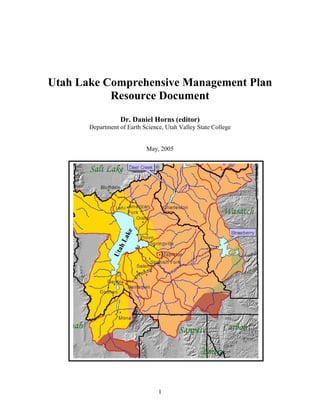
Utah Lake Comprehensive Management Plan
Resource Document
Dr. Daniel Horns (editor)
Department of Earth Science, Utah Valley State College
May, 2005
UtahLake
UtahLake
2
Table of Contents
Table of Contents............................................................................................................................ 2
List of Figures................................................................................................................................. 4
1.0 Purpose and Scope.............................................................................................................. 5
2.0 Executive Summary (Daniel Horns and Sam Rushforth; Utah Valley State College)....... 5
3.0 Geographic Setting and Physical Characteristics (Ben Erickson and Daniel Horns; Utah
Valley State College).......................................................................................................... 8
3.1 Introduction and Physical Characteristics....................................................................... 8
3.3 Sediments within Utah Lake......................................................................................... 13
3.3.1 Composition of Sediment in Utah Lake.................................................................... 14
3.3.2 Rate of Sediment Accumulation............................................................................... 16
4.0 Hydrology of Utah Lake (Cami Litchford, Jim Callison, and Daniel Horns; Utah Valley
State College).................................................................................................................... 17
4.1 Inflow............................................................................................................................ 18
4.1.1 Precipitation.............................................................................................................. 18
4.1.2 Surface Flow (Streams and Wastewater Treatment Plants)...................................... 18
4.1.3 Groundwater and Springs ......................................................................................... 23
4.1.4 History of Human Impact on Utah Lake’s Inflow.................................................... 23
4.2 Outflow ......................................................................................................................... 25
4.2.1 Surface Water............................................................................................................ 25
4.2.2 Evaporation............................................................................................................... 25
4.2.3 History of Human Impact on Utah Lake’s Outflow ................................................. 25
4.3 Lake Levels................................................................................................................... 26
5.0 Water Quality (W. John Calder, Katherine Klauzer, Eddy Cadet, Jim Callison, Daniel
Horns; Utah Valley State College) ................................................................................... 29
5.1 Water Quality of Tributaries......................................................................................... 29
5.2 Water Quality of Groundwater and Springs ................................................................. 32
5.3 Lake Water Quality....................................................................................................... 32
5.3.1 Phosphorous in Utah Lake........................................................................................ 36
5.3.2 Total Dissolved Solids (TDS) in Utah Lake............................................................. 38
5.3.3. Eutrophic Condition.................................................................................................. 42
5.3.4 Turbidity ................................................................................................................... 42
5.4 Nonpoint Sources of Pollution in the Utah Lake Drainage .......................................... 43
5.4.1 Introduction to Nonpoint Source Pollution............................................................... 43
5.4.2 Agricultural NPS’s in the Utah Lake Drainage Basin .............................................. 43
5.4.3 Sediment from NPS’s in the Utah Lake Drainage Basin.......................................... 43
5.4.4 NPS’s Associated with Urbanization in the Utah Lake Drainage Basin .................. 44
5.5 Water-Related Planning Efforts in the Utah Lake Basin (Katherine Klauzer, Eddy
Cadet, Daniel Horns) ................................................................................................................ 45
5.5.1 Utah’s Programs for Nonpoint Source Regulation................................................... 45
5.5.2 Implications of the Federal Clean Water Act for Nonpoint Source Pollution.......... 46
5.5.3 The TMDL Process................................................................................................... 46
6.0 Commercial and Cultural Activities (Darwin Demming, Emily Bartlett, Shayne
Galloway, Daniel Horns; Utah Valley State College) ...................................................... 48
6.1 Mining Activities within and near Utah Lake............................................................... 48
3
6.1.1 Large Mines .............................................................................................................. 48
6.1.2 Small Mines .............................................................................................................. 49
6.1.3 Hydrocarbon Potential .............................................................................................. 49
6.2 Recreation ..................................................................................................................... 51
6.2.1 Recreation History .................................................................................................... 51
6.2.2 Estimates of Recreation Use Numbers on Utah Lake............................................... 54
6.2.3 Utah Lake Recreation Decline.................................................................................. 57
6.2.4 Perceptions of Utah Lake.......................................................................................... 59
6.2.5 Current Recreational Activities on Utah Lake.......................................................... 60
6.2.6 Future of Recreation on Utah Lake........................................................................... 62
6.3 Cultural Facilities near Utah Lake................................................................................ 62
7.0 Biology of Utah Lake (Donna Barnes, Catherine Stephen, Zach Peterson, Sam Rushforth;
Utah Valley State College) ............................................................................................... 68
7.1 Phytoplankton of Utah Lake......................................................................................... 69
7.1.1 Influencing Factors ................................................................................................... 69
7.1.2 Method of Studies..................................................................................................... 70
7.1.3 Phytoplankton Division and Orders.......................................................................... 70
7.2 Macroinvertebrates and Zooplankton of Utah Lake ..................................................... 71
7.2.1 Zooplankton of Utah Lake........................................................................................ 72
7.2.2 Other Macroinvertebrates of Utah Lake ................................................................... 74
7.3 Birds of Utah Lake........................................................................................................ 75
7.3.1 Habitat loss and species decline................................................................................ 75
7.3.2 Bird Populations........................................................................................................ 76
7.4 Fishes of Utah Lake ...................................................................................................... 78
7.4.1 Biology of Utah Lake Fishes .................................................................................... 79
7.4.2 Game Fish................................................................................................................. 79
7.5 Mammals of Utah Lake ................................................................................................ 82
7.5.1 Insectivores ............................................................................................................... 83
7.5.2 Bats ........................................................................................................................... 83
7.5.3 Rabbits ...................................................................................................................... 84
7.5.4 Rodents ..................................................................................................................... 85
7.5.5 Carnivores................................................................................................................. 87
7.5.6 Hoofed Mammals...................................................................................................... 89
7.6 Utah Lake Wetlands, Flora and Fauna.......................................................................... 89
7.6.1 Pond Weed Community............................................................................................ 90
7.6.2 Bulrush Cattail Marsh............................................................................................... 91
7.6.3 Spikerush-Bulrush Meadow...................................................................................... 91
7.6.4 Grass-Rush-Sedge Meadow...................................................................................... 92
7.6.5 Lowland Woody Community ................................................................................... 92
7.6.6 Saline Terrestrial Community................................................................................... 92
7.6.7 Annual Herbaceous Community............................................................................... 93
7.7 Special Designations..................................................................................................... 93
7.8 Threatened and Endangered Species ............................................................................ 98
References................................................................................................................................... 102
4
List of Figures
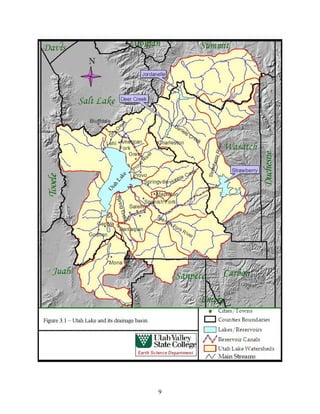
3.1 - Utah Lake and its drainage basin…………………………………….. Page 9
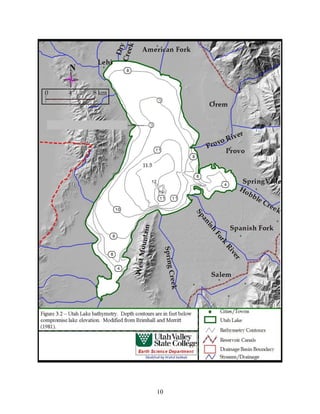
3.2 – Utah Lake bathymetry……………………………………………….. Page 10
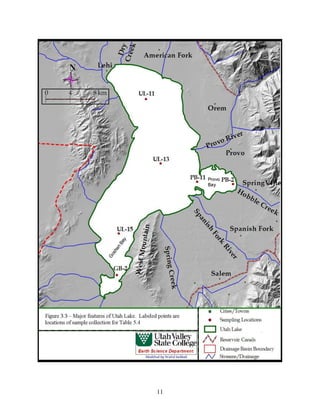
3.3 – Major features of Utah Lake………………………............................ Page 11
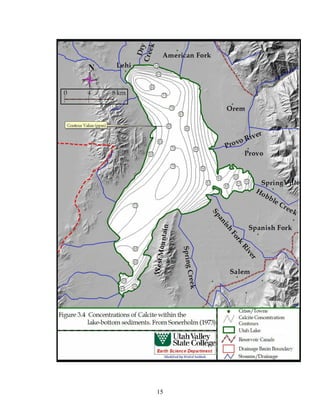
3.4 – Concentrations of Calcite within the lake-bottom sediments……….. Page 15
4.1 – Utah Lake tributaries………………………………………………... Page 20
4.2 – Utah Lake stage, 1930 through middle 2004……………………........Page 28
5.1 – Utah Lake TDS concentration VS stage …………………………….. Page 39
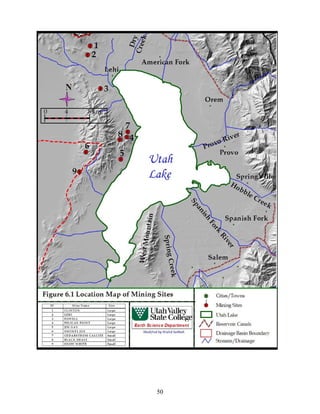
6.1 – Location of Mining sites near Utah Lake………………………….... Page 50
Chart 1 – Recreation Use Count for Utah Lake State Park………………... Page 56
Chart 2 – Recreation Use by Category and Season………………………... Page 58
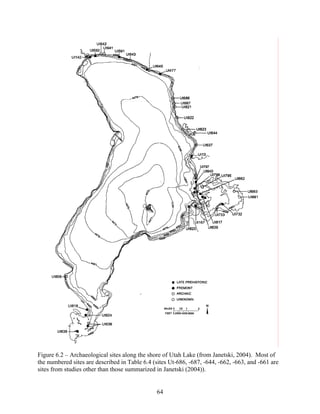
6.2 – Archaeological sites along the shore of Utah Lake ……………..…....Page 64
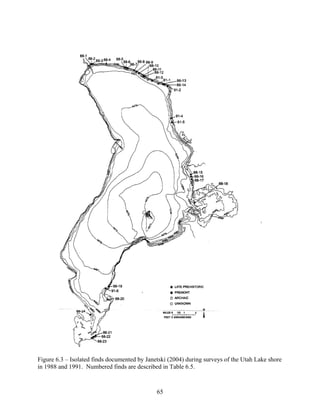
6.3 – Isolated finds along the shore of Utah Lake ……………..…......….... Page 65
List of Tables
4.1 – Yearly inflow to Utah Lake………………………………………….. Page 21
4.2 – Tributary flow data for 1979 water year……………………………...Page 21
4.3 – Stream flow data for the major Utah Lake tributaries………………...Page 22
4.4 – Significant diversions from Utah Lake tributaries…………………....Page 27
5.1 – Water quality data for Utah Lake tributaries………………………… Page 30
5.2 – Tributary average TDS concentrations and total loads……………… Page 31
5.3 – Tributary average phosphorous concentrations and total load………. Page 31
5.4 – Average Utah Lake water quality data………………………………..Page 34-35
5.5 – Total phosphorous concentrations from several stations……………. Page 37
5.6 – TDS values for several stations in Utah Lake……………………….. Page 40-41
6.1 – Resort History on Utah Lake………………………………………. Page 53
6.2 – Recreation use counts for Utah Lake State Park……………………. Page 55
6.3 – Percentage of Recreation use by activity and Season………………. Page 55
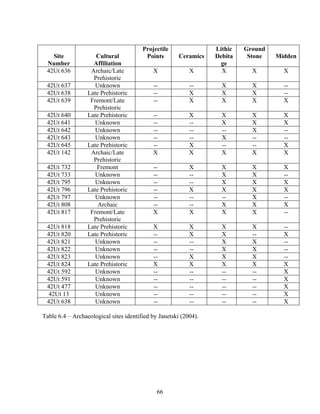
6.4 – Archaeological sites identified by Janetski (2004) ………………… Page 66
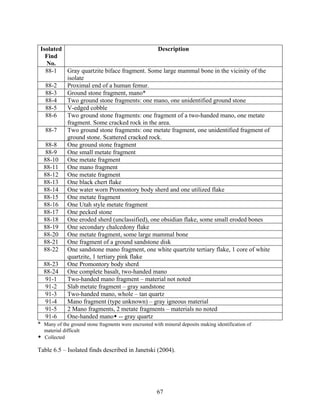
6.5 - Isolated finds described in Janetski (2004) ………………………..… Page 67
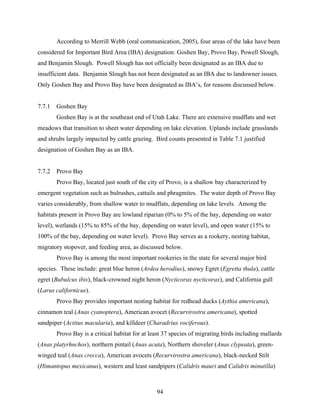
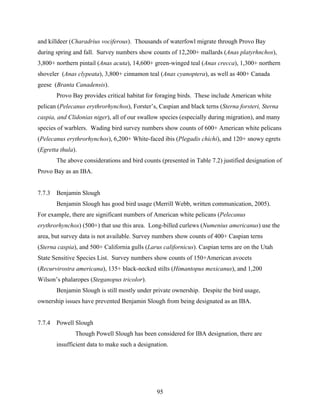
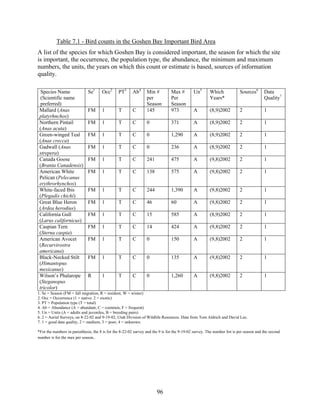
7.1 - Bird counts in the Goshen Bay Important Bird Area……………..… Page 96
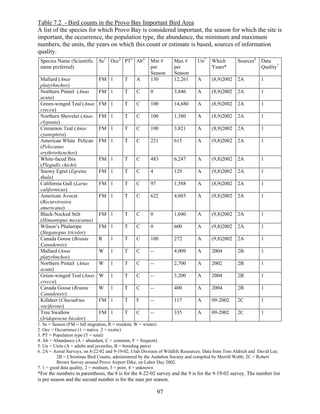
7.2 - Bird counts in the Provo Bay Important Bird Area……………..… Page 97
7.3 – Habitats utilized for foraging and nesting………………………..… Page 101
5
1.0 Purpose and Scope
This report was written at the request of the Utah Division of Forestry, Fire, and State
Lands. The report is intended to present a summary of the current conditions of Utah Lake,
including the composition of sediments being deposited in the lake, the rate of deposition of the
sediments, the hydrology of the lake (including estimates of net inflows and outflows), the
quality of water in the lake, factors in the drainage basin that may effect the water quality, the
flora and fauna of the lake (including associated wetlands), special biological designations within
and adjacent to the lake, threatened and endangered species that depend on the lake, human use
of the lake (including, if applicable, recreation, industry, agriculture, and mining), and local
planning and zoning that may affect the lake. This information came from reviews of published
literature and available unpublished reports and from interviews with knowledgeable individuals.
This report includes no original research.
2.0 Executive Summary (Daniel Horns and Sam Rushforth; Utah Valley State College)
Utah Lake, the largest fresh water lake in the United States west of the Mississippi, is
located in the midst of an arid land (Heckmann and Merritt, 1981; Sowby and Berg Consultants,
and others, 1999). As such, the lake plays a crucial role as a source of irrigation water, a
recreation destination, a biological habitat, and as an aesthetic component of Utah Valley. Rapid
urbanization around the lake has the potential to impact each one of these roles. Potential
impacts include degraded water quality and degraded habitat quality. Despite the lake’s
important economic and biological roles and the potential threats to these roles, there have been
few published studies of the lake. A series of geological, hydrological, and biological studies,
mainly during the 1970’s, culminated in the publication in 1981 of the Utah Lake Monograph
(Great Basin Naturalist Memoirs, Number 5, Brigham Young University). Since that time, most
studies of the lake have been written as reports for governmental agencies (e.g., Sowby and Berg
Consultants, and others, 1999; Central Utah Water Conservancy District, 2004a, b, c, d), or have
been conducted by local individuals and not yet published up at all (e.g., Merritt, 2004a, b, c, and
d; Miller, oral communication, 2004).
Utah Lake occupies the lowest portions of Utah Valley, a sediment-filled basin near the
eastern edge of the Basin and Range physiographic province (Jackson and Stevens, 1981). The
sediments that fill the basin were eroded from the nearby mountains and deposited in lakes,
6
floodplains, and stream channels within Utah Valley. Between about 25,000 and 10,000 years
ago, the basin was occupied by Lake Bonneville (Curry and others, 1984). Sediments deposited
within Lake Bonneville created a very flat lake bottom. As a result of climate change, the level
of Lake Bonneville dropped, resulting in the present-day Utah Lake and Great Salt Lake.
Because the Lake Bonneville sediments produced such a flat base of Utah Valley, Utah Lake is
remarkably shallow. At average water levels, the average depth of the lake is just 9.2 feet
(Brimhall and Merritt, 1981). During drought years, the average depth is even shallower.
Sediment being deposited within Utah Lake primarily consists of calcium carbonate, with
lesser amounts of quartz and clay (Brimhall and Merritt, 1981). The rate of sedimentation over
the past several thousand years is estimated at about 1 mm/yr, though the rate since settlers first
arrived appears to be about twice as fast (Brimhall and Merritt, 1981). Due to frequent re-
suspension of bottom sediment by wave action, there is no sharp sediment/water interface at the
bottom of the lake (Merritt, personal communication, 2004). Instead, the lake bottom is
characterized by a layer of sediment/water ooze and a general downward decrease in water
content within the sediment. The re-suspended sediment, along with algae blooms, results in
very turbid water in Utah Lake much of the year. This turbidity has a major impact on peoples’
perception of the aesthetic quality of the lake (Fuhriman and others, 1981).
Utah Lake receives 69% of its total inflow from surface inflow (Merritt, 2004a). This
water enters the lake through 52 identified sources (Fuhriman and others, 1981). The remaining
water enters by way of precipitation and groundwater inflow. About 50% of the water that
enters Utah Lake leaves by way of evaporation (Merritt, 2004a) – a relatively high amount for a
fresh water lake. The remaining water leaves through the Jordan River.
Due to the high rate of evaporation, the total dissolved solids (TDS) content of Utah Lake
is relatively high (generally between about 500 mg/L and 1,000 mg/L) (e.g., Fuhriman and
others, 1981; Central Utah Water Conservancy District, 2004a). Major ions include calcium,
magnesium, sodium, bicarbonate, chloride, and sulfate. Sources of these dissolved ions include
tributary streams flowing into the lake and lake-bottom mineral springs.
The Utah Department of Environmental Quality, Division of Water Quality has
established Utah Lake’s beneficial use categories as secondary recreational contact (Class 2B),
warm water fishery (3B), wildlife and aquatic organisms in their food chain (Class 3D), and
agricultural uses including irrigations and stock watering (Class 4) (Utah Department of
7
Environmental Quality, undated). Concentrations of phosphorous in Utah Lake impair its use as
a warm water fishery, and TDS concentrations impair its use for irrigation and stock watering
(Sowby and Berg Consultants and others, 1999).
Utah Lake is an important recreational resource for the Utah County region. Recreational
visitors to the lake have declined in recent years, due in large part to (1) the perception that the
lake is polluted, and (2) a drought-induced decline in lake level that has affected boating.
Biologically, Utah Lake is unusual for a number of reasons, as summarized below.
First, the lake has an overall high diversity of biological organisms. Phytoplankton
species are especially diverse.
Second, even though the lake is biologically diverse, by late summer and early fall
months, the diversity diminishes greatly. Again, this is especially the case with phytoplankton
though other species likewise decrease in diversity. Phytoplankton species often diminish in
number of species to a very few with huge absolute numbers of two or three species.
Third, from studies of core samples, it can be hypothesized that the lake has contained
most of the same species present today into the prehistoric past. Some variation in this
interpretation exists, but it is likely that the lake has always been high in nutrient levels and
likely has had somewhat elevated TDS.
Fourth, in contraindication to the third point above, the fish fauna has changed
dramatically in Utah Lake across the past 150 years. A native trout species, the Bonneville
cutthroat trout, dominated the lake when European settlers came to this part of Utah. That
species was over-fished and its spawning grounds disturbed so that it is now extinct in the lake.
Many fish species have been introduced into the lake in the past century. Early reasons
were to replenish the important source of protein that was lost with the native trout. Later reasons
were to attempt to restore and/or create a game fishery. While such attempts have had mixed
success, the fish fauna of the lake is currently dominated by non-native fish, many with qualities
not desirable to local fishers.
Utah Lake in many ways is a unique, beautiful ecosystem with high potential for
recreation and enjoyment. An educational campaign on Utah Lake is long overdue. Likewise,
more studies of the system are necessary in order to protect and enhance the ecosystem.
8
3.0 Geographic Setting and Physical Characteristics (Ben Erickson and Daniel Horns;
Utah Valley State College)
3.1 Introduction and Physical Characteristics
Utah Lake is one of Utah County’s most endearing geographic icons. The lake is used as
a resource for water, recreation, and food and it serves as a unique ecosystem for many natural
and imported organisms. It is located within the semi enclosed basin of Utah Valley (Figure
3.1). The lake covers more than 150 square miles (95,000 acres), or about 25% of Utah Valley.
Utah Lake contains over 1100 x 106
m3
(870,000 ac-ft) of water and it is very shallow, with an
average depth of just 9.2 feet (2.8 m) and a maximum depth of about 12 feet (3.6 m) (Jackson
and Stevens, 1981; Merritt, 2004) (Figure 3.2). Major features within and near Utah Lake are
shown in Figure 3.3.
Utah Valley is at the eastern edge of the Basin and Range province, which extends from
the Wasatch Range in the east to the Sierra Nevada in the west. The Basin and Range is
characterized by alternating north-south trending mountain ranges and intervening sediment-
filled basins. Many of these basins are internally drained, and thus contain terminal lakes. Utah
Lake is considered a semi-terminal lake in the sense that only about half of the water that enters
the lake leaves by surface flow. The remainder leaves by way of evaporation (Merritt, 2004b;
Fuhriman and others, 1981). Utah Lake’s location in a broad sediment filled basin, and its status
as a semi-terminal lake, has significant impact on the lake’s water quality and on the
characteristics of the lake bottom and lake shore. These, in turn have implications for the lake’s
role as a water resource, biological habitat, and recreation destination, as is discussed in more
detail below.
9
10
11
12
3.2 Geologic Setting
Over the past 70 million years Utah Valley has experienced a variety of geologic cycles
(Jackson and Stevens, 1981). The cause for the majority of the activity is the motion of tectonic
plates. The collision of the North American plate with other plates to the west caused uplift
faulting and folding prior to about 30 million years ago. This activity formed the ancestral
Wasatch mountain range and the other ranges in the Rocky Mountains.
Approximately 30 million years ago, relative plate movement changed, and western
North America began to be pulled apart rather than compressed (Brimhall and Merritt, 1981).
When the crust stretched, the previously uplifted mountains were broken apart, creating gaps and
forming a series of basins and fault-bounded ranges. This geologic province of alternating
mountains and valleys is termed the Basin and Range province. The Basin and Range extends
from the Wasatch Mountains, which is the eastern most edge, to the Sierra Nevada Mountain
range in the west (Jackson and Stevens, 1981). Over time, precipitation eroded the exposed rock
within the mountains. Streams carried the eroded material into the basins where it was
deposited, filling the basins with up to 10,000 feet or more of sediments (Curry and others,
1984).
For at least the past 15 million years, Utah Valley and other basins of northern Utah have
been collecting water and sediment through precipitation and runoff from the local mountains.
However, during the last ice age, between 30,000 and 130,000 years ago, there was a major
change to the northern Utah region. Volcanic activity in southern Idaho changed the path of the
Bear River, which had previously flowed into the Snake River drainage, causing it to flow
instead into northern Utah (Curry and others, 1984). As a result of the change in the Bear
River’s course, and due to climate change associated with emergence from the ice age, Lake
Bonneville began to form in northern Utah 23,000 to 25,000 years ago. Lake Bonneville covered
an area of 20,000 square miles of western Utah (Hunt and others, 1953). The vast lake stretched
north and south from Red Rock Pass, southern Idaho, to southwestern Utah and east and west
from the Wasatch Range to near the Utah/Nevada border (Bissell, 1963).
The greatest lake level elevation, of 5090 feet, was achieved about 16,000 years ago
(Curry and others, 1984). Today this level is known as the Bonneville level. Wave action and
other activities formed the Bonneville shoreline features seen along the mountain benches.
Natural dams were containing this high level of water. However, some of these dams consisted
13
of lose and unstable gravel, sand and clay. Between 14,000 and 15,000 years ago, a catastrophic
failure of one of these natural dams in Red Rock Pass, Idaho released water from Lake
Bonneville into the Snake River, causing the level of the lake to drop 350 feet (Curry and others,
1984). About 13,000 to 14,000 years ago, the lake’s water level reached stability at an elevation
of 4740 feet, with the outflow of the water passing through Red Rock Pass. This level is referred
to as the Provo level. The Provo level was maintained until the conclusion of the ice age when
the water level began to decline. Between 10,000 and 11,000 years ago, the level stood at 4250
feet in elevation, constituting the Gilbert level. Over the past 10,000 years the water level in
Lake Bonneville continued to decline. The Great Salt Lake and Utah Lake are remnants of Lake
Bonneville (Curry and others, 1984).
Utah Valley is bound on the east by the Provo segment of the Wasatch fault (Black and
others, 2001; Utah Geological Survey, 2002). Earthquakes on this segment of the Wasatch fault
produce as much as 7 feet (3.3 meters) of offset, with an average recurrence interval of about
2,400 years. The most recent event was about 650 years ago. A large earthquake on the
Wasatch fault would likely result in eastward tilting of the floor of Utah Valley (Eldredge, 1996).
Such tilting would cause the lake to flood eastward, inundating land along the east shore of the
lake.
There is a series of faults that run north-south beneath Utah Lake, identified by seismic
exploration of the lake bottom (Brimhall and Merritt, 1981). Though these faults are poorly
understood, they appear to have been active in the past 15,000 years with an average slip rate of
<0.1 mm/yr to about 0.4 mm/yr fault (Black and others, 2001; Utah Geological Survey, 2002).
3.3 Sediments within Utah Lake
When it rains or snows, the precipitated water makes its way down from the mountains
through streams. As water travels, it erodes through rock and sediment, taking the eroded pieces
along with the flow. Water can also chemically dissolve some types of minerals. Streams
flowing from mountains into valleys thus transport a load of solid (or detrital) sediment as well
as a load of dissolved (or chemical) sediment. The composition of the detrital and chemical
sediment carried by a stream is influenced by the composition of the rock through which the
stream flowed.
As a stream reaches a lake and slows down, it deposits the largest particles of detrital
sediment at the mouth of the stream. This deposition forms structures known as deltas. Wave
14
action can move the sediment along the shoreline, creating sandbars and beaches (Bingham,
1975). Chemical sediment and very fine-grained suspended detrital sediment travel further into
the lake and may eventually be deposited from the water onto the lake bottom. Bioorganic
material, such as plankton shells, may also be deposited on the lake bottom (Sonerholm, 1974).
3.3.1 Composition of Sediment in Utah Lake
In the 1970s, several studies were done on Utah Lake to determine what type of sediment
had been deposited in the lake (Bushman, 1980). The dominant sediment type, composing 60%
of the total lake-bottom sediment, is calcium carbonate (CaCO3, or the common mineral calcite).
This calcite is not in its pure form; it contains traces of magnesium, strontium and other
impurities. This calcite was dissolved from the limestone layers of the nearby mountains, and it
reflects the abundance of limestone in the Utah Lake drainage basin. High concentrations of
calcite sediment are found throughout the central part of the lake, with highest concentrations in
the north and the south parts of the lake (Figure 3.4) (Sonerholm, 1974).
There are several ways by which the calcite is deposited on the lake bottom. Some
calcite is transported to the lake in the form of fine particulate matter suspended in the water.
This particulate matter then settles out in the quiet lake water. The majority of the calcite
transported to the lake is in the form of dissolved calcium and bicarbonate ions. Evaporation
from the lake can cause the remaining lake water to become saturated with calcium and
bicarbonate, resulting in precipitation of calcite from the water. Lastly, some of the calcite
comes from algae and other microorganisms in the lake. According to Merritt (2004c), outflow
through the Jordan River carries away only 42% of the dissolved calcium and 50% of the
dissolved bicarbonate ions that enter the lake. The remainder of the dissolved calcium and
bicarbonate precipitate as calcite within the lake.
After calcite, the second most abundant mineral found in the Utah Lake sediment
is quartz and other silica forms. Quartz comprises almost 30% of the mineral sediments in the
lake (overall mean value of cores = 27%). General trends in quartz sedimentation tend to be
opposite of carbonate sediments. Lower concentrations are found in the center of the lake and
greater concentrations are found near the shore. This trend is due to the near-shore deposition of
minerals from major rivers and vigorous wave action (Brimhall and Merritt, 1981).
The third most abundant mineral is clay (illite and montmorillonite, at a size less than
1/256 mm). The clays are distributed in the river deltas and in areas where the currents have
15
16
carried them to deeper parts of the lake (Brimhall and Merritt, 1981). Insoluble calcium in the
form of hydrated calcium sulfate (gypsum) is found in small amounts. A trace of iron is present
and is thought to be in the form of ferric oxide (hematite) or hydrated iron oxide (goethite)
(Sonerholm, 1974).
3.3.2 Rate of Sediment Accumulation
To determine the rate at which the sediments accumulate in Utah Lake, it is necessary to
determine the age of deposition of sediment that is found at various depths beneath the lake
bottom (Brimhall and Merritt, 1981). With an average depth of 9.2 feet, Utah Lake is very
shallow. When strong winds cross over Utah Lake, large waves form and stir the lake bottom
(Brimhall and Merritt, 1981). This frequent wave action reaching the shallow lake bottom
causes sediment to remain suspended within the water, producing a lake bottom composed of
soft ooze (Brimhall and Merritt, 1981). Therefore, there generally is no distinct boundary
between water and sediment at the bottom of Utah Lake. Furthermore, wave action causes
mixing of the top layers of sediment (perhaps up to a foot deep). Due to these conditions of the
near-surface sediments in Utah Lake, it is difficult to determine when any one layer of sediment
beneath the lake was deposited. It is correspondingly difficult to determine rates of
sedimentation relative to deeper lakes. Still, several researchers have attempted to measure the
rate of sedimentation in Utah Lake, and these studies have resulted in a wide range of estimated
sedimentation rates. Some of those studies are summarized below.
Brimhall (1972) used core samples to estimate that the rate of sedimentation from 1935 to
1965 was, on average, 3.3 cm per year. This led Brimhall (1972) to speculate that the lake would
become a mud flat within 75 years of his study. Brimhall later discounted this study himself.
Brimhall and Merritt (1981) suggest that Brimhall’s (1972) estimated sedimentation rate was
more than 10 times too high, due to errors in estimating ages of specific layers of sediment.
In 1975, 17 shallow core samples were taken from throughout the lake. Core lengths
ranged from 30 cm to 120 cm. Analyses of these cores resulted in estimated sedimentation rates
of 1 mm/yr to 5 mm/yr over the past few hundred years (Brimhall and Merritt, 1981).
Analysis of seismic profiling was used to estimate the longer-term sedimentation rate
(Brimhall and Merritt, 1981). The seismic profiling identified persistent sediment layers at
depths ranging from 26 feet to 49 feet (8 to 15 meters). Stratigraphic considerations indicate that
17
the layer was deposited in Lake Bonneville about 10,000 years ago. If this age assignment is
correct, it implies an average sedimentation rate of between 0.8 mm/yr and 1.5 mm/yr over the
past 10,000 years.
Lastly, Bushman (1980) estimated sedimentation rates by examining pollen in a 5-meter
core sample taken in 1972 from the southern part of Utah Lake. Counting pollen from sections
of the core, Bushman (1980) decided that the best pollen to follow would be Taraxacum
officinale (common dandelion). The dandelion was introduced to Utah Valley in 1849 and can
be found growing along the shores of Utah Lake and throughout the valley. While it is unknown
when the dandelion became abundant enough to be a significant part of the lake sediment, the
first appearance of dandelion pollen in the lake sediments can be used to estimate a minimum
rate of sedimentation since 1849. The pollen first appears in the core at a depth of 170 cm. If
170 cm of sediment accumulated since 1849, the sedimentation rate from 1849 to 1972 would be
1.38 cm per year (Bushman, 1980).
Ignoring the results of Brimhall (1972) (which he discounted himself in Brimall and
Merritt (1981)), sedimentation rates estimated in the above studies range from about 1mm/yr
(over the past 10,000 years (Brimhall and Merritt, 1981)), to 1 mm/yr to 5 mm/yr (over the past
several hundred years (Brimhall and Merritt, 1981)), to as high as 1.38 cm/yr (from 1849 through
1972 (Bushman, 1980)). The result of Bushman (1980) is clearly not consistent with the other
studies. Since Bushman’s (1980) study relied on shallower sediments than the others, it is most
likely to be influenced by errors associated with sediment mixing and with the uncertainty of the
age of deposition of any particular layer of sediment in Utah Lake. Most people familiar with
Utah Lake consider the best estimate for the long-term sedimentation rate in Utah Lake to be
about 1 mm/yr, with a possible increase over the past 150 years to about 2 mm/yr (Brimhall and
Merritt, 1981). The lake and river sediments beneath Utah Lake may extend to a depth as great
as 10,000 feet (Price and Conroy, 1988; Utah Lake Study Committee, 2004).
4.0 Hydrology of Utah Lake (Cami Litchford, Jim Callison, and Daniel Horns; Utah
Valley State College)
As mentioned above, Utah Lake functions as a semi-terminal lake. Water flows into the
lake from streams, canals, and groundwater. About half of the water leaves by way of the Jordan
River (which flows to Great Salt Lake) and half by evaporation. The hydrology of the basin has
been altered by canals that divert water from the tributary streams and by the inflow from
18
wastewater treatment plants. Due to the generally high rate of evaporation, the lake level varies
greatly with long-term trends in weather.
4.1 Inflow
Sources of inflow to Utah Lake include precipitation, lake-bottom mineralized thermal
springs, lake-bottom freshwater springs, diffuse groundwater inflow, and surface tributaries.
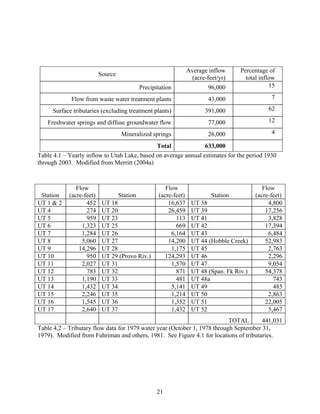
Contributions from each of these sources, estimated by Merritt (2004a) are listed in Table 4.1.
Each of these sources is discussed in more detail below.
4.1.1 Precipitation
Even though direct precipitation to the lake is not the main source for the lake’s inflow, it
still plays a significant role to the total inflow of the lake. Estimates of precipitation are
complicated by the fact that precipitation varies considerably from place to place across the lake.
Most weather stations are located along the east side of the lake, where precipitation is likely
enhanced by storms moving northwest-to-southeast across the lake (Miller and Merritt, oral
communication, 2004). Even along the east shore the amount of precipitation is variable. For
example, near the Geneva Steel Plant the average annual precipitation is approximately nine
inches (23cm) per year, whereas further south along the lake near Santaquin the average annual
precipitation is about 18 inches (45.7cm) per year. Taking these complicating factors into
account, Merritt (2004a) estimates that the lake receives about 96,000 acre-feet per year from
precipitation. This accounts for about 15% of the total inflow. Jackson and Stevens (1981) state
that about 60% of the precipitation comes between late winter and early spring, with March
usually being the wettest month.
4.1.2 Surface Flow (Streams and Wastewater Treatment Plants)
Of all the sources that provide water to Utah Lake, surface flows (including natural streams and
flows from wastewater treatment plants) are the largest contributors. Merritt (2004a) states that
Utah Lake receives 69% of its total inflow from surface inflow. This water enters the lake
through many sources. Fuhriman and others (1981) identified a total of 52 inflow sources.
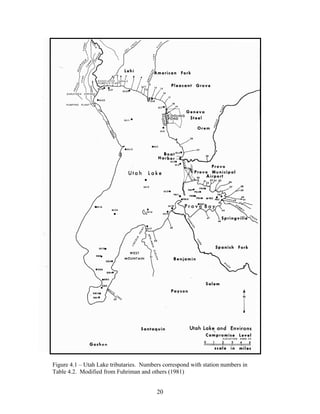
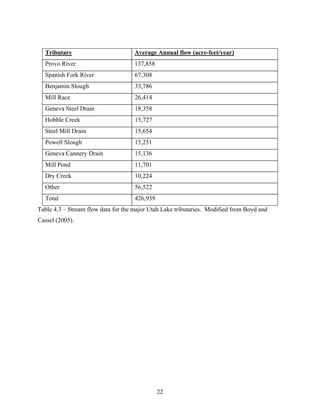
These tributaries are shown on Figure 4.1. Total annual flows for the year 1979 from 46 of these
tributaries are shown on Table 4.2. As can be seen on Table 4.2, the three largest tributaries
(Provo River, Hobble Creek, and Spanish Fork River) accounted for over 50% of the total
19
surface water inflow to Utah Lake. The Provo River alone accounted for over 25% of the
inflow.
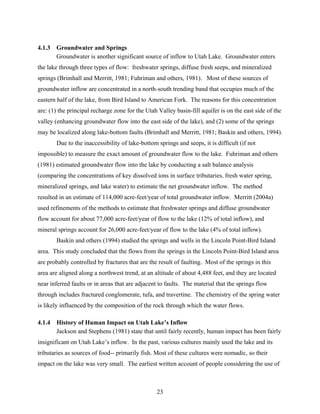
Boyd and Cassel (2005) also estimated flows for the major Utah Lake tributaries. These
more recent estimates are presented in Table 4.3. These flow rates agree broadly with those of
Fuhriman and others (1981). The differences between Tables 4.2 and 4.3 likely have two
sources. First, variations in precipitation produce variations in flow rates of the tributaries.
Second, there is some inevitable error in any flow rate estimate. Determining the flow of
tributaries into Utah Lake is complicated by the numerous changes that have been made to those
tributaries. For example, the upper Spanish Fork River receives a substantial amount of water
from the tunnels that run under the mountains to Strawberry Reservoir. On the other hand, the
lower Spanish Fork River has numerous diversions for irrigation. Some of the irrigation water is
lost to evaporation and an unknown amount of irrigation water eventually reaches Utah Lake
through groundwater flow. The flow rate estimates in Tables 4.2 and 4.2 should thus be taken
as broad estimates, and are not likely to match the true flow in any given year.
20
Figure 4.1 – Utah Lake tributaries. Numbers correspond with station numbers in
Table 4.2. Modified from Fuhriman and others (1981)
21
Source
Average inflow
(acre-feet/yr)
Percentage of
total inflow
Precipitation 96,000 15
Flow from waste water treatment plants 43,000 7
Surface tributaries (excluding treatment plants) 391,000 62
Freshwater springs and diffuse groundwater flow 77,000 12
Mineralized springs 26,000 4
Total 633,000
Table 4.1 – Yearly inflow to Utah Lake, based on average annual estimates for the period 1930
through 2003. Modified from Merritt (2004a)
Station
Flow
(acre-feet) Station
Flow
(acre-feet) Station
Flow
(acre-feet)
UT 1 & 2 452 UT 18 16,637 UT 38 4,800
UT 4 274 UT 20 26,459 UT 39 17,256
UT 5 959 UT 23 113 UT 41 3,828
UT 6 1,323 UT 25 669 UT 42 17,394
UT 7 1,284 UT 26 6,164 UT 43 6,484
UT 8 5,060 UT 27 14,200 UT 44 (Hobble Creek) 52,983
UT 9 14,296 UT 28 1,175 UT 45 2,763
UT 10 950 UT 29 (Provo Riv.) 124,293 UT 46 2,296
UT 11 2,027 UT 31 1,570 UT 47 9,054
UT 12 783 UT 32 871 UT 48 (Span. Fk Riv.) 54,378
UT 13 1,190 UT 33 481 UT 48a 743
UT 14 1,432 UT 34 5,141 UT 49 485
UT 15 2,246 UT 35 1,214 UT 50 2,863
UT 16 1,545 UT 36 1,352 UT 51 22,005
UT 17 2,640 UT 37 1,432 UT 52 5,467
TOTAL 441,031
Table 4.2 – Tributary flow data for 1979 water year (October 1, 1978 through September 31,
1979). Modified from Fuhriman and others, 1981. See Figure 4.1 for locations of tributaries.
22
Tributary Average Annual flow (acre-feet/year)
Provo River 137,858
Spanish Fork River 67,308
Benjamin Slough 33,786
Mill Race 26,414
Geneva Steel Drain 18,358
Hobble Creek 15,727
Steel Mill Drain 15,654
Powell Slough 15,251
Geneva Cannery Drain 15,136
Mill Pond 11,701
Dry Creek 10,224
Other 56,522
Total 426,939
Table 4.3 – Stream flow data for the major Utah Lake tributaries. Modified from Boyd and
Cassel (2005).
23
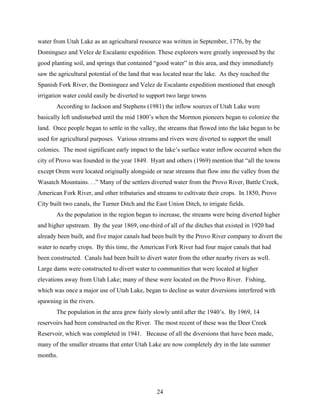
4.1.3 Groundwater and Springs
Groundwater is another significant source of inflow to Utah Lake. Groundwater enters
the lake through three types of flow: freshwater springs, diffuse fresh seeps, and mineralized
springs (Brimhall and Merritt, 1981; Fuhriman and others, 1981). Most of these sources of
groundwater inflow are concentrated in a north-south trending band that occupies much of the
eastern half of the lake, from Bird Island to American Fork. The reasons for this concentration
are: (1) the principal recharge zone for the Utah Valley basin-fill aquifer is on the east side of the
valley (enhancing groundwater flow into the east side of the lake), and (2) some of the springs
may be localized along lake-bottom faults (Brimhall and Merritt, 1981; Baskin and others, 1994).
Due to the inaccessibility of lake-bottom springs and seeps, it is difficult (if not
impossible) to measure the exact amount of groundwater flow to the lake. Fuhriman and others
(1981) estimated groundwater flow into the lake by conducting a salt balance analysis
(comparing the concentrations of key dissolved ions in surface tributaries, fresh water spring,
mineralized springs, and lake water) to estimate the net groundwater inflow. The method
resulted in an estimate of 114,000 acre-feet/year of total groundwater inflow. Merritt (2004a)
used refinements of the methods to estimate that freshwater springs and diffuse groundwater
flow account for about 77,000 acre-feet/year of flow to the lake (12% of total inflow), and
mineral springs account for 26,000 acre-feet/year of flow to the lake (4% of total inflow).
Baskin and others (1994) studied the springs and wells in the Lincoln Point-Bird Island
area. This study concluded that the flows from the springs in the Lincoln Point-Bird Island area
are probably controlled by fractures that are the result of faulting. Most of the springs in this
area are aligned along a northwest trend, at an altitude of about 4,488 feet, and they are located
near inferred faults or in areas that are adjacent to faults. The material that the springs flow
through includes fractured conglomerate, tufa, and travertine. The chemistry of the spring water
is likely influenced by the composition of the rock through which the water flows.
4.1.4 History of Human Impact on Utah Lake’s Inflow
Jackson and Stephens (1981) state that until fairly recently, human impact has been fairly
insignificant on Utah Lake’s inflow. In the past, various cultures mainly used the lake and its
tributaries as sources of food-- primarily fish. Most of these cultures were nomadic, so their
impact on the lake was very small. The earliest written account of people considering the use of
24
water from Utah Lake as an agricultural resource was written in September, 1776, by the
Dominguez and Velez de Escalante expedition. These explorers were greatly impressed by the
good planting soil, and springs that contained “good water” in this area, and they immediately
saw the agricultural potential of the land that was located near the lake. As they reached the
Spanish Fork River, the Dominguez and Velez de Escalante expedition mentioned that enough
irrigation water could easily be diverted to support two large towns
According to Jackson and Stephens (1981) the inflow sources of Utah Lake were
basically left undisturbed until the mid 1800’s when the Mormon pioneers began to colonize the
land. Once people began to settle in the valley, the streams that flowed into the lake began to be
used for agricultural purposes. Various streams and rivers were diverted to support the small
colonies. The most significant early impact to the lake’s surface water inflow occurred when the
city of Provo was founded in the year 1849. Hyatt and others (1969) mention that “all the towns
except Orem were located originally alongside or near streams that flow into the valley from the
Wasatch Mountains. . .” Many of the settlers diverted water from the Provo River, Battle Creek,
American Fork River, and other tributaries and streams to cultivate their crops. In 1850, Provo
City built two canals, the Turner Ditch and the East Union Ditch, to irrigate fields.
As the population in the region began to increase, the streams were being diverted higher
and higher upstream. By the year 1869, one-third of all of the ditches that existed in 1920 had
already been built, and five major canals had been built by the Provo River company to divert the
water to nearby crops. By this time, the American Fork River had four major canals that had
been constructed. Canals had been built to divert water from the other nearby rivers as well.
Large dams were constructed to divert water to communities that were located at higher
elevations away from Utah Lake; many of these were located on the Provo River. Fishing,
which was once a major use of Utah Lake, began to decline as water diversions interfered with
spawning in the rivers.
The population in the area grew fairly slowly until after the 1940’s. By 1969, 14
reservoirs had been constructed on the River. The most recent of these was the Deer Creek
Reservoir, which was completed in 1941. Because of all the diversions that have been made,
many of the smaller streams that enter Utah Lake are now completely dry in the late summer
months.
25
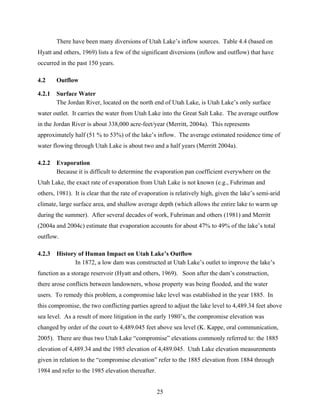
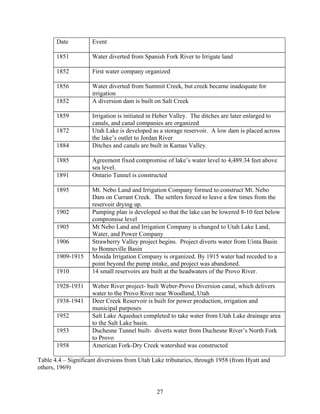
There have been many diversions of Utah Lake’s inflow sources. Table 4.4 (based on
Hyatt and others, 1969) lists a few of the significant diversions (inflow and outflow) that have
occurred in the past 150 years.
4.2 Outflow
4.2.1 Surface Water
The Jordan River, located on the north end of Utah Lake, is Utah Lake’s only surface
water outlet. It carries the water from Utah Lake into the Great Salt Lake. The average outflow
in the Jordan River is about 338,000 acre-feet/year (Merritt, 2004a). This represents
approximately half (51 % to 53%) of the lake’s inflow. The average estimated residence time of
water flowing through Utah Lake is about two and a half years (Merritt 2004a).
4.2.2 Evaporation
Because it is difficult to determine the evaporation pan coefficient everywhere on the
Utah Lake, the exact rate of evaporation from Utah Lake is not known (e.g., Fuhriman and
others, 1981). It is clear that the rate of evaporation is relatively high, given the lake’s semi-arid
climate, large surface area, and shallow average depth (which allows the entire lake to warm up
during the summer). After several decades of work, Fuhriman and others (1981) and Merritt
(2004a and 2004c) estimate that evaporation accounts for about 47% to 49% of the lake’s total
outflow.
4.2.3 History of Human Impact on Utah Lake’s Outflow
In 1872, a low dam was constructed at Utah Lake’s outlet to improve the lake’s
function as a storage reservoir (Hyatt and others, 1969). Soon after the dam’s construction,
there arose conflicts between landowners, whose property was being flooded, and the water
users. To remedy this problem, a compromise lake level was established in the year 1885. In
this compromise, the two conflicting parties agreed to adjust the lake level to 4,489.34 feet above
sea level. As a result of more litigation in the early 1980’s, the compromise elevation was
changed by order of the court to 4,489.045 feet above sea level (K. Kappe, oral communication,
2005). There are thus two Utah Lake “compromise” elevations commonly referred to: the 1885
elevation of 4,489.34 and the 1985 elevation of 4,489.045. Utah Lake elevation measurements
given in relation to the “compromise elevation” refer to the 1885 elevation from 1884 through
1984 and refer to the 1985 elevation thereafter.
26
Jackson and Stephens (1981) state that pumping stations extracting water from the lake have
been built and used in the past, but were abandoned due to fluctuations of the lake’s level. On
many occasions the lake level was so low that the pumps were useless. Hyatt and others (1969)
mention that in the year 1902, a pumping plant was constructed so that the lake could be lowered
when needed. Throughout the decades, the pumping plant was modified and enlarged on several
occasions. In 1969, the pumping plant’s capacity was approximately 1,050 cubic feet per second
and the lake’s level could be lowered 8-10 feet below the its “compromise level”.
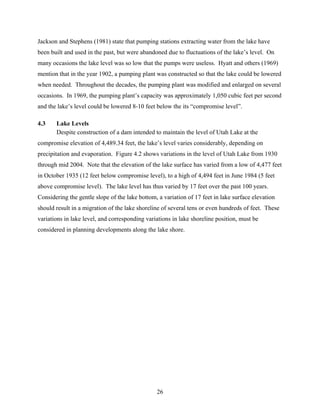
4.3 Lake Levels
Despite construction of a dam intended to maintain the level of Utah Lake at the
compromise elevation of 4,489.34 feet, the lake’s level varies considerably, depending on
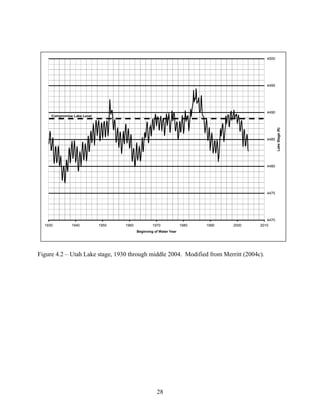
precipitation and evaporation. Figure 4.2 shows variations in the level of Utah Lake from 1930
through mid 2004. Note that the elevation of the lake surface has varied from a low of 4,477 feet
in October 1935 (12 feet below compromise level), to a high of 4,494 feet in June 1984 (5 feet
above compromise level). The lake level has thus varied by 17 feet over the past 100 years.
Considering the gentle slope of the lake bottom, a variation of 17 feet in lake surface elevation
should result in a migration of the lake shoreline of several tens or even hundreds of feet. These
variations in lake level, and corresponding variations in lake shoreline position, must be
considered in planning developments along the lake shore.
27
Table 4.4 – Significant diversions from Utah Lake tributaries, through 1958 (from Hyatt and
others, 1969)
Date Event
1851 Water diverted from Spanish Fork River to Irrigate land
1852 First water company organized
1856 Water diverted from Summit Creek, but creek became inadequate for
irrigation
1852 A diversion dam is built on Salt Creek
1859 Irrigation is initiated in Heber Valley. The ditches are later enlarged to
canals, and canal companies are organized
1872 Utah Lake is developed as a storage reservoir. A low dam is placed across
the lake’s outlet to Jordan River
1884 Ditches and canals are built in Kamas Valley.
1885 Agreement fixed compromise of lake’s water level to 4,489.34 feet above
sea level.
1891 Ontario Tunnel is constructed
1895 Mt. Nebo Land and Irrigation Company formed to construct Mt. Nebo
Dam on Currant Creek. The settlers forced to leave a few times from the
reservoir drying up.
1902 Pumping plan is developed so that the lake can be lowered 8-10 feet below
compromise level
1905 Mt Nebo Land and Irrigation Company is changed to Utah Lake Land,
Water, and Power Company
1906 Strawberry Valley project begins. Project diverts water from Uinta Basin
to Bonneville Basin
1909-1915 Mosida Irrigation Company is organized. By 1915 water had receded to a
point beyond the pump intake, and project was abandoned.
1910 14 small reservoirs are built at the headwaters of the Provo River.
1928-1931 Weber River project- built Weber-Provo Diversion canal, which delivers
water to the Provo River near Woodland, Utah
1938-1941 Deer Creek Reservoir is built for power production, irrigation and
municipal purposes
1952 Salt Lake Aqueduct completed to take water from Utah Lake drainage area
to the Salt Lake basin.
1953 Duchesne Tunnel built- diverts water from Duchesne River’s North Fork
to Provo
1958 American Fork-Dry Creek watershed was constructed
28
Figure 4.2 – Utah Lake stage, 1930 through middle 2004. Modified from Merritt (2004c).
1930 1940 1950 1960 1970 1980 1990 2000 2010
Beginning of Water Year
4470
4475
4480
4485
4490
4495
4500
LakeStage(ft)
Compromise Lake Level
29
5.0 Water Quality (W. John Calder, Katherine Klauzer, Eddy Cadet, Jim Callison,
Daniel Horns; Utah Valley State College)
The quality of water in Utah Lake is influenced by the quality of water in the various
inflows (tributary streams, wastewater treatment plants, and groundwater), by the rate of
evaporation, and by the re-suspension of lake-bottom sediments. Utah Lake is naturally turbid,
slightly saline, and biologically productive (eutrophic) Merritt (2004b). While there is a
common perception that the Utah Lake is polluted, the water quality and overall characteristics
of the lake probably haven’t changed much since its birth as Lake Bonneville last receded about
ten thousand years ago (Merritt, 2004b)
5.1 Water Quality of Tributaries
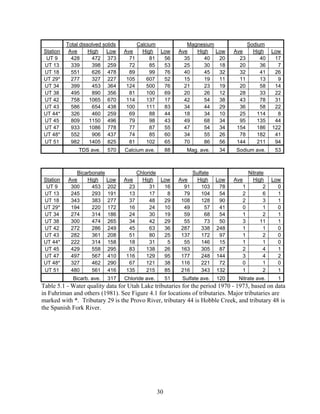
Fuhriman and others (1981) published a report on the water quality of Utah Lake based
on data collected through the 1970’s. These data are summarized in Table 5.1. In general, the
most common reported cation is calcium, and the most common anion is bicarbonate. These
values reflect the abundance of limestone in the drainage basin. The major tributaries, in
general, have relatively low concentrations of most parameters. For example, the Provo River
has an average TDS of 277 mg/L, Hobble Creek has an average TDS of 326 mg/l, and Spanish
Fork River has an average TDS of 552 mg/l, while the average TDS from all tributaries is 570
mg/L.
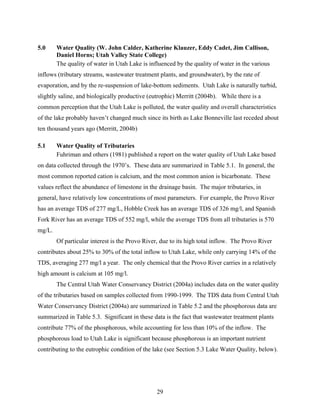
Of particular interest is the Provo River, due to its high total inflow. The Provo River
contributes about 25% to 30% of the total inflow to Utah Lake, while only carrying 14% of the
TDS, averaging 277 mg/l a year. The only chemical that the Provo River carries in a relatively
high amount is calcium at 105 mg/l.
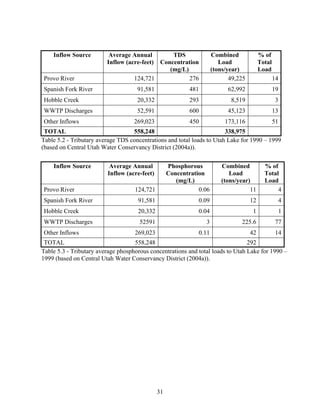
The Central Utah Water Conservancy District (2004a) includes data on the water quality
of the tributaries based on samples collected from 1990-1999. The TDS data from Central Utah
Water Conservancy District (2004a) are summarized in Table 5.2 and the phosphorous data are
summarized in Table 5.3. Significant in these data is the fact that wastewater treatment plants
contribute 77% of the phosphorous, while accounting for less than 10% of the inflow. The
phosphorous load to Utah Lake is significant because phosphorous is an important nutrient
contributing to the eutrophic condition of the lake (see Section 5.3 Lake Water Quality, below).
30
Total dissolved solids Calcium Magnesium Sodium
Station Ave High Low Ave High Low Ave High Low Ave High Low
UT 9 428 472 373 71 81 56 35 40 20 23 40 17
UT 13 339 398 259 72 85 53 25 30 18 20 36 7
UT 18 551 626 478 89 99 76 40 45 32 32 41 26
UT 29* 277 327 227 105 607 52 15 19 11 11 13 9
UT 34 399 453 364 124 500 76 21 23 19 20 58 14
UT 38 495 890 356 81 100 69 20 26 12 28 33 22
UT 42 758 1065 670 114 137 17 42 54 38 43 78 31
UT 43 586 654 438 100 111 83 34 44 29 36 58 22
UT 44* 326 460 259 69 88 44 18 34 10 25 114 8
UT 45 809 1150 496 79 98 43 49 68 34 95 135 44
UT 47 933 1086 778 77 87 55 47 54 34 154 186 122
UT 48* 552 906 437 74 85 60 34 55 26 78 182 41
UT 51 982 1405 825 81 102 65 70 86 56 144 211 94
TDS ave. 570 Calcium ave. 88 Mag. ave. 34 Sodium ave. 53
Bicarbonate Chloride Sulfate Nitrate
Station Ave High Low Ave High Low Ave High Low Ave High Low
UT 9 300 453 202 23 31 16 91 103 78 1 2 0
UT 13 245 293 191 13 17 8 79 104 54 2 6 1
UT 18 343 383 277 37 48 29 108 128 90 2 3 1
UT 29* 194 220 172 16 24 10 49 57 41 0 1 0
UT 34 274 314 186 24 30 19 59 68 54 1 2 1
UT 38 300 474 265 34 42 29 55 73 50 3 11 1
UT 42 272 286 249 45 63 36 287 338 248 1 1 0
UT 43 282 361 208 51 80 25 137 172 97 1 2 0
UT 44* 222 314 158 18 31 5 55 146 15 1 1 0
UT 45 429 558 295 83 138 26 163 305 87 2 4 1
UT 47 497 567 410 116 129 95 177 248 144 3 4 2
UT 48* 327 462 290 67 121 38 116 221 72 0 1 0
UT 51 480 561 416 135 215 85 216 343 132 1 2 1
Bicarb. ave. 317 Chloride ave. 51 Sulfate ave. 120 Nitrate ave. 1
Table 5.1 - Water quality data for Utah Lake tributaries for the period 1970 - 1973, based on data
in Fuhriman and others (1981). See Figure 4.1 for locations of tributaries. Major tributaries are
marked with *. Tributary 29 is the Provo River, tributary 44 is Hobble Creek, and tributary 48 is
the Spanish Fork River.
31
Inflow Source Average Annual
Inflow (acre-feet)
TDS
Concentration
(mg/L)
Combined
Load
(tons/year)
% of
Total
Load
Provo River 124,721 276 49,225 14
Spanish Fork River 91,581 481 62,992 19
Hobble Creek 20,332 293 8,519 3
WWTP Discharges 52,591 600 45,123 13
Other Inflows 269,023 450 173,116 51
TOTAL 558,248 338,975
Table 5.2 - Tributary average TDS concentrations and total loads to Utah Lake for 1990 – 1999
(based on Central Utah Water Conservancy District (2004a)).
Inflow Source Average Annual
Inflow (acre-feet)
Phosphorous
Concentration
(mg/L)
Combined
Load
(tons/year)
% of
Total
Load
Provo River 124,721 0.06 11 4
Spanish Fork River 91,581 0.09 12 4
Hobble Creek 20,332 0.04 1 1
WWTP Discharges 52591 3 225.6 77
Other Inflows 269,023 0.11 42 14
TOTAL 558,248 292
Table 5.3 - Tributary average phosphorous concentrations and total loads to Utah Lake for 1990 –
1999 (based on Central Utah Water Conservancy District (2004a)).
32
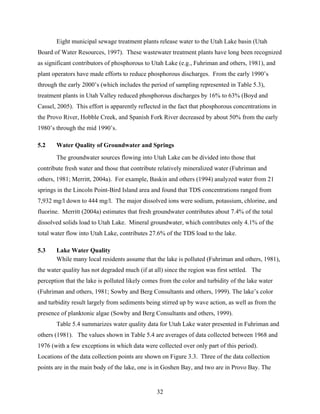
Eight municipal sewage treatment plants release water to the Utah Lake basin (Utah
Board of Water Resources, 1997). These wastewater treatment plants have long been recognized
as significant contributors of phosphorous to Utah Lake (e.g., Fuhriman and others, 1981), and
plant operators have made efforts to reduce phosphorous discharges. From the early 1990’s
through the early 2000’s (which includes the period of sampling represented in Table 5.3),
treatment plants in Utah Valley reduced phosphorous discharges by 16% to 63% (Boyd and
Cassel, 2005). This effort is apparently reflected in the fact that phosphorous concentrations in
the Provo River, Hobble Creek, and Spanish Fork River decreased by about 50% from the early
1980’s through the mid 1990’s.
5.2 Water Quality of Groundwater and Springs
The groundwater sources flowing into Utah Lake can be divided into those that
contribute fresh water and those that contribute relatively mineralized water (Fuhriman and
others, 1981; Merritt, 2004a). For example, Baskin and others (1994) analyzed water from 21
springs in the Lincoln Point-Bird Island area and found that TDS concentrations ranged from
7,932 mg/l down to 444 mg/l. The major dissolved ions were sodium, potassium, chlorine, and
fluorine. Merritt (2004a) estimates that fresh groundwater contributes about 7.4% of the total
dissolved solids load to Utah Lake. Mineral groundwater, which contributes only 4.1% of the
total water flow into Utah Lake, contributes 27.6% of the TDS load to the lake.
5.3 Lake Water Quality
While many local residents assume that the lake is polluted (Fuhriman and others, 1981),
the water quality has not degraded much (if at all) since the region was first settled. The
perception that the lake is polluted likely comes from the color and turbidity of the lake water
(Fuhriman and others, 1981; Sowby and Berg Consultants and others, 1999). The lake’s color
and turbidity result largely from sediments being stirred up by wave action, as well as from the
presence of planktonic algae (Sowby and Berg Consultants and others, 1999).
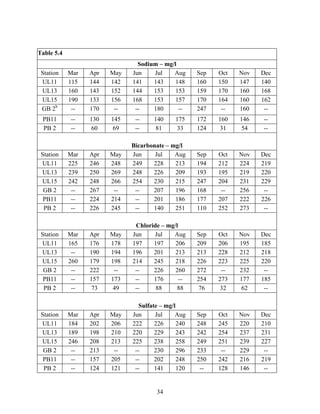
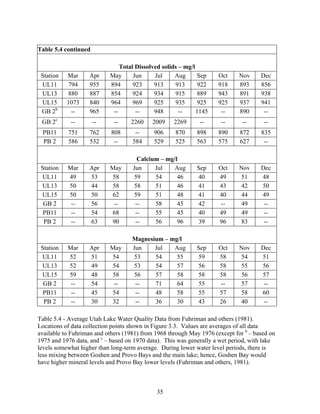
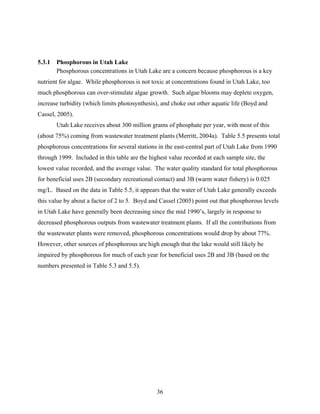
Table 5.4 summarizes water quality data for Utah Lake water presented in Fuhriman and
others (1981). The values shown in Table 5.4 are averages of data collected between 1968 and
1976 (with a few exceptions in which data were collected over only part of this period).
Locations of the data collection points are shown on Figure 3.3. Three of the data collection
points are in the main body of the lake, one is in Goshen Bay, and two are in Provo Bay. The
33
data in Table 5.4 highlight the variability of water quality in Utah Lake. Many of the parameters
(sodium, chloride, sulfate, TDS) show distinct seasonal trends, with concentrations varying by as
much as 20% or more at some sampling sites over the course of a year. Also, water in Provo
Bay has lower concentrations of many of the parameters than the water in Goshen Bay or the
main body of the lake. This latter observation may reflect the relatively high rate of freshwater
inflow to Provo Bay. According to many of the researchers familiar with Utah Lake, water
quality in the lake is highly variable over time, and the lake appears to be fairly well mixed
during periods of normal wind conditions (e.g., A.W. Miller, oral communication, 2004; L.B.
Merritt, oral communication, 2004).
Since Utah Lake is not a direct source of drinking water, USEPA standards for culinary
water quality do not apply. Instead, water quality standards for Utah Lake are determined by the
lake’s beneficial use categories as determined by the Utah Department of Environmental Quality,
Division of Water Quality (DWQ). The DWQ has established Utah Lake’s beneficial use
categories as secondary recreational contact (Class 2B), warm water fishery (Class 3B), wildlife
and aquatic organisms in their food chain (Class 3D), and agricultural uses including irrigations
and stock watering (Class 4) (Utah Department of Environmental Quality, undated).
Concentrations of phosphorous in Utah Lake impair its use as a warm water fishery, and TDS
concentrations impair its use for irrigation and stock watering (Sowby and Berg Consultants and
others, 1999). The sections below present more detailed information on Utah Lake’s
phosphorous and TDS concentrations, as well as information on the lake’s high turbidity and
eutrophic conditions.
34
Table 5.4
Sodium – mg/l
Station Mar Apr May Jun Jul Aug Sep Oct Nov Dec
UL11 115 144 142 141 143 148 160 150 147 140
UL13 160 143 152 144 153 153 159 170 160 168
UL15 190 133 156 168 153 157 170 164 160 162
GB 2b
-- 170 -- -- 180 -- 247 -- 160 --
PB11 -- 130 145 -- 140 175 172 160 146 --
PB 2 -- 60 69 -- 81 33 124 31 54 --
Bicarbonate – mg/l
Station Mar Apr May Jun Jul Aug Sep Oct Nov Dec
UL11 225 246 248 249 228 213 194 212 224 219
UL13 239 250 269 248 226 209 193 195 219 220
UL15 242 248 266 254 230 215 247 204 231 229
GB 2 -- 267 -- -- 207 196 168 -- 256 --
PB11 -- 224 214 -- 201 186 177 207 222 226
PB 2 -- 226 245 -- 140 251 110 252 273 --
Chloride – mg/l
Station Mar Apr May Jun Jul Aug Sep Oct Nov Dec
UL11 165 176 178 197 197 206 209 206 195 185
UL13 -- 190 194 196 201 213 213 228 212 218
UL15 260 179 198 214 245 218 226 223 225 220
GB 2 -- 222 -- -- 226 260 272 -- 232 --
PB11 -- 157 173 -- 176 -- 254 273 177 185
PB 2 -- 73 49 -- 88 88 76 32 62 --
Sulfate – mg/l
Station Mar Apr May Jun Jul Aug Sep Oct Nov Dec
UL11 184 202 206 222 226 240 248 245 220 210
UL13 189 198 210 220 229 243 242 254 237 231
UL15 246 208 213 225 238 258 249 251 239 227
GB 2 -- 213 -- -- 230 296 233 -- 229 --
PB11 -- 157 205 -- 202 248 250 242 216 219
PB 2 -- 124 121 -- 141 120 -- 128 146 --
35
Table 5.4 continued
Total Dissolved solids – mg/l
Station Mar Apr May Jun Jul Aug Sep Oct Nov Dec
UL11 794 955 894 923 913 913 922 918 893 856
UL13 880 887 854 924 934 915 889 943 891 938
UL15 1073 840 964 969 925 935 925 925 937 941
GB 2b
-- 965 -- -- 948 -- 1145 -- 890 --
GB 2c
-- -- -- 2260 2009 2269 -- -- -- --
PB11 751 762 808 -- 906 870 898 890 872 835
PB 2 586 532 -- 584 529 525 563 575 627 --
Calcium – mg/l
Station Mar Apr May Jun Jul Aug Sep Oct Nov Dec
UL11 49 53 58 59 54 46 40 49 51 48
UL13 50 44 58 58 51 46 41 43 42 50
UL15 50 50 62 59 51 48 41 40 44 49
GB 2 -- 56 -- -- 58 45 42 -- 49 --
PB11 -- 54 68 -- 55 45 40 49 49 --
PB 2 -- 63 90 -- 56 96 39 96 83 --
Magnesium – mg/l
Station Mar Apr May Jun Jul Aug Sep Oct Nov Dec
UL11 52 51 54 53 54 55 59 58 54 51
UL13 52 49 54 53 54 57 56 58 55 56
UL15 59 48 58 56 57 58 58 58 56 57
GB 2 -- 54 -- -- 71 64 55 -- 57 --
PB11 -- 45 54 -- 48 58 55 57 58 60
PB 2 -- 30 32 -- 36 30 43 26 40 --
Table 5.4 - Average Utah Lake Water Quality Data from Fuhriman and others (1981).
Locations of data collection points shown in Figure 3.3. Values are averages of all data
available to Fuhriman and others (1981) from 1968 through May 1976 (except for b
– based on
1975 and 1976 data, and c
– based on 1970 data). This was generally a wet period, with lake
levels somewhat higher than long-term average. During lower water level periods, there is
less mixing between Goshen and Provo Bays and the main lake; hence, Goshen Bay would
have higher mineral levels and Provo Bay lower levels (Fuhriman and others, 1981).
36
5.3.1 Phosphorous in Utah Lake
Phosphorous concentrations in Utah Lake are a concern because phosphorous is a key
nutrient for algae. While phosphorous is not toxic at concentrations found in Utah Lake, too
much phosphorous can over-stimulate algae growth. Such algae blooms may deplete oxygen,
increase turbidity (which limits photosynthesis), and choke out other aquatic life (Boyd and
Cassel, 2005).
Utah Lake receives about 300 million grams of phosphate per year, with most of this
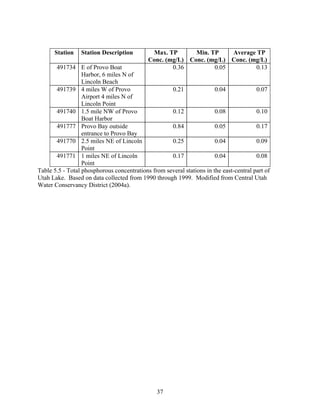
(about 75%) coming from wastewater treatment plants (Merritt, 2004a). Table 5.5 presents total
phosphorous concentrations for several stations in the east-central part of Utah Lake from 1990
through 1999. Included in this table are the highest value recorded at each sample site, the
lowest value recorded, and the average value. The water quality standard for total phosphorous
for beneficial uses 2B (secondary recreational contact) and 3B (warm water fishery) is 0.025
mg/L. Based on the data in Table 5.5, it appears that the water of Utah Lake generally exceeds
this value by about a factor of 2 to 5. Boyd and Cassel (2005) point out that phosphorous levels
in Utah Lake have generally been decreasing since the mid 1990’s, largely in response to
decreased phosphorous outputs from wastewater treatment plants. If all the contributions from
the wastewater plants were removed, phosphorous concentrations would drop by about 77%.
However, other sources of phosphorous are high enough that the lake would still likely be
impaired by phosphorous for much of each year for beneficial uses 2B and 3B (based on the
numbers presented in Table 5.3 and 5.5).
37
Station Station Description Max. TP
Conc. (mg/L)
Min. TP
Conc. (mg/L)
Average TP
Conc. (mg/L)
491734 E of Provo Boat
Harbor, 6 miles N of
Lincoln Beach
0.36 0.05 0.13
491739 4 miles W of Provo
Airport 4 miles N of
Lincoln Point
0.21 0.04 0.07
491740 1.5 mile NW of Provo
Boat Harbor
0.12 0.08 0.10
491777 Provo Bay outside
entrance to Provo Bay
0.84 0.05 0.17
491770 2.5 miles NE of Lincoln
Point
0.25 0.04 0.09
491771 1 miles NE of Lincoln
Point
0.17 0.04 0.08
Table 5.5 - Total phosphorous concentrations from several stations in the east-central part of
Utah Lake. Based on data collected from 1990 through 1999. Modified from Central Utah
Water Conservancy District (2004a).
38
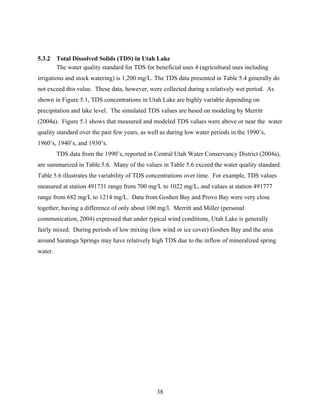
5.3.2 Total Dissolved Solids (TDS) in Utah Lake
The water quality standard for TDS for beneficial uses 4 (agricultural uses including
irrigations and stock watering) is 1,200 mg/L. The TDS data presented in Table 5.4 generally do
not exceed this value. These data, however, were collected during a relatively wet period. As
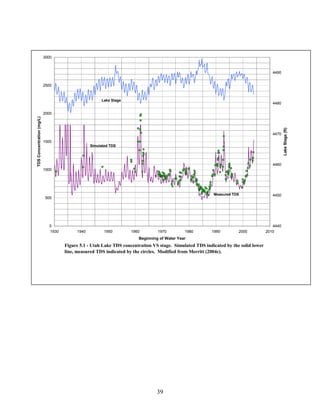
shown in Figure 5.1, TDS concentrations in Utah Lake are highly variable depending on
precipitation and lake level. The simulated TDS values are based on modeling by Merritt
(2004a). Figure 5.1 shows that measured and modeled TDS values were above or near the water
quality standard over the past few years, as well as during low water periods in the 1990’s,
1960’s, 1940’s, and 1930’s.
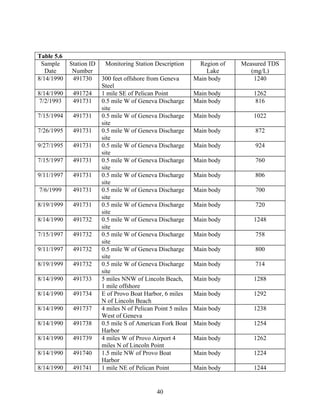
TDS data from the 1990’s, reported in Central Utah Water Conservancy District (2004a),
are summarized in Table 5.6. Many of the values in Table 5.6 exceed the water quality standard.
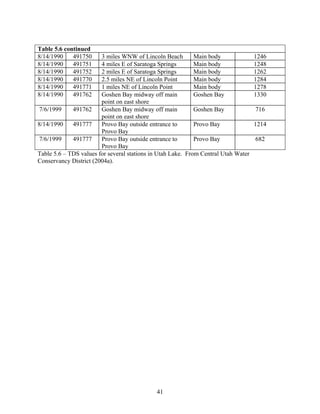
Table 5.6 illustrates the variability of TDS concentrations over time. For example, TDS values
measured at station 491731 range from 700 mg/L to 1022 mg/L, and values at station 491777
range from 682 mg/L to 1214 mg/L. Data from Goshen Bay and Provo Bay were very close
together, having a difference of only about 100 mg/l. Merritt and Miller (personal
communication, 2004) expressed that under typical wind conditions, Utah Lake is generally
fairly mixed. During periods of low mixing (low wind or ice cover) Goshen Bay and the area
around Saratoga Springs may have relatively high TDS due to the inflow of mineralized spring
water.
39
Figure 5.1 - Utah Lake TDS concentration VS stage. Simulated TDS indicated by the solid lower
line, measured TDS indicated by the circles. Modified from Merritt (2004c).
0
500
1000
1500
2000
2500
3000
1930 1940 1950 1960 1970 1980 1990 2000 2010
Beginning of Water Year
TDSConcentration(mg/L)
4440
4450
4460
4470
4480
4490
LakeStage(ft)
Lake Stage
Simulated TDS
Measured TDS
40
Table 5.6
Sample
Date
Station ID
Number
Monitoring Station Description Region of
Lake
Measured TDS
(mg/L)
8/14/1990 491730 300 feet offshore from Geneva
Steel
Main body 1240
8/14/1990 491724 1 mile SE of Pelican Point Main body 1262
7/2/1993 491731 0.5 mile W of Geneva Discharge
site
Main body 816
7/15/1994 491731 0.5 mile W of Geneva Discharge
site
Main body 1022
7/26/1995 491731 0.5 mile W of Geneva Discharge
site
Main body 872
9/27/1995 491731 0.5 mile W of Geneva Discharge
site
Main body 924
7/15/1997 491731 0.5 mile W of Geneva Discharge
site
Main body 760
9/11/1997 491731 0.5 mile W of Geneva Discharge
site
Main body 806
7/6/1999 491731 0.5 mile W of Geneva Discharge
site
Main body 700
8/19/1999 491731 0.5 mile W of Geneva Discharge
site
Main body 720
8/14/1990 491732 0.5 mile W of Geneva Discharge
site
Main body 1248
7/15/1997 491732 0.5 mile W of Geneva Discharge
site
Main body 758
9/11/1997 491732 0.5 mile W of Geneva Discharge
site
Main body 800
8/19/1999 491732 0.5 mile W of Geneva Discharge
site
Main body 714
8/14/1990 491733 5 miles NNW of Lincoln Beach,
1 mile offshore
Main body 1288
8/14/1990 491734 E of Provo Boat Harbor, 6 miles
N of Lincoln Beach
Main body 1292
8/14/1990 491737 4 miles N of Pelican Point 5 miles
West of Geneva
Main body 1238
8/14/1990 491738 0.5 mile S of American Fork Boat
Harbor
Main body 1254
8/14/1990 491739 4 miles W of Provo Airport 4
miles N of Lincoln Point
Main body 1262
8/14/1990 491740 1.5 mile NW of Provo Boat
Harbor
Main body 1224
8/14/1990 491741 1 mile NE of Pelican Point Main body 1244
41
Table 5.6 continued
8/14/1990 491750 3 miles WNW of Lincoln Beach Main body 1246
8/14/1990 491751 4 miles E of Saratoga Springs Main body 1248
8/14/1990 491752 2 miles E of Saratoga Springs Main body 1262
8/14/1990 491770 2.5 miles NE of Lincoln Point Main body 1284
8/14/1990 491771 1 miles NE of Lincoln Point Main body 1278
8/14/1990 491762 Goshen Bay midway off main
point on east shore
Goshen Bay 1330
7/6/1999 491762 Goshen Bay midway off main
point on east shore
Goshen Bay 716
8/14/1990 491777 Provo Bay outside entrance to
Provo Bay
Provo Bay 1214
7/6/1999 491777 Provo Bay outside entrance to
Provo Bay
Provo Bay 682
Table 5.6 – TDS values for several stations in Utah Lake. From Central Utah Water
Conservancy District (2004a).
42
5.3.3. Eutrophic Condition
The concentrations of nutrients in Utah Lake (especially phosphorous and nitrogen) are
high enough for the lake to be considered highly eutrophic (Fuhriman and others, 1981; Merritt
and Miller, 1981; Merritt, 2004d). Observations of actual algae growth, however, indicate that
functionally the lake is only moderately eutrophic (Merritt, 2004d). This indicates that Utah Lake
contains phosphorous and nitrogen far in excess of what is needed to sustain the lake’s biological
productivity, and that algae growth is limited by some factor other than available nutrients. Even
substantial reductions in nutrient loading would likely result in little or no change in algae
growth (Merritt and Miller, 1981). For example, Fuhriman and others (1981) suggest that even if
there was no discharge of phosphorous from waste water treatment plants, the lake would still be
eutrophic.
5.3.4 Turbidity
The high turbidity of Utah Lake water is the major factor contributing to the lake’s
“polluted” image (Fuhriman and others, 1981). Furthermore, the turbidity severely limits the
depth to which photosynthesis may take place in the lake. The turbidity is likely a limiting factor
in the biological productivity of the lake (Fuhriman and others, 1981). Turbidity therefore has
major influence on the public perception of the lake and the ecosystem in the lake. The main
cause of the turbidity is generally thought to be re-suspension of bottom sediments by wave
action (e.g., Fuhriman and others, 1981; Merritt, 2004b). Understanding the cause of high
turbidity in Utah Lake therefore requires an understanding of wave action in the lake (e.g., the
minimum wave size required to re-suspend sediments from all or most of the lake bottom, the
wind conditions necessary to produce those waves, etc.). Despite the apparent importance of
wave action in affecting the water quality in Utah Lake, there have been no specific studies of
waves in the lake (L. B. Merritt, oral communication, 2004; A. W. Miller, oral communication,
2004; Naylor, 2004).
43
5.4 Nonpoint Sources of Pollution in the Utah Lake Drainage
5.4.1 Introduction to Nonpoint Source Pollution
According to EPA (2003a), nonpoint Source Pollution (NPS) is pollution that enters an
area from many diffuse sources. NPS pollution is caused by rainfall or snowmelt moving over
and through the ground. As the runoff moves, it picks up and carries away natural and human-
made pollutants, finally depositing them into lakes, rivers, wetlands, costal waters, and even
underground sources of drinking water.
5.4.2 Agricultural NPS’s in the Utah Lake Drainage Basin
According to the most recent National Water Quality Inventory conducted by the EPA
(EPA 2003b), agricultural NPS pollution is the leading source of water quality impacts to
surveyed rivers and lakes. Agricultural activities that cause NPS pollution include confined
animal facilities, grazing, plowing, pesticide spraying, irrigation, fertilization, planting, and
harvesting. The major agricultural NPS pollutants that result from the activities are sediment,
nutrients, pathogens, pesticides, and salts. Agricultural activities also can damage habitat and
stream channels.
Several agricultural/livestock areas surround Utah Lake. For example, Sowby and Berg
Consultants and others (1999) list 24 dairy farms and thirty-seven feedlots were located within
the watershed for Utah Lake. According to EPA (2003b) by confining animals to areas or
lots, farmers and ranchers can efficiently feed and maintain livestock. But these confined
areas become major sources of animal waste. Runoff from poorly managed facilities can carry
pathogens (bacteria and viruses), nutrients, and oxygen-demanding substances that create
water quality problems. When plants are over-fertilized or animal waste is not managed
properly, the nutrients found in these substances are able to enter the local water system and may
eventually be deposited into Utah Lake. Managing the fertilizers used for agriculture as well as
properly storing animal waste can prevent seepage of containments into the watershed that feeds
Utah Lake.
5.4.3 Sediment from NPS’s in the Utah Lake Drainage Basin
Agricultural activities and urbanization increase the amount sediment carried by fluvial
systems into Utah Lake. According to Sowby and Berg Consultants and others (1999),
44
sedimentation is a particular problem due to the fact that farmland around Utah Lake must be
irrigated. Water piped from Strawberry Reservoir through Spanish Fork River sometimes
exceeds the system’s ability to carry water, making erosion quite extensive. Some of this
imported water has been re-routed for the time being to relieve this stress while still providing
the water that is needed to irrigate farmland. It is estimated that Diamond Fork feeds Spanish
Fork River with an approximate 26,500 tons of sediment a year (Sowby and Berg Consultants
and others, 1999). According to EPA (2003b), excessive sedimentation clouds the water, which
reduces the amount of sunlight reaching aquatic plants; covers fish spawning areas and food
supplies; and clogs the gills of fish. In addition, other pollutants like phosphorus, pathogens, and
heavy metals are often attached to the soil particles and may be carried to Utah Lake along with
the sediment.
To manage sediment, farmers and ranchers “can reduce erosion and sedimentation 20%
to 90% by applying management measures to control the volume and flow rate of runoff water,
keep soil in place, and reduce soil transport” (EPA, 2003b).
5.4.4 NPS’s Associated with Urbanization in the Utah Lake Drainage Basin
Prior to extensive urbanization in the Utah Lake drainage basin, there was more
vegetation and less ground was covered by buildings and paved roads. Due to the increased area
of buildings and roads, less rainfall and snowmelt seeps into the ground and there is an increased
runoff flowing into the tributaries. This water drains into the lake more quickly, carrying
chemicals such as oil, gas, antifreeze, road salt, and brake fluid off roads and directly into surface
water (EPA 2004a). The increased runoff erodes stream banks, damages stream side
vegetation, and widens stream channels. This will result in lower stream water depths during
non-storm periods, higher than normal water levels during wet weather periods, increased
sediment loads, and higher water temperatures.
The population of Utah County in 1994 (during which a major study of Utah Lake was
conducted) was reported as 290,990. (Sowby and Berg Consultants and others, 1999, pg. 2.5).
As of July 2002, Utah County’s population was reported as 398,056. (Utah County Online,
2002a). Projections estimate that by 2010, population will rise to 503,039 (Utah County Online,
2002b), increasing pollutants and construction-site problems. EPA Region 8 policies include
maintaining the volume of runoff at pre-development levels by using structural controls and
pollution prevention strategies for new developing areas (EPA, 2004a). Informing the public as
45
a whole is also a vital part of reducing NPS into Utah Lake. Residential areas can increase
vegetation, allowing water to drain properly instead of directly heading for Utah Lake.
5.5 Water-Related Planning Efforts in the Utah Lake Basin (Katherine Klauzer, Eddy
Cadet, Daniel Horns)
Virtually all lands in the watershed drain to Utah Lake. As a result, it receives many
different types of contaminants, whose sources can be identified (point source pollution) as well
as those pollutants whose sources cannot be pinpointed as easily (nonpoint source pollutants).
Point and nonpoint sources of contaminants, including, urban and industrial activities,
wastewater treatment plants, stormwater discharges, commercial activities, and runoff from
agriculture, have had damaging effects on the quality of ground and surface water resources in
the area. For instance, excessive nutrient levels may have contributed to eutrophication in Utah
Lake. The major contaminants that affect the use of streams by aquatic life are suspended
sediments, nutrients, and metals. Under these conditions, surface water bodies often fall short of
meeting federal standards for surface water quality.
To address the problems caused by the various land-use activities in the area, the Utah
Division of Water Quality (DWQ) has assessed and classified the beneficial uses of most of the
water bodies in the basin. Utah Lake has been designated by DWQ as (Class 2B), which protects
the lake for secondary contact recreation, such as boating, wading, or similar uses; (Class 3B)
protects the water body for warm water species of game fish and other warm water aquatic life,
including the necessary aquatic organisms in their food chain; and (Class 3D) which protects it
for waterfowl, shore birds, and other-water oriented wildlife not included in Classes 3A, 3B, or
3C (Boyd and Cassel, 2005).
5.5.1 Utah’s Programs for Nonpoint Source Regulation
According to EPA (2004b), Utah is one of only a few states in the nation where
management and implementation of the Nonpoint Source Program is shared and coordinated
through two state agencies: Utah Department of Environmental Quality (UDEQ) and the Utah
Department of Agriculture and Food (UDAF). These agencies have a fully-developed and
operational watershed approach that has been in effect for about a decade, including intensive
basin assessments, prioritization and targeting, extensive stakeholder involvement, and strategic
46
rotational monitoring. Key elements of the approach include information, education and
training, research and demonstrations; prioritization of watersheds; assessment of animal feed
operations; and a well-defined timeline including permitting goals and objectives, compliance
milestones and permit development. Utah holds an annual NPS Conference at different locations
5.5.2 Implications of the Federal Clean Water Act for Nonpoint Source Pollution
Congress enacted Section 319 of the Clean Water Act in 1987, establishing a national
program to control nonpoint sources of water pollution (EPA 2004c). The nonpoint source
program is entirely non-regulatory at the Federal level; States may use regulatory approaches,
but are not required to do so. In the absence of regulatory authority, EPA's most significant
means of implementing an effective national nonpoint source program is the grants program to
states. Projects that have received funding from Section 319 grants have ranged from
information and educational programs to the demonstration of innovative technologies and
watershed-based approaches to solving water quality problems. With the help of Section 319
grants, States have been able to address site- and watershed-specific water quality problems as
well as to initiate and maintain State-wide nonpoint source programs.
5.5.3 The TMDL Process
Because of the potential for impairment, Utah Lake has been identified as a priority target
for the state’s water quality improvement effort. Recent monitoring activities conducted by
DWQ reveal that Utah Lake has exceeded state water quality criteria for Total Dissolved Solids
(TDS), and total phosphorus (TP) (Utah Division of Water Quality, 2000). For this reason, Utah
Lake is listed on the state’s 303(d) list of non-supporting waters for these constituents (Utah
Division of Water Quality, 2000). The listing of the lake on the 303(d) requires that a Total
Maximum Daily Load (TMDL) study be completed. The purpose of the TMDL study is to
address the pollutants of concern in the watershed through analysis of sampling data collected
and other resources (such as wastewater release permits) at specified times during the year. This
is accomplished in several steps: Once the water body is identified, the State determines the
source (s) of the water quality problem and allocates responsibility for controlling the pollution.
The State then determines the reduction in pollutant loading necessary for that water body in
order to meet water quality standards.
47
These processes may take several years to complete. Currently, existing data are not
considered adequate to reach a definite conclusion. The recent report on the TMDL study for
Utah Lake has recommended the continuation of the study (Boyd and Cassel, 2005). They also
suggested that additional sampling be done, although supplementary data is not expected to
change existing results significantly.
48
6.0 Commercial and Cultural Activities (Darwin Demming, Emily Bartlett, Shayne
Galloway, Daniel Horns; Utah Valley State College)
The population of Utah County in 1994 (during which a major study of Utah Lake was
conducted) was reported as 290,990. (Sowby and Berg Consultants and others, 1999, pg. 2.5).
As of July 2002, Utah County’s population was reported as 398,056. (Utah County Online,
2002a). Projections estimate that by 2010, population will rise to 503,039 (Utah County Online,
2002b),
6.1 Mining Activities within and near Utah Lake
Information on mine permits provides an understanding of what kind of minerals are
available near Utah Lake. Mine permits are split into large and small permits and are classified
by property name, operator, and product. Both large and small mine sites are located on the west
side of Utah Lake (Bon and Wakefield, 1999) (Figure 6.1).
6.1.1 Large Mines
Large mine permits operated by Interstate Brick Company excavate clay for bricks. Sites
include Powell and Jim Gay (Bon and Wakefield, 1999 a and b). Interstate Brick has excavated
high quality clay from the Jim Gay and Powell mines since the 1950’s. The Powell mine is
estimated to have enough reserves to produce clay for another 10 years. The Jim Gay could
potentially produce for many more years. Housing development has grown rapidly on the west
side of the lake and could potentially impede product extraction in the future (J. Huit, oral
communication, 2004).
Interpace Industries, Inc. mines clay and shale for brick at a site called Clinton. The mine
is approximately 100 years old and still produces a high quality and quantity of material. The
company estimates the mine has about 20 years of production left before it becomes
economically inefficient (A. Hancock, 2004).
Pelican Point Rock Product Company (formerly Larsen Limestone Company) mines
limestone and dolomite at the site Pelican Point. Their product is mainly used for construction,
flue gas desulphurization in coal-fired power plants, and steelmaking. A small amount of
limestone and dolomite was also crushed to a fine powder and marketed as “rock dust” to the
coal mining industry (Gloyn and Bon, 2002).
49
Valley Asphalt Co. mined sand and gravel mainly for construction at the site near Lehi
(Bon and Wakefield, 1999). The company has been out of business for over two years because
of bankruptcy due to some legal issues (Hester, 2001).
6.1.2 Small Mines
The Interstate Brick Company mines clay at small mine sites at Black Shale Mine and
Snow White (Bon and Wakefield, 1999).
Cedarstrom Calcite Company mines calcite used mostly for a calcium supplement for
chicken feed and sometimes for livestock. The mine has been in use since the 1920’s and no
limit has been estimated for the amount of calcite still available (P. Pugh, 2004).
6.1.3 Hydrocarbon Potential
According to Morgan (2005), there is a very minor potential for petroleum reserves
beneath Utah Lake. While there is some potential that petroleum exists within Tertiary and
Paleozoic sediments buried deep beneath the lake, there has only been one significant petroleum
exploration well drilled in Utah Valley. The well was drilled to a depth of 12,995 feet east by
Payson by Gulf Oil. The well bottomed out in Miocene deposits, never encountering Paleozoic
sediments or significant petroleum (Price and Conroy, 1988; Morgan, 2005).
50
51
6.2 Recreation
Utah Lake has a long history of recreation and tourism that have been recently impacted
by public perceptions of the lake. This summary relies on available data and anecdotal literature
compiled from public records. A complete understanding of the current and projected use of the
resources requires collection of additional data from resource users, neighbors, and state, local
and associated businesses. Found here is a summary of the history of recreation and its decline
on Utah Lake, as well as data compiled by Utah State Parks on the use within the state park
portion of the lake.
6.2.1 Recreation History
Utah Lake, the largest freshwater lake west of the Mississippi, has been an important
source of recreation throughout the years, (Jackson and Stevens, 1981). In the mid 1800’s
Mormon settlers began using Utah Lake as a means of survival. Not too long after settling in the
area Utah Lake became a source of recreation and leisure; in fact, Anglo settlers ranked
recreation as the lake’s third most important use (Clean Lakes Program Application for Utah
Lake).
Toward the late 1800’s many recreational and leisure activities on and near the lake
began to develop (Carter, 2002). These activities included boat racing, horse races, waterskiing,
ferry rides across the lake, swimming, bonfires, fishing, dancing and live music, community
events, picnics, duck hunting, and opening of resorts (Carter, 2002). Boat racing started in the
1890’s, but because of the shallowness of the water the races were soon called off. In 1938,
however, races started again with Memorial Day boat racing. People came from all over the
nation to participate. This was a spectacular event among residents. These races lasted well into
the1970’s. Commenting on these races, Bill Loy, Jr., fourth generation Utah Lake commercial
fisherman says “Boat races, that was the big thing. There were more boat racers in Utah County
[than in any other county] in the United States. It had every class imaginable. What they call
skip jacks about 12 feet long…all the way up to unlimited hydroplanes” (Carter, 2002).
Horse racing was another exciting event. People from miles away came to enjoy the
thrill of a great race. Cabins provided a nice place for visitors to stay. Bonfires, wildlife
watching and other community events gave residents and others visiting the ability to soak in the
52
atmosphere of the lake without having to spend money (Carter, 2002). In the summer activities
such as water skiing were enjoyed by many. Originally they used what they called surf boards,
(Carter, 2002) (comparable to a wakeboard), to glide on behind the boat. Ferry rides across the
lake were great for all ages to go and enjoy a beautiful day on the lake. Likewise dancing
combined with live orchestras or bands provided an attraction for young and old alike, (Carter,
2002). Utah Lake became a great place for a date or a nice social night out. Throughout the year
swimming was enjoyed. Since Saratoga resort had its natural hot springs to heat their pools
year-round, it became very popular. Resorts provided swimsuit rentals and a fun atmosphere,
most provided slides and diving boards (Carter, 2002).
The most popular of the Utah Lake resorts from the mid-1800’s through the mid 1900’s
included Saratoga resort, Geneva resort, Garden City resort, Provo Lake resort, and Provona
Beach resort (Table 6.1). Saratoga resort, as previously mentioned, was known for its naturally
heated water from near by hot springs providing swimming year round. Amenities of the resort
included swimming, dancing, boating, fishing, and a café service. Saratoga adopted waterslides,
thrill rides, and even a Ferris wheel. Today the Ferris wheel and carnival rides are gone, but
remains of the old resort can be found.
Saratoga Springs is now a lakeside community. Geneva resort, located where Lindon boat
harbor is today, included boating, picnicking, dancing, a hotel and a saloon. Wealthy families
rented cabins and spent their vacations here, says Caleb Warnock, reporter for the Daily Herald.
Garden City resort provided visitors with swimsuits to rent, bath houses, opera house bands,
dancing, horse racing, and ferry rides. Provo Lake resort was the same as Garden City resort,
just under new ownership. Provona Beach resort was known for its fun, clean, family
environment. Picnicking, bathhouses, swing sets, and plane rides were available (Carter, 2002).
53
Resort Name Dates of Operation Available activities
Saratoga Springs 1860’s – 1972 ca. Baths, swimming pools, pavilions
for dancing, picnicking.
Walker-Chessman 1870’s – early 1900’s Hotel, restaurant, boat rental
Woodbury park 1880–1888 Summer cottage, bath houses,
dance pavilion, boat dock
Old lake Resort 1883–1907 Pavilion, boat house, ice house,
restaurant, bath house, 2 piers
Geneva 1888–1935 Hotel, saloon, bath houses,
pavilion, boat harbor
Lincoln beach 1889–1900 ca. Tourist house, swimming pool,
store, saloon, dance pavilion
American Fork Resort 1892–1930’s Dance hall, pool hall, piers,
picnic facilities, café, bath houses
Murdock Resort 1894–1900 ca. Dance pavilion, picnic facilities,
bath houses
Jepperson’s Boat House 1890’s–1920 Picnic facilities, piers, boat
harbor, boat yard, refreshment
stands
Knudsens resort 1913–1918 ca. Boat rentals, fishing equipment
rental, picnic facilities
Loy resort 1913–1925 Boat rentals, picnic tables,
bathing facilities
Provona (Taylor Resort) 1825–1930’s Store, dance hall, 30 cabins, bath
houses, picnic facilities
Table 6.1 – Resort History on Utah Lake. Compiled from Carter (2002).
54
In addition to these resorts, fishing continued to be a very important source of recreation.
Although much of the fishing on Utah Lake was out of necessity, fishing also became a time of
leisure and relaxation. Ducks were plentiful around the lake, so hunters took the opportunity for
some good duck hunting. Because duck hunting became so popular, conservation measures were
installed (Carter, 2002).
6.2.2 Estimates of Recreation Use Numbers on Utah Lake
Utah State Parks maintains annual counts of users entering Utah Lake State Park. Table
6.2 details the counts from 1980-2002. Despite a gap in data collection in 1983-1984, the data
depicts significantly great summer use of the resource, as well as trends in overall annual
visitation.
Chart 1 illustrates the trend in overall annual visitation. There is a distinct drop in use
through the mid and late 1980’s, and another drop beginning in 1999 and continuing through the
end of the data period. No information was provided by Utah Lake State Park regarding the
factors impacting the trends in recreation use.
Utah State Parks provided estimates of percentage of use by activity and time of year
(season). Table 6.3 gives the percentages of use on the lake throughout the year according by
activity and season. The data only reflect use at Provo Boat Harbor. The highest percentage use
is fishing throughout the year. Water sports and camping constitute a significant portion of use
during the warmer months. Interestingly, wildlife watching exhibits a significant percentage of
use during the colder months, possibly indicating a sizable population of bird watching during
annual migrations.
55
Year Jan. Feb. March April May June July August Sept. Oct. Nov. Dec. TOTAL
1980 31,221 37,004 42,760 52,905 65,173 83,778 85,334 55,793 34,318 21,187 20,282 31,602 561,357
1981 46,949 49,567 29,890 44,009 54,857 75,553 75,783 56,677 37,012 18,500 22,860 36,372 548,029
1982 44,351 47,447 27,058 35,321 67,196 68,355 82,846 61,381 32,153 23,818 22,407 43,257 555,590
1983 38,372 39,095 77,467
1984 7,612 9,120 5,744 2,688 5,280 5,780 36,224
1985 11,500 8,820 24,980 12,910 18,500 27,340 23,172 14,080 9,660 8,890 5,684 5,116 170,652
1986 5,916 10,660 17,040 11,156 19,836 19,680 20,052 16,996 8,812 5,740 6,744 14,560 157,192
1987 18,156 13,840 10,528 13,932 14,620 25,320 16,151 13,690 7,098 4,623 5,432 11,727 155,117
1988 19,868 14,168 14,864 20,508 14,512 39,720 20,556 11,360 6,719 1,872 892 15,116 180,155
1989 16,519 7,556 12,152 16,072 18,432 18,507 28,848 11,228 9,316 1,772 1,608 8,271 150,281
1990 15,280 9,300 15,155 15,155 19,804 28,740 24,404 9,104 3,909 2,060 3,888 10,033 156,832
1991 29,350 15,224 12,568 22,540 20,788 51,868 28,692 10,580 5,388 2,240 4,564 12,283 216,085
1992 21,616 18,828 8,912 37,160 35,124 51,744 40,164 15,168 10,140 3,136 12,832 19,584 274,408
1993 22,598 13,150 10,308 14,372 38,424 64,628 89,860 40,092 49,488 9,778 13,893 27,598 394,189
1994 30,512 27,606 48,984 54,214 59,060 81,382 85,357 80,576 70,634 56,847 18,715 42,205 656,092
1995 48,662 48,001 57,804 54,214 61,808 73,892 55,276 75,408 43,392 33,888 22,848 24,530 599,723
1996 29,714 18,334 60,765 59,119 76,950 95,308 67,547 75,061 70,780 34,132 20,943 29,728 638,381
1997 30,180 26,500 67,765 66,960 86,850 98,486 110,562 83,686 65,250 21,020 21,551 26,263 705,073
1998 32,750 28,275 51,735 57,575 93,925 103,925 114,710 102,686 84,689 30,250 17,575 16,900 734,995
1999 12,867 6,877 36,227 58,626 37,800 77,510 59,900 41,800 39,240 33,580 19,575 7,700 431,702
2000 8,500 9,000 27,500 59,407 42,900 79,424 62,412 37,900 34,570 30,500 8,600 4,850 405,563
2001 8,000 8,900 7,050 19,700 48,800 57,500 37,000 24,600 22,830 26,820 9,775 5,500 276,475
2002 8,000 4,000 3,720 6,650 18,300 38,500 35,122 9,200 11,750 13,100 3,520 6,020 157,882
Table 6.2 - Recreation Use Counts for Utah Lake State Park (1980-2002).
% use, April to October % use, November to March
Fishing 35 30
Waterskiing 25 15
Camping 20 0
Boating 10 15
Picnicking 7 20
Wildlife watching 3 20
Table 6.3 - Percentage of Recreation Use by Activity and Season. Provided by Utah State Parks:
Provo boat harbor only (modified from Hunter, 2004b).
56
Chart 1: Recreation Use Count for Utah Lake State Park
0
100,000
200,000
300,000
400,000
500,000
600,000
700,000
800,000
2002
2001
2000
1999
1998
1997
1996
1995
1994
1993
1992
1991
1990
1989
1988
1987
1986
1985
1984
1983
1982
1981
1980
57
Extrapolating the data from overall annual use (Table 6.2) and the site specific data
provided for Provo Boat Harbor (Table 6.3) some anecdotal estimates may be made for use on
the lake as a whole. Chart 2 illustrates this extrapolation with recreation use by use category and
season provided in 5 year increments from 1980 through 2002. Consistent use patterns emerge
for fishing and waterskiing, as well as camping.
6.2.3 Utah Lake Recreation Decline
Utah Lake is no longer the recreational destination it once was. Factors contributing to
the lake’s decline include droughts, industry, sewage/waste pollution, war, and irrigation from
nearby farms (Carter, 2002), as well as public perception.
Drought has affected the depth of the lake and thus recreation on the lake. Drought
contributed to the decline of boat use in the early 1900’s, which ended the boat races (Carter,
2002). “Recreation has gone down the past 5 years because of the water levels. Water levels
affect the boating, fishing and duck hunting. Because of the decrease in water levels, walleye
fish migrated from the north to the south of the lake, which makes it difficult for those fishing”
(Hunter, 2004b). Cal Houghton (oral communication, 2004) said that because of the drought the
last three years they’ve had to close the American Fork boat harbor in September each year.
According to the Division of Forestry, Fire, and State Lands, the Saratoga boat harbor is closed
due to the drought. Utah Lake State Park, Lindon Marina, and Lincoln Point boat harbor have
had limited use beginning in September in each of the last four years (2001-2004).
War and the depression for a short time affected the use of the lake. The boat harbor was
being built in the 1930’s but had to be put off because of WWII. Yet, soon after the war the boat
harbor was finished and lake use resumed as usual (Carter, 2002). Utah Lake is perceived to have
been polluted in many ways. Industry picked up after the war. Geneva Steel was built, which
had significant discharges to the lake. Also, irrigation runoff from local farmers brought other
impurities to the lake. This is perceived to have caused the lake to fill with mud and debris,
contributing to the shallowness of the lake. It is worth noting, however, that there is no evidence
of any significant degradation of lake water quality (see section 5.0).
Before the 1950’s wastewater was emptied into the lake left untreated; therefore signs
went up at boat harbors saying that swimming was unsafe (due to the unclean lake.) Since then
efforts began to stop this pollution. In the 1950’s many wastewater plants began to be built.
Construction of upgraded sewage treatment plants since 1980 has improved this situation. Still
58
Chart 2: Recreation Use by Category and Season (5 yr
increments)
0
20,000
40,000
60,000
80,000
100,000
120,000
140,000
160,000
180,000
April-
October
November-
March
April-
OctoberNovember-
March
April-
OctoberNovember-
March
April-
OctoberNovember-
March
April-
OctoberNovember-
March
April-
OctoberNovember-
March
Fishing Waterskiing Camping Boating Picnicking Wildlife Watching
Category and Season
User Days
2002 2000 1995 1990 1985 1980
59
there are significant amounts of nutrients entering the water from these sources. In 1967 Provo
Boat Harbor became a State Park. Because of the lake’s status change, new facilities were built.
Toll booths were put at the park entrance. Visitors of the lake were so used to being able to use
the lake for free that this added to the decline in lake use (Carter, 2002).
6.2.4 Perceptions of Utah Lake
According to Caleb Warnock, of the Provo Daily Herald, the lake has been considered
impaired since 1994 as a result of pollution from nearby farms, sewage treatment plants and
industry, (Warnock, 2003a). Carter, (author of Utah Lake: Legacy) says, “While residents still
boat and fish in the lake today, the number of residents who treat the lake like a resort destination
for swimming and other activities has decreased sharply since sewage began being dumped into
the lake,” (Warnock, 2003b).
According to a survey done in 1976, 86% of Utah county residents use existing county
parks, 70 percent of them enjoy Utah Lake’s scenery, but because they perceive the lake as being
polluted they don’t use the lake. As heavy algae blooms begin to dominate the water surface in
mid to late summer, water skiers, boaters, and sailors find other places to do their recreation
(Utah Department of Health, Clean Lakes Program, undated).
Though many anglers go fishing in Utah Lake and believe the water to be fine and the
fish to be great, many residents’ views of the lake are quite different. One resident was
enlightened while driving home from a fishing trip in Yellowstone; Rick Kinateder, now a
charter member of the Utah Lake restoration project said, “I drive a thousand miles to
Yellowstone and back to go fishing and then I drive over the point of the mountain and see our
lake and I just wonder, ‘I live here and this is my lake – why can’t we do something” (Warnock,
2003a).
Though many residents may view Utah Lake as being impaired, there are those that see
Utah Lake as being the gem of Utah. One such individual from the Daily Herald compared Utah
Lake to New York’s Central Park. Suggesting that if we were able to take the land where
Geneva Steel now stands, and turn it into recreation, housing and business parks, we would have
that same getaway that New Yorkers enjoy in Central Park (The Daily Herald, 2004). Utah
County believes that Utah Lake recreation is essential to the economy of the county and the state
of Utah (Utah Department of Health, Clean Lakes Program, undated). Millions of tourists visit
60
Utah, but due to lack of tourist accommodations at Utah Lake tourists lose interest (Clean Lakes
Program Application for Utah Lake).
Smith (2004) talks about accepting the lake as it is. Utah Lake is what is left of historic
Lake Bonneville. Smith compares Utah Lake to Lake Zurich in Switzerland; Lake Zurich is a
natural crystalline lake, Utah Lake isn’t meant to be that way. We can not make Utah Lake into
what it wasn’t meant to be.
Sam Rushforth of Utah Valley State College spoke highly of Utah Lake’s condition: Utah
Lake is not polluted; fecal contamination is low…what it is, is turbid and full of algae. The
phosphorus in the lake is what stimulates the algae growth, and gives many the perception of a
polluted lake…if polluted, the contaminants are minimal, and are not a threat (S. Rushforth, oral
communication, 2004).
M. Cook (oral communication, 2004) says the media tries to focus on the bad aspects of
the lake. It’s really not so bad…Utah lake is a warm water lake, great for swimming, and tons of
activities that aren’t being recognized…Kite boarding and wind surfing are huge…Utah lake has
the best fishing in the state…a lot more people use the lake than is recognized. When there is a
lot of water in the lake, Houghton says, they can’t handle the amounts of people that want to use
the lake (Houghton, oral communication, 2004).
6.2.5 Current Recreational Activities on Utah Lake
Utah Lake is still thriving, and although it is not the same attraction it used to be, it is still
very important to those who recognize its beauty and worth. The Brigham Young University
Sailing Club uses Utah Lake frequently. Because the lake tends to be a spot for strong winds
many come for sailing, windsurfing, canoeing, kayaking, and water skiing (Carter, 2002). The
lakes most popular uses that are accounted for include boating, fishing (includes ice fishing),
wildlife watching, waterskiing, picnicking, and camping (Catala, 2003).
The State park ice skating rink was discontinued because of the new Seven Peaks arena
built for the 2002 Winter Olympics. Yet, one can come to the park and skate on the lake at one’s
own risk, says Hunter. Hunter warns that the ice may not be stable in some areas of the lake
because of underground springs throughout the lake.
S. Rushforth (oral communication, 2004) says he is excited for this winter, he plans to
cross country ski across the lake. Hunter says this is an activity that many anticipate; in fact
61
scout groups have come to the lake for this adventure. The large amount of open space makes the
lake ideal for this.
Recreational fishing is a popular sport for many who use the lake. The fish are delicious
and safe according to local fisherman, Danny Potts. There is a diverse crowd of various
nationalities that can be found fishing at Utah Lake, including Mexican, Russian, Japanese,
Chinese, Croatian, Vietnamese, etc. These anglers enjoy the fabulous fishing offered by Utah
Lake that is so underestimated by most locals. Also, camping in tents or RV’s near the lake is
offered in addition to new modern facilities (Carter, 2002). Other activities include sight seeing
and beach combing.
Summary of Recreation Sites on Utah Lake
• Provo harbor: This harbor includes “four boat launching ramps, sheltered 30-acre
marina, 78 seasonal/transient boat slips, modern rest rooms, showers, 71 campsites, a
fishing area for the disabled, and sewage disposal.”(www.stateparks.utah.gov, 2004)
• American Fork harbor: This harbor includes 1 boat ramp, picnic and camping sites.
• Saratoga Springs (Soon to be private, where Saratoga resort used to be)
• Saratoga Springs City Boat Harbor (Pelican Bay): This facility is located on the west
side of the lake, three miles north of Pelican Point. The facility includes a boat ramp,
restrooms, and picnic sites. The site was developed by Saratoga Springs for public use in
exchange for privatization of the existing harbor at Saratoga Springs (K. Kappe, oral
communication, 2005).
• El Nautica: Private facility
• Goshen Bay: Located at the very south end of the lake.
• Lincoln Beach: Picnic areas are available along with a boat ramp.
• Lindon Boat Harbor: Includes 2 boat ramps, rental docks, courtesy dock, 8 picnic tables,
overnight parking allowed, camping in campers and trailers (no hookups), and ABA
(American Bike Association) BMX bike track. This facility is privately leased, but is
available to the public for a fee.
• Bird Island: Located just north of Lincoln Beach, Bird Islands’ size fluctuates depending
on water levels; there have been times where the whole island was immersed. This area is
a hot spot for all types of sport fish. Some hunting is done here but the shoreline of the
lake is the most popular for waterfowl hunting.
• Provo Bay (also known as Mud Lake): Waterfowl hunting is popular here. The Utah
Water Ski Club uses this part of the lake to set up ski courses and practice.
• Goshen Bay: Boating, fishing and waterfowl hunting is popular here. Goshen bay is
surrounded by private land, so no camping is allowed here.
62
• The Knolls area on the southwest side of the lake: A mixed Bureau of Land Management
and private land resource.
• Sandy Beach near the Spanish Fork River inlet: An unimproved area used for fishing,
swimming, and picnicking.
6.2.6 Future of Recreation on Utah Lake
According to Utah Department of Health Bureau of Water Pollution Control, 60% of
Utah residents with registered boats live within an hour’s drive from Utah Lake. They say a
tremendous possibility exists at Utah Lake for a sport fishery and that recreation importance is
increasing in the valley. Utah Lake offers an almost unlimited recreational potential (Clean
Lakes Program Application for Utah Lake).
Data on the recreation and tourism use of Utah Lake is incomplete and largely anecdotal.
As was stated at the beginning of this section, a complete understanding of the current and
projected use of the resources requires collection of additional data from resource users,
neighbors, and state, local and associated businesses. However, the existing data do suggest that
the lake is a resource valued by the community and one that would experience increased use
given adequate facilities and improved public information regarding the overall condition of the
lake, as well as available activities.
6.3 Cultural Facilities near Utah Lake
According to Janetski (1990, 2004), Utah Lake was center of human activity for
at least 6,000 years prior to European occupation of Utah Valley. This activity spans three
periods of prehistory: the Archaic period (hunter-gatherer culture, prior to about 700AD), the
Fremont period (cultivation supplementing hunting and gathering, from about 700 AD to about
1350 AD), and the Late Prehistoric (about 1350AD through the time of European occupation)
(Janetski, 1990).
The most extensive information on cultural sites adjacent to Utah Lake comes from
surveys conducted by a team from Brigham Young University, and summarized in Janetski
(2004). The first survey was conducted in August 1988, when the lake level was very close to
the compromise level. In August 1991, however, the lake level was about 4 feet lower (Figure
4.1), so a second survey was conducted to look for cultural resources that may have been
exposed as the lake receded. These two surveys documented 34 cultural sites (defined as a locus
of cultural material, usually with 5 or more artifacts within a 10 meter radius) and 30 isolated
63
finds (typically one or two artifacts). These sites and isolated finds are shown on Figures 6.2 and
6.3, and described in Tables 6.4 and 6.5. The artifacts found include stone tools, middens,
ceramics, animals remains, and human remains.
The surveys cited above document the abundance of cultural sites along the shore of Utah
Lake. The second survey, conducted when the lake level was 4 feet lower than during the first
survey, documented 14 additional cultural sites and 6 additional isolated finds (Janetski, 2004).
The apparent density of prehistoric cultural sites is much greater along the lake share than away
from the shore (Janetski, 2004, Figure 3.9). These observations illustrate the extent to which the
Utah Lake shoreline was a center of prehistoric human activity. Janetski (oral communication,
2005), suggests that the documented sites and isolated finds are only a fraction of the cultural
resources along Utah Lake. For example, while Figures 6.2 and 6.3 show many discreet sites
and finds along the east shore of the lake between Provo Bay and the Jordan River, there are
actually nearly continuous archaeological sites along that section of the lake shore. Janetski (oral
communication, 2005) suggested that the undocumented cultural resources are in danger of being
damaged by off-road vehicle use and wave erosion.
64
Figure 6.2 – Archaeological sites along the shore of Utah Lake (from Janetski, 2004). Most of
the numbered sites are described in Table 6.4 (sites Ut-686, -687, -644, -662, -663, and -661 are
sites from studies other than those summarized in Janetski (2004)).
65
Figure 6.3 – Isolated finds documented by Janetski (2004) during surveys of the Utah Lake shore
in 1988 and 1991. Numbered finds are described in Table 6.5.
66
Site
Number
Cultural
Affiliation
Projectile
Points Ceramics
Lithic
Debita
ge
Ground
Stone Midden
42Ut 636 Archaic/Late
Prehistoric
X X X X X
42Ut 637 Unknown -- -- X X --
42Ut 638 Late Prehistoric -- X X X --
42Ut 639 Fremont/Late
Prehistoric
-- X X X X
42Ut 640 Late Prehistoric -- X X X X
42Ut 641 Unknown -- -- X X X
42Ut 642 Unknown -- -- -- X --
42Ut 643 Unknown -- -- X -- --
42Ut 645 Late Prehistoric -- X -- -- X
42Ut 142 Archaic/Late
Prehistoric
X X X X X
42Ut 732 Fremont -- X X X X
42Ut 733 Unknown -- -- X X --
42Ut 795 Unknown -- -- X X X
42Ut 796 Late Prehistoric -- X X X X
42Ut 797 Unknown -- -- -- X --
42Ut 808 Archaic -- -- X X X
42Ut 817 Fremont/Late
Prehistoric
X X X X --
42Ut 818 Late Prehistoric X X X X --
42Ut 820 Late Prehistoric -- X X -- X
42Ut 821 Unknown -- -- X X --
42Ut 822 Unknown -- -- X X --
42Ut 823 Unknown -- X X X --
42Ut 824 Late Prehistoric X X X X X
42Ut 592 Unknown -- -- -- -- X
42Ut 591 Unknown -- -- -- -- X
42Ut 477 Unknown -- -- -- -- X
42Ut 13 Unknown -- -- -- -- X
42Ut 638 Unknown -- -- -- -- X
Table 6.4 – Archaeological sites identified by Janetski (2004).
67
Isolated
Find
No.
Description
88-1 Gray quartzite biface fragment. Some large mammal bone in the vicinity of the
isolate
88-2 Proximal end of a human femur.
88-3 Ground stone fragment, mano*
88-4 Two ground stone fragments: one mano, one unidentified ground stone
88-5 V-edged cobble
88-6 Two ground stone fragments: one fragment of a two-handed mano, one metate
fragment. Some cracked rock in the area.
88-7 Two ground stone fragments: one metate fragment, one unidentified fragment of
ground stone. Scattered cracked rock.
88-8 One ground stone fragment
88-9 One small metate fragment
88-10 One metate fragment
88-11 One mano fragment
88-12 One metate fragment
88-13 One black chert flake
88-14 One water worn Promontory body sherd and one utilized flake
88-15 One metate fragment
88-16 One Utah style metate fragment
88-17 One pecked stone
88-18 One eroded sherd (unclassified), one obsidian flake, some small eroded bones
88-19 One secondary chalcedony flake
88-20 One metate fragment, some large mammal bone
88-21 One fragment of a ground sandstone disk
88-22 One sandstone mano fragment, one white quartzite tertiary flake, 1 core of white
quartzite, 1 tertiary pink flake
88-23 One Promontory body sherd
88-24 One complete basalt, two-handed mano
91-1 Two-handed mano fragment – material not noted
91-2 Slab metate fragment – gray sandstone
91-3 Two-handed mano, whole – tan quartz
91-4 Mano fragment (type unknown) – gray igneous material
91-5 2 Mano fragments, 2 metate fragments – materials no noted
91-6 One-handed mano -- gray quartz
* Many of the ground stone fragments were encrusted with mineral deposits making identification of
material difficult
Collected
Table 6.5 – Isolated finds described in Janetski (2004).
68
7.0 Biology of Utah Lake (Donna Barnes, Catherine Stephen, Zach Peterson, Sam
Rushforth; Utah Valley State College)
Biologically, Utah Lake is unusual for a number of reasons, as summarized below.
First, the lake has an overall high diversity of biological organisms. Phytoplankton
species are especially diverse.
Second, even though the lake is biologically diverse, by late summer and early fall
months, the diversity diminishes greatly. Again, this is especially the case with phytoplankton
though other species likewise decrease in diversity. Phytoplankton species often diminish in
number of species to a very few with huge absolute numbers of two or three species.
Third, from studies of core samples, it can be hypothesized that the lake has contained
most of the same species present today into the prehistoric past. Some variation in this
interpretation exists, but it is likely that the lake has always been high in nutrient levels and
likely has had somewhat elevated TDS.
Fourth, in contraindication to the third point above, the fish fauna has changed
dramatically in Utah Lake across the past 150 years. A native trout species, the Bonneville
cutthroat trout, dominated the lake when European settlers came to this part of Utah. That
species was over-fished and its spawning grounds disturbed so that it is now extinct in the lake.
Many fish species have been introduced into the lake in the past century. Early reasons
were to replenish the important source of protein that was lost with the native trout. Later reasons
were to attempt to restore and/or create a game fishery. While such attempts have had mixed
success, the fish fauna of the lake is currently dominated by non-native fish, many with qualities
not desirable to local fishers.
Utah Lake in many ways is a unique, beautiful ecosystem with high potential for
recreation and enjoyment. It is important for the people of Utah to understand this lake and to
value it for what it is; a warm-water, shallow lake with a warm-water fishery. An educational
campaign on Utah Lake is long overdue. Likewise, more studies of the system are necessary in
order to protect and enhance the ecosystem.
69
7.1 Phytoplankton of Utah Lake
Phytoplankton is a general term describing algae and photosynthetic bacteria that occur in
the water column of bodies of water (Campbell and Reece 2002). Phytoplankton are necessary to
the success of an ecosystem since they are at the base of food webs in aquatic systems. Utah
Lake, the largest naturally occurring freshwater lake in the western United States, supports a
diverse and abundant phytoplankton flora. As of 1981 the total number of recognized plankton
taxa was 295 (Rushforth and others, 1981). Utah Lake is 24 miles long, 13 miles wide and is
quite shallow. It has variable shorelines, variable total dissolved solids, variations in turbidity
and nutrient levels. These factors are important to support such a diverse assemblage of
phytoplankton species.
7.1.1 Influencing Factors
Water temperature, wind, seasonal changes and water quality are factors that influence
the productivity of phytoplankton in Utah Lake (S. Rushforth and S. Rushforth, oral
communication,. 2004). These factors interact both seasonally and geographically. Basically, as
the season progresses, by late summer with increased water temperature, the biological water
quality diminishes resulting in a decrease of species diversity.
Wind is an important factor in the productivity of phytoplankton and in the structure of
phytoplankton communities. The distribution of phytoplankton differs in times of low wind
disturbance. Furthermore, phytoplankton communities differ somewhat in areas of the lake less
disturbed by wind (S. Rushforth and S. Rushforth, oral communication,. 2004).
Seasonal changes influence development of large masses of phytoplankton. In June the
phytoplankton flora is quite diverse, and includes several different algal divisions. By July
phytoplankton diversity begins to diminish. By August the phytoplankton diversity often has
been reduced to essentially two species, Aphanizomenon flos-aquae, and Ceratium hirundinella,
(Whiting 1977; Rushforth and others. 1981). The largest phytoplankton “blooms” occur in late
summer and early fall (Whiting 1977).
Water quality is an important factor influencing phytoplankton communities.
Phytoplankton diversity is often most abundant in the Provo Bay area, but decreases from north
to south in the main body of the lake. This is apparently caused by the decreasing water quality
towards the southern part of the lake (Rushforth and Rushforth personal communication). In late
70
summer and early fall, Utah Lake endures environmental stresses such as nutrient enrichment,
high silt load, and an increasing level of total dissolved solids. These stresses lower the species
diversity (Rushforth and Rushforth; Rushforth and others. 1981),
The importance of phytoplankton as a food source in aquatic ecosystems necessitates the
study of factors surrounding the productivity of phytoplankton communities. Furthermore, some
phytoplankton species are toxic and others are excellent sources of food for zooplankton and
other animal species. Information gathered from phytoplankton studies will help protect and
encourage the continued success of ecosystems dependant on phytoplankton.
7.1.2 Method of Studies
Most studies on the phytoplankton of Utah Lake used a standardized method to collect
data. Utah Lake was divided into transects chosen to represent supposed sub-environments in
the lake. Stations were then established at equal distances along each transect. Each station was
charted and the points recorded so that they could be relocated in successive samplings. A set
volume of water was collected from these sites on nine-day intervals, with sampling done in the
morning in order to reduce diurnal variability. Phytoplankton were then identified and counted
following standard methods. Organisms present were identified to species and frequency was
recorded (Rushforth and others. 1981).
7.1.3 Phytoplankton Division and Orders
The main algal divisions in Utah Lake include: Chlorophyta, Chrysophyta,
Bacillariophyta, Euglenophyta, Pyrrophyta, and Cyanophyta.
Within the division Chlorophyta in Utah Lake the following taxonomic criteria are
represented. Volvocales (3 families, 6 genera, 10 species), Tetrasporales (1 family, 1 genus, 1
species), Ulotrichales (1 family, 1 genus, 1 species), Cladophorales (1 family, 1 genus, 1
species), Chlorococcales (7 families, 13 genera, 38 species, 14 varieties), and Zygnematales (1
family, 2 genus, 3 species).
Within the division Chrysophyta are the orders Ochromonadales (2 families, 2 genera, 6
species, 1 variety), Tribonematales (1 family, 1 genus, 1 species) occur within the lake.
Within the lake, the division Bacillariophyta is represented by the orders Biddulphiales (2
families, 2 genera, 2 species), Coscinodisacales (1 family, 5 genera, 13 species, 2 varieties),
71
Fragilariales (1 family, 6 genera, 14 species, 13 varieties), Eunotiales (1 family, 1 genus, 1
species), Achnanthales (1 family, 3 genera, 11 species, 2 varieties), Naviculales (4 families, 14
genera, 69 species, 14 varieties), Epithemiales (1 family, 3 genera, 6 species, 4 varieties),
Nitzschiales (1 family, 4 genera, 21 species, 5 varieties) and Surrirellales (1 family, 2 genus, 7
species, 1 variety).
In Utah Lake, the division Euglenophyta is represented only by the order Euglenales (1
family, 5 genera, 9 species). Dinoflagellates (Pyrrophyta) in the lake are represented by the
order Peridiniales (2 families, 2 genera, 3 species). Cyanophytes (division Cyanophyta) are
represented by the orders Chroococcales (1 family, 8 genera, 11 species), and Hormogonales (2
families, 6 genera, 11 species). (Rushforth and others. 1981).
For a complete taxonomic list of algae collected from Utah Lake between the years of 1974-1978
see Rushforth and others.1981.
7.2 Macroinvertebrates and Zooplankton of Utah Lake
The first studies of macroinvertebrate and zooplankton communities in Utah Lake largely
consisted of lists of the protozoan, mollusca and zooplankton species found there (Barnes and
Toole 1981). The first comprehensive zooplankton study was conducted by Hansen and others
from June to August 1974 (Barnes and Toole 1981). The first extensive study of littoral
macroinvertebrates was conducted in the Lincoln Beach area of the lake by Brown in 1968.
Subsequent studies have focused on the rocky eastern shore of Goshen Bay (Barnes and Toole
1981).
The first studies of zooplankton communities in Utah Lake largely consisted of lists of
the zooplankton species found there (Barnes and Toole 1981). In 1974 B.J. Hanson and others
conducted a three month study to identify species and determine frequency of occurrence of
zooplankton in the lake (Barnes and Toole 1981). Hanson designated three study regions
representing three different regions within the lake: the northern or Geneva region, which ran
west from the settling pond spillway of Geneva Steel, the Boat Harbor region, which ran west
out of the point just south of the Provo River and north of Provo Bay, and the southern or
Goshen Bay region, which ran west from Lincoln Beach. Samples were collected from set
72
stations in each region every nine days between June 4 and August 15, 1974 (Barnes and Toole
1981).
7.2.1 Zooplankton of Utah Lake
In 1974 B.J. Hanson and others conducted a three month study to identify species and
determine frequency of occurrence of zooplankton in the Utah Lake (Barnes and Toole 1981).
Hanson designated three study regions representing three different environments within the lake:
the northern or Geneva region, which ran west from the settling pond spillway of Geneva Steel,
the Boat Harbor region, which ran west out of the point just south of the Provo River and north
of Provo Bay, and the southern or Goshen Bay region, which ran west from Lincoln Beach.
Samples were collected from set stations in each region every nine days between June 4 and
August 15, 1974 (Barnes and Toole 1981).
Most zooplankton species were present at all stations, although their frequencies at each
location varied. Those areas influenced by inflow from the Provo River showed more diversity
and less dominance by a few species (Barnes and Toole 1981). In the northern two regions the
total zooplankton numbers peaked in late June and early July, then dropped off in August. No
pattern was noticeable in Goshen Bay, although the highest zooplankton numbers were observed
in August. In the early samples taken, calanoid copepods dominated much of the lake, but their
dominance decreased steadily throughout the summer. By August Daphnia retrocurva and
Pseudosida bidentata were found in higher numbers than the calanoids. This tendency was more
pronounced in the Goshen Bay region than in any other region studied. The more obvious trend
in all regions was the increase of predatory cyclopoid copepods during the summer months
(Barnes and Toole 1981).
Zooplankton, collected and identified from Utah Lake by Barnes and Toole (1981) is as
follows: Copeoda; Diaptomus spp. (two species), Cyclops spp. (two species).
Cladocera; Daphnia retrocurva, Pseudosida bidentata, Leptodora kindtii, Bosmina longirostris,
Chydorus sphaericus, Ceriodaphnia sp. Rotifera: Keratella cochlearis, Keratella quadrata f.
valga, Keratella quadrata f. frenzeli, Brachionus caudatus, Brachionus calcyflorus, Brachionus
budapestensis, Filinia terminalis, Polyarthra sp., Synchaeta sp., Notommata sp., Asplanchna sp.,
Colurella sp., Cephalodella sp. (Barnes and Toole 1981).
73
In 1981 a research group from Brigham Young University and the Eyring Research
Institute of Provo Utah, conducted an intensive study of the zooplankton in Utah Lake. The
purpose of their study was to determine correlations between substrate types and lake location on
zooplankton distribution and abundance and to determine seasonal shifts in the zooplankton
populations (Barnes and McArthur, 1981). Sampling stations were established at eleven
locations around the lake. Locations were designated by substrate type including: hardpan, sand,
large rubble, small rubble, and emergent vegetation. After intensive sampling it was determined
that there were no consistent patterns of species diversity. However, population sizes between
stations were significantly different (Barnes and McArthur, 1981). Zooplankton species,
collected during the sampling, included Rotifera (not classified to species), Copepods:
Diaptomus sicilis, Cyclops vernalis, and Cladocerans: Pseudosida bidentata, Ceriodaphnia
quadrangular, Daphnia retrocurva, Chydorus sphaericus, Bosmina longirostris. Copepods and
Cladocerans were found at all sites. Rotifera were not found at the sand sites, but were found at
all other sites (Barnes and McArthur, 1981).
The BYU research group concluded that zooplankton communities within Utah Lake can
not be generalized to a particular substrate type or location. They concluded that one should
compare the distribution of individual taxa to evaluate large lake differences or similarities.
They also found that wind patterns are the cause for some of the shift in populations (Barnes and
McArthur, 1981)
In a study conducted in conjunction with the Barnes and MacArthur 1981 study, it was
found that the Provo Bay area had significantly larger numbers of zooplankton than the main
lake sediment. All other areas were statistically similar. It was also found that the zooplankton
numbers in the lake decreased from north to south (Shiozawa, 1981).
S. Rushforth and S. Rushforth (oral communication), determined that zooplankton
numbers tend to be higher in deeper waters that are not disturbed by wind currents, and that wind
patterns are important in zooplankton community structure. They suggested that the increasing
trend of zooplankton density in Provo Bay indicates that Provo Bay is considerably different
from other parts of the lake. They also suggest the north-to-south decrease in zooplankton
density is important, suggesting that the trend is likely due to decreasing water quality in the
southern region of the lake.
74
7.2.2 Other Macroinvertebrates of Utah Lake
The Goshen Bay region of Utah Lake supports a varied and prolific macroinvertebrate
community (Barnes and Toole 1981). Much of this diversity can be attributed to two things:
variations in substrate (compacted calcareous tufa, and rubble), and numerous saline springs that
are high in bicarbonate alkalinity, sulfate and free carbon dioxide (Barnes and Toole 1981).
In a 1974 study cited by Barnes and Toole (1981), Toole identified dominant
macroinvertebrates found in rubble and calcareous tufa habitats. The amphipod (scud), Hyallela
azteca, and chironomid (midge), Dictrotendipes fumidus were the dominant species. Other
species found were trichopteran (caddis fly), Polycentropus cinereus, leeches Helobdella
stagnalis, Dina parva, and Erpobdella punctata, naucorid hemipteran (creeping water bug),
Ambrysus mormon, and gastropod (snail), Physella utahensis. A planarian worm, Dugesia
dorotocephala, was found only in calcareous tufa habitat. (Barnes and Toole 1981)
The clay-silt area of the southern end of Utah Lake was sampled in 1971-72. (Barnes and
Toole, 1981). Chironomidae (midge flies) and Oligochaeta (worms) were found to be the
dominant taxa. Three species of chironomids were found in the silty-clay area: Chironomus
frommeri, Tanypus stellatus, and Procladius freemani. The oligochaetes were not classified.
The highest densities of macroinvertebrates were found at the southern end of Utah Lake
in the Goshen Bay area. The Provo Bay area and lake margins characterized by a sandy
substrate were found to have much lower macroinvertebrate density (Central Utah Water
Conservancy District, 2004c).
A 1929 description of Utah mollusca listed 22 gastropod species from locations in and
around Utah Lake (Chamberlin and Jones, 1929). Also listed were four bivalve species:
Anodonta nuttalliana, Nuttall’s high-winged floater, Anodonta wahlametensis, Curved-winged
floater, Sphaerium pilsbryanum, Pilsbry’s seed-shell, and Pisidium compressum, Triangle seed-
shell (Chamberlin and Jones 1929). A more up-to-date list of mollusk species of Utah Lake could
not be found.
A literature search conducted in 1969 at Brigham Young University (White and Barton,
1969) compared the probable 1850’s biota of Utah Lake with the biota of 1969. Distinct changes
were evident. Native species had declined in number or were no longer found at the lake.
Introduction of exotic species and degradation of the lake environment were considered to be
75
probable causes of decline (White and Barton, 1969). Groups of macroinvertebrates were
summarized as follows:
Flatworms- scattered in cold spring areas in 1850, restricted by 1969 (due to siltation and
water manipulation)
Roundworms- many in silt on pond weeds in 1850, changes in species and populations by
1969 (due to more silt, loss of submerged plants)
Segmented worms- high population in 1850, increase in population of some species,
reduction in others by 1969 (due to organic enrichment, siltation and water manipulation)
Crustacea (amphipods) - large populations in springs, pond weed and rocky areas in
1850, reduced populations by 1969 (due to siltation and reduction of pond weeds)
Aquatic insects- many species in pond weeds, springs, silt and rocks in 1850, increase in
pollution indicator species, reduction in shoreline species by 1969, (due to silt enrichment, water
manipulation and pesticides.
Mollusca- 17 species including bivalves and snails in 1850, 3 living species by 1969 (due
to reduction of pond weeds, siltation, and water manipulation (White and Barton, 1969).
7.3 Birds of Utah Lake
Utah Lake is Utah’s largest natural body of fresh water. The lake is shallow with varied
shoreline communities that provide excellent habitat for numerous species of plants, and various
forms of wildlife, including over 200 species of birds (Pritchett and others, 1981). Bird
population dynamics have changed dramatically from those recorded by early explorers and
settlers of Utah Valley. Though not as productive an area for birds as in those early years, Utah
Lake is still important avian habitat (Pritchett and others, 1981).
7.3.1 Habitat loss and species decline
Along with growing human population in Utah Valley came habitat destruction as well as
avian destruction. This destruction was caused by five harmful conditions: raw sewage, industry,
the belief that fish-eating bird species were reducing the numbers of game fish, market hunting,
and harassment of birds, including disturbance of nesting areas (Pritchett and others, 1981).
Through conservation efforts, many of these conditions are no longer major contributors
to the loss of avian species. Construction of sewage treatment plants has virtually eliminated the
76
release of untreated sewage into the lake. Harmful waste products and hot water from industry
has been greatly reduced. A better understanding of bird-fish interaction has prompted the end of
bounties for fish eating birds. Limits have been placed on the numbers and length of time a
particular species can be hunted. However, the most egregious cause of damage to birds, the
disturbance of normal activities, such as feeding, mating, nesting, and raising young, continues to
be of major concern (Pritchett and others, 1981).
Studies conducted in the mid-western states show that species richness decreases with
increasing disturbance (Croonquist and Brooks, 1993). Disturbances such as farming, grazing,
recreational activities, changing water levels of the lake, and human harassment have influenced
bird populations of Utah Lake, and the surrounding areas (Pritchett and others, 1981). White
pelicans use Utah Lake as a source of food. However, they no longer nest at the lake because of
human harassment (Pritchett and others, 1981). The location of Great Blue Heron nesting
colonies have changed due to human influence, early records show that they nested in bulrushes.
They now nest almost exclusively in trees (Pritchett and others, 1981). The Bald Eagle was once
a permanent breeding species at the lake. At the time of printing of the Utah Lake Monograph,
the Bald Eagle was only occasionally seen, and then primarily in the winter months (Pritchett,
Frost and others. 1981). Additional species affected by disturbances at the lake include:
Peregrine Falcon (climatic changes and pesticide contamination), Sandhill Crane (nesting habitat
destroyed), Long-billed Curlew (decrease of breeding habitat), and the Caspian Tern (unable to
compete with increasing California Gull populations for nesting habitat) (Pritchett and others,
1981).
7.3.2 Bird Populations
The 1981 Utah Lake monograph reported two hundred species of birds, representing 46
families, from the lake and surrounding areas (Pritchett and others, 1981). The birds were
categorized into seven groups: migrants (37 species), migrants occasionally remaining in the area
(6 species), permanent residents (47 species), summer residents (46 species), summer residents
that may occasionally over-winter (28 species), winter visitants (20 Species) and those having
been found only once or twice at the lake (16 species) (Pritchett, Frost and others. 1981).
77
A study contracted by the Central Utah Water Conservancy District (2004b) listed
characteristic bird species found around Utah Lake. The species were divided into two groups:
game birds, and non-game birds (Central Utah Water Conservancy District, 2004b).
Game birds include waterfowl game species, found near areas of open water, and upland
game species, utilizing farmlands and brushy or wooded border areas (Central Utah Water
Conservancy District, 2004b).
Waterfowl game bird species include: Canada Goose (Branta canadensis), mallard (Anas
platyrhnchos), northern pintail (Anas acuta), gadwall (Anas strepera), American widgeon (Anas
americana), blue-winged teal (Anas discors), cinnamon teal (Anas cyanoptera), and green-
winged teal (Anas crecca) (Central Utah Water Conservancy District, 2004b).
Upland game bird species include: ring-necked pheasant (Phasianus colchicus),
mourning dove (Zenadia macroura), and California quail (Callipepla californica) (Central Utah
Water Conservancy District, 2004b).
Non-game bird species include raptors, occupying all types of lake habitat, passerine
(perching) birds, occupying all types of lake habitat except open-water, and water-related birds,
utilizing wetland and open-water habitats (Central Utah Water Conservancy District, 2004b).
Raptors include: golden eagle (Aquila chrysaetos), red-tailed hawk (Buteo jamaicensis),
Merlin (Falco columbarius), American kestrel (Falco sparverius), turkey vulture (Cathartes
aura), northern harrier (Circus cyaneus), great horned owl (Bubo virginianus), long-eared owl
(Asio otus), barn owl (Tyto alba), western screech-owl (Otus kennicottii) and northern pygmy-
owl (Glaucidium gnoma) (Central Utah Water Conservancy District, 2004b).
Passerine species include: Bewick’s wren (Thyromanes bewickii), hermit thrush
(Cathartus guttata), warbling vireo, yellow warbler (Dendroica petechia), black-headed
grosbeak (Pheucticus melanocarpus), spotted towhee (Pipilo maculatus), fox sparrow
(Passerella iliaca), song sparrow (Melospisa melodia), Bullock’s oriole (Icterus bullocii), bank
swallow (Roparia roporia), red-winged blackbird (Agelaius phoeniceus), yellow-headed
blackbird (Xanthocephalus xanthocephalus), Say’s phoebe (Sayornis saya), western kingbird
(Tyrannus verticalis), horned lark (Eremophila alepstris), black-billed magpie (Pica pica),
common raven (Corvus corax), American crow (Corvus brachyrhynchos), European starling
(Sturnus vulgaris ), vesper sparrow (Pooecetes gramineus), lark sparrow (Chondestes
grammacus), savannah sparrow (Passerculus sandwichensis), western meadowlark (Sturnella
78
negelcta), Brewer’s blackbird (Euphagus cyanocephalus), house finch (Carpodacus mexicanus),
and American goldfinch ( Carduelis tristis) (Central Utah Water Conservancy District, 2004b).
Water related species include: double-crested cormorant (Phalacrocorax auritus), black-
crowned night-heron (Nycticorax nycticorax), sandhill crane (Grus canadensis), common snipe
(Capella gallinago), Killdeer (Charadrius vociferous), black-necked stilt (Himantopus
mexicanus), Wilson’s phalarope (Steganopus tricolor), pied-billed grebe (Podilymbus podiceps),
western grebe (Aechmophorus occidentalis), California gull (Larus californicus), and ring-billed
gull (Larus delawarensis) (Central Utah Water Conservancy District, 2004b).
Though there has been a significant decline in the diversity of bird species in Utah Lake
in recent years, the populations of remaining species appear to be thriving (S. Rushforth, oral
communication, 2005). Populations of most of the remaining species have either increased or at
have least maintained a relatively constant abundance. Utah Lake provides a thriving
environment for both resident and migratory birds.
7.4 Fishes of Utah Lake
Utah Lake is a shallow, warm, freshwater lake. Early accounts describe a beautiful lake
teaming with native cutthroat trout, mountain whitefish, Utah chub, leatherside chub, least chub,
longnose dace, Utah sucker, Webug sucker, June sucker, mountain sucker, mottled sculpin, and
Utah lake sculin (Heckmann and others, 1981). Since the arrival of the early settlers there has
been a steady decline in fisheries quality (Heckmann and others, 1981). Introduced species have
become the most prevalent fish in the lake, with the common carp making up more than 90% of
the total fish biomass (Cook, 2000).
By 1949, 25 species of fish had been purposely introduced into Utah Lake (Popov, 1949).
Thirteen of those introductions were unsuccessful. The common carp, white bass, black bullhead,
channel catfish, and walleyed pike were most successful, and continue to be the most abundant
game fish in the lake (Central Utah Water Conservancy District, 2004c). Two minnow species,
the golden shiner and the fathead minnow, were introduced as forage fish for the larger
piscivorous species such as the walleye and largemouth bass (Popov, 1949). In the 1981
monograph of Utah Lake, the golden shiner is listed as possibly established, and the fathead
minnow is listed as occasional. The Utah Division of Wildlife Resources reports capturing
79
extremely few golden shiner during fish sampling on the lake (K. Kappe, oral communication,
2005). Other introductions which have persisted in the lake are: gold fish, bullhead, yellow
perch, blue gill, and black crappie (Heckmann and others, 1981).
7.4.1 Biology of Utah Lake Fishes
Few comprehensive studies have been conducted concerning general fish populations of
Utah Lake. For the most part studies have been confined to endangered species. The Utah
Division of Wildlife Resources conducts annual monitoring of Utah Lake fishes, and has annual
summary information.
The fish population of Utah Lake is dominated by non-native warm-water species
(Central Utah Water Conservancy District, 2004c). Rising lake temperatures caused by
increasing water fluctuations, decrease in average depth, decrease in marsh and wet meadow
density, and increased turbidity, are major causes of change in fish species populations (Cook
2000). Non-native fish introductions have also contributed changes in fish species and
populations (K. Kappe, oral communication, 2005).
Littoral zones of Utah Lake are areas of reproduction for most fish in Utah Lake; young
fish are abundant in these areas (Heckmann and others, 1981). The most dominant fish are carp
with a total percentage of 66.2, followed by white bass at 26.7%, walleye at 2.0%, black bullhead
at 1.4%, channel catfish at 0.8%, largemouth bass at 0.1%, bluegill at 0.3%, fathead minnow at
1.6%, Utah sucker at 0.4%, June sucker at 0.4%, and less than 0.1% of black crappie, golden
shiner, brown trout, rainbow trout, green sunfish, and redside shiner (Central Utah Water
Conservancy District, 2004c). The highest species diversity was found in the Linclon Beach area
of the lake (Heckmann and others, 1981). Important areas for fish reproduction are Bird Island,
Mud Lake and the rocky littoral zone along the eastern shore of Goshen Bay (Heckmann and
others, 1981).
7.4.2 Game Fish
Exploitation by commercial fishermen in the late 1800’s and early 1900’s as well as
habitat destruction resulted in the complete depletion of the most desirable food fishes in Utah
Lake (Heckmann and others, 1981). Imposed restrictions became necessary. As transportation
and agriculture improved, reliance on lake fish, as a food source, diminished (Heckmann and
80
others, 1981). Loy Fisheries is the lone commercial fishing operation in the lake. Most fish
harvesting taking place on Utah Lake today is for sport. Game fish documented from Utah Lake
include: white bass, walleye, largemouth bass, brown trout, and rainbow trout (Central Utah
Water Conservancy District, 2004c), as well as channel catfish and black bullhead (Heckmann
and others, 1981). The Utah Division of Wildlife Resources reports there are very few brown
trout and rainbow trout in the lake, and that more perch and black crappie are caught than trout.
Following are descriptions of Fish Caught for Sport
Channel Catfish
Channel catfish are a non-native species. They were originally introduced into Utah Lake
in 1911, and have periodically been restocked. Length of channel catfish, depending on age,
ranges from 64 mm to 489 mm. Spawning season of the channel catfish has not been
definitively determined, but possibly starts in late June and occurs through September.
Reproduction: Channel catfish typically reach maturity between the ages of four and six
years. In Utah Lake the majority of spawning takes place in the waters surrounding Bird Island,
off Lincoln Beach, and around the Knolls. It has been reported that a large population of channel
catfish move into Mud Bay during June, July, and August and move out by mid-October.
Diet: The dominant food of Utah Lake channel catfish appears to be fish, which makes up
90% of food volume found in stomach contents. Insects, and crustaceans make up 4-5% of the
stomach contents.
Harvest: Populations of channel catfish have declined considerably since 1960.
According to Heckmann and others (1981), Lawler reported 0.40-0.45 fish caught per hour in
1958. Heckmann and others (1981) also report that White and Dabb duplicated Lawler’s work
and reported a catch rate for the channel catfish of 0.03 and the State Division of Wildlife
Resources reported 0.05 catch rate in 1970.
Black Bullhead
Black bullheads are non-native and were introduced into Utah Lake in 1871. This fish has
not been reintroduced, but has become very abundant. Utah Lake bullheads grow very quickly,
81
reaching maximum size by the end of their second year. Maximum calculated length is 295mm
for ages one through four years.
Reproduction: There has been very little research done on bullheads in the lake to
determine age at maturity or time of spawning. However, spawning has been observed during the
month of July when the water temperature is typically around 65-77 F.
Diet: Black bullheads have the most diverse diet of any game fish in Utah Lake.
Examination of stomach contents show 11 different food items, the most dominant being
chironomids (midge larvae). Other items include insects, and frogs. No fish were found in the
stomach contents.
Harvest: Black bullheads are reported as the fish most commonly caught by fishermen in
Utah Lake. The average catch rate in 1958 was 0.38 fish per hour. In 1970 that rate had
increased to 0.74 fish per hour. (Heckmann and others, 1981)
Walleye
Walleye were first introduced into Utah Lake in 1952. There have been several
reintroductions since that time. The maximum length recorded for mature male walleye is 399
mm, 465 for female.
Reproduction: Walleye may begin spawning at 2 years of age for male and 3 years of age
for female; but most spawning takes place in individuals between the age of three and five years.
Spawning starts by about mid-March and runs until mid-April. Because of the popularity of this
species with sport fishermen, the Utah Division of Wildlife resources conducted studies aimed at
increasing reproduction of walleye in the lake during the 1970’s.
Diet: Walleye diet is composed primarily of fish. Early studies showed the fish eaten
were small forage fish such as redside shiner, yellow perch, and Utah chub. Later studies show a
change from forage fish to carp, white bass, and channel catfish. Smaller forage fish are now
rarely found in the lake. Other items in the walleye diet consist of, chironmids, copepods, and
liptodorans.
Harvest: Walleye harvest is mostly seasonal, occurring in conjunction with March
spawning. Fifty years ago the harvest of walleye was light, with almost no fish being taken. In
the years 1970-73 the Division of Wildlife Resources measured fishermen harvest during the
spawning run in March on the Provo River and around Utah Lake State Boat Park. Fishermen
82
hours increased considerably from 1970 to 1973. However, Walleye catch was still low
(Heckmann and others, 1981).
White Bass
Age-Growth: White Bass are also a non-native. They were introduced to the lake in 1956,
when 209 fish were transplanted from Colorado. By 1974, they were reported as very abundant.
White bass in Utah Lake obtain a maximum length of approximately 291 mm. Most of this
length is achieved by their fourth year.
Reproduction: Typically white bass mature in their second or third year. Around mid-
April, as water temperature warms to 52 F, large schools of mature males can be observed (large
schools of female White bass have never been noted). Actual spawning occurs around mid-June.
The primary spawning area at Utah Lake is Lincoln Beach.
Diet: Young white bass (less than one year) tend to feed mainly on zooplankton. Larger fish
depend on zooplankton, aquatic insects, and young (less than one year) white bass.
Harvest: Historically spring catch of white bass at the mouth of Provo River, was large
with 10 to 12 fish taken per hour. Summer catch reported for 1970 was only 0.08 fish per hour
(Heckmann and others, 1981).
Largemouth Bass
Largemouth bass were introduced into the lake in 1890 and became an important
commercial fish species. The population experienced immediate rapid growth, with numbers
peaking in 1900 when 65,000 pounds were harvested. This peak period was followed by a steady
decline, with major die-offs occurring in 1924 and 1959. In 1981 largemouth bass populations
were small. Only occasional catches were reported (Heckmann and others, 1981).
7.5 Mammals of Utah Lake
Utah Lake, the largest freshwater lake in Utah, provides important habitat for many
mammalian vertebrate species. Pritchett and others (1981) state, “Each species of mammal found
in or near Utah Lake is there because its requirements for food, shelter, courtship, and the rearing
of young are available.” A 1981 monograph of Utah Lake identified 47 species of mammals in
83
16 taxonomic families, which could be found occupying different ecological communities
around the lake.
7.5.1 Insectivores
The vagrant shrew, Sorex vagrans, occurs throughout much of western North America. In
Utah, the vagrant shrew apparently only occurs in the north-central and northwestern areas of the
state. Due to the secretive nature of the species, however, the exact Utah distribution of the
vagrant shrew is not known. The vagrant shrew can be found in many types of habitat, but it
usually occurs near water (Biological and Conservation Database, 2002). Shrews have been
found in marshlands, grass pastures and riparian areas around Utah Lake (Pritchett and others,
1981).
7.5.2 Bats
The big brown bat, Eptesicus fuscus, occurs throughout most of North America, and is
one of the most widespread and abundant bats in Utah. It can be found state-wide, with the
possible exception of the West Desert area. It is common in all Utah Lake habitats (Pritchett and
others, 1981). However, preferred habitat for the species include: woodland and urban areas. The
species is nocturnal - daytime roosting occurs in buildings, caves, mines, rock crevices, and
trees. Big brown bats are often solitary, but may congregate into small colonies during the spring
and summer (Biological and Conservation Database, 2002).
The Brazilian free-tailed bat, Tadarida brasiliensis, occurs throughout southern North
America, Central America, and South America. Members of the species roost colonially in caves
and buildings, with colonies in some areas containing thousands, or even millions, of individuals.
In Utah, few appropriate roosting sites exist, and colonies are much smaller, rarely containing
more than a few hundred individuals (Biological and Conservation Database, 2002). This bat is
common in all Utah Lake habitats (Pritchett and others, 1981).
The hoary bat, Lasiurus cinereus, is widely distributed, occurring throughout most of
North America and Central America, in part of South America, and on several islands, including
Hawaii. The species is common in Utah and around Utah Lake. The hoary bat is nocturnal;
84
daytime roosting often occurs in trees. Some individuals hibernate in the northern areas of the
species' range, but most individuals migrate south to warmer climates during the winter
(Biological and Conservation Database, 2002).
The silver-haired bat, Lasionycteris noctivagans, occurs in most of the United States, in
southern Canada, and in a small area of northern Mexico. Silver-haired bats migrate to the
southern areas of their range during the winter and to the northern areas of their range during the
summer. The species is common in Utah as both a summer resident and a migrant (Biological
and Conservation Database, 2002).
The spotted bat, Euderma maculatum, occurs throughout much of the western United
States, as well as in southwestern Canada and northern and central Mexico. Spotted bats occur
state-wide in Utah, but have probably never been abundant in any particular location, and have
not been documented around Utah Lake since 1983 (Bosworth, 2003). Unfortunately, current
data suggest that the species may be becoming even rarer in Utah than it was in the past.
Consequently, the spotted bat is included on the Utah Sensitive Species List (Biological and
Conservation Database, 2002). The long-Legged Myotis, Myotis volans, is also called the hairy-
winged Myotis.
The long-legged myotis occurs throughout Utah but its wintering in Utah is not known.
The long-legged myotis occurs in Utah in a variety of habitats including: lowland
riparian, desert shrub, juniper–sagebrush (Oliver, 2000). It has been listed as uncommon around
Utah Lake (Pritchett and others, 1981).
7.5.3 Rabbits
The black-tailed jackrabbit, Lepus californicus, is found primarily in open areas or
brushlands and eats forbs, grasses, cultivated crops, and the bark and twigs of many shrubs and
fruit trees (Alden and Grossenheider, 1987). The black-tailed jackrabbit is important as major
prey species for most predators in the area. Many shooting hours are spent by hunters in pursuit
of this species. It is probably the most abundant and most commonly seen rabbit species in Utah,
and is common in the dry brushland west of Utah Lake (Pritchett and others, 1981).
The pygmy rabbit, Brachylagus idahoensis, occurs in the western (primarily
northwestern) United States. This species can be found in northern and western Utah, where it
85
prefers areas with tall dense sagebrush and loose soils (Biological and Conservation Database,
2002). It is only occasionally seen around Utah Lake (Pritchett and others, 1981). As its name
suggests, the pygmy rabbit is the smallest of all rabbits in Utah (and in North America).
7.5.4 Rodents
The yellow-bellied marmot, Marmota flaviventris, is a large (five to ten pound) rodent
that occurs throughout much of the western United States and in parts of southwestern Canada.
The species is common in Utah, where it is often considered a pest due to the damage it inflicts
on crops. Yellow-bellied marmots prefer meadows near forested areas. They dig burrows under
rocks and logs, and retreat to those burrows to hibernate during the cold winter months
(Conservation and Biological Database, 2002). It is uncommonly seen in the dry brushland west
of Utah Lake (Pritchett and others, 1981). Squirrels found at or around Utah Lake include the
Townsend ground squirrel (Spermophilus townsendii), abundant in grass pastures and the dry
brushland west of Utah Lake (Pritchett and others, 1981); Uinta ground squirrel (Spermophilus
armatus), common in grass pastures and the dry brushland west of Utah Lake; rock squirrel
(Spermophilus veriegatus), common in grass pastures, riparian trees and willows, and the dry
brushland west of Utah Lake; and antelope ground squirrel (Ammonspermophilus leacurus),
common in the dry brushland west of Utah Lake (Pritchett and others, 1981). Squirrels are
opportunistic feeders, eating seeds, nuts, berries, other vegetation, invertebrates, and even meat
when it is available.
The least chipmunk, Tamias minimus, in Utah occurs in many types of habitat, ranging
from deserts to mountain forests, in all areas of the state except for the state's southwestern
corner. Individuals are active during the day throughout the late spring, summer, and early fall,
but hibernate in underground burrows during the winter (Biological and Conservation Database,
2002). They are common in riparian trees and willows and in the dry brushland west of Utah
Lake (Pritchett and others, 1981).
Botta's pocket gopher, Thomomys bottae, is one of three species of pocket gopher (along
with the northern pocket gopher and the Idaho pocket gopher) native to Utah. Botta's pocket
gopher is an herbivore, eating roots, bulbs, and tubers (Alden and Grossenheider, 1987). This
species is common in grass pastures around Utah Lake (Pritchett and others, 1981).
86
Species of mice found at or around Utah Lake include the Great Basin pocket mouse
(Perognathus parvus), uncommon in dry brushland areas west of Utah Lake; harvest mouse
(Reithrodontomys megalotis), common in grass pastures and the dry brushland area west of Utah
Lake; deer mouse (Peromyscus truei), abundant in marshlands, grass pastrues, riparian, and dry
brushlands, pinyon mouse (Peromyscus maniculatus), uncommon in the dry brushland area west
of Utah Lake; Northern Grasshopper Mouse (Onychomys leucogaster), uncommon in the dry
brushland area west of Utah Lake; Pennsylvanian meadow mouse (Microtus pennsylvanicus)
common in marshlands, riparian willow and tree areas, and grass pastures around Utah Lake;
montane meadow mouse (Microtus montanus) common in marshlands, riparian willow and tree
areas, and grass pasturelands around Utah Lake; and long-tailed meadow mouse, (Microtus
longicaudus) uncommon in marshlands, riparian willow and tree areas, and grass pastures around
Utah Lake (Pritchett and others, 1981). Mice generally feed on grains or grasses, but the
Northern grasshopper mice are carnivorous, eating primarily insects, spiders, and small
mammals. Plant matter (especially seeds) is eaten, however, when animal material is scarce.
Mice live in burrows or under rocks (Alden and Grossenheider, 1987).
The bushy-tailed woodrat (Neotoma cinerea) is common in Utah and common in the dry
brushland area west of Utah Lake (Pritchett and others, 1981). Bushy-tailed woodrats do not
usually build extensive homes, but will gather sticks and other debris together in crevices for
dens. The species is active throughout the year and is primarily nocturnal. Bushy-tailed woodrats
feed primarily on plant material, such as leaves, twigs, seeds, and fruits (Alden and
Grossenheider, 1987).
The chisel-toothed kangaroo rat (Dipodomys microps) occurs throughout much of the
Great Basin (Biological and Conservation Database, 2002). Chisel-toothed kangaroo rats eat
seeds, leaves, and sometimes insects. When food is plentiful, it is stored in underground burrows.
Individuals are usually solitary and rarely live longer than one year.
The desert woodrat (Neotoma lepida) is common in riparian and dry brushland areas
around Utah Lake (Pritchett and others, 1981). They are primarily nocturnal animals, retreating
to dens constructed of debris among rocks and/or vegetation when inactive during the day.
Desert woodrats eat a variety of plant material, such as seeds, fruits, and leaves (Alden and
Grossenheider, 1987).
87
The sagebrush vole (Lemmiscus curtatus) is moderately common in Utah, where it is
typically associated with semi-arid sagebrush and grassland areas. Sagebrush voles are active
year-round throughout the day, but primarily at dawn and dusk. The bulk of the sagebrush vole
diet is composed of sagebrush, although other vegetation is also consumed. (Biological and
Conservation Database, 2002). This species is only occasionally seen in the dry brushland areas
around Utah Lake (Pritchett and others, 1981).
The muskrat (Ondatra zibethicus) is a large rodent that spends much of its time in the
water. In Utah, muskrats can be found throughout the state in marshes, ponds, and other areas
with shallow, slow-moving water. They are common in marshlands and riparian willow and tree
areas around Utah Lake (Pritchett and others, 1981). Muskrats primarily feed on aquatic plants,
but mollusks, fishes, and upland vegetation are also consumed. Muskrats are active throughout
the year, and are primarily nocturnal, although daytime activity is not unusual (Alden and
Grossenheider, 1987).
The American beaver (Castor Canadensis) is fairly common in Utah, where it may be
found in permanent slow moving streams, ponds, small lakes, and reservoirs. Though historically
common at Utah Lake, as of 1981 could only be found at two lake locations (Pritchett and others,
1981). Beaver are mainly nocturnal but are occasionally seen during the day. They do not
hibernate, but may become less active during the winter (Alden and Grossenheider, 1987).
The North American porcupine (Erethizon dorsatum) is a large rodent that is common in
Utah, where it prefers mixed forest areas, although it may also be found in riparian zones,
deserts, and shrubland habitats. The porcupine is active throughout the year and is mainly
nocturnal, but is often visible during the day (Biological and Conservation Database, 2002). This
mammal is uncommon in the riparian and dry brushland areas around Utah Lake (Pritchett and
others., 1981).
7.5.5 Carnivores
Coyotes (Canis latrans) are considered by many to be pests, because they occasionally
kill pets, livestock, and young game animals. They are common in marshlands, grass pastures,
and dry brushlands around Utah Lake (Pritchett and others, 1981). Female coyotes may produce
one litter of four to seven pups during the spring. Coyotes are opportunistic feeders that mainly
88
consume small animals and carrion, although plant material is occasionally consumed (Alden
and Grossenheider, 1987).
The kit fox (Vulpes macrotis) is not overly abundant in Utah. However, it does occur in
the western, east-central, and southeastern areas of the state, and is uncommonly found in dry
brushlands around Utah Lake (Pritchett and others, 1981). The kit fox opportunistically eats
small mammals, birds, invertebrates, and plant matter. The species is primarily nocturnal, but
individuals may be found outside of their dens during the day (Biological and Conservation
Database, 2002). The kit fox can be distinguished from other Utah foxes because it has a black
tip on its tail (Alden and Grossenheider, 1987).
The long-tailed weasel (Mustela frenata) is fairly tolerant of human presence, and is
common throughout Utah. The long-tailed weasel is a habitat generalist that occurs in numerous
types of habitat. The species is primarily nocturnal. The diet of the long-tailed weasel is
composed mainly of small rodents, although insects, birds, and other animals are also eaten
(Alden and Grossenheider, 1987). It is a common species in all terrestrial Utah Lake habitats
(Pritchett and others., 1981).
Mink (Mustela vison) were once common at Utah Lake (Pritchett and others, 1981). The
Utah Division of Wildlife Resources reports very few sightings of mink in recent years.
The badger (Taxidea taxus) has strong legs and long claws on the front feet, which make
it a tremendous digger. This digging ability allows the badger to unearth its primary food source,
burrowing rodents, such as ground squirrels, gophers, and prairie dogs. Invertebrates, reptiles,
and birds may also be consumed when small mammals are rare. (Alden and Grossenheider,
1987). The badger is uncommon in grass pastures, riparian, and dry brushland areas around Utah
Lake (Pritchett and others, 1981).
The bobcat (Lynx rufus) is fairly common throughout Utah, although individuals are
rarely seen due to the secretive nature of the species. Bobcats prefer areas with thick
undergrowth, and can be found in deserts, mountains, and numerous other types of habitat. They
are primarily active at night and seek shelter in rocks, trees, or hollow logs when inactive.
Bobcats are typically solitary except when breeding (Biological and Conservation Database,
2002). They are uncommon in riparian and dry brushland areas around Utah Lake (Pritchett and
others, 1981).
89
The striped skunk (Mephitis mephitis) prefers open areas, especially grasslands and
meadows, but may be found in urban settings as well. Striped skunks are active year-round, are
nocturnal, and are generally solitary. They are a major carrier of rabies. Striped skunks are
opportunistic omnivores, with diets consisting of small vertebrate animals, insects, plants matter,
eggs, and carrion (Biological and Conservation Database, 2002).
The western spotted skunk (Spilogale gracilis) is one of Utah's two native skunk species,
occurring in brushy areas throughout the state. Western spotted skunks are primarily carnivorous,
eating small birds, rodents, and insects. They also eat fruits, berries, and bird eggs (Biological
and Conservation Database, 2002). The western spotted skunk is found in all terrestrial habitats
around Utah Lake (Pritchett and others, 1981).
7.5.6 Hoofed Mammals
The mule deer (Odocoileus hemionus) is common state-wide in Utah, where it can be
found in many types of habitat, ranging from open deserts to high mountains to urban areas.
Mule deer often migrate from high mountainous areas in the summer to lower elevations in the
winter to avoid deep snow. The mule deer is an extremely popular game animal; tens of
thousands of hunters pursue mule deer in Utah each year. Mule deer are browsers that primarily
eat shrubs and other woody material, although grasses are also consumed. The major threat to
mule deer in Utah is habitat loss; the loss of lower elevation winter range can be especially
devastating (Biological and Conservation Database, 2002). They are common in riparian and dry
brushland areas around Utah Lake (Pritchett and others, 1981).
7.6 Utah Lake Wetlands, Flora and Fauna
Utah Lake is the largest naturally occurring freshwater lake in the western United States
and is nationally recognized for its importance to fish and wildlife resources. Wetlands
surrounding the lake are biologically diverse and provide valuable habitat for plants as well as
animals (URMCC 2002). Utah Lake plant communities contain over 483 distinct species
(Brotherson, 1981). The Utah Lake Wetlands Preserve is being established to partially mitigate
for past and anticipated future impacts of the Central Utah Project (Utah Reclamation and
90
Conservation Commission, 2005). The preserve consists of two units adjacent to the lake: the
Goshen Bay unit and the Benjamin Slough unit.
Brotherson (1981) summarizes key vegetation surveys of Utah Lake prior to 1981. These
are summarized below. The floristic communities surrounding Utah Lake were recognized as
early as 1776 when initial comments about the vegetation were made by Father Atanasio
Dominguez and Silvestre Velez de Escalante. There have been many subsequent investigations.
In 1926, Cottom made the first quantitative study of the vegetation of the lake. Eleven years later
in 1937, Wakefield described vegetational changes, during a six year period, on the lakeshore
area south of what is now Utah Lake State Park. In 1951 Murphy, in conjunction with bird
studies, classified plant communities frequented by birds. In 1964 Barnett, who studied
waterfowl habitat, described four major communities based on habitat. A 1965 study conducted
by Christensen, focused on tamarisk and willow stands near the mouth of the Spanish Fork
River. A statewide study conducted by Foster in 1968 recognized four plant community types
around Utah Lake. And in 1970, Coombs examined the vascular aquatic and semi aquatic
vegetation formations around the lake (Brotherson, 1981).
Utah Lake aquatic and semi aquatic plant communities form a band of vegetation along
the lake shore. This band varies in width from 20 meters or less on the western shore, to 400
meters on the eastern shore (Brotherson 1981). In Brotherson (1981), 483 plant species, from
seven major vegetative communities, were identified. These communities include: Pondweed,
Bulrush-cattail marshes, Grass rush-sedge meadows, Lowland woody, Saline terrestrial and
Annual herbaceous. Phragmites, and introduced species, is dominating shoreline and seasonally
submerged parts of the lake, replacing native species (primarily bulrush and cattail) (K. Kappe,
Oral communication, 2005).
7.6.1 Pond Weed Community
Pond weed communities are continuously flooded by water. The vegetation is made up
of essentially monospecific types occupying open water areas of the lake. Stands occur in water
as deep as 8 feet, but depth is variable. No other communities are found at equivalent depths.
Stands found along the shoreline occur but are not as prevalent (Brotherson, 1981). The
91
dominant species in this community is Broad-leaf pondweed, Potamogeton latifolius (Central
Utah Water Conservancy District, 2004b).
7.6.2 Bulrush Cattail Marsh
The Bulrush-cattail marshes tolerate continuous inundation. The water depth at which
these plants grow varies, but generally does not exceed 2 feet and is often at ground level. The
soil most often contains a considerable amount of organic matter. Utah Lake marshes generally
support 12 different species, the most abundant are, Cattail, Typha latifolia and Hardstem
bulrush, Scirpus acutus (Brotherson, 1981; Central Utah Water Conservancy District. 2004b).
The general appearance of the bulrush cattail marsh is somewhat like a giant puzzle, with the
dominant plants growing in dense monospecific stands and overlapping each other in narrow
zones. Along edges and in areas where the cover is more open, one finds mixing of the dominant
species and increased species diversity. It is in these more open areas that many of the
subdominant species are found. The community occurs in three major habitat types, in lakes,
adjacent to spring fed bogs, and along irrigation canals. The bulrush is prevalent around the
entire shoreline of the lake but reaches maximum development in Provo Bay and Powell Slough
(Brotherson, 1981).
7.6.3 Spikerush-Bulrush Meadow
Early in the year the Spikerush-bulrush meadow communities are generally inundated by
water but dry by fall. The soil of this community generally consists of peaty sandy loams.
Organic content is high, and in places the community occurs on peat beds that that may reach 30
inches in depth. This community is found on the east side of Utah Lake and is best developed in
Benjamin Slough and Provo Bay. There is an average of 17 different species the most dominant
being, Common spikerush, Eleocharis palustris, and Nebraska sedge, Carex nebrascensis
(Brotherson, 1981).
92
7.6.4 Grass-Rush-Sedge Meadow
The Grass-rush-sedge meadow community is geographically much like the Spikerush-
bulrush meadow community, but tends to differ in at least the following 3 ways: 1) although
inundated by water early in the year, the water generally drains away by late spring; 2) Soils
contain less peat; 3) The soil is often slightly to moderately saline. This community is highly
diverse, but is usually dominated by grass species. The major dominants and subdominants
segregate along a moisture gradient. Sedges, Common spikerush, Eleocharis palustris,
Olnyey’s threesquare Scirpus americanus, and Nebraska sedge, Carex nebrascensis dominate
areas of inundation while grasses, Saltgrass, Distichlis spicata, Foxtail barley, Hordeum jubatum,
and Alkali saccaton, Sporobolus aeroides dominate the dryer areas (Brotherson, 1981).
7.6.5 Lowland Woody Community
The Lowland woody communities are scattered in a variety of discontinuous sites around
the lake. These communities are found most often in seasonally underwater areas or near
flowing streams. The soils are mostly sandy to sandy-clay loams with various amounts of
organic matter. The lowland woody community is one of the least diverse of all Utah Lake
communities. Dominant woody plants include three shrub species, and two tree species. The
dominant tree species are, introduced exotics, Tamarisk, Tamarix ramosissima and Russian
olive, Elaeagnus angustifolia (Brotherson, 1981).
7.6.6 Saline Terrestrial Community
Located in Benjamin’s Slough, Goshen Bay, and surrounding areas the Saline terrestrial
community is the most geographically restricted Utah Lake community. The soils are usually
inadequately drained and vary from sandy clay loams to heavy clays, which are usually alkaline
or saline in nature. Heterogeneity in vegetation is formed when varying salinity content
combines with varying soil moisture content, as well as unfixed topography, to produce
microenvironments. This community is characterized by salt playas, around which most of the
vegetational variation occurs. All dominant species are salt tolerant, and include disturbance
indicators, Gray molly, Kochia Americana and Western seepweed, Suaeda occidentalis. The
93
most dominant species include: Annual samphire, Salicornia europaea and Iodine bush,
Allenrolfia occidentalis (Brotherson, 1981).
7.6.7 Annual Herbaceous Community
The annual herbaceous community occupies waste places around the lake. These areas
often display high variations in environment and species make up. This area also exhibits
regular disturbance, such as along beaches, seasonally swamped islands, and areas impacted
human activities. Because of regular habitat disturbance most of the dominant plant species are
annual, completing their life cycle in a few months time. Because these variations fluctuate from
year to year, patterns in species dominance also fluctuate. The most dominant species may
include: Willow weed, Polygonum lapathifolium, Oakleaf goosefoot, Chenopodium galucum,
Cocklebur, Xanthium strumarium, and Witchgrass, Panicum capillare (Brotherson, 1981).
7.7 Special Designations
Utah Lake is a shallow, slightly saline, biologically rich ecosystem. More than 150 bird
species have been observed on, in or around the lake. More than 45 bird species are considered
to be permanent Utah Lake residents. The majority of these species occur in or around Provo
Bay. An additional 25-30 species winter around the lake. Many of these winter residents
migrate from the north to feed on fish while the lake remains open. Perhaps the most noteworthy
of these is the Bald Eagle (Haliaeetus leucocephalus).
The following statement regarding Provo and Goshen Bay was made by Tom Aldrich,
Waterfowl Program Coordinator, Utah Division of Wildlife Resources in July 2003:
“Utah Lake is one of the most important wetland systems in Utah for waterfowl and shorebird
populations in terms of actual bird use. However, not all of the lake is equally important.
Approximately 90-95% of lake use occurs in both the Provo and Goshen Bays depending on
lake levels. Shorebirds and migratory birds seek flat, shallow ponds on which to feed, rest, and
breed. Therefore, when lake levels are high the birds tend towards Goshen Bay. However,
when levels are low, as they currently are and have been in recent years, Provo Bay provides
the most valuable habitat for shorebirds and migratory birds. The health of both bays is
necessary in order to respond to fluctuating lake levels and provide the necessary habitat. The
two greatest threats to these areas are lost upland and shoreland habitat from encroaching
development, and water quality in the lake. If shorebirds and migratory birds are to succeed in
their current population numbers, the bays of Utah Lake are critical to their survival.”
94
According to Merrill Webb (oral communication, 2005), four areas of the lake have been
considered for Important Bird Area (IBA) designation: Goshen Bay, Provo Bay, Powell Slough,
and Benjamin Slough. Powell Slough has not officially been designated as an IBA due to
insufficient data. Benjamin Slough has not been designated as an IBA due to landowner issues.
Only Goshen Bay and Provo Bay have been designated as IBA’s, for reasons discussed below.
7.7.1 Goshen Bay
Goshen Bay is at the southeast end of Utah Lake. There are extensive mudflats and wet
meadows that transition to sheet water depending on lake elevation. Uplands include grasslands
and shrubs largely impacted by cattle grazing. Bird counts presented in Table 7.1 justified
designation of Goshen Bay as an IBA.
7.7.2 Provo Bay
Provo Bay, located just south of the city of Provo, is a shallow bay characterized by
emergent vegetation such as bulrushes, cattails and phragmites. The water depth of Provo Bay
varies considerably, from shallow water to mudflats, depending on lake levels. Among the
habitats present in Provo Bay are lowland riparian (0% to 5% of the bay, depending on water
level), wetlands (15% to 85% of the bay, depending on water level), and open water (15% to
100% of the bay, depending on water level). Provo Bay serves as a rookery, nesting habitat,
migratory stopover, and feeding area, as discussed below.
Provo Bay is among the most important rookeries in the state for several major bird
species. These include: great blue heron (Ardea herodius), snowy Egret (Egretta thula), cattle
egret (Bubulcus ibis), black-crowned night heron (Nycticorax nycticorax), and California gull
(Larus californicus).
Provo Bay provides important nesting habitat for redhead ducks (Aythia americana),
cinnamon teal (Anas cyanoptera), American avocet (Recurvirostra americana), spotted
sandpiper (Actitus macularia), and killdeer (Charadrius vociferous).
Provo Bay is a critical habitat for at least 37 species of migrating birds including mallards
(Anas platyrhnchos), northern pintail (Anas acuta), Northern shoveler (Anas clypeata), green-
winged teal (Anas crecca), American avocets (Recurvirostra americana), black-necked Stilt
(Himantopus mexicanus), western and least sandpipers (Calidris mauri and Calidris minutilla)
95
and killdeer (Charadrius vociferous). Thousands of waterfowl migrate through Provo Bay
during spring and fall. Survey numbers show counts of 12,200+ mallards (Anas platyrhnchos),
3,800+ northern pintail (Anas acuta), 14,600+ green-winged teal (Anas crecca), 1,300+ northern
shoveler (Anas clypeata), 3,800+ cinnamon teal (Anas cyanoptera), as well as 400+ Canada
geese (Branta Canadensis).
Provo Bay provides critical habitat for foraging birds. These include American white
pelican (Pelecanus erythrorhynchos), Forster’s, Caspian and black terns (Sterna forsteri, Sterna
caspia, and Clidonias niger), all of our swallow species (especially during migration), and many
species of warblers. Wading bird survey numbers show counts of 600+ American white pelicans
(Pelecanus erythrorhynchos), 6,200+ White-faced ibis (Plegadis chichi), and 120+ snowy egrets
(Egretta thula).
The above considerations and bird counts (presented in Table 7.2) justified designation of
Provo Bay as an IBA.
7.7.3 Benjamin Slough
Benjamin Slough has good bird usage (Merrill Webb, written communication, 2005).
For example, there are significant numbers of American white pelicans (Pelecanus
erythrorhynchos) (500+) that use this area. Long-billed curlews (Numenius americanus) use the
area, but survey data is not available. Survey numbers show counts of 400+ Caspian terns
(Sterna caspia), and 500+ California gulls (Larus californicus). Caspian terns are on the Utah
State Sensitive Species List. Survey numbers show counts of 150+American avocets
(Recurvirostra americana), 135+ black-necked stilts (Himantopus mexicanus), and 1,200
Wilson’s phalaropes (Steganopus tricolor).
Benjamin Slough is still mostly under private ownership. Despite the bird usage,
ownership issues have prevented Benjamin Slough from being designated as an IBA.
7.7.4 Powell Slough
Though Powell Slough has been considered for IBA designation, there are
insufficient data to make such a designation.
96
Table 7.1 - Bird counts in the Goshen Bay Important Bird Area
A list of the species for which Goshen Bay is considered important, the season for which the site
is important, the occurrence, the population type, the abundance, the minimum and maximum
numbers, the units, the years on which this count or estimate is based, sources of information
quality.
1. Se = Season (FM = fall migration, R = resident, W = winter)
2. Occ = Occurrence (1 = native. 2 = exotic)
3. PT = Population type (T = total)
4. Ab = Abundance (A = abundant, C = common, F = frequent)
5. Un = Units (A = adults and juveniles, B = breeding pairs)
6. 2 = Aerial Surveys, on 8-22-02 and 9-19-02, Utah Division of Wildlife Resources. Data from Tom Aldrich and David Lee.
7. 1 = good data quality, 2 = medium, 3 = poor, 4 = unknown
*For the numbers in parenthesis, the 8 is for the 8-22-02 survey and the 9 is for the 9-19-02 survey. The number list is per season and the second
number is for the max per season.
Species Name
(Scientific name
preferred)
Se1
Occ2
PT3
Ab4
Min #
per
Season
Max #
Per
Season
Un5
Which
Years*
Sources6
Data
Quality7
Mallard (Anas
platyrhnchos)
FM 1 T C 145 973 A (8,9)2002 2 1
Northern Pintail
(Anas acuta)
FM 1 T C 0 371 A (8,9)2002 2 1
Green-winged Teal
(Anas crecca)
FM 1 T C 0 1,290 A (8,9)2002 2 1
Gadwall (Anas
strepera)
FM 1 T C 0 236 A (8,9)2002 2 1
Canada Goose
(Branta Canadensis)
FM 1 T C 241 475 A (9,8)2002 2 1
American White
Pelican (Pelecanus
erythrorhynchos)
FM 1 T C 138 575 A (9,8)2002 2 1
White-faced Ibis
(Plegadis chichi)
FM 1 T C 244 1,390 A (9,8)2002 2 1
Great Blue Heron
(Ardea herodius)
FM 1 T C 46 60 A (9,8)2002 2 1
California Gull
(Larus californicus)
FM 1 T C 15 585 A (8,9)2002 2 1
Caspian Tern
(Sterna caspia)
FM 1 T C 14 424 A (9,8)2002 2 1
American Avocet
(Recurvirostra
americana)
FM 1 T C 0 150 A (9,8)2002 2 1
Black-Necked Stilt
(Himantopus
mexicanus)
FM 1 T C 0 135 A (9,8)2002 2 1
Wilson’s Phalarope
(Steganopus
tricolor)
R 1 T C 0 1,260 A (9,8)2002 2 1
97
Table 7.2 - Bird counts in the Provo Bay Important Bird Area
A list of the species for which Provo Bay is considered important, the season for which the site is
important, the occurrence, the population type, the abundance, the minimum and maximum
numbers, the units, the years on which this count or estimate is based, sources of information
quality.
1. Se = Season (FM = fall migration, R = resident, W = winter)
2. Occ = Occurrence (1 = native. 2 = exotic)
3. PT = Population type (T = total)
4. Ab = Abundance (A = abundant, C = common, F = frequent)
5. Un = Units (A = adults and juveniles, B = breeding pairs)
6. 2A = Aerial Surveys, on 8-22-02 and 9-19-02, Utah Division of Wildlife Resources. Data from Tom Aldrich and David Lee;
2B = Christmas Bird Counts, administered by the Audubon Society and compiled by Merrill Webb; 2C = Robert
Brown Survey around Provo Airport Dike, on Labor Day 2002.
7. 1 = good data quality, 2 = medium, 3 = poor, 4 = unknown
*For the numbers in parenthesis, the 8 is for the 8-22-02 survey and the 9 is for the 9-19-02 survey. The number list
is per season and the second number is for the max per season.
Species Name (Scientific
name preferred)
Se1
Occ2
PT3
Ab4
Min #
per
Season
Max #
per
Season
Un5
Which
Years*
Sources6
Data
Quality7
Mallard (Anas
platyrhnchos)
FM 1 T A 130 12,261 A (8,9)2002 2A 1
Northern Pintail (Anas
acuta)
FM 1 T C 0 3,846 A (8,9)2002 2A 1
Green-winged Teal (Anas
crecca)
FM 1 T C 100 14,680 A (8,9)2002 2A 1
Northern Shoveler (Anas
clypeata)
FM 1 T C 100 1,380 A (8,9)2002 2A 1
Cinnamon Teal (Anas
cyanoptera)
FM 1 T C 100 3,821 A (8,9)2002 2A 1
American White Pelican
(Pelecanus
erythrorhynchos)
FM 1 T C 221 615 A (9,8)2002 2A 1
White-faced Ibis
(Plegadis chichi)
FM 1 T C 483 6,247 A (9,8)2002 2A 1
Snowy Egret (Egretta
thula)
FM 1 T C 4 129 A (9,8)2002 2A 1
California Gull (Larus
californicus)
FM 1 T C 97 1,588 A (8,9)2002 2A 1
American Avocet
(Recurvirostra
americana)
FM 1 T C 622 4,085 A (9,8)2002 2A 1
Black-Necked Stilt
(Himantopus mexicanus)
FM 1 T C 0 1,040 A (9,8)2002 2A 1
Wilson’s Phalarope
(Steganopus tricolor)
FM 1 T C 0 600 A (9,8)2002 2A 1
Canada Goose (Branta
Canadensis)
R 1 T C 100 272 A (9,8)2002 2A 1
Mallard (Anas
platyrhnchos)
W 1 T C -- 4,009 A 2004 2B 1
Northern Pintail (Anas
acuta)
W 1 T C -- 2,700 A 2002 2B 1
Green-winged Teal (Anas
crecca)
W 1 T C -- 3,200 A 2004 2B 1
Canada Goose (Branta
Canadensis)
W 1 T C -- 400 A 2004 2B 1
Killdeer (Charadrius
vociferous)
FM 1 T F -- 117 A 09-2002 2C 1
Tree Swallow
(Iridoprocne bicolor)
FM 1 T C -- 335 A 09-2002 2C 1
98
7.8 Threatened and Endangered Species
Utah Lake is an important ecological component of the Great Basin Ecosystem in
that it is the largest natural freshwater body. The perimeter of the lake consists of ever decreasing
natural grassland, dry and wet meadows, sagebrush-steppe, salt desert scrub, wetland, and
riparian habitats. The wet meadow, sagebrush-steppe, wetland, and lowland riparian habitats
have been listed as the highest priority for conservation by a consortium of seven separate
agencies, both governmental and non-governmental (CIPBCU, 2005). Within Utah Lake and
around its perimeter there are many wildlife and plant species that are Federally listed as
threatened (T) or endangered (EN), as well as species of concern to the State of Utah (SPC) and,
finally, those receiving special management attention under a formal Conservation Agreement
(CS) (Table 7.3). Below is a brief summary of those species and the particular habitats that they
require.
7.8.1 Plants
The wetlands of Utah Lake were home to two populations of Ute ladies’ tresses Spirantes
diluvialis (T), an orchid, at the time of its Federal Listing in 1992 (DOI, 1992) and still are today.
Other potential habitats for this species are wet meadow and riparian areas. In October of 2004,
the Department of the Interior initiated a status review to delist this species.
7.8.2 Birds
Many long-billed curlews Numenius americanus (SPC) stop in Utah to nest in the Spring,
choosing sites in short grassland vegetation, others stop on during their migration to other
nesting grounds and forage in fields, grasslands, and wetland areas (Pritchett and others, 1981;
Paton and Dalton, 1994). The bobolink Dolichonyx oryzivorus (SPC) requires the meadow and
grassland habitats on the west side of Utah Lake where it nests late in the spring (Pritchett and
others, 1981). This species may tolerate limited urbanization in surrounding landscape (Jones
and Bock, 2002). Burrowing owls Athene cunicularia (SPC) prefer short grassland habitat and
have been found to be highly productive nesters near agricultural fields, probably resulting from
a high abundance of small rodents (Belthoff and King, 2002). However, burrowing owls were
not able to sustain their population when their grassland was surrounded by an urbanized
99
landscape (Jones and Bock, 2002). Short-eared owl Asio flammeus (SPC) is a permanent resident
at Utah Lake (Pritchett and others, 1981) and utilizes many different habitats, including the wet
and dry meadows as well as sagebrush and wetland. Ferruginous hawks Buteo regalis (SPC)
migrate to the Great Basin to nest and rear their young (Weston, 1968). Ferruginous hawks arrive
at the end of winter to choose nests on cliffs in the foothills and leave by end of July, although
occasional year round residents of Utah Lake have been reported (Pritchett and others, 1981).
These hawks rely on wet and dry meadows in which they forage for their diet of small rodents.
The bald eagle Haliaeetus leucocephalus (T) is a winter resident of Utah Lake and utilizes many
different habitats for foraging, including the open water, riparian zones, grasslands, sagebrush,
and agricultural fields (Pritchett and others, 1981; Henny and Anthony, 1987). Reports from the
late 1800s describe bald eagle populations as “numerous,” yet they were notably uncommon in
this area when the Utah Lake Monograph was written in 1981. However, according to Utah
Division of Wildlife Resources, bird counts in 1994 revealed that wintering bald eagles had been
increasing in number. In the past, the American white pelican Pelecanus erythrorhynchos (SPC)
foraged in Utah Lake and nested near its shores (Pritchett and others, 1981). Currently this
species still nests in the Salt Lake area but has limited its use of Utah Lake for foraging and
resting. Human pestering of nesting pelicans is believed to be the cause of their abandoning the
Utah Lake area for nesting and with better management of the habitat and human visitors they
may restore a nesting population in the wetland areas.
7.8.3 Mammals
Pygmy rabbits Brachylagus idahoensis (SPC), found on the west side of Utah Lake
(Pritchett and others 1981), are restricted to short shrub and sagebrush areas where they depend
heavily upon denser stands of big sagebrush Artemisia tridentata on which they forage and
around which they construct burrow systems (Gabler and others, 2001). The kit fox Vulpes
macrotis (SPC) is also limited to scrubland habitat in the Great Basin (Arjo and others, 2003)
and has become relatively uncommon on the west banks of Utah Lake (Pritchett and others
1981). No detailed study of the bats foraging around Utah Lake has been published. There have
been occasional accounts of the spotted bat Euderma maculatum (SPC) around Utah Lake
(Pritchett and others, 1981) The Spotted bat is known to forage over open meadows and
sagebrush habitat (Oliver, 2000) and thus would utilize much of the habitat on the west side of
100
Utah Lake. The western red bat Lasiurus blossevillii (SPC) has been captured in the riparian area
of the Provo River (Cryan, 2003). In fact, these two bat species are particularly secretive and
difficult to detect (Storz, 1995; Cryan, 2003) and thus, without a comprehensive study in the
Utah Lake area, it would be imprudent to label them as rare.
7.8.4 Fish
The June sucker Chasmistes liorus (E) is endemic to Utah Lake and its tributaries. The
population in Utah Lake, having once been estimated in the millions, is now less than 1,000 wild
fish with little to no recruitment (Modde and Neal, 1994) as a result of competition with
introduced fish species, loss of juvenile habitat (deltas) along the rivers, loss of spawning habitat,
and the creation of barriers to spawning sites (Keleher, 1998; Carter, 2002). Management and
recovery of June sucker will have a great bearing on Utah Lake fish management. The lower
Provo River from Utah Lake to the Tanner Race diversion is formally desgnated as critical
habitat for the June sucker. Bonneville cutthroat trout Salmo clarki utah (CS) and the least chub
Iotichthys phlegethontis (CS) were once abundant in Utah Lake and throughout its drainage
system (May and others 1978; Hepworth 1997). For many of the same reasons that the June
sucker has declined in the lake, the Bonneville cutthroat trout and least chubs have gone extinct
in the Lake proper. Currently, a population of genetically pure Bonneville cutthroat still exists in
the Provo River drainage (Lentsch and others, 1997). As well, a small, managed population of
least chub is found South of Utah lake in the Mona Spring complex (Hogrefe, 2000; 2001). This
natural spring habitat is in constant threat of degradation by lowering of the water table through
groundwater withdrawal.
7.8.5 Mollusks and Amphibians
The California floater Anodonta californiensis (SPC) and Columbia spotted frog Rana
luteiventris (CS) were historically abundant in Utah Lake but are now extirpated from the lake
and immediate surrounding habitats (Hogrefe, 2000; 2001). However, they remain in the area as
remnant populations in the Mona Springs complex, south of the lake. Once severely degraded by
livestock trampling, restoration efforts of Mona Springs quickly improved the habitat. One of the
main threats to this important habitat is groundwater withdrawal (Hogrefe, 2000; 2001).
101
Habitats Utilized for Foraging and / or Nesting
Common Name Scientific Name Status Lake Riparian Wetland
Grassland /
Meadow
Sagebrush /
Scrubland
Agriculture /
Pasture Mona Springs
Ute Ladies Tresses Spirantes diluvialis T x
California floater Anodonta californiensis SPC x
Western Red Bat Lasiurus blossevillii SPC x
Spotted Bat Euderma maculatum SPC x x
Pgmy rabbit Brachylagus idahoensis SPC x
Kit fox Vulpes macrotis SPC x
American White Pelican Pelecanus erythrorhynchos SPC x x
Bobolink Dolichonyx oryzivorus SPC x x
Ferruginouos hawk Buteo regalis SPC x x
Bald Eagle Haliaeetus leucocephalus T x x x
Short-eared owl Asio flammeus SPC x x x x
Burrowing owl Athene cunicularia SPC x x
Long-Billed curlew Numenius americanus SPC x x x x
June Sucker Chasmistes liorus E x x
Least chub Iotichthys phlegethontis CS x
Bonneville cutthroat trout Salmo clarki utah CS x
Columbia spotted frog Rana luteiventris CS x
Table 7.3 -
102
References
Alden, P. and Grossenheider, R.P. 1987. Field Guide to mammals of North America.
Houghton Mifflin Company, Boston.
Arjo W.M., Bennett, T.J., and Kozlowski, A.J. 2003. Characteristics of current and historical kit
fox (Vulpes macrotis) dens in the Great Basin Desert. Canadian Journal Zoology. Vol. 81
(1). Pp. 96-102.
Audubon. 2004. Nov. 2004. http://www.audubon.org/bird/iba/utah/sites.html
Barnes, J. R., McArthur, J.V. 1981. Utah Lake littoral community analysis: intensive site
zooplankton studies. Utah Lake Phase 1 Report; no. 7. Provo, Eyring Research Institute,
Brigham Young University. 46p.
Barnes, J. R. and Toole, T.W. 1981. Macroinverterbrate and zooplankton communities of Utah
Lake: A review of the literature. Great Basin Naturalist Memoirs Number 5, Utah Lake
Monograph. Brigham Young University. pp. 101-106.
Baskin, R.L., Spangler, L.E., Holmes W.F. 1994. Physical Characteristics and Quality of Water
from Selected Springs and Wells in the Lincoln Point-Bird Island Area, Utah Lake, Utah.
U.S. Geological Survey Water Resource Investigations Report 93-4219. 54pp.
Belthoff, J.F. and King, R.A. 2002. Nest-site characteristics of burrowing owls (Athene
cunicularia) in the snake river birds of prey national conservation area, Idaho, and
applications to artificial burrow installation. Western North American Naturalist. Vol.
62(1). pp. 112-119.
Biological and Conservation Database. 2002. Utah Division of Wildlife Resources, The Nature
Conservancy, and NatureServe.
Bingham, C.C. 1975. Recent Sedimentation Trends in Utah Lake. Brigham Young University
Geology Studies, Vol. 22, Part 1. pp. 105-140.
Bissell, H.J. 1963. Lake Bonneville: Geology of Southern Utah Valley Utah. U.S. Geological
Survey Professional Paper 257 - B. 30pp.
Black, B.D., Hylland, M., McDonald, G.N., and Hecker, S., compilers, 2001, Fault Number
2351g, Wasatch Fault Zone, Provo Section. Quaternary fault and fold Database of the
United States, version 1.0: U.S. Geological Survey Open-File Report 03-417,
http://qfaults.cr.usgs.gov
Bon, R.L. and Wakefield, S. 1999a. Small Mine Permits. Utah Geological Survey.:
http://geology.utah.gov/maps/georesmap/pdf/pi-68.pdf
103
Bon, R.L. and Wakefield, S. 1999b. Large Mine Permits. [On-line]. Utah Geological Survey.
World Wide Web: http://geology.utah.gov/maps/georesmap/pdf/pi-67.pdf
Bosworth, W.R. III. 2003. Vertebrate information compiled by the Utah Natural Heritage
Program: A Progress Report. Department of Natural Resources Division of
Wildlife Resources - Utah Natural Heritage Program.
Boyd, A.E., and Cassel, M.D. 2005. Utah Lake TMDL Data Validation and Evaluation. Psomas
Engineering, Salt Lake City, Utah, 74 p.
Brimhall, W.H. 1972. Recent History of Utah Lake as Reflected in Its Sediments; A First Report.
Brigham Young University Geology Studies, Vol. 19, Part 2, pp. 121-126.
Brimhall, W.H., and Merritt, L.B. 1981. Geology of Utah Lake: Implementations for Resource
Management. Great Basin Naturalist Memoirs Number 5, Utah Lake Monograph.
Brigham Young University. pp 24-42.
Brotherson, J.D. 1981. Aquatic and Semiaquatic Vegetation of Utah Lake and its
Bays. Great Basin Naturalist Memoirs Number 5, Brigham Young University,
pp.68-84.
Bushman, J.R. 1980. The Rate of Sedimentation in Utah Lake and the use of Pollen as an
Indicator of Time in the Sediments. Geology Studies, Brigham Young University, Vol.
27, Part 3, pp. 35-43.
Campbell, N.A., and Reece, J.B. 2002. Biology. San Francisco, Benjamin Cummings.
Carter, R.D. 2002. Utah Lake: Legacy. June Sucker Recover Implementation Program, Utah. 165
pp.
Catala, P. 2003. Saratoga Springs goes back to its Resort Roots. The Daily Herald (April).
Central Utah Water Conservancy District. 2004a. Utah lake Drainage Basin Water delivery
System, Environmental Impact Statement Volume I. Orem, U.S. Department of the
Interior. 527 p.
Central Utah Water Conservancy District. 2004b. Utah Lake Drainage Basin Water Delivery
System Environmental Impact Statement: Draft Wildlife Resources and Habitat Technical
Report. Orem, U.S. Department of the Interior. 36 p.
Central Utah Water Conservancy District. 2004c. Utah Lake Drainage Basin Water Delivery
System Environmental Impact Statement: Draft Aquatic Resources Technical Report.
Orem, U.S. Department of the Interior. 165 p.
104
Central Utah Water Conservancy District. 2004d. Utah Lake Drainage Basin Water Delivery
System Environmental Impact Statement. Draft Threatened, Endangered and Sensitive
Species Technical Report. Orem, U.S. Department of the Interior. 71 p.
Chamberlin R.V., Jones, D.T. 1929. A descriptive catalog of mollusca of Utah. Bulletin of
University of Utah. Vol. 19, no.4. pp. 10-203.
CIBCU. 2005. Coordinated Implementation Pan for Bird Conservation in Utah. Utah Steering
Committee Intermountain West Joint Venture. West Valley City, UT. 74pp.
Clean Lakes Program Application for Utah Lake; Submitted by Utah Department of Health,
Bureau of Water Pollution Control.
Cook, A.G. 2000. A review of the comparative morphology and systematics of Utah Lake suckers
(Catostomidae). v. 254. p. 293-308.
Croonquist, M. J. and Brooks, R.P. 1993. Effects of habitat disturbance in bird communities in
riparian corridors. Journal of Soil and Water Conservation. V. 48, n. 1. 65 p.
Curry, D.R., Atwood, G., Mabey, D.R.1984. Major Levels of Great Salt Lake and Lake
Bonneville, Utah Geological and Mineral Survey Map 73. Scale 1:750,000.
DOI, 1992. Endangered and Threatened Plants; Final Rule To List the Plant Spirantes diluvialis
(The Ute Ladies’ Tresses) as a Threatened Species. Department of the Interior. Fish and
Wildlife Service. Federal Register Vol. 57 no. 12.
Eldredge, S. N. 1996. Homebuyer’s Guide to Earthquake Hazards in Utah. Utah Geological
Survey Public Information Series 38, 27p.
EPA. 2003a. What is Nonpoint Source (NPS) Pollution? Questions and Answers.
http://www.epa.gov/owow/nps/qa.html
EPA. 2003b. Water Quality Inventory. http://www.epa.gov/cgi-bin/epaprintonly.cgi
EPA, 2004a. Non-Point Source Pollution from Urban Runoff.
http://www.epa.gov/region8/water/nps/oldnps/npsurb.html
EPA, 2004b. Utah Nonpoint Source Pollution Control Program.
http://www.epa.gov/region8/water/nps/utnps.html
EPA, 2004c. Clean Water Act Section 319. http://www.epa.gov/region8/water/nps/cwa319.html
Fuhriman, D.K., Merritt, L.B. 1981. Refinement of Lake Evaporation Measurements, Using an
Ion-balance Technique. Journal of Hydrology, Netherlands, Vol. 51, Issue 1-4, pp. 255-
263.
105
Fuhriman, D.K., Merritt, L.B., Miller, W.A., Stock, H.S. 1981. Hydrology and Water Quality of
Utah Lake. Great Basin Naturalist Memoirs Number 5, Utah Lake Monograph. Brigham
Young University. pp 43-67.
Gabler, K.I., Heady L.T., and Laundrè, J.W. 2001. A Habitat suitability model for Pygmy
Rabbits (Brachylagus idahoensis) in southeastern Idaho. Western North American
Naturalist Vol. 61 (4). pp. 480-489.
Gloyn, R., and Bon, R. 2002. The Mineral Industry of Utah. U.S. Geological Survey Minerals
Yearbook. U.S. Geological Survey and Utah Geological Survey. World Wide Web:
http://minerals.usgs.gov/minerals/pubs/state/2002/utstmyb02.pdf
Heckmann, R.A., and Merritt, L.B. 1981. Preface. Great Basin Naturalist Memoirs Number 5,
Utah Lake Monograph. Brigham Young University. pp 1-2.
Heckmann, R.A., Thompson, C.W., and White, D.A. 1981. Fishes of Utah Lake. Great Basin
Naturalist Memoirs Number 5, Utah Lake Monograph. Brigham Young University. pp
107-127.
Henny, C.J., and Anthony, R.G. 1987. Bald eagle and osprey. In: Proceedings of Western Raptor
Management Symposium and Workshop, Technical Series No. 12. Washington, D.C.:
National Wildlife Federation.
Hester, L.C. 2001. Utah Company, Former President Sentenced in Asbestos Case. U.S.
Environmental Protection Agency.
Hogrefe, T.C. 2000. Columbia Spotted Frog (Rana luteiventris): Conservation Agreement and
Strategy Annual Progress Report. Utah Division of Wildlife Resources, Salt Lake City,
UT.
Hogrefe, T.C. 2001. Least Chub (Iotichthys phlegethontis): Conservation Agreement and
Strategy Annual Progress Report: 1999. Utah Division of Wildlife Resources, Salt Lake
City, UT.
Huit, J. Unpublished letter. Interstate Brick Company
Hunt, C. B., Varnes, H.D., and Thomas, H.E. 1953. Lake Bonneville Geology of Northern Utah
Valley Utah. U. S. Geological Survey Professional Paper 257 – A. 99pp.
Hunter, T. 2004a. Utah Lake Recreation Use Statistics.
Hunter, T. 2004b. Personal communication, December 6, 2004.
Hyatt, L.M., Skogerboe, G.V., Haws, F.W., Austin, L.H. 1969. Hydrologic Inventory of the
Utah Lake Drainage Area. Utah Division of Water Resources and Utah Water Research
Laboratory. Utah State University, Logan.
106
Jackson, R.H., and Stevens, D.J. 1981. Physical and Cultural Environment of Utah Lake and
Adjacent Areas. Great Basin Naturalist Memoirs Number 5, Utah Lake Monograph.
Brigham Young University. pp 3-23.
Janetski, J.C. 1990. Utah Lake: Its role in the prehistory of Utah Valley. Utah Historical
Quarterly. Vol. 58 (1). Pp. 5 – 31.
Janetski, J.C. 2004. Archaeological survey and limited excavations in Utah Valley. Museum of
Peoples and Cutlures, Brigham Young Univeristy, Technical Series No. 04-19. 34 pp.
Jones, Z.F. and Bock, C.E. 2002.Conservation of grassland birds in an urbanizing landscape: a
historical perspective. Condor Vol. 104 (3). pp 643-651.
Keleher, C.J., Lentsch, L.D., and Thompson, C.W. 1998. Evaluation of flow requirements for
June Sucker (Chasmistes liorus) in the Provo River : an empirical approach. Utah
Division of Wildlife Resources, Salt Lake City, UT.
Lentsch, L.D., Converse Y., and Perkins, J. 1997. Conservation Agreement and Strategy for
Bonneville Cutthroat Trout (Oncorhynchus clarki utah) in the State of Utah. Utah
Division of Wildlife Resources, Salt Lake City, UT.
May B.E., Leppink J.D., and Wydoski, R.D. 1978. Distribution, Systematics, and Biology of
Bonneville Cutthroat Trout, Salmo clarki utah. Utah State Division of Wildlife
Resources. Salt Lake City, UT.
Merritt, L.B., 2004a, Utah Lake Nutrient Loading. Unpublished letter. 1p.
Merritt, L.B., 2004b, Utah Lake, a Few Considerations. Unpublished letter. 3p.
Merritt, L.B., 2004c, Average Salt and Water Quantities for the 1930-2003 (74 yr) Utah Lake
Historical Simulation. Unpublished letter. 1p.
Merritt, L.B., 2004d, Brief Notes Relating to Eutrophic Conditions and Water Quality of Utah
Lake. Unpublished letter. 1p.
Merritt, L.B., and Miller, A.W. 1981. Projected Water Quality Conditions in Utah Lake and
Relationship to the Central Utah Project; Utah Lake Water Quality, Hydrology, and
Aquatic Biology (WHAB) Study, Phase I Report #20, Eyring Research Institute, Inc.,
Provo, Utah, 27p.
Modde, T. and Muirhead, N. 1994. Spawning Chronology and Larval Emergence of June Sucker
(Chasmistes liorus). Great Basin Naturalist. Vol. 54 (4). pp. 366-370.
Morgan, C. 2005. Unpublished letter on Utah Lake oil and gas potential. 1p.
107
Naylor, C., 2004, unpublished letter, 1 p.
Oliver, G.V. 2000. The Bats of Utah: A Literature Review. Prepared for URMCC and U.S.
Department of the Interior. Publication Number 00-14. Utah Division of Wildlife
Resources.
Paton, P.W.C. and Dalton, J. 1994. Breeding Ecology of Long-Billed Curlews at Great Salt Lake,
Utah. Great Basin Naturalist. Vol. 54 (1). pp. 79-85.
Popov, B. J. 1949. The introduced species, game birds and furbearing mammals of Utah.
Unpublished thesis. Utah State University, Logan
Price, D., and Conroy, L.S. 1988. Ground-Water Resources of the Southern Wasatch Front Area,
Utah. Utah Geological and Mineral Survey Map 55-C.
Pritchett, C.L., Frost, H.H., and Tanner, W.W.. 1981. Terrestrial Vertebrates in the Environs of
Utah Lake. Great Basin Naturalist Memoirs Number 5, Utah Lake Monograph. Brigham
Young University. pp 128-168.
Rushforth, S.R.,St. Clair, L.L, Grimes, J.A., and Whiting, M.C. 1981. Phytoplankton of Utah
Lake. Great Basin Naturalist Memoirs Number 5, Utah Lake Monograph. Brigham
Young University. pp 85-100.
Rushforth, S. 2005, Unpublished letter, 1 p.
Shiozawa, D. K. 1981. Littoral community qualitative study. Utah Lake phase 1 report; no. 34.
Provo, Eyring Research Institute and Brigham Young University. 82 p.
Smith, N. 2004. Utah Lake Never was, Never will be a Clear Alpine Lake. The Daily Herald
(November).
Sonerholm, P.A. 1974. Normative Mineral Distributions in Utah Lake Sediments: A Statistical
Analysis. Brigham Young University Geology Studies, Vol. 21, Part 3, pp. 97-117.
Sowby and Berg Consultants, Miller, A.W., Loveless, R., Wham, D. 1999. Phase I Clean Lakes
Study – Diagnostic and Feasibility Report on Utah Lake: EPA Grant # S008647-01.
Brigham Young University, Provo, Utah, Mountain land Association of Governments,
Provo, Utah, Utah Department of Environmental Quality, Salt Lake City, Utah. 119pp.
Storz, J. 1995. Local distribution and foraging behavior of the spotted bat, Euderma maculatum,
in northwestern Colorado and adjacent Utah. Great Basin Naturalist, Vol. 55. pp. 78-83.
The Daily Herald. 2004. In our view: Geneva site could become a treasure.
URMCC (2002). Utah Reclamation Migration and Conservation Commission
www.mitigationcommission.gov.
108
Utah Division of Wildlife Services (UDWS). 2004. www.wildlife.utah.gov
Utah Reclamation Migration and Conservation Commission (URMCC). 2002.
www.mitigationcommission.gov
USDA Forest Service. 2004. http://www.fs.fed.us/
Utah Board of Water Resources. 1997. State Water Plan, Section 12 - Utah Lake Basin. Utah
Board of Water Resources. 8 pp.
Utah County Online. 2002a. Utah County Population History, 2000 – 2002.
http://www.co.utah.ut.us/Dept/UVEDA/Demograph/PopHist2000-2002.asp
Utah County Online. 2002b. Utah County Population Projections.
http://www.co.utah.ut.us/Dept/UVEDA/Demograph/PopProj.asp
Utah County Online. 2002c. Utah County Population Projections.
http://www.co.utah.ut.us/Dept/UVEDA/Demograph/PopProj.asp
Utah Department of Environmental Quality. Undated. Classification of Waters of the Utah
Lake/Jordan River Basin:
http://waterquality.utah.gov/watersheds/jordan/jordan_ben_use_class.htm#utah
Utah Department of Health, Clean Lakes Program. Undated. Application for Utah Lake;
Submitted by, Utah department of health bureau of water pollution control.
Utah Department of Natural Resources. 1997
Utah Division of Water Quality. 2000. Utah’s Year 2000 303(d) List of Waters. Utah
Department of Environmental Quality, Division of Water Quality.
http://waterquality.utah.gov/documents/approved_2000_303d.pdf. 82 pp.
Utah Lake State Park website. 2004. http://www.stateparks.utah.gov
Utah Lake Study Committee. 2004. Unpublished committee meeting minutes.
Utah Geological Survey. 2002. Utah Quaternary Fault and Fold Map – 2002.
http://geology.utah.gov/maps/geohazmap/qfaults/imagemap2/index.html.
Utah Reclamation and Conservation Commission. 2005. Utah Lake Wetland Preserve.
http://www.mitigationcommission.gov/wetlands/wetlands_ulwp.html.
Warnock, C. 2003a. Residents Press for Lake Authority. The Daily Herald (April).
Warnock, C. 2003b. Golf, Lake, Budgets on our Minds. The Daily Herald (April).
109
Warnock, C. 2003c. Clock Ticking. The Daily Herald (April).
Washington State Department of Ecology. 2004. www.ecy.wa.gov
Weston, J.B. 1968. Nesting Ecology of the Ferruginous Hawk (Buteo regalis) in West-Central
Utah. Masters Thesis. BYU Department of Zoology and Entomology.
White, D.A., and Barton, J.R. 1969. The changing biota of Utah Lake. Encyclia. Vol. 46, no. 2.
pp. 133-139.
Whiting, M.C. 1977. Environmental interaction in summer algal communities of Utah Lake.
Provo, Brigham Young University. M.S. Thesis.

10.1.1.129.7394

  • 1.
    1 Utah Lake ComprehensiveManagement Plan Resource Document Dr. Daniel Horns (editor) Department of Earth Science, Utah Valley State College May, 2005 UtahLake UtahLake
  • 2.
    2 Table of Contents Tableof Contents............................................................................................................................ 2 List of Figures................................................................................................................................. 4 1.0 Purpose and Scope.............................................................................................................. 5 2.0 Executive Summary (Daniel Horns and Sam Rushforth; Utah Valley State College)....... 5 3.0 Geographic Setting and Physical Characteristics (Ben Erickson and Daniel Horns; Utah Valley State College).......................................................................................................... 8 3.1 Introduction and Physical Characteristics....................................................................... 8 3.3 Sediments within Utah Lake......................................................................................... 13 3.3.1 Composition of Sediment in Utah Lake.................................................................... 14 3.3.2 Rate of Sediment Accumulation............................................................................... 16 4.0 Hydrology of Utah Lake (Cami Litchford, Jim Callison, and Daniel Horns; Utah Valley State College).................................................................................................................... 17 4.1 Inflow............................................................................................................................ 18 4.1.1 Precipitation.............................................................................................................. 18 4.1.2 Surface Flow (Streams and Wastewater Treatment Plants)...................................... 18 4.1.3 Groundwater and Springs ......................................................................................... 23 4.1.4 History of Human Impact on Utah Lake’s Inflow.................................................... 23 4.2 Outflow ......................................................................................................................... 25 4.2.1 Surface Water............................................................................................................ 25 4.2.2 Evaporation............................................................................................................... 25 4.2.3 History of Human Impact on Utah Lake’s Outflow ................................................. 25 4.3 Lake Levels................................................................................................................... 26 5.0 Water Quality (W. John Calder, Katherine Klauzer, Eddy Cadet, Jim Callison, Daniel Horns; Utah Valley State College) ................................................................................... 29 5.1 Water Quality of Tributaries......................................................................................... 29 5.2 Water Quality of Groundwater and Springs ................................................................. 32 5.3 Lake Water Quality....................................................................................................... 32 5.3.1 Phosphorous in Utah Lake........................................................................................ 36 5.3.2 Total Dissolved Solids (TDS) in Utah Lake............................................................. 38 5.3.3. Eutrophic Condition.................................................................................................. 42 5.3.4 Turbidity ................................................................................................................... 42 5.4 Nonpoint Sources of Pollution in the Utah Lake Drainage .......................................... 43 5.4.1 Introduction to Nonpoint Source Pollution............................................................... 43 5.4.2 Agricultural NPS’s in the Utah Lake Drainage Basin .............................................. 43 5.4.3 Sediment from NPS’s in the Utah Lake Drainage Basin.......................................... 43 5.4.4 NPS’s Associated with Urbanization in the Utah Lake Drainage Basin .................. 44 5.5 Water-Related Planning Efforts in the Utah Lake Basin (Katherine Klauzer, Eddy Cadet, Daniel Horns) ................................................................................................................ 45 5.5.1 Utah’s Programs for Nonpoint Source Regulation................................................... 45 5.5.2 Implications of the Federal Clean Water Act for Nonpoint Source Pollution.......... 46 5.5.3 The TMDL Process................................................................................................... 46 6.0 Commercial and Cultural Activities (Darwin Demming, Emily Bartlett, Shayne Galloway, Daniel Horns; Utah Valley State College) ...................................................... 48 6.1 Mining Activities within and near Utah Lake............................................................... 48
  • 3.
    3 6.1.1 Large Mines.............................................................................................................. 48 6.1.2 Small Mines .............................................................................................................. 49 6.1.3 Hydrocarbon Potential .............................................................................................. 49 6.2 Recreation ..................................................................................................................... 51 6.2.1 Recreation History .................................................................................................... 51 6.2.2 Estimates of Recreation Use Numbers on Utah Lake............................................... 54 6.2.3 Utah Lake Recreation Decline.................................................................................. 57 6.2.4 Perceptions of Utah Lake.......................................................................................... 59 6.2.5 Current Recreational Activities on Utah Lake.......................................................... 60 6.2.6 Future of Recreation on Utah Lake........................................................................... 62 6.3 Cultural Facilities near Utah Lake................................................................................ 62 7.0 Biology of Utah Lake (Donna Barnes, Catherine Stephen, Zach Peterson, Sam Rushforth; Utah Valley State College) ............................................................................................... 68 7.1 Phytoplankton of Utah Lake......................................................................................... 69 7.1.1 Influencing Factors ................................................................................................... 69 7.1.2 Method of Studies..................................................................................................... 70 7.1.3 Phytoplankton Division and Orders.......................................................................... 70 7.2 Macroinvertebrates and Zooplankton of Utah Lake ..................................................... 71 7.2.1 Zooplankton of Utah Lake........................................................................................ 72 7.2.2 Other Macroinvertebrates of Utah Lake ................................................................... 74 7.3 Birds of Utah Lake........................................................................................................ 75 7.3.1 Habitat loss and species decline................................................................................ 75 7.3.2 Bird Populations........................................................................................................ 76 7.4 Fishes of Utah Lake ...................................................................................................... 78 7.4.1 Biology of Utah Lake Fishes .................................................................................... 79 7.4.2 Game Fish................................................................................................................. 79 7.5 Mammals of Utah Lake ................................................................................................ 82 7.5.1 Insectivores ............................................................................................................... 83 7.5.2 Bats ........................................................................................................................... 83 7.5.3 Rabbits ...................................................................................................................... 84 7.5.4 Rodents ..................................................................................................................... 85 7.5.5 Carnivores................................................................................................................. 87 7.5.6 Hoofed Mammals...................................................................................................... 89 7.6 Utah Lake Wetlands, Flora and Fauna.......................................................................... 89 7.6.1 Pond Weed Community............................................................................................ 90 7.6.2 Bulrush Cattail Marsh............................................................................................... 91 7.6.3 Spikerush-Bulrush Meadow...................................................................................... 91 7.6.4 Grass-Rush-Sedge Meadow...................................................................................... 92 7.6.5 Lowland Woody Community ................................................................................... 92 7.6.6 Saline Terrestrial Community................................................................................... 92 7.6.7 Annual Herbaceous Community............................................................................... 93 7.7 Special Designations..................................................................................................... 93 7.8 Threatened and Endangered Species ............................................................................ 98 References................................................................................................................................... 102
  • 4.
    4 List of Figures 3.1- Utah Lake and its drainage basin…………………………………….. Page 9 3.2 – Utah Lake bathymetry……………………………………………….. Page 10 3.3 – Major features of Utah Lake………………………............................ Page 11 3.4 – Concentrations of Calcite within the lake-bottom sediments……….. Page 15 4.1 – Utah Lake tributaries………………………………………………... Page 20 4.2 – Utah Lake stage, 1930 through middle 2004……………………........Page 28 5.1 – Utah Lake TDS concentration VS stage …………………………….. Page 39 6.1 – Location of Mining sites near Utah Lake………………………….... Page 50 Chart 1 – Recreation Use Count for Utah Lake State Park………………... Page 56 Chart 2 – Recreation Use by Category and Season………………………... Page 58 6.2 – Archaeological sites along the shore of Utah Lake ……………..…....Page 64 6.3 – Isolated finds along the shore of Utah Lake ……………..…......….... Page 65 List of Tables 4.1 – Yearly inflow to Utah Lake………………………………………….. Page 21 4.2 – Tributary flow data for 1979 water year……………………………...Page 21 4.3 – Stream flow data for the major Utah Lake tributaries………………...Page 22 4.4 – Significant diversions from Utah Lake tributaries…………………....Page 27 5.1 – Water quality data for Utah Lake tributaries………………………… Page 30 5.2 – Tributary average TDS concentrations and total loads……………… Page 31 5.3 – Tributary average phosphorous concentrations and total load………. Page 31 5.4 – Average Utah Lake water quality data………………………………..Page 34-35 5.5 – Total phosphorous concentrations from several stations……………. Page 37 5.6 – TDS values for several stations in Utah Lake……………………….. Page 40-41 6.1 – Resort History on Utah Lake………………………………………. Page 53 6.2 – Recreation use counts for Utah Lake State Park……………………. Page 55 6.3 – Percentage of Recreation use by activity and Season………………. Page 55 6.4 – Archaeological sites identified by Janetski (2004) ………………… Page 66 6.5 - Isolated finds described in Janetski (2004) ………………………..… Page 67 7.1 - Bird counts in the Goshen Bay Important Bird Area……………..… Page 96 7.2 - Bird counts in the Provo Bay Important Bird Area……………..… Page 97 7.3 – Habitats utilized for foraging and nesting………………………..… Page 101
  • 5.
    5 1.0 Purpose andScope This report was written at the request of the Utah Division of Forestry, Fire, and State Lands. The report is intended to present a summary of the current conditions of Utah Lake, including the composition of sediments being deposited in the lake, the rate of deposition of the sediments, the hydrology of the lake (including estimates of net inflows and outflows), the quality of water in the lake, factors in the drainage basin that may effect the water quality, the flora and fauna of the lake (including associated wetlands), special biological designations within and adjacent to the lake, threatened and endangered species that depend on the lake, human use of the lake (including, if applicable, recreation, industry, agriculture, and mining), and local planning and zoning that may affect the lake. This information came from reviews of published literature and available unpublished reports and from interviews with knowledgeable individuals. This report includes no original research. 2.0 Executive Summary (Daniel Horns and Sam Rushforth; Utah Valley State College) Utah Lake, the largest fresh water lake in the United States west of the Mississippi, is located in the midst of an arid land (Heckmann and Merritt, 1981; Sowby and Berg Consultants, and others, 1999). As such, the lake plays a crucial role as a source of irrigation water, a recreation destination, a biological habitat, and as an aesthetic component of Utah Valley. Rapid urbanization around the lake has the potential to impact each one of these roles. Potential impacts include degraded water quality and degraded habitat quality. Despite the lake’s important economic and biological roles and the potential threats to these roles, there have been few published studies of the lake. A series of geological, hydrological, and biological studies, mainly during the 1970’s, culminated in the publication in 1981 of the Utah Lake Monograph (Great Basin Naturalist Memoirs, Number 5, Brigham Young University). Since that time, most studies of the lake have been written as reports for governmental agencies (e.g., Sowby and Berg Consultants, and others, 1999; Central Utah Water Conservancy District, 2004a, b, c, d), or have been conducted by local individuals and not yet published up at all (e.g., Merritt, 2004a, b, c, and d; Miller, oral communication, 2004). Utah Lake occupies the lowest portions of Utah Valley, a sediment-filled basin near the eastern edge of the Basin and Range physiographic province (Jackson and Stevens, 1981). The sediments that fill the basin were eroded from the nearby mountains and deposited in lakes,
  • 6.
    6 floodplains, and streamchannels within Utah Valley. Between about 25,000 and 10,000 years ago, the basin was occupied by Lake Bonneville (Curry and others, 1984). Sediments deposited within Lake Bonneville created a very flat lake bottom. As a result of climate change, the level of Lake Bonneville dropped, resulting in the present-day Utah Lake and Great Salt Lake. Because the Lake Bonneville sediments produced such a flat base of Utah Valley, Utah Lake is remarkably shallow. At average water levels, the average depth of the lake is just 9.2 feet (Brimhall and Merritt, 1981). During drought years, the average depth is even shallower. Sediment being deposited within Utah Lake primarily consists of calcium carbonate, with lesser amounts of quartz and clay (Brimhall and Merritt, 1981). The rate of sedimentation over the past several thousand years is estimated at about 1 mm/yr, though the rate since settlers first arrived appears to be about twice as fast (Brimhall and Merritt, 1981). Due to frequent re- suspension of bottom sediment by wave action, there is no sharp sediment/water interface at the bottom of the lake (Merritt, personal communication, 2004). Instead, the lake bottom is characterized by a layer of sediment/water ooze and a general downward decrease in water content within the sediment. The re-suspended sediment, along with algae blooms, results in very turbid water in Utah Lake much of the year. This turbidity has a major impact on peoples’ perception of the aesthetic quality of the lake (Fuhriman and others, 1981). Utah Lake receives 69% of its total inflow from surface inflow (Merritt, 2004a). This water enters the lake through 52 identified sources (Fuhriman and others, 1981). The remaining water enters by way of precipitation and groundwater inflow. About 50% of the water that enters Utah Lake leaves by way of evaporation (Merritt, 2004a) – a relatively high amount for a fresh water lake. The remaining water leaves through the Jordan River. Due to the high rate of evaporation, the total dissolved solids (TDS) content of Utah Lake is relatively high (generally between about 500 mg/L and 1,000 mg/L) (e.g., Fuhriman and others, 1981; Central Utah Water Conservancy District, 2004a). Major ions include calcium, magnesium, sodium, bicarbonate, chloride, and sulfate. Sources of these dissolved ions include tributary streams flowing into the lake and lake-bottom mineral springs. The Utah Department of Environmental Quality, Division of Water Quality has established Utah Lake’s beneficial use categories as secondary recreational contact (Class 2B), warm water fishery (3B), wildlife and aquatic organisms in their food chain (Class 3D), and agricultural uses including irrigations and stock watering (Class 4) (Utah Department of
  • 7.
    7 Environmental Quality, undated).Concentrations of phosphorous in Utah Lake impair its use as a warm water fishery, and TDS concentrations impair its use for irrigation and stock watering (Sowby and Berg Consultants and others, 1999). Utah Lake is an important recreational resource for the Utah County region. Recreational visitors to the lake have declined in recent years, due in large part to (1) the perception that the lake is polluted, and (2) a drought-induced decline in lake level that has affected boating. Biologically, Utah Lake is unusual for a number of reasons, as summarized below. First, the lake has an overall high diversity of biological organisms. Phytoplankton species are especially diverse. Second, even though the lake is biologically diverse, by late summer and early fall months, the diversity diminishes greatly. Again, this is especially the case with phytoplankton though other species likewise decrease in diversity. Phytoplankton species often diminish in number of species to a very few with huge absolute numbers of two or three species. Third, from studies of core samples, it can be hypothesized that the lake has contained most of the same species present today into the prehistoric past. Some variation in this interpretation exists, but it is likely that the lake has always been high in nutrient levels and likely has had somewhat elevated TDS. Fourth, in contraindication to the third point above, the fish fauna has changed dramatically in Utah Lake across the past 150 years. A native trout species, the Bonneville cutthroat trout, dominated the lake when European settlers came to this part of Utah. That species was over-fished and its spawning grounds disturbed so that it is now extinct in the lake. Many fish species have been introduced into the lake in the past century. Early reasons were to replenish the important source of protein that was lost with the native trout. Later reasons were to attempt to restore and/or create a game fishery. While such attempts have had mixed success, the fish fauna of the lake is currently dominated by non-native fish, many with qualities not desirable to local fishers. Utah Lake in many ways is a unique, beautiful ecosystem with high potential for recreation and enjoyment. An educational campaign on Utah Lake is long overdue. Likewise, more studies of the system are necessary in order to protect and enhance the ecosystem.
  • 8.
    8 3.0 Geographic Settingand Physical Characteristics (Ben Erickson and Daniel Horns; Utah Valley State College) 3.1 Introduction and Physical Characteristics Utah Lake is one of Utah County’s most endearing geographic icons. The lake is used as a resource for water, recreation, and food and it serves as a unique ecosystem for many natural and imported organisms. It is located within the semi enclosed basin of Utah Valley (Figure 3.1). The lake covers more than 150 square miles (95,000 acres), or about 25% of Utah Valley. Utah Lake contains over 1100 x 106 m3 (870,000 ac-ft) of water and it is very shallow, with an average depth of just 9.2 feet (2.8 m) and a maximum depth of about 12 feet (3.6 m) (Jackson and Stevens, 1981; Merritt, 2004) (Figure 3.2). Major features within and near Utah Lake are shown in Figure 3.3. Utah Valley is at the eastern edge of the Basin and Range province, which extends from the Wasatch Range in the east to the Sierra Nevada in the west. The Basin and Range is characterized by alternating north-south trending mountain ranges and intervening sediment- filled basins. Many of these basins are internally drained, and thus contain terminal lakes. Utah Lake is considered a semi-terminal lake in the sense that only about half of the water that enters the lake leaves by surface flow. The remainder leaves by way of evaporation (Merritt, 2004b; Fuhriman and others, 1981). Utah Lake’s location in a broad sediment filled basin, and its status as a semi-terminal lake, has significant impact on the lake’s water quality and on the characteristics of the lake bottom and lake shore. These, in turn have implications for the lake’s role as a water resource, biological habitat, and recreation destination, as is discussed in more detail below.
  • 9.
  • 10.
  • 11.
  • 12.
    12 3.2 Geologic Setting Overthe past 70 million years Utah Valley has experienced a variety of geologic cycles (Jackson and Stevens, 1981). The cause for the majority of the activity is the motion of tectonic plates. The collision of the North American plate with other plates to the west caused uplift faulting and folding prior to about 30 million years ago. This activity formed the ancestral Wasatch mountain range and the other ranges in the Rocky Mountains. Approximately 30 million years ago, relative plate movement changed, and western North America began to be pulled apart rather than compressed (Brimhall and Merritt, 1981). When the crust stretched, the previously uplifted mountains were broken apart, creating gaps and forming a series of basins and fault-bounded ranges. This geologic province of alternating mountains and valleys is termed the Basin and Range province. The Basin and Range extends from the Wasatch Mountains, which is the eastern most edge, to the Sierra Nevada Mountain range in the west (Jackson and Stevens, 1981). Over time, precipitation eroded the exposed rock within the mountains. Streams carried the eroded material into the basins where it was deposited, filling the basins with up to 10,000 feet or more of sediments (Curry and others, 1984). For at least the past 15 million years, Utah Valley and other basins of northern Utah have been collecting water and sediment through precipitation and runoff from the local mountains. However, during the last ice age, between 30,000 and 130,000 years ago, there was a major change to the northern Utah region. Volcanic activity in southern Idaho changed the path of the Bear River, which had previously flowed into the Snake River drainage, causing it to flow instead into northern Utah (Curry and others, 1984). As a result of the change in the Bear River’s course, and due to climate change associated with emergence from the ice age, Lake Bonneville began to form in northern Utah 23,000 to 25,000 years ago. Lake Bonneville covered an area of 20,000 square miles of western Utah (Hunt and others, 1953). The vast lake stretched north and south from Red Rock Pass, southern Idaho, to southwestern Utah and east and west from the Wasatch Range to near the Utah/Nevada border (Bissell, 1963). The greatest lake level elevation, of 5090 feet, was achieved about 16,000 years ago (Curry and others, 1984). Today this level is known as the Bonneville level. Wave action and other activities formed the Bonneville shoreline features seen along the mountain benches. Natural dams were containing this high level of water. However, some of these dams consisted
  • 13.
    13 of lose andunstable gravel, sand and clay. Between 14,000 and 15,000 years ago, a catastrophic failure of one of these natural dams in Red Rock Pass, Idaho released water from Lake Bonneville into the Snake River, causing the level of the lake to drop 350 feet (Curry and others, 1984). About 13,000 to 14,000 years ago, the lake’s water level reached stability at an elevation of 4740 feet, with the outflow of the water passing through Red Rock Pass. This level is referred to as the Provo level. The Provo level was maintained until the conclusion of the ice age when the water level began to decline. Between 10,000 and 11,000 years ago, the level stood at 4250 feet in elevation, constituting the Gilbert level. Over the past 10,000 years the water level in Lake Bonneville continued to decline. The Great Salt Lake and Utah Lake are remnants of Lake Bonneville (Curry and others, 1984). Utah Valley is bound on the east by the Provo segment of the Wasatch fault (Black and others, 2001; Utah Geological Survey, 2002). Earthquakes on this segment of the Wasatch fault produce as much as 7 feet (3.3 meters) of offset, with an average recurrence interval of about 2,400 years. The most recent event was about 650 years ago. A large earthquake on the Wasatch fault would likely result in eastward tilting of the floor of Utah Valley (Eldredge, 1996). Such tilting would cause the lake to flood eastward, inundating land along the east shore of the lake. There is a series of faults that run north-south beneath Utah Lake, identified by seismic exploration of the lake bottom (Brimhall and Merritt, 1981). Though these faults are poorly understood, they appear to have been active in the past 15,000 years with an average slip rate of <0.1 mm/yr to about 0.4 mm/yr fault (Black and others, 2001; Utah Geological Survey, 2002). 3.3 Sediments within Utah Lake When it rains or snows, the precipitated water makes its way down from the mountains through streams. As water travels, it erodes through rock and sediment, taking the eroded pieces along with the flow. Water can also chemically dissolve some types of minerals. Streams flowing from mountains into valleys thus transport a load of solid (or detrital) sediment as well as a load of dissolved (or chemical) sediment. The composition of the detrital and chemical sediment carried by a stream is influenced by the composition of the rock through which the stream flowed. As a stream reaches a lake and slows down, it deposits the largest particles of detrital sediment at the mouth of the stream. This deposition forms structures known as deltas. Wave
  • 14.
    14 action can movethe sediment along the shoreline, creating sandbars and beaches (Bingham, 1975). Chemical sediment and very fine-grained suspended detrital sediment travel further into the lake and may eventually be deposited from the water onto the lake bottom. Bioorganic material, such as plankton shells, may also be deposited on the lake bottom (Sonerholm, 1974). 3.3.1 Composition of Sediment in Utah Lake In the 1970s, several studies were done on Utah Lake to determine what type of sediment had been deposited in the lake (Bushman, 1980). The dominant sediment type, composing 60% of the total lake-bottom sediment, is calcium carbonate (CaCO3, or the common mineral calcite). This calcite is not in its pure form; it contains traces of magnesium, strontium and other impurities. This calcite was dissolved from the limestone layers of the nearby mountains, and it reflects the abundance of limestone in the Utah Lake drainage basin. High concentrations of calcite sediment are found throughout the central part of the lake, with highest concentrations in the north and the south parts of the lake (Figure 3.4) (Sonerholm, 1974). There are several ways by which the calcite is deposited on the lake bottom. Some calcite is transported to the lake in the form of fine particulate matter suspended in the water. This particulate matter then settles out in the quiet lake water. The majority of the calcite transported to the lake is in the form of dissolved calcium and bicarbonate ions. Evaporation from the lake can cause the remaining lake water to become saturated with calcium and bicarbonate, resulting in precipitation of calcite from the water. Lastly, some of the calcite comes from algae and other microorganisms in the lake. According to Merritt (2004c), outflow through the Jordan River carries away only 42% of the dissolved calcium and 50% of the dissolved bicarbonate ions that enter the lake. The remainder of the dissolved calcium and bicarbonate precipitate as calcite within the lake. After calcite, the second most abundant mineral found in the Utah Lake sediment is quartz and other silica forms. Quartz comprises almost 30% of the mineral sediments in the lake (overall mean value of cores = 27%). General trends in quartz sedimentation tend to be opposite of carbonate sediments. Lower concentrations are found in the center of the lake and greater concentrations are found near the shore. This trend is due to the near-shore deposition of minerals from major rivers and vigorous wave action (Brimhall and Merritt, 1981). The third most abundant mineral is clay (illite and montmorillonite, at a size less than 1/256 mm). The clays are distributed in the river deltas and in areas where the currents have
  • 15.
  • 16.
    16 carried them todeeper parts of the lake (Brimhall and Merritt, 1981). Insoluble calcium in the form of hydrated calcium sulfate (gypsum) is found in small amounts. A trace of iron is present and is thought to be in the form of ferric oxide (hematite) or hydrated iron oxide (goethite) (Sonerholm, 1974). 3.3.2 Rate of Sediment Accumulation To determine the rate at which the sediments accumulate in Utah Lake, it is necessary to determine the age of deposition of sediment that is found at various depths beneath the lake bottom (Brimhall and Merritt, 1981). With an average depth of 9.2 feet, Utah Lake is very shallow. When strong winds cross over Utah Lake, large waves form and stir the lake bottom (Brimhall and Merritt, 1981). This frequent wave action reaching the shallow lake bottom causes sediment to remain suspended within the water, producing a lake bottom composed of soft ooze (Brimhall and Merritt, 1981). Therefore, there generally is no distinct boundary between water and sediment at the bottom of Utah Lake. Furthermore, wave action causes mixing of the top layers of sediment (perhaps up to a foot deep). Due to these conditions of the near-surface sediments in Utah Lake, it is difficult to determine when any one layer of sediment beneath the lake was deposited. It is correspondingly difficult to determine rates of sedimentation relative to deeper lakes. Still, several researchers have attempted to measure the rate of sedimentation in Utah Lake, and these studies have resulted in a wide range of estimated sedimentation rates. Some of those studies are summarized below. Brimhall (1972) used core samples to estimate that the rate of sedimentation from 1935 to 1965 was, on average, 3.3 cm per year. This led Brimhall (1972) to speculate that the lake would become a mud flat within 75 years of his study. Brimhall later discounted this study himself. Brimhall and Merritt (1981) suggest that Brimhall’s (1972) estimated sedimentation rate was more than 10 times too high, due to errors in estimating ages of specific layers of sediment. In 1975, 17 shallow core samples were taken from throughout the lake. Core lengths ranged from 30 cm to 120 cm. Analyses of these cores resulted in estimated sedimentation rates of 1 mm/yr to 5 mm/yr over the past few hundred years (Brimhall and Merritt, 1981). Analysis of seismic profiling was used to estimate the longer-term sedimentation rate (Brimhall and Merritt, 1981). The seismic profiling identified persistent sediment layers at depths ranging from 26 feet to 49 feet (8 to 15 meters). Stratigraphic considerations indicate that
  • 17.
    17 the layer wasdeposited in Lake Bonneville about 10,000 years ago. If this age assignment is correct, it implies an average sedimentation rate of between 0.8 mm/yr and 1.5 mm/yr over the past 10,000 years. Lastly, Bushman (1980) estimated sedimentation rates by examining pollen in a 5-meter core sample taken in 1972 from the southern part of Utah Lake. Counting pollen from sections of the core, Bushman (1980) decided that the best pollen to follow would be Taraxacum officinale (common dandelion). The dandelion was introduced to Utah Valley in 1849 and can be found growing along the shores of Utah Lake and throughout the valley. While it is unknown when the dandelion became abundant enough to be a significant part of the lake sediment, the first appearance of dandelion pollen in the lake sediments can be used to estimate a minimum rate of sedimentation since 1849. The pollen first appears in the core at a depth of 170 cm. If 170 cm of sediment accumulated since 1849, the sedimentation rate from 1849 to 1972 would be 1.38 cm per year (Bushman, 1980). Ignoring the results of Brimhall (1972) (which he discounted himself in Brimall and Merritt (1981)), sedimentation rates estimated in the above studies range from about 1mm/yr (over the past 10,000 years (Brimhall and Merritt, 1981)), to 1 mm/yr to 5 mm/yr (over the past several hundred years (Brimhall and Merritt, 1981)), to as high as 1.38 cm/yr (from 1849 through 1972 (Bushman, 1980)). The result of Bushman (1980) is clearly not consistent with the other studies. Since Bushman’s (1980) study relied on shallower sediments than the others, it is most likely to be influenced by errors associated with sediment mixing and with the uncertainty of the age of deposition of any particular layer of sediment in Utah Lake. Most people familiar with Utah Lake consider the best estimate for the long-term sedimentation rate in Utah Lake to be about 1 mm/yr, with a possible increase over the past 150 years to about 2 mm/yr (Brimhall and Merritt, 1981). The lake and river sediments beneath Utah Lake may extend to a depth as great as 10,000 feet (Price and Conroy, 1988; Utah Lake Study Committee, 2004). 4.0 Hydrology of Utah Lake (Cami Litchford, Jim Callison, and Daniel Horns; Utah Valley State College) As mentioned above, Utah Lake functions as a semi-terminal lake. Water flows into the lake from streams, canals, and groundwater. About half of the water leaves by way of the Jordan River (which flows to Great Salt Lake) and half by evaporation. The hydrology of the basin has been altered by canals that divert water from the tributary streams and by the inflow from
  • 18.
    18 wastewater treatment plants.Due to the generally high rate of evaporation, the lake level varies greatly with long-term trends in weather. 4.1 Inflow Sources of inflow to Utah Lake include precipitation, lake-bottom mineralized thermal springs, lake-bottom freshwater springs, diffuse groundwater inflow, and surface tributaries. Contributions from each of these sources, estimated by Merritt (2004a) are listed in Table 4.1. Each of these sources is discussed in more detail below. 4.1.1 Precipitation Even though direct precipitation to the lake is not the main source for the lake’s inflow, it still plays a significant role to the total inflow of the lake. Estimates of precipitation are complicated by the fact that precipitation varies considerably from place to place across the lake. Most weather stations are located along the east side of the lake, where precipitation is likely enhanced by storms moving northwest-to-southeast across the lake (Miller and Merritt, oral communication, 2004). Even along the east shore the amount of precipitation is variable. For example, near the Geneva Steel Plant the average annual precipitation is approximately nine inches (23cm) per year, whereas further south along the lake near Santaquin the average annual precipitation is about 18 inches (45.7cm) per year. Taking these complicating factors into account, Merritt (2004a) estimates that the lake receives about 96,000 acre-feet per year from precipitation. This accounts for about 15% of the total inflow. Jackson and Stevens (1981) state that about 60% of the precipitation comes between late winter and early spring, with March usually being the wettest month. 4.1.2 Surface Flow (Streams and Wastewater Treatment Plants) Of all the sources that provide water to Utah Lake, surface flows (including natural streams and flows from wastewater treatment plants) are the largest contributors. Merritt (2004a) states that Utah Lake receives 69% of its total inflow from surface inflow. This water enters the lake through many sources. Fuhriman and others (1981) identified a total of 52 inflow sources. These tributaries are shown on Figure 4.1. Total annual flows for the year 1979 from 46 of these tributaries are shown on Table 4.2. As can be seen on Table 4.2, the three largest tributaries (Provo River, Hobble Creek, and Spanish Fork River) accounted for over 50% of the total
  • 19.
    19 surface water inflowto Utah Lake. The Provo River alone accounted for over 25% of the inflow. Boyd and Cassel (2005) also estimated flows for the major Utah Lake tributaries. These more recent estimates are presented in Table 4.3. These flow rates agree broadly with those of Fuhriman and others (1981). The differences between Tables 4.2 and 4.3 likely have two sources. First, variations in precipitation produce variations in flow rates of the tributaries. Second, there is some inevitable error in any flow rate estimate. Determining the flow of tributaries into Utah Lake is complicated by the numerous changes that have been made to those tributaries. For example, the upper Spanish Fork River receives a substantial amount of water from the tunnels that run under the mountains to Strawberry Reservoir. On the other hand, the lower Spanish Fork River has numerous diversions for irrigation. Some of the irrigation water is lost to evaporation and an unknown amount of irrigation water eventually reaches Utah Lake through groundwater flow. The flow rate estimates in Tables 4.2 and 4.2 should thus be taken as broad estimates, and are not likely to match the true flow in any given year.
  • 20.
    20 Figure 4.1 –Utah Lake tributaries. Numbers correspond with station numbers in Table 4.2. Modified from Fuhriman and others (1981)
  • 21.
    21 Source Average inflow (acre-feet/yr) Percentage of totalinflow Precipitation 96,000 15 Flow from waste water treatment plants 43,000 7 Surface tributaries (excluding treatment plants) 391,000 62 Freshwater springs and diffuse groundwater flow 77,000 12 Mineralized springs 26,000 4 Total 633,000 Table 4.1 – Yearly inflow to Utah Lake, based on average annual estimates for the period 1930 through 2003. Modified from Merritt (2004a) Station Flow (acre-feet) Station Flow (acre-feet) Station Flow (acre-feet) UT 1 & 2 452 UT 18 16,637 UT 38 4,800 UT 4 274 UT 20 26,459 UT 39 17,256 UT 5 959 UT 23 113 UT 41 3,828 UT 6 1,323 UT 25 669 UT 42 17,394 UT 7 1,284 UT 26 6,164 UT 43 6,484 UT 8 5,060 UT 27 14,200 UT 44 (Hobble Creek) 52,983 UT 9 14,296 UT 28 1,175 UT 45 2,763 UT 10 950 UT 29 (Provo Riv.) 124,293 UT 46 2,296 UT 11 2,027 UT 31 1,570 UT 47 9,054 UT 12 783 UT 32 871 UT 48 (Span. Fk Riv.) 54,378 UT 13 1,190 UT 33 481 UT 48a 743 UT 14 1,432 UT 34 5,141 UT 49 485 UT 15 2,246 UT 35 1,214 UT 50 2,863 UT 16 1,545 UT 36 1,352 UT 51 22,005 UT 17 2,640 UT 37 1,432 UT 52 5,467 TOTAL 441,031 Table 4.2 – Tributary flow data for 1979 water year (October 1, 1978 through September 31, 1979). Modified from Fuhriman and others, 1981. See Figure 4.1 for locations of tributaries.
  • 22.
    22 Tributary Average Annualflow (acre-feet/year) Provo River 137,858 Spanish Fork River 67,308 Benjamin Slough 33,786 Mill Race 26,414 Geneva Steel Drain 18,358 Hobble Creek 15,727 Steel Mill Drain 15,654 Powell Slough 15,251 Geneva Cannery Drain 15,136 Mill Pond 11,701 Dry Creek 10,224 Other 56,522 Total 426,939 Table 4.3 – Stream flow data for the major Utah Lake tributaries. Modified from Boyd and Cassel (2005).
  • 23.
    23 4.1.3 Groundwater andSprings Groundwater is another significant source of inflow to Utah Lake. Groundwater enters the lake through three types of flow: freshwater springs, diffuse fresh seeps, and mineralized springs (Brimhall and Merritt, 1981; Fuhriman and others, 1981). Most of these sources of groundwater inflow are concentrated in a north-south trending band that occupies much of the eastern half of the lake, from Bird Island to American Fork. The reasons for this concentration are: (1) the principal recharge zone for the Utah Valley basin-fill aquifer is on the east side of the valley (enhancing groundwater flow into the east side of the lake), and (2) some of the springs may be localized along lake-bottom faults (Brimhall and Merritt, 1981; Baskin and others, 1994). Due to the inaccessibility of lake-bottom springs and seeps, it is difficult (if not impossible) to measure the exact amount of groundwater flow to the lake. Fuhriman and others (1981) estimated groundwater flow into the lake by conducting a salt balance analysis (comparing the concentrations of key dissolved ions in surface tributaries, fresh water spring, mineralized springs, and lake water) to estimate the net groundwater inflow. The method resulted in an estimate of 114,000 acre-feet/year of total groundwater inflow. Merritt (2004a) used refinements of the methods to estimate that freshwater springs and diffuse groundwater flow account for about 77,000 acre-feet/year of flow to the lake (12% of total inflow), and mineral springs account for 26,000 acre-feet/year of flow to the lake (4% of total inflow). Baskin and others (1994) studied the springs and wells in the Lincoln Point-Bird Island area. This study concluded that the flows from the springs in the Lincoln Point-Bird Island area are probably controlled by fractures that are the result of faulting. Most of the springs in this area are aligned along a northwest trend, at an altitude of about 4,488 feet, and they are located near inferred faults or in areas that are adjacent to faults. The material that the springs flow through includes fractured conglomerate, tufa, and travertine. The chemistry of the spring water is likely influenced by the composition of the rock through which the water flows. 4.1.4 History of Human Impact on Utah Lake’s Inflow Jackson and Stephens (1981) state that until fairly recently, human impact has been fairly insignificant on Utah Lake’s inflow. In the past, various cultures mainly used the lake and its tributaries as sources of food-- primarily fish. Most of these cultures were nomadic, so their impact on the lake was very small. The earliest written account of people considering the use of
  • 24.
    24 water from UtahLake as an agricultural resource was written in September, 1776, by the Dominguez and Velez de Escalante expedition. These explorers were greatly impressed by the good planting soil, and springs that contained “good water” in this area, and they immediately saw the agricultural potential of the land that was located near the lake. As they reached the Spanish Fork River, the Dominguez and Velez de Escalante expedition mentioned that enough irrigation water could easily be diverted to support two large towns According to Jackson and Stephens (1981) the inflow sources of Utah Lake were basically left undisturbed until the mid 1800’s when the Mormon pioneers began to colonize the land. Once people began to settle in the valley, the streams that flowed into the lake began to be used for agricultural purposes. Various streams and rivers were diverted to support the small colonies. The most significant early impact to the lake’s surface water inflow occurred when the city of Provo was founded in the year 1849. Hyatt and others (1969) mention that “all the towns except Orem were located originally alongside or near streams that flow into the valley from the Wasatch Mountains. . .” Many of the settlers diverted water from the Provo River, Battle Creek, American Fork River, and other tributaries and streams to cultivate their crops. In 1850, Provo City built two canals, the Turner Ditch and the East Union Ditch, to irrigate fields. As the population in the region began to increase, the streams were being diverted higher and higher upstream. By the year 1869, one-third of all of the ditches that existed in 1920 had already been built, and five major canals had been built by the Provo River company to divert the water to nearby crops. By this time, the American Fork River had four major canals that had been constructed. Canals had been built to divert water from the other nearby rivers as well. Large dams were constructed to divert water to communities that were located at higher elevations away from Utah Lake; many of these were located on the Provo River. Fishing, which was once a major use of Utah Lake, began to decline as water diversions interfered with spawning in the rivers. The population in the area grew fairly slowly until after the 1940’s. By 1969, 14 reservoirs had been constructed on the River. The most recent of these was the Deer Creek Reservoir, which was completed in 1941. Because of all the diversions that have been made, many of the smaller streams that enter Utah Lake are now completely dry in the late summer months.
  • 25.
    25 There have beenmany diversions of Utah Lake’s inflow sources. Table 4.4 (based on Hyatt and others, 1969) lists a few of the significant diversions (inflow and outflow) that have occurred in the past 150 years. 4.2 Outflow 4.2.1 Surface Water The Jordan River, located on the north end of Utah Lake, is Utah Lake’s only surface water outlet. It carries the water from Utah Lake into the Great Salt Lake. The average outflow in the Jordan River is about 338,000 acre-feet/year (Merritt, 2004a). This represents approximately half (51 % to 53%) of the lake’s inflow. The average estimated residence time of water flowing through Utah Lake is about two and a half years (Merritt 2004a). 4.2.2 Evaporation Because it is difficult to determine the evaporation pan coefficient everywhere on the Utah Lake, the exact rate of evaporation from Utah Lake is not known (e.g., Fuhriman and others, 1981). It is clear that the rate of evaporation is relatively high, given the lake’s semi-arid climate, large surface area, and shallow average depth (which allows the entire lake to warm up during the summer). After several decades of work, Fuhriman and others (1981) and Merritt (2004a and 2004c) estimate that evaporation accounts for about 47% to 49% of the lake’s total outflow. 4.2.3 History of Human Impact on Utah Lake’s Outflow In 1872, a low dam was constructed at Utah Lake’s outlet to improve the lake’s function as a storage reservoir (Hyatt and others, 1969). Soon after the dam’s construction, there arose conflicts between landowners, whose property was being flooded, and the water users. To remedy this problem, a compromise lake level was established in the year 1885. In this compromise, the two conflicting parties agreed to adjust the lake level to 4,489.34 feet above sea level. As a result of more litigation in the early 1980’s, the compromise elevation was changed by order of the court to 4,489.045 feet above sea level (K. Kappe, oral communication, 2005). There are thus two Utah Lake “compromise” elevations commonly referred to: the 1885 elevation of 4,489.34 and the 1985 elevation of 4,489.045. Utah Lake elevation measurements given in relation to the “compromise elevation” refer to the 1885 elevation from 1884 through 1984 and refer to the 1985 elevation thereafter.
  • 26.
    26 Jackson and Stephens(1981) state that pumping stations extracting water from the lake have been built and used in the past, but were abandoned due to fluctuations of the lake’s level. On many occasions the lake level was so low that the pumps were useless. Hyatt and others (1969) mention that in the year 1902, a pumping plant was constructed so that the lake could be lowered when needed. Throughout the decades, the pumping plant was modified and enlarged on several occasions. In 1969, the pumping plant’s capacity was approximately 1,050 cubic feet per second and the lake’s level could be lowered 8-10 feet below the its “compromise level”. 4.3 Lake Levels Despite construction of a dam intended to maintain the level of Utah Lake at the compromise elevation of 4,489.34 feet, the lake’s level varies considerably, depending on precipitation and evaporation. Figure 4.2 shows variations in the level of Utah Lake from 1930 through mid 2004. Note that the elevation of the lake surface has varied from a low of 4,477 feet in October 1935 (12 feet below compromise level), to a high of 4,494 feet in June 1984 (5 feet above compromise level). The lake level has thus varied by 17 feet over the past 100 years. Considering the gentle slope of the lake bottom, a variation of 17 feet in lake surface elevation should result in a migration of the lake shoreline of several tens or even hundreds of feet. These variations in lake level, and corresponding variations in lake shoreline position, must be considered in planning developments along the lake shore.
  • 27.
    27 Table 4.4 –Significant diversions from Utah Lake tributaries, through 1958 (from Hyatt and others, 1969) Date Event 1851 Water diverted from Spanish Fork River to Irrigate land 1852 First water company organized 1856 Water diverted from Summit Creek, but creek became inadequate for irrigation 1852 A diversion dam is built on Salt Creek 1859 Irrigation is initiated in Heber Valley. The ditches are later enlarged to canals, and canal companies are organized 1872 Utah Lake is developed as a storage reservoir. A low dam is placed across the lake’s outlet to Jordan River 1884 Ditches and canals are built in Kamas Valley. 1885 Agreement fixed compromise of lake’s water level to 4,489.34 feet above sea level. 1891 Ontario Tunnel is constructed 1895 Mt. Nebo Land and Irrigation Company formed to construct Mt. Nebo Dam on Currant Creek. The settlers forced to leave a few times from the reservoir drying up. 1902 Pumping plan is developed so that the lake can be lowered 8-10 feet below compromise level 1905 Mt Nebo Land and Irrigation Company is changed to Utah Lake Land, Water, and Power Company 1906 Strawberry Valley project begins. Project diverts water from Uinta Basin to Bonneville Basin 1909-1915 Mosida Irrigation Company is organized. By 1915 water had receded to a point beyond the pump intake, and project was abandoned. 1910 14 small reservoirs are built at the headwaters of the Provo River. 1928-1931 Weber River project- built Weber-Provo Diversion canal, which delivers water to the Provo River near Woodland, Utah 1938-1941 Deer Creek Reservoir is built for power production, irrigation and municipal purposes 1952 Salt Lake Aqueduct completed to take water from Utah Lake drainage area to the Salt Lake basin. 1953 Duchesne Tunnel built- diverts water from Duchesne River’s North Fork to Provo 1958 American Fork-Dry Creek watershed was constructed
  • 28.
    28 Figure 4.2 –Utah Lake stage, 1930 through middle 2004. Modified from Merritt (2004c). 1930 1940 1950 1960 1970 1980 1990 2000 2010 Beginning of Water Year 4470 4475 4480 4485 4490 4495 4500 LakeStage(ft) Compromise Lake Level
  • 29.
    29 5.0 Water Quality(W. John Calder, Katherine Klauzer, Eddy Cadet, Jim Callison, Daniel Horns; Utah Valley State College) The quality of water in Utah Lake is influenced by the quality of water in the various inflows (tributary streams, wastewater treatment plants, and groundwater), by the rate of evaporation, and by the re-suspension of lake-bottom sediments. Utah Lake is naturally turbid, slightly saline, and biologically productive (eutrophic) Merritt (2004b). While there is a common perception that the Utah Lake is polluted, the water quality and overall characteristics of the lake probably haven’t changed much since its birth as Lake Bonneville last receded about ten thousand years ago (Merritt, 2004b) 5.1 Water Quality of Tributaries Fuhriman and others (1981) published a report on the water quality of Utah Lake based on data collected through the 1970’s. These data are summarized in Table 5.1. In general, the most common reported cation is calcium, and the most common anion is bicarbonate. These values reflect the abundance of limestone in the drainage basin. The major tributaries, in general, have relatively low concentrations of most parameters. For example, the Provo River has an average TDS of 277 mg/L, Hobble Creek has an average TDS of 326 mg/l, and Spanish Fork River has an average TDS of 552 mg/l, while the average TDS from all tributaries is 570 mg/L. Of particular interest is the Provo River, due to its high total inflow. The Provo River contributes about 25% to 30% of the total inflow to Utah Lake, while only carrying 14% of the TDS, averaging 277 mg/l a year. The only chemical that the Provo River carries in a relatively high amount is calcium at 105 mg/l. The Central Utah Water Conservancy District (2004a) includes data on the water quality of the tributaries based on samples collected from 1990-1999. The TDS data from Central Utah Water Conservancy District (2004a) are summarized in Table 5.2 and the phosphorous data are summarized in Table 5.3. Significant in these data is the fact that wastewater treatment plants contribute 77% of the phosphorous, while accounting for less than 10% of the inflow. The phosphorous load to Utah Lake is significant because phosphorous is an important nutrient contributing to the eutrophic condition of the lake (see Section 5.3 Lake Water Quality, below).
  • 30.
    30 Total dissolved solidsCalcium Magnesium Sodium Station Ave High Low Ave High Low Ave High Low Ave High Low UT 9 428 472 373 71 81 56 35 40 20 23 40 17 UT 13 339 398 259 72 85 53 25 30 18 20 36 7 UT 18 551 626 478 89 99 76 40 45 32 32 41 26 UT 29* 277 327 227 105 607 52 15 19 11 11 13 9 UT 34 399 453 364 124 500 76 21 23 19 20 58 14 UT 38 495 890 356 81 100 69 20 26 12 28 33 22 UT 42 758 1065 670 114 137 17 42 54 38 43 78 31 UT 43 586 654 438 100 111 83 34 44 29 36 58 22 UT 44* 326 460 259 69 88 44 18 34 10 25 114 8 UT 45 809 1150 496 79 98 43 49 68 34 95 135 44 UT 47 933 1086 778 77 87 55 47 54 34 154 186 122 UT 48* 552 906 437 74 85 60 34 55 26 78 182 41 UT 51 982 1405 825 81 102 65 70 86 56 144 211 94 TDS ave. 570 Calcium ave. 88 Mag. ave. 34 Sodium ave. 53 Bicarbonate Chloride Sulfate Nitrate Station Ave High Low Ave High Low Ave High Low Ave High Low UT 9 300 453 202 23 31 16 91 103 78 1 2 0 UT 13 245 293 191 13 17 8 79 104 54 2 6 1 UT 18 343 383 277 37 48 29 108 128 90 2 3 1 UT 29* 194 220 172 16 24 10 49 57 41 0 1 0 UT 34 274 314 186 24 30 19 59 68 54 1 2 1 UT 38 300 474 265 34 42 29 55 73 50 3 11 1 UT 42 272 286 249 45 63 36 287 338 248 1 1 0 UT 43 282 361 208 51 80 25 137 172 97 1 2 0 UT 44* 222 314 158 18 31 5 55 146 15 1 1 0 UT 45 429 558 295 83 138 26 163 305 87 2 4 1 UT 47 497 567 410 116 129 95 177 248 144 3 4 2 UT 48* 327 462 290 67 121 38 116 221 72 0 1 0 UT 51 480 561 416 135 215 85 216 343 132 1 2 1 Bicarb. ave. 317 Chloride ave. 51 Sulfate ave. 120 Nitrate ave. 1 Table 5.1 - Water quality data for Utah Lake tributaries for the period 1970 - 1973, based on data in Fuhriman and others (1981). See Figure 4.1 for locations of tributaries. Major tributaries are marked with *. Tributary 29 is the Provo River, tributary 44 is Hobble Creek, and tributary 48 is the Spanish Fork River.
  • 31.
    31 Inflow Source AverageAnnual Inflow (acre-feet) TDS Concentration (mg/L) Combined Load (tons/year) % of Total Load Provo River 124,721 276 49,225 14 Spanish Fork River 91,581 481 62,992 19 Hobble Creek 20,332 293 8,519 3 WWTP Discharges 52,591 600 45,123 13 Other Inflows 269,023 450 173,116 51 TOTAL 558,248 338,975 Table 5.2 - Tributary average TDS concentrations and total loads to Utah Lake for 1990 – 1999 (based on Central Utah Water Conservancy District (2004a)). Inflow Source Average Annual Inflow (acre-feet) Phosphorous Concentration (mg/L) Combined Load (tons/year) % of Total Load Provo River 124,721 0.06 11 4 Spanish Fork River 91,581 0.09 12 4 Hobble Creek 20,332 0.04 1 1 WWTP Discharges 52591 3 225.6 77 Other Inflows 269,023 0.11 42 14 TOTAL 558,248 292 Table 5.3 - Tributary average phosphorous concentrations and total loads to Utah Lake for 1990 – 1999 (based on Central Utah Water Conservancy District (2004a)).
  • 32.
    32 Eight municipal sewagetreatment plants release water to the Utah Lake basin (Utah Board of Water Resources, 1997). These wastewater treatment plants have long been recognized as significant contributors of phosphorous to Utah Lake (e.g., Fuhriman and others, 1981), and plant operators have made efforts to reduce phosphorous discharges. From the early 1990’s through the early 2000’s (which includes the period of sampling represented in Table 5.3), treatment plants in Utah Valley reduced phosphorous discharges by 16% to 63% (Boyd and Cassel, 2005). This effort is apparently reflected in the fact that phosphorous concentrations in the Provo River, Hobble Creek, and Spanish Fork River decreased by about 50% from the early 1980’s through the mid 1990’s. 5.2 Water Quality of Groundwater and Springs The groundwater sources flowing into Utah Lake can be divided into those that contribute fresh water and those that contribute relatively mineralized water (Fuhriman and others, 1981; Merritt, 2004a). For example, Baskin and others (1994) analyzed water from 21 springs in the Lincoln Point-Bird Island area and found that TDS concentrations ranged from 7,932 mg/l down to 444 mg/l. The major dissolved ions were sodium, potassium, chlorine, and fluorine. Merritt (2004a) estimates that fresh groundwater contributes about 7.4% of the total dissolved solids load to Utah Lake. Mineral groundwater, which contributes only 4.1% of the total water flow into Utah Lake, contributes 27.6% of the TDS load to the lake. 5.3 Lake Water Quality While many local residents assume that the lake is polluted (Fuhriman and others, 1981), the water quality has not degraded much (if at all) since the region was first settled. The perception that the lake is polluted likely comes from the color and turbidity of the lake water (Fuhriman and others, 1981; Sowby and Berg Consultants and others, 1999). The lake’s color and turbidity result largely from sediments being stirred up by wave action, as well as from the presence of planktonic algae (Sowby and Berg Consultants and others, 1999). Table 5.4 summarizes water quality data for Utah Lake water presented in Fuhriman and others (1981). The values shown in Table 5.4 are averages of data collected between 1968 and 1976 (with a few exceptions in which data were collected over only part of this period). Locations of the data collection points are shown on Figure 3.3. Three of the data collection points are in the main body of the lake, one is in Goshen Bay, and two are in Provo Bay. The
  • 33.
    33 data in Table5.4 highlight the variability of water quality in Utah Lake. Many of the parameters (sodium, chloride, sulfate, TDS) show distinct seasonal trends, with concentrations varying by as much as 20% or more at some sampling sites over the course of a year. Also, water in Provo Bay has lower concentrations of many of the parameters than the water in Goshen Bay or the main body of the lake. This latter observation may reflect the relatively high rate of freshwater inflow to Provo Bay. According to many of the researchers familiar with Utah Lake, water quality in the lake is highly variable over time, and the lake appears to be fairly well mixed during periods of normal wind conditions (e.g., A.W. Miller, oral communication, 2004; L.B. Merritt, oral communication, 2004). Since Utah Lake is not a direct source of drinking water, USEPA standards for culinary water quality do not apply. Instead, water quality standards for Utah Lake are determined by the lake’s beneficial use categories as determined by the Utah Department of Environmental Quality, Division of Water Quality (DWQ). The DWQ has established Utah Lake’s beneficial use categories as secondary recreational contact (Class 2B), warm water fishery (Class 3B), wildlife and aquatic organisms in their food chain (Class 3D), and agricultural uses including irrigations and stock watering (Class 4) (Utah Department of Environmental Quality, undated). Concentrations of phosphorous in Utah Lake impair its use as a warm water fishery, and TDS concentrations impair its use for irrigation and stock watering (Sowby and Berg Consultants and others, 1999). The sections below present more detailed information on Utah Lake’s phosphorous and TDS concentrations, as well as information on the lake’s high turbidity and eutrophic conditions.
  • 34.
    34 Table 5.4 Sodium –mg/l Station Mar Apr May Jun Jul Aug Sep Oct Nov Dec UL11 115 144 142 141 143 148 160 150 147 140 UL13 160 143 152 144 153 153 159 170 160 168 UL15 190 133 156 168 153 157 170 164 160 162 GB 2b -- 170 -- -- 180 -- 247 -- 160 -- PB11 -- 130 145 -- 140 175 172 160 146 -- PB 2 -- 60 69 -- 81 33 124 31 54 -- Bicarbonate – mg/l Station Mar Apr May Jun Jul Aug Sep Oct Nov Dec UL11 225 246 248 249 228 213 194 212 224 219 UL13 239 250 269 248 226 209 193 195 219 220 UL15 242 248 266 254 230 215 247 204 231 229 GB 2 -- 267 -- -- 207 196 168 -- 256 -- PB11 -- 224 214 -- 201 186 177 207 222 226 PB 2 -- 226 245 -- 140 251 110 252 273 -- Chloride – mg/l Station Mar Apr May Jun Jul Aug Sep Oct Nov Dec UL11 165 176 178 197 197 206 209 206 195 185 UL13 -- 190 194 196 201 213 213 228 212 218 UL15 260 179 198 214 245 218 226 223 225 220 GB 2 -- 222 -- -- 226 260 272 -- 232 -- PB11 -- 157 173 -- 176 -- 254 273 177 185 PB 2 -- 73 49 -- 88 88 76 32 62 -- Sulfate – mg/l Station Mar Apr May Jun Jul Aug Sep Oct Nov Dec UL11 184 202 206 222 226 240 248 245 220 210 UL13 189 198 210 220 229 243 242 254 237 231 UL15 246 208 213 225 238 258 249 251 239 227 GB 2 -- 213 -- -- 230 296 233 -- 229 -- PB11 -- 157 205 -- 202 248 250 242 216 219 PB 2 -- 124 121 -- 141 120 -- 128 146 --
  • 35.
    35 Table 5.4 continued TotalDissolved solids – mg/l Station Mar Apr May Jun Jul Aug Sep Oct Nov Dec UL11 794 955 894 923 913 913 922 918 893 856 UL13 880 887 854 924 934 915 889 943 891 938 UL15 1073 840 964 969 925 935 925 925 937 941 GB 2b -- 965 -- -- 948 -- 1145 -- 890 -- GB 2c -- -- -- 2260 2009 2269 -- -- -- -- PB11 751 762 808 -- 906 870 898 890 872 835 PB 2 586 532 -- 584 529 525 563 575 627 -- Calcium – mg/l Station Mar Apr May Jun Jul Aug Sep Oct Nov Dec UL11 49 53 58 59 54 46 40 49 51 48 UL13 50 44 58 58 51 46 41 43 42 50 UL15 50 50 62 59 51 48 41 40 44 49 GB 2 -- 56 -- -- 58 45 42 -- 49 -- PB11 -- 54 68 -- 55 45 40 49 49 -- PB 2 -- 63 90 -- 56 96 39 96 83 -- Magnesium – mg/l Station Mar Apr May Jun Jul Aug Sep Oct Nov Dec UL11 52 51 54 53 54 55 59 58 54 51 UL13 52 49 54 53 54 57 56 58 55 56 UL15 59 48 58 56 57 58 58 58 56 57 GB 2 -- 54 -- -- 71 64 55 -- 57 -- PB11 -- 45 54 -- 48 58 55 57 58 60 PB 2 -- 30 32 -- 36 30 43 26 40 -- Table 5.4 - Average Utah Lake Water Quality Data from Fuhriman and others (1981). Locations of data collection points shown in Figure 3.3. Values are averages of all data available to Fuhriman and others (1981) from 1968 through May 1976 (except for b – based on 1975 and 1976 data, and c – based on 1970 data). This was generally a wet period, with lake levels somewhat higher than long-term average. During lower water level periods, there is less mixing between Goshen and Provo Bays and the main lake; hence, Goshen Bay would have higher mineral levels and Provo Bay lower levels (Fuhriman and others, 1981).
  • 36.
    36 5.3.1 Phosphorous inUtah Lake Phosphorous concentrations in Utah Lake are a concern because phosphorous is a key nutrient for algae. While phosphorous is not toxic at concentrations found in Utah Lake, too much phosphorous can over-stimulate algae growth. Such algae blooms may deplete oxygen, increase turbidity (which limits photosynthesis), and choke out other aquatic life (Boyd and Cassel, 2005). Utah Lake receives about 300 million grams of phosphate per year, with most of this (about 75%) coming from wastewater treatment plants (Merritt, 2004a). Table 5.5 presents total phosphorous concentrations for several stations in the east-central part of Utah Lake from 1990 through 1999. Included in this table are the highest value recorded at each sample site, the lowest value recorded, and the average value. The water quality standard for total phosphorous for beneficial uses 2B (secondary recreational contact) and 3B (warm water fishery) is 0.025 mg/L. Based on the data in Table 5.5, it appears that the water of Utah Lake generally exceeds this value by about a factor of 2 to 5. Boyd and Cassel (2005) point out that phosphorous levels in Utah Lake have generally been decreasing since the mid 1990’s, largely in response to decreased phosphorous outputs from wastewater treatment plants. If all the contributions from the wastewater plants were removed, phosphorous concentrations would drop by about 77%. However, other sources of phosphorous are high enough that the lake would still likely be impaired by phosphorous for much of each year for beneficial uses 2B and 3B (based on the numbers presented in Table 5.3 and 5.5).
  • 37.
    37 Station Station DescriptionMax. TP Conc. (mg/L) Min. TP Conc. (mg/L) Average TP Conc. (mg/L) 491734 E of Provo Boat Harbor, 6 miles N of Lincoln Beach 0.36 0.05 0.13 491739 4 miles W of Provo Airport 4 miles N of Lincoln Point 0.21 0.04 0.07 491740 1.5 mile NW of Provo Boat Harbor 0.12 0.08 0.10 491777 Provo Bay outside entrance to Provo Bay 0.84 0.05 0.17 491770 2.5 miles NE of Lincoln Point 0.25 0.04 0.09 491771 1 miles NE of Lincoln Point 0.17 0.04 0.08 Table 5.5 - Total phosphorous concentrations from several stations in the east-central part of Utah Lake. Based on data collected from 1990 through 1999. Modified from Central Utah Water Conservancy District (2004a).
  • 38.
    38 5.3.2 Total DissolvedSolids (TDS) in Utah Lake The water quality standard for TDS for beneficial uses 4 (agricultural uses including irrigations and stock watering) is 1,200 mg/L. The TDS data presented in Table 5.4 generally do not exceed this value. These data, however, were collected during a relatively wet period. As shown in Figure 5.1, TDS concentrations in Utah Lake are highly variable depending on precipitation and lake level. The simulated TDS values are based on modeling by Merritt (2004a). Figure 5.1 shows that measured and modeled TDS values were above or near the water quality standard over the past few years, as well as during low water periods in the 1990’s, 1960’s, 1940’s, and 1930’s. TDS data from the 1990’s, reported in Central Utah Water Conservancy District (2004a), are summarized in Table 5.6. Many of the values in Table 5.6 exceed the water quality standard. Table 5.6 illustrates the variability of TDS concentrations over time. For example, TDS values measured at station 491731 range from 700 mg/L to 1022 mg/L, and values at station 491777 range from 682 mg/L to 1214 mg/L. Data from Goshen Bay and Provo Bay were very close together, having a difference of only about 100 mg/l. Merritt and Miller (personal communication, 2004) expressed that under typical wind conditions, Utah Lake is generally fairly mixed. During periods of low mixing (low wind or ice cover) Goshen Bay and the area around Saratoga Springs may have relatively high TDS due to the inflow of mineralized spring water.
  • 39.
    39 Figure 5.1 -Utah Lake TDS concentration VS stage. Simulated TDS indicated by the solid lower line, measured TDS indicated by the circles. Modified from Merritt (2004c). 0 500 1000 1500 2000 2500 3000 1930 1940 1950 1960 1970 1980 1990 2000 2010 Beginning of Water Year TDSConcentration(mg/L) 4440 4450 4460 4470 4480 4490 LakeStage(ft) Lake Stage Simulated TDS Measured TDS
  • 40.
    40 Table 5.6 Sample Date Station ID Number MonitoringStation Description Region of Lake Measured TDS (mg/L) 8/14/1990 491730 300 feet offshore from Geneva Steel Main body 1240 8/14/1990 491724 1 mile SE of Pelican Point Main body 1262 7/2/1993 491731 0.5 mile W of Geneva Discharge site Main body 816 7/15/1994 491731 0.5 mile W of Geneva Discharge site Main body 1022 7/26/1995 491731 0.5 mile W of Geneva Discharge site Main body 872 9/27/1995 491731 0.5 mile W of Geneva Discharge site Main body 924 7/15/1997 491731 0.5 mile W of Geneva Discharge site Main body 760 9/11/1997 491731 0.5 mile W of Geneva Discharge site Main body 806 7/6/1999 491731 0.5 mile W of Geneva Discharge site Main body 700 8/19/1999 491731 0.5 mile W of Geneva Discharge site Main body 720 8/14/1990 491732 0.5 mile W of Geneva Discharge site Main body 1248 7/15/1997 491732 0.5 mile W of Geneva Discharge site Main body 758 9/11/1997 491732 0.5 mile W of Geneva Discharge site Main body 800 8/19/1999 491732 0.5 mile W of Geneva Discharge site Main body 714 8/14/1990 491733 5 miles NNW of Lincoln Beach, 1 mile offshore Main body 1288 8/14/1990 491734 E of Provo Boat Harbor, 6 miles N of Lincoln Beach Main body 1292 8/14/1990 491737 4 miles N of Pelican Point 5 miles West of Geneva Main body 1238 8/14/1990 491738 0.5 mile S of American Fork Boat Harbor Main body 1254 8/14/1990 491739 4 miles W of Provo Airport 4 miles N of Lincoln Point Main body 1262 8/14/1990 491740 1.5 mile NW of Provo Boat Harbor Main body 1224 8/14/1990 491741 1 mile NE of Pelican Point Main body 1244
  • 41.
    41 Table 5.6 continued 8/14/1990491750 3 miles WNW of Lincoln Beach Main body 1246 8/14/1990 491751 4 miles E of Saratoga Springs Main body 1248 8/14/1990 491752 2 miles E of Saratoga Springs Main body 1262 8/14/1990 491770 2.5 miles NE of Lincoln Point Main body 1284 8/14/1990 491771 1 miles NE of Lincoln Point Main body 1278 8/14/1990 491762 Goshen Bay midway off main point on east shore Goshen Bay 1330 7/6/1999 491762 Goshen Bay midway off main point on east shore Goshen Bay 716 8/14/1990 491777 Provo Bay outside entrance to Provo Bay Provo Bay 1214 7/6/1999 491777 Provo Bay outside entrance to Provo Bay Provo Bay 682 Table 5.6 – TDS values for several stations in Utah Lake. From Central Utah Water Conservancy District (2004a).
  • 42.
    42 5.3.3. Eutrophic Condition Theconcentrations of nutrients in Utah Lake (especially phosphorous and nitrogen) are high enough for the lake to be considered highly eutrophic (Fuhriman and others, 1981; Merritt and Miller, 1981; Merritt, 2004d). Observations of actual algae growth, however, indicate that functionally the lake is only moderately eutrophic (Merritt, 2004d). This indicates that Utah Lake contains phosphorous and nitrogen far in excess of what is needed to sustain the lake’s biological productivity, and that algae growth is limited by some factor other than available nutrients. Even substantial reductions in nutrient loading would likely result in little or no change in algae growth (Merritt and Miller, 1981). For example, Fuhriman and others (1981) suggest that even if there was no discharge of phosphorous from waste water treatment plants, the lake would still be eutrophic. 5.3.4 Turbidity The high turbidity of Utah Lake water is the major factor contributing to the lake’s “polluted” image (Fuhriman and others, 1981). Furthermore, the turbidity severely limits the depth to which photosynthesis may take place in the lake. The turbidity is likely a limiting factor in the biological productivity of the lake (Fuhriman and others, 1981). Turbidity therefore has major influence on the public perception of the lake and the ecosystem in the lake. The main cause of the turbidity is generally thought to be re-suspension of bottom sediments by wave action (e.g., Fuhriman and others, 1981; Merritt, 2004b). Understanding the cause of high turbidity in Utah Lake therefore requires an understanding of wave action in the lake (e.g., the minimum wave size required to re-suspend sediments from all or most of the lake bottom, the wind conditions necessary to produce those waves, etc.). Despite the apparent importance of wave action in affecting the water quality in Utah Lake, there have been no specific studies of waves in the lake (L. B. Merritt, oral communication, 2004; A. W. Miller, oral communication, 2004; Naylor, 2004).
  • 43.
    43 5.4 Nonpoint Sourcesof Pollution in the Utah Lake Drainage 5.4.1 Introduction to Nonpoint Source Pollution According to EPA (2003a), nonpoint Source Pollution (NPS) is pollution that enters an area from many diffuse sources. NPS pollution is caused by rainfall or snowmelt moving over and through the ground. As the runoff moves, it picks up and carries away natural and human- made pollutants, finally depositing them into lakes, rivers, wetlands, costal waters, and even underground sources of drinking water. 5.4.2 Agricultural NPS’s in the Utah Lake Drainage Basin According to the most recent National Water Quality Inventory conducted by the EPA (EPA 2003b), agricultural NPS pollution is the leading source of water quality impacts to surveyed rivers and lakes. Agricultural activities that cause NPS pollution include confined animal facilities, grazing, plowing, pesticide spraying, irrigation, fertilization, planting, and harvesting. The major agricultural NPS pollutants that result from the activities are sediment, nutrients, pathogens, pesticides, and salts. Agricultural activities also can damage habitat and stream channels. Several agricultural/livestock areas surround Utah Lake. For example, Sowby and Berg Consultants and others (1999) list 24 dairy farms and thirty-seven feedlots were located within the watershed for Utah Lake. According to EPA (2003b) by confining animals to areas or lots, farmers and ranchers can efficiently feed and maintain livestock. But these confined areas become major sources of animal waste. Runoff from poorly managed facilities can carry pathogens (bacteria and viruses), nutrients, and oxygen-demanding substances that create water quality problems. When plants are over-fertilized or animal waste is not managed properly, the nutrients found in these substances are able to enter the local water system and may eventually be deposited into Utah Lake. Managing the fertilizers used for agriculture as well as properly storing animal waste can prevent seepage of containments into the watershed that feeds Utah Lake. 5.4.3 Sediment from NPS’s in the Utah Lake Drainage Basin Agricultural activities and urbanization increase the amount sediment carried by fluvial systems into Utah Lake. According to Sowby and Berg Consultants and others (1999),
  • 44.
    44 sedimentation is aparticular problem due to the fact that farmland around Utah Lake must be irrigated. Water piped from Strawberry Reservoir through Spanish Fork River sometimes exceeds the system’s ability to carry water, making erosion quite extensive. Some of this imported water has been re-routed for the time being to relieve this stress while still providing the water that is needed to irrigate farmland. It is estimated that Diamond Fork feeds Spanish Fork River with an approximate 26,500 tons of sediment a year (Sowby and Berg Consultants and others, 1999). According to EPA (2003b), excessive sedimentation clouds the water, which reduces the amount of sunlight reaching aquatic plants; covers fish spawning areas and food supplies; and clogs the gills of fish. In addition, other pollutants like phosphorus, pathogens, and heavy metals are often attached to the soil particles and may be carried to Utah Lake along with the sediment. To manage sediment, farmers and ranchers “can reduce erosion and sedimentation 20% to 90% by applying management measures to control the volume and flow rate of runoff water, keep soil in place, and reduce soil transport” (EPA, 2003b). 5.4.4 NPS’s Associated with Urbanization in the Utah Lake Drainage Basin Prior to extensive urbanization in the Utah Lake drainage basin, there was more vegetation and less ground was covered by buildings and paved roads. Due to the increased area of buildings and roads, less rainfall and snowmelt seeps into the ground and there is an increased runoff flowing into the tributaries. This water drains into the lake more quickly, carrying chemicals such as oil, gas, antifreeze, road salt, and brake fluid off roads and directly into surface water (EPA 2004a). The increased runoff erodes stream banks, damages stream side vegetation, and widens stream channels. This will result in lower stream water depths during non-storm periods, higher than normal water levels during wet weather periods, increased sediment loads, and higher water temperatures. The population of Utah County in 1994 (during which a major study of Utah Lake was conducted) was reported as 290,990. (Sowby and Berg Consultants and others, 1999, pg. 2.5). As of July 2002, Utah County’s population was reported as 398,056. (Utah County Online, 2002a). Projections estimate that by 2010, population will rise to 503,039 (Utah County Online, 2002b), increasing pollutants and construction-site problems. EPA Region 8 policies include maintaining the volume of runoff at pre-development levels by using structural controls and pollution prevention strategies for new developing areas (EPA, 2004a). Informing the public as
  • 45.
    45 a whole isalso a vital part of reducing NPS into Utah Lake. Residential areas can increase vegetation, allowing water to drain properly instead of directly heading for Utah Lake. 5.5 Water-Related Planning Efforts in the Utah Lake Basin (Katherine Klauzer, Eddy Cadet, Daniel Horns) Virtually all lands in the watershed drain to Utah Lake. As a result, it receives many different types of contaminants, whose sources can be identified (point source pollution) as well as those pollutants whose sources cannot be pinpointed as easily (nonpoint source pollutants). Point and nonpoint sources of contaminants, including, urban and industrial activities, wastewater treatment plants, stormwater discharges, commercial activities, and runoff from agriculture, have had damaging effects on the quality of ground and surface water resources in the area. For instance, excessive nutrient levels may have contributed to eutrophication in Utah Lake. The major contaminants that affect the use of streams by aquatic life are suspended sediments, nutrients, and metals. Under these conditions, surface water bodies often fall short of meeting federal standards for surface water quality. To address the problems caused by the various land-use activities in the area, the Utah Division of Water Quality (DWQ) has assessed and classified the beneficial uses of most of the water bodies in the basin. Utah Lake has been designated by DWQ as (Class 2B), which protects the lake for secondary contact recreation, such as boating, wading, or similar uses; (Class 3B) protects the water body for warm water species of game fish and other warm water aquatic life, including the necessary aquatic organisms in their food chain; and (Class 3D) which protects it for waterfowl, shore birds, and other-water oriented wildlife not included in Classes 3A, 3B, or 3C (Boyd and Cassel, 2005). 5.5.1 Utah’s Programs for Nonpoint Source Regulation According to EPA (2004b), Utah is one of only a few states in the nation where management and implementation of the Nonpoint Source Program is shared and coordinated through two state agencies: Utah Department of Environmental Quality (UDEQ) and the Utah Department of Agriculture and Food (UDAF). These agencies have a fully-developed and operational watershed approach that has been in effect for about a decade, including intensive basin assessments, prioritization and targeting, extensive stakeholder involvement, and strategic
  • 46.
    46 rotational monitoring. Keyelements of the approach include information, education and training, research and demonstrations; prioritization of watersheds; assessment of animal feed operations; and a well-defined timeline including permitting goals and objectives, compliance milestones and permit development. Utah holds an annual NPS Conference at different locations 5.5.2 Implications of the Federal Clean Water Act for Nonpoint Source Pollution Congress enacted Section 319 of the Clean Water Act in 1987, establishing a national program to control nonpoint sources of water pollution (EPA 2004c). The nonpoint source program is entirely non-regulatory at the Federal level; States may use regulatory approaches, but are not required to do so. In the absence of regulatory authority, EPA's most significant means of implementing an effective national nonpoint source program is the grants program to states. Projects that have received funding from Section 319 grants have ranged from information and educational programs to the demonstration of innovative technologies and watershed-based approaches to solving water quality problems. With the help of Section 319 grants, States have been able to address site- and watershed-specific water quality problems as well as to initiate and maintain State-wide nonpoint source programs. 5.5.3 The TMDL Process Because of the potential for impairment, Utah Lake has been identified as a priority target for the state’s water quality improvement effort. Recent monitoring activities conducted by DWQ reveal that Utah Lake has exceeded state water quality criteria for Total Dissolved Solids (TDS), and total phosphorus (TP) (Utah Division of Water Quality, 2000). For this reason, Utah Lake is listed on the state’s 303(d) list of non-supporting waters for these constituents (Utah Division of Water Quality, 2000). The listing of the lake on the 303(d) requires that a Total Maximum Daily Load (TMDL) study be completed. The purpose of the TMDL study is to address the pollutants of concern in the watershed through analysis of sampling data collected and other resources (such as wastewater release permits) at specified times during the year. This is accomplished in several steps: Once the water body is identified, the State determines the source (s) of the water quality problem and allocates responsibility for controlling the pollution. The State then determines the reduction in pollutant loading necessary for that water body in order to meet water quality standards.
  • 47.
    47 These processes maytake several years to complete. Currently, existing data are not considered adequate to reach a definite conclusion. The recent report on the TMDL study for Utah Lake has recommended the continuation of the study (Boyd and Cassel, 2005). They also suggested that additional sampling be done, although supplementary data is not expected to change existing results significantly.
  • 48.
    48 6.0 Commercial andCultural Activities (Darwin Demming, Emily Bartlett, Shayne Galloway, Daniel Horns; Utah Valley State College) The population of Utah County in 1994 (during which a major study of Utah Lake was conducted) was reported as 290,990. (Sowby and Berg Consultants and others, 1999, pg. 2.5). As of July 2002, Utah County’s population was reported as 398,056. (Utah County Online, 2002a). Projections estimate that by 2010, population will rise to 503,039 (Utah County Online, 2002b), 6.1 Mining Activities within and near Utah Lake Information on mine permits provides an understanding of what kind of minerals are available near Utah Lake. Mine permits are split into large and small permits and are classified by property name, operator, and product. Both large and small mine sites are located on the west side of Utah Lake (Bon and Wakefield, 1999) (Figure 6.1). 6.1.1 Large Mines Large mine permits operated by Interstate Brick Company excavate clay for bricks. Sites include Powell and Jim Gay (Bon and Wakefield, 1999 a and b). Interstate Brick has excavated high quality clay from the Jim Gay and Powell mines since the 1950’s. The Powell mine is estimated to have enough reserves to produce clay for another 10 years. The Jim Gay could potentially produce for many more years. Housing development has grown rapidly on the west side of the lake and could potentially impede product extraction in the future (J. Huit, oral communication, 2004). Interpace Industries, Inc. mines clay and shale for brick at a site called Clinton. The mine is approximately 100 years old and still produces a high quality and quantity of material. The company estimates the mine has about 20 years of production left before it becomes economically inefficient (A. Hancock, 2004). Pelican Point Rock Product Company (formerly Larsen Limestone Company) mines limestone and dolomite at the site Pelican Point. Their product is mainly used for construction, flue gas desulphurization in coal-fired power plants, and steelmaking. A small amount of limestone and dolomite was also crushed to a fine powder and marketed as “rock dust” to the coal mining industry (Gloyn and Bon, 2002).
  • 49.
    49 Valley Asphalt Co.mined sand and gravel mainly for construction at the site near Lehi (Bon and Wakefield, 1999). The company has been out of business for over two years because of bankruptcy due to some legal issues (Hester, 2001). 6.1.2 Small Mines The Interstate Brick Company mines clay at small mine sites at Black Shale Mine and Snow White (Bon and Wakefield, 1999). Cedarstrom Calcite Company mines calcite used mostly for a calcium supplement for chicken feed and sometimes for livestock. The mine has been in use since the 1920’s and no limit has been estimated for the amount of calcite still available (P. Pugh, 2004). 6.1.3 Hydrocarbon Potential According to Morgan (2005), there is a very minor potential for petroleum reserves beneath Utah Lake. While there is some potential that petroleum exists within Tertiary and Paleozoic sediments buried deep beneath the lake, there has only been one significant petroleum exploration well drilled in Utah Valley. The well was drilled to a depth of 12,995 feet east by Payson by Gulf Oil. The well bottomed out in Miocene deposits, never encountering Paleozoic sediments or significant petroleum (Price and Conroy, 1988; Morgan, 2005).
  • 50.
  • 51.
    51 6.2 Recreation Utah Lakehas a long history of recreation and tourism that have been recently impacted by public perceptions of the lake. This summary relies on available data and anecdotal literature compiled from public records. A complete understanding of the current and projected use of the resources requires collection of additional data from resource users, neighbors, and state, local and associated businesses. Found here is a summary of the history of recreation and its decline on Utah Lake, as well as data compiled by Utah State Parks on the use within the state park portion of the lake. 6.2.1 Recreation History Utah Lake, the largest freshwater lake west of the Mississippi, has been an important source of recreation throughout the years, (Jackson and Stevens, 1981). In the mid 1800’s Mormon settlers began using Utah Lake as a means of survival. Not too long after settling in the area Utah Lake became a source of recreation and leisure; in fact, Anglo settlers ranked recreation as the lake’s third most important use (Clean Lakes Program Application for Utah Lake). Toward the late 1800’s many recreational and leisure activities on and near the lake began to develop (Carter, 2002). These activities included boat racing, horse races, waterskiing, ferry rides across the lake, swimming, bonfires, fishing, dancing and live music, community events, picnics, duck hunting, and opening of resorts (Carter, 2002). Boat racing started in the 1890’s, but because of the shallowness of the water the races were soon called off. In 1938, however, races started again with Memorial Day boat racing. People came from all over the nation to participate. This was a spectacular event among residents. These races lasted well into the1970’s. Commenting on these races, Bill Loy, Jr., fourth generation Utah Lake commercial fisherman says “Boat races, that was the big thing. There were more boat racers in Utah County [than in any other county] in the United States. It had every class imaginable. What they call skip jacks about 12 feet long…all the way up to unlimited hydroplanes” (Carter, 2002). Horse racing was another exciting event. People from miles away came to enjoy the thrill of a great race. Cabins provided a nice place for visitors to stay. Bonfires, wildlife watching and other community events gave residents and others visiting the ability to soak in the
  • 52.
    52 atmosphere of thelake without having to spend money (Carter, 2002). In the summer activities such as water skiing were enjoyed by many. Originally they used what they called surf boards, (Carter, 2002) (comparable to a wakeboard), to glide on behind the boat. Ferry rides across the lake were great for all ages to go and enjoy a beautiful day on the lake. Likewise dancing combined with live orchestras or bands provided an attraction for young and old alike, (Carter, 2002). Utah Lake became a great place for a date or a nice social night out. Throughout the year swimming was enjoyed. Since Saratoga resort had its natural hot springs to heat their pools year-round, it became very popular. Resorts provided swimsuit rentals and a fun atmosphere, most provided slides and diving boards (Carter, 2002). The most popular of the Utah Lake resorts from the mid-1800’s through the mid 1900’s included Saratoga resort, Geneva resort, Garden City resort, Provo Lake resort, and Provona Beach resort (Table 6.1). Saratoga resort, as previously mentioned, was known for its naturally heated water from near by hot springs providing swimming year round. Amenities of the resort included swimming, dancing, boating, fishing, and a café service. Saratoga adopted waterslides, thrill rides, and even a Ferris wheel. Today the Ferris wheel and carnival rides are gone, but remains of the old resort can be found. Saratoga Springs is now a lakeside community. Geneva resort, located where Lindon boat harbor is today, included boating, picnicking, dancing, a hotel and a saloon. Wealthy families rented cabins and spent their vacations here, says Caleb Warnock, reporter for the Daily Herald. Garden City resort provided visitors with swimsuits to rent, bath houses, opera house bands, dancing, horse racing, and ferry rides. Provo Lake resort was the same as Garden City resort, just under new ownership. Provona Beach resort was known for its fun, clean, family environment. Picnicking, bathhouses, swing sets, and plane rides were available (Carter, 2002).
  • 53.
    53 Resort Name Datesof Operation Available activities Saratoga Springs 1860’s – 1972 ca. Baths, swimming pools, pavilions for dancing, picnicking. Walker-Chessman 1870’s – early 1900’s Hotel, restaurant, boat rental Woodbury park 1880–1888 Summer cottage, bath houses, dance pavilion, boat dock Old lake Resort 1883–1907 Pavilion, boat house, ice house, restaurant, bath house, 2 piers Geneva 1888–1935 Hotel, saloon, bath houses, pavilion, boat harbor Lincoln beach 1889–1900 ca. Tourist house, swimming pool, store, saloon, dance pavilion American Fork Resort 1892–1930’s Dance hall, pool hall, piers, picnic facilities, café, bath houses Murdock Resort 1894–1900 ca. Dance pavilion, picnic facilities, bath houses Jepperson’s Boat House 1890’s–1920 Picnic facilities, piers, boat harbor, boat yard, refreshment stands Knudsens resort 1913–1918 ca. Boat rentals, fishing equipment rental, picnic facilities Loy resort 1913–1925 Boat rentals, picnic tables, bathing facilities Provona (Taylor Resort) 1825–1930’s Store, dance hall, 30 cabins, bath houses, picnic facilities Table 6.1 – Resort History on Utah Lake. Compiled from Carter (2002).
  • 54.
    54 In addition tothese resorts, fishing continued to be a very important source of recreation. Although much of the fishing on Utah Lake was out of necessity, fishing also became a time of leisure and relaxation. Ducks were plentiful around the lake, so hunters took the opportunity for some good duck hunting. Because duck hunting became so popular, conservation measures were installed (Carter, 2002). 6.2.2 Estimates of Recreation Use Numbers on Utah Lake Utah State Parks maintains annual counts of users entering Utah Lake State Park. Table 6.2 details the counts from 1980-2002. Despite a gap in data collection in 1983-1984, the data depicts significantly great summer use of the resource, as well as trends in overall annual visitation. Chart 1 illustrates the trend in overall annual visitation. There is a distinct drop in use through the mid and late 1980’s, and another drop beginning in 1999 and continuing through the end of the data period. No information was provided by Utah Lake State Park regarding the factors impacting the trends in recreation use. Utah State Parks provided estimates of percentage of use by activity and time of year (season). Table 6.3 gives the percentages of use on the lake throughout the year according by activity and season. The data only reflect use at Provo Boat Harbor. The highest percentage use is fishing throughout the year. Water sports and camping constitute a significant portion of use during the warmer months. Interestingly, wildlife watching exhibits a significant percentage of use during the colder months, possibly indicating a sizable population of bird watching during annual migrations.
  • 55.
    55 Year Jan. Feb.March April May June July August Sept. Oct. Nov. Dec. TOTAL 1980 31,221 37,004 42,760 52,905 65,173 83,778 85,334 55,793 34,318 21,187 20,282 31,602 561,357 1981 46,949 49,567 29,890 44,009 54,857 75,553 75,783 56,677 37,012 18,500 22,860 36,372 548,029 1982 44,351 47,447 27,058 35,321 67,196 68,355 82,846 61,381 32,153 23,818 22,407 43,257 555,590 1983 38,372 39,095 77,467 1984 7,612 9,120 5,744 2,688 5,280 5,780 36,224 1985 11,500 8,820 24,980 12,910 18,500 27,340 23,172 14,080 9,660 8,890 5,684 5,116 170,652 1986 5,916 10,660 17,040 11,156 19,836 19,680 20,052 16,996 8,812 5,740 6,744 14,560 157,192 1987 18,156 13,840 10,528 13,932 14,620 25,320 16,151 13,690 7,098 4,623 5,432 11,727 155,117 1988 19,868 14,168 14,864 20,508 14,512 39,720 20,556 11,360 6,719 1,872 892 15,116 180,155 1989 16,519 7,556 12,152 16,072 18,432 18,507 28,848 11,228 9,316 1,772 1,608 8,271 150,281 1990 15,280 9,300 15,155 15,155 19,804 28,740 24,404 9,104 3,909 2,060 3,888 10,033 156,832 1991 29,350 15,224 12,568 22,540 20,788 51,868 28,692 10,580 5,388 2,240 4,564 12,283 216,085 1992 21,616 18,828 8,912 37,160 35,124 51,744 40,164 15,168 10,140 3,136 12,832 19,584 274,408 1993 22,598 13,150 10,308 14,372 38,424 64,628 89,860 40,092 49,488 9,778 13,893 27,598 394,189 1994 30,512 27,606 48,984 54,214 59,060 81,382 85,357 80,576 70,634 56,847 18,715 42,205 656,092 1995 48,662 48,001 57,804 54,214 61,808 73,892 55,276 75,408 43,392 33,888 22,848 24,530 599,723 1996 29,714 18,334 60,765 59,119 76,950 95,308 67,547 75,061 70,780 34,132 20,943 29,728 638,381 1997 30,180 26,500 67,765 66,960 86,850 98,486 110,562 83,686 65,250 21,020 21,551 26,263 705,073 1998 32,750 28,275 51,735 57,575 93,925 103,925 114,710 102,686 84,689 30,250 17,575 16,900 734,995 1999 12,867 6,877 36,227 58,626 37,800 77,510 59,900 41,800 39,240 33,580 19,575 7,700 431,702 2000 8,500 9,000 27,500 59,407 42,900 79,424 62,412 37,900 34,570 30,500 8,600 4,850 405,563 2001 8,000 8,900 7,050 19,700 48,800 57,500 37,000 24,600 22,830 26,820 9,775 5,500 276,475 2002 8,000 4,000 3,720 6,650 18,300 38,500 35,122 9,200 11,750 13,100 3,520 6,020 157,882 Table 6.2 - Recreation Use Counts for Utah Lake State Park (1980-2002). % use, April to October % use, November to March Fishing 35 30 Waterskiing 25 15 Camping 20 0 Boating 10 15 Picnicking 7 20 Wildlife watching 3 20 Table 6.3 - Percentage of Recreation Use by Activity and Season. Provided by Utah State Parks: Provo boat harbor only (modified from Hunter, 2004b).
  • 56.
    56 Chart 1: RecreationUse Count for Utah Lake State Park 0 100,000 200,000 300,000 400,000 500,000 600,000 700,000 800,000 2002 2001 2000 1999 1998 1997 1996 1995 1994 1993 1992 1991 1990 1989 1988 1987 1986 1985 1984 1983 1982 1981 1980
  • 57.
    57 Extrapolating the datafrom overall annual use (Table 6.2) and the site specific data provided for Provo Boat Harbor (Table 6.3) some anecdotal estimates may be made for use on the lake as a whole. Chart 2 illustrates this extrapolation with recreation use by use category and season provided in 5 year increments from 1980 through 2002. Consistent use patterns emerge for fishing and waterskiing, as well as camping. 6.2.3 Utah Lake Recreation Decline Utah Lake is no longer the recreational destination it once was. Factors contributing to the lake’s decline include droughts, industry, sewage/waste pollution, war, and irrigation from nearby farms (Carter, 2002), as well as public perception. Drought has affected the depth of the lake and thus recreation on the lake. Drought contributed to the decline of boat use in the early 1900’s, which ended the boat races (Carter, 2002). “Recreation has gone down the past 5 years because of the water levels. Water levels affect the boating, fishing and duck hunting. Because of the decrease in water levels, walleye fish migrated from the north to the south of the lake, which makes it difficult for those fishing” (Hunter, 2004b). Cal Houghton (oral communication, 2004) said that because of the drought the last three years they’ve had to close the American Fork boat harbor in September each year. According to the Division of Forestry, Fire, and State Lands, the Saratoga boat harbor is closed due to the drought. Utah Lake State Park, Lindon Marina, and Lincoln Point boat harbor have had limited use beginning in September in each of the last four years (2001-2004). War and the depression for a short time affected the use of the lake. The boat harbor was being built in the 1930’s but had to be put off because of WWII. Yet, soon after the war the boat harbor was finished and lake use resumed as usual (Carter, 2002). Utah Lake is perceived to have been polluted in many ways. Industry picked up after the war. Geneva Steel was built, which had significant discharges to the lake. Also, irrigation runoff from local farmers brought other impurities to the lake. This is perceived to have caused the lake to fill with mud and debris, contributing to the shallowness of the lake. It is worth noting, however, that there is no evidence of any significant degradation of lake water quality (see section 5.0). Before the 1950’s wastewater was emptied into the lake left untreated; therefore signs went up at boat harbors saying that swimming was unsafe (due to the unclean lake.) Since then efforts began to stop this pollution. In the 1950’s many wastewater plants began to be built. Construction of upgraded sewage treatment plants since 1980 has improved this situation. Still
  • 58.
    58 Chart 2: RecreationUse by Category and Season (5 yr increments) 0 20,000 40,000 60,000 80,000 100,000 120,000 140,000 160,000 180,000 April- October November- March April- OctoberNovember- March April- OctoberNovember- March April- OctoberNovember- March April- OctoberNovember- March April- OctoberNovember- March Fishing Waterskiing Camping Boating Picnicking Wildlife Watching Category and Season User Days 2002 2000 1995 1990 1985 1980
  • 59.
    59 there are significantamounts of nutrients entering the water from these sources. In 1967 Provo Boat Harbor became a State Park. Because of the lake’s status change, new facilities were built. Toll booths were put at the park entrance. Visitors of the lake were so used to being able to use the lake for free that this added to the decline in lake use (Carter, 2002). 6.2.4 Perceptions of Utah Lake According to Caleb Warnock, of the Provo Daily Herald, the lake has been considered impaired since 1994 as a result of pollution from nearby farms, sewage treatment plants and industry, (Warnock, 2003a). Carter, (author of Utah Lake: Legacy) says, “While residents still boat and fish in the lake today, the number of residents who treat the lake like a resort destination for swimming and other activities has decreased sharply since sewage began being dumped into the lake,” (Warnock, 2003b). According to a survey done in 1976, 86% of Utah county residents use existing county parks, 70 percent of them enjoy Utah Lake’s scenery, but because they perceive the lake as being polluted they don’t use the lake. As heavy algae blooms begin to dominate the water surface in mid to late summer, water skiers, boaters, and sailors find other places to do their recreation (Utah Department of Health, Clean Lakes Program, undated). Though many anglers go fishing in Utah Lake and believe the water to be fine and the fish to be great, many residents’ views of the lake are quite different. One resident was enlightened while driving home from a fishing trip in Yellowstone; Rick Kinateder, now a charter member of the Utah Lake restoration project said, “I drive a thousand miles to Yellowstone and back to go fishing and then I drive over the point of the mountain and see our lake and I just wonder, ‘I live here and this is my lake – why can’t we do something” (Warnock, 2003a). Though many residents may view Utah Lake as being impaired, there are those that see Utah Lake as being the gem of Utah. One such individual from the Daily Herald compared Utah Lake to New York’s Central Park. Suggesting that if we were able to take the land where Geneva Steel now stands, and turn it into recreation, housing and business parks, we would have that same getaway that New Yorkers enjoy in Central Park (The Daily Herald, 2004). Utah County believes that Utah Lake recreation is essential to the economy of the county and the state of Utah (Utah Department of Health, Clean Lakes Program, undated). Millions of tourists visit
  • 60.
    60 Utah, but dueto lack of tourist accommodations at Utah Lake tourists lose interest (Clean Lakes Program Application for Utah Lake). Smith (2004) talks about accepting the lake as it is. Utah Lake is what is left of historic Lake Bonneville. Smith compares Utah Lake to Lake Zurich in Switzerland; Lake Zurich is a natural crystalline lake, Utah Lake isn’t meant to be that way. We can not make Utah Lake into what it wasn’t meant to be. Sam Rushforth of Utah Valley State College spoke highly of Utah Lake’s condition: Utah Lake is not polluted; fecal contamination is low…what it is, is turbid and full of algae. The phosphorus in the lake is what stimulates the algae growth, and gives many the perception of a polluted lake…if polluted, the contaminants are minimal, and are not a threat (S. Rushforth, oral communication, 2004). M. Cook (oral communication, 2004) says the media tries to focus on the bad aspects of the lake. It’s really not so bad…Utah lake is a warm water lake, great for swimming, and tons of activities that aren’t being recognized…Kite boarding and wind surfing are huge…Utah lake has the best fishing in the state…a lot more people use the lake than is recognized. When there is a lot of water in the lake, Houghton says, they can’t handle the amounts of people that want to use the lake (Houghton, oral communication, 2004). 6.2.5 Current Recreational Activities on Utah Lake Utah Lake is still thriving, and although it is not the same attraction it used to be, it is still very important to those who recognize its beauty and worth. The Brigham Young University Sailing Club uses Utah Lake frequently. Because the lake tends to be a spot for strong winds many come for sailing, windsurfing, canoeing, kayaking, and water skiing (Carter, 2002). The lakes most popular uses that are accounted for include boating, fishing (includes ice fishing), wildlife watching, waterskiing, picnicking, and camping (Catala, 2003). The State park ice skating rink was discontinued because of the new Seven Peaks arena built for the 2002 Winter Olympics. Yet, one can come to the park and skate on the lake at one’s own risk, says Hunter. Hunter warns that the ice may not be stable in some areas of the lake because of underground springs throughout the lake. S. Rushforth (oral communication, 2004) says he is excited for this winter, he plans to cross country ski across the lake. Hunter says this is an activity that many anticipate; in fact
  • 61.
    61 scout groups havecome to the lake for this adventure. The large amount of open space makes the lake ideal for this. Recreational fishing is a popular sport for many who use the lake. The fish are delicious and safe according to local fisherman, Danny Potts. There is a diverse crowd of various nationalities that can be found fishing at Utah Lake, including Mexican, Russian, Japanese, Chinese, Croatian, Vietnamese, etc. These anglers enjoy the fabulous fishing offered by Utah Lake that is so underestimated by most locals. Also, camping in tents or RV’s near the lake is offered in addition to new modern facilities (Carter, 2002). Other activities include sight seeing and beach combing. Summary of Recreation Sites on Utah Lake • Provo harbor: This harbor includes “four boat launching ramps, sheltered 30-acre marina, 78 seasonal/transient boat slips, modern rest rooms, showers, 71 campsites, a fishing area for the disabled, and sewage disposal.”(www.stateparks.utah.gov, 2004) • American Fork harbor: This harbor includes 1 boat ramp, picnic and camping sites. • Saratoga Springs (Soon to be private, where Saratoga resort used to be) • Saratoga Springs City Boat Harbor (Pelican Bay): This facility is located on the west side of the lake, three miles north of Pelican Point. The facility includes a boat ramp, restrooms, and picnic sites. The site was developed by Saratoga Springs for public use in exchange for privatization of the existing harbor at Saratoga Springs (K. Kappe, oral communication, 2005). • El Nautica: Private facility • Goshen Bay: Located at the very south end of the lake. • Lincoln Beach: Picnic areas are available along with a boat ramp. • Lindon Boat Harbor: Includes 2 boat ramps, rental docks, courtesy dock, 8 picnic tables, overnight parking allowed, camping in campers and trailers (no hookups), and ABA (American Bike Association) BMX bike track. This facility is privately leased, but is available to the public for a fee. • Bird Island: Located just north of Lincoln Beach, Bird Islands’ size fluctuates depending on water levels; there have been times where the whole island was immersed. This area is a hot spot for all types of sport fish. Some hunting is done here but the shoreline of the lake is the most popular for waterfowl hunting. • Provo Bay (also known as Mud Lake): Waterfowl hunting is popular here. The Utah Water Ski Club uses this part of the lake to set up ski courses and practice. • Goshen Bay: Boating, fishing and waterfowl hunting is popular here. Goshen bay is surrounded by private land, so no camping is allowed here.
  • 62.
    62 • The Knollsarea on the southwest side of the lake: A mixed Bureau of Land Management and private land resource. • Sandy Beach near the Spanish Fork River inlet: An unimproved area used for fishing, swimming, and picnicking. 6.2.6 Future of Recreation on Utah Lake According to Utah Department of Health Bureau of Water Pollution Control, 60% of Utah residents with registered boats live within an hour’s drive from Utah Lake. They say a tremendous possibility exists at Utah Lake for a sport fishery and that recreation importance is increasing in the valley. Utah Lake offers an almost unlimited recreational potential (Clean Lakes Program Application for Utah Lake). Data on the recreation and tourism use of Utah Lake is incomplete and largely anecdotal. As was stated at the beginning of this section, a complete understanding of the current and projected use of the resources requires collection of additional data from resource users, neighbors, and state, local and associated businesses. However, the existing data do suggest that the lake is a resource valued by the community and one that would experience increased use given adequate facilities and improved public information regarding the overall condition of the lake, as well as available activities. 6.3 Cultural Facilities near Utah Lake According to Janetski (1990, 2004), Utah Lake was center of human activity for at least 6,000 years prior to European occupation of Utah Valley. This activity spans three periods of prehistory: the Archaic period (hunter-gatherer culture, prior to about 700AD), the Fremont period (cultivation supplementing hunting and gathering, from about 700 AD to about 1350 AD), and the Late Prehistoric (about 1350AD through the time of European occupation) (Janetski, 1990). The most extensive information on cultural sites adjacent to Utah Lake comes from surveys conducted by a team from Brigham Young University, and summarized in Janetski (2004). The first survey was conducted in August 1988, when the lake level was very close to the compromise level. In August 1991, however, the lake level was about 4 feet lower (Figure 4.1), so a second survey was conducted to look for cultural resources that may have been exposed as the lake receded. These two surveys documented 34 cultural sites (defined as a locus of cultural material, usually with 5 or more artifacts within a 10 meter radius) and 30 isolated
  • 63.
    63 finds (typically oneor two artifacts). These sites and isolated finds are shown on Figures 6.2 and 6.3, and described in Tables 6.4 and 6.5. The artifacts found include stone tools, middens, ceramics, animals remains, and human remains. The surveys cited above document the abundance of cultural sites along the shore of Utah Lake. The second survey, conducted when the lake level was 4 feet lower than during the first survey, documented 14 additional cultural sites and 6 additional isolated finds (Janetski, 2004). The apparent density of prehistoric cultural sites is much greater along the lake share than away from the shore (Janetski, 2004, Figure 3.9). These observations illustrate the extent to which the Utah Lake shoreline was a center of prehistoric human activity. Janetski (oral communication, 2005), suggests that the documented sites and isolated finds are only a fraction of the cultural resources along Utah Lake. For example, while Figures 6.2 and 6.3 show many discreet sites and finds along the east shore of the lake between Provo Bay and the Jordan River, there are actually nearly continuous archaeological sites along that section of the lake shore. Janetski (oral communication, 2005) suggested that the undocumented cultural resources are in danger of being damaged by off-road vehicle use and wave erosion.
  • 64.
    64 Figure 6.2 –Archaeological sites along the shore of Utah Lake (from Janetski, 2004). Most of the numbered sites are described in Table 6.4 (sites Ut-686, -687, -644, -662, -663, and -661 are sites from studies other than those summarized in Janetski (2004)).
  • 65.
    65 Figure 6.3 –Isolated finds documented by Janetski (2004) during surveys of the Utah Lake shore in 1988 and 1991. Numbered finds are described in Table 6.5.
  • 66.
    66 Site Number Cultural Affiliation Projectile Points Ceramics Lithic Debita ge Ground Stone Midden 42Ut636 Archaic/Late Prehistoric X X X X X 42Ut 637 Unknown -- -- X X -- 42Ut 638 Late Prehistoric -- X X X -- 42Ut 639 Fremont/Late Prehistoric -- X X X X 42Ut 640 Late Prehistoric -- X X X X 42Ut 641 Unknown -- -- X X X 42Ut 642 Unknown -- -- -- X -- 42Ut 643 Unknown -- -- X -- -- 42Ut 645 Late Prehistoric -- X -- -- X 42Ut 142 Archaic/Late Prehistoric X X X X X 42Ut 732 Fremont -- X X X X 42Ut 733 Unknown -- -- X X -- 42Ut 795 Unknown -- -- X X X 42Ut 796 Late Prehistoric -- X X X X 42Ut 797 Unknown -- -- -- X -- 42Ut 808 Archaic -- -- X X X 42Ut 817 Fremont/Late Prehistoric X X X X -- 42Ut 818 Late Prehistoric X X X X -- 42Ut 820 Late Prehistoric -- X X -- X 42Ut 821 Unknown -- -- X X -- 42Ut 822 Unknown -- -- X X -- 42Ut 823 Unknown -- X X X -- 42Ut 824 Late Prehistoric X X X X X 42Ut 592 Unknown -- -- -- -- X 42Ut 591 Unknown -- -- -- -- X 42Ut 477 Unknown -- -- -- -- X 42Ut 13 Unknown -- -- -- -- X 42Ut 638 Unknown -- -- -- -- X Table 6.4 – Archaeological sites identified by Janetski (2004).
  • 67.
    67 Isolated Find No. Description 88-1 Gray quartzitebiface fragment. Some large mammal bone in the vicinity of the isolate 88-2 Proximal end of a human femur. 88-3 Ground stone fragment, mano* 88-4 Two ground stone fragments: one mano, one unidentified ground stone 88-5 V-edged cobble 88-6 Two ground stone fragments: one fragment of a two-handed mano, one metate fragment. Some cracked rock in the area. 88-7 Two ground stone fragments: one metate fragment, one unidentified fragment of ground stone. Scattered cracked rock. 88-8 One ground stone fragment 88-9 One small metate fragment 88-10 One metate fragment 88-11 One mano fragment 88-12 One metate fragment 88-13 One black chert flake 88-14 One water worn Promontory body sherd and one utilized flake 88-15 One metate fragment 88-16 One Utah style metate fragment 88-17 One pecked stone 88-18 One eroded sherd (unclassified), one obsidian flake, some small eroded bones 88-19 One secondary chalcedony flake 88-20 One metate fragment, some large mammal bone 88-21 One fragment of a ground sandstone disk 88-22 One sandstone mano fragment, one white quartzite tertiary flake, 1 core of white quartzite, 1 tertiary pink flake 88-23 One Promontory body sherd 88-24 One complete basalt, two-handed mano 91-1 Two-handed mano fragment – material not noted 91-2 Slab metate fragment – gray sandstone 91-3 Two-handed mano, whole – tan quartz 91-4 Mano fragment (type unknown) – gray igneous material 91-5 2 Mano fragments, 2 metate fragments – materials no noted 91-6 One-handed mano -- gray quartz * Many of the ground stone fragments were encrusted with mineral deposits making identification of material difficult Collected Table 6.5 – Isolated finds described in Janetski (2004).
  • 68.
    68 7.0 Biology ofUtah Lake (Donna Barnes, Catherine Stephen, Zach Peterson, Sam Rushforth; Utah Valley State College) Biologically, Utah Lake is unusual for a number of reasons, as summarized below. First, the lake has an overall high diversity of biological organisms. Phytoplankton species are especially diverse. Second, even though the lake is biologically diverse, by late summer and early fall months, the diversity diminishes greatly. Again, this is especially the case with phytoplankton though other species likewise decrease in diversity. Phytoplankton species often diminish in number of species to a very few with huge absolute numbers of two or three species. Third, from studies of core samples, it can be hypothesized that the lake has contained most of the same species present today into the prehistoric past. Some variation in this interpretation exists, but it is likely that the lake has always been high in nutrient levels and likely has had somewhat elevated TDS. Fourth, in contraindication to the third point above, the fish fauna has changed dramatically in Utah Lake across the past 150 years. A native trout species, the Bonneville cutthroat trout, dominated the lake when European settlers came to this part of Utah. That species was over-fished and its spawning grounds disturbed so that it is now extinct in the lake. Many fish species have been introduced into the lake in the past century. Early reasons were to replenish the important source of protein that was lost with the native trout. Later reasons were to attempt to restore and/or create a game fishery. While such attempts have had mixed success, the fish fauna of the lake is currently dominated by non-native fish, many with qualities not desirable to local fishers. Utah Lake in many ways is a unique, beautiful ecosystem with high potential for recreation and enjoyment. It is important for the people of Utah to understand this lake and to value it for what it is; a warm-water, shallow lake with a warm-water fishery. An educational campaign on Utah Lake is long overdue. Likewise, more studies of the system are necessary in order to protect and enhance the ecosystem.
  • 69.
    69 7.1 Phytoplankton ofUtah Lake Phytoplankton is a general term describing algae and photosynthetic bacteria that occur in the water column of bodies of water (Campbell and Reece 2002). Phytoplankton are necessary to the success of an ecosystem since they are at the base of food webs in aquatic systems. Utah Lake, the largest naturally occurring freshwater lake in the western United States, supports a diverse and abundant phytoplankton flora. As of 1981 the total number of recognized plankton taxa was 295 (Rushforth and others, 1981). Utah Lake is 24 miles long, 13 miles wide and is quite shallow. It has variable shorelines, variable total dissolved solids, variations in turbidity and nutrient levels. These factors are important to support such a diverse assemblage of phytoplankton species. 7.1.1 Influencing Factors Water temperature, wind, seasonal changes and water quality are factors that influence the productivity of phytoplankton in Utah Lake (S. Rushforth and S. Rushforth, oral communication,. 2004). These factors interact both seasonally and geographically. Basically, as the season progresses, by late summer with increased water temperature, the biological water quality diminishes resulting in a decrease of species diversity. Wind is an important factor in the productivity of phytoplankton and in the structure of phytoplankton communities. The distribution of phytoplankton differs in times of low wind disturbance. Furthermore, phytoplankton communities differ somewhat in areas of the lake less disturbed by wind (S. Rushforth and S. Rushforth, oral communication,. 2004). Seasonal changes influence development of large masses of phytoplankton. In June the phytoplankton flora is quite diverse, and includes several different algal divisions. By July phytoplankton diversity begins to diminish. By August the phytoplankton diversity often has been reduced to essentially two species, Aphanizomenon flos-aquae, and Ceratium hirundinella, (Whiting 1977; Rushforth and others. 1981). The largest phytoplankton “blooms” occur in late summer and early fall (Whiting 1977). Water quality is an important factor influencing phytoplankton communities. Phytoplankton diversity is often most abundant in the Provo Bay area, but decreases from north to south in the main body of the lake. This is apparently caused by the decreasing water quality towards the southern part of the lake (Rushforth and Rushforth personal communication). In late
  • 70.
    70 summer and earlyfall, Utah Lake endures environmental stresses such as nutrient enrichment, high silt load, and an increasing level of total dissolved solids. These stresses lower the species diversity (Rushforth and Rushforth; Rushforth and others. 1981), The importance of phytoplankton as a food source in aquatic ecosystems necessitates the study of factors surrounding the productivity of phytoplankton communities. Furthermore, some phytoplankton species are toxic and others are excellent sources of food for zooplankton and other animal species. Information gathered from phytoplankton studies will help protect and encourage the continued success of ecosystems dependant on phytoplankton. 7.1.2 Method of Studies Most studies on the phytoplankton of Utah Lake used a standardized method to collect data. Utah Lake was divided into transects chosen to represent supposed sub-environments in the lake. Stations were then established at equal distances along each transect. Each station was charted and the points recorded so that they could be relocated in successive samplings. A set volume of water was collected from these sites on nine-day intervals, with sampling done in the morning in order to reduce diurnal variability. Phytoplankton were then identified and counted following standard methods. Organisms present were identified to species and frequency was recorded (Rushforth and others. 1981). 7.1.3 Phytoplankton Division and Orders The main algal divisions in Utah Lake include: Chlorophyta, Chrysophyta, Bacillariophyta, Euglenophyta, Pyrrophyta, and Cyanophyta. Within the division Chlorophyta in Utah Lake the following taxonomic criteria are represented. Volvocales (3 families, 6 genera, 10 species), Tetrasporales (1 family, 1 genus, 1 species), Ulotrichales (1 family, 1 genus, 1 species), Cladophorales (1 family, 1 genus, 1 species), Chlorococcales (7 families, 13 genera, 38 species, 14 varieties), and Zygnematales (1 family, 2 genus, 3 species). Within the division Chrysophyta are the orders Ochromonadales (2 families, 2 genera, 6 species, 1 variety), Tribonematales (1 family, 1 genus, 1 species) occur within the lake. Within the lake, the division Bacillariophyta is represented by the orders Biddulphiales (2 families, 2 genera, 2 species), Coscinodisacales (1 family, 5 genera, 13 species, 2 varieties),
  • 71.
    71 Fragilariales (1 family,6 genera, 14 species, 13 varieties), Eunotiales (1 family, 1 genus, 1 species), Achnanthales (1 family, 3 genera, 11 species, 2 varieties), Naviculales (4 families, 14 genera, 69 species, 14 varieties), Epithemiales (1 family, 3 genera, 6 species, 4 varieties), Nitzschiales (1 family, 4 genera, 21 species, 5 varieties) and Surrirellales (1 family, 2 genus, 7 species, 1 variety). In Utah Lake, the division Euglenophyta is represented only by the order Euglenales (1 family, 5 genera, 9 species). Dinoflagellates (Pyrrophyta) in the lake are represented by the order Peridiniales (2 families, 2 genera, 3 species). Cyanophytes (division Cyanophyta) are represented by the orders Chroococcales (1 family, 8 genera, 11 species), and Hormogonales (2 families, 6 genera, 11 species). (Rushforth and others. 1981). For a complete taxonomic list of algae collected from Utah Lake between the years of 1974-1978 see Rushforth and others.1981. 7.2 Macroinvertebrates and Zooplankton of Utah Lake The first studies of macroinvertebrate and zooplankton communities in Utah Lake largely consisted of lists of the protozoan, mollusca and zooplankton species found there (Barnes and Toole 1981). The first comprehensive zooplankton study was conducted by Hansen and others from June to August 1974 (Barnes and Toole 1981). The first extensive study of littoral macroinvertebrates was conducted in the Lincoln Beach area of the lake by Brown in 1968. Subsequent studies have focused on the rocky eastern shore of Goshen Bay (Barnes and Toole 1981). The first studies of zooplankton communities in Utah Lake largely consisted of lists of the zooplankton species found there (Barnes and Toole 1981). In 1974 B.J. Hanson and others conducted a three month study to identify species and determine frequency of occurrence of zooplankton in the lake (Barnes and Toole 1981). Hanson designated three study regions representing three different regions within the lake: the northern or Geneva region, which ran west from the settling pond spillway of Geneva Steel, the Boat Harbor region, which ran west out of the point just south of the Provo River and north of Provo Bay, and the southern or Goshen Bay region, which ran west from Lincoln Beach. Samples were collected from set
  • 72.
    72 stations in eachregion every nine days between June 4 and August 15, 1974 (Barnes and Toole 1981). 7.2.1 Zooplankton of Utah Lake In 1974 B.J. Hanson and others conducted a three month study to identify species and determine frequency of occurrence of zooplankton in the Utah Lake (Barnes and Toole 1981). Hanson designated three study regions representing three different environments within the lake: the northern or Geneva region, which ran west from the settling pond spillway of Geneva Steel, the Boat Harbor region, which ran west out of the point just south of the Provo River and north of Provo Bay, and the southern or Goshen Bay region, which ran west from Lincoln Beach. Samples were collected from set stations in each region every nine days between June 4 and August 15, 1974 (Barnes and Toole 1981). Most zooplankton species were present at all stations, although their frequencies at each location varied. Those areas influenced by inflow from the Provo River showed more diversity and less dominance by a few species (Barnes and Toole 1981). In the northern two regions the total zooplankton numbers peaked in late June and early July, then dropped off in August. No pattern was noticeable in Goshen Bay, although the highest zooplankton numbers were observed in August. In the early samples taken, calanoid copepods dominated much of the lake, but their dominance decreased steadily throughout the summer. By August Daphnia retrocurva and Pseudosida bidentata were found in higher numbers than the calanoids. This tendency was more pronounced in the Goshen Bay region than in any other region studied. The more obvious trend in all regions was the increase of predatory cyclopoid copepods during the summer months (Barnes and Toole 1981). Zooplankton, collected and identified from Utah Lake by Barnes and Toole (1981) is as follows: Copeoda; Diaptomus spp. (two species), Cyclops spp. (two species). Cladocera; Daphnia retrocurva, Pseudosida bidentata, Leptodora kindtii, Bosmina longirostris, Chydorus sphaericus, Ceriodaphnia sp. Rotifera: Keratella cochlearis, Keratella quadrata f. valga, Keratella quadrata f. frenzeli, Brachionus caudatus, Brachionus calcyflorus, Brachionus budapestensis, Filinia terminalis, Polyarthra sp., Synchaeta sp., Notommata sp., Asplanchna sp., Colurella sp., Cephalodella sp. (Barnes and Toole 1981).
  • 73.
    73 In 1981 aresearch group from Brigham Young University and the Eyring Research Institute of Provo Utah, conducted an intensive study of the zooplankton in Utah Lake. The purpose of their study was to determine correlations between substrate types and lake location on zooplankton distribution and abundance and to determine seasonal shifts in the zooplankton populations (Barnes and McArthur, 1981). Sampling stations were established at eleven locations around the lake. Locations were designated by substrate type including: hardpan, sand, large rubble, small rubble, and emergent vegetation. After intensive sampling it was determined that there were no consistent patterns of species diversity. However, population sizes between stations were significantly different (Barnes and McArthur, 1981). Zooplankton species, collected during the sampling, included Rotifera (not classified to species), Copepods: Diaptomus sicilis, Cyclops vernalis, and Cladocerans: Pseudosida bidentata, Ceriodaphnia quadrangular, Daphnia retrocurva, Chydorus sphaericus, Bosmina longirostris. Copepods and Cladocerans were found at all sites. Rotifera were not found at the sand sites, but were found at all other sites (Barnes and McArthur, 1981). The BYU research group concluded that zooplankton communities within Utah Lake can not be generalized to a particular substrate type or location. They concluded that one should compare the distribution of individual taxa to evaluate large lake differences or similarities. They also found that wind patterns are the cause for some of the shift in populations (Barnes and McArthur, 1981) In a study conducted in conjunction with the Barnes and MacArthur 1981 study, it was found that the Provo Bay area had significantly larger numbers of zooplankton than the main lake sediment. All other areas were statistically similar. It was also found that the zooplankton numbers in the lake decreased from north to south (Shiozawa, 1981). S. Rushforth and S. Rushforth (oral communication), determined that zooplankton numbers tend to be higher in deeper waters that are not disturbed by wind currents, and that wind patterns are important in zooplankton community structure. They suggested that the increasing trend of zooplankton density in Provo Bay indicates that Provo Bay is considerably different from other parts of the lake. They also suggest the north-to-south decrease in zooplankton density is important, suggesting that the trend is likely due to decreasing water quality in the southern region of the lake.
  • 74.
    74 7.2.2 Other Macroinvertebratesof Utah Lake The Goshen Bay region of Utah Lake supports a varied and prolific macroinvertebrate community (Barnes and Toole 1981). Much of this diversity can be attributed to two things: variations in substrate (compacted calcareous tufa, and rubble), and numerous saline springs that are high in bicarbonate alkalinity, sulfate and free carbon dioxide (Barnes and Toole 1981). In a 1974 study cited by Barnes and Toole (1981), Toole identified dominant macroinvertebrates found in rubble and calcareous tufa habitats. The amphipod (scud), Hyallela azteca, and chironomid (midge), Dictrotendipes fumidus were the dominant species. Other species found were trichopteran (caddis fly), Polycentropus cinereus, leeches Helobdella stagnalis, Dina parva, and Erpobdella punctata, naucorid hemipteran (creeping water bug), Ambrysus mormon, and gastropod (snail), Physella utahensis. A planarian worm, Dugesia dorotocephala, was found only in calcareous tufa habitat. (Barnes and Toole 1981) The clay-silt area of the southern end of Utah Lake was sampled in 1971-72. (Barnes and Toole, 1981). Chironomidae (midge flies) and Oligochaeta (worms) were found to be the dominant taxa. Three species of chironomids were found in the silty-clay area: Chironomus frommeri, Tanypus stellatus, and Procladius freemani. The oligochaetes were not classified. The highest densities of macroinvertebrates were found at the southern end of Utah Lake in the Goshen Bay area. The Provo Bay area and lake margins characterized by a sandy substrate were found to have much lower macroinvertebrate density (Central Utah Water Conservancy District, 2004c). A 1929 description of Utah mollusca listed 22 gastropod species from locations in and around Utah Lake (Chamberlin and Jones, 1929). Also listed were four bivalve species: Anodonta nuttalliana, Nuttall’s high-winged floater, Anodonta wahlametensis, Curved-winged floater, Sphaerium pilsbryanum, Pilsbry’s seed-shell, and Pisidium compressum, Triangle seed- shell (Chamberlin and Jones 1929). A more up-to-date list of mollusk species of Utah Lake could not be found. A literature search conducted in 1969 at Brigham Young University (White and Barton, 1969) compared the probable 1850’s biota of Utah Lake with the biota of 1969. Distinct changes were evident. Native species had declined in number or were no longer found at the lake. Introduction of exotic species and degradation of the lake environment were considered to be
  • 75.
    75 probable causes ofdecline (White and Barton, 1969). Groups of macroinvertebrates were summarized as follows: Flatworms- scattered in cold spring areas in 1850, restricted by 1969 (due to siltation and water manipulation) Roundworms- many in silt on pond weeds in 1850, changes in species and populations by 1969 (due to more silt, loss of submerged plants) Segmented worms- high population in 1850, increase in population of some species, reduction in others by 1969 (due to organic enrichment, siltation and water manipulation) Crustacea (amphipods) - large populations in springs, pond weed and rocky areas in 1850, reduced populations by 1969 (due to siltation and reduction of pond weeds) Aquatic insects- many species in pond weeds, springs, silt and rocks in 1850, increase in pollution indicator species, reduction in shoreline species by 1969, (due to silt enrichment, water manipulation and pesticides. Mollusca- 17 species including bivalves and snails in 1850, 3 living species by 1969 (due to reduction of pond weeds, siltation, and water manipulation (White and Barton, 1969). 7.3 Birds of Utah Lake Utah Lake is Utah’s largest natural body of fresh water. The lake is shallow with varied shoreline communities that provide excellent habitat for numerous species of plants, and various forms of wildlife, including over 200 species of birds (Pritchett and others, 1981). Bird population dynamics have changed dramatically from those recorded by early explorers and settlers of Utah Valley. Though not as productive an area for birds as in those early years, Utah Lake is still important avian habitat (Pritchett and others, 1981). 7.3.1 Habitat loss and species decline Along with growing human population in Utah Valley came habitat destruction as well as avian destruction. This destruction was caused by five harmful conditions: raw sewage, industry, the belief that fish-eating bird species were reducing the numbers of game fish, market hunting, and harassment of birds, including disturbance of nesting areas (Pritchett and others, 1981). Through conservation efforts, many of these conditions are no longer major contributors to the loss of avian species. Construction of sewage treatment plants has virtually eliminated the
  • 76.
    76 release of untreatedsewage into the lake. Harmful waste products and hot water from industry has been greatly reduced. A better understanding of bird-fish interaction has prompted the end of bounties for fish eating birds. Limits have been placed on the numbers and length of time a particular species can be hunted. However, the most egregious cause of damage to birds, the disturbance of normal activities, such as feeding, mating, nesting, and raising young, continues to be of major concern (Pritchett and others, 1981). Studies conducted in the mid-western states show that species richness decreases with increasing disturbance (Croonquist and Brooks, 1993). Disturbances such as farming, grazing, recreational activities, changing water levels of the lake, and human harassment have influenced bird populations of Utah Lake, and the surrounding areas (Pritchett and others, 1981). White pelicans use Utah Lake as a source of food. However, they no longer nest at the lake because of human harassment (Pritchett and others, 1981). The location of Great Blue Heron nesting colonies have changed due to human influence, early records show that they nested in bulrushes. They now nest almost exclusively in trees (Pritchett and others, 1981). The Bald Eagle was once a permanent breeding species at the lake. At the time of printing of the Utah Lake Monograph, the Bald Eagle was only occasionally seen, and then primarily in the winter months (Pritchett, Frost and others. 1981). Additional species affected by disturbances at the lake include: Peregrine Falcon (climatic changes and pesticide contamination), Sandhill Crane (nesting habitat destroyed), Long-billed Curlew (decrease of breeding habitat), and the Caspian Tern (unable to compete with increasing California Gull populations for nesting habitat) (Pritchett and others, 1981). 7.3.2 Bird Populations The 1981 Utah Lake monograph reported two hundred species of birds, representing 46 families, from the lake and surrounding areas (Pritchett and others, 1981). The birds were categorized into seven groups: migrants (37 species), migrants occasionally remaining in the area (6 species), permanent residents (47 species), summer residents (46 species), summer residents that may occasionally over-winter (28 species), winter visitants (20 Species) and those having been found only once or twice at the lake (16 species) (Pritchett, Frost and others. 1981).
  • 77.
    77 A study contractedby the Central Utah Water Conservancy District (2004b) listed characteristic bird species found around Utah Lake. The species were divided into two groups: game birds, and non-game birds (Central Utah Water Conservancy District, 2004b). Game birds include waterfowl game species, found near areas of open water, and upland game species, utilizing farmlands and brushy or wooded border areas (Central Utah Water Conservancy District, 2004b). Waterfowl game bird species include: Canada Goose (Branta canadensis), mallard (Anas platyrhnchos), northern pintail (Anas acuta), gadwall (Anas strepera), American widgeon (Anas americana), blue-winged teal (Anas discors), cinnamon teal (Anas cyanoptera), and green- winged teal (Anas crecca) (Central Utah Water Conservancy District, 2004b). Upland game bird species include: ring-necked pheasant (Phasianus colchicus), mourning dove (Zenadia macroura), and California quail (Callipepla californica) (Central Utah Water Conservancy District, 2004b). Non-game bird species include raptors, occupying all types of lake habitat, passerine (perching) birds, occupying all types of lake habitat except open-water, and water-related birds, utilizing wetland and open-water habitats (Central Utah Water Conservancy District, 2004b). Raptors include: golden eagle (Aquila chrysaetos), red-tailed hawk (Buteo jamaicensis), Merlin (Falco columbarius), American kestrel (Falco sparverius), turkey vulture (Cathartes aura), northern harrier (Circus cyaneus), great horned owl (Bubo virginianus), long-eared owl (Asio otus), barn owl (Tyto alba), western screech-owl (Otus kennicottii) and northern pygmy- owl (Glaucidium gnoma) (Central Utah Water Conservancy District, 2004b). Passerine species include: Bewick’s wren (Thyromanes bewickii), hermit thrush (Cathartus guttata), warbling vireo, yellow warbler (Dendroica petechia), black-headed grosbeak (Pheucticus melanocarpus), spotted towhee (Pipilo maculatus), fox sparrow (Passerella iliaca), song sparrow (Melospisa melodia), Bullock’s oriole (Icterus bullocii), bank swallow (Roparia roporia), red-winged blackbird (Agelaius phoeniceus), yellow-headed blackbird (Xanthocephalus xanthocephalus), Say’s phoebe (Sayornis saya), western kingbird (Tyrannus verticalis), horned lark (Eremophila alepstris), black-billed magpie (Pica pica), common raven (Corvus corax), American crow (Corvus brachyrhynchos), European starling (Sturnus vulgaris ), vesper sparrow (Pooecetes gramineus), lark sparrow (Chondestes grammacus), savannah sparrow (Passerculus sandwichensis), western meadowlark (Sturnella
  • 78.
    78 negelcta), Brewer’s blackbird(Euphagus cyanocephalus), house finch (Carpodacus mexicanus), and American goldfinch ( Carduelis tristis) (Central Utah Water Conservancy District, 2004b). Water related species include: double-crested cormorant (Phalacrocorax auritus), black- crowned night-heron (Nycticorax nycticorax), sandhill crane (Grus canadensis), common snipe (Capella gallinago), Killdeer (Charadrius vociferous), black-necked stilt (Himantopus mexicanus), Wilson’s phalarope (Steganopus tricolor), pied-billed grebe (Podilymbus podiceps), western grebe (Aechmophorus occidentalis), California gull (Larus californicus), and ring-billed gull (Larus delawarensis) (Central Utah Water Conservancy District, 2004b). Though there has been a significant decline in the diversity of bird species in Utah Lake in recent years, the populations of remaining species appear to be thriving (S. Rushforth, oral communication, 2005). Populations of most of the remaining species have either increased or at have least maintained a relatively constant abundance. Utah Lake provides a thriving environment for both resident and migratory birds. 7.4 Fishes of Utah Lake Utah Lake is a shallow, warm, freshwater lake. Early accounts describe a beautiful lake teaming with native cutthroat trout, mountain whitefish, Utah chub, leatherside chub, least chub, longnose dace, Utah sucker, Webug sucker, June sucker, mountain sucker, mottled sculpin, and Utah lake sculin (Heckmann and others, 1981). Since the arrival of the early settlers there has been a steady decline in fisheries quality (Heckmann and others, 1981). Introduced species have become the most prevalent fish in the lake, with the common carp making up more than 90% of the total fish biomass (Cook, 2000). By 1949, 25 species of fish had been purposely introduced into Utah Lake (Popov, 1949). Thirteen of those introductions were unsuccessful. The common carp, white bass, black bullhead, channel catfish, and walleyed pike were most successful, and continue to be the most abundant game fish in the lake (Central Utah Water Conservancy District, 2004c). Two minnow species, the golden shiner and the fathead minnow, were introduced as forage fish for the larger piscivorous species such as the walleye and largemouth bass (Popov, 1949). In the 1981 monograph of Utah Lake, the golden shiner is listed as possibly established, and the fathead minnow is listed as occasional. The Utah Division of Wildlife Resources reports capturing
  • 79.
    79 extremely few goldenshiner during fish sampling on the lake (K. Kappe, oral communication, 2005). Other introductions which have persisted in the lake are: gold fish, bullhead, yellow perch, blue gill, and black crappie (Heckmann and others, 1981). 7.4.1 Biology of Utah Lake Fishes Few comprehensive studies have been conducted concerning general fish populations of Utah Lake. For the most part studies have been confined to endangered species. The Utah Division of Wildlife Resources conducts annual monitoring of Utah Lake fishes, and has annual summary information. The fish population of Utah Lake is dominated by non-native warm-water species (Central Utah Water Conservancy District, 2004c). Rising lake temperatures caused by increasing water fluctuations, decrease in average depth, decrease in marsh and wet meadow density, and increased turbidity, are major causes of change in fish species populations (Cook 2000). Non-native fish introductions have also contributed changes in fish species and populations (K. Kappe, oral communication, 2005). Littoral zones of Utah Lake are areas of reproduction for most fish in Utah Lake; young fish are abundant in these areas (Heckmann and others, 1981). The most dominant fish are carp with a total percentage of 66.2, followed by white bass at 26.7%, walleye at 2.0%, black bullhead at 1.4%, channel catfish at 0.8%, largemouth bass at 0.1%, bluegill at 0.3%, fathead minnow at 1.6%, Utah sucker at 0.4%, June sucker at 0.4%, and less than 0.1% of black crappie, golden shiner, brown trout, rainbow trout, green sunfish, and redside shiner (Central Utah Water Conservancy District, 2004c). The highest species diversity was found in the Linclon Beach area of the lake (Heckmann and others, 1981). Important areas for fish reproduction are Bird Island, Mud Lake and the rocky littoral zone along the eastern shore of Goshen Bay (Heckmann and others, 1981). 7.4.2 Game Fish Exploitation by commercial fishermen in the late 1800’s and early 1900’s as well as habitat destruction resulted in the complete depletion of the most desirable food fishes in Utah Lake (Heckmann and others, 1981). Imposed restrictions became necessary. As transportation and agriculture improved, reliance on lake fish, as a food source, diminished (Heckmann and
  • 80.
    80 others, 1981). LoyFisheries is the lone commercial fishing operation in the lake. Most fish harvesting taking place on Utah Lake today is for sport. Game fish documented from Utah Lake include: white bass, walleye, largemouth bass, brown trout, and rainbow trout (Central Utah Water Conservancy District, 2004c), as well as channel catfish and black bullhead (Heckmann and others, 1981). The Utah Division of Wildlife Resources reports there are very few brown trout and rainbow trout in the lake, and that more perch and black crappie are caught than trout. Following are descriptions of Fish Caught for Sport Channel Catfish Channel catfish are a non-native species. They were originally introduced into Utah Lake in 1911, and have periodically been restocked. Length of channel catfish, depending on age, ranges from 64 mm to 489 mm. Spawning season of the channel catfish has not been definitively determined, but possibly starts in late June and occurs through September. Reproduction: Channel catfish typically reach maturity between the ages of four and six years. In Utah Lake the majority of spawning takes place in the waters surrounding Bird Island, off Lincoln Beach, and around the Knolls. It has been reported that a large population of channel catfish move into Mud Bay during June, July, and August and move out by mid-October. Diet: The dominant food of Utah Lake channel catfish appears to be fish, which makes up 90% of food volume found in stomach contents. Insects, and crustaceans make up 4-5% of the stomach contents. Harvest: Populations of channel catfish have declined considerably since 1960. According to Heckmann and others (1981), Lawler reported 0.40-0.45 fish caught per hour in 1958. Heckmann and others (1981) also report that White and Dabb duplicated Lawler’s work and reported a catch rate for the channel catfish of 0.03 and the State Division of Wildlife Resources reported 0.05 catch rate in 1970. Black Bullhead Black bullheads are non-native and were introduced into Utah Lake in 1871. This fish has not been reintroduced, but has become very abundant. Utah Lake bullheads grow very quickly,
  • 81.
    81 reaching maximum sizeby the end of their second year. Maximum calculated length is 295mm for ages one through four years. Reproduction: There has been very little research done on bullheads in the lake to determine age at maturity or time of spawning. However, spawning has been observed during the month of July when the water temperature is typically around 65-77 F. Diet: Black bullheads have the most diverse diet of any game fish in Utah Lake. Examination of stomach contents show 11 different food items, the most dominant being chironomids (midge larvae). Other items include insects, and frogs. No fish were found in the stomach contents. Harvest: Black bullheads are reported as the fish most commonly caught by fishermen in Utah Lake. The average catch rate in 1958 was 0.38 fish per hour. In 1970 that rate had increased to 0.74 fish per hour. (Heckmann and others, 1981) Walleye Walleye were first introduced into Utah Lake in 1952. There have been several reintroductions since that time. The maximum length recorded for mature male walleye is 399 mm, 465 for female. Reproduction: Walleye may begin spawning at 2 years of age for male and 3 years of age for female; but most spawning takes place in individuals between the age of three and five years. Spawning starts by about mid-March and runs until mid-April. Because of the popularity of this species with sport fishermen, the Utah Division of Wildlife resources conducted studies aimed at increasing reproduction of walleye in the lake during the 1970’s. Diet: Walleye diet is composed primarily of fish. Early studies showed the fish eaten were small forage fish such as redside shiner, yellow perch, and Utah chub. Later studies show a change from forage fish to carp, white bass, and channel catfish. Smaller forage fish are now rarely found in the lake. Other items in the walleye diet consist of, chironmids, copepods, and liptodorans. Harvest: Walleye harvest is mostly seasonal, occurring in conjunction with March spawning. Fifty years ago the harvest of walleye was light, with almost no fish being taken. In the years 1970-73 the Division of Wildlife Resources measured fishermen harvest during the spawning run in March on the Provo River and around Utah Lake State Boat Park. Fishermen
  • 82.
    82 hours increased considerablyfrom 1970 to 1973. However, Walleye catch was still low (Heckmann and others, 1981). White Bass Age-Growth: White Bass are also a non-native. They were introduced to the lake in 1956, when 209 fish were transplanted from Colorado. By 1974, they were reported as very abundant. White bass in Utah Lake obtain a maximum length of approximately 291 mm. Most of this length is achieved by their fourth year. Reproduction: Typically white bass mature in their second or third year. Around mid- April, as water temperature warms to 52 F, large schools of mature males can be observed (large schools of female White bass have never been noted). Actual spawning occurs around mid-June. The primary spawning area at Utah Lake is Lincoln Beach. Diet: Young white bass (less than one year) tend to feed mainly on zooplankton. Larger fish depend on zooplankton, aquatic insects, and young (less than one year) white bass. Harvest: Historically spring catch of white bass at the mouth of Provo River, was large with 10 to 12 fish taken per hour. Summer catch reported for 1970 was only 0.08 fish per hour (Heckmann and others, 1981). Largemouth Bass Largemouth bass were introduced into the lake in 1890 and became an important commercial fish species. The population experienced immediate rapid growth, with numbers peaking in 1900 when 65,000 pounds were harvested. This peak period was followed by a steady decline, with major die-offs occurring in 1924 and 1959. In 1981 largemouth bass populations were small. Only occasional catches were reported (Heckmann and others, 1981). 7.5 Mammals of Utah Lake Utah Lake, the largest freshwater lake in Utah, provides important habitat for many mammalian vertebrate species. Pritchett and others (1981) state, “Each species of mammal found in or near Utah Lake is there because its requirements for food, shelter, courtship, and the rearing of young are available.” A 1981 monograph of Utah Lake identified 47 species of mammals in
  • 83.
    83 16 taxonomic families,which could be found occupying different ecological communities around the lake. 7.5.1 Insectivores The vagrant shrew, Sorex vagrans, occurs throughout much of western North America. In Utah, the vagrant shrew apparently only occurs in the north-central and northwestern areas of the state. Due to the secretive nature of the species, however, the exact Utah distribution of the vagrant shrew is not known. The vagrant shrew can be found in many types of habitat, but it usually occurs near water (Biological and Conservation Database, 2002). Shrews have been found in marshlands, grass pastures and riparian areas around Utah Lake (Pritchett and others, 1981). 7.5.2 Bats The big brown bat, Eptesicus fuscus, occurs throughout most of North America, and is one of the most widespread and abundant bats in Utah. It can be found state-wide, with the possible exception of the West Desert area. It is common in all Utah Lake habitats (Pritchett and others, 1981). However, preferred habitat for the species include: woodland and urban areas. The species is nocturnal - daytime roosting occurs in buildings, caves, mines, rock crevices, and trees. Big brown bats are often solitary, but may congregate into small colonies during the spring and summer (Biological and Conservation Database, 2002). The Brazilian free-tailed bat, Tadarida brasiliensis, occurs throughout southern North America, Central America, and South America. Members of the species roost colonially in caves and buildings, with colonies in some areas containing thousands, or even millions, of individuals. In Utah, few appropriate roosting sites exist, and colonies are much smaller, rarely containing more than a few hundred individuals (Biological and Conservation Database, 2002). This bat is common in all Utah Lake habitats (Pritchett and others, 1981). The hoary bat, Lasiurus cinereus, is widely distributed, occurring throughout most of North America and Central America, in part of South America, and on several islands, including Hawaii. The species is common in Utah and around Utah Lake. The hoary bat is nocturnal;
  • 84.
    84 daytime roosting oftenoccurs in trees. Some individuals hibernate in the northern areas of the species' range, but most individuals migrate south to warmer climates during the winter (Biological and Conservation Database, 2002). The silver-haired bat, Lasionycteris noctivagans, occurs in most of the United States, in southern Canada, and in a small area of northern Mexico. Silver-haired bats migrate to the southern areas of their range during the winter and to the northern areas of their range during the summer. The species is common in Utah as both a summer resident and a migrant (Biological and Conservation Database, 2002). The spotted bat, Euderma maculatum, occurs throughout much of the western United States, as well as in southwestern Canada and northern and central Mexico. Spotted bats occur state-wide in Utah, but have probably never been abundant in any particular location, and have not been documented around Utah Lake since 1983 (Bosworth, 2003). Unfortunately, current data suggest that the species may be becoming even rarer in Utah than it was in the past. Consequently, the spotted bat is included on the Utah Sensitive Species List (Biological and Conservation Database, 2002). The long-Legged Myotis, Myotis volans, is also called the hairy- winged Myotis. The long-legged myotis occurs throughout Utah but its wintering in Utah is not known. The long-legged myotis occurs in Utah in a variety of habitats including: lowland riparian, desert shrub, juniper–sagebrush (Oliver, 2000). It has been listed as uncommon around Utah Lake (Pritchett and others, 1981). 7.5.3 Rabbits The black-tailed jackrabbit, Lepus californicus, is found primarily in open areas or brushlands and eats forbs, grasses, cultivated crops, and the bark and twigs of many shrubs and fruit trees (Alden and Grossenheider, 1987). The black-tailed jackrabbit is important as major prey species for most predators in the area. Many shooting hours are spent by hunters in pursuit of this species. It is probably the most abundant and most commonly seen rabbit species in Utah, and is common in the dry brushland west of Utah Lake (Pritchett and others, 1981). The pygmy rabbit, Brachylagus idahoensis, occurs in the western (primarily northwestern) United States. This species can be found in northern and western Utah, where it
  • 85.
    85 prefers areas withtall dense sagebrush and loose soils (Biological and Conservation Database, 2002). It is only occasionally seen around Utah Lake (Pritchett and others, 1981). As its name suggests, the pygmy rabbit is the smallest of all rabbits in Utah (and in North America). 7.5.4 Rodents The yellow-bellied marmot, Marmota flaviventris, is a large (five to ten pound) rodent that occurs throughout much of the western United States and in parts of southwestern Canada. The species is common in Utah, where it is often considered a pest due to the damage it inflicts on crops. Yellow-bellied marmots prefer meadows near forested areas. They dig burrows under rocks and logs, and retreat to those burrows to hibernate during the cold winter months (Conservation and Biological Database, 2002). It is uncommonly seen in the dry brushland west of Utah Lake (Pritchett and others, 1981). Squirrels found at or around Utah Lake include the Townsend ground squirrel (Spermophilus townsendii), abundant in grass pastures and the dry brushland west of Utah Lake (Pritchett and others, 1981); Uinta ground squirrel (Spermophilus armatus), common in grass pastures and the dry brushland west of Utah Lake; rock squirrel (Spermophilus veriegatus), common in grass pastures, riparian trees and willows, and the dry brushland west of Utah Lake; and antelope ground squirrel (Ammonspermophilus leacurus), common in the dry brushland west of Utah Lake (Pritchett and others, 1981). Squirrels are opportunistic feeders, eating seeds, nuts, berries, other vegetation, invertebrates, and even meat when it is available. The least chipmunk, Tamias minimus, in Utah occurs in many types of habitat, ranging from deserts to mountain forests, in all areas of the state except for the state's southwestern corner. Individuals are active during the day throughout the late spring, summer, and early fall, but hibernate in underground burrows during the winter (Biological and Conservation Database, 2002). They are common in riparian trees and willows and in the dry brushland west of Utah Lake (Pritchett and others, 1981). Botta's pocket gopher, Thomomys bottae, is one of three species of pocket gopher (along with the northern pocket gopher and the Idaho pocket gopher) native to Utah. Botta's pocket gopher is an herbivore, eating roots, bulbs, and tubers (Alden and Grossenheider, 1987). This species is common in grass pastures around Utah Lake (Pritchett and others, 1981).
  • 86.
    86 Species of micefound at or around Utah Lake include the Great Basin pocket mouse (Perognathus parvus), uncommon in dry brushland areas west of Utah Lake; harvest mouse (Reithrodontomys megalotis), common in grass pastures and the dry brushland area west of Utah Lake; deer mouse (Peromyscus truei), abundant in marshlands, grass pastrues, riparian, and dry brushlands, pinyon mouse (Peromyscus maniculatus), uncommon in the dry brushland area west of Utah Lake; Northern Grasshopper Mouse (Onychomys leucogaster), uncommon in the dry brushland area west of Utah Lake; Pennsylvanian meadow mouse (Microtus pennsylvanicus) common in marshlands, riparian willow and tree areas, and grass pastures around Utah Lake; montane meadow mouse (Microtus montanus) common in marshlands, riparian willow and tree areas, and grass pasturelands around Utah Lake; and long-tailed meadow mouse, (Microtus longicaudus) uncommon in marshlands, riparian willow and tree areas, and grass pastures around Utah Lake (Pritchett and others, 1981). Mice generally feed on grains or grasses, but the Northern grasshopper mice are carnivorous, eating primarily insects, spiders, and small mammals. Plant matter (especially seeds) is eaten, however, when animal material is scarce. Mice live in burrows or under rocks (Alden and Grossenheider, 1987). The bushy-tailed woodrat (Neotoma cinerea) is common in Utah and common in the dry brushland area west of Utah Lake (Pritchett and others, 1981). Bushy-tailed woodrats do not usually build extensive homes, but will gather sticks and other debris together in crevices for dens. The species is active throughout the year and is primarily nocturnal. Bushy-tailed woodrats feed primarily on plant material, such as leaves, twigs, seeds, and fruits (Alden and Grossenheider, 1987). The chisel-toothed kangaroo rat (Dipodomys microps) occurs throughout much of the Great Basin (Biological and Conservation Database, 2002). Chisel-toothed kangaroo rats eat seeds, leaves, and sometimes insects. When food is plentiful, it is stored in underground burrows. Individuals are usually solitary and rarely live longer than one year. The desert woodrat (Neotoma lepida) is common in riparian and dry brushland areas around Utah Lake (Pritchett and others, 1981). They are primarily nocturnal animals, retreating to dens constructed of debris among rocks and/or vegetation when inactive during the day. Desert woodrats eat a variety of plant material, such as seeds, fruits, and leaves (Alden and Grossenheider, 1987).
  • 87.
    87 The sagebrush vole(Lemmiscus curtatus) is moderately common in Utah, where it is typically associated with semi-arid sagebrush and grassland areas. Sagebrush voles are active year-round throughout the day, but primarily at dawn and dusk. The bulk of the sagebrush vole diet is composed of sagebrush, although other vegetation is also consumed. (Biological and Conservation Database, 2002). This species is only occasionally seen in the dry brushland areas around Utah Lake (Pritchett and others, 1981). The muskrat (Ondatra zibethicus) is a large rodent that spends much of its time in the water. In Utah, muskrats can be found throughout the state in marshes, ponds, and other areas with shallow, slow-moving water. They are common in marshlands and riparian willow and tree areas around Utah Lake (Pritchett and others, 1981). Muskrats primarily feed on aquatic plants, but mollusks, fishes, and upland vegetation are also consumed. Muskrats are active throughout the year, and are primarily nocturnal, although daytime activity is not unusual (Alden and Grossenheider, 1987). The American beaver (Castor Canadensis) is fairly common in Utah, where it may be found in permanent slow moving streams, ponds, small lakes, and reservoirs. Though historically common at Utah Lake, as of 1981 could only be found at two lake locations (Pritchett and others, 1981). Beaver are mainly nocturnal but are occasionally seen during the day. They do not hibernate, but may become less active during the winter (Alden and Grossenheider, 1987). The North American porcupine (Erethizon dorsatum) is a large rodent that is common in Utah, where it prefers mixed forest areas, although it may also be found in riparian zones, deserts, and shrubland habitats. The porcupine is active throughout the year and is mainly nocturnal, but is often visible during the day (Biological and Conservation Database, 2002). This mammal is uncommon in the riparian and dry brushland areas around Utah Lake (Pritchett and others., 1981). 7.5.5 Carnivores Coyotes (Canis latrans) are considered by many to be pests, because they occasionally kill pets, livestock, and young game animals. They are common in marshlands, grass pastures, and dry brushlands around Utah Lake (Pritchett and others, 1981). Female coyotes may produce one litter of four to seven pups during the spring. Coyotes are opportunistic feeders that mainly
  • 88.
    88 consume small animalsand carrion, although plant material is occasionally consumed (Alden and Grossenheider, 1987). The kit fox (Vulpes macrotis) is not overly abundant in Utah. However, it does occur in the western, east-central, and southeastern areas of the state, and is uncommonly found in dry brushlands around Utah Lake (Pritchett and others, 1981). The kit fox opportunistically eats small mammals, birds, invertebrates, and plant matter. The species is primarily nocturnal, but individuals may be found outside of their dens during the day (Biological and Conservation Database, 2002). The kit fox can be distinguished from other Utah foxes because it has a black tip on its tail (Alden and Grossenheider, 1987). The long-tailed weasel (Mustela frenata) is fairly tolerant of human presence, and is common throughout Utah. The long-tailed weasel is a habitat generalist that occurs in numerous types of habitat. The species is primarily nocturnal. The diet of the long-tailed weasel is composed mainly of small rodents, although insects, birds, and other animals are also eaten (Alden and Grossenheider, 1987). It is a common species in all terrestrial Utah Lake habitats (Pritchett and others., 1981). Mink (Mustela vison) were once common at Utah Lake (Pritchett and others, 1981). The Utah Division of Wildlife Resources reports very few sightings of mink in recent years. The badger (Taxidea taxus) has strong legs and long claws on the front feet, which make it a tremendous digger. This digging ability allows the badger to unearth its primary food source, burrowing rodents, such as ground squirrels, gophers, and prairie dogs. Invertebrates, reptiles, and birds may also be consumed when small mammals are rare. (Alden and Grossenheider, 1987). The badger is uncommon in grass pastures, riparian, and dry brushland areas around Utah Lake (Pritchett and others, 1981). The bobcat (Lynx rufus) is fairly common throughout Utah, although individuals are rarely seen due to the secretive nature of the species. Bobcats prefer areas with thick undergrowth, and can be found in deserts, mountains, and numerous other types of habitat. They are primarily active at night and seek shelter in rocks, trees, or hollow logs when inactive. Bobcats are typically solitary except when breeding (Biological and Conservation Database, 2002). They are uncommon in riparian and dry brushland areas around Utah Lake (Pritchett and others, 1981).
  • 89.
    89 The striped skunk(Mephitis mephitis) prefers open areas, especially grasslands and meadows, but may be found in urban settings as well. Striped skunks are active year-round, are nocturnal, and are generally solitary. They are a major carrier of rabies. Striped skunks are opportunistic omnivores, with diets consisting of small vertebrate animals, insects, plants matter, eggs, and carrion (Biological and Conservation Database, 2002). The western spotted skunk (Spilogale gracilis) is one of Utah's two native skunk species, occurring in brushy areas throughout the state. Western spotted skunks are primarily carnivorous, eating small birds, rodents, and insects. They also eat fruits, berries, and bird eggs (Biological and Conservation Database, 2002). The western spotted skunk is found in all terrestrial habitats around Utah Lake (Pritchett and others, 1981). 7.5.6 Hoofed Mammals The mule deer (Odocoileus hemionus) is common state-wide in Utah, where it can be found in many types of habitat, ranging from open deserts to high mountains to urban areas. Mule deer often migrate from high mountainous areas in the summer to lower elevations in the winter to avoid deep snow. The mule deer is an extremely popular game animal; tens of thousands of hunters pursue mule deer in Utah each year. Mule deer are browsers that primarily eat shrubs and other woody material, although grasses are also consumed. The major threat to mule deer in Utah is habitat loss; the loss of lower elevation winter range can be especially devastating (Biological and Conservation Database, 2002). They are common in riparian and dry brushland areas around Utah Lake (Pritchett and others, 1981). 7.6 Utah Lake Wetlands, Flora and Fauna Utah Lake is the largest naturally occurring freshwater lake in the western United States and is nationally recognized for its importance to fish and wildlife resources. Wetlands surrounding the lake are biologically diverse and provide valuable habitat for plants as well as animals (URMCC 2002). Utah Lake plant communities contain over 483 distinct species (Brotherson, 1981). The Utah Lake Wetlands Preserve is being established to partially mitigate for past and anticipated future impacts of the Central Utah Project (Utah Reclamation and
  • 90.
    90 Conservation Commission, 2005).The preserve consists of two units adjacent to the lake: the Goshen Bay unit and the Benjamin Slough unit. Brotherson (1981) summarizes key vegetation surveys of Utah Lake prior to 1981. These are summarized below. The floristic communities surrounding Utah Lake were recognized as early as 1776 when initial comments about the vegetation were made by Father Atanasio Dominguez and Silvestre Velez de Escalante. There have been many subsequent investigations. In 1926, Cottom made the first quantitative study of the vegetation of the lake. Eleven years later in 1937, Wakefield described vegetational changes, during a six year period, on the lakeshore area south of what is now Utah Lake State Park. In 1951 Murphy, in conjunction with bird studies, classified plant communities frequented by birds. In 1964 Barnett, who studied waterfowl habitat, described four major communities based on habitat. A 1965 study conducted by Christensen, focused on tamarisk and willow stands near the mouth of the Spanish Fork River. A statewide study conducted by Foster in 1968 recognized four plant community types around Utah Lake. And in 1970, Coombs examined the vascular aquatic and semi aquatic vegetation formations around the lake (Brotherson, 1981). Utah Lake aquatic and semi aquatic plant communities form a band of vegetation along the lake shore. This band varies in width from 20 meters or less on the western shore, to 400 meters on the eastern shore (Brotherson 1981). In Brotherson (1981), 483 plant species, from seven major vegetative communities, were identified. These communities include: Pondweed, Bulrush-cattail marshes, Grass rush-sedge meadows, Lowland woody, Saline terrestrial and Annual herbaceous. Phragmites, and introduced species, is dominating shoreline and seasonally submerged parts of the lake, replacing native species (primarily bulrush and cattail) (K. Kappe, Oral communication, 2005). 7.6.1 Pond Weed Community Pond weed communities are continuously flooded by water. The vegetation is made up of essentially monospecific types occupying open water areas of the lake. Stands occur in water as deep as 8 feet, but depth is variable. No other communities are found at equivalent depths. Stands found along the shoreline occur but are not as prevalent (Brotherson, 1981). The
  • 91.
    91 dominant species inthis community is Broad-leaf pondweed, Potamogeton latifolius (Central Utah Water Conservancy District, 2004b). 7.6.2 Bulrush Cattail Marsh The Bulrush-cattail marshes tolerate continuous inundation. The water depth at which these plants grow varies, but generally does not exceed 2 feet and is often at ground level. The soil most often contains a considerable amount of organic matter. Utah Lake marshes generally support 12 different species, the most abundant are, Cattail, Typha latifolia and Hardstem bulrush, Scirpus acutus (Brotherson, 1981; Central Utah Water Conservancy District. 2004b). The general appearance of the bulrush cattail marsh is somewhat like a giant puzzle, with the dominant plants growing in dense monospecific stands and overlapping each other in narrow zones. Along edges and in areas where the cover is more open, one finds mixing of the dominant species and increased species diversity. It is in these more open areas that many of the subdominant species are found. The community occurs in three major habitat types, in lakes, adjacent to spring fed bogs, and along irrigation canals. The bulrush is prevalent around the entire shoreline of the lake but reaches maximum development in Provo Bay and Powell Slough (Brotherson, 1981). 7.6.3 Spikerush-Bulrush Meadow Early in the year the Spikerush-bulrush meadow communities are generally inundated by water but dry by fall. The soil of this community generally consists of peaty sandy loams. Organic content is high, and in places the community occurs on peat beds that that may reach 30 inches in depth. This community is found on the east side of Utah Lake and is best developed in Benjamin Slough and Provo Bay. There is an average of 17 different species the most dominant being, Common spikerush, Eleocharis palustris, and Nebraska sedge, Carex nebrascensis (Brotherson, 1981).
  • 92.
    92 7.6.4 Grass-Rush-Sedge Meadow TheGrass-rush-sedge meadow community is geographically much like the Spikerush- bulrush meadow community, but tends to differ in at least the following 3 ways: 1) although inundated by water early in the year, the water generally drains away by late spring; 2) Soils contain less peat; 3) The soil is often slightly to moderately saline. This community is highly diverse, but is usually dominated by grass species. The major dominants and subdominants segregate along a moisture gradient. Sedges, Common spikerush, Eleocharis palustris, Olnyey’s threesquare Scirpus americanus, and Nebraska sedge, Carex nebrascensis dominate areas of inundation while grasses, Saltgrass, Distichlis spicata, Foxtail barley, Hordeum jubatum, and Alkali saccaton, Sporobolus aeroides dominate the dryer areas (Brotherson, 1981). 7.6.5 Lowland Woody Community The Lowland woody communities are scattered in a variety of discontinuous sites around the lake. These communities are found most often in seasonally underwater areas or near flowing streams. The soils are mostly sandy to sandy-clay loams with various amounts of organic matter. The lowland woody community is one of the least diverse of all Utah Lake communities. Dominant woody plants include three shrub species, and two tree species. The dominant tree species are, introduced exotics, Tamarisk, Tamarix ramosissima and Russian olive, Elaeagnus angustifolia (Brotherson, 1981). 7.6.6 Saline Terrestrial Community Located in Benjamin’s Slough, Goshen Bay, and surrounding areas the Saline terrestrial community is the most geographically restricted Utah Lake community. The soils are usually inadequately drained and vary from sandy clay loams to heavy clays, which are usually alkaline or saline in nature. Heterogeneity in vegetation is formed when varying salinity content combines with varying soil moisture content, as well as unfixed topography, to produce microenvironments. This community is characterized by salt playas, around which most of the vegetational variation occurs. All dominant species are salt tolerant, and include disturbance indicators, Gray molly, Kochia Americana and Western seepweed, Suaeda occidentalis. The
  • 93.
    93 most dominant speciesinclude: Annual samphire, Salicornia europaea and Iodine bush, Allenrolfia occidentalis (Brotherson, 1981). 7.6.7 Annual Herbaceous Community The annual herbaceous community occupies waste places around the lake. These areas often display high variations in environment and species make up. This area also exhibits regular disturbance, such as along beaches, seasonally swamped islands, and areas impacted human activities. Because of regular habitat disturbance most of the dominant plant species are annual, completing their life cycle in a few months time. Because these variations fluctuate from year to year, patterns in species dominance also fluctuate. The most dominant species may include: Willow weed, Polygonum lapathifolium, Oakleaf goosefoot, Chenopodium galucum, Cocklebur, Xanthium strumarium, and Witchgrass, Panicum capillare (Brotherson, 1981). 7.7 Special Designations Utah Lake is a shallow, slightly saline, biologically rich ecosystem. More than 150 bird species have been observed on, in or around the lake. More than 45 bird species are considered to be permanent Utah Lake residents. The majority of these species occur in or around Provo Bay. An additional 25-30 species winter around the lake. Many of these winter residents migrate from the north to feed on fish while the lake remains open. Perhaps the most noteworthy of these is the Bald Eagle (Haliaeetus leucocephalus). The following statement regarding Provo and Goshen Bay was made by Tom Aldrich, Waterfowl Program Coordinator, Utah Division of Wildlife Resources in July 2003: “Utah Lake is one of the most important wetland systems in Utah for waterfowl and shorebird populations in terms of actual bird use. However, not all of the lake is equally important. Approximately 90-95% of lake use occurs in both the Provo and Goshen Bays depending on lake levels. Shorebirds and migratory birds seek flat, shallow ponds on which to feed, rest, and breed. Therefore, when lake levels are high the birds tend towards Goshen Bay. However, when levels are low, as they currently are and have been in recent years, Provo Bay provides the most valuable habitat for shorebirds and migratory birds. The health of both bays is necessary in order to respond to fluctuating lake levels and provide the necessary habitat. The two greatest threats to these areas are lost upland and shoreland habitat from encroaching development, and water quality in the lake. If shorebirds and migratory birds are to succeed in their current population numbers, the bays of Utah Lake are critical to their survival.”
  • 94.
    94 According to MerrillWebb (oral communication, 2005), four areas of the lake have been considered for Important Bird Area (IBA) designation: Goshen Bay, Provo Bay, Powell Slough, and Benjamin Slough. Powell Slough has not officially been designated as an IBA due to insufficient data. Benjamin Slough has not been designated as an IBA due to landowner issues. Only Goshen Bay and Provo Bay have been designated as IBA’s, for reasons discussed below. 7.7.1 Goshen Bay Goshen Bay is at the southeast end of Utah Lake. There are extensive mudflats and wet meadows that transition to sheet water depending on lake elevation. Uplands include grasslands and shrubs largely impacted by cattle grazing. Bird counts presented in Table 7.1 justified designation of Goshen Bay as an IBA. 7.7.2 Provo Bay Provo Bay, located just south of the city of Provo, is a shallow bay characterized by emergent vegetation such as bulrushes, cattails and phragmites. The water depth of Provo Bay varies considerably, from shallow water to mudflats, depending on lake levels. Among the habitats present in Provo Bay are lowland riparian (0% to 5% of the bay, depending on water level), wetlands (15% to 85% of the bay, depending on water level), and open water (15% to 100% of the bay, depending on water level). Provo Bay serves as a rookery, nesting habitat, migratory stopover, and feeding area, as discussed below. Provo Bay is among the most important rookeries in the state for several major bird species. These include: great blue heron (Ardea herodius), snowy Egret (Egretta thula), cattle egret (Bubulcus ibis), black-crowned night heron (Nycticorax nycticorax), and California gull (Larus californicus). Provo Bay provides important nesting habitat for redhead ducks (Aythia americana), cinnamon teal (Anas cyanoptera), American avocet (Recurvirostra americana), spotted sandpiper (Actitus macularia), and killdeer (Charadrius vociferous). Provo Bay is a critical habitat for at least 37 species of migrating birds including mallards (Anas platyrhnchos), northern pintail (Anas acuta), Northern shoveler (Anas clypeata), green- winged teal (Anas crecca), American avocets (Recurvirostra americana), black-necked Stilt (Himantopus mexicanus), western and least sandpipers (Calidris mauri and Calidris minutilla)
  • 95.
    95 and killdeer (Charadriusvociferous). Thousands of waterfowl migrate through Provo Bay during spring and fall. Survey numbers show counts of 12,200+ mallards (Anas platyrhnchos), 3,800+ northern pintail (Anas acuta), 14,600+ green-winged teal (Anas crecca), 1,300+ northern shoveler (Anas clypeata), 3,800+ cinnamon teal (Anas cyanoptera), as well as 400+ Canada geese (Branta Canadensis). Provo Bay provides critical habitat for foraging birds. These include American white pelican (Pelecanus erythrorhynchos), Forster’s, Caspian and black terns (Sterna forsteri, Sterna caspia, and Clidonias niger), all of our swallow species (especially during migration), and many species of warblers. Wading bird survey numbers show counts of 600+ American white pelicans (Pelecanus erythrorhynchos), 6,200+ White-faced ibis (Plegadis chichi), and 120+ snowy egrets (Egretta thula). The above considerations and bird counts (presented in Table 7.2) justified designation of Provo Bay as an IBA. 7.7.3 Benjamin Slough Benjamin Slough has good bird usage (Merrill Webb, written communication, 2005). For example, there are significant numbers of American white pelicans (Pelecanus erythrorhynchos) (500+) that use this area. Long-billed curlews (Numenius americanus) use the area, but survey data is not available. Survey numbers show counts of 400+ Caspian terns (Sterna caspia), and 500+ California gulls (Larus californicus). Caspian terns are on the Utah State Sensitive Species List. Survey numbers show counts of 150+American avocets (Recurvirostra americana), 135+ black-necked stilts (Himantopus mexicanus), and 1,200 Wilson’s phalaropes (Steganopus tricolor). Benjamin Slough is still mostly under private ownership. Despite the bird usage, ownership issues have prevented Benjamin Slough from being designated as an IBA. 7.7.4 Powell Slough Though Powell Slough has been considered for IBA designation, there are insufficient data to make such a designation.
  • 96.
    96 Table 7.1 -Bird counts in the Goshen Bay Important Bird Area A list of the species for which Goshen Bay is considered important, the season for which the site is important, the occurrence, the population type, the abundance, the minimum and maximum numbers, the units, the years on which this count or estimate is based, sources of information quality. 1. Se = Season (FM = fall migration, R = resident, W = winter) 2. Occ = Occurrence (1 = native. 2 = exotic) 3. PT = Population type (T = total) 4. Ab = Abundance (A = abundant, C = common, F = frequent) 5. Un = Units (A = adults and juveniles, B = breeding pairs) 6. 2 = Aerial Surveys, on 8-22-02 and 9-19-02, Utah Division of Wildlife Resources. Data from Tom Aldrich and David Lee. 7. 1 = good data quality, 2 = medium, 3 = poor, 4 = unknown *For the numbers in parenthesis, the 8 is for the 8-22-02 survey and the 9 is for the 9-19-02 survey. The number list is per season and the second number is for the max per season. Species Name (Scientific name preferred) Se1 Occ2 PT3 Ab4 Min # per Season Max # Per Season Un5 Which Years* Sources6 Data Quality7 Mallard (Anas platyrhnchos) FM 1 T C 145 973 A (8,9)2002 2 1 Northern Pintail (Anas acuta) FM 1 T C 0 371 A (8,9)2002 2 1 Green-winged Teal (Anas crecca) FM 1 T C 0 1,290 A (8,9)2002 2 1 Gadwall (Anas strepera) FM 1 T C 0 236 A (8,9)2002 2 1 Canada Goose (Branta Canadensis) FM 1 T C 241 475 A (9,8)2002 2 1 American White Pelican (Pelecanus erythrorhynchos) FM 1 T C 138 575 A (9,8)2002 2 1 White-faced Ibis (Plegadis chichi) FM 1 T C 244 1,390 A (9,8)2002 2 1 Great Blue Heron (Ardea herodius) FM 1 T C 46 60 A (9,8)2002 2 1 California Gull (Larus californicus) FM 1 T C 15 585 A (8,9)2002 2 1 Caspian Tern (Sterna caspia) FM 1 T C 14 424 A (9,8)2002 2 1 American Avocet (Recurvirostra americana) FM 1 T C 0 150 A (9,8)2002 2 1 Black-Necked Stilt (Himantopus mexicanus) FM 1 T C 0 135 A (9,8)2002 2 1 Wilson’s Phalarope (Steganopus tricolor) R 1 T C 0 1,260 A (9,8)2002 2 1
  • 97.
    97 Table 7.2 -Bird counts in the Provo Bay Important Bird Area A list of the species for which Provo Bay is considered important, the season for which the site is important, the occurrence, the population type, the abundance, the minimum and maximum numbers, the units, the years on which this count or estimate is based, sources of information quality. 1. Se = Season (FM = fall migration, R = resident, W = winter) 2. Occ = Occurrence (1 = native. 2 = exotic) 3. PT = Population type (T = total) 4. Ab = Abundance (A = abundant, C = common, F = frequent) 5. Un = Units (A = adults and juveniles, B = breeding pairs) 6. 2A = Aerial Surveys, on 8-22-02 and 9-19-02, Utah Division of Wildlife Resources. Data from Tom Aldrich and David Lee; 2B = Christmas Bird Counts, administered by the Audubon Society and compiled by Merrill Webb; 2C = Robert Brown Survey around Provo Airport Dike, on Labor Day 2002. 7. 1 = good data quality, 2 = medium, 3 = poor, 4 = unknown *For the numbers in parenthesis, the 8 is for the 8-22-02 survey and the 9 is for the 9-19-02 survey. The number list is per season and the second number is for the max per season. Species Name (Scientific name preferred) Se1 Occ2 PT3 Ab4 Min # per Season Max # per Season Un5 Which Years* Sources6 Data Quality7 Mallard (Anas platyrhnchos) FM 1 T A 130 12,261 A (8,9)2002 2A 1 Northern Pintail (Anas acuta) FM 1 T C 0 3,846 A (8,9)2002 2A 1 Green-winged Teal (Anas crecca) FM 1 T C 100 14,680 A (8,9)2002 2A 1 Northern Shoveler (Anas clypeata) FM 1 T C 100 1,380 A (8,9)2002 2A 1 Cinnamon Teal (Anas cyanoptera) FM 1 T C 100 3,821 A (8,9)2002 2A 1 American White Pelican (Pelecanus erythrorhynchos) FM 1 T C 221 615 A (9,8)2002 2A 1 White-faced Ibis (Plegadis chichi) FM 1 T C 483 6,247 A (9,8)2002 2A 1 Snowy Egret (Egretta thula) FM 1 T C 4 129 A (9,8)2002 2A 1 California Gull (Larus californicus) FM 1 T C 97 1,588 A (8,9)2002 2A 1 American Avocet (Recurvirostra americana) FM 1 T C 622 4,085 A (9,8)2002 2A 1 Black-Necked Stilt (Himantopus mexicanus) FM 1 T C 0 1,040 A (9,8)2002 2A 1 Wilson’s Phalarope (Steganopus tricolor) FM 1 T C 0 600 A (9,8)2002 2A 1 Canada Goose (Branta Canadensis) R 1 T C 100 272 A (9,8)2002 2A 1 Mallard (Anas platyrhnchos) W 1 T C -- 4,009 A 2004 2B 1 Northern Pintail (Anas acuta) W 1 T C -- 2,700 A 2002 2B 1 Green-winged Teal (Anas crecca) W 1 T C -- 3,200 A 2004 2B 1 Canada Goose (Branta Canadensis) W 1 T C -- 400 A 2004 2B 1 Killdeer (Charadrius vociferous) FM 1 T F -- 117 A 09-2002 2C 1 Tree Swallow (Iridoprocne bicolor) FM 1 T C -- 335 A 09-2002 2C 1
  • 98.
    98 7.8 Threatened andEndangered Species Utah Lake is an important ecological component of the Great Basin Ecosystem in that it is the largest natural freshwater body. The perimeter of the lake consists of ever decreasing natural grassland, dry and wet meadows, sagebrush-steppe, salt desert scrub, wetland, and riparian habitats. The wet meadow, sagebrush-steppe, wetland, and lowland riparian habitats have been listed as the highest priority for conservation by a consortium of seven separate agencies, both governmental and non-governmental (CIPBCU, 2005). Within Utah Lake and around its perimeter there are many wildlife and plant species that are Federally listed as threatened (T) or endangered (EN), as well as species of concern to the State of Utah (SPC) and, finally, those receiving special management attention under a formal Conservation Agreement (CS) (Table 7.3). Below is a brief summary of those species and the particular habitats that they require. 7.8.1 Plants The wetlands of Utah Lake were home to two populations of Ute ladies’ tresses Spirantes diluvialis (T), an orchid, at the time of its Federal Listing in 1992 (DOI, 1992) and still are today. Other potential habitats for this species are wet meadow and riparian areas. In October of 2004, the Department of the Interior initiated a status review to delist this species. 7.8.2 Birds Many long-billed curlews Numenius americanus (SPC) stop in Utah to nest in the Spring, choosing sites in short grassland vegetation, others stop on during their migration to other nesting grounds and forage in fields, grasslands, and wetland areas (Pritchett and others, 1981; Paton and Dalton, 1994). The bobolink Dolichonyx oryzivorus (SPC) requires the meadow and grassland habitats on the west side of Utah Lake where it nests late in the spring (Pritchett and others, 1981). This species may tolerate limited urbanization in surrounding landscape (Jones and Bock, 2002). Burrowing owls Athene cunicularia (SPC) prefer short grassland habitat and have been found to be highly productive nesters near agricultural fields, probably resulting from a high abundance of small rodents (Belthoff and King, 2002). However, burrowing owls were not able to sustain their population when their grassland was surrounded by an urbanized
  • 99.
    99 landscape (Jones andBock, 2002). Short-eared owl Asio flammeus (SPC) is a permanent resident at Utah Lake (Pritchett and others, 1981) and utilizes many different habitats, including the wet and dry meadows as well as sagebrush and wetland. Ferruginous hawks Buteo regalis (SPC) migrate to the Great Basin to nest and rear their young (Weston, 1968). Ferruginous hawks arrive at the end of winter to choose nests on cliffs in the foothills and leave by end of July, although occasional year round residents of Utah Lake have been reported (Pritchett and others, 1981). These hawks rely on wet and dry meadows in which they forage for their diet of small rodents. The bald eagle Haliaeetus leucocephalus (T) is a winter resident of Utah Lake and utilizes many different habitats for foraging, including the open water, riparian zones, grasslands, sagebrush, and agricultural fields (Pritchett and others, 1981; Henny and Anthony, 1987). Reports from the late 1800s describe bald eagle populations as “numerous,” yet they were notably uncommon in this area when the Utah Lake Monograph was written in 1981. However, according to Utah Division of Wildlife Resources, bird counts in 1994 revealed that wintering bald eagles had been increasing in number. In the past, the American white pelican Pelecanus erythrorhynchos (SPC) foraged in Utah Lake and nested near its shores (Pritchett and others, 1981). Currently this species still nests in the Salt Lake area but has limited its use of Utah Lake for foraging and resting. Human pestering of nesting pelicans is believed to be the cause of their abandoning the Utah Lake area for nesting and with better management of the habitat and human visitors they may restore a nesting population in the wetland areas. 7.8.3 Mammals Pygmy rabbits Brachylagus idahoensis (SPC), found on the west side of Utah Lake (Pritchett and others 1981), are restricted to short shrub and sagebrush areas where they depend heavily upon denser stands of big sagebrush Artemisia tridentata on which they forage and around which they construct burrow systems (Gabler and others, 2001). The kit fox Vulpes macrotis (SPC) is also limited to scrubland habitat in the Great Basin (Arjo and others, 2003) and has become relatively uncommon on the west banks of Utah Lake (Pritchett and others 1981). No detailed study of the bats foraging around Utah Lake has been published. There have been occasional accounts of the spotted bat Euderma maculatum (SPC) around Utah Lake (Pritchett and others, 1981) The Spotted bat is known to forage over open meadows and sagebrush habitat (Oliver, 2000) and thus would utilize much of the habitat on the west side of
  • 100.
    100 Utah Lake. Thewestern red bat Lasiurus blossevillii (SPC) has been captured in the riparian area of the Provo River (Cryan, 2003). In fact, these two bat species are particularly secretive and difficult to detect (Storz, 1995; Cryan, 2003) and thus, without a comprehensive study in the Utah Lake area, it would be imprudent to label them as rare. 7.8.4 Fish The June sucker Chasmistes liorus (E) is endemic to Utah Lake and its tributaries. The population in Utah Lake, having once been estimated in the millions, is now less than 1,000 wild fish with little to no recruitment (Modde and Neal, 1994) as a result of competition with introduced fish species, loss of juvenile habitat (deltas) along the rivers, loss of spawning habitat, and the creation of barriers to spawning sites (Keleher, 1998; Carter, 2002). Management and recovery of June sucker will have a great bearing on Utah Lake fish management. The lower Provo River from Utah Lake to the Tanner Race diversion is formally desgnated as critical habitat for the June sucker. Bonneville cutthroat trout Salmo clarki utah (CS) and the least chub Iotichthys phlegethontis (CS) were once abundant in Utah Lake and throughout its drainage system (May and others 1978; Hepworth 1997). For many of the same reasons that the June sucker has declined in the lake, the Bonneville cutthroat trout and least chubs have gone extinct in the Lake proper. Currently, a population of genetically pure Bonneville cutthroat still exists in the Provo River drainage (Lentsch and others, 1997). As well, a small, managed population of least chub is found South of Utah lake in the Mona Spring complex (Hogrefe, 2000; 2001). This natural spring habitat is in constant threat of degradation by lowering of the water table through groundwater withdrawal. 7.8.5 Mollusks and Amphibians The California floater Anodonta californiensis (SPC) and Columbia spotted frog Rana luteiventris (CS) were historically abundant in Utah Lake but are now extirpated from the lake and immediate surrounding habitats (Hogrefe, 2000; 2001). However, they remain in the area as remnant populations in the Mona Springs complex, south of the lake. Once severely degraded by livestock trampling, restoration efforts of Mona Springs quickly improved the habitat. One of the main threats to this important habitat is groundwater withdrawal (Hogrefe, 2000; 2001).
  • 101.
    101 Habitats Utilized forForaging and / or Nesting Common Name Scientific Name Status Lake Riparian Wetland Grassland / Meadow Sagebrush / Scrubland Agriculture / Pasture Mona Springs Ute Ladies Tresses Spirantes diluvialis T x California floater Anodonta californiensis SPC x Western Red Bat Lasiurus blossevillii SPC x Spotted Bat Euderma maculatum SPC x x Pgmy rabbit Brachylagus idahoensis SPC x Kit fox Vulpes macrotis SPC x American White Pelican Pelecanus erythrorhynchos SPC x x Bobolink Dolichonyx oryzivorus SPC x x Ferruginouos hawk Buteo regalis SPC x x Bald Eagle Haliaeetus leucocephalus T x x x Short-eared owl Asio flammeus SPC x x x x Burrowing owl Athene cunicularia SPC x x Long-Billed curlew Numenius americanus SPC x x x x June Sucker Chasmistes liorus E x x Least chub Iotichthys phlegethontis CS x Bonneville cutthroat trout Salmo clarki utah CS x Columbia spotted frog Rana luteiventris CS x Table 7.3 -
  • 102.
    102 References Alden, P. andGrossenheider, R.P. 1987. Field Guide to mammals of North America. Houghton Mifflin Company, Boston. Arjo W.M., Bennett, T.J., and Kozlowski, A.J. 2003. Characteristics of current and historical kit fox (Vulpes macrotis) dens in the Great Basin Desert. Canadian Journal Zoology. Vol. 81 (1). Pp. 96-102. Audubon. 2004. Nov. 2004. http://www.audubon.org/bird/iba/utah/sites.html Barnes, J. R., McArthur, J.V. 1981. Utah Lake littoral community analysis: intensive site zooplankton studies. Utah Lake Phase 1 Report; no. 7. Provo, Eyring Research Institute, Brigham Young University. 46p. Barnes, J. R. and Toole, T.W. 1981. Macroinverterbrate and zooplankton communities of Utah Lake: A review of the literature. Great Basin Naturalist Memoirs Number 5, Utah Lake Monograph. Brigham Young University. pp. 101-106. Baskin, R.L., Spangler, L.E., Holmes W.F. 1994. Physical Characteristics and Quality of Water from Selected Springs and Wells in the Lincoln Point-Bird Island Area, Utah Lake, Utah. U.S. Geological Survey Water Resource Investigations Report 93-4219. 54pp. Belthoff, J.F. and King, R.A. 2002. Nest-site characteristics of burrowing owls (Athene cunicularia) in the snake river birds of prey national conservation area, Idaho, and applications to artificial burrow installation. Western North American Naturalist. Vol. 62(1). pp. 112-119. Biological and Conservation Database. 2002. Utah Division of Wildlife Resources, The Nature Conservancy, and NatureServe. Bingham, C.C. 1975. Recent Sedimentation Trends in Utah Lake. Brigham Young University Geology Studies, Vol. 22, Part 1. pp. 105-140. Bissell, H.J. 1963. Lake Bonneville: Geology of Southern Utah Valley Utah. U.S. Geological Survey Professional Paper 257 - B. 30pp. Black, B.D., Hylland, M., McDonald, G.N., and Hecker, S., compilers, 2001, Fault Number 2351g, Wasatch Fault Zone, Provo Section. Quaternary fault and fold Database of the United States, version 1.0: U.S. Geological Survey Open-File Report 03-417, http://qfaults.cr.usgs.gov Bon, R.L. and Wakefield, S. 1999a. Small Mine Permits. Utah Geological Survey.: http://geology.utah.gov/maps/georesmap/pdf/pi-68.pdf
  • 103.
    103 Bon, R.L. andWakefield, S. 1999b. Large Mine Permits. [On-line]. Utah Geological Survey. World Wide Web: http://geology.utah.gov/maps/georesmap/pdf/pi-67.pdf Bosworth, W.R. III. 2003. Vertebrate information compiled by the Utah Natural Heritage Program: A Progress Report. Department of Natural Resources Division of Wildlife Resources - Utah Natural Heritage Program. Boyd, A.E., and Cassel, M.D. 2005. Utah Lake TMDL Data Validation and Evaluation. Psomas Engineering, Salt Lake City, Utah, 74 p. Brimhall, W.H. 1972. Recent History of Utah Lake as Reflected in Its Sediments; A First Report. Brigham Young University Geology Studies, Vol. 19, Part 2, pp. 121-126. Brimhall, W.H., and Merritt, L.B. 1981. Geology of Utah Lake: Implementations for Resource Management. Great Basin Naturalist Memoirs Number 5, Utah Lake Monograph. Brigham Young University. pp 24-42. Brotherson, J.D. 1981. Aquatic and Semiaquatic Vegetation of Utah Lake and its Bays. Great Basin Naturalist Memoirs Number 5, Brigham Young University, pp.68-84. Bushman, J.R. 1980. The Rate of Sedimentation in Utah Lake and the use of Pollen as an Indicator of Time in the Sediments. Geology Studies, Brigham Young University, Vol. 27, Part 3, pp. 35-43. Campbell, N.A., and Reece, J.B. 2002. Biology. San Francisco, Benjamin Cummings. Carter, R.D. 2002. Utah Lake: Legacy. June Sucker Recover Implementation Program, Utah. 165 pp. Catala, P. 2003. Saratoga Springs goes back to its Resort Roots. The Daily Herald (April). Central Utah Water Conservancy District. 2004a. Utah lake Drainage Basin Water delivery System, Environmental Impact Statement Volume I. Orem, U.S. Department of the Interior. 527 p. Central Utah Water Conservancy District. 2004b. Utah Lake Drainage Basin Water Delivery System Environmental Impact Statement: Draft Wildlife Resources and Habitat Technical Report. Orem, U.S. Department of the Interior. 36 p. Central Utah Water Conservancy District. 2004c. Utah Lake Drainage Basin Water Delivery System Environmental Impact Statement: Draft Aquatic Resources Technical Report. Orem, U.S. Department of the Interior. 165 p.
  • 104.
    104 Central Utah WaterConservancy District. 2004d. Utah Lake Drainage Basin Water Delivery System Environmental Impact Statement. Draft Threatened, Endangered and Sensitive Species Technical Report. Orem, U.S. Department of the Interior. 71 p. Chamberlin R.V., Jones, D.T. 1929. A descriptive catalog of mollusca of Utah. Bulletin of University of Utah. Vol. 19, no.4. pp. 10-203. CIBCU. 2005. Coordinated Implementation Pan for Bird Conservation in Utah. Utah Steering Committee Intermountain West Joint Venture. West Valley City, UT. 74pp. Clean Lakes Program Application for Utah Lake; Submitted by Utah Department of Health, Bureau of Water Pollution Control. Cook, A.G. 2000. A review of the comparative morphology and systematics of Utah Lake suckers (Catostomidae). v. 254. p. 293-308. Croonquist, M. J. and Brooks, R.P. 1993. Effects of habitat disturbance in bird communities in riparian corridors. Journal of Soil and Water Conservation. V. 48, n. 1. 65 p. Curry, D.R., Atwood, G., Mabey, D.R.1984. Major Levels of Great Salt Lake and Lake Bonneville, Utah Geological and Mineral Survey Map 73. Scale 1:750,000. DOI, 1992. Endangered and Threatened Plants; Final Rule To List the Plant Spirantes diluvialis (The Ute Ladies’ Tresses) as a Threatened Species. Department of the Interior. Fish and Wildlife Service. Federal Register Vol. 57 no. 12. Eldredge, S. N. 1996. Homebuyer’s Guide to Earthquake Hazards in Utah. Utah Geological Survey Public Information Series 38, 27p. EPA. 2003a. What is Nonpoint Source (NPS) Pollution? Questions and Answers. http://www.epa.gov/owow/nps/qa.html EPA. 2003b. Water Quality Inventory. http://www.epa.gov/cgi-bin/epaprintonly.cgi EPA, 2004a. Non-Point Source Pollution from Urban Runoff. http://www.epa.gov/region8/water/nps/oldnps/npsurb.html EPA, 2004b. Utah Nonpoint Source Pollution Control Program. http://www.epa.gov/region8/water/nps/utnps.html EPA, 2004c. Clean Water Act Section 319. http://www.epa.gov/region8/water/nps/cwa319.html Fuhriman, D.K., Merritt, L.B. 1981. Refinement of Lake Evaporation Measurements, Using an Ion-balance Technique. Journal of Hydrology, Netherlands, Vol. 51, Issue 1-4, pp. 255- 263.
  • 105.
    105 Fuhriman, D.K., Merritt,L.B., Miller, W.A., Stock, H.S. 1981. Hydrology and Water Quality of Utah Lake. Great Basin Naturalist Memoirs Number 5, Utah Lake Monograph. Brigham Young University. pp 43-67. Gabler, K.I., Heady L.T., and Laundrè, J.W. 2001. A Habitat suitability model for Pygmy Rabbits (Brachylagus idahoensis) in southeastern Idaho. Western North American Naturalist Vol. 61 (4). pp. 480-489. Gloyn, R., and Bon, R. 2002. The Mineral Industry of Utah. U.S. Geological Survey Minerals Yearbook. U.S. Geological Survey and Utah Geological Survey. World Wide Web: http://minerals.usgs.gov/minerals/pubs/state/2002/utstmyb02.pdf Heckmann, R.A., and Merritt, L.B. 1981. Preface. Great Basin Naturalist Memoirs Number 5, Utah Lake Monograph. Brigham Young University. pp 1-2. Heckmann, R.A., Thompson, C.W., and White, D.A. 1981. Fishes of Utah Lake. Great Basin Naturalist Memoirs Number 5, Utah Lake Monograph. Brigham Young University. pp 107-127. Henny, C.J., and Anthony, R.G. 1987. Bald eagle and osprey. In: Proceedings of Western Raptor Management Symposium and Workshop, Technical Series No. 12. Washington, D.C.: National Wildlife Federation. Hester, L.C. 2001. Utah Company, Former President Sentenced in Asbestos Case. U.S. Environmental Protection Agency. Hogrefe, T.C. 2000. Columbia Spotted Frog (Rana luteiventris): Conservation Agreement and Strategy Annual Progress Report. Utah Division of Wildlife Resources, Salt Lake City, UT. Hogrefe, T.C. 2001. Least Chub (Iotichthys phlegethontis): Conservation Agreement and Strategy Annual Progress Report: 1999. Utah Division of Wildlife Resources, Salt Lake City, UT. Huit, J. Unpublished letter. Interstate Brick Company Hunt, C. B., Varnes, H.D., and Thomas, H.E. 1953. Lake Bonneville Geology of Northern Utah Valley Utah. U. S. Geological Survey Professional Paper 257 – A. 99pp. Hunter, T. 2004a. Utah Lake Recreation Use Statistics. Hunter, T. 2004b. Personal communication, December 6, 2004. Hyatt, L.M., Skogerboe, G.V., Haws, F.W., Austin, L.H. 1969. Hydrologic Inventory of the Utah Lake Drainage Area. Utah Division of Water Resources and Utah Water Research Laboratory. Utah State University, Logan.
  • 106.
    106 Jackson, R.H., andStevens, D.J. 1981. Physical and Cultural Environment of Utah Lake and Adjacent Areas. Great Basin Naturalist Memoirs Number 5, Utah Lake Monograph. Brigham Young University. pp 3-23. Janetski, J.C. 1990. Utah Lake: Its role in the prehistory of Utah Valley. Utah Historical Quarterly. Vol. 58 (1). Pp. 5 – 31. Janetski, J.C. 2004. Archaeological survey and limited excavations in Utah Valley. Museum of Peoples and Cutlures, Brigham Young Univeristy, Technical Series No. 04-19. 34 pp. Jones, Z.F. and Bock, C.E. 2002.Conservation of grassland birds in an urbanizing landscape: a historical perspective. Condor Vol. 104 (3). pp 643-651. Keleher, C.J., Lentsch, L.D., and Thompson, C.W. 1998. Evaluation of flow requirements for June Sucker (Chasmistes liorus) in the Provo River : an empirical approach. Utah Division of Wildlife Resources, Salt Lake City, UT. Lentsch, L.D., Converse Y., and Perkins, J. 1997. Conservation Agreement and Strategy for Bonneville Cutthroat Trout (Oncorhynchus clarki utah) in the State of Utah. Utah Division of Wildlife Resources, Salt Lake City, UT. May B.E., Leppink J.D., and Wydoski, R.D. 1978. Distribution, Systematics, and Biology of Bonneville Cutthroat Trout, Salmo clarki utah. Utah State Division of Wildlife Resources. Salt Lake City, UT. Merritt, L.B., 2004a, Utah Lake Nutrient Loading. Unpublished letter. 1p. Merritt, L.B., 2004b, Utah Lake, a Few Considerations. Unpublished letter. 3p. Merritt, L.B., 2004c, Average Salt and Water Quantities for the 1930-2003 (74 yr) Utah Lake Historical Simulation. Unpublished letter. 1p. Merritt, L.B., 2004d, Brief Notes Relating to Eutrophic Conditions and Water Quality of Utah Lake. Unpublished letter. 1p. Merritt, L.B., and Miller, A.W. 1981. Projected Water Quality Conditions in Utah Lake and Relationship to the Central Utah Project; Utah Lake Water Quality, Hydrology, and Aquatic Biology (WHAB) Study, Phase I Report #20, Eyring Research Institute, Inc., Provo, Utah, 27p. Modde, T. and Muirhead, N. 1994. Spawning Chronology and Larval Emergence of June Sucker (Chasmistes liorus). Great Basin Naturalist. Vol. 54 (4). pp. 366-370. Morgan, C. 2005. Unpublished letter on Utah Lake oil and gas potential. 1p.
  • 107.
    107 Naylor, C., 2004,unpublished letter, 1 p. Oliver, G.V. 2000. The Bats of Utah: A Literature Review. Prepared for URMCC and U.S. Department of the Interior. Publication Number 00-14. Utah Division of Wildlife Resources. Paton, P.W.C. and Dalton, J. 1994. Breeding Ecology of Long-Billed Curlews at Great Salt Lake, Utah. Great Basin Naturalist. Vol. 54 (1). pp. 79-85. Popov, B. J. 1949. The introduced species, game birds and furbearing mammals of Utah. Unpublished thesis. Utah State University, Logan Price, D., and Conroy, L.S. 1988. Ground-Water Resources of the Southern Wasatch Front Area, Utah. Utah Geological and Mineral Survey Map 55-C. Pritchett, C.L., Frost, H.H., and Tanner, W.W.. 1981. Terrestrial Vertebrates in the Environs of Utah Lake. Great Basin Naturalist Memoirs Number 5, Utah Lake Monograph. Brigham Young University. pp 128-168. Rushforth, S.R.,St. Clair, L.L, Grimes, J.A., and Whiting, M.C. 1981. Phytoplankton of Utah Lake. Great Basin Naturalist Memoirs Number 5, Utah Lake Monograph. Brigham Young University. pp 85-100. Rushforth, S. 2005, Unpublished letter, 1 p. Shiozawa, D. K. 1981. Littoral community qualitative study. Utah Lake phase 1 report; no. 34. Provo, Eyring Research Institute and Brigham Young University. 82 p. Smith, N. 2004. Utah Lake Never was, Never will be a Clear Alpine Lake. The Daily Herald (November). Sonerholm, P.A. 1974. Normative Mineral Distributions in Utah Lake Sediments: A Statistical Analysis. Brigham Young University Geology Studies, Vol. 21, Part 3, pp. 97-117. Sowby and Berg Consultants, Miller, A.W., Loveless, R., Wham, D. 1999. Phase I Clean Lakes Study – Diagnostic and Feasibility Report on Utah Lake: EPA Grant # S008647-01. Brigham Young University, Provo, Utah, Mountain land Association of Governments, Provo, Utah, Utah Department of Environmental Quality, Salt Lake City, Utah. 119pp. Storz, J. 1995. Local distribution and foraging behavior of the spotted bat, Euderma maculatum, in northwestern Colorado and adjacent Utah. Great Basin Naturalist, Vol. 55. pp. 78-83. The Daily Herald. 2004. In our view: Geneva site could become a treasure. URMCC (2002). Utah Reclamation Migration and Conservation Commission www.mitigationcommission.gov.
  • 108.
    108 Utah Division ofWildlife Services (UDWS). 2004. www.wildlife.utah.gov Utah Reclamation Migration and Conservation Commission (URMCC). 2002. www.mitigationcommission.gov USDA Forest Service. 2004. http://www.fs.fed.us/ Utah Board of Water Resources. 1997. State Water Plan, Section 12 - Utah Lake Basin. Utah Board of Water Resources. 8 pp. Utah County Online. 2002a. Utah County Population History, 2000 – 2002. http://www.co.utah.ut.us/Dept/UVEDA/Demograph/PopHist2000-2002.asp Utah County Online. 2002b. Utah County Population Projections. http://www.co.utah.ut.us/Dept/UVEDA/Demograph/PopProj.asp Utah County Online. 2002c. Utah County Population Projections. http://www.co.utah.ut.us/Dept/UVEDA/Demograph/PopProj.asp Utah Department of Environmental Quality. Undated. Classification of Waters of the Utah Lake/Jordan River Basin: http://waterquality.utah.gov/watersheds/jordan/jordan_ben_use_class.htm#utah Utah Department of Health, Clean Lakes Program. Undated. Application for Utah Lake; Submitted by, Utah department of health bureau of water pollution control. Utah Department of Natural Resources. 1997 Utah Division of Water Quality. 2000. Utah’s Year 2000 303(d) List of Waters. Utah Department of Environmental Quality, Division of Water Quality. http://waterquality.utah.gov/documents/approved_2000_303d.pdf. 82 pp. Utah Lake State Park website. 2004. http://www.stateparks.utah.gov Utah Lake Study Committee. 2004. Unpublished committee meeting minutes. Utah Geological Survey. 2002. Utah Quaternary Fault and Fold Map – 2002. http://geology.utah.gov/maps/geohazmap/qfaults/imagemap2/index.html. Utah Reclamation and Conservation Commission. 2005. Utah Lake Wetland Preserve. http://www.mitigationcommission.gov/wetlands/wetlands_ulwp.html. Warnock, C. 2003a. Residents Press for Lake Authority. The Daily Herald (April). Warnock, C. 2003b. Golf, Lake, Budgets on our Minds. The Daily Herald (April).
  • 109.
    109 Warnock, C. 2003c.Clock Ticking. The Daily Herald (April). Washington State Department of Ecology. 2004. www.ecy.wa.gov Weston, J.B. 1968. Nesting Ecology of the Ferruginous Hawk (Buteo regalis) in West-Central Utah. Masters Thesis. BYU Department of Zoology and Entomology. White, D.A., and Barton, J.R. 1969. The changing biota of Utah Lake. Encyclia. Vol. 46, no. 2. pp. 133-139. Whiting, M.C. 1977. Environmental interaction in summer algal communities of Utah Lake. Provo, Brigham Young University. M.S. Thesis.