Pill Camera(Capsule
Endoscopy)
Presentation By:
Gaurav Jyoti Dutta
Department Of Electronics And Communication Engineering
Table Of Contents:
 What is Pill Camera?
 Different parts of Pill Camera
 Procedure of capsule endoscopy
 Control Unit of Capsule endoscopy
 Uses
 Advantages and disadvantages
 Future aspects
 Conclusion
 References
What is Pill Camera?
 Capsule endoscopy is a procedure that uses a tiny wireless camera to take pictures of
your digestive tract.
 About the size of a large vitamin capsule
 Another name for this new technique is Wireless Capsule Endoscopy.
 Its about 25mm length
 Single-use color-imaging capsule (naturally excreted from the body)
 Main area of observation is Small intestine
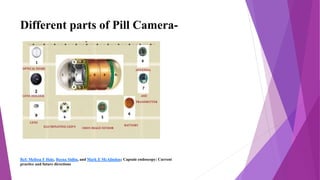
Different parts of Pill Camera-
Ref: Melissa F Hale, Reena Sidhu, and Mark E McAlindon; Capsule endoscopy: Current
practice and future directions
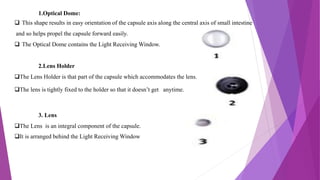
1.Optical Dome:
 This shape results in easy orientation of the capsule axis along the central axis of small intestine
and so helps propel the capsule forward easily.
 The Optical Dome contains the Light Receiving Window.
2.Lens Holder
The Lens Holder is that part of the capsule which accommodates the lens.
The lens is tightly fixed to the holder so that it doesn’t get anytime.
3. Lens
The Lens is an integral component of the capsule.
It is arranged behind the Light Receiving Window
4.Illuminating LED’s
 Around the Lens & CMOS Image Sensor, four LED’s (Light Emitting Diodes) are
present.
 These plural lighting devices are arranged in donut shape.
5.CMOS image sensor
 CMOS (Complementary Metal Oxide Semiconductor) Image Sensor is the most
important part of the capsule. It is highly sensitive and produces very high-quality
images.
 It has 140º field of view and can detect objects as small as possible.
6.Battery
 Battery used in the capsule is button shaped and are two in number as shown. batteries
are arranged together just behind the CMOS Image Sensor.
 Silver Oxide primary batteries are used (Zinc/Alkaline Electrolyte/Silver Oxide).Such a
battery is disposable and doesn’t cause harm to the body.
7.ASIC Transmitter
 The ASIC (Application Specific Integrated Circuit)
Transmitter is arranged behind the Batteries as shown. Two
Transmitting Electrodes are connected to the outlines of the
ASIC Transmitter. These electrodes are electrically isolated
from each other.
8.Antenna
 As shown, the Antennae is arranged at the end of the
capsule. It is enclosed in a dome shaped.
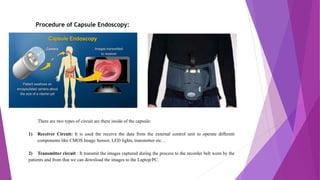
Procedure of Capsule Endoscopy:
There are two types of circuit are there inside of the capsule:
1) Receiver Circuit: It is used the receive the data from the external control unit to operate different
components like CMOS Image Sensor, LED lights, transmitter etc…
2) Transmitter circuit : It transmit the images captured during the process to the recorder belt worn by the
patients and from that we can download the images to the Laptop/PC.
 The patient have to swallowed the capsule like a conventional pill. It takes images as it
goes through the digestive track. A wireless recorder, worn on a belt, receives the image
transmitted by the pill.
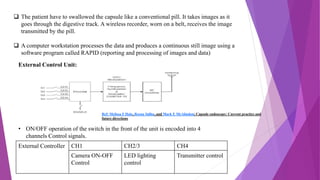
 A computer workstation processes the data and produces a continuous still image using a
software program called RAPID (reporting and processing of images and data)
External Control Unit:
• ON/OFF operation of the switch in the front of the unit is encoded into 4
channels Control signals.
External Controller CH1 CH2/3 CH4
Camera ON-OFF
Control
LED lighting
control
Transmitter control
Ref: Melissa F Hale, Reena Sidhu, and Mark E McAlindon; Capsule endoscopy: Current practice and
future directions
Fig: Compete capsule endoscopy process
 Why Pill Camera?
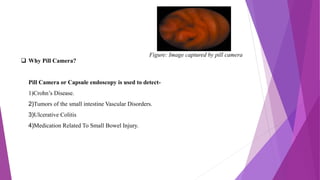
Pill Camera or Capsule endoscopy is used to detect-
1)Crohn’s Disease.
2)Tumors of the small intestine Vascular Disorders.
3)Ulcerative Colitis
4)Medication Related To Small Bowel Injury.
Figure: Image captured by pill camera
Advantages:
1)No pain: During this procedure, users feel no pain or discomfort; very efficient for
elderly people.
2) Unlike other endoscopy it can travel via the entire 20feet small intestine.
3) Can take upto 50000 images in the entire process.
4) The paitent can do their regular work in the entire duration i.e eight hours.
Disadvantages:
1. Pill Camera is very expensive; it costs around 20-25K Indian rupees.
2. It is difficult to do this capsule endoscopy with the patients who have blockage in small
intestine.
3. Movement of capsules depend on the natural transit of the bowel, which makes the
system incapable of repeated examination.
Future of capsule endoscopy:
1) Scientists hope a future version of the camera pill will repair gut problems as well as
spot them.
2) The scientific community at the University of Washington is currently developing a pill-
sized camera which would travel through the body looking for signs of disease.
3) The researchers are negotiating a contract to commercialize the technology. They hope
to not only take pictures, but also deliver treatments through the device in future. In future
the next big challenge is to make this cheaply.
Conclusion:
 In the future it hopes to not only take pictures, but also deliver treatments through the
device, and to apply it to other diseases. The Given Endoscopy capsule is a exploring
concept for Medical Technology of the 21st century.
 The endoscopy system is the first of its kind to be able to provide non-invasive imaging
of the entire small intestine. It has revolutionized the field of diagnostic imaging to a great
extent and has proved to be of great help to physicians all over the world.
References:
1] Melissa F Hale, Reena Sidhu, and Mark E McAlindon; Capsule endoscopy:
Current practice and future directions
2] Beg S,Parra-BlancoA,Ragunath K, Optimising the performance and interpretation of small
bowel capsule endoscopy. Frontline gastroenterology. 2018 Oct [PubMed PMID: 30245793]
3] Capsule endoscopy; Mayo Clinic; USA
THANK YOU

Pill camera(capsule endoscopy)

  • 1.
    Pill Camera(Capsule Endoscopy) Presentation By: GauravJyoti Dutta Department Of Electronics And Communication Engineering
  • 2.
    Table Of Contents: What is Pill Camera?  Different parts of Pill Camera  Procedure of capsule endoscopy  Control Unit of Capsule endoscopy  Uses  Advantages and disadvantages  Future aspects  Conclusion  References
  • 3.
    What is PillCamera?  Capsule endoscopy is a procedure that uses a tiny wireless camera to take pictures of your digestive tract.  About the size of a large vitamin capsule  Another name for this new technique is Wireless Capsule Endoscopy.  Its about 25mm length  Single-use color-imaging capsule (naturally excreted from the body)  Main area of observation is Small intestine
  • 4.
    Different parts ofPill Camera- Ref: Melissa F Hale, Reena Sidhu, and Mark E McAlindon; Capsule endoscopy: Current practice and future directions
  • 5.
    1.Optical Dome:  Thisshape results in easy orientation of the capsule axis along the central axis of small intestine and so helps propel the capsule forward easily.  The Optical Dome contains the Light Receiving Window. 2.Lens Holder The Lens Holder is that part of the capsule which accommodates the lens. The lens is tightly fixed to the holder so that it doesn’t get anytime. 3. Lens The Lens is an integral component of the capsule. It is arranged behind the Light Receiving Window
  • 6.
    4.Illuminating LED’s  Aroundthe Lens & CMOS Image Sensor, four LED’s (Light Emitting Diodes) are present.  These plural lighting devices are arranged in donut shape. 5.CMOS image sensor  CMOS (Complementary Metal Oxide Semiconductor) Image Sensor is the most important part of the capsule. It is highly sensitive and produces very high-quality images.  It has 140º field of view and can detect objects as small as possible. 6.Battery  Battery used in the capsule is button shaped and are two in number as shown. batteries are arranged together just behind the CMOS Image Sensor.  Silver Oxide primary batteries are used (Zinc/Alkaline Electrolyte/Silver Oxide).Such a battery is disposable and doesn’t cause harm to the body.
  • 7.
    7.ASIC Transmitter  TheASIC (Application Specific Integrated Circuit) Transmitter is arranged behind the Batteries as shown. Two Transmitting Electrodes are connected to the outlines of the ASIC Transmitter. These electrodes are electrically isolated from each other. 8.Antenna  As shown, the Antennae is arranged at the end of the capsule. It is enclosed in a dome shaped.
  • 8.
    Procedure of CapsuleEndoscopy: There are two types of circuit are there inside of the capsule: 1) Receiver Circuit: It is used the receive the data from the external control unit to operate different components like CMOS Image Sensor, LED lights, transmitter etc… 2) Transmitter circuit : It transmit the images captured during the process to the recorder belt worn by the patients and from that we can download the images to the Laptop/PC.
  • 9.
     The patienthave to swallowed the capsule like a conventional pill. It takes images as it goes through the digestive track. A wireless recorder, worn on a belt, receives the image transmitted by the pill.  A computer workstation processes the data and produces a continuous still image using a software program called RAPID (reporting and processing of images and data) External Control Unit: • ON/OFF operation of the switch in the front of the unit is encoded into 4 channels Control signals. External Controller CH1 CH2/3 CH4 Camera ON-OFF Control LED lighting control Transmitter control Ref: Melissa F Hale, Reena Sidhu, and Mark E McAlindon; Capsule endoscopy: Current practice and future directions
  • 10.
    Fig: Compete capsuleendoscopy process
  • 11.
     Why PillCamera? Pill Camera or Capsule endoscopy is used to detect- 1)Crohn’s Disease. 2)Tumors of the small intestine Vascular Disorders. 3)Ulcerative Colitis 4)Medication Related To Small Bowel Injury. Figure: Image captured by pill camera
  • 12.
    Advantages: 1)No pain: Duringthis procedure, users feel no pain or discomfort; very efficient for elderly people. 2) Unlike other endoscopy it can travel via the entire 20feet small intestine. 3) Can take upto 50000 images in the entire process. 4) The paitent can do their regular work in the entire duration i.e eight hours.
  • 13.
    Disadvantages: 1. Pill Camerais very expensive; it costs around 20-25K Indian rupees. 2. It is difficult to do this capsule endoscopy with the patients who have blockage in small intestine. 3. Movement of capsules depend on the natural transit of the bowel, which makes the system incapable of repeated examination.
  • 14.
    Future of capsuleendoscopy: 1) Scientists hope a future version of the camera pill will repair gut problems as well as spot them. 2) The scientific community at the University of Washington is currently developing a pill- sized camera which would travel through the body looking for signs of disease. 3) The researchers are negotiating a contract to commercialize the technology. They hope to not only take pictures, but also deliver treatments through the device in future. In future the next big challenge is to make this cheaply.
  • 15.
    Conclusion:  In thefuture it hopes to not only take pictures, but also deliver treatments through the device, and to apply it to other diseases. The Given Endoscopy capsule is a exploring concept for Medical Technology of the 21st century.  The endoscopy system is the first of its kind to be able to provide non-invasive imaging of the entire small intestine. It has revolutionized the field of diagnostic imaging to a great extent and has proved to be of great help to physicians all over the world.
  • 16.
    References: 1] Melissa FHale, Reena Sidhu, and Mark E McAlindon; Capsule endoscopy: Current practice and future directions 2] Beg S,Parra-BlancoA,Ragunath K, Optimising the performance and interpretation of small bowel capsule endoscopy. Frontline gastroenterology. 2018 Oct [PubMed PMID: 30245793] 3] Capsule endoscopy; Mayo Clinic; USA
  • 17.