Pilates + Athletes = Performance Presented by Marci Clark
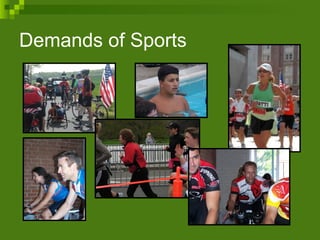
Demands of Sports
Objectives Identify the application of Pilates to athletics including mind/body connections Identify the benefits of core training to various sports Explore exercises that complement sport specific training
The Matter of Pilates for Athletes Integration of: Pelvic Girdle Pelvic Floor Shoulder Girdle Trunk/Spinal Column Breath Mind
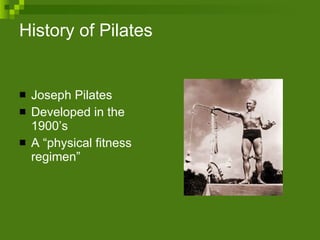
History of Pilates Joseph Pilates Developed in the 1900’s A “physical fitness regimen”
Athletes who practice
Getting buy in from your athletic clients Sell the performance aspect Offer a training session for them to “feel it” Define the muscle movement involved in Pilates and how it relates to their individual sport Reinforce functional movement training
The Mental Game The mind leads the body    the body drives the ball, balances the stroke, swings the club, throws the ball, stabilizes the gait    the athlete visualizes the successful performance
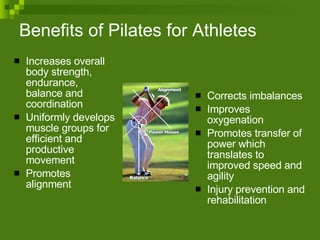
Benefits of Pilates for Athletes Increases overall body strength, endurance, balance and coordination Uniformly develops muscle groups for efficient and productive movement Promotes alignment Corrects imbalances Improves oxygenation Promotes transfer of power which translates to improved speed and agility Injury prevention and rehabilitation
Application: Consider the Efficiency and Stabilization Need of a Sport  A strong core: Enables form When the racquet and club sports extend the levers Economy of movement When the momentum needs to be halted or direction turned Decreases fatigue  When the game goes into overtime or the match goes 5 sets Improves endurance When the repetitive motion of the endurance activity begins to alter the gait
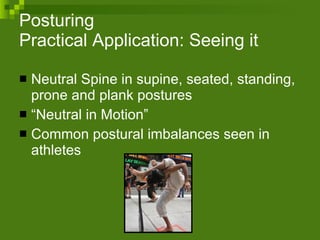
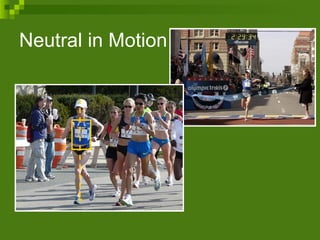
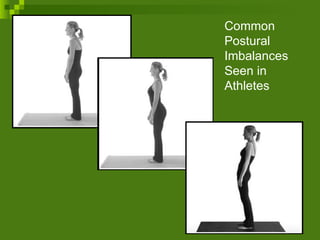
Posturing Practical Application: Seeing it Neutral Spine in supine, seated, standing, prone and plank postures “Neutral in Motion” Common postural imbalances seen in athletes
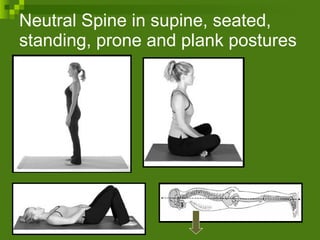
Neutral Spine in supine, seated, standing, prone and plank postures
Neutral in Motion
Common Postural Imbalances Seen in Athletes
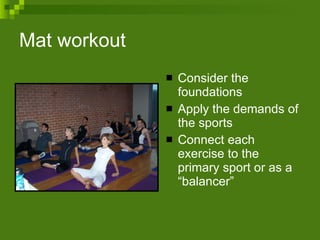
Mat workout Consider the foundations  Apply the demands of the sports Connect each exercise to the primary sport or as a “balancer”
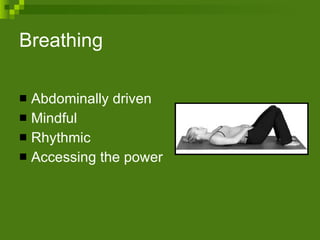
Breathing  Abdominally driven Mindful Rhythmic  Accessing the power
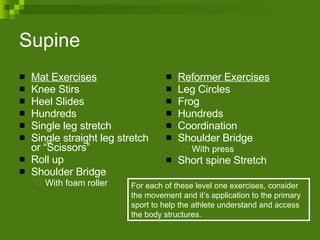
Supine  Mat Exercises Knee Stirs Heel Slides Hundreds Single leg stretch Single straight leg stretch or “Scissors” Roll up Shoulder Bridge With foam roller Reformer Exercises Leg Circles Frog Hundreds Coordination Shoulder Bridge With press Short spine Stretch For each of these level one exercises, consider the movement and it’s application to the primary sport to help the athlete understand and access the body structures.
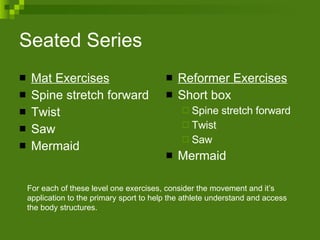
Seated Series Mat Exercises Spine stretch forward Twist Saw Mermaid Reformer Exercises Short box Spine stretch forward Twist Saw Mermaid For each of these level one exercises, consider the movement and it’s application to the primary sport to help the athlete understand and access the body structures.
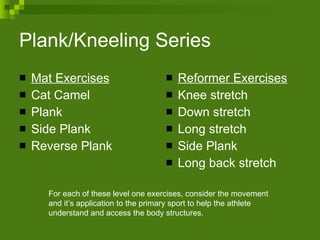
Plank/Kneeling Series Mat Exercises Cat Camel Plank Side Plank  Reverse Plank Reformer Exercises Knee stretch Down stretch Long stretch Side Plank Long back stretch For each of these level one exercises, consider the movement and it’s application to the primary sport to help the athlete understand and access the body structures.
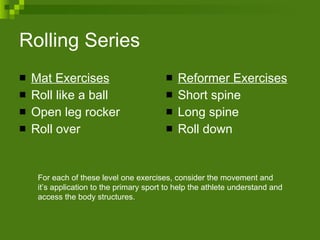
Rolling Series Mat Exercises Roll like a ball  Open leg rocker Roll over Reformer Exercises Short spine Long spine Roll down  For each of these level one exercises, consider the movement and it’s application to the primary sport to help the athlete understand and access the body structures.
References: Spin Pilate Training Manuals – M. Clark The Pilates Body –B. Siler Power Pilates – M. Winsor Stronger Abs and Back – Brittenham and Brittenham Crosstraining for Runners – Matt Fitzgerald Athletic Development – V. Gambetta

Pilates + Ahtletes = Performance

  • 1.
    Pilates + Athletes= Performance Presented by Marci Clark
  • 2.
  • 3.
    Objectives Identify theapplication of Pilates to athletics including mind/body connections Identify the benefits of core training to various sports Explore exercises that complement sport specific training
  • 4.
    The Matter ofPilates for Athletes Integration of: Pelvic Girdle Pelvic Floor Shoulder Girdle Trunk/Spinal Column Breath Mind
  • 5.
    History of PilatesJoseph Pilates Developed in the 1900’s A “physical fitness regimen”
  • 6.
  • 7.
    Getting buy infrom your athletic clients Sell the performance aspect Offer a training session for them to “feel it” Define the muscle movement involved in Pilates and how it relates to their individual sport Reinforce functional movement training
  • 8.
    The Mental GameThe mind leads the body  the body drives the ball, balances the stroke, swings the club, throws the ball, stabilizes the gait  the athlete visualizes the successful performance
  • 9.
    Benefits of Pilatesfor Athletes Increases overall body strength, endurance, balance and coordination Uniformly develops muscle groups for efficient and productive movement Promotes alignment Corrects imbalances Improves oxygenation Promotes transfer of power which translates to improved speed and agility Injury prevention and rehabilitation
  • 10.
    Application: Consider theEfficiency and Stabilization Need of a Sport A strong core: Enables form When the racquet and club sports extend the levers Economy of movement When the momentum needs to be halted or direction turned Decreases fatigue When the game goes into overtime or the match goes 5 sets Improves endurance When the repetitive motion of the endurance activity begins to alter the gait
  • 11.
    Posturing Practical Application:Seeing it Neutral Spine in supine, seated, standing, prone and plank postures “Neutral in Motion” Common postural imbalances seen in athletes
  • 12.
    Neutral Spine insupine, seated, standing, prone and plank postures
  • 13.
  • 14.
  • 15.
    Mat workout Considerthe foundations Apply the demands of the sports Connect each exercise to the primary sport or as a “balancer”
  • 16.
    Breathing Abdominallydriven Mindful Rhythmic Accessing the power
  • 17.
    Supine MatExercises Knee Stirs Heel Slides Hundreds Single leg stretch Single straight leg stretch or “Scissors” Roll up Shoulder Bridge With foam roller Reformer Exercises Leg Circles Frog Hundreds Coordination Shoulder Bridge With press Short spine Stretch For each of these level one exercises, consider the movement and it’s application to the primary sport to help the athlete understand and access the body structures.
  • 18.
    Seated Series MatExercises Spine stretch forward Twist Saw Mermaid Reformer Exercises Short box Spine stretch forward Twist Saw Mermaid For each of these level one exercises, consider the movement and it’s application to the primary sport to help the athlete understand and access the body structures.
  • 19.
    Plank/Kneeling Series MatExercises Cat Camel Plank Side Plank Reverse Plank Reformer Exercises Knee stretch Down stretch Long stretch Side Plank Long back stretch For each of these level one exercises, consider the movement and it’s application to the primary sport to help the athlete understand and access the body structures.
  • 20.
    Rolling Series MatExercises Roll like a ball Open leg rocker Roll over Reformer Exercises Short spine Long spine Roll down For each of these level one exercises, consider the movement and it’s application to the primary sport to help the athlete understand and access the body structures.
  • 21.
    References: Spin PilateTraining Manuals – M. Clark The Pilates Body –B. Siler Power Pilates – M. Winsor Stronger Abs and Back – Brittenham and Brittenham Crosstraining for Runners – Matt Fitzgerald Athletic Development – V. Gambetta