Personal Information Management Strategies and Tactics Used by Senior Engineers Christina K. Pikas [email_address] University of Maryland College of Information Studies ASIS&T 2007, Milwaukee, WI
Problem We have limited information on how engineers keep personal,  work-related files What is the in the engineers’ personal files? How is this information organized? How does this inform the design of systems?
Agenda Methods Results Implications for system design
Methods Qualitative methods in order to obtain rich, process-related information Responsive, semi-structured interviews 11 broad questions Audio taped & transcribed Purposeful participant selection Variety of specialties and academic backgrounds Have been at current workplace at least 10 years Working as engineers
Analysis Cross-case constant comparison method  to develop codes, integrate categories,  and define themes  Member checks for internal validity
Results Data in three different stages:  Raw data exported from experimental equipment Processed data in some stage of analysis Analyzed data published in reports  Information in several different formats: Their own published work Literature E-mail Networks of experts
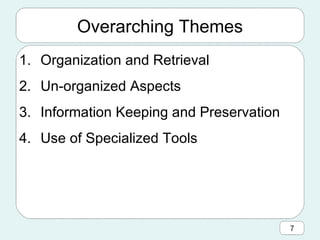
Overarching Themes Organization and Retrieval Un-organized Aspects Information Keeping and Preservation Use of Specialized Tools
1. Organization and Retrieval 1.1 Memory Association with time or place In lieu of organization scheme
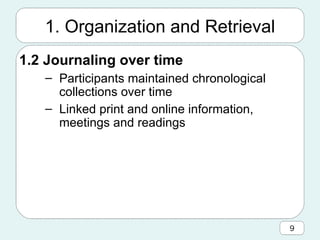
1. Organization and Retrieval 1.2 Journaling over time Participants maintained chronological collections over time Linked print and online information, meetings and readings
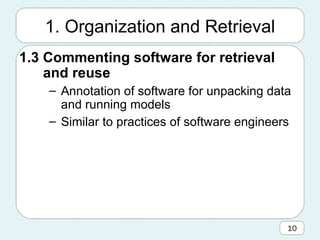
1. Organization and Retrieval 1.3 Commenting software for retrieval and reuse Annotation of software for unpacking data and running models Similar to practices of software engineers
1. Organization and Retrieval 1.4 Writing to remember, reporting to retrieve Participant reported using technical reports and formal write-ups for archival purposes Well typically, the best way to do that is you keep raw data…[y]ou keep it on disk or you print it out or whatever. But, you also write about it. You document it. You write a report, you write a paper or you write something and  that  becomes your archival reference… (A; 9:16)
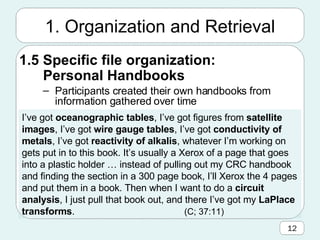
1. Organization and Retrieval 1.5 Specific file organization:  Personal Handbooks Participants created their own handbooks from information gathered over time I’ve got  oceanographic tables , I’ve got figures from  satellite images , I’ve got  wire gauge tables , I’ve got  conductivity of metals , I’ve got  reactivity of alkalis , whatever I’m working on gets put in to this book. It’s usually a Xerox of a page that goes into a plastic holder … instead of pulling out my CRC handbook and finding the section in a 300 page book, I’ll Xerox the 4 pages and put them in a book. Then when I want to do a  circuit analysis , I just pull that book out, and there I’ve got my  LaPlace   transforms .  (C; 37:11)
1. Organization and Retrieval 1.6 Specific file organization:  Technology and project files Files are organized into project-related files and technology-related files
1.7 Seeking information from people:  Maintaining a collection of experts Participants viewed their network as an asset Networks are carefully cultivated and maintained 1. Organization and Retrieval
2.1 Organized messes Mismatch between elaborate organization schemes and messy desks 2. Un-organized Aspects “ you go into a person’s office and you know if the desk is cluttered, the person is a worker. If the desk is pristine… well then… they’re not as productive” (C; 34:9)
2. Unorganized Aspects 2.2 E-mail, the overlooked collection E-mail collections are not fully exploited for PIM purposes.
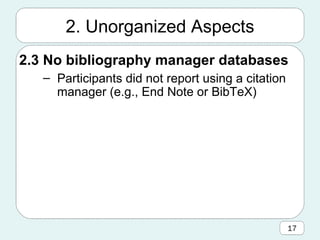
2. Unorganized Aspects 2.3 No bibliography manager databases Participants did not report using a citation manager (e.g., End Note or BibTeX)
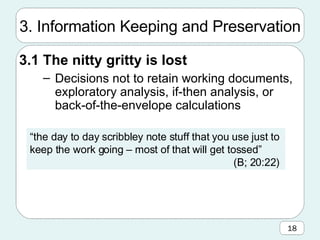
3. Information Keeping and Preservation 3.1 The nitty gritty is lost Decisions not to retain working documents, exploratory analysis, if-then analysis, or back-of-the-envelope calculations “ the day to day scribbley note stuff that you use just to keep the work going – most of that will get tossed”  (B; 20:22)
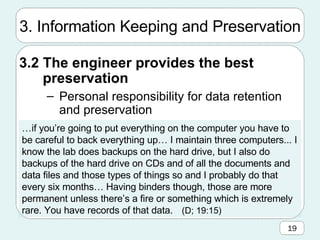
3. Information Keeping and Preservation 3.2 The engineer provides the best preservation Personal responsibility for data retention and preservation … if you’re going to put everything on the computer you have to be careful to back everything up… I maintain three computers... I know the lab does backups on the hard drive, but I also do backups of the hard drive on CDs and of all the documents and data files and those types of things so and I probably do that every six months… Having binders though, those are more permanent unless there’s a fire or something which is extremely rare. You have records of that data. (D; 19:15)
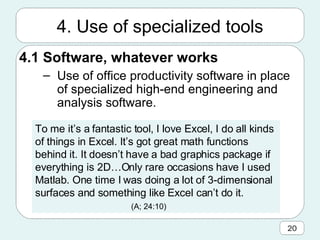
4. Use of specialized tools 4.1 Software, whatever works Use of office productivity software in place of specialized high-end engineering and analysis software. To me it’s a fantastic tool, I love Excel, I do all kinds of things in Excel. It’s got great math functions behind it. It doesn’t have a bad graphics package if everything is 2D…Only rare occasions have I used Matlab. One time I was doing a lot of 3-dimensional surfaces and something like Excel can’t do it. (A; 24:10)
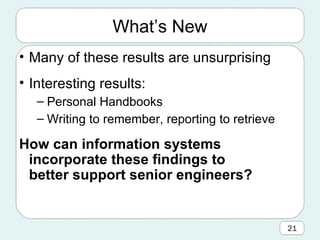
What’s New Many of these results are unsurprising Interesting results: Personal Handbooks Writing to remember, reporting to retrieve How can information systems incorporate these findings to better support senior engineers?
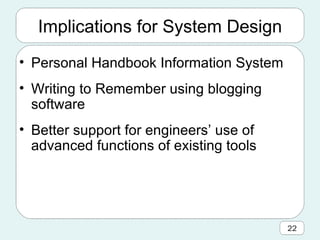
Implications for System Design Personal Handbook Information System Writing to Remember using blogging software Better support for engineers’ use of advanced functions of existing tools
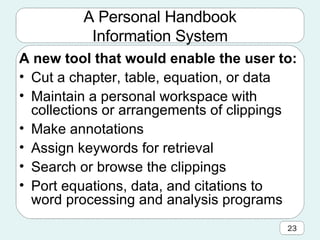
A Personal Handbook Information System A new tool that would enable the user to: Cut a chapter, table, equation, or data  Maintain a personal workspace with collections or arrangements of clippings Make annotations Assign keywords for retrieval Search or browse the clippings Port equations, data, and citations to  word processing and analysis programs
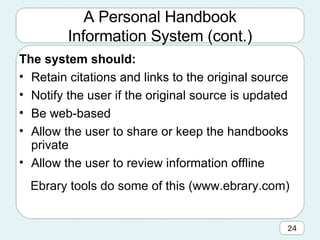
A Personal Handbook Information System (cont.) The system should: Retain citations and links to the original source Notify the user if the original source is updated Be web-based Allow the user to share or keep the handbooks private Allow the user to review information offline Ebrary tools do some of this (www.ebrary.com)
Writing to Remember Engineers could write in smaller increments using blogging software  Timeline arrangement fits with information retrieval methods for personal information Date/time stamps and hyperlinking add context The full content is searchable  Tags and categories provide subject access Information is posted smaller chunks Less daunting than preparing a formal report Allows information sharing and serendipitous finds
Software, Whatever Works Encourage the use of a citation manager Better bridging software to assist moving graphics from the advanced engineering software into word processing software Individualized support from IT
Take Home Messages Ethnographic studies can lead to useful ideas for system design to support engineers’ tasks It remains valuable and important to build on information behavior research to design and build PIM systems

Pikas Asist2007 PIM Senior Engineers Final

  • 1.
    Personal Information ManagementStrategies and Tactics Used by Senior Engineers Christina K. Pikas [email_address] University of Maryland College of Information Studies ASIS&T 2007, Milwaukee, WI
  • 2.
    Problem We havelimited information on how engineers keep personal, work-related files What is the in the engineers’ personal files? How is this information organized? How does this inform the design of systems?
  • 3.
    Agenda Methods ResultsImplications for system design
  • 4.
    Methods Qualitative methodsin order to obtain rich, process-related information Responsive, semi-structured interviews 11 broad questions Audio taped & transcribed Purposeful participant selection Variety of specialties and academic backgrounds Have been at current workplace at least 10 years Working as engineers
  • 5.
    Analysis Cross-case constantcomparison method to develop codes, integrate categories, and define themes Member checks for internal validity
  • 6.
    Results Data inthree different stages: Raw data exported from experimental equipment Processed data in some stage of analysis Analyzed data published in reports Information in several different formats: Their own published work Literature E-mail Networks of experts
  • 7.
    Overarching Themes Organizationand Retrieval Un-organized Aspects Information Keeping and Preservation Use of Specialized Tools
  • 8.
    1. Organization andRetrieval 1.1 Memory Association with time or place In lieu of organization scheme
  • 9.
    1. Organization andRetrieval 1.2 Journaling over time Participants maintained chronological collections over time Linked print and online information, meetings and readings
  • 10.
    1. Organization andRetrieval 1.3 Commenting software for retrieval and reuse Annotation of software for unpacking data and running models Similar to practices of software engineers
  • 11.
    1. Organization andRetrieval 1.4 Writing to remember, reporting to retrieve Participant reported using technical reports and formal write-ups for archival purposes Well typically, the best way to do that is you keep raw data…[y]ou keep it on disk or you print it out or whatever. But, you also write about it. You document it. You write a report, you write a paper or you write something and that becomes your archival reference… (A; 9:16)
  • 12.
    1. Organization andRetrieval 1.5 Specific file organization: Personal Handbooks Participants created their own handbooks from information gathered over time I’ve got oceanographic tables , I’ve got figures from satellite images , I’ve got wire gauge tables , I’ve got conductivity of metals , I’ve got reactivity of alkalis , whatever I’m working on gets put in to this book. It’s usually a Xerox of a page that goes into a plastic holder … instead of pulling out my CRC handbook and finding the section in a 300 page book, I’ll Xerox the 4 pages and put them in a book. Then when I want to do a circuit analysis , I just pull that book out, and there I’ve got my LaPlace transforms . (C; 37:11)
  • 13.
    1. Organization andRetrieval 1.6 Specific file organization: Technology and project files Files are organized into project-related files and technology-related files
  • 14.
    1.7 Seeking informationfrom people: Maintaining a collection of experts Participants viewed their network as an asset Networks are carefully cultivated and maintained 1. Organization and Retrieval
  • 15.
    2.1 Organized messesMismatch between elaborate organization schemes and messy desks 2. Un-organized Aspects “ you go into a person’s office and you know if the desk is cluttered, the person is a worker. If the desk is pristine… well then… they’re not as productive” (C; 34:9)
  • 16.
    2. Unorganized Aspects2.2 E-mail, the overlooked collection E-mail collections are not fully exploited for PIM purposes.
  • 17.
    2. Unorganized Aspects2.3 No bibliography manager databases Participants did not report using a citation manager (e.g., End Note or BibTeX)
  • 18.
    3. Information Keepingand Preservation 3.1 The nitty gritty is lost Decisions not to retain working documents, exploratory analysis, if-then analysis, or back-of-the-envelope calculations “ the day to day scribbley note stuff that you use just to keep the work going – most of that will get tossed” (B; 20:22)
  • 19.
    3. Information Keepingand Preservation 3.2 The engineer provides the best preservation Personal responsibility for data retention and preservation … if you’re going to put everything on the computer you have to be careful to back everything up… I maintain three computers... I know the lab does backups on the hard drive, but I also do backups of the hard drive on CDs and of all the documents and data files and those types of things so and I probably do that every six months… Having binders though, those are more permanent unless there’s a fire or something which is extremely rare. You have records of that data. (D; 19:15)
  • 20.
    4. Use ofspecialized tools 4.1 Software, whatever works Use of office productivity software in place of specialized high-end engineering and analysis software. To me it’s a fantastic tool, I love Excel, I do all kinds of things in Excel. It’s got great math functions behind it. It doesn’t have a bad graphics package if everything is 2D…Only rare occasions have I used Matlab. One time I was doing a lot of 3-dimensional surfaces and something like Excel can’t do it. (A; 24:10)
  • 21.
    What’s New Manyof these results are unsurprising Interesting results: Personal Handbooks Writing to remember, reporting to retrieve How can information systems incorporate these findings to better support senior engineers?
  • 22.
    Implications for SystemDesign Personal Handbook Information System Writing to Remember using blogging software Better support for engineers’ use of advanced functions of existing tools
  • 23.
    A Personal HandbookInformation System A new tool that would enable the user to: Cut a chapter, table, equation, or data Maintain a personal workspace with collections or arrangements of clippings Make annotations Assign keywords for retrieval Search or browse the clippings Port equations, data, and citations to word processing and analysis programs
  • 24.
    A Personal HandbookInformation System (cont.) The system should: Retain citations and links to the original source Notify the user if the original source is updated Be web-based Allow the user to share or keep the handbooks private Allow the user to review information offline Ebrary tools do some of this (www.ebrary.com)
  • 25.
    Writing to RememberEngineers could write in smaller increments using blogging software Timeline arrangement fits with information retrieval methods for personal information Date/time stamps and hyperlinking add context The full content is searchable Tags and categories provide subject access Information is posted smaller chunks Less daunting than preparing a formal report Allows information sharing and serendipitous finds
  • 26.
    Software, Whatever WorksEncourage the use of a citation manager Better bridging software to assist moving graphics from the advanced engineering software into word processing software Individualized support from IT
  • 27.
    Take Home MessagesEthnographic studies can lead to useful ideas for system design to support engineers’ tasks It remains valuable and important to build on information behavior research to design and build PIM systems