Software Sustainability Institute
www.software.ac.uk
Software – a different
kind of research object?
http://dx.doi.org/10.6084/m9.figshare.5459542
3rd October 2017, Lancaster Data Conversations, Lancaster
Neil Chue Hong (@npch), Software Sustainability Institute
ORCID: 0000-0002-8876-7606 | N.ChueHong@software.ac.uk
Slides licensed under
CC-BY where indicated:
Supported by Project funding
from
Software Sustainability Institute
www.software.ac.ukWhat’s
software
got to do
with my
research?
The research community
relies on software
Do you use research
software?
What would happen to your
research without software
Survey of researchers from 15 Russell Group universities conducted by SSI between August - October 2014.
406 respondents covering representative range of funders, discipline and seniority.
56%
Develop their
own software
71% Have no formal
software training
Software Sustainability Institute
www.software.ac.uk
Software in Nature
Nangia and Katz: https://arxiv.org/pdf/1706.06527.pdf
Software Sustainability Institute
www.software.ac.uk
Raise standards for preclinical
cancer research
47 out of 53
“landmark” publications
could not be replicated
Begley,Ellis.Nature,483,2012
doi:10.1038/483531a
Software Sustainability Institute
www.software.ac.uk
Repeatability of published
microarray gene expression
analyses
56% of analyses could not be repeated,
of which 30% were because of software issues.
50% did not state software version, 39% did not provide raw data.
Only 11% could be reproduced satisfactorily.
Ioannidis et al. Nature Genetics, 41, 2010
doi:10.1038/ng.295
Software Sustainability Institute
www.software.ac.uk
Repeatability in Computer
Science
Of 401 papers in ACM Computer Science journals and proceedings,
only 85 provided a link to software.
For 176 the software could not be obtained.
Collberg, Proebsting, Warren, University of Arizona TR 14-04, 2015
http://reproducibility.cs.arizona.edu/v2/RepeatabilityTR.pdf
Software Sustainability Institute
www.software.ac.uk
Errors due to
bioinformatics pipeline
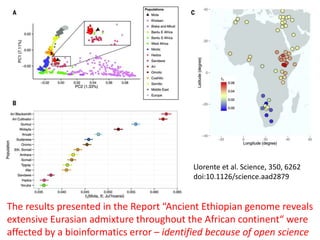
The results presented in the Report “Ancient Ethiopian genome reveals
extensive Eurasian admixture throughout the African continent“ were
affected by a bioinformatics error – identified because of open science
Llorente et al. Science, 350, 6262
doi:10.1126/science.aad2879
Software Sustainability Institute
www.software.ac.uk
T
Software Sustainability Institute
www.software.ac.ukIsn’t
software
just a type
of data?
Software Sustainability Institute
www.software.ac.uk
Authorship Lifecycle
IdentifyCite
Reuse
Research
Index
Papers, data, software all
research outputs of
a continuous cycle.
With software, technology
makes it easier to track,
but not reward.
We cannot separate
papers, data and software
when we release research.
http://openresearchsoftware.metajnl.com
Software Sustainability Institute
www.software.ac.uk
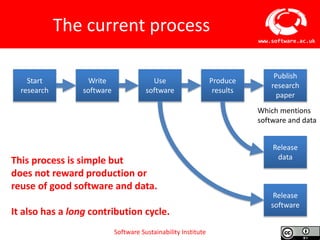
The current process
Start
research
Write
software
Use
software
Produce
results
Publish
research
paper
Release
data
Release
software
Which mentions
software and data
This process is simple but
does not reward production or
reuse of good software and data.
It also has a long contribution cycle.
Software Sustainability Institute
www.software.ac.uk
Write
software
A better process?
Start
research
Identify
existing
software
Use
software
Produce
results
Publish
research
paper
Adapt/
extend
software
Release
data
Release
software
Publish
software
paper Publish
data
paper
Whichreferences
softwareanddatapapers
Software and data papers
are needed as proxies for
rewarding reuse.
But it enables a shorter contribution cycle for
data and software.
Software Sustainability Institute
www.software.ac.uk
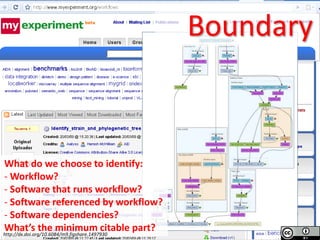
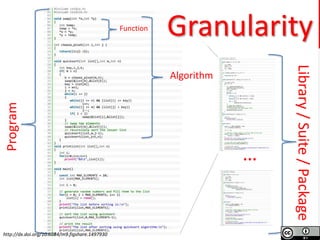
What do we choose to identify:
- Workflow?
- Software that runs workflow?
- Software referenced by workflow?
- Software dependencies?
What’s the minimum citable part?
Boundary
http://dx.doi.org/10.6084/m9.figshare.1497930
Software Sustainability Institute
www.software.ac.uk
Algorithm
Function
Program
Library/Suite/Package
…
Granularity
http://dx.doi.org/10.6084/m9.figshare.1497930
Software Sustainability Institute
www.software.ac.uk
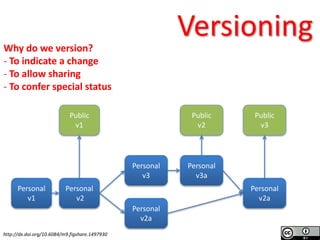
Versioning
Personal
v1
Personal
v2
Personal
v3
Personal
v2a
Public
v1
Personal
v3a
Personal
v2a
Public
v2
Public
v3
Why do we version?
- To indicate a change
- To allow sharing
- To confer special status
http://dx.doi.org/10.6084/m9.figshare.1497930
Software Sustainability Institute
www.software.ac.uk
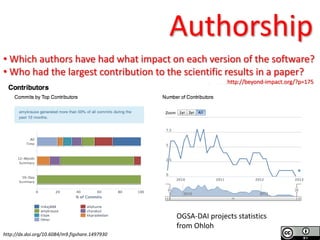
AuthorshipAuthorship
• Which authors have had what impact on each version of the software?
• Who had the largest contribution to the scientific results in a paper?
http://beyond-impact.org/?p=175
OGSA-DAI projects statistics
from Ohloh
http://dx.doi.org/10.6084/m9.figshare.1497930
Software Sustainability Institute
www.software.ac.ukIf software is
so important,
why is most
of it hard to
reuse?
Software Sustainability Institute
www.software.ac.uk
The Software Sustainability
Institute
A national facility for cultivating better, more
sustainable, research software to enable world-
class research
• Software reaches boundaries in its
development cycle that prevent
improvement, growth and adoption
• Providing the expertise and services
needed to negotiate to the next stage
• Developing the policy and tools to
support the community developing and
using research software Supported by EPSRC Grant EP/H043160/1
+ EPSRC/ESRC/BBSRC grant EP/N006410/1
Software Sustainability Institute
www.software.ac.uk
, it’
Victoria Stodden, AMP 2011 http://www.stodden.net/AMP2011/,
Special Issue Reproducible Research Computing in Science and Engineering July/August 2012, 14(4)
Howison and Herbsleb (2013) "Incentives and Integration In Scientific Software Production" CSCW 2013.
Software Sustainability Institute
www.software.ac.uk
T
Research Culture
Needs Changing
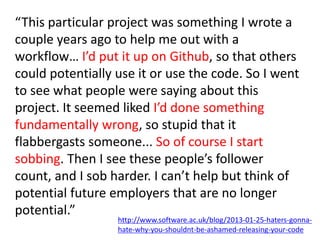
“This particular project was something I wrote a
couple years ago to help me out with a
workflow… I’d put it up on Github, so that others
could potentially use it or use the code. So I went
to see what people were saying about this
project. It seemed liked I’d done something
fundamentally wrong, so stupid that it
flabbergasts someone... So of course I start
sobbing. Then I see these people’s follower
count, and I sob harder. I can’t help but think of
potential future employers that are no longer
potential.”
http://www.software.ac.uk/blog/2013-01-25-haters-gonna-
hate-why-you-shouldnt-be-ashamed-releasing-your-code
Software Sustainability Institute
www.software.ac.uk
T
Research Culture
Needs Changing
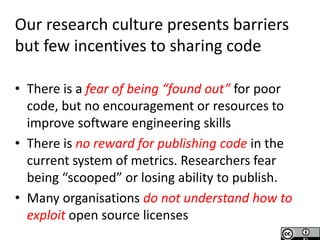
Our research culture presents barriers
but few incentives to sharing code
• There is a fear of being “found out” for poor
code, but no encouragement or resources to
improve software engineering skills
• There is no reward for publishing code in the
current system of metrics. Researchers fear
being “scooped” or losing ability to publish.
• Many organisations do not understand how to
exploit open source licenses
Software Sustainability Institute
www.software.ac.ukNever be
ashamed of
making your
software
available
Software Sustainability Institute
www.software.ac.uk
T
Vandewalle (2012) DOI: 10.1109/MCSE.2012.63
Software Sustainability Institute
www.software.ac.uk
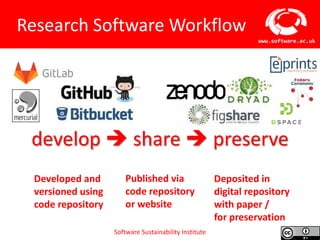
Research Software Workflow
develop  share  preserve
Developed and
versioned using
code repository
Published via
code repository
or website
Deposited in
digital repository
with paper /
for preservation
Software Sustainability Institute
www.software.ac.uk
Good Enough Practices To
Please Your Future Self
• Data:
 Save and backup raw data
 Create analysis-friendly data
 Record your processing steps
 Anticipate the need to use multiple tables, and use
a unique identifier for each record
 Submit data to a repository and get a DOI
Software Sustainability Institute
www.software.ac.uk
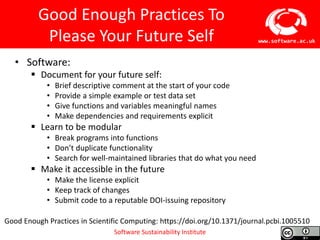
Good Enough Practices To
Please Your Future Self
• Software:
 Document for your future self:
• Brief descriptive comment at the start of your code
• Provide a simple example or test data set
• Give functions and variables meaningful names
• Make dependencies and requirements explicit
 Learn to be modular
• Break programs into functions
• Don’t duplicate functionality
• Search for well-maintained libraries that do what you need
 Make it accessible in the future
• Make the license explicit
• Keep track of changes
• Submit code to a reputable DOI-issuing repository
Good Enough Practices in Scientific Computing: https://doi.org/10.1371/journal.pcbi.1005510
Software Sustainability Institute
www.software.ac.uk
What you can do now
• Make sure you’re using version control
• Write a README file that describes how you
can get your code up and running, and give it
to a colleague to try out
 What it does, requirements / dependencies, simple
example of use and input + output data
• Ask a collaborator to contribute a new piece of
functionality, and get feedback on the process
• Talk to your library / IT services about the
services they offer
Software Sustainability Institute
www.software.ac.uk
Get some training
Teach basic lab skills
for scientific computing
so that researchers can do more in less
time and with less pain.
Teach basic concepts, skills and tools for
working more effectively with data.
Workshops are designed for people with
little to no prior computational
experience.
admin@datacarpentry.org
admin@software-carpentry.org
Open source learning, that can be tailored to disciplines.
“Train the trainers”: building a capable base of instructors.
Software Sustainability Institute
www.software.ac.uk
Three months
from now,
you will thank
yourself!
Software Sustainability Institute
www.software.ac.uk
Interested in more?
• Publish a software paper
 http://bit.ly/softwarejournals
• Easily archive your GitHub Code and make ir
citable
 GitHub to Zenodo
 GitHub to FigShare
• Software Citation Implementation WG
 https://www.force11.org/group/software-citation-
implementation-working-group
Software Sustainability Institute
www.software.ac.uk
Literate Programming
• Traditional papers are just advertisements
 A literate computing document is the research
• The technology is out there
 Jupyter notebooks
 Mathematica
 R Markdown
 knitR
 MATLAB Live scripts
Software Sustainability Institute
www.software.ac.uk
• LIGO Paper:
 http://journals.aps.org/prl/abstract/10.1103/Phys
RevLett.116.061102
• LIGO Notebook:
 https://losc.ligo.org/s/events/GW150914/GW1509
14_tutorial.ipynb
LIGO Example
Software Sustainability Institute
www.software.ac.uk
SSI Fellows 2018 / CW18
• SSI Fellowships
 Deadline: 9th October 2017
 £3000 bursary to be a research software advocate
 Join a network of great people working to improve
• Collaborations Workshop 2018
 Cardiff, 26-28th March 2018
 Theme: “Culture Change and Productivity”
 The un-conference that most participants would
recommend to their colleagues
Software Sustainability Institute
www.software.ac.uk
T
Without data it’s difficult
to validate results.
But without code, we
waste the opportunity to
advance science.
These slides: http://dx.doi.org/10.6084/m9.figshare.5459542
“The only way to publish software in a scientifically robust manner is to share
source code, and that means publishing via the internet in an open-access/open-
source fashion. —Warren Lyford DeLano, Creator of PyMOL, 2005
Software Sustainability Institute
www.software.ac.uk
The Software Sustainability
Institute
A national facility for cultivating better, more
sustainable, research software to enable world-
class research
• Software reaches boundaries in its
development cycle that prevent
improvement, growth and adoption
• Providing the expertise and services
needed to negotiate to the next stage
• Developing the policy and tools to
support the community developing and
using research software Supported by EPSRC Grant EP/H043160/1
+ EPSRC/ESRC/BBSRC grant EP/N006410/1
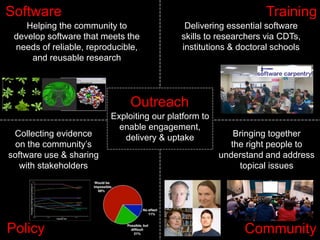
Software
Policy
Training
Community
Outreach
Delivering essential software
skills to researchers via CDTs,
institutions & doctoral schools
Helping the community to
develop software that meets the
needs of reliable, reproducible,
and reusable research
Collecting evidence
on the community’s
software use & sharing
with stakeholders
Bringing together
the right people to
understand and address
topical issues
Exploiting our platform to
enable engagement,
delivery & uptake
Website & blog
Campaigns
Advice
Guides
Courses
Workshops
Fellowship
Research
Software
Policy
Training
Community
Consultancy
50+ projects
130+ evaluations
4 surgeries
35+ UK SWC
workshops
1000+ learners
80+ guides
50,000 readers
61 domain
ambassadors
20+ workshops organised
740 researchers
50,000 grants
analysed
150+ contributed articles
20,000 unique visitors per month
3,000 Twitter followers
300+ RSEs engaged 2100 signatures 13 issues highlighted
Outreach
Software Sustainability Institute
www.software.ac.uk
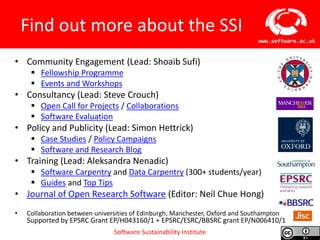
Find out more about the SSI
• Community Engagement (Lead: Shoaib Sufi)
 Fellowship Programme
 Events and Workshops
• Consultancy (Lead: Steve Crouch)
 Open Call for Projects / Collaborations
 Software Evaluation
• Policy and Publicity (Lead: Simon Hettrick)
 Case Studies / Policy Campaigns
 Software and Research Blog
• Training (Lead: Aleksandra Nenadic)
 Software Carpentry and Data Carpentry (300+ students/year)
 Guides and Top Tips
• Journal of Open Research Software (Editor: Neil Chue Hong)
• Collaboration between universities of Edinburgh, Manchester, Oxford and Southampton
Supported by EPSRC Grant EP/H043160/1 + EPSRC/ESRC/BBSRC grant EP/N006410/1
Software Sustainability Institute
www.software.ac.uk
Software Sustainability Institute
www.software.ac.uk
T
Research Culture
Needs Changing
But there’s still a lot to be done
• Software Assessment
• Software Management Plans
• Group Identifiers
 Software project teams – encompassing
contributors
 Software products – across versions
• Machine readable references
 Software papers solve the credit problem
 The reference problem is still hard
• Where is software mentioned and can we find it
Software Sustainability Institute
www.software.ac.uk
T
Research Culture
Needs Changing
Mechanisms are becoming available
• Roles
 Project Credit http://credit.casrai.org/
 Transitive Credit http://doi.org/10.5334/jors.be
• Mechanisms
 Software papers http://bit.ly/softwarejournals
 Software citation https://doi.org/10.7717/peerj-cs.86
• Tools
 Researcher Identifiers e.g. ORCID http://orcid.org/
 Alt-Metrics e.g. ImpactStory http://impactstory.org/
• Metadata
 CodeMeta http://codemeta.github.io/
Software Sustainability Institute
www.software.ac.uk
T
Research Culture
Needs Changing
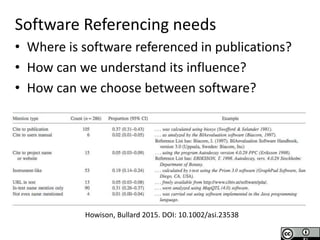
Software Referencing needs
• Where is software referenced in publications?
• How can we understand its influence?
• How can we choose between software?
Howison, Bullard 2015. DOI: 10.1002/asi.23538

20171003 lancaster data conversations Chue-Hong

  • 1.
    Software Sustainability Institute www.software.ac.uk Software– a different kind of research object? http://dx.doi.org/10.6084/m9.figshare.5459542 3rd October 2017, Lancaster Data Conversations, Lancaster Neil Chue Hong (@npch), Software Sustainability Institute ORCID: 0000-0002-8876-7606 | N.ChueHong@software.ac.uk Slides licensed under CC-BY where indicated: Supported by Project funding from
  • 2.
  • 3.
    The research community relieson software Do you use research software? What would happen to your research without software Survey of researchers from 15 Russell Group universities conducted by SSI between August - October 2014. 406 respondents covering representative range of funders, discipline and seniority. 56% Develop their own software 71% Have no formal software training
  • 4.
    Software Sustainability Institute www.software.ac.uk Softwarein Nature Nangia and Katz: https://arxiv.org/pdf/1706.06527.pdf
  • 5.
    Software Sustainability Institute www.software.ac.uk Raisestandards for preclinical cancer research 47 out of 53 “landmark” publications could not be replicated Begley,Ellis.Nature,483,2012 doi:10.1038/483531a
  • 6.
    Software Sustainability Institute www.software.ac.uk Repeatabilityof published microarray gene expression analyses 56% of analyses could not be repeated, of which 30% were because of software issues. 50% did not state software version, 39% did not provide raw data. Only 11% could be reproduced satisfactorily. Ioannidis et al. Nature Genetics, 41, 2010 doi:10.1038/ng.295
  • 7.
    Software Sustainability Institute www.software.ac.uk Repeatabilityin Computer Science Of 401 papers in ACM Computer Science journals and proceedings, only 85 provided a link to software. For 176 the software could not be obtained. Collberg, Proebsting, Warren, University of Arizona TR 14-04, 2015 http://reproducibility.cs.arizona.edu/v2/RepeatabilityTR.pdf
  • 8.
    Software Sustainability Institute www.software.ac.uk Errorsdue to bioinformatics pipeline The results presented in the Report “Ancient Ethiopian genome reveals extensive Eurasian admixture throughout the African continent“ were affected by a bioinformatics error – identified because of open science Llorente et al. Science, 350, 6262 doi:10.1126/science.aad2879
  • 9.
  • 10.
  • 11.
    Software Sustainability Institute www.software.ac.uk AuthorshipLifecycle IdentifyCite Reuse Research Index Papers, data, software all research outputs of a continuous cycle. With software, technology makes it easier to track, but not reward. We cannot separate papers, data and software when we release research. http://openresearchsoftware.metajnl.com
  • 12.
    Software Sustainability Institute www.software.ac.uk Thecurrent process Start research Write software Use software Produce results Publish research paper Release data Release software Which mentions software and data This process is simple but does not reward production or reuse of good software and data. It also has a long contribution cycle.
  • 13.
    Software Sustainability Institute www.software.ac.uk Write software Abetter process? Start research Identify existing software Use software Produce results Publish research paper Adapt/ extend software Release data Release software Publish software paper Publish data paper Whichreferences softwareanddatapapers Software and data papers are needed as proxies for rewarding reuse. But it enables a shorter contribution cycle for data and software.
  • 14.
    Software Sustainability Institute www.software.ac.uk Whatdo we choose to identify: - Workflow? - Software that runs workflow? - Software referenced by workflow? - Software dependencies? What’s the minimum citable part? Boundary http://dx.doi.org/10.6084/m9.figshare.1497930
  • 15.
  • 16.
    Software Sustainability Institute www.software.ac.uk Versioning Personal v1 Personal v2 Personal v3 Personal v2a Public v1 Personal v3a Personal v2a Public v2 Public v3 Whydo we version? - To indicate a change - To allow sharing - To confer special status http://dx.doi.org/10.6084/m9.figshare.1497930
  • 17.
    Software Sustainability Institute www.software.ac.uk AuthorshipAuthorship •Which authors have had what impact on each version of the software? • Who had the largest contribution to the scientific results in a paper? http://beyond-impact.org/?p=175 OGSA-DAI projects statistics from Ohloh http://dx.doi.org/10.6084/m9.figshare.1497930
  • 18.
    Software Sustainability Institute www.software.ac.ukIfsoftware is so important, why is most of it hard to reuse?
  • 19.
    Software Sustainability Institute www.software.ac.uk TheSoftware Sustainability Institute A national facility for cultivating better, more sustainable, research software to enable world- class research • Software reaches boundaries in its development cycle that prevent improvement, growth and adoption • Providing the expertise and services needed to negotiate to the next stage • Developing the policy and tools to support the community developing and using research software Supported by EPSRC Grant EP/H043160/1 + EPSRC/ESRC/BBSRC grant EP/N006410/1
  • 20.
    Software Sustainability Institute www.software.ac.uk ,it’ Victoria Stodden, AMP 2011 http://www.stodden.net/AMP2011/, Special Issue Reproducible Research Computing in Science and Engineering July/August 2012, 14(4) Howison and Herbsleb (2013) "Incentives and Integration In Scientific Software Production" CSCW 2013.
  • 21.
    Software Sustainability Institute www.software.ac.uk T ResearchCulture Needs Changing “This particular project was something I wrote a couple years ago to help me out with a workflow… I’d put it up on Github, so that others could potentially use it or use the code. So I went to see what people were saying about this project. It seemed liked I’d done something fundamentally wrong, so stupid that it flabbergasts someone... So of course I start sobbing. Then I see these people’s follower count, and I sob harder. I can’t help but think of potential future employers that are no longer potential.” http://www.software.ac.uk/blog/2013-01-25-haters-gonna- hate-why-you-shouldnt-be-ashamed-releasing-your-code
  • 22.
    Software Sustainability Institute www.software.ac.uk T ResearchCulture Needs Changing Our research culture presents barriers but few incentives to sharing code • There is a fear of being “found out” for poor code, but no encouragement or resources to improve software engineering skills • There is no reward for publishing code in the current system of metrics. Researchers fear being “scooped” or losing ability to publish. • Many organisations do not understand how to exploit open source licenses
  • 23.
    Software Sustainability Institute www.software.ac.ukNeverbe ashamed of making your software available
  • 24.
  • 25.
    Software Sustainability Institute www.software.ac.uk ResearchSoftware Workflow develop  share  preserve Developed and versioned using code repository Published via code repository or website Deposited in digital repository with paper / for preservation
  • 26.
    Software Sustainability Institute www.software.ac.uk GoodEnough Practices To Please Your Future Self • Data:  Save and backup raw data  Create analysis-friendly data  Record your processing steps  Anticipate the need to use multiple tables, and use a unique identifier for each record  Submit data to a repository and get a DOI
  • 27.
    Software Sustainability Institute www.software.ac.uk GoodEnough Practices To Please Your Future Self • Software:  Document for your future self: • Brief descriptive comment at the start of your code • Provide a simple example or test data set • Give functions and variables meaningful names • Make dependencies and requirements explicit  Learn to be modular • Break programs into functions • Don’t duplicate functionality • Search for well-maintained libraries that do what you need  Make it accessible in the future • Make the license explicit • Keep track of changes • Submit code to a reputable DOI-issuing repository Good Enough Practices in Scientific Computing: https://doi.org/10.1371/journal.pcbi.1005510
  • 28.
    Software Sustainability Institute www.software.ac.uk Whatyou can do now • Make sure you’re using version control • Write a README file that describes how you can get your code up and running, and give it to a colleague to try out  What it does, requirements / dependencies, simple example of use and input + output data • Ask a collaborator to contribute a new piece of functionality, and get feedback on the process • Talk to your library / IT services about the services they offer
  • 29.
    Software Sustainability Institute www.software.ac.uk Getsome training Teach basic lab skills for scientific computing so that researchers can do more in less time and with less pain. Teach basic concepts, skills and tools for working more effectively with data. Workshops are designed for people with little to no prior computational experience. admin@datacarpentry.org admin@software-carpentry.org Open source learning, that can be tailored to disciplines. “Train the trainers”: building a capable base of instructors.
  • 30.
    Software Sustainability Institute www.software.ac.uk Threemonths from now, you will thank yourself!
  • 31.
    Software Sustainability Institute www.software.ac.uk Interestedin more? • Publish a software paper  http://bit.ly/softwarejournals • Easily archive your GitHub Code and make ir citable  GitHub to Zenodo  GitHub to FigShare • Software Citation Implementation WG  https://www.force11.org/group/software-citation- implementation-working-group
  • 32.
    Software Sustainability Institute www.software.ac.uk LiterateProgramming • Traditional papers are just advertisements  A literate computing document is the research • The technology is out there  Jupyter notebooks  Mathematica  R Markdown  knitR  MATLAB Live scripts
  • 33.
    Software Sustainability Institute www.software.ac.uk •LIGO Paper:  http://journals.aps.org/prl/abstract/10.1103/Phys RevLett.116.061102 • LIGO Notebook:  https://losc.ligo.org/s/events/GW150914/GW1509 14_tutorial.ipynb LIGO Example
  • 34.
    Software Sustainability Institute www.software.ac.uk SSIFellows 2018 / CW18 • SSI Fellowships  Deadline: 9th October 2017  £3000 bursary to be a research software advocate  Join a network of great people working to improve • Collaborations Workshop 2018  Cardiff, 26-28th March 2018  Theme: “Culture Change and Productivity”  The un-conference that most participants would recommend to their colleagues
  • 35.
    Software Sustainability Institute www.software.ac.uk T Withoutdata it’s difficult to validate results. But without code, we waste the opportunity to advance science. These slides: http://dx.doi.org/10.6084/m9.figshare.5459542 “The only way to publish software in a scientifically robust manner is to share source code, and that means publishing via the internet in an open-access/open- source fashion. —Warren Lyford DeLano, Creator of PyMOL, 2005
  • 36.
    Software Sustainability Institute www.software.ac.uk TheSoftware Sustainability Institute A national facility for cultivating better, more sustainable, research software to enable world- class research • Software reaches boundaries in its development cycle that prevent improvement, growth and adoption • Providing the expertise and services needed to negotiate to the next stage • Developing the policy and tools to support the community developing and using research software Supported by EPSRC Grant EP/H043160/1 + EPSRC/ESRC/BBSRC grant EP/N006410/1
  • 37.
    Software Policy Training Community Outreach Delivering essential software skillsto researchers via CDTs, institutions & doctoral schools Helping the community to develop software that meets the needs of reliable, reproducible, and reusable research Collecting evidence on the community’s software use & sharing with stakeholders Bringing together the right people to understand and address topical issues Exploiting our platform to enable engagement, delivery & uptake
  • 38.
    Website & blog Campaigns Advice Guides Courses Workshops Fellowship Research Software Policy Training Community Consultancy 50+projects 130+ evaluations 4 surgeries 35+ UK SWC workshops 1000+ learners 80+ guides 50,000 readers 61 domain ambassadors 20+ workshops organised 740 researchers 50,000 grants analysed 150+ contributed articles 20,000 unique visitors per month 3,000 Twitter followers 300+ RSEs engaged 2100 signatures 13 issues highlighted Outreach
  • 39.
    Software Sustainability Institute www.software.ac.uk Findout more about the SSI • Community Engagement (Lead: Shoaib Sufi)  Fellowship Programme  Events and Workshops • Consultancy (Lead: Steve Crouch)  Open Call for Projects / Collaborations  Software Evaluation • Policy and Publicity (Lead: Simon Hettrick)  Case Studies / Policy Campaigns  Software and Research Blog • Training (Lead: Aleksandra Nenadic)  Software Carpentry and Data Carpentry (300+ students/year)  Guides and Top Tips • Journal of Open Research Software (Editor: Neil Chue Hong) • Collaboration between universities of Edinburgh, Manchester, Oxford and Southampton Supported by EPSRC Grant EP/H043160/1 + EPSRC/ESRC/BBSRC grant EP/N006410/1
  • 40.
  • 41.
    Software Sustainability Institute www.software.ac.uk T ResearchCulture Needs Changing But there’s still a lot to be done • Software Assessment • Software Management Plans • Group Identifiers  Software project teams – encompassing contributors  Software products – across versions • Machine readable references  Software papers solve the credit problem  The reference problem is still hard • Where is software mentioned and can we find it
  • 42.
    Software Sustainability Institute www.software.ac.uk T ResearchCulture Needs Changing Mechanisms are becoming available • Roles  Project Credit http://credit.casrai.org/  Transitive Credit http://doi.org/10.5334/jors.be • Mechanisms  Software papers http://bit.ly/softwarejournals  Software citation https://doi.org/10.7717/peerj-cs.86 • Tools  Researcher Identifiers e.g. ORCID http://orcid.org/  Alt-Metrics e.g. ImpactStory http://impactstory.org/ • Metadata  CodeMeta http://codemeta.github.io/
  • 43.
    Software Sustainability Institute www.software.ac.uk T ResearchCulture Needs Changing Software Referencing needs • Where is software referenced in publications? • How can we understand its influence? • How can we choose between software? Howison, Bullard 2015. DOI: 10.1002/asi.23538

Editor's Notes

  • #4 In related study 100% of respondents to survey from Europe said they used research software, 2.5 % No effect, 7.5% Possible but difficult, 90% impossible – this survey has more inherent bias because of the way it was conducted. Euro survey responses – Develop own software (90%), no formal training (57.5%) No training = 15% Formal + Self-Taught/Formal = 42.5% Self-taught only = 42.5%
  • #5 Study by Nangia and Katz https://arxiv.org/pdf/1706.06527.pdf January – March 2016, 173 pieces of software mentioned 32 of 40 papers mention software 6 packages mentioned in 4 or more papers: Pymol, R, Chimera, Coot, Matlab, PHENIX 26 packages mentioned in 2 or more papers Note that R packages feature heavily, along with visualisation tools
  • #6 5
  • #7 6
  • #8 7
  • #9 8
  • #10 9
  • #14 This process utilises the existing mechanisms for credit based on citation.
  • #15 Is it more important to sustain the software that this workflow references, or the workflow itself?
  • #16 At what level do you reference, at what level do you deposit?
  • #17 Made more difficult than data because of the fluidly changing collaborative nature of software development – not just adding to the contributor pool
  • #18 Made more difficult than data because of the fluidly changing collaborative nature of software development – not just adding to the contributor pool
  • #20 The Software Sustainability Institute can help with: software reviews and refactoring, collaborations to develop your project, guidance and best practice on software development, project management, community building, publicity and more… Drawing on pool of specialists to drive the continued improvement and impact of research software developed by and for researchers Providing services for research software users and developers Developing research community interactions and capacity Promoting research software best practice and capability
  • #21 20
  • #22 Victoria Stodden has done a lot of work looking at the barriers to sharing
  • #26 25
  • #35 LIGO Paper: http://journals.aps.org/prl/abstract/10.1103/PhysRevLett.116.061102 LIGO Notebook: https://losc.ligo.org/s/events/GW150914/GW150914_tutorial.ipynb
  • #37 36
  • #38 The Software Sustainability Institute can help with: software reviews and refactoring, collaborations to develop your project, guidance and best practice on software development, project management, community building, publicity and more… Drawing on pool of specialists to drive the continued improvement and impact of research software developed by and for researchers Providing services for research software users and developers Developing research community interactions and capacity Promoting research software best practice and capability