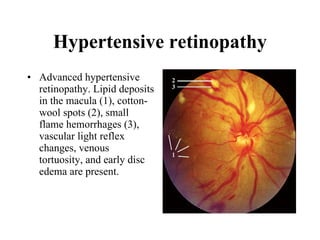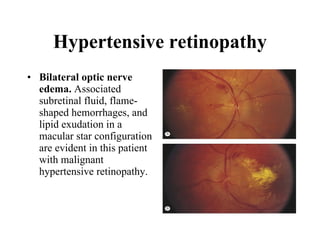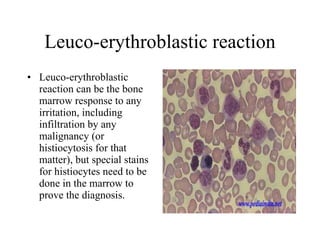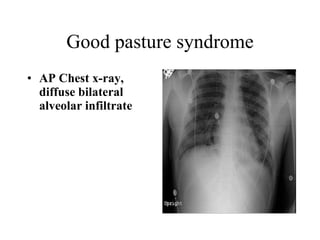




Good pasture syndrome AP Chest x-ray, diffuse bilateral alveolar infiltrate
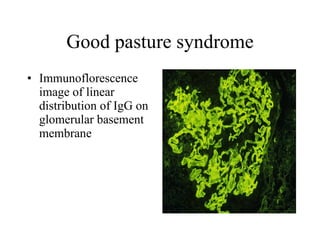
Good pasture syndrome Immunoflorescence image of linear distribution of IgG on glomerular basement membrane
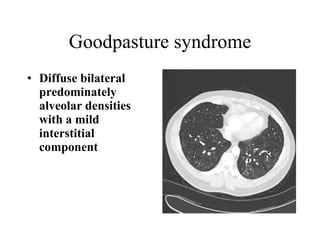
Goodpasture syndrome Diffuse bilateral predominately alveolar densities with a mild interstitial component
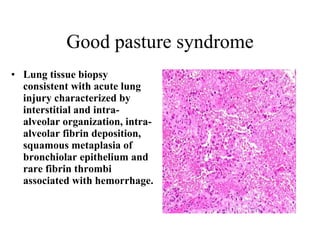
Good pasture syndrome Lung tissue biopsy consistent with acute lung injury characterized by interstitial and intra-alveolar organization, intra-alveolar fibrin deposition, squamous metaplasia of bronchiolar epithelium and rare fibrin thrombi associated with hemorrhage.
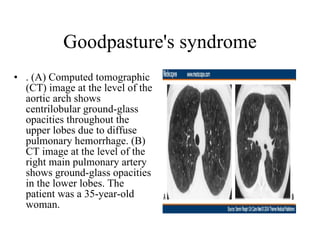
Goodpasture's syndrome . (A) Computed tomographic (CT) image at the level of the aortic arch shows centrilobular ground-glass opacities throughout the upper lobes due to diffuse pulmonary hemorrhage. (B) CT image at the level of the right main pulmonary artery shows ground-glass opacities in the lower lobes. The patient was a 35-year-old woman.
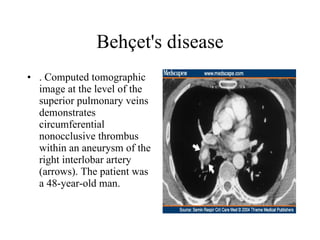
Behçet's disease . Computed tomographic image at the level of the superior pulmonary veins demonstrates circumferential nonocclusive thrombus within an aneurysm of the right interlobar artery (arrows). The patient was a 48-year-old man.
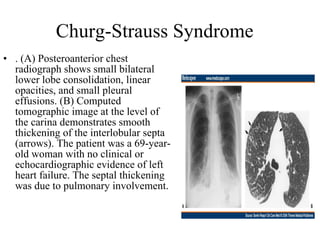
Churg-Strauss Syndrome . (A) Posteroanterior chest radiograph shows small bilateral lower lobe consolidation, linear opacities, and small pleural effusions. (B) Computed tomographic image at the level of the carina demonstrates smooth thickening of the interlobular septa (arrows). The patient was a 69-year-old woman with no clinical or echocardiographic evidence of left heart failure. The septal thickening was due to pulmonary involvement.
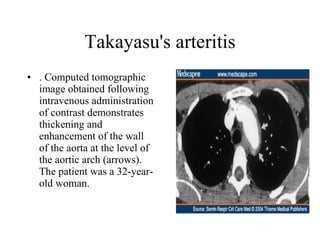
Takayasu's arteritis . Computed tomographic image obtained following intravenous administration of contrast demonstrates thickening and enhancement of the wall of the aorta at the level of the aortic arch (arrows). The patient was a 32-year-old woman.
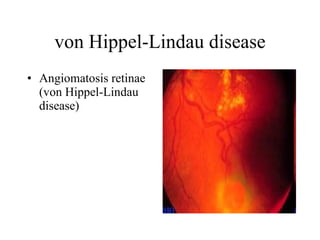
von Hippel-Lindau disease Angiomatosis retinae (von Hippel-Lindau disease)
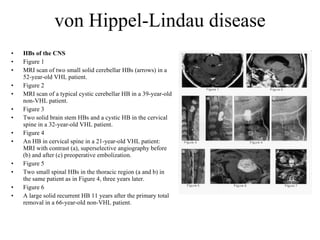
von Hippel-Lindau disease HBs of the CNS Figure 1 MRI scan of two small solid cerebellar HBs (arrows) in a 52-year-old VHL patient. Figure 2  MRI scan of a typical cystic cerebellar HB in a 39-year-old non-VHL patient. Figure 3 Two solid brain stem HBs and a cystic HB in the cervical spine in a 32-year-old VHL patient. Figure 4  An HB in cervical spine in a 21-year-old VHL patient: MRI with contrast (a), superselective angiography before (b) and after (c) preoperative embolization. Figure 5 Two small spinal HBs in the thoracic region (a and b) in the same patient as in Figure 4, three years later. Figure 6 A large solid recurrent HB 11 years after the primary total removal in a 66-year-old non-VHL patient.
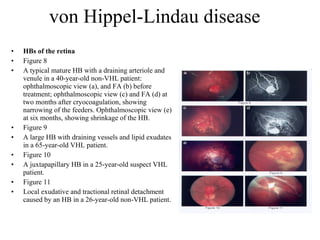
von Hippel-Lindau disease HBs of the retina Figure 8 A typical mature HB with a draining arteriole and venule in a 40-year-old non-VHL patient: ophthalmoscopic view (a), and FA (b) before treatment; ophthalmoscopic view (c) and FA (d) at two months after cryocoagulation, showing narrowing of the feeders. Ophthalmoscopic view (e) at six months, showing shrinkage of the HB. Figure 9 A large HB with draining vessels and lipid exudates in a 65-year-old VHL patient. Figure 10 A juxtapapillary HB in a 25-year-old suspect VHL patient. Figure 11 Local exudative and tractional retinal detachment caused by an HB in a 26-year-old non-VHL patient.
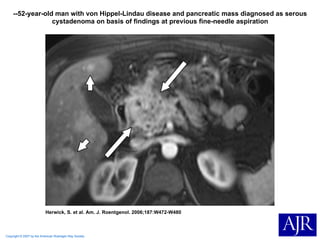
Copyright © 2007 by the American Roentgen Ray Society Herwick, S. et al. Am. J. Roentgenol. 2006;187:W472-W480 --52-year-old man with von Hippel-Lindau disease and pancreatic mass diagnosed as serous cystadenoma on basis of findings at previous fine-needle aspiration
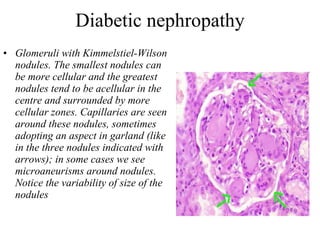
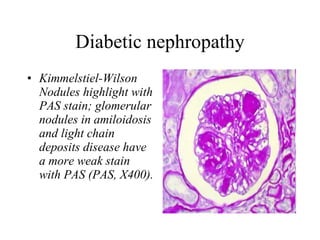
Diabetic nephropathy Glomeruli with Kimmelstiel-Wilson nodules. The smallest nodules can be more cellular and the greatest nodules tend to be acellular in the centre and surrounded by more cellular zones. Capillaries are seen around these nodules, sometimes adopting an aspect in garland (like in the three nodules indicated with arrows); in some cases we see microaneurisms around nodules. Notice the variability of size of the nodules
Diabetic nephropathy Kimmelstiel-Wilson Nodules highlight with PAS stain; glomerular nodules in amiloidosis and light chain deposits disease have a more weak stain with PAS (PAS, X400).
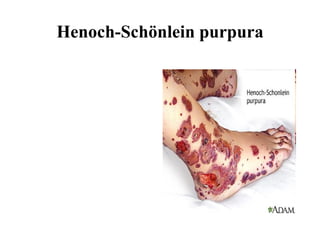
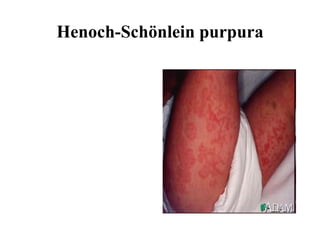
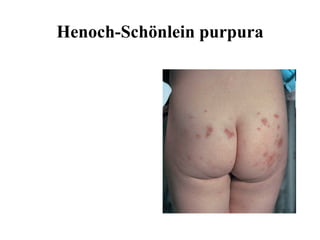
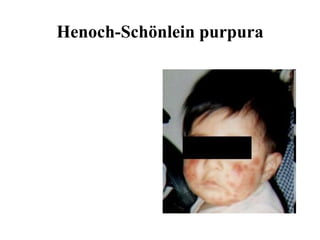
Henoch-Schönlein purpura
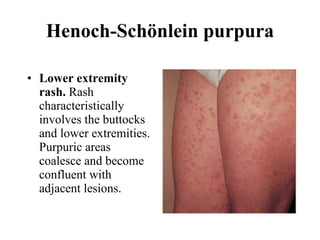
Henoch-Schönlein purpura Lower extremity rash.  Rash characteristically involves the buttocks and lower extremities. Purpuric areas coalesce and become confluent with adjacent lesions.
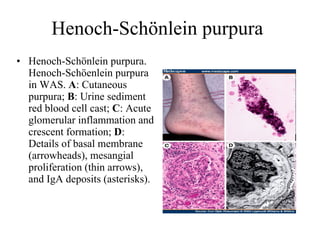
Henoch-Schönlein purpura Henoch-Schönlein purpura. Henoch-Schöenlein purpura in WAS.  A : Cutaneous purpura;  B : Urine sediment red blood cell cast;  C : Acute glomerular inflammation and crescent formation;  D : Details of basal membrane (arrowheads), mesangial proliferation (thin arrows), and IgA deposits (asterisks).
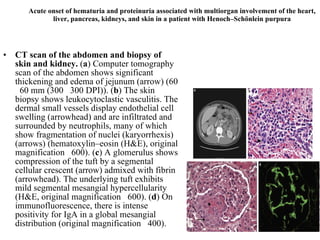
Acute onset of hematuria and proteinuria associated with multiorgan involvement of the heart, liver, pancreas, kidneys, and skin in a patient with Henoch–Schönlein purpura CT scan of the abdomen and biopsy of skin and kidney.  ( a ) Computer tomography scan of the abdomen shows significant thickening and edema of jejunum (arrow) (60  60 mm (300  300 DPI)). ( b ) The skin biopsy shows leukocytoclastic vasculitis. The dermal small vessels display endothelial cell swelling (arrowhead) and are infiltrated and surrounded by neutrophils, many of which show fragmentation of nuclei (karyorrhexis) (arrows) (hematoxylin–eosin (H&E), original magnification  600). ( c ) A glomerulus shows compression of the tuft by a segmental cellular crescent (arrow) admixed with fibrin (arrowhead). The underlying tuft exhibits mild segmental mesangial hypercellularity (H&E, original magnification  600). ( d ) On immunofluorescence, there is intense positivity for IgA in a global mesangial distribution (original magnification  400).
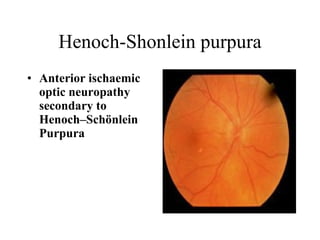
Henoch-Shonlein purpura Anterior ischaemic optic neuropathy secondary to Henoch–Schönlein Purpura
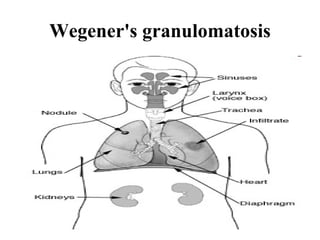
Wegener's granulomatosis
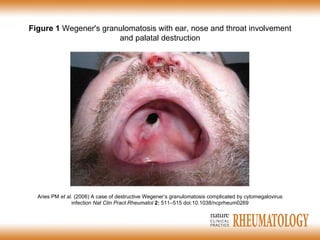
Aries PM  et al.  (2006) A case of destructive Wegener’s granulomatosis complicated by cytomegalovirus infection  Nat Clin Pract  Rheumatol   2:   511 – 515  doi:10.1038/ ncprheum0269 Figure 1  Wegener's granulomatosis with ear, nose and throat involvement and palatal destruction
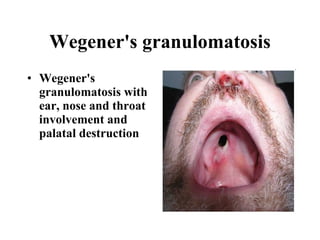
Wegener's granulomatosis Wegener's granulomatosis with ear, nose and throat involvement and palatal destruction
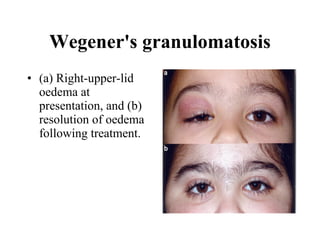
Wegener's granulomatosis (a) Right-upper-lid oedema at presentation, and (b) resolution of oedema following treatment.
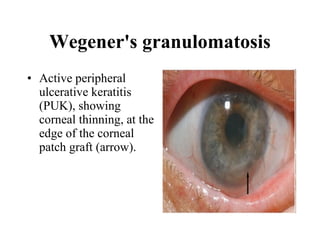
Wegener's granulomatosis Active peripheral ulcerative keratitis (PUK), showing corneal thinning, at the edge of the corneal patch graft (arrow).
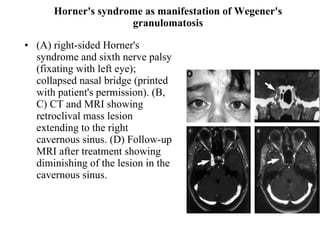
Horner's syndrome as manifestation of Wegener's granulomatosis (A) right-sided Horner's syndrome and sixth nerve palsy (fixating with left eye); collapsed nasal bridge (printed with patient's permission). (B, C) CT and MRI showing retroclival mass lesion extending to the right cavernous sinus. (D) Follow-up MRI after treatment showing diminishing of the lesion in the cavernous sinus.
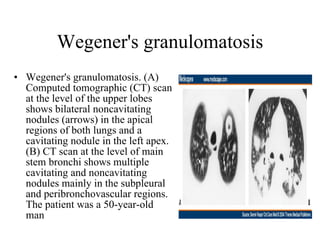
Wegener's granulomatosis Wegener's granulomatosis. (A) Computed tomographic (CT) scan at the level of the upper lobes shows bilateral noncavitating nodules (arrows) in the apical regions of both lungs and a cavitating nodule in the left apex. (B) CT scan at the level of main stem bronchi shows multiple cavitating and noncavitating nodules mainly in the subpleural and peribronchovascular regions. The patient was a 50-year-old man
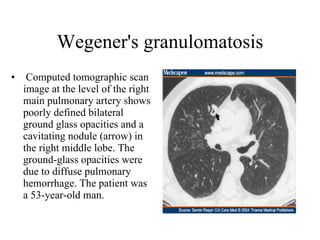
Wegener's granulomatosis Computed tomographic scan image at the level of the right main pulmonary artery shows poorly defined bilateral ground glass opacities and a cavitating nodule (arrow) in the right middle lobe. The ground-glass opacities were due to diffuse pulmonary hemorrhage. The patient was a 53-year-old man.
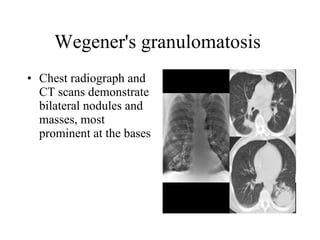
Wegener's granulomatosis  Chest radiograph and CT scans demonstrate bilateral nodules and masses, most prominent at the bases
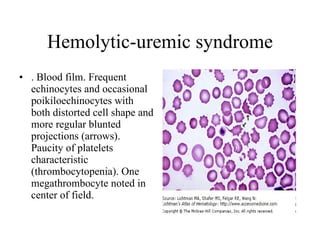
Hemolytic-uremic syndrome . Blood film. Frequent echinocytes and occasional poikiloechinocytes with both distorted cell shape and more regular blunted projections (arrows). Paucity of platelets characteristic (thrombocytopenia). One megathrombocyte noted in center of field.
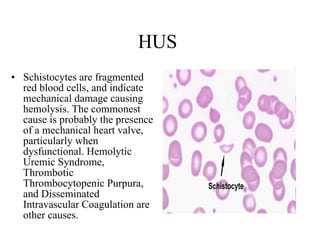
HUS  Schistocytes are fragmented red blood cells, and indicate mechanical damage causing hemolysis. The commonest cause is probably the presence of a mechanical heart valve, particularly when dysfunctional. Hemolytic Uremic Syndrome, Thrombotic Thrombocytopenic Purpura, and Disseminated Intravascular Coagulation are other causes.
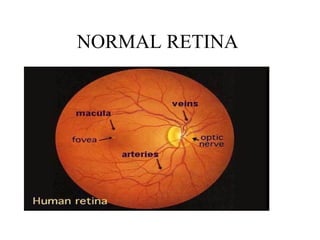
NORMAL RETINA
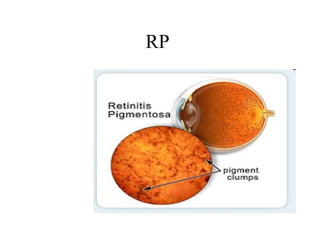
RP
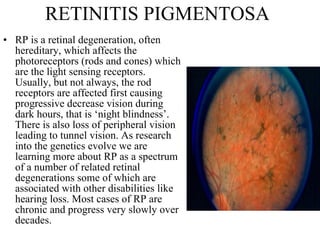
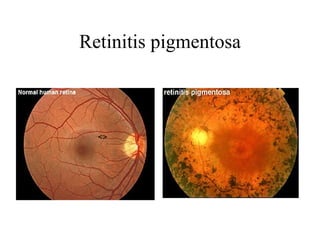
RETINITIS PIGMENTOSA RP is a retinal degeneration, often hereditary, which affects the photoreceptors (rods and cones) which are the light sensing receptors. Usually, but not always, the rod receptors are affected first causing progressive decrease vision during dark hours, that is ‘night blindness’. There is also loss of peripheral vision leading to tunnel vision. As research into the genetics evolve we are learning more about RP as a spectrum of a number of related retinal degenerations some of which are associated with other disabilities like hearing loss. Most cases of RP are chronic and progress very slowly over decades.
Retinitis pigmentosa                                         <>                                          <>
Retinitis pigmentosa http://www.blindness.org/content.asp?id=45
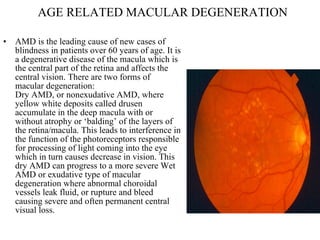
AGE RELATED MACULAR DEGENERATION AMD is the leading cause of new cases of blindness in patients over 60 years of age. It is a degenerative disease of the macula which is the central part of the retina and affects the central vision. There are two forms of macular degeneration: Dry AMD, or nonexudative AMD, where yellow white deposits called drusen accumulate in the deep macula with or without atrophy or ‘balding’ of the layers of the retina/macula. This leads to interference in the function of the photoreceptors responsible for processing of light coming into the eye which in turn causes decrease in vision. This dry AMD can progress to a more severe Wet AMD or exudative type of macular degeneration where abnormal choroidal vessels leak fluid, or rupture and bleed causing severe and often permanent central visual loss.
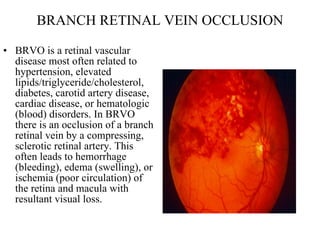
BRANCH RETINAL VEIN OCCLUSION BRVO is a retinal vascular disease most often related to hypertension, elevated lipids/triglyceride/cholesterol, diabetes, carotid artery disease, cardiac disease, or hematologic (blood) disorders. In BRVO there is an occlusion of a branch retinal vein by a compressing, sclerotic retinal artery. This often leads to hemorrhage (bleeding), edema (swelling), or ischemia (poor circulation) of the retina and macula with resultant visual loss.
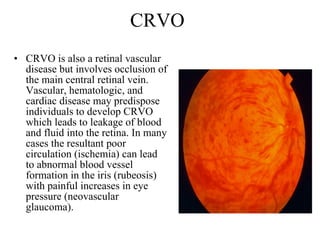
CRVO CRVO is also a retinal vascular disease but involves occlusion of the main central retinal vein. Vascular, hematologic, and cardiac disease may predispose individuals to develop CRVO which leads to leakage of blood and fluid into the retina. In many cases the resultant poor circulation (ischemia) can lead to abnormal blood vessel formation in the iris (rubeosis) with painful increases in eye pressure (neovascular glaucoma).
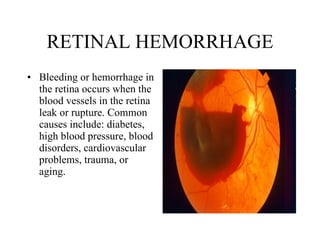
RETINAL HEMORRHAGE Bleeding or hemorrhage in the retina occurs when the blood vessels in the retina leak or rupture. Common causes include: diabetes, high blood pressure, blood disorders, cardiovascular problems, trauma, or aging.
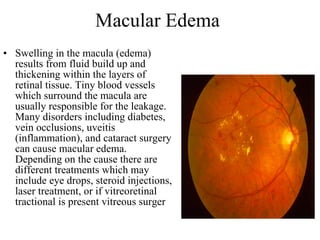
Macular Edema  Swelling in the macula (edema) results from fluid build up and thickening within the layers of retinal tissue. Tiny blood vessels which surround the macula are usually responsible for the leakage. Many disorders including diabetes, vein occlusions, uveitis (inflammation), and cataract surgery can cause macular edema. Depending on the cause there are different treatments which may include eye drops, steroid injections, laser treatment, or if vitreoretinal tractional is present vitreous surger
AR
AD
XLR
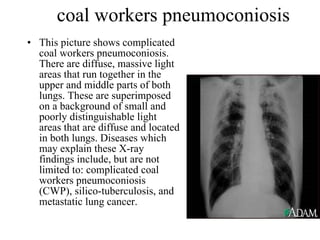
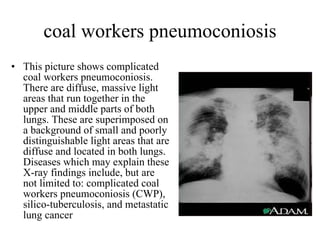
coal workers pneumoconiosis This picture shows complicated coal workers pneumoconiosis. There are diffuse, massive light areas that run together in the upper and middle parts of both lungs. These are superimposed on a background of small and poorly distinguishable light areas that are diffuse and located in both lungs. Diseases which may explain these X-ray findings include, but are not limited to: complicated coal workers pneumoconiosis (CWP), silico-tuberculosis, and metastatic lung cancer.
coal workers pneumoconiosis This picture shows complicated coal workers pneumoconiosis. There are diffuse, massive light areas that run together in the upper and middle parts of both lungs. These are superimposed on a background of small and poorly distinguishable light areas that are diffuse and located in both lungs. Diseases which may explain these X-ray findings include, but are not limited to: complicated coal workers pneumoconiosis (CWP), silico-tuberculosis, and metastatic lung cancer
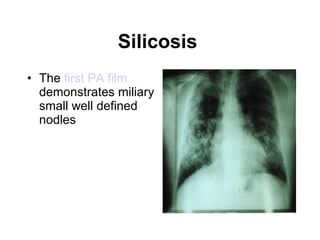
Silicosis   The  first PA film  demonstrates miliary small well defined nodles
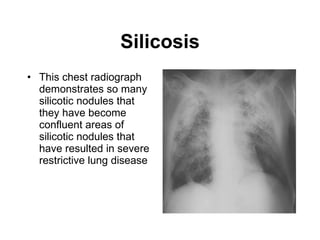
Silicosis This chest radiograph demonstrates so many silicotic nodules that they have become confluent areas of silicotic nodules that have resulted in severe restrictive lung disease
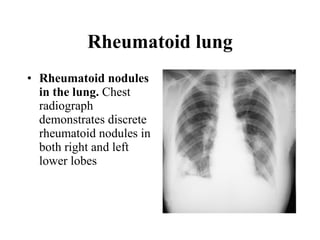
Rheumatoid lung Rheumatoid nodules in the lung.  Chest radiograph demonstrates discrete rheumatoid nodules in both right and left lower lobes
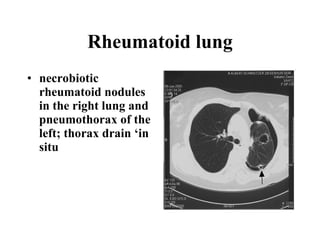
Rheumatoid lung necrobiotic rheumatoid nodules in the right lung and pneumothorax of the left; thorax drain ‘in situ
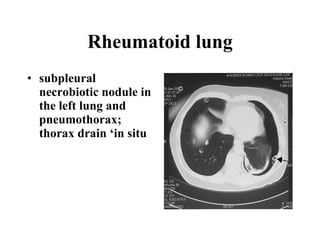
Rheumatoid lung subpleural necrobiotic nodule in the left lung and pneumothorax; thorax drain ‘in situ
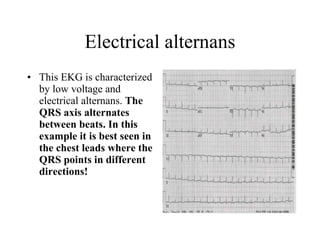
Electrical alternans This EKG is characterized by low voltage and electrical alternans.  The QRS axis alternates between beats. In this example it is best seen in the chest leads where the QRS points in different directions!
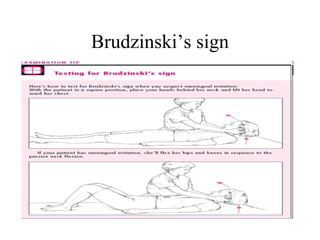
Brudzinski’s sign
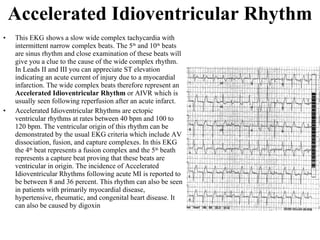
Accelerated Idioventricular Rhythm This EKG shows a slow wide complex tachycardia with intermittent narrow complex beats. The 5 th  and 10 th  beats are sinus rhythm and close examination of these beats will give you a clue to the cause of the wide complex rhythm. In Leads II and III you can appreciate ST elevation indicating an acute current of injury due to a myocardial infarction. The wide complex beats therefore represent an  Accelerated Idioventricular Rhythm  or AIVR which is usually seen following reperfusion after an acute infarct.  Accelerated Idioventricular Rhythms are ectopic ventricular rhythms at rates between 40 bpm and 100 to 120 bpm. The ventricular origin of this rhythm can be demonstrated by the usual EKG criteria which include AV dissociation, fusion, and capture complexes. In this EKG the 4 th  beat represents a fusion complex and the 5 th  beath represents a capture beat proving that these beats are ventricular in origin. The incidence of Accelerated Idioventricular Rhythms following acute MI is reported to be between 8 and 36 percent. This rhythm can also be seen in patients with primarily myocardial disease, hypertensive, rheumatic, and congenital heart disease. It can also be caused by digoxin
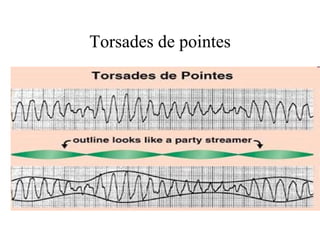
Torsades de pointes
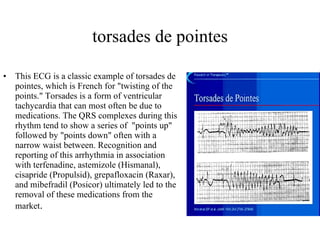
torsades de pointes This ECG is a classic example of torsades de pointes, which is French for &quot;twisting of the points.&quot; Torsades is a form of ventricular tachycardia that can most often be due to medications. The QRS complexes during this rhythm tend to show a series of  &quot;points up&quot; followed by &quot;points down&quot; often with a narrow waist between. Recognition and reporting of this arrhythmia in association with terfenadine, astemizole (Hismanal), cisapride (Propulsid), grepafloxacin (Raxar), and mibefradil (Posicor) ultimately led to the removal of these medications from the market .
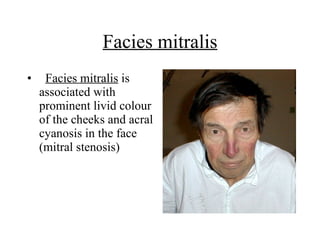
Facies mitralis    Facies mitralis  is associated with prominent livid colour of the cheeks and acral cyanosis in the face (mitral stenosis)
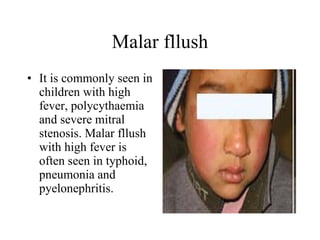
Malar fllush It is commonly seen in children with high fever, polycythaemia and severe mitral stenosis. Malar fllush with high fever is often seen in typhoid, pneumonia and pyelonephritis.
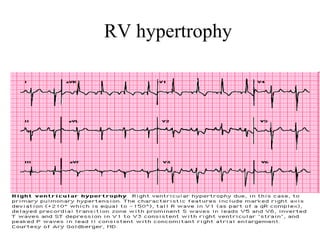
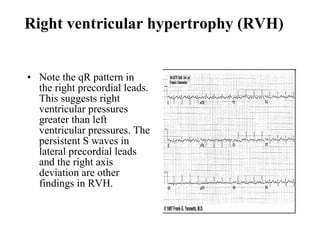
RV hypertrophy
Right ventricular hypertrophy (RVH)  Note the qR pattern in the right precordial leads. This suggests right ventricular pressures greater than left ventricular pressures. The persistent S waves in lateral precordial leads and the right axis deviation are other findings in RVH.
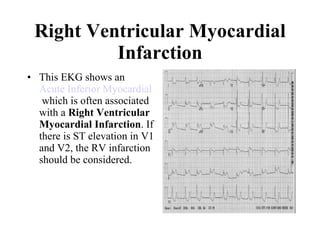
Right Ventricular Myocardial Infarction This EKG shows an  Acute Inferior Myocardial Infarction  which is often associated with a  Right Ventricular Myocardial Infarction . If there is ST elevation in V1 and V2, the RV infarction should be considered.
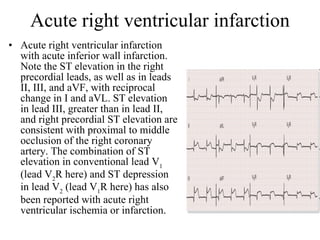
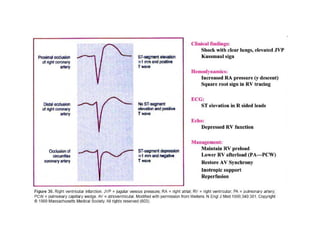
Acute right ventricular infarction Acute right ventricular infarction with acute inferior wall infarction. Note the ST elevation in the right precordial leads, as well as in leads II, III, and aVF, with reciprocal change in I and aVL. ST elevation in lead III, greater than in lead II, and right precordial ST elevation are consistent with proximal to middle occlusion of the right coronary artery. The combination of ST elevation in conventional lead V 1  (lead V 2 R here) and ST depression in lead V 2  (lead V 1 R here) has also been reported with acute right ventricular ischemia or infarction.
 
Acute posterior myocardial infarction
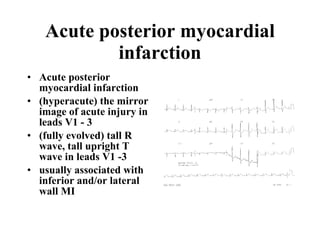
Acute posterior myocardial infarction Acute posterior myocardial infarction (hyperacute) the mirror image of acute injury in leads V1 - 3 (fully evolved) tall R wave, tall upright T wave in leads V1 -3 usually associated with inferior and/or lateral wall MI
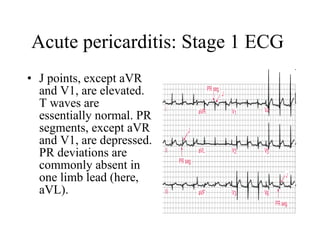
Acute pericarditis: Stage 1 ECG  J points, except aVR and V1, are elevated. T waves are essentially normal. PR segments, except aVR and V1, are depressed. PR deviations are commonly absent in one limb lead (here, aVL).
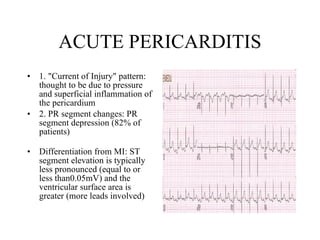
ACUTE PERICARDITIS 1. &quot;Current of Injury&quot; pattern: thought to be due to pressure and superficial inflammation of the pericardium  2. PR segment changes: PR segment depression (82% of patients)  Differentiation from MI: ST segment elevation is typically less pronounced (equal to or less than0.05mV) and the ventricular surface area is greater (more leads involved)
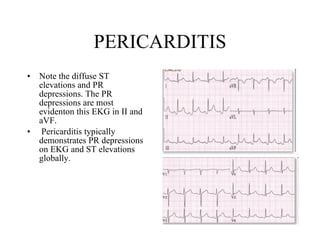
PERICARDITIS Note the diffuse ST elevations and PR depressions. The PR depressions are most evidenton this EKG in II and aVF.  
  Pericarditis typically demonstrates PR depressions on EKG and ST elevations globally.
echocardiography There are two major types of echocardiography: M-mode (below left) and two-dimensional (below right) (Fig. 2, [3])
echocardiography In the M-mode a single beam of ultrasound is used (Fig. 3, [3]) The reflections of the signal are recorded and displayed as monochronic dots. The location is proportional to the distance from the reflective region, and the intensity contains the information about acoustic impedance of the region. The M-mode has excellent axial resolution, but it carries essentially one-dimensional information. The two-dimensional echocardiograph typically uses a multielement transducer, which generates a single ultrasonic beam with changing direction. This technique allows one to create a two-dimensional image, which has good lateral resolution but lacks accuracy in the axial dimension.
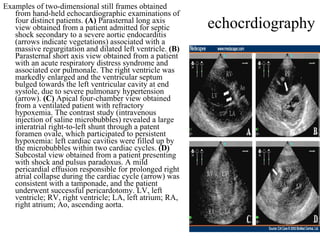
echocrdiography Examples of two-dimensional still frames obtained from hand-held echocardiographic examinations of four distinct patients.  (A)  Parasternal long axis view obtained from a patient admitted for septic shock secondary to a severe aortic endocarditis (arrows indicate vegetations) associated with a massive regurgitation and dilated left ventricle.  (B)  Parasternal short axis view obtained from a patient with an acute respiratory distress syndrome and associated cor pulmonale. The right ventricle was markedly enlarged and the ventricular septum bulged towards the left ventricular cavity at end systole, due to severe pulmonary hypertension (arrow).  (C)  Apical four-chamber view obtained from a ventilated patient with refractory hypoxemia. The contrast study (intravenous injection of saline microbubbles) revealed a large interatrial right-to-left shunt through a patent foramen ovale, which participated to persistent hypoxemia: left cardiac cavities were filled up by the microbubbles within two cardiac cycles.  (D)  Subcostal view obtained from a patient presenting with shock and pulsus paradoxus. A mild pericardial effusion responsible for prolonged right atrial collapse during the cardiac cycle (arrow) was consistent with a tamponade, and the patient underwent successful pericardotomy. LV, left ventricle; RV, right ventricle; LA, left atrium; RA, right atrium; Ao, ascending aorta.
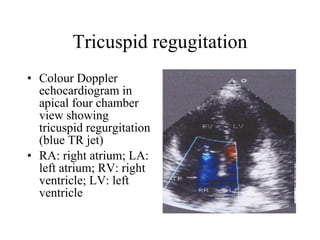
Tricuspid regugitation Colour Doppler echocardiogram in apical four chamber view showing tricuspid regurgitation (blue TR jet) RA: right atrium; LA: left atrium; RV: right ventricle; LV: left ventricle
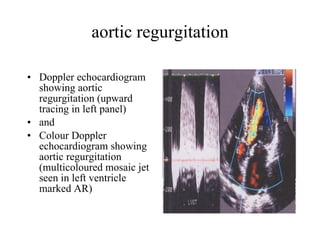
aortic regurgitation Doppler echocardiogram showing aortic regurgitation (upward tracing in left panel) and Colour Doppler echocardiogram showing aortic regurgitation (multicoloured mosaic jet seen in left ventricle marked AR)
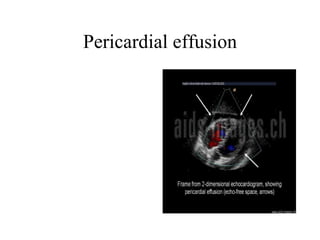
Pericardial effusion
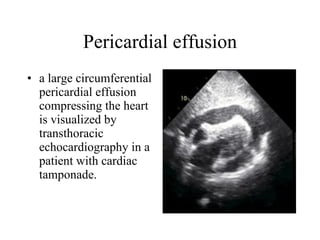
Pericardial effusion a large circumferential pericardial effusion compressing the heart is visualized by transthoracic echocardiography in a patient with cardiac tamponade.
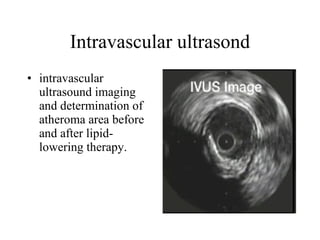
Intravascular ultrasond intravascular ultrasound imaging and determination of atheroma area before and after lipid-lowering therapy.
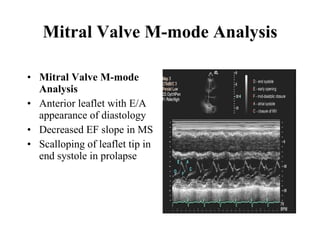
Mitral Valve M-mode Analysis Mitral Valve M-mode Analysis Anterior leaflet with E/A appearance of diastology  Decreased EF slope in MS  Scalloping of leaflet tip in end systole in prolapse
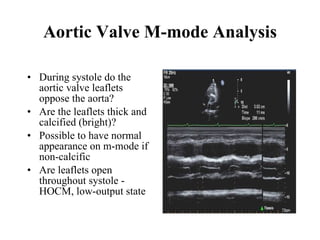
Aortic Valve M-mode Analysis During systole do the aortic valve leaflets oppose the aorta?  Are the leaflets thick and calcified (bright)?  Possible to have normal appearance on m-mode if non-calcific  Are leaflets open throughout systole - HOCM, low-output state
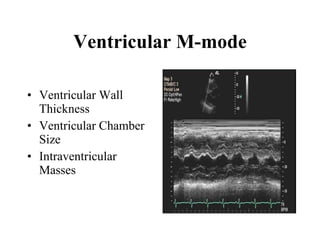
Ventricular M-mode Ventricular Wall Thickness  Ventricular Chamber Size  Intraventricular Masses
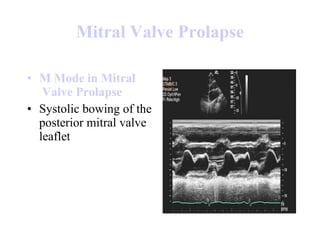
Mitral  Valve  Prolapse M Mode in  Mitral  Valve  Prolapse Systolic bowing of the posterior mitral valve leaflet
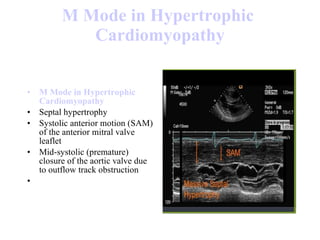
M Mode in  Hypertrophic   Cardiomyopathy M Mode in  Hypertrophic   Cardiomyopathy Septal hypertrophy  Systolic anterior motion (SAM) of the anterior mitral valve leaflet  Mid-systolic (premature) closure of the aortic valve due to outflow track obstruction
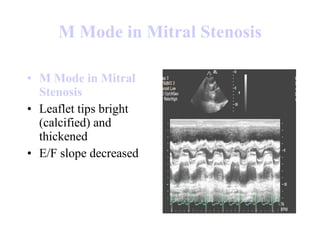
M Mode in  Mitral   Stenosis M Mode in  Mitral   Stenosis Leaflet tips bright (calcified) and thickened  E/F slope decreased
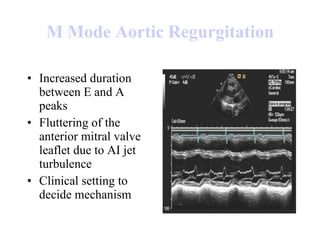
M Mode Aortic Regurgitation Increased duration between E and A peaks  Fluttering of the anterior mitral valve leaflet due to AI jet turbulence  Clinical setting to decide mechanism
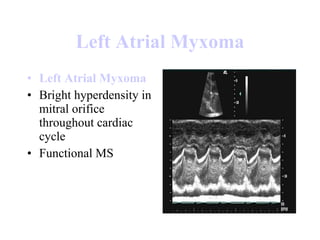
Left  Atrial   Myxoma Left  Atrial   Myxoma Bright hyperdensity in mitral orifice throughout cardiac cycle  Functional MS
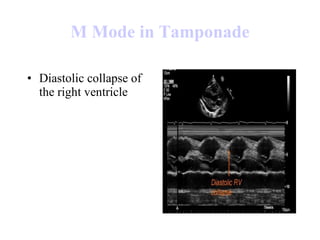
M Mode in  Tamponade Diastolic collapse of the right ventricle
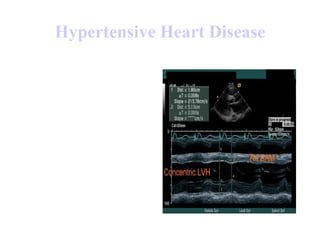
Hypertensive Heart Disease
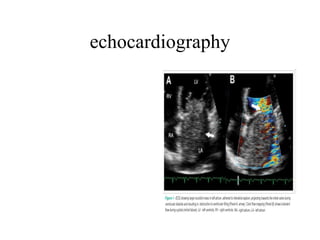
echocardiography
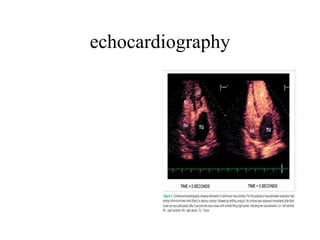
echocardiography
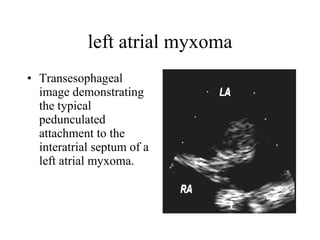
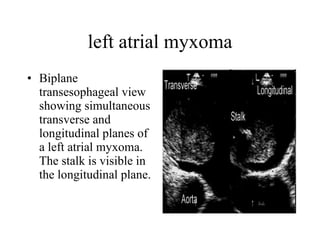
left atrial myxoma Transesophageal image demonstrating the typical pedunculated attachment to the interatrial septum of a left atrial myxoma.
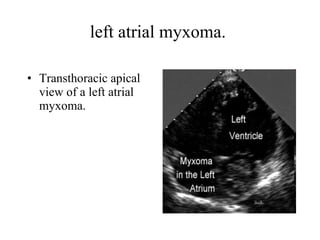
left atrial myxoma.  Transthoracic apical view of a left atrial myxoma.
left atrial myxoma Biplane transesophageal view showing simultaneous transverse and longitudinal planes of a left atrial myxoma. The stalk is visible in the longitudinal plane.
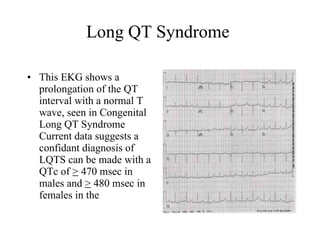
Long QT Syndrome  This EKG shows a prolongation of the QT interval with a normal T wave, seen in Congenital Long QT Syndrome Current data suggests a confidant diagnosis of LQTS can be made with a QTc of  >  470 msec in males and  >  480 msec in females in the
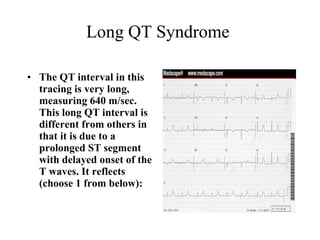
Long QT Syndrome  The QT interval in this tracing is very long, measuring 640 m/sec. This long QT interval is different from others in that it is due to a prolonged ST segment with delayed onset of the T waves. It reflects (choose 1 from below):
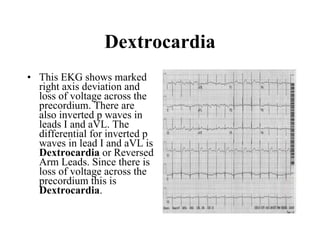
Dextrocardia This EKG shows marked right axis deviation and loss of voltage across the precordium. There are also inverted p waves in leads I and aVL. The differential for inverted p waves in lead I and aVL is  Dextrocardia  or Reversed Arm Leads. Since there is loss of voltage across the precordium this is  Dextrocardia .
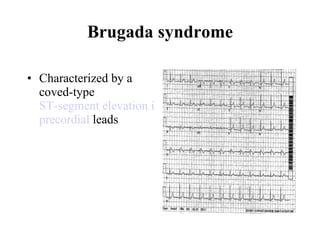
Brugada syndrome Characterized by a coved-type  ST-segment elevation in the right  precordial  leads
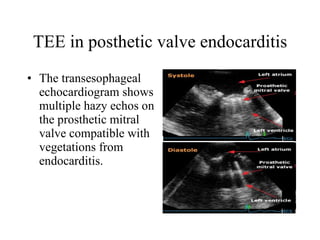
TEE in posthetic valve endocarditis The transesophageal echocardiogram shows multiple hazy echos on the prosthetic mitral valve compatible with vegetations from endocarditis.
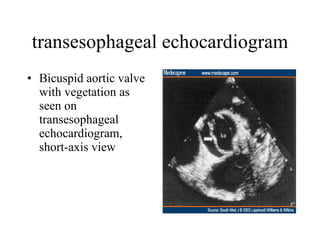
transesophageal echocardiogram Bicuspid aortic valve with vegetation as seen on transesophageal echocardiogram, short-axis view
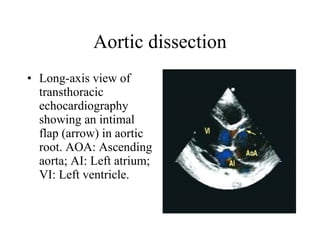
Aortic dissection Long-axis view of transthoracic echocardiography showing an intimal flap (arrow) in aortic root. AOA: Ascending aorta; AI: Left atrium; VI: Left ventricle.
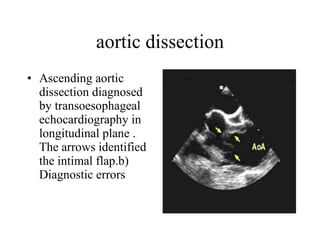
aortic dissection Ascending aortic dissection diagnosed by transoesophageal echocardiography in longitudinal plane . The arrows identified the intimal flap.b) Diagnostic errors
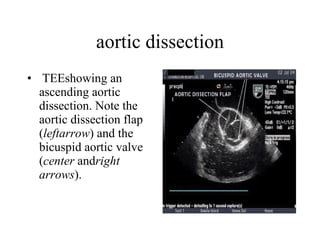
aortic dissection   TEEshowing an ascending aortic dissection. Note the aortic dissection flap ( leftarrow ) and the bicuspid aortic valve ( center  and right arrows ).
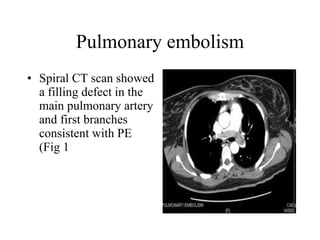
Pulmonary embolism Spiral CT scan showed a filling defect in the main pulmonary artery and first branches consistent with PE (Fig 1
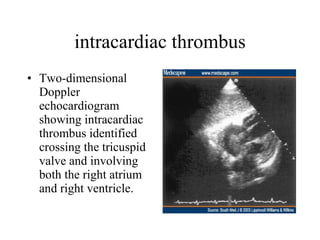
intracardiac thrombus Two-dimensional Doppler echocardiogram showing intracardiac thrombus identified crossing the tricuspid valve and involving both the right atrium and right ventricle.
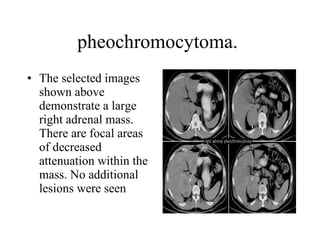
pheochromocytoma.  The selected images shown above demonstrate a large right adrenal mass. There are focal areas of decreased attenuation within the mass. No additional lesions were seen
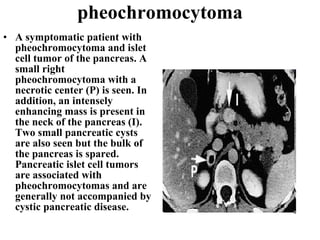
pheochromocytoma A symptomatic patient with pheochromocytoma and islet cell tumor of the pancreas. A small right pheochromocytoma with a necrotic center (P) is seen. In addition, an intensely enhancing mass is present in the neck of the pancreas (I). Two small pancreatic cysts are also seen but the bulk of the pancreas is spared. Pancreatic islet cell tumors are associated with pheochromocytomas and are generally not accompanied by cystic pancreatic disease.
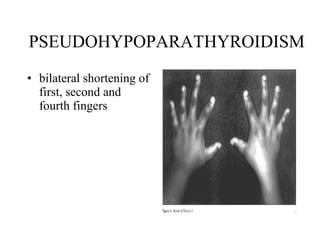
PSEUDOHYPOPARATHYROIDISM bilateral shortening of first, second and fourth fingers
Albright Hereditary Osteodystrophy (AHO). Features of Albright Hereditary Osteodystrophy (AHO). [A] Young woman with short stature (~ 3rd centile), disproportionate shortening of the limbs, generalized obesity, and round, flattened face. [B] Radiograph of the hand showing the shortened 4th and 5th metacarpals. [C] Fist with the characteristic 'dimples' over the 3rd, 4th, and 5th digits replacing the knuckles formed by the distal head of normally sized metacarpal bones (Archibald sign). [D] Brachydactyly of the hand, with the short 4th and 5th digits, the greatly foreshortened terminal 1st digit, and very short, wide thumbnail (potter's thumb).
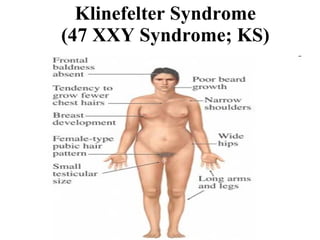
Klinefelter Syndrome (47 XXY Syndrome; KS)
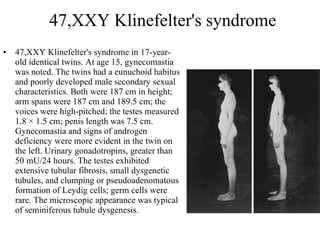
47,XXY Klinefelter's syndrome 47,XXY Klinefelter's syndrome in 17-year-old identical twins. At age 15, gynecomastia was noted. The twins had a eunuchoid habitus and poorly developed male secondary sexual characteristics. Both were 187 cm in height; arm spans were 187 cm and 189.5 cm; the voices were high-pitched; the testes measured 1.8 × 1.5 cm; penis length was 7.5 cm. Gynecomastia and signs of androgen deficiency were more evident in the twin on the left. Urinary gonadotropins, greater than 50 mU/24 hours. The testes exhibited extensive tubular fibrosis, small dysgenetic tubules, and clumping or pseudoadenomatous formation of Leydig cells; germ cells were rare. The microscopic appearance was typical of seminiferous tubule dysgenesis.
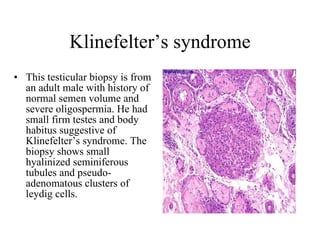
Klinefelter’s syndrome This testicular biopsy is from an adult male with history of normal semen volume and severe oligospermia. He had small firm testes and body habitus suggestive of Klinefelter’s syndrome. The biopsy shows small hyalinized seminiferous tubules and pseudo-adenomatous clusters of leydig cells.
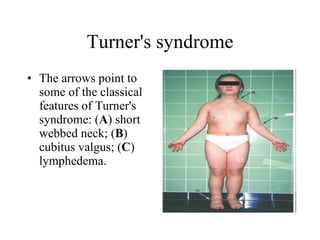
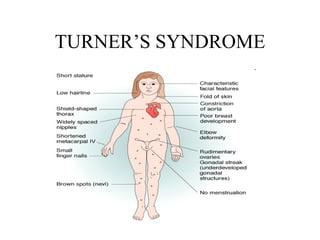
Turner's syndrome The arrows point to some of the classical features of Turner's syndrome: ( A ) short webbed neck; ( B ) cubitus valgus; ( C ) lymphedema.
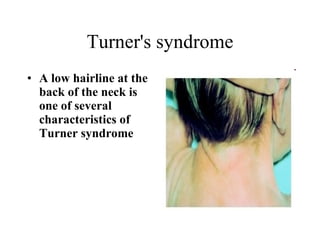
Turner's syndrome A low hairline at the back of the neck is one of several characteristics of Turner syndrome
TURNER’S SYNDROME
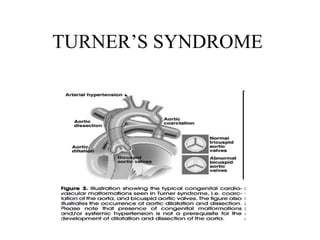
TURNER’S SYNDROME
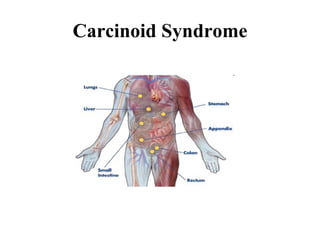
Carcinoid Syndrome
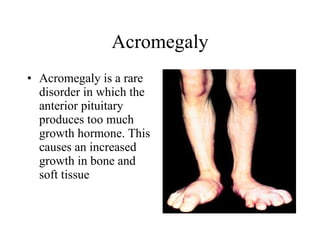
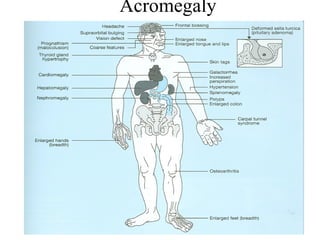
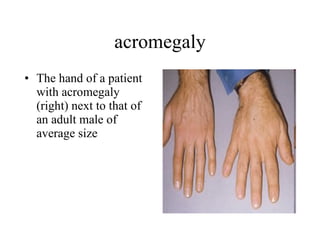
Acromegaly Acromegaly is a rare disorder in which the anterior pituitary produces too much growth hormone. This causes an increased growth in bone and soft tissue
Acromegaly Acromegaly results from excessive secretion of growth hormone and causes enlargement of many parts of the body, including the hands (left), fingers, toes, ears, nose, and jaw.
Acromegaly
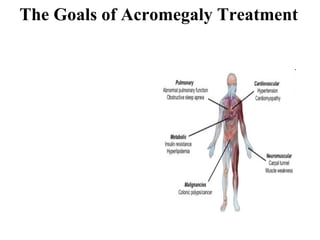
The Goals of Acromegaly Treatment
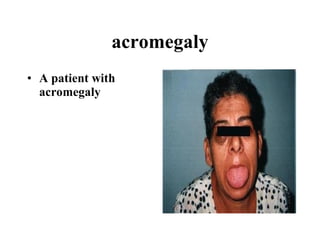
acromegaly A patient with acromegaly
Graves' Disease Dermatopathy(thickening of the skin) in Graves' Disease
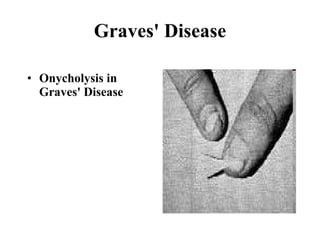
Graves' Disease Onycholysis in Graves' Disease
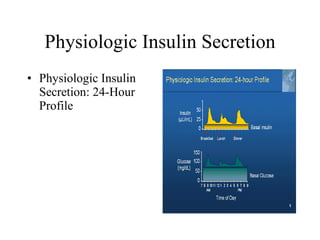
Physiologic Insulin Secretion Physiologic Insulin Secretion: 24-Hour Profile
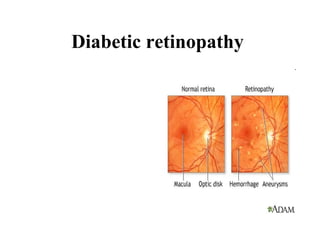
Diabetic retinopathy
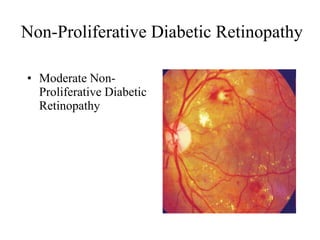
Non-Proliferative Diabetic Retinopathy  Moderate Non-Proliferative Diabetic Retinopathy
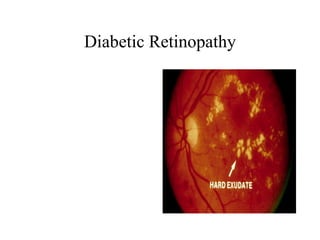
Diabetic Retinopathy
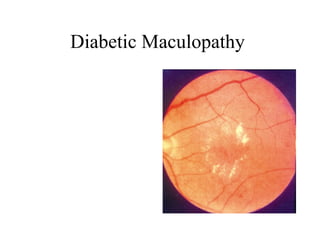
Diabetic Maculopathy
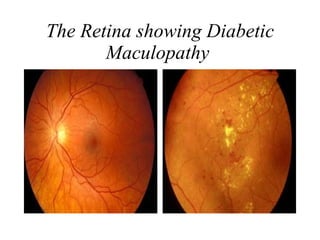
The Retina showing Diabetic Maculopathy
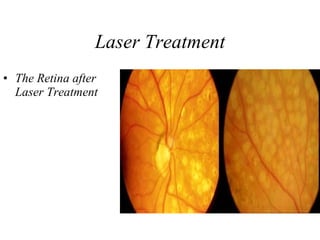
Laser Treatment The Retina after Laser Treatment
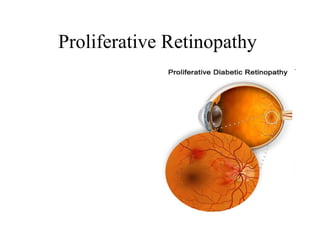
Proliferative Retinopathy
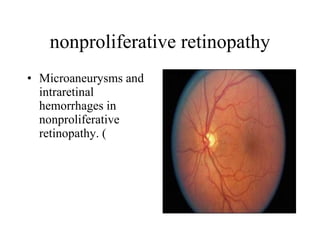
nonproliferative retinopathy Microaneurysms and intraretinal hemorrhages in nonproliferative retinopathy. (
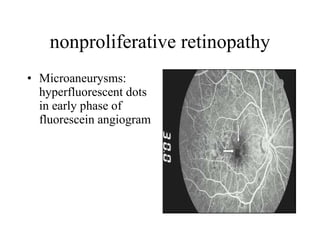
nonproliferative retinopathy Microaneurysms: hyperfluorescent dots in early phase of fluorescein angiogram
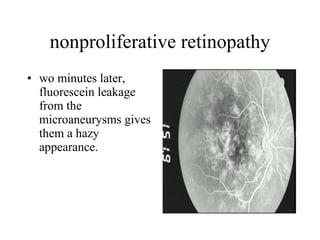
nonproliferative retinopathy wo minutes later, fluorescein leakage from the microaneurysms gives them a hazy appearance.
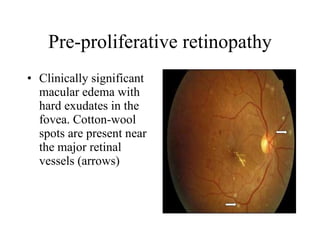
Pre-proliferative retinopathy Clinically significant macular edema with hard exudates in the fovea. Cotton-wool spots are present near the major retinal vessels (arrows)
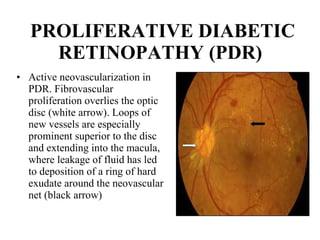
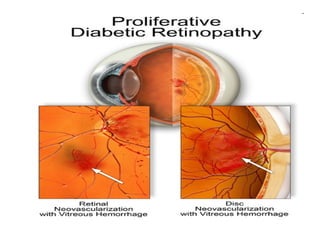
PROLIFERATIVE DIABETIC RETINOPATHY (PDR)   Active neovascularization in PDR. Fibrovascular proliferation overlies the optic disc (white arrow). Loops of new vessels are especially prominent superior to the disc and extending into the macula, where leakage of fluid has led to deposition of a ring of hard exudate around the neovascular net (black arrow)
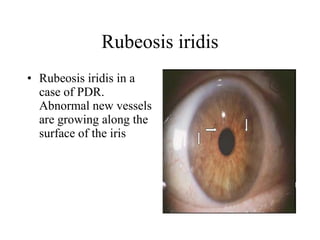
Rubeosis iridis Rubeosis iridis in a case of PDR. Abnormal new vessels are growing along the surface of the iris
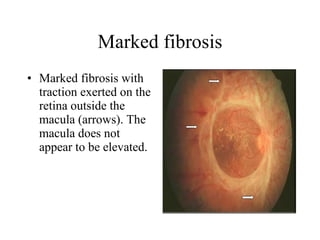
Marked fibrosis Marked fibrosis with traction exerted on the retina outside the macula (arrows). The macula does not appear to be elevated.
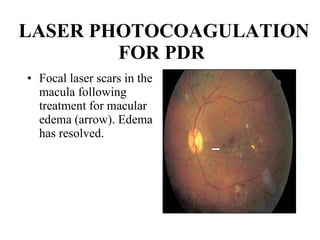
LASER PHOTOCOAGULATION FOR PDR   Focal laser scars in the macula following treatment for macular edema (arrow). Edema has resolved.
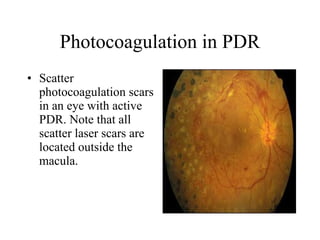
Photocoagulation in PDR Scatter photocoagulation scars in an eye with active PDR. Note that all scatter laser scars are located outside the macula.
 
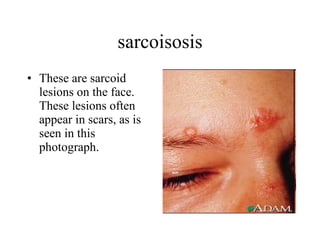
sarcoisosis These are sarcoid lesions on the face. These lesions often appear in scars, as is seen in this photograph.
Diagram of the stages of Sarcoidosis
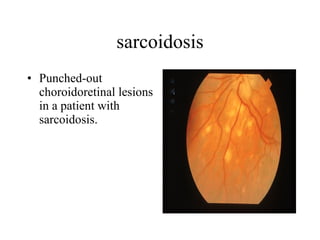
sarcoidosis Punched-out choroidoretinal lesions in a patient with sarcoidosis.
sarcoisosis Lupus pernio
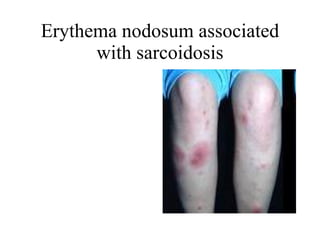
  Erythema nodosum associated with sarcoidosis  This picture shows reddish-purple, hard (indurated), painful nodules (Erythema nodosum) that occur most commonly on the shins. These lesions may be anywhere on the body and may be associated with tuberculosis (TB), sarcoidosis, coccidioidomycosis, systemic lupus erythematosis (SLE), fungal infections, or in response to medications
sarcoidosis Multiple mediastinal nodes in the right paratracheal region
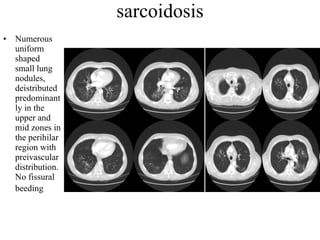
sarcoidosis Numerous uniform shaped small lung nodules, deistributed predominantly in the upper and mid zones in the perihilar region with preivascular distribution. No fissural beeding
Erythema nodosum associated with sarcoidosis
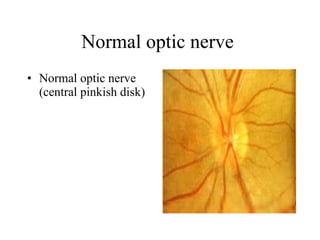
Normal optic nerve  Normal optic nerve (central pinkish disk)
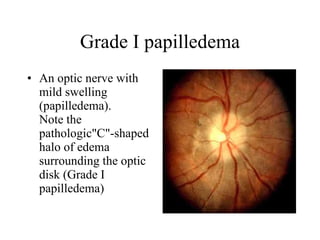
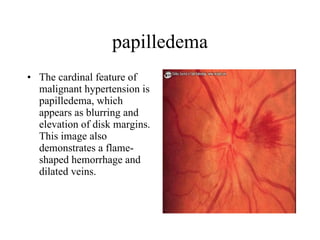
Grade I papilledema An optic nerve with mild swelling (papilledema). Note the pathologic&quot;C&quot;-shaped halo of edema surrounding the optic disk (Grade I papilledema)
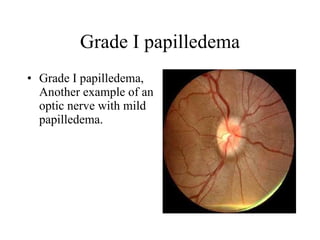
Grade I papilledema Grade I papilledema, Another example of an optic nerve with mild papilledema.
Grade II papilledema Grade II papilledema. The halo of edema now surrounds the optic disc.
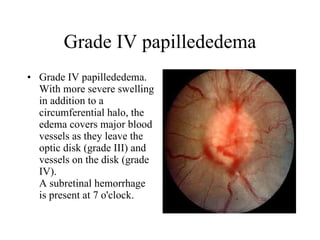
Grade IV papillededema Grade IV papillededema. With more severe swelling in addition to a circumferential halo, the edema covers major blood vessels as they leave the optic disk (grade III) and vessels on the disk (grade IV). A subretinal hemorrhage is present at 7 o'clock.
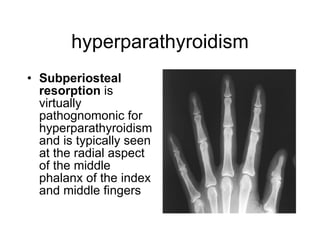
hyperparathyroidism Subperiosteal resorption  is virtually pathognomonic for hyperparathyroidism and is typically seen at the radial aspect of the middle phalanx of the index and middle fingers
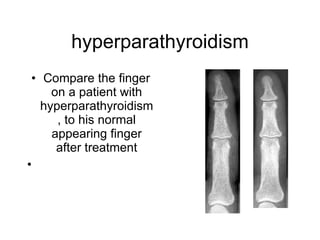
hyperparathyroidism Compare the finger on a patient with hyperparathyroidism, to his normal appearing finger after treatment  
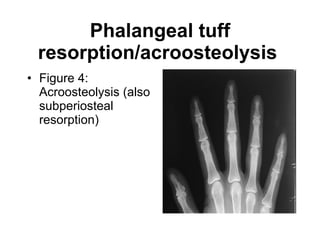
Phalangeal tuff resorption/acroosteolysis   Figure 4: Acroosteolysis (also subperiosteal resorption)
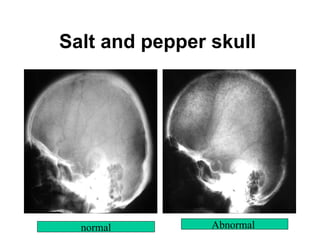
Salt and pepper skull   normal Abnormal
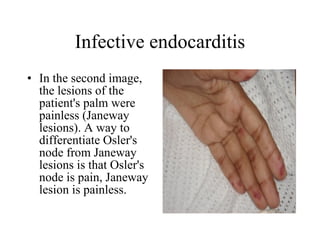
Infective endocarditis In the second image, the lesions of the patient's palm were painless (Janeway lesions). A way to differentiate Osler's node from Janeway lesions is that Osler's node is pain, Janeway lesion is painless.
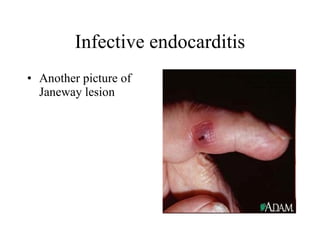
Infective endocarditis Another picture of Janeway lesion
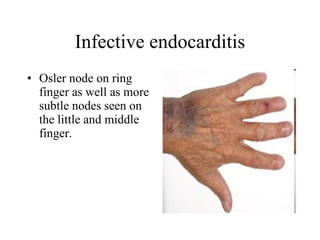
Infective endocarditis Osler node on ring finger as well as more subtle nodes seen on the little and middle finger.
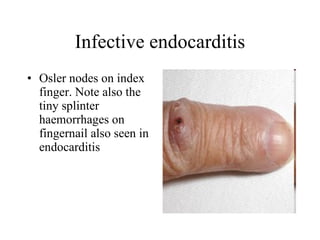
Infective endocarditis Osler nodes on index finger. Note also the tiny splinter haemorrhages on fingernail also seen in endocarditis
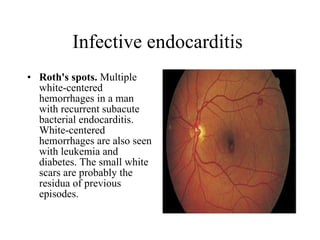
Infective endocarditis Roth's spot - white centered hemorrhages
Infective endocarditis  Roth's spots.  Multiple white-centered hemorrhages in a man with recurrent subacute bacterial endocarditis. White-centered hemorrhages are also seen with leukemia and diabetes. The small white scars are probably the residua of previous episodes.
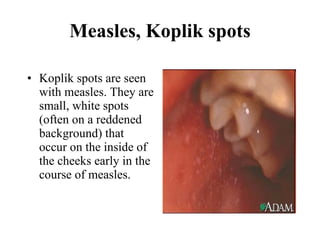
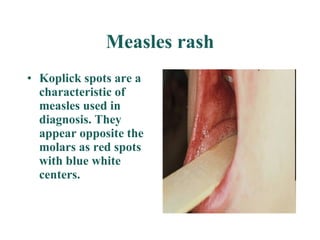
Measles, Koplik spots Koplik spots are seen with measles. They are small, white spots (often on a reddened background) that occur on the inside of the cheeks early in the course of measles.
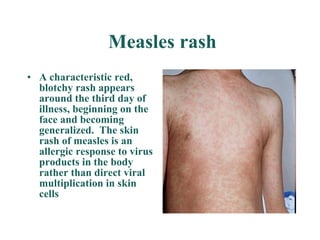
Measles rash A characteristic red, blotchy rash appears around the third day of illness, beginning on the face and becoming generalized.  The skin rash of measles is an allergic response to virus products in the body rather than direct viral multiplication in skin cells
Measles rash Koplick spots are a characteristic of measles used in diagnosis. They appear opposite the molars as red spots with blue white centers.
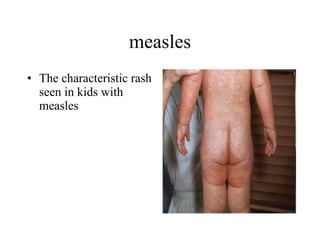
measles The characteristic rash seen in kids with measles
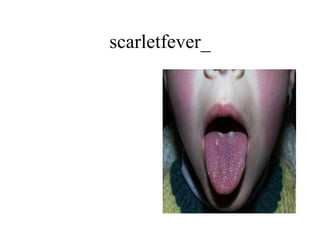
SCARLET FEVER
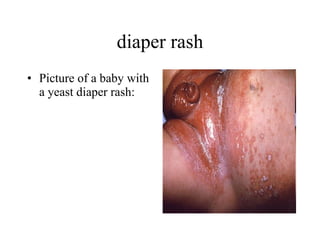
diaper rash Picture of a baby with a yeast diaper rash:
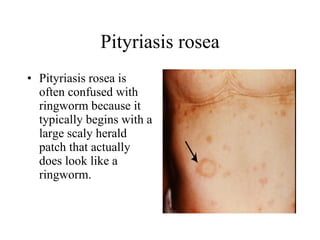
Pityriasis rosea Pityriasis rosea is often confused with ringworm because it typically begins with a large scaly herald patch that actually does look like a ringworm.
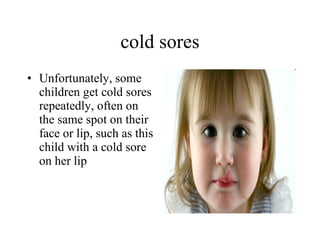
cold sores Unfortunately, some children get cold sores repeatedly, often on the same spot on their face or lip, such as this child with a cold sore on her lip
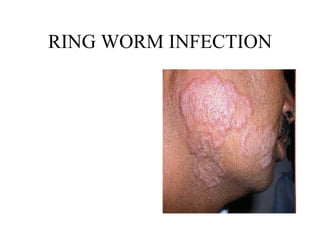
RING WORM INFECTION
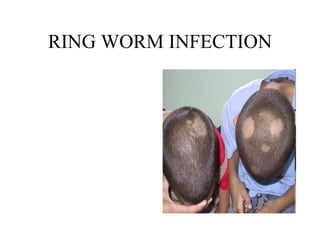
RING WORM INFECTION
SCARLET FEVER
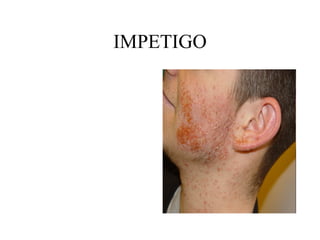
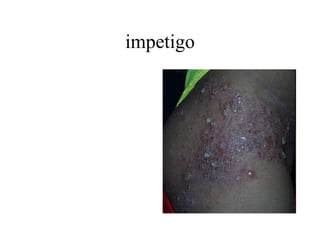
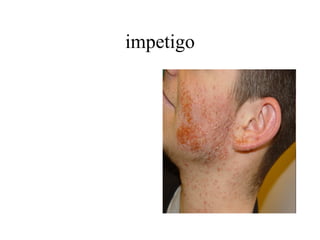
IMPETIGO
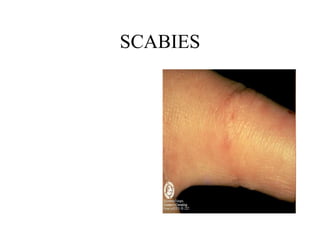
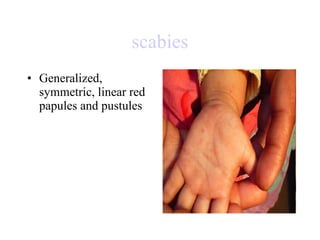
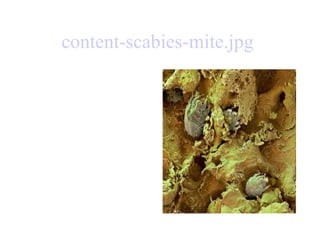
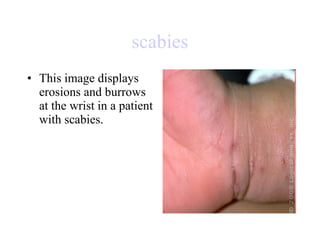
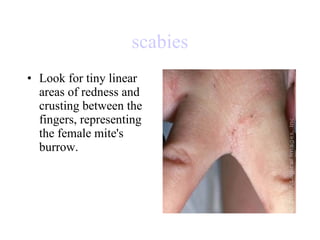
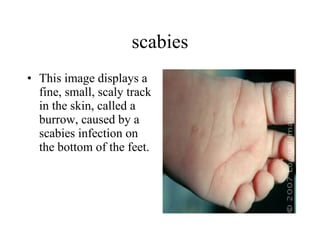
SCABIES
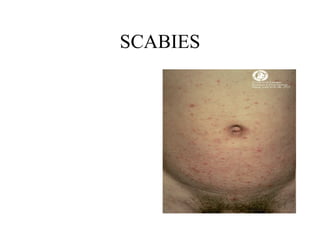
SCABIES
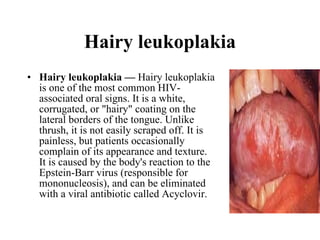
Hairy leukoplakia Hairy leukoplakia involving the lateral border of the tongue in a patient with AIDS
Hairy leukoplakia Hairy leukoplakia —  Hairy leukoplakia is one of the most common HIV-associated oral signs. It is a white, corrugated, or &quot;hairy&quot; coating on the lateral borders of the tongue. Unlike thrush, it is not easily scraped off. It is painless, but patients occasionally complain of its appearance and texture. It is caused by the body's reaction to the Epstein-Barr virus (responsible for mononucleosis), and can be eliminated with a viral antibiotic called Acyclovir.
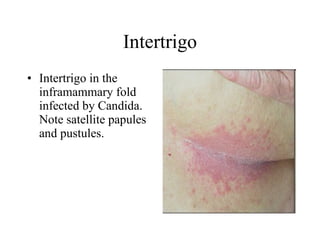
Intertrigo Intertrigo in the inframammary fold infected by Candida. Note satellite papules and pustules.
Lyme disease With warmer winters, deer ticks can reproduce more frequently and transmit the bacteria that cause Lyme disease. A lack of natural predators that normally hunt deer, such as wolves and mountain lions, also allows deer to flourish.
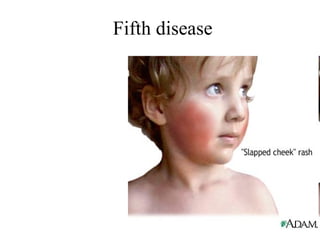
Fifth disease
Lyme Disease
Fifth Disease (Erythema Infectiosum)
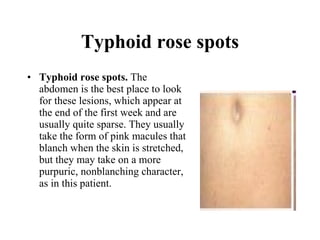
Typhoid rose spots Typhoid rose spots.  The abdomen is the best place to look for these lesions, which appear at the end of the first week and are usually quite sparse. They usually take the form of pink macules that blanch when the skin is stretched, but they may take on a more purpuric, nonblanching character, as in this patient.
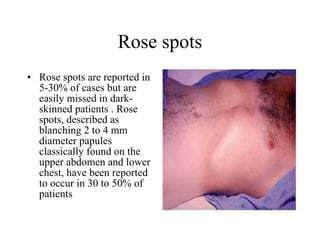
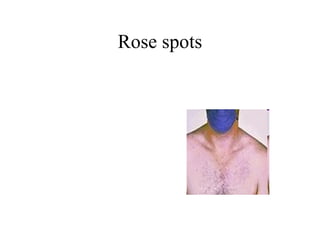
Rose spots Rose spots are reported in 5-30% of cases but are easily missed in dark-skinned patients . Rose spots, described as blanching 2 to 4 mm diameter papules classically found on the upper abdomen and lower chest, have been reported to occur in 30 to 50% of patients
Rose spots
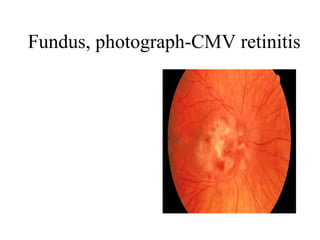
Fundus, photograph-CMV retinitis
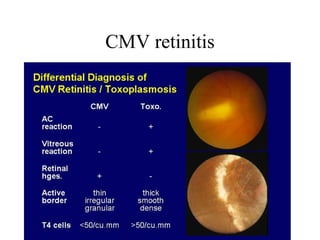
CMV retinitis
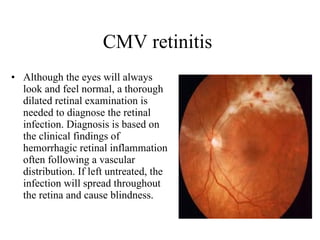
CMV retinitis  Although the eyes will always look and feel normal, a thorough dilated retinal examination is needed to diagnose the retinal infection. Diagnosis is based on the clinical findings of hemorrhagic retinal inflammation often following a vascular distribution. If left untreated, the infection will spread throughout the retina and cause blindness.
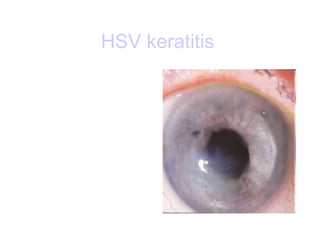
HSV  keratitis
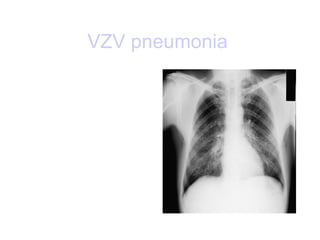
VZV pneumonia
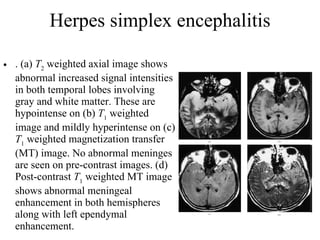
Herpes simplex encephalitis . (a)  T 2  weighted axial image shows abnormal increased signal intensities in both temporal lobes involving gray and white matter. These are hypointense on (b)  T 1  weighted image and mildly hyperintense on (c)  T 1  weighted magnetization transfer (MT) image. No abnormal meninges are seen on pre-contrast images. (d) Post-contrast  T 1  weighted MT image shows abnormal meningeal enhancement in both hemispheres along with left ependymal enhancement.
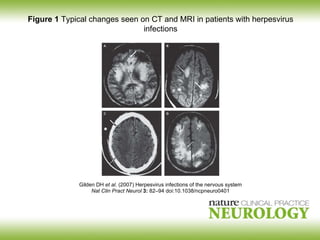
Gilden DH  et al.  (2007) Herpesvirus infections of the nervous system Nat Clin Pract  Neurol   3:  82 – 94 doi:10.1038/ncpneuro0401 Figure 1  Typical changes seen on CT and MRI in patients with herpesvirus infections
subhyaloid haemorrhage in subarachnoid hemorrhage Fundus photograph of the left eye showing well-circumscribed sub-internal limiting membrane haemorrhages, including a large premacular haemorrhage.
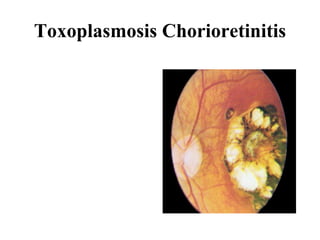
Toxoplasmosis Chorioretinitis
 
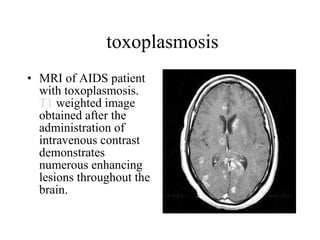
toxoplasmosis MRI of AIDS patient with toxoplasmosis.  T1  weighted image obtained after the administration of intravenous contrast demonstrates numerous enhancing lesions throughout the brain.
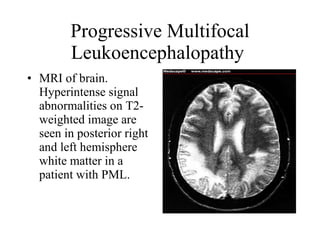
Progressive Multifocal Leukoencephalopathy  MRI of brain. Hyperintense signal abnormalities on T2-weighted image are seen in posterior right and left hemisphere white matter in a patient with PML.
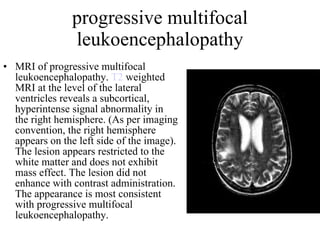
progressive multifocal leukoencephalopathy MRI of progressive multifocal leukoencephalopathy.  T2  weighted MRI at the level of the lateral ventricles reveals a subcortical, hyperintense signal abnormality in the right hemisphere. (As per imaging convention, the right hemisphere appears on the left side of the image). The lesion appears restricted to the white matter and does not exhibit mass effect. The lesion did not enhance with contrast administration. The appearance is most consistent with progressive multifocal leukoencephalopathy.
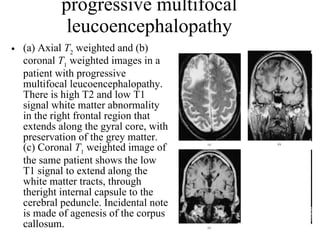
progressive multifocal leucoencephalopathy (a) Axial  T 2  weighted and (b) coronal  T 1  weighted images in a patient with progressive multifocal leucoencephalopathy. There is high T2 and low T1 signal white matter abnormality in the right frontal region that extends along the gyral core, with preservation of the grey matter. (c) Coronal  T 1  weighted image of the same patient shows the low T1 signal to extend along the white matter tracts, through theright internal capsule to the cerebral peduncle. Incidental note is made of agenesis of the corpus callosum.
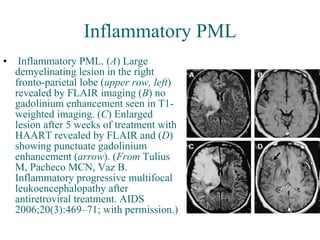
Inflammatory PML   Inflammatory PML. ( A ) Large demyelinating lesion in the right fronto-parietal lobe ( upper row, left ) revealed by FLAIR imaging ( B ) no gadolinium enhancement seen in T1-weighted imaging. ( C ) Enlarged lesion after 5 weeks of treatment with HAART revealed by FLAIR and ( D ) showing punctuate gadolinium enhancement ( arrow ). ( From  Tulius M, Pacheco MCN, Vaz B. Inflammatory progressive multifocal leukoencephalopathy after antiretroviral treatment. AIDS 2006;20(3):469–71; with permission.)
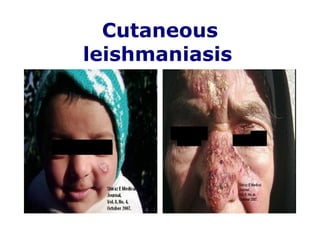
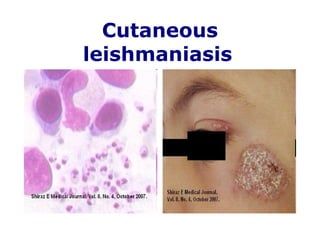
Cutaneous leishmaniasis
Cutaneous leishmaniasis   Donovan Bodies
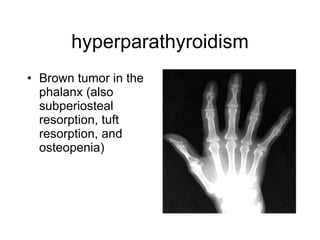
hyperparathyroidism Brown tumor in the phalanx (also subperiosteal resorption, tuft resorption, and osteopenia)
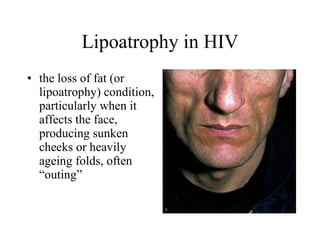
Lipoatrophy in HIV the loss of fat (or lipoatrophy) condition, particularly when it affects the face, producing sunken cheeks or heavily ageing folds, often “outing”
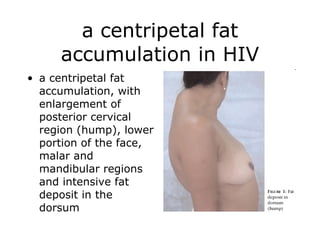
a centripetal fat accumulation in HIV a centripetal fat accumulation, with enlargement of posterior cervical region (hump), lower portion of the face, malar and mandibular regions and intensive fat deposit in the dorsum
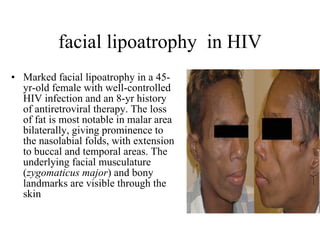
facial lipoatrophy  in HIV Marked facial lipoatrophy in a 45-yr-old female with well-controlled HIV infection and an 8-yr history of antiretroviral therapy. The loss of fat is most notable in malar area bilaterally, giving prominence to the nasolabial folds, with extension to buccal and temporal areas. The underlying facial musculature ( zygomaticus major ) and bony landmarks are visible through the skin
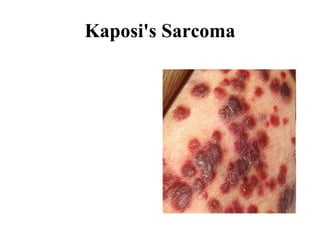
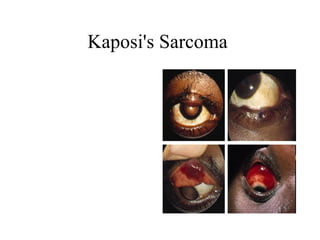
Kaposi's Sarcoma
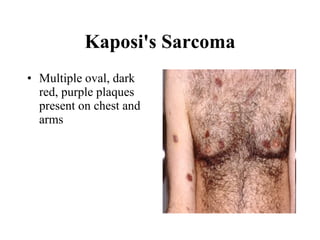
Kaposi's Sarcoma Multiple oval, dark red, purple plaques present on chest and arms
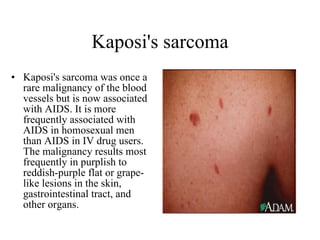
Kaposi's sarcoma Kaposi's sarcoma was once a rare malignancy of the blood vessels but is now associated with AIDS. It is more frequently associated with AIDS in homosexual men than AIDS in IV drug users. The malignancy results most frequently in purplish to reddish-purple flat or grape-like lesions in the skin, gastrointestinal tract, and other organs.
Kaposi's Sarcoma
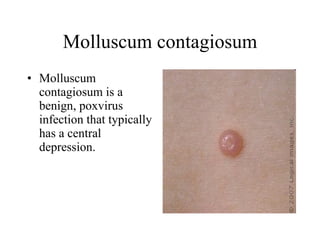
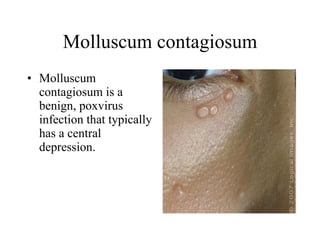
Molluscum contagiosum Molluscum contagiosum is a benign, poxvirus infection that typically has a central depression.
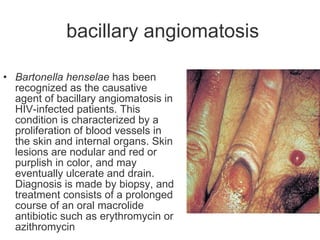
bacillary angiomatosis Bartonella henselae  has been recognized as the causative agent of bacillary angiomatosis in HIV-infected patients. This condition is characterized by a proliferation of blood vessels in the skin and internal organs. Skin lesions are nodular and red or purplish in color, and may eventually ulcerate and drain. Diagnosis is made by biopsy, and treatment consists of a prolonged course of an oral macrolide antibiotic such as erythromycin or azithromycin
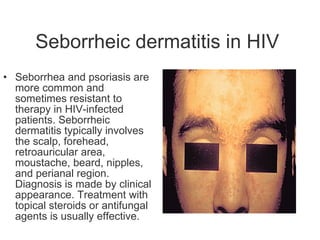
Seborrheic dermatitis in HIV  Seborrhea and psoriasis are more common and sometimes resistant to therapy in HIV-infected patients. Seborrheic dermatitis typically involves the scalp, forehead, retroauricular area, moustache, beard, nipples, and perianal region. Diagnosis is made by clinical appearance. Treatment with topical steroids or antifungal agents is usually effective.
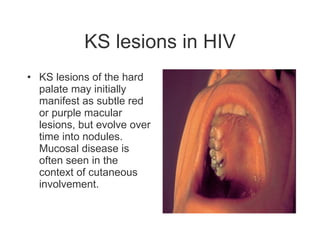
KS lesions in HIV KS lesions of the hard palate may initially manifest as subtle red or purple macular lesions, but evolve over time into nodules. Mucosal disease is often seen in the context of cutaneous involvement.
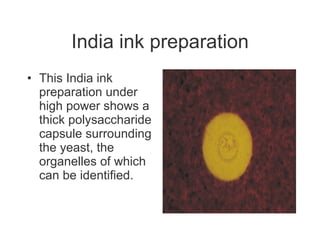
India ink preparation This India ink preparation under high power shows a thick polysaccharide capsule surrounding the yeast, the organelles of which can be identified.
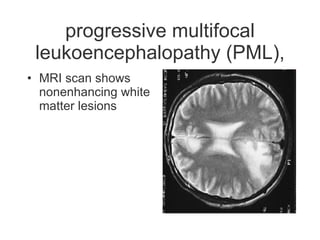
progressive multifocal leukoencephalopathy (PML), MRI scan shows nonenhancing white matter lesions
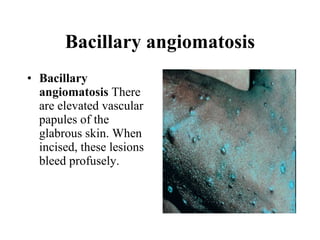
Bacillary angiomatosis Bacillary angiomatosis  There are elevated vascular papules of the glabrous skin. When incised, these lesions bleed profusely.
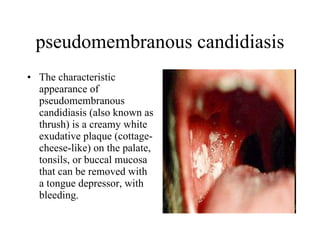
pseudomembranous candidiasis The characteristic appearance of pseudomembranous candidiasis (also known as thrush) is a creamy white exudative plaque (cottage-cheese-like) on the palate, tonsils, or buccal mucosa that can be removed with a tongue depressor, with bleeding.
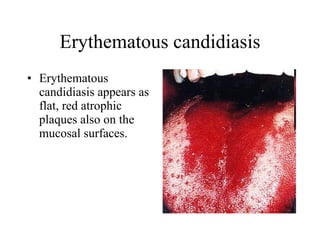
Erythematous candidiasis Erythematous candidiasis appears as flat, red atrophic plaques also on the mucosal surfaces.
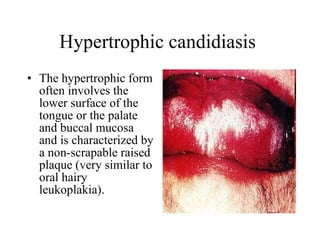
Hypertrophic candidiasis  The hypertrophic form often involves the lower surface of the tongue or the palate and buccal mucosa and is characterized by a non-scrapable raised plaque (very similar to oral hairy leukoplakia).
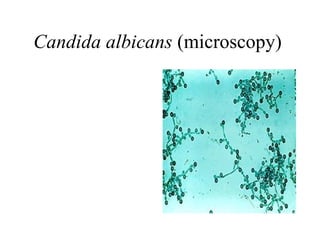
Candida albicans  (microscopy)
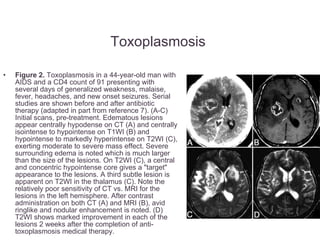
Toxoplasmosis  Figure 2.  Toxoplasmosis in a 44-year-old man with AIDS and a CD4 count of 91 presenting with several days of generalized weakness, malaise, fever, headaches, and new onset seizures. Serial studies are shown before and after antibiotic therapy (adapted in part from reference 7). (A-C) Initial scans, pre-treatment. Edematous lesions appear centrally hypodense on CT (A) and centrally isointense to hypointense on T1WI (B) and hypointense to markedly hyperintense on T2WI (C), exerting moderate to severe mass effect. Severe surrounding edema is noted which is much larger than the size of the lesions. On T2WI (C), a central and concentric hypointense core gives a &quot;target&quot; appearance to the lesions. A third subtle lesion is apparent on T2WI in the thalamus (C). Note the relatively poor sensitivity of CT vs. MRI for the lesions in the left hemisphere. After contrast administration on both CT (A) and MRI (B), avid ringlike and nodular enhancement is noted. (D) T2WI shows marked improvement in each of the lesions 2 weeks after the completion of anti-toxoplasmosis medical therapy.
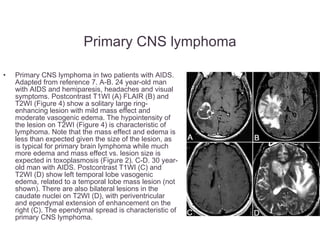
Primary CNS lymphoma Primary CNS lymphoma in two patients with AIDS. Adapted from reference 7. A-B. 24 year-old man with AIDS and hemiparesis, headaches and visual symptoms. Postcontrast T1WI (A) FLAIR (B) and T2WI (Figure 4) show a solitary large ring-enhancing lesion with mild mass effect and moderate vasogenic edema. The hypointensity of the lesion on T2WI (Figure 4) is characteristic of lymphoma. Note that the mass effect and edema is less than expected given the size of the lesion, as is typical for primary brain lymphoma while much more edema and mass effect vs. lesion size is expected in toxoplasmosis (Figure 2). C-D. 30 year-old man with AIDS. Postcontrast T1WI (C) and T2WI (D) show left temporal lobe vasogenic edema, related to a temporal lobe mass lesion (not shown). There are also bilateral lesions in the caudate nuclei on T2WI (D), with periventricular and ependymal extension of enhancement on the right (C). The ependymal spread is characteristic of primary CNS lymphoma.
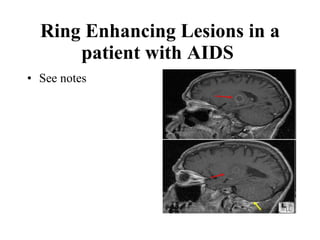
Ring Enhancing Lesions in a patient with AIDS   See notes
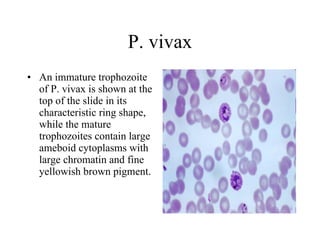
P. vivax An immature trophozoite of P. vivax is shown at the top of the slide in its characteristic ring shape, while the mature trophozoites contain large ameboid cytoplasms with large chromatin and fine yellowish brown pigment.
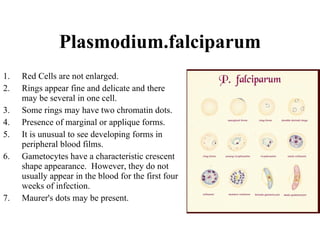
Plasmodium.falciparum Red Cells are not enlarged. Rings appear fine and delicate and there may be several in one cell. Some rings may have two chromatin dots. Presence of marginal or applique forms. It is unusual to see developing forms in peripheral blood films. Gametocytes have a characteristic crescent shape appearance.  However, they do not usually appear in the blood for the first four weeks of infection. Maurer's dots may be present.
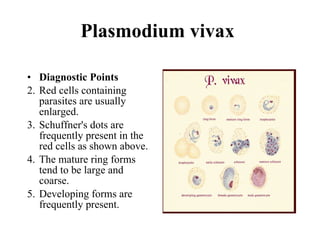
Plasmodium vivax  Diagnostic Points Red cells containing parasites are usually enlarged. Schuffner's dots are frequently present in the red cells as shown above. The mature ring forms tend to be large and coarse. Developing forms are frequently present.
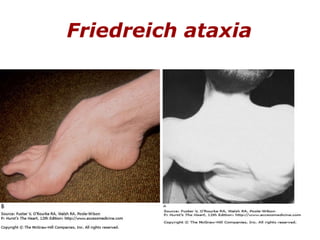
Friedreich ataxia
Friedreich ataxia
SCA Sagittal MRI of the brain  of a 60-year-old man with gait ataxia and dysarthria due to SCA1, illustrating cerebellar atrophy ( arrows ).
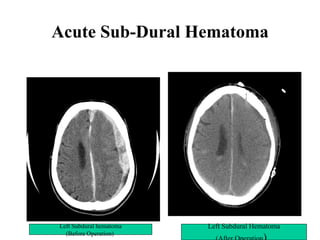
Acute Sub-Dural Hematoma Left Subdural hematoma (Before Operation)  Left Subdural Hematoma (After Operation ) 
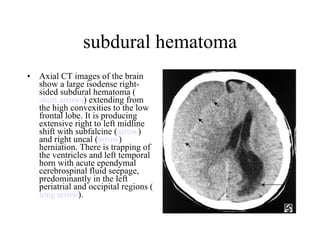
subdural hematoma Axial CT images of the brain show a large isodense right-sided subdural hematoma ( short arrows ) extending from the high convexities to the low frontal lobe. It is producing extensive right to left midline shift with subfalcine ( arrow ) and right uncal ( arrow ) herniation. There is trapping of the ventricles and left temporal horn with acute ependymal cerebrospinal fluid seepage, predominantly in the left periatrial and occipital regions ( long arrow ).
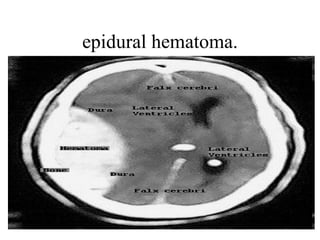
epidural hematoma  Biconvex homogeneous epidural hematoma
epidural hematoma.
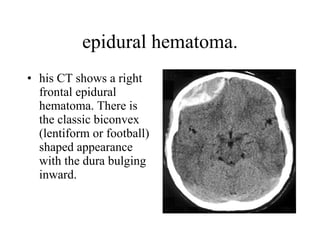
epidural hematoma. his CT shows a right frontal epidural hematoma. There is the classic biconvex (lentiform or football) shaped appearance with the dura bulging inward.
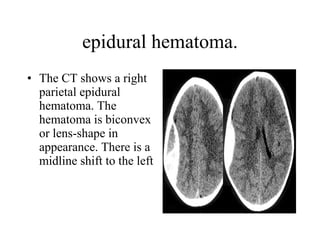
epidural hematoma. The CT shows a right parietal epidural hematoma. The hematoma is biconvex or lens-shape in appearance. There is a midline shift to the left
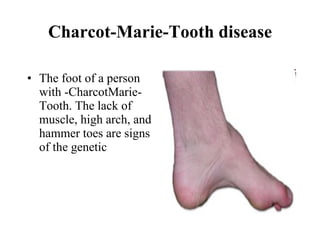
Charcot-Marie-Tooth disease The foot of a person with -CharcotMarie-Tooth. The lack of muscle, high arch, and hammer toes are signs of the genetic
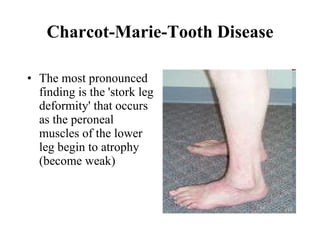
Charcot-Marie-Tooth Disease The most pronounced finding is the 'stork leg deformity' that occurs as the peroneal muscles of the lower leg begin to atrophy (become weak)
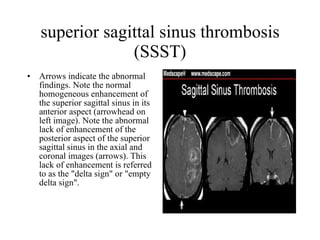
superior sagittal sinus thrombosis (SSST) Arrows indicate the abnormal findings. Note the normal homogeneous enhancement of the superior sagittal sinus in its anterior aspect (arrowhead on left image). Note the abnormal lack of enhancement of the posterior aspect of the superior sagittal sinus in the axial and coronal images (arrows). This lack of enhancement is referred to as the &quot;delta sign&quot; or &quot;empty delta sign&quot;.
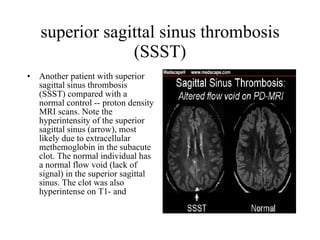
superior sagittal sinus thrombosis (SSST) Another patient with superior sagittal sinus thrombosis (SSST) compared with a normal control -- proton density MRI scans. Note the hyperintensity of the superior sagittal sinus (arrow), most likely due to extracellular methemoglobin in the subacute clot. The normal individual has a normal flow void (lack of signal) in the superior sagittal sinus. The clot was also hyperintense on T1- and
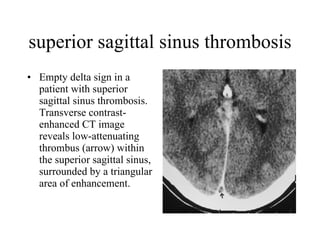
superior sagittal sinus thrombosis Empty delta sign in a patient with superior sagittal sinus thrombosis. Transverse contrast-enhanced CT image reveals low-attenuating thrombus (arrow) within the superior sagittal sinus, surrounded by a triangular area of enhancement.
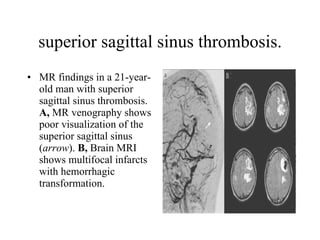
superior sagittal sinus thrombosis. MR findings in a 21-year-old man with superior sagittal sinus thrombosis.  A,  MR venography shows poor visualization of the superior sagittal sinus ( arrow ).  B,  Brain MRI shows multifocal infarcts with hemorrhagic transformation.
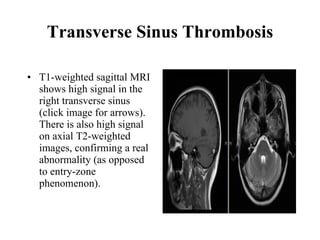
Transverse Sinus Thrombosis T1-weighted sagittal MRI shows high signal in the right transverse sinus (click image for arrows). There is also high signal on axial T2-weighted images, confirming a real abnormality (as opposed to entry-zone phenomenon).
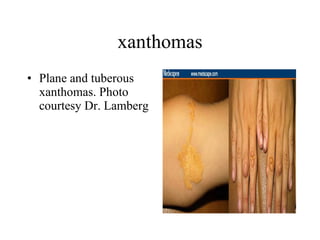
xanthomas Plane and tuberous xanthomas. Photo courtesy Dr. Lamberg
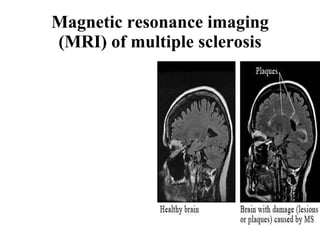
Magnetic resonance imaging (MRI) of multiple sclerosis
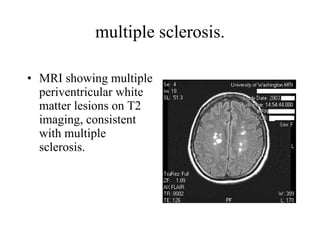
multiple sclerosis. MRI showing multiple periventricular white matter lesions on T2 imaging, consistent with multiple sclerosis.
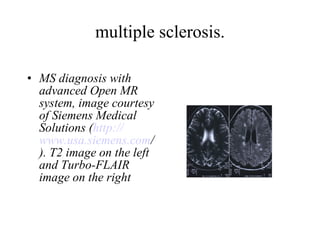
multiple sclerosis. MS diagnosis with advanced Open MR system, image courtesy of Siemens Medical Solutions ( http:// www.usa.siemens.com / ). T2 image on the left and Turbo-FLAIR image on the right
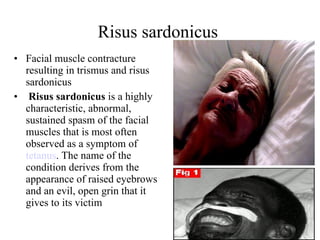
Risus sardonicus  Facial muscle contracture resulting in trismus and risus sardonicus Risus sardonicus  is a highly characteristic, abnormal, sustained spasm of the facial muscles that is most often observed as a symptom of  tetanus . The name of the condition derives from the appearance of raised eyebrows and an evil, open grin that it gives to its victim
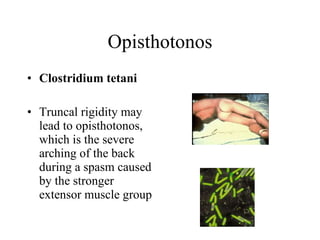
Opisthotonos Clostridium tetani Truncal rigidity may lead to opisthotonos, which is the severe arching of the back   during a spasm caused by the stronger extensor muscle group
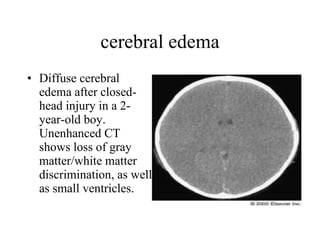
cerebral edema Diffuse cerebral edema after closed-head injury in a 2-year-old boy. Unenhanced CT shows loss of gray matter/white matter discrimination, as well as small ventricles.
cerebral edema [Figure ID: F1] FIGURE 1. CT SCAN SHOWING DIFFUSE CEREBRAL EDEMA IN A YOUNG WOMAN WITH HYPERSENSITIVITY SYNDROME DUE TO MINOCYCLINE.
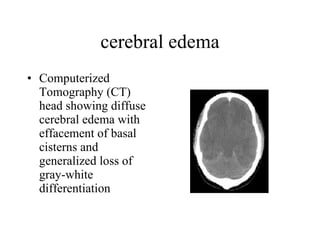
cerebral edema Computerized Tomography (CT) head showing diffuse cerebral edema with effacement of basal cisterns and generalized loss of gray-white differentiation
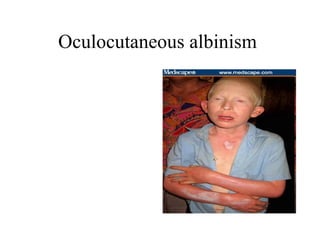
Oculocutaneous albinism
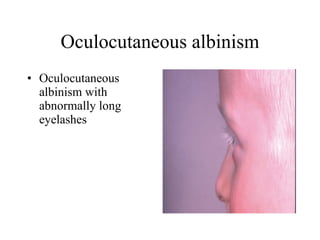
Oculocutaneous albinism Oculocutaneous albinism with abnormally long eyelashes
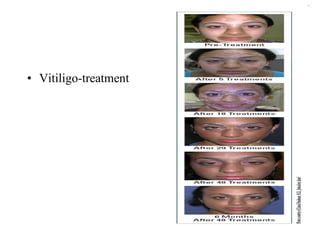
Vitiligo-treatment
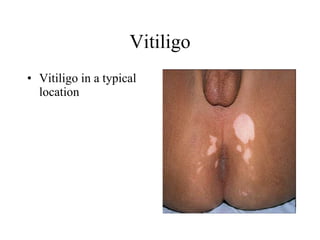
Vitiligo Vitiligo in a typical location
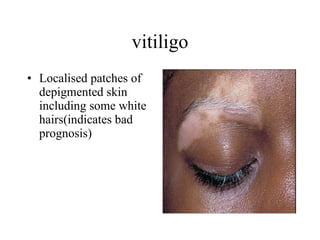
vitiligo Localised patches of depigmented skin including some white hairs(indicates bad prognosis)
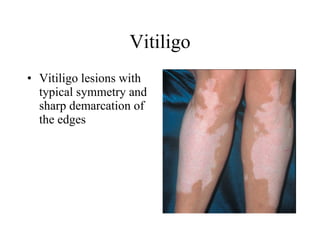
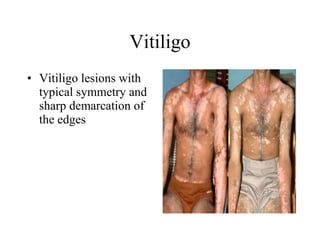
Vitiligo Vitiligo lesions with typical symmetry and sharp demarcation of the edges
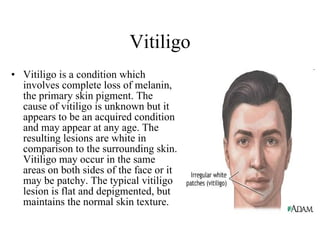
Vitiligo Vitiligo is a condition which involves complete loss of melanin, the primary skin pigment. The cause of vitiligo is unknown but it appears to be an acquired condition and may appear at any age. The resulting lesions are white in comparison to the surrounding skin. Vitiligo may occur in the same areas on both sides of the face or it may be patchy. The typical vitiligo lesion is flat and depigmented, but maintains the normal skin texture.
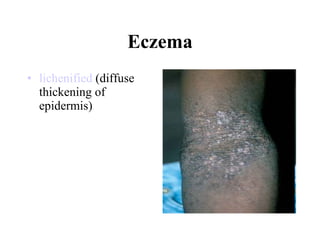
Eczema lichenified  (diffuse thickening of epidermis)
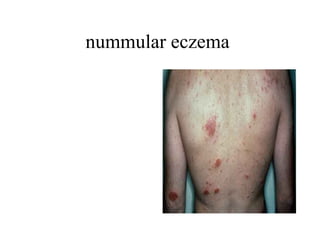
nummular eczema
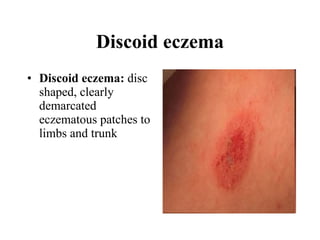
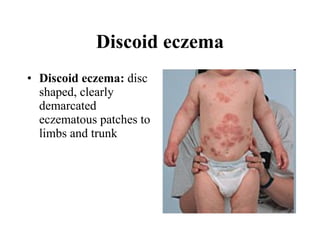
Discoid eczema Discoid eczema:  disc shaped, clearly demarcated eczematous patches to limbs and trunk
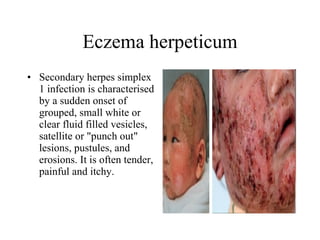
Eczema herpeticum Secondary herpes simplex 1 infection is characterised by a sudden onset of grouped, small white or clear fluid filled vesicles, satellite or &quot;punch out&quot; lesions, pustules, and erosions. It is often tender, painful and itchy.
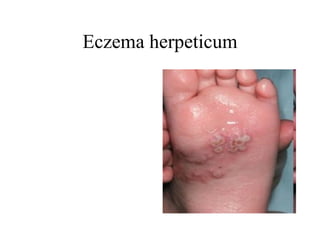
Eczema herpeticum
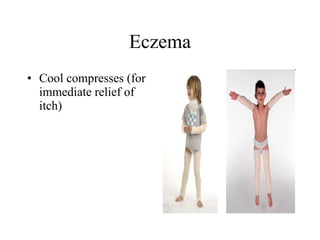
Eczema Cool compresses (for immediate relief of itch)
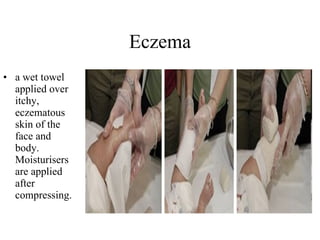
Eczema a wet towel applied over itchy, eczematous skin of the face and body. Moisturisers are applied after compressing.
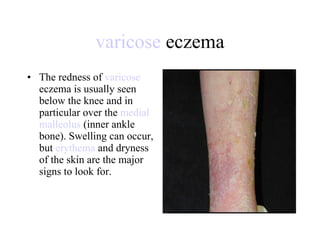
varicose  eczema The redness of  varicose  eczema is usually seen below the knee and in particular over the  medial   malleolus  (inner ankle bone). Swelling can occur, but  erythema  and dryness of the skin are the major signs to look for.
Patch testing for localised eczema   Patch testing for localised eczema for localised eczema
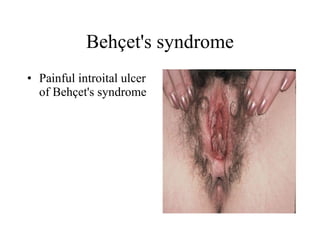
Behçet's syndrome Painful introital ulcer of Behçet's syndrome
Behçet's syndrome
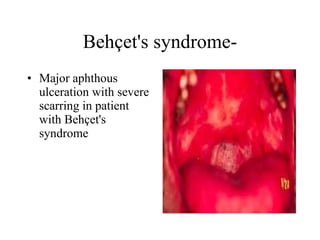
Behçet's syndrome- Major aphthous ulceration with severe scarring in patient with Behçet's syndrome
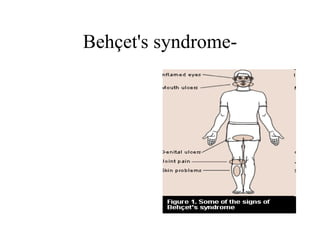
Behçet's syndrome-
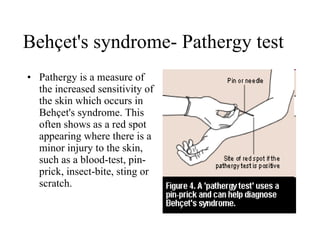
Behçet's syndrome- Pathergy test Pathergy is a measure of the increased sensitivity of the skin which occurs in Behçet's syndrome. This often shows as a red spot appearing where there is a minor injury to the skin, such as a blood-test, pin-prick, insect-bite, sting or scratch.
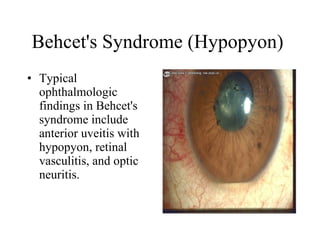
Behcet's Syndrome (Hypopyon)  Typical ophthalmologic findings in Behcet's syndrome include anterior uveitis with hypopyon, retinal vasculitis, and optic neuritis.
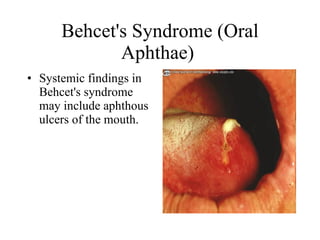
Behcet's Syndrome (Oral Aphthae)  Systemic findings in Behcet's syndrome may include aphthous ulcers of the mouth.
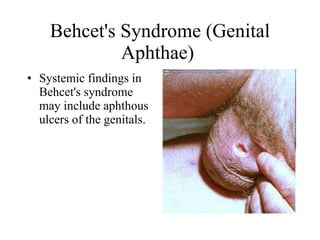
Behcet's Syndrome (Genital Aphthae)  Systemic findings in Behcet's syndrome may include aphthous ulcers of the genitals.
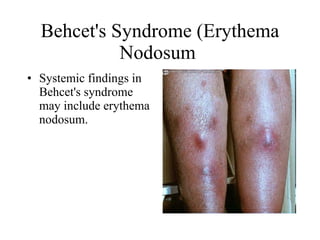
Behcet's Syndrome (Erythema Nodosum  Systemic findings in Behcet's syndrome may include erythema nodosum.
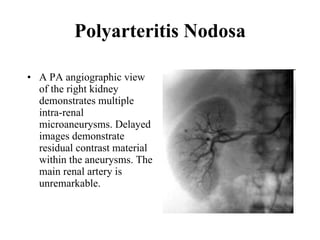
Polyarteritis Nodosa A PA angiographic view of the right kidney demonstrates multiple intra-renal microaneurysms. Delayed images demonstrate residual contrast material within the aneurysms. The main renal artery is unremarkable.
polyarteritis nodosa. Livedo racemosa (more commonly referred to as livedo reticularis). ( A ) Lacy pattern of discoloration over the lower extremities that does not blanch with pressure in a patient who has polyarteritis nodosa. ( B ) Livedo racemosa, “a tendril-like pattern reminiscent of forked lightning” [30].
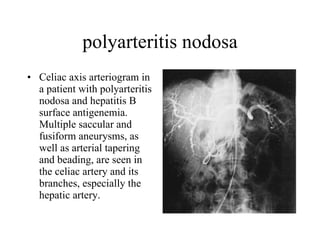
polyarteritis nodosa Celiac axis arteriogram in a patient with polyarteritis nodosa and hepatitis B surface antigenemia. Multiple saccular and fusiform aneurysms, as well as arterial tapering and beading, are seen in the celiac artery and its branches, especially the hepatic artery.
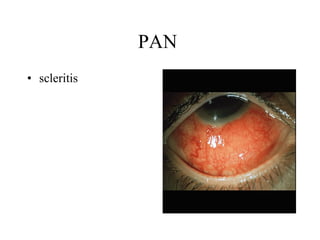
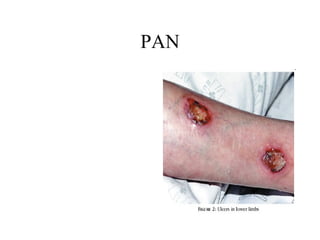
PAN  scleritis
PAN
Kawasaki disease  Red palms of the hands and the soles of the feet
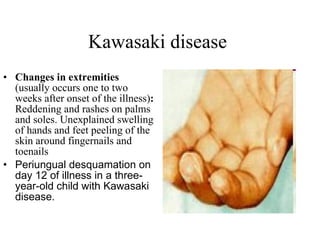
Kawasaki disease  Changes in extremities  (usually occurs one to two weeks after onset of the illness) :  Reddening and rashes on palms and soles. Unexplained swelling of hands and feet peeling of the skin around fingernails and toenails  Periungual desquamation on day 12 of illness in a three-year-old child with Kawasaki disease.
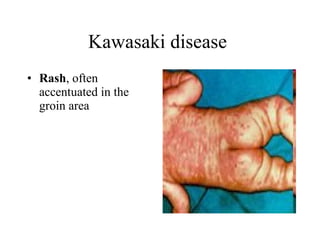
Kawasaki disease  Rash , often accentuated in the groin area
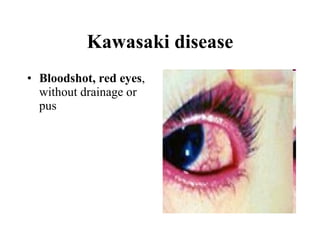
Kawasaki disease Bloodshot, red eyes , without drainage or pus
Kawasaki disease Redness in the lips, mouth and throat:   Reddening and cracking of the lips  A characteristic reddening of the tongue, called strawberry tongue
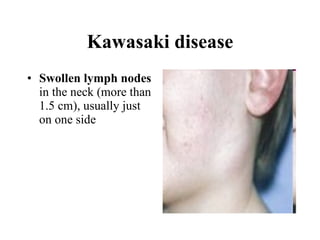
Kawasaki disease Swollen lymph nodes  in the neck (more than 1.5 cm), usually just on one side
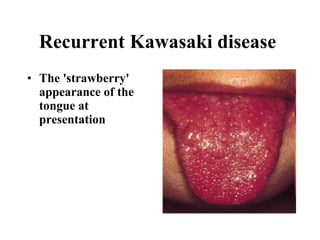
Recurrent Kawasaki disease   The 'strawberry' appearance of the tongue at presentation
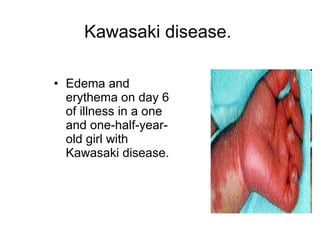
Kawasaki disease.   Edema and erythema on day 6 of illness in a one and one-half­year-old girl with Kawasaki disease.
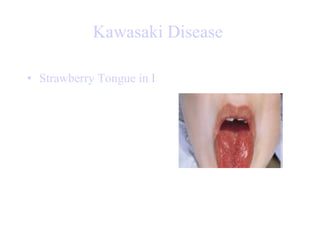
Kawasaki Disease   Strawberry Tongue in Kawasaki Disease
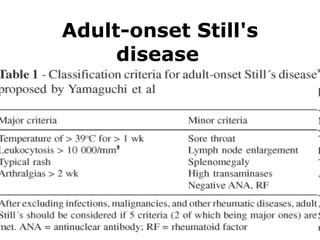
Adult-onset Still's disease
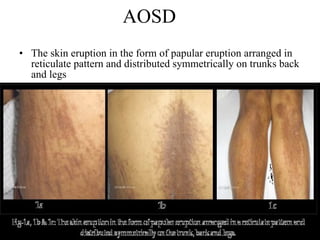
AOSD The skin eruption in the form of papular eruption arranged in reticulate pattern and distributed symmetrically on trunks back and legs
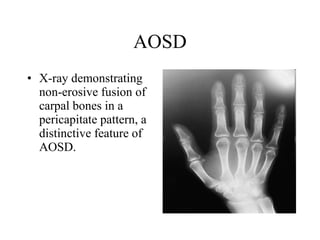
AOSD X-ray demonstrating non-erosive fusion of carpal bones in a pericapitate pattern, a distinctive feature of AOSD.
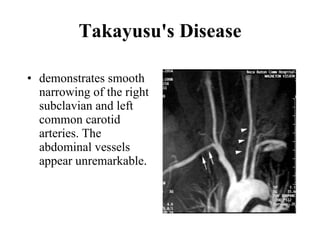
Takayusu's Disease demonstrates smooth narrowing of the right subclavian and left common carotid arteries. The abdominal vessels appear unremarkable.
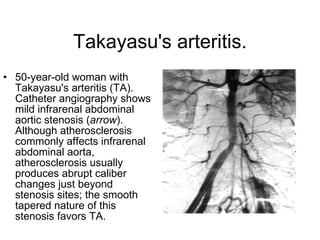
Takayasu's arteritis. 50-year-old woman with Takayasu's arteritis (TA). Catheter angiography shows mild infrarenal abdominal aortic stenosis ( arrow ). Although atherosclerosis commonly affects infrarenal abdominal aorta, atherosclerosis usually produces abrupt caliber changes just beyond stenosis sites; the smooth tapered nature of this stenosis favors TA.
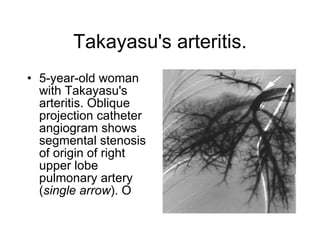
Takayasu's arteritis. 5-year-old woman with Takayasu's arteritis. Oblique projection catheter angiogram shows segmental stenosis of origin of right upper lobe pulmonary artery ( single arrow ). O
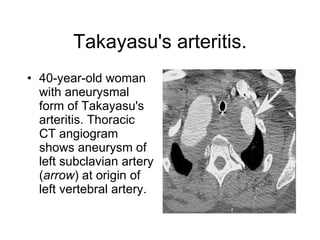
Takayasu's arteritis. 40-year-old woman with aneurysmal form of Takayasu's arteritis. Thoracic CT angiogram shows aneurysm of left subclavian artery ( arrow ) at origin of left vertebral artery.
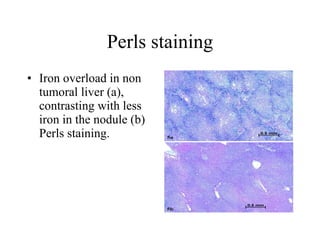
Perls staining Iron overload in non tumoral liver (a), contrasting with less iron in the nodule (b) Perls staining.
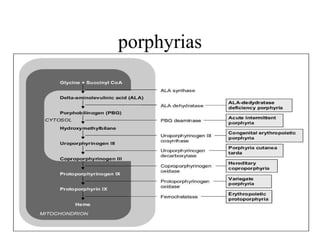
porphyrias
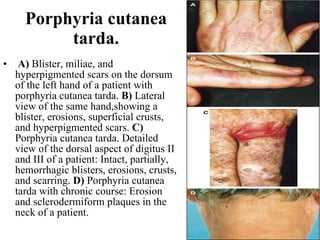
Porphyria cutanea tarda.   A)  Blister, miliae, and hyperpigmented scars on the dorsum of the left hand of a patient with porphyria cutanea tarda.  B)  Lateral view of the same hand,showing a blister, erosions, superficial crusts, and hyperpigmented scars.  C)  Porphyria cutanea tarda. Detailed view of the dorsal aspect of digitus II and III of a patient: Intact, partially, hemorrhagic blisters, erosions, crusts, and scarring.  D)  Porphyria cutanea tarda with chronic course: Erosion and sclerodermiform plaques in the neck of a patient.
 
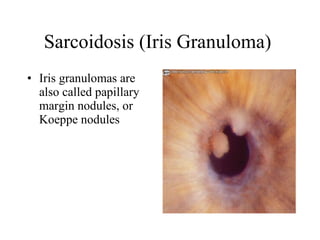
Sarcoidosis (Iris Granuloma)  Iris granulomas are also called papillary margin nodules, or Koeppe nodules
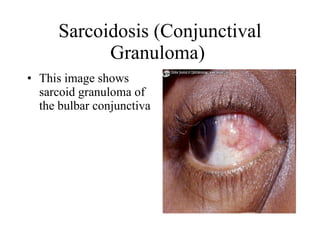
Sarcoidosis (Conjunctival Granuloma)  This image shows sarcoid granuloma of the bulbar conjunctiva
Retinitis (Cytomegalovirus)  Features of cytomegalovirus retinitis include retinal whitening, intraretinal hemorrhage, and arteritis. The diagnosis is presumptive based on characteristic retinal findings in an immunosuppressed patient.
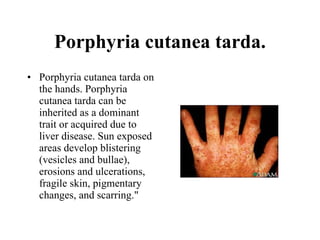
Porphyria cutanea tarda. Porphyria cutanea tarda on the hands. Porphyria cutanea tarda can be inherited as a dominant trait or acquired due to liver disease. Sun exposed areas develop blistering (vesicles and bullae), erosions and ulcerations, fragile skin, pigmentary changes, and scarring.&quot; 
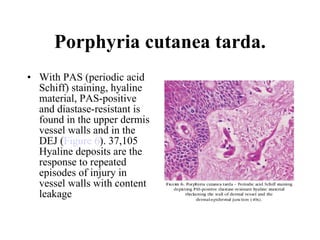
Porphyria cutanea tarda. With PAS (periodic acid Schiff) staining, hyaline material, PAS-positive and diastase-resistant is found in the upper dermis vessel walls and in the DEJ ( Figure 6 ). 37,105 Hyaline deposits are the response to repeated episodes of injury in vessel walls with content leakage
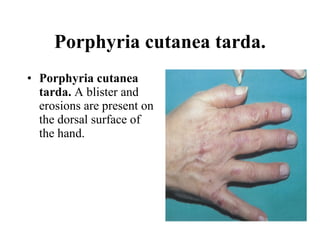
Porphyria cutanea tarda. Porphyria cutanea tarda.  A blister and erosions are present on the dorsal surface of the hand.
Homocystinuria Chest deformities (pectus carinatum,pectus excavatum
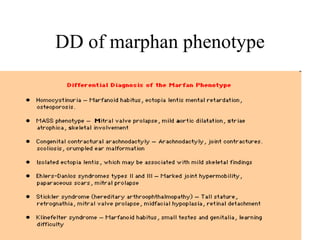
Marphan phenotype
DD of marphan phenotype
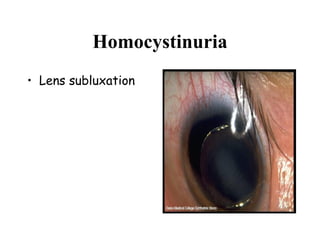
Homocystinuria Lens subluxation
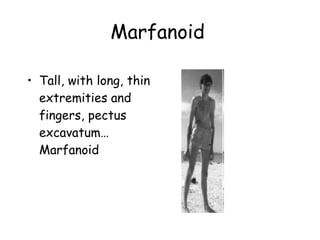
Marfanoid   Tall, with long, thin extremities and fingers, pectus excavatum…Marfanoid
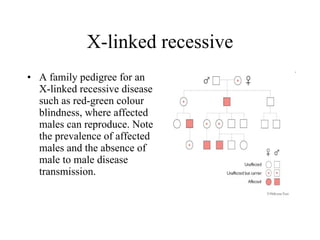
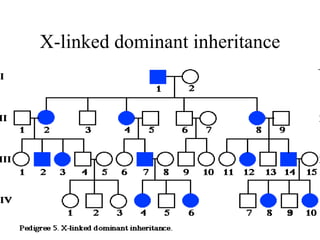
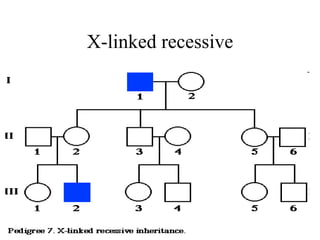
X-linked recessive A family pedigree for an X-linked recessive disease such as red-green colour blindness, where affected males can reproduce. Note the prevalence of affected males and the absence of male to male disease transmission.
X-linked dominant inheritance
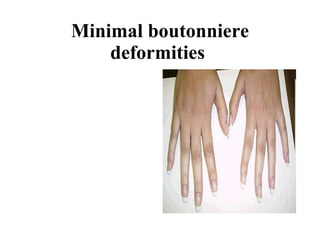
Minimal boutonniere deformities
X-linked recessive
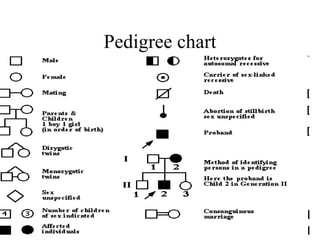
Pedigree chart
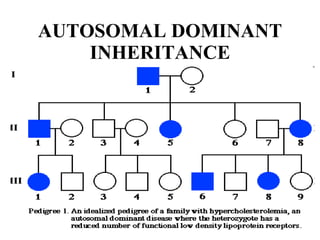
AUTOSOMAL DOMINANT INHERITANCE
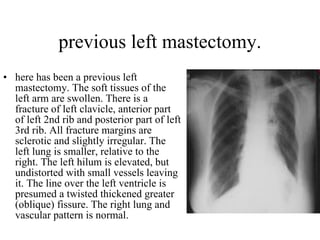
previous left mastectomy. here has been a previous left mastectomy. The soft tissues of the left arm are swollen. There is a fracture of left clavicle, anterior part of left 2nd rib and posterior part of left 3rd rib. All fracture margins are sclerotic and slightly irregular. The left lung is smaller, relative to the right. The left hilum is elevated, but undistorted with small vessels leaving it. The line over the left ventricle is presumed a twisted thickened greater (oblique) fissure. The right lung and vascular pattern is normal.
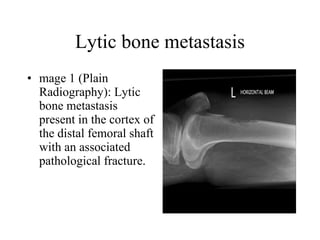
Lytic bone metastasis mage 1 (Plain Radiography): Lytic bone metastasis present in the cortex of the distal femoral shaft with an associated pathological fracture.
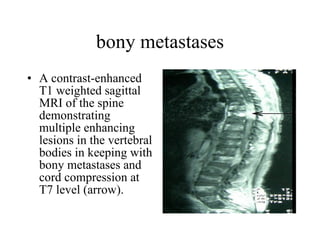
bony metastases A contrast-enhanced T1 weighted sagittal MRI of the spine demonstrating multiple enhancing lesions in the vertebral bodies in keeping with bony metastases and cord compression at T7 level (arrow).
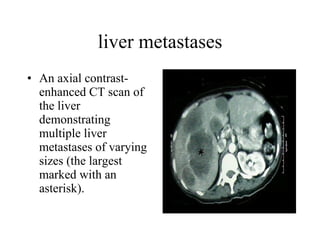
liver metastases An axial contrast-enhanced CT scan of the liver demonstrating multiple liver metastases of varying sizes (the largest marked with an asterisk).
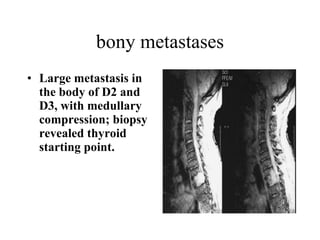
bony metastases Large metastasis in the body of D2 and D3, with medullary compression; biopsy revealed thyroid starting point.
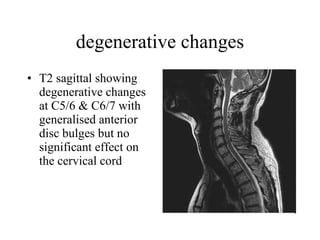
degenerative changes T2 sagittal showing degenerative changes at C5/6 & C6/7 with generalised anterior disc bulges but no significant effect on the cervical cord
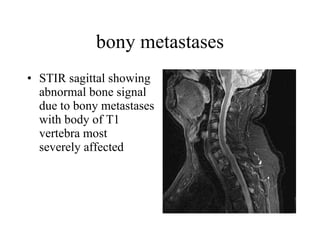
bony metastases STIR sagittal showing abnormal bone signal due to bony metastases with body of T1 vertebra most  severely affected
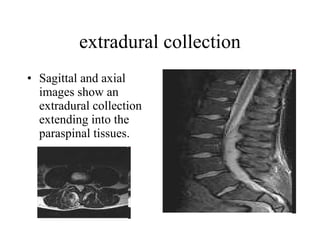
extradural collection Sagittal and axial images show an extradural collection extending into the paraspinal tissues.
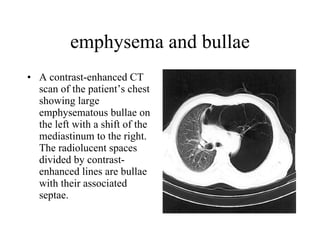
emphysema and bullae A contrast-enhanced CT scan of the patient’s chest showing large emphysematous bullae on the left with a shift of the mediastinum to the right. The radiolucent spaces divided by contrast-enhanced lines are bullae with their associated septae.
emphysema and bullae Computed tomography of the lung with thin slices (1 mm) showing emphysema and bullae in the lower lung lobes of a subject with type ZZ alpha-1-antitrypsin deficiency. There is also increased lung density in areas with compression of lung tissue by the bullae.
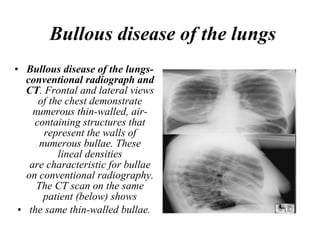
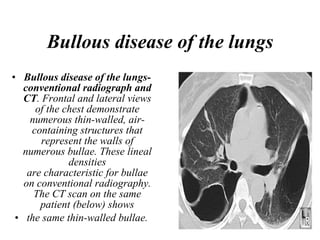
Bullous disease of the lungs Bullous disease of the lungs-conventional radiograph and CT . Frontal and lateral views of the chest demonstrate numerous thin-walled, air-containing structures that represent the walls of numerous bullae. These lineal densities are characteristic for bullae on conventional radiography. The CT scan on the same patient (below) shows the same thin-walled bullae.
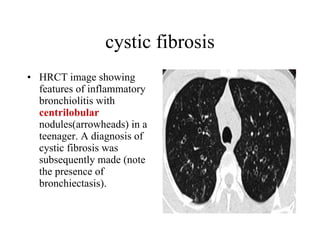
cystic fibrosis HRCT image showing features of inflammatory bronchiolitis with  centrilobular  nodules(arrowheads) in a teenager. A diagnosis of cystic fibrosis was subsequently made (note the presence of bronchiectasis).
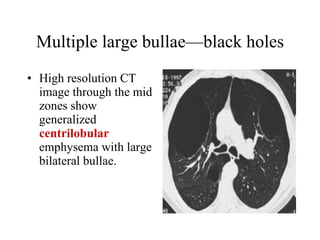
Multiple large bullae—black holes High resolution CT image through the mid zones show generalized  centrilobular  emphysema with large bilateral bullae.
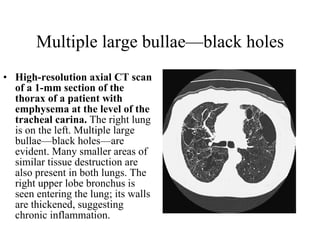
Multiple large bullae—black holes High-resolution axial CT scan of a 1-mm section of the thorax of a patient with emphysema at the level of the tracheal carina.  The right lung is on the left. Multiple large bullae—black holes—are evident. Many smaller areas of similar tissue destruction are also present in both lungs. The right upper lobe bronchus is seen entering the lung; its walls are thickened, suggesting chronic inflammation.
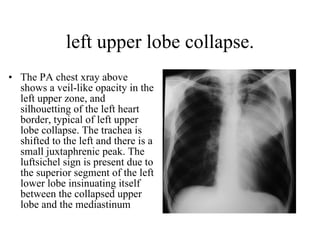
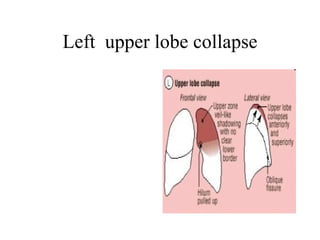
left upper lobe collapse. The PA chest xray above shows a veil-like opacity in the left upper zone, and silhouetting of the left heart border, typical of left upper lobe collapse. The trachea is shifted to the left and there is a small juxtaphrenic peak. The luftsichel sign is present due to the superior segment of the left lower lobe insinuating itself between the collapsed upper lobe and the mediastinum
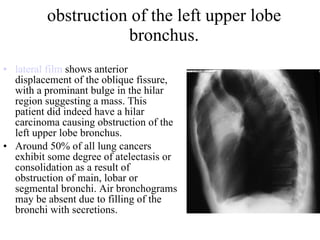
obstruction of the left upper lobe bronchus. lateral film  shows anterior displacement of the oblique fissure, with a prominant bulge in the hilar region suggesting a mass. This patient did indeed have a hilar carcinoma causing obstruction of the left upper lobe bronchus. Around 50% of all lung cancers exhibit some degree of atelectasis or consolidation as a result of obstruction of main, lobar or segmental bronchi. Air bronchograms may be absent due to filling of the bronchi with secretions.
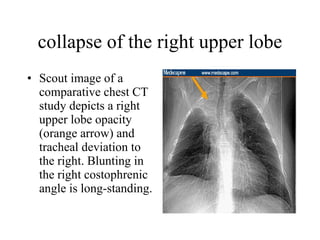
collapse of the right upper lobe Scout image of a comparative chest CT study depicts a right upper lobe opacity (orange arrow) and tracheal deviation to the right. Blunting in the right costophrenic angle is long-standing.
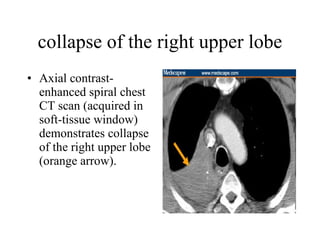
collapse of the right upper lobe Axial contrast-enhanced spiral chest CT scan (acquired in soft-tissue window) demonstrates collapse of the right upper lobe (orange arrow).
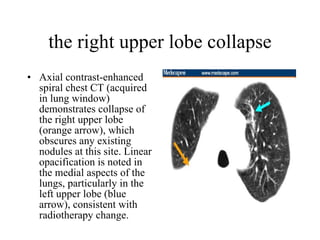
the right upper lobe collapse Axial contrast-enhanced spiral chest CT (acquired in lung window) demonstrates collapse of the right upper lobe (orange arrow), which obscures any existing nodules at this site. Linear opacification is noted in the medial aspects of the lungs, particularly in the left upper lobe (blue arrow), consistent with radiotherapy change.
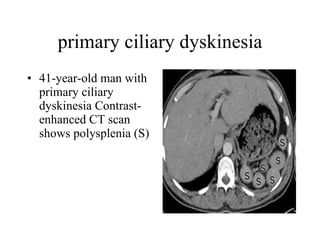
primary ciliary dyskinesia 41-year-old man with primary ciliary dyskinesia Contrast-enhanced CT scan shows polysplenia (S)
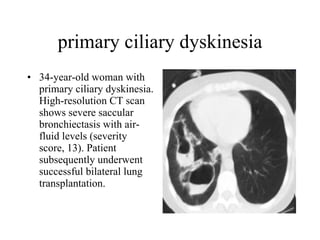
primary ciliary dyskinesia 34-year-old woman with primary ciliary dyskinesia. High-resolution CT scan shows severe saccular bronchiectasis with air-fluid levels (severity score, 13). Patient subsequently underwent successful bilateral lung transplantation.
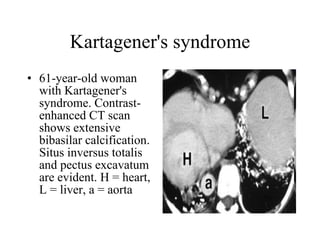
Kartagener's syndrome 61-year-old woman with Kartagener's syndrome. Contrast-enhanced CT scan shows extensive bibasilar calcification. Situs inversus totalis and pectus excavatum are evident. H = heart, L = liver, a = aorta
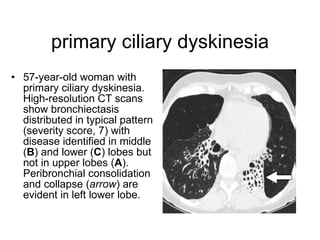
primary ciliary dyskinesia 57-year-old woman with primary ciliary dyskinesia. High-resolution CT scans show bronchiectasis distributed in typical pattern (severity score, 7) with disease identified in middle ( B ) and lower ( C ) lobes but not in upper lobes ( A ). Peribronchial consolidation and collapse ( arrow ) are evident in left lower lobe.
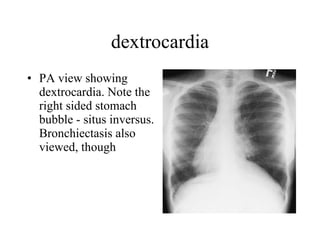
dextrocardia PA view showing dextrocardia. Note the right sided stomach bubble - situs inversus. Bronchiectasis also viewed, though  not easily appreciated on this film.
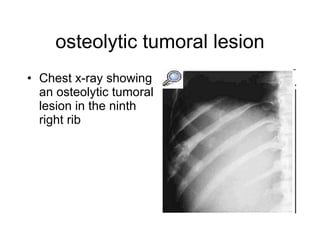
osteolytic tumoral lesion Chest x-ray showing an osteolytic tumoral lesion in the ninth right rib
Multiple myeloma - find the subtle rib lesion, CXR The superior cortex of the posterior part of the left 5th rib is mottled and lucent compared to the adjacent and the contralateral ribs (review the  CXR ). A poorly defined, lucent or absent inferior posterior rib margin is an unreliable finding as ribs are normally thin here to accommodate the intercostal neurovascular bundle. However, an absent or abnormal superior posterior rib margin is usually suspicious. Loss of the ANTERIOR end of a rib is, however, a fairly common normal finding (see  this case  for an example).
 
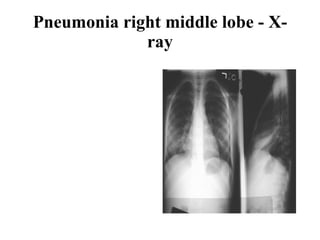
Pneumonia right middle lobe - X-ray
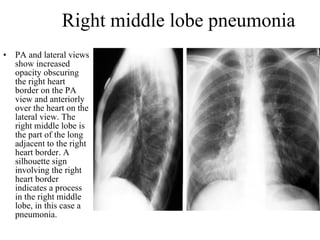
Right middle lobe pneumonia PA and lateral views show increased opacity obscuring the right heart border on the PA view and anteriorly over the heart on the lateral view. The right middle lobe is the part of the long adjacent to the right heart border. A silhouette sign involving the right heart border indicates a process in the right middle lobe, in this case a pneumonia.
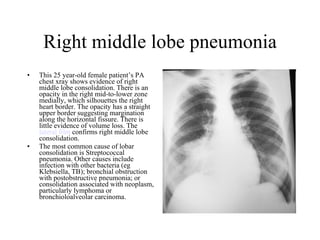
Right middle lobe pneumonia This 25 year-old female patient’s PA chest xray shows evidence of right middle lobe consolidation. There is an opacity in the right mid-to-lower zone medially, which silhouettes the right heart border. The opacity has a straight upper border suggesting margination along the horizontal fissure. There is little evidence of volume loss. The  lateral film  confirms right middle lobe consolidation. The most common cause of lobar consolidation is Streptococcal pneumonia. Other causes include infection with other bacteria (eg Klebsiella, TB); bronchial obstruction with postobstructive pneumonia; or consolidation associated with neoplasm, particularly lymphoma or bronchioloalveolar carcinoma.
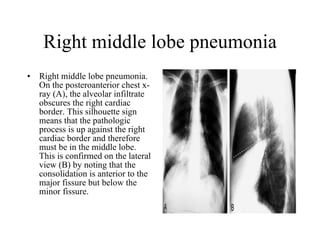
Right middle lobe pneumonia Right middle lobe pneumonia. On the posteroanterior chest x-ray (A), the alveolar infiltrate obscures the right cardiac border. This silhouette sign means that the pathologic process is up against the right cardiac border and therefore must be in the middle lobe. This is confirmed on the lateral view (B) by noting that the consolidation is anterior to the major fissure but below the minor fissure.
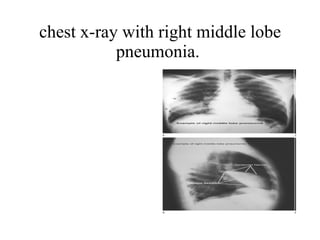
chest x-ray with right middle lobe pneumonia.
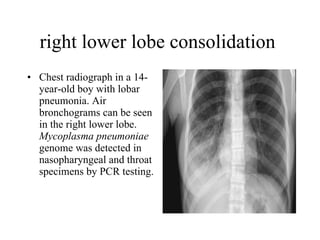
right lower lobe consolidation  Chest radiograph in a 14-year-old boy with lobar pneumonia. Air bronchograms can be seen in the right lower lobe.  Mycoplasma pneumoniae  genome was detected in nasopharyngeal and throat specimens by PCR testing.
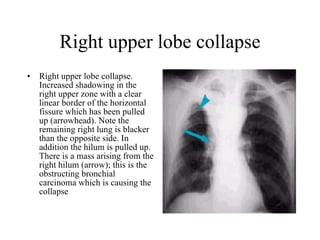
Right upper lobe collapse Right upper lobe collapse. Increased shadowing in the right upper zone with a clear linear border of the horizontal fissure which has been pulled up (arrowhead). Note the remaining right lung is blacker than the opposite side. In addition the hilum is pulled up. There is a mass arising from the right hilum (arrow); this is the obstructing bronchial carcinoma which is causing the collapse
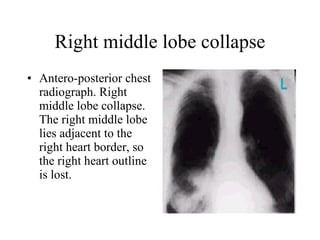
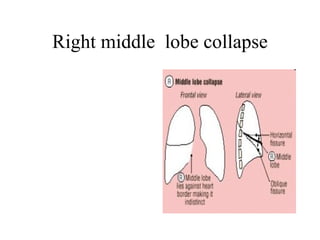
Right middle lobe collapse Antero-posterior chest radiograph. Right middle lobe collapse. The right middle lobe lies adjacent to the right heart border, so the right heart outline is lost.
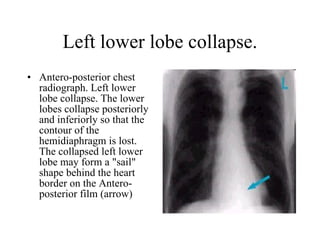
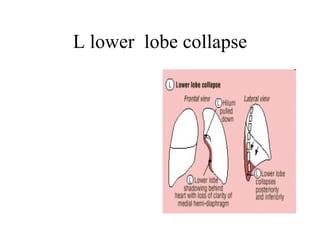
Left lower lobe collapse. Antero-posterior chest radiograph. Left lower lobe collapse. The lower lobes collapse posteriorly and inferiorly so that the contour of the hemidiaphragm is lost. The collapsed left lower lobe may form a &quot;sail&quot; shape behind the heart border on the Antero-posterior film (arrow)
Left  upper lobe collapse
Right middle  lobe collapse
L lower  lobe collapse
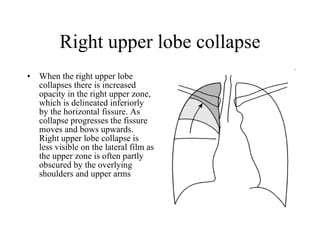
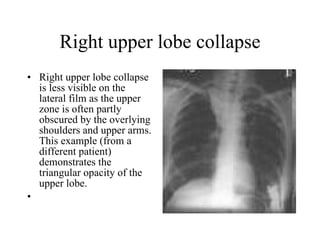
Right upper lobe collapse When the right upper lobe collapses there is increased opacity in the right upper zone, which is delineated inferiorly by the horizontal fissure. As collapse progresses the fissure moves and bows upwards. Right upper lobe collapse is less visible on the lateral film as the upper zone is often partly obscured by the overlying shoulders and upper arms
Right upper lobe collapse Right upper lobe collapse is less visible on the lateral film as the upper zone is often partly obscured by the overlying shoulders and upper arms. This example (from a different patient) demonstrates the triangular opacity of the upper lobe.
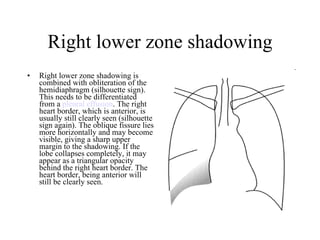
Right lower zone shadowing Right lower zone shadowing is combined with obliteration of the hemidiaphragm (silhouette sign). This needs to be differentiated from a  pleural effusion . The right heart border, which is anterior, is usually still clearly seen (silhouette sign again). The oblique fissure lies more horizontally and may become visible, giving a sharp upper margin to the shadowing. If the lobe collapses completely, it may appear as a triangular opacity behind the right heart border. The heart border, being anterior will still be clearly seen.
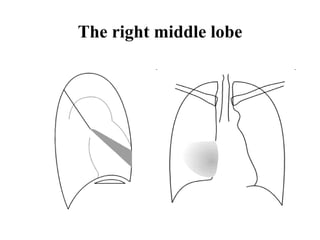
The right middle lobe
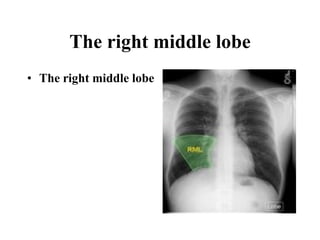
The right middle lobe The right middle lobe
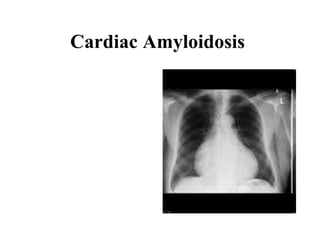
Cardiac Amyloidosis
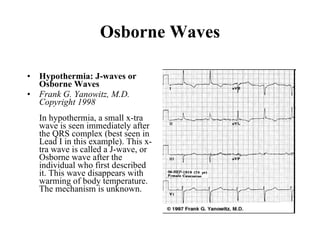
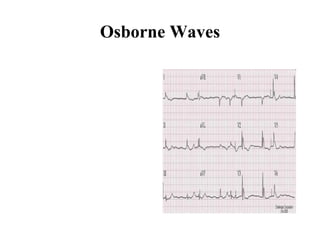
Osborne Waves Hypothermia: J-waves or Osborne Waves Frank G. Yanowitz, M.D. Copyright 1998  In hypothermia, a small x-tra wave is seen immediately after the QRS complex (best seen in Lead I in this example). This x-tra wave is called a J-wave, or Osborne wave after the individual who first described it. This wave disappears with warming of body temperature. The mechanism is unknown.
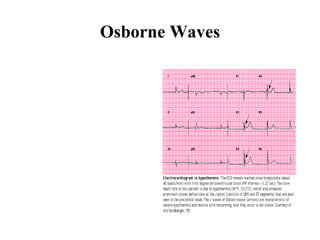
Osborne Waves
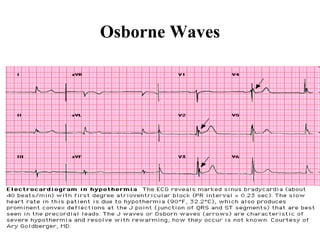
Osborne Waves
Osborne Waves
fat embolism
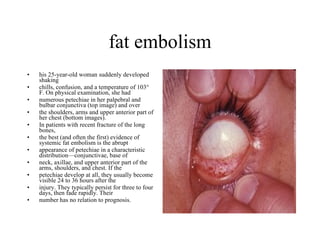
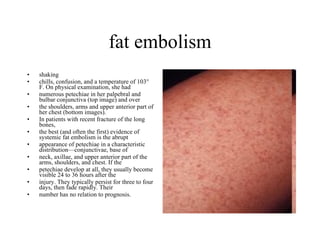
fat embolism his 25-year-old woman suddenly developed shaking  chills, confusion, and a temperature of 103° F. On physical examination, she had  numerous petechiae in her palpebral and bulbar conjunctiva (top image) and over  the shoulders, arms and upper anterior part of her chest (bottom images). In patients with recent fracture of the long bones,  the best (and often the first) evidence of systemic fat embolism is the abrupt  appearance of petechiae in a characteristic distribution—conjunctivae, base of  neck, axillae, and upper anterior part of the arms, shoulders, and chest. If the  petechiae develop at all, they usually become visible 24 to 36 hours after the  injury. They typically persist for three to four days, then fade rapidly. Their  number has no relation to prognosis.
fat embolism shaking  chills, confusion, and a temperature of 103° F. On physical examination, she had  numerous petechiae in her palpebral and bulbar conjunctiva (top image) and over  the shoulders, arms and upper anterior part of her chest (bottom images). In patients with recent fracture of the long bones,  the best (and often the first) evidence of systemic fat embolism is the abrupt  appearance of petechiae in a characteristic distribution—conjunctivae, base of  neck, axillae, and upper anterior part of the arms, shoulders, and chest. If the  petechiae develop at all, they usually become visible 24 to 36 hours after the  injury. They typically persist for three to four days, then fade rapidly. Their  number has no relation to prognosis.
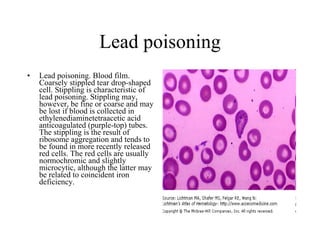
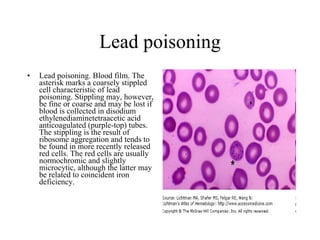
Lead poisoning Lead poisoning. Blood film. Coarsely stippled tear drop-shaped cell. Stippling is characteristic of lead poisoning. Stippling may, however, be fine or coarse and may be lost if blood is collected in ethylenediaminetetraacetic acid anticoagulated (purple-top) tubes. The stippling is the result of ribosome aggregation and tends to be found in more recently released red cells. The red cells are usually normochromic and slightly microcytic, although the latter may be related to coincident iron deficiency.
Lead poisoning Lead poisoning. Blood film. The asterisk marks a coarsely stippled cell characteristic of lead poisoning. Stippling may, however, be fine or coarse and may be lost if blood is collected in disodium ethylenediaminetetraacetic acid anticoagulated (purple-top) tubes. The stippling is the result of ribosome aggregation and tends to be found in more recently released red cells. The red cells are usually normochromic and slightly microcytic, although the latter may be related to coincident iron deficiency.
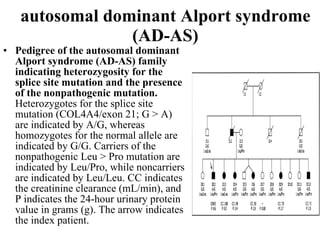
autosomal dominant Alport syndrome (AD-AS) Pedigree of the autosomal dominant Alport syndrome (AD-AS) family indicating heterozygosity for the splice site mutation and the presence of the nonpathogenic mutation.  Heterozygotes for the splice site mutation (COL4A4/exon 21; G > A) are indicated by A/G, whereas homozygotes for the normal allele are indicated by G/G. Carriers of the nonpathogenic Leu > Pro mutation are indicated by Leu/Pro, while noncarriers are indicated by Leu/Leu. CC indicates the creatinine clearance (mL/min), and P indicates the 24-hour urinary protein value in grams (g). The arrow indicates the index patient.
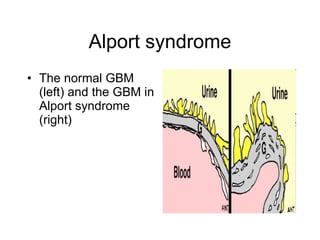
Alport syndrome The normal GBM (left) and the GBM in Alport syndrome (right)
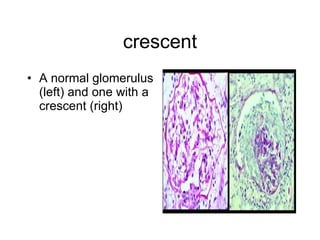
crescent A normal glomerulus (left) and one with a crescent (right)
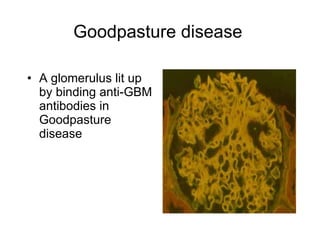
Goodpasture disease   A glomerulus lit up by binding anti-GBM antibodies in Goodpasture disease
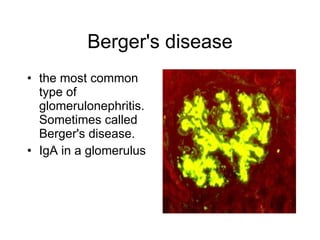
Berger's disease the most common type of glomerulonephritis. Sometimes called Berger's disease.  IgA in a glomerulus
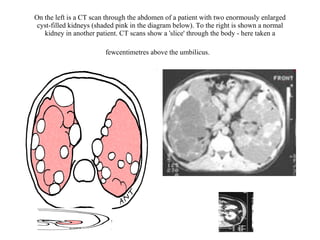
On the left is a CT scan through the abdomen of a patient with two enormously enlarged cyst-filled kidneys (shaded pink in the diagram below). To the right is shown a normal kidney in another patient. CT scans show a 'slice' through the body - here taken a fewcentimetres above the umbilicus.
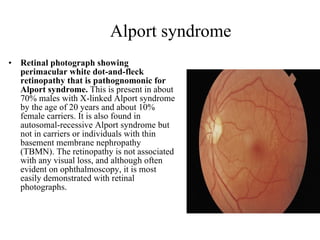
Alport syndrome Retinal photograph showing perimacular white dot-and-fleck retinopathy that is pathognomonic for Alport syndrome.  This is present in about 70% males with X-linked Alport syndrome by the age of 20 years and about 10% female carriers. It is also found in autosomal-recessive Alport syndrome but not in carriers or individuals with thin basement membrane nephropathy (TBMN). The retinopathy is not associated with any visual loss, and although often evident on ophthalmoscopy, it is most easily demonstrated with retinal photographs.
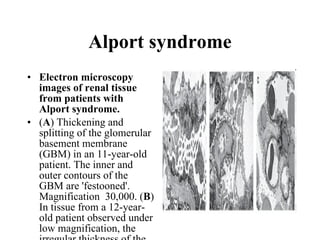
Alport syndrome Electron microscopy images of renal tissue from patients with Alport syndrome. ( A ) Thickening and splitting of the glomerular basement membrane (GBM) in an 11-year-old patient. The inner and outer contours of the GBM are 'festooned'. Magnification  30,000. ( B ) In tissue from a 12-year-old patient observed under low magnification, the irregular thickness of the GBM is evident. Magnification  5,400. ( C ) Diffuse thinning of the GBM in a 3-year-old male patient. Magnification  6,200. All sections stained with uranyl acetate and lead citrate.
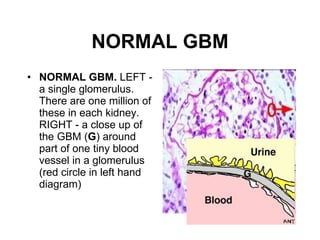
NORMAL GBM NORMAL GBM.  LEFT - a single glomerulus. There are one million of these in each kidney. RIGHT - a close up of the GBM ( G ) around part of one tiny blood vessel in a glomerulus (red circle in left hand diagram)
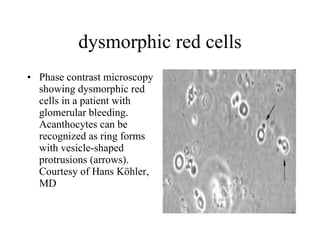
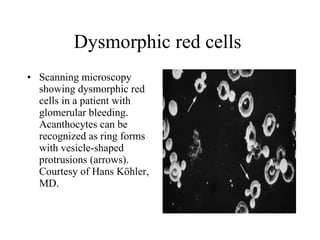
dysmorphic red cells Phase contrast microscopy showing dysmorphic red cells in a patient with glomerular bleeding. Acanthocytes can be recognized as ring forms with vesicle-shaped protrusions (arrows). Courtesy of Hans Köhler, MD
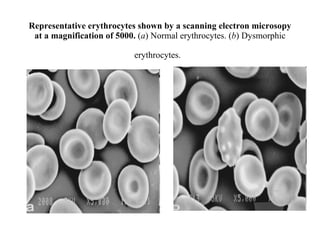
Representative erythrocytes shown by a scanning electron microsopy at a magnification of 5000.  ( a ) Normal erythrocytes. ( b ) Dysmorphic erythrocytes.
Dysmorphic red cells  Scanning microscopy showing dysmorphic red cells in a patient with glomerular bleeding. Acanthocytes can be recognized as ring forms with vesicle-shaped protrusions (arrows). Courtesy of Hans Köhler, MD.
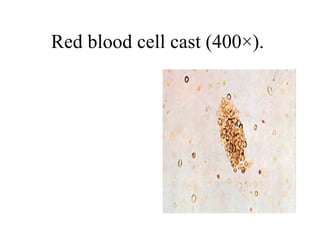
Red blood cell cast (400×).
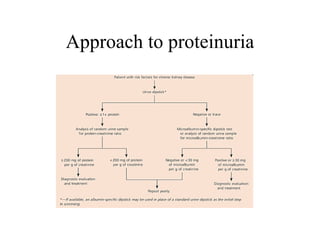
Approach to proteinuria
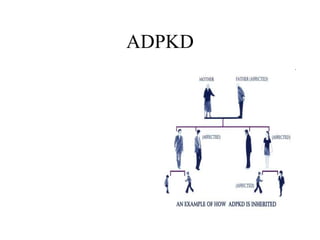
ADPKD
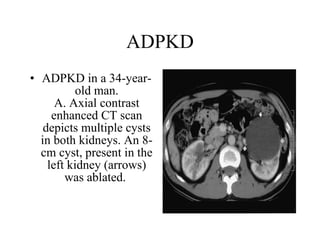
ADPKD ADPKD in a 34-year-old man. A. Axial contrast enhanced CT scan depicts multiple cysts in both kidneys. An 8-cm cyst, present in the left kidney (arrows) was ablated.
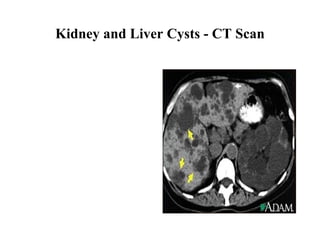
Kidney and Liver Cysts - CT Scan
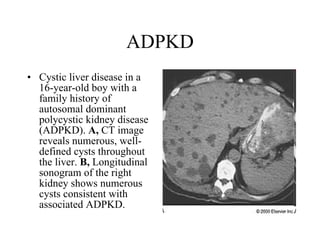
ADPKD Cystic liver disease in a 16-year-old boy with a family history of autosomal dominant polycystic kidney disease (ADPKD).  A,  CT image reveals numerous, well-defined cysts throughout the liver.  B,  Longitudinal sonogram of the right kidney shows numerous cysts consistent with associated ADPKD.
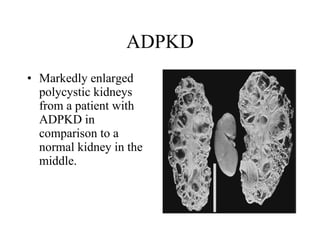
ADPKD Markedly enlarged polycystic kidneys from a patient with ADPKD in comparison to a normal kidney in the middle.
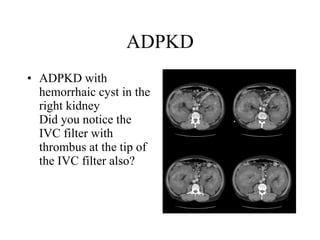
ADPKD ADPKD with hemorrhaic cyst in the right kidney Did you notice the IVC filter with thrombus at the tip of the IVC filter also?
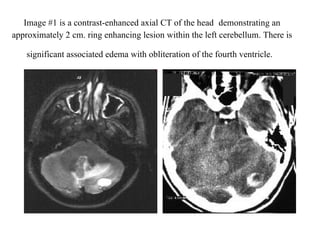
Image #1 is a contrast-enhanced axial CT of the head   demonstrating an approximately 2 cm. ring enhancing lesion within the left cerebellum. There is significant associated edema with obliteration of the fourth ventricle.
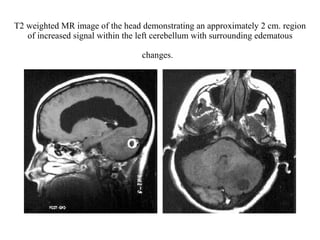
T2 weighted MR image of the head demonstrating an approximately 2 cm. region of increased signal within the left cerebellum with surrounding edematous changes.
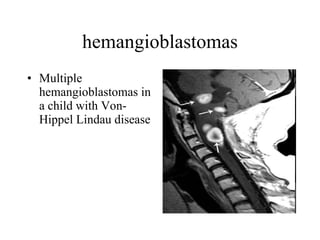
hemangioblastomas Multiple hemangioblastomas in a child with Von-Hippel Lindau disease
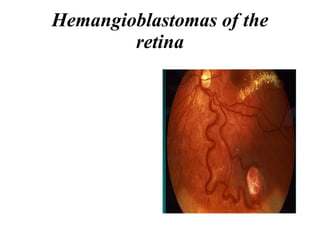
Hemangioblastomas of the retina
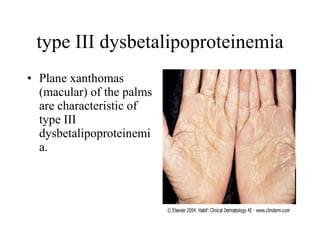
type III dysbetalipoproteinemia Plane xanthomas (macular) of the palms are characteristic of type III dysbetalipoproteinemia.
Type III hyperlipidemia (dysbetalipoproteinemia) A 46 year old man with hyperglycemia of a few weeks duration visited the Dermatology Outpatient Clinic with skin lesions on the palms, knees and buttocks Striate palmar xanthomata, tuberoeruptive xanthomata over the tuberosities of the elbows, and eruptive xanthomata on the buttocks. The hyperlipidemia became evident when an additional disturbance in lipid metabolism (ie glucose intolerance) was superimposed
Lipemia Retinalis
lipemia retinalis he second photo displays a  lipemia retinalis ; note the white aspect of retinal vessels
hyperlipidemia Physical examination findings associated with hyperlipidemia.  A,  Xanthelasma.  B,  Lipemia retinalis.  C,  Achilles tendon xanthomas. Note the marked thickening of the tendons.  D,  Tendon xanthomas.  E,  Tuberous xanthomas.  F,  Palmar xanthomas.  G,  Eruptive xanthomas.
membranous glomerulonephritis The arrows in both pictures are pointing out the thickness of the capillary (small blood vessel wall).  Notice how much thicker this wall is from a patient with MN.
membranous glomerulonephritis
Cryoglobulinemicmembranoproliferative glomerulonephritis This proteinuria in most of the cases is due to glomerulonephritis induced by hepatitis C, for example, these are cryoglobulinemic, membranoproliferative glomerulonephritis associated with HCV infection that were first published by Doctor Cruzado from Barcelona in the American Journal of Transplantation.
membranous glomerulonephritis Another lesion is possible membranous glomerulonephritis associated with hepatitis C virus infection in a similar way to patients without transplantation.
Membranous lupus nephritis  light micrograph of membranous lupus nephritis. The changes are similar to those in any form of membranous nephropathy with diffuse thickening of the glomerular capillary wall being the major abnormality (short arrows). Focal areas of mesangial expansion and hypercellularity (long arrows) are the only findings suggestive of an underlying disease such as lupus, although they can also be seen in idiopathic membranous nephropathy.
Normal glomerulus  Light micrograph of a normal glomerulus. There are only 1 or 2 cells per capillary tuft, the capillary lumens are open, the thickness of the glomerular capillary wall (long arrow) is similar to that of the tubular basement membranes (short arrow), and the mesangial cells and mesangial matrix are located in the central or stalk regions of the tuft (arrows).
Membranoproliferative lupus nephritis  Light micrograph showing a membranoproliferative pattern in lupus nephritis, characterized by areas of cellular proliferation (long arrows) and by thickening of the glomerular capillary wall (due to immune deposits) that may be prominent enough to form a &quot;wire-loop&quot; (short arrows). Although proliferative changes can be focal (affecting less than 50 percent of glomeruli), disease of this severity is usually diffuse.
Glomerular tuft segmental sclerosis Glomerular tuft segmental sclerosis in the superior half; segments in the inferior half display mesangium and capillary walls and lumens with conserved architecture. (Masson’s trichrome, X400).
Focal Segmental Glomerulosclerosis Focal segmental glomerulosclerosis or FSGS is a disease that causes urinary loss of protein and eventual scarring of the glomerular filters of the kidney. The terms focal and segmental refers to the pattern of damage in the kidney as seen under a microscope. Focal means that some of the glomeruli are scarred while others are normal. Segmental means that only a part of an individual glomerulus is damaged.
type I MPGN shows the characteristic histologic features of type I MPGN (and most cases of type II MPGN). There is thickening of capillary walls. This is usually global and diffuse but is occasionally at least focally and segmentally variable. There is also hypercellularity. Much of this hypercellularity is mesangial proliferation, and some of the capillary wall thickening is caused by mesangial interposition into the subendothelial zone of the capillary loops. This is the basis for the term mesangiocapillary glomerulonephritis.
Mesangiocapillary Glomerulonephritis This is mesangiocapillary glomerulonephritis (MCGN). Those that are idiopathic are divided into types I and II by pathologic findings. As seen here, the glomerulus has increased overall cellularity, mainly mesangial.  
Pure Red Cell  Aplasia
Langerhans cell histiocytosis Langerhans cell histiocytosis. Cutaneous abnormalities are present in about 80% of patients and are frequently the initial sign of the disease. The eruption may be extensive, involving the scalp, the face, the trunk, and the buttocks as well as the intertriginous areas. Lesions may consist of petechiae or yellow-brown papules topped with scale and crust. The papules may coalesce to form an erythematous, weeping eruption mimicking seborrheic dermatitis.
Langerhans' Cell Histiocytosis Erythematous plaques along with scaly, tiny, yellow-orange papules over the trunk.
Langerhans' Cell Histiocytosis Skull X-ray showing multiple sharply dermarcated lytic lesions in temporal and frontal bones.
Langerhans' Cell Histiocytosis Langerhans cell histiocytosis (LCH)  is an idiopathic disease characterized in its early stages by granulomatous nodules containing Langerhans histiocytes and eosinophils.  In its later stages, the granulomas are replaced by fibrosis and the formation of cysts. It is an uncommon condition.  The majority of patients are young or middle-aged adults presenting with nonspecific symptoms of cough and dyspnea. Up to 20% of patients present with pneumothorax and over 90% of patients are smokers. Most cysts appear round, but can also have bizarre shapes (bilobed or clover-leaf shaped). An upper lobe predominance in the size and number of cysts is common.
Langerhans' Cell Histiocytosis Osteolytic skull lesions lateral view
Langerhans Cell Histiocytosis
Pagets disease There is antero-posterior bowing of the tibia. The process involves grossly disordered architecture with loss of the usual cortico-medullary distinction. The process extends to the knee joint and the bone is larger and more disordered towards the knee. It appears more normal towards the ankle. The wide, dense lower margin of the abnormal area is flame-shaped. On the anterior cortex of the bone there are linear defects. Such increment fractures are also typical of this process. When such an appearance occurs, it implies microfracture and an attempt at healing. The process may be seen in metabolic diseases that affect bone mechanics in mature subjects. The implication is that the healing process has the potential to temporarily weaken the bone.
Pagets disease There is increased density of the proximal phalanx of the left middle finger, the left 2nd metacarpal and the base of the right 5th metacarpal. The bones no longer show the pattern of cortex and medulla that can be seen in the other bones. The affected bones are enlarged, particularly the phalanx. In all instances, the abnormal bone extends to a joint surface. The hands also show some loss of interphalangeal joint space and slight prominence of the tendon insertions
Aacromegaly hands The bones of the hand, particularly the digits, appear enlarged with prominent ligamentous insertions. The tufts of the terminal phalanges are enlarged and luxurious. The soft tissues are generally thickened, widening the metacarpo-phalangeal and interphalageal joint space
Paget's disease The view shows irregularly increased density of the thickened skull vault with scattered patches of increased bone density. The usual boundaries of the skull vault are lost. The diploie cannot be identified. The inner table margin remains well-defined. Vessel patterns in the vault are lost. There is some softening of the bones with some invagination of the skull base, as if the structure of the skull base were too soft to support the weight of the cranium and contents. Bone volumes are increased. The Hearing Aid is usually removed by the Radiographer.
Paget's disease.  Lateral skull radiograph shows a geographic, osteolytic lesion, which has been referred to as &quot;osteoporosis circumscripta&quot; (arrows), a finding that is said to be pathognomonic for Paget's disease.
Paget's disease.  There is a large, sharply demarcated low-density lesion in the  right parietal region  diagnostic for osteoporosis circumscripta ( arrows ).
Charcot arthropathy   Diffuse swelling is noted to the left foot in a typical, Charcot presentation.  The swelling is diffuse and non-painful.
Charcot arthropathy
Charcot arthropathy Diabetic patient with Charcot arthropathy characterized by collapse of the arch of the midfoot, which is replaced by a bony prominence (arrow). Several factors contribute to this painless condition, including small muscle wasting, decreased sensation, and maldistribution of weight bearing. Courtesy of David McCulloch, MD.
acromegaly The hand of a patient with acromegaly (right) next to that of an adult male of average size
scabies Scabies can infest your hand.
scabies Generalized, symmetric, linear red papules and pustules
content-scabies- mite.jpg
scabies This image displays erosions and burrows at the wrist in a patient with scabies.
scabies Look for tiny linear areas of redness and crusting between the fingers, representing the female mite's burrow.
Primary Syphilis
SECONDARY_SYPHILIS.
SECONDARY_SYPHILIS.
impetigo
impetigo
scarletfever_
scabies This image displays a fine, small, scaly track in the skin, called a burrow, caused by a scabies infection on the bottom of the feet.
Hypertensive retinopathy
papilledema The cardinal feature of malignant hypertension is papilledema, which appears as blurring and elevation of disk margins. This image also demonstrates a flame-shaped hemorrhage and dilated veins.
 
Toxoplasmosis
Hypertensive retinopathy Hypertensive retinopathy is traditionally divided into four grades. A,  Grade 1 shows early and minor changes in a young patient. Increased tortuosity of a retinal vessel and increased reflectiveness (silver wiring) of a retinal artery are seen at 1 o'clock in this view. Otherwise, the fundus is completely normal.  B,  Grade 2 also shows increased tortuosity and silver wiring (arrowheads). In addition, there is “nipping” of the venules at arteriovenous crossings (arrow).  C,  Grade 3 shows the same changes as grade 2 plus flame-shaped retinal hemorrhages and soft “cotton wool” exudates.  D,  In grade 4, there is swelling of the optic disc (papilledema), retinal edema is present, and hard exudates may collect around the fovea, producing a typical “macular star.”
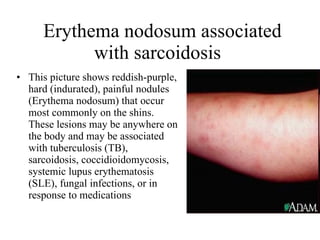
In this 15° view, note the arteriovenous crossing changes, presence of collateral vessels, and dilated capillary bed .
Hypertensive retinopathy Advanced hypertensive retinopathy. Lipid deposits in the macula (1), cotton-wool spots (2), small flame hemorrhages (3), vascular light reflex changes, venous tortuosity, and early disc edema are present. 
Hypertensive retinopathy Bilateral optic nerve edema.  Associated subretinal fluid, flame-shaped hemorrhages, and lipid exudation in a macular star configuration are evident in this patient with malignant hypertensive retinopathy.
Leuco-erythroblastic reaction Leuco-erythroblastic reaction can be the bone marrow response to any irritation, including infiltration by any malignancy (or histiocytosis for that matter), but special stains for histiocytes need to be done in the marrow to prove the diagnosis.

Picture Medicine

  • 1.
    Good pasture syndromeAP Chest x-ray, diffuse bilateral alveolar infiltrate
  • 2.
    Good pasture syndromeImmunoflorescence image of linear distribution of IgG on glomerular basement membrane
  • 3.
    Goodpasture syndrome Diffusebilateral predominately alveolar densities with a mild interstitial component
  • 4.
    Good pasture syndromeLung tissue biopsy consistent with acute lung injury characterized by interstitial and intra-alveolar organization, intra-alveolar fibrin deposition, squamous metaplasia of bronchiolar epithelium and rare fibrin thrombi associated with hemorrhage.
  • 5.
    Goodpasture's syndrome .(A) Computed tomographic (CT) image at the level of the aortic arch shows centrilobular ground-glass opacities throughout the upper lobes due to diffuse pulmonary hemorrhage. (B) CT image at the level of the right main pulmonary artery shows ground-glass opacities in the lower lobes. The patient was a 35-year-old woman.
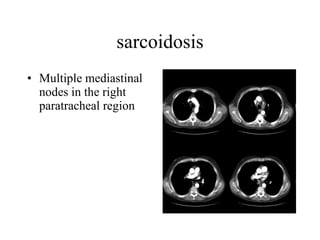
  • 6.
    Behçet's disease .Computed tomographic image at the level of the superior pulmonary veins demonstrates circumferential nonocclusive thrombus within an aneurysm of the right interlobar artery (arrows). The patient was a 48-year-old man.
  • 7.
    Churg-Strauss Syndrome .(A) Posteroanterior chest radiograph shows small bilateral lower lobe consolidation, linear opacities, and small pleural effusions. (B) Computed tomographic image at the level of the carina demonstrates smooth thickening of the interlobular septa (arrows). The patient was a 69-year-old woman with no clinical or echocardiographic evidence of left heart failure. The septal thickening was due to pulmonary involvement.
  • 8.
    Takayasu's arteritis .Computed tomographic image obtained following intravenous administration of contrast demonstrates thickening and enhancement of the wall of the aorta at the level of the aortic arch (arrows). The patient was a 32-year-old woman.
  • 9.
    von Hippel-Lindau diseaseAngiomatosis retinae (von Hippel-Lindau disease)
  • 10.
    von Hippel-Lindau diseaseHBs of the CNS Figure 1 MRI scan of two small solid cerebellar HBs (arrows) in a 52-year-old VHL patient. Figure 2 MRI scan of a typical cystic cerebellar HB in a 39-year-old non-VHL patient. Figure 3 Two solid brain stem HBs and a cystic HB in the cervical spine in a 32-year-old VHL patient. Figure 4 An HB in cervical spine in a 21-year-old VHL patient: MRI with contrast (a), superselective angiography before (b) and after (c) preoperative embolization. Figure 5 Two small spinal HBs in the thoracic region (a and b) in the same patient as in Figure 4, three years later. Figure 6 A large solid recurrent HB 11 years after the primary total removal in a 66-year-old non-VHL patient.
  • 11.
    von Hippel-Lindau diseaseHBs of the retina Figure 8 A typical mature HB with a draining arteriole and venule in a 40-year-old non-VHL patient: ophthalmoscopic view (a), and FA (b) before treatment; ophthalmoscopic view (c) and FA (d) at two months after cryocoagulation, showing narrowing of the feeders. Ophthalmoscopic view (e) at six months, showing shrinkage of the HB. Figure 9 A large HB with draining vessels and lipid exudates in a 65-year-old VHL patient. Figure 10 A juxtapapillary HB in a 25-year-old suspect VHL patient. Figure 11 Local exudative and tractional retinal detachment caused by an HB in a 26-year-old non-VHL patient.
  • 12.
    Copyright © 2007by the American Roentgen Ray Society Herwick, S. et al. Am. J. Roentgenol. 2006;187:W472-W480 --52-year-old man with von Hippel-Lindau disease and pancreatic mass diagnosed as serous cystadenoma on basis of findings at previous fine-needle aspiration
  • 13.
    Diabetic nephropathy Glomeruliwith Kimmelstiel-Wilson nodules. The smallest nodules can be more cellular and the greatest nodules tend to be acellular in the centre and surrounded by more cellular zones. Capillaries are seen around these nodules, sometimes adopting an aspect in garland (like in the three nodules indicated with arrows); in some cases we see microaneurisms around nodules. Notice the variability of size of the nodules
  • 14.
    Diabetic nephropathy Kimmelstiel-WilsonNodules highlight with PAS stain; glomerular nodules in amiloidosis and light chain deposits disease have a more weak stain with PAS (PAS, X400).
  • 15.
  • 16.
  • 17.
  • 18.
  • 19.
    Henoch-Schönlein purpura Lowerextremity rash. Rash characteristically involves the buttocks and lower extremities. Purpuric areas coalesce and become confluent with adjacent lesions.
  • 20.
    Henoch-Schönlein purpura Henoch-Schönleinpurpura. Henoch-Schöenlein purpura in WAS. A : Cutaneous purpura; B : Urine sediment red blood cell cast; C : Acute glomerular inflammation and crescent formation; D : Details of basal membrane (arrowheads), mesangial proliferation (thin arrows), and IgA deposits (asterisks).
  • 21.
    Acute onset ofhematuria and proteinuria associated with multiorgan involvement of the heart, liver, pancreas, kidneys, and skin in a patient with Henoch–Schönlein purpura CT scan of the abdomen and biopsy of skin and kidney. ( a ) Computer tomography scan of the abdomen shows significant thickening and edema of jejunum (arrow) (60 60 mm (300 300 DPI)). ( b ) The skin biopsy shows leukocytoclastic vasculitis. The dermal small vessels display endothelial cell swelling (arrowhead) and are infiltrated and surrounded by neutrophils, many of which show fragmentation of nuclei (karyorrhexis) (arrows) (hematoxylin–eosin (H&E), original magnification 600). ( c ) A glomerulus shows compression of the tuft by a segmental cellular crescent (arrow) admixed with fibrin (arrowhead). The underlying tuft exhibits mild segmental mesangial hypercellularity (H&E, original magnification 600). ( d ) On immunofluorescence, there is intense positivity for IgA in a global mesangial distribution (original magnification 400).
  • 22.
    Henoch-Shonlein purpura Anteriorischaemic optic neuropathy secondary to Henoch–Schönlein Purpura
  • 23.
  • 24.
    Aries PM et al. (2006) A case of destructive Wegener’s granulomatosis complicated by cytomegalovirus infection Nat Clin Pract Rheumatol 2: 511 – 515 doi:10.1038/ ncprheum0269 Figure 1 Wegener's granulomatosis with ear, nose and throat involvement and palatal destruction
  • 25.
    Wegener's granulomatosis Wegener'sgranulomatosis with ear, nose and throat involvement and palatal destruction
  • 26.
    Wegener's granulomatosis (a)Right-upper-lid oedema at presentation, and (b) resolution of oedema following treatment.
  • 27.
    Wegener's granulomatosis Activeperipheral ulcerative keratitis (PUK), showing corneal thinning, at the edge of the corneal patch graft (arrow).
  • 28.
    Horner's syndrome asmanifestation of Wegener's granulomatosis (A) right-sided Horner's syndrome and sixth nerve palsy (fixating with left eye); collapsed nasal bridge (printed with patient's permission). (B, C) CT and MRI showing retroclival mass lesion extending to the right cavernous sinus. (D) Follow-up MRI after treatment showing diminishing of the lesion in the cavernous sinus.
  • 29.
    Wegener's granulomatosis Wegener'sgranulomatosis. (A) Computed tomographic (CT) scan at the level of the upper lobes shows bilateral noncavitating nodules (arrows) in the apical regions of both lungs and a cavitating nodule in the left apex. (B) CT scan at the level of main stem bronchi shows multiple cavitating and noncavitating nodules mainly in the subpleural and peribronchovascular regions. The patient was a 50-year-old man
  • 30.
    Wegener's granulomatosis Computedtomographic scan image at the level of the right main pulmonary artery shows poorly defined bilateral ground glass opacities and a cavitating nodule (arrow) in the right middle lobe. The ground-glass opacities were due to diffuse pulmonary hemorrhage. The patient was a 53-year-old man.
  • 31.
    Wegener's granulomatosis Chest radiograph and CT scans demonstrate bilateral nodules and masses, most prominent at the bases
  • 32.
    Hemolytic-uremic syndrome .Blood film. Frequent echinocytes and occasional poikiloechinocytes with both distorted cell shape and more regular blunted projections (arrows). Paucity of platelets characteristic (thrombocytopenia). One megathrombocyte noted in center of field.
  • 33.
    HUS Schistocytesare fragmented red blood cells, and indicate mechanical damage causing hemolysis. The commonest cause is probably the presence of a mechanical heart valve, particularly when dysfunctional. Hemolytic Uremic Syndrome, Thrombotic Thrombocytopenic Purpura, and Disseminated Intravascular Coagulation are other causes.
  • 34.
  • 35.
  • 36.
    RETINITIS PIGMENTOSA RPis a retinal degeneration, often hereditary, which affects the photoreceptors (rods and cones) which are the light sensing receptors. Usually, but not always, the rod receptors are affected first causing progressive decrease vision during dark hours, that is ‘night blindness’. There is also loss of peripheral vision leading to tunnel vision. As research into the genetics evolve we are learning more about RP as a spectrum of a number of related retinal degenerations some of which are associated with other disabilities like hearing loss. Most cases of RP are chronic and progress very slowly over decades.
  • 37.
    Retinitis pigmentosa                                      <>                                      <>
  • 38.
  • 39.
    AGE RELATED MACULARDEGENERATION AMD is the leading cause of new cases of blindness in patients over 60 years of age. It is a degenerative disease of the macula which is the central part of the retina and affects the central vision. There are two forms of macular degeneration: Dry AMD, or nonexudative AMD, where yellow white deposits called drusen accumulate in the deep macula with or without atrophy or ‘balding’ of the layers of the retina/macula. This leads to interference in the function of the photoreceptors responsible for processing of light coming into the eye which in turn causes decrease in vision. This dry AMD can progress to a more severe Wet AMD or exudative type of macular degeneration where abnormal choroidal vessels leak fluid, or rupture and bleed causing severe and often permanent central visual loss.
  • 40.
    BRANCH RETINAL VEINOCCLUSION BRVO is a retinal vascular disease most often related to hypertension, elevated lipids/triglyceride/cholesterol, diabetes, carotid artery disease, cardiac disease, or hematologic (blood) disorders. In BRVO there is an occlusion of a branch retinal vein by a compressing, sclerotic retinal artery. This often leads to hemorrhage (bleeding), edema (swelling), or ischemia (poor circulation) of the retina and macula with resultant visual loss.
  • 41.
    CRVO CRVO isalso a retinal vascular disease but involves occlusion of the main central retinal vein. Vascular, hematologic, and cardiac disease may predispose individuals to develop CRVO which leads to leakage of blood and fluid into the retina. In many cases the resultant poor circulation (ischemia) can lead to abnormal blood vessel formation in the iris (rubeosis) with painful increases in eye pressure (neovascular glaucoma).
  • 42.
    RETINAL HEMORRHAGE Bleedingor hemorrhage in the retina occurs when the blood vessels in the retina leak or rupture. Common causes include: diabetes, high blood pressure, blood disorders, cardiovascular problems, trauma, or aging.
  • 43.
    Macular Edema Swelling in the macula (edema) results from fluid build up and thickening within the layers of retinal tissue. Tiny blood vessels which surround the macula are usually responsible for the leakage. Many disorders including diabetes, vein occlusions, uveitis (inflammation), and cataract surgery can cause macular edema. Depending on the cause there are different treatments which may include eye drops, steroid injections, laser treatment, or if vitreoretinal tractional is present vitreous surger
  • 44.
  • 45.
  • 46.
  • 47.
    coal workers pneumoconiosisThis picture shows complicated coal workers pneumoconiosis. There are diffuse, massive light areas that run together in the upper and middle parts of both lungs. These are superimposed on a background of small and poorly distinguishable light areas that are diffuse and located in both lungs. Diseases which may explain these X-ray findings include, but are not limited to: complicated coal workers pneumoconiosis (CWP), silico-tuberculosis, and metastatic lung cancer.
  • 48.
    coal workers pneumoconiosisThis picture shows complicated coal workers pneumoconiosis. There are diffuse, massive light areas that run together in the upper and middle parts of both lungs. These are superimposed on a background of small and poorly distinguishable light areas that are diffuse and located in both lungs. Diseases which may explain these X-ray findings include, but are not limited to: complicated coal workers pneumoconiosis (CWP), silico-tuberculosis, and metastatic lung cancer
  • 49.
    Silicosis The first PA film demonstrates miliary small well defined nodles
  • 50.
    Silicosis This chestradiograph demonstrates so many silicotic nodules that they have become confluent areas of silicotic nodules that have resulted in severe restrictive lung disease
  • 51.
    Rheumatoid lung Rheumatoidnodules in the lung. Chest radiograph demonstrates discrete rheumatoid nodules in both right and left lower lobes
  • 52.
    Rheumatoid lung necrobioticrheumatoid nodules in the right lung and pneumothorax of the left; thorax drain ‘in situ
  • 53.
    Rheumatoid lung subpleuralnecrobiotic nodule in the left lung and pneumothorax; thorax drain ‘in situ
  • 54.
    Electrical alternans ThisEKG is characterized by low voltage and electrical alternans. The QRS axis alternates between beats. In this example it is best seen in the chest leads where the QRS points in different directions!
  • 55.
  • 56.
    Accelerated Idioventricular RhythmThis EKG shows a slow wide complex tachycardia with intermittent narrow complex beats. The 5 th and 10 th beats are sinus rhythm and close examination of these beats will give you a clue to the cause of the wide complex rhythm. In Leads II and III you can appreciate ST elevation indicating an acute current of injury due to a myocardial infarction. The wide complex beats therefore represent an Accelerated Idioventricular Rhythm or AIVR which is usually seen following reperfusion after an acute infarct. Accelerated Idioventricular Rhythms are ectopic ventricular rhythms at rates between 40 bpm and 100 to 120 bpm. The ventricular origin of this rhythm can be demonstrated by the usual EKG criteria which include AV dissociation, fusion, and capture complexes. In this EKG the 4 th beat represents a fusion complex and the 5 th beath represents a capture beat proving that these beats are ventricular in origin. The incidence of Accelerated Idioventricular Rhythms following acute MI is reported to be between 8 and 36 percent. This rhythm can also be seen in patients with primarily myocardial disease, hypertensive, rheumatic, and congenital heart disease. It can also be caused by digoxin
  • 57.
  • 58.
    torsades de pointesThis ECG is a classic example of torsades de pointes, which is French for &quot;twisting of the points.&quot; Torsades is a form of ventricular tachycardia that can most often be due to medications. The QRS complexes during this rhythm tend to show a series of  &quot;points up&quot; followed by &quot;points down&quot; often with a narrow waist between. Recognition and reporting of this arrhythmia in association with terfenadine, astemizole (Hismanal), cisapride (Propulsid), grepafloxacin (Raxar), and mibefradil (Posicor) ultimately led to the removal of these medications from the market .
  • 59.
    Facies mitralis   Facies mitralis is associated with prominent livid colour of the cheeks and acral cyanosis in the face (mitral stenosis)
  • 60.
    Malar fllush Itis commonly seen in children with high fever, polycythaemia and severe mitral stenosis. Malar fllush with high fever is often seen in typhoid, pneumonia and pyelonephritis.
  • 61.
  • 62.
    Right ventricular hypertrophy(RVH) Note the qR pattern in the right precordial leads. This suggests right ventricular pressures greater than left ventricular pressures. The persistent S waves in lateral precordial leads and the right axis deviation are other findings in RVH.
  • 63.
    Right Ventricular MyocardialInfarction This EKG shows an Acute Inferior Myocardial Infarction which is often associated with a Right Ventricular Myocardial Infarction . If there is ST elevation in V1 and V2, the RV infarction should be considered.
  • 64.
    Acute right ventricularinfarction Acute right ventricular infarction with acute inferior wall infarction. Note the ST elevation in the right precordial leads, as well as in leads II, III, and aVF, with reciprocal change in I and aVL. ST elevation in lead III, greater than in lead II, and right precordial ST elevation are consistent with proximal to middle occlusion of the right coronary artery. The combination of ST elevation in conventional lead V 1 (lead V 2 R here) and ST depression in lead V 2 (lead V 1 R here) has also been reported with acute right ventricular ischemia or infarction.
  • 65.
  • 66.
  • 67.
    Acute posterior myocardialinfarction Acute posterior myocardial infarction (hyperacute) the mirror image of acute injury in leads V1 - 3 (fully evolved) tall R wave, tall upright T wave in leads V1 -3 usually associated with inferior and/or lateral wall MI
  • 68.
    Acute pericarditis: Stage1 ECG J points, except aVR and V1, are elevated. T waves are essentially normal. PR segments, except aVR and V1, are depressed. PR deviations are commonly absent in one limb lead (here, aVL).
  • 69.
    ACUTE PERICARDITIS 1.&quot;Current of Injury&quot; pattern: thought to be due to pressure and superficial inflammation of the pericardium 2. PR segment changes: PR segment depression (82% of patients) Differentiation from MI: ST segment elevation is typically less pronounced (equal to or less than0.05mV) and the ventricular surface area is greater (more leads involved)
  • 70.
    PERICARDITIS Note thediffuse ST elevations and PR depressions. The PR depressions are most evidenton this EKG in II and aVF. 
 Pericarditis typically demonstrates PR depressions on EKG and ST elevations globally.
  • 71.
    echocardiography There aretwo major types of echocardiography: M-mode (below left) and two-dimensional (below right) (Fig. 2, [3])
  • 72.
    echocardiography In theM-mode a single beam of ultrasound is used (Fig. 3, [3]) The reflections of the signal are recorded and displayed as monochronic dots. The location is proportional to the distance from the reflective region, and the intensity contains the information about acoustic impedance of the region. The M-mode has excellent axial resolution, but it carries essentially one-dimensional information. The two-dimensional echocardiograph typically uses a multielement transducer, which generates a single ultrasonic beam with changing direction. This technique allows one to create a two-dimensional image, which has good lateral resolution but lacks accuracy in the axial dimension.
  • 73.
    echocrdiography Examples oftwo-dimensional still frames obtained from hand-held echocardiographic examinations of four distinct patients. (A) Parasternal long axis view obtained from a patient admitted for septic shock secondary to a severe aortic endocarditis (arrows indicate vegetations) associated with a massive regurgitation and dilated left ventricle. (B) Parasternal short axis view obtained from a patient with an acute respiratory distress syndrome and associated cor pulmonale. The right ventricle was markedly enlarged and the ventricular septum bulged towards the left ventricular cavity at end systole, due to severe pulmonary hypertension (arrow). (C) Apical four-chamber view obtained from a ventilated patient with refractory hypoxemia. The contrast study (intravenous injection of saline microbubbles) revealed a large interatrial right-to-left shunt through a patent foramen ovale, which participated to persistent hypoxemia: left cardiac cavities were filled up by the microbubbles within two cardiac cycles. (D) Subcostal view obtained from a patient presenting with shock and pulsus paradoxus. A mild pericardial effusion responsible for prolonged right atrial collapse during the cardiac cycle (arrow) was consistent with a tamponade, and the patient underwent successful pericardotomy. LV, left ventricle; RV, right ventricle; LA, left atrium; RA, right atrium; Ao, ascending aorta.
  • 74.
    Tricuspid regugitation ColourDoppler echocardiogram in apical four chamber view showing tricuspid regurgitation (blue TR jet) RA: right atrium; LA: left atrium; RV: right ventricle; LV: left ventricle
  • 75.
    aortic regurgitation Dopplerechocardiogram showing aortic regurgitation (upward tracing in left panel) and Colour Doppler echocardiogram showing aortic regurgitation (multicoloured mosaic jet seen in left ventricle marked AR)
  • 76.
  • 77.
    Pericardial effusion alarge circumferential pericardial effusion compressing the heart is visualized by transthoracic echocardiography in a patient with cardiac tamponade.
  • 78.
    Intravascular ultrasond intravascularultrasound imaging and determination of atheroma area before and after lipid-lowering therapy.
  • 79.
    Mitral Valve M-modeAnalysis Mitral Valve M-mode Analysis Anterior leaflet with E/A appearance of diastology Decreased EF slope in MS Scalloping of leaflet tip in end systole in prolapse
  • 80.
    Aortic Valve M-modeAnalysis During systole do the aortic valve leaflets oppose the aorta? Are the leaflets thick and calcified (bright)? Possible to have normal appearance on m-mode if non-calcific Are leaflets open throughout systole - HOCM, low-output state
  • 81.
    Ventricular M-mode VentricularWall Thickness Ventricular Chamber Size Intraventricular Masses
  • 82.
    Mitral Valve Prolapse M Mode in Mitral Valve Prolapse Systolic bowing of the posterior mitral valve leaflet
  • 83.
    M Mode in Hypertrophic Cardiomyopathy M Mode in Hypertrophic Cardiomyopathy Septal hypertrophy Systolic anterior motion (SAM) of the anterior mitral valve leaflet Mid-systolic (premature) closure of the aortic valve due to outflow track obstruction
  • 84.
    M Mode in Mitral Stenosis M Mode in Mitral Stenosis Leaflet tips bright (calcified) and thickened E/F slope decreased
  • 85.
    M Mode AorticRegurgitation Increased duration between E and A peaks Fluttering of the anterior mitral valve leaflet due to AI jet turbulence Clinical setting to decide mechanism
  • 86.
    Left Atrial Myxoma Left Atrial Myxoma Bright hyperdensity in mitral orifice throughout cardiac cycle Functional MS
  • 87.
    M Mode in Tamponade Diastolic collapse of the right ventricle
  • 88.
  • 89.
  • 90.
  • 91.
    left atrial myxomaTransesophageal image demonstrating the typical pedunculated attachment to the interatrial septum of a left atrial myxoma.
  • 92.
    left atrial myxoma. Transthoracic apical view of a left atrial myxoma.
  • 93.
    left atrial myxomaBiplane transesophageal view showing simultaneous transverse and longitudinal planes of a left atrial myxoma. The stalk is visible in the longitudinal plane.
  • 94.
    Long QT Syndrome This EKG shows a prolongation of the QT interval with a normal T wave, seen in Congenital Long QT Syndrome Current data suggests a confidant diagnosis of LQTS can be made with a QTc of > 470 msec in males and > 480 msec in females in the
  • 95.
    Long QT Syndrome The QT interval in this tracing is very long, measuring 640 m/sec. This long QT interval is different from others in that it is due to a prolonged ST segment with delayed onset of the T waves. It reflects (choose 1 from below):
  • 96.
    Dextrocardia This EKGshows marked right axis deviation and loss of voltage across the precordium. There are also inverted p waves in leads I and aVL. The differential for inverted p waves in lead I and aVL is Dextrocardia or Reversed Arm Leads. Since there is loss of voltage across the precordium this is Dextrocardia .
  • 97.
    Brugada syndrome Characterizedby a coved-type ST-segment elevation in the right precordial leads
  • 98.
    TEE in postheticvalve endocarditis The transesophageal echocardiogram shows multiple hazy echos on the prosthetic mitral valve compatible with vegetations from endocarditis.
  • 99.
    transesophageal echocardiogram Bicuspidaortic valve with vegetation as seen on transesophageal echocardiogram, short-axis view
  • 100.
    Aortic dissection Long-axisview of transthoracic echocardiography showing an intimal flap (arrow) in aortic root. AOA: Ascending aorta; AI: Left atrium; VI: Left ventricle.
  • 101.
    aortic dissection Ascendingaortic dissection diagnosed by transoesophageal echocardiography in longitudinal plane . The arrows identified the intimal flap.b) Diagnostic errors
  • 102.
    aortic dissection  TEEshowing an ascending aortic dissection. Note the aortic dissection flap ( leftarrow ) and the bicuspid aortic valve ( center and right arrows ).
  • 103.
    Pulmonary embolism SpiralCT scan showed a filling defect in the main pulmonary artery and first branches consistent with PE (Fig 1
  • 104.
    intracardiac thrombus Two-dimensionalDoppler echocardiogram showing intracardiac thrombus identified crossing the tricuspid valve and involving both the right atrium and right ventricle.
  • 105.
    pheochromocytoma. Theselected images shown above demonstrate a large right adrenal mass. There are focal areas of decreased attenuation within the mass. No additional lesions were seen
  • 106.
    pheochromocytoma A symptomaticpatient with pheochromocytoma and islet cell tumor of the pancreas. A small right pheochromocytoma with a necrotic center (P) is seen. In addition, an intensely enhancing mass is present in the neck of the pancreas (I). Two small pancreatic cysts are also seen but the bulk of the pancreas is spared. Pancreatic islet cell tumors are associated with pheochromocytomas and are generally not accompanied by cystic pancreatic disease.
  • 107.
    PSEUDOHYPOPARATHYROIDISM bilateral shorteningof first, second and fourth fingers
  • 108.
    Albright Hereditary Osteodystrophy(AHO). Features of Albright Hereditary Osteodystrophy (AHO). [A] Young woman with short stature (~ 3rd centile), disproportionate shortening of the limbs, generalized obesity, and round, flattened face. [B] Radiograph of the hand showing the shortened 4th and 5th metacarpals. [C] Fist with the characteristic 'dimples' over the 3rd, 4th, and 5th digits replacing the knuckles formed by the distal head of normally sized metacarpal bones (Archibald sign). [D] Brachydactyly of the hand, with the short 4th and 5th digits, the greatly foreshortened terminal 1st digit, and very short, wide thumbnail (potter's thumb).
  • 109.
    Klinefelter Syndrome (47XXY Syndrome; KS)
  • 110.
    47,XXY Klinefelter's syndrome47,XXY Klinefelter's syndrome in 17-year-old identical twins. At age 15, gynecomastia was noted. The twins had a eunuchoid habitus and poorly developed male secondary sexual characteristics. Both were 187 cm in height; arm spans were 187 cm and 189.5 cm; the voices were high-pitched; the testes measured 1.8 × 1.5 cm; penis length was 7.5 cm. Gynecomastia and signs of androgen deficiency were more evident in the twin on the left. Urinary gonadotropins, greater than 50 mU/24 hours. The testes exhibited extensive tubular fibrosis, small dysgenetic tubules, and clumping or pseudoadenomatous formation of Leydig cells; germ cells were rare. The microscopic appearance was typical of seminiferous tubule dysgenesis.
  • 111.
    Klinefelter’s syndrome Thistesticular biopsy is from an adult male with history of normal semen volume and severe oligospermia. He had small firm testes and body habitus suggestive of Klinefelter’s syndrome. The biopsy shows small hyalinized seminiferous tubules and pseudo-adenomatous clusters of leydig cells.
  • 112.
    Turner's syndrome Thearrows point to some of the classical features of Turner's syndrome: ( A ) short webbed neck; ( B ) cubitus valgus; ( C ) lymphedema.
  • 113.
    Turner's syndrome Alow hairline at the back of the neck is one of several characteristics of Turner syndrome
  • 114.
  • 115.
  • 116.
  • 117.
    Acromegaly Acromegaly isa rare disorder in which the anterior pituitary produces too much growth hormone. This causes an increased growth in bone and soft tissue
  • 118.
    Acromegaly Acromegaly resultsfrom excessive secretion of growth hormone and causes enlargement of many parts of the body, including the hands (left), fingers, toes, ears, nose, and jaw.
  • 119.
  • 120.
    The Goals ofAcromegaly Treatment
  • 121.
    acromegaly A patientwith acromegaly
  • 122.
    Graves' Disease Dermatopathy(thickeningof the skin) in Graves' Disease
  • 123.
    Graves' Disease Onycholysisin Graves' Disease
  • 124.
    Physiologic Insulin SecretionPhysiologic Insulin Secretion: 24-Hour Profile
  • 125.
  • 126.
    Non-Proliferative Diabetic Retinopathy Moderate Non-Proliferative Diabetic Retinopathy
  • 127.
  • 128.
  • 129.
    The Retina showingDiabetic Maculopathy
  • 130.
    Laser Treatment TheRetina after Laser Treatment
  • 131.
  • 132.
    nonproliferative retinopathy Microaneurysmsand intraretinal hemorrhages in nonproliferative retinopathy. (
  • 133.
    nonproliferative retinopathy Microaneurysms:hyperfluorescent dots in early phase of fluorescein angiogram
  • 134.
    nonproliferative retinopathy wominutes later, fluorescein leakage from the microaneurysms gives them a hazy appearance.
  • 135.
    Pre-proliferative retinopathy Clinicallysignificant macular edema with hard exudates in the fovea. Cotton-wool spots are present near the major retinal vessels (arrows)
  • 136.
    PROLIFERATIVE DIABETIC RETINOPATHY(PDR) Active neovascularization in PDR. Fibrovascular proliferation overlies the optic disc (white arrow). Loops of new vessels are especially prominent superior to the disc and extending into the macula, where leakage of fluid has led to deposition of a ring of hard exudate around the neovascular net (black arrow)
  • 137.
    Rubeosis iridis Rubeosisiridis in a case of PDR. Abnormal new vessels are growing along the surface of the iris
  • 138.
    Marked fibrosis Markedfibrosis with traction exerted on the retina outside the macula (arrows). The macula does not appear to be elevated.
  • 139.
    LASER PHOTOCOAGULATION FORPDR Focal laser scars in the macula following treatment for macular edema (arrow). Edema has resolved.
  • 140.
    Photocoagulation in PDRScatter photocoagulation scars in an eye with active PDR. Note that all scatter laser scars are located outside the macula.
  • 141.
  • 142.
    sarcoisosis These aresarcoid lesions on the face. These lesions often appear in scars, as is seen in this photograph.
  • 143.
    Diagram of thestages of Sarcoidosis
  • 144.
    sarcoidosis Punched-out choroidoretinallesions in a patient with sarcoidosis.
  • 145.
  • 146.
      Erythema nodosumassociated with sarcoidosis This picture shows reddish-purple, hard (indurated), painful nodules (Erythema nodosum) that occur most commonly on the shins. These lesions may be anywhere on the body and may be associated with tuberculosis (TB), sarcoidosis, coccidioidomycosis, systemic lupus erythematosis (SLE), fungal infections, or in response to medications
  • 147.
    sarcoidosis Multiple mediastinalnodes in the right paratracheal region
  • 148.
    sarcoidosis Numerous uniformshaped small lung nodules, deistributed predominantly in the upper and mid zones in the perihilar region with preivascular distribution. No fissural beeding
  • 149.
  • 150.
    Normal optic nerve Normal optic nerve (central pinkish disk)
  • 151.
    Grade I papilledemaAn optic nerve with mild swelling (papilledema). Note the pathologic&quot;C&quot;-shaped halo of edema surrounding the optic disk (Grade I papilledema)
  • 152.
    Grade I papilledemaGrade I papilledema, Another example of an optic nerve with mild papilledema.
  • 153.
    Grade II papilledemaGrade II papilledema. The halo of edema now surrounds the optic disc.
  • 154.
    Grade IV papillededemaGrade IV papillededema. With more severe swelling in addition to a circumferential halo, the edema covers major blood vessels as they leave the optic disk (grade III) and vessels on the disk (grade IV). A subretinal hemorrhage is present at 7 o'clock.
  • 155.
    hyperparathyroidism Subperiosteal resorption is virtually pathognomonic for hyperparathyroidism and is typically seen at the radial aspect of the middle phalanx of the index and middle fingers
  • 156.
    hyperparathyroidism Compare the finger ona patient with hyperparathyroidism, to his normal appearing finger after treatment  
  • 157.
    Phalangeal tuff resorption/acroosteolysis Figure 4: Acroosteolysis (also subperiosteal resorption)
  • 158.
    Salt and pepperskull normal Abnormal
  • 159.
    Infective endocarditis Inthe second image, the lesions of the patient's palm were painless (Janeway lesions). A way to differentiate Osler's node from Janeway lesions is that Osler's node is pain, Janeway lesion is painless.
  • 160.
    Infective endocarditis Anotherpicture of Janeway lesion
  • 161.
    Infective endocarditis Oslernode on ring finger as well as more subtle nodes seen on the little and middle finger.
  • 162.
    Infective endocarditis Oslernodes on index finger. Note also the tiny splinter haemorrhages on fingernail also seen in endocarditis
  • 163.
    Infective endocarditis Roth'sspot - white centered hemorrhages
  • 164.
    Infective endocarditis Roth's spots. Multiple white-centered hemorrhages in a man with recurrent subacute bacterial endocarditis. White-centered hemorrhages are also seen with leukemia and diabetes. The small white scars are probably the residua of previous episodes.
  • 165.
    Measles, Koplik spotsKoplik spots are seen with measles. They are small, white spots (often on a reddened background) that occur on the inside of the cheeks early in the course of measles.
  • 166.
    Measles rash Acharacteristic red, blotchy rash appears around the third day of illness, beginning on the face and becoming generalized.  The skin rash of measles is an allergic response to virus products in the body rather than direct viral multiplication in skin cells
  • 167.
    Measles rash Koplickspots are a characteristic of measles used in diagnosis. They appear opposite the molars as red spots with blue white centers.
  • 168.
    measles The characteristicrash seen in kids with measles
  • 169.
  • 170.
    diaper rash Pictureof a baby with a yeast diaper rash:
  • 171.
    Pityriasis rosea Pityriasisrosea is often confused with ringworm because it typically begins with a large scaly herald patch that actually does look like a ringworm.
  • 172.
    cold sores Unfortunately,some children get cold sores repeatedly, often on the same spot on their face or lip, such as this child with a cold sore on her lip
  • 173.
  • 174.
  • 175.
  • 176.
  • 177.
  • 178.
  • 179.
    Hairy leukoplakia Hairyleukoplakia involving the lateral border of the tongue in a patient with AIDS
  • 180.
    Hairy leukoplakia Hairyleukoplakia — Hairy leukoplakia is one of the most common HIV-associated oral signs. It is a white, corrugated, or &quot;hairy&quot; coating on the lateral borders of the tongue. Unlike thrush, it is not easily scraped off. It is painless, but patients occasionally complain of its appearance and texture. It is caused by the body's reaction to the Epstein-Barr virus (responsible for mononucleosis), and can be eliminated with a viral antibiotic called Acyclovir.
  • 181.
    Intertrigo Intertrigo inthe inframammary fold infected by Candida. Note satellite papules and pustules.
  • 182.
    Lyme disease Withwarmer winters, deer ticks can reproduce more frequently and transmit the bacteria that cause Lyme disease. A lack of natural predators that normally hunt deer, such as wolves and mountain lions, also allows deer to flourish.
  • 183.
  • 184.
  • 185.
  • 186.
    Typhoid rose spotsTyphoid rose spots. The abdomen is the best place to look for these lesions, which appear at the end of the first week and are usually quite sparse. They usually take the form of pink macules that blanch when the skin is stretched, but they may take on a more purpuric, nonblanching character, as in this patient.
  • 187.
    Rose spots Rosespots are reported in 5-30% of cases but are easily missed in dark-skinned patients . Rose spots, described as blanching 2 to 4 mm diameter papules classically found on the upper abdomen and lower chest, have been reported to occur in 30 to 50% of patients
  • 188.
  • 189.
  • 190.
  • 191.
    CMV retinitis Although the eyes will always look and feel normal, a thorough dilated retinal examination is needed to diagnose the retinal infection. Diagnosis is based on the clinical findings of hemorrhagic retinal inflammation often following a vascular distribution. If left untreated, the infection will spread throughout the retina and cause blindness.
  • 192.
  • 193.
  • 194.
    Herpes simplex encephalitis. (a) T 2 weighted axial image shows abnormal increased signal intensities in both temporal lobes involving gray and white matter. These are hypointense on (b) T 1 weighted image and mildly hyperintense on (c) T 1 weighted magnetization transfer (MT) image. No abnormal meninges are seen on pre-contrast images. (d) Post-contrast T 1 weighted MT image shows abnormal meningeal enhancement in both hemispheres along with left ependymal enhancement.
  • 195.
    Gilden DH et al. (2007) Herpesvirus infections of the nervous system Nat Clin Pract Neurol 3: 82 – 94 doi:10.1038/ncpneuro0401 Figure 1 Typical changes seen on CT and MRI in patients with herpesvirus infections
  • 196.
    subhyaloid haemorrhage insubarachnoid hemorrhage Fundus photograph of the left eye showing well-circumscribed sub-internal limiting membrane haemorrhages, including a large premacular haemorrhage.
  • 197.
  • 198.
  • 199.
    toxoplasmosis MRI ofAIDS patient with toxoplasmosis. T1 weighted image obtained after the administration of intravenous contrast demonstrates numerous enhancing lesions throughout the brain.
  • 200.
    Progressive Multifocal Leukoencephalopathy MRI of brain. Hyperintense signal abnormalities on T2-weighted image are seen in posterior right and left hemisphere white matter in a patient with PML.
  • 201.
    progressive multifocal leukoencephalopathyMRI of progressive multifocal leukoencephalopathy. T2 weighted MRI at the level of the lateral ventricles reveals a subcortical, hyperintense signal abnormality in the right hemisphere. (As per imaging convention, the right hemisphere appears on the left side of the image). The lesion appears restricted to the white matter and does not exhibit mass effect. The lesion did not enhance with contrast administration. The appearance is most consistent with progressive multifocal leukoencephalopathy.
  • 202.
    progressive multifocal leucoencephalopathy(a) Axial T 2 weighted and (b) coronal T 1 weighted images in a patient with progressive multifocal leucoencephalopathy. There is high T2 and low T1 signal white matter abnormality in the right frontal region that extends along the gyral core, with preservation of the grey matter. (c) Coronal T 1 weighted image of the same patient shows the low T1 signal to extend along the white matter tracts, through theright internal capsule to the cerebral peduncle. Incidental note is made of agenesis of the corpus callosum.
  • 203.
    Inflammatory PML  Inflammatory PML. ( A ) Large demyelinating lesion in the right fronto-parietal lobe ( upper row, left ) revealed by FLAIR imaging ( B ) no gadolinium enhancement seen in T1-weighted imaging. ( C ) Enlarged lesion after 5 weeks of treatment with HAART revealed by FLAIR and ( D ) showing punctuate gadolinium enhancement ( arrow ). ( From Tulius M, Pacheco MCN, Vaz B. Inflammatory progressive multifocal leukoencephalopathy after antiretroviral treatment. AIDS 2006;20(3):469–71; with permission.)
  • 204.
  • 205.
  • 206.
  • 207.
    hyperparathyroidism Brown tumorin the phalanx (also subperiosteal resorption, tuft resorption, and osteopenia)
  • 208.
    Lipoatrophy in HIVthe loss of fat (or lipoatrophy) condition, particularly when it affects the face, producing sunken cheeks or heavily ageing folds, often “outing”
  • 209.
    a centripetal fataccumulation in HIV a centripetal fat accumulation, with enlargement of posterior cervical region (hump), lower portion of the face, malar and mandibular regions and intensive fat deposit in the dorsum
  • 210.
    facial lipoatrophy in HIV Marked facial lipoatrophy in a 45-yr-old female with well-controlled HIV infection and an 8-yr history of antiretroviral therapy. The loss of fat is most notable in malar area bilaterally, giving prominence to the nasolabial folds, with extension to buccal and temporal areas. The underlying facial musculature ( zygomaticus major ) and bony landmarks are visible through the skin
  • 211.
  • 212.
    Kaposi's Sarcoma Multipleoval, dark red, purple plaques present on chest and arms
  • 213.
    Kaposi's sarcoma Kaposi'ssarcoma was once a rare malignancy of the blood vessels but is now associated with AIDS. It is more frequently associated with AIDS in homosexual men than AIDS in IV drug users. The malignancy results most frequently in purplish to reddish-purple flat or grape-like lesions in the skin, gastrointestinal tract, and other organs.
  • 214.
  • 215.
    Molluscum contagiosum Molluscumcontagiosum is a benign, poxvirus infection that typically has a central depression.
  • 216.
    Molluscum contagiosum Molluscumcontagiosum is a benign, poxvirus infection that typically has a central depression.
  • 217.
    bacillary angiomatosis Bartonellahenselae has been recognized as the causative agent of bacillary angiomatosis in HIV-infected patients. This condition is characterized by a proliferation of blood vessels in the skin and internal organs. Skin lesions are nodular and red or purplish in color, and may eventually ulcerate and drain. Diagnosis is made by biopsy, and treatment consists of a prolonged course of an oral macrolide antibiotic such as erythromycin or azithromycin
  • 218.
    Seborrheic dermatitis inHIV Seborrhea and psoriasis are more common and sometimes resistant to therapy in HIV-infected patients. Seborrheic dermatitis typically involves the scalp, forehead, retroauricular area, moustache, beard, nipples, and perianal region. Diagnosis is made by clinical appearance. Treatment with topical steroids or antifungal agents is usually effective.
  • 219.
    KS lesions inHIV KS lesions of the hard palate may initially manifest as subtle red or purple macular lesions, but evolve over time into nodules. Mucosal disease is often seen in the context of cutaneous involvement.
  • 220.
    India ink preparationThis India ink preparation under high power shows a thick polysaccharide capsule surrounding the yeast, the organelles of which can be identified.
  • 221.
    progressive multifocal leukoencephalopathy(PML), MRI scan shows nonenhancing white matter lesions
  • 222.
    Bacillary angiomatosis Bacillaryangiomatosis There are elevated vascular papules of the glabrous skin. When incised, these lesions bleed profusely.
  • 223.
    pseudomembranous candidiasis Thecharacteristic appearance of pseudomembranous candidiasis (also known as thrush) is a creamy white exudative plaque (cottage-cheese-like) on the palate, tonsils, or buccal mucosa that can be removed with a tongue depressor, with bleeding.
  • 224.
    Erythematous candidiasis Erythematouscandidiasis appears as flat, red atrophic plaques also on the mucosal surfaces.
  • 225.
    Hypertrophic candidiasis The hypertrophic form often involves the lower surface of the tongue or the palate and buccal mucosa and is characterized by a non-scrapable raised plaque (very similar to oral hairy leukoplakia).
  • 226.
    Candida albicans (microscopy)
  • 227.
    Toxoplasmosis Figure2. Toxoplasmosis in a 44-year-old man with AIDS and a CD4 count of 91 presenting with several days of generalized weakness, malaise, fever, headaches, and new onset seizures. Serial studies are shown before and after antibiotic therapy (adapted in part from reference 7). (A-C) Initial scans, pre-treatment. Edematous lesions appear centrally hypodense on CT (A) and centrally isointense to hypointense on T1WI (B) and hypointense to markedly hyperintense on T2WI (C), exerting moderate to severe mass effect. Severe surrounding edema is noted which is much larger than the size of the lesions. On T2WI (C), a central and concentric hypointense core gives a &quot;target&quot; appearance to the lesions. A third subtle lesion is apparent on T2WI in the thalamus (C). Note the relatively poor sensitivity of CT vs. MRI for the lesions in the left hemisphere. After contrast administration on both CT (A) and MRI (B), avid ringlike and nodular enhancement is noted. (D) T2WI shows marked improvement in each of the lesions 2 weeks after the completion of anti-toxoplasmosis medical therapy.
  • 228.
    Primary CNS lymphomaPrimary CNS lymphoma in two patients with AIDS. Adapted from reference 7. A-B. 24 year-old man with AIDS and hemiparesis, headaches and visual symptoms. Postcontrast T1WI (A) FLAIR (B) and T2WI (Figure 4) show a solitary large ring-enhancing lesion with mild mass effect and moderate vasogenic edema. The hypointensity of the lesion on T2WI (Figure 4) is characteristic of lymphoma. Note that the mass effect and edema is less than expected given the size of the lesion, as is typical for primary brain lymphoma while much more edema and mass effect vs. lesion size is expected in toxoplasmosis (Figure 2). C-D. 30 year-old man with AIDS. Postcontrast T1WI (C) and T2WI (D) show left temporal lobe vasogenic edema, related to a temporal lobe mass lesion (not shown). There are also bilateral lesions in the caudate nuclei on T2WI (D), with periventricular and ependymal extension of enhancement on the right (C). The ependymal spread is characteristic of primary CNS lymphoma.
  • 229.
    Ring Enhancing Lesionsin a patient with AIDS See notes
  • 230.
    P. vivax Animmature trophozoite of P. vivax is shown at the top of the slide in its characteristic ring shape, while the mature trophozoites contain large ameboid cytoplasms with large chromatin and fine yellowish brown pigment.
  • 231.
    Plasmodium.falciparum Red Cellsare not enlarged. Rings appear fine and delicate and there may be several in one cell. Some rings may have two chromatin dots. Presence of marginal or applique forms. It is unusual to see developing forms in peripheral blood films. Gametocytes have a characteristic crescent shape appearance.  However, they do not usually appear in the blood for the first four weeks of infection. Maurer's dots may be present.
  • 232.
    Plasmodium vivax Diagnostic Points Red cells containing parasites are usually enlarged. Schuffner's dots are frequently present in the red cells as shown above. The mature ring forms tend to be large and coarse. Developing forms are frequently present.
  • 233.
  • 234.
  • 235.
    SCA Sagittal MRIof the brain of a 60-year-old man with gait ataxia and dysarthria due to SCA1, illustrating cerebellar atrophy ( arrows ).
  • 236.
    Acute Sub-Dural HematomaLeft Subdural hematoma (Before Operation) Left Subdural Hematoma (After Operation ) 
  • 237.
    subdural hematoma AxialCT images of the brain show a large isodense right-sided subdural hematoma ( short arrows ) extending from the high convexities to the low frontal lobe. It is producing extensive right to left midline shift with subfalcine ( arrow ) and right uncal ( arrow ) herniation. There is trapping of the ventricles and left temporal horn with acute ependymal cerebrospinal fluid seepage, predominantly in the left periatrial and occipital regions ( long arrow ).
  • 238.
    epidural hematoma Biconvex homogeneous epidural hematoma
  • 239.
  • 240.
    epidural hematoma. hisCT shows a right frontal epidural hematoma. There is the classic biconvex (lentiform or football) shaped appearance with the dura bulging inward.
  • 241.
    epidural hematoma. TheCT shows a right parietal epidural hematoma. The hematoma is biconvex or lens-shape in appearance. There is a midline shift to the left
  • 242.
    Charcot-Marie-Tooth disease Thefoot of a person with -CharcotMarie-Tooth. The lack of muscle, high arch, and hammer toes are signs of the genetic
  • 243.
    Charcot-Marie-Tooth Disease Themost pronounced finding is the 'stork leg deformity' that occurs as the peroneal muscles of the lower leg begin to atrophy (become weak)
  • 244.
    superior sagittal sinusthrombosis (SSST) Arrows indicate the abnormal findings. Note the normal homogeneous enhancement of the superior sagittal sinus in its anterior aspect (arrowhead on left image). Note the abnormal lack of enhancement of the posterior aspect of the superior sagittal sinus in the axial and coronal images (arrows). This lack of enhancement is referred to as the &quot;delta sign&quot; or &quot;empty delta sign&quot;.
  • 245.
    superior sagittal sinusthrombosis (SSST) Another patient with superior sagittal sinus thrombosis (SSST) compared with a normal control -- proton density MRI scans. Note the hyperintensity of the superior sagittal sinus (arrow), most likely due to extracellular methemoglobin in the subacute clot. The normal individual has a normal flow void (lack of signal) in the superior sagittal sinus. The clot was also hyperintense on T1- and
  • 246.
    superior sagittal sinusthrombosis Empty delta sign in a patient with superior sagittal sinus thrombosis. Transverse contrast-enhanced CT image reveals low-attenuating thrombus (arrow) within the superior sagittal sinus, surrounded by a triangular area of enhancement.
  • 247.
    superior sagittal sinusthrombosis. MR findings in a 21-year-old man with superior sagittal sinus thrombosis. A, MR venography shows poor visualization of the superior sagittal sinus ( arrow ). B, Brain MRI shows multifocal infarcts with hemorrhagic transformation.
  • 248.
    Transverse Sinus ThrombosisT1-weighted sagittal MRI shows high signal in the right transverse sinus (click image for arrows). There is also high signal on axial T2-weighted images, confirming a real abnormality (as opposed to entry-zone phenomenon).
  • 249.
    xanthomas Plane andtuberous xanthomas. Photo courtesy Dr. Lamberg
  • 250.
    Magnetic resonance imaging(MRI) of multiple sclerosis
  • 251.
    multiple sclerosis. MRIshowing multiple periventricular white matter lesions on T2 imaging, consistent with multiple sclerosis.
  • 252.
    multiple sclerosis. MSdiagnosis with advanced Open MR system, image courtesy of Siemens Medical Solutions ( http:// www.usa.siemens.com / ). T2 image on the left and Turbo-FLAIR image on the right
  • 253.
    Risus sardonicus Facial muscle contracture resulting in trismus and risus sardonicus Risus sardonicus is a highly characteristic, abnormal, sustained spasm of the facial muscles that is most often observed as a symptom of tetanus . The name of the condition derives from the appearance of raised eyebrows and an evil, open grin that it gives to its victim
  • 254.
    Opisthotonos Clostridium tetaniTruncal rigidity may lead to opisthotonos, which is the severe arching of the back during a spasm caused by the stronger extensor muscle group
  • 255.
    cerebral edema Diffusecerebral edema after closed-head injury in a 2-year-old boy. Unenhanced CT shows loss of gray matter/white matter discrimination, as well as small ventricles.
  • 256.
    cerebral edema [FigureID: F1] FIGURE 1. CT SCAN SHOWING DIFFUSE CEREBRAL EDEMA IN A YOUNG WOMAN WITH HYPERSENSITIVITY SYNDROME DUE TO MINOCYCLINE.
  • 257.
    cerebral edema ComputerizedTomography (CT) head showing diffuse cerebral edema with effacement of basal cisterns and generalized loss of gray-white differentiation
  • 258.
  • 259.
    Oculocutaneous albinism Oculocutaneousalbinism with abnormally long eyelashes
  • 260.
  • 261.
    Vitiligo Vitiligo ina typical location
  • 262.
    vitiligo Localised patchesof depigmented skin including some white hairs(indicates bad prognosis)
  • 263.
    Vitiligo Vitiligo lesionswith typical symmetry and sharp demarcation of the edges
  • 264.
    Vitiligo Vitiligo lesionswith typical symmetry and sharp demarcation of the edges
  • 265.
    Vitiligo Vitiligo isa condition which involves complete loss of melanin, the primary skin pigment. The cause of vitiligo is unknown but it appears to be an acquired condition and may appear at any age. The resulting lesions are white in comparison to the surrounding skin. Vitiligo may occur in the same areas on both sides of the face or it may be patchy. The typical vitiligo lesion is flat and depigmented, but maintains the normal skin texture.
  • 266.
    Eczema lichenified (diffuse thickening of epidermis)
  • 267.
  • 268.
    Discoid eczema Discoideczema: disc shaped, clearly demarcated eczematous patches to limbs and trunk
  • 269.
    Discoid eczema Discoideczema: disc shaped, clearly demarcated eczematous patches to limbs and trunk
  • 270.
    Eczema herpeticum Secondaryherpes simplex 1 infection is characterised by a sudden onset of grouped, small white or clear fluid filled vesicles, satellite or &quot;punch out&quot; lesions, pustules, and erosions. It is often tender, painful and itchy.
  • 271.
  • 272.
    Eczema Cool compresses(for immediate relief of itch)
  • 273.
    Eczema a wettowel applied over itchy, eczematous skin of the face and body. Moisturisers are applied after compressing.
  • 274.
    varicose eczemaThe redness of varicose eczema is usually seen below the knee and in particular over the medial malleolus (inner ankle bone). Swelling can occur, but erythema and dryness of the skin are the major signs to look for.
  • 275.
    Patch testing forlocalised eczema Patch testing for localised eczema for localised eczema
  • 276.
    Behçet's syndrome Painfulintroital ulcer of Behçet's syndrome
  • 277.
  • 278.
    Behçet's syndrome- Majoraphthous ulceration with severe scarring in patient with Behçet's syndrome
  • 279.
  • 280.
    Behçet's syndrome- Pathergytest Pathergy is a measure of the increased sensitivity of the skin which occurs in Behçet's syndrome. This often shows as a red spot appearing where there is a minor injury to the skin, such as a blood-test, pin-prick, insect-bite, sting or scratch.
  • 281.
    Behcet's Syndrome (Hypopyon) Typical ophthalmologic findings in Behcet's syndrome include anterior uveitis with hypopyon, retinal vasculitis, and optic neuritis.
  • 282.
    Behcet's Syndrome (OralAphthae) Systemic findings in Behcet's syndrome may include aphthous ulcers of the mouth.
  • 283.
    Behcet's Syndrome (GenitalAphthae) Systemic findings in Behcet's syndrome may include aphthous ulcers of the genitals.
  • 284.
    Behcet's Syndrome (ErythemaNodosum Systemic findings in Behcet's syndrome may include erythema nodosum.
  • 285.
    Polyarteritis Nodosa APA angiographic view of the right kidney demonstrates multiple intra-renal microaneurysms. Delayed images demonstrate residual contrast material within the aneurysms. The main renal artery is unremarkable.
  • 286.
    polyarteritis nodosa. Livedoracemosa (more commonly referred to as livedo reticularis). ( A ) Lacy pattern of discoloration over the lower extremities that does not blanch with pressure in a patient who has polyarteritis nodosa. ( B ) Livedo racemosa, “a tendril-like pattern reminiscent of forked lightning” [30].
  • 287.
    polyarteritis nodosa Celiacaxis arteriogram in a patient with polyarteritis nodosa and hepatitis B surface antigenemia. Multiple saccular and fusiform aneurysms, as well as arterial tapering and beading, are seen in the celiac artery and its branches, especially the hepatic artery.
  • 288.
  • 289.
  • 290.
    Kawasaki disease Red palms of the hands and the soles of the feet
  • 291.
    Kawasaki disease Changes in extremities (usually occurs one to two weeks after onset of the illness) : Reddening and rashes on palms and soles. Unexplained swelling of hands and feet peeling of the skin around fingernails and toenails Periungual desquamation on day 12 of illness in a three-year-old child with Kawasaki disease.
  • 292.
    Kawasaki disease Rash , often accentuated in the groin area
  • 293.
    Kawasaki disease Bloodshot,red eyes , without drainage or pus
  • 294.
    Kawasaki disease Rednessin the lips, mouth and throat: Reddening and cracking of the lips A characteristic reddening of the tongue, called strawberry tongue
  • 295.
    Kawasaki disease Swollenlymph nodes in the neck (more than 1.5 cm), usually just on one side
  • 296.
    Recurrent Kawasaki disease The 'strawberry' appearance of the tongue at presentation
  • 297.
    Kawasaki disease. Edema and erythema on day 6 of illness in a one and one-half­year-old girl with Kawasaki disease.
  • 298.
    Kawasaki Disease Strawberry Tongue in Kawasaki Disease
  • 299.
  • 300.
    AOSD The skineruption in the form of papular eruption arranged in reticulate pattern and distributed symmetrically on trunks back and legs
  • 301.
    AOSD X-ray demonstratingnon-erosive fusion of carpal bones in a pericapitate pattern, a distinctive feature of AOSD.
  • 302.
    Takayusu's Disease demonstratessmooth narrowing of the right subclavian and left common carotid arteries. The abdominal vessels appear unremarkable.
  • 303.
    Takayasu's arteritis. 50-year-oldwoman with Takayasu's arteritis (TA). Catheter angiography shows mild infrarenal abdominal aortic stenosis ( arrow ). Although atherosclerosis commonly affects infrarenal abdominal aorta, atherosclerosis usually produces abrupt caliber changes just beyond stenosis sites; the smooth tapered nature of this stenosis favors TA.
  • 304.
    Takayasu's arteritis. 5-year-oldwoman with Takayasu's arteritis. Oblique projection catheter angiogram shows segmental stenosis of origin of right upper lobe pulmonary artery ( single arrow ). O
  • 305.
    Takayasu's arteritis. 40-year-oldwoman with aneurysmal form of Takayasu's arteritis. Thoracic CT angiogram shows aneurysm of left subclavian artery ( arrow ) at origin of left vertebral artery.
  • 306.
    Perls staining Ironoverload in non tumoral liver (a), contrasting with less iron in the nodule (b) Perls staining.
  • 307.
  • 308.
    Porphyria cutanea tarda.  A) Blister, miliae, and hyperpigmented scars on the dorsum of the left hand of a patient with porphyria cutanea tarda. B) Lateral view of the same hand,showing a blister, erosions, superficial crusts, and hyperpigmented scars. C) Porphyria cutanea tarda. Detailed view of the dorsal aspect of digitus II and III of a patient: Intact, partially, hemorrhagic blisters, erosions, crusts, and scarring. D) Porphyria cutanea tarda with chronic course: Erosion and sclerodermiform plaques in the neck of a patient.
  • 309.
  • 310.
    Sarcoidosis (Iris Granuloma) Iris granulomas are also called papillary margin nodules, or Koeppe nodules
  • 311.
    Sarcoidosis (Conjunctival Granuloma) This image shows sarcoid granuloma of the bulbar conjunctiva
  • 312.
    Retinitis (Cytomegalovirus) Features of cytomegalovirus retinitis include retinal whitening, intraretinal hemorrhage, and arteritis. The diagnosis is presumptive based on characteristic retinal findings in an immunosuppressed patient.
  • 313.
    Porphyria cutanea tarda.Porphyria cutanea tarda on the hands. Porphyria cutanea tarda can be inherited as a dominant trait or acquired due to liver disease. Sun exposed areas develop blistering (vesicles and bullae), erosions and ulcerations, fragile skin, pigmentary changes, and scarring.&quot; 
  • 314.
    Porphyria cutanea tarda.With PAS (periodic acid Schiff) staining, hyaline material, PAS-positive and diastase-resistant is found in the upper dermis vessel walls and in the DEJ ( Figure 6 ). 37,105 Hyaline deposits are the response to repeated episodes of injury in vessel walls with content leakage
  • 315.
    Porphyria cutanea tarda.Porphyria cutanea tarda. A blister and erosions are present on the dorsal surface of the hand.
  • 316.
    Homocystinuria Chest deformities(pectus carinatum,pectus excavatum
  • 317.
  • 318.
    DD of marphanphenotype
  • 319.
  • 320.
    Marfanoid Tall, with long, thin extremities and fingers, pectus excavatum…Marfanoid
  • 321.
    X-linked recessive Afamily pedigree for an X-linked recessive disease such as red-green colour blindness, where affected males can reproduce. Note the prevalence of affected males and the absence of male to male disease transmission.
  • 322.
  • 323.
  • 324.
  • 325.
  • 326.
  • 327.
    previous left mastectomy.here has been a previous left mastectomy. The soft tissues of the left arm are swollen. There is a fracture of left clavicle, anterior part of left 2nd rib and posterior part of left 3rd rib. All fracture margins are sclerotic and slightly irregular. The left lung is smaller, relative to the right. The left hilum is elevated, but undistorted with small vessels leaving it. The line over the left ventricle is presumed a twisted thickened greater (oblique) fissure. The right lung and vascular pattern is normal.
  • 328.
    Lytic bone metastasismage 1 (Plain Radiography): Lytic bone metastasis present in the cortex of the distal femoral shaft with an associated pathological fracture.
  • 329.
    bony metastases Acontrast-enhanced T1 weighted sagittal MRI of the spine demonstrating multiple enhancing lesions in the vertebral bodies in keeping with bony metastases and cord compression at T7 level (arrow).
  • 330.
    liver metastases Anaxial contrast-enhanced CT scan of the liver demonstrating multiple liver metastases of varying sizes (the largest marked with an asterisk).
  • 331.
    bony metastases Largemetastasis in the body of D2 and D3, with medullary compression; biopsy revealed thyroid starting point.
  • 332.
    degenerative changes T2sagittal showing degenerative changes at C5/6 & C6/7 with generalised anterior disc bulges but no significant effect on the cervical cord
  • 333.
    bony metastases STIRsagittal showing abnormal bone signal due to bony metastases with body of T1 vertebra most  severely affected
  • 334.
    extradural collection Sagittaland axial images show an extradural collection extending into the paraspinal tissues.
  • 335.
    emphysema and bullaeA contrast-enhanced CT scan of the patient’s chest showing large emphysematous bullae on the left with a shift of the mediastinum to the right. The radiolucent spaces divided by contrast-enhanced lines are bullae with their associated septae.
  • 336.
    emphysema and bullaeComputed tomography of the lung with thin slices (1 mm) showing emphysema and bullae in the lower lung lobes of a subject with type ZZ alpha-1-antitrypsin deficiency. There is also increased lung density in areas with compression of lung tissue by the bullae.
  • 337.
    Bullous disease ofthe lungs Bullous disease of the lungs-conventional radiograph and CT . Frontal and lateral views of the chest demonstrate numerous thin-walled, air-containing structures that represent the walls of numerous bullae. These lineal densities are characteristic for bullae on conventional radiography. The CT scan on the same patient (below) shows the same thin-walled bullae.
  • 338.
    Bullous disease ofthe lungs Bullous disease of the lungs-conventional radiograph and CT . Frontal and lateral views of the chest demonstrate numerous thin-walled, air-containing structures that represent the walls of numerous bullae. These lineal densities are characteristic for bullae on conventional radiography. The CT scan on the same patient (below) shows the same thin-walled bullae.
  • 339.
    cystic fibrosis HRCTimage showing features of inflammatory bronchiolitis with centrilobular nodules(arrowheads) in a teenager. A diagnosis of cystic fibrosis was subsequently made (note the presence of bronchiectasis).
  • 340.
    Multiple large bullae—blackholes High resolution CT image through the mid zones show generalized centrilobular emphysema with large bilateral bullae.
  • 341.
    Multiple large bullae—blackholes High-resolution axial CT scan of a 1-mm section of the thorax of a patient with emphysema at the level of the tracheal carina. The right lung is on the left. Multiple large bullae—black holes—are evident. Many smaller areas of similar tissue destruction are also present in both lungs. The right upper lobe bronchus is seen entering the lung; its walls are thickened, suggesting chronic inflammation.
  • 342.
    left upper lobecollapse. The PA chest xray above shows a veil-like opacity in the left upper zone, and silhouetting of the left heart border, typical of left upper lobe collapse. The trachea is shifted to the left and there is a small juxtaphrenic peak. The luftsichel sign is present due to the superior segment of the left lower lobe insinuating itself between the collapsed upper lobe and the mediastinum
  • 343.
    obstruction of theleft upper lobe bronchus. lateral film shows anterior displacement of the oblique fissure, with a prominant bulge in the hilar region suggesting a mass. This patient did indeed have a hilar carcinoma causing obstruction of the left upper lobe bronchus. Around 50% of all lung cancers exhibit some degree of atelectasis or consolidation as a result of obstruction of main, lobar or segmental bronchi. Air bronchograms may be absent due to filling of the bronchi with secretions.
  • 344.
    collapse of theright upper lobe Scout image of a comparative chest CT study depicts a right upper lobe opacity (orange arrow) and tracheal deviation to the right. Blunting in the right costophrenic angle is long-standing.
  • 345.
    collapse of theright upper lobe Axial contrast-enhanced spiral chest CT scan (acquired in soft-tissue window) demonstrates collapse of the right upper lobe (orange arrow).
  • 346.
    the right upperlobe collapse Axial contrast-enhanced spiral chest CT (acquired in lung window) demonstrates collapse of the right upper lobe (orange arrow), which obscures any existing nodules at this site. Linear opacification is noted in the medial aspects of the lungs, particularly in the left upper lobe (blue arrow), consistent with radiotherapy change.
  • 347.
    primary ciliary dyskinesia41-year-old man with primary ciliary dyskinesia Contrast-enhanced CT scan shows polysplenia (S)
  • 348.
    primary ciliary dyskinesia34-year-old woman with primary ciliary dyskinesia. High-resolution CT scan shows severe saccular bronchiectasis with air-fluid levels (severity score, 13). Patient subsequently underwent successful bilateral lung transplantation.
  • 349.
    Kartagener's syndrome 61-year-oldwoman with Kartagener's syndrome. Contrast-enhanced CT scan shows extensive bibasilar calcification. Situs inversus totalis and pectus excavatum are evident. H = heart, L = liver, a = aorta
  • 350.
    primary ciliary dyskinesia57-year-old woman with primary ciliary dyskinesia. High-resolution CT scans show bronchiectasis distributed in typical pattern (severity score, 7) with disease identified in middle ( B ) and lower ( C ) lobes but not in upper lobes ( A ). Peribronchial consolidation and collapse ( arrow ) are evident in left lower lobe.
  • 351.
    dextrocardia PA viewshowing dextrocardia. Note the right sided stomach bubble - situs inversus. Bronchiectasis also viewed, though not easily appreciated on this film.
  • 352.
    osteolytic tumoral lesionChest x-ray showing an osteolytic tumoral lesion in the ninth right rib
  • 353.
    Multiple myeloma -find the subtle rib lesion, CXR The superior cortex of the posterior part of the left 5th rib is mottled and lucent compared to the adjacent and the contralateral ribs (review the CXR ). A poorly defined, lucent or absent inferior posterior rib margin is an unreliable finding as ribs are normally thin here to accommodate the intercostal neurovascular bundle. However, an absent or abnormal superior posterior rib margin is usually suspicious. Loss of the ANTERIOR end of a rib is, however, a fairly common normal finding (see this case for an example).
  • 354.
  • 355.
  • 356.
    Right middle lobepneumonia PA and lateral views show increased opacity obscuring the right heart border on the PA view and anteriorly over the heart on the lateral view. The right middle lobe is the part of the long adjacent to the right heart border. A silhouette sign involving the right heart border indicates a process in the right middle lobe, in this case a pneumonia.
  • 357.
    Right middle lobepneumonia This 25 year-old female patient’s PA chest xray shows evidence of right middle lobe consolidation. There is an opacity in the right mid-to-lower zone medially, which silhouettes the right heart border. The opacity has a straight upper border suggesting margination along the horizontal fissure. There is little evidence of volume loss. The lateral film confirms right middle lobe consolidation. The most common cause of lobar consolidation is Streptococcal pneumonia. Other causes include infection with other bacteria (eg Klebsiella, TB); bronchial obstruction with postobstructive pneumonia; or consolidation associated with neoplasm, particularly lymphoma or bronchioloalveolar carcinoma.
  • 358.
    Right middle lobepneumonia Right middle lobe pneumonia. On the posteroanterior chest x-ray (A), the alveolar infiltrate obscures the right cardiac border. This silhouette sign means that the pathologic process is up against the right cardiac border and therefore must be in the middle lobe. This is confirmed on the lateral view (B) by noting that the consolidation is anterior to the major fissure but below the minor fissure.
  • 359.
    chest x-ray withright middle lobe pneumonia.
  • 360.
    right lower lobeconsolidation Chest radiograph in a 14-year-old boy with lobar pneumonia. Air bronchograms can be seen in the right lower lobe. Mycoplasma pneumoniae genome was detected in nasopharyngeal and throat specimens by PCR testing.
  • 361.
    Right upper lobecollapse Right upper lobe collapse. Increased shadowing in the right upper zone with a clear linear border of the horizontal fissure which has been pulled up (arrowhead). Note the remaining right lung is blacker than the opposite side. In addition the hilum is pulled up. There is a mass arising from the right hilum (arrow); this is the obstructing bronchial carcinoma which is causing the collapse
  • 362.
    Right middle lobecollapse Antero-posterior chest radiograph. Right middle lobe collapse. The right middle lobe lies adjacent to the right heart border, so the right heart outline is lost.
  • 363.
    Left lower lobecollapse. Antero-posterior chest radiograph. Left lower lobe collapse. The lower lobes collapse posteriorly and inferiorly so that the contour of the hemidiaphragm is lost. The collapsed left lower lobe may form a &quot;sail&quot; shape behind the heart border on the Antero-posterior film (arrow)
  • 364.
    Left upperlobe collapse
  • 365.
    Right middle lobe collapse
  • 366.
    L lower lobe collapse
  • 367.
    Right upper lobecollapse When the right upper lobe collapses there is increased opacity in the right upper zone, which is delineated inferiorly by the horizontal fissure. As collapse progresses the fissure moves and bows upwards. Right upper lobe collapse is less visible on the lateral film as the upper zone is often partly obscured by the overlying shoulders and upper arms
  • 368.
    Right upper lobecollapse Right upper lobe collapse is less visible on the lateral film as the upper zone is often partly obscured by the overlying shoulders and upper arms. This example (from a different patient) demonstrates the triangular opacity of the upper lobe.
  • 369.
    Right lower zoneshadowing Right lower zone shadowing is combined with obliteration of the hemidiaphragm (silhouette sign). This needs to be differentiated from a pleural effusion . The right heart border, which is anterior, is usually still clearly seen (silhouette sign again). The oblique fissure lies more horizontally and may become visible, giving a sharp upper margin to the shadowing. If the lobe collapses completely, it may appear as a triangular opacity behind the right heart border. The heart border, being anterior will still be clearly seen.
  • 370.
  • 371.
    The right middlelobe The right middle lobe
  • 372.
  • 373.
    Osborne Waves Hypothermia:J-waves or Osborne Waves Frank G. Yanowitz, M.D. Copyright 1998 In hypothermia, a small x-tra wave is seen immediately after the QRS complex (best seen in Lead I in this example). This x-tra wave is called a J-wave, or Osborne wave after the individual who first described it. This wave disappears with warming of body temperature. The mechanism is unknown.
  • 374.
  • 375.
  • 376.
  • 377.
  • 378.
    fat embolism his25-year-old woman suddenly developed shaking chills, confusion, and a temperature of 103° F. On physical examination, she had numerous petechiae in her palpebral and bulbar conjunctiva (top image) and over the shoulders, arms and upper anterior part of her chest (bottom images). In patients with recent fracture of the long bones, the best (and often the first) evidence of systemic fat embolism is the abrupt appearance of petechiae in a characteristic distribution—conjunctivae, base of neck, axillae, and upper anterior part of the arms, shoulders, and chest. If the petechiae develop at all, they usually become visible 24 to 36 hours after the injury. They typically persist for three to four days, then fade rapidly. Their number has no relation to prognosis.
  • 379.
    fat embolism shaking chills, confusion, and a temperature of 103° F. On physical examination, she had numerous petechiae in her palpebral and bulbar conjunctiva (top image) and over the shoulders, arms and upper anterior part of her chest (bottom images). In patients with recent fracture of the long bones, the best (and often the first) evidence of systemic fat embolism is the abrupt appearance of petechiae in a characteristic distribution—conjunctivae, base of neck, axillae, and upper anterior part of the arms, shoulders, and chest. If the petechiae develop at all, they usually become visible 24 to 36 hours after the injury. They typically persist for three to four days, then fade rapidly. Their number has no relation to prognosis.
  • 380.
    fat embolism shaking chills, confusion, and a temperature of 103° F. On physical examination, she had numerous petechiae in her palpebral and bulbar conjunctiva (top image) and over the shoulders, arms and upper anterior part of her chest (bottom images). In patients with recent fracture of the long bones, the best (and often the first) evidence of systemic fat embolism is the abrupt appearance of petechiae in a characteristic distribution—conjunctivae, base of neck, axillae, and upper anterior part of the arms, shoulders, and chest. If the petechiae develop at all, they usually become visible 24 to 36 hours after the injury. They typically persist for three to four days, then fade rapidly. Their number has no relation to prognosis.
  • 381.
    Lead poisoning Leadpoisoning. Blood film. Coarsely stippled tear drop-shaped cell. Stippling is characteristic of lead poisoning. Stippling may, however, be fine or coarse and may be lost if blood is collected in ethylenediaminetetraacetic acid anticoagulated (purple-top) tubes. The stippling is the result of ribosome aggregation and tends to be found in more recently released red cells. The red cells are usually normochromic and slightly microcytic, although the latter may be related to coincident iron deficiency.
  • 382.
    Lead poisoning Leadpoisoning. Blood film. The asterisk marks a coarsely stippled cell characteristic of lead poisoning. Stippling may, however, be fine or coarse and may be lost if blood is collected in disodium ethylenediaminetetraacetic acid anticoagulated (purple-top) tubes. The stippling is the result of ribosome aggregation and tends to be found in more recently released red cells. The red cells are usually normochromic and slightly microcytic, although the latter may be related to coincident iron deficiency.
  • 383.
    autosomal dominant Alportsyndrome (AD-AS) Pedigree of the autosomal dominant Alport syndrome (AD-AS) family indicating heterozygosity for the splice site mutation and the presence of the nonpathogenic mutation. Heterozygotes for the splice site mutation (COL4A4/exon 21; G > A) are indicated by A/G, whereas homozygotes for the normal allele are indicated by G/G. Carriers of the nonpathogenic Leu > Pro mutation are indicated by Leu/Pro, while noncarriers are indicated by Leu/Leu. CC indicates the creatinine clearance (mL/min), and P indicates the 24-hour urinary protein value in grams (g). The arrow indicates the index patient.
  • 384.
    Alport syndrome Thenormal GBM (left) and the GBM in Alport syndrome (right)
  • 385.
    crescent A normalglomerulus (left) and one with a crescent (right)
  • 386.
    Goodpasture disease A glomerulus lit up by binding anti-GBM antibodies in Goodpasture disease
  • 387.
    Berger's disease themost common type of glomerulonephritis. Sometimes called Berger's disease. IgA in a glomerulus
  • 388.
    On the leftis a CT scan through the abdomen of a patient with two enormously enlarged cyst-filled kidneys (shaded pink in the diagram below). To the right is shown a normal kidney in another patient. CT scans show a 'slice' through the body - here taken a fewcentimetres above the umbilicus.
  • 389.
    Alport syndrome Retinalphotograph showing perimacular white dot-and-fleck retinopathy that is pathognomonic for Alport syndrome. This is present in about 70% males with X-linked Alport syndrome by the age of 20 years and about 10% female carriers. It is also found in autosomal-recessive Alport syndrome but not in carriers or individuals with thin basement membrane nephropathy (TBMN). The retinopathy is not associated with any visual loss, and although often evident on ophthalmoscopy, it is most easily demonstrated with retinal photographs.
  • 390.
    Alport syndrome Electronmicroscopy images of renal tissue from patients with Alport syndrome. ( A ) Thickening and splitting of the glomerular basement membrane (GBM) in an 11-year-old patient. The inner and outer contours of the GBM are 'festooned'. Magnification 30,000. ( B ) In tissue from a 12-year-old patient observed under low magnification, the irregular thickness of the GBM is evident. Magnification 5,400. ( C ) Diffuse thinning of the GBM in a 3-year-old male patient. Magnification 6,200. All sections stained with uranyl acetate and lead citrate.
  • 391.
    NORMAL GBM NORMALGBM. LEFT - a single glomerulus. There are one million of these in each kidney. RIGHT - a close up of the GBM ( G ) around part of one tiny blood vessel in a glomerulus (red circle in left hand diagram)
  • 392.
    dysmorphic red cellsPhase contrast microscopy showing dysmorphic red cells in a patient with glomerular bleeding. Acanthocytes can be recognized as ring forms with vesicle-shaped protrusions (arrows). Courtesy of Hans Köhler, MD
  • 393.
    Representative erythrocytes shownby a scanning electron microsopy at a magnification of 5000. ( a ) Normal erythrocytes. ( b ) Dysmorphic erythrocytes.
  • 394.
    Dysmorphic red cells Scanning microscopy showing dysmorphic red cells in a patient with glomerular bleeding. Acanthocytes can be recognized as ring forms with vesicle-shaped protrusions (arrows). Courtesy of Hans Köhler, MD.
  • 395.
    Red blood cellcast (400×).
  • 396.
  • 397.
  • 398.
    ADPKD ADPKD ina 34-year-old man. A. Axial contrast enhanced CT scan depicts multiple cysts in both kidneys. An 8-cm cyst, present in the left kidney (arrows) was ablated.
  • 399.
    Kidney and LiverCysts - CT Scan
  • 400.
    ADPKD Cystic liverdisease in a 16-year-old boy with a family history of autosomal dominant polycystic kidney disease (ADPKD). A, CT image reveals numerous, well-defined cysts throughout the liver. B, Longitudinal sonogram of the right kidney shows numerous cysts consistent with associated ADPKD.
  • 401.
    ADPKD Markedly enlargedpolycystic kidneys from a patient with ADPKD in comparison to a normal kidney in the middle.
  • 402.
    ADPKD ADPKD withhemorrhaic cyst in the right kidney Did you notice the IVC filter with thrombus at the tip of the IVC filter also?
  • 403.
    Image #1 isa contrast-enhanced axial CT of the head demonstrating an approximately 2 cm. ring enhancing lesion within the left cerebellum. There is significant associated edema with obliteration of the fourth ventricle.
  • 404.
    T2 weighted MRimage of the head demonstrating an approximately 2 cm. region of increased signal within the left cerebellum with surrounding edematous changes.
  • 405.
    hemangioblastomas Multiple hemangioblastomasin a child with Von-Hippel Lindau disease
  • 406.
  • 407.
    type III dysbetalipoproteinemiaPlane xanthomas (macular) of the palms are characteristic of type III dysbetalipoproteinemia.
  • 408.
    Type III hyperlipidemia(dysbetalipoproteinemia) A 46 year old man with hyperglycemia of a few weeks duration visited the Dermatology Outpatient Clinic with skin lesions on the palms, knees and buttocks Striate palmar xanthomata, tuberoeruptive xanthomata over the tuberosities of the elbows, and eruptive xanthomata on the buttocks. The hyperlipidemia became evident when an additional disturbance in lipid metabolism (ie glucose intolerance) was superimposed
  • 409.
    Type III hyperlipidemia(dysbetalipoproteinemia) A 46 year old man with hyperglycemia of a few weeks duration visited the Dermatology Outpatient Clinic with skin lesions on the palms, knees and buttocks Striate palmar xanthomata, tuberoeruptive xanthomata over the tuberosities of the elbows, and eruptive xanthomata on the buttocks. The hyperlipidemia became evident when an additional disturbance in lipid metabolism (ie glucose intolerance) was superimposed
  • 410.
    Type III hyperlipidemia(dysbetalipoproteinemia) A 46 year old man with hyperglycemia of a few weeks duration visited the Dermatology Outpatient Clinic with skin lesions on the palms, knees and buttocks Striate palmar xanthomata, tuberoeruptive xanthomata over the tuberosities of the elbows, and eruptive xanthomata on the buttocks. The hyperlipidemia became evident when an additional disturbance in lipid metabolism (ie glucose intolerance) was superimposed
  • 411.
  • 412.
    lipemia retinalis hesecond photo displays a lipemia retinalis ; note the white aspect of retinal vessels
  • 413.
    hyperlipidemia Physical examinationfindings associated with hyperlipidemia. A, Xanthelasma. B, Lipemia retinalis. C, Achilles tendon xanthomas. Note the marked thickening of the tendons. D, Tendon xanthomas. E, Tuberous xanthomas. F, Palmar xanthomas. G, Eruptive xanthomas.
  • 414.
    membranous glomerulonephritis Thearrows in both pictures are pointing out the thickness of the capillary (small blood vessel wall).  Notice how much thicker this wall is from a patient with MN.
  • 415.
  • 416.
    Cryoglobulinemicmembranoproliferative glomerulonephritis Thisproteinuria in most of the cases is due to glomerulonephritis induced by hepatitis C, for example, these are cryoglobulinemic, membranoproliferative glomerulonephritis associated with HCV infection that were first published by Doctor Cruzado from Barcelona in the American Journal of Transplantation.
  • 417.
    membranous glomerulonephritis Anotherlesion is possible membranous glomerulonephritis associated with hepatitis C virus infection in a similar way to patients without transplantation.
  • 418.
    Membranous lupus nephritis light micrograph of membranous lupus nephritis. The changes are similar to those in any form of membranous nephropathy with diffuse thickening of the glomerular capillary wall being the major abnormality (short arrows). Focal areas of mesangial expansion and hypercellularity (long arrows) are the only findings suggestive of an underlying disease such as lupus, although they can also be seen in idiopathic membranous nephropathy.
  • 419.
    Normal glomerulus Light micrograph of a normal glomerulus. There are only 1 or 2 cells per capillary tuft, the capillary lumens are open, the thickness of the glomerular capillary wall (long arrow) is similar to that of the tubular basement membranes (short arrow), and the mesangial cells and mesangial matrix are located in the central or stalk regions of the tuft (arrows).
  • 420.
    Membranoproliferative lupus nephritis Light micrograph showing a membranoproliferative pattern in lupus nephritis, characterized by areas of cellular proliferation (long arrows) and by thickening of the glomerular capillary wall (due to immune deposits) that may be prominent enough to form a &quot;wire-loop&quot; (short arrows). Although proliferative changes can be focal (affecting less than 50 percent of glomeruli), disease of this severity is usually diffuse.
  • 421.
    Glomerular tuft segmentalsclerosis Glomerular tuft segmental sclerosis in the superior half; segments in the inferior half display mesangium and capillary walls and lumens with conserved architecture. (Masson’s trichrome, X400).
  • 422.
    Focal Segmental GlomerulosclerosisFocal segmental glomerulosclerosis or FSGS is a disease that causes urinary loss of protein and eventual scarring of the glomerular filters of the kidney. The terms focal and segmental refers to the pattern of damage in the kidney as seen under a microscope. Focal means that some of the glomeruli are scarred while others are normal. Segmental means that only a part of an individual glomerulus is damaged.
  • 423.
    type I MPGNshows the characteristic histologic features of type I MPGN (and most cases of type II MPGN). There is thickening of capillary walls. This is usually global and diffuse but is occasionally at least focally and segmentally variable. There is also hypercellularity. Much of this hypercellularity is mesangial proliferation, and some of the capillary wall thickening is caused by mesangial interposition into the subendothelial zone of the capillary loops. This is the basis for the term mesangiocapillary glomerulonephritis.
  • 424.
    Mesangiocapillary Glomerulonephritis Thisis mesangiocapillary glomerulonephritis (MCGN). Those that are idiopathic are divided into types I and II by pathologic findings. As seen here, the glomerulus has increased overall cellularity, mainly mesangial.  
  • 425.
    Pure Red Cell Aplasia
  • 426.
    Langerhans cell histiocytosisLangerhans cell histiocytosis. Cutaneous abnormalities are present in about 80% of patients and are frequently the initial sign of the disease. The eruption may be extensive, involving the scalp, the face, the trunk, and the buttocks as well as the intertriginous areas. Lesions may consist of petechiae or yellow-brown papules topped with scale and crust. The papules may coalesce to form an erythematous, weeping eruption mimicking seborrheic dermatitis.
  • 427.
    Langerhans' Cell HistiocytosisErythematous plaques along with scaly, tiny, yellow-orange papules over the trunk.
  • 428.
    Langerhans' Cell HistiocytosisSkull X-ray showing multiple sharply dermarcated lytic lesions in temporal and frontal bones.
  • 429.
    Langerhans' Cell HistiocytosisLangerhans cell histiocytosis (LCH) is an idiopathic disease characterized in its early stages by granulomatous nodules containing Langerhans histiocytes and eosinophils. In its later stages, the granulomas are replaced by fibrosis and the formation of cysts. It is an uncommon condition. The majority of patients are young or middle-aged adults presenting with nonspecific symptoms of cough and dyspnea. Up to 20% of patients present with pneumothorax and over 90% of patients are smokers. Most cysts appear round, but can also have bizarre shapes (bilobed or clover-leaf shaped). An upper lobe predominance in the size and number of cysts is common.
  • 430.
    Langerhans' Cell HistiocytosisOsteolytic skull lesions lateral view
  • 431.
  • 432.
    Pagets disease Thereis antero-posterior bowing of the tibia. The process involves grossly disordered architecture with loss of the usual cortico-medullary distinction. The process extends to the knee joint and the bone is larger and more disordered towards the knee. It appears more normal towards the ankle. The wide, dense lower margin of the abnormal area is flame-shaped. On the anterior cortex of the bone there are linear defects. Such increment fractures are also typical of this process. When such an appearance occurs, it implies microfracture and an attempt at healing. The process may be seen in metabolic diseases that affect bone mechanics in mature subjects. The implication is that the healing process has the potential to temporarily weaken the bone.
  • 433.
    Pagets disease Thereis increased density of the proximal phalanx of the left middle finger, the left 2nd metacarpal and the base of the right 5th metacarpal. The bones no longer show the pattern of cortex and medulla that can be seen in the other bones. The affected bones are enlarged, particularly the phalanx. In all instances, the abnormal bone extends to a joint surface. The hands also show some loss of interphalangeal joint space and slight prominence of the tendon insertions
  • 434.
    Aacromegaly hands Thebones of the hand, particularly the digits, appear enlarged with prominent ligamentous insertions. The tufts of the terminal phalanges are enlarged and luxurious. The soft tissues are generally thickened, widening the metacarpo-phalangeal and interphalageal joint space
  • 435.
    Paget's disease Theview shows irregularly increased density of the thickened skull vault with scattered patches of increased bone density. The usual boundaries of the skull vault are lost. The diploie cannot be identified. The inner table margin remains well-defined. Vessel patterns in the vault are lost. There is some softening of the bones with some invagination of the skull base, as if the structure of the skull base were too soft to support the weight of the cranium and contents. Bone volumes are increased. The Hearing Aid is usually removed by the Radiographer.
  • 436.
    Paget's disease. Lateral skull radiograph shows a geographic, osteolytic lesion, which has been referred to as &quot;osteoporosis circumscripta&quot; (arrows), a finding that is said to be pathognomonic for Paget's disease.
  • 437.
    Paget's disease. There is a large, sharply demarcated low-density lesion in the right parietal region diagnostic for osteoporosis circumscripta ( arrows ).
  • 438.
    Charcot arthropathy  Diffuse swelling is noted to the left foot in a typical, Charcot presentation.  The swelling is diffuse and non-painful.
  • 439.
  • 440.
    Charcot arthropathy Diabeticpatient with Charcot arthropathy characterized by collapse of the arch of the midfoot, which is replaced by a bony prominence (arrow). Several factors contribute to this painless condition, including small muscle wasting, decreased sensation, and maldistribution of weight bearing. Courtesy of David McCulloch, MD.
  • 441.
    acromegaly The handof a patient with acromegaly (right) next to that of an adult male of average size
  • 442.
    scabies Scabies caninfest your hand.
  • 443.
    scabies Generalized, symmetric,linear red papules and pustules
  • 444.
  • 445.
    scabies This imagedisplays erosions and burrows at the wrist in a patient with scabies.
  • 446.
    scabies Look fortiny linear areas of redness and crusting between the fingers, representing the female mite's burrow.
  • 447.
  • 448.
  • 449.
  • 450.
  • 451.
  • 452.
  • 453.
    scabies This imagedisplays a fine, small, scaly track in the skin, called a burrow, caused by a scabies infection on the bottom of the feet.
  • 454.
  • 455.
    papilledema The cardinalfeature of malignant hypertension is papilledema, which appears as blurring and elevation of disk margins. This image also demonstrates a flame-shaped hemorrhage and dilated veins.
  • 456.
  • 457.
  • 458.
    Hypertensive retinopathy Hypertensiveretinopathy is traditionally divided into four grades. A, Grade 1 shows early and minor changes in a young patient. Increased tortuosity of a retinal vessel and increased reflectiveness (silver wiring) of a retinal artery are seen at 1 o'clock in this view. Otherwise, the fundus is completely normal. B, Grade 2 also shows increased tortuosity and silver wiring (arrowheads). In addition, there is “nipping” of the venules at arteriovenous crossings (arrow). C, Grade 3 shows the same changes as grade 2 plus flame-shaped retinal hemorrhages and soft “cotton wool” exudates. D, In grade 4, there is swelling of the optic disc (papilledema), retinal edema is present, and hard exudates may collect around the fovea, producing a typical “macular star.”
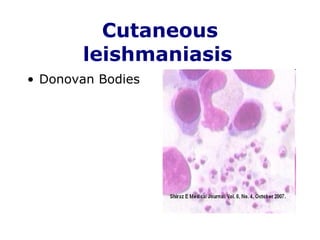
  • 459.
    In this 15°view, note the arteriovenous crossing changes, presence of collateral vessels, and dilated capillary bed .
  • 460.
    Hypertensive retinopathy Advancedhypertensive retinopathy. Lipid deposits in the macula (1), cotton-wool spots (2), small flame hemorrhages (3), vascular light reflex changes, venous tortuosity, and early disc edema are present. 
  • 461.
    Hypertensive retinopathy Bilateraloptic nerve edema. Associated subretinal fluid, flame-shaped hemorrhages, and lipid exudation in a macular star configuration are evident in this patient with malignant hypertensive retinopathy.
  • 462.
    Leuco-erythroblastic reaction Leuco-erythroblasticreaction can be the bone marrow response to any irritation, including infiltration by any malignancy (or histiocytosis for that matter), but special stains for histiocytes need to be done in the marrow to prove the diagnosis.