1 | P a g e
SAQIB IMRAN 0341-7549889 1
Assala mu alykum My Name is saqib imran and I
am the student of b.tech (civil) in sarhad
univeristy of science and technology peshawer.
I have written this notes by different websites
and some by self and prepare it for the student
and also for engineer who work on field to get
some knowledge from it.
I hope you all students may like it.
Remember me in your pray, allah bless me and
all of you friends.
If u have any confusion in this notes contact me
on my gmail id: Saqibimran43@gmail.com
or text me on 0341-7549889.
Saqib imran.
2 | P a g e
SAQIB IMRAN 0341-7549889 2
Environmental Engineering
Environment:
The physical and biotic habitat which surrounds us; that which can be seen,
heard, touched, smelled and tasted.
Environmental Science:
An integrative applied science that draws upon nearly all of the natural
sciences to address environmental quality and health issues.
Environmental Engineering:
Uses environmental science principles, along with engineering concepts and
techniques, to assess the impacts of social activities on the environment,
people, and to protect both human and environmental health. Environmental
engineering requires a sound foundation in the environmental sciences and
consists of;
 Provision of safe, palatable and ample water supplies
 Proper disposal of or recycling of wastewater and solid wastes
 Control of water, soil and atmospheric pollution.
Scope, Benefits and Problems in Environmental
Impact Assessment
3 | P a g e
SAQIB IMRAN 0341-7549889 3
Benefits of Environmental Impact Assessment
The main benefits of EIA process are:
 Improved project design / siting
 More informed decision making with improved opportunities for public involvement in
decision making.
 More environmentally sensitive decisions;
 Increased accountability and transparency during the development process;
 Improved integration of projects into their environmental and social setting;
 Reduced environmental damage;
 More effective projects in terms of meeting their financial and/or socio-economic
objectives; and
 A positive contribution towards achieving sustainability.
The study of EIA effectiveness shows a number of difficulties and constraints, generally,
although not universally applicable, that continue to prevent and hinder EIA from
consistently delivering these advantages and benefits:
Scope of EIA
Small scale projects not included in most environmental impact assessment systems
although their cumulative impacts may be significant over time.
Problems in Environmental Impact Assessment
 Difficulties in ensuring adequate and useful public involvement (or participation);
 Insufficient integration of EIA work at key decision points in relation to feasibility and
similar studies in the project life-cycle; with some major decisions being made even before
EIAs are completed;
 Lack of consistency in selection of developments requiring specific environmental impact
assessment studies;
 Inadequate understanding of the relative roles of baseline description and impact
prediction;
 Poor integration of biophysical environmental impacts with social, economic and health
effects also adds to the Problems in Environmental Impact Assessment;
 Production of EIA reports which are not easily understood by decision makers and the
public because of their length and technical complexity;
 Lack of mechanisms to ensure that EIA reports are considered in decision-making;
 Weak linkages between environmental impact assessment report recommendations on
mitigation and monitoring and project implementation and operation; and
 Limited technical and managerial capacities in many countries to implement EIAs result
in Problems in carrying out Environmental Impact Assessment.
4 | P a g e
SAQIB IMRAN 0341-7549889 4
What is Environmental Impact Assessment and
its Objectives
Definition of EIA
A systematic identification and evaluation of the potential impacts of proposed projects,
plans, programs, or legislative action relative to physical-chemical, biological, cultural and
socioeconomic components of environment is called Environmental Impact Assessment.
OR
The process of predicting, identifying, evaluating and mitigating the biological, social and
other relevant effects of developmental proposals prior to major decision being taken and
commitment made. It is an important procedure for ensuring that the likely effects of new
developmental activities on the environment are fully understood and taken into account
before the development is allowed to go ahead.
Environmental impact Assessment is an event or effect, which results from a prior event.
It can be described as the change in an environmental parameter, over a specific period and
within a defined area, resulting from a particular activity compared with the situation which
would have occurred had the activity not been initiated.
5 | P a g e
SAQIB IMRAN 0341-7549889 5
Objectives of Environmental Impact Assessment (EIA)
 To ensure that Environmental considerations are addressed properly and incorporated into
decision making process.
 To avoid, minimize or balance the adverse significant bio-physical, social and other
relevant effects of developmental projects.
 To protect the productivity and capacity of natural system and ecological processes with
maintain their function.
 To promote development that is sustainable and optimize resources use and management
opportunities.
Characteristics of Environmental Impact Assessment
An ideal EIA should have the following characteristics:
 Apply to all activities that have significant environmental impact and address all the
impacts that are expected to be significant.
 Compare alternatives to a proposed project (including the possibility of not developing the
site), management, techniques and mitigation measures.
 Clear EIS mentioning importance of impacts and their specific characteristics to experts as
well as to non expert in the field.
 Public participation and stringent administrative review procedure
 Be on time so as to provide information for decision making and be enforceable.
 Including monitoring and feed back procedures.
Types of Activated Sludge Process - Plug Flow,
Complete Mix, SBR
Following are the types of Activated Sludge Process
6 | P a g e
SAQIB IMRAN 0341-7549889 6
1. Plug Flow
2. Complete Mix
3. Sequencing Batch Reactor
Plug Flow (PF) Process
Involves relatively long and narrow aeration basins so that concentration of soluble
substances and colloidal and suspended solids varies along reactor length.
Complete-Mix Activated Sludge (CMAS) Process
In CMAS, mixing of tank contents is sufficient so that ideally concentrations of mixed-
liquor constituents, soluble substances (COD, BOD, NH4-N), and colloidal and suspended
solids do not vary with location in aeration basin.
Sequencing Batch Reactor (SBR) Process
 With development of program logic controllers (PLCs) and availability of level sensors
and automatically operated valves, SBR process became widely used by late 1970s.
 Sequencing Batch Reactor process is fill-and-draw type of reactor system involving single
complete-mix reactor in which all steps of ASP occur.
 Mixed liquor remains in reactor during all cycles, eliminating need for separate
sedimentation tanks.
Membrane technology has found increasing application for enhanced solids separation for
water reuse and use in suspended growth reactors for wastewater treatment. Membrane
biological reactors (MBRs) may change look of wastewater treatment in the future.
Microbial Metabolism in Biological Waste Water
Treatment
7 | P a g e
SAQIB IMRAN 0341-7549889 7
Carbon and Energy Sources for Microbial Growth:
 Organism must have sources of energy, carbon for synthesis of new cellular
material, and inorganic elements (nutrients) such as nitrogen, phosphorus, sulfur,
potassium, calcium and magnesium;
Carbon Sources:
 Organisms that use organic carbon for formation of new biomass are called
heterotrophs; Organisms that derive cell carbon from carbon dioxide are called
autotrophs
Energy Sources:
 Energy needed for cell synthesis supplied by light or by chemical oxidation reaction;
Those organisms that are able to use light as energy source are called phototrophs;
Phototrophic organisms either heterotrophic or autotrophic;
8 | P a g e
SAQIB IMRAN 0341-7549889 8
 Organisms that derive energy from chemical reactions are known as chemotrophs;
Chemoautotrophs obtain energy from oxidation of reduced inorganic compounds
(ammonia, nitrite, ferrous iron and sulfide); Chemoheterotrophs derive their energy
from oxidation of organic compounds
 Oxidation‐reduction reactions involve transfer of electrons from electron donor to
electron acceptor; Electron donor is oxidized and electron acceptor is reduced;
Electron acceptor available within cell during metabolism (endogenous) or it
obtained from outside cell (i.e., dissolved oxygen) (exogenous);
Respiratory Metabolism:
 Organisms that generate energy by enzyme‐mediated electron transport to external
electron acceptor
Fermentative Metabolism:
Use of internal electron acceptor and is less efficient energy yielding process than
respiration
Aerobic:
 When oxygen is used as electron acceptor the reaction is termed aerobic;
Anaerobic:
 When electron acceptors other than oxygen are involved, reaction is considered
anaerobic;
Anoxic:
 When nitrite or nitrate is used as electron acceptor, reaction is termed anoxic; Under
anoxic conditions nitrite or nitrate reduction to gaseous nitrogen occurs, also
referred to as biological denitrification.
 Organisms that can only meet their energy needs with oxygen are called obligate
aerobes
 Bacteria that can use oxygen or nitrite/nitrate as electron acceptor in absence of
oxygen are called facultative aerobes
 Organisms that generate energy by fermentation and that can exist only in
environment devoid of oxygen are obligate anaerobes
 Organisms having ability to grow in either presence or absence of oxygen are
facultative anaerobes.
9 | P a g e
SAQIB IMRAN 0341-7549889 9
Biological De-Nitrification Process in Waste
Water Treatment System
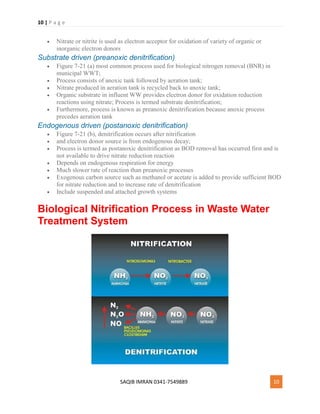
Denitrification
 Biological reduction of nitrate to nitric oxide, nitrousoxide, and nitrogen gas
 Involves both nitrification and denitrification
 Biological nitrogen removal (BNR) is more cost effective and used more often as
compared to ammonia stripping, breakpoint chlorination and ion exchange;
 BNR is used in wastewater treatment where
o there are concerns for eutrophication;
o where groundwater must be protected against elevated NO3‐N concentration;
o where WWTP effluent is used for groundwater recharge and other reclaimed
water applications
Process Description
Two modes of nitrate removal can occur in biological processes:
1. Assimilating and
2. Dissimilating nitrate reduction
Assimilating nitrate reduction
 Involves reduction of nitrate to ammonia for use in cell synthesis;
 Occurs when NH4‐N is not available and is independent of DO concentration
Dissimilating nitrate reduction
10 | P a g e
SAQIB IMRAN 0341-7549889 10
 Nitrate or nitrite is used as electron acceptor for oxidation of variety of organic or
inorganic electron donors
Substrate driven (preanoxic denitrification)
 Figure 7‐21 (a) most common process used for biological nitrogen removal (BNR) in
municipal WWT;
 Process consists of anoxic tank followed by aeration tank;
 Nitrate produced in aeration tank is recycled back to anoxic tank;
 Organic substrate in influent WW provides electron donor for oxidation reduction
reactions using nitrate; Process is termed substrate denitrification;
 Furthermore, process is known as preanoxic denitrification because anoxic process
precedes aeration tank
Endogenous driven (postanoxic denitrification)
 Figure 7‐21 (b), denitrification occurs after nitrification
 and electron donor source is from endogenous decay;
 Process is termed as postanoxic denitrification as BOD removal has occurred first and is
not available to drive nitrate reduction reaction
 Depends on endogenous respiration for energy
 Much slower rate of reaction than preanoxic processes
 Exogenous carbon source such as methanol or acetate is added to provide sufficient BOD
for nitrate reduction and to increase rate of denitrification
 Include suspended and attached growth systems
Biological Nitrification Process in Waste Water
Treatment System
11 | P a g e
SAQIB IMRAN 0341-7549889 11
Definition
The removal of nitrogen by biological nitrification and denitrification is a two-step process.
In the first step (nitrification), ammonia is converted aerobically to nitrate (NO3−). In the
second step (denitrification), nitrates are converted to N2O or nitrogen gas (N2) under
anoxic conditions. Two‐step biological process in which ammonia (NH4‐N) is oxidized to
nitrite (NO2) and nitrite is oxidized to nitrate (NO3‐N).
Purpose of Nitrification
1. Effect of ammonia on receiving water with respect to DO concentrations and fish toxicity
2. Need to provide nitrogen removal to control eutrophication
3. Need to provide nitrogen control for water‐reuse applications including groundwater
recharge
4. Drinking water maximum MCL for nitrate nitrogen is 45 mg/L as nitrate or 10 mg/L as
nitrogen
5. Total concentration of organic and ammonia nitrogen in municipal wastewater in the
range 25‐ 45 mg/L as nitrogen based on flowrate of 450 L/capita.d (120 gal/capita.d)
6. With limited water supplies, total nitrogen in excess of 200 mg/L as N measured in
domestic wastewater
Nitrification Process
Nitrification process in waste water treatment is accomplished in both suspended growth
and attached growth biological processes
Suspended Growth Processes
Nitrification along with BOD removal in single‐sludge process can be achieved, consisting
of aeration tank, clarifier, and sludge recycle system
In case of toxic and inhibitory substances in wastewater, two‐sludge suspended growth
system may be considered, consisting of two aeration tanks and two clarifiers in series. The
first aeration tank/clarifier unit operated at short SRT for BOD and toxic substances
removal, followed by nitrification in second aeration tank/clarifier unit operated at long
SRT; Nitrifying bacteria grow much more slowly than heterotrophic bacteria.
Attached Growth Processes
 For nitrification, most of BOD must be removed before nitrifying organisms can be
established
 Heterotrophic bacteria higher biomass yield and dominate surface area of fixed‐film
systems over nitrifying bacteria;
 Nitrification accomplished in attached growth reactor after BOD removal or in separate
attached growth system designed for nitrification.
12 | P a g e
SAQIB IMRAN 0341-7549889 12
 The nitrification rate for the attached-growth processes is higher than for the suspended-
growth processes. Attached-growth processes normally carry more suspended solids in the
effluent than the suspended-growth processes.
Microbiology of Nitrification
 Aerobic autotrophic bacteria are responsible for nitrification in activated sludge and
biofilm processes;
 Two‐step process in nitrication involve two groups of bacteria; First stage, ammonia is
oxidized to nitrite by one group (Nitrosomonas) and second stage, nitrite is oxidized to
nitrate by another group of autotrophic bacteria (Nitrobacter)
 Other autotrophic bacteria for oxidation of ammonia to nitrite (prefix with Nitroso‐):
Nitrosococcus, Nitrosospira, Nitrosolobus, and Nitrosorobrio
 Other autotrophic bacteria for oxidation of nitrite to nitrate (prefix with Nitro‐):
Nitrococcus, Nitrospira, Nitrospina, and Nitroeystis
Factors affecting Process of Nitrification
Environmental Factors: pH
 Nitrification process in waste water treatment is pH sensitive and rates decline significantly
at pH values below 6.8; Optimal nitrification rates occur at pH values in 7.5‐8.0 range; pH
of 7.0 to 7.2 is normally used;
 Low alkaline waters require alkalinity to be added to maintain acceptable pH values;
 Amount of alkalinity added depends on initial alkalinity concentration and amount of NH4‐
N to be oxidized;
 Alkalinity added in form of lime, soda ash, sodium bicarbonate, or magnesium hydroxide.
Environmental Factors: Toxicity
 Nitrifiers are good indicators of presence of organic toxic compounds at low
concentrations;
 Toxic compounds include: Solvent organic chemicals, amines, proteins, tannins, phenolic
compounds, alcohols, cyanates, ethers, carbamates, and benzene
Environmental Factors: Metals
 Complete inhibition of ammonia oxidation at 0.25 mg/L nickel, 0.25 mg/L chromium, and
0.10 mg/L copper
 Environmental Factors: Un‐ionized Ammonia
 Nitrification is also inhibited by un‐ionized ammonia (NH3) or free ammonia, and un‐
ionized nitrous acid (HNO2);
 Inhibition effects are dependent on total nitrogen species concentration, temperature, and
pH.
13 | P a g e
SAQIB IMRAN 0341-7549889 13
Sources of Drinking Water
Water for drinking and domestic use may be obtained from natural sources like surface
water, groundwater and rainwater.
Surface water
Streams, rivers and lakes are the major sources of surface waters. Usually these sources
fulfill the requirements of municipal supplies. Water in these sources originates partly
from groundwater outflows and partly from rainwater which flows over the terrestrial
areas into the surface water bodies. Outflows from groundwater brings in, the dissolved
solids.
The surface run off contributes turbidity, organic matter and pathogenic organisms.
Usually in surface water bodies, the dissolved mineral particles will remain unchanged
while the organic impurities are degraded by chemical and microbial action. In slow-
flowing or impounded surface waters sedimentation of suspended solids occurs naturally.
Due to the lack of nutrients micro-organisms wil1 die off.
Although clear water from rivers and lakes requires no treatment, on taking into account
the risk of incidental contamination, it is better to practice chlorination. Unpolluted surface
water of low turbidity may be purified by slow sand filtration alone. Alternatively, rapid
sand filtration followed by chlorination can be practiced.
14 | P a g e
SAQIB IMRAN 0341-7549889 14
Groundwater
Wells and springs constitute groundwater supplies. Groundwater mostly originates from
infiltrated rainwater which after reaching the aquifer flows through the underground.
Groundwater provides water to meet the requirements of individual household supplies as
well as municipal supplies.
The treatment processes also differ in these two cases with simply boiling the water before
use for household supplies. However, municipal supplies require one or more treatment
processes depending upon the impurities found in the water. A little contamination of
groundwater occurs from organic and inorganic soil particles, animal and plant debris,
fertilizers, pesticides, microorganisms, etc. as it flows through the soil layers. In spite of
this contamination, infiltration causes partial removal of suspended particles including
microorganisms. Organic substances are also degraded by oxidation. Partial removal of
microorganisms occurs by the death of cells due to lack of nutrients.
Thus, properly withdrawn groundwater will be free from turbidity and pathogenic
microorganisms. It is important to select the location of groundwater supply at a safe
distance from other sources of contamination.. If done so, groundwater will be of high
quality and can be used directly without any treatment.
Rainwater
Rainwater runoff from roofs can be collected and stored for domestic use. Rainwater will
be of high quality and the only possible source of contamination is airborne
microorganisms that too will be present in very low numbers.
Upland Lakes and Reservoirs
Typically located in the headwaters of river systems, upland reservoirs are usually sited
above any human habitation and may be surrounded by a protective zone to restrict the
opportunities for contamination. Bacteria and pathogen levels are usually low, but some
bacteria, protozoa or algae will be present. Where uplands are forested or peaty, humic acid
can color the water.
Many upland sources have low PH which requires adjustment.
Rivers, Canals and Low Land Reservoirs
Low land surface waters will have a significant bacterial load and may also contain algae,
suspended solids and a variety of dissolved constituents.
15 | P a g e
SAQIB IMRAN 0341-7549889 15
Atmospheric Water Generation
It is a new technology that can provide high quality drinking water by extracting water
from the air by cooling the air and thus condensing water vapor
What is Disinfection and Methods of Disinfection
of Water
Definition of Disinfection
Disinfection is a process to destroy the disease causing organisms or
pathogens.
Methods of Disinfection of water
Disinfection of water can be done by
16 | P a g e
SAQIB IMRAN 0341-7549889 16
1. Boiling the water
2. Physical method (Ultraviolet radiation)
3. A chemical inactivation of pathogen
In the water treatment processes, pathogens & other organisms can be partly physically
eliminated through coagulation, flocculation, sedimentation, & filtration, in addition to the
natural die-off. After filtration, to ensure pathogen free water, the chemical addition of
chlorine (so called chlorination), rightly or wrongly, is most widely used for disinfection of
drinking water. This less expensive & powerful disinfection of drinking water provides
more benefits than its short coming due to disinfection by-product (DBPs). DBPs have
to be controlled. The use of ozone & ultraviolet for disinfection of water & waste water is
increasing in the United States.
Chemical Characteristics of Sewage - BOD, COD,
Nutrients, DO
Sewerage characteristics can be divided into three broad categories:
 Physical (Temperature, colour, smell, solids)
 Chemical (BOD, COD, Nutrients and dissolved solids; and
17 | P a g e
SAQIB IMRAN 0341-7549889 17
 Biological
Chemical Characteristics of Sewage (Waste Water)
 In sanitary sewage about 75 % of suspended solids and 40% of filterable solids are organic.
 These solids are derived from both animals, plant and humans. Organic compounds usually
consist of C; H; O; N along with S; P and Iron.
 The organic substances found in sewage are Protein (40-60%); Carbohydrates (25-50%),
fats and oils (10%).
 Along with these organic compounds small amount of synthetic organic compounds like
VOCs, pesticides, insecticides, Organic Priority Pollutants are also presents in sewage.
 Sewage also contain inorganic substances.
 Tests like BOD, COD, Nitrogen, phosphorus, alkalinity etc. give the chemical
characteristics of sewage.
BOD (Biochemical Oxygen Demand):
When biodegradable organic matter is released into a water body, microorganisms feed on
the wastes, breaking them into simpler organic and inorganic substances. When this
decomposition occurs in aerobic environment the process produces non-objectionable,
stable end products like CO2, SO4, PO4 and NO3. A simplified form of Aerobic
decomposition is
O.M + O2 + Microorganisms
CO2 + H2O + C5 H7 NO2 (New Cells) = stable Products like NO3; PO4; NO3)
When sufficient O2 is not available Anaerobic decomposition occurs by different
microorganisms. They produce end products that can be highly objectionable, including
H2S; NH3 and CH4.
The reaction is O.M + Microorganisms
CO2 + H2O + C5 H7 NO2 (New Cells) = Unstable Products (NH3; H2S; CH4
 Such products are usually unstable.
 Bacteria placed in contact with organic matter will utilize it as food source.
 In the utilization of the organic material it will eventually be oxidized to stable end products
such as CO2 and H2O etc.
 The amount of oxygen required by the bacteria to oxidize the organic matter present in
sewage to stable end products is known as biochemical oxygen demand.
 BODu is the maximum amount of oxygen usage by microorganisms over a long period of
time. A good measure of maximum bioavailability.
 BOD5 is the amount of oxygen consumed (in mg/L) over a 5-day period at 20 o
C (in the
dark). BOD5 is a measure of the bioavailability over a 5-day period under controlled
conditions.
18 | P a g e
SAQIB IMRAN 0341-7549889 18
CBOD
Carbonaceous biochemical oxygen demand or CBOD is a method defined test measured
by the depletion of dissolved oxygen by biological organisms in a body of water in which
the contribution from nitrogenous bacteria has been suppressed. CBOD is a method defined
parameter is widely used as an indication of the pollutant removal from wastewater. It is
listed as a conventional pollutant in the U.S. Clean Water Act.
Chemical Oxygen Demand
 In addition to CBOD and NBOD measured, there are two other indicators to describe the
oxygen demands of wastewater. They are Chemical oxygen demand and theoretical oxygen
demand.
 The biodegradable organic matters are degraded completely by microorganisms either by
CBOD or NBOD.
 There are some organic matters like cellulose, phenols, benzene and tannic acid which are
resistant to biodegradation. Similarly, other organic matters like pesticides, insecticides
and various industrial chemicals are non biodegradable and they are toxic to
microorganisms.
 The COD is a measured quantity that does not depend on microorganisms. To calculate the
concentration of oxygen for non biodegradable materials a strong oxidizing agent known
as potassium dichromate will be used.
 The reaction is Organic matter (CaHbOc) + Cr2O7
-2
+ H2O – Cr +3
+ CO2 + H2O
 The COD test is much quicker than BOD test, but it does not distinguish between the
biodegradable and non biodegradable organic matter. The measured COD is usually more
than BOD if there is non biodegradable impurity present. If all are the biodegradable
organic matter, then COD remains the same as that of BOD. Roughly the BOD/COD is 0.4
to 0.8.
Theoretical Oxygen Demand (TheoD):
Organic matter of animal or vegetable origin in wastewater is generally a combination of
carbon, hydrogen, oxygen, nitrogen and other elements. If the chemical composition of an
organic matter is known then the amount of oxygen required to oxidize it to carbon dioxide
and water can be calculated using stoichiometry. This amount of oxygen is known as
Theoretical Oxygen Demand. If that oxidation is carried out by bacteria then it is BOD, if
by chemical process then it is COD. If a combination of both then it is TheoD.
Physical Characteristics of Sewage
19 | P a g e
SAQIB IMRAN 0341-7549889 19
Sewage Characteristics
Sewerage characteristics can be divided into three broad categories:
1. Physical (Temperature, colour, smell, solids)
2. Chemical (BOD, COD, Nutrients and dissolved solids; and
3. Biological
Physical Characteristics of Sewage
Following are the detailed physical characteristics of Sewage:
Temperature:
 The normal temperature of sewage is commonly higher than water supply due to domestic
and industrial activities. Depending on geographical location, the mean annual temperature
of sewage is in the range of 10 to 21°C. Temperature of sewage is an important parameter
because of its effect on chemical reaction rates and aquatic life.
 Increase temperature can cause a change in fish species that are present in water bodies.
20 | P a g e
SAQIB IMRAN 0341-7549889 20
 Similarly, oxygen is less soluble in warm water, while some species of aquatic life
population increases with temperature causing more demand of oxygen and result in
depletion of dissolved oxygen in summer.
 Similarly, sudden change of temperature cause mortality of species.
Colour:
 Fresh sewage is light brownish grey colour.
 At a temperature of above 20 °C, sewage will change from fresh to old in 2 - 6 hours.
 The old sewage is converted to dark grey and black color due to anaerobic activities, known
as stale or septic color.
 Some industrial sewage also add color to domestic wastewater.
 The grey, dark grey and black color is due to formation of sulfide produced under anaerobic
conditions reacts with the metals present in wastewater.
Odor:
 Fresh domestic sewage has a slightly soapy or oil odour.
 Stale sewage has a pronounced odour of Hydrogen Sulphide (H2S).
 The odor at low concentration has no effect, but high concentration causes poor appetite
for food, lower water consumption, impaired respiration, vomiting etc.
Solids:
 Solids comprise matter suspended or dissolved in water and wastewater.
 Solids are divided into several different fractions and their concentration provide useful
information for characterization of wastewater and control of treatment processes.
Total solids:
 Total solids (TS) are the sum of total suspended solids and total dissolved solids (TDS).
Each of these groups can further be divided into volatile and fixed fractions.
 Total solids (TS) is the material left in the evaporation dish after it has dried at 103-105
°C.
 Total solids can be expressed in mg/L.
Total suspended solids:
 Total suspended solids (TSS) are referred to as non-filterable residue.
 It is determined by filtering a well mixed sample through 0.45μm to 2 μm pore sized
membrane. The residue retained on the filter is dried in an oven at a temperature of 103-
105 °C for at least 1 hour.
 TSS is expressed in the unit mg/L.
Fixed and Volatile Solids:
21 | P a g e
SAQIB IMRAN 0341-7549889 21
 The residue for total solids, total suspended solids or total dissolved solids tests is ignited
to constant weight at 500 o
C ± 50.
 The weight lost on ignition is called volatile solids, whereas the remaining solids represent
the fixed total suspended or dissolved solids.
 The determination of volatile portion of solids is useful in controlling waster water
treatment plant operations because it gives a rough estimation of the amount of organic
matter present in the solid fraction of waster water, activated sludge and industrial waste.
Absorption
 Measure of amount of light, of specified wavelength, absorbed by constituents in
solution;
 Absorbance measured with spectrophotometer using specified wavelength (254 nm)
 Absorbance, measured using spectrophotometer and fixed path length (usually 1 cm) is
given by:
Absorbance
where A = absorbance, absorbance units (au)/cm
Io = initial detector reading for blank (distilled water) after passing through solution of
known depth I = final detector reading after passing through solution containing
constituents of interest
Turbidity
 Measure of light‐transmitting properties of water, used to indicate quality of waste
discharges and natural waters with respect to colloidal and residential suspended matter
 Measurement based on comparison of intensity of light scattered by a sample to the light
scattered by reference suspension under same conditions. Formazin suspensions are used
as primary reference standard
 Results of turbidity reported as nephelometric turbidity units (NTU)
 Relationship between turbidity and TSS for settled and filtered secondary effluent from
activated sludge process:
Relationship between turbidity and TSS for settled and filtered secondary effluent from
activated sludge process
22 | P a g e
SAQIB IMRAN 0341-7549889 22
 TSSf vary for each treatment plant; TSSf for settled secondary effluent and for secondary
effluent filtered with granular medium depth filter vary from 2.3 to 2.4 and 1.3 to 1.6,
respectively
Conductivity
 Electrical conductivity (EC) is measure of ability of solution to conduct electrical current
 Electrical current is transported by ions in solution, conductivity increases as concentration
of ions increases;
 EC value is used to substitute measure of TDS concentration; EC of water important
parameter to determine its suitability for irrigation;
 Salinity of treated wastewater to be used for irrigation is estimated by its EC;
 SI units: millisiemens per meter (mS/m);
 Estimation of TDS of water sample based on measured EC value:
TDS (mg / L) ≅ EC (dS / m)×(0.55 − 0.70)
Density and Specific Gravity
Physical Characteristics of Sewage also include aspects like density and specific gravity
of the sewage.
Density: Mass per unit volume expressed as g/L or kg/m3; density of domestic
wastewater is the same as that of water at same temperature;
Specific Gravity: sw =ρw/ρo
where ρw = density of wastewater
ρo = density of water
Both density and specific gravity are temperature dependent and will vary with
concentration of TSS in wastewater.
Types of Grit Chambers in Waste Water
Treatment
The objectives of Grit Chambers are:
1. Protect moving mechanical equipment from abrasion and abnormal wear
2. Reduce formation of heavy deposits in pipelines, channels and conduits
3. Reduce the frequency of digester cleaning caused by excessive accumulation of grit
Types of Grit Chamber
1. Horizontal flow (Rectangular or square) (configuration type)
23 | P a g e
SAQIB IMRAN 0341-7549889 23
Designing a Rectangular horizontal flow type grit chamber:
 Cross-sectional area, Ax = (Qdesign / Vh) for each unit (Vh ≈ 1 ft/sec), depth ≈ 3-5 ft
 Assuming (tD = 1-2 minutes), determine the length L = Vh * tD (Add 10% additional)
 Check the SLR (1200-1700 m3
/m2
-day) and Vs (≥ 0.01 m/sec). Grit produced is about 1.5
ft3
/ML of wastewater flow. Add to depth {1ft FB + grit}
2. Aerated Grit Chamber
Basic Info
 Air is introduced along one side of a rectangular tank to create a spiral flow pattern
perpendicular to the flow through the tank.
 If the velocity is too great, grit will be carried out of the chamber; if it is too small,
organic material will be removed with the grit.
 Normally designed to remove 0.21-mm-diameter or larger, with 2-5-minute
detention periods at the peak hourly rate of flow
 Air diffusers are located about 0.45 to 0.6m above the normal plane of the bottom.
24 | P a g e
SAQIB IMRAN 0341-7549889 24
Aerated Grit Chamber
Designing an Aerated grit chamber:
 Assume a “tD” (3-4 min), determine the volume of the basin.
 Assume a depth (D = 08-15 ft), determine the surface area of the basin. And check the
SLR (1200-1700 m3
/m2
-day)
 The amount of grit produced is about 1.5 ft3
/ML of wastewater flow. Add suitable depth
from grit and free board.
 Calculate the amount of air required (0.2-0.5 m3
/min/m length of the tank)
Advantages & Disadvantages of Comminutors
Advantages
 Elimination of extra steps and problems involved in the excavation of the disposals of
screening (screened material)
 Often difficult to dispose highly polluted screenings - In USA if buried, 6 inches of cover
material should be used
 Highly suitable for small treatment plants. e.g. : mountain or beach resorts.
Disadvantages
 Frequent maintenance of cutting tools ( delicate equipment)
 Risk accumulation of comminuted materials (textiles, vegetable fibers) eventual clogging
of pumps and piping.
 These materials to form floating scum in anaerobic digestion
 Problems in trickling filter (clogging of distribution pipe holes) mainly used in activated
sludge process.
25 | P a g e
SAQIB IMRAN 0341-7549889 25
Definitions in Waste Water Treatment
Sludge Volume Index (SVI-TEST)
It is the measure of the settleability and compatibility of sludge and is made from a
laboratory column setting test.
Definition
The sludge volume index is defined as ‘the volume in mm occupied by 1 gm of sludge
after it has settled for a specified period of time’ generally ranging from 20 min to 1 or 2
hr in a 1 – or 2-l cylinder. One-half hour is most common setting time allowed to the
mixed liquor to settle for 30 min. ( larger cylinder is desirable to minimize bridging of
sludge floe and war effects). Take the reading let Vs is the settled volume of sludge (ml/l)
in 30 min.
* If SVI is 50 - 150 ml/mg, the sludge settle ability is Good.
Return Activated Sludge System:
1. The activated sludge form the underflow of the final setting tanks should be returned to the
inlet of the aeration tanks at a rote sufficient to maintain the MLSS concentration at the
design value.
2. The flow are needed for return-sludge is determined form the incoming sewage flow rate
and the concentration at which the sludge is with drawn form the final setting tanks.
Hence a simple measure of the underflow concentration form the setting tanks is required.
The parameter conventionally employed for this purpose the sludge volume index, SVI
which is defined as 4 the volume occupied by sludge containing 1.0g of sludge soiled (dry
weight) after 30 min setting and thus it has ht units ml/g. Some time represented as SDI
i.e sludge density index. Once the SVI and operating MLSS concentration (x) is known,
the required rate of activated sludge return can be determined
R = 100 / [ 106/ (x) (SVI) -1] where r = return sludge flow rate as a % age of incoming
sewage flow.
SEDIMENTATION:
It is the removal of solid particles form a suspension by settling under gravity.
CLARIFICATION:
It is a similar term which refers specifically to the function of a sedimentation removal.
26 | P a g e
SAQIB IMRAN 0341-7549889 26
THICKENING:
It means the separation of water from Suspended Solids where R = return sludge flow
rate (ML/D) for Q in ML/D)
SURFACE GEOMETRY OF FINAL SEDIMENTATION TANKS:
VARIATION OF THE ACTIVATED SLUDGE PROCESS:
1. Activated sludge was introduced in 1941 and has undergone many variations and
adaptations.
2. The main objective of many modifications has been to increase the loading capacity of the
basic plug flow activated sludge plant by provision of optimum condition design
parameters for different variations are summarized in table. It is worthy of note that 5
modifications tapered aeration step aeration the CMAS process, the pure oxygen system
and the deep shaft process all aim at either the improvement of oxygen transfer efficiency
t the efficient distribution of available oxygen to match demand. A flow sheet of most of
the commonly used variations is similar to that of CAS (Conventional Activated Sludge).
CONVENTIONAL ACTIVATED SLUDGE:
Volumetric loading = kg of BOD
m3
-d
Aerial loading rate = gm of BOD
m3
-d
Td = V/Q in days and grater than 5 days.
ALGAL-BACTERIAL SYMBOPSTS:
The combined and mutually- been facial action of algae and bacteria in this process is
called algal-bacterial symbioses.
 Shock loading (CSTR)
 BODu
Aerated Lagoons:
Aerate lagoons are activated sludge units operated without sludge return. Historically they
were developed from waste stabilization ponds in temperate climate where mechanical
aeration was used to supplement the algal oxygen supply in winter. It was found, however
that soon after the aerations were put into operation the algal disappeared and the microbial
flora resembled that of activated sludge. Aerated lagoons were now usually design as
completely mixed not-return activated sludge units. Floating aerates are most commonly
used to supply the necessary oxygen and mixing power.
27 | P a g e
SAQIB IMRAN 0341-7549889 27
Sludge Treatment:
Anaerobic sludge treatment cell Primary Sedimentation Tank and Secondary
Sedimentation Tank are basically organic these can treated to aerobic.
 Anaerobic ponds and septic tank are for waste water treatment .
 Sludge treatment = Anaerobic sludge treatment.
COLD DIGESTION:
 Two stage digestion up
 High rate digestion up
 Fixed film processes. A swm zone
SLUDGE DIGESTION:
SLUDGE: the concentrated impurities settled at the bottom of the flower bed of
sedimentation tanks.
Digestion:
To decompose or breakdown by heat and moisture or chemical action. (to invent food
equable forms)
Sludge treatment:
Aerobic digestion it is defined as ‘it is the use of microbial organisms in the absence of
oxygen I for the stabilization of oxygen materials by conversion to mean and inure produce
including CO2.
Organic matter + H2O (amoebas) CH4+ CO2 + NH3+ H2S + heat
Benefices of anaerobic digestion. Types of anabolic detectors. It’s of two types:
 Conventional (stranded) or low-rate digester or cold digester.
 High rate digesters / two stage digester are characterized by continuous miring except at
time of sludge with draw.
What is the Composition of Wastewater?
28 | P a g e
SAQIB IMRAN 0341-7549889 28
Constituents of Waste Water
Constituents of Waste Water are characterized in terms of its physical, chemical and
biological composition
Physical Characteristics
Solids content
 Floating matter
 Settleable matter
 Colloidal matter
 Matter in solution
Particle size distribution; Turbidity; Color; Transmittance; Temperature; Conductivity;
Density; Specific gravity; Specific Weight
Solids classification
Solids interrelationships
Settleable solids: Placing 1‐L sample in Imhoff cone and noting volume of solids in mm
that settle after 1 h; Typically 60% of suspended solids (SS) in municipal wastewater are
settleable
Total solids (TS): Obtained by evaporating wastewater sample to dryness (at 103‐ 105°C)
and measuring mass of residue
Total suspended solids (TSS): Filtration step is used to separate TSS from total dissolved
solids (TDS); Portion of TS retained on filter (e.g., Whatman fiber glass filter‐GF/C)
measured after being dried at 105°C
Total Suspended Solids (TSS)
More TSS measured as pore size of filter used is reduced;
Important to note filter paper pore size, when comparing TSS values;
TSS and BOD universal effluent standards by which performance of treatment plants is
judged for regulatory control purposes
Total Dissolved Solids (TDS)
29 | P a g e
SAQIB IMRAN 0341-7549889 29
Solids contained in filtrate that passes through a filter with nominal pore size of 2 μm or
less are classified as dissolved; Size of colloidal particles in wastewater typically in range
from 0.01‐1 μm
Volatile and Fixed Solids (VS and FS) Material volatilized and burned off when ignited
at 500 ± 50oC classified as volatile solids (VS);
In general, VS are organic matter
Residue that remains after sample is ignited at 500 ± 50oC classified as fixed solids (FS);
TS, TSS, and TDS comprised of both VS and FS Ratio of VS to FS used to characterize
wastewater with respect to amount of organic matter present
Particle Size Distribution (PSD)
To understand nature of particles that comprise TSS in wastewater, measurement of
particle size is undertaken
PSD important in assessing effectiveness of treatment processes (secondary sedimentation,
effluent filtration, and effluent disinfection)
PSD methods can be divided into two general categories:
1. Methods based on observation and measurement
2. Methods based on separation and analysis techniques
Commonly used methods for particle size analysis:
1. Serial filtration: Wastewater sample is passed sequentially through series of membrane
filters with circular openings of known diameter, and amount of suspended solids retained
in each filter is measured.
Electronic Particle Counting
 Particles in wastewater are counted by diluting a sample and then passing diluted sample
through calibrated orifice or past laser beams;
 As particles pass through orifice, conductivity of fluid changes, owing to presence of
particle. Change in conductivity is correlated to size of equivalent sphere;
 Similarly, as particle passes by laser beam, it reduces intensity of laser because of light
scattering. Reduced intensity is correlated to diameter of particle. Particles counted are
grouped into particle size ranges. In turn, volume fraction corresponding to each particle
size range is computed.
30 | P a g e
SAQIB IMRAN 0341-7549889 30
Microscopic Observation:
Placing small wastewater sample in particle counting chamber and counting individual
particles;
 To aid in differentiating different types of particles, various types of stains are used;
 In general, microscopic particle counting is impractical on routine basis;
 However, it can be used to qualitatively assess nature and size of particles in wastewater
The typical composition of wastewater based on strength. The important characteristics
measured in wastewater included...
 Biochemical Oxygen Demand (BOD) [100-300 mg/L as O2]
 Suspended solids (SS) [100 – 350 mg/L]
 Settleable solids [5-20 mL/L]
 Total Kjeldahl nitrogen (TKN) [20-80 mg/L]
 Total Phosphorus [5-20 mg/L as P]
A typical solids analysis of wastewater, of the total solids, 50% is dissolved, 50%
suspended. Of the suspended solids, 50% will settle. Industrial activity changes the
composition of wastewater, often introducing toxic substances such as chromium and
cadmium from plating operations.
Food to Microorganisms Ratio (F/M)
Definition
A parameter of organic loading rate in the design aerated sludge parameter in the design of
Trickling Filter in organic loading rate = kg of BOD / m3-d
F/M ratio =
F/M ratio = BOD / MLSS x t kg of BOD / Kg of MLSS/day
FM ratio varies between 0.2 -0.5 day-1
 F/M ratio -0.5 day-1 has a good settleabilty of a sludge. ( even in some cases it can go to
1)
 F/M ratio -<0.2 Food is very limited so the bacteria will die.
 F/M ratio 70.5 day-1
Food is more so the bacteria will move the effluent (failure of the
system)
 If high F/M ratio, filamentous bacteria will also grow. They not settle easily because of
long tails, get entangled with each other. Food to micro organism ratio(F/M) is a common
31 | P a g e
SAQIB IMRAN 0341-7549889 31
used parameter in the activated-sludge process which is defined as the kg of BOD5applied
per kg MLSS per day.
Derivation of F/M Ratio:
Q = Flow of Sewage (m3/day)
BOD = organic matter (mg/l)
FOOD = Q (m3/day) x BOD (mg/l)
FOOD = Q x BOD / 1000 (Kg of BOD/ day)
V = Volume of Aeration (m3)
MLSS = Mixed liquor suspended solids (mg/l)
Micro-organisms = V (m3) x MLSS (log/l) / 1000 = V x MLSS / 1000 (kg of MLSS in
aeration tank)
Uses & Design of Flow Equalization Tank
Definition:
Flow equalization is method used to overcome the operational problems and flow rate
variations to improve the performance of downstream processes and to reduce the size &
cost of downstream treatment facilities. To prevent flow rate, temperature, and
contaminant concentrations from varying widely, flow equalization is often used.
32 | P a g e
SAQIB IMRAN 0341-7549889 32
Objective
Give a relatively constant flowrate to the downstream operations and processes
Functions of FET
 Dampen the daily variation in flowrate and loadings
 Reduce the required size of the downstream treatment facilities
 Feasible dry weather flows in separate sewer system and sometimes for storm
Effects of flow equalization
 10-20% of BOD entering is stabilized in the equalization basin
 23-47% of SS is further removed in the primary clarifier
 reduce shock load on biological process
Why to Use flow Equalization Tanks
Variations occur characteristically in domestic wastewater flow rate and composition as a
result of cyclic activities of the human population. Additional variations are commonly
imposed by a combination of:
1. Random and cyclic activities in the collective industrial-wastewater-generating segment of
the community and
2. By storm-related effects of infiltration and inflow
3. In addition, the average waste water flow rate at typical municipal treatment plants may be
expected to increase by 25 to 100 percent or more over the design life of the facilities.
4. Operation of waste water treatment plant at uniform conditions is assumed to be
advantageous. It results in improved efficiency, reliability, and control of various physical,
chemical and biological treatment processes. Costs can also be reduced by elimination of
excessive peak treatment capacity and from reduced periods of operation under peaking
conditions.
33 | P a g e
SAQIB IMRAN 0341-7549889 33
Design of Flow Equalization Tanks
The design of equalization facilities requires evaluation and selection of a number of
features:
1. Type and magnitude of input variations
2. Required volume
3. Facility configuration
4. Pumping/control mode
5. Type of construction
6. Appurtenances; aeration, mixing, odor control, cover, flushing
7. Cost and benefits
Benefits - Advantages of Flow Equalization Tank
1. Reduction of peaking requirements
2. Reduction of process overloads at existing plants under some conditions
3. Protection against toxic upsets
4. Potential reduction of operational problems
5. Provides increasing benefits with increasing plant complexity
6. Placement of equalization following primary treatment minimizes operation and
maintenance, and minimizes requirements for solids removal, aeration, and odor control
equipment.
To Measure COD of WasteWater using Open
Reflux Method
History of COD :
KMnO4 was used as oxidizing agent for many time pb with KMnO4 was that different value
of COD obtained due to strength change of KMnO4. BOD value obtained greater than COD
with KMnO4 means KMnO4 was not oxidizing all the substances. Tthen ceric sulphate
potassium loadate and potassium dichromate all tested separately and at the end potassium
sichromate was found practical.
Pottassium dichromate is used in excess a mount to oxidize all the organic matter, this
excess aomunt can be found at the end by using ferrousiion.
Method for cod test :
1. open reflux (drawback: end product is dangerous and cannot be discharged in open
draws)
34 | P a g e
SAQIB IMRAN 0341-7549889 34
2. close reflux (same chemicals as for open reflux but sample and chemicals used in less
quantity) spectro photometric (septrophotometer) titremetric ( titration)
Chemicals/ regents in open reflux method:
1. Potassium di-chromate (oxidation agents)
2. Sulphuric acid.
3. Mercuri sulphate (Hgs04)
4. Ferrous ammonium sulphate (Fe NH4)2 (So4)2 0.25 N used as tritrante,
5. Fezroin indicator.
Limitations of COD:
 cannot differentiate between biodegradable and non-biodegradable material
 N-value cannot be accurately found.
Advantages of COD:
1. can be performed in short time i.e 30 min can be correlated with BOD with a factor.
2. More biological resistant matter, more will be the difference in Bod and Cod results,
Apparatus
1. Digestion vessels (vial)
2. COD Reactor
3. Spectro-photometer
4. Premixed Reagents in Digestion Vessel (vials)
5. K2G2O7
6. Concentrated H2SO4
7. HgSO4
8. Ag2SO4
Procedure:
1. Place Approximately 500ml Of Sample In a clean blender bowl and homogenize
at high speed for two minutes. blending the sample ensures a uniform distribution
of suspended solids and thus improves the accuracy of test results.
2. Pre heat the COD reaction to Iso c
3. Carefully remove the cap of COD digestion Reagent vial.
4. While holding The vial at a 45 degree angle carefully pipette 2 ml sample into the
vial.
5. Replace and tighten the cap.
6. Holding the vial by the cap in an empty sink, gently invert several times to mix the
contents they will become very hot during mixing.
7. Place the vial in preheated COD reaction.
35 | P a g e
SAQIB IMRAN 0341-7549889 35
8. Prepare a reagent blank by repeating step 3 through 6, substituting2 ml of distilled
water in place of sample.
9. Incubate the vial for two hours at size.
10.Turn off the reaction off and allow the vials to cool to 120 degree and less. invert
each vial several times while still warm place vial in a cooling reach and allow
them to room temp.
11.Measure the COD using spetrcophotometer method.
Public Health Engineering
The public health engineering sector is responsible for the Collection of water, purification,
transmission and distribution of water. A Public Health Engineer has to perform his job by
calculating design flow, design population, design area and population density
1. Collection of water
2. Purification works
3. Transmission works
4. Distribution works
Water Works Explained
1. Collection of water:
This includes the collection of water from all available sources to ensure continuous
supply of water to the community.
2. Purification works:
Quality of the collected water is checked by physical and chemical tests on water and if
the quantity is not satisfactory and according to WHO standards then, purification or
treatment of water is done to make it suitable for its intended use e.g. cooking, drinking,
bathing, washing etc.
3. Transmission works:
Transmission works includes measure taken to ensure the purified supply of water by
laying out conduits, which do not affect the quality of water
4. Distribution works:
Water is then distributed to the consumers in desired quantity at adequate pressure. The
quantity of water may be different for residential, commercial and industrial zones. So
accordingly, there should be a difference between the quantities of water that they will
receive and hence the transmission works.Similarly, the pressure of water is also
important in industries, storied buildings, and hilly areas.
Design population:
It is the no. of people for whom the project is designed. The population should be
considered as it would be at the end of design period.
Design Flows:
36 | P a g e
SAQIB IMRAN 0341-7549889 36
The maximum discharge required at the end of transmission system is called design flow.
Per capita consumption is the average intake of water per person. It may be for a single
day, a week, a month or annually. It can be found out by dividing the total consumption of
water by the number of individuals in population using that water. The flow of water for
design is calculated by multiplying the average per capita consumption annually with the
design period (in years) and the design population.
Design period:
It is the number of years in future for which the excess capacity is provided. For this amount
of time the proposed system, its component structures and equipment should be appropriate
and adequate. The design period depends upon:
 Life of components system structures used.
 Ease of expansion of the project
 The type of technology used
 The rate of increase of population
 The rate of increase in water demand.
The flow required for design period must be estimated and not over-estimated, to prevent
the project from becoming un-economical and over-burdening the community with extra
cost.
Population density
The number of persons per unit area – e.g. persons/Km2
Population Forecasting Methods & Techniques
Population is one of the most important factors for design of the water systems, so it should
be estimated, so as to know the increasing demand and ensure continuous supply to them.
Population data is obtained by previous records and the rate of increase is found out and
this used for further analysis, which may be by using the methods described below
1. Arithmetic growth method
2. Geometric growth method
3. Curvilinear method
4. Logistic method
5. Decline growth method
6. Ratio growth
37 | P a g e
SAQIB IMRAN 0341-7549889 37
Arithmetic growth method:
It is based on the assumption that the rate of growth of population is constant. It means that
the each year population increase by the same increment.
Mathematically;
dp / dt = Ka
Where,
dp / dt is the rate of change of population
Ka = the constant arithmetic increment
Ka can be determined by finding the slop of the graph of population against time. The
population in the future is thus estimated.
Geometric method:
It is based on the hypothesis that rate of change of population is proportional to the
population. According to this, method it is assumed that the rate of increase of population
growth in a community is proportional to the present population.
Mathematically:
dP /dt ∝ P => dp / dt = Kg where Kg = Geometric Growth constant.
If P0 is the population at any time t0 and Pf is the population at time tf then
∫Pf P0 dp/p = Kg ∫ tf t0 dt = Ln (Pf/P0 = Kg (tf/t0)
=> Ln (Pf/P0 = Kg Δt
=> (Pf/P0 = (e) Kg Δt and Pf = P0 (e) Kg Δt
This method gives somewhat larger value as compared to arithmetic method and can be
used for new cities with rapid growth. In normal practice, arithmetic and geometric growth
average is taken.
38 | P a g e
SAQIB IMRAN 0341-7549889 38
Curvilinear method:
In this it is assumed that the population of a city will grow, in the same manner as in other
cities in the past. This similarity between the cities includes geographical proximity,
similarity of economic base, access to similar transportation system etc. In practice it is
difficult to find similar cities.
Logistic method:
When the growth rate of population due to birth, death and migration are under normal
situation and not subjected to extraordinary changes due to unusual situation like war,
epidemics earth quakes and refugees etc. Then this method is used:
According to this method
P = P sat / (1+ ea
+ bΔt), where P sat is the saturation population, of the community and a, b are
constants. P sat, a and b can be determined from three successive census populations and
the equations are
Psat = 2 P0 P1P2 - P1
2
(P0 + P2) / (P0 P2 - P1
2
)
Decline growth method:
This method like, logistic, assumes that the city has some limiting saturation population
and that its rate of growth is a function of population deficit;
Ratio method:
Ratio method of fore casting is based on the assumption that the population of a certain
area or a city will increase in the same manner to a larger entity like a province, or a country.
It requires calculation of ratio of locals to required population in a series of census years.
Projection of the trend line using any of the technique and application of projected ratio to
the estimated required population of projected ratio to the estimated required population in
the year of interest. This method of forecasting does not take into account some special
calculations in certain area but have the following advantages.
Estimation of Water Demand
While estimating the water demand, the above factors should be considered e.g. the size of
the city; its population does matter when estimating the water demand. The more the size
of population, more will be the demand. Estimation of water demand is necessary to:
 Calculate design flow
39 | P a g e
SAQIB IMRAN 0341-7549889 39
 Determine the pumping power of machines to be used
 Reservoir capacity
 Pipe capacity
To estimate water demand, following parameters must be determined or calculated.
To determine the maximum water demand during a fire, the required fir flow must be added
to the maximum daily consumption rate. The shortage is fulfilled by elevated storage tanks
which have been filled during lower demand in usual days
Keywords: county population forecasts, population forecasting, forecasting population
growth, population forecasting methods, growth forecasting, demographic forecasting, fire
water demand, fire flow demand, firefighter demand,
1. Average daily water consumption: It is based on complete one year supply of water. It
is the total consumption during one year, divided by the population.
q = (Q / P x 365) lpcd (liters per capita per day)
2. Maximum daily consumption: It is the maximum amount of water used during one day
in the year. This amount is 180% of the average daily consumption
MDC = 1.8 x Avg. daily consumption. It is usually a working day (Monday) of summer
season.
3. Maximum weekly demand: The amount of water used by a population during a whole
single week in a study span of 1 year.
Maximum weekly demand = 1.48 x Avg. D. C
Maximum monthly demand = 1.28 x Avg. D. C
Maximum hourly demand = 1.5 x Avg. D. C
Maximum daily demand = 1.8 x Avg. D. C
4. Fire water demand | Fire Demand: The amount of water used for fire fighting is termed
as fire demand. Although, the amount of water used in fire fighting is a negligible part of
the combine uses of water but the rate of flow and the volume required may be so high
during fire that it is a deciding factor for pumps, reservoirs and distribution mains.
Minimum fire flow should be 500 gpm (1890 L/m)
Minimum fire flow should be 8000 gpm (32, 400 L/m)
Additional flow may be required to protect adjacent buildings.
Sectoral Consumption of Water
1. Domestic use
2. Commercial use
3. Public use
4. Loss and waste
40 | P a g e
SAQIB IMRAN 0341-7549889 40
Domestic use of water:
Domestic uses of water include the consumption of water for drinking, washing, cooking,
toilets, livestock etc. the domestic average use per capita per day is 50 – 90 gallons (70 –
380 liters per capita per day). This use is increasing by 0.5% - 1.0% per year and at this
time comprises 50% of all the uses of water. Water uses are for drinking, cooking, meeting
of sanitary needs in houses and hotels, irrigating lawns etc. Residential water use rates
fluctuate regularly. Average daily winter consumption is less than annual daily average,
whereas summer consumption averages are greater. Similarly, peak hourly demand, is
higher than maximum. No universally applied rule for prediction
Commercial and industrial:
This is the amount of water used by the shops, markets, industries, factories etc. It
contributes 15 – 24% of total use of water. It includes factories, offices and commercial
places demand. It is based on either having a separate or combined water supply
system. Demand of water based on unit production: No. of persons working and floor area
Public use:
The public use of water is that one which is used by city halls, jails, hospitals, offices,
schools etc. This consumes 9% of total use of water. Its water demand is 50 – 75 liters per
capita per day. Fire protection's need of water is also fulfilled by this sector. The fire
demand does not greatly affect the average consumption but has a considerable effect on
peak rates. Schools, hospitals, fire fighting etc
Loss and wastes:
: Unauthorized, connections; leakage in distribution system, Hydrant flushing, major line
breakage and cleaning of streets, irrigating parks. Total consumption is sum of the above
demands. The water which is not intended for specific purpose or use is also called "Un-
accounted for". Loss and wastage of water is due to:
1. Errors in measurements
2. Leakages, evaporation or overflow
3. Un-metered uses e.g. fire fighting, main flushing
4. Un-authorized connections
Factors affecting the use of water
 Size of the city
 Industry and commerce
 Climate
41 | P a g e
SAQIB IMRAN 0341-7549889 41
 Time of the day
 Day of the week or month
Factors Affecting Selection of Water Source
Quantity of water:
The quantity of water available at the source must be sufficient to meet various demands
and requirements of the design population during the entire design period. Plans should be
made to bring water from other sources if the available water is insufficient.
Quality of water:
The water available at the source must not be toxic, poisonous or in anyway injurious to
health. The impurities should be as minimum as possible and such that, can be removed
easily and economically.
Distance of water supply source:
The source of supply must be situated as near to the city as possible. Hence, less length of
pipes needs to be installed and thus economical transfer and supply of water. The source
nearest to the city is usually selected.
Topography of city and its surroundings:
The area or land between the source and the city should not be highly uneven i.e. it should
not have steep slopes because cost of construction or laying or pipes is very high in these
areas.
Elevation of source of water supply:
The source of water must be on a high elevation than the city so as to provide sufficient
pressure in the water for daily requirements. When the water is available at lower levels,
then pumps are used to pressurize water. This requires an excess developmental and
operational tasks and cost. It may also have breakdowns and need repairs.
Water quality
 Impurities present in water and their health significance
 Water quality standards set by U.S and W.H.O
 Water quality tests
42 | P a g e
SAQIB IMRAN 0341-7549889 42
Sources of Fresh Water in Environmentl Engg.
Flowchart of the sources of clean drinking water
WasteWater Treatment Disposal & Management
The quantity of water required for a community depends upon:
1. Forecasted population
2. Types and variation in demand (e.g. seasonal variation)
3. Maximum demand (Per day/Per month)
4. Fire demand
5. Rural demand and supplies
6. Appropriate / Available technology
Main sources of water are
 Surface water sources: Lakes impounding reservoirs, streams, seas, irrigation canals
 Ground water sources: Springs, wells, infiltration wells
Above are the common sources of clean drinking water, other different sources of drinking
water are
43 | P a g e
SAQIB IMRAN 0341-7549889 43
Merits of surface sources
Merits of ground water sources
1. Being underground, the ground water supply has less chance of being contaminated by
atmospheric pollution.
2. The water quality is good and better than surface source.
3. Prevention of water through evaporation is ensured and thus loss of water is reduced.
4. Ground water supply is available and can even be maintained in deserted areas.
5. The land above ground water source can be used for other purposes and has less
environmental impacts.
Demerits of ground water source
1. The water obtained from ground water source is always pressure less. A mump is required
to take the water out and is then again pumped for daily use.
2. The transport / transmission of ground water is a problem and an expensive work. The
water has to be surfaced or underground conduits are required.
3. Boring and excavation for finding and using ground water is expensive work.
4. The modeling, analysis and calculation of ground water is less reliable and based on the
past experience, thus posing high risk of uncertainty.
Chemical Characteristics of Water
1. Acidity
2. Alkalinity
3. Hardness
4. Turbidity
44 | P a g e
SAQIB IMRAN 0341-7549889 44
Acidity:
Acidity or alkalinity is measured by pH. PH measures the concentration of Hydrogen ions
in water. Ionization of water is
HOH H+ + OH-
In neutral solutions [OH] = [H] hence pH = 7
If acidity is increased, [H] increases and pH reduces from 7 (because H is log of [H]). The
value of pH of water is important in the operations of many water and waste water treatment
processes and in the control of corrosion.
Alkalinity:
The values of pH higher than 7, shows alkalinity. The alkaline species in water can
neutralize acids. The major constituents of alkalinity (or causticity) are OH-, CO32- and
bicarbonates HCO3 ions. Alkalinity in water is usually caused by bicarbonate ions.
Hardness of water:
Definition of hard water
Hardness is the property that makes water to require more soap to produce a foam or
lather. Hardness of water is not harmful for human health but can be precipitated by
heating so can produce damaging effects in boilers, hot pipes etc by depositing the material
and reducing the water storage and carriage capacity. Absolute soft water on the other
hand is not acceptable for humans because it may cause ailments, especially to heart
patients. Hardness in water is commonly classified in terms of the amount of CaCO3
(Calcium Carbonate) in it.
Concentration of CaCO3 Degree of hardness
0 – 75 mg / L Soft
75 – 150 mg / L Moderately hard
150 – 300 mg / L Hard
300 up mg / L Very Hard
Table 1 - Degree of Hardness
Low level of hardness can be removed just by boiling but high degree of hardness can be
removed by addition of lime. This method has also the benefit that iron and manganese
contents are removed and suspended particles including micro-organisms are reduced.
45 | P a g e
SAQIB IMRAN 0341-7549889 45
Turbidity:
Keywords: study and interpretation of the chemical characteristics of natural water,
chemical characteristics of water, chemical characteristics of natural water, water chemical
properties.
Municipal Wastewater Treatment Systems
Objectives of Wastewater Treatment
 To kill the pathogens
 To improve the quality of waste-water
 To avoid unhygienic conditions
 To protect the aquatic life from the toxicity wastes
 To make the waste water usable for agricultural, aquaculture etc
There are three constituents and interrelated aspects of waste water management.
1. Collection of Wastewater
o Collection of domestic wastewater is best achieved by a full sewerage water drain
age system. Unfortunately this method is most expensive and there is relatively few
46 | P a g e
SAQIB IMRAN 0341-7549889 46
communities in hot climate which afford it. A modern hygienic method of night
soil collection is the only realistic alternative.
2. Treatment of Wastewater
o Treatment is required principally to destroy pathogenic agents in sewage or night
soil and to encore that it is suitable for whatever re-use process is secreted for it.
3. Re-use of wastewater (Recycling of wastewater)
o The responsible re-use of night soil and sewage effluent is aqua culture and crop
irrigation can make a significant contribution to a community food supply and
hence it’s general social development. The best example is china where over 90%
of waste after treatment is applied to land
Performance criteria for Wastewater Treatment Management System
The ideal system would satisfy all of the following criteria.
i. Health criteria
ii. Water Recycling criteria
iii. Ecological criteria
iv. Nuisance criteria
v. Cultural criteria
vi. Operational criteria
vii. Cost criteria
i. Health Criteria:
Pathogenic organisms should not be spread either by direct contact with right soil or
sewage or indirectly via soil, water or food. The treatment chosen should achieve a high
degree of pathogen destruction.
ii. Re-use/Recycle Criteria:
The treatment process should yield a safe product for re-use, preferably in aquaculture and
agriculture.
iii. Ecological criteria:
In those cases land the should be considered exception when the waste cannot be re-use,
the discharge of effluent into a surface water should not exceed the self-purification
capacity of the recipient water.
iv. Nuisance Criteria:
The degree of odor release must be below the nuisance threshold. No part of the system
should become aesthetically offensive.
47 | P a g e
SAQIB IMRAN 0341-7549889 47
v. Cultural Criteria.
The methods chosen for waste collection, treatment and re-use should be compatible with
local habits and social (religious) practice.
vi. Operational Criteria:
The skills required for the routine operation and maintenance of the system components
must be available locally or are such that they can be acquired with only minimum training.
vii. Cost criteria:
Capital and running costs must not exceed the community’s ability to pay. The financial
return from re-use schemes is an important factor is an important factor in this regard.
However, no one system completely satisfies all these demands. The problem becomes one
of minimizing disadvantages.
Waste Water Treatment Processes
Municipal wastewater is primarily organic in content and a significant number of industries
including chemical pharmaceutical and food have high organic waste load. This means that
the main treatment processes are geared towards organic removal. In a typical treatment
plant, the wastewater is directed through a series of physical, chemical and biological
processes each with specific waste load reduction task. The tasks are typically.
1. Pre-treatment ==> Physical and / or chemical
2. Primary treatment ==> Physical
3. Secondary treatment ==> Biological
4. Advanced treatment ==> Physical and / or chemical and / or biological.
Conventional Wastewater Treatment Plant Processes
Municipal Wastewater Treatment
Conventional treatment or conventional mechanical wastewater treatment is the term used
to describe the standard method of treatment designed to remove organic matter and solid
from solution. It comprises four stages of treatment.
 Preliminary treatment ( influent flow measurement, screening (Bar racks),
Shredders, comminutors (maceratours), pumping, grit removal)
 Primary treatment (sedimentation)
 Secondary treatment (biofitration or activated sludge)
 Sludge treatment (anaerobic digestion of the sludge produced in primary and
biological treatment)
48 | P a g e
SAQIB IMRAN 0341-7549889 48
Preliminary Treatment of Waste Water
Preliminary treatment of wastewater consists of the following steps:
1. Screening
2. Comminution
3. Grit Removal
49 | P a g e
SAQIB IMRAN 0341-7549889 49
4. Flow Equalization
5. Oil and Grease Removal
6. Pre-Aeration
1. Screening
The first unit operation generally encountered in wastewater treatment plants is screening.
A screen is a device with openings, generally of uniform size, that is used to retain solids
found in the influent wastewater to the treatment pant. The principal role of screening is to
remove coarse materials (pieces of wood, plastics, rags, papers, leaves, roots etc.) from the
flow stream that could:
1. Damage subsequent process equipment e.g. pumps, valves, pipe lines, impellers.
2. Reduce overall treatment process reliability & effectiveness, or
3. Contaminate waste way
Design of screening chamber:
The objective of screens is to remove large floating material and coarse solids from
wastewater. It may consist of parallel bars, wires or grating placed across the flow inclined
at 30o-60o. According to method of cleaning; the screens are hand cleaned screens or
mechanically cleaned screens. Whereas, according to the size of clear opening, they are
coarse screens (≥ 50 mm), medium screens (25-50 mm) and fine screens (10-25 mm).
Normally, medium screens are used in domestic wastewater treatment.
Dimensions of an approach channel
Used in wastewater treatment is mostly rectangular in shape. Wastewater from the wet well
of the pumping station is pumped into the approach channel from where it flows by gravity
50 | P a g e
SAQIB IMRAN 0341-7549889 50
to the treatment plant. Its main function is to provide a steady and uniform flow after
pumping.
 Select the size of bar/clear opening, say 10mm x 10 mm (medium screens)
 No. of bars; {(n + 1) + (n) = B}, and {Be = B – (width of bar)(n)}
 Head loss, hL = 0.0729 (V2 – Vh2) ------ {Vh 0.75m/sec, hL ≤ 0.5 ft}
 For perforated plate; amount of screening produce = (1-2) ft3/MG
 Length of bar; L = D/sinθ, and Lh = L * cosθ.
 Screen chamber. Lc = inlet zone (2-3 ft) + Lh + outlet zone {outlet zone = width of p
plate + (0.5-1.0 ft)}
2. Wastewater treatment through Coarse Solids Reduction:
As an alternative to coarse bar screens or fine screens, communitors and macerators be use
to intercept coarse solids and grind or shred them in the screen channel. High – speed
grinders are used in conjunction with mechanically cleaned screens to grin and shred
screenings that are cit up into a smaller, more uniform size for return to the flow stream for
subsequent removal by downstream treatment operations and processes, communitors,
macerators and grinders can theoretically eliminate the messy and offensive task of
screening handling and disposal.
Comminutors – small WWT (0.2 m3
/s or 5 MGD) 6 - 20 mm (0.25 N 0.77in)
a. Comminutors:
Comminutors are used commonly in small wastewater treatment plants having discharge
less than (0.2m3
/s or 5MGD). They are installed in a wastewater flow channel to screen and
shred material to sizes from 6 to 20 mm (0.25 to 0.77 in) without removing the shredded
solids from the flow stream. It cuts them to a relatively uniform size and prevents the solids
from freezing/clogging in the flow.
Comminutors are always placed before the grit chamber to reduce wear and tear occurring
on the surfaces.
b. Macerators:
Macerators are slow speed grinders that typically consist of two sets of counter rotating
assemblies with blades. The assemblies are mounted vertically in the flow channel. The
blades or teeth on the rotation assembles have a close tolerance that effectively chop
material as it passes through the unit.
c. Grinders:
51 | P a g e
SAQIB IMRAN 0341-7549889 51
High speed grinders typically referred to as fiammermills, receive screened materials from
base screen. The materials are pulverized by a high speed rotation assembly that wets the
materials passing through the unit.
52 | P a g e
SAQIB IMRAN 0341-7549889 52
53 | P a g e
SAQIB IMRAN 0341-7549889 53
3. Grit Removal system from Wastewater:
It is a Unit operation (physical). Removal of grit form waste Swater may be accomplished
in grit chambers or by centrifugal separation of solids. Grit chambers are designed to
remove grit, consisting of sand, gravel, sanders, or other heavy solid materials that have
specific gravities or setting velocities substantially greater than those of organic particles
in wastewater. Grit chambers are most commonly located after the bar screens and before
the primary sedimentation.
These are just like sedimentation tanks, design mainly to remove heavier particles or coarse
inert and relatively dry suspended solids from the wastewater. There are two main types of
grit chambers like rectangular horizontal flow types and aerated grit chambers. In the
aerated grit chamber the organic solids are kept in suspension by rising aerted system
provided at the bottom of the tank.
Purpose of Grit Chamber
Grit chambers are provided to:
1. Protect moving mechanical equipment from abrasion and accompanying abnormal wear.
2. Reduce formation of heavy deposits in pipelines, channels and conduits.
3. Reduce the frequency of digester.
Flow Equalization tank
54 | P a g e
SAQIB IMRAN 0341-7549889 54
Flow equalization is method used to overcome the operational problems and flow rate
variations to improve the performance of downstream processes and to reduce the size &
cost of downstream treatment facilities. To prevent flow rate, temperature, and contaminant
concentrations from varying widely, flow equalization is often used. It achieves its
objective by providing storage to hold water when it is arriving too rapidly, and to supply
additional water when it is arriving less rapidly than desired. A smaller the screen opening,
greater will be the amount of material screened.
In order to improve the performance of a reactor, particularly the biological processes, it
is required to equalize the strength of wastewater and to provide uniform flow, an
equalization tank is design after screen and grit chamber. This may be in the line-off or
off-line, as shown in the figure;
5. Primary Sedimentation Tank
Sedimentation or setting tanks that receive raw wastewater prior to biological treatment are
called primary tanks. The objective of the primary sedimentation tank is to remove readily
settleable organic solids and floating material and thus reduce the suspended solid content.
Efficiently designed and operated primary sedimentation tanks should remove from 50 to
70% the suspended solids and 25 to 40% of the BOD.
55 | P a g e
SAQIB IMRAN 0341-7549889 55
Sedimentation is carried out in variety of tank configurations including:
 Circular sedimentation tank
 Rectangular sedimentation tank
 Square sedimentation tank
Primary sedimentation is among the oldest wastewater treatment process. Traditionally the
design criteria for sizing setting tanks are:
Average overflow rate: 30 - 50 m3
/m2
/d (Typical 40 m3
/m2
/d) [800-1200 gal/ft2
-d
(Typical 1000 gal/ft2
-d]
Peak hourly overflow rate: 50 - 120 m3
/m2
/d (Typical 100 m3
/m2
/d) [2000-3000 gal/ft2
-d
(Typical 2500 gal/ft2
-d]
Weir loading rate: 1.5 - 2.5h (Typical 2.0 h) [1.5 - 2.5 h (Typical 2.0h)]
Types of Primary Sedimentation Tanks
Primary Sedimentation takes place in the sedimentation tanks with the objective to remove
readily settleable solids and floating materials and thus reduce the suspended solids
content. The removal rate is 50-70% of suspended solids and 25-40% of BOD whereas,
generally more than two rectangular or circular tanks are used.
56 | P a g e
SAQIB IMRAN 0341-7549889 56
Rectangular Horizontal Flow Tanks
These are most commonly used for primary sedimentation, since they
 Occupy less space than circular tanks.
 They can be economically built side-by-side with common walls.
 Length ranges 15 to 100m an width from 3 to 24m (length/ width ratio 3:1 to 5:1)
 The maximum forward velocity to avoid the risk of scouring settled sludge is 10 to 15
mm/s (06 to 09m/min or 2 to 3 ft/ min), indicating that the ratio of length to width l/w
should referrals be about.
 The maximum weir loading rate, to limit the influence of draw-down currents, is preferably
about 300 m3
/d-m, this figure is sometime increased where the design flow is great then 3
ADWF.
 Inlets should be baffled to dissipate the momentum of the incoming flow and to assist in
establishing uniform forward flow.
 Sludge is removed by scraping it into collecting hoppers at the inlet end of the tank.
 Some removal is essential in primary sedimentation tanks because of the grease and other
floating matter which is present in wastewater. The sludge serapes can return along the
length of the tank a the water surface. As they move towards the outlet end of the bank, the
flights then move the sum towards a skimmer located just upstream of the effluent weirs.
Rectangular Sedimentation Tank
Circular Radial Flow Tanks
These are also used for primary sedimentation.
 Most common-have diameters from 3 to 60m (side water depth range from 3 to 5m)
 Careful design of the inlet stilling well is needed to active a stable radial flow pattern
without causing excessive turbulence in the vicinity of the central sludge hopper.
57 | P a g e
SAQIB IMRAN 0341-7549889 57
 The weir length aroid the perimeter of the tank is usually sufficient to give a sates
factory weir loading rate at maximum flow, but at low flows, very low flow depths
may result.
 To overcome the sensitivity of these tanks to slight errors in weir level and wind
effects, it is common to provide v-much wares.
 Sludge removal is effected by means of a rotary sludge scrapper who moves the
sludge into a central hopper, form which it is with drown.
 Scum removal is carried out by surface skimming board attached to the sludge
scrapper mechanism and positioned so that scum is moved towards a collecting
hopper at the surface.
Up Flow Tanks:
 Up flow tanks, usually square in plan and with deep hopper bottoms, are common
in small treatment plants.
 Their main advantage is that sludge removal is cared out entirely by activity and no
mechanical parts are required for cleaning them.
 The steeply sloping sides usually to to horizontal concentrate the sludge at the
bottom of the hopper.
 Weir loading rate is a problem only at low flows. So that v-match weirs are
desirable.
 The required up flow pattern is maintained by weir troughs.
 True up flow tanks have an disadvantage on that hydraulic over loading may have
more serious effects than in horizontal flow tanks.
 Any practical with a velocity lower than VP = Q/A will not removed in an up flow
tank, but will escape in the effluent.
 In a horizontal flow tank assuming that such particles were uniformly distributed to
the flow, particle with Vp=Q/A still be removed in proportion.
Square sedimentation tank
They may be flat bottomed or hopper bottomed. Wastewater enters the tanks, usually at the
center, through a well or diffusion box. The tank is sized so that retention time is about 24
(range 20 minutes to 3h). In the quiescent period, the suspended part ides settle to the
bottom as sludge and are raked towards a central hopper from where the sludge is
withdrawn.
Primary sedimentation is among the oldest wastewater treatment process. Traditionally the
design criteria for sizing setting tanks are:
Average overflow rate: 30 - 50 m3
/m2
/d (Typical 40 m3
/m2
/d) [800-1200 gal/ft2
-d
(Typical 1000 gal/ft2
-d]
58 | P a g e
SAQIB IMRAN 0341-7549889 58
Peak hourly overflow rate: 50 - 120 m3
/m2
/d (Typical 100 m3
/m2
/d) [2000-3000 gal/ft2
-d
(Typical 2500 gal/ft2
-d]
Weir loading rate: 1.5 - 2.5h (Typical 2.0 h) [1.5 - 2.5 h (Typical 2.0h)]
Rectangular Sedimentation Tanks Circular Sedimentation Tanks
Depth
10-16 ft (Typical 14) 3 - 3.9 m
(Typical 4.3)
10-6 (Typical 14)3.39m (Typical 4.3 m)
Length 50-300 ft (Typical 80-30 ft)
Diameter 10-200 (Typical 40-150ft) 3-
60 m (Typical 12-45m
Flight speed
2-4 ft/min (Typical 3 ft/min) or
(Typical 0.9 m/min)
Scraper’s speed 0.02-0.05/min (Typical
0.03 Rev/min)
Bottom
Slope
1in/ft or Typical 0.9m/m check 1.12 ft
 Always provide minimum of 2 sedimentation tanks.
 Sludge accumulation is same for both.
 Sludgy accumulation 2.5kg of wet solids per m3
of flow.
Secondary Biological Wastewater Treatment
Process
59 | P a g e
SAQIB IMRAN 0341-7549889 59
1. Objectives of Secondary Treatment of waste water
Main objective
The main objective of secondary treatment: To remove most of the fine suspended and
dissolved degradable organic matter that remains after primary treatment, so that the
effluent may be rendered suitable for discharge. Conventional secondary treatment can
reduce the BOD's to below 20mg/l and Suspended Solids to below 30mg/l which is
acceptable in many cases.
Second objective
The second objective of secondary treatment: The reduction of ammonia toxicity and
nitrification oxygen demand in the stream. This is achieved by oxidation of most of the
ammonia to nitrate during treatment (nitrification).
2. Nitrification:
Means the oxidation of ammonia to nitrate. Nitrification is possible with aerobic biological
processes. If they are operated at low organic load rates-hence the units must be large than
those which would be required for oxidation of carbonaceous matter alone.
1. Conventional sedimentation the major process in primary wastewater treatment, normally
removes 60 to 70 % of suspended solids matter containing 30% to 40% of the BOD present
in municipal wastewater, leaving 150 to 200 mg/ l of BOD's and about 100mg/l SS in the
primary effluent.
2. Discharge or effluent of this quality with exceeding the assimilative capacity of the
receiving the assimilative capacity of the receiving environment is only possible where
very large volumes of water are available for delectation or where the effluent may be
irrigated over a large land area.
3. For discharge to inland streams or lakes, a considerably higher quality is necessary.
Assimilative capacity of O2 in H2O = 9mg/l not less then 2mg/l.
Biological Wastewater Treatment Processes
1. Aerobic biological processed
2. Anaerobic biological processed
3. Facultative biological processed
1. Aerobic Biological Processes
Are those where sufficed amount of dissolved oxygen is required into the wastewater to
sustain aerobic action, as one of the major polluting effects of wastewater on streams results
form the depletion of dissolved oxygen by the action of aerobic organisms in degrading the
organic content of the waste. Practical aerobic biological treatment processes seek to to
60 | P a g e
SAQIB IMRAN 0341-7549889 60
this, within the constraints of available land area and economic resources available to
construct and operate treatment works.
2. Anaerobic Biological Processes
Are those where micro-organisms oxidize organic matter in the completed absence of
dissolved oxygen. The micro-organisms take oxygen form inorganic salts which contain
bound oxygen (Nitrate NO3, Sulphate So4
2-
, Phosphate PO4
2-
). This mode of operation is
termed as anaerobic processes. Sufficiently fore dissolved oxygen is either physically
difficult or economically impracticable to transfer into the wastewater to sustain aerobic
action to biodegrade strong organic wastes.
Tip: Assimilative capacity of BOD in water is not more than or should be less then 4mg/l.
Aerobic Biological Treatment Processes
There are five types of aerobic biological treatment processes used to treat municipal
sewage
1. Tricking filters
2. Rotating biological contactors (filter)
3. Activated sludge.
4. Oxidization ponds.
5. Aerated lagoons (used for pre treat ion industrial effluent)
Trickling Filter
Introduction to trickling filter system:
It is the most common attached growth process. The trickling filter is like a circular well
having depth up to 2 meter filled with granular media like stone, plastic sheets and
redwood, slag, slate. The first tricking filter was placed in operation in England in 1893.
the concept of a tricking filter was grew form the of contact frets which were water tight
basins filled with broken stones. The limitation the contact filters included a relatively.
 Wastewater is distributed over top area of vessel containing non-submerged packing
material;
 Historically, rock was used with typical depths 1.25‐ 2 m
 Modern trickling filters 5 to 10 m and filled with plastic packing material for biofilm
attachment;
 90‐95% of volume in tower consists of void space;
 Air circulation in void space provides oxygen for microorganisms growing as attached
biofilm;
61 | P a g e
SAQIB IMRAN 0341-7549889 61
 Excess biomass sloughs from attached growth periodically and clarification is required for
liquid/solids separation
 High incidence of clogging,
 The long retention time (a typical cycle required 12 hours, 6 hours for operation and 6
hours for resting) and relatively
 Low loading rate. life cycle/ biological circle of bacteria: 20-30 mints. The tricking filter
itself consists of a bed of coarse material, such as stones, slates or plastic materials (media)
over which wastewater is applied. Because the micro-organisms that biodegrade the waste
form a film on the media this process is known as an attached growth process.
Tricking filters have been a popular biological treatment processes the must widely used
design for many years are:
Design diameter of Rock filters = 60m (2007t) and for Rock size Design diameter = 25 to
100mm
Activated Sludge Process
 It involves production of activated mass of microorganisms capable of stabilizing waste
under aerobic conditions;
 In aeration tank, contact time is provided for mixing and aerating influent wastewater with
microbial suspension, generally referred to mixed liquor suspended solids (MLSS) or
mixed liquor volatile suspended solids (MLVSS)
 Mixed liquor than flows to clarifier where microbial suspension is settled and thickened;
 Settled biomass (activated sludge) is returned to aeration tank to continue biodegradation
of influent;
 Portion of thickened solids is removed daily or periodically as process produces excess
biomass;
 Formation of floc particles, ranging in size from 50 to 200 μm, removed by gravity settling,
leaving relatively clear liquid as treated effluent;
 Typically 99% of suspended solids removed by clarification step;
Biological Treatment systems
1. Attached growth processes
2. Suspended growth processes
3. Dual (hybrid) biological treatment processes.
Attached growth process
 Microorganisms responsible for conversion of organic material or nutrients are attached
to an inert packing material;
 Organic material and nutrients are removed from wastewater flowing past attached
growth also known as biofilm
 Packing materials used in attached growth processes include rock, gravel, slag, sand,
redwood and wide range of plastic and other synthetic materials
62 | P a g e
SAQIB IMRAN 0341-7549889 62
Suspended Growth (SG) Processes
 Microorganisms responsible for treatment are maintained in liquid suspension by
appropriate mixing methods;
 Many SG processes are operated with positive dissolved oxygen concentration;
 Most common SG process is activated sludge process
Activated Sludge Wastewater Treatment Process
It is a:
 Unit process
 Biological treatment process
 Suspended growth process
 Aerobic process
Activated Sludge:
Definition
Is defined as a ‘Suspension’ of microorganisms, both living and dead’ in a wastewater.
The microorganisms are active by an input of air (oxygen) thus known as activated-sludge.
63 | P a g e
SAQIB IMRAN 0341-7549889 63
Activate-sludge is that sludge which settle down in a secondary sedimentation tank after
the sewage has been freely aerated and agitated for a certain time in an Aeration tank.
Working Mechanism of Activated Sludge
The activated-sludge contains numerous bacteria and other microorganisms, when it is
mixed with raw sewage saturated with oxygen, the bacteria perform the following function.
1. Oxidize the organic solids.
2. Promote coagulation and flocculation and convert dissolved, colloid and suspended solids
into settle able solids. In practice the following operations are carried out in an activated -
sludge process.
3. The sewage is given treatment in the primary sedimentation tank. The detention time is
kept as short as 1-1/2 hours.
4. The settled sewage form the Primary Sedimentation Tank is the mixed with the required
quantity of activated-sludge in the aeration tank. The mixture of activated-sludge and
wastewater in the aeration tank is called ‘mixed liquor or mixed liquor suspended
solids MLSS or MLVSS mixed liquor volatile suspended solids’.
5. The Mixed Liquor Suspended Solids is aerated for 6-8 hours in the aeration tank, called
the hydraulic detention timeaccording to the degree of purification. About 8m3
of air is
provided from each m3 of waste-water treated. The volumes of sludge returned to the
aeration basin is typically 20 to 30% of waste water flow air supply 8-10 m3
of sewage
6. The aerated Mixed Liquor Suspended Solids resulting in the formation of flock particles,
ranging in size from 50 to 200pm.which is then removed in the secondary sedimentation
tank by gravity settling, leeching a relatively clear liquid as the treated effluent. Typically
greater than 99% of suspend solids can be removed in the clarification step.
7. Most of the settled sludge is returned to the aeration tank (and is called return sludge) to
maintain the high population of microbes that permits rapid breakdown of the organic
compounds. Because more activated-sludge is produced tan is desirable in the process,
some of the return sludge is diverted or wasted to the sludge handling system for treatment
and disposal.
Activated Sludge Process
Consists of three basic components:
64 | P a g e
SAQIB IMRAN 0341-7549889 64
1. Reactor in which microorganisms responsible for treatment are kept in suspension and
aerated;
2. Liquid-solids separation usually in sedimentation tank;
3. Recycle system for returning solids removed from liquid-solids separation unit back to
reactor;
Important feature is formation of flocculent settleable solids removed by gravity settling in
sedimentation tanks. Pretreatment with primary sedimentation removes settleable solids
whereas biological processes remove soluble, colloidal, and particulate (suspended)
organic substances; for biological nitrification and denitrification; and for biological
phosphorus removal.
Activated Sludge Process Design
Design of Activated Sludge Systems:
Design of activated-sludge process involves details of sizing and operation
of the following main elements.
1. Aeration tank (reactor)-capacity and dimensions.
2. Aeration system-oxygen requirements and oxygen transfer system.
3. Final sedimentation tank – (deifier)
4. Return activated sludge system.SV1
5. Excess activated sludge withdrawal system and subsequent treatment and
disposal of waste sludge. Since the whole process takes place in a liquid medium
the hydraulic regime essentially in the aeration tank and final sedimentation tank.
6. MLSS – a mixture of settled sewage + activated sludge dissolved oxygen < 2mg/l
Design Criteria
1. F/M ratio = 0.2 – 0.5 day -1 or 0.2 – 0.5 kg BOD's / kg MLSS – d
2. Detention time (aeration time) of sewage = 6 to 6 hours
3. MLVSS or MLSS = 1500 -3000 mg/l
4. Air supply = 10m3/m3 sewage treated
5. return sludge = 0.25 -10 of Q (influent sewage flow) Qr / Q = 0.20-0.30 =
Vs/100Vs (Volume of sludge)
6. Depth = 3-5m
7. L=W ratio =5:1
8. SVI 50-150 ml/gm
Bacterial Classification in Wastewater Treatment
65 | P a g e
SAQIB IMRAN 0341-7549889 65
Microbiology in Waste Water Treatment:
It is the branch of biology which deals with micro organisms which is unclear or cluster of
cell microscopic organisms.
MICROORGANISMS:
Microorganisms are significant in water and wastewater because of their roles in different
transmission and they are the primary agents of biological treatment. They are the most
divers group of living organisms on earth and occupy important place in the ecosystem.
Are called OMNIPRESENT.
Classification of Bacteria in Waste Water Treatment Process
1. Classification of bacteria based on Oxygen requirements (ORP)
The heterotrophic bacteria are grouped into three classification, depending on their action
toward free oxygen (O4) or more precisely oxygen-reduction potential (ORP) for survival
and optimum growth.
1. Obligate aerobe or Aerobes or bacteria are micro-organisms require free dissolved oxygen
to oxidize organic mate and to live and multiply. These conditions are referred to as aerobic
processes.
2. Anaerobes or anaerobic bacteria are micro-organisms oxidize organic matter in the
complete absence of dissolved oxygen. The micro-organisms take oxygen from inorganic
sates which contain bound oxygen (Nitrate NO3, Sulphate So4
2-
, Phosphate PO4
2-
). This
mode of operation is termed as anaerobic process.
3. Facultative bacteria are a class of batter that use free dissolved oxygen when available but
can also Respire and multiply in the absence. "Escherichia Coli" a facile coli from is a
facultative elaterium. (Facultative Bacteria = Aerobic anaerobic bacteria)
2. Classification of Microorganisms by Kingdom:
Microorganisms are organized into five broad groups based on their structural functional
differences. The groups are called “Kingdoms”. The five kingdoms are animals, plants,
protista fungi and bacteria.
Representative examples and characteristics of differentiation are shown:
66 | P a g e
SAQIB IMRAN 0341-7549889 66
3. Classification by their preferred Temperature Regimes:
Each specie of bacteria reproduces best within a limited range of temperatures. Four
temperature ranges for bacteria:
1. That best at temperatures below 20°C are called psychrophiles.
2. Grows best in between 25°C and 40°C are called Mesophiles.
3. Between 45°C and 60°C thermopiles can grow.
4. Above 60 °C stenothermophiles grow best.
BACTERIA:
67 | P a g e
SAQIB IMRAN 0341-7549889 67
The highest population of microorganisms in a wastewater treatment plant will belong to
the bacteria. They are single-called organisms which use soluble food. Conditions in the
treatment plant are adjusted so that chemosererotrophs predominate. No particular species
is selected as best.
Metabolism:
The general tern that describes all of the chemical activities performed by a cell is
metabolism. Divided into two parts:
a. Catabolism:
Includes all the biochemical processes by which a substrate is degraded to end produces
with the release of energy.
b. Anabolism:
Includes all the biochemical processes by which the bacterium synthesizes new chemical
compounds needed by the cells to hire and reproduces.
Turbidity of Water sample Using Nephelometric
Method
Theory of Water Turbidity Test:
Water is said to turbid when it is seen containing materials of suspension inside it. While
turbidity may be defined as the measure of visible material in suspension in water, turbidity
may be caused by algae or other organisms. It is generally caused by silt or clay. The
amount and character of turbidity depends upon two things:
1. Type of soil over which flows
2. The velocity of flowing water
When water becomes stationary, the heavier and larger suspended particles settle down
quickly and the lighter and finely divided particles settles very slowly and even takes
months.
Ground water is less turbid because of low velocity of water. turbidity may be helpful for
controlling growth of paganisms by not allowing proper sunlight to water which is
necessary for their growth on the other hand it is harmful as the organisms are handling to
the suspended particles. When water becomes stationary, the heavier and larger suspended
particles settle down quickly and the lighter and finely divided particles settles very slowly
68 | P a g e
SAQIB IMRAN 0341-7549889 68
and even takes months. Ground water is less turbid because of low velocity of water.
Turbidity may be helpful for controlling growth of paganisms by not allowing proper
sunlight to water which is necessary for their growth on the other hand it is harmful as the
organisms are handling to the suspended particles.
There are Various units for the measurement of turbidity which are:
1. Standard turbidity unit[mg/lit or ppm]
2. Jackson turbidity unit [J.T.U]
3. Nephelometric turbidity unit [N.T.U]
A device called nephelometric turbidity measures the turbidity of water in N.T.U the
intensity of light after passing through the water gives a measure of turbidity of water.
WHO guideline value:
WHO suggested a guideline value for turbidity as [N.T.U]for disinfection the turbidity of
water should be less than 1 N.T.U.
Apparatus:
W.H.O Nephelometric turbidity meter formazine solution of the sample by multiplying
the scale reading by 0.9 N.T.U, 9 N.T.U, 99 N.T.U, test tubes and water samples.
Procedure of Turbidity Test:
1. Switch on the power supply and check the battery of the turbidimeter,
2. Press the 1 N.T.U button and coincide the scale with zero by using focusing
template.
3. Again press 1 N.T.U button and coincide the scale with zero using the focusing
template.
4. A Standard formazine solution of N.T.U is placed on tubidimeter in the path of rays
and scale is brought 9 n.t.u
5. The Water sample is taken in a test and is placed in turbidimeter.
6. Use A Cell rise if the turbidity is more than 100 N.T.U and get the turbidity dilution
factor.
Experiment To Find PH Value of Given Water
Sample
69 | P a g e
SAQIB IMRAN 0341-7549889 69
Theory:
"PH" value is the measure of concentration of hydrogen in water it shows the
alkanity or acidity of water. Mathematically PH may be defined as:
The negative log of hydrogen ion concentration
PH - log [H]
Sorenson in 1909 introduced this scale for the first time.
H20 <--> H4 + OH
This reaction shows that the number of H4 and OH ions are equal
experimentally it has been proved that the product of concentration of H4
and OH is a constant quality K , whose value was found to be 10 - 14 i.e
70 | P a g e
SAQIB IMRAN 0341-7549889 70
[H4][OH = K--> [H4][OH] -10
Log [H4] + Log [OH] = -14
--> - Log [H4] - Log [OH] = 14
-->ph 4 poh =14
But for what pH = POH
2PH = 14-->pH = 7
for acids PH ranges from 1 to 7 and for base PH ranges from8 to 14 There
Are Two methods to determine the PH values of given water sample,
1. Colorimetric method
2. Electrometric method
Importance of pH:
PH is very important in the control of number of water and waste water
treatment processes and in the control of corrosion.
W.H.O guide line value:
World organization suggested a guideline value of (6.5) to (8.5) for pH of
water.
Apparatus & Chemicals:
Buffers (pH4,pH) standard pH solution problem pH meter stand and
colorimetric paper and water sample
Procedure:
1. Colorimetric Method:
Dip the colorimetric paper in water sample. Compute the color of paper with
color from the table and note the PH of water against this color, This is the
PH of the sample.
2. Electrometric Method:
1. Press "01" key of PH meter to bring the meter in working condition.
2. Press the PH key and calibrate key so that the screen shows "00.00" reading.
71 | P a g e
SAQIB IMRAN 0341-7549889 71
3. Dip the problem into standard solution of PH - 7 and press "standard" key so that
the screen gives 7.00 reading.
4. Dip the probe in water sample and press"disperser" key and PH key to get the
PH of the sample.
5. Read the value of PH from Screen.
Finding Total Hardness Of Water Using EDTA
Method
Theory:
Hard water is generally considered to be one which requires considerable amount of soap
to produce foam or leather. Hard water cause scale formation in boilers heaters and hot
water pipes. The rain water catches CO2 from the atmosphere when the water pass through
CaCO3 rock in the Soil, these compounds make the water hard. Calcium and magnesium
chlorides and sulphates also cause hardness
There are two types of hardness:
1. Temporary Hardness
2. Permanent Hardness
Temporary Hardness:
This type of hardness is mostly caused by Ca(HCO3) or Mg(HCO3) OR both, therefore it
is also called carbonate hardness, these compounds dissolve in water and form Ca2, Mg+2
and HCO3 ions which cause hardness
H2O+ CO2--> H2CO3
CaCO3 + H2CO3 --> Ca(HCO3)2
Temporary hardness can be removed by Clark's method by adding limewater,Ca(OH)2 to
the hard water.
Ca(HCO3)2 + Ca (OH)2 -->2CaCO3 + 2H2O
Mg (HCO3)2 + Ca (OH)2 --> Mg CO3 + CaCO3 + 2H2O
As the magnesium carbonate and calcium carbonate are insoluble in water and settles
down,
Permanent Hardness:
72 | P a g e
SAQIB IMRAN 0341-7549889 72
It is also known as non carbonate hardness and it is caused by CaCl2.MgCl2, CaSo4 and
MgSO4, the ion exchange method is used for the removal of the permanent hardness
sodium zeolite is added to hard water due to which calcium or magnesium zeolite is formed
which is insoluble in water.
Ca + 2Na (zeolite) --> Ca (Zeolite ) + 2Na + 2
Disadvantages of hard water:
Total hardness = (Final hardness reading - Initial reading) 1000/50. The following values
give the type of hard water:
Hardness mg/lit
as CaCO3
Hardness (mg/lit
Type of water
0 - 75 Soft water
75 - 150
Moderately hand
water
150 - 300 Hard water
above 300 Very hard water
W.H.O guideline values:
W.H.O guideline value of hardness is 500mg/lit as CaCO3
1. Greater amount of soa is used.
2. Scale formation reduces the life of boilers.
3. Effect the digestive system of it contains MgSO2
Apparatus:
 Conical Flask
 Funnel
 Burette
 Sand
 Beaker
Chemicals:
Buffer solution of hardness ferrochrome black tea EDTA solution of 0.02normality.
73 | P a g e
SAQIB IMRAN 0341-7549889 73
Procedure:
1. Take 50ml of water sample in conical flask.
2. Add 1ml of buffer solution (Aluminum Hydroxide n Ammonium Chloride) of
hardness1.
3. Add 3 drops of ferrochrome black tea to the flask and shake well.
4. Place the flask below the burette containing EDTA (Ethylene diamine tetra-acitic
acid) solution of 0.02 normality.
5. Note the initial reading of the burette and open the tape of the burette to allow the
solution to flow in the flask.
6. Note The Final Reading when the color of the water in the flask turn bluish.
7. The total harness (temporary + permanent hardness) is found by using the following
formula.
Determination of Suspended Solids in Water
Theory:
The total dissolved solids mainly consist of the test that acts as a check on detailed analysis.
Another useful aspect is that electric conductivity can be continuously recorded. Any
sudden change indicate a change of water. A treatment method can be there fore instantly
detected. Determination of total solids is used in two operations. In developing a potential
source for public water supply we must know about total solids. This is the factor to divide
the type or method to be used in softening water.
Drinking water standard recommends the following:
 Max desirable criteria = 500mg/lit as dissolved solids
 Max permissible criteria = 500 mg/lit as dissolved solids
 W.H.O guideline value = 1000 mg/lit as dissolved solids
Apparatus:
Filter media paper, filter glass, suction motor and pumps. The suspended solids in a turbid
river consist of finely divided silt silica and clay having specifc gravity ranging from 2.65
for sand to 1.03 for tlocculated mud particles containing 95%water suspended impurities
are bacteria algae and silt causing tubidity while dissolved impurities are salt of calcium
magnesium sodium nitrogen and H2S are also dissolved impurites. Mostly rain water have
suspended solid contents usually well below 200mg/lit but the contents of large river in
tropical countries are sometimes over 200mg/lit
74 | P a g e
SAQIB IMRAN 0341-7549889 74
Procedure:
Take a filter glass of known size and weight let it is W1 put the filter glass on the filter
assembly attached with a suction motor pump, pour waste water sample ofover 50ml over
the filter glass and switch on the water pump remove the filter paper after waste paper filter
through it and put in dissector bring down the temperature. find out the weight of the filter
glass along with the sample remain on the filter let it would be W2.
Find the amount of suspended solids = (weight of filter + sample - (weight of filter)) x 100
Volume of Sample = (W2-W1) X 1000
Finding Alkalinity of Water Sample by Indicator
Method
Theory:
Alkalinity is the measure of the ability of a solution to neutralize acids
Importance:
Alkalinity is an important determination to the water treatment plant operator because some
of the coagulants used to clarify water and prepare it for filtration required sufficient
alkalinity to insure a proper reaction. The alkalinity may be increased by adding lime or
NA2CO3. Excessive alkalinity may be however interfere with coagulants.
WHO Guideline Value:
World health organization suggested a guideline value for alkalinity:
 Low alkalinity < 50mg/lit as CaCO3
 Medium alkalinity 50 - 250 mg/lit as CaCO3
 High alkalinity > 250 mg/lit as CaCO3
Relationship Table of Alkalinity:
Result of
titration
Hydroxide
(OH)
Carbonate
(CO3)
Bicarbonate
(HCO3)
p = 0 Nil Nil T
p > t/2 2p - T 2(T - p) Nil
p = t/2 Nil 2p Nil
p < t/2 Nil 2p T - 2p
p = T p Nil Nil
75 | P a g e
SAQIB IMRAN 0341-7549889 75
Where P= phenolphthalein alkalinity, T= Total alkalinity
Apparatus:
Stand, burette, funnel, conical flask, beaker etc.
Chemicals:
Phenolphthalein indicator solution, brome cresel green, methyl red solution, standard
solution (H2SO4) having normality 0.02
Procedure:
1. Take 50 ml of water sample in a flask. Add six drops of phenolphthalein indicator
in the sample (water), note the initial reading of the burette containing H2SO4
(N=0.02)
2. Start the titration till the color changes and note the reading of the burrete, Calculate
the phenolphthalein alkalinity using the formula alkalinity = (final reading - initial
reading) X 100/50
3. Now add six drops of brome cresol green in the methyl solution which turns the
color to greenish one. note the initial reading of the burette and start the titration till
the color changes to gray and note the final reading.
4. Calculate total alkalinity by using the formula,
Find Coliform Bacteria By Multiple Tube
Fermentation Technique
Theory:
Many bacteria are found in water. most of them are totally harmless (non pathogenic) and
few are harmful (pathogenic), which causes diseases e.g. typhoid, fever, parathyphoid,
dysentery, and cholera etc. The ground water at great depths is free from these bacteria.
The sanitary engineer is not concerning all of them. The Coliform group is one of the most
important types and includes aero genes, Acrobatic Cloace, eschroica coli. Therefore
Coliform may be define in part as including all of the aerobic and facultative green non-
spore bacilli, which formate lagtode with gas formation within 48 hours at 3.5 C. Coliform
themselves are harmless bacteria. But they are not indication of bacteria pollution of water
, but also because their absence or presence and their number can be determine by routine
laboratory test.
The number of Coliform May be found by following test:
76 | P a g e
SAQIB IMRAN 0341-7549889 76
 Pour plate total amount method
 Membrane filter method
 Multiple tube fermentation method
The last method based on the Coliform ferment lactose with gas formation. Appropriate
quantity of water to be tested is placed in sterile tube containing lactose. The Tubes are
incubated for 24 hours and then examined in the presence or absence of gas is noted and
recorded. If no gas is formed within 24 hours then wait for 48 hours. If the gas is formed
then Coliform is confirmed. To find the number of Coliform from this method the result
from various size of portion if the sample are noted the most probable number (MPN) of
the Coliform in the water is obtained by applying the laws of the statics to the result of the
test. For this purpose the most provable number charts are available.
WHO Guideline Value for Bacteria Coliform
According to WHO the water is divided into the following classes depending upon the
amount of Coliform bacteria present in it.
Class Status Coliform per 100ml
01 Excellent 0
02 Satisfactory 1-3
03 Suspicious 4-10
Apparatus:
Fermentation tube, Durham,s tube, Cotton, Beakers, autoclave (steam sterilizer) and
pippete filter.
Chemicals:
Water samples, lactose, and bullion solution.
Procedure:
This test is carried in three stages: We will confine our selves to the first stage
(Presumptive test) which is performed in the following steps.
1. Take 15 test tubes and make 3 sorts of them each having 5 test tubes
2. Fill each of them with 10ml of lactose broth solution
3. Insert Durham,s tubes upside down in all test tubes and they are gently shaken to
remove air.
4. Clog all the tes tubes with cotton
5. Sterelize all the test tubes at 121C"in autoclave for minute.
6. Take out the tube after sterilization and the tube is cooled down
77 | P a g e
SAQIB IMRAN 0341-7549889 77
7. 1ml and 0.1 ml of sample is added respectively to 2nd and 3rd set of tubes.
8. Incubate all these test tubes at 350" for 24 hours in an incubator.
9. After 24 hours each test tube it is said to be positive presumptive test other wise
negative.
Measure COD of WasteWater Using Closed
Reflux Method
Apparatus
1. Digestion vessels (vial)
2. COD Reactor
3. Spectrophotometer
4. Premixed Reagentsin Digestion Vessel (vials)
5. K2g2O7
6. Concentrated H2SO4
7. HgSO4
8. Ag2SO4
Procedure:
1. Place Approximately 500ml Of Sample In a clean blender bowl and homogenizze
at high speed for two minutes. blending the sample ensures a auniforum distribution
of suspended solids and thus improves the accuracy of test results.
2. Pre heat the COD reaction to Iso c
3. Carefully remove the cap of COD digestion Reagent vial.
4. While holding The vial at a 45 degree angle carefully pipet 2 ml sample into the
vial.
5. Replace and tighten the cap.
6. Holding the vial by the cap in an empty sink, gently invert several times to mix the
contents they will become very hot during mixing.
7. Place the vial in prehented COD reacton.
8. Prepare a reagent blank by repeating step 3 through 6, substituting2 ml of distilled
water in place of sample.
9. Incubate the vial for two hours at size.
10.Turn off the reaction off and alllow the vials to cool to 120 degree and less. invert
each vial several times while still warm place vial in a cooling reach and allow them
to room temp.
11.Measure the COD using spetrcophotamctrum method.
78 | P a g e
SAQIB IMRAN 0341-7549889 78
Determination of Biochemical Oxygen Demand
Of Wastewater
Theory:
Bio oxygen demand (B.O.D) is the amount of oxygen required for the microorganisms
(bacteria) present in the waster water to convert the organic substance to stable compounds
such as CO2 and H2O,
Organic substance + oxygen bacteria --> CO2 + H2O
Bacteria placed in contact with organic materials will utilize it as a food source in the
utilization the organic material will be oxidized to CO2 H2O. B.O.D is considered to be
the measure of organic content of the waste, the B.O.D determination has been done by
measuring the amount of oxygen utilized by the micro-organic has in the stabilization of
waste water for 5 days at 20 C. For domestic sewage the 5 days B.O.D value (B.O.D) is
represent approximately 2/3 of the demand to be consumed of all the oxidization materials
were in fact oxidized for measurement of high B.O.D values the waste is required to be
dilute the diluted water is carefully manufactured and contains a mixture of salts necessary
for biological activities plus a phosphate buffer to maintain neutral PH.
The water is activated before mixing with sewage.
Apparatus:
Bottle burette, pipette, pipette filter, graduated cylinder
Chemicals:
Manganese sulphate alkali iodide acid concentrated sulphate acid standard hio sulphate and
star itch indicator.
Procedure:
1. Take two B.O.D tubes and half fill it with distilled water.
2. Add 3ml of waste water (polluted water) to the B.O.D tubes with the help of pipit.
3. Now filled the tubes with distilled water and fix stopper on it.
4. Put one of the tubes in incubator at 20 C for 5 days.
5. Add 2ml of alkali iodide oxide and shake well if oxygen is present the color will be
brown otherwise while)
6. Add 2ml of concentrated H2SO and shake well which will give a color which is in
resemblance to mustard oil.
79 | P a g e
SAQIB IMRAN 0341-7549889 79
7. Take 200ml from this solution in a graduted cylinder and add 1ml of strach indicator
to it which will give a yellowish color.
8. Put the gragraduated cylinder below the burette containing standard solution of
sodium this sulphate and note the initial reading.
9. Fill dissolved oxygen of the first tube the dissolved oxygen is found in similar way.
10. Find the B.O.D by using the formula
B.O.D (mg/lit) = (zero day D.O - 5 days D.O ) x 300/ml of sample
The BRCES (British Royal Commission Effluent Standard) allows a B.O.D of 20 mg/lit in
a treated sewagr to be discharged to body of water.
Find Dissolved Oxygen in given Sample by Azide
Modification
Reactants:
1. MnSO4
2. Alkali
3. Iodide Azide (NaoH + NaH3 + NaI)
4. H2SO4 conc.
5. Starch Indicaoter,
6. Na2S203(N=0.025)
7. Oxygen is required for all living organisms for growth (metabolism) 21% in air
quantity directly related with atm pressure and inversly proportional to temp for
trout 7.5 mgl required
8. BOD (vol= 300 ml)
Procedure:
1. Add 2ml alkali iodide azide if becomes yellow = oxygen present while no oxygen
ppt will be created let it settle ( Na2S03, Sodium sulphride) brings oxygen to zero
2. Add NaSO3 to another sample (oxygen become zero)
3. Add MnSO4 add alkali iodide axide color while means no oxygen.
4. Add 2ml H2SO4 ro disolve (in first sample) color becomes as mastard oil
5. Remove 100ml from the sample
6. Add 1ml starch indicator to the remaining sample => color = blueish
7. Take NaS2o3 in burrette
8. Titrate the sample against it until it becomes colorless ==> initial reading=4ml
==> final reading=12.6ml ==> 12.6-4=8.6ml
9. ++ (oH) 1ml of Na2SO3 = 1mgk of dissolved oxygen it contains 8-6 mgk of
dissolved oxygen Mn + H2o => M(oH)2
80 | P a g e
SAQIB IMRAN 0341-7549889 80
10.Mn (oH)2 + 1/2 o2 =>Mno2+H2o
11.Mno2 + 2i + 4H + => Mn + i2 +2H2o
Algal Growth & Surface Water Quality
Definition:
Algae are photosynthetic organisms that occur in most habitats. They vary from small,
single-celled forms to complex multi-cellular forms, such as the giant helps that grow to
65 meters in length. Algae are a large group of complex-celled photosynthetic organisms.
1. Green Algae:
The green algae (singular: green alga) are the large group of algae from which the
embryophytes (higher plants) emerged.As such, they form a paraphyletic group, although
the group including both green algae and embryophytes is monophyletic (and often just
known as kingdom Plantae).
The green algae include unicellular and multicellular flagellates. There are about 6,000
species of green algae. Many species live most of their lives as single cells, while other
species form colonies or long filaments
2. Algae in Pakistan
2.1. The Algae Attack
Algae are the green carpet that forms layer on the top of ponds or swimming pools. It
may be long strands of seaweed, sometimes used for fertilizer or food. Algae may be easy
to see, but appearances can be deceiving. There's an ongoing problem with algae that has
enforced the scientists from the time when they started trying to organize and classify the
81 | P a g e
SAQIB IMRAN 0341-7549889 81
natural world. Different types of algae may look similar, but they're actually very
different organisms.
Algae may range in color from red to brown to yellow to green. Some types, like
phytoplankton, are tiny and visible only under a microscope. Others types, like giant sea
kelp, can grow to over 100 feet. Some types of algae are unicellular, which means the
entire organism is made of one cell; others are multicellular.Strangest of all, there are
some types of algae that sometimes behave like plants and sometimes behave like
animals. Like a plant, these algae use photosynthesis to make food. (During
photosynthesis, plants or algae use light from the sun to turn carbon dioxide and water
into oxygen and food.) But when sunlight is not available, these organisms can still
survive by eating other organisms including other algae.
3. Conditions necessary for Algal Growth:
3.a. Light
As with all plants, algae photosynthesize, i.e. they convert carbon dioxide into organic
compounds, especially sugars, using the energy from light.
3.b. PH
The pH range for most cultured algal species is between 7 and 9, with the optimum range
being 8.2-8.7.
3.c. Temperature
The optimal temperature for algal growth is generally between 20 and 24°C.
Temperatures lower than 16°C will slow down growth, whereas those higher than 35°are
lethal for a number of species.
3.d. Salinity
Marine algae are extremely tolerant to changes in salinity. Salinity of 20-24 g/l have been
found to be optimal.
4. Conditions in Pakistan promoting Algal Growth
1. Pakistan lies between 24° and 37° north latitudes and 61° and 75° east longitudes. More
than 60 percent area of Pakistan is arid and receives less than 250mm rainfall per annual.
About 20 percent area is semi-arid where rainfall varies between 250-400 mm per annum.
2. In these zones temperature rises steeply during summer and drops sharply in winter
giving rise to great variations in temperature.
82 | P a g e
SAQIB IMRAN 0341-7549889 82
3. Subsequently the arid and semi-arid parts of the country are characterized by low
precipitation, extreme temperature and low humidity. These conditions are inhospitable
to good plant growth.
4. There are frequent droughts and the plant growth fluctuates greatly with precipitation.
5. Algae as water pollutant
1. Filamentous algae form thick floating mats on the water surface. Such excessive algal
growth is called water bloom.
2. This bloom stops the light to deeper layers of water body and thus inhibits decomposition
of organic matter in that water body.
3. The algae further add a large amount of organic matter after death and decay to the water
body which is not decomposed quickly due to prevailing conditions in that water body.
Some algal blooms, otherwise called "nuisance algae" or "harmful algal blooms", are
toxic to plants and animals
4. This causes serious water pollution
6. How to control Algae
6.1. Treatment and Methods
Below are the most common treatments and methods for controlling algae. Each treatment
method has its pros and cons. some methods may not work well with some special type of
fish, plants, or other aquatic life.
6.1.1. Barley Straw
Barley straw is an excellent way to stop the growth of algae. It is cost effective and
.besides this it has no toxic effect on aquatic life.
6.1.2. Ultraviolet Sterilizers
Ultraviolet sterilizers are very important for controlling algae, it should be used according
to need .excessive use is harmful for fish. UV sterilizers are sometimes referred to as
clarifiers and are an important water treatment for killing free-floating bacteria, suspended
algae, fungi, mold spores, viruses, and other parasites. The disadvantage of UV sterilizers
is that the algae must pass through the light; any attached algae will not be killed.
6.1.3. Skimmers and Biological Filters
If pond is not too large, a skimmer can be helpful trapping and filter debris from the water.
Debris acts as nutrient for growth of algae. Skimmers aren't the best method for controlling
algae, they can provide a tiny bit of assistance. Skimmers must also be cleaned out regularly
so water can pass through. Biological filters are not so much effective in controlling algal
growth.
6.2. Chemical Treatments & Water Treatments
83 | P a g e
SAQIB IMRAN 0341-7549889 83
6.2.1. Algaecides
It is recommended that you avoid chemical treatments such as algaecides. Because besides
preventing algal growth, these treatments have many harmful effects on aquatic life. Many
of them can be harmful to the environment as well.
6.2.2. Dyes
Dyes are water treatments that shade the water. The shading stops vital sunlight, which the
algae must have for photosynthesis.
6.2.3. Bacterial and Enzyme Water Treatments
These are most popular and effective type of treatments. These treatments can control wide
can control water pH & sludge to remove ammonia and excess nitrates. These treatments
control algae very well and are safe for fish, aquatic plants, and also for the environment.
6.2.4. Natural Controls
6.2.4.a. By adding Plants
Adding plants to water is a great natural way to help control algae. Aquatic plants can
control algae utilizing their nutrients needed for their growth. They can also help shade the
water therefore removing the required sunlight which the algae need for photosynthesis.
6.2.4.b. Algae Eating Fish
Algae eating fish help to clean the water simply by eating the algae growing on the bottom
and sides of the pond. Tadpoles and snails are quite helpful.
Break Point Chlorination
Definition:
When the molar ratio of chlorine to ammonia is greater than 1.0, there is a reduction of
chlorine & oxidation of ammonia. A substantially complete oxidation-reduction process
occurs in ideal condition by a 2:1 ratio & result in the disappearance of all ammonium
ions with excess free chlorine residual. This is called break point phenomenon.
As shown in the above fig chlorine reacts with easily oxidized constituents, such as iron,
hydrogen sulphide, & some organic matter. It then continues to oxidize ammonia to form
chloramines & chloro-organic compound below Cl2:NH4+ ratio of 5.0. The destruction of
chloramines & chloro-organic compounds are between the ratio of 5.0 & 7.6. The ratio at
7.6 is the break point. All chloramines & other compounds are virtually oxidized. Further
84 | P a g e
SAQIB IMRAN 0341-7549889 84
addition of chlorine becomes free available chlorine. HOCl & OCl- . At this region this is
called break point chlorination. Dosage chlorine range from 7.0-10mg/lit in order to
obtain the free residual available chlorine of about 0.5mg/lit or more.
Definition and Types of Chlorination
Definition:
It is the method of disinfection by which the micro organisms are killed if chlorine & its
components are used. Chlorination serves not only for disinfection, but as an oxidant for
other substances (iron, manganese, cyanide, etc) & for taste & odor control in water &
wastewater. Other chemical disinfectants include chlorine dioxide, ozone, bromine,
iodine. The last two chemicals are generally used for personal application, not for the
public water supply.
Types of Chlorination
Plain Chlorination
Chlorination of water relatively free from suspended matter without any other treatment
Pre Chlorination
The application of chlorine to raw water before any other treatment to improve the
coagulation & to remove the taste, odor, & color
Post Chlorination
Application of chlorine to treated water after all the other treatment. Dosage chlorine
range from 0.25-5.0mg/lit in order to obtain the combine residual chlorine in range of
0.1-0.2mg/lit
Chemical Properties of Chlorine - Chemistry of Chlorination
Free Available Chlorine
Effective chlorine disinfection depends upon its chemical form in water. The influencing
factors are pH, temperature, & organic content in water. When chlorine gas dissolved in
water, it rapidly hydrolysis to hydrochloric acid (HCL) & hypochlorous acid (HOCL)
Cl2 + H2O ? H+
+ Cl-
+ HOCL
85 | P a g e
SAQIB IMRAN 0341-7549889 85
The equilibrium constant is KH = [H+
] [Cl-
] [HOCL]
[Cl2 (aq)] = 4.48 × 10 - 4
at 25 °C
Hypochlorous acid is a weak acid & subject to the further dissociation to hypochlorite
ions & hydrogen ions
HOCL ? OCl-
+ H+
& its acid dissociation constant Ka is Ka = [OCl-
] [H+
]
HOCL = 3.7 × 10⁻⁸
at 25 ?
C
Combine Available Chlorine
Chlorine reacts with certain dissolved constituent in water, such as ammonia & amino
nitrogen compounds to produce the chloramines. These are referred as combined
chlorine.
In the presence of ammonium ions, free chlorine reacts in a stepwise manner to form
three species.
1. Monochloramine NH2Cl
2. Dichloramine NHCl
3. Trichloramine NCl3
What is Chlorine Demand
Definition:
It is the difference between the amounts of chlorine applied to amount of free, combine or
total available chlorine remaining at the end of contact period (specified) which should be
at least 30min.
Chlorine Demand is a pool water chemistry topic that is getting more attention due to
changing climates, consumer's water chemistry and understanding of the problem. It is
also becoming a greater issue in many private & commercial pools.
Chlorine demand = chlorine dosage - chlorine residual.
Definition of Water supply | Order of preference
of Water Source
86 | P a g e
SAQIB IMRAN 0341-7549889 86
Definition of Water supply
A source, means, or process of supplying water to the community in
adequate quality and quantity, usually including reservoirs, tunnels and
pipelines.
Order of preference of Water Source in water supplies :
The order of preference of water source in water supplies should be as follow
:
1. Ground water : It requires no treatment, recovered at various places at short
distances from the consumer. For example deep and shallow wells.
2. Spring water : It requires no treatment, recovered locally.
3. Lakes, ponds and stream water : This water requires simple treatment, recovered
at some distance and carry to the distribution area through pumping.
4. Water from river : This is last preference in the order of preference for water used
in supply because it requires extensive treatment and carry to the distribution area
through pumping.
Following aspects should be considered for the water which is to be supplied
to the community:
 Adequate quality.
 Required quantity.
 Continuous supply.
 Reliable for drinking purposes.
 Financially viable.
Characteristics of safe water
Characteristics of safe water :
Safe water has the following characteristics:
 It should be colorless, odorless and tasteless.
 It must be free from pathogenic organisms. Pathogenic organisms are
those which cause or capable of causing disease.
 It must be free from toxic substances.
 It must be free from excess of minerals and organic matter.
87 | P a g e
SAQIB IMRAN 0341-7549889 87
 It should contain high enough oxygen.
 It should have a suitable temperature.
 Divalent ions such as calcium ions should not be present in the water
as they make the water hard and makes it unfit for drinking.
 The allowable ph range should be 6.5-8.5 to control undesirable
chemical reactions.
Components of water supply project
There are four components of water supply project or water supply scheme.
 Collection works:
In collection works, water is collected from the source. There are two major
source of water. Surface water and ground water. In order to collect surface
water, dams and barrages are constructed whereas to collect ground water,
tube wells are used.
 Treatment works:
In treatment works, water obtained through the source is treated. Most of the
surface water need treatment as it is contaminated by suspended particles.
Ground water may or may not need treatment. One of the problems with
ground water is high salt concentration. It is more expensive to treat this. In
such case surface water is used, when ground water contains high salt
concentration.Ground water may also contain elements like iron,
magnesium.
If collected water is contaminated with pathogens, it must be treated to kill
the germs. So treatment works may or may not be the part of water supply
project.
 Transmission works:
If source of water is away from the community, transmission work is required
to transport water the treatment plant and then the treated water from
treatment plant to the community. In some cases, transmission work may be
eliminated.
88 | P a g e
SAQIB IMRAN 0341-7549889 88
 Distribution works:
In Distribution works, treated water is supplied to the consumers at the point
of use from overhead tanks.
Following two requirements should be fulfilled while distribute water to the
community:
1. Quantity of water must be sufficient according to demand.
2. Pressure should be sufficient.
Definition of Average water consumption or
Design flow
 Average Water consumption or Design flow:
It is the amount of water consumed in a community or city for various
purposes. It is generally expressed as the ” Quantity of water per person in
one day on the average.”
Mathematically
Average Daily Per Capita Demand
= Quantity Required in 12 Months/ (365 x Population)
Its units are lpcd, gpcd or m3pcd.
 Maximum daily water consumption :
It is the maximum amount of water used in one day throughout the year.
Maximum daily water consumption or demand is calculated as follows:
Maximum daily water consumption = 1.8 × Average daily demand
 Peak hourly water consumption :
89 | P a g e
SAQIB IMRAN 0341-7549889 89
It is the maximum amount of water consumed in one hour of maximum
day during any month of year.
Peak hourly water consumption.
= 1.5 x average hourly demand
= 1.5 x Maximum daily demand/24
= 1.5 x (1.8 x average daily demand)/24
= 2.7 x average daily demand/24
= 2.7 x annual average hourly demand
Terms related to Surface water | Yield | Safe Yield
| Draft
Yield :
It may be defined as
The portion of precipitation on a water shed that can be collected for use is
called yield.
It includes direct run off and that water which passes underground before
appearing as stream flow.
Safe yield :
It is the amount of water that can be drawn throughout the year.
It is the minimum yield that can be recorded for a given past period.
Draft (Demand) :
It is the actual or intended quantity of water drawn for use.
In the water supply projects, the minimum daily flow of stream should be well
above the maximum daily draft.
90 | P a g e
SAQIB IMRAN 0341-7549889 90
Types of Reservoirs | Impounding reservoir |
Distribution reservoir
Types of reservoirs :
In general there are two types.
 Impounding.
 Distribution.
Impounding reservoirs :
An impounding reservoir is a basin constructed in the valley of a stream or
river for the purpose of holding stream flow so that the stored water may be
used when supply is insufficient.
They have the following two functions :
 To impound water for beneficial use.
 To retard flood.
These two functions may be combined to some extent by careful operations.
An impounding reservoir presents a water surface for evaporation. This loss
must be considered. Possibility of large seepage loss must also be
considered. If it is economically impossible to prevent them, the project may
have to be abandoned or move it to a more favorable site. There will be some
loss by seepage through and under the dam itself.
 Distribution reservoirs :
The basin constructed to equalize the supply and demand of the
community or used for treated water and to provide supplies in emergency,
is known as distribution reservoir.
Difference between distribution and impounding reservoirs :
The main difference between these two is that the impounding reservoirs
hold untreated water white distribution holds treated water. The water held
91 | P a g e
SAQIB IMRAN 0341-7549889 91
by an impounding reservoir may not all used as treated water but may be
used for other purposes such as irrigation.
Size of reservoirs :
The most important function is that water should be available at all times. It
does not mean that largest reservoir must be constructed. Size of reservoirs
must be adequate. It must not be too large and it must not be too small. For
this purpose, the rate of water consumption of the community or users should
be known. In case of impounding reservoir, the stream flow during drought
conditions should be calculated.
Factors effecting site selection for Reservoirs
Site selection for Reservoirs:
Following factors must be considered while site selection for Reservoirs.
 Surface topography :
The site should provide a large area for storage of the water. Also, there
should be suitable routes available for pipelines.
 Sub-surface geology:
The site must provide :
 Safe foundation for dam structure.
 Water tightness against seepage.
 Availability of local construction material.
 Land for storage :
The land should be cheap and there should be less population.
 Absence of objectionable soluble materials :
92 | P a g e
SAQIB IMRAN 0341-7549889 92
There should not be any soluble material present at site which cause change
in odour, taste and color of water. As it may be harmful for people.
 Availability of local construction material :
The construction material such as stones, binding material etc. should be
locally available. So that the cost of the project may be reduced.
Definition of fire demand | Methods for
estimation
Fire Demand
Fire demand is the amount of water required to extinguish fire.
Or
The water required for fire fighting in a given area.
Although the actual amount of water used in a year is small for fire fighting.
But the rate of use is large. Generally the water pressure is 20 Psi.
Method for estimation of fire demand
There are two methods for the estimation of fire demand.
 National board of fire under writers formula.
 Insurance service office formula.
Determination of fire demand considers construction, occupancy, exposure
and communication of each building.
The process of fire fighting water requires consideration of a number of
points. These are:
 Cost
 Reliability
 Quality of water
 Water demand i.e. flow rate, storage and available pressure
93 | P a g e
SAQIB IMRAN 0341-7549889 93
 Process for access via fire hydrants
Cost
Although water is inexpensive and readily available, itís processing and
distribution carries a significant cost in terms of infrastructure cost. The
main component of this cost is in the capital works required to filter and
sterilise the raw water supply and
produce a potable water supply.
The cost of providing a water reticulation supply to meet the needs of fire
fighting over and above a potable supply
was evaluated in a study undertaken by the National Research Council
Canada (NRCC 1997). This study concluded that it was more cost effective
to provide a tanker supply for fire fighting rather than increasing the size of
the water processing and reticulation system.
Reliability
The use of alternative supplies such as ponds, streams and swimming
pools is common in rural areas where reticulated supplies do not exist.
Quality
The quality of water required for fire-fighting purposes is much lower that
that required for human consumption and hence it is appropriate to
consider other alternative water supplies to supplement large reticulated
supplies. With the development of rainwater storage and ìgrey waterî
storage the ability exists to make this supply available for fire fighting
purposes. Another potential source of fire fighting water is from the runoff
collection tanks.
Access
The normal method of gaining access to a reticulated supply is via in
ground hydrants. These are spaced at regular intervals along public roads
in accordance with either a spacing or area requirement.
94 | P a g e
SAQIB IMRAN 0341-7549889 94
Definition of design period | Factors affecting
design period
Design period
Design period may be defined as
It is the number of years in future for which the given facility is available to
meet the demand.
Or
The number of years in future for which supply will be more than demand.
Why Design period is provided ?
Design period is provided because
 It is very difficult or impossible to provide frequent extension.
 It is cheaper to provide a single large unit rather to construct a number
of small units.
Factors affecting design period
Following are some factors which affect the design period of the structure.
 Life of the structure
Life of structure is the number of years in future for which the design period
is physically suitable to provide the intended facility. So it should be less
than life of structure.
 Ease or difficulty in extension
For the projects whose extension is easily possible, it is kept low. For
example we can install new tube wells at any time, so we do not need to
install all tube wells which would be required after 20 years.
95 | P a g e
SAQIB IMRAN 0341-7549889 95
But for the projects whose extension is difficult, their design period is kept
greater. For example dams and reservoirs cannot be extended easily.
 Rate of population growth
If the rate of population growth is higher, then for that region shorter design
period is required.
 Lead time
It is the time from the commencement of a project to its completion. Design
period should be greater than lead time.
 Economy of scale
The decrease in average cost as the size of facility increase is known as
economy of scale.
If the economy of scale is small, smaller design period will be used. It is
economical to build a large structure, for longer design period.
 Performance time
Structures are checked under working condition for sometime, which should
not be considered in design period. During this time it is not providing facility
to community.
Forecasting population | Methods of forecasting
population
Forecasting population
To design a structure, forecasting population is required.
The population of a particular area is increasing gradually. The cause of this
increment may be
 Development of new industries
96 | P a g e
SAQIB IMRAN 0341-7549889 96
If there are new big industries developed in an area, then population of that
area is increased. Because people will migrate towards the industrial area to
find the income sources.
 Natural disasters
Natural disasters such as earthquake or flood in adjoining area may cause
the population increase in particular area. Because people will move towards
the area where there is no flood.
 Educational facilities
Increase in educational facilities in an area may cause poplulation growth in
that area.
Other reasons are
 Increase in transport facilities
 Political changes in adjoining countries
Factors that decrease the population may be deaths or migration from the
city.
As increase in population is more than the decrease in population. So there
is net increase in population.
Methods of forecasting population
There are two methods use to forecast population
 Mathematical methods
 Curvilinear/Graphical methods
Mathematical methods
There are two mathematical methods to forecast population.
 Arithmetic method
97 | P a g e
SAQIB IMRAN 0341-7549889 97
This method is based on the hypothesis that the rate of population growth is
constant. This method of forecasting population is used in those cities where
population is more or less established.
It can be expressed as
Rate of population growth = constant
 Geometric method
Geometric method of forecasting population is based on the hypothesis that
the rate of growth of a particular area is proportional to the population.
This method is used for the region where population is growing rapidly.
Curvilinear or graphical methods
These methods of forecasting population involve the graphical projection of
the past population growth curve.
The commonly used graphical methods are
 Using population of the city under growth
In this method the procedure is as follows.
1. Plot the population data such as time in years in x-axis and population
data on y-axis.
2. Join all the points and make the curve of the given data considering
various factors.
3. Extend the curve considering various factors and find out the population
at required future year,
4. If the curve is properly extended keeping all the factors in view, this
method may result better than that of mathematical methods.
 By constant weight growth fall number
According to this method, the future population can be estimated as
98 | P a g e
SAQIB IMRAN 0341-7549889 98
Future population = Present population ( 1 + ϒ )n
where
ϒ = percentage of growth rate
n= number of years
 By ratio method
It is based on the hypothesis that the population of a city has a relationship to the
population of the whole country. The change rate of population of the city is the
same as that of the country.
 Comparison with other similar cities
In this method care should be taken that the cities selected for comparison should be
as similar as possible to the city under consideration. The cities selected for
comparison should have already attained the expected future population of the city.
Population density | Factors affecting population
density
Population density
It is defined as the number of persons per unit area.
It is commonly represented as people per unit area, which is derived simply
by dividing
total area population / unit land area
Population density can be computed for any area if we know the area and
the population. The population density of cities, states, entire continents, and
even the world can be computed.
99 | P a g e
SAQIB IMRAN 0341-7549889 99
The tiny country of Monaco has the world’s highest population density. With
an area of 3/4 of a square mile and a total population of 32,000, Monaco has
a density of almost 43,000 people per square mile.
Mongolia is the world’s least densely populated country with only 4.3 people
per square mile. Australia is a close second with 6.4 people per square mile.
The value for Population density (people per sq. km of land area) in Pakistan
was 225.19 as of 2010.
Population density is decided according to the land use. For example in
Residential area for single family having large plots, it is 12-37 persons
per hectare. For single family having small plots, it is 35-85 persons per
hectare.
For multiple families population density is 85-245 persons per hectare. In
apartment buildings such as flats, it is 245-2450 per hectare.
In industrial area, population density is 10-35 persons per hectare.
In commercial area, it is 10-85 persons per hectare.
Factors affecting Population density
The factors that tend to produce low population densities are
 Extreme climate – too cold, hot, wet or dry
 Extreme relief – too high and too steep
 Extreme remoteness – places that are difficult to reach
 Infertile land – need to have extensive (very large) farms
The factors that can produce a high population density are
 Moderate climate
 Fertile farming land – many, small farms able to support a large
population
 Mineral resources – mines produce jobs, and provide raw materials for
other industries
100 | P a g e
SAQIB IMRAN 0341-7549889
10
0
 Low land – with gentle slopes or flat ground
 Good water supply
 Wealthier areas – people will move to where the jobs and money are
found
Intake structures | Function and types of Intakes
Collection and distribution system of water
Intakes / Intake Structures
It is the structure built in the body of water to draw water from the source.
Source may be canal, river, dam. It is built as an integral part of the source.
Function of Intakes
 The main function of intakes is to provide highest quality of water from source.
 To protect pipes and pumps from damaging or clogging by wave action, floating
bodies and submerged marine.
The intakes consists of opening, strainer or grating through which water
enters and conduit conveying the water usually by gravity to a well.
Designing of intake structures
The following points must be considered while designing and locating the
intake structures.
 The source of supply must be considered including the wide fluctuation in water
level.
 Intake surroundings should be considered. For example depth of water around
intake.
 Characteristics of bottom, navigation requirements, the effect of floods and storm to
the structure and scouring in the bottom are also considered.
 The location with respect to the sources of pollution is also considered.
 The frequency of floating materials such as ice, vegetation is considered.
 Intake capacity must be large enough to meet the requirement of design discharge.
Types of intakes
101 | P a g e
SAQIB IMRAN 0341-7549889
10
1
Depending upon the source, the intakes may be of the following types
 Reservoir intake
The water of reservoir is likely to vary in quality at different levels. This
feature makes it usually desireable to take water from about 1m below the
surface.
Due to fluctuations in water level, it is desireable to have ports at various
heights with gate valves. These gate valves are used to regulate water
supply. When water level goes down, gate valve of lower portion is opened.
The access to the ports is made by means of an operating room.
 River Intakes
A river intake consists of a port (conduit) provided with a grating and a sump
or gravity well. The conduit is supported on pillars 1-2m above the bottom to
prevent entry of silt. Also it is kept 1m below the top surface to avoid entry of
floating particles. Velocity should be kept less than 0.15 m/s to prevent entry
of small fish.
River intake structure should be constructed above the point of sewage
disposal or industrial waste water disposal. River intakes are likely to need
screens to exclude large floating matter. The bottom of the river intake must
be sufficiently stable.
 Lake intakes
If the lake shore is inhabited, the intake should be constructed so that the
danger of pollution is minimized. The intake opening should be 2.5m or more
above the bottom so that the entry of silt with water is minimized. Entering
velocity must be low to prevent entering of floating matter, sediment, fish or
ice. Entering velocity of 0.15 m/s is usually used. Off shore winds tend to stir
up sediments which will be carried for long distances. So intakes must be
located at a distance not less than 600-900 meter.
The intake conduit
102 | P a g e
SAQIB IMRAN 0341-7549889
10
2
Intakes located at long distances from the pumps usually deliver their water
to the pump well at the shore end by gravity. This will required a large pipe
or conduit so that the velocity would be low. But velocity should not be low
enough to allow sedimentation. The conduit may be a submerged pipe or
tunnel. A submerged pipe should be protected
 By burying it in a trench
 By surrounding it with rock or
 hold it in place with piling
Water distribution system | Methods of water
distribution
Water distribution system
The function of water distribution system is to supply required quantity of
water at normal pressure maintaining a good standard of quality.
Components of water distribution system
Essential components of water distribution system are
 Service reservoirs or storage tanks
 Pipes
 Valves
 Fire hydrants
Methods of water distribution
Water is distributed to the consumer in several different ways.
The methods are
 Direct pumping
In this method the pumps force water direct into the mains with no other
outlet than the water actually being used. It is a least desireable system as
a power failure would result in the no availability of water. As consumption
103 | P a g e
SAQIB IMRAN 0341-7549889
10
3
varies so pressure in the mains is likely to fluctuate. To fulfil the varying
consumptions, several pumps are available to add water output when
needed. This requiring constant attendance of electricity. This method is
costly.
An advantage of this method is that a large fire pump may be sued which
can step up the pressure to any desired amount permitted by the
construction of mains.
 Pumping in conjunction with storage
In this method, the excessive water is pumped during period of low
consumption. This water is then stored in elevated tanks and reservoirs. And
when water consumption is high then this stored water is drawn. This method
fairly allows uniform rates of pumping and hence it is economical. This
method is fairly reliable. Because the stored water may be use at any time
when there will be a sudden power failure.
 Gravity distribution
This is possible when lake or reservoir is at some elevation above the city so
that sufficient pressure can be maintained in mains for domestic and fire
purposes. This is the most reliable method if the conduit from the source to
city is sufficient in size and well protected against accidental breaks. High
pressure for fire fighting may be obtained only by using motor pumpers of
the fire department.
Layout of Water Distribution system | Dead end
and grid iron system
Layout of Water Distribution system
There are two types of layout.
1. Dead end or tree system
2. Grid iron system
104 | P a g e
SAQIB IMRAN 0341-7549889
10
4
Dead end or tree system
It is the system in which each street or block is supplied separately from the
main. So there is end of system at each end of the block.
Advantages
 This type of system is good for a city which has been developed haphazardly.
 As it required less number of valves so it is economical.
 This type of system is easy to construct.
Disadvantages
This system is less desireable due to following reasons.
 Large areas are cut off during repairing.
 When tap is not opened for a long time, baterial growth may take place.
 When tap is not operated for a long time, water may be contaminated.
Grid iron system
In grid iron system, the whole distribution system is interconnected. So the
water remains in circulation and there is no contamination of water. Because
water does not stand still at any point and it continues circulation.
Advantages
 In this system, as the whole distribution system is interconnected, water can reach
from more than one directions.
 It provides better quality of water.
 During its repairing lesser area is cut off.
Disadvantages
 The main problem in grid iron system is that a lot of valve to cut off a small area in
case of accidental hazards.
 This system is difficult to design.
 The network of pipes forming loops in possible only in well planned cities.
105 | P a g e
SAQIB IMRAN 0341-7549889
10
5
Usually the system in cities is a combination of dead end and grid iron
system.
Types of water supply | Continuous and
intermittent supply
Types of water supply in water distribution system
In a water distribution system the supply may be of two types.
1. Continuous water supply
2. Intermittent water supply
 Continuous Supply
In this case water is available for 24 hours. So the system is always under
pressure. So there is no chance of infilteration i.e, negative pressure cannot
occur and as a result the quality of water is better. As the supply is
continuous, so there is more consumption of water and less chances of
contamination. If the supply of water is cut off for half an hour daily, then
supply cannot be called as continuous supply.
 Intermittent supply
In this case, water is supplied at regular intervals throughout the day. For
example water may be supplied for a few hours in the morning and few hours
in the evening. As it is not continuous supply so the consumption is less. Due
to negative pressure, the quality of water is not so good compared to the
case of continuous supply.
Pressure in water distribution system | Pressure
zones
Pressure in water distribution system
Pressure in water distribution system is maintained to
 prevent the entry of undesirable particles.
106 | P a g e
SAQIB IMRAN 0341-7549889
10
6
 make water rise to the given height of the buildings where fittings are located.
Quantity of pressure
140 kpa pressure should be maintained to serve a building of 8 floors.
Lahore development authority and WASA recommendations
 Minimum pressure should be 140 kpa.
 Maximum pressure should be 400 kpa.
Public health engineering department recommendations
 Minimum residual pressure should be 140 kpa.
 For urban residential areas it should be 100 kpa.
 For rural residential areas it should be 80 kpa.
Pressure zones
The topography of the city may require pressure zoning. Most of the city
may have normal pressure for all purposes. But the area of the city which
are low, if they are directly connected, have high pressure. There would be
danger of leakage and breakage. This problem may be solved by supplying
low area with one or several feeder mains and installing pressure
regulating valves. These valves will maintain pressure on the low area
when required.
Pipe system in water distribution system
The pipe system in water distribution system consists of three types of pipes.
1. Primary pipes
2. secondary pipes
3. distribution pipes
 Primary pipes
107 | P a g e
SAQIB IMRAN 0341-7549889
10
7
These are known as primary feeders or mains. They are the skeleton of the
water distribution system. They are so located that they carry large quantity
of water from the pumping plant to storage tanks and from storage tanks to
the various parts of area to be served. This pipe system form loops. The
distance between two main pipes should not be greater than 1 km. They
should have valves no more than 1.5 km apart. Large and long feeders
should be equipped with blow off valves at lower point and air relief valves at
higher point.
 Secondary pipes
These are the pipes which carry water from the primary pipes to the various
areas for normal supply or for fire fighting. Secondary pipe system form
smaller mains within the primary mains by running from one primary pipe to
another. They should be only a few blocks apart. The diameter of these pipes
should not be greater than 400 mm.
 Distribution pipes
This pipe system consists of the network of uniformly spaced horizontal and
perpendicular pipes. These pipes supply water to fire hydrants and service
pipes of the residential and other buildings. The size of these pipes is
determined according to the demand for fire flow. Their diamter should not
be less than 150 mm for fire hydrants and 75 mm for residential buildings.
Valves | Types | Distance between valves
Valves
A valve is a device which is used to regulate water supply in a water
distribution system.
They are used for testing, inspection, cleaning and repairing of pipes. They
are located at the road corners. Their number and the distance between
them depends upon the area.
WASA and LDA recommendations
108 | P a g e
SAQIB IMRAN 0341-7549889
10
8
Pipe diameter (mm) Distance between valves (m)
300 500-700
250 300-400
200 250-300
150 200-250
100 130-200
75 60-130
PHED recommendations
Pipe diameter (mm) Distance between valves (m)
75-100 160-330
150-200 330-500
109 | P a g e
SAQIB IMRAN 0341-7549889
10
9
225-250 500-700
>300 700-7000
Types of valves
 Gate valves
The valve which is used to regulate the water supply or flow in the mains is
known as gate valves.
When repairing is required, then supply has to be cut off. So gate valve is
closed to discontinue the supply and repairing is carried out. These are also
called as sluice valves.
 Globe valves
These are used in household plumbing. Due to their character of high loss
they are not used in water distribution system.
 Check valves
These are uni directional valves. They are used to prevent reversal of flow.
Check valve is installed at the end of the suction line and called as foot valve.
They prevent draining of suction when the pump stops. These are also
installed on the pump discharges to reduce hammer forces on the pump.
 Plug/Cone valve
These are used for water under high pressure, fir sewerage, oils, abrasive
liquids and gases.
 Butterfly valves
110 | P a g e
SAQIB IMRAN 0341-7549889
11
0
These valves are used in low pressure applications, in filter plants and in
water distribution systems where pressure may reach upto 800 kpa.
They are more suitable than gate valves in main pipe lines. They have lower
cost, more compactness, minimum friction and ease of operation than gate
valves.
However, these are not suitable for sewers.
 Pressure regulating valves
This valve regulate the pressure to required magnitude on downstream side.
These are used in lines entering in the low area of the city. If these valves
are not provided there, then pressure will be too high.
 Air vacuum and air relief valves
These valves are provided at high points of the primary feeders or mains of
water distribution. These are used to avoid air locking when the pipe is
getting up and down appreciably.
In water there is always dissolved air, when temperature rises, air stability
decreases and air bubbles come out. These bubbles are the cause for air
locking. Air relief valves help in removing these bubbles.
 Blow off valves
These are provided at the lower points of the primary feeders or mains. At
lower points of the primary mains, sediments carried by the water are
deposited there. These sediments will reduce the water carrying capacity of
the pipe. So these valves are provided and sediments deposited are
removed through their opening.
 Altitude valves
These valves are used to close the water supply to an elevated tank, when
the tank is full. This is done automatically.
111 | P a g e
SAQIB IMRAN 0341-7549889
11
1
Flow from the tank is permitted when low pressure below the valve indicates
that water from the tank is required.
Service or distribution storage | Components of
distribution storage
Service storage / Distribution storage
Distribution storage or storage within the distribution system allows constant
rate of distribution in case of unusual demand.
The principal functions of distribution storage are:
 to equalize supply and demand
 to provide water for fire fighting
 for emergency purposes
Storage Components
Distribution storage consists of the following components.
 equalizing or operating storage
 fire storage or reservoir
 emergency reserve
112 | P a g e
SAQIB IMRAN 0341-7549889
11
2
Equalizing or operating storage
It equalizes supply and demand which depends on variation in demand and
supply hours.
Equalizing storage permits the supply, treatment, pumping and transfer
works at a capacity equal to the average rate during maximum day. If
demand is above than the average, then it is supplied through storage. There
are significant variations in water demand at different time period of the day.
Adding supply, treatment and pumping capacity to the system to meet the
demand above the average rate on maximum day, and thereby avoid the
need for equalizing storage, is far more costly than providing equalizing
storage for this purpose.
Fire reservoir
Its function is to meet the fire demand.
Emergency Reserve
Its function is to meet the demand in case of system failure. Emergency
storage is used to meet the demand in case of any disturbance in supply.
Disturbance may be source contamination, equipment failure, pipeline
breaks or power failure. It can also be used for large fires which consumes
the design fire reserve volume. Generally emergency storage is not more
than 25 % of the total storage.
Storage Location
Location of storage facilities can greatly affect overall system cost and
performance. Following considerations must kept in mind for effective
placement of future storage:
 The location and capacities of supply, pumping, transmission and storage facilities.
 The condition of existing storage facilities.
 The compatibility of existing storage facilities with future requirements.
 The size, shape and topography of the water districts.
 The relative economics of constructing additional pumping and transmission
facilities versus additional storage facilities.
113 | P a g e
SAQIB IMRAN 0341-7549889
11
3
Construction and maintenance of water
distribution system
Construction and maintenance of water distribution system
Following factors are considered for the proper construction and
maintenace of water distribution system.
Excavation and back filling in water distribution system
 Trench should be wide enough to allow good workman ship. Its width should be
equal to external diameter of pipe and an additional of 40-50 meter.
 Extra excavation is done which is necessary at the bells or joints.
 Sufficient cover is necessary to protect the water pipes from the traffic load and to
prevent freezing. Generally pipes are placed at depth of 0.8-2.0 m from top of
pipe.
 Back fill materials should be free from debris, rock, stones bricks etc., and should
consist of good soil.
 Back fill should not be done in freezing weather or with frozen material.
 Partially back fill should be done before leakage test and complete backfilling
should be done after tests.
 Special bedding material support must be provided adequately at the trench
bottom.
Pipe Handling and Laying in water distribution system
Following points should be kept in mind while pipe handling and laying in
water distribution system.
 All pipes and fitting should be checked before unloading at the installation site.
 Pipes and fitting should not be dropped from the truck as they may get damaged.
 If the cable with hooks are used in unloading, then hooks should be covered with
rubber.
 If a fork lift is used, care is needed to avoid damaging the exterior coating, interior
lining or the pipe itself.
 In moving pipes and fittings they should never be rolled by bulldozer blades or any
other equipment. Instead they must be rolled by hand.
 Pipes and fittings in trench should be supported properly.
 Jointing procedure should follow the recommendation of pipes and joints.
 Stones found in the trench should be removed for a depth of at least 6 inches
below the bottom of the pipe.
 Bottom of the pipe should be leveled properly.
114 | P a g e
SAQIB IMRAN 0341-7549889
11
4
Submerged pipes in water distribution system
Occasionally pipe lines must run through streams. So it is necessary to
place the pipes under water. Generally cast iron pipes are used for this
purpose. To lay a pipe it is good to dig out a trench in the channel bottom.
The channel will silt up.
Silt up is to become choked or obstructed with silt.
It gives the protection. A dredged bottom will be rather irregular and it may
be necessary to furnish a suitable foundation.
Dredge is a machine for removing earth usually by buckets on an endless
chain or a suction tube.
The use of highly flexible joints may make blocking un necessary.
Hydrant placement in water distribution system
If summits and valleys are necessary in the water distribution system, then
it is suitable to place hydrants near them.
It will allow the escape of air at proper time intervals. And if hydrant is
placed near valleys then sediments will be collected there and it will help in
blowing out of sediments.
In fact it is placed between sidewalk and kerb.
Kerb is an edging made of concrete built along a street to form part of a
gutter.
Or hydrant is placed between sidewalk and property line.
Placing the hydrants on the base of concrete prevents setting the branch
from a main to hydrant. To prevent the hydrant from being displaced by
water pressure, is should be braced on the side opposite to the branch
entrance.
115 | P a g e
SAQIB IMRAN 0341-7549889
11
5
Maintenance of valves in water distribution system
Valves should be properly inspected and maintained regularly.
The main defects in the valves are
 Inaccessibility When bores are filled with earth or debris, then it is difficult to
access the valves.
 Unoperatable
A valve may become unoperatable through corrosion. Pouring kerosene oil
or diluted lubricating oil, will lubricate the joint between the stem and
packing. Corrosion can be overcome by carefully operating the gate up and
down and allowing increased velocity of water to sweep out the sediments.
 Closure of valves
Closure of valves occurs due to corrosion or silting. It can be removed by
pouring kerosene or lubricating oil down the valve key and by allowing
increased velocity of water.
Disinfection of pipes in water distribution system
Disinfection means killing of disease causing micro organisms.
In the process of handling and placing of pipes, pollution is not created.
The mains may become polluted
 During storage on the street by the mud in the bottom of the trench.
 By polluted water which may run into the trench.
 By the debris which workmen push into the open ends of the pipe.
The following steps are involved in disinfection
 Flush the pipe with water at 0.8-1 m/s .
 Fill the pipe with water containing at least 1 mg/L of chlorine. A free residual of at
least 0.5 mg/L must remain after 24 hours.
116 | P a g e
SAQIB IMRAN 0341-7549889
11
6
 If the total bacterial counts exceed 500/ ml or any caliform bacteria are found, the
pipe should be filled with water containing 50 mg/L which should not decrease
below 25 mg/L in 24 hours holding period.
 Flush the pipe again with water.
Waste water surveys in water distribution system
Undiscovered breaks in mains, unauthorized users of water and unmetered
customers which are the cause of wasting water are discovered by waste
water surveys.
These surveys are carried on by means of pitometers which are places in
the mains when flow is to be measured.
Instead of using pitometers, it is possible to close all the valves on the
mains leading into the district and supply water through a hose connecting
two hydrants and with a large water meter in the hose line,
Close all the valves on the mains, except the one which is entering the
district. The flow is measured in the one main at night when domestic use
is low. So the location of loss can be estimated.
Further restriction of the district by closing other valves and noting upon the
inflow rate in the supply mains will locate leakage very closely.
Water surveys save enormous amounts of water. These surveys make it
possible to account for at least 85% of the output in metered cities.
Cleaning of water mains in water distribution system
Water carrying capacity of the water mains is reduced due to the sediments
which accumulate in the water mains. It is also reduced by rusting. To
restore capacity of water mains, cleaning is required. Various types of
scrappers are used for this purpose.
At the lower end of the pipe to be cleaned, the pipe is broken. A 45 degree
branch is used to bring the end to the street surface where it is left opened.
A special sleeve is inserted at the upper end after a small float with an
117 | P a g e
SAQIB IMRAN 0341-7549889
11
7
attached cable is inseted. The upper valve is opened and the small float
passes through it. A large cable is then drawn through and scrapper is
inserted at the special sleeve. The water pressure is put on and the
scrapper is pulled through by means of the cable. In this way the dislodged
clogging matter escape from the open end with the flow of water.
Recleaning may be necessary after 5 or 6 years.
Leak and pipe location in water distribution system
It is difficult to locate a leak exactly. Various investigations methods may be
applied to our ease.
Presence of melted ice or green grass during a drought will indicate a leak.
A steel rod is thrust along with the pipe line into the grown. Then it is
withdrawn to determine whether or not its end is wet. A metal rod may be
driven into the ground to make contact with the main. The sound of
escaping waeter may be discernible by placing the ear against the rod. The
sound may be discernible by means of amplifying apparatus placed in
contact with the rod.
Pipe Location in water distribution system
Sometimes it is necessary to locate the lost underground mains and
services. Various electrical magnetic devices are used for discovering
buried metallic structures. They are particularly useful when there are no
other interfering conduits or pipes. These electrical devices may be of little
value in the streets or large cities where underground pipes are numerous.
Definition of Aquiclude
Aquiclude
Aquiclude is the geological formation that is impermeable to the flow of
water.
118 | P a g e
SAQIB IMRAN 0341-7549889
11
8
It may be considered as closed to water movement even though it may
contain large amount of water due to its high porosity. Clay is an example of
aquiclude.
These are the impervious formations which contain water but are not capable
of transmitting or supplying a sufficient quantity.
Definition of Aquifer | Confined & Unconfined |
Leaky aquifer
Aquifer
An aquifer is a saturated formation of earth material which not only
stores water but yields it in sufficient quantity.
Or
The water bearing strata or formation.
Thus an aquifer transmits water relatively easily due to its high permeability.
Unconsolidated deposits of sand and gravel form good aquifers.
They provide appreciable quantity of water to move through itself under
ordinary field conditions. These are the geological formations in which
ground water occurs.
The availability of water from it depends upon the rates of withdraw and
refilling. They play the role of both a transmission conduit and storage.
These are classified on the basis of their occurrence and field conditions.
 Unconfined
 Confined
119 | P a g e
SAQIB IMRAN 0341-7549889
11
9
Unconfined aquifer
An unconfined, also known as water table aquifer, is one in which a water
table exists.
Recharge of this aquifer takes place through infiltration of precipitation from
the ground surface. A well driven into it will indicate a static water level
corresponding to the water table at that location.
Confined Aquifer
A confined, also known as artesian aquifer, is confined between two
impervious beds such as aquicludes or aquifuges.
Recharge of this, takes place in that area where it is exposed to the ground
surface. The water in the confined aquifer will be under pressure. Hence
peizometric level will be much higher than the land surface. If peizometric
level attains a higher level than the ground surface, then a well driven into it
will flow freely without any pump.
Leaky aquifer
A confined aquifer is called a leaky if either or both of its confining beds
are aquitards.
Definition of Aquitard
Aquitard
Aquitard is a formation through which only seepage is possible. Yield is
insignificant compared to an aquifer.
It is partly permeable. A sandy clay unit is an example of aquitard. Through
an aquitard appreciable quantities of water may leak to an aquifer below it.
Definition of Water table and Perched water table
120 | P a g e
SAQIB IMRAN 0341-7549889
12
0
Water table
Water table is a free water surface in an unconfined aquifer.
A well driven into an unconfined aquifer will indicate a static water level. This
water level is corresponding to the water table level at that location. It is
constantly in motion adjusting its surface to achieve a balance between the
recharge and outflow.
Fluctuations in water table level
Fluctuations in water level occurs due to:
 lowering of ground water due to heavy pumping of the wells.
 rise in the water of an irrigated area with poor drainage.
 during various seasons of the year.
In general, it follows the topographical features of the surface.
If it intersects the land surface, then ground water comes out to the surface
in the form of springs or seepage.
Perched water table
Sometimes a lens or localised patch of impervious stratum occur inside an
unconfined aquifer. It retains a water table above the general water table.
Such type which is retained around the impervious material is known as
perched water table.
Usually it is of limited extent and the yield from such a situation is very small.
In ground water exploration, it is always confused with the general one.
121 | P a g e
SAQIB IMRAN 0341-7549889
12
1
Aquifer properties | Porosity | Specific yield |
Specific retention
Aquifer properties
The important properties of an aquifer are:
 Its capacity to release the water held in its pores.
 Its ability to transmit the flow easily.
These properties especially depend upon its composition.
Porosity
The amount of pore space per unit volume of aquifer is known as porosity.
It is expressed as
n=Vv/Vo
Where Vv= volume of voids
Vo= volume of porous medium
122 | P a g e
SAQIB IMRAN 0341-7549889
12
2
Specific yield
The actual volume of water that can be extracted by the force of gravity
from a unit volume of aquifer material is known as specific yield, Sy.
Specific retention
The fraction of water held back in the aquifer is known as specific
retention, Sr.
Thus Porosity = specific yield + specific retention
Water Treatment | Type and degree of water
treatment
Water Treatment
When the quality of water is not satisfactory, then the water is make it
suitable for the intended use. It includes removal of
1. Pathogens.
2. Suspended matters.
3. Color and odour producing substances.
4. Chemicals not suitable for drinking or other use of water.
5. Turbidity.
The above mentioned materials are removed in a water treatment plant. This
process is completed by the series of units which are suitable to the raw-
water, characteristics of raw-water source and the desired quality of finished
water. A typical flow diagram for a conventional water treatment plant for
municipal water supply is given as
Raw water is entered in the coagulation & flocculation tank. By passing
through these units, treated water is collected from the disinfection tank.
123 | P a g e
SAQIB IMRAN 0341-7549889
12
3
A water treatment plant is designed on the basis of maximum daily flow.
Type and degree of water treatment
The type and degree of water treatment will depend upon the
1. Source of raw-water.
2. Intended use of water after treatment.
If clear water is obtained from the lakes or reservoirs, only filtration and
disinfection units may be required.
Generally ground water required no treatment, if there are no chemical
precipitates are present in the water. However, filtration is necessary for lime
softening, removal of iron and manganese etc.
Coagulation and flocculation process in water
treatment
Coagulation
Coagulation is defined as
The process of aggregation of many small particles into a few large ones.
Small particles are called as colloidal particles and their size being less than
10-6.
These colloidal particles have lesser velocity and more detention period.
Detention period is a time taken by the particles to settle down. Coagulation
is carried by the addition of certain chemicals which are called as coagulants.
Coagulation is a process in which coagulants are added for the purpose of
rapid settlement of aggregates out of finely divided dispersed matter with
slow or negligible velocity.
So a larger tank may be needed to complete this process. This involves more
cost.
124 | P a g e
SAQIB IMRAN 0341-7549889
12
4
Purpose of coagulation
Coagulation purpose is to increase the settling velocity. When size of
aggregates increases, their settling velocity automatically increases.
Coagulation is completed in two steps.
1. Particle de-stabilization.
2. Particle transportation (Flocculation).
Particle de-stabilization
It involves use of chemicals. Stable particles aggregate very slowly. Most of
the particles in water have a charge which may be negative or positive.
Under most natural conditions, this charge is negative. If the chemicals we
added, have the same charge as that of particles. Then they don’t combine
with each other.
The charge of the particles may result from the various processes. For
example ionization of the surface group. Many solid surfaces contain
ionization groups. For example hydroxide ion etc.
When the charge on the particle results from ionization of the surface, it
depends on the pH value of the solution.
1. At low pH-value, surface will be positively charged.
2. At high pH-value surface will be negatively charged.
3. At some intermediate stage, the charge may be zero.
The suspension of particles is stable when there exist a potential barrier.
When two particles approach each other, the net repulsive force exist. If
repulsive force is dominant, then the system is stable. So we have to de-
stabilize the system by adding the chemicals which are called coagulants.
There are four methods by which chemicals can destabilize.
Compression of diffuse layer
The diffused layer can be compressed by addition of counter ions in the
solution. Sodium, calcium and Aluminum ions are the counter ions for
125 | P a g e
SAQIB IMRAN 0341-7549889
12
5
negatively charged surfaces. These counter ions are absorbed on the
surface of particles. In this mechanism, the charge of particle is not changed.
Electrostatic interaction is important. The precipitation of particles depend
upon the change of ions.
Schulze-Hardy rule
According to this rule, critical concentration of coagulants is inversely
proportional to the z6
Where
z = Charge on counter ions.
Adsorption and charge neutralization
The coagulant species that are to be adsorbed on the surface of the particles,
should have a charge opposite to that of the particle. Upon adsorption, the
charge of the particle is neutralized.
Enmeshment in precipitation
When large quantities of certain coagulants such as Al +++ and Fe+++ are
added then precipitates formed are Aluminum hydroxide and Ferric
hydroxide.
Adsorption and inter-particle bridge
Organic chemicals called polymers are also used for destabilization. It has
been observed that negatively charged polymer can destabilize negatively
charged particles. For example Alum.
Particle destabilization is carried out in rapid mixing tanks. Rapid mixing
occurs in short time normally 1 min or even less.
Polymers may be used separately or in combination with inorganic
coagulants for economy purposes.
126 | P a g e
SAQIB IMRAN 0341-7549889
12
6
Coagulant aids
They help in destabilization process of Coagulation. Generally these help to
produce denser sludge. These include
1. Activated Silica.
2. Bentronite clay.
3. Poly electrolytes.
Flocculation
It is the process of slow mixing to provide inter-particle contacts.
The gentle mixing is usually done mechanically although hydraulic mixing is
sometimes required. Typical detention time is 1 hour. The rapid mixing and
flocculation tank together bring about aggregation and comprises the
coagulation process. No material from water is removed in these tanks.
Solids are removed in subsequent setting and filtration facilities.
The rate of flocculation depends upon
1. The number of particles present.
2. Their volume with respect to the volume of water.
3. Velocity gradient in the basin.
Tanks used for flocculation are called as flocculators. These are of two types.
1. Baffled flocculator.
2. Mechanical flocculator.
Velocity gradient
The intensity of mixing of the particles is defined as velocity gradient. It is the
slope of the relative velocity between the two fluid elements.
The velocity gradient G is an important parameter for the design of
flocculators. It is the change in velocity per unit length.
127 | P a g e
SAQIB IMRAN 0341-7549889
12
7
When G is higher, flocculation will be rapid and lesser time will be required
to achieve flocculation. However if G is too high, it will result in excessive
shear force and tend to shear apart the flow particles. To encounter this,
tapered flocculation is done with the help of tapered flocculators.
Tapered flocculation
In tapered flocculation, high velocity gradient is used at inlet and low velocity
gradient is used at outlet.
It can be done by gradual decrease of thickness of flocculator. In mechanical
flocculators, it is done by decreasing paddle velocities. It is used to avoid
break-up of particles.
Environmental psychology
Definition of Environmental psychology
It may be defined as:
Environmental psychology is the study of molar relationships between
behavior and experience and built and natural environment.
Early definitions of the environmental psychology emphasized the
relationship between behavior and physical environment. Such as Proshan
sky (1976b) characterized the field as:
the attempt to establish empirical and theoretical relationships between
behavior and experience of a person and his built environment.
In the handbook of environmental psychology, Stokols and Altman
(1987) defined the field as:
The study of human behavior and well being in relation to socio physical
environment.
128 | P a g e
SAQIB IMRAN 0341-7549889
12
8
Similarly Russel and Snodgrass (1987) defined the field as:
Branch of psychology concerned with providing a systematic account of
relationship between a person and the environment.
Such definitions do not emphasize the bi directional nature of environment-
behavior relationships.
1. Environments affect behavior.
2. behavior affects environment.
Limiting definitions to the relationship between behavior and built
environment is also not satisfactory, because it does not include the non
built environment. So we will stick with the very first definition on the top of
this page.
Arousal approach theory and arousal effects on
behavior
Definition of Arousal
From a neuro-physiological perspective, arousal is a heightening of brain
activity, by the arousal center of brain known as reticular formation.
One effect of exposure to environmental stimulation is increased arousal.
1. It may be measured physiologically by heightened autonomic activity, such as
increase heart rate, blood pressure, respiration rate, adrenaline secretion etc.
2. It may be measured behaviorally by increased motor activity, or simply as self
reported arousal.
It is one of the dimensions along which any environment can be evaluated.
The arousal model makes distinct predictions about the effects on behavior
of lowered or heightened arousal. It is quite useful in explaining some
behavioral effects of such environmental factors as temperature, crowding
and noise.
Pleasant and unpleasant stimuli
129 | P a g e
SAQIB IMRAN 0341-7549889
12
9
There is a pleasant and unpleasant stimuli which heightens the arousal. For
example a thrilling ride at an amusement park could be as arousing as
noxious noise or a crowded elevator.
Effect on behavior
What happens to behavior when the arousal level of an organism move from
one end to other.
 It lead people to seek information about their internal states. We try to interpret the
nature of arousal and the reasons for it.
 Is it pleasant or unpleasant ? Is it due to people around us, or to some physical
aspect of environment ? We can say that we interpret arousal according to the
emotions displayed by others around us.
 In addition, the causes which we interpret for the arousal have significant results on
our behavior.
 For example, if we interpret arousal the cause for our own anger, we may become
more aggressive towards others.
 However attributing it to anger is not the only reason for the increased aggression.
 According to several theories of aggression, heightened arousal will facilitate
aggression, if aggression is a response caused in a certain situation.
 For example when noise increases arousal, it may also increase aggression.
 From an environment behavior perspective, as environmental stimulation from
crowding, noise, heat or any other source increases arousal, performance will either
increase or decrease.
Social comparison
When we become aroused, we seek opinion of others. We want to know
either we are acting appropriately or not and to see we are better or worse
than others. This process is known as social comparison.
We can feel comfortable about our own circumstances, if we compare
ourselves with others who are faring more poorly.
Yerkes-Dodson Law
According to this law, performance is maximum at intermediate levels of
arousal and gets progressively worse as arousal either falls below or rises
above this optimum point.
130 | P a g e
SAQIB IMRAN 0341-7549889
13
0
For complex tasks, the optimum level of arousal occurs slightly lower than
for simple tasks.
 From an environment behavior perspective, as environmental stimulation from
crowding, noise, heat or any other source increases arousal, performance will either
increase or decrease, depend on the whether the affected person’s response is
below or at above the optimum arousal level for a particular task.
 Apparently, low arousal does not result in maximum performance and extremely
high arousal prevents us from concentrating on our task.
How it can be measured ?
Performance and aggression can be predicted from the effects of the
environment on arousal, and the arousal does generalize to several
environment factors most notably noise, heat and crowding. Unfortunately,
arousal can be difficult to measure with confidence. Some measures used in
research include:
 Heart rate.
 Blood pressure.
 Respiration rate.
 Blood vessel constriction.
 GSR or galvanic skin response, meaning electrical conductance of skin due to
sweating.
 Palm sweat index, reaction of palm sweat with a chemical.
 urine secretion.
 brain wave activity.
 physical activity level.
Disadvantages of this theory
One measure may indicate high level of arousal, whereas other may indicate
lower level of arousal. Which measure to choose in predicting behavior is a
serious problem. However, the arousal approach is a useful one and will
continue to incorporate into those environment-behavior relationships to
which it is applicable.
Effects of Noise on Physical Health
131 | P a g e
SAQIB IMRAN 0341-7549889
13
1
Effects of Noise on Health
 High level of noise can also lead to increase in arousal and stress.
 Incidences of Diseases related to stress-hypertension such as blood pressure,
ulcers etc. would increase as one is exposed to higher levels of more
unpredictable and uncontrollable noise.
 Noise has been linked to spontaneous outbreaks of illness related to stress and to
incidence of neurological and gastrointestinal problems.
 Recent Studies suggest that noise affect immune system functions in humans and
animals that could cause us more susceptible to infection.
 Ulcers appear more likely among workers which are exposed to a lot of
occupational noise.
 Doring, Hauf and Seiberling (1980) have suggested that sound can effect
intestinal tissue directly.
 Sustained noise exposure is associated with constriction of peripheral blood
vessels in animals.
 At least one study has found an association between exposure of expected
mother to air craft noise and infant mortality (Ando and Hattori, 1973).
 Survey or correlational studies have found that frequent exposure to noise is
associated with reports of acute and chronic illness.
 Frequent exposure to noise is associated with increased consumption of sleeping
pills and the need to see a physician.
 Frequent loud noise exposure may lead to heightened electrodermal activity,
higher diastolic and systolic blood pressure.
 Physiological changes accompanying exposure to noise are also associated with
stress reactions and cardiovascular disorders.
 Few controlled experimental studies have been conducted that indicate a direct
link between noise and heart diseases.
 Noise may cause a variety of physiological changes that may contribute to
disease.
 Other studies have examined health problems among industrial workers as a
function of exposure to noise, and these studies find modest relationships
between exposure to high noise levels and cardiovascular disorders, allergies,
sore throats, and digestive disorders.
 It is also possible that noise can effect health by changing behavior that are
related to health.
 If people drink more coffee, smoke more cigarettes or fail to exercise because of
noise exposure, then relationship between noise and health might be mediated by
these behaviors.
 Overall it is difficult to relate noise directly to adverse affects on health. Adverse
effects of noise may occur in conjunction with other stressors such as on-the-job
tension.
 Adverse effects of noise may limited to those who are particularly susceptible to
certain physiological orders. For example, in one study, noise effects on blood
pressure were seen only in people with family histories of hypertension.
132 | P a g e
SAQIB IMRAN 0341-7549889
13
2
Environment planning and practice
Sustainable development | Focus and scale of
sustainability
Sustainable development
Sustainable development meets the needs of the present without
compromising the ability of future generation to meet their own needs.
Sustainability refers to the ability of a society to continue functioning into
indefinite future without being forced into decline through elimination of key
resources.
Sustainable development is a strategy by which communities seek
economic development approaches that also benefit the local environment
and quality of life. Where traditional approaches can lead to consumption of
resources, sustainable development offers real, lasting solutions that will
strengthen our future.
It provides a framework under which communities can use resources
efficiently, create efficient infra structure, protect and enhance quality of life.
It help us to create healthy communities that can sustain our generation as
well as those who follow ours. It involves people relationships with the
environment and the current generation responsibilities to future
generations.
For a community to be truly sustainable, it must adopt three approach that
considers:
1. economic resources.
2. environment resources.
3. cultural resources.
Sustainability is the emerging doctrine that economic growth and
development must take place and be maintained over time, within the limits
set by the ecology.
133 | P a g e
SAQIB IMRAN 0341-7549889
13
3
The word sustainable has roots in the Latin, meaning to hold up or to
support from below. A community must be supported from below, by its
inhabitants, present and future.
Focus and scale of sustainability
Focus and scale of sustainability efforts depend on local conditions
including resources, individual actions, and the unique features of the
community. Sustainable communities approach has been applied to the
issues such as:
 urban sprawl
 inner city development
 economic development growth
 ecosystem management
 agriculture
 biodiversity
 green buildings
 energy conservation
 water shed management
 pollution control
Many of these issues cannot easily be addressed by traditional approaches
within our society.
Definition of Urban Sprawl
The spreading of urban developments such as houses and shopping
centers on undeveloped land near a city that formerly had a few people
living in it.
Reference:
 Developing the environment, problems and management by C J barrow
 UN world commission on environment and development
 Robert Gilman, president of context institute.
 William D Ruckelshaus, “Toward a sustainable world”
134 | P a g e
SAQIB IMRAN 0341-7549889
13
4
Difference between climate and weather
Weather is a description of the physical conditions of the atmosphere (
moisture, temperature, pressure,light, vegetation and wind) all of
which play a vital role in shaping an ecosystem.
The state of atmosphere at a particular time and place. For example
temperature and other outside conditions such as rain cloudiness etc. at a
particular time and place is known as weather.
Whereas
Climate is a description of the long term pattern of weather in a particular
area. It is calculated over a period of time say a month or a year or more.
The usual weather conditions in a particular space or region is known as
climate.
We can also say that
Climate is what we expect and weather is what we get.
Three levels of climatic conditions
1. Global conditions of region created by land, sun and air.
2. Local conditions dependent on water, topography etc.
3. The site conditions.
Definition of Environmental Design |
Environment and Environmentalist
Environmental Design
Environmental design in buildings is the study of the way in which a
person’s physical and psychological behavior can be affected by his/her
135 | P a g e
SAQIB IMRAN 0341-7549889
13
5
environment. It refers to the factors which contribute towards the comfort of
the human environment such as heating, cooling lighting and air quality.
Today the term environmental design if often associated with issues
pertaining to the green movement, ecological concerns and
sustainability. Green movement, ecological concerns or sustainability refers
to our concerns with the ways in which our environment is being damaged
by humans through the depletion of natural resources, pollution and
production of gases. Those gases which contribute to the green house
effect and thinning of ozone layer. Many believe that our environment is
going towards environmental catastrophe. To sustain the planet we must
take notice of the destruction caused by the humans.
What benefits can a good environmental design give ?
Environmental design takes an interdisciplinary approach, by mixing
technical knowledge with the philosophical issues. It is through sensitive
consideration of the design of cities and landscapes that we will create
places that respond to both psychological and health needs of the
humanity. Good environmental design can generate economic
development.
Environment
Environment is a word which can have several definitions. In its broadest
sense, environment refers to one’s surroundings both natural and man
made. Natural surroundings such as landscape, sky, trees etc. and man
made surrounding refer to structures and buildings both interior and exterior.
The set of circumstances or conditions in which a person or community
lives, works, develops etc,. or a thing exists or operates.
The external conditions affecting the life of a plant or animal.
Environmental
Any step which is being taken while considering or concerning with the
conservation of the environment; not harmful to the environment.
136 | P a g e
SAQIB IMRAN 0341-7549889
13
6
Environmentalist
A person who is concerned about or seeks to protect the environment
especially from pollution.
Bio-chemical Oxygen Demand (B.O.D.)
The amount of oxygen required by the aerobic bacteria's to cause the
aerobic biological decomposition of putrescible (organic) matter of sewage
for complete oxidation is called Biochemical Oxygen Demand (B.O.D.).
Decomposition of Sewage :
Fresh sewage has oxygen content of about 2 to 5 mg/litre. Consequently the
organic matter is acted upon by the aerobic and facultative bacteria play
their role, resulting in spliting up of the complex organic compounds, setting
free the oxygen content. Gases like ammonia, methane, hydrogen sulphide
and carbon dioxide are given off. The process is called putrefaction and is
the first stage in the decomposition of sewage.
Following equipment is used for putrefaction of sewage :-
1. Septic tanks
2. Imhoft tanks
3. Sludge digestion tanks
For oxidation, the equipment used is :-
1. Contact beds
2. Trickling filters
3. Aeration tanks
Environment Engineering Terms
Sewage : it is the liquid conveyed by a sewer. It may consist of any one or
a mixture of liquid wastes.
Sanitary sewage : It is also known as a domestic sewage which originates
in the sanitary convenience of a dwelling, business building, factory etc.
Industrial waste : it is a liquid waste from an industrial process such as
dyeing, brewing or paper making.
Storm sewage : it is the liquid flowing in sewers during or following a
period of rainfall and resulting therefrom as drainage water.
Bacteriology of sewage : Although sewage largely ( ≈ 99 %) contains
water, however, it also contains an ever-changing mixture of substances in
solutions and suspension that are normally offensive in character and
behavior.
Sewer : it is a pipe or conduit generally closed but normally not flowing full,
for carrying sewage.
Sanitary sewer : it is the conduit that carries sanitary sewage and excludes
137 | P a g e
SAQIB IMRAN 0341-7549889
13
7
as far as possible storm sewage, surface sewage or water.
Storm sewer : It carries storm sewage including surface runoff, street wash
etc.
Combined sewer : it is conduit that is designed to carry domestic sewage,
industrial waste and storm sewage.
Some Important Points :-
1. Environment is a very broad term used to denote the existing surrounding
which comprises of living and non-living constituents.
2. Biosphere is a segment of global environment and represent that region
where life exists.
3. Separated land mass of an earth could be taken to be a bio-geographical
region.
4. Biome represents a distinct characteristic combination of living and non-
living components.
5. Habitat represents a local or micro environment.
6. Living component of environment is called biotic environment.
7. Non-living elements of the biosphere constitute physical environment.
8. Land, water and air or atmosphere are the three important abiotic
components of the environment.
9. Small sized, self perpetuating environmental unit is called ecosystem.
10. Pollution is a state of deformity in an operating ecosystem.
11. Chemical pollutants, fuel related pollutants, pollutants from combustion
of fuel, pollution from mining, sol id waste disposal, waste from nuclear
plants etc. are the factors which create impact on the environment.
12. Nitrogen, oxygen and other few gases are the composition of dry clean
air. Air pollutants may be grouped under three subheads namely gases,
particular matter, radioactive materials.
13. Air pollutants may be grouped under three subheads namely gases,
particular matter, radioactive materials.
14. Sulphur dioxide, nitrogen oxide, carbon monoxide, hydrocarbons,
particulate matter are the major five pollutants which need immediate
concern.
15. Combustion, heating and roasting process, industrial production,
agricultural practices and food processing are the major activities of sources
of air pollutants.
16. Ammonia, arsenic, boron, carbon monoxide, lead are the harmful effects
of air pollutants.
17. Air sampling and quality measurement is undertaken at two levels as (i)
ambient air sampling and (ii) stack sampling.
18. Grab sampling, absorption in liquids, absorption on solids, freeze-out
sampling are the four methods for collecting gaseous pollutants.
19. Dust fall collector, high volume filtration, tape samples, impinger,
138 | P a g e
SAQIB IMRAN 0341-7549889
13
8
electrostatic precipitation etc. are the methods used for collecting particular
matter.
20. Waste water can be classified as :-
⇒ Drainage from irrigated agriculture
⇒ Domestic waste water and
⇒ Industrial effluents
21. Water pollutants can be grouped into following categories :-
⇒ Oxygen demanding wastes
⇒ Pathogenic bacteria
⇒ Non-degradable organic compound
⇒ Inorganic chemical
⇒ Fertilizers
⇒ Radioactive substances
⇒ Thermal effluents
⇒ Oil spills
⇒ Sediments
Methods of Collection and Sewerage System
There are two methods of collection :-
1. Dry or Conservancy system : In this system accumulation of night soil
in latrines or cesspools is periodically removed manually.
2. Water carriage system : In this system the night soil gets mixed up
with sufficient quantity of waste forming sewage which is transported
through pipes for subsequent treatment and disposal in suitable manner.
Sewerage Systems are classified as follows :-
(1) Combined system
(2) Separate system
(3) Partially separate system
Explain Sanitary works
The sanitary works may be classified into three needs :-
1. Collection works : This includes the house drainage and the network of
sewers laid in the town to collect the waste from individual houses, public
places and industries.
2. Treatment works : This includes the processes for the treatment of
sewage below disposal. The purpose is to minimize the pollution of
atmosphere and water bodies in which sewage is to be disposed off.
3. Disposal works : It includes arrangements for the disposal of water and
sludge treated.
Sewage disposal
The effluent of sewage are disposed either in water course or on land. In the
139 | P a g e
SAQIB IMRAN 0341-7549889
13
9
first case, it is called dilution and in the second case it is termed as sewage
farming or broad irrigation.
Sewer Appurtenances
These sub-structures of sewerage system help in maintenance and operation
of sewer system properly various items of this system are :-
(1) Manholes
(2) Clean-outs
(3) Gullies
(4) Flush-tanks
(5) Oil-traps
(6) Catch-basins
(7) Syphons
(8) Regulators
Characteristics of Sewage :
Sewage contains organic and inorganic solids in proportion of about 9 : 11.
The inorganic solids are :-
(1) Minerals
(2) Dissolved salts
(3) Sand
(4) Pebbles and debris
The organic solids which are present contain :
(1) Cellulose
(2) Fats and oils
(3) Nitrogenous items
(4) Hydrocarbons
Physical Characteristics :-
1. Color : Fresh sewage is gray in color while decomposed sewage is dark
black in color.
2. Odor : Fresh sewage gives soapy, oily or earthy odor while decomposed
sewage contains foul smell of NH3, H2S etc.
3. Temperature : The temperature of sewage is generally high than normal
water, when sewage flows in closed conduits its temperature rises, resulting
in increase of bacterial activity.
4. Solids : Sewage generally contains 99-9% water and only 0-1% solids.
5. Turbidity : It depends upon the quantity of solid matter present in the
state of suspension.
Chemical Characteristics :-
The sewage contains organic compounds which may be categorised as :
1. Compounds containing nitrogen such as urea proteins, amines and amino
acids.
2. Compounds free from nitrogen such as fats, soaps and carbohydrates.
140 | P a g e
SAQIB IMRAN 0341-7549889
14
0
Dilution factor
Dilution factor is the ratio of moment of water for dilution wd to the amount of
sewage S and is expressed as
df = wd /S
Where df = dilution factor
Industrial waste treatment and disposal
Various treatments to be provided for industrial waste are one of the
following or combination of them. These are :-
⇒ Anaerobic digestion
⇒ Chlorination
⇒ Deionization
⇒ Filtration
⇒ Incineration
⇒ Lagooning
⇒ Spray irrigation
⇒ Vacuum filtration
⇒ Screening
⇒ Precipitation
Pollutants and their sources :-
141 | P a g e
SAQIB IMRAN 0341-7549889
14
1
Non-scouring velocity
While the minimum velocity should be self cleaning velocity, the velocity can
only be increased upto a certain limit. It is so because if the velocity is
increased too much the suspended solids may cause wear of the sewer.
Self-cleaning velocity
The sewers are designed in such a way that the velocity of flow of water
does not allow solids to get deposited in the sewer. Such a velocity is termed
as self-cleaning velocity.
Sewage pumping plant
Major cities have sewage pumping plants located at one or more than one
142 | P a g e
SAQIB IMRAN 0341-7549889
14
2
locations. The need of pumping arises when sewage from low lying areas is
to be disposed off. Pumps commonly used for sewage pumping are :-
1. Centrifugal pumps
2. Reciprocating pumps
3. Air pressure pumps
Treatment Methods

Environmental engineering pdf

  • 1.
    1 | Pa g e SAQIB IMRAN 0341-7549889 1 Assala mu alykum My Name is saqib imran and I am the student of b.tech (civil) in sarhad univeristy of science and technology peshawer. I have written this notes by different websites and some by self and prepare it for the student and also for engineer who work on field to get some knowledge from it. I hope you all students may like it. Remember me in your pray, allah bless me and all of you friends. If u have any confusion in this notes contact me on my gmail id: Saqibimran43@gmail.com or text me on 0341-7549889. Saqib imran.
  • 2.
    2 | Pa g e SAQIB IMRAN 0341-7549889 2 Environmental Engineering Environment: The physical and biotic habitat which surrounds us; that which can be seen, heard, touched, smelled and tasted. Environmental Science: An integrative applied science that draws upon nearly all of the natural sciences to address environmental quality and health issues. Environmental Engineering: Uses environmental science principles, along with engineering concepts and techniques, to assess the impacts of social activities on the environment, people, and to protect both human and environmental health. Environmental engineering requires a sound foundation in the environmental sciences and consists of;  Provision of safe, palatable and ample water supplies  Proper disposal of or recycling of wastewater and solid wastes  Control of water, soil and atmospheric pollution. Scope, Benefits and Problems in Environmental Impact Assessment
  • 3.
    3 | Pa g e SAQIB IMRAN 0341-7549889 3 Benefits of Environmental Impact Assessment The main benefits of EIA process are:  Improved project design / siting  More informed decision making with improved opportunities for public involvement in decision making.  More environmentally sensitive decisions;  Increased accountability and transparency during the development process;  Improved integration of projects into their environmental and social setting;  Reduced environmental damage;  More effective projects in terms of meeting their financial and/or socio-economic objectives; and  A positive contribution towards achieving sustainability. The study of EIA effectiveness shows a number of difficulties and constraints, generally, although not universally applicable, that continue to prevent and hinder EIA from consistently delivering these advantages and benefits: Scope of EIA Small scale projects not included in most environmental impact assessment systems although their cumulative impacts may be significant over time. Problems in Environmental Impact Assessment  Difficulties in ensuring adequate and useful public involvement (or participation);  Insufficient integration of EIA work at key decision points in relation to feasibility and similar studies in the project life-cycle; with some major decisions being made even before EIAs are completed;  Lack of consistency in selection of developments requiring specific environmental impact assessment studies;  Inadequate understanding of the relative roles of baseline description and impact prediction;  Poor integration of biophysical environmental impacts with social, economic and health effects also adds to the Problems in Environmental Impact Assessment;  Production of EIA reports which are not easily understood by decision makers and the public because of their length and technical complexity;  Lack of mechanisms to ensure that EIA reports are considered in decision-making;  Weak linkages between environmental impact assessment report recommendations on mitigation and monitoring and project implementation and operation; and  Limited technical and managerial capacities in many countries to implement EIAs result in Problems in carrying out Environmental Impact Assessment.
  • 4.
    4 | Pa g e SAQIB IMRAN 0341-7549889 4 What is Environmental Impact Assessment and its Objectives Definition of EIA A systematic identification and evaluation of the potential impacts of proposed projects, plans, programs, or legislative action relative to physical-chemical, biological, cultural and socioeconomic components of environment is called Environmental Impact Assessment. OR The process of predicting, identifying, evaluating and mitigating the biological, social and other relevant effects of developmental proposals prior to major decision being taken and commitment made. It is an important procedure for ensuring that the likely effects of new developmental activities on the environment are fully understood and taken into account before the development is allowed to go ahead. Environmental impact Assessment is an event or effect, which results from a prior event. It can be described as the change in an environmental parameter, over a specific period and within a defined area, resulting from a particular activity compared with the situation which would have occurred had the activity not been initiated.
  • 5.
    5 | Pa g e SAQIB IMRAN 0341-7549889 5 Objectives of Environmental Impact Assessment (EIA)  To ensure that Environmental considerations are addressed properly and incorporated into decision making process.  To avoid, minimize or balance the adverse significant bio-physical, social and other relevant effects of developmental projects.  To protect the productivity and capacity of natural system and ecological processes with maintain their function.  To promote development that is sustainable and optimize resources use and management opportunities. Characteristics of Environmental Impact Assessment An ideal EIA should have the following characteristics:  Apply to all activities that have significant environmental impact and address all the impacts that are expected to be significant.  Compare alternatives to a proposed project (including the possibility of not developing the site), management, techniques and mitigation measures.  Clear EIS mentioning importance of impacts and their specific characteristics to experts as well as to non expert in the field.  Public participation and stringent administrative review procedure  Be on time so as to provide information for decision making and be enforceable.  Including monitoring and feed back procedures. Types of Activated Sludge Process - Plug Flow, Complete Mix, SBR Following are the types of Activated Sludge Process
  • 6.
    6 | Pa g e SAQIB IMRAN 0341-7549889 6 1. Plug Flow 2. Complete Mix 3. Sequencing Batch Reactor Plug Flow (PF) Process Involves relatively long and narrow aeration basins so that concentration of soluble substances and colloidal and suspended solids varies along reactor length. Complete-Mix Activated Sludge (CMAS) Process In CMAS, mixing of tank contents is sufficient so that ideally concentrations of mixed- liquor constituents, soluble substances (COD, BOD, NH4-N), and colloidal and suspended solids do not vary with location in aeration basin. Sequencing Batch Reactor (SBR) Process  With development of program logic controllers (PLCs) and availability of level sensors and automatically operated valves, SBR process became widely used by late 1970s.  Sequencing Batch Reactor process is fill-and-draw type of reactor system involving single complete-mix reactor in which all steps of ASP occur.  Mixed liquor remains in reactor during all cycles, eliminating need for separate sedimentation tanks. Membrane technology has found increasing application for enhanced solids separation for water reuse and use in suspended growth reactors for wastewater treatment. Membrane biological reactors (MBRs) may change look of wastewater treatment in the future. Microbial Metabolism in Biological Waste Water Treatment
  • 7.
    7 | Pa g e SAQIB IMRAN 0341-7549889 7 Carbon and Energy Sources for Microbial Growth:  Organism must have sources of energy, carbon for synthesis of new cellular material, and inorganic elements (nutrients) such as nitrogen, phosphorus, sulfur, potassium, calcium and magnesium; Carbon Sources:  Organisms that use organic carbon for formation of new biomass are called heterotrophs; Organisms that derive cell carbon from carbon dioxide are called autotrophs Energy Sources:  Energy needed for cell synthesis supplied by light or by chemical oxidation reaction; Those organisms that are able to use light as energy source are called phototrophs; Phototrophic organisms either heterotrophic or autotrophic;
  • 8.
    8 | Pa g e SAQIB IMRAN 0341-7549889 8  Organisms that derive energy from chemical reactions are known as chemotrophs; Chemoautotrophs obtain energy from oxidation of reduced inorganic compounds (ammonia, nitrite, ferrous iron and sulfide); Chemoheterotrophs derive their energy from oxidation of organic compounds  Oxidation‐reduction reactions involve transfer of electrons from electron donor to electron acceptor; Electron donor is oxidized and electron acceptor is reduced; Electron acceptor available within cell during metabolism (endogenous) or it obtained from outside cell (i.e., dissolved oxygen) (exogenous); Respiratory Metabolism:  Organisms that generate energy by enzyme‐mediated electron transport to external electron acceptor Fermentative Metabolism: Use of internal electron acceptor and is less efficient energy yielding process than respiration Aerobic:  When oxygen is used as electron acceptor the reaction is termed aerobic; Anaerobic:  When electron acceptors other than oxygen are involved, reaction is considered anaerobic; Anoxic:  When nitrite or nitrate is used as electron acceptor, reaction is termed anoxic; Under anoxic conditions nitrite or nitrate reduction to gaseous nitrogen occurs, also referred to as biological denitrification.  Organisms that can only meet their energy needs with oxygen are called obligate aerobes  Bacteria that can use oxygen or nitrite/nitrate as electron acceptor in absence of oxygen are called facultative aerobes  Organisms that generate energy by fermentation and that can exist only in environment devoid of oxygen are obligate anaerobes  Organisms having ability to grow in either presence or absence of oxygen are facultative anaerobes.
  • 9.
    9 | Pa g e SAQIB IMRAN 0341-7549889 9 Biological De-Nitrification Process in Waste Water Treatment System Denitrification  Biological reduction of nitrate to nitric oxide, nitrousoxide, and nitrogen gas  Involves both nitrification and denitrification  Biological nitrogen removal (BNR) is more cost effective and used more often as compared to ammonia stripping, breakpoint chlorination and ion exchange;  BNR is used in wastewater treatment where o there are concerns for eutrophication; o where groundwater must be protected against elevated NO3‐N concentration; o where WWTP effluent is used for groundwater recharge and other reclaimed water applications Process Description Two modes of nitrate removal can occur in biological processes: 1. Assimilating and 2. Dissimilating nitrate reduction Assimilating nitrate reduction  Involves reduction of nitrate to ammonia for use in cell synthesis;  Occurs when NH4‐N is not available and is independent of DO concentration Dissimilating nitrate reduction
  • 10.
    10 | Pa g e SAQIB IMRAN 0341-7549889 10  Nitrate or nitrite is used as electron acceptor for oxidation of variety of organic or inorganic electron donors Substrate driven (preanoxic denitrification)  Figure 7‐21 (a) most common process used for biological nitrogen removal (BNR) in municipal WWT;  Process consists of anoxic tank followed by aeration tank;  Nitrate produced in aeration tank is recycled back to anoxic tank;  Organic substrate in influent WW provides electron donor for oxidation reduction reactions using nitrate; Process is termed substrate denitrification;  Furthermore, process is known as preanoxic denitrification because anoxic process precedes aeration tank Endogenous driven (postanoxic denitrification)  Figure 7‐21 (b), denitrification occurs after nitrification  and electron donor source is from endogenous decay;  Process is termed as postanoxic denitrification as BOD removal has occurred first and is not available to drive nitrate reduction reaction  Depends on endogenous respiration for energy  Much slower rate of reaction than preanoxic processes  Exogenous carbon source such as methanol or acetate is added to provide sufficient BOD for nitrate reduction and to increase rate of denitrification  Include suspended and attached growth systems Biological Nitrification Process in Waste Water Treatment System
  • 11.
    11 | Pa g e SAQIB IMRAN 0341-7549889 11 Definition The removal of nitrogen by biological nitrification and denitrification is a two-step process. In the first step (nitrification), ammonia is converted aerobically to nitrate (NO3−). In the second step (denitrification), nitrates are converted to N2O or nitrogen gas (N2) under anoxic conditions. Two‐step biological process in which ammonia (NH4‐N) is oxidized to nitrite (NO2) and nitrite is oxidized to nitrate (NO3‐N). Purpose of Nitrification 1. Effect of ammonia on receiving water with respect to DO concentrations and fish toxicity 2. Need to provide nitrogen removal to control eutrophication 3. Need to provide nitrogen control for water‐reuse applications including groundwater recharge 4. Drinking water maximum MCL for nitrate nitrogen is 45 mg/L as nitrate or 10 mg/L as nitrogen 5. Total concentration of organic and ammonia nitrogen in municipal wastewater in the range 25‐ 45 mg/L as nitrogen based on flowrate of 450 L/capita.d (120 gal/capita.d) 6. With limited water supplies, total nitrogen in excess of 200 mg/L as N measured in domestic wastewater Nitrification Process Nitrification process in waste water treatment is accomplished in both suspended growth and attached growth biological processes Suspended Growth Processes Nitrification along with BOD removal in single‐sludge process can be achieved, consisting of aeration tank, clarifier, and sludge recycle system In case of toxic and inhibitory substances in wastewater, two‐sludge suspended growth system may be considered, consisting of two aeration tanks and two clarifiers in series. The first aeration tank/clarifier unit operated at short SRT for BOD and toxic substances removal, followed by nitrification in second aeration tank/clarifier unit operated at long SRT; Nitrifying bacteria grow much more slowly than heterotrophic bacteria. Attached Growth Processes  For nitrification, most of BOD must be removed before nitrifying organisms can be established  Heterotrophic bacteria higher biomass yield and dominate surface area of fixed‐film systems over nitrifying bacteria;  Nitrification accomplished in attached growth reactor after BOD removal or in separate attached growth system designed for nitrification.
  • 12.
    12 | Pa g e SAQIB IMRAN 0341-7549889 12  The nitrification rate for the attached-growth processes is higher than for the suspended- growth processes. Attached-growth processes normally carry more suspended solids in the effluent than the suspended-growth processes. Microbiology of Nitrification  Aerobic autotrophic bacteria are responsible for nitrification in activated sludge and biofilm processes;  Two‐step process in nitrication involve two groups of bacteria; First stage, ammonia is oxidized to nitrite by one group (Nitrosomonas) and second stage, nitrite is oxidized to nitrate by another group of autotrophic bacteria (Nitrobacter)  Other autotrophic bacteria for oxidation of ammonia to nitrite (prefix with Nitroso‐): Nitrosococcus, Nitrosospira, Nitrosolobus, and Nitrosorobrio  Other autotrophic bacteria for oxidation of nitrite to nitrate (prefix with Nitro‐): Nitrococcus, Nitrospira, Nitrospina, and Nitroeystis Factors affecting Process of Nitrification Environmental Factors: pH  Nitrification process in waste water treatment is pH sensitive and rates decline significantly at pH values below 6.8; Optimal nitrification rates occur at pH values in 7.5‐8.0 range; pH of 7.0 to 7.2 is normally used;  Low alkaline waters require alkalinity to be added to maintain acceptable pH values;  Amount of alkalinity added depends on initial alkalinity concentration and amount of NH4‐ N to be oxidized;  Alkalinity added in form of lime, soda ash, sodium bicarbonate, or magnesium hydroxide. Environmental Factors: Toxicity  Nitrifiers are good indicators of presence of organic toxic compounds at low concentrations;  Toxic compounds include: Solvent organic chemicals, amines, proteins, tannins, phenolic compounds, alcohols, cyanates, ethers, carbamates, and benzene Environmental Factors: Metals  Complete inhibition of ammonia oxidation at 0.25 mg/L nickel, 0.25 mg/L chromium, and 0.10 mg/L copper  Environmental Factors: Un‐ionized Ammonia  Nitrification is also inhibited by un‐ionized ammonia (NH3) or free ammonia, and un‐ ionized nitrous acid (HNO2);  Inhibition effects are dependent on total nitrogen species concentration, temperature, and pH.
  • 13.
    13 | Pa g e SAQIB IMRAN 0341-7549889 13 Sources of Drinking Water Water for drinking and domestic use may be obtained from natural sources like surface water, groundwater and rainwater. Surface water Streams, rivers and lakes are the major sources of surface waters. Usually these sources fulfill the requirements of municipal supplies. Water in these sources originates partly from groundwater outflows and partly from rainwater which flows over the terrestrial areas into the surface water bodies. Outflows from groundwater brings in, the dissolved solids. The surface run off contributes turbidity, organic matter and pathogenic organisms. Usually in surface water bodies, the dissolved mineral particles will remain unchanged while the organic impurities are degraded by chemical and microbial action. In slow- flowing or impounded surface waters sedimentation of suspended solids occurs naturally. Due to the lack of nutrients micro-organisms wil1 die off. Although clear water from rivers and lakes requires no treatment, on taking into account the risk of incidental contamination, it is better to practice chlorination. Unpolluted surface water of low turbidity may be purified by slow sand filtration alone. Alternatively, rapid sand filtration followed by chlorination can be practiced.
  • 14.
    14 | Pa g e SAQIB IMRAN 0341-7549889 14 Groundwater Wells and springs constitute groundwater supplies. Groundwater mostly originates from infiltrated rainwater which after reaching the aquifer flows through the underground. Groundwater provides water to meet the requirements of individual household supplies as well as municipal supplies. The treatment processes also differ in these two cases with simply boiling the water before use for household supplies. However, municipal supplies require one or more treatment processes depending upon the impurities found in the water. A little contamination of groundwater occurs from organic and inorganic soil particles, animal and plant debris, fertilizers, pesticides, microorganisms, etc. as it flows through the soil layers. In spite of this contamination, infiltration causes partial removal of suspended particles including microorganisms. Organic substances are also degraded by oxidation. Partial removal of microorganisms occurs by the death of cells due to lack of nutrients. Thus, properly withdrawn groundwater will be free from turbidity and pathogenic microorganisms. It is important to select the location of groundwater supply at a safe distance from other sources of contamination.. If done so, groundwater will be of high quality and can be used directly without any treatment. Rainwater Rainwater runoff from roofs can be collected and stored for domestic use. Rainwater will be of high quality and the only possible source of contamination is airborne microorganisms that too will be present in very low numbers. Upland Lakes and Reservoirs Typically located in the headwaters of river systems, upland reservoirs are usually sited above any human habitation and may be surrounded by a protective zone to restrict the opportunities for contamination. Bacteria and pathogen levels are usually low, but some bacteria, protozoa or algae will be present. Where uplands are forested or peaty, humic acid can color the water. Many upland sources have low PH which requires adjustment. Rivers, Canals and Low Land Reservoirs Low land surface waters will have a significant bacterial load and may also contain algae, suspended solids and a variety of dissolved constituents.
  • 15.
    15 | Pa g e SAQIB IMRAN 0341-7549889 15 Atmospheric Water Generation It is a new technology that can provide high quality drinking water by extracting water from the air by cooling the air and thus condensing water vapor What is Disinfection and Methods of Disinfection of Water Definition of Disinfection Disinfection is a process to destroy the disease causing organisms or pathogens. Methods of Disinfection of water Disinfection of water can be done by
  • 16.
    16 | Pa g e SAQIB IMRAN 0341-7549889 16 1. Boiling the water 2. Physical method (Ultraviolet radiation) 3. A chemical inactivation of pathogen In the water treatment processes, pathogens & other organisms can be partly physically eliminated through coagulation, flocculation, sedimentation, & filtration, in addition to the natural die-off. After filtration, to ensure pathogen free water, the chemical addition of chlorine (so called chlorination), rightly or wrongly, is most widely used for disinfection of drinking water. This less expensive & powerful disinfection of drinking water provides more benefits than its short coming due to disinfection by-product (DBPs). DBPs have to be controlled. The use of ozone & ultraviolet for disinfection of water & waste water is increasing in the United States. Chemical Characteristics of Sewage - BOD, COD, Nutrients, DO Sewerage characteristics can be divided into three broad categories:  Physical (Temperature, colour, smell, solids)  Chemical (BOD, COD, Nutrients and dissolved solids; and
  • 17.
    17 | Pa g e SAQIB IMRAN 0341-7549889 17  Biological Chemical Characteristics of Sewage (Waste Water)  In sanitary sewage about 75 % of suspended solids and 40% of filterable solids are organic.  These solids are derived from both animals, plant and humans. Organic compounds usually consist of C; H; O; N along with S; P and Iron.  The organic substances found in sewage are Protein (40-60%); Carbohydrates (25-50%), fats and oils (10%).  Along with these organic compounds small amount of synthetic organic compounds like VOCs, pesticides, insecticides, Organic Priority Pollutants are also presents in sewage.  Sewage also contain inorganic substances.  Tests like BOD, COD, Nitrogen, phosphorus, alkalinity etc. give the chemical characteristics of sewage. BOD (Biochemical Oxygen Demand): When biodegradable organic matter is released into a water body, microorganisms feed on the wastes, breaking them into simpler organic and inorganic substances. When this decomposition occurs in aerobic environment the process produces non-objectionable, stable end products like CO2, SO4, PO4 and NO3. A simplified form of Aerobic decomposition is O.M + O2 + Microorganisms CO2 + H2O + C5 H7 NO2 (New Cells) = stable Products like NO3; PO4; NO3) When sufficient O2 is not available Anaerobic decomposition occurs by different microorganisms. They produce end products that can be highly objectionable, including H2S; NH3 and CH4. The reaction is O.M + Microorganisms CO2 + H2O + C5 H7 NO2 (New Cells) = Unstable Products (NH3; H2S; CH4  Such products are usually unstable.  Bacteria placed in contact with organic matter will utilize it as food source.  In the utilization of the organic material it will eventually be oxidized to stable end products such as CO2 and H2O etc.  The amount of oxygen required by the bacteria to oxidize the organic matter present in sewage to stable end products is known as biochemical oxygen demand.  BODu is the maximum amount of oxygen usage by microorganisms over a long period of time. A good measure of maximum bioavailability.  BOD5 is the amount of oxygen consumed (in mg/L) over a 5-day period at 20 o C (in the dark). BOD5 is a measure of the bioavailability over a 5-day period under controlled conditions.
  • 18.
    18 | Pa g e SAQIB IMRAN 0341-7549889 18 CBOD Carbonaceous biochemical oxygen demand or CBOD is a method defined test measured by the depletion of dissolved oxygen by biological organisms in a body of water in which the contribution from nitrogenous bacteria has been suppressed. CBOD is a method defined parameter is widely used as an indication of the pollutant removal from wastewater. It is listed as a conventional pollutant in the U.S. Clean Water Act. Chemical Oxygen Demand  In addition to CBOD and NBOD measured, there are two other indicators to describe the oxygen demands of wastewater. They are Chemical oxygen demand and theoretical oxygen demand.  The biodegradable organic matters are degraded completely by microorganisms either by CBOD or NBOD.  There are some organic matters like cellulose, phenols, benzene and tannic acid which are resistant to biodegradation. Similarly, other organic matters like pesticides, insecticides and various industrial chemicals are non biodegradable and they are toxic to microorganisms.  The COD is a measured quantity that does not depend on microorganisms. To calculate the concentration of oxygen for non biodegradable materials a strong oxidizing agent known as potassium dichromate will be used.  The reaction is Organic matter (CaHbOc) + Cr2O7 -2 + H2O – Cr +3 + CO2 + H2O  The COD test is much quicker than BOD test, but it does not distinguish between the biodegradable and non biodegradable organic matter. The measured COD is usually more than BOD if there is non biodegradable impurity present. If all are the biodegradable organic matter, then COD remains the same as that of BOD. Roughly the BOD/COD is 0.4 to 0.8. Theoretical Oxygen Demand (TheoD): Organic matter of animal or vegetable origin in wastewater is generally a combination of carbon, hydrogen, oxygen, nitrogen and other elements. If the chemical composition of an organic matter is known then the amount of oxygen required to oxidize it to carbon dioxide and water can be calculated using stoichiometry. This amount of oxygen is known as Theoretical Oxygen Demand. If that oxidation is carried out by bacteria then it is BOD, if by chemical process then it is COD. If a combination of both then it is TheoD. Physical Characteristics of Sewage
  • 19.
    19 | Pa g e SAQIB IMRAN 0341-7549889 19 Sewage Characteristics Sewerage characteristics can be divided into three broad categories: 1. Physical (Temperature, colour, smell, solids) 2. Chemical (BOD, COD, Nutrients and dissolved solids; and 3. Biological Physical Characteristics of Sewage Following are the detailed physical characteristics of Sewage: Temperature:  The normal temperature of sewage is commonly higher than water supply due to domestic and industrial activities. Depending on geographical location, the mean annual temperature of sewage is in the range of 10 to 21°C. Temperature of sewage is an important parameter because of its effect on chemical reaction rates and aquatic life.  Increase temperature can cause a change in fish species that are present in water bodies.
  • 20.
    20 | Pa g e SAQIB IMRAN 0341-7549889 20  Similarly, oxygen is less soluble in warm water, while some species of aquatic life population increases with temperature causing more demand of oxygen and result in depletion of dissolved oxygen in summer.  Similarly, sudden change of temperature cause mortality of species. Colour:  Fresh sewage is light brownish grey colour.  At a temperature of above 20 °C, sewage will change from fresh to old in 2 - 6 hours.  The old sewage is converted to dark grey and black color due to anaerobic activities, known as stale or septic color.  Some industrial sewage also add color to domestic wastewater.  The grey, dark grey and black color is due to formation of sulfide produced under anaerobic conditions reacts with the metals present in wastewater. Odor:  Fresh domestic sewage has a slightly soapy or oil odour.  Stale sewage has a pronounced odour of Hydrogen Sulphide (H2S).  The odor at low concentration has no effect, but high concentration causes poor appetite for food, lower water consumption, impaired respiration, vomiting etc. Solids:  Solids comprise matter suspended or dissolved in water and wastewater.  Solids are divided into several different fractions and their concentration provide useful information for characterization of wastewater and control of treatment processes. Total solids:  Total solids (TS) are the sum of total suspended solids and total dissolved solids (TDS). Each of these groups can further be divided into volatile and fixed fractions.  Total solids (TS) is the material left in the evaporation dish after it has dried at 103-105 °C.  Total solids can be expressed in mg/L. Total suspended solids:  Total suspended solids (TSS) are referred to as non-filterable residue.  It is determined by filtering a well mixed sample through 0.45μm to 2 μm pore sized membrane. The residue retained on the filter is dried in an oven at a temperature of 103- 105 °C for at least 1 hour.  TSS is expressed in the unit mg/L. Fixed and Volatile Solids:
  • 21.
    21 | Pa g e SAQIB IMRAN 0341-7549889 21  The residue for total solids, total suspended solids or total dissolved solids tests is ignited to constant weight at 500 o C ± 50.  The weight lost on ignition is called volatile solids, whereas the remaining solids represent the fixed total suspended or dissolved solids.  The determination of volatile portion of solids is useful in controlling waster water treatment plant operations because it gives a rough estimation of the amount of organic matter present in the solid fraction of waster water, activated sludge and industrial waste. Absorption  Measure of amount of light, of specified wavelength, absorbed by constituents in solution;  Absorbance measured with spectrophotometer using specified wavelength (254 nm)  Absorbance, measured using spectrophotometer and fixed path length (usually 1 cm) is given by: Absorbance where A = absorbance, absorbance units (au)/cm Io = initial detector reading for blank (distilled water) after passing through solution of known depth I = final detector reading after passing through solution containing constituents of interest Turbidity  Measure of light‐transmitting properties of water, used to indicate quality of waste discharges and natural waters with respect to colloidal and residential suspended matter  Measurement based on comparison of intensity of light scattered by a sample to the light scattered by reference suspension under same conditions. Formazin suspensions are used as primary reference standard  Results of turbidity reported as nephelometric turbidity units (NTU)  Relationship between turbidity and TSS for settled and filtered secondary effluent from activated sludge process: Relationship between turbidity and TSS for settled and filtered secondary effluent from activated sludge process
  • 22.
    22 | Pa g e SAQIB IMRAN 0341-7549889 22  TSSf vary for each treatment plant; TSSf for settled secondary effluent and for secondary effluent filtered with granular medium depth filter vary from 2.3 to 2.4 and 1.3 to 1.6, respectively Conductivity  Electrical conductivity (EC) is measure of ability of solution to conduct electrical current  Electrical current is transported by ions in solution, conductivity increases as concentration of ions increases;  EC value is used to substitute measure of TDS concentration; EC of water important parameter to determine its suitability for irrigation;  Salinity of treated wastewater to be used for irrigation is estimated by its EC;  SI units: millisiemens per meter (mS/m);  Estimation of TDS of water sample based on measured EC value: TDS (mg / L) ≅ EC (dS / m)×(0.55 − 0.70) Density and Specific Gravity Physical Characteristics of Sewage also include aspects like density and specific gravity of the sewage. Density: Mass per unit volume expressed as g/L or kg/m3; density of domestic wastewater is the same as that of water at same temperature; Specific Gravity: sw =ρw/ρo where ρw = density of wastewater ρo = density of water Both density and specific gravity are temperature dependent and will vary with concentration of TSS in wastewater. Types of Grit Chambers in Waste Water Treatment The objectives of Grit Chambers are: 1. Protect moving mechanical equipment from abrasion and abnormal wear 2. Reduce formation of heavy deposits in pipelines, channels and conduits 3. Reduce the frequency of digester cleaning caused by excessive accumulation of grit Types of Grit Chamber 1. Horizontal flow (Rectangular or square) (configuration type)
  • 23.
    23 | Pa g e SAQIB IMRAN 0341-7549889 23 Designing a Rectangular horizontal flow type grit chamber:  Cross-sectional area, Ax = (Qdesign / Vh) for each unit (Vh ≈ 1 ft/sec), depth ≈ 3-5 ft  Assuming (tD = 1-2 minutes), determine the length L = Vh * tD (Add 10% additional)  Check the SLR (1200-1700 m3 /m2 -day) and Vs (≥ 0.01 m/sec). Grit produced is about 1.5 ft3 /ML of wastewater flow. Add to depth {1ft FB + grit} 2. Aerated Grit Chamber Basic Info  Air is introduced along one side of a rectangular tank to create a spiral flow pattern perpendicular to the flow through the tank.  If the velocity is too great, grit will be carried out of the chamber; if it is too small, organic material will be removed with the grit.  Normally designed to remove 0.21-mm-diameter or larger, with 2-5-minute detention periods at the peak hourly rate of flow  Air diffusers are located about 0.45 to 0.6m above the normal plane of the bottom.
  • 24.
    24 | Pa g e SAQIB IMRAN 0341-7549889 24 Aerated Grit Chamber Designing an Aerated grit chamber:  Assume a “tD” (3-4 min), determine the volume of the basin.  Assume a depth (D = 08-15 ft), determine the surface area of the basin. And check the SLR (1200-1700 m3 /m2 -day)  The amount of grit produced is about 1.5 ft3 /ML of wastewater flow. Add suitable depth from grit and free board.  Calculate the amount of air required (0.2-0.5 m3 /min/m length of the tank) Advantages & Disadvantages of Comminutors Advantages  Elimination of extra steps and problems involved in the excavation of the disposals of screening (screened material)  Often difficult to dispose highly polluted screenings - In USA if buried, 6 inches of cover material should be used  Highly suitable for small treatment plants. e.g. : mountain or beach resorts. Disadvantages  Frequent maintenance of cutting tools ( delicate equipment)  Risk accumulation of comminuted materials (textiles, vegetable fibers) eventual clogging of pumps and piping.  These materials to form floating scum in anaerobic digestion  Problems in trickling filter (clogging of distribution pipe holes) mainly used in activated sludge process.
  • 25.
    25 | Pa g e SAQIB IMRAN 0341-7549889 25 Definitions in Waste Water Treatment Sludge Volume Index (SVI-TEST) It is the measure of the settleability and compatibility of sludge and is made from a laboratory column setting test. Definition The sludge volume index is defined as ‘the volume in mm occupied by 1 gm of sludge after it has settled for a specified period of time’ generally ranging from 20 min to 1 or 2 hr in a 1 – or 2-l cylinder. One-half hour is most common setting time allowed to the mixed liquor to settle for 30 min. ( larger cylinder is desirable to minimize bridging of sludge floe and war effects). Take the reading let Vs is the settled volume of sludge (ml/l) in 30 min. * If SVI is 50 - 150 ml/mg, the sludge settle ability is Good. Return Activated Sludge System: 1. The activated sludge form the underflow of the final setting tanks should be returned to the inlet of the aeration tanks at a rote sufficient to maintain the MLSS concentration at the design value. 2. The flow are needed for return-sludge is determined form the incoming sewage flow rate and the concentration at which the sludge is with drawn form the final setting tanks. Hence a simple measure of the underflow concentration form the setting tanks is required. The parameter conventionally employed for this purpose the sludge volume index, SVI which is defined as 4 the volume occupied by sludge containing 1.0g of sludge soiled (dry weight) after 30 min setting and thus it has ht units ml/g. Some time represented as SDI i.e sludge density index. Once the SVI and operating MLSS concentration (x) is known, the required rate of activated sludge return can be determined R = 100 / [ 106/ (x) (SVI) -1] where r = return sludge flow rate as a % age of incoming sewage flow. SEDIMENTATION: It is the removal of solid particles form a suspension by settling under gravity. CLARIFICATION: It is a similar term which refers specifically to the function of a sedimentation removal.
  • 26.
    26 | Pa g e SAQIB IMRAN 0341-7549889 26 THICKENING: It means the separation of water from Suspended Solids where R = return sludge flow rate (ML/D) for Q in ML/D) SURFACE GEOMETRY OF FINAL SEDIMENTATION TANKS: VARIATION OF THE ACTIVATED SLUDGE PROCESS: 1. Activated sludge was introduced in 1941 and has undergone many variations and adaptations. 2. The main objective of many modifications has been to increase the loading capacity of the basic plug flow activated sludge plant by provision of optimum condition design parameters for different variations are summarized in table. It is worthy of note that 5 modifications tapered aeration step aeration the CMAS process, the pure oxygen system and the deep shaft process all aim at either the improvement of oxygen transfer efficiency t the efficient distribution of available oxygen to match demand. A flow sheet of most of the commonly used variations is similar to that of CAS (Conventional Activated Sludge). CONVENTIONAL ACTIVATED SLUDGE: Volumetric loading = kg of BOD m3 -d Aerial loading rate = gm of BOD m3 -d Td = V/Q in days and grater than 5 days. ALGAL-BACTERIAL SYMBOPSTS: The combined and mutually- been facial action of algae and bacteria in this process is called algal-bacterial symbioses.  Shock loading (CSTR)  BODu Aerated Lagoons: Aerate lagoons are activated sludge units operated without sludge return. Historically they were developed from waste stabilization ponds in temperate climate where mechanical aeration was used to supplement the algal oxygen supply in winter. It was found, however that soon after the aerations were put into operation the algal disappeared and the microbial flora resembled that of activated sludge. Aerated lagoons were now usually design as completely mixed not-return activated sludge units. Floating aerates are most commonly used to supply the necessary oxygen and mixing power.
  • 27.
    27 | Pa g e SAQIB IMRAN 0341-7549889 27 Sludge Treatment: Anaerobic sludge treatment cell Primary Sedimentation Tank and Secondary Sedimentation Tank are basically organic these can treated to aerobic.  Anaerobic ponds and septic tank are for waste water treatment .  Sludge treatment = Anaerobic sludge treatment. COLD DIGESTION:  Two stage digestion up  High rate digestion up  Fixed film processes. A swm zone SLUDGE DIGESTION: SLUDGE: the concentrated impurities settled at the bottom of the flower bed of sedimentation tanks. Digestion: To decompose or breakdown by heat and moisture or chemical action. (to invent food equable forms) Sludge treatment: Aerobic digestion it is defined as ‘it is the use of microbial organisms in the absence of oxygen I for the stabilization of oxygen materials by conversion to mean and inure produce including CO2. Organic matter + H2O (amoebas) CH4+ CO2 + NH3+ H2S + heat Benefices of anaerobic digestion. Types of anabolic detectors. It’s of two types:  Conventional (stranded) or low-rate digester or cold digester.  High rate digesters / two stage digester are characterized by continuous miring except at time of sludge with draw. What is the Composition of Wastewater?
  • 28.
    28 | Pa g e SAQIB IMRAN 0341-7549889 28 Constituents of Waste Water Constituents of Waste Water are characterized in terms of its physical, chemical and biological composition Physical Characteristics Solids content  Floating matter  Settleable matter  Colloidal matter  Matter in solution Particle size distribution; Turbidity; Color; Transmittance; Temperature; Conductivity; Density; Specific gravity; Specific Weight Solids classification Solids interrelationships Settleable solids: Placing 1‐L sample in Imhoff cone and noting volume of solids in mm that settle after 1 h; Typically 60% of suspended solids (SS) in municipal wastewater are settleable Total solids (TS): Obtained by evaporating wastewater sample to dryness (at 103‐ 105°C) and measuring mass of residue Total suspended solids (TSS): Filtration step is used to separate TSS from total dissolved solids (TDS); Portion of TS retained on filter (e.g., Whatman fiber glass filter‐GF/C) measured after being dried at 105°C Total Suspended Solids (TSS) More TSS measured as pore size of filter used is reduced; Important to note filter paper pore size, when comparing TSS values; TSS and BOD universal effluent standards by which performance of treatment plants is judged for regulatory control purposes Total Dissolved Solids (TDS)
  • 29.
    29 | Pa g e SAQIB IMRAN 0341-7549889 29 Solids contained in filtrate that passes through a filter with nominal pore size of 2 μm or less are classified as dissolved; Size of colloidal particles in wastewater typically in range from 0.01‐1 μm Volatile and Fixed Solids (VS and FS) Material volatilized and burned off when ignited at 500 ± 50oC classified as volatile solids (VS); In general, VS are organic matter Residue that remains after sample is ignited at 500 ± 50oC classified as fixed solids (FS); TS, TSS, and TDS comprised of both VS and FS Ratio of VS to FS used to characterize wastewater with respect to amount of organic matter present Particle Size Distribution (PSD) To understand nature of particles that comprise TSS in wastewater, measurement of particle size is undertaken PSD important in assessing effectiveness of treatment processes (secondary sedimentation, effluent filtration, and effluent disinfection) PSD methods can be divided into two general categories: 1. Methods based on observation and measurement 2. Methods based on separation and analysis techniques Commonly used methods for particle size analysis: 1. Serial filtration: Wastewater sample is passed sequentially through series of membrane filters with circular openings of known diameter, and amount of suspended solids retained in each filter is measured. Electronic Particle Counting  Particles in wastewater are counted by diluting a sample and then passing diluted sample through calibrated orifice or past laser beams;  As particles pass through orifice, conductivity of fluid changes, owing to presence of particle. Change in conductivity is correlated to size of equivalent sphere;  Similarly, as particle passes by laser beam, it reduces intensity of laser because of light scattering. Reduced intensity is correlated to diameter of particle. Particles counted are grouped into particle size ranges. In turn, volume fraction corresponding to each particle size range is computed.
  • 30.
    30 | Pa g e SAQIB IMRAN 0341-7549889 30 Microscopic Observation: Placing small wastewater sample in particle counting chamber and counting individual particles;  To aid in differentiating different types of particles, various types of stains are used;  In general, microscopic particle counting is impractical on routine basis;  However, it can be used to qualitatively assess nature and size of particles in wastewater The typical composition of wastewater based on strength. The important characteristics measured in wastewater included...  Biochemical Oxygen Demand (BOD) [100-300 mg/L as O2]  Suspended solids (SS) [100 – 350 mg/L]  Settleable solids [5-20 mL/L]  Total Kjeldahl nitrogen (TKN) [20-80 mg/L]  Total Phosphorus [5-20 mg/L as P] A typical solids analysis of wastewater, of the total solids, 50% is dissolved, 50% suspended. Of the suspended solids, 50% will settle. Industrial activity changes the composition of wastewater, often introducing toxic substances such as chromium and cadmium from plating operations. Food to Microorganisms Ratio (F/M) Definition A parameter of organic loading rate in the design aerated sludge parameter in the design of Trickling Filter in organic loading rate = kg of BOD / m3-d F/M ratio = F/M ratio = BOD / MLSS x t kg of BOD / Kg of MLSS/day FM ratio varies between 0.2 -0.5 day-1  F/M ratio -0.5 day-1 has a good settleabilty of a sludge. ( even in some cases it can go to 1)  F/M ratio -<0.2 Food is very limited so the bacteria will die.  F/M ratio 70.5 day-1 Food is more so the bacteria will move the effluent (failure of the system)  If high F/M ratio, filamentous bacteria will also grow. They not settle easily because of long tails, get entangled with each other. Food to micro organism ratio(F/M) is a common
  • 31.
    31 | Pa g e SAQIB IMRAN 0341-7549889 31 used parameter in the activated-sludge process which is defined as the kg of BOD5applied per kg MLSS per day. Derivation of F/M Ratio: Q = Flow of Sewage (m3/day) BOD = organic matter (mg/l) FOOD = Q (m3/day) x BOD (mg/l) FOOD = Q x BOD / 1000 (Kg of BOD/ day) V = Volume of Aeration (m3) MLSS = Mixed liquor suspended solids (mg/l) Micro-organisms = V (m3) x MLSS (log/l) / 1000 = V x MLSS / 1000 (kg of MLSS in aeration tank) Uses & Design of Flow Equalization Tank Definition: Flow equalization is method used to overcome the operational problems and flow rate variations to improve the performance of downstream processes and to reduce the size & cost of downstream treatment facilities. To prevent flow rate, temperature, and contaminant concentrations from varying widely, flow equalization is often used.
  • 32.
    32 | Pa g e SAQIB IMRAN 0341-7549889 32 Objective Give a relatively constant flowrate to the downstream operations and processes Functions of FET  Dampen the daily variation in flowrate and loadings  Reduce the required size of the downstream treatment facilities  Feasible dry weather flows in separate sewer system and sometimes for storm Effects of flow equalization  10-20% of BOD entering is stabilized in the equalization basin  23-47% of SS is further removed in the primary clarifier  reduce shock load on biological process Why to Use flow Equalization Tanks Variations occur characteristically in domestic wastewater flow rate and composition as a result of cyclic activities of the human population. Additional variations are commonly imposed by a combination of: 1. Random and cyclic activities in the collective industrial-wastewater-generating segment of the community and 2. By storm-related effects of infiltration and inflow 3. In addition, the average waste water flow rate at typical municipal treatment plants may be expected to increase by 25 to 100 percent or more over the design life of the facilities. 4. Operation of waste water treatment plant at uniform conditions is assumed to be advantageous. It results in improved efficiency, reliability, and control of various physical, chemical and biological treatment processes. Costs can also be reduced by elimination of excessive peak treatment capacity and from reduced periods of operation under peaking conditions.
  • 33.
    33 | Pa g e SAQIB IMRAN 0341-7549889 33 Design of Flow Equalization Tanks The design of equalization facilities requires evaluation and selection of a number of features: 1. Type and magnitude of input variations 2. Required volume 3. Facility configuration 4. Pumping/control mode 5. Type of construction 6. Appurtenances; aeration, mixing, odor control, cover, flushing 7. Cost and benefits Benefits - Advantages of Flow Equalization Tank 1. Reduction of peaking requirements 2. Reduction of process overloads at existing plants under some conditions 3. Protection against toxic upsets 4. Potential reduction of operational problems 5. Provides increasing benefits with increasing plant complexity 6. Placement of equalization following primary treatment minimizes operation and maintenance, and minimizes requirements for solids removal, aeration, and odor control equipment. To Measure COD of WasteWater using Open Reflux Method History of COD : KMnO4 was used as oxidizing agent for many time pb with KMnO4 was that different value of COD obtained due to strength change of KMnO4. BOD value obtained greater than COD with KMnO4 means KMnO4 was not oxidizing all the substances. Tthen ceric sulphate potassium loadate and potassium dichromate all tested separately and at the end potassium sichromate was found practical. Pottassium dichromate is used in excess a mount to oxidize all the organic matter, this excess aomunt can be found at the end by using ferrousiion. Method for cod test : 1. open reflux (drawback: end product is dangerous and cannot be discharged in open draws)
  • 34.
    34 | Pa g e SAQIB IMRAN 0341-7549889 34 2. close reflux (same chemicals as for open reflux but sample and chemicals used in less quantity) spectro photometric (septrophotometer) titremetric ( titration) Chemicals/ regents in open reflux method: 1. Potassium di-chromate (oxidation agents) 2. Sulphuric acid. 3. Mercuri sulphate (Hgs04) 4. Ferrous ammonium sulphate (Fe NH4)2 (So4)2 0.25 N used as tritrante, 5. Fezroin indicator. Limitations of COD:  cannot differentiate between biodegradable and non-biodegradable material  N-value cannot be accurately found. Advantages of COD: 1. can be performed in short time i.e 30 min can be correlated with BOD with a factor. 2. More biological resistant matter, more will be the difference in Bod and Cod results, Apparatus 1. Digestion vessels (vial) 2. COD Reactor 3. Spectro-photometer 4. Premixed Reagents in Digestion Vessel (vials) 5. K2G2O7 6. Concentrated H2SO4 7. HgSO4 8. Ag2SO4 Procedure: 1. Place Approximately 500ml Of Sample In a clean blender bowl and homogenize at high speed for two minutes. blending the sample ensures a uniform distribution of suspended solids and thus improves the accuracy of test results. 2. Pre heat the COD reaction to Iso c 3. Carefully remove the cap of COD digestion Reagent vial. 4. While holding The vial at a 45 degree angle carefully pipette 2 ml sample into the vial. 5. Replace and tighten the cap. 6. Holding the vial by the cap in an empty sink, gently invert several times to mix the contents they will become very hot during mixing. 7. Place the vial in preheated COD reaction.
  • 35.
    35 | Pa g e SAQIB IMRAN 0341-7549889 35 8. Prepare a reagent blank by repeating step 3 through 6, substituting2 ml of distilled water in place of sample. 9. Incubate the vial for two hours at size. 10.Turn off the reaction off and allow the vials to cool to 120 degree and less. invert each vial several times while still warm place vial in a cooling reach and allow them to room temp. 11.Measure the COD using spetrcophotometer method. Public Health Engineering The public health engineering sector is responsible for the Collection of water, purification, transmission and distribution of water. A Public Health Engineer has to perform his job by calculating design flow, design population, design area and population density 1. Collection of water 2. Purification works 3. Transmission works 4. Distribution works Water Works Explained 1. Collection of water: This includes the collection of water from all available sources to ensure continuous supply of water to the community. 2. Purification works: Quality of the collected water is checked by physical and chemical tests on water and if the quantity is not satisfactory and according to WHO standards then, purification or treatment of water is done to make it suitable for its intended use e.g. cooking, drinking, bathing, washing etc. 3. Transmission works: Transmission works includes measure taken to ensure the purified supply of water by laying out conduits, which do not affect the quality of water 4. Distribution works: Water is then distributed to the consumers in desired quantity at adequate pressure. The quantity of water may be different for residential, commercial and industrial zones. So accordingly, there should be a difference between the quantities of water that they will receive and hence the transmission works.Similarly, the pressure of water is also important in industries, storied buildings, and hilly areas. Design population: It is the no. of people for whom the project is designed. The population should be considered as it would be at the end of design period. Design Flows:
  • 36.
    36 | Pa g e SAQIB IMRAN 0341-7549889 36 The maximum discharge required at the end of transmission system is called design flow. Per capita consumption is the average intake of water per person. It may be for a single day, a week, a month or annually. It can be found out by dividing the total consumption of water by the number of individuals in population using that water. The flow of water for design is calculated by multiplying the average per capita consumption annually with the design period (in years) and the design population. Design period: It is the number of years in future for which the excess capacity is provided. For this amount of time the proposed system, its component structures and equipment should be appropriate and adequate. The design period depends upon:  Life of components system structures used.  Ease of expansion of the project  The type of technology used  The rate of increase of population  The rate of increase in water demand. The flow required for design period must be estimated and not over-estimated, to prevent the project from becoming un-economical and over-burdening the community with extra cost. Population density The number of persons per unit area – e.g. persons/Km2 Population Forecasting Methods & Techniques Population is one of the most important factors for design of the water systems, so it should be estimated, so as to know the increasing demand and ensure continuous supply to them. Population data is obtained by previous records and the rate of increase is found out and this used for further analysis, which may be by using the methods described below 1. Arithmetic growth method 2. Geometric growth method 3. Curvilinear method 4. Logistic method 5. Decline growth method 6. Ratio growth
  • 37.
    37 | Pa g e SAQIB IMRAN 0341-7549889 37 Arithmetic growth method: It is based on the assumption that the rate of growth of population is constant. It means that the each year population increase by the same increment. Mathematically; dp / dt = Ka Where, dp / dt is the rate of change of population Ka = the constant arithmetic increment Ka can be determined by finding the slop of the graph of population against time. The population in the future is thus estimated. Geometric method: It is based on the hypothesis that rate of change of population is proportional to the population. According to this, method it is assumed that the rate of increase of population growth in a community is proportional to the present population. Mathematically: dP /dt ∝ P => dp / dt = Kg where Kg = Geometric Growth constant. If P0 is the population at any time t0 and Pf is the population at time tf then ∫Pf P0 dp/p = Kg ∫ tf t0 dt = Ln (Pf/P0 = Kg (tf/t0) => Ln (Pf/P0 = Kg Δt => (Pf/P0 = (e) Kg Δt and Pf = P0 (e) Kg Δt This method gives somewhat larger value as compared to arithmetic method and can be used for new cities with rapid growth. In normal practice, arithmetic and geometric growth average is taken.
  • 38.
    38 | Pa g e SAQIB IMRAN 0341-7549889 38 Curvilinear method: In this it is assumed that the population of a city will grow, in the same manner as in other cities in the past. This similarity between the cities includes geographical proximity, similarity of economic base, access to similar transportation system etc. In practice it is difficult to find similar cities. Logistic method: When the growth rate of population due to birth, death and migration are under normal situation and not subjected to extraordinary changes due to unusual situation like war, epidemics earth quakes and refugees etc. Then this method is used: According to this method P = P sat / (1+ ea + bΔt), where P sat is the saturation population, of the community and a, b are constants. P sat, a and b can be determined from three successive census populations and the equations are Psat = 2 P0 P1P2 - P1 2 (P0 + P2) / (P0 P2 - P1 2 ) Decline growth method: This method like, logistic, assumes that the city has some limiting saturation population and that its rate of growth is a function of population deficit; Ratio method: Ratio method of fore casting is based on the assumption that the population of a certain area or a city will increase in the same manner to a larger entity like a province, or a country. It requires calculation of ratio of locals to required population in a series of census years. Projection of the trend line using any of the technique and application of projected ratio to the estimated required population of projected ratio to the estimated required population in the year of interest. This method of forecasting does not take into account some special calculations in certain area but have the following advantages. Estimation of Water Demand While estimating the water demand, the above factors should be considered e.g. the size of the city; its population does matter when estimating the water demand. The more the size of population, more will be the demand. Estimation of water demand is necessary to:  Calculate design flow
  • 39.
    39 | Pa g e SAQIB IMRAN 0341-7549889 39  Determine the pumping power of machines to be used  Reservoir capacity  Pipe capacity To estimate water demand, following parameters must be determined or calculated. To determine the maximum water demand during a fire, the required fir flow must be added to the maximum daily consumption rate. The shortage is fulfilled by elevated storage tanks which have been filled during lower demand in usual days Keywords: county population forecasts, population forecasting, forecasting population growth, population forecasting methods, growth forecasting, demographic forecasting, fire water demand, fire flow demand, firefighter demand, 1. Average daily water consumption: It is based on complete one year supply of water. It is the total consumption during one year, divided by the population. q = (Q / P x 365) lpcd (liters per capita per day) 2. Maximum daily consumption: It is the maximum amount of water used during one day in the year. This amount is 180% of the average daily consumption MDC = 1.8 x Avg. daily consumption. It is usually a working day (Monday) of summer season. 3. Maximum weekly demand: The amount of water used by a population during a whole single week in a study span of 1 year. Maximum weekly demand = 1.48 x Avg. D. C Maximum monthly demand = 1.28 x Avg. D. C Maximum hourly demand = 1.5 x Avg. D. C Maximum daily demand = 1.8 x Avg. D. C 4. Fire water demand | Fire Demand: The amount of water used for fire fighting is termed as fire demand. Although, the amount of water used in fire fighting is a negligible part of the combine uses of water but the rate of flow and the volume required may be so high during fire that it is a deciding factor for pumps, reservoirs and distribution mains. Minimum fire flow should be 500 gpm (1890 L/m) Minimum fire flow should be 8000 gpm (32, 400 L/m) Additional flow may be required to protect adjacent buildings. Sectoral Consumption of Water 1. Domestic use 2. Commercial use 3. Public use 4. Loss and waste
  • 40.
    40 | Pa g e SAQIB IMRAN 0341-7549889 40 Domestic use of water: Domestic uses of water include the consumption of water for drinking, washing, cooking, toilets, livestock etc. the domestic average use per capita per day is 50 – 90 gallons (70 – 380 liters per capita per day). This use is increasing by 0.5% - 1.0% per year and at this time comprises 50% of all the uses of water. Water uses are for drinking, cooking, meeting of sanitary needs in houses and hotels, irrigating lawns etc. Residential water use rates fluctuate regularly. Average daily winter consumption is less than annual daily average, whereas summer consumption averages are greater. Similarly, peak hourly demand, is higher than maximum. No universally applied rule for prediction Commercial and industrial: This is the amount of water used by the shops, markets, industries, factories etc. It contributes 15 – 24% of total use of water. It includes factories, offices and commercial places demand. It is based on either having a separate or combined water supply system. Demand of water based on unit production: No. of persons working and floor area Public use: The public use of water is that one which is used by city halls, jails, hospitals, offices, schools etc. This consumes 9% of total use of water. Its water demand is 50 – 75 liters per capita per day. Fire protection's need of water is also fulfilled by this sector. The fire demand does not greatly affect the average consumption but has a considerable effect on peak rates. Schools, hospitals, fire fighting etc Loss and wastes: : Unauthorized, connections; leakage in distribution system, Hydrant flushing, major line breakage and cleaning of streets, irrigating parks. Total consumption is sum of the above demands. The water which is not intended for specific purpose or use is also called "Un- accounted for". Loss and wastage of water is due to: 1. Errors in measurements 2. Leakages, evaporation or overflow 3. Un-metered uses e.g. fire fighting, main flushing 4. Un-authorized connections Factors affecting the use of water  Size of the city  Industry and commerce  Climate
  • 41.
    41 | Pa g e SAQIB IMRAN 0341-7549889 41  Time of the day  Day of the week or month Factors Affecting Selection of Water Source Quantity of water: The quantity of water available at the source must be sufficient to meet various demands and requirements of the design population during the entire design period. Plans should be made to bring water from other sources if the available water is insufficient. Quality of water: The water available at the source must not be toxic, poisonous or in anyway injurious to health. The impurities should be as minimum as possible and such that, can be removed easily and economically. Distance of water supply source: The source of supply must be situated as near to the city as possible. Hence, less length of pipes needs to be installed and thus economical transfer and supply of water. The source nearest to the city is usually selected. Topography of city and its surroundings: The area or land between the source and the city should not be highly uneven i.e. it should not have steep slopes because cost of construction or laying or pipes is very high in these areas. Elevation of source of water supply: The source of water must be on a high elevation than the city so as to provide sufficient pressure in the water for daily requirements. When the water is available at lower levels, then pumps are used to pressurize water. This requires an excess developmental and operational tasks and cost. It may also have breakdowns and need repairs. Water quality  Impurities present in water and their health significance  Water quality standards set by U.S and W.H.O  Water quality tests
  • 42.
    42 | Pa g e SAQIB IMRAN 0341-7549889 42 Sources of Fresh Water in Environmentl Engg. Flowchart of the sources of clean drinking water WasteWater Treatment Disposal & Management The quantity of water required for a community depends upon: 1. Forecasted population 2. Types and variation in demand (e.g. seasonal variation) 3. Maximum demand (Per day/Per month) 4. Fire demand 5. Rural demand and supplies 6. Appropriate / Available technology Main sources of water are  Surface water sources: Lakes impounding reservoirs, streams, seas, irrigation canals  Ground water sources: Springs, wells, infiltration wells Above are the common sources of clean drinking water, other different sources of drinking water are
  • 43.
    43 | Pa g e SAQIB IMRAN 0341-7549889 43 Merits of surface sources Merits of ground water sources 1. Being underground, the ground water supply has less chance of being contaminated by atmospheric pollution. 2. The water quality is good and better than surface source. 3. Prevention of water through evaporation is ensured and thus loss of water is reduced. 4. Ground water supply is available and can even be maintained in deserted areas. 5. The land above ground water source can be used for other purposes and has less environmental impacts. Demerits of ground water source 1. The water obtained from ground water source is always pressure less. A mump is required to take the water out and is then again pumped for daily use. 2. The transport / transmission of ground water is a problem and an expensive work. The water has to be surfaced or underground conduits are required. 3. Boring and excavation for finding and using ground water is expensive work. 4. The modeling, analysis and calculation of ground water is less reliable and based on the past experience, thus posing high risk of uncertainty. Chemical Characteristics of Water 1. Acidity 2. Alkalinity 3. Hardness 4. Turbidity
  • 44.
    44 | Pa g e SAQIB IMRAN 0341-7549889 44 Acidity: Acidity or alkalinity is measured by pH. PH measures the concentration of Hydrogen ions in water. Ionization of water is HOH H+ + OH- In neutral solutions [OH] = [H] hence pH = 7 If acidity is increased, [H] increases and pH reduces from 7 (because H is log of [H]). The value of pH of water is important in the operations of many water and waste water treatment processes and in the control of corrosion. Alkalinity: The values of pH higher than 7, shows alkalinity. The alkaline species in water can neutralize acids. The major constituents of alkalinity (or causticity) are OH-, CO32- and bicarbonates HCO3 ions. Alkalinity in water is usually caused by bicarbonate ions. Hardness of water: Definition of hard water Hardness is the property that makes water to require more soap to produce a foam or lather. Hardness of water is not harmful for human health but can be precipitated by heating so can produce damaging effects in boilers, hot pipes etc by depositing the material and reducing the water storage and carriage capacity. Absolute soft water on the other hand is not acceptable for humans because it may cause ailments, especially to heart patients. Hardness in water is commonly classified in terms of the amount of CaCO3 (Calcium Carbonate) in it. Concentration of CaCO3 Degree of hardness 0 – 75 mg / L Soft 75 – 150 mg / L Moderately hard 150 – 300 mg / L Hard 300 up mg / L Very Hard Table 1 - Degree of Hardness Low level of hardness can be removed just by boiling but high degree of hardness can be removed by addition of lime. This method has also the benefit that iron and manganese contents are removed and suspended particles including micro-organisms are reduced.
  • 45.
    45 | Pa g e SAQIB IMRAN 0341-7549889 45 Turbidity: Keywords: study and interpretation of the chemical characteristics of natural water, chemical characteristics of water, chemical characteristics of natural water, water chemical properties. Municipal Wastewater Treatment Systems Objectives of Wastewater Treatment  To kill the pathogens  To improve the quality of waste-water  To avoid unhygienic conditions  To protect the aquatic life from the toxicity wastes  To make the waste water usable for agricultural, aquaculture etc There are three constituents and interrelated aspects of waste water management. 1. Collection of Wastewater o Collection of domestic wastewater is best achieved by a full sewerage water drain age system. Unfortunately this method is most expensive and there is relatively few
  • 46.
    46 | Pa g e SAQIB IMRAN 0341-7549889 46 communities in hot climate which afford it. A modern hygienic method of night soil collection is the only realistic alternative. 2. Treatment of Wastewater o Treatment is required principally to destroy pathogenic agents in sewage or night soil and to encore that it is suitable for whatever re-use process is secreted for it. 3. Re-use of wastewater (Recycling of wastewater) o The responsible re-use of night soil and sewage effluent is aqua culture and crop irrigation can make a significant contribution to a community food supply and hence it’s general social development. The best example is china where over 90% of waste after treatment is applied to land Performance criteria for Wastewater Treatment Management System The ideal system would satisfy all of the following criteria. i. Health criteria ii. Water Recycling criteria iii. Ecological criteria iv. Nuisance criteria v. Cultural criteria vi. Operational criteria vii. Cost criteria i. Health Criteria: Pathogenic organisms should not be spread either by direct contact with right soil or sewage or indirectly via soil, water or food. The treatment chosen should achieve a high degree of pathogen destruction. ii. Re-use/Recycle Criteria: The treatment process should yield a safe product for re-use, preferably in aquaculture and agriculture. iii. Ecological criteria: In those cases land the should be considered exception when the waste cannot be re-use, the discharge of effluent into a surface water should not exceed the self-purification capacity of the recipient water. iv. Nuisance Criteria: The degree of odor release must be below the nuisance threshold. No part of the system should become aesthetically offensive.
  • 47.
    47 | Pa g e SAQIB IMRAN 0341-7549889 47 v. Cultural Criteria. The methods chosen for waste collection, treatment and re-use should be compatible with local habits and social (religious) practice. vi. Operational Criteria: The skills required for the routine operation and maintenance of the system components must be available locally or are such that they can be acquired with only minimum training. vii. Cost criteria: Capital and running costs must not exceed the community’s ability to pay. The financial return from re-use schemes is an important factor is an important factor in this regard. However, no one system completely satisfies all these demands. The problem becomes one of minimizing disadvantages. Waste Water Treatment Processes Municipal wastewater is primarily organic in content and a significant number of industries including chemical pharmaceutical and food have high organic waste load. This means that the main treatment processes are geared towards organic removal. In a typical treatment plant, the wastewater is directed through a series of physical, chemical and biological processes each with specific waste load reduction task. The tasks are typically. 1. Pre-treatment ==> Physical and / or chemical 2. Primary treatment ==> Physical 3. Secondary treatment ==> Biological 4. Advanced treatment ==> Physical and / or chemical and / or biological. Conventional Wastewater Treatment Plant Processes Municipal Wastewater Treatment Conventional treatment or conventional mechanical wastewater treatment is the term used to describe the standard method of treatment designed to remove organic matter and solid from solution. It comprises four stages of treatment.  Preliminary treatment ( influent flow measurement, screening (Bar racks), Shredders, comminutors (maceratours), pumping, grit removal)  Primary treatment (sedimentation)  Secondary treatment (biofitration or activated sludge)  Sludge treatment (anaerobic digestion of the sludge produced in primary and biological treatment)
  • 48.
    48 | Pa g e SAQIB IMRAN 0341-7549889 48 Preliminary Treatment of Waste Water Preliminary treatment of wastewater consists of the following steps: 1. Screening 2. Comminution 3. Grit Removal
  • 49.
    49 | Pa g e SAQIB IMRAN 0341-7549889 49 4. Flow Equalization 5. Oil and Grease Removal 6. Pre-Aeration 1. Screening The first unit operation generally encountered in wastewater treatment plants is screening. A screen is a device with openings, generally of uniform size, that is used to retain solids found in the influent wastewater to the treatment pant. The principal role of screening is to remove coarse materials (pieces of wood, plastics, rags, papers, leaves, roots etc.) from the flow stream that could: 1. Damage subsequent process equipment e.g. pumps, valves, pipe lines, impellers. 2. Reduce overall treatment process reliability & effectiveness, or 3. Contaminate waste way Design of screening chamber: The objective of screens is to remove large floating material and coarse solids from wastewater. It may consist of parallel bars, wires or grating placed across the flow inclined at 30o-60o. According to method of cleaning; the screens are hand cleaned screens or mechanically cleaned screens. Whereas, according to the size of clear opening, they are coarse screens (≥ 50 mm), medium screens (25-50 mm) and fine screens (10-25 mm). Normally, medium screens are used in domestic wastewater treatment. Dimensions of an approach channel Used in wastewater treatment is mostly rectangular in shape. Wastewater from the wet well of the pumping station is pumped into the approach channel from where it flows by gravity
  • 50.
    50 | Pa g e SAQIB IMRAN 0341-7549889 50 to the treatment plant. Its main function is to provide a steady and uniform flow after pumping.  Select the size of bar/clear opening, say 10mm x 10 mm (medium screens)  No. of bars; {(n + 1) + (n) = B}, and {Be = B – (width of bar)(n)}  Head loss, hL = 0.0729 (V2 – Vh2) ------ {Vh 0.75m/sec, hL ≤ 0.5 ft}  For perforated plate; amount of screening produce = (1-2) ft3/MG  Length of bar; L = D/sinθ, and Lh = L * cosθ.  Screen chamber. Lc = inlet zone (2-3 ft) + Lh + outlet zone {outlet zone = width of p plate + (0.5-1.0 ft)} 2. Wastewater treatment through Coarse Solids Reduction: As an alternative to coarse bar screens or fine screens, communitors and macerators be use to intercept coarse solids and grind or shred them in the screen channel. High – speed grinders are used in conjunction with mechanically cleaned screens to grin and shred screenings that are cit up into a smaller, more uniform size for return to the flow stream for subsequent removal by downstream treatment operations and processes, communitors, macerators and grinders can theoretically eliminate the messy and offensive task of screening handling and disposal. Comminutors – small WWT (0.2 m3 /s or 5 MGD) 6 - 20 mm (0.25 N 0.77in) a. Comminutors: Comminutors are used commonly in small wastewater treatment plants having discharge less than (0.2m3 /s or 5MGD). They are installed in a wastewater flow channel to screen and shred material to sizes from 6 to 20 mm (0.25 to 0.77 in) without removing the shredded solids from the flow stream. It cuts them to a relatively uniform size and prevents the solids from freezing/clogging in the flow. Comminutors are always placed before the grit chamber to reduce wear and tear occurring on the surfaces. b. Macerators: Macerators are slow speed grinders that typically consist of two sets of counter rotating assemblies with blades. The assemblies are mounted vertically in the flow channel. The blades or teeth on the rotation assembles have a close tolerance that effectively chop material as it passes through the unit. c. Grinders:
  • 51.
    51 | Pa g e SAQIB IMRAN 0341-7549889 51 High speed grinders typically referred to as fiammermills, receive screened materials from base screen. The materials are pulverized by a high speed rotation assembly that wets the materials passing through the unit.
  • 52.
    52 | Pa g e SAQIB IMRAN 0341-7549889 52
  • 53.
    53 | Pa g e SAQIB IMRAN 0341-7549889 53 3. Grit Removal system from Wastewater: It is a Unit operation (physical). Removal of grit form waste Swater may be accomplished in grit chambers or by centrifugal separation of solids. Grit chambers are designed to remove grit, consisting of sand, gravel, sanders, or other heavy solid materials that have specific gravities or setting velocities substantially greater than those of organic particles in wastewater. Grit chambers are most commonly located after the bar screens and before the primary sedimentation. These are just like sedimentation tanks, design mainly to remove heavier particles or coarse inert and relatively dry suspended solids from the wastewater. There are two main types of grit chambers like rectangular horizontal flow types and aerated grit chambers. In the aerated grit chamber the organic solids are kept in suspension by rising aerted system provided at the bottom of the tank. Purpose of Grit Chamber Grit chambers are provided to: 1. Protect moving mechanical equipment from abrasion and accompanying abnormal wear. 2. Reduce formation of heavy deposits in pipelines, channels and conduits. 3. Reduce the frequency of digester. Flow Equalization tank
  • 54.
    54 | Pa g e SAQIB IMRAN 0341-7549889 54 Flow equalization is method used to overcome the operational problems and flow rate variations to improve the performance of downstream processes and to reduce the size & cost of downstream treatment facilities. To prevent flow rate, temperature, and contaminant concentrations from varying widely, flow equalization is often used. It achieves its objective by providing storage to hold water when it is arriving too rapidly, and to supply additional water when it is arriving less rapidly than desired. A smaller the screen opening, greater will be the amount of material screened. In order to improve the performance of a reactor, particularly the biological processes, it is required to equalize the strength of wastewater and to provide uniform flow, an equalization tank is design after screen and grit chamber. This may be in the line-off or off-line, as shown in the figure; 5. Primary Sedimentation Tank Sedimentation or setting tanks that receive raw wastewater prior to biological treatment are called primary tanks. The objective of the primary sedimentation tank is to remove readily settleable organic solids and floating material and thus reduce the suspended solid content. Efficiently designed and operated primary sedimentation tanks should remove from 50 to 70% the suspended solids and 25 to 40% of the BOD.
  • 55.
    55 | Pa g e SAQIB IMRAN 0341-7549889 55 Sedimentation is carried out in variety of tank configurations including:  Circular sedimentation tank  Rectangular sedimentation tank  Square sedimentation tank Primary sedimentation is among the oldest wastewater treatment process. Traditionally the design criteria for sizing setting tanks are: Average overflow rate: 30 - 50 m3 /m2 /d (Typical 40 m3 /m2 /d) [800-1200 gal/ft2 -d (Typical 1000 gal/ft2 -d] Peak hourly overflow rate: 50 - 120 m3 /m2 /d (Typical 100 m3 /m2 /d) [2000-3000 gal/ft2 -d (Typical 2500 gal/ft2 -d] Weir loading rate: 1.5 - 2.5h (Typical 2.0 h) [1.5 - 2.5 h (Typical 2.0h)] Types of Primary Sedimentation Tanks Primary Sedimentation takes place in the sedimentation tanks with the objective to remove readily settleable solids and floating materials and thus reduce the suspended solids content. The removal rate is 50-70% of suspended solids and 25-40% of BOD whereas, generally more than two rectangular or circular tanks are used.
  • 56.
    56 | Pa g e SAQIB IMRAN 0341-7549889 56 Rectangular Horizontal Flow Tanks These are most commonly used for primary sedimentation, since they  Occupy less space than circular tanks.  They can be economically built side-by-side with common walls.  Length ranges 15 to 100m an width from 3 to 24m (length/ width ratio 3:1 to 5:1)  The maximum forward velocity to avoid the risk of scouring settled sludge is 10 to 15 mm/s (06 to 09m/min or 2 to 3 ft/ min), indicating that the ratio of length to width l/w should referrals be about.  The maximum weir loading rate, to limit the influence of draw-down currents, is preferably about 300 m3 /d-m, this figure is sometime increased where the design flow is great then 3 ADWF.  Inlets should be baffled to dissipate the momentum of the incoming flow and to assist in establishing uniform forward flow.  Sludge is removed by scraping it into collecting hoppers at the inlet end of the tank.  Some removal is essential in primary sedimentation tanks because of the grease and other floating matter which is present in wastewater. The sludge serapes can return along the length of the tank a the water surface. As they move towards the outlet end of the bank, the flights then move the sum towards a skimmer located just upstream of the effluent weirs. Rectangular Sedimentation Tank Circular Radial Flow Tanks These are also used for primary sedimentation.  Most common-have diameters from 3 to 60m (side water depth range from 3 to 5m)  Careful design of the inlet stilling well is needed to active a stable radial flow pattern without causing excessive turbulence in the vicinity of the central sludge hopper.
  • 57.
    57 | Pa g e SAQIB IMRAN 0341-7549889 57  The weir length aroid the perimeter of the tank is usually sufficient to give a sates factory weir loading rate at maximum flow, but at low flows, very low flow depths may result.  To overcome the sensitivity of these tanks to slight errors in weir level and wind effects, it is common to provide v-much wares.  Sludge removal is effected by means of a rotary sludge scrapper who moves the sludge into a central hopper, form which it is with drown.  Scum removal is carried out by surface skimming board attached to the sludge scrapper mechanism and positioned so that scum is moved towards a collecting hopper at the surface. Up Flow Tanks:  Up flow tanks, usually square in plan and with deep hopper bottoms, are common in small treatment plants.  Their main advantage is that sludge removal is cared out entirely by activity and no mechanical parts are required for cleaning them.  The steeply sloping sides usually to to horizontal concentrate the sludge at the bottom of the hopper.  Weir loading rate is a problem only at low flows. So that v-match weirs are desirable.  The required up flow pattern is maintained by weir troughs.  True up flow tanks have an disadvantage on that hydraulic over loading may have more serious effects than in horizontal flow tanks.  Any practical with a velocity lower than VP = Q/A will not removed in an up flow tank, but will escape in the effluent.  In a horizontal flow tank assuming that such particles were uniformly distributed to the flow, particle with Vp=Q/A still be removed in proportion. Square sedimentation tank They may be flat bottomed or hopper bottomed. Wastewater enters the tanks, usually at the center, through a well or diffusion box. The tank is sized so that retention time is about 24 (range 20 minutes to 3h). In the quiescent period, the suspended part ides settle to the bottom as sludge and are raked towards a central hopper from where the sludge is withdrawn. Primary sedimentation is among the oldest wastewater treatment process. Traditionally the design criteria for sizing setting tanks are: Average overflow rate: 30 - 50 m3 /m2 /d (Typical 40 m3 /m2 /d) [800-1200 gal/ft2 -d (Typical 1000 gal/ft2 -d]
  • 58.
    58 | Pa g e SAQIB IMRAN 0341-7549889 58 Peak hourly overflow rate: 50 - 120 m3 /m2 /d (Typical 100 m3 /m2 /d) [2000-3000 gal/ft2 -d (Typical 2500 gal/ft2 -d] Weir loading rate: 1.5 - 2.5h (Typical 2.0 h) [1.5 - 2.5 h (Typical 2.0h)] Rectangular Sedimentation Tanks Circular Sedimentation Tanks Depth 10-16 ft (Typical 14) 3 - 3.9 m (Typical 4.3) 10-6 (Typical 14)3.39m (Typical 4.3 m) Length 50-300 ft (Typical 80-30 ft) Diameter 10-200 (Typical 40-150ft) 3- 60 m (Typical 12-45m Flight speed 2-4 ft/min (Typical 3 ft/min) or (Typical 0.9 m/min) Scraper’s speed 0.02-0.05/min (Typical 0.03 Rev/min) Bottom Slope 1in/ft or Typical 0.9m/m check 1.12 ft  Always provide minimum of 2 sedimentation tanks.  Sludge accumulation is same for both.  Sludgy accumulation 2.5kg of wet solids per m3 of flow. Secondary Biological Wastewater Treatment Process
  • 59.
    59 | Pa g e SAQIB IMRAN 0341-7549889 59 1. Objectives of Secondary Treatment of waste water Main objective The main objective of secondary treatment: To remove most of the fine suspended and dissolved degradable organic matter that remains after primary treatment, so that the effluent may be rendered suitable for discharge. Conventional secondary treatment can reduce the BOD's to below 20mg/l and Suspended Solids to below 30mg/l which is acceptable in many cases. Second objective The second objective of secondary treatment: The reduction of ammonia toxicity and nitrification oxygen demand in the stream. This is achieved by oxidation of most of the ammonia to nitrate during treatment (nitrification). 2. Nitrification: Means the oxidation of ammonia to nitrate. Nitrification is possible with aerobic biological processes. If they are operated at low organic load rates-hence the units must be large than those which would be required for oxidation of carbonaceous matter alone. 1. Conventional sedimentation the major process in primary wastewater treatment, normally removes 60 to 70 % of suspended solids matter containing 30% to 40% of the BOD present in municipal wastewater, leaving 150 to 200 mg/ l of BOD's and about 100mg/l SS in the primary effluent. 2. Discharge or effluent of this quality with exceeding the assimilative capacity of the receiving the assimilative capacity of the receiving environment is only possible where very large volumes of water are available for delectation or where the effluent may be irrigated over a large land area. 3. For discharge to inland streams or lakes, a considerably higher quality is necessary. Assimilative capacity of O2 in H2O = 9mg/l not less then 2mg/l. Biological Wastewater Treatment Processes 1. Aerobic biological processed 2. Anaerobic biological processed 3. Facultative biological processed 1. Aerobic Biological Processes Are those where sufficed amount of dissolved oxygen is required into the wastewater to sustain aerobic action, as one of the major polluting effects of wastewater on streams results form the depletion of dissolved oxygen by the action of aerobic organisms in degrading the organic content of the waste. Practical aerobic biological treatment processes seek to to
  • 60.
    60 | Pa g e SAQIB IMRAN 0341-7549889 60 this, within the constraints of available land area and economic resources available to construct and operate treatment works. 2. Anaerobic Biological Processes Are those where micro-organisms oxidize organic matter in the completed absence of dissolved oxygen. The micro-organisms take oxygen form inorganic salts which contain bound oxygen (Nitrate NO3, Sulphate So4 2- , Phosphate PO4 2- ). This mode of operation is termed as anaerobic processes. Sufficiently fore dissolved oxygen is either physically difficult or economically impracticable to transfer into the wastewater to sustain aerobic action to biodegrade strong organic wastes. Tip: Assimilative capacity of BOD in water is not more than or should be less then 4mg/l. Aerobic Biological Treatment Processes There are five types of aerobic biological treatment processes used to treat municipal sewage 1. Tricking filters 2. Rotating biological contactors (filter) 3. Activated sludge. 4. Oxidization ponds. 5. Aerated lagoons (used for pre treat ion industrial effluent) Trickling Filter Introduction to trickling filter system: It is the most common attached growth process. The trickling filter is like a circular well having depth up to 2 meter filled with granular media like stone, plastic sheets and redwood, slag, slate. The first tricking filter was placed in operation in England in 1893. the concept of a tricking filter was grew form the of contact frets which were water tight basins filled with broken stones. The limitation the contact filters included a relatively.  Wastewater is distributed over top area of vessel containing non-submerged packing material;  Historically, rock was used with typical depths 1.25‐ 2 m  Modern trickling filters 5 to 10 m and filled with plastic packing material for biofilm attachment;  90‐95% of volume in tower consists of void space;  Air circulation in void space provides oxygen for microorganisms growing as attached biofilm;
  • 61.
    61 | Pa g e SAQIB IMRAN 0341-7549889 61  Excess biomass sloughs from attached growth periodically and clarification is required for liquid/solids separation  High incidence of clogging,  The long retention time (a typical cycle required 12 hours, 6 hours for operation and 6 hours for resting) and relatively  Low loading rate. life cycle/ biological circle of bacteria: 20-30 mints. The tricking filter itself consists of a bed of coarse material, such as stones, slates or plastic materials (media) over which wastewater is applied. Because the micro-organisms that biodegrade the waste form a film on the media this process is known as an attached growth process. Tricking filters have been a popular biological treatment processes the must widely used design for many years are: Design diameter of Rock filters = 60m (2007t) and for Rock size Design diameter = 25 to 100mm Activated Sludge Process  It involves production of activated mass of microorganisms capable of stabilizing waste under aerobic conditions;  In aeration tank, contact time is provided for mixing and aerating influent wastewater with microbial suspension, generally referred to mixed liquor suspended solids (MLSS) or mixed liquor volatile suspended solids (MLVSS)  Mixed liquor than flows to clarifier where microbial suspension is settled and thickened;  Settled biomass (activated sludge) is returned to aeration tank to continue biodegradation of influent;  Portion of thickened solids is removed daily or periodically as process produces excess biomass;  Formation of floc particles, ranging in size from 50 to 200 μm, removed by gravity settling, leaving relatively clear liquid as treated effluent;  Typically 99% of suspended solids removed by clarification step; Biological Treatment systems 1. Attached growth processes 2. Suspended growth processes 3. Dual (hybrid) biological treatment processes. Attached growth process  Microorganisms responsible for conversion of organic material or nutrients are attached to an inert packing material;  Organic material and nutrients are removed from wastewater flowing past attached growth also known as biofilm  Packing materials used in attached growth processes include rock, gravel, slag, sand, redwood and wide range of plastic and other synthetic materials
  • 62.
    62 | Pa g e SAQIB IMRAN 0341-7549889 62 Suspended Growth (SG) Processes  Microorganisms responsible for treatment are maintained in liquid suspension by appropriate mixing methods;  Many SG processes are operated with positive dissolved oxygen concentration;  Most common SG process is activated sludge process Activated Sludge Wastewater Treatment Process It is a:  Unit process  Biological treatment process  Suspended growth process  Aerobic process Activated Sludge: Definition Is defined as a ‘Suspension’ of microorganisms, both living and dead’ in a wastewater. The microorganisms are active by an input of air (oxygen) thus known as activated-sludge.
  • 63.
    63 | Pa g e SAQIB IMRAN 0341-7549889 63 Activate-sludge is that sludge which settle down in a secondary sedimentation tank after the sewage has been freely aerated and agitated for a certain time in an Aeration tank. Working Mechanism of Activated Sludge The activated-sludge contains numerous bacteria and other microorganisms, when it is mixed with raw sewage saturated with oxygen, the bacteria perform the following function. 1. Oxidize the organic solids. 2. Promote coagulation and flocculation and convert dissolved, colloid and suspended solids into settle able solids. In practice the following operations are carried out in an activated - sludge process. 3. The sewage is given treatment in the primary sedimentation tank. The detention time is kept as short as 1-1/2 hours. 4. The settled sewage form the Primary Sedimentation Tank is the mixed with the required quantity of activated-sludge in the aeration tank. The mixture of activated-sludge and wastewater in the aeration tank is called ‘mixed liquor or mixed liquor suspended solids MLSS or MLVSS mixed liquor volatile suspended solids’. 5. The Mixed Liquor Suspended Solids is aerated for 6-8 hours in the aeration tank, called the hydraulic detention timeaccording to the degree of purification. About 8m3 of air is provided from each m3 of waste-water treated. The volumes of sludge returned to the aeration basin is typically 20 to 30% of waste water flow air supply 8-10 m3 of sewage 6. The aerated Mixed Liquor Suspended Solids resulting in the formation of flock particles, ranging in size from 50 to 200pm.which is then removed in the secondary sedimentation tank by gravity settling, leeching a relatively clear liquid as the treated effluent. Typically greater than 99% of suspend solids can be removed in the clarification step. 7. Most of the settled sludge is returned to the aeration tank (and is called return sludge) to maintain the high population of microbes that permits rapid breakdown of the organic compounds. Because more activated-sludge is produced tan is desirable in the process, some of the return sludge is diverted or wasted to the sludge handling system for treatment and disposal. Activated Sludge Process Consists of three basic components:
  • 64.
    64 | Pa g e SAQIB IMRAN 0341-7549889 64 1. Reactor in which microorganisms responsible for treatment are kept in suspension and aerated; 2. Liquid-solids separation usually in sedimentation tank; 3. Recycle system for returning solids removed from liquid-solids separation unit back to reactor; Important feature is formation of flocculent settleable solids removed by gravity settling in sedimentation tanks. Pretreatment with primary sedimentation removes settleable solids whereas biological processes remove soluble, colloidal, and particulate (suspended) organic substances; for biological nitrification and denitrification; and for biological phosphorus removal. Activated Sludge Process Design Design of Activated Sludge Systems: Design of activated-sludge process involves details of sizing and operation of the following main elements. 1. Aeration tank (reactor)-capacity and dimensions. 2. Aeration system-oxygen requirements and oxygen transfer system. 3. Final sedimentation tank – (deifier) 4. Return activated sludge system.SV1 5. Excess activated sludge withdrawal system and subsequent treatment and disposal of waste sludge. Since the whole process takes place in a liquid medium the hydraulic regime essentially in the aeration tank and final sedimentation tank. 6. MLSS – a mixture of settled sewage + activated sludge dissolved oxygen < 2mg/l Design Criteria 1. F/M ratio = 0.2 – 0.5 day -1 or 0.2 – 0.5 kg BOD's / kg MLSS – d 2. Detention time (aeration time) of sewage = 6 to 6 hours 3. MLVSS or MLSS = 1500 -3000 mg/l 4. Air supply = 10m3/m3 sewage treated 5. return sludge = 0.25 -10 of Q (influent sewage flow) Qr / Q = 0.20-0.30 = Vs/100Vs (Volume of sludge) 6. Depth = 3-5m 7. L=W ratio =5:1 8. SVI 50-150 ml/gm Bacterial Classification in Wastewater Treatment
  • 65.
    65 | Pa g e SAQIB IMRAN 0341-7549889 65 Microbiology in Waste Water Treatment: It is the branch of biology which deals with micro organisms which is unclear or cluster of cell microscopic organisms. MICROORGANISMS: Microorganisms are significant in water and wastewater because of their roles in different transmission and they are the primary agents of biological treatment. They are the most divers group of living organisms on earth and occupy important place in the ecosystem. Are called OMNIPRESENT. Classification of Bacteria in Waste Water Treatment Process 1. Classification of bacteria based on Oxygen requirements (ORP) The heterotrophic bacteria are grouped into three classification, depending on their action toward free oxygen (O4) or more precisely oxygen-reduction potential (ORP) for survival and optimum growth. 1. Obligate aerobe or Aerobes or bacteria are micro-organisms require free dissolved oxygen to oxidize organic mate and to live and multiply. These conditions are referred to as aerobic processes. 2. Anaerobes or anaerobic bacteria are micro-organisms oxidize organic matter in the complete absence of dissolved oxygen. The micro-organisms take oxygen from inorganic sates which contain bound oxygen (Nitrate NO3, Sulphate So4 2- , Phosphate PO4 2- ). This mode of operation is termed as anaerobic process. 3. Facultative bacteria are a class of batter that use free dissolved oxygen when available but can also Respire and multiply in the absence. "Escherichia Coli" a facile coli from is a facultative elaterium. (Facultative Bacteria = Aerobic anaerobic bacteria) 2. Classification of Microorganisms by Kingdom: Microorganisms are organized into five broad groups based on their structural functional differences. The groups are called “Kingdoms”. The five kingdoms are animals, plants, protista fungi and bacteria. Representative examples and characteristics of differentiation are shown:
  • 66.
    66 | Pa g e SAQIB IMRAN 0341-7549889 66 3. Classification by their preferred Temperature Regimes: Each specie of bacteria reproduces best within a limited range of temperatures. Four temperature ranges for bacteria: 1. That best at temperatures below 20°C are called psychrophiles. 2. Grows best in between 25°C and 40°C are called Mesophiles. 3. Between 45°C and 60°C thermopiles can grow. 4. Above 60 °C stenothermophiles grow best. BACTERIA:
  • 67.
    67 | Pa g e SAQIB IMRAN 0341-7549889 67 The highest population of microorganisms in a wastewater treatment plant will belong to the bacteria. They are single-called organisms which use soluble food. Conditions in the treatment plant are adjusted so that chemosererotrophs predominate. No particular species is selected as best. Metabolism: The general tern that describes all of the chemical activities performed by a cell is metabolism. Divided into two parts: a. Catabolism: Includes all the biochemical processes by which a substrate is degraded to end produces with the release of energy. b. Anabolism: Includes all the biochemical processes by which the bacterium synthesizes new chemical compounds needed by the cells to hire and reproduces. Turbidity of Water sample Using Nephelometric Method Theory of Water Turbidity Test: Water is said to turbid when it is seen containing materials of suspension inside it. While turbidity may be defined as the measure of visible material in suspension in water, turbidity may be caused by algae or other organisms. It is generally caused by silt or clay. The amount and character of turbidity depends upon two things: 1. Type of soil over which flows 2. The velocity of flowing water When water becomes stationary, the heavier and larger suspended particles settle down quickly and the lighter and finely divided particles settles very slowly and even takes months. Ground water is less turbid because of low velocity of water. turbidity may be helpful for controlling growth of paganisms by not allowing proper sunlight to water which is necessary for their growth on the other hand it is harmful as the organisms are handling to the suspended particles. When water becomes stationary, the heavier and larger suspended particles settle down quickly and the lighter and finely divided particles settles very slowly
  • 68.
    68 | Pa g e SAQIB IMRAN 0341-7549889 68 and even takes months. Ground water is less turbid because of low velocity of water. Turbidity may be helpful for controlling growth of paganisms by not allowing proper sunlight to water which is necessary for their growth on the other hand it is harmful as the organisms are handling to the suspended particles. There are Various units for the measurement of turbidity which are: 1. Standard turbidity unit[mg/lit or ppm] 2. Jackson turbidity unit [J.T.U] 3. Nephelometric turbidity unit [N.T.U] A device called nephelometric turbidity measures the turbidity of water in N.T.U the intensity of light after passing through the water gives a measure of turbidity of water. WHO guideline value: WHO suggested a guideline value for turbidity as [N.T.U]for disinfection the turbidity of water should be less than 1 N.T.U. Apparatus: W.H.O Nephelometric turbidity meter formazine solution of the sample by multiplying the scale reading by 0.9 N.T.U, 9 N.T.U, 99 N.T.U, test tubes and water samples. Procedure of Turbidity Test: 1. Switch on the power supply and check the battery of the turbidimeter, 2. Press the 1 N.T.U button and coincide the scale with zero by using focusing template. 3. Again press 1 N.T.U button and coincide the scale with zero using the focusing template. 4. A Standard formazine solution of N.T.U is placed on tubidimeter in the path of rays and scale is brought 9 n.t.u 5. The Water sample is taken in a test and is placed in turbidimeter. 6. Use A Cell rise if the turbidity is more than 100 N.T.U and get the turbidity dilution factor. Experiment To Find PH Value of Given Water Sample
  • 69.
    69 | Pa g e SAQIB IMRAN 0341-7549889 69 Theory: "PH" value is the measure of concentration of hydrogen in water it shows the alkanity or acidity of water. Mathematically PH may be defined as: The negative log of hydrogen ion concentration PH - log [H] Sorenson in 1909 introduced this scale for the first time. H20 <--> H4 + OH This reaction shows that the number of H4 and OH ions are equal experimentally it has been proved that the product of concentration of H4 and OH is a constant quality K , whose value was found to be 10 - 14 i.e
  • 70.
    70 | Pa g e SAQIB IMRAN 0341-7549889 70 [H4][OH = K--> [H4][OH] -10 Log [H4] + Log [OH] = -14 --> - Log [H4] - Log [OH] = 14 -->ph 4 poh =14 But for what pH = POH 2PH = 14-->pH = 7 for acids PH ranges from 1 to 7 and for base PH ranges from8 to 14 There Are Two methods to determine the PH values of given water sample, 1. Colorimetric method 2. Electrometric method Importance of pH: PH is very important in the control of number of water and waste water treatment processes and in the control of corrosion. W.H.O guide line value: World organization suggested a guideline value of (6.5) to (8.5) for pH of water. Apparatus & Chemicals: Buffers (pH4,pH) standard pH solution problem pH meter stand and colorimetric paper and water sample Procedure: 1. Colorimetric Method: Dip the colorimetric paper in water sample. Compute the color of paper with color from the table and note the PH of water against this color, This is the PH of the sample. 2. Electrometric Method: 1. Press "01" key of PH meter to bring the meter in working condition. 2. Press the PH key and calibrate key so that the screen shows "00.00" reading.
  • 71.
    71 | Pa g e SAQIB IMRAN 0341-7549889 71 3. Dip the problem into standard solution of PH - 7 and press "standard" key so that the screen gives 7.00 reading. 4. Dip the probe in water sample and press"disperser" key and PH key to get the PH of the sample. 5. Read the value of PH from Screen. Finding Total Hardness Of Water Using EDTA Method Theory: Hard water is generally considered to be one which requires considerable amount of soap to produce foam or leather. Hard water cause scale formation in boilers heaters and hot water pipes. The rain water catches CO2 from the atmosphere when the water pass through CaCO3 rock in the Soil, these compounds make the water hard. Calcium and magnesium chlorides and sulphates also cause hardness There are two types of hardness: 1. Temporary Hardness 2. Permanent Hardness Temporary Hardness: This type of hardness is mostly caused by Ca(HCO3) or Mg(HCO3) OR both, therefore it is also called carbonate hardness, these compounds dissolve in water and form Ca2, Mg+2 and HCO3 ions which cause hardness H2O+ CO2--> H2CO3 CaCO3 + H2CO3 --> Ca(HCO3)2 Temporary hardness can be removed by Clark's method by adding limewater,Ca(OH)2 to the hard water. Ca(HCO3)2 + Ca (OH)2 -->2CaCO3 + 2H2O Mg (HCO3)2 + Ca (OH)2 --> Mg CO3 + CaCO3 + 2H2O As the magnesium carbonate and calcium carbonate are insoluble in water and settles down, Permanent Hardness:
  • 72.
    72 | Pa g e SAQIB IMRAN 0341-7549889 72 It is also known as non carbonate hardness and it is caused by CaCl2.MgCl2, CaSo4 and MgSO4, the ion exchange method is used for the removal of the permanent hardness sodium zeolite is added to hard water due to which calcium or magnesium zeolite is formed which is insoluble in water. Ca + 2Na (zeolite) --> Ca (Zeolite ) + 2Na + 2 Disadvantages of hard water: Total hardness = (Final hardness reading - Initial reading) 1000/50. The following values give the type of hard water: Hardness mg/lit as CaCO3 Hardness (mg/lit Type of water 0 - 75 Soft water 75 - 150 Moderately hand water 150 - 300 Hard water above 300 Very hard water W.H.O guideline values: W.H.O guideline value of hardness is 500mg/lit as CaCO3 1. Greater amount of soa is used. 2. Scale formation reduces the life of boilers. 3. Effect the digestive system of it contains MgSO2 Apparatus:  Conical Flask  Funnel  Burette  Sand  Beaker Chemicals: Buffer solution of hardness ferrochrome black tea EDTA solution of 0.02normality.
  • 73.
    73 | Pa g e SAQIB IMRAN 0341-7549889 73 Procedure: 1. Take 50ml of water sample in conical flask. 2. Add 1ml of buffer solution (Aluminum Hydroxide n Ammonium Chloride) of hardness1. 3. Add 3 drops of ferrochrome black tea to the flask and shake well. 4. Place the flask below the burette containing EDTA (Ethylene diamine tetra-acitic acid) solution of 0.02 normality. 5. Note the initial reading of the burette and open the tape of the burette to allow the solution to flow in the flask. 6. Note The Final Reading when the color of the water in the flask turn bluish. 7. The total harness (temporary + permanent hardness) is found by using the following formula. Determination of Suspended Solids in Water Theory: The total dissolved solids mainly consist of the test that acts as a check on detailed analysis. Another useful aspect is that electric conductivity can be continuously recorded. Any sudden change indicate a change of water. A treatment method can be there fore instantly detected. Determination of total solids is used in two operations. In developing a potential source for public water supply we must know about total solids. This is the factor to divide the type or method to be used in softening water. Drinking water standard recommends the following:  Max desirable criteria = 500mg/lit as dissolved solids  Max permissible criteria = 500 mg/lit as dissolved solids  W.H.O guideline value = 1000 mg/lit as dissolved solids Apparatus: Filter media paper, filter glass, suction motor and pumps. The suspended solids in a turbid river consist of finely divided silt silica and clay having specifc gravity ranging from 2.65 for sand to 1.03 for tlocculated mud particles containing 95%water suspended impurities are bacteria algae and silt causing tubidity while dissolved impurities are salt of calcium magnesium sodium nitrogen and H2S are also dissolved impurites. Mostly rain water have suspended solid contents usually well below 200mg/lit but the contents of large river in tropical countries are sometimes over 200mg/lit
  • 74.
    74 | Pa g e SAQIB IMRAN 0341-7549889 74 Procedure: Take a filter glass of known size and weight let it is W1 put the filter glass on the filter assembly attached with a suction motor pump, pour waste water sample ofover 50ml over the filter glass and switch on the water pump remove the filter paper after waste paper filter through it and put in dissector bring down the temperature. find out the weight of the filter glass along with the sample remain on the filter let it would be W2. Find the amount of suspended solids = (weight of filter + sample - (weight of filter)) x 100 Volume of Sample = (W2-W1) X 1000 Finding Alkalinity of Water Sample by Indicator Method Theory: Alkalinity is the measure of the ability of a solution to neutralize acids Importance: Alkalinity is an important determination to the water treatment plant operator because some of the coagulants used to clarify water and prepare it for filtration required sufficient alkalinity to insure a proper reaction. The alkalinity may be increased by adding lime or NA2CO3. Excessive alkalinity may be however interfere with coagulants. WHO Guideline Value: World health organization suggested a guideline value for alkalinity:  Low alkalinity < 50mg/lit as CaCO3  Medium alkalinity 50 - 250 mg/lit as CaCO3  High alkalinity > 250 mg/lit as CaCO3 Relationship Table of Alkalinity: Result of titration Hydroxide (OH) Carbonate (CO3) Bicarbonate (HCO3) p = 0 Nil Nil T p > t/2 2p - T 2(T - p) Nil p = t/2 Nil 2p Nil p < t/2 Nil 2p T - 2p p = T p Nil Nil
  • 75.
    75 | Pa g e SAQIB IMRAN 0341-7549889 75 Where P= phenolphthalein alkalinity, T= Total alkalinity Apparatus: Stand, burette, funnel, conical flask, beaker etc. Chemicals: Phenolphthalein indicator solution, brome cresel green, methyl red solution, standard solution (H2SO4) having normality 0.02 Procedure: 1. Take 50 ml of water sample in a flask. Add six drops of phenolphthalein indicator in the sample (water), note the initial reading of the burette containing H2SO4 (N=0.02) 2. Start the titration till the color changes and note the reading of the burrete, Calculate the phenolphthalein alkalinity using the formula alkalinity = (final reading - initial reading) X 100/50 3. Now add six drops of brome cresol green in the methyl solution which turns the color to greenish one. note the initial reading of the burette and start the titration till the color changes to gray and note the final reading. 4. Calculate total alkalinity by using the formula, Find Coliform Bacteria By Multiple Tube Fermentation Technique Theory: Many bacteria are found in water. most of them are totally harmless (non pathogenic) and few are harmful (pathogenic), which causes diseases e.g. typhoid, fever, parathyphoid, dysentery, and cholera etc. The ground water at great depths is free from these bacteria. The sanitary engineer is not concerning all of them. The Coliform group is one of the most important types and includes aero genes, Acrobatic Cloace, eschroica coli. Therefore Coliform may be define in part as including all of the aerobic and facultative green non- spore bacilli, which formate lagtode with gas formation within 48 hours at 3.5 C. Coliform themselves are harmless bacteria. But they are not indication of bacteria pollution of water , but also because their absence or presence and their number can be determine by routine laboratory test. The number of Coliform May be found by following test:
  • 76.
    76 | Pa g e SAQIB IMRAN 0341-7549889 76  Pour plate total amount method  Membrane filter method  Multiple tube fermentation method The last method based on the Coliform ferment lactose with gas formation. Appropriate quantity of water to be tested is placed in sterile tube containing lactose. The Tubes are incubated for 24 hours and then examined in the presence or absence of gas is noted and recorded. If no gas is formed within 24 hours then wait for 48 hours. If the gas is formed then Coliform is confirmed. To find the number of Coliform from this method the result from various size of portion if the sample are noted the most probable number (MPN) of the Coliform in the water is obtained by applying the laws of the statics to the result of the test. For this purpose the most provable number charts are available. WHO Guideline Value for Bacteria Coliform According to WHO the water is divided into the following classes depending upon the amount of Coliform bacteria present in it. Class Status Coliform per 100ml 01 Excellent 0 02 Satisfactory 1-3 03 Suspicious 4-10 Apparatus: Fermentation tube, Durham,s tube, Cotton, Beakers, autoclave (steam sterilizer) and pippete filter. Chemicals: Water samples, lactose, and bullion solution. Procedure: This test is carried in three stages: We will confine our selves to the first stage (Presumptive test) which is performed in the following steps. 1. Take 15 test tubes and make 3 sorts of them each having 5 test tubes 2. Fill each of them with 10ml of lactose broth solution 3. Insert Durham,s tubes upside down in all test tubes and they are gently shaken to remove air. 4. Clog all the tes tubes with cotton 5. Sterelize all the test tubes at 121C"in autoclave for minute. 6. Take out the tube after sterilization and the tube is cooled down
  • 77.
    77 | Pa g e SAQIB IMRAN 0341-7549889 77 7. 1ml and 0.1 ml of sample is added respectively to 2nd and 3rd set of tubes. 8. Incubate all these test tubes at 350" for 24 hours in an incubator. 9. After 24 hours each test tube it is said to be positive presumptive test other wise negative. Measure COD of WasteWater Using Closed Reflux Method Apparatus 1. Digestion vessels (vial) 2. COD Reactor 3. Spectrophotometer 4. Premixed Reagentsin Digestion Vessel (vials) 5. K2g2O7 6. Concentrated H2SO4 7. HgSO4 8. Ag2SO4 Procedure: 1. Place Approximately 500ml Of Sample In a clean blender bowl and homogenizze at high speed for two minutes. blending the sample ensures a auniforum distribution of suspended solids and thus improves the accuracy of test results. 2. Pre heat the COD reaction to Iso c 3. Carefully remove the cap of COD digestion Reagent vial. 4. While holding The vial at a 45 degree angle carefully pipet 2 ml sample into the vial. 5. Replace and tighten the cap. 6. Holding the vial by the cap in an empty sink, gently invert several times to mix the contents they will become very hot during mixing. 7. Place the vial in prehented COD reacton. 8. Prepare a reagent blank by repeating step 3 through 6, substituting2 ml of distilled water in place of sample. 9. Incubate the vial for two hours at size. 10.Turn off the reaction off and alllow the vials to cool to 120 degree and less. invert each vial several times while still warm place vial in a cooling reach and allow them to room temp. 11.Measure the COD using spetrcophotamctrum method.
  • 78.
    78 | Pa g e SAQIB IMRAN 0341-7549889 78 Determination of Biochemical Oxygen Demand Of Wastewater Theory: Bio oxygen demand (B.O.D) is the amount of oxygen required for the microorganisms (bacteria) present in the waster water to convert the organic substance to stable compounds such as CO2 and H2O, Organic substance + oxygen bacteria --> CO2 + H2O Bacteria placed in contact with organic materials will utilize it as a food source in the utilization the organic material will be oxidized to CO2 H2O. B.O.D is considered to be the measure of organic content of the waste, the B.O.D determination has been done by measuring the amount of oxygen utilized by the micro-organic has in the stabilization of waste water for 5 days at 20 C. For domestic sewage the 5 days B.O.D value (B.O.D) is represent approximately 2/3 of the demand to be consumed of all the oxidization materials were in fact oxidized for measurement of high B.O.D values the waste is required to be dilute the diluted water is carefully manufactured and contains a mixture of salts necessary for biological activities plus a phosphate buffer to maintain neutral PH. The water is activated before mixing with sewage. Apparatus: Bottle burette, pipette, pipette filter, graduated cylinder Chemicals: Manganese sulphate alkali iodide acid concentrated sulphate acid standard hio sulphate and star itch indicator. Procedure: 1. Take two B.O.D tubes and half fill it with distilled water. 2. Add 3ml of waste water (polluted water) to the B.O.D tubes with the help of pipit. 3. Now filled the tubes with distilled water and fix stopper on it. 4. Put one of the tubes in incubator at 20 C for 5 days. 5. Add 2ml of alkali iodide oxide and shake well if oxygen is present the color will be brown otherwise while) 6. Add 2ml of concentrated H2SO and shake well which will give a color which is in resemblance to mustard oil.
  • 79.
    79 | Pa g e SAQIB IMRAN 0341-7549889 79 7. Take 200ml from this solution in a graduted cylinder and add 1ml of strach indicator to it which will give a yellowish color. 8. Put the gragraduated cylinder below the burette containing standard solution of sodium this sulphate and note the initial reading. 9. Fill dissolved oxygen of the first tube the dissolved oxygen is found in similar way. 10. Find the B.O.D by using the formula B.O.D (mg/lit) = (zero day D.O - 5 days D.O ) x 300/ml of sample The BRCES (British Royal Commission Effluent Standard) allows a B.O.D of 20 mg/lit in a treated sewagr to be discharged to body of water. Find Dissolved Oxygen in given Sample by Azide Modification Reactants: 1. MnSO4 2. Alkali 3. Iodide Azide (NaoH + NaH3 + NaI) 4. H2SO4 conc. 5. Starch Indicaoter, 6. Na2S203(N=0.025) 7. Oxygen is required for all living organisms for growth (metabolism) 21% in air quantity directly related with atm pressure and inversly proportional to temp for trout 7.5 mgl required 8. BOD (vol= 300 ml) Procedure: 1. Add 2ml alkali iodide azide if becomes yellow = oxygen present while no oxygen ppt will be created let it settle ( Na2S03, Sodium sulphride) brings oxygen to zero 2. Add NaSO3 to another sample (oxygen become zero) 3. Add MnSO4 add alkali iodide axide color while means no oxygen. 4. Add 2ml H2SO4 ro disolve (in first sample) color becomes as mastard oil 5. Remove 100ml from the sample 6. Add 1ml starch indicator to the remaining sample => color = blueish 7. Take NaS2o3 in burrette 8. Titrate the sample against it until it becomes colorless ==> initial reading=4ml ==> final reading=12.6ml ==> 12.6-4=8.6ml 9. ++ (oH) 1ml of Na2SO3 = 1mgk of dissolved oxygen it contains 8-6 mgk of dissolved oxygen Mn + H2o => M(oH)2
  • 80.
    80 | Pa g e SAQIB IMRAN 0341-7549889 80 10.Mn (oH)2 + 1/2 o2 =>Mno2+H2o 11.Mno2 + 2i + 4H + => Mn + i2 +2H2o Algal Growth & Surface Water Quality Definition: Algae are photosynthetic organisms that occur in most habitats. They vary from small, single-celled forms to complex multi-cellular forms, such as the giant helps that grow to 65 meters in length. Algae are a large group of complex-celled photosynthetic organisms. 1. Green Algae: The green algae (singular: green alga) are the large group of algae from which the embryophytes (higher plants) emerged.As such, they form a paraphyletic group, although the group including both green algae and embryophytes is monophyletic (and often just known as kingdom Plantae). The green algae include unicellular and multicellular flagellates. There are about 6,000 species of green algae. Many species live most of their lives as single cells, while other species form colonies or long filaments 2. Algae in Pakistan 2.1. The Algae Attack Algae are the green carpet that forms layer on the top of ponds or swimming pools. It may be long strands of seaweed, sometimes used for fertilizer or food. Algae may be easy to see, but appearances can be deceiving. There's an ongoing problem with algae that has enforced the scientists from the time when they started trying to organize and classify the
  • 81.
    81 | Pa g e SAQIB IMRAN 0341-7549889 81 natural world. Different types of algae may look similar, but they're actually very different organisms. Algae may range in color from red to brown to yellow to green. Some types, like phytoplankton, are tiny and visible only under a microscope. Others types, like giant sea kelp, can grow to over 100 feet. Some types of algae are unicellular, which means the entire organism is made of one cell; others are multicellular.Strangest of all, there are some types of algae that sometimes behave like plants and sometimes behave like animals. Like a plant, these algae use photosynthesis to make food. (During photosynthesis, plants or algae use light from the sun to turn carbon dioxide and water into oxygen and food.) But when sunlight is not available, these organisms can still survive by eating other organisms including other algae. 3. Conditions necessary for Algal Growth: 3.a. Light As with all plants, algae photosynthesize, i.e. they convert carbon dioxide into organic compounds, especially sugars, using the energy from light. 3.b. PH The pH range for most cultured algal species is between 7 and 9, with the optimum range being 8.2-8.7. 3.c. Temperature The optimal temperature for algal growth is generally between 20 and 24°C. Temperatures lower than 16°C will slow down growth, whereas those higher than 35°are lethal for a number of species. 3.d. Salinity Marine algae are extremely tolerant to changes in salinity. Salinity of 20-24 g/l have been found to be optimal. 4. Conditions in Pakistan promoting Algal Growth 1. Pakistan lies between 24° and 37° north latitudes and 61° and 75° east longitudes. More than 60 percent area of Pakistan is arid and receives less than 250mm rainfall per annual. About 20 percent area is semi-arid where rainfall varies between 250-400 mm per annum. 2. In these zones temperature rises steeply during summer and drops sharply in winter giving rise to great variations in temperature.
  • 82.
    82 | Pa g e SAQIB IMRAN 0341-7549889 82 3. Subsequently the arid and semi-arid parts of the country are characterized by low precipitation, extreme temperature and low humidity. These conditions are inhospitable to good plant growth. 4. There are frequent droughts and the plant growth fluctuates greatly with precipitation. 5. Algae as water pollutant 1. Filamentous algae form thick floating mats on the water surface. Such excessive algal growth is called water bloom. 2. This bloom stops the light to deeper layers of water body and thus inhibits decomposition of organic matter in that water body. 3. The algae further add a large amount of organic matter after death and decay to the water body which is not decomposed quickly due to prevailing conditions in that water body. Some algal blooms, otherwise called "nuisance algae" or "harmful algal blooms", are toxic to plants and animals 4. This causes serious water pollution 6. How to control Algae 6.1. Treatment and Methods Below are the most common treatments and methods for controlling algae. Each treatment method has its pros and cons. some methods may not work well with some special type of fish, plants, or other aquatic life. 6.1.1. Barley Straw Barley straw is an excellent way to stop the growth of algae. It is cost effective and .besides this it has no toxic effect on aquatic life. 6.1.2. Ultraviolet Sterilizers Ultraviolet sterilizers are very important for controlling algae, it should be used according to need .excessive use is harmful for fish. UV sterilizers are sometimes referred to as clarifiers and are an important water treatment for killing free-floating bacteria, suspended algae, fungi, mold spores, viruses, and other parasites. The disadvantage of UV sterilizers is that the algae must pass through the light; any attached algae will not be killed. 6.1.3. Skimmers and Biological Filters If pond is not too large, a skimmer can be helpful trapping and filter debris from the water. Debris acts as nutrient for growth of algae. Skimmers aren't the best method for controlling algae, they can provide a tiny bit of assistance. Skimmers must also be cleaned out regularly so water can pass through. Biological filters are not so much effective in controlling algal growth. 6.2. Chemical Treatments & Water Treatments
  • 83.
    83 | Pa g e SAQIB IMRAN 0341-7549889 83 6.2.1. Algaecides It is recommended that you avoid chemical treatments such as algaecides. Because besides preventing algal growth, these treatments have many harmful effects on aquatic life. Many of them can be harmful to the environment as well. 6.2.2. Dyes Dyes are water treatments that shade the water. The shading stops vital sunlight, which the algae must have for photosynthesis. 6.2.3. Bacterial and Enzyme Water Treatments These are most popular and effective type of treatments. These treatments can control wide can control water pH & sludge to remove ammonia and excess nitrates. These treatments control algae very well and are safe for fish, aquatic plants, and also for the environment. 6.2.4. Natural Controls 6.2.4.a. By adding Plants Adding plants to water is a great natural way to help control algae. Aquatic plants can control algae utilizing their nutrients needed for their growth. They can also help shade the water therefore removing the required sunlight which the algae need for photosynthesis. 6.2.4.b. Algae Eating Fish Algae eating fish help to clean the water simply by eating the algae growing on the bottom and sides of the pond. Tadpoles and snails are quite helpful. Break Point Chlorination Definition: When the molar ratio of chlorine to ammonia is greater than 1.0, there is a reduction of chlorine & oxidation of ammonia. A substantially complete oxidation-reduction process occurs in ideal condition by a 2:1 ratio & result in the disappearance of all ammonium ions with excess free chlorine residual. This is called break point phenomenon. As shown in the above fig chlorine reacts with easily oxidized constituents, such as iron, hydrogen sulphide, & some organic matter. It then continues to oxidize ammonia to form chloramines & chloro-organic compound below Cl2:NH4+ ratio of 5.0. The destruction of chloramines & chloro-organic compounds are between the ratio of 5.0 & 7.6. The ratio at 7.6 is the break point. All chloramines & other compounds are virtually oxidized. Further
  • 84.
    84 | Pa g e SAQIB IMRAN 0341-7549889 84 addition of chlorine becomes free available chlorine. HOCl & OCl- . At this region this is called break point chlorination. Dosage chlorine range from 7.0-10mg/lit in order to obtain the free residual available chlorine of about 0.5mg/lit or more. Definition and Types of Chlorination Definition: It is the method of disinfection by which the micro organisms are killed if chlorine & its components are used. Chlorination serves not only for disinfection, but as an oxidant for other substances (iron, manganese, cyanide, etc) & for taste & odor control in water & wastewater. Other chemical disinfectants include chlorine dioxide, ozone, bromine, iodine. The last two chemicals are generally used for personal application, not for the public water supply. Types of Chlorination Plain Chlorination Chlorination of water relatively free from suspended matter without any other treatment Pre Chlorination The application of chlorine to raw water before any other treatment to improve the coagulation & to remove the taste, odor, & color Post Chlorination Application of chlorine to treated water after all the other treatment. Dosage chlorine range from 0.25-5.0mg/lit in order to obtain the combine residual chlorine in range of 0.1-0.2mg/lit Chemical Properties of Chlorine - Chemistry of Chlorination Free Available Chlorine Effective chlorine disinfection depends upon its chemical form in water. The influencing factors are pH, temperature, & organic content in water. When chlorine gas dissolved in water, it rapidly hydrolysis to hydrochloric acid (HCL) & hypochlorous acid (HOCL) Cl2 + H2O ? H+ + Cl- + HOCL
  • 85.
    85 | Pa g e SAQIB IMRAN 0341-7549889 85 The equilibrium constant is KH = [H+ ] [Cl- ] [HOCL] [Cl2 (aq)] = 4.48 × 10 - 4 at 25 °C Hypochlorous acid is a weak acid & subject to the further dissociation to hypochlorite ions & hydrogen ions HOCL ? OCl- + H+ & its acid dissociation constant Ka is Ka = [OCl- ] [H+ ] HOCL = 3.7 × 10⁻⁸ at 25 ? C Combine Available Chlorine Chlorine reacts with certain dissolved constituent in water, such as ammonia & amino nitrogen compounds to produce the chloramines. These are referred as combined chlorine. In the presence of ammonium ions, free chlorine reacts in a stepwise manner to form three species. 1. Monochloramine NH2Cl 2. Dichloramine NHCl 3. Trichloramine NCl3 What is Chlorine Demand Definition: It is the difference between the amounts of chlorine applied to amount of free, combine or total available chlorine remaining at the end of contact period (specified) which should be at least 30min. Chlorine Demand is a pool water chemistry topic that is getting more attention due to changing climates, consumer's water chemistry and understanding of the problem. It is also becoming a greater issue in many private & commercial pools. Chlorine demand = chlorine dosage - chlorine residual. Definition of Water supply | Order of preference of Water Source
  • 86.
    86 | Pa g e SAQIB IMRAN 0341-7549889 86 Definition of Water supply A source, means, or process of supplying water to the community in adequate quality and quantity, usually including reservoirs, tunnels and pipelines. Order of preference of Water Source in water supplies : The order of preference of water source in water supplies should be as follow : 1. Ground water : It requires no treatment, recovered at various places at short distances from the consumer. For example deep and shallow wells. 2. Spring water : It requires no treatment, recovered locally. 3. Lakes, ponds and stream water : This water requires simple treatment, recovered at some distance and carry to the distribution area through pumping. 4. Water from river : This is last preference in the order of preference for water used in supply because it requires extensive treatment and carry to the distribution area through pumping. Following aspects should be considered for the water which is to be supplied to the community:  Adequate quality.  Required quantity.  Continuous supply.  Reliable for drinking purposes.  Financially viable. Characteristics of safe water Characteristics of safe water : Safe water has the following characteristics:  It should be colorless, odorless and tasteless.  It must be free from pathogenic organisms. Pathogenic organisms are those which cause or capable of causing disease.  It must be free from toxic substances.  It must be free from excess of minerals and organic matter.
  • 87.
    87 | Pa g e SAQIB IMRAN 0341-7549889 87  It should contain high enough oxygen.  It should have a suitable temperature.  Divalent ions such as calcium ions should not be present in the water as they make the water hard and makes it unfit for drinking.  The allowable ph range should be 6.5-8.5 to control undesirable chemical reactions. Components of water supply project Components of water supply project There are four components of water supply project or water supply scheme.  Collection works: In collection works, water is collected from the source. There are two major source of water. Surface water and ground water. In order to collect surface water, dams and barrages are constructed whereas to collect ground water, tube wells are used.  Treatment works: In treatment works, water obtained through the source is treated. Most of the surface water need treatment as it is contaminated by suspended particles. Ground water may or may not need treatment. One of the problems with ground water is high salt concentration. It is more expensive to treat this. In such case surface water is used, when ground water contains high salt concentration.Ground water may also contain elements like iron, magnesium. If collected water is contaminated with pathogens, it must be treated to kill the germs. So treatment works may or may not be the part of water supply project.  Transmission works: If source of water is away from the community, transmission work is required to transport water the treatment plant and then the treated water from treatment plant to the community. In some cases, transmission work may be eliminated.
  • 88.
    88 | Pa g e SAQIB IMRAN 0341-7549889 88  Distribution works: In Distribution works, treated water is supplied to the consumers at the point of use from overhead tanks. Following two requirements should be fulfilled while distribute water to the community: 1. Quantity of water must be sufficient according to demand. 2. Pressure should be sufficient. Definition of Average water consumption or Design flow  Average Water consumption or Design flow: It is the amount of water consumed in a community or city for various purposes. It is generally expressed as the ” Quantity of water per person in one day on the average.” Mathematically Average Daily Per Capita Demand = Quantity Required in 12 Months/ (365 x Population) Its units are lpcd, gpcd or m3pcd.  Maximum daily water consumption : It is the maximum amount of water used in one day throughout the year. Maximum daily water consumption or demand is calculated as follows: Maximum daily water consumption = 1.8 × Average daily demand  Peak hourly water consumption :
  • 89.
    89 | Pa g e SAQIB IMRAN 0341-7549889 89 It is the maximum amount of water consumed in one hour of maximum day during any month of year. Peak hourly water consumption. = 1.5 x average hourly demand = 1.5 x Maximum daily demand/24 = 1.5 x (1.8 x average daily demand)/24 = 2.7 x average daily demand/24 = 2.7 x annual average hourly demand Terms related to Surface water | Yield | Safe Yield | Draft Yield : It may be defined as The portion of precipitation on a water shed that can be collected for use is called yield. It includes direct run off and that water which passes underground before appearing as stream flow. Safe yield : It is the amount of water that can be drawn throughout the year. It is the minimum yield that can be recorded for a given past period. Draft (Demand) : It is the actual or intended quantity of water drawn for use. In the water supply projects, the minimum daily flow of stream should be well above the maximum daily draft.
  • 90.
    90 | Pa g e SAQIB IMRAN 0341-7549889 90 Types of Reservoirs | Impounding reservoir | Distribution reservoir Types of reservoirs : In general there are two types.  Impounding.  Distribution. Impounding reservoirs : An impounding reservoir is a basin constructed in the valley of a stream or river for the purpose of holding stream flow so that the stored water may be used when supply is insufficient. They have the following two functions :  To impound water for beneficial use.  To retard flood. These two functions may be combined to some extent by careful operations. An impounding reservoir presents a water surface for evaporation. This loss must be considered. Possibility of large seepage loss must also be considered. If it is economically impossible to prevent them, the project may have to be abandoned or move it to a more favorable site. There will be some loss by seepage through and under the dam itself.  Distribution reservoirs : The basin constructed to equalize the supply and demand of the community or used for treated water and to provide supplies in emergency, is known as distribution reservoir. Difference between distribution and impounding reservoirs : The main difference between these two is that the impounding reservoirs hold untreated water white distribution holds treated water. The water held
  • 91.
    91 | Pa g e SAQIB IMRAN 0341-7549889 91 by an impounding reservoir may not all used as treated water but may be used for other purposes such as irrigation. Size of reservoirs : The most important function is that water should be available at all times. It does not mean that largest reservoir must be constructed. Size of reservoirs must be adequate. It must not be too large and it must not be too small. For this purpose, the rate of water consumption of the community or users should be known. In case of impounding reservoir, the stream flow during drought conditions should be calculated. Factors effecting site selection for Reservoirs Site selection for Reservoirs: Following factors must be considered while site selection for Reservoirs.  Surface topography : The site should provide a large area for storage of the water. Also, there should be suitable routes available for pipelines.  Sub-surface geology: The site must provide :  Safe foundation for dam structure.  Water tightness against seepage.  Availability of local construction material.  Land for storage : The land should be cheap and there should be less population.  Absence of objectionable soluble materials :
  • 92.
    92 | Pa g e SAQIB IMRAN 0341-7549889 92 There should not be any soluble material present at site which cause change in odour, taste and color of water. As it may be harmful for people.  Availability of local construction material : The construction material such as stones, binding material etc. should be locally available. So that the cost of the project may be reduced. Definition of fire demand | Methods for estimation Fire Demand Fire demand is the amount of water required to extinguish fire. Or The water required for fire fighting in a given area. Although the actual amount of water used in a year is small for fire fighting. But the rate of use is large. Generally the water pressure is 20 Psi. Method for estimation of fire demand There are two methods for the estimation of fire demand.  National board of fire under writers formula.  Insurance service office formula. Determination of fire demand considers construction, occupancy, exposure and communication of each building. The process of fire fighting water requires consideration of a number of points. These are:  Cost  Reliability  Quality of water  Water demand i.e. flow rate, storage and available pressure
  • 93.
    93 | Pa g e SAQIB IMRAN 0341-7549889 93  Process for access via fire hydrants Cost Although water is inexpensive and readily available, itís processing and distribution carries a significant cost in terms of infrastructure cost. The main component of this cost is in the capital works required to filter and sterilise the raw water supply and produce a potable water supply. The cost of providing a water reticulation supply to meet the needs of fire fighting over and above a potable supply was evaluated in a study undertaken by the National Research Council Canada (NRCC 1997). This study concluded that it was more cost effective to provide a tanker supply for fire fighting rather than increasing the size of the water processing and reticulation system. Reliability The use of alternative supplies such as ponds, streams and swimming pools is common in rural areas where reticulated supplies do not exist. Quality The quality of water required for fire-fighting purposes is much lower that that required for human consumption and hence it is appropriate to consider other alternative water supplies to supplement large reticulated supplies. With the development of rainwater storage and ìgrey waterî storage the ability exists to make this supply available for fire fighting purposes. Another potential source of fire fighting water is from the runoff collection tanks. Access The normal method of gaining access to a reticulated supply is via in ground hydrants. These are spaced at regular intervals along public roads in accordance with either a spacing or area requirement.
  • 94.
    94 | Pa g e SAQIB IMRAN 0341-7549889 94 Definition of design period | Factors affecting design period Design period Design period may be defined as It is the number of years in future for which the given facility is available to meet the demand. Or The number of years in future for which supply will be more than demand. Why Design period is provided ? Design period is provided because  It is very difficult or impossible to provide frequent extension.  It is cheaper to provide a single large unit rather to construct a number of small units. Factors affecting design period Following are some factors which affect the design period of the structure.  Life of the structure Life of structure is the number of years in future for which the design period is physically suitable to provide the intended facility. So it should be less than life of structure.  Ease or difficulty in extension For the projects whose extension is easily possible, it is kept low. For example we can install new tube wells at any time, so we do not need to install all tube wells which would be required after 20 years.
  • 95.
    95 | Pa g e SAQIB IMRAN 0341-7549889 95 But for the projects whose extension is difficult, their design period is kept greater. For example dams and reservoirs cannot be extended easily.  Rate of population growth If the rate of population growth is higher, then for that region shorter design period is required.  Lead time It is the time from the commencement of a project to its completion. Design period should be greater than lead time.  Economy of scale The decrease in average cost as the size of facility increase is known as economy of scale. If the economy of scale is small, smaller design period will be used. It is economical to build a large structure, for longer design period.  Performance time Structures are checked under working condition for sometime, which should not be considered in design period. During this time it is not providing facility to community. Forecasting population | Methods of forecasting population Forecasting population To design a structure, forecasting population is required. The population of a particular area is increasing gradually. The cause of this increment may be  Development of new industries
  • 96.
    96 | Pa g e SAQIB IMRAN 0341-7549889 96 If there are new big industries developed in an area, then population of that area is increased. Because people will migrate towards the industrial area to find the income sources.  Natural disasters Natural disasters such as earthquake or flood in adjoining area may cause the population increase in particular area. Because people will move towards the area where there is no flood.  Educational facilities Increase in educational facilities in an area may cause poplulation growth in that area. Other reasons are  Increase in transport facilities  Political changes in adjoining countries Factors that decrease the population may be deaths or migration from the city. As increase in population is more than the decrease in population. So there is net increase in population. Methods of forecasting population There are two methods use to forecast population  Mathematical methods  Curvilinear/Graphical methods Mathematical methods There are two mathematical methods to forecast population.  Arithmetic method
  • 97.
    97 | Pa g e SAQIB IMRAN 0341-7549889 97 This method is based on the hypothesis that the rate of population growth is constant. This method of forecasting population is used in those cities where population is more or less established. It can be expressed as Rate of population growth = constant  Geometric method Geometric method of forecasting population is based on the hypothesis that the rate of growth of a particular area is proportional to the population. This method is used for the region where population is growing rapidly. Curvilinear or graphical methods These methods of forecasting population involve the graphical projection of the past population growth curve. The commonly used graphical methods are  Using population of the city under growth In this method the procedure is as follows. 1. Plot the population data such as time in years in x-axis and population data on y-axis. 2. Join all the points and make the curve of the given data considering various factors. 3. Extend the curve considering various factors and find out the population at required future year, 4. If the curve is properly extended keeping all the factors in view, this method may result better than that of mathematical methods.  By constant weight growth fall number According to this method, the future population can be estimated as
  • 98.
    98 | Pa g e SAQIB IMRAN 0341-7549889 98 Future population = Present population ( 1 + ϒ )n where ϒ = percentage of growth rate n= number of years  By ratio method It is based on the hypothesis that the population of a city has a relationship to the population of the whole country. The change rate of population of the city is the same as that of the country.  Comparison with other similar cities In this method care should be taken that the cities selected for comparison should be as similar as possible to the city under consideration. The cities selected for comparison should have already attained the expected future population of the city. Population density | Factors affecting population density Population density It is defined as the number of persons per unit area. It is commonly represented as people per unit area, which is derived simply by dividing total area population / unit land area Population density can be computed for any area if we know the area and the population. The population density of cities, states, entire continents, and even the world can be computed.
  • 99.
    99 | Pa g e SAQIB IMRAN 0341-7549889 99 The tiny country of Monaco has the world’s highest population density. With an area of 3/4 of a square mile and a total population of 32,000, Monaco has a density of almost 43,000 people per square mile. Mongolia is the world’s least densely populated country with only 4.3 people per square mile. Australia is a close second with 6.4 people per square mile. The value for Population density (people per sq. km of land area) in Pakistan was 225.19 as of 2010. Population density is decided according to the land use. For example in Residential area for single family having large plots, it is 12-37 persons per hectare. For single family having small plots, it is 35-85 persons per hectare. For multiple families population density is 85-245 persons per hectare. In apartment buildings such as flats, it is 245-2450 per hectare. In industrial area, population density is 10-35 persons per hectare. In commercial area, it is 10-85 persons per hectare. Factors affecting Population density The factors that tend to produce low population densities are  Extreme climate – too cold, hot, wet or dry  Extreme relief – too high and too steep  Extreme remoteness – places that are difficult to reach  Infertile land – need to have extensive (very large) farms The factors that can produce a high population density are  Moderate climate  Fertile farming land – many, small farms able to support a large population  Mineral resources – mines produce jobs, and provide raw materials for other industries
  • 100.
    100 | Pa g e SAQIB IMRAN 0341-7549889 10 0  Low land – with gentle slopes or flat ground  Good water supply  Wealthier areas – people will move to where the jobs and money are found Intake structures | Function and types of Intakes Collection and distribution system of water Intakes / Intake Structures It is the structure built in the body of water to draw water from the source. Source may be canal, river, dam. It is built as an integral part of the source. Function of Intakes  The main function of intakes is to provide highest quality of water from source.  To protect pipes and pumps from damaging or clogging by wave action, floating bodies and submerged marine. The intakes consists of opening, strainer or grating through which water enters and conduit conveying the water usually by gravity to a well. Designing of intake structures The following points must be considered while designing and locating the intake structures.  The source of supply must be considered including the wide fluctuation in water level.  Intake surroundings should be considered. For example depth of water around intake.  Characteristics of bottom, navigation requirements, the effect of floods and storm to the structure and scouring in the bottom are also considered.  The location with respect to the sources of pollution is also considered.  The frequency of floating materials such as ice, vegetation is considered.  Intake capacity must be large enough to meet the requirement of design discharge. Types of intakes
  • 101.
    101 | Pa g e SAQIB IMRAN 0341-7549889 10 1 Depending upon the source, the intakes may be of the following types  Reservoir intake The water of reservoir is likely to vary in quality at different levels. This feature makes it usually desireable to take water from about 1m below the surface. Due to fluctuations in water level, it is desireable to have ports at various heights with gate valves. These gate valves are used to regulate water supply. When water level goes down, gate valve of lower portion is opened. The access to the ports is made by means of an operating room.  River Intakes A river intake consists of a port (conduit) provided with a grating and a sump or gravity well. The conduit is supported on pillars 1-2m above the bottom to prevent entry of silt. Also it is kept 1m below the top surface to avoid entry of floating particles. Velocity should be kept less than 0.15 m/s to prevent entry of small fish. River intake structure should be constructed above the point of sewage disposal or industrial waste water disposal. River intakes are likely to need screens to exclude large floating matter. The bottom of the river intake must be sufficiently stable.  Lake intakes If the lake shore is inhabited, the intake should be constructed so that the danger of pollution is minimized. The intake opening should be 2.5m or more above the bottom so that the entry of silt with water is minimized. Entering velocity must be low to prevent entering of floating matter, sediment, fish or ice. Entering velocity of 0.15 m/s is usually used. Off shore winds tend to stir up sediments which will be carried for long distances. So intakes must be located at a distance not less than 600-900 meter. The intake conduit
  • 102.
    102 | Pa g e SAQIB IMRAN 0341-7549889 10 2 Intakes located at long distances from the pumps usually deliver their water to the pump well at the shore end by gravity. This will required a large pipe or conduit so that the velocity would be low. But velocity should not be low enough to allow sedimentation. The conduit may be a submerged pipe or tunnel. A submerged pipe should be protected  By burying it in a trench  By surrounding it with rock or  hold it in place with piling Water distribution system | Methods of water distribution Water distribution system The function of water distribution system is to supply required quantity of water at normal pressure maintaining a good standard of quality. Components of water distribution system Essential components of water distribution system are  Service reservoirs or storage tanks  Pipes  Valves  Fire hydrants Methods of water distribution Water is distributed to the consumer in several different ways. The methods are  Direct pumping In this method the pumps force water direct into the mains with no other outlet than the water actually being used. It is a least desireable system as a power failure would result in the no availability of water. As consumption
  • 103.
    103 | Pa g e SAQIB IMRAN 0341-7549889 10 3 varies so pressure in the mains is likely to fluctuate. To fulfil the varying consumptions, several pumps are available to add water output when needed. This requiring constant attendance of electricity. This method is costly. An advantage of this method is that a large fire pump may be sued which can step up the pressure to any desired amount permitted by the construction of mains.  Pumping in conjunction with storage In this method, the excessive water is pumped during period of low consumption. This water is then stored in elevated tanks and reservoirs. And when water consumption is high then this stored water is drawn. This method fairly allows uniform rates of pumping and hence it is economical. This method is fairly reliable. Because the stored water may be use at any time when there will be a sudden power failure.  Gravity distribution This is possible when lake or reservoir is at some elevation above the city so that sufficient pressure can be maintained in mains for domestic and fire purposes. This is the most reliable method if the conduit from the source to city is sufficient in size and well protected against accidental breaks. High pressure for fire fighting may be obtained only by using motor pumpers of the fire department. Layout of Water Distribution system | Dead end and grid iron system Layout of Water Distribution system There are two types of layout. 1. Dead end or tree system 2. Grid iron system
  • 104.
    104 | Pa g e SAQIB IMRAN 0341-7549889 10 4 Dead end or tree system It is the system in which each street or block is supplied separately from the main. So there is end of system at each end of the block. Advantages  This type of system is good for a city which has been developed haphazardly.  As it required less number of valves so it is economical.  This type of system is easy to construct. Disadvantages This system is less desireable due to following reasons.  Large areas are cut off during repairing.  When tap is not opened for a long time, baterial growth may take place.  When tap is not operated for a long time, water may be contaminated. Grid iron system In grid iron system, the whole distribution system is interconnected. So the water remains in circulation and there is no contamination of water. Because water does not stand still at any point and it continues circulation. Advantages  In this system, as the whole distribution system is interconnected, water can reach from more than one directions.  It provides better quality of water.  During its repairing lesser area is cut off. Disadvantages  The main problem in grid iron system is that a lot of valve to cut off a small area in case of accidental hazards.  This system is difficult to design.  The network of pipes forming loops in possible only in well planned cities.
  • 105.
    105 | Pa g e SAQIB IMRAN 0341-7549889 10 5 Usually the system in cities is a combination of dead end and grid iron system. Types of water supply | Continuous and intermittent supply Types of water supply in water distribution system In a water distribution system the supply may be of two types. 1. Continuous water supply 2. Intermittent water supply  Continuous Supply In this case water is available for 24 hours. So the system is always under pressure. So there is no chance of infilteration i.e, negative pressure cannot occur and as a result the quality of water is better. As the supply is continuous, so there is more consumption of water and less chances of contamination. If the supply of water is cut off for half an hour daily, then supply cannot be called as continuous supply.  Intermittent supply In this case, water is supplied at regular intervals throughout the day. For example water may be supplied for a few hours in the morning and few hours in the evening. As it is not continuous supply so the consumption is less. Due to negative pressure, the quality of water is not so good compared to the case of continuous supply. Pressure in water distribution system | Pressure zones Pressure in water distribution system Pressure in water distribution system is maintained to  prevent the entry of undesirable particles.
  • 106.
    106 | Pa g e SAQIB IMRAN 0341-7549889 10 6  make water rise to the given height of the buildings where fittings are located. Quantity of pressure 140 kpa pressure should be maintained to serve a building of 8 floors. Lahore development authority and WASA recommendations  Minimum pressure should be 140 kpa.  Maximum pressure should be 400 kpa. Public health engineering department recommendations  Minimum residual pressure should be 140 kpa.  For urban residential areas it should be 100 kpa.  For rural residential areas it should be 80 kpa. Pressure zones The topography of the city may require pressure zoning. Most of the city may have normal pressure for all purposes. But the area of the city which are low, if they are directly connected, have high pressure. There would be danger of leakage and breakage. This problem may be solved by supplying low area with one or several feeder mains and installing pressure regulating valves. These valves will maintain pressure on the low area when required. Pipe system in water distribution system Pipe system in water distribution system The pipe system in water distribution system consists of three types of pipes. 1. Primary pipes 2. secondary pipes 3. distribution pipes  Primary pipes
  • 107.
    107 | Pa g e SAQIB IMRAN 0341-7549889 10 7 These are known as primary feeders or mains. They are the skeleton of the water distribution system. They are so located that they carry large quantity of water from the pumping plant to storage tanks and from storage tanks to the various parts of area to be served. This pipe system form loops. The distance between two main pipes should not be greater than 1 km. They should have valves no more than 1.5 km apart. Large and long feeders should be equipped with blow off valves at lower point and air relief valves at higher point.  Secondary pipes These are the pipes which carry water from the primary pipes to the various areas for normal supply or for fire fighting. Secondary pipe system form smaller mains within the primary mains by running from one primary pipe to another. They should be only a few blocks apart. The diameter of these pipes should not be greater than 400 mm.  Distribution pipes This pipe system consists of the network of uniformly spaced horizontal and perpendicular pipes. These pipes supply water to fire hydrants and service pipes of the residential and other buildings. The size of these pipes is determined according to the demand for fire flow. Their diamter should not be less than 150 mm for fire hydrants and 75 mm for residential buildings. Valves | Types | Distance between valves Valves A valve is a device which is used to regulate water supply in a water distribution system. They are used for testing, inspection, cleaning and repairing of pipes. They are located at the road corners. Their number and the distance between them depends upon the area. WASA and LDA recommendations
  • 108.
    108 | Pa g e SAQIB IMRAN 0341-7549889 10 8 Pipe diameter (mm) Distance between valves (m) 300 500-700 250 300-400 200 250-300 150 200-250 100 130-200 75 60-130 PHED recommendations Pipe diameter (mm) Distance between valves (m) 75-100 160-330 150-200 330-500
  • 109.
    109 | Pa g e SAQIB IMRAN 0341-7549889 10 9 225-250 500-700 >300 700-7000 Types of valves  Gate valves The valve which is used to regulate the water supply or flow in the mains is known as gate valves. When repairing is required, then supply has to be cut off. So gate valve is closed to discontinue the supply and repairing is carried out. These are also called as sluice valves.  Globe valves These are used in household plumbing. Due to their character of high loss they are not used in water distribution system.  Check valves These are uni directional valves. They are used to prevent reversal of flow. Check valve is installed at the end of the suction line and called as foot valve. They prevent draining of suction when the pump stops. These are also installed on the pump discharges to reduce hammer forces on the pump.  Plug/Cone valve These are used for water under high pressure, fir sewerage, oils, abrasive liquids and gases.  Butterfly valves
  • 110.
    110 | Pa g e SAQIB IMRAN 0341-7549889 11 0 These valves are used in low pressure applications, in filter plants and in water distribution systems where pressure may reach upto 800 kpa. They are more suitable than gate valves in main pipe lines. They have lower cost, more compactness, minimum friction and ease of operation than gate valves. However, these are not suitable for sewers.  Pressure regulating valves This valve regulate the pressure to required magnitude on downstream side. These are used in lines entering in the low area of the city. If these valves are not provided there, then pressure will be too high.  Air vacuum and air relief valves These valves are provided at high points of the primary feeders or mains of water distribution. These are used to avoid air locking when the pipe is getting up and down appreciably. In water there is always dissolved air, when temperature rises, air stability decreases and air bubbles come out. These bubbles are the cause for air locking. Air relief valves help in removing these bubbles.  Blow off valves These are provided at the lower points of the primary feeders or mains. At lower points of the primary mains, sediments carried by the water are deposited there. These sediments will reduce the water carrying capacity of the pipe. So these valves are provided and sediments deposited are removed through their opening.  Altitude valves These valves are used to close the water supply to an elevated tank, when the tank is full. This is done automatically.
  • 111.
    111 | Pa g e SAQIB IMRAN 0341-7549889 11 1 Flow from the tank is permitted when low pressure below the valve indicates that water from the tank is required. Service or distribution storage | Components of distribution storage Service storage / Distribution storage Distribution storage or storage within the distribution system allows constant rate of distribution in case of unusual demand. The principal functions of distribution storage are:  to equalize supply and demand  to provide water for fire fighting  for emergency purposes Storage Components Distribution storage consists of the following components.  equalizing or operating storage  fire storage or reservoir  emergency reserve
  • 112.
    112 | Pa g e SAQIB IMRAN 0341-7549889 11 2 Equalizing or operating storage It equalizes supply and demand which depends on variation in demand and supply hours. Equalizing storage permits the supply, treatment, pumping and transfer works at a capacity equal to the average rate during maximum day. If demand is above than the average, then it is supplied through storage. There are significant variations in water demand at different time period of the day. Adding supply, treatment and pumping capacity to the system to meet the demand above the average rate on maximum day, and thereby avoid the need for equalizing storage, is far more costly than providing equalizing storage for this purpose. Fire reservoir Its function is to meet the fire demand. Emergency Reserve Its function is to meet the demand in case of system failure. Emergency storage is used to meet the demand in case of any disturbance in supply. Disturbance may be source contamination, equipment failure, pipeline breaks or power failure. It can also be used for large fires which consumes the design fire reserve volume. Generally emergency storage is not more than 25 % of the total storage. Storage Location Location of storage facilities can greatly affect overall system cost and performance. Following considerations must kept in mind for effective placement of future storage:  The location and capacities of supply, pumping, transmission and storage facilities.  The condition of existing storage facilities.  The compatibility of existing storage facilities with future requirements.  The size, shape and topography of the water districts.  The relative economics of constructing additional pumping and transmission facilities versus additional storage facilities.
  • 113.
    113 | Pa g e SAQIB IMRAN 0341-7549889 11 3 Construction and maintenance of water distribution system Construction and maintenance of water distribution system Following factors are considered for the proper construction and maintenace of water distribution system. Excavation and back filling in water distribution system  Trench should be wide enough to allow good workman ship. Its width should be equal to external diameter of pipe and an additional of 40-50 meter.  Extra excavation is done which is necessary at the bells or joints.  Sufficient cover is necessary to protect the water pipes from the traffic load and to prevent freezing. Generally pipes are placed at depth of 0.8-2.0 m from top of pipe.  Back fill materials should be free from debris, rock, stones bricks etc., and should consist of good soil.  Back fill should not be done in freezing weather or with frozen material.  Partially back fill should be done before leakage test and complete backfilling should be done after tests.  Special bedding material support must be provided adequately at the trench bottom. Pipe Handling and Laying in water distribution system Following points should be kept in mind while pipe handling and laying in water distribution system.  All pipes and fitting should be checked before unloading at the installation site.  Pipes and fitting should not be dropped from the truck as they may get damaged.  If the cable with hooks are used in unloading, then hooks should be covered with rubber.  If a fork lift is used, care is needed to avoid damaging the exterior coating, interior lining or the pipe itself.  In moving pipes and fittings they should never be rolled by bulldozer blades or any other equipment. Instead they must be rolled by hand.  Pipes and fittings in trench should be supported properly.  Jointing procedure should follow the recommendation of pipes and joints.  Stones found in the trench should be removed for a depth of at least 6 inches below the bottom of the pipe.  Bottom of the pipe should be leveled properly.
  • 114.
    114 | Pa g e SAQIB IMRAN 0341-7549889 11 4 Submerged pipes in water distribution system Occasionally pipe lines must run through streams. So it is necessary to place the pipes under water. Generally cast iron pipes are used for this purpose. To lay a pipe it is good to dig out a trench in the channel bottom. The channel will silt up. Silt up is to become choked or obstructed with silt. It gives the protection. A dredged bottom will be rather irregular and it may be necessary to furnish a suitable foundation. Dredge is a machine for removing earth usually by buckets on an endless chain or a suction tube. The use of highly flexible joints may make blocking un necessary. Hydrant placement in water distribution system If summits and valleys are necessary in the water distribution system, then it is suitable to place hydrants near them. It will allow the escape of air at proper time intervals. And if hydrant is placed near valleys then sediments will be collected there and it will help in blowing out of sediments. In fact it is placed between sidewalk and kerb. Kerb is an edging made of concrete built along a street to form part of a gutter. Or hydrant is placed between sidewalk and property line. Placing the hydrants on the base of concrete prevents setting the branch from a main to hydrant. To prevent the hydrant from being displaced by water pressure, is should be braced on the side opposite to the branch entrance.
  • 115.
    115 | Pa g e SAQIB IMRAN 0341-7549889 11 5 Maintenance of valves in water distribution system Valves should be properly inspected and maintained regularly. The main defects in the valves are  Inaccessibility When bores are filled with earth or debris, then it is difficult to access the valves.  Unoperatable A valve may become unoperatable through corrosion. Pouring kerosene oil or diluted lubricating oil, will lubricate the joint between the stem and packing. Corrosion can be overcome by carefully operating the gate up and down and allowing increased velocity of water to sweep out the sediments.  Closure of valves Closure of valves occurs due to corrosion or silting. It can be removed by pouring kerosene or lubricating oil down the valve key and by allowing increased velocity of water. Disinfection of pipes in water distribution system Disinfection means killing of disease causing micro organisms. In the process of handling and placing of pipes, pollution is not created. The mains may become polluted  During storage on the street by the mud in the bottom of the trench.  By polluted water which may run into the trench.  By the debris which workmen push into the open ends of the pipe. The following steps are involved in disinfection  Flush the pipe with water at 0.8-1 m/s .  Fill the pipe with water containing at least 1 mg/L of chlorine. A free residual of at least 0.5 mg/L must remain after 24 hours.
  • 116.
    116 | Pa g e SAQIB IMRAN 0341-7549889 11 6  If the total bacterial counts exceed 500/ ml or any caliform bacteria are found, the pipe should be filled with water containing 50 mg/L which should not decrease below 25 mg/L in 24 hours holding period.  Flush the pipe again with water. Waste water surveys in water distribution system Undiscovered breaks in mains, unauthorized users of water and unmetered customers which are the cause of wasting water are discovered by waste water surveys. These surveys are carried on by means of pitometers which are places in the mains when flow is to be measured. Instead of using pitometers, it is possible to close all the valves on the mains leading into the district and supply water through a hose connecting two hydrants and with a large water meter in the hose line, Close all the valves on the mains, except the one which is entering the district. The flow is measured in the one main at night when domestic use is low. So the location of loss can be estimated. Further restriction of the district by closing other valves and noting upon the inflow rate in the supply mains will locate leakage very closely. Water surveys save enormous amounts of water. These surveys make it possible to account for at least 85% of the output in metered cities. Cleaning of water mains in water distribution system Water carrying capacity of the water mains is reduced due to the sediments which accumulate in the water mains. It is also reduced by rusting. To restore capacity of water mains, cleaning is required. Various types of scrappers are used for this purpose. At the lower end of the pipe to be cleaned, the pipe is broken. A 45 degree branch is used to bring the end to the street surface where it is left opened. A special sleeve is inserted at the upper end after a small float with an
  • 117.
    117 | Pa g e SAQIB IMRAN 0341-7549889 11 7 attached cable is inseted. The upper valve is opened and the small float passes through it. A large cable is then drawn through and scrapper is inserted at the special sleeve. The water pressure is put on and the scrapper is pulled through by means of the cable. In this way the dislodged clogging matter escape from the open end with the flow of water. Recleaning may be necessary after 5 or 6 years. Leak and pipe location in water distribution system It is difficult to locate a leak exactly. Various investigations methods may be applied to our ease. Presence of melted ice or green grass during a drought will indicate a leak. A steel rod is thrust along with the pipe line into the grown. Then it is withdrawn to determine whether or not its end is wet. A metal rod may be driven into the ground to make contact with the main. The sound of escaping waeter may be discernible by placing the ear against the rod. The sound may be discernible by means of amplifying apparatus placed in contact with the rod. Pipe Location in water distribution system Sometimes it is necessary to locate the lost underground mains and services. Various electrical magnetic devices are used for discovering buried metallic structures. They are particularly useful when there are no other interfering conduits or pipes. These electrical devices may be of little value in the streets or large cities where underground pipes are numerous. Definition of Aquiclude Aquiclude Aquiclude is the geological formation that is impermeable to the flow of water.
  • 118.
    118 | Pa g e SAQIB IMRAN 0341-7549889 11 8 It may be considered as closed to water movement even though it may contain large amount of water due to its high porosity. Clay is an example of aquiclude. These are the impervious formations which contain water but are not capable of transmitting or supplying a sufficient quantity. Definition of Aquifer | Confined & Unconfined | Leaky aquifer Aquifer An aquifer is a saturated formation of earth material which not only stores water but yields it in sufficient quantity. Or The water bearing strata or formation. Thus an aquifer transmits water relatively easily due to its high permeability. Unconsolidated deposits of sand and gravel form good aquifers. They provide appreciable quantity of water to move through itself under ordinary field conditions. These are the geological formations in which ground water occurs. The availability of water from it depends upon the rates of withdraw and refilling. They play the role of both a transmission conduit and storage. These are classified on the basis of their occurrence and field conditions.  Unconfined  Confined
  • 119.
    119 | Pa g e SAQIB IMRAN 0341-7549889 11 9 Unconfined aquifer An unconfined, also known as water table aquifer, is one in which a water table exists. Recharge of this aquifer takes place through infiltration of precipitation from the ground surface. A well driven into it will indicate a static water level corresponding to the water table at that location. Confined Aquifer A confined, also known as artesian aquifer, is confined between two impervious beds such as aquicludes or aquifuges. Recharge of this, takes place in that area where it is exposed to the ground surface. The water in the confined aquifer will be under pressure. Hence peizometric level will be much higher than the land surface. If peizometric level attains a higher level than the ground surface, then a well driven into it will flow freely without any pump. Leaky aquifer A confined aquifer is called a leaky if either or both of its confining beds are aquitards. Definition of Aquitard Aquitard Aquitard is a formation through which only seepage is possible. Yield is insignificant compared to an aquifer. It is partly permeable. A sandy clay unit is an example of aquitard. Through an aquitard appreciable quantities of water may leak to an aquifer below it. Definition of Water table and Perched water table
  • 120.
    120 | Pa g e SAQIB IMRAN 0341-7549889 12 0 Water table Water table is a free water surface in an unconfined aquifer. A well driven into an unconfined aquifer will indicate a static water level. This water level is corresponding to the water table level at that location. It is constantly in motion adjusting its surface to achieve a balance between the recharge and outflow. Fluctuations in water table level Fluctuations in water level occurs due to:  lowering of ground water due to heavy pumping of the wells.  rise in the water of an irrigated area with poor drainage.  during various seasons of the year. In general, it follows the topographical features of the surface. If it intersects the land surface, then ground water comes out to the surface in the form of springs or seepage. Perched water table Sometimes a lens or localised patch of impervious stratum occur inside an unconfined aquifer. It retains a water table above the general water table. Such type which is retained around the impervious material is known as perched water table. Usually it is of limited extent and the yield from such a situation is very small. In ground water exploration, it is always confused with the general one.
  • 121.
    121 | Pa g e SAQIB IMRAN 0341-7549889 12 1 Aquifer properties | Porosity | Specific yield | Specific retention Aquifer properties The important properties of an aquifer are:  Its capacity to release the water held in its pores.  Its ability to transmit the flow easily. These properties especially depend upon its composition. Porosity The amount of pore space per unit volume of aquifer is known as porosity. It is expressed as n=Vv/Vo Where Vv= volume of voids Vo= volume of porous medium
  • 122.
    122 | Pa g e SAQIB IMRAN 0341-7549889 12 2 Specific yield The actual volume of water that can be extracted by the force of gravity from a unit volume of aquifer material is known as specific yield, Sy. Specific retention The fraction of water held back in the aquifer is known as specific retention, Sr. Thus Porosity = specific yield + specific retention Water Treatment | Type and degree of water treatment Water Treatment When the quality of water is not satisfactory, then the water is make it suitable for the intended use. It includes removal of 1. Pathogens. 2. Suspended matters. 3. Color and odour producing substances. 4. Chemicals not suitable for drinking or other use of water. 5. Turbidity. The above mentioned materials are removed in a water treatment plant. This process is completed by the series of units which are suitable to the raw- water, characteristics of raw-water source and the desired quality of finished water. A typical flow diagram for a conventional water treatment plant for municipal water supply is given as Raw water is entered in the coagulation & flocculation tank. By passing through these units, treated water is collected from the disinfection tank.
  • 123.
    123 | Pa g e SAQIB IMRAN 0341-7549889 12 3 A water treatment plant is designed on the basis of maximum daily flow. Type and degree of water treatment The type and degree of water treatment will depend upon the 1. Source of raw-water. 2. Intended use of water after treatment. If clear water is obtained from the lakes or reservoirs, only filtration and disinfection units may be required. Generally ground water required no treatment, if there are no chemical precipitates are present in the water. However, filtration is necessary for lime softening, removal of iron and manganese etc. Coagulation and flocculation process in water treatment Coagulation Coagulation is defined as The process of aggregation of many small particles into a few large ones. Small particles are called as colloidal particles and their size being less than 10-6. These colloidal particles have lesser velocity and more detention period. Detention period is a time taken by the particles to settle down. Coagulation is carried by the addition of certain chemicals which are called as coagulants. Coagulation is a process in which coagulants are added for the purpose of rapid settlement of aggregates out of finely divided dispersed matter with slow or negligible velocity. So a larger tank may be needed to complete this process. This involves more cost.
  • 124.
    124 | Pa g e SAQIB IMRAN 0341-7549889 12 4 Purpose of coagulation Coagulation purpose is to increase the settling velocity. When size of aggregates increases, their settling velocity automatically increases. Coagulation is completed in two steps. 1. Particle de-stabilization. 2. Particle transportation (Flocculation). Particle de-stabilization It involves use of chemicals. Stable particles aggregate very slowly. Most of the particles in water have a charge which may be negative or positive. Under most natural conditions, this charge is negative. If the chemicals we added, have the same charge as that of particles. Then they don’t combine with each other. The charge of the particles may result from the various processes. For example ionization of the surface group. Many solid surfaces contain ionization groups. For example hydroxide ion etc. When the charge on the particle results from ionization of the surface, it depends on the pH value of the solution. 1. At low pH-value, surface will be positively charged. 2. At high pH-value surface will be negatively charged. 3. At some intermediate stage, the charge may be zero. The suspension of particles is stable when there exist a potential barrier. When two particles approach each other, the net repulsive force exist. If repulsive force is dominant, then the system is stable. So we have to de- stabilize the system by adding the chemicals which are called coagulants. There are four methods by which chemicals can destabilize. Compression of diffuse layer The diffused layer can be compressed by addition of counter ions in the solution. Sodium, calcium and Aluminum ions are the counter ions for
  • 125.
    125 | Pa g e SAQIB IMRAN 0341-7549889 12 5 negatively charged surfaces. These counter ions are absorbed on the surface of particles. In this mechanism, the charge of particle is not changed. Electrostatic interaction is important. The precipitation of particles depend upon the change of ions. Schulze-Hardy rule According to this rule, critical concentration of coagulants is inversely proportional to the z6 Where z = Charge on counter ions. Adsorption and charge neutralization The coagulant species that are to be adsorbed on the surface of the particles, should have a charge opposite to that of the particle. Upon adsorption, the charge of the particle is neutralized. Enmeshment in precipitation When large quantities of certain coagulants such as Al +++ and Fe+++ are added then precipitates formed are Aluminum hydroxide and Ferric hydroxide. Adsorption and inter-particle bridge Organic chemicals called polymers are also used for destabilization. It has been observed that negatively charged polymer can destabilize negatively charged particles. For example Alum. Particle destabilization is carried out in rapid mixing tanks. Rapid mixing occurs in short time normally 1 min or even less. Polymers may be used separately or in combination with inorganic coagulants for economy purposes.
  • 126.
    126 | Pa g e SAQIB IMRAN 0341-7549889 12 6 Coagulant aids They help in destabilization process of Coagulation. Generally these help to produce denser sludge. These include 1. Activated Silica. 2. Bentronite clay. 3. Poly electrolytes. Flocculation It is the process of slow mixing to provide inter-particle contacts. The gentle mixing is usually done mechanically although hydraulic mixing is sometimes required. Typical detention time is 1 hour. The rapid mixing and flocculation tank together bring about aggregation and comprises the coagulation process. No material from water is removed in these tanks. Solids are removed in subsequent setting and filtration facilities. The rate of flocculation depends upon 1. The number of particles present. 2. Their volume with respect to the volume of water. 3. Velocity gradient in the basin. Tanks used for flocculation are called as flocculators. These are of two types. 1. Baffled flocculator. 2. Mechanical flocculator. Velocity gradient The intensity of mixing of the particles is defined as velocity gradient. It is the slope of the relative velocity between the two fluid elements. The velocity gradient G is an important parameter for the design of flocculators. It is the change in velocity per unit length.
  • 127.
    127 | Pa g e SAQIB IMRAN 0341-7549889 12 7 When G is higher, flocculation will be rapid and lesser time will be required to achieve flocculation. However if G is too high, it will result in excessive shear force and tend to shear apart the flow particles. To encounter this, tapered flocculation is done with the help of tapered flocculators. Tapered flocculation In tapered flocculation, high velocity gradient is used at inlet and low velocity gradient is used at outlet. It can be done by gradual decrease of thickness of flocculator. In mechanical flocculators, it is done by decreasing paddle velocities. It is used to avoid break-up of particles. Environmental psychology Definition of Environmental psychology Definition of Environmental psychology It may be defined as: Environmental psychology is the study of molar relationships between behavior and experience and built and natural environment. Early definitions of the environmental psychology emphasized the relationship between behavior and physical environment. Such as Proshan sky (1976b) characterized the field as: the attempt to establish empirical and theoretical relationships between behavior and experience of a person and his built environment. In the handbook of environmental psychology, Stokols and Altman (1987) defined the field as: The study of human behavior and well being in relation to socio physical environment.
  • 128.
    128 | Pa g e SAQIB IMRAN 0341-7549889 12 8 Similarly Russel and Snodgrass (1987) defined the field as: Branch of psychology concerned with providing a systematic account of relationship between a person and the environment. Such definitions do not emphasize the bi directional nature of environment- behavior relationships. 1. Environments affect behavior. 2. behavior affects environment. Limiting definitions to the relationship between behavior and built environment is also not satisfactory, because it does not include the non built environment. So we will stick with the very first definition on the top of this page. Arousal approach theory and arousal effects on behavior Definition of Arousal From a neuro-physiological perspective, arousal is a heightening of brain activity, by the arousal center of brain known as reticular formation. One effect of exposure to environmental stimulation is increased arousal. 1. It may be measured physiologically by heightened autonomic activity, such as increase heart rate, blood pressure, respiration rate, adrenaline secretion etc. 2. It may be measured behaviorally by increased motor activity, or simply as self reported arousal. It is one of the dimensions along which any environment can be evaluated. The arousal model makes distinct predictions about the effects on behavior of lowered or heightened arousal. It is quite useful in explaining some behavioral effects of such environmental factors as temperature, crowding and noise. Pleasant and unpleasant stimuli
  • 129.
    129 | Pa g e SAQIB IMRAN 0341-7549889 12 9 There is a pleasant and unpleasant stimuli which heightens the arousal. For example a thrilling ride at an amusement park could be as arousing as noxious noise or a crowded elevator. Effect on behavior What happens to behavior when the arousal level of an organism move from one end to other.  It lead people to seek information about their internal states. We try to interpret the nature of arousal and the reasons for it.  Is it pleasant or unpleasant ? Is it due to people around us, or to some physical aspect of environment ? We can say that we interpret arousal according to the emotions displayed by others around us.  In addition, the causes which we interpret for the arousal have significant results on our behavior.  For example, if we interpret arousal the cause for our own anger, we may become more aggressive towards others.  However attributing it to anger is not the only reason for the increased aggression.  According to several theories of aggression, heightened arousal will facilitate aggression, if aggression is a response caused in a certain situation.  For example when noise increases arousal, it may also increase aggression.  From an environment behavior perspective, as environmental stimulation from crowding, noise, heat or any other source increases arousal, performance will either increase or decrease. Social comparison When we become aroused, we seek opinion of others. We want to know either we are acting appropriately or not and to see we are better or worse than others. This process is known as social comparison. We can feel comfortable about our own circumstances, if we compare ourselves with others who are faring more poorly. Yerkes-Dodson Law According to this law, performance is maximum at intermediate levels of arousal and gets progressively worse as arousal either falls below or rises above this optimum point.
  • 130.
    130 | Pa g e SAQIB IMRAN 0341-7549889 13 0 For complex tasks, the optimum level of arousal occurs slightly lower than for simple tasks.  From an environment behavior perspective, as environmental stimulation from crowding, noise, heat or any other source increases arousal, performance will either increase or decrease, depend on the whether the affected person’s response is below or at above the optimum arousal level for a particular task.  Apparently, low arousal does not result in maximum performance and extremely high arousal prevents us from concentrating on our task. How it can be measured ? Performance and aggression can be predicted from the effects of the environment on arousal, and the arousal does generalize to several environment factors most notably noise, heat and crowding. Unfortunately, arousal can be difficult to measure with confidence. Some measures used in research include:  Heart rate.  Blood pressure.  Respiration rate.  Blood vessel constriction.  GSR or galvanic skin response, meaning electrical conductance of skin due to sweating.  Palm sweat index, reaction of palm sweat with a chemical.  urine secretion.  brain wave activity.  physical activity level. Disadvantages of this theory One measure may indicate high level of arousal, whereas other may indicate lower level of arousal. Which measure to choose in predicting behavior is a serious problem. However, the arousal approach is a useful one and will continue to incorporate into those environment-behavior relationships to which it is applicable. Effects of Noise on Physical Health
  • 131.
    131 | Pa g e SAQIB IMRAN 0341-7549889 13 1 Effects of Noise on Health  High level of noise can also lead to increase in arousal and stress.  Incidences of Diseases related to stress-hypertension such as blood pressure, ulcers etc. would increase as one is exposed to higher levels of more unpredictable and uncontrollable noise.  Noise has been linked to spontaneous outbreaks of illness related to stress and to incidence of neurological and gastrointestinal problems.  Recent Studies suggest that noise affect immune system functions in humans and animals that could cause us more susceptible to infection.  Ulcers appear more likely among workers which are exposed to a lot of occupational noise.  Doring, Hauf and Seiberling (1980) have suggested that sound can effect intestinal tissue directly.  Sustained noise exposure is associated with constriction of peripheral blood vessels in animals.  At least one study has found an association between exposure of expected mother to air craft noise and infant mortality (Ando and Hattori, 1973).  Survey or correlational studies have found that frequent exposure to noise is associated with reports of acute and chronic illness.  Frequent exposure to noise is associated with increased consumption of sleeping pills and the need to see a physician.  Frequent loud noise exposure may lead to heightened electrodermal activity, higher diastolic and systolic blood pressure.  Physiological changes accompanying exposure to noise are also associated with stress reactions and cardiovascular disorders.  Few controlled experimental studies have been conducted that indicate a direct link between noise and heart diseases.  Noise may cause a variety of physiological changes that may contribute to disease.  Other studies have examined health problems among industrial workers as a function of exposure to noise, and these studies find modest relationships between exposure to high noise levels and cardiovascular disorders, allergies, sore throats, and digestive disorders.  It is also possible that noise can effect health by changing behavior that are related to health.  If people drink more coffee, smoke more cigarettes or fail to exercise because of noise exposure, then relationship between noise and health might be mediated by these behaviors.  Overall it is difficult to relate noise directly to adverse affects on health. Adverse effects of noise may occur in conjunction with other stressors such as on-the-job tension.  Adverse effects of noise may limited to those who are particularly susceptible to certain physiological orders. For example, in one study, noise effects on blood pressure were seen only in people with family histories of hypertension.
  • 132.
    132 | Pa g e SAQIB IMRAN 0341-7549889 13 2 Environment planning and practice Sustainable development | Focus and scale of sustainability Sustainable development Sustainable development meets the needs of the present without compromising the ability of future generation to meet their own needs. Sustainability refers to the ability of a society to continue functioning into indefinite future without being forced into decline through elimination of key resources. Sustainable development is a strategy by which communities seek economic development approaches that also benefit the local environment and quality of life. Where traditional approaches can lead to consumption of resources, sustainable development offers real, lasting solutions that will strengthen our future. It provides a framework under which communities can use resources efficiently, create efficient infra structure, protect and enhance quality of life. It help us to create healthy communities that can sustain our generation as well as those who follow ours. It involves people relationships with the environment and the current generation responsibilities to future generations. For a community to be truly sustainable, it must adopt three approach that considers: 1. economic resources. 2. environment resources. 3. cultural resources. Sustainability is the emerging doctrine that economic growth and development must take place and be maintained over time, within the limits set by the ecology.
  • 133.
    133 | Pa g e SAQIB IMRAN 0341-7549889 13 3 The word sustainable has roots in the Latin, meaning to hold up or to support from below. A community must be supported from below, by its inhabitants, present and future. Focus and scale of sustainability Focus and scale of sustainability efforts depend on local conditions including resources, individual actions, and the unique features of the community. Sustainable communities approach has been applied to the issues such as:  urban sprawl  inner city development  economic development growth  ecosystem management  agriculture  biodiversity  green buildings  energy conservation  water shed management  pollution control Many of these issues cannot easily be addressed by traditional approaches within our society. Definition of Urban Sprawl The spreading of urban developments such as houses and shopping centers on undeveloped land near a city that formerly had a few people living in it. Reference:  Developing the environment, problems and management by C J barrow  UN world commission on environment and development  Robert Gilman, president of context institute.  William D Ruckelshaus, “Toward a sustainable world”
  • 134.
    134 | Pa g e SAQIB IMRAN 0341-7549889 13 4 Difference between climate and weather Difference between climate and weather Weather is a description of the physical conditions of the atmosphere ( moisture, temperature, pressure,light, vegetation and wind) all of which play a vital role in shaping an ecosystem. The state of atmosphere at a particular time and place. For example temperature and other outside conditions such as rain cloudiness etc. at a particular time and place is known as weather. Whereas Climate is a description of the long term pattern of weather in a particular area. It is calculated over a period of time say a month or a year or more. The usual weather conditions in a particular space or region is known as climate. We can also say that Climate is what we expect and weather is what we get. Three levels of climatic conditions 1. Global conditions of region created by land, sun and air. 2. Local conditions dependent on water, topography etc. 3. The site conditions. Definition of Environmental Design | Environment and Environmentalist Environmental Design Environmental design in buildings is the study of the way in which a person’s physical and psychological behavior can be affected by his/her
  • 135.
    135 | Pa g e SAQIB IMRAN 0341-7549889 13 5 environment. It refers to the factors which contribute towards the comfort of the human environment such as heating, cooling lighting and air quality. Today the term environmental design if often associated with issues pertaining to the green movement, ecological concerns and sustainability. Green movement, ecological concerns or sustainability refers to our concerns with the ways in which our environment is being damaged by humans through the depletion of natural resources, pollution and production of gases. Those gases which contribute to the green house effect and thinning of ozone layer. Many believe that our environment is going towards environmental catastrophe. To sustain the planet we must take notice of the destruction caused by the humans. What benefits can a good environmental design give ? Environmental design takes an interdisciplinary approach, by mixing technical knowledge with the philosophical issues. It is through sensitive consideration of the design of cities and landscapes that we will create places that respond to both psychological and health needs of the humanity. Good environmental design can generate economic development. Environment Environment is a word which can have several definitions. In its broadest sense, environment refers to one’s surroundings both natural and man made. Natural surroundings such as landscape, sky, trees etc. and man made surrounding refer to structures and buildings both interior and exterior. The set of circumstances or conditions in which a person or community lives, works, develops etc,. or a thing exists or operates. The external conditions affecting the life of a plant or animal. Environmental Any step which is being taken while considering or concerning with the conservation of the environment; not harmful to the environment.
  • 136.
    136 | Pa g e SAQIB IMRAN 0341-7549889 13 6 Environmentalist A person who is concerned about or seeks to protect the environment especially from pollution. Bio-chemical Oxygen Demand (B.O.D.) The amount of oxygen required by the aerobic bacteria's to cause the aerobic biological decomposition of putrescible (organic) matter of sewage for complete oxidation is called Biochemical Oxygen Demand (B.O.D.). Decomposition of Sewage : Fresh sewage has oxygen content of about 2 to 5 mg/litre. Consequently the organic matter is acted upon by the aerobic and facultative bacteria play their role, resulting in spliting up of the complex organic compounds, setting free the oxygen content. Gases like ammonia, methane, hydrogen sulphide and carbon dioxide are given off. The process is called putrefaction and is the first stage in the decomposition of sewage. Following equipment is used for putrefaction of sewage :- 1. Septic tanks 2. Imhoft tanks 3. Sludge digestion tanks For oxidation, the equipment used is :- 1. Contact beds 2. Trickling filters 3. Aeration tanks Environment Engineering Terms Sewage : it is the liquid conveyed by a sewer. It may consist of any one or a mixture of liquid wastes. Sanitary sewage : It is also known as a domestic sewage which originates in the sanitary convenience of a dwelling, business building, factory etc. Industrial waste : it is a liquid waste from an industrial process such as dyeing, brewing or paper making. Storm sewage : it is the liquid flowing in sewers during or following a period of rainfall and resulting therefrom as drainage water. Bacteriology of sewage : Although sewage largely ( ≈ 99 %) contains water, however, it also contains an ever-changing mixture of substances in solutions and suspension that are normally offensive in character and behavior. Sewer : it is a pipe or conduit generally closed but normally not flowing full, for carrying sewage. Sanitary sewer : it is the conduit that carries sanitary sewage and excludes
  • 137.
    137 | Pa g e SAQIB IMRAN 0341-7549889 13 7 as far as possible storm sewage, surface sewage or water. Storm sewer : It carries storm sewage including surface runoff, street wash etc. Combined sewer : it is conduit that is designed to carry domestic sewage, industrial waste and storm sewage. Some Important Points :- 1. Environment is a very broad term used to denote the existing surrounding which comprises of living and non-living constituents. 2. Biosphere is a segment of global environment and represent that region where life exists. 3. Separated land mass of an earth could be taken to be a bio-geographical region. 4. Biome represents a distinct characteristic combination of living and non- living components. 5. Habitat represents a local or micro environment. 6. Living component of environment is called biotic environment. 7. Non-living elements of the biosphere constitute physical environment. 8. Land, water and air or atmosphere are the three important abiotic components of the environment. 9. Small sized, self perpetuating environmental unit is called ecosystem. 10. Pollution is a state of deformity in an operating ecosystem. 11. Chemical pollutants, fuel related pollutants, pollutants from combustion of fuel, pollution from mining, sol id waste disposal, waste from nuclear plants etc. are the factors which create impact on the environment. 12. Nitrogen, oxygen and other few gases are the composition of dry clean air. Air pollutants may be grouped under three subheads namely gases, particular matter, radioactive materials. 13. Air pollutants may be grouped under three subheads namely gases, particular matter, radioactive materials. 14. Sulphur dioxide, nitrogen oxide, carbon monoxide, hydrocarbons, particulate matter are the major five pollutants which need immediate concern. 15. Combustion, heating and roasting process, industrial production, agricultural practices and food processing are the major activities of sources of air pollutants. 16. Ammonia, arsenic, boron, carbon monoxide, lead are the harmful effects of air pollutants. 17. Air sampling and quality measurement is undertaken at two levels as (i) ambient air sampling and (ii) stack sampling. 18. Grab sampling, absorption in liquids, absorption on solids, freeze-out sampling are the four methods for collecting gaseous pollutants. 19. Dust fall collector, high volume filtration, tape samples, impinger,
  • 138.
    138 | Pa g e SAQIB IMRAN 0341-7549889 13 8 electrostatic precipitation etc. are the methods used for collecting particular matter. 20. Waste water can be classified as :- ⇒ Drainage from irrigated agriculture ⇒ Domestic waste water and ⇒ Industrial effluents 21. Water pollutants can be grouped into following categories :- ⇒ Oxygen demanding wastes ⇒ Pathogenic bacteria ⇒ Non-degradable organic compound ⇒ Inorganic chemical ⇒ Fertilizers ⇒ Radioactive substances ⇒ Thermal effluents ⇒ Oil spills ⇒ Sediments Methods of Collection and Sewerage System There are two methods of collection :- 1. Dry or Conservancy system : In this system accumulation of night soil in latrines or cesspools is periodically removed manually. 2. Water carriage system : In this system the night soil gets mixed up with sufficient quantity of waste forming sewage which is transported through pipes for subsequent treatment and disposal in suitable manner. Sewerage Systems are classified as follows :- (1) Combined system (2) Separate system (3) Partially separate system Explain Sanitary works The sanitary works may be classified into three needs :- 1. Collection works : This includes the house drainage and the network of sewers laid in the town to collect the waste from individual houses, public places and industries. 2. Treatment works : This includes the processes for the treatment of sewage below disposal. The purpose is to minimize the pollution of atmosphere and water bodies in which sewage is to be disposed off. 3. Disposal works : It includes arrangements for the disposal of water and sludge treated. Sewage disposal The effluent of sewage are disposed either in water course or on land. In the
  • 139.
    139 | Pa g e SAQIB IMRAN 0341-7549889 13 9 first case, it is called dilution and in the second case it is termed as sewage farming or broad irrigation. Sewer Appurtenances These sub-structures of sewerage system help in maintenance and operation of sewer system properly various items of this system are :- (1) Manholes (2) Clean-outs (3) Gullies (4) Flush-tanks (5) Oil-traps (6) Catch-basins (7) Syphons (8) Regulators Characteristics of Sewage : Sewage contains organic and inorganic solids in proportion of about 9 : 11. The inorganic solids are :- (1) Minerals (2) Dissolved salts (3) Sand (4) Pebbles and debris The organic solids which are present contain : (1) Cellulose (2) Fats and oils (3) Nitrogenous items (4) Hydrocarbons Physical Characteristics :- 1. Color : Fresh sewage is gray in color while decomposed sewage is dark black in color. 2. Odor : Fresh sewage gives soapy, oily or earthy odor while decomposed sewage contains foul smell of NH3, H2S etc. 3. Temperature : The temperature of sewage is generally high than normal water, when sewage flows in closed conduits its temperature rises, resulting in increase of bacterial activity. 4. Solids : Sewage generally contains 99-9% water and only 0-1% solids. 5. Turbidity : It depends upon the quantity of solid matter present in the state of suspension. Chemical Characteristics :- The sewage contains organic compounds which may be categorised as : 1. Compounds containing nitrogen such as urea proteins, amines and amino acids. 2. Compounds free from nitrogen such as fats, soaps and carbohydrates.
  • 140.
    140 | Pa g e SAQIB IMRAN 0341-7549889 14 0 Dilution factor Dilution factor is the ratio of moment of water for dilution wd to the amount of sewage S and is expressed as df = wd /S Where df = dilution factor Industrial waste treatment and disposal Various treatments to be provided for industrial waste are one of the following or combination of them. These are :- ⇒ Anaerobic digestion ⇒ Chlorination ⇒ Deionization ⇒ Filtration ⇒ Incineration ⇒ Lagooning ⇒ Spray irrigation ⇒ Vacuum filtration ⇒ Screening ⇒ Precipitation Pollutants and their sources :-
  • 141.
    141 | Pa g e SAQIB IMRAN 0341-7549889 14 1 Non-scouring velocity While the minimum velocity should be self cleaning velocity, the velocity can only be increased upto a certain limit. It is so because if the velocity is increased too much the suspended solids may cause wear of the sewer. Self-cleaning velocity The sewers are designed in such a way that the velocity of flow of water does not allow solids to get deposited in the sewer. Such a velocity is termed as self-cleaning velocity. Sewage pumping plant Major cities have sewage pumping plants located at one or more than one
  • 142.
    142 | Pa g e SAQIB IMRAN 0341-7549889 14 2 locations. The need of pumping arises when sewage from low lying areas is to be disposed off. Pumps commonly used for sewage pumping are :- 1. Centrifugal pumps 2. Reciprocating pumps 3. Air pressure pumps Treatment Methods