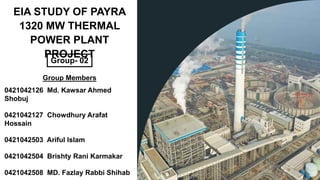
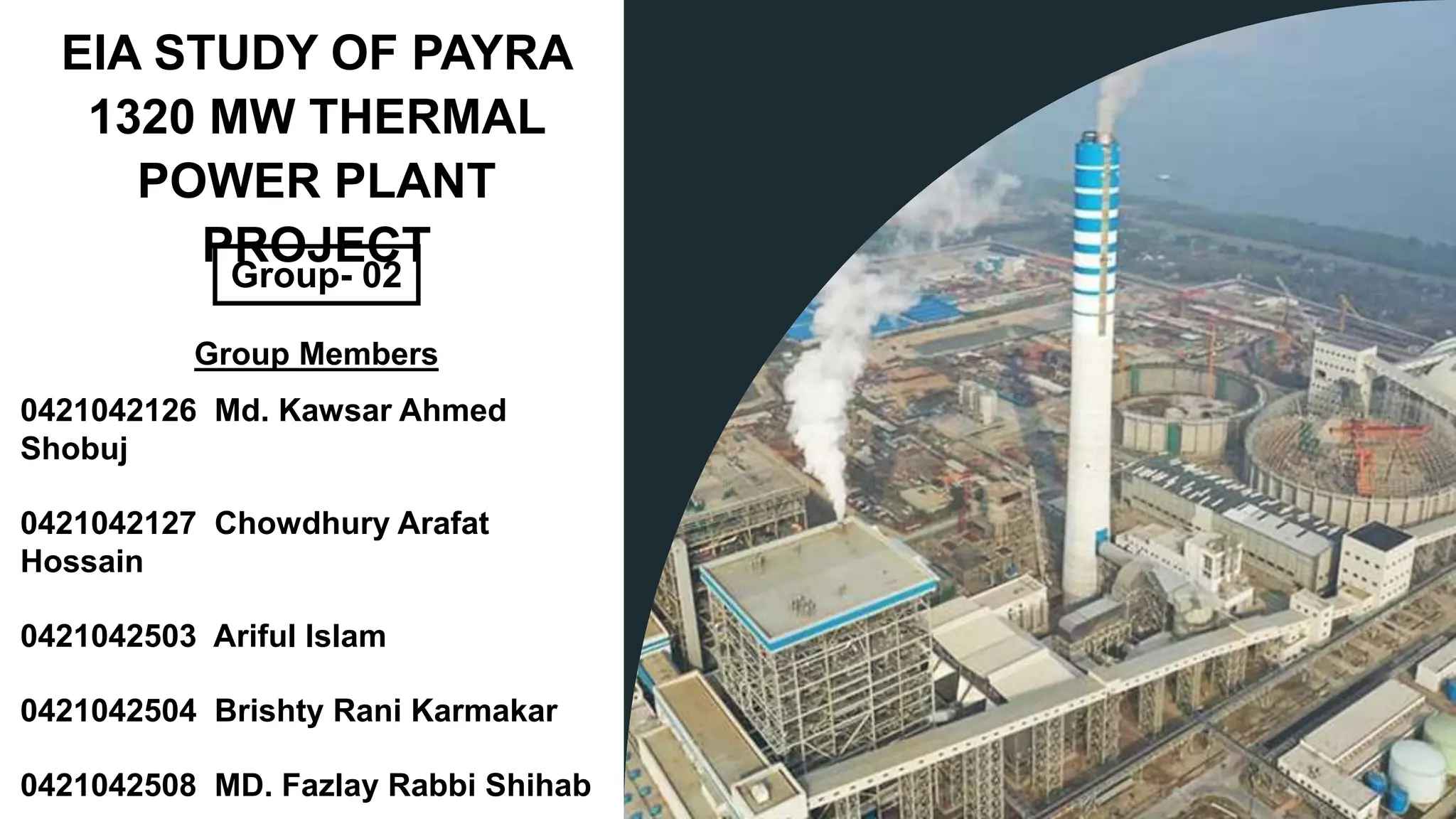
EIA STUDY OF PAYRA
1320 MW THERMAL
POWER PLANT
PROJECT
Group- 02
Group Members
0421042126 Md. Kawsar Ahmed
Shobuj
0421042127 Chowdhury Arafat
Hossain
0421042503 Ariful Islam
0421042504 Brishty Rani Karmakar
0421042508 MD. Fazlay Rabbi Shihab
INTRODUCTION
Planned and appropriate use of power is one of the pre-conditions for the economic
development of Bangladesh. In Bangladesh, the demand and consumption of electricity are
increasing day by day. But compared to other developing countries, the electricity generation of
Bangladesh is comparatively low. Only 62% of the total population has access to electricity. On
the other hand, the natural gas reserve is depleting and gas demands in other sectors are
increasing. So, the Bangladesh government has decided to install a coal-based thermal power
plant which will diverse the use of fuel and boost up the economy. The name of the project is
Payra 1320 MW Thermal Power Plant Project. BCPCL (Bangladesh China Power Company
Limited) will implement the project.
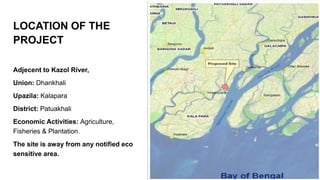
LOCATION OF THE
PROJECT
Adjecent to Kazol River,
Union: Dhankhali
Upazila: Kalapara
District: Patuakhali
Economic Activities: Agriculture,
Fisheries & Plantation.
The site is away from any notified eco
sensitive area.
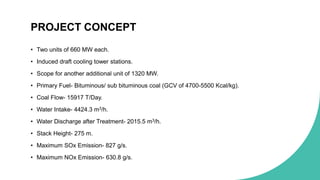
PROJECT CONCEPT
• Two units of 660 MW each.
• Induced draft cooling tower stations.
• Scope for another additional unit of 1320 MW.
• Primary Fuel- Bituminous/ sub bituminous coal (GCV of 4700-5500 Kcal/kg).
• Coal Flow- 15917 T/Day.
• Water Intake- 4424.3 m3/h.
• Water Discharge after Treatment- 2015.5 m3/h.
• Stack Height- 275 m.
• Maximum SOx Emission- 827 g/s.
• Maximum NOx Emission- 630.8 g/s.
IMPORTANCE OF THE PROJECT
• Addition of 1300 MW electricity to the national grid.
• Employment opportunity to the local people.
• Improvement of transportation in the project area.
• Fuel diversification.
• Reduce pressure on natural gas reserve.
EIA Screening
o To address the environmental and social risks of any proposed project and its associated
components; any protect and conserve the environment from any adverse impacts, the GoB
has specified regulations, policy and guidelines. Potential Lenders‘ also have their own set of
requirements (such as the ADB‘s Safeguard Policy and IFC‘s Performance Standards) to
which any project funded by them must operate.
o The activities of proposed coal based thermal power plant project of Bangladesh Government
fall under the 'red' category according to the Bangladesh Environment Conservation Rules
(ECR) 1997 and therefore, need to conduct IEE and EIA studies to obtain site and
environmental clearance from the DoE.
o There are no feasible alternatives to achieve the project's substantial overall net benefits
o Acceptable mitigation measures, such as compensatory protected areas, are included within
the project.
Scoping
o Governance of Power Generation and Management System
oCoal Sourcing: Indonesia etc.
oCoal Transportation: From the Kalimantan Port of Indonesia to the proposed project site.
oPrevention of pollution, and Protection of Environment
oHealth and Safety
oProcurement in Bangladesh
oTransport, Handling and Storage of Dangerous Goods
Baseline study
 Pollution elements
oAmbient air quality: minor increase of
Suspended Particulate Matter (SPM)
oAmbient noise quality: may produce noise but
very limited noise outside the project boundary
oSolid waste: coal dust, bottom ash and domestic
waste may also be the major types of solid
waste
oAquatic monitoring
o Surface and ground water quality
oSoil quality
§ Natural environment
o Physiography, geology &
hydrogeology
o Meteorology
o Ecology
 Socio-economic scenario
o Social classification
o Livelihoods and economic profile
o Access to infrastructure
o Cultural heritage
Baseline Study
Activities involved and their impact
 Land use and cropping pattern
oErosion
oLoss of biodiversity
 Civil works
oDust pollution
oNoise pollution
§ Operational activities
o Air pollution
o Waste generation
o Water consumption
o GHGs emission
§ Local biodiversity
§ Solid waste management
Baseline Study
Activities involved and their impact
 Air pollution from point sources
oParticulate matter, Gaseous emission: SOx, NOx, CO, CO2 etc.
 Air pollution from non-point sources
oTransport of coal, loading/unloading, coal storage, fly-ash handling
 Sources of water pollution
oCooling tower blow down, boiler blow down, plant effluent etc.
Impact Analysis
Methodology -Identification
Guidelines: ADB's safeguards Policy statement (2009), World Bank
Operational Guideline, IFC Health Safety Guidelines including the General EHS
Guidelines and those for Development Project
Mathematical Modeling
SCREEN 3.5.0 model- Thermal plume modelling
DEM- Digital elevation modelling
Multisource Noise Attenuation Model
Hydrological data sampling and analysis
Remote sensing(GIS) , FGD and Observational investigation on
Terrestrial and Aquatic Biodiversity
Impact Analysis
Methodology -Evaluation
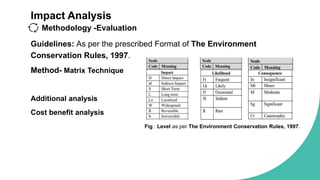
Guidelines: As per the prescribed Format of The Environment
Conservation Rules, 1997.
Method- Matrix Technique
Additional analysis
Cost benefit analysis
Fig : Level as per The Environment Conservation Rules, 1997.
Impact Analysis
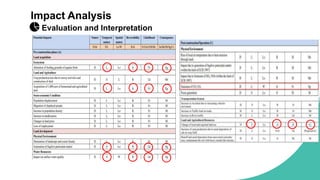
Evaluation and Interpretation
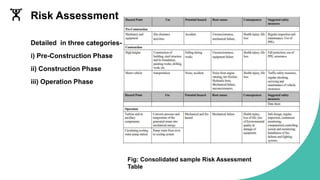
Risk Assessment
Detailed in three categories-
i) Pre-Construction Phase
ii) Construction Phase
iii) Operation Phase
Fig: Consolidated sample Risk Assessment
Table
Public Consultation
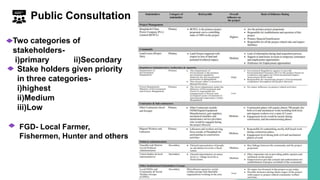
Two categories of
stakeholders-
i)primary ii)Secondary
Stake holders given priority
in three categories-
i)highest
ii)Medium
iii)Low
FGD- Local Farmer,
Fishermen, Hunter and others
Environmental M
anagement Plan
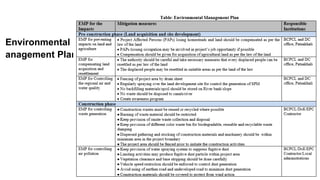
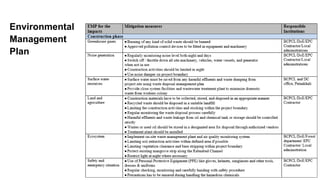
Environmental
Management
Plan
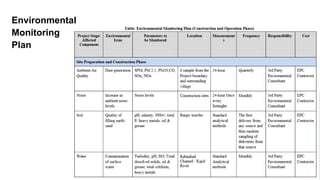
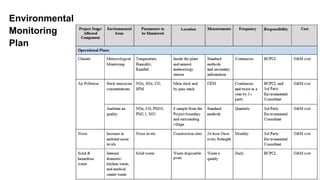
Environmental
Monitoring
Plan
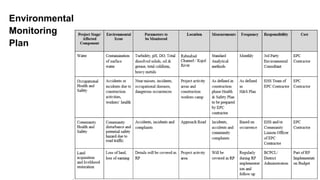
Environmental
Monitoring
Plan
Environmental
Monitoring
Plan
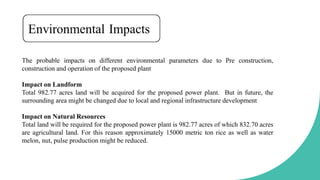
The probable impacts on different environmental parameters due to Pre construction,
construction and operation of the proposed plant
Impact on Landform
Total 982.77 acres land will be acquired for the proposed power plant. But in future, the
surrounding area might be changed due to local and regional infrastructure development
Impact on Natural Resources
Total land will be required for the proposed power plant is 982.77 acres of which 832.70 acres
are agricultural land. For this reason approximately 15000 metric ton rice as well as water
melon, nut, pulse production might be reduced.
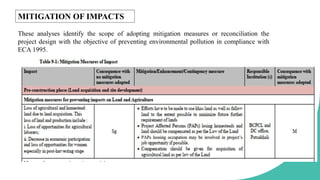
These analyses identify the scope of adopting mitigation measures or reconciliation the
project design with the objective of preventing environmental pollution in compliance with
ECA 1995.
MITIGATION OF IMPACTS
1. Impacts on different environmental parameters due to Pre construction, construction and
operation of the proposed plant
2. All activities (pre-construction, construction and post-construction stage) should be
implemented according to EMP
3. Proper Resettlement and Rehabilitation plan is necessary for proper compensation to
Project Affected People
4. The plant should be operated ensuring all pollution abatement measures.
CRITICISM
1. The proposed power plant contain human settlement and the lands are used for
agricultural activities at present
2. Major environmental and social impact due to wastewater, gaseous emission and noise
from power plant, loss of agricultural land and settlement.
3. These problems would be overcome by taking proper mitigation measures as stated in
EMP.
4. Local people showed interest to the project considering the needs for national development.
Conclusions
Thanks For Your Attention!

EIA Presentation Group-2 Final.pptx

  • 1.
    EIA STUDY OFPAYRA 1320 MW THERMAL POWER PLANT PROJECT Group- 02 Group Members 0421042126 Md. Kawsar Ahmed Shobuj 0421042127 Chowdhury Arafat Hossain 0421042503 Ariful Islam 0421042504 Brishty Rani Karmakar 0421042508 MD. Fazlay Rabbi Shihab
  • 2.
    INTRODUCTION Planned and appropriateuse of power is one of the pre-conditions for the economic development of Bangladesh. In Bangladesh, the demand and consumption of electricity are increasing day by day. But compared to other developing countries, the electricity generation of Bangladesh is comparatively low. Only 62% of the total population has access to electricity. On the other hand, the natural gas reserve is depleting and gas demands in other sectors are increasing. So, the Bangladesh government has decided to install a coal-based thermal power plant which will diverse the use of fuel and boost up the economy. The name of the project is Payra 1320 MW Thermal Power Plant Project. BCPCL (Bangladesh China Power Company Limited) will implement the project.
  • 3.
    LOCATION OF THE PROJECT Adjecentto Kazol River, Union: Dhankhali Upazila: Kalapara District: Patuakhali Economic Activities: Agriculture, Fisheries & Plantation. The site is away from any notified eco sensitive area.
  • 4.
    PROJECT CONCEPT • Twounits of 660 MW each. • Induced draft cooling tower stations. • Scope for another additional unit of 1320 MW. • Primary Fuel- Bituminous/ sub bituminous coal (GCV of 4700-5500 Kcal/kg). • Coal Flow- 15917 T/Day. • Water Intake- 4424.3 m3/h. • Water Discharge after Treatment- 2015.5 m3/h. • Stack Height- 275 m. • Maximum SOx Emission- 827 g/s. • Maximum NOx Emission- 630.8 g/s.
  • 5.
    IMPORTANCE OF THEPROJECT • Addition of 1300 MW electricity to the national grid. • Employment opportunity to the local people. • Improvement of transportation in the project area. • Fuel diversification. • Reduce pressure on natural gas reserve.
  • 6.
    EIA Screening o Toaddress the environmental and social risks of any proposed project and its associated components; any protect and conserve the environment from any adverse impacts, the GoB has specified regulations, policy and guidelines. Potential Lenders‘ also have their own set of requirements (such as the ADB‘s Safeguard Policy and IFC‘s Performance Standards) to which any project funded by them must operate. o The activities of proposed coal based thermal power plant project of Bangladesh Government fall under the 'red' category according to the Bangladesh Environment Conservation Rules (ECR) 1997 and therefore, need to conduct IEE and EIA studies to obtain site and environmental clearance from the DoE. o There are no feasible alternatives to achieve the project's substantial overall net benefits o Acceptable mitigation measures, such as compensatory protected areas, are included within the project.
  • 7.
    Scoping o Governance ofPower Generation and Management System oCoal Sourcing: Indonesia etc. oCoal Transportation: From the Kalimantan Port of Indonesia to the proposed project site. oPrevention of pollution, and Protection of Environment oHealth and Safety oProcurement in Bangladesh oTransport, Handling and Storage of Dangerous Goods
  • 8.
    Baseline study  Pollutionelements oAmbient air quality: minor increase of Suspended Particulate Matter (SPM) oAmbient noise quality: may produce noise but very limited noise outside the project boundary oSolid waste: coal dust, bottom ash and domestic waste may also be the major types of solid waste oAquatic monitoring o Surface and ground water quality oSoil quality § Natural environment o Physiography, geology & hydrogeology o Meteorology o Ecology  Socio-economic scenario o Social classification o Livelihoods and economic profile o Access to infrastructure o Cultural heritage
  • 9.
    Baseline Study Activities involvedand their impact  Land use and cropping pattern oErosion oLoss of biodiversity  Civil works oDust pollution oNoise pollution § Operational activities o Air pollution o Waste generation o Water consumption o GHGs emission § Local biodiversity § Solid waste management
  • 10.
    Baseline Study Activities involvedand their impact  Air pollution from point sources oParticulate matter, Gaseous emission: SOx, NOx, CO, CO2 etc.  Air pollution from non-point sources oTransport of coal, loading/unloading, coal storage, fly-ash handling  Sources of water pollution oCooling tower blow down, boiler blow down, plant effluent etc.
  • 11.
    Impact Analysis Methodology -Identification Guidelines:ADB's safeguards Policy statement (2009), World Bank Operational Guideline, IFC Health Safety Guidelines including the General EHS Guidelines and those for Development Project Mathematical Modeling SCREEN 3.5.0 model- Thermal plume modelling DEM- Digital elevation modelling Multisource Noise Attenuation Model Hydrological data sampling and analysis Remote sensing(GIS) , FGD and Observational investigation on Terrestrial and Aquatic Biodiversity
  • 12.
    Impact Analysis Methodology -Evaluation Guidelines:As per the prescribed Format of The Environment Conservation Rules, 1997. Method- Matrix Technique Additional analysis Cost benefit analysis Fig : Level as per The Environment Conservation Rules, 1997.
  • 13.
  • 14.
    Risk Assessment Detailed inthree categories- i) Pre-Construction Phase ii) Construction Phase iii) Operation Phase Fig: Consolidated sample Risk Assessment Table
  • 15.
    Public Consultation Two categoriesof stakeholders- i)primary ii)Secondary Stake holders given priority in three categories- i)highest ii)Medium iii)Low FGD- Local Farmer, Fishermen, Hunter and others
  • 16.
  • 17.
  • 18.
  • 19.
  • 20.
  • 21.
    The probable impactson different environmental parameters due to Pre construction, construction and operation of the proposed plant Impact on Landform Total 982.77 acres land will be acquired for the proposed power plant. But in future, the surrounding area might be changed due to local and regional infrastructure development Impact on Natural Resources Total land will be required for the proposed power plant is 982.77 acres of which 832.70 acres are agricultural land. For this reason approximately 15000 metric ton rice as well as water melon, nut, pulse production might be reduced.
  • 22.
    These analyses identifythe scope of adopting mitigation measures or reconciliation the project design with the objective of preventing environmental pollution in compliance with ECA 1995. MITIGATION OF IMPACTS
  • 23.
    1. Impacts ondifferent environmental parameters due to Pre construction, construction and operation of the proposed plant 2. All activities (pre-construction, construction and post-construction stage) should be implemented according to EMP 3. Proper Resettlement and Rehabilitation plan is necessary for proper compensation to Project Affected People 4. The plant should be operated ensuring all pollution abatement measures. CRITICISM
  • 24.
    1. The proposedpower plant contain human settlement and the lands are used for agricultural activities at present 2. Major environmental and social impact due to wastewater, gaseous emission and noise from power plant, loss of agricultural land and settlement. 3. These problems would be overcome by taking proper mitigation measures as stated in EMP. 4. Local people showed interest to the project considering the needs for national development. Conclusions
  • 25.
    Thanks For YourAttention!