General guide to the recognition of plant
pests and diseases
Aim of the presentation
• To provide an overview of the types of pest and disease that
cause damage on plants and produce
• To demonstrate the types of symptoms that each type of pest
or disease can cause
• To allow better recognition of symptoms of these pests and
diseases and to improve detection.
Contents
Diseases
• Causes of disease
• Types of disease affecting
different parts of the plant
• Common symptoms
Pests
• Groups of pests
• Symptoms caused
PLANT DISEASES
Causes of Plant Disease
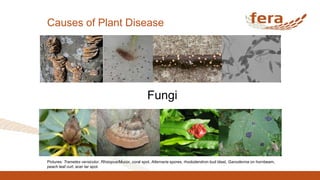
Fungi
Pictures: Trametes versicolor, Rhizopus/Mucor, coral spot, Alternaria spores, rhododendron bud blast, Ganoderma on hornbeam,
peach leaf curl, acer tar spot.
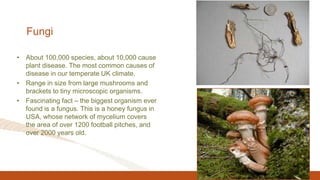
Fungi
• About 100,000 species, about 10,000 cause
plant disease. The most common causes of
disease in our temperate UK climate.
• Range in size from large mushrooms and
brackets to tiny microscopic organisms.
• Fascinating fact – the biggest organism ever
found is a fungus. This is a honey fungus in
USA, whose network of mycelium covers
the area of over 1200 football pitches, and
over 2000 years old.
Causes of Plant Disease
Fungus-like organisms
Pictures: foliar blight, tuber blight, Phytophthora root rot on box, Phytophthora bleeding canker on sycamore, Phytophthora
sporangium, clubroot, pea downy mildew, nicotiana downy mildew.
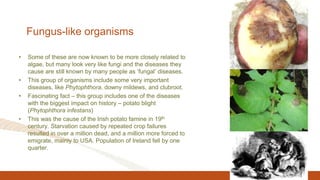
Fungus-like organisms
• Some of these are now known to be more closely related to
algae, but many look very like fungi and the diseases they
cause are still known by many people as ‘fungal’ diseases.
• This group of organisms include some very important
diseases, like Phytophthora, downy mildews, and clubroot.
• Fascinating fact – this group includes one of the diseases
with the biggest impact on history – potato blight
(Phytophthora infestans)
• This was the cause of the Irish potato famine in 19th
century. Starvation caused by repeated crop failures
resulted in over a million dead, and a million more forced to
emigrate, mainly to USA. Population of Ireland fell by one
quarter.
Causes of Plant Disease
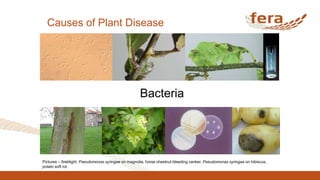
Bacteria
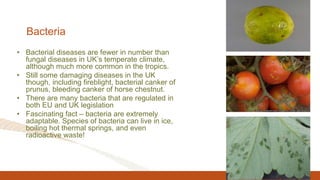
Pictures – fireblight, Pseudomonas syringae on magnolia, horse chestnut bleeding canker, Pseudomonas syringae on hibiscus,
potato soft rot.
Bacteria
• Bacterial diseases are fewer in number than
fungal diseases in UK’s temperate climate,
although much more common in the tropics.
• Still some damaging diseases in the UK
though, including fireblight, bacterial canker of
prunus, bleeding canker of horse chestnut.
• There are many bacteria that are regulated in
both EU and UK legislation
• Fascinating fact – bacteria are extremely
adaptable. Species of bacteria can live in ice,
boiling hot thermal springs, and even
radioactive waste!
Causes of Plant Disease
Viruses / Viroids / Phytoplasmas
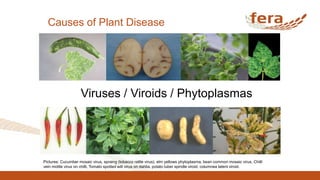
Pictures: Cucumber mosaic virus, spraing (tobacco rattle virus), elm yellows phytoplasma, bean common mosaic virus, Chilli
vein mottle virus on chilli, Tomato spotted wilt virus on dahlia, potato tuber spindle viroid, columnea latent viroid.
Viruses / Viroids / Phytoplasmas
• Viruses are very small and can only be seen with powerful electron
microscopes. Viroids are even smaller, and are just naked pieces of
genetic material. Phytoplasmas are more closely related to bacteria than
viruses, but often cause virus-like symptoms.
• Viruses have no means of movement and rely on ‘vectors’ to move them
from plant to plant. Common vectors include insects such as aphids,
thrips, whiteflies.
• People can move some ‘mechanically-transmitted’ viruses by
transferring sap from a virus-affected to a healthy plant (via tools, or
simply by touching the plants).
• Fascinating fact: some plant viruses are extremely contagious. Plant sap
containing tobacco mosaic virus can be diluted a million times and still
be infectious.
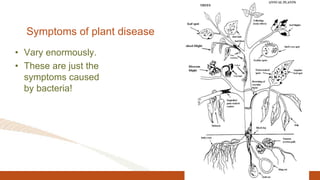
Symptoms of plant disease
• Vary enormously.
• These are just the
symptoms caused
by bacteria!
Leaf diseases
• Powdery mildews
• Downy mildews
• Rusts
• Leaf spots
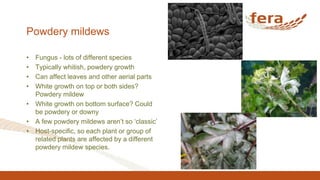
Powdery mildews
• Fungus - lots of different species
• Typically whitish, powdery growth
• Can affect leaves and other aerial parts
• White growth on top or both sides?
Powdery mildew
• White growth on bottom surface? Could
be powdery or downy
• A few powdery mildews aren’t so ‘classic’
• Host-specific, so each plant or group of
related plants are affected by a different
powdery mildew species.
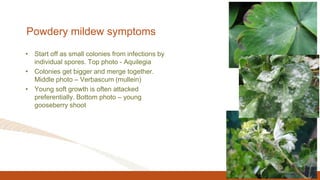
Powdery mildew symptoms
• Start off as small colonies from infections by
individual spores. Top photo - Aquilegia
• Colonies get bigger and merge together.
Middle photo – Verbascum (mullein)
• Young soft growth is often attacked
preferentially. Bottom photo – young
gooseberry shoot
Downy mildews
• Fungus-like organism: lots of different species
• Often (not always) confined to leaves
• Discolouration of top surface
• ‘Fungal’ growth below; white, purple or brown
• May cause leaf distortion or shedding
• Host-specific, so each plant or group of related
plants are affected by a different downy mildew
species.
• Growth on leaf underside consists of spore
stalks and spores.
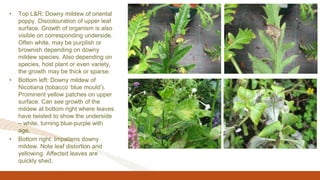
• Top L&R: Downy mildew of oriental
poppy. Discolouration of upper leaf
surface. Growth of organism is also
visible on corresponding underside.
Often white, may be purplish or
brownish depending on downy
mildew species. Also depending on
species, host plant or even variety,
the growth may be thick or sparse.
• Bottom left: Downy mildew of
Nicotiana (tobacco ‘blue mould’).
Prominent yellow patches on upper
surface. Can see growth of the
mildew at bottom right where leaves
have twisted to show the underside
– white, turning blue-purple with
age.
• Bottom right: Impatiens downy
mildew. Note leaf distortion and
yellowing. Affected leaves are
quickly shed.
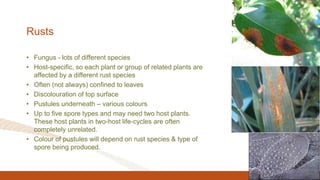
Rusts
• Fungus - lots of different species
• Host-specific, so each plant or group of related plants are
affected by a different rust species
• Often (not always) confined to leaves
• Discolouration of top surface
• Pustules underneath – various colours
• Up to five spore types and may need two host plants.
These host plants in two-host life-cycles are often
completely unrelated.
• Colour of pustules will depend on rust species & type of
spore being produced.
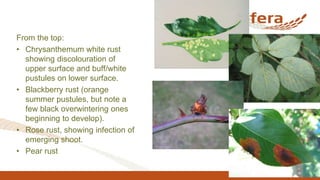
From the top:
• Chrysanthemum white rust
showing discolouration of
upper surface and buff/white
pustules on lower surface.
• Blackberry rust (orange
summer pustules, but note a
few black overwintering ones
beginning to develop).
• Rose rust, showing infection of
emerging shoot.
• Pear rust
Leaf spots
• Can be caused by fungi, bacteria or viruses
• Huge number of different species
• Fungal fruiting bodies sometimes visible
• Effects on plant very variable
• Some may also cause diebacks
• Most plant species will suffer from at least one
leaf spot, often several.
• Some leaf spot diseases have very little effect
on the plant, others can be much more
damaging, causing defoliation and dieback.
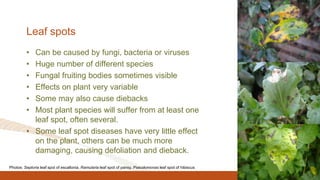
Photos: Septoria leaf spot of escallonia, Ramularia leaf spot of pansy, Pseudomonas leaf spot of hibiscus
• Top R: Phoma on brassica: Leaf spots
showing fungal fruiting bodies
• Septoria leaf spot of Escallonia – a relatively
new and very damaging fungal leaf spot
• Cylindrocladium blight of box – fungus
causing leaf loss and dieback, as well as
spotting.
• Xanthomonas arboricola pv pruni on Prunus –
a bacterial leaf spot
• Pseudomonas syringae on hibiscus – a
bacterial leaf spot
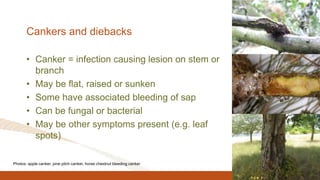
Top left - bleeding
canker of horse
chestnut (P. syringae
pv. aesculi)
Bottom left – apple
canker (Neonectria
ditissima)
Right – ash dieback
(Hymenoscyphus
fraxineus)
Cankers and
diebacks
Cankers and diebacks
• Canker = infection causing lesion on stem or
branch
• May be flat, raised or sunken
• Some have associated bleeding of sap
• Can be fungal or bacterial
• May be other symptoms present (e.g. leaf
spots)
Photos: apple canker, pine pitch canker, horse chestnut bleeding canker
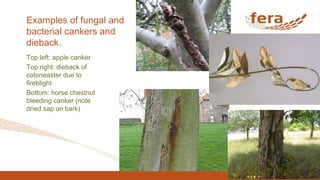
Examples of fungal and
bacterial cankers and
dieback.
Top left: apple canker
Top right: dieback of
cotoneaster due to
fireblight
Bottom: horse chestnut
bleeding canker (note
dried sap on bark)
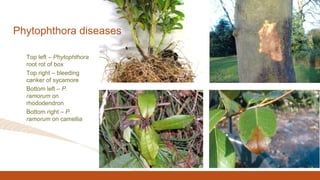
Top left – Phytophthora
root rot of box
Top right – bleeding
canker of sycamore
Bottom left – P.
ramorum on
rhododendron
Bottom right – P.
ramorum on camellia
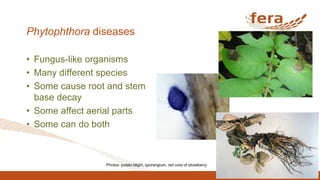
Phytophthora diseases
• Fungus-like organisms
• Many different species
• Some cause root and stem
base decay
• Some affect aerial parts
• Some can do both
Photos: potato blight, sporangium, red core of strawberry
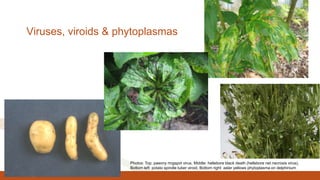
Viruses, viroids & phytoplasmas
Photos: Top: paeony ringspot virus, Middle: hellebore black death (hellebore net necrosis virus),
Bottom left: potato spindle tuber viroid, Bottom right: aster yellows phytoplasma on delphinium
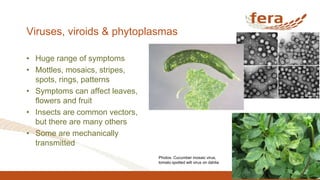
Viruses, viroids & phytoplasmas
• Huge range of symptoms
• Mottles, mosaics, stripes,
spots, rings, patterns
• Symptoms can affect leaves,
flowers and fruit
• Insects are common vectors,
but there are many others
• Some are mechanically
transmitted
Photos: Cucumber mosaic virus,
tomato spotted wilt virus on dahlia
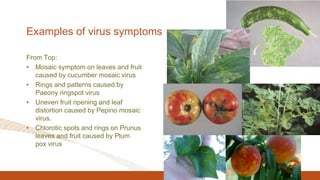
Examples of virus symptoms
From Top:
• Mosaic symptom on leaves and fruit
caused by cucumber mosaic virus
• Rings and patterns caused by
Paeony ringspot virus
• Uneven fruit ripening and leaf
distortion caused by Pepino mosaic
virus.
• Chlorotic spots and rings on Prunus
leaves and fruit caused by Plum
pox virus

1.-Guide-to-the-detection-of-PD-Diseases.pptx

  • 1.
    General guide tothe recognition of plant pests and diseases
  • 2.
    Aim of thepresentation • To provide an overview of the types of pest and disease that cause damage on plants and produce • To demonstrate the types of symptoms that each type of pest or disease can cause • To allow better recognition of symptoms of these pests and diseases and to improve detection.
  • 3.
    Contents Diseases • Causes ofdisease • Types of disease affecting different parts of the plant • Common symptoms Pests • Groups of pests • Symptoms caused
  • 4.
  • 5.
    Causes of PlantDisease Fungi Pictures: Trametes versicolor, Rhizopus/Mucor, coral spot, Alternaria spores, rhododendron bud blast, Ganoderma on hornbeam, peach leaf curl, acer tar spot.
  • 6.
    Fungi • About 100,000species, about 10,000 cause plant disease. The most common causes of disease in our temperate UK climate. • Range in size from large mushrooms and brackets to tiny microscopic organisms. • Fascinating fact – the biggest organism ever found is a fungus. This is a honey fungus in USA, whose network of mycelium covers the area of over 1200 football pitches, and over 2000 years old.
  • 7.
    Causes of PlantDisease Fungus-like organisms Pictures: foliar blight, tuber blight, Phytophthora root rot on box, Phytophthora bleeding canker on sycamore, Phytophthora sporangium, clubroot, pea downy mildew, nicotiana downy mildew.
  • 8.
    Fungus-like organisms • Someof these are now known to be more closely related to algae, but many look very like fungi and the diseases they cause are still known by many people as ‘fungal’ diseases. • This group of organisms include some very important diseases, like Phytophthora, downy mildews, and clubroot. • Fascinating fact – this group includes one of the diseases with the biggest impact on history – potato blight (Phytophthora infestans) • This was the cause of the Irish potato famine in 19th century. Starvation caused by repeated crop failures resulted in over a million dead, and a million more forced to emigrate, mainly to USA. Population of Ireland fell by one quarter.
  • 9.
    Causes of PlantDisease Bacteria Pictures – fireblight, Pseudomonas syringae on magnolia, horse chestnut bleeding canker, Pseudomonas syringae on hibiscus, potato soft rot.
  • 10.
    Bacteria • Bacterial diseasesare fewer in number than fungal diseases in UK’s temperate climate, although much more common in the tropics. • Still some damaging diseases in the UK though, including fireblight, bacterial canker of prunus, bleeding canker of horse chestnut. • There are many bacteria that are regulated in both EU and UK legislation • Fascinating fact – bacteria are extremely adaptable. Species of bacteria can live in ice, boiling hot thermal springs, and even radioactive waste!
  • 11.
    Causes of PlantDisease Viruses / Viroids / Phytoplasmas Pictures: Cucumber mosaic virus, spraing (tobacco rattle virus), elm yellows phytoplasma, bean common mosaic virus, Chilli vein mottle virus on chilli, Tomato spotted wilt virus on dahlia, potato tuber spindle viroid, columnea latent viroid.
  • 12.
    Viruses / Viroids/ Phytoplasmas • Viruses are very small and can only be seen with powerful electron microscopes. Viroids are even smaller, and are just naked pieces of genetic material. Phytoplasmas are more closely related to bacteria than viruses, but often cause virus-like symptoms. • Viruses have no means of movement and rely on ‘vectors’ to move them from plant to plant. Common vectors include insects such as aphids, thrips, whiteflies. • People can move some ‘mechanically-transmitted’ viruses by transferring sap from a virus-affected to a healthy plant (via tools, or simply by touching the plants). • Fascinating fact: some plant viruses are extremely contagious. Plant sap containing tobacco mosaic virus can be diluted a million times and still be infectious.
  • 13.
    Symptoms of plantdisease • Vary enormously. • These are just the symptoms caused by bacteria!
  • 14.
    Leaf diseases • Powderymildews • Downy mildews • Rusts • Leaf spots
  • 15.
    Powdery mildews • Fungus- lots of different species • Typically whitish, powdery growth • Can affect leaves and other aerial parts • White growth on top or both sides? Powdery mildew • White growth on bottom surface? Could be powdery or downy • A few powdery mildews aren’t so ‘classic’ • Host-specific, so each plant or group of related plants are affected by a different powdery mildew species.
  • 16.
    Powdery mildew symptoms •Start off as small colonies from infections by individual spores. Top photo - Aquilegia • Colonies get bigger and merge together. Middle photo – Verbascum (mullein) • Young soft growth is often attacked preferentially. Bottom photo – young gooseberry shoot
  • 17.
    Downy mildews • Fungus-likeorganism: lots of different species • Often (not always) confined to leaves • Discolouration of top surface • ‘Fungal’ growth below; white, purple or brown • May cause leaf distortion or shedding • Host-specific, so each plant or group of related plants are affected by a different downy mildew species. • Growth on leaf underside consists of spore stalks and spores.
  • 18.
    • Top L&R:Downy mildew of oriental poppy. Discolouration of upper leaf surface. Growth of organism is also visible on corresponding underside. Often white, may be purplish or brownish depending on downy mildew species. Also depending on species, host plant or even variety, the growth may be thick or sparse. • Bottom left: Downy mildew of Nicotiana (tobacco ‘blue mould’). Prominent yellow patches on upper surface. Can see growth of the mildew at bottom right where leaves have twisted to show the underside – white, turning blue-purple with age. • Bottom right: Impatiens downy mildew. Note leaf distortion and yellowing. Affected leaves are quickly shed.
  • 19.
    Rusts • Fungus -lots of different species • Host-specific, so each plant or group of related plants are affected by a different rust species • Often (not always) confined to leaves • Discolouration of top surface • Pustules underneath – various colours • Up to five spore types and may need two host plants. These host plants in two-host life-cycles are often completely unrelated. • Colour of pustules will depend on rust species & type of spore being produced.
  • 20.
    From the top: •Chrysanthemum white rust showing discolouration of upper surface and buff/white pustules on lower surface. • Blackberry rust (orange summer pustules, but note a few black overwintering ones beginning to develop). • Rose rust, showing infection of emerging shoot. • Pear rust
  • 21.
    Leaf spots • Canbe caused by fungi, bacteria or viruses • Huge number of different species • Fungal fruiting bodies sometimes visible • Effects on plant very variable • Some may also cause diebacks • Most plant species will suffer from at least one leaf spot, often several. • Some leaf spot diseases have very little effect on the plant, others can be much more damaging, causing defoliation and dieback. Photos: Septoria leaf spot of escallonia, Ramularia leaf spot of pansy, Pseudomonas leaf spot of hibiscus
  • 22.
    • Top R:Phoma on brassica: Leaf spots showing fungal fruiting bodies • Septoria leaf spot of Escallonia – a relatively new and very damaging fungal leaf spot • Cylindrocladium blight of box – fungus causing leaf loss and dieback, as well as spotting. • Xanthomonas arboricola pv pruni on Prunus – a bacterial leaf spot • Pseudomonas syringae on hibiscus – a bacterial leaf spot
  • 23.
    Top left -bleeding canker of horse chestnut (P. syringae pv. aesculi) Bottom left – apple canker (Neonectria ditissima) Right – ash dieback (Hymenoscyphus fraxineus) Cankers and diebacks
  • 24.
    Cankers and diebacks •Canker = infection causing lesion on stem or branch • May be flat, raised or sunken • Some have associated bleeding of sap • Can be fungal or bacterial • May be other symptoms present (e.g. leaf spots) Photos: apple canker, pine pitch canker, horse chestnut bleeding canker
  • 25.
    Examples of fungaland bacterial cankers and dieback. Top left: apple canker Top right: dieback of cotoneaster due to fireblight Bottom: horse chestnut bleeding canker (note dried sap on bark)
  • 26.
    Top left –Phytophthora root rot of box Top right – bleeding canker of sycamore Bottom left – P. ramorum on rhododendron Bottom right – P. ramorum on camellia Phytophthora diseases
  • 27.
    Phytophthora diseases • Fungus-likeorganisms • Many different species • Some cause root and stem base decay • Some affect aerial parts • Some can do both Photos: potato blight, sporangium, red core of strawberry
  • 28.
    Viruses, viroids &phytoplasmas Photos: Top: paeony ringspot virus, Middle: hellebore black death (hellebore net necrosis virus), Bottom left: potato spindle tuber viroid, Bottom right: aster yellows phytoplasma on delphinium
  • 29.
    Viruses, viroids &phytoplasmas • Huge range of symptoms • Mottles, mosaics, stripes, spots, rings, patterns • Symptoms can affect leaves, flowers and fruit • Insects are common vectors, but there are many others • Some are mechanically transmitted Photos: Cucumber mosaic virus, tomato spotted wilt virus on dahlia
  • 30.
    Examples of virussymptoms From Top: • Mosaic symptom on leaves and fruit caused by cucumber mosaic virus • Rings and patterns caused by Paeony ringspot virus • Uneven fruit ripening and leaf distortion caused by Pepino mosaic virus. • Chlorotic spots and rings on Prunus leaves and fruit caused by Plum pox virus

Editor's Notes

  • #31 e.g. of symptom type: mosaic Cucumber mosaic