Dr. T. BalasubramanianPhysiology of deglutition
The crossing of alimentary and Ventilatory streams is anEvolutionary consequenceOf transition of vertebratesFrom sea to land livingdrtbalu's otolaryngology online2
IntroductionDeglutition involves co-ordinated activity of muscles of oral cavity, pharynx, larynx and esophagusThe whole process is partly under voluntary control & partly reflexive in natureDeglution by definition involves passage of bolus of food (solid / liquid) from the oral cavity to stomach via the pharynx and esophagus.Voluntary control of deglutition involves control of jaw, tongue, degree of constriction and length of pharynx and closure of laryngeal introitusdrtbalu's otolaryngology online3
Components of deglutitionDeglution has 3 componentsPassage of bolus from oral cavity to stomachProtection of airwayInhibition of air entry into the stomachdrtbalu's otolaryngology online4
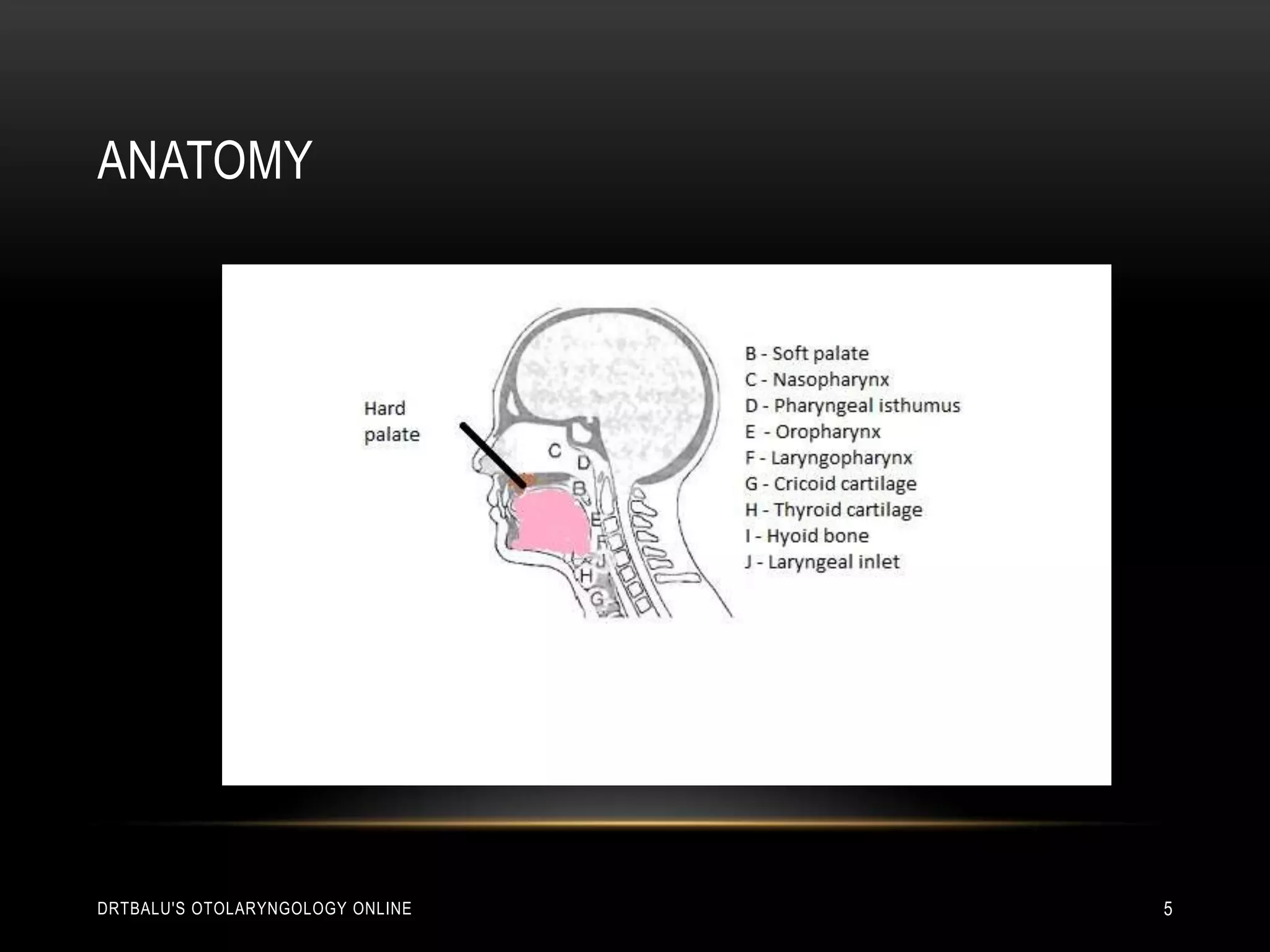
Anatomydrtbalu's otolaryngology online5
Deglutition - phasesOralPharyngealEsophagealThese stages have been traditionally described for the sake of convenience.  They help in the better understanding of the physiological process involved.drtbalu's otolaryngology online6
Oral phaseIn this phase food is prepared for swallowingTongue plays a vital role in this processThis phase is divided into oral preparatory phase and oral phase properThis phase is vital in all land animals which don’t swallow their food as a wholeThis phase is under voluntary controldrtbalu's otolaryngology online7
Oral preparatory phaseThis phase involves breaking down of food in the oral cavityDuring this phase the food is chewed and mixed with saliva making it into a bolus which can be swallowedThe elevators of lower jaw play an important role in bolus preparationTongue plays a vital role in bolus formation by the action of its intrinsic muscles which alters its shape.  Its extrinsic muscles changes its position within the oral cavity thereby helping in chewing the food by dental occlusionOcclusal action of the lips help in creating an effective seal preventing the bolus from dribbling out of the oral cavityThe action of buccinator muscle helps in pushing the bolus out of the vestibule into the oral cavity properdrtbalu's otolaryngology online8
Bolus formationThis is the most important function of preparatory phaseThis involves repeated transfer of food from oral cavity to oropharyngeal surface of tongueBolus accumulates on the oropharyngeal surface of tongue due to repeated cycles of upward & downward movement of the tonguedrtbalu's otolaryngology online9
Oral phase properDuring this phase the bolus is moved towards the back of the tongueThe contraction of soft palate prevents nasal regurgitationThe soft palate also prevents premature movement of bolus into the oropharynxOnce the bolus is of suitable consistency the transit from mouth to oropharynx just takes a couple of secondsTongue plays a vital role during this phase.  Its intrinsic muscles contracts and reduces its size, while genioglossus muscle elevates the tongue towards the palateThe elevation of the mandible plays a vital role hereWhen the mandible is elevated the suprahyoid muscles raises the hyoid bonedrtbalu's otolaryngology online10
Anatomy of pharynxIt is a midline tube about 15 cm longIt is continuous with nasal cavities and larynx above and esophagus belowThe anterior wall of pharynx is incomplete and is composed of posterior part of tongue superiorly and larynx inferiorlyPharynx is hence divided into nasopharynx, oropharynx and laryngopharynx according to those structures lying anteriorlyThe reminder of pharynx resembles the gut.  It has 4 layers i.e. areolar, muscular, sub mucous and inner mucous membrane (from outside inwards)The muscular layer has 2 components i.e. longitudinal and circular muscle layersdrtbalu's otolaryngology online11
Anatomy of pharynx – (contd)The circular muscle layer is formed by superior, middle and inferior constrictorsThe inferior constrictor has 2 components i.e. thyropharyngeus and cricopharyngeusExcept the cricopharyngeus muscle all the other muscles acting on the pharynx are pairedThe cricopharynx forms a distinct sphincter at the point where laryngopharynx enters the oesophagusdrtbalu's otolaryngology online12
Pharyngeal phase (Pumping action of tongue & hypopharyngeal suction) This phase of deglutition is reflexive in natureIt is during this phase that Ventilatory and alimentary streams cross each other.  Dynamic separation of these streams is possible due to the co-ordination of reflex phase that occursIt just takes a second for the bolus to traverse the pharynx and reach the cricopharyngeal areaContraction of diaphragm is inhibited making simultaneous breathing & swallowing impossibleSoft palate is elevated in order to seal off the nasopharynx (T. palatini & L. palatini)Vocal cords adduct protecting the airwayAs the bolus passes the palatoglossal & palatopharyngeal folds the act of swallowing becomes reflexivedrtbalu's otolaryngology online13
Functions of trigger points in oropharynxStimulation of trigger points present in the oropharynx starts off the pharyngeal reflexive stage of swallowingTrigger points are present at the faucial arches & mucosa of the posterior pharyngeal wallThese trigger points are innervated by glossopharyngeal nerveStimulation of these trigger points causes dilatation of pharynx due to relaxation of the constrictors, and elevation of pharynx & larynx due to contraction of longitudinal musclesThe pharynx constricts behind the bolus thereby propelling itContraction of the inferior constrictor moves the bolus towards the oesophagusdrtbalu's otolaryngology online14
Importance of laryngeal elevation during pharyngeal stageIt narrows the laryngeal inletIt ensures better sealing of the laryngeal inlet by the downturned epiglottisLaryngeal elevation also contributes to dilatation of pharynxThe laryngeal inlet is closed due to the actions of interarytenoid, aryepiglottic and thyroepiglottic musclesdrtbalu's otolaryngology online15
Role of epiglottis in the pharyngeal phaseThe  movement of epiglottis occurs in two stagesThe epiglottis moves from vertical – horizontal positionThe upper third of epiglottis moves below the horizontal to a slightly lower level to cover the narrowed laryngeal inletThe bolus during the course of the swallow impinges on the epiglottis and gets diverted to the lateral food channelsSolid food tends to go behind the epiglottis in to the post cricoid areaLiquid food gets split by the epiglottis and passes via the pyriform fossaedrtbalu's otolaryngology online16
Esophageal stageThis is purely reflexiveThis phase begins by relaxing the cricopharyngeal sphincterThe time taken for esophageal transit is 10-15 secondsPrimary / secondary / tertiary peristaltic waves play active roles in this phasedrtbalu's otolaryngology online17
Neural control of swallowingTwo areas of brain are involvedCerebral cortexBrain stemdrtbalu's otolaryngology online18
Neural control (initiation)Initiation of swallow is voluntaryBilateral prefrontal, frontal and parietal cortices are involvedSwallowing is initiated when food comes into contact with certain trigger areas like fauces / mucosa of posterior pharyngeal wallAfferent nerve is the glossopharyngeal nerveNucleus tractussolitarius & spinal nucleus of trigeminal nerve play a vital roleEfferents involve several cranial nerve nuclei which include nucleus ambiguus (muscles of palate, pharynx and larynx), hypoglossal nucleus supplying the muscles of the tongue, motor nuclei of trigeminal and facial nerves supplying the muscles of face, jaws and lips.drtbalu's otolaryngology online19
Role of medullaThere are two groups of neurons in the medulla while lie between the afferent and efferent systemFirst group lie in the dorsal medulla above the nucleus of the solitary tractThe second group lie in the ventral medulla around nucleus ambiguusThese groups of neurons are named as lateral & medial medullary swallowing centersdrtbalu's otolaryngology online20
Role of central pattern generatorCentral pattern generator are a set of neurons capable of initiating sequential swallowThese neurons act like a cardiac pacemakerSince the process of swallowing and breathing are interlinked there is a certain degree of central co ordination taking placedrtbalu's otolaryngology online21
Phase of respiration & swallowingSwallowing occurs during expiratory phase of respirationThis helps in clearing food material left in the vestibule.  Thus it should be considered to be a protective phenomenon The rhythm of respiration is reset after a successful swallowdrtbalu's otolaryngology online22
Thank youdrtbalu's otolaryngology online23

Physiology of deglutition

  • 1.
  • 2.
    The crossing ofalimentary and Ventilatory streams is anEvolutionary consequenceOf transition of vertebratesFrom sea to land livingdrtbalu's otolaryngology online2
  • 3.
    IntroductionDeglutition involves co-ordinatedactivity of muscles of oral cavity, pharynx, larynx and esophagusThe whole process is partly under voluntary control & partly reflexive in natureDeglution by definition involves passage of bolus of food (solid / liquid) from the oral cavity to stomach via the pharynx and esophagus.Voluntary control of deglutition involves control of jaw, tongue, degree of constriction and length of pharynx and closure of laryngeal introitusdrtbalu's otolaryngology online3
  • 4.
    Components of deglutitionDeglutionhas 3 componentsPassage of bolus from oral cavity to stomachProtection of airwayInhibition of air entry into the stomachdrtbalu's otolaryngology online4
  • 5.
  • 6.
    Deglutition - phasesOralPharyngealEsophagealThesestages have been traditionally described for the sake of convenience. They help in the better understanding of the physiological process involved.drtbalu's otolaryngology online6
  • 7.
    Oral phaseIn thisphase food is prepared for swallowingTongue plays a vital role in this processThis phase is divided into oral preparatory phase and oral phase properThis phase is vital in all land animals which don’t swallow their food as a wholeThis phase is under voluntary controldrtbalu's otolaryngology online7
  • 8.
    Oral preparatory phaseThisphase involves breaking down of food in the oral cavityDuring this phase the food is chewed and mixed with saliva making it into a bolus which can be swallowedThe elevators of lower jaw play an important role in bolus preparationTongue plays a vital role in bolus formation by the action of its intrinsic muscles which alters its shape. Its extrinsic muscles changes its position within the oral cavity thereby helping in chewing the food by dental occlusionOcclusal action of the lips help in creating an effective seal preventing the bolus from dribbling out of the oral cavityThe action of buccinator muscle helps in pushing the bolus out of the vestibule into the oral cavity properdrtbalu's otolaryngology online8
  • 9.
    Bolus formationThis isthe most important function of preparatory phaseThis involves repeated transfer of food from oral cavity to oropharyngeal surface of tongueBolus accumulates on the oropharyngeal surface of tongue due to repeated cycles of upward & downward movement of the tonguedrtbalu's otolaryngology online9
  • 10.
    Oral phase properDuringthis phase the bolus is moved towards the back of the tongueThe contraction of soft palate prevents nasal regurgitationThe soft palate also prevents premature movement of bolus into the oropharynxOnce the bolus is of suitable consistency the transit from mouth to oropharynx just takes a couple of secondsTongue plays a vital role during this phase. Its intrinsic muscles contracts and reduces its size, while genioglossus muscle elevates the tongue towards the palateThe elevation of the mandible plays a vital role hereWhen the mandible is elevated the suprahyoid muscles raises the hyoid bonedrtbalu's otolaryngology online10
  • 11.
    Anatomy of pharynxItis a midline tube about 15 cm longIt is continuous with nasal cavities and larynx above and esophagus belowThe anterior wall of pharynx is incomplete and is composed of posterior part of tongue superiorly and larynx inferiorlyPharynx is hence divided into nasopharynx, oropharynx and laryngopharynx according to those structures lying anteriorlyThe reminder of pharynx resembles the gut. It has 4 layers i.e. areolar, muscular, sub mucous and inner mucous membrane (from outside inwards)The muscular layer has 2 components i.e. longitudinal and circular muscle layersdrtbalu's otolaryngology online11
  • 12.
    Anatomy of pharynx– (contd)The circular muscle layer is formed by superior, middle and inferior constrictorsThe inferior constrictor has 2 components i.e. thyropharyngeus and cricopharyngeusExcept the cricopharyngeus muscle all the other muscles acting on the pharynx are pairedThe cricopharynx forms a distinct sphincter at the point where laryngopharynx enters the oesophagusdrtbalu's otolaryngology online12
  • 13.
    Pharyngeal phase (Pumpingaction of tongue & hypopharyngeal suction) This phase of deglutition is reflexive in natureIt is during this phase that Ventilatory and alimentary streams cross each other. Dynamic separation of these streams is possible due to the co-ordination of reflex phase that occursIt just takes a second for the bolus to traverse the pharynx and reach the cricopharyngeal areaContraction of diaphragm is inhibited making simultaneous breathing & swallowing impossibleSoft palate is elevated in order to seal off the nasopharynx (T. palatini & L. palatini)Vocal cords adduct protecting the airwayAs the bolus passes the palatoglossal & palatopharyngeal folds the act of swallowing becomes reflexivedrtbalu's otolaryngology online13
  • 14.
    Functions of triggerpoints in oropharynxStimulation of trigger points present in the oropharynx starts off the pharyngeal reflexive stage of swallowingTrigger points are present at the faucial arches & mucosa of the posterior pharyngeal wallThese trigger points are innervated by glossopharyngeal nerveStimulation of these trigger points causes dilatation of pharynx due to relaxation of the constrictors, and elevation of pharynx & larynx due to contraction of longitudinal musclesThe pharynx constricts behind the bolus thereby propelling itContraction of the inferior constrictor moves the bolus towards the oesophagusdrtbalu's otolaryngology online14
  • 15.
    Importance of laryngealelevation during pharyngeal stageIt narrows the laryngeal inletIt ensures better sealing of the laryngeal inlet by the downturned epiglottisLaryngeal elevation also contributes to dilatation of pharynxThe laryngeal inlet is closed due to the actions of interarytenoid, aryepiglottic and thyroepiglottic musclesdrtbalu's otolaryngology online15
  • 16.
    Role of epiglottisin the pharyngeal phaseThe movement of epiglottis occurs in two stagesThe epiglottis moves from vertical – horizontal positionThe upper third of epiglottis moves below the horizontal to a slightly lower level to cover the narrowed laryngeal inletThe bolus during the course of the swallow impinges on the epiglottis and gets diverted to the lateral food channelsSolid food tends to go behind the epiglottis in to the post cricoid areaLiquid food gets split by the epiglottis and passes via the pyriform fossaedrtbalu's otolaryngology online16
  • 17.
    Esophageal stageThis ispurely reflexiveThis phase begins by relaxing the cricopharyngeal sphincterThe time taken for esophageal transit is 10-15 secondsPrimary / secondary / tertiary peristaltic waves play active roles in this phasedrtbalu's otolaryngology online17
  • 18.
    Neural control ofswallowingTwo areas of brain are involvedCerebral cortexBrain stemdrtbalu's otolaryngology online18
  • 19.
    Neural control (initiation)Initiationof swallow is voluntaryBilateral prefrontal, frontal and parietal cortices are involvedSwallowing is initiated when food comes into contact with certain trigger areas like fauces / mucosa of posterior pharyngeal wallAfferent nerve is the glossopharyngeal nerveNucleus tractussolitarius & spinal nucleus of trigeminal nerve play a vital roleEfferents involve several cranial nerve nuclei which include nucleus ambiguus (muscles of palate, pharynx and larynx), hypoglossal nucleus supplying the muscles of the tongue, motor nuclei of trigeminal and facial nerves supplying the muscles of face, jaws and lips.drtbalu's otolaryngology online19
  • 20.
    Role of medullaThereare two groups of neurons in the medulla while lie between the afferent and efferent systemFirst group lie in the dorsal medulla above the nucleus of the solitary tractThe second group lie in the ventral medulla around nucleus ambiguusThese groups of neurons are named as lateral & medial medullary swallowing centersdrtbalu's otolaryngology online20
  • 21.
    Role of centralpattern generatorCentral pattern generator are a set of neurons capable of initiating sequential swallowThese neurons act like a cardiac pacemakerSince the process of swallowing and breathing are interlinked there is a certain degree of central co ordination taking placedrtbalu's otolaryngology online21
  • 22.
    Phase of respiration& swallowingSwallowing occurs during expiratory phase of respirationThis helps in clearing food material left in the vestibule. Thus it should be considered to be a protective phenomenon The rhythm of respiration is reset after a successful swallowdrtbalu's otolaryngology online22
  • 23.