Geography 110
Physical Geography

Reference # 4156
Tuesday 6:00-8:50 PM
Professor Lisa Schmidt
Important Information
• Professor Lisa Schmidt
• Ref. 4156
• 6:00-8:50 PM Tuesdays**
Lisa.Schmidt@Chaffey.edu
• PS 221
• (909) 384-5221 Voice Mail
• (760) 440-8977 Text or Voice Mail
• http://schmidtphysicalgeography.wikispaces.com
Physical Geography
• Welcome to Geography 110, Physical
Geography. In this class, you will learn
the basic elements of geography. We will
study climate,
landforms, water, soils,
native animal life and native vegetation.
We will examine the inter-relationships
between these things and we will look at
their patterns of distribution throughout the
world.
Textbooks


Required


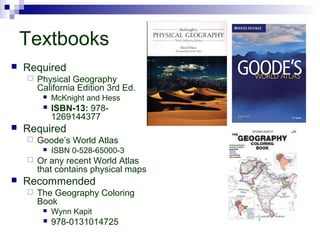
Physical Geography
California Edition 3rd Ed.






McKnight and Hess

ISBN-13: 9781269144377

Required


Goode’s World Atlas






ISBN 0-528-65000-3

Or any recent World Atlas
that contains physical maps

Recommended


The Geography Coloring
Book


Wynn Kapit



978-0131014725
Required Materials
Internet Access
 Pencils
 Pens
 Paper

Recommended Materials


Colored Pens or Pencils
 For

map studies
Course Description


The goal of this course is to introduce
students to basic concepts in physical
geography…
 Since

it is an introductory course, it is
assumed students have little or no
background in physical geography.
Course Objectives






You will gain an understanding of the geographic
perspective within natural and environmental sciences,
including place, space, map scale, map projection,
spatial connection, and spatial diffusion.
You will better understand how to use maps, in
particular, the geographic distribution of natural
phenomena.
You will learn about the four environmental spheres,
atmosphere, hydrosphere, biosphere, and lithosphere,
and how they interact across the surface of the Earth. In
particular, you will learn the role of humankind within the
environment.
Course Description


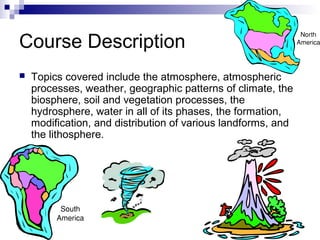
Topics covered include the atmosphere, atmospheric
processes, weather, geographic patterns of climate, the
biosphere, soil and vegetation processes, the
hydrosphere, water in all of its phases, the formation,
modification, and distribution of various landforms, and
the lithosphere.
Assignments







4 Exams 100 points each =
400 points
14 Chapter Quizzes 10
points each = 140 points
5 Map Quizzes 25 points
each = 125 points
1 Presentation = 100 points
100 Random Participation
Points
Total Points Possible = 865







100-90% 865-778 A
89-80% 777-692 B
79-70% 691-605 C
69-60% 604-519 D
59-0% 518-0 F

Note: You must earn at least
60% to pass this class. You
may be dropped for falling below
60%. Please refer to your syllabus.
Chapter Quizzes


There will be a quiz for each
chapter in the textbook.
 Quizzes

will be posted on
Blackboard after each lecture.
 Quizzes will be due one week
after they are posted by 5:30 PM.


There will be 14 quizzes.
 The

format will be multiple
choice, true/false, and or
matching.



Quiz questions may be used
on exams.
 You

will want to take notes from
your quizzes and study them.
Exams








There will be four exams.
Exams will be given using Blackboard.
The format will be multiple choice, true and
false, and/or matching.
Each exam will be worth 100 points.
The final exam will be cumulative.
A study guide will be available for each exam.
Map Quizzes





We will study the physical features of Earth.
You MUST bring your atlas to class on map
study nights.
Colored pens or pencils will be helpful.
You will have five map quizzes.
 North

America 25 points
 South America 25 points
 Europe 25 points
 Asia 25 points
 Africa 25 points


Total 125 points
Presentation/Project







You are required to give a presentation for this Physical
Geography course.
You will be able to choose from a list of topics.
Presentations will be no less than five minutes but no
more than ten minutes long.
Presentations MAY be done in groups WITH
INSTRUCTOR APPROVAL.
Presentations will be scheduled. If you do not present
when you are scheduled, you will lose points.
See the class web site for presentation details:


http://schmidtphysicalgeography.wikispaces.com/
Random Points








At any time, I may give an assignment in
class, like a quiz or an activity, or I might
give another attendance check.
Points will be given for random activities
and if you are not present, you will not
receive those points.
Random activities will usually happen after
the break, but sometimes may happen at
the very beginning of class.
Being late or absent CAN hurt your grade.
Changes




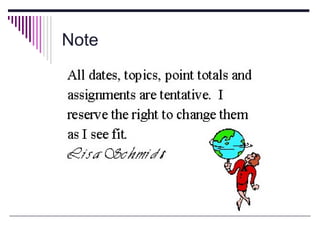
The dates, topics, assignments, and
due dates in the syllabus are tentative.
There may be changes, it is your
responsibility to stay informed of
changes.
Late Work and Exams


Late work ...
 will

not be accepted.
 There will be no opening of quizzes or exams
after they close unless you have some
documented proof of an emergency.
Absences and Tardiness


I reserve the right to drop students who miss
class twice.
 If

you have to miss class, you should stay in contact
with me if you do not want to be dropped.



You may be dropped for excessive tardiness.
 This

means being more than five minutes late, more
than three times.
 If you are going to be late, come in quietly and take a
seat WITHOUT interrupting lecture.
Last Day to Turn in Work
The last day that extra credit work or late
work (if it has been approved), will be
accepted is May 13th.
 No exceptions will be made.

Dropping
It is your responsibility to drop if you
decide you want to.
 If you stop coming to class, I have no way
of knowing if you want to drop or receive
and F.


I

will give F’s, it is your responsibility to drop.
Extra Credit
Some extra credit may be assigned
throughout the semester.
 It will be announced in class and you must
be present in order to take advantage of it.

Academic Honesty


Cheating of any kind will not be tolerated.
 Any

incidences of cheating or plagiarism will
be reported to the deans office.
 Please refer to San Bernardino Valley
College’s policy on academic honesty.
Cell Phones and Texting
 Use

of cell phones for
talking or texting during
class is inappropriate.
 You may be asked to
leave the classroom if you
are talking or texting on
your phone during lecture.
 Phones should be set to
silent mode when in class.
Disabilities
 If you need accommodations for this

course, please see me after class.
 If you have or think you may have a
disability that might affect your
performance in this course, please
contact the office of Disabled Students
Programs and Services at (909) 3844443.
Blackboard


Blackboard will be used for this class.
 You

will need to log in to Blackboard to take
your quizzes and exams.
 http://blackboard.valleycollege.edu


If you have questions about blackboard, stay after
class, I am here to help.
Contact Information
 The best way to reach me is by e-mail.
 My e-mail address is:

Lisa.Schmidt@Chaffey.edu
 My mailbox is located the Chemistry building,
room 121.
 My voice mail is (909) 652-7090-this goes to my
e-mail.
 You may text me at (760) 440-8977 and you
can leave voice mail at this number too.
Note
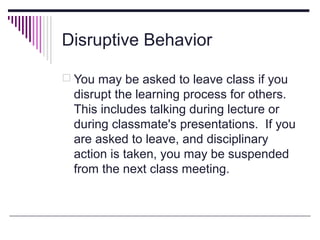
Disruptive Behavior
 You may be asked to leave class if you

disrupt the learning process for others.
This includes talking during lecture or
during classmate's presentations. If you
are asked to leave, and disciplinary
action is taken, you may be suspended
from the next class meeting.
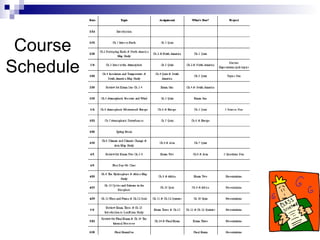
Course
Schedule
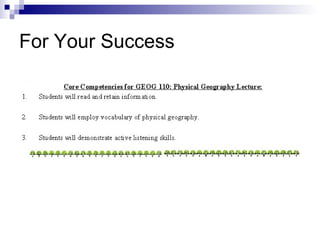
For Your Success
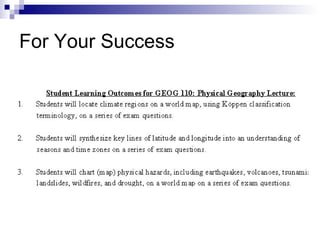
For Your Success
What is Geography?


The scientific study of the Earth's surface
and its various climates, countries,
peoples, and natural resources.
Fields of Geography


Human or Cultural Geography
 Deals

with social, economic, and behavioral
processes



Physical Geography
 Examines

the natural processes occurring at
Earth’s surface that provide the physical
setting for human activities
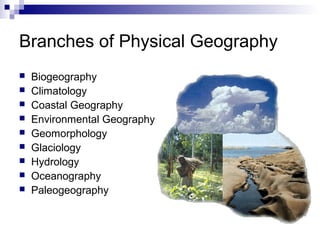
Branches of Physical Geography










Biogeography
Climatology
Coastal Geography
Environmental Geography
Geomorphology
Glaciology
Hydrology
Oceanography
Paleogeography
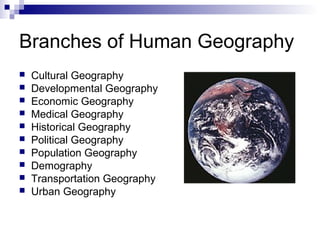
Branches of Human Geography











Cultural Geography
Developmental Geography
Economic Geography
Medical Geography
Historical Geography
Political Geography
Population Geography
Demography
Transportation Geography
Urban Geography
What we will be studying
 The

atmosphere
 Atmospheric processes
 Weather and Climate
 The Biosphere
 Soil
 Vegetation
 Hydrosphere
 Tectonic Processes
 Volcanic Processes
What we will be studying…


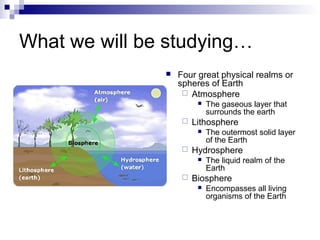
Four great physical realms or
spheres of Earth
 Atmosphere




Lithosphere




The outermost solid layer
of the Earth

Hydrosphere




The gaseous layer that
surrounds the earth

The liquid realm of the
Earth

Biosphere


Encompasses all living
organisms of the Earth
Tools Geographers Use






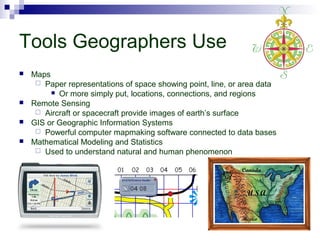
Maps
 Paper representations of space showing point, line, or area data
 Or more simply put, locations, connections, and regions
Remote Sensing
 Aircraft or spacecraft provide images of earth’s surface
GIS or Geographic Information Systems
 Powerful computer mapmaking software connected to data bases
Mathematical Modeling and Statistics
 Used to understand natural and human phenomenon

Geog 110 sp 2014 intro

  • 1.
    Geography 110 Physical Geography Reference# 4156 Tuesday 6:00-8:50 PM Professor Lisa Schmidt
  • 2.
    Important Information • ProfessorLisa Schmidt • Ref. 4156 • 6:00-8:50 PM Tuesdays** Lisa.Schmidt@Chaffey.edu • PS 221 • (909) 384-5221 Voice Mail • (760) 440-8977 Text or Voice Mail • http://schmidtphysicalgeography.wikispaces.com
  • 3.
    Physical Geography • Welcometo Geography 110, Physical Geography. In this class, you will learn the basic elements of geography. We will study climate, landforms, water, soils, native animal life and native vegetation. We will examine the inter-relationships between these things and we will look at their patterns of distribution throughout the world.
  • 4.
    Textbooks  Required  Physical Geography California Edition3rd Ed.    McKnight and Hess ISBN-13: 9781269144377 Required  Goode’s World Atlas    ISBN 0-528-65000-3 Or any recent World Atlas that contains physical maps Recommended  The Geography Coloring Book  Wynn Kapit  978-0131014725
  • 5.
    Required Materials Internet Access Pencils  Pens  Paper 
  • 6.
    Recommended Materials  Colored Pensor Pencils  For map studies
  • 7.
    Course Description  The goalof this course is to introduce students to basic concepts in physical geography…  Since it is an introductory course, it is assumed students have little or no background in physical geography.
  • 8.
    Course Objectives    You willgain an understanding of the geographic perspective within natural and environmental sciences, including place, space, map scale, map projection, spatial connection, and spatial diffusion. You will better understand how to use maps, in particular, the geographic distribution of natural phenomena. You will learn about the four environmental spheres, atmosphere, hydrosphere, biosphere, and lithosphere, and how they interact across the surface of the Earth. In particular, you will learn the role of humankind within the environment.
  • 9.
    Course Description  Topics coveredinclude the atmosphere, atmospheric processes, weather, geographic patterns of climate, the biosphere, soil and vegetation processes, the hydrosphere, water in all of its phases, the formation, modification, and distribution of various landforms, and the lithosphere.
  • 10.
    Assignments       4 Exams 100points each = 400 points 14 Chapter Quizzes 10 points each = 140 points 5 Map Quizzes 25 points each = 125 points 1 Presentation = 100 points 100 Random Participation Points Total Points Possible = 865      100-90% 865-778 A 89-80% 777-692 B 79-70% 691-605 C 69-60% 604-519 D 59-0% 518-0 F Note: You must earn at least 60% to pass this class. You may be dropped for falling below 60%. Please refer to your syllabus.
  • 11.
    Chapter Quizzes  There willbe a quiz for each chapter in the textbook.  Quizzes will be posted on Blackboard after each lecture.  Quizzes will be due one week after they are posted by 5:30 PM.  There will be 14 quizzes.  The format will be multiple choice, true/false, and or matching.  Quiz questions may be used on exams.  You will want to take notes from your quizzes and study them.
  • 12.
    Exams       There will befour exams. Exams will be given using Blackboard. The format will be multiple choice, true and false, and/or matching. Each exam will be worth 100 points. The final exam will be cumulative. A study guide will be available for each exam.
  • 13.
    Map Quizzes     We willstudy the physical features of Earth. You MUST bring your atlas to class on map study nights. Colored pens or pencils will be helpful. You will have five map quizzes.  North America 25 points  South America 25 points  Europe 25 points  Asia 25 points  Africa 25 points  Total 125 points
  • 14.
    Presentation/Project       You are requiredto give a presentation for this Physical Geography course. You will be able to choose from a list of topics. Presentations will be no less than five minutes but no more than ten minutes long. Presentations MAY be done in groups WITH INSTRUCTOR APPROVAL. Presentations will be scheduled. If you do not present when you are scheduled, you will lose points. See the class web site for presentation details:  http://schmidtphysicalgeography.wikispaces.com/
  • 15.
    Random Points     At anytime, I may give an assignment in class, like a quiz or an activity, or I might give another attendance check. Points will be given for random activities and if you are not present, you will not receive those points. Random activities will usually happen after the break, but sometimes may happen at the very beginning of class. Being late or absent CAN hurt your grade.
  • 16.
    Changes   The dates, topics,assignments, and due dates in the syllabus are tentative. There may be changes, it is your responsibility to stay informed of changes.
  • 17.
    Late Work andExams  Late work ...  will not be accepted.  There will be no opening of quizzes or exams after they close unless you have some documented proof of an emergency.
  • 18.
    Absences and Tardiness  Ireserve the right to drop students who miss class twice.  If you have to miss class, you should stay in contact with me if you do not want to be dropped.  You may be dropped for excessive tardiness.  This means being more than five minutes late, more than three times.  If you are going to be late, come in quietly and take a seat WITHOUT interrupting lecture.
  • 19.
    Last Day toTurn in Work The last day that extra credit work or late work (if it has been approved), will be accepted is May 13th.  No exceptions will be made. 
  • 20.
    Dropping It is yourresponsibility to drop if you decide you want to.  If you stop coming to class, I have no way of knowing if you want to drop or receive and F.  I will give F’s, it is your responsibility to drop.
  • 21.
    Extra Credit Some extracredit may be assigned throughout the semester.  It will be announced in class and you must be present in order to take advantage of it. 
  • 22.
    Academic Honesty  Cheating ofany kind will not be tolerated.  Any incidences of cheating or plagiarism will be reported to the deans office.  Please refer to San Bernardino Valley College’s policy on academic honesty.
  • 23.
    Cell Phones andTexting  Use of cell phones for talking or texting during class is inappropriate.  You may be asked to leave the classroom if you are talking or texting on your phone during lecture.  Phones should be set to silent mode when in class.
  • 24.
    Disabilities  If youneed accommodations for this course, please see me after class.  If you have or think you may have a disability that might affect your performance in this course, please contact the office of Disabled Students Programs and Services at (909) 3844443.
  • 25.
    Blackboard  Blackboard will beused for this class.  You will need to log in to Blackboard to take your quizzes and exams.  http://blackboard.valleycollege.edu  If you have questions about blackboard, stay after class, I am here to help.
  • 26.
    Contact Information  Thebest way to reach me is by e-mail.  My e-mail address is: Lisa.Schmidt@Chaffey.edu  My mailbox is located the Chemistry building, room 121.  My voice mail is (909) 652-7090-this goes to my e-mail.  You may text me at (760) 440-8977 and you can leave voice mail at this number too.
  • 27.
  • 28.
    Disruptive Behavior  Youmay be asked to leave class if you disrupt the learning process for others. This includes talking during lecture or during classmate's presentations. If you are asked to leave, and disciplinary action is taken, you may be suspended from the next class meeting.
  • 29.
  • 30.
  • 31.
  • 33.
    What is Geography?  Thescientific study of the Earth's surface and its various climates, countries, peoples, and natural resources.
  • 34.
    Fields of Geography  Humanor Cultural Geography  Deals with social, economic, and behavioral processes  Physical Geography  Examines the natural processes occurring at Earth’s surface that provide the physical setting for human activities
  • 35.
    Branches of PhysicalGeography          Biogeography Climatology Coastal Geography Environmental Geography Geomorphology Glaciology Hydrology Oceanography Paleogeography
  • 36.
    Branches of HumanGeography           Cultural Geography Developmental Geography Economic Geography Medical Geography Historical Geography Political Geography Population Geography Demography Transportation Geography Urban Geography
  • 37.
    What we willbe studying  The atmosphere  Atmospheric processes  Weather and Climate  The Biosphere  Soil  Vegetation  Hydrosphere  Tectonic Processes  Volcanic Processes
  • 38.
    What we willbe studying…  Four great physical realms or spheres of Earth  Atmosphere   Lithosphere   The outermost solid layer of the Earth Hydrosphere   The gaseous layer that surrounds the earth The liquid realm of the Earth Biosphere  Encompasses all living organisms of the Earth
  • 39.
    Tools Geographers Use     Maps Paper representations of space showing point, line, or area data  Or more simply put, locations, connections, and regions Remote Sensing  Aircraft or spacecraft provide images of earth’s surface GIS or Geographic Information Systems  Powerful computer mapmaking software connected to data bases Mathematical Modeling and Statistics  Used to understand natural and human phenomenon