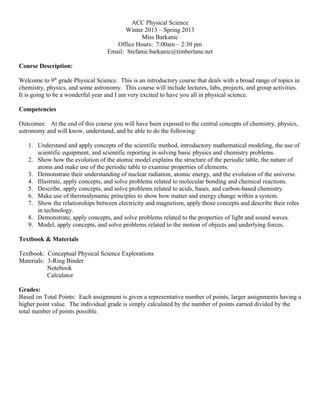
ACC Physical Science
                                          Winter 2013 – Spring 2013
                                                Miss Barkanic
                                      Office Hours: 7:00am – 2:30 pm
                                   Email: Stefanie.barkanic@timberlane.net

Course Description:

Welcome to 9th grade Physical Science. This is an introductory course that deals with a broad range of topics in
chemistry, physics, and some astronomy. This course will include lectures, labs, projects, and group activities.
It is going to be a wonderful year and I am very excited to have you all in physical science.

Competencies

Outcomes: At the end of this course you will have been exposed to the central concepts of chemistry, physics,
astronomy and will know, understand, and be able to do the following:

   1. Understand and apply concepts of the scientific method, introductory mathematical modeling, the use of
      scientific equipment, and scientific reporting in solving basic physics and chemistry problems.
   2. Show how the evolution of the atomic model explains the structure of the periodic table, the nature of
      atoms and make use of the periodic table to examine properties of elements.
   3. Demonstrate their understanding of nuclear radiation, atomic energy, and the evolution of the universe.
   4. Illustrate, apply concepts, and solve problems related to molecular bonding and chemical reactions.
   5. Describe, apply concepts, and solve problems related to acids, bases, and carbon-based chemistry.
   6. Make use of thermodynamic principles to show how matter and energy change within a system.
   7. Show the relationships between electricity and magnetism, apply those concepts and describe their roles
      in technology.
   8. Demonstrate, apply concepts, and solve problems related to the properties of light and sound waves.
   9. Model, apply concepts, and solve problems related to the motion of objects and underlying forces.

Textbook & Materials

Textbook: Conceptual Physical Science Explorations
Materials: 3-Ring Binder
           Notebook
           Calculator

Grades:
Based on Total Points: Each assignment is given a representative number of points, larger assignments having a
higher point value. The individual grade is simply calculated by the number of points earned divided by the
total number of points possible.
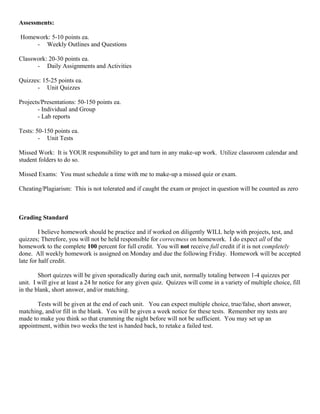
Assessments:

Homework: 5-10 points ea.
    - Weekly Outlines and Questions

Classwork: 20-30 points ea.
      - Daily Assignments and Activities

Quizzes: 15-25 points ea.
      - Unit Quizzes

Projects/Presentations: 50-150 points ea.
       - Individual and Group
       - Lab reports

Tests: 50-150 points ea.
        - Unit Tests

Missed Work: It is YOUR responsibility to get and turn in any make-up work. Utilize classroom calendar and
student folders to do so.

Missed Exams: You must schedule a time with me to make-up a missed quiz or exam.

Cheating/Plagiarism: This is not tolerated and if caught the exam or project in question will be counted as zero


Grading Standard

         I believe homework should be practice and if worked on diligently WILL help with projects, test, and
quizzes; Therefore, you will not be held responsible for correctness on homework. I do expect all of the
homework to the complete 100 percent for full credit. You will not receive full credit if it is not completely
done. All weekly homework is assigned on Monday and due the following Friday. Homework will be accepted
late for half credit.

        Short quizzes will be given sporadically during each unit, normally totaling between 1-4 quizzes per
unit. I will give at least a 24 hr notice for any given quiz. Quizzes will come in a variety of multiple choice, fill
in the blank, short answer, and/or matching.

       Tests will be given at the end of each unit. You can expect multiple choice, true/false, short answer,
matching, and/or fill in the blank. You will be given a week notice for these tests. Remember my tests are
made to make you think so that cramming the night before will not be sufficient. You may set up an
appointment, within two weeks the test is handed back, to retake a failed test.

Aac physical science syllabus 2010-11

  • 1.
    ACC Physical Science Winter 2013 – Spring 2013 Miss Barkanic Office Hours: 7:00am – 2:30 pm Email: Stefanie.barkanic@timberlane.net Course Description: Welcome to 9th grade Physical Science. This is an introductory course that deals with a broad range of topics in chemistry, physics, and some astronomy. This course will include lectures, labs, projects, and group activities. It is going to be a wonderful year and I am very excited to have you all in physical science. Competencies Outcomes: At the end of this course you will have been exposed to the central concepts of chemistry, physics, astronomy and will know, understand, and be able to do the following: 1. Understand and apply concepts of the scientific method, introductory mathematical modeling, the use of scientific equipment, and scientific reporting in solving basic physics and chemistry problems. 2. Show how the evolution of the atomic model explains the structure of the periodic table, the nature of atoms and make use of the periodic table to examine properties of elements. 3. Demonstrate their understanding of nuclear radiation, atomic energy, and the evolution of the universe. 4. Illustrate, apply concepts, and solve problems related to molecular bonding and chemical reactions. 5. Describe, apply concepts, and solve problems related to acids, bases, and carbon-based chemistry. 6. Make use of thermodynamic principles to show how matter and energy change within a system. 7. Show the relationships between electricity and magnetism, apply those concepts and describe their roles in technology. 8. Demonstrate, apply concepts, and solve problems related to the properties of light and sound waves. 9. Model, apply concepts, and solve problems related to the motion of objects and underlying forces. Textbook & Materials Textbook: Conceptual Physical Science Explorations Materials: 3-Ring Binder Notebook Calculator Grades: Based on Total Points: Each assignment is given a representative number of points, larger assignments having a higher point value. The individual grade is simply calculated by the number of points earned divided by the total number of points possible.
  • 2.
    Assessments: Homework: 5-10 pointsea. - Weekly Outlines and Questions Classwork: 20-30 points ea. - Daily Assignments and Activities Quizzes: 15-25 points ea. - Unit Quizzes Projects/Presentations: 50-150 points ea. - Individual and Group - Lab reports Tests: 50-150 points ea. - Unit Tests Missed Work: It is YOUR responsibility to get and turn in any make-up work. Utilize classroom calendar and student folders to do so. Missed Exams: You must schedule a time with me to make-up a missed quiz or exam. Cheating/Plagiarism: This is not tolerated and if caught the exam or project in question will be counted as zero Grading Standard I believe homework should be practice and if worked on diligently WILL help with projects, test, and quizzes; Therefore, you will not be held responsible for correctness on homework. I do expect all of the homework to the complete 100 percent for full credit. You will not receive full credit if it is not completely done. All weekly homework is assigned on Monday and due the following Friday. Homework will be accepted late for half credit. Short quizzes will be given sporadically during each unit, normally totaling between 1-4 quizzes per unit. I will give at least a 24 hr notice for any given quiz. Quizzes will come in a variety of multiple choice, fill in the blank, short answer, and/or matching. Tests will be given at the end of each unit. You can expect multiple choice, true/false, short answer, matching, and/or fill in the blank. You will be given a week notice for these tests. Remember my tests are made to make you think so that cramming the night before will not be sufficient. You may set up an appointment, within two weeks the test is handed back, to retake a failed test.