PHYSICAL &
EXTERNAL
BARRIERS TO
COMMUNICATION
BATCH 1 
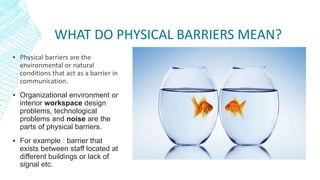
WHAT DO PHYSICAL BARRIERS MEAN?
▪ Physical barriers are the
environmental or natural
conditions that act as a barrier in
communication.
▪ Organizational environment or
interior workspace design
problems, technological
problems and noise are the
parts of physical barriers.
▪ For example : barrier that
exists between staff located at
different buildings or lack of
signal etc.
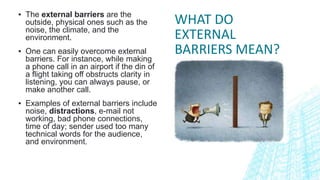
WHAT DO
EXTERNAL
BARRIERS MEAN?
▪ The external barriers are the
outside, physical ones such as the
noise, the climate, and the
environment.
▪ One can easily overcome external
barriers. For instance, while making
a phone call in an airport if the din of
a flight taking off obstructs clarity in
listening, you can always pause, or
make another call.
▪ Examples of external barriers include
noise, distractions, e-mail not
working, bad phone connections,
time of day; sender used too many
technical words for the audience,
and environment.
TYPES OF EXTERNAL
BARRIERS
• PHYSICAL BARRIERS
• ORGANISATIONAL BARRIERS
• CULTURAL BARRIERS
• LANGUAGE BARRIERS
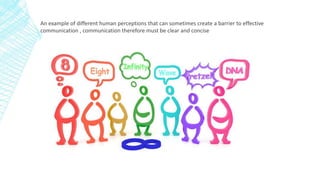
An example of different human perceptions that can sometimes create a barrier to effective
communication , communication therefore must be clear and concise
MAIN CAUSES OF
PHYSICAL BARRIERS
1. Time
2. Place
3. Space
4. Climate
5. noise
6. Information overflow
7. Medium & disturbance
8. Workspace design
9. Faulty equipment
10. Organisational hierarchy
TIME
▪ Time becomes a physical barrier when people have
to communicate across different time zones in
different countries.
▪ Time has an important role in
a communication process. Do we not often hear
expressions such as “timely caution”, “timely
advice?”.
▪ These expressions indicate the role of time as a
factor in communication.

▪ An organization that expects quick results cannot
afford to be slack in its channels of communication.
▪ When a group of people are
having communication one must pay attention
and communicate on time as it adds value to one's
opinion. If time is managed well during
a communication it leads to a
great communication with the desired results.
PLACE • Space can act as barrier in a cross cultural or trans-national
oral communication situation. Over crowding in elevators,
jostling in office corridors and elbowing in public transport
systems are all external factors that do
affect communication as barriers.
• Proper maintenance of distance will help overcome this carrier.
It will remove miscommunication and prevent distortion of a
message or information.
• The place or the location where a communication process takes
place can degenerate into a barrier to effective communication.
A simple comparison of the surroundings in a Government /
Municipal office and the ambience provided in a multinational
company will show how place and surroundings play an
important role in effective communication.
• Inconvenient place, rickety furniture, poor lighting, inadequacy
of space are all factors that make people irritable / impatient
and annoyed.
• Friction and conflict erupt easily in such places which mar the
transaction of any business, leave alone business
communication. Even though it is part of office management,
its impact on the communication process as a barrier is
inevitable. Good ambience and suitably lighted and ventilated
places promote effective communication.
SPACE
▪ Space plays an important role in an
oral communication situation. It can
act as a barrier to communication or
act as an aid promoting good
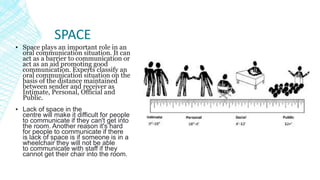
communication. Experts classify an
oral communication situation on the
basis of the distance maintained
between sender and receiver as
Intimate, Personal, Official and
Public.
▪ Lack of space in the
centre will make it difficult for people
to communicate if they can't get into
the room. Another reason it's hard
for people to communicate if there
is lack of space is if someone is in a
wheelchair they will not be able
to communicate with staff if they
cannot get their chair into the room.
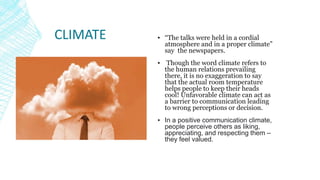
CLIMATE ▪ “The talks were held in a cordial
atmosphere and in a proper climate”
say the newspapers.
▪ Though the word climate refers to
the human relations prevailing
there, it is no exaggeration to say
that the actual room temperature
helps people to keep their heads
cool! Unfavorable climate can act as
a barrier to communication leading
to wrong perceptions or decision.
▪ In a positive communication climate,
people perceive others as liking,
appreciating, and respecting them –
they feel valued.
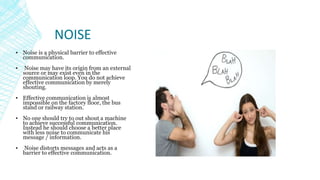
NOISE
▪ Noise is a physical barrier to effective
communication.
▪ Noise may have its origin from an external
source or may exist even in the
communication loop. You do not achieve
effective communication by merely
shouting.
▪ Effective communication is almost
impossible on the factory floor, the bus
stand or railway station.
▪ No one should try to out shout a machine
to achieve successful communication.
Instead he should choose a better place
with less noise to communicate his
message / information.
▪ Noise distorts messages and acts as a
barrier to effective communication.
INFORMATION OVERFLOW
▪ We have all been in situations when we felt that too much
information was coming at us. When this happens, we feel
overwhelmed and fear that we will not be able to retain any
information at all.
▪ Sometimes it is not just the quantity of communication but
the level that causes overload. If the message contains
information that is new to the receiver, including processes
or concepts that are not familiar, then the chances of
overload increase greatly.
▪ The sender should break up the message into more
palatable or digestible bits and reduce the amount of
information that has to be absorbed at any one time. One
technique is to make a high-level announcement and then
follow it up later with more details.
▪ The sender has the primary responsibility to check that the
receiver has understood the message.
▪ This means that a manager may have to adjust a message
to reflect the various experiences of the employees. A new
employee may need repeated explanations before beginning
an operation, whereas an experienced employee may start
rolling his eyes at the same old instructions.
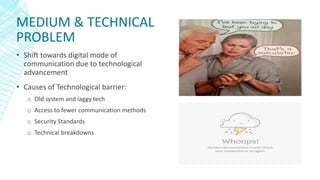
MEDIUM & TECHNICAL
PROBLEM
• Shift towards digital mode of
communication due to technological
advancement
• Causes of Technological barrier:
o Old system and laggy tech
o Access to fewer communication methods
o Security Standards
o Technical breakdowns
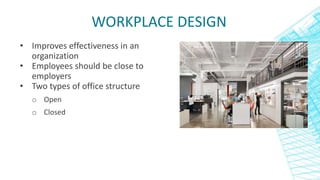
WORKPLACE DESIGN
• Improves effectiveness in an
organization
• Employees should be close to
employers
• Two types of office structure
o Open
o Closed
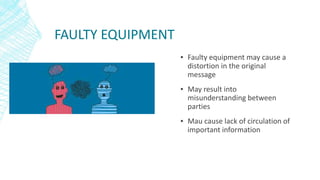
FAULTY EQUIPMENT
▪ Faulty equipment may cause a
distortion in the original
message
▪ May result into
misunderstanding between
parties
▪ Mau cause lack of circulation of
important information
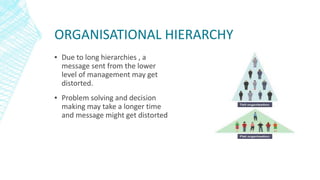
ORGANISATIONAL HIERARCHY
▪ Due to long hierarchies , a
message sent from the lower
level of management may get
distorted.
▪ Problem solving and decision
making may take a longer time
and message might get distorted
HOW TO OVERCOME
BARRIERS TO
COMMUNICATION?
• checking whether it is a good time and place to
communicate with the person
• being clear and using language that the person
understands
• communicating one thing at a time
• respecting a person’s desire to not communicate
• checking that the person has understood you correctly
• communicating in a location that is free of distractions
• acknowledging any emotional responses the person
has to what you have said.
• Don’t make any judgements about what someone may
be experiencing, always ask!
HOW TO OVERCOME BARRIERS TO
COMMUNICATION?
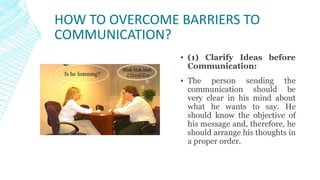
▪ (1) Clarify Ideas before
Communication:
▪ The person sending the
communication should be
very clear in his mind about
what he wants to say. He
should know the objective of
his message and, therefore, he
should arrange his thoughts in
a proper order.
HOW TO OVERCOME BARRIERS TO
COMMUNICATION?
▪ (2) Communicate According to the
Need of the Receiver:
▪ The sender of the communication should
prepare the structure of the message not
according to his own level or ability but he
should keep in mind the level,
understanding or the environment of the
receiver.
▪ (3) Consult Others before
Communication:
▪ At the time of planning the
communication, suggestions should be
invited from all the persons concerned. Its
main advantage will be that all those
people who are consulted at the time of
preparing the communication plan will
contribute to the success of the
communication system.
HOW TO OVERCOME BARRIERS TO
COMMUNICATION?
▪ (4) Be Aware of Language, Tone
and Content of Message:
▪ The sender should take care of the fact
that the message should be framed in
clear and beautiful language. The tone
of the message should not injure the
feelings of the receiver. As far as
possible the contents of the message
should be brief and excessive use of
technical words should be avoided.
▪ (5) Convey Things of Help and
Value to the Listener:
▪ The subject matter of the message
should be helpful to the receiver. The
need and interest of the receiver
should specially be kept in mind.
Communication is more effective in
such a situation.
HOW TO OVERCOME BARRIERS TO
COMMUNICATION?
▪ (6) Ensure Proper Feedback:
▪ The purpose of feedback is to find out whether
the receiver has properly understood the
meaning of the information received. In the face-
to- face communication, the reaction on the face
of the receiver can be understood.
▪ But in case of written communication or some
other sort of communications some proper
method of feedback should be adopted by the
sender.
▪ (7) Consistency of Message:
▪ The information sent to the receiver should not
be self- contradictory. It should be in accordance
with the objectives, policies, programmes and
techniques of the organisation. When a new
message has to be sent in place of the old one, it
should always make a mention of the change
otherwise it can create some doubts.
HOW TO OVERCOME BARRIERS TO
COMMUNICATION?
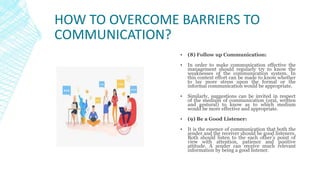
▪ (8) Follow up Communication:
▪ In order to make communication effective the
management should regularly try to know the
weaknesses of the communication system. In
this context effort can be made to know whether
to lay more stress upon the formal or the
informal communication would be appropriate.
▪ Similarly, suggestions can be invited in respect
of the medium of communication (oral, written
and gestural) to know as to which medium
would be more effective and appropriate.
▪ (9) Be a Good Listener:
▪ It is the essence of communication that both the
sender and the receiver should be good listeners.
Both should listen to the each other’s point of
view with attention, patience and positive
attitude. A sender can receive much relevant
information by being a good listener.
ROLEPLAY
SCENARIO ONE
Discussion between an interviewer and an interviewee,
regarding the interview time despite different timezones
And due to lack of clear communication there seems to
be a confusion
CONCLUSION
▪ Communication may break down as a result of many communication
barriers that may be attributed to the sender or receiver.
▪ Therefore, effective communication requires familiarity with the
barriers.
▪ Choosing the right channel for communication is also important,
because choosing the wrong medium undermines the message.
▪ When communication occurs in the cross-cultural context, extra
caution is needed, given that different cultures have different norms
regarding nonverbal communication, and different words will be
interpreted differently across cultures.
PHYSICAL _ EXTERNAL BARRIERS TO COMMUNICATION (1).pptx

PHYSICAL _ EXTERNAL BARRIERS TO COMMUNICATION (1).pptx

  • 1.
  • 2.
    WHAT DO PHYSICALBARRIERS MEAN? ▪ Physical barriers are the environmental or natural conditions that act as a barrier in communication. ▪ Organizational environment or interior workspace design problems, technological problems and noise are the parts of physical barriers. ▪ For example : barrier that exists between staff located at different buildings or lack of signal etc.
  • 3.
    WHAT DO EXTERNAL BARRIERS MEAN? ▪The external barriers are the outside, physical ones such as the noise, the climate, and the environment. ▪ One can easily overcome external barriers. For instance, while making a phone call in an airport if the din of a flight taking off obstructs clarity in listening, you can always pause, or make another call. ▪ Examples of external barriers include noise, distractions, e-mail not working, bad phone connections, time of day; sender used too many technical words for the audience, and environment.
  • 4.
    TYPES OF EXTERNAL BARRIERS •PHYSICAL BARRIERS • ORGANISATIONAL BARRIERS • CULTURAL BARRIERS • LANGUAGE BARRIERS
  • 5.
    An example ofdifferent human perceptions that can sometimes create a barrier to effective communication , communication therefore must be clear and concise
  • 6.
    MAIN CAUSES OF PHYSICALBARRIERS 1. Time 2. Place 3. Space 4. Climate 5. noise 6. Information overflow 7. Medium & disturbance 8. Workspace design 9. Faulty equipment 10. Organisational hierarchy
  • 7.
    TIME ▪ Time becomesa physical barrier when people have to communicate across different time zones in different countries. ▪ Time has an important role in a communication process. Do we not often hear expressions such as “timely caution”, “timely advice?”. ▪ These expressions indicate the role of time as a factor in communication. ▪ An organization that expects quick results cannot afford to be slack in its channels of communication. ▪ When a group of people are having communication one must pay attention and communicate on time as it adds value to one's opinion. If time is managed well during a communication it leads to a great communication with the desired results.
  • 8.
    PLACE • Spacecan act as barrier in a cross cultural or trans-national oral communication situation. Over crowding in elevators, jostling in office corridors and elbowing in public transport systems are all external factors that do affect communication as barriers. • Proper maintenance of distance will help overcome this carrier. It will remove miscommunication and prevent distortion of a message or information. • The place or the location where a communication process takes place can degenerate into a barrier to effective communication. A simple comparison of the surroundings in a Government / Municipal office and the ambience provided in a multinational company will show how place and surroundings play an important role in effective communication. • Inconvenient place, rickety furniture, poor lighting, inadequacy of space are all factors that make people irritable / impatient and annoyed. • Friction and conflict erupt easily in such places which mar the transaction of any business, leave alone business communication. Even though it is part of office management, its impact on the communication process as a barrier is inevitable. Good ambience and suitably lighted and ventilated places promote effective communication.
  • 9.
    SPACE ▪ Space playsan important role in an oral communication situation. It can act as a barrier to communication or act as an aid promoting good communication. Experts classify an oral communication situation on the basis of the distance maintained between sender and receiver as Intimate, Personal, Official and Public. ▪ Lack of space in the centre will make it difficult for people to communicate if they can't get into the room. Another reason it's hard for people to communicate if there is lack of space is if someone is in a wheelchair they will not be able to communicate with staff if they cannot get their chair into the room.
  • 10.
    CLIMATE ▪ “Thetalks were held in a cordial atmosphere and in a proper climate” say the newspapers. ▪ Though the word climate refers to the human relations prevailing there, it is no exaggeration to say that the actual room temperature helps people to keep their heads cool! Unfavorable climate can act as a barrier to communication leading to wrong perceptions or decision. ▪ In a positive communication climate, people perceive others as liking, appreciating, and respecting them – they feel valued.
  • 11.
    NOISE ▪ Noise isa physical barrier to effective communication. ▪ Noise may have its origin from an external source or may exist even in the communication loop. You do not achieve effective communication by merely shouting. ▪ Effective communication is almost impossible on the factory floor, the bus stand or railway station. ▪ No one should try to out shout a machine to achieve successful communication. Instead he should choose a better place with less noise to communicate his message / information. ▪ Noise distorts messages and acts as a barrier to effective communication.
  • 12.
    INFORMATION OVERFLOW ▪ Wehave all been in situations when we felt that too much information was coming at us. When this happens, we feel overwhelmed and fear that we will not be able to retain any information at all. ▪ Sometimes it is not just the quantity of communication but the level that causes overload. If the message contains information that is new to the receiver, including processes or concepts that are not familiar, then the chances of overload increase greatly. ▪ The sender should break up the message into more palatable or digestible bits and reduce the amount of information that has to be absorbed at any one time. One technique is to make a high-level announcement and then follow it up later with more details. ▪ The sender has the primary responsibility to check that the receiver has understood the message. ▪ This means that a manager may have to adjust a message to reflect the various experiences of the employees. A new employee may need repeated explanations before beginning an operation, whereas an experienced employee may start rolling his eyes at the same old instructions.
  • 13.
    MEDIUM & TECHNICAL PROBLEM •Shift towards digital mode of communication due to technological advancement • Causes of Technological barrier: o Old system and laggy tech o Access to fewer communication methods o Security Standards o Technical breakdowns
  • 14.
    WORKPLACE DESIGN • Improveseffectiveness in an organization • Employees should be close to employers • Two types of office structure o Open o Closed
  • 15.
    FAULTY EQUIPMENT ▪ Faultyequipment may cause a distortion in the original message ▪ May result into misunderstanding between parties ▪ Mau cause lack of circulation of important information
  • 16.
    ORGANISATIONAL HIERARCHY ▪ Dueto long hierarchies , a message sent from the lower level of management may get distorted. ▪ Problem solving and decision making may take a longer time and message might get distorted
  • 17.
    HOW TO OVERCOME BARRIERSTO COMMUNICATION? • checking whether it is a good time and place to communicate with the person • being clear and using language that the person understands • communicating one thing at a time • respecting a person’s desire to not communicate • checking that the person has understood you correctly • communicating in a location that is free of distractions • acknowledging any emotional responses the person has to what you have said. • Don’t make any judgements about what someone may be experiencing, always ask!
  • 18.
    HOW TO OVERCOMEBARRIERS TO COMMUNICATION? ▪ (1) Clarify Ideas before Communication: ▪ The person sending the communication should be very clear in his mind about what he wants to say. He should know the objective of his message and, therefore, he should arrange his thoughts in a proper order.
  • 19.
    HOW TO OVERCOMEBARRIERS TO COMMUNICATION? ▪ (2) Communicate According to the Need of the Receiver: ▪ The sender of the communication should prepare the structure of the message not according to his own level or ability but he should keep in mind the level, understanding or the environment of the receiver. ▪ (3) Consult Others before Communication: ▪ At the time of planning the communication, suggestions should be invited from all the persons concerned. Its main advantage will be that all those people who are consulted at the time of preparing the communication plan will contribute to the success of the communication system.
  • 20.
    HOW TO OVERCOMEBARRIERS TO COMMUNICATION? ▪ (4) Be Aware of Language, Tone and Content of Message: ▪ The sender should take care of the fact that the message should be framed in clear and beautiful language. The tone of the message should not injure the feelings of the receiver. As far as possible the contents of the message should be brief and excessive use of technical words should be avoided. ▪ (5) Convey Things of Help and Value to the Listener: ▪ The subject matter of the message should be helpful to the receiver. The need and interest of the receiver should specially be kept in mind. Communication is more effective in such a situation.
  • 21.
    HOW TO OVERCOMEBARRIERS TO COMMUNICATION? ▪ (6) Ensure Proper Feedback: ▪ The purpose of feedback is to find out whether the receiver has properly understood the meaning of the information received. In the face- to- face communication, the reaction on the face of the receiver can be understood. ▪ But in case of written communication or some other sort of communications some proper method of feedback should be adopted by the sender. ▪ (7) Consistency of Message: ▪ The information sent to the receiver should not be self- contradictory. It should be in accordance with the objectives, policies, programmes and techniques of the organisation. When a new message has to be sent in place of the old one, it should always make a mention of the change otherwise it can create some doubts.
  • 22.
    HOW TO OVERCOMEBARRIERS TO COMMUNICATION? ▪ (8) Follow up Communication: ▪ In order to make communication effective the management should regularly try to know the weaknesses of the communication system. In this context effort can be made to know whether to lay more stress upon the formal or the informal communication would be appropriate. ▪ Similarly, suggestions can be invited in respect of the medium of communication (oral, written and gestural) to know as to which medium would be more effective and appropriate. ▪ (9) Be a Good Listener: ▪ It is the essence of communication that both the sender and the receiver should be good listeners. Both should listen to the each other’s point of view with attention, patience and positive attitude. A sender can receive much relevant information by being a good listener.
  • 23.
    ROLEPLAY SCENARIO ONE Discussion betweenan interviewer and an interviewee, regarding the interview time despite different timezones And due to lack of clear communication there seems to be a confusion
  • 24.
    CONCLUSION ▪ Communication maybreak down as a result of many communication barriers that may be attributed to the sender or receiver. ▪ Therefore, effective communication requires familiarity with the barriers. ▪ Choosing the right channel for communication is also important, because choosing the wrong medium undermines the message. ▪ When communication occurs in the cross-cultural context, extra caution is needed, given that different cultures have different norms regarding nonverbal communication, and different words will be interpreted differently across cultures.