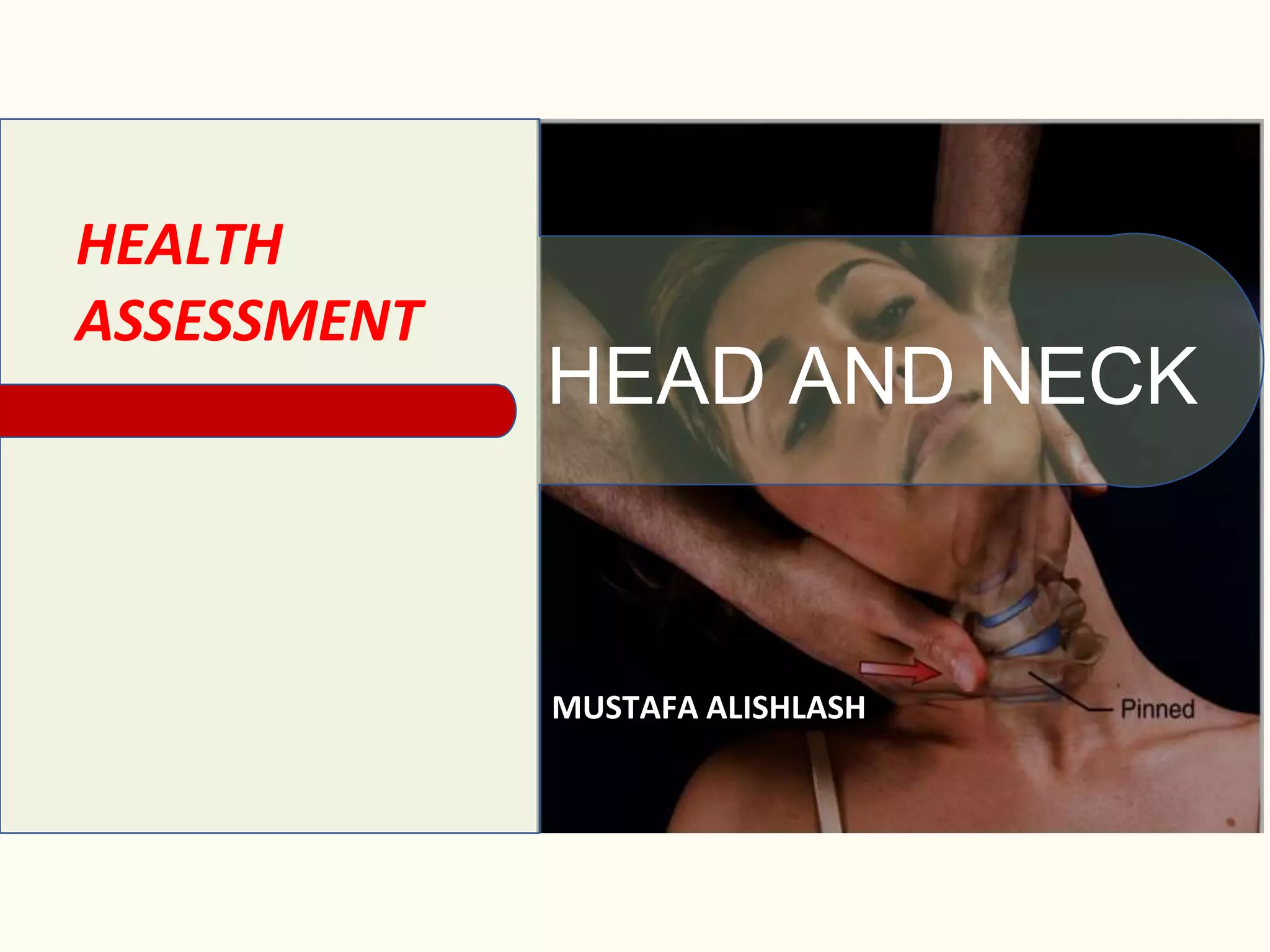
HEAD AND NECK
MUSTAFA ALISHLASH
HEALTH
ASSESSMENT
SESSION OBJECTIVES
By the end of this presentation, learners will be able to:
• Brainstorm the anatomy and physiology of the structures
of the head, and neck.
• Describe the components of health history that should be
elicited during the assessment of head & neck.
• Describe the specific assessment to be made during the
physical examination of the Head & Neck.
• Identify normal findings in physical assessment of the
head, and neck.
• Document the significant findings .
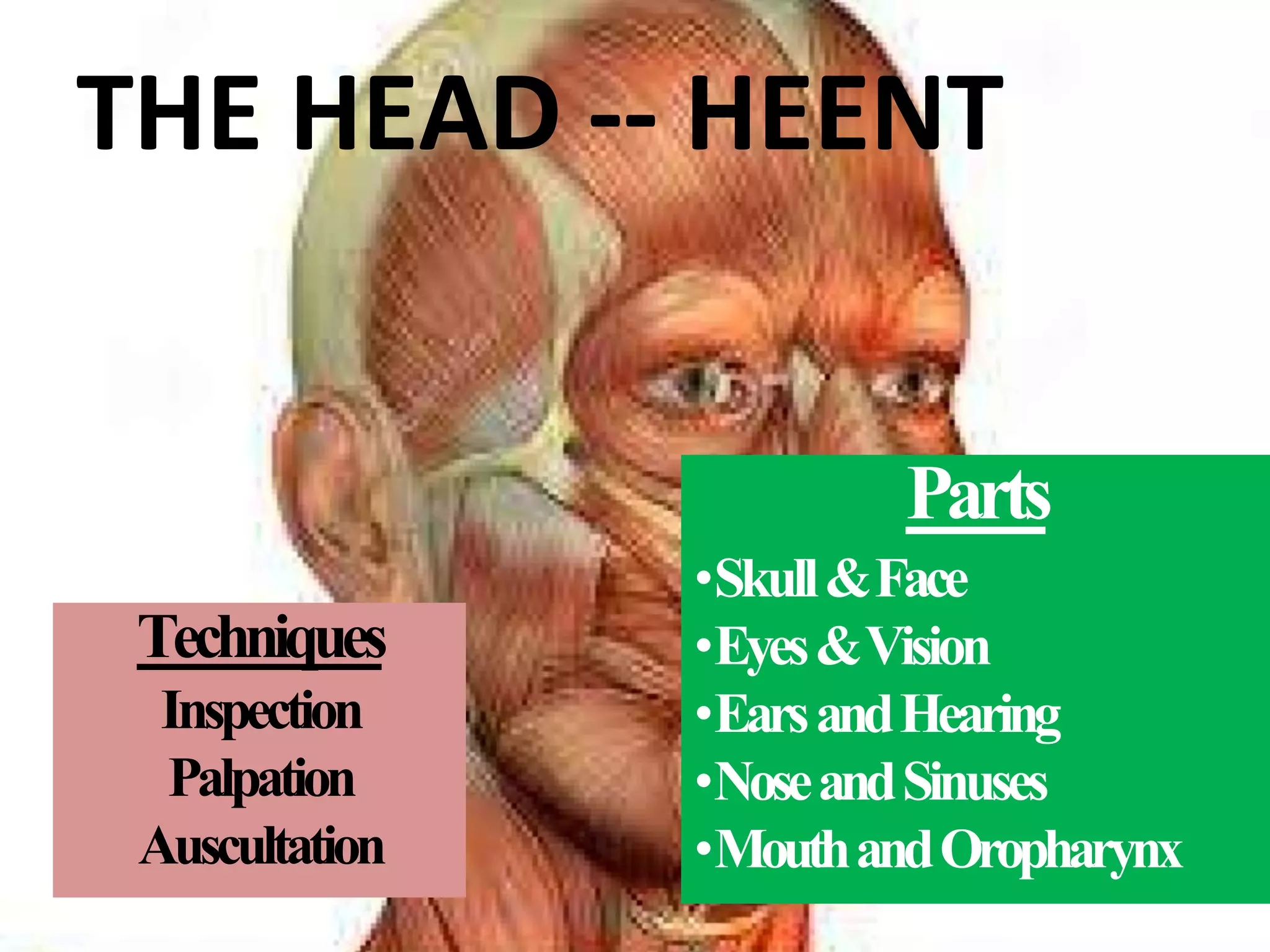
THE HEAD -- HEENT
Techniques
Inspection
Palpation
Auscultation
Parts
•Skull&Face
•Eyes&Vision
•EarsandHearing
•NoseandSinuses
•MouthandOropharynx
OVERVIEW OF HEENT ASSESSMENT
• The assessment of the HEENT systems will include
examinations of the;
Head, Eyes, Ears, Nose, &
Throat/neck
Key parameters are;
Symmetry, and color;
Hair distribution to scalp, eyebrows, and eyelashes;
Hydration status of the mucus membranes to the nose
and mouth;
The number and condition of teeth, palate structure and
uvula placement and color of lips and buccal membrane.
And the assessment of the XII cranial nerves.
STANDARD PROTOCOL FOR ASSESSMENT OF
THE HEENT
•Be organized and systematic in your
assessment.
•Use appropriate listening and questioning skills.
•Listen and attend to patient cues.
•Ensure patient’s privacy and dignity.
•Apply principles of asepsis and safety.
•Check vital signs.
STANDARD PROTOCOL FOR ASSESSMENT OF
THE HEENT
• Perform hand hygiene.
• Check room for contact precautions.
• Introduce yourself to the patient.
• Confirm patient ID using two patient identifiers (e.g., name
and date of birth or address).
• Explain the process to the patient.
• Assemble equipment prior to starting the exam.
Possible History you could gather- Focused.
• Ask questions related to:
• Pain to the head, eyes, ear, nose, throat and neck or
drainage as applicable.
• About changes to sight, smell, hearing, taste, chewing,
swallowing and speech.
• The need for glasses, hearing aids, dentures.
• Acute or chronic disease of the HEENT and medication
used to treat mentioned disease or abnormalities.
• Risk factors noted to the HEENT systems.
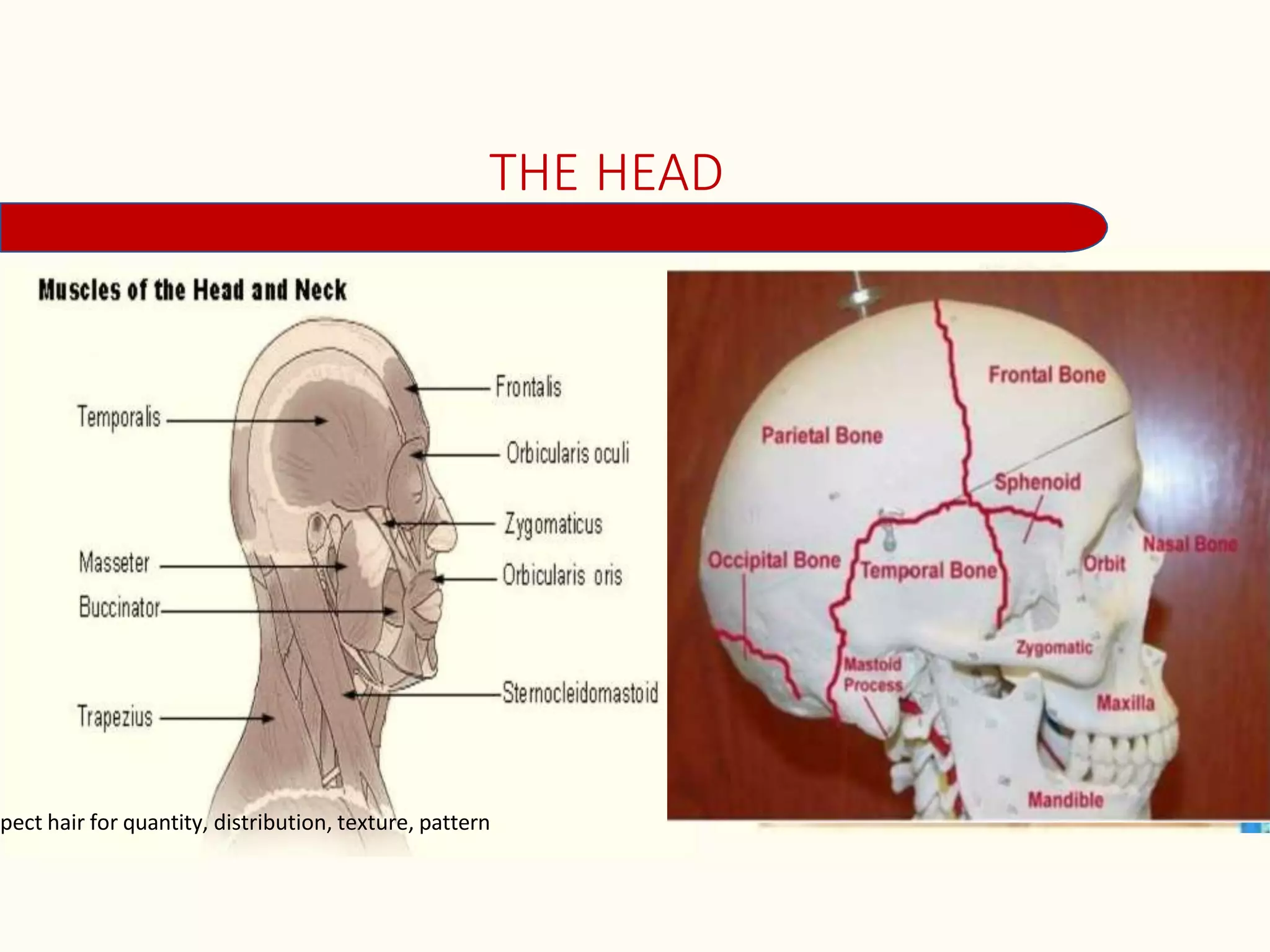
THE HEAD
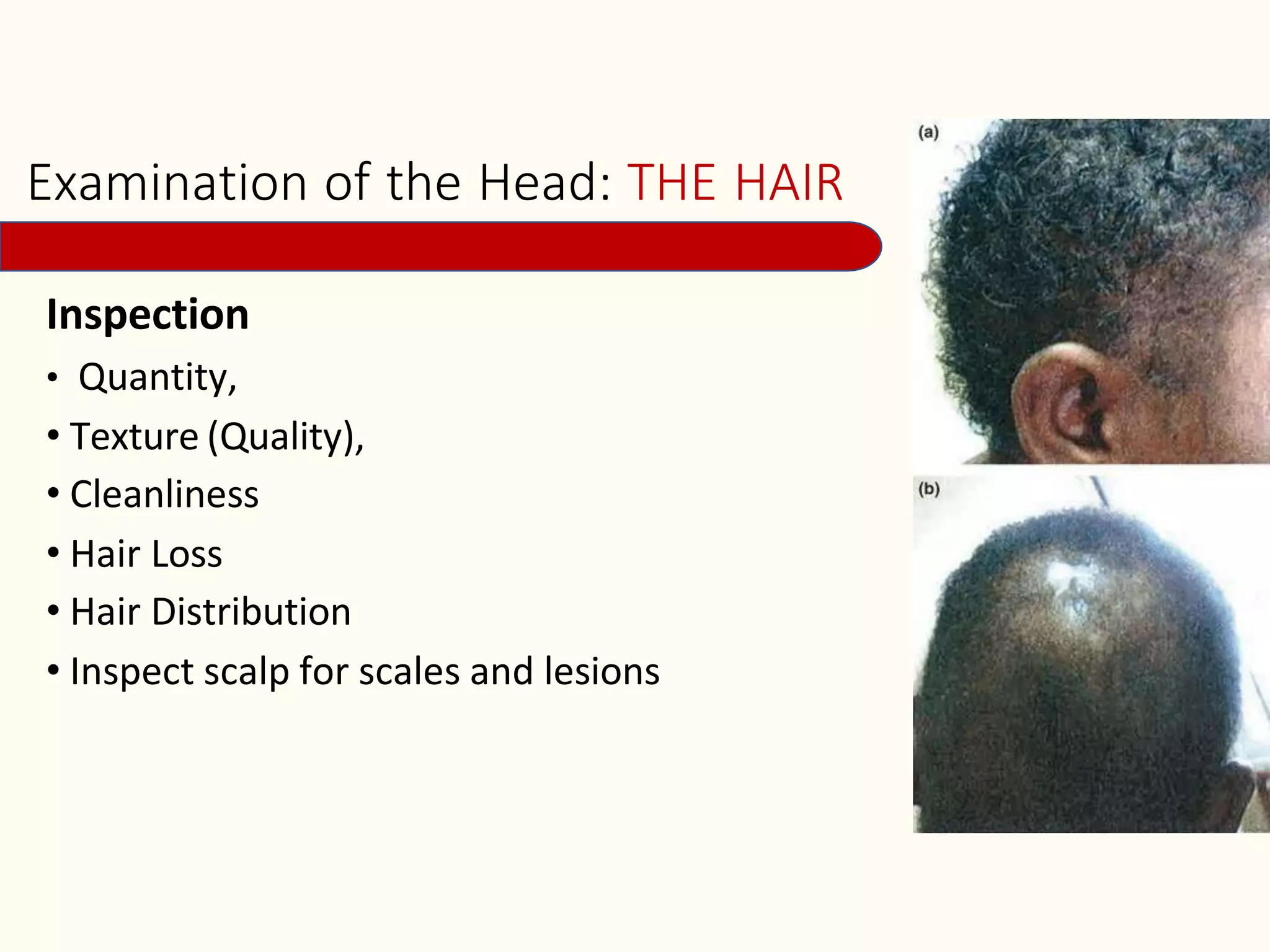
pect hair for quantity, distribution, texture, pattern
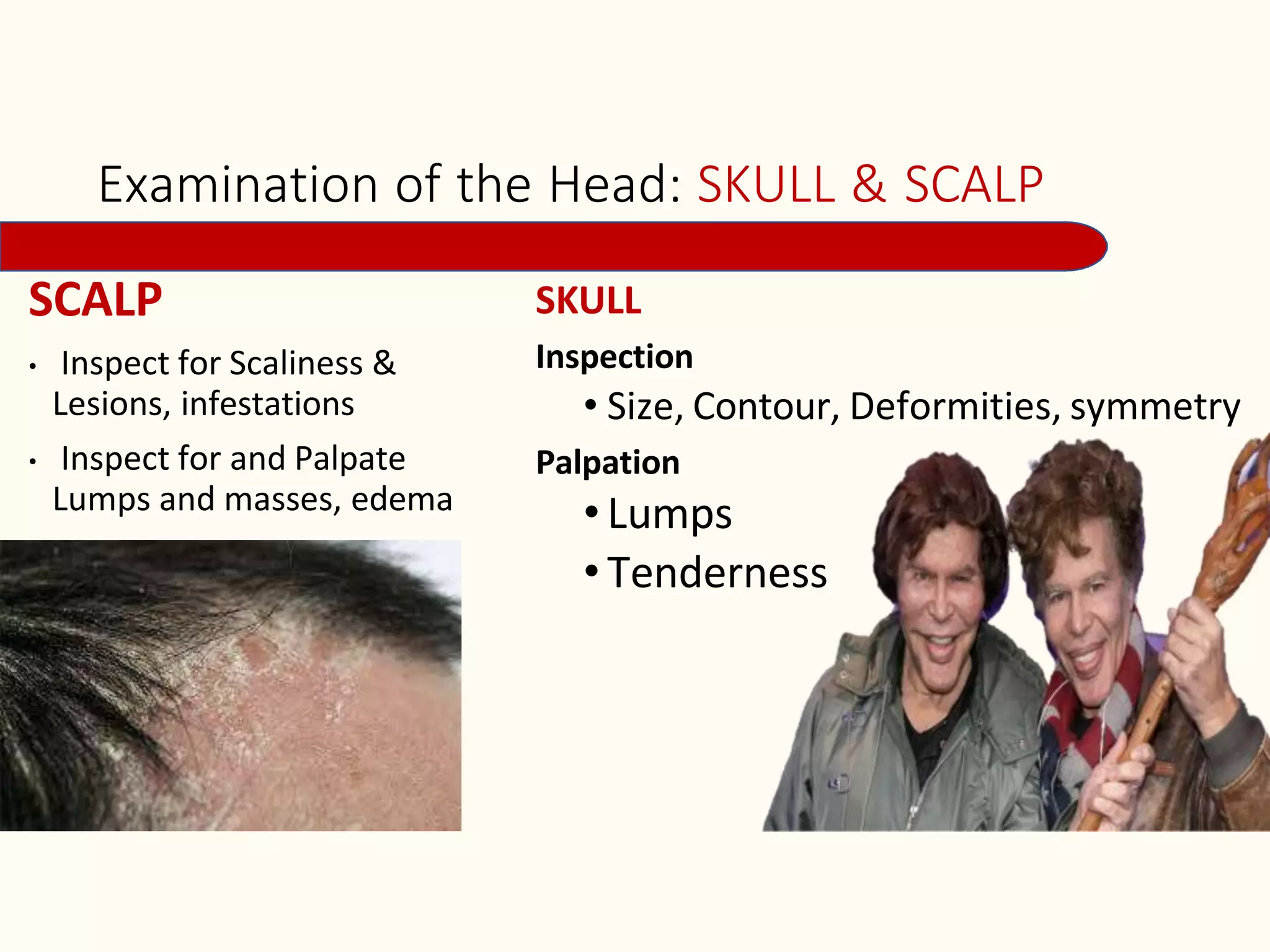
Examination of the Head: SKULL & SCALP
SCALP
• Inspect for Scaliness &
Lesions, infestations
• Inspect for and Palpate
Lumps and masses, edema
SKULL
Inspection
• Size, Contour, Deformities, symmetry
Palpation
• Lumps
• Tenderness
Examination of the Head: THE HAIR
Inspection
• Quantity,
• Texture (Quality),
• Cleanliness
• Hair Loss
• Hair Distribution
• Inspect scalp for scales and lesions
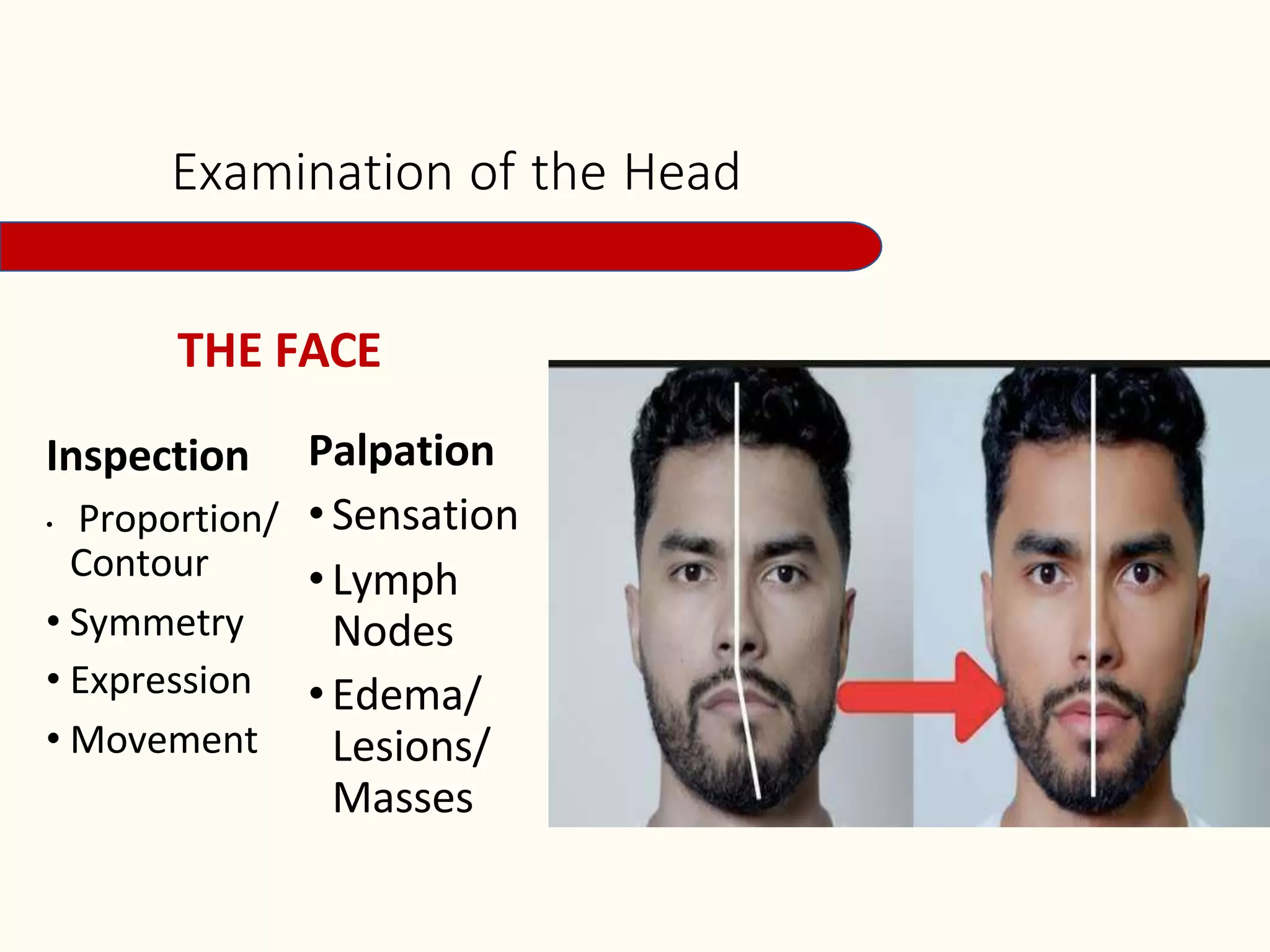
Examination of the Head
Inspection
• Proportion/
Contour
• Symmetry
• Expression
• Movement
Palpation
• Sensation
• Lymph
Nodes
• Edema/
Lesions/
Masses
THE FACE
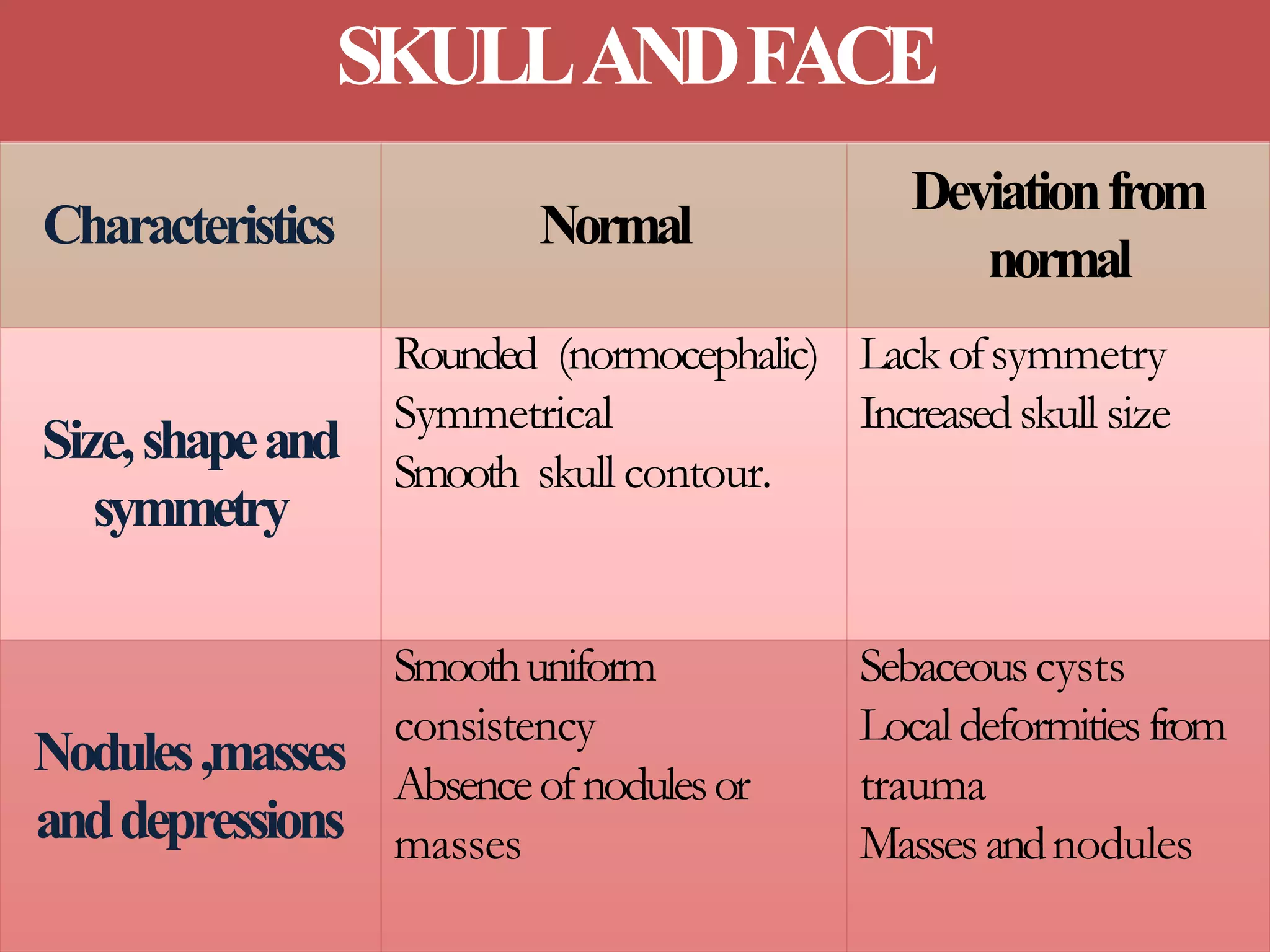
SKULLANDFACE
Characteristics Normal
Deviationfrom
normal
Size,shapeand
symmetry
Rounded (normocephalic)
Symmetrical
Smooth skull contour.
Lackofsymmetry
Increasedskull size
Nodules,masses
anddepressions
Smoothuniform
consistency
Absenceofnodulesor
masses
Sebaceouscysts
Localdeformitiesfrom
trauma
Massesandnodules
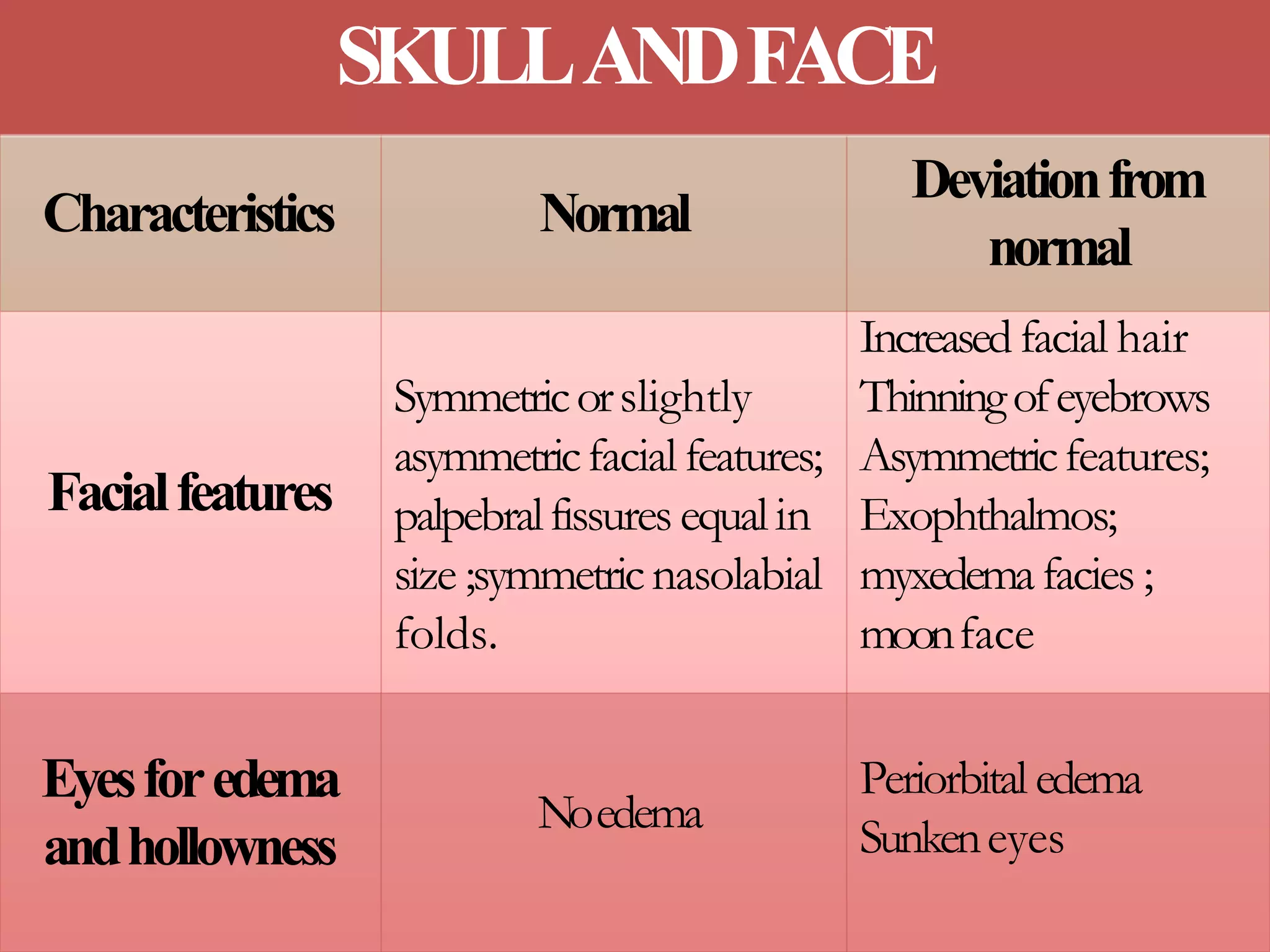
SKULLANDFACE
Characteristics Normal
Deviationfrom
normal
Facialfeatures
Symmetricorslightly
asymmetricfacialfeatures;
palpebralfissuresequalin
size ;symmetricnasolabial
folds.
Increasedfacial hair
Thinningofeyebrows
Asymmetricfeatures;
Exophthalmos;
myxedemafacies ;
moonface
Eyesforedema
andhollowness
Noedema
Periorbital edema
Sunkeneyes
SKULL AND FACE
Characteristics Normal
Deviationfrom
normal
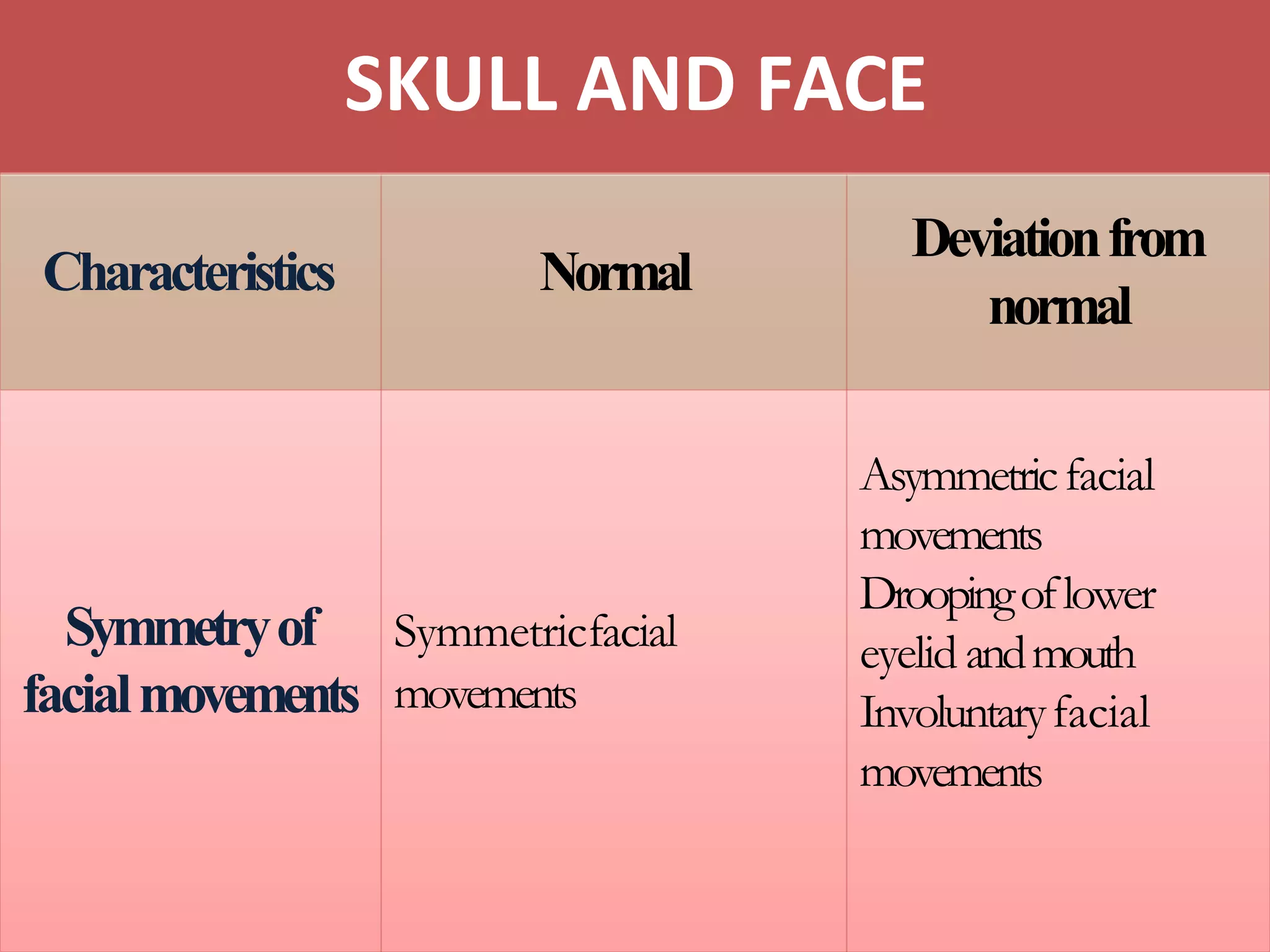
Symmetryof Symmetricfacial
facialmovements movements
Asymmetricfacial
movements
Droopingoflower
eyelid andmouth
Involuntaryfacial
movements
EYES AND VISION
Equipments
•Cottontipapplicator
•Gauzesquare
•Cleangloves
•Millimeterruler
•Penlight
•Snellen’sorEchart
•Opaquecard
Assessmentofeyeincludes,
•Externaleyestructures
•Visualfields
•Extraocularmuscletests
•Visualacuity
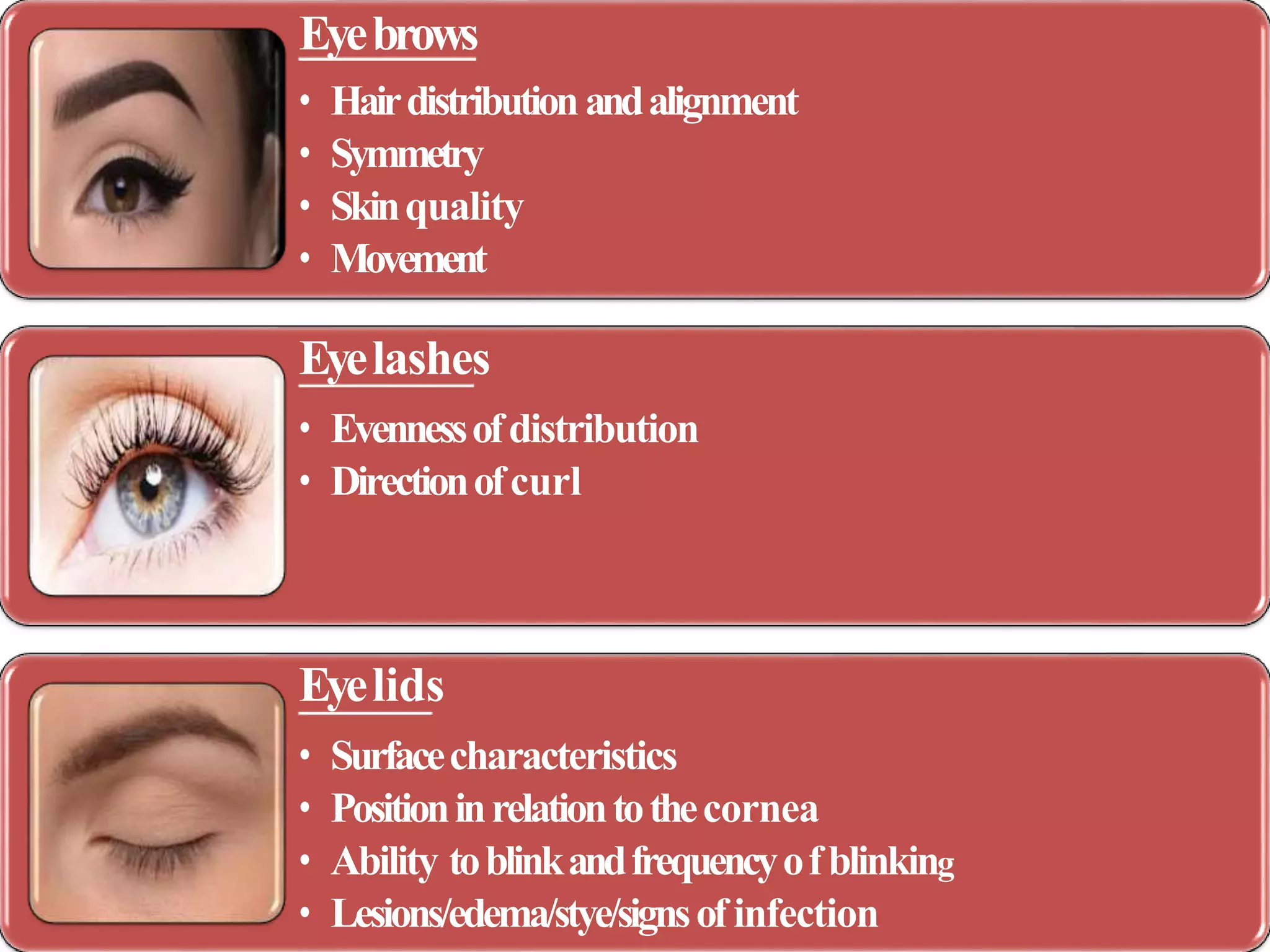
Eyebrows
• Hairdistributionandalignment
• Symmetry
• Skinquality
• Movement
Eyelashes
• Evennessofdistribution
• Directionofcurl
Eyelids
• Surfacecharacteristics
• Positioninrelationtothecornea
• Ability toblinkandfrequencyofblinking
• Lesions/edema/stye/signsofinfection
Bulbarconjunctivaandpalpebralconjunctiva
• Color
• Texture
• Presenceoflesions
Lacrimalgland, lacrimalsacand
nasolacrimalduct
• Edema
• TendernessandEvidenceoftearing
Cornea
• Clarityandtexture
• Performcornealsensitivitytest
Anteriorchamber
• Transparency
• Depth
Pupils
• Color/shape/symmetryofsize
• PERRLA(pupilsareroundand
reacttolightandaccommodation)
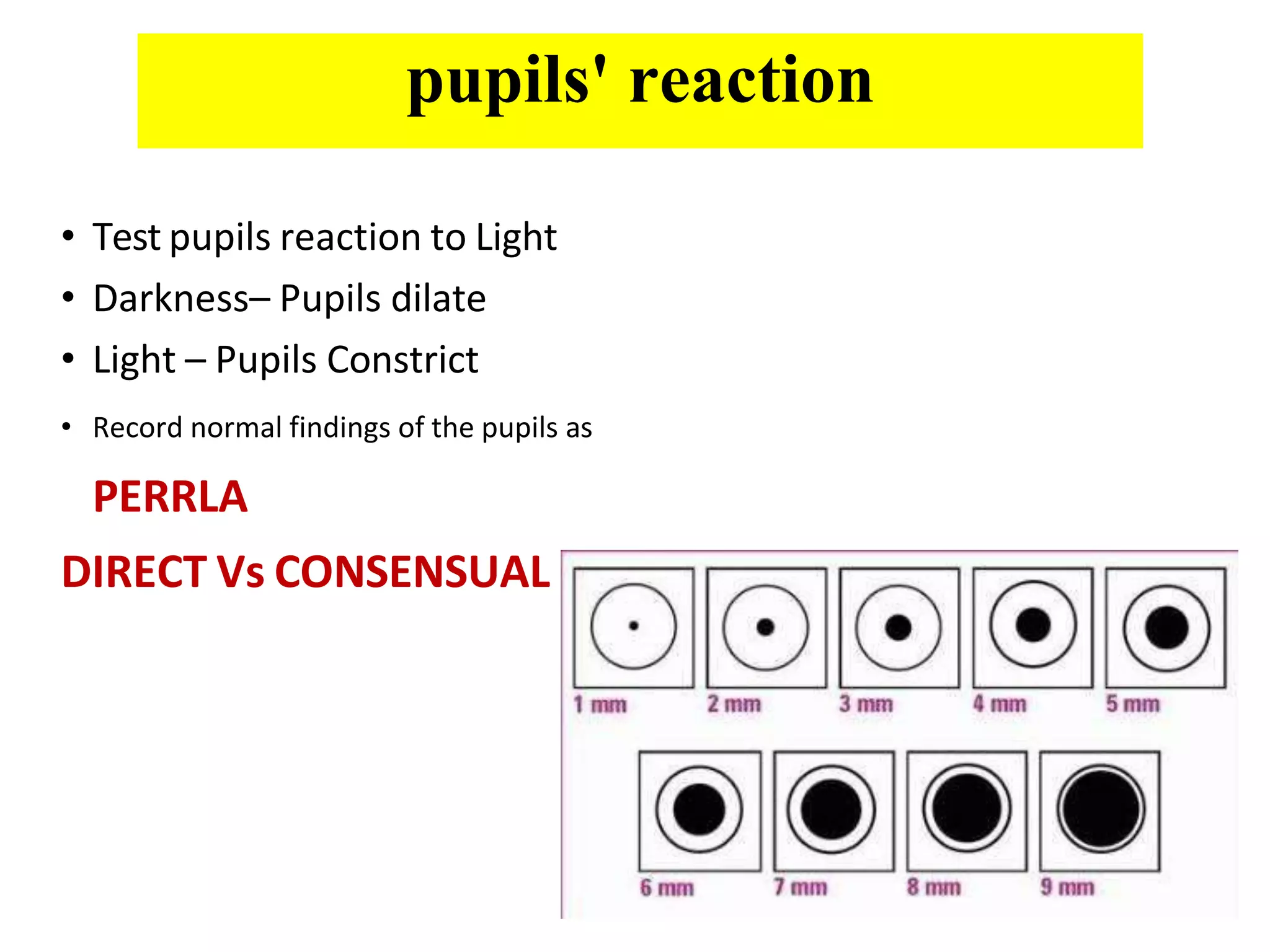
pupils' reaction
• Test pupils reaction to Light
• Darkness– Pupils dilate
• Light – Pupils Constrict
• Record normal findings of the pupils as
PERRLA
DIRECT Vs CONSENSUAL
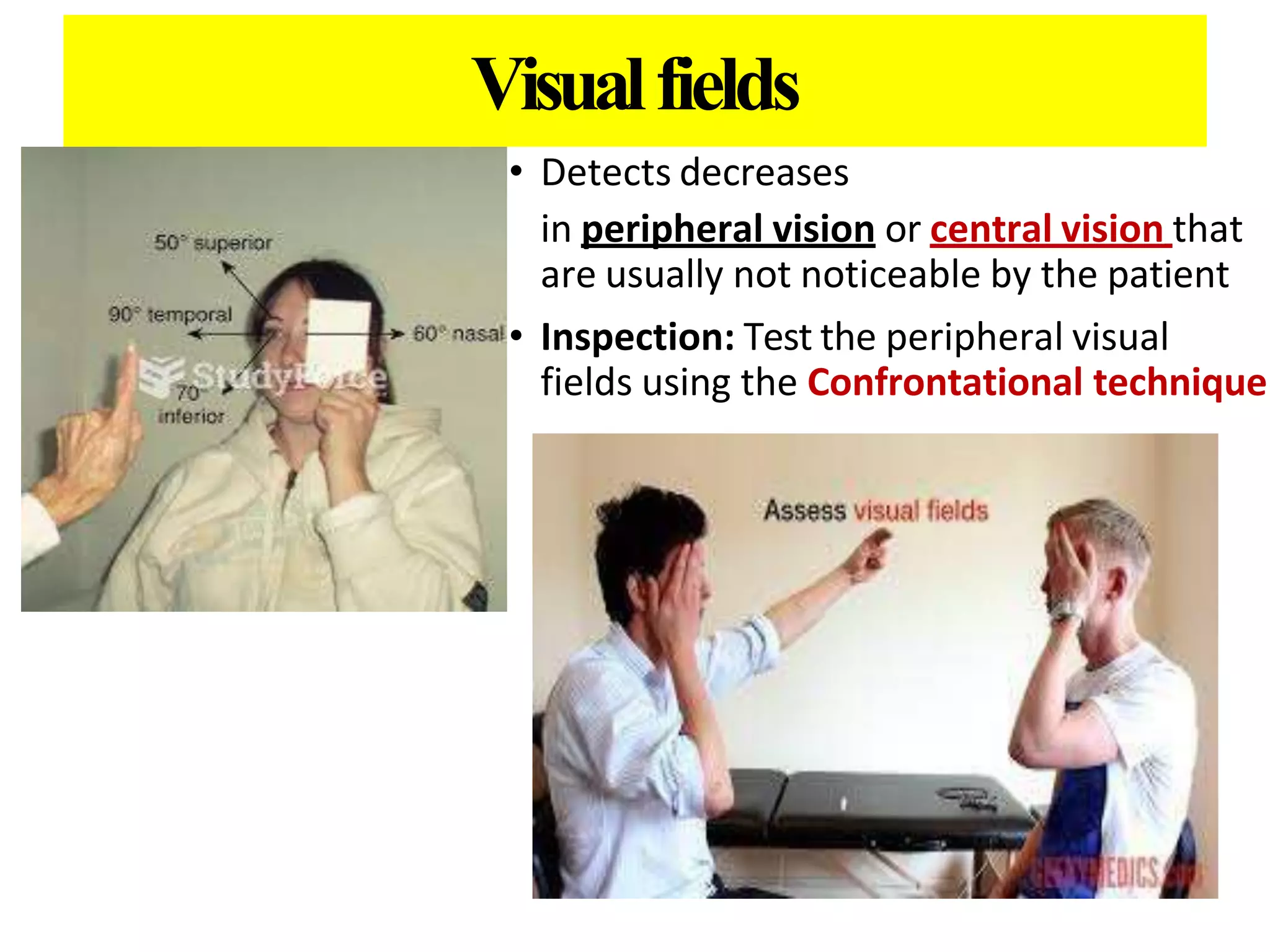
Visualfields
• Detects decreases
in peripheral vision or central vision that
are usually not noticeable by the patient
• Inspection: Test the peripheral visual
fields using the Confrontational technique
Visualfields
Normal
• Whenlookingstraight
ahead,clientcanseeobjects
intheperiphery
Deviationfromnormal
• Visual field smaller than the
normal(possibleglaucoma)
• One half vision in one or
both eyes (possible nerve
damage)
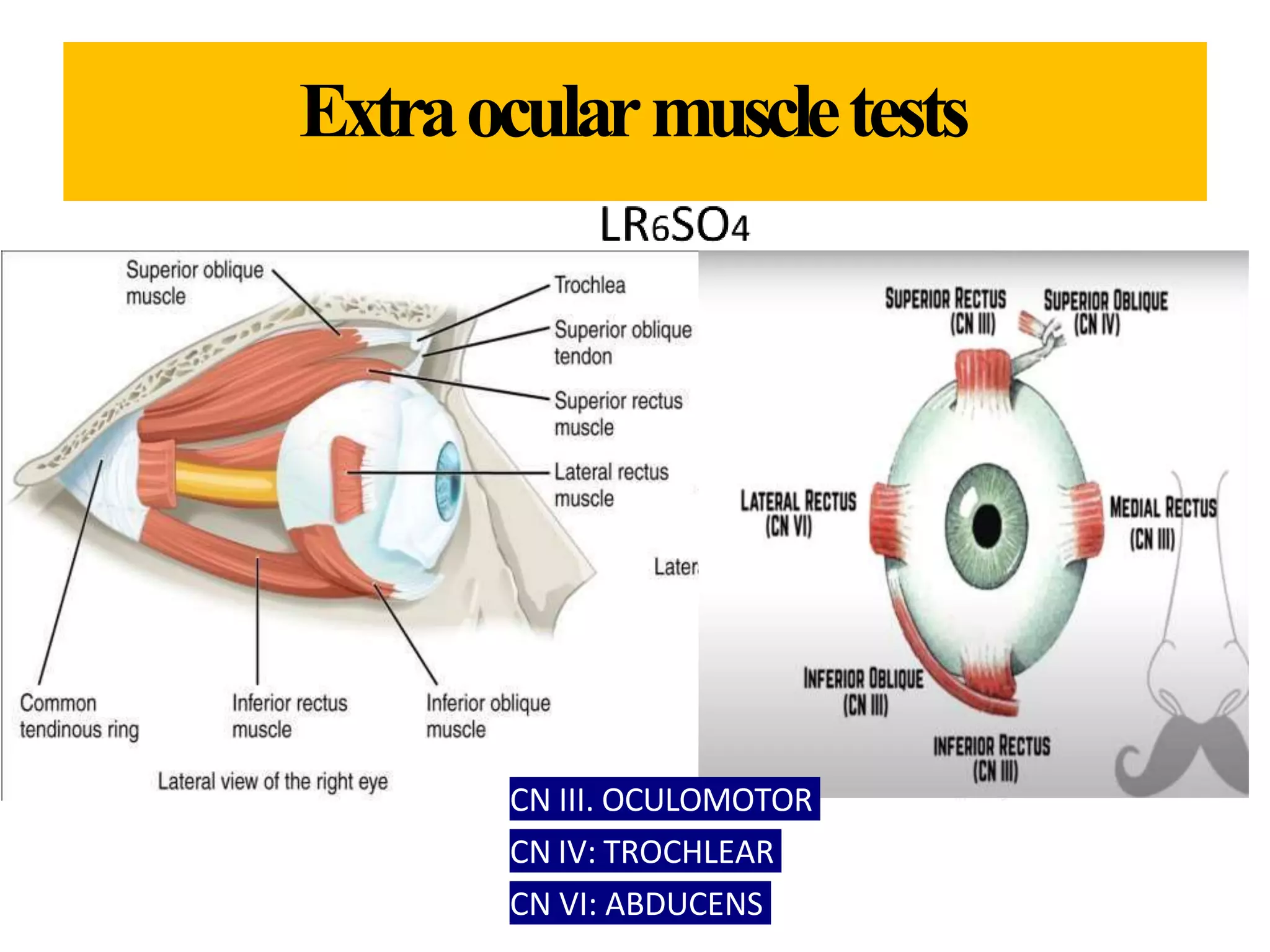
Extraocularmuscletests
CN III. OCULOMOTOR
CN IV: TROCHLEAR
CN VI: ABDUCENS
Extraocularmuscletests
THE 6 CADINAL FIELDS OF GAZE
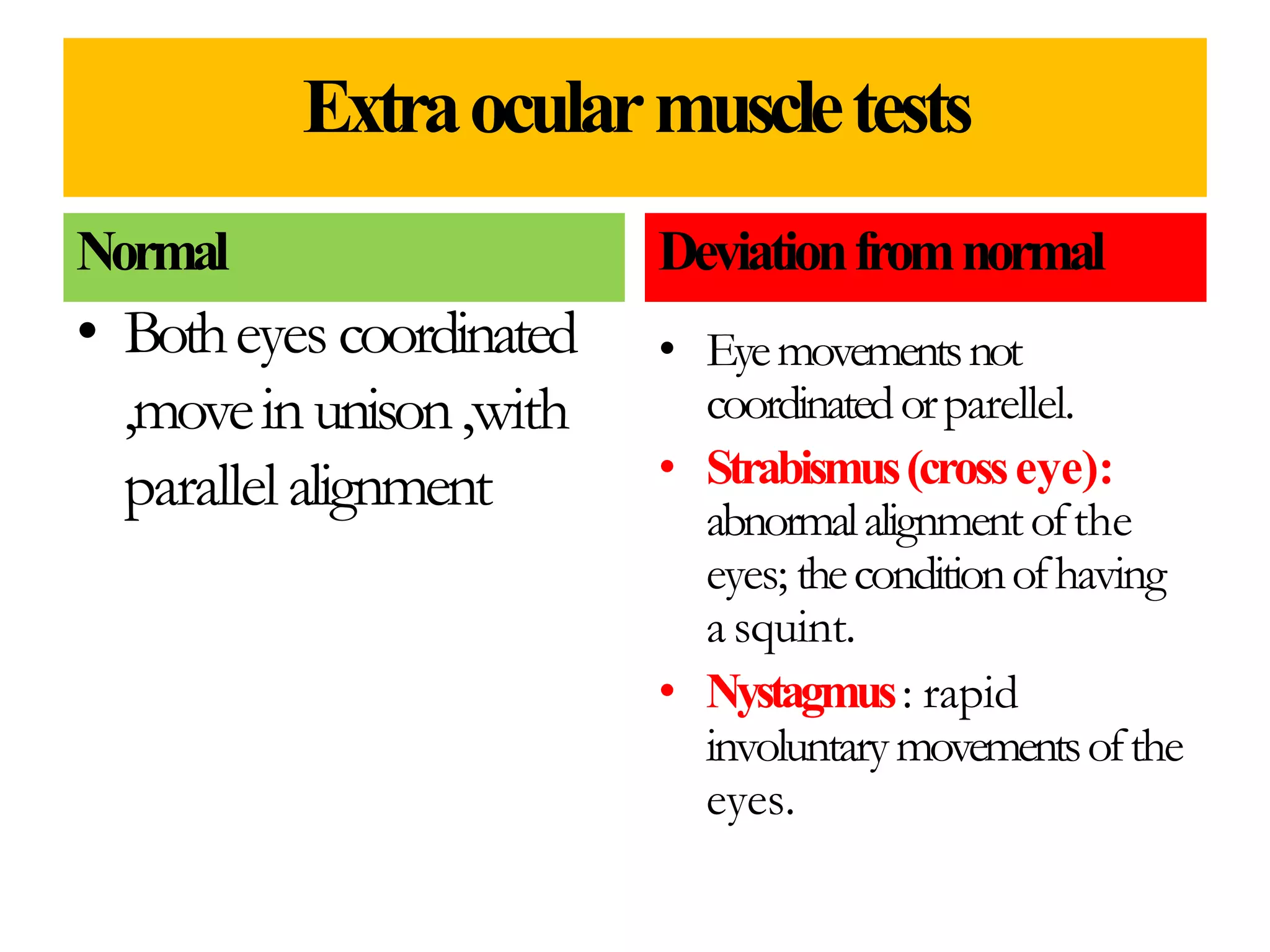
• Botheyes coordinated
,moveinunison,with
parallel alignment
• Eyemovementsnot
coordinatedorparellel.
• Strabismus(crosseye):
abnormalalignmentofthe
eyes; theconditionofhaving
asquint.
• Nystagmus: rapid
involuntarymovementsofthe
eyes.
Extraocularmuscletests
Normal Deviationfromnormal
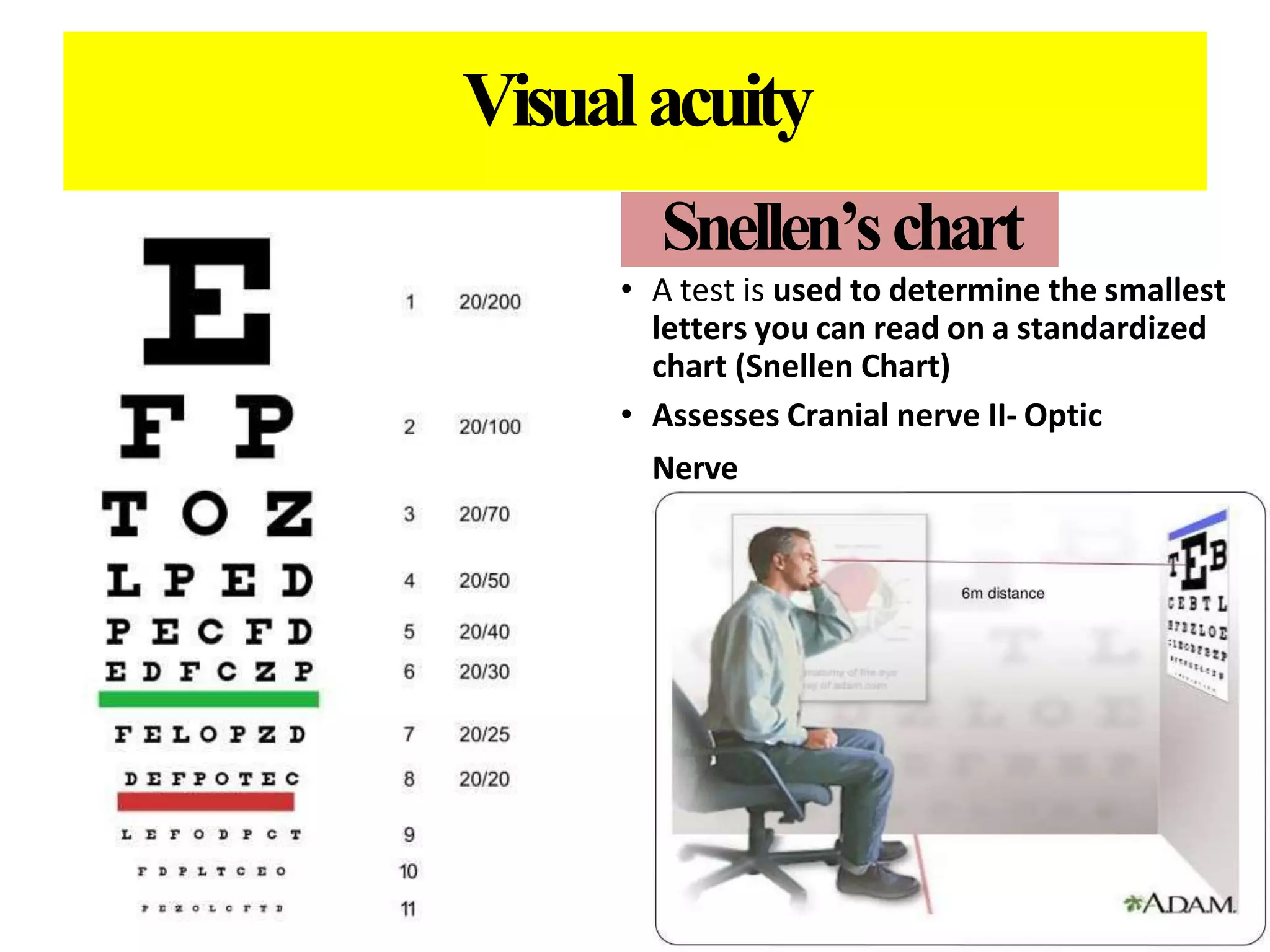
Visualacuity
Snellen’schart
• A test is used to determine the smallest
letters you can read on a standardized
chart (Snellen Chart)
• Assesses Cranial nerve II- Optic
Nerve
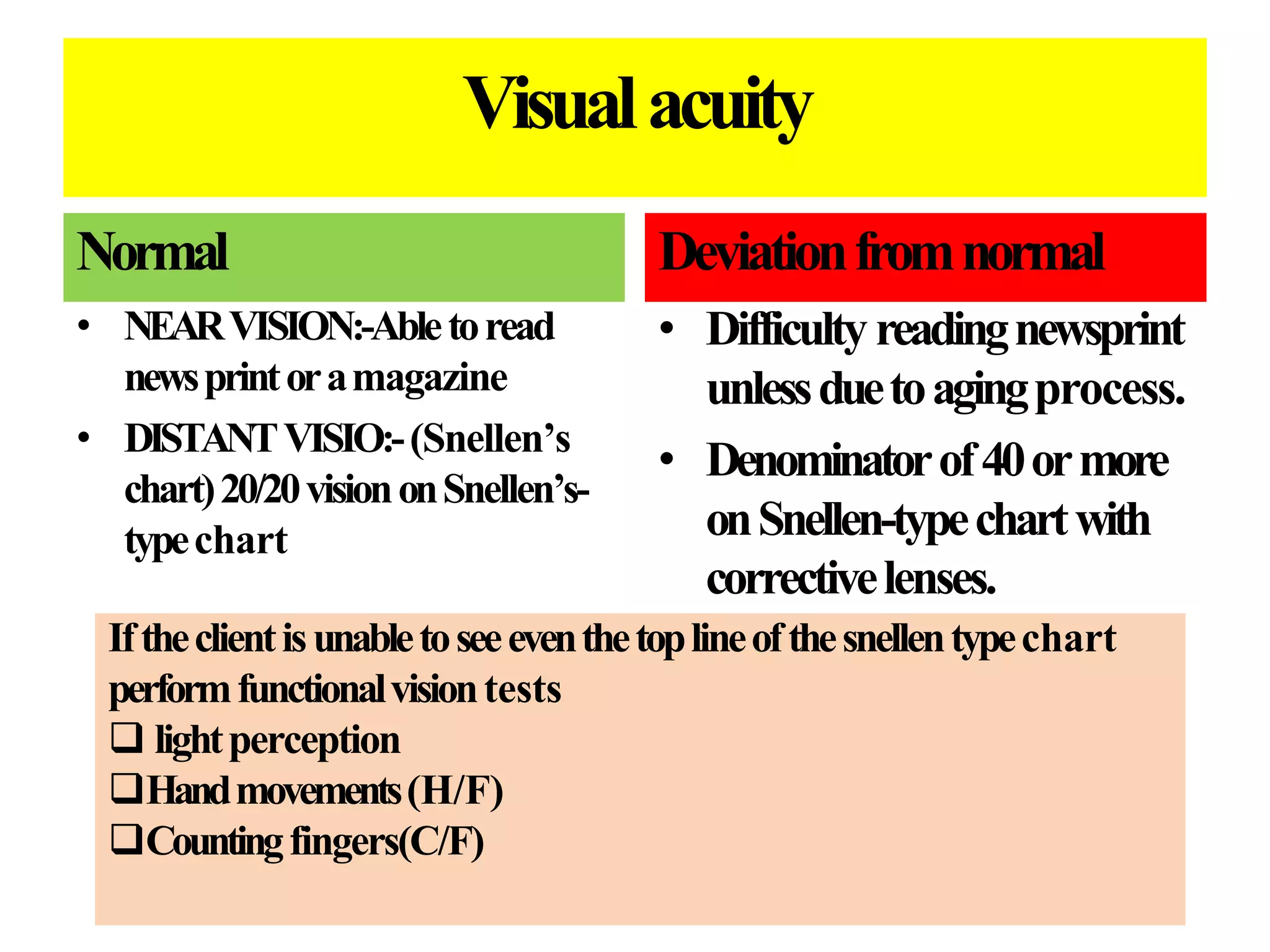
Visualacuity
Normal
• NEARVISION:-Abletoread
newsprintoramagazine
• DISTANTVISIO:-(Snellen’s
chart)20/20visiononSnellen’s-
typechart
Deviationfromnormal
• Difficultyreadingnewsprint
unlessduetoagingprocess.
• Denominatorof40ormore
onSnellen-typechartwith
correctivelenses.
Iftheclientisunabletoseeeventhetoplineofthesnellentypechart
performfunctionalvisiontests
 lightperception
Handmovements(H/F)
Countingfingers(C/F)
Myopia
• Nearsightedness
Hyperopia
• Farsightedness
Presbyopia
• Loss of elasticity of the lens and thus loss of ability
to see close objects
Astigmatism
• An uneven curvature of the cornea that prevents horizontal
and vertical rays from focusing on the retina
Refractive errors
Inflammation
Conjunctivitis
• Inflammationofthebulbarandpalpebralconjunctiva
Dacryocystitis
• InflammationoftheLacrimalsac
Hordeolum(sty)
• Rednessswellingandtendernessofthehairfollicle
andglandthatemptyattheedgeoftheeyelids
Iritis
• Iflammation oftheiris
Contusionsorhematomas
• “Blackeyes”resultingfrominjury
Cataracts
• Opacityoflensanditscapsule
Glaucoma
• Adisturbanceinthecirculationofaqueousfluid
whichcausesanincreaseinintraocularpressure.
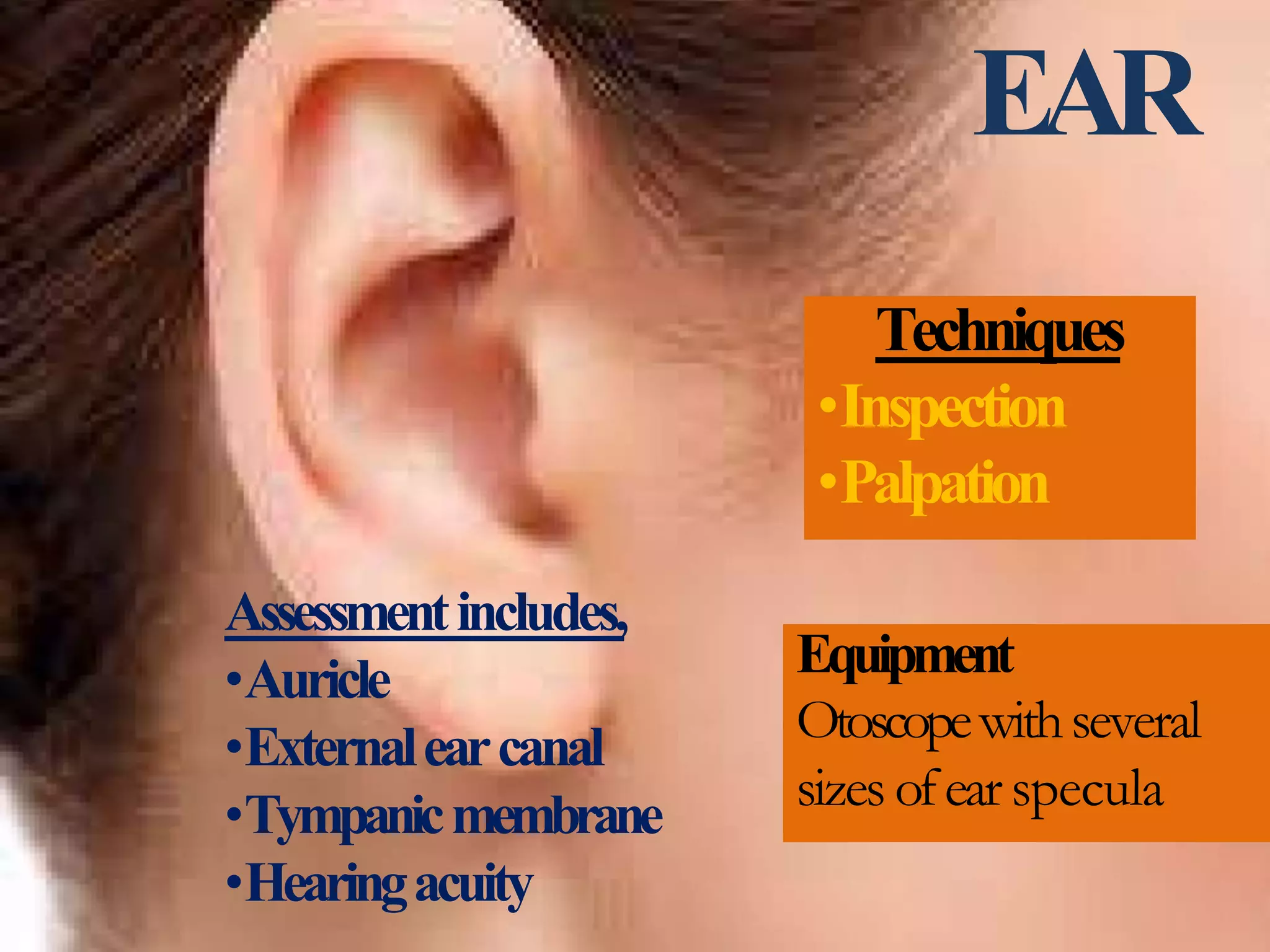
EAR
Techniques
•Inspection
•Palpation
Equipment
Otoscopewithseveral
sizes ofearspecula
Assessmentincludes,
•Auricle
•Externalearcanal
•Tympanicmembrane
•Hearingacuity
color
Normal
• Sameasfacial
skin
Deviation
• Cyanosis
• Pallor
• Excessiveredness
symmetryof
size
Normal
• symmetrical
Deviation
• Asymmetry
Position
Normal
• Auriclealigned
withouter
canthusofeye
about10degree
fromvertical
Deviation
• Lowsetears
(downsyndrome)
Auricle(Inspection)
Auricle(Palpation)
• Textureelasticityandareasoftenderness
Normal
• Mobilefirm
andnon
tender
• Pinnarecoils
after it is
folded
Deviation
• Lesions
• Flaky ,scaly
skin
• Tenderness
Externalearandtympanicmembrane
Otoscope
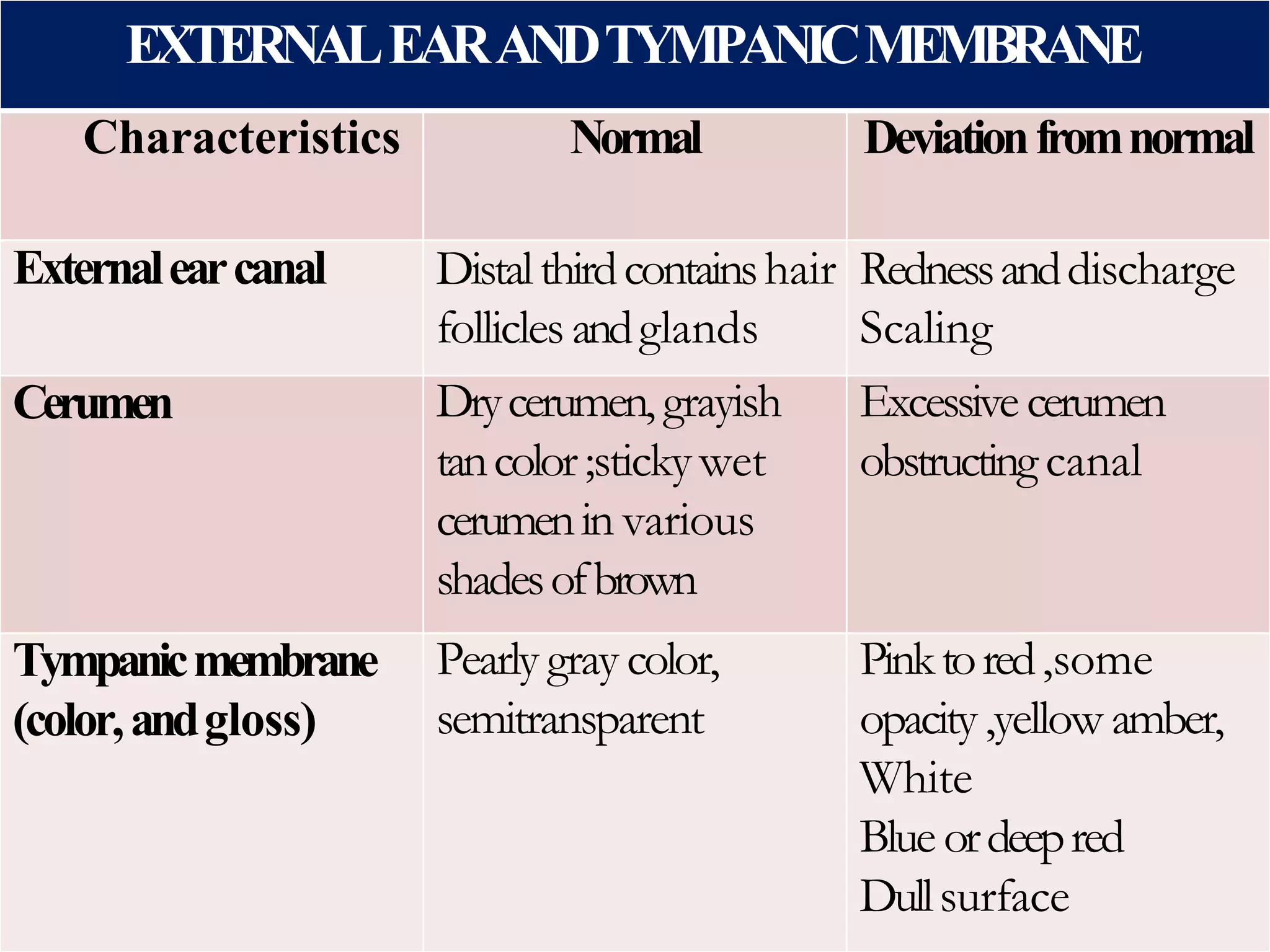
EXTERNALEARANDTYMPANICMEMBRANE
Characteristics Normal Deviationfromnormal
Externalearcanal Distalthirdcontainshair Rednessanddischarge
follicles andglands Scaling
Cerumen Drycerumen,grayish
tancolor;stickywet
cerumenin various
shadesofbrown
Excessivecerumen
obstructingcanal
Tympanicmembrane
(color,andgloss)
Pearly gray color,
semitransparent
Pinktored,some
opacity ,yellow amber,
White
Blue ordeepred
Dullsurface
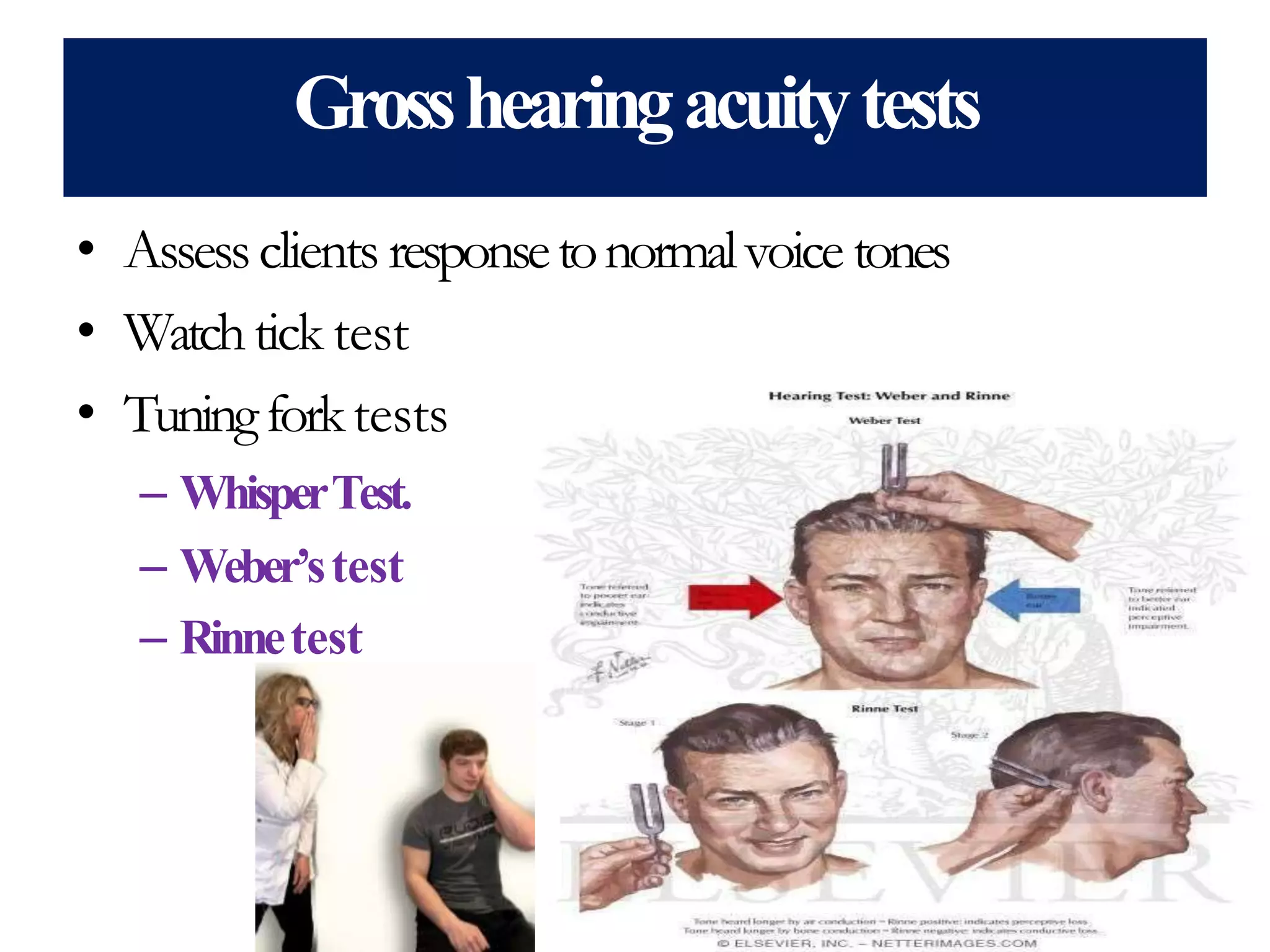
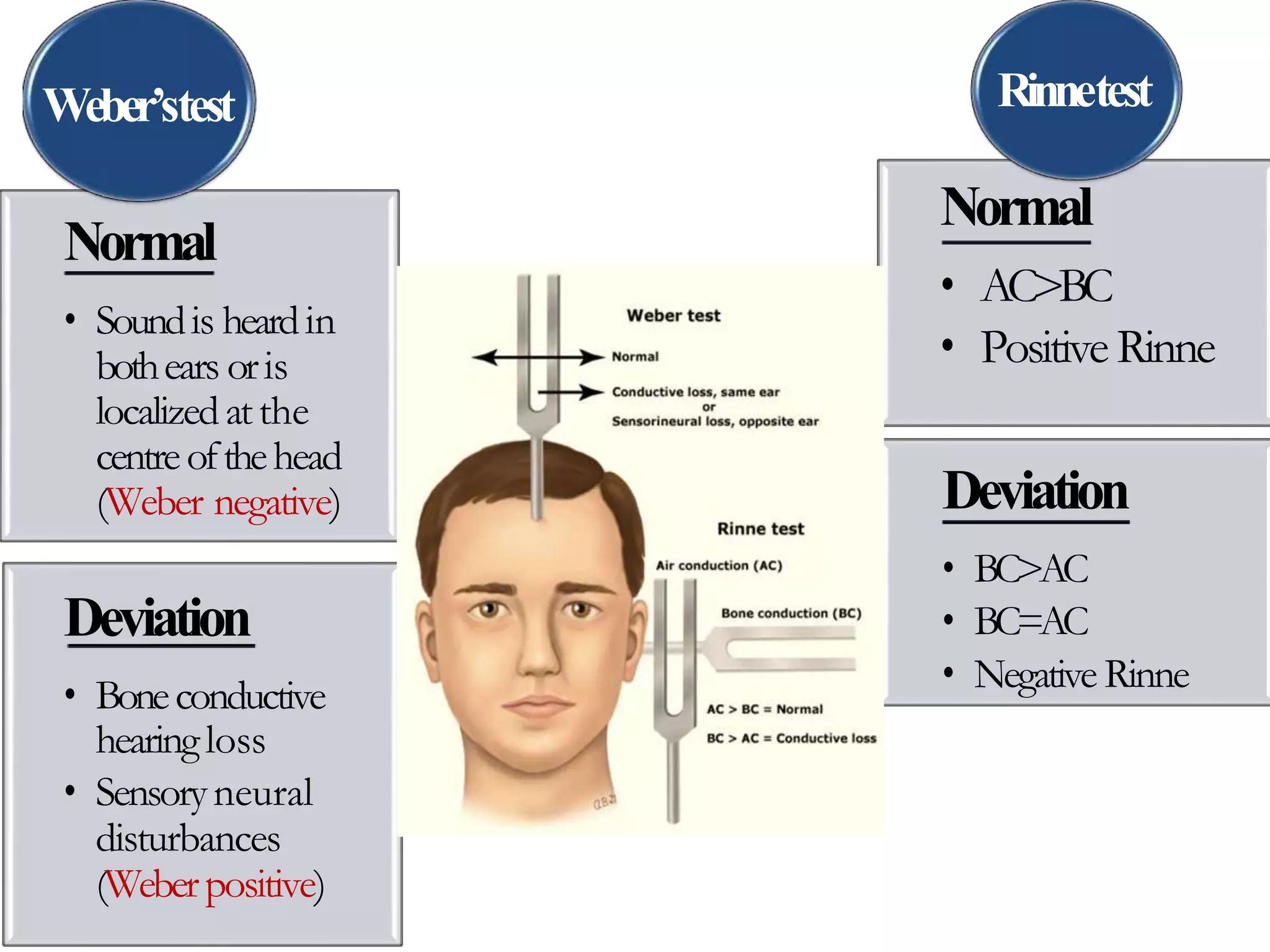
Grosshearingacuitytests
• Assessclients responsetonormalvoice tones
• Watchtick test
• Tuningforktests
– WhisperTest.
– Weber’stest
– Rinnetest
Normal
• Soundis heardin
bothears oris
localizedatthe
centreofthehead
(Weber negative)
Deviation
• Boneconductive
hearingloss
• Sensoryneural
disturbances
(Weberpositive)
Weber’stest
Normal
• AC>BC
• Positive Rinne
Deviation
• BC>AC
• BC=AC
• Negative Rinne
Rinnetest
NOSEANDSINUSES
Techniques
Inspection
Palpation
Equipment
•Nasalspeculum
•Flashlight/penlight
Assessmentincludes,
 Noseandnasalcavities
 Facialsinuses
NOSE
• Inspectfornoseforanydeviationsin
Shape,size, colorandflaring ordischargefromthenares.
• Lightly palpatetheexternal nosefor
Tenderness,massesanddisplacementofboneandcartilage.
• Determinepatencyofbothnasal cavities
• Inspectthenasal cavities usingnasal speculum
Observemucosaforredness, swelling, growths,and
discharges.
• Inspectthenasal septumbetweenthenasal
champers
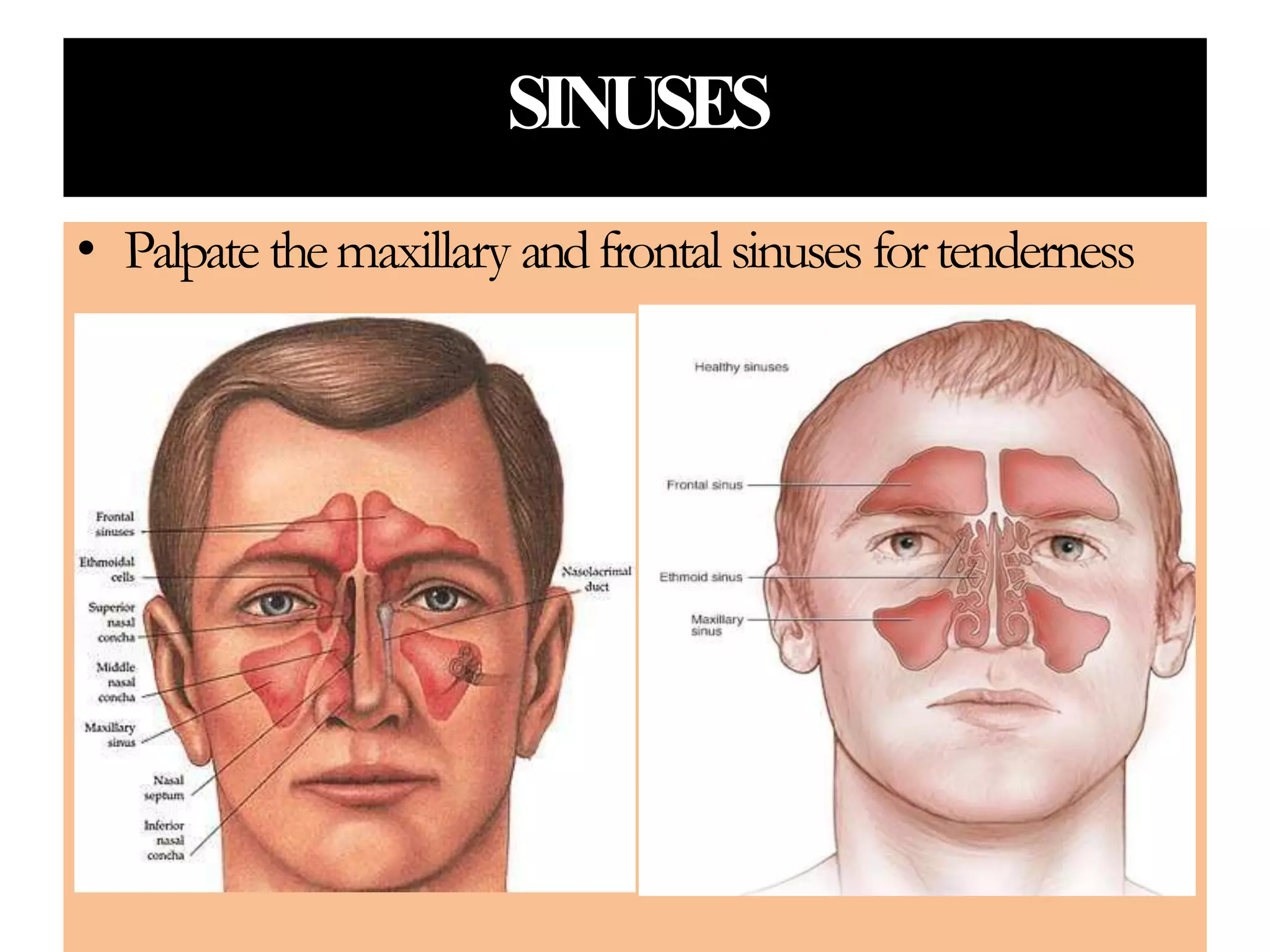
SINUSES
• Palpate themaxillary andfrontalsinusesfortenderness
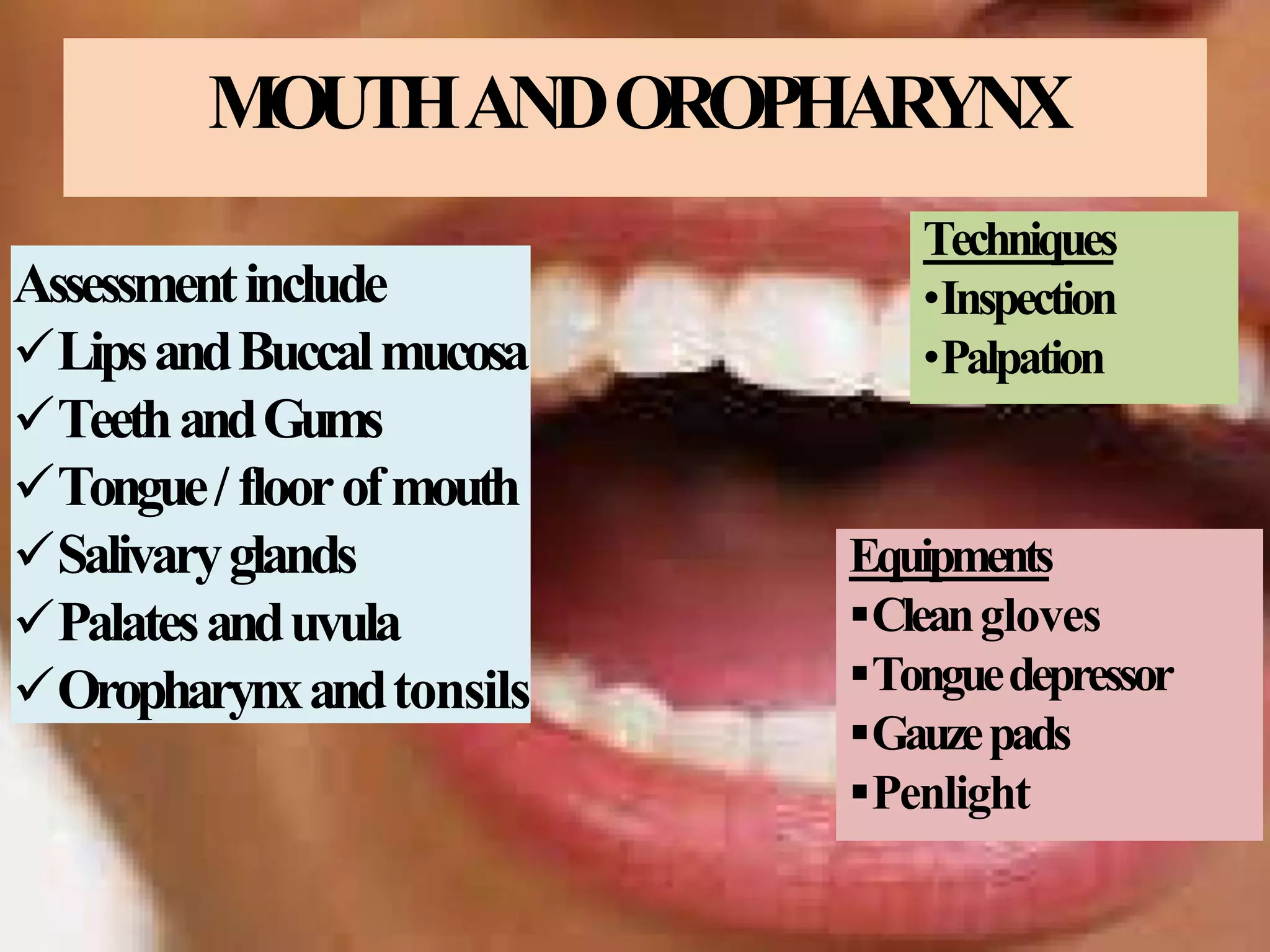
MOUTHANDOROPHARYNX
Equipments
Cleangloves
Tonguedepressor
Gauzepads
Penlight
Assessmentinclude
LipsandBuccalmucosa
TeethandGums
Tongue/floorofmouth
Salivaryglands
Palatesanduvula
Oropharynxandtonsils
Techniques
•Inspection
•Palpation
Lipsandbuccalmucosa
• Inspectouterlipsfor
– Symmetry,contour,colorandtexture,abilitytopurselips
Normal
• Uniformpinkcolor&soft,moistandsmoothtexture
• Symmetry ofcontour
• Abletopurselips
Deviationfromnormal
• Pallor ,cyanosis
• Blisters, swelling, scaling
• Inability topurselips
Lipsandbuccalmucosa
• Inspectandpalpate innerlipsandbuccalmucosafor
– Color, moisture,textureandpresenceoflesions
Normal
• Uniformpinkcolor&soft,moist,smooth, glisteningandelastic
texture.
Deviationfromnormal
• Pallor; leukoplakia(white patches), red,bleeding
• Excessive dryness
• Mucosalcysts ;irritation fromdentures , abrasions, ulceraions
;nodules.
Teethandgums
Normal
• 32adult teeth
• Smooth,white, shiny toothenamel
• Pinkgums
• Moistfirmtexture togums
• Noretraction ofgums
Deviationfromnormal
• Missingteeth ;ill fitting dentures
• Brownorblackdiscoloration oftheenamel(dental caries)
• Excessively redgums
• Spongytexture ; bleeding; tenderness
• Receding; atrophiedgums; swelling thatpartially coverstheteeth
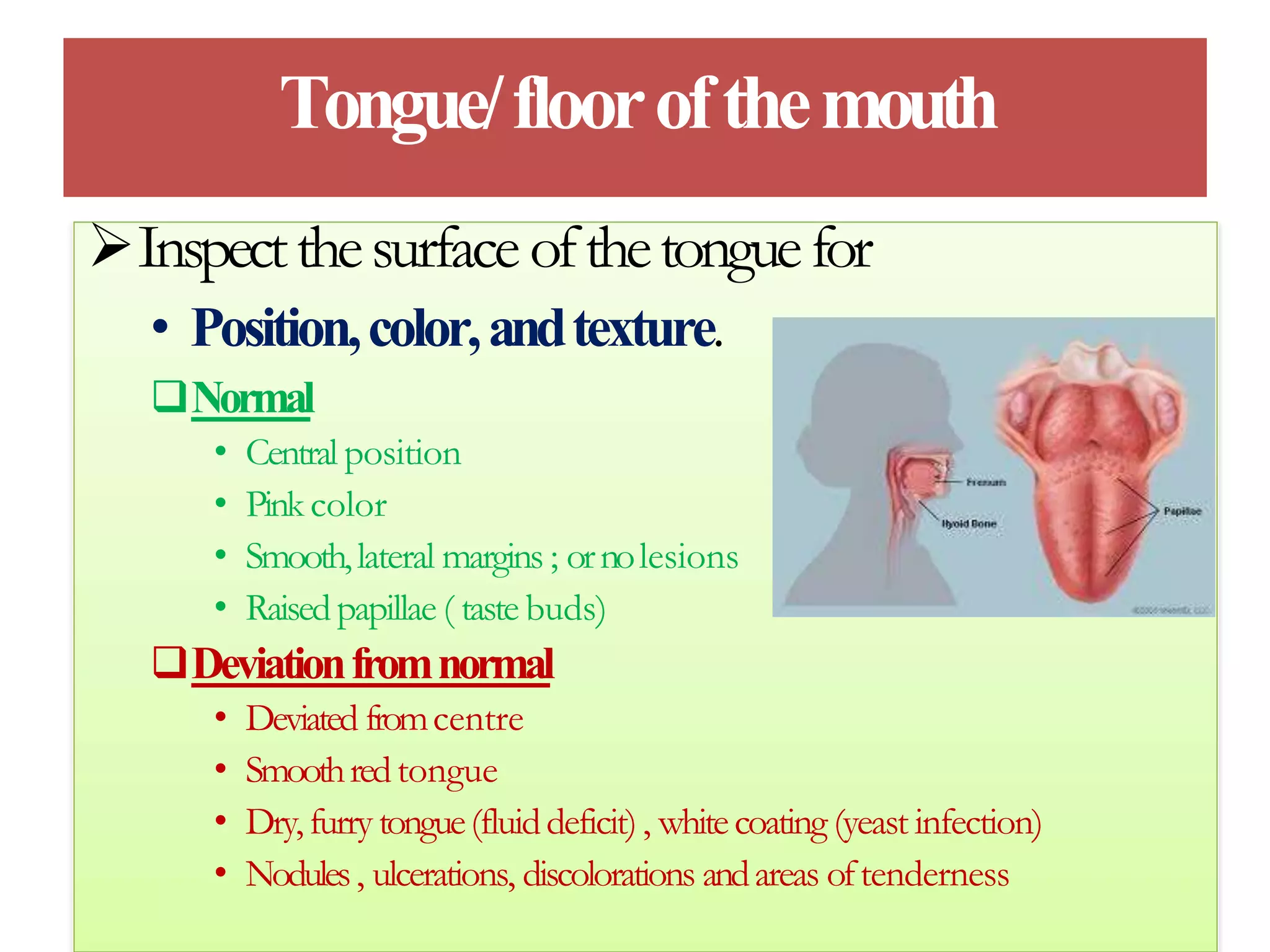
Tongue/floorofthemouth
Inspectthesurfaceofthetonguefor
• Position,color,andtexture.
Normal
• Central position
• Pinkcolor
• Smooth,lateral margins ; ornolesions
• Raisedpapillae ( taste buds)
Deviationfromnormal
• Deviated fromcentre
• Smoothredtongue
• Dry,furry tongue(fluiddeficit), whitecoating(yeast infection)
• Nodules, ulcerations, discolorations andareas oftenderness
Tongue/floorofthemouth
• Inspectthetonguemovement
• Insectthebaseofthetonguethemouthfloorandfrenulum
• Palpatethetongueandfloorofthemouth
Normal
• Movesfreelynotenderness
• Smoothtonguewithprominentveins
• Smooth, nopalpablenodules
Deviationfromnormal
• Swelling andulceration
• Nodules
Salivaryglands
• Inspectsalivary ductopeningsfor
– swellingorredness
Normal
• Sameas colorofbuccal
mucosaandfloorofthemouth
Deviationfromnormal
• Inflammation
(rednessandswelling)
• Inspectthehardandsoftpalateforthe
– Color, shape,textureandpresenceofbonyprominences
• Inspecttheuvulafor
– Positionandmobility
Palatesanduvula
Oropharynxandtonsils
• InspecttheOropharynxforthe
– Colorandtexture
Normal:Pinkandsmoothposteriorwall.
Deviationfromnormal: Reddenedoredematous,presenceof
lesions.
• Inspectthetonsils
– Color,discharge,andsize
Normal:Pinkcolorandsmoothtexture, nodischarge,normalsize.
Deviationfromnormal:Inflamed, presenceofdischarge, swollen.
• Elicit thegagreflex
Oropharynxandtonsils
NECK
Techniques
Inspection
Palpation
Auscultation
Assessmentincludes,
•Neckmuscles
•Lymphnodes
•Trachea
•Thyroidgland
•Carotidarteriesandjugularveins
Neckmuscles
Sternocleidomastoidmuscle
Trapeziusmuscle
Neckmuscles
• Inspecttheneckmuscles
• Observeheadmovements
– Movechintothechest(sternocleidomastoid)
– Movetheheadsothattheearis movedtowardtheshoulderon
eachside (sternocleidomastoid)
– Turntheheadtotheright andtotheleft (sternocleidomastoid)
– Moveheadbacksothatthechinpointsupward(Trapezius)
• Assessthemusclestrength
Lymphnodes
• Palpatetheentire lymphnodeforenlargement
Normal lymph nodes are
Non-palpable
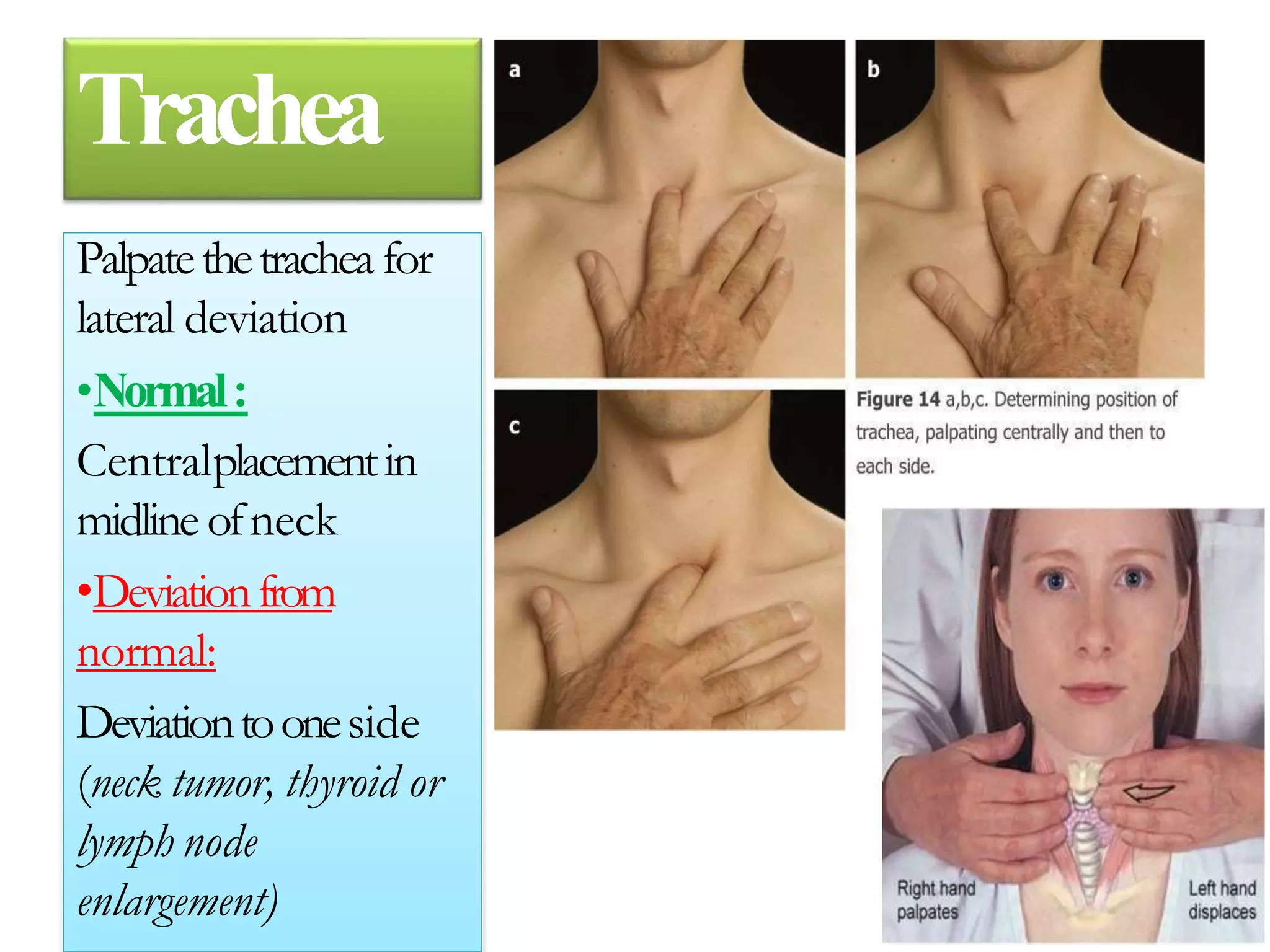
Trachea
Trachea
Palpatethetracheafor
lateral deviation
•Normal:
Centralplacementin
midline ofneck
•Deviationfrom
normal:
Deviationtooneside
(neck tumor, thyroid or
lymph node
enlargement)
Thyroidgland
 Inspectthethyroidgland
Normal:
Not visible oninspection
Deviationfromnormal:
Localenlargement
Thyroidgland
Palpatethethyroidglandfor
smoothnessnoteanyareas of
enlargement, masses and
nodules.
Posteriorapproach
Anteriorapproach
Normal:
Lobesmaynotbepalpated
Deviationfromnormal:
Solitary nodules
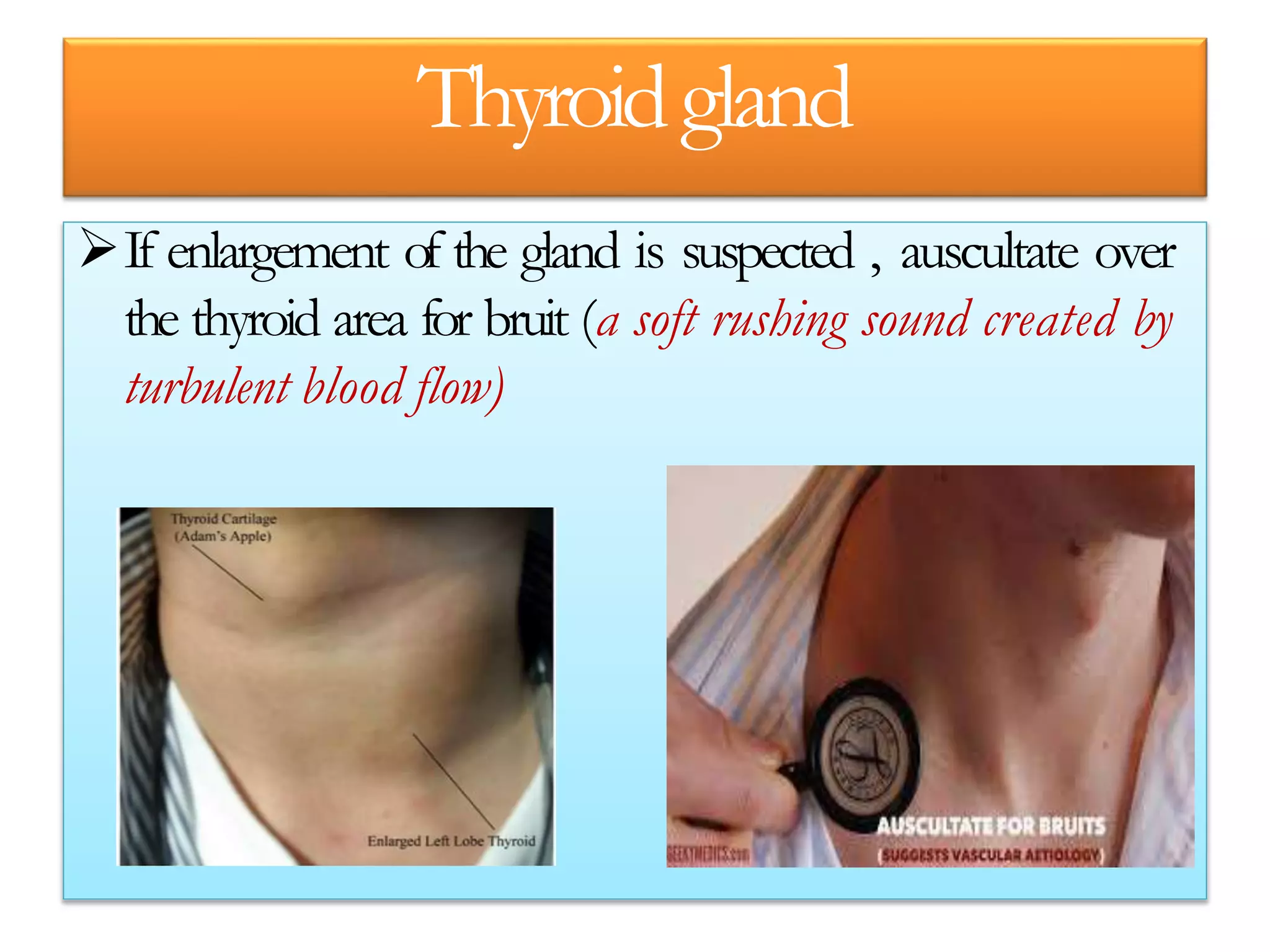
Thyroidgland
If enlargement of the gland is suspected , auscultate over
the thyroid area for bruit (a soft rushing sound created by
turbulent blood flow)
“Lets have a brake”
THANK YOU

physical examination head and neck.pptx