Health Assessment
HEENT
Christina Nardi, MSN, RN, CNL, DNP (c)
University of San Francisco, SONHP
Spring 2016
Adapted from Wolter Kluwer LWW
Objectives
1. Describe the normal appearance of the head, eyes, ears,
neck, and throat (HEENT)
2. Describe and demonstrate techniques of examination of
HEENT
3. Describe and demonstrate technique for assessment of
lymph nodes
4. Describe the underlying principles for the techniques used
to examine the neck and thyroid gland
5. Describe abnormal findings of HEENT
• Readings: Chapter 7
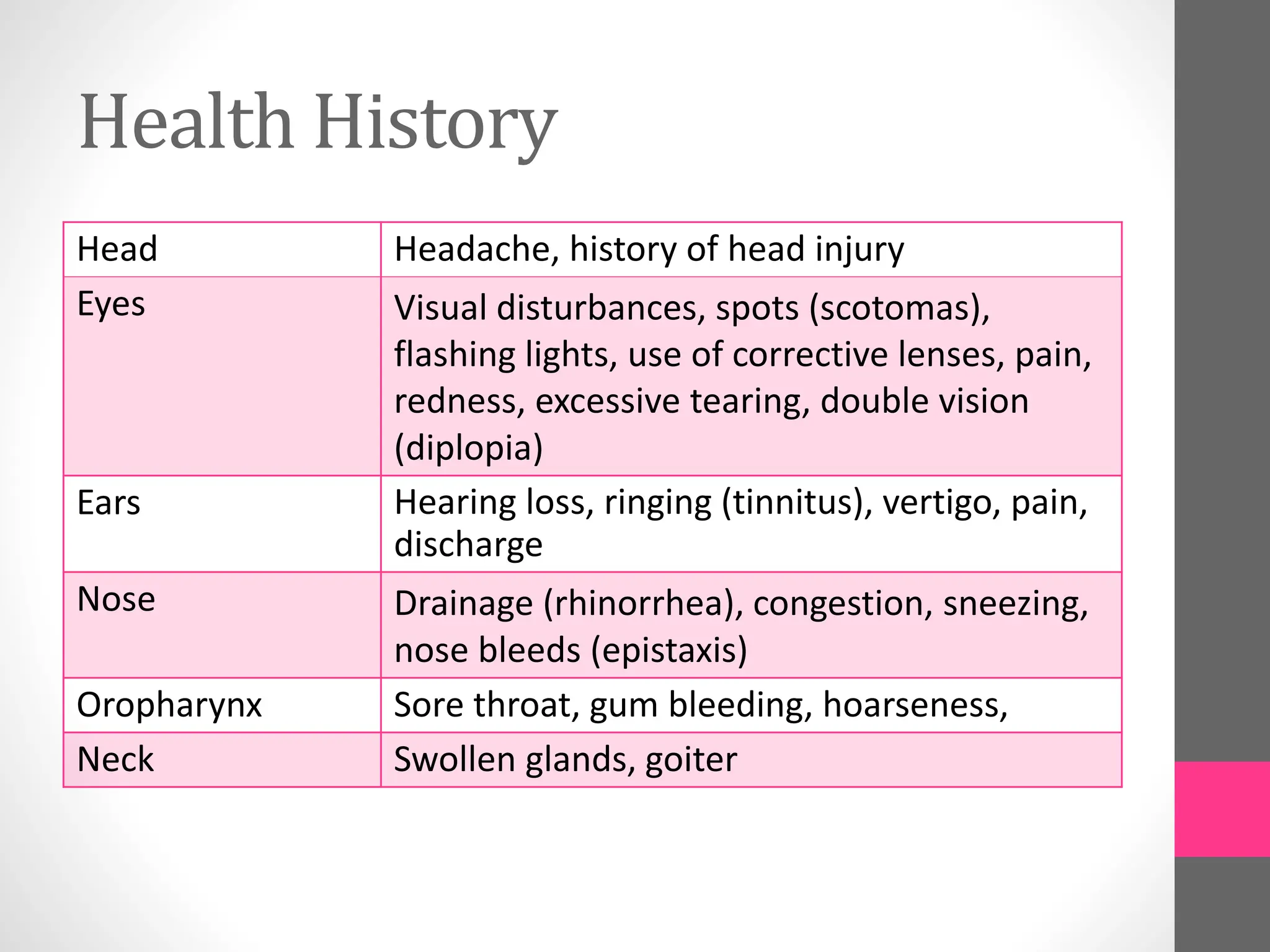
Health History
Head Headache, history of head injury
Eyes Visual disturbances, spots (scotomas),
flashing lights, use of corrective lenses, pain,
redness, excessive tearing, double vision
(diplopia)
Ears Hearing loss, ringing (tinnitus), vertigo, pain,
discharge
Nose Drainage (rhinorrhea), congestion, sneezing,
nose bleeds (epistaxis)
Oropharynx Sore throat, gum bleeding, hoarseness,
Neck Swollen glands, goiter
HEAD
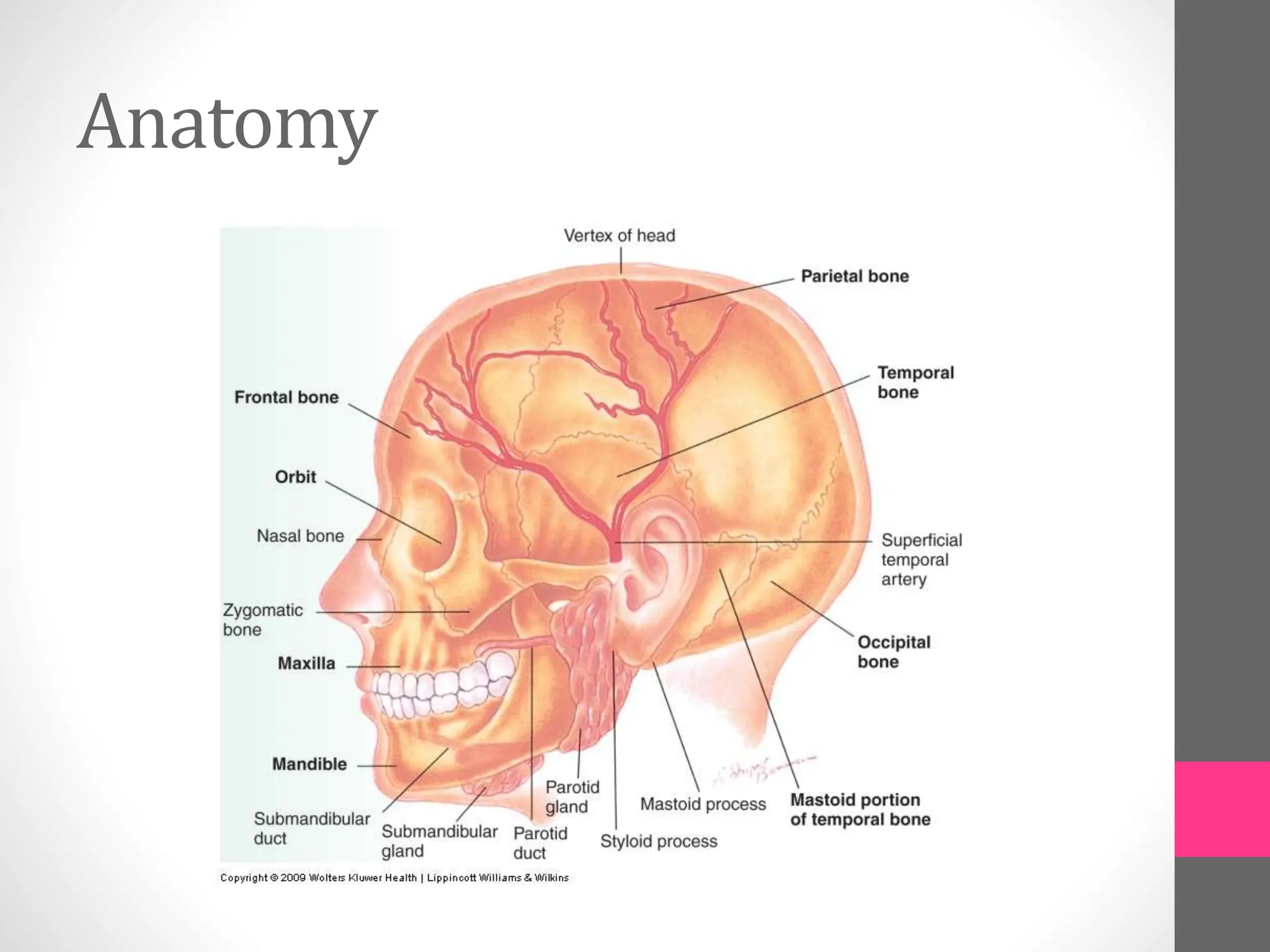
Anatomy
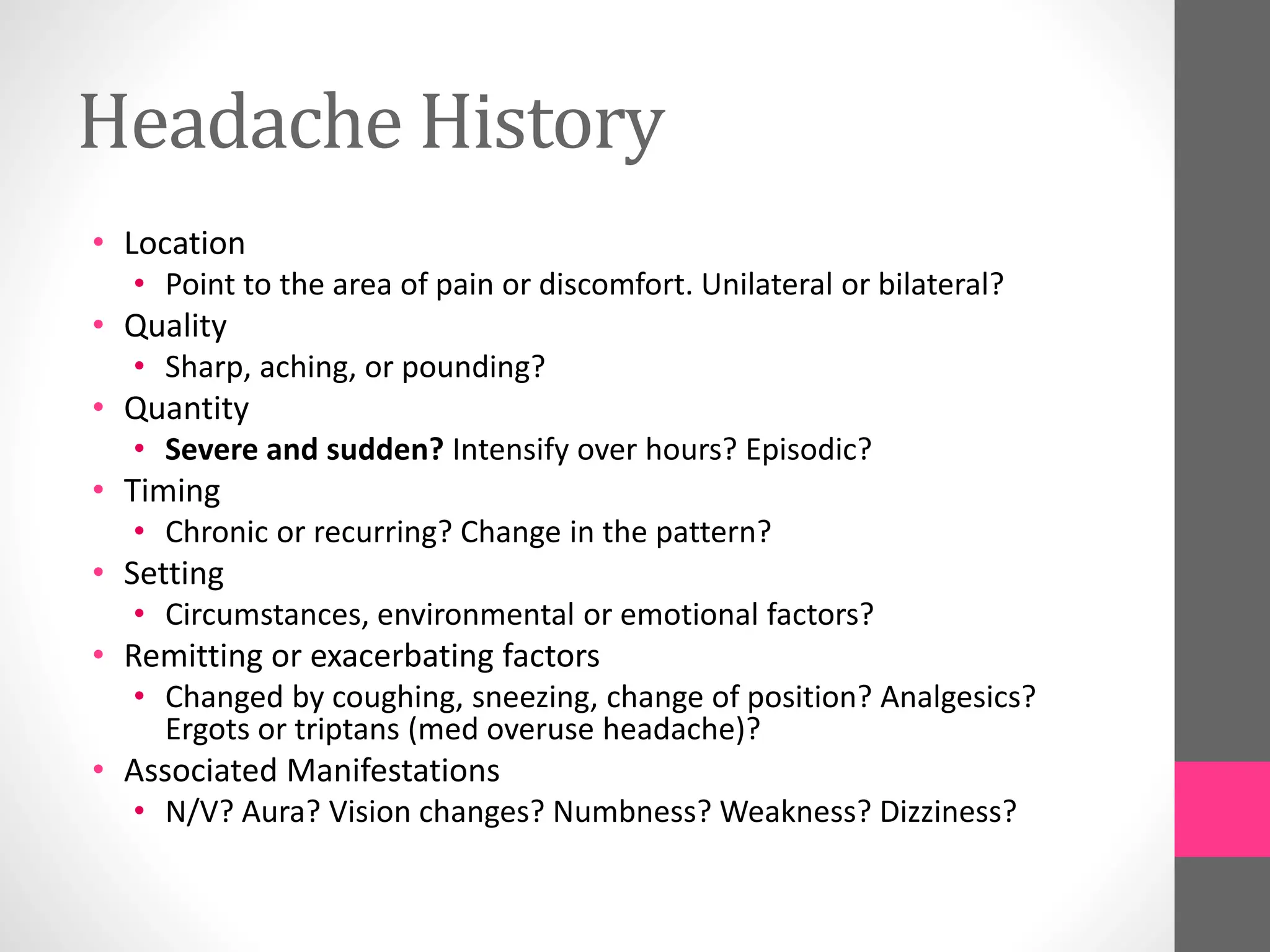
Headache History
• Location
• Point to the area of pain or discomfort. Unilateral or bilateral?
• Quality
• Sharp, aching, or pounding?
• Quantity
• Severe and sudden? Intensify over hours? Episodic?
• Timing
• Chronic or recurring? Change in the pattern?
• Setting
• Circumstances, environmental or emotional factors?
• Remitting or exacerbating factors
• Changed by coughing, sneezing, change of position? Analgesics?
Ergots or triptans (med overuse headache)?
• Associated Manifestations
• N/V? Aura? Vision changes? Numbness? Weakness? Dizziness?
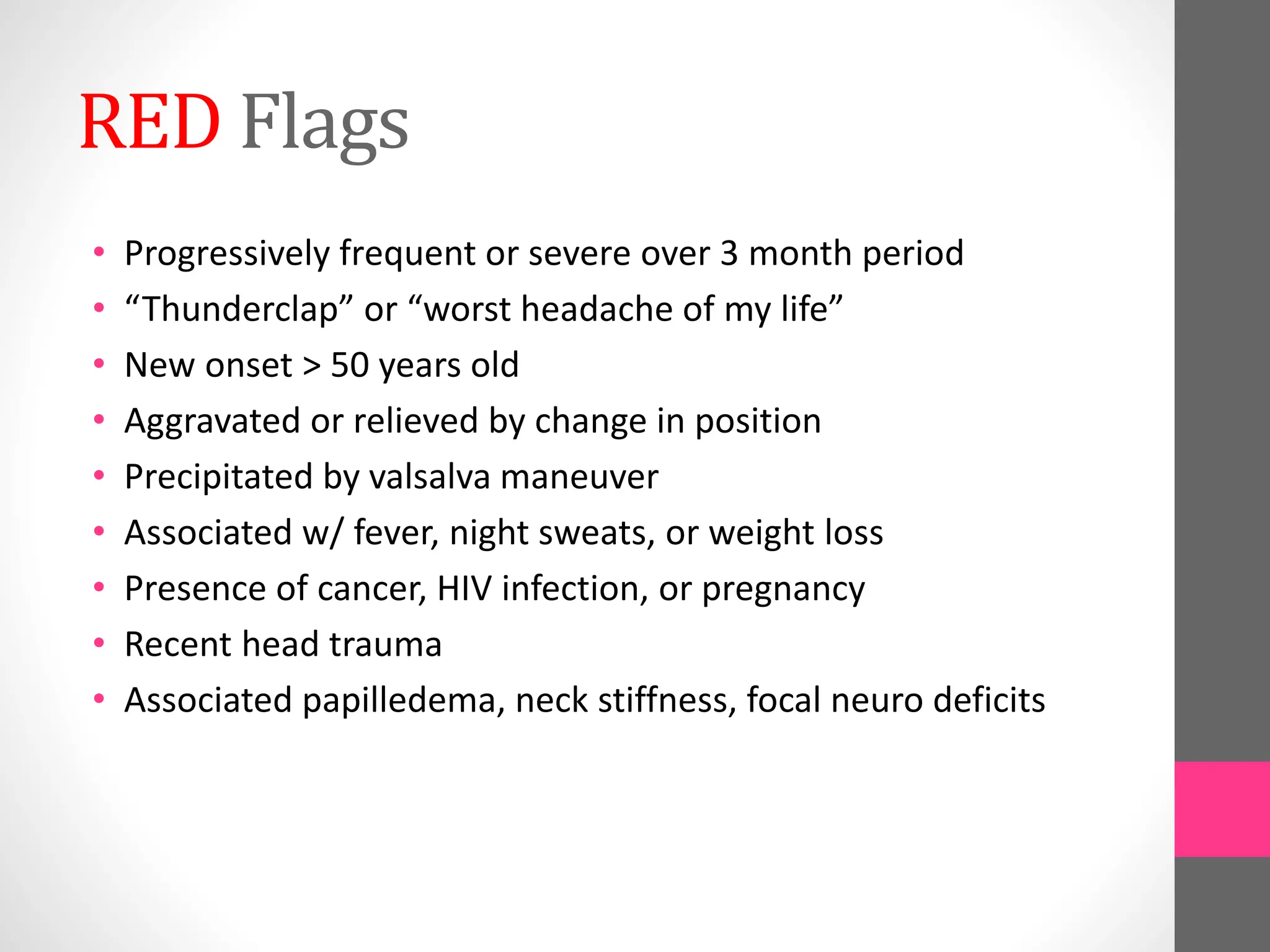
RED Flags
• Progressively frequent or severe over 3 month period
• “Thunderclap” or “worst headache of my life”
• New onset > 50 years old
• Aggravated or relieved by change in position
• Precipitated by valsalva maneuver
• Associated w/ fever, night sweats, or weight loss
• Presence of cancer, HIV infection, or pregnancy
• Recent head trauma
• Associated papilledema, neck stiffness, focal neuro deficits
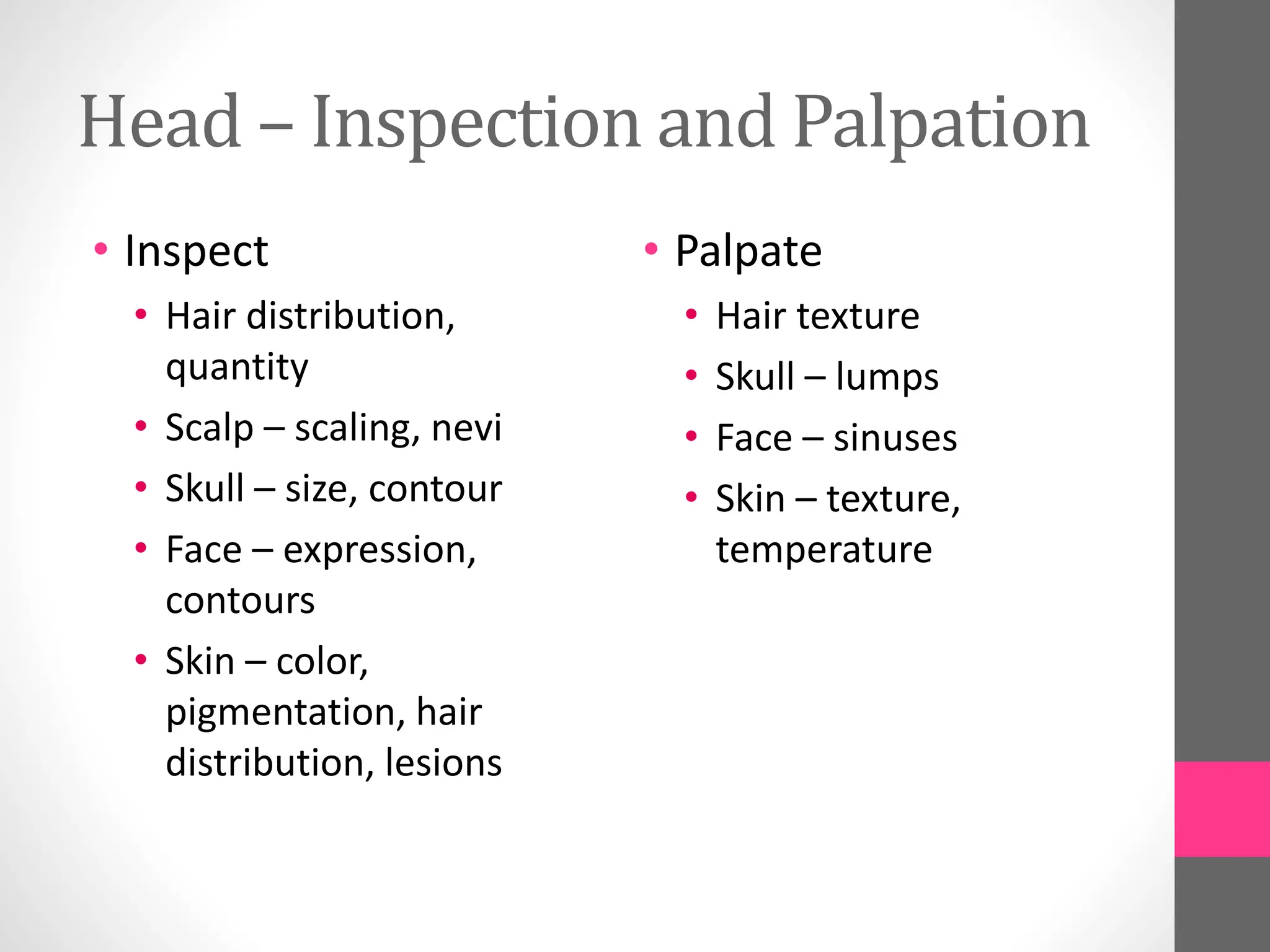
Head – Inspection and Palpation
• Inspect
• Hair distribution,
quantity
• Scalp – scaling, nevi
• Skull – size, contour
• Face – expression,
contours
• Skin – color,
pigmentation, hair
distribution, lesions
• Palpate
• Hair texture
• Skull – lumps
• Face – sinuses
• Skin – texture,
temperature
Head Terminology
• Fine hair
• Coarse hair
• White ovoid granules
• Redness, scaling
• Enlarged skull
• Tenderness
• Hirsutism
→ Hyperthyroid
→ Hypothyroid
→ Nits
→ Seborrheic dermatitis,
psoriasis
→ Hydrocephalus, Paget’s
→ Head trauma
→ Excessive facial hair
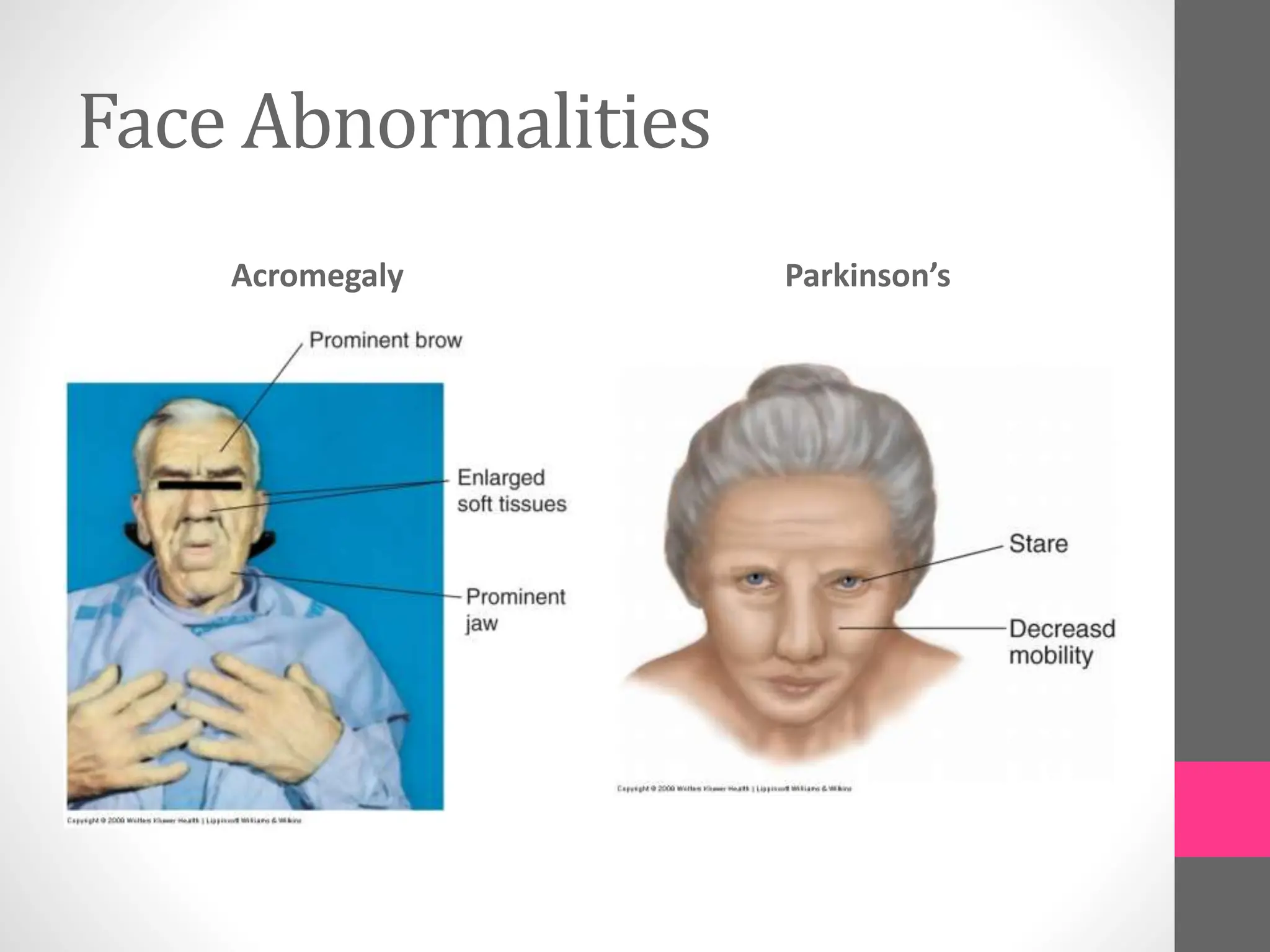
Face Abnormalities
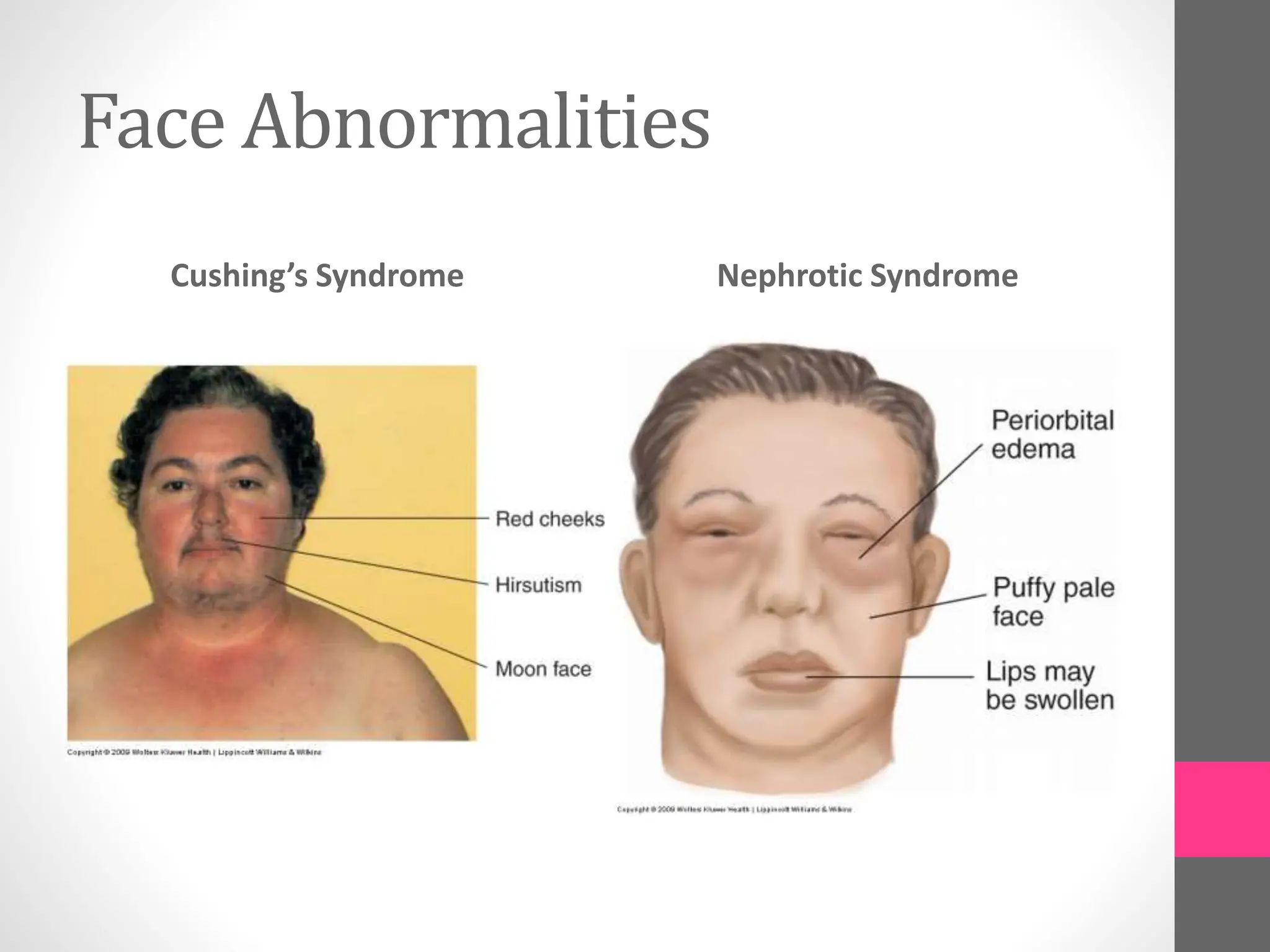
• Cushing’s Syndrome
• Nephrotic Syndrome
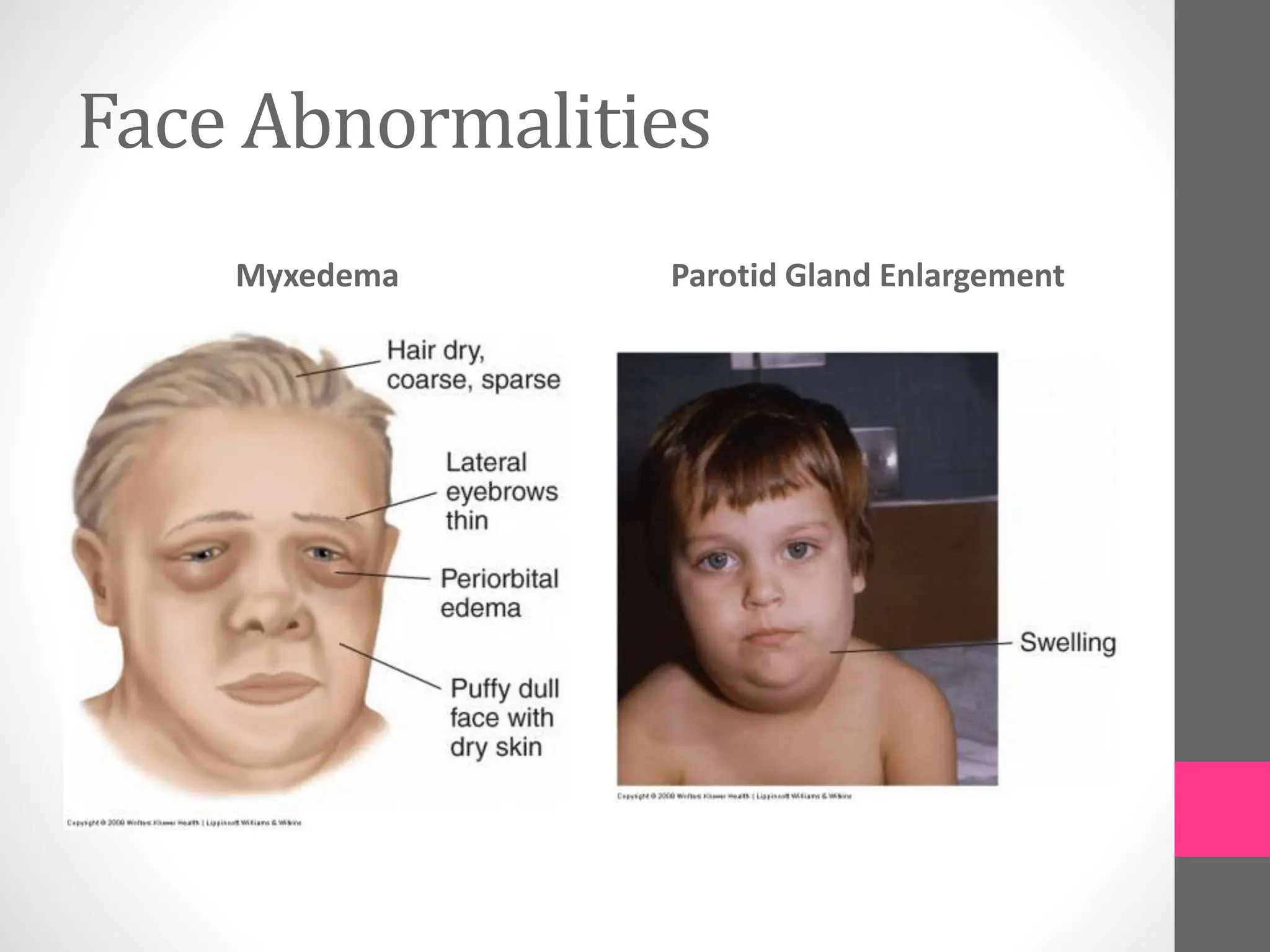
• Myxedema
• Parotid Gland enlargement
• Acromegaly
• Parkinson’s disease
Face Abnormalities
Cushing’s Syndrome Nephrotic Syndrome
Face Abnormalities
Myxedema Parotid Gland Enlargement
Face Abnormalities
Acromegaly Parkinson’s
EYES
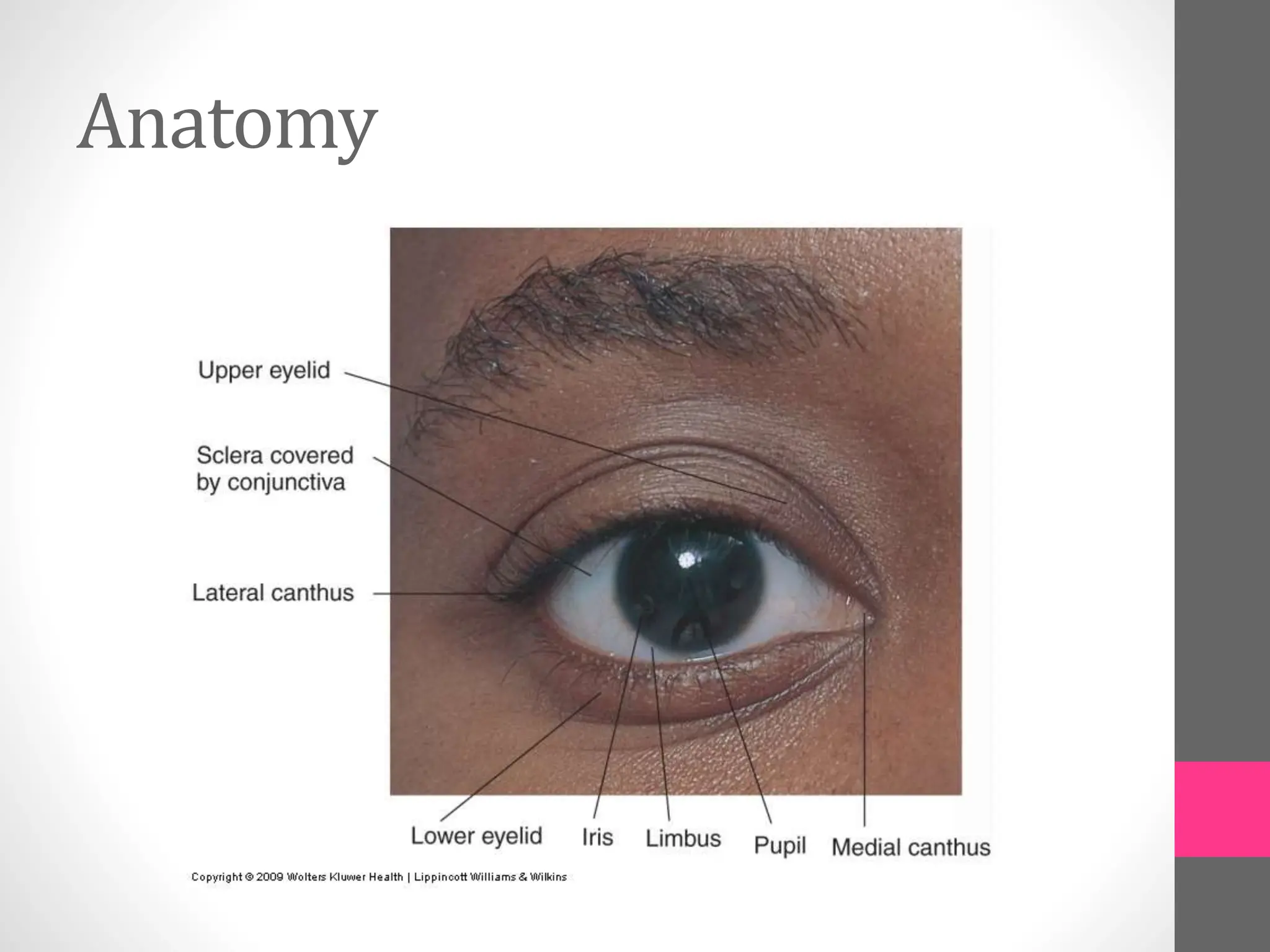
Anatomy
History
• How is your vision?
• Any trouble with your eyes?
• Do you wear glasses or contacts?
• Do you have eye pain?
• Blurred vision?
Eyes - Inspection
• Position and alignment
of eyes
• Eyebrows - quantity,
distribution
• Eyelids
• Width of palpebral
fissures
• Edema, color, lesions
• Condition and direction
of eyelashes
• Adequacy of closed
eyelids
• Lacrimal apparatus
• Lacrimal gland and sac
for swelling
• Conjunctiva and sclera
• Color, vascular pattern
• Cornea and lens -
opacities
• Iris – markings clearly
defined
• Pupils – size, shape,
symmetry, reaction to
light (direct and
consensual)
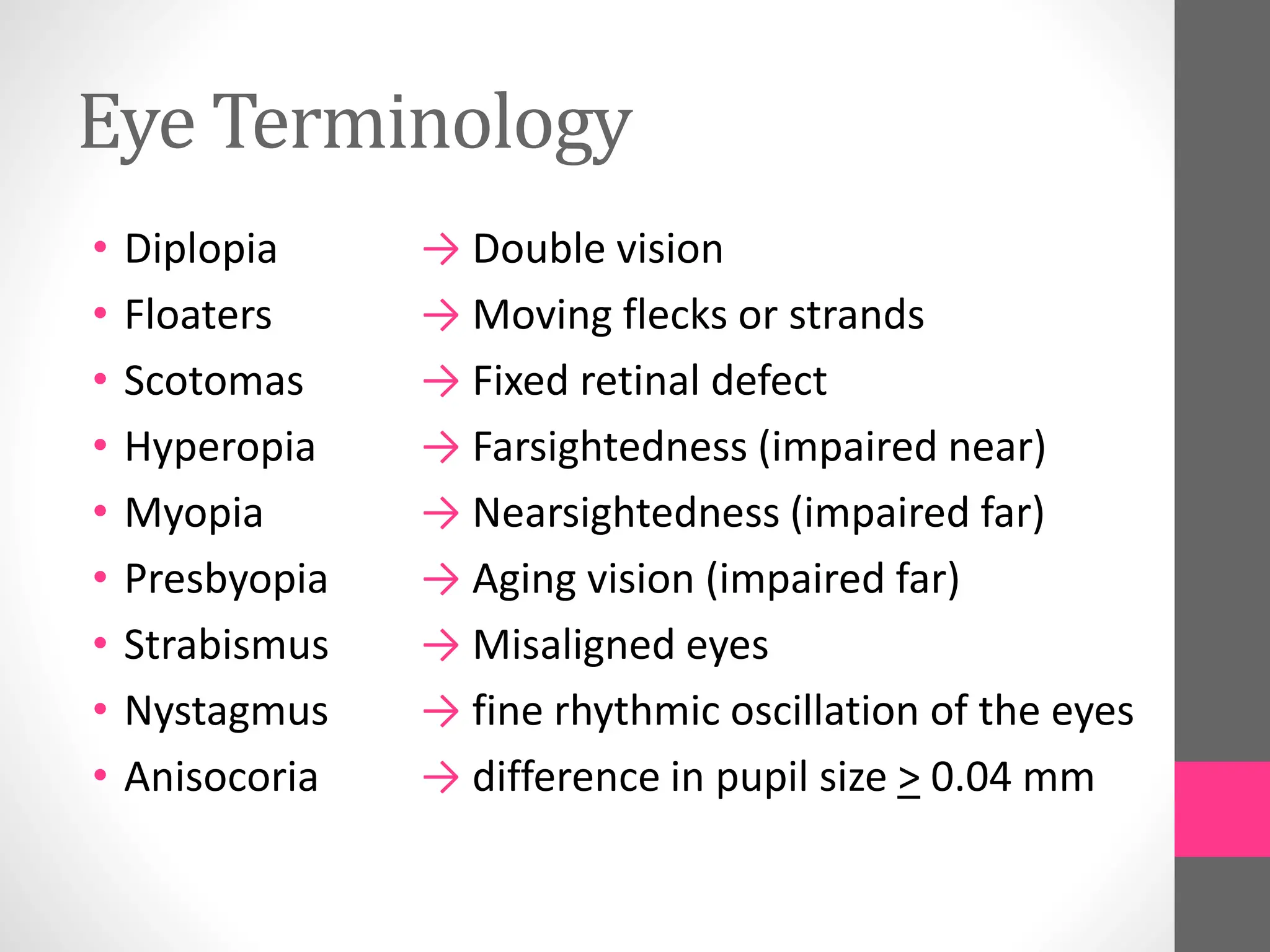
Eye Terminology
• Diplopia
• Floaters
• Scotomas
• Hyperopia
• Myopia
• Presbyopia
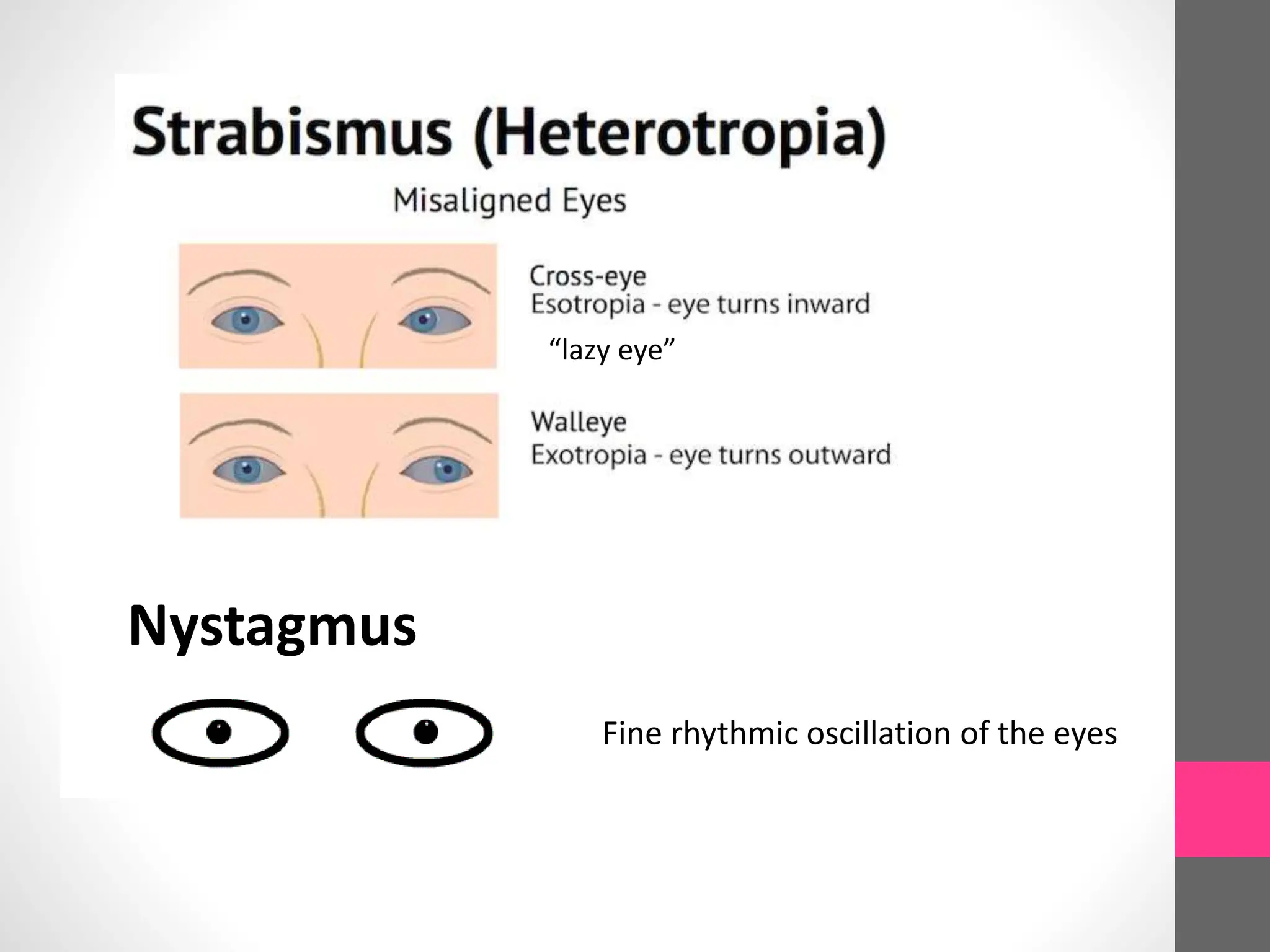
• Strabismus
• Nystagmus
• Anisocoria
→ Double vision
→ Moving flecks or strands
→ Fixed retinal defect
→ Farsightedness (impaired near)
→ Nearsightedness (impaired far)
→ Aging vision (impaired far)
→ Misaligned eyes
→ fine rhythmic oscillation of the eyes
→ difference in pupil size > 0.04 mm
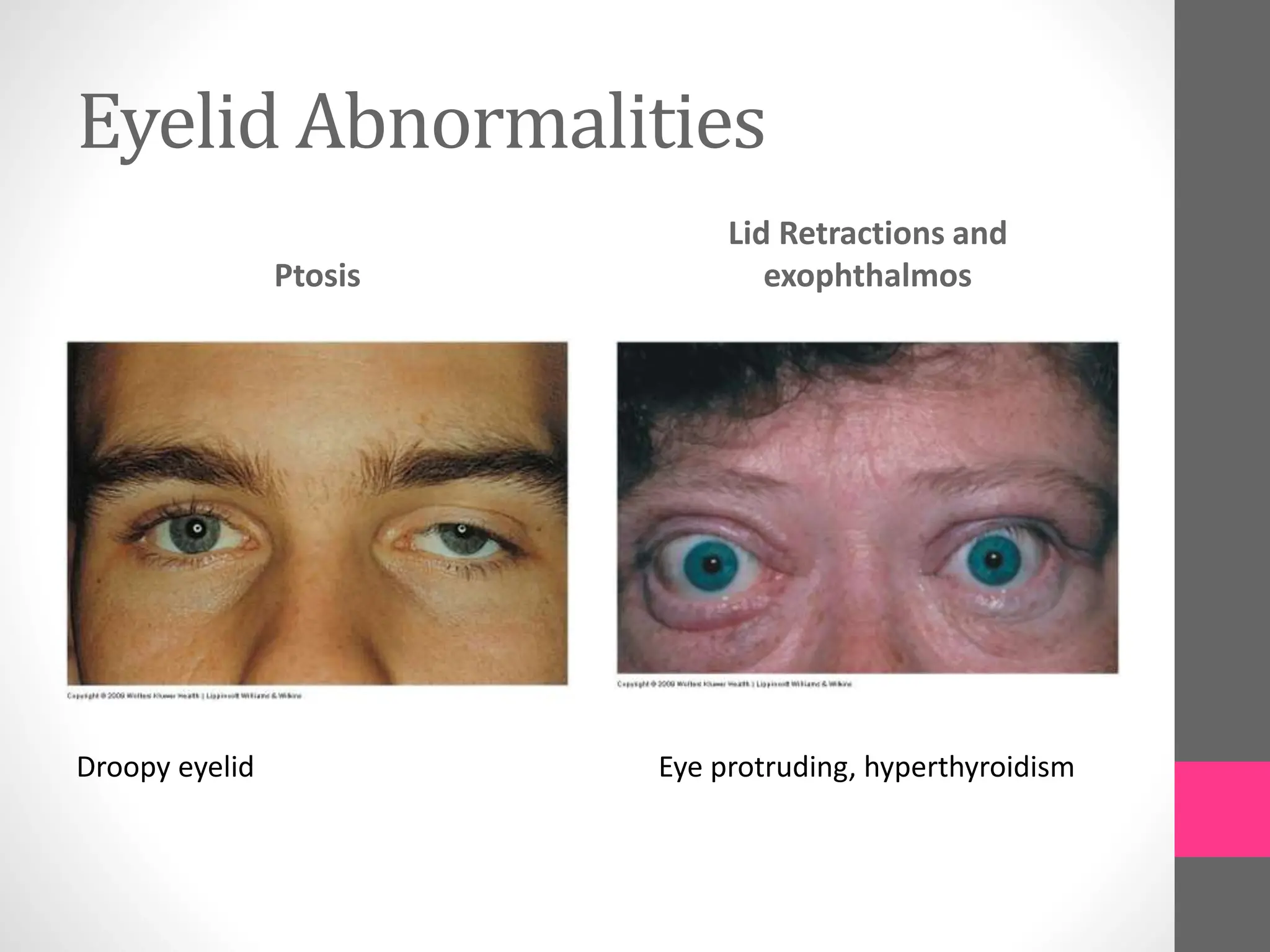
Eyelid Abnormalities
Ptosis
Lid Retractions and
exophthalmos
Droopy eyelid Eye protruding, hyperthyroidism
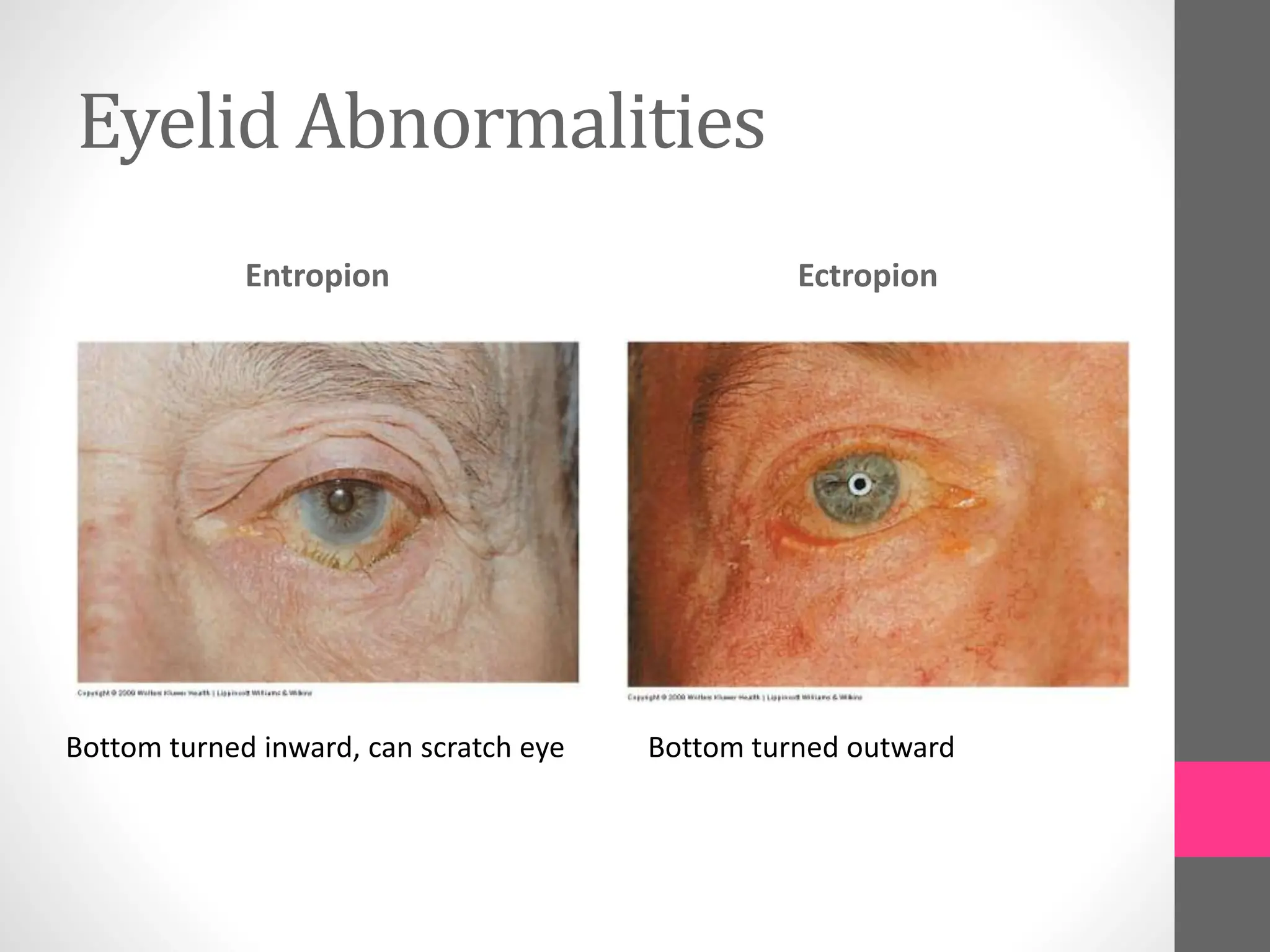
Eyelid Abnormalities
Entropion Ectropion
Bottom turned inward, can scratch eye Bottom turned outward
Eye Examinations
• Visual Acuity
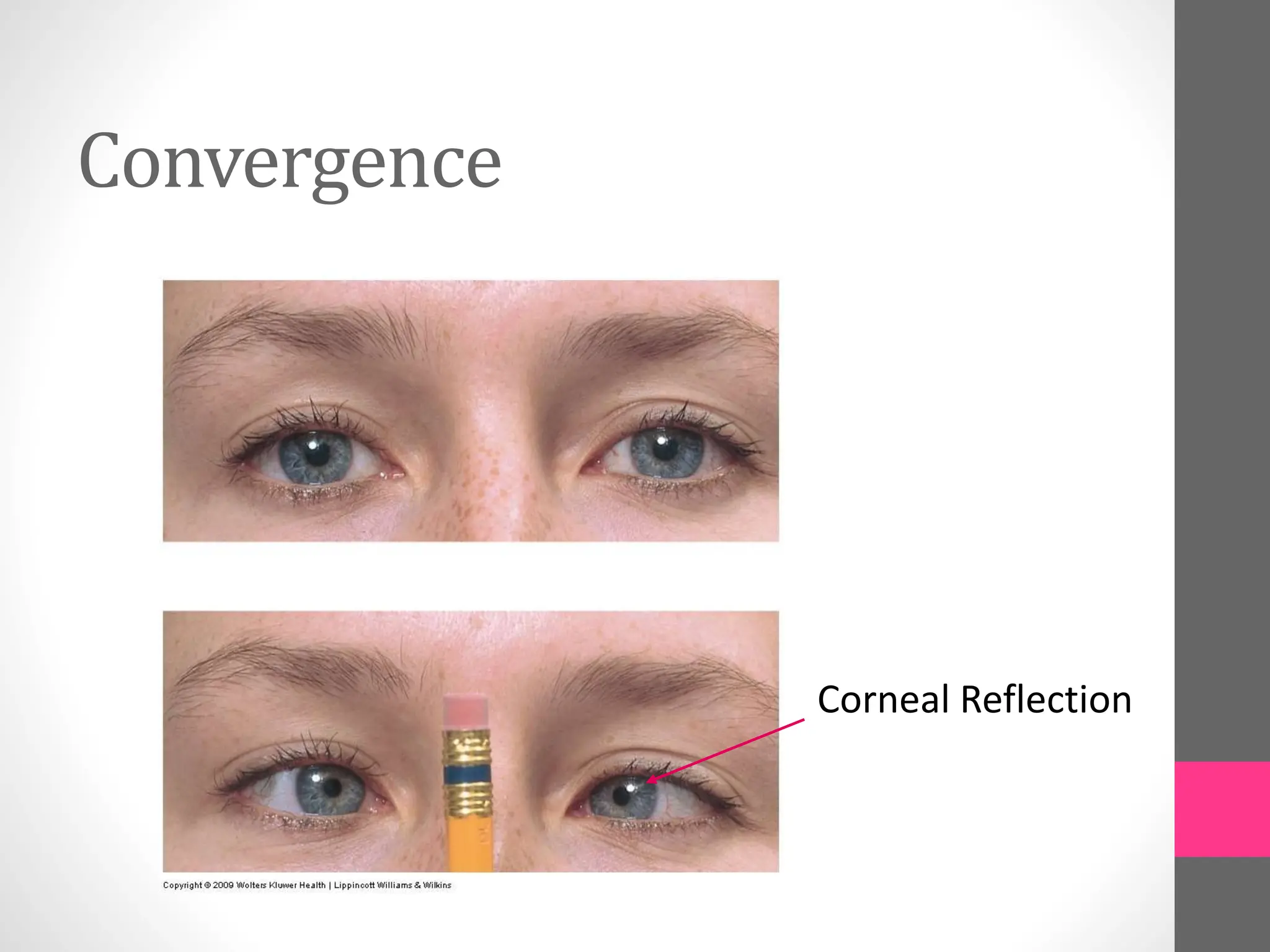
• Corneal Reflection
• Pupils (PERRLA)
• Extraocular Muscles (EOM)
• Visual Fields
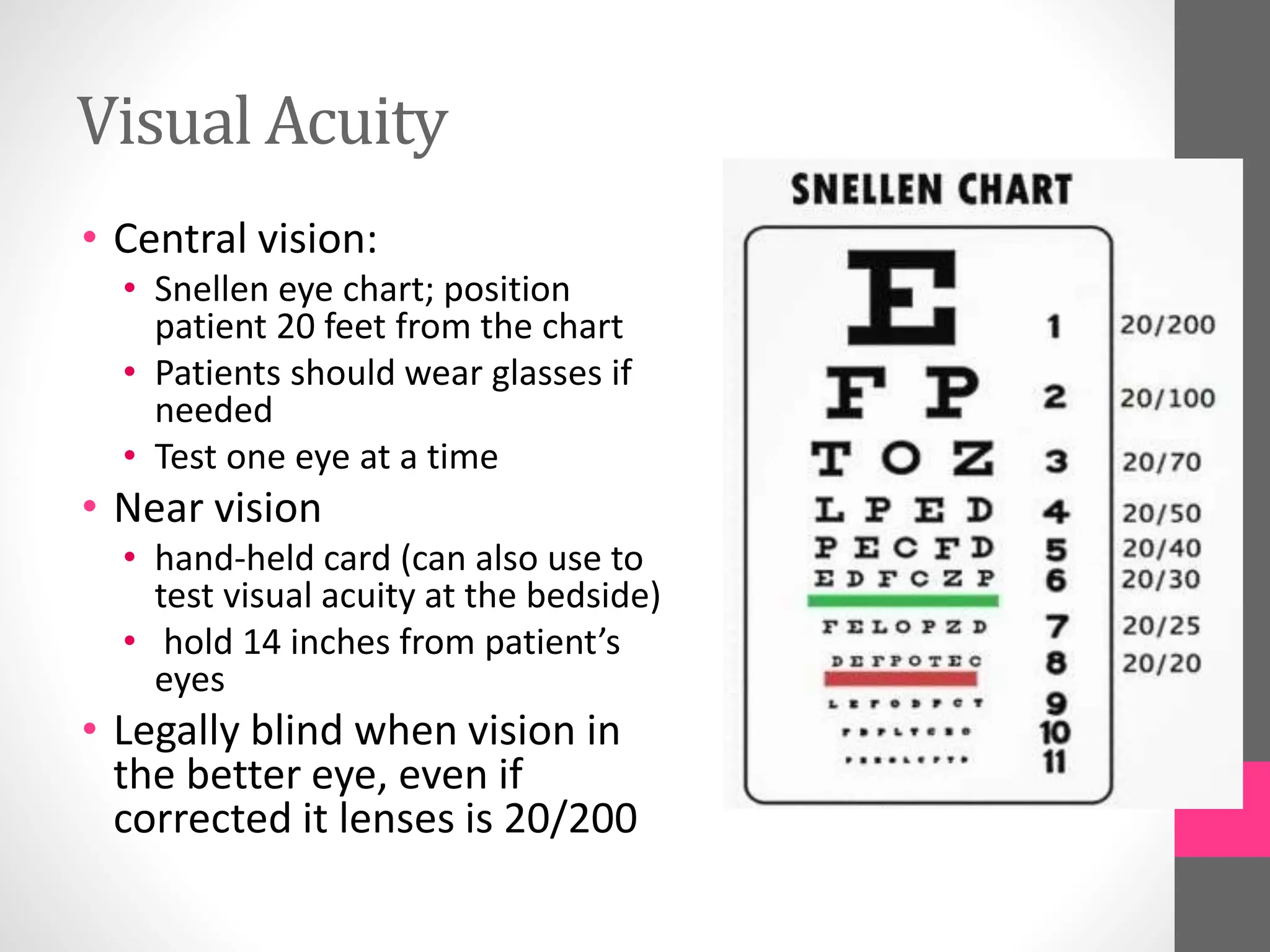
Visual Acuity
• Central vision:
• Snellen eye chart; position
patient 20 feet from the chart
• Patients should wear glasses if
needed
• Test one eye at a time
• Near vision
• hand-held card (can also use to
test visual acuity at the bedside)
• hold 14 inches from patient’s
eyes
• Legally blind when vision in
the better eye, even if
corrected it lenses is 20/200
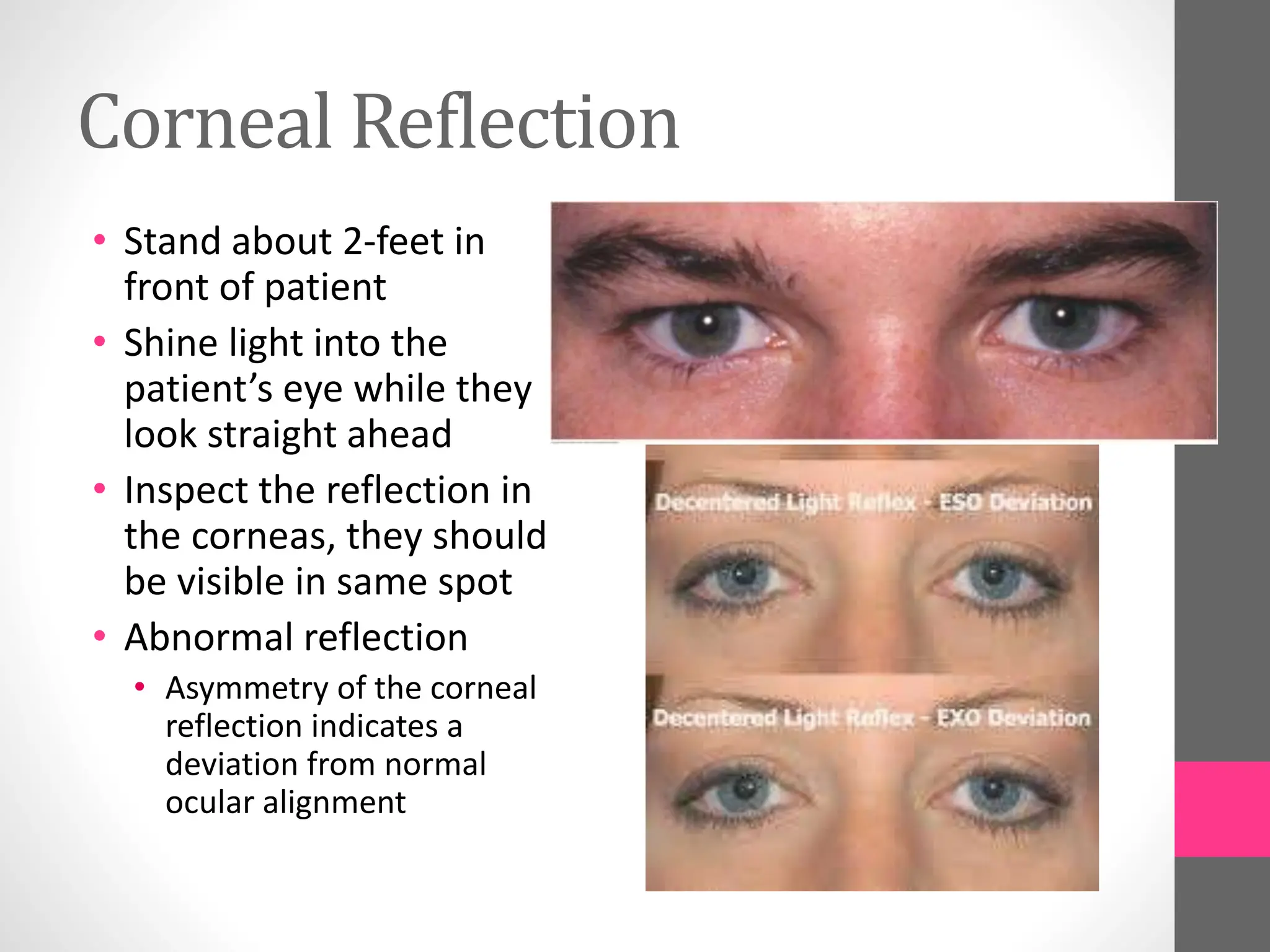
Corneal Reflection
• Stand about 2-feet in
front of patient
• Shine light into the
patient’s eye while they
look straight ahead
• Inspect the reflection in
the corneas, they should
be visible in same spot
• Abnormal reflection
• Asymmetry of the corneal
reflection indicates a
deviation from normal
ocular alignment
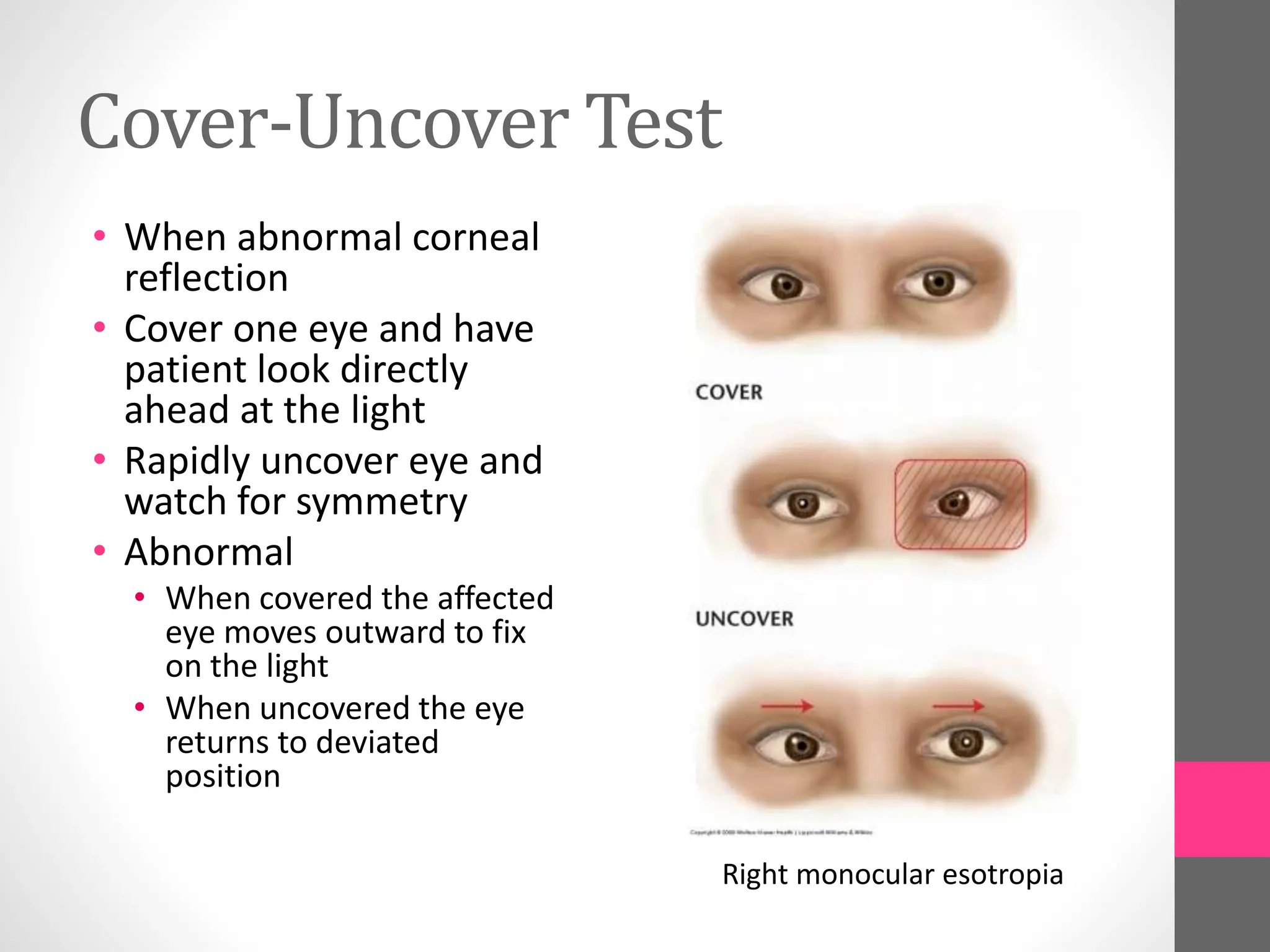
Cover-Uncover Test
• When abnormal corneal
reflection
• Cover one eye and have
patient look directly
ahead at the light
• Rapidly uncover eye and
watch for symmetry
• Abnormal
• When covered the affected
eye moves outward to fix
on the light
• When uncovered the eye
returns to deviated
position
Right monocular esotropia
PERRLA
•Pupils Equal
•Round
•Reactive to Light
•Accommodate
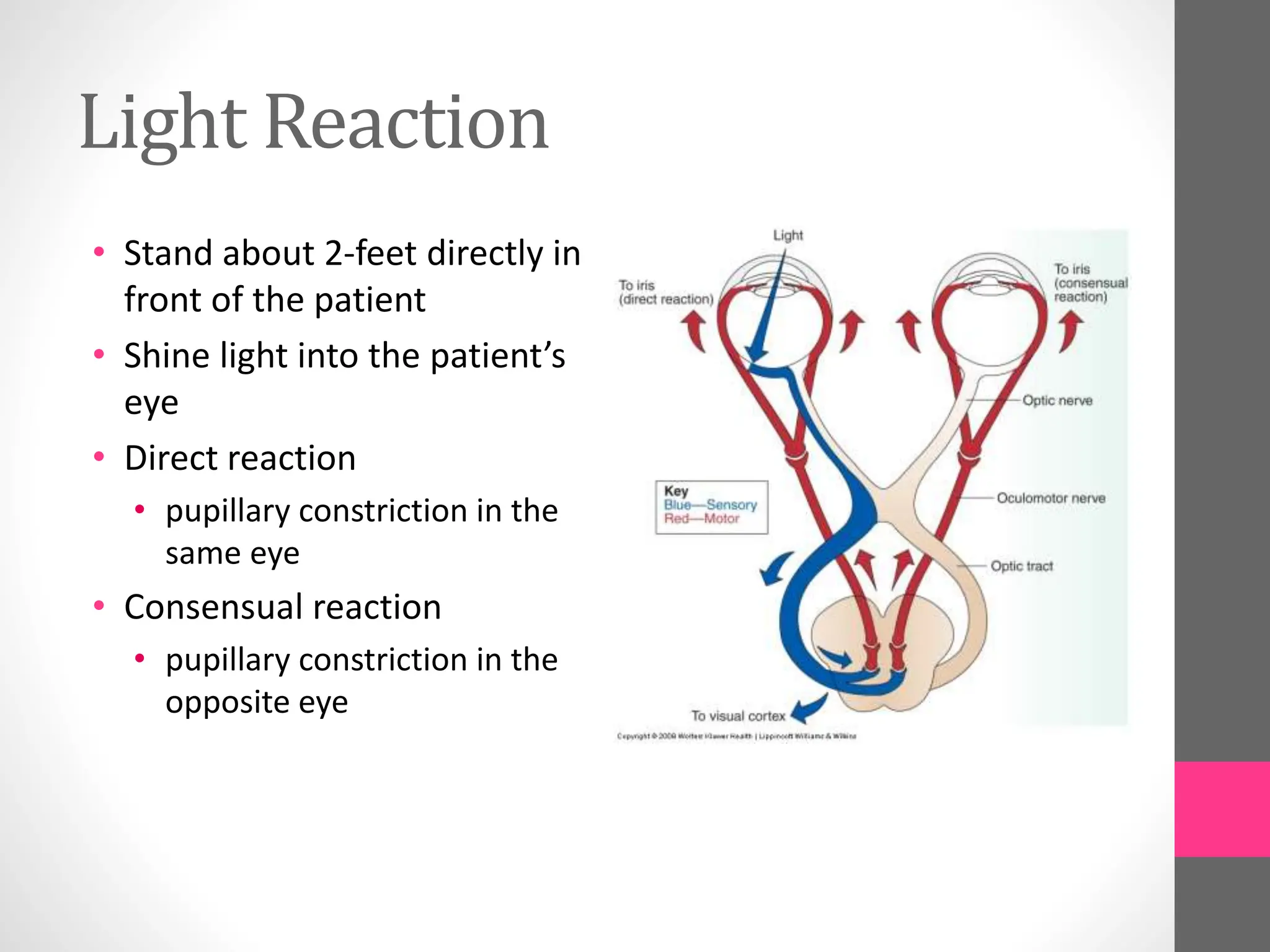
Light Reaction
• Stand about 2-feet directly in
front of the patient
• Shine light into the patient’s
eye
• Direct reaction
• pupillary constriction in the
same eye
• Consensual reaction
• pupillary constriction in the
opposite eye
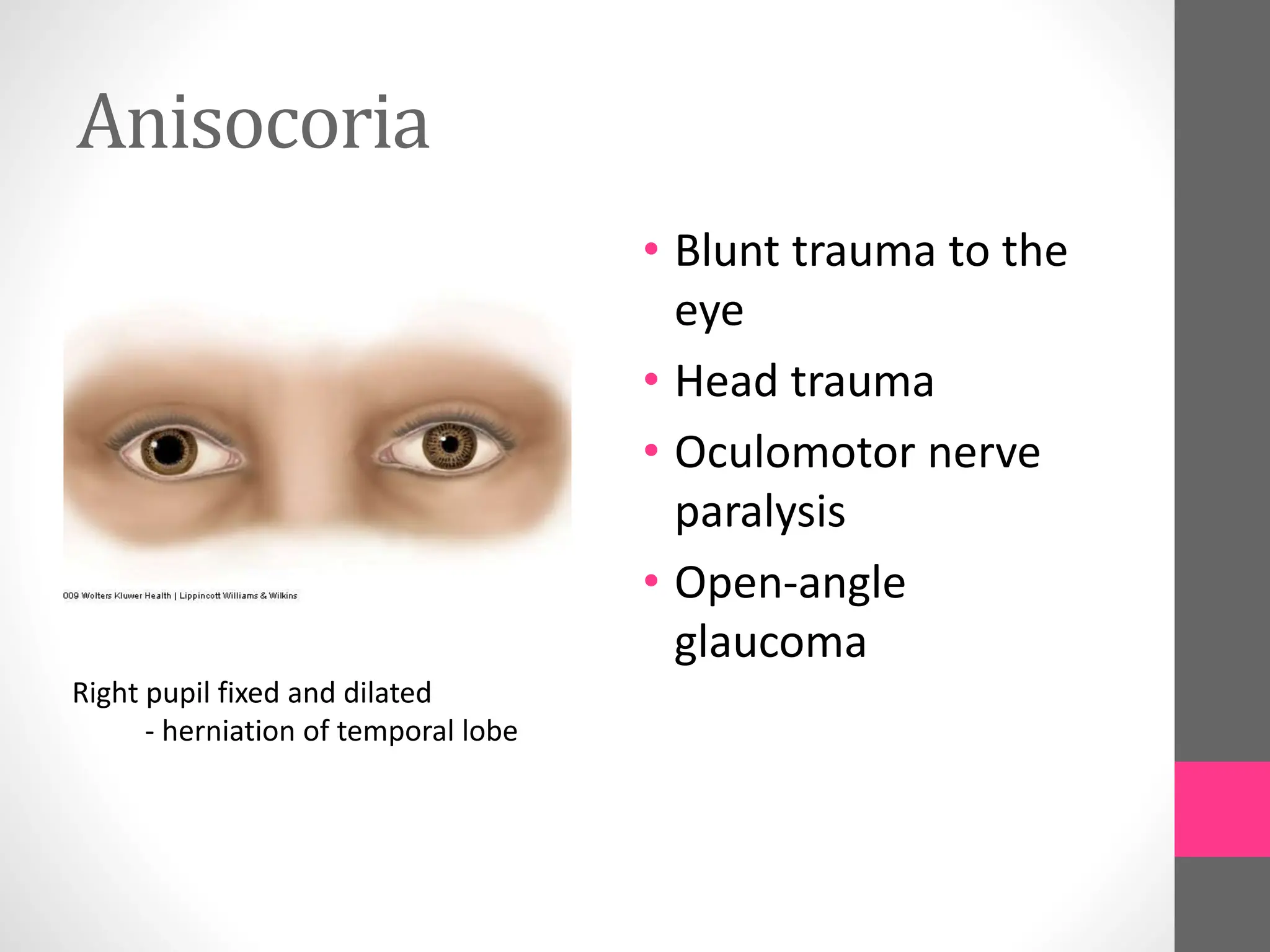
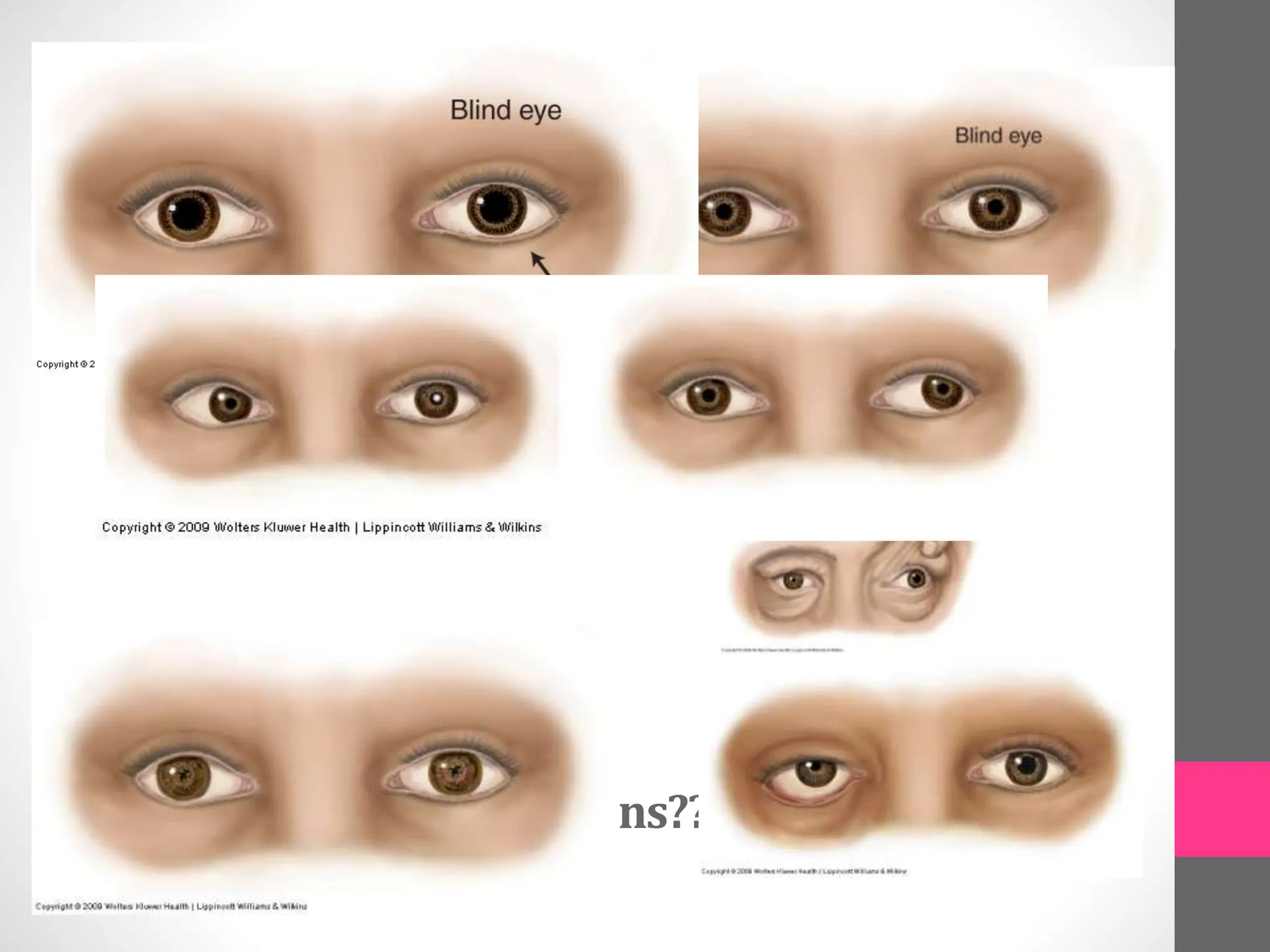
Anisocoria
• Blunt trauma to the
eye
• Head trauma
• Oculomotor nerve
paralysis
• Open-angle
glaucoma
Right pupil fixed and dilated
- herniation of temporal lobe
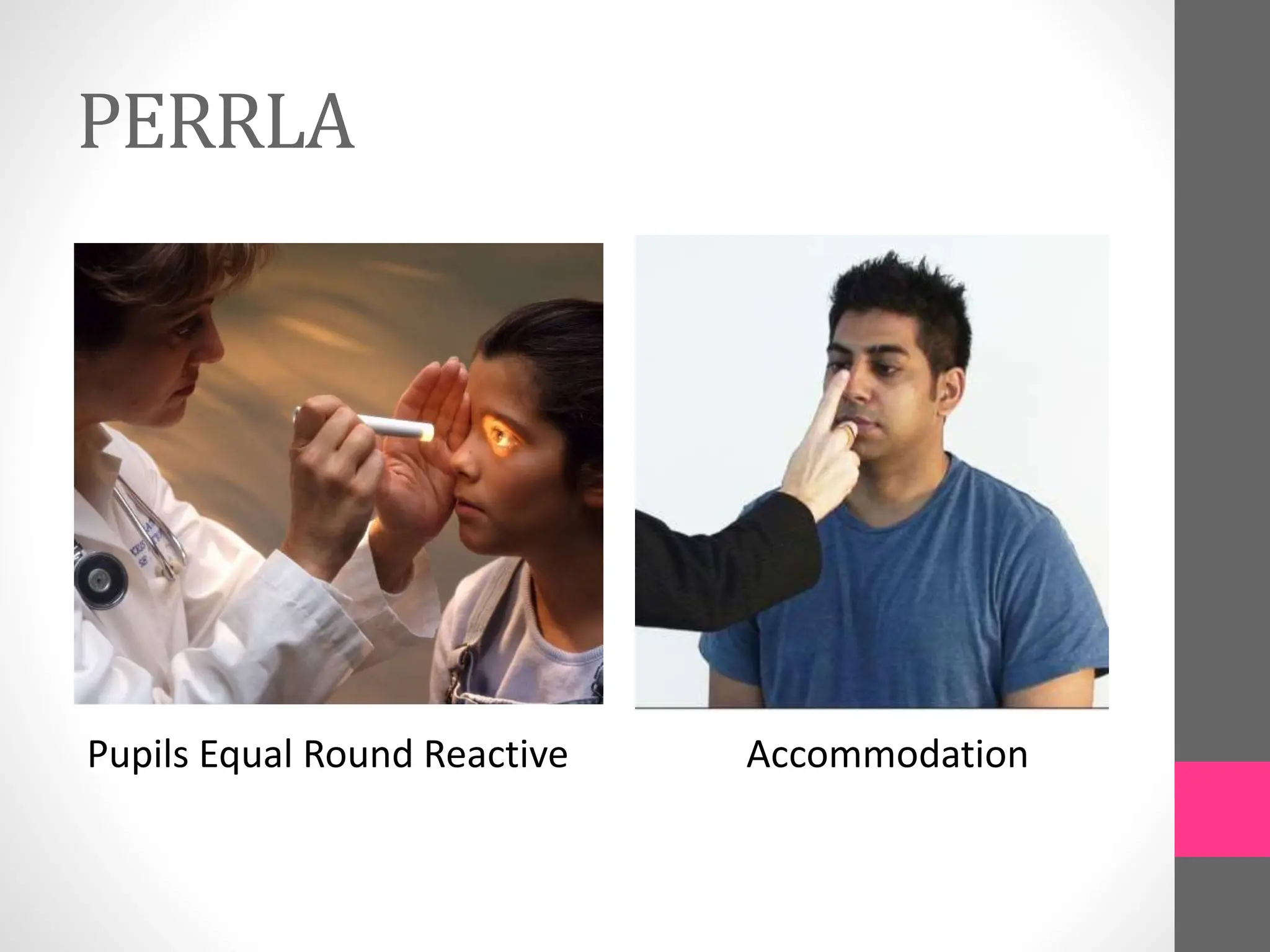
PERRLA
Accommodation
Pupils Equal Round Reactive
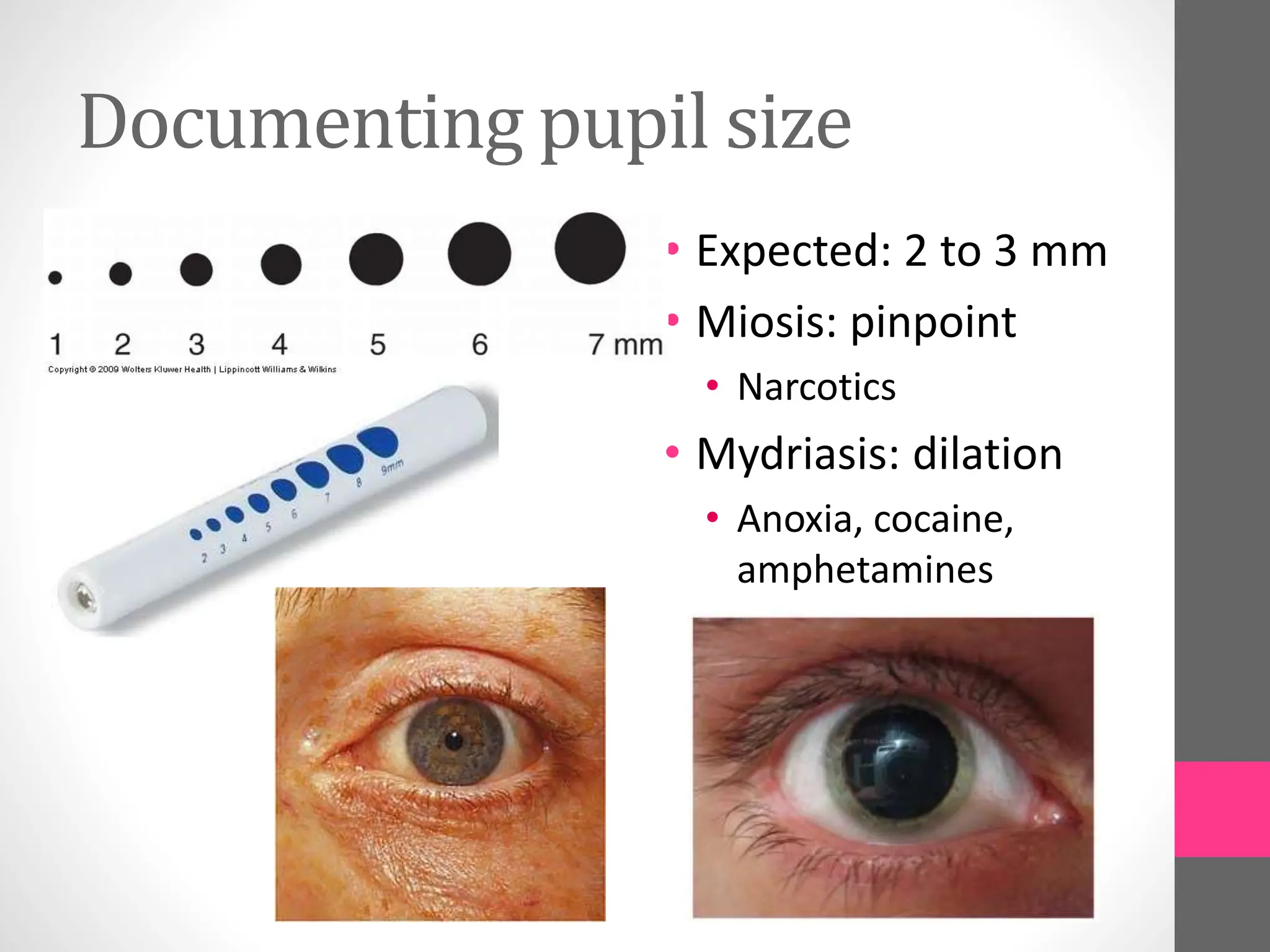
Documenting pupil size
• Expected: 2 to 3 mm
• Miosis: pinpoint
• Narcotics
• Mydriasis: dilation
• Anoxia, cocaine,
amphetamines
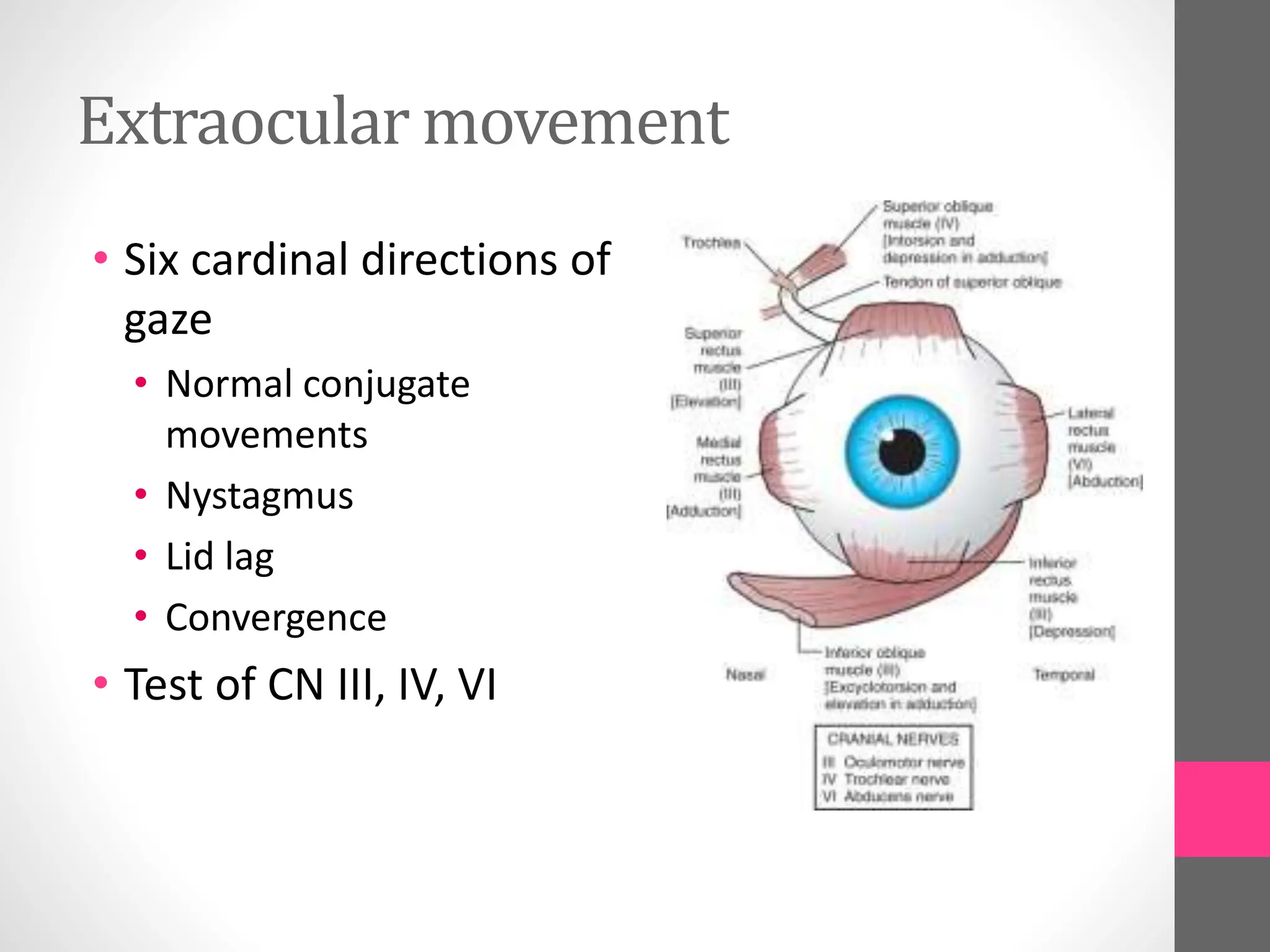
Extraocular movement
• Six cardinal directions of
gaze
• Normal conjugate
movements
• Nystagmus
• Lid lag
• Convergence
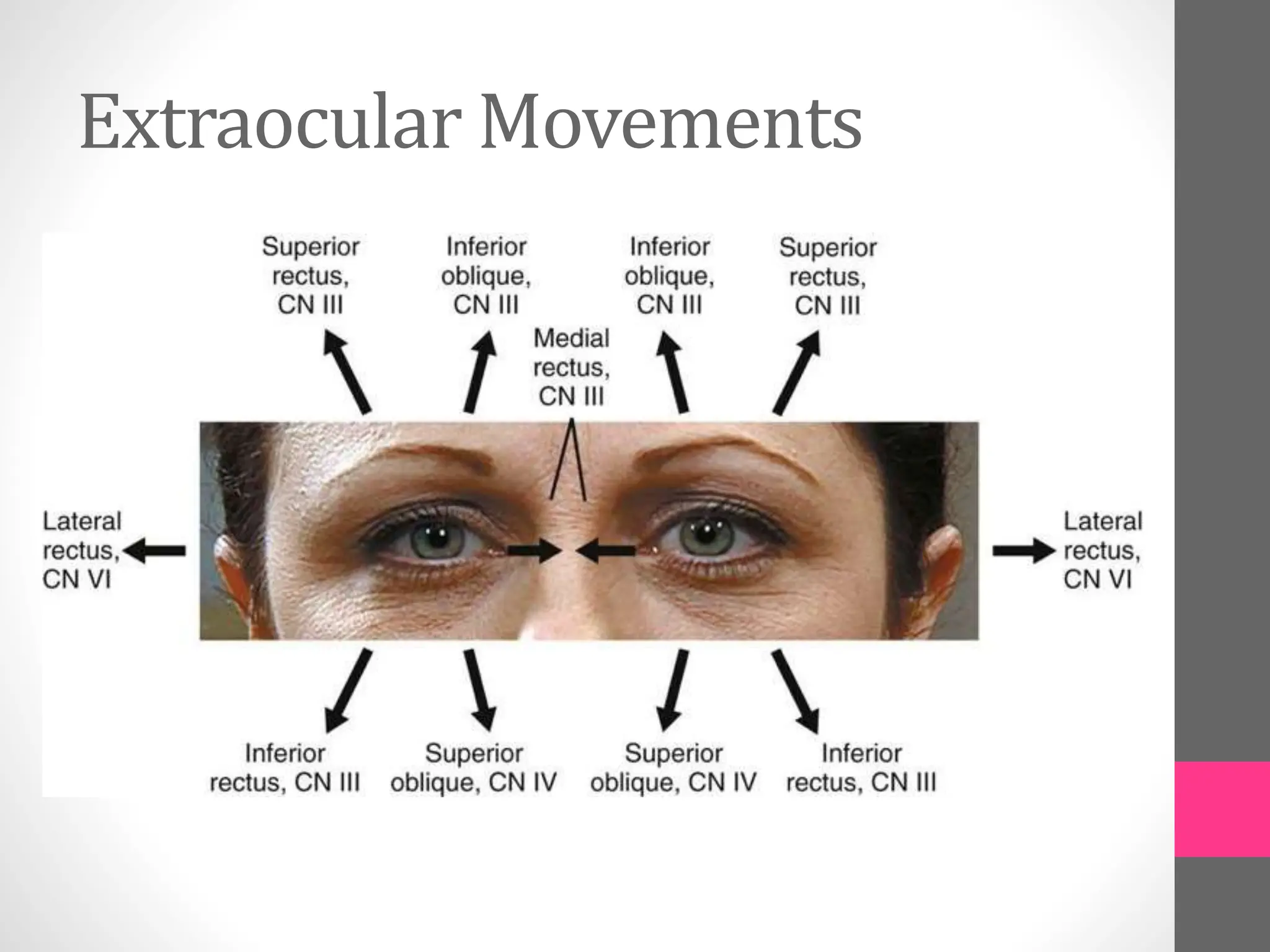
• Test of CN III, IV, VI
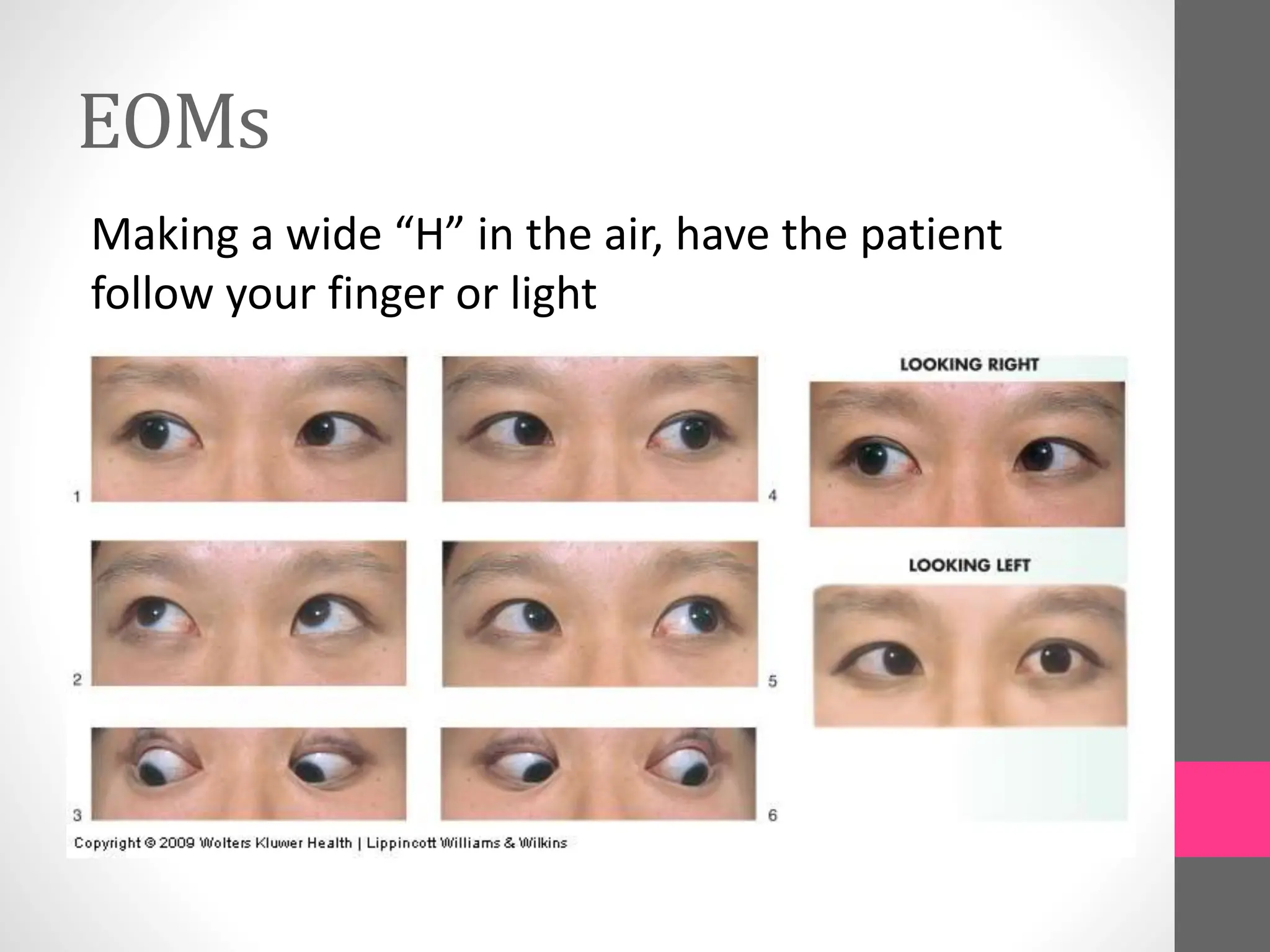
EOMs
Making a wide “H” in the air, have the patient
follow your finger or light
Extraocular Movements
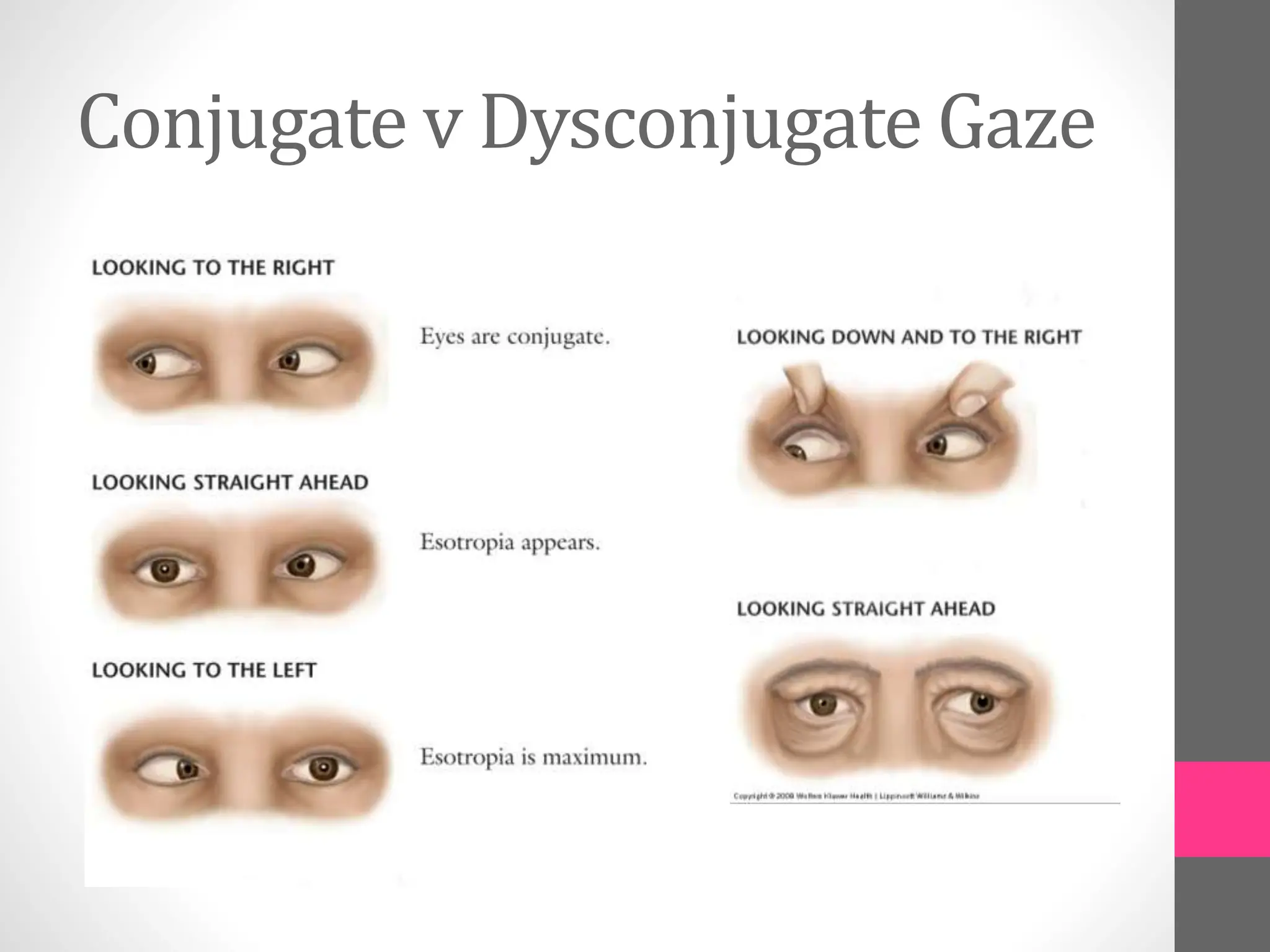
Conjugate v Dysconjugate Gaze
Nystagmus
Fine rhythmic oscillation of the eyes
“lazy eye”
Lid Lag
Normal Abnormal
Follow finger from up to down in midline
Convergence
Corneal Reflection
Visual Fields
• Screening
• Both eyes at same time; start in the temporal fields
• Further testing
• If a defect is found, test one eye at a time
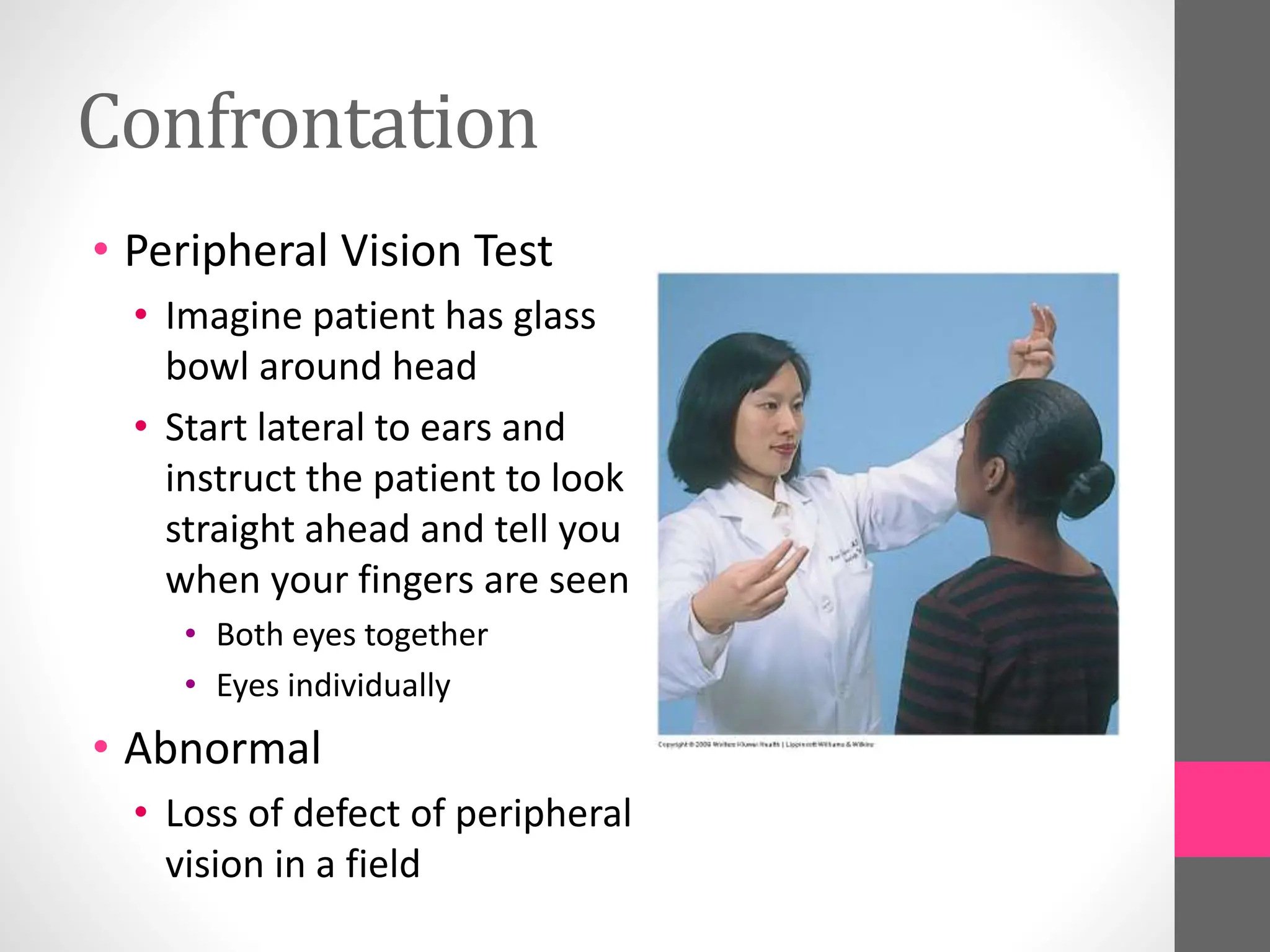
Confrontation
• Peripheral Vision Test
• Imagine patient has glass
bowl around head
• Start lateral to ears and
instruct the patient to look
straight ahead and tell you
when your fingers are seen
• Both eyes together
• Eyes individually
• Abnormal
• Loss of defect of peripheral
vision in a field
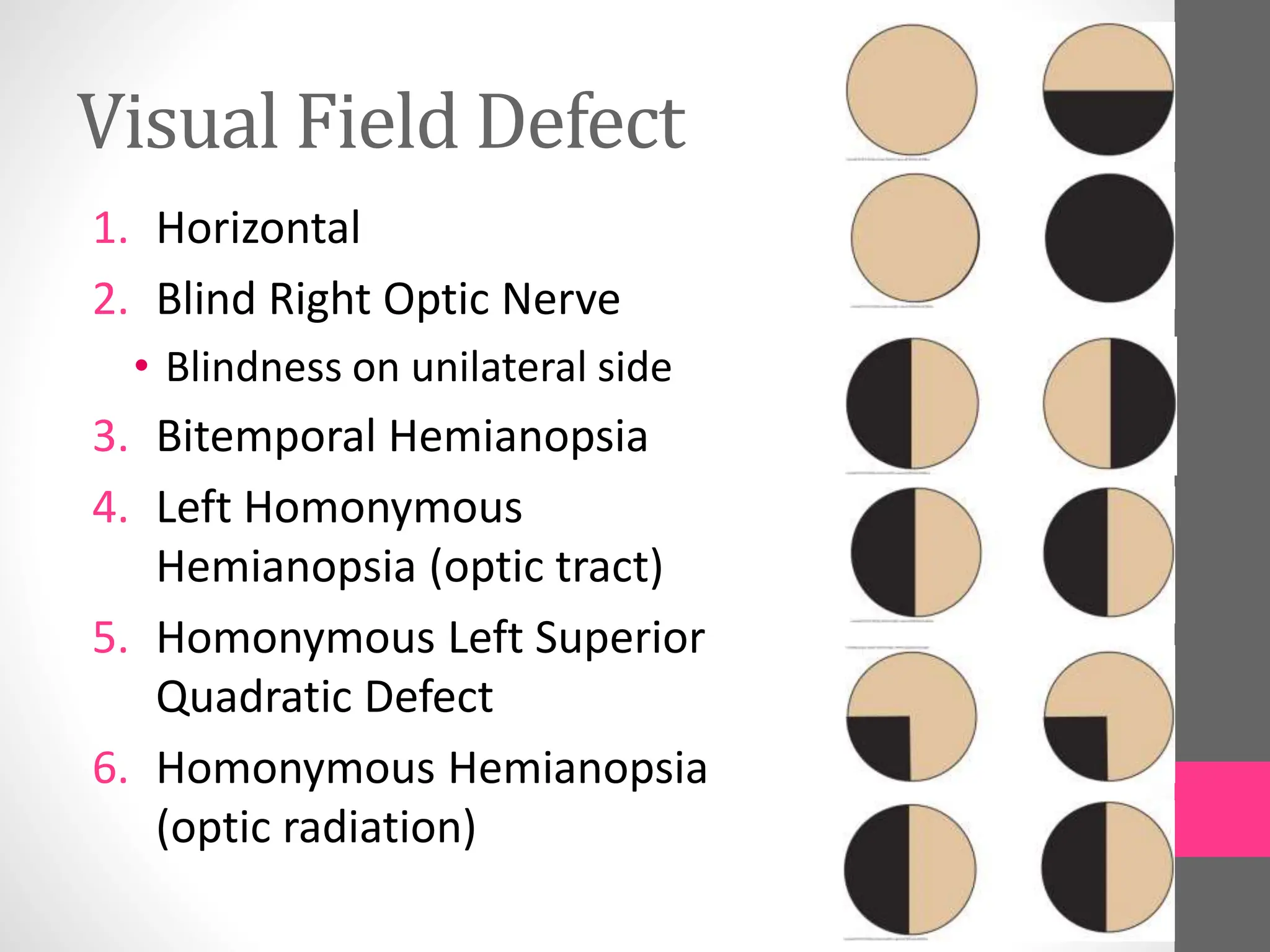
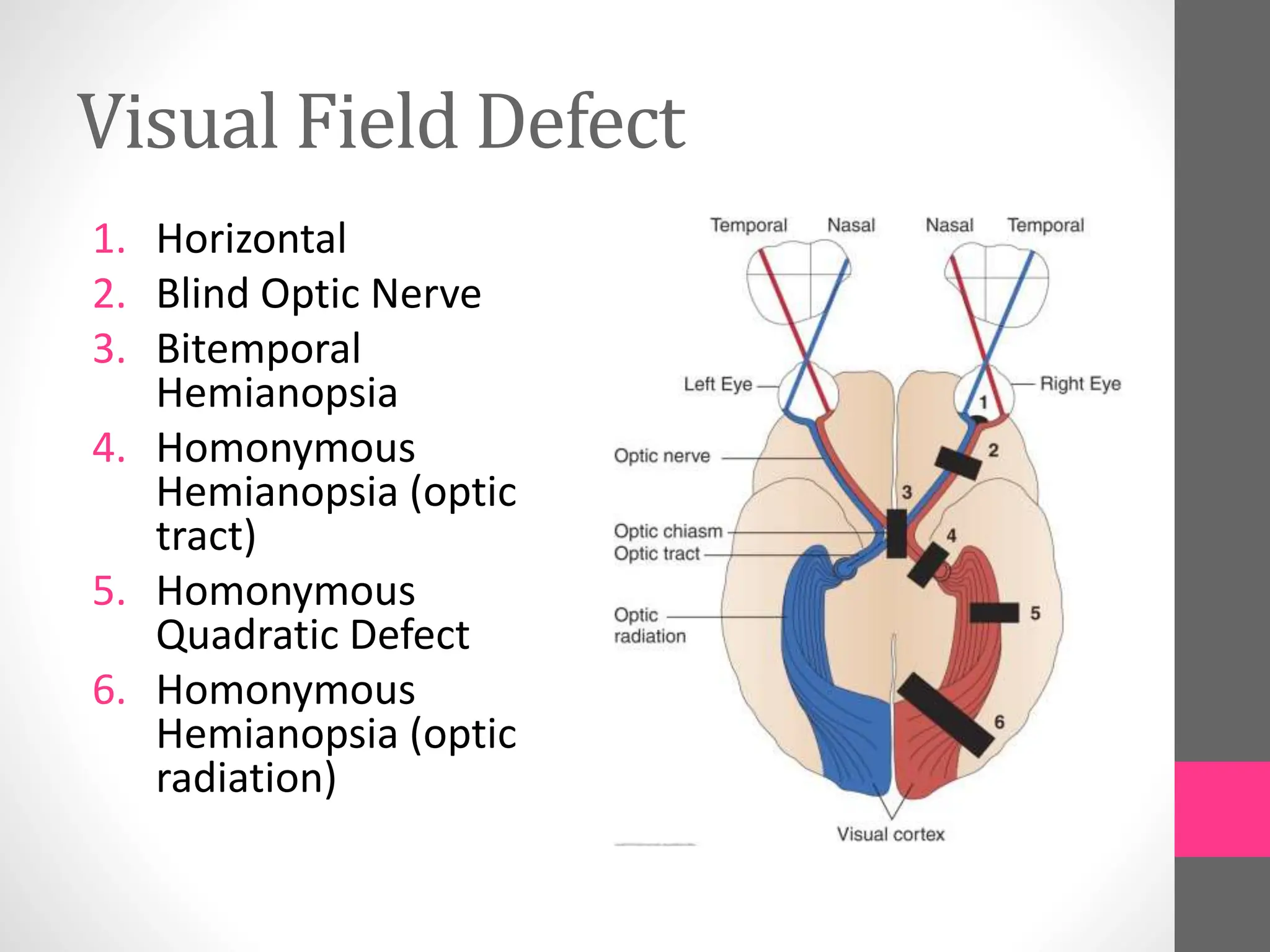
Visual Field Defect
1. Horizontal
2. Blind Optic Nerve
3. Bitemporal
Hemianopsia
4. Homonymous
Hemianopsia (optic
tract)
5. Homonymous
Quadratic Defect
6. Homonymous
Hemianopsia (optic
radiation)
Visual Field Defect
1. Horizontal
2. Blind Right Optic Nerve
• Blindness on unilateral side
3. Bitemporal Hemianopsia
4. Left Homonymous
Hemianopsia (optic tract)
5. Homonymous Left Superior
Quadratic Defect
6. Homonymous Hemianopsia
(optic radiation)
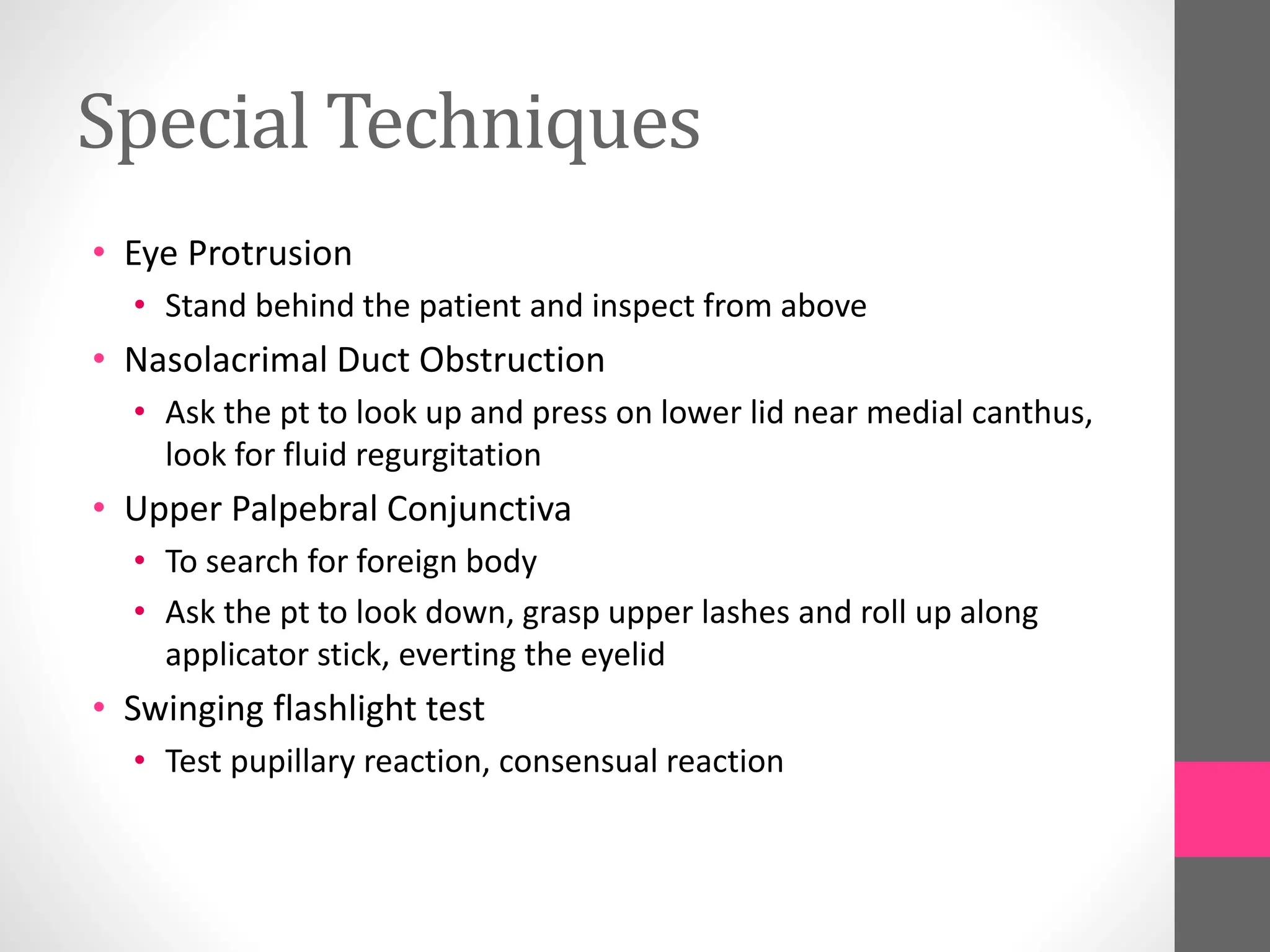
Special Techniques
• Eye Protrusion
• Stand behind the patient and inspect from above
• Nasolacrimal Duct Obstruction
• Ask the pt to look up and press on lower lid near medial canthus,
look for fluid regurgitation
• Upper Palpebral Conjunctiva
• To search for foreign body
• Ask the pt to look down, grasp upper lashes and roll up along
applicator stick, everting the eyelid
• Swinging flashlight test
• Test pupillary reaction, consensual reaction
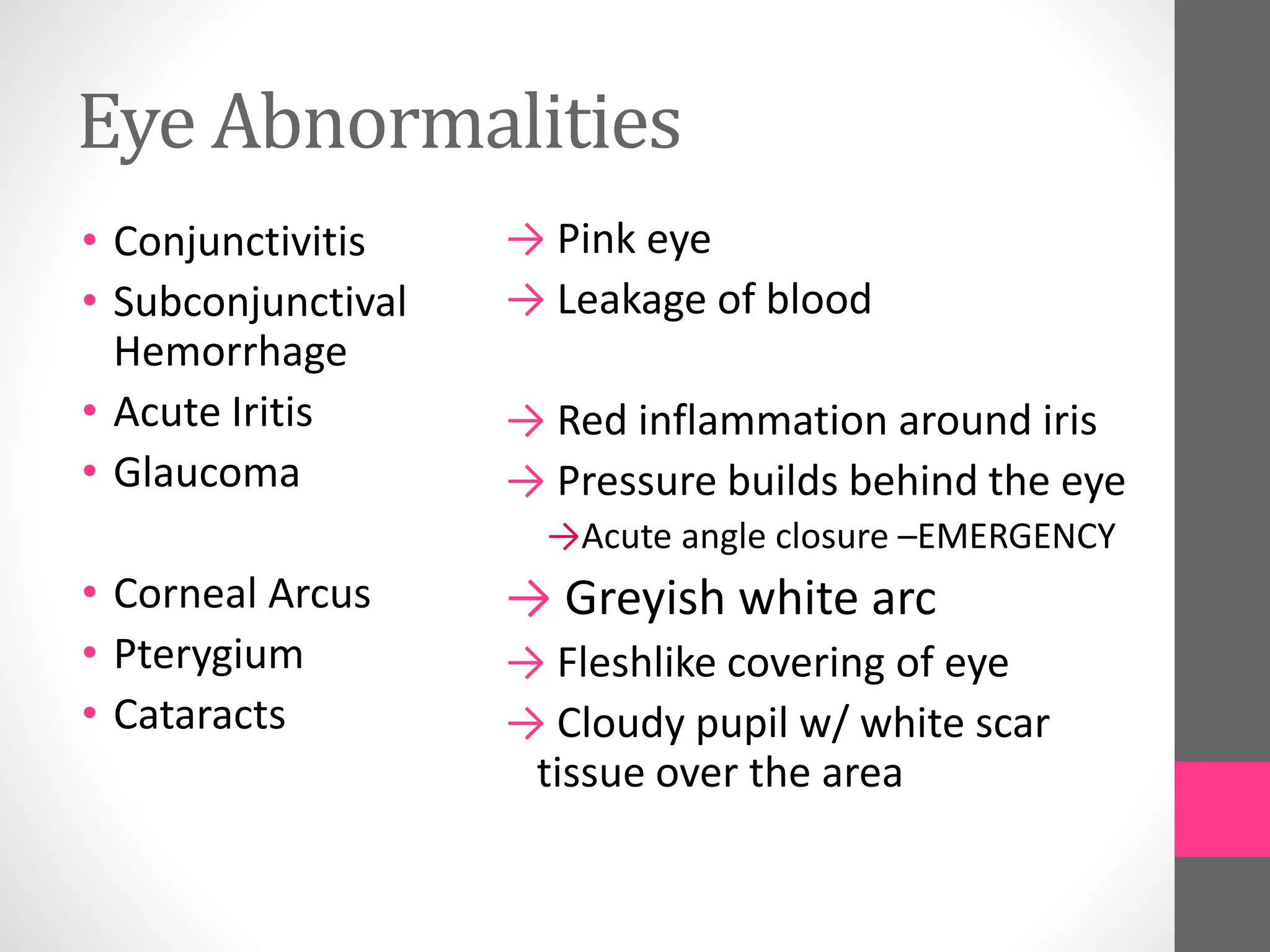
Eye Abnormalities
• Conjunctivitis
• Subconjunctival
Hemorrhage
• Acute Iritis
• Glaucoma
• Corneal Arcus
• Pterygium
• Cataracts
→ Pink eye
→ Leakage of blood
→ Red inflammation around iris
→ Pressure builds behind the eye
→Acute angle closure –EMERGENCY
→ Greyish white arc
→ Fleshlike covering of eye
→ Cloudy pupil w/ white scar
tissue over the area
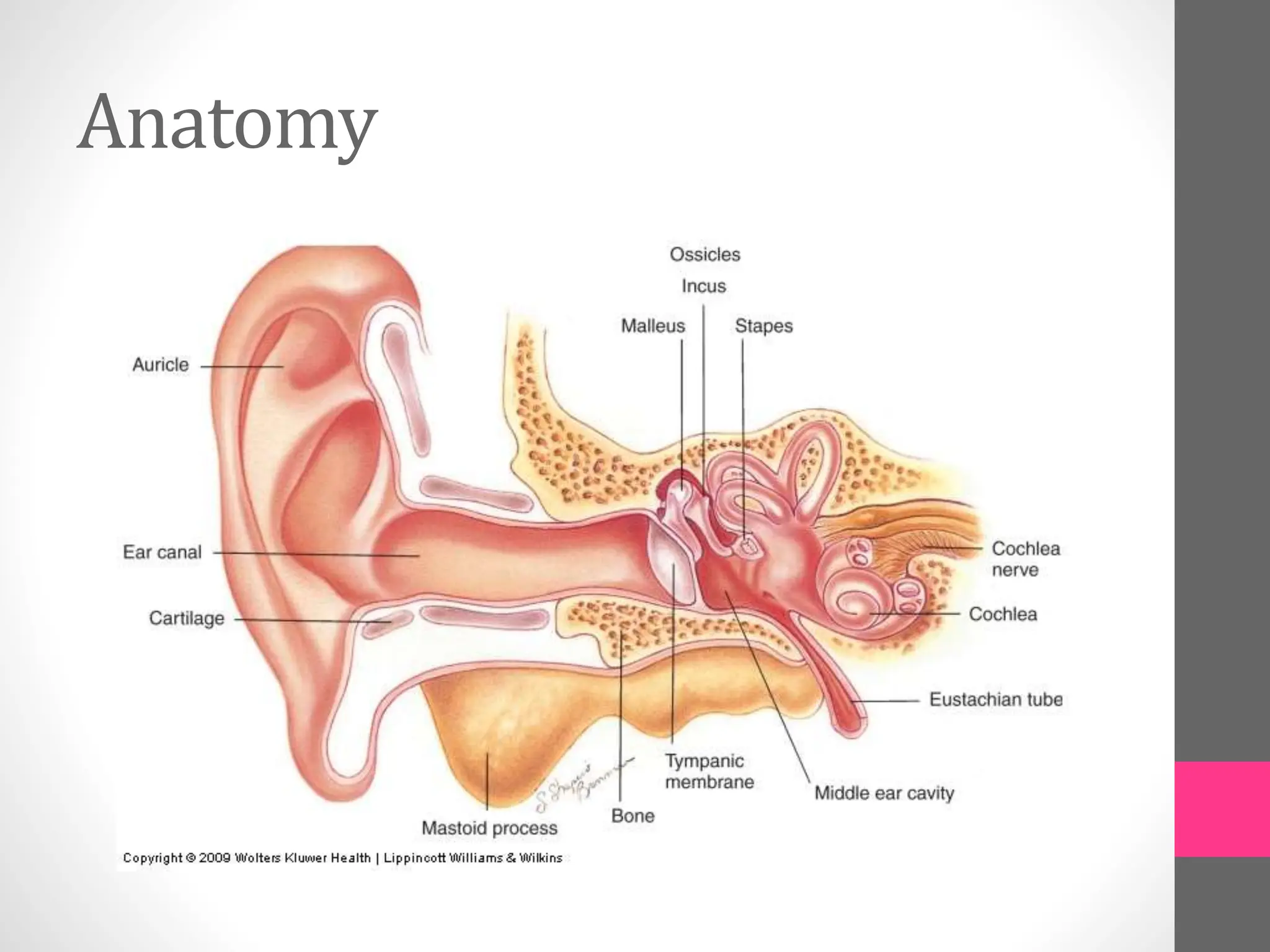
EARS
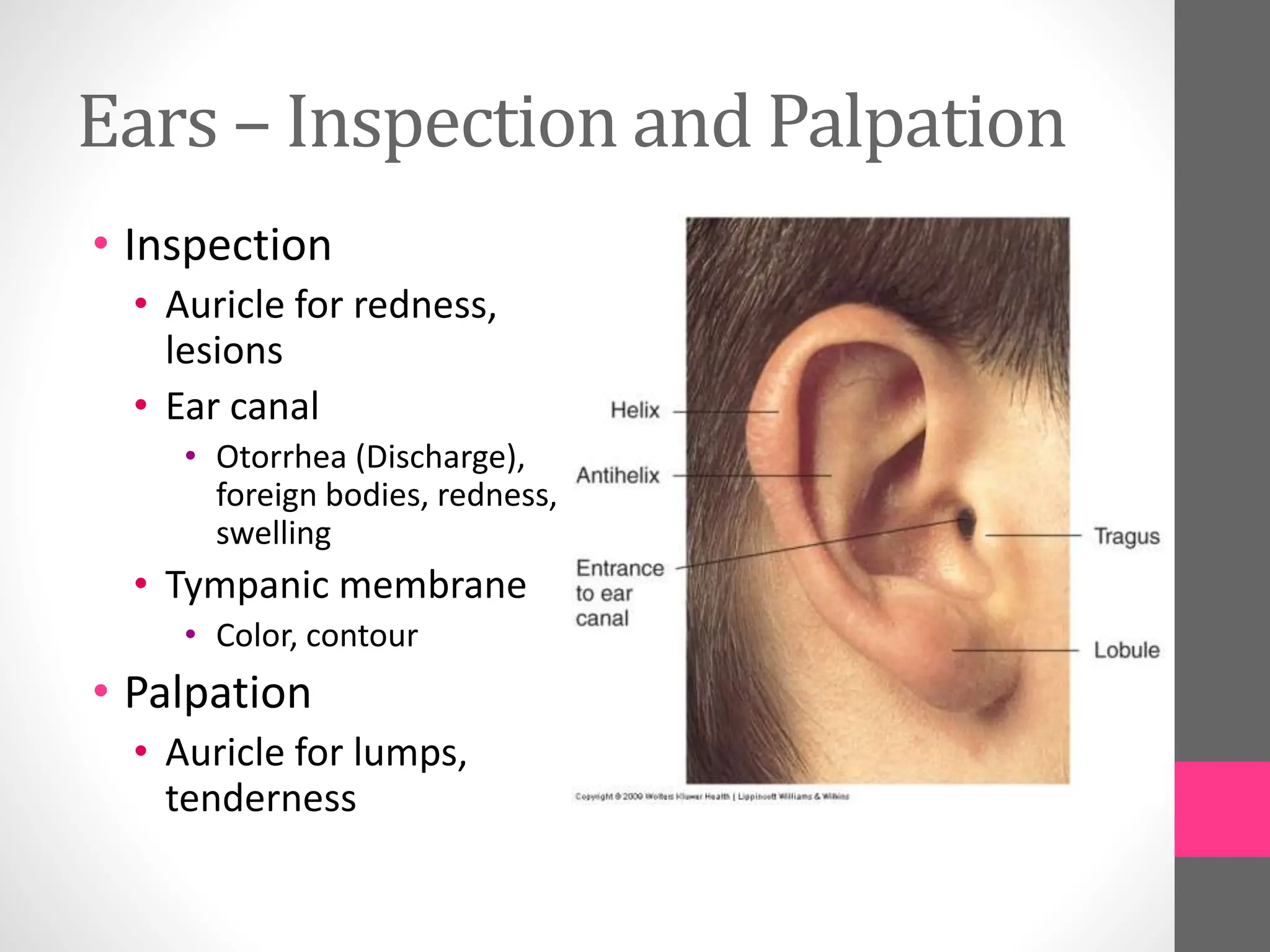
Anatomy
Ears – Inspection and Palpation
• Inspection
• Auricle for redness,
lesions
• Ear canal
• Otorrhea (Discharge),
foreign bodies, redness,
swelling
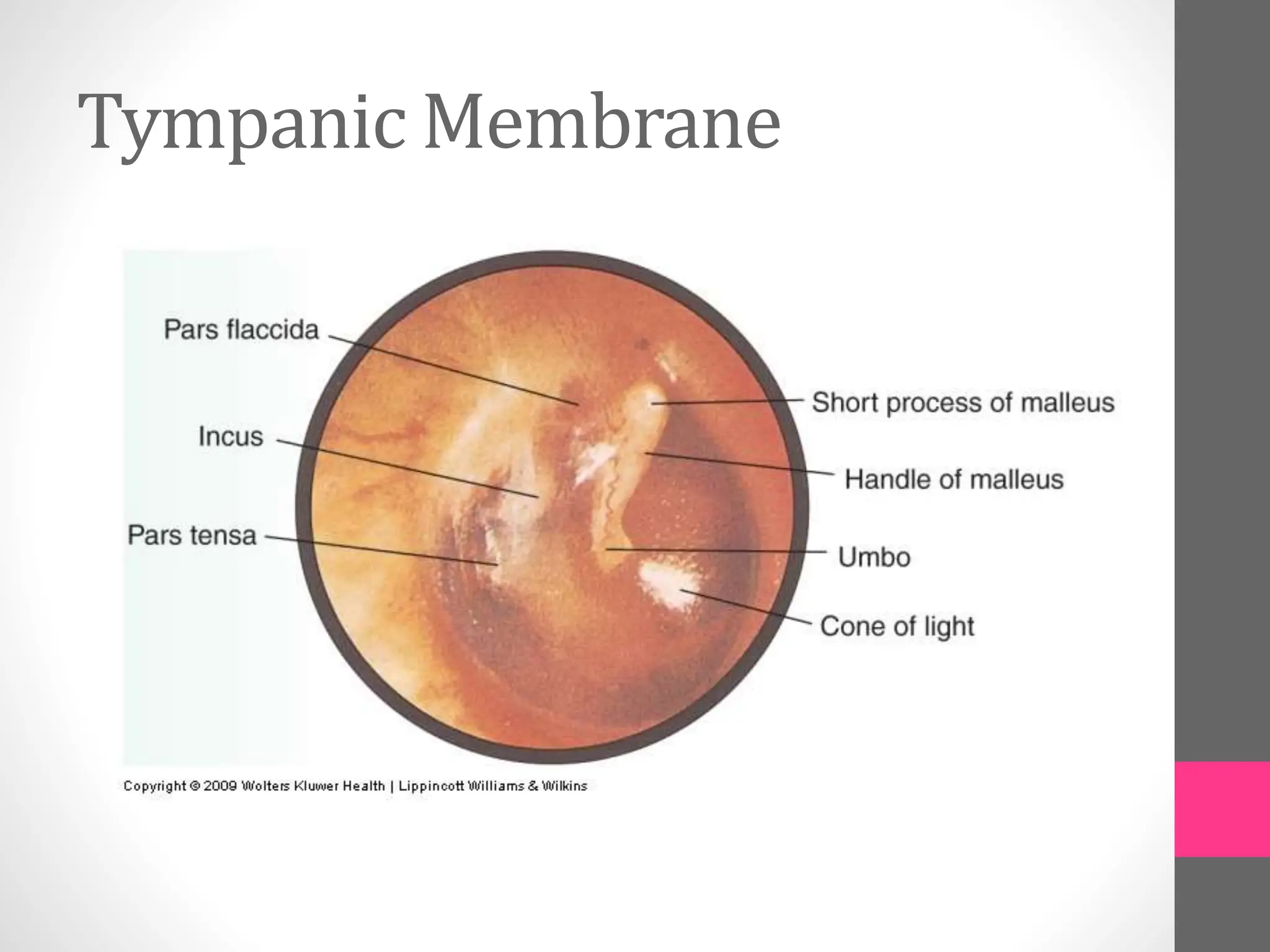
• Tympanic membrane
• Color, contour
• Palpation
• Auricle for lumps,
tenderness
Ear Terminology
• Cerumen
• Conductive loss
• Dizziness
• Vertigo
• Meniere’s disease
• Otitis externa
• Otitis media
• Sensorineural loss
• Tinnitus
→ Ear wax
→ Outer ear problem
→ You are spinning
→ The room is spinning
→ Ringing, vertigo hearing loss
→ External ear infection
→ Middle ear infection
→ Inner ear problem
→ Ringing
Tympanic Membrane
Ears - Hearing
• Auditory acuity
• Test one ear at a time
• Whisper test, standing 1-2 feet behind patient, softly
say “nine-four,” “baseball”
• Finger rub
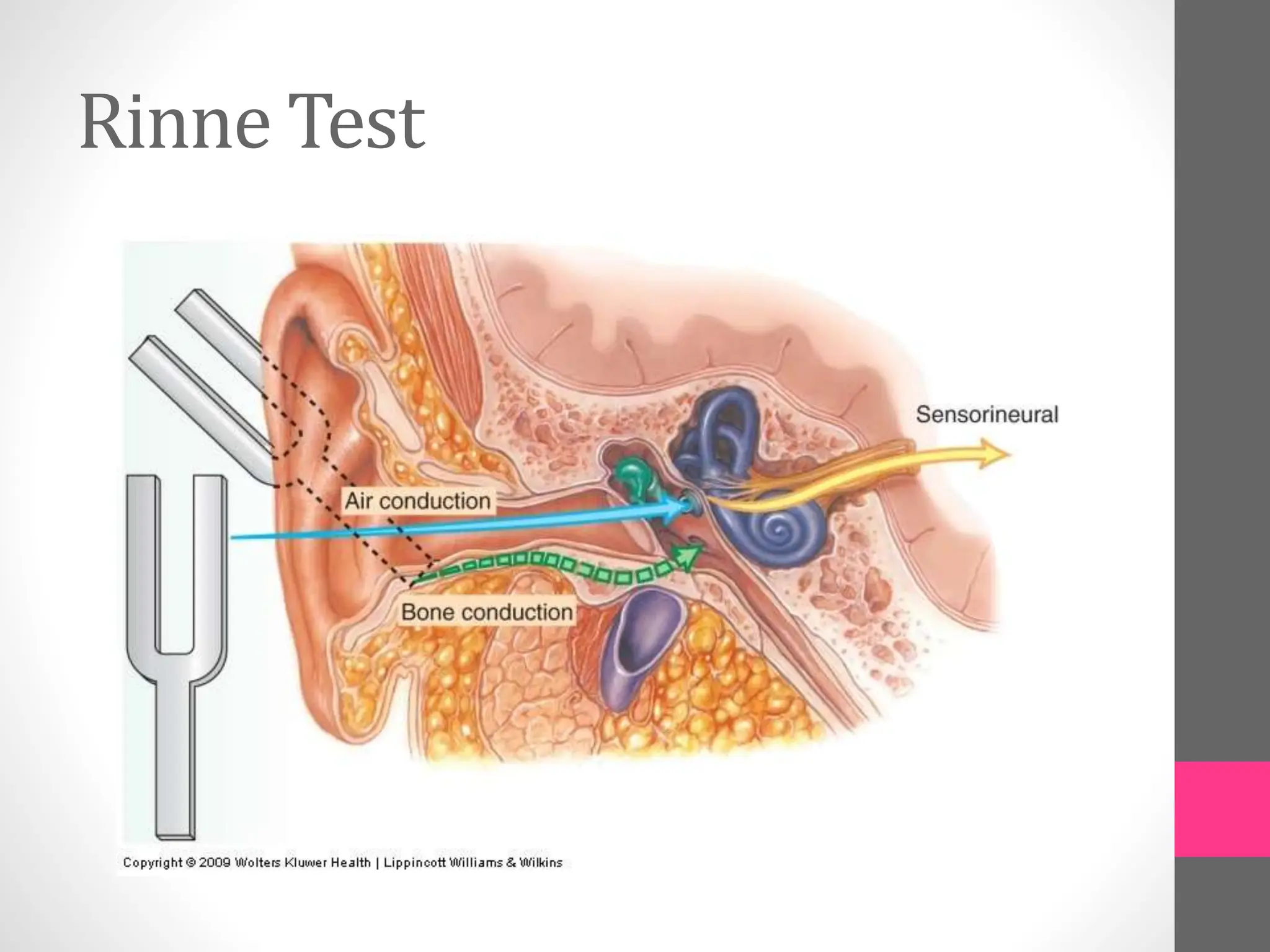
• Air and bone conduction
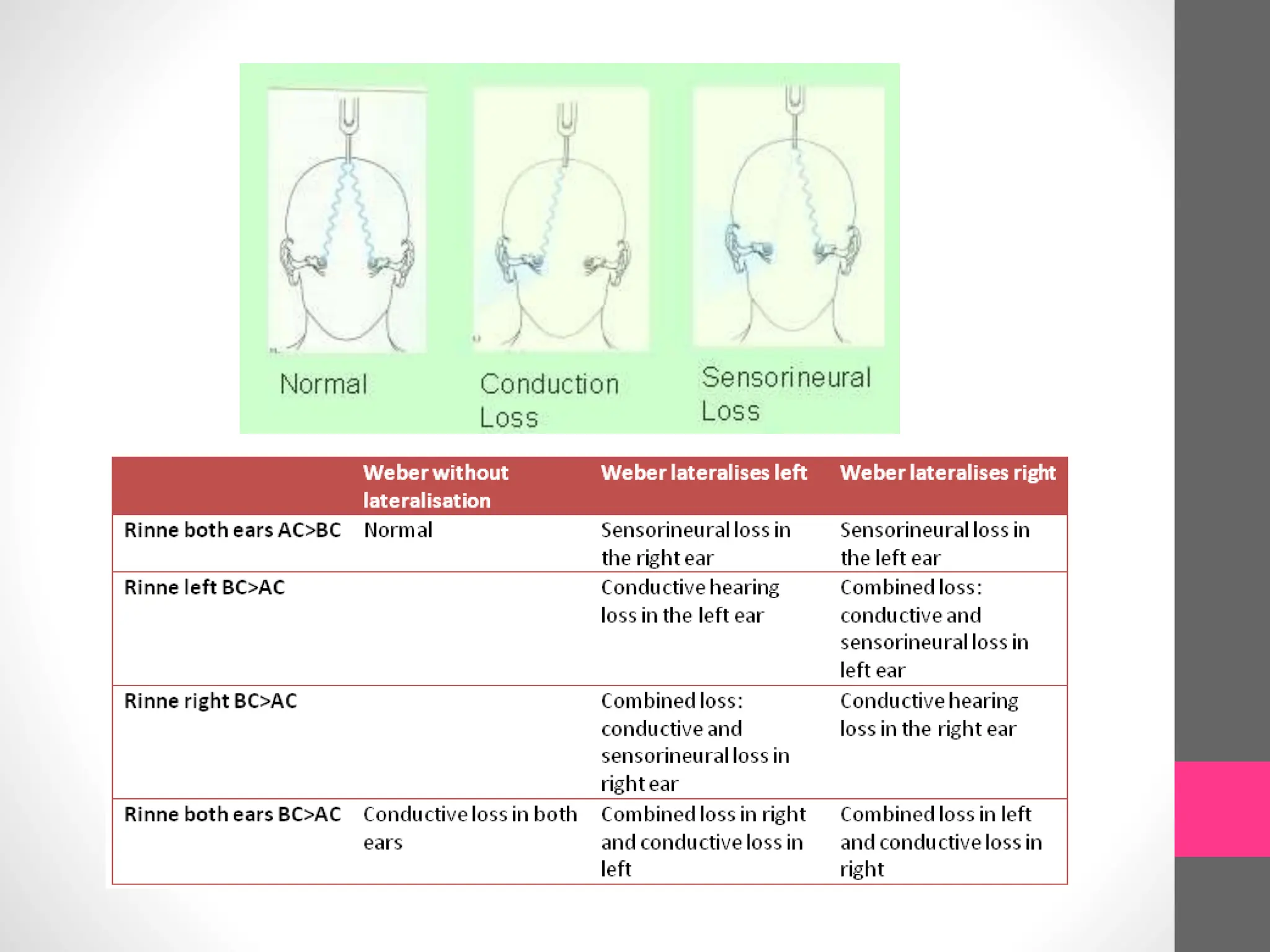
• Weber
• Lateralization of sound
• Rinne
• Compare time of air vs. bone conduction
• Bone conduction bypasses the external and middle ear
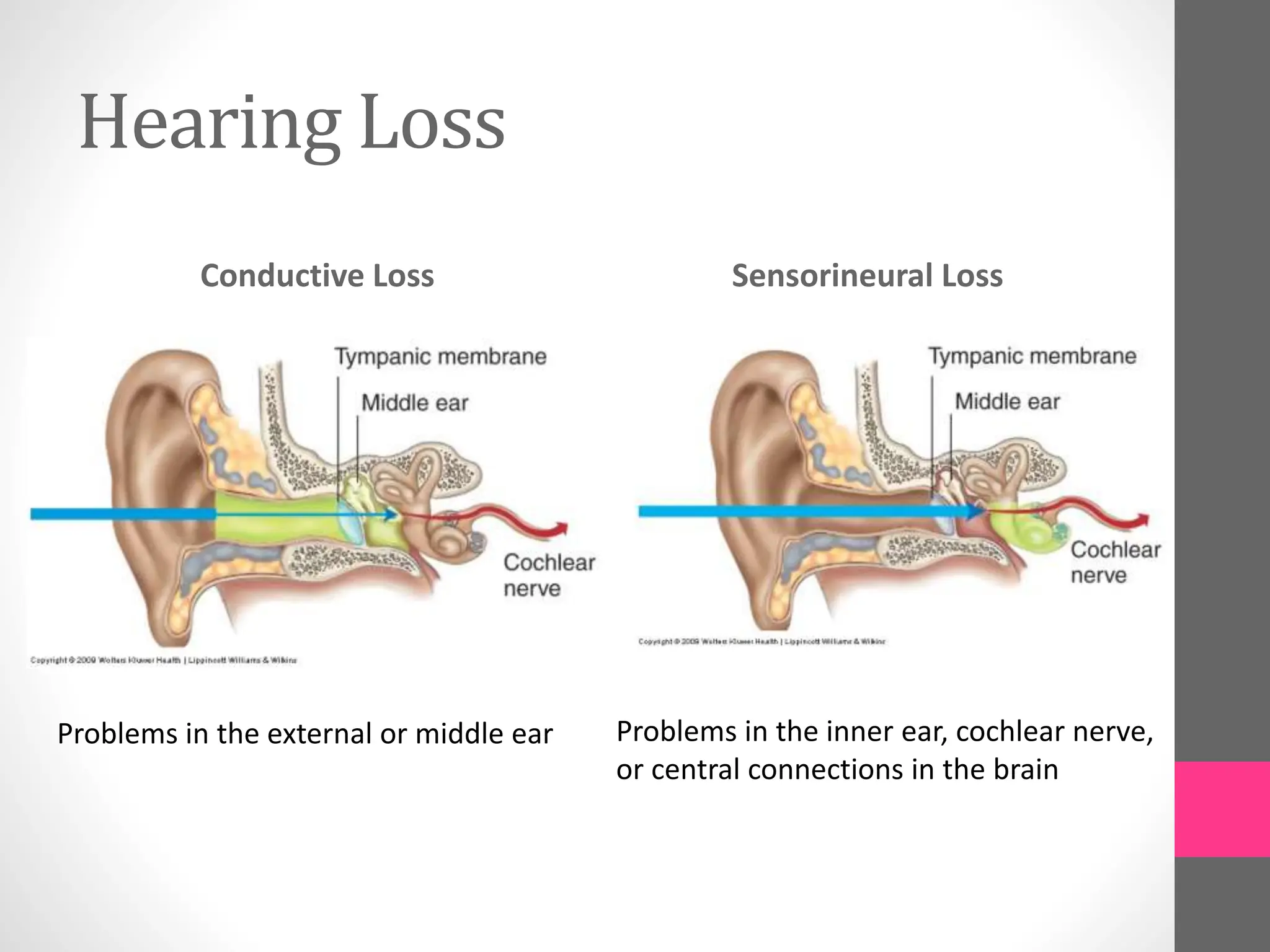
Hearing Loss
Conductive Loss Sensorineural Loss
Problems in the external or middle ear Problems in the inner ear, cochlear nerve,
or central connections in the brain
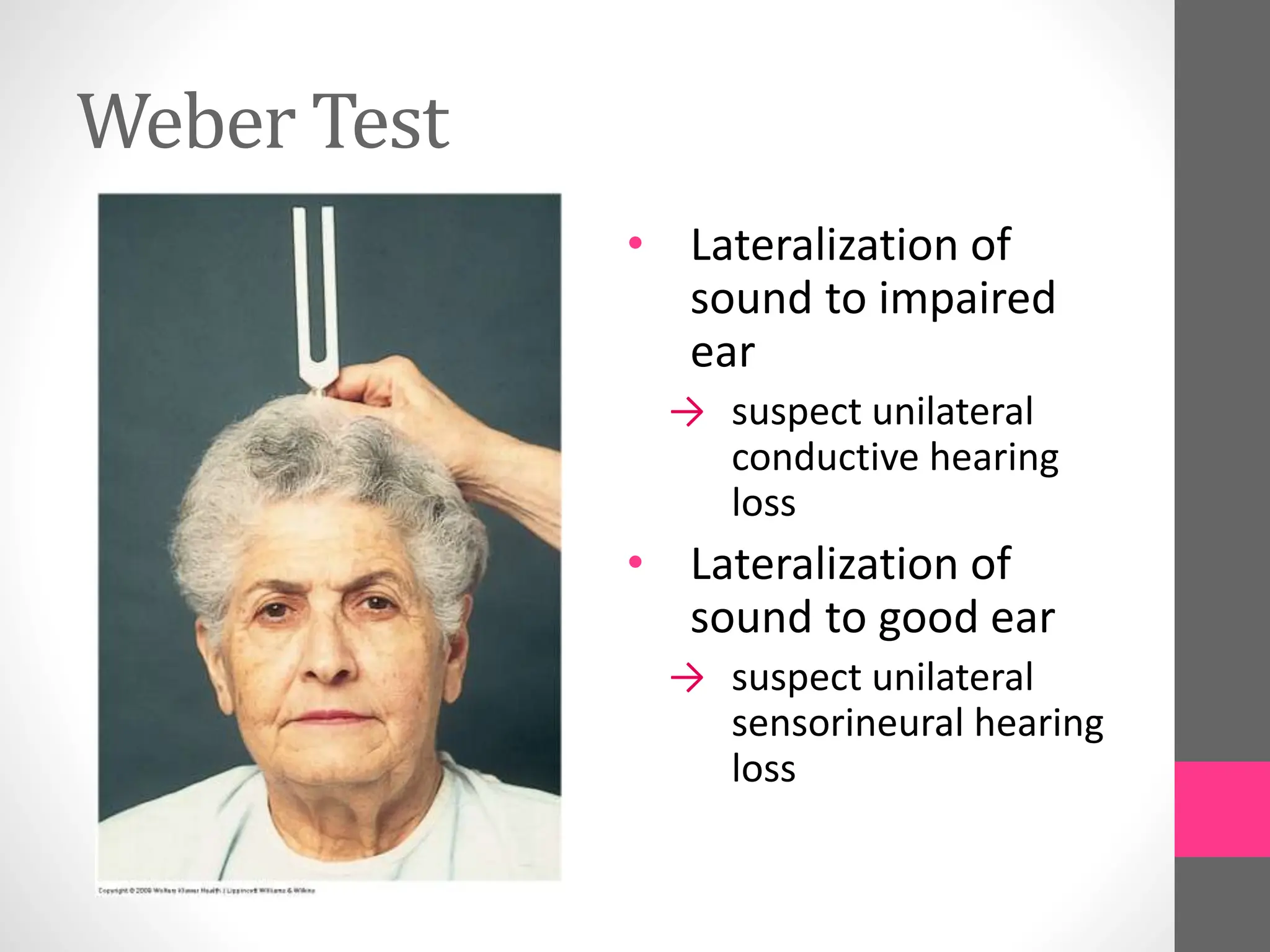
Weber Test
• Lateralization of
sound to impaired
ear
→ suspect unilateral
conductive hearing
loss
• Lateralization of
sound to good ear
→ suspect unilateral
sensorineural hearing
loss
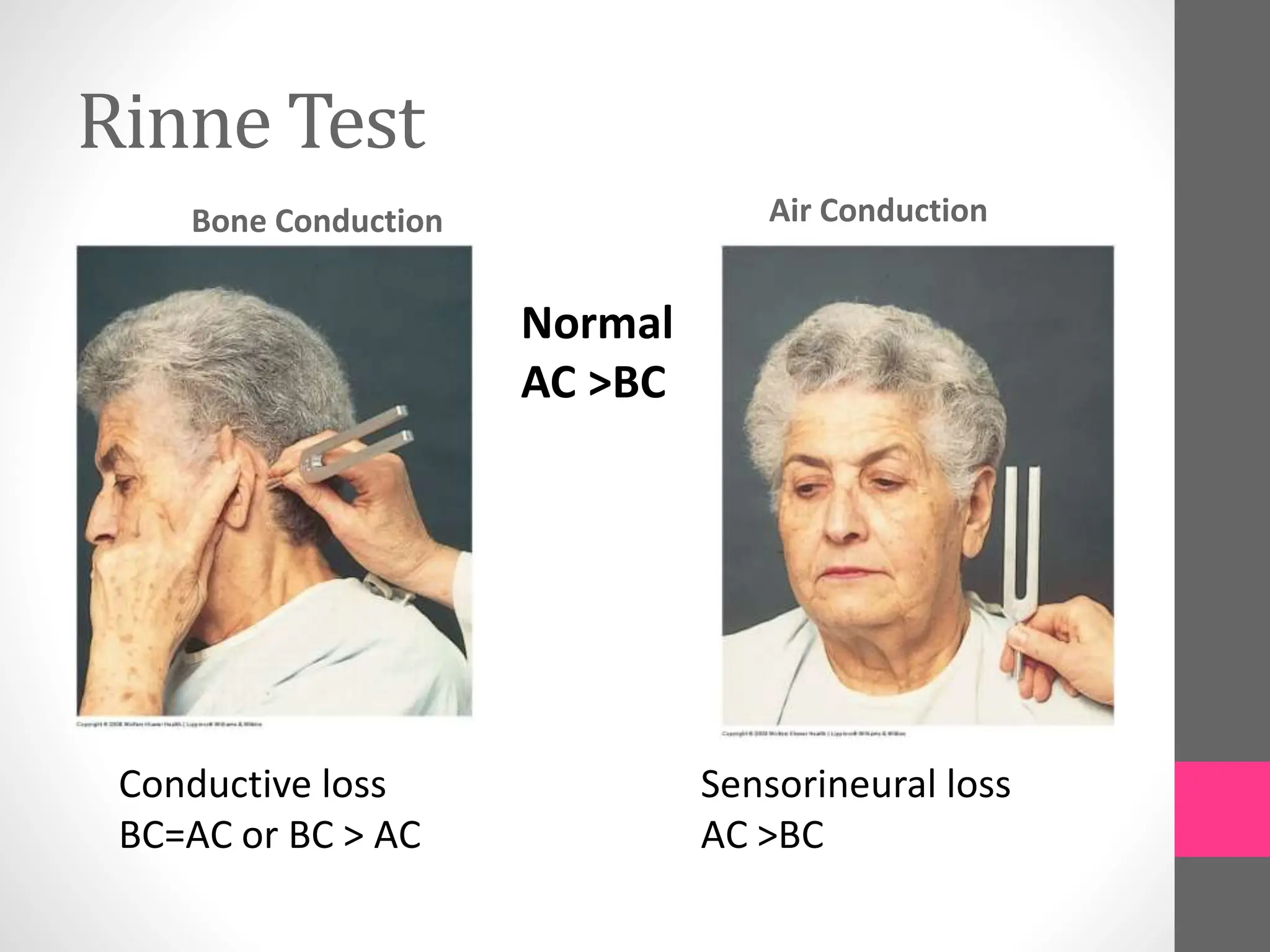
Rinne Test
Bone Conduction Air Conduction
Conductive loss
BC=AC or BC > AC
Sensorineural loss
AC >BC
Normal
AC >BC
Rinne Test
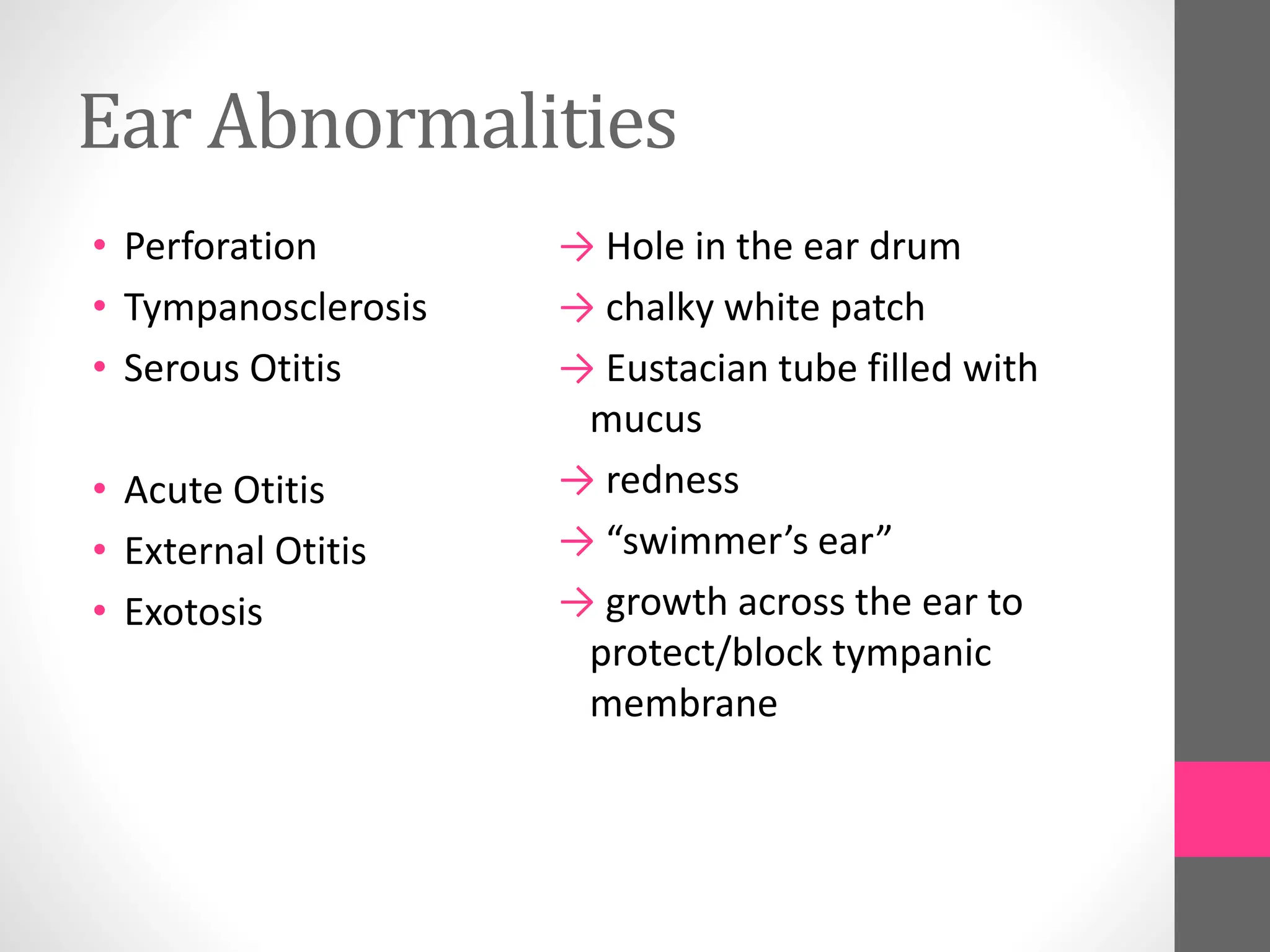
Ear Abnormalities
• Perforation
• Tympanosclerosis
• Serous Otitis
• Acute Otitis
• External Otitis
• Exotosis
→ Hole in the ear drum
→ chalky white patch
→ Eustacian tube filled with
mucus
→ redness
→ “swimmer’s ear”
→ growth across the ear to
protect/block tympanic
membrane
NOSE & PARANASAL SINUSES
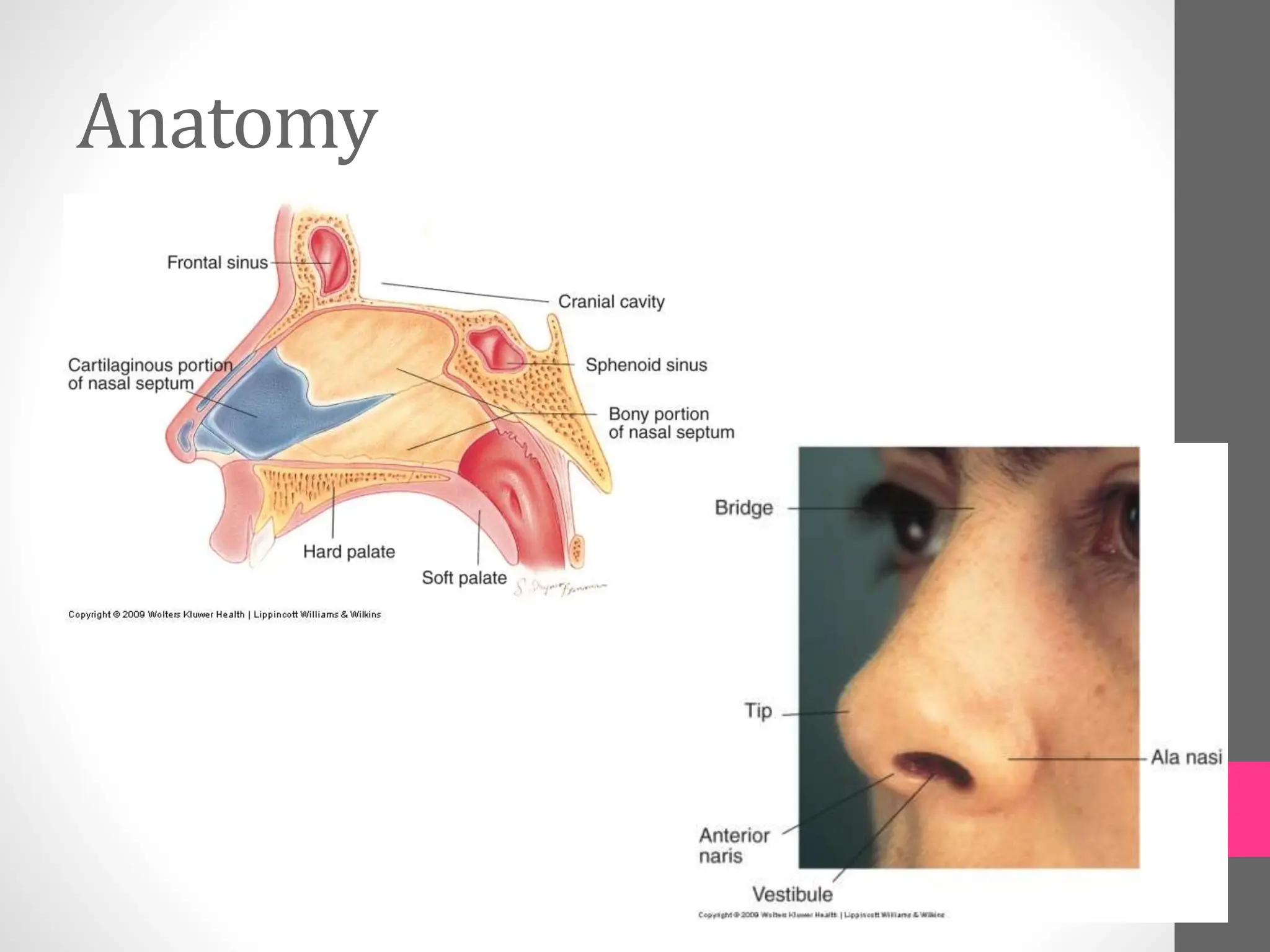
Anatomy
Nose and Sinus Terms
• Acute sinusitis
• Chronic sinusitis
• Allergic Rhinitis
• Epistaxis
• Rhinitis
medicamentosa
• Rhinorrhea
• URI
• Vasomotor rhinitis
→Infection < 6 weeks
→Infection > 6 weeks
→Hayfever, allergic itching
→Nose bleeds
→Excessive decongestant use
→Runny nose
→Upper Respiratory Infection
→Vascular congestion
Nose and Sinuses –
Inspection/Palpation
• Inspection
• Anterior and inferior surface – asymmetry or deformity
• Inside of nose
• Mucosa – color, swelling, bleeding, exudate, ulcers, or polyps
• Septum – deviation, inflammation, or perforation
• Turbinates – use otoscope to view middle and inferior turbinates
• Sense of smell
• Close eyes and identify odors
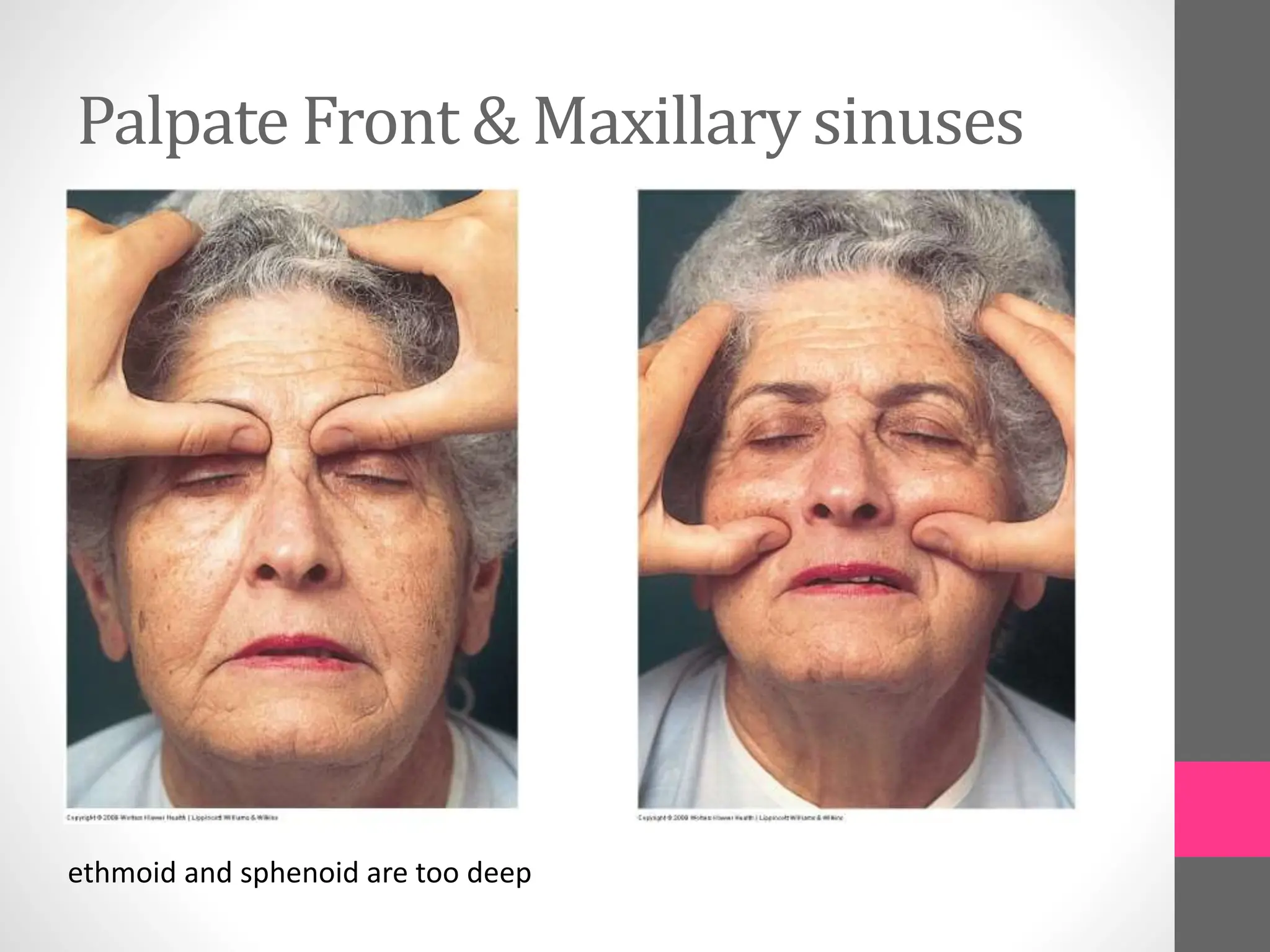
• Palpation of sinuses – frontal and maxillary
• Press up on the frontal sinuses from under the bony brows
• Press up pm the maxillary sinuses from under the cheek bones
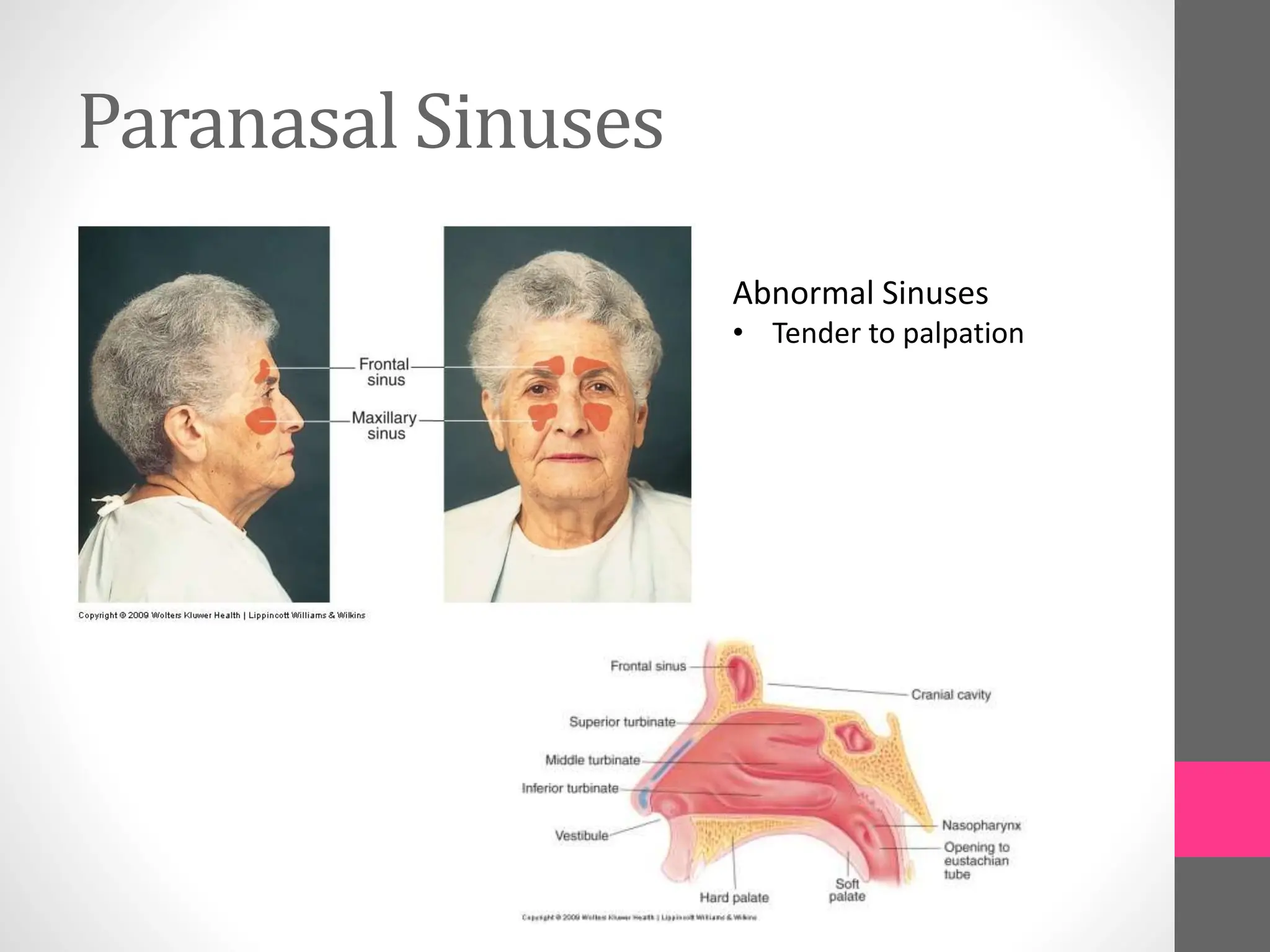
Paranasal Sinuses
Abnormal Sinuses
• Tender to palpation
Palpate Front & Maxillary sinuses
ethmoid and sphenoid are too deep
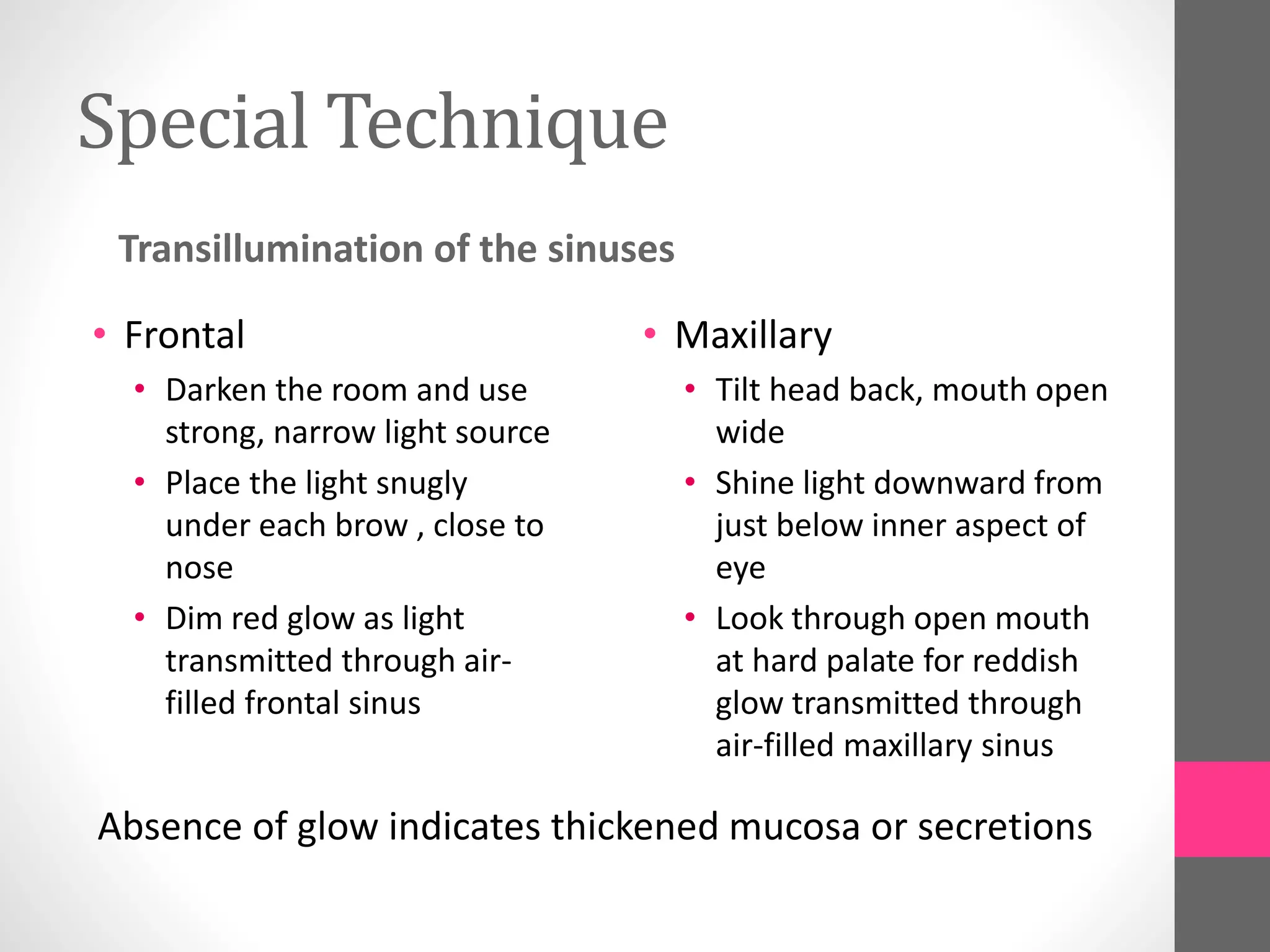
Special Technique
Transillumination of the sinuses
• Frontal
• Darken the room and use
strong, narrow light source
• Place the light snugly
under each brow , close to
nose
• Dim red glow as light
transmitted through air-
filled frontal sinus
• Maxillary
• Tilt head back, mouth open
wide
• Shine light downward from
just below inner aspect of
eye
• Look through open mouth
at hard palate for reddish
glow transmitted through
air-filled maxillary sinus
Absence of glow indicates thickened mucosa or secretions
MOUTH AND PHARYNX
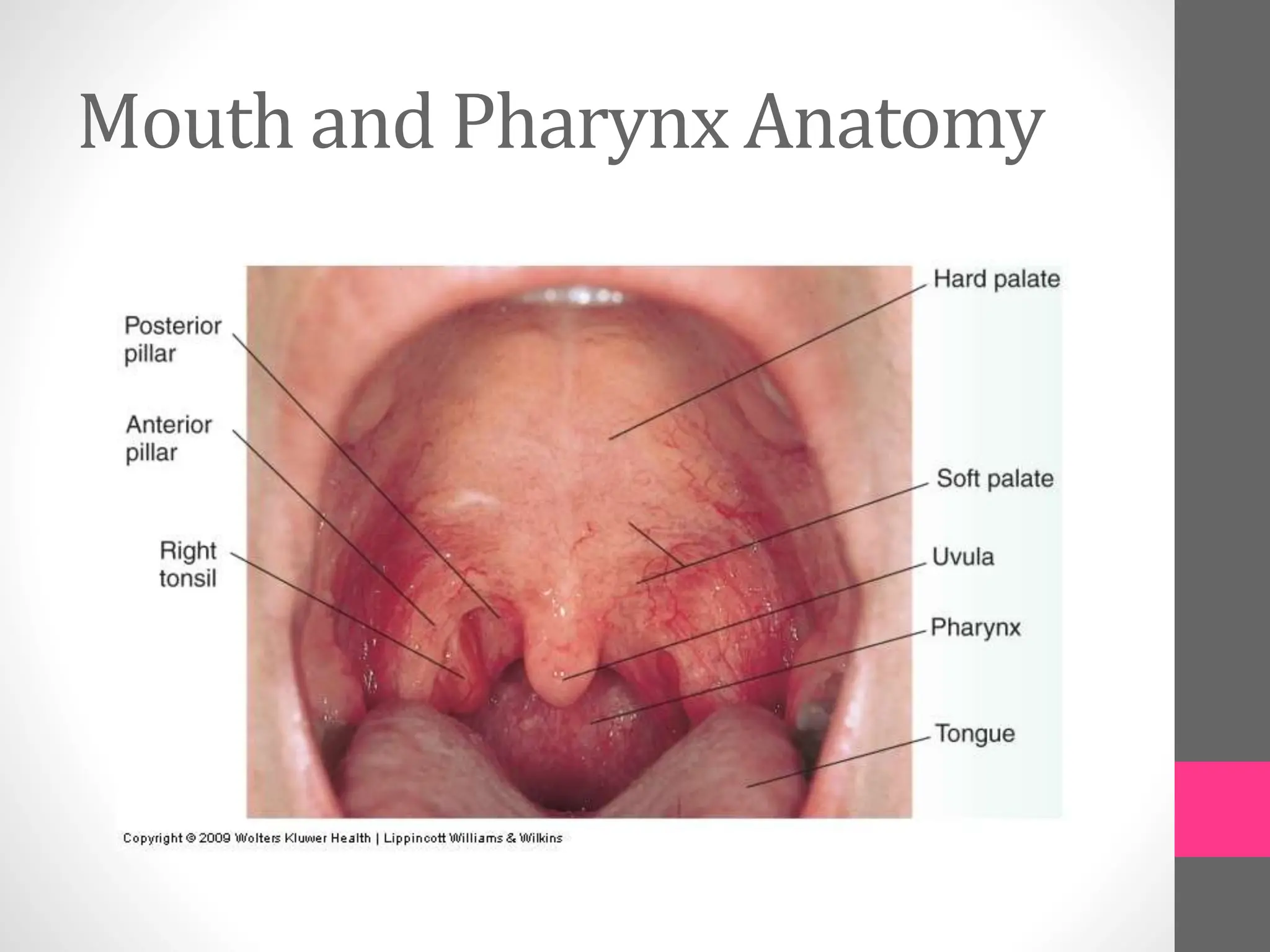
Mouth and Pharynx Anatomy
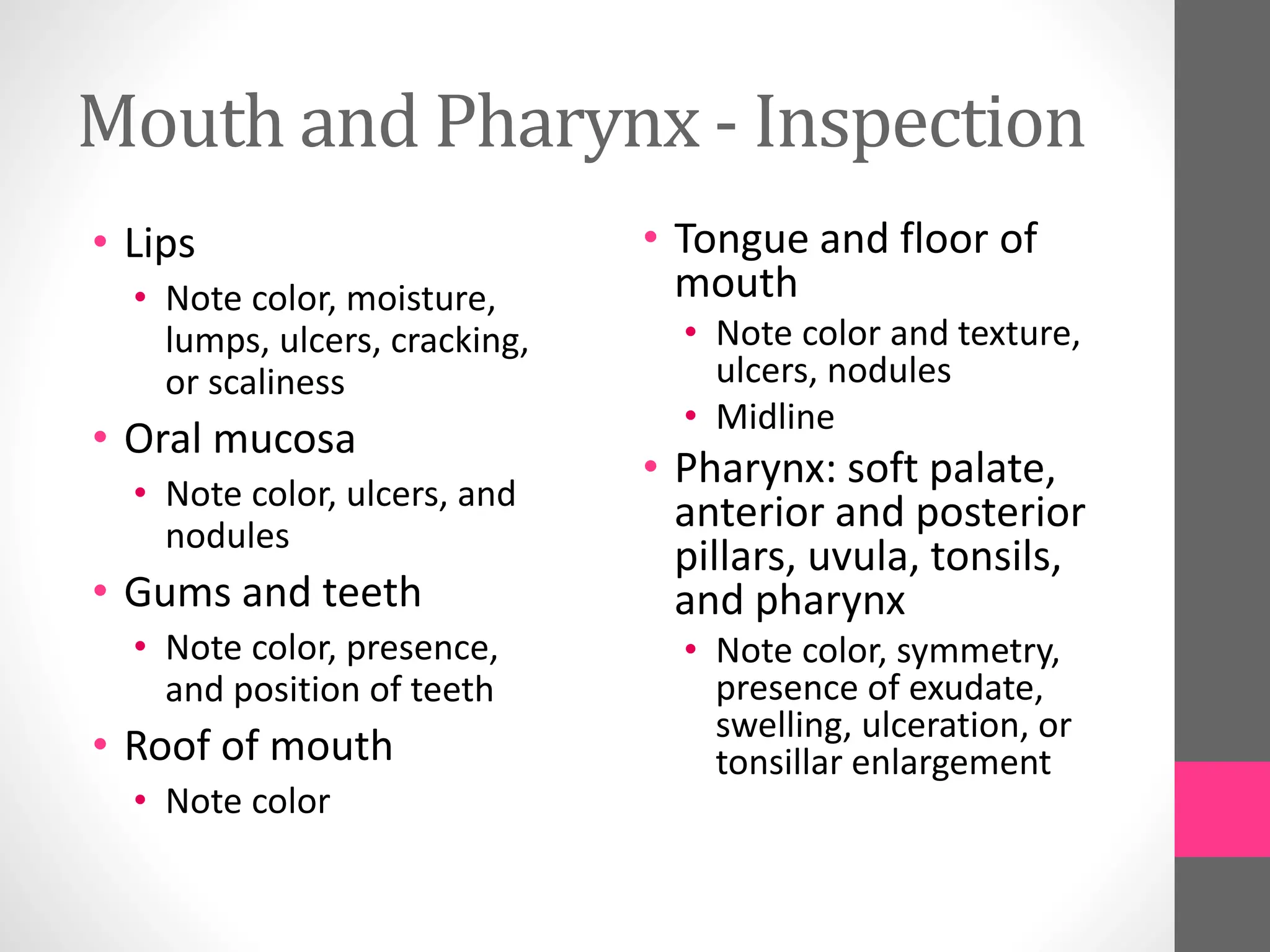
Mouth and Pharynx - Inspection
• Lips
• Note color, moisture,
lumps, ulcers, cracking,
or scaliness
• Oral mucosa
• Note color, ulcers, and
nodules
• Gums and teeth
• Note color, presence,
and position of teeth
• Roof of mouth
• Note color
• Tongue and floor of
mouth
• Note color and texture,
ulcers, nodules
• Midline
• Pharynx: soft palate,
anterior and posterior
pillars, uvula, tonsils,
and pharynx
• Note color, symmetry,
presence of exudate,
swelling, ulceration, or
tonsillar enlargement
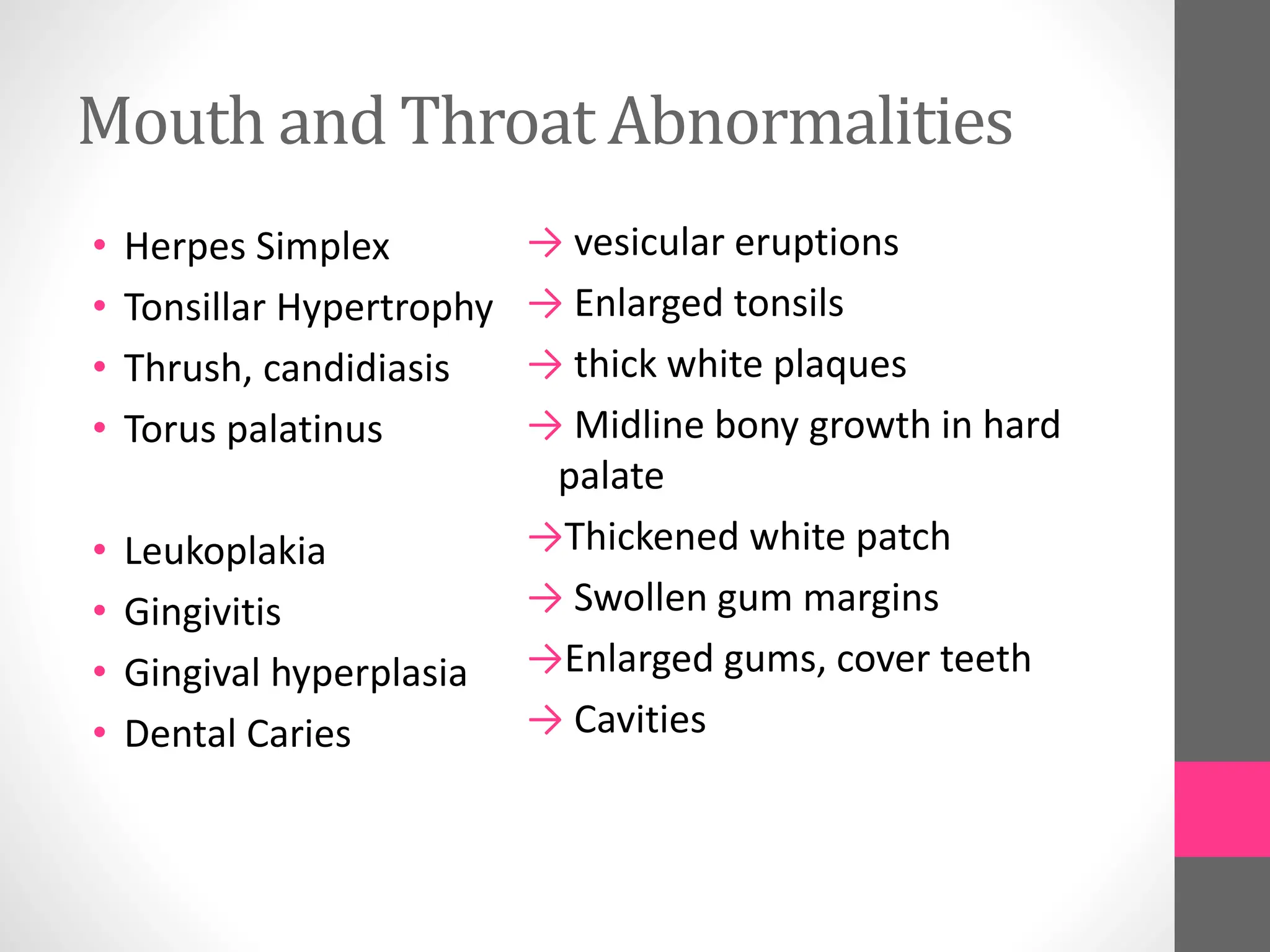
Mouth and Throat Abnormalities
• Herpes Simplex
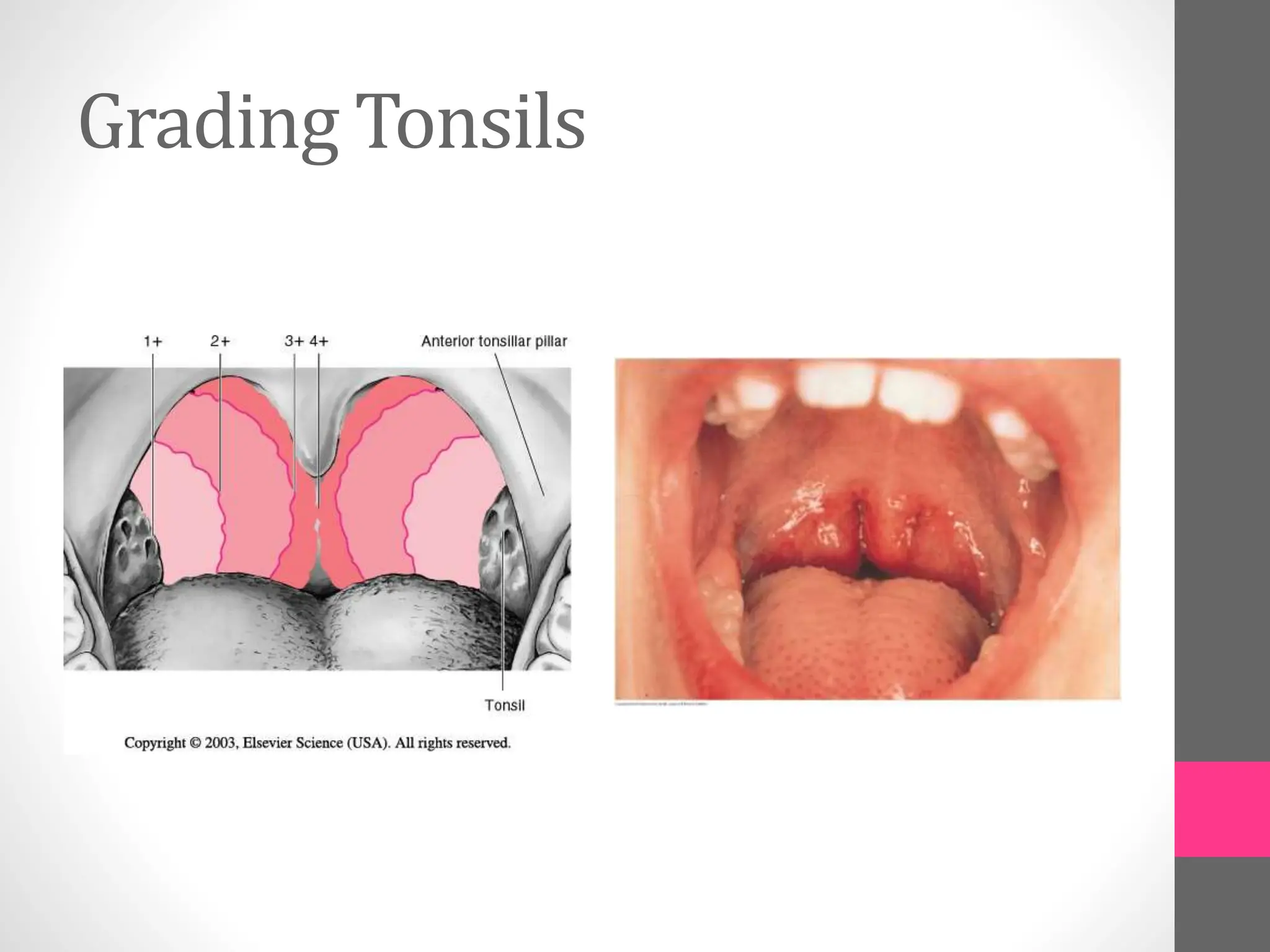
• Tonsillar Hypertrophy
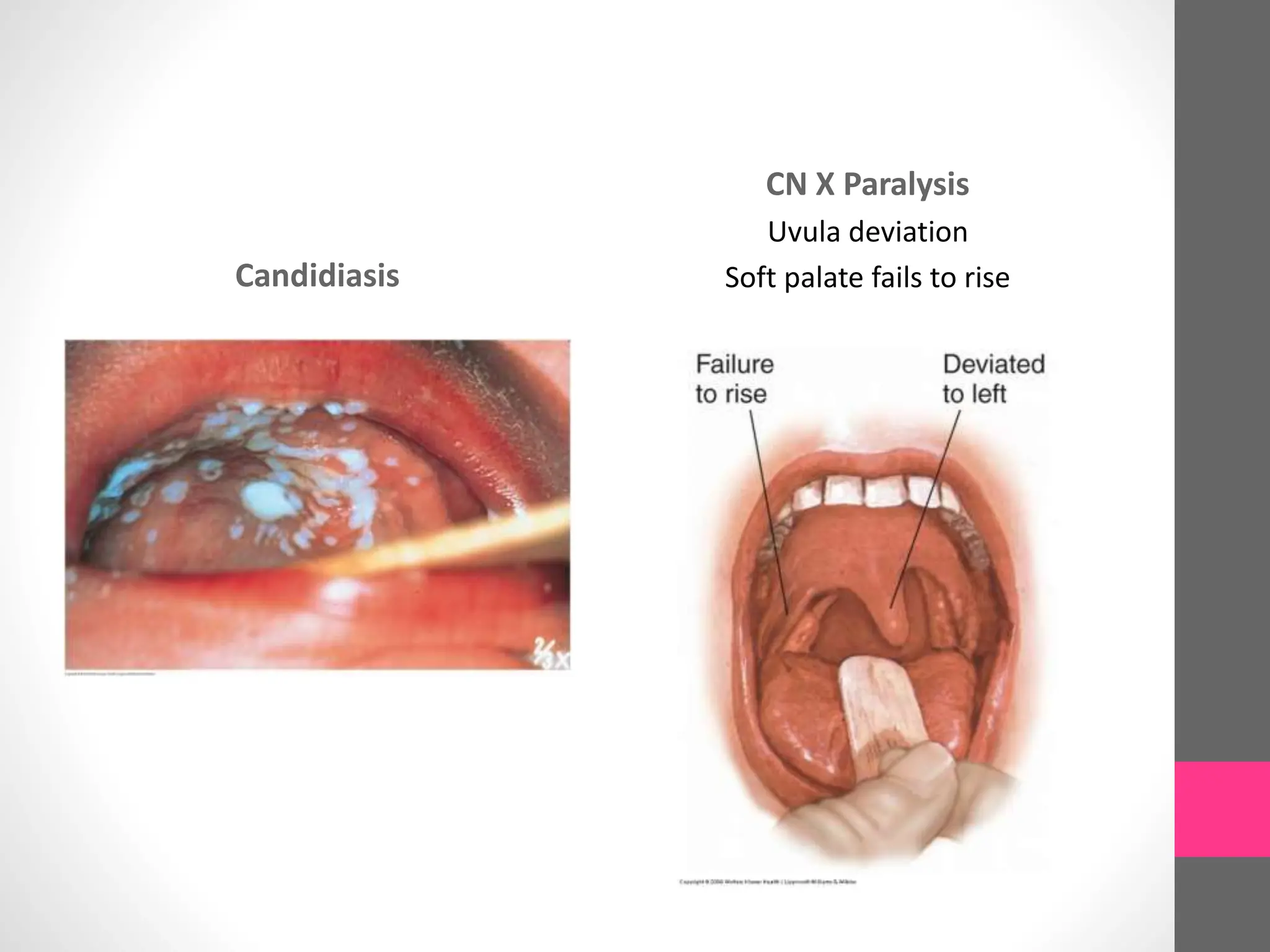
• Thrush, candidiasis
• Torus palatinus
• Leukoplakia
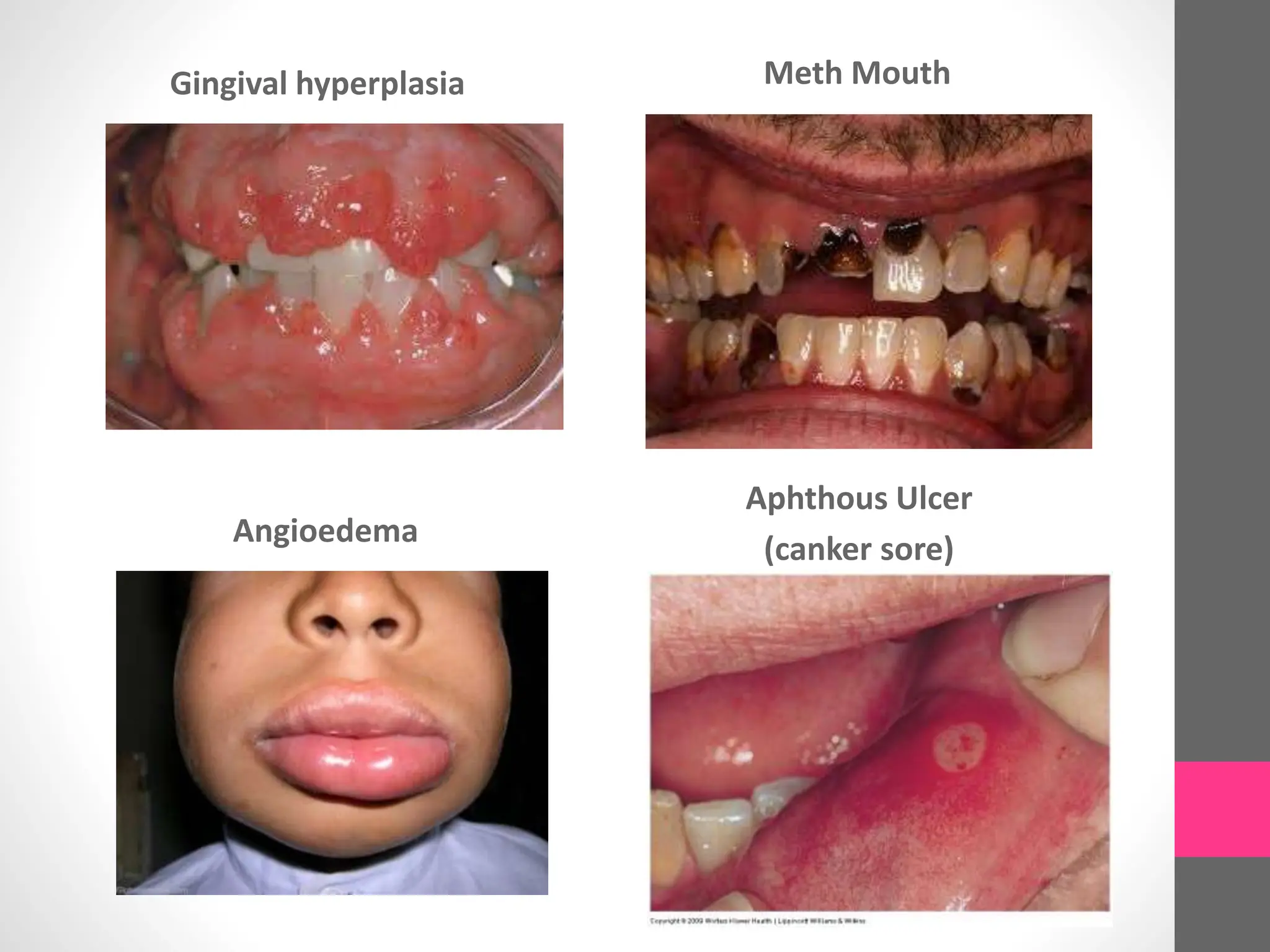
• Gingivitis
• Gingival hyperplasia
• Dental Caries
→ vesicular eruptions
→ Enlarged tonsils
→ thick white plaques
→ Midline bony growth in hard
palate
→Thickened white patch
→ Swollen gum margins
→Enlarged gums, cover teeth
→ Cavities
Grading Tonsils
Gingival hyperplasia Meth Mouth
Angioedema
Aphthous Ulcer
(canker sore)
Candidiasis
CN X Paralysis
Uvula deviation
Soft palate fails to rise
NECK
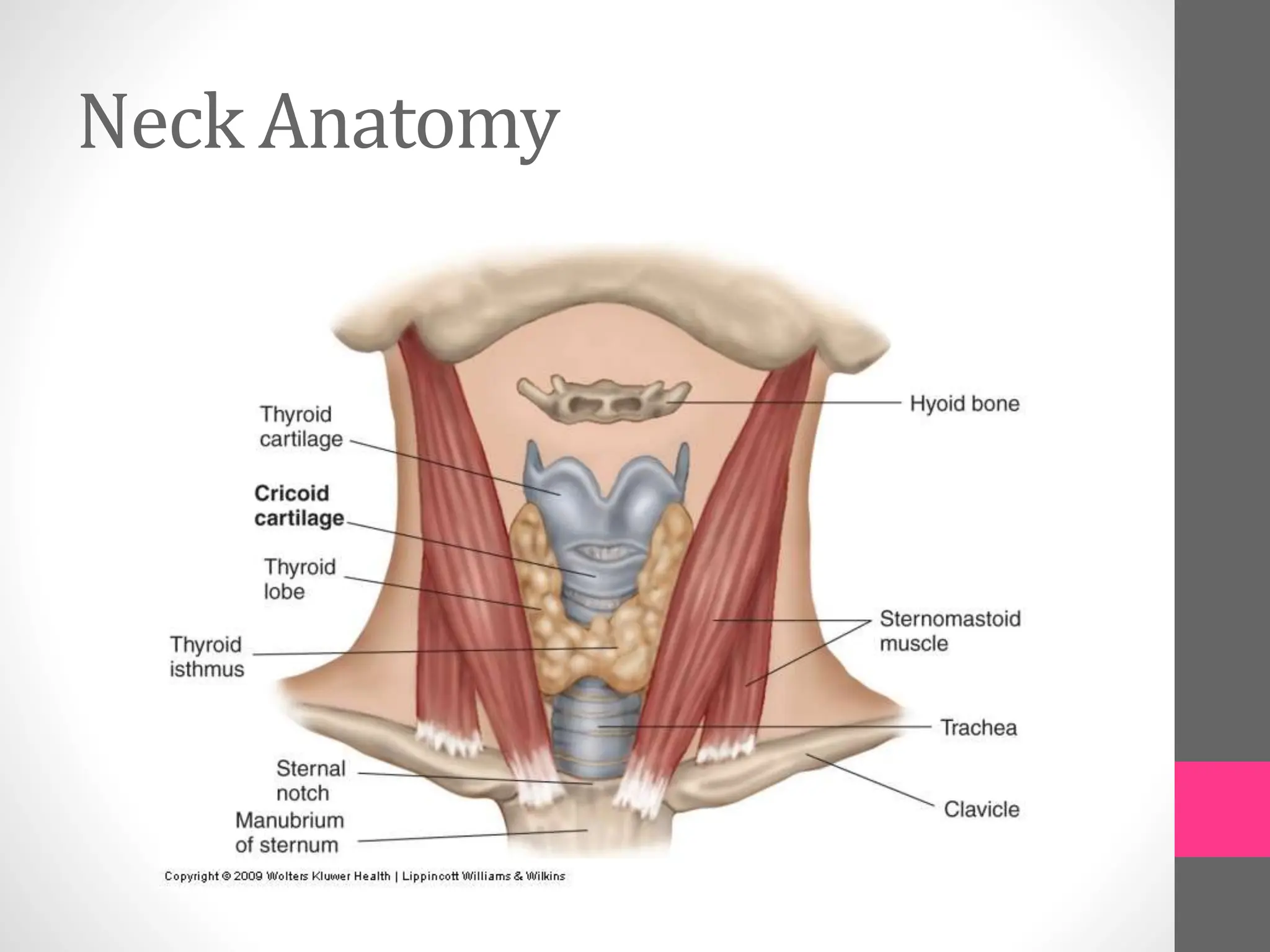
Neck Anatomy
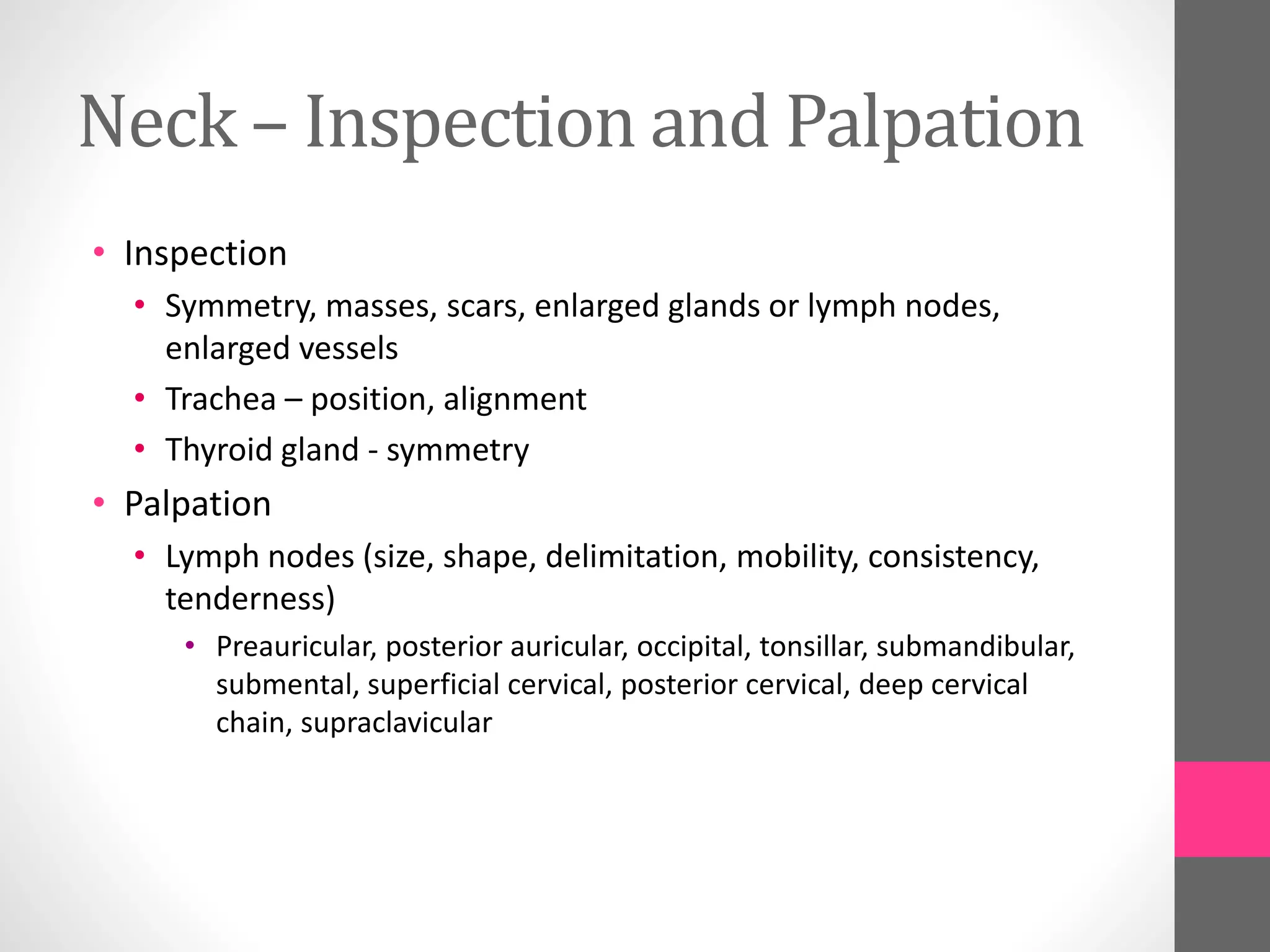
Neck – Inspection and Palpation
• Inspection
• Symmetry, masses, scars, enlarged glands or lymph nodes,
enlarged vessels
• Trachea – position, alignment
• Thyroid gland - symmetry
• Palpation
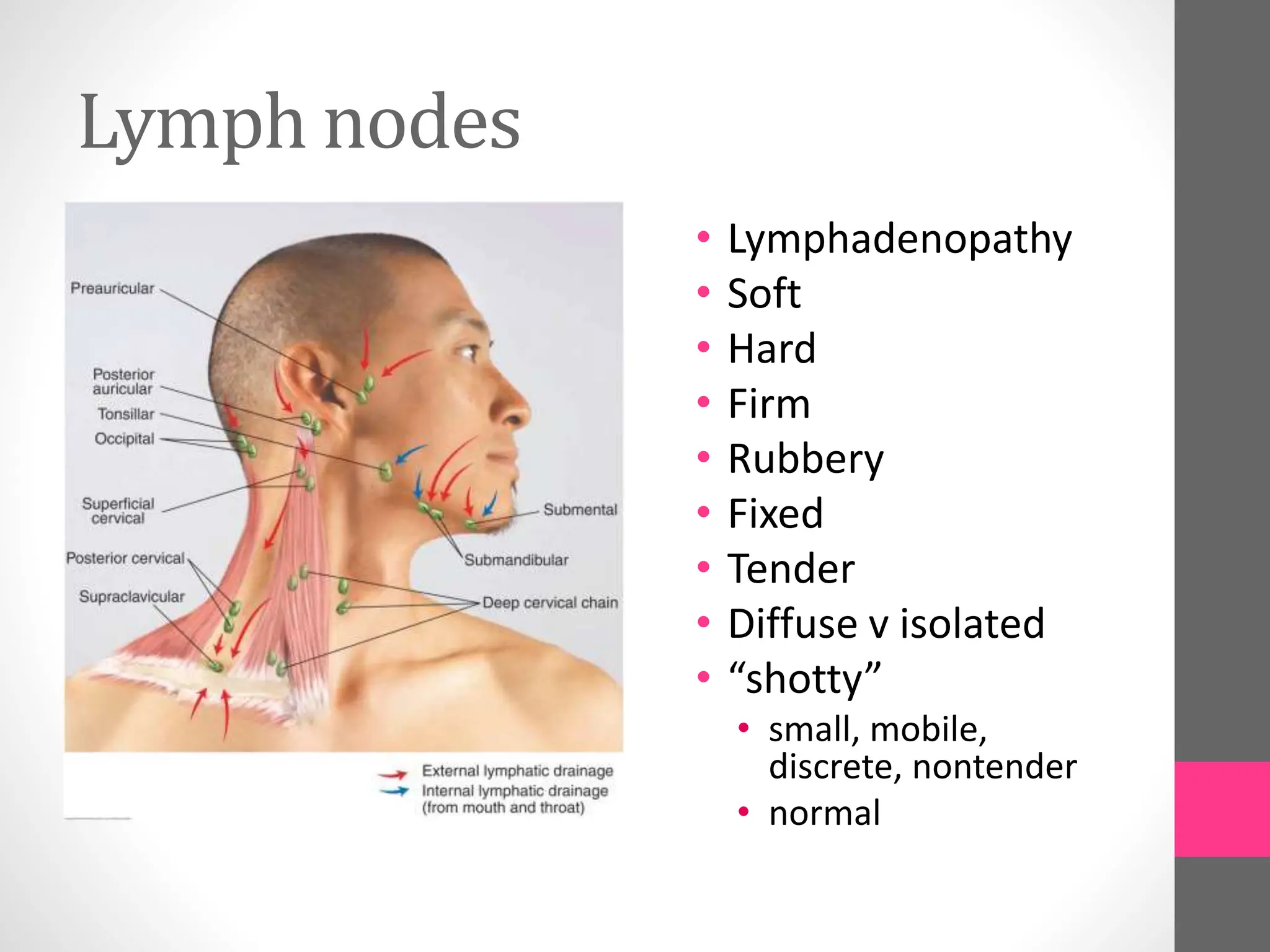
• Lymph nodes (size, shape, delimitation, mobility, consistency,
tenderness)
• Preauricular, posterior auricular, occipital, tonsillar, submandibular,
submental, superficial cervical, posterior cervical, deep cervical
chain, supraclavicular
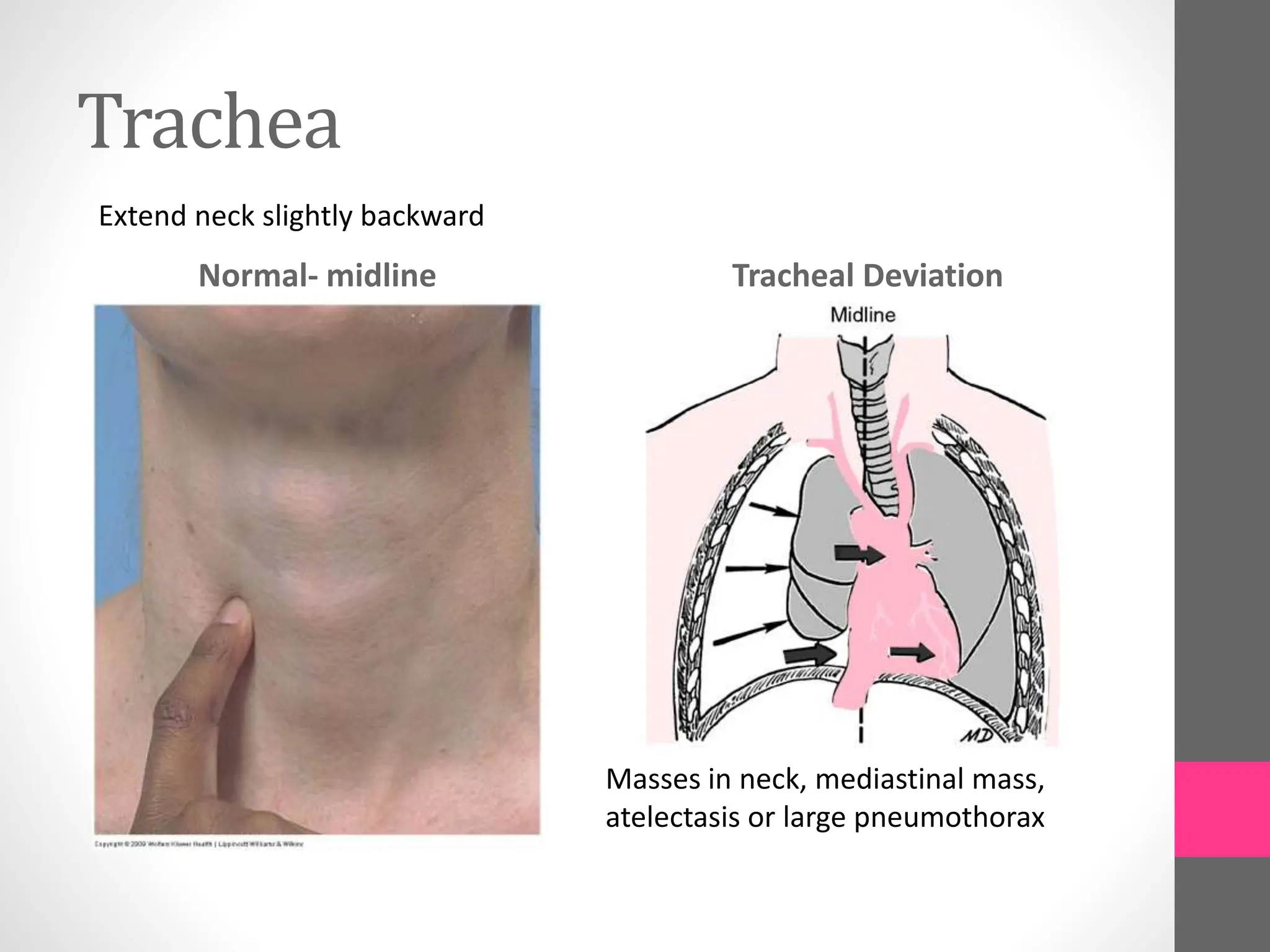
Trachea
Normal- midline Tracheal Deviation
Extend neck slightly backward
Masses in neck, mediastinal mass,
atelectasis or large pneumothorax
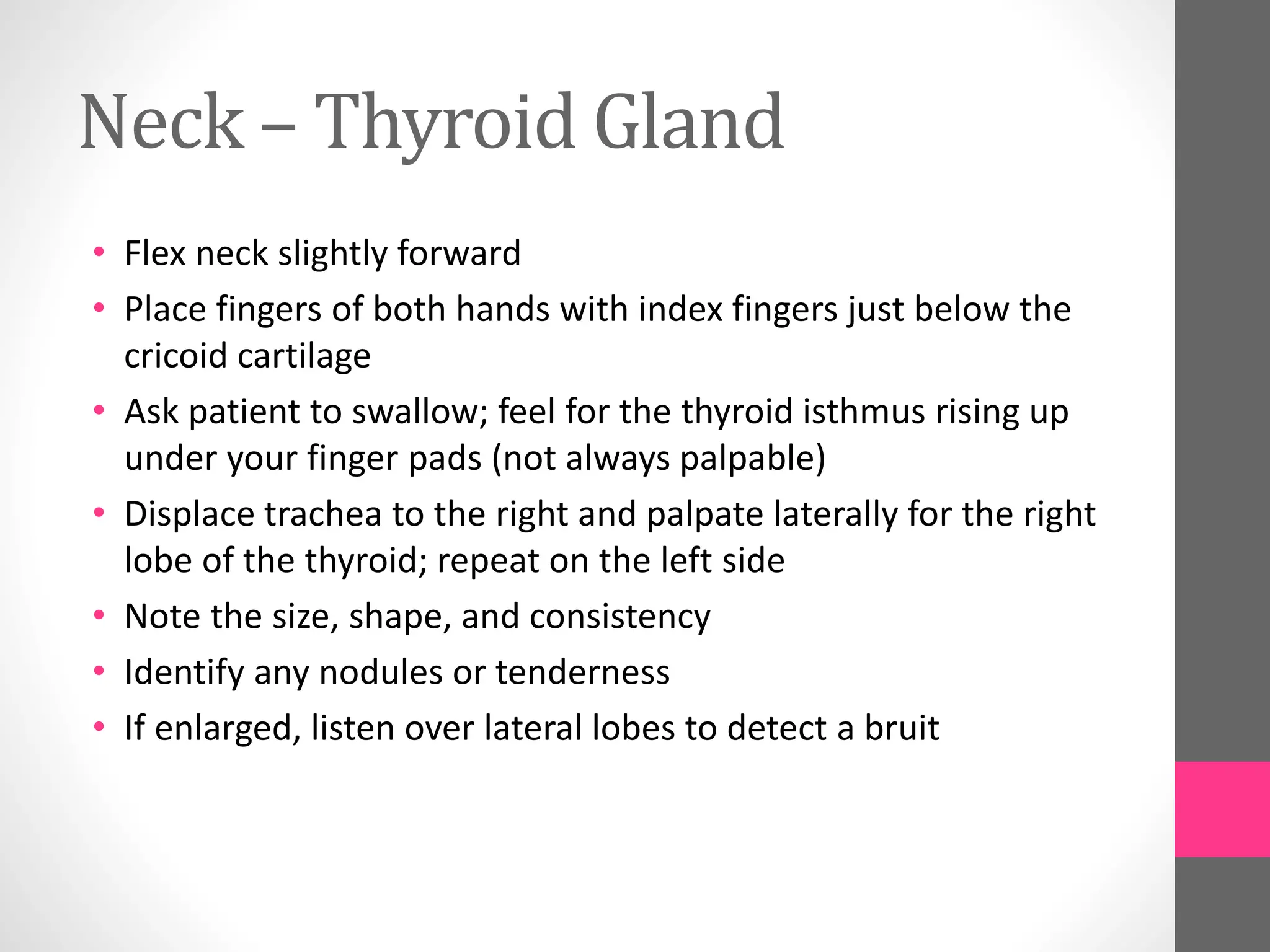
Neck – Thyroid Gland
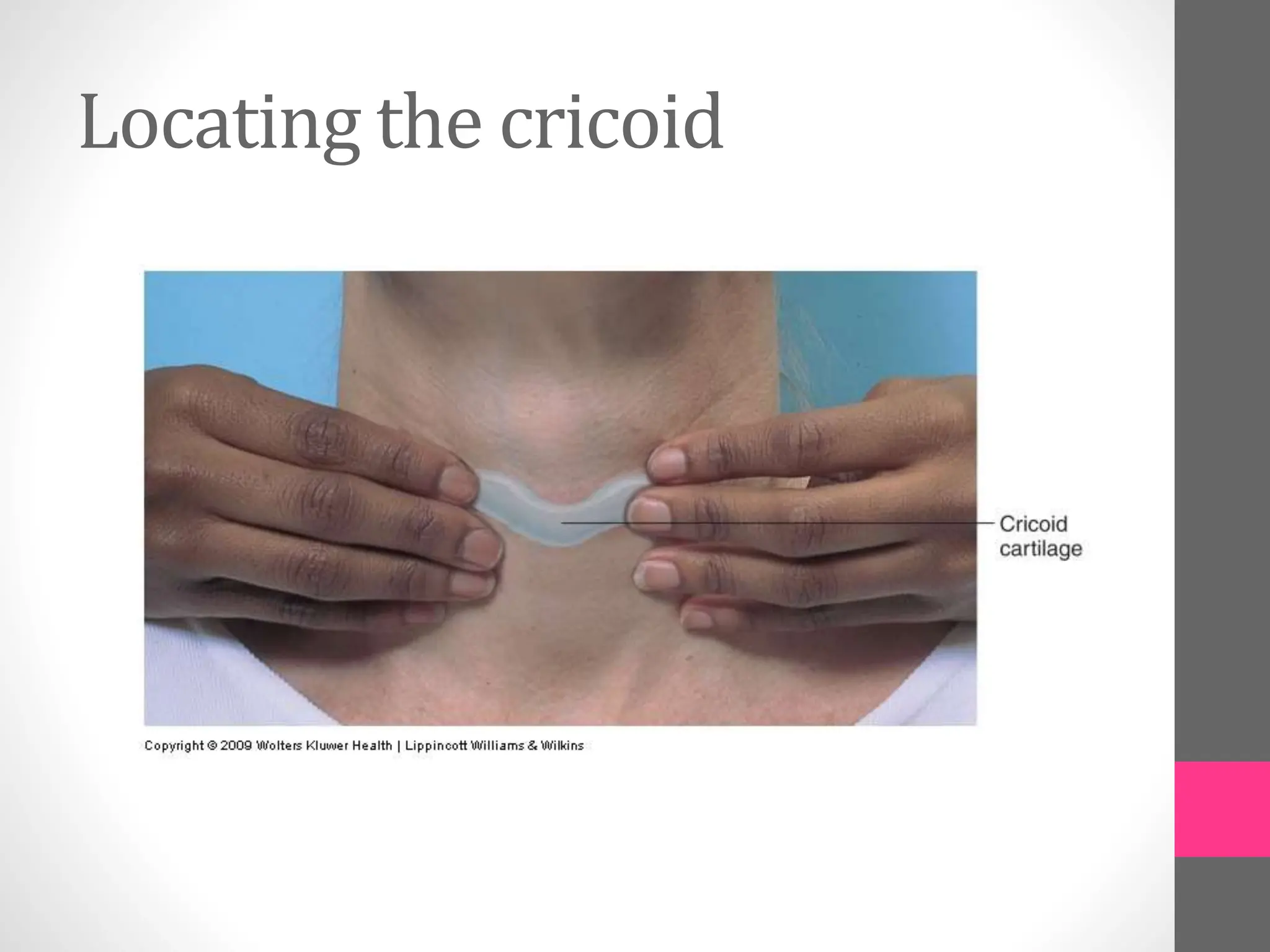
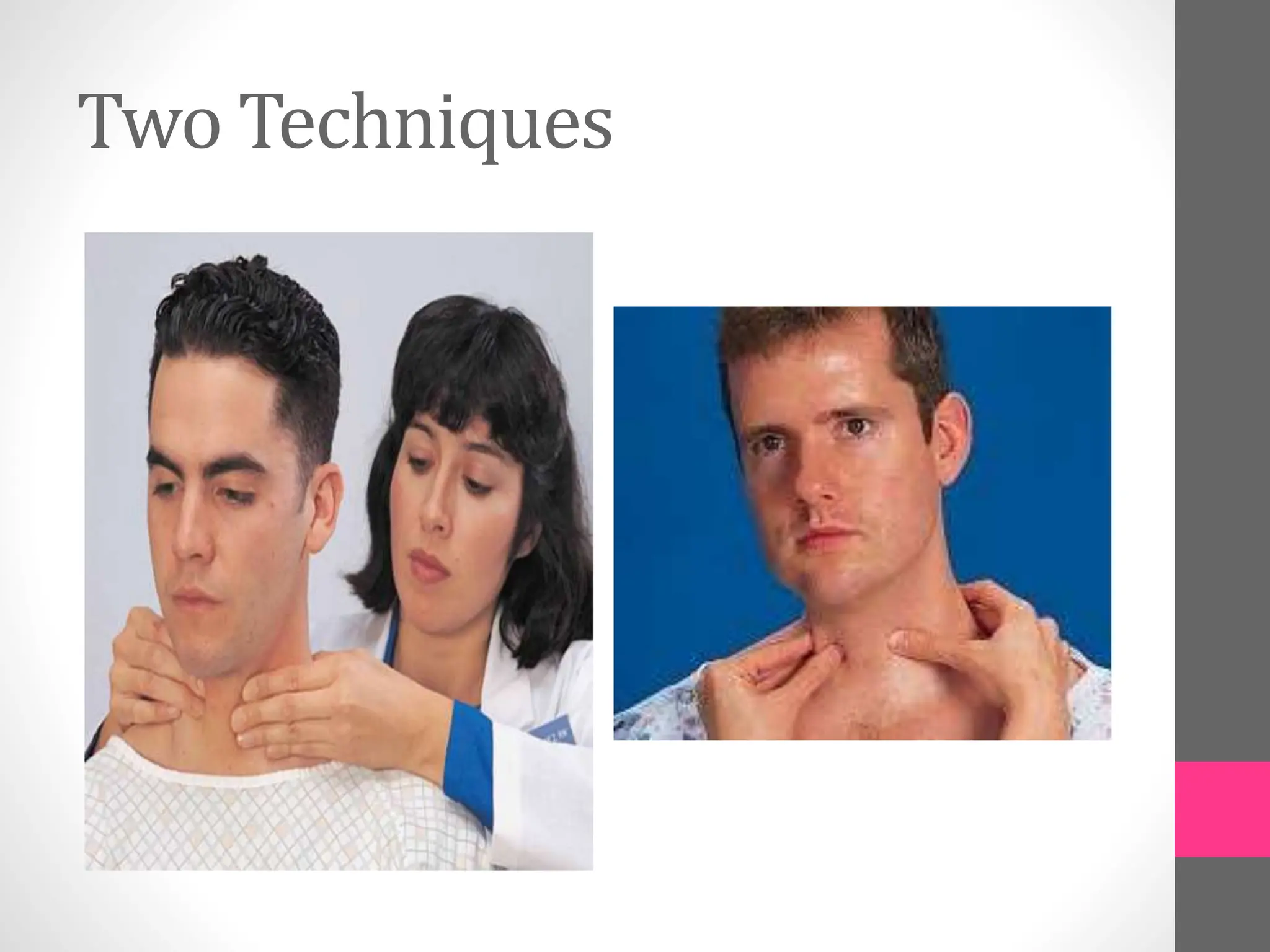
• Flex neck slightly forward
• Place fingers of both hands with index fingers just below the
cricoid cartilage
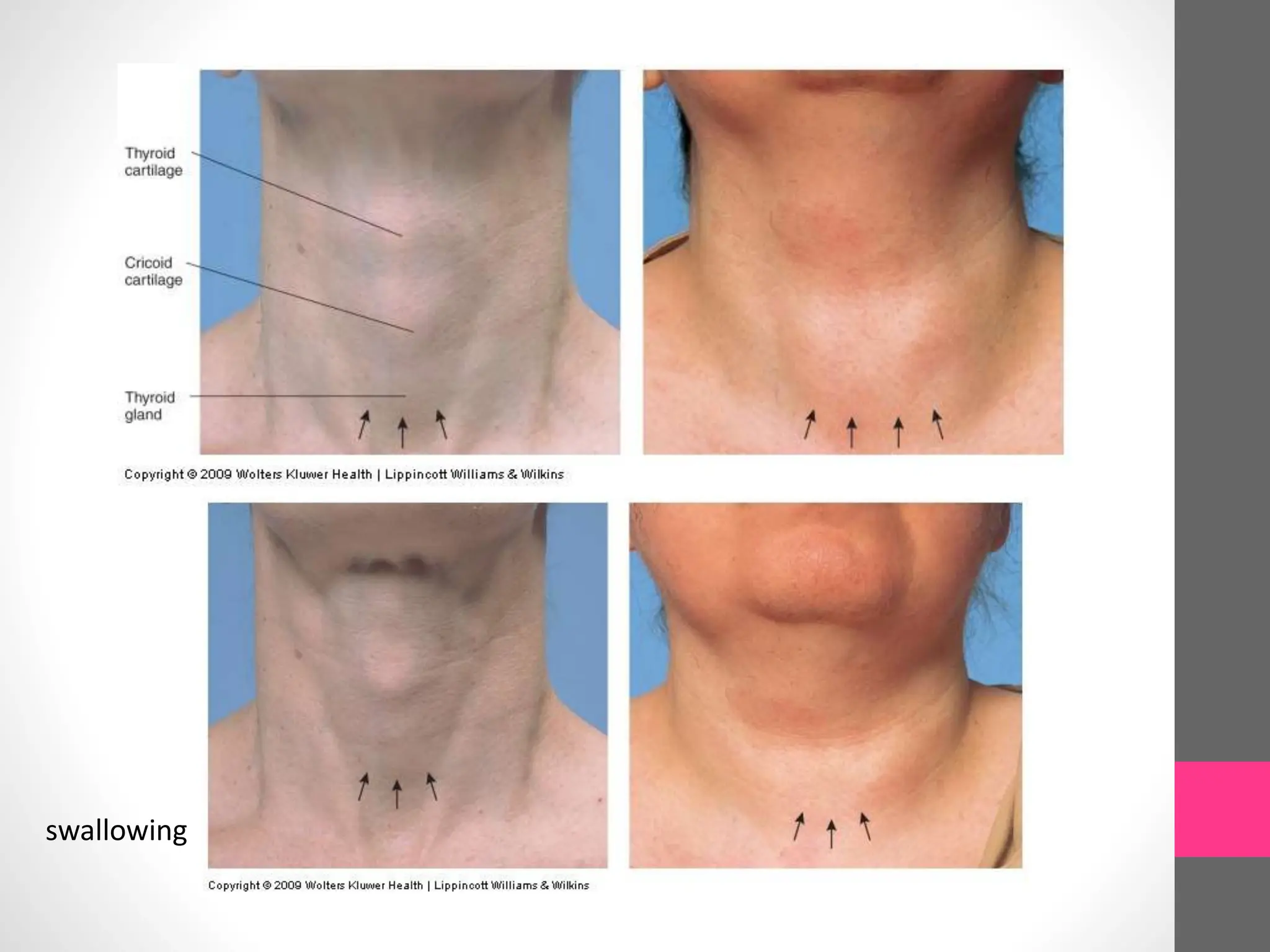
• Ask patient to swallow; feel for the thyroid isthmus rising up
under your finger pads (not always palpable)
• Displace trachea to the right and palpate laterally for the right
lobe of the thyroid; repeat on the left side
• Note the size, shape, and consistency
• Identify any nodules or tenderness
• If enlarged, listen over lateral lobes to detect a bruit
Locating the cricoid
swallowing
Two Techniques
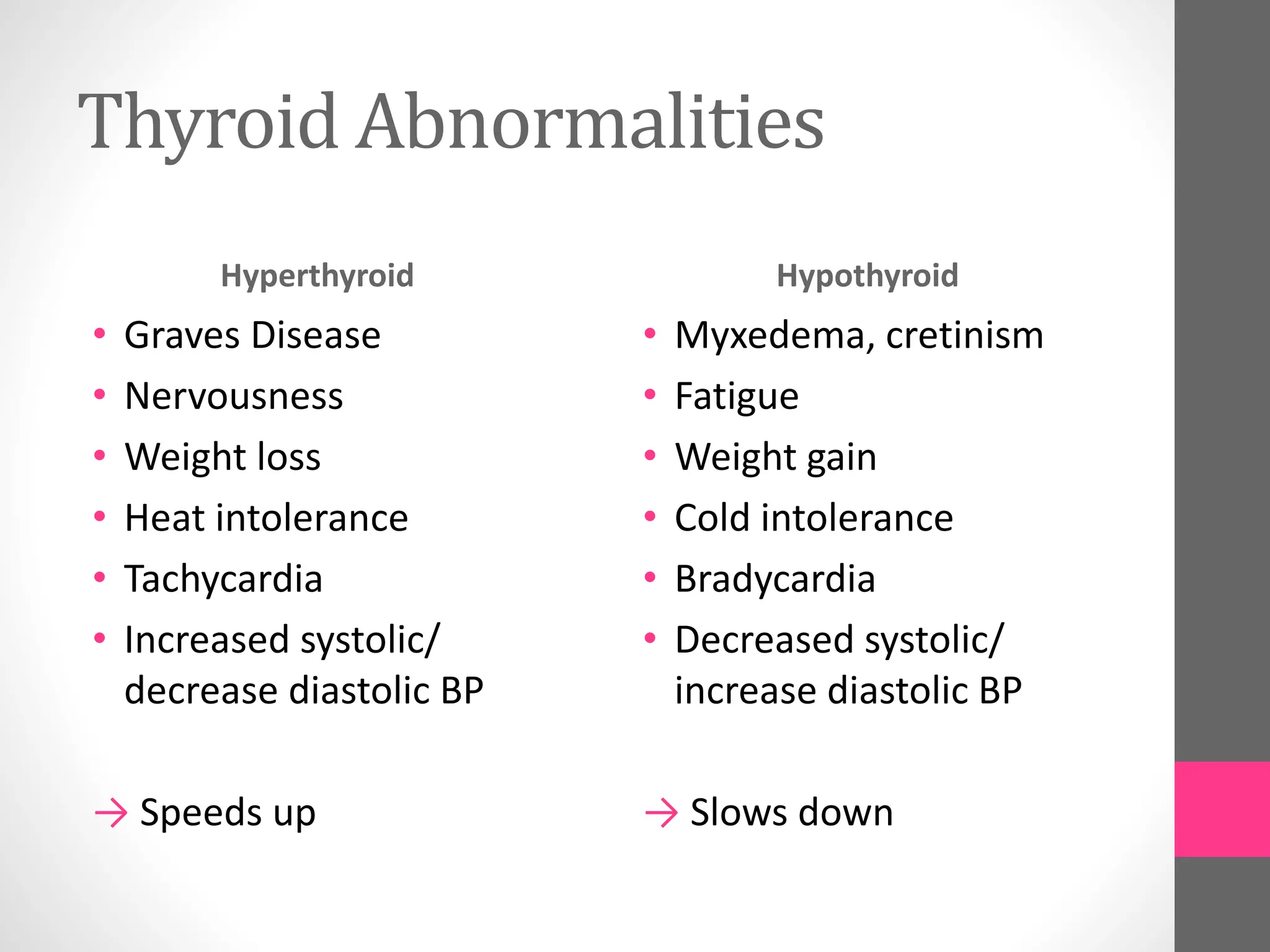
Thyroid Abnormalities
Hyperthyroid
• Graves Disease
• Nervousness
• Weight loss
• Heat intolerance
• Tachycardia
• Increased systolic/
decrease diastolic BP
→ Speeds up
Hypothyroid
• Myxedema, cretinism
• Fatigue
• Weight gain
• Cold intolerance
• Bradycardia
• Decreased systolic/
increase diastolic BP
→ Slows down
Lymph nodes
• Lymphadenopathy
• Soft
• Hard
• Firm
• Rubbery
• Fixed
• Tender
• Diffuse v isolated
• “shotty”
• small, mobile,
discrete, nontender
• normal
Question
• When palpating the thyroid, which of the following is true?
a. Flex the neck slightly backward
b. Place the index fingers just above the cricoid cartilage
c. The thyroid isthmus may not be palpable
d. A bruit auscultated over the lateral lobe is expected
Answer
C. The thyroid isthmus may not be palpable
• Ask the patient to swallow and feel for the thyroid isthmus rising
up under your finger pads (not always palpable)
• Flex the neck slightly forward
• Place fingers of both hands with index fingers just below the cricoid
cartilage
• If enlarged, listen over lateral lobes to detect a bruit
HEENT Documentation
• Head—The skull is normocephalic/atraumatic (NC/AT). Hair with
average texture.
• Eyes—Visual acuity 20/20 bilaterally. Sclera white, conjunctiva pink.
Pupils are 4 mm constricting to 2 mm, equally round and reactive to
light and accommodations. Disc margins sharp; no hemorrhages or
exudates, no arteriolar narrowing.
• Ears—Acuity good to whispered voice. Tympanic membranes (TMs)
with good cone of light. Weber midline. AC > BC.
• Nose— Nasal mucosa pink, septum midline; no sinus tenderness.
• Throat (or Mouth)— Oral mucosa pink, dentition good, pharynx
without exudates.
• Neck—Trachea midline. Neck supple; thyroid isthmus palpable,
lobes not felt.
• Lymph Nodes—No cervical, axillary, epitrochlear, inguinal
adenopathy
Abnormal HEENT Documentation
• Head—The skull is normocephalic/atraumatic. Frontal balding.
• Eyes— Visual acuity 20/100 bilaterally. Sclera white; conjunctiva
injected. Pupils constrict3 mm to 2 mm, equally round and reactive
to light and accommodation. Disc margins sharp; no hemorrhages or
exudates. Arteriolar-to-venous ratio (AV ratio) 2:4; no AV nicking.
• Ears—Acuity diminished to whispered voice; intact to spoken voice.
TMs clear.
• Nose—Mucosa swollen with erythema and clear drain- age. Septum
midline. Tender over maxillary sinuses.
• Throat—Oral mucosa pink, dental caries in lower molars, pharynx
erythematous, no exudates.
• Neck—Trachea midline. Neck supple; thyroid isthmus midline, lobes
palpable but not enlarged.
• Lymph Nodes—Submandibular and anterior cervical lymph nodes
tender, 1 × 1 cm, rubbery and mobile; no posterior cervical,
epitrochlear, axillary, or inguinal lymphadenopathy
Questions??

HEENT POWER POINT PRESENTATION USF SPRING 2016

  • 1.
    Health Assessment HEENT Christina Nardi,MSN, RN, CNL, DNP (c) University of San Francisco, SONHP Spring 2016 Adapted from Wolter Kluwer LWW
  • 2.
    Objectives 1. Describe thenormal appearance of the head, eyes, ears, neck, and throat (HEENT) 2. Describe and demonstrate techniques of examination of HEENT 3. Describe and demonstrate technique for assessment of lymph nodes 4. Describe the underlying principles for the techniques used to examine the neck and thyroid gland 5. Describe abnormal findings of HEENT • Readings: Chapter 7
  • 3.
    Health History Head Headache,history of head injury Eyes Visual disturbances, spots (scotomas), flashing lights, use of corrective lenses, pain, redness, excessive tearing, double vision (diplopia) Ears Hearing loss, ringing (tinnitus), vertigo, pain, discharge Nose Drainage (rhinorrhea), congestion, sneezing, nose bleeds (epistaxis) Oropharynx Sore throat, gum bleeding, hoarseness, Neck Swollen glands, goiter
  • 4.
  • 5.
  • 6.
    Headache History • Location •Point to the area of pain or discomfort. Unilateral or bilateral? • Quality • Sharp, aching, or pounding? • Quantity • Severe and sudden? Intensify over hours? Episodic? • Timing • Chronic or recurring? Change in the pattern? • Setting • Circumstances, environmental or emotional factors? • Remitting or exacerbating factors • Changed by coughing, sneezing, change of position? Analgesics? Ergots or triptans (med overuse headache)? • Associated Manifestations • N/V? Aura? Vision changes? Numbness? Weakness? Dizziness?
  • 7.
    RED Flags • Progressivelyfrequent or severe over 3 month period • “Thunderclap” or “worst headache of my life” • New onset > 50 years old • Aggravated or relieved by change in position • Precipitated by valsalva maneuver • Associated w/ fever, night sweats, or weight loss • Presence of cancer, HIV infection, or pregnancy • Recent head trauma • Associated papilledema, neck stiffness, focal neuro deficits
  • 8.
    Head – Inspectionand Palpation • Inspect • Hair distribution, quantity • Scalp – scaling, nevi • Skull – size, contour • Face – expression, contours • Skin – color, pigmentation, hair distribution, lesions • Palpate • Hair texture • Skull – lumps • Face – sinuses • Skin – texture, temperature
  • 9.
    Head Terminology • Finehair • Coarse hair • White ovoid granules • Redness, scaling • Enlarged skull • Tenderness • Hirsutism → Hyperthyroid → Hypothyroid → Nits → Seborrheic dermatitis, psoriasis → Hydrocephalus, Paget’s → Head trauma → Excessive facial hair
  • 10.
    Face Abnormalities • Cushing’sSyndrome • Nephrotic Syndrome • Myxedema • Parotid Gland enlargement • Acromegaly • Parkinson’s disease
  • 11.
  • 12.
  • 13.
  • 14.
  • 15.
  • 16.
    History • How isyour vision? • Any trouble with your eyes? • Do you wear glasses or contacts? • Do you have eye pain? • Blurred vision?
  • 17.
    Eyes - Inspection •Position and alignment of eyes • Eyebrows - quantity, distribution • Eyelids • Width of palpebral fissures • Edema, color, lesions • Condition and direction of eyelashes • Adequacy of closed eyelids • Lacrimal apparatus • Lacrimal gland and sac for swelling • Conjunctiva and sclera • Color, vascular pattern • Cornea and lens - opacities • Iris – markings clearly defined • Pupils – size, shape, symmetry, reaction to light (direct and consensual)
  • 18.
    Eye Terminology • Diplopia •Floaters • Scotomas • Hyperopia • Myopia • Presbyopia • Strabismus • Nystagmus • Anisocoria → Double vision → Moving flecks or strands → Fixed retinal defect → Farsightedness (impaired near) → Nearsightedness (impaired far) → Aging vision (impaired far) → Misaligned eyes → fine rhythmic oscillation of the eyes → difference in pupil size > 0.04 mm
  • 19.
    Eyelid Abnormalities Ptosis Lid Retractionsand exophthalmos Droopy eyelid Eye protruding, hyperthyroidism
  • 20.
    Eyelid Abnormalities Entropion Ectropion Bottomturned inward, can scratch eye Bottom turned outward
  • 21.
    Eye Examinations • VisualAcuity • Corneal Reflection • Pupils (PERRLA) • Extraocular Muscles (EOM) • Visual Fields
  • 22.
    Visual Acuity • Centralvision: • Snellen eye chart; position patient 20 feet from the chart • Patients should wear glasses if needed • Test one eye at a time • Near vision • hand-held card (can also use to test visual acuity at the bedside) • hold 14 inches from patient’s eyes • Legally blind when vision in the better eye, even if corrected it lenses is 20/200
  • 23.
    Corneal Reflection • Standabout 2-feet in front of patient • Shine light into the patient’s eye while they look straight ahead • Inspect the reflection in the corneas, they should be visible in same spot • Abnormal reflection • Asymmetry of the corneal reflection indicates a deviation from normal ocular alignment
  • 24.
    Cover-Uncover Test • Whenabnormal corneal reflection • Cover one eye and have patient look directly ahead at the light • Rapidly uncover eye and watch for symmetry • Abnormal • When covered the affected eye moves outward to fix on the light • When uncovered the eye returns to deviated position Right monocular esotropia
  • 25.
  • 26.
    Light Reaction • Standabout 2-feet directly in front of the patient • Shine light into the patient’s eye • Direct reaction • pupillary constriction in the same eye • Consensual reaction • pupillary constriction in the opposite eye
  • 27.
    Anisocoria • Blunt traumato the eye • Head trauma • Oculomotor nerve paralysis • Open-angle glaucoma Right pupil fixed and dilated - herniation of temporal lobe
  • 28.
  • 29.
    Documenting pupil size •Expected: 2 to 3 mm • Miosis: pinpoint • Narcotics • Mydriasis: dilation • Anoxia, cocaine, amphetamines
  • 30.
    Extraocular movement • Sixcardinal directions of gaze • Normal conjugate movements • Nystagmus • Lid lag • Convergence • Test of CN III, IV, VI
  • 31.
    EOMs Making a wide“H” in the air, have the patient follow your finger or light
  • 32.
  • 33.
  • 34.
    Nystagmus Fine rhythmic oscillationof the eyes “lazy eye”
  • 35.
    Lid Lag Normal Abnormal Followfinger from up to down in midline
  • 36.
  • 37.
    Visual Fields • Screening •Both eyes at same time; start in the temporal fields • Further testing • If a defect is found, test one eye at a time
  • 38.
    Confrontation • Peripheral VisionTest • Imagine patient has glass bowl around head • Start lateral to ears and instruct the patient to look straight ahead and tell you when your fingers are seen • Both eyes together • Eyes individually • Abnormal • Loss of defect of peripheral vision in a field
  • 39.
    Visual Field Defect 1.Horizontal 2. Blind Optic Nerve 3. Bitemporal Hemianopsia 4. Homonymous Hemianopsia (optic tract) 5. Homonymous Quadratic Defect 6. Homonymous Hemianopsia (optic radiation)
  • 40.
    Visual Field Defect 1.Horizontal 2. Blind Right Optic Nerve • Blindness on unilateral side 3. Bitemporal Hemianopsia 4. Left Homonymous Hemianopsia (optic tract) 5. Homonymous Left Superior Quadratic Defect 6. Homonymous Hemianopsia (optic radiation)
  • 41.
    Special Techniques • EyeProtrusion • Stand behind the patient and inspect from above • Nasolacrimal Duct Obstruction • Ask the pt to look up and press on lower lid near medial canthus, look for fluid regurgitation • Upper Palpebral Conjunctiva • To search for foreign body • Ask the pt to look down, grasp upper lashes and roll up along applicator stick, everting the eyelid • Swinging flashlight test • Test pupillary reaction, consensual reaction
  • 42.
    Eye Abnormalities • Conjunctivitis •Subconjunctival Hemorrhage • Acute Iritis • Glaucoma • Corneal Arcus • Pterygium • Cataracts → Pink eye → Leakage of blood → Red inflammation around iris → Pressure builds behind the eye →Acute angle closure –EMERGENCY → Greyish white arc → Fleshlike covering of eye → Cloudy pupil w/ white scar tissue over the area
  • 43.
  • 44.
  • 45.
    Ears – Inspectionand Palpation • Inspection • Auricle for redness, lesions • Ear canal • Otorrhea (Discharge), foreign bodies, redness, swelling • Tympanic membrane • Color, contour • Palpation • Auricle for lumps, tenderness
  • 46.
    Ear Terminology • Cerumen •Conductive loss • Dizziness • Vertigo • Meniere’s disease • Otitis externa • Otitis media • Sensorineural loss • Tinnitus → Ear wax → Outer ear problem → You are spinning → The room is spinning → Ringing, vertigo hearing loss → External ear infection → Middle ear infection → Inner ear problem → Ringing
  • 47.
  • 48.
    Ears - Hearing •Auditory acuity • Test one ear at a time • Whisper test, standing 1-2 feet behind patient, softly say “nine-four,” “baseball” • Finger rub • Air and bone conduction • Weber • Lateralization of sound • Rinne • Compare time of air vs. bone conduction • Bone conduction bypasses the external and middle ear
  • 49.
    Hearing Loss Conductive LossSensorineural Loss Problems in the external or middle ear Problems in the inner ear, cochlear nerve, or central connections in the brain
  • 50.
    Weber Test • Lateralizationof sound to impaired ear → suspect unilateral conductive hearing loss • Lateralization of sound to good ear → suspect unilateral sensorineural hearing loss
  • 52.
    Rinne Test Bone ConductionAir Conduction Conductive loss BC=AC or BC > AC Sensorineural loss AC >BC Normal AC >BC
  • 53.
  • 54.
    Ear Abnormalities • Perforation •Tympanosclerosis • Serous Otitis • Acute Otitis • External Otitis • Exotosis → Hole in the ear drum → chalky white patch → Eustacian tube filled with mucus → redness → “swimmer’s ear” → growth across the ear to protect/block tympanic membrane
  • 55.
  • 56.
  • 57.
    Nose and SinusTerms • Acute sinusitis • Chronic sinusitis • Allergic Rhinitis • Epistaxis • Rhinitis medicamentosa • Rhinorrhea • URI • Vasomotor rhinitis →Infection < 6 weeks →Infection > 6 weeks →Hayfever, allergic itching →Nose bleeds →Excessive decongestant use →Runny nose →Upper Respiratory Infection →Vascular congestion
  • 58.
    Nose and Sinuses– Inspection/Palpation • Inspection • Anterior and inferior surface – asymmetry or deformity • Inside of nose • Mucosa – color, swelling, bleeding, exudate, ulcers, or polyps • Septum – deviation, inflammation, or perforation • Turbinates – use otoscope to view middle and inferior turbinates • Sense of smell • Close eyes and identify odors • Palpation of sinuses – frontal and maxillary • Press up on the frontal sinuses from under the bony brows • Press up pm the maxillary sinuses from under the cheek bones
  • 59.
  • 60.
    Palpate Front &Maxillary sinuses ethmoid and sphenoid are too deep
  • 61.
    Special Technique Transillumination ofthe sinuses • Frontal • Darken the room and use strong, narrow light source • Place the light snugly under each brow , close to nose • Dim red glow as light transmitted through air- filled frontal sinus • Maxillary • Tilt head back, mouth open wide • Shine light downward from just below inner aspect of eye • Look through open mouth at hard palate for reddish glow transmitted through air-filled maxillary sinus Absence of glow indicates thickened mucosa or secretions
  • 62.
  • 63.
  • 64.
    Mouth and Pharynx- Inspection • Lips • Note color, moisture, lumps, ulcers, cracking, or scaliness • Oral mucosa • Note color, ulcers, and nodules • Gums and teeth • Note color, presence, and position of teeth • Roof of mouth • Note color • Tongue and floor of mouth • Note color and texture, ulcers, nodules • Midline • Pharynx: soft palate, anterior and posterior pillars, uvula, tonsils, and pharynx • Note color, symmetry, presence of exudate, swelling, ulceration, or tonsillar enlargement
  • 65.
    Mouth and ThroatAbnormalities • Herpes Simplex • Tonsillar Hypertrophy • Thrush, candidiasis • Torus palatinus • Leukoplakia • Gingivitis • Gingival hyperplasia • Dental Caries → vesicular eruptions → Enlarged tonsils → thick white plaques → Midline bony growth in hard palate →Thickened white patch → Swollen gum margins →Enlarged gums, cover teeth → Cavities
  • 66.
  • 67.
    Gingival hyperplasia MethMouth Angioedema Aphthous Ulcer (canker sore)
  • 68.
    Candidiasis CN X Paralysis Uvuladeviation Soft palate fails to rise
  • 69.
  • 70.
  • 71.
    Neck – Inspectionand Palpation • Inspection • Symmetry, masses, scars, enlarged glands or lymph nodes, enlarged vessels • Trachea – position, alignment • Thyroid gland - symmetry • Palpation • Lymph nodes (size, shape, delimitation, mobility, consistency, tenderness) • Preauricular, posterior auricular, occipital, tonsillar, submandibular, submental, superficial cervical, posterior cervical, deep cervical chain, supraclavicular
  • 72.
    Trachea Normal- midline TrachealDeviation Extend neck slightly backward Masses in neck, mediastinal mass, atelectasis or large pneumothorax
  • 73.
    Neck – ThyroidGland • Flex neck slightly forward • Place fingers of both hands with index fingers just below the cricoid cartilage • Ask patient to swallow; feel for the thyroid isthmus rising up under your finger pads (not always palpable) • Displace trachea to the right and palpate laterally for the right lobe of the thyroid; repeat on the left side • Note the size, shape, and consistency • Identify any nodules or tenderness • If enlarged, listen over lateral lobes to detect a bruit
  • 74.
  • 75.
  • 76.
  • 77.
    Thyroid Abnormalities Hyperthyroid • GravesDisease • Nervousness • Weight loss • Heat intolerance • Tachycardia • Increased systolic/ decrease diastolic BP → Speeds up Hypothyroid • Myxedema, cretinism • Fatigue • Weight gain • Cold intolerance • Bradycardia • Decreased systolic/ increase diastolic BP → Slows down
  • 78.
    Lymph nodes • Lymphadenopathy •Soft • Hard • Firm • Rubbery • Fixed • Tender • Diffuse v isolated • “shotty” • small, mobile, discrete, nontender • normal
  • 79.
    Question • When palpatingthe thyroid, which of the following is true? a. Flex the neck slightly backward b. Place the index fingers just above the cricoid cartilage c. The thyroid isthmus may not be palpable d. A bruit auscultated over the lateral lobe is expected
  • 80.
    Answer C. The thyroidisthmus may not be palpable • Ask the patient to swallow and feel for the thyroid isthmus rising up under your finger pads (not always palpable) • Flex the neck slightly forward • Place fingers of both hands with index fingers just below the cricoid cartilage • If enlarged, listen over lateral lobes to detect a bruit
  • 81.
    HEENT Documentation • Head—Theskull is normocephalic/atraumatic (NC/AT). Hair with average texture. • Eyes—Visual acuity 20/20 bilaterally. Sclera white, conjunctiva pink. Pupils are 4 mm constricting to 2 mm, equally round and reactive to light and accommodations. Disc margins sharp; no hemorrhages or exudates, no arteriolar narrowing. • Ears—Acuity good to whispered voice. Tympanic membranes (TMs) with good cone of light. Weber midline. AC > BC. • Nose— Nasal mucosa pink, septum midline; no sinus tenderness. • Throat (or Mouth)— Oral mucosa pink, dentition good, pharynx without exudates. • Neck—Trachea midline. Neck supple; thyroid isthmus palpable, lobes not felt. • Lymph Nodes—No cervical, axillary, epitrochlear, inguinal adenopathy
  • 82.
    Abnormal HEENT Documentation •Head—The skull is normocephalic/atraumatic. Frontal balding. • Eyes— Visual acuity 20/100 bilaterally. Sclera white; conjunctiva injected. Pupils constrict3 mm to 2 mm, equally round and reactive to light and accommodation. Disc margins sharp; no hemorrhages or exudates. Arteriolar-to-venous ratio (AV ratio) 2:4; no AV nicking. • Ears—Acuity diminished to whispered voice; intact to spoken voice. TMs clear. • Nose—Mucosa swollen with erythema and clear drain- age. Septum midline. Tender over maxillary sinuses. • Throat—Oral mucosa pink, dental caries in lower molars, pharynx erythematous, no exudates. • Neck—Trachea midline. Neck supple; thyroid isthmus midline, lobes palpable but not enlarged. • Lymph Nodes—Submandibular and anterior cervical lymph nodes tender, 1 × 1 cm, rubbery and mobile; no posterior cervical, epitrochlear, axillary, or inguinal lymphadenopathy
  • 83.