physical
examination
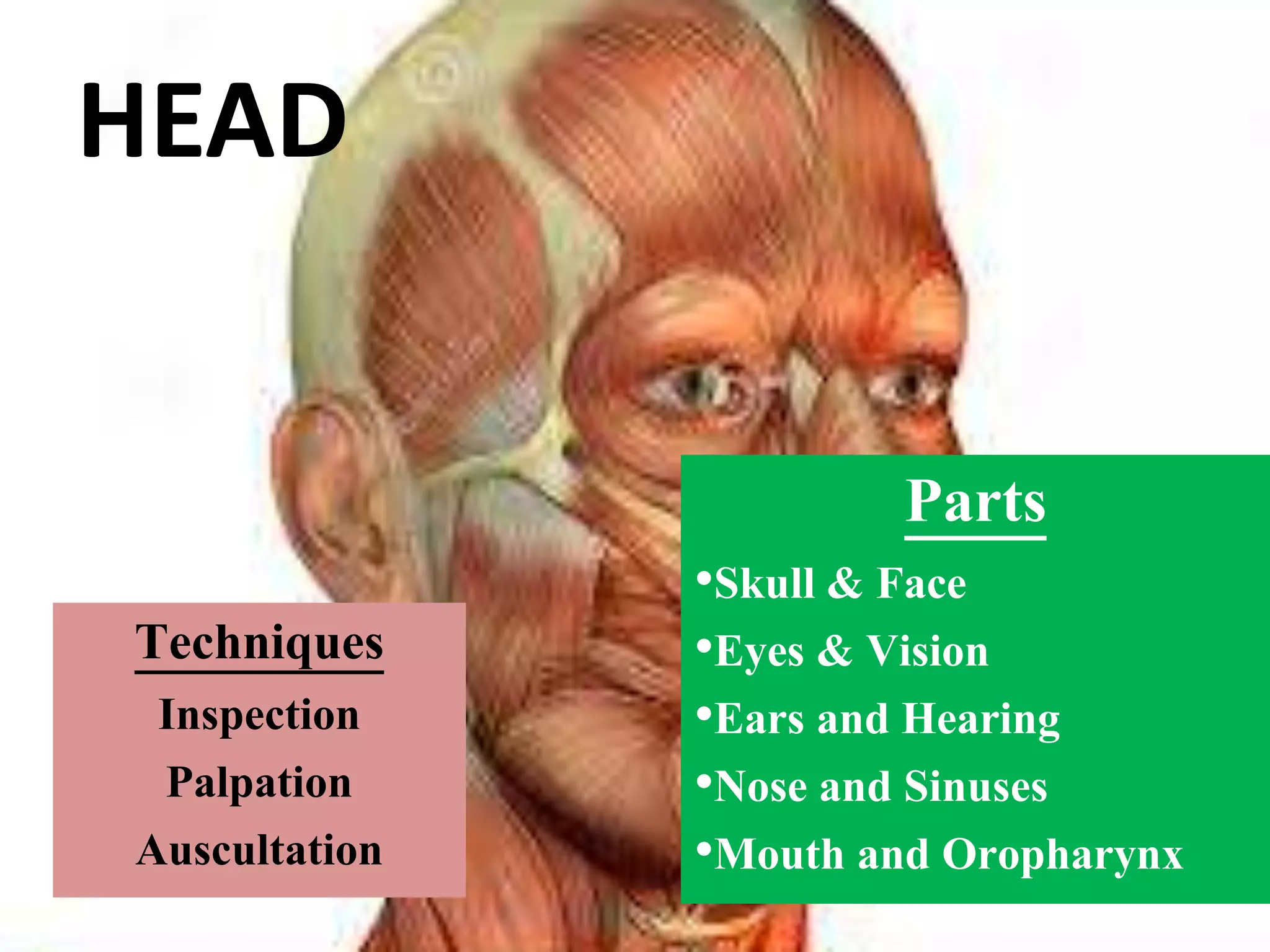
HEAD
Techniques
Inspection
Palpation
Auscultation
Parts
•Skull & Face
•Eyes & Vision
•Ears and Hearing
•Nose and Sinuses
•Mouth and Oropharynx
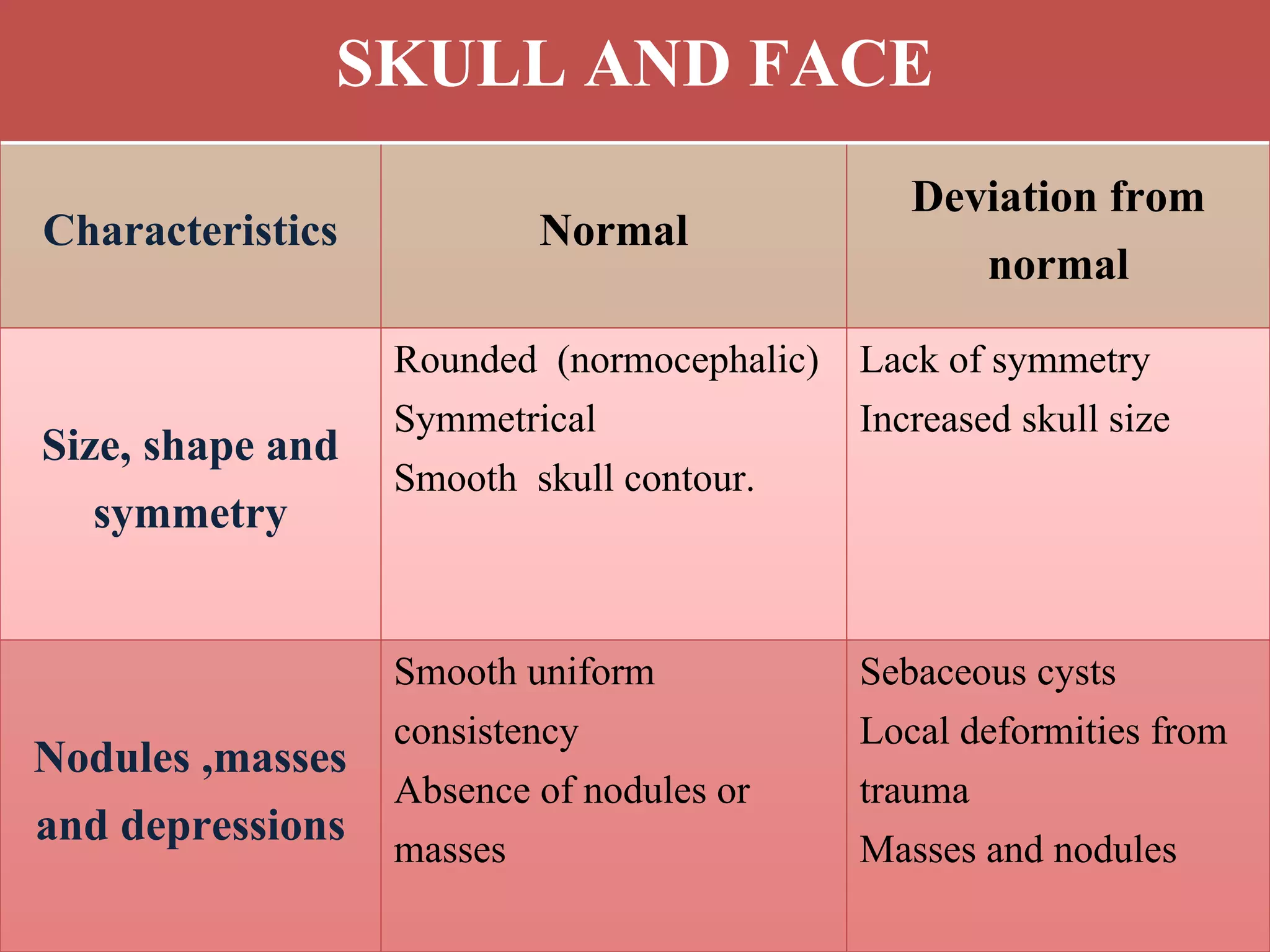
SKULL AND FACE
Characteristics Normal
Deviation from
normal
Size, shape and
symmetry
Rounded (normocephalic)
Symmetrical
Smooth skull contour.
Lack of symmetry
Increased skull size
Nodules ,masses
and depressions
Smooth uniform
consistency
Absence of nodules or
masses
Sebaceous cysts
Local deformities from
trauma
Masses and nodules
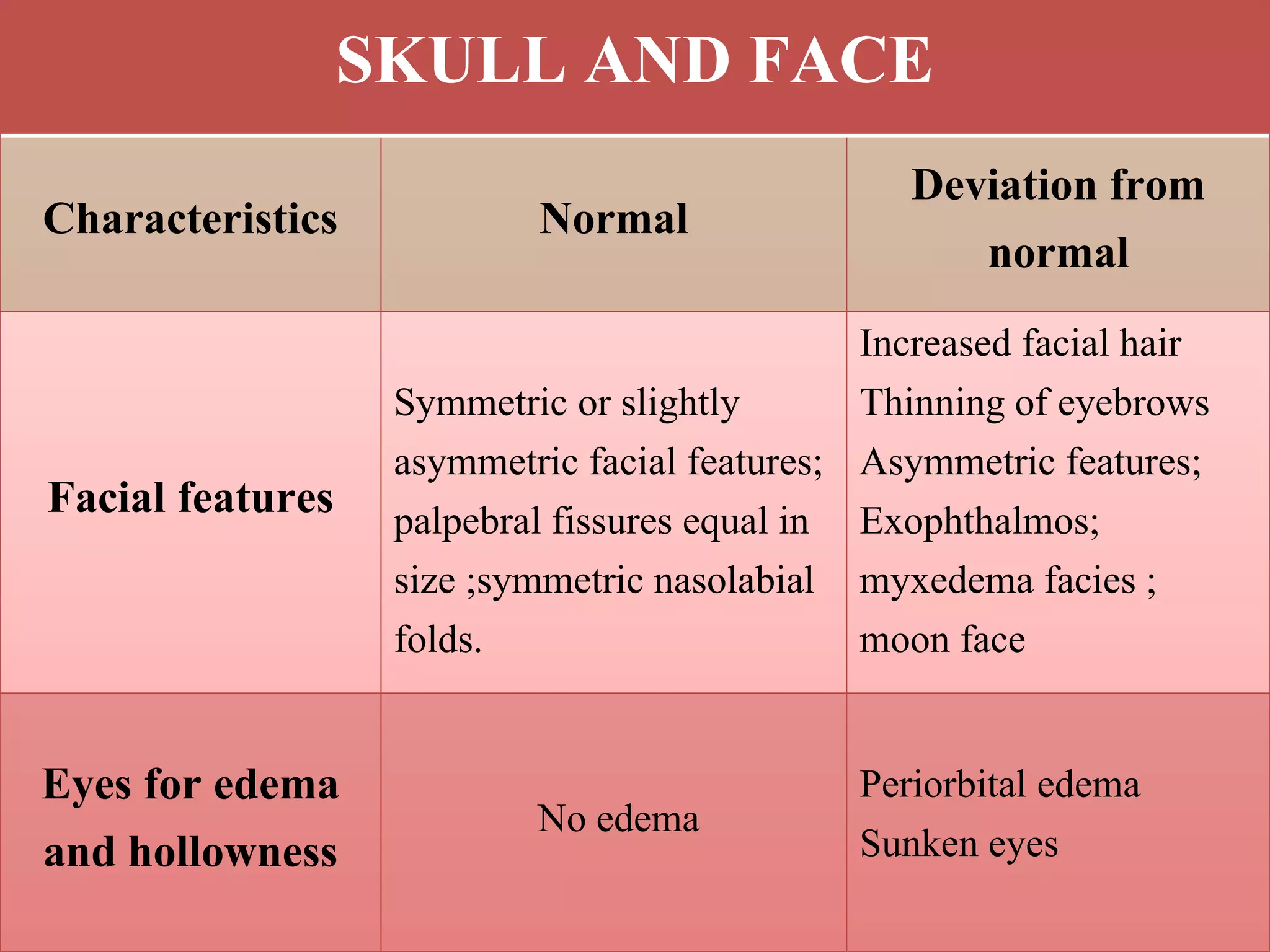
SKULL AND FACE
Characteristics Normal
Deviation from
normal
Facial features
Symmetric or slightly
asymmetric facial features;
palpebral fissures equal in
size ;symmetric nasolabial
folds.
Increased facial hair
Thinning of eyebrows
Asymmetric features;
Exophthalmos;
myxedema facies ;
moon face
Eyes for edema
and hollowness
No edema
Periorbital edema
Sunken eyes
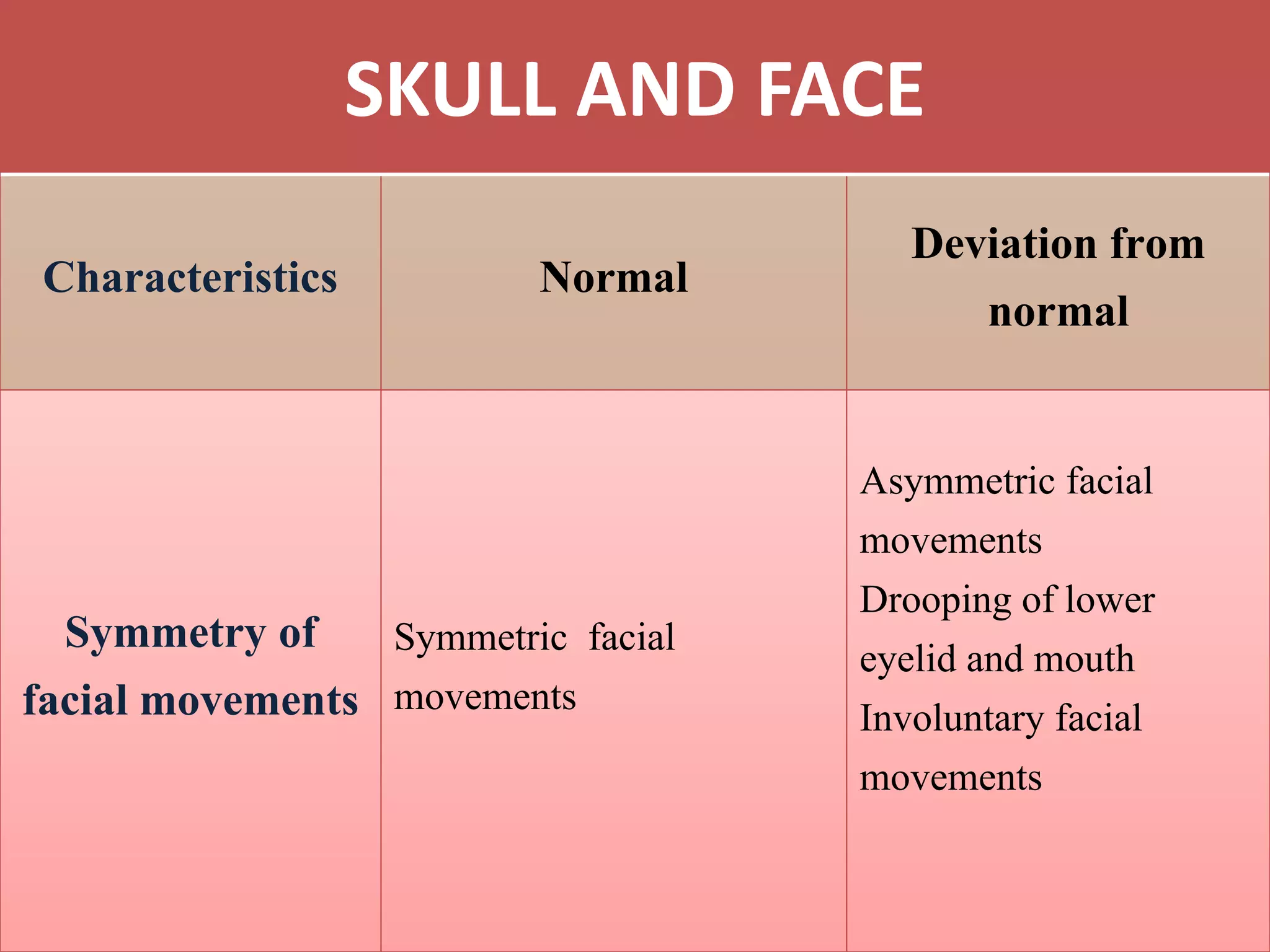
SKULL AND FACE
Characteristics Normal
Deviation from
normal
Symmetry of
facial movements
Symmetric facial
movements
Asymmetric facial
movements
Drooping of lower
eyelid and mouth
Involuntary facial
movements
EYES AND VISION
Equipments
•Cotton tip applicator
•Gauze square
•Clean gloves
•Millimeter ruler
•Penlight
•Snellen’s or E chart
•Opaque card
Assessment of eye includes,
•External eye structures
•Visual fields
•Extra ocular muscle tests
•Visual acuity
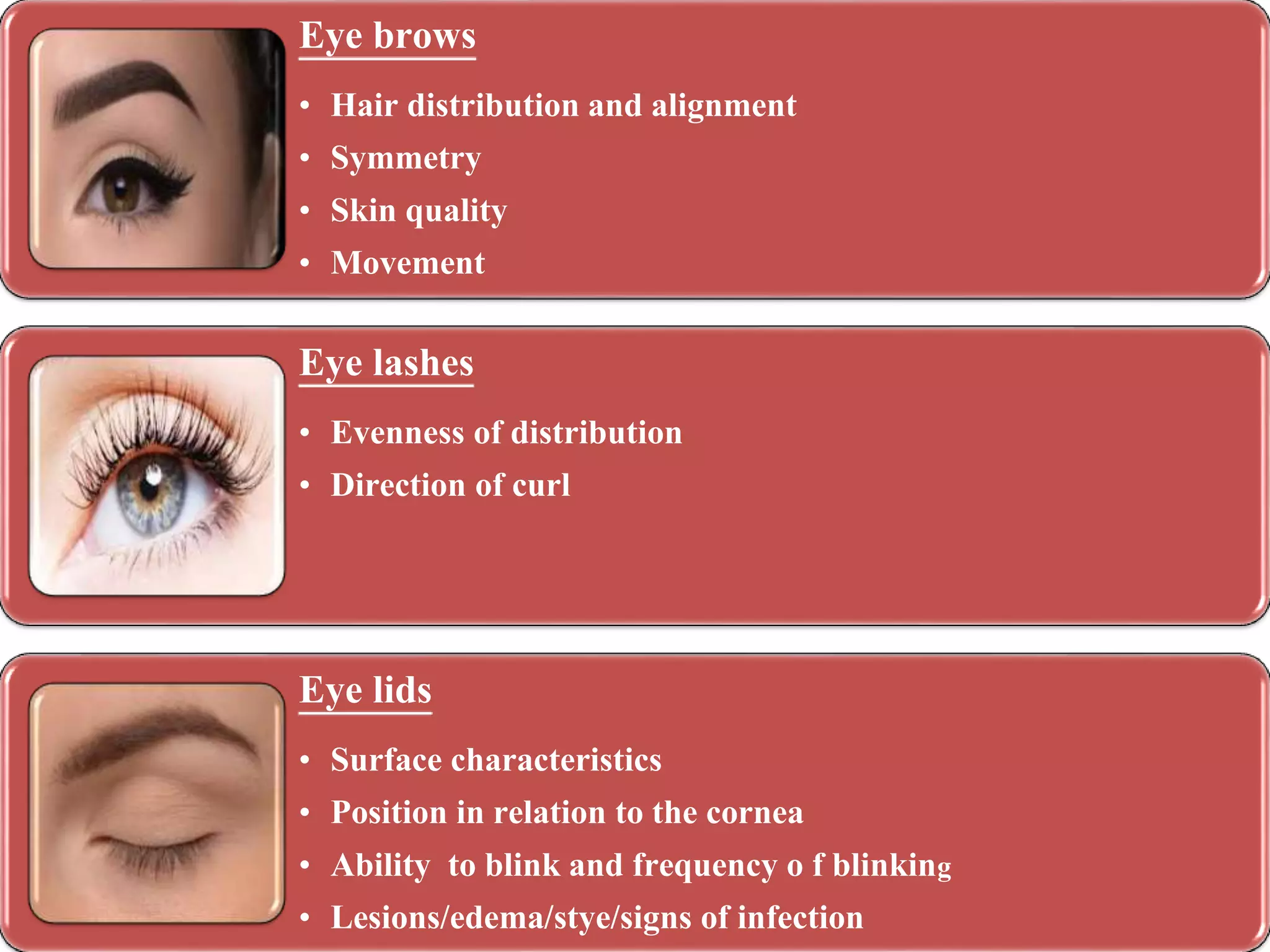
Eye brows
• Hair distribution and alignment
• Symmetry
• Skin quality
• Movement
Eye lashes
• Evenness of distribution
• Direction of curl
Eye lids
• Surface characteristics
• Position in relation to the cornea
• Ability to blink and frequency o f blinking
• Lesions/edema/stye/signs of infection
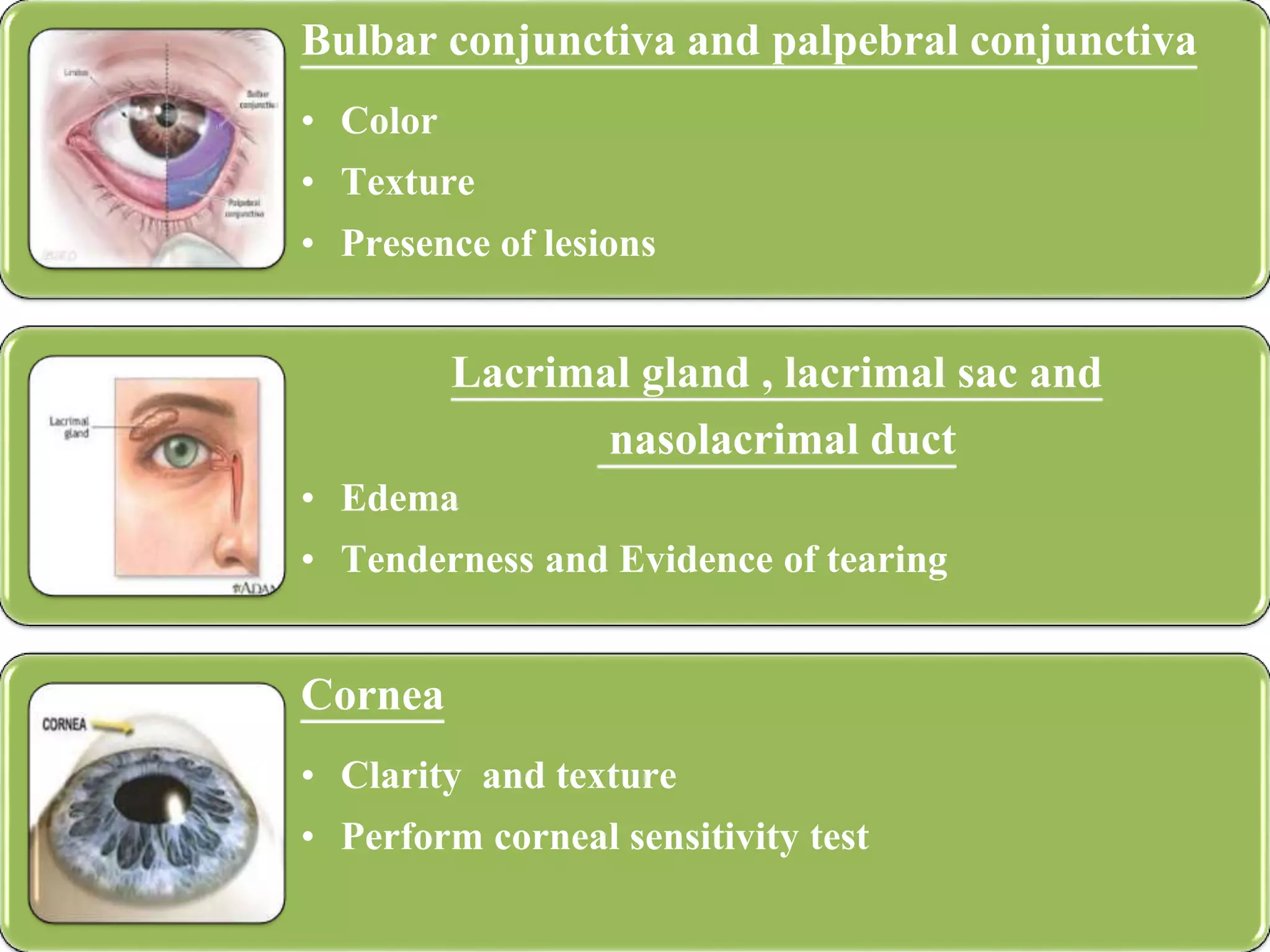
Bulbar conjunctiva and palpebral conjunctiva
• Color
• Texture
• Presence of lesions
Lacrimal gland , lacrimal sac and
nasolacrimal duct
• Edema
• Tenderness and Evidence of tearing
Cornea
• Clarity and texture
• Perform corneal sensitivity test
Anterior chamber
• Transparency
• Depth
Pupils
• Color/shape/symmetry of size
• PERRLA (pupils are round and
react to light and accommodation)
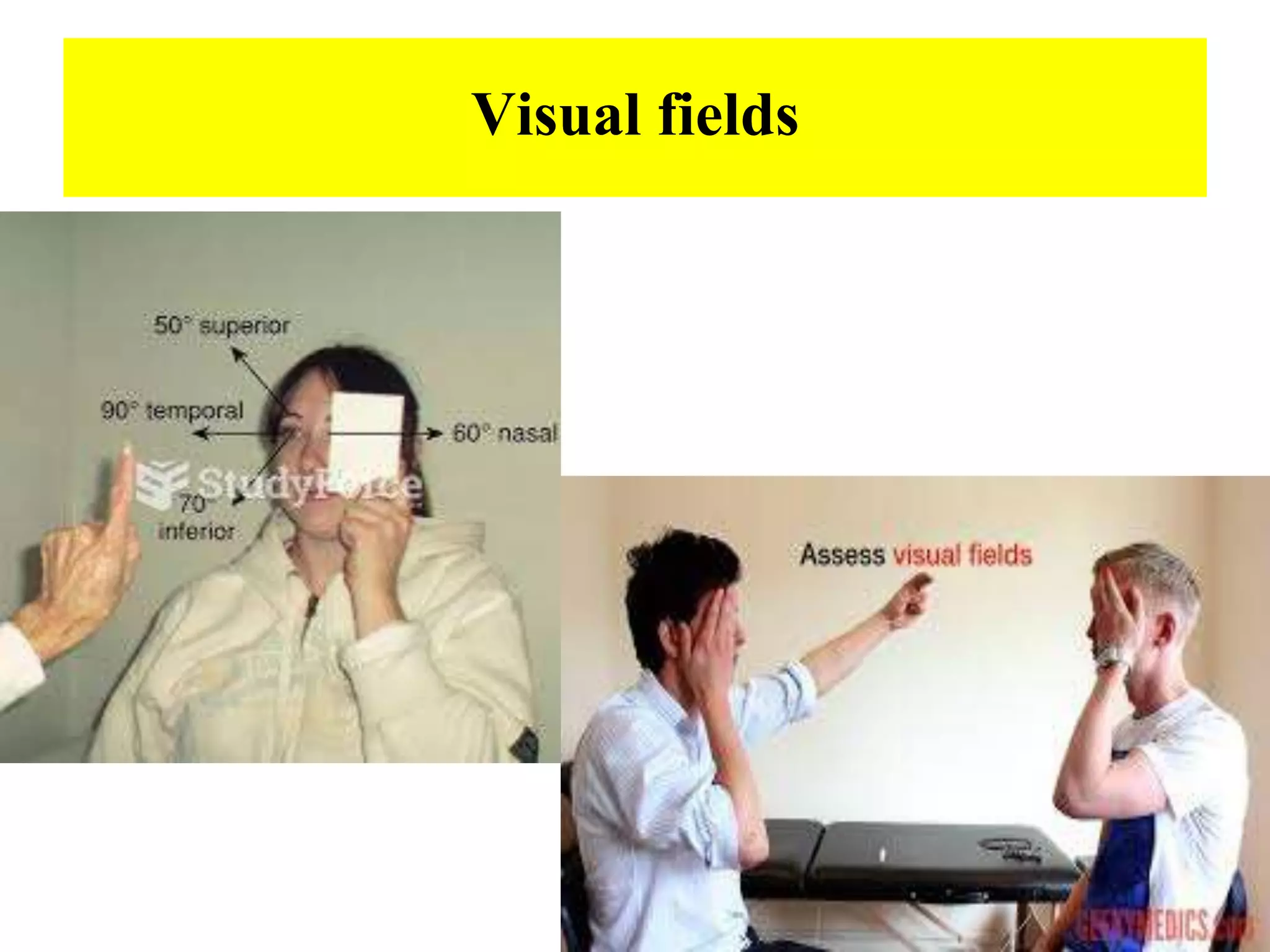
Visual fields
Visual fields
Normal
• When looking straight
ahead ,client can see objects
in the periphery
Deviation from normal
• Visual field smaller than the
normal (possible glaucoma)
• One half vision in one or
both eyes (possible nerve
damage)
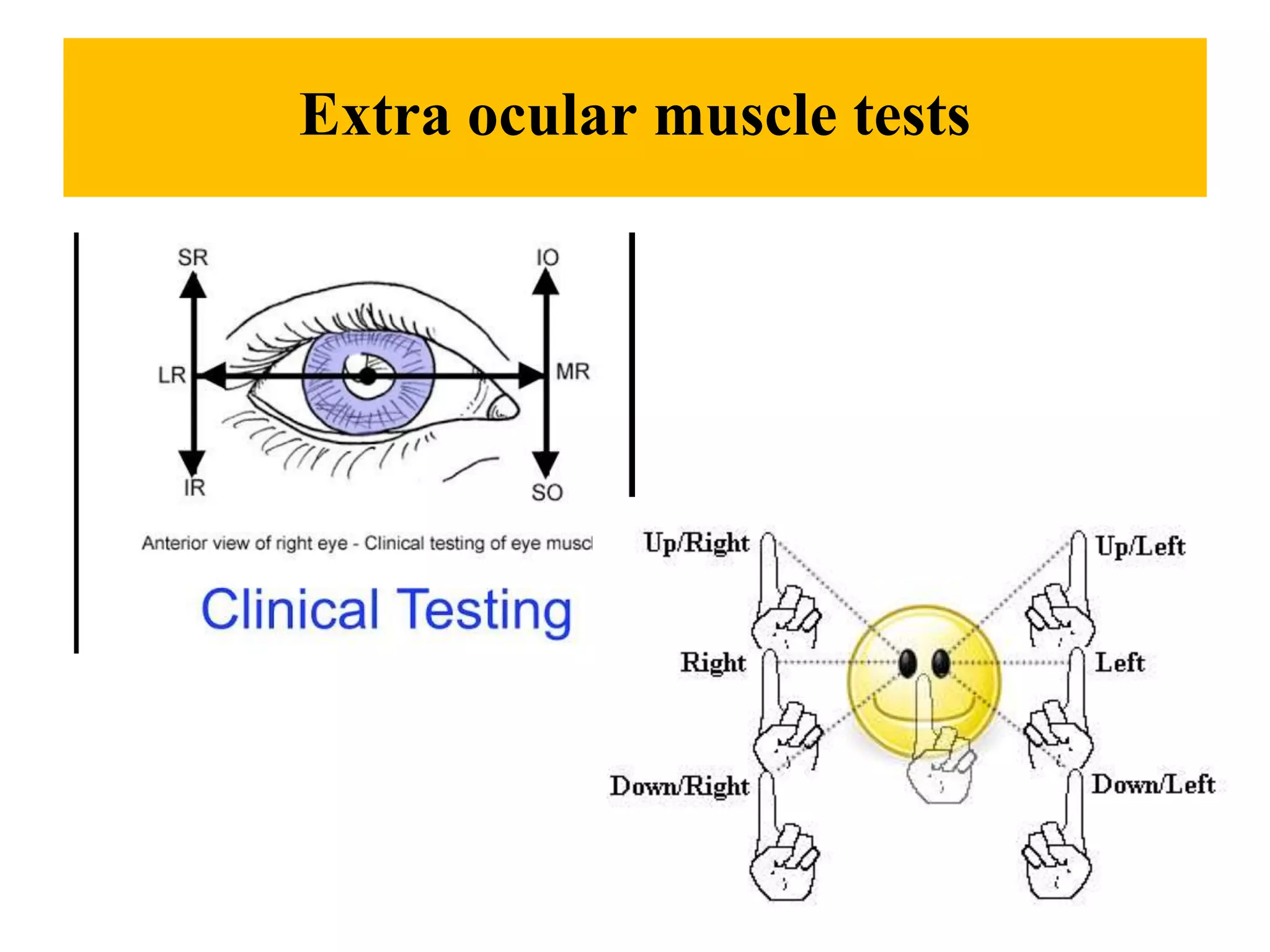
Extra ocular muscle tests
• Both eyes coordinated
,move in unison ,with
parallel alignment
• Eye movements not
coordinated or parellel.
• Strabismus (cross eye):
abnormal alignment of the
eyes; the condition of having
a squint.
• Nystagmus : rapid
involuntary movements of the
eyes.
Extra ocular muscle tests
Normal Deviation from normal
Visual acuity
Snellen’s chart
Visual acuity
Normal
• NEAR VISION:-Able to read
news print or a magazine
• DISTANT VISIO:- (Snellen’s
chart) 20/20 vision on Snellen’s-
type chart
Deviation from normal
• Difficulty reading newsprint
unless due to aging process.
• Denominator of 40 or more
on Snellen-type chart with
corrective lenses.
If the client is unable to see even the top line of the snellen type chart
perform functional vision tests
 light perception
Hand movements (H/F)
Counting fingers(C/F)
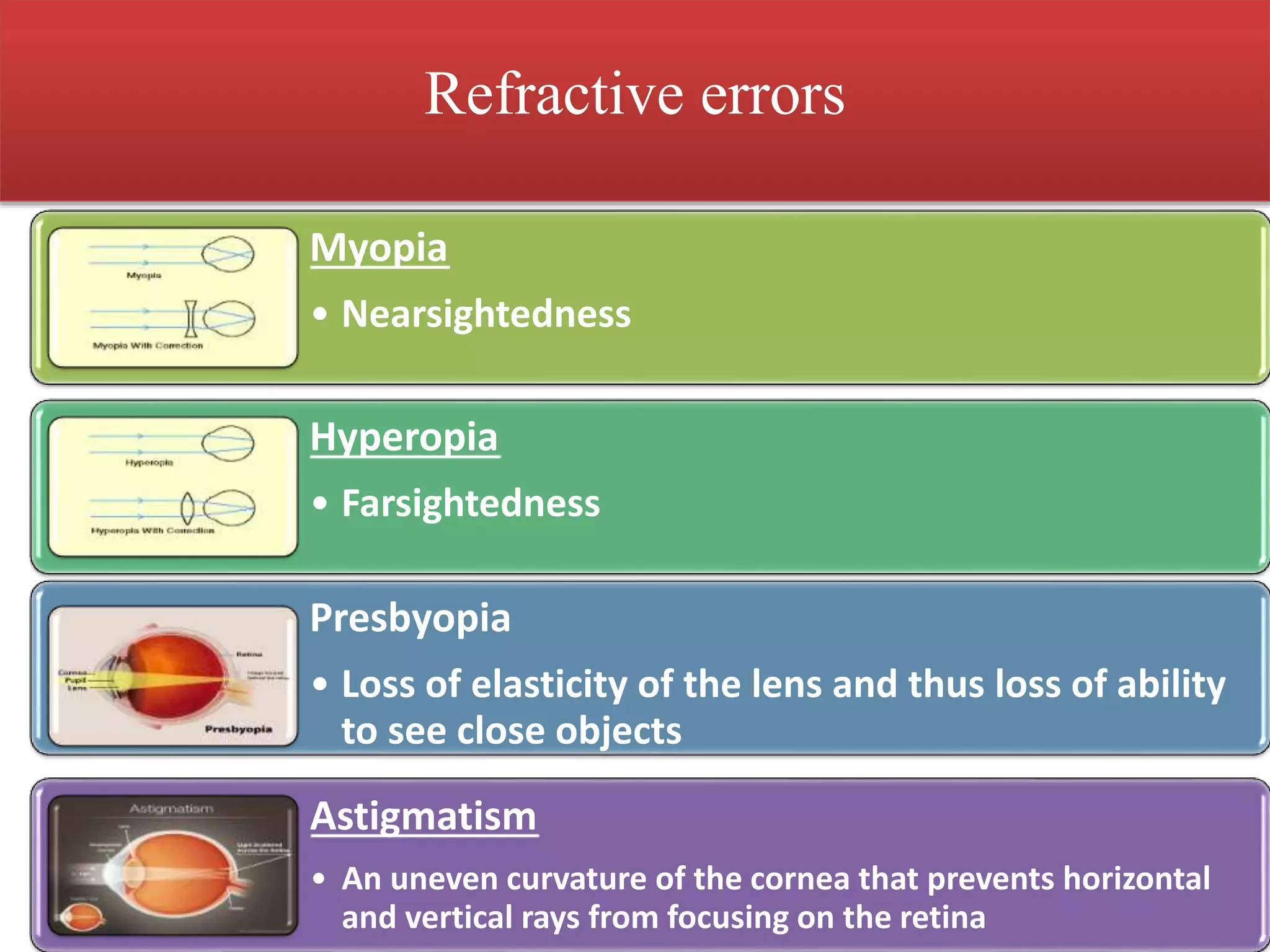
Myopia
• Nearsightedness
Hyperopia
• Farsightedness
Presbyopia
• Loss of elasticity of the lens and thus loss of ability
to see close objects
Astigmatism
• An uneven curvature of the cornea that prevents horizontal
and vertical rays from focusing on the retina
Refractive errors
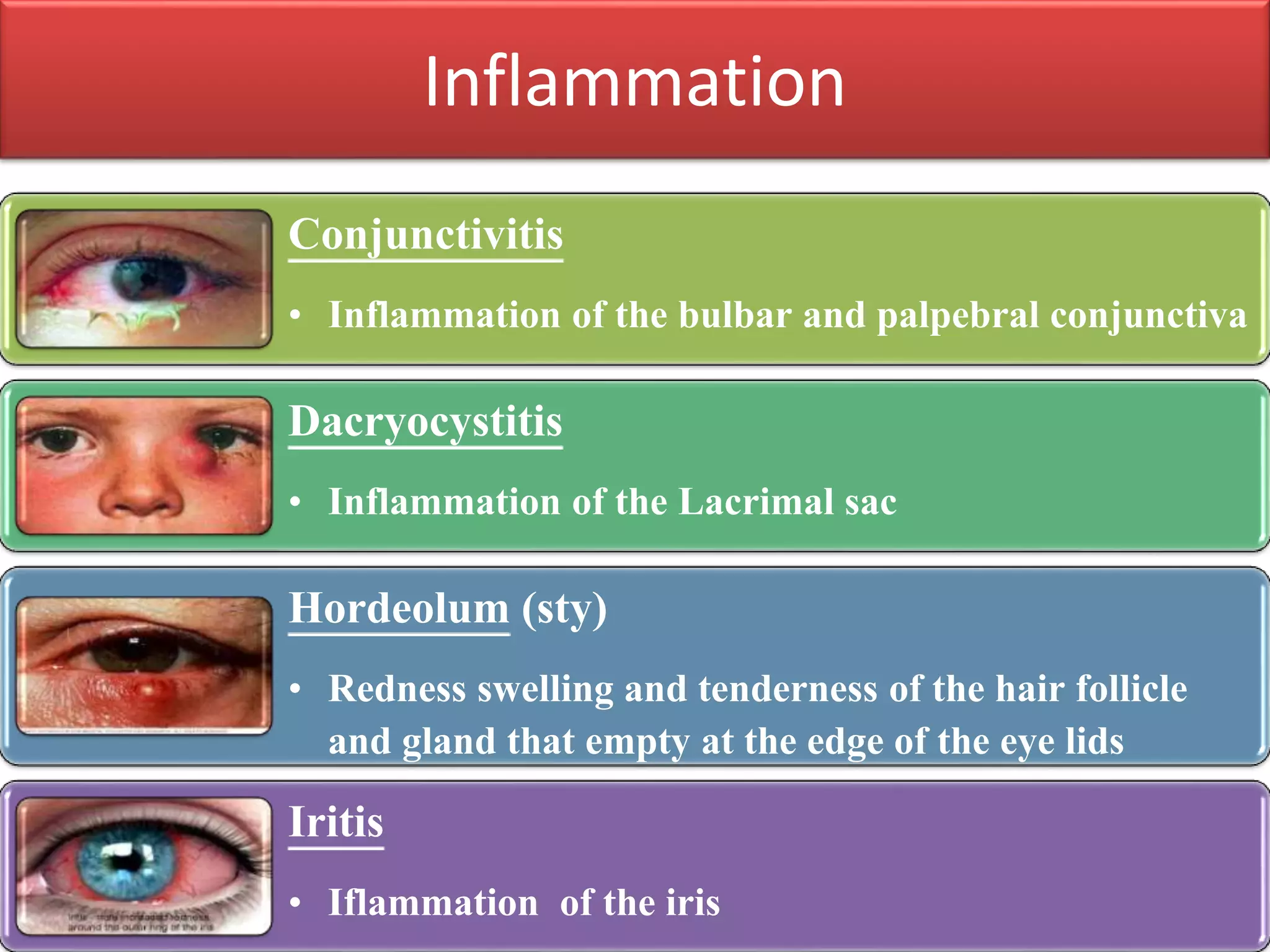
Inflammation
Conjunctivitis
• Inflammation of the bulbar and palpebral conjunctiva
Dacryocystitis
• Inflammation of the Lacrimal sac
Hordeolum (sty)
• Redness swelling and tenderness of the hair follicle
and gland that empty at the edge of the eye lids
Iritis
• Iflammation of the iris
Contusions or hematomas
• “Black eyes” resulting from injury
Cataracts
• Opacity of lens and its capsule
Glaucoma
• A disturbance in the circulation of aqueous fluid
which causes an increase in intra ocular pressure.
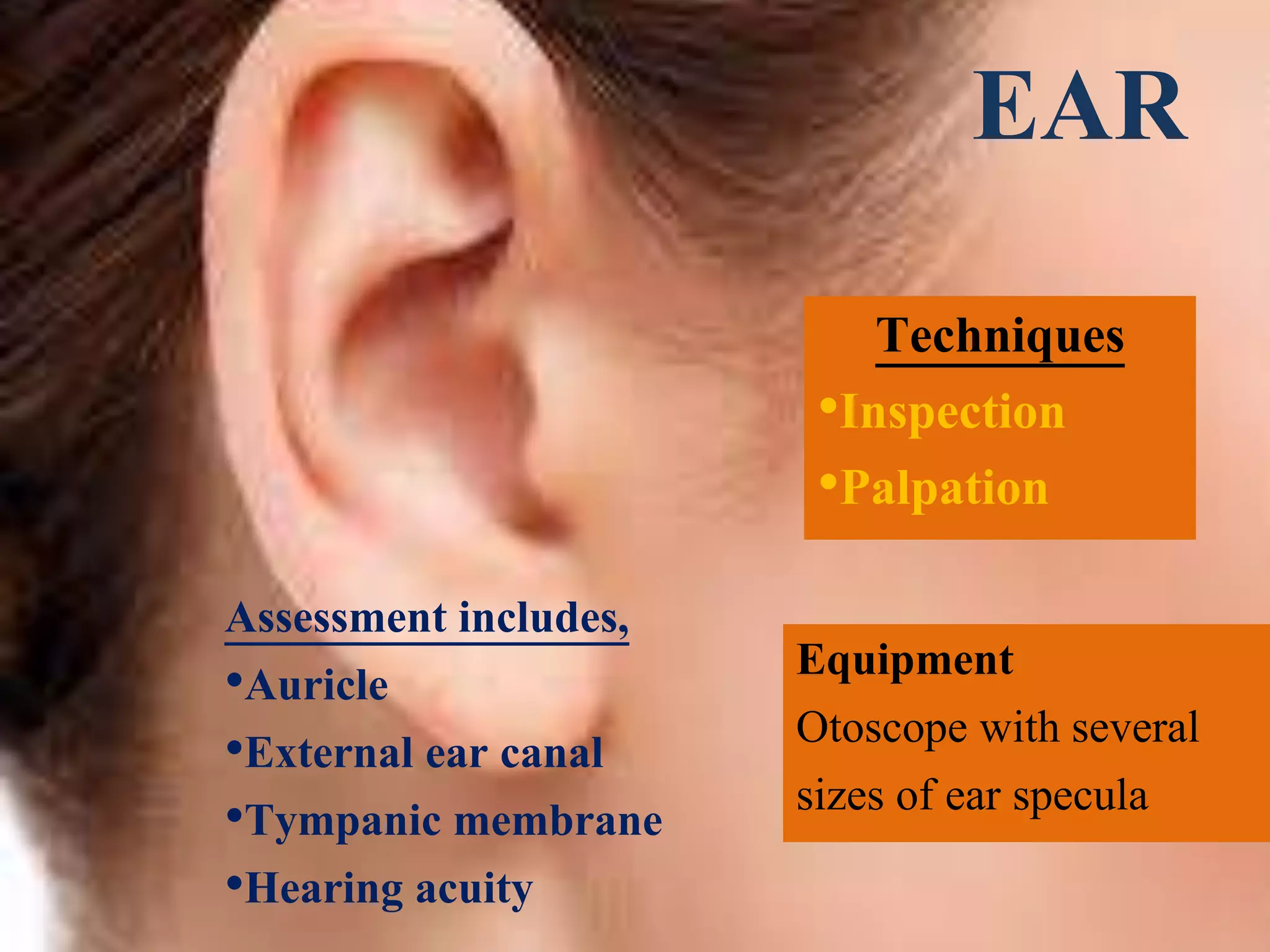
EAR
Techniques
•Inspection
•Palpation
Equipment
Otoscope with several
sizes of ear specula
Assessment includes,
•Auricle
•External ear canal
•Tympanic membrane
•Hearing acuity
color
Normal
• Same as facial
skin
Deviation
• Cyanosis
• Pallor
• Excessive redness
symmetry of
size
Normal
• symmetrical
Deviation
• Asymmetry
Position
Normal
• Auricle aligned
with outer
canthus of eye
about 10 degree
from vertical
Deviation
• Low set ears
(down syndrome)
Auricle (Inspection)
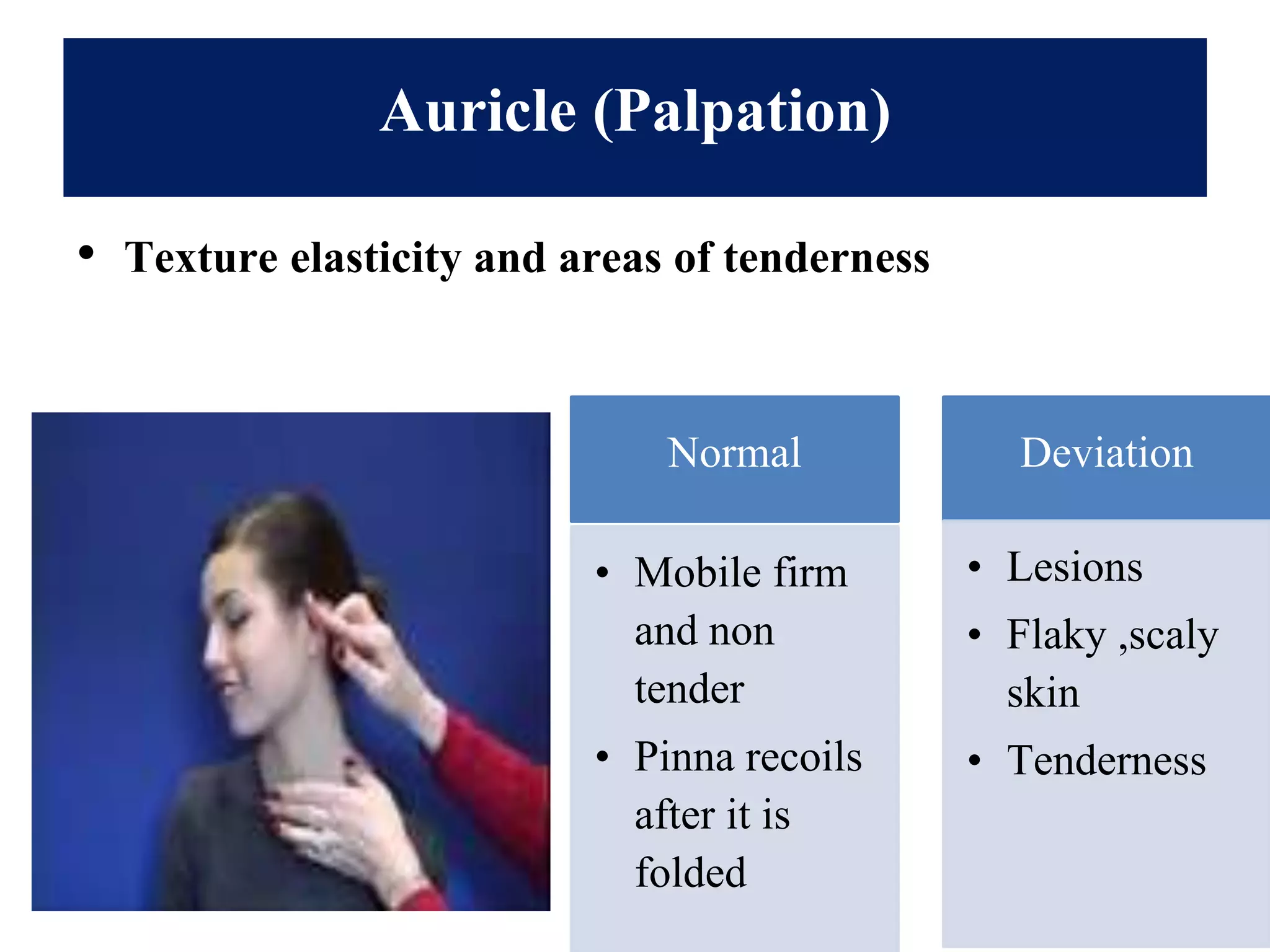
Auricle (Palpation)
• Texture elasticity and areas of tenderness
Normal
• Mobile firm
and non
tender
• Pinna recoils
after it is
folded
Deviation
• Lesions
• Flaky ,scaly
skin
• Tenderness
External ear and tympanic membrane
Otoscope
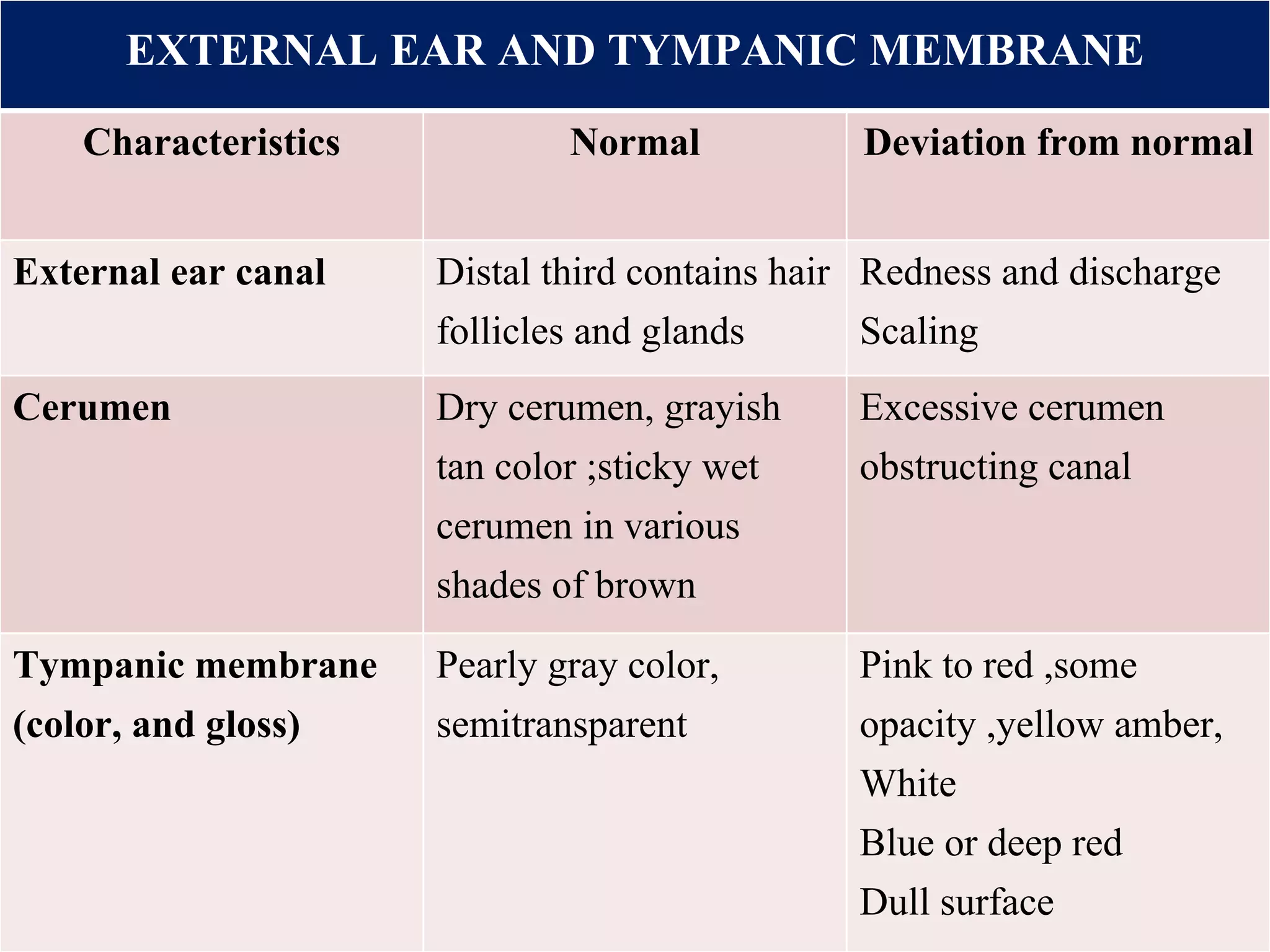
EXTERNAL EAR AND TYMPANIC MEMBRANE
Characteristics Normal Deviation from normal
External ear canal Distal third contains hair
follicles and glands
Redness and discharge
Scaling
Cerumen Dry cerumen, grayish
tan color ;sticky wet
cerumen in various
shades of brown
Excessive cerumen
obstructing canal
Tympanic membrane
(color, and gloss)
Pearly gray color,
semitransparent
Pink to red ,some
opacity ,yellow amber,
White
Blue or deep red
Dull surface
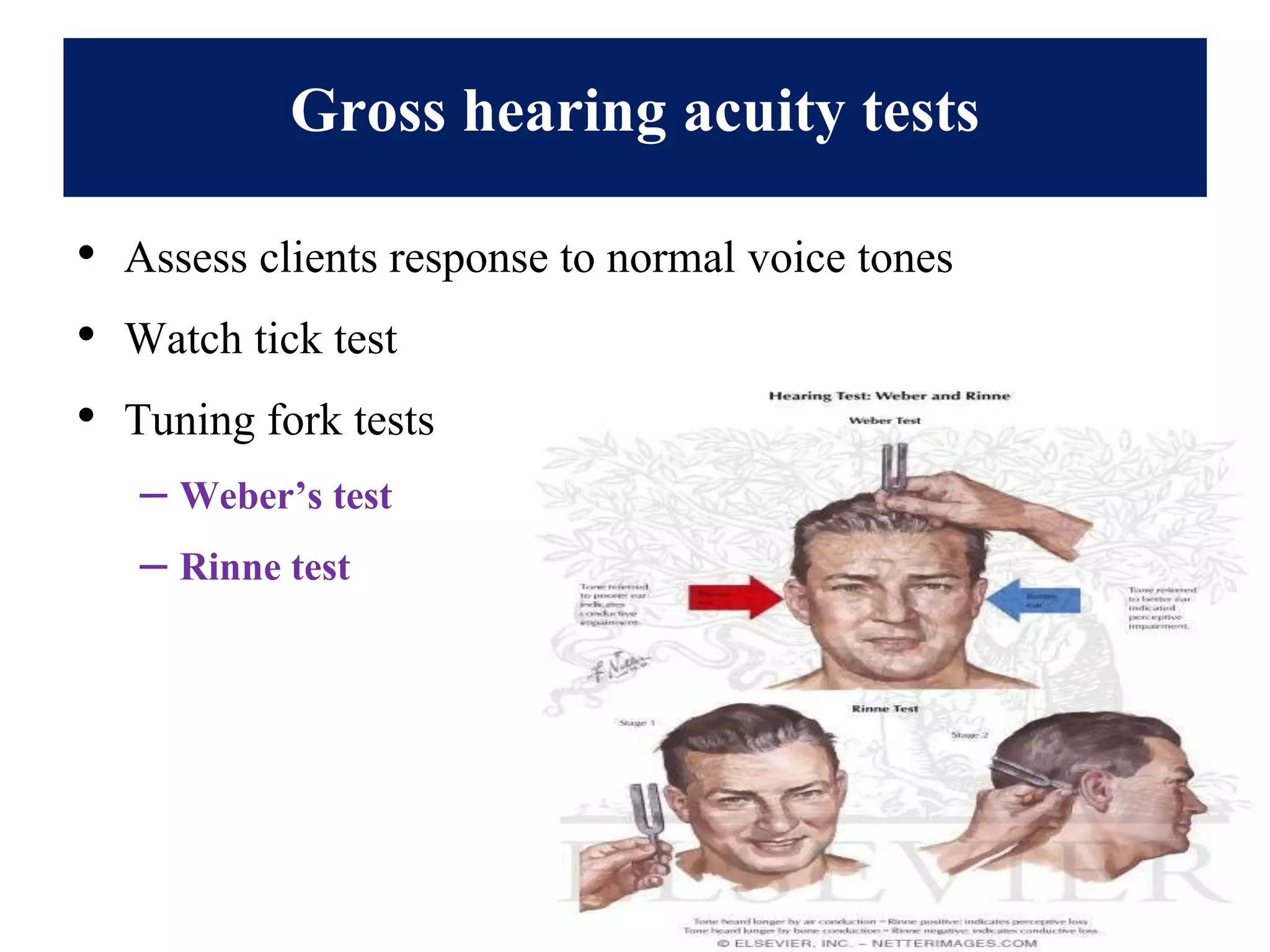
Gross hearing acuity tests
• Assess clients response to normal voice tones
• Watch tick test
• Tuning fork tests
– Weber’s test
– Rinne test
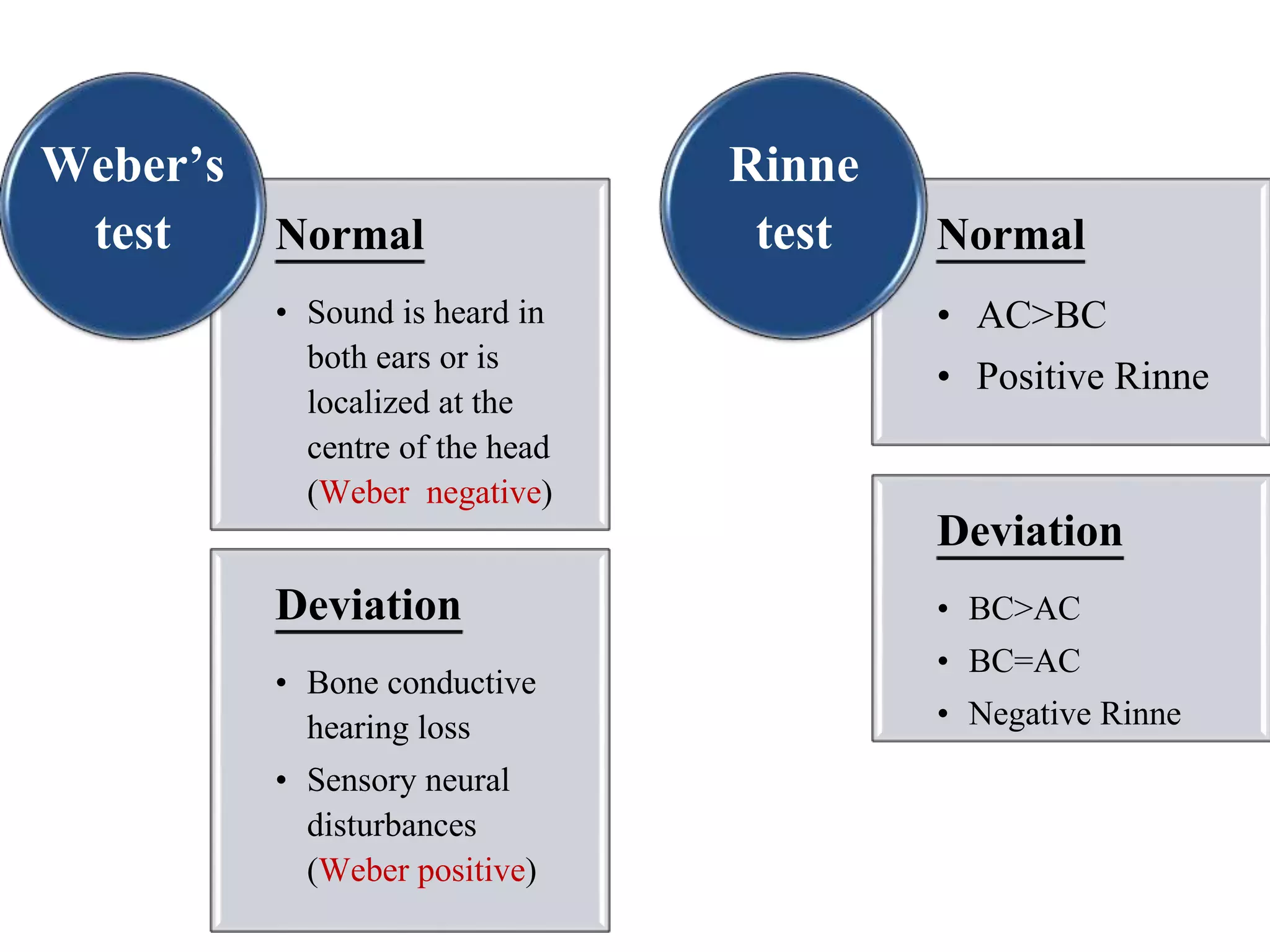
Normal
• Sound is heard in
both ears or is
localized at the
centre of the head
(Weber negative)
Deviation
• Bone conductive
hearing loss
• Sensory neural
disturbances
(Weber positive)
Weber’s
test Normal
• AC>BC
• Positive Rinne
Deviation
• BC>AC
• BC=AC
• Negative Rinne
Rinne
test
NOSE AND SINUSES
Techniques
Inspection
Palpation
Equipment
•Nasal speculum
•Flashlight/penlight
Assessment includes,
 Nose and nasal cavities
 Facial sinuses
NOSE
• Inspect for nose for any deviations in
Shape, size, color and flaring or discharge from the nares.
• Lightly palpate the external nose for
Tenderness, masses and displacement of bone and cartilage.
• Determine patency of both nasal cavities
• Inspect the nasal cavities using nasal speculum
Observe mucosa for redness , swelling, growths, and
discharges.
• Inspect the nasal septum between the nasal
champers
SINUSES
• Palpate the maxillary and frontal sinuses for tenderness
MOUTH AND OROPHARYNX
Equipments
Clean gloves
Tongue depressor
Gauze pads
Penlight
Assessment include
Lips and Buccal mucosa
Teeth and Gums
Tongue / floor of mouth
Salivary glands
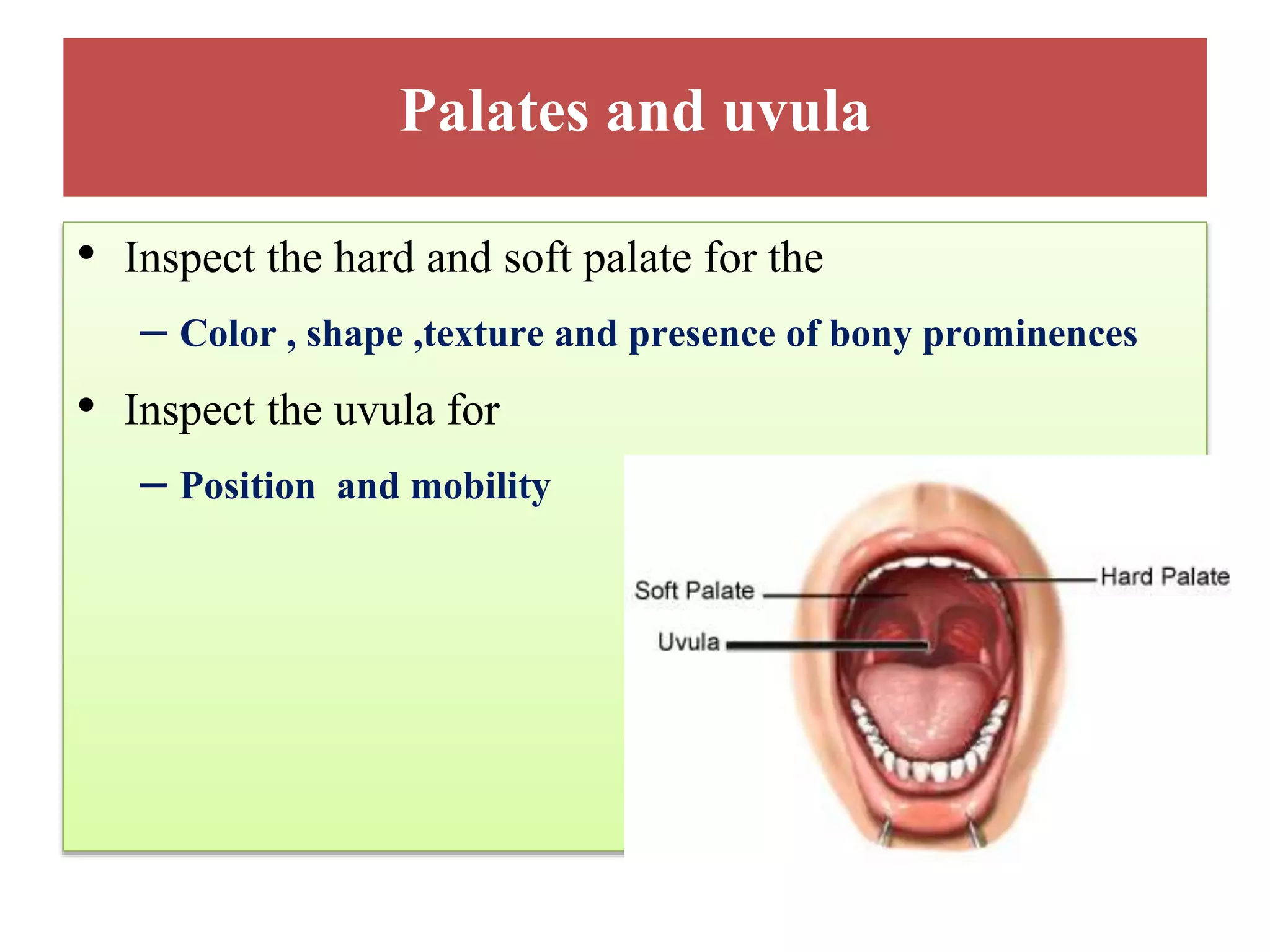
Palates and uvula
Oropharynx and tonsils
Techniques
•Inspection
•Palpation
Lips and buccal mucosa
• Inspect outer lips for
– Symmetry ,contour, color and texture, ability to purse lips
Normal
• Uniform pink color & soft ,moist and smooth texture
• Symmetry of contour
• Able to purse lips
Deviation from normal
• Pallor ,cyanosis
• Blisters, swelling, scaling
• Inability to purse lips
Lips and buccal mucosa
• Inspect and palpate inner lips and buccal mucosa for
– Color , moisture, texture and presence of lesions
Normal
• Uniform pink color & soft ,moist, smooth , glistening and elastic
texture.
Deviation from normal
• Pallor; leukoplakia (white patches) , red, bleeding
• Excessive dryness
• Mucosal cysts ;irritation from dentures , abrasions, ulceraions
;nodules.
Teeth and gums
Normal
• 32 adult teeth
• Smooth, white, shiny tooth enamel
• Pink gums
• Moist firm texture to gums
• No retraction of gums
Deviation from normal
• Missing teeth ;ill fitting dentures
• Brown or black discoloration of the enamel (dental caries)
• Excessively red gums
• Spongy texture ; bleeding; tenderness
• Receding; atrophied gums ; swelling that partially covers the teeth
Tongue/ floor of the mouth
Inspect the surface of the tongue for
• Position, color, and texture.
Normal
• Central position
• Pink color
• Smooth, lateral margins ; or no lesions
• Raised papillae ( taste buds)
Deviation from normal
• Deviated from centre
• Smooth red tongue
• Dry, furry tongue (fluid deficit) , white coating (yeast infection)
• Nodules , ulcerations, discolorations and areas of tenderness
Tongue/ floor of the mouth
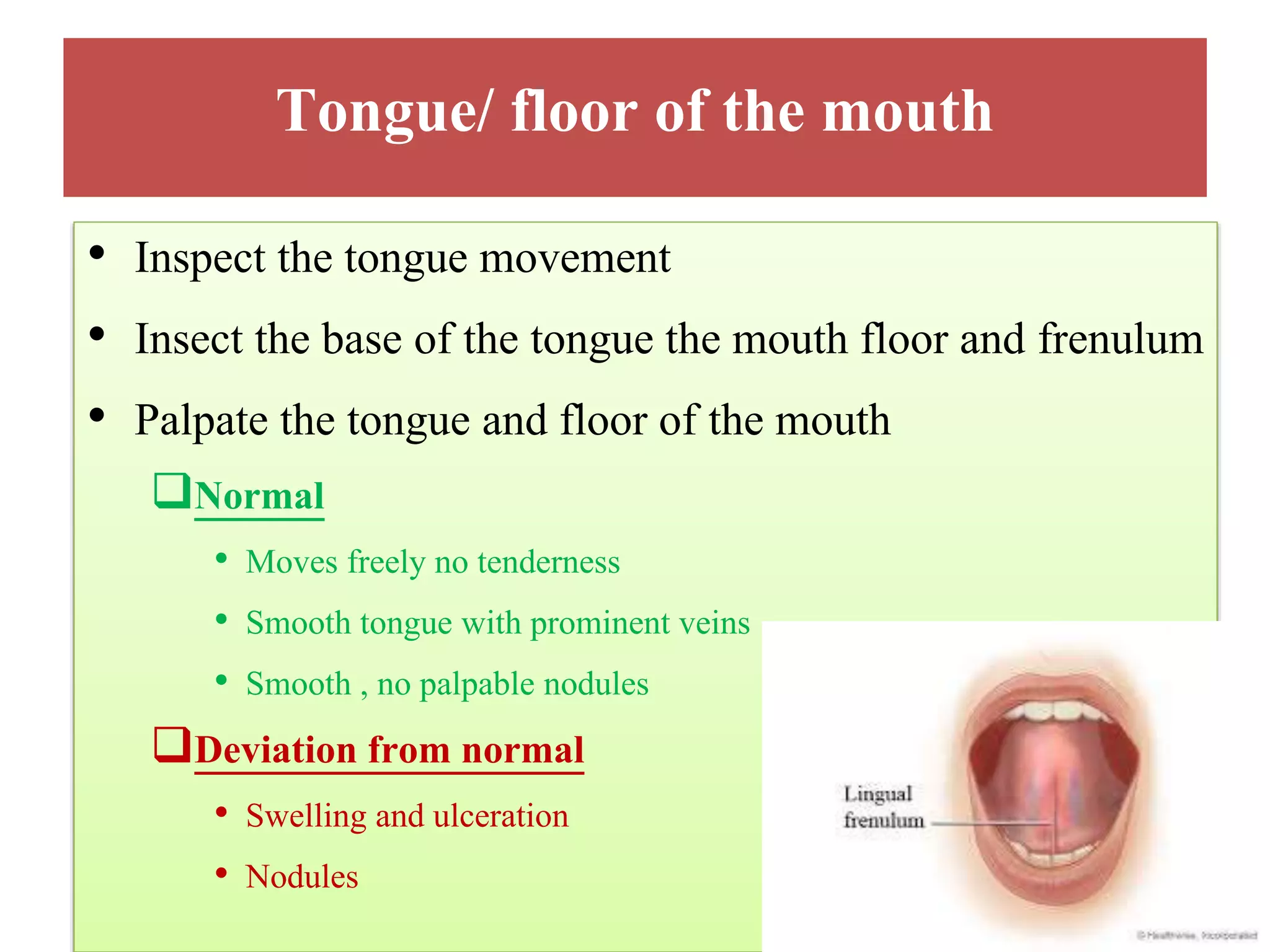
• Inspect the tongue movement
• Insect the base of the tongue the mouth floor and frenulum
• Palpate the tongue and floor of the mouth
Normal
• Moves freely no tenderness
• Smooth tongue with prominent veins
• Smooth , no palpable nodules
Deviation from normal
• Swelling and ulceration
• Nodules
Salivary glands
• Inspect salivary duct openings for
– swelling or redness
Normal
• Same as color of buccal mucosa
and floor of the mouth
Deviation from normal
• Inflammation
(redness and swelling)
• Inspect the hard and soft palate for the
– Color , shape ,texture and presence of bony prominences
• Inspect the uvula for
– Position and mobility
Palates and uvula
Oropharynx and tonsils
• Inspect the Oropharynx for the
– Color and texture
Normal : Pink and smooth posterior wall.
Deviation from normal : Reddened or edematous, presence of
lesions.
• Inspect the tonsils
– Color, discharge, and size
Normal : Pink color and smooth texture, no discharge, normal size.
Deviation from normal :Inflamed , presence of discharge, swollen.
• Elicit the gag reflex
Oropharynx and tonsils
NECK
Techniques
Inspection
Palpation
Auscultation
Assessment includes,
•Neck muscles
•Lymph nodes
•Trachea
•Thyroid gland
•Carotid arteries and jugular veins
Neck muscles
Sternocleidomastoid muscle
Trapezius muscle
Neck muscles
• Inspect the neck muscles
• Observe head movements
– Move chin to the chest (sternocleidomastoid)
– Move the head so that the ear is moved toward the shoulder on
each side (sternocleidomastoid)
– Turn the head to the right and to the left (sternocleidomastoid)
– Move head back so that the chin points upward (Trapezius)
• Assess the muscle strength
Lymph nodes
• Palpate the entire lymph node for enlargement
Trachea
Trachea
Palpate the trachea for
lateral deviation
•Normal :
Central placement in
midline of neck
•Deviation from
normal:
Deviation to one side
(neck tumor, thyroid or
lymph node
enlargement)
Thyroid gland
 Inspect the thyroid gland
Normal :
Not visible on inspection
Deviation from normal :
Local enlargement
Thyroid gland
Palpate the thyroid gland for
smoothness note any areas of
enlargement, masses and
nodules.
Posterior approach
Anterior approach
Normal :
Lobes may not be palpated
Deviation from normal:
Solitary nodules
Thyroid gland
 If enlargement of the gland is suspected , auscultate over
the thyroid area for bruit (a soft rushing sound created by
turbulent blood flow)
THANK YOU
“Lets have a brake”

Physical examination head and neck

  • 1.
  • 3.
    HEAD Techniques Inspection Palpation Auscultation Parts •Skull & Face •Eyes& Vision •Ears and Hearing •Nose and Sinuses •Mouth and Oropharynx
  • 4.
    SKULL AND FACE CharacteristicsNormal Deviation from normal Size, shape and symmetry Rounded (normocephalic) Symmetrical Smooth skull contour. Lack of symmetry Increased skull size Nodules ,masses and depressions Smooth uniform consistency Absence of nodules or masses Sebaceous cysts Local deformities from trauma Masses and nodules
  • 5.
    SKULL AND FACE CharacteristicsNormal Deviation from normal Facial features Symmetric or slightly asymmetric facial features; palpebral fissures equal in size ;symmetric nasolabial folds. Increased facial hair Thinning of eyebrows Asymmetric features; Exophthalmos; myxedema facies ; moon face Eyes for edema and hollowness No edema Periorbital edema Sunken eyes
  • 6.
    SKULL AND FACE CharacteristicsNormal Deviation from normal Symmetry of facial movements Symmetric facial movements Asymmetric facial movements Drooping of lower eyelid and mouth Involuntary facial movements
  • 7.
    EYES AND VISION Equipments •Cottontip applicator •Gauze square •Clean gloves •Millimeter ruler •Penlight •Snellen’s or E chart •Opaque card Assessment of eye includes, •External eye structures •Visual fields •Extra ocular muscle tests •Visual acuity
  • 10.
    Eye brows • Hairdistribution and alignment • Symmetry • Skin quality • Movement Eye lashes • Evenness of distribution • Direction of curl Eye lids • Surface characteristics • Position in relation to the cornea • Ability to blink and frequency o f blinking • Lesions/edema/stye/signs of infection
  • 11.
    Bulbar conjunctiva andpalpebral conjunctiva • Color • Texture • Presence of lesions Lacrimal gland , lacrimal sac and nasolacrimal duct • Edema • Tenderness and Evidence of tearing Cornea • Clarity and texture • Perform corneal sensitivity test
  • 12.
    Anterior chamber • Transparency •Depth Pupils • Color/shape/symmetry of size • PERRLA (pupils are round and react to light and accommodation)
  • 13.
  • 14.
    Visual fields Normal • Whenlooking straight ahead ,client can see objects in the periphery Deviation from normal • Visual field smaller than the normal (possible glaucoma) • One half vision in one or both eyes (possible nerve damage)
  • 15.
  • 16.
  • 17.
    • Both eyescoordinated ,move in unison ,with parallel alignment • Eye movements not coordinated or parellel. • Strabismus (cross eye): abnormal alignment of the eyes; the condition of having a squint. • Nystagmus : rapid involuntary movements of the eyes. Extra ocular muscle tests Normal Deviation from normal
  • 18.
  • 19.
    Visual acuity Normal • NEARVISION:-Able to read news print or a magazine • DISTANT VISIO:- (Snellen’s chart) 20/20 vision on Snellen’s- type chart Deviation from normal • Difficulty reading newsprint unless due to aging process. • Denominator of 40 or more on Snellen-type chart with corrective lenses. If the client is unable to see even the top line of the snellen type chart perform functional vision tests  light perception Hand movements (H/F) Counting fingers(C/F)
  • 20.
    Myopia • Nearsightedness Hyperopia • Farsightedness Presbyopia •Loss of elasticity of the lens and thus loss of ability to see close objects Astigmatism • An uneven curvature of the cornea that prevents horizontal and vertical rays from focusing on the retina Refractive errors
  • 21.
    Inflammation Conjunctivitis • Inflammation ofthe bulbar and palpebral conjunctiva Dacryocystitis • Inflammation of the Lacrimal sac Hordeolum (sty) • Redness swelling and tenderness of the hair follicle and gland that empty at the edge of the eye lids Iritis • Iflammation of the iris
  • 22.
    Contusions or hematomas •“Black eyes” resulting from injury Cataracts • Opacity of lens and its capsule Glaucoma • A disturbance in the circulation of aqueous fluid which causes an increase in intra ocular pressure.
  • 23.
    EAR Techniques •Inspection •Palpation Equipment Otoscope with several sizesof ear specula Assessment includes, •Auricle •External ear canal •Tympanic membrane •Hearing acuity
  • 25.
    color Normal • Same asfacial skin Deviation • Cyanosis • Pallor • Excessive redness symmetry of size Normal • symmetrical Deviation • Asymmetry Position Normal • Auricle aligned with outer canthus of eye about 10 degree from vertical Deviation • Low set ears (down syndrome) Auricle (Inspection)
  • 26.
    Auricle (Palpation) • Textureelasticity and areas of tenderness Normal • Mobile firm and non tender • Pinna recoils after it is folded Deviation • Lesions • Flaky ,scaly skin • Tenderness
  • 27.
    External ear andtympanic membrane Otoscope
  • 28.
    EXTERNAL EAR ANDTYMPANIC MEMBRANE Characteristics Normal Deviation from normal External ear canal Distal third contains hair follicles and glands Redness and discharge Scaling Cerumen Dry cerumen, grayish tan color ;sticky wet cerumen in various shades of brown Excessive cerumen obstructing canal Tympanic membrane (color, and gloss) Pearly gray color, semitransparent Pink to red ,some opacity ,yellow amber, White Blue or deep red Dull surface
  • 29.
    Gross hearing acuitytests • Assess clients response to normal voice tones • Watch tick test • Tuning fork tests – Weber’s test – Rinne test
  • 30.
    Normal • Sound isheard in both ears or is localized at the centre of the head (Weber negative) Deviation • Bone conductive hearing loss • Sensory neural disturbances (Weber positive) Weber’s test Normal • AC>BC • Positive Rinne Deviation • BC>AC • BC=AC • Negative Rinne Rinne test
  • 31.
    NOSE AND SINUSES Techniques Inspection Palpation Equipment •Nasalspeculum •Flashlight/penlight Assessment includes,  Nose and nasal cavities  Facial sinuses
  • 32.
    NOSE • Inspect fornose for any deviations in Shape, size, color and flaring or discharge from the nares. • Lightly palpate the external nose for Tenderness, masses and displacement of bone and cartilage. • Determine patency of both nasal cavities • Inspect the nasal cavities using nasal speculum Observe mucosa for redness , swelling, growths, and discharges. • Inspect the nasal septum between the nasal champers
  • 33.
    SINUSES • Palpate themaxillary and frontal sinuses for tenderness
  • 34.
    MOUTH AND OROPHARYNX Equipments Cleangloves Tongue depressor Gauze pads Penlight Assessment include Lips and Buccal mucosa Teeth and Gums Tongue / floor of mouth Salivary glands Palates and uvula Oropharynx and tonsils Techniques •Inspection •Palpation
  • 35.
    Lips and buccalmucosa • Inspect outer lips for – Symmetry ,contour, color and texture, ability to purse lips Normal • Uniform pink color & soft ,moist and smooth texture • Symmetry of contour • Able to purse lips Deviation from normal • Pallor ,cyanosis • Blisters, swelling, scaling • Inability to purse lips
  • 36.
    Lips and buccalmucosa • Inspect and palpate inner lips and buccal mucosa for – Color , moisture, texture and presence of lesions Normal • Uniform pink color & soft ,moist, smooth , glistening and elastic texture. Deviation from normal • Pallor; leukoplakia (white patches) , red, bleeding • Excessive dryness • Mucosal cysts ;irritation from dentures , abrasions, ulceraions ;nodules.
  • 37.
    Teeth and gums Normal •32 adult teeth • Smooth, white, shiny tooth enamel • Pink gums • Moist firm texture to gums • No retraction of gums Deviation from normal • Missing teeth ;ill fitting dentures • Brown or black discoloration of the enamel (dental caries) • Excessively red gums • Spongy texture ; bleeding; tenderness • Receding; atrophied gums ; swelling that partially covers the teeth
  • 38.
    Tongue/ floor ofthe mouth Inspect the surface of the tongue for • Position, color, and texture. Normal • Central position • Pink color • Smooth, lateral margins ; or no lesions • Raised papillae ( taste buds) Deviation from normal • Deviated from centre • Smooth red tongue • Dry, furry tongue (fluid deficit) , white coating (yeast infection) • Nodules , ulcerations, discolorations and areas of tenderness
  • 39.
    Tongue/ floor ofthe mouth • Inspect the tongue movement • Insect the base of the tongue the mouth floor and frenulum • Palpate the tongue and floor of the mouth Normal • Moves freely no tenderness • Smooth tongue with prominent veins • Smooth , no palpable nodules Deviation from normal • Swelling and ulceration • Nodules
  • 40.
    Salivary glands • Inspectsalivary duct openings for – swelling or redness Normal • Same as color of buccal mucosa and floor of the mouth Deviation from normal • Inflammation (redness and swelling)
  • 41.
    • Inspect thehard and soft palate for the – Color , shape ,texture and presence of bony prominences • Inspect the uvula for – Position and mobility Palates and uvula
  • 42.
  • 43.
    • Inspect theOropharynx for the – Color and texture Normal : Pink and smooth posterior wall. Deviation from normal : Reddened or edematous, presence of lesions. • Inspect the tonsils – Color, discharge, and size Normal : Pink color and smooth texture, no discharge, normal size. Deviation from normal :Inflamed , presence of discharge, swollen. • Elicit the gag reflex Oropharynx and tonsils
  • 44.
    NECK Techniques Inspection Palpation Auscultation Assessment includes, •Neck muscles •Lymphnodes •Trachea •Thyroid gland •Carotid arteries and jugular veins
  • 45.
  • 46.
    Neck muscles • Inspectthe neck muscles • Observe head movements – Move chin to the chest (sternocleidomastoid) – Move the head so that the ear is moved toward the shoulder on each side (sternocleidomastoid) – Turn the head to the right and to the left (sternocleidomastoid) – Move head back so that the chin points upward (Trapezius) • Assess the muscle strength
  • 47.
    Lymph nodes • Palpatethe entire lymph node for enlargement
  • 48.
  • 49.
    Trachea Palpate the tracheafor lateral deviation •Normal : Central placement in midline of neck •Deviation from normal: Deviation to one side (neck tumor, thyroid or lymph node enlargement)
  • 50.
    Thyroid gland  Inspectthe thyroid gland Normal : Not visible on inspection Deviation from normal : Local enlargement
  • 51.
    Thyroid gland Palpate thethyroid gland for smoothness note any areas of enlargement, masses and nodules. Posterior approach Anterior approach Normal : Lobes may not be palpated Deviation from normal: Solitary nodules
  • 52.
    Thyroid gland  Ifenlargement of the gland is suspected , auscultate over the thyroid area for bruit (a soft rushing sound created by turbulent blood flow)
  • 53.