Beats
PHYSICS 101
BEATS
If we listen to two waves of slightly different
frequencies we hear the amplitude increasing and
decreasing as a function of time.
This type of variation in amplitude is called a beat.
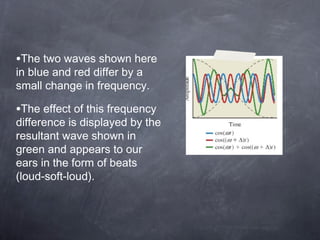
•The two waves shown here
in blue and red differ by a
small change in frequency.
•The effect of this frequency
difference is displayed by the
resultant wave shown in
green and appears to our
ears in the form of beats
(loud-soft-loud).
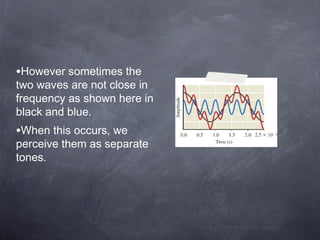
•However sometimes the
two waves are not close in
frequency as shown here in
black and blue.
•When this occurs, we
perceive them as separate
tones.
Two cellos in an orchestra are slightly out
of tune. They produce frequencies of 249
Hz and 245 Hz. What beat frequency is
heard?
Example Question
Solution
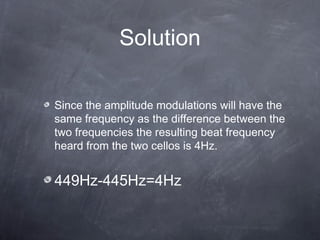
Since the amplitude modulations will have the
same frequency as the difference between the
two frequencies the resulting beat frequency
heard from the two cellos is 4Hz.
449Hz-445Hz=4Hz
Solution
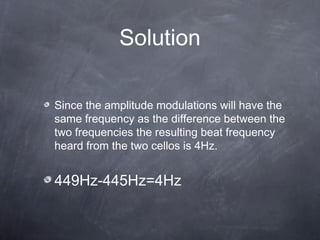
Since the amplitude modulations will have the
same frequency as the difference between the
two frequencies the resulting beat frequency
heard from the two cellos is 4Hz.
449Hz-445Hz=4Hz

Lo8

  • 1.
  • 2.
    BEATS If we listento two waves of slightly different frequencies we hear the amplitude increasing and decreasing as a function of time. This type of variation in amplitude is called a beat.
  • 3.
    •The two wavesshown here in blue and red differ by a small change in frequency. •The effect of this frequency difference is displayed by the resultant wave shown in green and appears to our ears in the form of beats (loud-soft-loud).
  • 4.
    •However sometimes the twowaves are not close in frequency as shown here in black and blue. •When this occurs, we perceive them as separate tones.
  • 5.
    Two cellos inan orchestra are slightly out of tune. They produce frequencies of 249 Hz and 245 Hz. What beat frequency is heard? Example Question
  • 6.
    Solution Since the amplitudemodulations will have the same frequency as the difference between the two frequencies the resulting beat frequency heard from the two cellos is 4Hz. 449Hz-445Hz=4Hz
  • 7.
    Solution Since the amplitudemodulations will have the same frequency as the difference between the two frequencies the resulting beat frequency heard from the two cellos is 4Hz. 449Hz-445Hz=4Hz