Protozoan Diseases
• Protozoans are unicellular eukaryotic organisms
• Responsible for several serious human diseases:
ameobiasis, Chaga’s disease, malaria, African
sleeping sickness, leishmaniasis, and taxoplasmosis.
• Type of immune response that develops depends (in
part) on the location of the parasite in the host.
• Bloodstream: humoral antibody most effective
• Intracellular: cell-mediated immune reactions
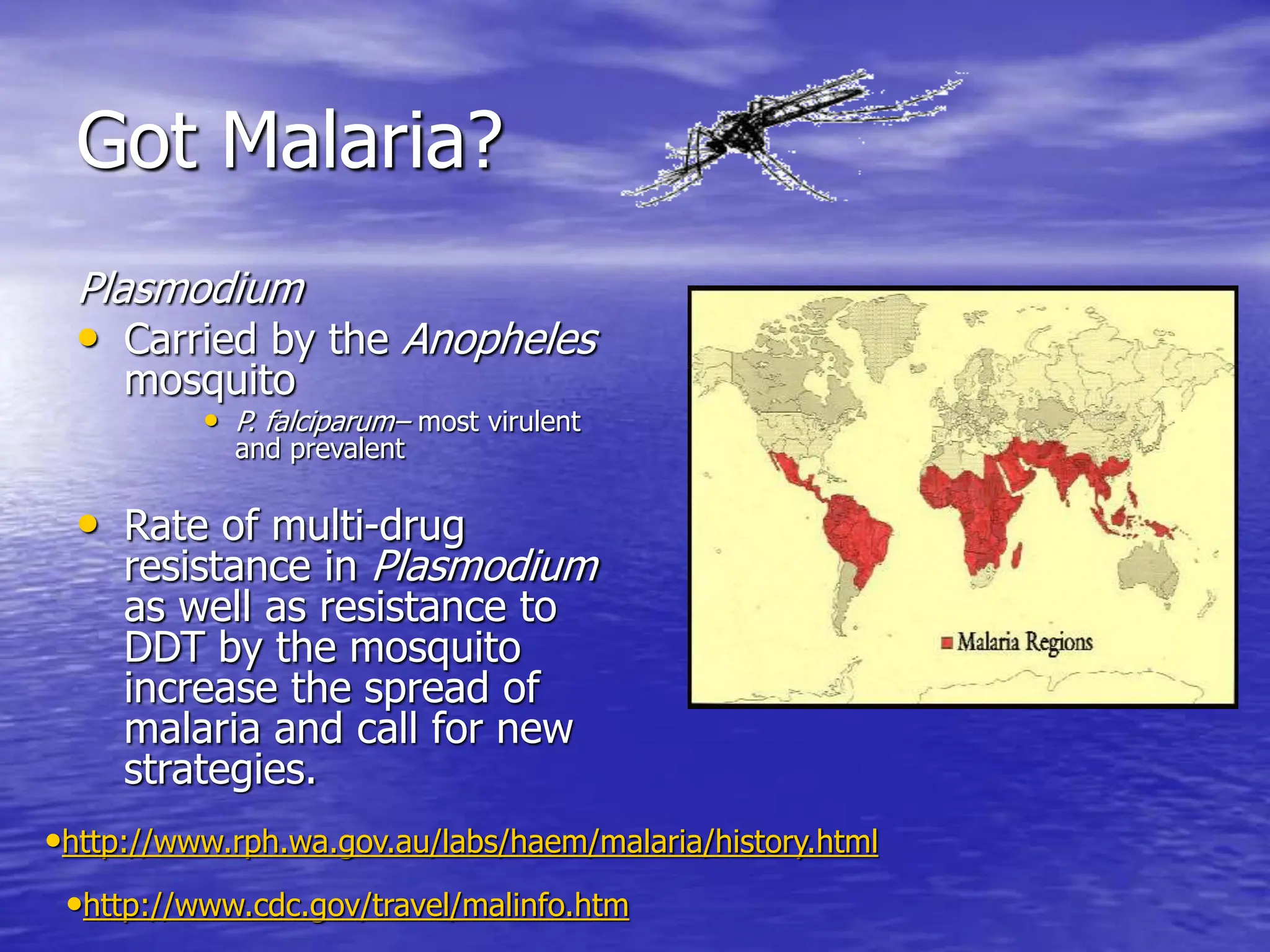
Got Malaria?
Plasmodium
• Carried by the Anopheles
mosquito
• P. falciparum– most virulent
and prevalent
• Rate of multi-drug
resistance in Plasmodium
as well as resistance to
DDT by the mosquito
increase the spread of
malaria and call for new
strategies.
•http://www.rph.wa.gov.au/labs/haem/malaria/history.html
•http://www.cdc.gov/travel/malinfo.htm
Malaria. . .
Plasmodium life cycle
• ♀ Anopheles mosquito feeds on
blood & serves as the vector.
• Sporozites enter blood stream and
proceed to the liver within 30 min
to infect hepatocytes
• Circumsporozite (CS), 45-
kDa protein helps with
adhesion to liver cells. The
binding site, a conserved
region on the carboxyl
terminal end (reg II) has a
high degree of sequence
homology with known cell
adhesion molecules.
http://www.who.int/inf-fs/en/1InformationSheet03.pdf
Malaria. . .
• 1 week = Multiplication &
transformation in the liver leads to the
release of about 5,000-10,000
merozites PER HEPATOCYTE infected
with only one sporozite!
• Merozites infect red blood cells,
initiating the symptoms and pathology
of malaria.
• Merozites replicate and differentiate
again
• Cell ruptures to release new merozites
(which will infect more red blood cells)
• Some merozites differentiate into ♂
and ♀ gametocytes.
• Gametocytes ingested by Female
Anopheles differentiate into male and
female gametes which fuse to form a
zygote and become sporozites in the
salivary gland….
• Wash, Rinse, Repeat…
Malaria. . .
• Chills, fever, sweating—peak
every 48hrs
• Weak, anemic, splenomegaly
• Blocked capillaries = intense
headaches, renal failure, heart
failure, or cerebral damage
• Some symptoms may not be
caused by Plasmodium but by
excessive production of
cytokines
– Cancer patients treated with
recombinant TNF show similar
symptoms
Immune Response to Malaria
• Where malaria is endemic, IR
is poor. Children < 14yrs have
lowest IR and are most likely
to develop malaria. Mortality
rate 50% in some regions;
about 1million children a year
die of malaria.
• Only 22% of children in
endemic regions have
detectable antibodies to the
sporozite stage, 84% of adults
have such antibodies.
• Most people in endemic
regions have life long low-level
Plamsmodium infections.
Malaria in the placenta
Low-Level Immune Response. . .
• Changes from sporozite to merozoite to
gametocyte allow for changing of surface
molecules. So, antigens seen by immune system
are continually different.
• Intracellular phases (hepatocytes &
erythrocytes) reduce the degree of immune
activation. Plasmodium is allowed to multiply
while shielded from attack.
• Sporozite stage, most susceptible to IR
circulates for only 30 min.
• Plasmodium can slough off surface CS Ag coat,
rendering Ab ineffective.
Malaria Vaccine?
• Current approaches focus on sporozite
stage. (Eg: Sporozites attenuated by x-
rays used for vaccine)
• Impractical. Sporozites do not breed well
in culture, so mosquito populations need
to be bred.
Yeah, lets breed mosquitoes. Great idea…
African sleeping sickness…ZZZZzzzz
Trypanosoma
• Flagellated protozoans—2
species
• TseTse fly carries
• Stages:
– Systemic: multiplies in
blood
– Progresses to neurological
stage, infects central
nervous system
→ meningoencephalitis
(big word, must be bad…)
– Loss of consciousness.
Hence, the SLEEP part.
http://www.biosci.ohio-state.edu/~parasite/lifecycles/trypanosoma_lifecycle.html
AFS Immune Response
• Humoral response to
glycoprotein coat (variant
surface glycoprotein VSG)
• Most of the parasite is
eliminated from the blood…
• BUT, 1% escape (because
they’re wearing a different
coat)…all hell breaks loose!
• Survivors proliferate and a new
wave of parasitemia is
observed.
• Antigenic shift allows
trypanosomes to evade
immune system
• Each new variant can escape
humoral Ab generated for the
preceeding variant.
Sneaky sneaky. . .
Variation in VSG
• Trypanosomes carry a
HUUUGE number of VSG genes
• Activation of VSG gene=
duplication & transposition to
expression site at the telomeric
end of a specific chromosome
• Activation of new gene
displaces previous gene
• Each new variant arises from
the growth of multiple cells
that have activated the same
VSG gene in the current wave.
• Continual shifts in the epitope
displayed by the VSG make
vaccine development difficult.
Leishmaniasis
Leishmania major
• Lives in the phagosomes of
macrophages
• Resistence correlates with IFN-
γ and development of TH 1
response.
• Loss of IFN-γ or IFN-γ receptor
= fatality
• BALB/c mice mount TH 2
response = high IL-4 but no
IFN-γ
• BALB/c CD4+ Tcells can see a
particular epitope on L.major
and produce high IL-4 early in
the response. This skews the
response to
TH 2 and the mice die……
SAY CHEESE!!!
Leishmania Ulcer
Parasitic Worms… mmm mmm good
Helminths
• Large, multicellular organisms
• Reside in humans, but do not usually
replicate there
• NOT intracellular
• Most infected individuals carry few,
immune system not heavily engaged, level
of immunity generated is often poor
A Plethora of Disease…
• >1 billion have Ascaris, a roundworm in the
small intestine
• >300 million infected with Schistosoma,
trematode worm causing debilitating infection
• Taenia—tapeworm of cattle and pigs
• Trichinella—roundworm of pigs causing
Trichinosis
…just to name a few
Ascaris
Taenia
Schistosomiasis
3 major species:
– S. mansoni (intestinal
mesenteric veins)
– S. japonicum (intestinal
mesenteric veins)
– S. haematobium (urinary
bladder veins)
Africa, Middle East, S. America,
Caribbean,
China, S.E. Asia
*Increase in irrigation has expanded
the habitat of the fresh water
snail, the intermediate host.
Attack of the Killer Snails!!!
• Snails release 300-3000
cercariae (free swimming
larvae)
• Cercariae secrete
digestive enzymes and
bore into skin
– Lose tail → schistosomules
– Enter cappillaries → lungs
→ liver →main infection
site (depending on species)
– Mature into ♀and ♂ worms
→ mate
– ♀produces 300 spiny
eggs/day
Attack of the Killer Snails!!!
• Eggs do not mature—some get into feces
& urine where, upon excretion, they infect
more snails
• # of worms in the individual increases
only with repeated exposure
• Most symptoms initiated by the eggs…
SYPMTOMS
• ½ the eggs can remain: invade intestinal
wall, liver, or bladder → hemorrhage
• Unexcreted eggs induce cell-mediated
delayed type hypersensitvity. Large
granulomas are formed and walled off by
fibrous tissue
• Granulomas often obstruct venous blood
flow to the liver or bladder.
Immune Response
• No IR to Schistomosomes; survive for up
to 20 years evading attack of localized
cellular buildup of immune and
inflammatory cells
• Several mechanisms of defense: decrease
Ag expression, Cover in glycolipid/protein
coat from the host → host’s own ABO
blood group antigens are on the worm’s
body along with histocompatibility
antigens
For All You Hypochondriacs
Possible signs and symptoms of internal parasites:
• Feel tired most of the time (Chronic Fatigue)?
• Have digestive problems? (gas, bloating, constipation or diarrhea that come and go but never really
clear up)
• Have gastrointestinal symptoms and bulky stools with excess fat in feces?
• Suffer with food sensitivities and environmental intolerance?
• Developed allergic-like reactions and can’t understand why?
• Have joint and muscle pains and inflammation often assumed to be arthritis?
• Suffer with anemia or iron deficiency (pernicious anemia)?
• Have hives, rashes, weeping eczema, cutaneous ulcers, swelling, sores, papular lesions, itchy
dermatitis?
• Suffer with restlessness and anxiety?
• Experience multiple awakenings during the night particularly between 2 and 3 am?
• Grind your teeth?
• Have an excessive amount of bacterial or viral infections?
• Depressed?
• Difficulty gaining or losing weight no matter what you do?
• Did a Candida program which either didn’t help at all or helped somewhat but you still can’t stay away
from bread, alcohol, fruit, or fruit juices?
• Just can’t figure out why you don’t feel really great and neither can your doctor?
• itchy ears, nose, anus
• forgetfulness, slow reflexes, gas and bloating, unclear thinking;
• loss of appetite, yellowish face
• fast heartbeat, heart pain, pain in the navel;
• eating more than normal but still feeling hungry;
• pain in the back, thighs, shoulders;
• lethargy;
• numb hands;
• burning sensation in the stomach;
• drooling while sleeping;
• damp lips at night, dry lips during the day, grinding teeth while asleep;
• bed wetting;
• women: problems with the menstrual cycle;
• men: sexual dysfunction;
These are only possible
symptoms, and please keep in
mind that not everyone that
has a few of these symptoms
should automatically make the
assumption that they are
infected; however, if you
suspect infection or have been
unsuccessfully treated for a
problem, it is worth doing some
specific parasite cleansing.
For your enjoyment. . .
And because I’m supposed to be
writing a term paper
• http://www.curezone.com/diseases/parasites/default.asp
WARNING: The following images are
graphic and offensive in nature. They are
unnecessary but really cool. Please take
care and remove children from the room.
phylum Protozoa : Protozoan Diseases.ppt

phylum Protozoa : Protozoan Diseases.ppt

  • 1.
    Protozoan Diseases • Protozoansare unicellular eukaryotic organisms • Responsible for several serious human diseases: ameobiasis, Chaga’s disease, malaria, African sleeping sickness, leishmaniasis, and taxoplasmosis. • Type of immune response that develops depends (in part) on the location of the parasite in the host. • Bloodstream: humoral antibody most effective • Intracellular: cell-mediated immune reactions
  • 2.
    Got Malaria? Plasmodium • Carriedby the Anopheles mosquito • P. falciparum– most virulent and prevalent • Rate of multi-drug resistance in Plasmodium as well as resistance to DDT by the mosquito increase the spread of malaria and call for new strategies. •http://www.rph.wa.gov.au/labs/haem/malaria/history.html •http://www.cdc.gov/travel/malinfo.htm
  • 3.
    Malaria. . . Plasmodiumlife cycle • ♀ Anopheles mosquito feeds on blood & serves as the vector. • Sporozites enter blood stream and proceed to the liver within 30 min to infect hepatocytes • Circumsporozite (CS), 45- kDa protein helps with adhesion to liver cells. The binding site, a conserved region on the carboxyl terminal end (reg II) has a high degree of sequence homology with known cell adhesion molecules. http://www.who.int/inf-fs/en/1InformationSheet03.pdf
  • 4.
    Malaria. . . •1 week = Multiplication & transformation in the liver leads to the release of about 5,000-10,000 merozites PER HEPATOCYTE infected with only one sporozite! • Merozites infect red blood cells, initiating the symptoms and pathology of malaria. • Merozites replicate and differentiate again • Cell ruptures to release new merozites (which will infect more red blood cells) • Some merozites differentiate into ♂ and ♀ gametocytes. • Gametocytes ingested by Female Anopheles differentiate into male and female gametes which fuse to form a zygote and become sporozites in the salivary gland…. • Wash, Rinse, Repeat…
  • 5.
    Malaria. . . •Chills, fever, sweating—peak every 48hrs • Weak, anemic, splenomegaly • Blocked capillaries = intense headaches, renal failure, heart failure, or cerebral damage • Some symptoms may not be caused by Plasmodium but by excessive production of cytokines – Cancer patients treated with recombinant TNF show similar symptoms
  • 6.
    Immune Response toMalaria • Where malaria is endemic, IR is poor. Children < 14yrs have lowest IR and are most likely to develop malaria. Mortality rate 50% in some regions; about 1million children a year die of malaria. • Only 22% of children in endemic regions have detectable antibodies to the sporozite stage, 84% of adults have such antibodies. • Most people in endemic regions have life long low-level Plamsmodium infections. Malaria in the placenta
  • 7.
    Low-Level Immune Response.. . • Changes from sporozite to merozoite to gametocyte allow for changing of surface molecules. So, antigens seen by immune system are continually different. • Intracellular phases (hepatocytes & erythrocytes) reduce the degree of immune activation. Plasmodium is allowed to multiply while shielded from attack. • Sporozite stage, most susceptible to IR circulates for only 30 min. • Plasmodium can slough off surface CS Ag coat, rendering Ab ineffective.
  • 8.
    Malaria Vaccine? • Currentapproaches focus on sporozite stage. (Eg: Sporozites attenuated by x- rays used for vaccine) • Impractical. Sporozites do not breed well in culture, so mosquito populations need to be bred. Yeah, lets breed mosquitoes. Great idea…
  • 9.
    African sleeping sickness…ZZZZzzzz Trypanosoma •Flagellated protozoans—2 species • TseTse fly carries • Stages: – Systemic: multiplies in blood – Progresses to neurological stage, infects central nervous system → meningoencephalitis (big word, must be bad…) – Loss of consciousness. Hence, the SLEEP part. http://www.biosci.ohio-state.edu/~parasite/lifecycles/trypanosoma_lifecycle.html
  • 11.
    AFS Immune Response •Humoral response to glycoprotein coat (variant surface glycoprotein VSG) • Most of the parasite is eliminated from the blood… • BUT, 1% escape (because they’re wearing a different coat)…all hell breaks loose! • Survivors proliferate and a new wave of parasitemia is observed. • Antigenic shift allows trypanosomes to evade immune system • Each new variant can escape humoral Ab generated for the preceeding variant.
  • 12.
    Sneaky sneaky. .. Variation in VSG • Trypanosomes carry a HUUUGE number of VSG genes • Activation of VSG gene= duplication & transposition to expression site at the telomeric end of a specific chromosome • Activation of new gene displaces previous gene • Each new variant arises from the growth of multiple cells that have activated the same VSG gene in the current wave. • Continual shifts in the epitope displayed by the VSG make vaccine development difficult.
  • 13.
    Leishmaniasis Leishmania major • Livesin the phagosomes of macrophages • Resistence correlates with IFN- γ and development of TH 1 response. • Loss of IFN-γ or IFN-γ receptor = fatality • BALB/c mice mount TH 2 response = high IL-4 but no IFN-γ • BALB/c CD4+ Tcells can see a particular epitope on L.major and produce high IL-4 early in the response. This skews the response to TH 2 and the mice die……
  • 14.
  • 15.
    Parasitic Worms… mmmmmm good Helminths • Large, multicellular organisms • Reside in humans, but do not usually replicate there • NOT intracellular • Most infected individuals carry few, immune system not heavily engaged, level of immunity generated is often poor
  • 16.
    A Plethora ofDisease… • >1 billion have Ascaris, a roundworm in the small intestine • >300 million infected with Schistosoma, trematode worm causing debilitating infection • Taenia—tapeworm of cattle and pigs • Trichinella—roundworm of pigs causing Trichinosis …just to name a few
  • 17.
  • 18.
    Schistosomiasis 3 major species: –S. mansoni (intestinal mesenteric veins) – S. japonicum (intestinal mesenteric veins) – S. haematobium (urinary bladder veins) Africa, Middle East, S. America, Caribbean, China, S.E. Asia *Increase in irrigation has expanded the habitat of the fresh water snail, the intermediate host.
  • 19.
    Attack of theKiller Snails!!! • Snails release 300-3000 cercariae (free swimming larvae) • Cercariae secrete digestive enzymes and bore into skin – Lose tail → schistosomules – Enter cappillaries → lungs → liver →main infection site (depending on species) – Mature into ♀and ♂ worms → mate – ♀produces 300 spiny eggs/day
  • 20.
    Attack of theKiller Snails!!! • Eggs do not mature—some get into feces & urine where, upon excretion, they infect more snails • # of worms in the individual increases only with repeated exposure • Most symptoms initiated by the eggs…
  • 21.
    SYPMTOMS • ½ theeggs can remain: invade intestinal wall, liver, or bladder → hemorrhage • Unexcreted eggs induce cell-mediated delayed type hypersensitvity. Large granulomas are formed and walled off by fibrous tissue • Granulomas often obstruct venous blood flow to the liver or bladder.
  • 22.
    Immune Response • NoIR to Schistomosomes; survive for up to 20 years evading attack of localized cellular buildup of immune and inflammatory cells • Several mechanisms of defense: decrease Ag expression, Cover in glycolipid/protein coat from the host → host’s own ABO blood group antigens are on the worm’s body along with histocompatibility antigens
  • 23.
    For All YouHypochondriacs Possible signs and symptoms of internal parasites: • Feel tired most of the time (Chronic Fatigue)? • Have digestive problems? (gas, bloating, constipation or diarrhea that come and go but never really clear up) • Have gastrointestinal symptoms and bulky stools with excess fat in feces? • Suffer with food sensitivities and environmental intolerance? • Developed allergic-like reactions and can’t understand why? • Have joint and muscle pains and inflammation often assumed to be arthritis? • Suffer with anemia or iron deficiency (pernicious anemia)? • Have hives, rashes, weeping eczema, cutaneous ulcers, swelling, sores, papular lesions, itchy dermatitis? • Suffer with restlessness and anxiety? • Experience multiple awakenings during the night particularly between 2 and 3 am? • Grind your teeth? • Have an excessive amount of bacterial or viral infections? • Depressed? • Difficulty gaining or losing weight no matter what you do? • Did a Candida program which either didn’t help at all or helped somewhat but you still can’t stay away from bread, alcohol, fruit, or fruit juices? • Just can’t figure out why you don’t feel really great and neither can your doctor? • itchy ears, nose, anus • forgetfulness, slow reflexes, gas and bloating, unclear thinking; • loss of appetite, yellowish face • fast heartbeat, heart pain, pain in the navel; • eating more than normal but still feeling hungry; • pain in the back, thighs, shoulders; • lethargy; • numb hands; • burning sensation in the stomach; • drooling while sleeping; • damp lips at night, dry lips during the day, grinding teeth while asleep; • bed wetting; • women: problems with the menstrual cycle; • men: sexual dysfunction; These are only possible symptoms, and please keep in mind that not everyone that has a few of these symptoms should automatically make the assumption that they are infected; however, if you suspect infection or have been unsuccessfully treated for a problem, it is worth doing some specific parasite cleansing.
  • 24.
    For your enjoyment.. . And because I’m supposed to be writing a term paper • http://www.curezone.com/diseases/parasites/default.asp
  • 25.
    WARNING: The followingimages are graphic and offensive in nature. They are unnecessary but really cool. Please take care and remove children from the room.