TOM JENKINS
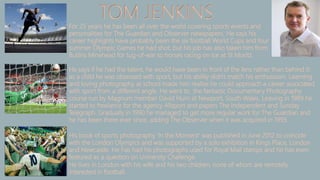
For 25 years he has been all over the world covering sports events and
personalities for The Guardian and Observer newspapers. He says his
career highlights have probably been the six football World Cups and four
summer Olympic Games he had shot, but his job has also taken him from
Butlins Minehead for tug-of-war to horses racing on ice at St Moritz.
He says if he had the talent, he would have been in front of the lens rather than behind it:
as a child he was obsessed with sport, but his ability didn't match his enthusiasm. Learning
and loving photography at school made him realise he could approach a career associated
with sport from a different angle. He went to the fantastic Documentary Photography
course run by Magnum member David Hurn at Newport, South Wales. Leaving in 1989 he
started to freelance for the agency Allsport and papers The Independent and Sunday
Telegraph. Gradually in 1990 he managed to get more regular work for The Guardian and
he has been there ever since, adding The Observer when it was acquired in 1993.
His book of sports photography 'In the Moment' was published in June 2012 to coincide
with the London Olympics and was supported by a solo exhibition in Kings Place, London
and Newcastle. He has had his photographs used for Royal Mail stamps and he has even
featured as a question on University Challenge.
He lives in London with his wife and his two children, none of whom are remotely
interested in football.
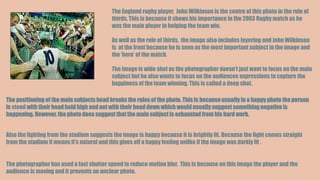
The England rugby player, John Wilkinson is the centre of this photo in the rule of
thirds. This is because it shows his importance in the 2003 Rugby match as he
was the main player in helping the team win.
As well as the rule of thirds, the image also includes layering and John Wilkinson
is at the front because he is seen as the most important subject in the image and
the ‘hero’ of the match.
The image is wide shot as the photographer doesn’t just want to focus on the main
subject but he also wants to focus on the audiences expressions to capture the
happiness of the team winning. This is called a deep shot.
The positioning of the main subjects head breaks the rules of the photo. This is because usually in a happy photo the person
is stood with their head held high and not with their head down which would usually suggest something negative is
happening. However, the photo does suggest that the main subject is exhausted from his hard work.
Also the lighting from the stadium suggests the image is happy because it is brightly lit. Because the light comes straight
from the stadium it means it’s natural and this gives off a happy feeling unlike if the image was darkly lit .
The photographer has used a fast shutter speed to reduce motion blur. This is because on this image the player and the
audience is moving and it prevents an unclear photo.
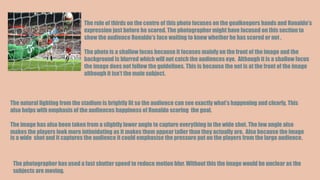
The rule of thirds on the centre of this photo focuses on the goalkeepers hands and Ronaldo’s
expression just before he scored. The photographer might have focused on this section to
show the audience Ronaldo’s face waiting to know whether he has scored or not .
The photo is a shallow focus because it focuses mainly on the front of the image and the
background is blurred which will not catch the audiences eye. Although it is a shallow focus
the image does not follow the guidelines. This is because the net is at the front of the image
although it isn’t the main subject.
The natural lighting from the stadium is brightly lit so the audience can see exactly what’s happening and clearly. This
also helps with emphasis of the audiences happiness of Ronaldo scoring the goal.
The image has also been taken from a slightly lower angle to capture everything in the wide shot. The low angle also
makes the players look more intimidating as it makes them appear taller than they actually are. Also because the image
is a wide shot and it captures the audience it could emphasise the pressure put on the players from the large audience.
The photographer has used a fast shutter speed to reduce motion blur. Without this the image would be unclear as the
subjects are moving.
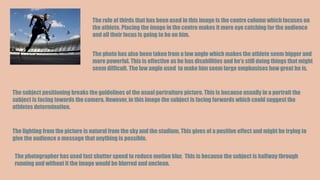
The rule of thirds that has been used in this image is the centre column which focuses on
the athlete. Placing the image in the centre makes it more eye catching for the audience
and all their focus is going to be on him.
The photo has also been taken from a low angle which makes the athlete seem bigger and
more powerful. This is effective as he has disabilities and he’s still doing things that might
seem difficult. The low angle used to make him seem large emphasises how great he is.
The subject positioning breaks the guidelines of the usual portraiture picture. This is because usually in a portrait the
subject is facing towards the camera. However, in this image the subject is facing forwards which could suggest the
athletes determination.
The lighting from the picture is natural from the sky and the stadium. This gives of a positive effect and might be trying to
give the audience a message that anything is possible.
The photographer has used fast shutter speed to reduce motion blur. This is because the subject is halfway through
running and without it the image would be blurred and unclean.
MARIO TESTINO
One of fashion's most sought-after snappers, Mario Testino was born in 1954 in Lima, Peru. He
came to London in 1976, took a flat in an abandoned hospital near Trafalgar Square, and began
selling portfolios (for £25, including hair and make-up) to wannabe models. Today he is best
known for his highly polished, exotically bright ad campaigns and his exquisitely styled
photographs of the couture scene all of which carry a deceptive air of nonchalance. Now at the
top of his profession, Testino has hot Madonna for Versace as well as photographing the late
Diana, Princess of Wales for her famous Vanity Fair cover in 1997. His popularity with designers
and fashion editors stems as much from his professionalism and good nature as his unerring
ability to take beautiful pictures which sell clothes. His work first appeared in vogue in 1983. In
1976 he went to London to study photography after abandoning his studies of Economics, Law
and International Affairs. It was during apprenticeships at the studios of John Vickers and Paul
Nugent that he made his first attempts as a photographer. Living in an unconverted floor of a
hospital, without much money,[10] he funded himself by working as a waiter. He had his hair
dyed pink which helped him get noticed as a photographer and took inspiration from British
celebrity fashion photographer Cecil Beaton London was a city that allowed him to flourish
expressively without the restrictions he felt were imposed on him in Peru. During the early
nineties, Testino looked to his childhood growing up in Peru and his teenage summers in Brazil
for inspiration, which helped him to shape his photographic language.
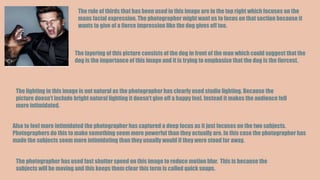
The rule of thirds that has been used in this image are in the top right which focuses on the
mans facial expression. The photographer might want us to focus on that section because it
wants to give of a fierce impression like the dog gives off too.
The layering of this picture consists of the dog in front of the man which could suggest that the
dog is the importance of this image and it is trying to emphasise that the dog is the fiercest.
The lighting in this image is not natural as the photographer has clearly used studio lighting. Because the
picture doesn’t include bright natural lighting it doesn’t give off a happy feel. Instead it makes the audience fell
more intimidated.
Also to feel more intimidated the photographer has captured a deep focus as it just focuses on the two subjects.
Photographers do this to make something seem more powerful than they actually are. In this case the photographer has
made the subjects seem more intimidating than they usually would if they were stood far away.
The photographer has used fast shutter speed on this image to reduce motion blur. This is because the
subjects will be moving and this keeps them clear this term is called quick snaps.
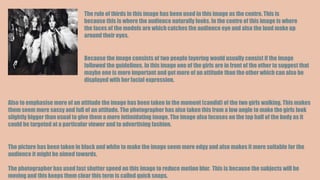
The rule of thirds in this image has been used in this image as the centre. This is
because this is where the audience naturally looks. In the centre of this image is where
the faces of the models are which catches the audience eye and also the loud make up
around their eyes.
Because the image consists of two people layering would usually consist if the image
followed the guidelines. In this image one of the girls are in front of the other to suggest that
maybe one is more important and got more of an attitude than the other which can also be
displayed with her facial expression.
Also to emphasise more of an attitude the image has been taken in the moment (candid) of the two girls walking. This makes
them seem more sassy and full of an attitude. The photographer has also taken this from a low angle to make the girls look
slightly bigger than usual to give them a more intimidating image. The image also focuses on the top half of the body as it
could be targeted at a particular viewer and to advertising fashion.
The picture has been taken in black and white to make the image seem more edgy and also makes it more suitable for the
audience it might be aimed towards.
The photographer has used fast shutter speed on this image to reduce motion blur. This is because the subjects will be
moving and this keeps them clear this term is called quick snaps.
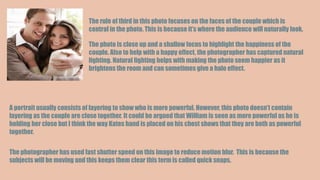
The rule of third in this photo focuses on the faces of the couple which is
central in the photo. This is because it’s where the audience will naturally look.
The photo is close up and a shallow focus to highlight the happiness of the
couple. Also to help with a happy effect, the photographer has captured natural
lighting. Natural lighting helps with making the photo seem happier as it
brightens the room and can sometimes give a halo effect.
A portrait usually consists of layering to show who is more powerful. However, this photo doesn’t contain
layering as the couple are close together. It could be argued that William is seen as more powerful as he is
holding her close but I think the way Kates hand is placed on his chest shows that they are both as powerful
together.
The photographer has used fast shutter speed on this image to reduce motion blur. This is because the
subjects will be moving and this keeps them clear this term is called quick snaps.
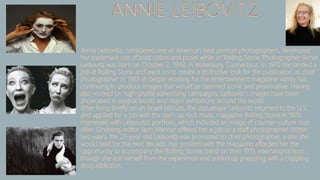
ANNIE LEIBOVITZ
Annie Leibovitz, considered one of America's best portrait photographers, developed
her trademark use of bold colors and poses while at 'Rolling Stone.'Photographer Annie
Leibovitz was born on October 2, 1949, in Waterbury, Connecticut. In 1970 she landed a
job at Rolling Stone and went on to create a distinctive look for the publication as chief
photographer. In 1983 sh began working for the entertainment magazine Vanity Fair,
continuing to produce images that would be deemed iconic and provocative. Having
also worked on high-profile advertising campaigns, Leibovitz's images have been
showcased in several books and major exhibitions around the world.
After living briefly on an Israeli kibbutz, the statuesque Leibovitz returned to the U.S.
and applied for a job with the start-up rock music magazine Rolling Stone in 1970.
Impressed with Leibovitz’s portfolio, which included an image of counter-culture icon
Allen Ginsberg, editor Jann Wenner offered her a job as a staff photographer. Within
two years, the 23-year-old Leibovitz was promoted to chief photographer, a title she
would hold for the next decade. Her position with the magazine afforded her the
opportunity to accompany the Rolling Stones band on their 1975 international tour,
though she lost herself from the experience and ended up grappling with a crippling
drug addiction.
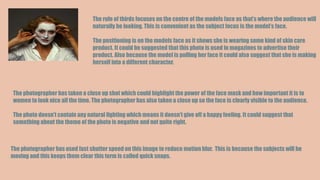
The rule of thirds focuses on the centre of the models face as that’s where the audience will
naturally be looking. This is convenient as the subject focus is the model’s face.
The positioning is on the models face as it shows she is wearing some kind of skin care
product. It could be suggested that this photo is used in magazines to advertise their
product. Also because the model is pulling her face it could also suggest that she is making
herself into a different character.
The photographer has taken a close up shot which could highlight the power of the face mask and how important it is to
women to look nice all the time. The photographer has also taken a close up so the face is clearly visible to the audience.
The photo doesn’t contain any natural lighting which means it doesn’t give off a happy feeling. It could suggest that
something about the theme of the photo is negative and not quite right.
The photographer has used fast shutter speed on this image to reduce motion blur. This is because the subjects will be
moving and this keeps them clear this term is called quick snaps.
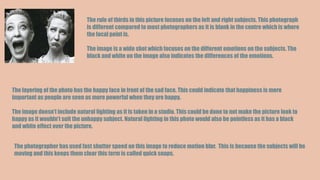
The rule of thirds in this picture focuses on the left and right subjects. This photograph
is different compared to most photographers as it is blank in the centre which is where
the focal point is.
The image is a wide shot which focuses on the different emotions on the subjects. The
black and white on the image also indicates the differences of the emotions.
The layering of the photo has the happy face in front of the sad face. This could indicate that happiness is more
important as people are seen as more powerful when they are happy.
The image doesn’t include natural lighting as it is taken in a studio. This could be done to not make the picture look to
happy as it wouldn’t suit the unhappy subject. Natural lighting in this photo would also be pointless as it has a black
and white effect over the picture.
The photographer has used fast shutter speed on this image to reduce motion blur. This is because the subjects will be
moving and this keeps them clear this term is called quick snaps.
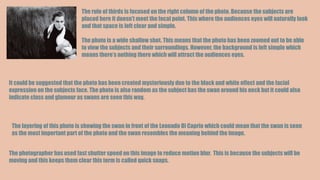
The rule of thirds is focused on the right column of the photo. Because the subjects are
placed here it doesn’t meet the focal point. This where the audiences eyes will naturally look
and that space is left clear and simple.
The photo is a wide shallow shot. This means that the photo has been zoomed out to be able
to view the subjects and their surroundings. However, the background is left simple which
means there’s nothing there which will attract the audiences eyes.
It could be suggested that the photo has been created mysteriously due to the black and white effect and the facial
expression on the subjects face. The photo is also random as the subject has the swan around his neck but it could also
indicate class and glamour as swans are seen this way.
The layering of this photo is showing the swan in front of the Leonado Di Caprio which could mean that the swan is seen
as the most important part of the photo and the swan resembles the meaning behind the image.
The photographer has used fast shutter speed on this image to reduce motion blur. This is because the subjects will be
moving and this keeps them clear this term is called quick snaps.

Photo powerpoint

  • 1.
    TOM JENKINS For 25years he has been all over the world covering sports events and personalities for The Guardian and Observer newspapers. He says his career highlights have probably been the six football World Cups and four summer Olympic Games he had shot, but his job has also taken him from Butlins Minehead for tug-of-war to horses racing on ice at St Moritz. He says if he had the talent, he would have been in front of the lens rather than behind it: as a child he was obsessed with sport, but his ability didn't match his enthusiasm. Learning and loving photography at school made him realise he could approach a career associated with sport from a different angle. He went to the fantastic Documentary Photography course run by Magnum member David Hurn at Newport, South Wales. Leaving in 1989 he started to freelance for the agency Allsport and papers The Independent and Sunday Telegraph. Gradually in 1990 he managed to get more regular work for The Guardian and he has been there ever since, adding The Observer when it was acquired in 1993. His book of sports photography 'In the Moment' was published in June 2012 to coincide with the London Olympics and was supported by a solo exhibition in Kings Place, London and Newcastle. He has had his photographs used for Royal Mail stamps and he has even featured as a question on University Challenge. He lives in London with his wife and his two children, none of whom are remotely interested in football.
  • 2.
    The England rugbyplayer, John Wilkinson is the centre of this photo in the rule of thirds. This is because it shows his importance in the 2003 Rugby match as he was the main player in helping the team win. As well as the rule of thirds, the image also includes layering and John Wilkinson is at the front because he is seen as the most important subject in the image and the ‘hero’ of the match. The image is wide shot as the photographer doesn’t just want to focus on the main subject but he also wants to focus on the audiences expressions to capture the happiness of the team winning. This is called a deep shot. The positioning of the main subjects head breaks the rules of the photo. This is because usually in a happy photo the person is stood with their head held high and not with their head down which would usually suggest something negative is happening. However, the photo does suggest that the main subject is exhausted from his hard work. Also the lighting from the stadium suggests the image is happy because it is brightly lit. Because the light comes straight from the stadium it means it’s natural and this gives off a happy feeling unlike if the image was darkly lit . The photographer has used a fast shutter speed to reduce motion blur. This is because on this image the player and the audience is moving and it prevents an unclear photo.
  • 3.
    The rule ofthirds on the centre of this photo focuses on the goalkeepers hands and Ronaldo’s expression just before he scored. The photographer might have focused on this section to show the audience Ronaldo’s face waiting to know whether he has scored or not . The photo is a shallow focus because it focuses mainly on the front of the image and the background is blurred which will not catch the audiences eye. Although it is a shallow focus the image does not follow the guidelines. This is because the net is at the front of the image although it isn’t the main subject. The natural lighting from the stadium is brightly lit so the audience can see exactly what’s happening and clearly. This also helps with emphasis of the audiences happiness of Ronaldo scoring the goal. The image has also been taken from a slightly lower angle to capture everything in the wide shot. The low angle also makes the players look more intimidating as it makes them appear taller than they actually are. Also because the image is a wide shot and it captures the audience it could emphasise the pressure put on the players from the large audience. The photographer has used a fast shutter speed to reduce motion blur. Without this the image would be unclear as the subjects are moving.
  • 4.
    The rule ofthirds that has been used in this image is the centre column which focuses on the athlete. Placing the image in the centre makes it more eye catching for the audience and all their focus is going to be on him. The photo has also been taken from a low angle which makes the athlete seem bigger and more powerful. This is effective as he has disabilities and he’s still doing things that might seem difficult. The low angle used to make him seem large emphasises how great he is. The subject positioning breaks the guidelines of the usual portraiture picture. This is because usually in a portrait the subject is facing towards the camera. However, in this image the subject is facing forwards which could suggest the athletes determination. The lighting from the picture is natural from the sky and the stadium. This gives of a positive effect and might be trying to give the audience a message that anything is possible. The photographer has used fast shutter speed to reduce motion blur. This is because the subject is halfway through running and without it the image would be blurred and unclean.
  • 5.
    MARIO TESTINO One offashion's most sought-after snappers, Mario Testino was born in 1954 in Lima, Peru. He came to London in 1976, took a flat in an abandoned hospital near Trafalgar Square, and began selling portfolios (for £25, including hair and make-up) to wannabe models. Today he is best known for his highly polished, exotically bright ad campaigns and his exquisitely styled photographs of the couture scene all of which carry a deceptive air of nonchalance. Now at the top of his profession, Testino has hot Madonna for Versace as well as photographing the late Diana, Princess of Wales for her famous Vanity Fair cover in 1997. His popularity with designers and fashion editors stems as much from his professionalism and good nature as his unerring ability to take beautiful pictures which sell clothes. His work first appeared in vogue in 1983. In 1976 he went to London to study photography after abandoning his studies of Economics, Law and International Affairs. It was during apprenticeships at the studios of John Vickers and Paul Nugent that he made his first attempts as a photographer. Living in an unconverted floor of a hospital, without much money,[10] he funded himself by working as a waiter. He had his hair dyed pink which helped him get noticed as a photographer and took inspiration from British celebrity fashion photographer Cecil Beaton London was a city that allowed him to flourish expressively without the restrictions he felt were imposed on him in Peru. During the early nineties, Testino looked to his childhood growing up in Peru and his teenage summers in Brazil for inspiration, which helped him to shape his photographic language.
  • 6.
    The rule ofthirds that has been used in this image are in the top right which focuses on the mans facial expression. The photographer might want us to focus on that section because it wants to give of a fierce impression like the dog gives off too. The layering of this picture consists of the dog in front of the man which could suggest that the dog is the importance of this image and it is trying to emphasise that the dog is the fiercest. The lighting in this image is not natural as the photographer has clearly used studio lighting. Because the picture doesn’t include bright natural lighting it doesn’t give off a happy feel. Instead it makes the audience fell more intimidated. Also to feel more intimidated the photographer has captured a deep focus as it just focuses on the two subjects. Photographers do this to make something seem more powerful than they actually are. In this case the photographer has made the subjects seem more intimidating than they usually would if they were stood far away. The photographer has used fast shutter speed on this image to reduce motion blur. This is because the subjects will be moving and this keeps them clear this term is called quick snaps.
  • 7.
    The rule ofthirds in this image has been used in this image as the centre. This is because this is where the audience naturally looks. In the centre of this image is where the faces of the models are which catches the audience eye and also the loud make up around their eyes. Because the image consists of two people layering would usually consist if the image followed the guidelines. In this image one of the girls are in front of the other to suggest that maybe one is more important and got more of an attitude than the other which can also be displayed with her facial expression. Also to emphasise more of an attitude the image has been taken in the moment (candid) of the two girls walking. This makes them seem more sassy and full of an attitude. The photographer has also taken this from a low angle to make the girls look slightly bigger than usual to give them a more intimidating image. The image also focuses on the top half of the body as it could be targeted at a particular viewer and to advertising fashion. The picture has been taken in black and white to make the image seem more edgy and also makes it more suitable for the audience it might be aimed towards. The photographer has used fast shutter speed on this image to reduce motion blur. This is because the subjects will be moving and this keeps them clear this term is called quick snaps.
  • 8.
    The rule ofthird in this photo focuses on the faces of the couple which is central in the photo. This is because it’s where the audience will naturally look. The photo is close up and a shallow focus to highlight the happiness of the couple. Also to help with a happy effect, the photographer has captured natural lighting. Natural lighting helps with making the photo seem happier as it brightens the room and can sometimes give a halo effect. A portrait usually consists of layering to show who is more powerful. However, this photo doesn’t contain layering as the couple are close together. It could be argued that William is seen as more powerful as he is holding her close but I think the way Kates hand is placed on his chest shows that they are both as powerful together. The photographer has used fast shutter speed on this image to reduce motion blur. This is because the subjects will be moving and this keeps them clear this term is called quick snaps.
  • 9.
    ANNIE LEIBOVITZ Annie Leibovitz,considered one of America's best portrait photographers, developed her trademark use of bold colors and poses while at 'Rolling Stone.'Photographer Annie Leibovitz was born on October 2, 1949, in Waterbury, Connecticut. In 1970 she landed a job at Rolling Stone and went on to create a distinctive look for the publication as chief photographer. In 1983 sh began working for the entertainment magazine Vanity Fair, continuing to produce images that would be deemed iconic and provocative. Having also worked on high-profile advertising campaigns, Leibovitz's images have been showcased in several books and major exhibitions around the world. After living briefly on an Israeli kibbutz, the statuesque Leibovitz returned to the U.S. and applied for a job with the start-up rock music magazine Rolling Stone in 1970. Impressed with Leibovitz’s portfolio, which included an image of counter-culture icon Allen Ginsberg, editor Jann Wenner offered her a job as a staff photographer. Within two years, the 23-year-old Leibovitz was promoted to chief photographer, a title she would hold for the next decade. Her position with the magazine afforded her the opportunity to accompany the Rolling Stones band on their 1975 international tour, though she lost herself from the experience and ended up grappling with a crippling drug addiction.
  • 10.
    The rule ofthirds focuses on the centre of the models face as that’s where the audience will naturally be looking. This is convenient as the subject focus is the model’s face. The positioning is on the models face as it shows she is wearing some kind of skin care product. It could be suggested that this photo is used in magazines to advertise their product. Also because the model is pulling her face it could also suggest that she is making herself into a different character. The photographer has taken a close up shot which could highlight the power of the face mask and how important it is to women to look nice all the time. The photographer has also taken a close up so the face is clearly visible to the audience. The photo doesn’t contain any natural lighting which means it doesn’t give off a happy feeling. It could suggest that something about the theme of the photo is negative and not quite right. The photographer has used fast shutter speed on this image to reduce motion blur. This is because the subjects will be moving and this keeps them clear this term is called quick snaps.
  • 11.
    The rule ofthirds in this picture focuses on the left and right subjects. This photograph is different compared to most photographers as it is blank in the centre which is where the focal point is. The image is a wide shot which focuses on the different emotions on the subjects. The black and white on the image also indicates the differences of the emotions. The layering of the photo has the happy face in front of the sad face. This could indicate that happiness is more important as people are seen as more powerful when they are happy. The image doesn’t include natural lighting as it is taken in a studio. This could be done to not make the picture look to happy as it wouldn’t suit the unhappy subject. Natural lighting in this photo would also be pointless as it has a black and white effect over the picture. The photographer has used fast shutter speed on this image to reduce motion blur. This is because the subjects will be moving and this keeps them clear this term is called quick snaps.
  • 12.
    The rule ofthirds is focused on the right column of the photo. Because the subjects are placed here it doesn’t meet the focal point. This where the audiences eyes will naturally look and that space is left clear and simple. The photo is a wide shallow shot. This means that the photo has been zoomed out to be able to view the subjects and their surroundings. However, the background is left simple which means there’s nothing there which will attract the audiences eyes. It could be suggested that the photo has been created mysteriously due to the black and white effect and the facial expression on the subjects face. The photo is also random as the subject has the swan around his neck but it could also indicate class and glamour as swans are seen this way. The layering of this photo is showing the swan in front of the Leonado Di Caprio which could mean that the swan is seen as the most important part of the photo and the swan resembles the meaning behind the image. The photographer has used fast shutter speed on this image to reduce motion blur. This is because the subjects will be moving and this keeps them clear this term is called quick snaps.