Helpers & Bystanders 
Rescuers and Indifference
Rescuer 
• verb (used with object), rescued, rescuing. 
• to free or deliver from confinement, violence, 
danger, or evil. 
• to liberate or take by forcible or illegal means from 
lawful custody. 
• History: 1300-1350; Middle English rescuen & Old 
French rescourre, equivalent to re + escourre : to 
shake, drive out, remove.
Bystander 
• noun 
• a person present but not involved; chance 
spectator; onlooker. 
• Origin: 1610-1620; by + stander
Helper 
• noun 
• a person or thing that helps or gives assistance, 
support, etc. 
• an extra locomotive attachment to a train at the 
front, middle or rear, especially to provide extra 
power for climbing a steep grade. 
• Origin: 1250-1300; Middle English
Indifference 
• noun 
• lack of interest or concern. 
• unimportance; little or no concern. 
• the quality or condition of being indifferent. 
• mediocre quality; mediocrity. 
• Origin: 1400-1450; Middle English variant of Latin 
indifferentia.
9 Examples of Helpers 
• 1. Jewish Holocaust 
• 2. Rwandan Genocide 
• 3. Slavery in United States 
• 4. Religious Rights 
• 5. Women’s Rights 
• 6. Gay Rights 
• 7. Human Rights / Human Trafficking 
• 8. Civil Rights in United States 
• 9. People in Danger
Jewish Holocaust 
• Oscar Schindler 
• German industrialist that was at 
one time a member of the Nazi 
party. 
• Took ownership of an 
enamelware factory where he 
witnessed the inhuman 
treatment of Jews. 
• Credited with saving the lives 
of 1,200 Jews during the 
Holocaust.
“I knew the people that worked for me. 
When you know people, you have to behave 
towards them like human beings.” 
–Oscar Schindler
Rwandan Genocide 
• Paul Rusesabagina 
• Hotel manager who hid and 
protected 1,268 Hutu and Tutsi 
refugees during the Rwandan 
Genocide. 
• None of those refugees were 
hurt or killed during the attacks.
“I thought I was doing my right job, my day-to-day 
life, a manger’s life. A manager’s job.” 
“If people see this footage, they’ll say, ‘Oh God, 
that’s terrible,’ and they’ll go on eating their 
dinners.” 
-Paul Rusesabagina
Slavery in USA 
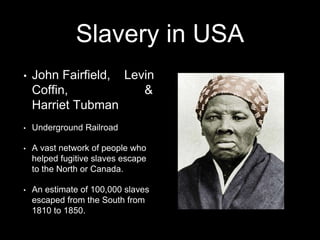
• John Fairfield, Levin 
Coffin, & 
Harriet Tubman 
• Underground Railroad 
• A vast network of people who 
helped fugitive slaves escape 
to the North or Canada. 
• An estimate of 100,000 slaves 
escaped from the South from 
1810 to 1850.
“Every great dream begins with a dreamer. 
Always remember, you have within you the 
strength, the patience, and the passion to reach 
for the stars to change the world.” 
–Harriet Tubman
Religious Rights 
• Mahatma Gandhi 
• Established a policy of non-violent 
non-co-operation to 
achieve independence in India. 
• He struggled to alleviate 
poverty, liberate women and 
put an end to caste 
discrimination, with the ultimate 
objective being self-rule for 
India.
“Where there is love there is life.” 
“Happiness is when what you think, what you 
say, and what you do are in harmony.” 
“You must be the change you wish to see in the 
world.” 
–Mahatma Gandhi
Women’s Rights 
• Susan B. Anthony 
• In 1869 Anthony formed the 
National Woman Sufferage 
Association. The primary goal 
was to achieve voting rights for 
women by means of a 
Congressional amendment to 
the Constitution.
“I declare to you that woman must not depend 
upon the protection of man, but must be taught 
to protect herself, and there I take my stand.” 
–Susan B. Anthony
Gay Rights 
• Harvey Milk 
• Political and community activist 
• In 1977 was the first openly gay 
person to become a publicly 
elected official 
• He tackled a wide variety of 
issues from child care to 
housing to a police review 
board. 
• He was assassinated in 1978.
“All young people, regardless of sexual 
orientation or identity, deserve a safe and 
supportive environment in which to achieve to 
their full potential.” 
–Harvey Milk
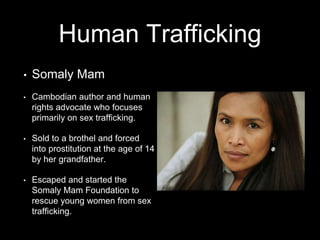
Human Trafficking 
• Somaly Mam 
• Cambodian author and human 
rights advocate who focuses 
primarily on sex trafficking. 
• Sold to a brothel and forced 
into prostitution at the age of 14 
by her grandfather. 
• Escaped and started the 
Somaly Mam Foundation to 
rescue young women from sex 
trafficking.
“A seed is like a little girl: it can look small and 
worthless, but if you treat it well then it will grow 
beautiful.” 
–Somaly Mam
Civil Rights 
• Ezell Blair, Franklin 
McCain, Joseph McNeil, 
David Richmond 
• On February 1, 1960 four African 
American college students sat down at 
a lunch counter at Woolworth’s in 
Greensboro, NC and politely asked for 
service. 
• When asked to leave they remained in 
their seats. 
• Their passive resistance and peaceful 
sit-down helped ignite a youth led 
movement to challenge racial 
inequality.
“Darkness cannot drive out darkness; only light 
can do that. Hate cannot drive out hate; only 
love can do that.” 
“Nothing in all the world is more dangerous than 
sincere ignorance and conscientious stupidity.” 
–Martin Luther King, Jr.
People in Danger 
• Hugh O’Neil 
• A 1960 Hoban graduate and Georgetown 
University student home for summer 
break. 
• Heavy rain caused a sink hole to form on 
Tallmadge Ave. and several people were 
trapped in the hole. 
• O’Neil volunteered to be part of a rescue 
team to help save the trapped people. 
• He lost his life saving a woman named 
Janet Lewis. 
• Because of the lost lives Tallmadge Ave 
was renamed Memorial Parkway.
Two Ways to Approach 
Project 
• Option 1: Use a contemporary example of 
helper/rescuer or bystander/indifference as the 
subject of your woodblock print. 
• Option 2: Use an actual story from the Holocaust 
as the subject of your woodblock print.

Helpers

  • 1.
    Helpers & Bystanders Rescuers and Indifference
  • 2.
    Rescuer • verb(used with object), rescued, rescuing. • to free or deliver from confinement, violence, danger, or evil. • to liberate or take by forcible or illegal means from lawful custody. • History: 1300-1350; Middle English rescuen & Old French rescourre, equivalent to re + escourre : to shake, drive out, remove.
  • 3.
    Bystander • noun • a person present but not involved; chance spectator; onlooker. • Origin: 1610-1620; by + stander
  • 4.
    Helper • noun • a person or thing that helps or gives assistance, support, etc. • an extra locomotive attachment to a train at the front, middle or rear, especially to provide extra power for climbing a steep grade. • Origin: 1250-1300; Middle English
  • 5.
    Indifference • noun • lack of interest or concern. • unimportance; little or no concern. • the quality or condition of being indifferent. • mediocre quality; mediocrity. • Origin: 1400-1450; Middle English variant of Latin indifferentia.
  • 6.
    9 Examples ofHelpers • 1. Jewish Holocaust • 2. Rwandan Genocide • 3. Slavery in United States • 4. Religious Rights • 5. Women’s Rights • 6. Gay Rights • 7. Human Rights / Human Trafficking • 8. Civil Rights in United States • 9. People in Danger
  • 7.
    Jewish Holocaust •Oscar Schindler • German industrialist that was at one time a member of the Nazi party. • Took ownership of an enamelware factory where he witnessed the inhuman treatment of Jews. • Credited with saving the lives of 1,200 Jews during the Holocaust.
  • 8.
    “I knew thepeople that worked for me. When you know people, you have to behave towards them like human beings.” –Oscar Schindler
  • 9.
    Rwandan Genocide •Paul Rusesabagina • Hotel manager who hid and protected 1,268 Hutu and Tutsi refugees during the Rwandan Genocide. • None of those refugees were hurt or killed during the attacks.
  • 10.
    “I thought Iwas doing my right job, my day-to-day life, a manger’s life. A manager’s job.” “If people see this footage, they’ll say, ‘Oh God, that’s terrible,’ and they’ll go on eating their dinners.” -Paul Rusesabagina
  • 11.
    Slavery in USA • John Fairfield, Levin Coffin, & Harriet Tubman • Underground Railroad • A vast network of people who helped fugitive slaves escape to the North or Canada. • An estimate of 100,000 slaves escaped from the South from 1810 to 1850.
  • 12.
    “Every great dreambegins with a dreamer. Always remember, you have within you the strength, the patience, and the passion to reach for the stars to change the world.” –Harriet Tubman
  • 13.
    Religious Rights •Mahatma Gandhi • Established a policy of non-violent non-co-operation to achieve independence in India. • He struggled to alleviate poverty, liberate women and put an end to caste discrimination, with the ultimate objective being self-rule for India.
  • 14.
    “Where there islove there is life.” “Happiness is when what you think, what you say, and what you do are in harmony.” “You must be the change you wish to see in the world.” –Mahatma Gandhi
  • 15.
    Women’s Rights •Susan B. Anthony • In 1869 Anthony formed the National Woman Sufferage Association. The primary goal was to achieve voting rights for women by means of a Congressional amendment to the Constitution.
  • 16.
    “I declare toyou that woman must not depend upon the protection of man, but must be taught to protect herself, and there I take my stand.” –Susan B. Anthony
  • 17.
    Gay Rights •Harvey Milk • Political and community activist • In 1977 was the first openly gay person to become a publicly elected official • He tackled a wide variety of issues from child care to housing to a police review board. • He was assassinated in 1978.
  • 18.
    “All young people,regardless of sexual orientation or identity, deserve a safe and supportive environment in which to achieve to their full potential.” –Harvey Milk
  • 19.
    Human Trafficking •Somaly Mam • Cambodian author and human rights advocate who focuses primarily on sex trafficking. • Sold to a brothel and forced into prostitution at the age of 14 by her grandfather. • Escaped and started the Somaly Mam Foundation to rescue young women from sex trafficking.
  • 20.
    “A seed islike a little girl: it can look small and worthless, but if you treat it well then it will grow beautiful.” –Somaly Mam
  • 21.
    Civil Rights •Ezell Blair, Franklin McCain, Joseph McNeil, David Richmond • On February 1, 1960 four African American college students sat down at a lunch counter at Woolworth’s in Greensboro, NC and politely asked for service. • When asked to leave they remained in their seats. • Their passive resistance and peaceful sit-down helped ignite a youth led movement to challenge racial inequality.
  • 23.
    “Darkness cannot driveout darkness; only light can do that. Hate cannot drive out hate; only love can do that.” “Nothing in all the world is more dangerous than sincere ignorance and conscientious stupidity.” –Martin Luther King, Jr.
  • 24.
    People in Danger • Hugh O’Neil • A 1960 Hoban graduate and Georgetown University student home for summer break. • Heavy rain caused a sink hole to form on Tallmadge Ave. and several people were trapped in the hole. • O’Neil volunteered to be part of a rescue team to help save the trapped people. • He lost his life saving a woman named Janet Lewis. • Because of the lost lives Tallmadge Ave was renamed Memorial Parkway.
  • 25.
    Two Ways toApproach Project • Option 1: Use a contemporary example of helper/rescuer or bystander/indifference as the subject of your woodblock print. • Option 2: Use an actual story from the Holocaust as the subject of your woodblock print.