Midterm Presentation: Bio-mineralization


    Phospholipid vesicles as a model
    system for biomineralization
      324, 565 (1986)     Stephen Mann, John P. Hannington
                          & R. J. P. Williams


        Course: Bioinspired Materials and Technology
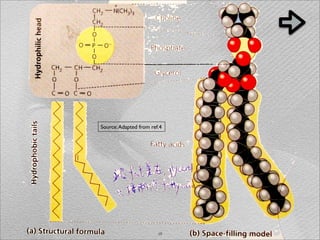
        Advisor: Tu Lee, Ph. D.
        Department of Chemical and Materials Engineering
        Reporter: Lin, Chun-Ian
                                                       Date: 11/06/2009
About this article...
-   Originally an article from “LETTERS TO NATURE”
-   An experiment on the biomineralization of iron oxide in
    unilamella (Latin, thin plate pl, lamellae) phospholipid
    vesicles


                               2
What will be presented,
   1.   The authors who contributed to this work
   2.   Biomineralization defined
   3.   Experiment design 1-2
   4.   Results


                         3
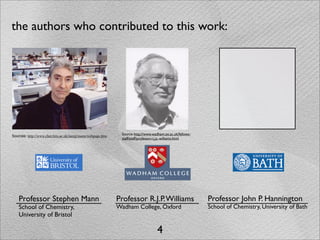
the authors who contributed to this work:


                                                             Source: http://www.wadham.ox.ac.uk/fellows-
Sources: http://www.chm.bris.ac.uk/inorg/mann/webpage.htm
                                                             staff/staff/professor-r.j.p.-williams.html


    Professor Stephen Mann                                  Professor R.J.P. Williams                      Professor John P. Hannington
    School of Chemistry,                                    Wadham College, Oxford                         School of Chemistry, University of Bath
    University of Bristol

                                                                                   4
Biomineralization
     defined
       Classification:
1. Biologically induced
  - little control over type and
       habit of minerals
   -   except for the metabolism-
       mediated pH, pCO2
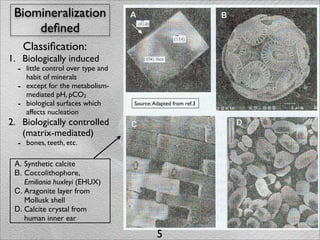
   -   biological surfaces which    Source: Adapted from ref.3
       affects nucleation
2. Biologically controlled
   (matrix-mediated)
  - bones, teeth, etc.

 A. Synthetic calcite
 B. Coccolithophore,
    Emiliania huxleyi (EHUX)
 C. Aragonite layer from
    Mollusk shell
 D. Calcite crystal from
    human inner ear

                                             5
Vesicles preparation
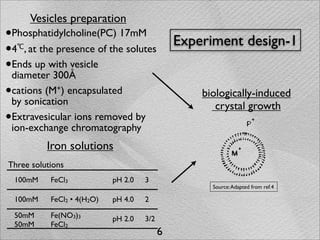
•Phosphatidylcholine(PC) 17mM Experiment design-1
•4 , at the presence of the solutes
  ℃

•diameterwith vesicle
 Ends up
           300Å
•by sonicationencapsulated
 cations (M )+
                                    biologically-induced
                                       crystal growth
•ion-exchange chromatography
 Extravesicular ions removed by

          Iron solutions
Three solutions
 100mM     FeCl3            pH 2.0   3
                                               Source: Adapted from ref.4

 100mM     FeCl2 • 4(H2O)   pH 4.0   2

 50mM      Fe(NO3)3         pH 2.0   3/2
 50mM      FeCl2
                                           6
Experiment design-2


                                Source: Adapted from ref.3

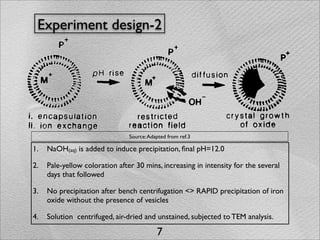
1.   NaOH(aq) is added to induce precipitation, final pH=12.0

2.   Pale-yellow coloration after 30 mins, increasing in intensity for the several
     days that followed

3.   No precipitation after bench centrifugation <> RAPID precipitation of iron
     oxide without the presence of vesicles

4.   Solution centrifuged, air-dried and unstained, subjected to TEM analysis.

                                           7
Source: Adapted from ref.4
 Three solutions
   100mM        FeCl3               pH 2.0    3

   100mM        FeCl2 • 4(H2O)      pH 4.0    2

   50mM         Fe(NO3)3            pH 2.0    3/2
   50mM         FeCl2

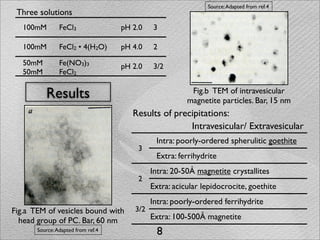
          Results                                         Fig.b TEM of intravesicular
                                                         magnetite particles. Bar, 15 nm
                                       Results of precipitations:
                                                      Intravesicular/ Extravesicular
                                               Intra: poorly-ordered spherulitic goethite
                                        3
                                               Extra: ferrihydrite
                                              Intra: 20-50Å magnetite crystallites
                                        2
                                              Extra: acicular lepidocrocite, goethite
                                              Intra: poorly-ordered ferrihydrite
Fig.a TEM of vesicles bound with        3/2
  head group of PC. Bar, 60 nm                Extra: 100-500Å magnetite
       Source: Adapted from ref.4               8
Reference

       ‣Bibliography
1. Bragg WL, Claringbull GF, Taylor WH. Crystal structures of minerals. 1st ed.
   LONDON: G. Bell and Sons, LTD; 1965.

2. Campbell NA, Reece JB. BIOLOGY. 6th ed. San Francisco, CA: Benjamin
   Cummings; 2001.

3. Dove PM, De Yoreo JJ, Weiner S. Biomineralization. 1st ed. Washington, DC:
   Mineralogical Society of America; 2003.

       ‣Literature
4.   Mann, S., Hannington J. P., Williams R. J. P., Nature 324, pp. 565-567
     (1986)


                                        9
creature too tiny to be seen with
unaided eyes, yet as a resident of the
mother earth like them, I feel compelled
to introduce them to you....
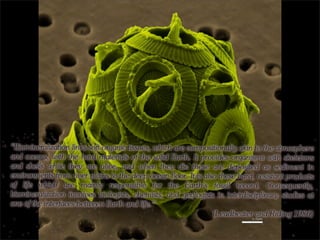
Coccolithophore, Emiliania huxleyi
      Thomas Henry Huxley (1825-1895)

  •   Marine phytoplankton
  •   Considered the most productive calcifying
      organisms on earth (Plants, photosynthesis)
  •   Forms large blooms in favorable conditions,
      sometimes the size of England
  1. DMS(dimethyl sulfide), cloud formation
  2. Brings carbon dioxide down to the deep ocean
  3. Heat retention and radiation reflection
Thanks for your attention, really.
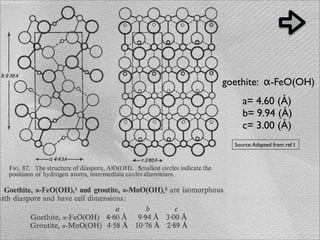
goethite: α-FeO(OH)
     a= 4.60 (Å)
     b= 9.94 (Å)
     c= 3.00 (Å)
  Source: Adapted from ref.1
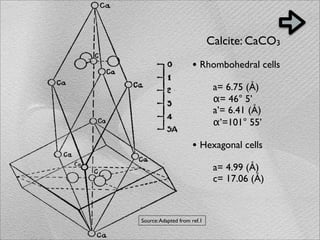
Calcite: CaCO3

                     • Rhombohedral cells
                              a= 6.75 (Å)
                              α= 46° 5’
                              a’= 6.41 (Å)
                              α’=101° 55’

                     • Hexagonal cells
                              a= 4.99 (Å)
                              c= 17.06 (Å)


Source: Adapted from ref.1
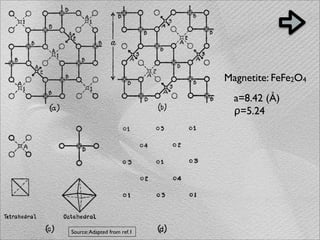
Magnetite: FeFe2O4
                               a=8.42 (Å)
                               ρ=5.24


Source: Adapted from ref.1
Source: Adapted from ref.4


                        17

Phospholipid Vescicles As A Model System For Biomineralization

  • 1.
    Midterm Presentation: Bio-mineralization Phospholipid vesicles as a model system for biomineralization 324, 565 (1986) Stephen Mann, John P. Hannington & R. J. P. Williams Course: Bioinspired Materials and Technology Advisor: Tu Lee, Ph. D. Department of Chemical and Materials Engineering Reporter: Lin, Chun-Ian Date: 11/06/2009
  • 2.
    About this article... - Originally an article from “LETTERS TO NATURE” - An experiment on the biomineralization of iron oxide in unilamella (Latin, thin plate pl, lamellae) phospholipid vesicles 2
  • 3.
    What will bepresented, 1. The authors who contributed to this work 2. Biomineralization defined 3. Experiment design 1-2 4. Results 3
  • 4.
    the authors whocontributed to this work: Source: http://www.wadham.ox.ac.uk/fellows- Sources: http://www.chm.bris.ac.uk/inorg/mann/webpage.htm staff/staff/professor-r.j.p.-williams.html Professor Stephen Mann Professor R.J.P. Williams Professor John P. Hannington School of Chemistry, Wadham College, Oxford School of Chemistry, University of Bath University of Bristol 4
  • 5.
    Biomineralization defined Classification: 1. Biologically induced - little control over type and habit of minerals - except for the metabolism- mediated pH, pCO2 - biological surfaces which Source: Adapted from ref.3 affects nucleation 2. Biologically controlled (matrix-mediated) - bones, teeth, etc. A. Synthetic calcite B. Coccolithophore, Emiliania huxleyi (EHUX) C. Aragonite layer from Mollusk shell D. Calcite crystal from human inner ear 5
  • 6.
    Vesicles preparation •Phosphatidylcholine(PC) 17mMExperiment design-1 •4 , at the presence of the solutes ℃ •diameterwith vesicle Ends up 300Å •by sonicationencapsulated cations (M )+ biologically-induced crystal growth •ion-exchange chromatography Extravesicular ions removed by Iron solutions Three solutions 100mM FeCl3 pH 2.0 3 Source: Adapted from ref.4 100mM FeCl2 • 4(H2O) pH 4.0 2 50mM Fe(NO3)3 pH 2.0 3/2 50mM FeCl2 6
  • 7.
    Experiment design-2 Source: Adapted from ref.3 1. NaOH(aq) is added to induce precipitation, final pH=12.0 2. Pale-yellow coloration after 30 mins, increasing in intensity for the several days that followed 3. No precipitation after bench centrifugation <> RAPID precipitation of iron oxide without the presence of vesicles 4. Solution centrifuged, air-dried and unstained, subjected to TEM analysis. 7
  • 8.
    Source: Adapted fromref.4 Three solutions 100mM FeCl3 pH 2.0 3 100mM FeCl2 • 4(H2O) pH 4.0 2 50mM Fe(NO3)3 pH 2.0 3/2 50mM FeCl2 Results Fig.b TEM of intravesicular magnetite particles. Bar, 15 nm Results of precipitations: Intravesicular/ Extravesicular Intra: poorly-ordered spherulitic goethite 3 Extra: ferrihydrite Intra: 20-50Å magnetite crystallites 2 Extra: acicular lepidocrocite, goethite Intra: poorly-ordered ferrihydrite Fig.a TEM of vesicles bound with 3/2 head group of PC. Bar, 60 nm Extra: 100-500Å magnetite Source: Adapted from ref.4 8
  • 9.
    Reference ‣Bibliography 1. Bragg WL, Claringbull GF, Taylor WH. Crystal structures of minerals. 1st ed. LONDON: G. Bell and Sons, LTD; 1965. 2. Campbell NA, Reece JB. BIOLOGY. 6th ed. San Francisco, CA: Benjamin Cummings; 2001. 3. Dove PM, De Yoreo JJ, Weiner S. Biomineralization. 1st ed. Washington, DC: Mineralogical Society of America; 2003. ‣Literature 4. Mann, S., Hannington J. P., Williams R. J. P., Nature 324, pp. 565-567 (1986) 9
  • 10.
    creature too tinyto be seen with unaided eyes, yet as a resident of the mother earth like them, I feel compelled to introduce them to you....
  • 11.
    Coccolithophore, Emiliania huxleyi Thomas Henry Huxley (1825-1895) • Marine phytoplankton • Considered the most productive calcifying organisms on earth (Plants, photosynthesis) • Forms large blooms in favorable conditions, sometimes the size of England 1. DMS(dimethyl sulfide), cloud formation 2. Brings carbon dioxide down to the deep ocean 3. Heat retention and radiation reflection
  • 13.
    Thanks for yourattention, really.
  • 14.
    goethite: α-FeO(OH) a= 4.60 (Å) b= 9.94 (Å) c= 3.00 (Å) Source: Adapted from ref.1
  • 15.
    Calcite: CaCO3 • Rhombohedral cells a= 6.75 (Å) α= 46° 5’ a’= 6.41 (Å) α’=101° 55’ • Hexagonal cells a= 4.99 (Å) c= 17.06 (Å) Source: Adapted from ref.1
  • 16.
    Magnetite: FeFe2O4 a=8.42 (Å) ρ=5.24 Source: Adapted from ref.1
  • 17.