Mechanisms, Functions, and
Engineering Applications
Presented by: Zaib Un NIsa
1414017
Biomineralization
Prof. Dr. Thomas Jüstel
Outline
01 Introduction
02
Mechanisms of
Biomineralization
04 Applications
05 Future Trends
06 Summary & References
03 Types of Biominerals
Introduction and History of Biomineralization
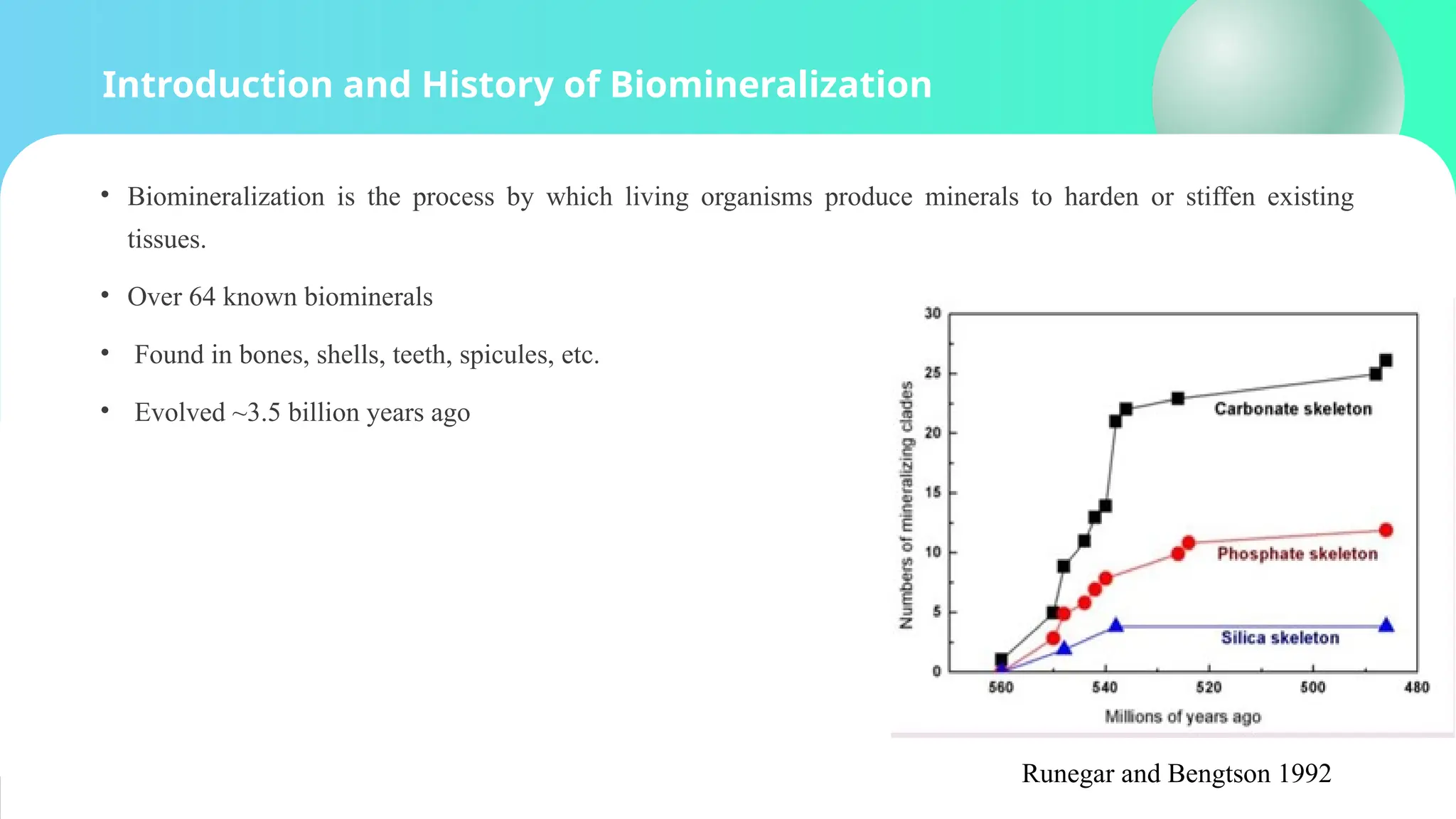
• Biomineralization is the process by which living organisms produce minerals to harden or stiffen existing
tissues.
• Over 64 known biominerals
• Found in bones, shells, teeth, spicules, etc.
• Evolved ~3.5 billion years ago
Runegar and Bengtson 1992
Continue
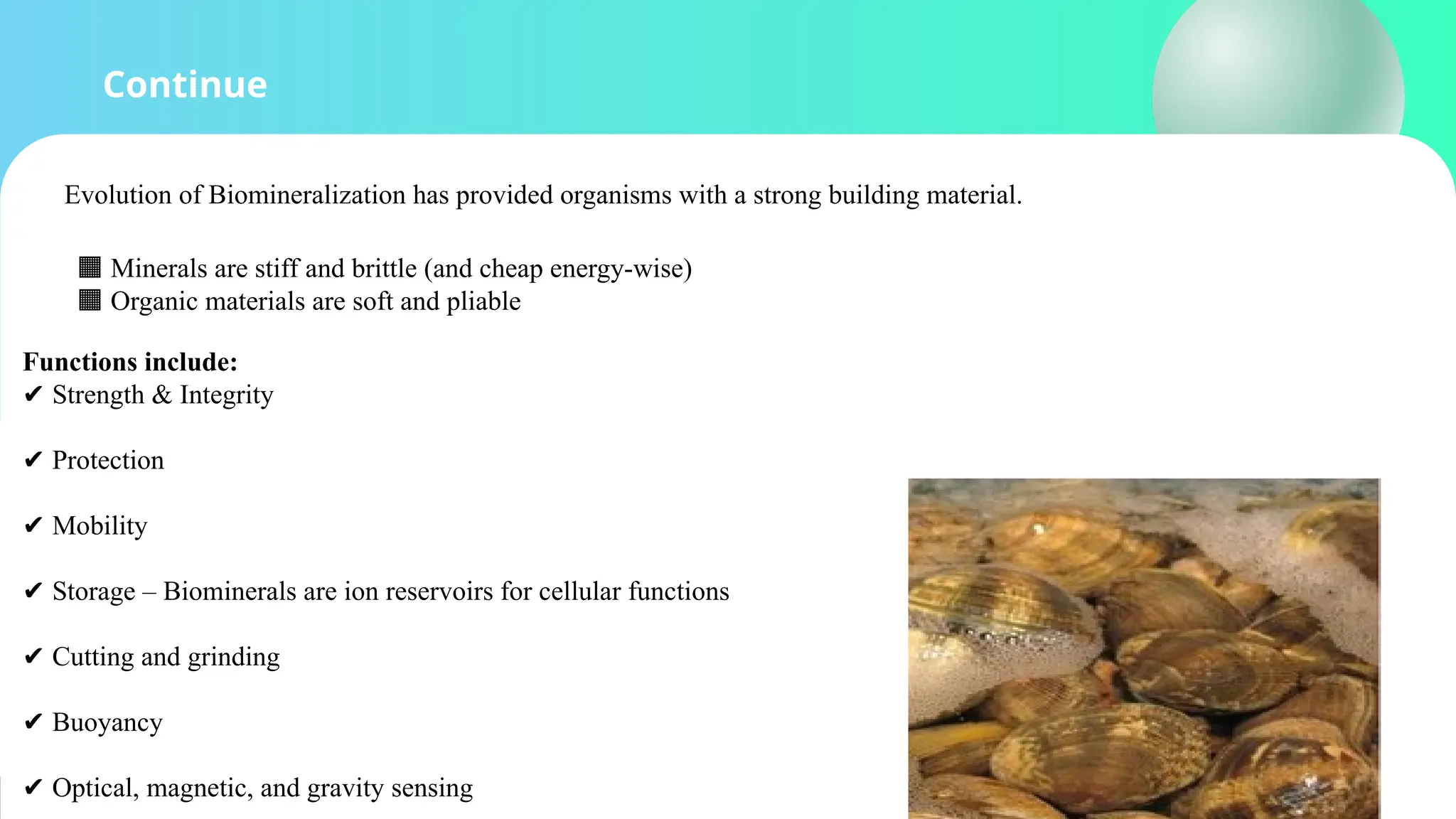
Evolution of Biomineralization has provided organisms with a strong building material.
🟧 Minerals are stiff and brittle (and cheap energy-wise)
🟧 Organic materials are soft and pliable
Functions include:
✔️Strength & Integrity
✔️Protection
✔️Mobility
✔️Storage – Biominerals are ion reservoirs for cellular functions
✔️Cutting and grinding
✔️Buoyancy
✔️Optical, magnetic, and gravity sensing
Basic Biomineralization Principles
Saturation, Nucleation, Growth and Organic
Matrix
Saturation – The Starting Point of Biomineralization
🔹 Saturation refers to the level at which a solution contains enough dissolved ions to begin forming a solid mineral (i.e., it becomes
supersaturated).
🧪 Key Points:
• Supersaturation of ions (e.g., Ca² and CO ² for calcium carbonate) is necessary for biomineral formation.
⁺ ₃ ⁻
• Organisms regulate ion concentration to reach and maintain supersaturation locally (e.g., via ion pumps or pH changes).
• The process must be carefully controlled to prevent unwanted precipitation.
📌 Biological Example:
• Sea urchin embryos regulate pH to increase carbonate concentration and initiate skeletal mineralization.
Nucleation – Initiating Mineral Formation
🔹 What is Nucleation?
• Nucleation is the initial step where ions in solution begin to assemble into a tiny, stable crystal nucleus.
🔍 Types:
• Homogeneous nucleation: Occurs without a template (rare in biology).
• Heterogeneous nucleation: Occurs on a surface or organic matrix (common in living systems).
🧠 Biological Control:
• Organisms use proteins, lipids, and sugars to control the location, timing, and structure of nucleation.
• These biomolecules lower the energy barrier for nucleation and determine the crystal type.
Example:
• Oyster shell formation starts with nucleation on organic sheets secreted by mantle tissue.
Crystal Growth – Building the Mineral Structure
🔹 What is Crystal Growth?
• After nucleation, ions continue to attach to the nucleus, growing it into a full-sized mineral crystal.
🧩 Controlled Features:
• Size: Growth rate is controlled to avoid brittleness.
• Shape & Orientation: Directed by protein scaffolds and environmental conditions.
• Polymorphism: Organisms can select between mineral forms (e.g., aragonite vs. calcite).
🧪 Factors Influencing Growth:
• Ion availability
• Temperature
• Presence of inhibitors/promoters
📌 Example:
• Corals grow aragonite crystals in layered, highly oriented structures for strength.
Organic Matrix – The Blueprint for Mineralization
A network of proteins, glycoproteins, and polysaccharides that provides a framework for mineral formation.
🧠 Functions
• Scaffold: Directs crystal shape, orientation, and location.
• Chemical control: Binds ions and mediates crystallization.
• Mechanical enhancement: Increases toughness by integrating soft and hard phases.
🌿 Matrix Components:
• Collagen (in bone)
• Chitin (in shells)
• Acidic proteins (e.g., osteopontin, nacrein)
📌 Example:
• Bone is composed of collagen fibers with embedded hydroxyapatite crystals aligned along the fibers.
Types & Uses
Calcium carbonate
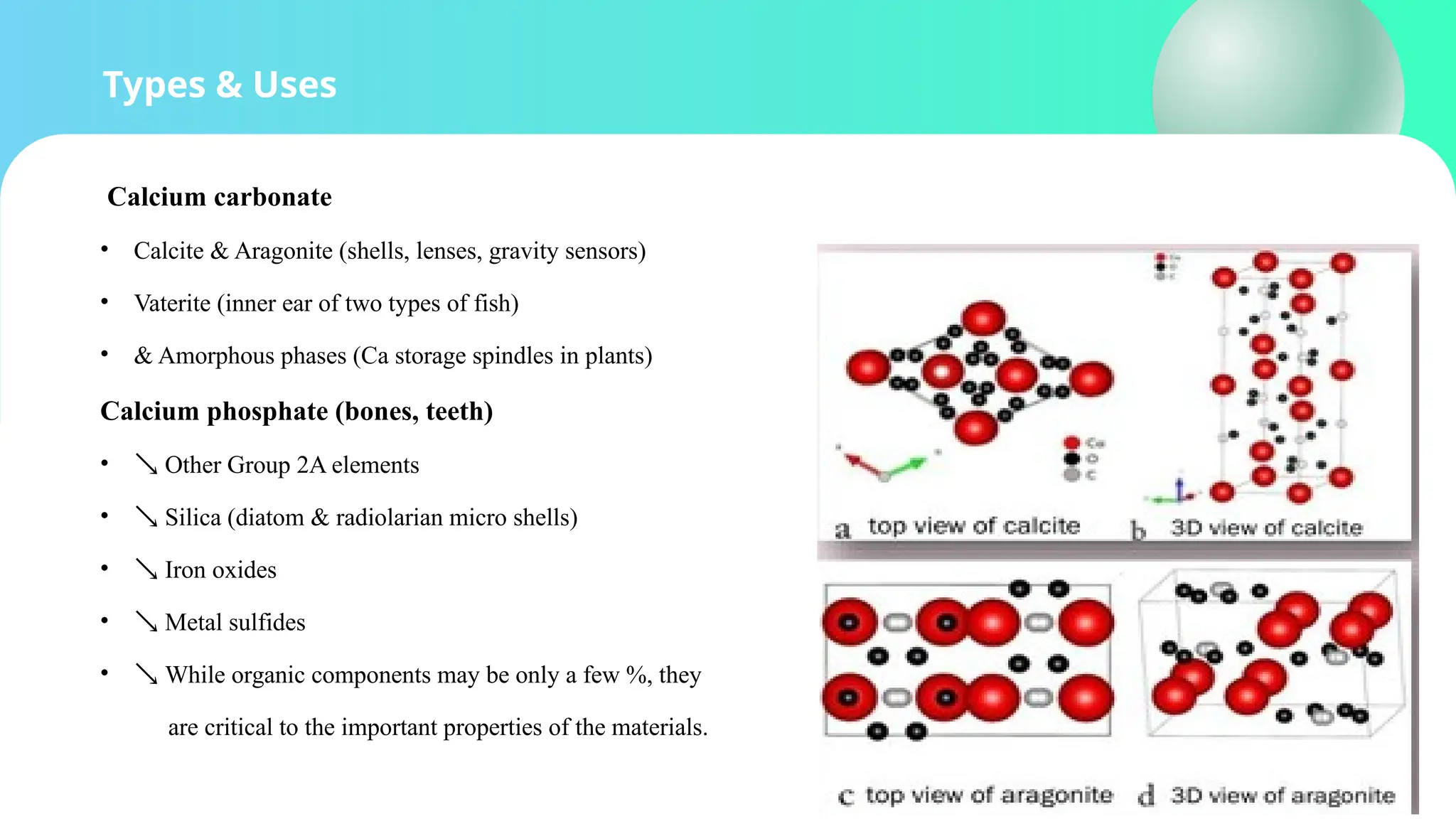
• Calcite & Aragonite (shells, lenses, gravity sensors)
• Vaterite (inner ear of two types of fish)
• & Amorphous phases (Ca storage spindles in plants)
Calcium phosphate (bones, teeth)
•  Other Group 2A elements
•  Silica (diatom & radiolarian micro shells)
•  Iron oxides
•  Metal sulfides
•  While organic components may be only a few %, they
are critical to the important properties of the materials.
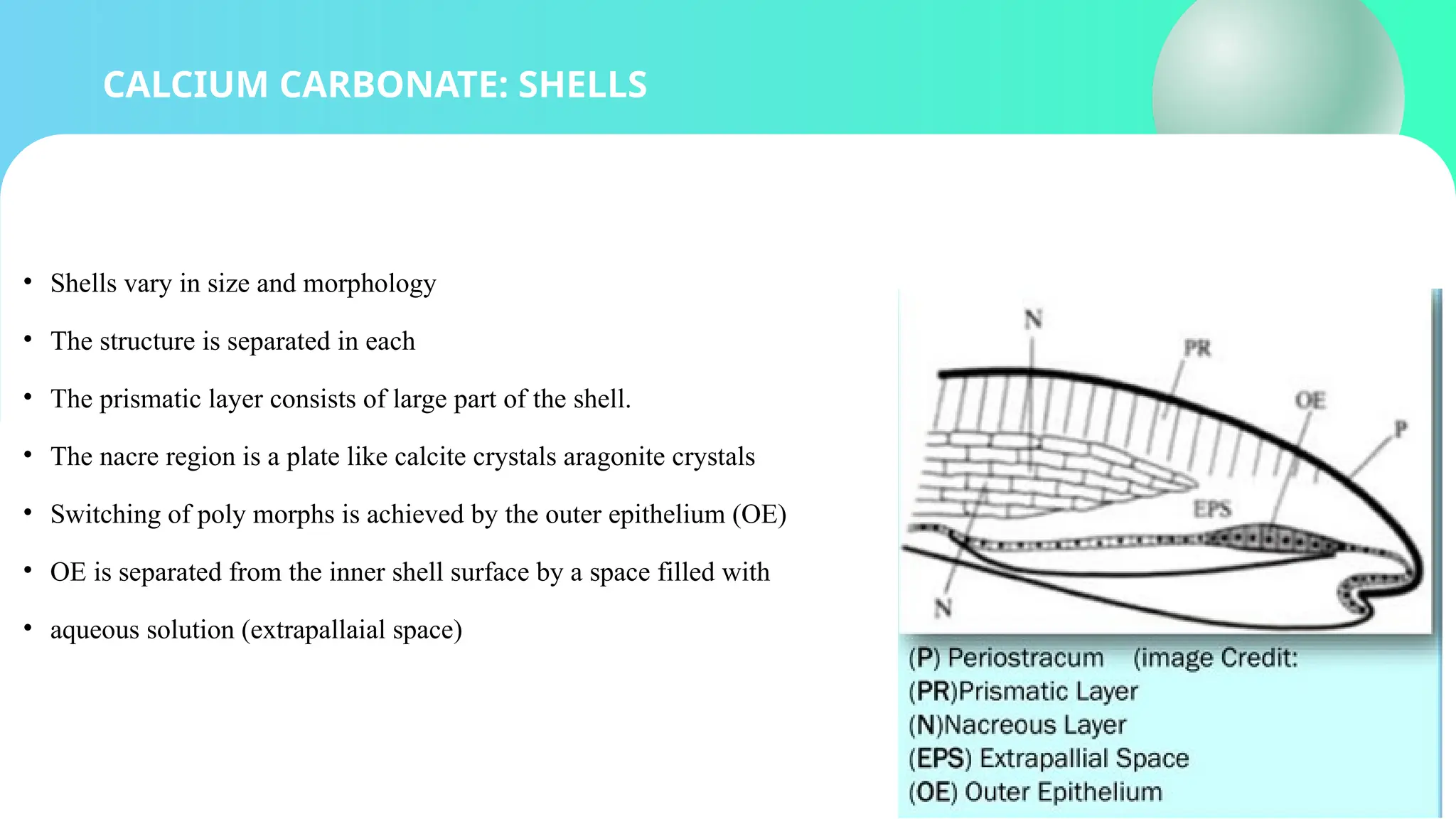
CALCIUM CARBONATE: SHELLS
• Shells vary in size and morphology
• The structure is separated in each
• The prismatic layer consists of large part of the shell.
• The nacre region is a plate like calcite crystals aragonite crystals
• Switching of poly morphs is achieved by the outer epithelium (OE)
• OE is separated from the inner shell surface by a space filled with
• aqueous solution (extrapallaial space)
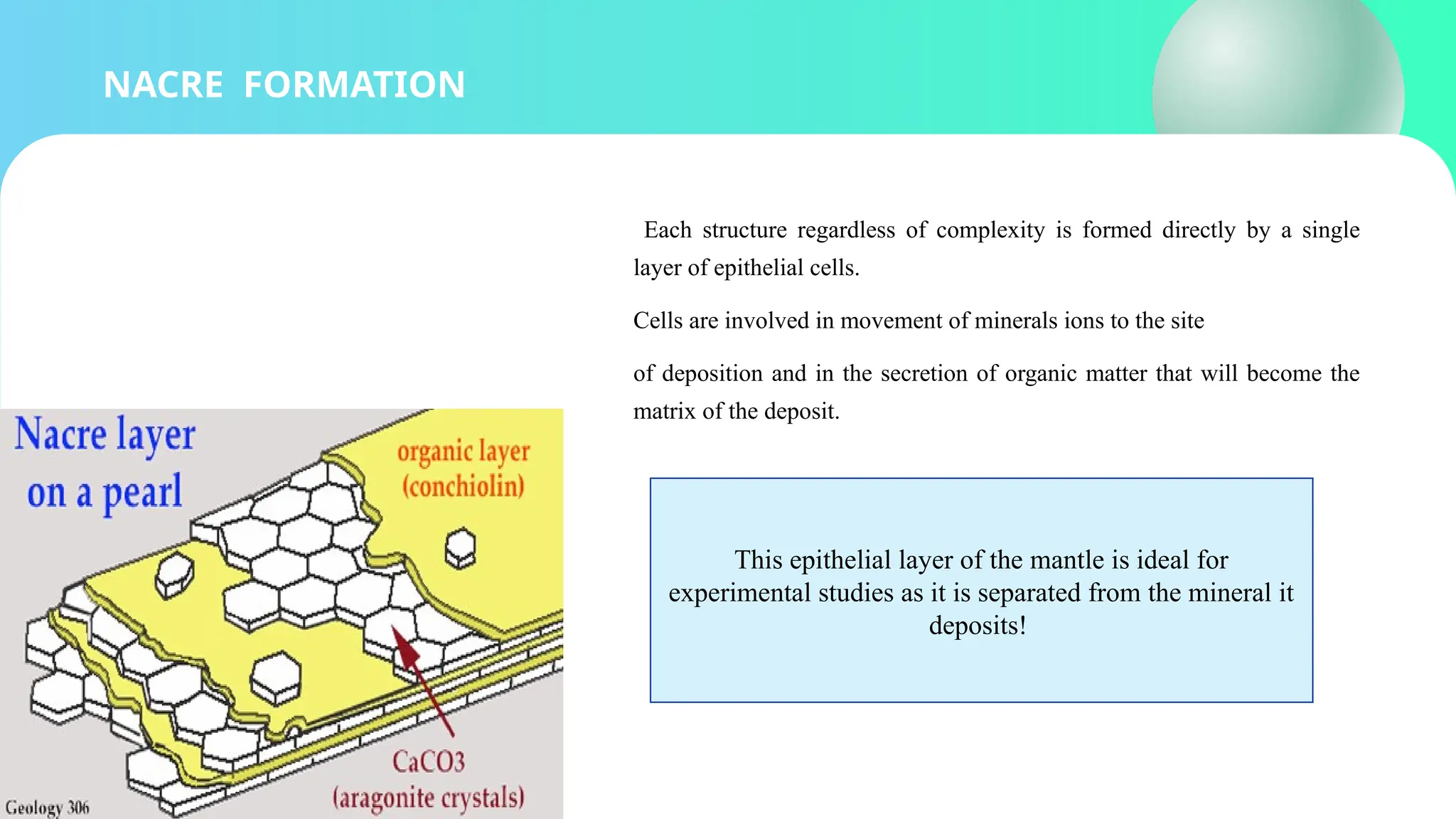
NACRE FORMATION
Each structure regardless of complexity is formed directly by a single
layer of epithelial cells.
Cells are involved in movement of minerals ions to the site
of deposition and in the secretion of organic matter that will become the
matrix of the deposit.
This epithelial layer of the mantle is ideal for
experimental studies as it is separated from the mineral it
deposits!
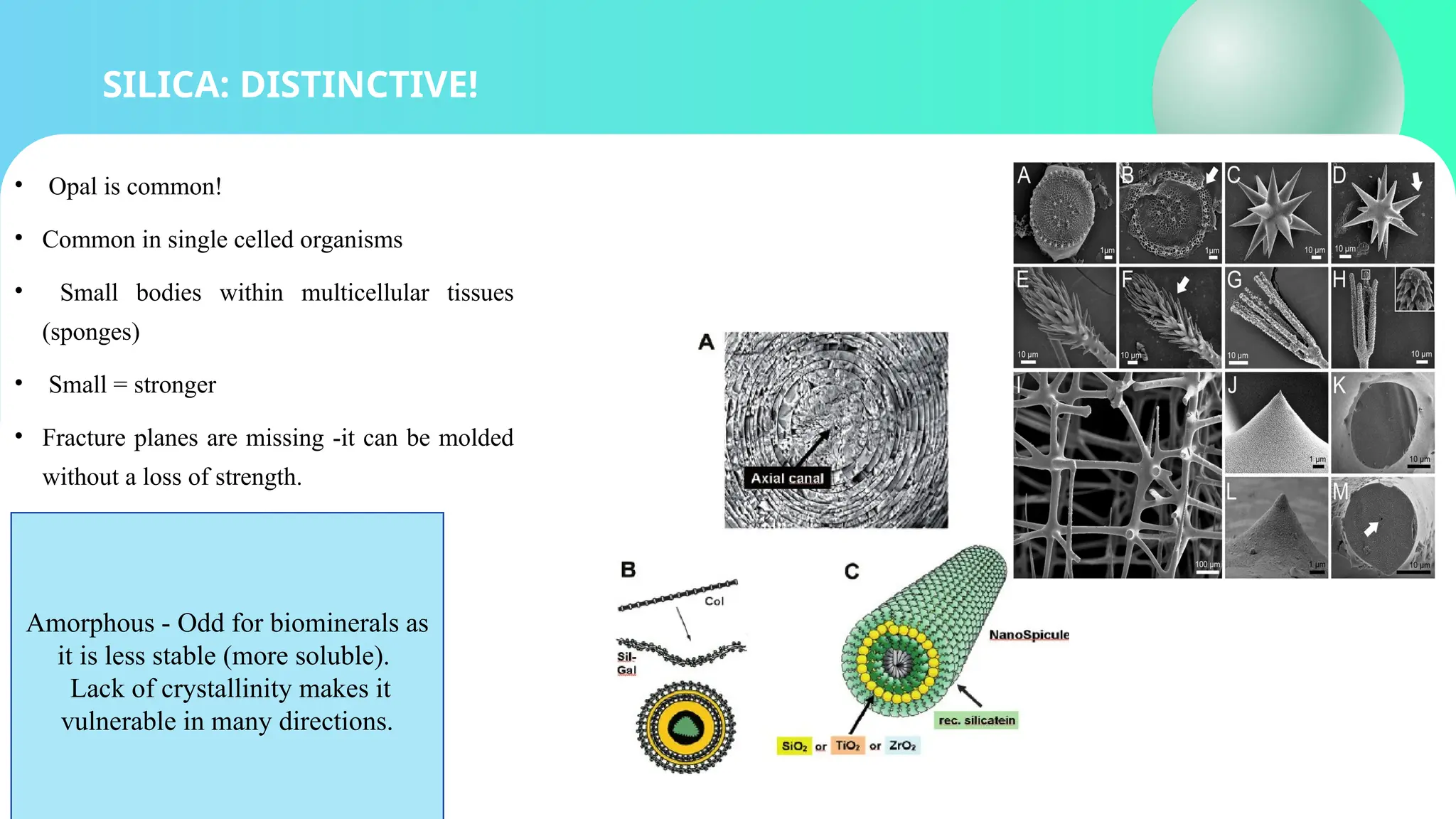
SILICA: DISTINCTIVE!
• Opal is common!
• Common in single celled organisms
• Small bodies within multicellular tissues
(sponges)
• Small = stronger
• Fracture planes are missing -it can be molded
without a loss of strength.
Amorphous - Odd for biominerals as
it is less stable (more soluble).
Lack of crystallinity makes it
vulnerable in many directions.
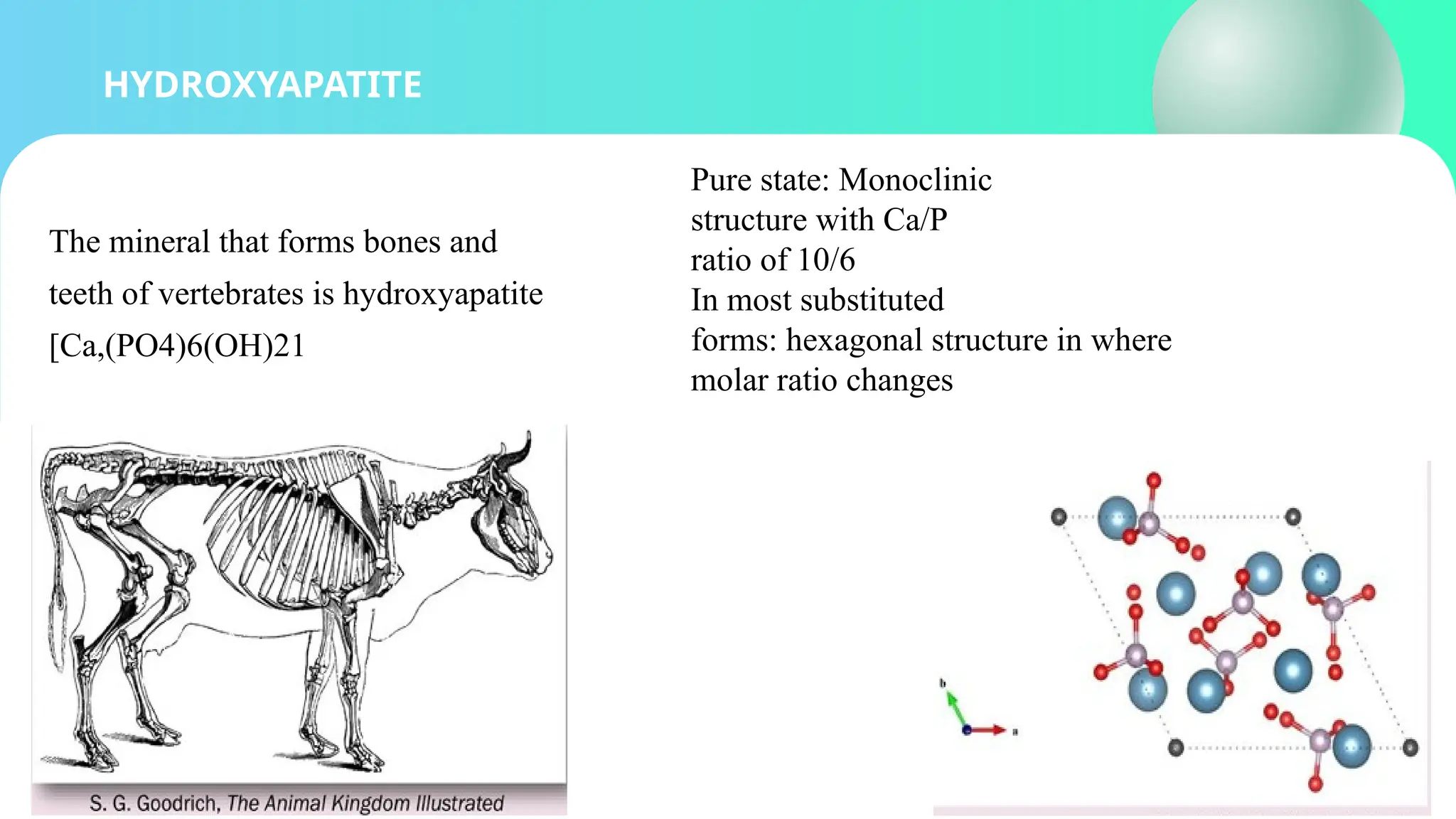
HYDROXYAPATITE
The mineral that forms bones and
teeth of vertebrates is hydroxyapatite
[Ca,(PO4)6(OH)21
Pure state: Monoclinic
structure with Ca/P
ratio of 10/6
In most substituted
forms: hexagonal structure in where
molar ratio changes
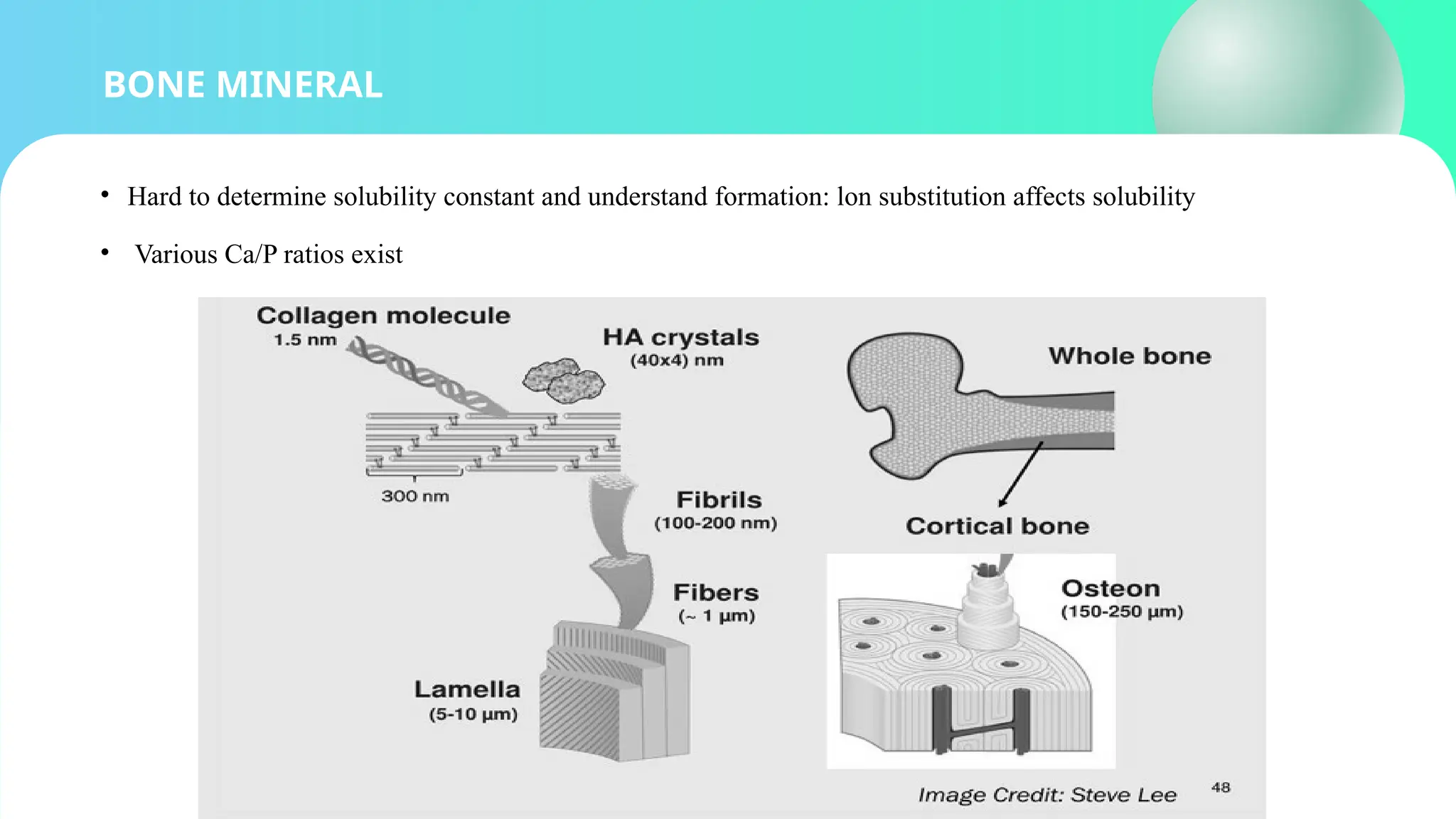
BONE MINERAL
• Hard to determine solubility constant and understand formation: lon substitution affects solubility
• Various Ca/P ratios exist
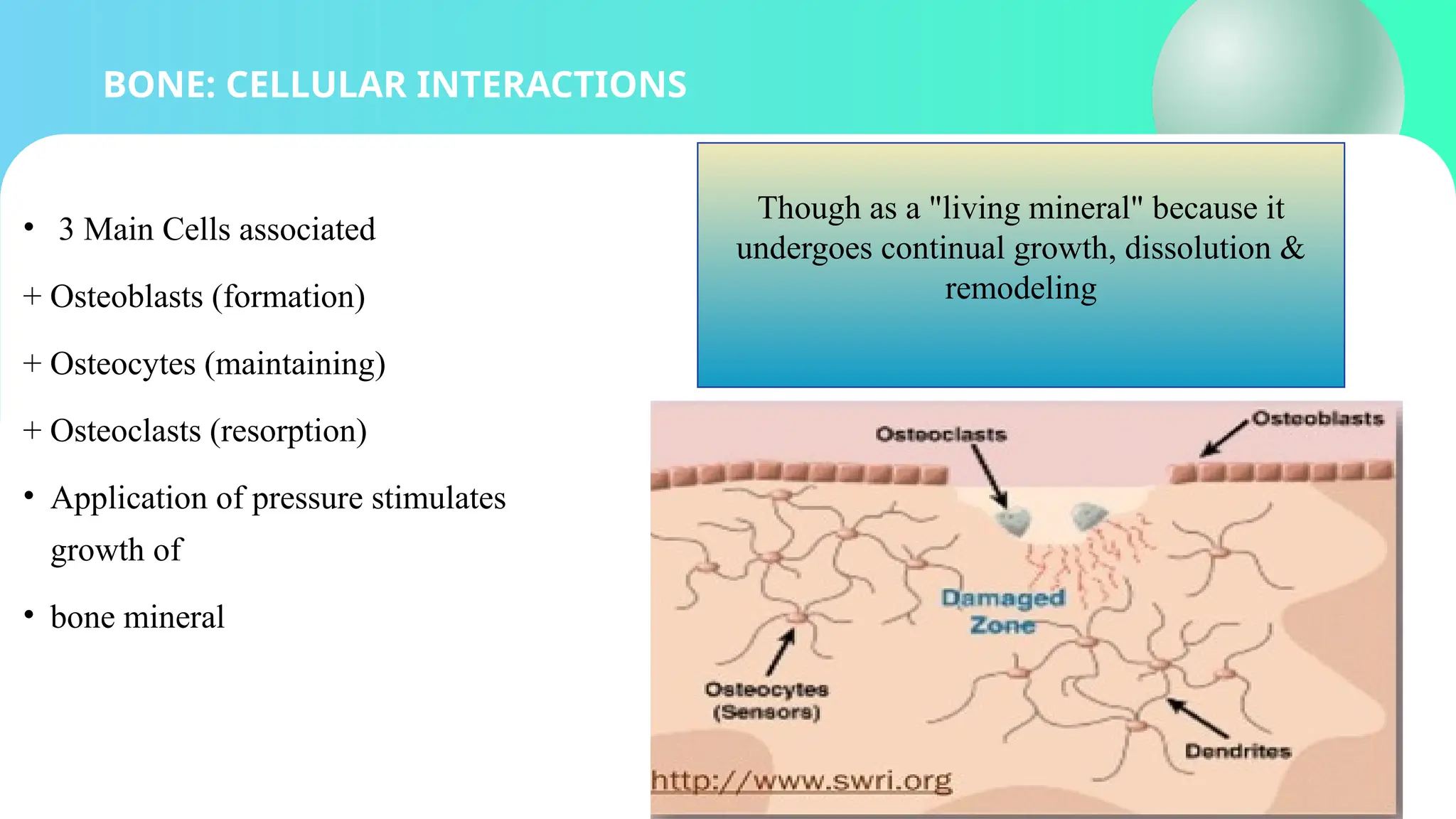
BONE: CELLULAR INTERACTIONS
• 3 Main Cells associated
+ Osteoblasts (formation)
+ Osteocytes (maintaining)
+ Osteoclasts (resorption)
• Application of pressure stimulates
growth of
• bone mineral
Though as a "living mineral" because it
undergoes continual growth, dissolution &
remodeling
Why do we need to understand Biomineralization
SOCIAL IMPACT: OCEAN ACIDIFICATION
• Changes in seawater chemistry are occurring in the ocean.
• Industrial and agricultural activities is increasing amount of CO2 in the atmosphere.
• The ocean absorbs about 25% of CO2 released.
• As atmospheric CO2 levels increase, so do the levels
in the ocean.
SOCIAL IMPACT: OCEAN ACIDIFICATION
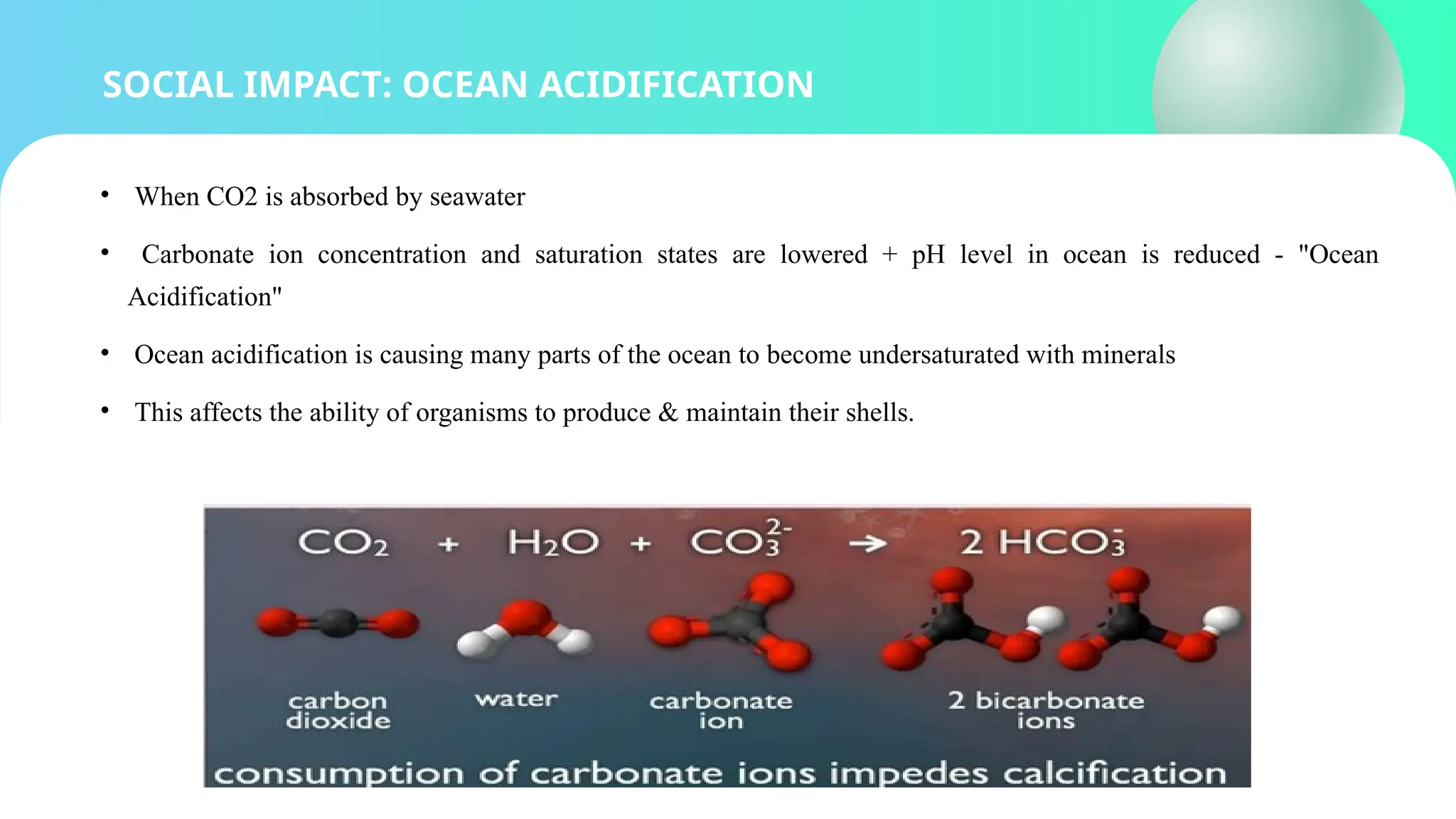
• When CO2 is absorbed by seawater
• Carbonate ion concentration and saturation states are lowered + pH level in ocean is reduced - "Ocean
Acidification"
• Ocean acidification is causing many parts of the ocean to become undersaturated with minerals
• This affects the ability of organisms to produce & maintain their shells.
SOCIAL IMPACT: OCEAN ACIDIFICATION
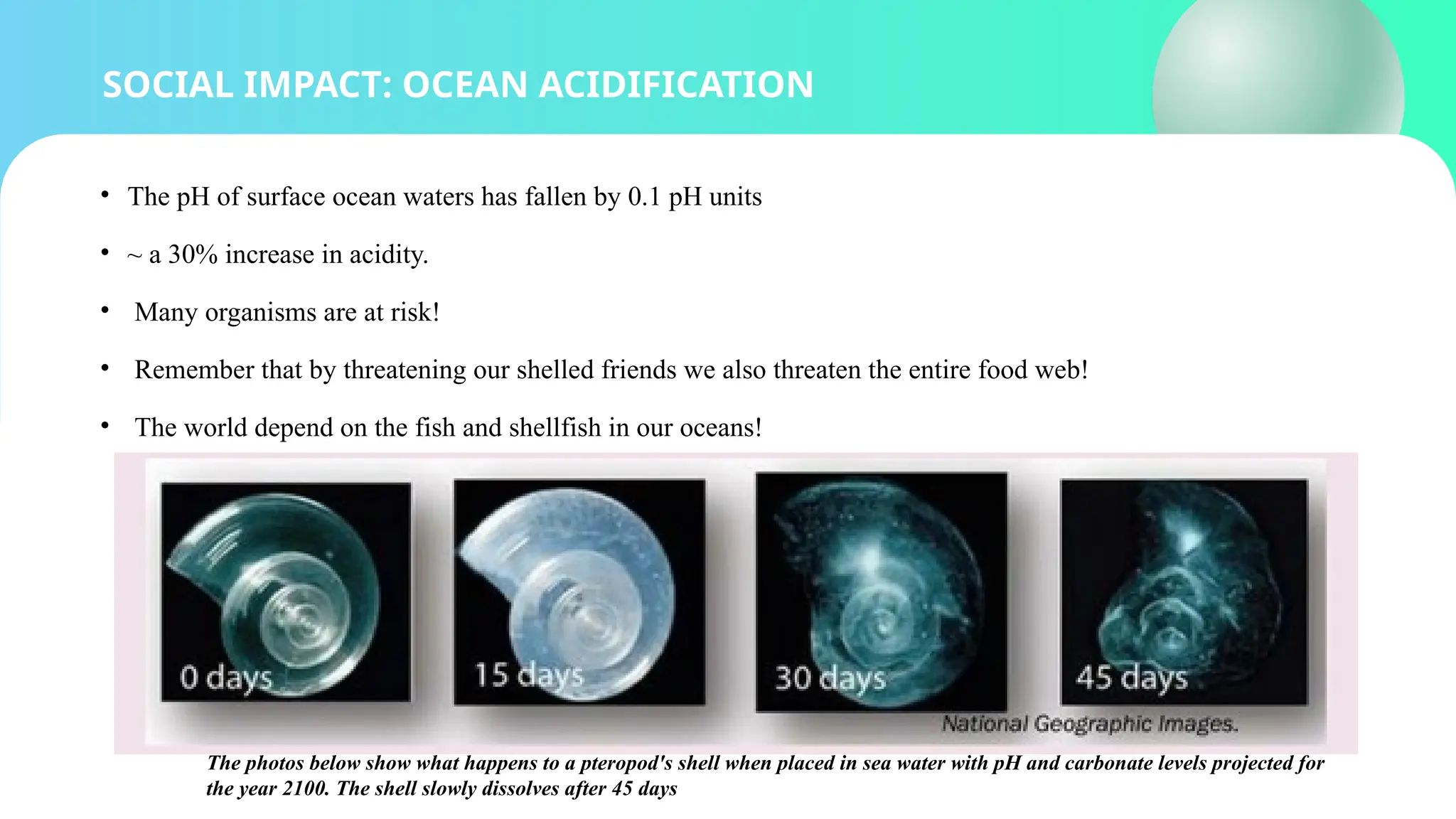
• The pH of surface ocean waters has fallen by 0.1 pH units
• ~ a 30% increase in acidity.
• Many organisms are at risk!
• Remember that by threatening our shelled friends we also threaten the entire food web!
• The world depend on the fish and shellfish in our oceans!
The photos below show what happens to a pteropod's shell when placed in sea water with pH and carbonate levels projected for
the year 2100. The shell slowly dissolves after 45 days
SUMMARY & CONCLUSIONS
Biomineralization is the process by which living organisms form and influence the precipitation of minerals.
+ No 'grand' mechanism.
+ Saturation, Nucleation Growth & Influence of Organic Matrix.
* Many Biominerals:
+ Calcium Carbonate Abundant!
+ Silica
Distinctive!
+ Hydroxyapatite - Living!
* Biomineralized forms are used to study
the effects of environmental influences
• Thank you
THANK YOU

Biomineralization formechanics function and engineering

  • 1.
    Mechanisms, Functions, and EngineeringApplications Presented by: Zaib Un NIsa 1414017 Biomineralization Prof. Dr. Thomas Jüstel
  • 2.
    Outline 01 Introduction 02 Mechanisms of Biomineralization 04Applications 05 Future Trends 06 Summary & References 03 Types of Biominerals
  • 3.
    Introduction and Historyof Biomineralization • Biomineralization is the process by which living organisms produce minerals to harden or stiffen existing tissues. • Over 64 known biominerals • Found in bones, shells, teeth, spicules, etc. • Evolved ~3.5 billion years ago Runegar and Bengtson 1992
  • 4.
    Continue Evolution of Biomineralizationhas provided organisms with a strong building material. 🟧 Minerals are stiff and brittle (and cheap energy-wise) 🟧 Organic materials are soft and pliable Functions include: ✔️Strength & Integrity ✔️Protection ✔️Mobility ✔️Storage – Biominerals are ion reservoirs for cellular functions ✔️Cutting and grinding ✔️Buoyancy ✔️Optical, magnetic, and gravity sensing
  • 5.
    Basic Biomineralization Principles Saturation,Nucleation, Growth and Organic Matrix
  • 6.
    Saturation – TheStarting Point of Biomineralization 🔹 Saturation refers to the level at which a solution contains enough dissolved ions to begin forming a solid mineral (i.e., it becomes supersaturated). 🧪 Key Points: • Supersaturation of ions (e.g., Ca² and CO ² for calcium carbonate) is necessary for biomineral formation. ⁺ ₃ ⁻ • Organisms regulate ion concentration to reach and maintain supersaturation locally (e.g., via ion pumps or pH changes). • The process must be carefully controlled to prevent unwanted precipitation. 📌 Biological Example: • Sea urchin embryos regulate pH to increase carbonate concentration and initiate skeletal mineralization.
  • 7.
    Nucleation – InitiatingMineral Formation 🔹 What is Nucleation? • Nucleation is the initial step where ions in solution begin to assemble into a tiny, stable crystal nucleus. 🔍 Types: • Homogeneous nucleation: Occurs without a template (rare in biology). • Heterogeneous nucleation: Occurs on a surface or organic matrix (common in living systems). 🧠 Biological Control: • Organisms use proteins, lipids, and sugars to control the location, timing, and structure of nucleation. • These biomolecules lower the energy barrier for nucleation and determine the crystal type. Example: • Oyster shell formation starts with nucleation on organic sheets secreted by mantle tissue.
  • 8.
    Crystal Growth –Building the Mineral Structure 🔹 What is Crystal Growth? • After nucleation, ions continue to attach to the nucleus, growing it into a full-sized mineral crystal. 🧩 Controlled Features: • Size: Growth rate is controlled to avoid brittleness. • Shape & Orientation: Directed by protein scaffolds and environmental conditions. • Polymorphism: Organisms can select between mineral forms (e.g., aragonite vs. calcite). 🧪 Factors Influencing Growth: • Ion availability • Temperature • Presence of inhibitors/promoters 📌 Example: • Corals grow aragonite crystals in layered, highly oriented structures for strength.
  • 9.
    Organic Matrix –The Blueprint for Mineralization A network of proteins, glycoproteins, and polysaccharides that provides a framework for mineral formation. 🧠 Functions • Scaffold: Directs crystal shape, orientation, and location. • Chemical control: Binds ions and mediates crystallization. • Mechanical enhancement: Increases toughness by integrating soft and hard phases. 🌿 Matrix Components: • Collagen (in bone) • Chitin (in shells) • Acidic proteins (e.g., osteopontin, nacrein) 📌 Example: • Bone is composed of collagen fibers with embedded hydroxyapatite crystals aligned along the fibers.
  • 10.
    Types & Uses Calciumcarbonate • Calcite & Aragonite (shells, lenses, gravity sensors) • Vaterite (inner ear of two types of fish) • & Amorphous phases (Ca storage spindles in plants) Calcium phosphate (bones, teeth) •  Other Group 2A elements •  Silica (diatom & radiolarian micro shells) •  Iron oxides •  Metal sulfides •  While organic components may be only a few %, they are critical to the important properties of the materials.
  • 11.
    CALCIUM CARBONATE: SHELLS •Shells vary in size and morphology • The structure is separated in each • The prismatic layer consists of large part of the shell. • The nacre region is a plate like calcite crystals aragonite crystals • Switching of poly morphs is achieved by the outer epithelium (OE) • OE is separated from the inner shell surface by a space filled with • aqueous solution (extrapallaial space)
  • 12.
    NACRE FORMATION Each structureregardless of complexity is formed directly by a single layer of epithelial cells. Cells are involved in movement of minerals ions to the site of deposition and in the secretion of organic matter that will become the matrix of the deposit. This epithelial layer of the mantle is ideal for experimental studies as it is separated from the mineral it deposits!
  • 13.
    SILICA: DISTINCTIVE! • Opalis common! • Common in single celled organisms • Small bodies within multicellular tissues (sponges) • Small = stronger • Fracture planes are missing -it can be molded without a loss of strength. Amorphous - Odd for biominerals as it is less stable (more soluble). Lack of crystallinity makes it vulnerable in many directions.
  • 14.
    HYDROXYAPATITE The mineral thatforms bones and teeth of vertebrates is hydroxyapatite [Ca,(PO4)6(OH)21 Pure state: Monoclinic structure with Ca/P ratio of 10/6 In most substituted forms: hexagonal structure in where molar ratio changes
  • 15.
    BONE MINERAL • Hardto determine solubility constant and understand formation: lon substitution affects solubility • Various Ca/P ratios exist
  • 16.
    BONE: CELLULAR INTERACTIONS •3 Main Cells associated + Osteoblasts (formation) + Osteocytes (maintaining) + Osteoclasts (resorption) • Application of pressure stimulates growth of • bone mineral Though as a "living mineral" because it undergoes continual growth, dissolution & remodeling
  • 17.
    Why do weneed to understand Biomineralization SOCIAL IMPACT: OCEAN ACIDIFICATION • Changes in seawater chemistry are occurring in the ocean. • Industrial and agricultural activities is increasing amount of CO2 in the atmosphere. • The ocean absorbs about 25% of CO2 released. • As atmospheric CO2 levels increase, so do the levels in the ocean.
  • 18.
    SOCIAL IMPACT: OCEANACIDIFICATION • When CO2 is absorbed by seawater • Carbonate ion concentration and saturation states are lowered + pH level in ocean is reduced - "Ocean Acidification" • Ocean acidification is causing many parts of the ocean to become undersaturated with minerals • This affects the ability of organisms to produce & maintain their shells.
  • 19.
    SOCIAL IMPACT: OCEANACIDIFICATION • The pH of surface ocean waters has fallen by 0.1 pH units • ~ a 30% increase in acidity. • Many organisms are at risk! • Remember that by threatening our shelled friends we also threaten the entire food web! • The world depend on the fish and shellfish in our oceans! The photos below show what happens to a pteropod's shell when placed in sea water with pH and carbonate levels projected for the year 2100. The shell slowly dissolves after 45 days
  • 20.
    SUMMARY & CONCLUSIONS Biomineralizationis the process by which living organisms form and influence the precipitation of minerals. + No 'grand' mechanism. + Saturation, Nucleation Growth & Influence of Organic Matrix. * Many Biominerals: + Calcium Carbonate Abundant! + Silica Distinctive! + Hydroxyapatite - Living! * Biomineralized forms are used to study the effects of environmental influences
  • 21.