



Phone CALLIncidental Language Learning with Mobile TechnologiesMike Sharpleswith Tony Fisher, Richard Pemberton, Tommy SweeneyUniversity of NottinghamHiroaki Ogata, Noriko UosakiUniversity of TokushimaPhil Edmonds, Anthony Hull, Patrick TschornSharp Labs, Europe
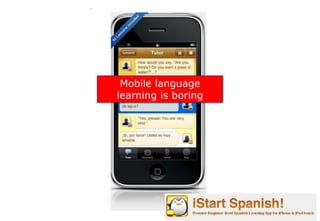
Mobile language learning is boring
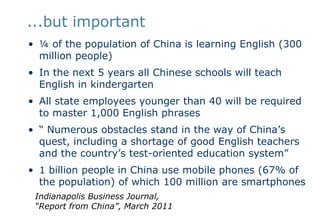
...but important ¼ of the population of China is learning English (300 million people)In the next 5 years all Chinese schools will teach English in kindergartenAll state employees younger than 40 will be required to master 1,000 English phrases“ Numerous obstacles stand in the way of China’s quest, including a shortage of good English teachers and the country’s test-oriented education system”1 billion people in China use mobile phones (67% of the population) of which 100 million are smartphonesIndianapolis Business Journal, “Report from China”, March 2011
How can we design language learning for a smartphone that is engaging and effective?
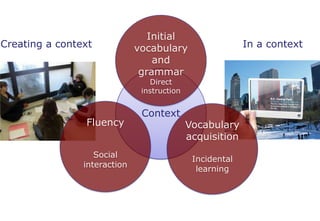
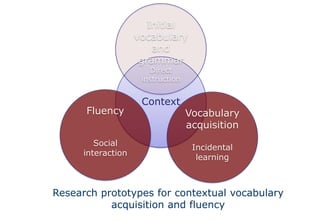
Initial vocabulary and grammarDirect instructionIn a contextCreating a contextContextFluencySocial interactionVocabulary acquisitionIncidentallearning
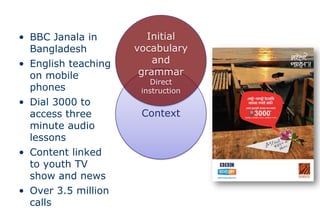
Initial vocabulary and grammarDirect instructionBBC Janala in BangladeshEnglish teaching on mobile phonesDial 3000 to access three minute audio lessonsContent linked to youth TV show and newsOver 3.5 million callsContext
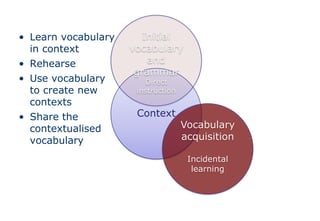
Initial vocabulary and grammarDirect instructionLearn vocabulary in contextRehearseUse vocabulary to create new contextsShare the contextualised vocabularyContextVocabulary acquisitionIncidental learning
Research project by the Learning Sciences Research Institute in association with the University of Tokushima andSharp Laboratories of Europe
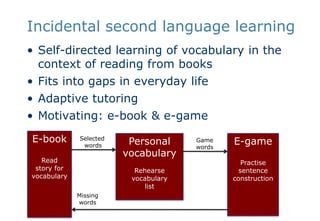
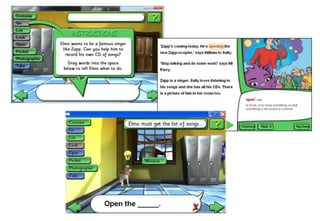
Incidental second language learningSelf-directed learning of vocabulary in the context of reading from booksFits into gaps in everyday lifeAdaptive tutoringMotivating: e-book & e-gameE-bookReadstory for vocabularyE-gamePractise sentence constructionSelected wordsPersonal vocabularyRehearse vocabularylist GamewordsMissingwords
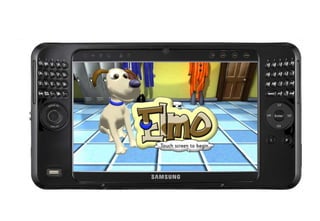
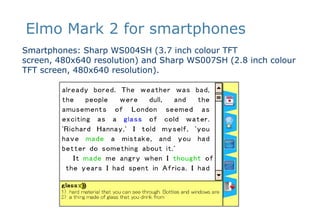
Elmo Mark 2 for smartphonesSmartphones: Sharp WS004SH (3.7 inch colour TFT screen, 480x640 resolution) and Sharp WS007SH (2.8 inch colour TFT screen, 480x640 resolution).
Research questionAre there differences in the learning of English vocabulary through reading novels, depending on the mode of mobile interaction?
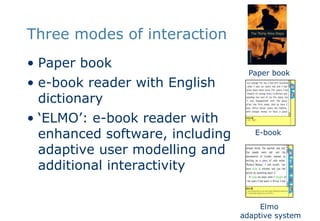
Three modes of interactionPaper booke-book reader with English dictionary‘ELMO’: e-book reader with enhanced software, including adaptive user modelling and additional interactivityPaper bookE-bookElmo adaptive system
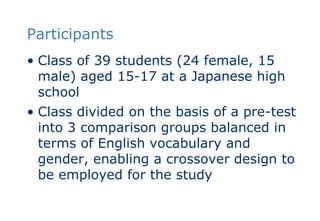
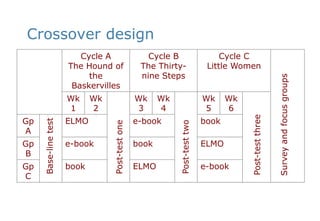
ParticipantsClass of 39 students (24 female, 15 male) aged 15-17 at a Japanese high schoolClass divided on the basis of a pre-test into 3 comparison groups balanced in terms of English vocabulary and gender, enabling a crossover design to be employed for the study
Crossover designSurvey and focus groupsPost-test threeBase-line testPost-test twoPost-test one
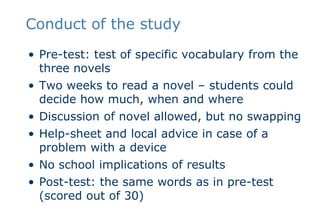
Conduct of the studyPre-test: test of specific vocabulary from the three novelsTwo weeks to read a novel – students could decide how much, when and whereDiscussion of novel allowed, but no swappingHelp-sheet and local advice in case of a problem with a deviceNo school implications of resultsPost-test: the same words as in pre-test (scored out of 30)
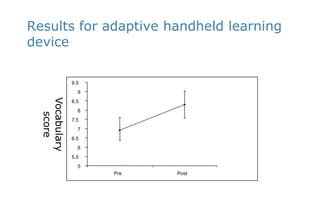
Results for adaptive handheld learning device9.598.587.576.565.55PrePostVocabulary score
9.598.58Adaptive7.57Book6.565.55PrePostVocabulary scoreComparison with paper book
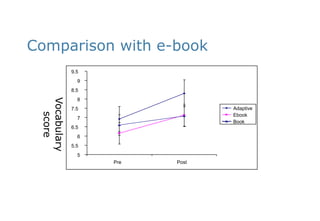
9.598.58Adaptive7.5Ebook7Book6.565.55PrePostComparison with e-bookVocabulary score
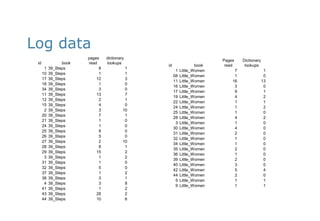
Log data
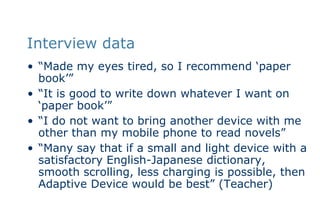
Interview data“Made my eyes tired, so I recommend ‘paper book’”“It is good to write down whatever I want on ‘paper book’”“I do not want to bring another device with me other than my mobile phone to read novels”“Many say that if a small and light device with a satisfactory English-Japanese dictionary, smooth scrolling, less charging is possible, then Adaptive Device would be best” (Teacher)
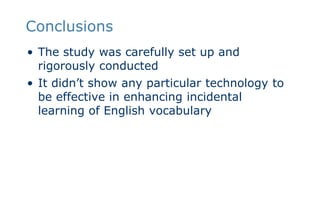
ConclusionsThe study was carefully set up and rigorously conductedIt didn’t show any particular technology to be effective in enhancing incidental learning of English vocabulary
ConclusionsThe study was carefully set up and rigorously conductedIt didn’t show effectiveness of any particular technology to enhance incidental learning of English vocabularyBut... Sharp Labs Europe is developing a new version of Elmo with an attractive interface, pictorial e-book and vocabulary games
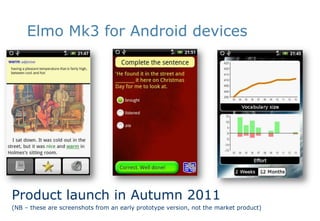
Elmo Mk3 for Android devicesProduct launch in Autumn 2011(NB – these are screenshots from an early prototype version, not the market product)
Initial vocabulary and grammarDirect instructionContextFluencySocial interactionVocabulary acquisitionIncidentallearningResearch prototypes for contextual vocabulary acquisition and fluency
MiLexicon – Joshua UnderwoodPhD, Institute of Education, Londonhttps://sites.google.com/site/joshunderwood/milexicon
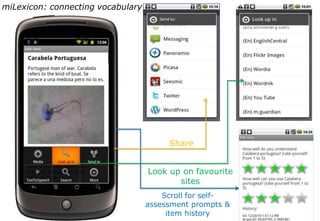
miLexicon: connecting vocabularyShareLook up on favourite sitesScroll for self-assessment prompts & item history
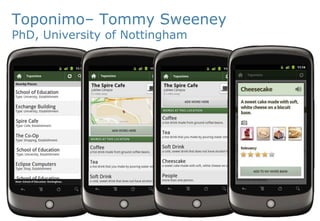
Toponimo– TommySweeneyPhD, University of Nottingham
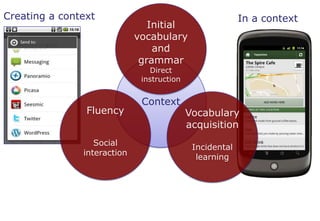
Initial vocabulary and grammarDirect instructionCreating a contextIn a contextContextFluencySocial interactionVocabulary acquisitionIncidentallearning

PhoneCALL: EuroCALL 2011 keynote

  • 1.
    Phone CALLIncidental LanguageLearning with Mobile TechnologiesMike Sharpleswith Tony Fisher, Richard Pemberton, Tommy SweeneyUniversity of NottinghamHiroaki Ogata, Noriko UosakiUniversity of TokushimaPhil Edmonds, Anthony Hull, Patrick TschornSharp Labs, Europe
  • 2.
  • 3.
    ...but important ¼of the population of China is learning English (300 million people)In the next 5 years all Chinese schools will teach English in kindergartenAll state employees younger than 40 will be required to master 1,000 English phrases“ Numerous obstacles stand in the way of China’s quest, including a shortage of good English teachers and the country’s test-oriented education system”1 billion people in China use mobile phones (67% of the population) of which 100 million are smartphonesIndianapolis Business Journal, “Report from China”, March 2011
  • 4.
    How can wedesign language learning for a smartphone that is engaging and effective?
  • 5.
    Initial vocabulary andgrammarDirect instructionIn a contextCreating a contextContextFluencySocial interactionVocabulary acquisitionIncidentallearning
  • 6.
    Initial vocabulary andgrammarDirect instructionBBC Janala in BangladeshEnglish teaching on mobile phonesDial 3000 to access three minute audio lessonsContent linked to youth TV show and newsOver 3.5 million callsContext
  • 7.
    Initial vocabulary andgrammarDirect instructionLearn vocabulary in contextRehearseUse vocabulary to create new contextsShare the contextualised vocabularyContextVocabulary acquisitionIncidental learning
  • 8.
    Research project bythe Learning Sciences Research Institute in association with the University of Tokushima andSharp Laboratories of Europe
  • 9.
    Incidental second languagelearningSelf-directed learning of vocabulary in the context of reading from booksFits into gaps in everyday lifeAdaptive tutoringMotivating: e-book & e-gameE-bookReadstory for vocabularyE-gamePractise sentence constructionSelected wordsPersonal vocabularyRehearse vocabularylist GamewordsMissingwords
  • 12.
    Elmo Mark 2for smartphonesSmartphones: Sharp WS004SH (3.7 inch colour TFT screen, 480x640 resolution) and Sharp WS007SH (2.8 inch colour TFT screen, 480x640 resolution).
  • 13.
    Research questionAre theredifferences in the learning of English vocabulary through reading novels, depending on the mode of mobile interaction?
  • 14.
    Three modes ofinteractionPaper booke-book reader with English dictionary‘ELMO’: e-book reader with enhanced software, including adaptive user modelling and additional interactivityPaper bookE-bookElmo adaptive system
  • 15.
    ParticipantsClass of 39students (24 female, 15 male) aged 15-17 at a Japanese high schoolClass divided on the basis of a pre-test into 3 comparison groups balanced in terms of English vocabulary and gender, enabling a crossover design to be employed for the study
  • 16.
    Crossover designSurvey andfocus groupsPost-test threeBase-line testPost-test twoPost-test one
  • 17.
    Conduct of thestudyPre-test: test of specific vocabulary from the three novelsTwo weeks to read a novel – students could decide how much, when and whereDiscussion of novel allowed, but no swappingHelp-sheet and local advice in case of a problem with a deviceNo school implications of resultsPost-test: the same words as in pre-test (scored out of 30)
  • 18.
    Results for adaptivehandheld learning device9.598.587.576.565.55PrePostVocabulary score
  • 19.
  • 20.
  • 21.
  • 22.
    Interview data“Made myeyes tired, so I recommend ‘paper book’”“It is good to write down whatever I want on ‘paper book’”“I do not want to bring another device with me other than my mobile phone to read novels”“Many say that if a small and light device with a satisfactory English-Japanese dictionary, smooth scrolling, less charging is possible, then Adaptive Device would be best” (Teacher)
  • 23.
    ConclusionsThe study wascarefully set up and rigorously conductedIt didn’t show any particular technology to be effective in enhancing incidental learning of English vocabulary
  • 24.
    ConclusionsThe study wascarefully set up and rigorously conductedIt didn’t show effectiveness of any particular technology to enhance incidental learning of English vocabularyBut... Sharp Labs Europe is developing a new version of Elmo with an attractive interface, pictorial e-book and vocabulary games
  • 25.
    Elmo Mk3 forAndroid devicesProduct launch in Autumn 2011(NB – these are screenshots from an early prototype version, not the market product)
  • 26.
    Initial vocabulary andgrammarDirect instructionContextFluencySocial interactionVocabulary acquisitionIncidentallearningResearch prototypes for contextual vocabulary acquisition and fluency
  • 27.
    MiLexicon – JoshuaUnderwoodPhD, Institute of Education, Londonhttps://sites.google.com/site/joshunderwood/milexicon
  • 28.
    miLexicon: connecting vocabularyShareLookup on favourite sitesScroll for self-assessment prompts & item history
  • 29.
  • 30.
    Initial vocabulary andgrammarDirect instructionCreating a contextIn a contextContextFluencySocial interactionVocabulary acquisitionIncidentallearning

Editor's Notes

  • #29 miLexicon is about making connections between words and experiences.I looked at accounts of successful experience-based vocabularylearning and found that learners made various kinds of connection:- connecting experiences of new language in context with opportunitiesfor investigation into form, meaning & use, and practice.- connecting spoken and written forms or vice-versa- connecting first language concepts and second language concepts- connecting experiences across episodes and settings- connecting representations across various media (e.g. Facebook,twitter, SMS, an information sign, a conversation, a paperback).miLexicon is Android phone software that aims to prompt and supportlearners in making these connections. It provides a multimediavocabulary notebook with tightly integrated direct access to socialand technological resources. These resources are customisable. Ongoingparticipatory design suggests that current versions of miLexicon doprompt collection and investigation of new vocabulary. However, thesoftware could and should do more to support self-regulation. Forexample: by using spoken notifications to prompt spaced recall andremind learners to look up and practise the words and phrases theycollect, by challenging users with an interest related new 'word aday' or similar, by offering practice tests or games using thecollected vocabulary.