Chi-Cheng Chang  張基成  I-Jung Chen  陳怡容 ,  [email_address]   Gina Wen-Chun Chen  陳玟君 UbiLearn 2010, April 12, Kaohsiung, Taiwan
Statement of the Problem
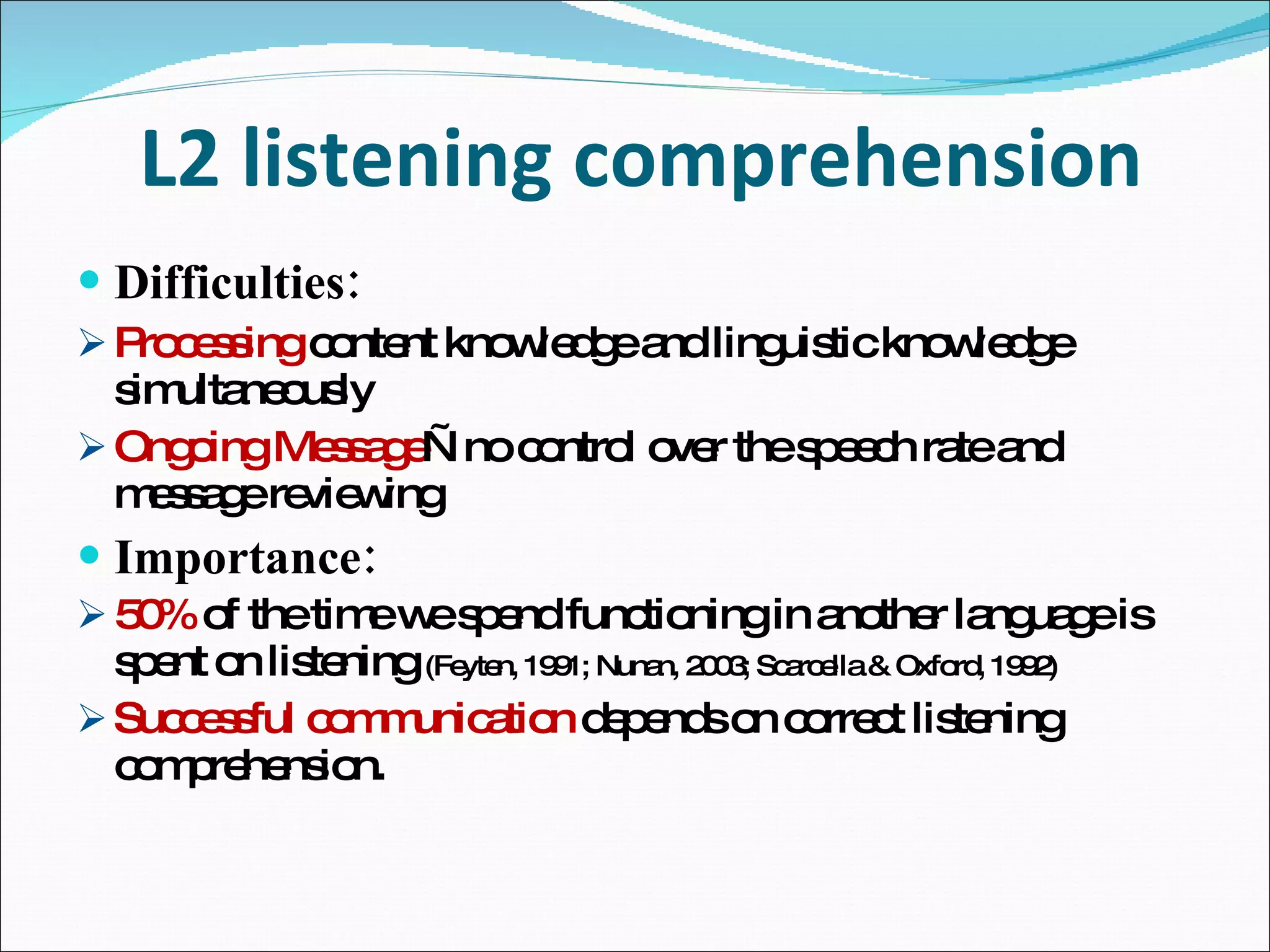
L2 listening comprehension Difficulties: Processing  content knowledge and linguistic knowledge simultaneously Ongoing Message —no control over the speech rate and message reviewing Importance: 50%  of the time we spend functioning in another language is spent on listening  (Feyten, 1991; Nunan, 2003; Scarcella & Oxford, 1992) Successful communication  depends on correct listening comprehension.
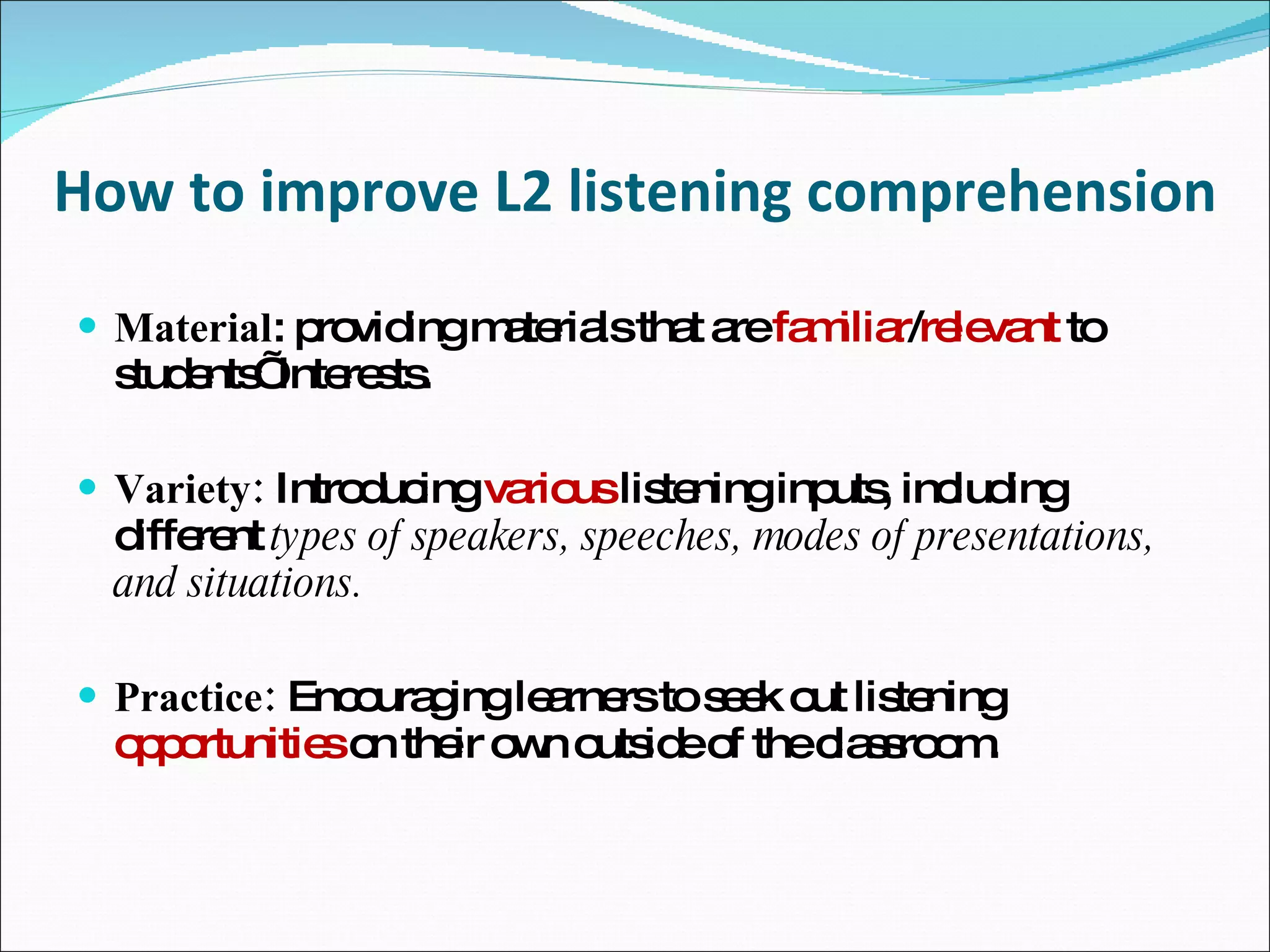
How to improve L2 listening comprehension Material : providing materials that are  familiar / relevant  to students’ interests. Variety:  Introducing  various  listening inputs, including different  types of speakers, speeches, modes of presentations, and situations. Practice:  Encouraging learners to seek out listening  opportunities  on their own outside of the classroom.
Mobile learning(m-learning) “ Any sort of learning that happens when the learner  is not in a fixed, predetermined location , or learning that happens when the learner takes advantage of the learning opportunities offered by  mobile technologies .”  (O'Malley et al, 2003)
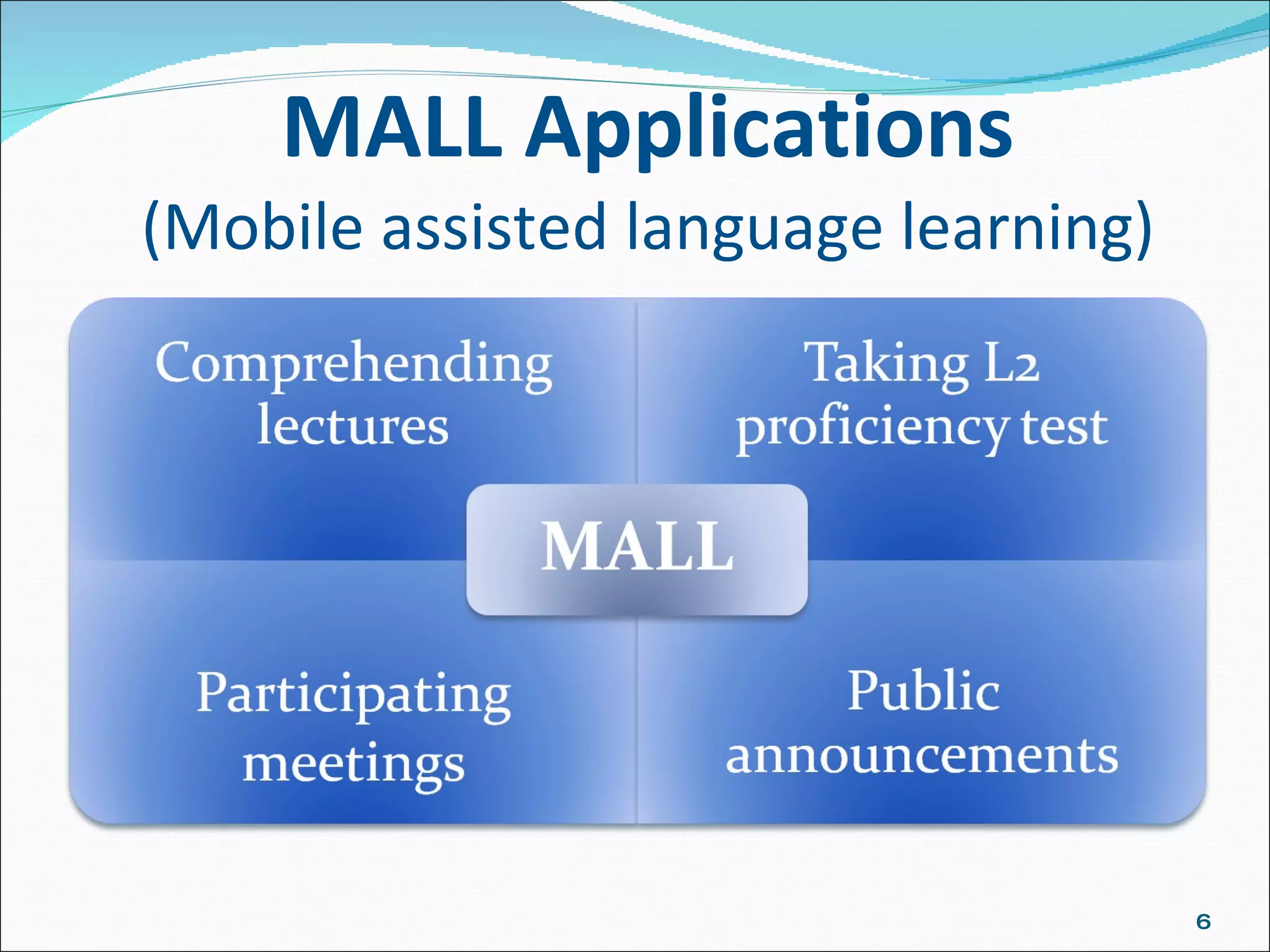
MALL Applications (Mobile assisted language learning)
The Study
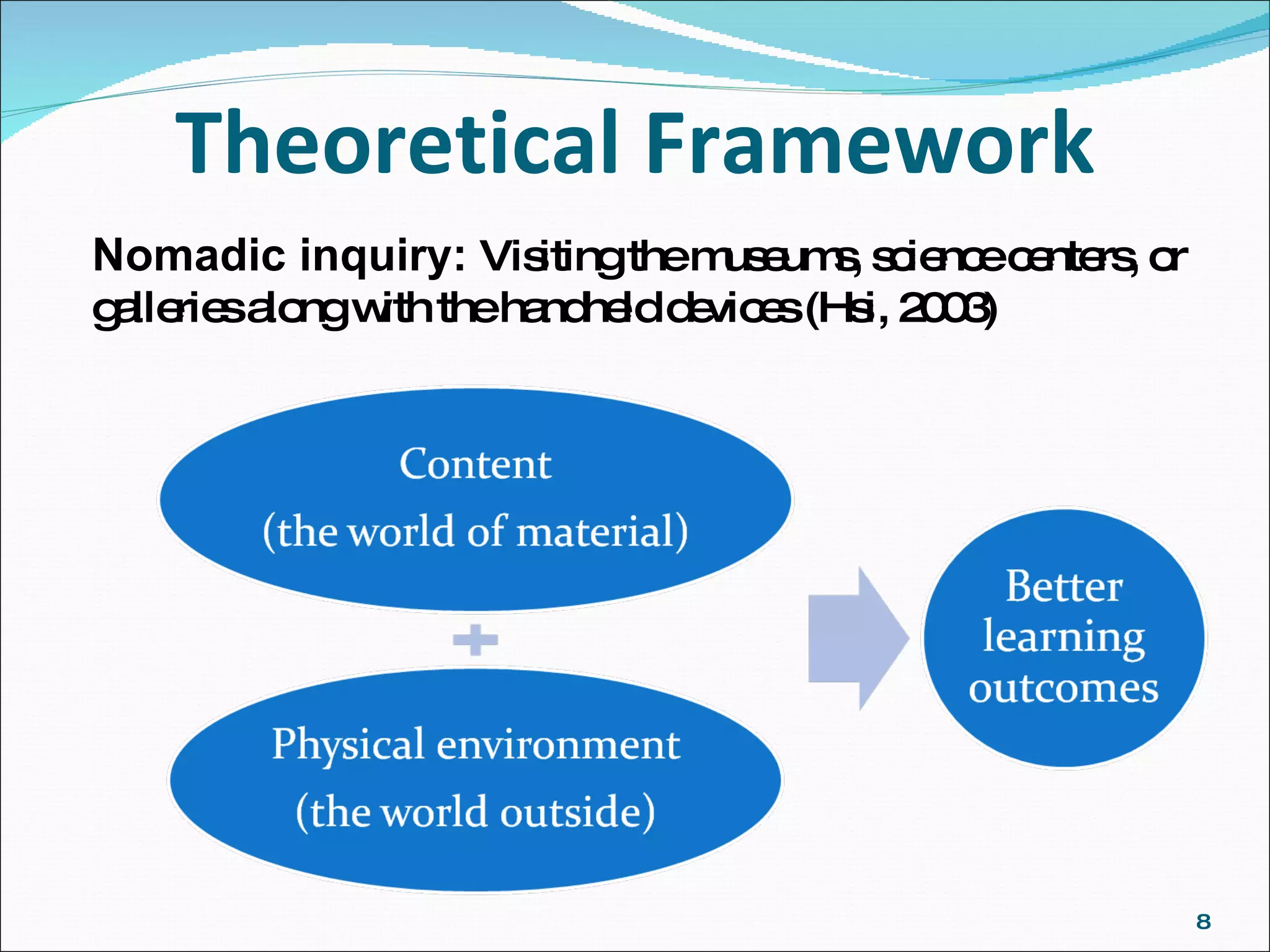
Theoretical Framework Nomadic inquiry:  Visiting the museums, science centers, or  galleries along with the handheld devices (Hsi, 2003)
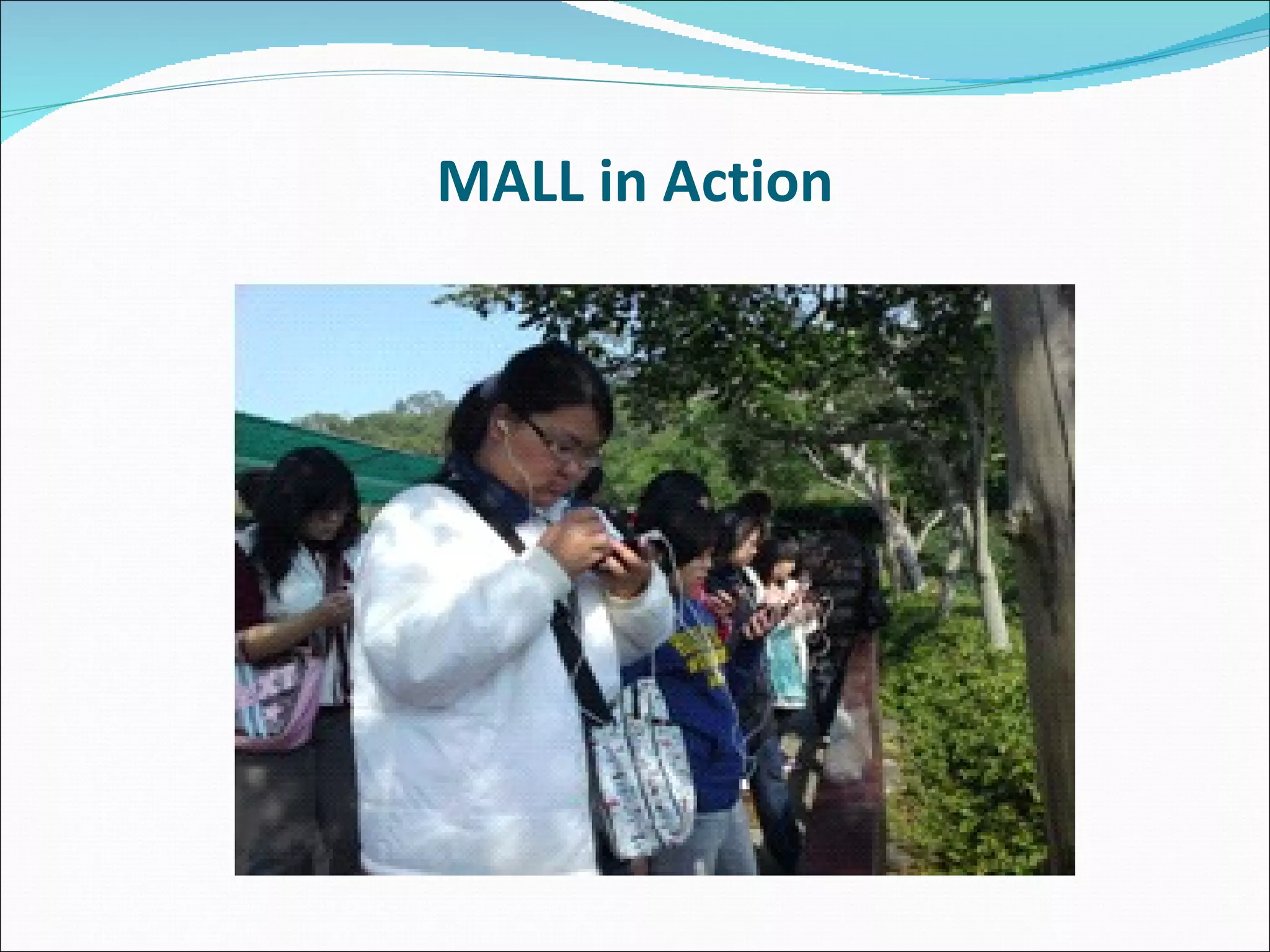
MALL in Action
Methodology  (I)  Participants — 162  university students  majoring in Applied English (37 males and 125 females, aged 18–22 years). Materials — 4 passages of animal audio guide in English Length: 180 ~ 220 words/passage.  Speech rate: approximately 130 w/pm
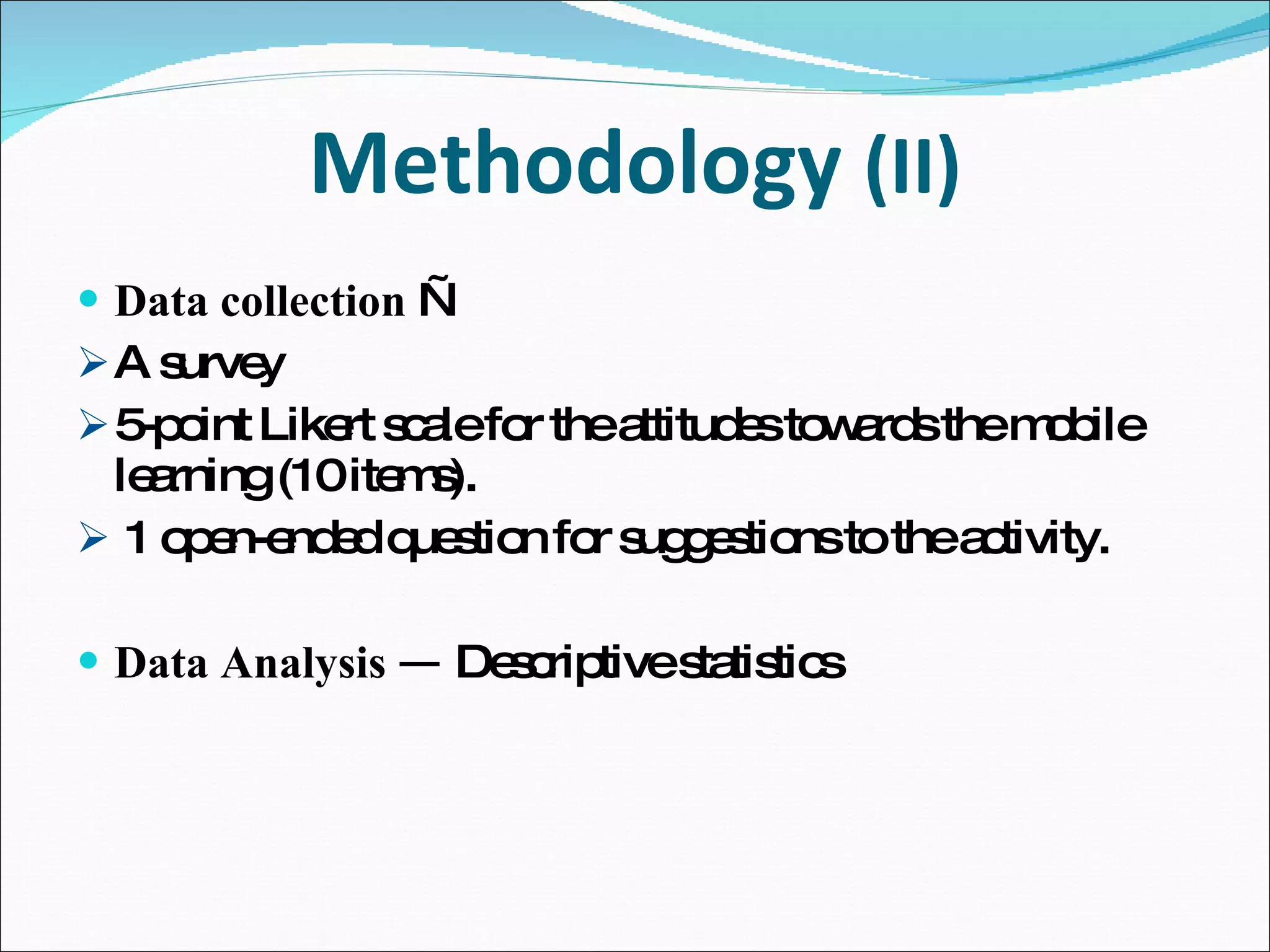
Methodology  (II) Data collection  —  A survey  5-point Likert scale for the attitudes towards the mobile learning (10 items). 1 open-ended question for suggestions to the activity. Data Analysis —  Descriptive statistics
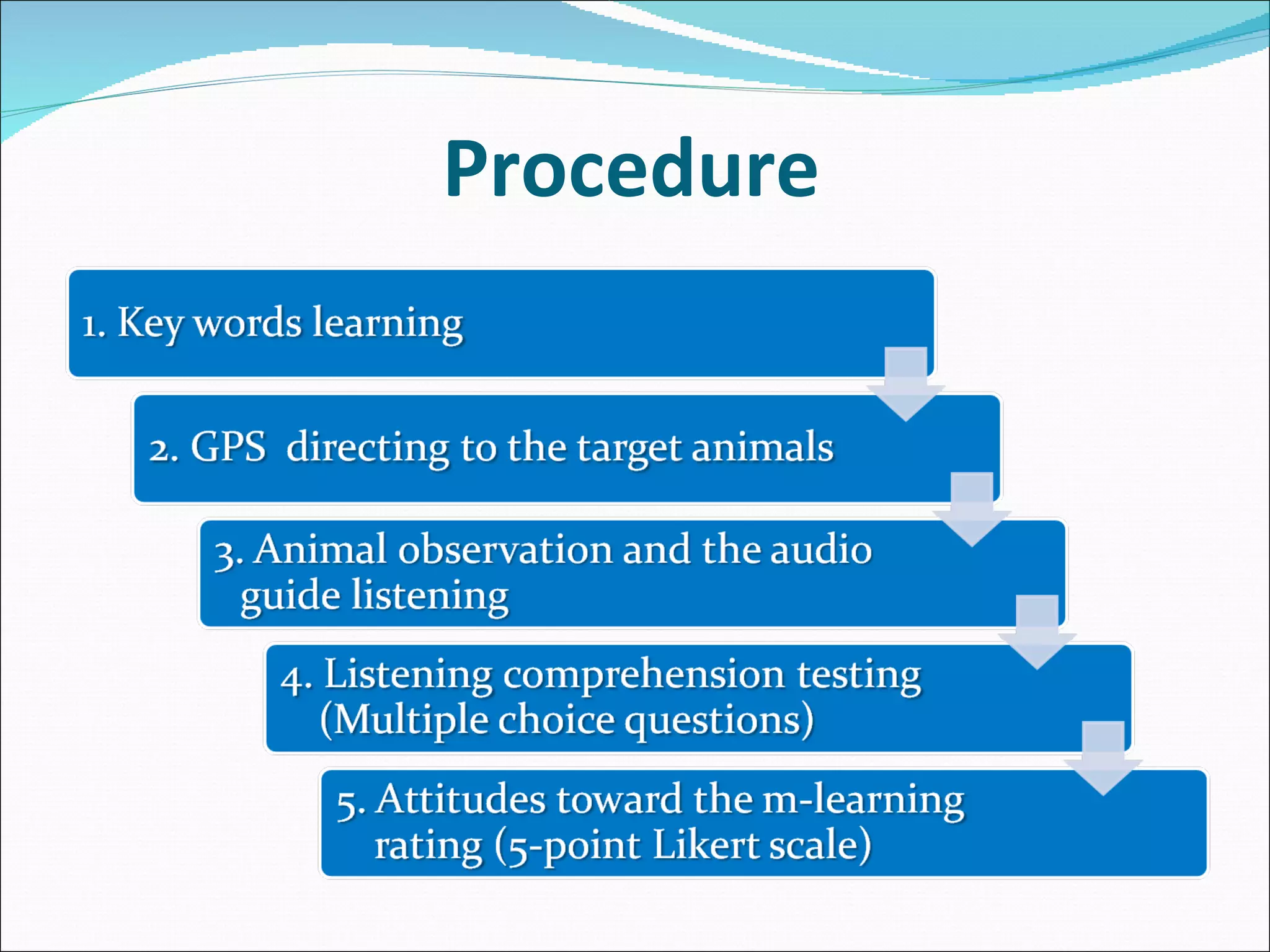
Procedure
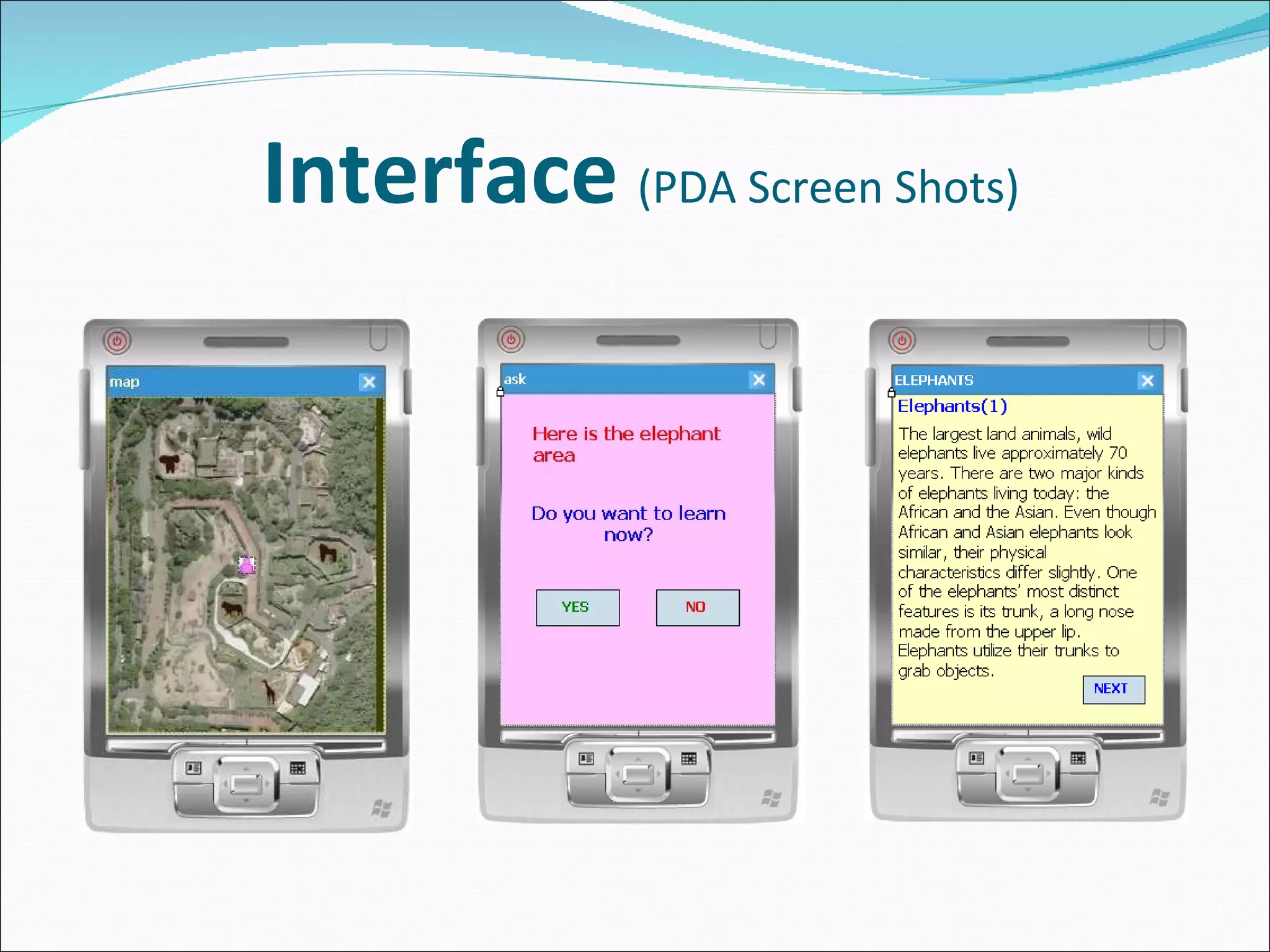
Interface   (PDA Screen Shots)
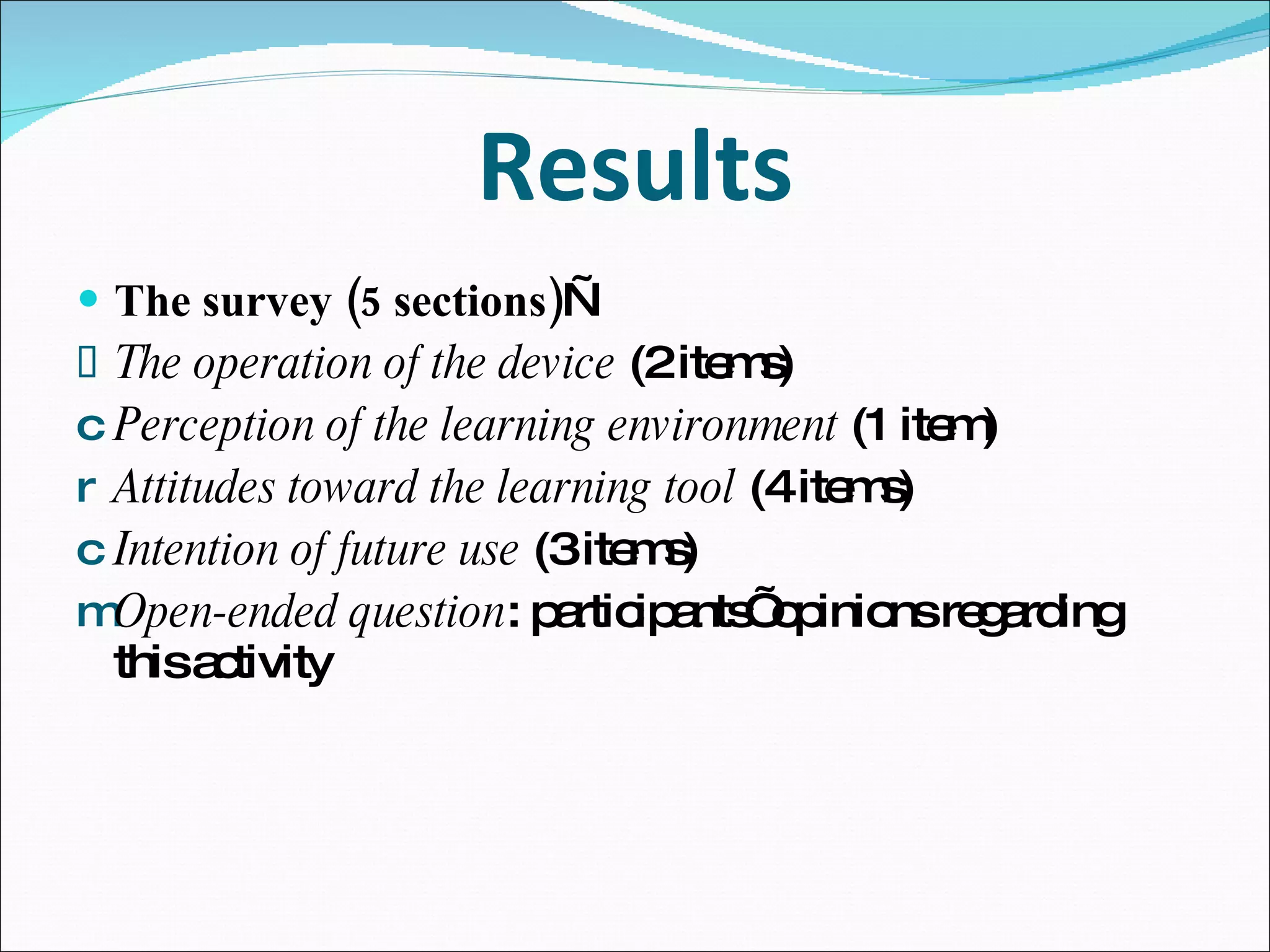
Results The survey (5 sections) — The operation of the device  (2 items) Perception of the learning environment  (1 item) Attitudes toward the learning tool  (4 items) Intention of future use  (3 items) Open-ended question : participants’ opinions regarding this activity
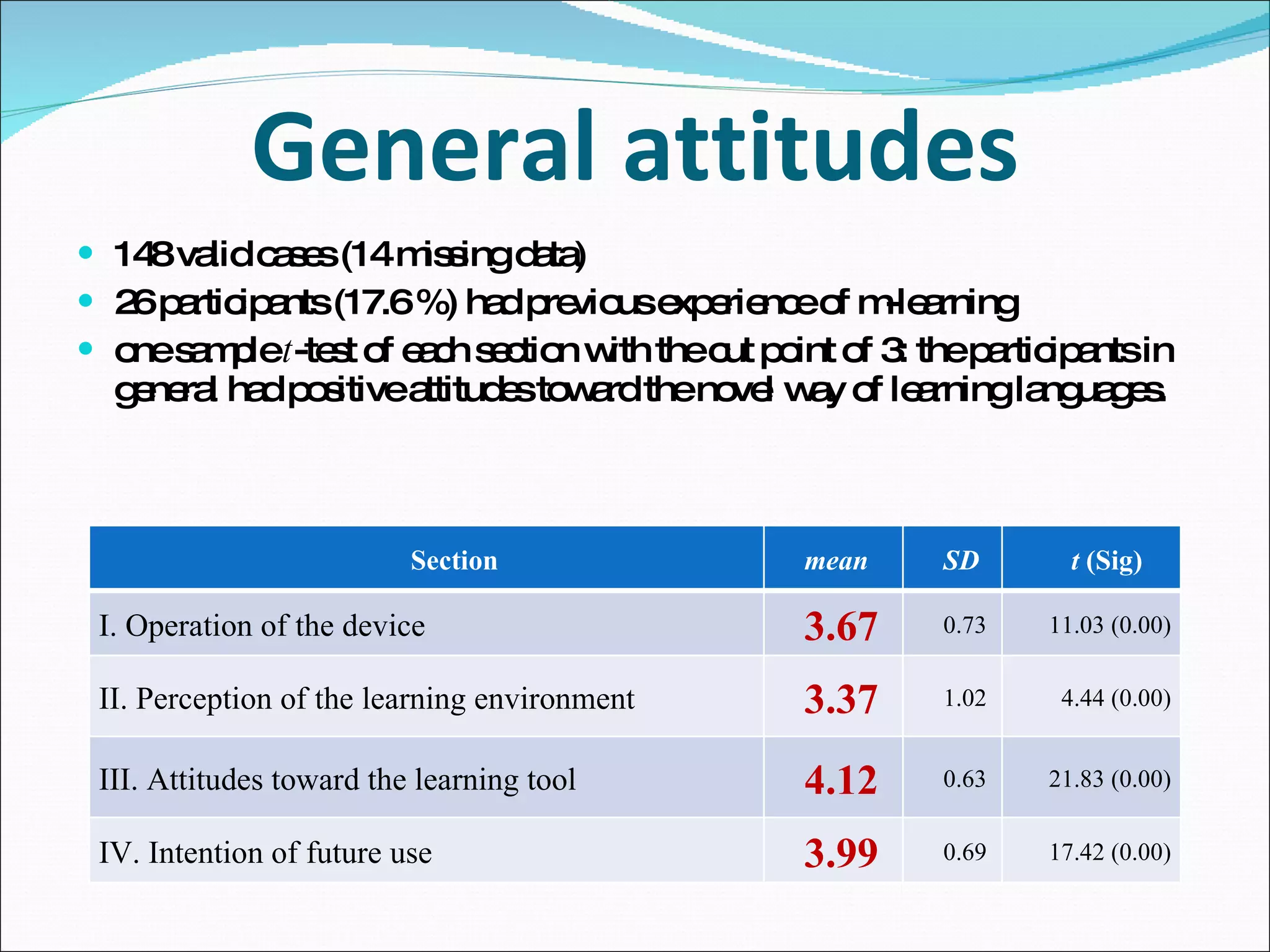
General attitudes 148 valid cases (14 missing data) 26 participants (17.6 %) had previous experience of m-learning one sample  t -test of each section with the cut point of 3: the participants in general had positive attitudes toward the novel way of learning languages. Section mean SD t  (Sig) I. Operation of the device 3.67 0.73 11.03 (0.00) II. Perception of the learning environment 3.37 1.02 4.44 (0.00) III. Attitudes toward the learning tool 4.12 0.63 21.83 (0.00) IV. Intention of future use 3.99 0.69 17.42 (0.00)
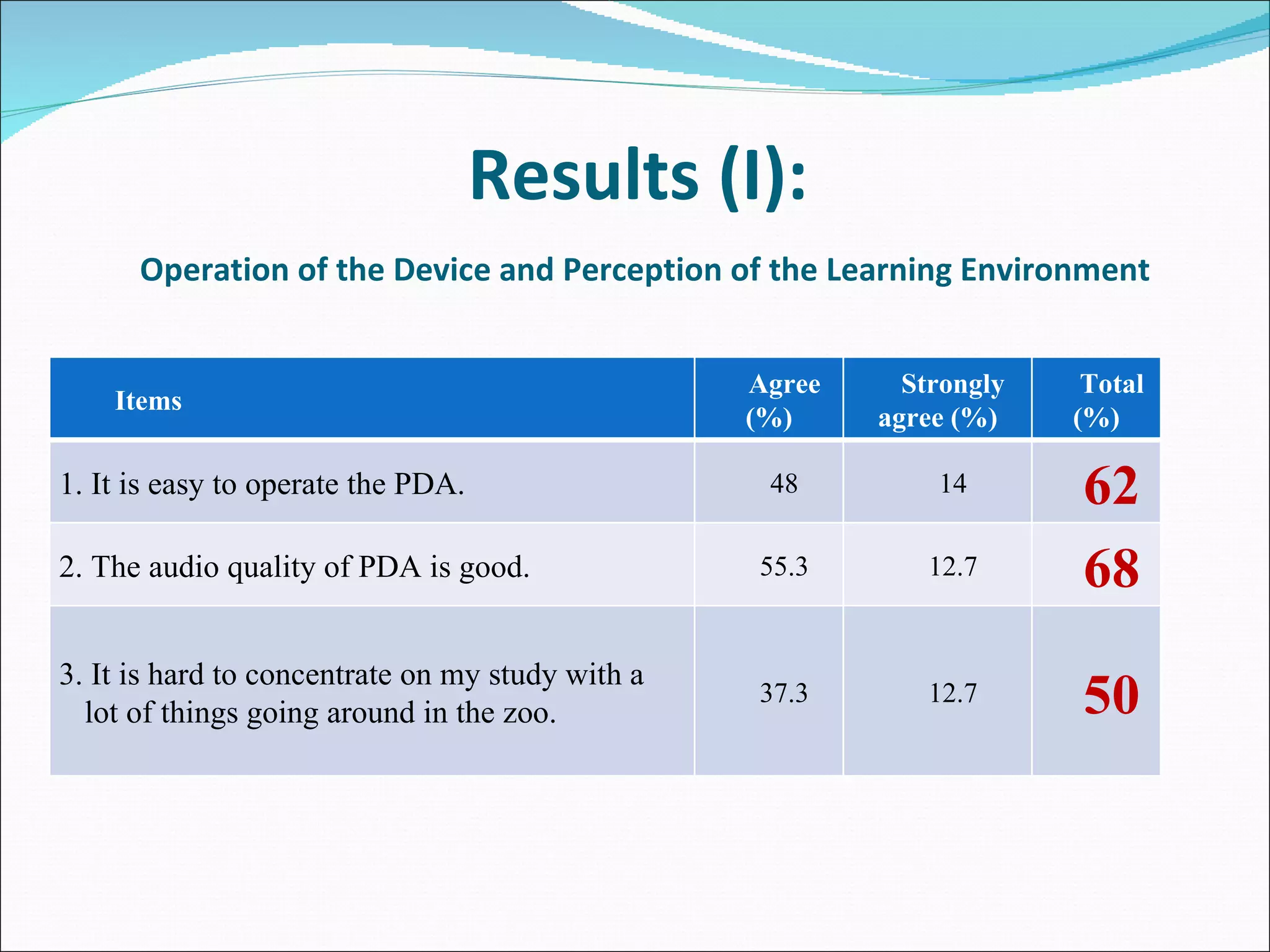
Results (I):   Operation of the Device and Perception of the Learning Environment Items Agree (%) Strongly agree (%) Total (%) 1. It is easy to operate the PDA. 48 14 62 2. The audio quality of PDA is good. 55.3 12.7 68 3. It is hard to concentrate on my study with a lot of things going around in the zoo. 37.3 12.7 50
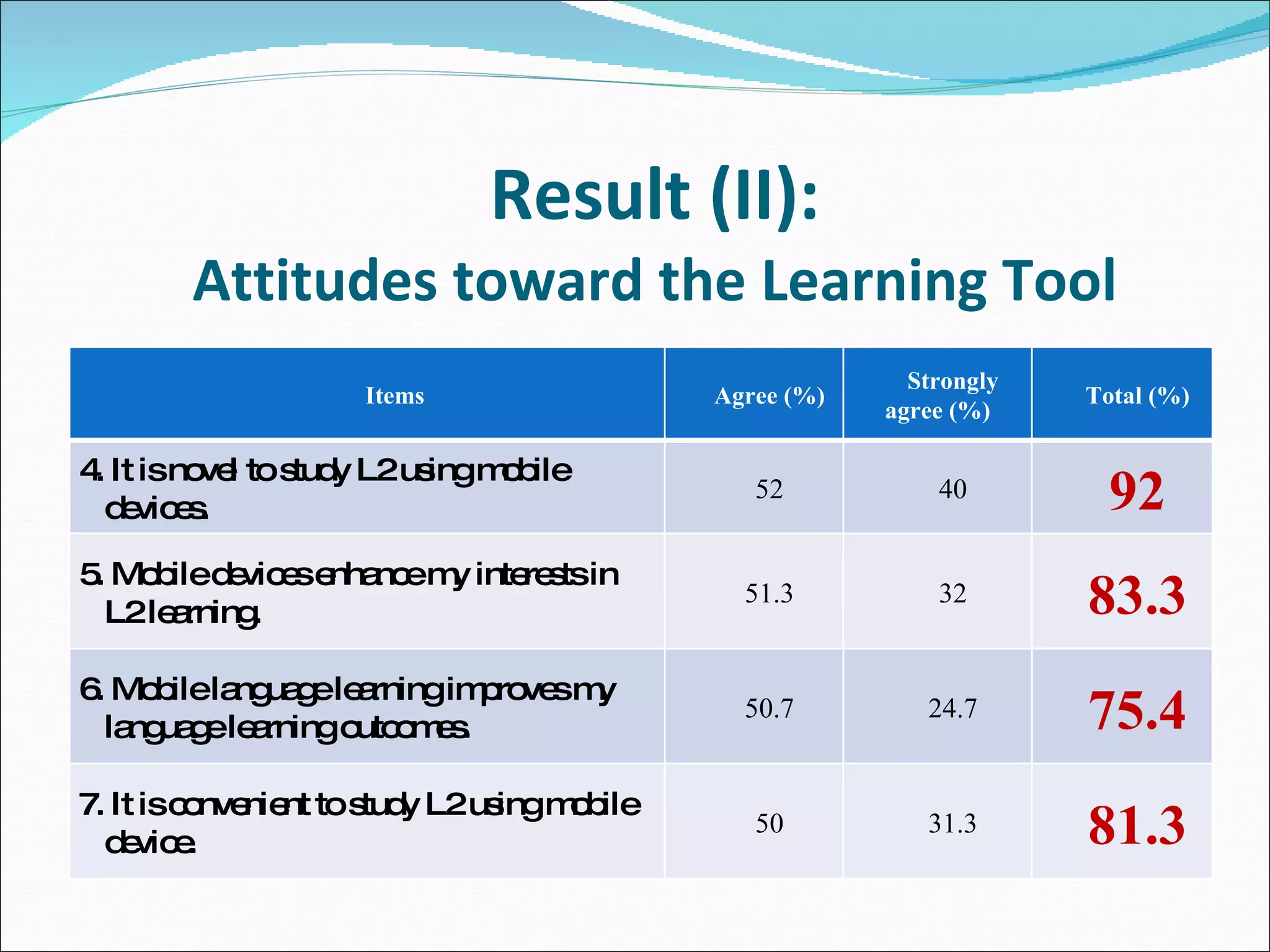
Result (II): Attitudes toward the Learning Tool Items Agree (%) Strongly agree (%) Total (%) 4. It is novel to study L2 using mobile devices. 52 40 92 5. Mobile devices enhance my interests in L2 learning. 51.3 32 83.3 6. Mobile language learning improves my language learning outcomes. 50.7 24.7 75.4 7. It is convenient to study L2 using mobile device. 50 31.3 81.3
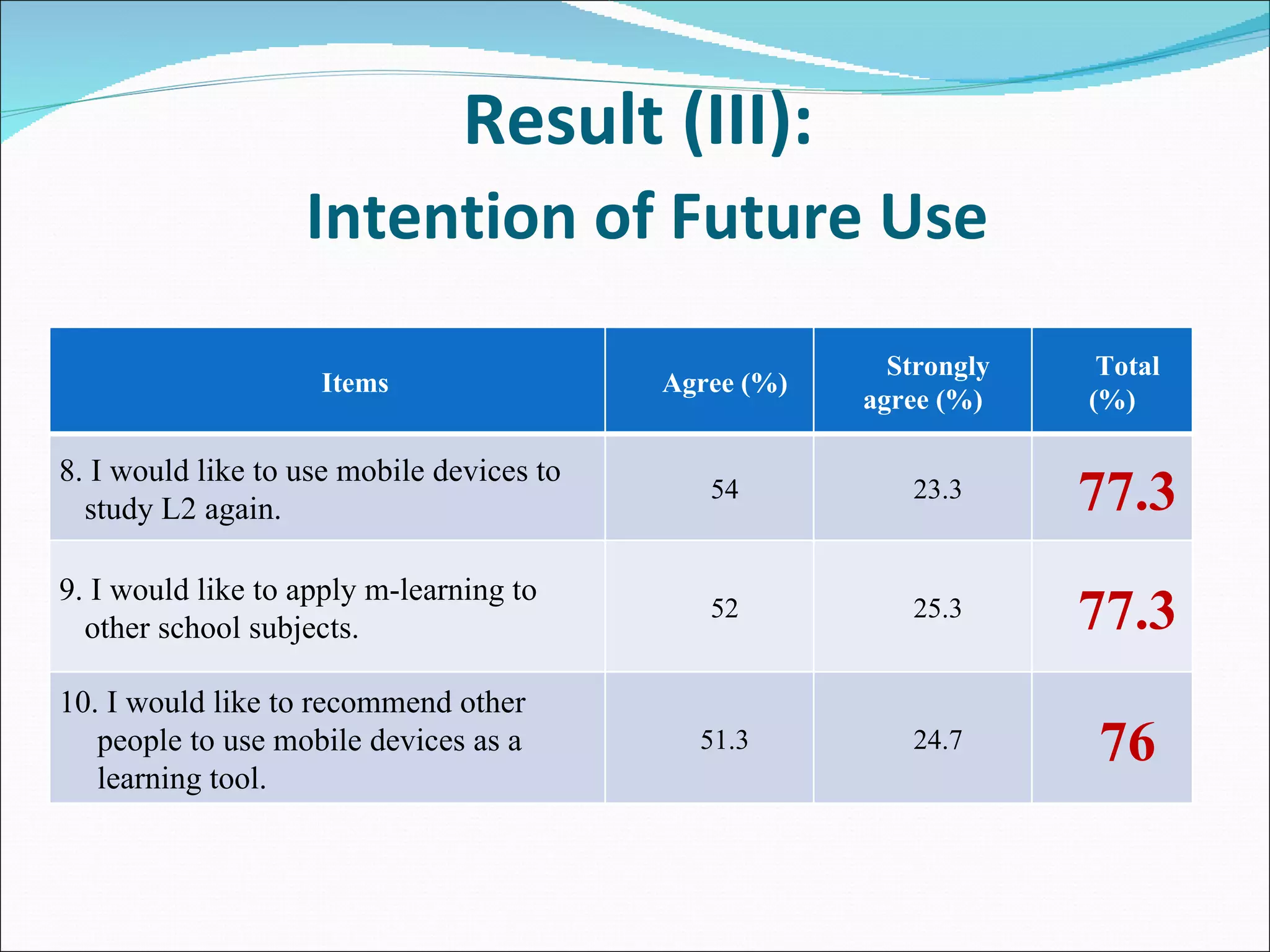
Result (III):   Intention of Future Use Items Agree (%) Strongly agree (%) Total (%) 8. I would like to use mobile devices to study L2 again. 54 23.3 77.3 9. I would like to apply m-learning to other school subjects. 52 25.3 77.3 10. I would like to recommend other people to use mobile devices as a learning tool. 51.3 24.7 76
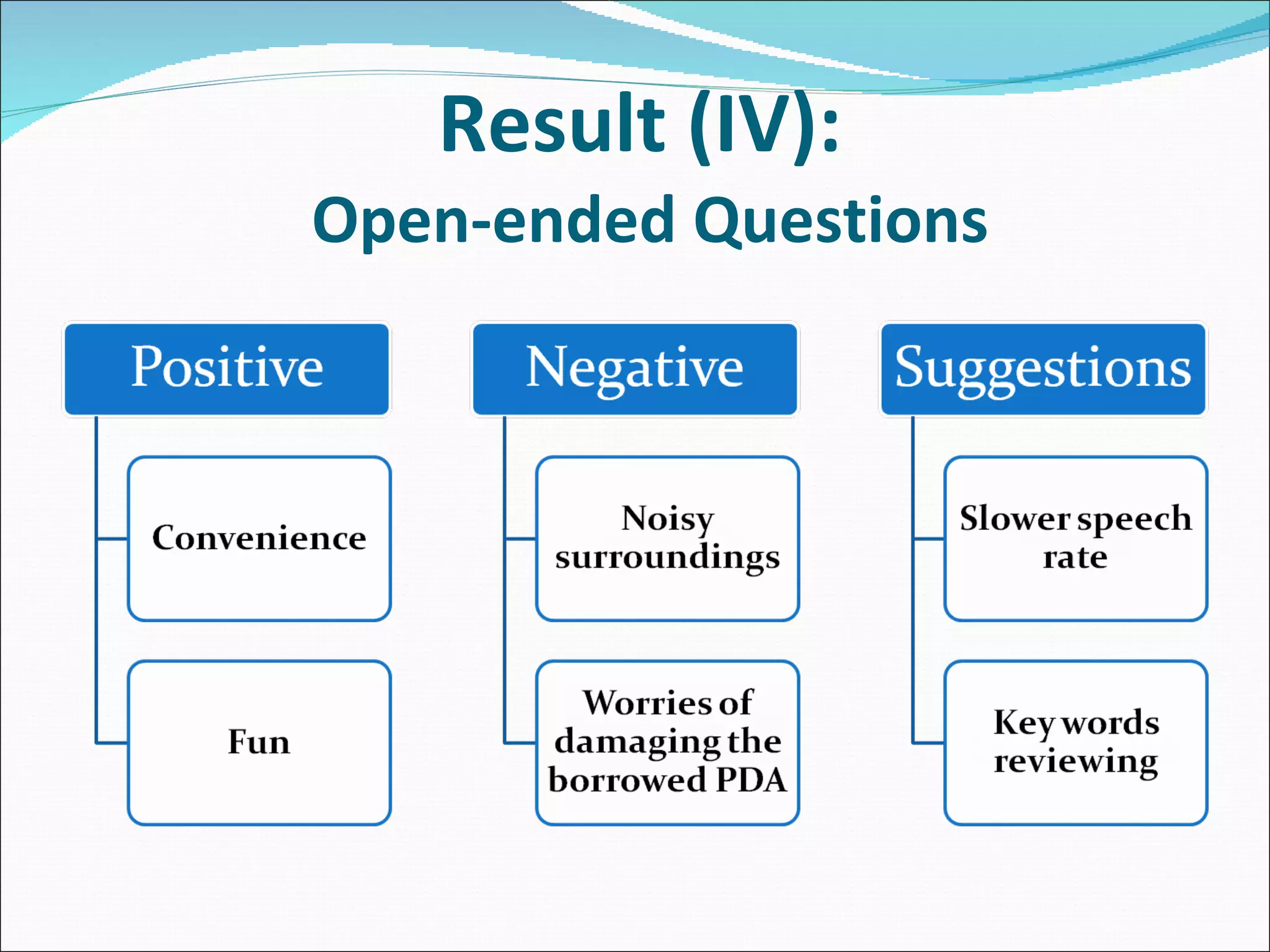
Result (IV):  Open-ended Questions
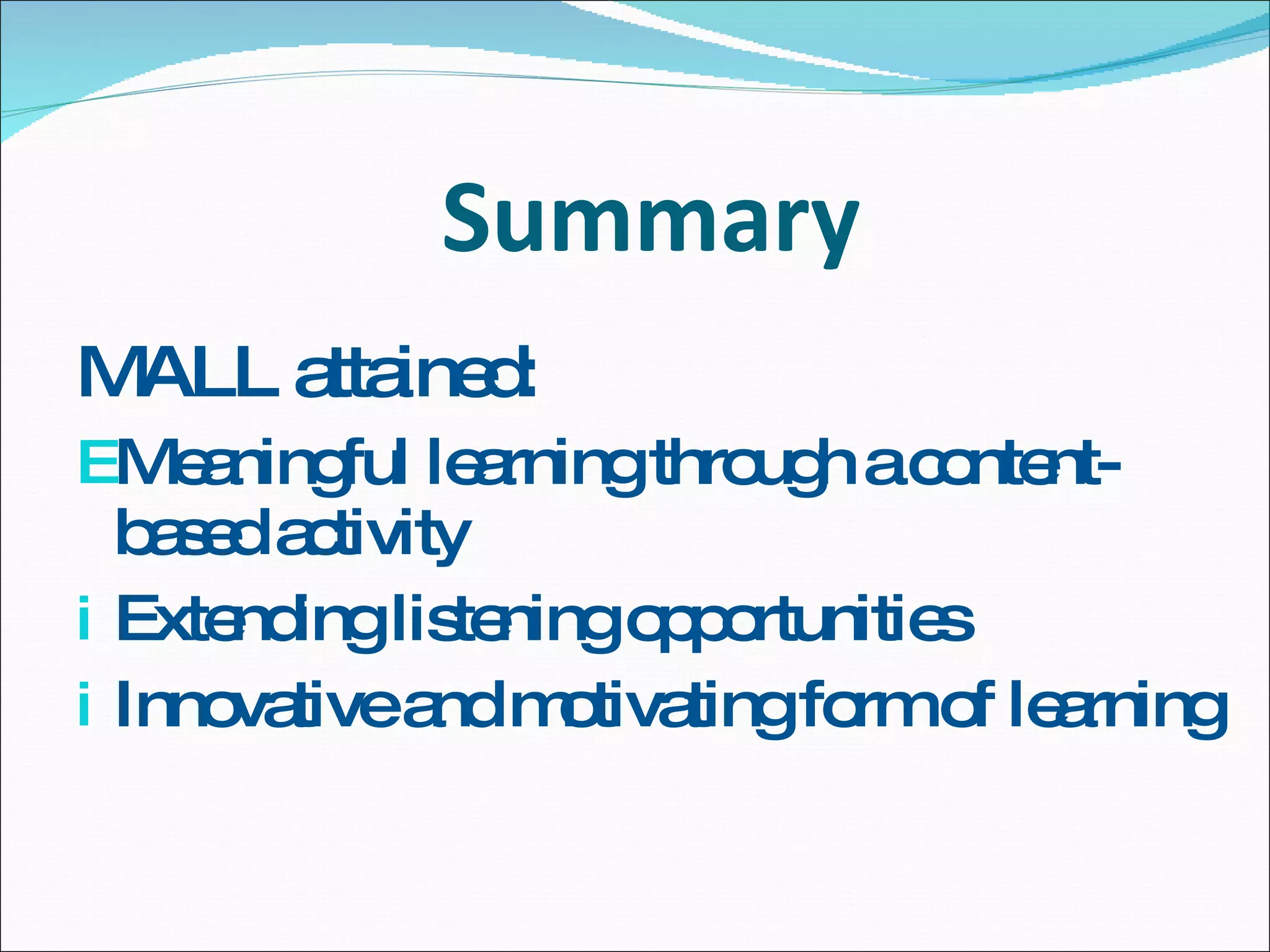
Summary MALL attained: Meaningful learning through a content-based activity Extending listening opportunities  Innovative and motivating form of learning
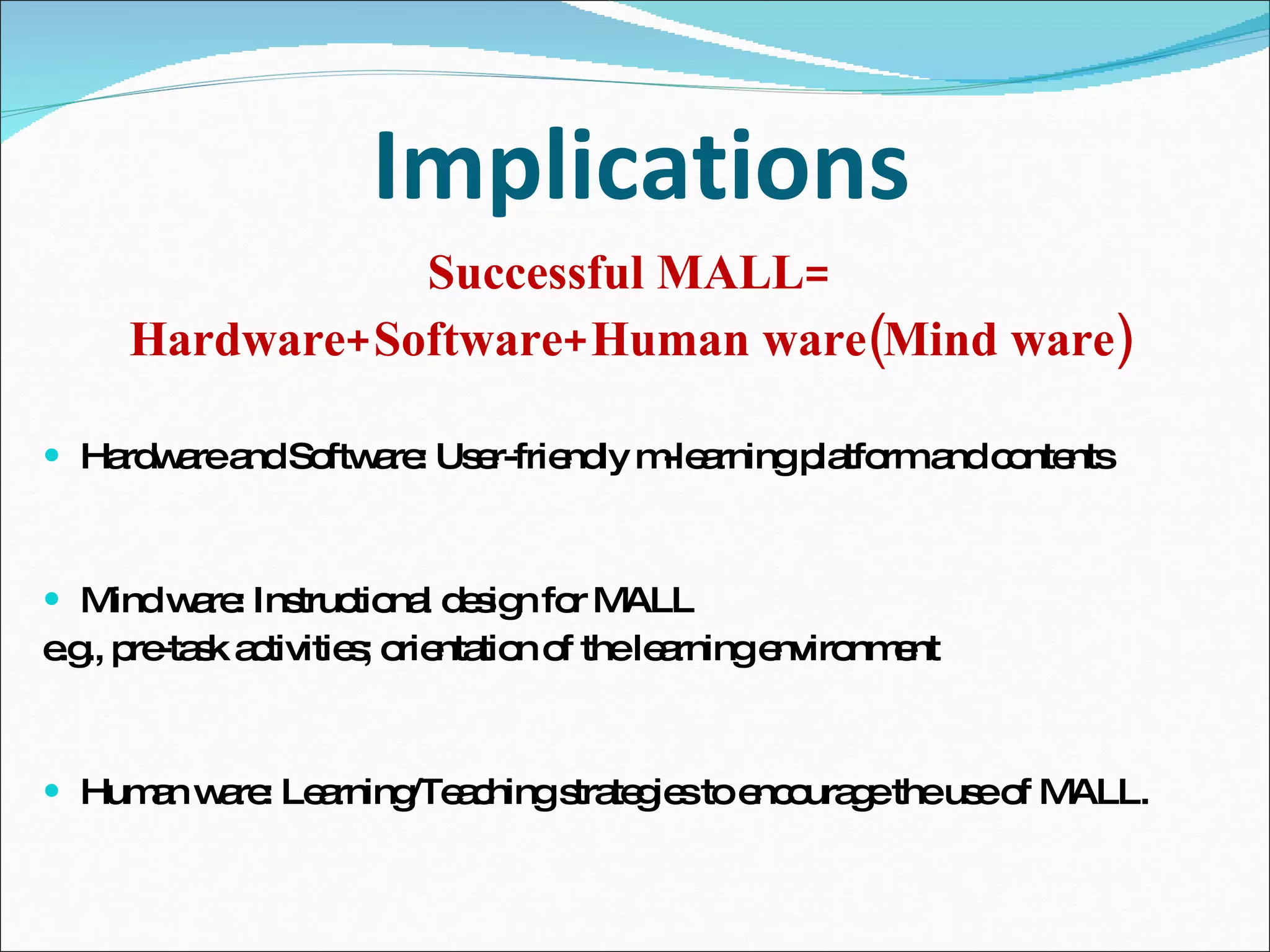
Implications Successful MALL= Hardware+Software+Human ware(Mind ware) Hardware and Software: User-friendly m-learning platform and contents Mind ware: Instructional design for MALL e.g., pre-task activities; orientation of the learning environment Human ware: Learning/Teaching strategies to encourage the use of MALL.
Further research Different contexts Different sites. Different assessment foci.

More Than Just Audio Guide

  • 1.
    Chi-Cheng Chang 張基成 I-Jung Chen 陳怡容 , [email_address] Gina Wen-Chun Chen 陳玟君 UbiLearn 2010, April 12, Kaohsiung, Taiwan
  • 2.
  • 3.
    L2 listening comprehensionDifficulties: Processing content knowledge and linguistic knowledge simultaneously Ongoing Message —no control over the speech rate and message reviewing Importance: 50% of the time we spend functioning in another language is spent on listening (Feyten, 1991; Nunan, 2003; Scarcella & Oxford, 1992) Successful communication depends on correct listening comprehension.
  • 4.
    How to improveL2 listening comprehension Material : providing materials that are familiar / relevant to students’ interests. Variety: Introducing various listening inputs, including different types of speakers, speeches, modes of presentations, and situations. Practice: Encouraging learners to seek out listening opportunities on their own outside of the classroom.
  • 5.
    Mobile learning(m-learning) “Any sort of learning that happens when the learner is not in a fixed, predetermined location , or learning that happens when the learner takes advantage of the learning opportunities offered by mobile technologies .” (O'Malley et al, 2003)
  • 6.
    MALL Applications (Mobileassisted language learning)
  • 7.
  • 8.
    Theoretical Framework Nomadicinquiry: Visiting the museums, science centers, or galleries along with the handheld devices (Hsi, 2003)
  • 9.
  • 10.
    Methodology (I) Participants — 162 university students majoring in Applied English (37 males and 125 females, aged 18–22 years). Materials — 4 passages of animal audio guide in English Length: 180 ~ 220 words/passage. Speech rate: approximately 130 w/pm
  • 11.
    Methodology (II)Data collection — A survey 5-point Likert scale for the attitudes towards the mobile learning (10 items). 1 open-ended question for suggestions to the activity. Data Analysis — Descriptive statistics
  • 12.
  • 13.
    Interface (PDA Screen Shots)
  • 14.
    Results The survey(5 sections) — The operation of the device (2 items) Perception of the learning environment (1 item) Attitudes toward the learning tool (4 items) Intention of future use (3 items) Open-ended question : participants’ opinions regarding this activity
  • 15.
    General attitudes 148valid cases (14 missing data) 26 participants (17.6 %) had previous experience of m-learning one sample t -test of each section with the cut point of 3: the participants in general had positive attitudes toward the novel way of learning languages. Section mean SD t (Sig) I. Operation of the device 3.67 0.73 11.03 (0.00) II. Perception of the learning environment 3.37 1.02 4.44 (0.00) III. Attitudes toward the learning tool 4.12 0.63 21.83 (0.00) IV. Intention of future use 3.99 0.69 17.42 (0.00)
  • 16.
    Results (I): Operation of the Device and Perception of the Learning Environment Items Agree (%) Strongly agree (%) Total (%) 1. It is easy to operate the PDA. 48 14 62 2. The audio quality of PDA is good. 55.3 12.7 68 3. It is hard to concentrate on my study with a lot of things going around in the zoo. 37.3 12.7 50
  • 17.
    Result (II): Attitudestoward the Learning Tool Items Agree (%) Strongly agree (%) Total (%) 4. It is novel to study L2 using mobile devices. 52 40 92 5. Mobile devices enhance my interests in L2 learning. 51.3 32 83.3 6. Mobile language learning improves my language learning outcomes. 50.7 24.7 75.4 7. It is convenient to study L2 using mobile device. 50 31.3 81.3
  • 18.
    Result (III): Intention of Future Use Items Agree (%) Strongly agree (%) Total (%) 8. I would like to use mobile devices to study L2 again. 54 23.3 77.3 9. I would like to apply m-learning to other school subjects. 52 25.3 77.3 10. I would like to recommend other people to use mobile devices as a learning tool. 51.3 24.7 76
  • 19.
    Result (IV): Open-ended Questions
  • 20.
    Summary MALL attained:Meaningful learning through a content-based activity Extending listening opportunities Innovative and motivating form of learning
  • 21.
    Implications Successful MALL=Hardware+Software+Human ware(Mind ware) Hardware and Software: User-friendly m-learning platform and contents Mind ware: Instructional design for MALL e.g., pre-task activities; orientation of the learning environment Human ware: Learning/Teaching strategies to encourage the use of MALL.
  • 22.
    Further research Differentcontexts Different sites. Different assessment foci.