Lorem ipsum dolor sit amet, adipiscing elit
TeachingReadingthroughICT
By
Wili Astuti/19705261008
SaptinDSetyoH/19705261010
SilviSalsabil/19705261033
TREYresearch
CONTENT
This presentation will focus on
2
1.The nature of reading:
the extensive and intensive reading
2.Principles for Designing Interactive Reading
3. ICT in Teaching Reading
4.Workshop: Nearpod
TREYresearch
TheNatureofReading
3
TREYresearch
Reading is a process carried out and used by the reader to
obtain a message, which the writer wants to convey through
the media of words / written language.
(Hodgson in Tarigan, 2008: 7)
Reading is all activities done by the reader to obtain
information contained in a reading material. The reading
product is the result of the reading process, which is the
understanding of the reading content.
(Yunus, 2012: 148)
4
TREYresearch
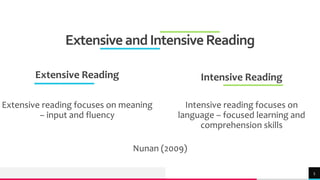
ExtensiveandIntensiveReading
Extensive Reading
Extensive reading focuses on meaning
– input and fluency
Intensive Reading
Intensive reading focuses on
language – focused learning and
comprehension skills
5
Nunan (2009)
TREYresearch
PrinciplesforDesigningInteractiveReading
6
TREYresearch
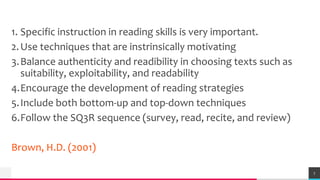
1. Specific instruction in reading skills is very important.
2.Use techniques that are instrinsically motivating
3.Balance authenticity and readibility in choosing texts such as
suitability, exploitability, and readability
4.Encourage the development of reading strategies
5.Include both bottom-up and top-down techniques
6.Follow the SQ3R sequence (survey, read, recite, and review)
Brown, H.D. (2001)
7
TREYresearch
ICTinTeachingReading
8
TREYresearch
TheAdvantagesandDisadvantages
Advantages
1. Attracts the student attention
2. Aids the teaching process
3. Helps student improves their
vocabulary and enable them to find
out the meaning of the words in the
texts they read
4. Helps teacher to get suitable reading
material online
Disadvantages
1. Difficult to control the class
2. Too many articles available
9
(Ladbrook 2014; Yunus et all 2013)
TREYresearch
ConsiderationinteachingReadingbyusingICT
Computers and the internet has been viewed as good sources in developing reading
skills which helps increase students’ interaction with texts, attention to individual
needs, and increases independence (Case and Truscott, 1999).
Pérez Correa et al (2004) provide guidelines for successful computer- reading
instruction in the classroom:
1. Computer instruction in reading should focus on meaning and stress reading
comprehension.
2. Computer instruction in reading should foster active involvement and stimulate
thinking.
3. Computer instruction in reading should support and extend students knowledge of
text structure.
4. Computer instruction in reading should make use of content from a wide range of
subject areas.
5. Computer instruction in reading should link reading and writing. 10
TREYresearch
References
• Ladbrook, J. (2014). An interactive digital platform for preservice secondary English
teachers’ reading: First iteration findings. Australasian Journal of Educational
Technology, 30(5).
• Maduabuchi, C. H., & Emechebe, V. I. (2016). ICT and the Teaching of Reading
Comprehension in English as a Second Language in Secondary Schools: Problems and
Prospects. International Journal of Education and Literacy Studies, 4(3), 18-23.
• Nikolopoulou, K., Akriotou, D., & Gialamas, V. (2019). Early Reading Skills in English as
a Foreign Language Via ICT in Greece: Early Childhood Student Teachers’ Perceptions.
Early Childhood Education Journal, 47(5), 597-606.
• Yunus, M. M., Nordin, N., Salehi, H., Sun, C. H., & Embi, M. A. (2013). Pros and Cons of
Using IICT in Teaching ESL Reading and Writing. International education studies, 6(7),
119-130.
Add a footer 11
TREYresearch
DISCUSSION
12
1. We already discussed about ER and IR. Which one do you
often use in teaching reading? why?
2.In your opinion, what aspects must be covered in teaching
reading through ICT? Why?
3.Have you ever considered to use ICT in teaching reading?
Why or Why not?
TREYresearch
ThankYou
13

Teaching reading through ict

  • 1.
    Lorem ipsum dolorsit amet, adipiscing elit TeachingReadingthroughICT By Wili Astuti/19705261008 SaptinDSetyoH/19705261010 SilviSalsabil/19705261033
  • 2.
    TREYresearch CONTENT This presentation willfocus on 2 1.The nature of reading: the extensive and intensive reading 2.Principles for Designing Interactive Reading 3. ICT in Teaching Reading 4.Workshop: Nearpod
  • 3.
  • 4.
    TREYresearch Reading is aprocess carried out and used by the reader to obtain a message, which the writer wants to convey through the media of words / written language. (Hodgson in Tarigan, 2008: 7) Reading is all activities done by the reader to obtain information contained in a reading material. The reading product is the result of the reading process, which is the understanding of the reading content. (Yunus, 2012: 148) 4
  • 5.
    TREYresearch ExtensiveandIntensiveReading Extensive Reading Extensive readingfocuses on meaning – input and fluency Intensive Reading Intensive reading focuses on language – focused learning and comprehension skills 5 Nunan (2009)
  • 6.
  • 7.
    TREYresearch 1. Specific instructionin reading skills is very important. 2.Use techniques that are instrinsically motivating 3.Balance authenticity and readibility in choosing texts such as suitability, exploitability, and readability 4.Encourage the development of reading strategies 5.Include both bottom-up and top-down techniques 6.Follow the SQ3R sequence (survey, read, recite, and review) Brown, H.D. (2001) 7
  • 8.
  • 9.
    TREYresearch TheAdvantagesandDisadvantages Advantages 1. Attracts thestudent attention 2. Aids the teaching process 3. Helps student improves their vocabulary and enable them to find out the meaning of the words in the texts they read 4. Helps teacher to get suitable reading material online Disadvantages 1. Difficult to control the class 2. Too many articles available 9 (Ladbrook 2014; Yunus et all 2013)
  • 10.
    TREYresearch ConsiderationinteachingReadingbyusingICT Computers and theinternet has been viewed as good sources in developing reading skills which helps increase students’ interaction with texts, attention to individual needs, and increases independence (Case and Truscott, 1999). Pérez Correa et al (2004) provide guidelines for successful computer- reading instruction in the classroom: 1. Computer instruction in reading should focus on meaning and stress reading comprehension. 2. Computer instruction in reading should foster active involvement and stimulate thinking. 3. Computer instruction in reading should support and extend students knowledge of text structure. 4. Computer instruction in reading should make use of content from a wide range of subject areas. 5. Computer instruction in reading should link reading and writing. 10
  • 11.
    TREYresearch References • Ladbrook, J.(2014). An interactive digital platform for preservice secondary English teachers’ reading: First iteration findings. Australasian Journal of Educational Technology, 30(5). • Maduabuchi, C. H., & Emechebe, V. I. (2016). ICT and the Teaching of Reading Comprehension in English as a Second Language in Secondary Schools: Problems and Prospects. International Journal of Education and Literacy Studies, 4(3), 18-23. • Nikolopoulou, K., Akriotou, D., & Gialamas, V. (2019). Early Reading Skills in English as a Foreign Language Via ICT in Greece: Early Childhood Student Teachers’ Perceptions. Early Childhood Education Journal, 47(5), 597-606. • Yunus, M. M., Nordin, N., Salehi, H., Sun, C. H., & Embi, M. A. (2013). Pros and Cons of Using IICT in Teaching ESL Reading and Writing. International education studies, 6(7), 119-130. Add a footer 11
  • 12.
    TREYresearch DISCUSSION 12 1. We alreadydiscussed about ER and IR. Which one do you often use in teaching reading? why? 2.In your opinion, what aspects must be covered in teaching reading through ICT? Why? 3.Have you ever considered to use ICT in teaching reading? Why or Why not?
  • 13.