Learning to Detect Phishing EmailsIan Fette
Norman Sadeh
Anthony Tomasic
Presented by – BhavinMadhaniAuthorsBhavinMadhani - UC Irvine -  2009Ian Fette:  - Masters degree from Carnegie Mellon University. - Product Manager at Google - works on the   Google Chrome team . - Product manager for the anti-phishing and   anti-malware teams at Google. Norman M. Sadeh:  - Professor in the School of Computer Science at Carnegie Mellon University. - Director, Mobile Commerce Lab. - Director, e-Supply Chain Management Lab.  - Co-Director, COS PhD Program.Anthony Tomasic:  - Director of the Carnegie Mellon University. - Masters of science in Information Technology,     Very Large Information Systems  (MSIT-VLIS) Program..
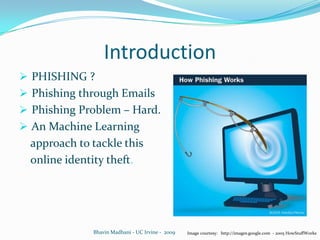
IntroductionPHISHING ?
 Phishing through Emails
 Phishing Problem – Hard.
 An Machine Learning     approach to tackle this      online identity theft. BhavinMadhani - UC Irvine -  2009Image courtesy:   http://images.google.com  - 2005 HowStuffWorks
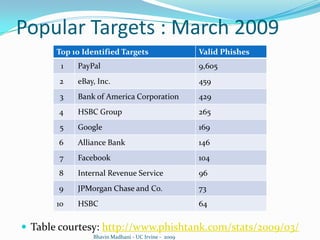
Popular Targets : March 2009Table courtesy: http://www.phishtank.com/stats/2009/03/BhavinMadhani - UC Irvine -  2009
BackgroundToolbars
SpoofGuard
NetCraft
Email Filtering
SpamAssassin
SpamatoBhavinMadhani - UC Irvine -  2009Image courtesy:   http://images.google.com   - www.glasbergen.com
Method PILFER – A Machine Learning based approach to    classification.
 phishing emails / ham (good) emails
 Feature Set
 Features as used in email classification
 Features as used in webpage classificationBhavinMadhani - UC Irvine -  2009
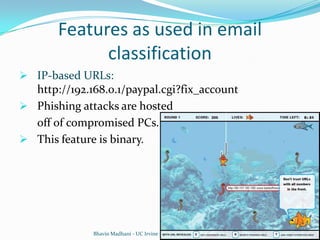
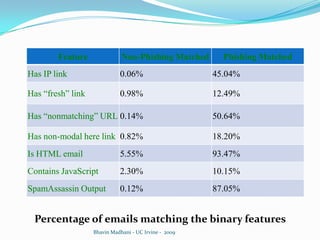
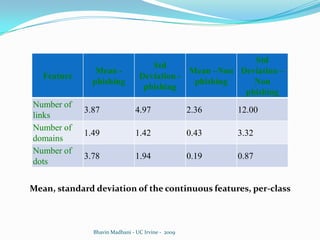
Features as used in email classificationIP-based URLs: http://192.168.0.1/paypal.cgi?fix_account
Phishing attacks are hosted 	off of compromised PCs. 	This feature is binary. BhavinMadhani - UC Irvine -  2009
Age of linked-to domain names:
‘playpal.com’ or ‘paypal-update.com’
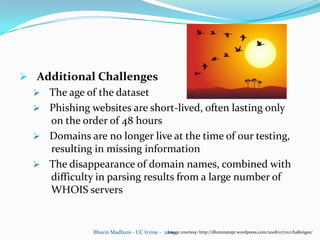
These domains often have a limited life
WHOIS query
date is within 60 days of the date the email was sent – “fresh” domain. This is a binary featureBhavinMadhani - UC Irvine -  2009
Nonmatching URLs

Learning to Detect Phishing Emails

Editor's Notes

  • #3 Ian FetteIan Fette is a Product Manager at Google, where he works on the Google Chrome team focusing on security and the browser infrastructure. He is also the product manager for the anti-phishing and anti-malware teams at Google, focused on discovering harmful sites online and making that data available for use, such as in Google Chrome and Mozilla Firefox. Ian holds a Masters degree from Carnegie Mellon University's School of Computer Science, as well a bachelor's degree in Computer Science Engineering from the University of Michigan. Norman M. Sadeh is a Professor in the School of Computer Science at Carnegie Mellon University (CMU). He is director of CMU’s e-Supply Chain Management Laboratory, director of its Mobile Commerce Laboratory, and co-Director of the School’s PhD Program in Computation, Organizations and Society. Dr. Sadeh has been on the faculty at CMU since 1991. Norman received his Ph.D. in Computer Science at CMU with a major in Artificial Intelligence and a minor in Operations Research. He holds a MS degree in computer science from the University of Southern California. Over the past six years, Norman has conducted pioneering research in pervasive computing and semantic web technologies for privacy and context awareness and is currently extending these techniques to inter-enterprise collaboration scenarios.Anthony Tomasic (tomasic@cs.cmu.edutomasic@cs.cmu.edu) is the Director of the Carnegie Mellon University Masters of Science in Information Technology, Very Large Information Systems (MSIT-VLIS) program.VIO The Virtual Information Officer is an intelligent assistant for processing natural language task requests for users. WbE The Workflow By Example is an intelligent assistant for user constructed workflows.
  • #4 This message and others like it are examples of phishing, a method of online identity theft. Each month, more attacks are launched with the aim of making web users believe that they are communicating with a trusted entity for the purpose of stealing account information, logon credentials, and identity information in general. This attack method, commonly known as ``phishing,'' is most commonly initiated by sending out emails with links to spoofed websites that harvest information.
  • #6 The first disadvantage toolbars face when compared to email filtering is a decreased amount of contextual information. The email provides the context under which the attack is delivered to the user. An email filter can see what words are used to entice the user to take action, which is currently not knowable to a filter operating in a browser separate from the user's e-mail client.The second disadvantage of toolbars is the inability to completely shield the user from the decision making process. Toolbars usually prompt users with a dialog box, which many users will simply dismiss or misinterpret, or worse yet these warning dialogs can be intercepted by user-space malware [2]. By filtering out phishing emails before they are ever seen by users, we avoid the risk of these warnings being dismissed by or hidden from the user.