PHILOSOPHY CHEAT SHEET: THE MOST IMPORTANT BRANCHES
OF PHILOSOPHY, TIME PERIODS AND PHILOSOPHERS
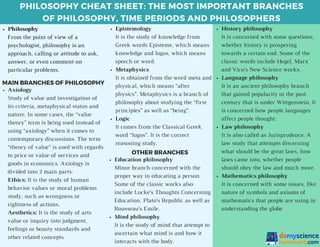
Philosophy
From the point of view of a
psychologist, philosophy is an
approach, calling or attitude to ask,
answer, or even comment on
particular problems.
Epistemology
It is the study of knowledge from
Greek words Episteme, which means
knowledge and logos, which means
speech or word.
Metaphysics
It is obtained from the word meta and
physical, which means “after
physics”. Metaphysics is a branch of
philosophy about studying the “first
principles” as well as “being”.
Logic
It comes from the Classical Greek
word “logos”. It is the correct
reasoning study.
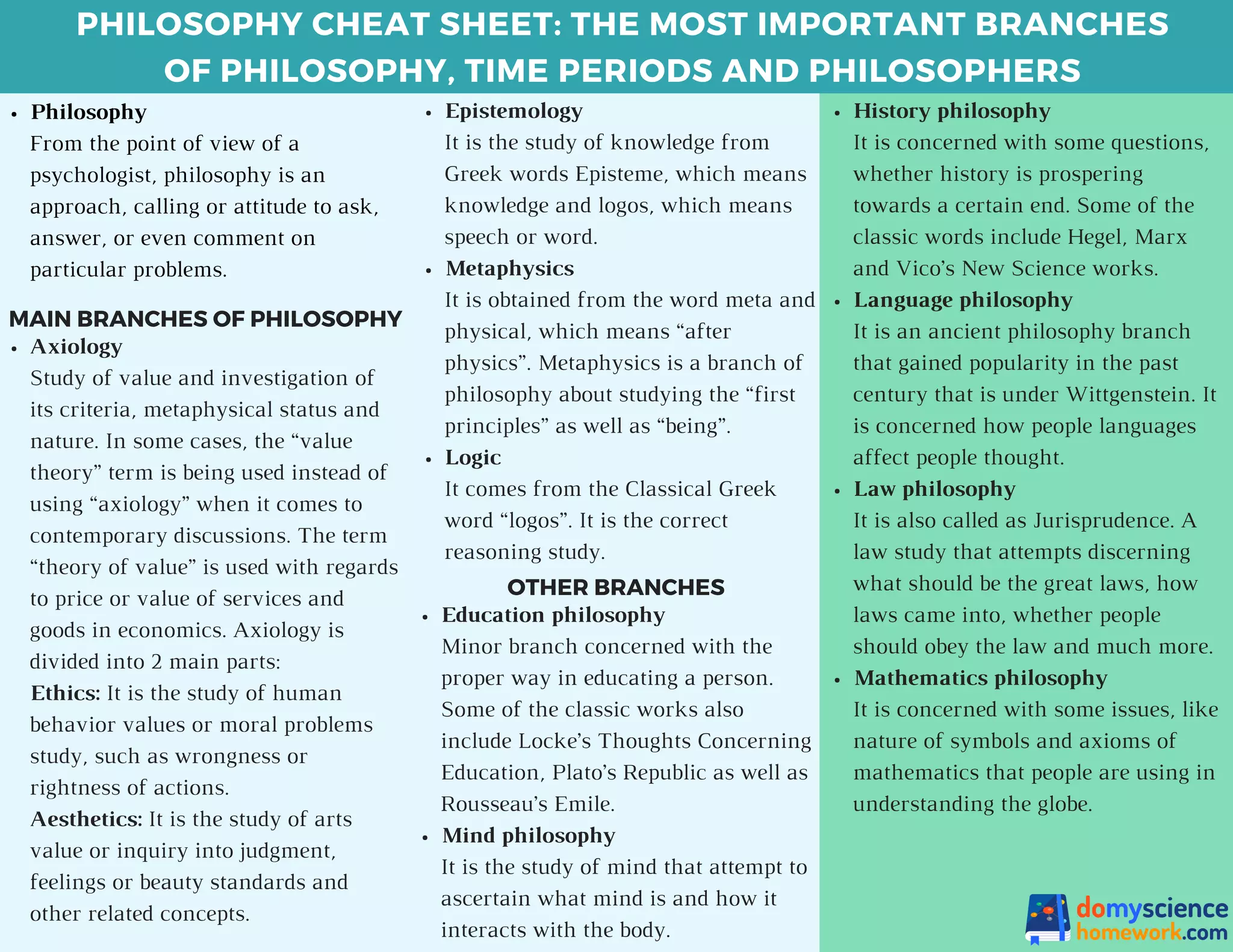
History philosophy
It is concerned with some questions,
whether history is prospering
towards a certain end. Some of the
classic words include Hegel, Marx
and Vico’s New Science works.
Language philosophy
It is an ancient philosophy branch
that gained popularity in the past
century that is under Wittgenstein. It
is concerned how people languages
affect people thought.
Law philosophy
It is also called as Jurisprudence. A
law study that attempts discerning
what should be the great laws, how
laws came into, whether people
should obey the law and much more.
Mathematics philosophy
It is concerned with some issues, like
nature of symbols and axioms of
mathematics that people are using in
understanding the globe.
MAIN BRANCHES OF PHILOSOPHY
Axiology
Study of value and investigation of
its criteria, metaphysical status and
nature. In some cases, the “value
theory” term is being used instead of
using “axiology” when it comes to
contemporary discussions. The term
“theory of value” is used with regards
to price or value of services and
goods in economics. Axiology is
divided into 2 main parts:
Ethics: It is the study of human
behavior values or moral problems
study, such as wrongness or
rightness of actions.
Aesthetics: It is the study of arts
value or inquiry into judgment,
feelings or beauty standards and
other related concepts.
OTHER BRANCHES
Education philosophy
Minor branch concerned with the
proper way in educating a person.
Some of the classic works also
include Locke’s Thoughts Concerning
Education, Plato’s Republic as well as
Rousseau’s Emile.
Mind philosophy
It is the study of mind that attempt to
ascertain what mind is and how it
interacts with the body.
PHILOSOPHY CHEAT SHEET: THE MOST IMPORTANT BRANCHES
OF PHILOSOPHY, TIME PERIODS AND PHILOSOPHERS
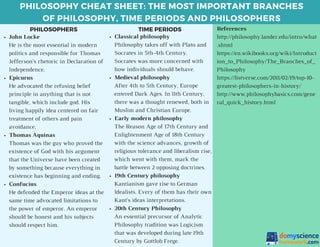
References
http://philosophy.lander.edu/intro/what
.shtml
https://en.wikibooks.org/wiki/Introduct
ion_to_Philosophy/The_Branches_of_
Philosophy
https://listverse.com/2011/02/19/top-10-
greatest-philosophers-in-history/
http://www.philosophybasics.com/gene
ral_quick_history.html
PHILOSOPHERS
John Locke
He is the most essential in modern
politics and responsible for Thomas
Jefferson’s rhetoric in Declaration of
Independence.
Epicurus
He advocated the refusing belief
principle in anything that is not
tangible, which include god. His
living happily idea centered on fair
treatment of others and pain
avoidance.
Thomas Aquinas
Thomas was the guy who proved the
existence of God with his argument
that the Universe have been created
by something because everything in
existence has beginning and ending.
Confucius
He defended the Emperor ideas at the
same time advocated limitations to
the power of emperor. An emperor
should be honest and his subjects
should respect him.
TIME PERIODS
Classical philosophy
Philosophy takes off with Plato and
Socrates in 5th-4th Century.
Socrates was more concerned with
how individuals should behave.
Medieval philosophy
After 4th to 5th Century, Europe
entered Dark Ages. In 11th Century,
there was a thought renewed, both in
Muslim and Christian Europe.
Early modern philosophy
The Reason Age of 17th Century and
Enlightenment Age of 18th Century
with the science advances, growth of
religious tolerance and liberalism rise,
which went with them, mark the
battle between 2 opposing doctrines.
19th Century philosophy
Kantianism gave rise to German
Idealists. Every of them has their own
Kant’s ideas interpretations.
20th Century Philosophy
An essential precursor of Analytic
Philosophy tradition was Logicism
that was developed during late 19th
Century by Gottlob Frege.

Philosophy Cheat Sheet

  • 1.
    PHILOSOPHY CHEAT SHEET:THE MOST IMPORTANT BRANCHES OF PHILOSOPHY, TIME PERIODS AND PHILOSOPHERS Philosophy From the point of view of a psychologist, philosophy is an approach, calling or attitude to ask, answer, or even comment on particular problems. Epistemology It is the study of knowledge from Greek words Episteme, which means knowledge and logos, which means speech or word. Metaphysics It is obtained from the word meta and physical, which means “after physics”. Metaphysics is a branch of philosophy about studying the “first principles” as well as “being”. Logic It comes from the Classical Greek word “logos”. It is the correct reasoning study. History philosophy It is concerned with some questions, whether history is prospering towards a certain end. Some of the classic words include Hegel, Marx and Vico’s New Science works. Language philosophy It is an ancient philosophy branch that gained popularity in the past century that is under Wittgenstein. It is concerned how people languages affect people thought. Law philosophy It is also called as Jurisprudence. A law study that attempts discerning what should be the great laws, how laws came into, whether people should obey the law and much more. Mathematics philosophy It is concerned with some issues, like nature of symbols and axioms of mathematics that people are using in understanding the globe. MAIN BRANCHES OF PHILOSOPHY Axiology Study of value and investigation of its criteria, metaphysical status and nature. In some cases, the “value theory” term is being used instead of using “axiology” when it comes to contemporary discussions. The term “theory of value” is used with regards to price or value of services and goods in economics. Axiology is divided into 2 main parts: Ethics: It is the study of human behavior values or moral problems study, such as wrongness or rightness of actions. Aesthetics: It is the study of arts value or inquiry into judgment, feelings or beauty standards and other related concepts. OTHER BRANCHES Education philosophy Minor branch concerned with the proper way in educating a person. Some of the classic works also include Locke’s Thoughts Concerning Education, Plato’s Republic as well as Rousseau’s Emile. Mind philosophy It is the study of mind that attempt to ascertain what mind is and how it interacts with the body.
  • 2.
    PHILOSOPHY CHEAT SHEET:THE MOST IMPORTANT BRANCHES OF PHILOSOPHY, TIME PERIODS AND PHILOSOPHERS References http://philosophy.lander.edu/intro/what .shtml https://en.wikibooks.org/wiki/Introduct ion_to_Philosophy/The_Branches_of_ Philosophy https://listverse.com/2011/02/19/top-10- greatest-philosophers-in-history/ http://www.philosophybasics.com/gene ral_quick_history.html PHILOSOPHERS John Locke He is the most essential in modern politics and responsible for Thomas Jefferson’s rhetoric in Declaration of Independence. Epicurus He advocated the refusing belief principle in anything that is not tangible, which include god. His living happily idea centered on fair treatment of others and pain avoidance. Thomas Aquinas Thomas was the guy who proved the existence of God with his argument that the Universe have been created by something because everything in existence has beginning and ending. Confucius He defended the Emperor ideas at the same time advocated limitations to the power of emperor. An emperor should be honest and his subjects should respect him. TIME PERIODS Classical philosophy Philosophy takes off with Plato and Socrates in 5th-4th Century. Socrates was more concerned with how individuals should behave. Medieval philosophy After 4th to 5th Century, Europe entered Dark Ages. In 11th Century, there was a thought renewed, both in Muslim and Christian Europe. Early modern philosophy The Reason Age of 17th Century and Enlightenment Age of 18th Century with the science advances, growth of religious tolerance and liberalism rise, which went with them, mark the battle between 2 opposing doctrines. 19th Century philosophy Kantianism gave rise to German Idealists. Every of them has their own Kant’s ideas interpretations. 20th Century Philosophy An essential precursor of Analytic Philosophy tradition was Logicism that was developed during late 19th Century by Gottlob Frege.