INTRODUCTION TO THE PHILOSOPHY OF
THE HUMAN PERSON
GRACIA P
. CABIDA
DOINGPHILOSOPHY
Philosophy: What is it and where did it originate?
PHILOSOPHY
Comes from two Greek words: Philos
(love) and Sophia (wisdom).
The science or discipline which uses
human reason to investigate the ultimate
cause and principles which govern all
things.
Philosophy: What is it and where did it originate?
PHILOSOPHY
It originated from Ancient Greece and the
first philosophers were pioneers in the
study of various disciplines such as history,
biology, medicine, mathematics, astronomy
and physics.
Philosophy: What is it and where did it originate?
PHILOSOPHY
Its historical development led to the
growth of two major branches: Western
Philosophy and Eastern Philosophy.
Western Philosophy
Is primarily concerned with uncovering the
truth through systematic argumentation
and theory.
There is greater emphasis on the use of
reason rather than faith, and an increased
focus on man as an individual.
Western Philosophy
It has led to the development of a more
scientific, theory-based approach in
philosophy, and a more individualistic, self-
oriented approach in analyzing the human
condition.
Eastern Philosophy
It is consisted of schools of thought closely
tied to religion, and is concerned with social
relations, ethics, and achieving a balanced
life.
The Most Notable Ancient Greek Philosophers
Pythagoras
A mathematician and scientist;
Credited with the formulation
of Pythagorean theorem;
Devoted to the study of
religion and philosophy.
The Most Notable Ancient Greek Philosophers
Heraclitus
He proposed that everything
that exists is based on a higher
order or plan (logos).
Change is a permanent aspect of
the human condition;
“No man ever steps on the same
river twice”
The Most Notable Ancient Greek Philosophers
Democritus
He devoted himself to
studying the causes of natural
phenomena.
The
matter
first to propose
is composed of
that
tiny
particles (atoms).
The Most Notable Ancient Greek Philosophers
Diogenes of Sinope
Known advocate of a simple
and virtuous life.
For him, one should not only
talk of virtue but should show it
in words and actions.
The Most Notable Ancient Greek Philosophers
Epicurus
He believed that philosophy could
enable man to live a life of
happiness.
His
Epicureanism – a school
views gave rise to
of
philosophy which believes that
wisdom and simple living will result
to a life free from fear and pain.
The Most Notable Ancient Greek Philosophers
Socrates
Known as critique of intellectuals
during his time.
He was credited with formulating
the Socratic Method – means of
examining a topic by devising a
series of questions that let the
learner examine and analyze his
knowledge and views regarding the
topic.
The Most Notable Ancient Greek Philosophers
Plato
A student of Socrates.
Known for his Theory of
Forms and Dialectic Method.
Founder of Academy.
The Most Notable Ancient Greek Philosophers
Aristotle
A student of Plato.
He proposed a system for the
classification of plants and
animals.
Deductive reasoning – process
by which specific statements are
analyzed to reach a conclusion
or generalization.
The Most Notable Ancient Greek Philosophers
Archimedes
Considered as a leading
scientist in ancient times.
He pioneered the use of
mathematics led to earlier
developments which gave rise
to modern calculus.
How do we characterize the study of
Philosophy?
One way of looking at Philosophy is to
consider it a way of analyzing frameworks.
Is defined as a way of thinking
about the world and is composed of
the views and beliefs of a person.
How do we characterize the study of
Philosophy?
Philosophy can also be thought as an examination of a
particular area of knowledge.
The central principle in philosophy is examination and
questioning.
Philosophy itself is a distinct area of knowledge with
its own goals, concerns and ways of doing things.
How do we characterize the study of
Philosophy?
Philosophy is a reflective and meditative
activity, and it has no designated subject
matter of its own. Rather it is a method of
mental exercise on any type of experience.
What are the Branches of
Philosophy?
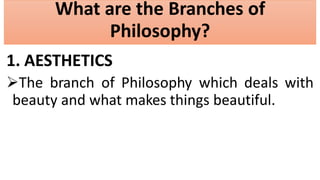
1. AESTHETICS
The branch of Philosophy which deals with
beauty and what makes things beautiful.
What are the Branches of
Philosophy?
2. LOGIC
The branch of Philosophy which deals with
correct reasoning.
What are the Branches of
Philosophy?
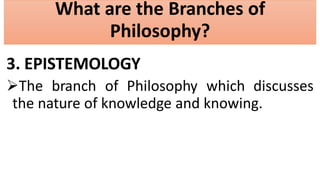
3. EPISTEMOLOGY
The branch of Philosophy which discusses
the nature of knowledge and knowing.
What are the Branches of
Philosophy?
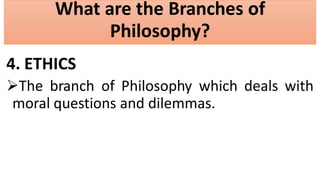
4. ETHICS
The branch of Philosophy which deals with
moral questions and dilemmas.
What are the Branches of
Philosophy?
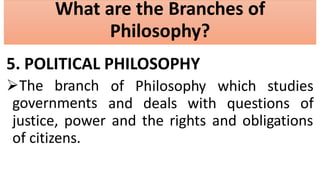
5. POLITICAL PHILOSOPHY
The branch
governments
of Philosophy which studies
and deals with questions of
justice, power and the rights and obligations
of citizens.
What are the Branches of
Philosophy?
6. METAPHYSICS
The branch of Philosophy which deals with
questions regarding reality and existence.
Why is there a need for man
Philosophize?
Philosophers have often wondered and
argued about the role of philosophy in man’s
life.
The Greek Philosopher Plato traced man’s
need to philosophize to his sense of wonder.
Rene Descartes traced the need to
philosophize to doubt.
His method of examining ideas and
perspectives became the basis of critical
thinking and analysis in the sciences.
Karl Jaspers saw the need to philosophize
because of experience.
He believed that man is often confronted by
experiences (limit situations) which challenge
his ideas and frameworks.
For him, philosophy provides us a means to
understand adverse or challenging conditions,
and to rise above them and gain new knowledge
and perspectives.
Finally, the need to philosophize is driven
by the love for wisdom.
Socrates is famous for having said “I know
that I do not know” and it is in accepting
this state of ignorance that one can begin
to learn and understand.
Socrates is also recognized for his motto:
“The unexamined life is not worth living”.
What are some of the major questions
that philosophers ponder upon?
The major questions in Philosophy concern
about:
reality
certainty
causality
ethics
What is real? Are we able to perceive reality
and everything in it?
REALITY – refers to the state of existence of
things independent of human consciousness.
It includes physical things that we see, feel,
taste, and smell, as well as things that
presently exist, and things that are yet to
exist.
Philosophers believe in the existence of an
“objective and absolute” reality, which
means that everything that exists in reality
has a specific nature or character.
They also believe that man has the ability
to sense and perceive reality.
Reality has two categories: the concrete
and abstract reality.
The branch of Philosophy which addresses
questions regarding reality is Metaphysics.
Ontology as branch of metaphysics focuses
on the classification of existing things.
The topics related to reality include the
concept of time, space, the nature of the
universe, and the nature of the human being
or what makes man what he is.
How do we know what we know? Are the
things that we know true?
CERTAINTY – refers to perfect knowledge
that is free from error or doubt. Its central
concept is truth. Also related to this is the
concept of knowledge and the means by
which man is able to know.
Rationalism is a theory on knowledge
which believes that knowledge is a priori
knowledge or based on pure reasoning
without the benefit of any experience.
Empiricism is another theory which
considers knowledge to be a posteriori
knowledge or knowledge gained from
experience.
Skepticism is a theory that questions the
certainty of established doctrines or truths
and believes that mind has limits in
perceiving and understanding reality – thus,
all knowledge is uncertain.
Epistemology is the branch of Philosophy
which deals with the nature and extent of
knowledge.
What is the ultimate cause of all things? What is
our purpose in this world? To what extent are
our choices and actions considered “free”?
CAUSALITY – refers to the causes of events
and phenomena.
Philosophers analyze causality by
examining events in the context of a cause-
and-effect relationship.
The closely related to the concept of
causality are questions regarding the:
1. origin of things,
2. purpose or the explanation of a thing’s
function or goal and;
3. agency.
Purpose – refers to the reason for a
thing’s existence.
cause – refers to a thing’s
Ultimate
purpose.
Agency – refers to the capacity of man to
govern or control his actions.
Free will – refers to the ability to choose
among possible actions.
Choice – is an important discussion on
agency and free will.
Determinism – is an important
perspective regarding causality and agency
which shows that event is determined or
influenced by a specific set if events or
factors.
Destiny – refers to a predetermined
course of events leading to a specific
outcome for future.
Etiology – the branch of Philosophy that
studies causality.
Teleology – is the branch which deals
with question of purpose.
How should one live his or her life?
What is the right course of action in the face of
problems or dilemmas?
ETHICS – it deals with the standards of right
and wrong which define human behavior. It
discusses and defines concepts and principles
which are meant to govern reasoning and
action.
A discussion on ethics seeks to formulate a
set of standards and norms of “acceptable”,
“correct,” and “good” behavior which are
applied to daily life.
Important concepts related to ethics are
right and wrong, the greater good, duty,
obligation and virtue.
Ethics or Moral Philosophy is the
branch that seeks to apply and analyze these
concepts in various situations, contexts and
cultures, and recommends guidelines that
will govern the decisions and actions of
people.
What methods and tools do Philosophers
use in the conduct of their study?
1. Systematic doubt
Philosophers employ a skeptical attitude in
looking at ideas, events, or things. Each aspect
of the topic in question is analyzed to
determine its validity or truthfulness.
What methods and tools do Philosophers
use in the conduct of their study?
2. Argument
Philosophers engage in discussion and
debate on their ideas. Various perspectives on
a topic are taken into consideration and
examined.
What methods and tools do Philosophers
use in the conduct of their study?
3. Dialectic
Varied and differing ideas and perspectives
are analyzed and from the information
gathered, new ideas and views are
formulated.
What methods and tools do Philosophers
use in the conduct of their study?
4. Socratic Method
It is a method of analyzing a topic by
formulating a series of questions designed to
analyze its various aspects, and examine and
clarify a person’s views on it.
What methods and tools do Philosophers
use in the conduct of their study?
5. Axioms
It refers to the assumptions which are taken
for granted in a philosophical discussion.
Example: the view that “existence exists”.
What methods and tools do Philosophers
use in the conduct of their study?
6. Occam’s razor
It is a problem-solving device used in
analyzing possible explanations regarding a
phenomenon.
This principle states that among possible
explanations, the one which has the least
assumptions is the most acceptable.
What methods and tools do Philosophers
use in the conduct of their study?
7. Formal logic
It is a systematic analysis of the validity of
arguments and statements.
It entails the use of syllogisms
Logical arguments presented as a series of
related statements.
What methods and tools do Philosophers
use in the conduct of their study?
8. Thought experiment and allegory
These
illustrate
theory.
are imagined
a certain problem or describe
scenarios used to
a
What are the practical uses of Philosophy
in our lives?
1. Philosophy requires a person to
engage in analysis and interpretation
of concepts, definitions, arguments,
and problems.
What are the practical uses of Philosophy
in our lives?
2. Problem-solving and decision making
are important aspects in life which can
benefit from a knowledge of philosophy.
What are the practical uses of Philosophy
in our lives?
communicator who can clearly
3. A philosopher is also a good
and
adequately present his or her ideas.
What are the practical uses of Philosophy
in our lives?
4. Wisdom is one intended product of
philosophizing, and this refers to a
person’s ability to apply knowledge to
daily life particularly in making sound
choices and judgement in the practical
aspects of life.
What are the practical uses of Philosophy
in our lives?
5. Knowledge of Philosophy can
contribute to self-development.

Philosophy-Lecture-1.pptx

  • 1.
    INTRODUCTION TO THEPHILOSOPHY OF THE HUMAN PERSON GRACIA P . CABIDA DOINGPHILOSOPHY
  • 2.
    Philosophy: What isit and where did it originate? PHILOSOPHY Comes from two Greek words: Philos (love) and Sophia (wisdom). The science or discipline which uses human reason to investigate the ultimate cause and principles which govern all things.
  • 3.
    Philosophy: What isit and where did it originate? PHILOSOPHY It originated from Ancient Greece and the first philosophers were pioneers in the study of various disciplines such as history, biology, medicine, mathematics, astronomy and physics.
  • 4.
    Philosophy: What isit and where did it originate? PHILOSOPHY Its historical development led to the growth of two major branches: Western Philosophy and Eastern Philosophy.
  • 5.
    Western Philosophy Is primarilyconcerned with uncovering the truth through systematic argumentation and theory. There is greater emphasis on the use of reason rather than faith, and an increased focus on man as an individual.
  • 6.
    Western Philosophy It hasled to the development of a more scientific, theory-based approach in philosophy, and a more individualistic, self- oriented approach in analyzing the human condition.
  • 7.
    Eastern Philosophy It isconsisted of schools of thought closely tied to religion, and is concerned with social relations, ethics, and achieving a balanced life.
  • 8.
    The Most NotableAncient Greek Philosophers Pythagoras A mathematician and scientist; Credited with the formulation of Pythagorean theorem; Devoted to the study of religion and philosophy.
  • 9.
    The Most NotableAncient Greek Philosophers Heraclitus He proposed that everything that exists is based on a higher order or plan (logos). Change is a permanent aspect of the human condition; “No man ever steps on the same river twice”
  • 10.
    The Most NotableAncient Greek Philosophers Democritus He devoted himself to studying the causes of natural phenomena. The matter first to propose is composed of that tiny particles (atoms).
  • 11.
    The Most NotableAncient Greek Philosophers Diogenes of Sinope Known advocate of a simple and virtuous life. For him, one should not only talk of virtue but should show it in words and actions.
  • 12.
    The Most NotableAncient Greek Philosophers Epicurus He believed that philosophy could enable man to live a life of happiness. His Epicureanism – a school views gave rise to of philosophy which believes that wisdom and simple living will result to a life free from fear and pain.
  • 13.
    The Most NotableAncient Greek Philosophers Socrates Known as critique of intellectuals during his time. He was credited with formulating the Socratic Method – means of examining a topic by devising a series of questions that let the learner examine and analyze his knowledge and views regarding the topic.
  • 14.
    The Most NotableAncient Greek Philosophers Plato A student of Socrates. Known for his Theory of Forms and Dialectic Method. Founder of Academy.
  • 15.
    The Most NotableAncient Greek Philosophers Aristotle A student of Plato. He proposed a system for the classification of plants and animals. Deductive reasoning – process by which specific statements are analyzed to reach a conclusion or generalization.
  • 16.
    The Most NotableAncient Greek Philosophers Archimedes Considered as a leading scientist in ancient times. He pioneered the use of mathematics led to earlier developments which gave rise to modern calculus.
  • 17.
    How do wecharacterize the study of Philosophy? One way of looking at Philosophy is to consider it a way of analyzing frameworks. Is defined as a way of thinking about the world and is composed of the views and beliefs of a person.
  • 18.
    How do wecharacterize the study of Philosophy? Philosophy can also be thought as an examination of a particular area of knowledge. The central principle in philosophy is examination and questioning. Philosophy itself is a distinct area of knowledge with its own goals, concerns and ways of doing things.
  • 19.
    How do wecharacterize the study of Philosophy? Philosophy is a reflective and meditative activity, and it has no designated subject matter of its own. Rather it is a method of mental exercise on any type of experience.
  • 20.
    What are theBranches of Philosophy? 1. AESTHETICS The branch of Philosophy which deals with beauty and what makes things beautiful.
  • 21.
    What are theBranches of Philosophy? 2. LOGIC The branch of Philosophy which deals with correct reasoning.
  • 22.
    What are theBranches of Philosophy? 3. EPISTEMOLOGY The branch of Philosophy which discusses the nature of knowledge and knowing.
  • 23.
    What are theBranches of Philosophy? 4. ETHICS The branch of Philosophy which deals with moral questions and dilemmas.
  • 24.
    What are theBranches of Philosophy? 5. POLITICAL PHILOSOPHY The branch governments of Philosophy which studies and deals with questions of justice, power and the rights and obligations of citizens.
  • 25.
    What are theBranches of Philosophy? 6. METAPHYSICS The branch of Philosophy which deals with questions regarding reality and existence.
  • 26.
    Why is therea need for man Philosophize? Philosophers have often wondered and argued about the role of philosophy in man’s life. The Greek Philosopher Plato traced man’s need to philosophize to his sense of wonder.
  • 27.
    Rene Descartes tracedthe need to philosophize to doubt. His method of examining ideas and perspectives became the basis of critical thinking and analysis in the sciences.
  • 28.
    Karl Jaspers sawthe need to philosophize because of experience. He believed that man is often confronted by experiences (limit situations) which challenge his ideas and frameworks. For him, philosophy provides us a means to understand adverse or challenging conditions, and to rise above them and gain new knowledge and perspectives.
  • 29.
    Finally, the needto philosophize is driven by the love for wisdom. Socrates is famous for having said “I know that I do not know” and it is in accepting this state of ignorance that one can begin to learn and understand. Socrates is also recognized for his motto: “The unexamined life is not worth living”.
  • 30.
    What are someof the major questions that philosophers ponder upon? The major questions in Philosophy concern about: reality certainty causality ethics
  • 31.
    What is real?Are we able to perceive reality and everything in it? REALITY – refers to the state of existence of things independent of human consciousness. It includes physical things that we see, feel, taste, and smell, as well as things that presently exist, and things that are yet to exist.
  • 32.
    Philosophers believe inthe existence of an “objective and absolute” reality, which means that everything that exists in reality has a specific nature or character. They also believe that man has the ability to sense and perceive reality. Reality has two categories: the concrete and abstract reality.
  • 33.
    The branch ofPhilosophy which addresses questions regarding reality is Metaphysics. Ontology as branch of metaphysics focuses on the classification of existing things. The topics related to reality include the concept of time, space, the nature of the universe, and the nature of the human being or what makes man what he is.
  • 34.
    How do weknow what we know? Are the things that we know true? CERTAINTY – refers to perfect knowledge that is free from error or doubt. Its central concept is truth. Also related to this is the concept of knowledge and the means by which man is able to know.
  • 35.
    Rationalism is atheory on knowledge which believes that knowledge is a priori knowledge or based on pure reasoning without the benefit of any experience. Empiricism is another theory which considers knowledge to be a posteriori knowledge or knowledge gained from experience.
  • 36.
    Skepticism is atheory that questions the certainty of established doctrines or truths and believes that mind has limits in perceiving and understanding reality – thus, all knowledge is uncertain. Epistemology is the branch of Philosophy which deals with the nature and extent of knowledge.
  • 37.
    What is theultimate cause of all things? What is our purpose in this world? To what extent are our choices and actions considered “free”? CAUSALITY – refers to the causes of events and phenomena.
  • 38.
    Philosophers analyze causalityby examining events in the context of a cause- and-effect relationship. The closely related to the concept of causality are questions regarding the: 1. origin of things, 2. purpose or the explanation of a thing’s function or goal and; 3. agency.
  • 39.
    Purpose – refersto the reason for a thing’s existence. cause – refers to a thing’s Ultimate purpose. Agency – refers to the capacity of man to govern or control his actions. Free will – refers to the ability to choose among possible actions.
  • 40.
    Choice – isan important discussion on agency and free will. Determinism – is an important perspective regarding causality and agency which shows that event is determined or influenced by a specific set if events or factors.
  • 41.
    Destiny – refersto a predetermined course of events leading to a specific outcome for future. Etiology – the branch of Philosophy that studies causality. Teleology – is the branch which deals with question of purpose.
  • 42.
    How should onelive his or her life? What is the right course of action in the face of problems or dilemmas? ETHICS – it deals with the standards of right and wrong which define human behavior. It discusses and defines concepts and principles which are meant to govern reasoning and action.
  • 43.
    A discussion onethics seeks to formulate a set of standards and norms of “acceptable”, “correct,” and “good” behavior which are applied to daily life. Important concepts related to ethics are right and wrong, the greater good, duty, obligation and virtue.
  • 44.
    Ethics or MoralPhilosophy is the branch that seeks to apply and analyze these concepts in various situations, contexts and cultures, and recommends guidelines that will govern the decisions and actions of people.
  • 45.
    What methods andtools do Philosophers use in the conduct of their study? 1. Systematic doubt Philosophers employ a skeptical attitude in looking at ideas, events, or things. Each aspect of the topic in question is analyzed to determine its validity or truthfulness.
  • 46.
    What methods andtools do Philosophers use in the conduct of their study? 2. Argument Philosophers engage in discussion and debate on their ideas. Various perspectives on a topic are taken into consideration and examined.
  • 47.
    What methods andtools do Philosophers use in the conduct of their study? 3. Dialectic Varied and differing ideas and perspectives are analyzed and from the information gathered, new ideas and views are formulated.
  • 48.
    What methods andtools do Philosophers use in the conduct of their study? 4. Socratic Method It is a method of analyzing a topic by formulating a series of questions designed to analyze its various aspects, and examine and clarify a person’s views on it.
  • 49.
    What methods andtools do Philosophers use in the conduct of their study? 5. Axioms It refers to the assumptions which are taken for granted in a philosophical discussion. Example: the view that “existence exists”.
  • 50.
    What methods andtools do Philosophers use in the conduct of their study? 6. Occam’s razor It is a problem-solving device used in analyzing possible explanations regarding a phenomenon. This principle states that among possible explanations, the one which has the least assumptions is the most acceptable.
  • 51.
    What methods andtools do Philosophers use in the conduct of their study? 7. Formal logic It is a systematic analysis of the validity of arguments and statements. It entails the use of syllogisms Logical arguments presented as a series of related statements.
  • 52.
    What methods andtools do Philosophers use in the conduct of their study? 8. Thought experiment and allegory These illustrate theory. are imagined a certain problem or describe scenarios used to a
  • 53.
    What are thepractical uses of Philosophy in our lives? 1. Philosophy requires a person to engage in analysis and interpretation of concepts, definitions, arguments, and problems.
  • 54.
    What are thepractical uses of Philosophy in our lives? 2. Problem-solving and decision making are important aspects in life which can benefit from a knowledge of philosophy.
  • 55.
    What are thepractical uses of Philosophy in our lives? communicator who can clearly 3. A philosopher is also a good and adequately present his or her ideas.
  • 56.
    What are thepractical uses of Philosophy in our lives? 4. Wisdom is one intended product of philosophizing, and this refers to a person’s ability to apply knowledge to daily life particularly in making sound choices and judgement in the practical aspects of life.
  • 57.
    What are thepractical uses of Philosophy in our lives? 5. Knowledge of Philosophy can contribute to self-development.