WELCOME
BRIEF NOTE ON
BOUDDHA DARSHANA
The Buddhist philosophy is divided into two categories
according to their thought and principles.
Heena Yana
Maha Yana
Four groups of
Buddhist Philosophers
Four groups of Buddhist philosophers are seen in Buddhist
literature according to the differences in the evolutive process of
universe, like;
 “The Shunya Vada” of Madhyamikas
 “The Vigyana Vada” of Yogachara
 “The Bahyanumeya Vada” of Soutrantikas
 “The Kshana Bhangura Vada” of Vaibhashikas.
KSHANABHANGURAVADA
INTRODUCTION
It is one of the important theory of Bouddha Darshana.
Kshana = fraction of a second
Bhangura = destructed
Kshana Bhangura = destroyed in a moment
According to this theory, all the worldly substances are
destroyed within moment and cannot exist for more than a
fraction of a second.
This is a continuous process without a break.
Each substance exists only for a transient period.
For example, the wave in the ocean destroys soon after it
appears and the another new wave takes its place. In the same
way different factors are destroyed soon and the new one is
developed.
Uddhesha
According to this Vada, everything of this universe is
not static and eternal. Instead everything is
momentary.
Everything is produced in the first moment and exist in
the second moment and get destruct in the next
moment.
Process in Kshanabhangura
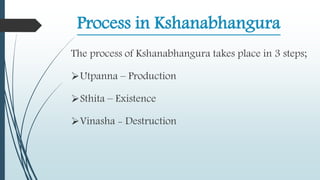
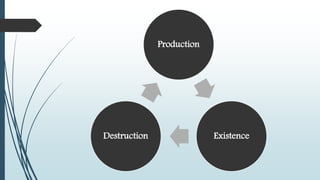
The process of Kshanabhangura takes place in 3 steps;
Utpanna – Production
Sthita – Existence
Vinasha - Destruction
Production
Existence
Destruction
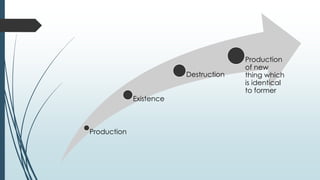
Production
Existence
Destruction
Production
of new
thing which
is identical
to former
Opinion of Bouddha Darshana
Bouddha Darshana states that some cause is there for creation
or production of matter.
But there is no such cause for its destruction. Destruction is
natural phenomenon.
The human life is also momentary like a bubble of water
“Jeevitam Budbudam Prayam”, which lasts only for a moment.
The objects produced get changes in every moment very
fastly, which cannot be visible. Hence it looks like as it is in
previous form. But it is not true.
The production, existence and destruction of all the objects is
continuous process forever.
Opinion of Acharya Charaka
Acharya Charaka accepted kshanabhanguravada and based
on this theory he framed SWABHAVOPARAMAVADA, which
is identical with Kshanabhanguravada.
Acharya Charaka presents this theory describing that there is
no permanent entities as such. They appear to be so because
they are similar. As a matter of fact, they are produced a fresh
each time, consequently.
Acharya Charaka also states that increase and decrease of
Dhatus of the Shareera takes place continuously forever
because of Samanya Visesha Siddhanta.
There is a cause for production of Bhava Padarthas, but there
is no cause for the destruction.
Ahara Rasa is the cause for the production of Rasadi Dhatu.
But there is no such cause for their destruction. Destruction
takes place naturally.
The Shareera undergoes destruction every fraction of second
i.e., the wear and tear phenomena goes forvever in the body.
Ahara is the cause for the Wear phenomena but the tear
phenomena i.e., Uparama (destruction) is natural.
If it is seen scientifically, it can be concluded briefly that the
wear and tear phenomena goes on forever in the body.
Example: R.B.C’s in the blood which is produced through the
food, gets destructed naturally in 120 days. This theory of
modern science is identical with Swabhavoparama Vada.
Body cells are destroyed continuously and produce new one
which are similar to them.
For example; cell of the eye of a person aged about 50 years are
not the same which were at the age of 5 years, but the knowledge
acquired at the age of 5 years (childhood) remains lifelong with
person. Such examples prove that at least 2 entities remain in the
body one of is temporary and the other is permanent nature.
It proves that there is the existence of a permanent entity known
as a Purusha apart from the transient physical manifestations.
Conclusion
The Shareera undergoes destruction every fraction
of second, so Ayurveda has given more importance to
Shareera Paripalana to attain the Purusharthas.
THANK YOU

KSHANABHANGURA VADA

  • 1.
  • 2.
    BRIEF NOTE ON BOUDDHADARSHANA The Buddhist philosophy is divided into two categories according to their thought and principles. Heena Yana Maha Yana
  • 3.
    Four groups of BuddhistPhilosophers Four groups of Buddhist philosophers are seen in Buddhist literature according to the differences in the evolutive process of universe, like;  “The Shunya Vada” of Madhyamikas  “The Vigyana Vada” of Yogachara  “The Bahyanumeya Vada” of Soutrantikas  “The Kshana Bhangura Vada” of Vaibhashikas.
  • 4.
  • 5.
    INTRODUCTION It is oneof the important theory of Bouddha Darshana. Kshana = fraction of a second Bhangura = destructed Kshana Bhangura = destroyed in a moment According to this theory, all the worldly substances are destroyed within moment and cannot exist for more than a fraction of a second.
  • 6.
    This is acontinuous process without a break. Each substance exists only for a transient period. For example, the wave in the ocean destroys soon after it appears and the another new wave takes its place. In the same way different factors are destroyed soon and the new one is developed.
  • 7.
    Uddhesha According to thisVada, everything of this universe is not static and eternal. Instead everything is momentary. Everything is produced in the first moment and exist in the second moment and get destruct in the next moment.
  • 8.
    Process in Kshanabhangura Theprocess of Kshanabhangura takes place in 3 steps; Utpanna – Production Sthita – Existence Vinasha - Destruction
  • 9.
  • 10.
  • 11.
    Opinion of BouddhaDarshana Bouddha Darshana states that some cause is there for creation or production of matter. But there is no such cause for its destruction. Destruction is natural phenomenon. The human life is also momentary like a bubble of water “Jeevitam Budbudam Prayam”, which lasts only for a moment.
  • 12.
    The objects producedget changes in every moment very fastly, which cannot be visible. Hence it looks like as it is in previous form. But it is not true. The production, existence and destruction of all the objects is continuous process forever.
  • 13.
    Opinion of AcharyaCharaka Acharya Charaka accepted kshanabhanguravada and based on this theory he framed SWABHAVOPARAMAVADA, which is identical with Kshanabhanguravada. Acharya Charaka presents this theory describing that there is no permanent entities as such. They appear to be so because they are similar. As a matter of fact, they are produced a fresh each time, consequently.
  • 14.
    Acharya Charaka alsostates that increase and decrease of Dhatus of the Shareera takes place continuously forever because of Samanya Visesha Siddhanta. There is a cause for production of Bhava Padarthas, but there is no cause for the destruction. Ahara Rasa is the cause for the production of Rasadi Dhatu. But there is no such cause for their destruction. Destruction takes place naturally.
  • 15.
    The Shareera undergoesdestruction every fraction of second i.e., the wear and tear phenomena goes forvever in the body. Ahara is the cause for the Wear phenomena but the tear phenomena i.e., Uparama (destruction) is natural. If it is seen scientifically, it can be concluded briefly that the wear and tear phenomena goes on forever in the body. Example: R.B.C’s in the blood which is produced through the food, gets destructed naturally in 120 days. This theory of modern science is identical with Swabhavoparama Vada.
  • 16.
    Body cells aredestroyed continuously and produce new one which are similar to them. For example; cell of the eye of a person aged about 50 years are not the same which were at the age of 5 years, but the knowledge acquired at the age of 5 years (childhood) remains lifelong with person. Such examples prove that at least 2 entities remain in the body one of is temporary and the other is permanent nature. It proves that there is the existence of a permanent entity known as a Purusha apart from the transient physical manifestations.
  • 17.
    Conclusion The Shareera undergoesdestruction every fraction of second, so Ayurveda has given more importance to Shareera Paripalana to attain the Purusharthas.
  • 18.